EP4039690A1 - A substantially diastereomerically pure phosphoramidochloridate, a method and a pharmaceutical composition - Google Patents
A substantially diastereomerically pure phosphoramidochloridate, a method and a pharmaceutical composition Download PDFInfo
- Publication number
- EP4039690A1 EP4039690A1 EP21210674.4A EP21210674A EP4039690A1 EP 4039690 A1 EP4039690 A1 EP 4039690A1 EP 21210674 A EP21210674 A EP 21210674A EP 4039690 A1 EP4039690 A1 EP 4039690A1
- Authority
- EP
- European Patent Office
- Prior art keywords
- compound
- formula
- diastereomerically pure
- optionally substituted
- pure
- Prior art date
- Legal status (The legal status is an assumption and is not a legal conclusion. Google has not performed a legal analysis and makes no representation as to the accuracy of the status listed.)
- Granted
Links
Images


Classifications
-
- A—HUMAN NECESSITIES
- A61—MEDICAL OR VETERINARY SCIENCE; HYGIENE
- A61K—PREPARATIONS FOR MEDICAL, DENTAL OR TOILETRY PURPOSES
- A61K31/00—Medicinal preparations containing organic active ingredients
- A61K31/70—Carbohydrates; Sugars; Derivatives thereof
- A61K31/7088—Compounds having three or more nucleosides or nucleotides
- A61K31/7125—Nucleic acids or oligonucleotides having modified internucleoside linkage, i.e. other than 3'-5' phosphodiesters
-
- A—HUMAN NECESSITIES
- A61—MEDICAL OR VETERINARY SCIENCE; HYGIENE
- A61K—PREPARATIONS FOR MEDICAL, DENTAL OR TOILETRY PURPOSES
- A61K31/00—Medicinal preparations containing organic active ingredients
- A61K31/70—Carbohydrates; Sugars; Derivatives thereof
- A61K31/7088—Compounds having three or more nucleosides or nucleotides
- A61K31/713—Double-stranded nucleic acids or oligonucleotides
-
- C—CHEMISTRY; METALLURGY
- C07—ORGANIC CHEMISTRY
- C07F—ACYCLIC, CARBOCYCLIC OR HETEROCYCLIC COMPOUNDS CONTAINING ELEMENTS OTHER THAN CARBON, HYDROGEN, HALOGEN, OXYGEN, NITROGEN, SULFUR, SELENIUM OR TELLURIUM
- C07F9/00—Compounds containing elements of Groups 5 or 15 of the Periodic Table
- C07F9/02—Phosphorus compounds
- C07F9/547—Heterocyclic compounds, e.g. containing phosphorus as a ring hetero atom
- C07F9/6558—Heterocyclic compounds, e.g. containing phosphorus as a ring hetero atom containing at least two different or differently substituted hetero rings neither condensed among themselves nor condensed with a common carbocyclic ring or ring system
- C07F9/65583—Heterocyclic compounds, e.g. containing phosphorus as a ring hetero atom containing at least two different or differently substituted hetero rings neither condensed among themselves nor condensed with a common carbocyclic ring or ring system each of the hetero rings containing nitrogen as ring hetero atom
-
- C—CHEMISTRY; METALLURGY
- C07—ORGANIC CHEMISTRY
- C07F—ACYCLIC, CARBOCYCLIC OR HETEROCYCLIC COMPOUNDS CONTAINING ELEMENTS OTHER THAN CARBON, HYDROGEN, HALOGEN, OXYGEN, NITROGEN, SULFUR, SELENIUM OR TELLURIUM
- C07F9/00—Compounds containing elements of Groups 5 or 15 of the Periodic Table
- C07F9/02—Phosphorus compounds
- C07F9/547—Heterocyclic compounds, e.g. containing phosphorus as a ring hetero atom
- C07F9/6561—Heterocyclic compounds, e.g. containing phosphorus as a ring hetero atom containing systems of two or more relevant hetero rings condensed among themselves or condensed with a common carbocyclic ring or ring system, with or without other non-condensed hetero rings
- C07F9/65616—Heterocyclic compounds, e.g. containing phosphorus as a ring hetero atom containing systems of two or more relevant hetero rings condensed among themselves or condensed with a common carbocyclic ring or ring system, with or without other non-condensed hetero rings containing the ring system having three or more than three double bonds between ring members or between ring members and non-ring members, e.g. purine or analogs
-
- C—CHEMISTRY; METALLURGY
- C07—ORGANIC CHEMISTRY
- C07H—SUGARS; DERIVATIVES THEREOF; NUCLEOSIDES; NUCLEOTIDES; NUCLEIC ACIDS
- C07H1/00—Processes for the preparation of sugar derivatives
-
- C—CHEMISTRY; METALLURGY
- C07—ORGANIC CHEMISTRY
- C07H—SUGARS; DERIVATIVES THEREOF; NUCLEOSIDES; NUCLEOTIDES; NUCLEIC ACIDS
- C07H21/00—Compounds containing two or more mononucleotide units having separate phosphate or polyphosphate groups linked by saccharide radicals of nucleoside groups, e.g. nucleic acids
- C07H21/02—Compounds containing two or more mononucleotide units having separate phosphate or polyphosphate groups linked by saccharide radicals of nucleoside groups, e.g. nucleic acids with ribosyl as saccharide radical
-
- A—HUMAN NECESSITIES
- A61—MEDICAL OR VETERINARY SCIENCE; HYGIENE
- A61K—PREPARATIONS FOR MEDICAL, DENTAL OR TOILETRY PURPOSES
- A61K31/00—Medicinal preparations containing organic active ingredients
- A61K31/70—Carbohydrates; Sugars; Derivatives thereof
- A61K31/7088—Compounds having three or more nucleosides or nucleotides
-
- C—CHEMISTRY; METALLURGY
- C07—ORGANIC CHEMISTRY
- C07B—GENERAL METHODS OF ORGANIC CHEMISTRY; APPARATUS THEREFOR
- C07B2200/00—Indexing scheme relating to specific properties of organic compounds
- C07B2200/07—Optical isomers
-
- C—CHEMISTRY; METALLURGY
- C07—ORGANIC CHEMISTRY
- C07H—SUGARS; DERIVATIVES THEREOF; NUCLEOSIDES; NUCLEOTIDES; NUCLEIC ACIDS
- C07H21/00—Compounds containing two or more mononucleotide units having separate phosphate or polyphosphate groups linked by saccharide radicals of nucleoside groups, e.g. nucleic acids
Definitions
- Embodiments may relate to preparation of substantially diastereomerically pure activated monomers that are phosphoramidochloridate morpholino subunits. Embodiments may also relate to use of substantially diastereomerically pure activated phosphorylated morpholino monomers for preparation of molecules through stereospecific coupling reactions.
- Embodiments may provide one or more stereochemically pure or substantially stereochemically pure compounds of Table 1. Further embodiments may also provide enantiomers of the compounds of Table 1. Typically the stereochemistry of those enantiomers varies from that of the compounds of Table 1 by the alteration of the stereochemistry of the morpholino ring. TABLE 1 Compound Formula # 20 21 22 23 24 25 26 27 28 29 30 31
- R 1 and R 2 may be the same or different, and may be -H, optionally substituted C1-C3 alkyl, optionally substituted phenyl, optionally substituted naphthyl, or, with the nitrogen to which they are attached, form an optionally substituted heterocycle, which may be, for example, pyrrolidine, piperazine, or morpholine.
- Optionally substituted moieties may be substituted with one or more of methyl, ethyl, halogen, nitro, methoxy, or cyano.
- R 3 may be trityl (Tr), which may be substituted trityl, including but not limited to such as MMTr (p-methoxyphenyldiphenylmethyl), optionally substituted benzyl, 4-methoxybenzyl (PMB, MPM), 3,4-dimethoxybenzyl, diphenylmethyl (Dpm), , or sulfonyl, which may be a cleavable sulfonyl.
- sulfonyl is 2-nitrobenzenesulfonyl, 4-nitrobenzenesulfonyl, or 2,4-dinitrobenzenesulfonyl.
- R 4 , R 5 , R 6 may be -H, -C(O)R 7 , or -C(O)OR 7 , where R 7 is alkyl (methyl, ethyl, isopropyl, or other C1-C6 alkyl), benzyl, 2,2,2-trichloroethyl, or aryl (including but not limited to phenyl, 4-methoxy phenyl, 4-bromophenyl, and 4-nitrophenyl).
- R 9 may be optionally substituted alkyl, cyanoethyl, acyl, carbonate, carbamate, optionally substituted benzyl, 4-pivaloyloxy benzyl, and silyl.
- morpholino nucleosides in addition to those shown in Table 1 may be prepared in diastereomerically pure or substantially diastereomerically pure form.
- Embodiments may also provide methods for separation of diastereomeric mixtures of the above-disclosed compounds into stereochemically pure or substantially stereochemically pure compounds. Further embodiments may provide pharmaceutical compositions comprising stereochemically pure or substantially stereochemically pure compounds as reported herein. Further embodiments may provide pharmaceutical compositions comprising pharmaceutically acceptable salts of stereochemically pure or substantially stereochemically pure compounds as reported herein. Pharmaceutical compositions may be administered in effective amounts to patients in need of treatment. Pharmaceutical compositions may further include pharmaceutically acceptable carriers.
- each of the compounds of Table 1 may be substituted at positions a, b, and e with one or two methyl groups, and may be substituted at positions c and d with one methyl group.
- the methyl group may be oriented on either side of the plan of the morpholino ring.
- an additional methylene, optionally substituted with one or more methyl groups may be inserted adjacent to the nitrogen in the morpholino group to allow for expansion to a seven-membered ring.
- Embodiments further provide for preparation of stereochemically pure oligonucleotides through stereospecific coupling of activated monomers. Further embodiments provide substantially diastereomerically pure oligomer made by stereospecific coupling of activated monomers. Still further embodiments provide substantially diastereomerically pure compositions comprising substantially diastereomerically pure compounds as reported herein.
- Embodiments may also provide methods for separation of diastereomeric mixtures of the above-disclosed compounds into stereochemically pure or substantially stereochemically pure compounds. Once separated, the pure diastereomers from the formerly diastereomeric mixture may be used to prepare diastereomerically pure compounds through stereospecific coupling reactions.
- Diastereomerically pure compounds and substantially diastereomerically pure compounds prepared as set forth herein may be diastereomerically pure phosphorodiamidate oligonucleotides. These diastereomerically pure and substantially diastereomerically pure phosphorodiamidate oligonucleotides may have multiple uses. For example, they may be useful as pharmaceuticals. They may be selected for properties that are potentially superior to those of heterogeneous mixtures (stereo-random mixtures) of diastereomers of phosphorodiamidate oligonucleotides. For example, they may be selected for differences in potency, efficacy, stability, safety, and specificity. Diastereomerically pure and substantially diastereomerically pure oligomers may have physical, chemical, and biological properties that differ from those of stereochemically heterogeneous mixtures of oligomers.
- Stepoisomers refers to isomers that differ only in the arrangement of the atoms in space.
- Stereomers refers to stereoisomers that are not mirror images of each other.
- Enantiomers refers to stereoisomers that are non-superimposable mirror images of one another. Enantiomers include “enantiomerically pure” isomers that comprise substantially a single enantiomer, for example, greater than or equal to 90%, 92%, 95%, 98%, or 99%, or equal to 100% of a single enantiomer.
- Activated monomer refers to 5'-O-phosphorylated morpholino subunits that bear reactive phosphorous having leaving groups, including but not limited to chloride and halide leaving groups, that undergo displacement reaction with nucleophiles, including but not limited to amines and alcohols.
- R and S as terms describing isomers are descriptors of the stereochemical configuration at asymmetrically substituted atoms, including but not limited to: carbon, sulfur, phosphorous and ammonium nitrogen.
- the designation of asymmetrically substituted atoms as “R” or “S” is done by application of the Cahn-Ingold-Prelog priority rules, as are well known to those skilled in the art, and described in the International Union of Pure and Applied Chemistry (IUPAC) Rules for the Nomenclature of Organic Chemistry. Section E, Stereochemistry.
- An enantiomer can be characterized by the direction in which it rotates the plane of plane polarized light, as is well known to those in the chemical arts. If it rotates the light clockwise (as seen by a viewer towards whom the light is traveling), that enantiomer is labeled (+), and is denoted dextrorotatory. Its mirror-image will rotate plane polarized light in a counterclockwise direction, and is labeled (-), or levorotatory.
- the direction of rotation of plane polarized light by an enantiomerically pure compound, termed the sign of optical rotation may be readily measured in standard device known as a polarimeter.
- Racemic refers to a mixture containing equal parts of individual enantiomers.
- Non-racemic refers to a mixture containing unequal parts of individual enantiomers.
- a non-racemic mixture may be enriched in the R- or S-configuration, including, without limitation, about 50/50, about 60/40, and about 70/30 R- to S-enantiomer, or S- to R-enantiomer, mixtures.
- substantially stereochemically pure and substantially stereochemical purity refer to enantiomers or diastereomers that are in enantiomeric excess or diastereomeric excess, respectively, equal to or greater than 80%.
- substantially stereochemically pure and substantially stereochemical purity refer to enantiomers or diastereomers that are in enantiomeric excess or diastereomeric excess, respectively, equal to or greater than 87%, equal to or greater than 90%, equal to or greater than 95%, equal to or greater than 96%, equal to or greater than 97%, equal to or greater than 98%, or equal to or greater than 99%.
- Substantially Diastereomerically Pure refers to diastereomers that are in diastereomeric excess equal to or greater than 87%, equal to or greater than 90%, equal to or greater than 95%, equal to or greater than 96%, equal to or greater than 97%, equal to or greater than 98%, or equal to or greater than 99%.
- Enantiomeric excess (ee) of an enantiomer is [(the mole fraction of the major enantiomer) minus the (mole fraction of the minor enantiomer)] ⁇ 100.
- Diastereomeric excess (de) of a diastereomer in a mixture of two diastereomers is defined analogously.
- “Pharmaceutically acceptable salt” as used herein refers to acid addition salts or base addition salts of the compounds in the present disclosure.
- a pharmaceutically acceptable salt is any salt which retains the activity of the parent compound and does not impart any unduly deleterious or undesirable effect on a subject to whom it is administered and in the context in which it is administered.
- Pharmaceutically acceptable salts include, but are not limited to, metal complexes and salts of both inorganic and carboxylic acids.
- Pharmaceutically acceptable salts also include metal salts such as aluminum, calcium, iron, magnesium, manganese and complex salts.
- salts include, but are not limited to, acid salts such as acetic, aspartic, alkylsulfonic, arylsulfonic, axetil, benzenesulfonic, benzoic, bicarbonic, bisulfuric, bitartaric, butyric, calcium edetate, camsylic, carbonic, chlorobenzoic, citric, edetic, edisylic, estolic, esyl, esylic, formic, fumaric, gluceptic, gluconic, glutamic, glycolic, glycolylarsanilic, hexamic, hexylresorcinoic, hydrabamic, hydrobromic, hydrochloric, hydroiodic, hydroxynaphthoic, isethionic, lactic, lactobionic, maleic, malic, malonic, mandelic, methanesulfonic, methylnitric, methylsulfur
- an “effective amount” of a combination of therapeutic agents is an amount sufficient to provide an observable therapeutic benefit compared to HCC or IHCC left untreated in a subject or patient.
- Active agents as reported herein can be combined with a pharmaceutically acceptable carrier to provide pharmaceutical formulations thereof.
- a pharmaceutically acceptable carrier to provide pharmaceutical formulations thereof.
- the particular choice of carrier and formulation will depend upon the particular route of administration for which the composition is intended.
- “Pharmaceutically acceptable carrier” refers to a nontoxic carrier, adjuvant, or vehicle that does not destroy the pharmacological activity of the compound with which it is formulated.
- Pharmaceutically acceptable carriers, adjuvants or vehicles that may be used in the compositions of this invention include, but are not limited to, sorbic acid, potassium sorbate, partial glyceride mixtures of saturated vegetable fatty acids, water, salts or electrolytes, disodium hydrogen phosphate, potassium hydrogen phosphate, sodium chloride, zinc salts, colloidal silica, magnesium trisilicate, polyvinyl pyrrolidone, cellulose-based substances, polyethylene glycol, sodium carboxymethylcellulose, polyacrylates, waxes, polyethylene glycol and wool fat.
- compositions of the present invention may be suitable for parenteral, oral, inhalation spray, topical, rectal, nasal, buccal, vaginal or implanted reservoir administration, etc.
- the formulation comprises ingredients that are from natural or non-natural sources.
- the formulation or carrier may be provided in a sterile form.
- Non-limiting examples of a sterile carrier include endotoxin-free water or pyrogen-free water.
- parenteral includes subcutaneous, intravenous, intramuscular, intra-articular, intra-synovial, intrasternal, intrathecal, intrahepatic, intralesional and intracranial injection or infusion techniques.
- the compounds are administered intravenously, orally, subcutaneously, or via intramuscular administration.
- Sterile injectable forms of the compositions of this invention may be aqueous or oleaginous suspension. These suspensions may be formulated according to techniques known in the art using suitable dispersing or wetting agents and suspending agents.
- the sterile injectable preparation may also be a sterile injectable solution or suspension in a nontoxic parenterally acceptable diluent or solvent.
- the acceptable vehicles and solvents that may be employed are water, Ringer's solution and isotonic sodium chloride solution.
- sterile, fixed oils are conventionally employed as a solvent or suspending medium.
- Embodiments of the invention provide for preparation of stereochemically pure isomers or substantially stereochemically pure isomers, followed by use of the pure isomers to stereospecifically prepare diastereomerically pure phosphorodiamidate morpholino oligomers (PMOs). Preparation may be by separation of the diastereomeric mixture of phosphoramidochloridate nucleotides. Separation may be made by, for example, chromatography; for example, high performance liquid chromatography or "HPLC.” Separation may also be accomplished through crystallization.
- active monomers Separated monomers may be referred to as “active” monomers.
- active it is meant that the monomers include phosphoramidochloridate moiety that is reactive towards a variety of nucleophiles, which include but not limited to: amines, alcohols/alkoxides, thiol/thiolate, alkyllithium, and Grignard reagents.
- stereochemically pure or substantially stereochemically pure activated monomers may be prepared by separation of a diastereomeric mixture of monomers. Separation may be accomplished by methods that permit distinction of stereoisomers using physical properties. For example, separation may be accomplished through chromatography or crystallization. Suitable types of chromatography include, for example, but are not limited to high performance liquid chromatography (HPLC), simulated moving bed chromatography, countercurrent chromatography, and other types of separative chromatography. For example, a diastereomeric mixture may be subjected to HPLC, eluting a fast-moving fraction and a slowmoving fraction. Each of these fractions is a different stereochemically pure or substantially stereochemically pure amount of a monomer. As described below, these monomers may be used to prepare oligomers with desired stereochemistry through stereospecific coupling using controlled reaction conditions.
- stereochemically pure activated monomers have sufficient stability for use in further chemical reactions. Furthermore, we have determined that the stereochemically pure activated monomers can undergo stereospecific chemical reactions. Thus, as discussed in more detail below, these stereochemically pure activated monomers may be used for stereospecific coupling reactions to prepare stereochemically pure products.
- embodiments may provide one or more stereochemically pure or substantially stereochemically pure compounds of Table 1, which may be prepared by taking advantage of different physical properties in the stereoisomers. Further embodiments may also provide enantiomers of the compounds of Table 1. Typically the stereochemistry of those enantiomers varies from that of the compounds of Table 1 by the alteration of the stereochemistry of the morpholino ring.
- R3 is optionally substituted triphenylmethyl (also referred to as "trityl”), optionally substituted benzyl, or sulfonyl.
- R4, R5, and R6 may be -C(O)R7 or -C(O)OR8, where R7 is methyl, ethyl, or phenyl, and R8 is benzyl or 2,2,2-trichloroethyl.
- R 9 may be optionally substituted alkyl, cyanoethyl (for use as a protecting group see, for example, U.S. Patent Application Pub. No. US2013/0197220 ), acyl, sulfonyl, acetal/ketal, carbonate, carbamate, optionally substituted benzyl, 4-pivaloyloxy benzyl, and silyl.
- the optionally substituted benzyl is 4-methoxybenzyl (PMB, MPM).
- sulfonyl is a cleavable sulfonyl.
- sulfonyl is 2-nitrobenzenesulfonyl, 4-nitrobenzenesulfonyl, or 2,4-dinitrobenzenesulfonyl.
- R1 and R2 may be the same or different, and may be -H, optionally substituted C1-C3 alkyl, optionally substituted phenyl, optionally substituted naphthyl, or, with the nitrogen to which they are attached, form an optionally substituted heterocycle, which may be, for example, pyrrolidine, piperazine, or morpholine.
- Optionally substituted moieties may be substituted with one or more of methyl, ethyl, halogen, nitro, or cyano.
- R3 may be trityl (Tr), which may be substituted trityl, including but not limited to such as MMTr (p-methoxyphenyldiphenylmethyl), benzyl, 4-methoxybenzyl (PMB, MPM), and 3,4-dimethoxybenzyl, diphenylmethyl (Dpm),
- Tr trityl
- MMTr p-methoxyphenyldiphenylmethyl
- PMB 4-methoxybenzyl
- Dpm 3,4-dimethoxybenzyl, diphenylmethyl
- R4, R5, R6 may be -H, -C(O)R 7 , or -C(O)OR7, where R7 is alkyl (methyl, ethyl, isopropyl, or other C1-C6 alkyl) or aryl (including but not limited to phenyl, 4-methoxy phenyl, 4-bromophenyl, and 4-nitrophenyl).
- Typical reaction conditions for stereospecific coupling include reaction in aprotic solvents.
- solvents may be, for example, but are not limited to, acetonitrile, tetrahydrofuran (THF), 1,3-dimethylimidazolidinone (DMI), dimethylformamide (DMF), N-methyl-2-pyrrolidinone (NMP), dimethylacetamide (DMAc), dichloromethane (DCM), 1,2-dichloroethane (DCE), chloroform, 1,4-dioxane, ethyl acetate, 2-methyltetrahydrofuran, and isopropyl acetate.
- THF tetrahydrofuran
- DMI 1,3-dimethylimidazolidinone
- DMF dimethylformamide
- NMP N-methyl-2-pyrrolidinone
- DMAc dimethylacetamide
- DCM dichloromethane
- DCE 1,2-dichloroethane
- chloroform
- Coupling reactions may be conducted in the presence of non-nucleophilic tertiary amine bases and aromatic bases.
- Suitable bases include, but are not limited to, diisopropylethylamine, triethylamine, 2,6-lutidine, trimethylpyridines (collidines), and N-ethylmorpholine.
- Reaction temperatures may range from room temperature (about 20 °C) to 50° C. Sonication may be applied in some cases to help dissolution of substrate(s).
- Chiralpak IC eluted at 15 ml/minute with 75% ethyl acetate and 25% n-heptane. Room temperature and uv 260nm detection.
- a 1 (5.9 mg, 0.008 mmol) was suspended in acetonitrile (118 ⁇ L). Diisopropylethylamine (5 ⁇ L, 0.03 mmol) was added followed by morpholino-uracil (1; 4.6 mg, 0.01 mmol). Sonication was applied for 1min and resultant homogeneous mixture was stirred at ambient temperature. After overnight stirring, the mixture (thick white paste) was diluted with a mixture of acetonitrile (5.0 ml) and methanol (0.30 ml) to give homogeneous clear solution. A small aliquot was directly analyzed by HPLC without further dilution.
- Diastereomerically substantially pure compounds as reported above may be used to prepare stereochemically pure oligonucleotides and other compounds. Examples of potential oligonucleotides are shown, for example, in Summerton, J (1999). "Morpholino Antisense Oligomers: The Case for an RNase-H Independent Structural Type.”. Biochimica et Biophysica Acta 1489 (1): 141-58 ; and in Summerton, J; Weller D. (1997). "Morpholino Antisense Oligomers: Design, Preparation and Properties". Antisense & Nucleic Acid Drug Development 7 (3): 187-95 . Both of those documents are incorporated by reference herein.
- This example reports a synthesis that targets a pair of stereopure 16-mer PMOs through stereospecific coupling using activated monomers. These PMOs have opposite stereochemical arrays for their phosphorous linkages.
- Stereopure active monomers (building blocks): Target PMOs Stereopure active monomers used for coupling Stereoisomer 1 A 2 , C 2 , G 1 and T 1 Stereoisomer 2 A 1 , C 1 , G 2 and T 2
- FIG. 6 A scheme for stereospecific synthesis of 16-mer PMOs and differentiation of stereoisomers by biophysical assay is shown in FIG. 6 .
- the 16-mer PMO stereoisomers 1 and stereoisomer 2 were prepared manually by solid-phase synthesis on aminomethylpolystyrene-disulfide resin ( ⁇ 300 ⁇ mol/g loading, see U.S. Patent App. Pub. No. 20090131624A1 , which is incorporated by reference herein) at 50 mg scale (starting resin weight).
- Reverse phase preparative HPLC method for PMO purification HPLC column XBridge Prep C8 OBD column , 9 ⁇ 150 mm, 5 ⁇ m Column temperature ambient temperature Flow rate 30.0 ml/min Gradient Time (min) %A %B Initial 85 15 18 80 20 20 0 100 Mobile phase Solvent A: 15mM Triethylammonium acetate (TEAA) buffer pH7 + 10% MeOH Solvent B: acetonitrile + 10% MeOH Diluting solution 15 mM TEAA buffer Run time 20 min Detection UV 260 nm Retention time Stereoisomer 1 13.98 min Stereoisomer 2 14.03 min
- Tm Melting Temperature
- RNA (16-mer) 5'-UUCCUUGAUGUUGGAG-3' Diluting buffer 10 mM Sodium Phosphate, 100 mM NaCl, 0.1 mM EDTA, pH 7.0 (adjusted with phosphoric acid)
- Stock solutions 8 ⁇ M in 250 ⁇ L buffer of each sample and complimentary RNA were prepared using the Dilution buffer from samples concentrated and dried by vacuum centrifugation Procedure • Each sample was then mixed with an equivalent volume of 8 ⁇ M complimentary RNA • The mixtures were heated to 95 °C and then cooled to 25 °C for annealment prior to the Tm measurement.
- Tm analysis (UV 260 nm) was conducted from 25 °C to 105 °C at 0.5 °C/min (with the temperature returning to starting conditions after each run) and then repeated under the same conditions.
- Tm Analysis software (Shimadzu) was used to calculate the Tm usinq the "averaging" function.
- Late-eluting active A monomer ( A 2 ; 200 mg, 0.277 mmol, 1 eq) was dissolved in a mixture of acetonitrile (2.0 ml) and DIPEA (0.12 ml, 0.69 mmol, 2.5 eq). T-morpholine-NH (1; 146 mg, 0.305 mmol, 1.1 eq) was then added and resultant suspension was sonicated for a few minutes until a clear solution was obtained. The reaction mixture was stirred at room temperature overnight. Upon complete reaction monitored by LC/MS, the mixture was concentrated and subjected to column chromatography (3% methanol in DCM, Biotage SnapUltra 10 g SiO 2 ). Clean product fractions were combined and concentrated under vacuum to give the fully protected stereopure 5'-TA-3' dinucleotide 2 as a white solid (240 mg, 0.206 mmol, 74% yield).
- the crude product was purified by column chromatography (20% MeOH in acetone, Biotage Snap Ultra 25 g SiO 2 cartridge) to give the partially protected dinucleotide 3 as a glassy solid (300 mg, 0.325 mmol, 76% yield).
- the partially protected dinucleotide 3 (250 mg, 0.271 mmol) was dissolved in a mixture of methanol (12.5 ml) and THF (12.5 mL) and treated with 1 M NaOH (10.8 ml) at room temperature. After stirring at room temperature for 22 h (progress monitored by LC/MS), the mixture was neutralized with 1 M HCl (10.8 mL) to adjust pH at 8 and then concentrated under vacuum to dryness. The residue was dissolved in water (5 mL) and washed with EtOAc (5 mL). The aqueous layer was concentrated under vacuum to dryness to give crude product as white solid (480 mg).
- a single crystal of Compound 100 (C 22 H 33 N 10 O 7 P) was mounted on a glass fiber. All measurements were made on a diffractometer using graphite monochromated Cu-K ⁇ radiation.
- the linear absorption coefficient, ⁇ , for Cu-K ⁇ radiation is 6.011 cm -1 .
- An empirical absorption correction was applied that resulted in transmission factors ranging from 0.341 to 1.000.
- the data were corrected for Lorentz and polarization effects.
- the structure was solved by direct methods ( SHELXT Version 2014/5: Sheldrick, G. M. (2014). Acta Cryst. A70, C1437 ) and expanded using Fourier techniques.
- the non-hydrogen atoms were refined anisotropically.
- Hydrogen atoms were refined using the riding model.
- Crystal data, intensity measurements, and structure solution and refinement were as shown below: A. Crystal Data Empirical Formula C 22 H 33 N 10 O 7 P Formula Weight 580.54 Crystal Color, Habit nONE, nONE Crystal Dimensions not described Crystal System monoclinic Lattice Type C-centered No.
- Variables 849 Reflection/Parameter Ratio 14.14 Residuals: R1 (I>2.00 ⁇ (I)) 0.0522 Residuals: R (All reflections) 0.0534 Residuals: wR2 (All reflections) 0.1632 Goodness of Fit Indicator 1.450 Flack parameter (Parsons' quotients 4813) 0.029(7) Max Shift/Error in Final Cycle 0.001 Maximum peak in Final Diff. Map 1.79 e - / ⁇ 3 Minimum peak in Final Diff. Map -0.69 e - / ⁇ 3
- Additional aspect of the invention include:-
- a substantially diastereomerically pure compound selected from the group consisting of the compound of Formula 20, the compound of Formula 21, the compound of Formula 22, the compound of Formula 23, the compound of Formula 24, the compound of Formula 25, the compound of Formula 26, the compound of Formula 27, the compound of Formula 28, the compound of Formula 29, the compound of Formula 30, and the compound of Formula 31, Compound Formula # 20 21 22 23 24 25 26 27 28 29 30 31
- A2 The compound of A1, wherein the sulfonyl is a cleavable sulfonyl selected from the group consisting of 2-nitrobenzenesulfonyl, 4-nitrobenzenesulfonyl, and 2,4-dinitrobenzenesulfonyl.
- R4, R5, and R6 are selected from the group consisting of phenyl, 4-methoxy phenyl, 4-bromophenyl, and 4-nitrophenyl.
- a method for preparing a stereochemically pure oligonucleotide comprising reacting substantially diastereomerically pure compounds of A1.
- a method for preparing a substantially diastereomerically pure oligomer comprising:
Landscapes
- Chemical & Material Sciences (AREA)
- Health & Medical Sciences (AREA)
- Organic Chemistry (AREA)
- Life Sciences & Earth Sciences (AREA)
- Molecular Biology (AREA)
- Biochemistry (AREA)
- General Health & Medical Sciences (AREA)
- Engineering & Computer Science (AREA)
- Genetics & Genomics (AREA)
- Biotechnology (AREA)
- Medicinal Chemistry (AREA)
- Veterinary Medicine (AREA)
- Public Health (AREA)
- Animal Behavior & Ethology (AREA)
- Epidemiology (AREA)
- Pharmacology & Pharmacy (AREA)
- Pharmaceuticals Containing Other Organic And Inorganic Compounds (AREA)
- Saccharide Compounds (AREA)
- Nitrogen And Oxygen Or Sulfur-Condensed Heterocyclic Ring Systems (AREA)
- Organic Low-Molecular-Weight Compounds And Preparation Thereof (AREA)
- Heterocyclic Compounds That Contain Two Or More Ring Oxygen Atoms (AREA)
- Medicines That Contain Protein Lipid Enzymes And Other Medicines (AREA)
Abstract
Description
- This application claims priority to
United States Provisional Patent Application No. 62/201,510, filed on August 5, 2015 - Embodiments may relate to preparation of substantially diastereomerically pure activated monomers that are phosphoramidochloridate morpholino subunits. Embodiments may also relate to use of substantially diastereomerically pure activated phosphorylated morpholino monomers for preparation of molecules through stereospecific coupling reactions.
- Synthesis of diastereomerically pure phosphorodiamidate oligonucleotides is substantially complicated by the existence of chiral phosphorous linkages. This is contrasted with, for example, phosphodiester linkages, which do not have a chiral phosphorous. Examples may be seen in
FIG. 1 , which compares phosphodiester, phosphorothioate (which also includes a chiral phosphorous), and phosphorodiamidate - The existence of the chiral phosphorous presents substantial challenges to synthetic routes that involve connection of a series of phosphorodiamidate nucleotides. Lack of stereochemically pure reagents (templates, subunits, building blocks) that enable stereospecific formation of phosphorodiamidate linkages leads to reaction at the stereocenter in which the phosphorus chirality of the resulting compound may not be controlled.
- As shown graphically in
FIG. 2 , the use of diastereomeric mixtures of nucleotides for stereochemically uncontrolled coupling to prepare an oligonucleotide of any significant length and sequence creates a heterogeneous mixture of many diastereomers. The number of diastereomers is theoretically 2(n-1), where n is the number of nucleotides that are connected to form the oligonucleotide. As shown inFIG. 2 , even a modest four-nucleotide oligonucleotide (tetranucleotide) can result in formation of a mixture of eight separate diastereomers. - Formation of a significant number of diastereomers can create the need for sensitive separation techniques following synthesis. Yield of desired product may be adversely impacted by use of raw materials to prepare multiple diastereomers that are not desired.
- It would be useful to be able to select a specific diastereomer prior to synthesis, then to synthesize the selected diastereomer in a stereochemically pure or substantially-pure form.
- Embodiments may provide one or more stereochemically pure or substantially stereochemically pure compounds of Table 1. Further embodiments may also provide enantiomers of the compounds of Table 1. Typically the stereochemistry of those enantiomers varies from that of the compounds of Table 1 by the alteration of the stereochemistry of the morpholino ring.
TABLE 1 Compound Formula # 
20 
21 
22 
23 
24 
25 
26 
27 
28 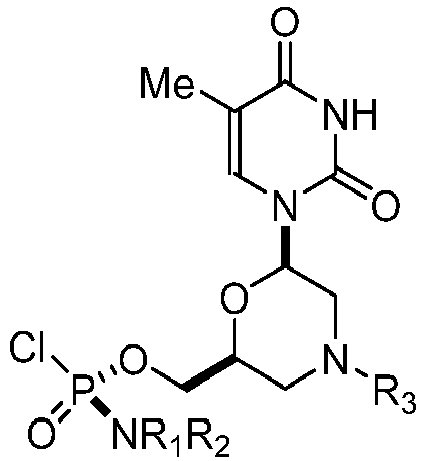
29 
30 
31 - R1 and R2 may be the same or different, and may be -H, optionally substituted C1-C3 alkyl, optionally substituted phenyl, optionally substituted naphthyl, or, with the nitrogen to which they are attached, form an optionally substituted heterocycle, which may be, for example, pyrrolidine, piperazine, or morpholine.
- Optionally substituted moieties may be substituted with one or more of methyl, ethyl, halogen, nitro, methoxy, or cyano.
- R3 may be trityl (Tr), which may be substituted trityl, including but not limited to such as MMTr (p-methoxyphenyldiphenylmethyl), optionally substituted benzyl, 4-methoxybenzyl (PMB, MPM), 3,4-dimethoxybenzyl, diphenylmethyl (Dpm), , or sulfonyl, which may be a cleavable sulfonyl. In some embodiments, sulfonyl is 2-nitrobenzenesulfonyl, 4-nitrobenzenesulfonyl, or 2,4-dinitrobenzenesulfonyl.
- R4, R5, R6 may be -H, -C(O)R7, or -C(O)OR7, where R7 is alkyl (methyl, ethyl, isopropyl, or other C1-C6 alkyl), benzyl, 2,2,2-trichloroethyl, or aryl (including but not limited to phenyl, 4-methoxy phenyl, 4-bromophenyl, and 4-nitrophenyl). R9 may be optionally substituted alkyl, cyanoethyl, acyl, carbonate, carbamate, optionally substituted benzyl, 4-pivaloyloxy benzyl, and silyl.
- In further embodiments, morpholino nucleosides in addition to those shown in Table 1 may be prepared in diastereomerically pure or substantially diastereomerically pure form.
- Embodiments may also provide methods for separation of diastereomeric mixtures of the above-disclosed compounds into stereochemically pure or substantially stereochemically pure compounds. Further embodiments may provide pharmaceutical compositions comprising stereochemically pure or substantially stereochemically pure compounds as reported herein. Further embodiments may provide pharmaceutical compositions comprising pharmaceutically acceptable salts of stereochemically pure or substantially stereochemically pure compounds as reported herein. Pharmaceutical compositions may be administered in effective amounts to patients in need of treatment. Pharmaceutical compositions may further include pharmaceutically acceptable carriers.
- In some embodiments the following moiety in each of the compounds of Table 1 may be substituted at positions a, b, and e with one or two methyl groups, and may be substituted at positions c and d with one methyl group. In each case the methyl group may be oriented on either side of the plan of the morpholino ring. In further embodiments, an additional methylene, optionally substituted with one or more methyl groups, may be inserted adjacent to the nitrogen in the morpholino group to allow for expansion to a seven-membered ring.
- Embodiments further provide for preparation of stereochemically pure oligonucleotides through stereospecific coupling of activated monomers. Further embodiments provide substantially diastereomerically pure oligomer made by stereospecific coupling of activated monomers. Still further embodiments provide substantially diastereomerically pure compositions comprising substantially diastereomerically pure compounds as reported herein.
-
-
FIG. 1 shows phosphodiester, phosphorothioate, and phosphorodiamidate oligonucleotide linkages. -
FIG. 2 shows the R- and S- phosphorous linkages in a phosphorodiamidate morpholino oligomer (PMO).FIG. 2 also shows the proliferation of diastereomers that typically results when diastereomeric mixtures of phosphorodiamidate oligomer precursors are used to synthesize dinucleotides (2-mers), trinucleotides (3-mers), tetranucleotides (4-mers), and N-mers. -
FIG. 3 shows preparation of diastereomerically pure dinucleotides both by using diastereomerically pure phosphoramidochloridates and by using diastereomeric mixture of phosphoramidochloridates. -
FIG. 4A andFIG. 4B show generalized diastereomeric mixtures of phosphoramidochloridates that may be useful for preparation of diastereomerically pure or substantially diastereomerically pure diastereomeric subunits. -
FIG. 5 shows preparation of diastereomerically pure (homogeneous) oligonucleotides using diastereomerically pure phosphoramidochloridates as reported herein. -
FIG. 6 shows a scheme for stereospecific synthesis of 16-mer PMOs and differentiation of stereoisomers by biophysical assay. -
FIG. 7 shows melting points forStereoisomers -
FIG. 8 shows an ORTEP plot of crystalline Compound 100, as reported below. -
FIG. 9A andFIG. 9B show ORTEP plots of two fragments of Compound 100, as reported below. - We have found that two diastereomers of activated morpholino subunits may be sorted by their physical properties, allowing preparation of diastereometrically pure isomers. This permits preparation of stereochemically pure or substantially stereochemically pure PMOs under controlled reaction conditions, which may then be used to selectively prepare oligonucleotides with a desired stereochemistry.
- Embodiments may also provide methods for separation of diastereomeric mixtures of the above-disclosed compounds into stereochemically pure or substantially stereochemically pure compounds. Once separated, the pure diastereomers from the formerly diastereomeric mixture may be used to prepare diastereomerically pure compounds through stereospecific coupling reactions.
- Diastereomerically pure compounds and substantially diastereomerically pure compounds prepared as set forth herein may be diastereomerically pure phosphorodiamidate oligonucleotides. These diastereomerically pure and substantially diastereomerically pure phosphorodiamidate oligonucleotides may have multiple uses. For example, they may be useful as pharmaceuticals. They may be selected for properties that are potentially superior to those of heterogeneous mixtures (stereo-random mixtures) of diastereomers of phosphorodiamidate oligonucleotides. For example, they may be selected for differences in potency, efficacy, stability, safety, and specificity. Diastereomerically pure and substantially diastereomerically pure oligomers may have physical, chemical, and biological properties that differ from those of stereochemically heterogeneous mixtures of oligomers.
- "Stereoisomers" refers to isomers that differ only in the arrangement of the atoms in space.
- "Diastereomers" refers to stereoisomers that are not mirror images of each other.
- "Enantiomers" refers to stereoisomers that are non-superimposable mirror images of one another. Enantiomers include "enantiomerically pure" isomers that comprise substantially a single enantiomer, for example, greater than or equal to 90%, 92%, 95%, 98%, or 99%, or equal to 100% of a single enantiomer.
- "Activated monomer" refers to 5'-O-phosphorylated morpholino subunits that bear reactive phosphorous having leaving groups, including but not limited to chloride and halide leaving groups, that undergo displacement reaction with nucleophiles, including but not limited to amines and alcohols.
- "R" and "S" as terms describing isomers are descriptors of the stereochemical configuration at asymmetrically substituted atoms, including but not limited to: carbon, sulfur, phosphorous and ammonium nitrogen. The designation of asymmetrically substituted atoms as "R" or "S" is done by application of the Cahn-Ingold-Prelog priority rules, as are well known to those skilled in the art, and described in the International Union of Pure and Applied Chemistry (IUPAC) Rules for the Nomenclature of Organic Chemistry. Section E, Stereochemistry.
- An enantiomer can be characterized by the direction in which it rotates the plane of plane polarized light, as is well known to those in the chemical arts. If it rotates the light clockwise (as seen by a viewer towards whom the light is traveling), that enantiomer is labeled (+), and is denoted dextrorotatory. Its mirror-image will rotate plane polarized light in a counterclockwise direction, and is labeled (-), or levorotatory. The direction of rotation of plane polarized light by an enantiomerically pure compound, termed the sign of optical rotation, may be readily measured in standard device known as a polarimeter.
- "Racemic" refers to a mixture containing equal parts of individual enantiomers.
- "Non-racemic" refers to a mixture containing unequal parts of individual enantiomers. A non-racemic mixture may be enriched in the R- or S-configuration, including, without limitation, about 50/50, about 60/40, and about 70/30 R- to S-enantiomer, or S- to R-enantiomer, mixtures.
- "Substantially stereochemically pure" and "substantial stereochemical purity" refer to enantiomers or diastereomers that are in enantiomeric excess or diastereomeric excess, respectively, equal to or greater than 80%. In some embodiments, "Substantially stereochemically pure" and "substantial stereochemical purity" refer to enantiomers or diastereomers that are in enantiomeric excess or diastereomeric excess, respectively, equal to or greater than 87%, equal to or greater than 90%, equal to or greater than 95%, equal to or greater than 96%, equal to or greater than 97%, equal to or greater than 98%, or equal to or greater than 99%. "Substantially Diastereomerically Pure" refers to diastereomers that are in diastereomeric excess equal to or greater than 87%, equal to or greater than 90%, equal to or greater than 95%, equal to or greater than 96%, equal to or greater than 97%, equal to or greater than 98%, or equal to or greater than 99%.
- "Enantiomeric excess" (ee) of an enantiomer is [(the mole fraction of the major enantiomer) minus the (mole fraction of the minor enantiomer)] × 100. Diastereomeric excess (de) of a diastereomer in a mixture of two diastereomers is defined analogously.
- "Pharmaceutically acceptable salt" as used herein refers to acid addition salts or base addition salts of the compounds in the present disclosure. A pharmaceutically acceptable salt is any salt which retains the activity of the parent compound and does not impart any unduly deleterious or undesirable effect on a subject to whom it is administered and in the context in which it is administered. Pharmaceutically acceptable salts include, but are not limited to, metal complexes and salts of both inorganic and carboxylic acids. Pharmaceutically acceptable salts also include metal salts such as aluminum, calcium, iron, magnesium, manganese and complex salts. In addition, pharmaceutically acceptable salts include, but are not limited to, acid salts such as acetic, aspartic, alkylsulfonic, arylsulfonic, axetil, benzenesulfonic, benzoic, bicarbonic, bisulfuric, bitartaric, butyric, calcium edetate, camsylic, carbonic, chlorobenzoic, citric, edetic, edisylic, estolic, esyl, esylic, formic, fumaric, gluceptic, gluconic, glutamic, glycolic, glycolylarsanilic, hexamic, hexylresorcinoic, hydrabamic, hydrobromic, hydrochloric, hydroiodic, hydroxynaphthoic, isethionic, lactic, lactobionic, maleic, malic, malonic, mandelic, methanesulfonic, methylnitric, methylsulfuric, mucic, muconic, napsylic, nitric, oxalic, p nitromethanesulfonic, pamoic, pantothenic, phosphoric, monohydrogen phosphoric, dihydrogen phosphoric, phthalic, polygalactouronic, propionic, salicylic, stearic, succinic, sulfamic, sulfanlic, sulfonic, sulfuric, tannic, tartaric, teoclic, toluenesulfonic, and the like.
- An "effective amount" of a combination of therapeutic agents (e.g.,
Compound 1 and aCDK 4/6 inhibitor) is an amount sufficient to provide an observable therapeutic benefit compared to HCC or IHCC left untreated in a subject or patient. - Active agents as reported herein can be combined with a pharmaceutically acceptable carrier to provide pharmaceutical formulations thereof. The particular choice of carrier and formulation will depend upon the particular route of administration for which the composition is intended.
- "Pharmaceutically acceptable carrier" as used herein refers to a nontoxic carrier, adjuvant, or vehicle that does not destroy the pharmacological activity of the compound with which it is formulated. Pharmaceutically acceptable carriers, adjuvants or vehicles that may be used in the compositions of this invention include, but are not limited to, sorbic acid, potassium sorbate, partial glyceride mixtures of saturated vegetable fatty acids, water, salts or electrolytes, disodium hydrogen phosphate, potassium hydrogen phosphate, sodium chloride, zinc salts, colloidal silica, magnesium trisilicate, polyvinyl pyrrolidone, cellulose-based substances, polyethylene glycol, sodium carboxymethylcellulose, polyacrylates, waxes, polyethylene glycol and wool fat.
- The compositions of the present invention may be suitable for parenteral, oral, inhalation spray, topical, rectal, nasal, buccal, vaginal or implanted reservoir administration, etc. In some embodiments, the formulation comprises ingredients that are from natural or non-natural sources. In some embodiments, the formulation or carrier may be provided in a sterile form. Non-limiting examples of a sterile carrier include endotoxin-free water or pyrogen-free water.
- The term "parenteral" as used herein includes subcutaneous, intravenous, intramuscular, intra-articular, intra-synovial, intrasternal, intrathecal, intrahepatic, intralesional and intracranial injection or infusion techniques. In particular embodiments, the compounds are administered intravenously, orally, subcutaneously, or via intramuscular administration. Sterile injectable forms of the compositions of this invention may be aqueous or oleaginous suspension. These suspensions may be formulated according to techniques known in the art using suitable dispersing or wetting agents and suspending agents. The sterile injectable preparation may also be a sterile injectable solution or suspension in a nontoxic parenterally acceptable diluent or solvent. Among the acceptable vehicles and solvents that may be employed are water, Ringer's solution and isotonic sodium chloride solution. In addition, sterile, fixed oils are conventionally employed as a solvent or suspending medium.
- Embodiments of the invention provide for preparation of stereochemically pure isomers or substantially stereochemically pure isomers, followed by use of the pure isomers to stereospecifically prepare diastereomerically pure phosphorodiamidate morpholino oligomers (PMOs). Preparation may be by separation of the diastereomeric mixture of phosphoramidochloridate nucleotides. Separation may be made by, for example, chromatography; for example, high performance liquid chromatography or "HPLC." Separation may also be accomplished through crystallization.
- Separated monomers may be referred to as "active" monomers. By "active" it is meant that the monomers include phosphoramidochloridate moiety that is reactive towards a variety of nucleophiles, which include but not limited to: amines, alcohols/alkoxides, thiol/thiolate, alkyllithium, and Grignard reagents.
- In one embodiment, stereochemically pure or substantially stereochemically pure activated monomers may be prepared by separation of a diastereomeric mixture of monomers. Separation may be accomplished by methods that permit distinction of stereoisomers using physical properties. For example, separation may be accomplished through chromatography or crystallization. Suitable types of chromatography include, for example, but are not limited to high performance liquid chromatography (HPLC), simulated moving bed chromatography, countercurrent chromatography, and other types of separative chromatography. For example, a diastereomeric mixture may be subjected to HPLC, eluting a fast-moving fraction and a slowmoving fraction. Each of these fractions is a different stereochemically pure or substantially stereochemically pure amount of a monomer. As described below, these monomers may be used to prepare oligomers with desired stereochemistry through stereospecific coupling using controlled reaction conditions.
- We have further determined that, once separated, the stereochemically pure activated monomers have sufficient stability for use in further chemical reactions. Furthermore, we have determined that the stereochemically pure activated monomers can undergo stereospecific chemical reactions. Thus, as discussed in more detail below, these stereochemically pure activated monomers may be used for stereospecific coupling reactions to prepare stereochemically pure products.
- As noted above, embodiments may provide one or more stereochemically pure or substantially stereochemically pure compounds of Table 1, which may be prepared by taking advantage of different physical properties in the stereoisomers. Further embodiments may also provide enantiomers of the compounds of Table 1. Typically the stereochemistry of those enantiomers varies from that of the compounds of Table 1 by the alteration of the stereochemistry of the morpholino ring.
TABLE 1 Compound Formula # 
20 
21 
22 
23 
24 
25 
26 
27 
28 
29 
30 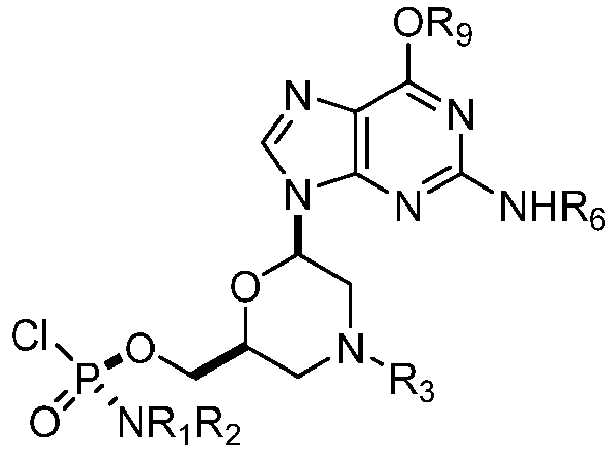
31 US2013/0197220 ), acyl, sulfonyl, acetal/ketal, carbonate, carbamate, optionally substituted benzyl, 4-pivaloyloxy benzyl, and silyl. - In some embodiments, the optionally substituted benzyl is 4-methoxybenzyl (PMB, MPM). In some embodiments, sulfonyl is a cleavable sulfonyl. In some embodiments, sulfonyl is 2-nitrobenzenesulfonyl, 4-nitrobenzenesulfonyl, or 2,4-dinitrobenzenesulfonyl.
- R1 and R2 may be the same or different, and may be -H, optionally substituted C1-C3 alkyl, optionally substituted phenyl, optionally substituted naphthyl, or, with the nitrogen to which they are attached, form an optionally substituted heterocycle, which may be, for example, pyrrolidine, piperazine, or morpholine.
- Optionally substituted moieties may be substituted with one or more of methyl, ethyl, halogen, nitro, or cyano.
- R3 may be trityl (Tr), which may be substituted trityl, including but not limited to such as MMTr (p-methoxyphenyldiphenylmethyl), benzyl, 4-methoxybenzyl (PMB, MPM), and 3,4-dimethoxybenzyl, diphenylmethyl (Dpm),
- R4, R5, R6 may be -H, -C(O)R7, or -C(O)OR7, where R7 is alkyl (methyl, ethyl, isopropyl, or other C1-C6 alkyl) or aryl (including but not limited to phenyl, 4-methoxy phenyl, 4-bromophenyl, and 4-nitrophenyl).
- In addition to determining that separation technology might be used to prepare substantially stereochemically pure amounts of activated monomer, we have determined that these activated monomers may, under some reaction conditions, be used to accomplish stereospecific coupling for the preparation of stereochemically pure dinucleotides, stereochemically pure trinucleotides, and larger stereochemically pure oligomers. Through use of methods reported herein, chirality of newly formed PMO linkage may be specifically coded by chirality of stereochemically pure active monomers used to form the oligomer.
- Typical reaction conditions for stereospecific coupling include reaction in aprotic solvents. These solvents may be, for example, but are not limited to, acetonitrile, tetrahydrofuran (THF), 1,3-dimethylimidazolidinone (DMI), dimethylformamide (DMF), N-methyl-2-pyrrolidinone (NMP), dimethylacetamide (DMAc), dichloromethane (DCM), 1,2-dichloroethane (DCE), chloroform, 1,4-dioxane, ethyl acetate, 2-methyltetrahydrofuran, and isopropyl acetate. Coupling reactions may be conducted in the presence of non-nucleophilic tertiary amine bases and aromatic bases. Suitable bases include, but are not limited to, diisopropylethylamine, triethylamine, 2,6-lutidine, trimethylpyridines (collidines), and N-ethylmorpholine. Reaction temperatures may range from room temperature (about 20 °C) to 50° C. Sonication may be applied in some cases to help dissolution of substrate(s).
- To demonstrate the feasibility of stereospecific coupling, multiple substantially stereochemically pure PMO dinucleotides were prepared by stereospecific PMO coupling of the fast- and slow-eluting substantially stereochemically pure active monomers (phosphoramidochloridates). Table 2, below, summarizes HPLC retention profiles of these substantially stereochemically pure PMO dinucleotides The table compares retention times for dinucleotides that were prepared from combinations of the 5'-end monomers listed on the left of the table with both faster-eluting and slower-eluting isomers of 3'-end monomers listed on the top. The table demonstrates that stereospecific coupling of substantially stereochemically pure active monomers produces different diastereomerically pure dinucleotides having different physical properties.
TABLE 2: Active Monomers (3'-end; electrophiles) 
U C c A d G b T fast U1 slow U2 fast C1 slow C2 fast A1 slow A2 fast G1 slow G2 fast T1 slow T2 5'-end monomers (nucleophiles) U UU1 9 UU2 < 27 UC1 9.1 UC2 > 6.5 UA1 12.6 UA2 > 10.9 UG1 12.5 UG2 < 18.8 UT1 8.4 UT2 < 27 dinucleotide RT (min) C a CU1 5.6 CU2 < 6.6 CC1 6.7 CC2 > 5.7 CA 1 8CA2 > 7.4 CG1 10.4 CG2 < 13.3 CT1 5.6 CT2 < 6.1 dinucleotide RT (min) 
A a AU1 3.5 AU2 < 3.6 AC1 3.6 AC2 = 3.6 AA1 4.2 AA2 > 4.1 AG1 7.6 AG2 < 8.5 AT1 3.5 AT2 < 3.6 dinucleotide RT (min) G b GU1 7.6 GU2 < 8.1 GC1 7.2 GC2 \= 7.2 GA1 9.7 GA2 > 8.9 GG1 14.2 GG2 > 11.3 GT1 7.4 GT2 < 7.5 dinucleotide RT (min) T TU1 9.7 TU2 < 23.9 TC1 8.9 TC2 > 5.6 TA1 13.2 TA2 > 11.4 TG1 13.2 TG2 < 20.0 TT1 9 TT2 < 24 dinucleotide RT (min) a nucleobases unprotected
b guanine amino group protected with isobutyryl group
c cytosine amino group protected with: (1) acetyl group for coupling with U, C, A and G, (2) benzoyl group for coupling with T
d adenine amino group protected with benzoyl group - Analytical HPLC conditions for profiling of the substantially stereochemically pure PMO dinucleotides of Table 2 are reported below:
HPLC column Chiralpak IC 4.6 × 250 mm 5 µmTemperature 30 °C Flow rate 1.0 mL/min Mobile phase 10% n-heptane, 80% EtOAc and 10% MeOH-EtOH 1:1 with 0.1% diethylamine Gradient Isocratic Run time 30 min Injection volume 1-2 µL (0.2 mg/ml, dichloromethane) Detection UV 260 nm - The following examples show diastereomer separation of activated monomers according to certain embodiments as presented herein.
-

- Analytical HPLC conditions for activated U monomers:
HPLC column Chiralpak IC, 4.6 × 250mm, 5 u Temperature 35 ° C Flow rate 1 mL/min Mobile phase Ethyl acetate Gradient Isocratic Run time 15 min Injection volume 10 µL (5mg/ml, ethyl acetate) Detection 260 nm Retention Time U 1 5 min U 2 7.5 min - Preparative HPLC conditions for activated U monomers:
- Chiralpak IC, 21 × 250mm, 5µ; Elute column at 11 ml/minute with ethyl acetate, room temperature, 260nm detection.
- [1H-NMR data for U1]
- 1H NMR (400 MHz, CDCl3) δ 8.18 (br, 1H), 7.45 (m, 6H), 7.15-7.32 (m, 10H), 6.12 (dd, 1H, J= 2.0 & 9.6 Hz), 5.62 (d, 1H, J= 8.0 Hz), 4.39 (m, 1H), 4.11 (m, 2H), 3.39 (d, 1H, J= 11 Hz), 3.15 (d, 1H, J= 11 Hz), 2.65 (s, 3H), 2.62 (s, 3H), 1.49 (t, 1H, J= 11 Hz), 1.39 (t, 1H, J= 11 Hz)
- [1H-NMR data for U2]
- 1H NMR (400 MHz, CDCl3) δ 8.07 (br, 1H), 7.44 (m, 6H), 7.14-7.34 (m, 10 H), 6.12 (dd, 1H, J= 2 & 9 Hz), 5.61 (d, 1H, 8.0 Hz), 4.39 (m, 1H), 4.08 (m, 2H), 3.39 (d, 1H, J= 12 Hz), 3.15 (d, 1H, J= 12 Hz), 2.66 (s, 3H), 2.62 (s, 3H), 1.46 (t, 1H, J= 11 Hz), 1.38 (t, 1H, J= 11 Hz),
-

- Analytical HPLC conditions for activated A monomers:
HPLC column Chiralpak IC, 4.6 × 250mm, 5u Temperature 35 ° C Flow rate 1 mL/min Mobile phase Ethyl acetate Gradient Isocratic Run time 15 min Injection volume 10 µL (5mg/ml, ethyl acetate) Detection 260 nm Retention Time A1 8.1 min A2 11.7 min - Preparative HPLC conditions for activated A monomers:
- Chiralpak IC, 21 × 250mm, 5u; Elute with 100% ethyl acetate at 15 ml/minute, room temperature, uv 260nm detection.
- [1H-NMR data for A1]
- 1H NMR (400 MHz, CDCl3) δ 9.01 (br, 1H), 8.79 (s, 1H), 8.00 (m, 3H), 7.58 (m, 1H), 7.4-7.6 (m, 8 H), 7.2-7.4 (m, 10H), 6.42 (d, 1H, J= 8.4 Hz), 4.51 (m, 1H), 4.12 (m, 3H), 3.54 (d, 1H, J= 12 Hz), 3.25 (d, 1H, J= 12 Hz), 2.62 (s, 3H), 2.59 (s, 3H), 1.81 (t, 1H, J= 11 Hz), 1.62 (t, 1H, J= 11 Hz)
- [1H-NMR data for A2]
- 1H NMR (400 MHz, CDCl3) δ 9.04 (br, 1H), 8.79 (s, 1H), 8.00 (m, 3H), 7.56 (m, 1H), 7.4-7.6 (m, 8H), 7.2-7.4 (m, 10H), 6.41 (d, 1H, J= 8.4 Hz), 4.51 (m, 1H), 4.12 (m, 3H), 3.54 (d, 1H, J= 12 Hz), 3.25 (d, 1H, J= 12 Hz), 2.64 (s, 3H), 2.61 (s, 3H), 1.82 (t, 1H, J= 11 Hz), 1.63 (t, 1H, J= 11 Hz)
-

- Analytical HPLC conditions for activated C monomers:
HPLC column Chiralpak IC, 4.6 × 250mm, 5u Temperature 35 °C Flow rate 1.0 mL/min Mobile phase 90% ethyl acetate 10% n-heptane Gradient Isocratic Run time 12 min Injection volume 10 µL (5mg/ml, dichloromethane) Detection 260 nm Retention Time C1 6.0 min C2 6.2 min - Preparative HPLC conditions for activated C monomers:
- Chiralpak IC eluted at 15 ml/minute with 75% ethyl acetate and 25% n-heptane. Room temperature and uv 260nm detection.
- [1H-NMR data for C1]
- 1H NMR (400 MHz, CDCl3) δ 7.66 (d, 1H, J= 7.8 Hz), 7.43 (m, 6H), 7.33 (d, 1H, J= 7.4 Hz), 7.15-7.32 (m, 9H), 6.18 (dd, 1H, J= 2.2 & 9.2 Hz), 4.42 (m, 1H), 4.08-4.16 (m, 2H), 3.54 (d, 1H, J= 11 Hz), 3.14 (d, 1H, J= 12 Hz), 2.64 (s, 3H), 2.60 (s, 3H), 2.23 (s, 3H), 1.51 (t, 1H, J= 11 Hz), 1.25 (m, 1H).
- [1H-NMR data for C2]
- 1H NMR (400 MHz, CDCl3) δ 7.64 (d, 1H, J= 7.8 Hz), 7.43 (m, 6H), 7.32 (d, 1H, J= 7.4 Hz), 7.15-7.32 (m, 9H), 6.19 (dd, 1H, J= 2.1 & 9.2 Hz), 4.41 (m, 1H), 4.06-4.15 (m, 2H), 3.54 (d, 1H, J= 11 Hz), 3.15 (d, 1H, J= 12 Hz), 2.64 (s, 3H), 2.61 (s, 3H), 2.22 (s, 3H), 1.49 (t, 1H, J= 11 Hz), 1.25 (m, 1H)
-

- Analytical HPLC conditions for activated G monomers:
HPLC column Chiralpak IC, 4.6 × 250mm, 5u Temperature 35 °C Flow rate 1.0 mL/min Mobile phase ethyl acetate Gradient Isocratic Run time 30 min Injection volume 10 µL (5mg/ml, ethyl acetate) Detection 260 nm Retention Time G1 17.8 min G2 22.3 min - Preparative HPLC conditions for activated G monomers:
- Chiralpak IC eluted at 15 ml/minute with 100% ethyl acetate. Room temperature and uv 260nm detection.
-

- Analytical HPLC conditions for activated T monomers:
HPLC column Chiralpak IC, 4.6 × 250mm, 5 u Temperature 35 ° C Flow rate 1 mL/min Mobile phase Ethyl acetate Gradient Isocratic Run time 10 min Injection volume 10 µL (5mg/ml, methylene chloride) Detection 260 nm Retention Time T1 4.5 min T2 7.0 min - Preparative HPLC conditions for activated T monomers:
Chiralpak IC, 50 × 500mm, 20u. Elute column at 60 ml/minute with ethyl acetate, room temperature, 260nm detection. Retention times are 25 and 40 minutes. - [1H-NMR data for T1]
- 1H NMR (400 MHz, CDCl3) δ 7.4-7.5 (m, 5H), 7.26-7.33 (m, 6H), 7.16-7.22 (m, 3H), 7.04 (d, 1H, J= 1 Hz), 6.12 (dd, 1H, J= 2 & 10 Hz), 4.39 (m, 1H), 4.12 (m, 2H), 3.37 (d, 1H, J= 12 Hz), 3.15 (d, 1H, J= 12 Hz), 2.66 (s, 3H), 2.63 (s, 3H), 1.83 (d, 1H, J= 1 Hz), 1.49 (t, 1H, J= 11 Hz), 1.41 (t, 1H, J= 11 Hz))
- [1H-NMR data for T2]
- 1H NMR (400 MHz, CDCl3) δ 7.4-7.5 (m, 6H), 7.24-7.35 (m, 6H), 7.14-7.22 (m, 3H), 7.03 (s, 1H), 6.12 (dd, 1H, J= 2 & 10 Hz), 4.39 (m, 1H), 4.09 (m, 2H), 3.37 (d, 1H, J= 11 Hz), 3.15 (d, 1H, J= 11 Hz), 2.66 (s, 3H), 2.62 (s, 3H), 1.82 (s, 3H), 1.48 (t, 1H, J= 11 Hz), 1.40 (t, 1H, J= 11 Hz)
-

- Analytical HPLC conditions for activated C monomers (NBz):

- Preparative HPLC conditions for activated C monomers (NBz):
Chiralpak IB, 20 × 250mm 5u, eluted at 9 ml/minute with 100% acetonitrile. Room temperature and uv 260nm detection. Retention times are 13 and 16 minutes. -

- Analytical HPLC conditions for activated G monomers (guanine doubly protected):
HPLC column Chiralpak IA, 4.6 × 250mm, 5u Temperature 35 °C Flow rate 1.0 mL/min Mobile phase 70% ethyl acetate / 30% methylene chloride Gradient Isocratic Run time 8 min Injection volume 10 µL (5mg/ml, ethyl acetate) Detection 260 nm Retention Time G1 3.9 min G2 4.3 min - Preparative HPLC conditions for activated G monomers (guanine doubly protected):
- Chiralpak IA 50 × 500mm, eluted at 60 ml/minute with 100% ethyl acetate. Room temperature and uv 260nm detection. Retention times are 20 and 24 minutes.
- [1H-NMR data for G1 (guanine doubly protected)]
- 1H NMR (400 MHz, CDCl3) δ 7.76 (s, 2H), 7.50 (d, 2H, J= 9 Hz), 7.4-7.5 (m, 6 H), 7.26-7.32 (m, 6H), 7.16-7.22 (m, 3H), 7.02 (d, 2H, J= 9 Hz), 6.24 (dd, 1H, J= 2 & 10 Hz), 5.61 (d, 1H, J= 12 Hz), 5.56 (d, 1H, J= 12 Hz), 4.48 (m, 1H), 4.1 (m, 2H), 3.47 (d, 1H, J= 11 Hz), 3.23 (d, 1H, J=12 Hz), 3.2 (m, 1H), 2.62 (s, 3H), 2.59 (s, 3H), 1.75 (t, 1H, J= 11 Hz), 1.57 (t, 1H, J= 12 Hz), 1.33 (s, 9H), 1.33 (t, 6H, J= 7 Hz)
- [1H-NMR data for G2 (guanine doubly protected)]
- 1H NMR (400 MHz, CDCl3) δ 7.78 (s, 1H), 7.77 (s, 1H), 7.50 (d, 2H, J= 9 Hz), 7.4-7.5 (m, 6H), 7.26-7.33 (m, 6H), 7.15-7.22 (m, 3H), 7.02 (d, 2H, J= 9 Hz), 6.23 (dd, 1H, J= 2 & 10 Hz), 5.61 (d, 1H, J= 12 Hz), 5.56 (d, 1H, J= 12 Hz), 4.47 (m, 1H), 4.1 (m, 2H), 3.47 (d, 1H, J= 11 Hz), 3.22 (d, 1H, J= 12 Hz), 3.2 (m, 1H), 2.64 (s, 3H), 2.60 (s, 3H), 1.75 (t, 1H, J= 11 Hz), 1.58 (t, 1H, J= 11 Hz), 1.33 (s, 9H), 1.33 (t, 6H, J= 7 Hz)
- The following examples report use of stereospecific coupling to prepare stereochemically homogeneous products.
-

- U1 (11 mg, 0.018 mmol, 1 eq, 99.0% de) was dissolved in acetonitrile (0.11 ml) and mixed with diisopropylethylamine (8 µL, 0.05 mmol, 2.5 eq). U-morpholine-NH (1; 14 mg, 0.030 mmol, 1.6 eq) was added and sonication was applied to aid for dissolution. After 0.5 h stirring, a small aliquot of reaction mixture was diluted with CDCl3 and analyzed by 1H NMR All the rest of reaction mixture was diluted with acetonitrile (8 ml) for HPLC analysis and kept in freezer. Stereospecific formation of 2 was confirmed by HPLC analysis (99.4% de). The above protocol was employed also for the coupling of U2 (95.6% de) to stereospecifically give 3 (96.0% de).
- Analytical HPLC conditions for U/U-coupling:
HPLC column Chiralpak IC, 4.6 × 250mm, 5u Temperature 35 °C Flow rate 1.0 mL/min Mobile phase 80% methanol 20% acetonitrile Gradient Isocratic Run time 30 min Injection volume 10 µL (2mg/ml, acetonitrile) Detection 260 nm Retention Time U1 11.5 min U2 21.5 min 2 12.0 min 3 22.1 min nucleophile activated U monomer Product (UU dinucleotide) U morpholine-NH (1) U1 (99.0% de) → 2 (99.4% de) U2 (95.6% de) → 3 (96.0% de) - [1H-NMR data for 2]
- 1H NMR (400 MHz, CDCl3) δ 7.6 (m, 4H), 7.2-7.5 (m, 20H), 7.1-7.2 (m, 3H), 6.15 (d, 1H, J= 8.0 Hz), 5.73 (d, 1H, J= 8.0 Hz), 5.66 (d, 1H, J= 8.0 Hz), 5.54 (d, 1H, J= 8.0 Hz), 4.40 (m, 1H), 3.93 (m, 2H), 3.81 (m, 1H), 3.70 (m, 2H), 3.41 (m, 2H), 3.40 (m, 3H), 3.11 (d, 1H, J= 12 Hz), 2.78 (m, 1H), 2.56 (s, 3H; NMe), 2.54 (s, 3H; NMe), 2.48 (m, 1H), 1.47 (t, 1H, J= 11 Hz), 1.35 (t, 1H, J= 11 Hz), 1.04 (s, 9H)
- [1H-NMR data for 3]
- 1H NMR (400 MHz, CDCl3) δ 7.6 (m, 4H), 7.3-7.5 (m, 11H), 7.2-7.3 (m, 9H), 7.1 (m, 3H), 6.12 (dd, 1H, J= 2.0 & 9.6 Hz), 5.71 (d, 1H, J= 8.4 Hz), 5.70 (d, 1H, J= 8.0 Hz), 5.47 (dd, 1H, J= 2.0 & 10.4 Hz), 4.31 (m, 1H), 3.97 (m, 1H), 3.85 (m, 1H), 3.73 (m, 2H), 3.65 (m, 1H), 3.31 (m, 2H), 3.24 (m, 1H), 3.07 (d, 1H, J= 12 Hz), 2.68 (m, 1H), 2.65 (s, 3H; NMe), 2.62 (s, 3H; NMe), 2.26 (m, 1H), 1.45 (t, 1H, J= 12 Hz), 1.29 (t, 1H, J= 11 Hz), 1.04 (s, 9H)
-

- C 1 (20 mg, 0.031 mmol, 1 eq, 93.5% de) was dissolved/suspended in THF (0.40 ml) and mixed with diisopropylethylamine (12 µL, 0.069 mmol, 2.3 eq). The morpholino-cytosine (4; 16 mg, 0.035 mmol, 1.1 eq) dissolved in THF (0.20 mL) was added. After 1.0-2.0 h stirring, a small aliquot of reaction mixture was diluted with acetonitrile and analyzed by LC/MS. An aliquot (30-50 µL) of reaction mixture was diluted with dichloromethane (0.6 ml) for HPLC analysis. Stereospecific formation of 6 was confirmed by HPLC analysis (94.3% de). The reaction mixture was directly loaded onto a silica gel column and eluted with a gradient mobile phase of 0-15% of methanol in ethyl acetate. The above protocol was employed also for the C/C coupling of C2 (90.2% de) to stereospecifically give 5 (90.0% de).
- Analytical HPLC conditions for C/C-coupling:
HPLC column Chiralpak IC, 4.6 × 250mm, 5u Temperature 35 °C Flow rate 1.0 mL/min Mobile phase Solvent A n-heptane Solvent B 1:1 ethanol: methanol 0.1% diethylamine (DEA) Gradient Isocratic %A %B 50 50 Run time 20 min Injection volume 5 µL (3 mg/ml, dichloromethane) Detection 260 nm Retention Time 4 5.4 min 5 10.5 min 6 12.9 min nucleophile activated C monomer Product (CC dinucleotide) C morpholine-NH (4) C1 (93.5% de) → 6 (94.3% de) C2 (90.2% de) → 5 (90.0% de) - [1H-NMR data for 5]
- 1H NMR (400 MHz, CDCl3) δ 10.9 (br, 1H), 7.69 (d, 1H, J = 7.4 Hz), 7.62 (m, 5H), 7.35-7.44 (m, 13H), 7.21-7.35 (m, 6H), 7.15 (m, 4H), 6.14 (br d, 1H, J= 7.8 Hz), 5.58 (dd, 1H, J= 2.4 & 9.4 Hz), 5.53 (br, 1H), 4.51 (dd, 1H, J= 8.6 & 10 Hz), 4.09 (m, 1H), 3.70-3.80 (m, 4H), 3.60 (dd, 1H, J= 6.3 & 10 Hz), 3.56 (d, 1H, J= 11 Hz), 3.28 (m, 1H), 2.96 (d, 1H, J= 11 Hz), 2.69 (s, 3H; NMe), 2.67 (s, 3H; NMe), 2.65 (m, 1H), 2.25 (m, 1H), 2.07 (s, 3H), 1.31 (t, 1H, J= 11 Hz), 1.13 (t, 1H, J= 11 Hz), 1.04 (s, 9H).
- [1H-NMR data for 6]
- 1H NMR (400 MHz, CDCl3) δ 9.57 (br, 1H), 7.62-7.70 (m, 7H), 7.35-7.50 (m, 14H), 7.23-7.35 (m, 4H), 7.12 (m, 4H), 6.31 (m, 1H), 5.79 (m, 1H), 5.70 (m, 1H), 4.61 (m, 1H), 4.03 (m, 1H), 3.80-3.90 (m, 2H), 3.72 (m, 2H), 3.58 (m, 1H), 3.48 (m, 1H), 3.09 (m, 1H), 2.75 (m, 1H), 2.58 (s, 3H; NMe), 2.55 (s, 3H; NMe), 2.53 (m, 1H), 2.38 (m, 1H), 2.21 (s, 3H), 1.47 (t, 1H, J= 10 Hz), 1.22 (t, 1H, J= 10 Hz), 1.06 (s, 9H).
-

- A1 (5.9 mg, 0.008 mmol) was suspended in acetonitrile (118 µL). Diisopropylethylamine (5 µL, 0.03 mmol) was added followed by morpholino-uracil (1; 4.6 mg, 0.01 mmol). Sonication was applied for 1min and resultant homogeneous mixture was stirred at ambient temperature. After overnight stirring, the mixture (thick white paste) was diluted with a mixture of acetonitrile (5.0 ml) and methanol (0.30 ml) to give homogeneous clear solution. A small aliquot was directly analyzed by HPLC without further dilution.
- A2 (F2; 5.0 mg, 0.007 mmol) was suspended in acetonitrile (100 µl). Diisopropylethylamine (4 µl, 0.02 mmol) was added followed by morpholino-uracil (4.1 mg, 0.009 mmol). Sonication was applied for 1 min and resultant thick suspension was stirred at ambient temperature. After overnight stirring, acetonitrile (5.0 ml) was added and sonication was applied to give homogeneous clear solution. A small aliquot was directly analyzed by HPLC without further dilution..
- Analytical HPLC conditions for U/A-coupling:
HPLC column Chiralpak IC, 4.6 × 250mm, 5u Temperature 35 ° C Flow rate 1 mL/min Mobile phase Solvent A Ethyl acetate Solvent B 1:1 ethanol/methanol with 0.1% diethylamine Gradient Isocratic: 98% solvent A, 2% solvent B Run time 30 min Injection volume 5 µL (1 mg/ml, acetonitrile-methanol) Detection 260 nm Retention Time 7 (S isomer) 21.7 min 8 (R isomer) 24.9 min nucleophile activated A monomer Product (UA dinucleotide) U morpholine-NH (1) A1 (97.8% de) → 8 (R isomer, 96.2% de) A2 (98.4% de) → 7 (S isomer 98.3% de) -

- G1 (6.5 mg, 0.009 mmol, 1 eq, 99.9% de) was dissolved/suspended in THF (0.13 ml) and mixed with diisopropylethylamine (3.6 µL, 0.02 mmol, 2.2 eq). The morpholino-uracil (1; 4.7 mg, 0.010 mmol, 1.1 eq) dissolved in THF (0.07 mL) was added. After 1.0-2.0 h stirring, a small aliquot of reaction mixture was diluted with acetonitrile and analyzed by LC/MS. An aliquot (100 µL) of reaction mixture was diluted with dichloromethane (0.4 ml) for HPLC analysis. Stereospecific formation of 9 was confirmed by HPLC analysis (99.9% de).
- Analytical HPLC conditions for U/G-coupling:
HPLC column Chiralpak IA, 4.6 × 250mm, 5u Temperature 35 °C Flow rate 1.0 mL/min Mobile phase Solvent A n-heptane Solvent B Ethyl acetate Solvent C 1:1 ethanol: methanol 0.1% diethylamine (DEA) Gradient Isocratic %A %B %C 55 40 5 Run time 30 min Injection volume 5 µL (2 mg/ml, dichloromethane) Detection 260 nm Retention Time 1 8.4 min 9 14.0 min 10 16.3 min nucleophile activated G monomer Product (UG dinucleotide) U morpholine-NH (1) G1 (99.9% de) → 9 (99.9% de) - Diastereomerically substantially pure compounds as reported above may be used to prepare stereochemically pure oligonucleotides and other compounds. Examples of potential oligonucleotides are shown, for example, in Summerton, J (1999). "Morpholino Antisense Oligomers: The Case for an RNase-H Independent Structural Type.". Biochimica et Biophysica Acta 1489 (1): 141-58; and in Summerton, J; Weller D. (1997). "Morpholino Antisense Oligomers: Design, Preparation and Properties". Antisense & Nucleic Acid Drug Development 7 (3): 187-95. Both of those documents are incorporated by reference herein.
- This example reports a synthesis that targets a pair of stereopure 16-mer PMOs through stereospecific coupling using activated monomers. These PMOs have opposite stereochemical arrays for their phosphorous linkages.
- Target sequence:

- Stereopure active monomers (building blocks):

Target PMOs Stereopure active monomers used for coupling Stereoisomer 1 A2, C2, G1 and T1 Stereoisomer 2 A1, C1, G2 and T2 - A scheme for stereospecific synthesis of 16-mer PMOs and differentiation of stereoisomers by biophysical assay is shown in
FIG. 6 . The 16-mer PMO stereoisomers 1 andstereoisomer 2 were prepared manually by solid-phase synthesis on aminomethylpolystyrene-disulfide resin (~300 µmol/g loading, seeU.S. Patent App. Pub. No. 20090131624A1 , which is incorporated by reference herein) at 50 mg scale (starting resin weight). - Stock solutions for solid-phase synthesis:
De-tritylation 4-cyanopyridine trifluoroacetate (CYTFA) 2% (w/v) and 0.9% ethanol (v/v) in 20% trifluoroethanol/DCM (v/v). Neutralization 5% diisopropylethylamine (v/v) in 25% isopropanol/DCM (v/v). Coupling Freshly prepared 55 mM solution in NEM-DMI* for each of stereopure active monomers (A2, C2, G1 and T1 for stereoisomer 1; A1, C1, G2 and T2 for stereoisomer 2)*0.11 M N-ethylmorpholine in 1,3-dimethylimidazolidinone (DMI) - Operational cycle for each PMO coupling:
Step Volume (ml) Time (min) DCM 1-2 2-5 Detritylation 1-2 5 Detritylation 1-2 5 Detritylation 1-2 5 Detritylation 1-2 5 Detritylation 1-2 5 DCM 1-2 2-5 Neutralization 1-2 2-5 Neutralization 1-2 2-5 Neutralization 1-2 2-5 Neutralization 1-2 2-5 DCM 1-2 2-5 DCM 1-2 2-5 DCM 1-2 2-5 Coupling 1 >180* DCM 1-2 2-5 Neutralization 1-2 2-5 Neutralization 1-2 2-5 DCM 1-2 2-5 DCM 1-2 2-5 DCM 1-2 2-5 DCM 1-2 2-5 * 40 °C for 3 hours or room temperature for 12 hours. - To the resin-bound 16-mer (after de-tritylation) was added 1:3 (v/v) of 28% aqueous ammonia/ethanol (~5 ml). The mixture was sealed and heated at 45 °C for 20 hours. After cooling to room temperature, the mixture was filtered and washed with methanol. The filtrate was concentrated and diafiltered against 15 mM triethylammonium (TEAA) buffer pH 7.0. The apparatus used was an Amicon Stirred Cell (50 mL) with an Ultracel 1kDa UF membrane. The samples were diafiltered by dilution/concentration until the original solvent was reduced to 1% original concentration (approximately 5 cycles) and then subjected to reverse phase preparative HPLC purification.
- Reverse phase preparative HPLC method for PMO purification:
HPLC column XBridge Prep C8 OBD column , 9 × 150 mm, 5µm Column temperature ambient temperature Flow rate 30.0 ml/min Gradient Time (min) %A %B Initial 85 15 18 80 20 20 0 100 Mobile phase Solvent A: 15mM Triethylammonium acetate (TEAA) buffer pH7 + 10% MeOH Solvent B: acetonitrile + 10% MeOH Diluting solution 15 mM TEAA buffer Run time 20 min Detection UV 260 nm Retention time Stereoisomer 1 13.98 min Stereoisomer 2 14.03 min - LC/MS method for quality assessment of PMOs:
HPLC column Waters BEH C18 Oligo 2.1 × 50mm 130 Angstrom 1.7um Column temperature 45 °C Flow rate 0.3 mL/min Gradient Time (min) %A %B Initial 95 5 2 95 5 20 50 50 24 50 50 24.1 95 5 30 95 5 Mobile phase Solvent A: 50 mM Ammonium acetate Solvent B: Acetonitrile/ Methanol 1/1 v/v with 50 mM Ammonium acetateRun time 30 min Injection volume 25 µL Diluent: water or 10 mM Triethylamine acetate Detection UV 260 nm MS/lonization mode Synapt G2/Electrospray Positive Mode Cone voltage/Extraction 30 V/4 V/2.8 kV Source Temp./ Collision energies/MS function/Analysis 100 °C/ 4 eV (low energy) 40-70 eV (high energy/MSE mode/Deconvolution and Deisotoping using Waters MSe Viewer Software Retention time Stereoisomer 1 10.83 min Stereoisomer 2 10.86 min - Materials and conditions for Melting Temperature (Tm) measurement
complimentary RNA (16-mer) 5'-UUCCUUGAUGUUGGAG-3' (SEQ ID NO. 1) (IDT Integrated DNA Technologies) Diluting buffer 10 mM Sodium Phosphate, 100 mM NaCl, 0.1 mM EDTA, pH 7.0 (adjusted with phosphoric acid) Thermal Melt Apparatus Shimadzu 2700 UV-Vis Spectrophotometer equipped with the Shimadzu S-1700 Temperature Module Vacuum Centrifugation Concentrator Labconco Centrivap Concentrator Model 7810015 Stock solutions 8 µM in 250 µL buffer of each sample and complimentary RNA were prepared using the Dilution buffer from samples concentrated and dried by vacuum centrifugation Procedure • Each sample was then mixed with an equivalent volume of 8 µM complimentary RNA • The mixtures were heated to 95 °C and then cooled to 25 °C for annealment prior to the Tm measurement. • Tm analysis (UV 260 nm) was conducted from 25 °C to 105 °C at 0.5 °C/min (with the temperature returning to starting conditions after each run) and then repeated under the same conditions. • Tm Analysis software (Shimadzu) was used to calculate the Tm usinq the "averaging" function. - Summary for Thermal Melt Characterization of Complexes of Stereochemically Distinct PMOs with Complimentary RNAs:
LC/MS purity (area%) Tm (°C) Stereoisomer 197.6 62.8 Stereoisomer 294.2 57.2 - Melting points for
Stereoisomers FIG. 7 . Based on the different melting points, one may conclude that separate amounts of substantially pure stereoisomers have been prepared. -

- Late-eluting active A monomer (A2 ; 200 mg, 0.277 mmol, 1 eq) was dissolved in a mixture of acetonitrile (2.0 ml) and DIPEA (0.12 ml, 0.69 mmol, 2.5 eq). T-morpholine-NH (1; 146 mg, 0.305 mmol, 1.1 eq) was then added and resultant suspension was sonicated for a few minutes until a clear solution was obtained. The reaction mixture was stirred at room temperature overnight. Upon complete reaction monitored by LC/MS, the mixture was concentrated and subjected to column chromatography (3% methanol in DCM, Biotage SnapUltra 10 g SiO2). Clean product fractions were combined and concentrated under vacuum to give the fully protected stereopure 5'-TA-3'
dinucleotide 2 as a white solid (240 mg, 0.206 mmol, 74% yield).
- To the fully protected dinucleotide 2 (500 mg, 0.429 mmol) in 25 ml flask was added 2,2,2-trifluoroethanol (TFE; 4.0 ml) and acetic acid (1.0 ml) at room temperature. The resultant mixture was stirred at room temperature and monitored by LC/MS. After 30 minutes, the reaction was quenched with saturated aqueous NaHCO3 and DCM. The two layers were separated and the aqueous layer was back extracted. All organic layers were combined, washed with half-saturated brine, dried over anhydrous Na2SO4, filtered and concentrated to give crude product as white foam. The crude product was purified by column chromatography (20% MeOH in acetone, Biotage Snap Ultra 25 g SiO2 cartridge) to give the partially protected
dinucleotide 3 as a glassy solid (300 mg, 0.325 mmol, 76% yield). - The partially protected dinucleotide 3 (250 mg, 0.271 mmol) was dissolved in a mixture of methanol (12.5 ml) and THF (12.5 mL) and treated with 1 M NaOH (10.8 ml) at room temperature. After stirring at room temperature for 22 h (progress monitored by LC/MS), the mixture was neutralized with 1 M HCl (10.8 mL) to adjust pH at 8 and then concentrated under vacuum to dryness. The residue was dissolved in water (5 mL) and washed with EtOAc (5 mL). The aqueous layer was concentrated under vacuum to dryness to give crude product as white solid (480 mg). The crude product was purified by size-exclusion chromatography (Sephadex® LH-20, MeOH/water 4:1) to give the fully deprotected dinucleotide Compound 100 as white solid (137 mg, 0.236 mmol, 87% yield).
- A drop of Compound 100 aqueous solution (200 mg/ml) was sealed in a well with pure water for one day to grow single crystals. X-ray structure of the single crystal confirmed absolute configuration of the phosphorous linkage as S. This X-ray structure is shown in an ORTEP plot in
FIG. 8 . ORTEP plots of separate fragments are shown inFIG. 9A andFIG. 9B . X-ray data was collected as reported below. - A single crystal of Compound 100 (C22H33N10O7P) was mounted on a glass fiber. All measurements were made on a diffractometer using graphite monochromated Cu-Kα radiation.
- Cell constants and an orientation matrix for data collection, obtained from a least-squares refinement using the setting angles of 36473 carefully centered reflections in the range 7.75 < 2θ < 147.10o corresponded to a C-centered monoclinic cell with dimensions:
- a = 33.3523(2) Å
- b = 13.80020(11) Å β = 96.8075(6)o
- c = 14.19956(10) Å
- V = 6489.53(8) Å3
- For Z = 4 and F.W. = 580.54, the calculated density is 0.594 g/cm3. Based on the reflection conditions of:

C2 (#5) - The data were collected at a temperature of 23 + 1oC using the ω-2θ scan technique to a maximum 2θ value of 147.7o. Omega scans of several intense reflections, made prior to data collection, had an average width at half-height of 0.00o with a take-off angle of 6.0o. Scans of (0.00 + 0.00 tan θ)o were made at a speed of 0.0o/min (in ω).
- 50795 reflections were collected, where 12008 were unique (Rint = 0.0453). Data were collected and processed using CrysAlisPro (Rigaku Oxford Diffraction). (CrysAlisPro: Data Collection and Processing Software, Rigaku Corporation (2015). Tokyo 196-8666, Japan). No decay correction was applied.
- The linear absorption coefficient, µ, for Cu-Kα radiation is 6.011 cm-1. An empirical absorption correction was applied that resulted in transmission factors ranging from 0.341 to 1.000. The data were corrected for Lorentz and polarization effects.
- The structure was solved by direct methods (SHELXT Version 2014/5: Sheldrick, G. M. (2014). Acta Cryst. A70, C1437) and expanded using Fourier techniques. The non-hydrogen atoms were refined anisotropically. Hydrogen atoms were refined using the riding model. The final cycle of full-matrix least-squares refinement (using Least Squares function minimized: (SHELXL Version 2014/7); Σw(Fo 2-Fc 2)2 where w = Least Squares weights) on F2 was based on 12008 observed reflections and 849 variable parameters and converged (largest parameter shift was 0.00 times its esd) with unweighted and weighted agreement factors of:


- The goodness of fit was 1.45. Goodness of fit is defined as: [Σw(Fo2-Fc2)2/(No-Nv)]1/2, where: No = number of observations and Nv = number of variables.
- Unit weights were used. The maximum and minimum peaks on the final difference Fourier map corresponded to 1.79 and -0.69 e-/Å3, respectively. The final Flack parameter was 0.029(7), indicating that the structure is inversion-twin. (Parsons, S. and Flack, H. (2004), Acta Cryst. A60, s61; Flack, H.D. and Bernardinelli (2000), J. Appl. Cryst. 33, 114-1148).
- Neutral atom scattering factors were taken from International Tables for Crystallography (IT), Vol. C, Table 6.1.1.4. (International Tables for Crystallography, Vol.C (1992). Ed. A.J.C. Wilson, Kluwer Academic Publishers, Dordrecht, Netherlands, Table 6.1.1.4, pp. 572). Anomalous dispersion effects were included in Fcalc (Ibers, J. A. & Hamilton, W. C.; Acta Crystallogr., 17, 781 (1964)); the values for Δf' and Δf" were those of Creagh and McAuley. (Creagh, D. C. & McAuley, W.J .; "International Tables for Crystallography", Vol C, (A.J.C. Wilson, ed.), Kluwer Academic Publishers, Boston, Table 4.2.6.8, pages 219-222 (1992)). The values for the mass attenuation coefficients are those of Creagh and Hubbell. (Creagh, D. C. & Hubbell, J.H..; "International Tables for Crystallography", Vol C, (A.J.C. Wilson, ed.), Kluwer Academic Publishers, Boston, Table 4.2.4.3, pages 200-206 (1992)). All calculations were performed using the CrystalStructure crystallographic software package except for refinement, which was performed using SHELXL Version 2014/7. (CrystalStructure 4.2: Crystal Structure Analysis Package, Rigaku Corporation (2000-2015). Tokyo 196-8666, Japan; SHELXL Version 2014/7: Sheldrick, G. M. (2008). Acta Cryst. A64, 112-122).
- Crystal data, intensity measurements, and structure solution and refinement were as shown below:
A. Crystal Data Empirical Formula C22H33N10O7P Formula Weight 580.54 Crystal Color, Habit nONE, nONE Crystal Dimensions not described Crystal System monoclinic Lattice Type C-centered No. of Reflections Used for Unit Cell Determination (2θ range) 36473 (7.7 - 147.1o ) Omega Scan Peak Width at Half-height 0.00o Lattice Parameters a = 33.3523(2) Å b = 13.80020(11) Å c = 14.19956(10) Å β = 96.8075(6) o V = 6489.53(8) Å3 Space Group C2 (#5) Z value 4 Dcalc 0.594 g/cm3 F000 1224.00 µ(CuKα) 6.011 cm-1 B. Intensity Measurements Diffractometer Radiation CuKα (λ = 1.54187 Å) graphite monochromated Take-off Angle 2.8° Detector Aperture 2.0 - 2.5 mm horizontal 2.0 mm vertical Crystal to Detector Distance 21 mm Temperature 23.0oC Scan Type ω-2θ Scan Rate 0.0o/min (in ω) (up to 0 scans) Scan Width (0.00 + 0.00 tan θ)o 2θmax 147.7o No. of Reflections Measured Total: 50795 Unique: 12008 (Rint = 0.0453) Parsons quotients (Flack x parameter): 4813 Corrections Lorentz-polarization Absorption (trans. factors: 0.341 - 1.000) C. Structure Solution and Refinement Structure Solution Direct Methods (SHELXT Version 2014/5) Refinement Full-matrix least-squares on F2 Function Minimized Σ w (Fo2 - Fc2)2 Least Squares Weights w = 1/ [ σ2(Fo2) + (0.1000 · P)2 + 0.0000 · P] where P = (Max(Fo2,0) + 2Fc2)/3 2θmax cutoff 147.7o Anomalous Dispersion All non-hydrogen atoms No. Observations (All reflections) 12008 No. Variables 849 Reflection/Parameter Ratio 14.14 Residuals: R1 (I>2.00σ(I)) 0.0522 Residuals: R (All reflections) 0.0534 Residuals: wR2 (All reflections) 0.1632 Goodness of Fit Indicator 1.450 Flack parameter (Parsons' quotients = 4813) 0.029(7) Max Shift/Error in Final Cycle 0.001 Maximum peak in Final Diff. Map 1.79 e-/Å3 Minimum peak in Final Diff. Map -0.69 e-/Å3 - [1H-NMR data for Compound 100]
- 1H NMR (400 MHz, D2O) δ 8.25 (s, 1H), 8.15 (s, 1H), 7.40 (s, 1H), 5.85 (d, 1H), 5.45 (d, 1H), 4.25 (m, 2H), 4.05 (m, 1H), 3.85 (m, 1H), 3.6 (m, 2H), 3.4 (m, 4H), 2.90 (m, 4H), 2.60 (d, 6H), 1.8 (s, 3H).
- All documents mentioned in this application are incorporated by reference herein. If there is any discrepancy between the incorporated document and this document, then this document controls.
- Additional aspect of the invention include:-
- A1. A substantially diastereomerically pure compound selected from the group consisting of the compound of Formula 20, the compound of
Formula 21, the compound ofFormula 22, the compound ofFormula 23, the compound of Formula 24, the compound of Formula 25, the compound of Formula 26, the compound of Formula 27, the compound of Formula 28, the compound of Formula 29, the compound of Formula 30, and the compound of Formula 31,Compound Formula # 
20 
21 
22 
23 
24 
25 
26 
27 
28 
29 
30 
31 - wherein R1 and R2 may be the same or different, and are selected from the group consisting of -H, optionally substituted C1-C3 alkyl, optionally substituted phenyl, optionally substituted naphthyl, or, with the nitrogen to which they are attached, form an optionally substituted heterocycle, which may be, for example, pyrrolidine, piperazine, and morpholine;
- wherein R3 is selected from the group consisting of trityl (Tr), which may be substituted trityl, including but not limited to such as MMTr (p-methoxyphenyldiphenylmethyl); optionally substituted benzyl, 4-methoxybenzyl (PMB, MPM), 3,4-dimethoxybenzyl, diphenylmethyl (Dpm), 4-methoxybenzyl, and sulfonyl;
- R4, R5, and R6 are selected from the group consisting of -H, -C(O)R7, and - C(O)OR7, where R7 is C1-C6 alkyl, benzyl, 2,2,2-trichloroethyl, and aryl;
- R9 is selected from the group consisting of optionally substituted alkyl, cyanoethyl, acyl, carbonate, carbamate, optionally substituted benzyl, 4-pivaloyloxy benzyl, and silyl,
- and enantiomers thereof.
- A2. The compound of A1, wherein the sulfonyl is a cleavable sulfonyl selected from the group consisting of 2-nitrobenzenesulfonyl, 4-nitrobenzenesulfonyl, and 2,4-dinitrobenzenesulfonyl.
- A3. The compound of A1, wherein R4, R5, and R6 are selected from the group consisting of phenyl, 4-methoxy phenyl, 4-bromophenyl, and 4-nitrophenyl.
- A4. A method for preparing a stereochemically pure oligonucleotide, comprising reacting substantially diastereomerically pure compounds of A1.
- A5. A method for preparing a substantially diastereomerically pure oligomer, comprising:
- selecting a substantially stereochemically pure activated monomer; and
- synthesizing a substantially diastereomerically pure oligomer from the selected substantially stereochemically pure activated monomer.
- A6. The method of A5, wherein the oligomer is an oligonucleotide comprising chiral phosphorous linkages.
- A7. The method of A5, further comprising:
separating a diastereomeric mixture of activated monomers into two substantially stereochemically pure monomers prior to the step of selecting a substantially stereochemically pure activated monomer. - A8. The method of A5, wherein said substantially diastereomerically pure oligomer is at least 90% diastereomerically pure.
- A9. The method of A8, wherein said substantially diastereomerically pure oligomer is at least 95% diastereomerically pure.
- A10. The method of A9, wherein said substantially diastereomerically pure oligomer is at least 99% diastereomerically pure.
- A11. The method of A10, wherein said substantially diastereomerically pure oligomer is 100% diastereomerically pure.
- A12. A method for preparing a substantially diastereomerically pure phosphorodiamidate oligomer, comprising:
- selecting a substantially stereochemically pure phosphoramidochloridate monomers; and
- synthesizing a substantially diastereomerically pure phosphorodiamidate oligomer from the selected substantially stereochemically pure phosphoramidochloridate monomer.
- A13. The method of A12, further comprising separating a diastereomeric mixture of phosphoramidochloridates into two substantially stereochemically pure phosphoramidochloridate monomers prior to the step of selecting a substantially stereochemically pure phosphoramidochloridate monomer.
- A14. The method of A13, wherein the separation of the diastereomeric mixture occurs by at least one member of the group consisting of chromatography and crystallization.
- A15. The method of A12, wherein the phorphorodiamidate oligomer is a phosphorodiamidate morpholino oligomer.
- A16. A substantially diastereomerically pure composition comprising a substantially diastereomerically pure compound of A1.
- A17. A substantially diastereomerically pure composition comprising a substantially diastereomerically pure compound of A2.
- A18. A substantially diastereomerically pure composition comprising a substantially diastereomerically pure compound of A3.
- A19. A substantially diastereomerically pure oligomer made by the method of A4.
- A20. A substantially diastereomerically pure oligomer made by the method of A5.
- A21. A substantially diastereomerically pure oligomer made by the method of A6.
- A22. A substantially diastereomerically pure oligomer made by the method of A7.
- A23. A substantially diastereomerically pure oligomer made by the method of A8.
- A24. A substantially diastereomerically pure oligomer made by the method of A9.
- A25. A substantially diastereomerically pure oligomer made by the method of A10.
- A26. A substantially diastereomerically pure oligomer made by the method of A11.
- A27. A pharmaceutical composition comprising a substantially diastereomerically pure oligomer of one of A19-27, or a pharmaceutically acceptable salt thereof.
Claims (7)
- A substantially diastereomerically pure compound selected from the group consisting of the compound of Formula 20, the compound of Formula 21, the compound of Formula 22, the compound of Formula 23, the compound of Formula 24, the compound of Formula 25, the compound of Formula 26, the compound of Formula 27, the compound of Formula 28, the compound of Formula 29, the compound of Formula 30, and the compound of Formula 31,
Compound Formula # 
20 
21 
22 
23 
24 
25 
26 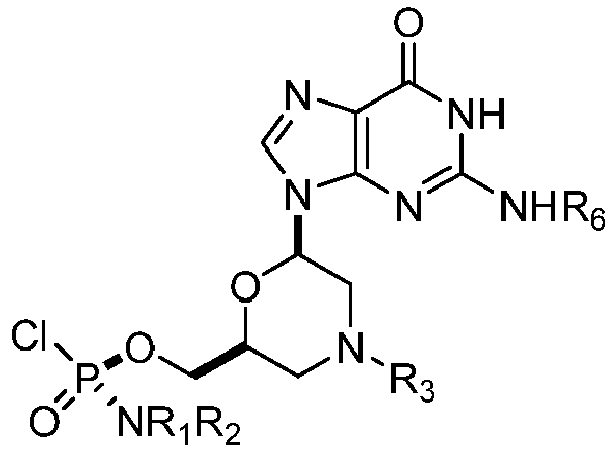
27 
28 
29 
30 
31 wherein R1 and R2 may be the same or different, and are selected from the group consisting of -H, optionally substituted C1-C3 alkyl, optionally substituted phenyl, optionally substituted naphthyl, or, with the nitrogen to which they are attached, form an optionally substituted heterocycle, which may be, for example, pyrrolidine, piperazine, and morpholine;wherein R3 is selected from the group consisting of trityl (Tr), which may be substituted trityl, including but not limited to such as MMTr (p-methoxyphenyldiphenylmethyl); optionally substituted benzyl, 4-methoxybenzyl (PMB, MPM), 3,4-dimethoxybenzyl, diphenylmethyl (Dpm), 4-methoxybenzyl, and sulfonyl;R4, R5, and R6 are selected from the group consisting of -H, -C(O)R7, and - C(O)OR7, where R7 is C1-C6 alkyl, benzyl, 2,2,2-trichloroethyl, and aryl;R9 is selected from the group consisting of optionally substituted alkyl, cyanoethyl, acyl, carbonate, carbamate, optionally substituted benzyl, 4-pivaloyloxy benzyl, and silyl,and enantiomers thereof. - The compound of claim 1, wherein the sulfonyl is a cleavable sulfonyl selected from the group consisting of 2-nitrobenzenesulfonyl, 4-nitrobenzenesulfonyl, and 2,4-dinitrobenzenesulfonyl.
- The compound of claim 1, wherein R4, R5, and R6 are selected from the group consisting of phenyl, 4-methoxy phenyl, 4-bromophenyl, and 4-nitrophenyl.
- A method for preparing a stereochemically pure oligonucleotide, comprising reacting substantially diastereomerically pure compounds of any one of claims 1-3.
- A substantially diastereomerically pure composition comprising a substantially diastereomerically pure compound of any one of claims 1-3.
- A substantially diastereomerically pure oligomer made by the method of claim 4.
- A pharmaceutical composition comprising a substantially diastereomerically pure oligomer of claim 6, or a pharmaceutically acceptable salt thereof.
Applications Claiming Priority (3)
| Application Number | Priority Date | Filing Date | Title |
|---|---|---|---|
| US201562201510P | 2015-08-05 | 2015-08-05 | |
| PCT/US2016/045876 WO2017024264A2 (en) | 2015-08-05 | 2016-08-05 | Chiral reagents for preparation of homogeneous oligomers |
| EP16767053.8A EP3331891B1 (en) | 2015-08-05 | 2016-08-05 | A method for preparing a substantially diastereomerically pure phosphorodiamidate oligomer, a phosphorodiamidate oligomer made by such a method and a pharmaceutical composition comprising such a phosphorodiamidate oligomer |
Related Parent Applications (1)
| Application Number | Title | Priority Date | Filing Date |
|---|---|---|---|
| EP16767053.8A Division EP3331891B1 (en) | 2015-08-05 | 2016-08-05 | A method for preparing a substantially diastereomerically pure phosphorodiamidate oligomer, a phosphorodiamidate oligomer made by such a method and a pharmaceutical composition comprising such a phosphorodiamidate oligomer |
Publications (3)
| Publication Number | Publication Date |
|---|---|
| EP4039690A1 true EP4039690A1 (en) | 2022-08-10 |
| EP4039690B1 EP4039690B1 (en) | 2024-07-17 |
| EP4039690C0 EP4039690C0 (en) | 2024-07-17 |
Family
ID=56943909
Family Applications (2)
| Application Number | Title | Priority Date | Filing Date |
|---|---|---|---|
| EP16767053.8A Active EP3331891B1 (en) | 2015-08-05 | 2016-08-05 | A method for preparing a substantially diastereomerically pure phosphorodiamidate oligomer, a phosphorodiamidate oligomer made by such a method and a pharmaceutical composition comprising such a phosphorodiamidate oligomer |
| EP21210674.4A Active EP4039690B1 (en) | 2015-08-05 | 2016-08-05 | A substantially diastereomerically pure phosphoramidochloridate, a method and a pharmaceutical composition |
Family Applications Before (1)
| Application Number | Title | Priority Date | Filing Date |
|---|---|---|---|
| EP16767053.8A Active EP3331891B1 (en) | 2015-08-05 | 2016-08-05 | A method for preparing a substantially diastereomerically pure phosphorodiamidate oligomer, a phosphorodiamidate oligomer made by such a method and a pharmaceutical composition comprising such a phosphorodiamidate oligomer |
Country Status (31)
| Country | Link |
|---|---|
| US (4) | US10457698B2 (en) |
| EP (2) | EP3331891B1 (en) |
| JP (4) | JP6978406B2 (en) |
| KR (2) | KR20250005537A (en) |
| CN (3) | CN108350005B (en) |
| AU (3) | AU2016302009B2 (en) |
| CA (1) | CA3296518A1 (en) |
| CL (1) | CL2018000322A1 (en) |
| CO (1) | CO2018001615A2 (en) |
| CY (1) | CY1125552T1 (en) |
| DK (1) | DK3331891T3 (en) |
| ES (2) | ES2907629T3 (en) |
| HR (1) | HRP20220129T1 (en) |
| HU (2) | HUE057593T2 (en) |
| IL (3) | IL293066A (en) |
| LT (1) | LT3331891T (en) |
| MA (1) | MA44209B1 (en) |
| MD (1) | MD3331891T2 (en) |
| MX (2) | MX389022B (en) |
| MY (1) | MY196627A (en) |
| NZ (2) | NZ778825A (en) |
| PE (2) | PE20231843A1 (en) |
| PH (1) | PH12018500265A1 (en) |
| PL (1) | PL3331891T3 (en) |
| PT (1) | PT3331891T (en) |
| RS (1) | RS62930B1 (en) |
| SI (1) | SI3331891T1 (en) |
| SM (1) | SMT202200089T1 (en) |
| UA (1) | UA123995C2 (en) |
| WO (1) | WO2017024264A2 (en) |
| ZA (3) | ZA201801518B (en) |
Families Citing this family (10)
| Publication number | Priority date | Publication date | Assignee | Title |
|---|---|---|---|---|
| RS62930B1 (en) * | 2015-08-05 | 2022-03-31 | Eisai R&D Man Co Ltd | A method for preparing a substantially diastereomerically pure phosphorodiamidate oligomer, a phosphorodiamidate oligomer made by such a method and a pharmaceutical composition comprising such a phosphorodiamidate oligomer |
| AU2017330276B2 (en) * | 2016-09-20 | 2022-01-20 | The Regents Of The University Of Colorado, A Body Corporate | Synthesis of backbone modified morpholino oligonucleotides and chimeras using phosphoramidite chemistry |
| IL294271A (en) | 2019-12-26 | 2022-08-01 | Nippon Shinyaku Co Ltd | Antisense nucleic acids that cause splicing on exon 50 |
| PE20230237A1 (en) | 2020-02-28 | 2023-02-07 | Nippon Shinyaku Co Ltd | ANTISENSE NUCLEIC ACIDS INDUCE SKIP OF EXON 51 |
| US20220195437A1 (en) | 2020-12-11 | 2022-06-23 | Eisai R&D Management Co., Ltd. | Tau-targeting oligonucleotide gapmers |
| JP2023553360A (en) | 2020-12-11 | 2023-12-21 | エーザイ・アール・アンド・ディー・マネジメント株式会社 | Poly-morpholino oligonucleotide gapmer |
| PE20252304A1 (en) | 2021-04-28 | 2025-09-22 | Eisai Randd Man Co Ltd | ANTI-SENSE OLIGONUCLEOTIDES AND THEIR USE FOR THE TREATMENT OF NEURODEGENERATIVE DISORDERS |
| EP4551580A2 (en) * | 2022-07-07 | 2025-05-14 | Eisai R&D Management Co., Ltd. | Crystalline monomers for preparing antisense oligonucleotides and methods of their preparation and use |
| KR20250099172A (en) | 2022-10-27 | 2025-07-01 | 에자이 알앤드디 매니지먼트 가부시키가이샤 | Peptide-antisense oligonucleotides and their use for the treatment of neurodegenerative disorders |
| EP4658280A2 (en) * | 2023-02-01 | 2025-12-10 | Alnylam Pharmaceuticals, Inc. | Six membered ring containing oligomers |
Citations (3)
| Publication number | Priority date | Publication date | Assignee | Title |
|---|---|---|---|---|
| US20090131624A1 (en) | 2007-11-15 | 2009-05-21 | Avi Biopharma, Inc. | Synthesis of morpholino oligomers using doubly protected guanine morpholino subunits |
| US20120289457A1 (en) * | 2011-05-05 | 2012-11-15 | Avi Biopharma, Inc. | Peptide oligonucleotide conjugates |
| US20130197220A1 (en) | 2010-09-30 | 2013-08-01 | Nippon Shinyaku Co., Ltd. | Morpholino Nucleic Acid Derivatives |
Family Cites Families (19)
| Publication number | Priority date | Publication date | Assignee | Title |
|---|---|---|---|---|
| US5185444A (en) | 1985-03-15 | 1993-02-09 | Anti-Gene Deveopment Group | Uncharged morpolino-based polymers having phosphorous containing chiral intersubunit linkages |
| US6117993A (en) * | 1995-05-23 | 2000-09-12 | Hybridon, Inc. | Synthons for oligonucleotide synthesis |
| US5922695A (en) | 1996-07-26 | 1999-07-13 | Gilead Sciences, Inc. | Antiviral phosphonomethyoxy nucleotide analogs having increased oral bioavarilability |
| US5874554A (en) | 1996-12-13 | 1999-02-23 | Incyte Pharmaceuticals, Inc. | Methods and solvent vehicles for reagent delivery in oligonucleotide synthesis using automated pulse jetting devices |
| US6306599B1 (en) * | 1999-07-16 | 2001-10-23 | Agilent Technologies Inc. | Biopolymer arrays and their fabrication |
| EP1176151B1 (en) | 2000-07-28 | 2014-08-20 | Agilent Technologies, Inc. | Synthesis of polynucleotides using combined oxidation/deprotection chemistry |
| AR036122A1 (en) | 2001-07-03 | 2004-08-11 | Avecia Biotechnology Inc | A COMPLEX OF SALT THAT INCLUDES AN N-ALQUILIMIDAZOL AND A 1,1-DIOXO-1,2-DIHIDRO-1L6-BENZO [D] -ISOTIAZOL-3-ONA AND A METHOD TO SYNTHEIZE OLIGONUCLEOTIDES USING PHOSPHORAMIDITE CHEMISTRY |
| MX2010004955A (en) * | 2007-11-15 | 2010-06-30 | Avi Biopharma Inc | Method of synthesis of morpholino oligomers. |
| WO2011018798A2 (en) | 2009-08-14 | 2011-02-17 | Indian Association For The Cultivation Of Science | Morpholino-based antisense agent |
| KR101981705B1 (en) * | 2010-05-28 | 2019-05-24 | 사렙타 쎄러퓨틱스, 인코퍼레이티드 | Oligonucleotide analogues having modified intersubunit linkages and/or terminal groups |
| AU2011367230B2 (en) * | 2011-05-05 | 2017-08-10 | Sarepta Therapeutics, Inc. | Peptide oligonucleotide conjugates |
| ES2661705T3 (en) | 2011-10-07 | 2018-04-03 | Gilead Sciences, Inc. | Methods for the preparation of antiviral nucleotide analogs |
| KR20140097398A (en) | 2011-11-18 | 2014-08-06 | 사렙타 쎄러퓨틱스, 인코퍼레이티드 | Functionally-modified oligonucleotides and subunits thereof |
| WO2013082548A1 (en) | 2011-11-30 | 2013-06-06 | Sarepta Therapeutics, Inc. | Oligonucleotides for treating expanded repeat diseases |
| CN102702265A (en) * | 2012-05-14 | 2012-10-03 | 天津特安化学科技有限公司 | Phosphorodiamidate morpholino oligomer synthetized by solid phase and method thereof |
| DE102015214943A1 (en) | 2015-08-05 | 2017-02-09 | Siemens Aktiengesellschaft | Process and plant for chemical synthesis |
| GB201513921D0 (en) | 2015-08-05 | 2015-09-23 | Immatics Biotechnologies Gmbh | Novel peptides and combination of peptides for use in immunotherapy against prostate cancer and other cancers |
| MY188405A (en) | 2015-08-05 | 2021-12-08 | Janssen Biotech Inc | Anti-cd154 antibodies and methods of using them |
| RS62930B1 (en) * | 2015-08-05 | 2022-03-31 | Eisai R&D Man Co Ltd | A method for preparing a substantially diastereomerically pure phosphorodiamidate oligomer, a phosphorodiamidate oligomer made by such a method and a pharmaceutical composition comprising such a phosphorodiamidate oligomer |
-
2016
- 2016-08-05 RS RS20220178A patent/RS62930B1/en unknown
- 2016-08-05 MA MA44209A patent/MA44209B1/en unknown
- 2016-08-05 ES ES16767053T patent/ES2907629T3/en active Active
- 2016-08-05 UA UAA201802109A patent/UA123995C2/en unknown
- 2016-08-05 WO PCT/US2016/045876 patent/WO2017024264A2/en not_active Ceased
- 2016-08-05 NZ NZ778825A patent/NZ778825A/en unknown
- 2016-08-05 MD MDE20180593T patent/MD3331891T2/en unknown
- 2016-08-05 SM SM20220089T patent/SMT202200089T1/en unknown
- 2016-08-05 HU HUE16767053A patent/HUE057593T2/en unknown
- 2016-08-05 SI SI201631470T patent/SI3331891T1/en unknown
- 2016-08-05 EP EP16767053.8A patent/EP3331891B1/en active Active
- 2016-08-05 CA CA3296518A patent/CA3296518A1/en active Pending
- 2016-08-05 IL IL293066A patent/IL293066A/en unknown
- 2016-08-05 PL PL16767053T patent/PL3331891T3/en unknown
- 2016-08-05 MX MX2018001557A patent/MX389022B/en unknown
- 2016-08-05 PE PE2023000140A patent/PE20231843A1/en unknown
- 2016-08-05 IL IL284611A patent/IL284611B2/en unknown
- 2016-08-05 NZ NZ778828A patent/NZ778828A/en unknown
- 2016-08-05 PE PE2018000192A patent/PE20180687A1/en unknown
- 2016-08-05 LT LTEPPCT/US2016/045876T patent/LT3331891T/en unknown
- 2016-08-05 AU AU2016302009A patent/AU2016302009B2/en active Active
- 2016-08-05 US US15/750,087 patent/US10457698B2/en active Active
- 2016-08-05 HU HUE21210674A patent/HUE067910T2/en unknown
- 2016-08-05 KR KR1020247042650A patent/KR20250005537A/en active Pending
- 2016-08-05 ES ES21210674T patent/ES2993126T3/en active Active
- 2016-08-05 PT PT167670538T patent/PT3331891T/en unknown
- 2016-08-05 CN CN201680058501.2A patent/CN108350005B/en active Active
- 2016-08-05 CN CN202410065464.4A patent/CN117924364A/en active Pending
- 2016-08-05 KR KR1020187006255A patent/KR102788397B1/en active Active
- 2016-08-05 DK DK16767053.8T patent/DK3331891T3/en active
- 2016-08-05 JP JP2018506149A patent/JP6978406B2/en active Active
- 2016-08-05 EP EP21210674.4A patent/EP4039690B1/en active Active
- 2016-08-05 CN CN202110735306.1A patent/CN113461733A/en active Pending
- 2016-08-05 HR HRP20220129TT patent/HRP20220129T1/en unknown
- 2016-08-25 MY MYPI2018000173A patent/MY196627A/en unknown
-
2018
- 2018-02-05 CL CL2018000322A patent/CL2018000322A1/en unknown
- 2018-02-05 IL IL257353A patent/IL257353B2/en unknown
- 2018-02-05 PH PH12018500265A patent/PH12018500265A1/en unknown
- 2018-02-06 MX MX2022000124A patent/MX2022000124A/en unknown
- 2018-02-19 CO CONC2018/0001615A patent/CO2018001615A2/en unknown
- 2018-03-05 ZA ZA2018/01518A patent/ZA201801518B/en unknown
-
2019
- 2019-08-15 ZA ZA2019/05394A patent/ZA201905394B/en unknown
- 2019-09-17 US US16/573,185 patent/US10836784B2/en active Active
-
2020
- 2020-10-28 US US17/082,070 patent/US20210171555A1/en not_active Abandoned
-
2021
- 2021-09-29 JP JP2021159804A patent/JP7254869B2/en active Active
- 2021-12-21 AU AU2021290235A patent/AU2021290235B2/en active Active
-
2022
- 2022-01-21 ZA ZA2022/01010A patent/ZA202201010B/en unknown
- 2022-02-23 CY CY20221100159T patent/CY1125552T1/en unknown
-
2023
- 2023-03-29 JP JP2023053119A patent/JP7712975B2/en active Active
- 2023-09-08 AU AU2023226763A patent/AU2023226763B2/en active Active
-
2024
- 2024-07-22 US US18/779,841 patent/US20250171475A1/en active Pending
-
2025
- 2025-03-03 JP JP2025032861A patent/JP2025090640A/en active Pending
Patent Citations (3)
| Publication number | Priority date | Publication date | Assignee | Title |
|---|---|---|---|---|
| US20090131624A1 (en) | 2007-11-15 | 2009-05-21 | Avi Biopharma, Inc. | Synthesis of morpholino oligomers using doubly protected guanine morpholino subunits |
| US20130197220A1 (en) | 2010-09-30 | 2013-08-01 | Nippon Shinyaku Co., Ltd. | Morpholino Nucleic Acid Derivatives |
| US20120289457A1 (en) * | 2011-05-05 | 2012-11-15 | Avi Biopharma, Inc. | Peptide oligonucleotide conjugates |
Non-Patent Citations (8)
| Title |
|---|
| CREAGH, D. C.MCAULEY, W.J .: "International Tables for Crystallography", vol. C, 1992, KLUWER ACADEMIC PUBLISHERS, pages: 200 - 206 |
| FLACK, H.D.BERNARDINELLI, J. APPL. CRYST., vol. 33, 2000, pages 114 - 1148 |
| IBERS, J. A.HAMILTON, W. C, ACTA CRYSTALLOGR., vol. 17, 1964, pages 781 |
| PARSONS, S.FLACK, H., ACTA CRYST, vol. A60, 2004, pages s61 |
| SHELDRICK, G. M., ACTA CRYST, vol. A64, 2008, pages 112 - 122 |
| SHELDRICK, G. M., ACTA CRYST, vol. A70, 2014, pages C1437 |
| SUMMERTON, J: "Morpholino Antisense Oligomers: The Case for an RNase-H Independent Structural Type.", BIOCHIMICA ET BIOPHYSICA ACTA, vol. 1489, no. 1, 1999, pages 141 - 58, XP004275529, DOI: 10.1016/S0167-4781(99)00150-5 |
| SUMMERTON, JWELLER D.: "Morpholino Antisense Oligomers: Design, Preparation and Properties", ANTISENSE & NUCLEIC ACID DRUG DEVELOPMENT, vol. 7, no. 3, 1997, pages 187 - 95, XP002136176 |
Also Published As
Similar Documents
| Publication | Publication Date | Title |
|---|---|---|
| US20250171475A1 (en) | Chiral reagents for preparation of homogeneous oligomers | |
| US11261209B2 (en) | Enhanced coupling of stereodefined oxazaphospholidine phosphoramidite monomers to nucleoside or oligonucleotide | |
| HK40069732A (en) | A substantially diastereomerically pure phosphoramidochloridate, a method and a pharmaceutical composition | |
| HK40069732B (en) | A substantially diastereomerically pure phosphoramidochloridate, a method and a pharmaceutical composition | |
| HK1248708B (en) | A method for preparing a substantially diastereomerically pure phosphorodiamidate oligomer, a phosphorodiamidate oligomer made by such a method and a pharmaceutical composition comprising such a phosphorodiamidate oligomer | |
| RU2791532C2 (en) | Chiral reagents for production of homogenous oligomers | |
| HK40059317A (en) | Chiral reagents for preparation of homogeneous oligomers | |
| KR102934598B1 (en) | Novel Morpholino Oligonucleotide derivatives | |
| BR122023025447B1 (en) | SUBSTANTIALLY DIASTEREOMERICALLY PURE COMPOUND, METHOD FOR PREPARING AN OLIGONUCLEOTIDE AND SUBSTANTIALLY DIASTEREOMERICALLY PURE COMPOSITION | |
| BR112018002430B1 (en) | METHOD OF PREPARING SUBSTANTIALLY DIASTEREOMERICALLY PURE PHOSPHORODIAMIDATE MORPHOLINE OLIGOMER, PHOSPHORODIAMIDATE MORPHOLINE OLIGOMER AND PHARMACEUTICAL COMPOSITION CONTAINING THE SAME | |
| WO2023167908A1 (en) | Bis-protected, activated guanine monomers | |
| BR112017021926B1 (en) | PROCESS FOR THE PREPARATION OF GALNAC ACID DERIVATIVES, AMINE SALT AND PROCESS FOR THE PREPARATION OF GALNAC OLIGONUCLEOTIDE CONJUGATES |
Legal Events
| Date | Code | Title | Description |
|---|---|---|---|
| PUAI | Public reference made under article 153(3) epc to a published international application that has entered the european phase |
Free format text: ORIGINAL CODE: 0009012 |
|
| STAA | Information on the status of an ep patent application or granted ep patent |
Free format text: STATUS: THE APPLICATION HAS BEEN PUBLISHED |
|
| AC | Divisional application: reference to earlier application |
Ref document number: 3331891 Country of ref document: EP Kind code of ref document: P |
|
| AK | Designated contracting states |
Kind code of ref document: A1 Designated state(s): AL AT BE BG CH CY CZ DE DK EE ES FI FR GB GR HR HU IE IS IT LI LT LU LV MC MK MT NL NO PL PT RO RS SE SI SK SM TR |
|
| REG | Reference to a national code |
Ref country code: HK Ref legal event code: DE Ref document number: 40069732 Country of ref document: HK |
|
| STAA | Information on the status of an ep patent application or granted ep patent |
Free format text: STATUS: REQUEST FOR EXAMINATION WAS MADE |
|
| 17P | Request for examination filed |
Effective date: 20230203 |
|
| RAV | Requested validation state of the european patent: fee paid |
Extension state: MD Effective date: 20230203 Extension state: MA Effective date: 20230203 |
|
| RAX | Requested extension states of the european patent have changed |
Extension state: ME Payment date: 20230203 Extension state: BA Payment date: 20230203 |
|
| RBV | Designated contracting states (corrected) |
Designated state(s): AL AT BE BG CH CY CZ DE DK EE ES FI FR GB GR HR HU IE IS IT LI LT LU LV MC MK MT NL NO PL PT RO RS SE SI SK SM TR |
|
| STAA | Information on the status of an ep patent application or granted ep patent |
Free format text: STATUS: EXAMINATION IS IN PROGRESS |
|
| P01 | Opt-out of the competence of the unified patent court (upc) registered |
Effective date: 20230511 |
|
| 17Q | First examination report despatched |
Effective date: 20230613 |
|
| GRAP | Despatch of communication of intention to grant a patent |
Free format text: ORIGINAL CODE: EPIDOSNIGR1 |
|
| STAA | Information on the status of an ep patent application or granted ep patent |
Free format text: STATUS: GRANT OF PATENT IS INTENDED |
|
| INTG | Intention to grant announced |
Effective date: 20240214 |
|
| GRAS | Grant fee paid |
Free format text: ORIGINAL CODE: EPIDOSNIGR3 |
|
| GRAA | (expected) grant |
Free format text: ORIGINAL CODE: 0009210 |
|
| STAA | Information on the status of an ep patent application or granted ep patent |
Free format text: STATUS: THE PATENT HAS BEEN GRANTED |
|
| AC | Divisional application: reference to earlier application |
Ref document number: 3331891 Country of ref document: EP Kind code of ref document: P |
|
| AK | Designated contracting states |
Kind code of ref document: B1 Designated state(s): AL AT BE BG CH CY CZ DE DK EE ES FI FR GB GR HR HU IE IS IT LI LT LU LV MC MK MT NL NO PL PT RO RS SE SI SK SM TR |
|
| REG | Reference to a national code |
Ref country code: CH Ref legal event code: EP |
|
| REG | Reference to a national code |
Ref country code: DE Ref legal event code: R096 Ref document number: 602016088511 Country of ref document: DE |
|
| REG | Reference to a national code |
Ref country code: IE Ref legal event code: FG4D |
|
| U01 | Request for unitary effect filed |
Effective date: 20240809 |
|
| P04 | Withdrawal of opt-out of the competence of the unified patent court (upc) registered |
Free format text: CASE NUMBER: APP_48688/2024 Effective date: 20240826 |
|
| U07 | Unitary effect registered |
Designated state(s): AT BE BG DE DK EE FI FR IT LT LU LV MT NL PT RO SE SI Effective date: 20240902 |
|
| U20 | Renewal fee for the european patent with unitary effect paid |
Year of fee payment: 9 Effective date: 20240827 |
|
| REG | Reference to a national code |
Ref country code: HU Ref legal event code: AG4A Ref document number: E067910 Country of ref document: HU |
|
| REG | Reference to a national code |
Ref country code: ES Ref legal event code: FG2A Ref document number: 2993126 Country of ref document: ES Kind code of ref document: T3 Effective date: 20241223 |
|
| P05 | Withdrawal of opt-out of the competence of the unified patent court (upc) changed |
Free format text: CASE NUMBER: APP_48688/2024 Effective date: 20240902 |
|
| PG25 | Lapsed in a contracting state [announced via postgrant information from national office to epo] |
Ref country code: NO Free format text: LAPSE BECAUSE OF FAILURE TO SUBMIT A TRANSLATION OF THE DESCRIPTION OR TO PAY THE FEE WITHIN THE PRESCRIBED TIME-LIMIT Effective date: 20241017 |
|
| PG25 | Lapsed in a contracting state [announced via postgrant information from national office to epo] |
Ref country code: GR Free format text: LAPSE BECAUSE OF FAILURE TO SUBMIT A TRANSLATION OF THE DESCRIPTION OR TO PAY THE FEE WITHIN THE PRESCRIBED TIME-LIMIT Effective date: 20241018 Ref country code: PL Free format text: LAPSE BECAUSE OF FAILURE TO SUBMIT A TRANSLATION OF THE DESCRIPTION OR TO PAY THE FEE WITHIN THE PRESCRIBED TIME-LIMIT Effective date: 20240717 |
|
| PG25 | Lapsed in a contracting state [announced via postgrant information from national office to epo] |
Ref country code: IS Free format text: LAPSE BECAUSE OF FAILURE TO SUBMIT A TRANSLATION OF THE DESCRIPTION OR TO PAY THE FEE WITHIN THE PRESCRIBED TIME-LIMIT Effective date: 20241117 |
|
| PG25 | Lapsed in a contracting state [announced via postgrant information from national office to epo] |
Ref country code: HR Free format text: LAPSE BECAUSE OF FAILURE TO SUBMIT A TRANSLATION OF THE DESCRIPTION OR TO PAY THE FEE WITHIN THE PRESCRIBED TIME-LIMIT Effective date: 20240717 |
|
| PG25 | Lapsed in a contracting state [announced via postgrant information from national office to epo] |
Ref country code: RS Free format text: LAPSE BECAUSE OF FAILURE TO SUBMIT A TRANSLATION OF THE DESCRIPTION OR TO PAY THE FEE WITHIN THE PRESCRIBED TIME-LIMIT Effective date: 20241017 |
|
| PG25 | Lapsed in a contracting state [announced via postgrant information from national office to epo] |
Ref country code: RS Free format text: LAPSE BECAUSE OF FAILURE TO SUBMIT A TRANSLATION OF THE DESCRIPTION OR TO PAY THE FEE WITHIN THE PRESCRIBED TIME-LIMIT Effective date: 20241017 Ref country code: PL Free format text: LAPSE BECAUSE OF FAILURE TO SUBMIT A TRANSLATION OF THE DESCRIPTION OR TO PAY THE FEE WITHIN THE PRESCRIBED TIME-LIMIT Effective date: 20240717 Ref country code: NO Free format text: LAPSE BECAUSE OF FAILURE TO SUBMIT A TRANSLATION OF THE DESCRIPTION OR TO PAY THE FEE WITHIN THE PRESCRIBED TIME-LIMIT Effective date: 20241017 Ref country code: IS Free format text: LAPSE BECAUSE OF FAILURE TO SUBMIT A TRANSLATION OF THE DESCRIPTION OR TO PAY THE FEE WITHIN THE PRESCRIBED TIME-LIMIT Effective date: 20241117 Ref country code: HR Free format text: LAPSE BECAUSE OF FAILURE TO SUBMIT A TRANSLATION OF THE DESCRIPTION OR TO PAY THE FEE WITHIN THE PRESCRIBED TIME-LIMIT Effective date: 20240717 Ref country code: GR Free format text: LAPSE BECAUSE OF FAILURE TO SUBMIT A TRANSLATION OF THE DESCRIPTION OR TO PAY THE FEE WITHIN THE PRESCRIBED TIME-LIMIT Effective date: 20241018 |
|
| PG25 | Lapsed in a contracting state [announced via postgrant information from national office to epo] |
Ref country code: SM Free format text: LAPSE BECAUSE OF FAILURE TO SUBMIT A TRANSLATION OF THE DESCRIPTION OR TO PAY THE FEE WITHIN THE PRESCRIBED TIME-LIMIT Effective date: 20240717 |
|
| PG25 | Lapsed in a contracting state [announced via postgrant information from national office to epo] |
Ref country code: MC Free format text: LAPSE BECAUSE OF FAILURE TO SUBMIT A TRANSLATION OF THE DESCRIPTION OR TO PAY THE FEE WITHIN THE PRESCRIBED TIME-LIMIT Effective date: 20240717 |
|
| PG25 | Lapsed in a contracting state [announced via postgrant information from national office to epo] |
Ref country code: CZ Free format text: LAPSE BECAUSE OF FAILURE TO SUBMIT A TRANSLATION OF THE DESCRIPTION OR TO PAY THE FEE WITHIN THE PRESCRIBED TIME-LIMIT Effective date: 20240717 |
|
| PG25 | Lapsed in a contracting state [announced via postgrant information from national office to epo] |
Ref country code: SK Free format text: LAPSE BECAUSE OF FAILURE TO SUBMIT A TRANSLATION OF THE DESCRIPTION OR TO PAY THE FEE WITHIN THE PRESCRIBED TIME-LIMIT Effective date: 20240717 |
|
| PLBE | No opposition filed within time limit |
Free format text: ORIGINAL CODE: 0009261 |
|
| STAA | Information on the status of an ep patent application or granted ep patent |
Free format text: STATUS: NO OPPOSITION FILED WITHIN TIME LIMIT |
|
| VS25 | Lapsed in a validation state [announced via postgrant information from nat. office to epo] |
Ref country code: MD Free format text: LAPSE BECAUSE OF FAILURE TO SUBMIT A TRANSLATION OF THE DESCRIPTION OR TO PAY THE FEE WITHIN THE PRESCRIBED TIME-LIMIT Effective date: 20240717 |
|
| 26N | No opposition filed |
Effective date: 20250422 |
|
| PGFP | Annual fee paid to national office [announced via postgrant information from national office to epo] |
Ref country code: HU Payment date: 20250730 Year of fee payment: 10 |
|
| U20 | Renewal fee for the european patent with unitary effect paid |
Year of fee payment: 10 Effective date: 20250827 |
|
| PGFP | Annual fee paid to national office [announced via postgrant information from national office to epo] |
Ref country code: ES Payment date: 20250901 Year of fee payment: 10 |
|
| PGFP | Annual fee paid to national office [announced via postgrant information from national office to epo] |
Ref country code: GB Payment date: 20250827 Year of fee payment: 10 |
|
| PGFP | Annual fee paid to national office [announced via postgrant information from national office to epo] |
Ref country code: CH Payment date: 20250901 Year of fee payment: 10 |
|
| PGFP | Annual fee paid to national office [announced via postgrant information from national office to epo] |
Ref country code: IE Payment date: 20250827 Year of fee payment: 10 |
|
| PG25 | Lapsed in a contracting state [announced via postgrant information from national office to epo] |
Ref country code: CY Free format text: LAPSE BECAUSE OF FAILURE TO SUBMIT A TRANSLATION OF THE DESCRIPTION OR TO PAY THE FEE WITHIN THE PRESCRIBED TIME-LIMIT; INVALID AB INITIO Effective date: 20160805 |
|
| VS25 | Lapsed in a validation state [announced via postgrant information from nat. office to epo] |
Ref country code: MA Free format text: FAILURE TO ELECT DOMICILE IN THE NATIONAL COUNTRY Effective date: 20241018 |
|
| VS25 | Lapsed in a validation state [announced via postgrant information from nat. office to epo] |
Ref country code: MA Free format text: LAPSE BECAUSE OF FAILURE TO SUBMIT A TRANSLATION OF THE DESCRIPTION OR TO PAY THE FEE WITHIN THE PRESCRIBED TIME-LIMIT Effective date: 20240717 |
|
| PG25 | Lapsed in a contracting state [announced via postgrant information from national office to epo] |
Ref country code: TR Free format text: LAPSE BECAUSE OF FAILURE TO SUBMIT A TRANSLATION OF THE DESCRIPTION OR TO PAY THE FEE WITHIN THE PRESCRIBED TIME-LIMIT Effective date: 20240717 |