EP4039555B1 - Lane recognition apparatus and method of controlling same - Google Patents
Lane recognition apparatus and method of controlling same Download PDFInfo
- Publication number
- EP4039555B1 EP4039555B1 EP22155406.6A EP22155406A EP4039555B1 EP 4039555 B1 EP4039555 B1 EP 4039555B1 EP 22155406 A EP22155406 A EP 22155406A EP 4039555 B1 EP4039555 B1 EP 4039555B1
- Authority
- EP
- European Patent Office
- Prior art keywords
- line distance
- vehicle
- lane
- response
- subject vehicle
- Prior art date
- Legal status (The legal status is an assumption and is not a legal conclusion. Google has not performed a legal analysis and makes no representation as to the accuracy of the status listed.)
- Active
Links
Images



Classifications
-
- G—PHYSICS
- G06—COMPUTING OR CALCULATING; COUNTING
- G06V—IMAGE OR VIDEO RECOGNITION OR UNDERSTANDING
- G06V20/00—Scenes; Scene-specific elements
- G06V20/50—Context or environment of the image
- G06V20/56—Context or environment of the image exterior to a vehicle by using sensors mounted on the vehicle
- G06V20/588—Recognition of the road, e.g. of lane markings; Recognition of the vehicle driving pattern in relation to the road
-
- B—PERFORMING OPERATIONS; TRANSPORTING
- B60—VEHICLES IN GENERAL
- B60Q—ARRANGEMENT OF SIGNALLING OR LIGHTING DEVICES, THE MOUNTING OR SUPPORTING THEREOF OR CIRCUITS THEREFOR, FOR VEHICLES IN GENERAL
- B60Q1/00—Arrangement of optical signalling or lighting devices, the mounting or supporting thereof or circuits therefor
- B60Q1/26—Arrangement of optical signalling or lighting devices, the mounting or supporting thereof or circuits therefor the devices being primarily intended to indicate the vehicle, or parts thereof, or to give signals, to other traffic
- B60Q1/30—Arrangement of optical signalling or lighting devices, the mounting or supporting thereof or circuits therefor the devices being primarily intended to indicate the vehicle, or parts thereof, or to give signals, to other traffic for indicating rear of vehicle, e.g. by means of reflecting surfaces
-
- B—PERFORMING OPERATIONS; TRANSPORTING
- B60—VEHICLES IN GENERAL
- B60W—CONJOINT CONTROL OF VEHICLE SUB-UNITS OF DIFFERENT TYPE OR DIFFERENT FUNCTION; CONTROL SYSTEMS SPECIALLY ADAPTED FOR HYBRID VEHICLES; ROAD VEHICLE DRIVE CONTROL SYSTEMS FOR PURPOSES NOT RELATED TO THE CONTROL OF A PARTICULAR SUB-UNIT
- B60W30/00—Purposes of road vehicle drive control systems not related to the control of a particular sub-unit, e.g. of systems using conjoint control of vehicle sub-units
- B60W30/08—Active safety systems predicting or avoiding probable or impending collision or attempting to minimise its consequences
-
- B—PERFORMING OPERATIONS; TRANSPORTING
- B60—VEHICLES IN GENERAL
- B60W—CONJOINT CONTROL OF VEHICLE SUB-UNITS OF DIFFERENT TYPE OR DIFFERENT FUNCTION; CONTROL SYSTEMS SPECIALLY ADAPTED FOR HYBRID VEHICLES; ROAD VEHICLE DRIVE CONTROL SYSTEMS FOR PURPOSES NOT RELATED TO THE CONTROL OF A PARTICULAR SUB-UNIT
- B60W30/00—Purposes of road vehicle drive control systems not related to the control of a particular sub-unit, e.g. of systems using conjoint control of vehicle sub-units
- B60W30/08—Active safety systems predicting or avoiding probable or impending collision or attempting to minimise its consequences
- B60W30/095—Predicting travel path or likelihood of collision
-
- B—PERFORMING OPERATIONS; TRANSPORTING
- B60—VEHICLES IN GENERAL
- B60W—CONJOINT CONTROL OF VEHICLE SUB-UNITS OF DIFFERENT TYPE OR DIFFERENT FUNCTION; CONTROL SYSTEMS SPECIALLY ADAPTED FOR HYBRID VEHICLES; ROAD VEHICLE DRIVE CONTROL SYSTEMS FOR PURPOSES NOT RELATED TO THE CONTROL OF A PARTICULAR SUB-UNIT
- B60W30/00—Purposes of road vehicle drive control systems not related to the control of a particular sub-unit, e.g. of systems using conjoint control of vehicle sub-units
- B60W30/08—Active safety systems predicting or avoiding probable or impending collision or attempting to minimise its consequences
- B60W30/095—Predicting travel path or likelihood of collision
- B60W30/0956—Predicting travel path or likelihood of collision the prediction being responsive to traffic or environmental parameters
-
- B—PERFORMING OPERATIONS; TRANSPORTING
- B60—VEHICLES IN GENERAL
- B60W—CONJOINT CONTROL OF VEHICLE SUB-UNITS OF DIFFERENT TYPE OR DIFFERENT FUNCTION; CONTROL SYSTEMS SPECIALLY ADAPTED FOR HYBRID VEHICLES; ROAD VEHICLE DRIVE CONTROL SYSTEMS FOR PURPOSES NOT RELATED TO THE CONTROL OF A PARTICULAR SUB-UNIT
- B60W30/00—Purposes of road vehicle drive control systems not related to the control of a particular sub-unit, e.g. of systems using conjoint control of vehicle sub-units
- B60W30/10—Path keeping
- B60W30/12—Lane keeping
-
- B—PERFORMING OPERATIONS; TRANSPORTING
- B60—VEHICLES IN GENERAL
- B60W—CONJOINT CONTROL OF VEHICLE SUB-UNITS OF DIFFERENT TYPE OR DIFFERENT FUNCTION; CONTROL SYSTEMS SPECIALLY ADAPTED FOR HYBRID VEHICLES; ROAD VEHICLE DRIVE CONTROL SYSTEMS FOR PURPOSES NOT RELATED TO THE CONTROL OF A PARTICULAR SUB-UNIT
- B60W30/00—Purposes of road vehicle drive control systems not related to the control of a particular sub-unit, e.g. of systems using conjoint control of vehicle sub-units
- B60W30/18—Propelling the vehicle
- B60W30/18009—Propelling the vehicle related to particular drive situations
- B60W30/18163—Lane change; Overtaking manoeuvres
-
- B—PERFORMING OPERATIONS; TRANSPORTING
- B60—VEHICLES IN GENERAL
- B60W—CONJOINT CONTROL OF VEHICLE SUB-UNITS OF DIFFERENT TYPE OR DIFFERENT FUNCTION; CONTROL SYSTEMS SPECIALLY ADAPTED FOR HYBRID VEHICLES; ROAD VEHICLE DRIVE CONTROL SYSTEMS FOR PURPOSES NOT RELATED TO THE CONTROL OF A PARTICULAR SUB-UNIT
- B60W40/00—Estimation or calculation of non-directly measurable driving parameters for road vehicle drive control systems not related to the control of a particular sub unit, e.g. by using mathematical models
- B60W40/10—Estimation or calculation of non-directly measurable driving parameters for road vehicle drive control systems not related to the control of a particular sub unit, e.g. by using mathematical models related to vehicle motion
-
- B—PERFORMING OPERATIONS; TRANSPORTING
- B60—VEHICLES IN GENERAL
- B60W—CONJOINT CONTROL OF VEHICLE SUB-UNITS OF DIFFERENT TYPE OR DIFFERENT FUNCTION; CONTROL SYSTEMS SPECIALLY ADAPTED FOR HYBRID VEHICLES; ROAD VEHICLE DRIVE CONTROL SYSTEMS FOR PURPOSES NOT RELATED TO THE CONTROL OF A PARTICULAR SUB-UNIT
- B60W50/00—Details of control systems for road vehicle drive control not related to the control of a particular sub-unit, e.g. process diagnostic or vehicle driver interfaces
- B60W50/08—Interaction between the driver and the control system
- B60W50/14—Means for informing the driver, warning the driver or prompting a driver intervention
-
- G—PHYSICS
- G01—MEASURING; TESTING
- G01S—RADIO DIRECTION-FINDING; RADIO NAVIGATION; DETERMINING DISTANCE OR VELOCITY BY USE OF RADIO WAVES; LOCATING OR PRESENCE-DETECTING BY USE OF THE REFLECTION OR RERADIATION OF RADIO WAVES; ANALOGOUS ARRANGEMENTS USING OTHER WAVES
- G01S13/00—Systems using the reflection or reradiation of radio waves, e.g. radar systems; Analogous systems using reflection or reradiation of waves whose nature or wavelength is irrelevant or unspecified
- G01S13/88—Radar or analogous systems specially adapted for specific applications
- G01S13/93—Radar or analogous systems specially adapted for specific applications for anti-collision purposes
- G01S13/931—Radar or analogous systems specially adapted for specific applications for anti-collision purposes of land vehicles
-
- B—PERFORMING OPERATIONS; TRANSPORTING
- B60—VEHICLES IN GENERAL
- B60Q—ARRANGEMENT OF SIGNALLING OR LIGHTING DEVICES, THE MOUNTING OR SUPPORTING THEREOF OR CIRCUITS THEREFOR, FOR VEHICLES IN GENERAL
- B60Q1/00—Arrangement of optical signalling or lighting devices, the mounting or supporting thereof or circuits therefor
- B60Q1/26—Arrangement of optical signalling or lighting devices, the mounting or supporting thereof or circuits therefor the devices being primarily intended to indicate the vehicle, or parts thereof, or to give signals, to other traffic
- B60Q1/50—Arrangement of optical signalling or lighting devices, the mounting or supporting thereof or circuits therefor the devices being primarily intended to indicate the vehicle, or parts thereof, or to give signals, to other traffic for indicating other intentions or conditions, e.g. request for waiting or overtaking
- B60Q1/525—Arrangement of optical signalling or lighting devices, the mounting or supporting thereof or circuits therefor the devices being primarily intended to indicate the vehicle, or parts thereof, or to give signals, to other traffic for indicating other intentions or conditions, e.g. request for waiting or overtaking automatically indicating risk of collision between vehicles in traffic or with pedestrians, e.g. after risk assessment using the vehicle sensor data
-
- B—PERFORMING OPERATIONS; TRANSPORTING
- B60—VEHICLES IN GENERAL
- B60Q—ARRANGEMENT OF SIGNALLING OR LIGHTING DEVICES, THE MOUNTING OR SUPPORTING THEREOF OR CIRCUITS THEREFOR, FOR VEHICLES IN GENERAL
- B60Q9/00—Arrangement or adaptation of signal devices not provided for in one of main groups B60Q1/00 - B60Q7/00, e.g. haptic signalling
- B60Q9/008—Arrangement or adaptation of signal devices not provided for in one of main groups B60Q1/00 - B60Q7/00, e.g. haptic signalling for anti-collision purposes
-
- B—PERFORMING OPERATIONS; TRANSPORTING
- B60—VEHICLES IN GENERAL
- B60W—CONJOINT CONTROL OF VEHICLE SUB-UNITS OF DIFFERENT TYPE OR DIFFERENT FUNCTION; CONTROL SYSTEMS SPECIALLY ADAPTED FOR HYBRID VEHICLES; ROAD VEHICLE DRIVE CONTROL SYSTEMS FOR PURPOSES NOT RELATED TO THE CONTROL OF A PARTICULAR SUB-UNIT
- B60W50/00—Details of control systems for road vehicle drive control not related to the control of a particular sub-unit, e.g. process diagnostic or vehicle driver interfaces
- B60W2050/0001—Details of the control system
- B60W2050/0002—Automatic control, details of type of controller or control system architecture
-
- B—PERFORMING OPERATIONS; TRANSPORTING
- B60—VEHICLES IN GENERAL
- B60W—CONJOINT CONTROL OF VEHICLE SUB-UNITS OF DIFFERENT TYPE OR DIFFERENT FUNCTION; CONTROL SYSTEMS SPECIALLY ADAPTED FOR HYBRID VEHICLES; ROAD VEHICLE DRIVE CONTROL SYSTEMS FOR PURPOSES NOT RELATED TO THE CONTROL OF A PARTICULAR SUB-UNIT
- B60W50/00—Details of control systems for road vehicle drive control not related to the control of a particular sub-unit, e.g. process diagnostic or vehicle driver interfaces
- B60W50/08—Interaction between the driver and the control system
- B60W50/14—Means for informing the driver, warning the driver or prompting a driver intervention
- B60W2050/146—Display means
-
- B—PERFORMING OPERATIONS; TRANSPORTING
- B60—VEHICLES IN GENERAL
- B60W—CONJOINT CONTROL OF VEHICLE SUB-UNITS OF DIFFERENT TYPE OR DIFFERENT FUNCTION; CONTROL SYSTEMS SPECIALLY ADAPTED FOR HYBRID VEHICLES; ROAD VEHICLE DRIVE CONTROL SYSTEMS FOR PURPOSES NOT RELATED TO THE CONTROL OF A PARTICULAR SUB-UNIT
- B60W2420/00—Indexing codes relating to the type of sensors based on the principle of their operation
-
- B—PERFORMING OPERATIONS; TRANSPORTING
- B60—VEHICLES IN GENERAL
- B60W—CONJOINT CONTROL OF VEHICLE SUB-UNITS OF DIFFERENT TYPE OR DIFFERENT FUNCTION; CONTROL SYSTEMS SPECIALLY ADAPTED FOR HYBRID VEHICLES; ROAD VEHICLE DRIVE CONTROL SYSTEMS FOR PURPOSES NOT RELATED TO THE CONTROL OF A PARTICULAR SUB-UNIT
- B60W2420/00—Indexing codes relating to the type of sensors based on the principle of their operation
- B60W2420/40—Photo, light or radio wave sensitive means, e.g. infrared sensors
- B60W2420/408—Radar; Laser, e.g. lidar
-
- B—PERFORMING OPERATIONS; TRANSPORTING
- B60—VEHICLES IN GENERAL
- B60W—CONJOINT CONTROL OF VEHICLE SUB-UNITS OF DIFFERENT TYPE OR DIFFERENT FUNCTION; CONTROL SYSTEMS SPECIALLY ADAPTED FOR HYBRID VEHICLES; ROAD VEHICLE DRIVE CONTROL SYSTEMS FOR PURPOSES NOT RELATED TO THE CONTROL OF A PARTICULAR SUB-UNIT
- B60W2552/00—Input parameters relating to infrastructure
- B60W2552/10—Number of lanes
-
- B—PERFORMING OPERATIONS; TRANSPORTING
- B60—VEHICLES IN GENERAL
- B60W—CONJOINT CONTROL OF VEHICLE SUB-UNITS OF DIFFERENT TYPE OR DIFFERENT FUNCTION; CONTROL SYSTEMS SPECIALLY ADAPTED FOR HYBRID VEHICLES; ROAD VEHICLE DRIVE CONTROL SYSTEMS FOR PURPOSES NOT RELATED TO THE CONTROL OF A PARTICULAR SUB-UNIT
- B60W2552/00—Input parameters relating to infrastructure
- B60W2552/53—Road markings, e.g. lane marker or crosswalk
-
- B—PERFORMING OPERATIONS; TRANSPORTING
- B60—VEHICLES IN GENERAL
- B60W—CONJOINT CONTROL OF VEHICLE SUB-UNITS OF DIFFERENT TYPE OR DIFFERENT FUNCTION; CONTROL SYSTEMS SPECIALLY ADAPTED FOR HYBRID VEHICLES; ROAD VEHICLE DRIVE CONTROL SYSTEMS FOR PURPOSES NOT RELATED TO THE CONTROL OF A PARTICULAR SUB-UNIT
- B60W2554/00—Input parameters relating to objects
- B60W2554/80—Spatial relation or speed relative to objects
- B60W2554/801—Lateral distance
-
- B—PERFORMING OPERATIONS; TRANSPORTING
- B60—VEHICLES IN GENERAL
- B60W—CONJOINT CONTROL OF VEHICLE SUB-UNITS OF DIFFERENT TYPE OR DIFFERENT FUNCTION; CONTROL SYSTEMS SPECIALLY ADAPTED FOR HYBRID VEHICLES; ROAD VEHICLE DRIVE CONTROL SYSTEMS FOR PURPOSES NOT RELATED TO THE CONTROL OF A PARTICULAR SUB-UNIT
- B60W30/00—Purposes of road vehicle drive control systems not related to the control of a particular sub-unit, e.g. of systems using conjoint control of vehicle sub-units
- B60W30/14—Adaptive cruise control
- B60W30/16—Control of distance between vehicles, e.g. keeping a distance to preceding vehicle
-
- B—PERFORMING OPERATIONS; TRANSPORTING
- B60—VEHICLES IN GENERAL
- B60W—CONJOINT CONTROL OF VEHICLE SUB-UNITS OF DIFFERENT TYPE OR DIFFERENT FUNCTION; CONTROL SYSTEMS SPECIALLY ADAPTED FOR HYBRID VEHICLES; ROAD VEHICLE DRIVE CONTROL SYSTEMS FOR PURPOSES NOT RELATED TO THE CONTROL OF A PARTICULAR SUB-UNIT
- B60W40/00—Estimation or calculation of non-directly measurable driving parameters for road vehicle drive control systems not related to the control of a particular sub unit, e.g. by using mathematical models
- B60W40/02—Estimation or calculation of non-directly measurable driving parameters for road vehicle drive control systems not related to the control of a particular sub unit, e.g. by using mathematical models related to ambient conditions
- B60W40/06—Road conditions
Definitions
- the following description is related to recognizing lanes by using a sensor provided at a vehicle, and using the recognized lanes for a warning system when the vehicle makes a lane change, to prevent false warnings from BSD and LCA systems.
- ADAS Advanced Driver Assistance System
- BSD blind spot detection
- LCDA line change assistance
- US 2020/255008 A1 discloses a vehicle capable of acquiring an image of a road in front of a vehicle in an autonomous driving mode, recognizing a lane line, a subject lane, and an obstacle on the acquired image of the road, and determining whether the recognized obstacle is in a stationary state based on obstacle information detected by an obstacle detector.
- DE 10 2016 113804 A1 discloses a steering assistant including a lane width setting unit and a determining unit.
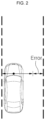
- a conventional lane recognition system has a limit in a lane recognition range, so when a vehicle travels close one line of a lane, the other line of the lane may not be recognized. That is, as shown in FIG. 2 , when the vehicle travels close to the left side, a sensor of the vehicle is unable to recognize the right line of the lane and determines that the right line is at a distance longer than the maximum distance. Accordingly, lane recognition is not performed accurately, and an error occurs.
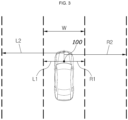
- a lane recognition system including: a sensor 100 provided at a subject vehicle, and configured to detect a left line and a right line of a current lane, sense a first left line distance L1 from a middle of the subject vehicle to the left line and a first right line distance R1 from the middle of the subject vehicle to the right line, and transmit a result of sensing to a controller; a radar (not shown) provided at the subject vehicle, and configured to collect following-vehicle location information of a following vehicle and transmit the following-vehicle location information to the controller; and the controller (not shown) configured to set a sum of the first left line distance L1 and the first right line distance R1 as a lane width W when the sensor detects both the left line and the right line, use the previously set lane width W to correct the first left line distance L1 or the first right line distance R1 when the sensor detects either the left line or the right line, use the corrected or uncorrected first left line distance to set
- the sensor 100 senses the distance from the subject vehicle to the left line as the first left line distance L1, and senses the distance from the subject vehicle to the right line as the first right line distance R1.
- the sensor senses both the left line and the right line, the sum of the first left line distance L1 and the first right line distance R1 is set as the lane width.
- the controller sets the sum of the lane width and the first left line distance L1 as the second left line distance L2 and sets the sum of the lane width and the first right line distance R1 as the second right line distance R2.
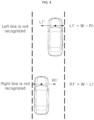
- the controller corrects and calculates the first left line distance or the first right line distance by using the previously used lane width W and the first right line distance R1 or the first left line distance L1. That is, referring to FIG. 4 , when only the right line is detected and the left line is not detected, the controller corrects the first left line distance with the difference between the previously set lane width and the first right line distance. When only the left line is detected and the right line is not detected, the controller corrects the first right line distance with the difference between the previously set lane width and the first left line distance.
- the second left line distance is set by adding the corrected first left line distance L1' and the previously set lane width and the second right line distance is set by adding the first right line distance and the previously set lane width.
- the second left line distance is set by adding the first left line distance and the previously set lane width and the second right line distance is set by adding the corrected first right line distance R1' and the previously set lane width.
- the controller may recognize the moving state of the subject vehicle at a normal driving state, a left-biased driving state, a right-biased driving state, or a lane change state. Specifically, when both left and right lines are detected, the moving state of the subject vehicle is recognized as the normal driving state.
- the normal driving state is a state in which both left and right lines are detected and a lane change is not performed.
- the first left line distance is less than a first threshold value and the first right line distance is greater than a second threshold value
- the moving state of the subject vehicle is recognized as the left-biased driving state.
- the moving state of the subject vehicle is recognized as the right-biased driving state.
- the time period during which the left and right lines are not recognized is greater than a third threshold value, the moving state of the subject vehicle is recognized as the lane change state.
- first threshold values Different first threshold values, second threshold values, and third threshold values may be set according to a situation.
- the first threshold value, the second threshold value, and the third threshold value are variable values that may vary according to road conditions, such as rainfall, snowfall, fog, and lane conditions.
- the controller sets a following-vehicle warning area on the basis of the first left line distance and the first right line distance. When a following vehicle is located in the following-vehicle warning area, it is considered that a warning condition is satisfied.
- a warning of the following vehicle is given and preparation for a collision with the following vehicle is performed.
- the following-vehicle warning area is set on the basis of the first left line distance and the first right line distance, and may be variously set according to road conditions, such as rainfall, snowfall, fog, and lane conditions.
- the controller considers that the warning condition is basically satisfied, and controls the subject vehicle to transmit a warning signal to the following vehicle to urge caution.
- the warning signal may take a method of switching the tail lights on and off rapidly.
- the subject vehicle is in the lane change state and a collision with the following vehicle is sufficiently expected. Therefore, the subject vehicle may be controlled to perform preparation for the collision, for example, preparing to tighten the seat belts of all the seats of the subject vehicle including the driver's seat.
- the controller recognizes that the subject vehicle is in the normal driving state, the left-biased driving state, or the right-biased driving state and the following vehicle is located within the first left line distance or the first right line distance and is traveling in the same lane as the subject vehicle, a warning of the following vehicle is not given.
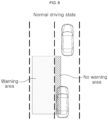
- the subject vehicle is in the normal driving state and the following vehicle is located in the following-vehicle warning area, but it is recognized that the following vehicle is located within the first left line distance and is traveling in the same lane as the subject vehicle. Therefore, a warning signal is not transmitted for the following vehicle.
- the following vehicle is located in the following-vehicle warning area and a warning is thus given to the driver of the subject vehicle.
- the following vehicle is at the first left line distance and is traveling in the same lane as the subject vehicle, and the subject vehicle is in the normal driving state, so a warning is not given to the driver of the following vehicle as well as the driver of the subject vehicle.
- the controller recognizes that the subject vehicle is in the normal driving state, the left-biased driving state, or the right-biased driving state and that the following vehicle is located beyond the second left line distance or the second right line distance although the following vehicle satisfies the warning condition, a warning of the following vehicle is not given.
- the subject vehicle is in the normal driving state and the following vehicle is located in the following-vehicle warning area, but it is recognized that the following vehicle is located beyond the second left line distance. Therefore, a warning of the following vehicle is not given. That is, when a subject vehicle travels on a road with narrow lanes, the following vehicle in the lane
- next to the next lane of the current lane is erroneously recognized and a warning signal is transmitted to the driver of the subject vehicle driver in the related art.
- a warning signal is transmitted to the driver of the subject vehicle driver in the related art.
- the subject vehicle is in the lane change state and the following vehicle is located in the following-vehicle warning area, but the subject vehicle moves away from the following vehicle when changing the lane. In this case, a warning of the following vehicle is not given.
- the controller recognizes that the subject vehicle changes the lane to the right lane.
- the controller may not give a warning of the left following vehicle even through the following vehicle on the left side is in the following-vehicle warning area. This may also be applied to the case in which the subject vehicle changes the lane to the left lane and there is a following vehicle on the right side. 0056. Referring to FIG.
- a method of controlling the lane recognition system of claim 1 including: detecting, by the sensor, the left line and the right line of the current lane, sensing the first left line distance from the middle of the subject vehicle to the left line and the first right line distance from the middle of the subject vehicle to the right line, and transmitting the result of sensing to the controller at step S100; collecting, by the radar, the following-vehicle location information of the following vehicle, and transmitting the following-vehicle location information to the controller at step S200; setting the sum of the first left line distance and the first right line distance as the lane width when the sensor detects both the left line and the right line, at step S300; correcting the first left line distance or the first right line distance by using the previously set lane width when the sensor detects either the left line or the right line, at step S400; using the corrected or uncorrected first left line distance to set the second left line distance that is the distance between the subject vehicle and the left line of the left lane of the current lane
- the method may further include setting, by the controller, the following-vehicle warning area on the basis of the first left line distance and the first right line distance, considering that the warning condition is satisfied when the following vehicle is located in the following-vehicle warning area, and giving a warning of the following vehicle and performing preparation for a collision with the following vehicle when the subject vehicle is in the lane change state, at step S700.
- the lane recognition system may prevent malfunction of BSD and LCA systems and false warnings, so that the driver is assisted not to feel fatigue driver.
- a warning signal is transmitted to the following vehicle to urge caution, thereby reducing accidents that may occur when the lane change is made.
- the lane recognition system that is capable of reducing false warnings from BSD and LCA systems, and of transmitting a warning signal to a following vehicle when it is detected that collision with the following vehicle may occur if a lane change is performed.
- the apparatuses, devices, units, modules, and components described herein are implemented by hardware components.
- hardware components that may be used to perform the operations described in this application where appropriate include controllers, sensors, generators, drivers, memories, comparators, arithmetic logic units, adders, subtractors, multipliers, dividers, integrators, and any other electronic components configured to perform the operations described in this application.
- one or more of the hardware components that perform the operations described in this application are implemented by computing hardware, for example, by one or more processors or computers.
- a processor or computer may be implemented by one or more processing elements, such as an array of logic gates, a controller and an arithmetic logic unit, a digital signal processor, a microcomputer, a programmable logic controller, a field-programmable gate array, a programmable logic array, a microprocessor, or any other device or combination of devices that is configured to respond to and execute instructions in a defined manner to achieve a desired result.
- a processor or computer includes, or is connected to, one or more memories storing instructions or software that are executed by the processor or computer.
- Hardware components implemented by a processor or computer may execute instructions or software, such as an operating system (OS) and one or more software applications that run on the OS, to perform the operations described in this application.
- OS operating system
- the hardware components may also access, manipulate, process, create, and store data in response to execution of the instructions or software.
- processor or “computer” may be used in the description of the examples described in this application, but in other examples multiple processors or computers may be used, or a processor or computer may include multiple processing elements, or multiple types of processing elements, or both.
- a single hardware component or two or more hardware components may be implemented by a single processor, or two or more processors, or a processor and a controller.
- One or more hardware components may be implemented by one or more processors, or a processor and a controller, and one or more other hardware components may be implemented by one or more other processors, or another processor and another controller.
- One or more processors may implement a single hardware component, or two or more hardware components.
- a hardware component may have any one or more of different processing configurations, examples of which include a single processor, independent processors, parallel processors, single-instruction single-data (SISD) multiprocessing, single-instruction multiple-data (SIMD) multiprocessing, multiple-instruction single-data (MISD) multiprocessing, multiple-instruction multiple-data (MIMD) multiprocessing, a controller and an arithmetic logic unit (ALU), a DSP, a microcomputer, an application-specific integrated circuit (ASIC), a field programmable gate array (FPGA), a programmable logic unit (PLU), a central processing unit (CPU), a graphics processing unit (GPU), a neural processing unit (NPU), or any other device capable of responding to and executing instructions in a defined manner.
- SISD single-instruction single-data
- SIMD single-instruction multiple-data
- MIMD multiple-in
- the software may include a computer program, a piece of code, an instruction, or some combination thereof, to independently or uniformly instruct or configure the processing device to operate as desired.
- Software and data may be embodied permanently or temporarily in any type of machine, component, physical or pseudo equipment, computer storage medium or device, or in a propagated signal wave capable of providing instructions or data to or being interpreted by the processing device.
- the software also may be distributed over network-coupled computer systems so that the software is stored and executed in a distributed fashion.
- the software and data may be stored by one or more non-transitory computer-readable recording mediums.
- the methods that perform the operations described in this application are performed by computing hardware, for example, by one or more processors or computers, implemented as described above executing instructions or software to perform the operations described in this application that are performed by the methods.
- a single operation or two or more operations may be performed by a single processor, or two or more processors, or a processor and a controller.
- One or more operations may be performed by one or more processors, or a processor and a controller, and one or more other operations may be performed by one or more other processors, or another processor and another controller.
- One or more processors, or a processor and a controller may perform a single operation, or two or more operations.
- Instructions or software to control a processor or computer to implement the hardware components and perform the methods as described above are written as computer programs, code segments, instructions or any combination thereof, for individually or collectively instructing or configuring the processor or computer to operate as a machine or special-purpose computer to perform the operations performed by the hardware components and the methods as described above.
- the instructions or software include machine code that is directly executed by the processor or computer, such as machine code produced by a compiler.
- the instructions or software includes at least one of an applet, a dynamic link library (DLL), middleware, firmware, a device driver, an application program storing the lane recognition method.
- the instructions or software include higher-level code that is executed by the processor or computer using an interpreter. Programmers of ordinary skill in the art can readily write the instructions or software based on the block diagrams and the flow charts illustrated in the drawings and the corresponding descriptions in the specification, which disclose algorithms for performing the operations performed by the hardware components and the methods as described above.
- the instructions or software to control a processor or computer to implement the hardware components and perform the methods as described above, and any associated data, data files, and data structures, are recorded, stored, or fixed in or on one or more non-transitory computer-readable storage media.
- Examples of a non-transitory computer-readable storage medium include read-only memory (ROM), random-access programmable read only memory (PROM), electrically erasable programmable read-only memory (EEPROM), random-access memory (RAM), magnetic RAM (MRAM), spin-transfer torque(STT)-MRAM, static random-access memory (SRAM), thyristor RAM (T-RAM), zero capacitor RAM (Z-RAM), twin transistor RAM (TTRAM), conductive bridging RAM(CBRAM), ferroelectric RAM (FeRAM), phase change RAM (PRAM), resistive RAM(RRAM), nanotube RRAM, polymer RAM (PoRAM), nano floating gate Memory(NFGM), holographic memory, molecular electronic memory device), insulator resistance change memory, dynamic random access memory (DRAM), static random access memory (SRAM), flash memory, non-volatile memory, CD-ROMs, CD-Rs, CD+Rs, CD-RWs, CD+RWs, DVD-ROMs, DVD-Rs, DVD+Rs
- the instructions or software and any associated data, data files, and data structures are distributed over network-coupled computer systems so that the instructions and software and any associated data, data files, and data structures are stored, accessed, and executed in a distributed fashion by the one or more processors or computers.
Landscapes
- Engineering & Computer Science (AREA)
- Automation & Control Theory (AREA)
- Mechanical Engineering (AREA)
- Transportation (AREA)
- Physics & Mathematics (AREA)
- General Physics & Mathematics (AREA)
- Radar, Positioning & Navigation (AREA)
- Remote Sensing (AREA)
- Human Computer Interaction (AREA)
- Theoretical Computer Science (AREA)
- Multimedia (AREA)
- Mathematical Physics (AREA)
- Electromagnetism (AREA)
- Computer Networks & Wireless Communication (AREA)
- Traffic Control Systems (AREA)
Description
- 0002. The following description is related to recognizing lanes by using a sensor provided at a vehicle, and using the recognized lanes for a warning system when the vehicle makes a lane change, to prevent false warnings from BSD and LCA systems.
- 0004. With the introduction of an Advanced Driver Assistance System (ADAS) technology for a driver's convenience, it is very important to accurately recognize information on a lane in which a vehicle travels.
- 0005. According to conventional blind spot detection (BSD) and line change assistance (LCA) systems, while a subject vehicle in the middle of driving changes lanes, when a following vehicle is in a blind spot and is thus not viewed in a side-view mirror of the subject vehicle, a flashing warning light at the side-view mirror warns the driver of the subject vehicle.
- 0006. These systems assist in changing lanes safely, but sometimes cause drivers to feel fatigue as the systems run even when no warning is needed.
- 0007. The foregoing is intended merely to aid in the understanding of the background of the present invention, and is not intended to mean that the present invention falls within the purview of the related art that is already known to those skilled in the art.
- 0007a.
US 2020/255008 A1 discloses a vehicle capable of acquiring an image of a road in front of a vehicle in an autonomous driving mode, recognizing a lane line, a subject lane, and an obstacle on the acquired image of the road, and determining whether the recognized obstacle is in a stationary state based on obstacle information detected by an obstacle detector. - 0007b.
DE 10 2016 113804 A1 discloses a steering assistant including a lane width setting unit and a determining unit. - 0008. The invention is defined by the appended claims.
- 0024. The above and other objectives, features, and other advantages of the present invention will be more clearly understood from the following detailed description when taken in conjunction with the accompanying drawings, in which:
- 0025.
FIGS. 1 and2 are diagrams illustrating problems in the related art; - 0026.
FIGS. 3 and4 are diagrams illustrating a lane recognition system according to the present invention; - 0027.
FIG. 5 is a diagram illustrating a case in which warning of a following vehicle is required; - 0028.
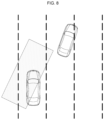
FIGS. 6 to 8 are diagrams illustrating cases in which warning of a following vehicle is not required; and - 0029.
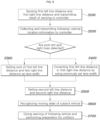
FIG. 9 is a flowchart illustrating a method of controlling the lane recognition system. - 0030.
- 0031.
- 0032. The terminology used herein is for the purpose of describing particular examples only and is not to be limiting of the examples. The singular forms "a", "an", and "the" are intended to include the plural forms as well, unless the context clearly indicates otherwise. It will be further understood that the terms "comprises/comprising" and/or "includes/including" when used herein, specify the presence of stated features, integers, steps, operations, elements, and/or components, but do not preclude the presence or addition of one or more other features, integers, steps, operations, elements, components and/or groups thereof.
- 0033.
- 0034.
- 0035.
- 0036. Referring to
FIG. 1 , when lanes are wide, conventional BSD and LCA systems recognize the following vehicle traveling in the same lane as a risk factor and give a false warning to the driver of the subject vehicle. When lanes are narrow, the conventional systems recognize the following vehicle traveling in the lane next to the next lane of the current lane as a risk factor and give a false warning to the driver of the subject vehicle, which causes the driver to feel fatigue. - 0037. To prevent this, it is necessary to prevent the BSD and LCA systems from warning the driver when a following vehicle is not recognized as a risk factor. For this, a system capable of recognizing a lane accurately is required to be supported.
- 0038. Referring to
FIG. 2 , a conventional lane recognition system has a limit in a lane recognition range, so when a vehicle travels close one line of a lane, the other line of the lane may not be recognized. That is, as shown inFIG. 2 , when the vehicle travels close to the left side, a sensor of the vehicle is unable to recognize the right line of the lane and determines that the right line is at a distance longer than the maximum distance. Accordingly, lane recognition is not performed accurately, and an error occurs. - 0039. Therefore, a lane recognition system capable of recognizing a lane accurately needs to be developed first. The present invention will be described with reference to
FIG. 3 . - 0040. According to the present invention, there is provided a lane recognition system including: a
sensor 100 provided at a subject vehicle, and configured to detect a left line and a right line of a current lane, sense a first left line distance L1 from a middle of the subject vehicle to the left line and a first right line distance R1 from the middle of the subject vehicle to the right line, and transmit a result of sensing to a controller; a radar (not shown) provided at the subject vehicle, and configured to collect following-vehicle location information of a following vehicle and transmit the following-vehicle location information to the controller; and the controller (not shown) configured to set a sum of the first left line distance L1 and the first right line distance R1 as a lane width W when the sensor detects both the left line and the right line, use the previously set lane width W to correct the first left line distance L1 or the first right line distance R1 when the sensor detects either the left line or the right line, use the corrected or uncorrected first left line distance to set a second left line distance L2 that is a distance between the subject vehicle and a left line of a left lane of the current lane, use the corrected or uncorrected first right line distance to set a second right line distance R2 that is a distance between the subject vehicle and a right line of a right lane of the current lane, and recognize that a moving state of the subject vehicle is a normal driving state, a left-biased driving state, a right-biased driving state, or a lane change state, from information on the left line of the current lane and the right line of the current lane. - 0041. Specifically, the
sensor 100 senses the distance from the subject vehicle to the left line as the first left line distance L1, and senses the distance from the subject vehicle to the right line as the first right line distance R1. When the sensor senses both the left line and the right line, the sum of the first left line distance L1 and the first right line distance R1 is set as the lane width. - 0042. When the sensor sets the lane width, the controller sets the sum of the lane width and the first left line distance L1 as the second left line distance L2 and sets the sum of the lane width and the first right line distance R1 as the second right line distance R2.
- 0043. When the
sensor 100 recognizes either the left line or the right line because of the biased driving of the subject vehicle, the controller corrects and calculates the first left line distance or the first right line distance by using the previously used lane width W and the first right line distance R1 or the first left line distance L1. That is, referring toFIG. 4 , when only the right line is detected and the left line is not detected, the controller corrects the first left line distance with the difference between the previously set lane width and the first right line distance. When only the left line is detected and the right line is not detected, the controller corrects the first right line distance with the difference between the previously set lane width and the first left line distance. - 0044. In addition, when the left line is not recognized, the second left line distance is set by adding the corrected first left line distance L1' and the previously set lane width and the second right line distance is set by adding the first right line distance and the previously set lane width. When the right line is not recognized, the second left line distance is set by adding the first left line distance and the previously set lane width and the second right line distance is set by adding the corrected first right line distance R1' and the previously set lane width.
- 0045. In the meantime, the controller may recognize the moving state of the subject vehicle at a normal driving state, a left-biased driving state, a right-biased driving state, or a lane change state. Specifically, when both left and right lines are detected, the moving state of the subject vehicle is recognized as the normal driving state. The normal driving state is a state in which both left and right lines are detected and a lane change is not performed. When the first left line distance is less than a first threshold value and the first right line distance is greater than a second threshold value, the moving state of the subject vehicle is recognized as the left-biased driving state. When the first right line distance is less than the first threshold value and the first left line distance is greater than the second threshold value, the moving state of the subject vehicle is recognized as the right-biased driving state. In addition, when the time period during which the left and right lines are not recognized is greater than a third threshold value, the moving state of the subject vehicle is recognized as the lane change state.
- 0046. Different first threshold values, second threshold values, and third threshold values may be set according to a situation. Specifically, the first threshold value, the second threshold value, and the third threshold value are variable values that may vary according to road conditions, such as rainfall, snowfall, fog, and lane conditions. 0047. In the meantime, the controller sets a following-vehicle warning area on the basis of the first left line distance and the first right line distance. When a following vehicle is located in the following-vehicle warning area, it is considered that a warning condition is satisfied. When the subject vehicle is in the lane change state, a warning of the following vehicle is given and preparation for a collision with the following vehicle is performed.
- 0048. Specifically, referring to
FIG. 5 , the following-vehicle warning area is set on the basis of the first left line distance and the first right line distance, and may be variously set according to road conditions, such as rainfall, snowfall, fog, and lane conditions. When a vehicle is in the following-vehicle warning area, the controller considers that the warning condition is basically satisfied, and controls the subject vehicle to transmit a warning signal to the following vehicle to urge caution. The warning signal may take a method of switching the tail lights on and off rapidly. In addition, the subject vehicle is in the lane change state and a collision with the following vehicle is sufficiently expected. Therefore, the subject vehicle may be controlled to perform preparation for the collision, for example, preparing to tighten the seat belts of all the seats of the subject vehicle including the driver's seat. - 0049. Further, when the controller recognizes that the subject vehicle is in the normal driving state, the left-biased driving state, or the right-biased driving state and the following vehicle is located within the first left line distance or the first right line distance and is traveling in the same lane as the subject vehicle, a warning of the following vehicle is not given.
- 0050. Specifically, referring to
FIG. 6 , the subject vehicle is in the normal driving state and the following vehicle is located in the following-vehicle warning area, but it is recognized that the following vehicle is located within the first left line distance and is traveling in the same lane as the subject vehicle. Therefore, a warning signal is not transmitted for the following vehicle. In the related art, when lanes are wide and a following vehicle travels close to a side, the following vehicle is located in the following-vehicle warning area and a warning is thus given to the driver of the subject vehicle. However, in the case of using the system according to the present invention, it is recognized that the following vehicle is at the first left line distance and is traveling in the same lane as the subject vehicle, and the subject vehicle is in the normal driving state, so a warning is not given to the driver of the following vehicle as well as the driver of the subject vehicle. - 0051. In addition, when the controller recognizes that the subject vehicle is in the normal driving state, the left-biased driving state, or the right-biased driving state and that the following vehicle is located beyond the second left line distance or the second right line distance although the following vehicle satisfies the warning condition, a warning of the following vehicle is not given.
- 0052. Specifically, referring to
FIG. 7 , the subject vehicle is in the normal driving state and the following vehicle is located in the following-vehicle warning area, but it is recognized that the following vehicle is located beyond the second left line distance. Therefore, a warning of the following vehicle is not given. That is, when a subject vehicle travels on a road with narrow lanes, the following vehicle in the lane - next to the next lane of the current lane is erroneously recognized and a warning signal is transmitted to the driver of the subject vehicle driver in the related art. However, in the case of using the system according to the present invention, it is possible to recognize the vehicle in the lane next to the next lane of the current lane. In this case, a warning is not given to the driver of the following vehicle as well as the driver of the subject vehicle.
- 0053. In the meantime, although the following vehicle satisfies the warning condition and the subject vehicle is in the lane change state, when the controller recognizes that the subject vehicle makes a lane change to move away from the following vehicle, a warning of the following vehicle is not given.
- 0054. Specifically, referring to
FIG. 8 , the subject vehicle is in the lane change state and the following vehicle is located in the following-vehicle warning area, but the subject vehicle moves away from the following vehicle when changing the lane. In this case, a warning of the following vehicle is not given. - 0055. More specifically, when the subject vehicle changes the lane to the right lane, the right-biased driving state is entered and then the lane change state is entered. Therefore, when the moving state is changed from the right-biased driving state to the lane change state, the controller recognizes that the subject vehicle changes the lane to the right lane. The controller may not give a warning of the left following vehicle even through the following vehicle on the left side is in the following-vehicle warning area. This may also be applied to the case in which the subject vehicle changes the lane to the left lane and there is a following vehicle on the right side. 0056. Referring to
FIG. 9 , there is provided a method of controlling the lane recognition system of claim 1, the method including: detecting, by the sensor, the left line and the right line of the current lane, sensing the first left line distance from the middle of the subject vehicle to the left line and the first right line distance from the middle of the subject vehicle to the right line, and transmitting the result of sensing to the controller at step S100; collecting, by the radar, the following-vehicle location information of the following vehicle, and transmitting the following-vehicle location information to the controller at step S200; setting the sum of the first left line distance and the first right line distance as the lane width when the sensor detects both the left line and the right line, at step S300; correcting the first left line distance or the first right line distance by using the previously set lane width when the sensor detects either the left line or the right line, at step S400; using the corrected or uncorrected first left line distance to set the second left line distance that is the distance between the subject vehicle and the left line of the left lane of the current lane, and using the corrected or uncorrected first right line distance to set the second right line distance that is the distance between the subject vehicle and the right line of the right lane of the current lane, at step S500; and recognizing that the moving state of the subject vehicle is the normal driving state, the left-biased driving state, the right-biased driving state, or the lane change state, from information on the left line of the current lane and the right line of the current lane at step S600. - 0057. The method may further include setting, by the controller, the following-vehicle warning area on the basis of the first left line distance and the first right line distance, considering that the warning condition is satisfied when the following vehicle is located in the following-vehicle warning area, and giving a warning of the following vehicle and performing preparation for a collision with the following vehicle when the subject vehicle is in the lane change state, at step S700.
- 0058. According to the lane recognition system and the method of controlling the same, malfunctions of BSD and LCA systems and false warnings therefrom can be prevented, so that the driver is assisted not to feel fatigue. In addition, when the subject vehicle makes a lane change, a warning signal is transmitted to the following vehicle to urge caution, thereby reducing accidents that may occur when the lane change is made.
- 0059. As described above, the lane recognition system may prevent malfunction of BSD and LCA systems and false warnings, so that the driver is assisted not to feel fatigue driver. In addition, when the subject vehicle makes a lane change, a warning signal is transmitted to the following vehicle to urge caution, thereby reducing accidents that may occur when the lane change is made.
- 0060. As described above, the lane recognition system that is capable of reducing false warnings from BSD and LCA systems, and of transmitting a warning signal to a following vehicle when it is detected that collision with the following vehicle may occur if a lane change is performed.
- 0061. The apparatuses, devices, units, modules, and components described herein are implemented by hardware components. Examples of hardware components that may be used to perform the operations described in this application where appropriate include controllers, sensors, generators, drivers, memories, comparators, arithmetic logic units, adders, subtractors, multipliers, dividers, integrators, and any other electronic components configured to perform the operations described in this application. In other examples, one or more of the hardware components that perform the operations described in this application are implemented by computing hardware, for example, by one or more processors or computers. A processor or computer may be implemented by one or more processing elements, such as an array of logic gates, a controller and an arithmetic logic unit, a digital signal processor, a microcomputer, a programmable logic controller, a field-programmable gate array, a programmable logic array, a microprocessor, or any other device or combination of devices that is configured to respond to and execute instructions in a defined manner to achieve a desired result. In one example, a processor or computer includes, or is connected to, one or more memories storing instructions or software that are executed by the processor or computer. Hardware components implemented by a processor or computer may execute instructions or software, such as an operating system (OS) and one or more software applications that run on the OS, to perform the operations described in this application. The hardware components may also access, manipulate, process, create, and store data in response to execution of the instructions or software. For simplicity, the singular term "processor" or "computer" may be used in the description of the examples described in this application, but in other examples multiple processors or computers may be used, or a processor or computer may include multiple processing elements, or multiple types of processing elements, or both. For example, a single hardware component or two or more hardware components may be implemented by a single processor, or two or more processors, or a processor and a controller. One or more hardware components may be implemented by one or more processors, or a processor and a controller, and one or more other hardware components may be implemented by one or more other processors, or another processor and another controller. One or more processors, or a processor and a controller, may implement a single hardware component, or two or more hardware components. A hardware component may have any one or more of different processing configurations, examples of which include a single processor, independent processors, parallel processors, single-instruction single-data (SISD) multiprocessing, single-instruction multiple-data (SIMD) multiprocessing, multiple-instruction single-data (MISD) multiprocessing, multiple-instruction multiple-data (MIMD) multiprocessing, a controller and an arithmetic logic unit (ALU), a DSP, a microcomputer, an application-specific integrated circuit (ASIC), a field programmable gate array (FPGA), a programmable logic unit (PLU), a central processing unit (CPU), a graphics processing unit (GPU), a neural processing unit (NPU), or any other device capable of responding to and executing instructions in a defined manner.
- 0062. The software may include a computer program, a piece of code, an instruction, or some combination thereof, to independently or uniformly instruct or configure the processing device to operate as desired. Software and data may be embodied permanently or temporarily in any type of machine, component, physical or pseudo equipment, computer storage medium or device, or in a propagated signal wave capable of providing instructions or data to or being interpreted by the processing device. The software also may be distributed over network-coupled computer systems so that the software is stored and executed in a distributed fashion. The software and data may be stored by one or more non-transitory computer-readable recording mediums.
- 0063. The methods that perform the operations described in this application are performed by computing hardware, for example, by one or more processors or computers, implemented as described above executing instructions or software to perform the operations described in this application that are performed by the methods. For example, a single operation or two or more operations may be performed by a single processor, or two or more processors, or a processor and a controller. One or more operations may be performed by one or more processors, or a processor and a controller, and one or more other operations may be performed by one or more other processors, or another processor and another controller. One or more processors, or a processor and a controller, may perform a single operation, or two or more operations.
- 0064. Instructions or software to control a processor or computer to implement the hardware components and perform the methods as described above are written as computer programs, code segments, instructions or any combination thereof, for individually or collectively instructing or configuring the processor or computer to operate as a machine or special-purpose computer to perform the operations performed by the hardware components and the methods as described above. In one example, the instructions or software include machine code that is directly executed by the processor or computer, such as machine code produced by a compiler. In an example, the instructions or software includes at least one of an applet, a dynamic link library (DLL), middleware, firmware, a device driver, an application program storing the lane recognition method. In another example, the instructions or software include higher-level code that is executed by the processor or computer using an interpreter. Programmers of ordinary skill in the art can readily write the instructions or software based on the block diagrams and the flow charts illustrated in the drawings and the corresponding descriptions in the specification, which disclose algorithms for performing the operations performed by the hardware components and the methods as described above.
- 0065. The instructions or software to control a processor or computer to implement the hardware components and perform the methods as described above, and any associated data, data files, and data structures, are recorded, stored, or fixed in or on one or more non-transitory computer-readable storage media. Examples of a non-transitory computer-readable storage medium include read-only memory (ROM), random-access programmable read only memory (PROM), electrically erasable programmable read-only memory (EEPROM), random-access memory (RAM), magnetic RAM (MRAM), spin-transfer torque(STT)-MRAM, static random-access memory (SRAM), thyristor RAM (T-RAM), zero capacitor RAM (Z-RAM), twin transistor RAM (TTRAM), conductive bridging RAM(CBRAM), ferroelectric RAM (FeRAM), phase change RAM (PRAM), resistive RAM(RRAM), nanotube RRAM, polymer RAM (PoRAM), nano floating gate Memory(NFGM), holographic memory, molecular electronic memory device), insulator resistance change memory, dynamic random access memory (DRAM), static random access memory (SRAM), flash memory, non-volatile memory, CD-ROMs, CD-Rs, CD+Rs, CD-RWs, CD+RWs, DVD-ROMs, DVD-Rs, DVD+Rs, DVD-RWs, DVD+RWs, DVD-RAMs, BD-ROMs, BD-Rs, BD-R LTHs, BD-REs, blue-ray or optical disk storage, hard disk drive (HDD), solid state drive (SSD), flash memory, a card type memory such as multimedia card micro or a card (for example, secure digital (SD) or extreme digital (XD)), magnetic tapes, floppy disks, magneto-optical data storage devices, optical data storage devices, hard disks, solid-state disks, and any other device that is configured to store the instructions or software and any associated data, data files, and data structures in a non-transitory manner and providing the instructions or software and any associated data, data files, and data structures to a processor or computer so that the processor or computer can execute the instructions. In an example, the instructions or software and any associated data, data files, and data structures are distributed over network-coupled computer systems so that the instructions and software and any associated data, data files, and data structures are stored, accessed, and executed in a distributed fashion by the one or more processors or computers.
- 0066.
Claims (10)
- A lane recognition apparatus, comprising:a sensor provided at a subject vehicle, and being configured to detect a left line and a right line of a current lane, sense a first left line distance from a middle of the subject vehicle to the left line (L1) and a first right line distance (R1) from the middle of the subject vehicle to the right line, and to transmit a result of sensing to a controller;a radar provided at the subject vehicle, and being configured to collect following-vehicle location information of a following vehicle and to transmit the following-vehicle location information to the controller; andthe controller being configured toset a sum of the first left line distance and the first right line distance as a lane width (W) in response to the sensor detecting both the left line and the right line,correct the first left line distance or the first right line distance based on a previously set lane width, in response to the sensor detecting either one of the left line or the right line,determine a second left line distance (L2) that is a distance between the middle of the subject vehicle and a left line of a left lane of the current lane based the corrected first left line distance or the first left line distance,determine a second right line distance (R2) that is a distance between the middle of the subject vehicle and a right line of a right lane of the current lane based on the corrected first right line distance or the first right line distance, anddetermine a moving state of the subject vehicle as any one of a normal driving state, a left-biased driving state, a right-biased driving state, or a lane change state based on information on the left line of the current lane and the right line of the current lane,wherein the controller is further configured to:set a following-vehicle warning area on the basis of the first left line distance and the first right line distance,determine that a warning condition is satisfied, in response to the following vehicle being located in the following-vehicle warning area,provide a warning to the following vehicle, in response to the warning condition being satisfied, andnot provide the warning to the following vehicle, in response to the subject vehicle being in the normal driving state, the left-biased driving state, or the right-biased driving state and the following vehicle being located beyond the second left line distance or the second right line distance although the warning condition is satisfied.
- The apparatus of claim 1, wherein the controller is further configured to:correct the first left line distance with a difference between the previously set lane width and the first right line distance, in response to the left line of the current lane not being detected, orcorrect the first right line distance with a difference between the previously set lane width and the first left line distance, in response to the right line of the current lane not being detected.
- The apparatus of claim 1 or 2, wherein the controller is further configured to:determine that the moving state of the subject vehicle is the normal driving state, in response to both the left and the right line of the current lane being detected,determine that the moving state of the subject vehicle is the left-biased driving state, in response to the first left line distance being less than a first threshold value and the first right line distance being greater than a second threshold value,determine that the moving state of the subject vehicle is the right-biased driving state, in response to the first right line distance being less than the first threshold value and the first left line distance being greater than the second threshold value, ordetermine that the moving state of the subject vehicle is the lane change state, in response to a time period during which the left and the right line of the current lane are not recognized being greater than a third threshold value.
- The apparatus of claim 1, wherein the controller is further configured to:
not provide the warning to the following vehicle, in response to the subject vehicle being in the normal driving state, the left-biased driving state, or the right-biased driving state and the following vehicle being located within the first left line distance or the first right line distance and traveling in the current lane. - The apparatus of any one of claims 1 to 4, wherein the controller is configured to:
not provide the warning to the following vehicle, in response to recognizing that the subject vehicle is in the lane change state and moving away from the following vehicle. - A method of lane recognition, the method comprising:detecting, by a sensor, a left line and a right line of a current lane, sensing (S100) a first left line distance from a middle of a subject vehicle to the left line of the current lane and a first right line distance from the middle of the subject vehicle to the right line of the current lane, and transmitting the result of sensing to a controller;collecting (S200), by a radar, following-vehicle location information of a following vehicle, and transmitting (S200) the following-vehicle location information to the controller;setting (S300), at the controller, a sum of the first left line distance and the first right line distance as the lane width, in response to the sensor detecting both the left line and the right line of the current lane;correcting (S400) the first left line distance or the first right line distance based on a previously set lane width, in response to the sensor detecting either one of the left line or the right line of the current lane;determining (S500) a second left line distance that is the distance between the middle of the subject vehicle and the left line of the left lane of the current lane based the corrected first left line distance or the first left line distance;determining (S500) a second right line distance that is the distance between the middle of the subject vehicle and the right line of the right lane of the current lane; anddetermining (S600) a moving state of the subject vehicle as any one of a normal driving state, a left-biased driving state, a right-biased driving state, or a lane change state based on information on the left line of the current lane and the right line of the current lane,wherein the method further comprises:setting, by the controller, a following-vehicle warning area on the basis of the first left line distance and the first right line distance,determining, by the controller, that a warning condition is satisfied, in response to the following vehicle being located in the following-vehicle warning area,providing, by the controller, a warning of the following vehicle, in response to the warning condition being satisfied, andnot providing, by the controller, the warning to the following vehicle, in response the subject vehicle being in the normal driving state, the left-biased driving state, or the right-biased driving state and the following vehicle being located beyond the second left line distance or the second right line distance although the warning condition is satisfied.
- The method of claim 6, wherein the correcting (S400) of the first left line distance or the first right line distance comprises:correcting the first left line distance with a difference between the previously set lane width and the first right line distance, in response to the left line of the current lane not being detected, orcorrecting the first right line distance with a difference between the previously set lane width and the first left line distance, in response to the right line of the current lane not being detected.
- The method of claim 6 or 7, wherein the determining (S600) of the moving state of the subject vehicle comprises:determining that the moving state of the subject vehicle is the normal driving state, in response to both the left and the right line of the current lane being detected,determining that the moving state of the subject vehicle is the left-biased driving state, in response to the first left line distance being less than a first threshold value and the first right line distance is greater than a second threshold value,determining that the moving state of the subject vehicle is the right-biased driving state, in response to the first right line distance being less than the first threshold value and the first left line distance is greater than the second threshold value, ordetermining that the moving state of the subject vehicle is the lane change state, in response to a time period during which the left and the right line of the current lane are not recognized being greater than a third threshold value.
- The method of claim 6, further comprising:
not providing the warning to the following vehicle, in response to the subject vehicle being in the normal driving state, the left-biased driving state, or the right-biased driving state and the following vehicle being located within the first left line distance or the first right line distance and traveling in the current lane. - The method of any one of claims 6 to 9, further comprising:
not providing the warning to the following vehicle, in response to recognizing that the subject vehicle is in the lane change state and moving away from the following vehicle.
Applications Claiming Priority (1)
| Application Number | Priority Date | Filing Date | Title |
|---|---|---|---|
| KR1020210018118A KR20220114750A (en) | 2021-02-09 | 2021-02-09 | System for recognizing lange and control method for the same |
Publications (2)
| Publication Number | Publication Date |
|---|---|
| EP4039555A1 EP4039555A1 (en) | 2022-08-10 |
| EP4039555B1 true EP4039555B1 (en) | 2024-02-14 |
Family
ID=80222547
Family Applications (1)
| Application Number | Title | Priority Date | Filing Date |
|---|---|---|---|
| EP22155406.6A Active EP4039555B1 (en) | 2021-02-09 | 2022-02-07 | Lane recognition apparatus and method of controlling same |
Country Status (4)
| Country | Link |
|---|---|
| US (1) | US12080079B2 (en) |
| EP (1) | EP4039555B1 (en) |
| KR (1) | KR20220114750A (en) |
| CN (1) | CN114940173B (en) |
Families Citing this family (3)
| Publication number | Priority date | Publication date | Assignee | Title |
|---|---|---|---|---|
| KR20220114750A (en) * | 2021-02-09 | 2022-08-17 | 현대모비스 주식회사 | System for recognizing lange and control method for the same |
| CN115303295B (en) * | 2022-09-06 | 2025-07-22 | 中国重汽集团济南动力有限公司 | Lane departure early warning method and device, electronic equipment and storage medium |
| US20250104269A1 (en) * | 2023-09-25 | 2025-03-27 | Toyota Jidosha Kabushiki Kaisha | Lane change detection using a graph representation |
Family Cites Families (40)
| Publication number | Priority date | Publication date | Assignee | Title |
|---|---|---|---|---|
| KR100941271B1 (en) * | 2007-03-30 | 2010-02-11 | 현대자동차주식회사 | Lane departure prevention method for automobile |
| JP4622001B2 (en) * | 2008-05-27 | 2011-02-02 | トヨタ自動車株式会社 | Road lane marking detection apparatus and road lane marking detection method |
| JP4692613B2 (en) * | 2008-11-28 | 2011-06-01 | トヨタ自動車株式会社 | In-vehicle device and method used in the device |
| JP4710981B2 (en) * | 2009-01-23 | 2011-06-29 | トヨタ自動車株式会社 | Marking line recognition apparatus and marking line recognition method used in the apparatus |
| KR101163446B1 (en) * | 2009-03-18 | 2012-07-18 | 기아자동차주식회사 | A lane departure warning system using a virtual lane and a system according to the same |
| US9460624B2 (en) * | 2014-05-06 | 2016-10-04 | Toyota Motor Engineering & Manufacturing North America, Inc. | Method and apparatus for determining lane identification in a roadway |
| JP6336888B2 (en) * | 2014-10-24 | 2018-06-06 | 株式会社デンソー | Adjacent lane monitoring device |
| JP6222785B2 (en) * | 2015-08-10 | 2017-11-01 | 株式会社Subaru | Steering support device |
| JP2017161501A (en) * | 2016-03-07 | 2017-09-14 | 株式会社デンソー | Travelling location detection device and travelling location detection method |
| CN106314266B (en) * | 2016-09-07 | 2018-09-14 | 长沙中联消防机械有限公司 | Warning control method, control device, control system and the fire fighting truck of vehicle |
| JP6774297B2 (en) * | 2016-10-17 | 2020-10-21 | 株式会社デンソー | Vehicle recognition device and vehicle recognition method |
| CN110431609B (en) * | 2017-03-27 | 2022-01-11 | 三菱电机株式会社 | Vehicle position estimation device |
| JP6617886B2 (en) * | 2017-07-06 | 2019-12-11 | トヨタ自動車株式会社 | Vehicle travel support device |
| KR102007304B1 (en) * | 2017-07-12 | 2019-08-05 | 엘지전자 주식회사 | Driving system for vehicle and vehicle |
| US11643092B2 (en) * | 2017-12-27 | 2023-05-09 | Bayerische Motoren Werke Aktiengesellschaft | Vehicle lane change prediction |
| JP7576982B2 (en) * | 2019-01-22 | 2024-11-01 | 日産自動車株式会社 | Vehicle driving control method and driving control device |
| KR102061140B1 (en) * | 2019-02-12 | 2020-02-12 | 주식회사 만도 | Lane keeping Assistance apparatus, Vehicle having the same and method for controlling the same |
| JP7113134B2 (en) * | 2019-03-12 | 2022-08-04 | 日立Astemo株式会社 | vehicle controller |
| CN110103967B (en) * | 2019-05-15 | 2020-10-20 | 广州小鹏汽车科技有限公司 | Automatic lane changing method for vehicle, vehicle control system and vehicle |
| DE102019004833A1 (en) * | 2019-07-10 | 2020-01-16 | Daimler Ag | Method for operating a lane departure warning system of a vehicle, in particular for a commercial vehicle |
| CN110304063B (en) * | 2019-07-15 | 2020-11-10 | 广州小鹏汽车科技有限公司 | A vehicle automatic lane changing method and system, and a vehicle |
| CN110427850B (en) * | 2019-07-24 | 2022-03-08 | 中国科学院自动化研究所 | Method, system and device for predicting driver's intention to change lane on expressway |
| CN115087573B (en) * | 2020-03-31 | 2023-05-05 | 华为技术有限公司 | A key target selection method, device and system |
| EP4120215B1 (en) * | 2020-04-02 | 2026-03-25 | Shenzhen Yinwang Intelligent Technologies Co., Ltd. | Method for identifying abnormal driving behavior |
| JP7477236B2 (en) * | 2020-08-28 | 2024-05-01 | 株式会社Subaru | Lane Departure Prevention Control Device |
| KR20220032708A (en) * | 2020-09-08 | 2022-03-15 | 현대자동차주식회사 | Vehicle and controlling method of vehicle |
| JP7719596B2 (en) * | 2020-10-05 | 2025-08-06 | 株式会社Subaru | Vehicle lane departure prevention control device |
| CN112477859B (en) * | 2020-10-21 | 2022-03-15 | 中国汽车技术研究中心有限公司 | Lane keeping assist method, apparatus, device and readable storage medium |
| WO2022133253A1 (en) * | 2020-12-18 | 2022-06-23 | Shenzen Gudsen Technology Co., Ltd | Image-based localization module |
| KR20220114750A (en) * | 2021-02-09 | 2022-08-17 | 현대모비스 주식회사 | System for recognizing lange and control method for the same |
| DE102021109496A1 (en) * | 2021-04-15 | 2022-10-20 | Bayerische Motoren Werke Aktiengesellschaft | Method and device for monitoring the tracking of a vehicle |
| CN113232658B (en) * | 2021-06-28 | 2022-06-28 | 驭势(上海)汽车科技有限公司 | Vehicle positioning method and device, electronic equipment and storage medium |
| CN114212085A (en) * | 2021-08-27 | 2022-03-22 | 南京林业大学 | A method for locating lanes for vehicles changing lanes on expressways in foggy weather |
| JP7683712B2 (en) * | 2021-09-09 | 2025-05-27 | 株式会社デンソー | Vehicle data generation server, data generation device, program, and system |
| JP7795925B2 (en) * | 2022-01-19 | 2026-01-08 | 株式会社Subaru | Vehicle driving assistance device |
| JP2023105691A (en) * | 2022-01-19 | 2023-07-31 | 株式会社Subaru | Vehicle driving support device |
| CN114655222A (en) * | 2022-04-18 | 2022-06-24 | 重庆长安汽车股份有限公司 | Method and system for displaying target vehicle in real time |
| CN114750759B (en) * | 2022-04-19 | 2024-04-30 | 合众新能源汽车股份有限公司 | Method, device, equipment and medium for determining following target |
| DE102022204089A1 (en) * | 2022-04-27 | 2023-11-02 | Robert Bosch Gesellschaft mit beschränkter Haftung | Method for detecting whether an ego vehicle changes from a currently traveled lane of a road into an adjacent lane or whether it maintains the currently traveled lane |
| CN115203352B (en) * | 2022-09-13 | 2022-11-29 | 腾讯科技(深圳)有限公司 | Lane level positioning method and device, computer equipment and storage medium |
-
2021
- 2021-02-09 KR KR1020210018118A patent/KR20220114750A/en active Pending
-
2022
- 2022-01-24 US US17/582,666 patent/US12080079B2/en active Active
- 2022-02-07 EP EP22155406.6A patent/EP4039555B1/en active Active
- 2022-02-08 CN CN202210119725.7A patent/CN114940173B/en active Active
Also Published As
| Publication number | Publication date |
|---|---|
| EP4039555A1 (en) | 2022-08-10 |
| CN114940173A (en) | 2022-08-26 |
| CN114940173B (en) | 2025-04-15 |
| US12080079B2 (en) | 2024-09-03 |
| KR20220114750A (en) | 2022-08-17 |
| US20220254168A1 (en) | 2022-08-11 |
Similar Documents
| Publication | Publication Date | Title |
|---|---|---|
| EP4039555B1 (en) | Lane recognition apparatus and method of controlling same | |
| US11794723B2 (en) | Apparatus and method for controlling driving of vehicle | |
| US20190184990A1 (en) | Method and apparatus with vehicular longitudinal velocity control | |
| CN111238520A (en) | Lane change path planning method and device, electronic equipment and computer readable medium | |
| JP6968288B2 (en) | Course prediction device, course prediction program and course prediction method | |
| US11852716B2 (en) | Apparatus and method for monitoring surrounding environment of vehicle | |
| US12449531B2 (en) | Apparatus and method for monitoring surrounding environment of vehicle | |
| US11975776B2 (en) | Steering wheel control apparatus and method of SBW system | |
| CN111086514B (en) | Device for notifying driving lane and control method thereof | |
| EP4001844A1 (en) | Method and apparatus with localization | |
| US11801855B2 (en) | Exit warning system and control method thereof | |
| EP4112405B1 (en) | Vehicle including an apparatus with collision warning | |
| EP4029715B1 (en) | Apparatus and method for controlling vehicle display | |
| US12280775B2 (en) | Method of and apparatus for controlling vehicle | |
| EP4002325B1 (en) | System for controlling vehicle driving through roundabout and method of controlling the same | |
| US12472921B2 (en) | Apparatus and method for vehicle control for autonomous driving | |
| US12030499B2 (en) | Intersection identification with related driving control system and method for vehicles | |
| US20230027766A1 (en) | Apparatus and method for monitoring surrounding environment of vehicle | |
| US12612039B2 (en) | Triggering logic for lane keeping aid using predicted evasive maneuver | |
| US12158526B2 (en) | System and method for tracking vehicle | |
| JP7699470B2 (en) | Vehicle detection device and vehicle detection program | |
| JP7380733B2 (en) | Steering control device | |
| JP7380735B2 (en) | Steering control device | |
| JP7380734B2 (en) | Steering control device | |
| CN118288898A (en) | Vehicle and method of controlling vehicle |
Legal Events
| Date | Code | Title | Description |
|---|---|---|---|
| PUAI | Public reference made under article 153(3) epc to a published international application that has entered the european phase |
Free format text: ORIGINAL CODE: 0009012 |
|
| STAA | Information on the status of an ep patent application or granted ep patent |
Free format text: STATUS: REQUEST FOR EXAMINATION WAS MADE |
|
| 17P | Request for examination filed |
Effective date: 20220207 |
|
| AK | Designated contracting states |
Kind code of ref document: A1 Designated state(s): AL AT BE BG CH CY CZ DE DK EE ES FI FR GB GR HR HU IE IS IT LI LT LU LV MC MK MT NL NO PL PT RO RS SE SI SK SM TR |
|
| STAA | Information on the status of an ep patent application or granted ep patent |
Free format text: STATUS: EXAMINATION IS IN PROGRESS |
|
| 17Q | First examination report despatched |
Effective date: 20230502 |
|
| REG | Reference to a national code |
Ref country code: DE Ref legal event code: R079 Free format text: PREVIOUS MAIN CLASS: B60W0030095000 Ipc: B60Q0001500000 Ref country code: DE Ref legal event code: R079 Ref document number: 602022001884 Country of ref document: DE Free format text: PREVIOUS MAIN CLASS: B60W0030095000 Ipc: B60Q0001500000 |
|
| GRAP | Despatch of communication of intention to grant a patent |
Free format text: ORIGINAL CODE: EPIDOSNIGR1 |
|
| STAA | Information on the status of an ep patent application or granted ep patent |
Free format text: STATUS: GRANT OF PATENT IS INTENDED |
|
| RIC1 | Information provided on ipc code assigned before grant |
Ipc: B60Q 9/00 20060101ALI20230831BHEP Ipc: B60W 30/095 20120101ALI20230831BHEP Ipc: B60W 30/12 20200101ALI20230831BHEP Ipc: B60W 40/10 20120101ALI20230831BHEP Ipc: B60W 30/18 20120101ALI20230831BHEP Ipc: B60Q 1/50 20060101AFI20230831BHEP |
|
| INTG | Intention to grant announced |
Effective date: 20230921 |
|
| GRAS | Grant fee paid |
Free format text: ORIGINAL CODE: EPIDOSNIGR3 |
|
| GRAA | (expected) grant |
Free format text: ORIGINAL CODE: 0009210 |
|
| STAA | Information on the status of an ep patent application or granted ep patent |
Free format text: STATUS: THE PATENT HAS BEEN GRANTED |
|
| P01 | Opt-out of the competence of the unified patent court (upc) registered |
Effective date: 20231211 |
|
| AK | Designated contracting states |
Kind code of ref document: B1 Designated state(s): AL AT BE BG CH CY CZ DE DK EE ES FI FR GB GR HR HU IE IS IT LI LT LU LV MC MK MT NL NO PL PT RO RS SE SI SK SM TR |
|
| REG | Reference to a national code |
Ref country code: GB Ref legal event code: FG4D |
|
| REG | Reference to a national code |
Ref country code: CH Ref legal event code: EP |
|
| REG | Reference to a national code |
Ref country code: DE Ref legal event code: R096 Ref document number: 602022001884 Country of ref document: DE |
|
| REG | Reference to a national code |
Ref country code: IE Ref legal event code: FG4D |
|
| REG | Reference to a national code |
Ref country code: LT Ref legal event code: MG9D |
|
| REG | Reference to a national code |
Ref country code: NL Ref legal event code: MP Effective date: 20240214 |
|
| PG25 | Lapsed in a contracting state [announced via postgrant information from national office to epo] |
Ref country code: IS Free format text: LAPSE BECAUSE OF FAILURE TO SUBMIT A TRANSLATION OF THE DESCRIPTION OR TO PAY THE FEE WITHIN THE PRESCRIBED TIME-LIMIT Effective date: 20240614 |
|
| PG25 | Lapsed in a contracting state [announced via postgrant information from national office to epo] |
Ref country code: LT Free format text: LAPSE BECAUSE OF FAILURE TO SUBMIT A TRANSLATION OF THE DESCRIPTION OR TO PAY THE FEE WITHIN THE PRESCRIBED TIME-LIMIT Effective date: 20240214 |
|
| PG25 | Lapsed in a contracting state [announced via postgrant information from national office to epo] |
Ref country code: GR Free format text: LAPSE BECAUSE OF FAILURE TO SUBMIT A TRANSLATION OF THE DESCRIPTION OR TO PAY THE FEE WITHIN THE PRESCRIBED TIME-LIMIT Effective date: 20240515 |
|
| REG | Reference to a national code |
Ref country code: AT Ref legal event code: MK05 Ref document number: 1656784 Country of ref document: AT Kind code of ref document: T Effective date: 20240214 |
|
| PG25 | Lapsed in a contracting state [announced via postgrant information from national office to epo] |
Ref country code: RS Free format text: LAPSE BECAUSE OF FAILURE TO SUBMIT A TRANSLATION OF THE DESCRIPTION OR TO PAY THE FEE WITHIN THE PRESCRIBED TIME-LIMIT Effective date: 20240514 Ref country code: HR Free format text: LAPSE BECAUSE OF FAILURE TO SUBMIT A TRANSLATION OF THE DESCRIPTION OR TO PAY THE FEE WITHIN THE PRESCRIBED TIME-LIMIT Effective date: 20240214 Ref country code: NL Free format text: LAPSE BECAUSE OF FAILURE TO SUBMIT A TRANSLATION OF THE DESCRIPTION OR TO PAY THE FEE WITHIN THE PRESCRIBED TIME-LIMIT Effective date: 20240214 |
|
| PG25 | Lapsed in a contracting state [announced via postgrant information from national office to epo] |
Ref country code: ES Free format text: LAPSE BECAUSE OF FAILURE TO SUBMIT A TRANSLATION OF THE DESCRIPTION OR TO PAY THE FEE WITHIN THE PRESCRIBED TIME-LIMIT Effective date: 20240214 |
|
| PG25 | Lapsed in a contracting state [announced via postgrant information from national office to epo] |
Ref country code: AT Free format text: LAPSE BECAUSE OF FAILURE TO SUBMIT A TRANSLATION OF THE DESCRIPTION OR TO PAY THE FEE WITHIN THE PRESCRIBED TIME-LIMIT Effective date: 20240214 |
|
| PG25 | Lapsed in a contracting state [announced via postgrant information from national office to epo] |
Ref country code: RS Free format text: LAPSE BECAUSE OF FAILURE TO SUBMIT A TRANSLATION OF THE DESCRIPTION OR TO PAY THE FEE WITHIN THE PRESCRIBED TIME-LIMIT Effective date: 20240514 Ref country code: NO Free format text: LAPSE BECAUSE OF FAILURE TO SUBMIT A TRANSLATION OF THE DESCRIPTION OR TO PAY THE FEE WITHIN THE PRESCRIBED TIME-LIMIT Effective date: 20240514 Ref country code: NL Free format text: LAPSE BECAUSE OF FAILURE TO SUBMIT A TRANSLATION OF THE DESCRIPTION OR TO PAY THE FEE WITHIN THE PRESCRIBED TIME-LIMIT Effective date: 20240214 Ref country code: LT Free format text: LAPSE BECAUSE OF FAILURE TO SUBMIT A TRANSLATION OF THE DESCRIPTION OR TO PAY THE FEE WITHIN THE PRESCRIBED TIME-LIMIT Effective date: 20240214 Ref country code: IS Free format text: LAPSE BECAUSE OF FAILURE TO SUBMIT A TRANSLATION OF THE DESCRIPTION OR TO PAY THE FEE WITHIN THE PRESCRIBED TIME-LIMIT Effective date: 20240614 Ref country code: HR Free format text: LAPSE BECAUSE OF FAILURE TO SUBMIT A TRANSLATION OF THE DESCRIPTION OR TO PAY THE FEE WITHIN THE PRESCRIBED TIME-LIMIT Effective date: 20240214 Ref country code: GR Free format text: LAPSE BECAUSE OF FAILURE TO SUBMIT A TRANSLATION OF THE DESCRIPTION OR TO PAY THE FEE WITHIN THE PRESCRIBED TIME-LIMIT Effective date: 20240515 Ref country code: FI Free format text: LAPSE BECAUSE OF FAILURE TO SUBMIT A TRANSLATION OF THE DESCRIPTION OR TO PAY THE FEE WITHIN THE PRESCRIBED TIME-LIMIT Effective date: 20240214 Ref country code: ES Free format text: LAPSE BECAUSE OF FAILURE TO SUBMIT A TRANSLATION OF THE DESCRIPTION OR TO PAY THE FEE WITHIN THE PRESCRIBED TIME-LIMIT Effective date: 20240214 Ref country code: BG Free format text: LAPSE BECAUSE OF FAILURE TO SUBMIT A TRANSLATION OF THE DESCRIPTION OR TO PAY THE FEE WITHIN THE PRESCRIBED TIME-LIMIT Effective date: 20240214 Ref country code: AT Free format text: LAPSE BECAUSE OF FAILURE TO SUBMIT A TRANSLATION OF THE DESCRIPTION OR TO PAY THE FEE WITHIN THE PRESCRIBED TIME-LIMIT Effective date: 20240214 |
|
| PG25 | Lapsed in a contracting state [announced via postgrant information from national office to epo] |
Ref country code: PL Free format text: LAPSE BECAUSE OF FAILURE TO SUBMIT A TRANSLATION OF THE DESCRIPTION OR TO PAY THE FEE WITHIN THE PRESCRIBED TIME-LIMIT Effective date: 20240214 Ref country code: PT Free format text: LAPSE BECAUSE OF FAILURE TO SUBMIT A TRANSLATION OF THE DESCRIPTION OR TO PAY THE FEE WITHIN THE PRESCRIBED TIME-LIMIT Effective date: 20240614 |
|
| PG25 | Lapsed in a contracting state [announced via postgrant information from national office to epo] |
Ref country code: SE Free format text: LAPSE BECAUSE OF FAILURE TO SUBMIT A TRANSLATION OF THE DESCRIPTION OR TO PAY THE FEE WITHIN THE PRESCRIBED TIME-LIMIT Effective date: 20240214 Ref country code: PT Free format text: LAPSE BECAUSE OF FAILURE TO SUBMIT A TRANSLATION OF THE DESCRIPTION OR TO PAY THE FEE WITHIN THE PRESCRIBED TIME-LIMIT Effective date: 20240614 Ref country code: PL Free format text: LAPSE BECAUSE OF FAILURE TO SUBMIT A TRANSLATION OF THE DESCRIPTION OR TO PAY THE FEE WITHIN THE PRESCRIBED TIME-LIMIT Effective date: 20240214 Ref country code: LV Free format text: LAPSE BECAUSE OF FAILURE TO SUBMIT A TRANSLATION OF THE DESCRIPTION OR TO PAY THE FEE WITHIN THE PRESCRIBED TIME-LIMIT Effective date: 20240214 |
|
| PG25 | Lapsed in a contracting state [announced via postgrant information from national office to epo] |
Ref country code: DK Free format text: LAPSE BECAUSE OF FAILURE TO SUBMIT A TRANSLATION OF THE DESCRIPTION OR TO PAY THE FEE WITHIN THE PRESCRIBED TIME-LIMIT Effective date: 20240214 |
|
| PG25 | Lapsed in a contracting state [announced via postgrant information from national office to epo] |
Ref country code: SM Free format text: LAPSE BECAUSE OF FAILURE TO SUBMIT A TRANSLATION OF THE DESCRIPTION OR TO PAY THE FEE WITHIN THE PRESCRIBED TIME-LIMIT Effective date: 20240214 |
|
| PG25 | Lapsed in a contracting state [announced via postgrant information from national office to epo] |
Ref country code: EE Free format text: LAPSE BECAUSE OF FAILURE TO SUBMIT A TRANSLATION OF THE DESCRIPTION OR TO PAY THE FEE WITHIN THE PRESCRIBED TIME-LIMIT Effective date: 20240214 Ref country code: CZ Free format text: LAPSE BECAUSE OF FAILURE TO SUBMIT A TRANSLATION OF THE DESCRIPTION OR TO PAY THE FEE WITHIN THE PRESCRIBED TIME-LIMIT Effective date: 20240214 |
|
| PG25 | Lapsed in a contracting state [announced via postgrant information from national office to epo] |
Ref country code: SK Free format text: LAPSE BECAUSE OF FAILURE TO SUBMIT A TRANSLATION OF THE DESCRIPTION OR TO PAY THE FEE WITHIN THE PRESCRIBED TIME-LIMIT Effective date: 20240214 |
|
| PG25 | Lapsed in a contracting state [announced via postgrant information from national office to epo] |
Ref country code: SM Free format text: LAPSE BECAUSE OF FAILURE TO SUBMIT A TRANSLATION OF THE DESCRIPTION OR TO PAY THE FEE WITHIN THE PRESCRIBED TIME-LIMIT Effective date: 20240214 Ref country code: SK Free format text: LAPSE BECAUSE OF FAILURE TO SUBMIT A TRANSLATION OF THE DESCRIPTION OR TO PAY THE FEE WITHIN THE PRESCRIBED TIME-LIMIT Effective date: 20240214 Ref country code: RO Free format text: LAPSE BECAUSE OF FAILURE TO SUBMIT A TRANSLATION OF THE DESCRIPTION OR TO PAY THE FEE WITHIN THE PRESCRIBED TIME-LIMIT Effective date: 20240214 Ref country code: EE Free format text: LAPSE BECAUSE OF FAILURE TO SUBMIT A TRANSLATION OF THE DESCRIPTION OR TO PAY THE FEE WITHIN THE PRESCRIBED TIME-LIMIT Effective date: 20240214 Ref country code: DK Free format text: LAPSE BECAUSE OF FAILURE TO SUBMIT A TRANSLATION OF THE DESCRIPTION OR TO PAY THE FEE WITHIN THE PRESCRIBED TIME-LIMIT Effective date: 20240214 Ref country code: CZ Free format text: LAPSE BECAUSE OF FAILURE TO SUBMIT A TRANSLATION OF THE DESCRIPTION OR TO PAY THE FEE WITHIN THE PRESCRIBED TIME-LIMIT Effective date: 20240214 |
|
| REG | Reference to a national code |
Ref country code: DE Ref legal event code: R097 Ref document number: 602022001884 Country of ref document: DE |
|
| PG25 | Lapsed in a contracting state [announced via postgrant information from national office to epo] |
Ref country code: IT Free format text: LAPSE BECAUSE OF FAILURE TO SUBMIT A TRANSLATION OF THE DESCRIPTION OR TO PAY THE FEE WITHIN THE PRESCRIBED TIME-LIMIT Effective date: 20240214 |
|
| PLBE | No opposition filed within time limit |
Free format text: ORIGINAL CODE: 0009261 |
|
| STAA | Information on the status of an ep patent application or granted ep patent |
Free format text: STATUS: NO OPPOSITION FILED WITHIN TIME LIMIT |
|
| PG25 | Lapsed in a contracting state [announced via postgrant information from national office to epo] |
Ref country code: IT Free format text: LAPSE BECAUSE OF FAILURE TO SUBMIT A TRANSLATION OF THE DESCRIPTION OR TO PAY THE FEE WITHIN THE PRESCRIBED TIME-LIMIT Effective date: 20240214 |
|
| 26N | No opposition filed |
Effective date: 20241115 |
|
| PG25 | Lapsed in a contracting state [announced via postgrant information from national office to epo] |
Ref country code: SI Free format text: LAPSE BECAUSE OF FAILURE TO SUBMIT A TRANSLATION OF THE DESCRIPTION OR TO PAY THE FEE WITHIN THE PRESCRIBED TIME-LIMIT Effective date: 20240214 |
|
| PG25 | Lapsed in a contracting state [announced via postgrant information from national office to epo] |
Ref country code: MC Free format text: LAPSE BECAUSE OF FAILURE TO SUBMIT A TRANSLATION OF THE DESCRIPTION OR TO PAY THE FEE WITHIN THE PRESCRIBED TIME-LIMIT Effective date: 20240214 |
|
| REG | Reference to a national code |
Ref country code: CH Ref legal event code: PL |
|
| PG25 | Lapsed in a contracting state [announced via postgrant information from national office to epo] |
Ref country code: LU Free format text: LAPSE BECAUSE OF NON-PAYMENT OF DUE FEES Effective date: 20250207 |
|
| PG25 | Lapsed in a contracting state [announced via postgrant information from national office to epo] |
Ref country code: CH Free format text: LAPSE BECAUSE OF NON-PAYMENT OF DUE FEES Effective date: 20250228 |
|
| REG | Reference to a national code |
Ref country code: BE Ref legal event code: MM Effective date: 20250228 |
|
| PGFP | Annual fee paid to national office [announced via postgrant information from national office to epo] |
Ref country code: GB Payment date: 20251222 Year of fee payment: 5 |
|
| PGFP | Annual fee paid to national office [announced via postgrant information from national office to epo] |
Ref country code: FR Payment date: 20251223 Year of fee payment: 5 |
|
| PG25 | Lapsed in a contracting state [announced via postgrant information from national office to epo] |
Ref country code: BE Free format text: LAPSE BECAUSE OF NON-PAYMENT OF DUE FEES Effective date: 20250228 |
|
| PG25 | Lapsed in a contracting state [announced via postgrant information from national office to epo] |
Ref country code: IE Free format text: LAPSE BECAUSE OF NON-PAYMENT OF DUE FEES Effective date: 20250207 |
|
| PGFP | Annual fee paid to national office [announced via postgrant information from national office to epo] |
Ref country code: DE Payment date: 20251222 Year of fee payment: 5 |