EP4039443A1 - Molded body, and method for producing molded body - Google Patents
Molded body, and method for producing molded body Download PDFInfo
- Publication number
- EP4039443A1 EP4039443A1 EP20919124.6A EP20919124A EP4039443A1 EP 4039443 A1 EP4039443 A1 EP 4039443A1 EP 20919124 A EP20919124 A EP 20919124A EP 4039443 A1 EP4039443 A1 EP 4039443A1
- Authority
- EP
- European Patent Office
- Prior art keywords
- molded body
- cells
- resin
- composition
- foaming agent
- Prior art date
- Legal status (The legal status is an assumption and is not a legal conclusion. Google has not performed a legal analysis and makes no representation as to the accuracy of the status listed.)
- Pending
Links
- 238000004519 manufacturing process Methods 0.000 title claims description 11
- 229920005989 resin Polymers 0.000 claims abstract description 35
- 239000011347 resin Substances 0.000 claims abstract description 35
- 239000000203 mixture Substances 0.000 claims description 36
- 238000000465 moulding Methods 0.000 claims description 29
- 239000004088 foaming agent Substances 0.000 claims description 28
- 238000000034 method Methods 0.000 claims description 12
- 239000004156 Azodicarbonamide Substances 0.000 description 9
- XOZUGNYVDXMRKW-AATRIKPKSA-N azodicarbonamide Chemical compound NC(=O)\N=N\C(N)=O XOZUGNYVDXMRKW-AATRIKPKSA-N 0.000 description 9
- 235000019399 azodicarbonamide Nutrition 0.000 description 9
- 239000013585 weight reducing agent Substances 0.000 description 8
- 238000000635 electron micrograph Methods 0.000 description 6
- 239000000463 material Substances 0.000 description 6
- -1 polypropylene Polymers 0.000 description 6
- 239000004743 Polypropylene Substances 0.000 description 5
- 238000002347 injection Methods 0.000 description 5
- 239000007924 injection Substances 0.000 description 5
- 229920001155 polypropylene Polymers 0.000 description 5
- 229920005992 thermoplastic resin Polymers 0.000 description 5
- KAKZBPTYRLMSJV-UHFFFAOYSA-N Butadiene Chemical compound C=CC=C KAKZBPTYRLMSJV-UHFFFAOYSA-N 0.000 description 4
- 229910000831 Steel Inorganic materials 0.000 description 4
- 230000002349 favourable effect Effects 0.000 description 4
- 239000010959 steel Substances 0.000 description 4
- XLYOFNOQVPJJNP-UHFFFAOYSA-N water Substances O XLYOFNOQVPJJNP-UHFFFAOYSA-N 0.000 description 4
- 239000000654 additive Substances 0.000 description 3
- 230000000996 additive effect Effects 0.000 description 3
- 239000006260 foam Substances 0.000 description 3
- 239000002994 raw material Substances 0.000 description 3
- 239000000126 substance Substances 0.000 description 3
- NLHHRLWOUZZQLW-UHFFFAOYSA-N Acrylonitrile Chemical compound C=CC#N NLHHRLWOUZZQLW-UHFFFAOYSA-N 0.000 description 2
- 239000004594 Masterbatch (MB) Substances 0.000 description 2
- UIIMBOGNXHQVGW-UHFFFAOYSA-M Sodium bicarbonate Chemical compound [Na+].OC([O-])=O UIIMBOGNXHQVGW-UHFFFAOYSA-M 0.000 description 2
- PPBRXRYQALVLMV-UHFFFAOYSA-N Styrene Natural products C=CC1=CC=CC=C1 PPBRXRYQALVLMV-UHFFFAOYSA-N 0.000 description 2
- 229920000122 acrylonitrile butadiene styrene Polymers 0.000 description 2
- 239000002131 composite material Substances 0.000 description 2
- 229920001577 copolymer Polymers 0.000 description 2
- 238000000354 decomposition reaction Methods 0.000 description 2
- 238000002844 melting Methods 0.000 description 2
- 230000008018 melting Effects 0.000 description 2
- 239000004372 Polyvinyl alcohol Substances 0.000 description 1
- BZHJMEDXRYGGRV-UHFFFAOYSA-N Vinyl chloride Chemical compound ClC=C BZHJMEDXRYGGRV-UHFFFAOYSA-N 0.000 description 1
- 230000009471 action Effects 0.000 description 1
- 229910045601 alloy Inorganic materials 0.000 description 1
- 239000000956 alloy Substances 0.000 description 1
- VJRITMATACIYAF-UHFFFAOYSA-N benzenesulfonohydrazide Chemical compound NNS(=O)(=O)C1=CC=CC=C1 VJRITMATACIYAF-UHFFFAOYSA-N 0.000 description 1
- 230000015572 biosynthetic process Effects 0.000 description 1
- 239000006229 carbon black Substances 0.000 description 1
- 230000008859 change Effects 0.000 description 1
- 238000006243 chemical reaction Methods 0.000 description 1
- 230000000052 comparative effect Effects 0.000 description 1
- 239000000470 constituent Substances 0.000 description 1
- 238000005520 cutting process Methods 0.000 description 1
- 230000000694 effects Effects 0.000 description 1
- 238000011156 evaluation Methods 0.000 description 1
- 230000009969 flowable effect Effects 0.000 description 1
- 238000005187 foaming Methods 0.000 description 1
- 239000000446 fuel Substances 0.000 description 1
- 239000007789 gas Substances 0.000 description 1
- 229920000554 ionomer Polymers 0.000 description 1
- 238000005259 measurement Methods 0.000 description 1
- 229910052751 metal Inorganic materials 0.000 description 1
- 239000002184 metal Substances 0.000 description 1
- 238000002156 mixing Methods 0.000 description 1
- 239000000049 pigment Substances 0.000 description 1
- 229920006122 polyamide resin Polymers 0.000 description 1
- 229920005668 polycarbonate resin Polymers 0.000 description 1
- 239000004431 polycarbonate resin Substances 0.000 description 1
- 229920013716 polyethylene resin Polymers 0.000 description 1
- 229920000139 polyethylene terephthalate Polymers 0.000 description 1
- 239000005020 polyethylene terephthalate Substances 0.000 description 1
- 229920005990 polystyrene resin Polymers 0.000 description 1
- 229920002451 polyvinyl alcohol Polymers 0.000 description 1
- 238000002360 preparation method Methods 0.000 description 1
- 230000008569 process Effects 0.000 description 1
- 230000001737 promoting effect Effects 0.000 description 1
- 229910000030 sodium bicarbonate Inorganic materials 0.000 description 1
- 235000017557 sodium bicarbonate Nutrition 0.000 description 1
- 229910001220 stainless steel Inorganic materials 0.000 description 1
- 230000032258 transport Effects 0.000 description 1
Images

Classifications
-
- B—PERFORMING OPERATIONS; TRANSPORTING
- B60—VEHICLES IN GENERAL
- B60R—VEHICLES, VEHICLE FITTINGS, OR VEHICLE PARTS, NOT OTHERWISE PROVIDED FOR
- B60R13/00—Elements for body-finishing, identifying, or decorating; Arrangements or adaptations for advertising purposes
- B60R13/02—Internal Trim mouldings ; Internal Ledges; Wall liners for passenger compartments; Roof liners
-
- B—PERFORMING OPERATIONS; TRANSPORTING
- B29—WORKING OF PLASTICS; WORKING OF SUBSTANCES IN A PLASTIC STATE IN GENERAL
- B29C—SHAPING OR JOINING OF PLASTICS; SHAPING OF MATERIAL IN A PLASTIC STATE, NOT OTHERWISE PROVIDED FOR; AFTER-TREATMENT OF THE SHAPED PRODUCTS, e.g. REPAIRING
- B29C44/00—Shaping by internal pressure generated in the material, e.g. swelling or foaming ; Producing porous or cellular expanded plastics articles
- B29C44/34—Auxiliary operations
- B29C44/35—Component parts; Details or accessories
- B29C44/355—Characteristics of the foam, e.g. having particular surface properties or structure
-
- B—PERFORMING OPERATIONS; TRANSPORTING
- B29—WORKING OF PLASTICS; WORKING OF SUBSTANCES IN A PLASTIC STATE IN GENERAL
- B29C—SHAPING OR JOINING OF PLASTICS; SHAPING OF MATERIAL IN A PLASTIC STATE, NOT OTHERWISE PROVIDED FOR; AFTER-TREATMENT OF THE SHAPED PRODUCTS, e.g. REPAIRING
- B29C44/00—Shaping by internal pressure generated in the material, e.g. swelling or foaming ; Producing porous or cellular expanded plastics articles
- B29C44/34—Auxiliary operations
- B29C44/58—Moulds
- B29C44/586—Moulds with a cavity increasing in size during foaming
-
- C—CHEMISTRY; METALLURGY
- C08—ORGANIC MACROMOLECULAR COMPOUNDS; THEIR PREPARATION OR CHEMICAL WORKING-UP; COMPOSITIONS BASED THEREON
- C08J—WORKING-UP; GENERAL PROCESSES OF COMPOUNDING; AFTER-TREATMENT NOT COVERED BY SUBCLASSES C08B, C08C, C08F, C08G or C08H
- C08J9/00—Working-up of macromolecular substances to porous or cellular articles or materials; After-treatment thereof
- C08J9/04—Working-up of macromolecular substances to porous or cellular articles or materials; After-treatment thereof using blowing gases generated by a previously added blowing agent
- C08J9/06—Working-up of macromolecular substances to porous or cellular articles or materials; After-treatment thereof using blowing gases generated by a previously added blowing agent by a chemical blowing agent
- C08J9/10—Working-up of macromolecular substances to porous or cellular articles or materials; After-treatment thereof using blowing gases generated by a previously added blowing agent by a chemical blowing agent developing nitrogen, the blowing agent being a compound containing a nitrogen-to-nitrogen bond
- C08J9/102—Azo-compounds
- C08J9/103—Azodicarbonamide
-
- C—CHEMISTRY; METALLURGY
- C08—ORGANIC MACROMOLECULAR COMPOUNDS; THEIR PREPARATION OR CHEMICAL WORKING-UP; COMPOSITIONS BASED THEREON
- C08J—WORKING-UP; GENERAL PROCESSES OF COMPOUNDING; AFTER-TREATMENT NOT COVERED BY SUBCLASSES C08B, C08C, C08F, C08G or C08H
- C08J9/00—Working-up of macromolecular substances to porous or cellular articles or materials; After-treatment thereof
- C08J9/34—Chemical features in the manufacture of articles consisting of a foamed macromolecular core and a macromolecular surface layer having a higher density than the core
-
- C—CHEMISTRY; METALLURGY
- C08—ORGANIC MACROMOLECULAR COMPOUNDS; THEIR PREPARATION OR CHEMICAL WORKING-UP; COMPOSITIONS BASED THEREON
- C08K—Use of inorganic or non-macromolecular organic substances as compounding ingredients
- C08K3/00—Use of inorganic substances as compounding ingredients
- C08K3/02—Elements
- C08K3/04—Carbon
-
- B—PERFORMING OPERATIONS; TRANSPORTING
- B29—WORKING OF PLASTICS; WORKING OF SUBSTANCES IN A PLASTIC STATE IN GENERAL
- B29C—SHAPING OR JOINING OF PLASTICS; SHAPING OF MATERIAL IN A PLASTIC STATE, NOT OTHERWISE PROVIDED FOR; AFTER-TREATMENT OF THE SHAPED PRODUCTS, e.g. REPAIRING
- B29C44/00—Shaping by internal pressure generated in the material, e.g. swelling or foaming ; Producing porous or cellular expanded plastics articles
- B29C44/02—Shaping by internal pressure generated in the material, e.g. swelling or foaming ; Producing porous or cellular expanded plastics articles for articles of definite length, i.e. discrete articles
- B29C44/04—Shaping by internal pressure generated in the material, e.g. swelling or foaming ; Producing porous or cellular expanded plastics articles for articles of definite length, i.e. discrete articles consisting of at least two parts of chemically or physically different materials, e.g. having different densities
- B29C44/06—Making multilayered articles
-
- B—PERFORMING OPERATIONS; TRANSPORTING
- B29—WORKING OF PLASTICS; WORKING OF SUBSTANCES IN A PLASTIC STATE IN GENERAL
- B29K—INDEXING SCHEME ASSOCIATED WITH SUBCLASSES B29B, B29C OR B29D, RELATING TO MOULDING MATERIALS OR TO MATERIALS FOR MOULDS, REINFORCEMENTS, FILLERS OR PREFORMED PARTS, e.g. INSERTS
- B29K2023/00—Use of polyalkenes or derivatives thereof as moulding material
- B29K2023/04—Polymers of ethylene
- B29K2023/06—PE, i.e. polyethylene
-
- B—PERFORMING OPERATIONS; TRANSPORTING
- B29—WORKING OF PLASTICS; WORKING OF SUBSTANCES IN A PLASTIC STATE IN GENERAL
- B29K—INDEXING SCHEME ASSOCIATED WITH SUBCLASSES B29B, B29C OR B29D, RELATING TO MOULDING MATERIALS OR TO MATERIALS FOR MOULDS, REINFORCEMENTS, FILLERS OR PREFORMED PARTS, e.g. INSERTS
- B29K2023/00—Use of polyalkenes or derivatives thereof as moulding material
- B29K2023/10—Polymers of propylene
- B29K2023/12—PP, i.e. polypropylene
-
- B—PERFORMING OPERATIONS; TRANSPORTING
- B29—WORKING OF PLASTICS; WORKING OF SUBSTANCES IN A PLASTIC STATE IN GENERAL
- B29K—INDEXING SCHEME ASSOCIATED WITH SUBCLASSES B29B, B29C OR B29D, RELATING TO MOULDING MATERIALS OR TO MATERIALS FOR MOULDS, REINFORCEMENTS, FILLERS OR PREFORMED PARTS, e.g. INSERTS
- B29K2025/00—Use of polymers of vinyl-aromatic compounds or derivatives thereof as moulding material
- B29K2025/04—Polymers of styrene
- B29K2025/06—PS, i.e. polystyrene
-
- B—PERFORMING OPERATIONS; TRANSPORTING
- B29—WORKING OF PLASTICS; WORKING OF SUBSTANCES IN A PLASTIC STATE IN GENERAL
- B29K—INDEXING SCHEME ASSOCIATED WITH SUBCLASSES B29B, B29C OR B29D, RELATING TO MOULDING MATERIALS OR TO MATERIALS FOR MOULDS, REINFORCEMENTS, FILLERS OR PREFORMED PARTS, e.g. INSERTS
- B29K2055/00—Use of specific polymers obtained by polymerisation reactions only involving carbon-to-carbon unsaturated bonds, not provided for in a single one of main groups B29K2023/00 - B29K2049/00, e.g. having a vinyl group, as moulding material
- B29K2055/02—ABS polymers, i.e. acrylonitrile-butadiene-styrene polymers
-
- B—PERFORMING OPERATIONS; TRANSPORTING
- B29—WORKING OF PLASTICS; WORKING OF SUBSTANCES IN A PLASTIC STATE IN GENERAL
- B29K—INDEXING SCHEME ASSOCIATED WITH SUBCLASSES B29B, B29C OR B29D, RELATING TO MOULDING MATERIALS OR TO MATERIALS FOR MOULDS, REINFORCEMENTS, FILLERS OR PREFORMED PARTS, e.g. INSERTS
- B29K2067/00—Use of polyesters or derivatives thereof, as moulding material
- B29K2067/003—PET, i.e. poylethylene terephthalate
-
- B—PERFORMING OPERATIONS; TRANSPORTING
- B29—WORKING OF PLASTICS; WORKING OF SUBSTANCES IN A PLASTIC STATE IN GENERAL
- B29K—INDEXING SCHEME ASSOCIATED WITH SUBCLASSES B29B, B29C OR B29D, RELATING TO MOULDING MATERIALS OR TO MATERIALS FOR MOULDS, REINFORCEMENTS, FILLERS OR PREFORMED PARTS, e.g. INSERTS
- B29K2069/00—Use of PC, i.e. polycarbonates or derivatives thereof, as moulding material
-
- B—PERFORMING OPERATIONS; TRANSPORTING
- B29—WORKING OF PLASTICS; WORKING OF SUBSTANCES IN A PLASTIC STATE IN GENERAL
- B29K—INDEXING SCHEME ASSOCIATED WITH SUBCLASSES B29B, B29C OR B29D, RELATING TO MOULDING MATERIALS OR TO MATERIALS FOR MOULDS, REINFORCEMENTS, FILLERS OR PREFORMED PARTS, e.g. INSERTS
- B29K2077/00—Use of PA, i.e. polyamides, e.g. polyesteramides or derivatives thereof, as moulding material
-
- B—PERFORMING OPERATIONS; TRANSPORTING
- B29—WORKING OF PLASTICS; WORKING OF SUBSTANCES IN A PLASTIC STATE IN GENERAL
- B29K—INDEXING SCHEME ASSOCIATED WITH SUBCLASSES B29B, B29C OR B29D, RELATING TO MOULDING MATERIALS OR TO MATERIALS FOR MOULDS, REINFORCEMENTS, FILLERS OR PREFORMED PARTS, e.g. INSERTS
- B29K2105/00—Condition, form or state of moulded material or of the material to be shaped
- B29K2105/04—Condition, form or state of moulded material or of the material to be shaped cellular or porous
-
- B—PERFORMING OPERATIONS; TRANSPORTING
- B29—WORKING OF PLASTICS; WORKING OF SUBSTANCES IN A PLASTIC STATE IN GENERAL
- B29K—INDEXING SCHEME ASSOCIATED WITH SUBCLASSES B29B, B29C OR B29D, RELATING TO MOULDING MATERIALS OR TO MATERIALS FOR MOULDS, REINFORCEMENTS, FILLERS OR PREFORMED PARTS, e.g. INSERTS
- B29K2995/00—Properties of moulding materials, reinforcements, fillers, preformed parts or moulds
- B29K2995/0037—Other properties
- B29K2995/0094—Geometrical properties
-
- B—PERFORMING OPERATIONS; TRANSPORTING
- B29—WORKING OF PLASTICS; WORKING OF SUBSTANCES IN A PLASTIC STATE IN GENERAL
- B29L—INDEXING SCHEME ASSOCIATED WITH SUBCLASS B29C, RELATING TO PARTICULAR ARTICLES
- B29L2031/00—Other particular articles
- B29L2031/30—Vehicles, e.g. ships or aircraft, or body parts thereof
- B29L2031/3005—Body finishings
-
- B—PERFORMING OPERATIONS; TRANSPORTING
- B29—WORKING OF PLASTICS; WORKING OF SUBSTANCES IN A PLASTIC STATE IN GENERAL
- B29L—INDEXING SCHEME ASSOCIATED WITH SUBCLASS B29C, RELATING TO PARTICULAR ARTICLES
- B29L2031/00—Other particular articles
- B29L2031/30—Vehicles, e.g. ships or aircraft, or body parts thereof
- B29L2031/3055—Cars
-
- C—CHEMISTRY; METALLURGY
- C08—ORGANIC MACROMOLECULAR COMPOUNDS; THEIR PREPARATION OR CHEMICAL WORKING-UP; COMPOSITIONS BASED THEREON
- C08J—WORKING-UP; GENERAL PROCESSES OF COMPOUNDING; AFTER-TREATMENT NOT COVERED BY SUBCLASSES C08B, C08C, C08F, C08G or C08H
- C08J2201/00—Foams characterised by the foaming process
- C08J2201/02—Foams characterised by the foaming process characterised by mechanical pre- or post-treatments
- C08J2201/024—Preparation or use of a blowing agent concentrate, i.e. masterbatch in a foamable composition
-
- C—CHEMISTRY; METALLURGY
- C08—ORGANIC MACROMOLECULAR COMPOUNDS; THEIR PREPARATION OR CHEMICAL WORKING-UP; COMPOSITIONS BASED THEREON
- C08J—WORKING-UP; GENERAL PROCESSES OF COMPOUNDING; AFTER-TREATMENT NOT COVERED BY SUBCLASSES C08B, C08C, C08F, C08G or C08H
- C08J2203/00—Foams characterized by the expanding agent
- C08J2203/04—N2 releasing, ex azodicarbonamide or nitroso compound
-
- C—CHEMISTRY; METALLURGY
- C08—ORGANIC MACROMOLECULAR COMPOUNDS; THEIR PREPARATION OR CHEMICAL WORKING-UP; COMPOSITIONS BASED THEREON
- C08J—WORKING-UP; GENERAL PROCESSES OF COMPOUNDING; AFTER-TREATMENT NOT COVERED BY SUBCLASSES C08B, C08C, C08F, C08G or C08H
- C08J2205/00—Foams characterised by their properties
- C08J2205/04—Foams characterised by their properties characterised by the foam pores
- C08J2205/044—Micropores, i.e. average diameter being between 0,1 micrometer and 0,1 millimeter
-
- C—CHEMISTRY; METALLURGY
- C08—ORGANIC MACROMOLECULAR COMPOUNDS; THEIR PREPARATION OR CHEMICAL WORKING-UP; COMPOSITIONS BASED THEREON
- C08J—WORKING-UP; GENERAL PROCESSES OF COMPOUNDING; AFTER-TREATMENT NOT COVERED BY SUBCLASSES C08B, C08C, C08F, C08G or C08H
- C08J2323/00—Characterised by the use of homopolymers or copolymers of unsaturated aliphatic hydrocarbons having only one carbon-to-carbon double bond; Derivatives of such polymers
- C08J2323/02—Characterised by the use of homopolymers or copolymers of unsaturated aliphatic hydrocarbons having only one carbon-to-carbon double bond; Derivatives of such polymers not modified by chemical after treatment
- C08J2323/10—Homopolymers or copolymers of propene
- C08J2323/12—Polypropene
Definitions
- the invention relates to a molded body and a method for producing a molded body.
- the material for interior and exterior components of automobiles has been changing from metal to resin in order to meet the demand of recent days for weight reduction.
- a molded body including air bubbles (cells), obtained by foaming a resin is expected, as a lightweight component, to achieve further improvements in fuel economy of automobiles.
- a foamed molded body used as an interior component or the like for automobiles for example, a product obtained by a method described in Patent Document 1 is known.
- the molded body is produced by injecting melted resin into a cavity formed by a pair of molds, and allowing the resin to foam.
- Patent Document 1 Japanese Patent Application Laid-Open No. 2005-238726
- the proportion of cells with respect to the total volume of the molded body is preferably as large as possible.
- increasing the proportion of cells with respect to the total volume of the molded body may deteriorate an external appearance of the molded body by promoting formation of dimples at a surface thereof.
- the present invention aims to provide a molded body that can achieve both weight reduction and improved external appearance, and a method for producing the molded body.
- the means for solving the problem include the following embodiments.
- a molded body that can achieve both weight reduction and improved external appearance, and a method for producing the molded body, are provided.
- step includes not only an independent step which is distinguishable from another step, but also a step which is not clearly distinguishable from another step, as long as the purpose of the step is achieved.
- any numerical range described using the expression "from ⁇ to” represents a range in which numerical values described before and after the "to” are included in the range as a minimum value and a maximum value, respectively.
- an upper limit value or a lower limit value described in one numerical range may be replaced with an upper limit value or a lower limit value in another numerical range described in stages.
- the upper limit value or the lower limit value in the numerical range may be replaced with a value shown in the Examples.
- each component may include plural kinds of substances corresponding to the component.
- the content ratio or content of each component refers to the total content ratio or content of the plural kinds of substances present in the composition, unless otherwise specified.
- the term "layer” includes, when a region with a layer is viewed, a case in which a layer is formed at a portion of the region, in addition to a case in which a layer is formed at an entire region.
- the molded body according to the present disclosure is a molded body, comprising a resin and cells,
- the present inventors have found that a molded body in which the average diameter of cells satisfies the condition as specified above is less likely to have dimples at a surface thereof, even if a large number of cells are present in the molded body, thereby achieving a favorable external appearance. Therefore, the molded body achieves both weight reduction and improved external appearance.
- the average diameter of the cells is measured by observing a cross-section of the molded body. More specifically, a diameter of a true circle having an equivalent area with a cell observed at a cross-section of the molded body (i.e., equivalent circle diameter) is determined as a diameter of the cell. Further, an arithmetic average value of the diameter of all cells observed at a cross-section of the molded body (except cells having a diameter of less than 0.03 mm) is determined as an average diameter of the cells.
- the number per unit area of the cells at a cross-section is measured by observing a cross-section of the molded body. More specifically, the number of cells observed at a cross-section of the molded body is counted, and is converted to the number per unit area (1 mm 2 ).
- the cross-section of the molded body refers to a surface obtained by cutting the molded body in a direction along a thickness thereof.
- the molded body may have cells at an entire region of the cross-section thereof, or may have a region in which cells are present and a region in which cells are not present.
- the molded body may have a skin layer as a region in which cells are not present and a foamed layer as a region in which cells are present, like the case shown in the Examples.
- the diameter, number and area of the cells are the values obtained by observing a region of the cross-section in which cells are present.
- the dimension of a cross-section of the molded body which is used as a standard for the measurement of the average diameter and the number of cells (observed region), is determined such that the measured values are obtained in a generally constant manner.
- the dimension of the observed region in a thickness direction of a cross-section of the molded body is determined as a dimension of the entire region in which cells are present at a cross-section of the molded body.
- the dimension of the observed region in a thickness direction is preferably 1 mm or more, more preferably 2 mm or more.
- the dimension of the observed region in a width direction (a direction perpendicular to a thickness direction) of a cross-section of the molded body is preferably equal to or greater than the dimension of the observed region in a thickness direction.
- the molded body according to the present disclosure has an average diameter of the cells being from 0.03 mm to 0.13 mm.
- the average diameter of the cells is 0.03 mm or more, a sufficient degree of weight reduction of the molded body can be achieved.
- the average diameter of the cells is 0.13 mm or less, a favorable external appearance of the molded body can be maintained.
- the average diameter of the cells may be from 0.05 mm to 0.12 mm, or may be from 0.08 mm to 0.11 mm.
- the molded body according to the present disclosure has a number per unit area of the cells at a cross-section of the molded body of no less than 20 cells/mm 2 .
- the number of the cells may be no less than 25 cells/mm 2 , or may be no less than 30 cells/mm 2 .
- the upper limit of the number per unit area of the cells at a cross-section of the molded body is not particularly limited. From the viewpoint of strength and external appearance of the molded body, the number per unit area of the cells may be any of no more than 100 cells/mm 2 , no more than 80 cells/mm 2 , or no more than 60 cells/mm 2 .
- the maximum diameter of the cells may be any of no greater than 0.2 mm, no greater than 0.175 mm, or no greater than 0.15 mm. When the maximum diameter of the cells is no greater than 0.2 mm, the molded body maintains a favorable external appearance. In the present disclosure, the maximum diameter of the cells refers to a maximum value of the measured diameters of the cells.
- the area ratio of the cells may be any of from 12% to 24%, from 14% to 22%, or from 16% to 20%.
- the area ratio of the cells is a value calculated by the following formula.
- the total thickness of the molded body is not particularly limited, and may be determined according to a purpose of the molded body.
- the total thickness of the molded body may be selected from 2 mm to 5 mm, or may be selected from 3 mm to 4 mm.
- a minimum value thereof is defined as the thickness of the molded body as specified above.
- the molded body according to the present disclosure may include a skin layer as a region in which cells are not present and a foamed layer as a region in which cells are present.
- the molded body may have a skin layer at each side of a foamed layer, respectively.
- the ratio of the thickness of the foamed layer with respect to the total thickness of the molded body may be any of 50% or more, 55% or more, or 60% or more, from the viewpoint of weight reduction of the molded body. From the viewpoint of securing the strength of the molded body, the ratio of the thickness of the foamed layer with respect to the total thickness of the molded body may be any of 95% or less, 90% or less, or 80% or less.
- the kind of the resin included in the molded body is not particularly limited. From the viewpoint of ease of molding, a balance between tenacity and strength, or other properties, the resin is preferably a thermoplastic resin.
- the molded body may include a single kind of resin or two or more kinds thereof.
- the resin include at least one selected from the group consisting of polyethylene resin, polypropylene resin, composite polypropylene resin, polystyrene resin, polyethylene terephthalate resin, polyvinyl alcohol resin, vinyl chloride resin, ionomer resin, polyamide resin, acrylonitrile/butadiene/styrene copolymer (ABS) resin and polycarbonate resin.
- the resins at least one selected from the group consisting of polypropylene resin, composite polypropylene resin and acrylonitrile/butadiene/styrene copolymer (ABS) resin is preferred.
- the molded body may include a component other than a resin, as necessary.
- the component other than a resin include an additive such as carbon black and a component derived from a foaming agent as described later.
- the total content thereof with respect to the total molded body is preferably 15% by mass or less, more preferably 10% by mass or less, further preferably 5% by mass or less.
- the purpose of the molded body is not particularly limited. Since the molded body is light in weight and has excellent external appearance, the molded body is suitable for purposes that require being light in weight and excellent in external appearance, such as internal or external components for automobiles. Specific examples of the internal or external components for automobiles include Sacco moldings, arch moldings, side moldings, rocker moldings, bumpers and back door trims.
- the method for producing a molded body according to the present disclosure is a method for producing the molded body as mentioned above, the method comprising:
- the volume of an internal space of a molding apparatus, in which a composition has been supplied is increased by moving a movable portion of the molding apparatus.
- cells are formed by the action of a foaming agent included in the composition.
- a molded body including a resin with cells is produced.
- the techniques for controlling the average diameter or the number of the cells in the molded body to be within the aforementioned ranges are not particularly limited.
- the average diameter or the number of the cells may be controlled by the type or the amount of the resin or the foaming agent included in the composition, or by the molding conditions such as the temperature of the composition and the molding apparatus or the time for molding.
- the kind of the resin included in the composition is not particularly limited, and may be selected from the resins that may be included in the molded body as described above.
- the kind of the foaming agent is not particularly limited, and may be either an organic foaming agent or an inorganic foaming agent.
- organic foaming agent examples include azodicarbonamide (ADCA), N,N-dintrosopentamethylenetetramine (DPT), 4,4-oxybis(benzenesulfonylhydrazide (ABSH) and hydroazodicarbonamide (HDCA).
- organic foaming agent examples include sodium hydrogen carbonate.
- azodicarbonamide is preferred.
- the blister refers to a state in which a skin layer is raised by a gas generated by reaction of water with an unreacted foaming agent remaining in a skin layer.
- the decomposition temperature of the foaming agent is preferably from 50°C to 250°C, more preferably from 50°C to 220°C. Depending on the type of usage, the decomposition temperature of the foaming agent may be from 130°C to 250°C.
- the content of the foaming agent in the composition is preferably determined depending on the type of the foaming agent or the like.
- the content of the organic foaming agent in the composition is preferably from 0.05% by mass to 1.0% by mass, more preferably from 0.05% by mass to 0.5% by mass, further preferably from 0.1% by mass to 0.4% by mass, from the viewpoint of foamability, moldability and coatability of the composition.
- the content of the foaming agent as mentioned above is a content in a composition before being supplied to a molding apparatus.
- the temperature of the composition when it is supplied to a molding apparatus is not particularly limited.
- the temperature of the composition is preferably equal to or higher than a softening point of the thermoplastic resin.
- the molding apparatus used in the present method is not particularly limited, as long as at least a portion thereof is movable. From the viewpoint of workability, the molding apparatus is preferably a pair of molds with at least one of them being movable.
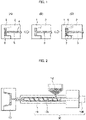
- Fig. 1 shows an exemplary configuration of the molding apparatus.
- the molding apparatus shown in Fig. 1 has a movable mold 1; a fixed mold 2; a cavity corresponding to a space between the movable mold 1 and the fixed mold 2; and a gate 4 that penetrates the fixed mold 2 from the outside to the cavity 6.
- the movable mold 1 and the fixed mold 2 may be collectively referred to as a mold.
- a composition 3 including a resin and a foaming agent is supplied to the cavity 6 from an injection apparatus (not shown) through the gate 4.
- the composition 3 includes a thermoplastic resin
- the composition 3 is supplied to the cavity 6 while the thermoplastic resin is made flowable by melting or softening.
- the mold is generally has a lower temperature than the composition 3 to be supplied. Therefore, when the composition 3 fills the cavity 6 as shown in (B) in Fig. 1 , the composition 3 is caused to solidify at a portion being in contact with the mold.
- a foamed layer 5 is formed by moving the movable mold 1 for a predetermined amount (core back) to cause a portion of the composition 3, which has not been solidified, to foam. Between the foamed layer 5 and the mold, skin layers 7 are formed from the solidified composition 3.
- the material for the molding apparatus is not particularly limited, and may be selected from ordinary materials.
- the materials include stainless steels, pre-hardened steels, alloy tool steels, high-speed tool steels and ultra-hard tool steels.
- the method for supplying the composition to the molding apparatus as shown in Fig. 1 is not particularly limited.
- the composition may be supplied to the molding apparatus by means of an injection apparatus that prepares and supplies the composition to the molding apparatus in a continuous manner.
- the injection apparatus 10 as shown in Fig. 2 has a cylinder 11 and a hopper 12 that supplies a raw material of the composition to the cylinder 11.
- the outlet of the cylinder 11 is connected to the mold 13 of the molding apparatus.
- the cylinder 11 has a screw 11A that prepares a composition by mixing the raw material and transports the composition toward the mold 13 of the molding apparatus; a motor 11 B that drives the screw 11A; and a heater (not shown) that heats inside the cylinder 11.
- the raw material that has been supplied to the cylinder 11 is melted while being moved toward the mold 13.
- a resin (100 parts by mass), a foaming agent (1 parts by mass) and an additive (3 parts by mass) were supplied to a hopper of an injection apparatus having a configuration as shown in Fig. 2 . Inside the cylinder, the materials were mixed while melting the resin to prepare a composition. The composition was supplied to a cavity formed by a pair of molds with one of them being movable. After supplying the composition to the cavity, the composition was caused to foam by moving the movable mold (core back), thereby obtaining a molded body.
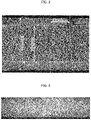
- the molded body was cut along a thickness direction and a cross-section was observed with an electron microscope. As shown in Fig. 3 , the cross-section was formed of three layers consisting of skin layer/foamed layer/skin layer (3.57 mm in total thickness).
- a molded body produced by another company was cut along a thickness direction and a cross-section was observed with an electron microscope. As shown in Fig. 4 , the cross-section of the molded body was formed of three layers consisting of skin layer/foamed layer/skin layer.
- FIG. 5 The electron micrograph of a surface of the molded body prepared in Example 1 is shown in Fig. 5 . As shown in Fig. 5 , almost no dimples were observed at a surface of the molded body.
- Example 1 Thickness of molded body mm 3.57 3.06 Thickness of foamed layer (thickness of observed region) mm 2.49 1.96 Width of observed region mm 3.3 2.96 Average diameter of cells mm 0.08 0.15 Maximum diameter of cells mm 0.13 0.21 Number per unit area of cells cells/mm 2 47 13 Area ratio of cells % 16 14
Landscapes
- Chemical & Material Sciences (AREA)
- Engineering & Computer Science (AREA)
- Health & Medical Sciences (AREA)
- Chemical Kinetics & Catalysis (AREA)
- Medicinal Chemistry (AREA)
- Polymers & Plastics (AREA)
- Organic Chemistry (AREA)
- Materials Engineering (AREA)
- General Chemical & Material Sciences (AREA)
- Mechanical Engineering (AREA)
- Injection Moulding Of Plastics Or The Like (AREA)
Abstract
Description
- The invention relates to a molded body and a method for producing a molded body.
- The material for interior and exterior components of automobiles has been changing from metal to resin in order to meet the demand of recent days for weight reduction. In particular, a molded body including air bubbles (cells), obtained by foaming a resin, is expected, as a lightweight component, to achieve further improvements in fuel economy of automobiles.
- As a foamed molded body used as an interior component or the like for automobiles, for example, a product obtained by a method described in
Patent Document 1 is known. In this method, the molded body is produced by injecting melted resin into a cavity formed by a pair of molds, and allowing the resin to foam. - [Patent Document 1]
Japanese Patent Application Laid-Open No. 2005-238726 - From the viewpoint of weight reduction of automobiles, the proportion of cells with respect to the total volume of the molded body is preferably as large as possible. However, increasing the proportion of cells with respect to the total volume of the molded body may deteriorate an external appearance of the molded body by promoting formation of dimples at a surface thereof.
- In view of the foregoing, the present invention aims to provide a molded body that can achieve both weight reduction and improved external appearance, and a method for producing the molded body.
- The means for solving the problem include the following embodiments.
- <1> A molded body, comprising a resin and cells,
the cells having an average diameter of from 0.03 mm to 0.13 mm, and a number per unit area of the cells at a cross-section of the molded body being no less than 20 cells/mm2. - <2> The molded body according to <1>, wherein the cells have a maximum diameter of no greater than 0.2 mm.
- <3> The molded body according to <1> or <2>, having a region in which the cells are present and a region in which the cells are not present.
- <4> The molded body according to any one of <1> to <3>, which is a component for an automobile.
- <5> A method for producing the molded body according to any one of <1> to <4>, the method comprising:
- supplying a composition including a resin and a foaming agent to an internal space of a molding apparatus having a moveable portion; and
- increasing a volume of the internal space by moving the movable portion of the molding apparatus.
- <6> The method for producing the molded body according to <5>, wherein the foaming agent is an organic foaming agent.
- According to the present invention, a molded body that can achieve both weight reduction and improved external appearance, and a method for producing the molded body, are provided.
-
-
Fig. 1 is a schematic sectional view of an exemplary configuration of a molding apparatus used in the present embodiment. -
Fig. 2 is a schematic sectional view of an exemplary configuration of an injection apparatus used in the present embodiment. -
Fig. 3 is an electron micrograph of a cross-section of a molded body according to the present embodiment. -
Fig. 4 is an electron micrograph of a cross-section of a molded body that is different from the present embodiment. -
Fig. 5 is an electron micrograph of a surface of a molded body according to the present embodiment. - Embodiments for carrying out the present invention will now be described in detail. However, the invention is in no way limited to the following embodiments.
- In the following embodiments, constituent elements (including element steps and the like) of the embodiments are not essential, unless otherwise specified. Likewise, numerical values and ranges thereof are not intended to restrict the invention.
- In the present disclosure, the definition of the term "step" includes not only an independent step which is distinguishable from another step, but also a step which is not clearly distinguishable from another step, as long as the purpose of the step is achieved.
- In the present disclosure, any numerical range described using the expression "from ∗ to" represents a range in which numerical values described before and after the "to" are included in the range as a minimum value and a maximum value, respectively.
- In a numerical range described in stages, in the present disclosure, an upper limit value or a lower limit value described in one numerical range may be replaced with an upper limit value or a lower limit value in another numerical range described in stages. Further, in a numerical range described in the present disclosure, the upper limit value or the lower limit value in the numerical range may be replaced with a value shown in the Examples.
- In the present disclosure, each component may include plural kinds of substances corresponding to the component. In a case in which plural kinds of substances corresponding to each component are present in a composition, the content ratio or content of each component refers to the total content ratio or content of the plural kinds of substances present in the composition, unless otherwise specified.
- In the present disclosure, the term "layer" includes, when a region with a layer is viewed, a case in which a layer is formed at a portion of the region, in addition to a case in which a layer is formed at an entire region.
- The molded body according to the present disclosure is a molded body, comprising a resin and cells,
- the cells having an average diameter of from 0.03 mm to 0.13 mm, and
- a number per unit area of the cells at a cross-section of the molded body being no less than 20 cells/mm2.
- The present inventors have found that a molded body in which the average diameter of cells satisfies the condition as specified above is less likely to have dimples at a surface thereof, even if a large number of cells are present in the molded body, thereby achieving a favorable external appearance. Therefore, the molded body achieves both weight reduction and improved external appearance.
- In the present disclosure, the average diameter of the cells is measured by observing a cross-section of the molded body. More specifically, a diameter of a true circle having an equivalent area with a cell observed at a cross-section of the molded body (i.e., equivalent circle diameter) is determined as a diameter of the cell. Further, an arithmetic average value of the diameter of all cells observed at a cross-section of the molded body (except cells having a diameter of less than 0.03 mm) is determined as an average diameter of the cells.
- In the present disclosure, the number per unit area of the cells at a cross-section is measured by observing a cross-section of the molded body. More specifically, the number of cells observed at a cross-section of the molded body is counted, and is converted to the number per unit area (1 mm2).
- The cross-section of the molded body refers to a surface obtained by cutting the molded body in a direction along a thickness thereof.
- The molded body may have cells at an entire region of the cross-section thereof, or may have a region in which cells are present and a region in which cells are not present. For example, the molded body may have a skin layer as a region in which cells are not present and a foamed layer as a region in which cells are present, like the case shown in the Examples.
- When the cross-section of the molded body has a region in which cells are present and a region in which cells are not present, the diameter, number and area of the cells are the values obtained by observing a region of the cross-section in which cells are present.
- The dimension of a cross-section of the molded body, which is used as a standard for the measurement of the average diameter and the number of cells (observed region), is determined such that the measured values are obtained in a generally constant manner.
- Specifically, the dimension of the observed region in a thickness direction of a cross-section of the molded body is determined as a dimension of the entire region in which cells are present at a cross-section of the molded body. The dimension of the observed region in a thickness direction is preferably 1 mm or more, more preferably 2 mm or more.
- The dimension of the observed region in a width direction (a direction perpendicular to a thickness direction) of a cross-section of the molded body is preferably equal to or greater than the dimension of the observed region in a thickness direction.
- The molded body according to the present disclosure has an average diameter of the cells being from 0.03 mm to 0.13 mm. When the average diameter of the cells is 0.03 mm or more, a sufficient degree of weight reduction of the molded body can be achieved. When the average diameter of the cells is 0.13 mm or less, a favorable external appearance of the molded body can be maintained.
- The average diameter of the cells may be from 0.05 mm to 0.12 mm, or may be from 0.08 mm to 0.11 mm.
- The molded body according to the present disclosure has a number per unit area of the cells at a cross-section of the molded body of no less than 20 cells/mm2. When the number of the cells is no less than 20 cells/mm2, a sufficient degree of weight reduction of the molded body can be achieved. The number of cells may be no less than 25 cells/mm2, or may be no less than 30 cells/mm2.
- The upper limit of the number per unit area of the cells at a cross-section of the molded body is not particularly limited. From the viewpoint of strength and external appearance of the molded body, the number per unit area of the cells may be any of no more than 100 cells/mm2, no more than 80 cells/mm2, or no more than 60 cells/mm2.
- In the molded body according to the present disclosure, the maximum diameter of the cells may be any of no greater than 0.2 mm, no greater than 0.175 mm, or no greater than 0.15 mm. When the maximum diameter of the cells is no greater than 0.2 mm, the molded body maintains a favorable external appearance. In the present disclosure, the maximum diameter of the cells refers to a maximum value of the measured diameters of the cells.
- In the molded body according to the present disclosure, the area ratio of the cells may be any of from 12% to 24%, from 14% to 22%, or from 16% to 20%.
- The area ratio of the cells is a value calculated by the following formula.
- Total area of all cells in observed region / area of observed region × 100 (%)
- The total thickness of the molded body is not particularly limited, and may be determined according to a purpose of the molded body. For example, the total thickness of the molded body may be selected from 2 mm to 5 mm, or may be selected from 3 mm to 4 mm. When the thickness of the molded body is not uniform, a minimum value thereof is defined as the thickness of the molded body as specified above.
- The molded body according to the present disclosure may include a skin layer as a region in which cells are not present and a foamed layer as a region in which cells are present. For example, the molded body may have a skin layer at each side of a foamed layer, respectively.
- When the molded body includes a foamed layer and a skin layer, the ratio of the thickness of the foamed layer with respect to the total thickness of the molded body may be any of 50% or more, 55% or more, or 60% or more, from the viewpoint of weight reduction of the molded body. From the viewpoint of securing the strength of the molded body, the ratio of the thickness of the foamed layer with respect to the total thickness of the molded body may be any of 95% or less, 90% or less, or 80% or less.
- The kind of the resin included in the molded body is not particularly limited. From the viewpoint of ease of molding, a balance between tenacity and strength, or other properties, the resin is preferably a thermoplastic resin. The molded body may include a single kind of resin or two or more kinds thereof.
- Specific examples of the resin include at least one selected from the group consisting of polyethylene resin, polypropylene resin, composite polypropylene resin, polystyrene resin, polyethylene terephthalate resin, polyvinyl alcohol resin, vinyl chloride resin, ionomer resin, polyamide resin, acrylonitrile/butadiene/styrene copolymer (ABS) resin and polycarbonate resin. Among these resins, at least one selected from the group consisting of polypropylene resin, composite polypropylene resin and acrylonitrile/butadiene/styrene copolymer (ABS) resin is preferred.
- The molded body may include a component other than a resin, as necessary. Examples of the component other than a resin include an additive such as carbon black and a component derived from a foaming agent as described later. When the molded body include a component other than a resin, the total content thereof with respect to the total molded body is preferably 15% by mass or less, more preferably 10% by mass or less, further preferably 5% by mass or less.
- The purpose of the molded body is not particularly limited. Since the molded body is light in weight and has excellent external appearance, the molded body is suitable for purposes that require being light in weight and excellent in external appearance, such as internal or external components for automobiles. Specific examples of the internal or external components for automobiles include Sacco moldings, arch moldings, side moldings, rocker moldings, bumpers and back door trims.
- The method for producing a molded body according to the present disclosure is a method for producing the molded body as mentioned above, the method comprising:
- supplying a composition including a resin and a foaming agent to an internal space of a molding apparatus having a movable portion; and
- increasing a volume of the internal space by moving the movable portion of the molding apparatus.
- In the present method, the volume of an internal space of a molding apparatus, in which a composition has been supplied, is increased by moving a movable portion of the molding apparatus. In this process, cells are formed by the action of a foaming agent included in the composition. As a result, a molded body including a resin with cells is produced.
- In the present method, the techniques for controlling the average diameter or the number of the cells in the molded body to be within the aforementioned ranges are not particularly limited. For example, the average diameter or the number of the cells may be controlled by the type or the amount of the resin or the foaming agent included in the composition, or by the molding conditions such as the temperature of the composition and the molding apparatus or the time for molding.
- The kind of the resin included in the composition is not particularly limited, and may be selected from the resins that may be included in the molded body as described above.
- The kind of the foaming agent is not particularly limited, and may be either an organic foaming agent or an inorganic foaming agent.
- Specific examples of the organic foaming agent include azodicarbonamide (ADCA), N,N-dintrosopentamethylenetetramine (DPT), 4,4-oxybis(benzenesulfonylhydrazide (ABSH) and hydroazodicarbonamide (HDCA). Specific examples of the inorganic foaming agent include sodium hydrogen carbonate.
- Among the organic foaming agents, when the molded body is used as an exterior component, azodicarbonamide (ADCA) is preferred.
- By using azodicarbonamide (ADCA), resistance to warm water or the like of the molded body is improved, and occurrence of blisters in a warm-water test tends to be suppressed. The blister refers to a state in which a skin layer is raised by a gas generated by reaction of water with an unreacted foaming agent remaining in a skin layer.
- The decomposition temperature of the foaming agent is preferably from 50°C to 250°C, more preferably from 50°C to 220°C. Depending on the type of usage, the decomposition temperature of the foaming agent may be from 130°C to 250°C.
- The content of the foaming agent in the composition is preferably determined depending on the type of the foaming agent or the like.
- For example, when an organic foaming agent (preferably azodicarbonamide) is used as the foaming agent, the content of the organic foaming agent in the composition is preferably from 0.05% by mass to 1.0% by mass, more preferably from 0.05% by mass to 0.5% by mass, further preferably from 0.1% by mass to 0.4% by mass, from the viewpoint of foamability, moldability and coatability of the composition.
- The content of the foaming agent as mentioned above is a content in a composition before being supplied to a molding apparatus.
- In the present method, the temperature of the composition when it is supplied to a molding apparatus is not particularly limited. When the composition includes a thermoplastic resin, the temperature of the composition is preferably equal to or higher than a softening point of the thermoplastic resin.
- The molding apparatus used in the present method is not particularly limited, as long as at least a portion thereof is movable. From the viewpoint of workability, the molding apparatus is preferably a pair of molds with at least one of them being movable.
-
Fig. 1 shows an exemplary configuration of the molding apparatus. The molding apparatus shown inFig. 1 has amovable mold 1; a fixedmold 2; a cavity corresponding to a space between themovable mold 1 and the fixedmold 2; and agate 4 that penetrates the fixedmold 2 from the outside to thecavity 6. In the following, themovable mold 1 and the fixedmold 2 may be collectively referred to as a mold. - First, as shown in (A) in
Fig. 1 , acomposition 3 including a resin and a foaming agent is supplied to thecavity 6 from an injection apparatus (not shown) through thegate 4. When thecomposition 3 includes a thermoplastic resin, thecomposition 3 is supplied to thecavity 6 while the thermoplastic resin is made flowable by melting or softening. - The mold is generally has a lower temperature than the
composition 3 to be supplied. Therefore, when thecomposition 3 fills thecavity 6 as shown in (B) inFig. 1 , thecomposition 3 is caused to solidify at a portion being in contact with the mold. - Subsequently, a foamed
layer 5 is formed by moving themovable mold 1 for a predetermined amount (core back) to cause a portion of thecomposition 3, which has not been solidified, to foam. Between the foamedlayer 5 and the mold,skin layers 7 are formed from the solidifiedcomposition 3. - The material for the molding apparatus is not particularly limited, and may be selected from ordinary materials. Examples of the materials include stainless steels, pre-hardened steels, alloy tool steels, high-speed tool steels and ultra-hard tool steels.
- The method for supplying the composition to the molding apparatus as shown in
Fig. 1 is not particularly limited. For example, the composition may be supplied to the molding apparatus by means of an injection apparatus that prepares and supplies the composition to the molding apparatus in a continuous manner. - The
injection apparatus 10 as shown inFig. 2 has acylinder 11 and ahopper 12 that supplies a raw material of the composition to thecylinder 11. The outlet of thecylinder 11 is connected to themold 13 of the molding apparatus. - The
cylinder 11 has ascrew 11A that prepares a composition by mixing the raw material and transports the composition toward themold 13 of the molding apparatus; amotor 11 B that drives thescrew 11A; and a heater (not shown) that heats inside thecylinder 11. The raw material that has been supplied to thecylinder 11 is melted while being moved toward themold 13. - In the following, the present invention is explained in detail by referring to the Examples. However, the present invention is not limited to the Examples.
- A resin (100 parts by mass), a foaming agent (1 parts by mass) and an additive (3 parts by mass) were supplied to a hopper of an injection apparatus having a configuration as shown in
Fig. 2 . Inside the cylinder, the materials were mixed while melting the resin to prepare a composition. The composition was supplied to a cavity formed by a pair of molds with one of them being movable. After supplying the composition to the cavity, the composition was caused to foam by moving the movable mold (core back), thereby obtaining a molded body. - Details of the materials used for the preparation of the composition are as follows.
- Resin: polypropylene
- Foaming agent: masterbatch including azodicarbonamide (ADCA)
- Additive: masterbatch including black pigment
- The molded body was cut along a thickness direction and a cross-section was observed with an electron microscope. As shown in
Fig. 3 , the cross-section was formed of three layers consisting of skin layer/foamed layer/skin layer (3.57 mm in total thickness). - The average diameter, maximum diameter, number per unit area, and area ratio of the cells in a region corresponding to the foamed layer in the electron micrograph were measured with a microscope, respectively. The results are shown in Table 1.
- A molded body produced by another company was cut along a thickness direction and a cross-section was observed with an electron microscope. As shown in
Fig. 4 , the cross-section of the molded body was formed of three layers consisting of skin layer/foamed layer/skin layer. - The average diameter, maximum diameter, number per unit area, and area ratio of the cells in a region corresponding to the foamed layer in the electron micrograph were measured with a microscope, respectively. The results are shown in Table 1.
- The electron micrograph of a surface of the molded body prepared in Example 1 is shown in
Fig. 5 . As shown inFig. 5 , almost no dimples were observed at a surface of the molded body. - Further, there was no change in the external appearance of the molded body prepared in Example 1 even after being immersed in warm water (40°C) for 10 days, and favorable external appearance was maintained.
Table 1 Items Unit Example 1 Example 2 Thickness of molded body mm 3.57 3.06 Thickness of foamed layer (thickness of observed region) mm 2.49 1.96 Width of observed region mm 3.3 2.96 Average diameter of cells mm 0.08 0.15 Maximum diameter of cells mm 0.13 0.21 Number per unit area of cells cells/mm2 47 13 Area ratio of cells % 16 14 - The disclosure of
Japanese Patent Application No. 2020-020848 - All publications, patent applications, and technical standards mentioned in the present specification are incorporated herein by reference to the same extent as if each individual publication, patent application, or technical standard was specifically and individually indicated to be incorporated by reference.
Claims (6)
- A molded body, comprising a resin and cells,
the cells having an average diameter of from 0.03 mm to 0.13 mm, and a number per unit area of the cells at a cross-section of the molded body being no less than 20 cells/mm2. - The molded body according to claim 1, wherein the cells have a maximum diameter of no greater than 0.2 mm.
- The molded body according to claim 1 or claim 2, having a region in which the cells are present and a region in which the cells are not present.
- The molded body according to any one of claim 1 to claim 3, which is a component for an automobile.
- A method for producing the molded body according to any one of claim 1 to claim 4, the method comprising:supplying a composition including a resin and a foaming agent to an internal space of a molding apparatus having a moveable portion; andincreasing a volume of the internal space by moving the movable portion of the molding apparatus.
- The method for producing the molded body according to claim 5, wherein the foaming agent is an organic foaming agent.
Applications Claiming Priority (2)
| Application Number | Priority Date | Filing Date | Title |
|---|---|---|---|
| JP2020020848 | 2020-02-10 | ||
| PCT/JP2020/038937 WO2021161586A1 (en) | 2020-02-10 | 2020-10-15 | Molded body, and method for producing molded body |
Publications (2)
| Publication Number | Publication Date |
|---|---|
| EP4039443A1 true EP4039443A1 (en) | 2022-08-10 |
| EP4039443A4 EP4039443A4 (en) | 2022-12-21 |
Family
ID=77292345
Family Applications (1)
| Application Number | Title | Priority Date | Filing Date |
|---|---|---|---|
| EP20919124.6A Pending EP4039443A4 (en) | 2020-02-10 | 2020-10-15 | MOLDING AND METHOD OF MAKING A MOLDING |
Country Status (5)
| Country | Link |
|---|---|
| US (1) | US20220402445A1 (en) |
| EP (1) | EP4039443A4 (en) |
| JP (1) | JPWO2021161586A1 (en) |
| CN (2) | CN117924784A (en) |
| WO (1) | WO2021161586A1 (en) |
Families Citing this family (1)
| Publication number | Priority date | Publication date | Assignee | Title |
|---|---|---|---|---|
| JPWO2024209521A1 (en) * | 2023-04-03 | 2024-10-10 |
Family Cites Families (16)
| Publication number | Priority date | Publication date | Assignee | Title |
|---|---|---|---|---|
| US5158986A (en) * | 1991-04-05 | 1992-10-27 | Massachusetts Institute Of Technology | Microcellular thermoplastic foamed with supercritical fluid |
| US5670102A (en) * | 1993-02-11 | 1997-09-23 | Minnesota Mining And Manufacturing Company | Method of making thermoplastic foamed articles using supercritical fluid |
| JP4144916B2 (en) * | 1996-04-04 | 2008-09-03 | 三井化学株式会社 | Thermoplastic resin foam injection molded body and method for producing the same |
| JP2002234046A (en) * | 2001-02-13 | 2002-08-20 | Sumitomo Chem Co Ltd | Thermoplastic resin foam molded article and method for producing the same |
| JP2003039475A (en) * | 2001-07-30 | 2003-02-13 | Teijin Meton Kk | Vehicle components containing microbubbles |
| US7524556B2 (en) * | 2003-07-23 | 2009-04-28 | Sumitomo Chemical Company, Limited | Thermoplastic resin foamed article |
| JP4324914B2 (en) | 2004-02-27 | 2009-09-02 | トヨタ紡織株式会社 | Injection foam molding method |
| JP5666308B2 (en) * | 2008-10-31 | 2015-02-12 | 株式会社プライムポリマー | Polypropylene resin composition for foam molding and foam molded body using the same |
| US9279046B2 (en) * | 2009-06-08 | 2016-03-08 | Board Of Trustees Of Michigan State University | Nanocomposites and nanocomposite foams and methods and products related to same |
| JP5992447B2 (en) * | 2011-01-27 | 2016-09-14 | ニュー バランス アスレティックス, インコーポレイテッドNew Balance Athletics, Inc. | Method for forming a foam member |
| JP5687119B2 (en) * | 2011-04-15 | 2015-03-18 | 富士紡ホールディングス株式会社 | Polishing pad and manufacturing method thereof |
| EP2746025B1 (en) * | 2011-08-19 | 2017-01-11 | Hitachi Maxell, Ltd. | Kneading device and method for producing thermoplastic resin molded body |
| JP6045386B2 (en) * | 2013-02-18 | 2016-12-14 | 日立マクセル株式会社 | Method for producing foam molded article |
| KR20170015922A (en) * | 2014-05-30 | 2017-02-10 | 세끼스이 테크노 세이께이 가부시끼가이샤 | Foam-molded article and method for manufacturing same |
| JP7054448B6 (en) * | 2018-06-25 | 2022-06-24 | 東洋紡株式会社 | Thermoplastic polyester elastomer foam molded article and its manufacturing method |
| JP2020020848A (en) | 2018-07-30 | 2020-02-06 | 京セラドキュメントソリューションズ株式会社 | Fixing device and image forming apparatus |
-
2020
- 2020-10-15 US US17/775,037 patent/US20220402445A1/en active Pending
- 2020-10-15 JP JP2020558650A patent/JPWO2021161586A1/ja active Pending
- 2020-10-15 EP EP20919124.6A patent/EP4039443A4/en active Pending
- 2020-10-15 WO PCT/JP2020/038937 patent/WO2021161586A1/en not_active Ceased
- 2020-10-15 CN CN202410174578.2A patent/CN117924784A/en active Pending
- 2020-10-15 CN CN202080076470.XA patent/CN114630858A/en active Pending
Also Published As
| Publication number | Publication date |
|---|---|
| CN114630858A (en) | 2022-06-14 |
| CN117924784A (en) | 2024-04-26 |
| US20220402445A1 (en) | 2022-12-22 |
| JPWO2021161586A1 (en) | 2021-08-19 |
| WO2021161586A1 (en) | 2021-08-19 |
| EP4039443A4 (en) | 2022-12-21 |
Similar Documents
| Publication | Publication Date | Title |
|---|---|---|
| US6391233B1 (en) | Method of producing a porous product | |
| EP2489686B1 (en) | Polypropylene resin, polypropylene resin composition, and foam-injection-molded article | |
| JP2025078851A (en) | resin molded products | |
| US20220402445A1 (en) | Molded body, and method for producing molded body | |
| EP4252996A1 (en) | Molded body, automobile part, and method for manufacturing molded body | |
| JP7852220B2 (en) | Molded articles, automotive components, and methods for manufacturing molded articles | |
| JP7862327B2 (en) | Molded articles, automotive components, and methods for manufacturing molded articles | |
| WO2022149463A1 (en) | Molded body, automobile member, and production method for molded body | |
| JP4310118B2 (en) | Composition for injection foam molding, molded product and molding method thereof | |
| US20190030769A1 (en) | Method for producing a climate control box | |
| KR20180066624A (en) | Automobile interiors manufactured from compounding compositions combining ABS and foaming agent | |
| EP0801097B1 (en) | Process for producing an expanded molded plastic | |
| WO2025063311A1 (en) | Molded body, automotive member, and production method for molded body | |
| EP4596206A1 (en) | Foam molded product, vehicle member, and vehicle backdoor | |
| EP4691726A1 (en) | Molded body, automotive component, and method for producing molded body | |
| JP2023034629A (en) | Resin composition for foam molding, and foamed article | |
| JPH079485A (en) | Method for manufacturing automobile interior parts made of composite molded body | |
| JP2020084035A (en) | Foam molded article and method for producing foam molded article | |
| JP2024050304A (en) | Foam molded products, vehicle components and vehicle back doors | |
| JP7505618B2 (en) | Foam molded product, method for producing foam molded product, and method for suppressing appearance defects of foam molded product | |
| JP7758095B2 (en) | Foam molded product and method for producing foam molded product | |
| WO2024213467A1 (en) | Foamed article with improved surface aesthetics | |
| JP2001302830A (en) | Injection foam molding resin composition, method for producing injection foam molding, and injection foam molding | |
| JP5226375B2 (en) | Method for producing thermoplastic resin foam molding | |
| JP2025072084A (en) | Molded body, automobile component, and method for producing molded body |
Legal Events
| Date | Code | Title | Description |
|---|---|---|---|
| STAA | Information on the status of an ep patent application or granted ep patent |
Free format text: STATUS: THE INTERNATIONAL PUBLICATION HAS BEEN MADE |
|
| PUAI | Public reference made under article 153(3) epc to a published international application that has entered the european phase |
Free format text: ORIGINAL CODE: 0009012 |
|
| STAA | Information on the status of an ep patent application or granted ep patent |
Free format text: STATUS: REQUEST FOR EXAMINATION WAS MADE |
|
| 17P | Request for examination filed |
Effective date: 20220504 |
|
| AK | Designated contracting states |
Kind code of ref document: A1 Designated state(s): AL AT BE BG CH CY CZ DE DK EE ES FI FR GB GR HR HU IE IS IT LI LT LU LV MC MK MT NL NO PL PT RO RS SE SI SK SM TR |
|
| STAA | Information on the status of an ep patent application or granted ep patent |
Free format text: STATUS: EXAMINATION IS IN PROGRESS |
|
| A4 | Supplementary search report drawn up and despatched |
Effective date: 20221118 |
|
| RIC1 | Information provided on ipc code assigned before grant |
Ipc: C08K 5/23 20060101ALI20221114BHEP Ipc: C08J 9/10 20060101ALI20221114BHEP Ipc: B29C 44/04 20060101ALI20221114BHEP Ipc: B29C 44/02 20060101ALI20221114BHEP Ipc: B29C 44/00 20060101ALI20221114BHEP Ipc: B29C 45/26 20060101AFI20221114BHEP |
|
| 17Q | First examination report despatched |
Effective date: 20221130 |
|
| RAP3 | Party data changed (applicant data changed or rights of an application transferred) |
Owner name: RESONAC CORPORATION |
|
| DAV | Request for validation of the european patent (deleted) | ||
| DAX | Request for extension of the european patent (deleted) | ||
| RAP3 | Party data changed (applicant data changed or rights of an application transferred) |
Owner name: RESONAC CORPORATION |