EP4038689B1 - Battery carrier - Google Patents
Battery carrier Download PDFInfo
- Publication number
- EP4038689B1 EP4038689B1 EP20792893.8A EP20792893A EP4038689B1 EP 4038689 B1 EP4038689 B1 EP 4038689B1 EP 20792893 A EP20792893 A EP 20792893A EP 4038689 B1 EP4038689 B1 EP 4038689B1
- Authority
- EP
- European Patent Office
- Prior art keywords
- battery
- carrier
- wall
- end portion
- guide feature
- Prior art date
- Legal status (The legal status is an assumption and is not a legal conclusion. Google has not performed a legal analysis and makes no representation as to the accuracy of the status listed.)
- Active
Links
Images




Classifications
-
- H—ELECTRICITY
- H01—ELECTRIC ELEMENTS
- H01M—PROCESSES OR MEANS, e.g. BATTERIES, FOR THE DIRECT CONVERSION OF CHEMICAL ENERGY INTO ELECTRICAL ENERGY
- H01M50/00—Constructional details or processes of manufacture of the non-active parts of electrochemical cells other than fuel cells, e.g. hybrid cells
- H01M50/20—Mountings; Secondary casings or frames; Racks, modules or packs; Suspension devices; Shock absorbers; Transport or carrying devices; Holders
- H01M50/204—Racks, modules or packs for multiple batteries or multiple cells
- H01M50/207—Racks, modules or packs for multiple batteries or multiple cells characterised by their shape
- H01M50/213—Racks, modules or packs for multiple batteries or multiple cells characterised by their shape adapted for cells having curved cross-section, e.g. round or elliptic
-
- E—FIXED CONSTRUCTIONS
- E05—LOCKS; KEYS; WINDOW OR DOOR FITTINGS; SAFES
- E05B—LOCKS; ACCESSORIES THEREFOR; HANDCUFFS
- E05B47/00—Operating or controlling locks or other fastening devices by electric or magnetic means
- E05B2047/0048—Circuits, feeding, monitoring
- E05B2047/0057—Feeding
- E05B2047/0058—Feeding by batteries
-
- E—FIXED CONSTRUCTIONS
- E05—LOCKS; KEYS; WINDOW OR DOOR FITTINGS; SAFES
- E05B—LOCKS; ACCESSORIES THEREFOR; HANDCUFFS
- E05B63/00—Locks or fastenings with special structural characteristics
- E05B63/08—Mortise locks
-
- H—ELECTRICITY
- H01—ELECTRIC ELEMENTS
- H01M—PROCESSES OR MEANS, e.g. BATTERIES, FOR THE DIRECT CONVERSION OF CHEMICAL ENERGY INTO ELECTRICAL ENERGY
- H01M2220/00—Batteries for particular applications
- H01M2220/30—Batteries in portable systems, e.g. mobile phone, laptop
-
- Y—GENERAL TAGGING OF NEW TECHNOLOGICAL DEVELOPMENTS; GENERAL TAGGING OF CROSS-SECTIONAL TECHNOLOGIES SPANNING OVER SEVERAL SECTIONS OF THE IPC; TECHNICAL SUBJECTS COVERED BY FORMER USPC CROSS-REFERENCE ART COLLECTIONS [XRACs] AND DIGESTS
- Y02—TECHNOLOGIES OR APPLICATIONS FOR MITIGATION OR ADAPTATION AGAINST CLIMATE CHANGE
- Y02E—REDUCTION OF GREENHOUSE GAS [GHG] EMISSIONS, RELATED TO ENERGY GENERATION, TRANSMISSION OR DISTRIBUTION
- Y02E60/00—Enabling technologies; Technologies with a potential or indirect contribution to GHG emissions mitigation
- Y02E60/10—Energy storage using batteries
Definitions
- the present invention relates to a battery carrier and to a battery storage system including the battery carrier.
- the disclosure herein thus relates to battery storage, and more particularly to a battery carrier for inserting and removing batteries from a battery housing, such as one configured to power an electronic mortise lock.
- a "mortise” is a recess cut into a part which is designed to receive an insert.
- a door mortise along an edge of a door is a common type of mortise, and is commonly used to receive a mortise lock for locking and unlocking the door when the door is in a closed position.
- Electronic locks for doors are known, but have typically located batteries on an exterior of the door, outside of a door mortise.
- EP3422303 discloses a holder of the type defined in the pre-characterising portion of claim 1.
- the invention provides a battery carrier including an elongated body having opposing first and second walls that extend longitudinally between a first end portion and a second end portion of the elongated body.
- a handle extends outwards from the first end portion.
- First and second sloped walls extend between the first and second end portions and at least partially define respective battery recesses. Each sloped wall is sloped inwardly from a respective side of the first wall to the second wall.
- the battery carrier is characterized in that the second wall comprises: a plurality of cavities that are coaxial and are disposed between the first end portion and second end portion; and a plurality of support ribs that separate the plurality of cavities
- the battery carrier includes a battery retention wall disposed at the second end portion that extends outwardly from the second wall in a direction generally perpendicular to a central longitudinal axis of the elongated body.
- the first and second sloped walls terminate at the battery retention wall.
- the battery carrier includes a first guide feature that extends outwardly from the first wall, and a second guide feature that extends outwardly from the second wall.
- the first guide feature includes a ridge that extends outward from the first wall and extends longitudinally between the first end portion and second end portion.
- the second guide feature includes a tab, and a flexible tongue biases the tab outwardly from the second wall.
- the handle is T-shaped.
- a radius of curvature of the first and second sloped walls is approximately the same.
- first battery recess and second battery recess are each dimensioned to at least partially receive at least one cylindrical battery.
- the invention provides a battery storage system that includes a battery housing that at least partially defines a cavity that has a first battery storage area and a second battery storage area.
- a battery carrier is moveable relative to the battery housing between a battery storage position, in which the battery carrier is disposed within the cavity and between the first and second battery storage areas, and a battery removal position in which the battery carrier extends outside of the cavity.
- the battery carrier is as described above.
- the battery storage system includes a battery retention wall disposed at the second end portion and extending outwardly from the second wall in a direction generally perpendicular to a central longitudinal axis of the elongated body.
- the first and second sloped walls terminate at the battery retention wall.
- the battery storage system includes a carrier guide feature of the first wall or second wall that engages a housing guide feature of the housing to support movement of the battery carrier between the battery storage position and the battery removal position.
- the carrier guide feature includes a ridge that extends outward from the first wall, and the housing guide feature includes a slot that receives the ridge, wherein the ridge is slidable in the slot between the battery storage position and the battery removal position.
- the carrier guide feature includes a tab, a flexible tongue biasing the tab outwardly from the second wall, and the housing guide feature includes a slot that receives the tab and extends between a first end and a second end. The first end of the slot limits movement of the carrier in the battery removal position.
- the handle is T-shaped.
- a radius of curvature of the each of the sloped walls is approximately the same.
- the battery storage system includes a hinged door that is rotatable between an open position which enables the battery carrier to advance to the battery removal position, and a closed position that prevents the battery carrier from advancing to the battery removal position.
- FIG 1 is a perspective view of an example door lock system 10 for a door 11.
- the door lock system 10 includes an electronic mortise lock 12 received into a first door mortise 13A, and a battery storage system 14 that is received into a second door mortise 13B.
- the battery storage system 14 includes batteries configured to power the electronic mortise lock 12.
- a rib 15 is provided between the two door mortises 13A-B to provide structural support.
- An access door 16 is removable to provide access to the battery storage system 14.
- FIG 2 is a perspective view of the battery storage system 14, with the access door 16 having been removed.
- the battery storage system 14 includes a battery housing 18 that at least partially defines a cavity 20 for storing batteries that power the electronic mortise lock 12.
- Wires 17 electrically connect the batteries (not shown in Figure 2 ) to the electronic mortise lock 12.
- a hinged door 22 is provided, and is depicted in a closed position in Figure 2 .
- the hinged door 22 rotates about an axis A between the closed position, shown in Figure 2 , and an open position, as shown in Figure 3 .
- Figure 3 is a perspective view of the battery storage system 14 with the hinged door 22 in an open position, which provides access to batteries 23A and 23B within the battery housing 18. Electrical contacts 21A-B are provided for providing an electrical connection between the batteries 23A-B when the hinged door 22 is in the closed position.
- a battery carrier 26 is provided for removing the batteries 23A-B (and batteries 23C-D, not shown in Figure 3 ) from the battery housing 18 and inserting the batteries 23A-D into the battery housing 18.
- the battery carrier 26 is depicted in a battery storage position in which the batteries 23 and battery carrier 26 are stored within the cavity 20 of the battery housing 18.
- the battery carrier 26 is movable relative to the battery housing 18 between the battery storage position and a battery removal position, shown in Figure 4 , in which the batteries 23A-D are easily removable.
- the hinged door 22 When the hinged door 22 is in the open position, the battery carrier 26 can advance to the battery removal position.
- the hinged door 22 is in the closed position, movement of the battery carrier 26 is limited, and the battery carrier 26 cannot advance to the battery removal position.
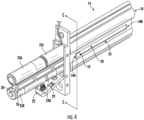
- Figure 4 is a perspective view the battery storage system 14 with the hinged door 22 in an open position, and the battery carrier 26 in the battery removal position. As shown in Figure 4 , in the battery removal position, the battery carrier 26 extends outside of the cavity 20. In the example of Figure 4 , a majority of the battery carrier 26 is outside of the battery housing 18 and cavity 20 in the battery removal position.
- the batteries 23A-D can be easily removed, replaced, and/or inserted in the battery removal position.
- a T-shaped handle 28 is provided at an end portion of the battery carrier 26 for translating the battery carrier 26 between the battery storage position and the battery removal position.
- the hinged door 22 includes an opening 29, and when the hinged door 22 is in the closed position, the T-shaped handle 28 extends at least partially into the opening 29.
- FIG. 5 is a cross-sectional view of the battery housing 18 taken along line C-C of Figure 4 , but with the batteries 23 not shown.
- the battery housing 18 includes two exterior walls 30A-B that are secured together by clamping members 32A-B.
- the cavity 20 is provided between the exterior walls 30A-B, and includes a first battery storage area 34A for storing batteries 23A, 23C, and a second battery storage area 34B for storing batteries 23B, 23D.
- the battery carrier 26 is provided between the two battery storage areas 34A-B.
- the battery carrier 26 includes a first wall 40 and a second wall 42 that is opposite the first wall 40.
- First and second sloped walls 44A-B are provided that are disposed on opposing sides of the first wall 40.
- Each sloped wall 44 has a convex geometry and is sloped inwardly from a respective side of the first wall 40 to the second wall 42.
- the first sloped wall 44A has a radius of curvature R1
- the second sloped wall 44A has a radius of curvature R2.
- the R1 and R2 are substantially the same.
- the first sloped wall 44A at least partially defines a battery recess 46A that is dimensioned to at least partially receive the batteries 23A, 23C.
- the second sloped wall 44B at least partially defines a battery recess 46B that is dimensioned to at least partially receive the batteries 23B, 23D.
- the battery carrier 26 includes a first carrier guide feature and a second carrier guide feature which each engage a respective housing guide feature of the battery housing 18 to support movement of the battery carrier 26 between the battery storage position and the battery removal position.
- the guide features also provide for alignment of the battery carrier 26 with respect to the battery housing 18 as the battery carrier 26 it moves between the battery storage position and the battery removal position.
- the first carrier guide feature is a ridge 50 that extends outward from the first wall 40 and is received into a slot 51 in the exterior wall 30A.
- the ridge 50 is slidable in the slot 51 between the battery storage position and the battery removal position.
- the second carrier guide feature includes a tab 52 that extends outward from the second wall 42 and engages a slot 53 in the exterior wall 30B.
- the slot 53 extends between a first end 54A and a second end 54B.
- the first end 54A of the slot 53 limits movement of the battery carrier 26 in the battery removal position (see Figure 4 ), and the second end 54B of the slot 53 limits movement of the battery carrier 26 in the battery storage position (see Figure 2 ).
- the ridge 50 and slot 51 could be switched so that the ridge 50 is part of the exterior wall 30A and the slot 51 is part of the first wall 40.
- FIG 6 is perspective view of the batter carrier 26.
- the battery carrier 26 has an elongated body 60 that extends longitudinally along a central longitudinal axis B between a first end portion 62A and a second end portion 62B.
- the first and second sloped walls 44A-B and ridge 50 also extend longitudinally between the first end portion 62A and the second end portion 62B.
- the T-shaped handle 28 extends outwards from the first end portion 62A.
- the batteries 23A-D extend generally parallel to the central longitudinal axis B.
- a battery retention wall 70 is disposed at the second end portion 62B, and extends outwardly from the second wall 42 in a direction generally perpendicular to the central longitudinal axis B. As shown in Figure 6 , the first and second sloped walls 44A-B terminate at the battery retention wall 70, such that the battery retention wall 70 also partially defines the battery recesses 46A-B. The battery retention wall 70 prevents batteries in the battery recesses 46A-B from extending beyond the second end portion 62B.
- FIG 7 is another perspective view of the batter carrier 26.
- the second wall 42 includes a plurality of cavities 72 that are coaxial, extend along the central longitudinal axis B, and are disposed between the first end portion 62A and second end portion 62B.
- a plurality of support ribs 74 separate the plurality of cavities 72 and extend between edges 76A-B of the second wall 42.
- the tab 52 which is receivable into the slot 53, is shown in Figure 7 .
- a tongue 78 provides a bias force that biases the tab 52 outwardly from the second wall 42.
- the tongue 78 can be flexed inward towards the first wall 40 for initial insertion of the tab 52 into the slot 53, and for removal of the tab 52 from the slot 53 (e.g., so that the battery carrier 26 can extend beyond the battery removal position for complete removal of the battery carrier 26 from the cavity 20 of the battery housing 18).
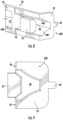
- Figure 8 is perspective view of the second end portion 62B of the battery carrier 26 which shows the tab 52 and tongue 78 in greater detail.
- Figure 9 is an end view of the battery carrier 26 that shows the second end portion 62B, and illustrates a recess 80 in the battery carrier 26 that accommodates inward flexing of the tab 52 and tongue 78 towards the first wall.
- Electronic mortise locks generally require a plurality of batteries. Unlike typical prior art electronic mortise locks, which have located a battery pack on the exterior of a door, the battery storage system 14 provides for convenient storage of the batteries 23A-D within the second door mortise 13B.
Landscapes
- Chemical & Material Sciences (AREA)
- Chemical Kinetics & Catalysis (AREA)
- Electrochemistry (AREA)
- General Chemical & Material Sciences (AREA)
- Battery Mounting, Suspending (AREA)
- Engineering & Computer Science (AREA)
- Structural Engineering (AREA)
Description
- The present invention relates to a battery carrier and to a battery storage system including the battery carrier. The disclosure herein thus relates to battery storage, and more particularly to a battery carrier for inserting and removing batteries from a battery housing, such as one configured to power an electronic mortise lock.
- A "mortise" is a recess cut into a part which is designed to receive an insert. A door mortise along an edge of a door is a common type of mortise, and is commonly used to receive a mortise lock for locking and unlocking the door when the door is in a closed position. Electronic locks for doors are known, but have typically located batteries on an exterior of the door, outside of a door mortise.
-
EP3422303 discloses a holder of the type defined in the pre-characterising portion of claim 1. - Viewed from a first aspect, the invention provides a battery carrier including an elongated body having opposing first and second walls that extend longitudinally between a first end portion and a second end portion of the elongated body. A handle extends outwards from the first end portion. First and second sloped walls extend between the first and second end portions and at least partially define respective battery recesses. Each sloped wall is sloped inwardly from a respective side of the first wall to the second wall. The battery carrier is characterized in that the second wall comprises: a plurality of cavities that are coaxial and are disposed between the first end portion and second end portion; and a plurality of support ribs that separate the plurality of cavities
- In a further embodiment of any of the foregoing embodiments, the battery carrier includes a battery retention wall disposed at the second end portion that extends outwardly from the second wall in a direction generally perpendicular to a central longitudinal axis of the elongated body.
- In a further embodiment of any of the foregoing embodiments, the first and second sloped walls terminate at the battery retention wall.
- In a further embodiment of any of the foregoing embodiments, the battery carrier includes a first guide feature that extends outwardly from the first wall, and a second guide feature that extends outwardly from the second wall.
- In a further embodiment of any of the foregoing embodiments, the first guide feature includes a ridge that extends outward from the first wall and extends longitudinally between the first end portion and second end portion.
- In a further embodiment of any of the foregoing embodiments, the second guide feature includes a tab, and a flexible tongue biases the tab outwardly from the second wall.
- In a further embodiment of any of the foregoing embodiments, the handle is T-shaped.
- In a further embodiment of any of the foregoing embodiments, a radius of curvature of the first and second sloped walls is approximately the same.
- In a further embodiment of any of the foregoing embodiments, the first battery recess and second battery recess are each dimensioned to at least partially receive at least one cylindrical battery.
- Viewed from a second aspect, the invention provides a battery storage system that includes a battery housing that at least partially defines a cavity that has a first battery storage area and a second battery storage area. A battery carrier is moveable relative to the battery housing between a battery storage position, in which the battery carrier is disposed within the cavity and between the first and second battery storage areas, and a battery removal position in which the battery carrier extends outside of the cavity. The battery carrier is as described above.
- In a further embodiment of any of the foregoing embodiments, the battery storage system includes a battery retention wall disposed at the second end portion and extending outwardly from the second wall in a direction generally perpendicular to a central longitudinal axis of the elongated body.
- In a further embodiment of any of the foregoing embodiments, the first and second sloped walls terminate at the battery retention wall.
- In a further embodiment of any of the foregoing embodiments, the battery storage system includes a carrier guide feature of the first wall or second wall that engages a housing guide feature of the housing to support movement of the battery carrier between the battery storage position and the battery removal position.
- In a further embodiment of any of the foregoing embodiments, the carrier guide feature includes a ridge that extends outward from the first wall, and the housing guide feature includes a slot that receives the ridge, wherein the ridge is slidable in the slot between the battery storage position and the battery removal position.
- In a further embodiment of any of the foregoing embodiments, the carrier guide feature includes a tab, a flexible tongue biasing the tab outwardly from the second wall, and the housing guide feature includes a slot that receives the tab and extends between a first end and a second end. The first end of the slot limits movement of the carrier in the battery removal position.
- In a further embodiment of any of the foregoing embodiments, the handle is T-shaped.
- In a further embodiment of any of the foregoing embodiments, a radius of curvature of the each of the sloped walls is approximately the same.
- In a further embodiment of any of the foregoing embodiments, the battery storage system includes a hinged door that is rotatable between an open position which enables the battery carrier to advance to the battery removal position, and a closed position that prevents the battery carrier from advancing to the battery removal position.
- The embodiments, examples, and alternatives of the preceding paragraphs, the claims, or the following description and drawings, including any of their various aspects or respective individual features, may be taken independently or in any combination. Features described in connection with one embodiment are applicable to all embodiments, unless such features are incompatible.
-
Figure 1 is a perspective view of an example door lock system. -
Figure 2 is a perspective view of a battery storage system ofFigure 1 , with a hinged door in a closed position. -
Figure 3 is a perspective view of the battery storage system ofFigure 2 with the hinged door in an open position. -
Figure 4 is a perspective view the battery storage system ofFigure 2 . -
Figure 5 is cross-sectional view of a battery housing of the battery storage system ofFigure 2 , taken along line C-C inFigure 4 . -
Figure 6 is perspective view of a battery carrier of the battery storage system ofFigure 3 . -
Figure 7 is another perspective view of the battery carrier ofFigure 6 . -
Figure 8 is a perspective view of an end portion of the battery carrier ofFigures 6 . -
Figure 9 is an end view of the battery carrier ofFigure 6 . -
Figure 1 is a perspective view of an exampledoor lock system 10 for adoor 11. Thedoor lock system 10 includes anelectronic mortise lock 12 received into afirst door mortise 13A, and abattery storage system 14 that is received into asecond door mortise 13B. Thebattery storage system 14 includes batteries configured to power theelectronic mortise lock 12. Arib 15 is provided between the twodoor mortises 13A-B to provide structural support. Anaccess door 16 is removable to provide access to thebattery storage system 14. -
Figure 2 is a perspective view of thebattery storage system 14, with theaccess door 16 having been removed. As shown inFigure 2 , thebattery storage system 14 includes abattery housing 18 that at least partially defines acavity 20 for storing batteries that power theelectronic mortise lock 12.Wires 17 electrically connect the batteries (not shown inFigure 2 ) to theelectronic mortise lock 12. - A hinged
door 22 is provided, and is depicted in a closed position inFigure 2 . The hingeddoor 22 rotates about an axis A between the closed position, shown inFigure 2 , and an open position, as shown inFigure 3 . -
Figure 3 is a perspective view of thebattery storage system 14 with the hingeddoor 22 in an open position, which provides access tobatteries battery housing 18.Electrical contacts 21A-B are provided for providing an electrical connection between thebatteries 23A-B when the hingeddoor 22 is in the closed position. Abattery carrier 26 is provided for removing thebatteries 23A-B (andbatteries 23C-D, not shown inFigure 3 ) from thebattery housing 18 and inserting thebatteries 23A-D into thebattery housing 18. - In
Figure 3 , thebattery carrier 26 is depicted in a battery storage position in which the batteries 23 andbattery carrier 26 are stored within thecavity 20 of thebattery housing 18. Thebattery carrier 26 is movable relative to thebattery housing 18 between the battery storage position and a battery removal position, shown inFigure 4 , in which thebatteries 23A-D are easily removable. When the hingeddoor 22 is in the open position, thebattery carrier 26 can advance to the battery removal position. When the hingeddoor 22 is in the closed position, movement of thebattery carrier 26 is limited, and thebattery carrier 26 cannot advance to the battery removal position. -
Figure 4 is a perspective view thebattery storage system 14 with the hingeddoor 22 in an open position, and thebattery carrier 26 in the battery removal position. As shown inFigure 4 , in the battery removal position, thebattery carrier 26 extends outside of thecavity 20. In the example ofFigure 4 , a majority of thebattery carrier 26 is outside of thebattery housing 18 andcavity 20 in the battery removal position. Thebatteries 23A-D can be easily removed, replaced, and/or inserted in the battery removal position. - A T-
shaped handle 28 is provided at an end portion of thebattery carrier 26 for translating thebattery carrier 26 between the battery storage position and the battery removal position. The hingeddoor 22 includes an opening 29, and when thehinged door 22 is in the closed position, the T-shaped handle 28 extends at least partially into the opening 29. -
Figure 5 is a cross-sectional view of thebattery housing 18 taken along line C-C ofFigure 4 , but with the batteries 23 not shown. As shown inFigure 5 , thebattery housing 18 includes twoexterior walls 30A-B that are secured together by clampingmembers 32A-B. Thecavity 20 is provided between theexterior walls 30A-B, and includes a firstbattery storage area 34A for storingbatteries battery storage area 34B for storingbatteries battery carrier 26 is provided between the twobattery storage areas 34A-B. - The
battery carrier 26 includes afirst wall 40 and asecond wall 42 that is opposite thefirst wall 40. First and secondsloped walls 44A-B are provided that are disposed on opposing sides of thefirst wall 40. Each sloped wall 44 has a convex geometry and is sloped inwardly from a respective side of thefirst wall 40 to thesecond wall 42. The firstsloped wall 44A has a radius of curvature R1, and the secondsloped wall 44A has a radius of curvature R2. In the example ofFigure 5 , the R1 and R2 are substantially the same. - The first
sloped wall 44A at least partially defines abattery recess 46A that is dimensioned to at least partially receive thebatteries sloped wall 44B at least partially defines abattery recess 46B that is dimensioned to at least partially receive thebatteries - The
battery carrier 26 includes a first carrier guide feature and a second carrier guide feature which each engage a respective housing guide feature of thebattery housing 18 to support movement of thebattery carrier 26 between the battery storage position and the battery removal position. The guide features also provide for alignment of thebattery carrier 26 with respect to thebattery housing 18 as thebattery carrier 26 it moves between the battery storage position and the battery removal position. - In the example of
Figure 5 , the first carrier guide feature is aridge 50 that extends outward from thefirst wall 40 and is received into aslot 51 in theexterior wall 30A. Theridge 50 is slidable in theslot 51 between the battery storage position and the battery removal position. The second carrier guide feature includes atab 52 that extends outward from thesecond wall 42 and engages aslot 53 in theexterior wall 30B. - Referring again to
Figure 2 and4 , theslot 53 extends between afirst end 54A and asecond end 54B. Thefirst end 54A of theslot 53 limits movement of thebattery carrier 26 in the battery removal position (seeFigure 4 ), and thesecond end 54B of theslot 53 limits movement of thebattery carrier 26 in the battery storage position (seeFigure 2 ). - In an alternative embodiment, the
ridge 50 andslot 51 could be switched so that theridge 50 is part of theexterior wall 30A and theslot 51 is part of thefirst wall 40. -
Figure 6 is perspective view of thebatter carrier 26. As shown inFigure 6 , thebattery carrier 26 has an elongatedbody 60 that extends longitudinally along a central longitudinal axis B between afirst end portion 62A and asecond end portion 62B. The first and secondsloped walls 44A-B andridge 50 also extend longitudinally between thefirst end portion 62A and thesecond end portion 62B. The T-shapedhandle 28 extends outwards from thefirst end portion 62A. Thebatteries 23A-D extend generally parallel to the central longitudinal axis B. - A
battery retention wall 70 is disposed at thesecond end portion 62B, and extends outwardly from thesecond wall 42 in a direction generally perpendicular to the central longitudinal axis B. As shown inFigure 6 , the first and secondsloped walls 44A-B terminate at thebattery retention wall 70, such that thebattery retention wall 70 also partially defines the battery recesses 46A-B. Thebattery retention wall 70 prevents batteries in the battery recesses 46A-B from extending beyond thesecond end portion 62B. -
Figure 7 is another perspective view of thebatter carrier 26. As shown inFigure 7 , thesecond wall 42 includes a plurality ofcavities 72 that are coaxial, extend along the central longitudinal axis B, and are disposed between thefirst end portion 62A andsecond end portion 62B. A plurality ofsupport ribs 74 separate the plurality ofcavities 72 and extend betweenedges 76A-B of thesecond wall 42. - The
tab 52, which is receivable into theslot 53, is shown inFigure 7 . Atongue 78 provides a bias force that biases thetab 52 outwardly from thesecond wall 42. Thetongue 78 can be flexed inward towards thefirst wall 40 for initial insertion of thetab 52 into theslot 53, and for removal of thetab 52 from the slot 53 (e.g., so that thebattery carrier 26 can extend beyond the battery removal position for complete removal of thebattery carrier 26 from thecavity 20 of the battery housing 18). -
Figure 8 is perspective view of thesecond end portion 62B of thebattery carrier 26 which shows thetab 52 andtongue 78 in greater detail. -
Figure 9 is an end view of thebattery carrier 26 that shows thesecond end portion 62B, and illustrates arecess 80 in thebattery carrier 26 that accommodates inward flexing of thetab 52 andtongue 78 towards the first wall. - Electronic mortise locks generally require a plurality of batteries. Unlike typical prior art electronic mortise locks, which have located a battery pack on the exterior of a door, the
battery storage system 14 provides for convenient storage of thebatteries 23A-D within thesecond door mortise 13B. - Excessively large door mortises are undesirable because they can weaken the structure of a door. The small footprint of the
battery storage system 14 avoids any substantial weakening of thedoor 11, while also providing for convenient insertion, removal, and replacement of thebatteries 23A-D without requiring any complex external tools. - Also, by separating the
second door mortise 13B, which houses thebattery storage system 14, from thefirst door mortise 13A, which houses theelectronic mortise lock 12, a greater degree of structural strength of thedoor 11 is maintained. - Although example embodiments have been disclosed, a worker of ordinary skill in this art would recognize that certain modifications would come within the scope of this invention, which is defined by the claims. For that reason, the following claims should be studied to determine the scope and content of the invention.
Claims (14)
- A battery carrier, comprising:an elongated body (60) including opposing first and second walls (40, 42) that extend longitudinally between a first end portion (62A) and a second end portion (62B) of the elongated body;a handle (28) extending outwards from the first end portion; andfirst and second sloped walls (44A, 44B) that extend between the first and second end portions and at least partially define respective battery recesses (46A, 46B), each sloped wall sloped inwardly from a respective side of the first wall to the second wall;characterized in that the second wall comprises:a plurality of cavities (72) that are coaxial and are disposed between the first end portion and second end portion; anda plurality of support ribs(74) that separate the plurality of cavities.
- The battery carrier of claim 1, comprising:
a battery retention wall (70) disposed at the second end portion (62B) and extending outwardly from the second wall (42) in a direction generally perpendicular to a central longitudinal axis of the elongated body. - The battery carrier of claim 2, wherein the first and second sloped walls (44A, 44B) terminate at the battery retention wall (70).
- The battery carrier of claim 1, 2 or 3, comprising:a first guide feature (50) extending outwardly from the first wall (40); anda second guide feature (52) extending outwardly from the second wall (42).
- The battery carrier of claim 4, wherein the first guide feature (50) comprises a ridge that extends outward from the first wall (40) and extends longitudinally between the first end portion (62A) and second end portion (62B).
- The battery carrier of claim 4 or 5, wherein the second guide feature (52) comprises a tab, a flexible tongue biasing the tab outwardly from the second wall (42).
- The battery carrier of any preceding claim, wherein the handle (28) is T-shaped.
- The battery carrier of any preceding claim, wherein a radius of curvature of the first and second sloped walls (44A, 44B) is approximately the same.
- The battery carrier of any preceding claim, wherein the first battery recess (46A) and second battery recess (46B) are each dimensioned to at least partially receive at least one cylindrical battery.
- A battery storage system, comprising:a battery housing (18) at least partially defining a cavity (20) that includes a first battery storage area (34A) and a second battery storage area (34B); anda battery carrier (26) that is moveable relative to the battery housing between a battery storage position, in which the battery carrier is disposed within the cavity and between the first and second battery storage areas, and a battery removal position in which the battery carrier extends outside of the cavity, wherein the battery carrier is as claimed in any preceding claim.
- The battery storage system of claim 10, comprising:
a carrier guide feature (50, 52) of the first wall (40) or second wall (42) that engages a housing guide feature of the housing to support movement of the battery carrier (26) between the battery storage position and the battery removal position. - The battery storage system of claim 11, wherein:the carrier guide feature (50) comprises a ridge that extends outward from the first wall (40); andthe housing guide feature comprises a slot (51) that receives the ridge, wherein the ridge is slidable in the slot between the battery storage position and the battery removal position.
- The battery storage system of claim 11 or 12, wherein:the carrier guide feature (52) comprises a tab, a flexible tongue (78) biasing the tab outwardly from the second wall (42); andthe housing guide feature comprises a slot (53) that receives the tab and extends between a first end and a second end, the first end of the slot limiting movement of the battery carrier (26) in the battery removal position.
- The battery storage system of any or claims 10 to 13, comprising:
a hinged door (22) that is rotatable between an open position which enables the battery carrier (26) to advance to the battery removal position, and a closed position that prevents the battery carrier from advancing to the battery removal position.
Applications Claiming Priority (2)
| Application Number | Priority Date | Filing Date | Title |
|---|---|---|---|
| US201962909433P | 2019-10-02 | 2019-10-02 | |
| PCT/US2020/053705 WO2021067543A1 (en) | 2019-10-02 | 2020-10-01 | Battery carrier |
Publications (2)
| Publication Number | Publication Date |
|---|---|
| EP4038689A1 EP4038689A1 (en) | 2022-08-10 |
| EP4038689B1 true EP4038689B1 (en) | 2025-03-19 |
Family
ID=72896173
Family Applications (1)
| Application Number | Title | Priority Date | Filing Date |
|---|---|---|---|
| EP20792893.8A Active EP4038689B1 (en) | 2019-10-02 | 2020-10-01 | Battery carrier |
Country Status (3)
| Country | Link |
|---|---|
| US (1) | US12300835B2 (en) |
| EP (1) | EP4038689B1 (en) |
| WO (1) | WO2021067543A1 (en) |
Families Citing this family (1)
| Publication number | Priority date | Publication date | Assignee | Title |
|---|---|---|---|---|
| WO2023114909A1 (en) * | 2021-12-17 | 2023-06-22 | Spectrum Brands, Inc. | Electronic lock with mortise insert |
Family Cites Families (33)
| Publication number | Priority date | Publication date | Assignee | Title |
|---|---|---|---|---|
| US4101818A (en) * | 1977-03-28 | 1978-07-18 | Union Carbide Corporation | Multi-cell battery charger |
| US5187026A (en) * | 1990-10-09 | 1993-02-16 | Scrivano Thomas J | Battery adapter |
| US5631098A (en) * | 1994-09-06 | 1997-05-20 | Nikon Corporation | Battery holder |
| JP2001068078A (en) * | 1999-06-22 | 2001-03-16 | Hudson Soft Co Ltd | Battery |
| ATE542008T1 (en) * | 2004-03-11 | 2012-02-15 | Keso Ag | ELECTROMECHANICAL LOCKING CYLINDER |
| US20060065027A1 (en) | 2004-09-29 | 2006-03-30 | U-Code, Inc. | Two-piece electronic lock door handle |
| JP4736428B2 (en) * | 2004-12-28 | 2011-07-27 | ソニー株式会社 | Power supply unit |
| JP5127154B2 (en) * | 2005-05-23 | 2013-01-23 | パナソニック株式会社 | Battery module |
| US7690230B2 (en) * | 2006-09-26 | 2010-04-06 | Yake Security Inc. | Housing for electronic lock |
| US8293392B2 (en) * | 2009-03-26 | 2012-10-23 | Sanyo Energy (Usa) Corporation | Battery holder for a battery array, and battery array |
| WO2010144078A1 (en) | 2009-06-08 | 2010-12-16 | Utc Fire & Security Corporation | Battery fire prevention via thermal management |
| JP2011021419A (en) | 2009-07-17 | 2011-02-03 | Sanyo Electric Co Ltd | Electronic lock device |
| KR101084836B1 (en) * | 2009-10-27 | 2011-11-21 | 삼성에스디아이 주식회사 | Battery pack |
| KR101299139B1 (en) * | 2011-03-21 | 2013-08-21 | 주식회사 엘지화학 | Battery Cell Holder of Improved Connecting Reliability and Battery Module Employed with the Same |
| DE102011050492A1 (en) | 2011-05-19 | 2012-11-22 | Dorma Gmbh + Co. Kg | Electronic blocking device for adding to a manually operable locking device of a door, window or the like and locking system |
| AU2012335631B2 (en) | 2011-11-11 | 2016-03-10 | Master Lock Company Llc | Battery access and power supply arrangements |
| KR20130090100A (en) * | 2012-02-03 | 2013-08-13 | 삼성에스디아이 주식회사 | Cell holder |
| US20130264128A1 (en) | 2012-04-09 | 2013-10-10 | Master Lock Company | Luggage lock |
| US10072441B2 (en) | 2012-10-10 | 2018-09-11 | Dormakaba Canada Inc. | Strike assembly |
| JP6036547B2 (en) * | 2013-05-22 | 2016-11-30 | 株式会社デンソー | Electronic control unit and protective case |
| US20160017640A1 (en) | 2014-07-15 | 2016-01-21 | Alarm Lock Systems, Inc. | Electronic Door Locking System |
| US20160042582A1 (en) | 2014-08-08 | 2016-02-11 | RPH Engineering | Electronic locking system |
| CN106716675B (en) * | 2014-10-17 | 2020-02-28 | 三洋电机株式会社 | Battery pack |
| AT516960B1 (en) | 2015-03-23 | 2016-10-15 | Kaba Gmbh | Lock or window or door fitting with a device for detecting the locking state |
| CN205004366U (en) * | 2015-08-31 | 2016-01-27 | 芝麻智能科技(北京)有限公司 | Be applied to battery case subassembly and electronic lock on electronic lock |
| DE102016103667A1 (en) * | 2016-03-01 | 2017-09-07 | Unicorn Energy GmbH | Battery pack and method of making a battery pack |
| KR102505611B1 (en) * | 2016-03-21 | 2023-03-03 | 삼성에스디아이 주식회사 | Battery pack |
| JP6846689B2 (en) * | 2016-08-24 | 2021-03-24 | パナソニックIpマネジメント株式会社 | Battery module |
| US10435916B2 (en) | 2016-08-26 | 2019-10-08 | Dormakaba Usa Inc. | Locking system for a door |
| TWI745456B (en) | 2016-10-19 | 2021-11-11 | 美商貝斯特艾瑟斯解決方案股份有限公司 | Electromechanical core apparatus, system, and methods of operating an electromechanical core apparatus |
| AU2018247582B2 (en) | 2017-04-05 | 2023-11-09 | Dormakaba Canada Inc. | Locking system for door, and extendible wire conduit therefore |
| EP3422303A1 (en) | 2017-06-29 | 2019-01-02 | Inwido AB | Door integrated power source unit |
| EP4190999A1 (en) | 2021-12-03 | 2023-06-07 | dormakaba Schweiz AG | Locking device with a stator, a rotor and an anti-wear device |
-
2020
- 2020-10-01 EP EP20792893.8A patent/EP4038689B1/en active Active
- 2020-10-01 WO PCT/US2020/053705 patent/WO2021067543A1/en not_active Ceased
- 2020-10-01 US US17/766,491 patent/US12300835B2/en active Active
Also Published As
| Publication number | Publication date |
|---|---|
| US20240055712A1 (en) | 2024-02-15 |
| WO2021067543A1 (en) | 2021-04-08 |
| EP4038689A1 (en) | 2022-08-10 |
| US12300835B2 (en) | 2025-05-13 |
Similar Documents
| Publication | Publication Date | Title |
|---|---|---|
| EP2421071B1 (en) | Tool batteries | |
| US5516308A (en) | Connector equipped with comb-like terminal locking tool | |
| US8069984B2 (en) | Bit holder | |
| EP2009747B1 (en) | Electrical connection system having wafer connectors | |
| EP4038689B1 (en) | Battery carrier | |
| EP0711005B1 (en) | Connector | |
| US12544905B2 (en) | Tool accessory holder, tool system, and tool accessory storage system | |
| JP6558095B2 (en) | Electric tool storage case | |
| US20060260964A1 (en) | Case and organizer tray for a power tool | |
| US5413223A (en) | Holder for emergency flashlight | |
| US12490826B2 (en) | Storage case for storing a power-driven personal care implement and personal care kit | |
| JPH09270276A (en) | Connector with terminal locking tool | |
| US20230381945A1 (en) | Tool box | |
| CN215589120U (en) | Combined tool box | |
| JP4187823B2 (en) | Small case for storing electronic components | |
| JP3551733B2 (en) | connector | |
| CN222150072U (en) | Nail bin assembly and surgical anastomat | |
| JP2012160305A (en) | Battery adapter | |
| JP2019181694A (en) | Electric tool storage case | |
| US10958057B1 (en) | Electronic device and cable fixing device | |
| KR200338730Y1 (en) | Clam Shell Type Case | |
| CN219713776U (en) | Refrigerator with a refrigerator body | |
| CN215789996U (en) | Blade | |
| JP2025085142A (en) | Storage battery | |
| JP3056470B2 (en) | Electrical connector |
Legal Events
| Date | Code | Title | Description |
|---|---|---|---|
| STAA | Information on the status of an ep patent application or granted ep patent |
Free format text: STATUS: UNKNOWN |
|
| STAA | Information on the status of an ep patent application or granted ep patent |
Free format text: STATUS: THE INTERNATIONAL PUBLICATION HAS BEEN MADE |
|
| PUAI | Public reference made under article 153(3) epc to a published international application that has entered the european phase |
Free format text: ORIGINAL CODE: 0009012 |
|
| STAA | Information on the status of an ep patent application or granted ep patent |
Free format text: STATUS: REQUEST FOR EXAMINATION WAS MADE |
|
| 17P | Request for examination filed |
Effective date: 20220429 |
|
| AK | Designated contracting states |
Kind code of ref document: A1 Designated state(s): AL AT BE BG CH CY CZ DE DK EE ES FI FR GB GR HR HU IE IS IT LI LT LU LV MC MK MT NL NO PL PT RO RS SE SI SK SM TR |
|
| DAV | Request for validation of the european patent (deleted) | ||
| DAX | Request for extension of the european patent (deleted) | ||
| GRAP | Despatch of communication of intention to grant a patent |
Free format text: ORIGINAL CODE: EPIDOSNIGR1 |
|
| STAA | Information on the status of an ep patent application or granted ep patent |
Free format text: STATUS: GRANT OF PATENT IS INTENDED |
|
| INTG | Intention to grant announced |
Effective date: 20240516 |
|
| GRAS | Grant fee paid |
Free format text: ORIGINAL CODE: EPIDOSNIGR3 |
|
| RAP1 | Party data changed (applicant data changed or rights of an application transferred) |
Owner name: HONEYWELL INTERNATIONAL INC. |
|
| GRAA | (expected) grant |
Free format text: ORIGINAL CODE: 0009210 |
|
| STAA | Information on the status of an ep patent application or granted ep patent |
Free format text: STATUS: THE PATENT HAS BEEN GRANTED |
|
| AK | Designated contracting states |
Kind code of ref document: B1 Designated state(s): AL AT BE BG CH CY CZ DE DK EE ES FI FR GB GR HR HU IE IS IT LI LT LU LV MC MK MT NL NO PL PT RO RS SE SI SK SM TR |
|
| REG | Reference to a national code |
Ref country code: GB Ref legal event code: FG4D |
|
| REG | Reference to a national code |
Ref country code: CH Ref legal event code: EP |
|
| REG | Reference to a national code |
Ref country code: DE Ref legal event code: R096 Ref document number: 602020047989 Country of ref document: DE |
|
| REG | Reference to a national code |
Ref country code: IE Ref legal event code: FG4D |
|
| PG25 | Lapsed in a contracting state [announced via postgrant information from national office to epo] |
Ref country code: RS Free format text: LAPSE BECAUSE OF FAILURE TO SUBMIT A TRANSLATION OF THE DESCRIPTION OR TO PAY THE FEE WITHIN THE PRESCRIBED TIME-LIMIT Effective date: 20250619 |
|
| PG25 | Lapsed in a contracting state [announced via postgrant information from national office to epo] |
Ref country code: FI Free format text: LAPSE BECAUSE OF FAILURE TO SUBMIT A TRANSLATION OF THE DESCRIPTION OR TO PAY THE FEE WITHIN THE PRESCRIBED TIME-LIMIT Effective date: 20250319 |
|
| REG | Reference to a national code |
Ref country code: LT Ref legal event code: MG9D |
|
| PG25 | Lapsed in a contracting state [announced via postgrant information from national office to epo] |
Ref country code: NO Free format text: LAPSE BECAUSE OF FAILURE TO SUBMIT A TRANSLATION OF THE DESCRIPTION OR TO PAY THE FEE WITHIN THE PRESCRIBED TIME-LIMIT Effective date: 20250619 |
|
| PG25 | Lapsed in a contracting state [announced via postgrant information from national office to epo] |
Ref country code: HR Free format text: LAPSE BECAUSE OF FAILURE TO SUBMIT A TRANSLATION OF THE DESCRIPTION OR TO PAY THE FEE WITHIN THE PRESCRIBED TIME-LIMIT Effective date: 20250319 |
|
| PG25 | Lapsed in a contracting state [announced via postgrant information from national office to epo] |
Ref country code: LV Free format text: LAPSE BECAUSE OF FAILURE TO SUBMIT A TRANSLATION OF THE DESCRIPTION OR TO PAY THE FEE WITHIN THE PRESCRIBED TIME-LIMIT Effective date: 20250319 |
|
| PG25 | Lapsed in a contracting state [announced via postgrant information from national office to epo] |
Ref country code: GR Free format text: LAPSE BECAUSE OF FAILURE TO SUBMIT A TRANSLATION OF THE DESCRIPTION OR TO PAY THE FEE WITHIN THE PRESCRIBED TIME-LIMIT Effective date: 20250620 Ref country code: BG Free format text: LAPSE BECAUSE OF FAILURE TO SUBMIT A TRANSLATION OF THE DESCRIPTION OR TO PAY THE FEE WITHIN THE PRESCRIBED TIME-LIMIT Effective date: 20250319 |
|
| REG | Reference to a national code |
Ref country code: NL Ref legal event code: MP Effective date: 20250319 |
|
| REG | Reference to a national code |
Ref country code: AT Ref legal event code: MK05 Ref document number: 1777758 Country of ref document: AT Kind code of ref document: T Effective date: 20250319 |
|
| PG25 | Lapsed in a contracting state [announced via postgrant information from national office to epo] |
Ref country code: NL Free format text: LAPSE BECAUSE OF FAILURE TO SUBMIT A TRANSLATION OF THE DESCRIPTION OR TO PAY THE FEE WITHIN THE PRESCRIBED TIME-LIMIT Effective date: 20250319 |
|
| PG25 | Lapsed in a contracting state [announced via postgrant information from national office to epo] |
Ref country code: SE Free format text: LAPSE BECAUSE OF FAILURE TO SUBMIT A TRANSLATION OF THE DESCRIPTION OR TO PAY THE FEE WITHIN THE PRESCRIBED TIME-LIMIT Effective date: 20250319 |
|
| PG25 | Lapsed in a contracting state [announced via postgrant information from national office to epo] |
Ref country code: SM Free format text: LAPSE BECAUSE OF FAILURE TO SUBMIT A TRANSLATION OF THE DESCRIPTION OR TO PAY THE FEE WITHIN THE PRESCRIBED TIME-LIMIT Effective date: 20250319 |
|
| PG25 | Lapsed in a contracting state [announced via postgrant information from national office to epo] |
Ref country code: ES Free format text: LAPSE BECAUSE OF FAILURE TO SUBMIT A TRANSLATION OF THE DESCRIPTION OR TO PAY THE FEE WITHIN THE PRESCRIBED TIME-LIMIT Effective date: 20250319 Ref country code: PT Free format text: LAPSE BECAUSE OF FAILURE TO SUBMIT A TRANSLATION OF THE DESCRIPTION OR TO PAY THE FEE WITHIN THE PRESCRIBED TIME-LIMIT Effective date: 20250721 |
|
| PG25 | Lapsed in a contracting state [announced via postgrant information from national office to epo] |
Ref country code: IT Free format text: LAPSE BECAUSE OF FAILURE TO SUBMIT A TRANSLATION OF THE DESCRIPTION OR TO PAY THE FEE WITHIN THE PRESCRIBED TIME-LIMIT Effective date: 20250319 Ref country code: PL Free format text: LAPSE BECAUSE OF FAILURE TO SUBMIT A TRANSLATION OF THE DESCRIPTION OR TO PAY THE FEE WITHIN THE PRESCRIBED TIME-LIMIT Effective date: 20250319 |
|
| PG25 | Lapsed in a contracting state [announced via postgrant information from national office to epo] |
Ref country code: AT Free format text: LAPSE BECAUSE OF FAILURE TO SUBMIT A TRANSLATION OF THE DESCRIPTION OR TO PAY THE FEE WITHIN THE PRESCRIBED TIME-LIMIT Effective date: 20250319 |
|
| PG25 | Lapsed in a contracting state [announced via postgrant information from national office to epo] |
Ref country code: EE Free format text: LAPSE BECAUSE OF FAILURE TO SUBMIT A TRANSLATION OF THE DESCRIPTION OR TO PAY THE FEE WITHIN THE PRESCRIBED TIME-LIMIT Effective date: 20250319 Ref country code: CZ Free format text: LAPSE BECAUSE OF FAILURE TO SUBMIT A TRANSLATION OF THE DESCRIPTION OR TO PAY THE FEE WITHIN THE PRESCRIBED TIME-LIMIT Effective date: 20250319 |
|
| PG25 | Lapsed in a contracting state [announced via postgrant information from national office to epo] |
Ref country code: RO Free format text: LAPSE BECAUSE OF FAILURE TO SUBMIT A TRANSLATION OF THE DESCRIPTION OR TO PAY THE FEE WITHIN THE PRESCRIBED TIME-LIMIT Effective date: 20250319 |
|
| PG25 | Lapsed in a contracting state [announced via postgrant information from national office to epo] |
Ref country code: SK Free format text: LAPSE BECAUSE OF FAILURE TO SUBMIT A TRANSLATION OF THE DESCRIPTION OR TO PAY THE FEE WITHIN THE PRESCRIBED TIME-LIMIT Effective date: 20250319 |
|
| PG25 | Lapsed in a contracting state [announced via postgrant information from national office to epo] |
Ref country code: IS Free format text: LAPSE BECAUSE OF FAILURE TO SUBMIT A TRANSLATION OF THE DESCRIPTION OR TO PAY THE FEE WITHIN THE PRESCRIBED TIME-LIMIT Effective date: 20250719 |
|
| REG | Reference to a national code |
Ref country code: DE Ref legal event code: R097 Ref document number: 602020047989 Country of ref document: DE |
|
| PGFP | Annual fee paid to national office [announced via postgrant information from national office to epo] |
Ref country code: DE Payment date: 20251028 Year of fee payment: 6 |
|
| PGFP | Annual fee paid to national office [announced via postgrant information from national office to epo] |
Ref country code: GB Payment date: 20251023 Year of fee payment: 6 |
|
| PG25 | Lapsed in a contracting state [announced via postgrant information from national office to epo] |
Ref country code: DK Free format text: LAPSE BECAUSE OF FAILURE TO SUBMIT A TRANSLATION OF THE DESCRIPTION OR TO PAY THE FEE WITHIN THE PRESCRIBED TIME-LIMIT Effective date: 20250319 |
|
| PGFP | Annual fee paid to national office [announced via postgrant information from national office to epo] |
Ref country code: FR Payment date: 20251027 Year of fee payment: 6 |
|
| PLBE | No opposition filed within time limit |
Free format text: ORIGINAL CODE: 0009261 |
|
| STAA | Information on the status of an ep patent application or granted ep patent |
Free format text: STATUS: NO OPPOSITION FILED WITHIN TIME LIMIT |
|
| REG | Reference to a national code |
Ref country code: CH Ref legal event code: L10 Free format text: ST27 STATUS EVENT CODE: U-0-0-L10-L00 (AS PROVIDED BY THE NATIONAL OFFICE) Effective date: 20260128 |
|
| 26N | No opposition filed |
Effective date: 20251222 |