EP4038071B1 - Process for preparing an activin receptor-like kinase inhibitor - Google Patents
Process for preparing an activin receptor-like kinase inhibitor Download PDFInfo
- Publication number
- EP4038071B1 EP4038071B1 EP20793533.9A EP20793533A EP4038071B1 EP 4038071 B1 EP4038071 B1 EP 4038071B1 EP 20793533 A EP20793533 A EP 20793533A EP 4038071 B1 EP4038071 B1 EP 4038071B1
- Authority
- EP
- European Patent Office
- Prior art keywords
- formula
- palladium
- bis
- starting material
- compound
- Prior art date
- Legal status (The legal status is an assumption and is not a legal conclusion. Google has not performed a legal analysis and makes no representation as to the accuracy of the status listed.)
- Active
Links
Images
Classifications
-
- C—CHEMISTRY; METALLURGY
- C07—ORGANIC CHEMISTRY
- C07D—HETEROCYCLIC COMPOUNDS
- C07D471/00—Heterocyclic compounds containing nitrogen atoms as the only ring hetero atoms in the condensed system, at least one ring being a six-membered ring with one nitrogen atom, not provided for by groups C07D451/00 - C07D463/00
- C07D471/02—Heterocyclic compounds containing nitrogen atoms as the only ring hetero atoms in the condensed system, at least one ring being a six-membered ring with one nitrogen atom, not provided for by groups C07D451/00 - C07D463/00 in which the condensed system contains two hetero rings
- C07D471/04—Ortho-condensed systems
-
- A—HUMAN NECESSITIES
- A61—MEDICAL OR VETERINARY SCIENCE; HYGIENE
- A61K—PREPARATIONS FOR MEDICAL, DENTAL OR TOILETRY PURPOSES
- A61K31/00—Medicinal preparations containing organic active ingredients
- A61K31/33—Heterocyclic compounds
- A61K31/395—Heterocyclic compounds having nitrogen as a ring hetero atom, e.g. guanethidine or rifamycins
- A61K31/495—Heterocyclic compounds having nitrogen as a ring hetero atom, e.g. guanethidine or rifamycins having six-membered rings with two or more nitrogen atoms as the only ring heteroatoms, e.g. piperazine or tetrazines
- A61K31/50—Pyridazines; Hydrogenated pyridazines
- A61K31/5025—Pyridazines; Hydrogenated pyridazines ortho- or peri-condensed with heterocyclic ring systems
-
- C—CHEMISTRY; METALLURGY
- C07—ORGANIC CHEMISTRY
- C07D—HETEROCYCLIC COMPOUNDS
- C07D401/00—Heterocyclic compounds containing two or more hetero rings, having nitrogen atoms as the only ring hetero atoms, at least one ring being a six-membered ring with only one nitrogen atom
- C07D401/02—Heterocyclic compounds containing two or more hetero rings, having nitrogen atoms as the only ring hetero atoms, at least one ring being a six-membered ring with only one nitrogen atom containing two hetero rings
- C07D401/04—Heterocyclic compounds containing two or more hetero rings, having nitrogen atoms as the only ring hetero atoms, at least one ring being a six-membered ring with only one nitrogen atom containing two hetero rings directly linked by a ring-member-to-ring-member bond
-
- C—CHEMISTRY; METALLURGY
- C07—ORGANIC CHEMISTRY
- C07D—HETEROCYCLIC COMPOUNDS
- C07D487/00—Heterocyclic compounds containing nitrogen atoms as the only ring hetero atoms in the condensed system, not provided for by groups C07D451/00 - C07D477/00
- C07D487/02—Heterocyclic compounds containing nitrogen atoms as the only ring hetero atoms in the condensed system, not provided for by groups C07D451/00 - C07D477/00 in which the condensed system contains two hetero rings
- C07D487/04—Ortho-condensed systems
-
- Y—GENERAL TAGGING OF NEW TECHNOLOGICAL DEVELOPMENTS; GENERAL TAGGING OF CROSS-SECTIONAL TECHNOLOGIES SPANNING OVER SEVERAL SECTIONS OF THE IPC; TECHNICAL SUBJECTS COVERED BY FORMER USPC CROSS-REFERENCE ART COLLECTIONS [XRACs] AND DIGESTS
- Y02—TECHNOLOGIES OR APPLICATIONS FOR MITIGATION OR ADAPTATION AGAINST CLIMATE CHANGE
- Y02P—CLIMATE CHANGE MITIGATION TECHNOLOGIES IN THE PRODUCTION OR PROCESSING OF GOODS
- Y02P20/00—Technologies relating to chemical industry
- Y02P20/50—Improvements relating to the production of bulk chemicals
- Y02P20/55—Design of synthesis routes, e.g. reducing the use of auxiliary or protecting groups
Definitions
- ALK2 Activin receptor-like kinase-2
- ACVR1 Activin A receptor, type I gene
- ALK2 is a serine/threonine kinase in the bone morphogenetic protein (BMP) pathway ( Shore et al., Nature Genetics 2006, 38: 525-27 ).
- Inhibitors of ALK2 and mutant forms of ALK2 have the potential to treat a number of diseases, including fibrodysplasia ossificans progressiva (FOP); heterotopic ossification (HO) induced by, for example, major surgical interventions, trauma (such as head or blast injuries), protracted immobilization, or severe burns; diffuse intrinsic pontine glioma (DIPG), a rare form of brain cancer; and anemia associated with chronic inflammatory, infectious or neoplastic disease.
- FOP fibrodysplasia ossificans progressiva
- HO heterotopic ossification
- DIPG diffuse intrinsic pontine glioma
- brain cancer anemia associated with chronic inflammatory, infectious or neoplastic disease.
- U.S. Patent No. 10,233,186 discloses potent, highly selective inhibitors of ALK2 and mutant forms of ALK2. Also disclosed in U.S. Patent No. 10,233,186 is Compound 1 as a key intermediate in the synthesis of many of the disclosed ALK2 inhibitors. U.S. Patent No. 10,233,186 discloses Suzuki reactions for the preparation of intermediates such as Compound 1, as shown below: which involve the coupling of a pyrrolo-pyridazine intermediate with a piperidinyl-pyridine compound.
- the disclosure provides a method of preparing a compound represented by formula (I):
- the method comprises reacting in a reaction mixture a first starting material represented by formula (II): and a second starting material represented by formula (III) under Negishi conditions: to form the compound of formula (I).
- R is an amine protecting group; Y is Cl, Br or I; and Z is Cl, Br, I or triflate (preferably Br).
- Amine protecting groups are well known in the art and are disclosed, for example, in T.W. Greene and P. G. M. Wuts "Protective Groups in Organic Synthesis” John Wiley & Sons, Inc., New York 1999 . Protecting groups may be added and removed using methods well known in the art.
- amine protecting groups include (9-Fluorenylmethyl carbamate), Cbz (Benzyl carbamate), Boc ( t -Butyl carbamate), acetamide, benzyl, tosyl ( p -Toluenesulfonamide).
- the amine protecting group is Boc.
- Another embodiment of the present disclosure is a compound represented by formula (II-A), or (II-B).
- the compound with formula (II) is not encompassed by the wording of the claims.
- the scope of the subject-matter for which protection is sought is defined by the claims.
- Y, X, and X 2 are independently Cl, Br or I.
- Y is Cl or I.
- the compounds represented by Formulas (II), (II-A) and (II-B) are intermediates in the disclosed Negishi Reaction, as described in greater detail below.
- the present disclosure provides an improved method for preparing Compound 1 in a good yield and a high purity via a Negishi Reaction (also referred to herein as a "Negishi Coupling").
- the Negishi Reaction is a transition metal catalyzed cross-coupling reaction.
- the reaction couples organic halides or triflates with organozinc compounds, thereby forming carbon-carbon bonds (c-c) in the process.
- the transition metal catalyst is typically palladium or nickel.
- the catalytic species is Pd(0) in the form of, for example, Pd(X 1 ) 2 ;
- X 1 is a phosphine ligand.
- Pd(0) can be generated in situ from a Pd +2 species in the form of, for example, Pd(X 1 ) 2 Cl 2 .
- Exemplary phosphine ligands include 1,1'-Bis(di-tert-butylphosphino)ferrocene (dtbpf), 1,1'-Bis(di-tert-butylphosphino)ferrocene (dcypf), 1,1'-Bis(diphenylphosphino)ferrocene (dppf), 2-Di-tert-butylphosphino-2',4',6'-triisopropylbiphenyl ( t -BuXPhos), [2-(Di-1-adamantylphosphino)-2',4',6'-triisopropyl-3,6-dimethoxybiphenyl] [2-(2'-amino-1,1 '-biphenyl)]palladium(II) methanesulfonate (AdBrettPhos), 2-Dicyclohexylphosphino-2',
- Exemplary palladium catalysts include Pd(dppe) 2 (Bis[1,2-bis(diphenylphosphino)ethane]palladium(0)),Pd(dba) 2 (Bis(dibenzylideneacetone)palladium(0)), CX-11 (1,3-Bis(2,6-diisopropylphenyl)imidazol-2-ylidene(1,4-naphthoquinone)palladium(0) dimer), CX-12 (1,3-Bis(2,4,6-trimethylphenyl)imidazol-2-ylidene (1,4-naphthoquinone)palladium(0) dimer), Pd(t-Bu 3 P) 2 (Bis(tri-tert-butylphosphine)palladium(0)), Pd(PCy 3 ) 2 (Bis(tricyclohexylphosphine)palladium(0)), Pd(PPh 3 ) 4 (Tetrakis(triphen
- the palladium catalyst is selected from Pd(MeCN) 2 Cl 2 , Pd[P( o- Tol) 3 ] 2 Cl 2 , PdCl 2 (Amphos) 2 and Pd(dba) 2 .
- the palladium catalyst is selected from Pd 2 (dba) 3 /P(R 1 ) 3 , Pd(PPh 3 ) 4 , Pd(PPh 3 ) 2 Cl 2 , Pd(MeCN) 2 Cl 2 , Pd[P( o -Tol) 3 ] 2 Cl 2 , PdCl 2 (Amphos) 2 , Pd(P t Bu 3 ) 2 , Pd(dppf)Cl 2 , Pd(dba) 2 , Pd 2 (dba) 3 and Pd(XPhos); each R 1 is C 1 -C 6 alkyl, C 3 -C 6 cycloalkyl, benzyl or phenyl and wherein the benzyl or phenyl is each optionally and independently substituted with one or more groups selected from halogen, C 1 -C 3 alkyl and C 1 -C 3 alkoxy.
- the palladium catalyst is Pd 2 (dba) 3
- the palladium catalyst can be combined with a phosphine ligand, e.g., the palladium catalyst is Pd 2 (dba) combined with P( t Bu) 3 .
- the catalytic species is Ni(0); and Ni(0) can be generated in situ from Ni +2 species such as NiCl 2 .
- Exemplary nickel catalyst include Ni(acac) 2 , Ni(cod) 2 , Ni(PCy 3 )2Cl2, NiBr 2 , NiI 2 , Ni(OAc) 2 , Ni(OTf) 2 , Ni(BF4) 2 , NiCl2(PPh 3 ) 2 .
- the organic halide or organic triflate in the Negishi Reaction can be an alkenyl, aryl, allyl, alkynyl or propargyl halide or triflate; and the organozinc compound is R-Zn-X in which X is chloride, bromide or iodide and R is an alkenyl, aryl, allyl, alkyl, benzyl, homoallyl or homopropargyl group.
- Conditions for carrying out the Negishi Reaction are described in, for example, Recent Developments in Negishi Cross-Coupling Reactions Diana Haas, Jeffrey M.
- Aryl zincs can be prepared using mild reaction conditions via a Grignard or organolithium intermediate with zinc metals such as ZnCh or ZnBr 2 . See, for example, Recent Developments in Negishi Cross-Coupling Reactions Diana Haas, Jeffrey M. Hammann, Robert Greiner, Paul Knochel* ACS Catal.2016, V6(3) p1540-1552 . Giovannini R, Knochel P (1998). "Ni(II)-Catalyzed Cross-Coupling between Polyfunctional Arylzinc Derivatives and Primary Alkyl Iodides". Journal of the American Chemical Society. 120 (43): 11186-11187. doi:10.1021/ja982520o .
- the organozinc compound can be prepared directly by reacting with ZnCh. ( S.P. Nolan and O. Navarro, 11.01 - C-C Bond Formation by Cross-coupling in "Comprehensive Organometallic Chemistry III” 11:1-37 (2007 ).
- under Negishi conditions means the transition metal catalyzed cross-coupling, carbon-carbon bond forming reaction between an organic halide and an organozinc compound.
- Under Negishi conditions also includes the formation of the organozinc compound, such as by reaction of a Grignard or oganolithium intermediate with a zinc halide.
- the organozinc intermediate of formula (II-B) is reacted with the second starting material of formula (III) in the presence of the palladium catalyst to form the compound of formula (I).
- X is Cl, Br or I.
- X in the organozinc intermediate (formula (II-B) is Cl; and Y in the first starting material (formula II) is Br.
- Suitable solvents for this reaction include ethereal solvents such as tetrahydrofuran, methyltetrahydrofuran, anisole and mixtures thereof.
- the organozinc intermediate of formula (II-B) is often reacted with the second starting material of formula (III) without isolation of the organozinc intermediate of formula (II-B).
- a solution of an alkoxide or amine base in an ethereal solvent is combined with the organozinc intermediate of formula (II-B) before reaction with the second starting material of formula (III).
- Adding the base to the reaction mixture has the advantage of reducing by-product formation.
- suitable bases include potassium tert- butoxide (KOtBu), morpholine, piperazine, benzylpiperazine, NH 3 , NH 4 Cl, and hexamethyldisilazane.
- KotBu is commonly used.
- Methyl tetrahydrofuran is a commonly used ethereal solvent.
- the reaction with the organozinc intermediate of formula (II-B) and the second starting material of formula (III) is carried out in the presence of polar aprotic solvent such as N -methyl-2-pyrrolidinone, dimethylformamide or dimethyl sulfoxide. N -methyl-2-pyrrolidinone is commonly used. In one aspect, between 0.05 to 1.5 volumes or mL per gram starting material of the polar aprotic solvent are used.
- the reaction mixture comprising the reaction product of the organozinc intermediate of formula (II-B) and the second starting material of formula (III) is extracted with a basic aqueous solution of N -acetyl- L -cysteine after formation of the compound of formula (I).
- concentration of the N -acetyl- L -cysteine solution is generally less than 1 gram per 5 mL water.
- extraction of the reaction mixture refers washing the reaction mixture directly with the N -acetyl- L -cysteine solution to form an aqueous phase and organic phase.
- the organic phase which contains Compound 1, is then separated from the aqueous phase.
- extraction refers to quenching the reaction mixture with an aqueous solution to form an aqueous phase and organic phase.
- the organic phase which contains Compound 1
- is then separated from the aqueous phase which is then extracted with the N -acetyl- L -cysteine solution.
- the N -acetyl- L -cysteine solution extraction has the advantage of reducing residual palladium in the final reaction product (Compound 1).
- the organozinc intermediate of formula (II-B) is obtained by reacting the first starting material of formula (II) with a Grignard reagent R'MgX 2 , to form an organometallic intermediate represented by formula (II-A):
- organometallic intermediate of formula (II-A) is then reacted with ZnX 2 to form the organozinc intermediate of formula (II-B).
- R' is a C 1 -C 6 alkyl, C 1 -C 6 alkenyl, C 1 -C 6 alkynyl, phenyl, benzyl or monocyclic heteroaryl; the phenyl, benzyl or heteroaryl is each optionally and independently substituted with one or more groups selected from halogen, C 1 -C 3 alkyl and C 1 -C 3 alkoxy group; and X 2 is Cl, Br or I.
- the Grignard reagent is iso- propyl magnesium chloride ( i -PrMgCl).
- the organometallic intermediate of formula (II-A) is reacted with ZnX 2 without isolation of the organometallic intermediate of formula (II-A).
- the reaction of the first starting material of formula (II) with the Grignard reagent can be carried out in ethereal solvents.
- One commonly used ethereal solvent is tetrahydrofuran.
- the reaction of the first starting material of formula (II) with the Grignard reagent is carried out in a mixture comprising anisole and an ethereal solvent. Utilizing anisole in the reaction mixture has the advantage of reducing by-products.
- the reaction of the first starting material of formula (II) with the Grignard reagent is carried out in a mixture comprising an aromatic solvent such as benzene, toluene, xylene, and a mixture thereof.
- Example 1 Specific conditions for preparing Compound 1 by the methods of the present disclosure are provided in Examples 1 and 5.
- Compound 1 can be readily converted into ALK-2 inhibitors by first removing the amine protecting group and then carbamoylating the resulting free amine into the desired ALK-2 inhibitor. Suitable conditions for these two transformations are disclosed in U.S. Patent No. 10,233,186 . Specific conditions for the removal of a Boc protecting group are provided in Example 2 below; and in Examiner 3 for the carbamoylation.
- Compound 2 was prepared from starting materials 1-isopropylpiperidin-4-one and 2-bromo-5-iodopyridine via a synthetic route as shown in the scheme above. It was also commercially available from Acceledev.
- reaction mixture was diluted with water (3.5 kg) and isopropyl acetate (36.9 kg) and agitated. The mixture was allowed to settle, and organic phase separated. The organic solution was further washed with water (5 ⁇ 7 kg). The organic phase after final separation was diluted with isopropyl acetate (7.7 kg) and distilled at 50-60 °C under vacuum to reduce the water content. The organic solvent can then be removed to isolate the ALK-2 inhibitor.
- the quenched reaction mixture split into three portions and the palladium content determined by inductively coupled plasma mass spectrometry (IPC-MS) to be: Reference (K 2 CO 3 ): 1'400 ppm Pd; 2 ⁇ extraction with TMT: 1'000 ppm Pd; and 2 ⁇ extraction with N-acetylcysteine: 120 ppm Pd.
- IPC-MS inductively coupled plasma mass spectrometry
Landscapes
- Chemical & Material Sciences (AREA)
- Organic Chemistry (AREA)
- Health & Medical Sciences (AREA)
- General Health & Medical Sciences (AREA)
- Veterinary Medicine (AREA)
- Epidemiology (AREA)
- Life Sciences & Earth Sciences (AREA)
- Animal Behavior & Ethology (AREA)
- Medicinal Chemistry (AREA)
- Public Health (AREA)
- Pharmacology & Pharmacy (AREA)
- Low-Molecular Organic Synthesis Reactions Using Catalysts (AREA)
- Organic Low-Molecular-Weight Compounds And Preparation Thereof (AREA)
- Plural Heterocyclic Compounds (AREA)
- Nitrogen Condensed Heterocyclic Rings (AREA)
- Heterocyclic Carbon Compounds Containing A Hetero Ring Having Oxygen Or Sulfur (AREA)
- Catalysts (AREA)
Description
- This application claims priority from
U.S. Provisional Application No. 62/909,533, filed October 2, 2019 - Activin receptor-like kinase-2 (ALK2) is encoded by the Activin A receptor, type I gene (ACVR1). ALK2 is a serine/threonine kinase in the bone morphogenetic protein (BMP) pathway (Shore et al., Nature Genetics 2006, 38: 525-27). Inhibitors of ALK2 and mutant forms of ALK2 have the potential to treat a number of diseases, including fibrodysplasia ossificans progressiva (FOP); heterotopic ossification (HO) induced by, for example, major surgical interventions, trauma (such as head or blast injuries), protracted immobilization, or severe burns; diffuse intrinsic pontine glioma (DIPG), a rare form of brain cancer; and anemia associated with chronic inflammatory, infectious or neoplastic disease.
-
U.S. Patent No. 10,233,186 U.S. Patent No. 10,233,186 
U.S. Patent No. 10,233,186 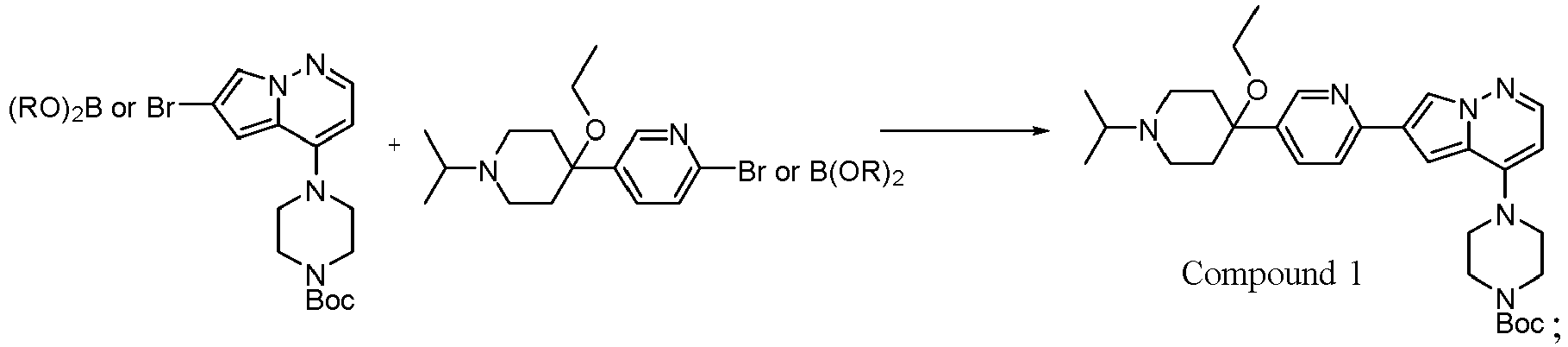
- It now has been found that the Suzuki coupling of 6-pyrrolo-pyridazine and the (bis(pinacolato)diboron piperidinyl-pyridine to prepare Compound 1 results in a complicated purity profile, whereas the formation of by-products in the corresponding Negishi coupling is considerably reduced (Example 5). The Negishi coupling has further advantages in that it requires smaller amounts of the expensive 6-pyrrolo-pyridazine starting material, has only one isolation step and uses inexpensive reagents (ZnCh and i-propylmagnesiumchloride). Moreover, based on small scale reactions, it is expected that considerably higher yields will be obtained when the Negishi coupling is employed to prepare Compound 1 on an industrial scale than the Suzuki coupling. Based on these results, new and improved syntheses of important intermediate Compound 1 are disclosed.
- In one embodiment, the disclosure provides a method of preparing a compound represented by formula (I):

- The method comprises reacting in a reaction mixture a first starting material represented by formula (II):


- Another embodiment of the present disclosure is a compound represented by formula (II-A), or (II-B). The compound with formula (II) is not encompassed by the wording of the claims. The scope of the subject-matter for which protection is sought is defined by the claims.

-
-
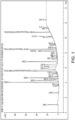
Figure 1 is an ion pair chromatography (IPC) purity profile of the reaction product obtained from preparing Compound 1 by a Suzuki coupling as disclosed inU.S. Patent No. 10,233,186 -
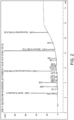
Figure 2 is an IPC purity profile of the reaction product obtained from preparing Compound 1 by the method of the present disclosure, i.e., a Negishi Coupling. - The present disclosure provides an improved method for preparing Compound 1 in a good yield and a high purity via a Negishi Reaction (also referred to herein as a "Negishi Coupling").
- The Negishi Reaction is a transition metal catalyzed cross-coupling reaction. The reaction couples organic halides or triflates with organozinc compounds, thereby forming carbon-carbon bonds (c-c) in the process. The transition metal catalyst is typically palladium or nickel. In the case of palladium, the catalytic species is Pd(0) in the form of, for example, Pd(X1)2; X1is a phosphine ligand. Alternatively, Pd(0) can be generated in situ from a Pd+2 species in the form of, for example, Pd(X1)2Cl2. Exemplary phosphine ligands include 1,1'-Bis(di-tert-butylphosphino)ferrocene (dtbpf), 1,1'-Bis(di-tert-butylphosphino)ferrocene (dcypf), 1,1'-Bis(diphenylphosphino)ferrocene (dppf), 2-Di-tert-butylphosphino-2',4',6'-triisopropylbiphenyl (t-BuXPhos), [2-(Di-1-adamantylphosphino)-2',4',6'-triisopropyl-3,6-dimethoxybiphenyl] [2-(2'-amino-1,1 '-biphenyl)]palladium(II) methanesulfonate (AdBrettPhos), 2-Dicyclohexylphosphino-2',6'-dimethoxybiphenyl (SPhos), (2-Dicyclohexylphosphino-2',6'-diisopropoxy-1,1'-biphenyl)[2-(2'-amino-1,1'-biphenyl)]palladium(II) methanesulfonate (RuPhos), [2-Dicyclohexylphosphino-2',4',6'-triisopropylbiphenyl] (XPhos), [(2-Di-cyclohexylphosphino-3,6-dimethoxy-2',4',6'-triisopropyl-1,1'-biphenyl)-2-(2'-amino-1,1'-biphenyl)]palladium(II) methanesulfonate methanesulfonate (BrettPhos), [(2-{Bis[3,5-bis(trifluoromethyl)phenyl]phosphine}-3,6-dimethoxy- 2',4',6'-triisopropyl-1,1'-biphenyl )-2-(2'-amino-1,1'-biphenyl)]palladium(II) methanesulfonate (JackiePhos), [(2-Di-tert-butylphosphino-3,6-dimethoxy-2',4',6'-triisopropyl-1,1'-biphenyl)-2-(2'-amino-1,1'-biphenyl)]palladium(II) methanesulfonate (t-BuBrettPhos), Mesyl(2-(di-tert-butylphosphino)-1,1'-binaphthyl)[2-(2'-amino-1,1'-biphenyl)]palladium (TrixiePhos), (2-Biphenyl)di-tert-butylphosphine, (2-Biphenylyl)di-tert-butylphosphine (JohnPhos), 2'-(Di-tert-butylphosphino)-N,N-dimethylbiphenyl-2-amine (t-BuDavePhos), 2-Di-tert-butylphosphino-2'-methylbiphenyl (t-BuMePhos), Chloro(2-dicyclohexylphosphino-1,1'-biphenyl)[2-(2'-amino-1,1'-biphenyl)]palladium(II) (CyJohnPhos), 2-Dicyclohexylphosphino-2'-(N,N-dimethylamino)biphenyl (DavePhos), 2-Dicyclohexylphosphino-2'-methylbiphenyl (MePhos), 2-Dicyclohexylphosphino-2'-(N,N-dimethylamino)biphenyl (PhDavePhos), 2-Dicyclohexylphosphino-2'-methoxy-4',6'-di-tert-butylbiphenyl (VPhos), 2-[(tert-Butyl)phenylphosphino]-2',6'-bis(N,N-dimethylamino)biphenyl. (PhCPhos), [(2-Dicyclohexylphosphino-2',6'-bis(N,N-dimethylamino) -1,1'-biphenyl)-2-(2'-amino-1,1'-biphenyl)] palladium(II) methanesulfonate (CPhos), Methanesulfonato[2-diethylphosphino-2',6'-bis(dimethylamino)-1,1-biphenyl](2'-amino-1,1'-biphenyl-2-yl)palladium(II) (EtCPhos), 2-Di(tert-butyl)phosphino-2',4',6'-triisopropyl-3-methoxy-6-methylbiphenyl (RockPhos), Di-1-adamantyl(4"-butyl-2",3",5",6"-tetrafluoro-2',4',6'-triisopropyl-2-methoxy-meta-terphenyl)phosphine (AlPhos) and 2-(t-Butylphenylphosphino)-2',6'-dimethylamino-1,1'-biphenyl, ((t-Bu)PhCPhos).
- Exemplary palladium catalysts include Pd(dppe)2 (Bis[1,2-bis(diphenylphosphino)ethane]palladium(0)),Pd(dba)2 (Bis(dibenzylideneacetone)palladium(0)), CX-11 (1,3-Bis(2,6-diisopropylphenyl)imidazol-2-ylidene(1,4-naphthoquinone)palladium(0) dimer), CX-12 (1,3-Bis(2,4,6-trimethylphenyl)imidazol-2-ylidene (1,4-naphthoquinone)palladium(0) dimer), Pd(t-Bu3P)2 (Bis(tri-tert-butylphosphine)palladium(0)), Pd(PCy3)2 (Bis(tricyclohexylphosphine)palladium(0)), Pd(PPh3)4 (Tetrakis(triphenylphosphine)palladium(0)),Pd2(dba)3 (Tris(dibenzylideneacetone)dipalladium(0)), Pd(OAc)2 (Palladium (II) acetate), PdCl2(PPh3)2 (Dichlorobis(triphenylphosphine)palladium(II)), PdCl2(Amphos)2 (Bis(di-tert-butyl(4-dimethylaminophenyl)phosphine)dichloropalladium(II)), Pd(MeCN)2Cl2 (Bis(acetonitrile)dichloropalladium(II)), PdCl2(P(o-Tol)3)2 (Dichlorobis(tri-o-tolylphosphine)palladium(II)), Pd(dppf)Cl2 (1,1'-Bis(diphenylphosphino)ferrocene]dichloropalladium(II)), Pd(MeCN)4(BF4)2 (Tetrakis(acetonitrile)palladium(II) tetrafluoroborate), Pd-PEPPSI-IPent (Dichloro[1,3-bis(2,6-Di-3-pentylphenyl)imidazol-2-ylidene](3-chloropyridyl)palladium(II)), Pd-PEPPSI-IPr([1,3-Bis(2,6-Diisopropylphenyl)imidazol-2-ylidene](3-chloropyridyl)palladium(II) dichloride) and Pd-PEPPSI-SIPr ((1,3-Bis(2,6-Diisopropylphenyl)imidazolidene) (3-chloropyridyl) palladium(II) dichloride).
- Alternatively, the palladium catalyst is selected from Pd(MeCN)2Cl2, Pd[P(o-Tol)3]2Cl2, PdCl2(Amphos)2 and Pd(dba)2. In another alternative, the palladium catalyst is selected from Pd2(dba)3/P(R1)3, Pd(PPh3)4, Pd(PPh3)2Cl2, Pd(MeCN)2Cl2, Pd[P(o-Tol)3]2Cl2, PdCl2(Amphos)2, Pd(PtBu3)2, Pd(dppf)Cl2, Pd(dba)2, Pd2(dba)3 and Pd(XPhos); each R1 is C1-C6 alkyl, C3-C6cycloalkyl, benzyl or phenyl and wherein the benzyl or phenyl is each optionally and independently substituted with one or more groups selected from halogen, C1-C3alkyl and C1-C3 alkoxy. In another alternative, the palladium catalyst is Pd2(dba)3 In yet another alternative, the palladium catalyst is PdP(tBu)3.
- In another embodiment, the palladium catalyst can be combined with a phosphine ligand, e.g., the palladium catalyst is Pd2(dba) combined with P(tBu)3.
- In the case of nickel, the catalytic species is Ni(0); and Ni(0) can be generated in situ from Ni+2 species such as NiCl2. Exemplary nickel catalyst include Ni(acac)2, Ni(cod)2, Ni(PCy3)2Cl2, NiBr2, NiI2, Ni(OAc)2, Ni(OTf)2, Ni(BF4)2, NiCl2(PPh3)2.
- The organic halide or organic triflate in the Negishi Reaction can be an alkenyl, aryl, allyl, alkynyl or propargyl halide or triflate; and the organozinc compound is R-Zn-X in which X is chloride, bromide or iodide and R is an alkenyl, aryl, allyl, alkyl, benzyl, homoallyl or homopropargyl group. Conditions for carrying out the Negishi Reaction are described in, for example, Recent Developments in Negishi Cross-Coupling Reactions Diana Haas, Jeffrey M. Hammann, Robert Greiner, Paul Knochel* ACS Catal.2016, V6(3) p1540-1552; Mild Negishi Cross-Coupling Reactions Catalyzed by Acenaphthoimidazolylidene Palladium Complexes at Low Catalyst Loadings Z. Liu, N. Dong, M. Xu, Z. Sun, T. Tu, J. Org. Chem., 2013, 78, 7436-7444; An Extremely Active Catalyst for the Negishi Cross-Coupling Reaction J. E. Milne, S. L. Buchwald, J. Am. Chem. Soc., 2004, 126, 13028-13032; One-Pot Negishi Cross-Coupling Reactions of In Situ Generated Zinc Reagents with Aryl Chlorides, Bromides, and Inflates S. Sase, M. Jaric, A. Metzger, V. Malakhov, P. Knochel, J. Org. Chem., 2008, 73, 7380-7382; Efficient Negishi Coupling Reactions of Aryl Chlorides Catalyzed by Binuclear and Mononuclear Nickel-N-Heterocyclic Carbene Complexes Z. Xi, Y. Zhou, W. Chen, J. Org. Chem., 2008, 73, 8497-8501; Cross-Coupling of Aryltrimethylammonium Iodides with Arylzinc Reagents Catalyzed by Amido Pincer Nickel Complexes X.-Q. Zhang, Z.-X. Wang, J. Org. Chem., 2012, 77, 3658-3663; Efficient Cross-Coupling of Aryl Chlorides with Arylzinc Reagents Catalyzed by Amido Pincer Complexes of Nickel L. Wang, Z.-X. Wang, Org. Lett., 2007, 9, 4335-4338; Highly Regio- and Stereoselective Synthesis of (Z)-Trisubstituted Alkenes via Propyne Bromoboration and Tandem Pd-Catalyzed Cross-Coupling C. Wang, T. Tobrman, Z. Xu, E.-i. Negishi, Org. Lett., 2009, 11, 4092-4095; Highly Regioselective Synthesis of Trisubstituted Allenes via Lithiation of 1-Aryl-3-alkylpropadiene, Subsequent Transmetalation, and Pd-Catalyzed Negishi Coupling Reaction J. Zhao, Y. Liu, S. Ma, Org. Lett., 2008, 10, 1521-1523; High Temperature Metalation of Functionalized Aromatics and Heteroaromatics using (tmp)2Zn·2MgCl2·2LiCl and Microwave Irradiation S. Wunderlich, P. Knochel, Org. Lett., 2008, 10, 4705-4707; A Mild Negishi Cross-Coupling of 2-Heterocyclic Organozinc Reagents and Aryl Chlorides M. R. Luzung, J. S. Patel, J. Yin, J. Org. Chem., 2010, 75, 8330-8332; Synthesis of Substituted Cyclopropanecarboxylates via Room Temperature Palladium-Catalyzed α-Arylation of Reformatsky Reagents S. N. Greszler, G. T. Halvorsen, E. A. Voight, Org. Lett., 2017, 19, 2490-2493; and Enantioselective, Palladium-Catalyzed α-Arylation of N-Boc-pyrrolidine K. R. Campos, A. Klapars, J. H. Waldman, P. G. Dormer, C.-Y. Chen, J. Am. Chem. Soc., 2006, 128, 3538-3539.
- Aryl zincs can be prepared using mild reaction conditions via a Grignard or organolithium intermediate with zinc metals such as ZnCh or ZnBr2. See, for example, Recent Developments in Negishi Cross-Coupling Reactions Diana Haas, Jeffrey M. Hammann, Robert Greiner, Paul Knochel* ACS Catal.2016, V6(3) p1540-1552. Giovannini R, Knochel P (1998). "Ni(II)-Catalyzed Cross-Coupling between Polyfunctional Arylzinc Derivatives and Primary Alkyl Iodides". Journal of the American Chemical Society. 120 (43): 11186-11187. doi:10.1021/ja982520o . Jie Jack Li, Chapter 3 - Applications of Palladium Chemistry to the Total Synthesis of Naturally Occurring of Indole Alkaloids in "Alkaloids: Chemical and Biological Perspectives" 14:437-503 (1999). In some instances, the organozinc compound can be prepared directly by reacting with ZnCh. (S.P. Nolan and O. Navarro, 11.01 - C-C Bond Formation by Cross-coupling in "Comprehensive Organometallic Chemistry III" 11:1-37 (2007).
- The term "under Negishi conditions" means the transition metal catalyzed cross-coupling, carbon-carbon bond forming reaction between an organic halide and an organozinc compound. "Under Negishi conditions" also includes the formation of the organozinc compound, such as by reaction of a Grignard or oganolithium intermediate with a zinc halide.
- In one aspect, i) the first starting material of formula (II) is converted into an organozinc intermediate represented by formula (II-B):

- The organozinc intermediate of formula (II-B) is reacted with the second starting material of formula (III) in the presence of the palladium catalyst to form the compound of formula (I). X is Cl, Br or I. Alternatively, X in the organozinc intermediate (formula (II-B) is Cl; and Y in the first starting material (formula II) is Br. Suitable solvents for this reaction include ethereal solvents such as tetrahydrofuran, methyltetrahydrofuran, anisole and mixtures thereof. The organozinc intermediate of formula (II-B) is often reacted with the second starting material of formula (III) without isolation of the organozinc intermediate of formula (II-B). In one aspect, a solution of an alkoxide or amine base in an ethereal solvent is combined with the organozinc intermediate of formula (II-B) before reaction with the second starting material of formula (III). Adding the base to the reaction mixture has the advantage of reducing by-product formation. Examples of suitable bases include potassium tert-butoxide (KOtBu), morpholine, piperazine, benzylpiperazine, NH3, NH4Cl, and hexamethyldisilazane. KotBu is commonly used. In one aspect, between 0.5 and 3.0 equivalents of base relative to the first starting material of formula (II). In one aspect, between 1.5 and 3.0 equivalents of base relative to the first starting material of formula (II). Methyl tetrahydrofuran is a commonly used ethereal solvent. In yet another aspect, the reaction with the organozinc intermediate of formula (II-B) and the second starting material of formula (III) is carried out in the presence of polar aprotic solvent such as N-methyl-2-pyrrolidinone, dimethylformamide or dimethyl sulfoxide. N-methyl-2-pyrrolidinone is commonly used. In one aspect, between 0.05 to 1.5 volumes or mL per gram starting material of the polar aprotic solvent are used. In another aspect, the reaction mixture comprising the reaction product of the organozinc intermediate of formula (II-B) and the second starting material of formula (III) is extracted with a basic aqueous solution of N-acetyl-L-cysteine after formation of the compound of formula (I). The concentration of the N-acetyl-L-cysteine solution is generally less than 1 gram per 5 mL water. "Extraction" of the reaction mixture refers washing the reaction mixture directly with the N-acetyl-L-cysteine solution to form an aqueous phase and organic phase. The organic phase, which contains Compound 1, is then separated from the aqueous phase. Alternatively, "extraction" refers to quenching the reaction mixture with an aqueous solution to form an aqueous phase and organic phase. The organic phase, which contains Compound 1, is then separated from the aqueous phase, which is then extracted with the N-acetyl-L-cysteine solution. The N-acetyl-L-cysteine solution extraction has the advantage of reducing residual palladium in the final reaction product (Compound 1). In another aspect, the organozinc intermediate of formula (II-B) is obtained by reacting the first starting material of formula (II) with a Grignard reagent R'MgX2, to form an organometallic intermediate represented by formula (II-A):

- The organometallic intermediate of formula (II-A) is then reacted with ZnX2 to form the organozinc intermediate of formula (II-B). R' is a C1-C6 alkyl, C1-C6 alkenyl, C1-C6 alkynyl, phenyl, benzyl or monocyclic heteroaryl; the phenyl, benzyl or heteroaryl is each optionally and independently substituted with one or more groups selected from halogen, C1-C3alkyl and C1-C3 alkoxy group; and X2 is Cl, Br or I. In one aspect, the Grignard reagent is iso-propyl magnesium chloride (i-PrMgCl). Conveniently, the organometallic intermediate of formula (II-A) is reacted with ZnX2 without isolation of the organometallic intermediate of formula (II-A). The reaction of the first starting material of formula (II) with the Grignard reagent can be carried out in ethereal solvents. One commonly used ethereal solvent is tetrahydrofuran. In one aspect, the reaction of the first starting material of formula (II) with the Grignard reagent is carried out in a mixture comprising anisole and an ethereal solvent. Utilizing anisole in the reaction mixture has the advantage of reducing by-products. In one aspect, the reaction of the first starting material of formula (II) with the Grignard reagent is carried out in a mixture comprising an aromatic solvent such as benzene, toluene, xylene, and a mixture thereof.
- Specific conditions for preparing Compound 1 by the methods of the present disclosure are provided in Examples 1 and 5. Compound 1 can be readily converted into ALK-2 inhibitors by first removing the amine protecting group and then carbamoylating the resulting free amine into the desired ALK-2 inhibitor. Suitable conditions for these two transformations are disclosed in
U.S. Patent No. 10,233,186 - The following examples are intended to be illustrative and are not intended to be limiting in any way to the scope of the disclosure.
-

-
Compound 2 was prepared from starting materials 1-isopropylpiperidin-4-one and 2-bromo-5-iodopyridine via a synthetic route as shown in the scheme above. It was also commercially available from Acceledev. - A mixture of 6-bromopyrrolo[1,2-b]pyridazine-4-ol (5.5 kg, 25.8 mol) and triethylamine (3.1 kg, 1.2 equiv) in acetonitrile (27 L, 4.9 volumes) is agitated at -10 °C. To this mixture was added trifluoromethanesulfonic anhydride (7.1 kg, 0.98 equiv) with an additional rinse of acetonitrile (2 L, 0.36 volumes). The reaction was agitated until reaction completion, at which time trimethylsilyl chloride (0.3 kg, 0.1 equiv) is added. To the mixture is then added, triethylamine (3.7 kg, 1.3 equiv) and N-Boc-piperazine (5.5 kg, 1.2 equiv) with additional acetonitrile rinses (2 L, 0.36 volumes). The reaction was heated to 65-75 °C until reaction completion. The reaction mixture was concentrated at 45-55 °C and diluted with water before cooling to 15-25 °C to crystalize the product. The product was filtered and washed with isopropanol (2 × 11 L, 2 × 2 volumes) to give 7.0 kg (72.4% yield).
- 2-Bromo-5-(4-ethoxy-1-isopropylpiperidin-4-yl)pyridine (
Compound 2, 5.9 kg, prepared as disclosed inUS10233186 US10233186 -
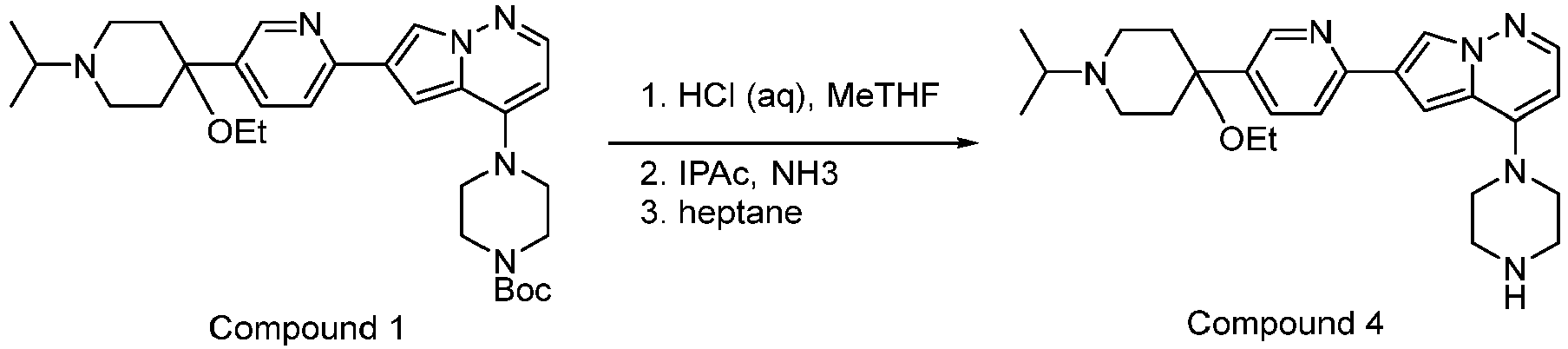
- Compound 1 prepared as described in Example 1 was used without purification or isolation from the reaction mixture. The reaction mixture was diluted with tetrahydrofuran (8.8 kg) and 33% hydrochloric acid (21 kg) in water (36 kg) was added. The acidic aqueous mixture containing the product was washed with methyltetrahydrofuran (31 kg) and then isopropyl acetate (2 × 11 kg). The aqueous solution was then diluted with isopropyl acetate (53 kg) and basified with ammonia (25%, 33 kg). The organic phase was separated and washed with acetylcysteine (3 × 26 kg) and water (2 × 18 kg). The organic solution was seeded and heptane (41.7 kg) was added to crystalize the product that was then isolated by filtration to give approximately 3.6 kg of
Compound 4 after drying. -

- To the reactor was added 1,1-carbonyldiimidazol (1.51 kg), isopropyl acetate (6.4 kg), and the alcohol R-OH (e.g., 1.1 equivalents relative to 1,1-carbonyldiimidazol). The reaction was agitated 30 minutes at 20-30 °C until reaction completion. The reaction was heated to 30-40 °C and filtered, washing the filter with isopropyl acetate (7.7 kg). This diluted mixture was charged with ammonia (25%, 3.2 kg) and Compound 4 (3.5 kg) was added. The reaction was heated to 50-60 °C and distilled under vacuum. The mixture was further diluted with isopropyl acetate (6.1 kg) and reaction completion confirmed. At this time, the reaction mixture was diluted with water (3.5 kg) and isopropyl acetate (36.9 kg) and agitated. The mixture was allowed to settle, and organic phase separated. The organic solution was further washed with water (5 ×7 kg). The organic phase after final separation was diluted with isopropyl acetate (7.7 kg) and distilled at 50-60 °C under vacuum to reduce the water content. The organic solvent can then be removed to isolate the ALK-2 inhibitor.
- To 1.15 equivalents 2-bromo-5-(4-ethoxy-1-isopropylpiperidin-4-yl)pyridine (Compound 2) were added 6 volumes toluene and the mixture was heated to jacket temperature (JT) 145° C1. At internal temperature (IT) 112-121°
C 4 volumes toluene were distilled. At IT 45° C 1.37 equivalents iso-propyl magnesium chloride (2 M in tetrahydrofuran) were added in total to reach reaction completion. At that time, 1.20 equivalents ZnCh (2 M in tetrahydrofuran) was added at 45° C and the mixture was stirred atJT 80° C for 14 hours. At IT 45° C were added 0.1 volumes N-methyl-2-pyrroldinone, 1 mol% Pd2(dba)3, 4 mol% tBu3P•HBF4. A solution of 1.0 equivalents Compound 3 (30.4 g) in 2.5 volumes methyltetrahydrofuran (MeTHF) was added over 30 minutes at IT 45° C. After 1 h additional 0.15 equivalents Compound 3 in 0.4 volumes tetrahydrofuran was added. The mixture was stirred for 2 hours at IT 45° C, transferred to another reaction vessel, rinsed with 1.6 volumes MeTHF and then added over 10 minutes to a solution of 4.1 equivalents K2CO3 in 25 volumes water at 24° C. Then, 0.43 volumes 30%-w/w NaOH were added, the aq. phase was separated and the organic phase split into three portions. Each portion was washed with 2 × 1.6 volumes of either (i) potassium carbonate, (ii) 2,4,6-trimercapto-1,3,5-triazine (TMT), or (iii) N-acetylcysteine. Then 3.3 volumes water and 0.95 volumes 2 M HCl were added and the organic phase was separated. Subsequently 0.30 volumes 30%-w/w NaOH and Norit CGP super (approx. 0.5 g) were added. The mixture was stirred at IT 45° C for 2 hours, filtered, and washed with 0.33 volumes MeTHF. The organic phase was washed with 2 × 1 volumes water. Boc2O (0.08 vol, 2 M) was added and the mixture was stirred for 15 minutes at 24° C. MeTHF was distilled at JT 80-120° C while n-heptane was added (3 × 1.6 volumes). The brown slurry was cooled to 0° C, stirred for 15 minutes, filtered, and washed with 2 × 0.7 volumes n-heptane (re-slurry washings).
1 Equivalents and volumes are all relative to Compound 3, in which one equivalent is 30.4 g. Volume is 1 mL/1 gram of reference material, in this case Compound 3. - The quenched reaction mixture split into three portions and the palladium content determined by inductively coupled plasma mass spectrometry (IPC-MS) to be: Reference (K2CO3): 1'400 ppm Pd; 2 × extraction with TMT: 1'000 ppm Pd; and 2 × extraction with N-acetylcysteine: 120 ppm Pd.
-

- To a vessel containing Compound 4 (1.0 g) in water 2.4 mL (2.4 vol) and 1,4-dioxane (12.0 mL, 12 vol) was added 0.68 g (1.0 eq) of 2-bromo-5-(4-ethoxy-1-isopropylpiperidin-4-yl)pyridine (Compound 2) , K2CO3 (0.57 g, 2.0 eq), and Pd(PPh3)4 (0.12 g, 0.05 eq). The reaction was heated to 80 °C until reaction completion was observed by HPLC (
Figure 1 ). - To 3.27 g of 2-bromo-5-(4-ethoxy-1-isopropylpiperidin-4-yl)pyridine (Compound 2) was added 6 vol toluene and 1.2 eq iPrMgCl (2 M in THF). The mixture was heated to JT 65°C. After reaching reaction completion, 1.3 eq ZnCl2 (1.9 M in MeTHF) was added and the reaction held at 20-25°C. At 45°C, Compound 3 was added with PdP(tBu3)2 (0.1 eq) with THF (3 vol) and the mixture agitated until reaction completion by HPLC (
Figure 2 ). - It is evident from
Figures 1 and2 that the preparation of Compound 1 by the method of the present disclosure is considerably cleaner and produces far fewer impurities than the corresponding Suzuki coupling.
Claims (15)
- A method of preparing a compound represented by formula (I):


- The method of claim 1, wherein the reaction is mediated by a palladium catalyst.
- The method of claim 2, wherein:i) the first starting material of formula (II) is converted into an organozinc intermediate represented by formula (II-B):
 ii) the organozinc intermediate of formula (II-B) is reacted with the second starting material of formula (III) in the presence of the palladium catalyst to form the compound of formula (I), wherein X is Cl, Br or I.
 - The method of any one of claims 1-3, wherein X is Cl and Y is Br.
- The method of claim 3 or 4, wherein the organozinc intermediate of formula (II-B) is reacted with the second starting material of formula (III) without isolation of the organozinc intermediate of formula (II-B).
- The method of any one of claims 2-5, wherein the palladium catalyst is selected from Pd(X1)2 and Pd(X1)2Cl2, wherein each X1 is independently a phosphine ligand, preferably selected from dtbpf, dcypf, dppf, t-BuXPhos, AdBrettPhos, SPhos, RuPhos, XPhos, BrettPhos, JackiePhos, t-BuBrettPhos, TrixiePhos, JohnPhos, t-BuDavePhos, t-BuMePhos, CyJohnPhos, DavePhos, MePhos, PhDavePhos, VPhos, PhCPhos, CPhos, EtCPhos, RockPhos, AlPhos and (t-Bu)PhCPhos.
- The method of claim 6, wherein the palladium catalyst is selected from:(i) Pd(dppe)2 (Bis[1,2-bis(diphenylphosphino)ethane]palladium(o)),Pd(dba)2 (Bis(dibenzylideneacetone)palladium(o)),CX-11 (1,3-Bis(2,6-diisopropylphenyl)imidazol-2-ylidene(1,4-naphthoquinone)palladium(o) dimer),CX-12 (1,3-Bis(2,4,6-trimethylphenyl)imidazol-2-ylidene (1,4-naphthoquinone)palladium(o) dimer),Pd(t-Bu3P)2 (Bis(tri-tert-butylphosphine)palladium(o)), Pd(PCy3)2 (Bis(tricyclohexylphosphine)palladium(o)),Pd(PPh3)4 (Tetrakis(triphenylphosphine)palladium(o)), Pd2(dba)3 (Tris(dibenzylideneacetone)dipalladium(o)),Pd(OAc)2 (Palladium (II) acetate),PdCl2(PPh3)2 (Dichlorobis(triphenylphosphine)palladium(II)),PdCl2(Amphos)2 (Bis(di-tert-butyl(4-dimethylaminophenyl)phosphine)dichloropalladium(II)),Pd(MeCN)2Cl2 (Bis(acetonitrile)dichloropalladium(II)),PdCl2(P(o-Tol)3)2 (Dichlorobis(tri-o-tolylphosphine)palladium(II)),Pd(dppf)Cl2 (1,1'-Bis(diphenylphosphino)ferrocene]dichloropalladium(II)),Pd(MeCN)4(BF4)2 (Tetrakis(acetonitrile)palladium(II) tetrafluoroborate),Pd-PEPPSI-IPent (Dichloro[1,3-bis(2,6-Di-3-pentylphenyl)imidazol-2-ylidene](3-chloropyridyl)palladium(II)),Pd-PEPPSI-IPr ([1,3-Bis(2,6-Diisopropylphenyl)imidazol-2-ylidene](3-chloropyridyl)palladium(II) dichloride), andPd-PEPPSI-SIPr ((1,3-Bis(2,6-Diisopropylphenyl)imidazolidene) (3-chloropyridyl) palladium(II) dichloride); or(ii) the palladium catalyst is selected from Pd(MeCN)2Cl2, Pd[P(o-Tol)3]2Cl2, PdCl2(Amphos)2 and Pd(dba)2; or(iii) the palladium catalyst is selected from Pd2(dba)3/P(R1)3, Pd(PPh3)4, Pd(PPh3)2Cl2, Pd(MeCN)2Cl2, Pd[P(o-Tol)3]2Cl2, PdCl2(Amphos)2, Pd(PtBu3)2, Pd(dppf)Cl2, Pd(dba)2, Pd2(dba)3 and Pd(XPhos), wherein each R1 is C1-C6 alkyl, C3-C6cycloalkyl, benzyl or phenyl and wherein the benzyl or phenyl is each optionally and independently substituted with one or more groups selected from halogen, C1-C3alkyl and C1-C3 alkoxy; or(iv) the palladium catalyst is Pd2(dba)3; or(v) the palladium catalyst is PdP(tBu)3.
- The method of any one of claims 2-7, wherein the first starting material of formula (II) is converted into the organozinc intermediate of formula (II-B) by reacting the first starting material of formula (II) with a Grignard reagent R'MgX2, to form an organometallic intermediate represented by formula (II-A):

- The method of claim 8, wherein the organometallic intermediate of formula (II-A) is reacted with ZnX2 without isolation of the organometallic intermediate of formula (II-A).
- The method of claim 8 or claim 9, wherein the first starting material of formula (II) is reacted with the Grignard reagent in a mixture comprising anisole; orwherein the first starting material of formula (II) is reacted with the Grignard reagent in a mixture of anisole and an ethereal solvent, preferably wherein the ethereal solvent is tetrahydrofuran; orwherein the first starting material of formula (II) is reacted with the Grignard reagent in a mixture comprising an aromatic solvent selected from the group consisting of benzene, toluene, and xylene.
- The method of any one of claims 3-10, wherein KOtBu in an ethereal solvent is combined with the organozinc intermediate of formula (II-B) before reaction with the second starting material of formula (III), preferably wherein the organozinc intermediate of formula (II-B) is combined with KOtBu in tetrahydrofuran, and wherein the reaction of the organozinc intermediate of formula (II-B) and the second starting material of formula (III) is carried out in the presence of N-methyl-2-pyrollidinone.
- The method of any one of claims 1-11, further comprising extracting the reaction mixture after formation of the compound of formula (I) with a basic aqueous solution of N-acetyl-L-cysteine.
- The method of any one of claims 1-12, wherein R is selected from Fmoc (9-Fluorenylmethyl carbamate), Cbz (Benzyl carbamate), Boc (t-Butyloxycarbonyl), Acetamide, benzyl, and tosyl (p-Toluenesulfonamide), preferably R is tert-butoxycarbonyl.
- The method of any one of claims 1-13, wherein Z is Br.
- A compound represented by formula (II-A) or (II-B):

Applications Claiming Priority (2)
| Application Number | Priority Date | Filing Date | Title |
|---|---|---|---|
| US201962909533P | 2019-10-02 | 2019-10-02 | |
| PCT/US2020/053904 WO2021067670A1 (en) | 2019-10-02 | 2020-10-02 | Process for preparing an activin receptor-like kinase inhibitor |
Publications (3)
| Publication Number | Publication Date |
|---|---|
| EP4038071A1 EP4038071A1 (en) | 2022-08-10 |
| EP4038071C0 EP4038071C0 (en) | 2024-12-18 |
| EP4038071B1 true EP4038071B1 (en) | 2024-12-18 |
Family
ID=72944269
Family Applications (1)
| Application Number | Title | Priority Date | Filing Date |
|---|---|---|---|
| EP20793533.9A Active EP4038071B1 (en) | 2019-10-02 | 2020-10-02 | Process for preparing an activin receptor-like kinase inhibitor |
Country Status (9)
| Country | Link |
|---|---|
| US (1) | US20220396576A1 (en) |
| EP (1) | EP4038071B1 (en) |
| JP (1) | JP7712267B2 (en) |
| KR (2) | KR20260057225A (en) |
| CN (1) | CN114502558A (en) |
| AU (1) | AU2020357979A1 (en) |
| CA (1) | CA3152422A1 (en) |
| ES (1) | ES3014839T3 (en) |
| WO (1) | WO2021067670A1 (en) |
Families Citing this family (3)
| Publication number | Priority date | Publication date | Assignee | Title |
|---|---|---|---|---|
| CA3117695A1 (en) | 2018-10-26 | 2020-04-30 | Keros Therapeutics, Inc. | Crystal forms of an alk2 inhibitor |
| WO2021222875A1 (en) | 2020-04-30 | 2021-11-04 | Keros Therapeutics, Inc. | Methods of using alk2 inhibitors |
| WO2022098812A1 (en) | 2020-11-04 | 2022-05-12 | Keros Therapeutics, Inc. | Methods of treating iron overload |
Family Cites Families (2)
| Publication number | Priority date | Publication date | Assignee | Title |
|---|---|---|---|---|
| WO1996040684A1 (en) * | 1995-06-07 | 1996-12-19 | American Home Products Corporation | Process for preparation of biphenyl derivatives |
| FI3442977T3 (en) | 2016-04-15 | 2023-09-26 | Blueprint Medicines Corp | Inhibitors of activin receptor-like kinase |
-
2020
- 2020-10-02 KR KR1020267011798A patent/KR20260057225A/en active Pending
- 2020-10-02 KR KR1020227014227A patent/KR102955238B1/en active Active
- 2020-10-02 US US17/765,755 patent/US20220396576A1/en active Pending
- 2020-10-02 AU AU2020357979A patent/AU2020357979A1/en active Pending
- 2020-10-02 JP JP2022520377A patent/JP7712267B2/en active Active
- 2020-10-02 WO PCT/US2020/053904 patent/WO2021067670A1/en not_active Ceased
- 2020-10-02 CN CN202080068490.2A patent/CN114502558A/en active Pending
- 2020-10-02 ES ES20793533T patent/ES3014839T3/en active Active
- 2020-10-02 EP EP20793533.9A patent/EP4038071B1/en active Active
- 2020-10-02 CA CA3152422A patent/CA3152422A1/en active Pending
Also Published As
| Publication number | Publication date |
|---|---|
| AU2020357979A1 (en) | 2022-04-21 |
| KR20220075365A (en) | 2022-06-08 |
| JP7712267B2 (en) | 2025-07-23 |
| WO2021067670A1 (en) | 2021-04-08 |
| EP4038071A1 (en) | 2022-08-10 |
| CN114502558A (en) | 2022-05-13 |
| JP2022550451A (en) | 2022-12-01 |
| KR20260057225A (en) | 2026-04-27 |
| EP4038071C0 (en) | 2024-12-18 |
| KR102955238B1 (en) | 2026-04-22 |
| CA3152422A1 (en) | 2021-04-08 |
| ES3014839T3 (en) | 2025-04-25 |
| US20220396576A1 (en) | 2022-12-15 |
Similar Documents
| Publication | Publication Date | Title |
|---|---|---|
| CN103917522B (en) | Process for producing N-(hetero)arylazoles | |
| KR102955238B1 (en) | Method for manufacturing an activin receptor-like kinase inhibitor | |
| CN103153956B (en) | Preparation of propane-1-sulfonic acid {3-[5-(4-chloro-phenyl)-1H-pyrrolo[2,3-b]pyridine-3-carbonyl]-2,4-difluoro-phenyl} - A new approach to amides | |
| WO2014108671A1 (en) | Syntheses of n-heterocyclic carbenes and intermediates therefor | |
| Erb et al. | Functionalization of 3-iodo-N, N-diisopropylferrocene-carboxamide, a pivotal substrate to open the chemical space to 1, 3-disubstituted ferrocenes | |
| Kamei et al. | Catalytic carbometalation/cross‐coupling sequence across alkynyl (2‐pyridyl) silanes leading to a diversity‐oriented synthesis of tamoxifen‐type tetrasubstituted olefins | |
| Mauger et al. | The Synthesis of important pharmaceutical building blocks by palladium‐catalyzed coupling reaction: Access to various Arylhydrazines | |
| KR101017881B1 (en) | Phosphine compounds, intermediates, palladium-complexes, and uses thereof | |
| RU2826600C1 (en) | Method of producing activin-receptor-like kinase inhibitor | |
| CN104230723B (en) | The synthetic method of toremifene | |
| JP2002193845A (en) | Method for producing monofunctional, bifunctional or polyfunctional biaryl | |
| WO2017193288A1 (en) | Synthesis of phosphine ligands bearing tunable linkage: methods of their use in catalysis | |
| EP3356329A1 (en) | Process for preparing 1-(4-methanesulfonyl-2-trifluoromethyl-benzyl)-2-methyl-1h-pyrrolo [2,3-b]pyridin-3-yl-acetic acid | |
| JP6869614B2 (en) | Phosphine compound and a catalyst for coupling using this as a ligand | |
| JP2000095713A (en) | Method for producing 4-chlorobiphenyl | |
| JP2004537405A (en) | Palladium catalyst | |
| Yamaguchi et al. | Scalable synthesis of dihydroxyterphenylphosphine ligands | |
| CN105008378B (en) | The manufacturing method of cross-coupling catalysts and aromatic compound | |
| US20240116965A1 (en) | Organometallic compounds | |
| Melikyan et al. | Inter-and intramolecular isocarbon couplings of cobalt-complexed propargyl radicals: challenging the consensus | |
| CN112675920A (en) | Mono-chiral center catalyst, preparation thereof and method for catalytically synthesizing chiral alcohol compound and chiral alpha-allyl alcohol | |
| Rousseaux et al. | C–H functionalization: A new strategy for the synthesis of biologically active natural products | |
| Yamamoto | Catalytic alkyne hydroarylation using arylboron reagents, aryl halides, and congeners | |
| CN103180277A (en) | New process for the preparation of aryl substituted olefinic amines | |
| US10538479B2 (en) | Process for the preparation of indanamine derivatives and new synthesis intermediates |
Legal Events
| Date | Code | Title | Description |
|---|---|---|---|
| STAA | Information on the status of an ep patent application or granted ep patent |
Free format text: STATUS: UNKNOWN |
|
| STAA | Information on the status of an ep patent application or granted ep patent |
Free format text: STATUS: THE INTERNATIONAL PUBLICATION HAS BEEN MADE |
|
| PUAI | Public reference made under article 153(3) epc to a published international application that has entered the european phase |
Free format text: ORIGINAL CODE: 0009012 |
|
| STAA | Information on the status of an ep patent application or granted ep patent |
Free format text: STATUS: REQUEST FOR EXAMINATION WAS MADE |
|
| 17P | Request for examination filed |
Effective date: 20220316 |
|
| AK | Designated contracting states |
Kind code of ref document: A1 Designated state(s): AL AT BE BG CH CY CZ DE DK EE ES FI FR GB GR HR HU IE IS IT LI LT LU LV MC MK MT NL NO PL PT RO RS SE SI SK SM TR |
|
| DAV | Request for validation of the european patent (deleted) | ||
| DAX | Request for extension of the european patent (deleted) | ||
| STAA | Information on the status of an ep patent application or granted ep patent |
Free format text: STATUS: EXAMINATION IS IN PROGRESS |
|
| 17Q | First examination report despatched |
Effective date: 20230515 |
|
| GRAP | Despatch of communication of intention to grant a patent |
Free format text: ORIGINAL CODE: EPIDOSNIGR1 |
|
| STAA | Information on the status of an ep patent application or granted ep patent |
Free format text: STATUS: GRANT OF PATENT IS INTENDED |
|
| INTG | Intention to grant announced |
Effective date: 20240301 |
|
| GRAJ | Information related to disapproval of communication of intention to grant by the applicant or resumption of examination proceedings by the epo deleted |
Free format text: ORIGINAL CODE: EPIDOSDIGR1 |
|
| STAA | Information on the status of an ep patent application or granted ep patent |
Free format text: STATUS: EXAMINATION IS IN PROGRESS |
|
| GRAP | Despatch of communication of intention to grant a patent |
Free format text: ORIGINAL CODE: EPIDOSNIGR1 |
|
| STAA | Information on the status of an ep patent application or granted ep patent |
Free format text: STATUS: GRANT OF PATENT IS INTENDED |
|
| INTC | Intention to grant announced (deleted) | ||
| INTG | Intention to grant announced |
Effective date: 20240716 |
|
| GRAS | Grant fee paid |
Free format text: ORIGINAL CODE: EPIDOSNIGR3 |
|
| GRAA | (expected) grant |
Free format text: ORIGINAL CODE: 0009210 |
|
| STAA | Information on the status of an ep patent application or granted ep patent |
Free format text: STATUS: THE PATENT HAS BEEN GRANTED |
|
| AK | Designated contracting states |
Kind code of ref document: B1 Designated state(s): AL AT BE BG CH CY CZ DE DK EE ES FI FR GB GR HR HU IE IS IT LI LT LU LV MC MK MT NL NO PL PT RO RS SE SI SK SM TR |
|
| REG | Reference to a national code |
Ref country code: CH Ref legal event code: EP |
|
| REG | Reference to a national code |
Ref country code: DE Ref legal event code: R096 Ref document number: 602020043426 Country of ref document: DE |
|
| REG | Reference to a national code |
Ref country code: IE Ref legal event code: FG4D |
|
| U01 | Request for unitary effect filed |
Effective date: 20241218 |
|
| U07 | Unitary effect registered |
Designated state(s): AT BE BG DE DK EE FI FR IT LT LU LV MT NL PT RO SE SI Effective date: 20250102 |
|
| PG25 | Lapsed in a contracting state [announced via postgrant information from national office to epo] |
Ref country code: HR Free format text: LAPSE BECAUSE OF FAILURE TO SUBMIT A TRANSLATION OF THE DESCRIPTION OR TO PAY THE FEE WITHIN THE PRESCRIBED TIME-LIMIT Effective date: 20241218 |
|
| PG25 | Lapsed in a contracting state [announced via postgrant information from national office to epo] |
Ref country code: NO Free format text: LAPSE BECAUSE OF FAILURE TO SUBMIT A TRANSLATION OF THE DESCRIPTION OR TO PAY THE FEE WITHIN THE PRESCRIBED TIME-LIMIT Effective date: 20250318 |
|
| PG25 | Lapsed in a contracting state [announced via postgrant information from national office to epo] |
Ref country code: GR Free format text: LAPSE BECAUSE OF FAILURE TO SUBMIT A TRANSLATION OF THE DESCRIPTION OR TO PAY THE FEE WITHIN THE PRESCRIBED TIME-LIMIT Effective date: 20250319 |
|
| REG | Reference to a national code |
Ref country code: ES Ref legal event code: FG2A Ref document number: 3014839 Country of ref document: ES Kind code of ref document: T3 Effective date: 20250425 |
|
| PG25 | Lapsed in a contracting state [announced via postgrant information from national office to epo] |
Ref country code: RS Free format text: LAPSE BECAUSE OF FAILURE TO SUBMIT A TRANSLATION OF THE DESCRIPTION OR TO PAY THE FEE WITHIN THE PRESCRIBED TIME-LIMIT Effective date: 20250318 |
|
| U1N | Appointed representative for the unitary patent procedure changed after the registration of the unitary effect |
Representative=s name: GERMAIN MAUREAU; FR |
|
| PG25 | Lapsed in a contracting state [announced via postgrant information from national office to epo] |
Ref country code: SM Free format text: LAPSE BECAUSE OF FAILURE TO SUBMIT A TRANSLATION OF THE DESCRIPTION OR TO PAY THE FEE WITHIN THE PRESCRIBED TIME-LIMIT Effective date: 20241218 |
|
| PG25 | Lapsed in a contracting state [announced via postgrant information from national office to epo] |
Ref country code: PL Free format text: LAPSE BECAUSE OF FAILURE TO SUBMIT A TRANSLATION OF THE DESCRIPTION OR TO PAY THE FEE WITHIN THE PRESCRIBED TIME-LIMIT Effective date: 20241218 |
|
| PG25 | Lapsed in a contracting state [announced via postgrant information from national office to epo] |
Ref country code: IS Free format text: LAPSE BECAUSE OF FAILURE TO SUBMIT A TRANSLATION OF THE DESCRIPTION OR TO PAY THE FEE WITHIN THE PRESCRIBED TIME-LIMIT Effective date: 20250418 |
|
| PG25 | Lapsed in a contracting state [announced via postgrant information from national office to epo] |
Ref country code: SK Free format text: LAPSE BECAUSE OF FAILURE TO SUBMIT A TRANSLATION OF THE DESCRIPTION OR TO PAY THE FEE WITHIN THE PRESCRIBED TIME-LIMIT Effective date: 20241218 |
|
| PG25 | Lapsed in a contracting state [announced via postgrant information from national office to epo] |
Ref country code: CZ Free format text: LAPSE BECAUSE OF FAILURE TO SUBMIT A TRANSLATION OF THE DESCRIPTION OR TO PAY THE FEE WITHIN THE PRESCRIBED TIME-LIMIT Effective date: 20241218 |
|
| U20 | Renewal fee for the european patent with unitary effect paid |
Year of fee payment: 6 Effective date: 20250909 |
|
| PGFP | Annual fee paid to national office [announced via postgrant information from national office to epo] |
Ref country code: GB Payment date: 20250904 Year of fee payment: 6 |
|
| PGFP | Annual fee paid to national office [announced via postgrant information from national office to epo] |
Ref country code: IE Payment date: 20250909 Year of fee payment: 6 |
|
| PLBE | No opposition filed within time limit |
Free format text: ORIGINAL CODE: 0009261 |
|
| STAA | Information on the status of an ep patent application or granted ep patent |
Free format text: STATUS: NO OPPOSITION FILED WITHIN TIME LIMIT |
|
| REG | Reference to a national code |
Ref country code: CH Ref legal event code: L10 Free format text: ST27 STATUS EVENT CODE: U-0-0-L10-L00 (AS PROVIDED BY THE NATIONAL OFFICE) Effective date: 20251029 |
|
| REG | Reference to a national code |
Ref country code: CH Ref legal event code: U11 Free format text: ST27 STATUS EVENT CODE: U-0-0-U10-U11 (AS PROVIDED BY THE NATIONAL OFFICE) Effective date: 20251101 |
|
| 26N | No opposition filed |
Effective date: 20250919 |
|
| PGFP | Annual fee paid to national office [announced via postgrant information from national office to epo] |
Ref country code: CH Payment date: 20251101 Year of fee payment: 6 |
|
| PGFP | Annual fee paid to national office [announced via postgrant information from national office to epo] |
Ref country code: ES Payment date: 20251104 Year of fee payment: 6 |