EP4037066B1 - Methods and apparatus for thermal management of batteries - Google Patents
Methods and apparatus for thermal management of batteries Download PDFInfo
- Publication number
- EP4037066B1 EP4037066B1 EP22154388.7A EP22154388A EP4037066B1 EP 4037066 B1 EP4037066 B1 EP 4037066B1 EP 22154388 A EP22154388 A EP 22154388A EP 4037066 B1 EP4037066 B1 EP 4037066B1
- Authority
- EP
- European Patent Office
- Prior art keywords
- battery
- bus bar
- cooling fluid
- housing
- fluid channel
- Prior art date
- Legal status (The legal status is an assumption and is not a legal conclusion. Google has not performed a legal analysis and makes no representation as to the accuracy of the status listed.)
- Active
Links
Images




Classifications
-
- H—ELECTRICITY
- H01—ELECTRIC ELEMENTS
- H01M—PROCESSES OR MEANS, e.g. BATTERIES, FOR THE DIRECT CONVERSION OF CHEMICAL ENERGY INTO ELECTRICAL ENERGY
- H01M50/00—Constructional details or processes of manufacture of the non-active parts of electrochemical cells other than fuel cells, e.g. hybrid cells
- H01M50/20—Mountings; Secondary casings or frames; Racks, modules or packs; Suspension devices; Shock absorbers; Transport or carrying devices; Holders
- H01M50/204—Racks, modules or packs for multiple batteries or multiple cells
- H01M50/207—Racks, modules or packs for multiple batteries or multiple cells characterised by their shape
- H01M50/211—Racks, modules or packs for multiple batteries or multiple cells characterised by their shape adapted for pouch cells
-
- H—ELECTRICITY
- H01—ELECTRIC ELEMENTS
- H01M—PROCESSES OR MEANS, e.g. BATTERIES, FOR THE DIRECT CONVERSION OF CHEMICAL ENERGY INTO ELECTRICAL ENERGY
- H01M50/00—Constructional details or processes of manufacture of the non-active parts of electrochemical cells other than fuel cells, e.g. hybrid cells
- H01M50/50—Current conducting connections for cells or batteries
- H01M50/502—Interconnectors for connecting terminals of adjacent batteries; Interconnectors for connecting cells outside a battery casing
- H01M50/507—Interconnectors for connecting terminals of adjacent batteries; Interconnectors for connecting cells outside a battery casing comprising an arrangement of two or more busbars within a container structure, e.g. busbar modules
-
- H—ELECTRICITY
- H01—ELECTRIC ELEMENTS
- H01M—PROCESSES OR MEANS, e.g. BATTERIES, FOR THE DIRECT CONVERSION OF CHEMICAL ENERGY INTO ELECTRICAL ENERGY
- H01M10/00—Secondary cells; Manufacture thereof
- H01M10/60—Heating or cooling; Temperature control
- H01M10/61—Types of temperature control
- H01M10/613—Cooling or keeping cold
-
- H—ELECTRICITY
- H01—ELECTRIC ELEMENTS
- H01M—PROCESSES OR MEANS, e.g. BATTERIES, FOR THE DIRECT CONVERSION OF CHEMICAL ENERGY INTO ELECTRICAL ENERGY
- H01M10/00—Secondary cells; Manufacture thereof
- H01M10/60—Heating or cooling; Temperature control
- H01M10/62—Heating or cooling; Temperature control specially adapted for specific applications
- H01M10/625—Vehicles
-
- H—ELECTRICITY
- H01—ELECTRIC ELEMENTS
- H01M—PROCESSES OR MEANS, e.g. BATTERIES, FOR THE DIRECT CONVERSION OF CHEMICAL ENERGY INTO ELECTRICAL ENERGY
- H01M10/00—Secondary cells; Manufacture thereof
- H01M10/60—Heating or cooling; Temperature control
- H01M10/64—Heating or cooling; Temperature control characterised by the shape of the cells
- H01M10/647—Prismatic or flat cells, e.g. pouch cells
-
- H—ELECTRICITY
- H01—ELECTRIC ELEMENTS
- H01M—PROCESSES OR MEANS, e.g. BATTERIES, FOR THE DIRECT CONVERSION OF CHEMICAL ENERGY INTO ELECTRICAL ENERGY
- H01M10/00—Secondary cells; Manufacture thereof
- H01M10/60—Heating or cooling; Temperature control
- H01M10/65—Means for temperature control structurally associated with the cells
- H01M10/655—Solid structures for heat exchange or heat conduction
- H01M10/6553—Terminals or leads
-
- H—ELECTRICITY
- H01—ELECTRIC ELEMENTS
- H01M—PROCESSES OR MEANS, e.g. BATTERIES, FOR THE DIRECT CONVERSION OF CHEMICAL ENERGY INTO ELECTRICAL ENERGY
- H01M10/00—Secondary cells; Manufacture thereof
- H01M10/60—Heating or cooling; Temperature control
- H01M10/65—Means for temperature control structurally associated with the cells
- H01M10/655—Solid structures for heat exchange or heat conduction
- H01M10/6556—Solid parts with flow channel passages or pipes for heat exchange
-
- H—ELECTRICITY
- H01—ELECTRIC ELEMENTS
- H01M—PROCESSES OR MEANS, e.g. BATTERIES, FOR THE DIRECT CONVERSION OF CHEMICAL ENERGY INTO ELECTRICAL ENERGY
- H01M10/00—Secondary cells; Manufacture thereof
- H01M10/60—Heating or cooling; Temperature control
- H01M10/65—Means for temperature control structurally associated with the cells
- H01M10/656—Means for temperature control structurally associated with the cells characterised by the type of heat-exchange fluid
- H01M10/6567—Liquids
-
- H—ELECTRICITY
- H01—ELECTRIC ELEMENTS
- H01M—PROCESSES OR MEANS, e.g. BATTERIES, FOR THE DIRECT CONVERSION OF CHEMICAL ENERGY INTO ELECTRICAL ENERGY
- H01M10/00—Secondary cells; Manufacture thereof
- H01M10/60—Heating or cooling; Temperature control
- H01M10/65—Means for temperature control structurally associated with the cells
- H01M10/656—Means for temperature control structurally associated with the cells characterised by the type of heat-exchange fluid
- H01M10/6567—Liquids
- H01M10/6568—Liquids characterised by flow circuits, e.g. loops, located externally to the cells or cell casings
-
- H—ELECTRICITY
- H01—ELECTRIC ELEMENTS
- H01M—PROCESSES OR MEANS, e.g. BATTERIES, FOR THE DIRECT CONVERSION OF CHEMICAL ENERGY INTO ELECTRICAL ENERGY
- H01M50/00—Constructional details or processes of manufacture of the non-active parts of electrochemical cells other than fuel cells, e.g. hybrid cells
- H01M50/10—Primary casings; Jackets or wrappings
-
- H—ELECTRICITY
- H01—ELECTRIC ELEMENTS
- H01M—PROCESSES OR MEANS, e.g. BATTERIES, FOR THE DIRECT CONVERSION OF CHEMICAL ENERGY INTO ELECTRICAL ENERGY
- H01M50/00—Constructional details or processes of manufacture of the non-active parts of electrochemical cells other than fuel cells, e.g. hybrid cells
- H01M50/20—Mountings; Secondary casings or frames; Racks, modules or packs; Suspension devices; Shock absorbers; Transport or carrying devices; Holders
-
- H—ELECTRICITY
- H01—ELECTRIC ELEMENTS
- H01M—PROCESSES OR MEANS, e.g. BATTERIES, FOR THE DIRECT CONVERSION OF CHEMICAL ENERGY INTO ELECTRICAL ENERGY
- H01M50/00—Constructional details or processes of manufacture of the non-active parts of electrochemical cells other than fuel cells, e.g. hybrid cells
- H01M50/50—Current conducting connections for cells or batteries
- H01M50/502—Interconnectors for connecting terminals of adjacent batteries; Interconnectors for connecting cells outside a battery casing
-
- H—ELECTRICITY
- H01—ELECTRIC ELEMENTS
- H01M—PROCESSES OR MEANS, e.g. BATTERIES, FOR THE DIRECT CONVERSION OF CHEMICAL ENERGY INTO ELECTRICAL ENERGY
- H01M50/00—Constructional details or processes of manufacture of the non-active parts of electrochemical cells other than fuel cells, e.g. hybrid cells
- H01M50/50—Current conducting connections for cells or batteries
- H01M50/502—Interconnectors for connecting terminals of adjacent batteries; Interconnectors for connecting cells outside a battery casing
- H01M50/505—Interconnectors for connecting terminals of adjacent batteries; Interconnectors for connecting cells outside a battery casing comprising a single busbar
-
- H—ELECTRICITY
- H01—ELECTRIC ELEMENTS
- H01M—PROCESSES OR MEANS, e.g. BATTERIES, FOR THE DIRECT CONVERSION OF CHEMICAL ENERGY INTO ELECTRICAL ENERGY
- H01M50/00—Constructional details or processes of manufacture of the non-active parts of electrochemical cells other than fuel cells, e.g. hybrid cells
- H01M50/50—Current conducting connections for cells or batteries
- H01M50/543—Terminals
-
- H—ELECTRICITY
- H01—ELECTRIC ELEMENTS
- H01M—PROCESSES OR MEANS, e.g. BATTERIES, FOR THE DIRECT CONVERSION OF CHEMICAL ENERGY INTO ELECTRICAL ENERGY
- H01M2220/00—Batteries for particular applications
- H01M2220/20—Batteries in motive systems, e.g. vehicle, ship, plane
-
- Y—GENERAL TAGGING OF NEW TECHNOLOGICAL DEVELOPMENTS; GENERAL TAGGING OF CROSS-SECTIONAL TECHNOLOGIES SPANNING OVER SEVERAL SECTIONS OF THE IPC; TECHNICAL SUBJECTS COVERED BY FORMER USPC CROSS-REFERENCE ART COLLECTIONS [XRACs] AND DIGESTS
- Y02—TECHNOLOGIES OR APPLICATIONS FOR MITIGATION OR ADAPTATION AGAINST CLIMATE CHANGE
- Y02E—REDUCTION OF GREENHOUSE GAS [GHG] EMISSIONS, RELATED TO ENERGY GENERATION, TRANSMISSION OR DISTRIBUTION
- Y02E60/00—Enabling technologies; Technologies with a potential or indirect contribution to GHG emissions mitigation
- Y02E60/10—Energy storage using batteries
Definitions
- This disclosure relates generally to batteries and, more particularly, to methods and apparatus for thermal management of batteries.
- Batteries are commonly used in vehicles, such as electric vehicles (e.g., electric aircraft), to provide electrical power to one or more systems of the vehicle and/or provide the main power to propel the vehicle. These batteries commonly face temperature fluctuations, such as temperature increases. Such increases in battery temperature may cause the batteries to malfunction and/or fail. Keeping the batteries within a functional temperature range is challenging but important since fluctuations in battery temperature not only reduce the performance of the battery, but could also pose safety risks associated with battery failure during vehicle operation.
- JP 2011/029103 A in accordance with its abstract, states a battery cooling device for cooling a plurality of lithium ion batteries in which electrode terminals are connected to each other, comprising a pair of through-holes which allows the electrode terminals of adjacent lithium ion batteries pass therethrough and fit thereto, and an insulating cooling liquid passage avoiding these through-holes, circulating over almost the whole, and facing outward openings at both ends are installed in a connecting conductor connecting electrode terminals of the adjacent lithium ion batteries, the insulating cooling liquid passages in a plurality of connecting conductors are connected in a series through an insulating pipe, and the insulating cooling liquid is circulated through the cooling liquid passage of each connecting conductor with a circulation pump.
- WO 2020/152567 A1 in accordance with its abstract, states a battery module that includes a plurality of electrochemical cells, each with a pair of electrical terminals, a first elongated member, electrically connecting a first terminal of at least one cell of the electrochemical cells to a second terminal of at least one other cell, and a second elongated member, electrically connecting a third terminal of at least one of the cells to a fourth terminal of at least one other cell, wherein at least a portion of the first and second elongated members is a hollow section defining a fluid pathway configured to transmit a fluid for transferring heat to or from the electrical terminals of the electrochemical cells.
- US 2016/190663 A1 in accordance with its abstract, states a battery assembly that includes a plurality of batteries operably positioned to be charged and discharged. At least a first battery and a second battery of the plurality of batteries include a stack of electrochemical cells encased in an electrically inert case. A pair of battery tabs outwardly extends from the case. At least the first battery and the second battery in the battery assembly are configured to be electrically connected through their battery tabs with one or more hollow busbars forming a passage for a coolant flow.
- US 2019/379093 A1 in accordance with its abstract, states a coolant cooling type battery that includes battery cells each having tabs to electrically connect the battery cells to each other by respective tabs.
- the respective tabs of the battery cells are arranged in a unidirectional alignment.
- the battery includes busbars each interconnecting the tabs of adjacent battery cells of the multiple battery cells with each other to form an electrical connection between the battery cells and a coolant channel that is connected to the multiple busbars and has coolant flowing therein.
- a battery according to claim 1 is provided.
- An example battery disclosed herein may include a housing defining a cavity, a battery cell disposed in the cavity of the housing, and a cooling fluid in the cavity of the housing that at least partially submerges the battery cell.
- the cooling fluid partially fills the cavity such that an air gap is formed between a top surface of the cooling fluid and a top of the housing.
- the example battery also includes a cooling circuit disposed in the air gap.
- An example method disclosed herein may include determining a temperature of a battery.
- the battery includes a bus bar having a fluid channel formed therein.
- the method includes comparing the temperature to a threshold, and, in response to determining that the temperature exceeds the threshold, activating a pump to pump cooling fluid through the fluid channel in the bus bar to reduce the temperature of the battery.
- a first part is above a second part, if the second part has at least one part between Earth and the first part.
- a first part is "below” a second part when the first part is closer to the Earth than the second part.
- a first part can be above or below a second part with one or more of: other parts therebetween, without other parts therebetween, with the first and second parts touching, or without the first and second parts being in direct contact with one another.
- connection references e.g., attached, coupled, connected, and joined
- connection references may include intermediate members between the elements referenced by the connection reference and/or relative movement between those elements unless otherwise indicated. As such, connection references do not necessarily infer that two elements are directly connected and/or in fixed relation to each other.
- any part is in "contact" with another part is defined to mean that there is no intermediate part between the two parts.
- descriptors such as “first,” “second,” “third,” etc. are used herein without imputing or otherwise indicating any meaning of priority, physical order, arrangement in a list, and/or ordering in any way, but are merely used as labels and/or arbitrary names to distinguish elements for ease of understanding the disclosed examples.
- the descriptor "first” may be used to refer to an element in the detailed description, while the same element may be referred to in a claim with a different descriptor such as “second” or “third.” In such instances, it should be understood that such descriptors are used merely for identifying those elements distinctly that might, for example, otherwise share a same name.
- “approximately” and “about” refer to dimensions that may not be exact due to manufacturing tolerances and/or other real-world imperfections.
- Batteries such as lithium-ion batteries, are commonly used in vehicles such as electric vehicles.
- electric aircraft typically include one or more lithium-ion batteries to power one or more electric motors for flying the aircraft and/or for powering other electrical systems (e.g., navigation and guidance systems, communication systems, etc.) on the aircraft.
- lithium-ion batteries are just one example of the types of batteries that can be used in vehicles, they are growing increasingly popular among aircraft manufacturers due to their higher energy density and lower weight compared to other battery types.
- a tradeoff to their improved energy capacity and weight characteristics is their potential to overheat and malfunction during use.
- thermal management of these batteries is important. Maintaining a battery within a certain temperature range is important not only for mitigating the risk of a thermal runaway event in one or more battery cells but also for extending the cycle life of the battery.
- a battery including a bus bar with a fluid channel formed in the bus bar.
- the fluid channel is part of a cooling circuit including a pump and supply/return lines (which can be external to the battery).
- the pump can be activated to pump cooling fluid into the battery and through the fluid channel in the bus bar (to absorb heat from the bus bar). This operation reduces the temperature of the bus bar and, thus, reduces the temperature inside of the battery, thereby helping to maintain the battery within a certain operating temperature range.
- Using the bus bar to form part of the fluid circuit eliminates the need for additional cooling pipes in the battery as seen in known cooling designs. This significantly reduces the weight of the battery compared to known batteries with piping systems.
- the cooling fluid is continuously pumped through the bus bar to regulate the temperature of the battery.
- the mass flow of the cooling fluid can be increased or decreased to maintain the temperature of the battery within a certain temperature range.
- the pump can be activated when the temperature of the battery exceeds a threshold.
- the cooling fluid is a liquid. In other examples, the cooling fluid is a gas.
- the battery includes a second cooling fluid in a housing of the battery that contains the one or more battery cells.
- the second cooling fluid at least partially submerges the battery cells.
- the second cooling fluid absorbs heat from the battery cells and helps regulate the temperature of the battery.
- the second cooling fluid only partially fills the housing of the battery. As such, an air gap is formed between a top of the second cooling fluid and a top of the housing. This also reduces the weight of the battery compared to known batteries that are completely fulfilled with cooling fluid.
- the second cooling fluid surrounding the battery cells undergoes a phase change from a liquid state to a gaseous state. The gas rises in the housing and then condenses on the surface of the bus bar, thus reducing the temperature of the battery cells.
- the examples disclosed herein provide a battery including a bus bar with a fluid channel connected to one or more cells, which are submerged in a phase changing cooling fluid.
- the examples disclosed herein provide a thermal management solution for batteries to control battery temperature during temperature increases and prevent thermal runaway events.
- the examples of the subject disclosure address the shortcomings of current battery cooling techniques noted above.
- FIG. 1 illustrates an example aircraft 100 in which one or more of the example batteries and/or example battery systems disclosed herein can be implemented.
- the aircraft 100 can be a manned or unmanned aerial vehicle.
- the aircraft 100 is an electric aircraft.
- the aircraft 100 can be powered by other means (e.g., gas-powered).
- the aircraft 100 illustrated in FIG. 1 is an electric vertical take-off and landing (VTOL) aircraft having a plurality of vertical lift rotors 102 (one of which is referenced in FIG. 1 ) driven by respective electric motors 104 (one of which is referenced in FIG. 1 ).
- the aircraft 100 also has a forward propulsion rotor 106 driven by a motor.
- VTOL electric vertical take-off and landing
- the example batteries and/or battery systems disclosed herein can be used to provide electrical power to the motors 104 (and the motor that drives the rotor 106) and/or any other electrical system on the aircraft 100.
- the one or more batteries are disposed inside a body 108 (e.g., a fuselage) of the aircraft 100.
- the aircraft 100 is implemented as a VTOL aircraft, in other examples, the aircraft 100 can be implemented as any other type of aircraft (e.g., a fixed wing aircraft, a rotorcraft such as a helicopter or quadcopter, etc.).
- a fixed wing aircraft e.g., a fixed wing aircraft, a rotorcraft such as a helicopter or quadcopter, etc.
- the subject disclosure describes an aircraft 100, one or more of the example batteries and/or example battery systems disclosed herein can be implemented in any vehicle (e.g., ground and/or water vehicles).
- FIGS. 2A and 2B are perspective views of opposite sides of an example battery 200 constructed in accordance with the teachings of this disclosure.
- the example battery 200 (or multiple ones of the battery 200) can be implemented in the aircraft 100 of FIG. 1 .
- the battery 200 includes a housing 202 that contains one or more battery cells (shown in FIG. 3 ).
- the housing 202 is cuboid shape.
- the housing 202 has a first sidewall 204, a second sidewall 206 that is opposite to the first sidewall 204, a first end wall 208 that is coupled between the first sidewall 204 and the second sidewall 206, and a second end wall 210 that is coupled between the first sidewall 204 and the second sidewall 206 and is opposite to the first end wall 208.
- the housing 202 can include more than four side/end walls.
- the housing 202 also includes a bottom wall 212 is coupled to the first sidewall 204, the first end wall 208, the second sidewall 206, and the second end wall 210 to define a base of the housing 202.
- the housing 202 has a lid 214 (e.g., a top) that is coupled to the first and second side walls 204, 206 and the first and second end walls 208, 210 opposite to the bottom wall 212.
- the lid 214 is removable to access the battery cells and/or other components in the housing 202.
- the housing 202 is hermetically sealed. In some examples, the housing 202 is constructed of a composite material. In some examples, the housing 202 is constructed of stainless steel, titanium, and/or aluminum. In other examples, the housing 202 is constructed of other types of materials. In some examples, the housing 202 is designed to withstand internal pressures of approximately 2 bar. In other examples, housing 202 can be designed to withstand higher or lower internal pressures.
- the first end wall 208 has an interface portion 215 with one or more ports and terminals for fluid connections and electrical connections.
- the example battery 200 includes a first terminal 216 and a second terminal 218.
- One of the terminals 216, 218 can be a positive terminal and the other of the terminals 216, 218 can be a negative terminal.
- the terminals 216, 218 are on the interface portion 215 on the first end wall 208.
- the terminals 216, 218 can be on any other surface of the housing 202.
- the interface portion 215 includes a first inlet port 220 and a first outlet port 222.
- the first inlet and outlet ports 220, 222 extend through the first end wall 208 and into the cavity defined in the housing 202.
- the first inlet and outlet ports 220, 222 can be connected to supply and return lines, respectively, for pumping cooling fluid through a first bus bar disposed inside of the housing 202, examples of which are disclosed in further detail herein.
- the interface portion 215 also includes a second inlet port 224 and a second outlet port 226 for a second bus bar.
- the interface portion 215 further includes a valve port 228.
- a pressure release valve 230 (e.g., a blow-off valve) is disposed in the valve port 228 and can release pressure from inside the housing 202 during an over-pressurization event. While in this example the ports 220-228 are disposed on the interface portion 215 on the first end wall 208, in other examples, any of the ports 220-228 can be disposed on any other surface of the housing 202.
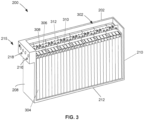
- FIG. 3 is a perspective cross-sectional view of the battery 200 taken along line A-A in FIG. 2A .
- the lid 214 FIG. 2
- the housing 202 defines a cavity 302.
- the battery 200 includes a plurality of battery cells 304 (one of which is referenced in FIG. 2 ) disposed in the cavity 302 of the housing 202.
- the battery 200 includes 28 battery cells.
- the battery 200 can include any number of battery cells 304 (e.g., one battery cell, two battery cells, three battery cells, etc.).
- Each of the battery cells 304 has a first terminal 306 (one of which is referenced in FIG.
- the terminals 306, 308 are sometimes referred to as tabs.
- the first terminals 306 can be positive terminals and the second terminals 308 can be negative terminals.
- the first terminals 306 of the battery cells 304 can be electrically coupled (in a series or parallel arrangement) to one of the terminals 216, 218, and the second terminals 308 of the battery cells 304 can be electrically coupled (in a series or parallel arrangement) to the other one of the terminals 216, 218.
- the battery cells 304 are lithium-ion battery cells. In other examples, the battery cells 304 can be implemented as other types of battery cells, such lithium polymer cells, nickel cadmium cells, or nickel-metal hydride, for example. In some examples, the battery cells 304 are grouped into sections or bricks. In some examples, the bricks are 3D printed aluminum alloy (e.g., Al-Alloy AlSi10Mg, Scalmalloy), with integrated features optimizing functionalities and weight. In some examples, the battery cells 304 are pouch cells, whereas other examples can include cylindrical battery cell(s) or prismatic cell(s). In the illustrated example, the battery cells 304 are arranged in a single row between the first end wall 208 and the second end wall 210.
- 3D printed aluminum alloy e.g., Al-Alloy AlSi10Mg, Scalmalloy
- the battery cells 304 are pouch cells, whereas other examples can include cylindrical battery cell(s) or prismatic cell(s). In the illustrated example, the battery
- the battery cells 304 can be arranged in two or more rows or other configurations. In some examples, the battery cells 304 are supported by and rest on the bottom wall 212. In other examples, the battery cells 304 can be spaced apart from the bottom wall 212. In some examples, the housing 202 includes features for the battery cells 304 to rest on. During use or operation of the battery 200, the temperature of the battery 200 environment can increase and, if not controlled, can cause a thermal runaway event in one or more of the battery cells 304.
- the battery 200 includes a first bus bar 310 and a second bus bar 312.
- the first and second bus bars 310, 312 are disposed in the cavity 302 of the housing 202.
- the first terminals 306 of the battery cells 304 are coupled (e.g., electrically coupled) to the first bus bar 310.
- the first bus bar 310 is constructed of a conductive material, such as metal (e.g., copper, aluminum, etc.). As such, the first bus bar 310 electrically couples the first terminals 306 of the battery cells 304 (which results in added voltage and/or current of the cells, depending on the arrangement) to the first terminal 216 of the battery 200.
- FIG. 4 is a perspective view of the example battery cells 304 (one of which is referenced in FIG. 4 ) and the first and second bus bars 310, 312 as removed the housing 202 ( FIGS. 2A, 2B , and 3 ).
- an example fluid channel 402 is formed in the first bus bar 310.
- the fluid channel 402 is formed between an inlet port 404 (e.g., an opening) on the first bus bar 310 and an outlet port 406 on the first bus bar 310.
- the fluid channel 402 is to receive a cooling fluid to cool the first bus bar 310 and reduce a temperature of the battery 200.
- a cooling fluid can be pumped through the fluid channel 402 from the inlet port 404 to the outlet port 406.
- the cooling fluid absorbs heat from the first bus bar 310, thereby reducing the temperature of the first bus bar 310 and, thus, reducing the temperature of the battery 200.
- the cooling fluid can be non-conductive dielectric fluid (e.g., a 3M NOVEC fluid, ethylene glycol, propylene glycol, etc.).
- An example system used for pumping cooling fluid through the fluid channel 402 is disclosed in conjunction with FIG. 8 .
- the first bus bar 310 has a dual purpose of serving as a bus bar (a tab/electrical interface) and serving as at least a portion a cooling circuit or heat sink. This significantly reduces the weight of the battery 200 compared to known batteries that have separate cooling circuits with complex piping systems that route cooling fluid between the cells and throughout the battery.
- Example aspects of the first bus bar 310 are disclosed in further detail herein.
- the second bus bar 312 is substantially the same as the first bus bar 310.
- any of the example aspects disclosed in connection with the first bus bar 310 can likewise apply to the second bus bar 312.
- the first bus bar 310 has the inlet port 404 and the outlet port 406 to enable the cooling fluid to enter the example fluid channel 402 of the first bus bar 310 at the inlet port 404 and exit the example fluid channel 402 of the first bus bars 310 from the outlet port 406.
- the inlet port 404 and the outlet port 406 are on a same end or side of the first bus bar 310.
- the first bus bar 310 has a first end 408 and a second end 410 opposite the first end 408.
- the inlet port 404 and the outlet port 406 are on the first end 408 of the first bus bar 310.
- the first end 408 of the first bus bar 310 is engaged with the inside of the first end wall 208 ( FIG. 2 ).
- the first inlet port 220 ( FIG. 2 ) on the first end wall 208 ( FIG. 2 ) is aligned with the inlet port 404 of the first bus bar 310.
- the inlet port 404 is fluidly coupled to the first inlet port 220 ( FIG. 2 ).
- the first outlet port 222 ( FIG. 2 ) on the first end wall 208 ( FIG. 2 ) is aligned with the outlet port 406 on the first bus bar 310.
- the example fluid channel 402 forms a C-shaped or a U-shaped path through the first bus bar 310 between the inlet port 404 and the outlet port 406.
- a first portion 412 of the fluid channel 402 traverses along a first edge 414 of the first bus bar 310 and a second portion 416 of the fluid channel 402 traverses along a second edge 418 of the first bus bar 310, and the first and second portions 412, 416 are coupled by a transverse portion 420.
- a top surface 422 of the first bus bar 310 is recessed 423 between the first and second portions 412, 416 of the fluid channel 402.
- another cooling fluid that is in the battery 200 can accumulate or rest in the recess 423 of the first bus bar 310, as disclosed in further detail herein.
- the inlet port 404 and outlet port 406 can be disposed on opposite ends of the first bus bar 310.
- the inlet port 404 can be disposed on the first end 408 of the first bus bar 310 and/or the outlet port 406 can be disposed on the second end 410 of the first bus bar 310.
- the inlet port 404 of the first bus bar 310 is disposed closer to a center line of the battery cells 304, such that new cooling fluid entering the fluid channel 402 is first transported along the center line area of the battery cells 304, which is typically the hottest area.
- the inlet and outlet ports 404, 406 can be switched.
- the path of the fluid channel 402 forms an alternate shaped path through the first bus bar 310 between the inlet port 404 and the outlet port 406.
- the first and second bus bars 310, 312 are positioned parallel to each other.
- the bus bars 310, 312 can have equivalent structures and/or compositions following the teachings disclosed herein.
- the second bus bar 312 has a fluid channel 424 between an inlet port 426 and an outlet port 428.
- the inlet and outlet port 426, 428 align with the second inlet and outlet ports 224, 226 ( FIG. 2 ) on the first end wall 208 ( FIG. 2 ).
- the bus bars 310, 312 can have alternate structures and/or compositions.
- FIG. 5 is an enlarged perspective view of the ends of the first and second bus bar 310, 312 of FIG. 4 .
- the inlet and outlet ports 404, 406 are shown in FIG. 5 .
- the first bus bar 310 is constructed of multiple bus bar sections that are coupled together.
- the first bus bar 310 includes a first section 504a, a second section 504b, a third section 504c, and a fourth section 504d.
- Each of the sections 504a-504d can be electrically coupled to one or more of the battery cells 304 (one of which is referenced in FIG. 5 ).
- the first section 504a is coupled to the first terminals 306 (one of which is referenced in FIG.
- the first bus bar 310 can include any number of sections (e.g., one section, two sections, etc.). In some examples, the first bus bar 310 includes two bridge seals (e.g., spacers) between each of the sections 504a-504d.
- the battery 200 includes first and second bridge seals 506a, 506b between the first and second sections 504a, 504b, third and fourth bridge seals 506c, 506d between the second and third sections 504b, 504c, etc.
- the section 504a-504d and the bridge seals 506a-506d are coupled via an adhesive.
- the sections 504a-504d and the bridge seals 506a-506d can be coupled via other techniques (e.g., friction fit, mechanical fasteners, etc.).
- the bridge seals 506a-506d help to fluidly coupled the sections of the fluid channel 402 formed in the sections 504a-504d and also electrically isolates the sections 504a-504d.
- the bridge seals 506 are constructed of insulating or non-conductive material (e.g., plastic, rubber, etc.).
- FIG. 6 is an exploded view of the first and second sections 504a, 504b of the first bus bar 310 ( FIG. 5 ) and the first and second bridge seals 506a, 506b.
- the first and second bridge seals 506a, 506b are to be coupled (e.g., clamped) between an end 602 of the first section 504a and an end 604 of the second section 504b.
- the first bridge seal 506a has an opening 606 that is aligned with a first section 608 of the fluid channel 402 formed in the first section 504a and a second section 610 of the fluid channel 402 formed in the second section 504b.
- the first bridge seal 506a fluidly couples the sections 608, 610 of the fluid channel 402 formed in the first and second sections 504a, 504b, respectively. This enables a substantially continuous flow path for the cooling fluid between the first and second sections 504a, 504b. In some examples, at least a portion of the first bridge seal 506a extends into the first and second sections 504a, 504b. The second bridge seal 506b similarly fluidly couples the other sections of the fluid channel 402 formed in the first and second sections 504a, 504b.
- FIG. 7 is a cross-sectional view showing the first bridge seal 506a between the first section 504a and the second section 504b taken along the opening 606 in the first bridge seal 506a.
- the first bridge seal 506a has a spacer portion 700 and a tubular portion 702 extending in opposite directions from the spacer portion 700.
- the tubular portion 702 extends in the fluid channel 402 formed in the first and second sections 504a, 504b.
- the spacer portion 700 has a larger diameter than the tubular portion 702 and physically separates the first and second section 504a, 504b.
- the opening 606 fluidly couples the sections of the fluid channel 402 formed in the first section 504a and the second section 504b.
- the first bridge seal 506a enables cooling fluid to flow between the first and second sections 504a, 504b. Further, the first bridge seal 506a electrically isolates the first and second sections 504a, 504b. Thus, the interface formed by the first bridge seal 506a between the first and second sections 504a, 504b can maintain electrical separation across the first and second sections 504a, 504b while allowing a cooling fluid to flow continuously throughout the fluid channel 402.
- the other bus bar sections 504b-504d and bridge seals 506c, 506d are similarly arranged. Thus, each of the bus bar sections 504a-504d is electrically isolated from the other adjoining bus bar sections 504a-504d but can maintain circulation of the cooling fluid through the fluid channel 402 without breaks.
- the example battery 200 includes a central spine 508 disposed between the first bus bar 310 and the second bus bar 312.
- the central spine 508 traverses along a centerline of the battery cells 304.
- the housing 202 FIG. 2
- the first and second bus bars 310, 312 are mechanically and electrically coupled to the central spine 508.
- each of the sections of the first and second bus bars 310, 312 is electrically coupled to the central spine 508.
- the central spine 508 includes circuitry to measure and monitor the voltage of the battery cells 304 and/or the groups (bricks) of the battery cells 304 at each of the sections.
- the circuitry can turn off or deactivate the battery 200, for example.
- the central spine 508 is a circuit board, such as a printed circuit board (PCB).
- FIG. 8 illustrates an example battery system 800 including the example battery 200 and an example control system 802 implemented in connection with the example battery 200.
- FIG. 8 shows a cross-sectional side view of the example battery 200 and a schematic of the example control system 802.
- the control system 802 can be used to pump a cooling fluid 803, referred to herein as the first cooling fluid 803, through the first and second bus bars 310, 312 (only the first bus bar 310 is visible in FIG. 8 ), as disclosed in further detail below.
- the battery 200 includes a cooling fluid 804, referred to herein as the second cooling fluid 804, in the cavity 302 of the housing 202.
- reference number 804 points to the top surface of the second cooling fluid 804.
- the second cooling fluid 804 is separate from the first cooling fluid 803 that is pumped through the first bus bars 310.
- the battery cells 304 (one of which is referenced in FIG. 8 ) are at least partially submerged in the second cooling fluid 804. In some examples, such as shown in FIG. 8 , the battery cells 304 are fully submerged in the second cooling fluid 804.
- the surface of the second cooling fluid 804 is above the tops of the battery cells 304, but below the first and second bus bars 310, 312.
- the battery cells 304 are spaced apart from each other, such that the second cooling fluid 804 can flow between the battery cells 304.
- the second cooling fluid 804 draws heat away from the battery cells 304 (and distributes the heat evenly around the battery 200), which helps reduce the temperature of the battery 200.
- the second cooling fluid 804 can be a dielectric fluid, such as a 3M NOVEC 7100 Engineered Fluid.
- the second cooling fluid 804 is an evaporating fluid.
- the cooling fluid 804 is the same type of cooling fluid as the first cooling fluid 803, whereas, in other examples, the cooling fluids can be different types of cooling fluids.
- the cavity 302 is only partially filled with the second cooling fluid 804.
- the second cooling fluid 804 does not completely fill the cavity 302. This reduces the overall weight of the battery 200 compared to known batteries, which is beneficial in aerospace applications where weight is a concern.
- an air gap 806 is formed between the top surface of the example cooling fluid 804 and the lid 214 (e.g., the top) of the housing 202.
- the battery cells 304 increase in temperature, at least some of the second cooling fluid 804 undergoes a phase change from a liquid state to a gaseous state.
- the battery cells 304 may become hot, which heats up the second cooling fluid 804 and causes some of the second cooling fluid 804 to evaporate.
- the evaporated portion of the second cooling fluid 804 rises into the air gap 806 where the first and second bus bar 310, 312 are located.
- the first and second bus bars 310, 312 can have a lower temperature due to the first cooling fluid 803 being pumped through the fluid channel 402 of each bus bars 310, 312.
- the evaporated portion of the second cooling fluid 804 condenses onto the first and second bus bars 310, 312.
- the condensed cooling fluid collects or accumulates in the recess 423 ( FIG. 4 ) on the top surfaces of the first and second bus bars 310, 312.
- the condensed portion of the second cooling fluid 804 drips over the edges or sides of the bus bars 310, 312 and returns to the base of the cavity 302.
- the first and second bus bars 310, 312 have one or more pores or openings through which the condensed cooling fluid can drain.
- This cycle (evaporate and condense) can repeat continuously and helps to reduce the temperature of the battery 200.
- the bus bars 310, 312 form a cooling circuit in the air gap 806 that draws the heat from the evaporated portion of the second cooling fluid 804, thereby enabling the second cooling fluid 804 to condense and complete the cooling cycle.
- other mechanisms can be used as the cooling circuit in the air gap 806.
- the second cooling fluid 804 can reduce the temperature of the example battery 200 to cool the battery 200 during high temperature operation and/or a thermal runaway event, thus facilitating thermal control and management of the battery 200 to keep the temperature of the battery 200 within a desired range.
- FIG. 8 also shows a schematic of the example control system 802.
- the control system 802 forms part of the cooling circuit with the first bus bar 310.
- the control system 802 includes a reservoir 808 of the cooling fluid 803, a supply line 810 coupled between the reservoir 808 and the inlet port 220 ( FIG. 2 ) on the housing 202, a return line 812 coupled between the outlet port 222 ( FIG. 2 ) on the housing 202 and the reservoir 808, a pump 814 coupled to the supply line 810, and a controller 816 to control the pump 814 (e.g., turn the pump on or off and/or control the speed of the pump 814).
- a controller 816 to control the pump 814 (e.g., turn the pump on or off and/or control the speed of the pump 814).
- the pump 814 pumps the first cooling fluid 803 through the supply line 810 from the reservoir 808 to the inlet port 220 ( FIG. 2 ) on the housing 202.
- the first cooling fluid 803 flows through the inlet port 220 ( FIG. 2 ) and into the inlet port 404 ( FIG. 4 ) in the first bus bar 310.
- the first cooling fluid 803 flows through the fluid channel 402 ( FIG. 4 ) in the first bus bar 310.
- the first cooling fluid 803 then exits the outlet port 406 ( FIG. 4 ) in the first bar 310.
- the first cooling fluid 803 flows through the outlet port 222 ( FIG. 2 ) on the housing 202 to the return line 812, and through the return line 812 back into the reservoir 808.
- the first cooling fluid 803 is fluidly isolated from and separate from the second cooling fluid 804.
- the control system 802 includes a heat exchanger to cool the first cooling fluid 803 before returning to the battery 200.
- the controller 816 operates to activate and deactivate the pump 814 to maintain the battery 200 within a desired temperature range (e.g., below a first threshold and/or above a second threshold). Additionally or alternatively, the controller 816 can increase or decrease the power of the pump 814 to increase or decrease the flow rate of the first cooling fluid 803 through the first bus bar 310. In some examples, the controller 816 can monitor a temperature of the battery 200 based on signals from a temperature sensor 818. In some examples, the temperature sensor 818 is disposed in the cavity 302. The temperature sensor 818 is communicatively coupled to the controller 816 via a wired or wireless connection.
- the controller 816 can activate/deactivate the pump 814 and/or increase/decrease the power to the pump 814 based on the temperature.
- the first cooling fluid 803 can circulate through the fluid channel 402 ( FIG. 4 ), which helps reduce the temperature of the first bus bar 310 and, thus, helps maintain the battery temperature within a desired temperature range.
- the second cooling fluid 804 submerging the battery cells 304 in the cavity 302 of the battery housing 202 can still facilitate thermal management of the battery 200 to keep the temperature of the battery 200 within an operational temperature range.
- the example control system 802 is disclosed in connection with the first bus bar 310, the control system 802 (or a separate control system) can similarly control the pumping of cooling fluid through the second bus bar 312.
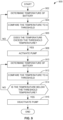
- FIG. 9 is a flowchart representative of an example method 900 that can be implemented by the example control system 802.
- the method 900 of FIG. 9 can be implemented by instructions that are executed by the controller 816.
- the controller 816 can be implemented by one or more digital circuit(s), logic circuits, programmable processor(s), programmable controller(s), graphics processing unit(s) (GPU(s)), digital signal processor(s) (DSP(s)), application specific integrated circuit(s) (ASIC(s)), programmable logic device(s) (PLD(s)) and/or field programmable logic device(s) (FPLD(s)).
- the method 900 is described in connection with pumping fluid through the first bus bar 310. However, the method 900 can be similarly performed in connection with the second bus bar 312.
- example method 900 is described with reference to the flowchart illustrated in FIG. 9 , many other methods can alternatively be used. For example, some of the blocks described herein can be changed, eliminated, or combined.
- the example method starts with the pump 814 off or deactivated.
- the controller 816 determines the temperature of the battery 200 based on signals from the temperature sensor 818.
- the battery temperature can be measured or determined continuously during the operation of the battery 200 or periodically over increments of time (e.g., every 10 seconds).
- the controller 816 compares the temperature to a threshold temperature.
- the threshold temperature can vary across battery types, use cases, and/or depending on the type(s) of cooling fluids used by the fluid circuit and/or to submerge the battery cells 304.
- the controller 816 determines if the determined battery temperature exceeds the threshold temperature.
- the controller 816 In response to determining that the battery temperature exceeds the threshold temperature, the controller 816, at block 908, activates the pump 814 to pump the first cooling fluid 803 through the fluid channel 402 of the first bus bar 310 to reduce the temperature of the battery 200. In contrast, if the battery temperature does not exceed the threshold temperature the pump 814 remains deactivated and control proceeds to block 902.
- the controller 816 determines the temperature of the battery 200 after the activation of the pump 814 at block 908.
- the controller 816 compares the battery temperature to the temperature threshold.
- the controller 816 determines whether the battery temperature decreased, for example during the operation of the pump 814, and returned to a temperature below the threshold temperature. In response to determining that the battery temperature has fallen below the threshold temperature, the controller 816, at block 916, deactivates the pump 814 to cease pumping of the cooling fluid through the fluid channel 402. However, if controller 816 determines that the temperature is above the threshold, the controller 816 keeps the pump 814 activated, and control proceeds back to block 910. After block 916, the example method 900 can end or control can proceed back to block 902 and the example 900 can repeat.
- example methods, apparatus and articles of manufacture have been disclosed that enable thermal management of batteries that are advantageous to known methods and apparatus.
- the methods and apparatus disclosed herein provide solutions that address the maintenance of batteries within operating temperature ranges while also considering energy capacity and weight characteristic improvements in batteries. Such advantages can not only extend the cycle life of batteries but can also mitigate risks of battery overheating and thus thermal runaway events.
- the examples disclosed herein improve heat transfer and cell temperature uniformity.
- the second cooling fluid may partially fill the cavity such that an air gap is formed between a top surface of the second cooling fluid and a top of the housing.
- the first cooling fluid forms the cooling circuit in the bus bar, and the cooling circuit may receive the second cooling fluid to reduce a temperature of the bus bar.
- the second cooling fluid may be fluidly isolated from the first cooling fluid in the cavity.
- the housing may include a wall with a port, wherein the battery may further include a pressure release valve in the port.
Landscapes
- Chemical & Material Sciences (AREA)
- Chemical Kinetics & Catalysis (AREA)
- Electrochemistry (AREA)
- General Chemical & Material Sciences (AREA)
- Engineering & Computer Science (AREA)
- Manufacturing & Machinery (AREA)
- Secondary Cells (AREA)
- Battery Mounting, Suspending (AREA)
Description
- This disclosure relates generally to batteries and, more particularly, to methods and apparatus for thermal management of batteries.
- Batteries are commonly used in vehicles, such as electric vehicles (e.g., electric aircraft), to provide electrical power to one or more systems of the vehicle and/or provide the main power to propel the vehicle. These batteries commonly face temperature fluctuations, such as temperature increases. Such increases in battery temperature may cause the batteries to malfunction and/or fail. Keeping the batteries within a functional temperature range is challenging but important since fluctuations in battery temperature not only reduce the performance of the battery, but could also pose safety risks associated with battery failure during vehicle operation.
-
JP 2011/029103 A -
WO 2020/152567 A1 , in accordance with its abstract, states a battery module that includes a plurality of electrochemical cells, each with a pair of electrical terminals, a first elongated member, electrically connecting a first terminal of at least one cell of the electrochemical cells to a second terminal of at least one other cell, and a second elongated member, electrically connecting a third terminal of at least one of the cells to a fourth terminal of at least one other cell, wherein at least a portion of the first and second elongated members is a hollow section defining a fluid pathway configured to transmit a fluid for transferring heat to or from the electrical terminals of the electrochemical cells. -
US 2016/190663 A1 , in accordance with its abstract, states a battery assembly that includes a plurality of batteries operably positioned to be charged and discharged. At least a first battery and a second battery of the plurality of batteries include a stack of electrochemical cells encased in an electrically inert case. A pair of battery tabs outwardly extends from the case. At least the first battery and the second battery in the battery assembly are configured to be electrically connected through their battery tabs with one or more hollow busbars forming a passage for a coolant flow. -
US 2019/379093 A1 , in accordance with its abstract, states a coolant cooling type battery that includes battery cells each having tabs to electrically connect the battery cells to each other by respective tabs. The respective tabs of the battery cells are arranged in a unidirectional alignment. Additionally, the battery includes busbars each interconnecting the tabs of adjacent battery cells of the multiple battery cells with each other to form an electrical connection between the battery cells and a coolant channel that is connected to the multiple busbars and has coolant flowing therein. - According to one aspect disclosed herein, a battery according to claim 1 is provided.
- An example battery disclosed herein may include a housing defining a cavity, a battery cell disposed in the cavity of the housing, and a cooling fluid in the cavity of the housing that at least partially submerges the battery cell. The cooling fluid partially fills the cavity such that an air gap is formed between a top surface of the cooling fluid and a top of the housing. The example battery also includes a cooling circuit disposed in the air gap.
- An example method disclosed herein may include determining a temperature of a battery. The battery includes a bus bar having a fluid channel formed therein. The method includes comparing the temperature to a threshold, and, in response to determining that the temperature exceeds the threshold, activating a pump to pump cooling fluid through the fluid channel in the bus bar to reduce the temperature of the battery.
-
-
FIG. 1 illustrates an example electric-powered aircraft in which example batteries and example battery systems disclosed herein can be implemented. -
FIGS. 2A and 2B are perspective views of opposite sides of an example battery. -
FIG. 3 is a perspective cross-sectional view of the example battery ofFIGS. 2A and 2B taken along line A-A ofFIG. 2A , showing example battery cells and example bus bars in an example battery housing. -
FIG. 4 is a perspective view of the example battery cells and the example bus bars ofFIG. 3 removed from the example battery housing. -
FIG. 5 is an enlarged view of a first end the example battery cells and the example bus bars ofFIG. 4 . -
FIG. 6 is an exploded view of two example bus bar sections and example bridge seals used to form one of the example bus bars ofFIGS. 3-5 . -
FIG. 7 is a cross-sectional view of the example bus bar sections and one of the example bridge seals ofFIG. 6 . -
FIG. 8 illustrates an example battery system including the example battery ofFIG. 2 and an example control system. The example battery is shown as a side cross-sectional view, and the example control system is shown as a schematic. -
FIG. 9 is a flowchart of an example method, which can be implemented by the example control system ofFIG. 8 , to activate a pump to pump a cooling fluid through a fluid channel of a bus bar in the example battery. - The figures are not to scale. In general, the same reference numbers will be used throughout the drawing(s) and accompanying written description to refer to the same or like parts. As used herein, unless otherwise stated, the term "above" describes the relationship of two parts relative to Earth. A first part is above a second part, if the second part has at least one part between Earth and the first part. Likewise, as used herein, a first part is "below" a second part when the first part is closer to the Earth than the second part. As noted above, a first part can be above or below a second part with one or more of: other parts therebetween, without other parts therebetween, with the first and second parts touching, or without the first and second parts being in direct contact with one another. As used in this application, stating that any part (e.g., a layer, film, area, region, or plate) is in any way on (e.g., positioned on, located on, disposed on, or formed on, etc.) another part, indicates that the referenced part is either in contact with the other part, or that the referenced part is above the other part with one or more intermediate part(s) located therebetween. As used herein, connection references (e.g., attached, coupled, connected, and joined) may include intermediate members between the elements referenced by the connection reference and/or relative movement between those elements unless otherwise indicated. As such, connection references do not necessarily infer that two elements are directly connected and/or in fixed relation to each other. As used herein, stating that any part is in "contact" with another part is defined to mean that there is no intermediate part between the two parts.
- Unless specifically stated otherwise, descriptors such as "first," "second," "third," etc. are used herein without imputing or otherwise indicating any meaning of priority, physical order, arrangement in a list, and/or ordering in any way, but are merely used as labels and/or arbitrary names to distinguish elements for ease of understanding the disclosed examples. In some examples, the descriptor "first" may be used to refer to an element in the detailed description, while the same element may be referred to in a claim with a different descriptor such as "second" or "third." In such instances, it should be understood that such descriptors are used merely for identifying those elements distinctly that might, for example, otherwise share a same name. As used herein, "approximately" and "about" refer to dimensions that may not be exact due to manufacturing tolerances and/or other real-world imperfections.
- Batteries, such as lithium-ion batteries, are commonly used in vehicles such as electric vehicles. For example, electric aircraft typically include one or more lithium-ion batteries to power one or more electric motors for flying the aircraft and/or for powering other electrical systems (e.g., navigation and guidance systems, communication systems, etc.) on the aircraft. Although lithium-ion batteries are just one example of the types of batteries that can be used in vehicles, they are growing increasingly popular among aircraft manufacturers due to their higher energy density and lower weight compared to other battery types. However, a tradeoff to their improved energy capacity and weight characteristics is their potential to overheat and malfunction during use. Thus, thermal management of these batteries is important. Maintaining a battery within a certain temperature range is important not only for mitigating the risk of a thermal runaway event in one or more battery cells but also for extending the cycle life of the battery.
- Currently, there exist a number of known technologies in aviation and other industries for cooling batteries in events of temperature increase and providing uniform temperature control to battery environments. For example, some known batteries include coolant or a cooling fluid that fully fills the battery cavity and submerges the individual battery cells. Other known batteries utilize cooling pipes that are routed between each of the battery cells. A drawback to these solutions is the added weight that these cooling methods and supplemental equipment incur on the battery system in order to accomplish effective cooling.
- Disclosed herein are example batteries and battery systems that address at least the above-noted drawbacks. Disclosed herein is a battery including a bus bar with a fluid channel formed in the bus bar. The fluid channel is part of a cooling circuit including a pump and supply/return lines (which can be external to the battery). The pump can be activated to pump cooling fluid into the battery and through the fluid channel in the bus bar (to absorb heat from the bus bar). This operation reduces the temperature of the bus bar and, thus, reduces the temperature inside of the battery, thereby helping to maintain the battery within a certain operating temperature range. Using the bus bar to form part of the fluid circuit eliminates the need for additional cooling pipes in the battery as seen in known cooling designs. This significantly reduces the weight of the battery compared to known batteries with piping systems.
- In some examples, the cooling fluid is continuously pumped through the bus bar to regulate the temperature of the battery. The mass flow of the cooling fluid can be increased or decreased to maintain the temperature of the battery within a certain temperature range. In other examples, the pump can be activated when the temperature of the battery exceeds a threshold. In some examples the cooling fluid is a liquid. In other examples, the cooling fluid is a gas.
- In some examples disclosed herein, the battery includes a second cooling fluid in a housing of the battery that contains the one or more battery cells. The second cooling fluid at least partially submerges the battery cells. The second cooling fluid absorbs heat from the battery cells and helps regulate the temperature of the battery. In some examples, the second cooling fluid only partially fills the housing of the battery. As such, an air gap is formed between a top of the second cooling fluid and a top of the housing. This also reduces the weight of the battery compared to known batteries that are completely fulfilled with cooling fluid. During a temperature increase event, the second cooling fluid surrounding the battery cells undergoes a phase change from a liquid state to a gaseous state. The gas rises in the housing and then condenses on the surface of the bus bar, thus reducing the temperature of the battery cells.
- Thus, the examples disclosed herein provide a battery including a bus bar with a fluid channel connected to one or more cells, which are submerged in a phase changing cooling fluid. The examples disclosed herein provide a thermal management solution for batteries to control battery temperature during temperature increases and prevent thermal runaway events. The examples of the subject disclosure address the shortcomings of current battery cooling techniques noted above.
-
FIG. 1 illustrates anexample aircraft 100 in which one or more of the example batteries and/or example battery systems disclosed herein can be implemented. Theaircraft 100 can be a manned or unmanned aerial vehicle. In this example, theaircraft 100 is an electric aircraft. However, in other examples, theaircraft 100 can be powered by other means (e.g., gas-powered). Theaircraft 100 illustrated inFIG. 1 is an electric vertical take-off and landing (VTOL) aircraft having a plurality of vertical lift rotors 102 (one of which is referenced inFIG. 1 ) driven by respective electric motors 104 (one of which is referenced inFIG. 1 ). Theaircraft 100 also has aforward propulsion rotor 106 driven by a motor. The example batteries and/or battery systems disclosed herein can be used to provide electrical power to the motors 104 (and the motor that drives the rotor 106) and/or any other electrical system on theaircraft 100. In some examples, the one or more batteries are disposed inside a body 108 (e.g., a fuselage) of theaircraft 100. While in this example theaircraft 100 is implemented as a VTOL aircraft, in other examples, theaircraft 100 can be implemented as any other type of aircraft (e.g., a fixed wing aircraft, a rotorcraft such as a helicopter or quadcopter, etc.). Further, it is noted that although the subject disclosure describes anaircraft 100, one or more of the example batteries and/or example battery systems disclosed herein can be implemented in any vehicle (e.g., ground and/or water vehicles). -
FIGS. 2A and 2B are perspective views of opposite sides of anexample battery 200 constructed in accordance with the teachings of this disclosure. The example battery 200 (or multiple ones of the battery 200) can be implemented in theaircraft 100 ofFIG. 1 . Thebattery 200 includes ahousing 202 that contains one or more battery cells (shown inFIG. 3 ). In this example, thehousing 202 is cuboid shape. In particular, thehousing 202 has afirst sidewall 204, asecond sidewall 206 that is opposite to thefirst sidewall 204, afirst end wall 208 that is coupled between thefirst sidewall 204 and thesecond sidewall 206, and asecond end wall 210 that is coupled between thefirst sidewall 204 and thesecond sidewall 206 and is opposite to thefirst end wall 208. In other examples, thehousing 202 can include more than four side/end walls. Thehousing 202 also includes abottom wall 212 is coupled to thefirst sidewall 204, thefirst end wall 208, thesecond sidewall 206, and thesecond end wall 210 to define a base of thehousing 202. Thehousing 202 has a lid 214 (e.g., a top) that is coupled to the first andsecond side walls second end walls bottom wall 212. In some examples, thelid 214 is removable to access the battery cells and/or other components in thehousing 202. - In some examples, the
housing 202 is hermetically sealed. In some examples, thehousing 202 is constructed of a composite material. In some examples, thehousing 202 is constructed of stainless steel, titanium, and/or aluminum. In other examples, thehousing 202 is constructed of other types of materials. In some examples, thehousing 202 is designed to withstand internal pressures of approximately 2 bar. In other examples,housing 202 can be designed to withstand higher or lower internal pressures. - In the illustrated example, the
first end wall 208 has aninterface portion 215 with one or more ports and terminals for fluid connections and electrical connections. For example, theexample battery 200 includes afirst terminal 216 and asecond terminal 218. One of theterminals terminals terminals interface portion 215 on thefirst end wall 208. However, in other examples, theterminals housing 202. - In the illustrated example, the
interface portion 215 includes a first inlet port 220 and afirst outlet port 222. The first inlet andoutlet ports 220, 222 extend through thefirst end wall 208 and into the cavity defined in thehousing 202. The first inlet andoutlet ports 220, 222 can be connected to supply and return lines, respectively, for pumping cooling fluid through a first bus bar disposed inside of thehousing 202, examples of which are disclosed in further detail herein. Theinterface portion 215 also includes a second inlet port 224 and asecond outlet port 226 for a second bus bar. Theinterface portion 215 further includes avalve port 228. A pressure release valve 230 (e.g., a blow-off valve) is disposed in thevalve port 228 and can release pressure from inside thehousing 202 during an over-pressurization event. While in this example the ports 220-228 are disposed on theinterface portion 215 on thefirst end wall 208, in other examples, any of the ports 220-228 can be disposed on any other surface of thehousing 202. -
FIG. 3 is a perspective cross-sectional view of thebattery 200 taken along line A-A inFIG. 2A . The lid 214 (FIG. 2 ) has also been removed. As shown inFIG. 3 , thehousing 202 defines acavity 302. Thebattery 200 includes a plurality of battery cells 304 (one of which is referenced inFIG. 2 ) disposed in thecavity 302 of thehousing 202. In this example, thebattery 200 includes 28 battery cells. However, it is understood that thebattery 200 can include any number of battery cells 304 (e.g., one battery cell, two battery cells, three battery cells, etc.). Each of thebattery cells 304 has a first terminal 306 (one of which is referenced inFIG. 3 ) and a second terminal 308 (one of which is reference inFIG. 3 ). Theterminals first terminals 306 can be positive terminals and thesecond terminals 308 can be negative terminals. Thefirst terminals 306 of thebattery cells 304 can be electrically coupled (in a series or parallel arrangement) to one of theterminals second terminals 308 of thebattery cells 304 can be electrically coupled (in a series or parallel arrangement) to the other one of theterminals - In some examples, the
battery cells 304 are lithium-ion battery cells. In other examples, thebattery cells 304 can be implemented as other types of battery cells, such lithium polymer cells, nickel cadmium cells, or nickel-metal hydride, for example. In some examples, thebattery cells 304 are grouped into sections or bricks. In some examples, the bricks are 3D printed aluminum alloy (e.g., Al-Alloy AlSi10Mg, Scalmalloy), with integrated features optimizing functionalities and weight. In some examples, thebattery cells 304 are pouch cells, whereas other examples can include cylindrical battery cell(s) or prismatic cell(s). In the illustrated example, thebattery cells 304 are arranged in a single row between thefirst end wall 208 and thesecond end wall 210. In other examples, thebattery cells 304 can be arranged in two or more rows or other configurations. In some examples, thebattery cells 304 are supported by and rest on thebottom wall 212. In other examples, thebattery cells 304 can be spaced apart from thebottom wall 212. In some examples, thehousing 202 includes features for thebattery cells 304 to rest on. During use or operation of thebattery 200, the temperature of thebattery 200 environment can increase and, if not controlled, can cause a thermal runaway event in one or more of thebattery cells 304. - As shown in
FIG. 3 , thebattery 200 includes afirst bus bar 310 and asecond bus bar 312. The first and second bus bars 310, 312 are disposed in thecavity 302 of thehousing 202. Thefirst terminals 306 of thebattery cells 304 are coupled (e.g., electrically coupled) to thefirst bus bar 310. Thefirst bus bar 310 is constructed of a conductive material, such as metal (e.g., copper, aluminum, etc.). As such, thefirst bus bar 310 electrically couples thefirst terminals 306 of the battery cells 304 (which results in added voltage and/or current of the cells, depending on the arrangement) to thefirst terminal 216 of thebattery 200. In some examples, thefirst terminals 306 extend through corresponding slots in thefirst bus bar 310 and are welded (e.g., laser welded) to thefirst bus bar 310. In other examples, thefirst terminals 306 can be coupled to thefirst bus bar 310 in other manners. Thesecond terminals 308 are similarly coupled to thesecond bus bar 312, which electrically couples thesecond terminals 308 to thesecond terminal 218 of thebattery 200. In some examples the first and second bus bars 310, 312 rest on the tops of thebattery cells 304. In other examples, the first and second bus bars 310, 312 are spaced apart from the tops of thebattery cells 304. -
FIG. 4 is a perspective view of the example battery cells 304 (one of which is referenced inFIG. 4 ) and the first and second bus bars 310, 312 as removed the housing 202 (FIGS. 2A, 2B , and3 ). As illustrated inFIG. 4 , anexample fluid channel 402 is formed in thefirst bus bar 310. Thefluid channel 402 is formed between an inlet port 404 (e.g., an opening) on thefirst bus bar 310 and anoutlet port 406 on thefirst bus bar 310. Thefluid channel 402 is to receive a cooling fluid to cool thefirst bus bar 310 and reduce a temperature of thebattery 200. In particular, a cooling fluid can be pumped through thefluid channel 402 from theinlet port 404 to theoutlet port 406. The cooling fluid absorbs heat from thefirst bus bar 310, thereby reducing the temperature of thefirst bus bar 310 and, thus, reducing the temperature of thebattery 200. The cooling fluid can be non-conductive dielectric fluid (e.g., a 3M NOVEC fluid, ethylene glycol, propylene glycol, etc.). An example system used for pumping cooling fluid through thefluid channel 402 is disclosed in conjunction withFIG. 8 . Thus, thefirst bus bar 310 has a dual purpose of serving as a bus bar (a tab/electrical interface) and serving as at least a portion a cooling circuit or heat sink. This significantly reduces the weight of thebattery 200 compared to known batteries that have separate cooling circuits with complex piping systems that route cooling fluid between the cells and throughout the battery. Example aspects of thefirst bus bar 310 are disclosed in further detail herein. Thesecond bus bar 312 is substantially the same as thefirst bus bar 310. Thus, it is understood that any of the example aspects disclosed in connection with thefirst bus bar 310 can likewise apply to thesecond bus bar 312. - As disclosed above, the
first bus bar 310 has theinlet port 404 and theoutlet port 406 to enable the cooling fluid to enter theexample fluid channel 402 of thefirst bus bar 310 at theinlet port 404 and exit theexample fluid channel 402 of the first bus bars 310 from theoutlet port 406. In some examples, theinlet port 404 and theoutlet port 406 are on a same end or side of thefirst bus bar 310. For example, as shown inFIG. 4 , thefirst bus bar 310 has afirst end 408 and asecond end 410 opposite thefirst end 408. In the illustrated example, theinlet port 404 and theoutlet port 406 are on thefirst end 408 of thefirst bus bar 310. Thefirst end 408 of thefirst bus bar 310 is engaged with the inside of the first end wall 208 (FIG. 2 ). The first inlet port 220 (FIG. 2 ) on the first end wall 208 (FIG. 2 ) is aligned with theinlet port 404 of thefirst bus bar 310. As such, theinlet port 404 is fluidly coupled to the first inlet port 220 (FIG. 2 ). Similarly, the first outlet port 222 (FIG. 2 ) on the first end wall 208 (FIG. 2 ) is aligned with theoutlet port 406 on thefirst bus bar 310. - In the illustrated example, the
example fluid channel 402 forms a C-shaped or a U-shaped path through thefirst bus bar 310 between theinlet port 404 and theoutlet port 406. For example, afirst portion 412 of thefluid channel 402 traverses along afirst edge 414 of thefirst bus bar 310 and asecond portion 416 of thefluid channel 402 traverses along asecond edge 418 of thefirst bus bar 310, and the first andsecond portions transverse portion 420. In some examples, atop surface 422 of thefirst bus bar 310 is recessed 423 between the first andsecond portions fluid channel 402. In some examples, another cooling fluid that is in thebattery 200 can accumulate or rest in therecess 423 of thefirst bus bar 310, as disclosed in further detail herein. - In other examples, the
inlet port 404 andoutlet port 406 can be disposed on opposite ends of thefirst bus bar 310. For example, theinlet port 404 can be disposed on thefirst end 408 of thefirst bus bar 310 and/or theoutlet port 406 can be disposed on thesecond end 410 of thefirst bus bar 310. In the illustrated example, theinlet port 404 of thefirst bus bar 310 is disposed closer to a center line of thebattery cells 304, such that new cooling fluid entering thefluid channel 402 is first transported along the center line area of thebattery cells 304, which is typically the hottest area. However, in other examples, the inlet andoutlet ports fluid channel 402 forms an alternate shaped path through thefirst bus bar 310 between theinlet port 404 and theoutlet port 406. - In the illustrated example, the first and second bus bars 310, 312 are positioned parallel to each other. In some examples, the bus bars 310, 312 can have equivalent structures and/or compositions following the teachings disclosed herein. For example, the
second bus bar 312 has afluid channel 424 between aninlet port 426 and anoutlet port 428. The inlet andoutlet port FIG. 2 ) on the first end wall 208 (FIG. 2 ). However, in other examples, the bus bars 310, 312 can have alternate structures and/or compositions. -
FIG. 5 is an enlarged perspective view of the ends of the first andsecond bus bar FIG. 4 . The inlet andoutlet ports FIG. 5 . In some examples, thefirst bus bar 310 is constructed of multiple bus bar sections that are coupled together. For example, inFIG. 5 , thefirst bus bar 310 includes afirst section 504a, asecond section 504b, athird section 504c, and afourth section 504d. Each of thesections 504a-504d can be electrically coupled to one or more of the battery cells 304 (one of which is referenced inFIG. 5 ). For example, thefirst section 504a is coupled to the first terminals 306 (one of which is referenced inFIG. 5 ) of the first fourbattery cells 304, thesecond section 504b is coupled to thefirst terminals 306 of the next fourbattery cells 304, and so forth. This enables thebattery cells 304 to be electrically combined into discrete groups of battery cells (sometimes referred to as bricks). Thefirst bus bar 310 can include any number of sections (e.g., one section, two sections, etc.). In some examples, thefirst bus bar 310 includes two bridge seals (e.g., spacers) between each of thesections 504a-504d. For example, thebattery 200 includes first andsecond bridge seals second sections third sections section 504a-504d and thebridge seals 506a-506d are coupled via an adhesive. In other examples, thesections 504a-504d and thebridge seals 506a-506d can be coupled via other techniques (e.g., friction fit, mechanical fasteners, etc.). Thebridge seals 506a-506d help to fluidly coupled the sections of thefluid channel 402 formed in thesections 504a-504d and also electrically isolates thesections 504a-504d. In some examples, the bridge seals 506 are constructed of insulating or non-conductive material (e.g., plastic, rubber, etc.). -
FIG. 6 is an exploded view of the first andsecond sections FIG. 5 ) and the first andsecond bridge seals second bridge seals end 602 of thefirst section 504a and anend 604 of thesecond section 504b. Thefirst bridge seal 506a has anopening 606 that is aligned with afirst section 608 of thefluid channel 402 formed in thefirst section 504a and asecond section 610 of thefluid channel 402 formed in thesecond section 504b. When thefirst bus bar 310 is assembled, thefirst bridge seal 506a fluidly couples thesections fluid channel 402 formed in the first andsecond sections second sections first bridge seal 506a extends into the first andsecond sections second bridge seal 506b similarly fluidly couples the other sections of thefluid channel 402 formed in the first andsecond sections -
FIG. 7 is a cross-sectional view showing thefirst bridge seal 506a between thefirst section 504a and thesecond section 504b taken along theopening 606 in thefirst bridge seal 506a. As shown inFIG. 7 , thefirst bridge seal 506a has aspacer portion 700 and atubular portion 702 extending in opposite directions from thespacer portion 700. Thetubular portion 702 extends in thefluid channel 402 formed in the first andsecond sections spacer portion 700 has a larger diameter than thetubular portion 702 and physically separates the first andsecond section opening 606 fluidly couples the sections of thefluid channel 402 formed in thefirst section 504a and thesecond section 504b. As such, thefirst bridge seal 506a enables cooling fluid to flow between the first andsecond sections first bridge seal 506a electrically isolates the first andsecond sections first bridge seal 506a between the first andsecond sections second sections fluid channel 402. The otherbus bar sections 504b-504d andbridge seals bus bar sections 504a-504d is electrically isolated from the other adjoiningbus bar sections 504a-504d but can maintain circulation of the cooling fluid through thefluid channel 402 without breaks. - Referring back to
FIG. 5 , theexample battery 200 includes acentral spine 508 disposed between thefirst bus bar 310 and thesecond bus bar 312. In some examples, thecentral spine 508 traverses along a centerline of thebattery cells 304. In some examples, the housing 202 (FIG. 2 ) includes features on which thecentral spine 508 can rest. The first and second bus bars 310, 312 are mechanically and electrically coupled to thecentral spine 508. In particular, each of the sections of the first and second bus bars 310, 312 is electrically coupled to thecentral spine 508. Thecentral spine 508 includes circuitry to measure and monitor the voltage of thebattery cells 304 and/or the groups (bricks) of thebattery cells 304 at each of the sections. If one or more of thebattery cells 304 and/or the groups ofbattery cells 304 is outputting too much power, the circuitry can turn off or deactivate thebattery 200, for example. In some examples, thecentral spine 508 is a circuit board, such as a printed circuit board (PCB). -
FIG. 8 illustrates anexample battery system 800 including theexample battery 200 and anexample control system 802 implemented in connection with theexample battery 200. In particular,FIG. 8 shows a cross-sectional side view of theexample battery 200 and a schematic of theexample control system 802. Thecontrol system 802 can be used to pump acooling fluid 803, referred to herein as thefirst cooling fluid 803, through the first and second bus bars 310, 312 (only thefirst bus bar 310 is visible inFIG. 8 ), as disclosed in further detail below. - In some examples, the
battery 200 includes a coolingfluid 804, referred to herein as thesecond cooling fluid 804, in thecavity 302 of thehousing 202. InFIG. 8 ,reference number 804 points to the top surface of thesecond cooling fluid 804. Thesecond cooling fluid 804 is separate from thefirst cooling fluid 803 that is pumped through the first bus bars 310. The battery cells 304 (one of which is referenced inFIG. 8 ) are at least partially submerged in thesecond cooling fluid 804. In some examples, such as shown inFIG. 8 , thebattery cells 304 are fully submerged in thesecond cooling fluid 804. In the illustrated example, the surface of thesecond cooling fluid 804 is above the tops of thebattery cells 304, but below the first and second bus bars 310, 312. In some examples, thebattery cells 304 are spaced apart from each other, such that thesecond cooling fluid 804 can flow between thebattery cells 304. Thesecond cooling fluid 804 draws heat away from the battery cells 304 (and distributes the heat evenly around the battery 200), which helps reduce the temperature of thebattery 200. Thesecond cooling fluid 804 can be a dielectric fluid, such as a 3M NOVEC 7100 Engineered Fluid. In some examples, thesecond cooling fluid 804 is an evaporating fluid. In some examples, the coolingfluid 804 is the same type of cooling fluid as thefirst cooling fluid 803, whereas, in other examples, the cooling fluids can be different types of cooling fluids. - In some examples, the
cavity 302 is only partially filled with thesecond cooling fluid 804. In other words, thesecond cooling fluid 804 does not completely fill thecavity 302. This reduces the overall weight of thebattery 200 compared to known batteries, which is beneficial in aerospace applications where weight is a concern. As shown inFIG. 8 , anair gap 806 is formed between the top surface of theexample cooling fluid 804 and the lid 214 (e.g., the top) of thehousing 202. In some examples, when thebattery cells 304 increase in temperature, at least some of thesecond cooling fluid 804 undergoes a phase change from a liquid state to a gaseous state. For example, during operation, thebattery cells 304 may become hot, which heats up thesecond cooling fluid 804 and causes some of thesecond cooling fluid 804 to evaporate. The evaporated portion of thesecond cooling fluid 804 rises into theair gap 806 where the first andsecond bus bar first cooling fluid 803 being pumped through thefluid channel 402 of each bus bars 310, 312. As a result, the evaporated portion of thesecond cooling fluid 804 condenses onto the first and second bus bars 310, 312. In some examples, the condensed cooling fluid collects or accumulates in the recess 423 (FIG. 4 ) on the top surfaces of the first and second bus bars 310, 312. The condensed portion of thesecond cooling fluid 804 drips over the edges or sides of the bus bars 310, 312 and returns to the base of thecavity 302. In some examples, the first and second bus bars 310, 312 have one or more pores or openings through which the condensed cooling fluid can drain. This cycle (evaporate and condense) can repeat continuously and helps to reduce the temperature of thebattery 200. In this example, the bus bars 310, 312 form a cooling circuit in theair gap 806 that draws the heat from the evaporated portion of thesecond cooling fluid 804, thereby enabling thesecond cooling fluid 804 to condense and complete the cooling cycle. However, in other examples, other mechanisms can be used as the cooling circuit in theair gap 806. As such, thesecond cooling fluid 804 can reduce the temperature of theexample battery 200 to cool thebattery 200 during high temperature operation and/or a thermal runaway event, thus facilitating thermal control and management of thebattery 200 to keep the temperature of thebattery 200 within a desired range. - As mentioned above,
FIG. 8 also shows a schematic of theexample control system 802. Thecontrol system 802 forms part of the cooling circuit with thefirst bus bar 310. In the illustrated example, thecontrol system 802 includes areservoir 808 of the coolingfluid 803, asupply line 810 coupled between thereservoir 808 and the inlet port 220 (FIG. 2 ) on thehousing 202, areturn line 812 coupled between the outlet port 222 (FIG. 2 ) on thehousing 202 and thereservoir 808, apump 814 coupled to thesupply line 810, and acontroller 816 to control the pump 814 (e.g., turn the pump on or off and/or control the speed of the pump 814). When thepump 814 is activated, thepump 814 pumps thefirst cooling fluid 803 through thesupply line 810 from thereservoir 808 to the inlet port 220 (FIG. 2 ) on thehousing 202. Thefirst cooling fluid 803 flows through the inlet port 220 (FIG. 2 ) and into the inlet port 404 (FIG. 4 ) in thefirst bus bar 310. Thefirst cooling fluid 803 flows through the fluid channel 402 (FIG. 4 ) in thefirst bus bar 310. Thefirst cooling fluid 803 then exits the outlet port 406 (FIG. 4 ) in thefirst bar 310. Thefirst cooling fluid 803 flows through the outlet port 222 (FIG. 2 ) on thehousing 202 to thereturn line 812, and through thereturn line 812 back into thereservoir 808. As such, thefirst cooling fluid 803 is fluidly isolated from and separate from thesecond cooling fluid 804. In some examples, thecontrol system 802 includes a heat exchanger to cool thefirst cooling fluid 803 before returning to thebattery 200. - In examples disclosed, the
controller 816 operates to activate and deactivate thepump 814 to maintain thebattery 200 within a desired temperature range (e.g., below a first threshold and/or above a second threshold). Additionally or alternatively, thecontroller 816 can increase or decrease the power of thepump 814 to increase or decrease the flow rate of thefirst cooling fluid 803 through thefirst bus bar 310. In some examples, thecontroller 816 can monitor a temperature of thebattery 200 based on signals from atemperature sensor 818. In some examples, thetemperature sensor 818 is disposed in thecavity 302. Thetemperature sensor 818 is communicatively coupled to thecontroller 816 via a wired or wireless connection. Thecontroller 816 can activate/deactivate thepump 814 and/or increase/decrease the power to thepump 814 based on the temperature. When thecontroller 816 activates thepump 814, thefirst cooling fluid 803 can circulate through the fluid channel 402 (FIG. 4 ), which helps reduce the temperature of thefirst bus bar 310 and, thus, helps maintain the battery temperature within a desired temperature range. In some examples, if thepump 814 fails, thesecond cooling fluid 804 submerging thebattery cells 304 in thecavity 302 of thebattery housing 202 can still facilitate thermal management of thebattery 200 to keep the temperature of thebattery 200 within an operational temperature range. While theexample control system 802 is disclosed in connection with thefirst bus bar 310, the control system 802 (or a separate control system) can similarly control the pumping of cooling fluid through thesecond bus bar 312. -
FIG. 9 is a flowchart representative of anexample method 900 that can be implemented by theexample control system 802. In particular, themethod 900 ofFIG. 9 can be implemented by instructions that are executed by thecontroller 816. Thecontroller 816 can be implemented by one or more digital circuit(s), logic circuits, programmable processor(s), programmable controller(s), graphics processing unit(s) (GPU(s)), digital signal processor(s) (DSP(s)), application specific integrated circuit(s) (ASIC(s)), programmable logic device(s) (PLD(s)) and/or field programmable logic device(s) (FPLD(s)). Themethod 900 is described in connection with pumping fluid through thefirst bus bar 310. However, themethod 900 can be similarly performed in connection with thesecond bus bar 312. - Although the
example method 900 is described with reference to the flowchart illustrated inFIG. 9 , many other methods can alternatively be used. For example, some of the blocks described herein can be changed, eliminated, or combined. - The example method starts with the
pump 814 off or deactivated. Atblock 902, thecontroller 816 determines the temperature of thebattery 200 based on signals from thetemperature sensor 818. The battery temperature can be measured or determined continuously during the operation of thebattery 200 or periodically over increments of time (e.g., every 10 seconds). Atblock 904, thecontroller 816 compares the temperature to a threshold temperature. The threshold temperature can vary across battery types, use cases, and/or depending on the type(s) of cooling fluids used by the fluid circuit and/or to submerge thebattery cells 304. Atblock 906, thecontroller 816 determines if the determined battery temperature exceeds the threshold temperature. In response to determining that the battery temperature exceeds the threshold temperature, thecontroller 816, atblock 908, activates thepump 814 to pump thefirst cooling fluid 803 through thefluid channel 402 of thefirst bus bar 310 to reduce the temperature of thebattery 200. In contrast, if the battery temperature does not exceed the threshold temperature thepump 814 remains deactivated and control proceeds to block 902. - At
block 910, thecontroller 816 determines the temperature of thebattery 200 after the activation of thepump 814 atblock 908. Atblock 912, thecontroller 816 compares the battery temperature to the temperature threshold. Atblock 914, thecontroller 816 determines whether the battery temperature decreased, for example during the operation of thepump 814, and returned to a temperature below the threshold temperature. In response to determining that the battery temperature has fallen below the threshold temperature, thecontroller 816, atblock 916, deactivates thepump 814 to cease pumping of the cooling fluid through thefluid channel 402. However, ifcontroller 816 determines that the temperature is above the threshold, thecontroller 816 keeps thepump 814 activated, and control proceeds back to block 910. Afterblock 916, theexample method 900 can end or control can proceed back to block 902 and the example 900 can repeat. - From the foregoing, it will be appreciated that example methods, apparatus and articles of manufacture have been disclosed that enable thermal management of batteries that are advantageous to known methods and apparatus. The methods and apparatus disclosed herein provide solutions that address the maintenance of batteries within operating temperature ranges while also considering energy capacity and weight characteristic improvements in batteries. Such advantages can not only extend the cycle life of batteries but can also mitigate risks of battery overheating and thus thermal runaway events. The examples disclosed herein improve heat transfer and cell temperature uniformity.
- Example methods, apparatus, and articles of manufacture for thermal management of batteries are been disclosed herein. Also provided are the following illustrative, non-exhaustive example of further non-claimed embodiments that are compatible with the claimed subject matter:
In the claimed battery, the second cooling fluid may partially fill the cavity such that an air gap is formed between a top surface of the second cooling fluid and a top of the housing. - In the claimed battery, the first cooling fluid forms the cooling circuit in the bus bar, and the cooling circuit may receive the second cooling fluid to reduce a temperature of the bus bar.
- The second cooling fluid may be fluidly isolated from the first cooling fluid in the cavity.
- The housing may include a wall with a port, wherein the battery may further include a pressure release valve in the port.
- Although certain example methods, apparatus and articles of manufacture have been disclosed herein, the scope of coverage of this application is not limited thereto. On the contrary, this application covers all methods, apparatus and articles of manufacture fairly falling within the scope of the claims of this application.
Claims (15)
- A battery (200) comprising:a housing (202) defining a cavity (302);a plurality of battery cells (304) disposed in the cavity (302) of the housing (202), the battery cell (304) having a first terminal (306) and a second terminal (308);a first bus bar (310) disposed in the cavity (302) of the housing (202), the first bus bar (310) coupled to the first terminal (306), a first fluid channel (402) formed in the first bus bar (310);a second bus bar (312) disposed in the cavity (302) of the housing (202), the second bus bar (312) coupled to the second terminal (308) of the battery cell (304), a second fluid channel (424) formed in the second bus bar (312), the second bus bar (312) disposed parallel to the first bus bar (310);the first and second fluid channels (402, 424) to receive a cooling fluid (803) to cool the first and second bus bars (310, 312) respectively and reduce a temperature of the battery (200); anda central spine (508) disposed between the first and second bus bars (310, 312), the first and second bus bars (310, 312) electrically coupled to the central spine (508), wherein the central spine (508) includes circuitry to measure voltage of the battery cell (304).
- The battery (200) of claim 1, wherein the central spine (508) traverses along a centerline of the battery cells (304).
- The battery (200) of claim 1 or 2, wherein the first and second bus bars (310, 312) are mechanically and electrically coupled to the central spine (508).
- The battery (200) of any of claims 1 to 3, wherein the first fluid channel (402) forms a C-shaped or U-shaped path through the first bus bar (310).
- The battery (200) of any of claims 1 to 4, wherein the first fluid channel (402) is formed between an inlet port (404) and an outlet port (406) on the first bus bar (310) on a same end of the first bus bar (310).
- The battery (200) of claim 5, wherein the housing (202) has a wall (208) with an inlet port (220) aligned with the inlet port (404) of the first bus bar (310).
- The battery (200) of claim 6, wherein the wall (208) of the housing (202) has an outlet port (222) aligned with the outlet port (406) of the first bus bar (310).
- The battery (200) of any of claims 1 to 4, wherein a first portion (412) of the first fluid channel (402) traverses along a first edge (414) of the first bus bar (310) and a second portion (416) of the first fluid channel (402) traverses along a second edge (418) of the first bus bar (310) opposite the first edge (414), and wherein a top surface (422) of the first bus bar (310) is recessed between the first and second portions (412, 416) of the first fluid channel (402).
- The battery (200) of claim 1, wherein the first bus bar (310) includes:a first bus bar section (504a);a second bus bar section (504b); anda bridge seal (506a) between the first bus bar section (504a) and the second bus bar section (504b).
- The battery (200) of claim 9, wherein a first section (608) of the first fluid channel (402) is formed in the first bus bar section (504a) and a second section (610) of the first fluid channel (402) is formed in the second bus bar section (504b), and wherein the bridge seal (506a) has an opening (606) aligned with the first section (608) of the first fluid channel (402) and the second section (610) of the first fluid channel (402) to enable the cooling fluid (803) to flow between the first and second sections (608, 610) of the first fluid channel (402).
- The battery of claim 9 or 10, wherein the bridge seal (506a) extends at least partially into the first and second bus bar sections (504a, 504b).
- The battery (200) of claim 9 or 10, wherein the bridge seal (506a) electrically isolates the first and second bus bar sections (504a, 504b).
- The battery (200) of claim 1, wherein the cooling fluid (803) is a first cooling fluid, the battery (200) further including a second cooling fluid (804) in the cavity (302) of the housing (202), the battery cell (304) at least partially submerged in the second cooling fluid (804).
- The battery (200) of claim 13, wherein a surface of the second cooling fluid (804) is above the top of the battery cell (304) and below the first and second bus bars (310, 312).
- The battery (200) of claim 13 or 14, wherein the second cooling fluid (804) is separate from the first cooling fluid (803).
Applications Claiming Priority (1)
| Application Number | Priority Date | Filing Date | Title |
|---|---|---|---|
| US202163144773P | 2021-02-02 | 2021-02-02 |
Publications (2)
| Publication Number | Publication Date |
|---|---|
| EP4037066A1 EP4037066A1 (en) | 2022-08-03 |
| EP4037066B1 true EP4037066B1 (en) | 2025-03-12 |
Family
ID=80118878
Family Applications (1)
| Application Number | Title | Priority Date | Filing Date |
|---|---|---|---|
| EP22154388.7A Active EP4037066B1 (en) | 2021-02-02 | 2022-01-31 | Methods and apparatus for thermal management of batteries |
Country Status (3)
| Country | Link |
|---|---|
| US (1) | US12170358B2 (en) |
| EP (1) | EP4037066B1 (en) |
| CN (1) | CN114843714A (en) |
Families Citing this family (5)
| Publication number | Priority date | Publication date | Assignee | Title |
|---|---|---|---|---|
| US12170358B2 (en) | 2021-02-02 | 2024-12-17 | Aurora Flight Sciences Corporation, a subsidiary of The Boeing Company | Methods and apparatus for thermal management of batteries |
| US11894529B2 (en) * | 2021-07-14 | 2024-02-06 | GM Global Technology Operations LLC | Thermal management of battery cell tab temperature |
| US20230415913A1 (en) * | 2022-06-28 | 2023-12-28 | Beta Air, Llc | Preflight temperature management of an electric aircraft energy source |
| EP4358235A1 (en) * | 2022-10-18 | 2024-04-24 | Volvo Truck Corporation | Cooling arrangement for an electrical storage system |
| CN118198658A (en) * | 2023-12-01 | 2024-06-14 | 上海兰钧新能源科技有限公司 | A battery module and a battery pack |
Family Cites Families (14)
| Publication number | Priority date | Publication date | Assignee | Title |
|---|---|---|---|---|
| JP4788674B2 (en) * | 2007-07-05 | 2011-10-05 | トヨタ自動車株式会社 | Power supply |
| JP2011029103A (en) * | 2009-07-29 | 2011-02-10 | Kawasaki Shipbuilding Corp | Battery cooling device |
| KR101179307B1 (en) * | 2010-08-13 | 2012-09-03 | 삼성전기주식회사 | Energy storage device module |
| AU2014241781B2 (en) * | 2013-03-14 | 2016-12-08 | Allison Transmission, Inc. | System and method for thermally robust energy storage system |
| DE102013225521A1 (en) * | 2013-12-11 | 2015-06-11 | Bayerische Motoren Werke Aktiengesellschaft | Battery system and battery module |
| US20160190663A1 (en) | 2014-10-09 | 2016-06-30 | Simon Fraser University | Busbars with integrated cooling system for vehicle battery assemblies |
| US10272758B2 (en) * | 2016-11-02 | 2019-04-30 | Proterra Inc. | Battery system of an electric vehicle |
| WO2018165133A1 (en) * | 2017-03-08 | 2018-09-13 | Paragon Space Development Corporation | Systems and methods for integrating a busbar and coldplate for battery cooling |
| CN109301634B (en) * | 2017-07-24 | 2020-06-19 | 莫仕连接器(成都)有限公司 | Battery connection module |
| KR102663541B1 (en) | 2018-06-12 | 2024-05-03 | 현대자동차주식회사 | Coolant cooling type battery |
| TW202042424A (en) * | 2019-01-21 | 2020-11-16 | 美商3M新設資產公司 | Thermal mangagement of battery modules |
| US20200266507A1 (en) * | 2019-02-18 | 2020-08-20 | 3M Innovative Properties Company | Battery module and system |
| EP3696877A1 (en) * | 2019-02-18 | 2020-08-19 | 3M Innovative Properties Company | Battery module |
| US12170358B2 (en) | 2021-02-02 | 2024-12-17 | Aurora Flight Sciences Corporation, a subsidiary of The Boeing Company | Methods and apparatus for thermal management of batteries |
-
2021
- 2021-12-16 US US17/553,297 patent/US12170358B2/en active Active
-
2022
- 2022-01-30 CN CN202210114060.0A patent/CN114843714A/en active Pending
- 2022-01-31 EP EP22154388.7A patent/EP4037066B1/en active Active
Also Published As
| Publication number | Publication date |
|---|---|
| CN114843714A (en) | 2022-08-02 |
| US20220247006A1 (en) | 2022-08-04 |
| US12170358B2 (en) | 2024-12-17 |
| EP4037066A1 (en) | 2022-08-03 |
Similar Documents
| Publication | Publication Date | Title |
|---|---|---|
| EP4037066B1 (en) | Methods and apparatus for thermal management of batteries | |
| CN110770931B (en) | Flexible cooling plate for battery | |
| US10483606B2 (en) | Temperature-control device for a battery system | |
| US20240234871A1 (en) | Thermal management of a liquid cooled module | |
| CN113994531B (en) | Battery module with insulated bus bar assembly | |
| EP2619836B1 (en) | Lithium accumulator | |
| EP2808936B1 (en) | Battery pack | |
| US20130196184A1 (en) | Battery module with integrated thermal management system | |
| KR20140062603A (en) | Cooling device for battery module and battery module assembly having the same | |
| CN218632330U (en) | Battery pack and electric automobile | |
| US20220255170A1 (en) | Pressure Management Device for Battery Pack | |
| US20120177973A1 (en) | Electrochemical energy storage and method for cooling or heating an electrochemical energy storage | |
| CN106207025A (en) | The energy accumulator module of electricity and the energy accumulator of corresponding modular | |
| WO2020214384A1 (en) | Battery module including asymmetric cell electrical connections | |
| WO2024107698A1 (en) | Heat exchanger assemblies and cooling systems for evtol aircraft | |
| EP4249314A1 (en) | Battery module and electric vehicle | |
| EP3637537B1 (en) | Bypass tube for a cooling circuit of a vehicle battery pack | |
| EP2797159B1 (en) | Battery pack | |
| CN208674323U (en) | Heat management battery system and new-energy automobile | |
| EP3948979A1 (en) | Battery pack with a pressure management system | |
| WO2024173731A1 (en) | Systems and methods associated with dynamic thermal and pressure control of a battery | |
| EP3975312A1 (en) | Interface with battery management system and mechanical switch device | |
| EP3975311A1 (en) | Battery system with thermal control loop | |
| EP3985779A2 (en) | Battery system with thermal control loop | |
| EP3985768A2 (en) | Battery system with optical connections |
Legal Events
| Date | Code | Title | Description |
|---|---|---|---|
| PUAI | Public reference made under article 153(3) epc to a published international application that has entered the european phase |
Free format text: ORIGINAL CODE: 0009012 |
|
| STAA | Information on the status of an ep patent application or granted ep patent |
Free format text: STATUS: THE APPLICATION HAS BEEN PUBLISHED |
|
| AK | Designated contracting states |
Kind code of ref document: A1 Designated state(s): AL AT BE BG CH CY CZ DE DK EE ES FI FR GB GR HR HU IE IS IT LI LT LU LV MC MK MT NL NO PL PT RO RS SE SI SK SM TR |
|
| STAA | Information on the status of an ep patent application or granted ep patent |
Free format text: STATUS: REQUEST FOR EXAMINATION WAS MADE |
|
| 17P | Request for examination filed |
Effective date: 20230105 |
|
| RBV | Designated contracting states (corrected) |
Designated state(s): AL AT BE BG CH CY CZ DE DK EE ES FI FR GB GR HR HU IE IS IT LI LT LU LV MC MK MT NL NO PL PT RO RS SE SI SK SM TR |
|
| GRAP | Despatch of communication of intention to grant a patent |
Free format text: ORIGINAL CODE: EPIDOSNIGR1 |
|
| STAA | Information on the status of an ep patent application or granted ep patent |
Free format text: STATUS: GRANT OF PATENT IS INTENDED |
|
| RIC1 | Information provided on ipc code assigned before grant |
Ipc: H01M 50/20 20210101ALI20241204BHEP Ipc: H01M 50/211 20210101ALI20241204BHEP Ipc: H01M 50/502 20210101ALI20241204BHEP Ipc: H01M 10/6567 20140101ALI20241204BHEP Ipc: H01M 10/6556 20140101ALI20241204BHEP Ipc: H01M 10/6553 20140101ALI20241204BHEP Ipc: H01M 10/625 20140101ALI20241204BHEP Ipc: H01M 10/613 20140101AFI20241204BHEP |
|
| INTG | Intention to grant announced |
Effective date: 20241216 |
|
| RIN1 | Information on inventor provided before grant (corrected) |
Inventor name: MOSER, TIM Inventor name: TISCHHAUSER, FREDERICK |
|
| GRAS | Grant fee paid |
Free format text: ORIGINAL CODE: EPIDOSNIGR3 |
|
| GRAA | (expected) grant |
Free format text: ORIGINAL CODE: 0009210 |
|
| STAA | Information on the status of an ep patent application or granted ep patent |
Free format text: STATUS: THE PATENT HAS BEEN GRANTED |
|
| P01 | Opt-out of the competence of the unified patent court (upc) registered |
Free format text: CASE NUMBER: APP_4879/2025 Effective date: 20250129 |
|
| AK | Designated contracting states |
Kind code of ref document: B1 Designated state(s): AL AT BE BG CH CY CZ DE DK EE ES FI FR GB GR HR HU IE IS IT LI LT LU LV MC MK MT NL NO PL PT RO RS SE SI SK SM TR |
|
| REG | Reference to a national code |
Ref country code: GB Ref legal event code: FG4D |
|
| REG | Reference to a national code |
Ref country code: CH Ref legal event code: EP |
|
| REG | Reference to a national code |
Ref country code: DE Ref legal event code: R096 Ref document number: 602022011575 Country of ref document: DE |
|
| REG | Reference to a national code |
Ref country code: IE Ref legal event code: FG4D |
|
| PG25 | Lapsed in a contracting state [announced via postgrant information from national office to epo] |
Ref country code: RS Free format text: LAPSE BECAUSE OF FAILURE TO SUBMIT A TRANSLATION OF THE DESCRIPTION OR TO PAY THE FEE WITHIN THE PRESCRIBED TIME-LIMIT Effective date: 20250612 |
|
| PG25 | Lapsed in a contracting state [announced via postgrant information from national office to epo] |
Ref country code: FI Free format text: LAPSE BECAUSE OF FAILURE TO SUBMIT A TRANSLATION OF THE DESCRIPTION OR TO PAY THE FEE WITHIN THE PRESCRIBED TIME-LIMIT Effective date: 20250312 |
|
| PG25 | Lapsed in a contracting state [announced via postgrant information from national office to epo] |
Ref country code: ES Free format text: LAPSE BECAUSE OF FAILURE TO SUBMIT A TRANSLATION OF THE DESCRIPTION OR TO PAY THE FEE WITHIN THE PRESCRIBED TIME-LIMIT Effective date: 20250312 |
|
| REG | Reference to a national code |
Ref country code: LT Ref legal event code: MG9D |
|
| PG25 | Lapsed in a contracting state [announced via postgrant information from national office to epo] |
Ref country code: NO Free format text: LAPSE BECAUSE OF FAILURE TO SUBMIT A TRANSLATION OF THE DESCRIPTION OR TO PAY THE FEE WITHIN THE PRESCRIBED TIME-LIMIT Effective date: 20250612 |
|
| PG25 | Lapsed in a contracting state [announced via postgrant information from national office to epo] |
Ref country code: HR Free format text: LAPSE BECAUSE OF FAILURE TO SUBMIT A TRANSLATION OF THE DESCRIPTION OR TO PAY THE FEE WITHIN THE PRESCRIBED TIME-LIMIT Effective date: 20250312 |
|
| REG | Reference to a national code |
Ref country code: NL Ref legal event code: MP Effective date: 20250312 |
|
| PG25 | Lapsed in a contracting state [announced via postgrant information from national office to epo] |
Ref country code: LV Free format text: LAPSE BECAUSE OF FAILURE TO SUBMIT A TRANSLATION OF THE DESCRIPTION OR TO PAY THE FEE WITHIN THE PRESCRIBED TIME-LIMIT Effective date: 20250312 |
|
| PG25 | Lapsed in a contracting state [announced via postgrant information from national office to epo] |
Ref country code: BG Free format text: LAPSE BECAUSE OF FAILURE TO SUBMIT A TRANSLATION OF THE DESCRIPTION OR TO PAY THE FEE WITHIN THE PRESCRIBED TIME-LIMIT Effective date: 20250312 Ref country code: GR Free format text: LAPSE BECAUSE OF FAILURE TO SUBMIT A TRANSLATION OF THE DESCRIPTION OR TO PAY THE FEE WITHIN THE PRESCRIBED TIME-LIMIT Effective date: 20250613 |
|
| REG | Reference to a national code |
Ref country code: AT Ref legal event code: MK05 Ref document number: 1775822 Country of ref document: AT Kind code of ref document: T Effective date: 20250312 |
|
| PG25 | Lapsed in a contracting state [announced via postgrant information from national office to epo] |
Ref country code: NL Free format text: LAPSE BECAUSE OF FAILURE TO SUBMIT A TRANSLATION OF THE DESCRIPTION OR TO PAY THE FEE WITHIN THE PRESCRIBED TIME-LIMIT Effective date: 20250312 |
|
| PG25 | Lapsed in a contracting state [announced via postgrant information from national office to epo] |
Ref country code: SE Free format text: LAPSE BECAUSE OF FAILURE TO SUBMIT A TRANSLATION OF THE DESCRIPTION OR TO PAY THE FEE WITHIN THE PRESCRIBED TIME-LIMIT Effective date: 20250312 |
|
| PG25 | Lapsed in a contracting state [announced via postgrant information from national office to epo] |
Ref country code: SM Free format text: LAPSE BECAUSE OF FAILURE TO SUBMIT A TRANSLATION OF THE DESCRIPTION OR TO PAY THE FEE WITHIN THE PRESCRIBED TIME-LIMIT Effective date: 20250312 |
|
| PG25 | Lapsed in a contracting state [announced via postgrant information from national office to epo] |
Ref country code: PT Free format text: LAPSE BECAUSE OF FAILURE TO SUBMIT A TRANSLATION OF THE DESCRIPTION OR TO PAY THE FEE WITHIN THE PRESCRIBED TIME-LIMIT Effective date: 20250714 |
|
| PG25 | Lapsed in a contracting state [announced via postgrant information from national office to epo] |
Ref country code: PL Free format text: LAPSE BECAUSE OF FAILURE TO SUBMIT A TRANSLATION OF THE DESCRIPTION OR TO PAY THE FEE WITHIN THE PRESCRIBED TIME-LIMIT Effective date: 20250312 Ref country code: IT Free format text: LAPSE BECAUSE OF FAILURE TO SUBMIT A TRANSLATION OF THE DESCRIPTION OR TO PAY THE FEE WITHIN THE PRESCRIBED TIME-LIMIT Effective date: 20250312 |
|
| PG25 | Lapsed in a contracting state [announced via postgrant information from national office to epo] |
Ref country code: AT Free format text: LAPSE BECAUSE OF FAILURE TO SUBMIT A TRANSLATION OF THE DESCRIPTION OR TO PAY THE FEE WITHIN THE PRESCRIBED TIME-LIMIT Effective date: 20250312 |
|
| PG25 | Lapsed in a contracting state [announced via postgrant information from national office to epo] |
Ref country code: CZ Free format text: LAPSE BECAUSE OF FAILURE TO SUBMIT A TRANSLATION OF THE DESCRIPTION OR TO PAY THE FEE WITHIN THE PRESCRIBED TIME-LIMIT Effective date: 20250312 Ref country code: EE Free format text: LAPSE BECAUSE OF FAILURE TO SUBMIT A TRANSLATION OF THE DESCRIPTION OR TO PAY THE FEE WITHIN THE PRESCRIBED TIME-LIMIT Effective date: 20250312 |
|
| PG25 | Lapsed in a contracting state [announced via postgrant information from national office to epo] |
Ref country code: RO Free format text: LAPSE BECAUSE OF FAILURE TO SUBMIT A TRANSLATION OF THE DESCRIPTION OR TO PAY THE FEE WITHIN THE PRESCRIBED TIME-LIMIT Effective date: 20250312 |
|
| PG25 | Lapsed in a contracting state [announced via postgrant information from national office to epo] |
Ref country code: SK Free format text: LAPSE BECAUSE OF FAILURE TO SUBMIT A TRANSLATION OF THE DESCRIPTION OR TO PAY THE FEE WITHIN THE PRESCRIBED TIME-LIMIT Effective date: 20250312 |
|
| PG25 | Lapsed in a contracting state [announced via postgrant information from national office to epo] |
Ref country code: IS Free format text: LAPSE BECAUSE OF FAILURE TO SUBMIT A TRANSLATION OF THE DESCRIPTION OR TO PAY THE FEE WITHIN THE PRESCRIBED TIME-LIMIT Effective date: 20250712 |
|
| REG | Reference to a national code |
Ref country code: DE Ref legal event code: R097 Ref document number: 602022011575 Country of ref document: DE |
|
| PG25 | Lapsed in a contracting state [announced via postgrant information from national office to epo] |
Ref country code: DK Free format text: LAPSE BECAUSE OF FAILURE TO SUBMIT A TRANSLATION OF THE DESCRIPTION OR TO PAY THE FEE WITHIN THE PRESCRIBED TIME-LIMIT Effective date: 20250312 |
|
| PLBE | No opposition filed within time limit |
Free format text: ORIGINAL CODE: 0009261 |
|
| STAA | Information on the status of an ep patent application or granted ep patent |
Free format text: STATUS: NO OPPOSITION FILED WITHIN TIME LIMIT |
|
| REG | Reference to a national code |
Ref country code: CH Ref legal event code: L10 Free format text: ST27 STATUS EVENT CODE: U-0-0-L10-L00 (AS PROVIDED BY THE NATIONAL OFFICE) Effective date: 20260121 |
|
| 26N | No opposition filed |
Effective date: 20251215 |
|
| PGFP | Annual fee paid to national office [announced via postgrant information from national office to epo] |
Ref country code: GB Payment date: 20260127 Year of fee payment: 5 |
|
| PGFP | Annual fee paid to national office [announced via postgrant information from national office to epo] |
Ref country code: DE Payment date: 20260128 Year of fee payment: 5 |
|
| PGFP | Annual fee paid to national office [announced via postgrant information from national office to epo] |
Ref country code: FR Payment date: 20260126 Year of fee payment: 5 |