EP4036796A1 - Automatic modeling method and apparatus for object detection model - Google Patents
Automatic modeling method and apparatus for object detection model Download PDFInfo
- Publication number
- EP4036796A1 EP4036796A1 EP19946971.9A EP19946971A EP4036796A1 EP 4036796 A1 EP4036796 A1 EP 4036796A1 EP 19946971 A EP19946971 A EP 19946971A EP 4036796 A1 EP4036796 A1 EP 4036796A1
- Authority
- EP
- European Patent Office
- Prior art keywords
- object detection
- detection model
- model
- nas
- reward
- Prior art date
- Legal status (The legal status is an assumption and is not a legal conclusion. Google has not performed a legal analysis and makes no representation as to the accuracy of the status listed.)
- Granted
Links
Images


Classifications
-
- G—PHYSICS
- G06—COMPUTING OR CALCULATING; COUNTING
- G06N—COMPUTING ARRANGEMENTS BASED ON SPECIFIC COMPUTATIONAL MODELS
- G06N3/00—Computing arrangements based on biological models
- G06N3/02—Neural networks
- G06N3/08—Learning methods
- G06N3/084—Backpropagation, e.g. using gradient descent
-
- G—PHYSICS
- G06—COMPUTING OR CALCULATING; COUNTING
- G06V—IMAGE OR VIDEO RECOGNITION OR UNDERSTANDING
- G06V10/00—Arrangements for image or video recognition or understanding
- G06V10/40—Extraction of image or video features
-
- G—PHYSICS
- G06—COMPUTING OR CALCULATING; COUNTING
- G06N—COMPUTING ARRANGEMENTS BASED ON SPECIFIC COMPUTATIONAL MODELS
- G06N20/00—Machine learning
- G06N20/20—Ensemble learning
-
- G—PHYSICS
- G06—COMPUTING OR CALCULATING; COUNTING
- G06N—COMPUTING ARRANGEMENTS BASED ON SPECIFIC COMPUTATIONAL MODELS
- G06N3/00—Computing arrangements based on biological models
- G06N3/02—Neural networks
- G06N3/04—Architecture, e.g. interconnection topology
-
- G—PHYSICS
- G06—COMPUTING OR CALCULATING; COUNTING
- G06N—COMPUTING ARRANGEMENTS BASED ON SPECIFIC COMPUTATIONAL MODELS
- G06N3/00—Computing arrangements based on biological models
- G06N3/02—Neural networks
- G06N3/04—Architecture, e.g. interconnection topology
- G06N3/044—Recurrent networks, e.g. Hopfield networks
-
- G—PHYSICS
- G06—COMPUTING OR CALCULATING; COUNTING
- G06N—COMPUTING ARRANGEMENTS BASED ON SPECIFIC COMPUTATIONAL MODELS
- G06N3/00—Computing arrangements based on biological models
- G06N3/02—Neural networks
- G06N3/04—Architecture, e.g. interconnection topology
- G06N3/044—Recurrent networks, e.g. Hopfield networks
- G06N3/0442—Recurrent networks, e.g. Hopfield networks characterised by memory or gating, e.g. long short-term memory [LSTM] or gated recurrent units [GRU]
-
- G—PHYSICS
- G06—COMPUTING OR CALCULATING; COUNTING
- G06N—COMPUTING ARRANGEMENTS BASED ON SPECIFIC COMPUTATIONAL MODELS
- G06N3/00—Computing arrangements based on biological models
- G06N3/02—Neural networks
- G06N3/04—Architecture, e.g. interconnection topology
- G06N3/045—Combinations of networks
-
- G—PHYSICS
- G06—COMPUTING OR CALCULATING; COUNTING
- G06N—COMPUTING ARRANGEMENTS BASED ON SPECIFIC COMPUTATIONAL MODELS
- G06N3/00—Computing arrangements based on biological models
- G06N3/02—Neural networks
- G06N3/04—Architecture, e.g. interconnection topology
- G06N3/0464—Convolutional networks [CNN, ConvNet]
-
- G—PHYSICS
- G06—COMPUTING OR CALCULATING; COUNTING
- G06N—COMPUTING ARRANGEMENTS BASED ON SPECIFIC COMPUTATIONAL MODELS
- G06N3/00—Computing arrangements based on biological models
- G06N3/02—Neural networks
- G06N3/08—Learning methods
- G06N3/082—Learning methods modifying the architecture, e.g. adding, deleting or silencing nodes or connections
-
- G—PHYSICS
- G06—COMPUTING OR CALCULATING; COUNTING
- G06N—COMPUTING ARRANGEMENTS BASED ON SPECIFIC COMPUTATIONAL MODELS
- G06N3/00—Computing arrangements based on biological models
- G06N3/02—Neural networks
- G06N3/08—Learning methods
- G06N3/09—Supervised learning
-
- G—PHYSICS
- G06—COMPUTING OR CALCULATING; COUNTING
- G06N—COMPUTING ARRANGEMENTS BASED ON SPECIFIC COMPUTATIONAL MODELS
- G06N3/00—Computing arrangements based on biological models
- G06N3/02—Neural networks
- G06N3/08—Learning methods
- G06N3/092—Reinforcement learning
-
- G—PHYSICS
- G06—COMPUTING OR CALCULATING; COUNTING
- G06N—COMPUTING ARRANGEMENTS BASED ON SPECIFIC COMPUTATIONAL MODELS
- G06N3/00—Computing arrangements based on biological models
- G06N3/02—Neural networks
- G06N3/08—Learning methods
- G06N3/0985—Hyperparameter optimisation; Meta-learning; Learning-to-learn
-
- G—PHYSICS
- G06—COMPUTING OR CALCULATING; COUNTING
- G06V—IMAGE OR VIDEO RECOGNITION OR UNDERSTANDING
- G06V10/00—Arrangements for image or video recognition or understanding
- G06V10/70—Arrangements for image or video recognition or understanding using pattern recognition or machine learning
- G06V10/74—Image or video pattern matching; Proximity measures in feature spaces
- G06V10/75—Organisation of the matching processes, e.g. simultaneous or sequential comparisons of image or video features; Coarse-fine approaches, e.g. multi-scale approaches; using context analysis; Selection of dictionaries
- G06V10/755—Deformable models or variational models, e.g. snakes or active contours
-
- G—PHYSICS
- G06—COMPUTING OR CALCULATING; COUNTING
- G06V—IMAGE OR VIDEO RECOGNITION OR UNDERSTANDING
- G06V10/00—Arrangements for image or video recognition or understanding
- G06V10/70—Arrangements for image or video recognition or understanding using pattern recognition or machine learning
- G06V10/77—Processing image or video features in feature spaces; using data integration or data reduction, e.g. principal component analysis [PCA] or independent component analysis [ICA] or self-organising maps [SOM]; Blind source separation
- G06V10/776—Validation; Performance evaluation
-
- G—PHYSICS
- G06—COMPUTING OR CALCULATING; COUNTING
- G06V—IMAGE OR VIDEO RECOGNITION OR UNDERSTANDING
- G06V10/00—Arrangements for image or video recognition or understanding
- G06V10/70—Arrangements for image or video recognition or understanding using pattern recognition or machine learning
- G06V10/82—Arrangements for image or video recognition or understanding using pattern recognition or machine learning using neural networks
-
- G—PHYSICS
- G06—COMPUTING OR CALCULATING; COUNTING
- G06N—COMPUTING ARRANGEMENTS BASED ON SPECIFIC COMPUTATIONAL MODELS
- G06N3/00—Computing arrangements based on biological models
- G06N3/02—Neural networks
- G06N3/04—Architecture, e.g. interconnection topology
- G06N3/048—Activation functions
-
- G—PHYSICS
- G06—COMPUTING OR CALCULATING; COUNTING
- G06V—IMAGE OR VIDEO RECOGNITION OR UNDERSTANDING
- G06V2201/00—Indexing scheme relating to image or video recognition or understanding
- G06V2201/07—Target detection
-
- Y—GENERAL TAGGING OF NEW TECHNOLOGICAL DEVELOPMENTS; GENERAL TAGGING OF CROSS-SECTIONAL TECHNOLOGIES SPANNING OVER SEVERAL SECTIONS OF THE IPC; TECHNICAL SUBJECTS COVERED BY FORMER USPC CROSS-REFERENCE ART COLLECTIONS [XRACs] AND DIGESTS
- Y02—TECHNOLOGIES OR APPLICATIONS FOR MITIGATION OR ADAPTATION AGAINST CLIMATE CHANGE
- Y02T—CLIMATE CHANGE MITIGATION TECHNOLOGIES RELATED TO TRANSPORTATION
- Y02T10/00—Road transport of goods or passengers
- Y02T10/10—Internal combustion engine [ICE] based vehicles
- Y02T10/40—Engine management systems
Definitions
- the present invention relates to the field of object detection, and in particular to an automatic modeling method and device in the field of object detection.
- Object detection as a classical topic in the field of image processing and computer vision, has a wide range of applications in traffic monitoring, image retrieval, human-computer interaction, etc. It aims to detect the target object of interest in a still image (or dynamic video).
- the more popular algorithms include Yolo, SSD, and R-CNN algorithms.
- existing object detection algorithms use fixed network structure to extract image features, and cannot use different network structures to extract the most suitable image features according to different tasks and data characteristics, which makes the artificially designed object detection model can only achieve higher accuracy for specific tasks and lacks flexibility.
- the technical problem to be solved by the present invention is to provide an automatic modeling method for object detection model, which can search for different models according to different tasks and improve the effect of object detection.
- embodiments of the present invention provide an automatic modeling method for object detection model, which includes the following steps:
- the first neural network is a Recurrent Neural Network (RNN).
- RNN Recurrent Neural Network
- Step S1 includes:
- the NAS network model is a NAS network without a fully connected layer.
- the detection part fusion of the NAS network and the first object detection model refers to: that a plurality of output ends of different scales of the NAS network model are each connected to a 1 ⁇ 1 convolutional layer, and an output of the 1 ⁇ 1 convolutional layer is used as an input of a detection part of the second object detection model.
- the method includes: training the first object detection model with optimal evaluation result by using a training set, and testing the trained first object detection model with optimal evaluation result on a test set.
- the second object detection model includes YOLO.
- the evaluating the current first object detection model by using a validation set includes:
- the adjusting parameters used for searching for the NAS network model according to the reward includes:
- embodiments of the present invention further provide an automatic modeling device for object detection model, which includes a memory and a processor;
- the first neural network is a Recurrent Neural Network (RNN).
- RNN Recurrent Neural Network
- Step S1 includes:
- the NAS network model is a NAS network without a fully connected layer.
- the detection part fusion of the NAS network and the first object detection model refers to: that a plurality of output ends of different scales of the NAS network model are each connected to a 1 ⁇ 1 convolutional layer, and an output of the 1 ⁇ 1 convolutional layer is used as an input of a detection part of the second object detection model.
- the processor is configured for reading and performing the program for automatic modeling of the object detection model, and performing the following operations: after determining the optimal first object detection model according to the evaluation result, training the first object detection model with optimal evaluation result by using a training set, and testing the trained first object detection model with optimal evaluation result on a test set.
- the second object detection model includes Yolo.
- the evaluating the current first object detection model by using a validation set includes:
- the adjusting parameters used for searching for the NAS network model according to the reward includes:
- the embodiments of the present invention provide an automatic modeling method and device for object detection model, which improves the object detection effect by fusing the feature extraction model searched for according to different tasks with the object detection model in the prior art to form a new object detection model.
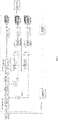
- FIG. 1 is a schematic diagram of an automatic modeling method for object detection model according to an embodiment of the present invention.
- the automatic modeling method of the present embodiment includes: S1, searching for an NAS network model according to a predetermined first neural network.
- the first neural network may be a recurrent neural network (RNN); the NAS network model refers to Neural Architecture Search network model.
- RNN recurrent neural network
- the NAS network model refers to Neural Architecture Search network model.
- Step S1 can include:
- the NAS network model is a NAS network without a fully connected layer.
- the detection part fusion of the NAS network and the first object detection model refers to: that a plurality of output ends of different scales of the NAS network model are each connected to a 1 ⁇ 1 convolutional layer, and an output of the 1 ⁇ 1 convolutional layer is used as an input of a detection part of the second object detection model.
- the evaluating the current first object detection model by using a validation set can include:
- the determining the optimal first object detection model according to the evaluation result can include: determining a first object detection model corresponding to a maximum MAP within the second preset number of times as the optimal first object detection model.
- the adjusting parameters used for searching for the NAS network model according to the reward includes:
- the parameters used by the NAS network model may include the trainable parameters of the RNN controller.
- the determining the optimal first object detection model according to the evaluation result can include: determining a first object detection model corresponding to a maximum MAP within the second preset number of times as the optimal first object detection model.
- the method can include: training the first object detection model with optimal evaluation result by using a training set, and testing the trained first object detection model with optimal evaluation result on a test set.
- FIG. 2 is a schematic diagram of an automatic modeling method for object detection model according to an embodiment of the present invention. As shown in FIG. 2 , the method includes the following steps: Step 201: initializing input.
- the initializing input includes configuring the hyperparameters and database reading-in data sets.
- the hyperparameters may include subnetwork hyperparameters and controller hyperparameters.
- the subnetwork hyperparameters mainly include the number of layers of the subnetwork, the number of cell branches, model learning rate related parameters, the number of output channels, etc.
- the number of layers of the subnetwork is the number of cells, and the parameters related to the learning rate of the subnetwork refer to, for example, the decay rate, decay step etc., in exponential decay.
- the above data sets may include training set, validation set and test set.
- Step 202 adopting the RNN network as the controller to sample and output the subnetwork structure encoding.
- Step 203 outputting the NAS network model through a decoder, and fusing it with the output part of Yolo3 to form a Yolo3-NAS model.
- the current Yolo3 adopts the network structure of Darknet-53 to extract image features, and in the detection part, the idea of FPN (feature pyramid networks) is referred.
- the present invention replaces the feature extraction network Darknet-53 in Yolo3 with the NAS network generated by automatic search (normal cell and reduce cell superimposed), and fuses it with the detection output part of Yolo by removing the fully connected layer of the NAS network model and adding 1 ⁇ 1 convolution to a plurality of output ends of the NAS network model to form Yolo3-NAS model.
- the present embodiment is described based on Yolo3, but it is not limited to Yolo3 in practical applications, and other object detection models may also be improved in this manner.
- Step 204 after training the Yolo3-NAS model on a training set and reaching a preset number of training times, validating the Yolo3-NAS model through a validation set, and outputting an evaluation result.
- the evaluation result may be evaluated with mean average precision (MAP).
- MAP mean average precision
- Step 205 calculating the object detection task reward corresponding to the Yolo3-NAS model.
- the object detection includes two parts: classification and regression. Classification is whether the object category is correctly classified in the object detection, and regression is whether the position of the object is correct. The corresponding loss of classification and regression is the classification loss and regression loss. Meanwhile, the present invention expands the excitation effect by the function (from (-1,1) expanding to (- ⁇ , ⁇ )), which makes the controller parameters update faster, i.e., search for the optimal model structure faster.
- Step 206 feeding the reward back to the controller and updating the trainable parameters of the controller.
- the formula for updating the controller parameters is ⁇ ⁇ ⁇ + ⁇ ⁇ log ⁇ ⁇ ( s t , a t ) ⁇ R t ,
- ⁇ represents the trainable parameters of the RNN controller
- ⁇ ⁇ represents a back propagation gradient of the trainable parameters
- ⁇ represents a preset parameter
- log ⁇ ⁇ (s t , a t ) is a cross entropy loss corresponding to the t-th structure (the NAS network model searched for when step S1 is performed for the t-th time).
- R t the reward value corresponding to the t-th structure (the NAS network model searched for when step S 1 is performed for the t-th time)
- the reward is used to feed back whether the gradient calculated by this cross entropy is a trustworthy gradient. If the reward is small or negative, it indicates that the gradient descent is in a wrong direction and the parameters should be updated in another direction. If the reward is positive, or very large, it indicates that the gradient descent is in a correct direction, and the parameters are updated in that direction.
- Step 207 repeating the above steps 202-206 for a preset number of times, and the maximum evaluation result for the preset number of times is used as the optimal subnetwork model searched for (i.e., the model obtained by detection part fusion of the NAS network model and a second object detection model), and retraining and testing the final effect on the test set.
- the optimal subnetwork model searched for i.e., the model obtained by detection part fusion of the NAS network model and a second object detection model
- the invention can search for different models according to different tasks, thus improving the detection effect in a targeted manner.
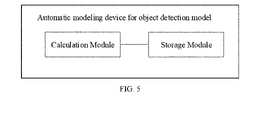
- FIG. 5 is a schematic diagram of an automatic modeling device for object detection model according to an embodiment of the present invention.
- the automatic modeling device of the present embodiment includes a memory and a processor;
- the first neural network is a Recurrent Neural Network (RNN).
- RNN Recurrent Neural Network
- step S1 includes:
- the NAS network model is a NAS network without a fully connected layer.
- the detection part fusion of the NAS network and the first object detection model refers to: that a plurality of output ends of different scales of the NAS network model are each connected to a 1 ⁇ 1 convolutional layer, and an output of the 1 ⁇ 1 convolutional layer is used as an input of a detection part of the second object detection model.
- the processor is configured for reading and performing the program for automatic modeling of the object detection model, and performing the following operations: after determining the optimal first object detection model according to the evaluation result, training the first object detection model with optimal evaluation result by using a training set, and testing the trained first object detection model with optimal evaluation result on a test set.
- the second object detection model includes Yolo.
- the evaluating the current first object detection model by using a validation set includes: performing Mean Average Precision (MAP) evaluation on the current first object detection model by using the validation set;
- MAP Mean Average Precision
- the determining the optimal first object detection model according to the evaluation result includes: determining a first object detection model corresponding to a maximum MAP within the second preset number of times as the optimal first object detection model.
- the adjusting parameters used for searching for the NAS network model according to the reward includes:
Landscapes
- Engineering & Computer Science (AREA)
- Theoretical Computer Science (AREA)
- Physics & Mathematics (AREA)
- Evolutionary Computation (AREA)
- Software Systems (AREA)
- General Physics & Mathematics (AREA)
- Artificial Intelligence (AREA)
- Computing Systems (AREA)
- Health & Medical Sciences (AREA)
- General Health & Medical Sciences (AREA)
- General Engineering & Computer Science (AREA)
- Mathematical Physics (AREA)
- Data Mining & Analysis (AREA)
- Biophysics (AREA)
- Molecular Biology (AREA)
- Computational Linguistics (AREA)
- Biomedical Technology (AREA)
- Life Sciences & Earth Sciences (AREA)
- Computer Vision & Pattern Recognition (AREA)
- Multimedia (AREA)
- Medical Informatics (AREA)
- Databases & Information Systems (AREA)
- Image Analysis (AREA)
- Management, Administration, Business Operations System, And Electronic Commerce (AREA)
Abstract
Description
- The present application claims priority to
Chinese patent application No. 201910912868.1 filed with the Chinese Patent Office on September 25, 2019 - The present invention relates to the field of object detection, and in particular to an automatic modeling method and device in the field of object detection.
- Object detection, as a classical topic in the field of image processing and computer vision, has a wide range of applications in traffic monitoring, image retrieval, human-computer interaction, etc. It aims to detect the target object of interest in a still image (or dynamic video). At present, the more popular algorithms include Yolo, SSD, and R-CNN algorithms. However, existing object detection algorithms use fixed network structure to extract image features, and cannot use different network structures to extract the most suitable image features according to different tasks and data characteristics, which makes the artificially designed object detection model can only achieve higher accuracy for specific tasks and lacks flexibility.
- The technical problem to be solved by the present invention is to provide an automatic modeling method for object detection model, which can search for different models according to different tasks and improve the effect of object detection.
- To solve the above technical problems, embodiments of the present invention provide an automatic modeling method for object detection model, which includes the following steps:
- S1, searching for a Neural Architecture Search (NAS) network model according to a predetermined first neural network;
- S2, training a first object detection model by using a training set, evaluating the current first object detection model by using a validation set after a number of training times reaches a first preset number of times, and outputting an evaluation result, wherein the first object detection model is a model obtained by detection part fusion of the NAS network model and a second object detection model;
- S3, calculating an object detection task reward corresponding to the current first object detection model; and
- S4, adjusting parameters used for searching for the NAS network model according to the object detection task reward; and
- repeating the steps S1-S4 for a second preset number of times, and determining an optimal first object detection model according to the evaluation result.
- Preferably, the first neural network is a Recurrent Neural Network (RNN).
- Step S1 includes:
- step S11, sampling through a RNN controller according to preconfigured hyperparameters, to obtain a subnetwork structure encoding; wherein said hyperparameters include subnetwork hyperparameters, controller hyperparameters; the subnetwork hyperparameters include the number of layers of the subnetwork, the number of cell branches, parameters related to the learning rate of the subnetwork, and the number of output channels; the controller hyperparameters include parameters related to the learning rate of the controller, and optimizer configuration parameters; and
- step S12: outputting the NAS network model by decoding the subnetwork structure encoding through a decoder.
- Preferably, the NAS network model is a NAS network without a fully connected layer.
- The detection part fusion of the NAS network and the first object detection model refers to:
that a plurality of output ends of different scales of the NAS network model are each connected to a 1∗1 convolutional layer, and an output of the 1∗1 convolutional layer is used as an input of a detection part of the second object detection model. - Preferably, after determining the optimal first object detection model according to the evaluation result, the method includes:
training the first object detection model with optimal evaluation result by using a training set, and testing the trained first object detection model with optimal evaluation result on a test set. - Preferably, the second object detection model includes YOLO.
- Preferably, the evaluating the current first object detection model by using a validation set includes:
- performing Mean Average Precision (MAP) evaluation on the current first object detection model by using the validation set;
- the determining the optimal first object detection model according to the evaluation result including:
determining a first object detection model corresponding to a maximum MAP within the second preset number of times as the optimal first object detection model. - Preferably, the calculating an object detection task reward corresponding to the current first object detection model includes:


- Preferably, the adjusting parameters used for searching for the NAS network model according to the reward includes:
- feeding the reward back to the RNN controller, and
- updating trainable parameters of the RNN controller by θ ← θ + γ∇θ log πθ (st, at ) · Rt, wherein θrepresents the trainable parameters of the RNN controller, γ∇θ represents a back propagation gradient of the trainable parameter, γrepresents a preset parameter, log πθ (st, at ) is a cross entropy loss corresponding to the NAS network model searched for when step S1 is performed for the t-th time, and Rt represents a reward value corresponding to the NAS network model searched for when step S1 is performed for the t-th time.
- To solve the above technical problems, embodiments of the present invention further provide an automatic modeling device for object detection model, which includes a memory and a processor;
- the memory is configured for storing a program for automatic modeling of the object detection model; and
- the processor is configured for reading and performing the program for automatic modeling of the object detection model, and performing the following operations:
- S1, searching for a Neural Architecture Search (NAS) network model according to a predetermined first neural network;
- S2, training a first object detection model by using a training set, evaluating the current first object detection model by using a validation set after a number of training times reaches a first preset number of times, and outputting an evaluation result, wherein the first object detection model is a model obtained by detection part fusion of the NAS network model and a second object detection model;
- S3, calculating an object detection task reward corresponding to the current first object detection model; and
- S4, adjusting parameters used for searching for the NAS network model according to the object detection task reward; and
- repeating the steps S1-S4 for a second preset number of times, and determining an optimal first object detection model according to the evaluation result.
- Preferably, the first neural network is a Recurrent Neural Network (RNN).
- Step S1 includes:
- step S11, sampling through a RNN controller according to preconfigured hyperparameters, to obtain a subnetwork structure encoding; wherein said hyperparameters include subnetwork hyperparameters, controller hyperparameters; the subnetwork hyperparameters include the number of layers of the subnetwork, the number of cell branches, parameters related to the learning rate of the subnetwork, and the number of output channels; the controller hyperparameters include parameters related to the learning rate of the controller, and optimizer configuration parameters; and
- step S12: outputting the NAS network model by decoding the subnetwork structure encoding through a decoder.
- Preferably, the NAS network model is a NAS network without a fully connected layer.
- The detection part fusion of the NAS network and the first object detection model refers to:
that a plurality of output ends of different scales of the NAS network model are each connected to a 1∗1 convolutional layer, and an output of the 1∗1 convolutional layer is used as an input of a detection part of the second object detection model. - Preferably, the processor is configured for reading and performing the program for automatic modeling of the object detection model, and performing the following operations:
after determining the optimal first object detection model according to the evaluation result, training the first object detection model with optimal evaluation result by using a training set, and testing the trained first object detection model with optimal evaluation result on a test set. - Preferably, the second object detection model includes Yolo.
- Preferably, the evaluating the current first object detection model by using a validation set includes:
- performing Mean Average Precision (MAP) evaluation on the current first object detection model by using the validation set;
- the determining the optimal first object detection model according to the evaluation result including:
determining a first object detection model corresponding to a maximum MAP within the second preset number of times as the optimal first object detection model. - Preferably, the calculating an object detection task reward corresponding to the current first object detection model includes:


- Preferably, the adjusting parameters used for searching for the NAS network model according to the reward includes:
- feeding the reward back to the RNN controller, and
- updating trainable parameters of the RNN controller by θ ← θ + γ∇θ log πθ (st, at ) · Rt, wherein θ represents the trainable parameters of the RNN controller, γ∇θ represents a back propagation gradient of the trainable parameter, γ represents a preset parameter, log πθ (st, at ) is a cross entropy loss corresponding to the NAS network model searched for when
step S 1 is performed for the t-th time, and Rt represents a reward value corresponding to the NAS network model searched for when step S1 is performed for the t-th time. - In summary, the embodiments of the present invention provide an automatic modeling method and device for object detection model, which improves the object detection effect by fusing the feature extraction model searched for according to different tasks with the object detection model in the prior art to form a new object detection model.
-
-
FIG. 1 is a schematic diagram of an automatic modeling method for object detection model according to an embodiment of the present invention. -
FIG. 2 is a flow chart of automatic modeling for object detection model according to an embodiment of the present invention. -
FIG. 3 is a schematic diagram of Yolo3 according to an embodiment of the present invention. -
FIG. 4 is a schematic diagram of automatic modeling of Yolo3-NAS model according to an embodiment of the present invention. -
FIG. 5 is a schematic diagram of an automatic modeling device for object detection model according to an embodiment of the present invention. - To make the objects, technical solutions and advantages of the present invention more apparent, embodiments of the present invention will be described in detail below with reference to the accompanying drawings. It should be noted that the embodiments and features of the embodiments in the present application may be arbitrarily combined with each other without conflict.
-
FIG. 1 is a schematic diagram of an automatic modeling method for object detection model according to an embodiment of the present invention. As shown inFIG. 1 , the automatic modeling method of the present embodiment includes:
S1, searching for an NAS network model according to a predetermined first neural network. - In an exemplary embodiment, the first neural network may be a recurrent neural network (RNN); the NAS network model refers to Neural Architecture Search network model.
- Step S1 can include:
- step S11, sampling through a RNN controller according to preconfigured hyperparameters, to obtain a subnetwork structure encoding; wherein said hyperparameters include subnetwork hyperparameters, controller hyperparameters; the subnetwork hyperparameters include the number of layers of the subnetwork, the number of cell branches, parameters related to the learning rate of the subnetwork, and the number of output channels; the controller hyperparameters include parameters related to the learning rate of the controller, and optimizer configuration parameters;
- step S12: outputting the NAS network model by decoding the subnetwork structure encoding through a decoder.
- S2, training a first object detection model by using a training set, evaluating the current first object detection model by using a validation set after a number of training times reaches a first preset number of times, and outputting an evaluation result, wherein the first object detection model is a model obtained by detection part fusion of the NAS network model and a second object detection model.
- In an exemplary embodiment, the NAS network model is a NAS network without a fully connected layer.
- In an exemplary embodiment, the detection part fusion of the NAS network and the first object detection model refers to:
that a plurality of output ends of different scales of the NAS network model are each connected to a 1∗1 convolutional layer, and an output of the 1∗1 convolutional layer is used as an input of a detection part of the second object detection model. - In an exemplary embodiment, the evaluating the current first object detection model by using a validation set can include:
- performing Mean Average Precision (MAP) evaluation on the current first object detection model by using the validation set;
- wherein, the second object detection model can include Yolo. Yolo (You Only Live Once) is a deep neural network based object recognition and positioning algorithm. It is a one-stage algorithm, i.e., it applies the algorithm directly to the input image and outputs the category and the corresponding positioning.
- In an exemplary embodiment, the determining the optimal first object detection model according to the evaluation result can include:
determining a first object detection model corresponding to a maximum MAP within the second preset number of times as the optimal first object detection model. - S3, calculating an object detection task reward corresponding to the current first object detection model.
- In an exemplary embodiment, the calculating an object detection task reward corresponding to the current first object detection model includes:


- S4, adjusting parameters used for searching for the NAS network model according to the object detection task reward; and
In an exemplary embodiment, the adjusting parameters used for searching for the NAS network model according to the reward includes: - feeding the reward back to the RNN controller, and
- updating trainable parameters of the RNN controller by θ ← θ + γ∇θ log πθ (st, at ) · Rt, wherein θrepresents the trainable parameters of the RNN controller, γ∇θ represents a back propagation gradient of the trainable parameter, γ represents a preset parameter,
log πθ (st, at ) is a cross entropy loss corresponding to the NAS network model searched for when step S1 is performed for the t-th time, and Rt represents a reward value corresponding to the NAS network model searched for when step S1 is performed for the t-th time. - Wherein the parameters used by the NAS network model may include the trainable parameters of the RNN controller.
- S5, repeating the steps S1-S4 for a second preset number of times, and determining an optimal first object detection model according to the evaluation result.
- In an exemplary embodiment, the determining the optimal first object detection model according to the evaluation result can include:
determining a first object detection model corresponding to a maximum MAP within the second preset number of times as the optimal first object detection model. - In an exemplary embodiment, after determining the optimal first object detection model according to the evaluation result, the method can include:
training the first object detection model with optimal evaluation result by using a training set, and testing the trained first object detection model with optimal evaluation result on a test set. -
FIG. 2 is a schematic diagram of an automatic modeling method for object detection model according to an embodiment of the present invention. As shown inFIG. 2 , the method includes the following steps:
Step 201: initializing input. - The initializing input includes configuring the hyperparameters and database reading-in data sets. The hyperparameters may include subnetwork hyperparameters and controller hyperparameters. The subnetwork hyperparameters mainly include the number of layers of the subnetwork, the number of cell branches, model learning rate related parameters, the number of output channels, etc. The number of layers of the subnetwork is the number of cells, and the parameters related to the learning rate of the subnetwork refer to, for example, the decay rate, decay step etc., in exponential decay. The above data sets may include training set, validation set and test set.
- Step 202: adopting the RNN network as the controller to sample and output the subnetwork structure encoding.
- Step 203: outputting the NAS network model through a decoder, and fusing it with the output part of Yolo3 to form a Yolo3-NAS model.
- As shown in
FIG. 3 , the current Yolo3 adopts the network structure of Darknet-53 to extract image features, and in the detection part, the idea of FPN (feature pyramid networks) is referred. - As shown in
Fig. 4 , the present invention replaces the feature extraction network Darknet-53 in Yolo3 with the NAS network generated by automatic search (normal cell and reduce cell superimposed), and fuses it with the detection output part of Yolo by removing the fully connected layer of the NAS network model and adding 1∗1 convolution to a plurality of output ends of the NAS network model to form Yolo3-NAS model. It should be noted that the present embodiment is described based on Yolo3, but it is not limited to Yolo3 in practical applications, and other object detection models may also be improved in this manner. - Step 204: after training the Yolo3-NAS model on a training set and reaching a preset number of training times, validating the Yolo3-NAS model through a validation set, and outputting an evaluation result.
- Wherein, the evaluation result may be evaluated with mean average precision (MAP). The MAP evaluation is a prior art and will not be described herein again.
- Step 205: calculating the object detection task reward corresponding to the Yolo3-NAS model.
- Wherein, the reward is calculated by the formula below:


- Step 206: feeding the reward back to the controller and updating the trainable parameters of the controller.
- Wherein, the formula for updating the controller parameters is θ ← θ + γ∇θ log πθ (st, at ) · Rt,
- Wherein, θrepresents the trainable parameters of the RNN controller, γ∇θ represents a back propagation gradient of the trainable parameters, γ represents a preset parameter, log πθ (st, at) is a cross entropy loss corresponding to the t-th structure (the NAS network model searched for when step S1 is performed for the t-th time). To ensure that this structure is really "correct", our loss is multiplied by Rt (the reward value corresponding to the t-th structure (the NAS network model searched for when
step S 1 is performed for the t-th time)), and the reward is used to feed back whether the gradient calculated by this cross entropy is a trustworthy gradient. If the reward is small or negative, it indicates that the gradient descent is in a wrong direction and the parameters should be updated in another direction. If the reward is positive, or very large, it indicates that the gradient descent is in a correct direction, and the parameters are updated in that direction. - Step 207: repeating the above steps 202-206 for a preset number of times, and the maximum evaluation result for the preset number of times is used as the optimal subnetwork model searched for (i.e., the model obtained by detection part fusion of the NAS network model and a second object detection model), and retraining and testing the final effect on the test set.
- By changing the object detection into automatic searching for optimal model approach, the invention can search for different models according to different tasks, thus improving the detection effect in a targeted manner.
-
FIG. 5 is a schematic diagram of an automatic modeling device for object detection model according to an embodiment of the present invention. As shown inFIG. 5 , the automatic modeling device of the present embodiment includes a memory and a processor; - the memory is configured for storing a program for automatic modeling of the object detection model; and
- the processor is configured for reading and performing the program for automatic modeling of the object detection model, and performing the following operations:
- S1, searching for a Neural Architecture Search (NAS) network model according to a predetermined first neural network;
- S2, training a first object detection model by using a training set, evaluating the current first object detection model by using a validation set after a number of training times reaches a first preset number of times, and outputting an evaluation result, wherein the first object detection model is a model obtained by detection part fusion of the NAS network model and a second object detection model.
- S3, calculating an object detection task reward corresponding to the current first object detection model; and
- S4, adjusting parameters used for searching for the NAS network model according to the object detection task reward; and
- repeating the steps S1-S4 for a second preset number of times, and determining an optimal first object detection model according to the evaluation result.
- Optionally, the first neural network is a Recurrent Neural Network (RNN).
- Optionally, step S1 includes:
- step S11, sampling through a RNN controller according to preconfigured hyperparameters, to obtain a subnetwork structure encoding; wherein said hyperparameters include subnetwork hyperparameters, controller hyperparameters; the subnetwork hyperparameters include the number of layers of the subnetwork, the number of cell branches, parameters related to the learning rate of the subnetwork, and the number of output channels; the controller hyperparameters include parameters related to the learning rate of the controller, and optimizer configuration parameters;
- step S12: outputting the NAS network model by decoding the subnetwork structure encoding through a decoder.
- Optionally, the NAS network model is a NAS network without a fully connected layer.
- Optionally, the detection part fusion of the NAS network and the first object detection model refers to:
that a plurality of output ends of different scales of the NAS network model are each connected to a 1∗1 convolutional layer, and an output of the 1∗1 convolutional layer is used as an input of a detection part of the second object detection model. - Optionally, the processor is configured for reading and performing the program for automatic modeling of the object detection model, and performing the following operations:
after determining the optimal first object detection model according to the evaluation result, training the first object detection model with optimal evaluation result by using a training set, and testing the trained first object detection model with optimal evaluation result on a test set. - Optionally, the second object detection model includes Yolo.
- Optionally, the evaluating the current first object detection model by using a validation set includes:
performing Mean Average Precision (MAP) evaluation on the current first object detection model by using the validation set; - Optionally, the determining the optimal first object detection model according to the evaluation result includes:
determining a first object detection model corresponding to a maximum MAP within the second preset number of times as the optimal first object detection model. - Optionally, the calculating an object detection task reward corresponding to the current first object detection model includes:


- Optionally, the adjusting parameters used for searching for the NAS network model according to the reward includes:
- feeding the reward back to the RNN controller, and
- updating trainable parameters of the RNN controller by θ ← θ + γ∇θ log πθ (st, at ) · Rt, wherein θrepresents the trainable parameters of the RNN controller, γ∇θ represents a back propagation gradient of the trainable parameter, γrepresents a preset parameter,
log πθ (st, at )is a cross entropy loss corresponding to the NAS network model searched for when step S1 is performed for the t-th time, and Rt represents a reward value corresponding to the NAS network model searched for when step S1 is performed for the t-th time. - A person of ordinary skill in the art can understand that all or some of the steps in the above method can be accomplished by instructing the relevant hardware by means of a program, and the program can be stored in a computer readable storage medium, such as a read-only memory, a magnetic disk or an optical disk, etc. Optionally, all or some of the steps of the above embodiments may also be implemented using one or more integrated circuits. Accordingly, the modules/units in the above embodiments may be implemented in the form of hardware or in the form of software function modules. The present invention is not limited to any particular form of combination of hardware and software.
- Of course, the present invention may also have other various embodiments, and those skilled in the art can make various corresponding changes and modifications according to the present invention without departing from the spirit and essence of the present invention, but these corresponding changes and modifications shall fall within the scope of protection of the appended claims of the present invention.
Claims (16)
- An automatic modeling method for object detection model, characterized by comprising the following steps:S1, searching for a Neural Architecture Search (NAS) network model according to a predetermined first neural network;S2, training a first object detection model by using a training set, evaluating the current first object detection model by using a validation set after a number of training times reaches a first preset number of times, and outputting an evaluation result, wherein the first object detection model is a model obtained by detection part fusion of the NAS network model and a second object detection model.S3, calculating an object detection task reward corresponding to the current first object detection model; andS4, adjusting parameters used for searching for the NAS network model according to the object detection task reward; andrepeating the steps S1-S4 for a second preset number of times, and determining an optimal first object detection model according to the evaluation result.
- The method according to claim 1, characterized in that,the first neural network is a recurrent neural network RNN;step S1 comprises:step S11, sampling through a RNN controller according to preconfigured hyperparameters, to obtain a subnetwork structure encoding; wherein said hyperparameters include subnetwork hyperparameters, controller hyperparameters; the subnetwork hyperparameters include the number of layers of the subnetwork, the number of cell branches, parameters related to the learning rate of the subnetwork, and the number of output channels; the controller hyperparameters include parameters related to the learning rate of the controller, and optimizer configuration parameters;step S12: outputting the NAS network model by decoding the subnetwork structure encoding through a decoder.
- The method according to claim 2, characterized in that,the NAS network model is a NAS network without a fully connected layer;the detection part fusion of the NAS network and the first object detection model refers to:that a plurality of output ends of different scales of the NAS network model are each connected to a 1∗1 convolutional layer, and an output of the 1∗1 convolutional layer is used as an input of a detection part of the second object detection model.
- The method according to claim 1, characterized in that after determining the optimal first object detection model according to the evaluation result, the method comprises:
training the first object detection model with optimal evaluation result by using a training set, and testing the trained first object detection model with optimal evaluation result on a test set. - The method according to claim 1, characterized in that,
the second object detection model includes Yolo. - The method according to claim 1, characterized in that,
the evaluating the current first object detection model by using a validation set comprises:performing Mean Average Precision (MAP) evaluation on the current first object detection model by using the validation set;the determining the optimal first object detection model according to the evaluation result comprises:
determining a first object detection model corresponding to a maximum MAP within the second preset number of times as the optimal first object detection model. - The method according to claim 1, characterized in that the calculating an object detection task reward corresponding to the current first object detection model comprises:


- The method according to claim 2, characterized in that,
the adjusting parameters used for searching for the NAS network model according to the reward comprises:feeding the reward back to the RNN controller, andupdating trainable parameters of the RNN controller by θ ← θ + γ∇θ log πθ (st, at ) · Rt, wherein θ represents the trainable parameters of the RNN controller, γ∇θ represents a back propagation gradient of the trainable parameter, γrepresents a preset parameter, log πθ (st, at ) is a cross entropy loss corresponding to the NAS network model searched for when step S1 is performed for the t-th time, and Rt represents a reward value corresponding to the NAS network model searched for when step S1 is performed for the t-th time. - An automatic modeling device for object detection model, comprising a memory and a processor, characterized in that,the memory is configured for storing a program for automatic modeling of the object detection model; andthe processor is configured for reading and performing the program for automatic modeling of the object detection model, and performing the following operations:S1, searching for a Neural Architecture Search (NAS) network model according to a predetermined first neural network;S2, training a first object detection model by using a training set, evaluating the current first object detection model by using a validation set after a number of training times reaches a first preset number of times, and outputting an evaluation result, wherein the first object detection model is a model obtained by detection part fusion of the NAS network model and a second object detection model.S3, calculating an object detection task reward corresponding to the current first object detection model;S4, adjusting parameters used for searching for the NAS network model according to the object detection task reward;repeating the steps S1-S4 for a second preset number of times, and determining an optimal first object detection model according to the evaluation result.
- The device according to claim 9, characterized in that,the first neural network is a recurrent neural network RNN;step S1 comprises:step S11, sampling through a RNN controller according to preconfigured hyperparameters, to obtain a subnetwork structure encoding; wherein said hyperparameters include subnetwork hyperparameters, controller hyperparameters; the subnetwork hyperparameters include the number of layers of the subnetwork, the number of cell branches, parameters related to the learning rate of the subnetwork, and the number of output channels; the controller hyperparameters include parameters related to the learning rate of the controller, and optimizer configuration parameters;step S12: outputting the NAS network model by decoding the subnetwork structure encoding through a decoder.
- The device according to claim 10, characterized in that,the NAS network model is a NAS network without a fully connected layer;the detection part fusion of the NAS network and the first object detection model refers to:
that a plurality of output ends of different scales of the NAS network model are each connected to a 1∗1 convolutional layer, and an output of the 1∗1 convolutional layer is used as an input of a detection part of the second object detection model. - The device according to claim 9, characterized in that the processor is configured for reading and performing the program for automatic modeling of the object detection model, and performing the following operations:
after determining the optimal first object detection model according to the evaluation result, training the first object detection model with optimal evaluation result by using a training set, and testing the trained first object detection model with optimal evaluation result on a test set. - The device according to claim 9, characterized in that,
the second object detection model includes Yolo. - The device according to claim 9, characterized in that,
the evaluating the current first object detection model by using a validation set comprises:performing Mean Average Precision (MAP) evaluation on the current first object detection model by using the validation set;the determining the optimal first object detection model according to the evaluation result comprises:
determining a first object detection model corresponding to a maximum MAP within the second preset number of times as the optimal first object detection model. - The device according to claim 9, characterized in that the calculating an object detection task reward corresponding to the current first object detection model comprises:


- The device according to claim 10, characterized in that,
the adjusting parameters used for searching for the NAS network model according to the reward comprises:feeding the reward back to the RNN controller, andupdating trainable parameters of the RNN controller by θ ← θ + γ∇θ log πθ (st, at ) · Rt, wherein θ represents the trainable parameters of the RNN controller, γ∇θ represents a back propagation gradient of the trainable parameter, γrepresents a preset parameter, log πθ (st, at ) is a cross entropy loss corresponding to the NAS network model searched for when step S1 is performed for the t-th time, and Rt represents a reward value corresponding to the NAS network model searched for when step S1 is performed for the t-th time.
Applications Claiming Priority (2)
| Application Number | Priority Date | Filing Date | Title |
|---|---|---|---|
| CN201910912868.1A CN110705573A (en) | 2019-09-25 | 2019-09-25 | Automatic modeling method and device of target detection model |
| PCT/CN2019/130024 WO2021056914A1 (en) | 2019-09-25 | 2019-12-30 | Automatic modeling method and apparatus for object detection model |
Publications (3)
| Publication Number | Publication Date |
|---|---|
| EP4036796A1 true EP4036796A1 (en) | 2022-08-03 |
| EP4036796A4 EP4036796A4 (en) | 2023-10-18 |
| EP4036796B1 EP4036796B1 (en) | 2026-01-28 |
Family
ID=69196577
Family Applications (1)
| Application Number | Title | Priority Date | Filing Date |
|---|---|---|---|
| EP19946971.9A Active EP4036796B1 (en) | 2019-09-25 | 2019-12-30 | Automatic modeling method and apparatus for object detection model |
Country Status (6)
| Country | Link |
|---|---|
| US (1) | US12211258B2 (en) |
| EP (1) | EP4036796B1 (en) |
| JP (1) | JP7335430B2 (en) |
| KR (1) | KR102921852B1 (en) |
| CN (1) | CN110705573A (en) |
| WO (1) | WO2021056914A1 (en) |
Families Citing this family (12)
| Publication number | Priority date | Publication date | Assignee | Title |
|---|---|---|---|---|
| CN111738098B (en) * | 2020-05-29 | 2022-06-17 | 浪潮(北京)电子信息产业有限公司 | Vehicle identification method, device, equipment and storage medium |
| CN113869521B (en) * | 2020-06-30 | 2026-01-16 | 华为技术有限公司 | Method, device, computing equipment and storage medium for constructing prediction model |
| CN111930795B (en) * | 2020-07-02 | 2022-11-29 | 苏州浪潮智能科技有限公司 | Distributed model searching method and system |
| CN112149551A (en) * | 2020-09-21 | 2020-12-29 | 上海孚聪信息科技有限公司 | Safety helmet identification method based on embedded equipment and deep learning |
| CN114998285A (en) * | 2022-06-17 | 2022-09-02 | 桂林医学院 | Industrial product blind detection target detection method based on neural network architecture search |
| CN116721155B (en) * | 2023-06-02 | 2026-01-30 | 北京大学 | An automatic target positioning method, device, and computer storage medium |
| CN117132534B (en) * | 2023-07-19 | 2026-02-10 | 西安电子科技大学 | A task-driven method for evaluating the quality of spatial target images |
| CN117132909A (en) * | 2023-08-24 | 2023-11-28 | 浪潮软件集团有限公司 | UAV surface detection system and method based on cascaded sparse query |
| CN116821513B (en) * | 2023-08-25 | 2023-11-10 | 腾讯科技(深圳)有限公司 | Parameter searching method, device, equipment and medium under recommended scene |
| CN117036869B (en) * | 2023-10-08 | 2024-01-09 | 之江实验室 | A model training method and device based on diversity and random strategies |
| CN117291845B (en) * | 2023-11-27 | 2024-03-19 | 成都理工大学 | A point cloud ground filtering method, system, electronic equipment and storage medium |
| CN118296546B (en) * | 2024-06-06 | 2024-08-23 | 浙江大学 | Unstability fault monitoring method and device with self-learning generalization capability |
Family Cites Families (10)
| Publication number | Priority date | Publication date | Assignee | Title |
|---|---|---|---|---|
| KR20120051208A (en) | 2010-11-12 | 2012-05-22 | 엘지전자 주식회사 | Method for gesture recognition using an object in multimedia device device and thereof |
| JP7023613B2 (en) | 2017-05-11 | 2022-02-22 | キヤノン株式会社 | Image recognition device and learning device |
| JP6963627B2 (en) | 2017-07-21 | 2021-11-10 | グーグル エルエルシーGoogle LLC | Neural architecture search for convolutional neural networks |
| WO2019084560A1 (en) | 2017-10-27 | 2019-05-02 | Google Llc | Neural architecture search |
| CN107886117A (en) | 2017-10-30 | 2018-04-06 | 国家新闻出版广电总局广播科学研究院 | The algorithm of target detection merged based on multi-feature extraction and multitask |
| FR3082963A1 (en) * | 2018-06-22 | 2019-12-27 | Amadeus S.A.S. | SYSTEM AND METHOD FOR EVALUATING AND DEPLOYING NON-SUPERVISED OR SEMI-SUPERVISED AUTOMATIC LEARNING MODELS |
| CN109063759A (en) | 2018-07-20 | 2018-12-21 | 浙江大学 | A kind of neural network structure searching method applied to the more attribute forecasts of picture |
| US10713491B2 (en) * | 2018-07-27 | 2020-07-14 | Google Llc | Object detection using spatio-temporal feature maps |
| CN109325454B (en) | 2018-09-28 | 2020-05-22 | 合肥工业大学 | A real-time recognition method for static gestures based on YOLOv3 |
| CN109788222A (en) * | 2019-02-02 | 2019-05-21 | 视联动力信息技术股份有限公司 | A kind of processing method and processing device regarding networked video |
-
2019
- 2019-09-25 CN CN201910912868.1A patent/CN110705573A/en not_active Withdrawn
- 2019-12-30 JP JP2022517307A patent/JP7335430B2/en active Active
- 2019-12-30 US US17/642,816 patent/US12211258B2/en active Active
- 2019-12-30 KR KR1020227009936A patent/KR102921852B1/en active Active
- 2019-12-30 EP EP19946971.9A patent/EP4036796B1/en active Active
- 2019-12-30 WO PCT/CN2019/130024 patent/WO2021056914A1/en not_active Ceased
Also Published As
| Publication number | Publication date |
|---|---|
| US12211258B2 (en) | 2025-01-28 |
| US20220383627A1 (en) | 2022-12-01 |
| KR102921852B1 (en) | 2026-02-03 |
| KR20220051383A (en) | 2022-04-26 |
| EP4036796B1 (en) | 2026-01-28 |
| JP7335430B2 (en) | 2023-08-29 |
| EP4036796A4 (en) | 2023-10-18 |
| JP2022548293A (en) | 2022-11-17 |
| WO2021056914A1 (en) | 2021-04-01 |
| CN110705573A (en) | 2020-01-17 |
Similar Documents
| Publication | Publication Date | Title |
|---|---|---|
| EP4036796B1 (en) | Automatic modeling method and apparatus for object detection model | |
| US12361305B2 (en) | Neural architecture search for convolutional neural networks | |
| US12361691B2 (en) | Vehicle recognition method and apparatus, device, and storage medium | |
| US12346817B2 (en) | Neural architecture search | |
| CN111523640B (en) | Training methods and devices for neural network models | |
| CN117931991B (en) | Training sample acquisition and large model optimization training method and device | |
| CN112419268A (en) | A transmission line image defect detection method, device, equipment and medium | |
| CN111445008A (en) | Knowledge distillation-based neural network searching method and system | |
| CN117521814A (en) | A question and answer method and device based on multi-modal input and knowledge graph | |
| CN114330703B (en) | Methods, apparatus, devices, and computer-readable storage media for updating search models | |
| CN114758199A (en) | Training method, device, equipment and storage medium for detection model | |
| CN112115372B (en) | Parking lot recommendation method and device | |
| US20200265297A1 (en) | Method and apparatus based on neural network modeland storage medium | |
| CN119761515B (en) | Sample construction method, large model training method, device, electronic equipment and medium | |
| CN114819100B (en) | Neural network searching method and device of target detection model and electronic equipment | |
| CN117152528A (en) | Insulator status identification method, device, equipment, storage medium and program product | |
| CN114511083A (en) | Model training method and device, storage medium and electronic device | |
| CN110705695B (en) | Method, device, equipment and storage medium for searching model structure | |
| CN113806589A (en) | Video clip positioning method, device and computer readable storage medium | |
| CN119293162A (en) | Model training method, information processing method, device, electronic device, storage medium and computer program product | |
| CN113407806A (en) | Network structure searching method, device, equipment and computer readable storage medium | |
| CN104572820A (en) | Method and device for generating model and method and device for acquiring importance degree | |
| CN116977698A (en) | A target detection method, device, equipment, storage medium and program product | |
| CN117115886A (en) | Cross-scenario adaptation method and device for living body detection model | |
| CN112907959A (en) | Electronic eye management method, device and storage medium |
Legal Events
| Date | Code | Title | Description |
|---|---|---|---|
| STAA | Information on the status of an ep patent application or granted ep patent |
Free format text: STATUS: THE INTERNATIONAL PUBLICATION HAS BEEN MADE |
|
| PUAI | Public reference made under article 153(3) epc to a published international application that has entered the european phase |
Free format text: ORIGINAL CODE: 0009012 |
|
| STAA | Information on the status of an ep patent application or granted ep patent |
Free format text: STATUS: REQUEST FOR EXAMINATION WAS MADE |
|
| 17P | Request for examination filed |
Effective date: 20220317 |
|
| AK | Designated contracting states |
Kind code of ref document: A1 Designated state(s): AL AT BE BG CH CY CZ DE DK EE ES FI FR GB GR HR HU IE IS IT LI LT LU LV MC MK MT NL NO PL PT RO RS SE SI SK SM TR |
|
| DAV | Request for validation of the european patent (deleted) | ||
| DAX | Request for extension of the european patent (deleted) | ||
| REG | Reference to a national code |
Ref country code: DE Ref legal event code: R079 Free format text: PREVIOUS MAIN CLASS: G06K0009460000 Ipc: G06N0003098500 Ref country code: DE Ref legal event code: R079 Ref document number: 602019081040 Country of ref document: DE Free format text: PREVIOUS MAIN CLASS: G06K0009460000 Ipc: G06N0003098500 |
|
| A4 | Supplementary search report drawn up and despatched |
Effective date: 20230918 |
|
| RIC1 | Information provided on ipc code assigned before grant |
Ipc: G06V 10/82 20220101ALI20230912BHEP Ipc: G06V 10/776 20220101ALI20230912BHEP Ipc: G06N 3/084 20230101ALI20230912BHEP Ipc: G06N 3/0464 20230101ALI20230912BHEP Ipc: G06N 3/045 20230101ALI20230912BHEP Ipc: G06N 3/0985 20230101AFI20230912BHEP |
|
| STAA | Information on the status of an ep patent application or granted ep patent |
Free format text: STATUS: EXAMINATION IS IN PROGRESS |
|
| 17Q | First examination report despatched |
Effective date: 20240701 |
|
| GRAP | Despatch of communication of intention to grant a patent |
Free format text: ORIGINAL CODE: EPIDOSNIGR1 |
|
| STAA | Information on the status of an ep patent application or granted ep patent |
Free format text: STATUS: GRANT OF PATENT IS INTENDED |
|
| INTG | Intention to grant announced |
Effective date: 20250827 |
|
| GRAS | Grant fee paid |
Free format text: ORIGINAL CODE: EPIDOSNIGR3 |
|
| GRAA | (expected) grant |
Free format text: ORIGINAL CODE: 0009210 |
|
| STAA | Information on the status of an ep patent application or granted ep patent |
Free format text: STATUS: THE PATENT HAS BEEN GRANTED |
|
| AK | Designated contracting states |
Kind code of ref document: B1 Designated state(s): AL AT BE BG CH CY CZ DE DK EE ES FI FR GB GR HR HU IE IS IT LI LT LU LV MC MK MT NL NO PL PT RO RS SE SI SK SM TR |
|
| REG | Reference to a national code |
Ref country code: CH Ref legal event code: F10 Free format text: ST27 STATUS EVENT CODE: U-0-0-F10-F00 (AS PROVIDED BY THE NATIONAL OFFICE) Effective date: 20260128 Ref country code: GB Ref legal event code: FG4D |
|
| REG | Reference to a national code |
Ref country code: DE Ref legal event code: R096 Ref document number: 602019081040 Country of ref document: DE |
|
| REG | Reference to a national code |
Ref country code: IE Ref legal event code: FG4D |