EP4036785A1 - Multilingual, end-to-end aspect based sentiment analysis with opinion triplets predictions - Google Patents
Multilingual, end-to-end aspect based sentiment analysis with opinion triplets predictions Download PDFInfo
- Publication number
- EP4036785A1 EP4036785A1 EP21305139.4A EP21305139A EP4036785A1 EP 4036785 A1 EP4036785 A1 EP 4036785A1 EP 21305139 A EP21305139 A EP 21305139A EP 4036785 A1 EP4036785 A1 EP 4036785A1
- Authority
- EP
- European Patent Office
- Prior art keywords
- self
- absa
- attention network
- neural
- term
- Prior art date
- Legal status (The legal status is an assumption and is not a legal conclusion. Google has not performed a legal analysis and makes no representation as to the accuracy of the status listed.)
- Pending
Links
Images



Classifications
-
- G—PHYSICS
- G06—COMPUTING OR CALCULATING; COUNTING
- G06F—ELECTRIC DIGITAL DATA PROCESSING
- G06F40/00—Handling natural language data
- G06F40/20—Natural language analysis
- G06F40/279—Recognition of textual entities
- G06F40/284—Lexical analysis, e.g. tokenisation or collocates
-
- G—PHYSICS
- G06—COMPUTING OR CALCULATING; COUNTING
- G06N—COMPUTING ARRANGEMENTS BASED ON SPECIFIC COMPUTATIONAL MODELS
- G06N3/00—Computing arrangements based on biological models
- G06N3/02—Neural networks
- G06N3/08—Learning methods
- G06N3/084—Backpropagation, e.g. using gradient descent
-
- G—PHYSICS
- G06—COMPUTING OR CALCULATING; COUNTING
- G06F—ELECTRIC DIGITAL DATA PROCESSING
- G06F40/00—Handling natural language data
- G06F40/30—Semantic analysis
-
- G—PHYSICS
- G06—COMPUTING OR CALCULATING; COUNTING
- G06N—COMPUTING ARRANGEMENTS BASED ON SPECIFIC COMPUTATIONAL MODELS
- G06N3/00—Computing arrangements based on biological models
- G06N3/02—Neural networks
- G06N3/04—Architecture, e.g. interconnection topology
- G06N3/049—Temporal neural networks, e.g. delay elements, oscillating neurons or pulsed inputs
-
- G—PHYSICS
- G06—COMPUTING OR CALCULATING; COUNTING
- G06N—COMPUTING ARRANGEMENTS BASED ON SPECIFIC COMPUTATIONAL MODELS
- G06N3/00—Computing arrangements based on biological models
- G06N3/02—Neural networks
- G06N3/08—Learning methods
-
- G—PHYSICS
- G06—COMPUTING OR CALCULATING; COUNTING
- G06N—COMPUTING ARRANGEMENTS BASED ON SPECIFIC COMPUTATIONAL MODELS
- G06N3/00—Computing arrangements based on biological models
- G06N3/02—Neural networks
- G06N3/08—Learning methods
- G06N3/09—Supervised learning
-
- G—PHYSICS
- G06—COMPUTING OR CALCULATING; COUNTING
- G06N—COMPUTING ARRANGEMENTS BASED ON SPECIFIC COMPUTATIONAL MODELS
- G06N3/00—Computing arrangements based on biological models
- G06N3/02—Neural networks
- G06N3/08—Learning methods
- G06N3/096—Transfer learning
-
- G—PHYSICS
- G10—MUSICAL INSTRUMENTS; ACOUSTICS
- G10L—SPEECH ANALYSIS TECHNIQUES OR SPEECH SYNTHESIS; SPEECH RECOGNITION; SPEECH OR VOICE PROCESSING TECHNIQUES; SPEECH OR AUDIO CODING OR DECODING
- G10L15/00—Speech recognition
- G10L15/08—Speech classification or search
- G10L15/16—Speech classification or search using artificial neural networks
-
- G—PHYSICS
- G06—COMPUTING OR CALCULATING; COUNTING
- G06N—COMPUTING ARRANGEMENTS BASED ON SPECIFIC COMPUTATIONAL MODELS
- G06N3/00—Computing arrangements based on biological models
- G06N3/02—Neural networks
- G06N3/04—Architecture, e.g. interconnection topology
- G06N3/044—Recurrent networks, e.g. Hopfield networks
-
- G—PHYSICS
- G06—COMPUTING OR CALCULATING; COUNTING
- G06N—COMPUTING ARRANGEMENTS BASED ON SPECIFIC COMPUTATIONAL MODELS
- G06N3/00—Computing arrangements based on biological models
- G06N3/02—Neural networks
- G06N3/04—Architecture, e.g. interconnection topology
- G06N3/045—Combinations of networks
Definitions
- the present disclosure relates to aspect based sentiment analysis (ABSA).
- ABSA aspect based sentiment analysis
- the present disclosure relates to a neural end-to-end ABSA system that jointly discovers polarities and categories of aspect terms.
- Sentiment Analysis is a use case of Natural Language Processing (NLP). In its basic version, it assists in classifying the polarity of a given sentence or document. However, it only captures coarse-grained sentiments at a global level.
- Aspect-Based Sentiment Analysis is the task of identifying fine-grained opinion polarity towards a specific aspect associated with a given target term (i.e., an aspect term).
- the ABSA task requires Aspect Term Detection (ATE), i.e. detecting the aspect term, or opinionated term, associated with the specific aspect, Aspect Polarity Detection (APD), i.e. detecting term polarity and Aspect Category Detection (ACD), i.e. detecting the term domain-dependent category, for instance SERVICE or DRINKS in the Restaurants domain.
- ATE Aspect Term Detection
- APD Aspect Polarity Detection
- ACD Aspect Category Detection
- ABSA was classically divided in the subtasks of ATE, APD and ACD, and then combined in a pipeline to perform the whole opinion extraction.
- one of the problems with these approaches is that errors are propagated from subtask to subtask.
- evaluating the tasks separately, based on the ground truth of the previous task, as it is usually done for ABSA is unrealistic and inefficient, as only performances on a complete extraction are relevant for "real world" applications.
- these systems may be extensive and may require relatively large amounts of memory.
- a computer-implemented method for training a neural end-to-end ABSA system with a dataset comprises inputting a batch of samples of a dataset into the neural end-to-end ABSA system.
- the neural end-to-end ABSA system comprises a contextual language model encoder for embedding tokens with context and a first self-attention network for detecting an aspect term and providing a first output corresponding to the aspect term and a second self-attention network for detecting the aspect term and providing a second output corresponding to the aspect term.
- An output of the contextual language model encoder is input into the first self-attention network and the second self-attention network.
- the method further comprises adapting weights of the neural end-to-end ABSA system based at least in part on a first loss function and the inputted batch of samples.
- the first loss function comprises a consistency loss function, which may consider a first probability of classifying a token as not being an aspect term by the first self-attention network and a second probability of classifying the token as not being an aspect term by the second self-attention network, to provide for consistent aspect term detection by the first self-attention network and the second self-attention network.
- an improved method for efficiently training a neural end-to-end ABSA system that accurately detects aspect terms and provides outputs corresponding to the aspect term is provided.
- the training allows exploiting dependencies between the two tasks of the two self-attention networks that are mutually beneficial.
- the novel training method allows training small neural network systems regarding the number of parameters compared to state of the art systems with a similar performance.
- the dataset comprises a multi-lingual dataset.
- the neural end-to-end ABSA system may be trained for a single language, such as a target language, and a loss associated with one or more samples of a first language of the multilingual dataset for the training of the neural end-to-end ABSA system may be weighted based on a language similarity between the first language and the single language.
- the language similarity may be determined based on an F-score of a model, such as a neural end-to-end ABSA system, trained on the first language and evaluated on the single language.
- the neural end-to-end ABSA system is trained to output triplets including the aspect term, the first output comprising a category corresponding to the aspect term and the second output comprising a polarity corresponding to the aspect term.
- the first self-attention network and the second self-attention network may be trained simultaneously.
- the contextual language model encoder may be based on a pre-trained transformer.
- the neural end-to-end ABSA system is adapted based on a second loss function, wherein the second loss function weights a loss associated with the first self-attention network and a loss associated with the second self-attention network.
- a neural end-to-end ABSA system for predicting aspect categories and polarities comprises a contextual language model encoder, a first self-attention network, and a second self-attention network.
- An output of the contextual language model encoder is a first input for the first self-attention network and a second input for the second self-attention network.
- the neural end-to-end ABSA system is configured to receive a sequence of tokens, embed, by the contextual language model encoder, tokens of the sequence of tokens with context into representations, extract, by the first self-attention network and the second self-attention network, an aspect term based on the representations, determine, by the first self-attention network, an aspect category of the aspect term, and determine, by the second self-attention network, a polarity of the aspect term.
- the neural end-to-end ABSA system may further be configured to output triplets including the aspect term, the aspect category and the polarity.
- the contextual language model encoder is based on a multilingual contextual language model encoder.
- a first probability of classifying a token as not being an aspect term by the first self-attention network corresponds to a second probability of classifying the token as not being an aspect term by the second self-attention network, which provides for consistent aspect term detection by the first self-attention network and the second self-attention network.
- a neural end-to-end ABSA system for predicting at least one of aspect categories and polarities for a plurality of languages comprises a multilingual encoder configured for embedding tokens of a sequence of tokens with context into representations, and at least one of a first self-attention network configured to associate an aspect category to a first aspect term from the representations, and a second self-attention network configured to associate a polarity to a second aspect term from the representations.
- the outputs of the first and second first self-attention network are merged under consistency constraints to output the final aspect term together with its aspect category and polarity.
- a computer-readable storage medium comprises instructions which, when executed by a computer, cause the computer to carry out the steps of training a neural end-to-end ABSA system with a multilingual dataset.
- the neural end-to-end ABSA system comprises a multilingual contextual language model encoder for embedding tokens with context into representations and is followed by at least one of a first self-attention network configured for detecting an aspect term and determining an aspect category of the aspect term based on the representations, and a second self-attention network for detecting the aspect term and determining a polarity of the aspect term based on the representations.
- the neural end-to-end ABSA system may be trained for one or more specific languages.
- the neural end-to-end ABSA system may be trained using a weighted loss based on language similarities between languages of the multilingual dataset and the one or more specific languages.
- the language similarities may be determined based on cross-lingual F-scores of a model, such as a neural end-to-end ABSA system, trained on at least one of the languages of the multilingual dataset and evaluated on the one or more specific languages.
- a computer-readable storage medium having computer-executable instructions stored thereon is provided.
- the computer-executable instructions When executed by one or more processors, the computer-executable instructions perform the method for training a neural end-to-end aspect based sentiment analysis, ABSA, system described above.
- an apparatus comprising processing circuitry.
- the processing circuitry is configured to execute a neural end-to-end aspect based sentiment analysis, ABSA, system described above.
- ABSA neural end-to-end aspect based sentiment analysis
- ABSA Aspect Based Sentiment Analysis
- ABSA ABSA aims to identify fine-grained opinion polarity towards specific aspects associated with a given target term (i.e., aspect term).
- Embodiments address this task with a system that models polarity (e.g., positive, negative, neutral, or conflict [i.e., both positive and negative]) and category (e.g., domain-dependent categories associated with POI (point of interest) categories such as shopping, transportation, lodging, etc.) signals jointly. It can be shown that this system preserves performances from past works on standard ABSA subtasks, while extracting full ABSA information, i.e. opinion triplets.
- polarity e.g., positive, negative, neutral, or conflict [
- pre-trained contextualized word embeddings help to improve results on several NLP tasks, due to the rich syntactic and semantic information contained in their pre-trained representations. Fine-tuning these models on downstream tasks is also highly efficient.
- the pre-trained language model BERT can be combined with a task specific head (e.g., a Conditional Random Field (CRF) network, only linear, or a Self-Attention Network (SAN)) to label each token with a sequence annotation tagging scheme such as the BIO format (i.e., Beginning [B], Inside [I], Outside/Other [O]) tagging scheme with a category tag and a polarity tag.
- a task specific head e.g., a Conditional Random Field (CRF) network, only linear, or a Self-Attention Network (SAN)
- CRF Conditional Random Field
- SAN Self-Attention Network
- An example CRF network that may be used in embodiments herein as a task specific head is disclosed by Zhiheng Huang, Wei Xu, and Kai Yu, in "Bidirectional Istm-crf models for sequence tagging", arXiv preprint arXiv:1508.0199 2015 , which is incorporated herein by reference.
- an example SAN that may be used in embodiments herein as a task specific head is disclosed by Xin Li, Lidong Bing, Wenxuan Zhang, Wai Lam in "Exploiting BERT for End-to-End Aspect-based Sentiment Analysis", proceedings of the 5th Workshop on noisysy User-generated Text (W-NUT 2019) , which is incorporated herein by reference.
- ABSA fine-tuning pre-trained representations using in-domain data after the general pre-training task and before the task-specific fine-tuning step.
- a system according to embodiments is trained in a multilingual context. Evaluation of this system using data in six different languages have shown how non-parallel, multilingual data can help alleviate the issue of ABSA-labelled data scarcity.
- Fig. 1 is a process flow diagram of an exemplary method 100 for training a neural end-to-end aspect based sentiment analysis, ABSA, system with a dataset in accordance with an embodiment.
- the method comprises inputting a batch of samples of a dataset into the neural end-to-end ABSA system.
- the neural end-to-end ABSA system comprises a contextual language model encoder for embedding tokens with context. Additionally, the neural end-to-end ABSA system comprises a first self-attention network for detecting an aspect term and providing a first output and a second self-attention network for detecting the aspect term and providing a second output.
- the contextual language model encoder is followed by the first self-attention network and the second self-attention network, so that an output of the contextual language model encoder is input into the first self-attention network and the second self-attention network.
- the neural end-to-end ABSA system may be trained to output triplets including the aspect term, the first output comprising a category corresponding to the aspect term and the second output comprising a polarity corresponding to the aspect term.
- the contextual language model encoder may be based on a pre-trained transformer and is fine-tuned during the training.
- a transformer is a deep learning model and is configured to handle sequential data, such as natural language.
- RNNs recurrent neural networks
- LSTM long short-term memory
- transformers do not require that the sequential data be processed in order. Due to this feature, the transformer allows for much more parallelization than RNNs and therefore reduced training times.
- Examples of pre-trained transformers are BERT (Bidirectional Encoder Representations from Transformers) and GPT (Generative Pre-trained Transformer), which have been trained with huge general language datasets, such as Wikipedia Corpus, and can be fine-tuned to specific language tasks.
- the method comprises adapting weights of the neural end-to-end ABSA system based at least in part on a first loss function and the inputted batch of samples.
- the batch of samples may comprise one or more labeled samples, such as a labeled sequence of tokens or a labeled sentence.
- a sentence may be labeled in accordance with a BIO format annotation.
- the BIO annotation may be "Italian [B-Food] pasta [I-Food] was [O] great [O].” (i) for the category branch, (where "Food” is the category output by the category branch); and (ii) for the polarity branch the BIO annotation for the sentence may be: “Italian [B-Positive] pasta [I-Positive] was [O] great [O].” (where "Positive” is the polarity output by the polarity branch).
- the steps 110 and 120 can be repeated until the training of the neural end-to-end ABSA system is finished.
- the first loss function considers a first probability of classifying a token as not being an aspect term by the first self-attention network and a second probability of classifying the token as not being an aspect term by the second self-attention network, to provide for consistent aspect term detection by the first self-attention network and the second self-attention network.
- the dataset may comprise a multilingual dataset comprising samples of different languages.
- the neural end-to-end ABSA system may be trained for a single or specific language.
- a loss associated with one or more samples of a first language of the dataset for the training of the neural end-to-end ABSA system may be weighted based on a language similarity between the first language and the single or specific language.
- the language similarity may be determined based on an F-score of a model, such as a neural end-to-end ABSA system or a different ABSA model, trained on the first language and evaluated on the single or specific language.
- the language similarity may be obtained from a table indicating language similarities between different languages.
- Multi-output learning can be either beneficial or detrimental. Either both tasks "teach" something to the network that benefits to the other task, or they compete for capacity of the network, biasing weights toward one or the other loss, hurting final performance. Therefore, the neural end-to-end ABSA system may be adapted based at least in part on a second loss function to balance the losses corresponding to each output during the training.
- the second loss function weights a loss associated with the first self-attention network and a loss associated with the second self-attention network. For example, to balance our two losses a Dynamic Weighted Average can be used.
- the first self-attention network and the second self-attention network are trained simultaneously.
- Dynamic Weighted Average does not require accessing the intermediate layers of the model.
- the network Since the network has two specific branches performing sequence tagging, one for polarities and one for categories, they detect the term twice, i.e. both detect whether a token is part of an aspect term or not. This could lead to inconsistencies between branches, where one would predict a term and the other would not. Both branches can be forced to yield the same token probabilities of not being a term. To do that, a third loss (or consistency loss) described in equation 6 can be added.
- multilingual contextual embeddings and the available multilingual data from SemEval 2016 are used to assess whether the neural end-to-end ABSA system can perform zero shot cross lingual evaluation.
- Zero shot cross lingual evaluation consists here in assessing whether the neural end-to-end ABSA system, trained with monolingual data only, can still perform well when predicting aspect terms, polarities and categories in a language unseen during fine-tuning.
- Multilingual pre-trained encoders such as mBERT, yield representations for tokens and sentences that are almost aligned across languages and thus allow such inference.
- mBERT monolingual pre-trained encoders
- BERT monolingual encoders
- the first method comprises that all samples or examples are fed randomly to the model (the neural end-to-end ABSA system) without any language-based discrimination, which yielded a single model performing decently on all languages.
- the second method targets a single language l target and comprises training the model on a plurality of languages, and weighting a loss by a factor ⁇ l depending on the language l of the sample or example.
- ⁇ l is defined in equation 7, where F 1 ( l 1 ⁇ l 2 ) corresponds to an F-score of a model trained on language l 1 and evaluated on language l 2 , ⁇ being a hyper-parameter.
- ⁇ l F 1 l ⁇ l target ⁇ F 1 l target ⁇ l target ⁇
- the parameter helps to discriminate the respective contribution of the different languages: when ⁇ > 1, the loss value for languages with good performances on the target language will be significantly higher than for languages with poor performance, while with ⁇ ⁇ 1, all examples are treated equally with respect to the optimization. Depending on ⁇ , higher ratios of F-scores for different languages will be more discriminative ( ⁇ > 1), or will result in similar weight values ( ⁇ ⁇ 1)
- Fig. 2 is a process flow diagram of an exemplary method 200 for predicting aspect categories and polarities by a neural end-to-end ABSA system in accordance with an embodiment.
- the neural end-to-end ABSA system may be trained in accordance with the method 100.
- the neural end-to-end ABSA system comprises a contextual language model encoder, a first self-attention network, and a second self-attention network.
- the neural end-to-end ABSA system may be explained in more detail with respect to Fig. 4 .
- An output of the contextual language model encoder is a first input for the first self-attention network (first branch) and a second input for the second self-attention network (second branch).
- a first probability of classifying a token as not being an aspect term by the first self-attention network may correspond to or may approximately correspond to a second probability of classifying the token as not being an aspect term by the second self-attention network, to provide for consistent aspect term detection by the first self-attention network and the second self-attention network.
- the contextual language model encoder may be based on a multilingual contextual language model encoder.
- the method 200 comprises receiving a sequence of tokens, such as one or more sentences in step 210.
- a token in NLP may be a string of contiguous characters between two spaces, or between a space and punctuation marks.
- a token can also be an integer or a number.
- tokens of the sequence of tokens are embedded with context into representations.
- the tokens may be embedded by a transformer, e.g. the contextual language model encoder.
- an aspect term is extracted based on the representations.
- the aspect term may be detected twice, e.g. in the first branch and the second branch. Based on the aspect term, an aspect category is determined in step 240 and a polarity is determined in step 250.
- the aspect category and the polarity may be determined in the first and the second branch, respectively.
- an opinion triplet is output.
- the opinion triplet comprises the aspect term, the aspect category, and the polarity, where the aspect category and polarity are consistent for the aspect term.
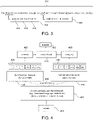
- Fig. 3 illustrates an example of opinion triplet extraction in ABSA.
- the opinion triplets 310 and 320 may be extracted in accordance with method 200 and comprise an aspect term 312, an aspect category 314 and a polarity 316 of the aspect term 312.
- the opinion triplets 310 and 320 are output by a multi-output architecture, such as the neural end-to-end ABSA system illustrated in Fig. 4 .
- the neural end-to-end ABSA system may be made of a contextual language model (BERT-like) encoder on top of which two Self Attention Networks (SANs) are defined.
- One SAN is used to infer which polarity (if any) a current token reflects, and the other SAN estimates which aspect category (if any) the current token pertains to.
- Fig. 4 illustrates an architecture of the neural end-to-end ABSA system according to an embodiment.
- the neural end-to-end ABSA system is configured to receive an input 410, such as a sequence of tokens that is input to a contextual language model encoder 420 of the neural end-to-end ABSA system.
- the output of the contextual language model encoder 420 are representations 425 that are input to a first self-attention network 430 and a second self-attention network 440.
- representations 425 are defined by embedding context in tokens in the sequence of tokens (e.g., determined by neighboring tokens in the sequence of tokens).
- the first self-attention network 430 and the second self-attention network 440 extract aspect terms 435 and 445, respectively, based on the representations 425. Further, the first self-attention network 430 and the second self-attention network 440 determine polarities 450 and categories 460 of aspect terms 435 and 445, respectively.
- the aspect terms 435 and 445 are encoded using the BIO format, together with polarity (e.g., [O],[O],[O],[B-POS],[I-POS],[I-POS], where "POS" corresponds to the positive polarity), and category (e.g., [O],[O],[O],[B-FOO],[I-FOO],[I-FOO], where "FOO" corresponds to the food category).
- polarity e.g., [O],[O],[O],[B-POS],[I-POS],[I-POS], where "POS" corresponds to the positive polarity
- category e.g., [O],[O],[O],[B-FOO],[I-FOO],[I-FOO], where "FOO" corresponds to the food category.
- the neural end-to-end ABSA system uses one or more loss functions (e.g., the first loss function and the second loss function described above) to provide consistency 470 between the polarity 450 and the category 460 of aspect terms when generating outputs 480 consisting a composite (or final) aspect term 435/445 (i.e., aspect term, aspect category and the polarity triplets).
- the aspect terms in the outputs 480 may be encoded using the BIO format with a composite polarity and category (e.g., [O], [O], [O], [B-POS/FOO], [I-POS/FOO], [I-POS/FOO]).
- the contextual language model encoder 420 may be a pretrained language model, such as the Bidirectional Encoder Representations from Transformers (BERT) encoder, to embed each token with their context.
- the contextual language model encoder 420 may be a task-specific layer 430/440, which can be trained with a dataset, such as SemEval 2016 task 5 ( Maria Pontiki, Dimitrios Galanis, Haris Papageorgiou, Ion Androutsopoulos, Suresh Manandhar, Mohammad Al-Smadi, Mahmoud Al-Ayyoub, Yanyan Zhao, Bing Qin, Orphee De Clercq, et al. 2016.
- SemEval 2016 task 5 Maria Pontiki, Dimitrios Galanis, Haris Papageorgiou, Ion Androutsopoulos, Suresh Manandhar, Mohammad Al-Smadi, Mahmoud Al-Ayyoub, Yanyan Zhao, Bing Qin, Orphee De Cler
- the task-specific layer 430/440 may comprise a Self-Attention layer, which produces better results than Conditional Random Fields and other types of layers.
- Self-Attention Networks may use the dot product attention with Layer Normalization, but no feed forward layer.
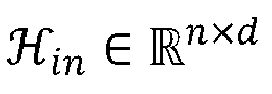
- the embeddings of the representations 425 of the sequence of tokens may be computed as follows:
- n the number of tokens embedded
- d the dimension of the embeddings
- Q , K , V ⁇ R d the query, key and value matrices respectively.
- This task specific layer 430/440 is duplicated in the neural end-to-end ABSA system, with one focusing on polarity detection at 430 and the other on category detection at 440.
- the contextual language model encoder 420 remains shared by both classification heads.
- each example yields a loss value for both types of classification which may be used to optimize jointly at 470 every parameter from the neural end-to-end ABSA system to ensure consistency between polarity and category.
- a simple baseline modeling end-to-end extraction of ABSA triplets is used to compare the neural end-to-end ABSA system.
- the BIO position prefix of each term is concatenated with its category and polarity. This has the disadvantage of multiplying the number of possible labels. For example, 6 different labels for categories, 3 for polarities, and each entity tagged with the BIO scheme, may result in 37 labels, some of which with very few training examples.
- ABSA system Compared to the baseline model, where each classification type has very few task specific parameters, the neural end-to-end ABSA system according to embodiments, which will be called ABSA system in the following part of the description, grants each head its own capacity at the final layer of the network to model complex situations. At the same time, having completely distinct models would not only result in an important total number of parameters but most importantly no shared information between tasks. In the model according to embodiments, the shared encoder, which represent 89% of the parameters of the model, still has to work with information from both tasks which should help extract better representations.
- a BERT-base-uncased version of BERT was used for the contextualized embeddings in the monolingual (en) setting and a BERT-base-multilingual-cased version was used for the multilingual setting.
- These pre-trained models use 12 layers of Transformers with 12 heads in each layer and a hidden size of 768.
- the SAN layer on top of the encoder uses only a single layer with the same characteristics as BERT, 12 heads with hidden size 768.
- XLM-Roberta-Large was used, that has 24 layers with 16 heads each, and uses a hidden size of 1027.
- the models can be trained with a linearly decreasing learning rate.
- the training can start with a learning rate of 2 ⁇ 10 -5 and a batch size of 16 can be used.
- the network can be trained for 3,000 steps, with early stopping on the validation F1 score. Given the small size of the dataset, each experiment can be run with five different initializations and 10-fold cross validation can be used each time.
- Results show a slight advantage to using both strategies of dynamic loss weighting and logical dependencies combined, although the performance is lower when used independently. Once again, high standard deviations show that the models are not robust to different initializations.
- the neural end-to-end ABSA system has also been applied to multilingual data obtained directly from SemEval 2016 task 5 restaurant reviews. Datasets are provided in English ( en ), French ( fr ) , Spanish ( es ), Dutch ( nl ) , Russian ( ru ) and Vietnamese ( tr ).
- the system performance of the neural end-to-end ABSA system may be evaluated on different languages.
- Multilingual contextual embeddings can be used to train the neural end-to-end ABSA system jointly on several languages and inference can be performed on languages unseen during training.
- the neural end-to-end ABSA system architecture may tackle the three ABSA subtasks jointly, i.e. extracts opinion triplets relating target terms to their aspect category and polarity; Accordingly, embodiments allow for joint zero shot cross lingual ATE, APD and ACD, and augmentation of training data.
- Weighting the loss depending on the target language yields small improvements over the baseline where each language has the same importance.
- One reason for this may be that embedding information for sentiments might be less language dependent than embeddings for aspects, e.g. food and drink, which benefit from similar languages with closer cultures.
- One downside of this strategy is the multiplication of models, since one model per target language is trained, instead of a single model handling several languages at once.
- Table 3 F1 scores of the ABSA system for polarities trained with mBERT on one or all languages and evaluated on the test set of single languages. "All weighted" means that language discrimination was performed. Results are averaged on five runs. Standard deviations come from different initializations.
- ABSA system has been evaluated with a different encoder, XLM-R. Results with these embeddings were obtained with the exact same setup as with mBERT and are presented in tables 6 to 8.
- Using this encoder yields important gains on monolingual supervised training, e.g. 19.97 points improvement for the triplets ⁇ Term, Cat, Pol> for a model trained on tr and evaluated on tr.
- a 36.16 points gain for triplets when training on en and evaluating on tr could be observed. This is most probably due to a better alignment in cross lingual representations in XLM-R than mBERT, thanks to more diverse data during the pre-training, better covering under represented languages like Turkish.
- ABSA system trained with XML-R on English only is also compared with the ABSA system trained with monolingual BERT (table 1).
- the evaluation results on the English test set shows significant improvements on the F1 score with XML-R, on all tasks: +6.6 for polarities, +4.4 for categories, and +6.9 for triplets. Accordingly, multilingual embeddings can be a valuable alternative to monolingual embeddings for tasks such as ABSA.
- Table 6 F1 scores of the ABSA system, with XLM-R as encoder instead of mBERT, for the polarities.
- Some or all of the method steps may be implemented by a computer in that they are executed by (or using) a processor, a microprocessor, an electronic circuit or processing circuitry.
- the embodiments described above may be implemented in hardware or in software.
- the implementation can be performed using a non-transitory storage medium such as a computer-readable storage medium, for example a floppy disc, a DVD, a Blu-Ray, a CD, a ROM, a PROM, and EPROM, an EEPROM or a FLASH memory.
- a computer-readable storage medium for example a floppy disc, a DVD, a Blu-Ray, a CD, a ROM, a PROM, and EPROM, an EEPROM or a FLASH memory.
- Such computer-readable media can be any available media that can be accessed by a general-purpose or special-purpose computer system.
- embodiments can be implemented as a computer program product with a program code or computer-executable instructions, the program code or computer-executable instructions being operative for performing one of the methods when the computer program product runs on a computer.
- the program code or the computer-executable instructions may be stored on a computer-readable storage medium.
- a storage medium (or a data carrier, or a computer-readable medium) comprises, stored thereon, the computer program or the computer-executable instructions for performing one of the methods described herein when it is performed by a processor.
- an apparatus comprises one or more processors and the storage medium mentioned above.
- an apparatus comprises means, for example processing circuitry like, e.g., a processor communicating with a memory, the means being configured to, or adapted to perform one of the methods described herein.
- a further embodiment comprises a computer having installed thereon the computer program or instructions for performing one of the methods described herein.
- Fig. 5 which comprises server 500 and one or more client devices 502 that communicate over a network 504 (which may be wireless and / or wired) such as the Internet for data exchange.
- Server 500 and the client devices 502 include a data processor 512 and memory 513 such as a hard disk.
- the client devices 502 may be any device that communicates with server 500, including autonomous vehicle 502b, robot 502c, computer 502d, or cell phone 502e.
- the method according to the embodiment of Fig. 1 and/or Fig. 2 may be performed at server 500.
- the methods according to the embodiments of Fig. 1 and/or Fig. 2 may be performed at client device 502 partially or completely.
- the methods may be performed at a different server or on a plurality of servers in a distributed manner.
- a novel single neural network for an end-to-end Aspect Based Sentiment Analysis (ABSA) multitask system that jointly discovers opinion triplets (term, polarity, category) in one or multiple languages, trained with a loss function integrating a penalty term for enforcing BIO tagging format (i.e., Beginning [B], Inside [I], Outside/Other [O]) for sequence annotation consistency is disclosed.
- ABSA Aspect Based Sentiment Analysis
- Consistency between the two branches is evaluated because the branches can predict different things. Specifically, the consistency check examines that the category and polarity are associated with a term and the BIO sequence of the term are consistent between the branches. The trade-off of having two branches is that you have less labels, but you can have inconsistent outputs.
- a 'single network' means that a large number of the network's weights are simultaneously trained and involved in computing all components of the tuple. Therefore in training, the loss function is defined such that it penalizes the cases where the output is inconsistent thereby forcing the two branches (category/polarity) to learn, and therefore produce, output that is consistent.
- a second aspect concerns a single neural network for an end-to-end Aspect Based Sentiment Analysis (ABSA) multilingual multitask system that separately discovers polarities and/or categories (i.e., doubles or triples), trained using a weighted loss, which in one embodiment is the weighted loss set out in the first aspect, or another loss in other embodiments, based on language similarities between the target language and the source language of the training examples (i.e., a single opinion-tuple extraction network, using training data in multiple languages).
- a 'single network' means that a large number of the network's weights are simultaneously trained and involved in computing all components of the tuple.
- a neural, end-to-end ABSA system predicting both aspect categories and polarities in two output branches.
- the system may be trained with a loss function integrating a penalty term for enforcing BIO tag consistency between the two outputs.
- a neural, end-to-end ABSA system predicting at least one of aspect categories and polarities for any language L is disclosed.
- the system may be trained on labelled, multi-lingual datasets using a weighted loss based on language similarities between L and the languages of the training examples, estimated from cross-lingual F1 scores.
Landscapes
- Engineering & Computer Science (AREA)
- Theoretical Computer Science (AREA)
- Physics & Mathematics (AREA)
- Health & Medical Sciences (AREA)
- Artificial Intelligence (AREA)
- Computational Linguistics (AREA)
- General Health & Medical Sciences (AREA)
- General Physics & Mathematics (AREA)
- General Engineering & Computer Science (AREA)
- Evolutionary Computation (AREA)
- Biomedical Technology (AREA)
- Molecular Biology (AREA)
- Computing Systems (AREA)
- Data Mining & Analysis (AREA)
- Biophysics (AREA)
- Mathematical Physics (AREA)
- Software Systems (AREA)
- Life Sciences & Earth Sciences (AREA)
- Audiology, Speech & Language Pathology (AREA)
- Human Computer Interaction (AREA)
- Acoustics & Sound (AREA)
- Multimedia (AREA)
- Machine Translation (AREA)
Abstract
Description
- The present disclosure relates to aspect based sentiment analysis (ABSA). In particular, the present disclosure relates to a neural end-to-end ABSA system that jointly discovers polarities and categories of aspect terms.
- Sentiment Analysis is a use case of Natural Language Processing (NLP). In its basic version, it assists in classifying the polarity of a given sentence or document. However, it only captures coarse-grained sentiments at a global level. Aspect-Based Sentiment Analysis (ABSA) is the task of identifying fine-grained opinion polarity towards a specific aspect associated with a given target term (i.e., an aspect term). The ABSA task requires Aspect Term Detection (ATE), i.e. detecting the aspect term, or opinionated term, associated with the specific aspect, Aspect Polarity Detection (APD), i.e. detecting term polarity and Aspect Category Detection (ACD), i.e. detecting the term domain-dependent category, for instance SERVICE or DRINKS in the Restaurants domain. Most of the existing work in ABSA focuses on ATE and APD.
- ABSA was classically divided in the subtasks of ATE, APD and ACD, and then combined in a pipeline to perform the whole opinion extraction. However, one of the problems with these approaches is that errors are propagated from subtask to subtask. Moreover, evaluating the tasks separately, based on the ground truth of the previous task, as it is usually done for ABSA is unrealistic and inefficient, as only performances on a complete extraction are relevant for "real world" applications. Further, these systems may be extensive and may require relatively large amounts of memory.
- In order to alleviate these problems, authors have tried to tackle ABSA as an end-to-end problem, for example by solving ATE and ACD in parallel (Ruidan He, Wee Sun Lee, Hwee Tou Ng, and Daniel Dahlmeier. 2019. "An interactive multi-task learning network for end-to-end aspect-based sentiment analysis". arXiv preprint arXiv:1906.06906.) or by transforming ATE and APD into a sequence labeling task (Xin Li, Lidong Bing, Piji Li, and Wai Lam. 2019a. "A unified model for opinion target extraction and target sentiment prediction". In Proceedings of the AAAI Conference on Artificial Intelligence, volume 33, pages 6714-6721), where each token is tagged individually with its position in the group and its polarity (positive, negative, neutral).
- However, such state-of-the-art systems do not perform the three sub-tasks at once, i.e. Target term, Aspect category and Sentiment detection. Further, conventional state-of-the-art systems are often underperforming, because of a small number of annotated examples in ABSA datasets for the training of these systems.
- Accordingly, there is a need to address the problem of inefficient and underperforming ABSA systems and the training thereof. More concretely, in view of the problem of error propagation and inefficiency, there is a need for an improved ABSA system and an improved training method for such a system. This is of particular interest when deploying applications to real-world scenarios where an ABSA system is expected to detect an aspect term, an aspect polarity and an aspect category with limited memory resources.
- To address the challenges in the state of the art, novel methods and systems for training a neural end-to-end aspect based sentiment analysis (ABSA) system with a dataset is disclosed.
- In an embodiment, a computer-implemented method for training a neural end-to-end ABSA system with a dataset comprises inputting a batch of samples of a dataset into the neural end-to-end ABSA system. The neural end-to-end ABSA system comprises a contextual language model encoder for embedding tokens with context and a first self-attention network for detecting an aspect term and providing a first output corresponding to the aspect term and a second self-attention network for detecting the aspect term and providing a second output corresponding to the aspect term. An output of the contextual language model encoder is input into the first self-attention network and the second self-attention network. The method further comprises adapting weights of the neural end-to-end ABSA system based at least in part on a first loss function and the inputted batch of samples. The first loss function comprises a consistency loss function, which may consider a first probability of classifying a token as not being an aspect term by the first self-attention network and a second probability of classifying the token as not being an aspect term by the second self-attention network, to provide for consistent aspect term detection by the first self-attention network and the second self-attention network.
- By adapting weights of the neural end-to-end ABSA system based at least in part on a first loss function comprising a consistency loss function to provide for consistent aspect term detection by the first self-attention network and the second self-attention network, and the inputted batch of samples, an improved method for efficiently training a neural end-to-end ABSA system that accurately detects aspect terms and provides outputs corresponding to the aspect term is provided. In addition, the training allows exploiting dependencies between the two tasks of the two self-attention networks that are mutually beneficial. Furthermore, the novel training method allows training small neural network systems regarding the number of parameters compared to state of the art systems with a similar performance.
- According to aspects, the dataset comprises a multi-lingual dataset. The neural end-to-end ABSA system may be trained for a single language, such as a target language, and a loss associated with one or more samples of a first language of the multilingual dataset for the training of the neural end-to-end ABSA system may be weighted based on a language similarity between the first language and the single language. The language similarity may be determined based on an F-score of a model, such as a neural end-to-end ABSA system, trained on the first language and evaluated on the single language. By training the neural end-to-end ABSA system on multilingual data, the method alleviates the problem of ABSA-labelled data scarcity.
- In aspects, the neural end-to-end ABSA system is trained to output triplets including the aspect term, the first output comprising a category corresponding to the aspect term and the second output comprising a polarity corresponding to the aspect term. The first self-attention network and the second self-attention network may be trained simultaneously. The contextual language model encoder may be based on a pre-trained transformer. According to aspects, the neural end-to-end ABSA system is adapted based on a second loss function, wherein the second loss function weights a loss associated with the first self-attention network and a loss associated with the second self-attention network.
- In an embodiment, a neural end-to-end ABSA system for predicting aspect categories and polarities comprises a contextual language model encoder, a first self-attention network, and a second self-attention network. An output of the contextual language model encoder is a first input for the first self-attention network and a second input for the second self-attention network. The neural end-to-end ABSA system is configured to receive a sequence of tokens, embed, by the contextual language model encoder, tokens of the sequence of tokens with context into representations, extract, by the first self-attention network and the second self-attention network, an aspect term based on the representations, determine, by the first self-attention network, an aspect category of the aspect term, and determine, by the second self-attention network, a polarity of the aspect term. The neural end-to-end ABSA system may further be configured to output triplets including the aspect term, the aspect category and the polarity.
- In aspects, the contextual language model encoder is based on a multilingual contextual language model encoder. A first probability of classifying a token as not being an aspect term by the first self-attention network corresponds to a second probability of classifying the token as not being an aspect term by the second self-attention network, which provides for consistent aspect term detection by the first self-attention network and the second self-attention network.
- In an embodiment, a neural end-to-end ABSA system for predicting at least one of aspect categories and polarities for a plurality of languages comprises a multilingual encoder configured for embedding tokens of a sequence of tokens with context into representations, and at least one of a first self-attention network configured to associate an aspect category to a first aspect term from the representations, and a second self-attention network configured to associate a polarity to a second aspect term from the representations. The outputs of the first and second first self-attention network are merged under consistency constraints to output the final aspect term together with its aspect category and polarity.
- In an embodiment, a computer-readable storage medium comprises instructions which, when executed by a computer, cause the computer to carry out the steps of training a neural end-to-end ABSA system with a multilingual dataset. The neural end-to-end ABSA system comprises a multilingual contextual language model encoder for embedding tokens with context into representations and is followed by at least one of a first self-attention network configured for detecting an aspect term and determining an aspect category of the aspect term based on the representations, and a second self-attention network for detecting the aspect term and determining a polarity of the aspect term based on the representations. The neural end-to-end ABSA system may be trained for one or more specific languages. The neural end-to-end ABSA system may be trained using a weighted loss based on language similarities between languages of the multilingual dataset and the one or more specific languages. The language similarities may be determined based on cross-lingual F-scores of a model, such as a neural end-to-end ABSA system, trained on at least one of the languages of the multilingual dataset and evaluated on the one or more specific languages.
- In a further embodiment, a computer-readable storage medium having computer-executable instructions stored thereon is provided. When executed by one or more processors, the computer-executable instructions perform the method for training a neural end-to-end aspect based sentiment analysis, ABSA, system described above.
- In a further embodiment, an apparatus comprising processing circuitry is provided. The processing circuitry is configured to execute a neural end-to-end aspect based sentiment analysis, ABSA, system described above.
- The following detailed description and accompanying drawings provide a more detailed understanding of the nature and advantages of the present invention.
- The accompanying drawings are incorporated into and form a part of the specification for the purpose of explaining the principles of the embodiments. The drawings are not to be construed as limiting the embodiments to only the illustrated and described embodiments of how they can be made and used. Further features and advantages will become apparent from the following and more particularly from the description of the embodiments, as illustrated in the accompanying drawings, wherein:
-
Fig. 1 illustrates a process flow diagram of a method for training a neural end-to-end aspect based sentiment analysis, ABSA, system in accordance with at least one embodiment, -
Fig. 2 illustrates a process flow diagram of a method for executing a neural end-to-end aspect based sentiment analysis, ABSA, system in accordance with at least one embodiment, -
Fig. 3 illustrates an example of an opinion triplet detection according to an embodiment, -
Fig. 4 illustrates an example architecture of a neural end-to-end aspect based sentiment analysis system in accordance with embodiments, and -
Fig. 5 illustrates an example architecture in which the disclosed methods may be performed. - Described herein are systems and methods for training a neural end-to-end aspect based sentiment analysis (ABSA) system with a dataset. For purposes of explanation, numerous examples and specific details are set forth in order to provide a thorough understanding of the described embodiments. Embodiments as defined by the claims may include some or all of the features in these examples alone or in combination with other features described below, and may further include modifications and equivalents of the features and concepts described herein. The illustrative embodiments will be described with reference to the drawings wherein elements and structures are indicated by reference numbers. Further, where an embodiment is a method, steps and elements of the method may be combinable in parallel or sequential execution. As far as they are not contradictory, all embodiments described below can be combined with each other.
- Aspect Based Sentiment Analysis (ABSA) aims to identify fine-grained opinion polarity towards specific aspects associated with a given target term (i.e., aspect term). Recent works tackled this task as an end-to-end problem, detecting terms together with their polarity, or, less frequently, terms with their aspect categories. However, they do not extract joint information about aspect terms, aspect categories, and polarities, i.e. opinion triplets. Embodiments address this task with a system that models polarity (e.g., positive, negative, neutral, or conflict [i.e., both positive and negative]) and category (e.g., domain-dependent categories associated with POI (point of interest) categories such as shopping, transportation, lodging, etc.) signals jointly. It can be shown that this system preserves performances from past works on standard ABSA subtasks, while extracting full ABSA information, i.e. opinion triplets.
- In embodiments, pre-trained contextualized word embeddings help to improve results on several NLP tasks, due to the rich syntactic and semantic information contained in their pre-trained representations. Fine-tuning these models on downstream tasks is also highly efficient. For example, the pre-trained language model BERT can be combined with a task specific head (e.g., a Conditional Random Field (CRF) network, only linear, or a Self-Attention Network (SAN)) to label each token with a sequence annotation tagging scheme such as the BIO format (i.e., Beginning [B], Inside [I], Outside/Other [O]) tagging scheme with a category tag and a polarity tag.
- An example CRF network that may be used in embodiments herein as a task specific head is disclosed by Zhiheng Huang, Wei Xu, and Kai Yu, in "Bidirectional Istm-crf models for sequence tagging", arXiv preprint arXiv:1508.0199 2015, which is incorporated herein by reference. Further, an example SAN that may be used in embodiments herein as a task specific head is disclosed by Xin Li, Lidong Bing, Wenxuan Zhang, Wai Lam in "Exploiting BERT for End-to-End Aspect-based Sentiment Analysis", proceedings of the 5th Workshop on Noisy User-generated Text (W-NUT 2019), which is incorporated herein by reference.
- Nonetheless, even though transfer learning dramatically improves sample efficiency, the small number of annotated examples in ABSA datasets remains hard to work with. To alleviate this problem, works in ABSA have focused on fine-tuning pre-trained representations using in-domain data after the general pre-training task and before the task-specific fine-tuning step. However, this leads to an increased computational cost and the need for a large amount of in-domain data, which is not always available in practice. A system according to embodiments is trained in a multilingual context. Evaluation of this system using data in six different languages have shown how non-parallel, multilingual data can help alleviate the issue of ABSA-labelled data scarcity.
-
Fig. 1 is a process flow diagram of anexemplary method 100 for training a neural end-to-end aspect based sentiment analysis, ABSA, system with a dataset in accordance with an embodiment. - At
step 110, the method comprises inputting a batch of samples of a dataset into the neural end-to-end ABSA system. The neural end-to-end ABSA system comprises a contextual language model encoder for embedding tokens with context. Additionally, the neural end-to-end ABSA system comprises a first self-attention network for detecting an aspect term and providing a first output and a second self-attention network for detecting the aspect term and providing a second output. The contextual language model encoder is followed by the first self-attention network and the second self-attention network, so that an output of the contextual language model encoder is input into the first self-attention network and the second self-attention network. The neural end-to-end ABSA system may be trained to output triplets including the aspect term, the first output comprising a category corresponding to the aspect term and the second output comprising a polarity corresponding to the aspect term. - The contextual language model encoder may be based on a pre-trained transformer and is fine-tuned during the training. A transformer is a deep learning model and is configured to handle sequential data, such as natural language. In contrast to recurrent neural networks (RNNs), such as the long short-term memory (LSTM), or models that process sequential data in order, transformers do not require that the sequential data be processed in order. Due to this feature, the transformer allows for much more parallelization than RNNs and therefore reduced training times. Examples of pre-trained transformers are BERT (Bidirectional Encoder Representations from Transformers) and GPT (Generative Pre-trained Transformer), which have been trained with huge general language datasets, such as Wikipedia Corpus, and can be fine-tuned to specific language tasks.
- At
step 120, the method comprises adapting weights of the neural end-to-end ABSA system based at least in part on a first loss function and the inputted batch of samples. The batch of samples may comprise one or more labeled samples, such as a labeled sequence of tokens or a labeled sentence. For example, a sentence may be labeled in accordance with a BIO format annotation. For the sentence "Italian pasta was great." the BIO annotation may be "Italian [B-Food] pasta [I-Food] was [O] great [O]." (i) for the category branch, (where "Food" is the category output by the category branch); and (ii) for the polarity branch the BIO annotation for the sentence may be: "Italian [B-Positive] pasta [I-Positive] was [O] great [O]." (where "Positive" is the polarity output by the polarity branch). Thesteps - The first loss function considers a first probability of classifying a token as not being an aspect term by the first self-attention network and a second probability of classifying the token as not being an aspect term by the second self-attention network, to provide for consistent aspect term detection by the first self-attention network and the second self-attention network. By using a consistency loss between the category and polarity outputs, the method encourages the two self-attention networks to agree on whether or not an aspect term has been spotted.
- The dataset may comprise a multilingual dataset comprising samples of different languages. The neural end-to-end ABSA system may be trained for a single or specific language. A loss associated with one or more samples of a first language of the dataset for the training of the neural end-to-end ABSA system may be weighted based on a language similarity between the first language and the single or specific language. The language similarity may be determined based on an F-score of a model, such as a neural end-to-end ABSA system or a different ABSA model, trained on the first language and evaluated on the single or specific language. The language similarity may be obtained from a table indicating language similarities between different languages.
- Multi-output learning can be either beneficial or detrimental. Either both tasks "teach" something to the network that benefits to the other task, or they compete for capacity of the network, biasing weights toward one or the other loss, hurting final performance. Therefore, the neural end-to-end ABSA system may be adapted based at least in part on a second loss function to balance the losses corresponding to each output during the training. The second loss function weights a loss associated with the first self-attention network and a loss associated with the second self-attention network. For example, to balance our two losses a Dynamic Weighted Average can be used. The first self-attention network and the second self-attention network are trained simultaneously.
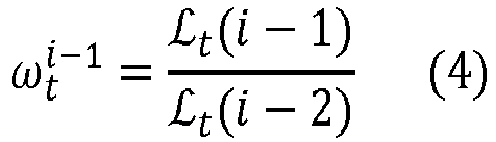
- The Dynamic Weighted Average method does not require accessing the intermediate layers of the model. Dynamic Weighted Average computes weights


 the loss of that particular task, T a temperature parameter, K a scaling parameter and i the training step. For steps


- The final loss for the multi-output network at time step i is given by the following formula:

- Since the network has two specific branches performing sequence tagging, one for polarities and one for categories, they detect the term twice, i.e. both detect whether a token is part of an aspect term or not. This could lead to inconsistencies between branches, where one would predict a term and the other would not. Both branches can be forced to yield the same token probabilities of not being a term. To do that, a third loss (or consistency loss) described in equation 6 can be added.


- According to embodiments, multilingual contextual embeddings and the available multilingual data from SemEval 2016 are used to assess whether the neural end-to-end ABSA system can perform zero shot cross lingual evaluation.
- Zero shot cross lingual evaluation consists here in assessing whether the neural end-to-end ABSA system, trained with monolingual data only, can still perform well when predicting aspect terms, polarities and categories in a language unseen during fine-tuning. Multilingual pre-trained encoders, such as mBERT, yield representations for tokens and sentences that are almost aligned across languages and thus allow such inference. Unfortunately, when applied on monolingual data only, they may underperform compared to strictly monolingual encoders, such as BERT.
- To alleviate the lack of training data, a greater number of samples in different languages can be used for the training. This can improve performances on one target language. Two different training methods are disclosed. The first method comprises that all samples or examples are fed randomly to the model (the neural end-to-end ABSA system) without any language-based discrimination, which yielded a single model performing decently on all languages. The second method targets a single language ltarget and comprises training the model on a plurality of languages, and weighting a loss by a factor ωl depending on the language l of the sample or example. ωl is defined in equation 7, where F 1(l 1 → l 2) corresponds to an F-score of a model trained on language l 1 and evaluated on language l 2 , α being a hyper-parameter.

- The parameter helps to discriminate the respective contribution of the different languages: when α > 1, the loss value for languages with good performances on the target language will be significantly higher than for languages with poor performance, while with α < 1, all examples are treated equally with respect to the optimization. Depending on α, higher ratios of F-scores for different languages will be more discriminative (α > 1), or will result in similar weight values (α < 1)
-
Fig. 2 is a process flow diagram of anexemplary method 200 for predicting aspect categories and polarities by a neural end-to-end ABSA system in accordance with an embodiment. The neural end-to-end ABSA system may be trained in accordance with themethod 100. The neural end-to-end ABSA system comprises a contextual language model encoder, a first self-attention network, and a second self-attention network. The neural end-to-end ABSA system may be explained in more detail with respect toFig. 4 . An output of the contextual language model encoder is a first input for the first self-attention network (first branch) and a second input for the second self-attention network (second branch). A first probability of classifying a token as not being an aspect term by the first self-attention network may correspond to or may approximately correspond to a second probability of classifying the token as not being an aspect term by the second self-attention network, to provide for consistent aspect term detection by the first self-attention network and the second self-attention network. In aspects, the contextual language model encoder may be based on a multilingual contextual language model encoder. - The
method 200 comprises receiving a sequence of tokens, such as one or more sentences instep 210. A token in NLP may be a string of contiguous characters between two spaces, or between a space and punctuation marks. A token can also be an integer or a number. Atstep 220, tokens of the sequence of tokens are embedded with context into representations. The tokens may be embedded by a transformer, e.g. the contextual language model encoder. Atstep 230, an aspect term is extracted based on the representations. The aspect term may be detected twice, e.g. in the first branch and the second branch. Based on the aspect term, an aspect category is determined instep 240 and a polarity is determined instep 250. The aspect category and the polarity may be determined in the first and the second branch, respectively. Atstep 260, an opinion triplet is output. The opinion triplet comprises the aspect term, the aspect category, and the polarity, where the aspect category and polarity are consistent for the aspect term. -
Fig. 3 illustrates an example of opinion triplet extraction in ABSA. The opinion triplets 310 and 320 may be extracted in accordance withmethod 200 and comprise anaspect term 312, anaspect category 314 and apolarity 316 of theaspect term 312. The opinion triplets 310 and 320 are output by a multi-output architecture, such as the neural end-to-end ABSA system illustrated inFig. 4 . Specifically, the neural end-to-end ABSA system may be made of a contextual language model (BERT-like) encoder on top of which two Self Attention Networks (SANs) are defined. One SAN is used to infer which polarity (if any) a current token reflects, and the other SAN estimates which aspect category (if any) the current token pertains to. -
Fig. 4 illustrates an architecture of the neural end-to-end ABSA system according to an embodiment. The neural end-to-end ABSA system is configured to receive aninput 410, such as a sequence of tokens that is input to a contextuallanguage model encoder 420 of the neural end-to-end ABSA system. The output of the contextuallanguage model encoder 420 arerepresentations 425 that are input to a first self-attention network 430 and a second self-attention network 440. In embodiments,representations 425 are defined by embedding context in tokens in the sequence of tokens (e.g., determined by neighboring tokens in the sequence of tokens). The first self-attention network 430 and the second self-attention network 440extract aspect terms representations 425. Further, the first self-attention network 430 and the second self-attention network 440 determinepolarities 450 andcategories 460 ofaspect terms - In the example shown in
Fig. 4 , theaspect terms consistency 470 between thepolarity 450 and thecategory 460 of aspect terms when generatingoutputs 480 consisting a composite (or final)aspect term 435/445 (i.e., aspect term, aspect category and the polarity triplets). In the example shown inFig. 4 , the aspect terms in theoutputs 480 may be encoded using the BIO format with a composite polarity and category (e.g., [O], [O], [O], [B-POS/FOO], [I-POS/FOO], [I-POS/FOO]). - In an embodiment of the neural end-to-end ABSA system, the contextual
language model encoder 420 may be a pretrained language model, such as the Bidirectional Encoder Representations from Transformers (BERT) encoder, to embed each token with their context. On top of the contextuallanguage model encoder 420 may be a task-specific layer 430/440, which can be trained with a dataset, such as SemEval 2016 task 5 (Maria Pontiki, Dimitrios Galanis, Haris Papageorgiou, Ion Androutsopoulos, Suresh Manandhar, Mohammad Al-Smadi, Mahmoud Al-Ayyoub, Yanyan Zhao, Bing Qin, Orphee De Clercq, et al. 2016. "Semeval-2016 task 5: Aspect based sentiment analysis". In 10th International Workshop on Semantic Evaluation (SemEval 2016)). The task-specific layer 430/440 may comprise a Self-Attention layer, which produces better results than Conditional Random Fields and other types of layers. Self-Attention Networks (SAN) may use the dot product attention with Layer Normalization, but no feed forward layer. The embeddings of therepresentations 425 of the sequence of tokens may be computed as follows:

- With

- This task
specific layer 430/440 is duplicated in the neural end-to-end ABSA system, with one focusing on polarity detection at 430 and the other on category detection at 440. The contextuallanguage model encoder 420 remains shared by both classification heads. During optimization (fine-tuning), each example yields a loss value for both types of classification which may be used to optimize jointly at 470 every parameter from the neural end-to-end ABSA system to ensure consistency between polarity and category. - As an example, a simple baseline modeling end-to-end extraction of ABSA triplets is used to compare the neural end-to-end ABSA system. To model all outputs, the BIO position prefix of each term is concatenated with its category and polarity. This has the disadvantage of multiplying the number of possible labels. For example, 6 different labels for categories, 3 for polarities, and each entity tagged with the BIO scheme, may result in 37 labels, some of which with very few training examples.
- Compared to the baseline model, where each classification type has very few task specific parameters, the neural end-to-end ABSA system according to embodiments, which will be called ABSA system in the following part of the description, grants each head its own capacity at the final layer of the network to model complex situations. At the same time, having completely distinct models would not only result in an important total number of parameters but most importantly no shared information between tasks. In the model according to embodiments, the shared encoder, which represent 89% of the parameters of the model, still has to work with information from both tasks which should help extract better representations.
- In experiments, a BERT-base-uncased version of BERT was used for the contextualized embeddings in the monolingual (en) setting and a BERT-base-multilingual-cased version was used for the multilingual setting. These pre-trained models use 12 layers of Transformers with 12 heads in each layer and a hidden size of 768. The SAN layer on top of the encoder uses only a single layer with the same characteristics as BERT, 12 heads with hidden
size 768. In the multilingual setting, also XLM-Roberta-Large was used, that has 24 layers with 16 heads each, and uses a hidden size of 1027. - The models can be trained with a linearly decreasing learning rate. The training can start with a learning rate of 2·10-5 and a batch size of 16 can be used. The network can be trained for 3,000 steps, with early stopping on the validation F1 score. Given the small size of the dataset, each experiment can be run with five different initializations and 10-fold cross validation can be used each time.
- In table 1, results on a test dataset are presented. They were obtained over 5 runs, using early stopping on a development set created with 10 fold cross validation. "Duplicate" is introduced as another naive baseline, where the system from Li et al. (Xin Li, Lidong Bing, Wenxuan Zhang, and Wai Lam. 2019b. "Exploiting BERT for end-to-end aspect-based sentiment analysis". arXiv preprint arXiv:1910.00883) is duplicated, to predict polarities on one side and categories on the other. This yields decent results, but at the cost of twice as many parameters.
Table 1: F1 scores for the different systems on the test set of SemEval 2016 "Restaurant reviews", averaged over five runs with different initializations. Standard deviations (in parenthesis) come from those five runs. "-" indicates that the task was not performed by the system. System #Params Polarity Category <Term, Cat, Pol> BERT + SAN (Li et al.) 117M 70.82 (0.43) - - Duplicate (BERT + SAN) 234M 70.82 (0.43) 75.58 (0.51) - Baseline 117M 70.63 (0.50) 75.67 (0.46) 68.15 (0.55) ABSA system 124M 70.33 (0.41) 75.58 (0.72) 67.56 (0.57) - Although the system from Li et al. yields slightly higher results on polarities, and could be duplicated to extract triplets, the ABSA system is capable of extracting the same triplets with half the number of parameters, and similar performance. Indeed, a very high variance could be found over initializations, due to the limited number of training examples that limit the interpretability of results. Results on 10 fold cross validation on the training set exhibited an opposite behavior, with the ABSA system according to embodiments slightly above all other systems.
- In order to assess the impact of the different techniques used in the neural end-to-end ABSA system according to embodiments, an ablation study has been performed and the results are presented in table 2. These results are obtained with 10 fold cross validation, hence the differences with test results from table 1 for the "base + (1) + (2)" model (the ABSA system). For the "base" version, fixed weights for losses are used (instead of the Dynamic Weighted Average) optimized using a hyper-parameter search. For the weights λ pοl = 0,55 and λ cat = 0,45 was found to be the best performing weighting of losses.
Table 2: F1 scores on polarity and category detection and classification. Results on 10 fold cross validation using mean and standard deviation across five runs. System Polarity Category base : BERT with SAN (fixed weights for losses) 73.79 (0.20) 77.03 (0.36) base + (1) dynamic loss weighting 73.65 (0.31) 76.83 (0.35) base + (2) logical dependencies 73.47 (0.45) 76.67 (0.48) ABSA system: base + (1) + (2) 73.93 (0.37) 77.08 (0.50) - Results show a slight advantage to using both strategies of dynamic loss weighting and logical dependencies combined, although the performance is lower when used independently. Once again, high standard deviations show that the models are not robust to different initializations.
- The neural end-to-end ABSA system according to embodiments has also been applied to multilingual data obtained directly from SemEval 2016 task 5 restaurant reviews. Datasets are provided in English (en), French (fr), Spanish (es), Dutch (nl), Russian (ru) and Turkish (tr).
- The system performance of the neural end-to-end ABSA system may be evaluated on different languages. Multilingual contextual embeddings can be used to train the neural end-to-end ABSA system jointly on several languages and inference can be performed on languages unseen during training. The neural end-to-end ABSA system architecture may tackle the three ABSA subtasks jointly, i.e. extracts opinion triplets relating target terms to their aspect category and polarity; Accordingly, embodiments allow for joint zero shot cross lingual ATE, APD and ACD, and augmentation of training data.
- For zero shot cross lingual ABSA, multilingual training without discrimination, and multilingual training with language-based discrimination, the results are shown in tables 3 to 5. Each score corresponds to the performance of a model trained on the language(s) of the vertical axis, and evaluated on the test set of the language of the horizontal axis. When targeting improved performances in a single target language, training on several languages helps, except for en, where 0.27 and 0.78 lower F1 scores have been observed for polarities and categories respectively. A gain is observed on all other languages, especially on polarity classification, with a maximum gain over a single language training of 4.21 F1 points for tr. The scarcity of examples for Turkish may be the reason why additional data seems very valuable. On the other hand, en benefits from good representations from mBERT due to the large amount of English unlabeled data it is trained on. This may be why other languages only add noise to the performances of this model.
- Weighting the loss depending on the target language yields small improvements over the baseline where each language has the same importance. The hyper-parameter α has been set to α = {0,5; 1; 1,5; 2; 2,5; 3; 4}, where α = 2 performed best. These improvements are more important for categories than for polarities. One reason for this may be that embedding information for sentiments might be less language dependent than embeddings for aspects, e.g. food and drink, which benefit from similar languages with closer cultures. One downside of this strategy is the multiplication of models, since one model per target language is trained, instead of a single model handling several languages at once.
Table 3: F1 scores of the ABSA system for polarities trained with mBERT on one or all languages and evaluated on the test set of single languages. "All weighted" means that language discrimination was performed. Results are averaged on five runs. Standard deviations come from different initializations. Trained on: all weighted 68.41 ± 1.05 69.90 ± 0.69 64.99 ± 0.84 62.29 ± 1.23 62.97 ± 0.98 57.16 ± 1.46 all 67.63 ± 0.79 69.94 ± 1.02 64.75 ± 1.28 61.82 ± 0.59 62.98 ± 1.05 56.14 ± 2.09 en 67.90 ± 1.15 57.85 ± 1.27 46.68 ± 1.52 45.45 ± 2.16 45.84 ± 0.62 39.59 ± 4.77 es 51.55 ± 1.85 66.42 ± 0.51 48.80 ± 1.56 43.74 ± 1.01 40.50 ± 3.33 27.55 ± 3.98 fr 48.03 ± 1.97 59.38 ± 1.39 62.09 ± 1.37 40.33 ± 1.10 34.68 ± 2.15 29.18 ± 1.87 nl 43.41 ± 2.24 47.67 ± 3.15 42.48 ± 1.30 58.19 ± 1.25 29.50 ± 2.64 20.75 ± 3.56 ru 51.65 ± 1.19 53.33 ± 0.75 40.20 ± 1.83 42.34 ± 1.75 61.03 ± 0.88 37.95 ± 2.33 tr 36.35 ± 2.81 41.71 ± 1.49 33.23 ± 1.49 30.30 ± 1.35 37.09 ± 2.98 51.93 ± 0.98 Evaluated on: en es fr nl ru tr Table 4: F1 scores of the ABSA system for categories trained with mBERT on one or all languages and evaluated on the test set of single languages. "All weighted" means that language discrimination was performed. Results are averaged on five runs. Standard deviations come from different initializations. Trained on: all weighted 73.05 ± 0.96 72.69 ± 0.56 74.09 ± 0.65 67.12 ± 0.47 72.85 ± 0.68 64.45 ± 1.24 all 72.53 ± 0.56 72.58 ± 0.52 73.44 ± 0.71 65.71 ± 0.83 72.19 ± 0.91 62.34 ± 1.19 en 73.31 ± 1.26 56.69 ± 1.28 56.33 ± 0.73 40.16 ± 2.83 45.58 ± 1.96 42.02 ± 2.95 es 52.02 ± 1.81 69.50 ± 0.60 57.51 ± 1.33 44.29 ± 1.28 44.89 ± 3.55 31.90 ± 3.12 fr 53.92 ± 1.06 58.33 ± 1.41 72.50 ± 1.13 44.39 ± 0.74 45.71 ± 1.11 35.59 ± 2.09 nl 46.00 ± 1.18 45.99 ± 1.83 47.84 ± 1.87 64.12 ± 1.12 31.21 ± 2.59 23.89 ± 4.70 ru 50.49 ± 0.97 45.60 ± 1.96 47.46 ± 1.69 44.39 ± 1.35 71.29 ± 0.46 38.96 ± 4.96 tr 36.83 ± 2.50 37.64 ± 2.07 40.25 ± 1.35 32.66 ± 2.40 39.01 ± 1.37 61.37 ± 1.43 Evaluated on: en es fr nl ru tr Table 5: F1 scores of the ABSA system for Triplets <Term, Cat, Pol> trained with mBERT on one or all languages and evaluated on the test set of single languages. "All weighted" means that language discrimination was performed. Results are averaged on five runs. Standard deviations come from different initializations. Trained on: all weighted 63.80 ± 1.07 65.28 ± 0.83 60.72 ± 0.88 57.21 ± 1.29 59.94 ± 0.84 50.02 ± 1.15 all 63.05 ± 0.76 65.15 ± 0.94 60.02 ± 1.24 56.40 ± 0.76 59.48 ± 1.21 48.72 ± 2.50 en 63.60 ± 1.45 46.84 ± 1.26 39.02 ± 1.65 30.95 ± 2.66 34.41 ± 0.84 28.47 ± 3.73 es 42.19 ± 2.03 60.56 ± 0.59 39.27 ± 1.79 33.22 ± 1.92 30.77 ± 2.81 18.93 ± 3.47 fr 41.89 ± 1.38 47.96 ± 1.84 57.48 ± 1.37 31.27 ± 1.31 26.22 ± 1.60 20.00 ± 1.83 nl 34.91 ± 1.95 35.44 ± 2.41 32.66 ± 1.24 51.29 ± 1.64 19.69 ± 2.39 14.40 ± 2.82 ru 41.34 ± 0.67 35.68 ± 1.75 28.99 ± 1.80 32.83 ± 1.08 57.74 ± 1.09 27.25 ± 3.59 tr 25.39 ± 2.18 25.90 ± 2.23 23.29 ± 1.10 20.51 ± 2.68 24.95 ± 1.91 45.18 ± 1.27 Evaluated on: en es fr nl ru tr - The ABSA system according to embodiments has been evaluated with a different encoder, XLM-R. Results with these embeddings were obtained with the exact same setup as with mBERT and are presented in tables 6 to 8. Using this encoder yields important gains on monolingual supervised training, e.g. 19.97 points improvement for the triplets <Term, Cat, Pol> for a model trained on tr and evaluated on tr. In the zero shot cross lingual setting, for instance a 36.16 points gain for triplets when training on en and evaluating on tr could be observed. This is most probably due to a better alignment in cross lingual representations in XLM-R than mBERT, thanks to more diverse data during the pre-training, better covering under represented languages like Turkish.
- The ABSA system trained with XML-R on English only is also compared with the ABSA system trained with monolingual BERT (table 1). The evaluation results on the English test set shows significant improvements on the F1 score with XML-R, on all tasks: +6.6 for polarities, +4.4 for categories, and +6.9 for triplets. Accordingly, multilingual embeddings can be a valuable alternative to monolingual embeddings for tasks such as ABSA.
Table 6: F1 scores of the ABSA system, with XLM-R as encoder instead of mBERT, for the polarities. Trained on: all weighted 79.50 ± 1.09 77.29 ± 0.38 76.81 ± 0.21 70.38 ± 1.39 73.81 ± 0.64 76.00 ± 1.22 all 79.00 ± 1.09 78.17 ± 0.38 75.19 ± 0.75 69.12 ± 0.52 73.74 ± 0.29 75.35 ± 1.53 en 76.92 ± 2.42 71.93 ± 1.42 63.89 ± 1.30 61.81 ± 1.27 65.91 ± 1.81 66.67 ± 1.64 es 60.35 ± 1.60 75.22 ± 0.89 63.85 ± 1.07 61.75 ± 1.58 62.93 ± 1.29 60.42 ± 1.01 fr 59.91 ± 2.39 71.43 ± 1.09 72.25 ± 1.25 61.10 ± 0.95 61.29 ± 1.46 55.55 ± 3.51 nl 58.39 ± 3.17 66.18 ± 2.06 57.88 ± 1.41 68.34 ± 1.63 51.31 ± 3.01 39.55 ± 5.76 ru 70.87 ± 3.46 67.94 ± 1.95 61.66 ± 2.35 59.29 ± 1.34 71.14 ± 0.71 65.66 ± 1.83 tr 58.93 ± 1.93 55.29 ± 1.45 50.33 ± 1.70 50.54 ± 1.58 57.04 ± 1.85 70.40 ± 3.12 Evaluated on: en es fr nl ru tr Table 7: F1 scores of the ABSA system, with XLM-R as encoder instead of mBERT, for the categories. Trained on: all weighted 82.19 ± 0.94 78.63 ± 0.51 80.99 ± 0.96 71.42 ± 1.15 78.10 ± 0.36 76.43 ± 0.92 all 81.85 ± 0.48 78.57 ± 0.49 79.51 ± 1.24 71.27 ± 1.56 77.85 ± 0.48 74.21 ± 2.83 en 80.00 ± 2.30 72.29 ± 1.96 69.60 ± 0.59 62.68 ± 1.14 67.80 ± 2.10 63.69 ± 0.90 es 61.31 ± 1.73 74.70 ± 1.27 69.27 ± 0.97 60.82 ± 1.67 65.03 ± 1.34 59.37 ± 1.61 fr 63.78 ± 2.20 72.10 ± 0.89 77.61 ± 1.71 60.82 ± 1.20 64.96 ± 1.54 56.73 ± 2.27 nl 62.28 ± 2.33 67.46 ± 1.67 62.65 ± 1.08 70.82 ± 1.73 53.09 ± 1.64 39.08 ± 5.39 ru 73.38 ± 2.83 67.05 ± 1.32 67.49 ± 3.09 59.68 ± 0.78 76.26 ± 0.58 63.73 ± 2.01 tr 60.64 ± 1.64 56.57 ± 1.64 55.81 ± 1.57 50.57 ± 1.79 59.13 ± 2.02 69.89 ± 3.65 Evaluated on: en es fr nl ru tr Table 8: F1 scores of the ABSA system, with XLM-R as encoder instead of mBERT, for the Triplets <Term, Cat, Pol>. Trained on: all weighted 77.71 ± 1.18 74.48 ± 0.67 73.62 ± 0.60 66.20 ± 1.90 70.72 ± 0.66 72.96 ± 1.61 all 77.34 ± 0.92 74.63 ± 0.26 72.06 ± 0.79 65.54 ± 1.08 70.74 ± 0.50 70.04 ± 2.40 en 74.39 ± 2.52 67.06 ± 2.06 59.29 ± 1.08 56.89 ± 1.36 60.33 ± 2.31 59.54 ± 1.90 es 56.19 ± 2.07 70.80 ± 1.34 59.39 ± 1.38 55.74 ± 1.33 57.24 ± 1.51 55.09 ± 1.43 fr 57.61 ± 2.28 66.42 ± 1.33 68.71 ± 2.14 55.25 ± 1.37 56.45 ± 1.73 51.09 ± 3.13 nl 54.84 ± 2.99 61.11 ± 2.22 53.07 ± 1.16 62.60 ± 2.15 45.36 ± 2.20 33.58 ± 6.40 ru 68.09 ± 2.99 62.32 ± 1.78 58.15 ± 2.53 53.57 ± 1.03 68.52 ± 0.97 58.48 ± 2.58 tr 55.55 ± 2.05 52.93 ± 1.45 48.50 ± 1.58 47.04 ± 2.24 52.90 ± 2.02 65.15 ± 3.64 Evaluated on: en es fr nl ru tr - While some specific embodiments have been described in detail above, it will be apparent to those skilled in the art that various modifications, variations, and improvements of the embodiments may be made in light of the above teachings and within the content of the appended claims without departing from the intended scope of the embodiments. In addition, those areas in which it is believed that those of ordinary skill in the art are familiar have not been described herein in order to not unnecessarily obscure the embodiments described herein. Accordingly, it is to be understood that the embodiments are not to be limited by the specific illustrative embodiments, but only by the scope of the appended claims.
- Although the above embodiments have been described in the context of method steps, they also represent a description of a corresponding component, module or feature of a corresponding apparatus or system.
- Some or all of the method steps may be implemented by a computer in that they are executed by (or using) a processor, a microprocessor, an electronic circuit or processing circuitry.
- The embodiments described above may be implemented in hardware or in software. The implementation can be performed using a non-transitory storage medium such as a computer-readable storage medium, for example a floppy disc, a DVD, a Blu-Ray, a CD, a ROM, a PROM, and EPROM, an EEPROM or a FLASH memory. Such computer-readable media can be any available media that can be accessed by a general-purpose or special-purpose computer system.
- Generally, embodiments can be implemented as a computer program product with a program code or computer-executable instructions, the program code or computer-executable instructions being operative for performing one of the methods when the computer program product runs on a computer. The program code or the computer-executable instructions may be stored on a computer-readable storage medium.
- In an embodiment, a storage medium (or a data carrier, or a computer-readable medium) comprises, stored thereon, the computer program or the computer-executable instructions for performing one of the methods described herein when it is performed by a processor. In a further embodiment, an apparatus comprises one or more processors and the storage medium mentioned above.
- In a further embodiment, an apparatus comprises means, for example processing circuitry like, e.g., a processor communicating with a memory, the means being configured to, or adapted to perform one of the methods described herein.
- A further embodiment comprises a computer having installed thereon the computer program or instructions for performing one of the methods described herein.
- The above-mentioned methods and embodiments may be implemented within an architecture such as illustrated in
Fig. 5 , which comprisesserver 500 and one or more client devices 502 that communicate over a network 504 (which may be wireless and / or wired) such as the Internet for data exchange.Server 500 and the client devices 502 include a data processor 512 and memory 513 such as a hard disk. The client devices 502 may be any device that communicates withserver 500, includingautonomous vehicle 502b,robot 502c,computer 502d, orcell phone 502e. - More precisely in an embodiment, the method according to the embodiment of
Fig. 1 and/orFig. 2 may be performed atserver 500. In other embodiments, the methods according to the embodiments ofFig. 1 and/orFig. 2 may be performed at client device 502 partially or completely. In yet other embodiments, the methods may be performed at a different server or on a plurality of servers in a distributed manner. - A novel single neural network for an end-to-end Aspect Based Sentiment Analysis (ABSA) multitask system that jointly discovers opinion triplets (term, polarity, category) in one or multiple languages, trained with a loss function integrating a penalty term for enforcing BIO tagging format (i.e., Beginning [B], Inside [I], Outside/Other [O]) for sequence annotation consistency is disclosed.
- Consistency between the two branches (category/polarity) is evaluated because the branches can predict different things. Specifically, the consistency check examines that the category and polarity are associated with a term and the BIO sequence of the term are consistent between the branches. The trade-off of having two branches is that you have less labels, but you can have inconsistent outputs. Advantageously however a 'single network' means that a large number of the network's weights are simultaneously trained and involved in computing all components of the tuple. Therefore in training, the loss function is defined such that it penalizes the cases where the output is inconsistent thereby forcing the two branches (category/polarity) to learn, and therefore produce, output that is consistent.
- A second aspect concerns a single neural network for an end-to-end Aspect Based Sentiment Analysis (ABSA) multilingual multitask system that separately discovers polarities and/or categories (i.e., doubles or triples), trained using a weighted loss, which in one embodiment is the weighted loss set out in the first aspect, or another loss in other embodiments, based on language similarities between the target language and the source language of the training examples (i.e., a single opinion-tuple extraction network, using training data in multiple languages). A 'single network' means that a large number of the network's weights are simultaneously trained and involved in computing all components of the tuple.
- In particular, a neural, end-to-end ABSA system predicting both aspect categories and polarities in two output branches is disclosed. The system may be trained with a loss function integrating a penalty term for enforcing BIO tag consistency between the two outputs. Furthermore, a neural, end-to-end ABSA system predicting at least one of aspect categories and polarities for any language L is disclosed. The system may be trained on labelled, multi-lingual datasets using a weighted loss based on language similarities between L and the languages of the training examples, estimated from cross-lingual F1 scores.
Claims (15)
- A computer-implemented method (100) for training a neural end-to-end aspect based sentiment analysis, ABSA, system with a dataset, the computer-implemented method (100) comprising:inputting (110) a batch of samples of a dataset into the neural end-to-end ABSA system,wherein the neural end-to-end ABSA system comprises a contextual language model encoder for embedding tokens with context, a first self-attention network for detecting an aspect term and providing a first output corresponding to the aspect term, and a second self-attention network for detecting the aspect term and providing a second output corresponding to the aspect term, andwherein an output of the contextual language model encoder is input into the first self-attention network and the second self-attention network; andadapting weights of the neural end-to-end ABSA system based at least in part on a first loss function and the inputted batch of samples,wherein the first loss function comprises a consistency loss function to provide for consistent aspect term detection by the first self-attention network and the second self-attention network.
- The computer-implemented method of claim 1, wherein the consistency loss function considers a first probability of classifying a token as not being an aspect term by the first self-attention network and a second probability of classifying the token as not being an aspect term by the second self-attention network, to provide for the consistent aspect term detection by the first self-attention network and the second self-attention network.
- The computer-implemented method of one of claims 1 and 2, wherein the dataset comprises a multi-lingual dataset.
- The computer-implemented method of claim 3, wherein the neural end-to-end ABSA system is trained for a single language, and wherein a loss associated with one or more samples of a first language of the multilingual dataset for the training of the neural end-to-end ABSA system is weighted based on a language similarity between the first language and the single language.
- The computer-implemented method of claim 4, wherein the language similarity is determined based on an F-score of a model trained on the first language and evaluated on the single language.
- The computer-implemented method of one of claims 1 to 5, wherein the first self-attention network and the second self-attention network are trained simultaneously, and/or
wherein the neural end-to-end ABSA system is trained to output triplets including the aspect term, the first output comprising a category corresponding to the aspect term and the second output comprising a polarity corresponding to the aspect term, and/or
wherein the contextual language model encoder is based on a pre-trained transformer. - The computer-implemented method of one of claims 1 to 6, wherein the neural end-to-end ABSA system is adapted based on a second loss function, wherein the second loss function weights a loss associated with the first self-attention network and a loss associated with the second self-attention network.
- A neural end-to-end aspect based sentiment analysis, ABSA, system for predicting aspect categories and polarities, the neural end-to-end ABSA system comprising:a contextual language model encoder;a first self-attention network; anda second self-attention network, wherein an output of the contextual language model encoder is a first input for the first self-attention network and a second input for the second self-attention network, andwherein the neural end-to-end ABSA system is configured to:receive a sequence of tokens;embed, by the contextual language model encoder, tokens of the sequence of tokens with context into representations;extract, by the first self-attention network and the second self-attention network, an aspect term based on the representations;determine, by the first self-attention network, an aspect category of the aspect term; anddetermine, by the second self-attention network, a polarity of the aspect term.
- The neural end-to-end ABSA system of claim 8, wherein the neural end-to-end ABSA system is further configured to output triplets including the aspect term, the aspect category and the polarity.
- The neural end-to-end ABSA system of claim 8, wherein the contextual language model encoder is based on a multilingual contextual language model encoder.
- The neural end-to-end ABSA system of one of claims 8 to 10, wherein a first probability of classifying a token as not being an aspect term by the first self-attention network corresponds to a second probability of classifying the token as not being an aspect term by the second self-attention network, to provide for consistent aspect term detection by the first self-attention network and the second self-attention network.
- A neural end-to-end aspect based sentiment analysis, ABSA, system for predicting at least one of aspect categories and polarities for a plurality of languages, the neural network system comprising:a multilingual encoder configured for embedding tokens of a sequence of tokens with context into representations; andat least one of a first self-attention network configured to extract a first aspect term from the representations and to determine an aspect category of the first aspect term, and a second self-attention network configured to extract a second aspect term from the representations and to determine a polarity of the second aspect term.
- A computer-readable storage medium comprising instructions which, when executed by a computer, cause the computer to carry out the steps of:training a neural end-to-end aspect based sentiment analysis, ABSA, system with a multilingual dataset,wherein the neural end-to-end ABSA system comprises a multilingual contextual language model encoder for embedding tokens with context into representations and is followed by at least one of a first self-attention network configured for detecting an aspect term and determining an aspect category of the aspect term based on the representations, and a second self-attention network for detecting the aspect term and determining a polarity of the aspect term based on the representations.
- The computer-readable storage medium of claim 13, wherein the neural end-to-end ABSA system is trained for one or more specific languages, and wherein the neural end-to-end ABSA system is trained using a weighted loss based on language similarities between languages of the multilingual dataset and the one or more specific languages.
- The computer-readable storage medium of claim 14, wherein the language similarities are determined based on cross-lingual F-scores of a model trained on the languages of the multilingual dataset and evaluated on the one or more specific languages.
Priority Applications (3)
| Application Number | Priority Date | Filing Date | Title |
|---|---|---|---|
| EP21305139.4A EP4036785A1 (en) | 2021-02-02 | 2021-02-02 | Multilingual, end-to-end aspect based sentiment analysis with opinion triplets predictions |
| US17/550,655 US12019988B2 (en) | 2021-02-02 | 2021-12-14 | Multilingual, end-to-end-aspect based sentiment analysis with opinion triplets predictions |
| KR1020220013321A KR102908507B1 (en) | 2021-02-02 | 2022-01-28 | Multilingual, end-to-end-aspect based sentiment analysis with opinion triplets predictions |
Applications Claiming Priority (1)
| Application Number | Priority Date | Filing Date | Title |
|---|---|---|---|
| EP21305139.4A EP4036785A1 (en) | 2021-02-02 | 2021-02-02 | Multilingual, end-to-end aspect based sentiment analysis with opinion triplets predictions |
Publications (1)
| Publication Number | Publication Date |
|---|---|
| EP4036785A1 true EP4036785A1 (en) | 2022-08-03 |
Family
ID=74661314
Family Applications (1)
| Application Number | Title | Priority Date | Filing Date |
|---|---|---|---|
| EP21305139.4A Pending EP4036785A1 (en) | 2021-02-02 | 2021-02-02 | Multilingual, end-to-end aspect based sentiment analysis with opinion triplets predictions |
Country Status (3)
| Country | Link |
|---|---|
| US (1) | US12019988B2 (en) |
| EP (1) | EP4036785A1 (en) |
| KR (1) | KR102908507B1 (en) |
Cited By (2)
| Publication number | Priority date | Publication date | Assignee | Title |
|---|---|---|---|---|
| US20230016729A1 (en) * | 2021-07-02 | 2023-01-19 | Adobe Inc. | Transfer learning and prediction consistency for detecting offensive spans of text |
| CN118366166A (en) * | 2024-04-08 | 2024-07-19 | 读书郎教育科技有限公司 | An intelligent recognition method based on multilingual dictionary pen software |
Families Citing this family (6)
| Publication number | Priority date | Publication date | Assignee | Title |
|---|---|---|---|---|
| US12001462B1 (en) * | 2023-05-04 | 2024-06-04 | Vijay Madisetti | Method and system for multi-level artificial intelligence supercomputer design |
| US11853706B2 (en) * | 2021-05-17 | 2023-12-26 | Salesforce.Com, Inc. | Generative language model for few-shot aspect-based sentiment analysis |
| US20230410682A1 (en) * | 2022-06-20 | 2023-12-21 | International Business Machines Corporation | Task-specific language sets for multilingual learning |
| US20240118929A1 (en) * | 2022-09-29 | 2024-04-11 | Royal Bank Of Canada | System and method for a machine learning architecture for resource allocation |
| CN115965407A (en) * | 2022-11-28 | 2023-04-14 | 西安电子科技大学 | Cultural relic reuse value evaluation system and method |
| CN116312619B (en) * | 2023-01-29 | 2026-05-05 | 北京有竹居网络技术有限公司 | Methods, apparatus, media and electronic equipment for generating speech activity detection models |
Family Cites Families (2)
| Publication number | Priority date | Publication date | Assignee | Title |
|---|---|---|---|---|
| CN110210024B (en) * | 2019-05-28 | 2024-04-02 | 腾讯科技(深圳)有限公司 | Information processing method, device and storage medium |
| US11501187B2 (en) * | 2019-09-24 | 2022-11-15 | International Business Machines Corporation | Opinion snippet detection for aspect-based sentiment analysis |
-
2021
- 2021-02-02 EP EP21305139.4A patent/EP4036785A1/en active Pending
- 2021-12-14 US US17/550,655 patent/US12019988B2/en active Active
-
2022
- 2022-01-28 KR KR1020220013321A patent/KR102908507B1/en active Active
Non-Patent Citations (6)
| Title |
|---|
| MARIA PONTIKIDIMITRIOS GALANISHARIS PAPAGEORGIOUION ANDROUTSOPOULOSSURESH MANANDHARMOHAMMAD AL-SMADIMAHMOUD AI-AYYOUBYANYAN ZHAOBI: "Semeval-2016 task 5: Aspect based sentiment analysis", 10TH INTERNATIONAL WORKSHOP ON SEMANTIC EVALUATION (SEMEVAL 2016, 2016 |
| RUIDAN HE ET AL: "An Interactive Multi-Task Learning Network for End-to-End Aspect-Based Sentiment Analysis", ARXIV.ORG, CORNELL UNIVERSITY LIBRARY, 201 OLIN LIBRARY CORNELL UNIVERSITY ITHACA, NY 14853, 17 June 2019 (2019-06-17), XP081382403 * |
| RUIDAN HEWEE SUN LEEHWEE TOU NGDANIEL DAHLMEIER: "An interactive multi-task learning network for end-to-end aspect-based sentiment analysis", ARXIV: 1906.06906, 2019 |
| XIN LI ET AL: "Exploiting BERT for End-to-End Aspect-based Sentiment Analysis", ARXIV.ORG, CORNELL UNIVERSITY LIBRARY, 201 OLIN LIBRARY CORNELL UNIVERSITY ITHACA, NY 14853, 2 October 2019 (2019-10-02), XP081501952 * |
| XIN LILIDONG BINGPIJI LIWAI LAM: "A unified model for opinion target extraction and target sentiment prediction", PROCEEDINGS OF THE AAAI CONFERENCE ON ARTIFICIAL INTELLIGENCE, vol. 33, 2019, pages 6714 - 6721 |
| XIN LILIDONG BINGWENXUAN ZHANGWAI LAM: "Exploiting BERT for end-to-end aspect-based sentiment analysis", ARXIV: 1910.00883, 2019 |
Cited By (3)
| Publication number | Priority date | Publication date | Assignee | Title |
|---|---|---|---|---|
| US20230016729A1 (en) * | 2021-07-02 | 2023-01-19 | Adobe Inc. | Transfer learning and prediction consistency for detecting offensive spans of text |
| US12032907B2 (en) * | 2021-07-02 | 2024-07-09 | Adobe Inc. | Transfer learning and prediction consistency for detecting offensive spans of text |
| CN118366166A (en) * | 2024-04-08 | 2024-07-19 | 读书郎教育科技有限公司 | An intelligent recognition method based on multilingual dictionary pen software |
Also Published As
| Publication number | Publication date |
|---|---|
| US20220245343A1 (en) | 2022-08-04 |
| KR102908507B1 (en) | 2026-01-07 |
| US12019988B2 (en) | 2024-06-25 |
| KR20220111674A (en) | 2022-08-09 |
Similar Documents
| Publication | Publication Date | Title |
|---|---|---|
| US12019988B2 (en) | Multilingual, end-to-end-aspect based sentiment analysis with opinion triplets predictions | |
| CN110298037B (en) | Text Recognition Approach Based on Convolutional Neural Network Matching with Enhanced Attention Mechanism | |
| US20210224286A1 (en) | Search result processing method and apparatus, and storage medium | |
| Cheng et al. | Contextual text understanding in distributional semantic space | |
| CN107122416A (en) | A kind of Chinese event abstracting method | |
| CN111460247A (en) | Automatic detection method for network picture sensitive characters | |
| CN112507727A (en) | Text visual question-answering system and method based on text | |
| Almiman et al. | Deep neural network approach for Arabic community question answering | |
| US20250086208A1 (en) | Method and apparatus for question-answering using a database consist of query vectors | |
| CN112613451B (en) | Modeling method of cross-modal text picture retrieval model | |
| US11288265B2 (en) | Method and apparatus for building a paraphrasing model for question-answering | |
| Mozafari et al. | A method for answer selection using DistilBERT and important words | |
| Kovvuri et al. | Pirc net: Using proposal indexing, relationships and context for phrase grounding | |
| CN117851216A (en) | Software defect localization method based on feature intersection and structural semantic information matching | |
| Reddy et al. | DeFactoNLP: fact verification using entity recognition, TFIDF vector comparison and decomposable attention | |
| CN117112790B (en) | Text sentiment classification method and system based on aspect semantic enhancement | |
| CN116822515B (en) | Multi-mode named entity recognition method and system based on entity span positioning visual area | |
| CN116450781A (en) | Question and answer processing method and device | |
| Li et al. | E-commerce Sentiment Analysis Using Fine-tuned LLaMA3 Models: A QLoRA-based Approach | |
| CN116628196B (en) | A zero-sample stance detection device and method based on multi-level knowledge selection | |
| US20210165800A1 (en) | Method and apparatus for question-answering using a paraphrasing model | |
| Rahimi et al. | Improving stance detection accuracy in low-resource languages: a deep learning framework with ParsBERT | |
| Kiran et al. | Deep learning-based attention models for sarcasm detection in text | |
| Abraham et al. | Improvement of Translation Accuracy for the Word Sense Disambiguation System using Novel Classifier Approach. | |
| Chanti et al. | DocumentQA-Leveraging LayoutLMv3 for Next-Level Question Answering |
Legal Events
| Date | Code | Title | Description |
|---|---|---|---|
| PUAI | Public reference made under article 153(3) epc to a published international application that has entered the european phase |
Free format text: ORIGINAL CODE: 0009012 |
|
| STAA | Information on the status of an ep patent application or granted ep patent |
Free format text: STATUS: THE APPLICATION HAS BEEN PUBLISHED |
|
| AK | Designated contracting states |
Kind code of ref document: A1 Designated state(s): AL AT BE BG CH CY CZ DE DK EE ES FI FR GB GR HR HU IE IS IT LI LT LU LV MC MK MT NL NO PL PT RO RS SE SI SK SM TR |
|
| STAA | Information on the status of an ep patent application or granted ep patent |
Free format text: STATUS: REQUEST FOR EXAMINATION WAS MADE |
|
| 17P | Request for examination filed |
Effective date: 20230203 |
|
| RBV | Designated contracting states (corrected) |
Designated state(s): AL AT BE BG CH CY CZ DE DK EE ES FI FR GB GR HR HU IE IS IT LI LT LU LV MC MK MT NL NO PL PT RO RS SE SI SK SM TR |
|
| STAA | Information on the status of an ep patent application or granted ep patent |
Free format text: STATUS: EXAMINATION IS IN PROGRESS |