EP4036764A1 - Machine learning program, machine learning method, and machine learning apparatus - Google Patents
Machine learning program, machine learning method, and machine learning apparatus Download PDFInfo
- Publication number
- EP4036764A1 EP4036764A1 EP21213112.2A EP21213112A EP4036764A1 EP 4036764 A1 EP4036764 A1 EP 4036764A1 EP 21213112 A EP21213112 A EP 21213112A EP 4036764 A1 EP4036764 A1 EP 4036764A1
- Authority
- EP
- European Patent Office
- Prior art keywords
- mode
- tensor
- machine learning
- axis
- topology
- Prior art date
- Legal status (The legal status is an assumption and is not a legal conclusion. Google has not performed a legal analysis and makes no representation as to the accuracy of the status listed.)
- Pending
Links
Images






Classifications
-
- G—PHYSICS
- G06—COMPUTING OR CALCULATING; COUNTING
- G06N—COMPUTING ARRANGEMENTS BASED ON SPECIFIC COMPUTATIONAL MODELS
- G06N20/00—Machine learning
-
- G—PHYSICS
- G06—COMPUTING OR CALCULATING; COUNTING
- G06F—ELECTRIC DIGITAL DATA PROCESSING
- G06F17/00—Digital computing or data processing equipment or methods, specially adapted for specific functions
- G06F17/10—Complex mathematical operations
- G06F17/16—Matrix or vector computation, e.g. matrix-matrix or matrix-vector multiplication, matrix factorization
-
- G—PHYSICS
- G16—INFORMATION AND COMMUNICATION TECHNOLOGY [ICT] SPECIALLY ADAPTED FOR SPECIFIC APPLICATION FIELDS
- G16C—COMPUTATIONAL CHEMISTRY; CHEMOINFORMATICS; COMPUTATIONAL MATERIALS SCIENCE
- G16C20/00—Chemoinformatics, i.e. ICT specially adapted for the handling of physicochemical or structural data of chemical particles, elements, compounds or mixtures
- G16C20/70—Machine learning, data mining or chemometrics
-
- G—PHYSICS
- G16—INFORMATION AND COMMUNICATION TECHNOLOGY [ICT] SPECIALLY ADAPTED FOR SPECIFIC APPLICATION FIELDS
- G16C—COMPUTATIONAL CHEMISTRY; CHEMOINFORMATICS; COMPUTATIONAL MATERIALS SCIENCE
- G16C20/00—Chemoinformatics, i.e. ICT specially adapted for the handling of physicochemical or structural data of chemical particles, elements, compounds or mixtures
- G16C20/90—Programming languages; Computing architectures; Database systems; Data warehousing
Definitions
- the embodiments discussed herein are related to a machine learning program, a machine learning method, and a machine learning apparatus.
- Tensor data may be used as training data for a system that generates a machine learning model by machine learning, and performs prediction, classification, and the like by using the generated machine learning model.
- the tensor data is expressed as an n-dimensional (n is a positive integer) array, and is also expressed by a graph, a table, or the like.
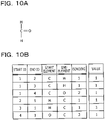
- FIGs. 10A and 10B are diagrams illustrating an example in which tensor data is expressed in a graph format and a table format.
- FIGs. 10A and 10B illustrate an example of a chemical formula.
- FIG. 10A illustrates a chemical formula of formaldehyde in a graph format
- FIG. 10B illustrates the chemical formula of formaldehyde in a table format.
- the chemical formula is expressed by 5 axes (columns) of a start ID, an end ID, a start element, an end element, and bonding, and values.
- the start ID is an index of a start point of linking.
- the end ID is an index of an end point of linking. The index may be freely assigned to the start point and the end point.
- the start element is a type of element at the start point.
- the end element is a type of element at the end point.
- the bonding is a type of linking.
- only values having non-zero in the tensor data are expressed as rows. In FIG. 10B , only 6 values expressed by 6 rows are 1, and the other values of the tensor data are 0.
- the axis of the tensor is called a mode.
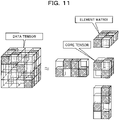
- FIG. 11 is a diagram for explaining tensor decomposition.
- white cubes indicate elements of 0, and shaded cubes indicate elements having non-zero.
- data tensor is tensor-decomposed into a core tensor and element matrices of the number of modes.
- the data tensor since the data tensor has 3 stages and the number of modes is 3, the data tensor is tensor-decomposed into a core tensor and 3 element matrices.
- the core tensor is calculated by a mode product of the data tensor and the element matrix of each mode.
- FIGs. 12A and 12B are diagrams for explaining calculation of a core tensor by a mode product.
- FIG. 12A illustrates the mode product
- FIG. 12B illustrates the core tensor calculation.
- the number of elements of a mode is converted from the number of data tensors to the number of elements of the core tensor by the mode product.
- the number of elements of the mode in a vertical direction is converted from 3 to 2.
- all elements in the mode direction after the conversion are non-zero.
- 3 elements 91 in the vertical direction include non-zero
- 2 elements 92 after the conversion are non-zero.
- the number of elements of each mode in the core tensor is designated by a user.
- the core tensor is calculated by sequentially calculating the mode products of the respective modes.
- an intermediate tensor 1 is calculated from a data tensor based on the mode product P 1
- an intermediate tensor 2 is calculated from an intermediate tensor 1 by the mode product P 2
- a core tensor is calculated from an intermediate tensor 2 by the mode product P 3 .
- An order of calculation of the mode products is arbitrary.
- a tensor having n stages is X
- a core tensor is X ⁇
- X ⁇ R I 1 ⁇ I 2 ⁇ ⁇ ⁇ I n X ⁇ ⁇ R J 1 ⁇ J 2 ⁇ ⁇ ⁇ J n Wi ⁇ R I i ⁇ J i is established.
- R is a set of real numbers.
- I i is the number of elements of the mode i of X
- J i is the number of elements of the mode i of X ⁇ .
- a tensor generation program capable of executing machine learning based on a ranking relationship of labels.
- the program causes a computer to execute a process of accepting an input of data having a graph structure including a plurality of nodes and attributes respectively set in the plurality of nodes.
- This program causes a computer to execute a process of generating tensor data which has dimensions respectively corresponding to the plurality of nodes and the respective attributes, and in which relationships between the plurality of nodes and the attributes and values corresponding to the relationships between the plurality of nodes are set.
- This program causes a computer to execute a process of setting a value in a range corresponding to a ranking relationship for each attribute included in the tensor data in a case where a ranking relationship between the attributes is machine-learned by using each attribute as a label.
- Japanese Laid-open Patent Publication No. 2020-119101 U.S. Patent Application Publication No. 2019/0228304 , and U.S. Patent Application Publication No. 2019/0325312 are disclosed as related art.
- a machine learning program a machine learning method, and a machine learning apparatus that make it easier to grasp a fine linking method of data in machine learning.
- a machine learning program that causes at least one computer to execute a process, the process includes specifying an axis of a label mode and a plurality of axes of a topology mode among a plurality of axes included in data in a tensor format; selecting a certain axis among the plurality axes of the topology mode; calculating a core tensor from the data in the tensor format via a plurality of intermediate tensors, by a first process of concatenating an element included in a first element matrix corresponding to the axis of the label mode to an element included in a first intermediate tensor among the plurality of intermediate tensors, by a second process of calculating a mode product of a second intermediate tensor among the plurality of intermediate tensors and a second element matrix corresponding to an axis among the plurality axes of the topology mode other than the certain axis, by a third process of con
- a machine learning apparatus divides a mode into a topology mode and a label mode.
- the topology mode is a mode in which linking of data is expressed.
- the label mode is a mode in which an attribute is expressed.
- FIG. 1 is a diagram illustrating an example of the label mode and the topology mode. As illustrated in FIG. 1 , a start ID and an end ID are topology modes, and a start element, an end element, and bonding are label modes.
- the label mode is associated with one or more of the topology modes, and a value of the label mode is determined by the associated topology mode.
- the start element is associated with the start ID, and a value of the start element is determined by the start ID.
- the start ID is 1, the start element is C, and when the start ID is 2 or 3, the start element is H, and when the start ID is 4, the start element is O.
- the end element is associated with the end ID, and a value of end element is determined by the end ID.
- the end element is C when the end ID is 1, the end element is H when the end ID is 2 or 3, and the end element is O when the end ID is 4.
- the bonding is associated with the start ID and the end ID, and a value of the bonding is determined by the start ID and the end ID. When the start ID is 1 and the end ID is 2 or 3, the bonding is 1, and when the start ID is 1 and the end ID is 4, the bonding is 2.
- the label mode is expressed as a one-hot vector.
- the one-hot vector is a vector in which only one element is 1 and the other elements are 0.
- FIG. 2 is a diagram for explaining a matrix product of a matrix having sparse non-zero elements and a matrix having dense non-zero elements.
- A is a matrix with sparse non-zero elements
- B is a matrix with dense non-zero elements
- C is a matrix product of A and B.
- black and shaded squares indicate non-zero elements
- white squares indicate zero elements.
- the non-zero elements of a row of A are multiplied with a corresponding row of B to form a corresponding row of C.
- all elements in the corresponding row of C are non-zero.
- the number of non-zero elements increases exponentially.
- the number of elements that are non-zero in the intermediate tensor increases exponentially each time the mode product is calculated.
- the machine learning apparatus converts the mode product of the label mode into a concatenation.
- the concatenation is to add an element of an element matrix to an element of a data tensor or an intermediate tensor, and is also referred to as an E operation.
- the matrix product (mode product) is also referred to as a P operation.
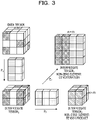
- FIG. 3 is a diagram for explaining a difference in mode product and concatenation.
- FIG. 3 illustrates a difference between a mode product P 2 and a concatenation E 2 .
- a shaded cube indicates a non-zero element
- a white cube indicates a zero element.
- n is a size of a non-zero element related to a mode "2" of an intermediate tensor 1
- m is a size of a non-zero element of a column of an element matrix 2 .
- the machine learning apparatus converts the mode product of the label mode to concatenation so that the number of non-zero elements linearly increases.
- a tensor X having sparse non-zero elements is mixedly expressed by a pair (I, V) of an index table I and a vector V of non-zero tensor elements.
- a row of I corresponds to coordinates of an element of V
- a column of I corresponds to a mode of the tensor.
- the following equation indicates a sub-tensor unit V i having dense non-zero elements.
- zero elements are not expressed.
- a mode product of X and the element matrix W is calculated in an order of index division, a tensor outer product, and a sum.
- the index row is divided as in the following equation (1).
- An output index table I' of the mode product is formed from I ⁇ i .
- Each value of the output vector V' of the mode product is calculated by a sum of the outer products of the row of V i and the corresponding row of W as illustrated in the following equation (2).
- the calculation of the sum of equation (2) is performed for i satisfying the following equation (3).
- V j ′ ⁇ i ⁇ nnz I j ′
- the machine learning apparatus In order to input a core tensor calculated by tensor decomposition to a neural network, the machine learning apparatus according to the embodiment creates an input to the neural network by flattening and concatenating elements of V. Therefore, the outer product of the mode products and the vector concatenation include the same information although the numbers of values are different from each other. Therefore, even when the mode product of the label mode is converted into concatenation, there is no influence on machine learning.
- the machine learning apparatus selects one axis from among axes of a plurality of specified topology modes. For example, since the topology mode expresses linking of data, there are the plurality of (at least one set (2)) having a link) topology modes. Therefore, the machine learning apparatus according to the embodiment selects one axis that may be a target of explanation from among the axes of the plurality of topology modes, for example, by accepting selection or the like by a user.
- the machine learning apparatus when calculating the core tensor, performs the E operation on an axis of the label mode, and performs the P operation on an axis of the topology mode other than the selected one axis.
- the machine learning apparatus When calculating the core tensor, performs, for one selected axis, the E operation of sharing a parameter (element of the element matrix) with the axis of the topology mode other than the axis.
- the E operation of sharing this parameter is an E operation of concatenating not only the parameter of one selected axis but also a parameter of the axis of the topology mode other than the axis.
- the core tensor includes a data linking method (topology), and in the embodiment, by performing machine learning using such a core tensor, it is possible to easily grasp the fine linking method of the data.
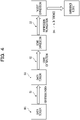
- FIG. 4 is a diagram for explaining an overview of the embodiment.
- the machine learning apparatus reassigns the index a data tensor D1 in which a topology mode and a label mode are specified and one axis is selected among axes of the topology mode (step S1), and obtains a data tensor D2.
- FIG. 5 is a diagram for explaining reassignment of an index.
- the machine learning apparatus according to the embodiment generates the data tensor D2 by randomly reassigning a new element (index) to the data tensor D1 while maintaining information on a data linking method (topology).
- the machine learning apparatus according to the embodiment determines an exchange table for replacing elements at random for each data and each learning epoch for an axis ("start ID" and "end ID” in the described example) of the topology mode.
- the machine learning apparatus refers to the exchange table so that the same exchange table is used for IDs of the same group, and reassigns elements of the "start ID” and the "end ID” in the data tensor D1 to generate the data tensor D2.
- an original ID "1” is reassigned to a new ID "2”
- an original ID "2” is reassigned to a new ID "3”
- an original ID "3” is reassigned to a new ID "1”
- an original ID "4" is reassigned to a new ID "4".
- parameters of the machine learning model may be optimized so that the same inference result is obtained regardless of a value of the element.
- the machine learning apparatus calculates a core tensor (performs core extraction) by using the data tensor D2 (step S2). Specifically, the machine learning apparatus according to the embodiment performs the E operation on an axis of the label mode of the data tensor D2, and performs the P operation on an axis of the topology mode other than the selected axis. The machine learning apparatus according to the embodiment performs the E operation of sharing the parameter with the axis of the topology mode other than the axis, on the axis selected in the data tensor D2.
- the machine learning apparatus executes machine learning of a machine learning model by using the calculated core tensor as an input (step S3, and step S4). For example, the machine learning apparatus according to the embodiment compares an inference result of the machine learning model inferred by information propagation (expression propagation) between nodes with a correct answer label assigned to the data tensor D1, and adjusts the parameter of the machine learning model.
- information propagation expression propagation
- a known method such as Multihead Self-Attention may be used for the information propagation.
- pooling for example, Average Pooling
- FCNN Fully Convolutional Network
- FCNN Fully Convolutional Network
- FIG. 6 illustrates a functional configuration example of the machine learning apparatus according to the embodiment.
- a machine learning apparatus 1 includes a core tensor calculation unit 11 and a machine learning unit 12.
- the core tensor calculation unit 11 inputs information on the data tensor D1 and the number of elements of each mode of a core tensor to calculate the core tensor.
- the machine learning unit 12 performs machine learning by using the core tensor calculated by the core tensor calculation unit 11 to generate a machine learning model.
- the generated machine learning model is used for classification, prediction, and the like.
- the core tensor calculation unit 11 includes an input unit 21, a storage unit 22, a specifying unit 23, a selection unit 24, a determination unit 25, a conversion unit 26, an exchange unit 27, and a calculation unit 28.
- the input unit 21 inputs information on the data tensor D1 and the number of elements in each mode of the core tensor for storing in the storage unit 22.
- the storage unit 22 stores the information input by the input unit 21.
- the storage unit 22 stores information created by the specifying unit 23, the selection unit 24, the determination unit 25, the conversion unit 26, the exchange unit 27, and the calculation unit 28.
- the specifying unit 23 specifies whether each mode of the data tensor D1 is a topology mode or a label mode, and stores the specified result in the storage unit 22. For example, the specifying unit 23 specifies a target mode as the label mode in a case where a value of only one the target mode is 1 and the others are all 0 when values of all modes other than the target mode are fixed, and specifies the target mode as the topology mode in the other cases. Whether each mode of the data tensor is the topology mode or the label mode may be input by the input unit 21 and stored in the storage unit 22. Alternatively, the specifying unit 23 may specify the topology mode or the label mode by making an inquiry to the user.
- the selection unit 24 selects one mode (axis) from the topology modes (axes) specified by the specifying unit 23, and stores the selection result in the storage unit 22. For example, the selection unit 24 makes an inquiry to the user, and stores the selection result input by the input unit 21 in the storage unit 22.
- the determination unit 25 determines an order (execution order) of the modes of tensor decomposition so that the label mode is first and the topology mode is next, and stores the determined order in the storage unit 22. The determination unit 25 determines the order in which the topology mode selected by the selection unit 24 is last.
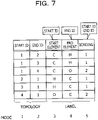
- a mode of a start ID is "1"
- a mode of an end ID is "2”
- a mode of a start element is "3”
- a mode of an end element is "4"
- a mode of bonding is "5".
- the mode of the start ID is set as the mode selected by the selection unit 24.
- the determination unit 25 determines P 5 P 4 P 3 P 2 P 1 as the order of the tensor decomposition process.
- P 5 P 4 P 3 P 2 P 1 indicates that the tensor decomposition process is performed in the order of P 5 , P 4 , P 3 , P 2 , and Pi.
- the conversion unit 26 converts the mode product P of the label mode into the concatenation E, and stores the conversion result in the storage unit 22.
- the mode "5", the mode "4", and the mode "3" are label modes
- P 5 P 4 P 3 is converted into E 5 E 4 E 3
- an order of the tensor decomposition process is E 5 E 4 E 3 P 2 P 1 .
- the conversion unit 26 reassigns the index described above, and stores the result obtained by randomly reassigned new elements in the storage unit 22.
- the conversion unit 26 converts the mode product P into the concatenation E of sharing parameters with other topology modes, and stores the conversion result in the storage unit 22.
- the modes "1" and “2" are the label modes, and the mode "1" is the selected mode. Therefore, the conversion unit 26 converts Pi into E 1(P2) that shares parameters with P 2 .
- the order of the tensor decomposition processes is E 5 E 4 E 3 P 2 E 1(P2) .
- the exchange unit 27 exchanges the order of the processes so as to process the concatenation E as late as possible, and stores the exchange result in the storage unit 22. Meanwhile, the conversion unit 26 has to perform the process of the label mode before the process of the topology mode associated with the label mode, and exchanges the order of the processes under a restriction that the concatenation E of sharing the parameters is the last.
- E 5 E 4 E 3 P 2 E 1(P2) in a case where E 3 is processed as late as possible, the mode "3" is associated with the mode "1", so that E 3 has to be performed before Pi. Therefore, E 3 and P 2 are exchanged, and E 5 E 4 E 3 P 2 E 1(P2) becomes E 5 E 4 P 2 E 3 E 1(P2) . Since the mode "5" and the mode "4" are associated with the mode "2", further exchanging is not performed.
- the core tensor calculation unit 11 may further reduce the number of non-zero elements of the intermediate tensor.
- the exchange unit 27 specifies a topology mode associated with the label mode by, for example, making an inquiry to the user.
- the topology mode associated with the label mode may be input by the input unit 21, and stored in the storage unit 22.
- the calculation unit 28 performs tensor decomposition based on the exchange result by the exchange unit 27 to calculate a core tensor.
- the calculation unit 28 stores information on the calculated core tensor in the storage unit 22.
- the calculation unit 28 includes a mode product unit 31, and a concatenation unit 32.
- the mode product unit 31 calculates a mode product (P operation) for a topology mode.
- the concatenation unit 32 performs concatenation calculation (E operation) for a label mode, and concatenation calculation (E operation) of sharing parameters for the selected mode.
- FIG. 8 is a flowchart illustrating a procedure of a process by the core tensor calculation unit 11.
- FIG. 8 illustrates a procedure of the process related to step S2 in FIG. 4 .
- the core tensor calculation unit 11 specifies whether each mode of a data tensor is a topology mode or a label mode (step S11). Next, the core tensor calculation unit 11 selects one of the topology modes (step S12).
- the core tensor calculation unit 11 determines an order of tensor decomposition in an order of the label mode and the topology mode (step S13).
- the core tensor calculation unit 11 determines the mode selected in step S12 to be at an end of the order.
- the core tensor calculation unit 11 converts a process of the label mode from P to E (step S14).
- the core tensor calculation unit 11 exchanges E and P so that E is processed as late as possible under a restriction that the process of the label mode is to be performed before a process of the topology mode associated with the label mode (step S15).
- the core tensor calculation unit 11 converts the process of the mode selected in step S12 from P to E (step S16). In this conversion, it is assumed that the core tensor calculation unit 11 shares a parameter with the other P. Next, the core tensor calculation unit 11 calculates a core tensor in the order obtained by the exchange (step S17).
- the specifying unit 23 specifies an axis of the label mode and an axis of the topology mode, among a plurality of axes included in data in a tensor format.
- the selection unit 24 selects one axis, among a plurality of specified axes of the topology mode.
- the calculation unit 28 calculates a core tensor from the data in the tensor format by a first process, a second process, and a third process. In the first process, an element included in an element matrix corresponding to an axis of a label mode is concatenated to an element included in an intermediate tensor.
- a mode product of the intermediate tensor and an element matrix corresponding to an axis of the topology mode other than the selected one axis is calculated.
- an element included in an element matrix corresponding to the selected one axis and the element included in the element matrix corresponding to the axis of the topology mode other than the axis are shared and concatenated to the element included in the intermediate tensor.
- the machine learning unit 12 executes machine learning of the machine learning model by using the core tensor calculated by the core tensor calculation unit 11 as an input.
- the core tensor (core expression) an element corresponding to one axis selected among axes of a topology mode and an element corresponding to an axis of the topology mode other than the one axis are incorporated, and a data linking method (topology) is included. Therefore, in the embodiment, by performing machine learning using such a core tensor, it is possible to easily grasp the fine linking method of data.
- the third process is executed at an end in the execution order, and thus a core tensor (core expression) in which the data linking method (topology) is incorporated last may be used for machine learning. Therefore, in the embodiment, it is possible to make it easier to grasp the fine linking method of data in machine learning.
- each of the components of each of the devices illustrated in the drawings is not necessarily physically configured as illustrated in the drawings.
- specific forms of the separation and integration of each device are not limited to those illustrated in the drawings.
- the entirety or part of the device may be configured by functionally or physically separating into arbitrary units or integrating into an arbitrary unit in accordance with various loads, usage situations, and the like.
- machine learning apparatus 1 is described in the embodiment, a machine learning program having similar functions may be obtained by implementing the configuration of the machine learning apparatus 1 by software. A computer that executes the machine learning program will be described.
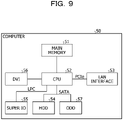
- FIG. 9 is a diagram illustrating a hardware configuration of the computer that executes the machine learning program according to the embodiment.
- a computer 50 includes a main memory 51, a central processing unit (CPU) 52, a local area network (LAN) interface 53, and a hard disk drive (HDD) 54.
- the computer 50 further includes a super input output (IO) 55, a digital visual interface (DVI) 56, and an optical disk drive (ODD) 57.
- IO super input output
- DVI digital visual interface
- ODD optical disk drive
- the main memory 51 is a memory that stores therein a program, a halfway result of program execution, and the like.
- the CPU 52 is a central processing unit that reads a program from the main memory 51, and executes the program, and is also an example of a control unit.
- the CPU 52 includes a chipset having a memory controller.
- the LAN interface 53 is an interface that couples the computer 50 to another computer through the LAN.
- the HDD 54 is a disk device that stores a program and data
- the super IO 55 is an interface that couples input devices such as a mouse and a keyboard to the computer 50.
- the DVI 56 is an interface that couples a liquid crystal display device to the computer 50.
- the ODD 57 is a device that performs reading and writing of a Digital Versatile Disc (DVD) and a compact disc-recordable (CD-R).
- the LAN interface 53 is coupled to the CPU 52 via Peripheral Component Interconnect Express (PCIe).
- PCIe Peripheral Component Interconnect Express
- the HDD 54 and the ODD 57 are coupled to the CPU 52 by Serial Advanced Technology Attachment (SATA).
- SATA Serial Advanced Technology Attachment
- the super IO 55 is coupled to the CPU 52 by Low Pin Count (LPC).
- LPC Low Pin Count
- the machine learning program executed by the computer 50 is stored on a CD-R which is an example of a recording medium that is readable by the computer 50, is read from the CD-R by the ODD 57, and is installed in the computer 50, for example.
- the machine learning program is stored in a database or the like of another computer system coupled via the LAN interface 53, is read out from the database or the like, and is installed in the computer 50.
- the installed machine learning program is stored in the HDD 54, is read out to the main memory 51, and is executed by the CPU 52.
Landscapes
- Engineering & Computer Science (AREA)
- Theoretical Computer Science (AREA)
- Software Systems (AREA)
- Physics & Mathematics (AREA)
- Computing Systems (AREA)
- Mathematical Physics (AREA)
- General Physics & Mathematics (AREA)
- Data Mining & Analysis (AREA)
- General Engineering & Computer Science (AREA)
- Evolutionary Computation (AREA)
- Medical Informatics (AREA)
- Artificial Intelligence (AREA)
- Computer Vision & Pattern Recognition (AREA)
- Databases & Information Systems (AREA)
- Life Sciences & Earth Sciences (AREA)
- Mathematical Optimization (AREA)
- Chemical & Material Sciences (AREA)
- Bioinformatics & Computational Biology (AREA)
- Computational Mathematics (AREA)
- Bioinformatics & Cheminformatics (AREA)
- Mathematical Analysis (AREA)
- Pure & Applied Mathematics (AREA)
- Crystallography & Structural Chemistry (AREA)
- General Health & Medical Sciences (AREA)
- Algebra (AREA)
- Health & Medical Sciences (AREA)
- Complex Calculations (AREA)
- Information Retrieval, Db Structures And Fs Structures Therefor (AREA)
- Machine Translation (AREA)
Abstract
Description
- The embodiments discussed herein are related to a machine learning program, a machine learning method, and a machine learning apparatus.
- Tensor data may be used as training data for a system that generates a machine learning model by machine learning, and performs prediction, classification, and the like by using the generated machine learning model. The tensor data is expressed as an n-dimensional (n is a positive integer) array, and is also expressed by a graph, a table, or the like.
FIGs. 10A and 10B are diagrams illustrating an example in which tensor data is expressed in a graph format and a table format.FIGs. 10A and 10B illustrate an example of a chemical formula.FIG. 10A illustrates a chemical formula of formaldehyde in a graph format, andFIG. 10B illustrates the chemical formula of formaldehyde in a table format. - In the table format, the chemical formula is expressed by 5 axes (columns) of a start ID, an end ID, a start element, an end element, and bonding, and values. The start ID is an index of a start point of linking. The end ID is an index of an end point of linking. The index may be freely assigned to the start point and the end point. The start element is a type of element at the start point. The end element is a type of element at the end point. The bonding is a type of linking. In the table format, only values having non-zero in the tensor data are expressed as rows. In
FIG. 10B , only 6 values expressed by 6 rows are 1, and the other values of the tensor data are 0. The axis of the tensor is called a mode. - In machine learning, a data tensor is converted into a core tensor by tensor decomposition, and training is performed by using the core tensor.
FIG. 11 is a diagram for explaining tensor decomposition. InFIG. 11 , white cubes indicate elements of 0, and shaded cubes indicate elements having non-zero. As illustrated inFIG. 11 , data tensor is tensor-decomposed into a core tensor and element matrices of the number of modes. InFIG. 11 , since the data tensor has 3 stages and the number of modes is 3, the data tensor is tensor-decomposed into a core tensor and 3 element matrices. - The core tensor is calculated by a mode product of the data tensor and the element matrix of each mode.
FIGs. 12A and 12B are diagrams for explaining calculation of a core tensor by a mode product.FIG. 12A illustrates the mode product, andFIG. 12B illustrates the core tensor calculation. As illustrated inFIG. 12A , the number of elements of a mode is converted from the number of data tensors to the number of elements of the core tensor by the mode product. In the example inFIG. 12A , the number of elements of the mode in a vertical direction is converted from 3 to 2. When there is at least one element that is non-zero among the elements in a mode direction, all elements in the mode direction after the conversion are non-zero. In the example inFIG. 12A , since 3elements 91 in the vertical direction include non-zero, 2elements 92 after the conversion are non-zero. The number of elements of each mode in the core tensor is designated by a user. - As illustrated in
FIG. 12B , the core tensor is calculated by sequentially calculating the mode products of the respective modes. InFIG. 12B , Pi (i = 1 to 3) indicates a mode product corresponding to a mode i. As illustrated inFIG. 12B , an intermediate tensor1 is calculated from a data tensor based on the mode product P1, an intermediate tensor2 is calculated from an intermediate tensor1 by the mode product P2, and a core tensor is calculated from an intermediate tensor2 by the mode product P3. An order of calculation of the mode products is arbitrary. - Assuming that a tensor having n stages is X, a core tensor is X^, and an element matrix of the mode i (i = 1 to n) is Wi,


- Regarding the mode product Pk of the mode k, assuming that X is the following matrix X',


- As the related art related to a data tensor, there is a tensor generation program capable of executing machine learning based on a ranking relationship of labels. The program causes a computer to execute a process of accepting an input of data having a graph structure including a plurality of nodes and attributes respectively set in the plurality of nodes. This program causes a computer to execute a process of generating tensor data which has dimensions respectively corresponding to the plurality of nodes and the respective attributes, and in which relationships between the plurality of nodes and the attributes and values corresponding to the relationships between the plurality of nodes are set. This program causes a computer to execute a process of setting a value in a range corresponding to a ranking relationship for each attribute included in the tensor data in a case where a ranking relationship between the attributes is machine-learned by using each attribute as a label.
-
Japanese Laid-open Patent Publication No. 2020-119101 U.S. Patent Application Publication No. 2019/0228304 , andU.S. Patent Application Publication No. 2019/0325312 are disclosed as related art. - Meanwhile, in the related art described above, there is a problem in that it is difficult to grasp a fine linking method (fine structure) of data in machine learning by using tensor data.
- According to one aspect, there is provided a machine learning program, a machine learning method, and a machine learning apparatus that make it easier to grasp a fine linking method of data in machine learning.
- According to an aspect of the embodiments, a machine learning program that causes at least one computer to execute a process, the process includes specifying an axis of a label mode and a plurality of axes of a topology mode among a plurality of axes included in data in a tensor format; selecting a certain axis among the plurality axes of the topology mode; calculating a core tensor from the data in the tensor format via a plurality of intermediate tensors, by a first process of concatenating an element included in a first element matrix corresponding to the axis of the label mode to an element included in a first intermediate tensor among the plurality of intermediate tensors, by a second process of calculating a mode product of a second intermediate tensor among the plurality of intermediate tensors and a second element matrix corresponding to an axis among the plurality axes of the topology mode other than the certain axis, by a third process of concatenating an element included in a third element matrix corresponding to the certain axis and an element included in the second element matrix to an element included in a third intermediate tensor among the plurality of intermediate tensors; and executing a machine learning by using the core tensor as an input.
- It is possible to make it easy to grasp a fine linking method of data in machine learning.
-
-
FIG. 1 is a diagram illustrating an example of a label mode and a topology mode; -
FIG. 2 is a diagram for explaining a matrix product of a matrix having sparse non-zero elements and a matrix having dense non-zero elements; -
FIG. 3 is a diagram for explaining a difference in mode product and concatenation; -
FIG. 4 is a diagram for explaining an overview of an embodiment; -
FIG. 5 is a diagram for explaining reassignment of an index; -
FIG. 6 illustrates a functional configuration example of a machine learning apparatus according to the embodiment; -
FIG. 7 is a diagram illustrating 5 modes; -
FIG. 8 is a flowchart illustrating a procedure of a process by a core tensor calculation unit; -
FIG. 9 is a diagram illustrating a hardware configuration of a computer that executes a machine learning program according to the embodiment; -
FIGs. 10A and 10B are diagrams illustrating an example in which tensor data is expressed in a graph format and a table format; -
FIG. 11 is a diagram for explaining tensor decomposition; and -
FIGs. 12A and 12B are diagrams for explaining calculation of a core tensor by a mode product. - Hereinafter, a machine learning program, a machine learning method, and a machine learning apparatus according to embodiments will be described with reference to the drawings. In embodiments, components having the same functions are denoted by the same reference signs, thereby omitting redundant description thereof. The machine learning program, the machine learning method, and the machine learning apparatus described in the following examples are merely embodiments and are not intended to limit the embodiments. The embodiments below may be appropriately combined with each other within a scope without any contradiction.
- First, a label mode and a topology mode will be described. A machine learning apparatus according to the embodiment divides a mode into a topology mode and a label mode. The topology mode is a mode in which linking of data is expressed. The label mode is a mode in which an attribute is expressed.
FIG. 1 is a diagram illustrating an example of the label mode and the topology mode. As illustrated inFIG. 1 , a start ID and an end ID are topology modes, and a start element, an end element, and bonding are label modes. The label mode is associated with one or more of the topology modes, and a value of the label mode is determined by the associated topology mode. - For example, the start element is associated with the start ID, and a value of the start element is determined by the start ID. When the start ID is 1, the start element is C, and when the start ID is 2 or 3, the start element is H, and when the start ID is 4, the start element is O. The end element is associated with the end ID, and a value of end element is determined by the end ID. The end element is C when the end ID is 1, the end element is H when the end ID is 2 or 3, and the end element is O when the end ID is 4. The bonding is associated with the start ID and the end ID, and a value of the bonding is determined by the start ID and the end ID. When the start ID is 1 and the end ID is 2 or 3, the bonding is 1, and when the start ID is 1 and the end ID is 4, the bonding is 2.
- The label mode is expressed as a one-hot vector. The one-hot vector is a vector in which only one element is 1 and the other elements are 0.
- Next, conversion into concatenation of mode products by the machine learning apparatus according to the embodiment will be described. When many label modes are included in a data tensor, non-zero elements of the data tensor become sparse. On the other hand, an element matrix has dense non-zero elements. Calculation of the mode product is calculation of the matrix product X" = (Wk)T × X', and when many label modes are included in a data tensor, the number of non-zero elements of the intermediate tensor increases exponentially for each calculation of the mode product so as to calculate the matrix product of a matrix with sparse non-zero elements and a matrix with dense non-zero elements.
-
FIG. 2 is a diagram for explaining a matrix product of a matrix having sparse non-zero elements and a matrix having dense non-zero elements. InFIG. 2 , A is a matrix with sparse non-zero elements, B is a matrix with dense non-zero elements, and C is a matrix product of A and B. InFIG. 2 , black and shaded squares indicate non-zero elements, and white squares indicate zero elements. As illustrated inFIG. 2 , the non-zero elements of a row of A are multiplied with a corresponding row of B to form a corresponding row of C. When there is even one element that is non-zero in the row of A, all elements in the corresponding row of C are non-zero. As described above, in the matrix product of the matrix with sparse non-zero elements and the matrix with dense non-zero elements, the number of non-zero elements increases exponentially. For example, the number of elements that are non-zero in the intermediate tensor increases exponentially each time the mode product is calculated. - Therefore, the machine learning apparatus according to the embodiment converts the mode product of the label mode into a concatenation. The concatenation is to add an element of an element matrix to an element of a data tensor or an intermediate tensor, and is also referred to as an E operation. For the E operation, the matrix product (mode product) is also referred to as a P operation.
-
FIG. 3 is a diagram for explaining a difference in mode product and concatenation.FIG. 3 illustrates a difference between a mode product P2 and a concatenation E2. InFIG. 3 , a shaded cube indicates a non-zero element, and a white cube indicates a zero element. n is a size of a non-zero element related to a mode "2" of anintermediate tensor 1, and m is a size of a non-zero element of a column of an element matrix2. - As illustrated in
FIG. 3 , in a case of the mode product P2, the size of the non-zero element related to the mode "2" of the intermediate tensor2 is n × m, whereas in a case of the concatenation E2, the size of the non-zero element related to the mode "2" of the intermediate tensor2 is n + m. For example, the machine learning apparatus according to the embodiment converts the mode product of the label mode to concatenation so that the number of non-zero elements linearly increases. - A tensor X having sparse non-zero elements is mixedly expressed by a pair (I, V) of an index table I and a vector V of non-zero tensor elements. In the mixed expression, a row of I corresponds to coordinates of an element of V, and a column of I corresponds to a mode of the tensor. For i-th row of I, the following equation indicates a sub-tensor unit Vi having dense non-zero elements. In the mixed expression, zero elements are not expressed.

- In the mixed expression, a mode product of X and the element matrix W is calculated in an order of index division, a tensor outer product, and a sum. For example, in the calculation of the mode product of the mode n, the index row is divided as in the following equation (1).

- An output index table I' of the mode product is formed from I^i. Each value of the output vector V' of the mode product is calculated by a sum of the outer products of the row of Vi and the corresponding row of W as illustrated in the following equation (2). The calculation of the sum of equation (2) is performed for i satisfying the following equation (3).


- In the label mode, the calculation of the sum of equation (2) is not performed, and only the outer product is obtained. The machine learning apparatus according to the embodiment calculates the output vector of the concatenation by using the following equation (4).

- In order to input a core tensor calculated by tensor decomposition to a neural network, the machine learning apparatus according to the embodiment creates an input to the neural network by flattening and concatenating elements of V. Therefore, the outer product of the mode products and the vector concatenation include the same information although the numbers of values are different from each other. Therefore, even when the mode product of the label mode is converted into concatenation, there is no influence on machine learning.
- The machine learning apparatus according to the embodiment selects one axis from among axes of a plurality of specified topology modes. For example, since the topology mode expresses linking of data, there are the plurality of (at least one set (2)) having a link) topology modes. Therefore, the machine learning apparatus according to the embodiment selects one axis that may be a target of explanation from among the axes of the plurality of topology modes, for example, by accepting selection or the like by a user.
- Next, when calculating the core tensor, the machine learning apparatus according to the embodiment performs the E operation on an axis of the label mode, and performs the P operation on an axis of the topology mode other than the selected one axis. When calculating the core tensor, the machine learning apparatus according to the embodiment performs, for one selected axis, the E operation of sharing a parameter (element of the element matrix) with the axis of the topology mode other than the axis. The E operation of sharing this parameter is an E operation of concatenating not only the parameter of one selected axis but also a parameter of the axis of the topology mode other than the axis.
- Thus, an element corresponding to the one axis selected among the axes of the topology mode and elements corresponding to the axis of the topology mode other than the one axis are incorporated in the core tensor (core expression). For this reason, the core tensor (core expression) includes a data linking method (topology), and in the embodiment, by performing machine learning using such a core tensor, it is possible to easily grasp the fine linking method of the data.
-
FIG. 4 is a diagram for explaining an overview of the embodiment. As illustrated inFIG. 4 , the machine learning apparatus according to the embodiment reassigns the index a data tensor D1 in which a topology mode and a label mode are specified and one axis is selected among axes of the topology mode (step S1), and obtains a data tensor D2. -
FIG. 5 is a diagram for explaining reassignment of an index. As illustrated inFIG. 5 , the machine learning apparatus according to the embodiment generates the data tensor D2 by randomly reassigning a new element (index) to the data tensor D1 while maintaining information on a data linking method (topology). For example, the machine learning apparatus according to the embodiment determines an exchange table for replacing elements at random for each data and each learning epoch for an axis ("start ID" and "end ID" in the described example) of the topology mode. - Next, the machine learning apparatus according to the embodiment refers to the exchange table so that the same exchange table is used for IDs of the same group, and reassigns elements of the "start ID" and the "end ID" in the data tensor D1 to generate the data tensor D2. In the example in
FIG. 5 , an original ID "1" is reassigned to a new ID "2", an original ID "2" is reassigned to a new ID "3", an original ID "3" is reassigned to a new ID "1", and an original ID "4" is reassigned to a new ID "4". - Thus, in the machine learning using the data tensor D2, parameters of the machine learning model may be optimized so that the same inference result is obtained regardless of a value of the element.
- Referring back to
FIG. 4 , the machine learning apparatus according to the embodiment calculates a core tensor (performs core extraction) by using the data tensor D2 (step S2). Specifically, the machine learning apparatus according to the embodiment performs the E operation on an axis of the label mode of the data tensor D2, and performs the P operation on an axis of the topology mode other than the selected axis. The machine learning apparatus according to the embodiment performs the E operation of sharing the parameter with the axis of the topology mode other than the axis, on the axis selected in the data tensor D2. - Next, the machine learning apparatus according to the embodiment executes machine learning of a machine learning model by using the calculated core tensor as an input (step S3, and step S4). For example, the machine learning apparatus according to the embodiment compares an inference result of the machine learning model inferred by information propagation (expression propagation) between nodes with a correct answer label assigned to the data tensor D1, and adjusts the parameter of the machine learning model.
- A known method such as Multihead Self-Attention may be used for the information propagation. In a case of inference for each data (for example, toxicity of a compound expressed by a chemical formula), pooling (for example, Average Pooling) + Fully Convolutional Network (FCNN) may be used. In a case of the inference for each node (for example, health management, daily departure classification), FCNN may be used.
- Next, a functional configuration of the machine learning apparatus according to the embodiment will be described.
FIG. 6 illustrates a functional configuration example of the machine learning apparatus according to the embodiment. As illustrated inFIG. 6 , amachine learning apparatus 1 according to the embodiment includes a coretensor calculation unit 11 and amachine learning unit 12. - The core
tensor calculation unit 11 inputs information on the data tensor D1 and the number of elements of each mode of a core tensor to calculate the core tensor. Themachine learning unit 12 performs machine learning by using the core tensor calculated by the coretensor calculation unit 11 to generate a machine learning model. The generated machine learning model is used for classification, prediction, and the like. - The core
tensor calculation unit 11 includes aninput unit 21, astorage unit 22, a specifyingunit 23, aselection unit 24, adetermination unit 25, aconversion unit 26, anexchange unit 27, and acalculation unit 28. - The
input unit 21 inputs information on the data tensor D1 and the number of elements in each mode of the core tensor for storing in thestorage unit 22. - The
storage unit 22 stores the information input by theinput unit 21. Thestorage unit 22 stores information created by the specifyingunit 23, theselection unit 24, thedetermination unit 25, theconversion unit 26, theexchange unit 27, and thecalculation unit 28. - The specifying
unit 23 specifies whether each mode of the data tensor D1 is a topology mode or a label mode, and stores the specified result in thestorage unit 22. For example, the specifyingunit 23 specifies a target mode as the label mode in a case where a value of only one the target mode is 1 and the others are all 0 when values of all modes other than the target mode are fixed, and specifies the target mode as the topology mode in the other cases. Whether each mode of the data tensor is the topology mode or the label mode may be input by theinput unit 21 and stored in thestorage unit 22. Alternatively, the specifyingunit 23 may specify the topology mode or the label mode by making an inquiry to the user. - The
selection unit 24 selects one mode (axis) from the topology modes (axes) specified by the specifyingunit 23, and stores the selection result in thestorage unit 22. For example, theselection unit 24 makes an inquiry to the user, and stores the selection result input by theinput unit 21 in thestorage unit 22. - The
determination unit 25 determines an order (execution order) of the modes of tensor decomposition so that the label mode is first and the topology mode is next, and stores the determined order in thestorage unit 22. Thedetermination unit 25 determines the order in which the topology mode selected by theselection unit 24 is last. - For example, as illustrated in
FIG. 7 , a mode of a start ID is "1", a mode of an end ID is "2", a mode of a start element is "3", a mode of an end element is "4", and a mode of bonding is "5". The mode of the start ID is set as the mode selected by theselection unit 24. In the example illustrated inFIG. 7 , thedetermination unit 25 determines P5P4P3P2P1 as the order of the tensor decomposition process. P5P4P3P2P1 indicates that the tensor decomposition process is performed in the order of P5, P4, P3, P2, and Pi. - The
conversion unit 26 converts the mode product P of the label mode into the concatenation E, and stores the conversion result in thestorage unit 22. In the example illustrated inFIG. 7 , since the mode "5", the mode "4", and the mode "3" are label modes, P5P4P3 is converted into E5E4E3, and an order of the tensor decomposition process is E5E4E3P2P1. - For the topology mode, the
conversion unit 26 reassigns the index described above, and stores the result obtained by randomly reassigned new elements in thestorage unit 22. - For the topology mode selected by the
selection unit 24, theconversion unit 26 converts the mode product P into the concatenation E of sharing parameters with other topology modes, and stores the conversion result in thestorage unit 22. In the example illustrated inFIG. 7 , the modes "1" and "2" are the label modes, and the mode "1" is the selected mode. Therefore, theconversion unit 26 converts Pi into E1(P2) that shares parameters with P2. Thus, the order of the tensor decomposition processes is E5E4E3P2E1(P2). - The
exchange unit 27 exchanges the order of the processes so as to process the concatenation E as late as possible, and stores the exchange result in thestorage unit 22. Meanwhile, theconversion unit 26 has to perform the process of the label mode before the process of the topology mode associated with the label mode, and exchanges the order of the processes under a restriction that the concatenation E of sharing the parameters is the last. - For example, for E5E4E3P2E1(P2), in a case where E3 is processed as late as possible, the mode "3" is associated with the mode "1", so that E3 has to be performed before Pi. Therefore, E3 and P2 are exchanged, and E5E4E3P2E1(P2) becomes E5E4P2E3E1(P2). Since the mode "5" and the mode "4" are associated with the mode "2", further exchanging is not performed. By processing the concatenation E as late as possible, the core
tensor calculation unit 11 may further reduce the number of non-zero elements of the intermediate tensor. - The
exchange unit 27 specifies a topology mode associated with the label mode by, for example, making an inquiry to the user. The topology mode associated with the label mode may be input by theinput unit 21, and stored in thestorage unit 22. - The
calculation unit 28 performs tensor decomposition based on the exchange result by theexchange unit 27 to calculate a core tensor. Thecalculation unit 28 stores information on the calculated core tensor in thestorage unit 22. Thecalculation unit 28 includes amode product unit 31, and aconcatenation unit 32. Themode product unit 31 calculates a mode product (P operation) for a topology mode. Theconcatenation unit 32 performs concatenation calculation (E operation) for a label mode, and concatenation calculation (E operation) of sharing parameters for the selected mode. - Next, a processing procedure by the core
tensor calculation unit 11 will be described.FIG. 8 is a flowchart illustrating a procedure of a process by the coretensor calculation unit 11. For example,FIG. 8 illustrates a procedure of the process related to step S2 inFIG. 4 . - As illustrated in
FIG. 8 , the coretensor calculation unit 11 specifies whether each mode of a data tensor is a topology mode or a label mode (step S11). Next, the coretensor calculation unit 11 selects one of the topology modes (step S12). - Next, the core
tensor calculation unit 11 determines an order of tensor decomposition in an order of the label mode and the topology mode (step S13). The coretensor calculation unit 11 determines the mode selected in step S12 to be at an end of the order. - Next, the core
tensor calculation unit 11 converts a process of the label mode from P to E (step S14). Next, the coretensor calculation unit 11 exchanges E and P so that E is processed as late as possible under a restriction that the process of the label mode is to be performed before a process of the topology mode associated with the label mode (step S15). - Next, the core
tensor calculation unit 11 converts the process of the mode selected in step S12 from P to E (step S16). In this conversion, it is assumed that the coretensor calculation unit 11 shares a parameter with the other P. Next, the coretensor calculation unit 11 calculates a core tensor in the order obtained by the exchange (step S17). - As described above, in the embodiment, the specifying
unit 23 specifies an axis of the label mode and an axis of the topology mode, among a plurality of axes included in data in a tensor format. Theselection unit 24 selects one axis, among a plurality of specified axes of the topology mode. Thecalculation unit 28 calculates a core tensor from the data in the tensor format by a first process, a second process, and a third process. In the first process, an element included in an element matrix corresponding to an axis of a label mode is concatenated to an element included in an intermediate tensor. In the second process, a mode product of the intermediate tensor and an element matrix corresponding to an axis of the topology mode other than the selected one axis is calculated. In the third process, an element included in an element matrix corresponding to the selected one axis and the element included in the element matrix corresponding to the axis of the topology mode other than the axis are shared and concatenated to the element included in the intermediate tensor. Themachine learning unit 12 executes machine learning of the machine learning model by using the core tensor calculated by the coretensor calculation unit 11 as an input. - Thus, in the core tensor (core expression), an element corresponding to one axis selected among axes of a topology mode and an element corresponding to an axis of the topology mode other than the one axis are incorporated, and a data linking method (topology) is included. Therefore, in the embodiment, by performing machine learning using such a core tensor, it is possible to easily grasp the fine linking method of data.
- In the embodiment, the third process is executed at an end in the execution order, and thus a core tensor (core expression) in which the data linking method (topology) is incorporated last may be used for machine learning. Therefore, in the embodiment, it is possible to make it easier to grasp the fine linking method of data in machine learning.
- It is noted that each of the components of each of the devices illustrated in the drawings is not necessarily physically configured as illustrated in the drawings. For example, specific forms of the separation and integration of each device are not limited to those illustrated in the drawings. The entirety or part of the device may be configured by functionally or physically separating into arbitrary units or integrating into an arbitrary unit in accordance with various loads, usage situations, and the like.
- Although the
machine learning apparatus 1 is described in the embodiment, a machine learning program having similar functions may be obtained by implementing the configuration of themachine learning apparatus 1 by software. A computer that executes the machine learning program will be described. -
FIG. 9 is a diagram illustrating a hardware configuration of the computer that executes the machine learning program according to the embodiment. As illustrated inFIG. 9 , acomputer 50 includes amain memory 51, a central processing unit (CPU) 52, a local area network (LAN)interface 53, and a hard disk drive (HDD) 54. Thecomputer 50 further includes a super input output (IO) 55, a digital visual interface (DVI) 56, and an optical disk drive (ODD) 57. - The
main memory 51 is a memory that stores therein a program, a halfway result of program execution, and the like. TheCPU 52 is a central processing unit that reads a program from themain memory 51, and executes the program, and is also an example of a control unit. TheCPU 52 includes a chipset having a memory controller. - The
LAN interface 53 is an interface that couples thecomputer 50 to another computer through the LAN. TheHDD 54 is a disk device that stores a program and data, and thesuper IO 55 is an interface that couples input devices such as a mouse and a keyboard to thecomputer 50. TheDVI 56 is an interface that couples a liquid crystal display device to thecomputer 50. TheODD 57 is a device that performs reading and writing of a Digital Versatile Disc (DVD) and a compact disc-recordable (CD-R). - The
LAN interface 53 is coupled to theCPU 52 via Peripheral Component Interconnect Express (PCIe). TheHDD 54 and theODD 57 are coupled to theCPU 52 by Serial Advanced Technology Attachment (SATA). Thesuper IO 55 is coupled to theCPU 52 by Low Pin Count (LPC). - The machine learning program executed by the
computer 50 is stored on a CD-R which is an example of a recording medium that is readable by thecomputer 50, is read from the CD-R by theODD 57, and is installed in thecomputer 50, for example. Alternatively, the machine learning program is stored in a database or the like of another computer system coupled via theLAN interface 53, is read out from the database or the like, and is installed in thecomputer 50. The installed machine learning program is stored in theHDD 54, is read out to themain memory 51, and is executed by theCPU 52. - Regarding the foregoing embodiment, the following appendices are further disclosed.
Claims (9)
- A machine learning program that causes at least one computer to execute a process, the process comprising:specifying an axis of a label mode and a plurality of axes of a topology mode among a plurality of axes included in data in a tensor format;selecting a certain axis among the plurality axes of the topology mode;calculating a core tensor from the data in the tensor format via a plurality of intermediate tensors, by a first process of concatenating an element included in a first element matrix corresponding to the axis of the label mode to an element included in a first intermediate tensor among the plurality of intermediate tensors, by a second process of calculating a mode product of a second intermediate tensor among the plurality of intermediate tensors and a second element matrix corresponding to an axis among the plurality axes of the topology mode other than the certain axis, by a third process of concatenating an element included in a third element matrix corresponding to the certain axis and an element included in the second element matrix to an element included in a third intermediate tensor among the plurality of intermediate tensors; andexecuting a machine learning by using the core tensor as an input.
- The machine learning program according to claim 1, wherein the process further comprisingdetermining an execution order of the first process, the second process, and the third process, whereinthe calculating includes executing the first process, the second process, and the third process in the order.
- The machine learning program according to claim 2, wherein the determining includes determining the third process to be at an end of the order.
- A machine learning method for a computer to execute a process comprising:specifying an axis of a label mode and a plurality of axes of a topology mode among a plurality of axes included in data in a tensor format;selecting a certain axis among the plurality axes of the topology mode;calculating a core tensor from the data in the tensor format via a plurality of intermediate tensors, by a first process of concatenating an element included in a first element matrix corresponding to the axis of the label mode to an element included in a first intermediate tensor among the plurality of intermediate tensors, by a second process of calculating a mode product of a second intermediate tensor among the plurality of intermediate tensors and a second element matrix corresponding to an axis among the plurality axes of the topology mode other than the certain axis, by a third process of concatenating an element included in a third element matrix corresponding to the certain axis and an element included in the second element matrix to an element included in a third intermediate tensor among the plurality of intermediate tensors; andexecuting a machine learning by using the core tensor as an input.
- The machine learning method according to claim 4, wherein the process further comprisingdetermining an execution order of the first process, the second process, and the third process, whereinthe calculating includes executing the first process, the second process, and the third process in the order.
- The machine learning method according to claim 5,
wherein the determining includes determining the third process to be at an end of the order. - A machine learning apparatus device comprising a control unit configured to:specify an axis of a label mode and a plurality of axes of a topology mode among a plurality of axes included in data in a tensor format,select a certain axis among the plurality axes of the topology mode,calculate a core tensor from the data in the tensor format via a plurality of intermediate tensors, by a first process of concatenating an element included in a first element matrix corresponding to the axis of the label mode to an element included in a first intermediate tensor among the plurality of intermediate tensors, by a second process of calculating a mode product of a second intermediate tensor among the plurality of intermediate tensors and a second element matrix corresponding to an axis among the plurality axes of the topology mode other than the certain axis, by a third process of concatenating an element included in a third element matrix corresponding to the certain axis and an element included in the second element matrix to an element included in a third intermediate tensor among the plurality of intermediate tensors, andexecute a machine learning by using the core tensor as an input.
- The machine learning device according to claim 7, wherein the control unit is further configured to:determine an execution order of the first process, the second process, and the third process, andexecute the first process, the second process, and the third process in the order.
- The machine learning device according to claim 8,
wherein the control unit is further configured to determine the third process to be at an end of the order.
Applications Claiming Priority (1)
| Application Number | Priority Date | Filing Date | Title |
|---|---|---|---|
| JP2021011225A JP7524778B2 (en) | 2021-01-27 | 2021-01-27 | Machine learning program, machine learning method, and machine learning device |
Publications (1)
| Publication Number | Publication Date |
|---|---|
| EP4036764A1 true EP4036764A1 (en) | 2022-08-03 |
Family
ID=78824807
Family Applications (1)
| Application Number | Title | Priority Date | Filing Date |
|---|---|---|---|
| EP21213112.2A Pending EP4036764A1 (en) | 2021-01-27 | 2021-12-08 | Machine learning program, machine learning method, and machine learning apparatus |
Country Status (3)
| Country | Link |
|---|---|
| US (1) | US20220237511A1 (en) |
| EP (1) | EP4036764A1 (en) |
| JP (1) | JP7524778B2 (en) |
Families Citing this family (1)
| Publication number | Priority date | Publication date | Assignee | Title |
|---|---|---|---|---|
| WO2025220222A1 (en) * | 2024-04-19 | 2025-10-23 | Ntt株式会社 | Learning device, inference device, learning method, inference method, and program |
Citations (3)
| Publication number | Priority date | Publication date | Assignee | Title |
|---|---|---|---|---|
| US20190228304A1 (en) | 2018-01-19 | 2019-07-25 | Fujitsu Limited | Computer-readable recording medium, learning method, and learning apparatus |
| US20190325312A1 (en) | 2018-04-20 | 2019-10-24 | Fujitsu Limited | Computer-readable recording medium, machine learning method, and machine learning apparatus |
| JP2020119101A (en) | 2019-01-21 | 2020-08-06 | 富士通株式会社 | Tensor generating program, tensor generation method and tensor generation device |
Family Cites Families (3)
| Publication number | Priority date | Publication date | Assignee | Title |
|---|---|---|---|---|
| WO2012133185A1 (en) | 2011-03-31 | 2012-10-04 | 独立行政法人理化学研究所 | Brain wave analysis apparatus, brain wave analysis method, program and recording medium |
| US20160004664A1 (en) | 2014-07-02 | 2016-01-07 | Xerox Corporation | Binary tensor factorization |
| JP7225874B2 (en) | 2019-02-07 | 2023-02-21 | 富士通株式会社 | Model output program, model output method and model output device |
-
2021
- 2021-01-27 JP JP2021011225A patent/JP7524778B2/en active Active
- 2021-12-08 US US17/545,064 patent/US20220237511A1/en not_active Abandoned
- 2021-12-08 EP EP21213112.2A patent/EP4036764A1/en active Pending
Patent Citations (3)
| Publication number | Priority date | Publication date | Assignee | Title |
|---|---|---|---|---|
| US20190228304A1 (en) | 2018-01-19 | 2019-07-25 | Fujitsu Limited | Computer-readable recording medium, learning method, and learning apparatus |
| US20190325312A1 (en) | 2018-04-20 | 2019-10-24 | Fujitsu Limited | Computer-readable recording medium, machine learning method, and machine learning apparatus |
| JP2020119101A (en) | 2019-01-21 | 2020-08-06 | 富士通株式会社 | Tensor generating program, tensor generation method and tensor generation device |
Non-Patent Citations (2)
| Title |
|---|
| ALP OZDEMIR ET AL: "Multiscale Analysis for Higher-order Tensors", ARXIV.ORG, CORNELL UNIVERSITY LIBRARY, 201 OLIN LIBRARY CORNELL UNIVERSITY ITHACA, NY 14853, 27 April 2017 (2017-04-27), XP080766031 * |
| MO YU ET AL: "Embedding Lexical Features via Low-Rank Tensors", ARXIV.ORG, CORNELL UNIVERSITY LIBRARY, 201 OLIN LIBRARY CORNELL UNIVERSITY ITHACA, NY 14853, 2 April 2016 (2016-04-02), XP080692927 * |
Also Published As
| Publication number | Publication date |
|---|---|
| US20220237511A1 (en) | 2022-07-28 |
| JP2022114792A (en) | 2022-08-08 |
| JP7524778B2 (en) | 2024-07-30 |
Similar Documents
| Publication | Publication Date | Title |
|---|---|---|
| Epskamp et al. | A tutorial on regularized partial correlation networks. | |
| US20250094703A1 (en) | Ai-generated data objects for data visualization | |
| Johal et al. | Comparing estimation methods for psychometric networks with ordinal data. | |
| EP4036764A1 (en) | Machine learning program, machine learning method, and machine learning apparatus | |
| WO2016207731A2 (en) | Alife machine learning system and method | |
| US20230229967A1 (en) | Recording medium, machine learning method, and machine learning device | |
| US20210312229A1 (en) | Selecting unlabeled data objects to be processed | |
| Bayat et al. | Advancing Fluid-Based Thermal Management Systems Design: Leveraging Graph Neural Networks for Graph Regression and Efficient Enumeration Reduction | |
| JP2021060874A (en) | Device, method, and program for summarizing video | |
| CN117813602A (en) | Principal component analysis | |
| KR102199412B1 (en) | Data Mining System Using dimensionless number and the method of the same | |
| CN112508119A (en) | Feature mining combination method, device, equipment and computer readable storage medium | |
| CN118114421B (en) | Methods, devices, equipment and media for constructing digital twin models for multiple logistics scenarios | |
| CN110362303B (en) | Data exploration method and system | |
| Shirisha et al. | Student data analysis using Hadoop | |
| Li et al. | changepointGA: An R package for Fast Changepoint Detection via Genetic Algorithm | |
| CN110147804B (en) | A method for processing unbalanced data, a terminal, and a computer-readable storage medium | |
| Dang et al. | MultiLayerMatrix: visualizing large taxonomic datasets | |
| Bladen | Contributions to Random Forest Variable Importance with Applications in R | |
| Yan et al. | Learning precedence relations for manufacturing operations sequencing using convolutional recurrent neural networks | |
| JP7819776B2 (en) | Meta-learning method, meta-learning device, and program | |
| US20200250536A1 (en) | Gpu-based artificial intelligence system using channel-level architecture search for deep neural network | |
| TWI923264B (en) | Annotation method and computer program | |
| KR102828791B1 (en) | Exhibition Recommendation Device And Method | |
| Cappello et al. | Visual interactive parameter selection for temporal blind source separation |
Legal Events
| Date | Code | Title | Description |
|---|---|---|---|
| PUAI | Public reference made under article 153(3) epc to a published international application that has entered the european phase |
Free format text: ORIGINAL CODE: 0009012 |
|
| STAA | Information on the status of an ep patent application or granted ep patent |
Free format text: STATUS: THE APPLICATION HAS BEEN PUBLISHED |
|
| AK | Designated contracting states |
Kind code of ref document: A1 Designated state(s): AL AT BE BG CH CY CZ DE DK EE ES FI FR GB GR HR HU IE IS IT LI LT LU LV MC MK MT NL NO PL PT RO RS SE SI SK SM TR |
|
| STAA | Information on the status of an ep patent application or granted ep patent |
Free format text: STATUS: REQUEST FOR EXAMINATION WAS MADE |
|
| 17P | Request for examination filed |
Effective date: 20221103 |
|
| RBV | Designated contracting states (corrected) |
Designated state(s): AL AT BE BG CH CY CZ DE DK EE ES FI FR GB GR HR HU IE IS IT LI LT LU LV MC MK MT NL NO PL PT RO RS SE SI SK SM TR |
|
| STAA | Information on the status of an ep patent application or granted ep patent |
Free format text: STATUS: EXAMINATION IS IN PROGRESS |
|
| 17Q | First examination report despatched |
Effective date: 20250326 |