EP4036525B1 - Direction calculation device, direction calculation method, and program - Google Patents
Direction calculation device, direction calculation method, and program Download PDFInfo
- Publication number
- EP4036525B1 EP4036525B1 EP19946388.6A EP19946388A EP4036525B1 EP 4036525 B1 EP4036525 B1 EP 4036525B1 EP 19946388 A EP19946388 A EP 19946388A EP 4036525 B1 EP4036525 B1 EP 4036525B1
- Authority
- EP
- European Patent Office
- Prior art keywords
- force sensation
- vector
- presentation device
- sensation presentation
- matrix
- Prior art date
- Legal status (The legal status is an assumption and is not a legal conclusion. Google has not performed a legal analysis and makes no representation as to the accuracy of the status listed.)
- Active
Links
Images


Classifications
-
- G—PHYSICS
- G01—MEASURING; TESTING
- G01C—MEASURING DISTANCES, LEVELS OR BEARINGS; SURVEYING; NAVIGATION; GYROSCOPIC INSTRUMENTS; PHOTOGRAMMETRY OR VIDEOGRAMMETRY
- G01C21/00—Navigation; Navigational instruments not provided for in groups G01C1/00 - G01C19/00
- G01C21/005—Navigation; Navigational instruments not provided for in groups G01C1/00 - G01C19/00 with correlation of navigation data from several sources, e.g. map or contour matching
-
- G—PHYSICS
- G01—MEASURING; TESTING
- G01C—MEASURING DISTANCES, LEVELS OR BEARINGS; SURVEYING; NAVIGATION; GYROSCOPIC INSTRUMENTS; PHOTOGRAMMETRY OR VIDEOGRAMMETRY
- G01C21/00—Navigation; Navigational instruments not provided for in groups G01C1/00 - G01C19/00
- G01C21/04—Navigation; Navigational instruments not provided for in groups G01C1/00 - G01C19/00 by terrestrial means
- G01C21/08—Navigation; Navigational instruments not provided for in groups G01C1/00 - G01C19/00 by terrestrial means involving use of the magnetic field of the earth
-
- G—PHYSICS
- G01—MEASURING; TESTING
- G01C—MEASURING DISTANCES, LEVELS OR BEARINGS; SURVEYING; NAVIGATION; GYROSCOPIC INSTRUMENTS; PHOTOGRAMMETRY OR VIDEOGRAMMETRY
- G01C21/00—Navigation; Navigational instruments not provided for in groups G01C1/00 - G01C19/00
- G01C21/20—Instruments for performing navigational calculations
-
- G—PHYSICS
- G01—MEASURING; TESTING
- G01C—MEASURING DISTANCES, LEVELS OR BEARINGS; SURVEYING; NAVIGATION; GYROSCOPIC INSTRUMENTS; PHOTOGRAMMETRY OR VIDEOGRAMMETRY
- G01C21/00—Navigation; Navigational instruments not provided for in groups G01C1/00 - G01C19/00
- G01C21/26—Navigation; Navigational instruments not provided for in groups G01C1/00 - G01C19/00 specially adapted for navigation in a road network
- G01C21/34—Route searching; Route guidance
- G01C21/36—Input/output arrangements for on-board computers
- G01C21/3626—Details of the output of route guidance instructions
- G01C21/3652—Guidance using non-audiovisual output, e.g. tactile, haptic or electric stimuli
Definitions
- a force sensation presentation device is a device that provides a force sensation itself to a person gripping the device or a stimulus (stimulus by a vibration pattern, for example) that causes the person to artificially perceive a force sensation.
- NPL 2 discloses a new algorithm called vector cross product method which is compared with traditional attitude angle method for principle and accuracy.
- PL 1 relates to navigation systems and specifically to navigation systems providing directional and distal information about user position, environment object position and orientation to a user in tactile form.
- PL 2 relates to a processing apparatus, computer program code for the processing apparatus, and a method in the processing apparatus.
- the geomagnetism may be significantly distorted due to an influence of a steel frame or the like used in the building and, as a result, the azimuth detected using the geomagnetism changes significantly from the correct azimuth, resulting in the problem that the guided person is navigated in a direction different from the desired direction.
- an object of the present invention is to provide a technique for more accurately calculating a direction to be presented to a guided person using a force sensation presentation device gripped by the guided person, taking into account geomagnetic distortion.
- a direction calculation apparatus configured to calculate a direction to be presented to a guided person (hereinafter referred to as a presented direction) using a force sensation presentation device gripped by the guided person includes a first matrix acquisition unit configured to use a geomagnetic map including a geomagnetic vector and a gravitational acceleration vector of a reference posture of the force sensation presentation device in a reference coordinate system at a position included in a predetermined range to acquire, from a current position of the force sensation presentation device, a matrix (hereinafter referred to as a first matrix) composed of a geomagnetic vector, a gravitational acceleration vector, and an outer product vector of these vectors of the reference posture of the force sensation presentation device in the reference coordinate system at the current position, a second matrix acquisition unit configured to acquire a matrix (hereinafter referred to as a first matrix) composed of a geomagnetic vector, a gravitational acceleration vector, and an outer product vector of these vectors of the reference posture of the force sensation presentation device in the reference coordinate system at the current
- a direction calculation apparatus configured to calculate a direction to be presented to a guided person (hereinafter referred to as a presented direction) using a force sensation presentation device gripped by the guided person includes a bias acquisition unit configured to use a geomagnetic map including a bias of an azimuth angle caused by geomagnetic distortion at a position included in a predetermined range to acquire, from a current position of the force sensation presentation device, a bias of an azimuth angle caused by geomagnetic distortion at the current position, a first azimuth angle acquisition unit configured to acquire an azimuth angle (hereinafter referred to as a first azimuth angle) indicating an azimuth of the force sensation presentation device that does not take into account an influence of geomagnetic distortion in a reference coordinate system at the current position, and a presented direction calculation unit configured to use the bias and the first azimuth angle to calculate, from an instructed force sensation vector (hereinafter referred to as a first instructed force sensation vector) in a reference coordinate system
- the present invention it is possible to more accurately calculate a direction to be presented to a guided person using a force sensation presentation device gripped by the guided person, taking into account geomagnetic distortion.
- a guided person grips a force sensation presentation device and walks in a predetermined range such as in a designated building.
- the force sensation presentation device guides the guided person in a predetermined walking direction by a force sensation provided to the guided person or a stimulus that causes the guided person to artificially perceive a force sensation.
- a predetermined walking direction needs to be determined, taking into account an influence of geomagnetic distortion.
- a direction calculation apparatus 100 is a device that calculates, in real time, a direction to be presented (hereinafter referred to as a presented direction) to the guided person using the force sensation presentation device, and is a device constituting a walking navigation system. That is, a walking navigation system is realized using the direction calculation apparatus 100 and a force sensation presentation device.
- the force sensation presentation device is a device gripped by the guided person, and the guided person need only grip the device, for example.
- the direction to be presented to the guided person is typically a direction in which the walking of the guided person is to be guided, but may be a direction in which the attention of the guided person is to be directed.
- the direction calculation apparatus 100 is used not only in the configuration of the walking navigation system, but can also be used in a case in which the guided person grips the force sensation presentation device and moves using a method other than walking.
- the direction calculation apparatus 100 can also be used in a case in which the guided person moves on a bicycle.
- a posture of the force sensation presentation device is not limited to being kept constant. That is, the force sensation presentation device is not limited to being gripped while being kept in a horizontal direction, and the force sensation presentation device may be gripped upside-down or at an angle. Further, during movement, a height of an arm gripping the force sensation presentation device and a posture of the body may vary.
- a position of the force sensation presentation device in a range (predetermined range) in which the guided person is to be guided, and a geomagnetic vector and a gravitational acceleration vector at that position can be measured.
- a positioning device that uses an ultra-wideband (UWB) can be used as a module that measures the position of the force sensation presentation device
- a three-axis geomagnetic sensor can be used as a module that measures the geomagnetic vector
- a three-axis acceleration sensor can be used as a module that measures the gravitational acceleration vector.
- the force sensation presentation device incorporates the modules described above in an interior thereof, for example, and is thus configured to be capable of measuring the position of the force sensation presentation device, and the geomagnetic vector and the gravitational acceleration vector at that position.
- Fig. 1 is a block diagram illustrating a configuration of the direction calculation apparatus 100.
- Fig. 2 is a flowchart illustrating an operation of the direction calculation apparatus 100.
- the direction calculation apparatus 100 includes a first matrix acquisition unit 110, a second matrix acquisition unit 120, a presented direction calculation unit 130, and a recording unit 190.
- the recording unit 190 is a component configured to appropriately record information required for the processing of the direction calculation apparatus 100.
- the recording unit 190 records in advance, for example, a geomagnetic map including a geomagnetic vector and a gravitational acceleration vector of a reference posture of the force sensation presentation device in a reference coordinate system at a position included in a predetermined range.
- the reference coordinate system is a coordinate system for expressing a position in a predetermined range, and may be, for example, any three-dimensional coordinate system with a gravitational direction set as a z-axis.
- the reference posture of the force sensation presentation device is a posture of the force sensation presentation device referenced during measurement of the geomagnetic vector and the gravitational acceleration vector and is, for example, a posture of the force sensation presentation device being gripped by the guided person so as to be in the horizontal direction (so as to be parallel to an xy plane).
- the current position of the force sensation presentation device is, for example, data measured by a module (not illustrated) that measures the position of the device, and the direction calculation apparatus 100 in a location away from the force sensation presentation device receives the measured data from the module via a communication unit (not illustrated) and inputs the data to the first matrix acquisition unit 110.
- the gravitational acceleration vector of the current posture of the force sensation presentation device is, for example, data measured by a module (not illustrated) that measures the gravitational acceleration vector, and the direction calculation apparatus 100 receives the measured data from the module via a communication unit (not illustrated) and inputs the data to the second matrix acquisition unit 120.
- the presented direction calculation unit 130 uses the first matrix acquired in S110 and the second matrix acquired in S120 to calculate, from an instructed force sensation vector (hereinafter referred to as a first instructed force sensation vector) in a reference coordinate system indicating a direction to be instructed to the force sensation presentation device, an instructed force sensation vector (hereinafter referred to as a second instructed force sensation vector) in a force sensation presentation device coordinate system indicating a direction to be instructed to the force sensation presentation device as the presented direction, and outputs the second instructed force sensation vector.
- a first instructed force sensation vector hereinafter referred to as a first instructed force sensation vector
- a second instructed force sensation vector in a force sensation presentation device coordinate system indicating a direction to be instructed to the force sensation presentation device as the presented direction
- the first instructed force sensation vector is input to the direction calculation apparatus 100 by, for example, the guide or a program, and corresponds to a direction in which the walking of the guided person is to be guided or a direction in which the attention of the guided person is to be called.
- the force sensation presentation device coordinate system is a coordinate system fixed to the force sensation presentation device.
- m p # represents the geomagnetic vector of the reference posture of the force sensation presentation device in the reference coordinate system
- g p # represents the gravitational acceleration vector of the reference posture of the force sensation presentation device in the reference coordinate system
- x represents the outer product of the two vectors.
- m p represents the geomagnetic vector of the current posture of the force sensation presentation device in the reference coordinate system
- g p represents the gravitational acceleration vector of the current posture of the force sensation presentation device in the reference coordinate system.
- the first matrix r c (x p , y p , z p ) and the second matrix r s (x p , y p , z p ) will be denoted as r°, r s , respectively.
- Atan2 (y, x) represents an angle formed by vector (x, y) and vector (1, 0).
- the presented direction calculation unit 130 calculates the azimuth angle ⁇ b from the first matrix r c and the second matrix r s . Specifically, the calculation need only be made using Math. 1 and Math. 2.
- [cos ⁇ d , sin ⁇ d ] T (where ⁇ d is the angle formed by the vector [1, 0] T and the first instructed force sensation vector), the second instructed force sensation vector f d b . Specifically, the calculation is made by the following Math. 6: f d b f d c cos ⁇ d ⁇ ⁇ b , sin ⁇ d ⁇ ⁇ b T
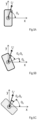
- Fig. 5A is an example of the first instructed force sensation vector f d c .
- Fig. 5B is an example of an actual rotation angle ⁇ d - ⁇ b of the force sensation presentation device (that is, the rotation angle of the force sensation presentation device with the influence of the azimuth angle ⁇ b removed).
- the azimuth angle ⁇ b corresponding to the error caused by the influence of geomagnetic distortion is found using a geomagnetic map, making it possible to provide, as an instruction, a direction obtained by correcting the error to the force sensation presentation device and thus prevent navigation of the guided person in a direction different from the desired direction in the walking navigation system.
- a direction calculation apparatus 200 is a device that calculates, in real time, a direction to be presented (hereinafter referred to as a presented direction) to a guided person using the force sensation presentation device. Note that the position of the force sensation presentation device in a predetermined range, and the geomagnetic vector and the gravitational acceleration vector at that position can be measured in the same manner as that of the direction calculation apparatus 100.
- the bias acquisition unit 210 uses the geomagnetic map recorded in the recording unit 190 to acquire and output, from the current position of the force sensation presentation device, a bias of the azimuth angle caused by geomagnetic distortion at the current position.
- the current position of the force sensation presentation device is, for example, data measured by a module (not illustrated) that measures the position of the force sensation presentation device, and the direction calculation apparatus 200 in a location away from the force sensation presentation device receives the measured data from the module via a communication unit (not illustrated) and inputs the data to the bias acquisition unit 210.
- the first azimuth angle acquisition unit 220 uses the geomagnetic vector of the current posture of the force sensation presentation device in the reference coordinate system at the current position of the force sensation presentation device to acquire and output an azimuth angle (hereinafter referred to as a first azimuth angle) indicating an azimuth of the force sensation presentation device that does not take into account an influence of geomagnetic distortion in the reference coordinate system at the current position.
- the geomagnetic vector of the current posture of the force sensation presentation device is, for example, data measured by a module (not illustrated) that measures the geomagnetic vector, and the direction calculation apparatus 200 receives the measured data from the module via a communication unit (not illustrated) and inputs the data to the first azimuth angle acquisition unit 220.
- Position coordinates in the reference coordinate system indicating the current position of the force sensation presentation device are denoted by (x p , y p , z p ).
- the presented direction calculation unit 230 calculates, from the bias and the first azimuth angle ⁇ b' , an azimuth angle ⁇ b (hereinafter referred to as a second azimuth angle) indicating an azimuth of the force sensation presentation device that takes into account the influence of geomagnetic distortion in the reference coordinate system at the position (x p , y p , z p ).
- the second azimuth angle ⁇ b is calculated such that a difference between the first azimuth angle ⁇ b' and the second azimuth angle ⁇ b is equal to the bias.
- the calculation is made by the following Math.
- Fig. 5C indicates an example of an erroneous rotation angle ⁇ d - ⁇ b' of the force sensation presentation device.
- the azimuth angle ⁇ d' that does not take into account the influence of geomagnetic distortion is used as is and the direction is instructed to the force sensation presentation device with ⁇ d - ⁇ b' as the rotation angle
- the guided person is guided in the wrong direction.
- the azimuth angle ⁇ b that takes into account the influence of geomagnetic distortion is used and the direction is instructed to the force sensation presentation device with ⁇ d - ⁇ b (or ⁇ d' - ⁇ b' ) as the rotation angle
- the guided person is guided in the correct direction.
- the direction calculation apparatus 200 transmits the second instructed force sensation vector f d' b' to the force sensation presentation device via a communication unit (not illustrated), and the force sensation presentation device presents the direction to the guided person by a force sensation or a stimulus that causes the person to artificially perceive a force sensation in accordance with the received second instructed force sensation vector f d' b' .
- the geomagnetic map used in the calculation of the presented direction differs between the first embodiment and the first example. Due to this difference, the first example has the following advantages and disadvantages in comparison with the first embodiment. (Advantages) In the first example, because a geomagnetic map including the bias of the azimuth angle caused by the influence of geomagnetic distortion is used, the data size is smaller than that of the geomagnetic map used in the first embodiment. As a result, the calculation of the second instructed force sensation vector f d' b' can be executed in less time.
- the geomagnetic map of the first example includes only a bias of the azimuth angle
- the force sensation presentation device is expected to be kept horizontal by the guided person and the problem arises that, when this posture is not maintained, the accuracy of the calculation of the presented direction decreases.
- the problem that it is not possible to respond to changes in the posture of the force sensation presentation device other than the azimuth.
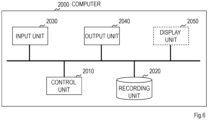
- Fig. 6 is a diagram illustrating an example of a functional configuration of a computer realizing each apparatus described above.
- the processing in each of the above-described apparatuses can be performed by causing a recording unit 2020 to read a program for causing a computer to function as each of the above-described apparatuses, and operating the program in a control unit 2010, an input unit 2030, an output unit 2040, and the like.
- a program necessary to implement the above-described functions, data necessary for processing of this program, and the like are stored in the external storage apparatus of the hardware entity (the present invention is not limited to the external storage apparatus; for example, the program may be read out and stored in a ROM that is a dedicated storage apparatus). Further, data obtained by the processing of the program is appropriately stored in a RAM, the external storage apparatus, or the like.
- each program and data necessary for the processing of each program stored in the external storage apparatus are read into a memory as necessary and appropriately interpreted, executed, or processed by a CPU.
- the CPU realizes predetermined functions (respective components expressed as the above-described, unit, means, or the like).
- processing function in the hardware entity (the apparatus of the present invention) described in the embodiment is implemented by a computer
- processing content of a function that the hardware entity should have is described by a program.
- the processing function in the hardware entity is implemented on the computer.
- the program in which the processing details are described can be recorded on a computer-readable recording medium.
- the computer-readable recording medium may be any type of medium such as a magnetic recording device, an optical disc, a magneto-optical recording medium, or a semiconductor memory.
- a hard disk apparatus, a flexible disk, a magnetic tape, or the like can be used as a magnetic recording apparatus
- a DVD Digital Versatile Disc
- DVD-RAM Random Access Memory
- CD-ROM Compact Disc Read Only Memory
- CD-R Recordable
- RW ReWritable
- an optical disc an optical disc
- MO Magneticto-Optical disc
- EEP-ROM Electrically Erasable and Programmable-Read Only Memory
- a computer executing the program first temporarily stores the program recorded on the portable recording medium or the program transmitted from the server computer in its own storage device.
- the computer reads the program stored in its own storage device and executes the processing in accordance with the read program.
- the computer may directly read the program from the portable recording medium and execute processing in accordance with the program, or, further, may sequentially execute the processing in accordance with the received program each time the program is transferred from the server computer to the computer.
- ASP application service provider
- the program in this mode is assumed to include information which is provided for processing of a computer and is equivalent to a program (data or the like that has characteristics of regulating processing of the computer rather than being a direct instruction to the computer).
- the hardware entity is configured by a predetermined program being executed on the computer in the present embodiment, at least a part of the processing content of the hardware entity may be implemented in hardware.
Landscapes
- Engineering & Computer Science (AREA)
- Remote Sensing (AREA)
- Radar, Positioning & Navigation (AREA)
- Automation & Control Theory (AREA)
- Physics & Mathematics (AREA)
- General Physics & Mathematics (AREA)
- Life Sciences & Earth Sciences (AREA)
- Environmental & Geological Engineering (AREA)
- General Life Sciences & Earth Sciences (AREA)
- Geology (AREA)
- Human Computer Interaction (AREA)
- Multimedia (AREA)
- Navigation (AREA)
- Measurement Of The Respiration, Hearing Ability, Form, And Blood Characteristics Of Living Organisms (AREA)
Description
- The present invention relates to a technique for presenting a direction to a guided person using a force sensation presentation device.
- For example, in walking navigation for a person who speaks a different language or a person who is visually impaired (hereinafter referred to as a guided person), intuitive presentation of a walking direction using a force sensation presentation device is considered effective (refer to NPL 1). Here, a force sensation presentation device is a device that provides a force sensation itself to a person gripping the device or a stimulus (stimulus by a vibration pattern, for example) that causes the person to artificially perceive a force sensation. NPL 2 discloses a new algorithm called vector cross product method which is compared with traditional attitude angle method for principle and accuracy. PL 1 relates to navigation systems and specifically to navigation systems providing directional and distal information about user position, environment object position and orientation to a user in tactile form. PL 2 relates to a processing apparatus, computer program code for the processing apparatus, and a method in the processing apparatus.
- In order to be able to present an accurate walking direction to the guided person in this walking navigation, it is necessary to accurately detect an azimuth. As an example of this azimuth detection method, there is a method that uses geomagnetism.
-
- NPL 1: Gomi, H., Amemiya, T., Takamuku, S., Ito, S., "Research and Development of Force Sensation Presentation Gadget: 'Buru-Navi3' Pinch-held Mobile Gadget Creating a Sensation of Being Pulled" Image Laboratory 26 (7), pp. 41-44, 2015.
- NPL 2: SUN Y ET AL, "A NewSolution Algorithm of Magnetic Azimuth", JOURNAL OF PHYSICS: CONFERENCE SERIES, INSTITUTE OF PHYSICS PUBLISHING, BRISTOL, GB, (20061001), vol. 48, no. 1.
-
- PL 1:
US 2013/218456 A1 . - PL 2:
US 2019/212152 A1 . - However, when walking navigation is performed inside a building, for example, the geomagnetism may be significantly distorted due to an influence of a steel frame or the like used in the building and, as a result, the azimuth detected using the geomagnetism changes significantly from the correct azimuth, resulting in the problem that the guided person is navigated in a direction different from the desired direction.
- Therefore, an object of the present invention is to provide a technique for more accurately calculating a direction to be presented to a guided person using a force sensation presentation device gripped by the guided person, taking into account geomagnetic distortion.
- The present disclosure provides a direction calculation apparatus, a direction calculation method, and a program, having the features of the respective independent claims. The dependent claim relates to a preferred embodiment.
According to an aspect of the present invention, a direction calculation apparatus configured to calculate a direction to be presented to a guided person (hereinafter referred to as a presented direction) using a force sensation presentation device gripped by the guided person includes a first matrix acquisition unit configured to use a geomagnetic map including a geomagnetic vector and a gravitational acceleration vector of a reference posture of the force sensation presentation device in a reference coordinate system at a position included in a predetermined range to acquire, from a current position of the force sensation presentation device, a matrix (hereinafter referred to as a first matrix) composed of a geomagnetic vector, a gravitational acceleration vector, and an outer product vector of these vectors of the reference posture of the force sensation presentation device in the reference coordinate system at the current position, a second matrix acquisition unit configured to acquire a matrix (hereinafter referred to as a second matrix) composed of a geomagnetic vector, a gravitational acceleration vector, and an outer product vector of these vectors of a current posture of the force sensation presentation device in the reference coordinate system at the current position, and a presented direction calculation unit configured to use the first matrix and the second matrix to calculate, from an instructed force sensation vector (hereinafter referred to as a first instructed force sensation vector) in a reference coordinate system indicating a direction to be instructed to the force sensation presentation device, an instructed force sensation vector (hereinafter referred to as a second instructed force sensation vector) in a force sensation presentation device coordinate system indicating a direction to be instructed to the force sensation presentation device, as the presented direction. - According to an aspect of the present invention, a direction calculation apparatus configured to calculate a direction to be presented to a guided person (hereinafter referred to as a presented direction) using a force sensation presentation device gripped by the guided person includes a bias acquisition unit configured to use a geomagnetic map including a bias of an azimuth angle caused by geomagnetic distortion at a position included in a predetermined range to acquire, from a current position of the force sensation presentation device, a bias of an azimuth angle caused by geomagnetic distortion at the current position, a first azimuth angle acquisition unit configured to acquire an azimuth angle (hereinafter referred to as a first azimuth angle) indicating an azimuth of the force sensation presentation device that does not take into account an influence of geomagnetic distortion in a reference coordinate system at the current position, and a presented direction calculation unit configured to use the bias and the first azimuth angle to calculate, from an instructed force sensation vector (hereinafter referred to as a first instructed force sensation vector) in a reference coordinate system indicating a direction to be instructed to the force sensation presentation device, an instructed force sensation vector (hereinafter referred to as a second instructed force sensation vector) in a force sensation presentation device coordinate system indicating a direction to be instructed to the force sensation presentation device, as the presented direction.
- According to the present invention, it is possible to more accurately calculate a direction to be presented to a guided person using a force sensation presentation device gripped by the guided person, taking into account geomagnetic distortion.
-
-
Fig. 1 is a block diagram illustrating an example of a configuration of adirection calculation apparatus 100. -
Fig. 2 is a flowchart illustrating an example of an operation of thedirection calculation apparatus 100. -
Fig. 3 is a block diagram illustrating an example of a configuration of adirection calculation apparatus 200. -
Fig. 4 is a flowchart illustrating an example of an operation of thedirection calculation apparatus 200. -
Fig. 5A is a diagram illustrating an example of a first instructed force sensation vector fd c. -
Fig. 5B is a diagram illustrating an example of an actual rotation angle θd - θb of the force sensation presentation device. -
Fig. 5C is a diagram illustrating an example of an erroneous rotation angle θd - θb' of the force sensation presentation device. -
Fig. 6 is a diagram illustrating an example of a functional configuration of a computer realizing each apparatus according to an embodiment of the present invention. - Hereinafter, embodiments of the present invention will be described in detail. Note that components having the same function are denoted by the same reference signs, and redundant description thereof will be omitted.
- An example of a walking navigation system will now be described. A guided person grips a force sensation presentation device and walks in a predetermined range such as in a designated building. The force sensation presentation device guides the guided person in a predetermined walking direction by a force sensation provided to the guided person or a stimulus that causes the guided person to artificially perceive a force sensation. In order for a walking navigation system that uses the force sensation presentation device to accurately present instructions related to the walking direction to the guided person, a predetermined walking direction needs to be determined, taking into account an influence of geomagnetic distortion. Thus, in embodiments of the present invention, a geomagnetic map is used that indicates a state of influence of geomagnetic distortion at a position included in a range in which a direction is to be presented to the guided person and navigation is to be performed, that is, a position in a designated building, or the like.
- A
direction calculation apparatus 100 is a device that calculates, in real time, a direction to be presented (hereinafter referred to as a presented direction) to the guided person using the force sensation presentation device, and is a device constituting a walking navigation system. That is, a walking navigation system is realized using thedirection calculation apparatus 100 and a force sensation presentation device. Here, the force sensation presentation device is a device gripped by the guided person, and the guided person need only grip the device, for example. Further, the direction to be presented to the guided person is typically a direction in which the walking of the guided person is to be guided, but may be a direction in which the attention of the guided person is to be directed. - Note that the
direction calculation apparatus 100 is used not only in the configuration of the walking navigation system, but can also be used in a case in which the guided person grips the force sensation presentation device and moves using a method other than walking. For example, thedirection calculation apparatus 100 can also be used in a case in which the guided person moves on a bicycle. - Further, because the force sensation presentation device is gripped by the guided person, a posture of the force sensation presentation device is not limited to being kept constant. That is, the force sensation presentation device is not limited to being gripped while being kept in a horizontal direction, and the force sensation presentation device may be gripped upside-down or at an angle. Further, during movement, a height of an arm gripping the force sensation presentation device and a posture of the body may vary.
- A position of the force sensation presentation device in a range (predetermined range) in which the guided person is to be guided, and a geomagnetic vector and a gravitational acceleration vector at that position can be measured. For example, a positioning device that uses an ultra-wideband (UWB) can be used as a module that measures the position of the force sensation presentation device, a three-axis geomagnetic sensor can be used as a module that measures the geomagnetic vector, and a three-axis acceleration sensor can be used as a module that measures the gravitational acceleration vector. Further, the force sensation presentation device incorporates the modules described above in an interior thereof, for example, and is thus configured to be capable of measuring the position of the force sensation presentation device, and the geomagnetic vector and the gravitational acceleration vector at that position.
- Hereinafter, the
direction calculation apparatus 100 will be described with reference toFigs. 1 and 2. Fig. 1 is a block diagram illustrating a configuration of thedirection calculation apparatus 100.Fig. 2 is a flowchart illustrating an operation of thedirection calculation apparatus 100. As illustrated inFig. 1 , thedirection calculation apparatus 100 includes a firstmatrix acquisition unit 110, a secondmatrix acquisition unit 120, a presenteddirection calculation unit 130, and arecording unit 190. Therecording unit 190 is a component configured to appropriately record information required for the processing of thedirection calculation apparatus 100. Therecording unit 190 records in advance, for example, a geomagnetic map including a geomagnetic vector and a gravitational acceleration vector of a reference posture of the force sensation presentation device in a reference coordinate system at a position included in a predetermined range. Here, the reference coordinate system is a coordinate system for expressing a position in a predetermined range, and may be, for example, any three-dimensional coordinate system with a gravitational direction set as a z-axis. Further, the reference posture of the force sensation presentation device is a posture of the force sensation presentation device referenced during measurement of the geomagnetic vector and the gravitational acceleration vector and is, for example, a posture of the force sensation presentation device being gripped by the guided person so as to be in the horizontal direction (so as to be parallel to an xy plane). - Hereinafter, an operation of the
direction calculation apparatus 100 will be described with reference toFig. 2 . The firstmatrix acquisition unit 110, in S110, uses the geomagnetic map recorded in therecording unit 190 to acquire and output, from a current position of the force sensation presentation device, a matrix (hereinafter referred to as a first matrix) composed of a geomagnetic vector, a gravitational acceleration vector, and an outer product vector of these vectors of the reference posture of the force sensation presentation device in the reference coordinate system at the current position. Here, the current position of the force sensation presentation device is, for example, data measured by a module (not illustrated) that measures the position of the device, and thedirection calculation apparatus 100 in a location away from the force sensation presentation device receives the measured data from the module via a communication unit (not illustrated) and inputs the data to the firstmatrix acquisition unit 110. - In S120, the second
matrix acquisition unit 120 acquires and outputs a matrix (hereinafter referred to as a second matrix) composed of a geomagnetic vector, a gravitational acceleration vector, and an outer product vector of these of a current posture of the force sensation presentation device in the reference coordinate system at the current position. Here, the geomagnetic vector of the current posture of the force sensation presentation device is, for example, data measured by a module (not illustrated) that measures the geomagnetic vector, and thedirection calculation apparatus 100 receives the measured data from the module via a communication unit (not illustrated) and inputs the data to the secondmatrix acquisition unit 120. Further, the gravitational acceleration vector of the current posture of the force sensation presentation device is, for example, data measured by a module (not illustrated) that measures the gravitational acceleration vector, and thedirection calculation apparatus 100 receives the measured data from the module via a communication unit (not illustrated) and inputs the data to the secondmatrix acquisition unit 120. - In S130, the presented
direction calculation unit 130 uses the first matrix acquired in S110 and the second matrix acquired in S120 to calculate, from an instructed force sensation vector (hereinafter referred to as a first instructed force sensation vector) in a reference coordinate system indicating a direction to be instructed to the force sensation presentation device, an instructed force sensation vector (hereinafter referred to as a second instructed force sensation vector) in a force sensation presentation device coordinate system indicating a direction to be instructed to the force sensation presentation device as the presented direction, and outputs the second instructed force sensation vector. Here, the first instructed force sensation vector is input to thedirection calculation apparatus 100 by, for example, the guide or a program, and corresponds to a direction in which the walking of the guided person is to be guided or a direction in which the attention of the guided person is to be called. Further, the force sensation presentation device coordinate system is a coordinate system fixed to the force sensation presentation device. - Prior to an explanation of a calculation procedure of the second instructed force sensation vector of the presented
direction calculation unit 130, a method for finding an azimuth angle θb indicating an azimuth of the force sensation presentation device taking into account the influence of geomagnetic distortion in the reference coordinate system at the current position of the force sensation presentation device will be described. Given (xp, yp, zp) as position coordinates in the reference coordinate system indicating the current position of the force sensation presentation device, the first matrix rc (xp, yp, zp) at position (xp, yp, zp) is represented by the following Math. 1:
- Here, mp # represents the geomagnetic vector of the reference posture of the force sensation presentation device in the reference coordinate system, gp # represents the gravitational acceleration vector of the reference posture of the force sensation presentation device in the reference coordinate system, and x represents the outer product of the two vectors.
- Further, the second matrix rs (xp, yp, zp) at position (xp, yp, zp) is represented by the following Math. 2:

- Here, mp represents the geomagnetic vector of the current posture of the force sensation presentation device in the reference coordinate system, and gp represents the gravitational acceleration vector of the current posture of the force sensation presentation device in the reference coordinate system.
- Hereinafter, the first matrix rc (xp, yp, zp) and the second matrix rs (xp, yp, zp) will be denoted as r°, rs, respectively.
- Here, given cRs as a matrix (rotation conversion matrix) rotated so that the second matrix rs corresponding to the current posture of the force sensation presentation device matches the first matrix rc corresponding to the reference posture of the force sensation presentation device, the following Math. 3 holds:

- Accordingly, the following Math. 4 is obtained:

- Thus, the azimuth angle θb indicating the azimuth of the force sensation presentation device taking into account the influence of geomagnetic distortion in the reference coordinate system at position (xp, yp, zp) is obtained by:

- Here, atan2 (y, x) represents an angle formed by vector (x, y) and vector (1, 0).
- Below, the calculation procedure of the second instructed force sensation vector of the presented
direction calculation unit 130 will be described. First, the presenteddirection calculation unit 130 calculates the azimuth angle θb from the first matrix rc and the second matrix rs. Specifically, the calculation need only be made using Math. 1 and Math. 2. Next, the presenteddirection calculation unit 130 uses the azimuth angle θb to calculate, from the first instructed force sensation vector fd c = | fd c | [cosθd, sinθd]T (where θd is the angle formed by the vector [1, 0]T and the first instructed force sensation vector), the second instructed force sensation vector fd b. Specifically, the calculation is made by the following Math. 6:
-
Fig. 5A is an example of the first instructed force sensation vector fd c. Further,Fig. 5B is an example of an actual rotation angle θd - θb of the force sensation presentation device (that is, the rotation angle of the force sensation presentation device with the influence of the azimuth angle θb removed). - Although not illustrated in
Fig. 2 , lastly, thedirection calculation apparatus 100 transmits the second instructed force sensation vector fd b to the force sensation presentation device via a communication unit (not illustrated), and the force sensation presentation device presents the direction to the guided person by a force sensation or a stimulus that causes the person to artificially perceive a force sensation in accordance with the received second instructed force sensation vector fd b. - According to the embodiment of the present invention, it is possible to more accurately calculate a direction to be presented to a guided person using a force sensation presentation device gripped by the guided person, taking into account geomagnetic distortion. In the invention of the present embodiment, the azimuth angle θb corresponding to the error caused by the influence of geomagnetic distortion is found using a geomagnetic map, making it possible to provide, as an instruction, a direction obtained by correcting the error to the force sensation presentation device and thus prevent navigation of the guided person in a direction different from the desired direction in the walking navigation system.
- Similar to the
direction calculation apparatus 100, adirection calculation apparatus 200 is a device that calculates, in real time, a direction to be presented (hereinafter referred to as a presented direction) to a guided person using the force sensation presentation device. Note that the position of the force sensation presentation device in a predetermined range, and the geomagnetic vector and the gravitational acceleration vector at that position can be measured in the same manner as that of thedirection calculation apparatus 100. - Hereinafter, the
direction calculation apparatus 200 will be described with reference toFigs. 3 and 4. Fig. 3 is a block diagram illustrating a configuration of thedirection calculation apparatus 200.Fig. 4 is a flowchart illustrating an operation of thedirection calculation apparatus 200. As illustrated inFig. 3 , thedirection calculation apparatus 200 includes abias acquisition unit 210, a first azimuthangle acquisition unit 220, a presenteddirection calculation unit 230, and therecording unit 190. Therecording unit 190 is a component configured to appropriately record information required for the processing of thedirection calculation apparatus 200. Therecording unit 190 records in advance, for example, a geomagnetic map including a bias of the azimuth angle caused by geomagnetic distortion at a position included in a predetermined range. - Hereinafter, an operation of the
direction calculation apparatus 200 will be described with reference toFig. 4 . In S210, thebias acquisition unit 210 uses the geomagnetic map recorded in therecording unit 190 to acquire and output, from the current position of the force sensation presentation device, a bias of the azimuth angle caused by geomagnetic distortion at the current position. Here, the current position of the force sensation presentation device is, for example, data measured by a module (not illustrated) that measures the position of the force sensation presentation device, and thedirection calculation apparatus 200 in a location away from the force sensation presentation device receives the measured data from the module via a communication unit (not illustrated) and inputs the data to thebias acquisition unit 210. - In S220, the first azimuth
angle acquisition unit 220 uses the geomagnetic vector of the current posture of the force sensation presentation device in the reference coordinate system at the current position of the force sensation presentation device to acquire and output an azimuth angle (hereinafter referred to as a first azimuth angle) indicating an azimuth of the force sensation presentation device that does not take into account an influence of geomagnetic distortion in the reference coordinate system at the current position. Here, the geomagnetic vector of the current posture of the force sensation presentation device is, for example, data measured by a module (not illustrated) that measures the geomagnetic vector, and thedirection calculation apparatus 200 receives the measured data from the module via a communication unit (not illustrated) and inputs the data to the first azimuthangle acquisition unit 220. - In S230, the presented
direction calculation unit 230 uses the bias acquired in S210 and the first azimuth angle acquired in S220 to calculate, from an instructed force sensation vector (hereinafter referred to as a first instructed force sensation vector) in a reference coordinate system indicating a direction to be instructed to the force sensation presentation device, an instructed force sensation vector (hereinafter referred to as a second instructed force sensation vector) in a force sensation presentation device coordinate system indicating a direction to be instructed to the force sensation presentation device as the presented direction , and outputs the second instructed force sensation vector. Here, the first instructed force sensation vector is input to thedirection calculation apparatus 200 by, for example, the guide or a program, and corresponds to a direction in which the walking of the guided person is to be guided or a direction in which the attention of the guided person is to be called. - Hereinafter, a calculation procedure of the second instructed force sensation vector of the presented
direction calculation unit 230 will be described. Position coordinates in the reference coordinate system indicating the current position of the force sensation presentation device are denoted by (xp, yp, zp). First, the presenteddirection calculation unit 230 calculates, from the bias and the first azimuth angle θb', an azimuth angle θb (hereinafter referred to as a second azimuth angle) indicating an azimuth of the force sensation presentation device that takes into account the influence of geomagnetic distortion in the reference coordinate system at the position (xp, yp, zp). Specifically, the second azimuth angle θb is calculated such that a difference between the first azimuth angle θb' and the second azimuth angle θb is equal to the bias. Next, the presenteddirection calculation unit 230 uses the second azimuth angle θb to calculate, from the first instructed force sensation vector fd c = | fd c | [cosθd, sinθd]T (where θd is the angle formed by the vector [1, 0]T and the first instructed force sensation vector), the second instructed force sensation vector fd' b'. Specifically, the calculation is made by the following Math. 7:
-
Fig. 5C indicates an example of an erroneous rotation angle θd - θb' of the force sensation presentation device. When the azimuth angle θd' that does not take into account the influence of geomagnetic distortion is used as is and the direction is instructed to the force sensation presentation device with θd - θb' as the rotation angle, the guided person is guided in the wrong direction. Here, when the azimuth angle θb that takes into account the influence of geomagnetic distortion is used and the direction is instructed to the force sensation presentation device with θd - θb (or θd' - θb') as the rotation angle, the guided person is guided in the correct direction. - Although not illustrated in
Fig. 4 , lastly, thedirection calculation apparatus 200 transmits the second instructed force sensation vector fd' b' to the force sensation presentation device via a communication unit (not illustrated), and the force sensation presentation device presents the direction to the guided person by a force sensation or a stimulus that causes the person to artificially perceive a force sensation in accordance with the received second instructed force sensation vector fd' b'. - The geomagnetic map used in the calculation of the presented direction differs between the first embodiment and the first example. Due to this difference, the first example has the following advantages and disadvantages in comparison with the first embodiment.
(Advantages) In the first example, because a geomagnetic map including the bias of the azimuth angle caused by the influence of geomagnetic distortion is used, the data size is smaller than that of the geomagnetic map used in the first embodiment. As a result, the calculation of the second instructed force sensation vector fd' b' can be executed in less time. - (Disadvantages) On the other hand, because the geomagnetic map of the first example includes only a bias of the azimuth angle, the force sensation presentation device is expected to be kept horizontal by the guided person and the problem arises that, when this posture is not maintained, the accuracy of the calculation of the presented direction decreases. There is also the problem that it is not possible to respond to changes in the posture of the force sensation presentation device other than the azimuth.
- According to the embodiment of the present invention, it is possible to more accurately calculate a direction to be presented to a guided person using a force sensation presentation device gripped by the guided person, taking into account geomagnetic distortion.
-
Fig. 6 is a diagram illustrating an example of a functional configuration of a computer realizing each apparatus described above. The processing in each of the above-described apparatuses can be performed by causing arecording unit 2020 to read a program for causing a computer to function as each of the above-described apparatuses, and operating the program in acontrol unit 2010, aninput unit 2030, anoutput unit 2040, and the like. - The apparatus according to the present invention includes, for example, as a single hardware entity, an input unit to which a keyboard or the like can be connected, an output unit to which a liquid crystal display or the like can be connected, a communication unit to which a communication apparatus (for example, a communication cable) capable of communication with the outside of the hardware entity can be connected, a Central Processing Unit (CPU, which may include a cache memory, a register, and the like), a RAM or a ROM that is a memory, an external storage apparatus that is a hard disk, and a bus connected for data exchange with the input unit, the output unit, the communication unit, the CPU, the RAM, the ROM, and the external storage apparatuses. An apparatus (drive) capable of reading and writing from and to a recording medium such as a CD-ROM may be provided in the hardware entity as necessary. An example of a physical entity including such hardware resources is a general-purpose computer.
- A program necessary to implement the above-described functions, data necessary for processing of this program, and the like are stored in the external storage apparatus of the hardware entity (the present invention is not limited to the external storage apparatus; for example, the program may be read out and stored in a ROM that is a dedicated storage apparatus). Further, data obtained by the processing of the program is appropriately stored in a RAM, the external storage apparatus, or the like.
- In the hardware entity, each program and data necessary for the processing of each program stored in the external storage apparatus (or a ROM, for example) are read into a memory as necessary and appropriately interpreted, executed, or processed by a CPU. As a result, the CPU realizes predetermined functions (respective components expressed as the above-described, unit, means, or the like).
- The present invention is not limited to the above-described embodiment, and appropriate changes can be made without departing from the spirit of the present invention. The processing described in the embodiments are not only executed in time series in the described order, but also may be executed in parallel or individually according to a processing capability of an apparatus that executes the processing or as necessary.
- As described above, when a processing function in the hardware entity (the apparatus of the present invention) described in the embodiment is implemented by a computer, processing content of a function that the hardware entity should have is described by a program. By executing this program using the computer, the processing function in the hardware entity is implemented on the computer.
- The program in which the processing details are described can be recorded on a computer-readable recording medium. The computer-readable recording medium, for example, may be any type of medium such as a magnetic recording device, an optical disc, a magneto-optical recording medium, or a semiconductor memory. Specifically, for example, a hard disk apparatus, a flexible disk, a magnetic tape, or the like can be used as a magnetic recording apparatus, a DVD (Digital Versatile Disc), a DVD-RAM (Random Access Memory), a CD-ROM (Compact Disc Read Only Memory), CD-R (Recordable)/RW (ReWritable), or the like can be used as an optical disc, an MO (Magneto-Optical disc) or the like can be used as a magneto-optical recording medium, and an EEP-ROM (Electronically Erasable and Programmable-Read Only Memory) or the like can be used as a semiconductor memory.
- In addition, the program is distributed, for example, by selling, transferring, or lending a portable recording medium such as a DVD or a CD-ROM with the program recorded on it. Further, the program may be stored in a storage device of a server computer and transmitted from the server computer to another computer via a network so that the program is distributed.
- For example, a computer executing the program first temporarily stores the program recorded on the portable recording medium or the program transmitted from the server computer in its own storage device. When executing the processing, the computer reads the program stored in its own storage device and executes the processing in accordance with the read program. Further, as another execution mode of this program, the computer may directly read the program from the portable recording medium and execute processing in accordance with the program, or, further, may sequentially execute the processing in accordance with the received program each time the program is transferred from the server computer to the computer. In addition, another configuration to execute the processing through a so-called application service provider (ASP) service in which processing functions are implemented just by issuing an instruction to execute the program and obtaining results without transmitting the program from the server computer to the computer may be employed. Further, the program in this mode is assumed to include information which is provided for processing of a computer and is equivalent to a program (data or the like that has characteristics of regulating processing of the computer rather than being a direct instruction to the computer).
- Although the hardware entity is configured by a predetermined program being executed on the computer in the present embodiment, at least a part of the processing content of the hardware entity may be implemented in hardware.
- The foregoing description of the embodiments of the present invention has been presented for purposes of illustration and description. The foregoing description does not intend to be exhaustive and does not intend to limit the invention to the precise forms disclosed. Modifications and variations are possible from the teachings above without departing from the scope of the claims.
Claims (4)
- A direction calculation apparatus (100) configured to calculate a direction to be presented to a guided person using a force sensation presentation device gripped by the guided person, the direction calculation apparatus characterized by comprising:a first matrix acquisition unit (110) configured to, using a geomagnetic map including a geomagnetic vector of a reference posture of the force sensation presentation device in a reference coordinate system at a position included in a predetermined range and a gravitational acceleration vector of the reference posture of the force sensation presentation device in the reference coordinate system at the position included in the predetermined range , acquire a first matrix composed of a geomagnetic vector of the reference posture of the force sensation presentation device in the reference coordinate system at the current position, a gravitational acceleration vector of the reference posture of the force sensation presentation device in the reference coordinate system at the current position, and an outer product vector of the geomagnetic vector and the gravitational acceleration vector from a current position of the force sensation presentation device, wherein said geomagnetic map is recorded in a recording unit (190) of the direction calculation apparatus (100);a second matrix acquisition unit (120) configured to acquire a second matrix composed of a geomagnetic vector of a current posture of the force sensation presentation device in the reference coordinate system at the current position, a gravitational acceleration vector of the current posture of the force sensation presentation device in the reference coordinate system at the current position, and an outer product vector of the geomagnetic vector and the gravitational acceleration vector; anda presented direction calculation unit (130) configured to use the first matrix and the second matrix to calculate, from a first instructed force sensation vector in a reference coordinate system indicating a direction to be instructed to the force sensation presentation device, a second instructed force sensation vector in a force sensation presentation device coordinate system indicating a direction to be instructed to the force sensation presentation device as the direction to be presented to the guide person.
- The direction calculation apparatus according to claim 1, whereinrc is assumed to represent the first matrix, and rs is assumed to represent the second matrix andthe first instructed force sensation vector is defined as fd c = | fd c | [cosθ4, sinθd]T (where θd represents an angle formed by a vector [1, 0]T and the first instructed force sensation vector), andthe presented direction calculation unit (130) calculates, from the first matrix rc and the second matrix rs, an azimuth angle θb indicating an azimuth of the force sensation presentation device, the azimuth taking into account an influence of geomagnetic distortion in the reference coordinate system at the current position by Math. 8:
 and the presented direction calculation unit calculates the second instructed force sensation vector fd b by Math. 9:
- A direction calculation method in which a direction calculation apparatus (100) calculates a direction to be presented to a guided person using a force sensation presentation device gripped by the guided person, the direction calculation method characterized by comprising:a first matrix acquisition step (S110) in which the direction calculation apparatus, using a geomagnetic map including a geomagnetic vector of a reference posture of a force sensation presentation device in a reference coordinate system at a position included in a predetermined range and a gravitational acceleration vector of the reference posture of the force sensation presentation device in the reference coordinate system at the position included in the predetermined range , acquires a first matrix composed of a geomagnetic vector of the reference posture of the force sensation presentation device in the reference coordinate system at the current position, a gravitational acceleration vector of the reference posture of the force sensation presentation device in the reference coordinate system at the current position, and an outer product vector of the geomagnetic vector and the gravitational acceleration vector from a current position of the force sensation presentation device, wherein said geomagnetic map is recorded in a recording unit (190) of the direction calculation apparatus (100);a second matrix acquisition step (S120) in which the direction calculation apparatus acquires a second matrix composed of a geomagnetic vector of a current posture of the force sensation presentation device in the reference coordinate system at the current position, a gravitational acceleration vector of the current posture of the force sensation presentation device in the reference coordinate system at the current position, and an outer product vector of the geomagnetic vector and the gravitational acceleration vector; anda presented direction calculation step (S130) in which the direction calculation apparatus, using the first matrix and the second matrix, calculates from a first instructed force sensation vector in a reference coordinate system indicating a direction to be instructed to the force sensation presentation device, a second instructed force sensation vector in a force sensation presentation device coordinate system indicating a direction to be instructed to the force sensation presentation device as the direction to be presented to the guide person.
- A program for causing a computer to execute each step of the direction calculation method according to claim 3.
Priority Applications (1)
| Application Number | Priority Date | Filing Date | Title |
|---|---|---|---|
| EP24192216.0A EP4431874B1 (en) | 2019-09-27 | 2019-09-27 | Direction calculation apparatus, direction calculation method, and program |
Applications Claiming Priority (1)
| Application Number | Priority Date | Filing Date | Title |
|---|---|---|---|
| PCT/JP2019/038186 WO2021059495A1 (en) | 2019-09-27 | 2019-09-27 | Direction calculation device, direction calculation method, and program |
Related Child Applications (2)
| Application Number | Title | Priority Date | Filing Date |
|---|---|---|---|
| EP24192216.0A Division EP4431874B1 (en) | 2019-09-27 | 2019-09-27 | Direction calculation apparatus, direction calculation method, and program |
| EP24192216.0A Division-Into EP4431874B1 (en) | 2019-09-27 | 2019-09-27 | Direction calculation apparatus, direction calculation method, and program |
Publications (3)
| Publication Number | Publication Date |
|---|---|
| EP4036525A1 EP4036525A1 (en) | 2022-08-03 |
| EP4036525A4 EP4036525A4 (en) | 2023-11-01 |
| EP4036525B1 true EP4036525B1 (en) | 2025-04-16 |
Family
ID=75165210
Family Applications (2)
| Application Number | Title | Priority Date | Filing Date |
|---|---|---|---|
| EP24192216.0A Active EP4431874B1 (en) | 2019-09-27 | 2019-09-27 | Direction calculation apparatus, direction calculation method, and program |
| EP19946388.6A Active EP4036525B1 (en) | 2019-09-27 | 2019-09-27 | Direction calculation device, direction calculation method, and program |
Family Applications Before (1)
| Application Number | Title | Priority Date | Filing Date |
|---|---|---|---|
| EP24192216.0A Active EP4431874B1 (en) | 2019-09-27 | 2019-09-27 | Direction calculation apparatus, direction calculation method, and program |
Country Status (4)
| Country | Link |
|---|---|
| US (1) | US11953325B2 (en) |
| EP (2) | EP4431874B1 (en) |
| JP (1) | JP7294434B2 (en) |
| WO (1) | WO2021059495A1 (en) |
Family Cites Families (7)
| Publication number | Priority date | Publication date | Assignee | Title |
|---|---|---|---|---|
| US20130218456A1 (en) | 2006-02-16 | 2013-08-22 | John S. Zelek | Wearable tactile navigation system |
| US8996298B2 (en) * | 2011-06-13 | 2015-03-31 | Panasonic Intellectual Property Corporation Of America | Noise pattern acquisition device and position detection apparatus provided therewith |
| WO2016031118A1 (en) | 2014-08-29 | 2016-03-03 | ソニー株式会社 | Force display device, force display system, and force display method |
| US20190212152A1 (en) | 2016-05-10 | 2019-07-11 | Indooratlas Oy | Measurement data processing |
| US11959751B2 (en) * | 2016-05-26 | 2024-04-16 | Apple Inc. | Correcting compass view using map data |
| US11473911B2 (en) | 2017-10-26 | 2022-10-18 | Sony Semiconductor Solutions Corporation | Heading determination device and method, rendering device and method |
| JP7027954B2 (en) | 2018-02-28 | 2022-03-02 | セイコーエプソン株式会社 | Electronic clock and pointer control method |
-
2019
- 2019-09-27 EP EP24192216.0A patent/EP4431874B1/en active Active
- 2019-09-27 EP EP19946388.6A patent/EP4036525B1/en active Active
- 2019-09-27 WO PCT/JP2019/038186 patent/WO2021059495A1/en not_active Ceased
- 2019-09-27 US US17/762,716 patent/US11953325B2/en active Active
- 2019-09-27 JP JP2021548128A patent/JP7294434B2/en active Active
Also Published As
| Publication number | Publication date |
|---|---|
| EP4036525A4 (en) | 2023-11-01 |
| US11953325B2 (en) | 2024-04-09 |
| EP4431874B1 (en) | 2026-03-11 |
| US20220341736A1 (en) | 2022-10-27 |
| EP4431874A3 (en) | 2024-11-27 |
| JPWO2021059495A1 (en) | 2021-04-01 |
| WO2021059495A1 (en) | 2021-04-01 |
| EP4036525A1 (en) | 2022-08-03 |
| JP7294434B2 (en) | 2023-06-20 |
| EP4431874A2 (en) | 2024-09-18 |
Similar Documents
| Publication | Publication Date | Title |
|---|---|---|
| US6993451B2 (en) | 3D input apparatus and method thereof | |
| CN1318942C (en) | Data conversion method and apparatus, and orientation measurement apparatus | |
| CN106814753B (en) | Target position correction method, device and system | |
| US7248967B2 (en) | Autonomous velocity estimation and navigation | |
| US20140222369A1 (en) | Simplified method for estimating the orientation of an object, and attitude sensor implementing such a method | |
| US20130238269A1 (en) | Apparatuses and methods for dynamic tracking and compensation of magnetic near field | |
| US20090076651A1 (en) | Apparatus and method for calculating position of robot | |
| JP3726884B2 (en) | Attitude estimation apparatus and method using inertial measurement apparatus, and program | |
| US11408735B2 (en) | Positioning system and positioning method | |
| US10539644B1 (en) | Tracking an object in an electromagnetic field | |
| EP4607150A1 (en) | Device attitude estimation method and apparatus | |
| US8862418B2 (en) | Magnetic data processing device, magnetic data processing method, and magnetic data processing program | |
| CN112902956A (en) | Course initial value acquisition method for handheld GNSS/MEMS-INS receiver, electronic equipment and storage medium | |
| US11187823B2 (en) | Correcting distortions | |
| CN106370178A (en) | Mobile terminal equipment attitude measurement method and mobile terminal equipment attitude measurement apparatus | |
| CN112684478A (en) | Parameter calibration method and device based on double antennas, storage medium and electronic equipment | |
| Diaz et al. | A time-varying Kalman filter for low-acceleration attitude estimation | |
| EP4036525B1 (en) | Direction calculation device, direction calculation method, and program | |
| CN114353825B (en) | Magnetometer online calibration algorithm, medium and system based on unscented Kalman filtering | |
| Cardou et al. | Angular velocity estimation from the angular acceleration matrix | |
| US20130085712A1 (en) | Inertial sensing input apparatus and method thereof | |
| CN114279396B (en) | Method and device for determining motion posture, computer readable medium and electronic device | |
| US11860246B1 (en) | Short-range position tracking using stationary magnetic field gradient | |
| CN116718176A (en) | A matching positioning method and device based on map information and historical trajectories | |
| JPH0875442A (en) | Simplified length measuring machine |
Legal Events
| Date | Code | Title | Description |
|---|---|---|---|
| STAA | Information on the status of an ep patent application or granted ep patent |
Free format text: STATUS: THE INTERNATIONAL PUBLICATION HAS BEEN MADE |
|
| PUAI | Public reference made under article 153(3) epc to a published international application that has entered the european phase |
Free format text: ORIGINAL CODE: 0009012 |
|
| STAA | Information on the status of an ep patent application or granted ep patent |
Free format text: STATUS: REQUEST FOR EXAMINATION WAS MADE |
|
| 17P | Request for examination filed |
Effective date: 20220428 |
|
| AK | Designated contracting states |
Kind code of ref document: A1 Designated state(s): AL AT BE BG CH CY CZ DE DK EE ES FI FR GB GR HR HU IE IS IT LI LT LU LV MC MK MT NL NO PL PT RO RS SE SI SK SM TR |
|
| DAV | Request for validation of the european patent (deleted) | ||
| DAX | Request for extension of the european patent (deleted) | ||
| A4 | Supplementary search report drawn up and despatched |
Effective date: 20231002 |
|
| RIC1 | Information provided on ipc code assigned before grant |
Ipc: G01C 21/26 20060101AFI20230926BHEP |
|
| GRAP | Despatch of communication of intention to grant a patent |
Free format text: ORIGINAL CODE: EPIDOSNIGR1 |
|
| STAA | Information on the status of an ep patent application or granted ep patent |
Free format text: STATUS: GRANT OF PATENT IS INTENDED |
|
| INTG | Intention to grant announced |
Effective date: 20240613 |
|
| RIC1 | Information provided on ipc code assigned before grant |
Ipc: G01C 21/20 20060101ALI20240531BHEP Ipc: G01C 21/26 20060101AFI20240531BHEP |
|
| GRAJ | Information related to disapproval of communication of intention to grant by the applicant or resumption of examination proceedings by the epo deleted |
Free format text: ORIGINAL CODE: EPIDOSDIGR1 |
|
| STAA | Information on the status of an ep patent application or granted ep patent |
Free format text: STATUS: REQUEST FOR EXAMINATION WAS MADE |
|
| GRAP | Despatch of communication of intention to grant a patent |
Free format text: ORIGINAL CODE: EPIDOSNIGR1 |
|
| STAA | Information on the status of an ep patent application or granted ep patent |
Free format text: STATUS: GRANT OF PATENT IS INTENDED |
|
| INTC | Intention to grant announced (deleted) | ||
| INTG | Intention to grant announced |
Effective date: 20241114 |
|
| GRAS | Grant fee paid |
Free format text: ORIGINAL CODE: EPIDOSNIGR3 |
|
| GRAA | (expected) grant |
Free format text: ORIGINAL CODE: 0009210 |
|
| STAA | Information on the status of an ep patent application or granted ep patent |
Free format text: STATUS: THE PATENT HAS BEEN GRANTED |
|
| AK | Designated contracting states |
Kind code of ref document: B1 Designated state(s): AL AT BE BG CH CY CZ DE DK EE ES FI FR GB GR HR HU IE IS IT LI LT LU LV MC MK MT NL NO PL PT RO RS SE SI SK SM TR |
|
| REG | Reference to a national code |
Ref country code: GB Ref legal event code: FG4D |
|
| REG | Reference to a national code |
Ref country code: CH Ref legal event code: EP |
|
| REG | Reference to a national code |
Ref country code: IE Ref legal event code: FG4D |
|
| REG | Reference to a national code |
Ref country code: DE Ref legal event code: R096 Ref document number: 602019068891 Country of ref document: DE |
|
| PGFP | Annual fee paid to national office [announced via postgrant information from national office to epo] |
Ref country code: IT Payment date: 20250509 Year of fee payment: 7 |
|
| REG | Reference to a national code |
Ref country code: NL Ref legal event code: MP Effective date: 20250416 |
|
| PG25 | Lapsed in a contracting state [announced via postgrant information from national office to epo] |
Ref country code: NL Free format text: LAPSE BECAUSE OF FAILURE TO SUBMIT A TRANSLATION OF THE DESCRIPTION OR TO PAY THE FEE WITHIN THE PRESCRIBED TIME-LIMIT Effective date: 20250416 |
|
| REG | Reference to a national code |
Ref country code: AT Ref legal event code: MK05 Ref document number: 1785955 Country of ref document: AT Kind code of ref document: T Effective date: 20250416 |
|
| RAP4 | Party data changed (patent owner data changed or rights of a patent transferred) |
Owner name: NTT, INC. |
|
| PG25 | Lapsed in a contracting state [announced via postgrant information from national office to epo] |
Ref country code: PT Free format text: LAPSE BECAUSE OF FAILURE TO SUBMIT A TRANSLATION OF THE DESCRIPTION OR TO PAY THE FEE WITHIN THE PRESCRIBED TIME-LIMIT Effective date: 20250818 Ref country code: ES Free format text: LAPSE BECAUSE OF FAILURE TO SUBMIT A TRANSLATION OF THE DESCRIPTION OR TO PAY THE FEE WITHIN THE PRESCRIBED TIME-LIMIT Effective date: 20250416 Ref country code: FI Free format text: LAPSE BECAUSE OF FAILURE TO SUBMIT A TRANSLATION OF THE DESCRIPTION OR TO PAY THE FEE WITHIN THE PRESCRIBED TIME-LIMIT Effective date: 20250416 |
|
| REG | Reference to a national code |
Ref country code: LT Ref legal event code: MG9D |
|
| PG25 | Lapsed in a contracting state [announced via postgrant information from national office to epo] |
Ref country code: NO Free format text: LAPSE BECAUSE OF FAILURE TO SUBMIT A TRANSLATION OF THE DESCRIPTION OR TO PAY THE FEE WITHIN THE PRESCRIBED TIME-LIMIT Effective date: 20250716 Ref country code: GR Free format text: LAPSE BECAUSE OF FAILURE TO SUBMIT A TRANSLATION OF THE DESCRIPTION OR TO PAY THE FEE WITHIN THE PRESCRIBED TIME-LIMIT Effective date: 20250717 |
|
| PG25 | Lapsed in a contracting state [announced via postgrant information from national office to epo] |
Ref country code: PL Free format text: LAPSE BECAUSE OF FAILURE TO SUBMIT A TRANSLATION OF THE DESCRIPTION OR TO PAY THE FEE WITHIN THE PRESCRIBED TIME-LIMIT Effective date: 20250416 |
|
| PG25 | Lapsed in a contracting state [announced via postgrant information from national office to epo] |
Ref country code: BG Free format text: LAPSE BECAUSE OF FAILURE TO SUBMIT A TRANSLATION OF THE DESCRIPTION OR TO PAY THE FEE WITHIN THE PRESCRIBED TIME-LIMIT Effective date: 20250416 |
|
| PGFP | Annual fee paid to national office [announced via postgrant information from national office to epo] |
Ref country code: GB Payment date: 20250829 Year of fee payment: 7 |
|
| PG25 | Lapsed in a contracting state [announced via postgrant information from national office to epo] |
Ref country code: HR Free format text: LAPSE BECAUSE OF FAILURE TO SUBMIT A TRANSLATION OF THE DESCRIPTION OR TO PAY THE FEE WITHIN THE PRESCRIBED TIME-LIMIT Effective date: 20250416 |
|
| PG25 | Lapsed in a contracting state [announced via postgrant information from national office to epo] |
Ref country code: AT Free format text: LAPSE BECAUSE OF FAILURE TO SUBMIT A TRANSLATION OF THE DESCRIPTION OR TO PAY THE FEE WITHIN THE PRESCRIBED TIME-LIMIT Effective date: 20250416 |
|
| PG25 | Lapsed in a contracting state [announced via postgrant information from national office to epo] |
Ref country code: RS Free format text: LAPSE BECAUSE OF FAILURE TO SUBMIT A TRANSLATION OF THE DESCRIPTION OR TO PAY THE FEE WITHIN THE PRESCRIBED TIME-LIMIT Effective date: 20250716 |
|
| PG25 | Lapsed in a contracting state [announced via postgrant information from national office to epo] |
Ref country code: IS Free format text: LAPSE BECAUSE OF FAILURE TO SUBMIT A TRANSLATION OF THE DESCRIPTION OR TO PAY THE FEE WITHIN THE PRESCRIBED TIME-LIMIT Effective date: 20250816 |
|
| PG25 | Lapsed in a contracting state [announced via postgrant information from national office to epo] |
Ref country code: LV Free format text: LAPSE BECAUSE OF FAILURE TO SUBMIT A TRANSLATION OF THE DESCRIPTION OR TO PAY THE FEE WITHIN THE PRESCRIBED TIME-LIMIT Effective date: 20250416 |
|
| PG25 | Lapsed in a contracting state [announced via postgrant information from national office to epo] |
Ref country code: DK Free format text: LAPSE BECAUSE OF FAILURE TO SUBMIT A TRANSLATION OF THE DESCRIPTION OR TO PAY THE FEE WITHIN THE PRESCRIBED TIME-LIMIT Effective date: 20250416 Ref country code: SM Free format text: LAPSE BECAUSE OF FAILURE TO SUBMIT A TRANSLATION OF THE DESCRIPTION OR TO PAY THE FEE WITHIN THE PRESCRIBED TIME-LIMIT Effective date: 20250416 |
|
| REG | Reference to a national code |
Ref country code: DE Ref legal event code: R097 Ref document number: 602019068891 Country of ref document: DE |
|
| PG25 | Lapsed in a contracting state [announced via postgrant information from national office to epo] |
Ref country code: CZ Free format text: LAPSE BECAUSE OF FAILURE TO SUBMIT A TRANSLATION OF THE DESCRIPTION OR TO PAY THE FEE WITHIN THE PRESCRIBED TIME-LIMIT Effective date: 20250416 |
|
| PG25 | Lapsed in a contracting state [announced via postgrant information from national office to epo] |
Ref country code: EE Free format text: LAPSE BECAUSE OF FAILURE TO SUBMIT A TRANSLATION OF THE DESCRIPTION OR TO PAY THE FEE WITHIN THE PRESCRIBED TIME-LIMIT Effective date: 20250416 |
|
| PG25 | Lapsed in a contracting state [announced via postgrant information from national office to epo] |
Ref country code: SK Free format text: LAPSE BECAUSE OF FAILURE TO SUBMIT A TRANSLATION OF THE DESCRIPTION OR TO PAY THE FEE WITHIN THE PRESCRIBED TIME-LIMIT Effective date: 20250416 |
|
| PG25 | Lapsed in a contracting state [announced via postgrant information from national office to epo] |
Ref country code: RO Free format text: LAPSE BECAUSE OF FAILURE TO SUBMIT A TRANSLATION OF THE DESCRIPTION OR TO PAY THE FEE WITHIN THE PRESCRIBED TIME-LIMIT Effective date: 20250416 |
|
| PLBE | No opposition filed within time limit |
Free format text: ORIGINAL CODE: 0009261 |
|
| STAA | Information on the status of an ep patent application or granted ep patent |
Free format text: STATUS: NO OPPOSITION FILED WITHIN TIME LIMIT |
|
| REG | Reference to a national code |
Ref country code: CH Ref legal event code: L10 Free format text: ST27 STATUS EVENT CODE: U-0-0-L10-L00 (AS PROVIDED BY THE NATIONAL OFFICE) Effective date: 20260225 |
|
| 26N | No opposition filed |
Effective date: 20260119 |