EP4036389B1 - Gear baffle - Google Patents
Gear baffle Download PDFInfo
- Publication number
- EP4036389B1 EP4036389B1 EP21215584.0A EP21215584A EP4036389B1 EP 4036389 B1 EP4036389 B1 EP 4036389B1 EP 21215584 A EP21215584 A EP 21215584A EP 4036389 B1 EP4036389 B1 EP 4036389B1
- Authority
- EP
- European Patent Office
- Prior art keywords
- gear
- main wall
- baffle
- interface
- corrugation
- Prior art date
- Legal status (The legal status is an assumption and is not a legal conclusion. Google has not performed a legal analysis and makes no representation as to the accuracy of the status listed.)
- Active
Links
Images




Classifications
-
- F—MECHANICAL ENGINEERING; LIGHTING; HEATING; WEAPONS; BLASTING
- F02—COMBUSTION ENGINES; HOT-GAS OR COMBUSTION-PRODUCT ENGINE PLANTS
- F02C—GAS-TURBINE PLANTS; AIR INTAKES FOR JET-PROPULSION PLANTS; CONTROLLING FUEL SUPPLY IN AIR-BREATHING JET-PROPULSION PLANTS
- F02C7/00—Features, components parts, details or accessories, not provided for in, or of interest apart form groups F02C1/00 - F02C6/00; Air intakes for jet-propulsion plants
- F02C7/36—Power transmission arrangements between the different shafts of the gas turbine plant, or between the gas-turbine plant and the power user
-
- F—MECHANICAL ENGINEERING; LIGHTING; HEATING; WEAPONS; BLASTING
- F16—ENGINEERING ELEMENTS AND UNITS; GENERAL MEASURES FOR PRODUCING AND MAINTAINING EFFECTIVE FUNCTIONING OF MACHINES OR INSTALLATIONS; THERMAL INSULATION IN GENERAL
- F16H—GEARING
- F16H57/00—General details of gearing
- F16H57/04—Features relating to lubrication or cooling or heating
- F16H57/0409—Features relating to lubrication or cooling or heating characterised by increasing efficiency, e.g. by reducing splash losses
-
- F—MECHANICAL ENGINEERING; LIGHTING; HEATING; WEAPONS; BLASTING
- F16—ENGINEERING ELEMENTS AND UNITS; GENERAL MEASURES FOR PRODUCING AND MAINTAINING EFFECTIVE FUNCTIONING OF MACHINES OR INSTALLATIONS; THERMAL INSULATION IN GENERAL
- F16H—GEARING
- F16H57/00—General details of gearing
- F16H57/04—Features relating to lubrication or cooling or heating
- F16H57/042—Guidance of lubricant
- F16H57/0421—Guidance of lubricant on or within the casing, e.g. shields or baffles for collecting lubricant, tubes, pipes, grooves, channels or the like
-
- F—MECHANICAL ENGINEERING; LIGHTING; HEATING; WEAPONS; BLASTING
- F02—COMBUSTION ENGINES; HOT-GAS OR COMBUSTION-PRODUCT ENGINE PLANTS
- F02C—GAS-TURBINE PLANTS; AIR INTAKES FOR JET-PROPULSION PLANTS; CONTROLLING FUEL SUPPLY IN AIR-BREATHING JET-PROPULSION PLANTS
- F02C7/00—Features, components parts, details or accessories, not provided for in, or of interest apart form groups F02C1/00 - F02C6/00; Air intakes for jet-propulsion plants
- F02C7/32—Arrangement, mounting, or driving, of auxiliaries
-
- F—MECHANICAL ENGINEERING; LIGHTING; HEATING; WEAPONS; BLASTING
- F16—ENGINEERING ELEMENTS AND UNITS; GENERAL MEASURES FOR PRODUCING AND MAINTAINING EFFECTIVE FUNCTIONING OF MACHINES OR INSTALLATIONS; THERMAL INSULATION IN GENERAL
- F16H—GEARING
- F16H57/00—General details of gearing
- F16H57/02—Gearboxes; Mounting gearing therein
-
- F—MECHANICAL ENGINEERING; LIGHTING; HEATING; WEAPONS; BLASTING
- F16—ENGINEERING ELEMENTS AND UNITS; GENERAL MEASURES FOR PRODUCING AND MAINTAINING EFFECTIVE FUNCTIONING OF MACHINES OR INSTALLATIONS; THERMAL INSULATION IN GENERAL
- F16H—GEARING
- F16H57/00—General details of gearing
- F16H57/02—Gearboxes; Mounting gearing therein
- F16H57/023—Mounting or installation of gears or shafts in the gearboxes, e.g. methods or means for assembly
-
- F—MECHANICAL ENGINEERING; LIGHTING; HEATING; WEAPONS; BLASTING
- F16—ENGINEERING ELEMENTS AND UNITS; GENERAL MEASURES FOR PRODUCING AND MAINTAINING EFFECTIVE FUNCTIONING OF MACHINES OR INSTALLATIONS; THERMAL INSULATION IN GENERAL
- F16H—GEARING
- F16H57/00—General details of gearing
- F16H57/04—Features relating to lubrication or cooling or heating
- F16H57/042—Guidance of lubricant
- F16H57/0421—Guidance of lubricant on or within the casing, e.g. shields or baffles for collecting lubricant, tubes, pipes, grooves, channels or the like
- F16H57/0423—Lubricant guiding means mounted or supported on the casing, e.g. shields or baffles for collecting lubricant, tubes or pipes
-
- F—MECHANICAL ENGINEERING; LIGHTING; HEATING; WEAPONS; BLASTING
- F16—ENGINEERING ELEMENTS AND UNITS; GENERAL MEASURES FOR PRODUCING AND MAINTAINING EFFECTIVE FUNCTIONING OF MACHINES OR INSTALLATIONS; THERMAL INSULATION IN GENERAL
- F16H—GEARING
- F16H57/00—General details of gearing
- F16H57/04—Features relating to lubrication or cooling or heating
- F16H57/048—Type of gearings to be lubricated, cooled or heated
- F16H57/0493—Gearings with spur or bevel gears
- F16H57/0495—Gearings with spur or bevel gears with fixed gear ratio
-
- F—MECHANICAL ENGINEERING; LIGHTING; HEATING; WEAPONS; BLASTING
- F05—INDEXING SCHEMES RELATING TO ENGINES OR PUMPS IN VARIOUS SUBCLASSES OF CLASSES F01-F04
- F05D—INDEXING SCHEME FOR ASPECTS RELATING TO NON-POSITIVE-DISPLACEMENT MACHINES OR ENGINES, GAS-TURBINES OR JET-PROPULSION PLANTS
- F05D2220/00—Application
- F05D2220/30—Application in turbines
- F05D2220/32—Application in turbines in gas turbines
-
- F—MECHANICAL ENGINEERING; LIGHTING; HEATING; WEAPONS; BLASTING
- F05—INDEXING SCHEMES RELATING TO ENGINES OR PUMPS IN VARIOUS SUBCLASSES OF CLASSES F01-F04
- F05D—INDEXING SCHEME FOR ASPECTS RELATING TO NON-POSITIVE-DISPLACEMENT MACHINES OR ENGINES, GAS-TURBINES OR JET-PROPULSION PLANTS
- F05D2230/00—Manufacture
- F05D2230/60—Assembly methods
- F05D2230/64—Assembly methods using positioning or alignment devices for aligning or centring, e.g. pins
- F05D2230/642—Assembly methods using positioning or alignment devices for aligning or centring, e.g. pins using maintaining alignment while permitting differential dilatation
-
- F—MECHANICAL ENGINEERING; LIGHTING; HEATING; WEAPONS; BLASTING
- F05—INDEXING SCHEMES RELATING TO ENGINES OR PUMPS IN VARIOUS SUBCLASSES OF CLASSES F01-F04
- F05D—INDEXING SCHEME FOR ASPECTS RELATING TO NON-POSITIVE-DISPLACEMENT MACHINES OR ENGINES, GAS-TURBINES OR JET-PROPULSION PLANTS
- F05D2240/00—Components
- F05D2240/10—Stators
- F05D2240/12—Fluid guiding means, e.g. vanes
- F05D2240/126—Baffles or ribs
-
- F—MECHANICAL ENGINEERING; LIGHTING; HEATING; WEAPONS; BLASTING
- F05—INDEXING SCHEMES RELATING TO ENGINES OR PUMPS IN VARIOUS SUBCLASSES OF CLASSES F01-F04
- F05D—INDEXING SCHEME FOR ASPECTS RELATING TO NON-POSITIVE-DISPLACEMENT MACHINES OR ENGINES, GAS-TURBINES OR JET-PROPULSION PLANTS
- F05D2250/00—Geometry
- F05D2250/60—Structure; Surface texture
- F05D2250/61—Structure; Surface texture corrugated
-
- F—MECHANICAL ENGINEERING; LIGHTING; HEATING; WEAPONS; BLASTING
- F05—INDEXING SCHEMES RELATING TO ENGINES OR PUMPS IN VARIOUS SUBCLASSES OF CLASSES F01-F04
- F05D—INDEXING SCHEME FOR ASPECTS RELATING TO NON-POSITIVE-DISPLACEMENT MACHINES OR ENGINES, GAS-TURBINES OR JET-PROPULSION PLANTS
- F05D2260/00—Function
- F05D2260/40—Transmission of power
- F05D2260/403—Transmission of power through the shape of the drive components
- F05D2260/4031—Transmission of power through the shape of the drive components as in toothed gearing
- F05D2260/40311—Transmission of power through the shape of the drive components as in toothed gearing of the epicyclical, planetary or differential type
-
- F—MECHANICAL ENGINEERING; LIGHTING; HEATING; WEAPONS; BLASTING
- F05—INDEXING SCHEMES RELATING TO ENGINES OR PUMPS IN VARIOUS SUBCLASSES OF CLASSES F01-F04
- F05D—INDEXING SCHEME FOR ASPECTS RELATING TO NON-POSITIVE-DISPLACEMENT MACHINES OR ENGINES, GAS-TURBINES OR JET-PROPULSION PLANTS
- F05D2260/00—Function
- F05D2260/98—Lubrication
-
- F—MECHANICAL ENGINEERING; LIGHTING; HEATING; WEAPONS; BLASTING
- F16—ENGINEERING ELEMENTS AND UNITS; GENERAL MEASURES FOR PRODUCING AND MAINTAINING EFFECTIVE FUNCTIONING OF MACHINES OR INSTALLATIONS; THERMAL INSULATION IN GENERAL
- F16H—GEARING
- F16H57/00—General details of gearing
- F16H57/02—Gearboxes; Mounting gearing therein
- F16H2057/02039—Gearboxes for particular applications
-
- F—MECHANICAL ENGINEERING; LIGHTING; HEATING; WEAPONS; BLASTING
- F16—ENGINEERING ELEMENTS AND UNITS; GENERAL MEASURES FOR PRODUCING AND MAINTAINING EFFECTIVE FUNCTIONING OF MACHINES OR INSTALLATIONS; THERMAL INSULATION IN GENERAL
- F16H—GEARING
- F16H57/00—General details of gearing
- F16H57/04—Features relating to lubrication or cooling or heating
- F16H57/0457—Splash lubrication
Definitions
- the disclosure relates generally to gas turbine engines, and more particularly to gear baffles for interacting with lubricant fluid around gears in gas turbine engines.
- a gas turbine engine may include a gearbox for coupling one of its spools to a load.
- the gearbox may include gears which may be partially submerged in, or otherwise interacting with a lubricant fluid.
- the interaction of the gear(s) with the lubricant fluid can sometimes induce churning of the lubricant fluid.
- Such churning of the lubricant fluid may be undesirable as it can cause drag-related energy losses and aeration of the lubricant fluid which can reduce the effectiveness of the lubricant fluid.
- a gear baffle may be installed adjacent to a gear to mitigate churning of the lubricant fluid caused by the rotation of the gear.
- gear baffles due to space constraints inside gearboxes of gas turbine engines and dimensional variations in such gearboxes, the design and installation of effective gear baffles in gearboxes of gas turbine engines can be challenging.
- US 2015/065285 discloses a geared architecture gas turbine engine with an oil scavenge.
- EP 2,559,913 discloses a planetary gear system.
- the corrugation may define a ridge on the inner side of the main wall.
- the corrugation may define a groove on the outer side of the main wall.
- the corrugation may be disposed substantially midway between the first interface and the second interface.
- a thickness of the first sidewall may be greater than a thickness of the main wall at a location of the corrugation.
- a thickness of the second sidewall may be greater than the thickness of the main wall at the location of the corrugation.
- the main wall may be perforated.
- the first interface may include a threaded through hole.
- the second interface may include an unthreaded through hole and the threaded and unthreaded through holes may be substantially parallel.
- the corrugation may define a ridge on the radially-inner side of the main wall.
- the corrugation may define a groove on the radially-outer side of the main wall.
- the gear may have two gear faces axially separated by an axial gap, and the ridge may extend radially into the axial gap between the two gear faces.
- a thickness of the first sidewall may be greater than a thickness of the main wall at a location of the corrugation.
- the gearbox may comprise two first interfaces and two second interfaces.
- the first interface may be oriented transversely to the main wall, the first interface may include a threaded hole extending through the first side wall, the second interface may be oriented transversely to the main wall, and the second interface may be include an unthreaded hole extending through the second side wall, the threaded and unthreaded holes being substantially parallel.
- the gear may have two gear faces that are axially separated by an axial gap relative to the axis, the corrugation may define a ridge on the main wall, and the method may include inserting the ridge into the axial gap.
- the method may comprise axially extending the corrugation when attaching the second portion of the gear baffle to the structure disposed to the second side of the gear.
- gear baffles may mitigate churning of lubricant fluid while also accommodating space constrains and dimensional variations between gearboxes of a same type due in part to tolerance stack-up associated with the assembly of components inside gearboxes.
- the baffles described herein have a compliant (e.g. deformable) feature (e.g., corrugation) that allows (e.g., non-destructive) deformation of part of the baffles to accommodate such dimensional variations in a controlled manner.
- connection may include both direct connection/coupling/attachment (in which two elements contact each other) and indirect connection/coupling/attachment (in which at least one additional element is located between the two elements).
- connection/coupling/attachment in which two elements contact each other
- indirect connection/coupling/attachment in which at least one additional element is located between the two elements.
- substantially as used herein may be applied to modify any quantitative representation which could permissibly vary without resulting in a change in the basic function to which it is related.
- FIG. 1 is a schematic axial cross-section view of an exemplary reverse flow turboprop gas turbine engine 10 comprising one or more gearboxes 12, as described herein. Even though the following description and FIG. 1 specifically refers to a turboprop gas turbine engine as an example, it is understood that aspects of the present disclosure may be equally applicable to other types of gearboxes and gas turbine engines including turboshaft and turbofan gas turbine engines.
- Gas turbine engine 10 may be of a type preferably provided for use in subsonic flight to drive a load such as propeller 14 via gearbox 12 coupled to low-pressure shaft 16 (sometimes called "power shaft") further coupled to low-pressure turbine 18.
- Compressor 22 may draw ambient air into engine 10 via annular radial air inlet duct 26, increase the pressure of the drawn air and deliver the pressurized air to combustor 28 where the pressurized air is mixed with fuel and ignited for generating an annular stream of hot combustion gas.
- High-pressure turbine 20 may extract energy from the hot expanding combustion gas and thereby drive compressor 22.
- the hot combustion gas leaving high-pressure turbine 20 may be accelerated as it further expands, flows through and drives low pressure turbine 18.
- the combustion gas may then exit gas turbine engine 10 via exhaust duct 30.
- Low-pressure shaft 16 may be drivingly coupled to propeller 14 or another load via gearbox 12 and propeller shaft 32.
- Gearbox 12 may be of a speed-reducing type so that the rotation speed of propeller shaft 32 may be lower than that of low-pressure shaft 16.
- Engine 10 may have central axis CA, which may correspond to an axis of rotation of one or more spools of engine 10.
- central axis CA may correspond to an axis of rotation of low-pressure shaft 16.
- central axis CA may correspond to an axis of rotation of propeller shaft 32, or propeller shaft 32 may rotate about an axis that is offset from central axis CA.
- FIG. 2 shows a perspective view of an exemplary gear set 34 that may be part of gearbox 12 and that may be disposed inside housing 36 (shown schematically) of gearbox 12.
- Gear set 34 may be only a subset of gears that are part of gearbox 12.
- Gear set 34 may include main gears 38A, 38B and input gear 40 drivingly coupled to (i.e., meshed with) both main gears 38A, 38B.
- Input gear 40 may be coupled to low-pressure shaft 16 and receive an input torque from low-pressure shaft 16.
- Input gear 40 may drive main gears 38A, 38B, which may be drivingly coupled to propeller shaft 32 via other gears that are not shown in FIG. 2 .
- the relative sizes of input gear 40 and of main gears 38A, 38B may provide a rotational speed reduction.
- input gear 40 may be rotatable about central axis CA of engine 10 or about an axis other than central axis CA.
- Main gears 38A, 38B may be rotatable about respective rotation axes RA1 and RA2.
- Axes RA1 and RA2 may be substantially parallel to central axis CA.
- main gears 38A, 38B and input gear 40 may be inserted as a preassemble unit into housing 36 along arrow D.
- the preassembled unit may include baffle 46 positioned adjacent to main gear 38A, and optionally another gear baffle may be positioned adjacent to main gear 38B.
- main gears 38A, 38B may each be a double gear having two toothed faces 42A, 42B.
- main gears 38A, 38B may be double helical gears.
- main gear 38A may have two toothed faces 42A that are axially spaced apart and separated by axial gap 44A.
- Main gear 38B may also have two toothed faces 42B that are axially spaced apart and separated by axial gap 44B.
- Axial gaps 44A, 44B may be defined by respective circumferential grooves extending around respective axes RA1, RA2 and that are radially-outwardly open.
- Input gear 40 may also have two axially spaced apart toothed faces for meshing with counterpart toothed faces 42A and 42B of main gears 38A, 38B.
- FIG. 2 shows a single baffle 46 being installed adjacent to main gear 38A for interacting with a liquid lubricant fluid 48 (e.g., oil) around main gear 38A.
- the geometric configuration of baffle 46 may define a receptacle for receiving a lower portion of main gear 38A that may be submerged in lubricant fluid 48.
- Baffle 46 may also include corrugation 50 that may optionally extend radially-inwardly between toothed faces 42A and into axial gap 44A. It is understood that another baffle could also be installed adjacent to main gear 38B.
- Baffle 46 may be used in conjunction with other gear types such as spur gears and/or with single gears having only one toothed face instead of two.
- Baffle 46 may be used in various types of gear sets including speed-reducing and speed-augmenting types of gear sets.
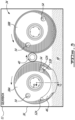
- FIG. 3 is a front plan view of an interior of gearbox 12 showing gear set 34 of FIG. 2 .
- Gear baffle 46 may be attached to fixed structure within gearbox 12 so that baffle 46 may be stationary relative to rotating gear 38A.
- a first side of baffle 46 disposed to a first side of main gear 38A may be attached via one or more first fasteners 52A (e.g., bolts, machine screws).
- a second side of baffle 46 disposed to an axially opposite second side of main gear 38A may be attached via one or more second fasteners 52B (e.g., bolts, machine screws).
- First and second fasteners 52A, 52B may be accessible from a same side of main gear 38A.
- second fasteners 52B may be accessible via one or more through passages 54 formed in a web of main gear 38A.
- Through passages 54 may be positioned and sized allow for a tool such as socket or other driver access to second fasteners 52B from the side of main gear 38A shown in FIG. 2 .
- Through passages 54 may be aligned with second fastener(s) 52B by manually rotating main gear 38A during installation or removal of baffle 46.
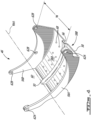
- FIGS. 4 to 6 are perspective views of baffle 46.
- baffle 46 includes first sidewall 56A and second sidewall 56B attached to main wall 58.
- First and second sidewalls 56A, 56B may be axially spaced apart by axial distance W.
- Main wall 58 may axially interconnect first and second sidewalls 56A, 56B.
- Main wall 58 may be disposed radially outward of main gear 38A.
- a gap may be provided between main gear 38A and main wall 58, and also between main gear 38A and sidewalls 56A, 56B to allow the presence and flow of lubricant fluid 48 between gear faces 42A and baffle 46.
- First and second sidewalls 56A, 56B may extend radially-inwardly from main wall 58 relative to rotation axis RA1 of main gear 38A.
- first sidewall 56A may be disposed to the first axial side of main gear 38A and second sidewall 56B may be disposed to the opposite second axial side of main gear 38A.
- baffle 46 defines receptacle 60 in which part of main gear 38A may be received during use.
- First sidewall 56A may include one or more first interfaces 62A disposed thereon to permit the attachment of baffle 46 to a structure within gearbox 12 to one axial side of main gear 38A.
- Second sidewall 62B may include one or more second interfaces 62B disposed thereon to permit the attachment of baffle 46 to a structure within gearbox 12 to another axially opposite side of main gear 38A.
- First interfaces 62A may each include a through threaded hole for engagement with a threaded first fastener 52A shown in FIG. 3 . Such threaded holes may be drilled and tapped in first sidewall 56A.
- first interfaces 62A may each include a self-locking helical coil (i.e., threaded) insert.
- Second interfaces 62B may each include a through unthreaded hole for receiving therethrough a threaded second fastener 52B shown in FIG. 3 .
- the threaded holes of first interfaces 62A and the unthreaded holes of second interfaces 62B may be oriented to be substantially parallel to rotation axis RA1.
- First sidewall 56A and second sidewall 56B may be relatively rigid and substantially planar.
- Baffle 46 may be made from a suitable metallic material such as (e.g., stainless) steel. In some embodiments, baffle 46 may be made from stamped sheet metal.
- First sidewall 56A and second sidewall 56B may be interconnected by main wall 58.
- Main wall 58 may include corrugation 50 (e.g., wrinkle, fold, furrow, ridge) that may accommodate a dimensional variation in axial distance W between first interface(s) 62A and second interface(s) 62B.
- Corrugation 50 is compliant (e.g., deformable) and may relatively easily absorb some dimensional variation to facilitate installation of baffle 46.
- Corrugation 50 compensates for dimensional variations caused by dimensional tolerance stack-up associated with the structure(s) to which baffle 46 is attached.
- corrugation 50 may permit axial distance W to be extended and/or shortened within prescribed amounts by the extension and/or compression of corrugation 50.
- Corrugation 50 may be (e.g., resiliently and/or plastically) deformable in a non-destructive manner.
- First sidewall 56A and second sidewall 56B may be transverse (e.g., substantially perpendicular) to main wall 58 and substantially parallel to one another so that baffle 46 may define a substantially U-shaped receptacle 60.
- Nominal axial dimension W of baffle 46 i.e., before deformation of corrugation 50
- Main wall 58 includes radially-inner side 58A (surface) facing main gear 38A, and a radially-outer side 58B (surface) opposite radially-inner side 58A.
- Main wall 58 may have a curved (e.g., arcuate) shape extending partially around axis RA1.
- corrugation 50 may define a ridge extending (e.g., radially-inwardly) from radially-inner side 58A of main wall 58.
- corrugation 50 may define groove 66 on radially-outer side 58B of main wall 58.
- corrugation 50 may extend in a circumferential direction relative to rotation axis RA1 of main gear 38A. Corrugation 50 may extend the full arcuate/circumferential length of main wall 58. In some embodiments, corrugation 50 may also provide added stiffness to main wall 58.
- corrugation 50 may be disposed substantially axially midway (e.g., at or close to W/2) between first interface 62A and second interface 62B. In some embodiments, corrugation 50 may be disposed to be axially coincident with axial gap 44A (shown in FIG. 2 ) of main gear 38A so that corrugation 50 may extend radially into and occupy part of axial gap 44A during operation.
- main wall 58 may be perforated to permit the flow of lubricant fluid 48 therethrough. Accordingly, main wall 58 may have one or more perforations 68 of circular or other cross-sectional shapes.
- main wall 58 may have two or more corrugations 50.
- main wall 58 may have one or more corrugations that define one or more ridges extending (e.g., radially-outwardly) from radially-outer side 58B of main wall 58 for example.
- an axial cross-sectional profile of corrugation 50 in a plane parallel to rotation axis RA1 may be of any suitable shape such as sinusoidal, trapezoidal or saw tooth shape for example.
- baffle 46 may be integrally formed (e.g., stamped) from a piece of sheet metal of uniform thickness as a single piece having a unitary construction.
- a portion of main wall 58 at corrugation 50 may have a wall thickness T1
- a portion of main wall 58 outside of corrugation 50 may have a wall thickness T2.
- wall thickness T1 may be smaller than wall thickness T2.
- First and second side walls 56A, 56B may have respective wall thicknesses T3 and T4.
- wall thicknesses T3 and T4 may be substantially equal.
- wall thicknesses T3 and T4 may be substantially equal to wall thickness T2 of main wall 58.
- wall thickness T1 may be smaller than wall thicknesses T2, T3 and T4.
- the smaller wall thickness T1 and/or shape of corrugation 50 may encourage axial deformation of baffle 46 to be absorbed by corrugation 50 as opposed to other parts of baffle 46.
- corrugation 50 may provide control over the axial deformation of baffle 46.
- Such control over the deformation of baffle 46 may also help maintain clearances between baffle 46 and main gear 38A, and/or between baffle 46 and other components of gearbox 12 despite dimensional variations.
- FIG. 7 is a perspective front view of another exemplary gear baffle 146 for use in gearbox 12.
- Baffle 146 may have elements in common with baffle 46 already described above. Like elements have been identified using reference numerals incremented by 100.
- Baffle 146 may include main wall 158 with corrugation 150 and perforations 168, first sidewall 156A with one or more first interfaces 162A, and second sidewall 156B with one or more second interfaces 162B.
- Baffle 146 may define receptacle 160 for receiving part of main gear 38A.
- Baffle 146 may be made from separate pieces that are subsequently attached together.
- sidewalls 156A, 156B and main wall 158 may be made separately by any suitable metal fabrication method(s) including machining and/or sheet metal forming method(s), and then welded together at welded junctions 170 for example.
- wall thickness T1 of main wall 158 at corrugation 150 may be substantially equal to or smaller than wall thickness T2 of main wall 158 outside of corrugation 150.
- wall thicknesses T3 and T4 of first and second sidewalls 156A, 156B may be substantially equal.
- wall thicknesses T3 and T4 may be greater than wall thicknesses T1 and T2 of main wall 158.
- the smaller wall thickness T1 and/or shape of corrugation 150 may encourage axial deformation of baffle 46 to be absorbed by corrugation 150 as opposed to bending of sidewalls 156A, 156B for example.
- FIG. 8 is a perspective front view of another exemplary gear baffle 246 for use in gearbox 12.
- Baffle 246 may have elements in common with baffle 46 already described above. Like elements have been identified using reference numerals incremented by 200.
- Baffle 246 may include main wall 256 with corrugation 250 and perforations 268, first sidewall 256A with one or more first interfaces 262A, and second sidewall 256B with one or more second interfaces 262B.
- Baffle 246 may define receptacle 260 for receiving part of main gear 38A.
- Baffle 246 may be machined (e.g., using a ball end mill) as a single piece having a unitary construction from a block of metallic material.
- wall thickness T1 of main wall 258 at corrugation 250 may be substantially equal to or smaller than wall thickness T2 of main wall 258 outside of corrugation 250.
- wall thicknesses T3 and T4 of first and second sidewalls 256A, 256B may be substantially equal.
- wall thicknesses T3 and T4 may be greater than wall thicknesses T1 and T2 of main wall 258.
- the smaller wall thickness T1 and/or shape of corrugation 250 may encourage axial deformation of baffle 246 to be absorbed by corrugation 250 as opposed to bending of sidewalls 156A, 156B for example.
- FIG. 9 is a flowchart of an exemplary method 1000 of installing a gear baffle adjacent to a gear in a gearbox of a gas turbine engine.
- Method 1000 may be performed using any of gear baffles 46, 146 or 246 in gearbox 12 described herein, or with other baffles and gearboxes. It is understood that aspects of method 1000 may be combined with other aspects or steps described herein.
- Method 1000 may include: attaching a first portion (e.g., first sidewall 56A) of baffle 46 to a structure disposed to a first side of main gear 38A (block 1002);
- FIG. 10 is a cross sectional view of baffle 46 and main gear 38A with neighbouring components taken along line 10-10 in FIG. 3 . Aspects of method 1000 are further described below in relation to FIG. 10 .
- Second sidewall 56B of baffle 46 may be attached to second structure 72B via fastener(s) 52B extending through second sidewall 56B at respective second interface(s) 62B.
- Fasteners 52B may be threadably engaged with threaded holes formed in second structure 72B.
- Fasteners 52B may be driven into second structure 72B using a suitable tool extended through passage 54.
- Second structure 72B may be any suitable structural element stationary relative to main gear 38A.
- second structure 72B may be attached to or part (e.g., wall, web, boss, cover) of housing 36 of gearbox 12.
- main gear 38A may be rotatably supported by second structure 72B via one or more bearings 74.
- First sidewall 56A of baffle 46 may be attached to first structure 72A via fastener(s) 52A extending through first sidewall 56A at respective first interface(s) 62A.
- Fasteners 52A may extend through a (e.g., unthreaded) hole formed in first structure 72A and be threadably engaged with threaded holes formed in first sidewall 56A at respective first interfaces 62A.
- Fasteners 52A may be driven into first side wall 56A using a suitable tool.
- Fasteners 52A and 52B may be driven in the same direction and from a same axial side of main gear 38A.
- First structure 72A may be any suitable structural element stationary relative to main gear 38A.
- first structure 72A may be attached to or part (e.g., wall, web, boss, removable cover) of housing 36 of gearbox 12.
- Corrugation 50 may be axially positioned to be in axial alignment with axial gap 44A of main gear 38A. Corrugation 50 may also extend radially-inwardly and be inserted into axial gap 44A to provide an efficient use of space within gearbox 12 and also provide a beneficial interaction with the lubricant fluid 48.
- the installation of baffle 46 may include attaching second sidewall 56B to second structure 72B using second fasteners 52B before or after attaching first sidewall 56A to first structure 72A using first fasteners 52A.
- the tightening of first fasteners 52A after second fasteners 52B have already been tightened may apply an axial tension force into baffle 46 and cause an axial extension of baffle 46.
- the axial extension is illustrated by arrow ⁇ W in FIG. 10 and may be accommodated by an axial deformation/extension of corrugation 50 of main wall 58.
- baffle 46 in situations where baffle 46 is slightly axially oversized compared to the axial distance between first and second structures 72A, 72B, the positioning of baffle 46 between first and second structures 72A, 72B may require manual axial shortening/compression of baffle 46.
- the axial shortening/compression may be accommodated by an axial deformation/compression of corrugation 50.
- corrugation 50 may permit baffle 46 to be axially self-adjusting to dimensional variations in gearboxes.
Landscapes
- Engineering & Computer Science (AREA)
- General Engineering & Computer Science (AREA)
- Mechanical Engineering (AREA)
- Chemical & Material Sciences (AREA)
- Combustion & Propulsion (AREA)
- General Details Of Gearings (AREA)
Description
- The disclosure relates generally to gas turbine engines, and more particularly to gear baffles for interacting with lubricant fluid around gears in gas turbine engines.
- A gas turbine engine may include a gearbox for coupling one of its spools to a load. The gearbox may include gears which may be partially submerged in, or otherwise interacting with a lubricant fluid. The interaction of the gear(s) with the lubricant fluid can sometimes induce churning of the lubricant fluid. Such churning of the lubricant fluid may be undesirable as it can cause drag-related energy losses and aeration of the lubricant fluid which can reduce the effectiveness of the lubricant fluid.
- A gear baffle may be installed adjacent to a gear to mitigate churning of the lubricant fluid caused by the rotation of the gear. However, due to space constraints inside gearboxes of gas turbine engines and dimensional variations in such gearboxes, the design and installation of effective gear baffles in gearboxes of gas turbine engines can be challenging.
-
US 2015/065285 discloses a geared architecture gas turbine engine with an oil scavenge. -
EP 2,559,913 discloses a planetary gear system. - In one aspect of the present invention, there is provided a gear baffle in accordance with claim 1.
- In one embodiment of the above, the corrugation may define a ridge on the inner side of the main wall.
- In one embodiment of any of the above, the corrugation may define a groove on the outer side of the main wall.
- In one embodiment of any of the above, the corrugation may be disposed substantially midway between the first interface and the second interface.
- In one embodiment of any of the above, a thickness of the first sidewall may be greater than a thickness of the main wall at a location of the corrugation.
- In one embodiment of any of the above, a thickness of the second sidewall may be greater than the thickness of the main wall at the location of the corrugation.
- In one embodiment of any of the above, the main wall may be perforated.
- In one embodiment of any of the above, the first interface may include a threaded through hole.
- In one embodiment of any of the above, the second interface may include an unthreaded through hole and the threaded and unthreaded through holes may be substantially parallel.
- In another aspect of the present invention, there is provided a gearbox in accordance with claim 7.
- In an embodiment of the above, the corrugation may define a ridge on the radially-inner side of the main wall.
- In one embodiment of any of the above, the corrugation may define a groove on the radially-outer side of the main wall.
- In one embodiment of any of the above, the gear may have two gear faces axially separated by an axial gap, and the ridge may extend radially into the axial gap between the two gear faces.
- In one embodiment of any of the above, a thickness of the first sidewall may be greater than a thickness of the main wall at a location of the corrugation.
- In one embodiment of any of the above, the gearbox may comprise two first interfaces and two second interfaces.
- In one embodiment of any of the above, the first interface may be oriented transversely to the main wall, the first interface may include a threaded hole extending through the first side wall, the second interface may be oriented transversely to the main wall, and the second interface may be include an unthreaded hole extending through the second side wall, the threaded and unthreaded holes being substantially parallel.
- In a further aspect of the present invention, there is provided a method of installing a gear baffle adjacent to a gear in a gearbox of a gas turbine engine, in accordance with claim 13.
- In an embodiment of the above, the gear may have two gear faces that are axially separated by an axial gap relative to the axis, the corrugation may define a ridge on the main wall, and the method may include inserting the ridge into the axial gap.
- In one embodiment of any of the above, the method may comprise axially extending the corrugation when attaching the second portion of the gear baffle to the structure disposed to the second side of the gear.
- Further details of these and other aspects of the subject matter of this application will be apparent from the detailed description included below and the drawings.
- Reference is now made to the accompanying drawings, in which:
-
FIG. 1 shows a schematic axial cross-section view of an exemplary turboprop gas turbine engine including a gearbox as described herein; -
FIG. 2 is a perspective schematic view of part of an exemplary gearbox of the engine ofFIG. 1 including a gear baffle; -
FIG. 3 is a schematic front view of the part of the gearbox ofFIG. 2 -
FIGS. 4-6 are perspective views of an exemplary gear baffle for the gearbox ofFIGS. 2 and3 ; -
FIG. 7 is a perspective front view of another exemplary gear baffle for the gearbox ofFIGS. 2 and3 ; -
FIG. 8 is a perspective front view of another exemplary gear baffle for the gearbox ofFIGS. 2 and3 ; -
FIG. 9 is a flowchart of an exemplary method of installing a gear baffle; and -
FIG. 10 is a cross-sectional view of the gear baffle ofFIG. 3 with an associated main gear and neighbouring structure taken along line 10-10 inFIG. 3 . - The following disclosure describes gear baffles, gearboxes including gear baffles, and methods for installing gear baffles. In some embodiments, the gear baffles described herein may mitigate churning of lubricant fluid while also accommodating space constrains and dimensional variations between gearboxes of a same type due in part to tolerance stack-up associated with the assembly of components inside gearboxes. The baffles described herein have a compliant (e.g. deformable) feature (e.g., corrugation) that allows (e.g., non-destructive) deformation of part of the baffles to accommodate such dimensional variations in a controlled manner.
- The terms "connected", "coupled" and "attached" may include both direct connection/coupling/attachment (in which two elements contact each other) and indirect connection/coupling/attachment (in which at least one additional element is located between the two elements). The terms "substantially" as used herein may be applied to modify any quantitative representation which could permissibly vary without resulting in a change in the basic function to which it is related.
- Aspects of various embodiments are described through reference to the drawings.
-
FIG. 1 is a schematic axial cross-section view of an exemplary reverse flow turbopropgas turbine engine 10 comprising one ormore gearboxes 12, as described herein. Even though the following description andFIG. 1 specifically refers to a turboprop gas turbine engine as an example, it is understood that aspects of the present disclosure may be equally applicable to other types of gearboxes and gas turbine engines including turboshaft and turbofan gas turbine engines.Gas turbine engine 10 may be of a type preferably provided for use in subsonic flight to drive a load such aspropeller 14 viagearbox 12 coupled to low-pressure shaft 16 (sometimes called "power shaft") further coupled to low-pressure turbine 18. -
Compressor 22 may draw ambient air intoengine 10 via annular radialair inlet duct 26, increase the pressure of the drawn air and deliver the pressurized air to combustor 28 where the pressurized air is mixed with fuel and ignited for generating an annular stream of hot combustion gas. High-pressure turbine 20 may extract energy from the hot expanding combustion gas and thereby drivecompressor 22. The hot combustion gas leaving high-pressure turbine 20 may be accelerated as it further expands, flows through and driveslow pressure turbine 18. The combustion gas may then exitgas turbine engine 10 viaexhaust duct 30. - Low-
pressure shaft 16 may be drivingly coupled topropeller 14 or another load viagearbox 12 andpropeller shaft 32.Gearbox 12 may be of a speed-reducing type so that the rotation speed ofpropeller shaft 32 may be lower than that of low-pressure shaft 16.Engine 10 may have central axis CA, which may correspond to an axis of rotation of one or more spools ofengine 10. For example, central axis CA may correspond to an axis of rotation of low-pressure shaft 16. In various embodiments, central axis CA may correspond to an axis of rotation ofpropeller shaft 32, orpropeller shaft 32 may rotate about an axis that is offset from central axis CA. -
FIG. 2 shows a perspective view of an exemplary gear set 34 that may be part ofgearbox 12 and that may be disposed inside housing 36 (shown schematically) ofgearbox 12. Gear set 34 may be only a subset of gears that are part ofgearbox 12. Gear set 34 may includemain gears input gear 40 drivingly coupled to (i.e., meshed with) bothmain gears Input gear 40 may be coupled to low-pressure shaft 16 and receive an input torque from low-pressure shaft 16.Input gear 40 may drivemain gears propeller shaft 32 via other gears that are not shown inFIG. 2 . The relative sizes ofinput gear 40 and ofmain gears - In various embodiments,
input gear 40 may be rotatable about central axis CA ofengine 10 or about an axis other than central axis CA. Main gears 38A, 38B may be rotatable about respective rotation axes RA1 and RA2. Axes RA1 and RA2 may be substantially parallel to central axis CA. When being installed inhousing 36,main gears input gear 40 may be inserted as a preassemble unit intohousing 36 along arrow D. The preassembled unit may includebaffle 46 positioned adjacent tomain gear 38A, and optionally another gear baffle may be positioned adjacent tomain gear 38B. - In some embodiments,
main gears toothed faces main gears main gear 38A may have twotoothed faces 42A that are axially spaced apart and separated byaxial gap 44A.Main gear 38B may also have twotoothed faces 42B that are axially spaced apart and separated by axial gap 44B.Axial gaps 44A, 44B may be defined by respective circumferential grooves extending around respective axes RA1, RA2 and that are radially-outwardly open.Input gear 40 may also have two axially spaced apart toothed faces for meshing with counterpart toothed faces 42A and 42B ofmain gears -
FIG. 2 shows asingle baffle 46 being installed adjacent tomain gear 38A for interacting with a liquid lubricant fluid 48 (e.g., oil) aroundmain gear 38A. The geometric configuration ofbaffle 46 may define a receptacle for receiving a lower portion ofmain gear 38A that may be submerged inlubricant fluid 48.Baffle 46 may also includecorrugation 50 that may optionally extend radially-inwardly between toothed faces 42A and intoaxial gap 44A. It is understood that another baffle could also be installed adjacent tomain gear 38B.Baffle 46 may be used in conjunction with other gear types such as spur gears and/or with single gears having only one toothed face instead of two.Baffle 46 may be used in various types of gear sets including speed-reducing and speed-augmenting types of gear sets. -
FIG. 3 is a front plan view of an interior ofgearbox 12 showing gear set 34 ofFIG. 2 .Gear baffle 46 may be attached to fixed structure withingearbox 12 so thatbaffle 46 may be stationary relative torotating gear 38A. A first side ofbaffle 46 disposed to a first side ofmain gear 38A may be attached via one or morefirst fasteners 52A (e.g., bolts, machine screws). A second side ofbaffle 46 disposed to an axially opposite second side ofmain gear 38A may be attached via one or moresecond fasteners 52B (e.g., bolts, machine screws). First andsecond fasteners main gear 38A. For example,second fasteners 52B may be accessible via one or more throughpassages 54 formed in a web ofmain gear 38A. Throughpassages 54 may be positioned and sized allow for a tool such as socket or other driver access tosecond fasteners 52B from the side ofmain gear 38A shown inFIG. 2 . Throughpassages 54 may be aligned with second fastener(s) 52B by manually rotatingmain gear 38A during installation or removal ofbaffle 46. -
FIGS. 4 to 6 are perspective views ofbaffle 46. In reference toFIGS. 4 and5 , baffle 46 includesfirst sidewall 56A andsecond sidewall 56B attached tomain wall 58. First andsecond sidewalls W. Main wall 58 may axially interconnect first andsecond sidewalls Main wall 58 may be disposed radially outward ofmain gear 38A. A gap may be provided betweenmain gear 38A andmain wall 58, and also betweenmain gear 38A and sidewalls 56A, 56B to allow the presence and flow oflubricant fluid 48 between gear faces 42A andbaffle 46. First andsecond sidewalls main wall 58 relative to rotation axis RA1 ofmain gear 38A. When installed,first sidewall 56A may be disposed to the first axial side ofmain gear 38A andsecond sidewall 56B may be disposed to the opposite second axial side ofmain gear 38A. In other words, baffle 46 definesreceptacle 60 in which part ofmain gear 38A may be received during use. -
First sidewall 56A may include one or morefirst interfaces 62A disposed thereon to permit the attachment ofbaffle 46 to a structure withingearbox 12 to one axial side ofmain gear 38A.Second sidewall 62B may include one or moresecond interfaces 62B disposed thereon to permit the attachment ofbaffle 46 to a structure withingearbox 12 to another axially opposite side ofmain gear 38A.First interfaces 62A may each include a through threaded hole for engagement with a threadedfirst fastener 52A shown inFIG. 3 . Such threaded holes may be drilled and tapped infirst sidewall 56A. In some embodiments,first interfaces 62A may each include a self-locking helical coil (i.e., threaded) insert.Second interfaces 62B may each include a through unthreaded hole for receiving therethrough a threadedsecond fastener 52B shown inFIG. 3 . In some embodiments, the threaded holes offirst interfaces 62A and the unthreaded holes ofsecond interfaces 62B may be oriented to be substantially parallel to rotation axis RA1. -
First sidewall 56A andsecond sidewall 56B may be relatively rigid and substantially planar.Baffle 46 may be made from a suitable metallic material such as (e.g., stainless) steel. In some embodiments, baffle 46 may be made from stamped sheet metal.First sidewall 56A andsecond sidewall 56B may be interconnected bymain wall 58.Main wall 58 may include corrugation 50 (e.g., wrinkle, fold, furrow, ridge) that may accommodate a dimensional variation in axial distance W between first interface(s) 62A and second interface(s) 62B.Corrugation 50 is compliant (e.g., deformable) and may relatively easily absorb some dimensional variation to facilitate installation ofbaffle 46.Corrugation 50 compensates for dimensional variations caused by dimensional tolerance stack-up associated with the structure(s) to which baffle 46 is attached. In some embodiments,corrugation 50 may permit axial distance W to be extended and/or shortened within prescribed amounts by the extension and/or compression ofcorrugation 50.Corrugation 50 may be (e.g., resiliently and/or plastically) deformable in a non-destructive manner. -
First sidewall 56A andsecond sidewall 56B may be transverse (e.g., substantially perpendicular) tomain wall 58 and substantially parallel to one another so thatbaffle 46 may define a substantiallyU-shaped receptacle 60. Nominal axial dimension W of baffle 46 (i.e., before deformation of corrugation 50) may be determined based on an expected axial gear width ofmain gear 38A and an expected axial distance between structure(s) to which first andsecond sidewalls baffle 46 will be attached. -
Main wall 58 includes radially-inner side 58A (surface) facingmain gear 38A, and a radially-outer side 58B (surface) opposite radially-inner side 58A.Main wall 58 may have a curved (e.g., arcuate) shape extending partially around axis RA1. In some embodiments,corrugation 50 may define a ridge extending (e.g., radially-inwardly) from radially-inner side 58A ofmain wall 58. In some embodiments,corrugation 50 may definegroove 66 on radially-outer side 58B ofmain wall 58. In some embodiments,corrugation 50 may extend in a circumferential direction relative to rotation axis RA1 ofmain gear 38A.Corrugation 50 may extend the full arcuate/circumferential length ofmain wall 58. In some embodiments,corrugation 50 may also provide added stiffness tomain wall 58. - In some embodiments,
corrugation 50 may be disposed substantially axially midway (e.g., at or close to W/2) betweenfirst interface 62A andsecond interface 62B. In some embodiments,corrugation 50 may be disposed to be axially coincident withaxial gap 44A (shown inFIG. 2 ) ofmain gear 38A so thatcorrugation 50 may extend radially into and occupy part ofaxial gap 44A during operation. In some embodiments,main wall 58 may be perforated to permit the flow oflubricant fluid 48 therethrough. Accordingly,main wall 58 may have one ormore perforations 68 of circular or other cross-sectional shapes. - In some embodiments,
main wall 58 may have two ormore corrugations 50. In some embodiments,main wall 58 may have one or more corrugations that define one or more ridges extending (e.g., radially-outwardly) from radially-outer side 58B ofmain wall 58 for example. In various embodiments, an axial cross-sectional profile ofcorrugation 50 in a plane parallel to rotation axis RA1 may be of any suitable shape such as sinusoidal, trapezoidal or saw tooth shape for example. - In reference to
FIG. 6 , baffle 46 may be integrally formed (e.g., stamped) from a piece of sheet metal of uniform thickness as a single piece having a unitary construction. For example, as shown inFIG. 6 , a portion ofmain wall 58 atcorrugation 50 may have a wall thickness T1, and a portion ofmain wall 58 outside ofcorrugation 50 may have a wall thickness T2. In some embodiments, wall thickness T1 may be smaller than wall thickness T2. First andsecond side walls main wall 58. In some embodiments wall thickness T1 may be smaller than wall thicknesses T2, T3 and T4. The smaller wall thickness T1 and/or shape ofcorrugation 50 may encourage axial deformation ofbaffle 46 to be absorbed bycorrugation 50 as opposed to other parts ofbaffle 46. In other words,corrugation 50 may provide control over the axial deformation ofbaffle 46. Such control over the deformation ofbaffle 46 may also help maintain clearances betweenbaffle 46 andmain gear 38A, and/or betweenbaffle 46 and other components ofgearbox 12 despite dimensional variations. -
FIG. 7 is a perspective front view of anotherexemplary gear baffle 146 for use ingearbox 12.Baffle 146 may have elements in common withbaffle 46 already described above. Like elements have been identified using reference numerals incremented by 100.Baffle 146 may includemain wall 158 withcorrugation 150 andperforations 168,first sidewall 156A with one or morefirst interfaces 162A, andsecond sidewall 156B with one or moresecond interfaces 162B.Baffle 146 may definereceptacle 160 for receiving part ofmain gear 38A. -
Baffle 146 may be made from separate pieces that are subsequently attached together. For example, sidewalls 156A, 156B andmain wall 158 may be made separately by any suitable metal fabrication method(s) including machining and/or sheet metal forming method(s), and then welded together at weldedjunctions 170 for example. - In some embodiments, wall thickness T1 of
main wall 158 atcorrugation 150 may be substantially equal to or smaller than wall thickness T2 ofmain wall 158 outside ofcorrugation 150. In some embodiments, wall thicknesses T3 and T4 of first andsecond sidewalls main wall 158. The smaller wall thickness T1 and/or shape ofcorrugation 150 may encourage axial deformation ofbaffle 46 to be absorbed bycorrugation 150 as opposed to bending of sidewalls 156A, 156B for example. -
FIG. 8 is a perspective front view of anotherexemplary gear baffle 246 for use ingearbox 12.Baffle 246 may have elements in common withbaffle 46 already described above. Like elements have been identified using reference numerals incremented by 200.Baffle 246 may include main wall 256 withcorrugation 250 andperforations 268,first sidewall 256A with one or morefirst interfaces 262A, andsecond sidewall 256B with one or moresecond interfaces 262B.Baffle 246 may definereceptacle 260 for receiving part ofmain gear 38A. -
Baffle 246 may be machined (e.g., using a ball end mill) as a single piece having a unitary construction from a block of metallic material. In some embodiments, wall thickness T1 ofmain wall 258 atcorrugation 250 may be substantially equal to or smaller than wall thickness T2 ofmain wall 258 outside ofcorrugation 250. In some embodiments, wall thicknesses T3 and T4 of first andsecond sidewalls main wall 258. The smaller wall thickness T1 and/or shape ofcorrugation 250 may encourage axial deformation ofbaffle 246 to be absorbed bycorrugation 250 as opposed to bending of sidewalls 156A, 156B for example. -
FIG. 9 is a flowchart of anexemplary method 1000 of installing a gear baffle adjacent to a gear in a gearbox of a gas turbine engine.Method 1000 may be performed using any of gear baffles 46, 146 or 246 ingearbox 12 described herein, or with other baffles and gearboxes. It is understood that aspects ofmethod 1000 may be combined with other aspects or steps described herein.Method 1000 may include:
attaching a first portion (e.g.,first sidewall 56A) ofbaffle 46 to a structure disposed to a first side ofmain gear 38A (block 1002); - attaching a second portion (e.g.,
second sidewall 56B) ofbaffle 46 to a structure disposed to a second side ofmain gear 38A, the second portion being axially spaced apart from the first portion by axial distance W relative to rotation axis RA1 ofmain gear 38A (block 1004); and - accommodating a variation in the axial distance W between the first portion and the second portion by deforming axially-
compliant corrugation 50 formed intomain wall 58 interconnecting the first and second portions of baffle 46 (block 1006). -
FIG. 10 is a cross sectional view ofbaffle 46 andmain gear 38A with neighbouring components taken along line 10-10 inFIG. 3 . Aspects ofmethod 1000 are further described below in relation toFIG. 10 .Second sidewall 56B ofbaffle 46 may be attached tosecond structure 72B via fastener(s) 52B extending throughsecond sidewall 56B at respective second interface(s) 62B.Fasteners 52B may be threadably engaged with threaded holes formed insecond structure 72B.Fasteners 52B may be driven intosecond structure 72B using a suitable tool extended throughpassage 54. -
Second structure 72B may be any suitable structural element stationary relative tomain gear 38A. In some embodiments,second structure 72B may be attached to or part (e.g., wall, web, boss, cover) ofhousing 36 ofgearbox 12. In some embodiments,main gear 38A may be rotatably supported bysecond structure 72B via one ormore bearings 74. -
First sidewall 56A ofbaffle 46 may be attached tofirst structure 72A via fastener(s) 52A extending throughfirst sidewall 56A at respective first interface(s) 62A.Fasteners 52A may extend through a (e.g., unthreaded) hole formed infirst structure 72A and be threadably engaged with threaded holes formed infirst sidewall 56A at respectivefirst interfaces 62A.Fasteners 52A may be driven intofirst side wall 56A using a suitable tool.Fasteners main gear 38A. -
First structure 72A may be any suitable structural element stationary relative tomain gear 38A. In some embodiments,first structure 72A may be attached to or part (e.g., wall, web, boss, removable cover) ofhousing 36 ofgearbox 12. - When
baffle 46 is installed adjacent ofmain gear 38A, a lower portion of main gear 36A may be received inreceptacle 60 defined bybaffle 46.Corrugation 50 may be axially positioned to be in axial alignment withaxial gap 44A ofmain gear 38A.Corrugation 50 may also extend radially-inwardly and be inserted intoaxial gap 44A to provide an efficient use of space withingearbox 12 and also provide a beneficial interaction with thelubricant fluid 48. - In various embodiments, the installation of
baffle 46 may include attachingsecond sidewall 56B tosecond structure 72B usingsecond fasteners 52B before or after attachingfirst sidewall 56A tofirst structure 72A usingfirst fasteners 52A. As an example, in situations wherebaffle 46 is slightly axially undersized compared to the axial distance between first andsecond structures first fasteners 52A aftersecond fasteners 52B have already been tightened may apply an axial tension force intobaffle 46 and cause an axial extension ofbaffle 46. The axial extension is illustrated by arrow ΔW inFIG. 10 and may be accommodated by an axial deformation/extension ofcorrugation 50 ofmain wall 58. On the other hand, in situations wherebaffle 46 is slightly axially oversized compared to the axial distance between first andsecond structures baffle 46 between first andsecond structures baffle 46. The axial shortening/compression may be accommodated by an axial deformation/compression ofcorrugation 50. In other words,corrugation 50 may permitbaffle 46 to be axially self-adjusting to dimensional variations in gearboxes. - The embodiments described in this document provide non-limiting examples of possible implementations of the present technology. Upon review of the present disclosure, a person of ordinary skill in the art will recognize that changes may be made to the embodiments described herein without departing from the scope of the present technology. Yet further modifications could be implemented by a person of ordinary skill in the art in view of the present disclosure, which modifications would be within the scope of the present technology.
Claims (15)
- A gear baffle (46; 146; 246) for interacting with a lubricant fluid around a gear (38A, 38B) in a gas turbine engine (10), the gear baffle (46; 146; 246) comprising:a first interface (62A; 162A; 262A) for attaching the gear baffle (46; 146; 246) to a structure disposed to a first side of the gear (38A, 38B);a second interface (62B; 162B; 262B) for attaching the gear baffle (46; 146; 246) to a structure disposed to a second side of the gear (38A, 38B) opposite the first side of the gear (38A, 38B), the second interface (62B; 162B; 262B) being spaced apart from the first interface (62A; 162A; 262A) by a distance (W); anda main wall (58; 158; 258) interconnecting the first interface (62A; 162A; 262A) with the second interface (62B; 162B; 262B), the main wall (58; 158; 258) including a compliant corrugation (50; 150; 250) that is deformable to allow the main wall (58; 158; 258) to accommodate a variation in the distance (W) between the first interface (62A; 162A; 262A) and the second interface (62B; 162B; 262B), the main wall including an inner side (58A) for facing the gear (38A, 38B) and an outer side (58B) opposite the inner side (58A),characterised in that the gear baffle further comprises:a first sidewall (56A, 156A, 256A) attached to the main wall (58; 158; 258) and extending from main wall (58; 158; 258), the first interface (62A; 162A; 262A) being disposed on the first sidewall (56A, 156A, 256A); anda second sidewall (56B, 156B, 256B) attached to the main wall (58; 158; 258) and extending from main wall (58; 158; 258), the second interface (62B; 162B; 262B) being disposed on the second sidewall (56B, 156B, 256B), wherein the main wall (58; 158; 258), the first sidewall (56A, 156A, 256A) and the second sidewall (56B, 156B, 256B) cooperatively define a receptacle (160) for receiving part of the gear (38A, 38B) therein.
- The gear baffle (46; 146; 246) of claim 1, wherein the corrugation (50; 150; 250) defines a ridge on the inner side (58A) of the main wall (58; 158; 258), optionally wherein the corrugation (50; 150; 250) defines a groove on the outer side (58B) of the main wall (58; 158; 258).
- The gear baffle (46; 146; 246) of claim 1 or 2, wherein the corrugation (50; 150; 250) is disposed midway between the first interface (62A; 162A; 262A) and the second interface (62B; 162B; 262B).
- The gear baffle (46; 146; 246) of any preceding claim, wherein a thickness (T3) of the first sidewall (56A) is greater than a thickness (T1) of the main wall (58; 158; 258) at a location of the corrugation (50; 150; 250); and/or
a thickness (T4) of the second sidewall (56B) is greater than a or the thickness (T1) of the main wall (58; 158; 258) at the location of the corrugation (50; 150; 250). - The gear baffle (46; 146; 246) of any preceding claim, wherein the main wall (58; 158; 258) is perforated.
- The gear baffle (46; 146; 246) of any preceding claim, wherein the first interface (62A; 162A; 262A) includes a threaded through hole, and optionally wherein:the second interface (62B; 162B; 262B) includes an unthreaded through hole; andthe threaded and unthreaded through holes are substantially parallel.
- A gearbox (12) of a gas turbine engine, the gearbox (12) comprising:a housing (36);a gear (38A, 38B) disposed inside the housing (36), the gear (38A, 38B) being rotatable about an axis (RA1); anda gear baffle (46; 146; 246) according to claim 1, the gear baffle (46; 146; 246) disposed inside the housing (36) and adjacent the gear (38A, 38B) to interact with lubricant fluid around the gear (38A, 38B), wherein the second side of the gear (38A, 38B) is axially opposite the first side of the gear (38A, 38B) relative to the axis (RA1), the second interface (62B; 162B; 262B) is axially spaced apart from the first interface (62A; 162A; 262A) by an axial distance, and the corrugation (50; 150; 250) is axially-compliant.
- The gearbox (12) of claim 7, wherein:the corrugation (50; 150; 250) defines a groove on the outer side (58B) of the main wall (58; 158; 258); andthe corrugation (50; 150; 250) defines a ridge on the inner side (58A) of the main wall (58; 158; 258), optionally wherein a thickness (T3) of the first sidewall (56A) is greater than a thickness (T1) of the main wall (58; 158; 258) at a location of the corrugation (50; 150; 250).
- The gearbox (12) of claim 8, wherein:the gear (38A, 38B) has two gear faces axially separated by an axial gap (44A); andthe ridge extends radially into the axial gap (44A) between the two gear faces (42A).
- The gearbox (12) of any of claims 7 to 9, wherein:the first interface (62A; 162A; 262A) is oriented transversely to the main wall (58; 158; 258);the first interface (62A; 162A; 262A) includes a threaded hole extending through the first side wall (56A);the second interface (62B; 162B; 262B) is oriented transversely to the main wall (58; 158; 258); andthe second interface (62B; 162B; 262B) includes an unthreaded hole extending through the second side wall (56B), the threaded and unthreaded holes being substantially parallel.
- The gear baffle (46; 146; 246) or gearbox (12) of any preceding claim, comprising two first interfaces (62A; 162A; 262A) and two second interfaces (62B; 162B; 262B).
- The gear baffle (46; 146; 246) of any preceding claim, wherein:the first sidewall (56A, 156A, 256A) and the second sidewall (56B; 156B; 256B) are transverse to the main wall (58; 158; 258); andthe receptacle (160) is U-shaped.
- A method of installing a gear baffle (46; 146; 246) adjacent to a gear (38A, 38B) in a gearbox (12) of a gas turbine engine (10), the gear (38A, 38B) being rotatable about an axis (RA1), the method comprising:attaching a first portion (56A) of the gear baffle (46; 146; 246) to a structure disposed to a first side of the gear (38A, 38B);attaching a second portion (56B) of the gear baffle (46; 146; 246) to a structure disposed to a second side of the gear (38A, 38B), the second portion (56B) being axially spaced apart from the first portion (56A) by an axial (W) distance relative to the axis (RA1); andaccommodating a variation in the axial distance (W) between the first portion (56A) and the second portion (56B) by deforming an axially-compliant corrugation (50; 150; 250) formed into a main wall (58; 158; 258) interconnecting the first and second portions (56A, 56B) of the gear baffle (46; 146; 246),wherein the main wall (58; 158; 258) includes a radially-inner side (58A) facing the gear (38A, 38B) and a radially-outer side (58B) opposite the radially-inner side (58A),characterised in that:the first portion (56A) of the gear baffle (46; 146; 246) is disposed on a first sidewall (56A; 156A; 256A) of the gear baffle (46; 146; 246) attached to the main wall (58; 158; 258) and extending radially inwardly from the main wall (58; 158; 258);the second portion (56B) of the gear baffle (46; 146; 246) is disposed on a second sidewall (56B; 156B; 256B) of the gear baffle (46; 146; 246) attached to the main wall (58; 158; 258) and extending radially inwardly from main wall (58; 158; 258), wherein the main wall (58; 158; 258), the first sidewall (56A; 156A; 256A) and the second sidewall (56B; 156B; 256B) cooperatively define a receptacle (160) for receiving part of the gear (38A, 38B) therein; andthe method includes receiving part of the gear (38A, 38B) into the receptacle (60) defined by the gear baffle (46; 146; 246).
- The method of claim 13, wherein:the gear (38A, 38B) has two gear faces (42A) that are axially separated by an axial gap (44A) relative to the axis (RA1);the corrugation (50; 150; 250) defines a ridge on the main wall (58; 158; 258); andthe method includes inserting the ridge into the axial gap (44A).
- The method of claim 13 or 14, comprising axially extending the corrugation (50; 150; 250) when attaching the second portion (56B) of the gear baffle (46; 146; 246) to the structure disposed to the second side of the gear (38A, 38B).
Applications Claiming Priority (1)
| Application Number | Priority Date | Filing Date | Title |
|---|---|---|---|
| US17/124,675 US11365798B1 (en) | 2020-12-17 | 2020-12-17 | Gear baffle |
Publications (2)
| Publication Number | Publication Date |
|---|---|
| EP4036389A1 EP4036389A1 (en) | 2022-08-03 |
| EP4036389B1 true EP4036389B1 (en) | 2024-01-31 |
Family
ID=78957266
Family Applications (1)
| Application Number | Title | Priority Date | Filing Date |
|---|---|---|---|
| EP21215584.0A Active EP4036389B1 (en) | 2020-12-17 | 2021-12-17 | Gear baffle |
Country Status (4)
| Country | Link |
|---|---|
| US (1) | US11365798B1 (en) |
| EP (1) | EP4036389B1 (en) |
| CN (1) | CN114645933A (en) |
| CA (1) | CA3142508A1 (en) |
Families Citing this family (7)
| Publication number | Priority date | Publication date | Assignee | Title |
|---|---|---|---|---|
| US11674590B2 (en) * | 2020-08-10 | 2023-06-13 | Dana Automotive Systems Group, Llc | Methods and systems for a gear box with multiple ratios |
| DE102021206607B3 (en) * | 2021-06-25 | 2022-10-20 | Vitesco Technologies Germany Gmbh | Oil distributor, final drive and motor vehicle |
| CN220037396U (en) * | 2023-04-17 | 2023-11-17 | 华为数字能源技术有限公司 | Power assembly and electric vehicle |
| US12345320B2 (en) * | 2023-05-05 | 2025-07-01 | Pratt & Whitney Canada Corp. | Reduction gearbox for gas turbine engine with lubrication control system |
| CN221300028U (en) * | 2023-09-21 | 2024-07-09 | 奇瑞汽车股份有限公司 | Hybrid transmission oil baffle |
| US12540667B2 (en) * | 2024-06-04 | 2026-02-03 | Pratt & Whitney Canada Corp. | Combined rotating component and fluid port baffle |
| US20260110267A1 (en) * | 2024-10-23 | 2026-04-23 | Pratt & Whitney Canada Corp. | Baffle assembly for interacting with lubricating fluid |
Family Cites Families (22)
| Publication number | Priority date | Publication date | Assignee | Title |
|---|---|---|---|---|
| US6616432B2 (en) * | 2001-12-28 | 2003-09-09 | Visteon Global Technologies, Inc. | Fluid pump mechanism for use in existing helical gearsets |
| JP3940314B2 (en) * | 2002-05-15 | 2007-07-04 | 愛知機械工業株式会社 | Transmission oil reduction structure |
| US20060179973A1 (en) * | 2003-03-10 | 2006-08-17 | Yanmar Co., Ltd. | Baffle plate and transmission |
| JP4563069B2 (en) * | 2004-04-20 | 2010-10-13 | 本田技研工業株式会社 | Parallel shaft automatic transmission |
| DE102006008821B4 (en) * | 2006-02-25 | 2013-10-24 | Zf Friedrichshafen Ag | Casing device of rotating components |
| JP4785976B1 (en) * | 2010-04-13 | 2011-10-05 | 川崎重工業株式会社 | Planetary gear set |
| CN104487740B (en) * | 2012-07-24 | 2017-05-03 | 本田技研工业株式会社 | Baffle plate and transmission with same |
| EP2954186B1 (en) * | 2013-02-06 | 2018-01-17 | United Technologies Corporation | Oil baffles in carrier for a fan drive gear system |
| WO2014149792A1 (en) * | 2013-03-15 | 2014-09-25 | Dana Heavy Systems Group, Llc | Ring gear shroud |
| US9038779B2 (en) * | 2013-08-30 | 2015-05-26 | United Technologies Corporation | Geared architecture gas turbine engine with oil scavenge |
| WO2015092471A1 (en) * | 2013-12-20 | 2015-06-25 | Volvo Truck Corporation | Differential arrangement and driven axle and automotive vehicle with improved lubrication |
| US9772026B2 (en) * | 2015-06-23 | 2017-09-26 | Ford Global Technologies, Llc | Differential and differential lubricating fluid management system |
| US10208848B2 (en) * | 2015-07-29 | 2019-02-19 | GM Global Technology Operations LLC | Gear baffle |
| US10197150B2 (en) | 2015-11-23 | 2019-02-05 | United Technologies Corporation | Gear baffle configured with lubricant outlet passage |
| US9810311B1 (en) * | 2016-08-16 | 2017-11-07 | Ford Global Technologies, Inc. | Baffle for lubrication management in an axle assembly |
| JP2018053943A (en) * | 2016-09-27 | 2018-04-05 | アイシン・エーアイ株式会社 | Lubrication device for transmission |
| US10724445B2 (en) * | 2018-01-03 | 2020-07-28 | Raytheon Technologies Corporation | Method of assembly for fan drive gear system with rotating carrier |
| CN214743233U (en) * | 2018-03-14 | 2021-11-16 | 德纳重型车辆系统集团有限责任公司 | drive unit assembly |
| CN110836260A (en) * | 2018-08-15 | 2020-02-25 | 广州小鹏汽车科技有限公司 | A reducer assembly and automobile |
| US11149837B2 (en) * | 2019-03-15 | 2021-10-19 | Hamilton Sundstrand Corporation | Differential unit gear shrouds |
| US11143286B2 (en) * | 2019-03-15 | 2021-10-12 | Hamilton Sundstrand Corporation | Differential unit gear shrouds |
| US11028917B1 (en) * | 2020-02-11 | 2021-06-08 | Deere & Company | Work equipment transmission with gear baffle and method of assembly |
-
2020
- 2020-12-17 US US17/124,675 patent/US11365798B1/en active Active
-
2021
- 2021-12-15 CA CA3142508A patent/CA3142508A1/en active Pending
- 2021-12-17 CN CN202111550252.8A patent/CN114645933A/en active Pending
- 2021-12-17 EP EP21215584.0A patent/EP4036389B1/en active Active
Also Published As
| Publication number | Publication date |
|---|---|
| EP4036389A1 (en) | 2022-08-03 |
| US20220195945A1 (en) | 2022-06-23 |
| US11365798B1 (en) | 2022-06-21 |
| CA3142508A1 (en) | 2022-06-17 |
| CN114645933A (en) | 2022-06-21 |
Similar Documents
| Publication | Publication Date | Title |
|---|---|---|
| EP4036389B1 (en) | Gear baffle | |
| US8215902B2 (en) | Scalable high pressure compressor variable vane actuation arm | |
| US11346285B2 (en) | Compact accessory systems for a gas turbine engine | |
| US20200263564A1 (en) | Planetary gearbox having compliant journal bearings | |
| EP3401531B1 (en) | Air turbine starter comprising a planetary gear system | |
| US8152438B2 (en) | Installing a shaft in a bearing comprising a self-releasing nut | |
| US9249676B2 (en) | Turbine rotor cover plate lock | |
| EP2679827B1 (en) | Turbo device | |
| EP2880286B1 (en) | Fan drive gear system torque frame pin retainer | |
| EP3388641B1 (en) | Monolithic stack nut and seal assembly for a bearing compartment of a gas turbine engine | |
| RU2431063C2 (en) | Attachment system of engine shaft by means of coupling nut, installation method of shaft, compressor of gas-turbine engine, double-flow gas-turbine engine | |
| CN114215885A (en) | Mechanical gearbox for aircraft turbine | |
| US11754002B2 (en) | Epicyclic reduction gear for a turbomachine | |
| US11802514B2 (en) | Epicyclic reduction gear for a turbomachine | |
| US7841174B2 (en) | Pilot boss for a torque converter cover and method of forming the same | |
| WO2014052765A1 (en) | Wrenching mechanism | |
| CN114198208B (en) | Air turbine starter | |
| AU2024202160B2 (en) | Air turbine starter with decoupler | |
| US20260110267A1 (en) | Baffle assembly for interacting with lubricating fluid | |
| US12601302B2 (en) | Turbomachine comprising a speed reducer having attachment flanges coupled by a gear coupling | |
| EP4628718A1 (en) | Turbine engine gearbox assembly | |
| US20260117707A1 (en) | Turbine engine gearbox assembly |
Legal Events
| Date | Code | Title | Description |
|---|---|---|---|
| PUAI | Public reference made under article 153(3) epc to a published international application that has entered the european phase |
Free format text: ORIGINAL CODE: 0009012 |
|
| STAA | Information on the status of an ep patent application or granted ep patent |
Free format text: STATUS: THE APPLICATION HAS BEEN PUBLISHED |
|
| AK | Designated contracting states |
Kind code of ref document: A1 Designated state(s): AL AT BE BG CH CY CZ DE DK EE ES FI FR GB GR HR HU IE IS IT LI LT LU LV MC MK MT NL NO PL PT RO RS SE SI SK SM TR |
|
| STAA | Information on the status of an ep patent application or granted ep patent |
Free format text: STATUS: REQUEST FOR EXAMINATION WAS MADE |
|
| 17P | Request for examination filed |
Effective date: 20230203 |
|
| RBV | Designated contracting states (corrected) |
Designated state(s): AL AT BE BG CH CY CZ DE DK EE ES FI FR GB GR HR HU IE IS IT LI LT LU LV MC MK MT NL NO PL PT RO RS SE SI SK SM TR |
|
| GRAP | Despatch of communication of intention to grant a patent |
Free format text: ORIGINAL CODE: EPIDOSNIGR1 |
|
| STAA | Information on the status of an ep patent application or granted ep patent |
Free format text: STATUS: GRANT OF PATENT IS INTENDED |
|
| RIC1 | Information provided on ipc code assigned before grant |
Ipc: F16H 57/04 20100101ALI20230531BHEP Ipc: F02C 7/36 20060101ALI20230531BHEP Ipc: F02C 7/06 20060101AFI20230531BHEP |
|
| INTG | Intention to grant announced |
Effective date: 20230703 |
|
| GRAS | Grant fee paid |
Free format text: ORIGINAL CODE: EPIDOSNIGR3 |
|
| GRAA | (expected) grant |
Free format text: ORIGINAL CODE: 0009210 |
|
| STAA | Information on the status of an ep patent application or granted ep patent |
Free format text: STATUS: THE PATENT HAS BEEN GRANTED |
|
| AK | Designated contracting states |
Kind code of ref document: B1 Designated state(s): AL AT BE BG CH CY CZ DE DK EE ES FI FR GB GR HR HU IE IS IT LI LT LU LV MC MK MT NL NO PL PT RO RS SE SI SK SM TR |
|
| REG | Reference to a national code |
Ref country code: GB Ref legal event code: FG4D Ref country code: CH Ref legal event code: EP |
|
| REG | Reference to a national code |
Ref country code: DE Ref legal event code: R096 Ref document number: 602021008958 Country of ref document: DE |
|
| REG | Reference to a national code |
Ref country code: IE Ref legal event code: FG4D |
|
| REG | Reference to a national code |
Ref country code: LT Ref legal event code: MG9D |
|
| REG | Reference to a national code |
Ref country code: NL Ref legal event code: MP Effective date: 20240131 |
|
| PG25 | Lapsed in a contracting state [announced via postgrant information from national office to epo] |
Ref country code: IS Free format text: LAPSE BECAUSE OF FAILURE TO SUBMIT A TRANSLATION OF THE DESCRIPTION OR TO PAY THE FEE WITHIN THE PRESCRIBED TIME-LIMIT Effective date: 20240531 |
|
| PG25 | Lapsed in a contracting state [announced via postgrant information from national office to epo] |
Ref country code: LT Free format text: LAPSE BECAUSE OF FAILURE TO SUBMIT A TRANSLATION OF THE DESCRIPTION OR TO PAY THE FEE WITHIN THE PRESCRIBED TIME-LIMIT Effective date: 20240131 |
|
| PG25 | Lapsed in a contracting state [announced via postgrant information from national office to epo] |
Ref country code: GR Free format text: LAPSE BECAUSE OF FAILURE TO SUBMIT A TRANSLATION OF THE DESCRIPTION OR TO PAY THE FEE WITHIN THE PRESCRIBED TIME-LIMIT Effective date: 20240501 |
|
| REG | Reference to a national code |
Ref country code: AT Ref legal event code: MK05 Ref document number: 1654022 Country of ref document: AT Kind code of ref document: T Effective date: 20240131 |
|
| PG25 | Lapsed in a contracting state [announced via postgrant information from national office to epo] |
Ref country code: HR Free format text: LAPSE BECAUSE OF FAILURE TO SUBMIT A TRANSLATION OF THE DESCRIPTION OR TO PAY THE FEE WITHIN THE PRESCRIBED TIME-LIMIT Effective date: 20240131 Ref country code: RS Free format text: LAPSE BECAUSE OF FAILURE TO SUBMIT A TRANSLATION OF THE DESCRIPTION OR TO PAY THE FEE WITHIN THE PRESCRIBED TIME-LIMIT Effective date: 20240430 Ref country code: NL Free format text: LAPSE BECAUSE OF FAILURE TO SUBMIT A TRANSLATION OF THE DESCRIPTION OR TO PAY THE FEE WITHIN THE PRESCRIBED TIME-LIMIT Effective date: 20240131 |
|
| PG25 | Lapsed in a contracting state [announced via postgrant information from national office to epo] |
Ref country code: ES Free format text: LAPSE BECAUSE OF FAILURE TO SUBMIT A TRANSLATION OF THE DESCRIPTION OR TO PAY THE FEE WITHIN THE PRESCRIBED TIME-LIMIT Effective date: 20240131 |
|
| PG25 | Lapsed in a contracting state [announced via postgrant information from national office to epo] |
Ref country code: AT Free format text: LAPSE BECAUSE OF FAILURE TO SUBMIT A TRANSLATION OF THE DESCRIPTION OR TO PAY THE FEE WITHIN THE PRESCRIBED TIME-LIMIT Effective date: 20240131 |
|
| PG25 | Lapsed in a contracting state [announced via postgrant information from national office to epo] |
Ref country code: RS Free format text: LAPSE BECAUSE OF FAILURE TO SUBMIT A TRANSLATION OF THE DESCRIPTION OR TO PAY THE FEE WITHIN THE PRESCRIBED TIME-LIMIT Effective date: 20240430 Ref country code: NO Free format text: LAPSE BECAUSE OF FAILURE TO SUBMIT A TRANSLATION OF THE DESCRIPTION OR TO PAY THE FEE WITHIN THE PRESCRIBED TIME-LIMIT Effective date: 20240430 Ref country code: NL Free format text: LAPSE BECAUSE OF FAILURE TO SUBMIT A TRANSLATION OF THE DESCRIPTION OR TO PAY THE FEE WITHIN THE PRESCRIBED TIME-LIMIT Effective date: 20240131 Ref country code: LT Free format text: LAPSE BECAUSE OF FAILURE TO SUBMIT A TRANSLATION OF THE DESCRIPTION OR TO PAY THE FEE WITHIN THE PRESCRIBED TIME-LIMIT Effective date: 20240131 Ref country code: IS Free format text: LAPSE BECAUSE OF FAILURE TO SUBMIT A TRANSLATION OF THE DESCRIPTION OR TO PAY THE FEE WITHIN THE PRESCRIBED TIME-LIMIT Effective date: 20240531 Ref country code: HR Free format text: LAPSE BECAUSE OF FAILURE TO SUBMIT A TRANSLATION OF THE DESCRIPTION OR TO PAY THE FEE WITHIN THE PRESCRIBED TIME-LIMIT Effective date: 20240131 Ref country code: GR Free format text: LAPSE BECAUSE OF FAILURE TO SUBMIT A TRANSLATION OF THE DESCRIPTION OR TO PAY THE FEE WITHIN THE PRESCRIBED TIME-LIMIT Effective date: 20240501 Ref country code: FI Free format text: LAPSE BECAUSE OF FAILURE TO SUBMIT A TRANSLATION OF THE DESCRIPTION OR TO PAY THE FEE WITHIN THE PRESCRIBED TIME-LIMIT Effective date: 20240131 Ref country code: ES Free format text: LAPSE BECAUSE OF FAILURE TO SUBMIT A TRANSLATION OF THE DESCRIPTION OR TO PAY THE FEE WITHIN THE PRESCRIBED TIME-LIMIT Effective date: 20240131 Ref country code: BG Free format text: LAPSE BECAUSE OF FAILURE TO SUBMIT A TRANSLATION OF THE DESCRIPTION OR TO PAY THE FEE WITHIN THE PRESCRIBED TIME-LIMIT Effective date: 20240131 Ref country code: AT Free format text: LAPSE BECAUSE OF FAILURE TO SUBMIT A TRANSLATION OF THE DESCRIPTION OR TO PAY THE FEE WITHIN THE PRESCRIBED TIME-LIMIT Effective date: 20240131 |
|
| PG25 | Lapsed in a contracting state [announced via postgrant information from national office to epo] |
Ref country code: PL Free format text: LAPSE BECAUSE OF FAILURE TO SUBMIT A TRANSLATION OF THE DESCRIPTION OR TO PAY THE FEE WITHIN THE PRESCRIBED TIME-LIMIT Effective date: 20240131 Ref country code: PT Free format text: LAPSE BECAUSE OF FAILURE TO SUBMIT A TRANSLATION OF THE DESCRIPTION OR TO PAY THE FEE WITHIN THE PRESCRIBED TIME-LIMIT Effective date: 20240531 |
|
| PG25 | Lapsed in a contracting state [announced via postgrant information from national office to epo] |
Ref country code: SE Free format text: LAPSE BECAUSE OF FAILURE TO SUBMIT A TRANSLATION OF THE DESCRIPTION OR TO PAY THE FEE WITHIN THE PRESCRIBED TIME-LIMIT Effective date: 20240131 Ref country code: PT Free format text: LAPSE BECAUSE OF FAILURE TO SUBMIT A TRANSLATION OF THE DESCRIPTION OR TO PAY THE FEE WITHIN THE PRESCRIBED TIME-LIMIT Effective date: 20240531 Ref country code: PL Free format text: LAPSE BECAUSE OF FAILURE TO SUBMIT A TRANSLATION OF THE DESCRIPTION OR TO PAY THE FEE WITHIN THE PRESCRIBED TIME-LIMIT Effective date: 20240131 Ref country code: LV Free format text: LAPSE BECAUSE OF FAILURE TO SUBMIT A TRANSLATION OF THE DESCRIPTION OR TO PAY THE FEE WITHIN THE PRESCRIBED TIME-LIMIT Effective date: 20240131 |
|
| PG25 | Lapsed in a contracting state [announced via postgrant information from national office to epo] |
Ref country code: DK Free format text: LAPSE BECAUSE OF FAILURE TO SUBMIT A TRANSLATION OF THE DESCRIPTION OR TO PAY THE FEE WITHIN THE PRESCRIBED TIME-LIMIT Effective date: 20240131 |
|
| PG25 | Lapsed in a contracting state [announced via postgrant information from national office to epo] |
Ref country code: SM Free format text: LAPSE BECAUSE OF FAILURE TO SUBMIT A TRANSLATION OF THE DESCRIPTION OR TO PAY THE FEE WITHIN THE PRESCRIBED TIME-LIMIT Effective date: 20240131 |
|
| PG25 | Lapsed in a contracting state [announced via postgrant information from national office to epo] |
Ref country code: CZ Free format text: LAPSE BECAUSE OF FAILURE TO SUBMIT A TRANSLATION OF THE DESCRIPTION OR TO PAY THE FEE WITHIN THE PRESCRIBED TIME-LIMIT Effective date: 20240131 Ref country code: EE Free format text: LAPSE BECAUSE OF FAILURE TO SUBMIT A TRANSLATION OF THE DESCRIPTION OR TO PAY THE FEE WITHIN THE PRESCRIBED TIME-LIMIT Effective date: 20240131 |
|
| PG25 | Lapsed in a contracting state [announced via postgrant information from national office to epo] |
Ref country code: SK Free format text: LAPSE BECAUSE OF FAILURE TO SUBMIT A TRANSLATION OF THE DESCRIPTION OR TO PAY THE FEE WITHIN THE PRESCRIBED TIME-LIMIT Effective date: 20240131 |
|
| PG25 | Lapsed in a contracting state [announced via postgrant information from national office to epo] |
Ref country code: SM Free format text: LAPSE BECAUSE OF FAILURE TO SUBMIT A TRANSLATION OF THE DESCRIPTION OR TO PAY THE FEE WITHIN THE PRESCRIBED TIME-LIMIT Effective date: 20240131 Ref country code: SK Free format text: LAPSE BECAUSE OF FAILURE TO SUBMIT A TRANSLATION OF THE DESCRIPTION OR TO PAY THE FEE WITHIN THE PRESCRIBED TIME-LIMIT Effective date: 20240131 Ref country code: RO Free format text: LAPSE BECAUSE OF FAILURE TO SUBMIT A TRANSLATION OF THE DESCRIPTION OR TO PAY THE FEE WITHIN THE PRESCRIBED TIME-LIMIT Effective date: 20240131 Ref country code: EE Free format text: LAPSE BECAUSE OF FAILURE TO SUBMIT A TRANSLATION OF THE DESCRIPTION OR TO PAY THE FEE WITHIN THE PRESCRIBED TIME-LIMIT Effective date: 20240131 Ref country code: DK Free format text: LAPSE BECAUSE OF FAILURE TO SUBMIT A TRANSLATION OF THE DESCRIPTION OR TO PAY THE FEE WITHIN THE PRESCRIBED TIME-LIMIT Effective date: 20240131 Ref country code: CZ Free format text: LAPSE BECAUSE OF FAILURE TO SUBMIT A TRANSLATION OF THE DESCRIPTION OR TO PAY THE FEE WITHIN THE PRESCRIBED TIME-LIMIT Effective date: 20240131 |
|
| REG | Reference to a national code |
Ref country code: DE Ref legal event code: R097 Ref document number: 602021008958 Country of ref document: DE |
|
| PG25 | Lapsed in a contracting state [announced via postgrant information from national office to epo] |
Ref country code: IT Free format text: LAPSE BECAUSE OF FAILURE TO SUBMIT A TRANSLATION OF THE DESCRIPTION OR TO PAY THE FEE WITHIN THE PRESCRIBED TIME-LIMIT Effective date: 20240131 |
|
| PLBE | No opposition filed within time limit |
Free format text: ORIGINAL CODE: 0009261 |
|
| STAA | Information on the status of an ep patent application or granted ep patent |
Free format text: STATUS: NO OPPOSITION FILED WITHIN TIME LIMIT |
|
| PG25 | Lapsed in a contracting state [announced via postgrant information from national office to epo] |
Ref country code: IT Free format text: LAPSE BECAUSE OF FAILURE TO SUBMIT A TRANSLATION OF THE DESCRIPTION OR TO PAY THE FEE WITHIN THE PRESCRIBED TIME-LIMIT Effective date: 20240131 |
|
| 26N | No opposition filed |
Effective date: 20241101 |
|
| PG25 | Lapsed in a contracting state [announced via postgrant information from national office to epo] |
Ref country code: SI Free format text: LAPSE BECAUSE OF FAILURE TO SUBMIT A TRANSLATION OF THE DESCRIPTION OR TO PAY THE FEE WITHIN THE PRESCRIBED TIME-LIMIT Effective date: 20240131 |
|
| PG25 | Lapsed in a contracting state [announced via postgrant information from national office to epo] |
Ref country code: MC Free format text: LAPSE BECAUSE OF FAILURE TO SUBMIT A TRANSLATION OF THE DESCRIPTION OR TO PAY THE FEE WITHIN THE PRESCRIBED TIME-LIMIT Effective date: 20240131 |
|
| REG | Reference to a national code |
Ref country code: CH Ref legal event code: PL |
|
| PG25 | Lapsed in a contracting state [announced via postgrant information from national office to epo] |
Ref country code: LU Free format text: LAPSE BECAUSE OF NON-PAYMENT OF DUE FEES Effective date: 20241217 |
|
| REG | Reference to a national code |
Ref country code: BE Ref legal event code: MM Effective date: 20241231 |
|
| PG25 | Lapsed in a contracting state [announced via postgrant information from national office to epo] |
Ref country code: BE Free format text: LAPSE BECAUSE OF NON-PAYMENT OF DUE FEES Effective date: 20241231 |
|
| PG25 | Lapsed in a contracting state [announced via postgrant information from national office to epo] |
Ref country code: CH Free format text: LAPSE BECAUSE OF NON-PAYMENT OF DUE FEES Effective date: 20241231 |
|
| PG25 | Lapsed in a contracting state [announced via postgrant information from national office to epo] |
Ref country code: IE Free format text: LAPSE BECAUSE OF NON-PAYMENT OF DUE FEES Effective date: 20241217 |
|
| PGFP | Annual fee paid to national office [announced via postgrant information from national office to epo] |
Ref country code: DE Payment date: 20251126 Year of fee payment: 5 |
|
| PGFP | Annual fee paid to national office [announced via postgrant information from national office to epo] |
Ref country code: GB Payment date: 20251120 Year of fee payment: 5 |
|
| PGFP | Annual fee paid to national office [announced via postgrant information from national office to epo] |
Ref country code: FR Payment date: 20251120 Year of fee payment: 5 |