EP4036277A1 - Laminated structure including electrodes - Google Patents
Laminated structure including electrodes Download PDFInfo
- Publication number
- EP4036277A1 EP4036277A1 EP19946605.3A EP19946605A EP4036277A1 EP 4036277 A1 EP4036277 A1 EP 4036277A1 EP 19946605 A EP19946605 A EP 19946605A EP 4036277 A1 EP4036277 A1 EP 4036277A1
- Authority
- EP
- European Patent Office
- Prior art keywords
- unit
- units
- fastening portions
- cathode
- anode
- Prior art date
- Legal status (The legal status is an assumption and is not a legal conclusion. Google has not performed a legal analysis and makes no representation as to the accuracy of the status listed.)
- Pending
Links
Images


Classifications
-
- C—CHEMISTRY; METALLURGY
- C25—ELECTROLYTIC OR ELECTROPHORETIC PROCESSES; APPARATUS THEREFOR
- C25B—ELECTROLYTIC OR ELECTROPHORETIC PROCESSES FOR THE PRODUCTION OF COMPOUNDS OR NON-METALS; APPARATUS THEREFOR
- C25B9/00—Cells or assemblies of cells; Constructional parts of cells; Assemblies of constructional parts, e.g. electrode-diaphragm assemblies; Process-related cell features
- C25B9/60—Constructional parts of cells
- C25B9/63—Holders for electrodes; Positioning of the electrodes
-
- C—CHEMISTRY; METALLURGY
- C25—ELECTROLYTIC OR ELECTROPHORETIC PROCESSES; APPARATUS THEREFOR
- C25B—ELECTROLYTIC OR ELECTROPHORETIC PROCESSES FOR THE PRODUCTION OF COMPOUNDS OR NON-METALS; APPARATUS THEREFOR
- C25B9/00—Cells or assemblies of cells; Constructional parts of cells; Assemblies of constructional parts, e.g. electrode-diaphragm assemblies; Process-related cell features
- C25B9/70—Assemblies comprising two or more cells
- C25B9/73—Assemblies comprising two or more cells of the filter-press type
- C25B9/77—Assemblies comprising two or more cells of the filter-press type having diaphragms
-
- C—CHEMISTRY; METALLURGY
- C25—ELECTROLYTIC OR ELECTROPHORETIC PROCESSES; APPARATUS THEREFOR
- C25B—ELECTROLYTIC OR ELECTROPHORETIC PROCESSES FOR THE PRODUCTION OF COMPOUNDS OR NON-METALS; APPARATUS THEREFOR
- C25B1/00—Electrolytic production of inorganic compounds or non-metals
- C25B1/01—Products
- C25B1/18—Alkaline earth metal compounds or magnesium compounds
- C25B1/20—Hydroxides
-
- C—CHEMISTRY; METALLURGY
- C25—ELECTROLYTIC OR ELECTROPHORETIC PROCESSES; APPARATUS THEREFOR
- C25B—ELECTROLYTIC OR ELECTROPHORETIC PROCESSES FOR THE PRODUCTION OF COMPOUNDS OR NON-METALS; APPARATUS THEREFOR
- C25B1/00—Electrolytic production of inorganic compounds or non-metals
- C25B1/01—Products
- C25B1/22—Inorganic acids
-
- C—CHEMISTRY; METALLURGY
- C25—ELECTROLYTIC OR ELECTROPHORETIC PROCESSES; APPARATUS THEREFOR
- C25B—ELECTROLYTIC OR ELECTROPHORETIC PROCESSES FOR THE PRODUCTION OF COMPOUNDS OR NON-METALS; APPARATUS THEREFOR
- C25B9/00—Cells or assemblies of cells; Constructional parts of cells; Assemblies of constructional parts, e.g. electrode-diaphragm assemblies; Process-related cell features
- C25B9/17—Cells comprising dimensionally-stable non-movable electrodes; Assemblies of constructional parts thereof
- C25B9/19—Cells comprising dimensionally-stable non-movable electrodes; Assemblies of constructional parts thereof with diaphragms
- C25B9/21—Cells comprising dimensionally-stable non-movable electrodes; Assemblies of constructional parts thereof with diaphragms two or more diaphragms
-
- H—ELECTRICITY
- H01—ELECTRIC ELEMENTS
- H01M—PROCESSES OR MEANS, e.g. BATTERIES, FOR THE DIRECT CONVERSION OF CHEMICAL ENERGY INTO ELECTRICAL ENERGY
- H01M8/00—Fuel cells; Manufacture thereof
- H01M8/02—Details
- H01M8/0202—Collectors; Separators, e.g. bipolar separators; Interconnectors
- H01M8/0247—Collectors; Separators, e.g. bipolar separators; Interconnectors characterised by the form
-
- H—ELECTRICITY
- H01—ELECTRIC ELEMENTS
- H01M—PROCESSES OR MEANS, e.g. BATTERIES, FOR THE DIRECT CONVERSION OF CHEMICAL ENERGY INTO ELECTRICAL ENERGY
- H01M8/00—Fuel cells; Manufacture thereof
- H01M8/02—Details
- H01M8/0271—Sealing or supporting means around electrodes, matrices or membranes
- H01M8/0273—Sealing or supporting means around electrodes, matrices or membranes with sealing or supporting means in the form of a frame
-
- H—ELECTRICITY
- H01—ELECTRIC ELEMENTS
- H01M—PROCESSES OR MEANS, e.g. BATTERIES, FOR THE DIRECT CONVERSION OF CHEMICAL ENERGY INTO ELECTRICAL ENERGY
- H01M8/00—Fuel cells; Manufacture thereof
- H01M8/02—Details
- H01M8/0271—Sealing or supporting means around electrodes, matrices or membranes
- H01M8/0276—Sealing means characterised by their form
-
- H—ELECTRICITY
- H01—ELECTRIC ELEMENTS
- H01M—PROCESSES OR MEANS, e.g. BATTERIES, FOR THE DIRECT CONVERSION OF CHEMICAL ENERGY INTO ELECTRICAL ENERGY
- H01M8/00—Fuel cells; Manufacture thereof
- H01M8/02—Details
- H01M8/0297—Arrangements for joining electrodes, reservoir layers, heat exchange units or bipolar separators to each other
-
- H—ELECTRICITY
- H01—ELECTRIC ELEMENTS
- H01M—PROCESSES OR MEANS, e.g. BATTERIES, FOR THE DIRECT CONVERSION OF CHEMICAL ENERGY INTO ELECTRICAL ENERGY
- H01M8/00—Fuel cells; Manufacture thereof
- H01M8/18—Regenerative fuel cells, e.g. redox flow batteries or secondary fuel cells
-
- H—ELECTRICITY
- H01—ELECTRIC ELEMENTS
- H01M—PROCESSES OR MEANS, e.g. BATTERIES, FOR THE DIRECT CONVERSION OF CHEMICAL ENERGY INTO ELECTRICAL ENERGY
- H01M8/00—Fuel cells; Manufacture thereof
- H01M8/24—Grouping of fuel cells, e.g. stacking of fuel cells
- H01M8/2455—Grouping of fuel cells, e.g. stacking of fuel cells with liquid, solid or electrolyte-charged reactants
-
- H—ELECTRICITY
- H01—ELECTRIC ELEMENTS
- H01M—PROCESSES OR MEANS, e.g. BATTERIES, FOR THE DIRECT CONVERSION OF CHEMICAL ENERGY INTO ELECTRICAL ENERGY
- H01M8/00—Fuel cells; Manufacture thereof
- H01M8/24—Grouping of fuel cells, e.g. stacking of fuel cells
- H01M8/2459—Comprising electrode layers with interposed electrolyte compartment with possible electrolyte supply or circulation
-
- H—ELECTRICITY
- H01—ELECTRIC ELEMENTS
- H01M—PROCESSES OR MEANS, e.g. BATTERIES, FOR THE DIRECT CONVERSION OF CHEMICAL ENERGY INTO ELECTRICAL ENERGY
- H01M8/00—Fuel cells; Manufacture thereof
- H01M8/24—Grouping of fuel cells, e.g. stacking of fuel cells
- H01M8/2465—Details of groupings of fuel cells
- H01M8/247—Arrangements for tightening a stack, for accommodation of a stack in a tank or for assembling different tanks
-
- C—CHEMISTRY; METALLURGY
- C25—ELECTROLYTIC OR ELECTROPHORETIC PROCESSES; APPARATUS THEREFOR
- C25B—ELECTROLYTIC OR ELECTROPHORETIC PROCESSES FOR THE PRODUCTION OF COMPOUNDS OR NON-METALS; APPARATUS THEREFOR
- C25B1/00—Electrolytic production of inorganic compounds or non-metals
- C25B1/01—Products
- C25B1/02—Hydrogen or oxygen
- C25B1/04—Hydrogen or oxygen by electrolysis of water
-
- C—CHEMISTRY; METALLURGY
- C25—ELECTROLYTIC OR ELECTROPHORETIC PROCESSES; APPARATUS THEREFOR
- C25B—ELECTROLYTIC OR ELECTROPHORETIC PROCESSES FOR THE PRODUCTION OF COMPOUNDS OR NON-METALS; APPARATUS THEREFOR
- C25B9/00—Cells or assemblies of cells; Constructional parts of cells; Assemblies of constructional parts, e.g. electrode-diaphragm assemblies; Process-related cell features
- C25B9/70—Assemblies comprising two or more cells
- C25B9/73—Assemblies comprising two or more cells of the filter-press type
- C25B9/75—Assemblies comprising two or more cells of the filter-press type having bipolar electrodes
-
- H—ELECTRICITY
- H01—ELECTRIC ELEMENTS
- H01M—PROCESSES OR MEANS, e.g. BATTERIES, FOR THE DIRECT CONVERSION OF CHEMICAL ENERGY INTO ELECTRICAL ENERGY
- H01M8/00—Fuel cells; Manufacture thereof
- H01M8/18—Regenerative fuel cells, e.g. redox flow batteries or secondary fuel cells
- H01M8/184—Regeneration by electrochemical means
- H01M8/188—Regeneration by electrochemical means by recharging of redox couples containing fluids; Redox flow type batteries
-
- Y—GENERAL TAGGING OF NEW TECHNOLOGICAL DEVELOPMENTS; GENERAL TAGGING OF CROSS-SECTIONAL TECHNOLOGIES SPANNING OVER SEVERAL SECTIONS OF THE IPC; TECHNICAL SUBJECTS COVERED BY FORMER USPC CROSS-REFERENCE ART COLLECTIONS [XRACs] AND DIGESTS
- Y02—TECHNOLOGIES OR APPLICATIONS FOR MITIGATION OR ADAPTATION AGAINST CLIMATE CHANGE
- Y02E—REDUCTION OF GREENHOUSE GAS [GHG] EMISSIONS, RELATED TO ENERGY GENERATION, TRANSMISSION OR DISTRIBUTION
- Y02E60/00—Enabling technologies; Technologies with a potential or indirect contribution to GHG emissions mitigation
- Y02E60/10—Energy storage using batteries
-
- Y—GENERAL TAGGING OF NEW TECHNOLOGICAL DEVELOPMENTS; GENERAL TAGGING OF CROSS-SECTIONAL TECHNOLOGIES SPANNING OVER SEVERAL SECTIONS OF THE IPC; TECHNICAL SUBJECTS COVERED BY FORMER USPC CROSS-REFERENCE ART COLLECTIONS [XRACs] AND DIGESTS
- Y02—TECHNOLOGIES OR APPLICATIONS FOR MITIGATION OR ADAPTATION AGAINST CLIMATE CHANGE
- Y02E—REDUCTION OF GREENHOUSE GAS [GHG] EMISSIONS, RELATED TO ENERGY GENERATION, TRANSMISSION OR DISTRIBUTION
- Y02E60/00—Enabling technologies; Technologies with a potential or indirect contribution to GHG emissions mitigation
- Y02E60/30—Hydrogen technology
- Y02E60/36—Hydrogen production from non-carbon containing sources, e.g. by water electrolysis
-
- Y—GENERAL TAGGING OF NEW TECHNOLOGICAL DEVELOPMENTS; GENERAL TAGGING OF CROSS-SECTIONAL TECHNOLOGIES SPANNING OVER SEVERAL SECTIONS OF THE IPC; TECHNICAL SUBJECTS COVERED BY FORMER USPC CROSS-REFERENCE ART COLLECTIONS [XRACs] AND DIGESTS
- Y02—TECHNOLOGIES OR APPLICATIONS FOR MITIGATION OR ADAPTATION AGAINST CLIMATE CHANGE
- Y02E—REDUCTION OF GREENHOUSE GAS [GHG] EMISSIONS, RELATED TO ENERGY GENERATION, TRANSMISSION OR DISTRIBUTION
- Y02E60/00—Enabling technologies; Technologies with a potential or indirect contribution to GHG emissions mitigation
- Y02E60/30—Hydrogen technology
- Y02E60/50—Fuel cells
-
- Y—GENERAL TAGGING OF NEW TECHNOLOGICAL DEVELOPMENTS; GENERAL TAGGING OF CROSS-SECTIONAL TECHNOLOGIES SPANNING OVER SEVERAL SECTIONS OF THE IPC; TECHNICAL SUBJECTS COVERED BY FORMER USPC CROSS-REFERENCE ART COLLECTIONS [XRACs] AND DIGESTS
- Y02—TECHNOLOGIES OR APPLICATIONS FOR MITIGATION OR ADAPTATION AGAINST CLIMATE CHANGE
- Y02P—CLIMATE CHANGE MITIGATION TECHNOLOGIES IN THE PRODUCTION OR PROCESSING OF GOODS
- Y02P70/00—Climate change mitigation technologies in the production process for final industrial or consumer products
- Y02P70/50—Manufacturing or production processes characterised by the final manufactured product
Definitions
- the present invention relates to a stacked structure including electrodes.
- Patent Document 1 discloses an apparatus for electrolysis in a solution. A stacked structure in which multiple bipolar elements are connected by rods is described.
- Patent Document 2 discloses a redox flow battery in which multiple battery cells including anodes and cathodes are stacked. Said document describes that the multiple battery cells are arranged between two end plates, and the stacked state is held by means of nuts and bolts.
- the present invention was made in consideration of such problems, and a problem to be solved by the present invention is to provide a stacked structure including electrodes that can effectively prevent misalignment between units.
- the present invention employs the means indicated below.
- the stacked structure according to the present invention is a stacked structure including electrodes, wherein multiple units including flat units are stacked and fastened by fasteners, the respective units comprising frame-shaped fastening portions on outer peripheral portions on both surfaces thereof, being stacked by the surfaces of the respective fastening portions being pressed against each other, and being formed so that the width of fastening portions on one unit is different from the width of fastening portions on another unit.
- the fastening portions comprise, on front surface sides thereof, gaskets comprising elastic members.
- the present invention can be constructed from appropriate components.
- diaphragms are provided between the stacked units, and the diaphragms are interposed between the fastening portions of the respective units.
- the multiple units include a bipolar element and a middle chamber.
- the multiple units are formed by stacking multiple sets of unit stacks wherein each set, as a single unit, is constructed by stacking, in the following order, a bipolar element, a middle chamber, and a bipolar element.
- the multiple units are bipolar elements.
- the multiple units include a cathode unit and an anode unit.
- a stacked structure including electrodes that can effectively prevent misalignment between units can be provided.
- Fig. 1 is a perspective view of an electrolytic cell 1 comprising a stacked structure including electrodes according to an embodiment of the present invention.
- the electrolytic cell 1 comprises: a stacked structure 2 including electrodes; a middle chamber supply manifold 3; a middle chamber discharge manifold 4; a cathode chamber supply manifold 5; a cathode chamber discharge manifold 6; an anode chamber supply manifold 7; and an anode chamber discharge manifold 8.
- the stacked structure 2 comprises fasteners 25 and a pair of terminal support frames 26, a terminal cathode element 21, a terminal anode element 22, and arranged therebetween, multiple bipolar elements 23 (flat units comprising electrodes), of which only two are illustrated in Fig. 1 , and multiple middle chambers, which are not illustrated in Fig. 1 .
- the terminal cathode element 21 and the terminal anode element 22 are arranged between the pair of terminal support frames 26.
- the fasteners 25 are composed of rods 251 and nuts 252.
- the terminal support frames 26 are provided with support members 261 for supporting the rods 251 of the fasteners 25, and are configured so that the rods 251 are inserted through holes formed in the support members 261, nuts 252 are screwed onto both ends of the rods 251, and the terminal cathode element 21, the terminal anode element 22, the multiple bipolar elements 23, and the multiple middle chambers, which are arranged between the pair of terminal support frames 26, are clamped from both ends. All of these components together form the stacked structure 2.
- Fig. 2 is a schematic diagram for explaining the positional relationship between the terminal cathode element 21, the terminal anode element 22, and the bipolar elements 23 and the middle chambers 24 that are arranged therebetween in the stacked structure 2.
- the stacked structure 2 is formed by stacking multiple sets of unit stacks 20 wherein each set, as a single unit, is constructed by stacking, in the following order, a bipolar element 23, a middle chamber 24, and a bipolar element 23.
- middle chambers 24 are arranged, respectively, on the inner sides, in the stacking direction, of the terminal cathode element 21 and the terminal anode element 22.
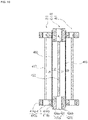
- Fig. 3 is a perspective view illustrating the positional relationship between a bipolar element 23, a middle chamber 24, and a bipolar element 23, as mentioned above, in a single unit stack 20, and the respective configurations thereof.
- Fig. 4 is a vertical section view for the case in which this unit stack 20 has been stacked.
- the bipolar elements 23 are composed of a bipolar element body 231, an anode 232, and a cathode 233.
- the bipolar element body 231 has recesses 234a, 234b formed on the front and rear surfaces thereof, and the edges of these recesses 234a, 234b are frame-shaped protrusions 235a, 235b.
- the anode 232 is provided inside the recess 234a, and the cathode 233 is provided inside the recess 234b.
- Gaskets 236a, 236b comprising elastic members are bonded, respectively, to the surfaces of the protrusions 235a, 235b.
- the protrusions 235a, 235b and the gaskets 236a, 236b form fastening portions 237a, 237b.
- the middle chamber 24 is composed of a middle chamber body 241 and gaskets 246a, 246b bonded to the front and rear surfaces of this middle chamber body 241.
- the middle chamber body 241 and the gaskets 246a, 246b form the fastening portions 247a, 247b.
- the middle chamber body 241 is formed so as to be frame-shaped, with a space being formed in the central area thereof.
- the middle chamber 24 is located at the center, with diaphragms 201, 202 arranged on both the front and rear surfaces thereof. Furthermore, the bipolar elements 23, 23 are arranged on the outer sides of these diaphragms 201, 202, and these portions are connected to each other to form a single unit stack 20.
- the diaphragm 201 is a cation exchange membrane and the diaphragm 202 is an anion exchange membrane.
- the space between the diaphragm 201 and the cathode 233 of the bipolar element 23 on the left side in Fig. 4 forms a cathode chamber 27
- the space between the diaphragm 201 and the diaphragm 202, including the space in the central area of the middle chamber body 241 forms an intermediate chamber 28
- the space between the diaphragm 202 and the anode 232 of the bipolar element on the right side in Fig. 4 forms an anode chamber 29.
- the width A of the fastening portions 247a, 247b of the middle chamber 24 is formed to be larger than the width B (so as to be different from the width B) of the fastening portions 237a, 237b of the bipolar elements.
- a sodium hydroxide solution (NaOH) is supplied to the multiple cathode chambers 27 through the cathode chamber supply manifold 5.
- the multiple middle chambers 28 are supplied with a sodium sulfate solution (Na 2 SO 4 ) through the middle chamber supply manifold 3, and the multiple anode chambers 29 are supplied with a sulfuric acid solution (H 2 SO 4 ) through the anode chamber supply manifold 7.
- sulfuric acid ions SO 4 2- pass through the anion exchange membrane 202 and move from the middle chamber 28 to the anode chamber 29, and sodium ions Na + pass through the cation exchange membrane 201 and move from the middle chamber 28 to the cathode chamber 27.
- oxygen gas (O 2 ) and sulfuric acid (H 2 SO 4 ) are generated in the anode chamber 29, and the generated oxygen gas (O 2 ) and sulfuric acid (H 2 SO 4 ) are recovered, as products, through the anode chamber discharge manifold 8.
- hydrogen gas (H 2 ) and sodium hydroxide (NaOH) are generated, and the generated hydrogen gas (H 2 ) and sodium hydroxide (NaOH) are recovered, as products, through the cathode chamber discharge manifold 6.
- the sodium sulfate solution (Na 2 SO 4 ) supplied as the raw material to the middle chamber 28 is recovered through the middle chamber discharge manifold 4 for recycling.
- a sodium hydroxide solution (NaOH) is supplied to the cathode chamber 27.
- a sodium hydroxide solution (NaOH) that is more highly concentrated than the concentration when supplied is obtained in the cathode chamber 27.
- Some of this sodium hydroxide solution (NaOH) is recovered as a product. Purified water (H 2 O) is added to the remaining solution, the adjusted-concentration sodium hydroxide solution (NaOH) is resupplied to the cathode chamber 27, and the above-mentioned generation step is repeated.
- Fig. 5 illustrates an enlarged view of the part indicated by the circle C represented by the dashed lines in Fig. 4 , indicating the fastening portion 237b of the bipolar element 23 and the fastening portion 247a of the middle chamber 24.
- Fig. 6 illustrates an enlarged view of a part corresponding to Fig. 5 according to the conventional art, indicating the fastening portion 237b of the bipolar element 23 and the fastening portion 247 of the middle chamber 240.
- the diaphragms 201, 202 illustrated in Fig. 4 are much thinner than the bipolar element 23 and the middle chamber 24.
- the diaphragms 201, 202 deform in accordance with the shapes of the gaskets 236a, 236b, 246a, 246b. Therefore, in order to make the explanation easier to understand, the diaphragms 201, 202 in Fig. 4 are omitted from Fig. 5 and Fig. 6 .
- the width B of the fastening portion 237b of the bipolar element 23 and the width B of the fastening portion 247 of the middle chamber 240 are the same.
- the gaskets 236b, 240a which have the same width, are brought into contact.
- the gaskets 236b and 240a are formed from elastic members, and therefore, if they are slightly misaligned, then forces corresponding to mutual actions and reactions will act on the ends thereof, as indicated by the arrow u and the arrow v, and by the arrow x and the arrow y.
- these forces are separated into the components in the vertical direction (the direction in which the misalignment occurs) on the sheet surface of Fig. 6 , it can be seen that forces are generated, respectively in the directions of the arrows u1, v1, x1, y1.
- the forces u1 and x1 acting on the bipolar element 23 are in the same direction, and act on the bipolar element 23 as u1 + x1.
- the forces v1 and y1 acting on the middle chamber 240 are in the same direction, opposite to the direction of the force acting on the bipolar element 23, and act on the middle chamber 240 as v1 + y1. Therefore, the actions of the force u1 + x1 and the force v1 + y1 increase the forces working to move the bipolar element 23 upward on the sheet surface and to move the middle chamber 240 downward on the sheet surface, thereby causing further and further misalignment.
- the width A of the fastening portion 247a of the middle chamber 24 is formed to be larger than the width B of the fastening portion 237b of the bipolar element 23.
- the forces corresponding to the actions and reactions acting in this case are represented by the arrows p, q, s, t, and are represented by being separated into p1, q1, s1, t1 as components in the misalignment direction.
- the forces p1 and s1 acting on the fastening portion 237b of the bipolar element 23 are in opposite directions and therefore cancel out.
- the forces q1 and t1 acting on the fastening portion 247a of the middle chamber 24 are also in opposite directions and therefore cancel out.
- the fastening portions 247a, 247b of the middle chamber 24 are formed to be wider than the fastening portions 237a, 237b of the bipolar element 23.
- the forces in the misalignment direction cancel out and are not generated.
- the fastening portion 247a of the middle chamber 24 remains within the width B of the fastening portion 237b of the bipolar element 23, forces will not be generated in the misalignment direction. Therefore, it is possible to provide a stacked structure 2 including electrodes in which misalignment of the units (the bipolar elements 23 and the middle chambers 24) can be prevented effectively.
- Fig. 7 is a perspective view of a unit stack 30 according to a second embodiment of the present invention.
- Fig. 8 is a section view of the unit stack 30 of the present embodiment.
- the differences from the first embodiment will be explained, and the features that are identical will be assigned the same reference numbers and the explanations thereof will be omitted.
- the unit stack 30 in the present embodiment comprises bipolar elements 23 having the same structure as in the first embodiment, and a bipolar element 33 on which the width of fastening portions 337a, 337b is different from the width of the fastening portions 237a, 237b of the bipolar elements 23, with the structures otherwise being the same.
- the unit stack 30 is constructed from a set consisting of a bipolar element 23, a bipolar element 33, and a bipolar element 23.
- the bipolar element 33 is composed of a bipolar element body 331, an anode 332, and a cathode 333.
- the bipolar element body 331 has recesses 334a, 334b formed on the front and rear surfaces thereof, and the edges of these recesses 334a, 334b are frame-shaped protrusions 335a, 335b.
- the anode 332 is provided inside the recess 334a, and the cathode 333 is provided inside the recess 334b.
- Gaskets 336a, 336b comprising elastic members are bonded, respectively, to the surfaces of the protrusions 335a, 335b.
- the protrusions 335a, 335b and the gaskets 336a, 336b form fastening portions 337a, 337b.
- the width A of the fastening portions 337a, 337b of the bipolar element 33 is formed to be larger than the width B of the fastening portions 237a, 237b of the bipolar element 23.
- Diaphragms 300 are provided between the bipolar elements 23 and the bipolar element 33, and in the present embodiment, the diaphragms 300 are cation exchange membranes.
- the space between the diaphragm 300 and the cathode 233 of the bipolar element 23 on the left side in Fig. 8 forms a cathode chamber 27, and the space between the diaphragm 300 and the anode 332 of the bipolar element 33 forms an anode chamber 29.
- a sodium hydroxide solution (NaOH) is supplied to the cathode chamber 27, and a sodium sulfate (Na 2 SO 4 ) solution is supplied to the anode chamber 29.
- NaOH sodium hydroxide solution
- Na 2 SO 4 sodium sulfate
- water (H 2 O) is oxidized to generate H + cations and oxygen (O 2 ), and on the surface of the cathode 233, water (H 2 O) is reduced to generate OH - anions and hydrogen (H 2 ).
- the Na + cations in the anode chamber 29 pass through the cation exchange membrane (diaphragm) 300 and move to the cathode chamber 27, and oxygen gas (O 2 ) and sulfuric acid (H 2 SO 4 ) are generated in the anode chamber 29.
- oxygen gas (O 2 ) and sulfuric acid (H 2 SO 4 ) are generated in the anode chamber 29.
- sodium sulfate (Na 2 SO 4 ) is in a state of mixture with these products, sodium hydroxide (NaOH) and hydrogen gas (H 2 ) are generated.
- the respective products are recovered through discharge manifolds, which are not illustrated.
- the width A of the fastening portions 337a, 337b of the bipolar element 33 is formed to be larger than the width B of the fastening portions 237a, 237b of the bipolar elements 23.
- Fig. 9 is a perspective view of a unit stack 40 according to a third embodiment of the present invention.
- Fig. 10 is a section view of the unit stack 40 of the present embodiment.
- the differences from the first embodiment will be explained, and the features that are identical will be assigned the same reference numbers and the explanations thereof will be omitted.
- the unit stack 40 in the present embodiment comprises anode units 41 and a cathode unit 42.
- the unit stack 40 is constructed from a set consisting of an anode unit 41, a cathode unit 42, and an anode unit 41.
- the anode units 41 are composed of a frame-shaped anode unit body 411 and an anode 412.
- the anode unit body 411 has the anode 412 fitted in the interior thereof.
- Gaskets 416a, 416b comprising elastic members are bonded, respectively, to the surfaces of the anode unit bodies 411.
- the anode unit bodies 411 and the gaskets 416a, 416b form fastening portions 417a, 417b.
- the cathode unit 42 is composed of a frame-shaped cathode unit body 421 and a cathode 422.
- the cathode unit body 421 has the anode 422 fitted in the interior thereof.
- Gaskets 426a, 426b each comprising elastic members are bonded to the surface of the cathode unit body 421.
- the cathode unit body 421 and the gaskets 426a, 426b form fastening portions 427a, 427b.
- the width A of the fastening portions 427a, 427b of the cathode unit 42 is formed to be larger than the width B of the fastening portions 417a, 417b of the cathode unit 42.
- Diaphragms 400 are provided between the anode units 41 and the cathode unit 42.
- the diaphragms 400 are cation exchange membranes.
- the spaces between the diaphragms 400 and the cathode 422 of the cathode unit 42 form cathode chambers 27, and the spaces between the diaphragm 400 and the anodes 412 of the bipolar elements 41 form anode chambers 29.
- the width A of the fastening portions 427a, 427b of the cathode unit 42 is formed to be larger than the width B of the fastening portions 417a, 417b of the anode units 41.
- the generation of sodium hydroxide (NaOH) in the electrolytic cells was explained.
- the invention is not limited thereto.
- lithium sulfate (Li 2 SO 4 ) to the intermediate chamber 28 in the case of the first embodiment and to the cathode chambers 27 in the case of the second and third embodiments, and supplying lithium hydroxide (LiOH) to the cathode chambers 27, lithium hydroxide (LiOH) and hydrogen (H 2 ) can be generated in the cathode chambers 27 by electrolysis. That is, all electrolytic cells having the stacked structure of the present invention are included in the present invention, regardless of the products generated thereby. Additionally, the present invention is not limited to electrolytic cells, and for example, batteries, electrodialysis devices, and the like are also included in the present invention, as long as they have the stacked structure of the present invention.
- the differences in the widths of the fastening portions in the above-mentioned embodiments are not limited to those described in the embodiments mentioned above. It is sufficient for the widths of the fastening portions to be such that the width of a fastening portion of one of the units that is to be stacked is different from that of the other.
- the width of the fastening portions of the bipolar elements 33 may be made larger than the width of the middle chamber.
- the width of the fastening portions of the anode units 41 may be made larger than the width of the fastening portions of the cathode unit 42.
Landscapes
- Chemical & Material Sciences (AREA)
- Electrochemistry (AREA)
- Engineering & Computer Science (AREA)
- Chemical Kinetics & Catalysis (AREA)
- Organic Chemistry (AREA)
- Metallurgy (AREA)
- Materials Engineering (AREA)
- General Chemical & Material Sciences (AREA)
- Life Sciences & Earth Sciences (AREA)
- Sustainable Energy (AREA)
- Sustainable Development (AREA)
- Manufacturing & Machinery (AREA)
- Inorganic Chemistry (AREA)
- Electrolytic Production Of Non-Metals, Compounds, Apparatuses Therefor (AREA)
- Connection Of Plates (AREA)
- Secondary Cells (AREA)
Abstract
Description
- The present invention relates to a stacked structure including electrodes.
- In order to construct electrolytic cells for electrolysis, redox flow batteries, and the like, stacked structures in which multiple units including electrodes are stacked and spaces between the units are filled with a solution are used.
-
Patent Document 1 discloses an apparatus for electrolysis in a solution. A stacked structure in which multiple bipolar elements are connected by rods is described. -
Patent Document 2 discloses a redox flow battery in which multiple battery cells including anodes and cathodes are stacked. Said document describes that the multiple battery cells are arranged between two end plates, and the stacked state is held by means of nuts and bolts. -
- Patent Document 1:
US 4758322 B - Patent Document 2:
WO 2018/092215 A1 - Patent Document 3:
JP H9-49096 A - As described in
Patent Documents Patent Document 3 is constructed from a stacked structure, an intermediate chamber (middle chamber) is further added to the unit being constructed. Thus, the number of constituent units increases to approximately twice the number in comparison to a two-chambered electrolytic cell that is composed of a cathode chamber and an anode chamber. Increasing the number of constituent units raises the probability that the units will become misaligned. Additionally, in order to improve the throughput of manufactured goods or to ensure stable operation, the electrode areas must be made somewhat large, which in turn causes the unit areas to become large and increases the mass that must be held, thus adversely affecting unit misalignment prevention even further. - The present invention was made in consideration of such problems, and a problem to be solved by the present invention is to provide a stacked structure including electrodes that can effectively prevent misalignment between units.
- In order to solve the above-mentioned problem, the present invention employs the means indicated below.
- Namely, the stacked structure according to the present invention is a stacked structure including electrodes, wherein multiple units including flat units are stacked and fastened by fasteners, the respective units comprising frame-shaped fastening portions on outer peripheral portions on both surfaces thereof, being stacked by the surfaces of the respective fastening portions being pressed against each other, and being formed so that the width of fastening portions on one unit is different from the width of fastening portions on another unit.
- Due to this configuration, misalignment between the units can be prevented.
- In one embodiment of the present invention, the fastening portions comprise, on front surface sides thereof, gaskets comprising elastic members.
- Due to this configuration, the present invention can be constructed from appropriate components.
- In one embodiment of the present invention, diaphragms are provided between the stacked units, and the diaphragms are interposed between the fastening portions of the respective units.
- In one embodiment of the present invention, the multiple units include a bipolar element and a middle chamber.
- In one embodiment of the present invention, the multiple units are formed by stacking multiple sets of unit stacks wherein each set, as a single unit, is constructed by stacking, in the following order, a bipolar element, a middle chamber, and a bipolar element.
- In one embodiment of the present invention, the multiple units are bipolar elements.
- In one embodiment of the present invention, the multiple units include a cathode unit and an anode unit.
- Due to a configuration such as those of the above-mentioned embodiments, the present invention can be appropriately implemented.
- According to the present invention, a stacked structure including electrodes that can effectively prevent misalignment between units can be provided.
-
-
Fig. 1 is a perspective view of an electrolytic cell comprising a stacked structure including electrodes according to an embodiment of the present invention. -
Fig. 2 is a schematic diagram for explaining the positional relationship between units in a stacked structure according to an embodiment of the present invention. -
Fig. 3 is a schematic perspective view indicating the positional relationship and configuration of a unit stack according to an embodiment of the present invention. -
Fig. 4 is a vertical section view of a unit stack according to an embodiment of the present invention. -
Fig. 5 is an enlarged view of a fastening portion according to an embodiment of the present invention. -
Fig. 6 is an enlarged view of a fastening portion according to the conventional art. -
Fig. 7 is a schematic perspective view indicating the positional relationship and configuration of a unit stack according to an embodiment of the present invention. -
Fig. 8 is a vertical section view of a unit stack according to an embodiment of the present invention. -
Fig. 9 is a schematic perspective view indicating the positional relationship and configuration of a unit stack according to an embodiment of the present invention. -
Fig. 10 is a vertical section view of a unit stack according to an embodiment of the present invention. - Hereinafter, embodiments of the present invention will be explained in detail with reference to the drawings.
- Hereinafter, an example of an embodiment of the present invention will be indicated.
Fig. 1 is a perspective view of anelectrolytic cell 1 comprising a stacked structure including electrodes according to an embodiment of the present invention. Theelectrolytic cell 1 comprises: astacked structure 2 including electrodes; a middlechamber supply manifold 3; a middlechamber discharge manifold 4; a cathodechamber supply manifold 5; a cathodechamber discharge manifold 6; an anodechamber supply manifold 7; and an anodechamber discharge manifold 8. - The stacked
structure 2 comprisesfasteners 25 and a pair ofterminal support frames 26, aterminal cathode element 21, aterminal anode element 22, and arranged therebetween, multiple bipolar elements 23 (flat units comprising electrodes), of which only two are illustrated inFig. 1 , and multiple middle chambers, which are not illustrated inFig. 1 . Theterminal cathode element 21 and theterminal anode element 22 are arranged between the pair ofterminal support frames 26. Thefasteners 25 are composed ofrods 251 andnuts 252. - The
terminal support frames 26 are provided withsupport members 261 for supporting therods 251 of thefasteners 25, and are configured so that therods 251 are inserted through holes formed in thesupport members 261,nuts 252 are screwed onto both ends of therods 251, and theterminal cathode element 21, theterminal anode element 22, the multiplebipolar elements 23, and the multiple middle chambers, which are arranged between the pair ofterminal support frames 26, are clamped from both ends. All of these components together form thestacked structure 2. -
Fig. 2 is a schematic diagram for explaining the positional relationship between theterminal cathode element 21, theterminal anode element 22, and thebipolar elements 23 and themiddle chambers 24 that are arranged therebetween in thestacked structure 2. Thestacked structure 2 is formed by stacking multiple sets ofunit stacks 20 wherein each set, as a single unit, is constructed by stacking, in the following order, abipolar element 23, amiddle chamber 24, and abipolar element 23. Additionally, in thestacked structure 2, in order to allow the structures of the terminal portions, in the stacking direction, to form anelectrolytic cell 1 without conflicting with each other,middle chambers 24 are arranged, respectively, on the inner sides, in the stacking direction, of theterminal cathode element 21 and theterminal anode element 22. -
Fig. 3 is a perspective view illustrating the positional relationship between abipolar element 23, amiddle chamber 24, and abipolar element 23, as mentioned above, in asingle unit stack 20, and the respective configurations thereof.Fig. 4 is a vertical section view for the case in which thisunit stack 20 has been stacked. - The
bipolar elements 23 are composed of abipolar element body 231, ananode 232, and acathode 233. Thebipolar element body 231 hasrecesses recesses shaped protrusions anode 232 is provided inside therecess 234a, and thecathode 233 is provided inside therecess 234b. - Gaskets 236a, 236b comprising elastic members are bonded, respectively, to the surfaces of the
protrusions protrusions gaskets form fastening portions - The
middle chamber 24 is composed of amiddle chamber body 241 andgaskets middle chamber body 241. Themiddle chamber body 241 and thegaskets fastening portions middle chamber body 241 is formed so as to be frame-shaped, with a space being formed in the central area thereof. - The
middle chamber 24 is located at the center, withdiaphragms bipolar elements diaphragms single unit stack 20. - In the present embodiment, the
diaphragm 201 is a cation exchange membrane and thediaphragm 202 is an anion exchange membrane. - In the above-mentioned configuration, the space between the
diaphragm 201 and thecathode 233 of thebipolar element 23 on the left side inFig. 4 forms acathode chamber 27, the space between thediaphragm 201 and thediaphragm 202, including the space in the central area of themiddle chamber body 241, forms anintermediate chamber 28, and the space between thediaphragm 202 and theanode 232 of the bipolar element on the right side inFig. 4 forms ananode chamber 29. - The width A of the
fastening portions middle chamber 24 is formed to be larger than the width B (so as to be different from the width B) of thefastening portions - If electrolysis using sodium sulfate (Na2SO4) as the raw material is to be performed in the
electrolytic cell 1 configured as described above, then a sodium hydroxide solution (NaOH) is supplied to themultiple cathode chambers 27 through the cathodechamber supply manifold 5. The multiplemiddle chambers 28 are supplied with a sodium sulfate solution (Na2SO4) through the middlechamber supply manifold 3, and themultiple anode chambers 29 are supplied with a sulfuric acid solution (H2SO4) through the anodechamber supply manifold 7. - When the
electrolytic cell 1 is started in a state in which the respective chemical solutions are supplied, a positive voltage is applied to theanode 232 and a negative voltage is applied to thecathode 233. By applying this voltage, theanode 232 becomes anodically polarized and thecathode 233 becomes cathodically polarized. On the surface of theanode 232, water (H2O) is oxidized to generate H+ cations and oxygen (O2), and on the surface of thecathode 233, water (H2O) is reduced to generate OH-anions and hydrogen (H2). - When this state is reached, in order to maintain electrical neutrality, sulfuric acid ions SO4 2- pass through the
anion exchange membrane 202 and move from themiddle chamber 28 to theanode chamber 29, and sodium ions Na+ pass through thecation exchange membrane 201 and move from themiddle chamber 28 to thecathode chamber 27. - Due to the above-mentioned generation step, oxygen gas (O2) and sulfuric acid (H2SO4) are generated in the
anode chamber 29, and the generated oxygen gas (O2) and sulfuric acid (H2SO4) are recovered, as products, through the anodechamber discharge manifold 8. In thecathode chamber 27, hydrogen gas (H2) and sodium hydroxide (NaOH) are generated, and the generated hydrogen gas (H2) and sodium hydroxide (NaOH) are recovered, as products, through the cathodechamber discharge manifold 6. - The sodium sulfate solution (Na2SO4) supplied as the raw material to the
middle chamber 28 is recovered through the middlechamber discharge manifold 4 for recycling. - During the above-mentioned generation step, a sodium hydroxide solution (NaOH) is supplied to the
cathode chamber 27. However, due to the above-mentioned generation step, a sodium hydroxide solution (NaOH) that is more highly concentrated than the concentration when supplied is obtained in thecathode chamber 27. Some of this sodium hydroxide solution (NaOH) is recovered as a product. Purified water (H2O) is added to the remaining solution, the adjusted-concentration sodium hydroxide solution (NaOH) is resupplied to thecathode chamber 27, and the above-mentioned generation step is repeated. - Next, the functions and effects of the stacked
structure 2 provided by the above-mentionedelectrolytic cell 1 will be explained. -
Fig. 5 illustrates an enlarged view of the part indicated by the circle C represented by the dashed lines inFig. 4 , indicating thefastening portion 237b of thebipolar element 23 and thefastening portion 247a of themiddle chamber 24.Fig. 6 illustrates an enlarged view of a part corresponding toFig. 5 according to the conventional art, indicating thefastening portion 237b of thebipolar element 23 and thefastening portion 247 of themiddle chamber 240. - In this case, the
diaphragms Fig. 4 are much thinner than thebipolar element 23 and themiddle chamber 24. Thus, when thegaskets bipolar element 23 and themiddle chamber 24 are pressed together, thediaphragms gaskets diaphragms Fig. 4 are omitted fromFig. 5 and Fig. 6 . - In this case, as indicated in
Fig. 6 illustrating the conventional art, the width B of thefastening portion 237b of thebipolar element 23 and the width B of thefastening portion 247 of themiddle chamber 240 are the same. In this configuration, thegaskets gasket gaskets - To explain this point in detail, the
gaskets Fig. 6 , it can be seen that forces are generated, respectively in the directions of the arrows u1, v1, x1, y1. At this time, the forces u1 and x1 acting on thebipolar element 23 are in the same direction, and act on thebipolar element 23 as u1 + x1. The forces v1 and y1 acting on themiddle chamber 240 are in the same direction, opposite to the direction of the force acting on thebipolar element 23, and act on themiddle chamber 240 as v1 + y1. Therefore, the actions of the force u1 + x1 and the force v1 + y1 increase the forces working to move thebipolar element 23 upward on the sheet surface and to move themiddle chamber 240 downward on the sheet surface, thereby causing further and further misalignment. - In contrast therewith, in
Fig. 5 , the width A of thefastening portion 247a of themiddle chamber 24 is formed to be larger than the width B of thefastening portion 237b of thebipolar element 23. The forces corresponding to the actions and reactions acting in this case are represented by the arrows p, q, s, t, and are represented by being separated into p1, q1, s1, t1 as components in the misalignment direction. The forces p1 and s1 acting on thefastening portion 237b of thebipolar element 23 are in opposite directions and therefore cancel out. The forces q1 and t1 acting on thefastening portion 247a of themiddle chamber 24 are also in opposite directions and therefore cancel out. As a result thereof, forces are not generated in the misalignment direction. Even if slight misalignment occurs for some reason, as long as thefastening portion 237b remains within the width A of thefastening portion 247a, the forces will act in the same manner as mentioned above, and no forces will be generated in the misalignment direction. - As mentioned above, in the present embodiment, the
fastening portions middle chamber 24 are formed to be wider than thefastening portions bipolar element 23. Thus, the forces in the misalignment direction cancel out and are not generated. Additionally, even if there is a slight misalignment, as long as thefastening portion 247a of themiddle chamber 24 remains within the width B of thefastening portion 237b of thebipolar element 23, forces will not be generated in the misalignment direction. Therefore, it is possible to provide astacked structure 2 including electrodes in which misalignment of the units (thebipolar elements 23 and the middle chambers 24) can be prevented effectively. -
Fig. 7 is a perspective view of aunit stack 30 according to a second embodiment of the present invention.Fig. 8 is a section view of theunit stack 30 of the present embodiment. Regarding the present embodiment, the differences from the first embodiment will be explained, and the features that are identical will be assigned the same reference numbers and the explanations thereof will be omitted. - The
unit stack 30 in the present embodiment comprisesbipolar elements 23 having the same structure as in the first embodiment, and abipolar element 33 on which the width offastening portions fastening portions bipolar elements 23, with the structures otherwise being the same. Theunit stack 30 is constructed from a set consisting of abipolar element 23, abipolar element 33, and abipolar element 23. - The
bipolar element 33 is composed of abipolar element body 331, ananode 332, and acathode 333. Thebipolar element body 331 hasrecesses recesses protrusions anode 332 is provided inside therecess 334a, and thecathode 333 is provided inside therecess 334b. - Gaskets 336a, 336b comprising elastic members are bonded, respectively, to the surfaces of the
protrusions protrusions gaskets form fastening portions - The width A of the
fastening portions bipolar element 33 is formed to be larger than the width B of thefastening portions bipolar element 23. -
Diaphragms 300 are provided between thebipolar elements 23 and thebipolar element 33, and in the present embodiment, thediaphragms 300 are cation exchange membranes. - The space between the
diaphragm 300 and thecathode 233 of thebipolar element 23 on the left side inFig. 8 forms acathode chamber 27, and the space between thediaphragm 300 and theanode 332 of thebipolar element 33 forms ananode chamber 29. - In the present embodiment, a sodium hydroxide solution (NaOH) is supplied to the
cathode chamber 27, and a sodium sulfate (Na2SO4) solution is supplied to theanode chamber 29. When a positive voltage is applied to the anode and a negative voltage is applied to the cathode in a state in which the chemical solutions are supplied, theanode 332 becomes anodically polarized and thecathode 233 becomes cathodically polarized. On the surface of theanode 332, water (H2O) is oxidized to generate H+ cations and oxygen (O2), and on the surface of thecathode 233, water (H2O) is reduced to generate OH- anions and hydrogen (H2). - When this state is reached, in order to maintain electrical neutrality, the Na+ cations in the
anode chamber 29 pass through the cation exchange membrane (diaphragm) 300 and move to thecathode chamber 27, and oxygen gas (O2) and sulfuric acid (H2SO4) are generated in theanode chamber 29. In thecathode chamber 27, in which the remaining raw material, sodium sulfate (Na2SO4), is in a state of mixture with these products, sodium hydroxide (NaOH) and hydrogen gas (H2) are generated. The respective products are recovered through discharge manifolds, which are not illustrated. - In the present embodiment, the width A of the
fastening portions bipolar element 33 is formed to be larger than the width B of thefastening portions bipolar elements 23. Thus, functions and effects similar to those in the first embodiment can be obtained. -
Fig. 9 is a perspective view of aunit stack 40 according to a third embodiment of the present invention.Fig. 10 is a section view of theunit stack 40 of the present embodiment. Regarding the present embodiment, the differences from the first embodiment will be explained, and the features that are identical will be assigned the same reference numbers and the explanations thereof will be omitted. - The
unit stack 40 in the present embodiment comprisesanode units 41 and acathode unit 42. Theunit stack 40 is constructed from a set consisting of ananode unit 41, acathode unit 42, and ananode unit 41. - The
anode units 41 are composed of a frame-shapedanode unit body 411 and ananode 412. Theanode unit body 411 has theanode 412 fitted in the interior thereof. - Gaskets 416a, 416b comprising elastic members are bonded, respectively, to the surfaces of the
anode unit bodies 411. Theanode unit bodies 411 and thegaskets form fastening portions - The
cathode unit 42 is composed of a frame-shapedcathode unit body 421 and acathode 422. Thecathode unit body 421 has theanode 422 fitted in the interior thereof. - Gaskets 426a, 426b each comprising elastic members are bonded to the surface of the
cathode unit body 421. Thecathode unit body 421 and thegaskets form fastening portions - The width A of the
fastening portions cathode unit 42 is formed to be larger than the width B of thefastening portions cathode unit 42. -
Diaphragms 400 are provided between theanode units 41 and thecathode unit 42. In the present embodiment, thediaphragms 400 are cation exchange membranes. - The spaces between the
diaphragms 400 and thecathode 422 of thecathode unit 42form cathode chambers 27, and the spaces between thediaphragm 400 and theanodes 412 of thebipolar elements 41form anode chambers 29. - Since the operations of the electrolytic cell due to electrolysis in the
cathode chambers 27 and theanode chambers 29 are the same as those in the second embodiment, the explanation will be omitted here. - In the present embodiment, the width A of the
fastening portions cathode unit 42 is formed to be larger than the width B of thefastening portions anode units 41. Thus, functions and effects similar to those in the first embodiment can be obtained. - In the above-mentioned embodiments, the generation of sodium hydroxide (NaOH) in the electrolytic cells was explained. However, the invention is not limited thereto. For example, by supplying lithium sulfate (Li2SO4) to the
intermediate chamber 28 in the case of the first embodiment and to thecathode chambers 27 in the case of the second and third embodiments, and supplying lithium hydroxide (LiOH) to thecathode chambers 27, lithium hydroxide (LiOH) and hydrogen (H2) can be generated in thecathode chambers 27 by electrolysis. That is, all electrolytic cells having the stacked structure of the present invention are included in the present invention, regardless of the products generated thereby. Additionally, the present invention is not limited to electrolytic cells, and for example, batteries, electrodialysis devices, and the like are also included in the present invention, as long as they have the stacked structure of the present invention. - Additionally, the differences in the widths of the fastening portions in the above-mentioned embodiments are not limited to those described in the embodiments mentioned above. It is sufficient for the widths of the fastening portions to be such that the width of a fastening portion of one of the units that is to be stacked is different from that of the other. For example, in the first embodiment, the width of the fastening portions of the
bipolar elements 33 may be made larger than the width of the middle chamber. In the third embodiment, the width of the fastening portions of theanode units 41 may be made larger than the width of the fastening portions of thecathode unit 42. -
- 2
- Stacked structure
- 20, 30, 40
- Unit stack
- 23, 33
- Bipolar element (unit)
- 232,332,412
- Anode
- 233, 333, 422
- Cathode
- 236a, 236b, 336a, 336b
- Gasket of bipolar element
- 237a, 237b ,337a, 337b
- Fastening portion of bipolar element
- 24, 240
- Middle chamber (unit)
- 247a, 247b, 247
- Fastening portion of middle chamber
- 25
- Fastener
- 41
- Anode unit (unit)
- 416a, 416b
- Gasket of anode unit
- 417a, 417b
- Fastening portion of anode unit
- 42
- Cathode unit (unit)
- 426a, 426b
- Gasket of anode unit
- 427a, 427b
- Fastening portion of anode unit
- 201, 202, 300, 400
- Diaphragm
Claims (7)
- A stacked structure including electrodes, wherein multiple units including flat units are stacked and fastened by fasteners,
the respective units comprising frame-shaped fastening portions on outer peripheral portions on both surfaces thereof, being stacked by the surfaces of the respective fastening portions being pressed against each other, and being formed so that a width of fastening portions on one unit is different from a width of fastening portions on another unit. - The stacked structure including electrodes according to claim 1, wherein the fastening portions comprise, on front surface sides thereof, gaskets comprising elastic members.
- The stacked structure including electrodes according to claim 1 or 2, wherein diaphragms are provided between the stacked units, and the diaphragms are interposed between the fastening portions of the respective units.
- The stacked structure including electrodes according to any one of claims 1 to 3, wherein the multiple units include a bipolar element and a middle chamber.
- The stacked structure including electrodes according to claim 4, wherein the multiple units are formed by stacking multiple sets of unit stacks wherein each set, as a single unit, is constructed by stacking, in the following order, a bipolar element, a middle chamber, and a bipolar element.
- The stacked structure including electrodes according to any one of claims 1 to 3, wherein the multiple units are bipolar elements.
- The stacked structure including electrodes according to any one of claims 1 to 3, wherein the multiple units include a cathode unit and an anode unit.
Applications Claiming Priority (1)
| Application Number | Priority Date | Filing Date | Title |
|---|---|---|---|
| PCT/JP2019/037496 WO2021059379A1 (en) | 2019-09-25 | 2019-09-25 | Laminated structure including electrodes |
Publications (2)
| Publication Number | Publication Date |
|---|---|
| EP4036277A1 true EP4036277A1 (en) | 2022-08-03 |
| EP4036277A4 EP4036277A4 (en) | 2022-12-07 |
Family
ID=73043538
Family Applications (1)
| Application Number | Title | Priority Date | Filing Date |
|---|---|---|---|
| EP19946605.3A Pending EP4036277A4 (en) | 2019-09-25 | 2019-09-25 | Laminated structure including electrodes |
Country Status (10)
| Country | Link |
|---|---|
| US (1) | US11718922B2 (en) |
| EP (1) | EP4036277A4 (en) |
| JP (1) | JP6783418B1 (en) |
| CN (1) | CN114502776A (en) |
| AU (1) | AU2019468159B2 (en) |
| BR (1) | BR112022005286B1 (en) |
| CA (1) | CA3152212C (en) |
| MY (1) | MY193749A (en) |
| TW (1) | TWI840419B (en) |
| WO (1) | WO2021059379A1 (en) |
Families Citing this family (3)
| Publication number | Priority date | Publication date | Assignee | Title |
|---|---|---|---|---|
| JP7597839B2 (en) * | 2023-02-14 | 2024-12-10 | 株式会社トクヤマ | Electrolysis Equipment |
| KR20250170578A (en) * | 2023-04-11 | 2025-12-05 | 가부시끼가이샤 도꾸야마 | Electrolytic device |
| EP4530377A1 (en) * | 2023-09-27 | 2025-04-02 | Südbayerisches Portland-Zementwerk Gebr. Wiesböck & Co. GmbH | Electrode support for an electrode stack |
Family Cites Families (21)
| Publication number | Priority date | Publication date | Assignee | Title |
|---|---|---|---|---|
| JPS5351440U (en) | 1976-10-04 | 1978-05-01 | ||
| US4441977A (en) * | 1980-11-05 | 1984-04-10 | Olin Corporation | Electrolytic cell with sealing means |
| US4431502A (en) | 1980-11-05 | 1984-02-14 | Olin Corporation | Sealing means for filter press cells |
| US4368109A (en) | 1980-11-05 | 1983-01-11 | Olin Corporation | Electrolytic cell with inter-electrode spacer means |
| US4332661A (en) * | 1980-11-05 | 1982-06-01 | Olin Corporation | Cells having gasket lubricating means |
| US4391680A (en) * | 1981-12-03 | 1983-07-05 | Allied Corporation | Preparing alkali metal hydroxide by water splitting and hydrolysis |
| JPS5976565A (en) | 1982-10-21 | 1984-05-01 | Origin Electric Co Ltd | Method and device for electrostatic painting |
| JPS5976565U (en) * | 1982-11-17 | 1984-05-24 | 株式会社トクヤマ | Filter press type electrolytic cell |
| DE3381495D1 (en) | 1983-03-14 | 1990-05-31 | Allied Signal Inc | ACID FORMATION IN LAUGES WITH SIMULTANEOUS PRODUCTION OF ALKALINE METAL HYDROXIDE AND SALT ACID THROUGH WATER DECOMPOSITION IN AN ELECTRODIALYSIS APPARATUS THREE CHAMBER TYPES. |
| US4602984A (en) | 1984-12-17 | 1986-07-29 | The Dow Chemical Company | Monopolar electrochemical cell having a novel electric current transmission element |
| CH672142A5 (en) | 1985-07-17 | 1989-10-31 | Metkon Sa | |
| JP2605708Y2 (en) | 1993-02-04 | 2000-08-07 | ペルメレック電極株式会社 | Electrolytic cell |
| JP3110656B2 (en) * | 1995-06-30 | 2000-11-20 | 三井造船株式会社 | Electrolytic cell |
| JPH0949096A (en) | 1995-08-10 | 1997-02-18 | Tanaka Kikinzoku Kogyo Kk | Three-chamber method for electrolysis of salt |
| ITMI20021524A1 (en) * | 2002-07-11 | 2004-01-12 | De Nora Elettrodi Spa | CELL WITH ERUPTION BED ELECTRODE FOR METAL ELECTRODEPOSITION |
| US7416804B2 (en) * | 2003-07-22 | 2008-08-26 | E.I. Du Pont De Nemours And Company | Process for making planar framed membrane electrode assembly arrays, and fuel cells containing the same |
| ITMI20042248A1 (en) | 2004-11-19 | 2005-02-19 | Uhdenora Technologies Srl | BIPOLAR PLATE FOR ELECTROLYZER INCLUDING A SINGLE WALL |
| JP5217323B2 (en) * | 2007-09-14 | 2013-06-19 | 株式会社明電舎 | Bipolar multilayer electric double layer capacitor |
| DE102012013832A1 (en) | 2012-07-13 | 2014-01-16 | Uhdenora S.P.A. | Insulating frame with corner compensators for electrolysis cells |
| WO2018066093A1 (en) * | 2016-10-05 | 2018-04-12 | 住友電気工業株式会社 | Cell stack and redox flow battery |
| KR20190077241A (en) | 2016-11-16 | 2019-07-03 | 스미토모덴키고교가부시키가이샤 | Cell frame, cell stack, and redox flow cell |
-
2019
- 2019-09-25 BR BR112022005286-3A patent/BR112022005286B1/en active IP Right Grant
- 2019-09-25 MY MYPI2022001471A patent/MY193749A/en unknown
- 2019-09-25 WO PCT/JP2019/037496 patent/WO2021059379A1/en not_active Ceased
- 2019-09-25 CA CA3152212A patent/CA3152212C/en active Active
- 2019-09-25 AU AU2019468159A patent/AU2019468159B2/en active Active
- 2019-09-25 JP JP2020536822A patent/JP6783418B1/en active Active
- 2019-09-25 EP EP19946605.3A patent/EP4036277A4/en active Pending
- 2019-09-25 US US17/753,904 patent/US11718922B2/en active Active
- 2019-09-25 CN CN201980100577.0A patent/CN114502776A/en active Pending
- 2019-10-03 TW TW108135810A patent/TWI840419B/en active
Also Published As
| Publication number | Publication date |
|---|---|
| JPWO2021059379A1 (en) | 2021-10-07 |
| AU2019468159A1 (en) | 2022-05-19 |
| BR112022005286B1 (en) | 2023-03-14 |
| JP6783418B1 (en) | 2020-11-11 |
| US20220416262A1 (en) | 2022-12-29 |
| US11718922B2 (en) | 2023-08-08 |
| TWI840419B (en) | 2024-05-01 |
| EP4036277A4 (en) | 2022-12-07 |
| CA3152212A1 (en) | 2021-04-01 |
| TW202113159A (en) | 2021-04-01 |
| CA3152212C (en) | 2023-02-07 |
| BR112022005286A2 (en) | 2022-06-14 |
| MY193749A (en) | 2022-10-27 |
| AU2019468159B2 (en) | 2022-12-01 |
| WO2021059379A1 (en) | 2021-04-01 |
| CN114502776A (en) | 2022-05-13 |
Similar Documents
| Publication | Publication Date | Title |
|---|---|---|
| CA3152212C (en) | Laminated structure including electrodes | |
| EP0608390B1 (en) | High-pressure electrochemical cell structure | |
| CN104619887A (en) | Internally reinforced water electrolyser module | |
| JPH0657874B2 (en) | Membrane type electrolytic cell | |
| CN115287687B (en) | A sealing structure for an electrolytic cell | |
| US20250333859A1 (en) | Adhesive-fixed electrolysis module | |
| US20060228619A1 (en) | Electrochemical cell structure | |
| IE53623B1 (en) | Electrolytic cell of the filter press type | |
| US4541911A (en) | Method of assembling a filter press type electrolytic cell | |
| US20120052410A1 (en) | High-Volume-Manufacture Fuel Cell Arrangement and Method for Production Thereof | |
| RU2778133C1 (en) | Stacked structure with electrodes | |
| JPH07135008A (en) | Battery cell structure | |
| KR20240132263A (en) | Electrolyzer having a stack of welded four-layer modules | |
| CA1291865C (en) | Method of assembling filter press type structure | |
| EP4497844B1 (en) | Multi-electrode package-cell frame for a hydrogen electrolyzer, electrolyzer comprising the same, and fabrication method | |
| EP4538426A1 (en) | Flow distributor configured to homogeneously distribute reactants into an electrolytic cell, cell frame including the same, and electrolyzer comprising the cell frame | |
| JPH0661970U (en) | Electrolyzer chamber frame | |
| US20260078504A1 (en) | Electrolysis cell | |
| US4197182A (en) | Cathode assembly for plural cell electrolyzer | |
| GB2632109A (en) | Electrolysers | |
| KR20260033530A (en) | Low-cost electrochemical cell stack for carbon dioxide gas separators | |
| JPH0913186A (en) | Electrolytic cell | |
| JPH07176325A (en) | Electrolytic solution flow type battery | |
| IT1292061B1 (en) | Ion exchange membrane electrolyser elements - with the elements having two sheets with projections to which are attached electrocatalytically coated anodic and cathodic screens | |
| JPS60262363A (en) | Electrolyte-flow-type container |
Legal Events
| Date | Code | Title | Description |
|---|---|---|---|
| STAA | Information on the status of an ep patent application or granted ep patent |
Free format text: STATUS: THE INTERNATIONAL PUBLICATION HAS BEEN MADE |
|
| PUAI | Public reference made under article 153(3) epc to a published international application that has entered the european phase |
Free format text: ORIGINAL CODE: 0009012 |
|
| STAA | Information on the status of an ep patent application or granted ep patent |
Free format text: STATUS: REQUEST FOR EXAMINATION WAS MADE |
|
| 17P | Request for examination filed |
Effective date: 20220330 |
|
| AK | Designated contracting states |
Kind code of ref document: A1 Designated state(s): AL AT BE BG CH CY CZ DE DK EE ES FI FR GB GR HR HU IE IS IT LI LT LU LV MC MK MT NL NO PL PT RO RS SE SI SK SM TR |
|
| REG | Reference to a national code |
Ref country code: DE Ref legal event code: R079 Free format text: PREVIOUS MAIN CLASS: C25B0009000000 Ipc: C25B0001040000 |
|
| A4 | Supplementary search report drawn up and despatched |
Effective date: 20221104 |
|
| RIC1 | Information provided on ipc code assigned before grant |
Ipc: H01M 8/18 20060101ALI20221028BHEP Ipc: C25B 9/77 20210101ALI20221028BHEP Ipc: C25B 9/75 20210101ALI20221028BHEP Ipc: C25B 9/63 20210101ALI20221028BHEP Ipc: C25B 9/21 20210101ALI20221028BHEP Ipc: C25B 1/22 20060101ALI20221028BHEP Ipc: C25B 1/20 20060101ALI20221028BHEP Ipc: C25B 1/04 20210101AFI20221028BHEP |
|
| DAV | Request for validation of the european patent (deleted) | ||
| DAX | Request for extension of the european patent (deleted) | ||
| P01 | Opt-out of the competence of the unified patent court (upc) registered |
Effective date: 20230322 |
|
| STAA | Information on the status of an ep patent application or granted ep patent |
Free format text: STATUS: EXAMINATION IS IN PROGRESS |
|
| 17Q | First examination report despatched |
Effective date: 20230908 |