EP4036146A1 - Polycarbonate resin - Google Patents
Polycarbonate resin Download PDFInfo
- Publication number
- EP4036146A1 EP4036146A1 EP20868795.4A EP20868795A EP4036146A1 EP 4036146 A1 EP4036146 A1 EP 4036146A1 EP 20868795 A EP20868795 A EP 20868795A EP 4036146 A1 EP4036146 A1 EP 4036146A1
- Authority
- EP
- European Patent Office
- Prior art keywords
- group
- carbon atoms
- polycarbonate resin
- general formula
- glycol
- Prior art date
- Legal status (The legal status is an assumption and is not a legal conclusion. Google has not performed a legal analysis and makes no representation as to the accuracy of the status listed.)
- Granted
Links
Classifications
-
- C—CHEMISTRY; METALLURGY
- C08—ORGANIC MACROMOLECULAR COMPOUNDS; THEIR PREPARATION OR CHEMICAL WORKING-UP; COMPOSITIONS BASED THEREON
- C08G—MACROMOLECULAR COMPOUNDS OBTAINED OTHERWISE THAN BY REACTIONS ONLY INVOLVING UNSATURATED CARBON-TO-CARBON BONDS
- C08G64/00—Macromolecular compounds obtained by reactions forming a carbonic ester link in the main chain of the macromolecule
- C08G64/18—Block or graft polymers
-
- C—CHEMISTRY; METALLURGY
- C08—ORGANIC MACROMOLECULAR COMPOUNDS; THEIR PREPARATION OR CHEMICAL WORKING-UP; COMPOSITIONS BASED THEREON
- C08G—MACROMOLECULAR COMPOUNDS OBTAINED OTHERWISE THAN BY REACTIONS ONLY INVOLVING UNSATURATED CARBON-TO-CARBON BONDS
- C08G64/00—Macromolecular compounds obtained by reactions forming a carbonic ester link in the main chain of the macromolecule
- C08G64/18—Block or graft polymers
- C08G64/183—Block or graft polymers containing polyether sequences
-
- C—CHEMISTRY; METALLURGY
- C08—ORGANIC MACROMOLECULAR COMPOUNDS; THEIR PREPARATION OR CHEMICAL WORKING-UP; COMPOSITIONS BASED THEREON
- C08G—MACROMOLECULAR COMPOUNDS OBTAINED OTHERWISE THAN BY REACTIONS ONLY INVOLVING UNSATURATED CARBON-TO-CARBON BONDS
- C08G64/00—Macromolecular compounds obtained by reactions forming a carbonic ester link in the main chain of the macromolecule
- C08G64/16—Aliphatic-aromatic or araliphatic polycarbonates
- C08G64/1608—Aliphatic-aromatic or araliphatic polycarbonates saturated
-
- C—CHEMISTRY; METALLURGY
- C08—ORGANIC MACROMOLECULAR COMPOUNDS; THEIR PREPARATION OR CHEMICAL WORKING-UP; COMPOSITIONS BASED THEREON
- C08G—MACROMOLECULAR COMPOUNDS OBTAINED OTHERWISE THAN BY REACTIONS ONLY INVOLVING UNSATURATED CARBON-TO-CARBON BONDS
- C08G64/00—Macromolecular compounds obtained by reactions forming a carbonic ester link in the main chain of the macromolecule
- C08G64/16—Aliphatic-aromatic or araliphatic polycarbonates
-
- C—CHEMISTRY; METALLURGY
- C08—ORGANIC MACROMOLECULAR COMPOUNDS; THEIR PREPARATION OR CHEMICAL WORKING-UP; COMPOSITIONS BASED THEREON
- C08G—MACROMOLECULAR COMPOUNDS OBTAINED OTHERWISE THAN BY REACTIONS ONLY INVOLVING UNSATURATED CARBON-TO-CARBON BONDS
- C08G64/00—Macromolecular compounds obtained by reactions forming a carbonic ester link in the main chain of the macromolecule
- C08G64/20—General preparatory processes
- C08G64/30—General preparatory processes using carbonates
- C08G64/305—General preparatory processes using carbonates and alcohols
-
- C—CHEMISTRY; METALLURGY
- C08—ORGANIC MACROMOLECULAR COMPOUNDS; THEIR PREPARATION OR CHEMICAL WORKING-UP; COMPOSITIONS BASED THEREON
- C08G—MACROMOLECULAR COMPOUNDS OBTAINED OTHERWISE THAN BY REACTIONS ONLY INVOLVING UNSATURATED CARBON-TO-CARBON BONDS
- C08G64/00—Macromolecular compounds obtained by reactions forming a carbonic ester link in the main chain of the macromolecule
- C08G64/20—General preparatory processes
- C08G64/30—General preparatory processes using carbonates
- C08G64/307—General preparatory processes using carbonates and phenols
Definitions
- the present invention relates to a novel polycarbonate resin.
- Patent Document 1 describes a ⁇ -ray irradiation-resistant polycarbonate resin containing this
- Patent Document 2 describes a thermoplastic resin composition having excellent antistatic properties and surface appearance that is blended in PMMA, etc.
- Patent Document 3 proposes to improve the transmittance and color phase by blending a polyalkylene glycol composed of a linear alkyl group.
- a polytetramethylene ether glycol By blending a polytetramethylene ether glycol, the transmittance and the degree of yellowness (yellow index: YI) are improved.
- Patent Document 4 describes a method for producing a polycarbonate copolymer, wherein a diol obtained by diesterification of polyalkylene glycol is used as a raw material (comonomer).
- a diester diol of polyalkylene glycol is unstable, and for this reason, impact resistance is insufficient and the color phase and heat discoloration resistance are unsatisfactory.
- the present invention was made in consideration of the above-described actual circumstances, and the purpose thereof is to provide a polycarbonate resin, wherein the amount of gas generated is small.
- the present inventor diligently made researches in order to solve the above-described problem and found that the generation of gas at the time of molding can be suppressed by a specific polycarbonate resin, and thus the present invention was achieved.
- the present invention relates to a polycarbonate resin described below.
- the amount of gas generated is small, and the polycarbonate resin has the effect of widening the range of resin design according to various applications.
- the first embodiment of the present invention is a polycarbonate resin containing a structural unit (A) represented by general formula (1) and a structural unit (B) represented by general formula (4).
- R 1 , R 2 , R 3 , R 4 , R 5 , R 6 , R 7 and R 8 are each independently selected from the group consisting of a hydrogen atom, a fluorine atom, a chlorine atom, a bromine atom, an iodine atom, an alkyl group having 1 to 7 carbon atoms (preferably 1 to 3 carbon atoms), an aryl group having 6 to 12 carbon atoms (preferably 6 to 10 carbon atoms), an alkenyl group having 2 to 7 carbon atoms (preferably 2 to 5 carbon atoms), an alkoxy group having 1 to 7 carbon atoms (preferably 1 to 4 carbon atoms) and an aralkyl group having 7 to 17 carbon atoms (preferably 7 to 11 carbon atoms), and are preferably selected from the group consisting of a hydrogen atom, a phenyl group and a methyl group. More preferably, all of R 1 to R 8 represent a hydrogen atom, or alternatively, R 1 or
- each of the alkyl group, the aryl group, the alkenyl group, the alkoxy group and the aralkyl group may have a substituent, and preferred examples of the substituent include a phenyl group.
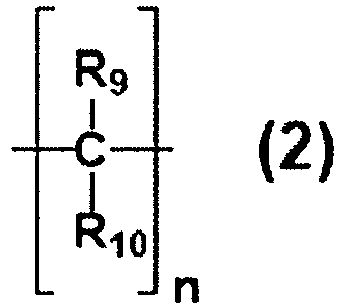
- X represents -O-, -S-, -SO-, -SO 2 -, -CO-, a cycloalkylene group having 6 to 12 carbon atoms, or a divalent group represented by general formula (2) or general formula (3), and the cycloalkylene group may be substituted with 1 to 12 alkyl groups having 1 to 3 carbon atoms.
- X represents a divalent group represented by general formula (2) or a divalent group represented by general formula (3).
- R 9 and R 10 are each independently selected from the group consisting of a hydrogen atom, a fluorine atom, a chlorine atom, a bromine atom, an iodine atom, an alkyl group having 1 to 20 carbon atoms (preferably 1 to 5 carbon atoms), an alkoxy group having 1 to 5 carbon atoms (preferably 1 to 3 carbon atoms), an aryl group having 6 to 12 carbon atoms (preferably 6 to 8 carbon atoms), an aralkyl group having 7 to 17 carbon atoms (preferably 7 to 10 carbon atoms) and an alkenyl group having 2 to 15 carbon atoms (preferably 2 to 10 carbon atoms), and are preferably selected from the group consisting of a hydrogen atom, a methyl group, an ethyl group, an isopropyl group, an isobutyl group and a phenyl group. More preferably, both R 9 and R 10 represent a methyl group.
- Each of the alkyl group, the alkoxy group, the aryl group, the aralkyl group and the alkenyl group of R 9 and R 10 may have a substituent.
- R 9 and R 10 may be bonded to each other so as to form a carbocyclic ring having 3 to 20 carbon atoms (preferably 5 to 15 carbon atoms) or a heterocyclic ring having 1 to 20 carbon atoms (preferably 5 to 10 carbon atoms), and each of the carbocyclic ring and the heterocyclic ring may have a substituent.
- Preferred examples of the substituent include a cyclohexyl group, an adamantyl group, a cyclododecane group and a norbornane group.
- n represents an integer of 0 to 20, preferably an integer of 0 to 5, and more preferably an integer of 0 to 2.
- R 11 and R 12 are each independently selected from the group consisting of a hydrogen atom, a fluorine atom, a chlorine atom, a bromine atom, an iodine atom, an alkyl group having 1 to 20 carbon atoms (preferably 1 to 3 carbon atoms), an alkoxy group having 1 to 7 carbon atoms (preferably 1 to 3 carbon atoms), an aryl group having 6 to 12 carbon atoms (preferably 6 to 10 carbon atoms), an aralkyl group having 7 to 17 carbon atoms (preferably 7 to 11 carbon atoms) and an alkenyl group having 2 to 15 carbon atoms, and are preferably selected from the group consisting of a hydrogen atom and a phenyl group. More preferably, both R 11 and R 12 represent a hydrogen atom.
- each of the alkyl group, the alkoxy group, the aryl group, the aralkyl group and the alkenyl group may have a substituent, and preferred examples of the substituent include a phenyl group.
- R 11 and R 12 may be bonded to each other so as to form a carbocyclic ring having 3 to 20 carbon atoms (preferably 3 to 10 carbon atoms) or a heterocyclic ring having 1 to 20 carbon atoms (preferably 1 to 10 carbon atoms), and each of the carbocyclic ring and the heterocyclic ring may have a substituent.
- Preferred examples of a monomer constituting the structural unit (A) represented by general formula (1) include poly-n-propylene glycol and polytetramethylene ether glycol, and poly-n-propylene glycol is more preferred.
- R z and R x each independently represent a hydrogen atom or an alkyl group having 1 to 3 carbon atoms, and preferably represent a hydrogen atom, a methyl group or an ethyl group. More preferably, both R z and R x represent a hydrogen atom.
- i represents an integer of 3 to 10, preferably an integer of 3 to 6, and more preferably 3 or 4.
- p represents an integer of 5 to 600, preferably an integer of 5 to 550, and more preferably an integer of 5 to 500.
- Preferred examples of a monomer constituting the structural unit (B) represented by general formula (4) include bisphenol A, bisphenol S, 4,4'-oxydiphenol, 4,4'-biphenol and 4,4'-thiodiphenol, and bisphenol A and bisphenol S are more preferred.
- bisphenol A a polycarbonate resin having a small YI value and excellent heat resistance is obtained, and it is preferred from the viewpoint of marketability.
- Bisphenol S is also preferred from the viewpoint of heat resistance.
- the mass ratio between the structural unit (A) and the structural unit (B) (A/B) is preferably 1/99 to 50/50, more preferably 5/95 to 50/50, even more preferably 5/95 to 40/60, still more preferably 5/95 to 35/65, and particularly preferably 10/90 to 30/70.
- the polycarbonate resin of the present invention is preferably a polycarbonate resin which includes a carbonate bond derived from bisphenol A and a carbonate bond derived from poly-n-propylene glycol that may have a substituent.
- bisphenol A is 5-50% by mass and poly-n-propylene glycol is 50-95% by mass
- bisphenol A is more preferred that bisphenol A is 5-40% by mass and poly-n-propylene glycol is 60-95% by mass
- bisphenol A is 5-35% by mass and poly-n-propylene glycol is 65-95% by mass.
- amount of poly-n-propylene glycol is less than 50% by mass, the color phase of the polycarbonate resin is deteriorated, and when it is more than 95% by mass, a white turbidity tends to be yielded.
- the polycarbonate resin of the present invention is preferably represented by general formula (5) below, and specifically, it is preferably a polycarbonate resin composed of a polycarbonate unit derived from bisphenol A and a polycarbonate unit derived from poly-n-propylene glycol.
- R a , R b and R c each independently represent a hydrogen atom or an alkyl group having 1 to 3 carbon atoms, and more preferably represent a hydrogen atom, a methyl group or an ethyl group.
- m represents an integer of 1 to 3000, and more preferably an integer of 1 to 2500.
- n represents an integer of 5 to 600, and more preferably an integer of 5 to 550.
- 1 represents an integer of 1 to 3000, and more preferably an integer of 1 to 2500.
- the polycarbonate resin of the present invention can be produced by a commonly-used production method such as an interfacial polymerization method and a melt polymerization method, and for example, it can be produced by a method of reacting at least bisphenol A, poly-n-propylene glycol and a carbonate precursor such as phosgene and diphenyl carbonate.
- poly-n-propylene glycol that may have a substituent
- various types of poly-n-propylene glycols can be used, and preferred examples thereof include a poly-n-propylene glycol represented by general formula (6) below, wherein a methylene group may have a substituent.
- R a , R b and R c each independently represent a hydrogen atom or an alkyl group having 1 to 3 carbon atoms, and more preferably represent a hydrogen atom, a methyl group or an ethyl group.
- n represents an integer of 6 to 600, and more preferably an integer of 6 to 550.
- poly-n-propylene glycol (2-methyl)-n-propylene glycol (in general formula (6), R b is a methyl group), (2-ethyl)-n-propylene glycol (in general formula (6), R b is an ethyl group) and n-propylene glycol (all of R a , R b and R c are a hydrogen atom) are more preferred, and among them, n-propylene glycol (all of R a , R b and R c are a hydrogen atom) (i.e., trimethylene glycol) is even more preferred.
- the poly-n-propylene glycol represented by general formula (6) may be a homopolymer composed of one type of R a , R b and R c or a copolymer composed of different R a s, R b s and R c s.
- Examples of commercially-available products of the poly-n-propylene glycol represented by general formula (6) include "VELVETOL” (trade name) manufactured by Allessa, which is a commercially-available product of a poly-n-propylene glycol, wherein all of R a , R b and R c in general formula (6) are a hydrogen atom, i.e., polytrimethylene glycol.
- the poly-n-propylene glycol represented by general formula (6) may be a copolymer with a linear polyalkylene glycol such as polyethylene glycol, polytetramethylene glycol, polypentamethylene glycol and polyhexamethylene glycol, but preferred is a homopolymer composed of polytrimethylene glycol because transparency of molded products obtained is improved in this case.
- a linear polyalkylene glycol such as polyethylene glycol, polytetramethylene glycol, polypentamethylene glycol and polyhexamethylene glycol, but preferred is a homopolymer composed of polytrimethylene glycol because transparency of molded products obtained is improved in this case.
- the poly-n-propylene glycol may contain a polyalkylene glycol copolymer, which has, in addition to an n-propylene ether unit (P1) represented by general formula (7) below, a branched alkylene ether unit (P2) selected from among units represented by general formulae (8-1) to (8-4) below.
- P1 n-propylene ether unit
- P2 branched alkylene ether unit
- R a , R b and R c are the same as those in general formula (6).
- R 1 to R 10 each independently represent a hydrogen atom or an alkyl group having 1 to 3 carbon atoms, and in each of general formulae (8-1) to (8-4), at least one of R 1 to R 10 represents an alkyl group having 1 to 3 carbon atoms.
- branched alkylene ether units represented by general formulae (8-1) to (8-4) either a homopolymer composed of a branched alkylene ether unit having any one of structures of general formulae (8-1) to (8-4) or a copolymer composed of a branched alkylene ether unit having a plurality of structures may be employed.
- n-propylene ether unit represented by general formula (7) when it is described as a glycol, it is an n-propylene glycol, and in addition to the n-propylene glycol, at least one of ethylene glycol, tetramethylene glycol, pentamethylene glycol, hexamethylene glycol, etc. may be mixed, but the n-propylene glycol alone is preferred. More preferred is the n-propylene glycol, wherein all of R a , R b and R c are a hydrogen atom (i.e., trimethylene glycol) alone.
- Trimethylene glycol is industrially produced by a method in which ethylene oxide is hydroformylated to obtain 3-hydroxypropionaldehyde, which is then hydrogenated, or a method in which acrolein is hydrated to obtain 3-hydroxypropionaldehyde, which is then hydrogenated with an Ni catalyst. Recently, a bio method is also employed, and according to this, glycerin, glucose, starch or the like is reduced using microorganisms to produce trimethylene glycol.
- branched alkylene ether unit represented by general formula (8-1) above when it is described as a glycol, examples thereof include (2-methyl) ethylene glycol, (2-ethyl) ethylene glycol and (2,2-dimethyl) ethylene glycol, and these substances may be mixed. Preferred are (2-methyl) ethylene glycol and (2-ethyl) ethylene glycol.
- examples thereof include (2-methyl) trimethylene glycol, (3-methyl) trimethylene glycol, (2-ethyl) trimethylene glycol, (3-ethyl) triethylene glycol, (2,2-dimethyl) trimethylene glycol, (2,2-methylethyl) trimethylene glycol, (2,2-diethyl) trimethylene glycol (i.e., neopentyl glycol), (3,3-dimethyl) trimethylene glycol, (3,3-methylethyl) trimethylene glycol and (3,3-diethyl) trimethylene glycol, and these substances may be mixed.
- branched alkylene ether unit represented by general formula (8-3) above when it is described as a glycol, examples thereof include (3-methyl) tetramethylene glycol, (4-methyl) tetramethylene glycol, (3-ethyl) tetramethylene glycol, (4-ethyl) tetramethylene glycol, (3,3-dimethyl) tetramethylene glycol, (3,3-methylethyl) tetramethylene glycol, (3,3-diethyl) tetramethylene glycol, (4,4-dimethyl) tetramethylene glycol, (4,4-methylethyl) tetramethylene glycol and (4,4-diethyl) tetramethylene glycol, and these substances may be mixed.
- Preferred is (3-methyl) tetramethylene glycol.
- examples thereof include (3-methyl) pentamethylene glycol, (4-methyl) pentamethylene glycol, (5-methyl) pentamethylene glycol, (3-ethyl) pentamethylene glycol, (4-ethyl) pentamethylene glycol, (5-ethyl) pentamethylene glycol, (3,3-dimethyl) pentamethylene glycol, (3,3-methylethyl) pentamethylene glycol, (3,3-diethyl) pentamethylene glycol, (4,4-dimethyl) pentamethylene glycol, (4,4-methylethyl) pentamethylene glycol, (4,4-diethyl) pentamethylene glycol, (5,5-dimethyl) pentamethylene glycol, (5,5-methylethyl) pentamethylene glycol and (5,5-diethyl) pentamethylene glycol, and these
- glycols are described as examples for the sake of convenience, but the units are not limited to these glycols, and alkylene oxides thereof and polyether-forming derivatives thereof may also be employed.
- a copolymer composed of the n-propylene ether unit and the unit represented by general formula (8-2) is preferred, and in particular, a copolymer composed of a trimethylene ether unit and a 3-methyltrimethylene ether unit is more preferred.
- the poly-n-propylene glycol copolymer may be a random copolymer or a block copolymer.
- the copolymerization ratio between the n-propylene ether unit (P1) represented by general formula (7) and the branched alkylene ether units (P2) represented by general formulae (8-1) to (8-4) ((P1)/(P2), molar ratio) is preferably 95/5 to 5/95, more preferably 93/7 to 40/60, and even more preferably 90/10 to 65/35, and it is more preferably rich with the n-propylene ether unit (P1).
- the molar fraction is measured using a 1 H-NMR measurement apparatus and deuterated chloroform as a solvent.
- a particularly preferred poly-n-propylene glycol is a homopolymer of an n-propylene glycol not having a substituent, i.e., trimethylene glycol.
- a structure derived from a polyol such as 1,4-butanediol, glycerol, sorbitol, benzenediol, bisphenol A, cyclohexanediol and spiroglycol may be included.
- a polyol such as 1,4-butanediol, glycerol, sorbitol, benzenediol, bisphenol A, cyclohexanediol and spiroglycol
- organic groups thereof can be imparted to the main chain.
- Particularly preferred examples thereof include glycerol, sorbitol and bisphenol A.
- Preferred examples of the poly-n-propylene glycol containing an organic group in its structure include:
- the weight average molecular weight (Mw) of the poly-n-propylene glycol is preferably 600-8,000, and it is more preferably 800 or more, and even more preferably 1,000 or more, and it is more preferably 6,000 or less, even more preferably 5,000 or less, and particularly preferably 4,000 or less.
- Mw weight average molecular weight
- compatibility tends to be reduced.
- weight average molecular weight is lower than the above-described lower limit, impact resistance of the polycarbonate resin may be reduced.
- weight average molecular weight is a polystyrene equivalent molecular weight measured using gel permeation chromatography (GPC) with THF as a developing solvent.
- examples of the carbonate precursor to be used include a carbonyl halide and a carbonate ester.
- the carbonate precursor one material may be used solely, or two or more types of materials may be used in any combination at any ratio.
- carbonyl halide examples include phosgene; and a haloformate such as a bischloroformate form of a dihydroxy compound and a monochloroformate form of a dihydroxy compound.
- the carbonate ester include diaryl carbonates such as diphenyl carbonate and ditolyl carbonate; dialkyl carbonates such as dimethyl carbonate and diethyl carbonate; and a carbonate form of a dihydroxy compound such as a biscarbonate form of a dihydroxy compound, a monocarbonate form of a dihydroxy compound and a cyclic carbonate.
- polycarbonate resin of the present invention a bisphenol A-poly-n-propylene glycol copolymerized polycarbonate represented by general formula (9) below is particularly preferred.
- the second embodiment of the present invention is a polycarbonate resin containing only a structural unit (B) represented by general formula (4):
- R z , R x , i and p are the same as those in the above-described first embodiment.
- the method for producing the polycarbonate resin of the present invention is not particularly limited, and any publicly-known method can be employed.
- the method include an interfacial polymerization method, a melt transesterification method, a pyridine method, a ring-opening polymerization method for a cyclic carbonate compound and a solid phase transesterification method for a prepolymer.
- a melt transesterification method and an interfacial polymerization method are preferred, and more preferred is a melt transesterification method.
- the polystyrene-equivalent weight average molecular weight (Mw) of the polycarbonate resin of the present invention is preferably 1,000-60,000, and more preferably 5,000-40,000.
- the lower limit is even more preferably 6,000 or more, and particularly preferably 7,000 or more
- the upper limit is even more preferably 37,000 or less, and particularly preferably 35,000 or less.
- compatibility tends to be reduced.
- the weight average molecular weight is lower than the above-described lower limit, a gas tends to be generated at the time of molding.
- the weight average molecular weight (Mw) of the polycarbonate resin of the present invention can be adjusted by selection of Mw of a polyalkylene glycol that is one of raw materials of a comonomer diol, adjustment of the ratio of the carbonate precursor, addition of a terminator, adjustment of the temperature or pressure at the time of polymerization, or the like.
- Mw can be increased by adjusting the monomer raw material ratio so that the reaction ratio between diphenyl carbonate that is a carbonate precursor monomer and a diol monomer becomes close to 1, keeping a high polymerization temperature so that a by-product phenol can be easily removed from the polymerization system, reducing the pressure as low as possible, actively carrying out interface renewal by means of stirring, etc.
- the weight average molecular weight (Mw) of the polycarbonate resin of the present invention is a polystyrene equivalent molecular weight measured using GPC with chloroform as a developing solvent.
- the concentration of a terminal hydroxyl group in the polycarbonate resin of the present invention is preferably 1 ppm to 3000 ppm from the viewpoint of maintaining hydrolysis resistance, and it is more preferably 1-1000 ppm, and particularly preferably 1-500 ppm.
- the method for measuring the concentration of the terminal hydroxyl group the method described in the Examples below can be used.
- the glass transition temperature (Tg) of the polycarbonate resin of the present invention is preferably -100 to 140°C from the viewpoint of ease of handling, and it is more preferably -70 to 120°C, and particularly preferably -70 to 110°C.
- the method for measuring the glass transition temperature the method described in the Examples below can be used.
- the polycarbonate resin of the present invention may contain additives other than those described above, for example, an antioxidant, a mold release agent, an ultraviolet absorber, a fluorescent brightener, a pigment, a dye, another polymer other than the polycarbonate resin, a flame retardant, an impact resistance improver, an antistatic agent, a plasticizer, a compatibilizer, etc. These additives may be blended solely, or two or more of them may be blended.
- Mw weight average molecular weight
- Mn number average molecular weight
- i represents the “i”th dividing point when dividing the molecular weight M
- Wi represents the “i”th weight
- Mi represents the "i”th molecular weight.
- the molecular weight M represents the value of the molecular weight of polystyrene at the corresponding elution time in the calibration curve.
- the measurement was carried out using an apparatus for simultaneous thermogravimetry/differential thermal analysis (TG/TDA) (product name "TGDTA7300” manufactured by Hitachi High-Tech Science Corporation).
- TG/TDA thermogravimetry/differential thermal analysis
- the weight at 350°C means a weight obtained when the temperature of the measurement sample was elevated from 120°C at a rate of 10°C/min to reach 350°C.
- the weight at 120°C means a weight obtained after the temperature of the measurement sample was elevated from room temperature to 120°C at a rate of 10°C/min and then kept at 120°C for 2 hours.
- the weight at 320°C means a weight obtained when the temperature of the measurement sample was elevated from 120°C at a rate of 10°C/min to reach 320°C.
- the measurement was carried out using a differential scanning calorimeter (DSC) (product name "DSC-7000" manufactured by Hitachi High-Tech Science Corporation).
- DSC differential scanning calorimeter
- a test piece 7 to 12 mg was precisely weighed in a sample container for AI autosampler (RDC aluminum pan, cylindrical container having a diameter of 6.8 mm and a height of 2.5 mm), and the upper portion of the sample container was sealed using a cover for AI autosampler, thereby preparing a measurement sample.
- a sample container for AI autosampler RRC aluminum pan, cylindrical container having a diameter of 6.8 mm and a height of 2.5 mm
- the measurement was carried out under nitrogen atmosphere (flow rate of nitrogen: 50 ml/min).
- flow rate of nitrogen 50 ml/min.
- 10.0 mg of alumina was used as a reference substance.
- the temperature of the measurement sample was adjusted to -70°C and then elevated to 200°C at a rate of 10°C/min. After that, cooling was carried out at a rate of 10°C/min to decrease the temperature to -70°C. After that, the temperature was elevated again to 200°C at a rate of 10°C/min, and the measurement was carried out.
- the measurement was carried out using a spectroscopic colorimeter SE2000 manufactured by Nippon Denshoku Industries Co., Ltd. Specifically, 12 g of a resin sample was dissolved in 60 mL of dichloromethane, and the measurement was carried out using a quartz cell having an optical path length of 6 cm. As a blank, dichloromethane was used.
- a poly-n-propylene glycol Velvetol H500 (Mw: 1700) manufactured by ALLESSA in an amount equivalent to 85% by mass, bisphenol A (hereinafter referred to as BPA) in an amount equivalent to 15% by mass, and diphenyl carbonate (hereinafter referred to as DPC) at a molar ratio relative to diol of 1.16 were put into a polymerization apparatus equipped with a three-necked flask. Further, as a catalyst, an aqueous solution of Cs 2 CO 3 was added thereto in an amount of 11 ⁇ mol (as Cs) per 1 mol of diol.
- Table 1 Table 1 Time Set temperature Set pressure (min) (°C) (kPaA) 0 200 97 10 200 ⁇ 217 97 ⁇ 27 20 217 27 ⁇ 24 30 217 24 ⁇ 20 40 217 20 ⁇ 17 50 217 17 ⁇ 13 60 217 13 ⁇ 6 70 217 6 ⁇ 0.13 or less 80 217 0.13 or less 140 Finished 100
- the reaction was performed in a manner similar to that in Example 1, except that the raw materials were changed to those shown in Table 5. Physical properties of the obtained polycarbonate resin are shown in Table 5.
- the concentration of OH in the polycarbonate resin obtained in Example 2 was 240 ppm, and the concentration of OH in the polycarbonate resin obtained in Example 3 was 1100 ppm.
- the reaction was performed in a manner similar to that in Example 1, except that the raw materials were changed to those shown in Table 5 and that the temperature elevation/pressure reduction program was changed to that shown in Table 3. Physical properties of the obtained polycarbonate resin are shown in Table 5. The concentration of OH in the polycarbonate resin obtained in Example 5 was 2200 ppm.
- Table 3 Time Set temperature Set pressure (min) (°C) (kPaA) 0 200 99 10 200 99 ⁇ 27 40 200 ⁇ 211 27 70 211 27 ⁇ 24 90 211 ⁇ 217 24 110 217 24 ⁇ 20 130 217 ⁇ 227 20 150 227 20 ⁇ 17 170 222 ⁇ 232 17 180 232 17 ⁇ 13 200 232 13 ⁇ 6 220 232 6 ⁇ 0.13 or less 230 232 0.13 or less 290 Finished 100
- the reaction was performed in a manner similar to that in Example 4, except that the raw materials were changed to those shown in Table 5. Physical properties of the obtained polycarbonate resin are shown in Table 5. The concentration of OH in the polycarbonate resin obtained in Comparative Example was 850 ppm.
- Example 11 The reaction was performed in a manner similar to that in Example 1, except that the raw materials were changed to those shown in Table 16 and that the temperature elevation/pressure reduction program was changed to that shown in Table 11. Physical properties of the obtained polycarbonate resin are shown in Table 17.
- Table 11 Table 11 Time Set temperature Set pressure (min) (°C) (kPaA) 0 200 97 10 200 97 ⁇ 27 30 200 ⁇ 211 27 70 211 27 ⁇ 24 80 211 ⁇ 217 24 100 217 24 ⁇ 20 110 217 ⁇ 227 20 130 227 20 ⁇ 17 140 227 ⁇ 237 17 150 237 17 ⁇ 13 170 237 13 ⁇ 6 190 237 6 ⁇ 0.13 or less 200 237 0.13 or less 260 237 100
- the amount of gas generated is very small, and therefore it can be suitably utilized for various molded products.
- a polycarbonate resin has a high Tg, and for this reason, at the time of melt molding, it is required to be heated to a high temperature (180°C or higher) and melted. For reduction of the cost for molding, molding at lower temperatures has been desired. Further, as a material for various industrial products, a polycarbonate having a low Tg has been desired. For example, though Tg of a widely-known bisphenol A-type polycarbonate resin is generally about 150°C, a material having a Tg lower than that has been desired.
- the copolymerized polycarbonate of polytetramethylene glycol and bisphenol A and in particular, the copolymerized polycarbonate of poly-n-propylene glycol and bisphenol A have a low Tg and can be widely and usefully used as materials for industrial products.
Landscapes
- Chemical & Material Sciences (AREA)
- Health & Medical Sciences (AREA)
- Chemical Kinetics & Catalysis (AREA)
- Medicinal Chemistry (AREA)
- Polymers & Plastics (AREA)
- Organic Chemistry (AREA)
- Polyesters Or Polycarbonates (AREA)
- Compositions Of Macromolecular Compounds (AREA)
Abstract
Description
- The present invention relates to a novel polycarbonate resin.
- It is known that polyethylene glycol, poly(2-methyl) ethylene glycol or the like is blended in a thermoplastic resin such as a polycarbonate resin. Patent Document 1 describes a γ-ray irradiation-resistant polycarbonate resin containing this, and Patent Document 2 describes a thermoplastic resin composition having excellent antistatic properties and surface appearance that is blended in PMMA, etc.
- Further, Patent Document 3 proposes to improve the transmittance and color phase by blending a polyalkylene glycol composed of a linear alkyl group. By blending a polytetramethylene ether glycol, the transmittance and the degree of yellowness (yellow index: YI) are improved.
- Moreover, Patent Document 4 describes a method for producing a polycarbonate copolymer, wherein a diol obtained by diesterification of polyalkylene glycol is used as a raw material (comonomer). However, in this polycarbonate copolymer, a diester diol of polyalkylene glycol is unstable, and for this reason, impact resistance is insufficient and the color phase and heat discoloration resistance are unsatisfactory.
- For molding optical components, high barrel temperatures and high-speed injection are required. With this, there is a problem that the amount of gas generated at the time of molding increases and mold contamination tends to progress. For this reason, resins to be used for molding optical components are required not only to have excellent optical properties, but also to cause less mold contamination due to the generation of gas at the time of injection molding at high temperatures and to have excellent impact resistance.
-
- Patent Document 1:
Japanese Laid-Open Patent Publication No. H01-22959 - Patent Document 2:
Japanese Laid-Open Patent Publication No. H09-227785 - Patent Document 3:
Japanese Patent No. 5699188 - Patent Document 4:
Japanese Laid-Open Patent Publication No. 2006-016497 - The present invention was made in consideration of the above-described actual circumstances, and the purpose thereof is to provide a polycarbonate resin, wherein the amount of gas generated is small.
- The present inventor diligently made researches in order to solve the above-described problem and found that the generation of gas at the time of molding can be suppressed by a specific polycarbonate resin, and thus the present invention was achieved.
- Specifically, the present invention relates to a polycarbonate resin described below.
- <1> A polycarbonate resin comprising a structural unit (A) represented by general formula (1) and a structural unit (B) represented by general formula (4):

- R1, R2, R3, R4, R5, R6, R7 and R8 are each independently selected from the group consisting of a hydrogen atom, a fluorine atom, a chlorine atom, a bromine atom, an iodine atom, an alkyl group having 1 to 7 carbon atoms, an aryl group having 6 to 12 carbon atoms, an alkenyl group having 2 to 7 carbon atoms, an alkoxy group having 1 to 7 carbon atoms and an aralkyl group having 7 to 17 carbon atoms, and each of the alkyl group, the aryl group, the alkenyl group, the alkoxy group and the aralkyl group may have a substituent; and
- X represents -O-, -S-, -SO-, -SO2-, -CO-, a cycloalkylene group having 6 to 12 carbon atoms, or a divalent group represented by general formula (2) or general formula (3), and the cycloalkylene group may be substituted with 1 to 12 alkyl groups having 1 to 3 carbon atoms:
- R9 and R10 are each independently selected from the group consisting of a hydrogen atom, a fluorine atom, a chlorine atom, a bromine atom, an iodine atom, an alkyl group having 1 to 20 carbon atoms, an alkoxy group having 1 to 5 carbon atoms, an aryl group having 6 to 12 carbon atoms, an aralkyl group having 7 to 17 carbon atoms and an alkenyl group having 2 to 15 carbon atoms;
- each of the alkyl group, the alkoxy group, the aryl group, the aralkyl group and the alkenyl group of R9 and R10 may have a substituent;
- R9 and R10 may be bonded to each other so as to form a carbocyclic ring having 3 to 20 carbon atoms or a heterocyclic ring having 1 to 20 carbon atoms, and each of the carbocyclic ring and the heterocyclic ring may have a substituent; and
- n represents an integer of 0 to 20,

- R11 and R12 are each independently selected from the group consisting of a hydrogen atom, a fluorine atom, a chlorine atom, a bromine atom, an iodine atom, an alkyl group having 1 to 20 carbon atoms, an alkoxy group having 1 to 7 carbon atoms, an aryl group having 6 to 12 carbon atoms, an aralkyl group having 7 to 17 carbon atoms and an alkenyl group having 2 to 15 carbon atoms, and each of the alkyl group, the alkoxy group, the aryl group, the aralkyl group and the alkenyl group may have a substituent; and
- R11 and R12 may be bonded to each other so as to form a carbocyclic ring having 3 to 20 carbon atoms or a heterocyclic ring having 1 to 20 carbon atoms, and each of the carbocyclic ring and the heterocyclic ring may have a substituent,

- <2> The polycarbonate resin according to item <1>, wherein the mass ratio between the structural unit (A) and the structural unit (B) (A/B) is 1/99 to 50/50.
- <3> A polycarbonate resin comprising only a structural unit (B) represented by general formula (4):

- <4> The polycarbonate resin according to any one of items <1> to <3>, wherein the concentration of a terminal hydroxyl group in the polycarbonate resin is 1 ppm to 3000 ppm.
- <5> The polycarbonate resin according to any one of items <1> to <4>, wherein i in general formula (4) is an integer of 3 or 4.
- <6> The polycarbonate resin according to any one of items <1> to <5>, wherein the polystyrene-equivalent weight average molecular weight (Mw) of the polycarbonate resin is 1,000 to 60,000.
- <7> The polycarbonate resin according to any one of items <1> to <6>, wherein the glass transition temperature (Tg) of the polycarbonate resin is -100 to 140°C.
- When using the polycarbonate resin of the present invention, the amount of gas generated is small, and the polycarbonate resin has the effect of widening the range of resin design according to various applications.
- Hereinafter, the present invention will be described in detail by way of embodiments, examples, etc.
- In this specification, "-" is used to mean that numerical values described at the both sides of "-" are included as the lower limit and the upper limit, unless otherwise specified.
- The first embodiment of the present invention is a polycarbonate resin containing a structural unit (A) represented by general formula (1) and a structural unit (B) represented by general formula (4).

- In general formula (1), R1, R2, R3, R4, R5, R6, R7 and R8 are each independently selected from the group consisting of a hydrogen atom, a fluorine atom, a chlorine atom, a bromine atom, an iodine atom, an alkyl group having 1 to 7 carbon atoms (preferably 1 to 3 carbon atoms), an aryl group having 6 to 12 carbon atoms (preferably 6 to 10 carbon atoms), an alkenyl group having 2 to 7 carbon atoms (preferably 2 to 5 carbon atoms), an alkoxy group having 1 to 7 carbon atoms (preferably 1 to 4 carbon atoms) and an aralkyl group having 7 to 17 carbon atoms (preferably 7 to 11 carbon atoms), and are preferably selected from the group consisting of a hydrogen atom, a phenyl group and a methyl group. More preferably, all of R1 to R8 represent a hydrogen atom, or alternatively, R1 or R3, and R6 or R8 represent a phenyl group and the others represent a hydrogen atom.
- Note that each of the alkyl group, the aryl group, the alkenyl group, the alkoxy group and the aralkyl group may have a substituent, and preferred examples of the substituent include a phenyl group.
- In general formula (1), X represents -O-, -S-, -SO-, -SO2-, -CO-, a cycloalkylene group having 6 to 12 carbon atoms, or a divalent group represented by general formula (2) or general formula (3), and the cycloalkylene group may be substituted with 1 to 12 alkyl groups having 1 to 3 carbon atoms. Preferably, X represents a divalent group represented by general formula (2) or a divalent group represented by general formula (3).

- In general formula (2), R9 and R10 are each independently selected from the group consisting of a hydrogen atom, a fluorine atom, a chlorine atom, a bromine atom, an iodine atom, an alkyl group having 1 to 20 carbon atoms (preferably 1 to 5 carbon atoms), an alkoxy group having 1 to 5 carbon atoms (preferably 1 to 3 carbon atoms), an aryl group having 6 to 12 carbon atoms (preferably 6 to 8 carbon atoms), an aralkyl group having 7 to 17 carbon atoms (preferably 7 to 10 carbon atoms) and an alkenyl group having 2 to 15 carbon atoms (preferably 2 to 10 carbon atoms), and are preferably selected from the group consisting of a hydrogen atom, a methyl group, an ethyl group, an isopropyl group, an isobutyl group and a phenyl group. More preferably, both R9 and R10 represent a methyl group.
- Each of the alkyl group, the alkoxy group, the aryl group, the aralkyl group and the alkenyl group of R9 and R10 may have a substituent.
- R9 and R10 may be bonded to each other so as to form a carbocyclic ring having 3 to 20 carbon atoms (preferably 5 to 15 carbon atoms) or a heterocyclic ring having 1 to 20 carbon atoms (preferably 5 to 10 carbon atoms), and each of the carbocyclic ring and the heterocyclic ring may have a substituent. Preferred examples of the substituent include a cyclohexyl group, an adamantyl group, a cyclododecane group and a norbornane group.
- In general formula (2), n represents an integer of 0 to 20, preferably an integer of 0 to 5, and more preferably an integer of 0 to 2.

- In general formula (3), R11 and R12 are each independently selected from the group consisting of a hydrogen atom, a fluorine atom, a chlorine atom, a bromine atom, an iodine atom, an alkyl group having 1 to 20 carbon atoms (preferably 1 to 3 carbon atoms), an alkoxy group having 1 to 7 carbon atoms (preferably 1 to 3 carbon atoms), an aryl group having 6 to 12 carbon atoms (preferably 6 to 10 carbon atoms), an aralkyl group having 7 to 17 carbon atoms (preferably 7 to 11 carbon atoms) and an alkenyl group having 2 to 15 carbon atoms, and are preferably selected from the group consisting of a hydrogen atom and a phenyl group. More preferably, both R11 and R12 represent a hydrogen atom.
- Note that each of the alkyl group, the alkoxy group, the aryl group, the aralkyl group and the alkenyl group may have a substituent, and preferred examples of the substituent include a phenyl group.
- R11 and R12 may be bonded to each other so as to form a carbocyclic ring having 3 to 20 carbon atoms (preferably 3 to 10 carbon atoms) or a heterocyclic ring having 1 to 20 carbon atoms (preferably 1 to 10 carbon atoms), and each of the carbocyclic ring and the heterocyclic ring may have a substituent.
- Preferred examples of a monomer constituting the structural unit (A) represented by general formula (1) include poly-n-propylene glycol and polytetramethylene ether glycol, and poly-n-propylene glycol is more preferred.

- In general formula (4), Rz and Rx each independently represent a hydrogen atom or an alkyl group having 1 to 3 carbon atoms, and preferably represent a hydrogen atom, a methyl group or an ethyl group. More preferably, both Rz and Rx represent a hydrogen atom.
- In general formula (4), i represents an integer of 3 to 10, preferably an integer of 3 to 6, and more preferably 3 or 4.
- In general formula (4), p represents an integer of 5 to 600, preferably an integer of 5 to 550, and more preferably an integer of 5 to 500.
- Preferred examples of a monomer constituting the structural unit (B) represented by general formula (4) include bisphenol A, bisphenol S, 4,4'-oxydiphenol, 4,4'-biphenol and 4,4'-thiodiphenol, and bisphenol A and bisphenol S are more preferred. In particular, when employing bisphenol A, a polycarbonate resin having a small YI value and excellent heat resistance is obtained, and it is preferred from the viewpoint of marketability. Bisphenol S is also preferred from the viewpoint of heat resistance.
- In the polycarbonate resin of the present invention, the mass ratio between the structural unit (A) and the structural unit (B) (A/B) is preferably 1/99 to 50/50, more preferably 5/95 to 50/50, even more preferably 5/95 to 40/60, still more preferably 5/95 to 35/65, and particularly preferably 10/90 to 30/70.
- The polycarbonate resin of the present invention is preferably a polycarbonate resin which includes a carbonate bond derived from bisphenol A and a carbonate bond derived from poly-n-propylene glycol that may have a substituent.
- Regarding the mass ratio between bisphenol A and poly-n-propylene glycol that constitute the polycarbonate resin based on the total (100% by mass) thereof, it is preferred that bisphenol A is 5-50% by mass and poly-n-propylene glycol is 50-95% by mass, it is more preferred that bisphenol A is 5-40% by mass and poly-n-propylene glycol is 60-95% by mass, and it is even more preferred that bisphenol A is 5-35% by mass and poly-n-propylene glycol is 65-95% by mass. When the amount of poly-n-propylene glycol is less than 50% by mass, the color phase of the polycarbonate resin is deteriorated, and when it is more than 95% by mass, a white turbidity tends to be yielded.
- The polycarbonate resin of the present invention is preferably represented by general formula (5) below, and specifically, it is preferably a polycarbonate resin composed of a polycarbonate unit derived from bisphenol A and a polycarbonate unit derived from poly-n-propylene glycol.

- In general formula (5), Ra, Rb and Rc each independently represent a hydrogen atom or an alkyl group having 1 to 3 carbon atoms, and more preferably represent a hydrogen atom, a methyl group or an ethyl group. m represents an integer of 1 to 3000, and more preferably an integer of 1 to 2500. n represents an integer of 5 to 600, and more preferably an integer of 5 to 550. 1 represents an integer of 1 to 3000, and more preferably an integer of 1 to 2500.
- The polycarbonate resin of the present invention can be produced by a commonly-used production method such as an interfacial polymerization method and a melt polymerization method, and for example, it can be produced by a method of reacting at least bisphenol A, poly-n-propylene glycol and a carbonate precursor such as phosgene and diphenyl carbonate.
- As the poly-n-propylene glycol that may have a substituent, various types of poly-n-propylene glycols can be used, and preferred examples thereof include a poly-n-propylene glycol represented by general formula (6) below, wherein a methylene group may have a substituent.

- As the poly-n-propylene glycol, (2-methyl)-n-propylene glycol (in general formula (6), Rb is a methyl group), (2-ethyl)-n-propylene glycol (in general formula (6), Rb is an ethyl group) and n-propylene glycol (all of Ra, Rb and Rc are a hydrogen atom) are more preferred, and among them, n-propylene glycol (all of Ra, Rb and Rc are a hydrogen atom) (i.e., trimethylene glycol) is even more preferred.
- The poly-n-propylene glycol represented by general formula (6) may be a homopolymer composed of one type of Ra, Rb and Rc or a copolymer composed of different Ras, Rbs and Rcs.
- Examples of commercially-available products of the poly-n-propylene glycol represented by general formula (6) include "VELVETOL" (trade name) manufactured by Allessa, which is a commercially-available product of a poly-n-propylene glycol, wherein all of Ra, Rb and Rc in general formula (6) are a hydrogen atom, i.e., polytrimethylene glycol.
- The poly-n-propylene glycol represented by general formula (6) may be a copolymer with a linear polyalkylene glycol such as polyethylene glycol, polytetramethylene glycol, polypentamethylene glycol and polyhexamethylene glycol, but preferred is a homopolymer composed of polytrimethylene glycol because transparency of molded products obtained is improved in this case.
- The poly-n-propylene glycol may contain a polyalkylene glycol copolymer, which has, in addition to an n-propylene ether unit (P1) represented by general formula (7) below, a branched alkylene ether unit (P2) selected from among units represented by general formulae (8-1) to (8-4) below.

- In general formula (7), Ra, Rb and Rc are the same as those in general formula (6).


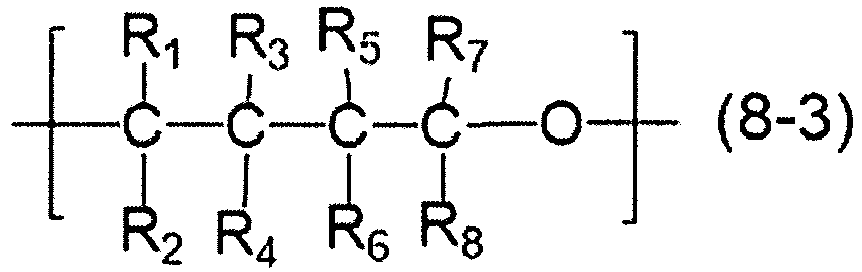

- In general formulae (8-1) to (8-4), R1 to R10 each independently represent a hydrogen atom or an alkyl group having 1 to 3 carbon atoms, and in each of general formulae (8-1) to (8-4), at least one of R1 to R10 represents an alkyl group having 1 to 3 carbon atoms.
- Regarding branched alkylene ether units represented by general formulae (8-1) to (8-4), either a homopolymer composed of a branched alkylene ether unit having any one of structures of general formulae (8-1) to (8-4) or a copolymer composed of a branched alkylene ether unit having a plurality of structures may be employed.
- Regarding the n-propylene ether unit represented by general formula (7), when it is described as a glycol, it is an n-propylene glycol, and in addition to the n-propylene glycol, at least one of ethylene glycol, tetramethylene glycol, pentamethylene glycol, hexamethylene glycol, etc. may be mixed, but the n-propylene glycol alone is preferred. More preferred is the n-propylene glycol, wherein all of Ra, Rb and Rc are a hydrogen atom (i.e., trimethylene glycol) alone.
- Trimethylene glycol is industrially produced by a method in which ethylene oxide is hydroformylated to obtain 3-hydroxypropionaldehyde, which is then hydrogenated, or a method in which acrolein is hydrated to obtain 3-hydroxypropionaldehyde, which is then hydrogenated with an Ni catalyst. Recently, a bio method is also employed, and according to this, glycerin, glucose, starch or the like is reduced using microorganisms to produce trimethylene glycol.
- Regarding the branched alkylene ether unit represented by general formula (8-1) above, when it is described as a glycol, examples thereof include (2-methyl) ethylene glycol, (2-ethyl) ethylene glycol and (2,2-dimethyl) ethylene glycol, and these substances may be mixed. Preferred are (2-methyl) ethylene glycol and (2-ethyl) ethylene glycol.
- Regarding the branched alkylene ether unit represented by general formula (8-2) above, when it is described as a glycol, examples thereof include (2-methyl) trimethylene glycol, (3-methyl) trimethylene glycol, (2-ethyl) trimethylene glycol, (3-ethyl) triethylene glycol, (2,2-dimethyl) trimethylene glycol, (2,2-methylethyl) trimethylene glycol, (2,2-diethyl) trimethylene glycol (i.e., neopentyl glycol), (3,3-dimethyl) trimethylene glycol, (3,3-methylethyl) trimethylene glycol and (3,3-diethyl) trimethylene glycol, and these substances may be mixed.
- Regarding the branched alkylene ether unit represented by general formula (8-3) above, when it is described as a glycol, examples thereof include (3-methyl) tetramethylene glycol, (4-methyl) tetramethylene glycol, (3-ethyl) tetramethylene glycol, (4-ethyl) tetramethylene glycol, (3,3-dimethyl) tetramethylene glycol, (3,3-methylethyl) tetramethylene glycol, (3,3-diethyl) tetramethylene glycol, (4,4-dimethyl) tetramethylene glycol, (4,4-methylethyl) tetramethylene glycol and (4,4-diethyl) tetramethylene glycol, and these substances may be mixed. Preferred is (3-methyl) tetramethylene glycol.
- Regarding the branched alkylene ether unit represented by general formula (8-4) above, when it is described as a glycol, examples thereof include (3-methyl) pentamethylene glycol, (4-methyl) pentamethylene glycol, (5-methyl) pentamethylene glycol, (3-ethyl) pentamethylene glycol, (4-ethyl) pentamethylene glycol, (5-ethyl) pentamethylene glycol, (3,3-dimethyl) pentamethylene glycol, (3,3-methylethyl) pentamethylene glycol, (3,3-diethyl) pentamethylene glycol, (4,4-dimethyl) pentamethylene glycol, (4,4-methylethyl) pentamethylene glycol, (4,4-diethyl) pentamethylene glycol, (5,5-dimethyl) pentamethylene glycol, (5,5-methylethyl) pentamethylene glycol and (5,5-diethyl) pentamethylene glycol, and these substances may be mixed.
- Thus, regarding the units represented by general formulae (8-1) to (8-4) constituting the branched alkylene ether units, glycols are described as examples for the sake of convenience, but the units are not limited to these glycols, and alkylene oxides thereof and polyether-forming derivatives thereof may also be employed.
- Regarding preferred examples of a poly-n-propylene glycol copolymer, a copolymer composed of the n-propylene ether unit and the unit represented by general formula (8-2) is preferred, and in particular, a copolymer composed of a trimethylene ether unit and a 3-methyltrimethylene ether unit is more preferred.
- The poly-n-propylene glycol copolymer may be a random copolymer or a block copolymer.
- In the poly-n-propylene glycol copolymer, the copolymerization ratio between the n-propylene ether unit (P1) represented by general formula (7) and the branched alkylene ether units (P2) represented by general formulae (8-1) to (8-4) ((P1)/(P2), molar ratio) is preferably 95/5 to 5/95, more preferably 93/7 to 40/60, and even more preferably 90/10 to 65/35, and it is more preferably rich with the n-propylene ether unit (P1).
- Note that the molar fraction is measured using a 1H-NMR measurement apparatus and deuterated chloroform as a solvent.
- Among the above-described examples, a particularly preferred poly-n-propylene glycol is a homopolymer of an n-propylene glycol not having a substituent, i.e., trimethylene glycol.
- In the structure of the poly-n-propylene glycol, a structure derived from a polyol such as 1,4-butanediol, glycerol, sorbitol, benzenediol, bisphenol A, cyclohexanediol and spiroglycol may be included. By adding these polyols at the time of the polymerization of polyalkylene glycol, organic groups thereof can be imparted to the main chain. Particularly preferred examples thereof include glycerol, sorbitol and bisphenol A.
- Preferred examples of the poly-n-propylene glycol containing an organic group in its structure include:
- poly-n-propylene glycol glyceryl ether,
- poly(2-methyl)-n-propylene glycol glyceryl ether,
- poly-n-propylene glycol glyceryl ether,
- poly-n-propylene glycol-poly(2-methyl)-n-propylene glycol glyceryl ether,
- poly-n-propylene glycol-poly(2-ethyl) poly-n-propylene glycol glyceryl ether,
- poly-n-propylene glycol sorbityl ether,
- poly(2-methyl)-n-propylene glycol sorbityl ether,
- poly-n-propylene glycol sorbityl ether,
- poly-n-propylene glycol-poly(2-methyl) ethylene glycol sorbityl ether,
- bisphenol A-bis(poly-n-propylene glycol) ether,
- bisphenol A-bis(poly(2-methyl)-n-propylene glycol) ether,
- bisphenol A-bis(poly-n-propylene glycol-poly(2-methyl) ethylene glycol) ether and
- bisphenol A-bis(poly-n-propylene glycol-poly(2-ethyl) poly-n-propylene glycol) ether.
- The weight average molecular weight (Mw) of the poly-n-propylene glycol is preferably 600-8,000, and it is more preferably 800 or more, and even more preferably 1,000 or more, and it is more preferably 6,000 or less, even more preferably 5,000 or less, and particularly preferably 4,000 or less. When the weight average molecular weight is more than the above-described upper limit, compatibility tends to be reduced. When the weight average molecular weight is lower than the above-described lower limit, impact resistance of the polycarbonate resin may be reduced.
- Note that the weight average molecular weight (Mw) is a polystyrene equivalent molecular weight measured using gel permeation chromatography (GPC) with THF as a developing solvent.
- Specifically, it is a value obtained as a polystyrene equivalent molecular weight (weight average molecular weight) using a high-speed GPC apparatus "HLC-8320" manufactured by Tosoh Corporation as GPC, columns: HZ-M (4.6 mm×150 mm)×3 manufactured by Tosoh Corporation (connected in series), and an eluant: chloroform.
- Among monomers as raw materials of the polycarbonate resin, examples of the carbonate precursor to be used include a carbonyl halide and a carbonate ester. As the carbonate precursor, one material may be used solely, or two or more types of materials may be used in any combination at any ratio.
- Specific examples of the carbonyl halide include phosgene; and a haloformate such as a bischloroformate form of a dihydroxy compound and a monochloroformate form of a dihydroxy compound.
- Specific examples of the carbonate ester include diaryl carbonates such as diphenyl carbonate and ditolyl carbonate; dialkyl carbonates such as dimethyl carbonate and diethyl carbonate; and a carbonate form of a dihydroxy compound such as a biscarbonate form of a dihydroxy compound, a monocarbonate form of a dihydroxy compound and a cyclic carbonate.
- As the polycarbonate resin of the present invention, a bisphenol A-poly-n-propylene glycol copolymerized polycarbonate represented by general formula (9) below is particularly preferred.

- In general formula (9), m, n and 1 are the same as those in general formula (5).
- The second embodiment of the present invention is a polycarbonate resin containing only a structural unit (B) represented by general formula (4):

- In general formula (4), Rz, Rx, i and p are the same as those in the above-described first embodiment.
- The method for producing the polycarbonate resin of the present invention is not particularly limited, and any publicly-known method can be employed. Examples of the method include an interfacial polymerization method, a melt transesterification method, a pyridine method, a ring-opening polymerization method for a cyclic carbonate compound and a solid phase transesterification method for a prepolymer. Among them, a melt transesterification method and an interfacial polymerization method are preferred, and more preferred is a melt transesterification method.
- The polystyrene-equivalent weight average molecular weight (Mw) of the polycarbonate resin of the present invention is preferably 1,000-60,000, and more preferably 5,000-40,000. The lower limit is even more preferably 6,000 or more, and particularly preferably 7,000 or more, and the upper limit is even more preferably 37,000 or less, and particularly preferably 35,000 or less. When the weight average molecular weight (Mw) is more than the above-described upper limit, compatibility tends to be reduced. When the weight average molecular weight is lower than the above-described lower limit, a gas tends to be generated at the time of molding.
- The weight average molecular weight (Mw) of the polycarbonate resin of the present invention can be adjusted by selection of Mw of a polyalkylene glycol that is one of raw materials of a comonomer diol, adjustment of the ratio of the carbonate precursor, addition of a terminator, adjustment of the temperature or pressure at the time of polymerization, or the like. For example, in the melt transesterification method, Mw can be increased by adjusting the monomer raw material ratio so that the reaction ratio between diphenyl carbonate that is a carbonate precursor monomer and a diol monomer becomes close to 1, keeping a high polymerization temperature so that a by-product phenol can be easily removed from the polymerization system, reducing the pressure as low as possible, actively carrying out interface renewal by means of stirring, etc.
- Note that the weight average molecular weight (Mw) of the polycarbonate resin of the present invention is a polystyrene equivalent molecular weight measured using GPC with chloroform as a developing solvent.
- Specifically, it is a value obtained as a polystyrene equivalent molecular weight (weight average molecular weight) using a high-speed GPC apparatus "HLC-8320" manufactured by Tosoh Corporation as GPC, columns: HZ-M (4.6 mm×150 mm)×3 manufactured by Tosoh Corporation (connected in series), and an eluant: chloroform, at a measurement temperature: 25°C.
- The concentration of a terminal hydroxyl group in the polycarbonate resin of the present invention is preferably 1 ppm to 3000 ppm from the viewpoint of maintaining hydrolysis resistance, and it is more preferably 1-1000 ppm, and particularly preferably 1-500 ppm. In the present invention, as the method for measuring the concentration of the terminal hydroxyl group, the method described in the Examples below can be used.
- The glass transition temperature (Tg) of the polycarbonate resin of the present invention is preferably -100 to 140°C from the viewpoint of ease of handling, and it is more preferably -70 to 120°C, and particularly preferably -70 to 110°C. In the present invention, as the method for measuring the glass transition temperature, the method described in the Examples below can be used.
- The polycarbonate resin of the present invention may contain additives other than those described above, for example, an antioxidant, a mold release agent, an ultraviolet absorber, a fluorescent brightener, a pigment, a dye, another polymer other than the polycarbonate resin, a flame retardant, an impact resistance improver, an antistatic agent, a plasticizer, a compatibilizer, etc. These additives may be blended solely, or two or more of them may be blended.
- Hereinafter, the present invention will be described in more detail by way of examples. However, the present invention is not limited to the below-described examples.
- It was obtained by dissolving 0.05 g of a resin sample in 1 ml of deuterated chloroform (containing 0.05 w/v% TMS) and carrying out the 1H-NMR measurement at 23°C. Specifically, the concentration of the terminal hydroxyl group (OH concentration) was calculated from the integration ratio between a peak related to the hydroxyl group and other peaks included in the resin skeleton.
- Using GPC with chloroform as a developing solvent, a calibration curve was produced using a standard polystyrene having an already-known molecular weight (molecular weight distribution=1) ("PStQuick MP-M" manufactured by Tosoh Corporation). The elution time and molecular weight value of each peak were plotted based on the measured standard polystyrene, and three-dimensional approximation was conducted to obtain a calibration curve. The weight average molecular weight (Mw) and the number average molecular weight (Mn) were obtained as polystyrene equivalent values using the below-described calculation formula.
-

- In this regard, "i" represents the "i"th dividing point when dividing the molecular weight M, "Wi" represents the "i"th weight, and "Mi" represents the "i"th molecular weight. The molecular weight M represents the value of the molecular weight of polystyrene at the corresponding elution time in the calibration curve.
-
- Apparatus: HLC-8320GPC manufactured by Tosoh Corporation
- Columns:
- Guard column: TSKguardcolumn SuperMPHZ-M × 1
- Analysis column: TSKgel SuperMultiporeHZ-M × 3
- Solvent: HPLC grade chloroform
- Injection amount: 10 µL
- Sample concentration: 0.2 w/v% HPLC grade chloroform solution
- Flow rate of solvent: 0.35 ml/min
- Measurement temperature: 40°C
- Detector: RI
- The measurement was carried out using an apparatus for simultaneous thermogravimetry/differential thermal analysis (TG/TDA) (product name "TGDTA7300" manufactured by Hitachi High-Tech Science Corporation).
- 5 mg of a sample was precisely weighed in a platinum pan (Pt open type sample container, cylindrical container having a diameter of 5.2 mm and a height of 5.0 mm) to prepare a measurement sample.
- The measurement was carried out under nitrogen atmosphere (flow rate of nitrogen: 250 ml/min). For a reference cell, 5.52 mg of α-alumina was used as a reference substance. Further, the measurement sample was heated to measure the weight thereof as described later. Assuming that the whole decreased weight corresponds to the gasified sample, the amount of gas generated (%) "120°C→350°C" was calculated as described below.

- The amount of gas generated (%) "120°C→320°C" was calculated as described below.

- In this regard, the weight at 350°C means a weight obtained when the temperature of the measurement sample was elevated from 120°C at a rate of 10°C/min to reach 350°C. The weight at 120°C means a weight obtained after the temperature of the measurement sample was elevated from room temperature to 120°C at a rate of 10°C/min and then kept at 120°C for 2 hours. The weight at 320°C means a weight obtained when the temperature of the measurement sample was elevated from 120°C at a rate of 10°C/min to reach 320°C.
- The measurement was carried out using a differential scanning calorimeter (DSC) (product name "DSC-7000" manufactured by Hitachi High-Tech Science Corporation).
- 7 to 12 mg of a test piece was precisely weighed in a sample container for AI autosampler (RDC aluminum pan, cylindrical container having a diameter of 6.8 mm and a height of 2.5 mm), and the upper portion of the sample container was sealed using a cover for AI autosampler, thereby preparing a measurement sample.
- The measurement was carried out under nitrogen atmosphere (flow rate of nitrogen: 50 ml/min). For a reference cell, 10.0 mg of alumina was used as a reference substance. Further, the temperature of the measurement sample was adjusted to -70°C and then elevated to 200°C at a rate of 10°C/min. After that, cooling was carried out at a rate of 10°C/min to decrease the temperature to -70°C. After that, the temperature was elevated again to 200°C at a rate of 10°C/min, and the measurement was carried out.
- The measurement was carried out using a spectroscopic colorimeter SE2000 manufactured by Nippon Denshoku Industries Co., Ltd. Specifically, 12 g of a resin sample was dissolved in 60 mL of dichloromethane, and the measurement was carried out using a quartz cell having an optical path length of 6 cm. As a blank, dichloromethane was used.
- As raw materials, a poly-n-propylene glycol Velvetol H500 (Mw: 1700) manufactured by ALLESSA in an amount equivalent to 85% by mass, bisphenol A (hereinafter referred to as BPA) in an amount equivalent to 15% by mass, and diphenyl carbonate (hereinafter referred to as DPC) at a molar ratio relative to diol of 1.16 were put into a polymerization apparatus equipped with a three-necked flask. Further, as a catalyst, an aqueous solution of Cs2CO3 was added thereto in an amount of 11 µmol (as Cs) per 1 mol of diol.
- Drying in the system was carried out for 1 hour, and then the pressure in the polymerization apparatus was recovered using nitrogen. The polymerization was initiated at the point when the polymerization apparatus in which the pressure was recovered was immersed in an oil bath, and the polymerization was carried out according to the temperature elevation/pressure reduction program shown in Table 1. Physical properties of the obtained polycarbonate resin are shown in Table 5. The concentration of OH in the polycarbonate resin obtained in Example 1 was 70 ppm.
Table 1 Table 1 Time Set temperature Set pressure (min) (°C) (kPaA) 0 200 97 10 200 → 217 97 → 27 20 217 27 → 24 30 217 24 → 20 40 217 20 → 17 50 217 17 → 13 60 217 13 → 6 70 217 6 → 0.13 or less 80 217 0.13 or less 140 Finished 100 - The reaction was performed in a manner similar to that in Example 1, except that the raw materials were changed to those shown in Table 5. Physical properties of the obtained polycarbonate resin are shown in Table 5. The concentration of OH in the polycarbonate resin obtained in Example 2 was 240 ppm, and the concentration of OH in the polycarbonate resin obtained in Example 3 was 1100 ppm.
- The reaction was performed in a manner similar to that in Example 1, except that the raw materials were changed to those shown in Table 5 and that the temperature elevation/pressure reduction program was changed to that shown in Table 2. Physical properties of the obtained polycarbonate resin are shown in Table 5.
Table 2 Table 2 Time Set temperature Set pressure (min) (°C) (kPaA) 0 201 97 10 201 → 211 97 → 27 70 211 → 217 27 90 217 → 227 27 → 24 110 227 → 232 24 → 20 130 232 → 241 20 → 17 140 241 17 → 13 150 241 → 260 13 → 6 160 260 6 → 4 170 260 4 → 0.13 or less 230 260 0.13 or less 320 Finished 100 - The reaction was performed in a manner similar to that in Example 1, except that the raw materials were changed to those shown in Table 5 and that the temperature elevation/pressure reduction program was changed to that shown in Table 3. Physical properties of the obtained polycarbonate resin are shown in Table 5. The concentration of OH in the polycarbonate resin obtained in Example 5 was 2200 ppm.
Table 3 Table 3 Time Set temperature Set pressure (min) (°C) (kPaA) 0 200 99 10 200 99 → 27 40 200 → 211 27 70 211 27 → 24 90 211 → 217 24 110 217 24 → 20 130 217 → 227 20 150 227 20 → 17 170 222 → 232 17 180 232 17 → 13 200 232 13 → 6 220 232 6 → 0.13 or less 230 232 0.13 or less 290 Finished 100 - The reaction was performed in a manner similar to that in Example 1, except that the raw materials were changed to those shown in Table 5 and that the temperature elevation/pressure reduction program was changed to that shown in Table 4. Physical properties of the obtained polycarbonate resin are shown in Table 5.
Table 4 Table 4 Time Set temperature Set pressure (min) (°C) (kPaA) 0 200 97 10 200 → 217 97 → 27 25 217 27 → 24 40 217 24 → 20 55 217 20 → 17 70 217 17 → 13 85 217 13 → 6 100 217 6 → 0.13 or less 110 217 0.13 or less 170 Finished 100 - The reaction was performed in a manner similar to that in Example 4, except that the raw materials were changed to those shown in Table 5. Physical properties of the obtained polycarbonate resin are shown in Table 5. The concentration of OH in the polycarbonate resin obtained in Comparative Example was 850 ppm.
Table 5 Table 5 Example 1 Example 2 Example 3 Example 4 Example 5 Example 6 Example 7 Comparative Example Raw materials Mass ratio of diol 
Rz=H, Rx=H i=3, p=9 manufactured by ALLESSA poly-n-propylene glycol Velvetol H500 85 85 0 0 0 100 0 0 Rz=H, Rx=H i=4, p=9 manufactured by Mitsubishi Chemical Corporation polytetramethylene glycol PTMG 650 0 0 85 0 0 0 100 0 Rz=H, Rx=H i=4, p=9 manufactured by BASF polytetramethylene glycol PTMG 650 0 0 0 7 0 0 0 0 Rz=H, Rx=H i=4, p=21 manufactured by Mitsubishi Chemical Corporation polytetramethylene glycol PTMG 1500 0 0 0 0 85 0 0 0 manufactured by Mitsubishi Chemical Corporation bisphenol A 15 15 15 93 15 0 0 100 Amount of Cs per 1 mol of diol (unit: µmol/diol) 11 10 10 1 10 10 10 10 Molar ratio of diphenyl carbonate (DPC) relative to diol 1.16 1.07 1.10 1.12 1.07 1.07 1.07 1.07 Physical properties Polystyrene-equivalent molecular weight (Mw) 15000 38000 26000 28000 25000 32000 14000 38000 Glass transition temperature Tg (°C) <35 <35 <35 105 <35 <35 <35 148 - The reaction was performed in a manner similar to that in Example 1, except that the raw materials were changed to those shown in Table 16 and that the temperature elevation/pressure reduction program was changed to that shown in Table 6. Physical properties of the obtained polycarbonate resin are shown in Table 17.
Table 6 Table 6 Time Set temperature Set pressure (min) (°C) (kPaA) 0 200 97 10 200 → 217 97 → 27 20 217 27 → 24 30 217 24 → 20 40 217 20 → 17 50 217 17 → 13 60 217 13 → 6 70 217 6 → 0.13 or less 80 217 0.13 or less 140 Finished (217°C) 100 - The reaction was performed in a manner similar to that in Example 1, except that the raw materials were changed to those shown in Table 16 and that the temperature elevation/pressure reduction program was changed to that shown in Table 7. Physical properties of the obtained polycarbonate resin are shown in Table 17.
Table 7 Table 7 Time Set temperature Set pressure (min) (°C) (kPaA) 0 200 97 10 200 → 217 97 → 27 80 217 27 → 24 170 217 24 → 20 210 217 20 → 17 230 217 17 → 13 260 217 13 → 6 280 217 6 → 0.13 or less 290 217 0.13 or less 350 Finished (217°C) 100 - The reaction was performed in a manner similar to that in Example 1, except that the raw materials were changed to those shown in Table 16 and that the temperature elevation/pressure reduction program was changed to that shown in Table 8. Physical properties of the obtained polycarbonate resin are shown in Table 17.
Table 8 Table 8 Time Set temperature Set pressure (min) (°C) (kPaA) 0 200 97 30 200 97 → 27 70 200 → 217 27 90 217 27 → 24 110 217 24 → 20 130 217 20 → 17 140 217 → 227 17 150 227 17 → 13 160 227 13 → 6 170 227 6 → 0.13 or less 180 227 0.13 or less 240 Finished (227°C) 100 - The reaction was performed in a manner similar to that in Example 1, except that the raw materials were changed to those shown in Table 16 and that the temperature elevation/pressure reduction program was changed to that shown in Table 9. Physical properties of the obtained polycarbonate resin are shown in Table 17.
Table 9 Table 9 Time Set temperature Set pressure (min) (°C) (kPaA) 0 120 97 10 120 → 150 97 20 150 → 180 97 30 180 → 200 27 50 200 → 217 97 → 27 65 217 27 → 24 80 217 24 → 20 95 217 20 → 17 110 217 17 → 13 125 217 13 → 6 140 217 6 → 0.13 or less 150 217 0.13 or less 210 Finished (217°C) 0.13 or less - The reaction was performed in a manner similar to that in Example 1, except that the raw materials were changed to those shown in Table 16 and that the temperature elevation/pressure reduction program was changed to that shown in Table 10. Physical properties of the obtained polycarbonate resin are shown in Table 17.
Table 10 Table 10 Time Set temperature Set pressure (min) (°C) (kPaA) 0 200 97 10 200 97 → 27 40 200 → 217 27 60 217 27 → 24 80 217 24 → 20 110 217 20 → 17 120 217 → 227 17 → 13 130 227 17 → 13 140 227 13 → 6 150 227 6 → 0.13 or less 160 227 0.13 or less 220 Finished (227°C) 100 - The reaction was performed in a manner similar to that in Example 1, except that the raw materials were changed to those shown in Table 16 and that the temperature elevation/pressure reduction program was changed to that shown in Table 11. Physical properties of the obtained polycarbonate resin are shown in Table 17.
Table 11 Table 11 Time Set temperature Set pressure (min) (°C) (kPaA) 0 200 97 10 200 97 → 27 30 200 → 211 27 70 211 27 → 24 80 211 → 217 24 100 217 24 → 20 110 217 → 227 20 130 227 20 → 17 140 227 → 237 17 150 237 17 → 13 170 237 13 → 6 190 237 6 → 0.13 or less 200 237 0.13 or less 260 237 100 - The reaction was performed in a manner similar to that in Example 1, except that the raw materials were changed to those shown in Table 16 and that the temperature elevation/pressure reduction program was changed to that shown in Table 12. Physical properties of the obtained polycarbonate resin are shown in Table 17.
Table 12 Table 12 Time Set temperature Set pressure (min) (°C) (kPaA) 0 200 97 10 200 → 217 97 → 27 25 217 27 → 24 40 217 24 → 20 55 217 20 → 17 70 217 17 → 13 85 217 13 → 6 100 217 6 → 0.13 or less 110 217 0.13 or less 170 Finished (217°C) 100 - The reaction was performed in a manner similar to that in Example 1, except that the raw materials were changed to those shown in Table 16 and that the temperature elevation/pressure reduction program was changed to that shown in Table 13. Physical properties of the obtained polycarbonate resin are shown in Table 17.
Table 13 Table 13 Time Set temperature Set pressure (min) (°C) (kPaA) 0 200 97 10 200 → 217 97 → 27 100 217 27 → 24 130 217 → 227 24 170 227 24 → 20 190 227 20 → 17 210 227 17 → 13 230 227 13 → 6 250 227 → 232 6 270 232 6 → 0.13 or less 280 232 0.13 or less 340 Finished (232°C) 100 - The reaction was performed in a manner similar to that in Example 1, except that the raw materials were changed to those shown in Table 16 and that the temperature elevation/pressure reduction program was changed to that shown in Table 14. Physical properties of the obtained polycarbonate resin are shown in Table 17.
Table 14 Table 14 Time Set temperature Set pressure (min) (°C) (kPaA) 0 200 97 10 200 → 217 97 → 27 40 217 27 → 24 60 217 24 → 20 80 217 20 → 17 90 217 17 → 13 110 217 13 → 6 130 217 6 → 0.13 or less 140 217 0.13 or less 200 Finished (217°C) 100 - The reaction was performed in a manner similar to that in Example 1, except that the raw materials were changed to those shown in Table 16 and that the temperature elevation/pressure reduction program was changed to that shown in Table 15. Physical properties of the obtained polycarbonate resin are shown in Table 17.
Table 15 Table 15 Time Set temperature Set pressure (min) (°C) (kPaA) 0 200 97 10 200 → 217 97 → 27 70 217 → 222 27 90 217 27 → 24 120 217 24 → 20 150 222 → 227 20 160 227 20 → 17 180 227 17 → 13 200 227 13 → 6 220 227 6 → 0.13 or less 230 227 0.13 or less 290 Finished (227°C) 100 Table 16 Table 16 Example 8 Example 9 Example 10 Example 11 Example 12 Example 13 Example 14 Example 15 Example 16 Example 17 Example 18 Mass ratio of diol 
Rz=H, Rx=H i=3, p=9 manufactured by ALLESSA poly-n-propylene glycol Velvetol H500 0 85 0 0 0 0 0 0 85 85 85 Rz=H, Rx=H i=4, p=9 manufactured by Mitsubishi Chemical Corporation polytetramethylene glycol PTMG 650 85 0 85 85 85 85 85 85 0 0 0 Raw materials Rz=H, Rx=H i=4, p=9 manufactured by BASF polytetramethylene glycol PTMG 650 0 0 0 0 0 0 0 0 0 0 0 Rz=H, Rx=H i=4, p=21 manufactured by Mitsubishi Chemical Corporation polytetramethylene glycol PTMG 1500 0 0 0 0 0 0 0 0 0 0 0 manufactured by Mitsubishi Chemical Corporation bisphenol A 15 15 0 0 0 0 0 0 0 0 0 manufactured by Tokyo Chemical Industry Co., Ltd. bisphenol S 15 0 0 0 0 0 15 0 0 manufactured by Tokyo Chemical Industry Co., Ltd. 4,4'-oxydiphenol 0 15 0 0 0 0 0 0 0 manufactured by Tokyo Chemical Industry Co., Ltd. 4,4'-biphenol 0 0 15 15 15 0 0 15 0 manufactured by Tokyo Chemical Industry Co., Ltd. 4,4'-thiodiphenol 0 0 0 0 0 15 0 0 15 Amount of Cs per 1 mol of diol (unit: µmol/diol) 10 5 10 10 10 10 10 10 5 5 5 Molar ratio of diphenyl carbonate (DPC) relative to diol 1.15 1.10 1.07 1.07 1.07 1.07 1.07 1.07 1.07 1.1 1.1 Table 17 Table 17 Amount generated of gas (%) GPC (PSt-equivalent) 120°C → 350°C 120°C → 320°C YI of solution Diol monomer/% by mass Mw Mn Mw/Mn Example 8 BPA 15 PTMG 85 22800 10200 2.24 9.8 4.1 0.61 Example 9 BPA 15 P3MG 85 22800 9680 2.35 8.1 1.8 3.31 Example 10 BPS 15 PTMG 85 21100 9060 2.33 2.9 1.0 2.28 Example 11 BPO 15 PTMG 85 17600 7380 2.38 9.0 3.6 2.51 Example 12 BF 15 PTMG 85 14100 5390 2.62 6.5 2.7 2.27 Example 13 BF 15 PTMG 85 10800 3880 2.78 6.0 2.0 1.82 Example 14 BF 15 PTMG 85 22100 8450 2.62 7.7 3.5 0.97 Example 15 TDP 15 PTMG 85 23200 9350 2.49 11.0 4.0 2.14 Example 16 BPS 15 P3MG 85 21200 6300 3.37 7.6 2.4 16.98 Example 17 BF 15 P3MG 85 22600 9770 2.31 7.8 1.8 9.76 Example 18 TDP 15 P3MG 85 23500 9920 2.37 12.7 2.1 8.26 BPA: bisphenol A BPS: bisphenol S BPO: 4,4'-oxydiphenol BF: 4,4'-biphenol TDP: 4,4'-thiodiphenol PTMG: polytetramethylene ether P3MG: poly-n-propylene glycol - When using the polycarbonate resin of the present invention, the amount of gas generated is very small, and therefore it can be suitably utilized for various molded products.
- In general, a polycarbonate resin has a high Tg, and for this reason, at the time of melt molding, it is required to be heated to a high temperature (180°C or higher) and melted. For reduction of the cost for molding, molding at lower temperatures has been desired. Further, as a material for various industrial products, a polycarbonate having a low Tg has been desired. For example, though Tg of a widely-known bisphenol A-type polycarbonate resin is generally about 150°C, a material having a Tg lower than that has been desired. In the present invention, the copolymerized polycarbonate of polytetramethylene glycol and bisphenol A, and in particular, the copolymerized polycarbonate of poly-n-propylene glycol and bisphenol A have a low Tg and can be widely and usefully used as materials for industrial products.
Claims (7)
- A polycarbonate resin comprising a structural unit (A) represented by general formula (1) and a structural unit (B) represented by general formula (4):
 R1, R2, R3, R4, R5, R6, R7 and R8 are each independently selected from the group consisting of a hydrogen atom, a fluorine atom, a chlorine atom, a bromine atom, an iodine atom, an alkyl group having 1 to 7 carbon atoms, an aryl group having 6 to 12 carbon atoms, an alkenyl group having 2 to 7 carbon atoms, an alkoxy group having 1 to 7 carbon atoms and an aralkyl group having 7 to 17 carbon atoms, and each of the alkyl group, the aryl group, the alkenyl group, the alkoxy group and the aralkyl group may have a substituent; andX represents -O-, -S-, -SO-, -SO2-, -CO-, a cycloalkylene group having 6 to 12 carbon atoms, or a divalent group represented by general formula (2) or general formula (3), and the cycloalkylene group may be substituted with 1 to 12 alkyl groups having 1 to 3 carbon atoms:
 R9 and R10 are each independently selected from the group consisting of a hydrogen atom, a fluorine atom, a chlorine atom, a bromine atom, an iodine atom, an alkyl group having 1 to 20 carbon atoms, an alkoxy group having 1 to 5 carbon atoms, an aryl group having 6 to 12 carbon atoms, an aralkyl group having 7 to 17 carbon atoms and an alkenyl group having 2 to 15 carbon atoms;each of the alkyl group, the alkoxy group, the aryl group, the aralkyl group and the alkenyl group of R9 and R10 may have a substituent;R9 and R10 may be bonded to each other so as to form a carbocyclic ring having 3 to 20 carbon atoms or a heterocyclic ring having 1 to 20 carbon atoms, and each of the carbocyclic ring and the heterocyclic ring may have a substituent; andn represents an integer of 0 to 20,
 R11 and R12 are each independently selected from the group consisting of a hydrogen atom, a fluorine atom, a chlorine atom, a bromine atom, an iodine atom, an alkyl group having 1 to 20 carbon atoms, an alkoxy group having 1 to 7 carbon atoms, an aryl group having 6 to 12 carbon atoms, an aralkyl group having 7 to 17 carbon atoms and an alkenyl group having 2 to 15 carbon atoms, and each of the alkyl group, the alkoxy group, the aryl group, the aralkyl group and the alkenyl group may have a substituent; andR11 and R12 may be bonded to each other so as to form a carbocyclic ring having 3 to 20 carbon atoms or a heterocyclic ring having 1 to 20 carbon atoms, and each of the carbocyclic ring and the heterocyclic ring may have a substituent,
- The polycarbonate resin according to claim 1, wherein the mass ratio between the structural unit (A) and the structural unit (B) (A/B) is 1/99 to 50/50.
- A polycarbonate resin comprising only a structural unit (B) represented by general formula (4):

- The polycarbonate resin according to any one of claims 1 to 3, wherein the concentration of a terminal hydroxyl group in the polycarbonate resin is 1 ppm to 3000 ppm.
- The polycarbonate resin according to any one of claims 1 to 4, wherein i in general formula (4) is an integer of 3 or 4.
- The polycarbonate resin according to any one of claims 1 to 5, wherein the polystyrene-equivalent weight average molecular weight (Mw) of the polycarbonate resin is 1,000 to 60,000.
- The polycarbonate resin according to any one of claims 1 to 6, wherein the glass transition temperature (Tg) of the polycarbonate resin is -100 to 140°C.
Applications Claiming Priority (2)
| Application Number | Priority Date | Filing Date | Title |
|---|---|---|---|
| JP2019173685 | 2019-09-25 | ||
| PCT/JP2020/033013 WO2021059884A1 (en) | 2019-09-25 | 2020-09-01 | Polycarbonate resin |
Publications (3)
| Publication Number | Publication Date |
|---|---|
| EP4036146A1 true EP4036146A1 (en) | 2022-08-03 |
| EP4036146A4 EP4036146A4 (en) | 2022-12-14 |
| EP4036146B1 EP4036146B1 (en) | 2024-09-25 |
Family
ID=75165741
Family Applications (1)
| Application Number | Title | Priority Date | Filing Date |
|---|---|---|---|
| EP20868795.4A Active EP4036146B1 (en) | 2019-09-25 | 2020-09-01 | Polycarbonate resin |
Country Status (7)
| Country | Link |
|---|---|
| US (1) | US20220389159A1 (en) |
| EP (1) | EP4036146B1 (en) |
| JP (1) | JP7687206B2 (en) |
| KR (1) | KR102905002B1 (en) |
| CN (1) | CN114423805A (en) |
| TW (1) | TWI890694B (en) |
| WO (1) | WO2021059884A1 (en) |
Families Citing this family (3)
| Publication number | Priority date | Publication date | Assignee | Title |
|---|---|---|---|---|
| EP4563656A4 (en) | 2022-07-28 | 2025-11-05 | Mitsubishi Chem Corp | POLYCARBONATE RESIN COMPOSITION |
| JPWO2024204728A1 (en) * | 2023-03-30 | 2024-10-03 | ||
| KR20250102215A (en) * | 2023-12-27 | 2025-07-07 | 주식회사 삼양사 | Polycarbonate resin composition with excellent optical properties and long term heat resistance and article comprising the same |
Family Cites Families (16)
| Publication number | Priority date | Publication date | Assignee | Title |
|---|---|---|---|---|
| DE2960470D1 (en) * | 1978-03-10 | 1981-10-22 | Bayer Ag | Polycarbonate moulding compositions with improved tenacity |
| CA1338226C (en) | 1987-06-26 | 1996-04-02 | Charles E. Lundy | Gamma radiation resistant polycarbonate compositions |
| JP2876242B2 (en) * | 1990-04-27 | 1999-03-31 | 三井化学株式会社 | Polyalkylene glycol polycarbonate |
| US5238590A (en) * | 1989-09-29 | 1993-08-24 | Mitsui Petrochemical Industries, Ltd. | Lubricant oil, polyalkylene glycol polycarbonates and process for preparing them |
| JPH05339359A (en) * | 1992-06-11 | 1993-12-21 | Daicel Chem Ind Ltd | Antistatic polyether carbonate |
| JPH07149888A (en) * | 1993-12-02 | 1995-06-13 | Teijin Ltd | Method for producing copolycarbonate |
| JPH09227785A (en) | 1995-12-20 | 1997-09-02 | Asahi Chem Ind Co Ltd | Resin composition and molded article thereof |
| US7226973B2 (en) * | 2003-12-31 | 2007-06-05 | General Electric Company | Polycarbonate polyester molding composition |
| JP4731134B2 (en) | 2004-07-01 | 2011-07-20 | 出光興産株式会社 | Method for producing polycarbonate copolymer and polycarbonate copolymer |
| JP5063873B2 (en) * | 2005-07-05 | 2012-10-31 | 出光興産株式会社 | Light diffusing polycarbonate resin composition and light diffusing plate using the resin composition |
| JP5359014B2 (en) * | 2008-04-28 | 2013-12-04 | 三菱瓦斯化学株式会社 | Polycarbonate resin with ultraviolet absorbing ability |
| EP2752458B1 (en) * | 2011-09-02 | 2023-07-05 | Mitsubishi Gas Chemical Company, Inc. | Aromatic polycarbonate resin composition, and molded article comprising same |
| JP5699188B2 (en) | 2013-07-26 | 2015-04-08 | 三菱エンジニアリングプラスチックス株式会社 | Polycarbonate resin composition for thin optical parts and thin optical parts |
| CN108699229B (en) * | 2016-03-30 | 2021-09-17 | 三菱瓦斯化学株式会社 | Process for producing high molecular weight aromatic polycarbonate resin |
| CN107226894B (en) * | 2017-07-24 | 2020-04-07 | 合肥安利聚氨酯新材料有限公司 | Solvent-free middle layer polyurethane resin for soft mirror synthetic leather and preparation method and application thereof |
| EP3778773B1 (en) * | 2018-03-27 | 2022-08-31 | Mitsubishi Engineering-Plastics Corporation | Polycarbonate resin composition |
-
2020
- 2020-09-01 WO PCT/JP2020/033013 patent/WO2021059884A1/en not_active Ceased
- 2020-09-01 KR KR1020227010362A patent/KR102905002B1/en active Active
- 2020-09-01 CN CN202080065530.8A patent/CN114423805A/en active Pending
- 2020-09-01 EP EP20868795.4A patent/EP4036146B1/en active Active
- 2020-09-01 TW TW109129891A patent/TWI890694B/en active
- 2020-09-01 JP JP2021548724A patent/JP7687206B2/en active Active
- 2020-09-01 US US17/761,102 patent/US20220389159A1/en not_active Abandoned
Also Published As
| Publication number | Publication date |
|---|---|
| US20220389159A1 (en) | 2022-12-08 |
| JPWO2021059884A1 (en) | 2021-04-01 |
| EP4036146A4 (en) | 2022-12-14 |
| JP7687206B2 (en) | 2025-06-03 |
| TW202122456A (en) | 2021-06-16 |
| CN114423805A (en) | 2022-04-29 |
| KR20220069019A (en) | 2022-05-26 |
| WO2021059884A1 (en) | 2021-04-01 |
| EP4036146B1 (en) | 2024-09-25 |
| KR102905002B1 (en) | 2025-12-26 |
| TWI890694B (en) | 2025-07-21 |
Similar Documents
| Publication | Publication Date | Title |
|---|---|---|
| EP4036146B1 (en) | Polycarbonate resin | |
| KR101651680B1 (en) | Polycarbonate resin composition and method for producing the same | |
| JP5543147B2 (en) | Method for producing polycarbonate resin | |
| KR102556128B1 (en) | polycarbonate resin | |
| EP3778773B1 (en) | Polycarbonate resin composition | |
| KR101948369B1 (en) | Polycarbonate resin | |
| EP2921515B1 (en) | Production method for aromatic polycarbonate resin having increased molecular weight | |
| EP3981822B1 (en) | POLYCARBONAT RESIN | |
| EP4071196A1 (en) | Polycarbonate/polyorganosiloxane copolymer and resin composition including said copolymer | |
| EP2762516B1 (en) | Polycarbonate and method for preparing same | |
| EP4032931B1 (en) | Polycarbonate resin, method for producing same, polycarbonate resin composition and molded body | |
| EP2143751B1 (en) | Polycarbonate and method for producing the same | |
| KR20100047127A (en) | Method for producing thermoplastic resin, polyester resin and polycarbonate resin, and their applications | |
| EP2308928A1 (en) | Polycarbonate resin composition and optical material using the same | |
| EP4556507A1 (en) | Polycarbonate-polyorganosiloxane copolymer, polycarbonate resin composition and molded body | |
| EP2921517B1 (en) | Production method for aromatic polycarbonate resin having increased molecular weight | |
| EP2215144B1 (en) | Copolymers comprising a trimethylene carbonate and poly(trimethylene ether) glycols | |
| EP3957673A1 (en) | Polycarbonate-polyorganosiloxane copolymer, method for producing the same, and resin composition comprising the copolymer | |
| KR20210124193A (en) | Polycarbonate resin composition and optical lens using same | |
| EP4431544A1 (en) | Polycarbonate resin, and optical lens and optical film using same | |
| JP6212854B2 (en) | Polycarbonate copolymer | |
| EP3438153B1 (en) | High molecular weight aromatic polycarbonate resin manufacturing method | |
| KR102048687B1 (en) | Method for producing branched aromatic polycarbonate resin | |
| KR20200119608A (en) | Poly(carbonate-eater) copolymer comprising based on isosorbide and preparing method thereof | |
| HK1177215A1 (en) | Process for production of highly polymerized aromatic polycarbonate resin |
Legal Events
| Date | Code | Title | Description |
|---|---|---|---|
| STAA | Information on the status of an ep patent application or granted ep patent |
Free format text: STATUS: THE INTERNATIONAL PUBLICATION HAS BEEN MADE |
|
| PUAI | Public reference made under article 153(3) epc to a published international application that has entered the european phase |
Free format text: ORIGINAL CODE: 0009012 |
|
| STAA | Information on the status of an ep patent application or granted ep patent |
Free format text: STATUS: REQUEST FOR EXAMINATION WAS MADE |
|
| 17P | Request for examination filed |
Effective date: 20220209 |
|
| AK | Designated contracting states |
Kind code of ref document: A1 Designated state(s): AL AT BE BG CH CY CZ DE DK EE ES FI FR GB GR HR HU IE IS IT LI LT LU LV MC MK MT NL NO PL PT RO RS SE SI SK SM TR |
|
| A4 | Supplementary search report drawn up and despatched |
Effective date: 20221114 |
|
| RIC1 | Information provided on ipc code assigned before grant |
Ipc: C08G 64/18 20060101AFI20221108BHEP |
|
| DAV | Request for validation of the european patent (deleted) | ||
| DAX | Request for extension of the european patent (deleted) | ||
| GRAP | Despatch of communication of intention to grant a patent |
Free format text: ORIGINAL CODE: EPIDOSNIGR1 |
|
| STAA | Information on the status of an ep patent application or granted ep patent |
Free format text: STATUS: GRANT OF PATENT IS INTENDED |
|
| INTG | Intention to grant announced |
Effective date: 20240513 |
|
| GRAS | Grant fee paid |
Free format text: ORIGINAL CODE: EPIDOSNIGR3 |
|
| GRAA | (expected) grant |
Free format text: ORIGINAL CODE: 0009210 |
|
| STAA | Information on the status of an ep patent application or granted ep patent |
Free format text: STATUS: THE PATENT HAS BEEN GRANTED |
|
| P01 | Opt-out of the competence of the unified patent court (upc) registered |
Free format text: CASE NUMBER: APP_43799/2024 Effective date: 20240726 |
|
| AK | Designated contracting states |
Kind code of ref document: B1 Designated state(s): AL AT BE BG CH CY CZ DE DK EE ES FI FR GB GR HR HU IE IS IT LI LT LU LV MC MK MT NL NO PL PT RO RS SE SI SK SM TR |
|
| REG | Reference to a national code |
Ref country code: GB Ref legal event code: FG4D |
|
| REG | Reference to a national code |
Ref country code: CH Ref legal event code: EP |
|
| REG | Reference to a national code |
Ref country code: DE Ref legal event code: R096 Ref document number: 602020038475 Country of ref document: DE |
|
| REG | Reference to a national code |
Ref country code: IE Ref legal event code: FG4D Ref country code: NL Ref legal event code: FP |
|
| REG | Reference to a national code |
Ref country code: LT Ref legal event code: MG9D |
|
| PG25 | Lapsed in a contracting state [announced via postgrant information from national office to epo] |
Ref country code: NO Free format text: LAPSE BECAUSE OF FAILURE TO SUBMIT A TRANSLATION OF THE DESCRIPTION OR TO PAY THE FEE WITHIN THE PRESCRIBED TIME-LIMIT Effective date: 20241225 |
|
| PG25 | Lapsed in a contracting state [announced via postgrant information from national office to epo] |
Ref country code: GR Free format text: LAPSE BECAUSE OF FAILURE TO SUBMIT A TRANSLATION OF THE DESCRIPTION OR TO PAY THE FEE WITHIN THE PRESCRIBED TIME-LIMIT Effective date: 20241226 Ref country code: FI Free format text: LAPSE BECAUSE OF FAILURE TO SUBMIT A TRANSLATION OF THE DESCRIPTION OR TO PAY THE FEE WITHIN THE PRESCRIBED TIME-LIMIT Effective date: 20240925 |
|
| PG25 | Lapsed in a contracting state [announced via postgrant information from national office to epo] |
Ref country code: BG Free format text: LAPSE BECAUSE OF FAILURE TO SUBMIT A TRANSLATION OF THE DESCRIPTION OR TO PAY THE FEE WITHIN THE PRESCRIBED TIME-LIMIT Effective date: 20240925 |
|
| PG25 | Lapsed in a contracting state [announced via postgrant information from national office to epo] |
Ref country code: LV Free format text: LAPSE BECAUSE OF FAILURE TO SUBMIT A TRANSLATION OF THE DESCRIPTION OR TO PAY THE FEE WITHIN THE PRESCRIBED TIME-LIMIT Effective date: 20240925 |
|
| PG25 | Lapsed in a contracting state [announced via postgrant information from national office to epo] |
Ref country code: RS Free format text: LAPSE BECAUSE OF FAILURE TO SUBMIT A TRANSLATION OF THE DESCRIPTION OR TO PAY THE FEE WITHIN THE PRESCRIBED TIME-LIMIT Effective date: 20241225 |
|
| PG25 | Lapsed in a contracting state [announced via postgrant information from national office to epo] |
Ref country code: RS Free format text: LAPSE BECAUSE OF FAILURE TO SUBMIT A TRANSLATION OF THE DESCRIPTION OR TO PAY THE FEE WITHIN THE PRESCRIBED TIME-LIMIT Effective date: 20241225 Ref country code: NO Free format text: LAPSE BECAUSE OF FAILURE TO SUBMIT A TRANSLATION OF THE DESCRIPTION OR TO PAY THE FEE WITHIN THE PRESCRIBED TIME-LIMIT Effective date: 20241225 Ref country code: LV Free format text: LAPSE BECAUSE OF FAILURE TO SUBMIT A TRANSLATION OF THE DESCRIPTION OR TO PAY THE FEE WITHIN THE PRESCRIBED TIME-LIMIT Effective date: 20240925 Ref country code: GR Free format text: LAPSE BECAUSE OF FAILURE TO SUBMIT A TRANSLATION OF THE DESCRIPTION OR TO PAY THE FEE WITHIN THE PRESCRIBED TIME-LIMIT Effective date: 20241226 Ref country code: FI Free format text: LAPSE BECAUSE OF FAILURE TO SUBMIT A TRANSLATION OF THE DESCRIPTION OR TO PAY THE FEE WITHIN THE PRESCRIBED TIME-LIMIT Effective date: 20240925 Ref country code: BG Free format text: LAPSE BECAUSE OF FAILURE TO SUBMIT A TRANSLATION OF THE DESCRIPTION OR TO PAY THE FEE WITHIN THE PRESCRIBED TIME-LIMIT Effective date: 20240925 |
|
| REG | Reference to a national code |
Ref country code: AT Ref legal event code: MK05 Ref document number: 1726603 Country of ref document: AT Kind code of ref document: T Effective date: 20240925 |
|
| PG25 | Lapsed in a contracting state [announced via postgrant information from national office to epo] |
Ref country code: PT Free format text: LAPSE BECAUSE OF FAILURE TO SUBMIT A TRANSLATION OF THE DESCRIPTION OR TO PAY THE FEE WITHIN THE PRESCRIBED TIME-LIMIT Effective date: 20250127 Ref country code: IS Free format text: LAPSE BECAUSE OF FAILURE TO SUBMIT A TRANSLATION OF THE DESCRIPTION OR TO PAY THE FEE WITHIN THE PRESCRIBED TIME-LIMIT Effective date: 20250125 |
|
| PG25 | Lapsed in a contracting state [announced via postgrant information from national office to epo] |
Ref country code: SM Free format text: LAPSE BECAUSE OF FAILURE TO SUBMIT A TRANSLATION OF THE DESCRIPTION OR TO PAY THE FEE WITHIN THE PRESCRIBED TIME-LIMIT Effective date: 20240925 Ref country code: RO Free format text: LAPSE BECAUSE OF FAILURE TO SUBMIT A TRANSLATION OF THE DESCRIPTION OR TO PAY THE FEE WITHIN THE PRESCRIBED TIME-LIMIT Effective date: 20240925 |
|
| PG25 | Lapsed in a contracting state [announced via postgrant information from national office to epo] |
Ref country code: ES Free format text: LAPSE BECAUSE OF FAILURE TO SUBMIT A TRANSLATION OF THE DESCRIPTION OR TO PAY THE FEE WITHIN THE PRESCRIBED TIME-LIMIT Effective date: 20240925 |
|
| PG25 | Lapsed in a contracting state [announced via postgrant information from national office to epo] |
Ref country code: EE Free format text: LAPSE BECAUSE OF FAILURE TO SUBMIT A TRANSLATION OF THE DESCRIPTION OR TO PAY THE FEE WITHIN THE PRESCRIBED TIME-LIMIT Effective date: 20240925 Ref country code: AT Free format text: LAPSE BECAUSE OF FAILURE TO SUBMIT A TRANSLATION OF THE DESCRIPTION OR TO PAY THE FEE WITHIN THE PRESCRIBED TIME-LIMIT Effective date: 20240925 |
|
| PG25 | Lapsed in a contracting state [announced via postgrant information from national office to epo] |
Ref country code: CZ Free format text: LAPSE BECAUSE OF FAILURE TO SUBMIT A TRANSLATION OF THE DESCRIPTION OR TO PAY THE FEE WITHIN THE PRESCRIBED TIME-LIMIT Effective date: 20240925 Ref country code: PL Free format text: LAPSE BECAUSE OF FAILURE TO SUBMIT A TRANSLATION OF THE DESCRIPTION OR TO PAY THE FEE WITHIN THE PRESCRIBED TIME-LIMIT Effective date: 20240925 |
|
| PG25 | Lapsed in a contracting state [announced via postgrant information from national office to epo] |
Ref country code: SK Free format text: LAPSE BECAUSE OF FAILURE TO SUBMIT A TRANSLATION OF THE DESCRIPTION OR TO PAY THE FEE WITHIN THE PRESCRIBED TIME-LIMIT Effective date: 20240925 Ref country code: IT Free format text: LAPSE BECAUSE OF FAILURE TO SUBMIT A TRANSLATION OF THE DESCRIPTION OR TO PAY THE FEE WITHIN THE PRESCRIBED TIME-LIMIT Effective date: 20240925 |
|
| REG | Reference to a national code |
Ref country code: DE Ref legal event code: R097 Ref document number: 602020038475 Country of ref document: DE |
|
| PG25 | Lapsed in a contracting state [announced via postgrant information from national office to epo] |
Ref country code: DK Free format text: LAPSE BECAUSE OF FAILURE TO SUBMIT A TRANSLATION OF THE DESCRIPTION OR TO PAY THE FEE WITHIN THE PRESCRIBED TIME-LIMIT Effective date: 20240925 |
|
| PLBE | No opposition filed within time limit |
Free format text: ORIGINAL CODE: 0009261 |
|
| STAA | Information on the status of an ep patent application or granted ep patent |
Free format text: STATUS: NO OPPOSITION FILED WITHIN TIME LIMIT |
|
| 26N | No opposition filed |
Effective date: 20250626 |
|
| PG25 | Lapsed in a contracting state [announced via postgrant information from national office to epo] |
Ref country code: SE Free format text: LAPSE BECAUSE OF FAILURE TO SUBMIT A TRANSLATION OF THE DESCRIPTION OR TO PAY THE FEE WITHIN THE PRESCRIBED TIME-LIMIT Effective date: 20240925 |
|
| PGFP | Annual fee paid to national office [announced via postgrant information from national office to epo] |
Ref country code: NL Payment date: 20250814 Year of fee payment: 6 |
|
| PGFP | Annual fee paid to national office [announced via postgrant information from national office to epo] |
Ref country code: DE Payment date: 20250730 Year of fee payment: 6 |
|
| PGFP | Annual fee paid to national office [announced via postgrant information from national office to epo] |
Ref country code: BE Payment date: 20250818 Year of fee payment: 6 |
|
| PG25 | Lapsed in a contracting state [announced via postgrant information from national office to epo] |
Ref country code: HR Free format text: LAPSE BECAUSE OF FAILURE TO SUBMIT A TRANSLATION OF THE DESCRIPTION OR TO PAY THE FEE WITHIN THE PRESCRIBED TIME-LIMIT Effective date: 20240925 |
|
| REG | Reference to a national code |
Ref country code: CH Ref legal event code: H13 Free format text: ST27 STATUS EVENT CODE: U-0-0-H10-H13 (AS PROVIDED BY THE NATIONAL OFFICE) Effective date: 20260425 |
|
| PG25 | Lapsed in a contracting state [announced via postgrant information from national office to epo] |
Ref country code: LU Free format text: LAPSE BECAUSE OF NON-PAYMENT OF DUE FEES Effective date: 20250901 |
|
| GBPC | Gb: european patent ceased through non-payment of renewal fee |
Effective date: 20250901 |
|
| PG25 | Lapsed in a contracting state [announced via postgrant information from national office to epo] |
Ref country code: LT Free format text: LAPSE BECAUSE OF FAILURE TO SUBMIT A TRANSLATION OF THE DESCRIPTION OR TO PAY THE FEE WITHIN THE PRESCRIBED TIME-LIMIT Effective date: 20240925 |
|
| PG25 | Lapsed in a contracting state [announced via postgrant information from national office to epo] |
Ref country code: MC Free format text: LAPSE BECAUSE OF FAILURE TO SUBMIT A TRANSLATION OF THE DESCRIPTION OR TO PAY THE FEE WITHIN THE PRESCRIBED TIME-LIMIT Effective date: 20240925 |
|
| PG25 | Lapsed in a contracting state [announced via postgrant information from national office to epo] |
Ref country code: GB Free format text: LAPSE BECAUSE OF NON-PAYMENT OF DUE FEES Effective date: 20250901 |
|
| PG25 | Lapsed in a contracting state [announced via postgrant information from national office to epo] |
Ref country code: IE Free format text: LAPSE BECAUSE OF NON-PAYMENT OF DUE FEES Effective date: 20250901 Ref country code: CH Free format text: LAPSE BECAUSE OF NON-PAYMENT OF DUE FEES Effective date: 20250930 |
|
| PG25 | Lapsed in a contracting state [announced via postgrant information from national office to epo] |
Ref country code: FR Free format text: LAPSE BECAUSE OF NON-PAYMENT OF DUE FEES Effective date: 20250930 |