EP4036103A1 - Method for producing peptide compound - Google Patents
Method for producing peptide compound Download PDFInfo
- Publication number
- EP4036103A1 EP4036103A1 EP20870211.8A EP20870211A EP4036103A1 EP 4036103 A1 EP4036103 A1 EP 4036103A1 EP 20870211 A EP20870211 A EP 20870211A EP 4036103 A1 EP4036103 A1 EP 4036103A1
- Authority
- EP
- European Patent Office
- Prior art keywords
- group
- amino acid
- mmol
- peptide
- phe
- Prior art date
- Legal status (The legal status is an assumption and is not a legal conclusion. Google has not performed a legal analysis and makes no representation as to the accuracy of the status listed.)
- Pending
Links
- 108090000765 processed proteins & peptides Proteins 0.000 title claims abstract description 111
- 238000004519 manufacturing process Methods 0.000 title claims abstract description 43
- 150000001875 compounds Chemical class 0.000 title claims description 11
- -1 N-protected amino Chemical group 0.000 claims abstract description 159
- 150000001413 amino acids Chemical class 0.000 claims abstract description 63
- 238000002156 mixing Methods 0.000 claims abstract description 50
- 125000004432 carbon atom Chemical group C* 0.000 claims abstract description 37
- 125000001424 substituent group Chemical group 0.000 claims abstract description 18
- 125000001931 aliphatic group Chemical group 0.000 claims abstract description 16
- 125000005843 halogen group Chemical group 0.000 claims abstract description 11
- 235000001014 amino acid Nutrition 0.000 claims description 86
- 125000001309 chloro group Chemical group Cl* 0.000 claims description 35
- 125000006239 protecting group Chemical group 0.000 claims description 25
- DHMQDGOQFOQNFH-UHFFFAOYSA-N Glycine Chemical compound NCC(O)=O DHMQDGOQFOQNFH-UHFFFAOYSA-N 0.000 claims description 16
- 150000001370 alpha-amino acid derivatives Chemical class 0.000 claims description 16
- 235000008206 alpha-amino acids Nutrition 0.000 claims description 16
- 125000000217 alkyl group Chemical group 0.000 claims description 14
- 125000000524 functional group Chemical group 0.000 claims description 11
- 125000002496 methyl group Chemical group [H]C([H])([H])* 0.000 claims description 9
- 239000004471 Glycine Substances 0.000 claims description 8
- 125000001584 benzyloxycarbonyl group Chemical group C(=O)(OCC1=CC=CC=C1)* 0.000 claims description 8
- 229910052801 chlorine Inorganic materials 0.000 claims description 7
- MTCFGRXMJLQNBG-REOHCLBHSA-N (2S)-2-Amino-3-hydroxypropansäure Chemical compound OC[C@H](N)C(O)=O MTCFGRXMJLQNBG-REOHCLBHSA-N 0.000 claims description 6
- XUJNEKJLAYXESH-REOHCLBHSA-N L-Cysteine Chemical compound SC[C@H](N)C(O)=O XUJNEKJLAYXESH-REOHCLBHSA-N 0.000 claims description 6
- CKLJMWTZIZZHCS-REOHCLBHSA-N L-aspartic acid Chemical compound OC(=O)[C@@H](N)CC(O)=O CKLJMWTZIZZHCS-REOHCLBHSA-N 0.000 claims description 6
- MTCFGRXMJLQNBG-UHFFFAOYSA-N Serine Natural products OCC(N)C(O)=O MTCFGRXMJLQNBG-UHFFFAOYSA-N 0.000 claims description 6
- 235000003704 aspartic acid Nutrition 0.000 claims description 6
- OQFSQFPPLPISGP-UHFFFAOYSA-N beta-carboxyaspartic acid Natural products OC(=O)C(N)C(C(O)=O)C(O)=O OQFSQFPPLPISGP-UHFFFAOYSA-N 0.000 claims description 6
- 235000018417 cysteine Nutrition 0.000 claims description 6
- XUJNEKJLAYXESH-UHFFFAOYSA-N cysteine Natural products SCC(N)C(O)=O XUJNEKJLAYXESH-UHFFFAOYSA-N 0.000 claims description 6
- 235000004400 serine Nutrition 0.000 claims description 6
- KXDHJXZQYSOELW-UHFFFAOYSA-M Carbamate Chemical compound NC([O-])=O KXDHJXZQYSOELW-UHFFFAOYSA-M 0.000 claims description 5
- WKBOTKDWSSQWDR-UHFFFAOYSA-N Bromine atom Chemical group [Br] WKBOTKDWSSQWDR-UHFFFAOYSA-N 0.000 claims description 4
- ROHFNLRQFUQHCH-YFKPBYRVSA-N L-leucine Chemical compound CC(C)C[C@H](N)C(O)=O ROHFNLRQFUQHCH-YFKPBYRVSA-N 0.000 claims description 4
- COLNVLDHVKWLRT-QMMMGPOBSA-N L-phenylalanine Chemical compound OC(=O)[C@@H](N)CC1=CC=CC=C1 COLNVLDHVKWLRT-QMMMGPOBSA-N 0.000 claims description 4
- AYFVYJQAPQTCCC-GBXIJSLDSA-N L-threonine Chemical compound C[C@@H](O)[C@H](N)C(O)=O AYFVYJQAPQTCCC-GBXIJSLDSA-N 0.000 claims description 4
- QIVBCDIJIAJPQS-VIFPVBQESA-N L-tryptophane Chemical compound C1=CC=C2C(C[C@H](N)C(O)=O)=CNC2=C1 QIVBCDIJIAJPQS-VIFPVBQESA-N 0.000 claims description 4
- OUYCCCASQSFEME-QMMMGPOBSA-N L-tyrosine Chemical compound OC(=O)[C@@H](N)CC1=CC=C(O)C=C1 OUYCCCASQSFEME-QMMMGPOBSA-N 0.000 claims description 4
- ROHFNLRQFUQHCH-UHFFFAOYSA-N Leucine Natural products CC(C)CC(N)C(O)=O ROHFNLRQFUQHCH-UHFFFAOYSA-N 0.000 claims description 4
- AYFVYJQAPQTCCC-UHFFFAOYSA-N Threonine Natural products CC(O)C(N)C(O)=O AYFVYJQAPQTCCC-UHFFFAOYSA-N 0.000 claims description 4
- 239000004473 Threonine Substances 0.000 claims description 4
- QIVBCDIJIAJPQS-UHFFFAOYSA-N Tryptophan Natural products C1=CC=C2C(CC(N)C(O)=O)=CNC2=C1 QIVBCDIJIAJPQS-UHFFFAOYSA-N 0.000 claims description 4
- KZSNJWFQEVHDMF-UHFFFAOYSA-N Valine Natural products CC(C)C(N)C(O)=O KZSNJWFQEVHDMF-UHFFFAOYSA-N 0.000 claims description 4
- COLNVLDHVKWLRT-UHFFFAOYSA-N phenylalanine Natural products OC(=O)C(N)CC1=CC=CC=C1 COLNVLDHVKWLRT-UHFFFAOYSA-N 0.000 claims description 4
- 235000008521 threonine Nutrition 0.000 claims description 4
- OUYCCCASQSFEME-UHFFFAOYSA-N tyrosine Natural products OC(=O)C(N)CC1=CC=C(O)C=C1 OUYCCCASQSFEME-UHFFFAOYSA-N 0.000 claims description 4
- 235000002374 tyrosine Nutrition 0.000 claims description 4
- 239000004474 valine Substances 0.000 claims description 4
- 125000000729 N-terminal amino-acid group Chemical group 0.000 claims description 3
- 125000002987 valine group Chemical group [H]N([H])C([H])(C(*)=O)C([H])(C([H])([H])[H])C([H])([H])[H] 0.000 claims description 2
- WEVYAHXRMPXWCK-UHFFFAOYSA-N Acetonitrile Chemical compound CC#N WEVYAHXRMPXWCK-UHFFFAOYSA-N 0.000 description 198
- XEKOWRVHYACXOJ-UHFFFAOYSA-N Ethyl acetate Chemical compound CCOC(C)=O XEKOWRVHYACXOJ-UHFFFAOYSA-N 0.000 description 180
- JGFZNNIVVJXRND-UHFFFAOYSA-N N,N-Diisopropylethylamine (DIPEA) Chemical compound CCN(C(C)C)C(C)C JGFZNNIVVJXRND-UHFFFAOYSA-N 0.000 description 128
- 239000000243 solution Substances 0.000 description 119
- YXFVVABEGXRONW-UHFFFAOYSA-N Toluene Chemical compound CC1=CC=CC=C1 YXFVVABEGXRONW-UHFFFAOYSA-N 0.000 description 81
- 229940024606 amino acid Drugs 0.000 description 77
- 239000000203 mixture Substances 0.000 description 73
- 238000000926 separation method Methods 0.000 description 58
- NLXLAEXVIDQMFP-UHFFFAOYSA-N Ammonia chloride Chemical compound [NH4+].[Cl-] NLXLAEXVIDQMFP-UHFFFAOYSA-N 0.000 description 56
- 239000000047 product Substances 0.000 description 39
- 230000015572 biosynthetic process Effects 0.000 description 35
- 229920006395 saturated elastomer Polymers 0.000 description 34
- 238000003786 synthesis reaction Methods 0.000 description 34
- VEXZGXHMUGYJMC-UHFFFAOYSA-N Hydrochloric acid Chemical compound Cl VEXZGXHMUGYJMC-UHFFFAOYSA-N 0.000 description 32
- 239000011541 reaction mixture Substances 0.000 description 31
- 238000007865 diluting Methods 0.000 description 29
- 239000010410 layer Substances 0.000 description 29
- 239000012044 organic layer Substances 0.000 description 29
- XLYOFNOQVPJJNP-UHFFFAOYSA-N water Substances O XLYOFNOQVPJJNP-UHFFFAOYSA-N 0.000 description 29
- 235000019270 ammonium chloride Nutrition 0.000 description 28
- WYURNTSHIVDZCO-UHFFFAOYSA-N Tetrahydrofuran Chemical compound C1CCOC1 WYURNTSHIVDZCO-UHFFFAOYSA-N 0.000 description 26
- 239000002904 solvent Substances 0.000 description 26
- 125000000999 tert-butyl group Chemical group [H]C([H])([H])C(*)(C([H])([H])[H])C([H])([H])[H] 0.000 description 25
- 239000006227 byproduct Substances 0.000 description 22
- 238000006243 chemical reaction Methods 0.000 description 16
- ZMANZCXQSJIPKH-UHFFFAOYSA-N Triethylamine Chemical compound CCN(CC)CC ZMANZCXQSJIPKH-UHFFFAOYSA-N 0.000 description 15
- 125000003277 amino group Chemical group 0.000 description 13
- 125000000956 methoxy group Chemical group [H]C([H])([H])O* 0.000 description 13
- YLQBMQCUIZJEEH-UHFFFAOYSA-N tetrahydrofuran Natural products C=1C=COC=1 YLQBMQCUIZJEEH-UHFFFAOYSA-N 0.000 description 13
- 210000004899 c-terminal region Anatomy 0.000 description 12
- 239000007787 solid Substances 0.000 description 12
- SECXISVLQFMRJM-UHFFFAOYSA-N N-Methylpyrrolidone Chemical compound CN1CCCC1=O SECXISVLQFMRJM-UHFFFAOYSA-N 0.000 description 11
- 125000003178 carboxy group Chemical group [H]OC(*)=O 0.000 description 11
- YMWUJEATGCHHMB-UHFFFAOYSA-N Dichloromethane Chemical compound ClCCl YMWUJEATGCHHMB-UHFFFAOYSA-N 0.000 description 9
- ZMXDDKWLCZADIW-UHFFFAOYSA-N N,N-Dimethylformamide Chemical compound CN(C)C=O ZMXDDKWLCZADIW-UHFFFAOYSA-N 0.000 description 9
- SJRJJKPEHAURKC-UHFFFAOYSA-N N-Methylmorpholine Chemical compound CN1CCOCC1 SJRJJKPEHAURKC-UHFFFAOYSA-N 0.000 description 9
- 238000000034 method Methods 0.000 description 9
- 125000004169 (C1-C6) alkyl group Chemical group 0.000 description 8
- JVSFQJZRHXAUGT-UHFFFAOYSA-N 2,2-dimethylpropanoyl chloride Chemical compound CC(C)(C)C(Cl)=O JVSFQJZRHXAUGT-UHFFFAOYSA-N 0.000 description 8
- RTZKZFJDLAIYFH-UHFFFAOYSA-N Diethyl ether Chemical compound CCOCC RTZKZFJDLAIYFH-UHFFFAOYSA-N 0.000 description 8
- 239000002253 acid Substances 0.000 description 7
- 150000001338 aliphatic hydrocarbons Chemical class 0.000 description 7
- 239000003153 chemical reaction reagent Substances 0.000 description 7
- UGNIYGNGCNXHTR-SFHVURJKSA-N (2s)-2-(9h-fluoren-9-ylmethoxycarbonylamino)-3-methylbutanoic acid Chemical compound C1=CC=C2C(COC(=O)N[C@@H](C(C)C)C(O)=O)C3=CC=CC=C3C2=C1 UGNIYGNGCNXHTR-SFHVURJKSA-N 0.000 description 6
- KSDTXRUIZMTBNV-INIZCTEOSA-N (2s)-2-(9h-fluoren-9-ylmethoxycarbonylamino)butanedioic acid Chemical compound C1=CC=C2C(COC(=O)N[C@@H](CC(=O)O)C(O)=O)C3=CC=CC=C3C2=C1 KSDTXRUIZMTBNV-INIZCTEOSA-N 0.000 description 6
- DTQVDTLACAAQTR-UHFFFAOYSA-N Trifluoroacetic acid Chemical compound OC(=O)C(F)(F)F DTQVDTLACAAQTR-UHFFFAOYSA-N 0.000 description 6
- YGYLYUIRSJSFJS-QMMMGPOBSA-N benzyl (2s)-2-aminopropanoate Chemical compound C[C@H](N)C(=O)OCC1=CC=CC=C1 YGYLYUIRSJSFJS-QMMMGPOBSA-N 0.000 description 6
- RAXXELZNTBOGNW-UHFFFAOYSA-N imidazole Natural products C1=CNC=N1 RAXXELZNTBOGNW-UHFFFAOYSA-N 0.000 description 6
- ADOHASQZJSJZBT-SANMLTNESA-N (2s)-2-(9h-fluoren-9-ylmethoxycarbonylamino)-3-[1-[(2-methylpropan-2-yl)oxycarbonyl]indol-3-yl]propanoic acid Chemical compound C12=CC=CC=C2N(C(=O)OC(C)(C)C)C=C1C[C@@H](C(O)=O)NC(=O)OCC1C2=CC=CC=C2C2=CC=CC=C21 ADOHASQZJSJZBT-SANMLTNESA-N 0.000 description 5
- 125000005915 C6-C14 aryl group Chemical group 0.000 description 5
- 150000001408 amides Chemical class 0.000 description 5
- 125000003710 aryl alkyl group Chemical group 0.000 description 5
- 125000001797 benzyl group Chemical group [H]C1=C([H])C([H])=C(C([H])=C1[H])C([H])([H])* 0.000 description 5
- 150000001602 bicycloalkyls Chemical group 0.000 description 5
- 125000001495 ethyl group Chemical group [H]C([H])([H])C([H])([H])* 0.000 description 5
- 125000000623 heterocyclic group Chemical group 0.000 description 5
- 125000002887 hydroxy group Chemical group [H]O* 0.000 description 5
- 238000005259 measurement Methods 0.000 description 5
- 229920005989 resin Polymers 0.000 description 5
- 239000011347 resin Substances 0.000 description 5
- 125000004191 (C1-C6) alkoxy group Chemical group 0.000 description 4
- 125000004454 (C1-C6) alkoxycarbonyl group Chemical group 0.000 description 4
- HEDRZPFGACZZDS-UHFFFAOYSA-N Chloroform Chemical compound ClC(Cl)Cl HEDRZPFGACZZDS-UHFFFAOYSA-N 0.000 description 4
- NQRYJNQNLNOLGT-UHFFFAOYSA-N Piperidine Chemical compound C1CCNCC1 NQRYJNQNLNOLGT-UHFFFAOYSA-N 0.000 description 4
- JUJWROOIHBZHMG-UHFFFAOYSA-N Pyridine Chemical compound C1=CC=NC=C1 JUJWROOIHBZHMG-UHFFFAOYSA-N 0.000 description 4
- GPDHNZNLPKYHCN-DZOOLQPHSA-N [[(z)-(1-cyano-2-ethoxy-2-oxoethylidene)amino]oxy-morpholin-4-ylmethylidene]-dimethylazanium;hexafluorophosphate Chemical compound F[P-](F)(F)(F)(F)F.CCOC(=O)C(\C#N)=N/OC(=[N+](C)C)N1CCOCC1 GPDHNZNLPKYHCN-DZOOLQPHSA-N 0.000 description 4
- 125000003545 alkoxy group Chemical group 0.000 description 4
- 150000001576 beta-amino acids Chemical class 0.000 description 4
- 238000000354 decomposition reaction Methods 0.000 description 4
- ZBCBWPMODOFKDW-UHFFFAOYSA-N diethanolamine Chemical compound OCCNCCO ZBCBWPMODOFKDW-UHFFFAOYSA-N 0.000 description 4
- 238000001914 filtration Methods 0.000 description 4
- 238000004128 high performance liquid chromatography Methods 0.000 description 4
- 125000000959 isobutyl group Chemical group [H]C([H])([H])C([H])(C([H])([H])[H])C([H])([H])* 0.000 description 4
- 125000004108 n-butyl group Chemical group [H]C([H])([H])C([H])([H])C([H])([H])C([H])([H])* 0.000 description 4
- 125000004123 n-propyl group Chemical group [H]C([H])([H])C([H])([H])C([H])([H])* 0.000 description 4
- 150000002825 nitriles Chemical class 0.000 description 4
- SJVFAHZPLIXNDH-QFIPXVFZSA-N (2s)-2-(9h-fluoren-9-ylmethoxycarbonylamino)-3-phenylpropanoic acid Chemical compound C([C@@H](C(=O)O)NC(=O)OCC1C2=CC=CC=C2C2=CC=CC=C21)C1=CC=CC=C1 SJVFAHZPLIXNDH-QFIPXVFZSA-N 0.000 description 3
- KZPTXQVSHOISSL-KYJUHHDHSA-N (2s)-2-[[(2s)-2-(9h-fluoren-9-ylmethoxycarbonylamino)-3-phenylpropanoyl]amino]-3-phenylpropanoic acid Chemical compound C([C@@H](C(=O)O)NC(=O)[C@H](CC=1C=CC=CC=1)NC(=O)OCC1C2=CC=CC=C2C2=CC=CC=C21)C1=CC=CC=C1 KZPTXQVSHOISSL-KYJUHHDHSA-N 0.000 description 3
- CNBUSIJNWNXLQQ-NSHDSACASA-N (2s)-3-(4-hydroxyphenyl)-2-[(2-methylpropan-2-yl)oxycarbonylamino]propanoic acid Chemical compound CC(C)(C)OC(=O)N[C@H](C(O)=O)CC1=CC=C(O)C=C1 CNBUSIJNWNXLQQ-NSHDSACASA-N 0.000 description 3
- SZXBQTSZISFIAO-ZETCQYMHSA-N (2s)-3-methyl-2-[(2-methylpropan-2-yl)oxycarbonylamino]butanoic acid Chemical compound CC(C)[C@@H](C(O)=O)NC(=O)OC(C)(C)C SZXBQTSZISFIAO-ZETCQYMHSA-N 0.000 description 3
- RYHBNJHYFVUHQT-UHFFFAOYSA-N 1,4-Dioxane Chemical compound C1COCCO1 RYHBNJHYFVUHQT-UHFFFAOYSA-N 0.000 description 3
- ZWEHNKRNPOVVGH-UHFFFAOYSA-N 2-Butanone Chemical compound CCC(C)=O ZWEHNKRNPOVVGH-UHFFFAOYSA-N 0.000 description 3
- YOETUEMZNOLGDB-UHFFFAOYSA-N 2-methylpropyl carbonochloridate Chemical compound CC(C)COC(Cl)=O YOETUEMZNOLGDB-UHFFFAOYSA-N 0.000 description 3
- QTBSBXVTEAMEQO-UHFFFAOYSA-N Acetic acid Chemical compound CC(O)=O QTBSBXVTEAMEQO-UHFFFAOYSA-N 0.000 description 3
- CSCPPACGZOOCGX-UHFFFAOYSA-N Acetone Chemical compound CC(C)=O CSCPPACGZOOCGX-UHFFFAOYSA-N 0.000 description 3
- 239000004475 Arginine Substances 0.000 description 3
- 125000000882 C2-C6 alkenyl group Chemical group 0.000 description 3
- 125000003601 C2-C6 alkynyl group Chemical group 0.000 description 3
- ODKSFYDXXFIFQN-BYPYZUCNSA-P L-argininium(2+) Chemical compound NC(=[NH2+])NCCC[C@H]([NH3+])C(O)=O ODKSFYDXXFIFQN-BYPYZUCNSA-P 0.000 description 3
- KDXKERNSBIXSRK-YFKPBYRVSA-N L-lysine Chemical compound NCCCC[C@H](N)C(O)=O KDXKERNSBIXSRK-YFKPBYRVSA-N 0.000 description 3
- KDXKERNSBIXSRK-UHFFFAOYSA-N Lysine Natural products NCCCCC(N)C(O)=O KDXKERNSBIXSRK-UHFFFAOYSA-N 0.000 description 3
- 239000004472 Lysine Substances 0.000 description 3
- OKKJLVBELUTLKV-UHFFFAOYSA-N Methanol Chemical compound OC OKKJLVBELUTLKV-UHFFFAOYSA-N 0.000 description 3
- FXHOOIRPVKKKFG-UHFFFAOYSA-N N,N-Dimethylacetamide Chemical compound CN(C)C(C)=O FXHOOIRPVKKKFG-UHFFFAOYSA-N 0.000 description 3
- CTQNGGLPUBDAKN-UHFFFAOYSA-N O-Xylene Chemical compound CC1=CC=CC=C1C CTQNGGLPUBDAKN-UHFFFAOYSA-N 0.000 description 3
- RWRDLPDLKQPQOW-UHFFFAOYSA-N Pyrrolidine Chemical compound C1CCNC1 RWRDLPDLKQPQOW-UHFFFAOYSA-N 0.000 description 3
- 125000003342 alkenyl group Chemical group 0.000 description 3
- 125000005103 alkyl silyl group Chemical group 0.000 description 3
- 125000000304 alkynyl group Chemical group 0.000 description 3
- 150000001412 amines Chemical class 0.000 description 3
- 238000004458 analytical method Methods 0.000 description 3
- ODKSFYDXXFIFQN-UHFFFAOYSA-N arginine Natural products OC(=O)C(N)CCCNC(N)=N ODKSFYDXXFIFQN-UHFFFAOYSA-N 0.000 description 3
- 235000009697 arginine Nutrition 0.000 description 3
- 150000004945 aromatic hydrocarbons Chemical class 0.000 description 3
- 239000002585 base Substances 0.000 description 3
- 125000004122 cyclic group Chemical group 0.000 description 3
- 125000000000 cycloalkoxy group Chemical group 0.000 description 3
- 125000000753 cycloalkyl group Chemical group 0.000 description 3
- 125000002704 decyl group Chemical group [H]C([H])([H])C([H])([H])C([H])([H])C([H])([H])C([H])([H])C([H])([H])C([H])([H])C([H])([H])C([H])([H])C([H])([H])* 0.000 description 3
- 238000010511 deprotection reaction Methods 0.000 description 3
- 238000000113 differential scanning calorimetry Methods 0.000 description 3
- 238000011156 evaluation Methods 0.000 description 3
- 125000001449 isopropyl group Chemical group [H]C([H])([H])C([H])(*)C([H])([H])[H] 0.000 description 3
- 235000018977 lysine Nutrition 0.000 description 3
- 239000000463 material Substances 0.000 description 3
- VLKZOEOYAKHREP-UHFFFAOYSA-N n-Hexane Chemical compound CCCCCC VLKZOEOYAKHREP-UHFFFAOYSA-N 0.000 description 3
- 125000001280 n-hexyl group Chemical group C(CCCCC)* 0.000 description 3
- 125000000740 n-pentyl group Chemical group [H]C([H])([H])C([H])([H])C([H])([H])C([H])([H])C([H])([H])* 0.000 description 3
- 229910052757 nitrogen Inorganic materials 0.000 description 3
- 125000004433 nitrogen atom Chemical group N* 0.000 description 3
- 125000003538 pentan-3-yl group Chemical group [H]C([H])([H])C([H])([H])C([H])(*)C([H])([H])C([H])([H])[H] 0.000 description 3
- 238000000746 purification Methods 0.000 description 3
- 150000003839 salts Chemical class 0.000 description 3
- 125000002914 sec-butyl group Chemical group [H]C([H])([H])C([H])([H])C([H])(*)C([H])([H])[H] 0.000 description 3
- 239000008096 xylene Substances 0.000 description 3
- FODJWPHPWBKDON-IBGZPJMESA-N (2s)-2-(9h-fluoren-9-ylmethoxycarbonylamino)-4-[(2-methylpropan-2-yl)oxy]-4-oxobutanoic acid Chemical compound C1=CC=C2C(COC(=O)N[C@@H](CC(=O)OC(C)(C)C)C(O)=O)C3=CC=CC=C3C2=C1 FODJWPHPWBKDON-IBGZPJMESA-N 0.000 description 2
- CBPJQFCAFFNICX-IBGZPJMESA-N (2s)-2-(9h-fluoren-9-ylmethoxycarbonylamino)-4-methylpentanoic acid Chemical compound C1=CC=C2C(COC(=O)N[C@@H](CC(C)C)C(O)=O)C3=CC=CC=C3C2=C1 CBPJQFCAFFNICX-IBGZPJMESA-N 0.000 description 2
- 125000005913 (C3-C6) cycloalkyl group Chemical group 0.000 description 2
- YQTCQNIPQMJNTI-UHFFFAOYSA-N 2,2-dimethylpropan-1-one Chemical group CC(C)(C)[C]=O YQTCQNIPQMJNTI-UHFFFAOYSA-N 0.000 description 2
- HQJUWELUVGSUPE-UHFFFAOYSA-N 2-(4,4-dimethylpentan-2-yl)-5,7,7-trimethyloctanoyl bromide Chemical compound CC(CC(C)C(C(=O)Br)CCC(CC(C)(C)C)C)(C)C HQJUWELUVGSUPE-UHFFFAOYSA-N 0.000 description 2
- 125000003903 2-propenyl group Chemical group [H]C([*])([H])C([H])=C([H])[H] 0.000 description 2
- XCJHDJAODLKGLG-UHFFFAOYSA-N 3-hydroxyxanthen-9-one Chemical compound C1=CC=C2C(=O)C3=CC=C(O)C=C3OC2=C1 XCJHDJAODLKGLG-UHFFFAOYSA-N 0.000 description 2
- 125000003542 3-methylbutan-2-yl group Chemical group [H]C([H])([H])C([H])(*)C([H])(C([H])([H])[H])C([H])([H])[H] 0.000 description 2
- VHYFNPMBLIVWCW-UHFFFAOYSA-N 4-Dimethylaminopyridine Chemical compound CN(C)C1=CC=NC=C1 VHYFNPMBLIVWCW-UHFFFAOYSA-N 0.000 description 2
- JXYACYYPACQCDM-UHFFFAOYSA-N Benzyl glycinate Chemical compound NCC(=O)OCC1=CC=CC=C1 JXYACYYPACQCDM-UHFFFAOYSA-N 0.000 description 2
- 125000005914 C6-C14 aryloxy group Chemical group 0.000 description 2
- 239000004215 Carbon black (E152) Substances 0.000 description 2
- ZAFNJMIOTHYJRJ-UHFFFAOYSA-N Diisopropyl ether Chemical compound CC(C)OC(C)C ZAFNJMIOTHYJRJ-UHFFFAOYSA-N 0.000 description 2
- WHUUTDBJXJRKMK-UHFFFAOYSA-N Glutamic acid Natural products OC(=O)C(N)CCC(O)=O WHUUTDBJXJRKMK-UHFFFAOYSA-N 0.000 description 2
- WHUUTDBJXJRKMK-VKHMYHEASA-N L-glutamic acid Chemical compound OC(=O)[C@@H](N)CCC(O)=O WHUUTDBJXJRKMK-VKHMYHEASA-N 0.000 description 2
- KZSNJWFQEVHDMF-BYPYZUCNSA-N L-valine Chemical compound CC(C)[C@H](N)C(O)=O KZSNJWFQEVHDMF-BYPYZUCNSA-N 0.000 description 2
- BZLVMXJERCGZMT-UHFFFAOYSA-N Methyl tert-butyl ether Chemical compound COC(C)(C)C BZLVMXJERCGZMT-UHFFFAOYSA-N 0.000 description 2
- YNAVUWVOSKDBBP-UHFFFAOYSA-N Morpholine Chemical compound C1COCCN1 YNAVUWVOSKDBBP-UHFFFAOYSA-N 0.000 description 2
- IMNFDUFMRHMDMM-UHFFFAOYSA-N N-Heptane Chemical compound CCCCCCC IMNFDUFMRHMDMM-UHFFFAOYSA-N 0.000 description 2
- 239000004793 Polystyrene Substances 0.000 description 2
- VYPSYNLAJGMNEJ-UHFFFAOYSA-N Silicium dioxide Chemical compound O=[Si]=O VYPSYNLAJGMNEJ-UHFFFAOYSA-N 0.000 description 2
- UIIMBOGNXHQVGW-UHFFFAOYSA-M Sodium bicarbonate Chemical compound [Na+].OC([O-])=O UIIMBOGNXHQVGW-UHFFFAOYSA-M 0.000 description 2
- RHQDFWAXVIIEBN-UHFFFAOYSA-N Trifluoroethanol Chemical compound OCC(F)(F)F RHQDFWAXVIIEBN-UHFFFAOYSA-N 0.000 description 2
- 125000000539 amino acid group Chemical group 0.000 description 2
- 150000004982 aromatic amines Chemical class 0.000 description 2
- 125000002029 aromatic hydrocarbon group Chemical group 0.000 description 2
- 125000004429 atom Chemical group 0.000 description 2
- 229910052799 carbon Inorganic materials 0.000 description 2
- 238000001816 cooling Methods 0.000 description 2
- 230000000694 effects Effects 0.000 description 2
- 239000003480 eluent Substances 0.000 description 2
- 125000001301 ethoxy group Chemical group [H]C([H])([H])C([H])([H])O* 0.000 description 2
- 235000013922 glutamic acid Nutrition 0.000 description 2
- 239000004220 glutamic acid Substances 0.000 description 2
- 229910052736 halogen Inorganic materials 0.000 description 2
- 150000002367 halogens Chemical class 0.000 description 2
- 230000020169 heat generation Effects 0.000 description 2
- 229930195733 hydrocarbon Natural products 0.000 description 2
- 150000002430 hydrocarbons Chemical class 0.000 description 2
- 125000004435 hydrogen atom Chemical group [H]* 0.000 description 2
- 125000002510 isobutoxy group Chemical group [H]C([H])([H])C([H])(C([H])([H])[H])C([H])([H])O* 0.000 description 2
- 125000001972 isopentyl group Chemical group [H]C([H])([H])C([H])(C([H])([H])[H])C([H])([H])C([H])([H])* 0.000 description 2
- 125000003253 isopropoxy group Chemical group [H]C([H])([H])C([H])(O*)C([H])([H])[H] 0.000 description 2
- 125000005647 linker group Chemical group 0.000 description 2
- SKTCDJAMAYNROS-UHFFFAOYSA-N methoxycyclopentane Chemical compound COC1CCCC1 SKTCDJAMAYNROS-UHFFFAOYSA-N 0.000 description 2
- 125000006606 n-butoxy group Chemical group 0.000 description 2
- 125000001298 n-hexoxy group Chemical group [H]C([H])([H])C([H])([H])C([H])([H])C([H])([H])C([H])([H])C([H])([H])O* 0.000 description 2
- 125000003935 n-pentoxy group Chemical group [H]C([H])([H])C([H])([H])C([H])([H])C([H])([H])C([H])([H])O* 0.000 description 2
- 125000003506 n-propoxy group Chemical group [H]C([H])([H])C([H])([H])C([H])([H])O* 0.000 description 2
- 125000001971 neopentyl group Chemical group [H]C([*])([H])C(C([H])([H])[H])(C([H])([H])[H])C([H])([H])[H] 0.000 description 2
- 125000002347 octyl group Chemical group [H]C([*])([H])C([H])([H])C([H])([H])C([H])([H])C([H])([H])C([H])([H])C([H])([H])C([H])([H])[H] 0.000 description 2
- 229920002223 polystyrene Polymers 0.000 description 2
- BWHMMNNQKKPAPP-UHFFFAOYSA-L potassium carbonate Chemical compound [K+].[K+].[O-]C([O-])=O BWHMMNNQKKPAPP-UHFFFAOYSA-L 0.000 description 2
- 125000002924 primary amino group Chemical group [H]N([H])* 0.000 description 2
- UMJSCPRVCHMLSP-UHFFFAOYSA-N pyridine Natural products COC1=CC=CN=C1 UMJSCPRVCHMLSP-UHFFFAOYSA-N 0.000 description 2
- 238000010992 reflux Methods 0.000 description 2
- 125000000467 secondary amino group Chemical group [H]N([*:1])[*:2] 0.000 description 2
- 238000010898 silica gel chromatography Methods 0.000 description 2
- 125000003808 silyl group Chemical group [H][Si]([H])([H])[*] 0.000 description 2
- 239000007790 solid phase Substances 0.000 description 2
- 239000000126 substance Substances 0.000 description 2
- 125000003396 thiol group Chemical group [H]S* 0.000 description 2
- 238000004704 ultra performance liquid chromatography Methods 0.000 description 2
- 239000003643 water by type Substances 0.000 description 2
- KLBPUVPNPAJWHZ-UMSFTDKQSA-N (2r)-2-(9h-fluoren-9-ylmethoxycarbonylamino)-3-tritylsulfanylpropanoic acid Chemical compound C([C@@H](C(=O)O)NC(=O)OCC1C2=CC=CC=C2C2=CC=CC=C21)SC(C=1C=CC=CC=1)(C=1C=CC=CC=1)C1=CC=CC=C1 KLBPUVPNPAJWHZ-UMSFTDKQSA-N 0.000 description 1
- REITVGIIZHFVGU-IBGZPJMESA-N (2s)-2-(9h-fluoren-9-ylmethoxycarbonylamino)-3-[(2-methylpropan-2-yl)oxy]propanoic acid Chemical compound C1=CC=C2C(COC(=O)N[C@@H](COC(C)(C)C)C(O)=O)C3=CC=CC=C3C2=C1 REITVGIIZHFVGU-IBGZPJMESA-N 0.000 description 1
- ZEQLLMOXFVKKCN-AWEZNQCLSA-N (2s)-2-[(2-methylpropan-2-yl)oxycarbonylamino]-3-[4-[(2-methylpropan-2-yl)oxy]phenyl]propanoic acid Chemical compound CC(C)(C)OC(=O)N[C@H](C(O)=O)CC1=CC=C(OC(C)(C)C)C=C1 ZEQLLMOXFVKKCN-AWEZNQCLSA-N 0.000 description 1
- RRONHWAVOYADJL-HNNXBMFYSA-N (2s)-3-phenyl-2-(phenylmethoxycarbonylamino)propanoic acid Chemical compound C([C@@H](C(=O)O)NC(=O)OCC=1C=CC=CC=1)C1=CC=CC=C1 RRONHWAVOYADJL-HNNXBMFYSA-N 0.000 description 1
- LZOLWEQBVPVDPR-VLIAUNLRSA-N (2s,3r)-2-(9h-fluoren-9-ylmethoxycarbonylamino)-3-[(2-methylpropan-2-yl)oxy]butanoic acid Chemical compound C1=CC=C2C(COC(=O)N[C@@H]([C@H](OC(C)(C)C)C)C(O)=O)C3=CC=CC=C3C2=C1 LZOLWEQBVPVDPR-VLIAUNLRSA-N 0.000 description 1
- 125000003088 (fluoren-9-ylmethoxy)carbonyl group Chemical group 0.000 description 1
- 125000001637 1-naphthyl group Chemical group [H]C1=C([H])C([H])=C2C(*)=C([H])C([H])=C([H])C2=C1[H] 0.000 description 1
- 125000005978 1-naphthyloxy group Chemical group 0.000 description 1
- 125000004343 1-phenylethyl group Chemical group [H]C1=C([H])C([H])=C(C([H])=C1[H])C([H])(*)C([H])([H])[H] 0.000 description 1
- 125000006017 1-propenyl group Chemical group 0.000 description 1
- 125000000530 1-propynyl group Chemical group [H]C([H])([H])C#C* 0.000 description 1
- 125000004201 2,4-dichlorophenyl group Chemical group [H]C1=C([H])C(*)=C(Cl)C([H])=C1Cl 0.000 description 1
- QBTIHZIVENIGSW-UHFFFAOYSA-N 2-(4,4-dimethylpentan-2-yl)-5,7,7-trimethyloctanoic acid Chemical compound CC(C)(C)CC(C)CCC(C(O)=O)C(C)CC(C)(C)C QBTIHZIVENIGSW-UHFFFAOYSA-N 0.000 description 1
- OJQVNDMVFQBVNF-UHFFFAOYSA-N 2-(4,4-dimethylpentan-2-yl)-5,7,7-trimethyloctanoyl chloride Chemical compound CC(C)(C)CC(C)CCC(C(Cl)=O)C(C)CC(C)(C)C OJQVNDMVFQBVNF-UHFFFAOYSA-N 0.000 description 1
- VRPJIFMKZZEXLR-UHFFFAOYSA-N 2-[(2-methylpropan-2-yl)oxycarbonylamino]acetic acid Chemical compound CC(C)(C)OC(=O)NCC(O)=O VRPJIFMKZZEXLR-UHFFFAOYSA-N 0.000 description 1
- VUCNQOPCYRJCGQ-UHFFFAOYSA-N 2-[4-(hydroxymethyl)phenoxy]acetic acid Chemical compound OCC1=CC=C(OCC(O)=O)C=C1 VUCNQOPCYRJCGQ-UHFFFAOYSA-N 0.000 description 1
- 125000004974 2-butenyl group Chemical group C(C=CC)* 0.000 description 1
- 125000004493 2-methylbut-1-yl group Chemical group CC(C*)CC 0.000 description 1
- 125000001622 2-naphthyl group Chemical group [H]C1=C([H])C([H])=C2C([H])=C(*)C([H])=C([H])C2=C1[H] 0.000 description 1
- 125000005979 2-naphthyloxy group Chemical group 0.000 description 1
- 125000000094 2-phenylethyl group Chemical group [H]C1=C([H])C([H])=C(C([H])=C1[H])C([H])([H])C([H])([H])* 0.000 description 1
- XMICBFRKICBBKD-UHFFFAOYSA-N 3,4-dihydro-2h-pyran-2-ylmethanol Chemical compound OCC1CCC=CO1 XMICBFRKICBBKD-UHFFFAOYSA-N 0.000 description 1
- WADSJYLPJPTMLN-UHFFFAOYSA-N 3-(cycloundecen-1-yl)-1,2-diazacycloundec-2-ene Chemical compound C1CCCCCCCCC=C1C1=NNCCCCCCCC1 WADSJYLPJPTMLN-UHFFFAOYSA-N 0.000 description 1
- VKDCHAMVLXCQRF-UHFFFAOYSA-N 3-(methoxyamino)propanoic acid Chemical compound CONCCC(O)=O VKDCHAMVLXCQRF-UHFFFAOYSA-N 0.000 description 1
- 125000004975 3-butenyl group Chemical group C(CC=C)* 0.000 description 1
- LSXHCFSGOBFNDX-UHFFFAOYSA-N 3-methoxy-2-nitropyridine Chemical compound COC1=CC=CN=C1[N+]([O-])=O LSXHCFSGOBFNDX-UHFFFAOYSA-N 0.000 description 1
- WWYFPDXEIFBNKE-UHFFFAOYSA-N 4-(hydroxymethyl)benzoic acid Chemical compound OCC1=CC=C(C(O)=O)C=C1 WWYFPDXEIFBNKE-UHFFFAOYSA-N 0.000 description 1
- ZCYVEMRRCGMTRW-UHFFFAOYSA-N 7553-56-2 Chemical group [I] ZCYVEMRRCGMTRW-UHFFFAOYSA-N 0.000 description 1
- 229920000936 Agarose Polymers 0.000 description 1
- 101100096578 Arabidopsis thaliana SQD2 gene Proteins 0.000 description 1
- DCXYFEDJOCDNAF-UHFFFAOYSA-N Asparagine Natural products OC(=O)C(N)CC(N)=O DCXYFEDJOCDNAF-UHFFFAOYSA-N 0.000 description 1
- 125000001433 C-terminal amino-acid group Chemical group 0.000 description 1
- 229920003043 Cellulose fiber Polymers 0.000 description 1
- XDTMQSROBMDMFD-UHFFFAOYSA-N Cyclohexane Chemical compound C1CCCCC1 XDTMQSROBMDMFD-UHFFFAOYSA-N 0.000 description 1
- XBPCUCUWBYBCDP-UHFFFAOYSA-N Dicyclohexylamine Chemical compound C1CCCCC1NC1CCCCC1 XBPCUCUWBYBCDP-UHFFFAOYSA-N 0.000 description 1
- UFHFLCQGNIYNRP-UHFFFAOYSA-N Hydrogen Chemical compound [H][H] UFHFLCQGNIYNRP-UHFFFAOYSA-N 0.000 description 1
- AHLPHDHHMVZTML-BYPYZUCNSA-N L-Ornithine Chemical compound NCCC[C@H](N)C(O)=O AHLPHDHHMVZTML-BYPYZUCNSA-N 0.000 description 1
- ONIBWKKTOPOVIA-BYPYZUCNSA-N L-Proline Chemical compound OC(=O)[C@@H]1CCCN1 ONIBWKKTOPOVIA-BYPYZUCNSA-N 0.000 description 1
- DCXYFEDJOCDNAF-REOHCLBHSA-N L-asparagine Chemical compound OC(=O)[C@@H](N)CC(N)=O DCXYFEDJOCDNAF-REOHCLBHSA-N 0.000 description 1
- ZDXPYRJPNDTMRX-VKHMYHEASA-N L-glutamine Chemical compound OC(=O)[C@@H](N)CCC(N)=O ZDXPYRJPNDTMRX-VKHMYHEASA-N 0.000 description 1
- HNDVDQJCIGZPNO-YFKPBYRVSA-N L-histidine Chemical compound OC(=O)[C@@H](N)CC1=CN=CN1 HNDVDQJCIGZPNO-YFKPBYRVSA-N 0.000 description 1
- 239000002841 Lewis acid Substances 0.000 description 1
- 239000000020 Nitrocellulose Substances 0.000 description 1
- AHLPHDHHMVZTML-UHFFFAOYSA-N Orn-delta-NH2 Natural products NCCCC(N)C(O)=O AHLPHDHHMVZTML-UHFFFAOYSA-N 0.000 description 1
- UTJLXEIPEHZYQJ-UHFFFAOYSA-N Ornithine Natural products OC(=O)C(C)CCCN UTJLXEIPEHZYQJ-UHFFFAOYSA-N 0.000 description 1
- KDLHZDBZIXYQEI-UHFFFAOYSA-N Palladium on carbon Substances [Pd] KDLHZDBZIXYQEI-UHFFFAOYSA-N 0.000 description 1
- 239000002202 Polyethylene glycol Substances 0.000 description 1
- 239000004743 Polypropylene Substances 0.000 description 1
- ONIBWKKTOPOVIA-UHFFFAOYSA-N Proline Natural products OC(=O)C1CCCN1 ONIBWKKTOPOVIA-UHFFFAOYSA-N 0.000 description 1
- PMZURENOXWZQFD-UHFFFAOYSA-L Sodium Sulfate Chemical compound [Na+].[Na+].[O-]S([O-])(=O)=O PMZURENOXWZQFD-UHFFFAOYSA-L 0.000 description 1
- 235000010724 Wisteria floribunda Nutrition 0.000 description 1
- 125000002777 acetyl group Chemical group [H]C([H])([H])C(*)=O 0.000 description 1
- 125000003668 acetyloxy group Chemical group [H]C([H])([H])C(=O)O[*] 0.000 description 1
- 230000003213 activating effect Effects 0.000 description 1
- 230000004913 activation Effects 0.000 description 1
- 239000013543 active substance Substances 0.000 description 1
- 125000003670 adamantan-2-yl group Chemical group [H]C1([H])C(C2([H])[H])([H])C([H])([H])C3([H])C([*])([H])C1([H])C([H])([H])C2([H])C3([H])[H] 0.000 description 1
- 229910052783 alkali metal Inorganic materials 0.000 description 1
- 125000006323 alkenyl amino group Chemical group 0.000 description 1
- 125000000033 alkoxyamino group Chemical group 0.000 description 1
- 125000004453 alkoxycarbonyl group Chemical group 0.000 description 1
- 125000006319 alkynyl amino group Chemical group 0.000 description 1
- 125000003368 amide group Chemical group 0.000 description 1
- 150000001409 amidines Chemical class 0.000 description 1
- 125000002078 anthracen-1-yl group Chemical group [H]C1=C([H])C([H])=C2C([H])=C3C([*])=C([H])C([H])=C([H])C3=C([H])C2=C1[H] 0.000 description 1
- 125000000748 anthracen-2-yl group Chemical group [H]C1=C([H])C([H])=C2C([H])=C3C([H])=C([*])C([H])=C([H])C3=C([H])C2=C1[H] 0.000 description 1
- 239000007864 aqueous solution Substances 0.000 description 1
- 125000001769 aryl amino group Chemical group 0.000 description 1
- 125000004104 aryloxy group Chemical group 0.000 description 1
- 235000009582 asparagine Nutrition 0.000 description 1
- 229960001230 asparagine Drugs 0.000 description 1
- 239000012298 atmosphere Substances 0.000 description 1
- 125000003725 azepanyl group Chemical group 0.000 description 1
- 125000002785 azepinyl group Chemical group 0.000 description 1
- 239000011324 bead Substances 0.000 description 1
- 125000002511 behenyl group Chemical group [H]C([*])([H])C([H])([H])C([H])([H])C([H])([H])C([H])([H])C([H])([H])C([H])([H])C([H])([H])C([H])([H])C([H])([H])C([H])([H])C([H])([H])C([H])([H])C([H])([H])C([H])([H])C([H])([H])C([H])([H])C([H])([H])C([H])([H])C([H])([H])C([H])([H])C([H])([H])[H] 0.000 description 1
- 125000003785 benzimidazolyl group Chemical group N1=C(NC2=C1C=CC=C2)* 0.000 description 1
- 125000001231 benzoyloxy group Chemical group C(C1=CC=CC=C1)(=O)O* 0.000 description 1
- 125000006267 biphenyl group Chemical group 0.000 description 1
- 125000000484 butyl group Chemical group [H]C([*])([H])C([H])([H])C([H])([H])C([H])([H])[H] 0.000 description 1
- 125000002915 carbonyl group Chemical group [*:2]C([*:1])=O 0.000 description 1
- 239000003054 catalyst Substances 0.000 description 1
- 239000007810 chemical reaction solvent Substances 0.000 description 1
- 239000003795 chemical substances by application Substances 0.000 description 1
- 125000004230 chromenyl group Chemical group O1C(C=CC2=CC=CC=C12)* 0.000 description 1
- 125000000259 cinnolinyl group Chemical group N1=NC(=CC2=CC=CC=C12)* 0.000 description 1
- 230000000052 comparative effect Effects 0.000 description 1
- 125000004093 cyano group Chemical group *C#N 0.000 description 1
- 125000001995 cyclobutyl group Chemical group [H]C1([H])C([H])([H])C([H])(*)C1([H])[H] 0.000 description 1
- 125000001352 cyclobutyloxy group Chemical group C1(CCC1)O* 0.000 description 1
- 125000000113 cyclohexyl group Chemical group [H]C1([H])C([H])([H])C([H])([H])C([H])(*)C([H])([H])C1([H])[H] 0.000 description 1
- 125000002933 cyclohexyloxy group Chemical group C1(CCCCC1)O* 0.000 description 1
- 125000001511 cyclopentyl group Chemical group [H]C1([H])C([H])([H])C([H])([H])C([H])(*)C1([H])[H] 0.000 description 1
- 125000001887 cyclopentyloxy group Chemical group C1(CCCC1)O* 0.000 description 1
- 125000001559 cyclopropyl group Chemical group [H]C1([H])C([H])([H])C1([H])* 0.000 description 1
- 125000000131 cyclopropyloxy group Chemical group C1(CC1)O* 0.000 description 1
- 125000006612 decyloxy group Chemical group 0.000 description 1
- 238000001514 detection method Methods 0.000 description 1
- 125000001664 diethylamino group Chemical group [H]C([H])([H])C([H])([H])N(*)C([H])([H])C([H])([H])[H] 0.000 description 1
- IJKVHSBPTUYDLN-UHFFFAOYSA-N dihydroxy(oxo)silane Chemical compound O[Si](O)=O IJKVHSBPTUYDLN-UHFFFAOYSA-N 0.000 description 1
- 125000002147 dimethylamino group Chemical group [H]C([H])([H])N(*)C([H])([H])[H] 0.000 description 1
- 238000004821 distillation Methods 0.000 description 1
- 125000003438 dodecyl group Chemical group [H]C([H])([H])C([H])([H])C([H])([H])C([H])([H])C([H])([H])C([H])([H])C([H])([H])C([H])([H])C([H])([H])C([H])([H])C([H])([H])C([H])([H])* 0.000 description 1
- 239000003814 drug Substances 0.000 description 1
- 238000000132 electrospray ionisation Methods 0.000 description 1
- 125000003754 ethoxycarbonyl group Chemical group C(=O)(OCC)* 0.000 description 1
- JBTWLSYIZRCDFO-UHFFFAOYSA-N ethyl methyl carbonate Chemical compound CCOC(=O)OC JBTWLSYIZRCDFO-UHFFFAOYSA-N 0.000 description 1
- 125000002534 ethynyl group Chemical group [H]C#C* 0.000 description 1
- 238000002474 experimental method Methods 0.000 description 1
- 229910052731 fluorine Inorganic materials 0.000 description 1
- 125000001153 fluoro group Chemical group F* 0.000 description 1
- 125000002541 furyl group Chemical group 0.000 description 1
- ZDXPYRJPNDTMRX-UHFFFAOYSA-N glutamine Natural products OC(=O)C(N)CCC(N)=O ZDXPYRJPNDTMRX-UHFFFAOYSA-N 0.000 description 1
- 235000004554 glutamine Nutrition 0.000 description 1
- 125000003106 haloaryl group Chemical group 0.000 description 1
- 125000005842 heteroatom Chemical group 0.000 description 1
- HNDVDQJCIGZPNO-UHFFFAOYSA-N histidine Natural products OC(=O)C(N)CC1=CN=CN1 HNDVDQJCIGZPNO-UHFFFAOYSA-N 0.000 description 1
- 238000005984 hydrogenation reaction Methods 0.000 description 1
- 125000002636 imidazolinyl group Chemical group 0.000 description 1
- 125000002883 imidazolyl group Chemical group 0.000 description 1
- 150000003949 imides Chemical class 0.000 description 1
- 239000012535 impurity Substances 0.000 description 1
- 125000001041 indolyl group Chemical group 0.000 description 1
- 229910052740 iodine Inorganic materials 0.000 description 1
- 125000005929 isobutyloxycarbonyl group Chemical group [H]C([H])([H])C([H])(C([H])([H])[H])C([H])([H])OC(*)=O 0.000 description 1
- 125000000904 isoindolyl group Chemical group C=1(NC=C2C=CC=CC12)* 0.000 description 1
- 125000000555 isopropenyl group Chemical group [H]\C([H])=C(\*)C([H])([H])[H] 0.000 description 1
- 125000005928 isopropyloxycarbonyl group Chemical group [H]C([H])([H])C([H])(OC(*)=O)C([H])([H])[H] 0.000 description 1
- 125000005956 isoquinolyl group Chemical group 0.000 description 1
- 150000002576 ketones Chemical class 0.000 description 1
- 150000007517 lewis acids Chemical class 0.000 description 1
- 239000007788 liquid Substances 0.000 description 1
- 229910052751 metal Inorganic materials 0.000 description 1
- 239000002184 metal Substances 0.000 description 1
- 125000001160 methoxycarbonyl group Chemical group [H]C([H])([H])OC(*)=O 0.000 description 1
- QVDXUKJJGUSGLS-LURJTMIESA-N methyl L-leucinate Chemical compound COC(=O)[C@@H](N)CC(C)C QVDXUKJJGUSGLS-LURJTMIESA-N 0.000 description 1
- 125000002950 monocyclic group Chemical group 0.000 description 1
- 125000002757 morpholinyl group Chemical group 0.000 description 1
- 125000001802 myricyl group Chemical group [H]C([*])([H])C([H])([H])C([H])([H])C([H])([H])C([H])([H])C([H])([H])C([H])([H])C([H])([H])C([H])([H])C([H])([H])C([H])([H])C([H])([H])C([H])([H])C([H])([H])C([H])([H])C([H])([H])C([H])([H])C([H])([H])C([H])([H])C([H])([H])C([H])([H])C([H])([H])C([H])([H])C([H])([H])C([H])([H])C([H])([H])C([H])([H])C([H])([H])C([H])([H])C([H])([H])[H] 0.000 description 1
- 125000004923 naphthylmethyl group Chemical group C1(=CC=CC2=CC=CC=C12)C* 0.000 description 1
- 230000007935 neutral effect Effects 0.000 description 1
- 125000000449 nitro group Chemical group [O-][N+](*)=O 0.000 description 1
- 229920001220 nitrocellulos Polymers 0.000 description 1
- 125000005447 octyloxy group Chemical group [H]C([H])([H])C([H])([H])C([H])([H])C([H])([H])C([H])([H])C([H])([H])C([H])([H])C([H])([H])O* 0.000 description 1
- 229960003104 ornithine Drugs 0.000 description 1
- 125000002971 oxazolyl group Chemical group 0.000 description 1
- 125000003551 oxepanyl group Chemical group 0.000 description 1
- 125000003585 oxepinyl group Chemical group 0.000 description 1
- 125000004430 oxygen atom Chemical group O* 0.000 description 1
- 125000003854 p-chlorophenyl group Chemical group [H]C1=C([H])C(*)=C([H])C([H])=C1Cl 0.000 description 1
- 125000000913 palmityl group Chemical group [H]C([*])([H])C([H])([H])C([H])([H])C([H])([H])C([H])([H])C([H])([H])C([H])([H])C([H])([H])C([H])([H])C([H])([H])C([H])([H])C([H])([H])C([H])([H])C([H])([H])C([H])([H])C([H])([H])[H] 0.000 description 1
- 238000010647 peptide synthesis reaction Methods 0.000 description 1
- 239000000575 pesticide Substances 0.000 description 1
- 125000000951 phenoxy group Chemical group [H]C1=C([H])C([H])=C(O*)C([H])=C1[H] 0.000 description 1
- 125000006678 phenoxycarbonyl group Chemical group 0.000 description 1
- 125000001997 phenyl group Chemical group [H]C1=C([H])C([H])=C(*)C([H])=C1[H] 0.000 description 1
- UYWQUFXKFGHYNT-UHFFFAOYSA-N phenylmethyl ester of formic acid Natural products O=COCC1=CC=CC=C1 UYWQUFXKFGHYNT-UHFFFAOYSA-N 0.000 description 1
- 125000000612 phthaloyl group Chemical group C(C=1C(C(=O)*)=CC=CC1)(=O)* 0.000 description 1
- 125000005936 piperidyl group Chemical group 0.000 description 1
- 229920002401 polyacrylamide Polymers 0.000 description 1
- 229920001223 polyethylene glycol Polymers 0.000 description 1
- 229920001155 polypropylene Polymers 0.000 description 1
- CHKVPAROMQMJNQ-UHFFFAOYSA-M potassium bisulfate Chemical compound [K+].OS([O-])(=O)=O CHKVPAROMQMJNQ-UHFFFAOYSA-M 0.000 description 1
- 229910000343 potassium bisulfate Inorganic materials 0.000 description 1
- 229910000027 potassium carbonate Inorganic materials 0.000 description 1
- 125000001042 pteridinyl group Chemical group N1=C(N=CC2=NC=CN=C12)* 0.000 description 1
- 239000012264 purified product Substances 0.000 description 1
- 125000000561 purinyl group Chemical group N1=C(N=C2N=CNC2=C1)* 0.000 description 1
- 125000003226 pyrazolyl group Chemical group 0.000 description 1
- 125000002098 pyridazinyl group Chemical group 0.000 description 1
- 125000004076 pyridyl group Chemical group 0.000 description 1
- 125000000714 pyrimidinyl group Chemical group 0.000 description 1
- 125000000719 pyrrolidinyl group Chemical group 0.000 description 1
- 125000000168 pyrrolyl group Chemical group 0.000 description 1
- 125000005493 quinolyl group Chemical group 0.000 description 1
- 125000001567 quinoxalinyl group Chemical group N1=C(C=NC2=CC=CC=C12)* 0.000 description 1
- 238000012827 research and development Methods 0.000 description 1
- 238000012552 review Methods 0.000 description 1
- 150000003335 secondary amines Chemical class 0.000 description 1
- 239000000377 silicon dioxide Substances 0.000 description 1
- 125000004469 siloxy group Chemical group [SiH3]O* 0.000 description 1
- 229910000030 sodium bicarbonate Inorganic materials 0.000 description 1
- 235000017557 sodium bicarbonate Nutrition 0.000 description 1
- 229910052938 sodium sulfate Inorganic materials 0.000 description 1
- 235000011152 sodium sulphate Nutrition 0.000 description 1
- 239000007858 starting material Substances 0.000 description 1
- 125000004079 stearyl group Chemical group [H]C([*])([H])C([H])([H])C([H])([H])C([H])([H])C([H])([H])C([H])([H])C([H])([H])C([H])([H])C([H])([H])C([H])([H])C([H])([H])C([H])([H])C([H])([H])C([H])([H])C([H])([H])C([H])([H])C([H])([H])C([H])([H])[H] 0.000 description 1
- 238000003756 stirring Methods 0.000 description 1
- 239000000758 substrate Substances 0.000 description 1
- 229940124530 sulfonamide Drugs 0.000 description 1
- 150000003456 sulfonamides Chemical class 0.000 description 1
- 229910052717 sulfur Inorganic materials 0.000 description 1
- 125000004434 sulfur atom Chemical group 0.000 description 1
- 229920003002 synthetic resin Polymers 0.000 description 1
- 239000000057 synthetic resin Substances 0.000 description 1
- 125000001973 tert-pentyl group Chemical group [H]C([H])([H])C([H])([H])C(*)(C([H])([H])[H])C([H])([H])[H] 0.000 description 1
- 150000003512 tertiary amines Chemical class 0.000 description 1
- 125000003718 tetrahydrofuranyl group Chemical group 0.000 description 1
- 125000001412 tetrahydropyranyl group Chemical group 0.000 description 1
- 125000005958 tetrahydrothienyl group Chemical group 0.000 description 1
- 125000004632 tetrahydrothiopyranyl group Chemical group S1C(CCCC1)* 0.000 description 1
- 125000004305 thiazinyl group Chemical group S1NC(=CC=C1)* 0.000 description 1
- 125000000335 thiazolyl group Chemical group 0.000 description 1
- 125000001544 thienyl group Chemical group 0.000 description 1
- 125000001583 thiepanyl group Chemical group 0.000 description 1
- 125000003777 thiepinyl group Chemical group 0.000 description 1
- HFRXJVQOXRXOPP-UHFFFAOYSA-N thionyl bromide Chemical compound BrS(Br)=O HFRXJVQOXRXOPP-UHFFFAOYSA-N 0.000 description 1
- 125000004044 trifluoroacetyl group Chemical group FC(C(=O)*)(F)F 0.000 description 1
- 125000000025 triisopropylsilyl group Chemical group C(C)(C)[Si](C(C)C)(C(C)C)* 0.000 description 1
- 125000002221 trityl group Chemical group [H]C1=C([H])C([H])=C([H])C([H])=C1C([*])(C1=C(C(=C(C(=C1[H])[H])[H])[H])[H])C1=C([H])C([H])=C([H])C([H])=C1[H] 0.000 description 1
- 125000000391 vinyl group Chemical group [H]C([*])=C([H])[H] 0.000 description 1
Classifications
-
- C—CHEMISTRY; METALLURGY
- C07—ORGANIC CHEMISTRY
- C07K—PEPTIDES
- C07K1/00—General methods for the preparation of peptides, i.e. processes for the organic chemical preparation of peptides or proteins of any length
- C07K1/107—General methods for the preparation of peptides, i.e. processes for the organic chemical preparation of peptides or proteins of any length by chemical modification of precursor peptides
- C07K1/1072—General methods for the preparation of peptides, i.e. processes for the organic chemical preparation of peptides or proteins of any length by chemical modification of precursor peptides by covalent attachment of residues or functional groups
- C07K1/1077—General methods for the preparation of peptides, i.e. processes for the organic chemical preparation of peptides or proteins of any length by chemical modification of precursor peptides by covalent attachment of residues or functional groups by covalent attachment of residues other than amino acids or peptide residues, e.g. sugars, polyols, fatty acids
-
- C—CHEMISTRY; METALLURGY
- C07—ORGANIC CHEMISTRY
- C07K—PEPTIDES
- C07K1/00—General methods for the preparation of peptides, i.e. processes for the organic chemical preparation of peptides or proteins of any length
- C07K1/06—General methods for the preparation of peptides, i.e. processes for the organic chemical preparation of peptides or proteins of any length using protecting groups or activating agents
- C07K1/061—General methods for the preparation of peptides, i.e. processes for the organic chemical preparation of peptides or proteins of any length using protecting groups or activating agents using protecting groups
-
- C—CHEMISTRY; METALLURGY
- C07—ORGANIC CHEMISTRY
- C07K—PEPTIDES
- C07K1/00—General methods for the preparation of peptides, i.e. processes for the organic chemical preparation of peptides or proteins of any length
- C07K1/10—General methods for the preparation of peptides, i.e. processes for the organic chemical preparation of peptides or proteins of any length using coupling agents
-
- C—CHEMISTRY; METALLURGY
- C07—ORGANIC CHEMISTRY
- C07K—PEPTIDES
- C07K1/00—General methods for the preparation of peptides, i.e. processes for the organic chemical preparation of peptides or proteins of any length
- C07K1/06—General methods for the preparation of peptides, i.e. processes for the organic chemical preparation of peptides or proteins of any length using protecting groups or activating agents
- C07K1/08—General methods for the preparation of peptides, i.e. processes for the organic chemical preparation of peptides or proteins of any length using protecting groups or activating agents using activating agents
- C07K1/088—General methods for the preparation of peptides, i.e. processes for the organic chemical preparation of peptides or proteins of any length using protecting groups or activating agents using activating agents containing other elements, e.g. B, Si, As
-
- C—CHEMISTRY; METALLURGY
- C07—ORGANIC CHEMISTRY
- C07K—PEPTIDES
- C07K5/00—Peptides containing up to four amino acids in a fully defined sequence; Derivatives thereof
- C07K5/04—Peptides containing up to four amino acids in a fully defined sequence; Derivatives thereof containing only normal peptide links
- C07K5/06—Dipeptides
- C07K5/06008—Dipeptides with the first amino acid being neutral
- C07K5/06017—Dipeptides with the first amino acid being neutral and aliphatic
- C07K5/06034—Dipeptides with the first amino acid being neutral and aliphatic the side chain containing 2 to 4 carbon atoms
- C07K5/06043—Leu-amino acid
-
- C—CHEMISTRY; METALLURGY
- C07—ORGANIC CHEMISTRY
- C07K—PEPTIDES
- C07K5/00—Peptides containing up to four amino acids in a fully defined sequence; Derivatives thereof
- C07K5/04—Peptides containing up to four amino acids in a fully defined sequence; Derivatives thereof containing only normal peptide links
- C07K5/06—Dipeptides
- C07K5/06008—Dipeptides with the first amino acid being neutral
- C07K5/06017—Dipeptides with the first amino acid being neutral and aliphatic
- C07K5/06034—Dipeptides with the first amino acid being neutral and aliphatic the side chain containing 2 to 4 carbon atoms
- C07K5/06052—Val-amino acid
-
- C—CHEMISTRY; METALLURGY
- C07—ORGANIC CHEMISTRY
- C07K—PEPTIDES
- C07K5/00—Peptides containing up to four amino acids in a fully defined sequence; Derivatives thereof
- C07K5/04—Peptides containing up to four amino acids in a fully defined sequence; Derivatives thereof containing only normal peptide links
- C07K5/06—Dipeptides
- C07K5/06008—Dipeptides with the first amino acid being neutral
- C07K5/06017—Dipeptides with the first amino acid being neutral and aliphatic
- C07K5/0606—Dipeptides with the first amino acid being neutral and aliphatic the side chain containing heteroatoms not provided for by C07K5/06086 - C07K5/06139, e.g. Ser, Met, Cys, Thr
-
- C—CHEMISTRY; METALLURGY
- C07—ORGANIC CHEMISTRY
- C07K—PEPTIDES
- C07K5/00—Peptides containing up to four amino acids in a fully defined sequence; Derivatives thereof
- C07K5/04—Peptides containing up to four amino acids in a fully defined sequence; Derivatives thereof containing only normal peptide links
- C07K5/06—Dipeptides
- C07K5/06008—Dipeptides with the first amino acid being neutral
- C07K5/06078—Dipeptides with the first amino acid being neutral and aromatic or cycloaliphatic
-
- C—CHEMISTRY; METALLURGY
- C07—ORGANIC CHEMISTRY
- C07K—PEPTIDES
- C07K5/00—Peptides containing up to four amino acids in a fully defined sequence; Derivatives thereof
- C07K5/04—Peptides containing up to four amino acids in a fully defined sequence; Derivatives thereof containing only normal peptide links
- C07K5/06—Dipeptides
- C07K5/06104—Dipeptides with the first amino acid being acidic
- C07K5/06113—Asp- or Asn-amino acid
-
- C—CHEMISTRY; METALLURGY
- C07—ORGANIC CHEMISTRY
- C07K—PEPTIDES
- C07K5/00—Peptides containing up to four amino acids in a fully defined sequence; Derivatives thereof
- C07K5/04—Peptides containing up to four amino acids in a fully defined sequence; Derivatives thereof containing only normal peptide links
- C07K5/08—Tripeptides
- C07K5/0802—Tripeptides with the first amino acid being neutral
- C07K5/0804—Tripeptides with the first amino acid being neutral and aliphatic
- C07K5/0808—Tripeptides with the first amino acid being neutral and aliphatic the side chain containing 2 to 4 carbon atoms, e.g. Val, Ile, Leu
-
- C—CHEMISTRY; METALLURGY
- C07—ORGANIC CHEMISTRY
- C07K—PEPTIDES
- C07K5/00—Peptides containing up to four amino acids in a fully defined sequence; Derivatives thereof
- C07K5/04—Peptides containing up to four amino acids in a fully defined sequence; Derivatives thereof containing only normal peptide links
- C07K5/08—Tripeptides
- C07K5/0802—Tripeptides with the first amino acid being neutral
- C07K5/0812—Tripeptides with the first amino acid being neutral and aromatic or cycloaliphatic
-
- C—CHEMISTRY; METALLURGY
- C07—ORGANIC CHEMISTRY
- C07K—PEPTIDES
- C07K5/00—Peptides containing up to four amino acids in a fully defined sequence; Derivatives thereof
- C07K5/04—Peptides containing up to four amino acids in a fully defined sequence; Derivatives thereof containing only normal peptide links
- C07K5/08—Tripeptides
- C07K5/0819—Tripeptides with the first amino acid being acidic
-
- Y—GENERAL TAGGING OF NEW TECHNOLOGICAL DEVELOPMENTS; GENERAL TAGGING OF CROSS-SECTIONAL TECHNOLOGIES SPANNING OVER SEVERAL SECTIONS OF THE IPC; TECHNICAL SUBJECTS COVERED BY FORMER USPC CROSS-REFERENCE ART COLLECTIONS [XRACs] AND DIGESTS
- Y02—TECHNOLOGIES OR APPLICATIONS FOR MITIGATION OR ADAPTATION AGAINST CLIMATE CHANGE
- Y02P—CLIMATE CHANGE MITIGATION TECHNOLOGIES IN THE PRODUCTION OR PROCESSING OF GOODS
- Y02P20/00—Technologies relating to chemical industry
- Y02P20/50—Improvements relating to the production of bulk chemicals
- Y02P20/55—Design of synthesis routes, e.g. reducing the use of auxiliary or protecting groups
Definitions
- the present invention relates to a method for producing a peptide compound.
- Non-Patent Document 1 Non-Patent Document 1
- the above-mentioned by-products are accumulated as impurities. Therefore, the above-mentioned method is expected to have problems in terms of efficiency and economy as an industrial producing method.
- the present invention is to provide a method for producing a peptide compound with high yield using a safe condensing reagent that does not generate heat due to self-decomposition.
- the present inventors have intensively studied and as a result, they have found that the above-mentioned problems can be solved by using a carboxylic acid halide having a specific structure, whereby the present invention has accomplished. That is, the present invention has the following characteristics.
- the objective peptide could be obtained with high yield by using an industrially applicable reagent.
- n- means normal, "s-" secondary, “t-” and “tert-” tertiary, "Me” methyl, “Et” ethyl, “Bu” butyl, “Bn” benzyl, “Boc” t-butoxycarbonyl, “Cbz” benzyloxycarbonyl, “Fmoc” 9-fluorenylmethoxycarbonyl, "Trt” trityl, and "NMP" N-methylpyrrolidone.
- halogen atom means a fluorine atom, a chlorine atom, a bromine atom or an iodine atom.
- alkyl group means a monovalent group of a linear or branched, saturated aliphatic hydrocarbon.
- C 1-6 alkyl group means a linear or branched alkyl group having 1 to 6 carbon atoms, and specific examples thereof include a methyl group, an ethyl group, an n-propyl group, an isopropyl group, an n-butyl group, an isobutyl group, an s-butyl group, a t-butyl group, an n-pentyl group, a 3-pentyl group, a 2-methylbutyl group, a 3-methylbutyl group, a 1,1-dimethylpropyl group, a 1,2-dimethylpropyl group, a 2,2-dimethylpropyl group, a 1-ethylpropyl group, an n-hexyl group, a 3,3-dimethylbutan-2-yl group, etc.
- C 1-40 alkyl group means a linear or branched alkyl group having 1 to 40 carbon atoms, and specific examples thereof include a methyl group, an ethyl group, an n-propyl group, an isopropyl group, an n-butyl group, an isobutyl group, an s-butyl group, a t-butyl group, an n-pentyl group, an n-hexyl group, an octyl group, a decyl group, a dodecyl group, a hexadecyl group, an octadecyl group, a docosyl group, a triacontyl group, a tetracontyl group, a 3,7,11,15-tetramethylhexadecyl group (hereinafter, sometimes referred to as a 2,3-dihydrophytyl group.), etc.
- C 3-10 alkyl group means a linear or branched alkyl group having 3 to 10 carbon atoms, and specific examples thereof include an n-propyl group, an isopropyl group, an n-butyl group, an isobutyl group, an s-butyl group, a t-butyl group, an n-pentyl group, an n-hexyl group, an octyl group, a decyl group, a 2,3-dimethylbutyl group, a 2,2-dimethylbutyl group, a 2,2,4-trimethylpentyl group, a 2,2,4-trimethylhexyl group, a 2,2,3,4-tetramethylhexyl group, a 4-ethyl-2,2-dimethylhexyl group, etc.
- cycloalkyl group means a monovalent group of a cyclic saturated aliphatic hydrocarbon.
- C 3-6 cycloalkyl group means a cycloalkyl group having 3 to 6 carbon atoms, and specific examples thereof include a cyclopropyl group, a cyclobutyl group, a cyclopentyl group, a cyclohexyl group, etc.
- alkenyl group means a monovalent group of a linear or branched unsaturated aliphatic hydrocarbon having a double bond(s).
- C 2-6 alkenyl group means an alkenyl group having 2 to 6 carbon atoms, and specific examples thereof include a vinyl group, a 1-propenyl group, an allyl group, an isopropenyl group, a 2-butenyl group, a 3-butenyl group, etc.
- alkynyl group means a monovalent group of a linear or branched unsaturated aliphatic hydrocarbon having a triple bond(s).
- C 2-6 alkynyl group means an alkynyl group having 2 to 6 carbon atoms, and specific examples thereof include an ethynyl group, a 1-propynyl group, etc.
- aralkyl group means an alkyl group having an aromatic hydrocarbon(s) as a substituent(s).
- C 7-14 aralkyl group means an aralkyl group having 7 to 14 carbon atoms, and specific examples thereof include a benzyl group, a 1-phenylethyl group, a 2-phenylethyl group, a 1-phenylpropyl group, a naphthylmethyl group, a 1-naphthylethyl group, a 1-naphthylpropyl group, etc.
- C 6-14 aryl group means an aromatic hydrocarbon group having 6 to 14 carbon atoms, and specific examples thereof include a phenyl group, a 1-naphthyl group, a 2-naphthyl group, a 1-anthryl group, a 2-anthryl group, a 9-anthryl group, a biphenyl group, etc.
- C 6-14 haloaryl group means an aromatic hydrocarbon group having 6 to 14 carbon atoms substituted by one or more halogen atoms, and specific examples thereof include a 4-chlorophenyl group, a 2,4-dichlorophenyl group, a 5-fluoro-1-naphthyl group, a 6-bromo-2-naphthyl group, a 6,7-diiodo-1-anthryl group, a 10-bromo-9-anthryl group, a 4'-chloro-(1,1'-biphenyl)-2-yl group, etc.
- C 6-14 aryloxy group means an aryloxy group having 6 to 14 carbon atoms, and specific examples thereof include a phenoxy group, a 1-naphthyloxy group, a 2-naphthyloxy group, a 1-anthryloxy group, a 2-anthryoxy group, a 9-anthryoxy group, a biphenyloxy group, etc.
- 5- to 10-membered heterocyclic group means a monocyclic or fused cyclic heterocyclic group having a number of atoms constituting the ring of 5 to 10, and having 1 to 4 hetero atoms independently selected from the group consisting of a nitrogen atom, an oxygen atom and a sulfur atom in the atoms constituting the ring.
- This heterocyclic group may be either a saturated, partially unsaturated or unsaturated, and specific examples thereof include a pyrrolidinyl group, a tetrahydrofuryl group, a tetrahydrothienyl group, a piperidyl group, a tetrahydropyranyl group, a tetrahydrothiopyranyl group, a pyrrolyl group, a furyl group, a thienyl group, a pyridyl group, a pyrimidinyl group, a pyridazinyl group, an azepanyl group, an oxepanyl group, a thiepanyl group, an azepinyl group, an oxepinyl group, a thiepinyl group, an imidazolyl group, a pyrazolyl group, an oxazolyl group, a thiazolyl group, an imidazolin
- C 1-6 alkoxy group means a linear or branched alkoxy group having 1 to 6 carbon atoms, and specific examples thereof include a methoxy group, an ethoxy group, an n-propoxy group, an isopropoxy group, an n-butoxy group, an isobutoxy group, a t-butoxy group, an n-pentyloxy group, an n-hexyloxy group, etc.
- C 1-40 alkoxy group means a linear or branched alkoxy group having 1 to 40 carbon atoms, and specific examples thereof include a methoxy group, an ethoxy group, an n-propoxy group, an isopropoxy group, an n-butoxy group, an isobutoxy group, a t-butoxy group, an n-pentyloxy group, an n-hexyloxy group, an octyloxy group, a decyloxy group, a dodecyloxy group, a hexadecyloxy group, an octadecyloxy group, a docosyloxy group, a triacontyloxy group, a tetracontyloxy group, a 3,7,11,15-tetramethylhexadecyloxy group (hereinafter, sometimes referred to as a 2,3-dihydrophytyloxy group.), etc.
- C 3-6 cycloalkoxy group means a cycloalkyloxy group having 3 to 6 carbon atoms, and specific examples thereof include a cyclopropoxy group, a cyclobutoxy group, a cyclopentyloxy group, a cyclohexyloxy group, etc.
- mono-C 1-6 alkylamino group means a group in which one of the above-mentioned "C 1-6 alkyl groups” is bonded to an amino group, and specific examples thereof include a monomethylamino group, a monoethylamino group, a mono-n-propylamino group, a monoisopropylamino group, a mono-n-butylamino group, a monoisobutylamino group, a mono-t-butylamino group, a mono-n-pentylamino group, a mono-n-hexylamino group, etc.
- di-C 1-6 alkylamino group means a group in which the same or different two of the above-mentioned "C 1-6 alkyl groups” are bonded to an amino group, and specific examples thereof include a dimethylamino group, a diethylamino group, a di-n-propylamino group, a diisopropylamino group, a di-n-butylamino group, a diisobutylamino group, a di-t-butylamino group, a di-n-pentylamino group, a di-n-hexylamino group, an N-ethyl-N-methylamino group, an N-methyl-N-n-propylamino group, an N-isopropyl-N-methylamino group, an N-n-butyl-N-methylamino group, an N-isobutyl-N-methylamino group, an N-t-
- C 1-6 alkoxycarbonyl group means a linear or branched alkoxycarbonyl group having 1 to 6 carbon atoms, and specific examples thereof include a methoxycarbonyl group, an ethoxycarbonyl group, an n-propoxycarbonyl group, an isopropoxycarbonyl group, an n-butoxycarbonyl group, an isobutoxycarbonyl group, a t-butoxycarbonyl group, an n-pentyloxycarbonyl group, an n-hexyloxycarbonyl group, etc.
- tri-C 1-6 alkylsilyl group means a group in which the same or different three of the above-mentioned "C 1-6 alkyl groups” are bonded to a silyl group, and specific examples thereof include a trimethylsilyl (TMS) group, a triethylsilyl group, a triisopropylsilyl group, a t-butyldimethylsilyl group, a di-t-butylisobutylsilyl group, etc.
- TMS trimethylsilyl
- TMS triethylsilyl group
- a triisopropylsilyl group a t-butyldimethylsilyl group
- di-t-butylisobutylsilyl group etc.
- tri-C 1-6 alkylsilyloxy group means a group in which the same or different three of the above-mentioned "C 1-6 alkyl groups” are bonded to a silyloxy group, and specific examples thereof include a trimethylsilyloxy group, a triethylsilyloxy group, a triisopropylsilyloxy group, a t-butyldimethylsilyloxy group, a di-t-butylisobutylsilyloxy group, etc.
- bicycloalkyl group means a monovalent group of a saturated aliphatic hydrocarbon containing two bridged carbons and having two rings, and specific examples thereof include an octahydroinden-3-yl group, an octahydronaphthalen-4-yl group, a bicyclo[2.2.1]heptan-1-yl group or bicyclo[2.2.1]heptan-2-yl group, etc.
- C 5-10 bicycloalkyl group means a bicycloalkyl group having 5 to 10 carbon atoms
- C 5-7 bicycloalkyl group means a bicycloalkyl group having 5 to 7 carbon atoms.
- tricycloalkyl group means a monovalent group of a saturated aliphatic hydrocarbon containing at least three bridged carbons and having three rings, and specific examples thereof include a tricyclo[3.3.1.1 3,7 ]decan-1-yl (adamantan-1-yl) group or a tricyclo[3.3.1.1 3,7 ]decan-2-yl (adamantan-2-yl) group, etc.
- C 5-15 tricycloalkyl group means a tricycloalkyl group having 5 to 15 carbon atoms
- C 7-15 tricycloalkyl group mean a tricycloalkyl group having 7 to 15 carbon atoms.
- aliphatic hydrocarbon group is a linear, branched or cyclic, saturated or unsaturated aliphatic hydrocarbon group, and there may be mentioned an alkyl group, a cycloalkyl group, an alkenyl group, an alkynyl group, an aralkyl group, etc., and specific examples thereof include a C 1-40 alkyl group, a C 3-6 cycloalkyl group, a C 2-6 alkenyl group, a C 2-6 alkynyl group, a C 7-14 aralkyl group, etc.
- aliphatic hydrocarbon group containing one or more tertiary or quaternary carbon atoms means a group in which one or more among the carbon atoms constituting the aliphatic hydrocarbon group is/are a tertiary or quaternary carbon atom(s), and specific examples thereof include a 2-methylbutan-2-yl group, a 3-methylbutan-2-yl group, a 3,3-dimethylbutan-2-yl group, a t-butyl group, a 3-pentyl group, a 2,2,4-trimethylpentan-3-yl group, a 2,4,4-trimethylpentyl group, a 2,4-dimethylpentan-3-yl group, a 4-ethyl-2,2-dimethylhexan-3-yl group, a 3-heptyl group, a 2,2,4,8,10,10-hexamethylundecan-5-yl group, a 3-methylcyclobutyl group, a 2-
- C 3-10 alkyl group containing one or more tertiary or quaternary carbon atoms means a group in which one or more among the carbon atoms constituting the C 3-10 alkyl group is/are a tertiary or quaternary carbon atom(s), and specific examples thereof include an isobutyl group, a t-butyl group, an isopentyl group, a neopentyl group, a 2,2-dimethylbutyl group, a 2,3-dimethylbutyl group, a 2,2,4-trimethylpentyl group, a 2,4,4-trimethylpentyl group, a 2,2,4-trimethylhexyl group, a 2,2,3,4-tetramethylhexyl group, a 2,2,4,4-tetramethylpentyl group, a 4-ethyl-2,2-dimethylhexyl group, etc.
- reactive functional group of amino acid side chain means a group that exists at a side chain of the amino acid and is capable of forming a covalent bond by reacting with the other group, and specific examples thereof include a hydroxy group, a carboxy group, an amino group, an amido group, a thiol group, etc.
- amino acid having these functional groups at the side chain there may be mentioned arginine, asparagine, aspartic acid, lysine, glutamine, cysteine, serine, threonine, tyrosine, tryptophan, histidine, etc.
- the term "the reactive functional group at a side chain of the amino acid is protected” means that a protective group generally used in the peptide chemistry, etc., is introduced into the above-mentioned reactive functional group.
- substituted hydrocarbon group which may have a substituent
- substituent there may be mentioned, for example, a C 6-14 aryl group, a C 6-14 aryloxy group, a 5-10 membered heterocyclic ring group, a hydroxy group, a C 1-40 alkoxy group, a C 3-6 cycloalkoxy group, an acetoxy group, a benzoyloxy group, an amino group, a mono-C 1-6 alkylamino group, an N-acetylamino group, a di-C 1-6 alkylamino group, a halogen atom, a C 1-6 alkoxycarbonyl group, a phenoxycarbonyl group, an N-methylcarbamoyl group, an N-phenylcarbamoyl group, a tri-C 1-6 alkylsilyl group, a tri-C 1-6 alkylsilyloxy group, a cyano group, a C 6-14 aryl group, a
- N-protected amino acid and “N-protected peptide” mean an amino acid or a peptide in which the amino group existing at the amino acid main chain or the amino group of the peptide N-terminal is protected, and the carboxy group existing at the amino acid main chain or the carboxy group at the peptide C-terminal is unprotected.
- C-protected amino acid and “C-protected peptide” mean an amino acid or a peptide in which the carboxy group existing at the amino acid main chain or the carboxy group at the peptide C-terminal is protected, and the amino group existing at the amino acid main chain or the amino group at the peptide N-terminal is unprotected.
- amino acid used in the present invention an N-substituted amino acid is also contained.
- N-substituted amino acid means an amino acid in which one substituent is introduced into the amino group existing at the amino acid main chain, and specific examples thereof include an N-C 1-6 alkylamino acid, an N-C 2-6 alkenylamino acid, an N-C 2-6 alkynylamino acid, an N-C 6-14 arylamino acid, an N-C 1-6 alkoxyamino acid (the C 1-6 alkyl, C 2-6 alkenyl, C 2-6 alkynyl, C 6-14 aryl and C 1-6 alkoxy may have a substituent, and examples of such a substituent are the same as the examples of the "substituent" in the above-mentioned "aliphatic hydrocarbon group which may have a substituent"), etc.
- the above-mentioned N-C 1-6 alkylamino acid is preferably an amino acid in which one C 1-6 alkyl group which may have a C 6-14 aryl group, a C 1-6 alkoxy group, a C 1-6 alkoxycarbonyl group, a di-C 1-6 alkylamino group, a 5- to 10-membered heterocyclic group or a tri-C 1-6 alkylsilyl group is introduced into the amino group, more preferably an amino acid in which one C 1-6 alkyl group which may have a C 6-14 aryl group, a C 1-6 alkoxy group or a C 1-6 alkoxycarbonyl group is introduced thereinto, and further preferably an amino acid into which one of a methyl group, an ethyl group, an n-propyl group, an n-butyl group or a benzyl group is introduced thereinto.
- the "group derived from an amino acid" to be used in the present invention means a divalent group in which a hydrogen atom is removed from the nitrogen atom of the primary or secondary amino group existing at the main chain of the amino acid, and a hydroxy group is removed from the carboxy group existing at the main chain.
- the "group derived from a peptide" to be used in the present invention means a divalent group in which a hydrogen atom is removed from the nitrogen atom of the primary or secondary amino group of the amino acid constituting the N-terminal, and a hydroxy group is removed from the carboxy group of the amino acid constituting the C-terminal.
- the steric structure of the ⁇ -amino acid is not particularly limited, and it is preferably an L-isomer.
- the method for producing the peptide of the present invention can be carried out all the unit steps described as the respective steps (1) to (5) or in an appropriate combination thereof.
- the present step is a step of mixing an N-protected amino acid or an N-protected peptide with a carboxylic acid halide.
- the present step is a step of activating the C-terminal of the N-protected amino acid or the N-protected peptide with the carboxylic acid halide.
- this is a step of mixing the N-protected amino acid or the N-protected peptide represented by the formula (III): P 1 A 1 OH (wherein P 1 is an N-terminal protective group, and A 1 represents a group derived from an amino acid or a group derived from a peptide.) with the carboxylic acid halide.
- the carboxylic acid halide is represented by the following formula (I). (wherein X represents a halogen atom, R 1 , R 2 and R 3 each independently represent an aliphatic hydrocarbon group which may have a substituent, and a total number of the carbon atoms in R 1 , R 2 and R 3 is 3 to 40.)
- the carboxylic acid halide represented by the formula (I) is preferably a carboxylic acid halide in which two or more among R 1 , R 2 and R 3 are each independently an aliphatic hydrocarbon group containing one or more tertiary or quaternary carbon atoms, more preferably a carboxylic acid halide in which R 1 is a methyl group, and R 2 and R 3 are each independently an aliphatic hydrocarbon group containing one or more tertiary or quaternary carbon atoms, further preferably a carboxylic acid halide in which R 1 is a methyl group, and R 2 and R 3 are each independently a C 3-10 alkyl group containing one or more tertiary or quaternary carbon atoms, and particularly preferably the compound represented by the following formula (II).
- halogen atom shown by X in the formula (I) and the formula (II) is not particularly limited as long as it is a halogen atom, and it is preferably a chlorine atom or a bromine atom, and more preferably a chlorine atom.
- An amount of the carboxylic acid halide to be used is preferably 0.2 equivalent to 50 equivalents based on the amount of the N-protected amino acid or the N-protected peptide, more preferably 0.5 equivalent to 20 equivalents, and further preferably 0.8 equivalent to 5 equivalents.
- the N-terminal protective group shown by P 1 of the formula (III) is not particularly limited, and specific examples thereof include a carbamate-based protective group (a 9-fluorenylmethoxycarbonyl group, a t-butoxycarbonyl group, a benzyloxycarbonyl group, an allyloxycarbonyl group, a 2,2,2-trichloroethoxycarbonyl group, a 2-(p-biphenyl)isopropyloxycarbonyl group, etc.), an amide-based protective group (an acetyl group, a trifluoroacetyl group, etc.), an imide-based protective group (phthaloyl group, etc.), a sulfonamide-based protective group (a p-toluenesulfonyl group, a 2-nitrobenzenesulfonyl group, etc.), a benzyl group, etc., preferably a 9-fluorenylmethoxycarbonyl
- the amino acid in the N-protected amino acid, and the amino acid in the C-terminal residue of the N-protected peptide shown by the formula (III) is not particularly limited, and preferably an ⁇ -amino acid, a ⁇ -amino acid, a ⁇ -amino acid or a ⁇ -amino acid, more preferably an ⁇ -amino acid or a ⁇ -amino acid, further preferably an ⁇ -amino acid, more further preferably an ⁇ -amino acid other than glycine, and particularly preferably valine, phenylalanine, threonine, leucine, tryptophan, serine, cysteine, aspartic acid or tyrosine.
- the reactive functional group present at the side chain of the amino acid that is not participate in the formation of the peptide may be protected.
- a 1 is a group derived from a peptide
- a number of the amino acid residues contained in the group is not particularly limited, and is preferably 2 to 40, and more preferably 2 to 20.
- the present step can be carried out by adding a base, if necessary.
- the base used in the present step is not particularly limited, and examples thereof include an aliphatic amine (for example, triethylamine, N,N-diisopropylethylamine, N-methylmorpholine), an aromatic amine (for example, pyridine, imidazole, N,N-dimethyl-4-aminopyridine), an amidine (for example, diazabicycloundecene), an alkali metal salt (for example, sodium hydrogen carbonate, potassium carbonate), etc. It is preferably an aliphatic amine, and more preferably N,N-diisopropylethylamine, triethylamine or N-methylmorpholine.
- an aliphatic amine for example, triethylamine, N,N-diisopropylethylamine, N-methylmorpholine
- aromatic amine for example, pyridine, imidazole, N,N-dimethyl-4-aminopyridine
- an amidine for example,
- An amount of the base to be used in the present step is preferably 0.2 equivalent to 50 equivalents based on the amount of the carboxylic acid halide, more preferably 0.5 equivalent to 20 equivalents, and further preferably 0.8 equivalent to 5 equivalents.
- the solvent used in the present step is not particularly limited as long as it does not interfere with the activation reaction, and examples thereof include a halogen-containing hydrocarbon solvent (for example, dichloromethane, chloroform), an aromatic hydrocarbon solvent (for example, toluene, xylene), an ether solvent (for example, tetrahydrofuran, 1,4-dioxane, cyclopentyl methyl ether, methyl-t-butyl ether), an amide solvent (for example, N,N-dimethylformamide, N,N-dimethylacetamide), a nitrile solvent (for example, acetonitrile), a ketone solvent (for example, acetone, methyl ethyl ketone), an aliphatic hydrocarbon solvent (for example, hexane, heptane, cyclohexane), an ester solvent (for example, ethyl acetate), etc. It is preferably a nitrile
- An amount of the solvent to be used is preferably 100-fold by mass or less based on the amount of the carboxylic acid halide, more preferably 1-fold by mass to 50-fold by mass, and further preferably 3-fold by mass to 20-fold by mass.
- the temperature may be controlled by using an oil bath or a cooling bath, if necessary, and the temperature is not particularly limited, and is preferably from -40°C to the reflux temperature of the mixture, more preferably -20°C to 50°C, and further preferably -10°C to 30°C.
- an N-protected amino acid or an N-protected peptide in which the C-terminal is activated is formed.
- the product obtained by the present step means an N-protected amino acid or an N-protected peptide in which the C-terminal is activated, or a mixture containing either of them.
- the N-protected amino acid or the N-protected peptide in which the C-terminal is activated thus obtained may be mixed with a C-protected peptide, as a reaction solution as such without subjecting to purification step, or isolated as a (crude) purified product.
- the present step is a step of mixing the product obtained in the step (1) with a C-protected amino acid or a C-protected peptide.
- the present step is a step of mixing the N-protected amino acid or the N-protected peptide in which the C-terminal is activated obtained in the step (1), with a C-protected amino acid or a C-protected peptide.
- it is a step of mixing the N-protected amino acid or the N-protected peptide in which the C-terminal is activated obtained in the step (1), with the C-protected amino acid or the C-protected peptide represented by the formula (IV) H-A 2 -OP 2 (A 2 represents a group derived from an amino acid or a group derived from a peptide, and P 2 is a C-terminal protective group.).
- the amino acid in the C-protected amino acid, and the amino acid in the N-terminal residue of the C-protected peptide represented by the formula (IV) is not particularly limited, and is preferably an ⁇ -amino acid, a ⁇ -amino acid, a ⁇ -amino acid or a ⁇ -amino acid, more preferably an ⁇ -amino acid or a ⁇ -amino acid, further preferably an ⁇ -amino acid, and more further preferably phenylalanine, glycine, valine, proline, leucine or ornithine.
- amino acids for example, arginine, lysine, etc.
- carboxy groups for example, glutamic acid, aspartic acid, etc.
- a reactive functional group for example, cysteine, serine, etc.
- a 2 is a group derived from a peptide
- a number of the amino acid residue contained in the group is not particularly limited, and is preferably 2 to 40, and more preferably 2 to 20.
- the C-terminal protective group shown by P 2 in the formula (IV) is not particularly limited as long as it is a protective group generally used in the synthesis of an amino acid or a peptide and may be mentioned, for example, a methyl group, an ethyl group, a t-butyl group, a benzyl group, an allyl group, a silyl group, etc.
- P 2 may be a group derived from a solid phase carrier, the embodiment is not particularly limited, and it binds directly or through a linker.
- the solid phase carrier is not particularly limited and may be mentioned, for example, synthetic resins such as nitrocellulose, agarose beads, modified cellulose fibers, polypropylene, polyethylene glycol, polystyrene and polyacrylamide, etc.
- the linker is not particularly limited and may be mentioned, for example, 2-chlorotrityl (2-ClTrt), 4-(hydroxymethyl)benzoic acid, 3,4-dihydro-2H-pyran-2-ylmethanol, 4-(hydroxymethyl)phenoxyacetic acid, 3-hydroxy-xanthen-9-one, N-methoxy-3-aminopropionic acid, 3-methoxy-2-nitropyridine, etc.
- the solvent used in the present step is not particularly limited, and examples thereof include a halogen-containing hydrocarbon solvent (for example, dichloromethane, chloroform), an aromatic hydrocarbon solvent (for example, toluene, xylene), an ether solvent (for example, tetrahydrofuran, 1,4-dioxane, cyclopentyl methyl ether, methyl-t-butyl ether), an amide solvent (for example, N,N-dimethylformamide), a nitrile solvent (for example, acetonitrile), etc. It is preferably a nitrile solvent, an amide solvent or an ether solvent, and more preferably acetonitrile, tetrahydrofuran or N,N-dimethylacetamide.
- a halogen-containing hydrocarbon solvent for example, dichloromethane, chloroform
- an aromatic hydrocarbon solvent for example, toluene, xylene
- an ether solvent for example,
- An amount of the solvent to be used is preferably 100-fold by mass or less based on the amount of the C-protected amino acid or the C-protected peptide, more preferably 1-fold by mass to 50-fold by mass, and further preferably 3-fold by mass to 20-fold by mass.
- the obtained mixture is, if necessary, controlled its temperature using an oil bath or a cooling bath.
- a temperature of the mixture is not particularly limited, and is preferably -40°C to a reflux temperature of the mixture, more preferably -20°C to 50°C, and further preferably -10°C to 30°C.
- the C-protected amino acid or the C-protected peptide used in the present step is a salt, it can be converted into a free form by adding an organic amine.
- the organic amine used at the time of converting the salt of the C-protected amino acid or the C-protected peptide into a free form is not particularly limited, and examples thereof include an aliphatic amine (for example, dicyclohexylamine, piperidine, triethylamine, N,N-diisopropylethylamine, N-methylmorpholine), and an aromatic amine (for example, pyridine, imidazole, N,N-dimethyl-4-aminopyridine), etc. It is preferably an aliphatic amine, and more preferably triethylamine or N,N-diisopropylethyl amine.
- an aliphatic amine for example, dicyclohexylamine, piperidine, triethylamine, N,N-diisopropylethylamine, N-methylmorpholine
- aromatic amine for example, pyridine, imidazole, N,N-dimethyl-4
- An amount of the organic amine to be used at the time of converting the salt of the C-protected amino acid or the C-protected peptide into a free form is preferably 0.01 equivalent to 50 equivalents based on the amount of the C-protected amino acid or the C-protected peptide, more preferably 0.1 equivalent to 20 equivalents, and further preferably 0.2 equivalent to 5 equivalents.
- the peptide chain can be further extended by repeating the following steps (3) to (5) a desired number of times with regard to the peptide obtained in the step (2).
- the steps (4) and (5) can be carried out by the same operations as in the above-mentioned steps (1) and (2), respectively, or by a general peptide synthesis reaction.
- N-protected amino acid or N-protected peptide used in the step (4) may be the same as or different from that used in the step (1).
- carboxylic acid halide represented by the formula (I) used in the step (4) may be the same as or different from that used in the step (1).
- the present step is a step of removing the N-terminal protective group from the peptide obtained in the step (2) or step (5).
- the deprotection conditions used in the present step are appropriately selected depending on the kind of the N-terminal protective group and, for example, in the case of the 9-fluorenylmethoxycarbonyl group, it is carried out by treating with a secondary or tertiary amine (for example, pyrrolidine, piperidine, morpholine, triethylamine), in the case of the t-butoxycarbonyl group, it is carried out by treating with an acid (for example, trifluoroacetic acid, hydrochloric acid, Lewis acid), and in the case of the benzyloxycarbonyl group or the allyloxycarbonyl group, it is carried out at neutral, for example, by hydrogenation in the presence of a metal catalyst.
- a secondary or tertiary amine for example, pyrrolidine, piperidine, morpholine, triethylamine
- an acid for example, trifluoroacetic acid, hydrochloric acid, Lewis acid
- reaction substrate has a hydroxy group, a mercapto group, an amino group, a carboxy group or a carbonyl group (in particular, when it has a functional group at the side chain of the amino acid or the peptide), a protective group which has been generally used in the peptide chemistry, etc., may be introduced into these groups, and the objective compound can be obtained by removing the protective group after the reaction, if necessary.
- Protection and deprotection can be carried out using a generally known protective group and subjecting to protection and deprotection reaction (for example, see Protective Group in Organic Synthesis, Fourth edition, written by T. W. Greene, John Wiley & Sons Inc. (2006 ), etc.).
- 2-(4,4-dimethylpentan-2-yl)-5,7,7-trimethyl-octanoyl group is sometimes referred to as ISTA, and the pivaloyl group as Piv.
- High performance liquid chromatography/mass analysis was measured using, unless otherwise specifically mentioned, either of ACQUITY UPLC H-Class/QDa manufactured by Waters Corporation, ACQUITY UPLC H-Class/SQD2 manufactured by Waters Corporation, or LC-20AD/Triple Tof5600 manufactured by Shimadzu Corporation.
- ESI+ means a positive mode of the electrospray ionization method
- M+H means a proton adduct.
- silica gel column chromatography Purification by silica gel column chromatography was carried out, unless otherwise specifically mentioned, either of Hi-Flash column manufactured by Yamazen Corporation, SNAP Ultra Silica Cartridge manufactured by Biotage AG, silica gel 60 manufactured by Merck or PSQ60B manufactured by Fuji Silysia Chemical Ltd., was used.
- the yield or quantitative yield sometimes exceeds 100%. These are all exceeded 100% due to measurement error, the influence of the purity of the starting materials or the product, or other factors based on common general technical knowledge.
- the causes when the yield exceeds 100% are not individually referred to, but those skilled in the art can fully understand the scientific validity of these Examples.
- ISTA-Br (14.9 mg) was charged in an Au pan, sealed, and calorimetric measurement was carried out. No exothermic peak was confirmed. According to this, it was clarified that ISTA-Br did not have heat generation due to self-decomposition.
- Fmoc-Val-OH (0.177 g, 0.522 mmol) and N,N-diisopropylethylamine (0.073 g, 0.566 mmol) were mixed with acetonitrile (1.8 mL), pivaloyl chloride (0.058 g, 0.479 mmol) was added thereto at 0°C and the mixture was stirred for one hour.
- pivaloyl chloride 0.058 g, 0.479 mmol
- To the solution was added a solution prepared separately by mixing HCl ⁇ H-Phe-OEt (0.1 g, 0.435 mmol), N,N-diisopropylethylamine (0.068 g, 0.522 mmol) and acetonitrile (1.0 mL), and the resulting mixture was stirred for one hour.
- Boc-Val-OH (0.114 g, 0.522 mmol) and N,N-diisopropylethylamine (0.073 g, 0.566 mmol) were mixed with acetonitrile (1.1mL), then, pivaloyl chloride (0.058 g, 0.479 mmol) was added thereto at 0°C and the mixture was stirred for one hour.
- pivaloyl chloride 0.058 g, 0.479 mmol
- Fmoc-Trp(Boc)-OH 0.293 g, 0.556 mmol
- N,N-diisopropylethylamine 0.078 g, 0.602 mmol
- pivaloyl chloride 0.061 g, 0.509 mmol
- Fmoc-Val-OH (0.118 g, 0.348 mmol) and N,N-diisopropylethylamine (0.048 g, 0.377 mmol) were mixed with acetonitrile (1.2mL), then, pivaloyl chloride (0.039 g, 0.32 mmol) was added thereto at 0°C and the mixture was stirred for one hour.
- Fmoc-Trp(Boc)-OH (0.209 g, 0.40 mmol) and N,N-diisopropylethylamine (0.055 g, 0.43 mmol) were mixed with acetonitrile (2.1mL), then, pivaloyl chloride (0.044 g, 0.36 mmol) was added thereto at 0°C and the mixture was stirred for one hour.
- Fmoc-Val-OH (0.177 g, 0.522 mmol) and N,N-diisopropylethylamine (0.073 g, 0.566 mmol) were mixed with acetonitrile (1.8 mL), then, a 50% by mass toluene solution (0.29 g, 0.479 mmol) of 2-(4,4-dimethylpentan-2-yl)-5,7,7-trimethyloctanoyl chloride (ISTA-Cl) was added thereto at 0°C and the mixture was stirred for 2 hours.
- acetonitrile 1.8 mL
- Fmoc-Val-OH (0.207 g, 0.610 mmol) and N,N-diisopropylethylamine (0.084 g, 0.650 mmol) were mixed with acetonitrile (1mL), then, a solution prepared separately by mixing 2-(4,4-dimethylpentan-2-yl)-5,7,7-trimethyloctanoyl bromide (ISTA-Br) (0.197 g, 0.566) and toluene (0.197 g) had been mixed was added thereto at 0°C and the mixture was stirred for one hour.
- IISTA-Br 2-(4,4-dimethylpentan-2-yl)-5,7,7-trimethyloctanoyl bromide
- Boc-Val-OH (0.114 g, 0.522 mmol) and N,N-diisopropylethylamine (0.073 g, 0.566 mmol) were mixed with acetonitrile (1.1 mL), then, a 50% by mass toluene solution (0.29 g, 0.479 mmol) of ISTA-Cl was added thereto at 0°C and the mixture was stirred for 2 hours.
- Fmoc-Phe-OH (0.202 g, 0.522 mmol) and N,N-diisopropylethylamine (0.073 g, 0.566 mmol) were mixed with acetonitrile (2.0 mL), then, a 50% by mass toluene solution (0.29 g, 0.479 mmol) of ISTA-Cl was added thereto at 0°C and the mixture was stirred for 2 hours.
- Fmoc-Phe-OH (0.202 g, 0.522 mmol) and N,N-diisopropylethylamine (0.073 g, 0.566 mmol) were mixed with acetonitrile (2.0 mL), then, a 50% by mass toluene solution (0.29 g, 0.479 mmol) of ISTA-Cl was added thereto at 0°C and the mixture was stirred for 2 hours.
- Fmoc-Leu-OH (0.210 g, 0.60 mmol) and N,N-diisopropylethylamine (0.083 g, 0.65 mmol) were mixed with acetonitrile (2.1 mL), then, a 50% by mass toluene solution (0.330 g, 0.55 mmol) of ISTA-Cl was added thereto at 0°C and the mixture was stirred for 2 hours.
- Fmoc-Trp(Boc)-OH 0.313 g, 0.60 mmol
- N,N-diisopropylethylamine 0.083 g, 0.65 mmol
- acetonitrile 3.0 mL
- a 50% by mass toluene solution 0.330 g, 0.55 mmol
- ISTA-Cl 50% by mass toluene solution
- Fmoc-Leu-OH (0.197 g, 0.556 mmol) and N,N-diisopropylethylamine (0.078 g, 0.602 mmol) were mixed with acetonitrile (2.0 mL), then, a 50% by mass toluene solution (0.309 g, 0.509 mmol) of ISTA-Cl was added thereto at 0°C and the mixture was stirred for 2 hours.
- Fmoc-Trp(Boc)-OH (0.293 g, 0.556 mmol) and N,N-diisopropylethylamine (0.078 g, 0.602 mmol) were mixed with acetonitrile (2.9 mL), then, a 50% by mass toluene solution (0.309 g, 0.509 mmol) of ISTA-Cl was added thereto at 0°C and the mixture was stirred for 3 hours.
- Fmoc-Ser(tBu)-OH (0.213 g, 0.556 mmol) and N,N-diisopropylethylamine (0.078 g, 0.602 mmol) were mixed with acetonitrile (2.1 mL), then, a 50% by mass toluene solution (0.309 g, 0.509 mmol) of ISTA-Cl was added thereto at 0°C and the mixture was stirred for 2 hours.
- Fmoc-Cys(Trt)-OH 0.326 g, 0.556 mmol
- N,N-diisopropylethylamine 0.078 g, 0.602 mmol
- acetonitrile 3.3 mL
- a 50% by mass toluene solution 0.309 g, 0.509 mmol
- ISTA-Cl 50% by mass toluene solution
- Fmoc-Thr(tBu)-OH 0.221 g, 0.556 mmol
- N,N-diisopropylethylamine 0.078 g, 0.602 mmol
- acetonitrile 2.2 mL
- a 50% by mass toluene solution 0.309 g, 0.509 mmol
- ISTA-Cl 50% by mass toluene solution
- Fmoc-Asp(tBu)-OH 0.215 g, 0.522 mmol
- N,N-diisopropylethylamine 0.073 g, 0.566 mmol
- acetonitrile 2.2 mL
- a 50% by mass toluene solution 0.29 g, 0.479 mmol
- Boc-Gly-OH (0.086 g, 0.50 mmol) and N,N-diisopropylethylamine (0.070 g, 0.538 mmol) were mixed with acetonitrile (0.9 mL), then, a 50% by mass toluene solution (0.27 g, 0.456 mmol) of ISTA-Cl was added thereto at 0°C and the mixture was stirred for 2 hours.
- Boc-Asp(tBu)-OH (0.191 g, 0.66 mmol) and N,N-diisopropylethylamine (0.092 g, 0.715 mmol) were mixed with acetonitrile (2.0 mL), then, a 50% by mass toluene solution (0.367 g, 0.61 mmol) of ISTA-Cl was added thereto at 0°C and the mixture was stirred for 2 hours.
- Boc-Asp(tBu)-Leu-OMe MASS (ESI+) m/z; 417.1 (M+H)+
- Boc-Tyr(tBu)-OH (0.142 g, 0.42 mmol) and N,N-diisopropylethylamine (0.059 g, 0.46 mmol) were mixed with acetonitrile (1.4 mL), then, a 50% by mass toluene solution (0.233 g, 0.39 mmol) of ISTA-Cl was added thereto at 0°C and the mixture was stirred for 2 hours.
- Boc-Tyr(tBu)-Orn(Boc)-OMe objective product
- the quantitative yield of Boc-Tyr(tBu)-Orn(Boc)-OMe (objective product) in the obtained organic layer was 99%.
- Fmoc-Val-OH (0.118 g, 0.348 mmol) and N,N-diisopropylethylamine (0.048 g, 0.377 mmol) were mixed with acetonitrile (1.2 mL), then, a 50% by mass toluene solution (0.193 g, 0.32 mmol) of ISTA-Cl was added thereto at 0°C and the mixture was stirred for 3 hours.
- Fmoc-Asp(tBu)-OH (0.143 g, 0.348 mmol) and N,N-diisopropylethylamine (0.048 g, 0.377 mmol) were mixed with acetonitrile (1.4 mL), then, a 50% by mass toluene solution (0.193 g, 0.32 mmol) of ISTA-Cl was added thereto at 0°C and the mixture was stirred for 3 hours.
- Fmoc-Trp(Boc)-OH (0.209 g, 0.40 mmol) and N,N-diisopropylethylamine (0.055 g, 0.43 mmol) were mixed with acetonitrile (2.1 mL), then, a 50% by mass toluene solution (0.220 g, 0.36 mmol) of ISTA-Cl was added thereto at 0°C and the mixture was stirred for 3 hours.
- Boc-Val-OH (0.340 g, 1.56 mmol) and N,N-diisopropylethylamine (0.219 g, 1.69 mmol) were mixed with acetonitrile (3.4 mL), then, a 50% by mass toluene solution (0.870 g, 1.43 mmol) of ISTA-Cl was added thereto at 0°C and the mixture was stirred for 3 hours.
- Boc-Val-Phe-OEt (0.20 g, 0.51 mmol) was mixed with 4M-HCl/1,4-dioxane (1.0 mL), and the mixture was stirred at 25°C for 2 hours. The obtained reaction mixture was concentrated and the obtained HCl ⁇ H-Val-Phe-OEt as a white solid was used in the next step.
- a producing method f a peptide with high efficiency can be provided.
Landscapes
- Chemical & Material Sciences (AREA)
- Organic Chemistry (AREA)
- Molecular Biology (AREA)
- Proteomics, Peptides & Aminoacids (AREA)
- Biophysics (AREA)
- General Health & Medical Sciences (AREA)
- Genetics & Genomics (AREA)
- Medicinal Chemistry (AREA)
- Health & Medical Sciences (AREA)
- Biochemistry (AREA)
- Life Sciences & Earth Sciences (AREA)
- Analytical Chemistry (AREA)
- Chemical Kinetics & Catalysis (AREA)
- General Chemical & Material Sciences (AREA)
- Organic Low-Molecular-Weight Compounds And Preparation Thereof (AREA)
- Peptides Or Proteins (AREA)
Abstract
(1) a step of mixing an N-protected amino acid or an N-protected peptide with a carboxylic acid halide represented by the formula (I)

R1, R2 and R3 each independently represent an aliphatic hydrocarbon group which may have a substituent, and a total number of the carbon atoms in R1, R2 and R3 is 3 to 40); and
(2) a step of mixing the product obtained in the step (1) and a C-protected amino acid or a C-protected peptide
is provided.
Description
- The present invention relates to a method for producing a peptide compound.
- Condensing reagents for forming amide bonds are widely used in the production of physiologically active substances such as pharmaceuticals and pesticides. In particular, in the production of a peptide compound, a plurality of amide bonds are required to be formed, so that a condensing reagent that can obtain an objective product with high yield is strongly desired (Non-Patent Document 1).
- In the production of the peptide compounds, as a condensing reagent that can be industrially used, there have been known (1-cyano-2-ethoxy-2-oxoethylideneaminooxy)dimethylamino-morpholino-carbenium hexafluorophosphate (COMU), isobutyl chloroformate, pivaloyl chloride, etc. (Patent Documents 1 and 2, and Non-Patent Documents 2 and 3). On the other hand, it has also been known that COMU and isobutyl chloroformate have exothermic properties due to self-decomposition (Non-Patent Document 4).
-
- Patent Document 1:
WO 2017/129796 - Patent Document 2:
WO 2012/004554 - Non-Patent Document 1: Chemical Reviews, 2011, vol. 111, pp. 6657-6602
- Non-Patent Document 2: Bulgarian Academy of Science, 2004, vol. 57, pp. 53-57
- Non-Patent Document 3: Journal of Bioorganic Chemistry, 2009, vol. 35, pp. 150-156
- Non-Patent Document 4: Organic Process Research and Development, 2018, vol. 22, pp. 1262-1275
- As confirmed by the present inventors, when the N-terminal of the C-protected amino acid or the C-protected peptide and the C-terminal of the N-protected amino acid or the N-protected peptide were reacted using pivaloyl chloride as the condensing reagent, it was found that a by-product in which the pivaloyl group derived from the condensing reagent had been introduced into the N-terminal of the C-protected amino acid or the C-protected peptide was produced, so that the yield of the target peptide compound was lowered. In the production of the peptide compound in which the amide bonds are repeatedly formed, the above-mentioned by-products are accumulated as impurities. Therefore, the above-mentioned method is expected to have problems in terms of efficiency and economy as an industrial producing method.
- The present invention is to provide a method for producing a peptide compound with high yield using a safe condensing reagent that does not generate heat due to self-decomposition.
- The present inventors have intensively studied and as a result, they have found that the above-mentioned problems can be solved by using a carboxylic acid halide having a specific structure, whereby the present invention has accomplished. That is, the present invention has the following characteristics.
- [1] A method for producing a peptide which comprises the following steps (1) and (2):
- (1) a step of mixing an N-protected amino acid or an N-protected peptide with a carboxylic acid halide represented by the formula (I)

R1, R2 and R3 each independently represent an aliphatic hydrocarbon group which may have a substituent, and a total number of the carbon atoms in R1, R2 and R3 is 3 to 40); and - (2) a step of mixing the product obtained in the step (1) with a C-protected amino acid or a C-protected peptide.
- (1) a step of mixing an N-protected amino acid or an N-protected peptide with a carboxylic acid halide represented by the formula (I)
- [2] The method for producing a peptide described in [1], which further comprises one or more repetitions of the following steps (3) to (5):
- (3) a step of removing a protective group for an N-terminal of the peptide obtained in the step (2) or (5);
- (4) a step of mixing an N-protected amino acid or an N-protected peptide with the carboxylic acid halide represented by the formula (I); and
- (5) a step of mixing the product obtained in the step (4) and the product obtained in the step (3).
- [3] The method for producing a peptide described in [1] or [2], wherein two or more among R1, R2 and R3 are each independently an aliphatic hydrocarbon group containing one or more tertiary or quaternary carbon atoms.
- [4] The method for producing a peptide described in [1] or [2], wherein R1 is a methyl group, and R2 and R3 are each independently an aliphatic hydrocarbon group containing one or more tertiary or quaternary carbon atoms.
- [5] The method for producing a peptide described in [4], wherein R2 and R3 are each independently a C3-10 alkyl group containing one or more tertiary or quaternary carbon atoms.
- [6] The method for producing a peptide described in [1], wherein the carboxylic acid halide is a compound represented by the formula (II)

- [7] The method for producing a peptide described in any one of [1] to [6], wherein X is a chlorine atom or a bromine atom.
- [8] The method for producing a peptide described in any one of [1] to [6], wherein X is a chlorine atom.
- [9] The method for producing a peptide described in any one of [1] to [8], wherein the amino acid of the N-protected amino acid is an α-amino acid other than glycine.
- [10] The method for producing a peptide described in [9], wherein the amino acid of the N-protected amino acid is an α-amino acid other than glycine, and the reactive functional group at a side chain of the amino acid is protected.
- [11] The method for producing a peptide described in [9] or [10], wherein the α-amino acid other than glycine is valine, phenylalanine, threonine, leucine, tryptophan, serine, cysteine, aspartic acid or tyrosine.
- [12] The method for producing a peptide described in any one of [1] to [11], wherein the amino acid at the C-protected amino acid or the amino acid at the N-terminal residue of the C-protected peptide is an α-amino acid other than the N-substituted amino acid.
- [13] The method for producing a peptide described in any one of [1] to [12], wherein the step (2) is a step of mixing the product obtained in the step (1) and a C-protected peptide.
- [14] The method for producing a peptide described in any one of [1] to [13], wherein the N-terminal protective group of the N-protected amino acid or the N-protected peptide is a carbamate-based protective group.
- [15] The method for producing a peptide described in [14], wherein the carbamate-based protective group is a 9-fluorenylmethyloxycarbonyl group or a benzyloxycarbonyl group.
- According to the present invention, the objective peptide could be obtained with high yield by using an industrially applicable reagent.
- Hereinafter, the present invention will be explained in detail.
- In the present specification, "n-" means normal, "s-" secondary, "t-" and "tert-" tertiary, "Me" methyl, "Et" ethyl, "Bu" butyl, "Bn" benzyl, "Boc" t-butoxycarbonyl, "Cbz" benzyloxycarbonyl, "Fmoc" 9-fluorenylmethoxycarbonyl, "Trt" trityl, and "NMP" N-methylpyrrolidone.
- The term "halogen atom" means a fluorine atom, a chlorine atom, a bromine atom or an iodine atom.
- The term "alkyl group" means a monovalent group of a linear or branched, saturated aliphatic hydrocarbon. The term "C1-6 alkyl group" means a linear or branched alkyl group having 1 to 6 carbon atoms, and specific examples thereof include a methyl group, an ethyl group, an n-propyl group, an isopropyl group, an n-butyl group, an isobutyl group, an s-butyl group, a t-butyl group, an n-pentyl group, a 3-pentyl group, a 2-methylbutyl group, a 3-methylbutyl group, a 1,1-dimethylpropyl group, a 1,2-dimethylpropyl group, a 2,2-dimethylpropyl group, a 1-ethylpropyl group, an n-hexyl group, a 3,3-dimethylbutan-2-yl group, etc.
- The term "C1-40 alkyl group" means a linear or branched alkyl group having 1 to 40 carbon atoms, and specific examples thereof include a methyl group, an ethyl group, an n-propyl group, an isopropyl group, an n-butyl group, an isobutyl group, an s-butyl group, a t-butyl group, an n-pentyl group, an n-hexyl group, an octyl group, a decyl group, a dodecyl group, a hexadecyl group, an octadecyl group, a docosyl group, a triacontyl group, a tetracontyl group, a 3,7,11,15-tetramethylhexadecyl group (hereinafter, sometimes referred to as a 2,3-dihydrophytyl group.), etc.
- The term "C3-10 alkyl group" means a linear or branched alkyl group having 3 to 10 carbon atoms, and specific examples thereof include an n-propyl group, an isopropyl group, an n-butyl group, an isobutyl group, an s-butyl group, a t-butyl group, an n-pentyl group, an n-hexyl group, an octyl group, a decyl group, a 2,3-dimethylbutyl group, a 2,2-dimethylbutyl group, a 2,2,4-trimethylpentyl group, a 2,2,4-trimethylhexyl group, a 2,2,3,4-tetramethylhexyl group, a 4-ethyl-2,2-dimethylhexyl group, etc.
- The term "cycloalkyl group" means a monovalent group of a cyclic saturated aliphatic hydrocarbon. The term "C3-6 cycloalkyl group" means a cycloalkyl group having 3 to 6 carbon atoms, and specific examples thereof include a cyclopropyl group, a cyclobutyl group, a cyclopentyl group, a cyclohexyl group, etc.
- The term "alkenyl group" means a monovalent group of a linear or branched unsaturated aliphatic hydrocarbon having a double bond(s). The term "C2-6 alkenyl group" means an alkenyl group having 2 to 6 carbon atoms, and specific examples thereof include a vinyl group, a 1-propenyl group, an allyl group, an isopropenyl group, a 2-butenyl group, a 3-butenyl group, etc.
- The term "alkynyl group" means a monovalent group of a linear or branched unsaturated aliphatic hydrocarbon having a triple bond(s). The term "C2-6 alkynyl group" means an alkynyl group having 2 to 6 carbon atoms, and specific examples thereof include an ethynyl group, a 1-propynyl group, etc.
- The term "aralkyl group" means an alkyl group having an aromatic hydrocarbon(s) as a substituent(s). The term "C7-14 aralkyl group" means an aralkyl group having 7 to 14 carbon atoms, and specific examples thereof include a benzyl group, a 1-phenylethyl group, a 2-phenylethyl group, a 1-phenylpropyl group, a naphthylmethyl group, a 1-naphthylethyl group, a 1-naphthylpropyl group, etc.
- The term "C6-14 aryl group" means an aromatic hydrocarbon group having 6 to 14 carbon atoms, and specific examples thereof include a phenyl group, a 1-naphthyl group, a 2-naphthyl group, a 1-anthryl group, a 2-anthryl group, a 9-anthryl group, a biphenyl group, etc.
- The term "C6-14 haloaryl group" means an aromatic hydrocarbon group having 6 to 14 carbon atoms substituted by one or more halogen atoms, and specific examples thereof include a 4-chlorophenyl group, a 2,4-dichlorophenyl group, a 5-fluoro-1-naphthyl group, a 6-bromo-2-naphthyl group, a 6,7-diiodo-1-anthryl group, a 10-bromo-9-anthryl group, a 4'-chloro-(1,1'-biphenyl)-2-yl group, etc.
- The term "C6-14 aryloxy group" means an aryloxy group having 6 to 14 carbon atoms, and specific examples thereof include a phenoxy group, a 1-naphthyloxy group, a 2-naphthyloxy group, a 1-anthryloxy group, a 2-anthryoxy group, a 9-anthryoxy group, a biphenyloxy group, etc.
- The term "5- to 10-membered heterocyclic group" means a monocyclic or fused cyclic heterocyclic group having a number of atoms constituting the ring of 5 to 10, and having 1 to 4 hetero atoms independently selected from the group consisting of a nitrogen atom, an oxygen atom and a sulfur atom in the atoms constituting the ring. This heterocyclic group may be either a saturated, partially unsaturated or unsaturated, and specific examples thereof include a pyrrolidinyl group, a tetrahydrofuryl group, a tetrahydrothienyl group, a piperidyl group, a tetrahydropyranyl group, a tetrahydrothiopyranyl group, a pyrrolyl group, a furyl group, a thienyl group, a pyridyl group, a pyrimidinyl group, a pyridazinyl group, an azepanyl group, an oxepanyl group, a thiepanyl group, an azepinyl group, an oxepinyl group, a thiepinyl group, an imidazolyl group, a pyrazolyl group, an oxazolyl group, a thiazolyl group, an imidazolinyl group, a pyradinyl group, a morpholinyl group, a thiazinyl group, an indolyl group, an isoindolyl group, a benzimidazolyl group, a purinyl group, a quinolyl group, an isoquinolyl group, a quinoxalinyl group, a cinnolinyl group, a pteridinyl group, a chromenyl group, an isochromenyl group, etc.
- The term "C1-6 alkoxy group" means a linear or branched alkoxy group having 1 to 6 carbon atoms, and specific examples thereof include a methoxy group, an ethoxy group, an n-propoxy group, an isopropoxy group, an n-butoxy group, an isobutoxy group, a t-butoxy group, an n-pentyloxy group, an n-hexyloxy group, etc.
- The term "C1-40 alkoxy group" means a linear or branched alkoxy group having 1 to 40 carbon atoms, and specific examples thereof include a methoxy group, an ethoxy group, an n-propoxy group, an isopropoxy group, an n-butoxy group, an isobutoxy group, a t-butoxy group, an n-pentyloxy group, an n-hexyloxy group, an octyloxy group, a decyloxy group, a dodecyloxy group, a hexadecyloxy group, an octadecyloxy group, a docosyloxy group, a triacontyloxy group, a tetracontyloxy group, a 3,7,11,15-tetramethylhexadecyloxy group (hereinafter, sometimes referred to as a 2,3-dihydrophytyloxy group.), etc.
- The term "C3-6 cycloalkoxy group" means a cycloalkyloxy group having 3 to 6 carbon atoms, and specific examples thereof include a cyclopropoxy group, a cyclobutoxy group, a cyclopentyloxy group, a cyclohexyloxy group, etc.
- The term "mono-C1-6 alkylamino group" means a group in which one of the above-mentioned "C1-6 alkyl groups" is bonded to an amino group, and specific examples thereof include a monomethylamino group, a monoethylamino group, a mono-n-propylamino group, a monoisopropylamino group, a mono-n-butylamino group, a monoisobutylamino group, a mono-t-butylamino group, a mono-n-pentylamino group, a mono-n-hexylamino group, etc.
- The term "di-C1-6 alkylamino group" means a group in which the same or different two of the above-mentioned "C1-6 alkyl groups" are bonded to an amino group, and specific examples thereof include a dimethylamino group, a diethylamino group, a di-n-propylamino group, a diisopropylamino group, a di-n-butylamino group, a diisobutylamino group, a di-t-butylamino group, a di-n-pentylamino group, a di-n-hexylamino group, an N-ethyl-N-methylamino group, an N-methyl-N-n-propylamino group, an N-isopropyl-N-methylamino group, an N-n-butyl-N-methylamino group, an N-isobutyl-N-methylamino group, an N-t-butyl-N-methylamino group, an N-methyl-N-n-pentylamino group, an N-n-hexyl-N-methylamino group, an N-ethyl-N-n-propylamino group, an N-ethyl-N-isopropylamino group, an N-n-butyl-N-ethylamino group, an N-ethyl-N-isobutylamino group, an N-t-butyl-N-ethylamino group, an N-ethyl-N-n-pentylamino group, an N-ethyl-N-n-hexylamino group, etc.
- The term "C1-6 alkoxycarbonyl group" means a linear or branched alkoxycarbonyl group having 1 to 6 carbon atoms, and specific examples thereof include a methoxycarbonyl group, an ethoxycarbonyl group, an n-propoxycarbonyl group, an isopropoxycarbonyl group, an n-butoxycarbonyl group, an isobutoxycarbonyl group, a t-butoxycarbonyl group, an n-pentyloxycarbonyl group, an n-hexyloxycarbonyl group, etc.
- The term "tri-C1-6 alkylsilyl group" means a group in which the same or different three of the above-mentioned "C1-6 alkyl groups" are bonded to a silyl group, and specific examples thereof include a trimethylsilyl (TMS) group, a triethylsilyl group, a triisopropylsilyl group, a t-butyldimethylsilyl group, a di-t-butylisobutylsilyl group, etc.
- The term "tri-C1-6 alkylsilyloxy group" means a group in which the same or different three of the above-mentioned "C1-6 alkyl groups" are bonded to a silyloxy group, and specific examples thereof include a trimethylsilyloxy group, a triethylsilyloxy group, a triisopropylsilyloxy group, a t-butyldimethylsilyloxy group, a di-t-butylisobutylsilyloxy group, etc.
- The term "bicycloalkyl group" means a monovalent group of a saturated aliphatic hydrocarbon containing two bridged carbons and having two rings, and specific examples thereof include an octahydroinden-3-yl group, an octahydronaphthalen-4-yl group, a bicyclo[2.2.1]heptan-1-yl group or bicyclo[2.2.1]heptan-2-yl group, etc. Also, the term "C5-10 bicycloalkyl group" means a bicycloalkyl group having 5 to 10 carbon atoms, and the term "C5-7 bicycloalkyl group" means a bicycloalkyl group having 5 to 7 carbon atoms.
- The term "tricycloalkyl group" means a monovalent group of a saturated aliphatic hydrocarbon containing at least three bridged carbons and having three rings, and specific examples thereof include a tricyclo[3.3.1.13,7]decan-1-yl (adamantan-1-yl) group or a tricyclo[3.3.1.13,7]decan-2-yl (adamantan-2-yl) group, etc. Also, the term "C5-15 tricycloalkyl group" means a tricycloalkyl group having 5 to 15 carbon atoms, and "C7-15 tricycloalkyl group" mean a tricycloalkyl group having 7 to 15 carbon atoms.
- The term "aliphatic hydrocarbon group" is a linear, branched or cyclic, saturated or unsaturated aliphatic hydrocarbon group, and there may be mentioned an alkyl group, a cycloalkyl group, an alkenyl group, an alkynyl group, an aralkyl group, etc., and specific examples thereof include a C1-40 alkyl group, a C3-6 cycloalkyl group, a C2-6 alkenyl group, a C2-6 alkynyl group, a C7-14 aralkyl group, etc.
- The term "aliphatic hydrocarbon group containing one or more tertiary or quaternary carbon atoms" means a group in which one or more among the carbon atoms constituting the aliphatic hydrocarbon group is/are a tertiary or quaternary carbon atom(s), and specific examples thereof include a 2-methylbutan-2-yl group, a 3-methylbutan-2-yl group, a 3,3-dimethylbutan-2-yl group, a t-butyl group, a 3-pentyl group, a 2,2,4-trimethylpentan-3-yl group, a 2,4,4-trimethylpentyl group, a 2,4-dimethylpentan-3-yl group, a 4-ethyl-2,2-dimethylhexan-3-yl group, a 3-heptyl group, a 2,2,4,8,10,10-hexamethylundecan-5-yl group, a 3-methylcyclobutyl group, a 2-methylcyclopentyl group, a 4-isopropylcyclohexyl group, etc.
- The term "C3-10 alkyl group containing one or more tertiary or quaternary carbon atoms" means a group in which one or more among the carbon atoms constituting the C3-10 alkyl group is/are a tertiary or quaternary carbon atom(s), and specific examples thereof include an isobutyl group, a t-butyl group, an isopentyl group, a neopentyl group, a 2,2-dimethylbutyl group, a 2,3-dimethylbutyl group, a 2,2,4-trimethylpentyl group, a 2,4,4-trimethylpentyl group, a 2,2,4-trimethylhexyl group, a 2,2,3,4-tetramethylhexyl group, a 2,2,4,4-tetramethylpentyl group, a 4-ethyl-2,2-dimethylhexyl group, etc.
- The term "reactive functional group of amino acid side chain" means a group that exists at a side chain of the amino acid and is capable of forming a covalent bond by reacting with the other group, and specific examples thereof include a hydroxy group, a carboxy group, an amino group, an amido group, a thiol group, etc. As the amino acid having these functional groups at the side chain, there may be mentioned arginine, asparagine, aspartic acid, lysine, glutamine, cysteine, serine, threonine, tyrosine, tryptophan, histidine, etc.
- Also, the term "the reactive functional group at a side chain of the amino acid is protected" means that a protective group generally used in the peptide chemistry, etc., is introduced into the above-mentioned reactive functional group.
- The term "which may have a substituent" means that it is unsubstituted, or substituted by an optional number of an optional substituent(s) that is chemically acceptable.
- The term "which has a substituent" means that it is substituted by a chemically acceptable optional number of optional substituent(s).
- The above-mentioned "optional substituent(s)" is not particularly limited in its kind as long as it is a substituent that does not exert any bad effect to the reaction to which the present invention is objected.
- As the "substituent" in the "aliphatic hydrocarbon group which may have a substituent", there may be mentioned, for example, a C6-14 aryl group, a C6-14 aryloxy group, a 5-10 membered heterocyclic ring group, a hydroxy group, a C1-40 alkoxy group, a C3-6 cycloalkoxy group, an acetoxy group, a benzoyloxy group, an amino group, a mono-C1-6 alkylamino group, an N-acetylamino group, a di-C1-6 alkylamino group, a halogen atom, a C1-6 alkoxycarbonyl group, a phenoxycarbonyl group, an N-methylcarbamoyl group, an N-phenylcarbamoyl group, a tri-C1-6 alkylsilyl group, a tri-C1-6 alkylsilyloxy group, a cyano group, a nitro group, a carboxy group, etc.
- The terms "N-protected amino acid" and "N-protected peptide" mean an amino acid or a peptide in which the amino group existing at the amino acid main chain or the amino group of the peptide N-terminal is protected, and the carboxy group existing at the amino acid main chain or the carboxy group at the peptide C-terminal is unprotected.
- The terms "C-protected amino acid" and "C-protected peptide" mean an amino acid or a peptide in which the carboxy group existing at the amino acid main chain or the carboxy group at the peptide C-terminal is protected, and the amino group existing at the amino acid main chain or the amino group at the peptide N-terminal is unprotected.
- In the amino acid used in the present invention, an N-substituted amino acid is also contained.
- The term "N-substituted amino acid" means an amino acid in which one substituent is introduced into the amino group existing at the amino acid main chain, and specific examples thereof include an N-C1-6 alkylamino acid, an N-C2-6 alkenylamino acid, an N-C2-6 alkynylamino acid, an N-C6-14 arylamino acid, an N-C1-6 alkoxyamino acid (the C1-6 alkyl, C2-6 alkenyl, C2-6 alkynyl, C6-14 aryl and C1-6 alkoxy may have a substituent, and examples of such a substituent are the same as the examples of the "substituent" in the above-mentioned "aliphatic hydrocarbon group which may have a substituent"), etc.
- The above-mentioned N-C1-6 alkylamino acid is preferably an amino acid in which one C1-6 alkyl group which may have a C6-14 aryl group, a C1-6 alkoxy group, a C1-6 alkoxycarbonyl group, a di-C1-6 alkylamino group, a 5- to 10-membered heterocyclic group or a tri-C1-6 alkylsilyl group is introduced into the amino group, more preferably an amino acid in which one C1-6 alkyl group which may have a C6-14 aryl group, a C1-6 alkoxy group or a C1-6 alkoxycarbonyl group is introduced thereinto, and further preferably an amino acid into which one of a methyl group, an ethyl group, an n-propyl group, an n-butyl group or a benzyl group is introduced thereinto.
- The "group derived from an amino acid" to be used in the present invention means a divalent group in which a hydrogen atom is removed from the nitrogen atom of the primary or secondary amino group existing at the main chain of the amino acid, and a hydroxy group is removed from the carboxy group existing at the main chain.
- The "group derived from a peptide" to be used in the present invention means a divalent group in which a hydrogen atom is removed from the nitrogen atom of the primary or secondary amino group of the amino acid constituting the N-terminal, and a hydroxy group is removed from the carboxy group of the amino acid constituting the C-terminal.
- The steric structure of the α-amino acid is not particularly limited, and it is preferably an L-isomer.
- All technical terms and scientific terms used in the present specification have the same meanings as those commonly understood by those skilled in the art to which the present invention belongs. The same or equivalent optional method and material described in the present specification can be used in practice or experiment of the present invention, and preferable methods and materials are described below. All publications and patents referred to in the present specification are incorporated into the present specification by reference, for example, for the purpose of describing and disclosing the constructs and methodologies, which are described in the publications capable of using in connection with the described inventions.
- Hereinafter, the method for producing the peptide of the present invention can be carried out all the unit steps described as the respective steps (1) to (5) or in an appropriate combination thereof.
- Incidentally, the present specific explanation is explained based on the following.
- (a) R1, R2 and R3 in the descriptions of the steps (1) to (5) have the same meanings as defined above.
- (b) The specific conditions of the reaction are not particularly limited as long as the production of the peptide of the present invention is accomplished. Preferred conditions in the respective reactions are appropriately described in detail.
- (c) The respective reactions can be carried out in a solvent, if necessary, and preferably carried out in a solvent. The solvent described in the respective reactions may be used alone or may be used in combination of two or more kinds.
- The present step is a step of mixing an N-protected amino acid or an N-protected peptide with a carboxylic acid halide. The present step is a step of activating the C-terminal of the N-protected amino acid or the N-protected peptide with the carboxylic acid halide. In one embodiment of the present invention, this is a step of mixing the N-protected amino acid or the N-protected peptide represented by the formula (III): P1A1OH (wherein P1 is an N-terminal protective group, and A1 represents a group derived from an amino acid or a group derived from a peptide.) with the carboxylic acid halide.
- The carboxylic acid halide is represented by the following formula (I).

- The carboxylic acid halide represented by the formula (I) is preferably a carboxylic acid halide in which two or more among R1, R2 and R3 are each independently an aliphatic hydrocarbon group containing one or more tertiary or quaternary carbon atoms, more preferably a carboxylic acid halide in which R1 is a methyl group, and R2 and R3 are each independently an aliphatic hydrocarbon group containing one or more tertiary or quaternary carbon atoms, further preferably a carboxylic acid halide in which R1 is a methyl group, and R2 and R3 are each independently a C3-10 alkyl group containing one or more tertiary or quaternary carbon atoms, and particularly preferably the compound represented by the following formula (II).

- The halogen atom shown by X in the formula (I) and the formula (II) is not particularly limited as long as it is a halogen atom, and it is preferably a chlorine atom or a bromine atom, and more preferably a chlorine atom.
- An amount of the carboxylic acid halide to be used is preferably 0.2 equivalent to 50 equivalents based on the amount of the N-protected amino acid or the N-protected peptide, more preferably 0.5 equivalent to 20 equivalents, and further preferably 0.8 equivalent to 5 equivalents.
- The N-terminal protective group shown by P1 of the formula (III) is not particularly limited, and specific examples thereof include a carbamate-based protective group (a 9-fluorenylmethoxycarbonyl group, a t-butoxycarbonyl group, a benzyloxycarbonyl group, an allyloxycarbonyl group, a 2,2,2-trichloroethoxycarbonyl group, a 2-(p-biphenyl)isopropyloxycarbonyl group, etc.), an amide-based protective group (an acetyl group, a trifluoroacetyl group, etc.), an imide-based protective group (phthaloyl group, etc.), a sulfonamide-based protective group (a p-toluenesulfonyl group, a 2-nitrobenzenesulfonyl group, etc.), a benzyl group, etc., preferably a 9-fluorenylmethoxycarbonyl group, a t-butoxycarbonyl group or a benzyloxycarbonyl group, and more preferably a 9-fluorenylmethoxycarbonyl group or a benzyloxycarbonyl group.
- The amino acid in the N-protected amino acid, and the amino acid in the C-terminal residue of the N-protected peptide shown by the formula (III) is not particularly limited, and preferably an α-amino acid, a β-amino acid, a γ-amino acid or a δ-amino acid, more preferably an α-amino acid or a β-amino acid, further preferably an α-amino acid, more further preferably an α-amino acid other than glycine, and particularly preferably valine, phenylalanine, threonine, leucine, tryptophan, serine, cysteine, aspartic acid or tyrosine. Incidentally, when two or more amino groups are present in these amino acids (for example, arginine, lysine, etc.), when two or more carboxy groups are present (for example, glutamic acid, aspartic acid, etc.), or when the reactive functional group is present (for example, cysteine, serine, etc.), the reactive functional group present at the side chain of the amino acid that is not participate in the formation of the peptide may be protected.
- In the formula (III), when A1 is a group derived from a peptide, a number of the amino acid residues contained in the group is not particularly limited, and is preferably 2 to 40, and more preferably 2 to 20.
- The present step can be carried out by adding a base, if necessary.
- The base used in the present step is not particularly limited, and examples thereof include an aliphatic amine (for example, triethylamine, N,N-diisopropylethylamine, N-methylmorpholine), an aromatic amine (for example, pyridine, imidazole, N,N-dimethyl-4-aminopyridine), an amidine (for example, diazabicycloundecene), an alkali metal salt (for example, sodium hydrogen carbonate, potassium carbonate), etc. It is preferably an aliphatic amine, and more preferably N,N-diisopropylethylamine, triethylamine or N-methylmorpholine.
- An amount of the base to be used in the present step is preferably 0.2 equivalent to 50 equivalents based on the amount of the carboxylic acid halide, more preferably 0.5 equivalent to 20 equivalents, and further preferably 0.8 equivalent to 5 equivalents.
- The solvent used in the present step is not particularly limited as long as it does not interfere with the activation reaction, and examples thereof include a halogen-containing hydrocarbon solvent (for example, dichloromethane, chloroform), an aromatic hydrocarbon solvent (for example, toluene, xylene), an ether solvent (for example, tetrahydrofuran, 1,4-dioxane, cyclopentyl methyl ether, methyl-t-butyl ether), an amide solvent (for example, N,N-dimethylformamide, N,N-dimethylacetamide), a nitrile solvent (for example, acetonitrile), a ketone solvent (for example, acetone, methyl ethyl ketone), an aliphatic hydrocarbon solvent (for example, hexane, heptane, cyclohexane), an ester solvent (for example, ethyl acetate), etc. It is preferably a nitrile solvent, an amide solvent or an ether solvent, and more preferably acetonitrile, tetrahydrofuran or N,N-dimethylacetamide.
- An amount of the solvent to be used is preferably 100-fold by mass or less based on the amount of the carboxylic acid halide, more preferably 1-fold by mass to 50-fold by mass, and further preferably 3-fold by mass to 20-fold by mass.
- In the present step, the temperature may be controlled by using an oil bath or a cooling bath, if necessary, and the temperature is not particularly limited, and is preferably from -40°C to the reflux temperature of the mixture, more preferably -20°C to 50°C, and further preferably -10°C to 30°C.
- According to the present step, an N-protected amino acid or an N-protected peptide in which the C-terminal is activated is formed. Accordingly, the product obtained by the present step means an N-protected amino acid or an N-protected peptide in which the C-terminal is activated, or a mixture containing either of them. The N-protected amino acid or the N-protected peptide in which the C-terminal is activated thus obtained may be mixed with a C-protected peptide, as a reaction solution as such without subjecting to purification step, or isolated as a (crude) purified product.
- The present step is a step of mixing the product obtained in the step (1) with a C-protected amino acid or a C-protected peptide. The present step is a step of mixing the N-protected amino acid or the N-protected peptide in which the C-terminal is activated obtained in the step (1), with a C-protected amino acid or a C-protected peptide. In one embodiment of the present invention, it is a step of mixing the N-protected amino acid or the N-protected peptide in which the C-terminal is activated obtained in the step (1), with the C-protected amino acid or the C-protected peptide represented by the formula (IV) H-A2-OP2 (A2 represents a group derived from an amino acid or a group derived from a peptide, and P2 is a C-terminal protective group.).
- The amino acid in the C-protected amino acid, and the amino acid in the N-terminal residue of the C-protected peptide represented by the formula (IV) is not particularly limited, and is preferably an α-amino acid, a β-amino acid, a γ-amino acid or a δ-amino acid, more preferably an α-amino acid or a β-amino acid, further preferably an α-amino acid, and more further preferably phenylalanine, glycine, valine, proline, leucine or ornithine. Incidentally, when two or more amino groups are present in these amino acids (for example, arginine, lysine, etc.), when two or more carboxy groups are present (for example, glutamic acid, aspartic acid, etc.), or when a reactive functional group is present (for example, cysteine, serine, etc.), the reactive functional group of the amino acid side chain which does not participate in the formation of the peptide may be protected.
- In the formula (IV), when A2 is a group derived from a peptide, a number of the amino acid residue contained in the group is not particularly limited, and is preferably 2 to 40, and more preferably 2 to 20.
- The C-terminal protective group shown by P2 in the formula (IV) is not particularly limited as long as it is a protective group generally used in the synthesis of an amino acid or a peptide and may be mentioned, for example, a methyl group, an ethyl group, a t-butyl group, a benzyl group, an allyl group, a silyl group, etc.
- In the formula (IV), P2 may be a group derived from a solid phase carrier, the embodiment is not particularly limited, and it binds directly or through a linker. The solid phase carrier is not particularly limited and may be mentioned, for example, synthetic resins such as nitrocellulose, agarose beads, modified cellulose fibers, polypropylene, polyethylene glycol, polystyrene and polyacrylamide, etc. The linker is not particularly limited and may be mentioned, for example, 2-chlorotrityl (2-ClTrt), 4-(hydroxymethyl)benzoic acid, 3,4-dihydro-2H-pyran-2-ylmethanol, 4-(hydroxymethyl)phenoxyacetic acid, 3-hydroxy-xanthen-9-one, N-methoxy-3-aminopropionic acid, 3-methoxy-2-nitropyridine, etc.
- The solvent used in the present step is not particularly limited, and examples thereof include a halogen-containing hydrocarbon solvent (for example, dichloromethane, chloroform), an aromatic hydrocarbon solvent (for example, toluene, xylene), an ether solvent (for example, tetrahydrofuran, 1,4-dioxane, cyclopentyl methyl ether, methyl-t-butyl ether), an amide solvent (for example, N,N-dimethylformamide), a nitrile solvent (for example, acetonitrile), etc. It is preferably a nitrile solvent, an amide solvent or an ether solvent, and more preferably acetonitrile, tetrahydrofuran or N,N-dimethylacetamide.
- An amount of the solvent to be used is preferably 100-fold by mass or less based on the amount of the C-protected amino acid or the C-protected peptide, more preferably 1-fold by mass to 50-fold by mass, and further preferably 3-fold by mass to 20-fold by mass.
- The obtained mixture is, if necessary, controlled its temperature using an oil bath or a cooling bath. A temperature of the mixture is not particularly limited, and is preferably -40°C to a reflux temperature of the mixture, more preferably -20°C to 50°C, and further preferably -10°C to 30°C.
- When the C-protected amino acid or the C-protected peptide used in the present step is a salt, it can be converted into a free form by adding an organic amine.
- The organic amine used at the time of converting the salt of the C-protected amino acid or the C-protected peptide into a free form is not particularly limited, and examples thereof include an aliphatic amine (for example, dicyclohexylamine, piperidine, triethylamine, N,N-diisopropylethylamine, N-methylmorpholine), and an aromatic amine (for example, pyridine, imidazole, N,N-dimethyl-4-aminopyridine), etc. It is preferably an aliphatic amine, and more preferably triethylamine or N,N-diisopropylethyl amine.
- An amount of the organic amine to be used at the time of converting the salt of the C-protected amino acid or the C-protected peptide into a free form is preferably 0.01 equivalent to 50 equivalents based on the amount of the C-protected amino acid or the C-protected peptide, more preferably 0.1 equivalent to 20 equivalents, and further preferably 0.2 equivalent to 5 equivalents.
- Also, in the method for producing the peptide of the present invention, the peptide chain can be further extended by repeating the following steps (3) to (5) a desired number of times with regard to the peptide obtained in the step (2).
- (3) A step of removing the protective group at the N-terminal of the peptide obtained in the step (2) or (5).
- (4) A step of mixing an N-protected amino acid or an N-protected peptide with a carboxylic acid halide represented by the formula (I).
- (5) A step of mixing the product obtained in the step (4) and the product obtained in the step (3).
- The steps (4) and (5) can be carried out by the same operations as in the above-mentioned steps (1) and (2), respectively, or by a general peptide synthesis reaction.
- The "N-protected amino acid or N-protected peptide" used in the step (4) may be the same as or different from that used in the step (1). Similarly, the "carboxylic acid halide represented by the formula (I)" used in the step (4) may be the same as or different from that used in the step (1).
- In the method for producing the peptide of the present invention, it is possible to appropriately omit purification of the peptide obtained in the steps (1) to (5) as long as it does not affect the reaction of the next step.
- The present step is a step of removing the N-terminal protective group from the peptide obtained in the step (2) or step (5).
- The deprotection conditions used in the present step are appropriately selected depending on the kind of the N-terminal protective group and, for example, in the case of the 9-fluorenylmethoxycarbonyl group, it is carried out by treating with a secondary or tertiary amine (for example, pyrrolidine, piperidine, morpholine, triethylamine), in the case of the t-butoxycarbonyl group, it is carried out by treating with an acid (for example, trifluoroacetic acid, hydrochloric acid, Lewis acid), and in the case of the benzyloxycarbonyl group or the allyloxycarbonyl group, it is carried out at neutral, for example, by hydrogenation in the presence of a metal catalyst.
- In each reaction, when the reaction substrate has a hydroxy group, a mercapto group, an amino group, a carboxy group or a carbonyl group (in particular, when it has a functional group at the side chain of the amino acid or the peptide), a protective group which has been generally used in the peptide chemistry, etc., may be introduced into these groups, and the objective compound can be obtained by removing the protective group after the reaction, if necessary.
- Protection and deprotection can be carried out using a generally known protective group and subjecting to protection and deprotection reaction (for example, see Protective Group in Organic Synthesis, Fourth edition, written by T. W. Greene, John Wiley & Sons Inc. (2006), etc.).
- Hereinafter, the present invention will be explained in more detail by referring to Reference Examples, Comparative Examples and Synthetic Examples as Examples, but the present invention is not limited to these Examples.
- In the present specification, when the amino acid, etc., are indicated as an abbreviation, each indication is based on the abbreviation by IUPAC-IUB Commission on Biochemical Nomenclature or the conventional abbreviation in this field of the art.
- In the present specification, 2-(4,4-dimethylpentan-2-yl)-5,7,7-trimethyl-octanoyl group is sometimes referred to as ISTA, and the pivaloyl group as Piv.
- Incidentally, in Synthetic Examples, "(v/v)" means (volume/volume), and "M" means mol/L.
- Safety evaluation of ISTA-Cl and ISTA-Br was measured using a differential scanning calorimetry device manufactured by METTLER TOLED International Inc., under the <Measurement conditions> shown below.
-
- Temperature raising region: 30-300 °C
- Temperature raising rate: 10°C/min
- Used pan: Au pan M20 manufactured by Swiss Institute
- High performance liquid chromatography/mass analysis was measured using, unless otherwise specifically mentioned, either of ACQUITY UPLC H-Class/QDa manufactured by Waters Corporation, ACQUITY UPLC H-Class/SQD2 manufactured by Waters Corporation, or LC-20AD/Triple Tof5600 manufactured by Shimadzu Corporation.
- In the description of high performance liquid chromatography/mass analysis, ESI+ means a positive mode of the electrospray ionization method, and M+H means a proton adduct.
- Hereinafter, unless otherwise specifically mentioned, the quantitative yields of each product and by-product were calculated by the analysis <Analytical conditions 1> using high performance liquid chromatography.
-
- High performance liquid chromatography: LC-20 manufactured by SHIMADZU
- Column: Poroshell 120 EC-C18 (2.7 µm, 3.0×100 mm) manufactured by Agilent
- Column oven temperature: 40°C
- Eluent: 0.025 vol% trifluoroacetic acid, acetonitrile: 0.025 vol% trifluoroacetic acid aqueous solution
- 95:5 (0-12 min), 95:5 (12 min-18 min), 10:90 (18.1 min-23 min) (v/v)
- Eluent speed: 0.7 mL/min
- Detection wavelength: 210 nm
- Purification by silica gel column chromatography was carried out, unless otherwise specifically mentioned, either of Hi-Flash column manufactured by Yamazen Corporation, SNAP Ultra Silica Cartridge manufactured by Biotage AG, silica gel 60 manufactured by Merck or PSQ60B manufactured by Fuji Silysia Chemical Ltd., was used.
- In the following Reference Examples and Examples, the yield or quantitative yield sometimes exceeds 100%. These are all exceeded 100% due to measurement error, the influence of the purity of the starting materials or the product, or other factors based on common general technical knowledge. In the following Examples, the causes when the yield exceeds 100% are not individually referred to, but those skilled in the art can fully understand the scientific validity of these Examples.
- In the following Reference Examples and Synthetic Examples, there is a case where the quantitative yields of the objective product and the by-product are shown, and these are materials generating as a result of the reaction. Also, at the time of showing the quantitative yield, when the yield of the by-product is not specifically mentioned, it means that no by-product is generated.
- ISTA-Cl (16.8 mg) was charged in an Au pan, sealed, and calorimetric measurement was carried out. No exothermic peak was confirmed. According to this, it was clarified that ISTA-Cl did not have heat generation due to self-decomposition. Incidentally, the calorific values of COMU and isobutyl chloroformate are 773.17 J/g and 467.31 J/g, respectively (Non-Patent Document 4).
- ISTA-Br (14.9 mg) was charged in an Au pan, sealed, and calorimetric measurement was carried out. No exothermic peak was confirmed. According to this, it was clarified that ISTA-Br did not have heat generation due to self-decomposition.
-

- 2-(4,4-Dimethylpentan-2-yl)-5,7,7-trimethyloctanoic acid (4.0 g, 14.06 mmol) and N,N-dimethylformamide (0.031 g, 0.422 mmol) were mixed with xylene (4.0 mL), thionyl bromide (4.8 g, 21.15 mmol) was added thereto at 0°C, and the temperature of the mixture was raised to room temperature and the mixture was stirred for one hour. The resulting reaction mixture was subjected to distillation under reduced pressure to obtain 2-(4,4-dimethylpentan-2-yl)-5,7,7-trimethyloctanoyl bromide (4.31 g, yield 88%) as a transparent liquid.
-

- Fmoc-Val-OH (0.177 g, 0.522 mmol) and N,N-diisopropylethylamine (0.073 g, 0.566 mmol) were mixed with acetonitrile (1.8 mL), pivaloyl chloride (0.058 g, 0.479 mmol) was added thereto at 0°C and the mixture was stirred for one hour. To the solution was added a solution prepared separately by mixing HCl·H-Phe-OEt (0.1 g, 0.435 mmol), N,N-diisopropylethylamine (0.068 g, 0.522 mmol) and acetonitrile (1.0 mL), and the resulting mixture was stirred for one hour. After diluting the obtained reaction mixture with tetrahydrofuran (3.0 g) and ethyl acetate (3.0 g), a saturated aqueous ammonium chloride solution (1.0 g) and water (1.0 g) were added thereto and liquid-separation was carried out. After subjecting the aqueous layer to liquid-separation again with ethyl acetate (2.0 g), the quantitative yield of Fmoc-Val-Phe-OEt (objective product) in the obtained organic layer was 79%, and the quantitative yield of Piv-Phe-OEt (by-product) was 21%.
Piv-Phe-OEt MASS (ESI+) m/z; 278.0 (M+H)+ -

- Cbz-Val-OH (0.131 g, 0.522 mmol) and N,N-diisopropylethylamine (0.073 g, 0.566 mmol) were mixed with acetonitrile (1.3 mL), then, pivaloyl chloride (0.058 g, 0.479 mmol) was added thereto at 0°C and the mixture was stirred for one hour. To the solution was added a solution prepared separately by mixing HCl·H-Phe-OEt (0.1 g, 0.435 mmol), N,N-diisopropylethylamine (0.068 g, 0.522 mmol) and acetonitrile (1.0 mL), and the resulting mixture was stirred for one hour. After diluting the obtained reaction mixture with ethyl acetate (3.0 g), a saturated aqueous ammonium chloride solution (1.0 g) and water (1.0 g) were added thereto and liquid-separation was carried out. After subjecting the aqueous layer to liquid-separation again with ethyl acetate (2.0 g), the quantitative yield of Cbz-Val-Phe-OEt (objective product) in the obtained organic layer was 77%, and the quantitative yield of Piv-Phe-OEt (by-product) was 22%.
-

- Boc-Val-OH (0.114 g, 0.522 mmol) and N,N-diisopropylethylamine (0.073 g, 0.566 mmol) were mixed with acetonitrile (1.1mL), then, pivaloyl chloride (0.058 g, 0.479 mmol) was added thereto at 0°C and the mixture was stirred for one hour. To the solution was added a solution prepared separately by mixing HCl·H-Phe-OEt (0.1 g, 0.435 mmol), N,N-diisopropylethylamine (0.068 g, 0.522 mmol) and acetonitrile (1.0 mL), and the resulting mixture was stirred for one hour. After diluting the obtained reaction mixture with ethyl acetate (3.0 g), a saturated aqueous ammonium chloride solution (1.0 g) and water (1.0 g) were added thereto and liquid-separation was carried out. After subjecting the aqueous layer to liquid-separation again with ethyl acetate (2.0 g), the quantitative yield of Boc-Val-Phe-OEt (objective product) in the obtained organic layer was 79%, and the quantitative yield of Piv-Phe-OEt (by-product) was 18%.
-

- Fmoc-Trp(Boc)-OH (0.293 g, 0.556 mmol) and N,N-diisopropylethylamine (0.078 g, 0.602 mmol) were mixed with acetonitrile (2.9mL), then, pivaloyl chloride (0.061 g, 0.509 mmol) was added thereto at 0°C and the mixture was stirred for 2 hours. To the solution was added a solution prepared separately by mixing HCl·H-Ala-OBn (0.1 g, 0.463 mmol), N,N-diisopropylethylamine (0.072 g, 0.556 mmol) and acetonitrile (1.0 mL), and the resulting mixture was stirred for one hour. After diluting the obtained reaction mixture with ethyl acetate (3.0 g), a saturated aqueous ammonium chloride solution (1.0 g) and water (1.0 g) were added thereto and liquid-separation was carried out. After subjecting the aqueous layer to liquid-separation again with ethyl acetate (2.0 g), the quantitative yield of Fmoc-Trp(Boc)-Ala-OBn (objective product) in the obtained organic layer was 84%, and the quantitative yield of Piv-Ala-OBn (by-product) was 10%.
Piv-Ala-OBn MASS (ESI+) m/z; 264.9 (M+H)+ -

- Fmoc-Val-OH (0.118 g, 0.348 mmol) and N,N-diisopropylethylamine (0.048 g, 0.377 mmol) were mixed with acetonitrile (1.2mL), then, pivaloyl chloride (0.039 g, 0.32 mmol) was added thereto at 0°C and the mixture was stirred for one hour. To the solution was added a solution prepared separately by mixing HCl·H-Phe-Phe-OEt (0.1 g, 0.29 mmol), N,N-diisopropylethylamine (0.045 g, 0.348 mmol) and acetonitrile (1.0 mL), and the resulting mixture was stirred for one hour. After diluting the obtained reaction mixture with tetrahydrofuran (3.0 g) and ethyl acetate (3.0 g), a saturated aqueous ammonium chloride solution (1.0 g) and water (1.0 g) were added thereto and liquid-separation was carried out. After subjecting the aqueous layer to liquid-separation again with ethyl acetate (3.0 g), the quantitative yield of Fmoc-Val-Phe-Phe-OEt (objective product) in the obtained organic layer was 85%, and the quantitative yield of Piv-Phe-Phe-OEt (by-product) was 18%.
Piv-Phe-Phe-OEt MASS (ESI+) m/z; 425.2 (M+H)+ -

- Fmoc-Trp(Boc)-OH (0.209 g, 0.40 mmol) and N,N-diisopropylethylamine (0.055 g, 0.43 mmol) were mixed with acetonitrile (2.1mL), then, pivaloyl chloride (0.044 g, 0.36 mmol) was added thereto at 0°C and the mixture was stirred for one hour. To the solution was added a solution prepared separately by mixing HCl·H-Ala-Phe-OEt (0.1 g, 0.33 mmol), N,N-diisopropylethylamine (0.051 g, 0.40 mmol) and acetonitrile (1.0 mL), and the resulting mixture was stirred for one hour. After diluting the obtained reaction mixture with tetrahydrofuran (3.0 g) and ethyl acetate (3.0 g), a saturated aqueous ammonium chloride solution (1.0 g) and water (1.0 g) were added thereto and liquid-separation was carried out. After subjecting the aqueous layer to liquid-separation again with ethyl acetate (3.0 g), the quantitative yield of Fmoc-Trp(Boc)-Ala-Phe-OEt (objective product) in the obtained organic layer was 69%, and the quantitative yield of Piv-Ala-Phe-OEt (by-product) was 26%.
Piv-Ala-Phe-OEt MASS (ESI+) m/z; 349.1 (M+H)+ -

- Fmoc-Val-OH (0.177 g, 0.522 mmol) and N,N-diisopropylethylamine (0.073 g, 0.566 mmol) were mixed with acetonitrile (1.8 mL), then, a 50% by mass toluene solution (0.29 g, 0.479 mmol) of 2-(4,4-dimethylpentan-2-yl)-5,7,7-trimethyloctanoyl chloride (ISTA-Cl) was added thereto at 0°C and the mixture was stirred for 2 hours. To the solution was added a solution prepared separately by mixing HCl·H-Phe-OEt (0.1 g, 0.435 mmol), N,N-diisopropylethylamine (0.068 g, 0.522 mmol) and acetonitrile (1.0 mL), and the resulting mixture was stirred for one hour. After diluting the obtained reaction mixture with tetrahydrofuran (3.0 g) and ethyl acetate (3.0 g), a saturated aqueous ammonium chloride solution (1.0 g) and water (1.0 g) were added thereto and liquid-separation was carried out. After subjecting the aqueous layer to liquid-separation again with ethyl acetate (2.0 g), the quantitative yield of Fmoc-Val-Phe-OEt (objective product) in the obtained organic layer was 95%, and the quantitative yield of ISTA-Phe-OEt (by-product) was 1%.
- Fmoc-Val-Phe-OEt MASS (ESI+) m/z; 515.7 (M+H)+
- ISTA-Phe-OEt MASS (ESI+) m/z; 461.1 (M+H)+
-

- Fmoc-Val-OH (0.207 g, 0.610 mmol) and N,N-diisopropylethylamine (0.084 g, 0.650 mmol) were mixed with acetonitrile (1mL), then, a solution prepared separately by mixing 2-(4,4-dimethylpentan-2-yl)-5,7,7-trimethyloctanoyl bromide (ISTA-Br) (0.197 g, 0.566) and toluene (0.197 g) had been mixed was added thereto at 0°C and the mixture was stirred for one hour. To the reaction solution was added a solution prepared separately by mixing HCl·H-Phe-OEt (0.1 g, 0.435 mmol), N,N-diisopropylethylamine (0.068 g, 0.526 mmol) and acetonitrile (1.0 mL), and the resulting mixture was stirred for one hour. After diluting the obtained reaction mixture with tetrahydrofuran (3.0 g) and ethyl acetate (6.0 g), 10% by mass aqueous potassium hydrogen sulfate solution (1.0 g) and water (2.0 g) were added thereto and liquid-separation was carried out. After subjecting the aqueous layer to liquid-separation again with ethyl acetate (3.0 g), the quantitative yield of Fmoc-Val-Phe-OEt (objective product) in the obtained organic layer was 94%, and the quantitative yield of ISTA-Phe-OEt (by-product) was 1%.
- Fmoc-Val-Phe-OEt MASS (ESI+) m/z; 515.7 (M+H)+
- ISTA-Phe-OEt MASS (ESI+) m/z; 461.1 (M+H)+
-

- Cbz-Val-OH (0.131 g, 0.522 mmol) and N,N-diisopropylethylamine (0.073 g, 0.566 mmol) were mixed with acetonitrile (1.3 mL), then, a 50% by mass toluene solution (0.29 g, 0.479 mmol) of ISTA-Cl was added thereto at 0°C and the mixture was stirred for 2 hours. To the solution was added a solution prepared separately by mixing HCl·H-Phe-OEt (0.1 g, 0.435 mmol), N,N-diisopropylethylamine (0.068 g, 0.522 mmol) and acetonitrile (1.0 mL), and the resulting mixture was stirred for one hour. After diluting the obtained reaction mixture with ethyl acetate (3.0 g), a saturated aqueous ammonium chloride solution (1.0 g) and water (1.0 g) were added thereto and liquid-separation was carried out. After subjecting the aqueous layer to liquid-separation again with ethyl acetate (2.0 g), the quantitative yield of Cbz-Val-Phe-OEt (objective product) in the obtained organic layer was 95%, and the quantitative yield of ISTA-Phe-OEt (by-product) was 1%.
Cbz-Val-Phe-OEt MASS (ESI+) m/z; 427.6 (M+H)+ -

- Boc-Val-OH (0.114 g, 0.522 mmol) and N,N-diisopropylethylamine (0.073 g, 0.566 mmol) were mixed with acetonitrile (1.1 mL), then, a 50% by mass toluene solution (0.29 g, 0.479 mmol) of ISTA-Cl was added thereto at 0°C and the mixture was stirred for 2 hours. To the solution was added a solution prepared separately by mixing HCl·H-Phe-OEt (0.1 g, 0.435 mmol), N,N-diisopropylethylamine (0.068 g, 0.522 mmol) and acetonitrile (1.0 mL), and the resulting mixture was stirred for one hour. After diluting the obtained reaction mixture with ethyl acetate (3.0 g), a saturated aqueous ammonium chloride solution (1.0 g) and water (1.0 g) were added thereto and liquid-separation was carried out. After subjecting the aqueous layer to liquid-separation again with ethyl acetate (2.0 g), the quantitative yield of Boc-Val-Phe-OEt (objective product) in the obtained organic layer was 96%, and the quantitative yield of ISTA-Phe-OEt (by-product) was 1%.
Boc-Val-Phe-OEt MASS (ESI+) m/z; 393.5 (M+H)+ -

- Fmoc-Phe-OH (0.202 g, 0.522 mmol) and N,N-diisopropylethylamine (0.073 g, 0.566 mmol) were mixed with acetonitrile (2.0 mL), then, a 50% by mass toluene solution (0.29 g, 0.479 mmol) of ISTA-Cl was added thereto at 0°C and the mixture was stirred for 2 hours. To the solution was added a solution prepared separately by mixing HCl·H-Phe-OEt (0.1 g, 0.435 mmol), N,N-diisopropylethylamine (0.068 g, 0.522 mmol) and acetonitrile (1.0 mL), and the resulting mixture was stirred for one hour. After diluting the obtained reaction mixture with tetrahydrofuran (3.0 g) and ethyl acetate (3.0 g), a saturated aqueous ammonium chloride solution (1.0 g) and water (1.0 g) were added thereto and liquid-separation was carried out. After subjecting the aqueous layer to liquid-separation again with ethyl acetate (2.0 g), the quantitative yield of Fmoc-Phe-Phe-OEt (objective product) in the obtained organic layer was 101%. Fmoc-Phe-Phe-OEt MASS (ESI+) m/z; 563.6 (M+H)+
-

- Cbz-Phe-OH (0.156 g, 0.522 mmol) and N,N-diisopropylethylamine (0.073 g, 0.566 mmol) were mixed with acetonitrile (1.6 mL), then, a 50% by mass toluene solution (0.29 g, 0.479 mmol) of ISTA-Cl was added thereto at 0°C and the mixture was stirred for 2 hours. To the solution was added a solution prepared separately by mixing HCl·H-Phe-OEt (0.1 g, 0.435 mmol), N,N-diisopropylethylamine (0.068 g, 0.522 mmol) and acetonitrile (1.0 mL), and the resulting mixture was stirred for one hour. After diluting the obtained reaction mixture with ethyl acetate (3.0 g), a saturated aqueous ammonium chloride solution (1.0 g) and water (1.0 g) were added thereto and liquid-separation was carried out. After subjecting the aqueous layer to liquid-separation again with ethyl acetate (2.0 g), the quantitative yield of Cbz-Phe-Phe-OEt (objective product) in the obtained organic layer was 99%.
Cbz-Phe-Phe-OEt MASS (ESI+) m/z; 563.6 (M+H)+ -

- Fmoc-Phe-OH (0.202 g, 0.522 mmol) and N,N-diisopropylethylamine (0.073 g, 0.566 mmol) were mixed with acetonitrile (2.0 mL), then, a 50% by mass toluene solution (0.29 g, 0.479 mmol) of ISTA-Cl was added thereto at 0°C and the mixture was stirred for 2 hours. To the solution was added a solution prepared separately by mixing HCl·H-MePhe-OMe (0.1 g, 0.435 mmol), N,N-diisopropylethylamine (0.068 g, 0.522 mmol) and acetonitrile (1.0 mL), and the resulting mixture was stirred for one hour. After diluting the obtained reaction mixture with ethyl acetate (3.0 g), a saturated aqueous ammonium chloride solution (1.0 g) and water (1.0 g) were added thereto and liquid-separation was carried out. After subjecting the aqueous layer to liquid-separation again with ethyl acetate (2.0 g), the quantitative yield of Fmoc-Phe-MePhe-OMe (objective product) in the obtained organic layer was 91%. Fmoc-Phe-MePhe-OMe MASS (ESI+) m/z; 563.7 (M+H)+
-

- Fmoc-Leu-OH (0.210 g, 0.60 mmol) and N,N-diisopropylethylamine (0.083 g, 0.65 mmol) were mixed with acetonitrile (2.1 mL), then, a 50% by mass toluene solution (0.330 g, 0.55 mmol) of ISTA-Cl was added thereto at 0°C and the mixture was stirred for 2 hours. To the solution was added a solution prepared separately by mixing HCl·H-Gly-OBn (0.1 g, 0.50 mmol), N,N-diisopropylethylamine (0.077 g, 0.60 mmol) and acetonitrile (1.0 mL), and the resulting mixture was stirred for one hour. After diluting the obtained reaction mixture with ethyl acetate (3.0 g), a saturated aqueous ammonium chloride solution (1.0 g) and water (1.0 g) were added thereto and liquid-separation was carried out. After subjecting the aqueous layer to liquid-separation again with ethyl acetate (2.0 g), the quantitative yield of Fmoc-Leu-Gly-OBn (objective product) in the obtained organic layer was 98%, and the quantitative yield of Piv-Gly-OBn (by-product) was 1%.
- Fmoc-Leu-Gly-OBn MASS (ESI+) m/z; 501.6 (M+H)+
- ISTA-Gly-OBn MASS (ESI+) m/z; 432.7 (M+H)+
-

- Fmoc-Trp(Boc)-OH (0.313 g, 0.60 mmol) and N,N-diisopropylethylamine (0.083 g, 0.65 mmol) were mixed with acetonitrile (3.1 mL), then, a 50% by mass toluene solution (0.330 g, 0.55 mmol) of ISTA-Cl was added thereto at 0°C and the mixture was stirred for 3 hours. To the solution was added a solution prepared separately by mixing HCl·H-Gly-OBn (0.1 g, 0.50 mmol), N,N-diisopropylethylamine (0.077 g, 0.60 mmol) and acetonitrile (1.0 mL), and the resulting mixture was stirred for one hour. After diluting the obtained reaction mixture with ethyl acetate (3.0 g), a saturated aqueous ammonium chloride solution (1.0 g) and water (1.0 g) were added thereto and liquid-separation was carried out. After subjecting the aqueous layer to liquid-separation again with ethyl acetate (2.0 g), the quantitative yield of Fmoc-Trp(Boc)-Gly-OBn (objective product) in the obtained organic layer was 93%, and the quantitative yield of ISTA-Gly-OBn (by-product) was 2%.
Fmoc-Trp-Gly-OBn MASS (ESI+) m/z; 574.3 (M+H)+ (detected as de-Boc body) -

- Fmoc-Leu-OH (0.197 g, 0.556 mmol) and N,N-diisopropylethylamine (0.078 g, 0.602 mmol) were mixed with acetonitrile (2.0 mL), then, a 50% by mass toluene solution (0.309 g, 0.509 mmol) of ISTA-Cl was added thereto at 0°C and the mixture was stirred for 2 hours. To the solution was added a solution prepared separately by mixing HCl·H-Ala-OBn (0.1 g, 0.463 mmol), N,N-diisopropylethylamine (0.072 g, 0.556 mmol) and acetonitrile (1.0 mL), and the resulting mixture was stirred for one hour. After diluting the obtained reaction mixture with ethyl acetate (3.0 g), a saturated aqueous ammonium chloride solution (1.0 g) and water (1.0 g) were added thereto and liquid-separation was carried out. After subjecting the aqueous layer to liquid-separation again with ethyl acetate (2.0 g), the quantitative yield of Fmoc-Leu-Ala-OBn (objective product) in the obtained organic layer was 98%. Fmoc-Leu-Ala-OBn MASS (ESI+) m/z; 515.7 (M+H)+
-

- Fmoc-Trp(Boc)-OH (0.293 g, 0.556 mmol) and N,N-diisopropylethylamine (0.078 g, 0.602 mmol) were mixed with acetonitrile (2.9 mL), then, a 50% by mass toluene solution (0.309 g, 0.509 mmol) of ISTA-Cl was added thereto at 0°C and the mixture was stirred for 3 hours. To the solution was added a solution prepared separately by mixing HCl·H-Ala-OBn (0.1 g, 0.463 mmol), N,N-diisopropylethylamine (0.072 g, 0.556 mmol) and acetonitrile (1.0 mL), and the resulting mixture was stirred for one hour. After diluting the obtained reaction mixture with ethyl acetate (3.0 g), a saturated aqueous ammonium chloride solution (1.0 g) and water (1.0 g) were added thereto and liquid-separation was carried out. After subjecting the aqueous layer to liquid-separation again with ethyl acetate (2.0 g), the quantitative yield of Fmoc-Trp(Boc)-Ala-OBn (objective product) in the obtained organic layer was 96%, and the quantitative yield of ISTA-Ala-OBn (by-product) was 1%.
- Fmoc-Trp(Boc)-Ala-OBn MASS (ESI+) m/z; 688.4 (M+H)+
- ISTA-Ala-OBn MASS (ESI+) m/z; 446.3 (M+H)+
-
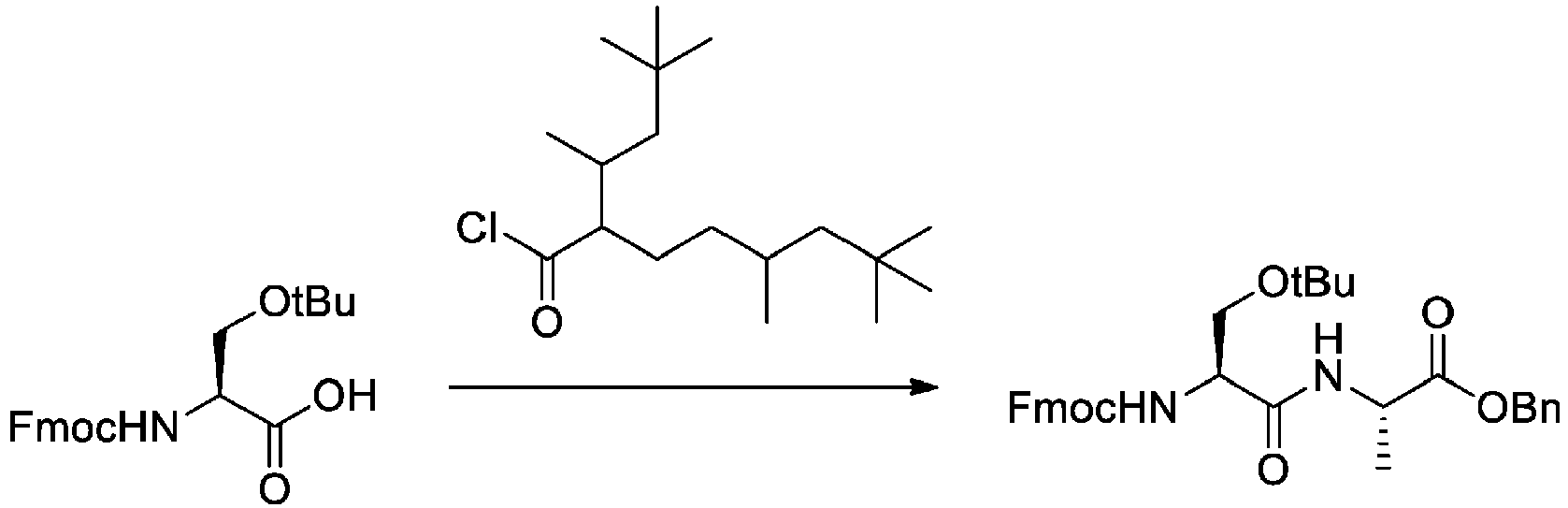
- Fmoc-Ser(tBu)-OH (0.213 g, 0.556 mmol) and N,N-diisopropylethylamine (0.078 g, 0.602 mmol) were mixed with acetonitrile (2.1 mL), then, a 50% by mass toluene solution (0.309 g, 0.509 mmol) of ISTA-Cl was added thereto at 0°C and the mixture was stirred for 2 hours. To the solution was added a solution prepared separately by mixing HCl·H-Ala-OBn (0.1 g, 0.463 mmol), N,N-diisopropylethylamine (0.072 g, 0.556 mmol) and acetonitrile (1.0 mL), and the resulting mixture was stirred for one hour. After diluting the obtained reaction mixture with ethyl acetate (3.0 g), a saturated aqueous ammonium chloride solution (1.0 g) and water (1.0 g) were added thereto and liquid-separation was carried out. After subjecting the aqueous layer to liquid-separation again with ethyl acetate (2.0 g), the quantitative yield of Fmoc-Ser(tBu)-Ala-OBn (objective product) in the obtained organic layer was 97%. Fmoc-Ser(tBu)-Ala-OBn MASS (ESI+) m/z; 545.3 (M+H)+
-

- Fmoc-Cys(Trt)-OH (0.326 g, 0.556 mmol) and N,N-diisopropylethylamine (0.078 g, 0.602 mmol) were mixed with acetonitrile (3.3 mL), then, a 50% by mass toluene solution (0.309 g, 0.509 mmol) of ISTA-Cl was added thereto at 0°C and the mixture was stirred for 2 hours. To the solution was added a solution prepared separately by mixing HCl·H-Ala-OBn (0.1 g, 0.463 mmol), N,N-diisopropylethylamine (0.072 g, 0.556 mmol) and acetonitrile (1.0 mL), and the resulting mixture was stirred for one hour. After diluting the obtained reaction mixture with ethyl acetate (3.0 g), a saturated aqueous ammonium chloride solution (1.0 g) and water (1.0 g) were added thereto and liquid-separation was carried out. After subjecting the aqueous layer to liquid-separation again with ethyl acetate (2.0 g), the quantitative yield of Fmoc-Cys(Trt)-Ala-OBn (objective product) in the obtained organic layer was 96%.
-

- Fmoc-Thr(tBu)-OH (0.221 g, 0.556 mmol) and N,N-diisopropylethylamine (0.078 g, 0.602 mmol) were mixed with acetonitrile (2.2 mL), then, a 50% by mass toluene solution (0.309 g, 0.509 mmol) of ISTA-Cl was added thereto at 0°C and the mixture was stirred for 2 hours. To the solution was added a solution prepared separately by mixing HCl·H-Ala-OBn (0.1 g, 0.463 mmol), N,N-diisopropylethylamine (0.072 g, 0.556 mmol) and acetonitrile (1.0 mL), and the resulting mixture was stirred for one hour. After diluting the obtained reaction mixture with ethyl acetate (3.0 g), a saturated aqueous ammonium chloride solution (1.0 g) and water (1.0 g) were added thereto and liquid-separation was carried out. After subjecting the aqueous layer to liquid-separation again with ethyl acetate (2.0 g), the quantitative yield of Fmoc-Thr(tBu)-Ala-OBn (objective product) in the obtained organic layer was 92%. Fmoc-Thr(tBu)-Ala-OBn MASS (ESI+) m/z; 559.4 (M+H)+
-

- Fmoc-Asp(tBu)-OH (0.215 g, 0.522 mmol) and N,N-diisopropylethylamine (0.073 g, 0.566 mmol) were mixed with acetonitrile (2.2 mL), then, a 50% by mass toluene solution (0.29 g, 0.479 mmol) of ISTA-Cl was added thereto at 0°C and the mixture was stirred for 3 hours. To the solution was added a solution prepared separately by mixing HCl·H-Phe-OEt (0.1 g, 0.435 mmol), N,N-diisopropylethylamine (0.068 g, 0.522 mmol) and acetonitrile (1.0 mL), and the resulting mixture was stirred for one hour. After diluting the obtained reaction mixture with ethyl acetate (3.0 g), a saturated aqueous ammonium chloride solution (1.0 g) and water (1.0 g) were added thereto and liquid-separation was carried out. After subjecting the aqueous layer to liquid-separation again with ethyl acetate (2.0 g), the quantitative yield of Fmoc-Asp(tBu)-Phe-OEt (objective product) in the obtained organic layer was 99%, and the quantitative yield of ISTA-Phe-OEt (by-product) was 1%.
Fmoc-Asp(tBu)-Phe-OEt MASS (ESI+) m/z; 587.7 (M+H)+ -

- Boc-Gly-OH (0.086 g, 0.50 mmol) and N,N-diisopropylethylamine (0.070 g, 0.538 mmol) were mixed with acetonitrile (0.9 mL), then, a 50% by mass toluene solution (0.27 g, 0.456 mmol) of ISTA-Cl was added thereto at 0°C and the mixture was stirred for 2 hours. To the solution was added a solution prepared separately by mixing HCl·H-Pro-OBn (0.1 g, 0.414 mmol), N,N-diisopropylethylamine (0.053 g, 0.50 mmol) and acetonitrile (1.0 mL), and the resulting mixture was stirred for one hour. After diluting the obtained reaction mixture with ethyl acetate (3.0 g), a saturated aqueous ammonium chloride solution (1.0 g) and water (1.0 g) were added thereto and liquid-separation was carried out. After subjecting the aqueous layer to liquid-separation again with ethyl acetate (2.0 g), the quantitative yield of Boc-Gly-Pro-OBn (objective product) in the obtained organic layer was 91%.
Boc-Gly-Pro-OBn MASS (ESI+) m/z; 363.1 (M+H)+ -

- Boc-Asp(tBu)-OH (0.191 g, 0.66 mmol) and N,N-diisopropylethylamine (0.092 g, 0.715 mmol) were mixed with acetonitrile (2.0 mL), then, a 50% by mass toluene solution (0.367 g, 0.61 mmol) of ISTA-Cl was added thereto at 0°C and the mixture was stirred for 2 hours. To the solution was added a solution prepared separately by mixing HCl·H-Leu-OMe (0.1 g, 0.55 mmol), N,N-diisopropylethylamine (0.085 g, 0.66 mmol) and acetonitrile (1.0 mL), and the resulting mixture was stirred for one hour. After diluting the obtained reaction mixture with ethyl acetate (3.0 g), a saturated aqueous ammonium chloride solution (1.0 g) and water (1.0 g) were added thereto and liquid-separation was carried out. After subjecting the aqueous layer to liquid-separation again with ethyl acetate (2.0 g), the quantitative yield of Boc-Asp(tBu)-Leu-OMe (objective product) in the obtained organic layer was 99%. Boc-Asp(tBu)-Leu-OMe MASS (ESI+) m/z; 417.1 (M+H)+
-

- Boc-Tyr(tBu)-OH (0.142 g, 0.42 mmol) and N,N-diisopropylethylamine (0.059 g, 0.46 mmol) were mixed with acetonitrile (1.4 mL), then, a 50% by mass toluene solution (0.233 g, 0.39 mmol) of ISTA-Cl was added thereto at 0°C and the mixture was stirred for 2 hours. To the solution was added a solution prepared separately by mixing HCl·H-Orn(Boc)-OMe (0.1 g, 0.35 mmol), N,N-diisopropylethylamine (0.054 g, 0.42 mmol) and acetonitrile (1.0 mL), and the resulting mixture was stirred for one hour. After diluting the obtained reaction mixture with ethyl acetate (3.0 g), a saturated aqueous ammonium chloride solution (1.0 g) and water (1.0 g) were added thereto and liquid-separation was carried out. After subjecting the aqueous layer to liquid-separation again with ethyl acetate (2.0 g), the quantitative yield of Boc-Tyr(tBu)-Orn(Boc)-OMe (objective product) in the obtained organic layer was 99%. Boc-Tyr(tBu)-Orn(Boc)-OMe MASS (ESI+) m/z; 566.4 (M+H)+
-

- Fmoc-Val-OH (0.118 g, 0.348 mmol) and N,N-diisopropylethylamine (0.048 g, 0.377 mmol) were mixed with acetonitrile (1.2 mL), then, a 50% by mass toluene solution (0.193 g, 0.32 mmol) of ISTA-Cl was added thereto at 0°C and the mixture was stirred for 3 hours. To the solution was added a solution prepared separately by mixing HCl·H-Phe-Phe-OEt (0.1 g, 0.29 mmol), N,N-diisopropylethylamine (0.045 g, 0.348 mmol) and acetonitrile (1.0 mL), and the resulting mixture was stirred for one hour. After diluting the obtained reaction mixture with tetrahydrofuran (3.0 g) and ethyl acetate (3.0 g), a saturated aqueous ammonium chloride solution (1.0 g) and water (1.0 g) were added thereto and liquid-separation was carried out. After subjecting the aqueous layer to liquid-separation again with ethyl acetate (3.0 g), the quantitative yield of Fmoc-Val-Phe-Phe-OEt (objective product) in the obtained organic layer was 96%, and the quantitative yield of ISTA-Phe-Phe-OEt (by-product) was 1%.
- Fmoc-Val-Phe-Phe-OEt MASS (ESI+) m/z; 662.4 (M+H)+
- ISTA-Phe-Phe-OEt MASS (ESI+) m/z; 607.4 (M+H)+
-

- Fmoc-Asp(tBu)-OH (0.143 g, 0.348 mmol) and N,N-diisopropylethylamine (0.048 g, 0.377 mmol) were mixed with acetonitrile (1.4 mL), then, a 50% by mass toluene solution (0.193 g, 0.32 mmol) of ISTA-Cl was added thereto at 0°C and the mixture was stirred for 3 hours. To the solution was added a solution prepared separately by mixing HCl·H-Phe-Phe-OEt (0.1 g, 0.29 mmol), N,N-diisopropylethylamine (0.045 g, 0.348 mmol) and acetonitrile (1.0 mL), and the resulting mixture was stirred for one hour. After diluting the obtained reaction mixture with tetrahydrofuran (3.0 g) and ethyl acetate (3.0 g), a saturated aqueous ammonium chloride solution (1.0 g) and water (1.0 g) were added thereto and liquid-separation was carried out. After subjecting the aqueous layer to liquid-separation again with ethyl acetate (3.0 g), the quantitative yield of Fmoc-Asp(tBu)-Phe-Phe-OEt (objective product) in the obtained organic layer 94%.
Fmoc-Asp(tBu)-Phe-Phe-OEt MASS (ESI+) m/z; 734.4 (M+H)+ -

- Fmoc-Trp(Boc)-OH (0.209 g, 0.40 mmol) and N,N-diisopropylethylamine (0.055 g, 0.43 mmol) were mixed with acetonitrile (2.1 mL), then, a 50% by mass toluene solution (0.220 g, 0.36 mmol) of ISTA-Cl was added thereto at 0°C and the mixture was stirred for 3 hours. To the solution was added a solution prepared separately by mixing HCl·H-Ala-Phe-OEt (0.1 g, 0.33 mmol), N,N-diisopropylethylamine (0.051 g, 0.40 mmol) and acetonitrile (1.0 mL), and the resulting mixture was stirred for one hour. After diluting the obtained reaction mixture with tetrahydrofuran (3.0 g) and ethyl acetate (3.0 g), a saturated aqueous ammonium chloride solution (1.0 g) and water (1.0 g) were added thereto and liquid-separation was carried out. After subjecting the aqueous layer to liquid-separation again with ethyl acetate (3.0 g), the quantitative yield of Fmoc-Trp(Boc)-Ala-Phe-OEt (objective product) in the obtained organic layer was 97%, and the quantitative yield of ISTA-Ala-Phe-OEt (by-product) was 1%.
- Fmoc-Trp(Boc)-Ala-Phe-OEt MASS (ESI+) m/z; 773.4 (M+H)+
- ISTA-Ala-Phe-OEt MASS (ESI+) m/z; 531.3 (M+H)+
-

- Boc-Val-OH (0.340 g, 1.56 mmol) and N,N-diisopropylethylamine (0.219 g, 1.69 mmol) were mixed with acetonitrile (3.4 mL), then, a 50% by mass toluene solution (0.870 g, 1.43 mmol) of ISTA-Cl was added thereto at 0°C and the mixture was stirred for 3 hours. To the solution was added a solution prepared separately by mixing HCl·H-Phe-OEt (0.3 g, 1.3 mmol), N,N-diisopropylethylamine (0.203 g, 1.32 mmol) and acetonitrile (3.0 mL), and the resulting mixture was stirred for one hour. After diluting the obtained reaction mixture with ethyl acetate (6.0 g), a saturated aqueous ammonium chloride solution (3.0 g) and water (2.0 g) were added thereto and liquid-separation was carried out. After subjecting the aqueous layer to liquid-separation again with ethyl acetate (3.0 g), the obtained organic layer was concentrated and purified by silica gel column chromatography to obtain Boc-Val-Phe-OEt (0.49 g, yield 95%) as a white solid.
Boc-Val-Phe-OEt MASS (ESI+) m/z; 393.2 (M+H)+ -

- Boc-Val-Phe-OEt (0.20 g, 0.51 mmol) was mixed with 4M-HCl/1,4-dioxane (1.0 mL), and the mixture was stirred at 25°C for 2 hours. The obtained reaction mixture was concentrated and the obtained HCl·H-Val-Phe-OEt as a white solid was used in the next step.
- Cbz-Val-OH (0.154 g, 0.612 mmol) and N,N-diisopropylethylamine (0.086 g, 0.663 mmol) were mixed with acetonitrile (3.0 mL), then, a 50% by mass toluene solution (0.340 g, 0.561 mmol) of ISTA-Cl was added thereto at 0°C and the mixture was stirred for 3 hours. To the solution was added a solution prepared separately by mixing HCl·H-Val-Phe-OEt (0.51 mmol), N,N-diisopropylethylamine (0.079 g, 0.612 mmol) and acetonitrile (2.0 mL), and the resulting mixture was stirred for one hour. After diluting the obtained reaction mixture with acetonitrile (4.0 g) and ethyl acetate (8.0 g), a saturated aqueous ammonium chloride solution (2.0 g) and water (2.0 g) were added thereto and liquid-separation was carried out. After subjecting the aqueous layer to liquid-separation again with ethyl acetate (5.0 g), it was dried over sodium sulfate and the obtained organic layer was concentrated to obtain a white solid. Ethyl acetate (4.0 g) was added to the obtained white solid, and the precipitated solid was collected by filtration to obtain Cbz-Val-Val-Phe-OEt (0.26 g, yield 97%) as a white solid.
Cbz-Val-Val-Phe-OEt MASS (ESI+) m/z; 526.7 (M+H)+ -

- Cbz-Val-Val-Phe-OEt (0.10 g, 0.19 mmol) was dissolved in 2,2,2-trifluoroethanol (4 mL), and after adding 10% by mass Pd-C (20 mg) thereto, the mixture was stirred under hydrogen gas atmosphere at 25°C for one hour. The reaction solution was filtered and concentrated, and the obtained H-Val-Val-Phe-OEt was used in the next step.
- Fmoc-Val-OH (0.077 g, 0.228 mmol) and N,N-diisopropylethylamine (0.032 g, 0.247 mmol) were mixed with acetonitrile (0.77 mL), then, a 50% by mass toluene solution (0.127 g, 0.21 mmol) of ISTA-Cl was added thereto at 0°C and the mixture was stirred for 3 hours. To the solution was added a solution prepared by mixing H-Val-Val-Phe-OEt (0.19 mmol) obtained in the previous step, acetonitrile (1.0 mL) and NMP (0.2 mL), and the resulting mixture was stirred for one hour. Diisopropyl ether (10 mL) was added to the obtained reaction solution, and the precipitated solid was collected by filtration to obtain Fmoc-Val-Val-Val-Phe-OEt (0.14 g, yield 103%) as a white solid.
Fmoc-Val-Val-Val-Phe-OEt MASS (ESI+) m/z; 713.4 (M+H)+ -
- (1) NMP (1.0 mL) was added to an H-Phe-2-ClTrt resin (109.9 mg, 0.1 mmol, available from Merck, the resin is polystyrene), and after stirring the mixture for 15 minutes, the solvent was removed.
- (2) Fmoc-Phe-OH (155.0 mg, 0.4 mmol) and N,N-diisopropylethylamine (0.07 mL, 0.4 mmol) were dissolved in NMP (0.8 mL), and then, a 50% by mass toluene solution (0.24 mL, 0.4 mmol) of ISTA-Cl was added thereto at room temperature and the mixture was stirred for 3 hours.
- (3) To the solution obtained in the above-mentioned (2) was added the solid obtained in the above-mentioned (1), and the mixture was stirred for one hour. After removing the reaction solvent, the obtained solid was washed successively by using NMP and methanol, and dried to obtain an Fmoc-Phe-Phe-2-ClTrt resin.
- (4) To the whole amount of Fmoc-Phe-Phe-2-ClTrt resin obtained in the above-mentioned (3) was added acetic acid/2,2,2-trifluoroethanol/dichloromethane (volume ratio 1/2/7) (2 mL), and the mixture was stirred for 2 hours. After removing the desorbed resin by filtration, the reaction solution is concentrated under reduced pressure, diisopropyl ether was added to the residue and the precipitated solid was collected by filtration to obtain Fmoc-Phe-Phe-OH (51.4 mg, yield 96.1%) as a white solid.
- Fmoc-Phe-Phe-OH MASS (ESI+) m/z; 535.3 (M+H)+
- According to the present invention, a producing method f a peptide with high efficiency can be provided.
Claims (15)
- A method for producing a peptide which comprises the following steps (1) and (2):(1) a step of mixing an N-protected amino acid or an N-protected peptide with a carboxylic acid halide represented by the formula (I)

R1, R2 and R3 each independently represent an aliphatic hydrocarbon group which may have a substituent, and a total number of the carbon atoms in R1, R2 and R3 is 3 to 40; and(2) a step of mixing the product obtained in the step (1) with a C-protected amino acid or a C-protected peptide. - The method for producing a peptide according to Claim 1, which further comprises one or more repetitions of the following steps (3) to (5):(3) a step of removing a protective group for an N-terminal of the peptide obtained in the step (2) or (5);(4) a step of mixing an N-protected amino acid or an N-protected peptide with the carboxylic acid halide represented by the formula (I); and(5) a step of mixing the product obtained in the step (4) and the product obtained in the step (3).
- The method for producing a peptide according to Claim 1 or 2, wherein two or more among R1, R2 and R3 are each independently an aliphatic hydrocarbon group containing one or more tertiary or quaternary carbon atoms.
- The method for producing a peptide according to Claim 1 or 2, wherein R1 is a methyl group, and R2 and R3 are each independently an aliphatic hydrocarbon group containing one or more tertiary or quaternary carbon atoms.
- The method for producing a peptide according to Claim 4, wherein R2 and R3 are each independently a C3-10 alkyl group containing one or more tertiary or quaternary carbon atoms.
- The method for producing a peptide according to Claim 1, wherein the carboxylic acid halide is a compound represented by the formula (II)

- The method for producing a peptide according to any one of Claims 1 to 6, wherein X is a chlorine atom or a bromine atom.
- The method for producing a peptide according to any one of Claims 1 to 6, wherein X is a chlorine atom.
- The method for producing a peptide according to any one of Claims 1 to 8, wherein the amino acid in the N-protected amino acid is an α-amino acid other than glycine.
- The method for producing a peptide according to Claim 9, wherein the amino acid in the N-protected amino acid is an α-amino acid other than glycine, and the reactive functional group at a side chain of the amino acid is protected.
- The method for producing a peptide according to Claim 9 or 10, wherein the α-amino acid other than glycine is valine, phenylalanine, threonine, leucine, tryptophan, serine, cysteine, aspartic acid or tyrosine.
- The method for producing a peptide according to any one of Claims 1 to 11, wherein the amino acid in the C-protected amino acid or the amino acid in the N-terminal residue of the C-protected peptide is an α-amino acid other than an N-substituted amino acid.
- The method for producing a peptide according to any one of Claims 1 to 12, wherein the step (2) is a step of mixing the product obtained in the step (1) and a C-protected peptide.
- The method for producing a peptide according to any one of Claims 1 to 13, wherein the N-terminal protective group of the N-protected amino acid or the N-protected peptide is a carbamate-based protective group.
- The method for producing a peptide according to Claim 14, wherein the carbamate-based protective group is a 9-fluorenylmethyloxycarbonyl group or a benzyloxycarbonyl group.
Applications Claiming Priority (3)
| Application Number | Priority Date | Filing Date | Title |
|---|---|---|---|
| JP2019174364 | 2019-09-25 | ||
| JP2020077224 | 2020-04-24 | ||
| PCT/JP2020/034686 WO2021060048A1 (en) | 2019-09-25 | 2020-09-14 | Method for producing peptide compound |
Publications (2)
| Publication Number | Publication Date |
|---|---|
| EP4036103A1 true EP4036103A1 (en) | 2022-08-03 |
| EP4036103A4 EP4036103A4 (en) | 2023-10-18 |
Family
ID=75166647
Family Applications (1)
| Application Number | Title | Priority Date | Filing Date |
|---|---|---|---|
| EP20870211.8A Pending EP4036103A4 (en) | 2019-09-25 | 2020-09-14 | METHOD FOR PRODUCING A PEPTIDE COMPOUND |
Country Status (7)
| Country | Link |
|---|---|
| US (1) | US12528834B2 (en) |
| EP (1) | EP4036103A4 (en) |
| JP (1) | JP7598325B2 (en) |
| CN (1) | CN114401978B (en) |
| CA (1) | CA3156019A1 (en) |
| TW (1) | TWI880950B (en) |
| WO (1) | WO2021060048A1 (en) |
Family Cites Families (8)
| Publication number | Priority date | Publication date | Assignee | Title |
|---|---|---|---|---|
| FR2652581B1 (en) | 1989-10-02 | 1991-12-13 | Rhone Poulenc Chimie | METHOD FOR SOLUBILIZING PEPTIDES AND METHOD FOR SYNTHESIS OF PEPTIDES. |
| DK0847994T3 (en) | 1996-12-11 | 2003-07-28 | Hoffmann La Roche | Process for preparing mixed anhydrides |
| EP2062909A1 (en) * | 2007-11-21 | 2009-05-27 | SOLVAY (Société Anonyme) | Peptide production and purification process |
| GB201011411D0 (en) | 2010-07-06 | 2010-08-18 | St Georges Hosp Medical School | Therapeutic compounds and their use |
| CN102286092B (en) * | 2011-09-14 | 2014-01-01 | 深圳翰宇药业股份有限公司 | Solid-phase synthesis method of liraglutide |
| CN109071446B (en) | 2016-01-29 | 2022-06-21 | 艾伯维德国有限责任两合公司 | Organic reaction in aqueous solution in the presence of hydroxyalkyl (alkyl) cellulose or alkylcellulose |
| JP7327412B2 (en) | 2018-11-29 | 2023-08-16 | 日産化学株式会社 | (Meth)acrylic compound and photosensitive insulating film composition |
| TWI873128B (en) * | 2019-03-15 | 2025-02-21 | 日商日產化學股份有限公司 | Method for producing peptide compound |
-
2020
- 2020-09-14 JP JP2021548816A patent/JP7598325B2/en active Active
- 2020-09-14 CA CA3156019A patent/CA3156019A1/en active Pending
- 2020-09-14 WO PCT/JP2020/034686 patent/WO2021060048A1/en not_active Ceased
- 2020-09-14 EP EP20870211.8A patent/EP4036103A4/en active Pending
- 2020-09-14 US US17/763,185 patent/US12528834B2/en active Active
- 2020-09-14 CN CN202080064410.6A patent/CN114401978B/en active Active
- 2020-09-15 TW TW109131654A patent/TWI880950B/en active
Also Published As
| Publication number | Publication date |
|---|---|
| US20220372069A1 (en) | 2022-11-24 |
| TW202126675A (en) | 2021-07-16 |
| EP4036103A4 (en) | 2023-10-18 |
| CN114401978A (en) | 2022-04-26 |
| US12528834B2 (en) | 2026-01-20 |
| TWI880950B (en) | 2025-04-21 |
| CA3156019A1 (en) | 2021-04-01 |
| CN114401978B (en) | 2026-04-17 |
| JP7598325B2 (en) | 2024-12-11 |
| JPWO2021060048A1 (en) | 2021-04-01 |
| WO2021060048A1 (en) | 2021-04-01 |
Similar Documents
| Publication | Publication Date | Title |
|---|---|---|
| EP3693377A1 (en) | Method for producing peptide compound | |
| JP2025013917A (en) | Method for producing peptide compounds | |
| Sudhir et al. | Click chemistry inspired synthesis of ferrocene amino acids and other derivatives | |
| JP7505498B2 (en) | Method for producing peptide compounds | |
| Rose et al. | Synthesis of enantiomerically enriched β, γ-unsaturated-α-amino acids | |
| Kotha et al. | Synthesis of constrained phenylalanine derivatives via a [2+ 2+ 2] cycloaddition strategy | |
| US11993629B2 (en) | Method for producing peptide compound | |
| N’Dongo et al. | Aqueous syntheses of [(Cp-R) M (CO) 3] type complexes (Cp= cyclopentadienyl, M= Mn, 99mTc, Re) with bioactive functionalities | |
| US12528834B2 (en) | Method for producing peptide compound | |
| Brosch et al. | A Two‐Step Palladium‐Catalyzed Coupling Scheme for the Synthesis of Ferrocene‐Labeled Amino Acids | |
| Barišić et al. | Ferrocene compounds: Part XXXIII. Synthesis and characterization of amino acids containing skeletal 1, 1′-ferrocenylene unit | |
| US8580998B2 (en) | Preparation of alkenes by mild thermolysis of sulfoxides | |
| Tanaka et al. | Catalytic dehydrogenative N-((triisopropylsilyl) oxy) carbonyl (Tsoc) protection of amines using iPr 3 SiH and CO 2 | |
| Cossy et al. | Manganese (III) acetate and copper (II) acetate promoted oxidation of β-enaminoamides and β-enaminoesters | |
| Niida et al. | Facile access to (Z)-alkene-containing diketopiperazine mimetics utilizing organocopper-mediated anti-SN2′ reactions | |
| Gair et al. | The development of zinc and zinc/copper reagents for the synthesis of enantiomerically pure amino acids | |
| CN107954872B (en) | Method for synthesizing malonate type compound | |
| Chibale et al. | Convenient synthesis of disulfide substrates for trypanothione reductase using polymer-supported reagents | |
| WO2013097456A1 (en) | Silodosin intermediate and preparation method therefor | |
| HK40065497A (en) | Method for producing peptide compound | |
| Peindy et al. | Aqueous syntheses of [(Cp-R) M (CO) 3] type complexes (Cp= cyclopentadienyl, M= Mn, 99mTc, Re) with bioactive functionalities | |
| Mazurkiewicz et al. | Reaction of N-acyl-α-triphenylphosphonio-α-amino acid esters with organic bases: Mechanism of the base-catalyzed nucleophilic substitution of the triphenylphosphonium group | |
| Balducci et al. | Stereoselective synthesis of a new chiral synthon: a cyclic pseudodipeptide containing an aspartic acid derivative and l-valine | |
| EP3960751A1 (en) | Method for producing peptide compound | |
| US6284912B1 (en) | Process for synthesizing para-and/or meta-substituted cyanophenyalanine derivatives |
Legal Events
| Date | Code | Title | Description |
|---|---|---|---|
| STAA | Information on the status of an ep patent application or granted ep patent |
Free format text: STATUS: THE INTERNATIONAL PUBLICATION HAS BEEN MADE |
|
| PUAI | Public reference made under article 153(3) epc to a published international application that has entered the european phase |
Free format text: ORIGINAL CODE: 0009012 |
|
| STAA | Information on the status of an ep patent application or granted ep patent |
Free format text: STATUS: REQUEST FOR EXAMINATION WAS MADE |
|
| 17P | Request for examination filed |
Effective date: 20220331 |
|
| AK | Designated contracting states |
Kind code of ref document: A1 Designated state(s): AL AT BE BG CH CY CZ DE DK EE ES FI FR GB GR HR HU IE IS IT LI LT LU LV MC MK MT NL NO PL PT RO RS SE SI SK SM TR |
|
| DAV | Request for validation of the european patent (deleted) | ||
| DAX | Request for extension of the european patent (deleted) | ||
| A4 | Supplementary search report drawn up and despatched |
Effective date: 20230920 |
|
| RIC1 | Information provided on ipc code assigned before grant |
Ipc: C07K 1/06 20060101AFI20230914BHEP |