TECHNICAL FIELD
-
The present invention belongs to the field of biomedicine, and particularly relates to a PROTAC small molecular compound and use thereof.
BACKGROUND
-
Proteolysis-targeting chimera (PROTAC) technology originated from the discovery of ubiquitin (Ub)-regulated proteolysis processes by scientists. Eukaryotic cells are constantly struggling to maintain appropriate protein levels, producing and degrading thousands of proteins every moment. A key factor to maintain protein balance is a small protein molecule called ubiquitin. When it binds to proteins, the proteins will be transported to proteasomes for degradation.
-
Targeted protein degradation is an emerging direction in the field of medicament development. Targeted protein degradation medicaments aim to design small molecules as a novel medicament; conventional small molecules act to block the functions of proteins, while targeted protein degraders act to completely degrade these proteins by feeding them into the proteasomes.
-
In 2010, a study by Handa and co-workers found that E3 ligase Cereblon (CRBN) is a main target of thalidomide protein. Considering the binding ability of phthalimide to CRBN, the Crews Lab and others have attempted to hijack CRBN to degrade the target protein using phthalimide as an E3 ligase recruiting ligand. Conjugation of a small molecule BRD4 binding moiety (OTX015) to pomalidomide results in PROTAC capable of degrading the epigenetic regulator BRD4 at picomolar efficiency. Compared with the BRD4 inhibitors JQ1 and OTX015, CRBN-based PROTAC is able to inhibit an expression level of c-myc more persistently by counteracting an increased expression of BRD4, feedback known to be associated with BRD4 inhibition. At a cellular level, this persistent inhibition results in superior anti-proliferative and apoptotic effects on Burkitt's lymphoma cell lines. In one study, the BRD4 inhibitor JQ1 is conjugated to a thalidomide derivative, and the resulting PROTAC, called dBET1, is able to induce BRD4 degradation at low nanomolar concentrations. Proteomic research on this PROTAC shows that the compound significantly reduces levels of c-myc, BRD2, BRD3 and BRD4, and meanwhile has reduced off-target degradation effects.
-
Cereblon is a protein encoded by the human CRBN gene, and CRBN homologous genes are highly conserved, indicating its importance in physiology. Cereblon, together with damaged DNA binding protein 1(DDB1), Cullin-4A (CUL4A) and Cullin-1 regulator (ROC1), forms an E3 ubiquitin ligase complex. This complex is capable of ubiquitinating a range of proteins, but the exact mechanism is not known. Cereblon ubiquitinated target protein causes an increase of fibroblast growth factor 8 (FGF8) and fibroblast growth factor 10 (FGF10), indicating that the ubiquitinase complex is important for embryonic limb growth.
-
Hematopoietic progenitor kinase 1 (HPK1) is involved in many signaling cascade reactions including growth factor signaling, MAPK signaling, cytokine signaling, apoptosis signaling, growth factor signaling, antigen receptor signaling and the like. HPK1 kinase is a key functional activator of JNK/SAPK signaling pathway, and when it is activated, the HPK1 kinase selectively activates MAPK signaling pathway of C-Jun N-terminal kinase (JNK). HPK1 kinase can be used as a target of immunotherapy, and it is activated by lymphocyte antigen receptors and inhibits AP-1; AP-1 plays a role in promoting cell proliferation, inhibiting differentiation, promoting invasion and metastasis of tumor cells and the like in processes of tumor formation and development. However, targeted disruption of alleles of the HPK1 kinase can lead to increased production of Thl cytokines by T cells in TCR responses.
-
A proteolysis targeting chimera is designed by the present invention, which can carry out ubiquitination labeling on HPK1, induce proteolysis, and has an inhibition effect superior to that of an HPK1 kinase inhibitor alone, that is, a small dose of medicament can be used to inhibit expression of HPK1 protein. On the premise of the same therapeutic effect, dosage of the medicament is less, and toxic and side effects are less.
SUMMARY
-
The present invention aims to provide a proteolysis targeting chimera for degrading HPK1 induced by a Cereblon ligand, and use of the proteolysis targeting chimera, and a pharmaceutically acceptable salt, a stereoisomer, an ester, a prodrug, a solvate and a deuterated compound thereof for treating diseases such as tumor, inflammation and immunity diseases.
-
The objectives of the present invention are implemented through the following technical solutions.
-
The present invention provides a compound of general formula I:
- wherein the MAP4K family inhibitor is selected from: a HPK1 inhibitor, an MAP4K2 inhibitor, an MAP4K3 inhibitor, an MAP4K4 inhibitor, an MAP4K5 inhibitor, and an MAP4K6 inhibitor; and preferably, the MAP4K family inhibitor is selected from: an HPK1(MAP4K1) inhibitor;
- wherein q is selected from integers between 1 and 5;
- the Cereblon protein ligand is a small molecular ligand of Cereblon protein in an E3 ubiquitin ligase complex; L is a linking group between the Cereblon protein ligand and the HPK1 inhibitor; and the attachment sites and the number of attachments of the Cereblon protein ligands affect activities of the compound, and in the present application, q is selected from integers between 1 and 5, and preferably, q is selected from integers between 1 and 3, such as 1, 2 or 3.
-
The Cereblon protein ligand refers to a small molecule ligand of the Cereblon protein in an E3 ubiquitin ligase complex, and is selected from: an amide compound, a phthalimide compound, thalidomide and a derivative thereof, lenalidomide and a derivative thereof, and pomalidomide and a derivative thereof.
-
Preferably, the Cereblon protein ligand moiety has a general formula as follows:
wherein C
1, C
2, C
3 and C
4 are independently selected from C and N; preferably, C
1, C
2, C
3 and C
4 are C; when C
1 is C, at least one of C
2, C
3 and C
4 is N; when C
2 is C, at least one of C
1, C
3 and C
4 is N; when C
3 is C, at least one of C
1, C
2 and C
4 is N; and when C
4 is C, at least one of C
1, C
2 and C
3 is N;
- T is selected from O and S;
- V is selected from -O-, -S-,
wherein R' and R" are independently selected from C0-10 alkyl, cyclohydrocarbyl and heterocyclohydrocarbyl; and G and Z are independently selected from H, -OH, C1-10 linear/branched alkyl, C3-10 cyclohydrocarbyl, O-containing heterocyclohydrocarbyl, N-containing heterocyclohydrocarbyl and S-containing heterocyclohydrocarbyl.
-
Preferably, C1, C2, C3 and C4 are C;
- T is O;
- V is selected from -CH2-,
and -NH-; and
- G and Z are independently selected from H, -CH3 and -CH2CH3.
-
In a preferred embodiment of the present invention, the Cereblon protein ligand moiety has a structural formula as follows:
-
L is a linking group between the Cereblon protein ligand and the HPK1 inhibitor, the Cereblon protein ligand is covalently bonded to the HPK1 inhibitor, and the linking group is -A1-A2 ....... At-, wherein
A1, A2......At are independently selected from:
- CRL1RL2, O, S, S=O, S(=O)2, -S(O)2O, -OS(O)2, OS(O)2O, NRL3, S(=O)2NRL3, S(=O)NRL3, C(=O)NRL3, OC(O)NRL3, NRL3C(=O), NRL3C(=O)NRL4, NRL3S(=O)2NRL4, C(=O), CRL1=CRL2, C=C, C≡C, SiRL1RL2, P(=O)RL1, P(=O)ORL1, NRL3C(=N-CN)NRL4, NRL3C(=N-CN), NRL3C(=C-NO2)NRL4, C3-11 cyclohydrocarbyl, C3-11 heterocyclohydrocarbyl, succinimide,
-CH2CH2O-, -OCH2CH2-,
and
or are absent, wherein any hydrogen atom of the cyclohydrocarbyl and the heterocyclohydrocarbyl may be substituted with 1-6 RL1 or RL2;
- when A1, A2......At are CRL1RL2 or SiRL1RL2, RL1 and RL2 can be independently attached to other A to form cyclohydrocarbyl or heterocyclohydrocarbyl, and preferably, the cyclohydrocarbyl or heterocyclohydrocarbyl is optionally substituted with 1-11 RL5 groups;
- RL1, RL2, RL3, RL4 and RL5 are independently selected from H, halogen, C1-8 alkyl, O(C1-8 alkyl), S(C1-8 alkyl), NH(C1-8 alkyl), N(C1-8 alkyl)2, C3-11 cyclohydrocarbyl, C3-11 heterocyclohydrocarbyl, O(C1-8 cyclohydrocarbyl), S(C1-8 cyclohydrocarbyl), NH(C1-8 cyclohydrocarbyl), N(C1-8 cyclohydrocarbyl)(C1-8 alkyl), OH, NH2, SH, SO2(C1-8 alkyl), P(=O)(OC1-8 alkyl)(C1-8 alkyl), P(=O)(OC1-8 alkyl)2, C1-8 alkynyl, CH=CH(C1-8 alkyl), C(C1-8 alkyl)=CH(C1-8 alkyl), C(C1-8alkyl)=C(C1-8alkyl)2, Si(OH)3, Si(C1-8 alkyl)3, Si(OH)(C1-8 alkyl)2, C(=O)(C1-8 alkyl), CO2H, CN, CF3, CHF2, CH2F, NO2, SF5, SO2NH(C1-8 alkyl), SO2N(C1-8 alkyl)2, S(=O)N(C1-8 alkyl)2, C(=O)NH(C1-8 alkyl), C(=O)N(C1-8 alkyl)2, N(C1-8 alkyl)C(=O)NH(C1-8 alkyl), N(C1-8 alkyl)C(=O)N(C1-8 alkyl)2, NHC(=O)NH(C1-8 alkyl), NHC(=O)N(C1-8 alkyl)2, NHC(=O)NH2, N(C1-8 alkyl)SO2NH(C1-8 alkyl), N(C1-8 alkyl)SO2N(C1-8 alkyl)2, NHSO2NH(C1-8 alkyl), NHSO2N(C1-8 alkyl)2 and NHSO2NH2;
- X3 is selected from -O-, -S-, -NR- and -CHR-;
- R is selected from H and C1-3 alkyl substituted with 1 or 2 -OH;
- i is selected from integers between 1 and 6;
- Y is selected from -O-, -S- and -NR-, or is absent;
- t is selected from integers between 1 and 100, and preferably, t is selected from integers between 1 and 50.
-
In one embodiment of the present invention, the linking group L is wherein s is selected from integers between 1 and 6;
CON is selected from H,
or is absent;
W
1 and W
2 are independently selected from
and
i is selected from integers between 1 and 6;
- n is selected from integers between 1 and 10, and preferably from integers between 1 and 4;
- m is selected from integers between 0 and 10, and preferably from integers between 2 and 7;
- X1 is selected from -O-, -S- and -NR-; and
- X2 is selected from -O-, -S-, NR-, -S(O)-, -S(O)2O, -OS(O)2- and -OS(O)2O-.
-
In another embodiment of the present invention, the linking group is selected from:
wherein Ar is selected from N-containing six-membered aryl;
- g is selected from 0 and 1;
- n is selected from integers between 1 and 10, and preferably from integers between 1 and 4;
- m is selected from integers between 1 and 10, and preferably from integers between 2 and 7;
- k is selected from integers between 1 and 10, and preferably from integers between 1 and 4; and
- p is selected from integers between 1 and 10, and preferably from integers between 1 and 2.
-
In a preferred embodiment of the present invention, the linking group L has a structure as follows:
-
In the most preferred examples of the present invention, the L is
or
-
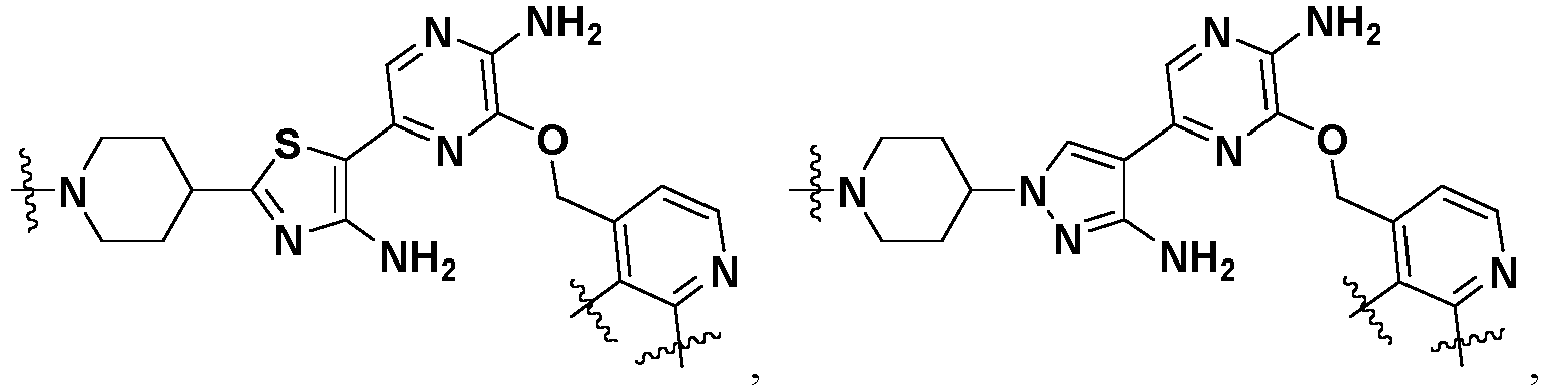
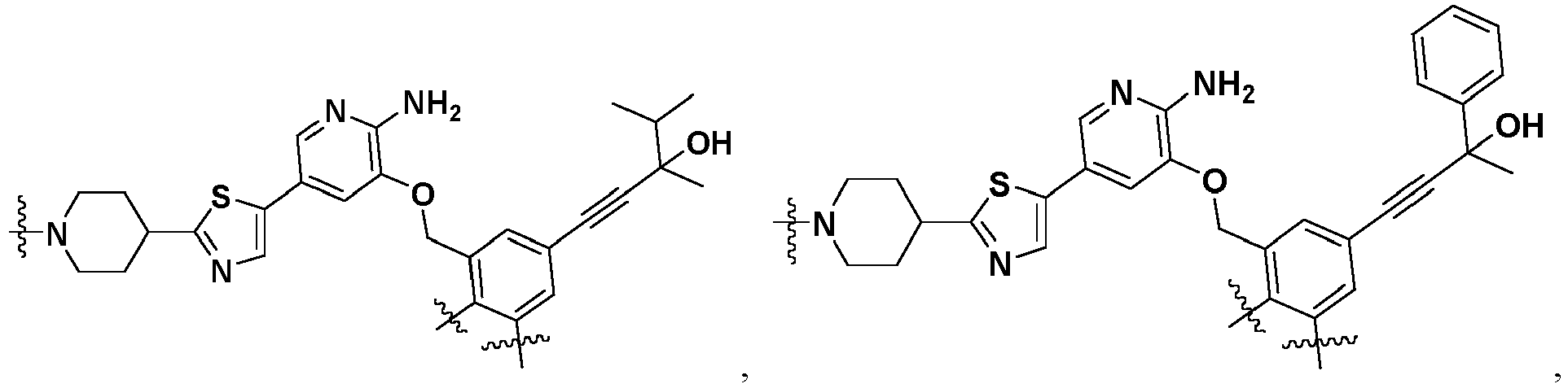
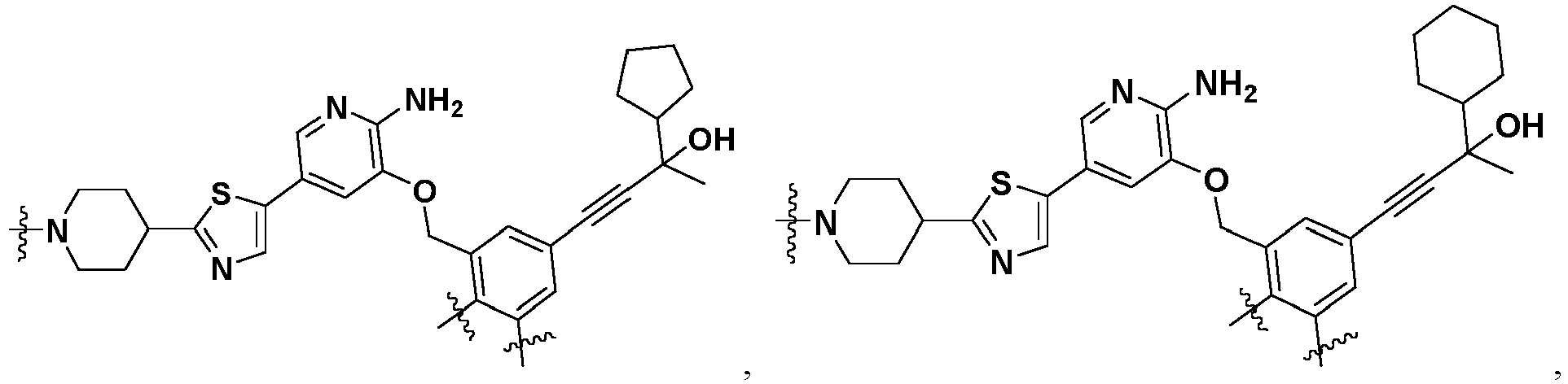
The HPK1 inhibitor moiety has a general formula as follows:
or
the general formula of HPK1 has 3 attachment sites to Cereblon protein ligands, and can be optionally attached to 3, 2 or 1 Cereblon protein ligand, with the rest attachment sites being replaced with -R"', wherein R'" is selected from -H, halogen, -NO
2, -CN, C
1-5 linear/branched alkyl, C
3-10 cyclohydrocarbyl, -N(C
0-10 alkyl)(Co-io alkyl), -CF
3, -OCF
3, -OCHF
2, -OCH
2F and -OC
0-10 alkyl; preferably, R‴ is selected from -H, halogen, C
1-5 linear/branched alkyl and -N(C
0-10 alkyl)(C
0-10 alkyl); and more preferably, R‴ is selected from -H and halogen.
-
Preferably, a position ①, a position ② and a position ③ are all attachment sites of the Cereblon protein ligands, or the position ① and the position ②are attachment sites of the Cereblon protein ligands while the position ③ is attached to R‴, or the position ② and the postion ③ are attachment sites of the Cereblon protein ligands while the position ① is attached to R‴, or the position ① and the position ③ are attachment sites of the Cereblon protein ligands while the position ② is attached to R‴, or the position ① is a attachment site of the Cereblon protein ligand while the position ② and the position ③ are attached to R‴, or the position ② is a attachment site of the Cereblon protein ligand while the position ① and the position ③ are attached to R‴, or the position ③ is a attachment site of the Cereblon protein ligand while the position ① and the position ② are attached to R‴.
-
Most preferably, the attachment sites of the position ① the position ② and the position ③ are all attached to the Cereblon protein ligands.
-
For the general formula of the HPK1 inhibitor described above, A is selected from C and N; B is selected from C and N.
-
Q is selected from O and S; x and z are independently selected from integers between 0 and 6; and y is selected from 0 and 1.
-
Preferably, x and z are independently selected from integers between 0 and 2, such as 0, 1 or 2.
-
Preferably, the HPK1 inhibitor moiety has a structural formula as follows:
-
R0 is independently selected from: -H, C1-10 linear/branched alkyl, -N(C0-10 alkyl)(C0-10 alkyl), -OC0-10 alkyl and C3-10 cyclohydrocarbyl.
-
Preferably, R0 is independently selected from: C1-5 linear/branched alkyl and -N(C0-10 alkyl)(C0-10 alkyl).
-
In a preferred embodiment of the present invention, R0 is independently selected from: -CH3, -CH2CH3 and -NH2.
-
R1 is selected from -O heterocycloalkyl, -N heterocycloalkyl, C1-10 linear/branched alkyl, C3-10 cycloalkyl, -OC0-10 alkyl, -N(C0-10 alkyl)(Co-io alkyl), -SO2(C0-10 alkyl), -O(C0-10 alkyl), -O-phenyl, -S(C0-10 alkyl), -N heterocycloaryl, -O heterocycloaryl and -S heterocycloaryl, wherein H attached to a C atom or heteroatom may be substituted with C1-3 linear alkyl, -N(C0-10 alkyl)(C0-10 alkyl) or -CF3.
-
Preferably, R1 is selected from: -O heterocycloalkyl and -N heterocycloalkyl, -SO2(C0-3 alkyl), -O-phenyl, -S(C0-4 alkyl), C3-6 cycloalkyl and C3-5 linear/branched alkyl, wherein H attached to a C atom or heteroatom may be substituted with -CH3, -NH2 or -CF3.
-
In a preferred embodiment of the present invention, R
1 is selected from:
-
R2 is selected from: -H, halogen, -NO2, -CN, C1-5 linear/branched alkyl, C3-10 cyclohydrocarbyl, -N(C0-10 alkyl)(C0-10 alkyl), -CF3, -OCF3, -OCHF2, -OCH2F and -OC0-10 alkyl.
-
Preferably, R2 is selected from: -NO2, -N(C0-10alkyl)(C0-10 alkyl), -OC0-10 alkyl and -OCF3.
-
In a preferred embodiment of the present invention, R2 is selected from: -NH2 and -NO2.
-
When B is N, R3 is absent; and when B is C, R3 is selected from: -H, halogen, -OC0-10 alkyl, C1-10 linear/branched alkyl, -N(C0-10alkyl)(C0-10 alkyl) and C3-10 cyclohydrocarbyl.
-
Preferably, R3 is selected from: -H, halogen, -OC0-10 alkyl and C1-10 linear/branched alkyl.
-
In a preferred embodiment of the present invention, R3 is selected from: -H, -F and -OCH3.
-
R4 is selected from: -H, halogen, -OC0-10 alkyl, -CN, C3-10 cyclohydrocarbyl, -C≡C-R10, C1-10 linear/branched alkyl, -N(C0-10alkyl)(C0-10 alkyl), -O heterocyclohydrocarbyl and -N heterocyclohydrocarbyl.
-
Preferably, R4 is selected from: -H, halogen, -OC0-10 alkyl, -CN, C3-10 cycloalkyl and -C≡C-R10,
-
In a preferred embodiment of the present invention, R
4 is selected from: -H, -F, -Cl, -OCH
3, -CN, -C≡C-R
10,
and
-
R
10 is selected from: H, C
1-5 linear/branched alkyl, C
3-10 cyclohydrocarbyl and
-
R11 and R12 are independently selected from: -H, -CF3, -CHF2H, -CH2F, C1-10 linear/branched alkyl, -CH=C(C0-10 alkyl)(Co-io alkyl), -C=C(C0-10 alkyl), C3-10 cycloalkyl, an aromatic five-membered cyclic group and an aromatic six-membered cyclic group, or R11 and R12, together with carbon atoms between R11 and R12, form C3-8 cycloalkyl or C3-8 heterocycloalkyl containing -O and -S, C4-9 fused cycloalkyl, C3-7 cyclolactam, C3-7 cyclic lactone, or C3-7 cyclic ketone, wherein H attached to a C atom may be substituted with alkyl or halogen.
-
Preferably, R11 and R12 are independently selected from: -H, -CF3, -CHF2H, -CH2F, C1-10 linear/branched alkyl, -CH=C(C0-10 alkyl)(Co-io alkyl), C3-10 cycloalkyl and an aromatic six-membered cyclic group, or R11 and R12, together with carbon atoms between R11 and R12, form C3-8 cycloalkyl, C4-7 fused cycloalkyl, C3-7 cyclolactam, C3-7 cyclic lactone, or C3-7 cyclic ketone, wherein H attached to a C atom may be substituted with alkyl or -F.
-
More preferably, R
11 and R
12 are independently selected from: -H, -CF
3, -CHF
2H, -CH
2F, C
1-5 linear/branched alkyl, -CH=CH(C
0-10 alkyl), C
3-10 cycloalkyl and an aromatic six-membered cyclic group, or R
11 and R
12, together with carbon atoms between R
11 and R
12, form C
3-6 cycloalkyl, C
4-6 fused cycloalkyl, C
3-7 cyclolactam, C
3-7 cyclic lactone, or C
3-7 cyclic ketone, wherein H attached to a C atom may be substituted with alkyl or -F. In a preferred embodiment of the present invention, R
11 and R
12 are independently selected from: -H, -CF
3, -CHF
2, -CH
2F, -CH
3, -CH
2CH
3, -CH=CH
2,
or R
11 and R
12, together with carbon atoms between R
11 and R
12, form
R
5 is selected from: -H, halogen, -CN, -OC
0-10 alkyl, C
1-10 linear/branched alkyl, heteroalkyl containing O and N, -N(C
0-10alkyl)(C
0-10 alkyl), C
3-10 cyclohydrocarbyl, -C=C-R
10, -O heterocyclohydrocarbyl and -N heterocyclohydrocarbyl, wherein H on a C atom can be substituted with the following groups: -SO
2, -SO
2N(C
0-10 alkyl)(C
0-10 alkyl), -N(C
0-10 alkyl)SO
2(C
0-10 alkyl), -CON(C
0-10 alkyl)(C
0-10 alkyl), -N(C
0-10 alkyl)CO(C
0-10 alkyl), -N(C
0-10 alkyl)COO(C
0-10 alkyl), -OCON(C
0-10 alkyl)(C
0-10 alkyl), halogen, -CN, -OCH
2F, -OCHF
2, -OCF
3, C
1-10 linear/branched alkyl, -N(C
0-10 alkyl)(C
0-10 alkyl), -OC
0-10 alkyl, C
3-10 cyclohydrocarbyl, -O heterocycloalkyl, -N heterocycloalkyl, -N heterocycloaryl, -O heterocycloaryl and -S heterocycloaryl.
-
Preferably, R5 is selected from: -H, halogen, C3-6 cycloalkyl, -OC0-5 alkyl, C1-5 linear/branched alkyl and C1-5 linear/branched alkyl containing O and N, wherein H on a C atom can be substituted with -F.
-
More preferably, R5 is selected from: -H, halogen, -OC0-3 alkyl, C1-3 linear/branched alkyl and C1-3 linear/branched alkyl containing N, wherein H on a C atom can be substituted with -F.
-
In a preferred embodiment of the present invention, R5 is selected from: -H, -F, -Cl, -CH3, -CH2NH2, -CN and -OCH3.
-
R8 and R9 are independently selected from: -H, halogen and C1-10 linear/branched alkyl.
-
Preferably, R8 and R9 are independently selected from: -H and C1-10 linear/branched alkyl.
-
More preferably, R8 and R9 are independently selected from: -H and C1-3 linear/branched alkyl.
-
In a preferred embodiment of the present invention, R8 and R9 are independently selected from: -H and -CH3. A' is selected from C and N; B1, B2, B3, B4 or B5 is independently selected from C and N.
-
Preferably, B1, B2, B3, B4 or B5 is C, or at least one of B1, B2, B3, B4 and B5 is N; and
more preferably, B2 is C, and at least one of B1, B3, B4 and B5 is N. In one embodiment of the present invention, B2 is C, and B1 is N; B2 is C, and B3 is N; B2 is C, and B4 is N; or B2 is C, and B5 is N. In another embodiment of the present invention, B2 is C, B3 and B4 are N, or B3 and B5 are N.
-
Q' is selected from O and S; x' and z' are independently selected from integers between 0 and 6; and y' is selected from 0 and 1; and
preferably, x' and z' are independently selected from integers between 0 and 2, such as 0, 1 or 2.
-
Preferably, the HPK1 inhibitor moiety has a structural formula as follows:
-
R0' is independently selected from: -H, C1-10 linear/branched alkyl, -N(C0-10alkyl)(C0-10 alkyl), -OC0-10 alkyl and C3-10 cyclohydrocarbyl.
-
Preferably, R0' is independently selected from: C1-5 linear/branched alkyl and -N(C0-10alkyl)(C0-10 alkyl).
-
In a preferred embodiment of the present invention, R0' is independently selected from: -CH3, -CH2CH3 and -NH2.
-
R1' is selected from: -O heterocycloalkyl, -N heterocycloalkyl, C1-10 linear/branched alkyl, C3-10 cyclohydrocarbyl, -OC0-10 alkyl, -N(C0-10alkyl)(C0-10 alkyl), -SO2(C0-10 alkyl), -O(C0-10 alkyl), -O-phenyl, -S(Co-io alkyl), -N heterocycloaryl, -O heterocycloaryl and -S heterocycloaryl, wherein H on a C atom or heteroatom can be substituted with C1-3 linear alkyl, -N(C0-10alkyl)(C0-10 alkyl) or -CF3.
-
Preferably, R1' is selected from: -O heterocycloalkyl and -N heterocycloalkyl, -SO2(C0-3 alkyl), -O-phenyl, -S(C0-4 alkyl), C3-6 cycloalkyl and C3-5 linear/branched alkyl, wherein H on a C atom or heteroatom can be substituted with -CH3, -NH2 or -CF3.
-
In a preferred embodiment of the present invention, R
1' is selected from:
-
R2' is selected from: -H, halogen, -NO2, -CN, C1-5 linear/branched alkyl, C3-10 cyclohydrocarbyl, -N(C0-10 alkyl)(C0-10 alkyl), -CF3, -OCF3, -OCHF2, -OCH2F and -OC0-10 alkyl.
-
Preferably, R2' is selected from: -NO2, -N(C0-10alkyl)(C0-10 alkyl), -OC0-10 alkyl and -OCF3.
-
In a preferred embodiment of the present invention, R2' is selected from: -NH2 and -NO2.
-
When B1, B2, B3, B4 or B5 is N, the corresponding R3', R4' or R5' is absent; when B1, B2, B3, B4 or B5 is C, R3', R4' and R5' are independently selected from: -H, halogen, -CN, -OC0-10 alkyl, C1-10 linear/branched alkyl, heteroalkyl containing O and N, -N(C0-10alkyl)(C0-10 alkyl), C3-10 cyclohydrocarbyl, -C≡C-R10', -O heterocyclohydrocarbyl and -N heterocyclohydrocarbyl, or R5' and R4', or R4' and R3', together with carbon atoms therebetween, form C3-8 cyclohydrocarbyl or C3-8 heterocycloalkyl containing -O- and -S-, -N heterocycloaryl, -O heterocycloaryl or -S heterocycloaryl, or phenyl, wherein H attached to a C atom can be substituted with the following groups: -SO2, -SO2N(C0-10 alkyl)(C0-10 alkyl), -N(C0-10 alkyl)SO2(C0-10 alkyl), -CON(C0-10 alkyl)(C0-10 alkyl), -N(C0-10 alkyl)CO(C0-10 alkyl), -N(C0-10 alkyl)COO(C0-10 alkyl), -OCON(C0-10 alkyl)(C0-10 alkyl), halogen, -CN, -OCH2F, -OCHF2, -OCF3, C1-10 linear/branched alkyl, -N(C0-10 alkyl)(C0-10 alkyl), -OC0-10 alkyl, C3-10 cyclohydrocarbyl, -O heterocycloalkyl, -N heterocycloalkyl, -N heterocycloaryl, -O heterocycloaryl and -S heterocycloaryl.
-
Preferably, R3' is selected from: -H, halogen, -OC0-10 alkyl, C1-10 linear/branched alkyl, -N(Co-io alkyl)(C0-10 alkyl) and C3-10 cycloalkyl.
-
More preferably, R3' is selected from: -H, halogen, -OC0-10 alkyl and C1-10 linear/branched alkyl.
-
In a preferred embodiment of the present invention, R3' is selected from: -H, -F and -OCH3.
-
Preferably, R4' is selected from: -H, halogen, -OC0-10 alkyl, -CN, C3-10 cycloalkyl, -C≡C-R10', C1-10 linear/branched alkyl, -N(C0-10alkyl)(C0-10 alkyl), -O heterocycloalkyl and -N heterocycloalkyl.
-
More preferably, R4' is selected from: -H, halogen, -OC0-10 alkyl, -CN, C3-10 cycloalkyl and -C≡C-R10',
-
In a preferred embodiment of the present invention, R
4' is selected from: -H, -F, -Cl, -OCH
3, -CN, -C≡C-R
10',
and
-
Preferably, R5' is independently selected from: -H, halogen, -CN, -OC0-10 alkyl, C1-10 linear/branched alkyl, -N(C0-10alkyl)(Co-io alkyl), C3-10 cycloalkyl, -C≡C-R10', -O heterocycloalkyl and -N heterocycloalkyl, and C1-5 linear/branched alkyl containing O and N, wherein H attached to a C atom may be substituted with -F.
-
More preferably, R5' is independently selected from: -H, halogen, C1-3 linear/branched alkyl, -OC0-3 alkyl and C1-3 linear/branched alkyl containing N, wherein H attached to a C atom may be substituted with -F.
-
In a preferred embodiment of the present invention, R5' is selected from: -H, -F, -Cl, -CH3, -CH2NH2, -CN and -OCH3.
-
R
10' is selected from: H, C
1-5 linear/branched alkyl, C
3-10 cyclohydrocarbyl and
R
11' and R
12' are independently selected from: -H, -CF
3, -CHF
2H, -CH
2F, C
1-10 linear/branched alkyl, -CH=C(C
0-10 alkyl)(C
0-10 alkyl), -C≡C(C
0-10 alkyl), C
3-10 cyclohydrocarbyl, an aromatic five-membered cyclic group and an aromatic six-membered cyclic group, or R
11' and R
12', together with carbon atoms between R
11' and R
12', form C
3-8 cycloalkyl or C
3-8 heterocycloalkyl containing -O or -S, C
4-9 fused cycloalkyl, C
5-10 spiro cycloalkyl, C
4-9 bridged cycloalkyl, C
3-7 cyclolactam, C
3-7 cyclic lactone, or C
3-7 cyclic ketone, wherein H attached to a C atom may be substituted with the following groups: -SO
2, -SO
2N(C
0-10 alkyl)(C
0-10 alkyl), -N(C
0-10 alkyl)SO
2(C
0-10 alkyl), -CON(C
0-10 alkyl)(C
0-10 alkyl), -N(C
0-10 alkyl)CO(C
0-10 alkyl), -N(C
0-10 alkyl)COO(C
0-10 alkyl), -OCON(C
0-10 alkyl)(C
0-10 alkyl), halogen, -CN, -OCH
2F, -OCHF
2, -OCF
3, C
1-10 linear/branched alkyl, -N(C
0-10 alkyl)(C
0-10 alkyl), -OC
0-10 alkyl, C
3-10 cyclohydrocarbyl, -O heterocycloalkyl, -N heterocycloalkyl, -N heterocycloaryl, -O heterocycloaryl and -S heterocycloaryl, wherein the alkyl moieties may be optionally substituted with one or more of the following groups: -SO
2, -SO
2N(C
0-10 alkyl)(Co-io alkyl), -N(C
0-10 alkyl)SO
2(C
0-10 alkyl), -CON(C
0-10 alkyl)(C
0-10 alkyl), -N(C
0-10 alkyl)CO(C
0-10 alkyl), -N(C
0-10 alkyl)COO(C
0-10 alkyl), -OCON(C
0-10 alkyl)(C
0-10 alkyl), halogen, -CN, -OCH
2F, -OCHF
2, -OCF
3, -N(C
0-10 alkyl)(C
0-10 alkyl), -OC
0-10 alkyl, -N heterocycloaryl, -O heterocycloaryl and -S heterocycloaryl.
-
Preferably, R11' and R12' are independently selected from: -H, -CF3, -CHF2H, -CH2F, C1-10 linear/branched alkyl, -CH=C(C0-10 alkyl)(C0-10 alkyl), C3-10 cycloalkyl and an aromatic six-membered cyclic group, or R11' and R12', together with carbon atoms between R11' and R12', form C3-8 cycloalkyl, C4-7 fused cycloalkyl, C5-9 spiro cycloalkyl, C4-9 bridged cycloalkyl, C3-7 cyclolactam, C3-7 cyclic lactone, or C3-7 cyclic ketone, wherein H attached to a C atom may be substituted with the following groups: -SO2, -SO2N(C0-10 alkyl)(C0-10 alkyl), -N(C0-10alkyl)SO2(C0-10 alkyl), -CON(C0-10 alkyl)(C0-10 alkyl), -N(C0-10alkyl)CO(C0-10 alkyl), -N(C0-10 alkyl)COO(C0-10 alkyl), -OCON(C0-10 alkyl)(C0-10 alkyl), halogen, -CN, -OCH2F, -OCHF2, -OCF3, C1-10 linear/branched alkyl, -N(C0-10alkyl)(C0-10 alkyl), -OC0-10 alkyl, C3-10 cycloalkyl, -O heterocycloalkyl, -N heterocycloalkyl, -N heterocycloaryl, -O heterocycloaryl and -S heterocycloaryl, wherein the alkyl moieties may be optionally substituted with one or more of the following groups: -SO2, -SO2N(C0-10 alkyl)(Co-io alkyl), -N(C0-10 alkyl)SO2(C0-10 alkyl), -CON(C0-10 alkyl)(C0-10 alkyl), -N(C0-10alkyl)CO(C0-10 alkyl), -N(C0-10 alkyl)COO(C0-10 alkyl), -OCON(C0-10 alkyl)(C0-10 alkyl), halogen, -CN, -OCH2F, -OCHF2, -OCF3, -N(C0-10 alkyl)(C0-10 alkyl), -OC0-10 alkyl, -N heterocycloaryl, -O heterocycloaryl and -S heterocycloaryl.
-
More preferably, R11' and R12' are independently selected from: -H, -CF3, -CHF2H, -CH2F, C1-5 linear/branched alkyl, -CH=CH(C0-10 alkyl), C3-10 cycloalkyl and an aromatic six-membered cyclic group, or R11' and R12', together with carbon atoms between R11' and R12', form C3-6 cycloalkyl, C4-6 fused cycloalkyl, C5-8 spiro cycloalkyl, C4-8 bridged cycloalkyl, C3-7 cyclolactam, C3-7 cyclic lactone, or C3-7 cyclic ketone, wherein H attached to a C atom may be substituted with the following groups: -SO2, -SO2N(C0-10 alkyl)(C0-10 alkyl), -N(C0-10 alkyl)SO2(C0-10 alkyl), -CON(C0-10 alkyl)(C0-10 alkyl), -N(C0-10 alkyl)CO(C0-10 alkyl), -N(C0-10 alkyl)COO(C0-10 alkyl), -OCON(C0-10 alkyl)(C0-10 alkyl), halogen, -CN, -OCH2F, -OCHF2, -OCF3, C1-10 linear/branched alkyl, -N(C0-10 alkyl)(C0-10 alkyl), -OC0-10 alkyl, C3-10 cycloalkyl, -O heterocycloalkyl, -N heterocycloalkyl, -N heterocycloaryl, -O heterocycloaryl and -S heterocycloaryl, wherein the alkyl moieties may be optionally substituted with one or more of the following groups: -SO2, -SO2N(C0-10 alkyl)(Co-io alkyl), -N(C0-10 alkyl)SO2(C0-10 alkyl), -CON(C0-10 alkyl)(C0-10 alkyl), -N(C0-10 alkyl)CO(C0-10 alkyl), -N(C0-10 alkyl)COO(C0-10 alkyl), -OCON(C0-10 alkyl)(C0-10 alkyl), halogen, -CN, -OCH2F, -OCHF2, -OCF3, -N(C0-10 alkyl)(C0-10 alkyl), -OC0-10 alkyl, -N heterocycloaryl, -O heterocycloaryl and -S heterocycloaryl.
-
In a preferred embodiment of the present invention, R
11' and R
12' are independently selected from: -H, -CF
3, -CHF
2, -CH
2F, -CH
3, -CH
2CH
3, -CH=CH
2,
or R
11' and R
12', together with carbon atoms between R
11' and R
12', form
-
R8' and R9' are independently selected from: -H, halogen and C1-10 linear/branched alkyl.
-
Preferably, R8' and R9' are independently selected from: -H and C1-10 linear/branched alkyl.
-
More preferably, R8' and R9' are independently selected from: -H and C1-3 linear/branched alkyl.
-
In a preferred embodiment of the present invention, R
8' and R
9' are independently selected from: -H and -CH
3. In a preferred embodiment of the present invention, the HPK1 inhibitor moiety has a specific structure as follows:
-
The HPK1 inhibitor described herein further comprises compounds disclosed in the prior art, comprising the following general formulas:
wherein R
35, R
36, R
38 and R
39 are selected from C
1-10 linear/branched alkyl, -CON(C
0-10 alkyl)-, -CO(C
0-10 alkyl)-, C
3-10 cyclohydrocarbyl, -O heterocycloalkyl, -N heterocycloalkyl, phenyl, -N heterocycloaryl and -O heterocycloaryl, and R
37, together with an N atom attached thereto and a C atom adjacent to the N atom, forms 5-8 membered cyclolactam.
-
Preferably, R35, R36, R38 and R39 are selected from -CO(C0-10 alkyl)-, -N heterocycloalkyl, phenyl and -N heterocycloaryl, and R37, together with an N atom attached thereto and a C atom adjacent to the N atom, forms 7-membered cyclolactam.
-
More preferably, the HPK1 inhibitor moiety has a general formula as follows:
wherein a position ① and a position ② are attachment sites of the Cereblon protein ligands, or, the position ① is an attachment site of the Cereblon protein ligand and the position ② is attached to R‴, or, the position ② is an attachment site of the Cereblon protein ligand and the position ① is attached to R‴; R
13-R
34 are independently selected from: -H, halogen, -CN, -OC
0-10 alkyl, C
1-10 linear/branched alkyl, -N(C
0-10 alkyl)(C
0-10 alkyl), C
3-10 cyclohydrocarbyl, -O heterocycloalkyl, -N heterocycloalkyl, -S heterocycloalkyl, phenyl, -N heterocycloaryl, -O heterocycloaryl and -S heterocycloaryl.
-
Preferably, R13-R34 are independently selected from: -H, halogen, -CN, C1-4 linear/branched alkyl, -N(C0-10 alkyl)(C0-10 alkyl) and C3-5 cycloalkyl.
-
In a preferred embodiment of the present invention, R
13-R
34 are independently selected from: -H, -F, -Cl, -CN, -CH
3, -CH
2CH
3, -NH
2,
-
Preferably, the HPK1 inhibitor moiety has a structural formula as follows:
-
In a preferred embodiment of the present invention, the compound has a specific structural formula as follows:
or
-
The compound of general formula I disclosed herein further encompasses a pharmaceutically acceptable salt, a stereoisomer, an ester, a prodrug, a solvate and a deuterated compound thereof.
-
The present invention provides a pharmaceutical composition, which comprises the compound of general formula I, or the pharmaceutically acceptable salt, the stereoisomer, the ester, the prodrug, the solvate and the deuterated compound thereof, and which further comprises a pharmaceutically acceptable excipient, wherein the excipient may be selected from a filler, a binder and a lubricant. Preferably, the pharmaceutical composition comprises a therapeutically effective amount of the compound of general formula I. In certain embodiments, the pharmaceutical composition can be used alone or in combination with other pharmaceutical formulations.
-
The other pharmaceutical formulations include: PD-1, PD-L1, CTLA-4, TIM-3, TGF-β and receptors thereof, LAG3 antagonists or TLR4, TLR7, TLR8, TLR9, and STING agonists.
-
The filler is selected from one of or a combination of two or more of lactose, microcrystalline cellulose, methylcellulose, carboxymethylcellulose sodium, ethylcellulose, hydroxypropylcellulose and hydroxypropyl methylcellulose.
-
The binder is selected from one of or a combination of two or more of starch, dextrin, cellulose derivatives, polyvidone, gelatin, polyethylene glycol, polyvinyl alcohol and sucrose.
-
The lubricant is selected from one of or a combination of two or more of distilled water, ethanol and starch slurry.
-
Preferably, the pharmaceutical composition further comprises an antioxidant, a buffer, a bacteriostat, a solute which renders a formulation isotonic with the blood of a subject, and aqueous and non-aqueous sterile suspensions which may comprise a suspending agent, a solubilizer, a thickening agent, a stabilizer and a preservative.
-
The pharmaceutical composition is suitable for gastrointestinal or parenteral administration, for example by intravenous, intramuscular, intradermal and subcutaneous routes of administration.
-
The pharmaceutical composition may be prepared into pharmaceutical formulations in the form of: injections, syrups, elixirs, suspensions, powders, granules, tablets, capsules, lozenges, creams, ointments, lotions, gels, emulsions and the like.
-
In the preparation of injections, any carrier commonly used in the art can be used, such as water, ethanol, propylene glycol, ethoxylated isostearyl alcohol, polyethoxylated isostearyl alcohol, and fatty acid esters of polyethylene sorbitan. In addition, conventional solvents, buffers, and the like can further be added.
-
The present invention provides use of the compound of general formula I, and the pharmaceutically acceptable salt, the stereoisomer, the ester, the prodrug, the solvate and the deuterated compound thereof for preparing a medicament for inhibiting the serine/threonine kinase family, and preferably for preparing a medicament for inhibiting hematopoietic progenitor kinase 1.
-
The present invention provides use of the compound of general formula I, and the pharmaceutically acceptable salt, the stereoisomer, the ester, the prodrug, the solvate and the deuterated compound thereof for preparing a medicament for treating a disease associated with the serine/threonine kinase family, and preferably for preparing a medicament for treating a disease associated with hematopoietic progenitor kinase 1 (HPK1).
-
The disease associated with hematopoietic progenitor kinase 1 (HPK1) is selected from: inflammation, immune disease and cancer.
-
The immune disease is selected from: lupus erythematosus, glomerulonephritis, rheumatoid arthritis, psoriasis, inflammatory bowel disease and autoimmune diabetes.
-
The cancer is selected from: lymphoma, blastoma, medulloblastoma, retinoblastoma, sarcoma, liposarcoma, synovial cell sarcoma, neuroendocrine tumor, carcinoid tumor, gastrinoma, islet cell carcinoma, mesothelioma, schwannoma, acoustic neuroma, meningioma, adenocarcinoma, melanoma, leukemia and lymphoid malignancy, squamous cell carcinoma, epithelial squamous cell carcinoma, lung carcinoma, small cell lung carcinoma, non-small cell lung carcinoma, adenocarcinoma lung carcinoma, squamous lung carcinoma, peritoneal carcinoma, hepatocellular carcinoma, gastric carcinoma, intestinal carcinoma, pancreatic carcinoma, glioblastoma, cervical carcinoma, ovarian carcinoma, liver carcinoma, bladder carcinoma, liver carcinoma, breast carcinoma, metastatic breast carcinoma, colon carcinoma, rectal carcinoma, colorectal carcinoma, uterine carcinoma, salivary gland carcinoma, kidney carcinoma, prostate carcinoma, vulval carcinoma, thyroid carcinoma, liver carcinoma, anal carcinoma, penile carcinoma, Merkel cell carcinoma, esophageal carcinoma, biliary tract carcinoma, head and neck carcinoma, and hematological malignancies.
-
Preferably, the compound of general formula I, and the pharmaceutically acceptable salt, the stereoisomer, the ester, the prodrug, the solvate and the deuterated compound thereof can be used alone or in combination with other pharmaceutical formulations and/or therapeutic methods.
-
The other pharmaceutical formulations are selected from: PD-1, PD-L1, CTLA-4, TIM-3, TGF-β and receptors thereof, LAG3 antagonists and TLR4, TLR7, TLR8, TLR9, and STING agonists.
-
The other therapeutic methods are selected from: radiotherapy and immunotherapy.
-
The present invention provides use of the compound of general formula I, and the pharmaceutically acceptable salt, the stereoisomer, the ester, the prodrug, the solvate and the deuterated compound thereof for preventing and/or treating cancer, immune disease and inflammation.
-
The present invention provides use of the compound of general formula I, and the pharmaceutically acceptable salt, the stereoisomer, the ester, the prodrug, the solvate and the deuterated compound thereof for preparing a medicament for preventing and/or treating cancer, immune disease and inflammation.
-
The present invention further provides use of the compound of general formula I, and the pharmaceutically acceptable salt, the stereoisomer, the ester, the prodrug, the solvate and the deuterated compound thereof in cancer immunotherapy in combination with PD-1, PD-L1, CTLA-4, TIM-3, TGF-β and receptors thereof, LAG3 antagonists or TLR4, TLR7, TLR8, TLR9, and STING agonists.
-
The present invention further provides use of the compound of general formula I, and the pharmaceutically acceptable salt, the stereoisomer, the ester, the prodrug, the solvate and the deuterated compound thereof in cancer immunotherapy in combination with CAR-T immunotherapy.
-
The CAR-T immunotherapy refers to the chimeric antigen receptor T cell immunotherapy which is one of the effective therapeutic methods for malignant tumors at present, and the basic principle is to eliminate cancer cells by utilizing the patient's own immune cells, which belongs to a cell therapy.
-
The cancer of the present invention is selected from: lymphoma, blastoma, medulloblastoma, retinoblastoma, sarcoma, liposarcoma, synovial cell sarcoma, neuroendocrine tumor, carcinoid tumor, gastrinoma, islet cell carcinoma, mesothelioma, schwannoma, acoustic neuroma, meningioma, adenocarcinoma, melanoma, leukemia and lymphoid malignancy, squamous cell carcinoma, epithelial squamous cell carcinoma, lung carcinoma, small cell lung carcinoma, non-small cell lung carcinoma, adenocarcinoma lung carcinoma, squamous lung carcinoma, peritoneal carcinoma, hepatocellular carcinoma, gastric carcinoma, intestinal carcinoma, pancreatic carcinoma, glioblastoma, cervical carcinoma, ovarian carcinoma, liver carcinoma, bladder carcinoma, liver carcinoma, breast carcinoma, metastatic breast carcinoma, colon carcinoma, rectal carcinoma, colorectal carcinoma, uterine carcinoma, salivary gland carcinoma, kidney carcinoma, prostate carcinoma, vulval carcinoma, thyroid carcinoma, liver carcinoma, anal carcinoma, penile carcinoma, Merkel cell carcinoma, esophageal carcinoma, biliary tract carcinoma, head and neck carcinoma, and hematological malignancies.
-
The pharmaceutically acceptable salts of the present invention include acid addition salts and base addition salts.
-
The acid addition salts include, but are not limited to, salts derived from inorganic acids, such as hydrochloric acid, nitric acid, phosphoric acid, sulfuric acid, hydrobromic acid, hydroiodic acid, and phosphonic acid, and salts derived from organic acids, such as aliphatic mono-carboxylic acid and aliphatic dicarboxylic acid, phenyl-substituted alkanoic acid, hydroxyalkanoic acid, alkanedioic acids, aromatic acid, aliphatic sulfonic acid and aromatic sulfonic acid. Thus, these salts include, but are not limited to, sulfate, pyrosulfate, bisulfate, sulfite, bisulfite, nitrate, phosphate, monohydrogenphosphate, dihydrogenphosphate, metaphosphate, pyrophosphate, hydrochloride, hydrobromide, iodate, acetate, propionate, caprylate, isobutyrate, oxalate, malonate, succinate, suberate, sebacate, fumarate, maleate, mandelate, benzoate, chlorobenzoate, methylbenzoate, dinitrobenzoate, phthalate, benzenesulfonate, tosylate, phenylacetate, citrate, lactate, maleate, tartrate, and methanesulfonate, and salts comprising amino acids such as arginate, gluconate and galacturonate. Acid addition salts can be prepared by contacting a free base form with a sufficient amount of the desired acid to form the salt in a conventional manner. The free base form can be regenerated by contacting the salt form with a base and isolating the free base in a conventional manner.
-
The base addition salts according to the present invention are salts with metals or amines, such as hydroxides of alkali metals and alkaline earth metals, or with organic amines. Examples of metals useful as cations include, but are not limited to, sodium, potassium, magnesium, and calcium. Examples of suitable amines include, but are not limited to, N,N'-dibenzylethylenediamine, chloroprocaine, choline, diethanolamine, ethylenediamine(ethane-1,2-diamine), N-methylglucamine and procaine. Base addition salts can be prepared by contacting the free acid form with a sufficient amount of the desired base to form the salt in a conventional manner. The free acid form can be regenerated by contacting the salt form with an acid and isolating the free acid in a conventional manner.
-
The stereoisomer described herein includes enantiomeric, diastereomeric and geometric forms. Some of the compounds of the present invention have cyclohydrocarbyl which may be substituted on more than one carbon atom, in which case all geometric forms thereof, including cis and trans, and mixtures thereof, are within the scope of the present invention. The cyclohydrocarbyl includes aliphatic cyclohydrocarbyl and aryl, wherein the alicyclic cyclohydrocarbyl may be non-aromatic, monocyclic, fused, bridged or spiro, saturated or unsaturated cyclic hydrocarbyl, and the aryl may be phenyl, naphthyl, phenanthryl, biphenyl and the like.
-
The solvate described herein refers to a physical association of the compound of the present invention with one or more solvent molecules. The physical association includes various degrees of ionic and covalent bonding, including hydrogen bonding. In some cases, the solvate can be isolated, for example, when one or more solvent molecules are incorporated into the crystal lattice of a crystalline solid. Solvates include both solution phases and isolatable solvates. Representative solvates include ethanolates, methanolates, and the like.
-
The prodrug described herein refers to forms of the compound of formula I (including acetals, esters, and zwitterions) which are suitable for administration to patients without undue toxicity, irritation, allergic response and the like, and which are effective for the intended use thereof. The prodrug is converted in vivo, e.g., by hydrolysis in blood, to give the parent compound of the above formula.
-
For the term C0-10 alkyl described herein, C0 alkyl refers to H, and thus C0-10 alkyl comprises H, C1 alkyl, C2 alkyl, C3 alkyl, C4 alkyl, C5 alkyl, C6 alkyl, C7 alkyl, C8 alkyl, C9 alkyl and C10 alkyl.
-
The term C1-10 linear/branched alkyl described herein comprises methyl, ethyl, C3 linear/branched alkyl, C4 linear/branched alkyl, C5 linear/branched alkyl, C6 linear/branched alkyl, C7 linear/branched alkyl, C8 linear/branched alkyl, C9 linear/branched alkyl and C10 linear/branched alkyl.
-
The term C3-10 branched alkyl described herein comprises isopropyl, isobutyl, tert-butyl and isoamyl.
-
The term C3-10 cyclohydrocarbyl described herein comprises C3 cyclohydrocarbyl, C4 cyclohydrocarbyl, C5 cyclohydrocarbyl, C6 cyclohydrocarbyl, C7 cyclohydrocarbyl, C8 cyclohydrocarbyl, C9 cyclohydrocarbyl and C10 cyclohydrocarbyl.
-
The term halogen described herein comprises fluorine, chlorine, bromine and iodine.
-
The term heterocyclohydrocarbyl described herein comprises aliphatic heterocyclyl and aromatic heterocyclyl, and preferably aromatic heterocyclyl and aliphatic heterocyclyl having 1 to 3 monocyclic and/or fused rings and 3 to about 18 ring atoms.
-
The term heterocycloalkyl described herein refers to a non-aromatic saturated monocyclic or polycyclic ring system containing 3 to 10 ring atoms, preferably 5 to 10 ring atoms, wherein one or more ring atoms are not carbon atoms, but are, for example, nitrogen, oxygen or sulfur atoms. Preferred heterocycloalkyl contains 5 to 6 ring atoms. The prefix aza, oxa or thia before heterocycloalkyl means that there is at least one nitrogen, oxygen or sulfur atom as a ring atom.
-
The term heterocycloaryl described herein refers to an aromatic monocyclic or polycyclic ring system containing 5 to 14 ring atoms, preferably 5 to 10 ring atoms, wherein one or more ring atoms are not carbon atoms, but are, for example, nitrogen, oxygen or sulfur atoms. Preferred heterocycloaryl contains 5 to 6 ring atoms. Representative heterocycloaryl comprises pyrazinyl, furyl, thienyl, pyridyl, pyrimidinyl, isoxazolyl, isothiazolyl, oxazolyl, thiazolyl, pyrazolyl, pyrrolyl, triazolyl, pyridazinyl, quinoxalinyl, 2,3-naphthyridinyl, imidazo[1,2-a]pyridine, imidazo[2,1-b]thiazolyl, benzofurazanyl, indolyl, azaindolyl, benzimidazolyl, benzothienyl, quinolyl, imidazolyl, thienopyridyl, quinazolinyl, thienopyrimidinyl, pyrrolopyridyl, imidazopyridinyl, isoquinolyl, 1,2,4-triazinyl, benzothiazolyl, and the like.
BRIEF DESCRIPTION OF THE DRAWINGS
-
FIG. 1 is a graph showing expression of HPK1 when treated with Compounds C1, C2 and C3.
DETAILED DESCRIPTION
-
The technical solutions in the examples of the present invention will be described clearly and completely below, and it is apparent that the examples described herein are only some examples of the present invention, but not all of them. Based on the examples of the present invention, all other examples obtained by those of ordinary skill in the art without creative work shall fall within the protection scope of the present invention.
Example 1: Preparation of Compound C1
-
-
To a 250-mL round-bottom flask were added 3-hydroxyphthalic anhydride (2 g, 12.2 mmol, 1.0 equiv), 3-amino-2,6-piperidinedione hydrochloride (2 g, 12.2 mmol, 1.0 equiv) and an appropriate amount of toluene, and after thorough mixing, the resulting mixture was added with triethylamine (1860 uL, 13.4 mmol, 1.1 equiv), heated to reflux for 12 h, and then the heating was stopped. After the reaction system was returned to room temperature, toluene was removed on a rotary evaporator. The resulting crude product was purified by silica gel column chromatography (methanol:dichloromethane = 1:40, v/v) to give a final product 2-(2,6-dioxopiperidin-3-yl)-4-hydroxyiso-1,3-dione (1.9032 g, yield: 57%) in the form of a pale yellow solid.
-
NMR:
1H NMR (400 MHz, DMSO) δ 11.15 (s, 1H), 11.07 (s, 1H), 7.62 (t,
J = 7.7 Hz, 1H), 7.29 (d,
J = 7.1 Hz, 1H), 7.22 (d,
J = 8.4 Hz, 1H), 5.05 (dd,
J = 12.8, 5.1 Hz, 1H), 3.04 - 2.73 (m, 1H), 2.68 - 2.34 (m, 1H), 2.17 - 1.73 (m, 1H).
13C NMR (100 MHz, DMSO) δ 173.28, 170.49, 167.50, 166.30, 155.94, 136.86, 133.63, 124.03, 114.84, 114.77, 49.11, 31.60, 22.80.
2-(2,6-dioxopiperidin-3-yl)-4-hydroxyiso-1,3-dione (100 mg, 0.4 mmol, 1.0 equiv), potassium iodide (6.1 mg, 0.03 mmol, 0.1 equiv) and sodium hydrogencarbonate (61.3 mg, 0.4 mmol, 2.0 equiv) were dissolved in DMF, 8-bromo-1-octanol (100.4 mg, 0.48 mmol, 1.2 equiv) was added to the reaction system, and then the reaction system was heated to 80°C and reacted overnight. The heating was stopped, the reaction system was cooled to room temperature, diluted with an appropriate amount of ethyl acetate, and extracted with saturated saline for 5 times. The resulting organic phase was dried over anhydrous sodium sulfate, filtered, and concentrated by rotary evaporation. The resulting crude product was purified by silica gel column chromatography (petroleum ether:ethyl acetate = 1:2, v/v) to give a final product (103.6 mg, yield: 64%); LC-MS: m/z = 403.
2-1 (92.6 mg, 0.23 mmol, 1.0 equiv) and a Sarrett reagent PCC (99.2 mg, 0.46 mmol, 2.0 equiv) were dissolved in an appropriate amount of dichloromethane, and the resulting mixture was stirred at room temperature for 6 h. The resulting reaction system was added with an appropriate amount of silica gel, concentrated by rotary evaporation, and purified by silica gel column chromatography (petroleum ether:ethyl acetate = 1:2, v/v) to give a final product 2-2 (91 mg, yield: 99%); LC-MS: m/z = 401.
2-2 (54.3 mg, 0.14 mmol, 1.0 equiv) and potassium monopersulfate compound (Oxone) (83.4 mg, 0.14 mol, 1.0 equiv) were dissolved in an appropriate amount of DMF, and the resulting mixture was stirred at room temperature overnight. The resulting reaction system was diluted with ethyl acetate and extracted with water and saturated brine for 3 times. The resulting organic phase was dried over anhydrous sodium sulfate, filtered and concentrated by rotary evaporation to give a final product 2-3 (47.9 mg, yield: 82%); LC-MS: m/z = 417.
2-3 (10 mg, 0.024 mmol, 1.1equiv) was dissolved in an appropriate amount of DMF, and the resulting mixture was stirred at 0°C, added with benzotriazole-
N,
N,
N',
N'-tetramethyluronium hexafluorophosphate (HBTU) (18.3 mg, 0.048 mmol, 2.0 equiv), after 5 min, sequentially added with DIEA (9.3 mg, 0.072 mmol, 3.0 equiv) and Compound 1 (10 mg, 0.022 mmol, 1.0 equiv), (for the preparation method of Compound 1, refer to Patent Application NOs.
CN 201810945948.2 and
CN 201810946081.2 ), then heated to room temperature, and stirred overnight. The resulting reaction system was diluted with ethyl acetate and extracted with water and saturated brine for 3 times. The resulting organic phase was dried over anhydrous sodium sulfate, filtered under vacuum with a sand-core funnel, and concentrated by rotary evaporation. The resulting crude product was purified by silica gel column chromatography (methanol:dichloromethane = 1:20, v/v) to give a final product 2-4 (17 mg, yield: 91.3%); LC-MS: m/z = 847.
-
NMR: 1H NMR (400 MHz, DMSO) δ 11.13 (s, 1H), 7.89 (s, 1H), 7.85 - 7.72 (m, 2H), 7.63 - 7.46 (m, 3H), 7.41 (dd, J = 16.7, 7.8 Hz, 2H), 7.34 (m, J = 7.5 Hz, 2H), 6.10 (s, 2H), 5.48 (s, 1H), 5.22 (s, 2H), 5.09 (dd, J = 12.8, 5.2 Hz, 1H), 4.43 (d, J = 12.7 Hz, 1H), 4.19 (s, 2H), 3.93 (d, J = 13.0 Hz, 1H), 3.20 (dt, J = 24.9, 11.5 Hz, 2H), 3.01 - 2.80 (m, 1H), 2.72 (t, J = 12.1 Hz, 1H), 2.66 - 2.43 (m, 2H), 2.33 (t, J = 7.1 Hz, 2H), 2.04 (dd, J = 21.1, 13.0 Hz, 3H), 1.85 - 1.70 (m, 2H), 1.69 - 1.58 (m, 1H), 1.58 - 1.49 (m, 4H), 1.47 (s, 6H), 1.32 (m, 4H), 1.24 - 1.11 (m, 1H). 13C NMR (101 MHz, DMSO) δ 173.24, 171.83, 170.95, 170.42, 167.31, 165.77, 156.47, 151.49, 140.68, 137.66, 137.46, 137.09, 136.93, 135.88, 133.70, 131.14, 130.71, 129.25, 128.00, 123.19, 120.21, 116.67, 116.33, 115.56, 115.06, 96.78, 80.67, 69.25, 69.19, 64.07, 49.20, 45.10, 41.14, 33.07, 32.77, 32.40, 32.06, 31.44, 29.21, 28.99, 28.86, 25.70, 25.30, 22.48. 13C NMR (101 MHz, DMSO) δ 173.24, 171.83, 170.95, 170.42, 167.31, 165.77, 156.47, 151.49, 140.68, 137.66, 137.46, 137.09, 136.93, 135.88, 133.70, 131.14, 130.71, 129.25, 128.00, 123.19, 120.21, 116.67, 116.33, 115.56, 115.06, 96.78, 80.67, 69.25, 69.19, 64.07, 49.20, 45.10, 41.14, 33.07, 32.77, 32.40, 32.06, 31.44, 29.21, 28.99, 28.86, 25.70, 25.30, 22.48, 21.78, 14.55.
Example 2: Preparation of Compound C2
-
-
C1 (12 mg, 0.014 mmol,1.0equiv) was dissolved in an appropriate amount of DMF, potassium carbonate (3.9 mg, 0.021 mmol,1.5 equiv) and iodomethane (2.4 mg, 0.017 mmol,1.2 equiv) were sequentially added, and the resulting mixture was stirred at room temperature overnight. When the reaction was completed, the resulting reaction system was diluted with an appropriate amount of ethyl acetate, and extracted with saturated saline for 3 times. The resulting organic phase was dried over anhydrous sodium sulfate, filtered under vacuum with a sand-core funne, concentrated by rotary evaporation, and purified by silica gel column chromatography purification (methanol:dichloromethane = 1:20, v/v) to give a final product 2-5 (8.2 mg, yield: 68%); LC-MS: m/z = 861.
-
NMR: 1H NMR (400 MHz, DMSO) δ 7.88 (s, 1H), 7.84 - 7.77 (m, 1H), 7.76 (d, J = 1.5 Hz, 1H), 7.56 - 7.48 (m, 3H), 7.45 - 7.36 (m, 2H), 7.36 - 7.30 (m, 2H), 6.09 (s, 2H), 5.46 (s, 1H), 5.21 (s, 2H), 5.15 (dd, J = 13.0, 5.4 Hz, 1H), 4.42 (d, J = 12.9 Hz, 1H), 4.20 (t, J = 6.3 Hz, 2H), 3.93 (d, J = 13.5 Hz, 1H), 3.29 - 3.09 (m, 3H), 2.98 (s, 3H), 2.96 - 2.87 (m, 1H), 2.81 - 2.65 (m, 2H), 2.62 - 2.51 (m, 2H), 2.33 (t, J = 7.3 Hz, 2H), 2.12 - 1.97 (m, 3H), 1.83 - 1.69 (m, 2H), 1.69 - 1.56 (m, 1H), 1.57 - 1.47 (m, 3H), 1.45 (s, 6H), 1.44 - 1.40 (m, 1H), 1.30 - 1.15 (m, 3H). 13C NMR (101 MHz, DMSO) δ 172.24, 171.87, 170.97, 170.17, 167.30, 165.78, 156.53, 151.50, 140.70, 137.68, 137.52, 137.08, 136.96, 135.89, 133.71, 131.15, 130.73, 129.27, 128.02, 123.20, 120.28, 116.68, 116.34, 115.60, 115.13, 96.80, 80.68, 69.29, 69.21, 64.08, 49.78, 45.11, 41.14, 33.08, 33.07, 32.77, 32.40, 32.07, 31.58, 29.20, 28.98, 28.86, 27.07, 25.71, 25.30, 21.68.
Example 3: Preparation of Compound C3
-
2-(2,6-dioxopiperidin-3-yl)-4-hydroxyiso-1,3-dione (300 mg, 1.1 mmol, 1.0 equiv), potassium iodide (18.2 mg, 0.1 mmol, 0.1 equiv) and sodium bicarbonate (183.8 mg, 2.2 mmol, 2.0 equiv) were dissolved in DMF, and the resulting mixture was added with 10-bromo-1-decanol (314 mg, 1.32 mmol, 1.2 equiv), heated to 80°C and reacted overnight. The heating was stopped, the resulting reaction system was cooled to room temperature, diluted with an appropriate amount of ethyl acetate, and extracted with saturated saline for 5 times. The resulting organic phase was dried over anhydrous sodium sulfate, filtered, and concentrated by rotary evaporation. The resulting crude product was purified by silica gel column chromatography (petroleum ether:ethyl acetate = 1:2, v/v) to give a final product (253.3 mg, yield: 53%); LC-MS: m/z = 431.
3-1 (190 mg, 0.32 mmol, 1.0 equiv) and PCC (190 mg, 0.64 mmol, 2.0 equiv) were dissolved in an appropriate amount of dichloromethane, and the resulting mixture was stirred at room temperature for 6 h. The resulting reaction system was added with an appropriate amount of silica gel, concentrated by rotary evaporation, and purified by silica gel column chromatography (petroleum ether:ethyl acetate = 1:2, v/v) to give a final product 3-2 (135.5 mg, yield: 99%); LC-MS: m/z =429.
3-2 (135.5 mg, 0.32 mmol, 1.0 equiv) and Oxone (197 mg, 0.32 mmol, 1.0 equiv) were dissolved in an appropriate amount of DMF, and the resulting mixture was stirred at room temperature overnight. The resulting reaction system was diluted with ethyl acetate and extracted with water and saturated brine for 3 times. The resulting organic phase was dried over anhydrous sodium sulfate, filtered, and concentrated by rotary evaporation to give a final product 3-3 (112.6 mg, yield: 79%); LC-MS: m/z = 445.
3-3 (12.2 mg, 0.028 mmol, 1.1 equiv) was dissolved in an appropriate amount of DMF, and the resulting mixture was stirred at 0°C, added with HBTU (19 mg, 0.05 mmol, 2.0 equiv), after 5 min, sequentially added with DIEA (9.7 mg, 0.075 mmol, 3.0 equiv) and Compound 1 (11 mg, 0.025 mmol, 1.0 equiv), then heated to room temperature, and stirred overnight. The resulting reaction system was diluted with ethyl acetate, and extracted with water and saturated brine for 3 times. The resulting organic phase was dried over anhydrous sodium sulfate, filtered under vacuum with a sand-core funnel, and concentrated by rotary evaporation. The resulting crude product was purified by silica gel column chromatography (methanol:dichloromethane = 1:20, v/v) to give a final product 3-4 (15.7 mg, yield: 72%); LC-MS: m/z = 875.
-
NMR: 1H NMR(400 MHz, DMSO) δ 11.13 (s, 1H), 7.89 (s, 1H), 7.84 - 7.77 (m, 1H), 7.76 (s, 1H), 7.53 (s, 2H), 7.47 (dd, J = 25.3, 7.9 Hz, 2H), 7.42 - 7.36 (m, 1H), 7.34 (d, J = 7.4 Hz, 2H), 6.11 (s, 2H), 5.49 (s, 1H), 5.22 (s, 2H), 5.09 (dd, J = 12.9, 5.2 Hz, 1H), 4.43 (d, J = 12.2 Hz, 1H), 4.19 (t, J = 6.2 Hz, 2H), 3.93 (d, J = 13.5 Hz, 1H), 3.30 - 3.11 (m, 4H), 2.99 - 2.78 (m, 2H), 2.78 - 2.65 (m, 1H), 2.64 - 2.53 (m, 2H), 2.35 - 2.25 (m, 2H), 2.14 - 1.92 (m, 4H), 1.83 - 1.48 (m, 6H), 1.47 (s, 6H), 1.43 - 1.32 (m, 3H), 1.24 - 1.15 (m, 4H). 13C NMR (101 MHz, DMSO) δ 173.28, 171.84, 170.96, 170.44, 167.32, 165.77, 156.47, 151.49, 140.65, 137.67, 137.49, 137.08, 136.93, 135.89, 133.69, 131.13, 130.71, 129.26, 128.10, 128.02, 123.16, 120.21, 116.65, 116.29, 115.58, 115.06, 115.03, 96.77, 80.66, 69.22, 69.14, 64.06, 49.18, 45.11, 41.13, 33.08, 32.80, 32.42, 32.05, 31.42, 29.37, 29.27, 29.24, 29.09, 28.87, 25.73, 25.37, 22.46.
Example 4: Preparation of Compound C4
-
-
C3 (15.7 mg, 0.018 mmol, 1.0 equiv) was dissolved in an appropriate amount of DMF, potassium carbonate (3.7 mg, 0.027 mmol, 1.5 equiv) and iodomethane (3.1 mg, 0.022 mmol, 1.2 equiv) were sequentially added, and the resulting mixture was stirred at room temperature overnight. When the reaction was completed, the resulting reaction system was diluted with an appropriate amount of ethyl acetate, and extracted with saturated saline for 3 times. The resulting organic phase was dried over anhydrous sodium sulfate, filtered under vacuum with a sand-core funnel, concentrated by rotary evaporation, and purified by silica gel column chromatography (methanol:dichloromethane = 1:20, v/v) to give a final product (10.4 mg, yield: 65%); LC-MS: m/z = 889.
Example 5: Preparation of Compound C5
-
-
To a solution of triethylene glycol (5.9 g, 39 mmol, 5.0 equiv) in acetonitrile were added
tert-butyl acrylate (1 g, 7.8 mmol, 1.0 equiv) and benzyltrimethylammonium hydroxide (Triton B) (121 mg, 0.29 mmol, 1.0 equiv, 40% aqueous solution), and the resulting mixture was stirred at room temperature for 48 h. Color was developed with KMnO
4 to determine whether the reaction was completed or not. The solvent was removed on a rotary evaporator. The resulting residue was purified by silica gel column chromatography (petroleum ether:ethyl acetate = 2:1, v/v) to give a target product 4-1 (1.6632 g, yield: 77%) in the form of an oily liquid.
-
Triphenylphosphine (1007.2 mg, 3.84 mmol, 1.2 equiv), imidazole (261.4 mg, 3.84 mmol, 1.2 equiv) and iodine (1218.3 mg, 4.8 mmol, 1.5 equiv) were dissolved in tetrahydrofuran (extra dry) under argon atmosphere, after thorough mixing, the resulting mixture was added dropwise with 4-1 (900 mg, 3.2 mmol, 1.0 equiv), and stirred at room temperature for 3 h, followed by TLC detection and color development with KMnO
4. After the reaction was completed, the white precipitate was removed by filtration, and the residue was concentrated on a rotary evaporator and purified by silica gel column chromatography (petroleum ether:ethyl acetate = 1:2, v/v) to give a final product 4-2 (1208.8 mg, yield: 97%) in the form of a brown oily liquid.
-
2-(2,6-dioxopiperidin-3-yl)-4-hydroxyiso-1,3-dione (181 mg, 0.66 mmol, 1.0 equiv) and cesium carbonate (644 mg, 1.98 mmol, 3.0 equiv) were dissolved in DMF, and the resulting mixture was added dropwise with 4-2 (307.5 mg, 0.79 mmol, 1.2 equiv), heated to 50°C and stirred overnight. When the reaction was completed, the resulting reaction system was diluted with an appropriate amount of ethyl acetate, and sequentially extracted with a mixed solution of water and a saturated sodium bicarbonate solution (water: saturated sodium bicarbonate solution = 1:5, v/v) and saturated saline. The resulting organic phase was dried over anhydrous sodium sulfate, filtered under vacuum with a sand-core funnel, concentrated by rotary evaporation, and purified by silica gel column chromatography (acetone:petroleum ether = 1:2, v/v) to give a final product 4-3 (194 mg, yield: 55%); LC-MS: m/z = 535.
-
4-3 (40 mg, 0.075 mmol, 1.0 equiv) was dissolved in an appropriate amount of dichloromethane, and the resulting mixture was added with 2-fold volume of trifluoroacetic acid at 0°C and stirred for 2 h. After the reaction was completed as monitored by LC-MS, dichloromethane and trifluoroacetic acid were removed on a rotary evaporator, and the residue was dried in a vacuum pump for 2 h to remove the residual solvent and acid to give a crude product 4-4 (35.4 mg) which was used in the next step directly without further purification; LC-MS: m/z = 479.
-
4-4 (23.7 mg, 0.05 mmol, 1.1 equiv) was dissolved in an appropriate amount of DMF, and the resulting mixture was stirred at 0°C, added with HBTU (34 mg, 0.09 mmol, 2.0 equiv), after 5 min, sequentially added with DIEA (17.2 mg, 0.13 mmol, 3.0 equiv) and Compound 1 (20 mg, 0.045 mmol, 1.0 equiv), then heated to room temperature, and stirred overnight. The reaction system was diluted with ethyl acetate, and extracted with water and saturated brine for 3 times. The resulting organic phase was dried over anhydrous sodium sulfate, filtered under vacuum with a sand-core funnel, and concentrated by rotary evaporation. The resulting crude product was purified by silica gel column chromatography (methanol:dichloromethane = 1:20, v/v) to give a final product (20.1 mg, yield: 51%); LC-MS: m/z = 909.
-
NMR: 1H NMR (400 MHz, DMSO) δ 7.89 (s, 1H), 7.77 (s, 1H), 7.71 - 7.61 (m, 1H), 7.53 (s, 2H), 7.39 (m, 3H), 7.29 (dd, J = 25.0, 7.8 Hz, 2H), 6.10 (s, 2H), 5.48 (s, 1H), 5.22 (s, 2H), 5.16 (dd, J = 13.0, 5.3 Hz, 1H), 4.42 (d, J = 13.2 Hz, 1H), 3.97 (d, J = 13.1 Hz, 1H), 3.83 (m, 2H), 3.64 (t, J = 6.6 Hz, 2H), 3.50 (d, J = 6.0 Hz, 6H), 3.43 (t, J = 6.6 Hz, 2H), 3.27 - 3.08 (m, 2H), 3.07 - 2.85 (m, 2H), 2.72 (dd, J = 24.3, 12.1 Hz, 2H), 2.60 (m, 2H), 2.13 - 1.92 (m, 4H), 1.76 - 1.53 (m, 2H), 1.47 (s, 6H). 13C NMR (101 MHz, DMSO) δ 171.98, 171.85, 170.00, 169.10, 167.44, 165.41, 156.04, 151.49, 148.07, 140.68, 137.89, 137.67, 137.10, 136.93, 136.85, 135.88, 133.59, 132.78, 131.13, 130.71, 130.11, 129.25, 128.01, 124.09, 123.18, 121.86, 118.15, 117.33, 116.33, 115.08, 114.79, 114.72, 96.78, 95.65, 88.52, 80.67, 70.24, 70.14, 70.07, 69.18, 67.36, 67.18, 64.07, 49.71, 33.28, 32.06, 31.59, 29.55, 29.49, 29.44, 22.56, 21.73.
Example 6: Preparation of Compound C6
-
-
C5 (10 mg, 0.011 mmol, 1.0 equiv) was dissolved in an appropriate amount of DMF, potassium carbonate (2.3 mg, 0.017 mmol, 1.5 equiv) and iodomethane (2 mg, 0.013 mmol, 1.2 equiv) were sequentially added, and the resulting mixture was stirred at room temperature overnight. When the reaction was completed, the resulting reaction system was diluted with an appropriate amount of ethyl acetate, and extracted with saturated saline for 3 times. The resulting organic phase was dried over anhydrous sodium sulfate, filtered under vacuum with a sand-core funnel, concentrated by rotary evaporation, and purified by silica gel column chromatography (methanol:dichloromethane = 1:20, v/v) to give a final product (10.2 mg, yield: 81%); LC-MS: m/z = 923.
-
NMR: 1H NMR (400 MHz, CDCl3) δ 7.83 (s, 1H), 7.72 - 7.65 (m, 1H), 7.64 (s, 1H), 7.50 (s, 1H), 7.45 (d, J = 7.3 Hz, 1H), 7.42 - 7.30 (m, 3H), 7.22 (d, J = 8.5 Hz, 1H), 7.06 (d, J = 1.4 Hz, 1H), 5.34 (t, J = 4.7 Hz, 1H), 5.08 (s, 2H), 4.97 (dd, J = 12.1, 5.7 Hz, 1H), 4.92 (s, 2H), 4.65 (d, J = 13.3 Hz, 1H), 4.08 - 3.97 (m, 5H), 3.79 (t, J = 6.8 Hz, 2H), 3.66 - 3.55 (m, 9H), 3.25 - 3.13 (m, 2H), 3.01 - 2.87 (m, 1H), 2.83 - 2.71 (m, 3H), 2.71 - 2.64 (m, 2H), 2.24 - 1.99 (m, 5H), 1.82 - 1.70 (m, 2H), 1.62 (s, 6H). 13C NMR (101 MHz, CDCl3) δ 172.58, 171.10, 169.57, 168.71, 167.23, 166.12, 157.09, 150.22, 141.28, 137.24, 136.88, 136.73, 136.10, 135.78, 133.97, 131.83, 131.08, 130.05, 128.93, 127.62, 123.51, 118.09, 117.92, 117.20, 115.98, 115.24, 94.83, 81.61, 70.62, 70.12, 67.64, 67.58, 65.63, 56.51, 45.61, 41.50, 40.76, 39.42, 36.06, 33.78, 32.87, 32.11, 31.61, 29.46, 27.35, 25.67, 22.83, 22.12.
Example 7: Preparation of Compound C7
-
-
To a solution of tetraethylene glycol (5.9 g, 39 mmol, 5.0 equiv) in acetonitrile were added
tert-butyl acrylate (1 g, 7.8 mmol, 1.0 equiv) and Triton B (121 mg, 0.29 mmol, 1.0 equiv, 40% aqueous solution), and the resulting was stirred at room temperature for 48 h. Color was developed with KMnO
4 to determine whether the reaction was completed or not. The solvent was removed on a rotary evaporator. The resulting residue was purified by silica gel column chromatography (petroleum ether:ethyl acetate = 2:1, v/v) to give a target product (1.8954 g, yield: 75%) in the form of an oily liquid.
-
Triphenylphosphine (879.7 mg, 3.4 mmol, 1.2 equiv), imidazole (228.3 mg, 3.4 mmol, 1.2 equiv) and iodine (1064 mg, 4.2 mmol, 1.5 equiv) were dissolved in tetrahydrofuran (extra dry) under argon atmosphere, after thorough mixing, the resulting mixture was added dropwise with 4-1 (900 mg, 2.8 mmol, 1.0 equiv), and stirred at room temperature for 3 h, followed by TLC detection and color development with KMnO
4. After the reaction was completed, the white precipitate was removed by filtration, and the residue was concentrated on a rotary evaporator, and purified by silica gel column chromatography (petroleum ether:ethyl acetate = 1:2, v/v) to give a final product (1150.6 mg, yield: 95%) in the form of a brown oily liquid.
-
2-(2,6-dioxopiperidin-3-yl)-4-hydroxyiso-1,3-dione (470.7 mg, 1.7 mmol, 1.0 equiv) and cesium carbonate (1678 mg, 5.2 mmol, 3.0 equiv) were dissolved in DMF, and the resulting mixture was added dropwise with 5-2 (307.5 mg, 0.79 mmol, 1.2 equiv), heated to 50°C and stirred overnight. When the reaction was completed, the resulting reaction system was diluted with an appropriate amount of ethyl acetate, and sequentially extracted with a mixed solution of water and a saturated sodium bicarbonate solution (water: saturated sodium bicarbonate solution = 1:5, v/v) and saturated saline. The resulting organic phase was dried over anhydrous sodium sulfate, filtered under vacuum with a sand-core funnel, concentrated by rotary evaporation, and purified by silica gel column chromatography (acetone:petroleum ether = 1:2, v/v) to give a final product (463.1 mg, yield: 47%); LC-MS: m/z = 579.
-
5-3 (40 mg, 0.084 mmol, 1.0 equiv) was dissolved in an appropriate amount of dichloromethane, and the resulting mixture was added with 2-fold volume of trifluoroacetic acid at 0°C and stirred for 2 h. After the reaction was completed as monitored by LC-MS, dichloromethane and trifluoroacetic acid were removed on a rotary evaporator, and the residue was dried in a vacuum pump for 2 h to remove the residual solvent and acid to give a crude product 5-4 (43.6 mg) which was used in the next step directly without further purification; LC-MS: m/z = 523.
-
5-4 (26 mg, 0.05 mmol, 1.1 equiv) was dissolved in an appropriate amount of DMF, and the resulting mixture was stirred at 0°C, added with HBTU (34 mg, 0.09 mmol, 2.0 equiv), after 5 min, sequentially added with DIEA (17.2 mg, 0.13 mmol, 3.0 equiv) and compound 1 (20 mg, 0.045 mmol, 1.0 equiv), then heated to room temperature, and stirred overnight. The resulting reaction system was diluted with ethyl acetate, and extracted with water and saturated brine for 3 times. The resulting organic phase was dried over anhydrous sodium sulfate, filtered under vacuum with a sand-core funnel, and concentrated by rotary evaporation, and the crude product was purified by silica gel column chromatography (methanol:dichloromethane = 1:20, v/v) to give a final product 5-5 (22.6 mg, yield: 44%); LC-MS: m/z = 953.
-
NMR: 1H NMR (400 MHz, DMSO) δ 7.91 (d, J = 12.6 Hz, 1H), 7.77 (d, J = 1.7 Hz, 1H), 7.70 - 7.60 (m, 1H), 7.54 (m, 2H), 7.47 - 7.32 (m, 3H), 7.27 (dd, J = 22.9, 7.8 Hz, 2H), 6.10 (s, 2H), 5.22 (s, 2H), 5.16 (dd, J = 13.0, 5.4 Hz, 1H), 4.42 (d, J = 12.8 Hz, 1H), 3.97 (d, J = 13.4 Hz, 1H), 3.84 (m, 2H), 3.63 (t, J = 6.7 Hz, 2H), 3.46 - 3.12 (m, 12H), 3.06 - 2.89 (m, 1H), 2.86 - 2.66 (m, 2H), 2.66 - 2.52 (m, 2H), 2.02 (dd, J = 19.6, 16.5 Hz, 3H), 1.75 - 1.51 (m, 2H), 1.47 (s, 6H). 13C NMR (101 MHz, DMSO) δ 172.03, 171.93, 170.02, 169.20, 167.50, 166.38, 156.38, 151.47, 140.70, 137.65, 137.07, 136.94, 136.85, 135.87, 133.58, 131.17, 130.70, 129.28, 128.02, 124.27, 123.18, 116.38, 115.09, 114.73, 114.56, 99.99, 96.76, 80.69, 70.24, 70.22, 70.14, 70.12, 70.06, 69.20, 67.34, 67.19, 64.10, 49.70, 45.21, 41.15, 39.11, 33.28, 32.97, 32.27, 32.04, 31.60, 21.73.
Example 8: Preparation of Compound C8
-
-
To a solution of 5-bromo-1-pentanol (260 mg, 0.78 mmol, 1.0 equiv) in acetonitrile were added
tert-butyl acrylate (200 mg, 1.56 mmol, 2.0 equiv) and Triton B (10 mg, 0.09 mmol, 1.0 equiv, 40% aqueous solution), and the resulting mixture was stirred at room temperature for 48 h. Color was developed with KMnO
4 to determine whether the reaction was completed or not. The solvent was removed on a rotary evaporator. The resulting residue was purified by silica gel column chromatography (petroleum ether:ethyl acetate = 50:1, v/v) to give a target product (178 mg, yield: 77%) in the form of an oily liquid.
-
2-(2,6-dioxopiperidin-3-yl) -4-hydroxyiso-1,3-dione (150 mg, 0.55 mmol, 1.0 equiv), potassium iodide (9 mg, 0.054 mmol, 0.1 equiv) and sodium bicarbonate (92 mg, 1.1 mmol, 2.0 equiv) were dissolved in DMF, and the resulting mixture was added with 6-1 (162 mg, 0.55 mmol, 1.2 equiv), heated to 80°C and reacted overnight, and then the heating was stopped. The resulting reaction system was cooled to room temperature, diluted with an appropriate amount of ethyl acetate, and extracted with saturated brine for 5 times. The resulting organic phase was dried over anhydrous sodium sulfate, filtered, and concentrated by rotary evaporation. The resulting crude product was purified by silica gel column chromatography (petroleum ether:acetone = 3:1, v/v) to give a final product 6-2 (164.7 mg, yield: 61%); LC-MS: m/z = 489.
-
6-2 (164.7 mg, 0.34 mmol, 1.0 equiv) was dissolved in an appropriate amount of dichloromethane, and the resulting mixture was added with 2-fold volume of trifluoroacetic acid at 0°C and stirred for 2 h. After the reaction was completed as monitored by LC-MS, dichloromethane and trifluoroacetic acid were removed on a rotary evaporator. The resulting residue was dried in a vacuum pump for 2 h to remove the residual solvent and acid to give a crude product 6-3 (145 mg) which was used in the next step directly without further purification; LC-MS: m/z = 433.
6-3 (21.6 mg, 0.05 mmol, 1.0 equiv) was dissolved in an appropriate amount of DMF, and the resulting mixture was stirred at 0°C, added with HBTU (34 mg, 0.09 mmol, 2.0 equiv), after 5 min, sequentially added with DIEA (17.2 mg, 0.13 mmol, 3.0 equiv) and compound 1 (20 mg, 0.045 mmol, 1.0 equiv), then heated to room temperature, and stirred overnight. The reaction system was diluted with ethyl acetate, and extracted with water and saturated brine for 3 times. The resulting organic phase was dried over anhydrous sodium sulfate, filtered under vacuum with a sand-core funnel, and concentrated by rotary evaporation. The resulting crude product was purified by silica gel column chromatography (methanol:dichloromethane = 1:20, v/v) to give a final product (10.5 mg, yield: 27%); LC-MS: m/z = 863. NMR:
1H NMR (400 MHz, CDCl
3) δ 7.82 (s, 1H), 7.71 - 7.59 (m, 2H), 7.51 (s, 1H), 7.46 - 7.38 (m, 2H), 7.35 (d, J = 5.7 Hz, 2H), 7.18 (d, J = 8.4 Hz, 1H), 7.07 (s, 1H), 5.42 - 5.32 (m, 1H), 5.09 (s, 2H), 4.93 (d, J = 9.7 Hz, 1H), 4.68 (t, J = 5.7 Hz, 2H), 4.38 - 3.96 (m, 4H), 3.75 (t, J = 6.6 Hz, 2H), 3.48 (d, J = 8.1 Hz, 3H), 3.34 - 3.07 (m, 2H), 3.02 - 2.48 (m, 7H), 2.43 - 2.07 (m, 6H), 2.07 - 1.95 (m, 3H), 1.62 (s, 6H).
Example 9: Preparation of Compound C9
-
-
To a solution of 6-bromo-1-hexanol (260 mg, 0.78 mmol, 1.0 equiv) in acetonitrile were added
tert-butyl acrylate (200 mg, 1.56 mmol, 2.0 equiv) and Triton B (10 mg, 0.09 mmol, 1.0 equiv, 40% aqueous solution), and the resulting mixture was stirred at room temperature for 48 h. Color was developed with KMnO
4 to determine whether the reaction was completed or not. The solvent was removed on a rotary evaporator. The residue was purified by silica gel column chromatography (petroleum ether:ethyl acetate = 50:1, v/v) to give a target product 7-1 (174.4 mg, yield: 72%) in the form of an oily liquid.
-
2-(2,6-dioxopiperidin-3-yl) -4-hydroxyiso-1,3-dione (150 mg, 0.55 mmol, 1.0 equiv), potassium iodide (9 mg, 0.054 mmol, 0.1 equiv) and sodium bicarbonate (92 mg, 1.1 mmol, 2.0 equiv) were dissolved in DMF, and the resulting mixture was added with 7-1 (169 mg, 0.55 mmol, 1.2 equiv), heated to 80°C and reacted overnight, and then the heating was stopped. The resulting reaction system was cooled to room temperature, diluted with an appropriate amount of ethyl acetate, and extracted with saturated brine for 5 times. The resulting organic phase was dried over anhydrous sodium sulfate, filtered, and concentrated by rotary evaporation. The resulting crude product was purified by silica gel column chromatography (petroleum ether:acetone = 3:1, v/v) to give a final product 7-2 (163 mg, yield: 59%); LC-MS: m/z = 503.
-
7-2 (163 mg, 0.32 mmol,1.0 equiv) was dissolved in an appropriate amount of dichloromethane, and the resulting mixture was added with 2-fold volume of trifluoroacetic acid at 0°C and stirred for 2 h. After the reaction was completed as monitored by LC-MS, dichloromethane and trifluoroacetic acid were removed on a rotary evaporator. The residue was dried in a vacuum pump for 2 h to remove the residual solvent and acid to give a crude product 7-3 (144.5 mg) which was used in the next step directly without further purification; LC-MS: m/z = 447.
-
7-3 (22.3 mg, 0.05 mmol, 1.0 equiv) was dissolved in an appropriate amount of DMF, and the resulting mixture was stirred at 0°C, added with HBTU (34 mg, 0.09 mmol, 2.0 equiv), after 5 min, sequentially added with DIEA (17.2 mg, 0.13 mmol, 3.0 equiv) and compound 1 (20 mg, 0.045 mmol, 1.0 equiv), then heated to room temperature, and stirred overnight. The reaction system was diluted with ethyl acetate, and extracted with water and saturated brine for 3 times. The resulting organic phase was dried over anhydrous sodium sulfate, filtered under vacuum with a sand-core funnel, and concentrated by rotary evaporation. The resulting crude product was purified by silica gel column chromatography (methanol:dichloromethane = 1:20, v/v) to give a final product (26mg, yield: 65%); LC-MS: m/z = 877.
-
NMR: 1H NMR (400 MHz, CDCl3) δ 7.76 (d, J = 1.2 Hz, 1H), 7.69 - 7.58 (m, 2H), 7.46 (s, 1H), 7.43 - 7.35 (m, 2H), 7.35 - 7.28 (m, 2H), 7.16 (dd, J = 8.5, 3.7 Hz, 1H), 7.04 (d, J = 1.4 Hz, 1H), 5.52 (s, 1H), 5.03 (s, 2H), 4.98 - 4.84 (m, 1H), 4.65 (d, J = 13.4 Hz, 1H), 4.12 (d, J = 2.3 Hz, 3H), 3.99 (d, J = 13.7 Hz, 1H), 3.84 - 3.62 (m, 2H), 3.54 - 3.37 (m, 4H), 3.18 (dd, J = 27.3, 12.0 Hz, 2H), 2.98 - 2.52 (m, 7H), 2.11 (dd, J = 20.1, 10.2 Hz, 3H), 1.93 - 1.65 (m, 3H), 1.61 (s, 6H), 1.54 - 1.29 (m, 5H). 13C NMR (101 MHz, CDCl3) δ 172.64, 171.94, 169.76, 168.68, 167.16, 165.69, 156.59, 150.37, 141.22, 136.72, 136.44, 135.89, 135.64, 135.41, 133.79, 131.67, 130.90, 128.78, 127.46, 123.41, 118.90, 117.38, 117.08, 115.65, 115.06, 94.87, 81.41, 71.09, 70.02, 69.25, 67.14, 66.23, 65.40, 49.12, 45.63, 41.50, 40.56, 35.32, 33.70, 32.81, 32.12, 31.47, 29.47, 28.78, 25.76, 25.59, 22.66.
Example 10: Preparation of Compound C10
-
-
To a solution of 7-bromo-1-heptanol (260 mg, 0.78 mmol, 1.0 equiv) in acetonitrile were added
tert-butyl acrylate (200 mg, 1.56 mmol, 2.0 equiv) and Triton B (10 mg, 0.09 mmol, 1.0 equiv, 40% aqueous solution), and the resulting mixture was stirred at room temperature for 48 h. Color was developed with KMnO
4 to determine whether the reaction was completed or not. The solvent was removed on a rotary evaporator. The residue was purified by silica gel column chromatography (petroleum ether:ethyl acetate = 50:1, v/v) to give a target product 8-1 (258.6 mg, yield: 80%) in the form of an oily liquid.
2-(2,6-dioxopiperidin-3-yl) -4-hydroxyiso-1,3-dione (150 mg, 0.55 mmol,1.0 equiv), potassium iodide (9 mg, 0.054 mmol,0.1 equiv) and sodium bicarbonate (92 mg, 1.1 mmol, 2.0 equiv) were dissolved in DMF, and the resulting mixture was added with 8-1 (177 mg, 0.55 mmol, 1.0 equiv), heated to 80°C and reacted overnight, and then the heating was stopped. The reaction system was cooled to room temperature, diluted with an appropriate amount of ethyl acetate, and extracted with saturated brine for 5 times. The resulting organic phase was dried over anhydrous sodium sulfate, filtered, and concentrated by rotary evaporation. The crude product was purified by silica gel column chromatography (petroleum ether: acetone = 3:1, v/v) to give a final product 8-2 (179 mg, yield: 63%); LC-MS: m/z = 517.
8-2 (179 mg, 0.35 mmol, 1.0 equiv) was dissolved in an appropriate amount of dichloromethane, and the resulting mixture was added with 2-fold volume of trifluoroacetic acid at 0°C and stirred for 2 h. After the reaction was completed as monitored by LC-MS, dichloromethane and trifluoroacetic acid were removed on a rotary evaporator. The residue was dried in a vacuum pump for 2 h to remove the residual solvent and acid to give a crude product 8-3 (158.3 mg) which was used in the next step directly without further purification; LC-MS: m/z = 461.
8-3 (23 mg, 0.05 mmol, 1.0 equiv) was dissolved in an appropriate amount of DMF, and the resulting mixture was stirred at 0°C, added with HBTU (34 mg, 0.09 mmol, 2.0 equiv), after 5 min, sequentially added with DIEA (17.2 mg, 0.13 mmol, 3.0 equiv) and compound 1 (20 mg, 0.045 mmol, 1.0 equiv), then heated to room temperature, and stirred overnight. The reaction system was diluted with ethyl acetate, and extracted with water and saturated brine for 3 times. The resulting organic phase was dried over anhydrous sodium sulfate, filtered under vacuum with a sand-core funnel, and concentrated by rotary evaporation. The resulting crude product was purified by silica gel column chromatography (methanol:dichloromethane = 1:20, v/v) to give a final product (28 mg, yield: 70%); LC-MS: m/z = 891.
-
NMR: 1H NMR (400 MHz, CDCl3) δ 7.75 (s, 1H), 7.70 - 7.55 (m, 2H), 7.47 (s, 1H), 7.44 - 7.35 (m, 2H), 7.36 - 7.28 (m, 2H), 7.16 (dd, J = 8.4, 5.1 Hz, 1H), 7.05 (d, J = 1.5 Hz, 1H), 5.68 (s, 2H), 5.04 (s, 2H), 4.97 - 4.87 (m, 2H), 4.66 (d, J = 13.2 Hz, 1H), 4.28 - 4.05 (m, 3H), 4.00 (d, J = 12.9 Hz, 1H), 3.82 - 3.62 (m, 3H), 3.54 - 3.35 (m, 4H), 3.31 - 3.08 (m, 2H), 2.91 - 2.45 (m, 9H), 2.32 - 1.95 (m, 4H), 1.90 - 1.63 (m, 5H), 1.61 (s, 6H). 13C NMR (101 MHz, CDCl3) δ 172.76, 171.96, 169.74, 168.64, 167.15, 165.69, 156.61, 150.36, 141.31, 136.77, 136.44, 135.80, 135.29, 133.79, 131.70, 130.91, 128.79, 127.46, 123.43, 118.85, 117.27, 117.05, 115.64, 115.11, 94.89, 81.39, 71.20, 70.08, 69.36, 67.11, 66.15, 65.41, 49.10, 45.64, 41.48, 40.58, 35.27, 33.73, 32.78, 32.14, 31.46, 29.53, 29.37, 29.04, 28.78, 26.03, 25.78, 22.64.
Example 11: Preparation of Compound C11
-
-
To a solution of 8-bromo-1-octanol (260 mg, 0.78 mmol, 1.0 equiv) in acetonitrile were added
tert-butyl acrylate (200 mg, 1.56 mmol, 2.0 equiv) and Triton B (10 mg, 0.09 mmol, 1.0 equiv, 40% aqueous solution), and the resulting mixutre was stirred at room temperature for 48 h. Color was developed with KMnO
4 to determine whether the reaction was completed or not. Then the solvent was removed on a rotary evaporator. The residue was purified by silica gel column chromatography (petroleum ether:ethyl acetate = 50:1, v/v) to give a target product 9-1 (198.4 mg, yield: 75%) in the form of an oily liquid.
-
2-(2,6-dioxopiperidin-3-yl) -4-hydroxyiso-1,3-dione (150 mg, 0.55 mmol, 1.0 equiv), potassium iodide (9 mg, 0.054 mmol, 0.1 equiv) and sodium bicarbonate (92 mg, 1.1 mmol, 2.0 equiv) were dissolved in DMF, and the resulting mixture was added with 9-1 (184 mg, 0.55 mmol, 1.0 equiv), heated to 80°C and reacted overnight, and then the heating was stopped. The reaction system was cooled to room temperature, diluted with an appropriate amount of ethyl acetate, and extracted with saturated brine for 5 times. The resulting organic phase was dried over anhydrous sodium sulfate, filtered, and concentrated by rotary evaporation. The resulting crude product was purified by silica gel column chromatography (petroleum ether: acetone = 3:1, v/v) to give a final product 9-2 (160.5 mg, yield: 55%); LC-MS: m/z = 531.
-
9-2 (160.5 mg, 0.30 mmol, 1.0 equiv) was dissolved in an appropriate amount of dichloromethane, and the resulting mixture was added with 2-fold volume of trifluoroacetic acid at 0°C and stirred for 2 h. After the reaction was completed as monitored by LC-MS, dichloromethane and trifluoroacetic acid were removed on a rotary evaporator. The residue was dried in a vacuum pump for 2 h to remove the residual solvent and acid to give a crude product 9-3 (143 mg) which was used in the next step directly without further purification; LC-MS: m/z = 475.
-
9-3 (23.7 mg, 0.05 mmol, 1.0 equiv) was dissolved in an appropriate amount of DMF, and the resulting mixture was stirred at 0°C, added with HBTU (34 mg, 0.09 mmol, 2.0 equiv), after 5 min, sequentially added with DIEA (17.2 mg, 0.13 mmol, 3.0 equiv) and compound 1 (20 mg, 0.045 mmol, 1.0 equiv), then heated to room temperature, and stirred overnight. The reaction system was diluted with ethyl acetate, and extracted with water and saturated brine for 3 times. The resulting organic phase was dried over anhydrous sodium sulfate, filtered under vacuum with a sand-core funnel, and concentrated by rotary evaporation. The resulting crude product was purified by silica gel column chromatography (methanol:dichloromethane = 1:20, v/v) to give a final product (21.6mg, yield: 53%); LC-MS: m/z = 905.
-
NMR: 1H NMR(400 MHz, CDCl3) δ 10.12 (s, 1H), 7.85 (d, J = 1.2 Hz, 1H), 7.78 - 7.59 (m, 2H), 7.50 (s, 1H), 7.46 - 7.39 (m, 2H), 7.38 - 7.30 (m, 2H), 7.20 (d, J = 8.5 Hz, 1H), 7.07 (d, J = 1.4 Hz, 1H), 5.25 (s, 1H), 5.07 (s, 2H), 4.95 (dd, J = 12.0, 5.2 Hz, 1H), 4.68 (d, J = 13.4 Hz, 1H), 4.15 (t, J = 6.4 Hz, 2H), 4.02 (d, J = 13.5 Hz, 1H), 3.75 (dd, J = 10.9, 6.6 Hz, 2H), 3.45 (t, J = 6.6 Hz, 2H), 3.21 (dd, J = 23.6, 11.8 Hz, 2H), 3.05 - 2.40 (m, 8H), 2.33 - 2.00 (m, 4H), 2.00 - 1.68 (m, 4H), 1.64 (s, 6H), 1.60 - 1.40 (m, 5H), 1.33 (s, 4H). 13C NMR (101 MHz, CDCl3) δ 172.50, 171.98, 171.93, 169.67, 167.16, 165.70, 156.67, 150.28, 141.12, 136.74, 136.60, 136.41, 136.08, 135.97, 135.58, 133.82, 131.66, 130.89, 128.76, 127.43, 123.43, 118.92, 117.62, 117.12, 117.10, 115.64, 115.07, 94.86, 81.42, 71.30, 70.01, 69.39, 67.10, 65.34, 49.12, 45.60, 41.46, 40.61, 33.76, 32.80, 32.09, 31.46, 29.60, 29.23, 29.12, 28.83, 26.02, 25.68, 22.66.
Example 12: Preparation of Compound C12
-
-
To a solution of 9-bromo-1-nonanol (260 mg, 0.78 mmol, 1.0 equiv) in acetonitrile were added
tert-butyl acrylate (200 mg, 1.56 mmol, 2.0 equiv) and Triton B (10 mg, 0.09 mmol, 1.0 equiv, 40% aqueous solution), and the resulting mixture was stirred at room temperature for 48 h. Color was developed with KMnO
4 to determine whether the reaction was completed or not. The solvent was removed on a rotary evaporator. The residue was purified by silica gel column chromatography (petroleum ether:ethyl acetate = 50:1, v/v) to give a target product 10-1 (274 mg, yield: 73%) in the form of an oily liquid.
-
2-(2,6-dioxopiperidin-3-yl) -4-hydroxyiso-1,3-dione (150 mg, 0.55 mmol, 1.0 equiv), potassium iodide (9 mg, 0.054 mmol, 0.1 equiv) and sodium bicarbonate (92 mg, 1.1 mmol, 2.0 equiv) were dissolved in DMF, and the resulting mixture was added with 10-1 (192 mg, 0.55 mmol, 1.0 equiv), heated to 80°C and reacted overnight, and then the heating was stopped. The reaction system was cooled to room temperature, diluted with an appropriate amount of ethyl acetate, and extracted with saturated brine for 5 times. The resulting organic phase was dried over anhydrous sodium sulfate, filtered, and concentrated by rotary evaporation. The resulting crude product was purified by silica gel column chromatography (petroleum ether: acetone = 3:1, v/v) to give a final product 10-2 (176.7 mg, yield: 59%); LC-MS: m/z = 545.
10-2 (176.7 mg, 0.32 mmol, 1.0 equiv) was dissolved in an appropriate amount of dichloromethane, and the resulting mixture was added with 2-fold volume of trifluoroacetic acid at 0°C and stirred for 2 h. After the reaction was completed as monitored by LC-MS, dichloromethane and trifluoroacetic acid were removed on a rotary evaporator. The residue was dried in a vacuum pump for 2 h to remove the residual solvent and acid to give a crude product 10-3 (158.5 mg) which was used in the next step directly without further purification; LC-MS: m/z = 489.
-
10-3 (24.2 mg, 0.05 mmol, 1.0 equiv) was dissolved in an appropriate amount of DMF, and the resulting mixture was stirred at 0°C, added with HBTU (34 mg, 0.09 mmol, 2.0 equiv), after 5 min, sequentially added with DIEA (17.2 mg, 0.13 mmol, 3.0 equiv) and compound 1 (20 mg, 0.045 mmol, 1.0 equiv), then heated to room temperature, and stirred overnight. The reaction system was diluted with ethyl acetate, and extracted with water and saturated brine for 3 times. The resulting organic phase was dried over anhydrous sodium sulfate, filtered under vacuum with a sand-core funnel, and concentrated by rotary evaporation. The resulting crude product was purified by silica gel column chromatography (methanol:dichloromethane = 1:20, v/v) to give a final product 10-4 (27.7 mg, yield: 67%); LC-MS: m/z = 919.
-
NMR: 1H NMR (400 MHz, CDCl3) δ 7.77 (s, 1H), 7.70 - 7.58 (m, 2H), 7.48 (s, 1H), 7.45 - 7.36 (m, 2H), 7.36 - 7.30 (m, 1H), 7.19 (d, J = 8.4 Hz, 2H), 7.07 (s, 1H), 5.72 (s, 2H), 5.06 (d, J = 3.6 Hz, 2H), 5.01 - 4.87 (m, 2H), 4.66 (d, J = 12.7 Hz, 1H), 4.12 (dd, J = 12.1, 5.1 Hz, 4H), 4.01 (d, J = 12.1 Hz, 1H), 3.73 (m, 3H), 3.45 (dd, J = 12.5, 6.3 Hz, 3H), 3.34 - 3.07 (m, 2H), 2.76 (m, 11H), 2.27 - 1.96 (m, 5H), 1.91 - 1.66 (m, 5H), 1.62 (s, 6H). 13C NMR (101 MHz, CDCl3) δ 172.69, 171.92, 169.72, 168.68, 167.15, 165.69, 156.66, 150.46, 141.31, 136.77, 136.43, 135.83, 135.31, 133.78, 131.67, 130.86, 128.77, 127.40, 123.44, 118.93, 118.89, 117.21, 117.06, 115.62, 115.16, 94.95, 81.36, 71.30, 71.19, 70.07, 69.43, 69.39, 67.07, 66.11, 65.38, 65.35, 49.10, 45.59, 41.45, 40.53, 36.54, 35.21, 33.73, 32.75, 32.08, 31.46, 29.61, 29.49, 29.36, 29.29, 29.24, 29.12, 28.84, 26.07, 26.00, 25.73, 25.71, 22.63.
Example 13: Preparation of Compound C13
-
-
2-(2,6-dioxopiperidin-3-yl)-4-hydroxyiso-1,3-dione (100 mg, 0.4 mmol, 1.0 equiv), potassium iodide (6.1 mg, 0.03 mmol, 0.1 equiv) and sodium bicarbonate (61.3 mg, 0.4 mmol, 2.0 equiv) were dissolved in DMF, and the resulting mixture was added with 2-(4-bromobutoxy) tetrahydro-2
H-pyran (113.8 mg, 0.48 mmol, 1.2 equiv), then heated to 80°C and reacted overnight, and then the heating was stopped. The reaction system was cooled to room temperature, diluted with an appropriate amount of ethyl acetate, and extracted with saturated saline for 5 times. The resulting organic phase was dried over anhydrous sodium sulfate, filtered, and concentrated by rotary evaporation. The resulting crude product was purified by silica gel column chromatography (petroleum ether:ethyl acetate = 1:2, v/v) to give a final product (113.6 mg, yield: 66%); LC-MS: m/z = 431.2.
-
11-1 (113.6 mg, 0.26 mmol) was weighed into a round-bottom flask, a 4 M dioxane hydrochloride solution was added, and the resulting mixture was stirred at room temperature until the reaction was completed. The redundant solvent was removed by rotary evaporation to give a final product (84 mg, yield: 93%); LC-MS: m/z = 347.1.
-
11-2 (84 mg, 0.24 mmol, 1.0 equiv) and PCC (103.5 mg, 0.48 mmol, 2.0 equiv) were dissolved in an appropriate amount of dichloromethane, and the resulting mixture was stirred at room temperature for 6 h. The reaction system was added with an appropriate amount of silica gel, concentrated by rotary evaporation, and purified by silica gel column chromatography (petroleum ether:ethyl acetate = 1:2, v/v) to give a final product (81 mg, yield: 98%); LC-MS: m/z = 345.1.
-
11-3 (81 mg, 0.24 mmol, 1.0 equiv) and Oxone (140.1 mg, 0.24 mol, 1.0 equiv) were dissolved in an appropriate amount of DMF, and the resulting mixture was stirred at room temperature overnight. The reaction system was diluted with ethyl acetate and extracted with water and saturated brine for 3 times. The resulting organic phase was dried over anhydrous sodium sulfate, filtered, and concentrated by rotary evaporation to give a final product (70.9 mg, yield: 82%); LC-MS: m/z = 361.1.
-
11-4 (50 mg, 0.14 mmol, 1.0 equiv) was dissolved in an appropriate amount of DMF, the resulting mixture was stirred at 0°C, added with HBTU (105.8 mg, 0.28 mmol, 2.0 equiv), after 5 min, sequentially added with DIEA (71.5 mg, 0.56 mmol, 4.0 equiv) and β-alanine
tert-butyl ester hydrochloride (25.4 mg, 0.14 mmol,1.0 equiv), then heated to room temperature, and stirred overnight. The reaction system was diluted with ethyl acetate, and extracted with water and saturated saline for 3 times. The resulting organic phase was dried over anhydrous sodium sulfate, filtered under vacuum with a sand-core funnel, and concentrated by rotary evaporation. The resulting crude product was purified by silica gel column chromatography to give a final product (44.4 mg, yield: 65%); LC-MS: m/z = 488.2.
-
11-5 (44.4 mg, 0.09 mmol) was dissolved in an appropriate amount of dichloromethane, and the resulting mixture was added with 2-fold volume of trifluoroacetic acid at 0°C and stirred for 2 h. After the reaction was completed as monitored by LC-MS, dichloromethane and trifluoroacetic acid were removed on a rotary evaporator. The residue was dried in a vacuum pump for 2 h to remove the residual solvent and acid to give a crude product (38.8 mg) which was used in the next step directly without further purification; LC-MS: m/z = 432.1.
-
11-6 (10.8 mg, 25 mmol, 1.0 equiv) was dissolved in an appropriate amount of DMF, the resulting mixture was stirred at 0°C, added with HBTU (17 mg, 0.045 mmol, 2.0 equiv), after 5 min, sequentially added with DIEA (8.6 mg, 0.065 mmol, 3.0 equiv) and compound 1 (10 mg, 0.023 mmol, 1.0 equiv), then heated to room temperature, and stirred overnight. The reaction system was diluted with ethyl acetate, and extracted with water and saturated saline for 3 times. The resulting organic phase was dried over anhydrous sodium sulfate, filtered under vacuum with a sand-core funnel, and concentrated by rotary evaporation. The resulting crude product was purified by silica gel column chromatography (methanol:dichloromethane = 1:20, v/v) to give a final product (7.9 mg, yield: 40%); LC-MS: m/z = 862.3.
-
NMR: 1H NMR(400 MHz, CDCl3) δ 7.86 (d, J = 1.8 Hz, 1H), 7.76 - 7.64 (m, 2H), 7.54 (s, 1H), 7.51 - 7.42 (m, 2H), 7.41 - 7.35 (m, 2H), 7.24 (dd, J = 8.4, 4.4 Hz, 1H), 7.11 (d, J = 7.9 Hz, 1H), 5.33 (s, 1H), 5.13 (s, 2H), 5.02 - 4.93 (m, 1H), 4.76 - 4.57 (m, 2H), 4.34 - 4.15 (m, 2H), 4.13 - 3.92 (m, 2H), 3.85 - 3.66 (m, 1H), 3.39 - 3.20 (m, 2H), 3.20 - 3.00 (m, 2H), 2.92 - 2.64 (m, 6H), 2.29 - 2.11 (m, 4H), 1.79 - 1.72 (m, 5H), 1.66 (s, 6H).
Example 14: Preparation of Compound C14
-
-
2-(2,6-dioxopiperidin-3-yl)-4-hydroxyiso-1,3-dione (100 mg, 0.4 mmol, 1.0 equiv), potassium iodide (6.1 mg, 0.03 mmol, 0.1 equiv) and sodium bicarbonate (61.3 mg, 0.4 mmol, 2.0 equiv) were dissolved in DMF, and the resulting mixture was added with 5-bromo-1-pentanol (80.2 mg, 0.48 mmol, 1.2 equiv), heated to 80°C and reacted overnight, and then the heating was stopped. The reaction system was cooled to room temperature, diluted with an appropriate amount of ethyl acetate, and extracted with saturated saline for 5 times. The resulting organic phase was dried over anhydrous sodium sulfate, filtered, and concentrated by rotary evaporation. The resulting crude product was purified by silica gel column chromatography (petroleum ether:ethyl acetate = 1:2, v/v) to give a final product (110.7 mg, yield: 64%); LC-MS: m/z = 361.1.
-
12-1 (110.7 mg, 0.31 mmol, 1.0 equiv) and PCC (133.7 mg, 0.62 mmol, 2.0 equiv) were dissolved in an appropriate amount of dichloromethane, and the resulting mixture was stirred at room temperature for 6 h. The reaction system was added with an appropriate amount of silica gel, concentrated by rotary evaporation, and purified by silica gel column chromatography (petroleum ether:ethyl acetate = 1:2, v/v) to give a final product (108.9 mg, yield: 98%); LC-MS: m/z = 359.1.
-
12-2 (108.9 mg, 0.3 mmol, 1.0 equiv) and Oxone (175.1 mg, 0.3 mol, 1.0 equiv) were dissolved in an appropriate amount of DMF, and the resulting mixture was stirred at room temperature overnight. The reaction system was diluted with ethyl acetate and extracted with water and saturated brine for 3 times. The resulting organic phase was dried over anhydrous sodium sulfate, filtered, and concentrated by rotary evaporation to give a final product (88.7 mg, yield: 79%); LC-MS: m/z = 375.1.
-
12-3 (52.4 mg, 0.14 mmol, 1.0 equiv) was dissolved in an appropriate amount of DMF, the resulting mixture was stirred at 0°C, added with HBTU (105.8 mg, 0.28 mmol, 2.0 equiv), after 5 min, sequentially added with DIEA (71.5 mg, 0.56 mmol, 4.0 equiv) and β-alanine
tert-butyl ester hydrochloride (25.4 mg, 0.14 mmol,1.0 equiv), then heated to room temperature, and stirred overnight. The reaction system was diluted with ethyl acetate and extracted with water and saturated brine for 3 times. The resulting organic phase was dried over anhydrous sodium sulfate, filtered under vacuum with a sand-core funnel, and concentrated by rotary evaporation. The resulting crude product was purified by silica gel column chromatography to give a final product (47 mg, yield: 67%); LC-MS: m/z = 502.2.
-
12-4 (47 mg, 0.09 mmol) was dissolved in an appropriate amount of dichloromethane, and the resulting mixture was added with 2-fold volume of trifluoroacetic acid at 0°C and stirred for 2 h. After the reaction was completed as monitored by LC-MS, dichloromethane and trifluoroacetic acid were removed on a rotary evaporator. The residue was dried in a vacuum pump for 2 h to remove the residual solvent and acid to give a crude product (40.1 mg) which was used in the next step directly without further purification; LC-MS: m/z = 446.2.
-
12-5 (11.1 mg, 0.025 mmol, 1.0 equiv) was dissolved in an appropriate amount of DMF, the resulting mixture was stirred at 0°C, added with HBTU (17 mg, 0.045 mmol, 2.0 equiv), after 5 min, sequentially added with DIEA (8.6 mg, 0.065 mmol, 3.0 equiv) and compound 1 (10 mg, 0.023 mmol, 1.0 equiv), then heated to room temperature, and stirred overnight. The reaction system was diluted with ethyl acetate, and extracted with water and saturated saline for 3 times. The resulting organic phase was dried over anhydrous sodium sulfate, filtered under vacuum with a sand-core funnel, and concentrated by rotary evaporation. The resulting crude product was purified by silica gel column chromatography (methanol:dichloromethane = 1:20, v/v) to give a final product (9.4 mg, yield: 43%); LC-MS: m/z = 876.2.
-
NMR: 1H NMR (400 MHz, CDCl3) δ 7.86 (s, 1H), 7.75 - 7.63 (m, 2H), 7.54 (s, 1H), 7.51 - 7.42 (m, 2H), 7.42 - 7.34 (m, 2H), 7.24 (d, J = 8.6 Hz, 1H), 7.12 (s, 1H), 5.46 (d, J = 16.4 Hz, 1H), 5.12 (s, 2H), 5.04 - 4.94 (m, 1H), 4.68 (dd, J = 33.0, 13.7 Hz, 2H), 4.31 - 4.16 (m, 2H), 4.00 (dd, J = 26.4, 13.7 Hz, 2H), 3.83 - 3.68 (m, 1H), 3.35 - 3.19 (m, 2H), 3.18 - 3.03 (m, 1H), 3.01 - 2.65 (m, 6H), 2.51 - 2.30 (m, 3H), 2.26 - 2.10 (m, 4H), 1.80 - 1.74 (m, 5H), 1.65 (s, 6H).
Example 15: Preparation of Compound C15
-
2-(2,6-dioxopiperidin-3-yl)-4-hydroxyiso-1,3-dione (100 mg, 0.4 mmol, 1.0 equiv), potassium iodide (6.1 mg, 0.03 mmol, 0.1 equiv) and sodium bicarbonate (61.3 mg, 0.4 mmol, 2.0 equiv) were dissolved in DMF, and the resulting mixture was added with 6-bromo-1-hexanol (86.9 mg, 0.48 mmol, 1.2 equiv), heated to 80°C and reacted overnight, and then the heating was stopped. The reaction system was cooled to room temperature, diluted with an appropriate amount of ethyl acetate, and extracted with saturated saline for 5 times. The resulting organic phase was dried over anhydrous sodium sulfate, filtered, and concentrated by rotary evaporation. The resulting crude product was purified by silica gel column chromatography (petroleum ether:ethyl acetate = 1:2, v/v) to give a final product (120.4 mg, yield: 67%); LC-MS: m/z = 375.2.
13-1 (120.4 mg, 0.32 mmol, 1.0 equiv) and PCC (138 mg, 0.64 mmol, 2.0 equiv) were dissolved in an appropriate amount of dichloromethane, and the resulting mixture was stirred at room temperature for 6 h. The reaction system was added with an appropriate amount of silica gel, concentrated by rotary evaporation, and purified by silica gel column chromatography (petroleum ether:ethyl acetate = 1:2, v/v) to give a final product (118 mg, yield: 99%); LC-MS: m/z = 373.1.
13-2 (118 mg, 0.32 mmol, 1.0 equiv) and Oxone (186.8 mg, 0.32 mol, 1.0 equiv) were dissolved in an appropriate amount of DMF, and the resulting mixture was stirred at room temperature overnight. The reaction system was diluted with ethyl acetate and extracted with water and saturated brine for 3 times. The resulting organic phase was dried over anhydrous sodium sulfate, filtered, and concentrated by rotary evaporation to give a final product (100.7 mg, yield: 81%); LC-MS: m/z = 389.1.
13-3 (54.4 mg, 0.14 mmol, 1.0 equiv) was dissolved in an appropriate amount of DMF, the resulting mixture was stirred at 0°C, added with HBTU (105.8 mg, 0.28 mmol, 2.0 equiv), after 5 min, sequentially added with DIEA (71.5 mg, 0.56 mmol, 4.0 equiv) and β-alanine
tert-butyl ester hydrochloride (25.4 mg, 0.14 mmol, 1.0 equiv), then heated to room temperature, and stirred overnight. The reaction system was diluted with ethyl acetate and extracted with water and saturated brine for 3 times. The resulting organic phase was dried over anhydrous sodium sulfate, filtered under vacuum with a sand-core funnel, and concentrated by rotary evaporation. The resulting crude product was purified by silica gel column chromatography to give a final product (42.6 mg, yield: 59%); LC-MS: m/z = 516.3.
13-4 (42.6 mg, 0.08 mmol) was dissolved in an appropriate amount of dichloromethane, and the resulting mixture was added with 2-fold volume of trifluoroacetic acid at 0°C and stirred for 2 h. After the reaction was completed as monitored by LC-MS, dichloromethane and trifluoroacetic acid were removed on a rotary evaporator. The residue was dried in a vacuum pump for 2 h to remove the residual solvent and acid to give a crude product (36.8 mg) which was used in the next step directly without further purification; LC-MS: m/z = 460.2.
13-5 (11.5 mg, 0.025 mmol, 1.0 equiv) was dissolved in an appropriate amount of DMF, the resulting mixture was stirred at 0°C, added with HBTU (17 mg, 0.045 mmol, 2.0 equiv), after 5 min, sequentially added with DIEA (8.6 mg, 0.065 mmol, 3.0 equiv) and compound 1 (10 mg, 0.023 mmol, 1.0 equiv), then heated to room temperature, and stirred overnight. The reaction system was diluted with ethyl acetate, and extracted with water and saturated saline for 3 times. The resulting organic phase was dried over anhydrous sodium sulfate, and filtered under vacuum with a sand-core funnel. The redundant solvent was removed on a rotary evaporator. The resulting crude product was purified by silica gel column chromatography (methanol:dichloromethane = 1:20, v/v) to give a final product (10.4 mg, yield: 51%); LC-MS: m/z = 890.3.
-
NMR: 1H NMR (400 MHz, CDCl3) δ 7.87 (s, 1H), 7.76 - 7.63 (m, 2H), 7.53 (s, 1H), 7.49 - 7.41 (m, 2H), 7.41 - 7.33 (m, 2H), 7.24 (d, J = 8.5 Hz, 1H), 7.10 (s, 1H), 5.32 (s, 1H), 5.24 (d, J = 11.7 Hz, 1H), 5.11 (s, 2H), 5.05 (s, 1H), 5.02 - 4.91 (m, 1H), 4.75 - 4.57 (m, 2H), 4.26 - 4.15 (m, 2H), 4.00 (dd, J = 27.7, 14.5 Hz, 2H), 3.84 - 3.64 (m, 1H), 3.34 - 3.20 (m, 2H), 3.17 - 3.05 (m, 1H), 2.96 - 2.63 (m, 6H), 2.45 - 2.31 (m, 3H), 2.30 - 2.09 (m, 4H), 1.91 - 1.71 (m, 9H), 1.65 (s, 6H).
Example 16: Preparation of Compound C16
-
2-(2,6-dioxopiperidin-3-yl)-4-hydroxyiso-1,3-dione (100 mg, 0.4 mmol, 1.0 equiv), potassium iodide (6.1 mg, 0.03 mmol, 0.1 equiv) and sodium bicarbonate (61.3 mg, 0.4 mmol, 2.0 equiv) were dissolved in DMF, and the resulting mixture was added with 7-bromo-1-heptanol (93.6 mg, 0.48 mmol, 1.2 equiv), heated to 80°C and reacted overnight, and then the heating was stopped. The reaction system was cooled to room temperature, diluted with an appropriate amount of ethyl acetate, and extracted with saturated saline for 5 times. The resulting organic phase was dried over anhydrous sodium sulfate, filtered, and concentrated by rotary evaporation. The resulting crude product was purified by silica gel column chromatography (petroleum ether:ethyl acetate = 1:2, v/v) to give a final product (113.7 mg, yield: 61%); LC-MS: m/z = 389.1.
-
14-1 (113.7 mg, 0.29 mmol, 1.0 equiv) and PCC (125 mg, 0.58 mmol, 2.0 equiv) were dissolved in an appropriate amount of dichloromethane, and the resulting mixture was stirred at room temperature for 6 h. The reaction system was added with an appropriate amount of silica gel, concentrated by rotary evaporation, and purified by silica gel column chromatography (petroleum ether:ethyl acetate = 1:2, v/v) to give a final product (110.9 mg, yield: 99%); LC-MS: m/z = 387.2.
-
14-2 (110.9 mg, 0.29 mmol, 1.0 equiv) and Oxone (180.6 mg, 0.29 mol, 1.0 equiv) were dissolved in an appropriate amount of DMF, and the resulting mixture was stirred at room temperature overnight. The reaction system was diluted with ethyl acetate and extracted with water and saturated brine for 3 times. The resulting organic phase was dried over anhydrous sodium sulfate, filtered, and concentrated by rotary evaporation to give a final product (99.2 mg, yield: 85%); LC-MS: m/z = 403.2.
-
14-3 (54.4 mg, 0.14 mmol, 1.0 equiv) was dissolved in an appropriate amount of DMF, and the resulting mixture was stirred at 0°C, added with HBTU (105.8 mg,0.28 mmol, 2.0 equiv), after 5 min, sequentially added with DIEA (71.5 mg, 0.56 mmol, 4.0 equiv) and β-alanine
tert-butyl ester hydrochloride (25.4 mg, 0.14 mmol, 1.0 equiv), then heated to room temperature, and stirred overnight. The reaction system was diluted with ethyl acetate, and extracted with water and saturated saline for 3 times. The resulting organic phase was dried over anhydrous sodium sulfate, filtered under vacuum with a sand-core funnel, and concentrated by rotary evaporation. The resulting crude product was purified by silica gel column chromatography to give a final product (47.5 mg, yield: 64%); LC-MS: m/z = 530.3.
-
14-4 (47.5 mg, 0.09 mmol) was dissolved in an appropriate amount of dichloromethane, and the resulting mixture was added with 2-fold volume of trifluoroacetic acid at 0°C and stirred for 2 h. After the reaction was completed as monitored by LC-MS, dichloromethane and trifluoroacetic acid were removed on a rotary evaporator. The residue was dried in a vacuum pump for 2 h to remove the residual solvent and acid to give a crude product (42.6 mg) which was used in the next step directly without further purification; LC-MS: m/z = 474.2.
-
14-5 (11.8 mg, 0.025 mmol, 1.0 equiv) was dissolved in an appropriate amount of DMF, and the resulting mixture was stirred at 0°C, added with HBTU (17 mg, 0.045 mmol, 2.0 equiv), after 5 min, sequentially added with DIEA (8.6 mg, 0.065 mmol, 3.0 equiv) and compound 1 (10 mg, 0.023 mmol, 1.0 equiv), then heated to room temperature, and stirred overnight. The reaction system was diluted with ethyl acetate, and extracted with water and saturated saline for 3 times. The resulting organic phase was dried over anhydrous sodium sulfate, and filtered under vacuum with a sand-core funnel. The redundant solvent was removed on a rotary evaporator. The resulting crude product was purified by silica gel column chromatography (methanol:dichloromethane = 1:20, v/v) to give a final product (8.1 mg, yield: 39%); LC-MS: m/z = 904.3.
-
NMR: 1H NMR (400 MHz, MeOD) δ 7.76 (s, 1H), 7.71 (d, J = 8.4 Hz, 2H), 7.55 (s, 1H), 7.52 - 7.43 (m, 2H), 7.42 - 7.35 (m, 3H), 7.30 (s, 1H), 5.37 - 5.31 (m, 2H), 5.20 (s, 2H), 5.08 (dd, J = 12.1, 4.9 Hz, 2H), 4.61 - 4.51 (m, 2H), 4.42 (dd, J = 9.7, 3.9 Hz, 1H), 4.25 - 4.19 (m, 2H), 4.05 - 3.98 (m, 1H), 3.81 - 3.72 (m, 2H), 3.64 - 3.56 (m, 3H), 3.50 - 3.45 (m, 2H), 2.87 - 2.62 (m, 6H), 2.60 - 2.52 (m, 2H), 2.49 - 2.41 (m, 2H), 2.15 - 2.03 (m, 5H), 1.56 (s, 6H).
Example 17: Preparation of Compound C17
-
1-Boc-4-piperidineacetic acid (50.4 mg, 0.22 mmol, 1.0 equiv) was dissolved in an appropriate amount of DMF, and the resulting mixture was stirred at 0°C, added with HBTU (166.2 mg, 0.44 mmol, 2.0 equiv), after 5 min, sequentially added with DIEA (84.3 mg, 0.66 mmol, 3.0 equiv) and Compound 1 (100 mg, 0.22 mmol, 1.0 equiv), then heated to room temperature, and stirred overnight. The reaction system was diluted with ethyl acetate, and extracted with water and saturated saline for 3 times. The resulting organic phase was dried over anhydrous sodium sulfate, filtered under vacuum with a sand-core funnel, and concentrated by rotary evaporation. The resulting crude product was purified by silica gel column chromatography to give a final product (117.2 mg, yield: 81%); LC-MS: m/z = 660.3.
15-1 (117.2 mg, 0.18 mmol) was weighed into a round-bottom flask, a 4 M dioxane hydrochloride solution was added, and the resulting mixture was stirred at room temperature until the reaction was completed. The redundant solvent was removed by rotary evaporation to give a final product in the form of a hydrochloride salt as a yellow solid (103.1 mg, yield: 96%); LC-MS: m/z = 560.3.
12-3 (9.4 mg, 0.025 mmol, 1.0 equiv) was dissolved in an appropriate amount of DMF, and the resulting mixture was stirred at 0°C, added with HBTU (17 mg, 0.045 mmol, 2.0 equiv), after 5 min, sequentially added with DIEA (8.6 mg, 0.065 mmol, 3.0 equiv) and 15-2 (13 mg, 0.023 mmol, 1.0 equiv), then heated to room temperature, and stirred overnight. The reaction system was diluted with ethyl acetate, and extracted with water and saturated saline for 3 times. The resulting organic phase was dried over anhydrous sodium sulfate, and filtered under vacuum with a sand-core funnel. The redundant solvent was removed on a rotary evaporator. The resulting crude product was purified by silica gel column chromatography (methanol:dichloromethane = 1:20, v/v) to give a final product (7.4 mg, yield 35%); LC-MS: m/z = 916.4. NMR:
1H NMR (400 MHz, MeOD) δ 7.75 (s, 1H), 7.73 - 7.66 (m, 2H), 7.55 (s, 1H), 7.51 - 7.45 (m, 1H), 7.41 - 7.33 (m, 4H), 7.29 (d,
J = 1.8 Hz, 1H), 5.20 (s, 2H), 5.09 (dd,
J = 12.9, 5.0 Hz, 1H), 4.58 (d,
J = 14.7 Hz, 1H), 4.25 - 4.15 (m, 2H), 4.04 (d,
J = 13.4 Hz, 1H), 3.49 (t,
J = 6.5 Hz, 2H), 3.31 - 3.19 (m, 5H), 2.92 - 2.65 (m, 6H), 2.65 - 2.54 (m, 2H), 2.34 (t,
J = 6.7 Hz, 2H), 2.21 - 2.07 (m, 5H), 1.91 - 1.80 (m, 4H), 1.79 - 1.61 (m, 3H), 1.56 (s, 6H).
Example 18: Preparation of Compound C18
-
-
13-3 (11.7 mg, 0.03 mmol, 1.0 equiv) was dissolved in an appropriate amount of DMF, and the resulting mixture was stirred at 0°C, added with HBTU (22.7 mg, 0.045 mmol, 2.0 equiv), after 5 min, sequentially added with DIEA (11.9 mg, 0.065 mmol, 3.0 equiv) and 15-2 (17 mg, 0.03 mmol, 1.0 equiv), then heated to room temperature, and stirred overnight. The reaction system was diluted with ethyl acetate, and extracted with water and saturated saline for 3 times. The resulting organic phase was dried over anhydrous sodium sulfate, and filtered under vacuum with a sand-core funnel. The redundant solvent was removed on a rotary evaporator. The resulting crude product was purified by silica gel column chromatography (methanol:dichloromethane = 1:20, v/v) to give a final product (14.2 mg, yield: 51%); LC-MS: m/z = 930.3.
-
NMR: 1H NMR (400 MHz, CDCl3) δ 10.68 (d, J = 59.9 Hz, 1H), 7.83 (s, 1H), 7.68 - 7.59 (m, 2H), 7.48 (s, 1H), 7.45 - 7.28 (m, 4H), 7.19 (d, J = 8.5 Hz, 1H), 7.05 (s, 1H), 6.69 (t, J = 6.1 Hz, 1H), 5.18 (d, J = 8.2 Hz, 2H), 5.05 (s, 2H), 5.00 - 4.92 (m, 1H), 4.69 - 4.56 (m, 1H), 4.26 - 4.09 (m, 2H), 3.89 (d, J = 13.8 Hz, 1H), 3.68 - 3.53 (m, 1H), 3.52 - 3.36 (m, 1H), 3.28 - 3.07 (m, 2H), 2.92 - 2.66 (m, 5H), 2.54 (t, J = 5.5 Hz, 2H), 2.30 - 2.04 (m, 6H), 1.88 - 1.77 (m, 3H), 1.76 - 1.64 (m, 5H), 1.61 (s, 6H), 1.58 - 1.46 (m, 3H); 13C NMR (100 MHz, CDCl3) δ 173.24, 172.30, 172.19, 170.14, 169.08, 167.15, 165.92, 156.56, 150.34, 141.09, 136.88, 136.67, 136.48, 136.00, 135.72, 133.80, 131.66, 130.88, 128.79, 127.43, 123.43, 119.38, 117.61, 117.41, 115.89, 115.00, 94.86, 81.42, 69.99, 69.30, 65.40, 49.25, 45.14, 41.55, 40.55, 36.54, 35.05, 33.04, 32.76, 32.14, 31.58, 31.49, 28.23, 25.62, 25.09, 22.71.
Example 19: Preparation of Compound C19
-
-
14-3 (12.1 mg, 0.03 mmol, 1.0 equiv) was dissolved in an appropriate amount of DMF, and the resulting mixture was stirred at 0°C, added with HBTU (22.7 mg, 0.045 mmol, 2.0 equiv), after 5 min, sequentially added with DIEA (11.9 mg, 0.065 mmol, 3.0 equiv) and 15-2 (17 mg, 0.03 mmol, 1.0 equiv), then heated to room temperature, and stirred overnight. The reaction system was diluted with ethyl acetate, and extracted with water and saturated saline for 3 times. The resulting organic phase was dried over anhydrous sodium sulfate, and filtered under vacuum with a sand-core funnel. The redundant solvent was removed on a rotary evaporator. The resulting crude product was purified by silica gel column chromatography (methanol:dichloromethane = 1:20, v/v) to give a final product (15.1 mg, yield: 53%); LC-MS: m/z = 944.4.
-
NMR: 1H NMR (400 MHz, CDCl3) δ 10.93 (d, J = 86.1 Hz, 2H), 7.79 (s, 1H), 7.69 - 7.55 (m, 2H), 7.44 (s, 1H), 7.42 - 7.27 (m, 4H), 7.16 (d, J = 8.5 Hz, 1H), 7.02 (s, 1H), 6.92 - 6.77 (m, 1H), 5.20 (s, 2H), 5.02 (s, 2H), 4.99 - 4.92 (m, 1H), 4.61 (d, J = 12.6 Hz, 1H), 4.23 - 4.05 (m, 2H), 3.83 (d, J = 13.9 Hz, 1H), 3.62 (dt, J = 13.0, 6.5 Hz, 4H), 3.53 - 3.44 (m, 1H), 3.22 - 3.01 (m, 5H), 2.87 - 2.70 (m, 4H), 2.61 - 2.42 (m, 3H), 2.20 - 2.02 (m, 5H), 1.87 - 1.74 (m, 2H), 1.73 - 1.61 (m, 3H), 1.58 (s, 6H), 1.53 - 1.51 (m, 3H); 13C NMR (100 MHz, CDCl3) δ 173.45, 172.27, 172.16, 170.26, 169.32, 167.16, 165.82, 156.59, 150.31, 141.09, 136.85, 136.66, 136.47, 136.04, 135.72, 133.82, 131.65, 130.85, 128.78, 127.44, 123.44, 119.03, 117.62, 117.18, 115.70, 114.97, 94.92, 81.39, 69.95, 69.25, 65.35, 49.21, 45.07, 41.59, 40.44, 35.94, 34.94, 32.98, 32.61, 32.07, 31.59, 31.49, 28.34, 28.20, 25.25, 25.01, 22.77.
Example 20: Preparation of Compound C20
-
-
2-(2,6-dioxopiperidin-3-yl)-4-hydroxyiso-1,3-dione (200 mg, 0.73 mmol, 1.0 equiv) and sodium bicarbonate (184 mg, 2.19 mmol, 3.0 equiv) were dissolved in DMF, and the resulting mixture was added dropwise with 3-(2-iodoethoxy)prop-1-yne (184 mg, 0.88 mmol, 1.2 equiv), then heated to 80°C and stirred overnight. When the reaction was completed, the reaction system was diluted with an appropriate amount of ethyl acetate, and sequentially extracted a mixed solution of water and a saturated sodium bicarbonate solution (water: saturated sodium bicarbonate solution = 1:5, v/v) and saturated saline. The resulting organic phase was dried over anhydrous sodium sulfate, filtered under vacuum with a sand-core funnel, concentrated by rotary evaporation, and purified by silica gel column chromatography (acetone:petroleum ether = 1:2, v/v) to give a final product (156.1 mg, yield: 70%); LC-MS: m/z = 357.2.
-
Copper sulfate (14.4 mg, 0.09 mmol, 0.2 equiv) was dissolved in 6 mL of water. 16-1 (156.1 mg, 0.44 mmol, 1 equiv) and 2-azido-1,1-diethoxyethane (70 mg, 0.44 mmol, 1 equiv) were dissolved in 6 mL of
tert-butanol, respectively, and sequentially added to the copper sulfate solution. Sodium ascorbate (35.6 mg, 0.18 mmol, 0.4 equiv) was dissolved in 6 mL of water and added to the reaction system, and the reaction system was stirred overnight at room temperature. After the reaction was completed as monitored, the reaction system was diluted with saturated saline and extracted twice with chloroform. The organic phases were combined, sequentially extracted with a saturated sodium bicarbonate solution and saturated brine, and dried over anhydrous sodium sulfate. The redundant solvent was removed on a rotary evaporator to give a crude product. The resulting crude product was purified by silica gel column chromatography to give a final product (102.1 mg, yield: 45%); LC-MS: m/z = 516.2.
-
16-2 (100 mg, 0.19 mmol) was added to a 4 M dioxane hydrochloride solution, and the resulting mixture was added dropwise with a small amount of water and heated to 60°C. After the reaction was completed as monitored by TLC, the redundant solvent was removed by rotary evaporation. The reaction system was diluted with an appropriate amount of ethyl acetate, and extracted twice with saturated brine to give a final product (25.1 mg, yield: 30%); LC-MS: m/z = 442.2.
-
16-3 (25 mg, 0.06 mmol, 1.0 equiv) and Oxone (37 mg, 0.32 mmol, 1.0 equiv) were dissolved in an appropriate amount of DMF, and the resulting mixture was stirred at room temperature overnight. The reaction system was diluted with ethyl acetate and sequentially extracted with water and saturated brine for 3 times. The resulting organic phase was dried over anhydrous sodium sulfate, filtered, and concentrated by rotary evaporation to give a final product (23 mg, yield: 83%); LC-MS: m/z = 458.1.
-
16-4 (22.9 mg, 0.05 mmol, 1.0 equiv) was dissolved in an appropriate amount of DMF, and the resulting mixture was stirred at 0°C, added with HBTU (34 mg, 0.09 mmol, 2.0 equiv), after 5 min, sequentially added with DIEA (17.2 mg, 0.13 mmol, 3.0 equiv) and compound 1 (20 mg, 0.045 mmol, 1.0 equiv), then heated to room temperature, and stirred overnight. The reaction system was diluted with ethyl acetate and extracted with water and saturated brine for 3 times. The resulting organic phase was dried over anhydrous sodium sulfate, filtered under vacuum with a sand-core funnel, and concentrated by rotary evaporation. The resulting crude product was purified by silica gel column chromatography (methanol:dichloromethane = 1:10, v/v) to give a final product (16.0 mg, yield: 40%); LC-MS: m/z = 888.3.
-
NMR: 1H NMR (400 MHz, MeOD) δ 7.96 (d, J = 3.8 Hz, 1H), 7.78 (d, J = 1.8 Hz, 1H), 7.74 - 7.65 (m, 2H), 7.52 (s, 1H), 7.47 (d, J = 7.3 Hz, 1H), 7.41 - 7.38 (m, 3H), 7.29 (dd, J = 8.5, 1.7 Hz, 1H), 7.12 (d, J = 1.8 Hz, 1H), 5.34 (p, J = 16.3 Hz, 2H), 5.12 (s, 2H), 5.05 - 4.93 (m, 1H), 4.84 (q, J = 12.7 Hz, 2H), 4.57 (d, J = 13.4 Hz, 1H), 4.45 - 4.30 (m, 2H), 3.47 - 3.22 (m, 4H), 3.06 - 2.72 (m, 5H), 2.35 - 2.00 (m, 4H), 1.96 - 1.66 (m, 3H), 1.60 (s, 6H); 13C NMR (101 MHz, MeOD) δ 171.84, 171.64, 168.66, 166.66, 165.35, 163.22, 155.72, 149.85, 144.35, 140.81, 136.11, 135.86, 135.65, 135.26, 133.01, 131.03, 130.12, 128.13, 126.74, 124.69, 123.01, 118.87, 116.71, 116.50, 115.50, 114.49, 94.15, 80.41, 69.45, 68.50, 67.50, 64.30, 64.02, 50.29, 44.44, 41.62, 39.57, 39.46, 31.64, 31.18, 30.72, 30.50, 22.02.
Example 21: Biological Experiment
-
- S1: Jurkat cells were resuscitated, and then subjected to adherent culture for 12 h, compounds were added, the compound concentrations were fixed (treatment time was 0 h, 3 h, 6 h, 12 h, 24 h and 72 h) or the treatment time was fixed (compound concentrations were 0 nM, 1 nM, 10 nM, 100 nM and 1000 nM);
- S2: the culture solution was poured out, the cells were washed with 3 mL of PBS pre-cooled at 4°C, then the washing solution was discarded, an appropriate amount of lysis solution containing PMSF (100×) was added according to the cell amount, the mixture was uniformly mixed, then placed on ice for lysis for 30 min, and centrifuged at 12000 rpm and at 4°C for 5 min, (a centrifuge was started for pre-cooling in advance), and the centrifuged supernatant was transferred into a new centrifuge tube and prepared for quantification;
- S3: an BCA quantitative reagent of Pierce™ BCA Protein Assay Kit (23225) was added at 200 uL/well, then 20 uL of BSA with known different concentrations was added to prepare a protein quantitative standard curve and a sample protein to be detected with avoiding generation of bubbles, the mixture was incubated for 30 min in the dark at 37°C, an OD value was measured at 562 nm, then an appropriate amount of SDS-PAGE loading buffer was added to the protein sample, and the reaction mixture was heated for 5 min in a boiling water bath to fully denature the protein, and stored at -20°C for later use;
- S4: an SDS-PAGE gel was prepared, wherein the voltage of a concentrated gel was 90 V, and the voltage of a separation gel was 120 V, a membrane was transferred for 1 h at 4°C and at a voltage of 100 V, after the membrane was transferred, the protein membrane was immediately placed in a prepared 5% BSA solution, and the mixture was slowly shaken on a shaker, and sealed for 1 h at room temperature;
- S5: the primary antibody was diluted according to an appropriate proportion according to the specifications of HPK1 Antibody (4472S CST), GLK (D1L4G) Rabbit mAb (92427S CST), SLP-76 (D1R1A) Rabbit mAb (70896S CST), Phospho-SLP-76 (Ser376) (D7S1K) XP® Rabbit mAb (92711T CST) and β-actin Mouse Monoclonal antibody (BE0021 easybio), then incubated overnight with slow shaking at 4°C, and washed 3 times with PBST for 10 min/time;
- S6: Goat Anti-Rabbit IgG (H&L)-HRP Conjugated (BE0101 easybio) or Goat Anti-Mouse IgG (H&L)-HRP Conjugated (BE0102 easybio) was selected according to the primary antibody, and the secondary antibody was diluted according to an appropriate proportion according to the specification of the secondary antibody, then incubated for 1 h at room temperature with slow shaking, and washed 3 times with PBST for 10 min/time; and
- S7: an ECL luminescence was added, the results were observed by a developing machine, Western results were quantified using Image J software, and the degradation rates (HPK1 and GLK) or inhibition rates (SLP76 Ser376 phosphorylation) were calculated by comparison with a control group to which no compounds were added, (degradation rate/inhibition rate = 1 - administration group/control group). The experimental results are shown in the tables below.
TABLE 1: Degradation Rates of HPK1 with Fixed Treatment Time of 12 h and Varying Treatment Concentrations of Compounds
| Compound |
Degradation rate (10 nM) |
Degradation rate (100 nM) |
| C1 |
47% |
68% |
| C2 |
39% |
33% |
| C3 |
15% |
75% |
| C7 |
72% |
68% |
TABLE 2: Degradation Rates of HPK1 at Different Time Points with Treatment Concentration of Compound of 100 nM
| Compound |
Degradation rate (3 h) |
Degradation rate (6 h) |
Degradation rate (12 h) |
Degradation rate (24 h) |
Degradation rate (48 h) |
Degradation rate (72 h) |
| C3 |
54% |
52% |
58% |
3% |
11% |
|
| C7 |
|
|
58% |
86% |
-40% |
-9% |
TABLE 3: Maximum Degradation Rate of HPK1 and Maximum Inhibition Rate of SLP-76 Phosphorylation at Different Time Points with Treatment Concentration of Compound of 100 nM
| Compound |
Maximum degradation rate of HPK1 |
Maximum inhibition rate of SLP76 Ser376 phosphorylation |
| C3 |
62% |
81% |
TABLE 4: Degradation Rates of HPK1 and GLK and Inhibition Rate of SLP-76 Phosphorylation with Treatment Time of 6 h and Treatment Concentration of Compound of 100 nM
| Compound |
HPK1 degradation rate |
GLK degradation rate |
SLP76 phosphorylation inhibition rate |
| C8 |
66% |
34% |
51% |
| C9 |
46% |
-34% |
61% |
| C10 |
48% |
-30% |
|
| C11 |
30% |
-36% |
|
| C12 |
30% |
22% |
|
| C13 |
38% |
43% |
4% |
| C14 |
58% |
60% |
26% |
| C15 |
-27% |
38% |
-7% |
| C16 |
49% |
74% |
24% |
| C17 |
-7% |
42% |
22% |
| C18 |
39% |
71% |
34% |
| C19 |
-95% |
34% |
3% |
| C20 |
-15% (12h 41%) |
15% |
7% |
-
Finally, it should be noted that, the above examples are only used to illustrate the technical solutions of the present invention, and should not limit the same; although the present invention has been described in detail with reference to the examples described above, it will be understood by those skilled in the art that, the technical solutions in the examples described above can still be modified, or some or all of the technical features can be equivalently replaced; and these modifications or replacements do not make the technical solutions corresponding thereto depart from the scope of the technical solutions in the examples of the present invention.




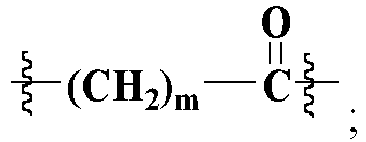









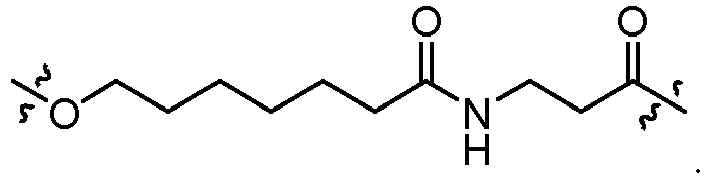





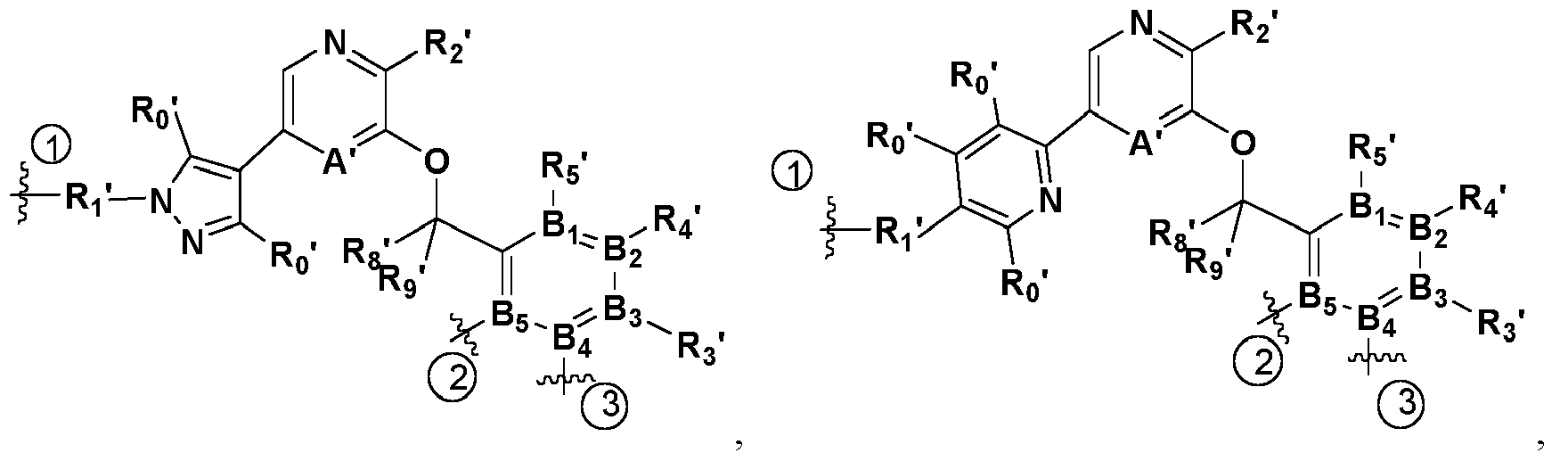


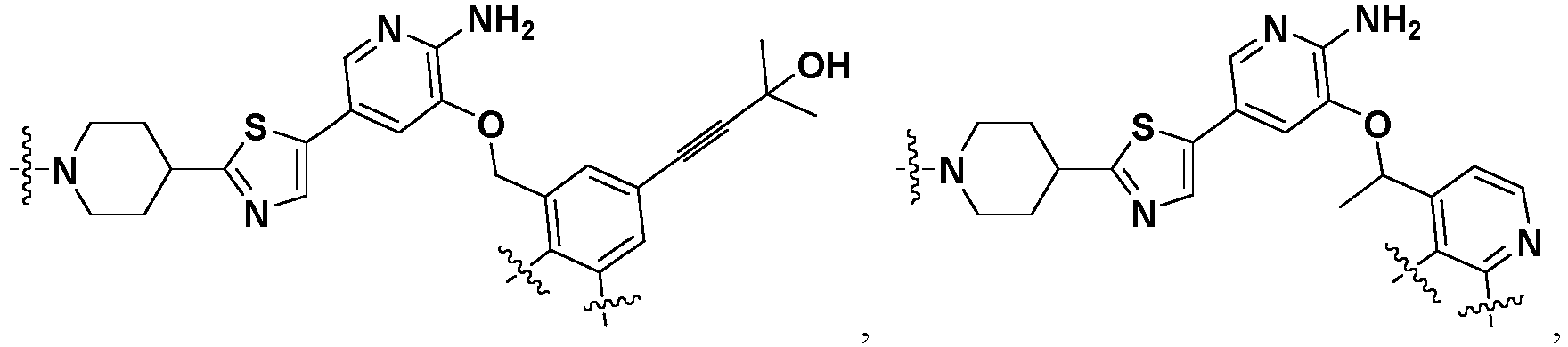


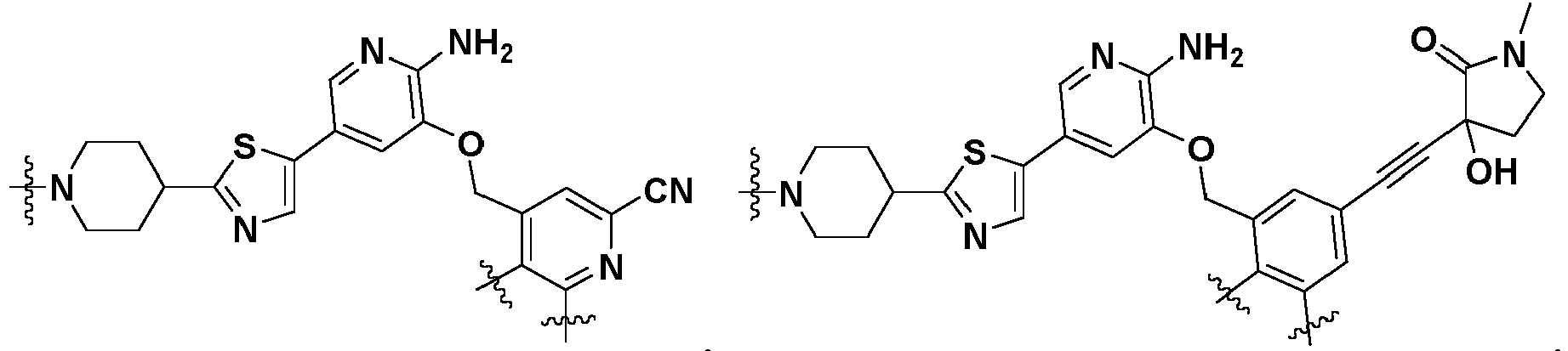


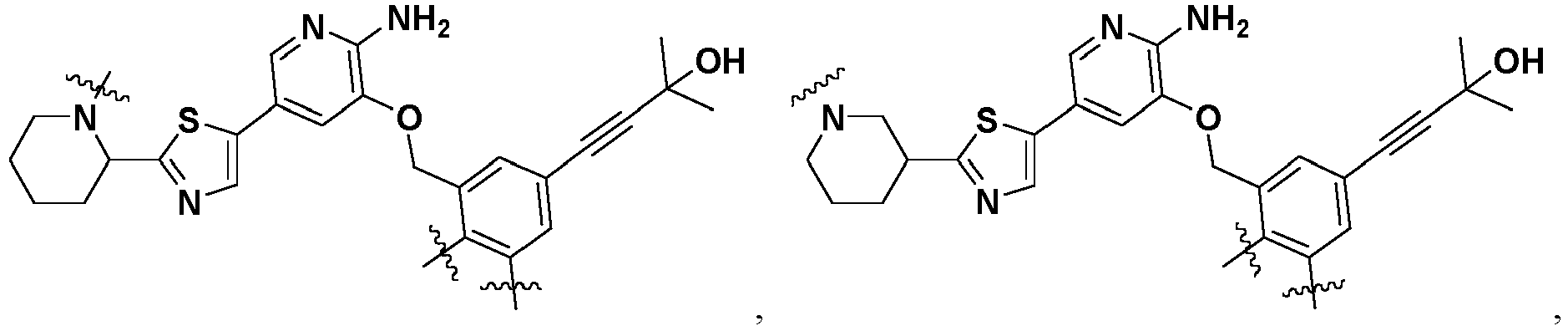


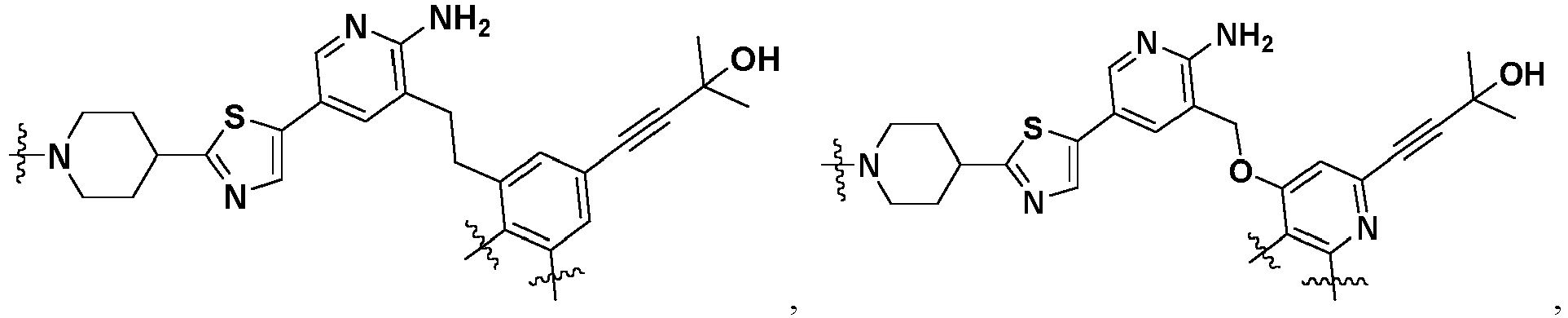


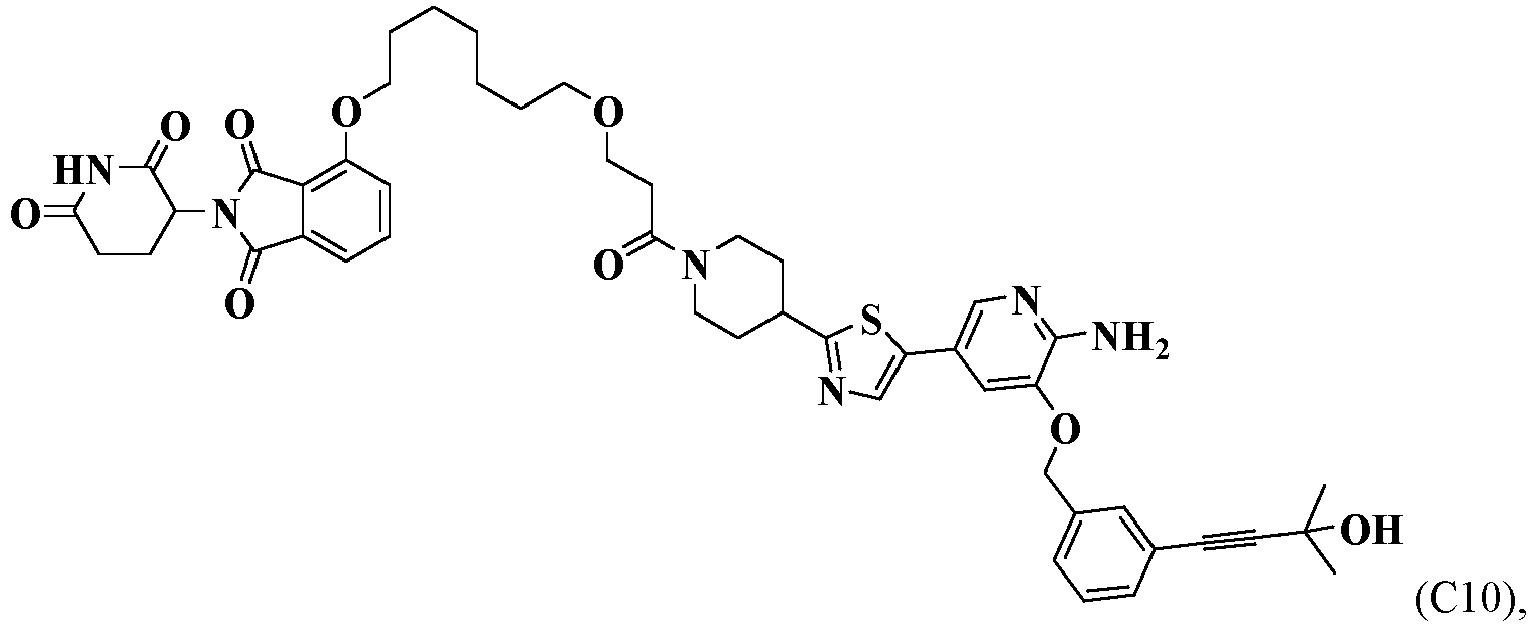


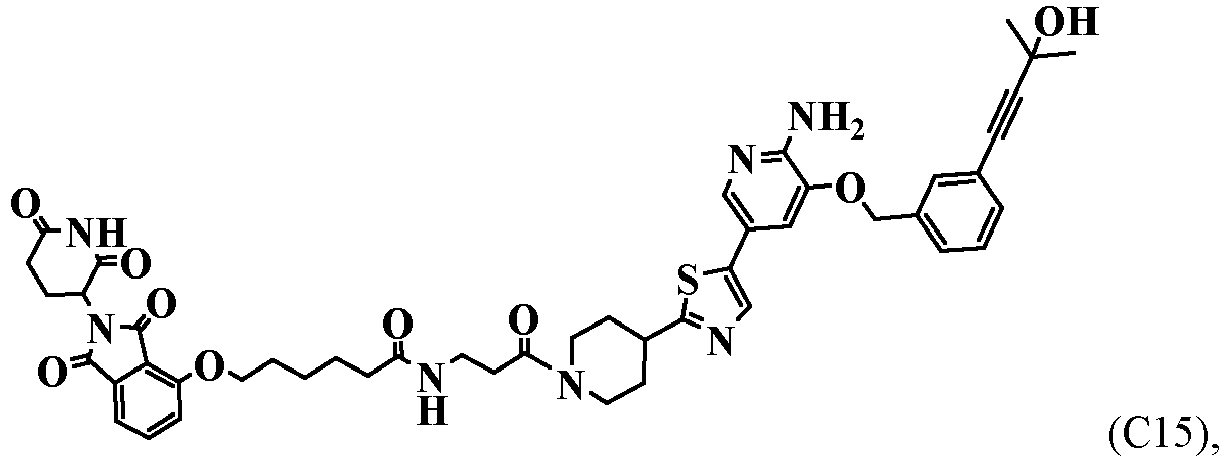






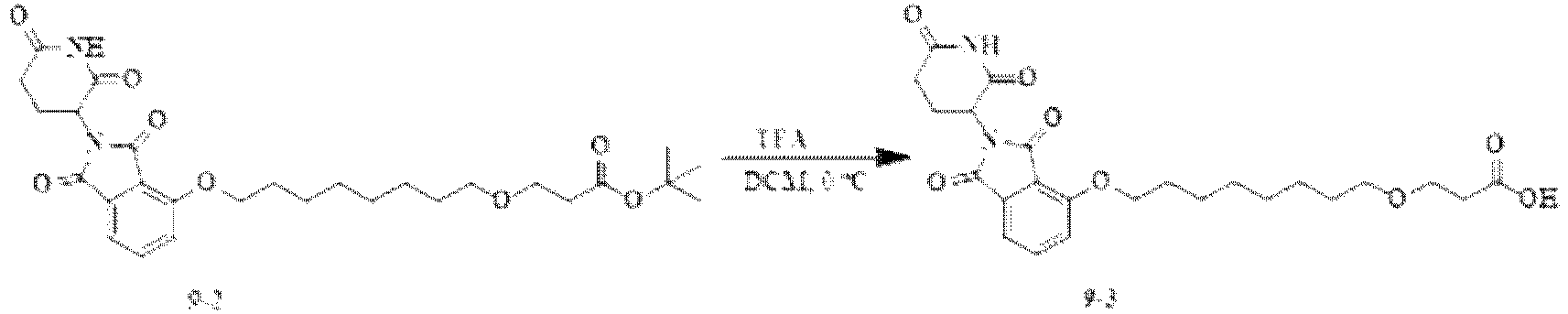





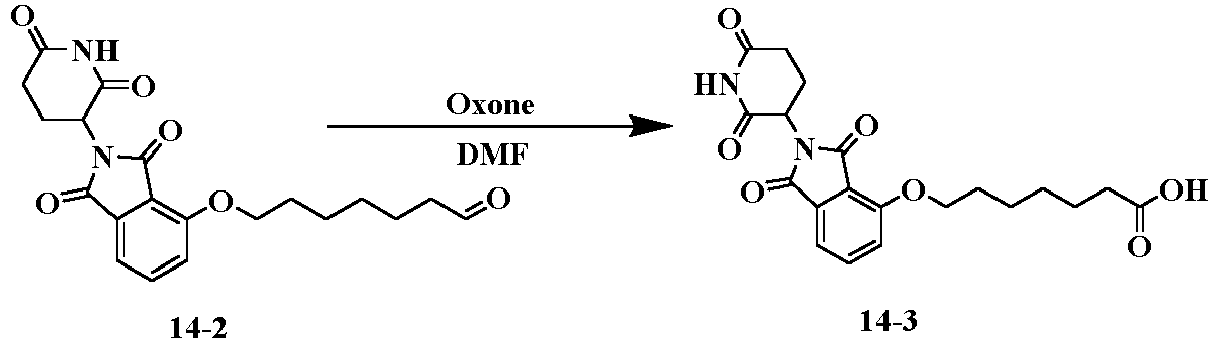





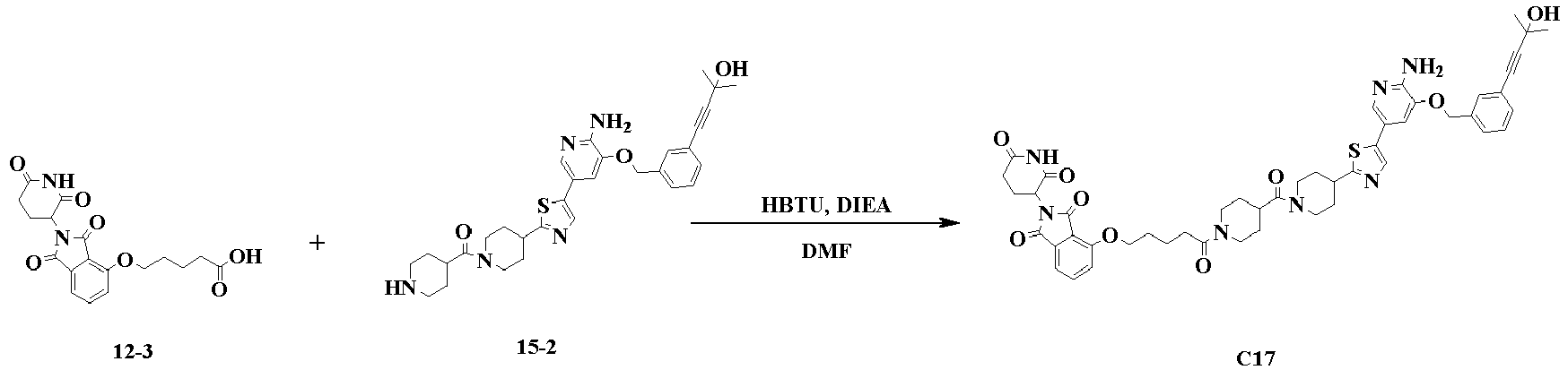


 q is selected from integers between 1 and 5;the Cereblon protein ligand is a small molecular ligand of Cereblon protein in an E3 ubiquitin ligase complex; L is a linking group between the Cereblon protein ligand and the MAP4K family inhibitor;preferably, the L is -A1-A2......-At-,wherein A1, A2......At are independently selected from:
 when A1, A2......At are CRL1RL2 or SiRL1RL2, RL1 and RL2 may be independently linked to other A to form cyclohydrocarbyl or heterocyclohydrocarbyl, and preferably, the cyclohydrocarbyl or heterocyclohydrocarbyl is optionally substituted with 1-11 RL5 groups;RL1, RL2, RL3, RL4 and RL5 are independently selected from H, halogen, C1-8 alkyl, O(C1-8 alkyl), S(C1-8 alkyl), NH(C1-8 alkyl), N(C1-8 alkyl)2, C3-11 cyclohydrocarbyl, C3-11 heterocyclohydrocarbyl, O(C1-8 cyclohydrocarbyl), S(C1-8 cyclohydrocarbyl), NH(C1-8 cyclohydrocarbyl), N(C1-8 cyclohydrocarbyl)(C1-8 alkyl), OH, NH2, SH, SO2(C1-8 alkyl), P(=O)(OC1-8 alkyl)(C1-8 alkyl), P(=O)(OC1-8 alkyl)2, C1-8 alkynyl, CH=CH(C1-8 alkyl), C(C1-8 alkyl)=CH(C1-8 alkyl), C(C1-8alkyl)=C(C1-8alkyl)2, Si(OH)3, Si(C1-8 alkyl)3, Si(OH)(C1-8 alkyl)2, C(=O)(C1-8 alkyl), CO2H, CN, CF3, CHF2, CH2F, NO2, SF5, SO2NH(C1-8 alkyl), SO2N(C1-8 alkyl)2, S(=O)N(C1-8 alkyl)2, C(=O)NH(C1-8 alkyl), C(=O)N(C1-8 alkyl)2, N(C1-8 alkyl)C(=O)NH(C1-8 alkyl), N(C1-8 alkyl)C(=O)N(C1-8 alkyl)2, NHC(=O)NH(C1-8 alkyl), NHC(=O)N(C1-8 alkyl)2, NHC(=O)NH2, N(C1-8 alkyl)SO2NH(C1-8 alkyl), N(C1-8 alkyl)SO2N(C1-8 alkyl)2, NHSO2NH(C1-8 alkyl), NHSO2N(C1-8 alkyl)2 and NHSO2NH2;X3 is selected from O, S, -NR- and -CHR-;R is selected from H and C1-3 alkyl substituted with 1 or 2 -OH;i is selected from integers between 1 and 6;Y is selected from -O-, -S- and -NR-, or is absent; andt is selected from integers between 1 and 100, and preferably, t is selected from integers between 1 and 50.


 m is selected from integers between 0 and 10, and preferably from integers between 2 and 7;X1 is selected from O, S and -NR-; andX2 is selected from O, S, -NR-, -S(O)-, -S(O)2O-, -OS(O)2- and -OS(O)2O-.





 g is selected from 0 and 1;k is selected from integers between 1 and 10, and preferably from integers between 1 and 4; andp is selected from integers between 1 and 10, and preferably from integers between 1 and 2.
 T is selected from O and S;V is selected from -O-, -S-,
 q is selected from integers between 1 and 3, such as 1, 2 or 3.
 G and Z are independently selected from H, -CH3 and -CH2CH3.








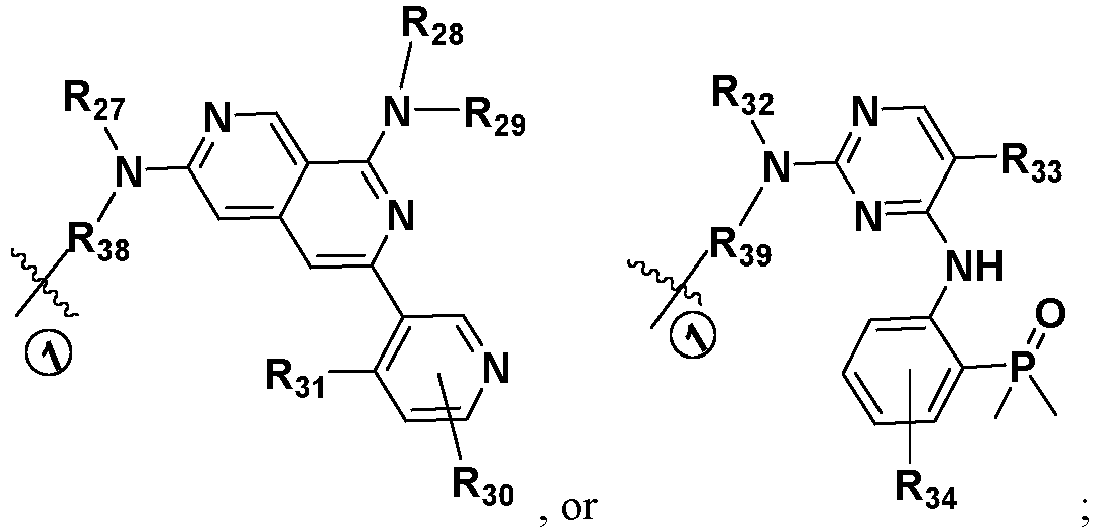 wherein R'" is selected from -H, halogen, -NO2, -CN, C1-5 linear/branched alkyl, C3-10 cyclohydrocarbyl, -N(C0-10 alkyl)(C0-10 alkyl), -CF3, -OCF3, -OCHF2, -OCH2F and -OC0-10 alkyl;A is selected from C and N; B is selected from C and N;Q is selected from O and S; x and z are independently selected from integers between 0 and 6; y is selected from 0 and 1;R0 is independently selected from: -H, C1-10 linear/branched alkyl, -N(C0-10 alkyl)(C0-10 alkyl), -OC0-10 alkyl and C3-10 cyclohydrocarbyl;R1 is selected from -O heterocycloalkyl, -N heterocycloalkyl, C1-10 linear/branched alkyl, C3-10 cycloalkyl, -OC0-10 alkyl, -N(Co-io alkyl)(Co-io alkyl), -O2(C0-10 alkyl), -O(C0-10 alkyl), -O-phenyl, -S(C0-10 alkyl), -N heterocycloaryl, -O heterocycloaryl and -S heterocycloaryl, wherein H on a C atom or heteroatom may be substituted with C1-3 linear alkyl, -N(C0-10 alkyl)(C0-10 alkyl) and -CF3;R2 is selected from: -H, halogen, -NO2, -CN, C1-5 linear/branched alkyl, C3-10 cyclohydrocarbyl, -N(C0-10 alkyl)(C0-10 alkyl), -CF3, -OCF3, -OCHF2, -OCH2F and -OC0-10 alkyl;when B is N, R3 is absent; when B is C, R3 is selected from: -H, halogen, -OC0-10 alkyl, C1-10 linear/branched alkyl, -N(C0-10 alkyl)(C0-10 alkyl) and C3-10 cyclohydrocarbyl;R4 is selected from: -H, halogen, -OC0-10 alkyl, -CN, C3-10 cyclohydrocarbyl, -C=C-R10. C1-10 linear/branched alkyl, -N(C0-10 alkyl)(C0-10 alkyl), -O heterocyclohydrocarbyl and -N heterocyclohydrocarbyl;R10 is selected from: H, C1-5 linear/branched alkyl, C3-10 cyclohydrocarbyl and
 R11 and R12 are independently selected from: -H, -CF3, -CHF2H, -CH2F, C1-10 linear/branched alkyl, -CH=C(C0-10 alkyl)(C0-10 alkyl), -C≡C(C0-10 alkyl), C3-10 cyclohydrocarbyl, an aromatic five-membered cyclic group and an aromatic six-membered cyclic group, or R11 and R12, together with carbon atoms between R11 and R12, form C3-8 cyclohydrocarbyl or C3-8 heterocyclohydrocarbyl containing -O or -S, C9 fused cyclohydrocarbyl, C3-7 cyclolactam, C3-7 cyclic lactone, or C3-7 cyclic ketone, wherein H on a C atom may be substituted with alkyl or halogen;R5 is selected from: -H, halogen, -CN, -OC0-10 alkyl, C1-10 linear/branched alkyl, heteroalkyl containing O and N, -N(Co-io alkyl)(C0-10 alkyl), C3-10 cyclohydrocarbyl, -C≡C-R10, -O heterocyclohydrocarbyl and -N heterocyclohydrocarbyl, wherein H attached to a C atom may be substituted with the following groups: -SO2, -SO2N(C0-10 alkyl)(C0-10 alkyl), -N(C0-10 alkyl)SO2(C0-10 alkyl), -CON(C0-10 alkyl)(C0-10 alkyl), -N(C0-10 alkyl)CO(C0-10 alkyl), -N(C0-10 alkyl)COO(C0-10 alkyl), -OCON(C0-10 alkyl)(C0-10 alkyl), halogen, -CN, -OCH2F, -OCHF2, -OCF3, C1-10 linear/branched alkyl, -N(C0-10 alkyl)(C0-10 alkyl), -OC0-10 alkyl, C3-10 cyclohydrocarbyl, -O heterocycloalkyl, -N heterocycloalkyl, -N heterocycloaryl, -O heterocycloaryl and -S heterocycloaryl;F8 and R9 are independently selected from: -H, halogen and C1-10 linear/branched alkyl;A' is selected from C and N; B1, B2, B3, B4 or B5 is independently selected from C and N;Q' is selected from O and S; x' and z' are independently selected from integers between 0 and 6; y' is selected from 0 and 1;R0' is independently selected from: -H, C1-10 linear/branched alkyl, -N(C0-10 alkyl)(C0-10 alkyl), -OC0-10 alkyl and C3-10 cyclohydrocarbyl;R1' is selected from: -O heterocycloalkyl, -N heterocycloalkyl, C1-10 linear/branched alkyl, C3-10 cyclohydrocarbyl, -OC0-10 alkyl, -N(C0-10 alkyl)(C0-10 alkyl), -SO2(C0-10 alkyl), -O(C0-10 alkyl), -O-phenyl, -S(Co-io alkyl), -N heterocycloaryl, -O heterocycloaryl and -S heterocycloaryl, wherein H attached to a C atom or heteroatom may be substituted with C1-3 linear alkyl, -N(C0-10 alkyl)(C0-10 alkyl) or -CF3;R2' is selected from: -H, halogen, -NO2, -CN, C1-5 linear/branched alkyl, C3-10 cyclohydrocarbyl, -N(C0-10 alkyl)(C0-10 alkyl), -CF3, -OCF3, -OCHF2, -OCH2F and -OC0-10 alkyl;when B1, B2, B3, B4 or B5 is N, the corresponding R3', R4' and R5' is absent; when B1, B2, B3, B4 or B5 is C, R3', R4' and R5' are independently selected from: -H, halogen, -CN, -OC0-10 alkyl, C1-10 linear/branched alkyl, heteroalkyl containing O and N, -N(C0-10 alkyl)(C0-10 alkyl), C3-10 cyclohydrocarbyl, -C≡C-R10'. -O heterocyclohydrocarbyl and -N heterocyclohydrocarbyl, or R5' and R4', or R4' and R3', together with carbon atoms therebetween, form C3-8 cyclohydrocarbyl or C3-8 heterocycloalkyl containing -O- and -S-, -N heterocycloaryl, -O heterocycloaryl or -S heterocycloaryl, or phenyl, wherein H attached to a C atom may be substituted with the following groups: -SO2, -SO2N(C0-10 alkyl)(C0-10 alkyl), -N(C0-10 alkyl)SO2(C0-10 alkyl), -CON(C0-10 alkyl)(C0-10 alkyl), -N(C0-10 alkyl)CO(C0-10 alkyl), -N(C0-10 alkyl)COO(C0-10 alkyl), -OCON(C0-10 alkyl)(C0-10 alkyl), halogen, -CN, -OCH2F, -OCHF2, -OCF3, C1-10 linear/branched alkyl, -N(C0-10 alkyl)(C0-10 alkyl), -OC0-10 alkyl, C3-10 cyclohydrocarbyl, -O heterocycloalkyl, -N heterocycloalkyl, -N heterocycloaryl, -O heterocycloaryl and -S heterocycloaryl;R5' and R9' are independently selected from: -H, halogen and C1-10 linear/branched alkyl; R35, R36, R38 and R39 are selected from C1-10 linear/branched alkyl, -CON(C0-10 alkyl)-, - CO(C0-10 alkyl)-, C3-10 cyclohydrocarbyl, -O heterocycloalkyl, -N heterocycloalkyl, phenyl, -N heterocycloaryl and -O heterocycloaryl, and R37, together with an N atom attached thereto and a C atom adjacent to the N atom, forms 5-8 membered cyclolactam; and R13-R34 are independently selected from: -H, halogen, -CN, -OC0-10 alkyl, C1-10 linear/branched alkyl, -N(C0-10 alkyl)(C0-10 alkyl), C3-10 cyclohydrocarbyl, -O heterocycloalkyl, -N heterocycloalkyl, -S heterocycloalkyl, phenyl, -N heterocycloaryl, -O heterocycloaryl and -S heterocycloaryl.


 R3 is selected from: -H, -F and -OCH3;R4 is selected from: -H, -F, -Cl, -OCH3, -CN,
 R11 and R12 are independently selected from: -H, -CF3, -CHF2, -CH2F, -CH3, -CH2CH3, -CH=CH2,
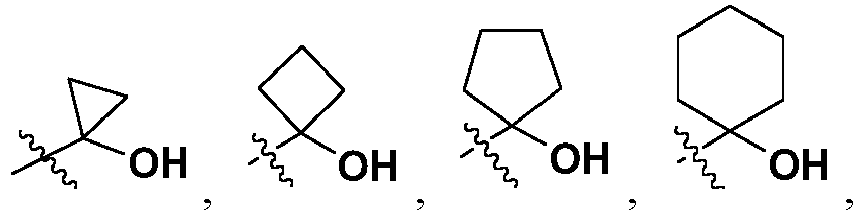

 -H, -F, -Cl, -CH3, -CH2NH2, -CN and -OCH3; andR8 and R9 are independently selected from: -H and -CH3.

 R0' is independently selected from: C1-5 linear/branched alkyl and -N(C0-10 alkyl)(C0-10 alkyl);R1' is selected from: -O heterocycloalkyl and -N heterocycloalkyl, -SO2(C0-3 alkyl), -O-phenyl, -S(C0-4 alkyl), C3-6 cycloalkyl and C3-5 linear/branched alkyl, wherein H attached to a C atom or heteroatom may be substituted with -CH3, -NH2 or -CF3;R2' is selected from: -NO2, -N(C0-10 alkyl)(C0-10 alkyl), -OC0-10 alkyl and -OCF3;R3' is selected from: -H, halogen, -OC0-10 alkyl, C1-10 linear/branched alkyl, -N(C0-10 alkyl)(C0-10 alkyl) and C3-10 cycloalkyl;R4' is selected from: -H, halogen, -OC0-10 alkyl, -CN, C3-10 cycloalkyl, -C≡C-R10'. C1-10 linear/branched alkyl, -N(C0-10 alkyl)(C0-10 alkyl), -O heterocycloalkyl and -N heterocycloalkyl;R5' is independently selected from: -H, halogen, -CN, -OC0-10 alkyl, C1-10 linear/branched alkyl, -N(C0-10 alkyl)(C0-10 alkyl), C3-10 cycloalkyl, -C≡C-R10', -O heterocycloalkyl and -N heterocycloalkyl, and C1-5 linear/branched alkyl containing O and N, wherein H attached to a C atom may be substituted with -F;R10' is selected from: H, C1-5 linear/branched alkyl, C3-10 cycloalkyl and
 R11' and R12' are independently selected from: -H, -CF3, -CHF2H, -CH2F, C1-10 linear/branched alkyl, -CH=C(C0-10 alkyl)(Co-io alkyl), -C≡C(C0-10 alkyl), C3-10 cycloalkyl, an aromatic five-membered cyclic group and an aromatic six-membered cyclic group, or R11' and R12', together with carbon atoms between R11' and R12', form C3-8 cycloalkyl or C3-8 heterocycloalkyl containing -O and -S, C4-9 fused cycloalkyl, C5-10 spiro cycloalkyl, C4-9 bridged cycloalkyl, C3-7 cyclolactam, C3-7 cyclic lactone, or C3-7 cyclic ketone, wherein H attached to a C atom may be substituted with the following groups: -SO2, -SO2N(C0-10 alkyl)(C0-10 alkyl), -N(C0-10 alkyl)SO2(C0-10 alkyl), -CON(C0-10 alkyl)(C0-10 alkyl), -N(C0-10 alkyl)CO(C0-10 alkyl), -N(C0-10 alkyl)COO(C0-10 alkyl), -OCON(C0-10 alkyl)(C0-10 alkyl), halogen, -CN, -OCH2F, -OCHF2, -OCF3, C1-10 linear/branched alkyl, -N(C0-10 alkyl)(C0-10 alkyl), -OC0-10 alkyl, C3-10 cycloalkyl, -O heterocycloalkyl, -N heterocycloalkyl, -N heterocycloaryl, -O heterocycloaryl and -S heterocycloaryl, wherein the alkyl moieties may be optionally substituted with one or more of the following groups: -SO2, -SO2N(C0-10 alkyl)(Co-io alkyl), -N(C0-10 alkyl)SO2(C0-10 alkyl), -CON(C0-10 alkyl)(C0-10 alkyl), -N(C0-10 alkyl)CO(C0-10 alkyl), -N(C0-10 alkyl)COO(C0-10 alkyl), -OCON(C0-10 alkyl)(C0-10 alkyl), halogen, -CN, -OCH2F, -OCHF2, -OCF3, -N(C0-10 alkyl)(C0-10 alkyl), -OC0-10 alkyl, -N heterocycloaryl, -O heterocycloaryl and -S heterocycloaryl; andR5' and R9' are independently selected from: -H and C1-10 linear/branched alkyl.
 R3' is selected from: -H, halogen, -OC0-10 alkyl and C1-10 linear/branched alkyl;R4' is selected from: -H, -F, -Cl, -OCH3, -CN,
 and -C≡C-R10';R5' is selected from: -H, -F, -Cl, -CH3, -CH2NH2, -CN and -OCH3;R11' and R12' are independently selected from: -H, -CF3, -CHF2, -CH2F, -CH3, -CH2CH3, -CH=CH2,


 R8' and R9' are independently selected from: -H and -CH3.