EP4035772A1 - Catalyst for alkylene oxide addition reaction and application thereof - Google Patents
Catalyst for alkylene oxide addition reaction and application thereof Download PDFInfo
- Publication number
- EP4035772A1 EP4035772A1 EP20869127.9A EP20869127A EP4035772A1 EP 4035772 A1 EP4035772 A1 EP 4035772A1 EP 20869127 A EP20869127 A EP 20869127A EP 4035772 A1 EP4035772 A1 EP 4035772A1
- Authority
- EP
- European Patent Office
- Prior art keywords
- cation
- catalyst
- hours
- reaction
- ion
- Prior art date
- Legal status (The legal status is an assumption and is not a legal conclusion. Google has not performed a legal analysis and makes no representation as to the accuracy of the status listed.)
- Pending
Links
Images
Classifications
-
- B—PERFORMING OPERATIONS; TRANSPORTING
- B01—PHYSICAL OR CHEMICAL PROCESSES OR APPARATUS IN GENERAL
- B01J—CHEMICAL OR PHYSICAL PROCESSES, e.g. CATALYSIS OR COLLOID CHEMISTRY; THEIR RELEVANT APPARATUS
- B01J31/00—Catalysts comprising hydrides, coordination complexes or organic compounds
- B01J31/02—Catalysts comprising hydrides, coordination complexes or organic compounds containing organic compounds or metal hydrides
- B01J31/06—Catalysts comprising hydrides, coordination complexes or organic compounds containing organic compounds or metal hydrides containing polymers
- B01J31/08—Ion-exchange resins
-
- C—CHEMISTRY; METALLURGY
- C08—ORGANIC MACROMOLECULAR COMPOUNDS; THEIR PREPARATION OR CHEMICAL WORKING-UP; COMPOSITIONS BASED THEREON
- C08F—MACROMOLECULAR COMPOUNDS OBTAINED BY REACTIONS ONLY INVOLVING CARBON-TO-CARBON UNSATURATED BONDS
- C08F212/00—Copolymers of compounds having one or more unsaturated aliphatic radicals, each having only one carbon-to-carbon double bond, and at least one being terminated by an aromatic carbocyclic ring
- C08F212/02—Monomers containing only one unsaturated aliphatic radical
- C08F212/04—Monomers containing only one unsaturated aliphatic radical containing one ring
- C08F212/06—Hydrocarbons
- C08F212/08—Styrene
-
- B—PERFORMING OPERATIONS; TRANSPORTING
- B01—PHYSICAL OR CHEMICAL PROCESSES OR APPARATUS IN GENERAL
- B01J—CHEMICAL OR PHYSICAL PROCESSES, e.g. CATALYSIS OR COLLOID CHEMISTRY; THEIR RELEVANT APPARATUS
- B01J31/00—Catalysts comprising hydrides, coordination complexes or organic compounds
- B01J31/02—Catalysts comprising hydrides, coordination complexes or organic compounds containing organic compounds or metal hydrides
- B01J31/0277—Catalysts comprising hydrides, coordination complexes or organic compounds containing organic compounds or metal hydrides comprising ionic liquids, as components in catalyst systems or catalysts per se, the ionic liquid compounds being used in the molten state at the respective reaction temperature
- B01J31/0278—Catalysts comprising hydrides, coordination complexes or organic compounds containing organic compounds or metal hydrides comprising ionic liquids, as components in catalyst systems or catalysts per se, the ionic liquid compounds being used in the molten state at the respective reaction temperature containing nitrogen as cationic centre
- B01J31/0281—Catalysts comprising hydrides, coordination complexes or organic compounds containing organic compounds or metal hydrides comprising ionic liquids, as components in catalyst systems or catalysts per se, the ionic liquid compounds being used in the molten state at the respective reaction temperature containing nitrogen as cationic centre the nitrogen being a ring member
- B01J31/0284—Catalysts comprising hydrides, coordination complexes or organic compounds containing organic compounds or metal hydrides comprising ionic liquids, as components in catalyst systems or catalysts per se, the ionic liquid compounds being used in the molten state at the respective reaction temperature containing nitrogen as cationic centre the nitrogen being a ring member of an aromatic ring, e.g. pyridinium
-
- B—PERFORMING OPERATIONS; TRANSPORTING
- B01—PHYSICAL OR CHEMICAL PROCESSES OR APPARATUS IN GENERAL
- B01J—CHEMICAL OR PHYSICAL PROCESSES, e.g. CATALYSIS OR COLLOID CHEMISTRY; THEIR RELEVANT APPARATUS
- B01J31/00—Catalysts comprising hydrides, coordination complexes or organic compounds
- B01J31/02—Catalysts comprising hydrides, coordination complexes or organic compounds containing organic compounds or metal hydrides
- B01J31/0277—Catalysts comprising hydrides, coordination complexes or organic compounds containing organic compounds or metal hydrides comprising ionic liquids, as components in catalyst systems or catalysts per se, the ionic liquid compounds being used in the molten state at the respective reaction temperature
- B01J31/0292—Catalysts comprising hydrides, coordination complexes or organic compounds containing organic compounds or metal hydrides comprising ionic liquids, as components in catalyst systems or catalysts per se, the ionic liquid compounds being used in the molten state at the respective reaction temperature immobilised on a substrate
- B01J31/0295—Catalysts comprising hydrides, coordination complexes or organic compounds containing organic compounds or metal hydrides comprising ionic liquids, as components in catalyst systems or catalysts per se, the ionic liquid compounds being used in the molten state at the respective reaction temperature immobilised on a substrate by covalent attachment to the substrate, e.g. silica
-
- B—PERFORMING OPERATIONS; TRANSPORTING
- B01—PHYSICAL OR CHEMICAL PROCESSES OR APPARATUS IN GENERAL
- B01J—CHEMICAL OR PHYSICAL PROCESSES, e.g. CATALYSIS OR COLLOID CHEMISTRY; THEIR RELEVANT APPARATUS
- B01J31/00—Catalysts comprising hydrides, coordination complexes or organic compounds
- B01J31/02—Catalysts comprising hydrides, coordination complexes or organic compounds containing organic compounds or metal hydrides
- B01J31/12—Catalysts comprising hydrides, coordination complexes or organic compounds containing organic compounds or metal hydrides containing organo-metallic compounds or metal hydrides
- B01J31/123—Organometallic polymers, e.g. comprising C-Si bonds in the main chain or in subunits grafted to the main chain
- B01J31/124—Silicones or siloxanes or comprising such units
- B01J31/127—Silicones or siloxanes or comprising such units the siloxane units, e.g. silsesquioxane units, being grafted onto other polymers or inorganic supports, e.g. via an organic linker
-
- B—PERFORMING OPERATIONS; TRANSPORTING
- B01—PHYSICAL OR CHEMICAL PROCESSES OR APPARATUS IN GENERAL
- B01J—CHEMICAL OR PHYSICAL PROCESSES, e.g. CATALYSIS OR COLLOID CHEMISTRY; THEIR RELEVANT APPARATUS
- B01J31/00—Catalysts comprising hydrides, coordination complexes or organic compounds
- B01J31/16—Catalysts comprising hydrides, coordination complexes or organic compounds containing coordination complexes
- B01J31/18—Catalysts comprising hydrides, coordination complexes or organic compounds containing coordination complexes containing nitrogen, phosphorus, arsenic or antimony as complexing atoms, e.g. in pyridine ligands, or in resonance therewith, e.g. in isocyanide ligands C=N-R or as complexed central atoms
-
- B—PERFORMING OPERATIONS; TRANSPORTING
- B01—PHYSICAL OR CHEMICAL PROCESSES OR APPARATUS IN GENERAL
- B01J—CHEMICAL OR PHYSICAL PROCESSES, e.g. CATALYSIS OR COLLOID CHEMISTRY; THEIR RELEVANT APPARATUS
- B01J37/00—Processes, in general, for preparing catalysts; Processes, in general, for activation of catalysts
- B01J37/30—Ion-exchange
-
- C—CHEMISTRY; METALLURGY
- C07—ORGANIC CHEMISTRY
- C07D—HETEROCYCLIC COMPOUNDS
- C07D317/00—Heterocyclic compounds containing five-membered rings having two oxygen atoms as the only ring hetero atoms
- C07D317/08—Heterocyclic compounds containing five-membered rings having two oxygen atoms as the only ring hetero atoms having the hetero atoms in positions 1 and 3
- C07D317/10—Heterocyclic compounds containing five-membered rings having two oxygen atoms as the only ring hetero atoms having the hetero atoms in positions 1 and 3 not condensed with other rings
- C07D317/32—Heterocyclic compounds containing five-membered rings having two oxygen atoms as the only ring hetero atoms having the hetero atoms in positions 1 and 3 not condensed with other rings with hetero atoms or with carbon atoms having three bonds to hetero atoms with at the most one bond to halogen, e.g. ester or nitrile radicals, directly attached to ring carbon atoms
- C07D317/34—Oxygen atoms
- C07D317/36—Alkylene carbonates; Substituted alkylene carbonates
-
- C—CHEMISTRY; METALLURGY
- C07—ORGANIC CHEMISTRY
- C07D—HETEROCYCLIC COMPOUNDS
- C07D317/00—Heterocyclic compounds containing five-membered rings having two oxygen atoms as the only ring hetero atoms
- C07D317/08—Heterocyclic compounds containing five-membered rings having two oxygen atoms as the only ring hetero atoms having the hetero atoms in positions 1 and 3
- C07D317/10—Heterocyclic compounds containing five-membered rings having two oxygen atoms as the only ring hetero atoms having the hetero atoms in positions 1 and 3 not condensed with other rings
- C07D317/32—Heterocyclic compounds containing five-membered rings having two oxygen atoms as the only ring hetero atoms having the hetero atoms in positions 1 and 3 not condensed with other rings with hetero atoms or with carbon atoms having three bonds to hetero atoms with at the most one bond to halogen, e.g. ester or nitrile radicals, directly attached to ring carbon atoms
- C07D317/34—Oxygen atoms
- C07D317/36—Alkylene carbonates; Substituted alkylene carbonates
- C07D317/38—Ethylene carbonate
-
- C—CHEMISTRY; METALLURGY
- C08—ORGANIC MACROMOLECULAR COMPOUNDS; THEIR PREPARATION OR CHEMICAL WORKING-UP; COMPOSITIONS BASED THEREON
- C08F—MACROMOLECULAR COMPOUNDS OBTAINED BY REACTIONS ONLY INVOLVING CARBON-TO-CARBON UNSATURATED BONDS
- C08F212/00—Copolymers of compounds having one or more unsaturated aliphatic radicals, each having only one carbon-to-carbon double bond, and at least one being terminated by an aromatic carbocyclic ring
- C08F212/34—Monomers containing two or more unsaturated aliphatic radicals
- C08F212/36—Divinylbenzene
-
- C—CHEMISTRY; METALLURGY
- C08—ORGANIC MACROMOLECULAR COMPOUNDS; THEIR PREPARATION OR CHEMICAL WORKING-UP; COMPOSITIONS BASED THEREON
- C08F—MACROMOLECULAR COMPOUNDS OBTAINED BY REACTIONS ONLY INVOLVING CARBON-TO-CARBON UNSATURATED BONDS
- C08F283/00—Macromolecular compounds obtained by polymerising monomers on to polymers provided for in subclass C08G
- C08F283/12—Macromolecular compounds obtained by polymerising monomers on to polymers provided for in subclass C08G on to polysiloxanes
- C08F283/124—Macromolecular compounds obtained by polymerising monomers on to polymers provided for in subclass C08G on to polysiloxanes on to polysiloxanes having carbon-to-carbon double bonds
-
- C—CHEMISTRY; METALLURGY
- C08—ORGANIC MACROMOLECULAR COMPOUNDS; THEIR PREPARATION OR CHEMICAL WORKING-UP; COMPOSITIONS BASED THEREON
- C08F—MACROMOLECULAR COMPOUNDS OBTAINED BY REACTIONS ONLY INVOLVING CARBON-TO-CARBON UNSATURATED BONDS
- C08F8/00—Chemical modification by after-treatment
- C08F8/18—Introducing halogen atoms or halogen-containing groups
- C08F8/24—Haloalkylation
-
- C—CHEMISTRY; METALLURGY
- C08—ORGANIC MACROMOLECULAR COMPOUNDS; THEIR PREPARATION OR CHEMICAL WORKING-UP; COMPOSITIONS BASED THEREON
- C08F—MACROMOLECULAR COMPOUNDS OBTAINED BY REACTIONS ONLY INVOLVING CARBON-TO-CARBON UNSATURATED BONDS
- C08F8/00—Chemical modification by after-treatment
- C08F8/30—Introducing nitrogen atoms or nitrogen-containing groups
-
- C—CHEMISTRY; METALLURGY
- C08—ORGANIC MACROMOLECULAR COMPOUNDS; THEIR PREPARATION OR CHEMICAL WORKING-UP; COMPOSITIONS BASED THEREON
- C08F—MACROMOLECULAR COMPOUNDS OBTAINED BY REACTIONS ONLY INVOLVING CARBON-TO-CARBON UNSATURATED BONDS
- C08F8/00—Chemical modification by after-treatment
- C08F8/44—Preparation of metal salts or ammonium salts
-
- B—PERFORMING OPERATIONS; TRANSPORTING
- B01—PHYSICAL OR CHEMICAL PROCESSES OR APPARATUS IN GENERAL
- B01J—CHEMICAL OR PHYSICAL PROCESSES, e.g. CATALYSIS OR COLLOID CHEMISTRY; THEIR RELEVANT APPARATUS
- B01J2231/00—Catalytic reactions performed with catalysts classified in B01J31/00
- B01J2231/30—Addition reactions at carbon centres, i.e. to either C-C or C-X multiple bonds
- B01J2231/34—Other additions, e.g. Monsanto-type carbonylations, addition to 1,2-C=X or 1,2-C-X triplebonds, additions to 1,4-C=C-C=X or 1,4-C=-C-X triple bonds with X, e.g. O, S, NH/N
-
- B—PERFORMING OPERATIONS; TRANSPORTING
- B01—PHYSICAL OR CHEMICAL PROCESSES OR APPARATUS IN GENERAL
- B01J—CHEMICAL OR PHYSICAL PROCESSES, e.g. CATALYSIS OR COLLOID CHEMISTRY; THEIR RELEVANT APPARATUS
- B01J2231/00—Catalytic reactions performed with catalysts classified in B01J31/00
- B01J2231/30—Addition reactions at carbon centres, i.e. to either C-C or C-X multiple bonds
- B01J2231/34—Other additions, e.g. Monsanto-type carbonylations, addition to 1,2-C=X or 1,2-C-X triplebonds, additions to 1,4-C=C-C=X or 1,4-C=-C-X triple bonds with X, e.g. O, S, NH/N
- B01J2231/341—1,2-additions, e.g. aldol or Knoevenagel condensations
-
- B—PERFORMING OPERATIONS; TRANSPORTING
- B82—NANOTECHNOLOGY
- B82Y—SPECIFIC USES OR APPLICATIONS OF NANOSTRUCTURES; MEASUREMENT OR ANALYSIS OF NANOSTRUCTURES; MANUFACTURE OR TREATMENT OF NANOSTRUCTURES
- B82Y30/00—Nanotechnology for materials or surface science, e.g. nanocomposites
Definitions
- the present invention relates to a catalyst for addition reaction of alkylene oxide and use thereof, in particular to a nanocomposite ion-exchange resin catalyst.
- Alkylene carbonates such as ethylene carbonate and propylene carbonate are excellent solvents and fine chemical intermediates with a wide range of uses.
- ethylene carbonate is widely used as solvent in textile, printing, polymer synthesis, and electrochemistry. It can also be used as raw materials of cosmetics and drugs and an intermediate of the corresponding diol.
- ethylene carbonate has been used in the production of lithium battery electrolyte and dimethyl carbonate, and the use of aliphatic polycarbonate and its various copolymers as biodegradable materials has attracted much attention to its industrial production.
- the traditional production method of ethylene carbonate is the phosgene method.
- Phosgene has high toxicity and serious pollution, and the process has the disadvantages of long process flow, low yield, high cost, and the like.
- Using carbon dioxide and ethylene oxide as raw materials to directly prepare ethylene carbonate under the action of the corresponding catalyst is a new way of green environmental protection.
- the process can directly use carbon dioxide, a greenhouse gas, to alleviate the problem of carbon dioxide emissions.
- catalyst systems that can be used for addition reaction of carbon dioxide and epoxy compounds include catalytic systems such as quaternary ammonium salts, quaternary phosphonium salts, transition metal complexes, main group element complexes and alkali metal salts, ionic liquids, and supercritical carbon dioxide.
- heterogeneous catalysts are beneficial to the subsequent separation of products and catalysts, and the catalysts can be easily regenerated and reused many times.
- molecular sieves, silica gels, ion-exchange resins, polyethylene glycol, poly(4-vinylpyridine), chitosan, and the like are commonly used.
- Xiao et al. (Appl. Catal. A 279 (2005) 125-129 ) reported the supported zinc halide catalyst, and the support was poly(4-vinylpyridine) or chitosan. In this system, 1-butyl-3-methylimidazolium bromide must also be homogeneously used as co-catalyst, and the catalytic activity dropped significantly after being recycled.
- Van Kruvier et al. reported in CN 10151181 0A a zinc halide catalyst supported on a solid support, where the support was a quaternary-phosphonium or quaternary-ammonium ion-exchange resin, and the activity of the catalytic system decreased rapidly after being recycled.
- the heterogeneous catalytic system has many advantages, however the wear resistance, the swelling resistance, and the activity of the catalyst still need to be further improved. It is very important to develop a catalytic system with high activity and easy separation.
- the catalyst comprises a nanocomposite ion-exchange resin having a structural formula of P-Im + -M - , wherein P is a nanocomposite resin matrix, Im + is a cation derived from 5-6 membered heterocycle containing at least one nitrogen atom such as imidazolium cation, pyrazolium cation, pyrrolidinium cation, piperidinium cation, piperazinium cation, pyrimidinium cation, pyrazinium cation, pyridazinium cation, triazinium cation (for example a cation derived from 5-6 membered heteroarene containing at least one nitrogen atom, such as imidazolium cation, pyrazolium cation, pyrimidinium cation, pyrazinium cation, azinium cation,
- the catalyst comprises a nanocomposite ion-exchange resin having a structural formula of P-Im + -M - , wherein P is a nanocomposite resin matrix, Im + is a cation derived from 5-6 membered heterocycle containing at least one nitrogen atom such as imidazolium cation, pyrazolium cation, pyrrolidinium cation, piperidinium cation, piperazinium cation, pyrimidinium cation, pyrazinium cation, pyridazinium cation, triazinium cation (for example a cation derived from 5-6 membered heteroarene containing at least one nitrogen atom, such as imidazolium cation, pyrazolium cation, pyrimidinium cation, pyrazinium cation, pyridazinium cation, triazinium cation), M - is
- the nanocomposite resin matrix comprises a structure fragment represented by formula I and a structure fragment of-CH(POSS)-CH 2 -,
- R 1 -R 8 are identical to or different from each other, and each independently selected from hydrogen and C 1 -C 6 alkyl, preferably selected from hydrogen, methyl, ethyl, propyl, and butyl;
- POSS is a polyhedral oligomeric silsesquioxane, which has a general formula of (-SIO 1.5 ) m , and m is 6, 8, 10, or 12.
- the catalyst comprises the following structure:
- R 1 -R 3 are identical to or different from each other, and each independently selected from hydrogen and C 1 -C 6 alkyl;
- R 4 -R 8 are each independently selected from hydrogen, C 1 -C 6 alkyl, and CH 2 Im + -M - , and at least one of R 4 -R 8 is CH 2 Im + -M - , preferably, R 4 -R 8 are each independently selected from hydrogen and CH 2 Im + -M - , and at least one of R 4 -R 8 is CH 2 Im + -M - .
- the catalyst comprises a structure fragment of-CH-(Ph-CH 2 -Im + -M - )-CH 2 -.
- said M - is one or more of halide ions and organic acid radical ions.
- said M - is one or more of a fluoride ion, a chloride ion, a bromide ion, an iodide ion, an acetate group, a formate group, and a bioxalate group.
- the mass content of POSS in the nanocomposite resin matrix P is 0.1-10%, for example 0.1%, 0.2%, 0.5%, 1.0%, 1.2%, 1.5%, 2.0%, 2.5%, 3.0%, 3.5%, 4.0%, 4.3%, 4.5%, 5.0%, 5.5%, 6.0%, 7.0%, 8.0%, 9.1%, 9.5%, 10% and an arbitrary value in between.
- the mass content of POSS in the nanocomposite resin matrix P is 0.2-5%.
- the mass content of POSS in the nanocomposite resin matrix P is 2-5%.
- the structural formula P-Im + -M - represents a nanocomposite resin matrix P modified with Im + and M - .
- the characteristic absorption peak at 1111 cm -1 is attributed to the stretching vibration absorption peak of the Si-O-Si skeleton in the silsesquioxane.
- a process for preparing the catalyst comprises the following steps:
- the nanocomposite resin matrix P is a nanocomposite copolymer obtained by in-situ copolymerization of a styrene-based monomer, a cross-linking agent, and a nano-material.
- said nano-material is at least one of a vinyl-containing silsesquioxane, a hydrogen-containing polysilsesquioxane, an alkoxy-containing polysilsesquioxane, and an epoxy-containing polysilsesquioxane.
- said styrene-based monomer is one or more of styrene-based monomers represented by formula II;
- R 1 -R 8 are identical to or different from each other, and each independently selected from hydrogen and C 1 -C 6 alkyl, preferably selected from hydrogen, methyl, ethyl, propyl, and butyl.
- said styrene-based monomer is at least one of styrene, ⁇ -methylstyrene, or 4-butylstyrene, preferably styrene.
- said polyhedral oligomeric silsesquioxane is one or more of a vinyl-containing silsesquioxane, a hydrogen-containing polysilsesquioxane, an alkoxy-containing polysilsesquioxane, and an epoxy-containing polysilsesquioxane.
- said vinyl-containing silsesquioxane is octavinylsilsesquioxane.
- said cross-linking agent is one or more of ethylene glycol bismethacrylate, dipropenylbenzene, divinylphenylmethane, and divinylbenzene.
- said initiator is at least one of benzoyl peroxide, azodiisobutyronitrile, azodiisoheptylonitrile, lauroyl peroxide, and cumene hydroperoxide.
- step S1 based on the total weight of the raw materials, the mass content of the styrene-based monomer is 85-95%.
- step S1 based on the total weight of the raw materials, the mass content of said cross-linking agent is 1-6%.
- the mass content of said polyhedral oligomeric silsesquioxane is 0.1-10%, for example 0.1%, 0.2%, 0.5%, 1.0%, 1.2%, 1.5%, 2.0%, 2.5%, 3.0%, 3.5%, 4.0%, 4.3%, 4.5%, 5.0%, 5.5%, 6.0%, 7.0%, 8.0%, 9.1%, 9.5%, 10% and an arbitrary value in between.
- step S1 based on the total weight of the raw materials, the mass content of said polyhedral oligomeric silsesquioxane is 0.2-5%.
- step S1 based on the total weight of the raw materials, the mass content of said polyhedral oligomeric silsesquioxane is 2-5%.
- step S1 based on the total weight of the raw materials, the mass content of said initiator is 0.1-5%.
- the used amount of the styrene-based monomer is 85-95 parts
- the used amount of the cross-linking agent is 2-5 parts
- the used amount of the nano-material is 0.1-10 parts
- the used amount of the initiator is 0.1-5 parts.
- the process for preparing the catalyst comprises the following steps:
- a method for an addition reaction of alkylene oxide and carbon dioxide comprises reacting alkylene oxide and carbon dioxide in the presence of the above catalyst.
- the alkylene oxide has a general formula of
- R 9 -R 12 are identical to or different from each other and each independently selected from hydrogen, C 1 -C 6 alkyl, and C 6 -C 10 aryl, preferably selected from hydrogen, methyl, ethyl, propyl, butyl, and phenyl.
- said alkylene oxide is selected from ethylene oxide, propylene oxide, and styrene oxide.
- the mass ratio of the catalyst to the alkylene oxide is (0.001-1):1, preferably (0.1-0.3):1.
- the reaction temperature is 60-180°C, for example, 60°C, 70°C, 80°C, 90°C, 100°C, 110°C, 120°C, 130°C, 140°C, 150°C, 160°C, 170°C, 180°C, and an arbitrary value in between.
- the reaction temperature is 100°C-160°C.
- the reaction pressure is 0.1-10.0MPa, for example, 0.1MPa, 0.5MPa, 1MPa, 2MPa, 3MPa, 4MPa, 5MPa, 6MPa, 7MPa, 8MPa, 9MPa, 10MPa, and an arbitrary value in between.
- said reaction pressure is 2-5MPa.
- said reaction time is 1-8 hours, preferably 3-6 hours.
- the nanocomposite ion-exchange resin catalyst of the present invention can be used in the addition reaction of alkylene oxide and carbon dioxide.
- the catalyst has high wear resistance, high swelling resistance, and high activity, the products after the reaction are easy to separate, and the catalyst can be used continuously many times.
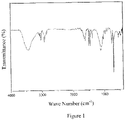
- Figure 1 Infrared spectrum of the ion-exchange resin of Example 1.
- the supernatant liquid was poured out, washed with hot water at 85°C, then washed with cold water, then filtered, put into an oven and dried at 80°C, sieved to collect composite microspheres A1 with a particle size in the range of 0.35-0.60 mm.
- Chloromethylation of composite microspheres To a 500mL three-necked flask were added 40g of composite microspheres A1 and 250mL of chloromethyl ether; after standing for 3 hours at room temperature, the stirring was started; 10g of zinc chloride was added as the catalyst; the mixture was warmed up to 60°C and reacted for 10 hours, and then cooled to room temperature after the completion of the chloromethylation; the chlorination mother liquor was filtered out, washed with methanol repeatedly, and dried at 100°C for 8 hours to obtain chloromethylated composite spheres A1.
- Ion-exchange To a 1000mL three-necked flask were added 30 g of imidazolated composite microspheres A1, and 500mL of a solution of NaBr in deionized water having a concentration of 0.1mol/L; the mixture was stirred at room temperature to perform an ion-exchange reaction for 24 hours, then washed with deionized water until the pH of the washing liquor was 7, and dried under vacuum to obtain an ion-exchange resin catalyst, which was denoted as Cat-A1, and had the following structural formula:
- a monomer mixture solution containing an initiator (60.0 g of styrene, 1.0 g of divinylbenzene, 1.6 g of octavinylsilsesquioxane, and 1.0 g of benzoyl peroxide, this solution was firstly reacted under stirring at 70°C for 0.5 hours), a stirrer was started, a mixed solution of 200 mL of deionized water and 4 g of polyvinyl alcohol was added, the mixture was warmed up to 85°C and reacted for 3 hours, then warmed up to 90°C and reacted for 9 hours, and finally warmed up to 100°C and reacted for 10 hours.
- an initiator 6-0.0 g of styrene, 1.0 g of divinylbenzene, 1.6 g of octavinylsilsesquioxane, and 1.0 g of benzoyl peroxide
- the supernatant liquid was poured out, washed with hot water at 85°C, then washed with cold water, then filtered, put into an oven and dried at 80°C, sieved to collect composite microspheres B1 with a particle size in the range of 0.35-0.60 mm.
- Chloromethylation of composite microspheres To a 500mL three-necked flask were added 50g of composite microspheres B1 and 200mL of chloromethyl ethyl ether; after standing for 6 hours at room temperature, 30g of zinc chloride was added as the catalyst and the stirring was started; the mixture was warmed up to 50°C and reacted for 30 hours, and then cooled to room temperature after the completion of the chloromethylation; the chlorination mother liquor was filtered out, washed with methanol repeatedly, and dried at 100°C for 8 hours to obtain chloromethylated composite spheres B 1.
- Ion-exchange To a 1000mL three-necked flask were added 40 g of imidazolated composite microspheres B1, and 400mL of a solution of NaBr in deionized water having a concentration of 0.1mol/L; the mixture was stirred at room temperature to perform an ion-exchange reaction for 12 hours, then washed with deionized water until the pH of the washing liquor was 7, and dried under vacuum to obtain an ion-exchange resin catalyst, which was denoted as Cat-B1, and had the following structural formula:
- a monomer mixture solution containing an initiator (42.5 g of styrene, 2.5 g of divinylbenzene, 0.1 g of octavinylsilsesquioxane, and 2.0 g of benzoyl peroxide, this solution was firstly reacted under stirring at 70°C for 1.5 hours), a mixed solution of 200 mL of deionized water and 4 g of polyvinyl alcohol was added, the mixture was warmed up to 85°C and reacted for 3 hours, then warmed up to 90°C and reacted for 9 hours, and finally warmed up to 100°C and reacted for 10 hours.
- an initiator 2.5 g of styrene, 2.5 g of divinylbenzene, 0.1 g of octavinylsilsesquioxane, and 2.0 g of benzoyl peroxide
- the supernatant liquid was poured out, washed with hot water at 85°C, then washed with cold water, then filtered, put into an oven and dried at 80°C, sieved to collect composite microspheres C1 with a particle size in the range of 0.35-0.60 mm.
- Chloromethylation of composite microspheres To a 250mL three-necked flask were added 20g of composite microspheres C1 and 100mL of 1,4-dichloromethoxybutane; after standing for 6 hours at room temperature, 8g of zinc chloride was added as the catalyst and the stirring was started; the mixture was warmed up to 30°C and reacted for 12 hours, and then cooled to room temperature after the completion of the chloromethylation; the chlorination mother liquor was filtered out, washed with methanol repeatedly, and dried at 100°C for 8 hours to obtain chloromethylated composite spheres C1.
- Ion-exchange To a 500mL three-necked flask were added 20 g of imidazolated composite microspheres C1, and 300mL of a solution of NaBr in deionized water having a concentration of 0.5mol/L; the mixture was stirred at room temperature to perform an ion-exchange reaction for 12 hours, then washed with deionized water until the pH of the washing liquor was 7, and dried under vacuum to obtain an ion-exchange resin catalyst, which was denoted as Cat-C1, and had the following structural formula:
- the stirring speed was adjusted, while the mixture was gradually warmed up to 80°C and reacted for 5 hours; then warmed up to 90°C and reacted for 5 hours, and finally warmed up to 98°C and reacted for 6 hours.
- the supernatant liquid was poured out, washed with hot water at 85°C, then washed with cold water, then filtered, put into an oven and dried at 80°C, sieved to collect composite microspheres A2 with a particle size in the range of 0.35-0.60 mm.
- Chloromethylation of composite microspheres To a 500mL three-necked flask were added 40g of composite microspheres A2 and 250mL of chloromethyl ether; after standing for 3 hours at room temperature, the stirring was started; 10g of zinc chloride was added as the catalyst; the mixture was warmed up to 60°C and reacted for 10 hours, and then cooled to room temperature after the completion of the chloromethylation; the chlorination mother liquor was filtered out, washed with methanol repeatedly, and dried at 100°C for 8 hours to obtain chloromethylated composite spheres A2.
- Ion-exchange To a 1000mL three-necked flask were added 30 g of imidazolated composite microspheres A2, and 500mL of a solution of NaBr in deionized water having a concentration of 0.1mol/L; the mixture was stirred at room temperature to perform an ion-exchange reaction for 24 hours, then washed with deionized water until the pH of the washing liquor was 7, and dried under vacuum to obtain an ion-exchange resin catalyst, which was denoted as Cat-A2, and had the following structural formula:
- a monomer mixture solution containing an initiator (60.0 g of styrene, 1.0 g of divinylbenzene, 1.6 g of octavinylsilsesquioxane, and 1.0 g of benzoyl peroxide, this solution was firstly reacted under stirring at 70°C for 0.5 hours), a stirrer was started, a mixed solution of 200 mL of deionized water and 4 g of polyvinyl alcohol was added, the mixture was warmed up to 85°C and reacted for 3 hours, then warmed up to 90°C and reacted for 9 hours, and finally warmed up to 100°C and reacted for 10 hours.
- an initiator 6-0.0 g of styrene, 1.0 g of divinylbenzene, 1.6 g of octavinylsilsesquioxane, and 1.0 g of benzoyl peroxide
- the supernatant liquid was poured out, washed with hot water at 85°C, then washed with cold water, then filtered, put into an oven and dried at 80°C, sieved to collect composite microspheres B2 with a particle size in the range of 0.35-0.60 mm.
- Chloromethylation of composite microspheres To a 500mL three-necked flask were added 50g of composite microspheres B2 and 200mL of chloromethyl ethyl ether; after standing for 6 hours at room temperature, 30g of zinc chloride was added as the catalyst and the stirring was started; the mixture was warmed up to 50°C and reacted for 30 hours, and then cooled to room temperature after the completion of the chloromethylation; the chlorination mother liquor was filtered out, washed with methanol repeatedly, and dried at 100°C for 8 hours to obtain chloromethylated composite spheres B2.
- Ion-exchange To a 1000mL three-necked flask were added 40 g of imidazolated composite microspheres B2, and 400mL of a solution of NaBr in deionized water having a concentration of 0.1mol/L; the mixture was stirred at room temperature to perform an ion-exchange reaction for 12 hours, then washed with deionized water until the pH of the washing liquor was 7, and dried under vacuum to obtain an ion-exchange resin catalyst, which was denoted as Cat-B2, and had the following structural formula:
- a monomer mixture solution containing an initiator (42.5 g of styrene, 2.5 g of divinylbenzene, 0.1 g of octavinylsilsesquioxane and 2.0 g of benzoyl peroxide, this solution was firstly reacted under stirring at 70°C for 1.5 hours), a mixed solution of 200 mL of deionized water and 4 g of polyvinyl alcohol was added, the mixture was warmed up to 85°C and reacted for 3 hours, then warmed up to 90°C and reacted for 9 hours, and finally warmed up to 100°C and reacted for 10 hours.
- an initiator 2.5 g of styrene, 2.5 g of divinylbenzene, 0.1 g of octavinylsilsesquioxane and 2.0 g of benzoyl peroxide
- the supernatant liquid was poured out, washed with hot water at 85°C, then washed with cold water, then filtered, put into an oven and dried at 80°C, sieved to collect composite microspheres C2 with a particle size in the range of 0.35-0.60 mm.
- Chloromethylation of composite microspheres To a 250mL three-necked flask were added 20g of composite microspheres C2 and 100mL of 1,4-dichloromethoxybutane; after standing for 6 hours at room temperature, 8g of zinc chloride was added as the catalyst and the stirring was started; the mixture was warmed up to 30°C and reacted for 12 hours, and then cooled to room temperature after the completion of the chloromethylation; the chlorination mother liquor was filtered out, washed with methanol repeatedly, and dried at 100°C for 8 hours to obtain chloromethylated composite spheres C2.
- Ion-exchange To a 500mL three-necked flask were added 20 g of imidazolated composite microspheres C2, and 300mL of a solution of NaBr in deionized water having a concentration of 0.5mol/L; the mixture was stirred at room temperature to perform an ion-exchange reaction for 12 hours, then washed with deionized water until the pH of the washing liquor was 7, and dried under vacuum to obtain an ion-exchange resin catalyst, which was denoted as Cat-C2, and had the following structural formula:
- the supernatant liquid was poured out, washed with hot water at 85°C, then washed with cold water, then filtered, put into an oven and dried at 80°C, sieved to collect composite microspheres A3 with a particle size in the range of 0.35-0.60 mm.
- Chloromethylation of composite microspheres To a 500mL three-necked flask were added 40g of composite microspheres A3 and 250mL of chloromethyl ether; after standing for 3 hours at room temperature, the stirring was started; 10g of zinc chloride was added as the catalyst; the mixture was warmed up to 60°C and reacted for 10 hours, and then cooled to room temperature after the completion of the chloromethylation; the chlorination mother liquor was filtered out, washed with methanol repeatedly, and dried at 100°C for 8 hours to obtain chloromethylated composite spheres A3.
- Ion-exchange To a 1000mL three-necked flask were added 30 g of imidazolated composite microspheres A3, and 500mL of a solution of NaBr in deionized water having a concentration of 0.1mol/L; the mixture was stirred at room temperature to perform an ion-exchange reaction for 24 hours, then washed with deionized water until the pH of the washing liquor was 7, and dried under vacuum to obtain an ion-exchange resin catalyst, which was denoted as Cat-A3, and had the following structural formula:
- the supernatant liquid was poured out, washed with hot water at 85°C, then washed with cold water, then filtered, put into an oven and dried at 80°C, sieved to collect composite microspheres A5 with a particle size in the range of 0.35-0.60 mm.
- Chloromethylation of composite microspheres To a 500mL three-necked flask were added 40g of composite microspheres A4 and 250mL of chloromethyl ether; after standing for 3 hours at room temperature, the stirring was started; 10g of zinc chloride was added as the catalyst; the mixture was warmed up to 60°C and reacted for 10 hours, and then cooled to room temperature after the completion of the chloromethylation; the chlorination mother liquor was filtered out, washed with methanol repeatedly, and dried at 100°C for 8 hours to obtain chloromethylated composite spheres A4.
- Ion-exchange To a 1000mL three-necked flask were added 30 g of imidazolated composite microspheres A4, and 500mL of a solution of NaBr in deionized water having a concentration of 0.1mol/L; the mixture was stirred at room temperature to perform an ion-exchange reaction for 24 hours, then washed with deionized water until the pH of the washing liquor was 7, and dried under vacuum to obtain an ion-exchange resin catalyst, which was denoted as Cat-A4, and had the following structural formula:
- the supernatant liquid was poured out, washed with hot water at 85°C, then washed with cold water, then filtered, put into an oven and dried at 80°C, sieved to collect composite microspheres A5 with a particle size in the range of 0.35-0.60 mm.
- Chloromethylation of composite microspheres To a 500mL three-necked flask were added 40g of composite microspheres A5 and 250mL of chloromethyl ether; after standing for 3 hours at room temperature, the stirring was started; 10g of zinc chloride was added as the catalyst; the mixture was warmed up to 60°C and reacted for 10 hours, and then cooled to room temperature after the completion of the chloromethylation; the chlorination mother liquor was filtered out, washed with methanol repeatedly, and dried at 100°C for 8 hours to obtain chloromethylated composite spheres A5.
- Ion-exchange To a 1000mL three-necked flask were added 30 g of imidazolated composite microspheres A5, and 500mL of a solution of NaBr in deionized water having a concentration of 0.1mol/L; the mixture was stirred at room temperature to perform an ion-exchange reaction for 24 hours, then washed with deionized water until the pH of the washing liquor was 7, and dried under vacuum to obtain an ion-exchange resin catalyst, which was denoted as Cat-A5, and had the following structural formula:
- the supernatant liquid was poured out, washed with hot water at 85°C, then washed with cold water, then filtered, put into an oven and dried at 80°C, sieved to collect microspheres A6 with a particle size in the range of 0.35-0.60 mm.
- Chloromethylation of microspheres To a 500mL three-necked flask were added 40g of microspheres A6 and 250mL of chloromethyl ether; after standing for 3 hours at room temperature, the stirring was started; 10g of zinc chloride was added as the catalyst; the mixture was warmed up to 60° C and reacted for 10 hours, and then cooled to room temperature after the completion of the chloromethylation; the chlorination mother liquor was filtered out, washed with methanol repeatedly, and dried at 100°C for 8 hours to obtain chloromethylated spheres A6.
- Ion-exchange To a 1000mL three-necked flask were added 30 g of imidazolated microspheres A6, and 500mL of a solution of NaBr in deionized water having a concentration of 0.1mol/L; the mixture was stirred at room temperature to perform an ion-exchange reaction for 24 hours, then washed with deionized water until the pH of the washing liquor was 7, and dried under vacuum to obtain an ion-exchange resin catalyst, which was denoted as Cat-A6, and had the following structural formula:
- the supernatant liquid was poured out, washed with hot water at 85°C, then washed with cold water, then filtered, put into an oven and dried at 80°C, sieved to collect microspheres A7 with a particle size in the range of 0.35-0.60 mm.
- Chloromethylation of microspheres To a 500mL three-necked flask were added 40g of microspheres A7 and 250mL of chloromethyl ether; after standing for 3 hours at room temperature, the stirring was started; 10g of zinc chloride was added as the catalyst; the mixture was warmed up to 60° C and reacted for 10 hours, and then cooled to room temperature after the completion of the chloromethylation; the chlorination mother liquor was filtered out, washed with methanol repeatedly, and dried at 100°C for 8 hours to obtain chloromethylated spheres A7.
- Ion-exchange To a 1000mL three-necked flask were added 30 g of imidazole/POSS microspheres A7, and 500mL of a solution of NaBr in deionized water having a concentration of 0.1 mol/L; the mixture was stirred at room temperature to perform an ion-exchange reaction for 24 hours, then washed with deionized water until the pH of the washing liquor was 7, and dried under vacuum to obtain an ion-exchange resin catalyst, which was denoted as Cat-A7, and had the following structural formula:
- the ion-exchange resin prepared in [Example 1] was used for the addition reaction of alkylene oxide and carbon dioxide.
- the experimental conditions were as follows: under the protection of high-purity nitrogen, to a 300 mL autoclave were added 50.0 g of ethylene oxide and 7.5 g of resin catalyst Cat-A1, filled with CO 2 at 1.0 MPa, warmed up to 120°C, refilled with CO 2 to maintain the reaction pressure at 2.0 MPa, reacted for 4 hours and filtered to remove the catalyst.
- the ethylene oxide conversion C EO was 96.7 %
- the ethylene carbonate selectivity S EC was 99.3%.
- the catalyst prepared in [Example 1] was used for the addition reaction of other alkylene oxides and carbon dioxide.
- the experimental conditions were as follows: under the protection of high-purity nitrogen, to a 300 mL autoclave were added 50.0 g of alkylene oxide and 7.5 g of resin catalyst, filled with CO 2 at 1.0 MPa, warmed up to 120°C, refilled with CO 2 to maintain the reaction pressure at 2.0 MPa, reacted for 4 hours and filtered to remove the catalyst.
- the alkylene oxide conversion and the obtained carbonate selectivity were measured. The results were shown in Table 3.
- the catalyst SiO 2 -ethane-Br was prepared. That catalyst was used for the addition reaction of styrene oxide and carbon dioxide.
- the experimental conditions were as follows: under the protection of high-purity nitrogen, to a 300 mL autoclave were added 50.0 g of styrene oxide and 7.5 g of catalyst, filled with CO 2 at 1.0 MPa, warmed up to 120°C, refilled with CO 2 to maintain the reaction pressure at 2.0 MPa, reacted for 4 hours and filtered to remove the catalyst.
- the styrene oxide conversion and the obtained cyclic styrene carbonate selectivity were measured. The results were shown in Table 4.
- the catalyst SBA-15-IL3Br was prepared. That catalyst was used for the addition reaction of propylene oxide and carbon dioxide.
- the experimental conditions were as follows: under the protection of high-purity nitrogen, to a 300 mL autoclave were added 50.0 g of propylene oxide and 7.5 g of catalyst, filled with CO 2 at 1.0 MPa, warmed up to 120°C, refilled with CO 2 to maintain the reaction pressure at 2.0 MPa, reacted for 4 hours and filtered to remove the catalyst. The propylene oxide conversion and the obtained propylene carbonate selectivity were measured. The results were shown in Table 4.
- the catalyst Poly[bvbim]Cl was prepared. That catalyst was used for the addition reaction of styrene oxide and carbon dioxide.
- the experimental conditions were as follows: under the protection of high-purity nitrogen, to a 300 mL autoclave were added 50.0 g of styrene oxide and 7.5 g of catalyst, filled with CO 2 at 1.0 MPa, warmed up to 120°C, refilled with CO 2 to maintain the reaction pressure at 2.0 MPa, reacted for 4 hours and filtered to remove the catalyst. The styrene oxide conversion and the obtained cyclic styrene carbonate selectivity were measured. The results were shown in Table 4.
- the catalyst of the present invention (Cat A1) had sphericity after attrition of 65.3%, and sphericity after osmotic attrition of 37.6%.
- the CNT-based catalyst (with reference to CN109569717A ) had sphericity after attrition of 54.2% and sphericity after osmotic attrition of 25.5%.
Landscapes
- Chemical & Material Sciences (AREA)
- Organic Chemistry (AREA)
- Chemical Kinetics & Catalysis (AREA)
- Health & Medical Sciences (AREA)
- Medicinal Chemistry (AREA)
- Polymers & Plastics (AREA)
- Engineering & Computer Science (AREA)
- Materials Engineering (AREA)
- General Chemical & Material Sciences (AREA)
- Inorganic Chemistry (AREA)
- Catalysts (AREA)
- Addition Polymer Or Copolymer, Post-Treatments, Or Chemical Modifications (AREA)
Abstract
Description
- The present invention relates to a catalyst for addition reaction of alkylene oxide and use thereof, in particular to a nanocomposite ion-exchange resin catalyst.
- Alkylene carbonates such as ethylene carbonate and propylene carbonate are excellent solvents and fine chemical intermediates with a wide range of uses. As an excellent high boiling solvent and an organic synthesis intermediate, ethylene carbonate is widely used as solvent in textile, printing, polymer synthesis, and electrochemistry. It can also be used as raw materials of cosmetics and drugs and an intermediate of the corresponding diol. In recent years, ethylene carbonate has been used in the production of lithium battery electrolyte and dimethyl carbonate, and the use of aliphatic polycarbonate and its various copolymers as biodegradable materials has attracted much attention to its industrial production.
- The traditional production method of ethylene carbonate is the phosgene method. Phosgene has high toxicity and serious pollution, and the process has the disadvantages of long process flow, low yield, high cost, and the like. Using carbon dioxide and ethylene oxide as raw materials to directly prepare ethylene carbonate under the action of the corresponding catalyst is a new way of green environmental protection. The process can directly use carbon dioxide, a greenhouse gas, to alleviate the problem of carbon dioxide emissions.
- Currently known homogeneous catalyst systems that can be used for addition reaction of carbon dioxide and epoxy compounds include catalytic systems such as quaternary ammonium salts, quaternary phosphonium salts, transition metal complexes, main group element complexes and alkali metal salts, ionic liquids, and supercritical carbon dioxide.
- He Liangnian et al. (Green Chem., 2003, 5, 92-94) developed a class of phosphonium salt catalysts and synthesized ethylene carbonate with the catalyst of Rf3RPI(Rf=R=C4F9C2H4; Rf=R=C6F13C2H4; Rf=C6F13C2H4, R=Me; Rf=C8F17C2H4, R=Me; P is phosphorus, I is iodine) in the supercritical carbon dioxide. The catalyst contains a relatively long fluorine chain and has relatively good solubility in carbon dioxide, while its solubility in the product is relatively small, which is beneficial to the product separation. The in-situ regeneration of the catalyst in the supercritical state and the recycling use of the catalyst were realized. The yield of ethylene carbonate reached more than 90%, but the reaction period was too long (24 hours were needed).
- Kim et al. studied the effect of homogeneous catalytic systems such as zinc halides with 1-alkyl-3-methyl-imidazolium halides and phosphine-containing ligands on the reaction (Angew. Chem. Int. Ed. 39 (2000) 4096-4098, Chem. Eur. J. 9 (2003) 678-686, J. Catal. 232 (2005) 80-84). After the reaction, the homogeneous catalyst needed to be separated from the product, and the separation of the product from the homogeneous catalyst by distillation could severely decompose alkylene carbonates.
- The characteristics of the homogeneous catalytic system itself determine that the homogeneous process has disadvantages such as the difficulty in product separation, the large amount of catalyst and the difficult recycling, and the environmental pollution. Compared with homogeneous catalysts, heterogeneous catalysts are beneficial to the subsequent separation of products and catalysts, and the catalysts can be easily regenerated and reused many times. As the support of the heterogeneous catalytic system, molecular sieves, silica gels, ion-exchange resins, polyethylene glycol, poly(4-vinylpyridine), chitosan, and the like are commonly used.
- Xiao et al. (Appl. Catal. A 279 (2005) 125-129) reported the supported zinc halide catalyst, and the support was poly(4-vinylpyridine) or chitosan. In this system, 1-butyl-3-methylimidazolium bromide must also be homogeneously used as co-catalyst, and the catalytic activity dropped significantly after being recycled.
Van Kruchten et al. reported in CN 10151181 0A a zinc halide catalyst supported on a solid support, where the support was a quaternary-phosphonium or quaternary-ammonium ion-exchange resin, and the activity of the catalytic system decreased rapidly after being recycled. - Lv Xiaobing et al. studied the continuous process of ethylene carbonate fixed bed with Salen (Co) supported on silica gel MCM-41 as catalyst. With the addition of n-butylammonium bromide as co-catalyst, the conversion of ethylene oxide could reach 85.6%.
- It can be seen that although the heterogeneous catalytic system has many advantages, however the wear resistance, the swelling resistance, and the activity of the catalyst still need to be further improved. It is very important to develop a catalytic system with high activity and easy separation.
- In order to solve the problems existing in the prior art, in the first aspect of the present invention is provided a catalyst for addition reaction of alkylene oxide, the catalyst comprises a nanocomposite ion-exchange resin having a structural formula of P-Im+-M-, wherein P is a nanocomposite resin matrix, Im+ is a cation derived from 5-6 membered heterocycle containing at least one nitrogen atom such as imidazolium cation, pyrazolium cation, pyrrolidinium cation, piperidinium cation, piperazinium cation, pyrimidinium cation, pyrazinium cation, pyridazinium cation, triazinium cation (for example a cation derived from 5-6 membered heteroarene containing at least one nitrogen atom, such as imidazolium cation, pyrazolium cation, pyrimidinium cation, pyrazinium cation, pyridazinium cation, triazinium cation), and M- is an anion. The catalyst of the present invention can be used in the addition reaction of alkylene oxide and carbon dioxide. The catalyst has high wear resistance, high swelling resistance, and high activity. The products after the reaction are easy to separate, and the catalyst can be used continuously many times.
- In the second aspect of the present invention is provided a method for an addition reaction of alkylene oxide and carbon dioxide.
- According to the first aspect of the present invention, the catalyst comprises a nanocomposite ion-exchange resin having a structural formula of P-Im+-M-, wherein P is a nanocomposite resin matrix, Im+ is a cation derived from 5-6 membered heterocycle containing at least one nitrogen atom such as imidazolium cation, pyrazolium cation, pyrrolidinium cation, piperidinium cation, piperazinium cation, pyrimidinium cation, pyrazinium cation, pyridazinium cation, triazinium cation (for example a cation derived from 5-6 membered heteroarene containing at least one nitrogen atom, such as imidazolium cation, pyrazolium cation, pyrimidinium cation, pyrazinium cation, pyridazinium cation, triazinium cation), M- is an anion.
- According to some embodiments of the present invention, the nanocomposite resin matrix comprises a structure fragment represented by formula I and a structure fragment of-CH(POSS)-CH2-,
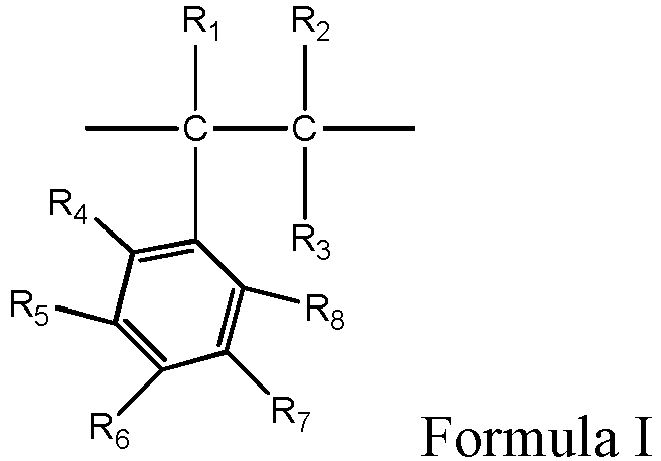
- In formula I, R1-R8 are identical to or different from each other, and each independently selected from hydrogen and C1-C6 alkyl, preferably selected from hydrogen, methyl, ethyl, propyl, and butyl;
- POSS is a polyhedral oligomeric silsesquioxane, which has a general formula of (-SIO1.5)m, and m is 6, 8, 10, or 12.
- According to some embodiments of the present invention, the catalyst comprises the following structure:

- Wherein R1-R3 are identical to or different from each other, and each independently selected from hydrogen and C1-C6 alkyl;
- R4-R8 are each independently selected from hydrogen, C1-C6 alkyl, and CH2Im+-M-, and at least one of R4-R8 is CH2Im+-M-, preferably, R4-R8 are each independently selected from hydrogen and CH2Im+-M-, and at least one of R4-R8 is CH2Im+-M-.
- According to some embodiments of the present invention, the catalyst comprises a structure fragment of-CH-(Ph-CH2-Im+-M-)-CH2-.
- According to some embodiments of the present invention, said M- is one or more of halide ions and organic acid radical ions.
- According to some embodiments of the present invention, said M- is one or more of a fluoride ion, a chloride ion, a bromide ion, an iodide ion, an acetate group, a formate group, and a bioxalate group.
- According to some embodiments of the present invention, the mass content of POSS in the nanocomposite resin matrix P is 0.1-10%, for example 0.1%, 0.2%, 0.5%, 1.0%, 1.2%, 1.5%, 2.0%, 2.5%, 3.0%, 3.5%, 4.0%, 4.3%, 4.5%, 5.0%, 5.5%, 6.0%, 7.0%, 8.0%, 9.1%, 9.5%, 10% and an arbitrary value in between.
- According to some embodiments of the present invention, the mass content of POSS in the nanocomposite resin matrix P is 0.2-5%.
- According to some embodiments of the present invention, the mass content of POSS in the nanocomposite resin matrix P is 2-5%.
- In the present invention, the structural formula P-Im+-M- represents a nanocomposite resin matrix P modified with Im+ and M-.
- According to some embodiments of the present invention, in the infrared spectrum of the nanocomposite resin matrix P, the characteristic absorption peak at 1111 cm-1 is attributed to the stretching vibration absorption peak of the Si-O-Si skeleton in the silsesquioxane.
- According to some embodiments of the present invention, a process for preparing the catalyst comprises the following steps:
- S1: polymerizing a styrene-based monomer, a cross-linking agent, and a polyhedral oligomeric silsesquioxane in the presence of an initiator to obtain a nanocomposite resin matrix P;
- S2: subjecting the nanocomposite resin matrix P obtained in step S1 to a chloromethylation reaction, an imidazolation reaction, and an ion-exchange reaction.
- According to some embodiments of the present invention, the nanocomposite resin matrix P is a nanocomposite copolymer obtained by in-situ copolymerization of a styrene-based monomer, a cross-linking agent, and a nano-material.
- According to some embodiments of the present invention, said nano-material is at least one of a vinyl-containing silsesquioxane, a hydrogen-containing polysilsesquioxane, an alkoxy-containing polysilsesquioxane, and an epoxy-containing polysilsesquioxane.
- According to some embodiments of the present invention, said styrene-based monomer is one or more of styrene-based monomers represented by formula II;

- In formula II, R1-R8 are identical to or different from each other, and each independently selected from hydrogen and C1-C6 alkyl, preferably selected from hydrogen, methyl, ethyl, propyl, and butyl.
- According to some embodiments of the present invention, said styrene-based monomer is at least one of styrene, α-methylstyrene, or 4-butylstyrene, preferably styrene.
- According to some embodiments of the present invention, said polyhedral oligomeric silsesquioxane is one or more of a vinyl-containing silsesquioxane, a hydrogen-containing polysilsesquioxane, an alkoxy-containing polysilsesquioxane, and an epoxy-containing polysilsesquioxane.
- According to some embodiments of the present invention, said vinyl-containing silsesquioxane is octavinylsilsesquioxane.
- According to some embodiments of the present invention, said cross-linking agent is one or more of ethylene glycol bismethacrylate, dipropenylbenzene, divinylphenylmethane, and divinylbenzene.
- According to some embodiments of the present invention, said initiator is at least one of benzoyl peroxide, azodiisobutyronitrile, azodiisoheptylonitrile, lauroyl peroxide, and cumene hydroperoxide.
- According to some embodiments of the present invention, in step S1, based on the total weight of the raw materials, the mass content of the styrene-based monomer is 85-95%.
- According to some embodiments of the present invention, in step S1, based on the total weight of the raw materials, the mass content of said cross-linking agent is 1-6%.
- According to some embodiments of the present invention, in step S1, based on the total weight of the raw materials, the mass content of said polyhedral oligomeric silsesquioxane is 0.1-10%, for example 0.1%, 0.2%, 0.5%, 1.0%, 1.2%, 1.5%, 2.0%, 2.5%, 3.0%, 3.5%, 4.0%, 4.3%, 4.5%, 5.0%, 5.5%, 6.0%, 7.0%, 8.0%, 9.1%, 9.5%, 10% and an arbitrary value in between.
- According to some embodiments of the present invention, in step S1, based on the total weight of the raw materials, the mass content of said polyhedral oligomeric silsesquioxane is 0.2-5%.
- According to some embodiments of the present invention, in step S1, based on the total weight of the raw materials, the mass content of said polyhedral oligomeric silsesquioxane is 2-5%.
- According to some embodiments of the present invention, in step S1, based on the total weight of the raw materials, the mass content of said initiator is 0.1-5%.
- According to some embodiments of the present invention, based on the parts by weight, the used amount of the styrene-based monomer is 85-95 parts, the used amount of the cross-linking agent is 2-5 parts, the used amount of the nano-material is 0.1-10 parts, and the used amount of the initiator is 0.1-5 parts.
- In some preferred embodiments of the present invention, the process for preparing the catalyst comprises the following steps:
- a) An auxiliary agent is formulated into an aqueous solution A having a concentration of 0.5-3% by weight, and a styrene-based monomer, a cross-linking agent, a nanomaterial, and an initiator are formulated into a solution B; wherein, said auxiliary agent is at least one of polyvinyl alcohol, gelatin, starch, methylcellulose, bentonite and calcium carbonate; said styrene-based monomer is at least one of styrene,α-methylstyrene and 4-butylstyrene; said cross-linking agent is at least one of ethylene glycol bismethacrylate, dipropenylbenzene, divinylphenylmethane, and divinylbenzene; said nano-material is at least one of a vinyl-containing silsesquioxane, a hydrogen-containing polysilsesquioxane, an alkoxy-containing polysilsesquioxane and an epoxy-containing polysilsesquioxane; said initiator is at least one of benzoyl peroxide, azodiisobutyronitrile, azodiisoheptylonitrile, lauroyl peroxide, and cumene hydroperoxide; based on the parts by weight, the used amount of the styrene-based monomer is 85-95 parts, the used amount of the cross-linking agent is 2-5 parts, the used amount of the nano-material is 0.1-10 parts, the used amount of the initiator is 0.1-5 parts; the used amount of the auxiliary agent is 150-400% of the used amount of the monomer;
- b) The solution B and the solution A are combined, stirred at normal temperature for 1-3 hours, and mixed well; then polymerized at 60-75°C for 0.5-5 hours, gradually warmed up to 70-90°C and reacted for 5-15 hours, then warmed up to 90-100°C and reacted for 5-15 hours; after the completion of the reaction, the reaction mixture is extracted, washed, filtered, dried and sieved to obtain composite microspheres with a particle size ranging from 0.35 to 0.60 mm;
- c) To the composite microspheres are added a chloromethylation reagent equivalent to 200-500% of the weight of composite microspheres and a zinc chloride catalyst equivalent to 20-70% of the weight of composite microspheres, reacted at 30-60°C for 8-30 hours, filtered and washed to obtain chloromethylated composite spheres; said chloromethylation reagent is at least one of chloromethyl ether, chloromethyl ethyl ether, and 1,4-dichloromethoxybutane;
- d) the chloromethylated composite spheres and an N-alkylimidazole in a mixture are reacted at 60-90°C for 10-48 hours, and after the completion of the reaction, filtered and washed to obtain imidazolated composite microspheres; in the mixture, the chloromethylated composite spheres, the N-alkylimidazole (e.g. N-methylimidazole) and a solvent (e.g. acetonitrile or N,N-dimethylformamide) can be 1:(1-5):(10-50);
- f) the imidazolated composite microspheres are washed with a salt solution, after the completion of the washing, washed with deionized water to pH = 7 to obtain the ion-exchange resin, wherein the molar ratio of the imidazolated composite microspheres to the salt solution is (1:1)-(1:10); the concentration of the salt solution is 0.1-1mol/L; the salt solution is a salt solution containing at least one of a fluoride ion, a chloride ion, a bromide ion, an iodide ion, an acetate group, a formate group, and a bioxalate group.
- According to the second aspect of the present invention, a method for an addition reaction of alkylene oxide and carbon dioxide comprises reacting alkylene oxide and carbon dioxide in the presence of the above catalyst.
- According to some embodiments of the present invention, the alkylene oxide has a general formula of

- Wherein, R9-R12 are identical to or different from each other and each independently selected from hydrogen, C1-C6 alkyl, and C6-C10 aryl, preferably selected from hydrogen, methyl, ethyl, propyl, butyl, and phenyl.
- According to some embodiments of the present invention, said alkylene oxide is selected from ethylene oxide, propylene oxide, and styrene oxide.
- According to some embodiments of the present invention, the mass ratio of the catalyst to the alkylene oxide is (0.001-1):1, preferably (0.1-0.3):1.
- According to some embodiments of the present invention, the reaction temperature is 60-180°C, for example, 60°C, 70°C, 80°C, 90°C, 100°C, 110°C, 120°C, 130°C, 140°C, 150°C, 160°C, 170°C, 180°C, and an arbitrary value in between.
- According to some embodiments of the present invention, the reaction temperature is 100°C-160°C.
- According to some embodiments of the present invention, the reaction pressure is 0.1-10.0MPa, for example, 0.1MPa, 0.5MPa, 1MPa, 2MPa, 3MPa, 4MPa, 5MPa, 6MPa, 7MPa, 8MPa, 9MPa, 10MPa, and an arbitrary value in between.
- According to some embodiments of the present invention, said reaction pressure is 2-5MPa.
- According to some embodiments of the present invention, said reaction time is 1-8 hours, preferably 3-6 hours.
- The nanocomposite ion-exchange resin catalyst of the present invention can be used in the addition reaction of alkylene oxide and carbon dioxide. The catalyst has high wear resistance, high swelling resistance, and high activity, the products after the reaction are easy to separate, and the catalyst can be used continuously many times.
-
Figure 1 : Infrared spectrum of the ion-exchange resin of Example 1. - The present invention will be further described below through examples, but it should be pointed out that the protection scope of the present invention is not limited thereto, but is determined by the appended claims.
- It should be particularly noted that two or more aspects (or embodiments) disclosed in the context of this specification can be combined with each other arbitrarily, and the technical solutions formed thereby belong to a part of the original disclosure of this specification, and also falls within the protection scope of the present invention.
- Raw materials:
- Styrene: analytically pure, purchased from Sinopharm, used after removing a polymerization inhibitor;
- Divinylbenzene: analytically pure, purchased from Sinopharm, used after removing a polymerization inhibitor;
- Octavinylsilsesquioxane: analytically pure, purchased from Sinopharm, used directly;
- Benzoyl peroxide: analytically pure, purchased from Sinopharm, used after recrystallization;
- Polyvinyl alcohol\gelatin: analytically pure, purchased from Sinopharm, used directly;
- Chloromethyl ether\chloromethyl ethyl ether \1,4-dichloromethoxybutane: analytically pure, purchased from Sinopharm, used directly;
- 1-methylimidazole\1-butylimidazole\imidazole: analytically pure, purchased from Sinopharm, used directly;
- Acetonitrile: analytically pure, purchased from Sinopharm, used directly;
- Other unmentioned reagents used in the examples are commercially available, and were analytically pure, purchased from Sinopharm, and used directly.
- To a 500mL three-necked flask were added 65.0 g of styrene, 1.0 g of divinylbenzene, 3.0 g of octavinylsilsesquioxane, and 1.0 g of benzoyl peroxide, a stirrer was started, and the mixture was stirred for 0.5 hours; a mixed solution of 200 mL of deionized water and 4 g of polyvinyl alcohol was added, the mixture was stirred for 2 hours. Then, the mixture was gradually warmed up to 75°C and reacted for 5 hours, then warmed up to 90°C and reacted for 10 hours, and finally warmed up to 100°C and reacted for 10 hours. After the completion of the reaction, the supernatant liquid was poured out, washed with hot water at 85°C, then washed with cold water, then filtered, put into an oven and dried at 80°C, sieved to collect composite microspheres A1 with a particle size in the range of 0.35-0.60 mm.
- Chloromethylation of composite microspheres: To a 500mL three-necked flask were added 40g of composite microspheres A1 and 250mL of chloromethyl ether; after standing for 3 hours at room temperature, the stirring was started; 10g of zinc chloride was added as the catalyst; the mixture was warmed up to 60°C and reacted for 10 hours, and then cooled to room temperature after the completion of the chloromethylation; the chlorination mother liquor was filtered out, washed with methanol repeatedly, and dried at 100°C for 8 hours to obtain chloromethylated composite spheres A1.
- Imidazolation: To a 500mL three-necked flask were added 30 g of chloromethylated composite spheres A1 (having a chlorine content of 3.4mmol Cl/g), 1-methylimidazole (102.0mmol), and 200mL of acetonitrile; the mixture was reacted at 60°C for 24 hours, cooled to room temperature, filtered, washed with ethyl acetate, 0.1 mol/L HCl, deionized water, and methanol successively, and then dried under vacuum at 60°C for 12 hours to obtain imidazolated composite microspheres A1.
- Ion-exchange: To a 1000mL three-necked flask were added 30 g of imidazolated composite microspheres A1, and 500mL of a solution of NaBr in deionized water having a concentration of 0.1mol/L; the mixture was stirred at room temperature to perform an ion-exchange reaction for 24 hours, then washed with deionized water until the pH of the washing liquor was 7, and dried under vacuum to obtain an ion-exchange resin catalyst, which was denoted as Cat-A1, and had the following structural formula:

- To a 500mL three-necked flask was added a monomer mixture solution containing an initiator (60.0 g of styrene, 1.0 g of divinylbenzene, 1.6 g of octavinylsilsesquioxane, and 1.0 g of benzoyl peroxide, this solution was firstly reacted under stirring at 70°C for 0.5 hours), a stirrer was started, a mixed solution of 200 mL of deionized water and 4 g of polyvinyl alcohol was added, the mixture was warmed up to 85°C and reacted for 3 hours, then warmed up to 90°C and reacted for 9 hours, and finally warmed up to 100°C and reacted for 10 hours. After the completion of the reaction, the supernatant liquid was poured out, washed with hot water at 85°C, then washed with cold water, then filtered, put into an oven and dried at 80°C, sieved to collect composite microspheres B1 with a particle size in the range of 0.35-0.60 mm.
- Chloromethylation of composite microspheres: To a 500mL three-necked flask were added 50g of composite microspheres B1 and 200mL of chloromethyl ethyl ether; after standing for 6 hours at room temperature, 30g of zinc chloride was added as the catalyst and the stirring was started; the mixture was warmed up to 50°C and reacted for 30 hours, and then cooled to room temperature after the completion of the chloromethylation; the chlorination mother liquor was filtered out, washed with methanol repeatedly, and dried at 100°C for 8 hours to obtain chloromethylated composite spheres B 1.
- Imidazolation: To a 500mL three-necked flask were added 50 g of chloromethylated composite spheres B1 (having a chlorine content of 4.6mmol Cl/g), 1-methylimidazole (230.0mmol), and 300mL of acetonitrile; the mixture was reacted at 80°C for 16 hours, cooled to room temperature, filtered, washed with ethyl acetate, 0.1 mol/L HCl, deionized water, and methanol successively, and then dried under vacuum at 60°C for 12 hours to obtain imidazolated composite microspheres B1.
- Ion-exchange: To a 1000mL three-necked flask were added 40 g of imidazolated composite microspheres B1, and 400mL of a solution of NaBr in deionized water having a concentration of 0.1mol/L; the mixture was stirred at room temperature to perform an ion-exchange reaction for 12 hours, then washed with deionized water until the pH of the washing liquor was 7, and dried under vacuum to obtain an ion-exchange resin catalyst, which was denoted as Cat-B1, and had the following structural formula:

- To a 500mL three-necked flask was added a monomer mixture solution containing an initiator (42.5 g of styrene, 2.5 g of divinylbenzene, 0.1 g of octavinylsilsesquioxane, and 2.0 g of benzoyl peroxide, this solution was firstly reacted under stirring at 70°C for 1.5 hours), a mixed solution of 200 mL of deionized water and 4 g of polyvinyl alcohol was added, the mixture was warmed up to 85°C and reacted for 3 hours, then warmed up to 90°C and reacted for 9 hours, and finally warmed up to 100°C and reacted for 10 hours. After the completion of the reaction, the supernatant liquid was poured out, washed with hot water at 85°C, then washed with cold water, then filtered, put into an oven and dried at 80°C, sieved to collect composite microspheres C1 with a particle size in the range of 0.35-0.60 mm.
- Chloromethylation of composite microspheres: To a 250mL three-necked flask were added 20g of composite microspheres C1 and 100mL of 1,4-dichloromethoxybutane; after standing for 6 hours at room temperature, 8g of zinc chloride was added as the catalyst and the stirring was started; the mixture was warmed up to 30°C and reacted for 12 hours, and then cooled to room temperature after the completion of the chloromethylation; the chlorination mother liquor was filtered out, washed with methanol repeatedly, and dried at 100°C for 8 hours to obtain chloromethylated composite spheres C1.
- Imidazolation: To a 250mL three-necked flask were added 20 g of chloromethylated composite spheres C1 (having a chlorine content of 1.5mmol Cl/g), 1-ethylimidazole (30.0mmol), and 150mL of acetonitrile; the mixture was reacted at 90°C for 16 hours, cooled to room temperature, filtered, washed with ethyl acetate, 0.1 mol/L HCl, deionized water, and methanol successively, and then dried under vacuum at 60°C for 12 hours to obtain imidazolated composite microspheres C1.
- Ion-exchange: To a 500mL three-necked flask were added 20 g of imidazolated composite microspheres C1, and 300mL of a solution of NaBr in deionized water having a concentration of 0.5mol/L; the mixture was stirred at room temperature to perform an ion-exchange reaction for 12 hours, then washed with deionized water until the pH of the washing liquor was 7, and dried under vacuum to obtain an ion-exchange resin catalyst, which was denoted as Cat-C1, and had the following structural formula:

- To a 500mL three-necked flask were added 47.0 g of styrene, 2.3 g of divinylbenzene, and 1.6 g of benzoyl peroxide (as an initiator); the mixture was reacted under stirring at 60°C for 2.0 hours; then 0.6 g of octavinylsilsesquioxane was added, the stirring was continued for 1 hour to perform the pre-polymerization. 260 mL of a solution of 2.0 g of gelatin dissolved in deionized water was added. The stirring speed was adjusted, while the mixture was gradually warmed up to 80°C and reacted for 5 hours; then warmed up to 90°C and reacted for 5 hours, and finally warmed up to 98°C and reacted for 6 hours. After the completion of the reaction, the supernatant liquid was poured out, washed with hot water at 85°C, then washed with cold water, then filtered, put into an oven and dried at 80°C, sieved to collect composite microspheres A2 with a particle size in the range of 0.35-0.60 mm.
- Chloromethylation of composite microspheres: To a 500mL three-necked flask were added 40g of composite microspheres A2 and 250mL of chloromethyl ether; after standing for 3 hours at room temperature, the stirring was started; 10g of zinc chloride was added as the catalyst; the mixture was warmed up to 60°C and reacted for 10 hours, and then cooled to room temperature after the completion of the chloromethylation; the chlorination mother liquor was filtered out, washed with methanol repeatedly, and dried at 100°C for 8 hours to obtain chloromethylated composite spheres A2.
- Imidazolation: To a 500mL three-necked flask were added 30 g of chloromethylated composite spheres A2 (having a chlorine content of 3.6mmol Cl/g), 1-methylimidazole (108.0mmol), and 200mL of acetonitrile; the mixture was reacted at 60°C for 24 hours, cooled to room temperature, filtered, washed with ethyl acetate, 0.1 mol/L HCl, deionized water, and methanol successively, and then dried under vacuum at 60°C for 12 hours to obtain imidazolated composite microspheres A2.
- Ion-exchange: To a 1000mL three-necked flask were added 30 g of imidazolated composite microspheres A2, and 500mL of a solution of NaBr in deionized water having a concentration of 0.1mol/L; the mixture was stirred at room temperature to perform an ion-exchange reaction for 24 hours, then washed with deionized water until the pH of the washing liquor was 7, and dried under vacuum to obtain an ion-exchange resin catalyst, which was denoted as Cat-A2, and had the following structural formula:

- To a 500mL three-necked flask was added a monomer mixture solution containing an initiator (60.0 g of styrene, 1.0 g of divinylbenzene, 1.6 g of octavinylsilsesquioxane, and 1.0 g of benzoyl peroxide, this solution was firstly reacted under stirring at 70°C for 0.5 hours), a stirrer was started, a mixed solution of 200 mL of deionized water and 4 g of polyvinyl alcohol was added, the mixture was warmed up to 85°C and reacted for 3 hours, then warmed up to 90°C and reacted for 9 hours, and finally warmed up to 100°C and reacted for 10 hours. After the completion of the reaction, the supernatant liquid was poured out, washed with hot water at 85°C, then washed with cold water, then filtered, put into an oven and dried at 80°C, sieved to collect composite microspheres B2 with a particle size in the range of 0.35-0.60 mm.
- Chloromethylation of composite microspheres: To a 500mL three-necked flask were added 50g of composite microspheres B2 and 200mL of chloromethyl ethyl ether; after standing for 6 hours at room temperature, 30g of zinc chloride was added as the catalyst and the stirring was started; the mixture was warmed up to 50°C and reacted for 30 hours, and then cooled to room temperature after the completion of the chloromethylation; the chlorination mother liquor was filtered out, washed with methanol repeatedly, and dried at 100°C for 8 hours to obtain chloromethylated composite spheres B2.
- Imidazolation: To a 500mL three-necked flask were added 50 g of chloromethylated composite spheres B2 (having a chlorine content of 4.7mmol Cl/g), 1-butylimidazole (235.0mmol), and 300mL of acetonitrile; the mixture was reacted at 80°C for 16 hours, cooled to room temperature, filtered, washed with ethyl acetate, 0.1 mol/L HCl, deionized water, and methanol successively, and then dried under vacuum at 60°C for 12 hours to obtain imidazolated composite microspheres B2.
- Ion-exchange: To a 1000mL three-necked flask were added 40 g of imidazolated composite microspheres B2, and 400mL of a solution of NaBr in deionized water having a concentration of 0.1mol/L; the mixture was stirred at room temperature to perform an ion-exchange reaction for 12 hours, then washed with deionized water until the pH of the washing liquor was 7, and dried under vacuum to obtain an ion-exchange resin catalyst, which was denoted as Cat-B2, and had the following structural formula:

- To a 500mL three-necked flask was added a monomer mixture solution containing an initiator (42.5 g of styrene, 2.5 g of divinylbenzene, 0.1 g of octavinylsilsesquioxane and 2.0 g of benzoyl peroxide, this solution was firstly reacted under stirring at 70°C for 1.5 hours), a mixed solution of 200 mL of deionized water and 4 g of polyvinyl alcohol was added, the mixture was warmed up to 85°C and reacted for 3 hours, then warmed up to 90°C and reacted for 9 hours, and finally warmed up to 100°C and reacted for 10 hours. After the completion of the reaction, the supernatant liquid was poured out, washed with hot water at 85°C, then washed with cold water, then filtered, put into an oven and dried at 80°C, sieved to collect composite microspheres C2 with a particle size in the range of 0.35-0.60 mm.
- Chloromethylation of composite microspheres: To a 250mL three-necked flask were added 20g of composite microspheres C2 and 100mL of 1,4-dichloromethoxybutane; after standing for 6 hours at room temperature, 8g of zinc chloride was added as the catalyst and the stirring was started; the mixture was warmed up to 30°C and reacted for 12 hours, and then cooled to room temperature after the completion of the chloromethylation; the chlorination mother liquor was filtered out, washed with methanol repeatedly, and dried at 100°C for 8 hours to obtain chloromethylated composite spheres C2.
- Imidazolation: To a 250mL three-necked flask were added 20 g of chloromethylated composite spheres C2 (having a chlorine content of 1.6mmol Cl/g), 1-methylimidazole (32.0mmol), and 150mL of acetonitrile; the mixture was reacted at 90°C for 16 hours, cooled to room temperature, filtered, washed with ethyl acetate, 0.1 mol/L HCl, deionized water, and methanol successively, and then dried under vacuum at 60°C for 12 hours to obtain imidazolated composite microspheres C2.
- Ion-exchange: To a 500mL three-necked flask were added 20 g of imidazolated composite microspheres C2, and 300mL of a solution of NaBr in deionized water having a concentration of 0.5mol/L; the mixture was stirred at room temperature to perform an ion-exchange reaction for 12 hours, then washed with deionized water until the pH of the washing liquor was 7, and dried under vacuum to obtain an ion-exchange resin catalyst, which was denoted as Cat-C2, and had the following structural formula:

- To a 500mL three-necked flask were added 65.0 g of styrene, 1.0 g of divinylbenzene, 0.07 g of octavinylsilsesquioxane and 1.0 g of benzoyl peroxide, a stirrer was started, and the mixture was stirred for 0.5 hours; a mixed solution of 200 mL of deionized water and 4 g of polyvinyl alcohol was added, the mixture was stirred for 2 hours. Then, the mixture was gradually warmed up to 75°C and reacted for 5 hours, then warmed up to 90°C and reacted for 10 hours, and finally warmed up to 100°C and reacted for 10 hours. After the completion of the reaction, the supernatant liquid was poured out, washed with hot water at 85°C, then washed with cold water, then filtered, put into an oven and dried at 80°C, sieved to collect composite microspheres A3 with a particle size in the range of 0.35-0.60 mm.
- Chloromethylation of composite microspheres: To a 500mL three-necked flask were added 40g of composite microspheres A3 and 250mL of chloromethyl ether; after standing for 3 hours at room temperature, the stirring was started; 10g of zinc chloride was added as the catalyst; the mixture was warmed up to 60°C and reacted for 10 hours, and then cooled to room temperature after the completion of the chloromethylation; the chlorination mother liquor was filtered out, washed with methanol repeatedly, and dried at 100°C for 8 hours to obtain chloromethylated composite spheres A3.
- Imidazolation: To a 500mL three-necked flask were added 30 g of chloromethylated composite spheres A3 (having a chlorine content of 3.4mmol Cl/g), 1-methylimidazole (102.0mmol), and 200mL of acetonitrile; the mixture was reacted at 60°C for 24 hours, cooled to room temperature, filtered, washed with ethyl acetate, 0.1 mol/L HCl, deionized water, and methanol successively, and then dried under vacuum at 60°C for 12 hours to obtain imidazolated composite microspheres A3.
- Ion-exchange: To a 1000mL three-necked flask were added 30 g of imidazolated composite microspheres A3, and 500mL of a solution of NaBr in deionized water having a concentration of 0.1mol/L; the mixture was stirred at room temperature to perform an ion-exchange reaction for 24 hours, then washed with deionized water until the pH of the washing liquor was 7, and dried under vacuum to obtain an ion-exchange resin catalyst, which was denoted as Cat-A3, and had the following structural formula:

- To a 500mL three-necked flask were added 65.0 g of styrene, 1.0 g of divinylbenzene, 7.5 g of octavinylsilsesquioxane and 1.0 g of benzoyl peroxide, a stirrer was started, and the mixture was stirred for 0.5 hours; a mixed solution of 200 mL of deionized water and 4 g of polyvinyl alcohol was added, the mixture was stirred for 2 hours. Then, the mixture was gradually warmed up to 75°C and reacted for 5 hours, then warmed up to 90°C and reacted for 10 hours, and finally warmed up to 100°C and reacted for 10 hours. After the completion of the reaction, the supernatant liquid was poured out, washed with hot water at 85°C, then washed with cold water, then filtered, put into an oven and dried at 80°C, sieved to collect composite microspheres A5 with a particle size in the range of 0.35-0.60 mm.
- Chloromethylation of composite microspheres: To a 500mL three-necked flask were added 40g of composite microspheres A4 and 250mL of chloromethyl ether; after standing for 3 hours at room temperature, the stirring was started; 10g of zinc chloride was added as the catalyst; the mixture was warmed up to 60°C and reacted for 10 hours, and then cooled to room temperature after the completion of the chloromethylation; the chlorination mother liquor was filtered out, washed with methanol repeatedly, and dried at 100°C for 8 hours to obtain chloromethylated composite spheres A4.
- Imidazolation: To a 500mL three-necked flask were added 30 g of chloromethylated composite spheres A4 (having a chlorine content of 3.4mmol Cl/g), 1-methylimidazole (102.0mmol), and 200mL of acetonitrile; the mixture was reacted at 60°C for 24 hours, cooled to room temperature, filtered, washed with ethyl acetate, 0.1 mol/L HCl, deionized water, and methanol successively, and then dried under vacuum at 60°C for 12 hours to obtain imidazolated composite microspheres A4.
- Ion-exchange: To a 1000mL three-necked flask were added 30 g of imidazolated composite microspheres A4, and 500mL of a solution of NaBr in deionized water having a concentration of 0.1mol/L; the mixture was stirred at room temperature to perform an ion-exchange reaction for 24 hours, then washed with deionized water until the pH of the washing liquor was 7, and dried under vacuum to obtain an ion-exchange resin catalyst, which was denoted as Cat-A4, and had the following structural formula:

- To a 500mL three-necked flask were added 65.0 g of styrene, 1.0 g of divinylbenzene, 11.8 g of octavinylsilsesquioxane, and 1.0 g of benzoyl peroxide, a stirrer was started, and the mixture was stirred for 0.5 hours; a mixed solution of 200 mL of deionized water and 4 g of polyvinyl alcohol was added, the mixture was stirred for 2 hours. Then, the mixture was gradually warmed up to 75°C and reacted for 5 hours, then warmed up to 90°C and reacted for 10 hours, and finally warmed up to 100°C and reacted for 10 hours. After the completion of the reaction, the supernatant liquid was poured out, washed with hot water at 85°C, then washed with cold water, then filtered, put into an oven and dried at 80°C, sieved to collect composite microspheres A5 with a particle size in the range of 0.35-0.60 mm.
- Chloromethylation of composite microspheres: To a 500mL three-necked flask were added 40g of composite microspheres A5 and 250mL of chloromethyl ether; after standing for 3 hours at room temperature, the stirring was started; 10g of zinc chloride was added as the catalyst; the mixture was warmed up to 60°C and reacted for 10 hours, and then cooled to room temperature after the completion of the chloromethylation; the chlorination mother liquor was filtered out, washed with methanol repeatedly, and dried at 100°C for 8 hours to obtain chloromethylated composite spheres A5.
- Imidazolation: To a 500mL three-necked flask were added 30 g of chloromethylated composite spheres A5 (having a chlorine content of 3.4mmol Cl/g), 1-methylimidazole (102.0mmol), and 200mL of acetonitrile; the mixture was reacted at 60°C for 24 hours, cooled to room temperature, filtered, washed with ethyl acetate, 0.1 mol/L HCl, deionized water, and methanol successively, and then dried under vacuum at 60°C for 12 hours to obtain imidazolated composite microspheres A5.
- Ion-exchange: To a 1000mL three-necked flask were added 30 g of imidazolated composite microspheres A5, and 500mL of a solution of NaBr in deionized water having a concentration of 0.1mol/L; the mixture was stirred at room temperature to perform an ion-exchange reaction for 24 hours, then washed with deionized water until the pH of the washing liquor was 7, and dried under vacuum to obtain an ion-exchange resin catalyst, which was denoted as Cat-A5, and had the following structural formula:

- To a 500mL three-necked flask were added 65.0 g of styrene, 1.0 g of divinylbenzene, and 1.0 g of benzoyl peroxide, a stirrer was started, and the mixture was stirred for 0.5 hours; a mixed solution of 200 mL of deionized water and 4 g of polyvinyl alcohol was added, the mixture was stirred for 2 hours. Then, the mixture was gradually warmed up to 75°C and reacted for 5 hours, then warmed up to 90°C and reacted for 10 hours, and finally warmed up to 100°C and reacted for 10 hours. After the completion of the reaction, the supernatant liquid was poured out, washed with hot water at 85°C, then washed with cold water, then filtered, put into an oven and dried at 80°C, sieved to collect microspheres A6 with a particle size in the range of 0.35-0.60 mm.
- Chloromethylation of microspheres: To a 500mL three-necked flask were added 40g of microspheres A6 and 250mL of chloromethyl ether; after standing for 3 hours at room temperature, the stirring was started; 10g of zinc chloride was added as the catalyst; the mixture was warmed up to 60° C and reacted for 10 hours, and then cooled to room temperature after the completion of the chloromethylation; the chlorination mother liquor was filtered out, washed with methanol repeatedly, and dried at 100°C for 8 hours to obtain chloromethylated spheres A6.
- Imidazolation: To a 500mL three-necked flask were added 30 g of chloromethylated spheres A6 (having a chlorine content of 3.4mmol Cl/g), 1-methylimidazole (102.0mmol), and 200mL of acetonitrile; the mixture was reacted at 60°C for 24 hours, cooled to room temperature, filtered, washed with ethyl acetate, 0.1 mol/L HCl, deionized water, and methanol successively, and then dried under vacuum at 60°C for 12 hours to obtain imidazolated microspheres A6.
- Ion-exchange: To a 1000mL three-necked flask were added 30 g of imidazolated microspheres A6, and 500mL of a solution of NaBr in deionized water having a concentration of 0.1mol/L; the mixture was stirred at room temperature to perform an ion-exchange reaction for 24 hours, then washed with deionized water until the pH of the washing liquor was 7, and dried under vacuum to obtain an ion-exchange resin catalyst, which was denoted as Cat-A6, and had the following structural formula:

- To a 500mL three-necked flask were added 65.0 g of styrene, 1.0 g of divinylbenzene, and 1.0 g of benzoyl peroxide, a stirrer was started, and the mixture was stirred for 0.5 hours; a mixed solution of 200 mL of deionized water and 4 g of polyvinyl alcohol was added, the mixture was stirred for 2 hours. Then, the mixture was gradually warmed up to 75°C and reacted for 5 hours, then warmed up to 90°C and reacted for 10 hours, and finally warmed up to 100°C and reacted for 10 hours. After the completion of the reaction, the supernatant liquid was poured out, washed with hot water at 85°C, then washed with cold water, then filtered, put into an oven and dried at 80°C, sieved to collect microspheres A7 with a particle size in the range of 0.35-0.60 mm.
- Chloromethylation of microspheres: To a 500mL three-necked flask were added 40g of microspheres A7 and 250mL of chloromethyl ether; after standing for 3 hours at room temperature, the stirring was started; 10g of zinc chloride was added as the catalyst; the mixture was warmed up to 60° C and reacted for 10 hours, and then cooled to room temperature after the completion of the chloromethylation; the chlorination mother liquor was filtered out, washed with methanol repeatedly, and dried at 100°C for 8 hours to obtain chloromethylated spheres A7.
- Imidazolation: To a 500mL three-necked flask were added 30 g of chloromethylated spheres A7 (having a chlorine content of 3.4mmol Cl/g), imidazole (102.0mmol), and 200mL of acetonitrile; the mixture was reacted at 80°C for 24 hours, cooled to room temperature, filtered, washed with ethyl acetate, 0.1 mol/L HCl, deionized water, and methanol successively, and then dried under vacuum at 60°C for 12 hours to obtain imidazole microspheres A7.
- POSS-incorporated: To a 500mL three-necked flask were added 30 g of imidazole microspheres A7 (having an imidazole group content of 3.1mmol/g), 9.3 g of octachloromethyl silsesquioxane, and 300mL of tetrahydrofuran; the mixture was reacted at 100°C for 24 hours, filtered after the reaction, washed with tetrahydrofuran and deionized water successively to obtain imidazole/POSS microspheres A7.
- Ion-exchange: To a 1000mL three-necked flask were added 30 g of imidazole/POSS microspheres A7, and 500mL of a solution of NaBr in deionized water having a concentration of 0.1 mol/L; the mixture was stirred at room temperature to perform an ion-exchange reaction for 24 hours, then washed with deionized water until the pH of the washing liquor was 7, and dried under vacuum to obtain an ion-exchange resin catalyst, which was denoted as Cat-A7, and had the following structural formula:

- The ion-exchange resin prepared in [Example 1] was used for the addition reaction of alkylene oxide and carbon dioxide. The experimental conditions were as follows: under the protection of high-purity nitrogen, to a 300 mL autoclave were added 50.0 g of ethylene oxide and 7.5 g of resin catalyst Cat-A1, filled with CO2 at 1.0 MPa, warmed up to 120°C, refilled with CO2 to maintain the reaction pressure at 2.0 MPa, reacted for 4 hours and filtered to remove the catalyst. As measured, the ethylene oxide conversion CEO was 96.7 %, and the ethylene carbonate selectivity SEC was 99.3%.
- The type of the resin catalyst and the reaction temperature and pressure were changed, and other reaction conditions were identical to those in [Example 12]. The catalytic reaction of ethylene oxide and carbon dioxide was performed and the analysis results after the reaction were shown in Table 1.
Table 1 Ex. Catalyst Catalyst Amount/g Temp /°C Time /h Reaction Pressure /MPa C EO, % S EC, % 12 Cat-A2 7.5 120 4 2.0 96.9 99.2 13 Cat-B 1 7.5 120 4 2.0 95.5 98.9 14 Cat-B2 7.5 120 4 2.0 95.7 99.1 15 Cat-Cl 7.5 120 4 2.0 95.3 99.3 16 Cat-C2 7.5 120 4 2.0 95.6 98.9 17 Cat-A3 7.5 120 4 2.0 92.9 98.9 18 Cat-A4 7.5 120 4 2.0 94.6 98.7 19 Cat-A5 7.5 120 4 2.0 92.8 98.5 20 Cat-A6 7.5 120 4 2.0 89.5 98.6 21 Cat-A7 7.5 120 4 2.0 80.3 95.1 22 Cat-A1 7.5 160 4 2.0 99.4 99.3 23 Cat-A1 7.5 100 4 2.0 94.5 99.2 24 Cat-A1 7.5 180 4 2.0 99.4 99.3 25 Cat-A1 7.5 120 4 0.1 20.2 98.6 26 Cat-A1 7.5 120 4 5 96.8 99.2 27 Cat-A1 7.5 120 4 10.0 95.5 99.1 - The catalyst Cat-A1 used in [Example 12] was filtered, washed, and dried, and then the catalytic reactions of ethylene oxide and carbon dioxide were performed according to the reaction steps and conditions in [Example 12]. The results for which the catalysts were used in two circulations were shown in Table 2. By analogy, the catalytic reactions in which the catalysts were used in 3-5 circulations were performed respectively, and the results were shown in Table 2.
Table 2 Circulation Number C EO% S EC% 2 95.6 99.0 3 95.9 99.1 4 95.5 99.2 5 95.3 98.9 - The catalyst prepared in [Example 1] was used for the addition reaction of other alkylene oxides and carbon dioxide. The experimental conditions were as follows: under the protection of high-purity nitrogen, to a 300 mL autoclave were added 50.0 g of alkylene oxide and 7.5 g of resin catalyst, filled with CO2 at 1.0 MPa, warmed up to 120°C, refilled with CO2 to maintain the reaction pressure at 2.0 MPa, reacted for 4 hours and filtered to remove the catalyst. The alkylene oxide conversion and the obtained carbonate selectivity were measured. The results were shown in Table 3.
Table 3 Examples Alkylene Oxide Catalyst Catalyst Amount/g Temp /°C Time /hr Reaction Pressure/MPa C on,% S ec,% 29 Propylene oxide Cat-A1 7.5 120 4 2.0 93.5 98.5 30 Styrene oxide Cat-A1 7.5 120 4 2.0 60.3 98.5 31 Propylene oxide Cat-B1 7.5 120 4 2.0 90.2 99.0 32 Styrene oxide Cat-B1 7.5 120 4 2.0 56.5 99.1 - According to the preparation method disclosed in the article of Catal. Sci. Technol., 2014, 4, 1598-1607, the catalyst SiO2-ethane-Br was prepared. That catalyst was used for the addition reaction of styrene oxide and carbon dioxide. The experimental conditions were as follows: under the protection of high-purity nitrogen, to a 300 mL autoclave were added 50.0 g of styrene oxide and 7.5 g of catalyst, filled with CO2 at 1.0 MPa, warmed up to 120°C, refilled with CO2 to maintain the reaction pressure at 2.0 MPa, reacted for 4 hours and filtered to remove the catalyst. The styrene oxide conversion and the obtained cyclic styrene carbonate selectivity were measured. The results were shown in Table 4.
- According to the preparation method disclosed in the article of Catalysis Today 2013, 200, 117-124, the catalyst SBA-15-IL3Br was prepared. That catalyst was used for the addition reaction of propylene oxide and carbon dioxide. The experimental conditions were as follows: under the protection of high-purity nitrogen, to a 300 mL autoclave were added 50.0 g of propylene oxide and 7.5 g of catalyst, filled with CO2 at 1.0 MPa, warmed up to 120°C, refilled with CO2 to maintain the reaction pressure at 2.0 MPa, reacted for 4 hours and filtered to remove the catalyst. The propylene oxide conversion and the obtained propylene carbonate selectivity were measured. The results were shown in Table 4.
- According to the preparation method disclosed in the article of Green Chem., 2013, 15, 1584-1589, the catalyst Poly[bvbim]Cl was prepared. That catalyst was used for the addition reaction of styrene oxide and carbon dioxide. The experimental conditions were as follows: under the protection of high-purity nitrogen, to a 300 mL autoclave were added 50.0 g of styrene oxide and 7.5 g of catalyst, filled with CO2 at 1.0 MPa, warmed up to 120°C, refilled with CO2 to maintain the reaction pressure at 2.0 MPa, reacted for 4 hours and filtered to remove the catalyst. The styrene oxide conversion and the obtained cyclic styrene carbonate selectivity were measured. The results were shown in Table 4.
Table 4 Reference Example Alkylene oxide Catalyst Catalyst Amount/g Temp /°C Time /hr Reaction Pressure /MPa C on,% S ec,% 1 Styrene oxide SiO2-ethane-Br 7.5 120 4 2.0 42.1 98.6 2 Propylene oxide SBA-15-IL3Br 7.5 120 4 2.0 73.5 97.0 3 Styrene oxide Poly [bvbim]Cl 7.5 120 4 2.0 24.9 98.5 -
- 1. 16 mL of a sample was weighed and transferred to an organic glass exchange column, 25 mL of pure water was added; a solution of sodium hydroxide in deionized water (25 mL, 1 mol/L) was quickly poured and drained off within 10-15 seconds, the operation was repeated 5 times; then a solution of sodium hydroxide in deionized water (20 mL, 1 mol/L), no bubble was in the resin layer, 250 mL of pure water was added, and the deionized water was allowed to flow out evenly within 5 minutes;
- 2. According to the method of (1), the sample was treated with a solution of HCl in deionized water (1 mol/L);
- 3. To 15mL of the above-treated sample was added a certain amount of deionized water so that the total volume was 50mL, the mixture was transferred to a rotary drum, 10 ceramic balls were added, and the drum cover was tightened;
- 4. The rotary drum was placed on a ball mill, and the resin was rotated at a speed of 125r/min for 20 minutes;
- 5. the treated resin was transferred to a screen cloth with pure water, and dried at 60°C for 2-3 hours until the particles can roll freely;
- 6. The dried sample was placed in an enamel tray, the tray was slightly inclined to allow the spherical particles to roll down, and the broken particles were brushed to the upper right corner. The sample was divided into two parts, i.e., the spherical particles and the broken particles. For each of two parts, the residual amount of another sample less than 50 particles means that the separation was complete;
- 7. The masses of spherical particles and broken particles were respectively measured, and denoted as m1 and m2;
- 8. Sphericity after osmotic attrition S = m1/(m1+m2)×100.
-
- 1. 50 mL of an original sample was taken, and 5 mL of pure water was present on the resin layer;
- 2. The resin was transferred to a rotary drum by using 145 mL of pure water, 10 ceramic balls were added, and the drum cover was tightened;
- 3. The rotary drum was placed on a ball mill, and the resin was rotated at a speed of 125r/min for 30 minutes;
- 4. the treated resin was transferred to a screen cloth with pure water, and dried at 60°C for 2-3 hours until the particles can roll freely;
- 5. The dried sample was placed in an enamel tray, the tray was slightly inclined to allow the spherical particles to roll down, and the broken particles were brushed to the upper right corner. The sample was divided into two parts, i.e., the spherical particles and the broken particles. For each of two parts, the residual amount of another sample less than 50 particles means that the separation was complete;
- 6. The masses of spherical particles and broken particles were respectively measured, and denoted as m3 and m4;
- 7. Sphericity after attrition A = m3/(m3+m4)×100.
- The catalyst of the present invention (Cat A1) had sphericity after attrition of 65.3%, and sphericity after osmotic attrition of 37.6%. The CNT-based catalyst (with reference to
CN109569717A ) had sphericity after attrition of 54.2% and sphericity after osmotic attrition of 25.5%. - The above experimental data showed that the nanocomposite resin catalyst of the present invention had higher strength.
- Determination for swelling ratio:
1. A certain volume of the catalyst was transferred to an organic glass exchange column, and the volume of the catalyst was recorded as VI;
2. A certain amount of deionized water was poured into an organic-glass exchange column, and 5 mL of pure water was present on the resin layer;
3. After standing at room temperature for 24 hours, the volume of the swelled catalyst was recorded, denoted as V2;
4. The swelling ratio of the catalyst was calculated, S=(V2-V1)/V1×100%.Catalyst Swelling Ratio (%) Cat-A6 (Comparative Example) 25.4 Cat-A1 33.2 CNT-based catalyst 27.6 - It should be noted that the above-mentioned embodiments are only used to explain the present invention, and do not constitute any limitation to the present invention. The present invention has been described with reference to exemplary embodiments, but it is to be understood that the words used therein are words of description and explanation, rather than words of limitation. The present invention may be modified within the scope of the claims of the present invention as specified and may be modified without departing from the scope and spirit of the present invention. Although the present invention described herein refers to the specific methods, materials, and embodiments, it is not intended to be limited to the specific examples disclosed therein, but rather, the present invention extends to all other methods and applications having the same function.
Claims (10)
- A catalyst for addition reaction of alkylene oxide, comprising a nanocomposite ion-exchange resin having a structural formula of P-Im+-M-, wherein P is a nanocomposite resin matrix, Im+ is a cation derived from 5-6 membered heterocycle containing at least one nitrogen atom such as imidazolium cation, pyrazolium cation, pyrrolidinium cation, piperidinium cation, piperazinium cation, pyrimidinium cation, pyrazinium cation, pyridazinium cation, triazinium cation (for example a cation derived from 5-6 membered heteroarene containing at least one nitrogen atom, such as imidazolium cation, pyrazolium cation, pyrimidinium cation, pyrazinium cation, pyridazinium cation, triazinium cation), M- is an anion.
- The catalyst according to claim 1, which is characterized in that the nanocomposite resin matrix comprises a structure fragment represented by formula I and a structure fragment of-CH(POSS)-CH2-,

- The catalyst according to any of the preceding claims, which is characterized in that the catalyst comprises the following structure:

- The catalyst according to any of the preceding claims, which is characterized in that said M- is one or more of halide ions and organic acid radical ions, preferably one or more of a fluoride ion, a chloride ion, a bromide ion, an iodide ion, an acetate group, a formate group, and a bioxalate group;
and/or, the mass content of POSS in the nanocomposite resin matrix P is 0.1-10%, preferably 0.2-5%, more preferably 2-5%. - A process for preparing a catalyst as claimed in any of claims 1-4, comprising the following steps:S1: polymerizing a styrene-based monomer, a cross-linking agent, and a polyhedral oligomeric silsesquioxane in the presence of an initiator to obtain a nanocomposite resin matrix P;S2: subjecting the nanocomposite resin matrix P obtained in step S1 to a chloromethylation reaction, an imidazolation reaction, and an ion-exchange reaction.
- The process according to claim 5, which is characterized in that said styrene-based monomer is one or more of styrene-based monomers represented by formula II;
 and/or, said polyhedral oligomeric silsesquioxane is one or more of a vinyl-containing silsesquioxane, a hydrogen-containing polysilsesquioxane, an alkoxy-containing polysilsesquioxane, and an epoxy-containing polysilsesquioxane, preferably said vinyl-containing silsesquioxane is an octavinylsilsesquioxane;and/or, said cross-linking agent is one or more of ethylene glycol bismethacrylate, dipropenylbenzene, divinylphenylmethane, and divinylbenzene;and/or, said initiator is at least one of benzoyl peroxide, azodiisobutyronitrile, azodiisoheptylonitrile, lauroyl peroxide, and cumene hydroperoxide,and/or, in step S1, based on the total weight of raw materials, the mass of said styrene-based monomer is 85-95%, the mass of the cross-linking agent is 1-6%, the mass of said polyhedral oligomeric silsesquioxane is 0.1-10%, preferably 0.2-5%, and more preferably 2-5%, and the mass of the initiator is 0.1-5%.
 - A method for an addition reaction of alkylene oxide and carbon dioxide, which comprises reacting alkylene oxide and carbon dioxide in the presence of the catalyst according to any of claims 1-4 or a catalyst prepared with the process according to claim 5 or 6.
- The method according to claim 7, which is characterized in that the alkylene oxide has a general formula of

- The method according to claim 7 or 8, which is characterized in that the reaction temperature is 60-180°C, preferably 100-160°C; and/or the reaction pressure is 0.1-10.0MPa, preferably 2-5MPa; and/or, the reaction time is 1-8 hours, preferably 3-6 hours.
- Use of the catalyst according to any of claims 1-4 or a catalyst prepared with the process according to claim 5 or 6 in the addition reaction of alkylene oxide.
Applications Claiming Priority (2)
| Application Number | Priority Date | Filing Date | Title |
|---|---|---|---|
| CN201910905824.6A CN112619705B (en) | 2019-09-24 | 2019-09-24 | Catalyst for addition reaction of alkylene oxide and its application |
| PCT/CN2020/117335 WO2021057835A1 (en) | 2019-09-24 | 2020-09-24 | Catalyst for alkylene oxide addition reaction and application thereof |
Publications (2)
| Publication Number | Publication Date |
|---|---|
| EP4035772A1 true EP4035772A1 (en) | 2022-08-03 |
| EP4035772A4 EP4035772A4 (en) | 2023-11-01 |
Family
ID=75165121
Family Applications (1)
| Application Number | Title | Priority Date | Filing Date |
|---|---|---|---|
| EP20869127.9A Pending EP4035772A4 (en) | 2019-09-24 | 2020-09-24 | CATALYST FOR ALKYLENE OXIDE ADDITION REACTION AND RELATED APPLICATION |
Country Status (6)
| Country | Link |
|---|---|
| US (1) | US12678777B2 (en) |
| EP (1) | EP4035772A4 (en) |
| JP (1) | JP7490759B2 (en) |
| KR (1) | KR102947275B1 (en) |
| CN (1) | CN112619705B (en) |
| WO (1) | WO2021057835A1 (en) |
Families Citing this family (6)
| Publication number | Priority date | Publication date | Assignee | Title |
|---|---|---|---|---|
| CN114478419A (en) * | 2022-03-14 | 2022-05-13 | 湖北工程学院 | Method for preparing 5-substituted tetrazole compound and product obtained by same |
| CN117358306B (en) * | 2022-06-29 | 2026-04-21 | 中国石油化工股份有限公司 | A supported N-containing heterocyclic catalyst, its preparation method and application |
| CN116178693B (en) * | 2022-12-28 | 2025-02-14 | 安徽大学 | Preparation method of azoimidazole-modified Mn-Mg nanoclusters catalyzing copolymerization of carbon dioxide and propylene oxide |
| CN116253887B (en) * | 2023-03-10 | 2024-05-03 | 福州大学 | POSS-based organic porous polymer for catalyzing cycloaddition reaction of epoxide and carbon dioxide |
| CN119281393B (en) * | 2023-07-04 | 2025-10-31 | 中国石油化工股份有限公司 | Cycloaddition catalysts, their preparation methods and applications; methods for preparing cyclic carbonates. |
| CN119869612A (en) * | 2023-10-24 | 2025-04-25 | 中国石油化工股份有限公司 | Catalyst for synthesizing alkylene carbonate and preparation method thereof |
Family Cites Families (21)
| Publication number | Priority date | Publication date | Assignee | Title |
|---|---|---|---|---|
| US6100417A (en) * | 1999-08-31 | 2000-08-08 | The United States Of America As Represented By The Secretary Of The Air Force | Functionalizing olefin bearing silsesquioxanes |
| WO2005084801A1 (en) | 2004-03-04 | 2005-09-15 | National Institute Of Advanced Industrial Science And Technology | Catalyst for cyclic carbonate synthesis |
| WO2008015231A1 (en) * | 2006-08-03 | 2008-02-07 | Shell Internationale Research Maatschappij B.V. | Process for the preparation of alkylene carbonate |
| US20120205315A1 (en) * | 2011-02-14 | 2012-08-16 | Dionex Corporation | Nanometer size chemical modified materials and uses |
| CN102336736B (en) * | 2011-07-18 | 2013-07-10 | 中国科学院过程工程研究所 | Method for catalyzing and preparing annular carbonic ester by supported ionic liquid |
| US9428605B2 (en) * | 2012-11-08 | 2016-08-30 | Neo Sitech Llc | Organic-inorganic hybrid material compositions and polymer composites |
| CN103495437B (en) | 2013-09-18 | 2015-05-13 | 华东师范大学 | Supported ionic liquid catalyst, as well as preparation and application thereof |
| US9732430B2 (en) * | 2013-10-24 | 2017-08-15 | Baker Hughes Incorporated | Chemical inhibition of pitting corrosion in methanolic solutions containing an organic halide |
| US20150224473A1 (en) * | 2014-02-07 | 2015-08-13 | Thermo Electron Manufacturing Limited | Chromatographic material and methods for the synthesis thereof |
| CN105503811B (en) | 2014-09-25 | 2018-06-08 | 中国石油化工股份有限公司 | The method for preparing ethylene carbonate |
| CN105440007B (en) | 2014-09-25 | 2018-04-06 | 中国石油化工股份有限公司 | The method of synthesizing ethylene carbonate |
| CN104324749B (en) * | 2014-10-15 | 2016-08-24 | 江南大学 | A kind of alkaline ionic liquid catalyst of based on POSS of carbonate synthesis glyceride and preparation method thereof |
| CN105330780B (en) | 2015-11-20 | 2018-06-05 | 同济大学 | A kind of styrene base resin porous material of adsorbable polycyclic aromatic hydrocarbon and preparation method thereof |
| CN106751095B (en) * | 2016-12-26 | 2018-10-26 | 沈阳化工大学 | Isomerism containing L-POSS crosslinking agents is modified recycling PS and preparation method thereof |
| US10731010B2 (en) * | 2017-06-07 | 2020-08-04 | Temple University—Of the Commonwealth System of Higher Education | Multi-ionic salts and uses thereof |
| CN107556481B (en) | 2017-09-11 | 2021-01-08 | 中国科学院长春应用化学研究所 | POSS alcohol amine and preparation method thereof |
| CN109575292B (en) * | 2017-09-29 | 2021-05-11 | 中国石油化工股份有限公司 | Ion exchange resin and use thereof |
| CN109574807B (en) * | 2017-09-29 | 2021-05-11 | 中国石油化工股份有限公司 | Method for preparing ethylene glycol by catalytic hydration of alkylene oxide |
| CN109575162B (en) * | 2017-09-29 | 2021-03-30 | 中国石油化工股份有限公司 | Ion exchange resin and use |
| CN109590029B (en) | 2017-09-29 | 2021-11-30 | 中国石油化工股份有限公司 | Ion exchange resins and uses thereof |
| CN109569717B (en) * | 2017-09-29 | 2021-11-30 | 中国石油化工股份有限公司 | Ion exchange resin and use |
-
2019
- 2019-09-24 CN CN201910905824.6A patent/CN112619705B/en active Active
-
2020
- 2020-09-24 EP EP20869127.9A patent/EP4035772A4/en active Pending
- 2020-09-24 WO PCT/CN2020/117335 patent/WO2021057835A1/en not_active Ceased
- 2020-09-24 KR KR1020227013721A patent/KR102947275B1/en active Active
- 2020-09-24 US US17/763,031 patent/US12678777B2/en active Active
- 2020-09-24 JP JP2022518953A patent/JP7490759B2/en active Active
Also Published As
| Publication number | Publication date |
|---|---|
| US20220355285A1 (en) | 2022-11-10 |
| KR102947275B1 (en) | 2026-04-01 |
| US12678777B2 (en) | 2026-07-14 |
| KR20220065065A (en) | 2022-05-19 |
| BR112022005563A2 (en) | 2022-06-21 |
| WO2021057835A1 (en) | 2021-04-01 |
| CN112619705A (en) | 2021-04-09 |
| CN112619705B (en) | 2023-08-04 |
| EP4035772A4 (en) | 2023-11-01 |
| JP7490759B2 (en) | 2024-05-27 |
| JP2022549663A (en) | 2022-11-28 |
Similar Documents
| Publication | Publication Date | Title |
|---|---|---|
| KR102947275B1 (en) | Catalyst for alkylene oxide addition reaction and its uses | |
| CN103121987B (en) | Method for preparing alkylene carbonate | |
| CN103122045B (en) | Nano composite quaternary phosphonium salt resin | |
| CN109569717B (en) | Ion exchange resin and use | |
| CN103028440B (en) | Macroporous resin catalyst for preparing alkyl carbonate | |
| CN114433229B (en) | Catalyst for preparing alkylene carbonate, and preparation method and application thereof | |
| CN103709010B (en) | A kind of by tetrahydrobenzene, carboxylic acid and water Reactive Synthesis hexalin method | |
| CN114874487B (en) | Rigid carrier loaded high polymer material and preparation method and application thereof | |
| CN110201717B (en) | Preparation method and application of copper-based metal organic polyhedral composite material | |
| CN109590029B (en) | Ion exchange resins and uses thereof | |
| CN109575162B (en) | Ion exchange resin and use | |
| CN103657718B (en) | For the preparation of resin catalyst and the method thereof of alkylene carbonate | |
| CN109575292B (en) | Ion exchange resin and use thereof | |
| CN101011670A (en) | Composite catalyst containing transient metal loaded by carrier | |
| BR112022005563B1 (en) | Catalyst for the addition reaction of alkylene oxide, its use, process for its preparation, and method for an addition reaction of alkylene oxide and carbon dioxide. | |
| CN112625192B (en) | Nano composite ion exchange resin catalyst and application thereof | |
| CN119281393B (en) | Cycloaddition catalysts, their preparation methods and applications; methods for preparing cyclic carbonates. | |
| CN115888824A (en) | A method for catalyzed synthesis of carbonate by amide functionalized polymeric ionic liquid | |
| CN108940358A (en) | A kind of acid proof basic catalyst and preparation method and application | |
| CN109776264A (en) | The method of olefine aldehyde condensation reaction | |
| CN114433230A (en) | Catalyst for catalytic hydration reaction of alkylene oxide and preparation method and application thereof | |
| CN116020557A (en) | Ion exchange resin catalyst and its preparation method and application | |
| CN117358306B (en) | A supported N-containing heterocyclic catalyst, its preparation method and application | |
| CN105272822B (en) | Method used for preparation of ethylene glycol by hydrolyzation of ethylene carbonate | |
| CN122011255A (en) | Imidazole salt functionalized resin material, preparation method and application thereof, and method for carbonylation of epoxy compound |
Legal Events
| Date | Code | Title | Description |
|---|---|---|---|
| STAA | Information on the status of an ep patent application or granted ep patent |
Free format text: STATUS: THE INTERNATIONAL PUBLICATION HAS BEEN MADE |
|
| PUAI | Public reference made under article 153(3) epc to a published international application that has entered the european phase |
Free format text: ORIGINAL CODE: 0009012 |
|
| STAA | Information on the status of an ep patent application or granted ep patent |
Free format text: STATUS: REQUEST FOR EXAMINATION WAS MADE |
|
| 17P | Request for examination filed |
Effective date: 20220420 |
|
| AK | Designated contracting states |
Kind code of ref document: A1 Designated state(s): AL AT BE BG CH CY CZ DE DK EE ES FI FR GB GR HR HU IE IS IT LI LT LU LV MC MK MT NL NO PL PT RO RS SE SI SK SM TR |
|
| DAV | Request for validation of the european patent (deleted) | ||
| DAX | Request for extension of the european patent (deleted) | ||
| A4 | Supplementary search report drawn up and despatched |
Effective date: 20230929 |
|
| RIC1 | Information provided on ipc code assigned before grant |
Ipc: C08F 212/08 20060101ALI20230926BHEP Ipc: C08F 8/44 20060101ALI20230926BHEP Ipc: C08F 8/30 20060101ALI20230926BHEP Ipc: C08F 8/24 20060101ALI20230926BHEP Ipc: B01J 31/12 20060101ALI20230926BHEP Ipc: B01J 31/02 20060101ALI20230926BHEP Ipc: C07D 317/38 20060101ALI20230926BHEP Ipc: C07D 317/36 20060101ALI20230926BHEP Ipc: B01J 31/18 20060101ALI20230926BHEP Ipc: B01J 31/08 20060101AFI20230926BHEP |