EP4034430B1 - Dispositif d'absorption acoustique - Google Patents
Dispositif d'absorption acoustique Download PDFInfo
- Publication number
- EP4034430B1 EP4034430B1 EP20789002.1A EP20789002A EP4034430B1 EP 4034430 B1 EP4034430 B1 EP 4034430B1 EP 20789002 A EP20789002 A EP 20789002A EP 4034430 B1 EP4034430 B1 EP 4034430B1
- Authority
- EP
- European Patent Office
- Prior art keywords
- bars
- sound absorption
- support plane
- absorption device
- bar
- Prior art date
- Legal status (The legal status is an assumption and is not a legal conclusion. Google has not performed a legal analysis and makes no representation as to the accuracy of the status listed.)
- Active
Links
Images



Classifications
-
- G—PHYSICS
- G10—MUSICAL INSTRUMENTS; ACOUSTICS
- G10K—SOUND-PRODUCING DEVICES; METHODS OR DEVICES FOR PROTECTING AGAINST, OR FOR DAMPING, NOISE OR OTHER ACOUSTIC WAVES IN GENERAL; ACOUSTICS NOT OTHERWISE PROVIDED FOR
- G10K11/00—Methods or devices for transmitting, conducting or directing sound in general; Methods or devices for protecting against, or for damping, noise or other acoustic waves in general
- G10K11/16—Methods or devices for protecting against, or for damping, noise or other acoustic waves in general
- G10K11/162—Selection of materials
-
- B—PERFORMING OPERATIONS; TRANSPORTING
- B60—VEHICLES IN GENERAL
- B60R—VEHICLES, VEHICLE FITTINGS, OR VEHICLE PARTS, NOT OTHERWISE PROVIDED FOR
- B60R13/00—Elements for body-finishing, identifying, or decorating; Arrangements or adaptations for advertising purposes
- B60R13/08—Insulating elements, e.g. for sound insulation
- B60R13/0884—Insulating elements, e.g. for sound insulation for mounting around noise sources, e.g. air blowers
Definitions
- the invention relates to a sound absorption device.
- acoustic comfort is a very important parameter. Indeed, acoustic comfort has an important role in concentration, fatigue, stress and intellectual performance. Any factor linked to the acoustic quality of a space is therefore important to consider.
- the document CN 102 737 627 relates to an acoustic absorber comprising bars with different lengths, said device comprising support means, hooking means and sound absorption means.
- the document US 10,359,163 discloses a device for acoustic absorption of a noise emitting zone, said device comprising support means, attachment means and sound absorption means.
- the document FR 2,817,995 discloses a sound absorption complex in which the absorbent material can be made in the form of foam, felt, tire waste, fabric, paper or carpet.
- the document US 2019/244596 discloses an acoustic diffuser-absorber comprising bars with different lengths. The length of the bars is determined by the inverse of the quadratic residue (QR) sequence.
- QR quadratic residue
- the present invention provides an acoustic device which can be suspended and placed above the noise source and which has a high sound absorption capacity.
- the sound absorption device of a noise emitting zone comprises support means, hooking means and sound absorption means in which the support means comprise a support plane on which said sound absorption means are attached, directed towards said emitting zone of noises.
- the device makes it possible to transform the kinetic energy of the sound carried by the air molecules into mechanical energy by the fibers constituting the sound absorption means.
- the support plane is a rigid support plane comprising a plurality of openings, each bar passing through an opening in the support plane.
- the number of apertures is equal to the number of sound absorption elements.
- the absorption elements extend longitudinally and vertically from a support plane and are aligned and spaced relative to each other along the plane comprising the support plane.
- the device comprising support means, hooking means and sound absorption means, and the support means comprise a support plane on which said sound absorption means are attached, directed towards said sound emitting zone. noises.
- the sound absorption means consist of more than two bars.
- Each bar is at least partially formed by a material with a density of between 12 kg/m3 and 24 kg/m3.
- each bar is made of noise-absorbing foam or wadding.
- the bars are of different lengths.
- the bars are of different sections and densities.
- each bar is increasingly shorter depending on whether the positioning of each bar is central.
- the bars placed on the periphery of the support plane are longer than the bars placed in the central part of the support plane, the length of said bars decreasing as we approach the center of the absorption device,
- the bars are organized into at least one bar alignment, of a first material density and one bar alignment, of a second material density.
- the alignments of bars are spaced and positioned in a staggered manner and the bars are offset from each other so that a bar of one certain density is only aligned with another bar of the same density.
- the length of the bars is increasingly shorter depending on how central their positioning is.
- the bars placed on the periphery of the absorption device are therefore longer than the bars placed in the central part of the support plane, the length of said bars decreasing as one approaches the center of the absorption device.
- the lower ends of the bars of different lengths form a parabolic space, in particular open.
- the support plane comprises at least one opening allowing the at least one bar to pass through said support plane, a pin ensuring the maintenance of each at least one bar on said support plane.
- the upper end of the bars is attached by gluing to the lower face of the support plane.
- the different bars are made of at least two materials.
- the attachment means are formed by hangers connected to the support plane.
- the attachment means can also be rigid with rods, for example in the case where the absorption device is directly fixed to the ceiling by clipping.
- the device includes a member for adjusting the height of the support plane with respect to a noise emitting zone. In this way, it is possible to adjust the height of the device to adapt to the size of the noise emitting zone. If the user works on a small noise emitting surface, the device can be brought closer to this area; on the contrary, if the user works on a large object with a larger noise emitting area, then the device can be away from this area so as to cover a large noise emitting area
- the sound absorption device comprises support means 10, hooking means 12 and sound absorption means 14.
- the support means 10 are formed by a rigid support plane 16 comprising at least one opening 17 through which a sound absorption element 18 passes.
- the absorption element sound 18 is formed by bars 20.
- Each bar 20 passes through an opening 17 of the support plane 16 and is held vertically by a pin 21, formed by an axis, which passes through said bars 20 along the plane X, Y and which are placed above the support plane 16.
- the pin 21 allows each bar 20 to be dismantled independently to easily clean or replace it.
- the number of openings 17 is equal to the number of sound absorption elements 18.
- the sound absorption device therefore comprises at least one sound absorption element 18.
- the absorption elements 18 are placed through the openings 17 made in the support plane 16.
- the absorption elements 18 are made by bars 20 extended longitudinally and vertically from a support plane 16 , along the Z axis.
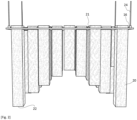
- the bars 20 are distributed in an organized manner and are aligned and spaced relative to each other along the plane identical length but to increase the sound absorption performance, the bars 20 here have a different length, as shown in the figure 2 .
- This other arrangement describes a configuration in which the length of each bar 20 is increasingly shorter depending on whether the positioning of each bar 20 is central.
- the bars 20 placed on the periphery of the support plane 16 are longer than the bars 20 placed in the central part of the support plane 16, the length of said bars 20 decreasing as one approaches the center of the device. absorption, in the plane 20.
- the bars 20, described as being held vertically by a pin 21, can also be glued by one of their ends, in this case the upper end. In the latter case, the bars 20 do not cross the support plane 16 but extend from said support plane 16 downwards, suspended.
- the sound absorption device is provided with at least two types of bars 20-1 and 20-2. Said bars 20-1 and 20-2 are also held on the support plane 16 by pins 21. Each of said at least two types of bar 20-1 and 20-2 has a different length and/or material density and/or is made of at least two materials.
- An arrangement is shown on the Figure 3 , and includes a 20-1 bar alignment, of a first material density and a 20-2 bar alignment, of a second material density.
- the material used here is wadding presenting high-performance sound qualities but also environmental qualities so as to ensure in particular non-polluting recycling or destruction of this material which has the advantage of not releasing volatile organic compounds.
- the alignments of bars 20-1 and 20-2 are also spaced and positioned in a staggered manner and the bars 20-1 and 20-2 are offset from each other so that a 20-1 bar of a certain density is only aligned with another 20-1 bar of the same density.
- the length of bars 20-1 and 20-2 is increasingly shorter depending on whether their positioning is central.
- the bars 20-1 and 20-2 placed on the periphery of the absorption device are therefore longer than the bars 20-1 and 20-2 placed in the central part of the support plane 16, the length of said bars 20-1 and 20 -2 decreasing as we approach the center of the absorption device.
- the bars 20-1 and 20-2 each have an end 23-1 and 23-2, these ends together forming a parabolic space open towards the bottom. However, multiple combinations are possible.
- the bars 20-1 and 20-2 can be of different geometry, of square, hexagonal, triangular section, or even be an irregular polygon. Bars 20-1 and 20-2 can also have the same or different density.
- the hanging means 12 are formed by hangers 24 connected to the support plane 16 and can be hung from a ceiling, beams or a specifically provided support, the weight of the device according to the invention having a large volume but a reduced weight .
- the attachment means can also be rigid with rods, in the case where the absorption device is directly fixed to the ceiling by clipping.
- the bars 20 are formed by a material having high sound absorption performance, as here in wadding and can also be formed from foam or any other material with high sound absorption capacity, light, in particular with a density of between 12 kg/m3 and 24 kg/m3.
- FIG. 4 represents the sound absorption device of the Figure 3 , suspended using hangers 24 above a workstation comprising a machine M used by an operator O.
- the noise B from the noise emitting zone, represented by waves, propagates towards the operator O and upwards, therefore towards the ceiling where the noise is damped, which protects the adjacent volume spaces and the people who are there.
- the sound absorption device of the present invention is intended to be hung or suspended in order to be positioned above and as close as possible to a noise source. It is therefore interesting to position the acoustic insulation device as close as possible to the noise source.
- a workshop station on which manual work with shocks is carried out generates noises of very different natures and frequencies. It is therefore interesting to be able to have an absorption device capable of absorbing and attenuating these different sounds as best as possible.
- the sound absorption device described here proposes to maximize the attenuation of these different sounds by using an arrangement of at least two bars 20-1 and 20-2, of different natures and different lengths.
- bars 20-1 and 20-2 of different densities therefore allows the attenuation of sounds of different frequencies because each density of absorbent material has a certain capacity to absorb a certain frequency range of the noise emitted and thus improve the quality of the acoustic environment.
- the positioning of the acoustic absorption device above the operator's station O and the machine M given as an example to illustrate a noise source with multiple frequency spectra allows the capture of a very large part of the noise B generated.
- the hangers 24 allow the desired height positioning to ensure the best absorption.
- the noises composed of different powers and frequencies are then captured by at least two types of bars 20-1 and 20-2 which, due to their different densities, each capture different frequency spectra. It is therefore possible to choose at least two types of bars depending on the different noises generated, high and low, of different intensities and sound frequencies.
- absorption devices can be multiplied and developed to measure according to different activities and different types of nuisance.
Landscapes
- Physics & Mathematics (AREA)
- Acoustics & Sound (AREA)
- Engineering & Computer Science (AREA)
- Multimedia (AREA)
- Mechanical Engineering (AREA)
- Soundproofing, Sound Blocking, And Sound Damping (AREA)
- Building Environments (AREA)
Description
- L'invention concerne un dispositif d'absorption acoustique.
- Dans tous les espaces de vie et les espaces de travail, le confort acoustique est un paramètre très important. En effet, le confort acoustique a un rôle important dans la concentration, la fatigue, le stress et la performance intellectuelle. Tout facteur lié à la qualité acoustique d'un espace est donc important à considérer.
- Dans des bâtiments comprenant une faible isolation acoustique, la réverbération des différents sons peut générer une mauvaise acoustique.
- Les espaces de travail collectif ou les espaces bruyants comme des ateliers techniques et industriels peuvent engendrer des niveaux sonores importants, difficilement admissibles et inconfortables, avec des valeurs égales ou supérieures à 100dB. Par exemple, un bâtiment métallique ne présente aucune capacité à absorber les bruits et accentue plutôt la réverbération des bruits intérieurs formant un volume de résonnance acoustique.
- De nombreux matériaux et surfaces acoustiques ont été développés et permettent, une fois disposés sur les murs, d'absorber les sons. Cette solution bien connue, est particulièrement utilisée dans les studios d'enregistrement musicaux pour éviter toute réverbération et parasitisme sonore afin d'obtenir la meilleure qualité acoustique possible. Ces matériaux peuvent également être appliqués sur des surfaces murales de cantines, écoles ou autres lieux bruyants. Le recouvrement de surfaces murales avec ce type de revêtement acoustique peut néanmoins coûter très cher et ne convient pas aux bâtiments industriels ou à certaines applications par exemple lorsque les cloisons sont trop éloignées et que les volumes sont très importants. De plus, certains bruits, générés ponctuellement nécessitent d'être isolés plus localement. Par exemple les bruits émis sur une zone émettrice de bruit avec un poste de travail sur lequel sont utilisés des machines ou des outils bruyants, ou bien des tables de restaurants, nécessitent plutôt une isolation appliquée à proximité directe de la source de bruit. Le document
CN 102 737 627 concerne un absorbeur acoustique comprenant des barres avec des longueurs différentes, ledit dispositif comportant des moyens support, des moyens d'accroche et des moyens d'absorption sonore. Le documentUS 10 359 163 FR 2 817 995 US 2019/244596 divulgue un diffuseur-absorbeur acoustique comprenant des barres avec des longueurs différentes. La longueur des barres est déterminée par l'inverse de la séquence des résidus quadratiques (QR). - Il conviendrait de disposer d'un élément pouvant être installé aisément à proximité des sources de nuisances sonores et des espaces nécessitant d'être isolés.
- La présente invention propose un dispositif acoustique pouvant être suspendu et placé au-dessus de la source de bruit et qui présente une capacité d'absorption sonore élevée. A cet effet le dispositif d'absorption acoustique d'une zone émettrice de bruits, comporte des moyens support, des moyens d'accroche et des moyens d'absorption sonore dans lequel les moyens support comprennent un plan support sur lequel sont rapportés lesdits moyens d'absorption sonore, dirigé vers ladite zone émettrice de bruits.
- Le dispositif permet de transformer l'énergie cinétique du son porté par les molécules d'air en énergie mécanique par les fibres constituant les moyens d'absorption sonore.
- Le plan support est un plan support rigide comprenant une pluralité d'ouverture, chaque barre passant dans une ouverture du plan support. En d'autres termes, le nombre d'ouverture est égal au nombre d'éléments d'absorption sonore. Les éléments d'absorption s'étendent longitudinalement et verticalement à partir d'un plan support et sont alignés et espacés l'un par rapport à l'autre suivant le plan comprenant le plan support.
- Selon l'invention, le dispositif comportant des moyens support, des moyens d'accroche et des moyens d'absorption sonore, et les moyens support comprennent un plan support sur lequel sont rapportés lesdits moyens d'absorption sonore, dirigé vers ladite zone émettrice de bruits.
- Selon l'invention, les moyens d'absorption sonore sont constitués de plus de deux barres.
- Chaque barre est au moins partiellement formée par une matière avec une densité comprise entre 12 kg/m3 et 24 kg/m3.
- Selon l'invention, chaque barre est constituée de mousse ou de ouate absorbant les bruits.
- Selon l'invention, les barres sont de longueurs différentes. Avantageusement les barres sont de sections, de densités différentes.
- Avantageusement la longueur de chaque barre est de plus en plus courte suivant que le positionnement de chaque barre est central. Ainsi les barres placées en périphérie du plan support sont plus longues que les barres placées en partie centrale du plan support, la longueur desdites barres diminuant au fur et à mesure que l'on se rapproche du centre du dispositif d'absorption,
- En variante, les barres sont organisées en au moins un alignement de barre, d'une première densité de matière et un alignement de barre, d'une seconde densité de matière. Les alignements de barres sont espacés et positionnés en quinconce et les barres sont décalées entre elles si bien qu'une barre d'une certaine densité est uniquement alignée avec une autre barre de même densité. La longueur des barres est de plus en plus courte suivant que leur positionnement est central. Ainsi les barres placées en périphérie du dispositif d'absorption sont donc plus longues que les barres placées en partie centrale du plan support, la longueur desdites barres diminuant au fur et à mesure que l'on se rapproche du centre du dispositif d'absorption.
- Les extrémités inférieures des barres de longueurs différentes forment un espace parabolique, notamment ouvert.
- Avantageusement le plan support comprend au moins une ouverture permettant à la au moins une barre de traverser ledit plan support, une goupille assurant le maintien de chaque au moins une barre sur ledit plan support.
- Avantageusement, l'extrémité supérieure des barres est rapportée par collage sur la face inférieure du plan support.
- Avantageusement, les différentes barres sont réalisées en au moins deux matières.
- Avantageusement, les moyens d'accroche sont formés par des suspentes reliées au plan support.
- En variante, les moyens d'accroche peuvent également être rigides avec des tiges, par exemple dans le cas où le dispositif d'absorption est directement fixé au plafond par clipsage
- Le dispositif comporte un organe de réglage de la hauteur du plan support vis-à-vis d'une zone émettrice de bruit. De la sorte, il est possible de régler la hauteur du dispositif pour s'adapter à la dimension de la zone émettrice de bruit. Si l'utilisateur travaille sur une petite surface émettrice de bruit, le dispositif peut être rapproché de cette zone, au contraire, si l'utilisateur travaille sur un objet de grande dimension avec une zone émettrice de bruit plus étendue, alors le dispositif peut être éloigné de cette zone de manière à couvrir une zone émettrice de bruit étendue
- La présente invention est maintenant décrite à l'aide d'exemples uniquement illustratifs et nullement limitatifs de la portée de l'invention, et à partir des illustrations jointes, dans lesquelles :
- [
Fig. 1] ou figure 1 représente une vue en perspective du dispositif d'absorption acoustique selon l'invention. - [
Fig. 2] ou figure 2 représente une vue de face du dispositif d'absorption acoustique de lafigure 1 . - [
Fig. 3] ou figure 3 représente une vue de dessus en perspective du dispositif d'absorption acoustique selon l'invention. - [
Fig. 4] ou figure 4 représente une vue de face d'un dispositif d'absorption mis en place au-dessus d'un poste de travail. - On considère l'ensemble des
figures 1 à 4 dans un repère orthogonal X, Y et Z. Le dispositif d'absorption acoustique comprend des moyens support 10, des moyens d'accroche 12 et des moyens d'absorption sonore 14. Les moyens support 10 sont formés par un plan support 16 rigide comportant au moins une ouverture 17 à travers laquelle passe un élément d'absorption sonore 18. L'élément d'absorption sonore 18 est formé par des barres 20. Chaque barre 20 passe dans une ouverture 17 du plan support 16 et se trouve maintenue verticalement par une goupille 21, formée par un axe, qui traverse lesdites barres 20 suivant le plan X, Y et qui sont placées au-dessus du plan support 16. La goupille 21 permet de démonter chaque barre 20 indépendamment pour facilement la nettoyer ou la remplacer. Le nombre d'ouverture 17 est égal au nombre d'éléments d'absorption sonore 18. Le dispositif d'absorption acoustique comporte donc au moins un élément d'absorption sonore 18. Dans les configurations représentées sur lesfigures 1 à 4 , vingt-trois éléments d'absorption sonore 18 sont mis en place à travers les ouvertures 17 réalisées dans le plan support 16. Les éléments d'absorption 18 sont réalisés par des barres 20 étendues longitudinalement et verticalement à partir d'un plan support 16, suivant l'axe Z. Les barres 20 sont réparties de manière organisée et sont alignées et espacées l'une par rapport à l'autre suivant le plan X, Y du repère orthogonal comprenant le plan support 16. Les barres 20 peuvent être de longueur identique mais pour augmenter la performance d'absorption acoustique, les barres 20 ont ici une longueur différente, comme représenté sur lafigure 2 . Cet autre agencement décrit une configuration dans laquelle la longueur de chaque barre 20 est de plus en plus courte suivant que le positionnement de chaque barre 20 est central. Ainsi les barres 20 placées en périphérie du plan support 16 sont plus longues que les barres 20 placées en partie centrale du plan support 16, la longueur desdites barres 20 diminuant au fur et à mesure que l'on se rapproche du centre du dispositif d'absorption, dans le plan X, Y. L'ensemble des extrémités inférieures 22 des barres 20 forment ainsi, ensembles, un espace parabolique ouvert vers le bas, si l'on considère une surface sensiblement parabolique qui passe par l'extrémité de chaque barre 20. - Les barres 20, décrites comment étant retenues verticalement par une goupille 21 peuvent également être collées par l'une de leur extrémité, en l'occurrence l'extrémité supérieure. Dans ce dernier cas, les barres 20 ne traversent pas le plan support 16 mais s'étendent depuis ledit plan support 16 vers le bas, suspendues.
- Dans un autre agencement, représenté sur les
figures 3 et4 , le dispositif d'absorption acoustique est muni d'au moins deux types de barres 20-1 et 20-2. Lesdites barres 20-1 et 20-2 sont également maintenues sur le plan support 16 par des goupilles 21. Chacun desdits au moins deux types de barre 20-1 et 20-2 a une longueur et/ou une densité de matière différente et/ou est réalisé en au moins deux matières. Un agencement est représenté sur lafigure 3 , et comprend un alignement de barre 20-1, d'une première densité de matière et un alignement de barre 20-2, d'une seconde densité de matière. La matière utilisée ici est de la ouate présentant des qualités phoniques performantes mais aussi des qualités environnementales de façon à assurer notamment un recyclage ou une destruction non polluante de cette matière qui présente l'avantage de ne pas dégager de composés organiques volatils. Les alignements de barres 20-1 et 20-2 sont également espacés et positionnés en quinconce et les barres 20-1 et 20-2 sont décalées entre elles si bien qu'une barre 20-1 d'une certaine densité est uniquement alignée avec une autre barre 20-1 de même densité. La longueur des barres 20-1 et 20-2 est de plus en plus courte suivant que leur positionnement est central. Ainsi les barres 20-1 et 20-2 placées en périphérie du dispositif d'absorption sont donc plus longues que les barres 20-1 et 20-2 placées en partie centrale du plan support 16, la longueur desdites barres 20-1 et 20-2 diminuant au fur et à mesure que l'on se rapproche du centre du dispositif d'absorption. Les barres 20-1 et 20-2 comportent chacune une extrémité 23-1 et 23-2, ces extrémités formant ensemble un espace parabolique ouvert vers le bas. Néanmoins, de multiples combinaisons sont possibles. Dans une autre configuration non représentée, les barres 20-1 et 20-2 peuvent être de géométrie différente, de section carrée, hexagonale, triangulaire, ou même être un polygone irrégulier. Les barres 20-1 et 20-2 peuvent également avoir une densité identique ou différente. Les moyens d'accroche 12 sont formés par des suspentes 24 reliées au plan support 16 et pouvant être accrochées, à un plafond, des poutres ou un support ménagé spécifiquement, le poids du dispositif selon l'invention ayant un volume important mais un poids réduit. Les moyens d'accroche peuvent également être rigides avec des tiges, dans le cas où le dispositif d'absorption est directement fixé au plafond par clipsage. - Les barres 20 sont formées par une matière ayant des performances d'absorption sonore élevées, comme ici en ouate et peuvent également être formées en mousse ou en toute autre matière à haute capacité d'absorption phonique, légère, notamment avec une densité comprise entre 12 kg/m3 et 24 kg/m3.
- La
figure 4 représente le dispositif d'absorption acoustique de lafigure 3 , suspendu à l'aide de suspentes 24 au-dessus d'un poste de travail comportant une machine M utilisée par un opérateur O. Le bruit B, de la zone émettrice de bruits, représenté par des ondes, se propage vers l'opérateur O et vers le haut, donc vers le plafond où le bruit est amorti, ce qui protège les espaces volumiques adjacents et les personnes qui s'y trouvent. - La mise en oeuvre du dispositif d'absorption de la présente invention est maintenant décrite. Le dispositif d'absorption acoustique est destiné à être accroché ou suspendu afin d'être positionné au-dessus et au plus près d'une source de bruit. Il est donc intéressant de positionner le dispositif d'isolation acoustique au plus près de la source de bruit. Un poste d'atelier sur lequel un travail manuel avec des chocs est opéré, génère des bruits de natures et de fréquences très différentes. Il est donc intéressant de pouvoir disposer d'un dispositif d'absorption capable d'absorber et d'atténuer au mieux ces différents sons. Le dispositif d'absorption acoustique décrit ici, propose de maximiser l'atténuation de ces différents sons en utilisant un agencement d'au moins deux barres 20-1 et 20-2, de natures différentes et de longueurs différentes. La mise en place de barres 20-1 et 20-2 de densités différentes permet donc l'atténuation de sons de fréquences différentes car chaque densité de matière absorbante a une certaine capacité à absorber une certaine plage de fréquences du bruit émis et ainsi améliorer la qualité de l'environnement acoustique. Le positionnement du dispositif d'absorption acoustique au-dessus du poste de l'opérateur O et de la machine M donnée en exemple pour illustrer une source de bruit à spectres de fréquences multiples, permet la captation d'une très grande partie du bruit B généré. Les suspentes 24 permettent le positionnement en hauteur souhaité pour assurer la meilleure absorption. Les bruits composés de puissances et de fréquences différentes sont alors captés par au moins deux types de barres 20-1 et 20-2 qui, de par leurs densités différentes, captent chacune des spectres de fréquence différents. Il est donc possible de choisir au moins deux types de barres en fonction des différents bruits générés, aigus, graves, d'intensités et de fréquences sonores différentes.
- La pose de dispositif d'absorption peut être multipliée et développée sur mesure en fonction des différentes activités et des différents types de nuisance.
Claims (6)
- Dispositif d'absorption acoustique d'une zone émettrice de bruits, ledit dispositif comportant des moyens support (10), des moyens d'accroche (12) et des moyens d'absorption sonore (18), caractérisé en ce que :- les moyens support (10) comprennent un plan support (16) sur lequel sont rapportés lesdits moyens d'absorption sonore (18), dirigé vers ladite zone émettrice de bruits- les moyens d'absorption sonore (18) sont constitués de plus de deux barres (20), chaque barre (20) étant de longueur différente ;∘ chaque barre (20) étant constituée de mousse ou de ouate absorbant les bruitset en ce que les extrémités inférieures (22) des barres (20) de longueurs différentes forment un espace parabolique ouvert.
- Dispositif d'absorption acoustique selon la revendication 1,
caractérisé en ce que les barres (20) sont de section et de densité différentes. - Dispositif d'absorption acoustique selon l'une des revendication 1 ou 2, caractérisé en ce que le plan support (16) comprend des ouvertures (17) permettant aux barres (20) de traverser le plan support (16), une goupille (21) pour chaque barre (20) assurant le maintien des barres (20) sur ledit plan support (16).
- Dispositif d'absorption acoustique selon l'une des revendications 1 ou 2, caractérisé en ce que l'extrémité supérieure des barres (20) est rapportée par collage sur la face inférieure du plan support (16).
- Dispositif selon l'une des revendications précédentes caractérisé en ce que les différentes barres (20) sont réalisées en au moins deux matières.
- Dispositif d'absorption acoustique selon l'une quelconque des revendications précédentes, caractérisé en ce que les moyens d'accroche (12) sont formés par des suspentes (24) reliées au plan support (16).
Applications Claiming Priority (2)
| Application Number | Priority Date | Filing Date | Title |
|---|---|---|---|
| FR1910592A FR3101184B1 (fr) | 2019-09-25 | 2019-09-25 | Dispositif d'absorption acoustique |
| PCT/EP2020/076983 WO2021058787A1 (fr) | 2019-09-25 | 2020-09-25 | Dispositif d'absorption acoustique |
Publications (3)
| Publication Number | Publication Date |
|---|---|
| EP4034430A1 EP4034430A1 (fr) | 2022-08-03 |
| EP4034430C0 EP4034430C0 (fr) | 2024-06-05 |
| EP4034430B1 true EP4034430B1 (fr) | 2024-06-05 |
Family
ID=69190918
Family Applications (1)
| Application Number | Title | Priority Date | Filing Date |
|---|---|---|---|
| EP20789002.1A Active EP4034430B1 (fr) | 2019-09-25 | 2020-09-25 | Dispositif d'absorption acoustique |
Country Status (4)
| Country | Link |
|---|---|
| US (1) | US20230135515A1 (fr) |
| EP (1) | EP4034430B1 (fr) |
| FR (1) | FR3101184B1 (fr) |
| WO (1) | WO2021058787A1 (fr) |
Citations (1)
| Publication number | Priority date | Publication date | Assignee | Title |
|---|---|---|---|---|
| CN102737627B (zh) * | 2012-06-15 | 2014-09-17 | 中国石油天然气股份有限公司 | 反二次余数扩散低频消声降噪复合模板 |
Family Cites Families (19)
| Publication number | Priority date | Publication date | Assignee | Title |
|---|---|---|---|---|
| US5665943A (en) * | 1995-06-15 | 1997-09-09 | Rpg Diffusor Systems, Inc. | Nestable sound absorbing foam with reduced area of attachment |
| US5623130A (en) * | 1995-11-20 | 1997-04-22 | Noxon; Arthur M. | System for enhancing room acoustics |
| US6199337B1 (en) * | 1995-11-22 | 2001-03-13 | Hunter Douglas Inc. | Cladding system and panel for use in such system |
| US5579614A (en) * | 1996-01-02 | 1996-12-03 | Dorn; Gordon J. | Acoustical system, a part therefor and method of making same |
| FR2817995B1 (fr) * | 2000-12-08 | 2003-02-28 | Cera | Complexe d'absorption acoustique |
| PL1607544T3 (pl) * | 2004-06-17 | 2009-08-31 | Heimbach Gmbh & Co Kg | Urządzenie do akustycznej izolacji wykładziny ściennej, sufitowej lub podłogowej |
| AT10910U1 (de) * | 2007-11-07 | 2009-12-15 | Vatter Acoustic Technologies V | Akustikpaneel |
| AU2012255734B2 (en) * | 2011-05-17 | 2015-09-17 | Armstrong World Industries, Inc. | Mounting hardware and mounting system for vertical panels |
| US8967823B2 (en) * | 2012-09-13 | 2015-03-03 | Rpg Diffusor Systems, Inc. | Combination light diffuser and acoustical treatment and listening room including such fixtures |
| SG11201504445UA (en) * | 2012-12-06 | 2015-07-30 | Armstrong World Ind Inc | Ceiling system |
| US20140262607A1 (en) * | 2013-03-15 | 2014-09-18 | Kent Gray | Kit For Assembling Acoustic Treatments To Surfaces |
| US9353521B2 (en) * | 2013-09-06 | 2016-05-31 | Awi Licensing Llc | Ceiling-mounted baffle system |
| US10255900B2 (en) * | 2016-01-14 | 2019-04-09 | Acoustic First Corporation | Systems, apparatuses, and methods for sound diffusion |
| US20180283004A1 (en) * | 2016-06-30 | 2018-10-04 | Jason Gillette | Apparatus and system for dynamic acoustic drop ceiling system and methods thereof |
| US9738796B1 (en) * | 2016-09-07 | 2017-08-22 | Usg Interiors, Llc | Acoustically transparent coating |
| DK179483B1 (en) * | 2017-03-05 | 2018-12-17 | Werner Adelmann-Larsen Niels | Variable Acoustic Technology for Rooms |
| US10490179B2 (en) * | 2018-02-07 | 2019-11-26 | RPG Acoustical Systems, LLC | Combined diffuser-absorber with spaced slats |
| AU2018446825A1 (en) * | 2018-10-22 | 2021-06-03 | Instyle Contract Textiles Pty Ltd | Ceiling module |
| US10359163B1 (en) * | 2018-10-30 | 2019-07-23 | Usg Interiors, Llc | Accessible ceiling baffles with integrated lighting, custom perforation, and acoustics |
-
2019
- 2019-09-25 FR FR1910592A patent/FR3101184B1/fr active Active
-
2020
- 2020-09-25 US US17/763,574 patent/US20230135515A1/en not_active Abandoned
- 2020-09-25 EP EP20789002.1A patent/EP4034430B1/fr active Active
- 2020-09-25 WO PCT/EP2020/076983 patent/WO2021058787A1/fr not_active Ceased
Patent Citations (1)
| Publication number | Priority date | Publication date | Assignee | Title |
|---|---|---|---|---|
| CN102737627B (zh) * | 2012-06-15 | 2014-09-17 | 中国石油天然气股份有限公司 | 反二次余数扩散低频消声降噪复合模板 |
Also Published As
| Publication number | Publication date |
|---|---|
| EP4034430A1 (fr) | 2022-08-03 |
| EP4034430C0 (fr) | 2024-06-05 |
| FR3101184B1 (fr) | 2023-01-27 |
| WO2021058787A1 (fr) | 2021-04-01 |
| US20230135515A1 (en) | 2023-05-04 |
| FR3101184A1 (fr) | 2021-03-26 |
Similar Documents
| Publication | Publication Date | Title |
|---|---|---|
| Cox et al. | Acoustic absorbers and diffusers: theory, design and application | |
| JP2023159382A (ja) | シュラウド | |
| EP3114678B1 (fr) | Ensemble d'absorption acoustique a hautes et basses frequences | |
| US20190257079A1 (en) | Special lightweight, durable mounting system for sound foam panel and quick installation process | |
| FR2564629A1 (fr) | Procede et appareil pour l'absorption du son | |
| CN102984621A (zh) | 声响调整方法、声场调整系统、扬声器基座、家具 | |
| EP1343141A3 (fr) | Dispositif absorbant le son utilisant un matériau poreux | |
| CN113969861B (zh) | 具有低频声波衰减特征的声学衬垫 | |
| WO2003071043A1 (fr) | Dispositif de fixation d'un panneau acoustique sur une paroi | |
| EP4034430B1 (fr) | Dispositif d'absorption acoustique | |
| WO2001071116A1 (fr) | Materiaux souples en feuilles pour structures tendues, procede de realisation de tels materiaux, faux plafonds tendus comprenant de tels materiaux | |
| Jayamani et al. | Experimental determination of sound absorption coefficients of four types of Malaysian wood | |
| RU2003109146A (ru) | Вибрационный грохот | |
| DE102004040112A1 (de) | Schallabsorbierendes Element | |
| US20190122649A1 (en) | Broadband acoustic absorption metamaterials | |
| Johnston et al. | 3D printed multifunctional, load-bearing, low-frequency sound absorbers | |
| AU2005274088A1 (en) | Active/passive distributed | |
| FR2881765A1 (fr) | Ensemble acoustiquement absorbant | |
| FR2581106A1 (fr) | Structure autoporteuse isolante, notamment pour isolation phonique et son procede de realisation | |
| FR2943880A1 (fr) | Panneau acoustique destine a recevoir, emettre ou absorber des sons. | |
| RU60101U1 (ru) | Устройство корректировки акустики помещений | |
| EP1249561A2 (fr) | Revêtement de sol multicouche, à poser flottant | |
| EP3736465B1 (fr) | Absorbeur de résonance pour une paroi de construction et élément de construction à absorbeurs de résonance | |
| Fuchs et al. | Sound absorbers | |
| EP2347406A1 (fr) | Réflecteur acoustique |
Legal Events
| Date | Code | Title | Description |
|---|---|---|---|
| STAA | Information on the status of an ep patent application or granted ep patent |
Free format text: STATUS: UNKNOWN |
|
| STAA | Information on the status of an ep patent application or granted ep patent |
Free format text: STATUS: THE INTERNATIONAL PUBLICATION HAS BEEN MADE |
|
| PUAI | Public reference made under article 153(3) epc to a published international application that has entered the european phase |
Free format text: ORIGINAL CODE: 0009012 |
|
| STAA | Information on the status of an ep patent application or granted ep patent |
Free format text: STATUS: REQUEST FOR EXAMINATION WAS MADE |
|
| 17P | Request for examination filed |
Effective date: 20220422 |
|
| AK | Designated contracting states |
Kind code of ref document: A1 Designated state(s): AL AT BE BG CH CY CZ DE DK EE ES FI FR GB GR HR HU IE IS IT LI LT LU LV MC MK MT NL NO PL PT RO RS SE SI SK SM TR |
|
| DAV | Request for validation of the european patent (deleted) | ||
| DAX | Request for extension of the european patent (deleted) | ||
| GRAP | Despatch of communication of intention to grant a patent |
Free format text: ORIGINAL CODE: EPIDOSNIGR1 |
|
| STAA | Information on the status of an ep patent application or granted ep patent |
Free format text: STATUS: GRANT OF PATENT IS INTENDED |
|
| INTG | Intention to grant announced |
Effective date: 20240108 |
|
| GRAS | Grant fee paid |
Free format text: ORIGINAL CODE: EPIDOSNIGR3 |
|
| GRAA | (expected) grant |
Free format text: ORIGINAL CODE: 0009210 |
|
| STAA | Information on the status of an ep patent application or granted ep patent |
Free format text: STATUS: THE PATENT HAS BEEN GRANTED |
|
| AK | Designated contracting states |
Kind code of ref document: B1 Designated state(s): AL AT BE BG CH CY CZ DE DK EE ES FI FR GB GR HR HU IE IS IT LI LT LU LV MC MK MT NL NO PL PT RO RS SE SI SK SM TR |
|
| REG | Reference to a national code |
Ref country code: CH Ref legal event code: EP |
|
| REG | Reference to a national code |
Ref country code: DE Ref legal event code: R096 Ref document number: 602020032053 Country of ref document: DE |
|
| REG | Reference to a national code |
Ref country code: IE Ref legal event code: FG4D Free format text: LANGUAGE OF EP DOCUMENT: FRENCH |
|
| U01 | Request for unitary effect filed |
Effective date: 20240705 |
|
| U07 | Unitary effect registered |
Designated state(s): AT BE BG DE DK EE FI FR IT LT LU LV MT NL PT SE SI Effective date: 20240712 |
|
| PG25 | Lapsed in a contracting state [announced via postgrant information from national office to epo] |
Ref country code: HR Free format text: LAPSE BECAUSE OF FAILURE TO SUBMIT A TRANSLATION OF THE DESCRIPTION OR TO PAY THE FEE WITHIN THE PRESCRIBED TIME-LIMIT Effective date: 20240605 |
|
| PG25 | Lapsed in a contracting state [announced via postgrant information from national office to epo] |
Ref country code: GR Free format text: LAPSE BECAUSE OF FAILURE TO SUBMIT A TRANSLATION OF THE DESCRIPTION OR TO PAY THE FEE WITHIN THE PRESCRIBED TIME-LIMIT Effective date: 20240906 |
|
| PG25 | Lapsed in a contracting state [announced via postgrant information from national office to epo] |
Ref country code: ES Free format text: LAPSE BECAUSE OF FAILURE TO SUBMIT A TRANSLATION OF THE DESCRIPTION OR TO PAY THE FEE WITHIN THE PRESCRIBED TIME-LIMIT Effective date: 20240605 |
|
| PG25 | Lapsed in a contracting state [announced via postgrant information from national office to epo] |
Ref country code: NO Free format text: LAPSE BECAUSE OF FAILURE TO SUBMIT A TRANSLATION OF THE DESCRIPTION OR TO PAY THE FEE WITHIN THE PRESCRIBED TIME-LIMIT Effective date: 20240905 Ref country code: HR Free format text: LAPSE BECAUSE OF FAILURE TO SUBMIT A TRANSLATION OF THE DESCRIPTION OR TO PAY THE FEE WITHIN THE PRESCRIBED TIME-LIMIT Effective date: 20240605 Ref country code: GR Free format text: LAPSE BECAUSE OF FAILURE TO SUBMIT A TRANSLATION OF THE DESCRIPTION OR TO PAY THE FEE WITHIN THE PRESCRIBED TIME-LIMIT Effective date: 20240906 Ref country code: ES Free format text: LAPSE BECAUSE OF FAILURE TO SUBMIT A TRANSLATION OF THE DESCRIPTION OR TO PAY THE FEE WITHIN THE PRESCRIBED TIME-LIMIT Effective date: 20240605 Ref country code: RS Free format text: LAPSE BECAUSE OF FAILURE TO SUBMIT A TRANSLATION OF THE DESCRIPTION OR TO PAY THE FEE WITHIN THE PRESCRIBED TIME-LIMIT Effective date: 20240905 |
|
| PG25 | Lapsed in a contracting state [announced via postgrant information from national office to epo] |
Ref country code: PL Free format text: LAPSE BECAUSE OF FAILURE TO SUBMIT A TRANSLATION OF THE DESCRIPTION OR TO PAY THE FEE WITHIN THE PRESCRIBED TIME-LIMIT Effective date: 20240605 |
|
| PG25 | Lapsed in a contracting state [announced via postgrant information from national office to epo] |
Ref country code: IS Free format text: LAPSE BECAUSE OF FAILURE TO SUBMIT A TRANSLATION OF THE DESCRIPTION OR TO PAY THE FEE WITHIN THE PRESCRIBED TIME-LIMIT Effective date: 20241005 |
|
| PG25 | Lapsed in a contracting state [announced via postgrant information from national office to epo] |
Ref country code: CZ Free format text: LAPSE BECAUSE OF FAILURE TO SUBMIT A TRANSLATION OF THE DESCRIPTION OR TO PAY THE FEE WITHIN THE PRESCRIBED TIME-LIMIT Effective date: 20240605 |
|
| PG25 | Lapsed in a contracting state [announced via postgrant information from national office to epo] |
Ref country code: SK Free format text: LAPSE BECAUSE OF FAILURE TO SUBMIT A TRANSLATION OF THE DESCRIPTION OR TO PAY THE FEE WITHIN THE PRESCRIBED TIME-LIMIT Effective date: 20240605 Ref country code: RO Free format text: LAPSE BECAUSE OF FAILURE TO SUBMIT A TRANSLATION OF THE DESCRIPTION OR TO PAY THE FEE WITHIN THE PRESCRIBED TIME-LIMIT Effective date: 20240605 |
|
| PG25 | Lapsed in a contracting state [announced via postgrant information from national office to epo] |
Ref country code: SM Free format text: LAPSE BECAUSE OF FAILURE TO SUBMIT A TRANSLATION OF THE DESCRIPTION OR TO PAY THE FEE WITHIN THE PRESCRIBED TIME-LIMIT Effective date: 20240605 |
|
| PG25 | Lapsed in a contracting state [announced via postgrant information from national office to epo] |
Ref country code: SM Free format text: LAPSE BECAUSE OF FAILURE TO SUBMIT A TRANSLATION OF THE DESCRIPTION OR TO PAY THE FEE WITHIN THE PRESCRIBED TIME-LIMIT Effective date: 20240605 Ref country code: SK Free format text: LAPSE BECAUSE OF FAILURE TO SUBMIT A TRANSLATION OF THE DESCRIPTION OR TO PAY THE FEE WITHIN THE PRESCRIBED TIME-LIMIT Effective date: 20240605 Ref country code: RO Free format text: LAPSE BECAUSE OF FAILURE TO SUBMIT A TRANSLATION OF THE DESCRIPTION OR TO PAY THE FEE WITHIN THE PRESCRIBED TIME-LIMIT Effective date: 20240605 Ref country code: PL Free format text: LAPSE BECAUSE OF FAILURE TO SUBMIT A TRANSLATION OF THE DESCRIPTION OR TO PAY THE FEE WITHIN THE PRESCRIBED TIME-LIMIT Effective date: 20240605 Ref country code: IS Free format text: LAPSE BECAUSE OF FAILURE TO SUBMIT A TRANSLATION OF THE DESCRIPTION OR TO PAY THE FEE WITHIN THE PRESCRIBED TIME-LIMIT Effective date: 20241005 Ref country code: CZ Free format text: LAPSE BECAUSE OF FAILURE TO SUBMIT A TRANSLATION OF THE DESCRIPTION OR TO PAY THE FEE WITHIN THE PRESCRIBED TIME-LIMIT Effective date: 20240605 |
|
| PLBE | No opposition filed within time limit |
Free format text: ORIGINAL CODE: 0009261 |
|
| STAA | Information on the status of an ep patent application or granted ep patent |
Free format text: STATUS: NO OPPOSITION FILED WITHIN TIME LIMIT |
|
| PG25 | Lapsed in a contracting state [announced via postgrant information from national office to epo] |
Ref country code: MC Free format text: LAPSE BECAUSE OF FAILURE TO SUBMIT A TRANSLATION OF THE DESCRIPTION OR TO PAY THE FEE WITHIN THE PRESCRIBED TIME-LIMIT Effective date: 20240605 |
|
| REG | Reference to a national code |
Ref country code: CH Ref legal event code: PL |
|
| 26N | No opposition filed |
Effective date: 20250306 |
|
| U90 | Renewal fees not paid: noting of loss of rights |
Free format text: RENEWAL FEE NOT PAID FOR YEAR 05 Effective date: 20250422 |
|
| GBPC | Gb: european patent ceased through non-payment of renewal fee |
Effective date: 20240925 |
|
| PG25 | Lapsed in a contracting state [announced via postgrant information from national office to epo] |
Ref country code: GB Free format text: LAPSE BECAUSE OF NON-PAYMENT OF DUE FEES Effective date: 20240925 |
|
| PG25 | Lapsed in a contracting state [announced via postgrant information from national office to epo] |
Ref country code: CH Free format text: LAPSE BECAUSE OF NON-PAYMENT OF DUE FEES Effective date: 20240930 |
|
| PG25 | Lapsed in a contracting state [announced via postgrant information from national office to epo] |
Ref country code: IE Free format text: LAPSE BECAUSE OF NON-PAYMENT OF DUE FEES Effective date: 20240925 |
|
| U93 | Unitary patent lapsed |
Free format text: RENEWAL FEE NOT PAID Effective date: 20240930 |
|
| PG25 | Lapsed in a contracting state [announced via postgrant information from national office to epo] |
Ref country code: CY Free format text: LAPSE BECAUSE OF FAILURE TO SUBMIT A TRANSLATION OF THE DESCRIPTION OR TO PAY THE FEE WITHIN THE PRESCRIBED TIME-LIMIT; INVALID AB INITIO Effective date: 20200925 |
|
| PG25 | Lapsed in a contracting state [announced via postgrant information from national office to epo] |
Ref country code: HU Free format text: LAPSE BECAUSE OF FAILURE TO SUBMIT A TRANSLATION OF THE DESCRIPTION OR TO PAY THE FEE WITHIN THE PRESCRIBED TIME-LIMIT; INVALID AB INITIO Effective date: 20200925 |