EP4033975B1 - An apparatus and method for energy expenditure estimation - Google Patents
An apparatus and method for energy expenditure estimation Download PDFInfo
- Publication number
- EP4033975B1 EP4033975B1 EP20740355.1A EP20740355A EP4033975B1 EP 4033975 B1 EP4033975 B1 EP 4033975B1 EP 20740355 A EP20740355 A EP 20740355A EP 4033975 B1 EP4033975 B1 EP 4033975B1
- Authority
- EP
- European Patent Office
- Prior art keywords
- heat
- individual
- flux
- heart rate
- energy expenditure
- Prior art date
- Legal status (The legal status is an assumption and is not a legal conclusion. Google has not performed a legal analysis and makes no representation as to the accuracy of the status listed.)
- Active
Links
Images



Classifications
-
- A—HUMAN NECESSITIES
- A61—MEDICAL OR VETERINARY SCIENCE; HYGIENE
- A61B—DIAGNOSIS; SURGERY; IDENTIFICATION
- A61B5/00—Measuring for diagnostic purposes; Identification of persons
- A61B5/22—Ergometry; Measuring muscular strength or the force of a muscular blow
- A61B5/221—Ergometry, e.g. by using bicycle type apparatus
- A61B5/222—Ergometry, e.g. by using bicycle type apparatus combined with detection or measurement of physiological parameters, e.g. heart rate
-
- A—HUMAN NECESSITIES
- A61—MEDICAL OR VETERINARY SCIENCE; HYGIENE
- A61B—DIAGNOSIS; SURGERY; IDENTIFICATION
- A61B5/00—Measuring for diagnostic purposes; Identification of persons
- A61B5/01—Measuring temperature of body parts ; Diagnostic temperature sensing, e.g. for malignant or inflamed tissue
-
- A—HUMAN NECESSITIES
- A61—MEDICAL OR VETERINARY SCIENCE; HYGIENE
- A61B—DIAGNOSIS; SURGERY; IDENTIFICATION
- A61B5/00—Measuring for diagnostic purposes; Identification of persons
- A61B5/02—Detecting, measuring or recording for evaluating the cardiovascular system, e.g. pulse, heart rate, blood pressure or blood flow
- A61B5/0205—Simultaneously evaluating both cardiovascular conditions and different types of body conditions, e.g. heart and respiratory condition
- A61B5/02055—Simultaneously evaluating both cardiovascular condition and temperature
-
- A—HUMAN NECESSITIES
- A61—MEDICAL OR VETERINARY SCIENCE; HYGIENE
- A61B—DIAGNOSIS; SURGERY; IDENTIFICATION
- A61B5/00—Measuring for diagnostic purposes; Identification of persons
- A61B5/02—Detecting, measuring or recording for evaluating the cardiovascular system, e.g. pulse, heart rate, blood pressure or blood flow
- A61B5/024—Measuring pulse rate or heart rate
- A61B5/02416—Measuring pulse rate or heart rate using photoplethysmograph signals, e.g. generated by infrared radiation
-
- A—HUMAN NECESSITIES
- A61—MEDICAL OR VETERINARY SCIENCE; HYGIENE
- A61B—DIAGNOSIS; SURGERY; IDENTIFICATION
- A61B5/00—Measuring for diagnostic purposes; Identification of persons
- A61B5/05—Detecting, measuring or recording for diagnosis by means of electric currents or magnetic fields; Measuring using microwaves or radio waves
- A61B5/053—Measuring electrical impedance or conductance of a portion of the body
- A61B5/0531—Measuring skin impedance
- A61B5/0533—Measuring galvanic skin response
-
- A—HUMAN NECESSITIES
- A61—MEDICAL OR VETERINARY SCIENCE; HYGIENE
- A61B—DIAGNOSIS; SURGERY; IDENTIFICATION
- A61B5/00—Measuring for diagnostic purposes; Identification of persons
- A61B5/103—Measuring devices for testing the shape, pattern, colour, size or movement of the body or parts thereof, for diagnostic purposes
- A61B5/11—Measuring movement of the entire body or parts thereof, e.g. head or hand tremor or mobility of a limb
-
- A—HUMAN NECESSITIES
- A61—MEDICAL OR VETERINARY SCIENCE; HYGIENE
- A61B—DIAGNOSIS; SURGERY; IDENTIFICATION
- A61B5/00—Measuring for diagnostic purposes; Identification of persons
- A61B5/103—Measuring devices for testing the shape, pattern, colour, size or movement of the body or parts thereof, for diagnostic purposes
- A61B5/11—Measuring movement of the entire body or parts thereof, e.g. head or hand tremor or mobility of a limb
- A61B5/1113—Local tracking of patients, e.g. in a hospital or private home
- A61B5/1114—Tracking parts of the body
-
- A—HUMAN NECESSITIES
- A61—MEDICAL OR VETERINARY SCIENCE; HYGIENE
- A61B—DIAGNOSIS; SURGERY; IDENTIFICATION
- A61B5/00—Measuring for diagnostic purposes; Identification of persons
- A61B5/103—Measuring devices for testing the shape, pattern, colour, size or movement of the body or parts thereof, for diagnostic purposes
- A61B5/11—Measuring movement of the entire body or parts thereof, e.g. head or hand tremor or mobility of a limb
- A61B5/1118—Determining activity level
-
- A—HUMAN NECESSITIES
- A61—MEDICAL OR VETERINARY SCIENCE; HYGIENE
- A61B—DIAGNOSIS; SURGERY; IDENTIFICATION
- A61B5/00—Measuring for diagnostic purposes; Identification of persons
- A61B5/103—Measuring devices for testing the shape, pattern, colour, size or movement of the body or parts thereof, for diagnostic purposes
- A61B5/11—Measuring movement of the entire body or parts thereof, e.g. head or hand tremor or mobility of a limb
- A61B5/1123—Discriminating type of movement, e.g. walking or running
-
- A—HUMAN NECESSITIES
- A61—MEDICAL OR VETERINARY SCIENCE; HYGIENE
- A61B—DIAGNOSIS; SURGERY; IDENTIFICATION
- A61B5/00—Measuring for diagnostic purposes; Identification of persons
- A61B5/44—Detecting, measuring or recording for evaluating the integumentary system, e.g. skin, hair or nails
- A61B5/441—Skin evaluation, e.g. for skin disorder diagnosis
- A61B5/443—Evaluating skin constituents, e.g. elastin, melanin, water
-
- A—HUMAN NECESSITIES
- A61—MEDICAL OR VETERINARY SCIENCE; HYGIENE
- A61B—DIAGNOSIS; SURGERY; IDENTIFICATION
- A61B5/00—Measuring for diagnostic purposes; Identification of persons
- A61B5/48—Other medical applications
- A61B5/4866—Evaluating metabolism
-
- A—HUMAN NECESSITIES
- A61—MEDICAL OR VETERINARY SCIENCE; HYGIENE
- A61B—DIAGNOSIS; SURGERY; IDENTIFICATION
- A61B5/00—Measuring for diagnostic purposes; Identification of persons
- A61B5/48—Other medical applications
- A61B5/4869—Determining body composition
-
- A—HUMAN NECESSITIES
- A61—MEDICAL OR VETERINARY SCIENCE; HYGIENE
- A61B—DIAGNOSIS; SURGERY; IDENTIFICATION
- A61B5/00—Measuring for diagnostic purposes; Identification of persons
- A61B5/72—Signal processing specially adapted for physiological signals or for diagnostic purposes
- A61B5/7235—Details of waveform analysis
- A61B5/7264—Classification of physiological signals or data, e.g. using neural networks, statistical classifiers, expert systems or fuzzy systems
-
- A—HUMAN NECESSITIES
- A61—MEDICAL OR VETERINARY SCIENCE; HYGIENE
- A61B—DIAGNOSIS; SURGERY; IDENTIFICATION
- A61B5/00—Measuring for diagnostic purposes; Identification of persons
- A61B5/72—Signal processing specially adapted for physiological signals or for diagnostic purposes
- A61B5/7271—Specific aspects of physiological measurement analysis
- A61B5/7278—Artificial waveform generation or derivation, e.g. synthesizing signals from measured signals
-
- G—PHYSICS
- G01—MEASURING; TESTING
- G01K—MEASURING TEMPERATURE; MEASURING QUANTITY OF HEAT; THERMALLY-SENSITIVE ELEMENTS NOT OTHERWISE PROVIDED FOR
- G01K17/00—Measuring quantity of heat
-
- A—HUMAN NECESSITIES
- A61—MEDICAL OR VETERINARY SCIENCE; HYGIENE
- A61B—DIAGNOSIS; SURGERY; IDENTIFICATION
- A61B2560/00—Constructional details of operational features of apparatus; Accessories for medical measuring apparatus
- A61B2560/02—Operational features
- A61B2560/0242—Operational features adapted to measure environmental factors, e.g. temperature, pollution
-
- A—HUMAN NECESSITIES
- A61—MEDICAL OR VETERINARY SCIENCE; HYGIENE
- A61B—DIAGNOSIS; SURGERY; IDENTIFICATION
- A61B2560/00—Constructional details of operational features of apparatus; Accessories for medical measuring apparatus
- A61B2560/02—Operational features
- A61B2560/0242—Operational features adapted to measure environmental factors, e.g. temperature, pollution
- A61B2560/0247—Operational features adapted to measure environmental factors, e.g. temperature, pollution for compensation or correction of the measured physiological value
- A61B2560/0252—Operational features adapted to measure environmental factors, e.g. temperature, pollution for compensation or correction of the measured physiological value using ambient temperature
-
- A—HUMAN NECESSITIES
- A61—MEDICAL OR VETERINARY SCIENCE; HYGIENE
- A61B—DIAGNOSIS; SURGERY; IDENTIFICATION
- A61B2560/00—Constructional details of operational features of apparatus; Accessories for medical measuring apparatus
- A61B2560/02—Operational features
- A61B2560/0242—Operational features adapted to measure environmental factors, e.g. temperature, pollution
- A61B2560/0247—Operational features adapted to measure environmental factors, e.g. temperature, pollution for compensation or correction of the measured physiological value
- A61B2560/0257—Operational features adapted to measure environmental factors, e.g. temperature, pollution for compensation or correction of the measured physiological value using atmospheric pressure
-
- A—HUMAN NECESSITIES
- A61—MEDICAL OR VETERINARY SCIENCE; HYGIENE
- A61B—DIAGNOSIS; SURGERY; IDENTIFICATION
- A61B2562/00—Details of sensors; Constructional details of sensor housings or probes; Accessories for sensors
- A61B2562/02—Details of sensors specially adapted for in-vivo measurements
- A61B2562/0271—Thermal or temperature sensors
-
- A—HUMAN NECESSITIES
- A61—MEDICAL OR VETERINARY SCIENCE; HYGIENE
- A61B—DIAGNOSIS; SURGERY; IDENTIFICATION
- A61B2562/00—Details of sensors; Constructional details of sensor housings or probes; Accessories for sensors
- A61B2562/02—Details of sensors specially adapted for in-vivo measurements
- A61B2562/029—Humidity sensors
-
- A—HUMAN NECESSITIES
- A61—MEDICAL OR VETERINARY SCIENCE; HYGIENE
- A61B—DIAGNOSIS; SURGERY; IDENTIFICATION
- A61B5/00—Measuring for diagnostic purposes; Identification of persons
- A61B5/02—Detecting, measuring or recording for evaluating the cardiovascular system, e.g. pulse, heart rate, blood pressure or blood flow
- A61B5/024—Measuring pulse rate or heart rate
-
- A—HUMAN NECESSITIES
- A61—MEDICAL OR VETERINARY SCIENCE; HYGIENE
- A61B—DIAGNOSIS; SURGERY; IDENTIFICATION
- A61B5/00—Measuring for diagnostic purposes; Identification of persons
- A61B5/02—Detecting, measuring or recording for evaluating the cardiovascular system, e.g. pulse, heart rate, blood pressure or blood flow
- A61B5/024—Measuring pulse rate or heart rate
- A61B5/02438—Measuring pulse rate or heart rate with portable devices, e.g. worn by the patient
-
- A—HUMAN NECESSITIES
- A61—MEDICAL OR VETERINARY SCIENCE; HYGIENE
- A61B—DIAGNOSIS; SURGERY; IDENTIFICATION
- A61B5/00—Measuring for diagnostic purposes; Identification of persons
- A61B5/68—Arrangements of detecting, measuring or recording means, e.g. sensors, in relation to patient
- A61B5/6801—Arrangements of detecting, measuring or recording means, e.g. sensors, in relation to patient specially adapted to be attached to or worn on the body surface
- A61B5/6802—Sensor mounted on worn items
- A61B5/681—Wristwatch-type devices
-
- A—HUMAN NECESSITIES
- A61—MEDICAL OR VETERINARY SCIENCE; HYGIENE
- A61B—DIAGNOSIS; SURGERY; IDENTIFICATION
- A61B5/00—Measuring for diagnostic purposes; Identification of persons
- A61B5/68—Arrangements of detecting, measuring or recording means, e.g. sensors, in relation to patient
- A61B5/6801—Arrangements of detecting, measuring or recording means, e.g. sensors, in relation to patient specially adapted to be attached to or worn on the body surface
- A61B5/6813—Specially adapted to be attached to a specific body part
- A61B5/6824—Arm or wrist
-
- A—HUMAN NECESSITIES
- A61—MEDICAL OR VETERINARY SCIENCE; HYGIENE
- A61B—DIAGNOSIS; SURGERY; IDENTIFICATION
- A61B5/00—Measuring for diagnostic purposes; Identification of persons
- A61B5/68—Arrangements of detecting, measuring or recording means, e.g. sensors, in relation to patient
- A61B5/6801—Arrangements of detecting, measuring or recording means, e.g. sensors, in relation to patient specially adapted to be attached to or worn on the body surface
- A61B5/6813—Specially adapted to be attached to a specific body part
- A61B5/6829—Foot or ankle
Definitions
- the disclosure relates to a method and an apparatus for estimating energy expenditure of an individual. Furthermore, the disclosure relates to a computer program for estimating energy expenditure of an individual.
- a human or animal body expends energy while participating in physical activities as well as just resting. Energy is expended for basal metabolism and for physical activities. In many cases, there is a need to measure or estimate the energy expenditure "EE" of a human or animal body in order to monitor for example a daily calorie consumption.
- Portable devices such as e.g. smart watches have become popular tools for estimating the energy expenditure. These devices typically measure heart rate and movement e.g. acceleration, and thereafter calculate an estimate for the energy expenditure based on these quantities.
- Publication US8920332 describes a wearable fitness monitoring device that comprises a motion sensor and a photoplethysmographic "PPG" sensor.
- the PPG sensor includes a periodic light source, a photodetector, and a circuitry determining a heart rate based on an output of the photodetector.
- the wearable fitness monitoring device described in US8920332 can be provided with means for operating the wearable fitness monitoring device in a low power state when a control unit of the wearable fitness monitoring device determines that the wearable fitness monitoring device is not worn by a user, and in a normal power state when the control unit determines that the wearable fitness monitoring device is worn by a user.
- the wearable fitness monitoring device described in US8920332 can be for example a smart wrist device.
- An apparatus for energy expenditure estimation comprises:
- the processing system is configured to increase a relative weight of the heart rate value on the estimate of the energy expenditure with respect to a relative weight of the heat-flux value on the estimate of the energy expenditure in response to an increase of the heart rate.
- a method according to the invention comprises:
- a computer program for energy expenditure estimation comprises computer executable instructions for controlling a programmable processor to:
- the computer program product comprises a non-volatile computer readable medium, e.g. a compact disc "CD”, encoded with a computer program according to the invention.
- a non-volatile computer readable medium e.g. a compact disc "CD”
- FIG. 1 shows a functional block diagram of an apparatus according to an exemplifying and non-limiting embodiment for energy expenditure estimation.
- the apparatus comprises a heart rate sensor 101 for producing a heart rate value indicative of a heart rate of an individual.
- the heart rate sensor 101 can be for example a photoplethysmographic "PPG" sensor or another suitable sensor for measuring the heart rate.
- the apparatus comprises a heat-flux sensor 103 for producing a heat-flux value indicative of a heat-flux q flowing through a measurement area on a skin 116 of the individual.
- the apparatus comprises a processing system 102 that is communicatively connected to the heart rate sensor 101 and to the heat-flux sensor 103.
- the processing system 102 is configured to produce an estimate of the energy expenditure "EE" of the individual based on the above-mentioned heart rate value and the heat-flux value.
- the use of the heat-flux value improves the accuracy of the energy expenditure estimation especially during low-intensity exercises and rest, when the heart rate and e.g. acceleration data often fail to provide information meaningful enough for energy expenditure estimation.
- the apparatus further comprises a user interface 111 that may comprise for example a touch screen.
- the heat-flux sensor 103 can be any suitable heat-flux sensor for measuring the heat-flux q flowing through the skin 116.
- the heat-flux sensor 103 can be based on multiple thermoelectric junctions so that tens, hundreds, or even thousands of thermoelectric junctions are connected in series.
- the heat-flux sensor 103 can be based on one or more anisotropic elements where electromotive force is created from a heat-flux by the Seebeck effect.
- the anisotropy can be implemented with suitable anisotropic material such as for example single-crystal bismuth. Another option for implementing the anisotropy is a multilayer structure where layers are oblique with respect to a surface of the heat-flux sensor for receiving the heat-flux.
- the function f can be constructed based on for example empirical data and/or theoretical models.
- the function f can be implemented for example as a lookup table or as a mathematical formula.
- the empirical data for constructing the function f can be obtained e.g. by means of indirect calorimetry, such as respiratory gas analysis; or by means of direct calorimetry, such as room calorimeter.
- the function fs can be constructed based on for example empirical data and/or theoretical models.
- the function fs can be implemented for example as a lookup table or as a mathematical formula.
- the processing system 102 is configured to increase a relative weight of the heart rate on the estimate of the energy expenditure EE with respect to a relative weight of the heat-flux on the estimate of the energy expenditure EE in response to an increase of the heart rate value HR.
- the weight factor W HR is increased with respect to the weight factor W HF when the heart rate value HR increases.
- the relative weight of the heart rate on the estimate of the energy expenditure EE is advantageously higher than the relative weight of the heat-flux during the high-intensity exercise.
- the weight factor W HR is advantageously decreased with respect to the weight factor W HF when the heart rate value HR decreases.
- the processing system 102 is configured to produce the estimate of the energy expenditure EE based on the heart rate value HR, the heat-flux value HF, and one or more of the following first quantities:
- a function e.g. a lookup table or a mathematical formula, for expressing the estimate of the energy expenditure EE as a function of the heart rate value HR, the heat-flux value HF, and one or more of the above-mentioned first quantities can be constructed with the aid of for example empirical data and/or theoretical models.
- the exemplifying apparatus illustrated in figure 1 comprises at least one movement sensor 105 for producing at least one movement value indicative of movement of at least one part, e.g. a hand or a foot, of the body of the individual.
- the processing system 102 is configured to produce the above-mentioned activity data based on the at least one movement value.
- the movement sensor 105 can be for example a wrist-worn three dimensional "3D" accelerometer, and the processing system 102 can be configured to use the acceleration information to classify the current activity type.
- the exemplifying apparatus illustrated in figure 1 comprises a temperature sensor 106 for producing the above-mentioned skin temperature value, a temperature sensor 107 for producing the above-mentioned ambient temperature value, a humidity sensor 108 for producing the above-mentioned humidity value indicative of the air humidity in the near-area of the skin, a humidity sensor 109 for producing the above-mentioned ambient humidity value, and a pressure sensor 110 for producing the above-mentioned barometric pressure value.
- the exemplifying apparatus illustrated in figure 1 may comprise a skin moisture sensor for producing the above-mentioned skin moisture value indicative of moisture of the skin of the individual.
- the skin moisture sensor may comprise e.g. means for measuring a galvanic skin resistance "GSR".
- the skin moisture sensor can be e.g. integrated with the temperature sensor 106 or it can be a separate device.
- processing system 102 is configured to receive one or more of the above-mentioned first quantities via a data interface 104 from an external system or device.
- the processing system 102 is configured to produce the estimate of the energy expenditure EE based on the heart rate value HR, the heat-flux value HF, one or more of the above-mentioned first quantities and/or one or more of the following second quantities:
- a function e.g. a lookup table or a mathematical formula, for expressing the estimate of the energy expenditure EE as a function of the heart rate value HR, the heat-flux value HF, and one or more of the above-mentioned first quantities and/or one or more of the above-mentioned second quantities can be constructed with the aid of for example empirical data and/or theoretical models.
- the processing system 102 is configured to constitute a recurrent neural network for producing a first preliminary result PR1 based on at least the heart rate value HR and the heat-flux value HF, and one or more densely connected neural networks for producing the estimate of the energy expenditure EE based on at least the first preliminary result PR1.
- the recurrent neural network is configured to produce the first preliminary PR1 result based on the heart rate value HR, the heat-flux value HF, and at least one of the following first quantities: activity data descriptive of physical activity of the individual during measurements of the heart rate and the heat-flux, one or more skin temperature values indicative of one or more local temperatures of the skin of the individual, an ambient temperature value indicative of temperature of ambient air surrounding the individual, one or more humidity values indicative of local humidity of air at one or more humidity measurement places belonging to a near-area less than a predetermined distance from the skin of the individual, an ambient humidity value indicative of humidity of air outside the near-area, and a barometric pressure value indicative of pressure of the ambient air.
- a first one of the densely connected neural networks is configured to produce a second preliminary result PR2 based on individual-related data
- a second one of the densely connected neural networks is configured to produce a third preliminary result PR3 based on a combination, e.g. a concatenation, of the first and second preliminary results PR1 and PR2.
- the individual-related data is indicative of at least one of the following second quantities: the body mass of the individual, the height of the individual, the sex of the individual, the age of the individual, the activity of the lifestyle of the individual.
- the processing system 102 can be configured to constitute a neuron implementing a scalar-valued function of a vector-valued argument for producing the estimate of the energy expenditure EE based on the third preliminary result PR3.
- Training data for the above-mentioned neural networks can be constructed from input and target data arranged as a time series.
- the input data comprises values of the heart rate and the heat-flux.
- the input data may comprise values of one or more of the above-mentioned first quantities and/or values of one or more of the above-mentioned second quantities.
- the target data comprises values of the energy expenditure EE measured e.g. by means of indirect calorimetry, such as respiratory gas analysis, or by means of direct calorimetry, such as room calorimeter.
- Each input-target pair of the time series comprises data collected from an individual during a measurement run.
- the time series may comprise the entire measurement run, or windowed sections of the measurement run, possibly overlapped.
- the above-mentioned neural networks are trained with the above-described training data. After the neural networks have been trained, the energy expenditure EE can be estimated without a need for a calorimetric measurement.
- the processing system 102 of the apparatus illustrated in figure 1 can be implemented for example with one or more processor circuits each of which can be a programmable processor circuit provided with appropriate software, a dedicated hardware processor such as for example an application specific integrated circuit "ASIC", or a configurable hardware processor such as for example a field programmable gate array "FPGA”. Furthermore, the processing system 102 may comprise one or more memory circuits each of which can be for example a random-access memory "RAM" circuit.
- RAM random-access memory
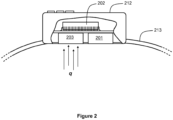
- FIG. 2 illustrates schematically an apparatus according to an exemplifying and non-limiting embodiment for energy expenditure estimation.
- the apparatus is a portable device which comprises a fastening band 213 that can be for example a wrist band, a chest band, a strap, or a belt.
- a casing 212 of the apparatus is presented as a partial section view.
- the apparatus comprises a heart rate sensor 201, a heat-flux sensor 203, and a processing system 202 communicatively connected to the heart rate sensor 201 and to the heat-flux sensor 203.
- the heart rate sensor 201 is configured to produce a heart rate value indicative of a heart rate of an individual
- the heat-flux sensor 203 is configured to produce a heat-flux value indicative of a heat-flux q flowing through a measurement area on the skin of the individual.
- the processing system 202 is configured to produce an estimate of energy expenditure of the individual based on at least the heart rate value and the heat-flux value.
- FIG. 3 shows a functional block diagram of an apparatus according to an exemplifying and non-limiting embodiment for energy expenditure estimation.
- the apparatus comprises a heart rate sensor 201 for producing a heart rate value indicative of a heart rate of an individual.
- the apparatus comprises two heat-flux sensors 303a and 303b for producing heat-flux values indicative of heat-fluxes flowing through two measurement areas on the skin of the individual.
- the heat-flux sensor 303a is placed on a wrist of the individual and the heat-flux sensor 303b is placed on an ankle of the individual.
- the apparatus comprises two movement sensors 305a and 305b for producing movement values indicative of movements of a hand 314 and a foot 315 of the individual.
- the movement sensors 305a and 305b can be e.g. acceleration sensors.
- the apparatus comprises a processing system 302 for producing an estimate of energy expenditure of the individual based on the heart rate value, the heat-flux values, and the movement values.
- the processing system 302 is configured to weight the heat-flux value produced by the heat-flux sensor 303a more than the heat-flux value produced by the heat-flux sensor 303b in response to a situation in which the movement sensor 305a indicates more movement than the movement sensor 305b.
- the processing system 302 is configured to weight the heat-flux value produced by the heat-flux sensor 303b more than the heat-flux value produced by the heat-flux sensor 303a in response to a situation in which the movement sensor 305b indicates more movement than the movement sensor 305a.
- the estimate of the energy expenditure can be for example a weighted average of preliminary estimates each being based on a respective one of the heat-flux values.
- a weight factor of the preliminary estimate related to a more intensive movement is set to be greater than the weight factor of the other preliminary estimate related to a less intensive movement.
- a heat-flux value which is in a closer relation to physical activity is weighted more than the other heat flux value.
- an apparatus may comprise three or more heat-flux sensors for producing heat-flux values indicative of heat-fluxes flowing through three or more measurement areas on the skin of an individual.
- an apparatus according to an exemplifying and non-limiting embodiment may comprise three or more movement sensors.
- Figure 4 shows a flowchart of a method according to an exemplifying and non-limiting embodiment for energy expenditure estimation. The method comprises the following actions:
- a method comprises increasing a relative weight of the measured heart rate on the estimate of the energy expenditure with respect to a relative weight of the measured heat-flux on the estimate of the energy expenditure in response to an increase of the heart rate.
- the estimate of the energy expenditure is produced based on the measured heart rate, the measured heat-flux, and activity data descriptive of physical activity of the individual during the measuring the heart rate and the heat-flux.
- a method comprises measuring movement of at least one part of the body of the individual and producing the activity data based on the measured movement.
- a method comprises measuring one or more local temperatures of the skin of the individual and using the measured one or more local temperatures in the producing the estimate of the energy expenditure.
- a method comprises using, in the producing the estimate of the energy expenditure, an ambient temperature value indicative of temperature of the ambient air surrounding the individual.
- a method comprises measuring one or more humidity values indicative of local humidity of air at one or more humidity measurement places belonging to a near-area less than a predetermined distance from the skin of the individual and using the one or more humidity values in the producing the estimate of the energy expenditure.
- a method comprises measuring one or more skin moisture values indicative of moisture of the skin of the individual at one or more measurement places on the skin of the individual, and using the one or more skin moisture values in the producing the estimate of the energy expenditure.
- a method comprises using, in the producing the estimate of the energy expenditure, an ambient humidity value indicative of humidity of air outside the above-mentioned near-area.
- a method comprises using, in the producing the estimate of the energy expenditure, a barometric pressure value indicative of pressure of ambient air surrounding the individual.
- a method comprises using, in the producing the estimate of the energy expenditure, individual-related data indicative of at least one of the following: the body mass of the individual, the height of the individual, the sex of the individual, the age of the individual, activity of the lifestyle of the individual.
- a method comprises producing a first preliminary result by supplying at least the measured heart rate and the measured heat-flux to a recurrent neural network and producing the estimate of the energy expenditure by supplying at least the first preliminary result to one or more densely connected neural networks.
- the above-mentioned first preliminary result is produced by supplying, to the recurrent neural network, the measured heart rate, the measured heat-flux, and at least one of the following: activity data descriptive of physical activity of the individual during the measuring the heart rate and the heat-flux, one or more local temperatures measured on the skin of the individual, temperature of the ambient air surrounding the individual, one or more humidity values indicative of local humidity of air at one or more humidity measurement places belonging to a near-area less than a predetermined distance from the skin of the individual, humidity of air outside the near-area, and/or pressure of the ambient air.
- a method comprises producing a second preliminary result by supplying individual-related data to a first one of the densely connected neural networks, producing a third preliminary result by supplying a combination of the first and second preliminary results to a second one of the densely connected neural networks, and producing the estimate of the energy expenditure by supplying the third preliminary result to a neuron implementing a scalar-valued function of a vector valued argument.
- the above-mentioned individual-related data is indicative of at least one of the following: the body mass of the individual, the height of the individual, the sex of the individual, the age of the individual, and/or activity of the lifestyle of the individual.
- a computer program according to an exemplifying and non-limiting embodiment comprises computer executable instructions for controlling a programmable processor to carry out actions related to a method according to any of the above-described exemplifying embodiments.
- a computer program comprises software modules for energy expenditure estimation.
- the software modules comprise computer executable instructions for controlling a programmable processor to:
- the above-mentioned software modules can be e.g. subroutines or functions implemented with a suitable programming language.
- a computer program product comprises a computer readable medium, e.g. a compact disc "CD", encoded with a computer program according to an embodiment of invention.
- a computer readable medium e.g. a compact disc "CD”
- a signal according to an exemplifying and non-limiting embodiment is encoded to carry information defining a computer program according to an embodiment of invention.
- the computer program can be downloadable from a server that may constitute e.g. a part of a cloud service.
Landscapes
- Health & Medical Sciences (AREA)
- Life Sciences & Earth Sciences (AREA)
- Engineering & Computer Science (AREA)
- Physics & Mathematics (AREA)
- Public Health (AREA)
- Veterinary Medicine (AREA)
- Biophysics (AREA)
- Pathology (AREA)
- Biomedical Technology (AREA)
- Heart & Thoracic Surgery (AREA)
- Medical Informatics (AREA)
- Molecular Biology (AREA)
- Surgery (AREA)
- Animal Behavior & Ethology (AREA)
- General Health & Medical Sciences (AREA)
- Physiology (AREA)
- Cardiology (AREA)
- Dentistry (AREA)
- Oral & Maxillofacial Surgery (AREA)
- Artificial Intelligence (AREA)
- Obesity (AREA)
- Pulmonology (AREA)
- Dermatology (AREA)
- Computer Vision & Pattern Recognition (AREA)
- Psychiatry (AREA)
- Signal Processing (AREA)
- Evolutionary Computation (AREA)
- Fuzzy Systems (AREA)
- Mathematical Physics (AREA)
- Physical Education & Sports Medicine (AREA)
- Radiology & Medical Imaging (AREA)
- Nuclear Medicine, Radiotherapy & Molecular Imaging (AREA)
- Chemical & Material Sciences (AREA)
- Combustion & Propulsion (AREA)
- General Physics & Mathematics (AREA)
- Measuring Pulse, Heart Rate, Blood Pressure Or Blood Flow (AREA)
- Measuring And Recording Apparatus For Diagnosis (AREA)
Description
- The disclosure relates to a method and an apparatus for estimating energy expenditure of an individual. Furthermore, the disclosure relates to a computer program for estimating energy expenditure of an individual.
- A human or animal body expends energy while participating in physical activities as well as just resting. Energy is expended for basal metabolism and for physical activities. In many cases, there is a need to measure or estimate the energy expenditure "EE" of a human or animal body in order to monitor for example a daily calorie consumption. Portable devices such as e.g. smart watches have become popular tools for estimating the energy expenditure. These devices typically measure heart rate and movement e.g. acceleration, and thereafter calculate an estimate for the energy expenditure based on these quantities. Publication
US8920332 describes a wearable fitness monitoring device that comprises a motion sensor and a photoplethysmographic "PPG" sensor. The PPG sensor includes a periodic light source, a photodetector, and a circuitry determining a heart rate based on an output of the photodetector. The wearable fitness monitoring device described inUS8920332 can be provided with means for operating the wearable fitness monitoring device in a low power state when a control unit of the wearable fitness monitoring device determines that the wearable fitness monitoring device is not worn by a user, and in a normal power state when the control unit determines that the wearable fitness monitoring device is worn by a user. The wearable fitness monitoring device described inUS8920332 can be for example a smart wrist device. - While data indicative of movement e.g. acceleration does not provide direct information about the energy expenditure, the heart rate correlates well with the energy expenditure, especially during moderate and high-intensity exercises. However, most of peoples' daily activities consist of low-level activities and/or rest. Therefore, heart rate and movement -based energy expenditure estimates are often inaccurate outside moderate and high-intensity physical exercises. Thus, there is still a need for new technologies for estimating the energy expenditure.
US 2012/245439 A1 discloses an algorithm for measuring energy expenditure of an individual that utilizes heart rate. A heat flux sensor may also be used as additional inputs into the algorithm. - The following presents a simplified summary in order to provide a basic understanding of some aspects of various invention embodiments. The summary is not an extensive overview of the invention. It is neither intended to identify key or critical elements of the invention nor to delineate the scope of the invention, which is defined by the claims. The following summary merely presents some concepts of the invention in a simplified form as a prelude to a more detailed description of exemplifying embodiments of the invention.
- In accordance with the invention, there is provided a new apparatus for energy expenditure estimation. An apparatus according to the invention comprises:
- a heart rate sensor for producing a heart rate value indicative of a heart rate of an individual,
- a heat-flux sensor for producing a heat-flux value indicative of a heat-flux flowing through a measurement area on a skin of the individual, and
- a processing system communicatively connected to the heart rate sensor and to the heat-flux sensor and configured to produce an estimate of the energy expenditure based on the heart rate value and the heat-flux value.
- The processing system is configured to increase a relative weight of the heart rate value on the estimate of the energy expenditure with respect to a relative weight of the heat-flux value on the estimate of the energy expenditure in response to an increase of the heart rate.
- The use of the above-mentioned heat-flux value improves the accuracy of the energy expenditure estimation especially during low-intensity exercises and rest, when the heart rate and e.g. acceleration data often fail to provide information meaningful enough for energy expenditure estimation.
- In accordance with the invention, there is provided also a new method for energy expenditure estimation. A method according to the invention comprises:
- measuring a heart rate of an individual,
- measuring a heat-flux flowing through a measurement area on a skin of the individual,
- producing an estimate of the energy expenditure based on the measured heart rate and the heat-flux, and
- increasing a relative weight of the measured heart rate on the estimate of the energy expenditure with respect to a relative weight of the measured heat-flux on the estimate of the energy expenditure in response to an increase of the heart rate.
- In accordance with the invention, there is provided also a new computer program for energy expenditure estimation. A computer program according to the invention comprises computer executable instructions for controlling a programmable processor to:
- receive, from a heart rate sensor, a heart rate value indicative of a heart rate of an individual,
- receive, from a heat-flux sensor, a heat-flux value indicative of a heat-flux flowing through a measurement area on a skin of the individual,
- produce an estimate of the energy expenditure based on the received heart rate value and the heat-flux value, and
- increase a relative weight of the heart rate value on the estimate of the energy expenditure with respect to a relative weight of the heat-flux value on the estimate of the energy expenditure in response to an increase of the heart rate.
- In accordance with the invention, there is provided also a new computer program product. The computer program product comprises a non-volatile computer readable medium, e.g. a compact disc "CD", encoded with a computer program according to the invention.
- Exemplifying and non-limiting embodiments are described in accompanied dependent claims.
- Various exemplifying and non-limiting embodiments both as to constructions and to methods of operation, together with additional objects and advantages thereof, will be best understood from the following description of specific exemplifying and non-limiting embodiments when read in conjunction with the accompanying drawings.
- The verbs "to comprise" and "to include" are used in this document as open limitations that neither exclude nor require the existence of unrecited features. The features recited in dependent claims are mutually freely combinable unless otherwise explicitly stated. Furthermore, it is to be understood that the use of "a" or "an", i.e. a singular form, throughout this document does not exclude a plurality.
- Exemplifying and non-limiting embodiments and their advantages are explained in greater detail below in the sense of examples and with reference to the accompanying drawings, in which:
-
figure 1 shows a functional block diagram of an apparatus according to an exemplifying and non-limiting embodiment for energy expenditure estimation, -
figure 2 illustrates schematically an apparatus according to an exemplifying and non-limiting embodiment for energy expenditure estimation, -
figure 3 shows a functional block diagram of an apparatus according to an exemplifying and non-limiting embodiment for energy expenditure estimation, and -
figure 4 shows a flowchart of a method according to an exemplifying and non-limiting embodiment for energy expenditure estimation. - The specific examples provided in the description below should not be construed as limiting the scope and/or the applicability of the accompanied claims. Lists and groups of examples provided in the description are not exhaustive unless otherwise explicitly stated.
-
Figure 1 shows a functional block diagram of an apparatus according to an exemplifying and non-limiting embodiment for energy expenditure estimation. The apparatus comprises aheart rate sensor 101 for producing a heart rate value indicative of a heart rate of an individual. Theheart rate sensor 101 can be for example a photoplethysmographic "PPG" sensor or another suitable sensor for measuring the heart rate. The apparatus comprises a heat-flux sensor 103 for producing a heat-flux value indicative of a heat-flux q flowing through a measurement area on askin 116 of the individual. The apparatus comprises aprocessing system 102 that is communicatively connected to theheart rate sensor 101 and to the heat-flux sensor 103. Theprocessing system 102 is configured to produce an estimate of the energy expenditure "EE" of the individual based on the above-mentioned heart rate value and the heat-flux value. The use of the heat-flux value improves the accuracy of the energy expenditure estimation especially during low-intensity exercises and rest, when the heart rate and e.g. acceleration data often fail to provide information meaningful enough for energy expenditure estimation. In this exemplifying case, the apparatus further comprises auser interface 111 that may comprise for example a touch screen. - The heat-
flux sensor 103 can be any suitable heat-flux sensor for measuring the heat-flux q flowing through theskin 116. For example, the heat-flux sensor 103 can be based on multiple thermoelectric junctions so that tens, hundreds, or even thousands of thermoelectric junctions are connected in series. For another example, the heat-flux sensor 103 can be based on one or more anisotropic elements where electromotive force is created from a heat-flux by the Seebeck effect. The anisotropy can be implemented with suitable anisotropic material such as for example single-crystal bismuth. Another option for implementing the anisotropy is a multilayer structure where layers are oblique with respect to a surface of the heat-flux sensor for receiving the heat-flux. - In an apparatus according to an exemplifying and non-limiting embodiment, the
processing system 102 is configured to estimate the energy expenditure EE according to the formula:
- In an apparatus according to an exemplifying and non-limiting embodiment, the
processing system 102 is configured to estimate the energy expenditure EE according to the formula:
processing system 102 is configured to increase a relative weight of the heart rate on the estimate of the energy expenditure EE with respect to a relative weight of the heat-flux on the estimate of the energy expenditure EE in response to an increase of the heart rate value HR. In other words, the weight factor WHR is increased with respect to the weight factor WHF when the heart rate value HR increases. As the heart rate correlates well with the energy expenditure EE during a high-intensity exercise i.e. when the heart rate is high, the relative weight of the heart rate on the estimate of the energy expenditure EE is advantageously higher than the relative weight of the heat-flux during the high-intensity exercise. On the other hand, as the heat-flux is a better quantity for estimating the energy expenditure EE at rest and during a low physical load, the weight factor WHR is advantageously decreased with respect to the weight factor WHF when the heart rate value HR decreases. - In an apparatus according to an exemplifying and non-limiting embodiment, the
processing system 102 is configured to produce the estimate of the energy expenditure EE based on the heart rate value HR, the heat-flux value HF, and one or more of the following first quantities: - activity data descriptive of physical activity of the individual during measurements of the heart rate and the heat-flux,
- a skin temperature value indicative of a local temperature of the skin of the individual,
- an ambient temperature value indicative of temperature of ambient air surrounding the individual
- a humidity value indicative of local humidity of air at a humidity measurement place belonging to a near-area less than a predetermined distance from the skin of the individual,
- a skin moisture value indicative of moisture of the skin of the individual,
- an ambient humidity value indicative of humidity of air outside the near-area, and
- a barometric pressure value indicative of pressure of ambient air surrounding the individual.
- A function, e.g. a lookup table or a mathematical formula, for expressing the estimate of the energy expenditure EE as a function of the heart rate value HR, the heat-flux value HF, and one or more of the above-mentioned first quantities can be constructed with the aid of for example empirical data and/or theoretical models.
- The exemplifying apparatus illustrated in
figure 1 comprises at least onemovement sensor 105 for producing at least one movement value indicative of movement of at least one part, e.g. a hand or a foot, of the body of the individual. Theprocessing system 102 is configured to produce the above-mentioned activity data based on the at least one movement value. Themovement sensor 105 can be for example a wrist-worn three dimensional "3D" accelerometer, and theprocessing system 102 can be configured to use the acceleration information to classify the current activity type. - The exemplifying apparatus illustrated in
figure 1 comprises atemperature sensor 106 for producing the above-mentioned skin temperature value, atemperature sensor 107 for producing the above-mentioned ambient temperature value, ahumidity sensor 108 for producing the above-mentioned humidity value indicative of the air humidity in the near-area of the skin, ahumidity sensor 109 for producing the above-mentioned ambient humidity value, and apressure sensor 110 for producing the above-mentioned barometric pressure value. Furthermore, the exemplifying apparatus illustrated infigure 1 may comprise a skin moisture sensor for producing the above-mentioned skin moisture value indicative of moisture of the skin of the individual. The skin moisture sensor may comprise e.g. means for measuring a galvanic skin resistance "GSR". The skin moisture sensor can be e.g. integrated with thetemperature sensor 106 or it can be a separate device. - It is also possible that the
processing system 102 is configured to receive one or more of the above-mentioned first quantities via adata interface 104 from an external system or device. - In an apparatus according to an exemplifying and non-limiting embodiment, the
processing system 102 is configured to produce the estimate of the energy expenditure EE based on the heart rate value HR, the heat-flux value HF, one or more of the above-mentioned first quantities and/or one or more of the following second quantities: - the body mass of the individual,
- the height of the individual,
- the sex of the individual,
- the age of the individual,
- the activity of the lifestyle of the individual, e.g. an integer ranging from 1 to 10 so that 1 = sedentary and 10 = athlete.
- A function, e.g. a lookup table or a mathematical formula, for expressing the estimate of the energy expenditure EE as a function of the heart rate value HR, the heat-flux value HF, and one or more of the above-mentioned first quantities and/or one or more of the above-mentioned second quantities can be constructed with the aid of for example empirical data and/or theoretical models.
- In an apparatus according to an exemplifying and non-limiting embodiment, the
processing system 102 is configured to constitute a recurrent neural network for producing a first preliminary result PR1 based on at least the heart rate value HR and the heat-flux value HF, and one or more densely connected neural networks for producing the estimate of the energy expenditure EE based on at least the first preliminary result PR1. - In an apparatus according to an exemplifying and non-limiting embodiment, the recurrent neural network is configured to produce the first preliminary PR1 result based on the heart rate value HR, the heat-flux value HF, and at least one of the following first quantities: activity data descriptive of physical activity of the individual during measurements of the heart rate and the heat-flux, one or more skin temperature values indicative of one or more local temperatures of the skin of the individual, an ambient temperature value indicative of temperature of ambient air surrounding the individual, one or more humidity values indicative of local humidity of air at one or more humidity measurement places belonging to a near-area less than a predetermined distance from the skin of the individual, an ambient humidity value indicative of humidity of air outside the near-area, and a barometric pressure value indicative of pressure of the ambient air.
- In an apparatus according to an exemplifying and non-limiting embodiment, a first one of the densely connected neural networks is configured to produce a second preliminary result PR2 based on individual-related data, and a second one of the densely connected neural networks is configured to produce a third preliminary result PR3 based on a combination, e.g. a concatenation, of the first and second preliminary results PR1 and PR2. The individual-related data is indicative of at least one of the following second quantities: the body mass of the individual, the height of the individual, the sex of the individual, the age of the individual, the activity of the lifestyle of the individual. The
processing system 102 can be configured to constitute a neuron implementing a scalar-valued function of a vector-valued argument for producing the estimate of the energy expenditure EE based on the third preliminary result PR3. - Training data for the above-mentioned neural networks can be constructed from input and target data arranged as a time series. The input data comprises values of the heart rate and the heat-flux. Furthermore, the input data may comprise values of one or more of the above-mentioned first quantities and/or values of one or more of the above-mentioned second quantities. The target data comprises values of the energy expenditure EE measured e.g. by means of indirect calorimetry, such as respiratory gas analysis, or by means of direct calorimetry, such as room calorimeter. Each input-target pair of the time series comprises data collected from an individual during a measurement run. The time series may comprise the entire measurement run, or windowed sections of the measurement run, possibly overlapped. The above-mentioned neural networks are trained with the above-described training data. After the neural networks have been trained, the energy expenditure EE can be estimated without a need for a calorimetric measurement.
- The
processing system 102 of the apparatus illustrated infigure 1 can be implemented for example with one or more processor circuits each of which can be a programmable processor circuit provided with appropriate software, a dedicated hardware processor such as for example an application specific integrated circuit "ASIC", or a configurable hardware processor such as for example a field programmable gate array "FPGA". Furthermore, theprocessing system 102 may comprise one or more memory circuits each of which can be for example a random-access memory "RAM" circuit. -
Figure 2 illustrates schematically an apparatus according to an exemplifying and non-limiting embodiment for energy expenditure estimation. In this exemplifying case, the apparatus is a portable device which comprises afastening band 213 that can be for example a wrist band, a chest band, a strap, or a belt. Infigure 2 , acasing 212 of the apparatus is presented as a partial section view. The apparatus comprises aheart rate sensor 201, a heat-flux sensor 203, and aprocessing system 202 communicatively connected to theheart rate sensor 201 and to the heat-flux sensor 203. Theheart rate sensor 201 is configured to produce a heart rate value indicative of a heart rate of an individual, and the heat-flux sensor 203 is configured to produce a heat-flux value indicative of a heat-flux q flowing through a measurement area on the skin of the individual. Theprocessing system 202 is configured to produce an estimate of energy expenditure of the individual based on at least the heart rate value and the heat-flux value. -
Figure 3 shows a functional block diagram of an apparatus according to an exemplifying and non-limiting embodiment for energy expenditure estimation. The apparatus comprises aheart rate sensor 201 for producing a heart rate value indicative of a heart rate of an individual. The apparatus comprises two heat-flux sensors figure 3 , the heat-flux sensor 303a is placed on a wrist of the individual and the heat-flux sensor 303b is placed on an ankle of the individual. In this exemplifying case, the apparatus comprises twomovement sensors hand 314 and afoot 315 of the individual. Themovement sensors processing system 302 for producing an estimate of energy expenditure of the individual based on the heart rate value, the heat-flux values, and the movement values. - In an apparatus according to an exemplifying and non-limiting embodiment, the
processing system 302 is configured to weight the heat-flux value produced by the heat-flux sensor 303a more than the heat-flux value produced by the heat-flux sensor 303b in response to a situation in which themovement sensor 305a indicates more movement than themovement sensor 305b. Correspondingly, theprocessing system 302 is configured to weight the heat-flux value produced by the heat-flux sensor 303b more than the heat-flux value produced by the heat-flux sensor 303a in response to a situation in which themovement sensor 305b indicates more movement than themovement sensor 305a. The estimate of the energy expenditure can be for example a weighted average of preliminary estimates each being based on a respective one of the heat-flux values. A weight factor of the preliminary estimate related to a more intensive movement is set to be greater than the weight factor of the other preliminary estimate related to a less intensive movement. Thus, a heat-flux value which is in a closer relation to physical activity is weighted more than the other heat flux value. - It is worth noting that an apparatus according to an exemplifying and non-limiting embodiment may comprise three or more heat-flux sensors for producing heat-flux values indicative of heat-fluxes flowing through three or more measurement areas on the skin of an individual. Correspondingly, an apparatus according to an exemplifying and non-limiting embodiment may comprise three or more movement sensors.
-
Figure 4 shows a flowchart of a method according to an exemplifying and non-limiting embodiment for energy expenditure estimation. The method comprises the following actions: - action 401: measuring a heart rate of an individual,
- action 402: measuring a heat-flux flowing through a measurement area on a skin of the individual, and
- action 403: producing an estimate of the energy expenditure based on the measured heart rate and the heat-flux.
- A method according to an exemplifying and non-limiting embodiment comprises increasing a relative weight of the measured heart rate on the estimate of the energy expenditure with respect to a relative weight of the measured heat-flux on the estimate of the energy expenditure in response to an increase of the heart rate.
- In a method according to an exemplifying and non-limiting embodiment, the estimate of the energy expenditure is produced based on the measured heart rate, the measured heat-flux, and activity data descriptive of physical activity of the individual during the measuring the heart rate and the heat-flux.
- A method according to an exemplifying and non-limiting embodiment comprises measuring movement of at least one part of the body of the individual and producing the activity data based on the measured movement.
- A method according to an exemplifying and non-limiting embodiment comprises:
- measuring at least two heat-fluxes flowing through at least two measurement areas on the skin of the individual,
- measuring movements of at least two parts of a body of the individual, and
- weighting, in the producing the estimate of the energy expenditure, a first one of the measured heat-fluxes more than a second one of the measured heat-fluxes in response to a situation in which the measured movements indicate more movement on the measurement area related to the first one of the measured heat-fluxes than on the measurement area related to the second one of the measured heat-fluxes.
- A method according to an exemplifying and non-limiting embodiment comprises measuring one or more local temperatures of the skin of the individual and using the measured one or more local temperatures in the producing the estimate of the energy expenditure.
- A method according to an exemplifying and non-limiting embodiment comprises using, in the producing the estimate of the energy expenditure, an ambient temperature value indicative of temperature of the ambient air surrounding the individual.
- A method according to an exemplifying and non-limiting embodiment comprises measuring one or more humidity values indicative of local humidity of air at one or more humidity measurement places belonging to a near-area less than a predetermined distance from the skin of the individual and using the one or more humidity values in the producing the estimate of the energy expenditure.
- A method according to an exemplifying and non-limiting embodiment comprises measuring one or more skin moisture values indicative of moisture of the skin of the individual at one or more measurement places on the skin of the individual, and using the one or more skin moisture values in the producing the estimate of the energy expenditure.
- A method according to an exemplifying and non-limiting embodiment comprises using, in the producing the estimate of the energy expenditure, an ambient humidity value indicative of humidity of air outside the above-mentioned near-area.
- A method according to an exemplifying and non-limiting embodiment comprises using, in the producing the estimate of the energy expenditure, a barometric pressure value indicative of pressure of ambient air surrounding the individual.
- A method according to an exemplifying and non-limiting embodiment comprises using, in the producing the estimate of the energy expenditure, individual-related data indicative of at least one of the following: the body mass of the individual, the height of the individual, the sex of the individual, the age of the individual, activity of the lifestyle of the individual.
- A method according to an exemplifying and non-limiting embodiment comprises producing a first preliminary result by supplying at least the measured heart rate and the measured heat-flux to a recurrent neural network and producing the estimate of the energy expenditure by supplying at least the first preliminary result to one or more densely connected neural networks.
- In a method according to an exemplifying and non-limiting embodiment, the above-mentioned first preliminary result is produced by supplying, to the recurrent neural network, the measured heart rate, the measured heat-flux, and at least one of the following: activity data descriptive of physical activity of the individual during the measuring the heart rate and the heat-flux, one or more local temperatures measured on the skin of the individual, temperature of the ambient air surrounding the individual, one or more humidity values indicative of local humidity of air at one or more humidity measurement places belonging to a near-area less than a predetermined distance from the skin of the individual, humidity of air outside the near-area, and/or pressure of the ambient air.
- A method according to an exemplifying and non-limiting embodiment comprises producing a second preliminary result by supplying individual-related data to a first one of the densely connected neural networks, producing a third preliminary result by supplying a combination of the first and second preliminary results to a second one of the densely connected neural networks, and producing the estimate of the energy expenditure by supplying the third preliminary result to a neuron implementing a scalar-valued function of a vector valued argument. The above-mentioned individual-related data is indicative of at least one of the following: the body mass of the individual, the height of the individual, the sex of the individual, the age of the individual, and/or activity of the lifestyle of the individual.
- A computer program according to an exemplifying and non-limiting embodiment comprises computer executable instructions for controlling a programmable processor to carry out actions related to a method according to any of the above-described exemplifying embodiments.
- A computer program according to an exemplifying and non-limiting embodiment comprises software modules for energy expenditure estimation. The software modules comprise computer executable instructions for controlling a programmable processor to:
- receive, from a heart rate sensor, a heart rate value indicative of a heart rate of an individual,
- receive, from a heat-flux sensor, a heat-flux value indicative of a heat-flux flowing through a measurement area on a skin of the individual, and
- produce an estimate of the energy expenditure based on the received heart rate value and the heat-flux value.
- The above-mentioned software modules can be e.g. subroutines or functions implemented with a suitable programming language.
- A computer program product according to an exemplifying and non-limiting embodiment comprises a computer readable medium, e.g. a compact disc "CD", encoded with a computer program according to an embodiment of invention.
- A signal according to an exemplifying and non-limiting embodiment is encoded to carry information defining a computer program according to an embodiment of invention. In this exemplifying case, the computer program can be downloadable from a server that may constitute e.g. a part of a cloud service.
- The specific examples provided in the description given above should not be construed as limiting the applicability and/or interpretation of the appended claims. It is to be noted that lists and groups of examples given in this document are non-exhaustive lists and groups unless otherwise explicitly stated.
Claims (15)
- An apparatus for energy expenditure estimation, the apparatus comprising:- a heart rate sensor (101, 201, 301) for producing a heart rate value indicative of a heart rate of an individual,- a processing system (102, 202, 302) communicatively connected to the heart rate sensor, and- a heat-flux sensor (103, 203, 303a, 303b) for producing a heat-flux value indicative of a heat-flux (q) flowing through a measurement area on a skin of the individual,wherein the processing system is communicatively connected to the heat-flux sensor and configured to produce an estimate of the energy expenditure based on the heart rate value and the heat-flux value, characterized in that the processing system is configured to increase a relative weight of the heart rate value on the estimate of the energy expenditure with respect to a relative weight of the heat-flux value on the estimate of the energy expenditure in response to an increase of the heart rate.
- An apparatus according to claim 1, wherein the processing system is configured to produce the estimate of the energy expenditure based on the heart rate value, the heat-flux value, and activity data descriptive of physical activity of the individual during measurements of the heart rate and the heat-flux.
- An apparatus according to claim 2 wherein the apparatus comprises at least one movement sensor (105, 305a, 305b) for producing at least one movement value indicative of movement of at least one part of a body of the individual, and the processing system is configured to produce the activity data based on the at least one movement value.
- An apparatus according any of claims 1-3 wherein:- the heat-flux sensor is one of at least two heat-flux sensors (303a, 303b) of the apparatus for producing heat-flux values indicative of heat-fluxes flowing through at least two measurement areas on the skin of the individual,- the apparatus comprises at least two movement sensors (305a, 305b) for producing movement values indicative of movements of at least two parts of a body of the individual, and- the processing system (302) is configured to weight a first one of the heat-flux values more than a second one of the heat-flux values for producing the estimate of the energy expenditure in response to a situation in which the movement values indicate more movement on the measurement area related to the first one of the heat-flux values than on the measurement area related to the second one of the heat-flux values.
- An apparatus according to any of claims 1-4 wherein the apparatus comprises at least one temperature sensor (106) for producing a skin temperature value indicative of a local temperature of the skin of the individual, and the processing system is configured to use the skin temperature value for producing the estimate of the energy expenditure.
- An apparatus according to any of claims 1-5 wherein the processing system is configured to use, for producing the estimate of the energy expenditure, an ambient temperature value indicative of temperature of ambient air surrounding the individual.
- An apparatus according to any of claims 1-6 wherein the apparatus comprises at least one humidity sensor (108) for producing a humidity value indicative of local humidity of air at a humidity measurement place belonging to a near-area less than a predetermined distance from the skin of the individual, and the processing system is configured to use the humidity value for producing the estimate of the energy expenditure.
- An apparatus according to any of claims 1-7 wherein the apparatus comprises at least one skin moisture sensor for producing a skin moisture value indicative of moisture of the skin of the individual, and the processing system is configured to use the skin moisture value for producing the estimate of the energy expenditure
- An apparatus according to any of claims 1-8 wherein the processing system is configured to use, for producing the estimate of the energy expenditure, an ambient humidity value indicative of humidity of ambient air surrounding the individual.
- An apparatus according to any of claims 1-9 wherein the processing system is configured to use, for producing the estimate of the energy expenditure, a barometric pressure value indicative of pressure of ambient air surrounding the individual.
- An apparatus according to any of claims 1-10 wherein the processing system is configured to use, for producing the estimate of the energy expenditure, individual-related data indicative of at least one of the following: body mass of the individual, height of the individual, sex of the individual, age of the individual, activity of lifestyle of the individual.
- An apparatus according to any of claims 1-11 wherein the processing system is configured to constitute a recurrent neural network for producing a first preliminary result based on at least the heart rate value and the heat-flux value and one or more densely connected neural networks for producing the estimate of the energy expenditure based on at least the first preliminary result.
- An apparatus according to claim 12 wherein the recurrent neural network is configured to produce the first preliminary result based on the heart rate value, the heat-flux value, and at least one of the following: activity data descriptive of physical activity of the individual during measurements of the heart rate and the heat-flux, a skin temperature value indicative of a local temperature of the skin of the individual, an ambient temperature value indicative of temperature of ambient air surrounding the individual, one or more humidity values indicative of local humidity of air at one or more humidity measurement places belonging to a near-area less than a predetermined distance from the skin of the individual, an ambient humidity value indicative of humidity of air outside the near-area, a barometric pressure value indicative of pressure of the ambient air.
- A method for energy expenditure estimation, the method comprising:- measuring (401) a heart rate of an individual,- measuring (402) a heat-flux flowing through a measurement area on a skin of the individual, and- producing (403), by a processing system (102, 202, 302), an estimate of the energy expenditure based on the measured heart rate and the measured heat-flux,characterized in that the method comprises increasing a relative weight of the measured heart rate on the estimate of the energy expenditure with respect to a relative weight of the measured heat-flux on the estimate of the energy expenditure in response to an increase of the heart rate.
- A computer program for energy expenditure estimation, the computer program comprising computer executable instructions for controlling a programmable processor to:- receive, from a heart rate sensor, a heart rate value indicative of a heart rate of an individual,- receive, from a heat-flux sensor, a heat-flux value indicative of a heat-flux flowing through a measurement area on a skin of the individual, and- produce an estimate of the energy expenditure based on the received heart rate value and the received heat-flux value,characterized in that the computer program further comprises computer executable instructions for controlling the programmable processor to increase a relative weight of the heart rate value on the estimate of the energy expenditure with respect to a relative weight of the heat-flux value on the estimate of the energy expenditure in response to an increase of the heart rate.
Applications Claiming Priority (2)
| Application Number | Priority Date | Filing Date | Title |
|---|---|---|---|
| FI20195796A FI128739B (en) | 2019-09-23 | 2019-09-23 | Method and apparatus for estimating energy consumption |
| PCT/FI2020/050444 WO2021058854A1 (en) | 2019-09-23 | 2020-06-22 | An apparatus and method for energy expenditure estimation |
Publications (3)
| Publication Number | Publication Date |
|---|---|
| EP4033975A1 EP4033975A1 (en) | 2022-08-03 |
| EP4033975C0 EP4033975C0 (en) | 2025-01-15 |
| EP4033975B1 true EP4033975B1 (en) | 2025-01-15 |
Family
ID=71614913
Family Applications (1)
| Application Number | Title | Priority Date | Filing Date |
|---|---|---|---|
| EP20740355.1A Active EP4033975B1 (en) | 2019-09-23 | 2020-06-22 | An apparatus and method for energy expenditure estimation |
Country Status (5)
| Country | Link |
|---|---|
| US (1) | US12138072B2 (en) |
| EP (1) | EP4033975B1 (en) |
| CN (1) | CN114423337A (en) |
| FI (1) | FI128739B (en) |
| WO (1) | WO2021058854A1 (en) |
Families Citing this family (2)
| Publication number | Priority date | Publication date | Assignee | Title |
|---|---|---|---|---|
| WO2024209730A1 (en) * | 2023-04-04 | 2024-10-10 | 株式会社村田製作所 | Organism activity measurement device |
| WO2025252519A1 (en) * | 2024-06-03 | 2025-12-11 | Greenteg Ag | Methods and systems for determining energy expenditure during exercise |
Family Cites Families (8)
| Publication number | Priority date | Publication date | Assignee | Title |
|---|---|---|---|---|
| WO2009131664A2 (en) | 2008-04-21 | 2009-10-29 | Carl Frederick Edman | Metabolic energy monitoring system |
| EP2358266A4 (en) * | 2008-11-20 | 2012-10-03 | Bodymedia Inc | METHOD AND APPARATUS FOR DETERMINING CRITICAL CARE PARAMETERS |
| EP2375973A4 (en) | 2008-12-16 | 2014-02-12 | Bodymedia Inc | METHOD AND APPARATUS FOR DETERMINING HEART RATE VARIABILITY USING WAVELET TRANSFORMATION |
| EP2475296B1 (en) | 2009-09-10 | 2017-05-17 | Intrapace, Inc. | Improved diagnostic sensors for gastrointestinal stimulation or monitoring devices |
| US8775120B2 (en) * | 2010-09-30 | 2014-07-08 | Fitbit, Inc. | Method of data synthesis |
| US8948832B2 (en) | 2012-06-22 | 2015-02-03 | Fitbit, Inc. | Wearable heart rate monitor |
| WO2016087381A1 (en) | 2014-12-02 | 2016-06-09 | Koninklijke Philips N.V. | System and method for generating health data using measurements of wearable device |
| CN107466222B (en) * | 2015-04-09 | 2021-01-05 | 皇家飞利浦有限公司 | Vital sign monitoring system |
-
2019
- 2019-09-23 FI FI20195796A patent/FI128739B/en active IP Right Grant
-
2020
- 2020-06-22 EP EP20740355.1A patent/EP4033975B1/en active Active
- 2020-06-22 WO PCT/FI2020/050444 patent/WO2021058854A1/en not_active Ceased
- 2020-06-22 CN CN202080066077.2A patent/CN114423337A/en active Pending
- 2020-06-22 US US17/762,542 patent/US12138072B2/en active Active
Also Published As
| Publication number | Publication date |
|---|---|
| FI128739B (en) | 2020-11-13 |
| EP4033975C0 (en) | 2025-01-15 |
| US20220354424A1 (en) | 2022-11-10 |
| US12138072B2 (en) | 2024-11-12 |
| WO2021058854A1 (en) | 2021-04-01 |
| FI20195796A1 (en) | 2020-11-13 |
| CN114423337A (en) | 2022-04-29 |
| EP4033975A1 (en) | 2022-08-03 |
Similar Documents
| Publication | Publication Date | Title |
|---|---|---|
| CN102292025B (en) | Determining energy expenditure of a user | |
| US10198928B1 (en) | Fall detection system | |
| JP6531161B2 (en) | Health risk index decision | |
| Nolan et al. | Validity of the Apple iPhone®/iPod Touch® as an accelerometer-based physical activity monitor: a proof-of-concept study | |
| Sazonov et al. | Posture and activity recognition and energy expenditure estimation in a wearable platform | |
| Sasaki et al. | Measurement of physical activity using accelerometers | |
| CN105210067B (en) | Calculate the user's physical state related to physical exercise | |
| Bender et al. | Measuring the fitness of fitness trackers | |
| Pande et al. | Energy expenditure estimation with smartphone body sensors | |
| JP2006501961A5 (en) | ||
| US10251598B2 (en) | Waistband monitoring analysis for a user | |
| US12138072B2 (en) | Apparatus and method for energy expenditure estimation | |
| Suryadevara et al. | Towards a smart non-invasive fluid loss measurement system | |
| CN107613869B (en) | Index derivation device, wearable device, and portable device | |
| EP3586742B1 (en) | Methods for computing a real-time step length and speed of a running or walking individual | |
| Widodo et al. | Artificial neural network based step-length prediction using ultrasonic sensors from simulation to implementation in shoe-type measurement device | |
| Li et al. | Estimating human metabolic rate at various activities using tri-axial accelerometers | |
| Ravizza et al. | IMU-based classification of resistive exercises for real-time training monitoring on board the international space station with potential telemedicine spin-off | |
| HK40071062A (en) | An apparatus and method for energy expenditure estimation | |
| Poli et al. | ADLs Monitoring by accelerometer-based wearable sensors: effect of measurement device and data uncertainty on classification accuracy | |
| US20170308677A1 (en) | Snacking control system, wearable device, snacking control method, and program | |
| KR20160022638A (en) | Method and apparatus for processing food information | |
| Morita et al. | Comparison of gait speed estimation of multiple sensor-based technologies | |
| Pires et al. | Calculation of jump flight time using a mobile device | |
| US20200323488A1 (en) | A method and an apparatus for producing information indicative of metabolic state |
Legal Events
| Date | Code | Title | Description |
|---|---|---|---|
| STAA | Information on the status of an ep patent application or granted ep patent |
Free format text: STATUS: UNKNOWN |
|
| STAA | Information on the status of an ep patent application or granted ep patent |
Free format text: STATUS: THE INTERNATIONAL PUBLICATION HAS BEEN MADE |
|
| PUAI | Public reference made under article 153(3) epc to a published international application that has entered the european phase |
Free format text: ORIGINAL CODE: 0009012 |
|
| STAA | Information on the status of an ep patent application or granted ep patent |
Free format text: STATUS: REQUEST FOR EXAMINATION WAS MADE |
|
| 17P | Request for examination filed |
Effective date: 20220301 |
|
| AK | Designated contracting states |
Kind code of ref document: A1 Designated state(s): AL AT BE BG CH CY CZ DE DK EE ES FI FR GB GR HR HU IE IS IT LI LT LU LV MC MK MT NL NO PL PT RO RS SE SI SK SM TR |
|
| DAV | Request for validation of the european patent (deleted) | ||
| DAX | Request for extension of the european patent (deleted) | ||
| GRAP | Despatch of communication of intention to grant a patent |
Free format text: ORIGINAL CODE: EPIDOSNIGR1 |
|
| STAA | Information on the status of an ep patent application or granted ep patent |
Free format text: STATUS: GRANT OF PATENT IS INTENDED |
|
| INTG | Intention to grant announced |
Effective date: 20241030 |
|
| GRAS | Grant fee paid |
Free format text: ORIGINAL CODE: EPIDOSNIGR3 |
|
| GRAA | (expected) grant |
Free format text: ORIGINAL CODE: 0009210 |
|
| STAA | Information on the status of an ep patent application or granted ep patent |
Free format text: STATUS: THE PATENT HAS BEEN GRANTED |
|
| AK | Designated contracting states |
Kind code of ref document: B1 Designated state(s): AL AT BE BG CH CY CZ DE DK EE ES FI FR GB GR HR HU IE IS IT LI LT LU LV MC MK MT NL NO PL PT RO RS SE SI SK SM TR |
|
| REG | Reference to a national code |
Ref country code: CH Ref legal event code: EP Ref country code: GB Ref legal event code: FG4D |
|
| REG | Reference to a national code |
Ref country code: DE Ref legal event code: R096 Ref document number: 602020044806 Country of ref document: DE |
|
| REG | Reference to a national code |
Ref country code: IE Ref legal event code: FG4D |
|
| U01 | Request for unitary effect filed |
Effective date: 20250115 |
|
| U07 | Unitary effect registered |
Designated state(s): AT BE BG DE DK EE FI FR IT LT LU LV MT NL PT RO SE SI Effective date: 20250121 |
|
| U20 | Renewal fee for the european patent with unitary effect paid |
Year of fee payment: 6 Effective date: 20250430 |
|
| PG25 | Lapsed in a contracting state [announced via postgrant information from national office to epo] |
Ref country code: RS Free format text: LAPSE BECAUSE OF FAILURE TO SUBMIT A TRANSLATION OF THE DESCRIPTION OR TO PAY THE FEE WITHIN THE PRESCRIBED TIME-LIMIT Effective date: 20250415 |
|
| PG25 | Lapsed in a contracting state [announced via postgrant information from national office to epo] |
Ref country code: PL Free format text: LAPSE BECAUSE OF FAILURE TO SUBMIT A TRANSLATION OF THE DESCRIPTION OR TO PAY THE FEE WITHIN THE PRESCRIBED TIME-LIMIT Effective date: 20250115 |
|
| PG25 | Lapsed in a contracting state [announced via postgrant information from national office to epo] |
Ref country code: ES Free format text: LAPSE BECAUSE OF FAILURE TO SUBMIT A TRANSLATION OF THE DESCRIPTION OR TO PAY THE FEE WITHIN THE PRESCRIBED TIME-LIMIT Effective date: 20250115 |
|
| PG25 | Lapsed in a contracting state [announced via postgrant information from national office to epo] |
Ref country code: IS Free format text: LAPSE BECAUSE OF FAILURE TO SUBMIT A TRANSLATION OF THE DESCRIPTION OR TO PAY THE FEE WITHIN THE PRESCRIBED TIME-LIMIT Effective date: 20250515 Ref country code: NO Free format text: LAPSE BECAUSE OF FAILURE TO SUBMIT A TRANSLATION OF THE DESCRIPTION OR TO PAY THE FEE WITHIN THE PRESCRIBED TIME-LIMIT Effective date: 20250415 |
|
| PG25 | Lapsed in a contracting state [announced via postgrant information from national office to epo] |
Ref country code: HR Free format text: LAPSE BECAUSE OF FAILURE TO SUBMIT A TRANSLATION OF THE DESCRIPTION OR TO PAY THE FEE WITHIN THE PRESCRIBED TIME-LIMIT Effective date: 20250115 |
|
| PG25 | Lapsed in a contracting state [announced via postgrant information from national office to epo] |
Ref country code: GR Free format text: LAPSE BECAUSE OF FAILURE TO SUBMIT A TRANSLATION OF THE DESCRIPTION OR TO PAY THE FEE WITHIN THE PRESCRIBED TIME-LIMIT Effective date: 20250416 |
|
| PG25 | Lapsed in a contracting state [announced via postgrant information from national office to epo] |
Ref country code: SM Free format text: LAPSE BECAUSE OF FAILURE TO SUBMIT A TRANSLATION OF THE DESCRIPTION OR TO PAY THE FEE WITHIN THE PRESCRIBED TIME-LIMIT Effective date: 20250115 |
|
| PG25 | Lapsed in a contracting state [announced via postgrant information from national office to epo] |
Ref country code: CZ Free format text: LAPSE BECAUSE OF FAILURE TO SUBMIT A TRANSLATION OF THE DESCRIPTION OR TO PAY THE FEE WITHIN THE PRESCRIBED TIME-LIMIT Effective date: 20250115 |
|
| PG25 | Lapsed in a contracting state [announced via postgrant information from national office to epo] |
Ref country code: SK Free format text: LAPSE BECAUSE OF FAILURE TO SUBMIT A TRANSLATION OF THE DESCRIPTION OR TO PAY THE FEE WITHIN THE PRESCRIBED TIME-LIMIT Effective date: 20250115 |
|
| PLBE | No opposition filed within time limit |
Free format text: ORIGINAL CODE: 0009261 |
|
| STAA | Information on the status of an ep patent application or granted ep patent |
Free format text: STATUS: NO OPPOSITION FILED WITHIN TIME LIMIT |
|
| REG | Reference to a national code |
Ref country code: CH Ref legal event code: L10 Free format text: ST27 STATUS EVENT CODE: U-0-0-L10-L00 (AS PROVIDED BY THE NATIONAL OFFICE) Effective date: 20251126 |
|
| 26N | No opposition filed |
Effective date: 20251016 |
|
| REG | Reference to a national code |
Ref country code: CH Ref legal event code: H13 Free format text: ST27 STATUS EVENT CODE: U-0-0-H10-H13 (AS PROVIDED BY THE NATIONAL OFFICE) Effective date: 20260127 |
|
| PG25 | Lapsed in a contracting state [announced via postgrant information from national office to epo] |
Ref country code: MC Free format text: LAPSE BECAUSE OF FAILURE TO SUBMIT A TRANSLATION OF THE DESCRIPTION OR TO PAY THE FEE WITHIN THE PRESCRIBED TIME-LIMIT Effective date: 20250115 |
|
| GBPC | Gb: european patent ceased through non-payment of renewal fee |
Effective date: 20250622 |
|
| PG25 | Lapsed in a contracting state [announced via postgrant information from national office to epo] |
Ref country code: GB Free format text: LAPSE BECAUSE OF NON-PAYMENT OF DUE FEES Effective date: 20250622 |
|
| PG25 | Lapsed in a contracting state [announced via postgrant information from national office to epo] |
Ref country code: IE Free format text: LAPSE BECAUSE OF NON-PAYMENT OF DUE FEES Effective date: 20250622 |
|
| PG25 | Lapsed in a contracting state [announced via postgrant information from national office to epo] |
Ref country code: CH Free format text: LAPSE BECAUSE OF NON-PAYMENT OF DUE FEES Effective date: 20250630 |