EP4033233A1 - Gas sensing device with a gas filter - Google Patents
Gas sensing device with a gas filter Download PDFInfo
- Publication number
- EP4033233A1 EP4033233A1 EP21153058.9A EP21153058A EP4033233A1 EP 4033233 A1 EP4033233 A1 EP 4033233A1 EP 21153058 A EP21153058 A EP 21153058A EP 4033233 A1 EP4033233 A1 EP 4033233A1
- Authority
- EP
- European Patent Office
- Prior art keywords
- gas
- chemo
- resistive
- gas sensing
- sensing element
- Prior art date
- Legal status (The legal status is an assumption and is not a legal conclusion. Google has not performed a legal analysis and makes no representation as to the accuracy of the status listed.)
- Withdrawn
Links
Images



Classifications
-
- G—PHYSICS
- G01—MEASURING; TESTING
- G01N—INVESTIGATING OR ANALYSING MATERIALS BY DETERMINING THEIR CHEMICAL OR PHYSICAL PROPERTIES
- G01N27/00—Investigating or analysing materials by the use of electric, electrochemical, or magnetic means
- G01N27/02—Investigating or analysing materials by the use of electric, electrochemical, or magnetic means by investigating impedance
- G01N27/04—Investigating or analysing materials by the use of electric, electrochemical, or magnetic means by investigating impedance by investigating resistance
- G01N27/12—Investigating or analysing materials by the use of electric, electrochemical, or magnetic means by investigating impedance by investigating resistance of a solid body in dependence upon absorption of a fluid; of a solid body in dependence upon reaction with a fluid, for detecting components in the fluid
- G01N27/128—Microapparatus
-
- G—PHYSICS
- G01—MEASURING; TESTING
- G01N—INVESTIGATING OR ANALYSING MATERIALS BY DETERMINING THEIR CHEMICAL OR PHYSICAL PROPERTIES
- G01N27/00—Investigating or analysing materials by the use of electric, electrochemical, or magnetic means
- G01N27/02—Investigating or analysing materials by the use of electric, electrochemical, or magnetic means by investigating impedance
- G01N27/04—Investigating or analysing materials by the use of electric, electrochemical, or magnetic means by investigating impedance by investigating resistance
- G01N27/12—Investigating or analysing materials by the use of electric, electrochemical, or magnetic means by investigating impedance by investigating resistance of a solid body in dependence upon absorption of a fluid; of a solid body in dependence upon reaction with a fluid, for detecting components in the fluid
- G01N27/125—Composition of the body, e.g. the composition of its sensitive layer
-
- G—PHYSICS
- G01—MEASURING; TESTING
- G01N—INVESTIGATING OR ANALYSING MATERIALS BY DETERMINING THEIR CHEMICAL OR PHYSICAL PROPERTIES
- G01N27/00—Investigating or analysing materials by the use of electric, electrochemical, or magnetic means
- G01N27/02—Investigating or analysing materials by the use of electric, electrochemical, or magnetic means by investigating impedance
- G01N27/04—Investigating or analysing materials by the use of electric, electrochemical, or magnetic means by investigating impedance by investigating resistance
- G01N27/12—Investigating or analysing materials by the use of electric, electrochemical, or magnetic means by investigating impedance by investigating resistance of a solid body in dependence upon absorption of a fluid; of a solid body in dependence upon reaction with a fluid, for detecting components in the fluid
-
- C—CHEMISTRY; METALLURGY
- C01—INORGANIC CHEMISTRY
- C01B—NON-METALLIC ELEMENTS; COMPOUNDS THEREOF; METALLOIDS OR COMPOUNDS THEREOF NOT COVERED BY SUBCLASS C01C
- C01B32/00—Carbon; Compounds thereof
- C01B32/15—Nano-sized carbon materials
- C01B32/158—Carbon nanotubes
-
- G—PHYSICS
- G01—MEASURING; TESTING
- G01N—INVESTIGATING OR ANALYSING MATERIALS BY DETERMINING THEIR CHEMICAL OR PHYSICAL PROPERTIES
- G01N27/00—Investigating or analysing materials by the use of electric, electrochemical, or magnetic means
- G01N27/02—Investigating or analysing materials by the use of electric, electrochemical, or magnetic means by investigating impedance
- G01N27/04—Investigating or analysing materials by the use of electric, electrochemical, or magnetic means by investigating impedance by investigating resistance
- G01N27/12—Investigating or analysing materials by the use of electric, electrochemical, or magnetic means by investigating impedance by investigating resistance of a solid body in dependence upon absorption of a fluid; of a solid body in dependence upon reaction with a fluid, for detecting components in the fluid
- G01N27/125—Composition of the body, e.g. the composition of its sensitive layer
- G01N27/127—Composition of the body, e.g. the composition of its sensitive layer comprising nanoparticles
-
- G—PHYSICS
- G01—MEASURING; TESTING
- G01N—INVESTIGATING OR ANALYSING MATERIALS BY DETERMINING THEIR CHEMICAL OR PHYSICAL PROPERTIES
- G01N27/00—Investigating or analysing materials by the use of electric, electrochemical, or magnetic means
- G01N27/02—Investigating or analysing materials by the use of electric, electrochemical, or magnetic means by investigating impedance
- G01N27/04—Investigating or analysing materials by the use of electric, electrochemical, or magnetic means by investigating impedance by investigating resistance
- G01N27/12—Investigating or analysing materials by the use of electric, electrochemical, or magnetic means by investigating impedance by investigating resistance of a solid body in dependence upon absorption of a fluid; of a solid body in dependence upon reaction with a fluid, for detecting components in the fluid
- G01N27/129—Diode type sensors, e.g. gas sensitive Schottky diodes
-
- G—PHYSICS
- G01—MEASURING; TESTING
- G01N—INVESTIGATING OR ANALYSING MATERIALS BY DETERMINING THEIR CHEMICAL OR PHYSICAL PROPERTIES
- G01N33/00—Investigating or analysing materials by specific methods not covered by groups G01N1/00 - G01N31/00
- G01N33/0004—Gaseous mixtures, e.g. polluted air
- G01N33/0009—General constructional details of gas analysers, e.g. portable test equipment
- G01N33/0011—Sample conditioning
- G01N33/0014—Sample conditioning by eliminating a gas
Definitions
- the disclosure relates to gas sensing devices, in particular to chemo-resistive gas sensing devices for sensing different gases in an ambient mixture of gases.
- Chemo-resistive sensing devices will of sensing different gases are known in the art. However, there is a need for improving the accuracy of the sensing results of such sensing devices.
- a gas sensing device for sensing a first gas and at least one second gas in an ambient mixture of gases; wherein the gas sensing device comprises a plurality of chemo-resistive gas sensing elements, wherein a first chemo-resistive gas sensing element of the plurality of chemo-resistive gas sensing elements is configured for providing first sensing signals, and wherein a second chemo-resistive gas sensing element of the plurality of chemo-resistive gas sensing elements is configured for providing second sensing signals; wherein a material composition of the first chemo-resistive gas sensing element is similar to a material composition of the second chemo-resistive gas sensing element, wherein the material composition is suitable for sensing the first gas and the at least one second gas; wherein the first chemo-resistive gas sensing element is exposed to the ambient mixture of gases so that the first sensing signals depend on a concentration of the first gas in the ambient mixture of gases
- a chemo-resistive gas sensing element is an electronic component that changes its electrical resistance in response to changes of the concentrations of nearby gases.
- the gases, for which a chemo-resistive gas sensing element is sensitive, depend on the material composition of the chemo-resistive gas sensing element.
- One problem lies in that most of the suitable material compositions interact with more than one gas, which is also known as cross sensitivity, so that it is demanding to distinguish the influence of different gases in a mixture of gases on the electrical resistance of the chemo-resistive gas sensing element.
- the proposed gas sensing device comprises at least a first chemo-resistive gas sensing element for producing first sensing signals and the second chemo-resistive gas sensing element for producing second sensing signals, wherein the material composition of both chemo-resistive gas sensing elements is similar control and in such way that the material composition is sensitive to at least a first gas and the second gas.
- Each of the gas sensing elements may be manufactured as a micro-electromechanical system (MEMS).
- MEMS micro-electromechanical system
- the two sensing elements may have similar dimensions and may be arranged inside a common package.
- the first chemo-resistive gas sensing element is arranged in such way, that it is exposed to an ambient mixture of gases comprising at least the first gas and the second gas.
- the second chemo-resistive gas sensing element is arranged in such way that it is exposed to a filtered mixture of gases which is obtained by filtering the ambient mixture of gases, wherein the gas filter is used which is impermeable for the first gas and permeable for the second gas.
- the first sensing signals depend on a concentration of the first gas in the ambient mixture of gases and on a concentration of the second gas in the ambient mixture of gases.
- the second sensing signals do not depend on the concentration of the first gas in the ambient mixture of gases, or at least to a lesser degree than the first sensor signals.
- the second sensing signals depend on the concentration of the second gas in the ambient mixture of gases.
- the gas sensing device estimates the concentration of the first gas in the ambient mixture of gases and/or the concentration of the second gas in the ambient mixture of gases by taking into account the first sensing signals and the second sensing signals simultaneously.
- the gas sensing device may comprise a processing device comprising a gas concentration estimator, wherein the first sensing signals and the second sensing signals are fed to the gas concentration estimator, wherein the gas concentration estimator is configured for estimating the concentration of the first gas in the ambient mixture of gases and/or the concentration of the second gas in the ambient mixture of gases based on the first sensing signals and based on the second sensing signals.
- Both of the sensing elements may be controlled by the same processing device.
- the processing device comprises hardware only. In other embodiments, the processing device comprises hardware and software. In particular, the processing device may comprise an application-specific integrated circuit (ASIC) and/or a microcontroller.
- ASIC application-specific integrated circuit
- the gas concentration estimator may comprise the lookup table to which values of the first sensing signals and corresponding values of the second sensing signals are fed to, and which outputs values for a concentration of the first gas and values for concentration of the second gas.
- the content of the lookup table may be determined experimentally.
- the combination of the first chemo-resistive sensing element, the second chemo-resistive sensing element, the gas filter and the estimation of the gas concentrations by assessing simultaneously the first sensor signals and the second sensor signals ensures that the cross sensitivity of the proposed gas sensing device is significantly lower than the cross sensitivity of pre-known multi-gas sensors.
- the gas sensing device according to the disclosure is, in particular, suitable for air quality monitoring in outdoor applications. It may be produced at low costs, may have small dimensions and may have a low power consumption.
- the second chemo-resistive gas sensing element is arranged in an enclosed containment, wherein the gas filter is implemented as a portion of a wall structure of the enclosed containment.
- the first gas is ozone.
- the at least one second gas comprises nitrogen dioxide.
- Ozone and nitrogen dioxide cause a very similar reaction on chemo-resistive gas sensing elements.
- prior art chemo-resistive gas sensor devices are not able to separate completely the contribution of the two gases to the eventual value of the electrical resistance of the chemo-resistive gas sensing element, as both gases are oxidizing gases with similar binding energy causing a similar change in the electrical resistance of the chemo-resistive sensing element.
- the processing device use the information coming from the two sensor elements (one exposed just to ozone and the other exposed to nitrogen dioxide and ozone) to differentiate between the two gases so that it is possible to predict the concentration of each of them with high accuracy.
- the material composition of the first chemo-resistive gas sensing element and of the second chemo-resistive gas sensing element comprises a mixed oxide (MOX) or materials comprising carbon like e. g. graphene, carbon nanotubes etc.
- MOX mixed oxide
- Such materials are suitable for gas sensing devices, however with materials shows strong cross sensitivity when exposed to nitrogen dioxide and ozone so that it is very demanding to separate properly the contribution of the two gases to the value of the electrical resistance of the gas sensing element comprising these materials.
- the proposed gas sensing device is capable of measuring correctly the concentration of each of the two gases.
- the gas sensing device comprises a processing device comprising a gas concentration estimator comprising a trained model based algorithm processor having an input layer and an output layer, wherein first sensing data derived from the first sensing signals and second sensing data derived from the second sensing signals are fed simultaneously to the input layer, and wherein the concentration of the first gas in the ambient mixture of gases and/or the concentration of the second gas in the ambient mixture of gases are estimated based on output data of the output layer.
- a processing device comprising a gas concentration estimator comprising a trained model based algorithm processor having an input layer and an output layer, wherein first sensing data derived from the first sensing signals and second sensing data derived from the second sensing signals are fed simultaneously to the input layer, and wherein the concentration of the first gas in the ambient mixture of gases and/or the concentration of the second gas in the ambient mixture of gases are estimated based on output data of the output layer.
- a trained model based algorithm processor is a processor, which is capable of machine learning.
- the machine learning is done in a preoperational training phase in which trained models are developed by comparing actual output values of the trained model based algorithm stage with desired output values of the trained model based algorithm stage for defined inputs of the trained model based algorithm stage.
- the trained models have a predefined structure, wherein a parametrization of the predefined structure is done during the training phase.
- the trained models comprise the learned content after the training phase is finished.
- an operational phase for producing sensing results one or more of the trained models from the training phase are used to process the first sensing data and the second sensing data.
- a plurality of trained models can be established and afterwards stored at the processing device or alternatively on a software running on an external microcontroller.
- the trained models may differ in the structures and/or the parameters.
- the most appropriate trained model may be selected depending on the specific use-case.
- the first chemo-resistive gas sensing element, the second chemo-resistive gas sensing element and the processing device are arranged at a common substrate.
- the common substrate maybe made, in particular, of a semiconductor material.
- the first chemo-resistive gas sensing element and the second chemo-resistive gas sensing element are arranged in an enclosed housing, wherein a wall structure of the enclosed housing comprises a particle filter, which is impermeable for particles and permeable for the first gas and for the at least one second gas.
- the gas filter is implemented as a coating of a gas-sensitive area of the second chemo-resistive gas sensing element.
- the coating may, e.g., comprise manganese oxide (MnO2).
- the gas sensing device comprises a first heating device configured for heating the first chemo-resistive gas sensing element and a second heating device configured for heating the second chemo-resistive gas sensing element
- the processing device comprises a heat control device configured for controlling the first heating device according to a first temperature profile and for controlling the second heating device according to a second temperature device, wherein a maximum temperature of the first temperature profile is lower than a maximum temperature of the second temperature profile.
- the exposure to very high concentrations of oxidizing gases, such as ozone, using high operating temperatures can damage, depending on the sensing material, the chemo-resistive gas sensing elements and using low operating temperature causes a slow response and recovery of the chemo-resistive gas sensing elements.
- the usage of a low operation temperature reduces the damage of the chemo-resistive sensor elements in presence of oxidizing gases, such as ozone, however a very low operation temperature is limiting the sensor performance since it causes a slow sensor response and its subsequent recovery.
- the operational temperatures of the second chemo-resistive gas sensing element may be chosen higher than the operational temperatures of the first chemo-resistive gas sensing element, in case that the respective gas is an oxidizing gases such as ozone. In this way, the response and the recovery of the second chemo-resistive gas sensing element can be drastically enhanced.
- the first chemo-resistive gas sensing element and the second chemo-resistive gas sensing element are arranged at a common side of the common substrate, wherein the processing device is arranged at an opposite side of the common substrate, wherein the first chemo-resistive gas sensing element and the second chemo-resistive gas sensing element are electrically connected to the processing device by vias.
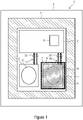
- Figure 1 illustrates a first embodiment of a gas sensing device 1 according to the disclosure in a schematic cross-sectional top view
- Figure 2 illustrates the first embodiment of a gas sensing device 1 according to the disclosure in a schematic cross-sectional side view.
- a gas sensing device for sensing a first gas and at least one second gas in an ambient mixture of gases; wherein the gas sensing device 1 comprises a plurality of chemo-resistive gas sensing elements 2, 3, wherein a first chemo-resistive gas sensing element 2 of the plurality of chemo-resistive gas sensing elements 2,3 is configured for providing first sensing signals S1, and wherein a second chemo-resistive gas sensing element 3 of the plurality of chemo-resistive gas sensing elements 2, 3 is configured for providing second sensing signals S2; wherein a material composition of the first chemo-resistive gas sensing element 2 is similar to a material composition of the second chemo-resistive gas sensing element 3, wherein the material composition is suitable for sensing the first gas and the at least one second gas; wherein the first chemo-resistive gas sensing element 2 is exposed to the ambient mixture of gases so that the first sensing signals S1 depend
- the second chemo-resistive gas sensing element 3 is arranged in an enclosed containment 5, wherein the gas filter 4 is implemented as a portion of a wall structure 6 of the enclosed containment 5.
- the enclosed containment 5 is formed by the gas filter 4, the wall structure 6 and the common substrate 9.
- the first gas is ozone.
- the at least one second gas comprises nitrogen dioxide.
- the material composition of the first chemo-resistive gas sensing element 2 and of the second chemo-resistive gas sensing element 3 comprises a mixed oxide or materials comprising carbon like e. g. graphene, carbon nanotubes etc.
- the gas sensing device 1 comprises a processing device 7 comprising a gas concentration estimator 8 comprising a trained model based algorithm processor having an input layer and an output layer, wherein first sensing data derived from the first sensing signals S1 and second sensing data derived from the second sensing signals S2 are fed simultaneously to the input layer, and wherein the concentration of the first gas in the ambient mixture of gases and/or the concentration of the second gas in the ambient mixture of gases are estimated based on output data of the output layer.
- a processing device 7 comprising a gas concentration estimator 8 comprising a trained model based algorithm processor having an input layer and an output layer, wherein first sensing data derived from the first sensing signals S1 and second sensing data derived from the second sensing signals S2 are fed simultaneously to the input layer, and wherein the concentration of the first gas in the ambient mixture of gases and/or the concentration of the second gas in the ambient mixture of gases are estimated based on output data of the output layer.
- the first chemo-resistive gas sensing element 2, the second chemo-resistive gas sensing element and the processing device 7 are arranged at a common substrate 9.
- the first chemo-resistive gas sensing element 2 and the second chemo-resistive gas sensing element 3 are arranged in an enclosed housing 10, wherein a wall structure 11 of the enclosed housing 10 comprises a particle filter 12, which is impermeable for particles and permeable for the first gas and for the at least one second gas.
- the enclosed housing 10 is formed by the common substrate 9, the wall structure 11 and the particle filter 12.
- the first chemo-resistive gas sensor element 2 comprises one gas sensitive area 13 and the second chemo-resistive gas sensor element 3 comprises one gas sensitive area 14.
- the first sensing signals S1 are transmitted over first electrical connectors 15 from the first chemo-resistive gas sensing element 2 to the processing device 7.
- the second sensing signals S2 are transmitted over second electrical connectors 16 from the second chemo-resistive gas sensing element 3 to the processing device 7.
- the gas sensing device 1 comprises two chemo-resistive gas sensing elements 2, 3 with the same type of material composition and controlled by the same processing device 7.
- Each of the chemo-resistive gas sensing elements 2, 3 has one or multiple gas sensing areas 13, 14. All the chemo resistive gas sensing elements 2, 3 are located inside the same package and one (or more) of the chemo-resistive gas sensing elements 2, 3 is protected by a gas filter 4, which filters out ozone.
- the two (or more) chemo resistive gas sensing elements 2, 3 can be on different micro-electromechanical systems and then the chemo resistive gas sensing element 3 with the gas filter 4 will have an enclosed containment 5 with a wall structure 6 (e.g. a small lid with a big opening) that will mechanically support the gas filter for on top.
- the chemo resistive gas sensing element 2 without the gas filter 4 will react to nitrogen dioxide and ozone and should be operated at a temperature low enough in order to avoid oxidation of the material due to the presence of ozone.
- the chemo resistive gas sensing element 3 with the gas filter 4 will not react to ozone and, therefore, is sensitive for nitrogen dioxide only.
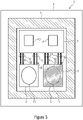
- Figure 3 illustrates a second embodiment of a gas sensing device 1 according to the disclosure in a schematic cross-sectional top view
- Figure 4 illustrates the second embodiment of a gas sensing device 1 according to the disclosure in a schematic cross-sectional side view.
- the gas filter 4 is implemented as a coating of a gas-sensitive area 14 of the second chemo-resistive gas sensing element 3.
- the gas sensing device 1 comprises a first heating device 17 configured for heating the first chemo-resistive gas sensing element 2 and a second heating device 18 configured for heating the second chemo-resistive gas sensing element 3, wherein the processing device 7 comprises a heat control device 19 configured for controlling the first heating device 17 according to a first temperature profile and for controlling the second heating device 18 according to a second temperature device, wherein a maximum temperature of the first temperature profile is lower than a maximum temperature of the second temperature profile.
- the first chemo-resistive gas sensing element 2 is heated by a first heating device 17 and the second chemo-resistive gas sensing element 3 is heated by a second heating device 18.
- the processing device 7 comprises a heat control device 19, which supplies a first electrical energy E1 over third electrical connectors 22 the first heating device 17, and which supplies second electrical energy E2 over the fourth electrical connectors 23 to the second heating device 18.
- an operational temperature of the first chemo-resistive gas sensing element 2 may be controlled independently from an operational temperature of the second chemo-resistive gas sensing element 3.
- a common heating device could be used for heating both of the gas sensing elements 2, 3.
- both gas sensing elements 2, 3 are arranged on a common micro-electromechanical system.
- the gas sensing element 3 has a layer of material which catalyzes the ozone decomposition (e.g. MnO2) deposited or grown on the top of the sensing material.
- the gas sensing elements 2, 3 can have independent heating devices 17, 18 or just one heating device.
- Figure 5 illustrates the third embodiment of a gas sensing device 1 according to the disclosure in a schematic cross-sectional side view.
- the first chemo-resistive gas sensing element 2 and the second chemo-resistive gas sensing element 3 are arranged at a common side of the common substrate 9, wherein the processing device 7 is arranged at an opposite side of the common substrate 9, wherein the first chemo-resistive gas sensing element 2 and the second chemo-resistive gas sensing element 3 are electrically connected to the processing device by vias 22, 23, 24, 25.
- the first chemo-resistive gas sensing element 2 and the second chemo-resistive gas sensing element 3 are arranged at a top side of the common substrate 9, wherein the processing device 7 is arranged at an bottom side of the common substrate 9.
- the first sensing signals S1 are transmitted over a first group of vias 22 to the processing device 7.
- the second sensing signals are transmitted over a second group of vias 23 to the processing device 7.
- the first electrical energy E1 is provided to the first heating device 17 using a third group of vias 24.
- the second electrical energy E2 is provided to the second heating device 18 using a fourth group of wires 25.
- the gas sensing device 1 could be extended to other gases which cause a similar response in the material composition of the gas sensing elements, using two (or more) second chemo-resistive gas sensing elements 3, where one (or more) of the second chemo-resistive gas sensing elements 3 is covered with a gas filter for filtering out a first gas of the gases and the other second chemo-resistive gas sensing element free (or sensors) has a gas filter for filtering out a further gas of the gases.
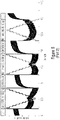
- Figure 6 illustrates an exemplary resistance change of a chemo-resistive gas sensing element 2, 3 upon applying various concentrations of nitrogen dioxide and ozone with (upper graph) and without (lower graph) a gas filter 4.
- the gas filter 4 was consisting of a standard filter paper which was impregnated with indigo - a material which decomposes ozone.
- the sensor response to ozone is very low when using a gas filter 4 as can be observed in Figure 6 .
- the recovery of the chemo-resistive sensing element 2, 3 is faster and the damage on the chemo-resistive sensing element 2, 3 (resistance increase of the baseline resembling an oxidation of the sensing material) is lowered.
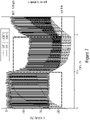
- Figure 7 illustrates an exemplary resistance change of a chemo-resistive gas sensing element 2, 3 when applying a certain NO2 concentration measured subsequently with different recovery temperatures.
- a higher operational temperature can be used without damaging the chemo-resistive sensing element 3. This would improve the overall sensor performance of the second chemo-resistive sensing element 3, thanks to a faster response and recovery and a more stable reaction to gases.
- the slightly lower sensitivity at higher temperature is not a limitation since the sensitivity is still above the detection limit for the concentration of interest (>20ppb) of the target gas.
- aspects have been described in the context of an apparatus, it is clear that these aspects also represent a description of the corresponding method, where a block or device corresponds to a method step or a feature of a method step. Analogously, aspects described in the context of a method step also represent a description of a corresponding block or item or feature of a corresponding apparatus.
Landscapes
- Chemical & Material Sciences (AREA)
- Health & Medical Sciences (AREA)
- Life Sciences & Earth Sciences (AREA)
- Immunology (AREA)
- Pathology (AREA)
- Physics & Mathematics (AREA)
- Analytical Chemistry (AREA)
- Biochemistry (AREA)
- General Health & Medical Sciences (AREA)
- General Physics & Mathematics (AREA)
- Engineering & Computer Science (AREA)
- Chemical Kinetics & Catalysis (AREA)
- Electrochemistry (AREA)
- Nanotechnology (AREA)
- Materials Engineering (AREA)
- Organic Chemistry (AREA)
- Combustion & Propulsion (AREA)
- Food Science & Technology (AREA)
- Medicinal Chemistry (AREA)
- Microelectronics & Electronic Packaging (AREA)
- Power Engineering (AREA)
- Inorganic Chemistry (AREA)
- Investigating Or Analyzing Materials By The Use Of Fluid Adsorption Or Reactions (AREA)
Abstract
wherein the gas sensing device comprises a plurality of chemo-resistive gas sensing elements;
wherein a material composition of the first chemo-resistive gas sensing element is similar to a material composition of the second chemo-resistive gas sensing element;
wherein the first chemo-resistive gas sensing element is exposed to the ambient mixture of gases so that the first sensing signals depend on a concentration of the first gas in the ambient mixture of gases and on a concentration of the second gas in the ambient mixture of gases;
wherein the gas sensing device comprises a gas filter so that the second sensing signals depend on the concentration of the first gas in the ambient mixture of gases to a lesser degree than the first sensor signals and so that the second sensing signals depend on the concentration of the second gas in the ambient mixture of gases;
wherein the gas sensing device is configured for estimating the concentration of the first gas in the ambient mixture of gases and/or the concentration of the second gas in the ambient mixture of gases based on the first sensing signals and based on the second sensing signals.
Description
- The disclosure relates to gas sensing devices, in particular to chemo-resistive gas sensing devices for sensing different gases in an ambient mixture of gases.
- Chemo-resistive sensing devices will of sensing different gases are known in the art. However, there is a need for improving the accuracy of the sensing results of such sensing devices.
- The problem is solved by a gas sensing device for sensing a first gas and at least one second gas in an ambient mixture of gases;
wherein the gas sensing device comprises a plurality of chemo-resistive gas sensing elements, wherein a first chemo-resistive gas sensing element of the plurality of chemo-resistive gas sensing elements is configured for providing first sensing signals, and wherein a second chemo-resistive gas sensing element of the plurality of chemo-resistive gas sensing elements is configured for providing second sensing signals;
wherein a material composition of the first chemo-resistive gas sensing element is similar to a material composition of the second chemo-resistive gas sensing element, wherein the material composition is suitable for sensing the first gas and the at least one second gas;
wherein the first chemo-resistive gas sensing element is exposed to the ambient mixture of gases so that the first sensing signals depend on a concentration of the first gas in the ambient mixture of gases and on a concentration of the second gas in the ambient mixture of gases;
wherein the gas sensing device comprises a gas filter, which is less permeable for the first gas than for the at least one second gas, wherein the gas filter is arranged in such way that the second chemo-resistive gas sensing element is exposed to a filtered mixture of gases obtained by filtering the ambient mixture of gases with the gas filter so that the second sensing signals depend on the concentration of the first gas in the ambient mixture of gases to a lesser degree than the first sensor signals and so that the second sensing signals depend on the concentration of the second gas in the ambient mixture of gases;
wherein the gas sensing device is configured for estimating the concentration of the first gas in the ambient mixture of gases and/or the concentration of the second gas in the ambient mixture of gases based on the first sensing signals and based on the second sensing signals. - In general, a chemo-resistive gas sensing element is an electronic component that changes its electrical resistance in response to changes of the concentrations of nearby gases. The gases, for which a chemo-resistive gas sensing element is sensitive, depend on the material composition of the chemo-resistive gas sensing element. One problem lies in that most of the suitable material compositions interact with more than one gas, which is also known as cross sensitivity, so that it is demanding to distinguish the influence of different gases in a mixture of gases on the electrical resistance of the chemo-resistive gas sensing element.
- The proposed gas sensing device comprises at least a first chemo-resistive gas sensing element for producing first sensing signals and the second chemo-resistive gas sensing element for producing second sensing signals, wherein the material composition of both chemo-resistive gas sensing elements is similar control and in such way that the material composition is sensitive to at least a first gas and the second gas. Each of the gas sensing elements may be manufactured as a micro-electromechanical system (MEMS). The two sensing elements may have similar dimensions and may be arranged inside a common package.
- The first chemo-resistive gas sensing element is arranged in such way, that it is exposed to an ambient mixture of gases comprising at least the first gas and the second gas. In contrast to that, the second chemo-resistive gas sensing element is arranged in such way that it is exposed to a filtered mixture of gases which is obtained by filtering the ambient mixture of gases, wherein the gas filter is used which is impermeable for the first gas and permeable for the second gas.
- In this way, it ensured that the first sensing signals depend on a concentration of the first gas in the ambient mixture of gases and on a concentration of the second gas in the ambient mixture of gases. Moreover, it ensured that the second sensing signals do not depend on the concentration of the first gas in the ambient mixture of gases, or at least to a lesser degree than the first sensor signals. However, that the second sensing signals depend on the concentration of the second gas in the ambient mixture of gases.
- The gas sensing device estimates the concentration of the first gas in the ambient mixture of gases and/or the concentration of the second gas in the ambient mixture of gases by taking into account the first sensing signals and the second sensing signals simultaneously.
- The gas sensing device may comprise a processing device comprising a gas concentration estimator, wherein the first sensing signals and the second sensing signals are fed to the gas concentration estimator, wherein the gas concentration estimator is configured for estimating the concentration of the first gas in the ambient mixture of gases and/or the concentration of the second gas in the ambient mixture of gases based on the first sensing signals and based on the second sensing signals.
- Both of the sensing elements may be controlled by the same processing device.
- In some embodiments, the processing device comprises hardware only. In other embodiments, the processing device comprises hardware and software. In particular, the processing device may comprise an application-specific integrated circuit (ASIC) and/or a microcontroller.
- The gas concentration estimator may comprise the lookup table to which values of the first sensing signals and corresponding values of the second sensing signals are fed to, and which outputs values for a concentration of the first gas and values for concentration of the second gas. The content of the lookup table may be determined experimentally.
- The combination of the first chemo-resistive sensing element, the second chemo-resistive sensing element, the gas filter and the estimation of the gas concentrations by assessing simultaneously the first sensor signals and the second sensor signals ensures that the cross sensitivity of the proposed gas sensing device is significantly lower than the cross sensitivity of pre-known multi-gas sensors.
- The gas sensing device according to the disclosure is, in particular, suitable for air quality monitoring in outdoor applications. It may be produced at low costs, may have small dimensions and may have a low power consumption.
- According to some embodiments, the second chemo-resistive gas sensing element is arranged in an enclosed containment, wherein the gas filter is implemented as a portion of a wall structure of the enclosed containment. These features are especially advantages, if the material of the gas filter does not allow attaching the gas filter directly to the second chemo-resistive gas sensing element. Using an enclosed containment ensures that the second chemo-resistive gas sensing element is prevented from getting into contact with the first gas.
- According to some embodiments, the first gas is ozone. According to some embodiments, the at least one second gas comprises nitrogen dioxide. Ozone and nitrogen dioxide cause a very similar reaction on chemo-resistive gas sensing elements. Thus, prior art chemo-resistive gas sensor devices are not able to separate completely the contribution of the two gases to the eventual value of the electrical resistance of the chemo-resistive gas sensing element, as both gases are oxidizing gases with similar binding energy causing a similar change in the electrical resistance of the chemo-resistive sensing element. However, at the disclosed solution data the processing device use the information coming from the two sensor elements (one exposed just to ozone and the other exposed to nitrogen dioxide and ozone) to differentiate between the two gases so that it is possible to predict the concentration of each of them with high accuracy.
- According to some embodiments, the material composition of the first chemo-resistive gas sensing element and of the second chemo-resistive gas sensing element comprises a mixed oxide (MOX) or materials comprising carbon like e. g. graphene, carbon nanotubes etc. Such materials are suitable for gas sensing devices, however with materials shows strong cross sensitivity when exposed to nitrogen dioxide and ozone so that it is very demanding to separate properly the contribution of the two gases to the value of the electrical resistance of the gas sensing element comprising these materials. However, the proposed gas sensing device is capable of measuring correctly the concentration of each of the two gases.
- According to some embodiments, the gas sensing device comprises a processing device comprising a gas concentration estimator comprising a trained model based algorithm processor having an input layer and an output layer, wherein first sensing data derived from the first sensing signals and second sensing data derived from the second sensing signals are fed simultaneously to the input layer, and wherein the concentration of the first gas in the ambient mixture of gases and/or the concentration of the second gas in the ambient mixture of gases are estimated based on output data of the output layer.
- A trained model based algorithm processor is a processor, which is capable of machine learning. The machine learning is done in a preoperational training phase in which trained models are developed by comparing actual output values of the trained model based algorithm stage with desired output values of the trained model based algorithm stage for defined inputs of the trained model based algorithm stage. The trained models have a predefined structure, wherein a parametrization of the predefined structure is done during the training phase. The trained models comprise the learned content after the training phase is finished. In an operational phase for producing sensing results one or more of the trained models from the training phase are used to process the first sensing data and the second sensing data.
- In the training phase, a plurality of trained models can be established and afterwards stored at the processing device or alternatively on a software running on an external microcontroller. The trained models may differ in the structures and/or the parameters. During an operational phase, the most appropriate trained model may be selected depending on the specific use-case.
- The use of a trained model based algorithm processor (in contrast to the use of a look-up table) ensures, that in an operational phase also input values, which were not used in an pre-operational experimental or training phase, are processed in such way that a measurement error is minimized.
- According to some embodiments, the first chemo-resistive gas sensing element, the second chemo-resistive gas sensing element and the processing device are arranged at a common substrate. By these features, the dimensions of the gas sensing device and the manufacturing effort may be minimized. The common substrate maybe made, in particular, of a semiconductor material.
- According to some embodiments, the first chemo-resistive gas sensing element and the second chemo-resistive gas sensing element are arranged in an enclosed housing, wherein a wall structure of the enclosed housing comprises a particle filter, which is impermeable for particles and permeable for the first gas and for the at least one second gas. By these features, clogging of the gas sensitive areas of the two gas sensing elements by particles may be prevented.
- According to some embodiments, the gas filter is implemented as a coating of a gas-sensitive area of the second chemo-resistive gas sensing element. The coating may, e.g., comprise manganese oxide (MnO2). By these features, the dimensions of the gas sensing device and the manufacturing effort may be further minimized.
- According to some embodiments, the gas sensing device comprises a first heating device configured for heating the first chemo-resistive gas sensing element and a second heating device configured for heating the second chemo-resistive gas sensing element, wherein the processing device comprises a heat control device configured for controlling the first heating device according to a first temperature profile and for controlling the second heating device according to a second temperature device, wherein a maximum temperature of the first temperature profile is lower than a maximum temperature of the second temperature profile.
- In general, the exposure to very high concentrations of oxidizing gases, such as ozone, using high operating temperatures can damage, depending on the sensing material, the chemo-resistive gas sensing elements and using low operating temperature causes a slow response and recovery of the chemo-resistive gas sensing elements. Vice versa, the usage of a low operation temperature reduces the damage of the chemo-resistive sensor elements in presence of oxidizing gases, such as ozone, however a very low operation temperature is limiting the sensor performance since it causes a slow sensor response and its subsequent recovery.
- As the second chemo-resistive gas sensing element of the proposed gas sensing device is prevented from contact with one of the gases, the operational temperatures of the second chemo-resistive gas sensing element may be chosen higher than the operational temperatures of the first chemo-resistive gas sensing element, in case that the respective gas is an oxidizing gases such as ozone. In this way, the response and the recovery of the second chemo-resistive gas sensing element can be drastically enhanced.
- According to some embodiments, the first chemo-resistive gas sensing element and the second chemo-resistive gas sensing element are arranged at a common side of the common substrate, wherein the processing device is arranged at an opposite side of the common substrate, wherein the first chemo-resistive gas sensing element and the second chemo-resistive gas sensing element are electrically connected to the processing device by vias. By these features, the dimensions of the gas sensing device and the manufacturing effort may be further minimized.
- Preferred embodiments of the invention are subsequently discussed with respect to the accompanying drawings, in which:
- Figure 1
- illustrates a first embodiment of a gas sensing device according to the disclosure in a schematic cross-sectional top view;
- Figure 2
- illustrates the first embodiment of a gas sensing device according to the disclosure in a schematic cross-sectional side view;
- Figure 3
- illustrates a second embodiment of a gas sensing device according to the disclosure in a schematic cross-sectional top view;
- Figure 4
- illustrates the second embodiment of a gas sensing device according to the disclosure in a schematic cross-sectional side view;
- Figure 5
- illustrates the third embodiment of a gas sensing device according to the disclosure in a schematic cross-sectional side view;
- Figure 6
- illustrates an exemplary resistance change of a chemo-resistive gas sensing element upon applying various concentrations of nitrogen dioxide and ozone with (upper graph) and without (lower graph) a gas filter; and
- Figure 7
- illustrates an exemplary resistance change of a chemo-resistive gas sensing element when applying a certain NO2 concentration measured subsequently with different recovery temperatures.
- Equal or equivalent elements or elements with equal or equivalent functionality are denoted in the following description by equal or equivalent reference numerals.
- In the following description, a plurality of details is set forth to provide a more thorough explanation of embodiments of the present disclosure. However, it will be apparent to those skilled in the art that embodiments of the present disclosure may be practiced without these specific details. In other instances, well-known structures and devices are shown in block diagram form rather than in detail in order to avoid obscuring embodiments of the present disclosure. In addition, features of the different embodiments described hereinafter may be combined with each other, unless specifically noted otherwise.
-
Figure 1 illustrates a first embodiment of agas sensing device 1 according to the disclosure in a schematic cross-sectional top view andFigure 2 illustrates the first embodiment of agas sensing device 1 according to the disclosure in a schematic cross-sectional side view. - Disclosed is a gas sensing device for sensing a first gas and at least one second gas in an ambient mixture of gases;
wherein thegas sensing device 1 comprises a plurality of chemo-resistivegas sensing elements gas sensing element 2 of the plurality of chemo-resistivegas sensing elements gas sensing element 3 of the plurality of chemo-resistivegas sensing elements
wherein a material composition of the first chemo-resistivegas sensing element 2 is similar to a material composition of the second chemo-resistivegas sensing element 3, wherein the material composition is suitable for sensing the first gas and the at least one second gas;
wherein the first chemo-resistivegas sensing element 2 is exposed to the ambient mixture of gases so that the first sensing signals S1 depend on a concentration of the first gas in the ambient mixture of gases and on a concentration of the second gas in the ambient mixture of gases;
wherein thegas sensing device 1 comprises a gas filter 4, which is less permeable for the first gas than for the at least one second gas, wherein the gas filter 4 is arranged in such way that the second chemo-resistivegas sensing element 3 is exposed to a filtered mixture of gases obtained by filtering the ambient mixture of gases with the gas filter 4 so that the second sensing signals S2 depend on the concentration of the first gas in the ambient mixture of gases to a lesser degree than the first sensor signals S1 and so that the second sensing signals 2 depend on the concentration of the second gas in the ambient mixture of gases;
wherein thegas sensing device 1 is configured for estimating the concentration of the first gas in the ambient mixture of gases and/or the concentration of the second gas in the ambient mixture of gases based on the first sensing signals S1 and based on the second sensing signals S2. - According to some embodiments, the second chemo-resistive
gas sensing element 3 is arranged in anenclosed containment 5, wherein the gas filter 4 is implemented as a portion of awall structure 6 of theenclosed containment 5. - In the example of
Figures 1 and2 , theenclosed containment 5 is formed by the gas filter 4, thewall structure 6 and thecommon substrate 9. - According to some embodiments, the first gas is ozone.
- According to some embodiments, the at least one second gas comprises nitrogen dioxide.
- According to some embodiments, the material composition of the first chemo-resistive
gas sensing element 2 and of the second chemo-resistivegas sensing element 3 comprises a mixed oxide or materials comprising carbon like e. g. graphene, carbon nanotubes etc. - According to some embodiments, the
gas sensing device 1 comprises a processing device 7 comprising agas concentration estimator 8 comprising a trained model based algorithm processor having an input layer and an output layer, wherein first sensing data derived from the first sensing signals S1 and second sensing data derived from the second sensing signals S2 are fed simultaneously to the input layer, and wherein the concentration of the first gas in the ambient mixture of gases and/or the concentration of the second gas in the ambient mixture of gases are estimated based on output data of the output layer. - According to some embodiments, the first chemo-resistive
gas sensing element 2, the second chemo-resistive gas sensing element and the processing device 7 are arranged at acommon substrate 9. - According to some embodiments, the first chemo-resistive
gas sensing element 2 and the second chemo-resistivegas sensing element 3 are arranged in anenclosed housing 10, wherein awall structure 11 of theenclosed housing 10 comprises aparticle filter 12, which is impermeable for particles and permeable for the first gas and for the at least one second gas. - In the example of
Figures 1 and2 , theenclosed housing 10 is formed by thecommon substrate 9, thewall structure 11 and theparticle filter 12. - In the example of
Figures 1 and2 , the first chemo-resistivegas sensor element 2 comprises one gassensitive area 13 and the second chemo-resistivegas sensor element 3 comprises one gassensitive area 14. The first sensing signals S1 are transmitted over firstelectrical connectors 15 from the first chemo-resistivegas sensing element 2 to the processing device 7. Similarly, the second sensing signals S2 are transmitted over secondelectrical connectors 16 from the second chemo-resistivegas sensing element 3 to the processing device 7. - In the example of
Figures 1 and2 , thegas sensing device 1 comprises two chemo-resistivegas sensing elements gas sensing elements gas sensing areas gas sensing elements gas sensing elements gas sensing elements gas sensing element 3 with the gas filter 4 will have anenclosed containment 5 with a wall structure 6 (e.g. a small lid with a big opening) that will mechanically support the gas filter for on top. The chemo resistivegas sensing element 2 without the gas filter 4 will react to nitrogen dioxide and ozone and should be operated at a temperature low enough in order to avoid oxidation of the material due to the presence of ozone. The chemo resistivegas sensing element 3 with the gas filter 4 will not react to ozone and, therefore, is sensitive for nitrogen dioxide only. -
Figure 3 illustrates a second embodiment of agas sensing device 1 according to the disclosure in a schematic cross-sectional top view andFigure 4 illustrates the second embodiment of agas sensing device 1 according to the disclosure in a schematic cross-sectional side view. - According to some embodiments, the gas filter 4 is implemented as a coating of a gas-
sensitive area 14 of the second chemo-resistivegas sensing element 3. - According to some embodiments, the
gas sensing device 1 comprises afirst heating device 17 configured for heating the first chemo-resistivegas sensing element 2 and asecond heating device 18 configured for heating the second chemo-resistivegas sensing element 3, wherein the processing device 7 comprises aheat control device 19 configured for controlling thefirst heating device 17 according to a first temperature profile and for controlling thesecond heating device 18 according to a second temperature device, wherein a maximum temperature of the first temperature profile is lower than a maximum temperature of the second temperature profile. - In the example of
Figures 3 and4 , the first chemo-resistivegas sensing element 2 is heated by afirst heating device 17 and the second chemo-resistivegas sensing element 3 is heated by asecond heating device 18. The processing device 7 comprises aheat control device 19, which supplies a first electrical energy E1 over thirdelectrical connectors 22 thefirst heating device 17, and which supplies second electrical energy E2 over the fourthelectrical connectors 23 to thesecond heating device 18. By these features, an operational temperature of the first chemo-resistivegas sensing element 2 may be controlled independently from an operational temperature of the second chemo-resistivegas sensing element 3. In other embodiments, a common heating device could be used for heating both of thegas sensing elements - In the example of
Figures 3 and4 , bothgas sensing elements gas sensing element 3 has a layer of material which catalyzes the ozone decomposition (e.g. MnO2) deposited or grown on the top of the sensing material. - The
gas sensing elements independent heating devices -
Figure 5 illustrates the third embodiment of agas sensing device 1 according to the disclosure in a schematic cross-sectional side view. - According to some embodiments, the first chemo-resistive
gas sensing element 2 and the second chemo-resistivegas sensing element 3 are arranged at a common side of thecommon substrate 9, wherein the processing device 7 is arranged at an opposite side of thecommon substrate 9, wherein the first chemo-resistivegas sensing element 2 and the second chemo-resistivegas sensing element 3 are electrically connected to the processing device byvias - In the example of
Figure 5 , the first chemo-resistivegas sensing element 2 and the second chemo-resistivegas sensing element 3 are arranged at a top side of thecommon substrate 9, wherein the processing device 7 is arranged at an bottom side of thecommon substrate 9. The first sensing signals S1 are transmitted over a first group ofvias 22 to the processing device 7. The second sensing signals are transmitted over a second group ofvias 23 to the processing device 7. The first electrical energy E1 is provided to thefirst heating device 17 using a third group ofvias 24. Similarly, the second electrical energy E2 is provided to thesecond heating device 18 using a fourth group ofwires 25. - The
gas sensing device 1 could be extended to other gases which cause a similar response in the material composition of the gas sensing elements, using two (or more) second chemo-resistivegas sensing elements 3, where one (or more) of the second chemo-resistivegas sensing elements 3 is covered with a gas filter for filtering out a first gas of the gases and the other second chemo-resistive gas sensing element free (or sensors) has a gas filter for filtering out a further gas of the gases. -
Figure 6 illustrates an exemplary resistance change of a chemo-resistivegas sensing element - The same measurement was done with the same chemo-
resistive sensing element sensitive area 13, 14) is very low when using a gas filter 4 as can be observed inFigure 6 . Moreover, the recovery of the chemo-resistive sensing element resistive sensing element 2, 3 (resistance increase of the baseline resembling an oxidation of the sensing material) is lowered. -
Figure 7 illustrates an exemplary resistance change of a chemo-resistivegas sensing element - When the chemo-
resistive sensing element 3 is protected from exposure to high concentration of ozone, then a higher operational temperature can be used without damaging the chemo-resistive sensing element 3. This would improve the overall sensor performance of the second chemo-resistive sensing element 3, thanks to a faster response and recovery and a more stable reaction to gases. The slightly lower sensitivity at higher temperature is not a limitation since the sensitivity is still above the detection limit for the concentration of interest (>20ppb) of the target gas. - Using 200°C as recovery temperature results in a more pronounced sensitivity but the response time as well as the recovery time are longer compared to a measurement with 300°C recovery temperature.
- Although some aspects have been described in the context of an apparatus, it is clear that these aspects also represent a description of the corresponding method, where a block or device corresponds to a method step or a feature of a method step. Analogously, aspects described in the context of a method step also represent a description of a corresponding block or item or feature of a corresponding apparatus.
- The above described is merely illustrative, and it is understood that modifications and variations of the arrangements and the details described herein will be apparent to others skilled in the art. It is the intent, therefore, to be limited only by the scope of the impending claims and not by the specific details presented by way of description and explanation above.
Claims (11)
- A gas sensing device for sensing a first gas and at least one second gas in an ambient mixture of gases;
wherein the gas sensing device (1) comprises a plurality of chemo-resistive gas sensing elements (2, 3), wherein a first chemo-resistive gas sensing element (2) of the plurality of chemo-resistive gas sensing elements (2,3) is configured for providing first sensing signals (S1), and wherein a second chemo-resistive gas sensing element (3) of the plurality of chemo-resistive gas sensing elements (2, 3) is configured for providing second sensing signals (S2);
wherein a material composition of the first chemo-resistive gas sensing element (2) is similar to a material composition of the second chemo-resistive gas sensing element (3), wherein the material composition is suitable for sensing the first gas and the at least one second gas;
wherein the first chemo-resistive gas sensing element (2) is exposed to the ambient mixture of gases so that the first sensing signals (S1) depend on a concentration of the first gas in the ambient mixture of gases and on a concentration of the second gas in the ambient mixture of gases;
wherein the gas sensing device (1) comprises a gas filter (4), which is less permeable for the first gas than for the at least one second gas, wherein the gas filter (4) is arranged in such way that the second chemo-resistive gas sensing element (3) is exposed to a filtered mixture of gases obtained by filtering the ambient mixture of gases with the gas filter (4) so that the second sensing signals (S2) depend on the concentration of the first gas in the ambient mixture of gases to a lesser degree than the first sensor signals (S1) and so that the second sensing signals (2) depend on the concentration of the second gas in the ambient mixture of gases;
wherein the gas sensing device (1) is configured for estimating the concentration of the first gas in the ambient mixture of gases and/or the concentration of the second gas in the ambient mixture of gases based on the first sensing signals (S1) and based on the second sensing signals (S2). - The gas sensing device according to the preceding claim, wherein the second chemo-resistive gas sensing element (3) is arranged in an enclosed containment (5), wherein the gas filter (4) is implemented as a portion of a wall structure (6) of the enclosed containment (5).
- The gas sensing device according to one of the preceding claims, wherein the first gas is ozone.
- The gas sensing device according to one of the preceding claims, wherein the at least one second gas comprises nitrogen dioxide.
- The gas sensing device according to one of the preceding claims, wherein the material composition of the first chemo-resistive gas sensing element (2) and of the second chemo-resistive gas sensing element (3) comprises a mixed oxide or materials comprising carbon, such as graphene or carbon nanotubes.
- The gas sensing device according to one of the preceding claims, wherein the gas sensing device (1) comprises a processing device (7) comprising a gas concentration estimator (8) comprising a trained model based algorithm processor having an input layer and an output layer, wherein first sensing data derived from the first sensing signals (S1) and second sensing data derived from the second sensing signals (S2) are fed simultaneously to the input layer, and wherein the concentration of the first gas in the ambient mixture of gases and/or the concentration of the second gas in the ambient mixture of gases are estimated based on output data of the output layer.
- The gas sensing device according to one of the preceding claims, wherein the first chemo-resistive gas sensing element (2), the second chemo-resistive gas sensing element and the processing device (7) are arranged at a common substrate (9).
- The gas sensing device according to one of the preceding claims, wherein the first chemo-resistive gas sensing element (2) and the second chemo-resistive gas sensing element (3) are arranged in an enclosed housing (10), wherein a wall structure (11) of the enclosed housing (10) comprises a particle filter (12), which is impermeable for particles and permeable for the first gas and for the at least one second gas.
- The gas sensing device according to claim 1, wherein the gas filter (4) is implemented as a coating of a gas-sensitive area (14) of the second chemo-resistive gas sensing element (3).
- The gas sensing device according to one of the preceding claims, wherein the gas sensing device (1) comprises a first heating device (17) configured for heating the first chemo-resistive gas sensing element (2) and a second heating device (18) configured for heating the second chemo-resistive gas sensing element (3), wherein the processing device (7) comprises a heat control device (19) configured for controlling the first heating device (17) according to a first temperature profile and for controlling the second heating device (18) according to a second temperature device, wherein a maximum temperature of the first temperature profile is lower than a maximum temperature of the second temperature profile.
- The gas sensing device according to one of the preceding claims 7 to 10, wherein the first chemo-resistive gas sensing element (2) and the second chemo-resistive gas sensing element (3) are arranged at a common side of the common substrate (9), wherein the processing device (7) is arranged at an opposite side of the common substrate (9), wherein the first chemo-resistive gas sensing element (2) and the second chemo-resistive gas sensing element (3) are electrically connected to the processing device by vias (22, 23, 24, 25).
Priority Applications (5)
| Application Number | Priority Date | Filing Date | Title |
|---|---|---|---|
| EP21153058.9A EP4033233A1 (en) | 2021-01-22 | 2021-01-22 | Gas sensing device with a gas filter |
| US17/643,653 US11740199B2 (en) | 2021-01-22 | 2021-12-10 | Gas sensing device with a gas filter |
| KR1020220008673A KR20220106705A (en) | 2021-01-22 | 2022-01-20 | Gas sensing device with a gas filter |
| CN202210080365.4A CN114813853A (en) | 2021-01-22 | 2022-01-24 | Gas sensing device with gas filter |
| US18/355,043 US20230358699A1 (en) | 2021-01-22 | 2023-07-19 | Gas Sensing Device with a Gas Filter |
Applications Claiming Priority (1)
| Application Number | Priority Date | Filing Date | Title |
|---|---|---|---|
| EP21153058.9A EP4033233A1 (en) | 2021-01-22 | 2021-01-22 | Gas sensing device with a gas filter |
Publications (1)
| Publication Number | Publication Date |
|---|---|
| EP4033233A1 true EP4033233A1 (en) | 2022-07-27 |
Family
ID=74215753
Family Applications (1)
| Application Number | Title | Priority Date | Filing Date |
|---|---|---|---|
| EP21153058.9A Withdrawn EP4033233A1 (en) | 2021-01-22 | 2021-01-22 | Gas sensing device with a gas filter |
Country Status (4)
| Country | Link |
|---|---|
| US (2) | US11740199B2 (en) |
| EP (1) | EP4033233A1 (en) |
| KR (1) | KR20220106705A (en) |
| CN (1) | CN114813853A (en) |
Families Citing this family (3)
| Publication number | Priority date | Publication date | Assignee | Title |
|---|---|---|---|---|
| DE102022107320A1 (en) * | 2022-03-29 | 2023-10-05 | Infineon Technologies Ag | Gas sensor devices, method for their manufacture and method for generating absorption spectra of gases |
| CN115901663B (en) * | 2022-12-29 | 2025-08-08 | 德尔格安全设备(中国)有限公司 | Gas detection method and system, and computer-readable storage medium |
| IT202400003922A1 (en) * | 2024-02-23 | 2025-08-23 | Fond Bruno Kessler | SOLID-STATE GAS SENSOR AND CORRESPONDING MANUFACTURING PROCEDURE |
Citations (4)
| Publication number | Priority date | Publication date | Assignee | Title |
|---|---|---|---|---|
| JPH10123083A (en) * | 1996-10-16 | 1998-05-15 | Chichibu Onoda Cement Corp | Gas sensor |
| EP2533037A1 (en) * | 2011-06-08 | 2012-12-12 | Alpha M.O.S. | Chemoresistor type gas sensor having a multi-storey architecture |
| WO2013008170A2 (en) * | 2011-07-13 | 2013-01-17 | Koninklijke Philips Electronics N.V. | Gas sensing apparatus |
| US20180135287A1 (en) * | 2016-11-15 | 2018-05-17 | David R. Hall | Filtering Toilet |
Family Cites Families (5)
| Publication number | Priority date | Publication date | Assignee | Title |
|---|---|---|---|---|
| DE102014203881A1 (en) * | 2014-03-04 | 2015-09-10 | Robert Bosch Gmbh | Component with microphone and media sensor function |
| GB201412507D0 (en) * | 2014-07-14 | 2014-08-27 | Alphasense Ltd | Amperometric electrochemical gas sensing apparatus and method for measuring oxidising gases |
| EP3223005A1 (en) * | 2016-03-22 | 2017-09-27 | Alphasense Limited | Electrochemical gas sensing apparatus and methods |
| US10012639B1 (en) * | 2016-06-09 | 2018-07-03 | Dynosense, Corp. | Gas-sensing apparatus with a self-powered microheater |
| US20200064291A1 (en) * | 2018-08-22 | 2020-02-27 | AerNos, Inc. | Pattern recognition algorithm for identifying and quantifying single and mixed contaminants in air with an array of nanomaterial-based gas sensors |
-
2021
- 2021-01-22 EP EP21153058.9A patent/EP4033233A1/en not_active Withdrawn
- 2021-12-10 US US17/643,653 patent/US11740199B2/en active Active
-
2022
- 2022-01-20 KR KR1020220008673A patent/KR20220106705A/en active Pending
- 2022-01-24 CN CN202210080365.4A patent/CN114813853A/en active Pending
-
2023
- 2023-07-19 US US18/355,043 patent/US20230358699A1/en not_active Abandoned
Patent Citations (4)
| Publication number | Priority date | Publication date | Assignee | Title |
|---|---|---|---|---|
| JPH10123083A (en) * | 1996-10-16 | 1998-05-15 | Chichibu Onoda Cement Corp | Gas sensor |
| EP2533037A1 (en) * | 2011-06-08 | 2012-12-12 | Alpha M.O.S. | Chemoresistor type gas sensor having a multi-storey architecture |
| WO2013008170A2 (en) * | 2011-07-13 | 2013-01-17 | Koninklijke Philips Electronics N.V. | Gas sensing apparatus |
| US20180135287A1 (en) * | 2016-11-15 | 2018-05-17 | David R. Hall | Filtering Toilet |
Also Published As
| Publication number | Publication date |
|---|---|
| KR20220106705A (en) | 2022-07-29 |
| US11740199B2 (en) | 2023-08-29 |
| CN114813853A (en) | 2022-07-29 |
| US20220236207A1 (en) | 2022-07-28 |
| US20230358699A1 (en) | 2023-11-09 |
Similar Documents
| Publication | Publication Date | Title |
|---|---|---|
| US20230358699A1 (en) | Gas Sensing Device with a Gas Filter | |
| Yuan et al. | Trace‐level, multi‐gas detection for food quality assessment based on decorated silicon transistor arrays | |
| US11656210B2 (en) | Gas sensing systems and methods of operation thereof | |
| CN102778483B (en) | Gas sensor | |
| Ivanov et al. | Towards a micro-system for monitoring ethylene in warehouses | |
| CN102128870A (en) | Carbon dioxide sensor and method for generating measured gas values | |
| EP3144669A1 (en) | A single gas sensor for sensing different gases and a method using the gas sensor | |
| Li et al. | Low concentration CO gas sensor based on pulsed-heating and wafer-level fabricated MEMS hotplate | |
| JP2887784B2 (en) | Meat freshness measuring device using gas sensor, measuring method thereof and gas sensor manufacturing method | |
| Jimenez et al. | Gas-sensing properties of catalytically modified WO/sub 3/with copper and vanadium for NH/sub 3/detection | |
| EP2499482B1 (en) | Device for the selective detection of benzene gas, method of obtaining it and detection of the gas therewith | |
| RU2371713C2 (en) | Sensor for detecting hydrogen and method of making said sensor | |
| EP2833129B1 (en) | Method and apparatus for analyzing a gas by a conductance-type particulate metal-oxide gas sensor | |
| EP2995938A1 (en) | Integrated metal oxide chemical sensor | |
| CN112469996B (en) | Method for operating a gas sensor device and gas sensor device for determining information about air quality | |
| KR101558189B1 (en) | SINGLE ARRAY SENSOR FOR DETECTING 5 KINDS OF VOCs IN INDOOR AIR AND MANUFACTURING METHOD THEREOF | |
| CN111094959A (en) | Method and apparatus for analyzing gases | |
| CN116768145A (en) | Packaging and testing method, device, equipment and medium of olfactory chip | |
| KR102031900B1 (en) | Semiconductor sensor for detecting chemical materials, detection method and detection system using the same | |
| CN118974553A (en) | Metal oxide MEMS sensor array-based multi-gas digital detection cell for detecting air composition-dependent patterns and associated stabilization methods | |
| Satter et al. | Extracting selectivity from the transient responses of a single coated gas sensor to analyte mixtures using multivariate analysis-based signal processing | |
| US20240302308A1 (en) | System and method of an in-situ calibration of a chemiresistor sensor | |
| CN120778833A (en) | Multichannel electrochemical detection electrode, electrochemical sensor and detection method | |
| Lakhmi et al. | Modeling of Electrochemical SOFC-Based Sensors | |
| Acharyya et al. | Gas Sensing Kinetic Analysis: A Theoretical Approach Towards Multiple Gas Discrimination |
Legal Events
| Date | Code | Title | Description |
|---|---|---|---|
| PUAI | Public reference made under article 153(3) epc to a published international application that has entered the european phase |
Free format text: ORIGINAL CODE: 0009012 |
|
| STAA | Information on the status of an ep patent application or granted ep patent |
Free format text: STATUS: THE APPLICATION HAS BEEN PUBLISHED |
|
| AK | Designated contracting states |
Kind code of ref document: A1 Designated state(s): AL AT BE BG CH CY CZ DE DK EE ES FI FR GB GR HR HU IE IS IT LI LT LU LV MC MK MT NL NO PL PT RO RS SE SI SK SM TR |
|
| STAA | Information on the status of an ep patent application or granted ep patent |
Free format text: STATUS: REQUEST FOR EXAMINATION WAS MADE |
|
| 17P | Request for examination filed |
Effective date: 20221230 |
|
| RBV | Designated contracting states (corrected) |
Designated state(s): AL AT BE BG CH CY CZ DE DK EE ES FI FR GB GR HR HU IE IS IT LI LT LU LV MC MK MT NL NO PL PT RO RS SE SI SK SM TR |
|
| GRAP | Despatch of communication of intention to grant a patent |
Free format text: ORIGINAL CODE: EPIDOSNIGR1 |
|
| STAA | Information on the status of an ep patent application or granted ep patent |
Free format text: STATUS: GRANT OF PATENT IS INTENDED |
|
| INTG | Intention to grant announced |
Effective date: 20241004 |
|
| STAA | Information on the status of an ep patent application or granted ep patent |
Free format text: STATUS: THE APPLICATION IS DEEMED TO BE WITHDRAWN |
|
| 18D | Application deemed to be withdrawn |
Effective date: 20250205 |