EP4032934A1 - Polymeric anion-conducting compound, its preparation and its use in electrochemistry - Google Patents
Polymeric anion-conducting compound, its preparation and its use in electrochemistry Download PDFInfo
- Publication number
- EP4032934A1 EP4032934A1 EP21152487.1A EP21152487A EP4032934A1 EP 4032934 A1 EP4032934 A1 EP 4032934A1 EP 21152487 A EP21152487 A EP 21152487A EP 4032934 A1 EP4032934 A1 EP 4032934A1
- Authority
- EP
- European Patent Office
- Prior art keywords
- carbon atoms
- compound
- anion
- formula
- compound according
- Prior art date
- Legal status (The legal status is an assumption and is not a legal conclusion. Google has not performed a legal analysis and makes no representation as to the accuracy of the status listed.)
- Granted
Links
Images


Classifications
-
- C—CHEMISTRY; METALLURGY
- C08—ORGANIC MACROMOLECULAR COMPOUNDS; THEIR PREPARATION OR CHEMICAL WORKING-UP; COMPOSITIONS BASED THEREON
- C08J—WORKING-UP; GENERAL PROCESSES OF COMPOUNDING; AFTER-TREATMENT NOT COVERED BY SUBCLASSES C08B, C08C, C08F, C08G or C08H
- C08J5/00—Manufacture of articles or shaped materials containing macromolecular substances
- C08J5/20—Manufacture of shaped structures of ion-exchange resins
- C08J5/22—Films, membranes or diaphragms
- C08J5/2206—Films, membranes or diaphragms based on organic and/or inorganic macromolecular compounds
- C08J5/2218—Synthetic macromolecular compounds
- C08J5/2256—Synthetic macromolecular compounds based on macromolecular compounds obtained by reactions other than those involving carbon-to-carbon bonds, e.g. obtained by polycondensation
-
- C—CHEMISTRY; METALLURGY
- C08—ORGANIC MACROMOLECULAR COMPOUNDS; THEIR PREPARATION OR CHEMICAL WORKING-UP; COMPOSITIONS BASED THEREON
- C08G—MACROMOLECULAR COMPOUNDS OBTAINED OTHERWISE THAN BY REACTIONS ONLY INVOLVING UNSATURATED CARBON-TO-CARBON BONDS
- C08G65/00—Macromolecular compounds obtained by reactions forming an ether link in the main chain of the macromolecule
- C08G65/34—Macromolecular compounds obtained by reactions forming an ether link in the main chain of the macromolecule from hydroxy compounds or their metallic derivatives
- C08G65/38—Macromolecular compounds obtained by reactions forming an ether link in the main chain of the macromolecule from hydroxy compounds or their metallic derivatives derived from phenols
- C08G65/40—Macromolecular compounds obtained by reactions forming an ether link in the main chain of the macromolecule from hydroxy compounds or their metallic derivatives derived from phenols from phenols (I) and other compounds (II), e.g. OH-Ar-OH + X-Ar-X, where X is halogen atom, i.e. leaving group
-
- C—CHEMISTRY; METALLURGY
- C08—ORGANIC MACROMOLECULAR COMPOUNDS; THEIR PREPARATION OR CHEMICAL WORKING-UP; COMPOSITIONS BASED THEREON
- C08G—MACROMOLECULAR COMPOUNDS OBTAINED OTHERWISE THAN BY REACTIONS ONLY INVOLVING UNSATURATED CARBON-TO-CARBON BONDS
- C08G65/00—Macromolecular compounds obtained by reactions forming an ether link in the main chain of the macromolecule
- C08G65/34—Macromolecular compounds obtained by reactions forming an ether link in the main chain of the macromolecule from hydroxy compounds or their metallic derivatives
- C08G65/38—Macromolecular compounds obtained by reactions forming an ether link in the main chain of the macromolecule from hydroxy compounds or their metallic derivatives derived from phenols
- C08G65/40—Macromolecular compounds obtained by reactions forming an ether link in the main chain of the macromolecule from hydroxy compounds or their metallic derivatives derived from phenols from phenols (I) and other compounds (II), e.g. OH-Ar-OH + X-Ar-X, where X is halogen atom, i.e. leaving group
- C08G65/4006—(I) or (II) containing elements other than carbon, oxygen, hydrogen or halogen as leaving group (X)
-
- C—CHEMISTRY; METALLURGY
- C08—ORGANIC MACROMOLECULAR COMPOUNDS; THEIR PREPARATION OR CHEMICAL WORKING-UP; COMPOSITIONS BASED THEREON
- C08G—MACROMOLECULAR COMPOUNDS OBTAINED OTHERWISE THAN BY REACTIONS ONLY INVOLVING UNSATURATED CARBON-TO-CARBON BONDS
- C08G65/00—Macromolecular compounds obtained by reactions forming an ether link in the main chain of the macromolecule
- C08G65/34—Macromolecular compounds obtained by reactions forming an ether link in the main chain of the macromolecule from hydroxy compounds or their metallic derivatives
- C08G65/38—Macromolecular compounds obtained by reactions forming an ether link in the main chain of the macromolecule from hydroxy compounds or their metallic derivatives derived from phenols
- C08G65/40—Macromolecular compounds obtained by reactions forming an ether link in the main chain of the macromolecule from hydroxy compounds or their metallic derivatives derived from phenols from phenols (I) and other compounds (II), e.g. OH-Ar-OH + X-Ar-X, where X is halogen atom, i.e. leaving group
- C08G65/4012—Other compound (II) containing a ketone group, e.g. X-Ar-C(=O)-Ar-X for polyetherketones
- C08G65/4056—(I) or (II) containing sulfur
-
- C—CHEMISTRY; METALLURGY
- C08—ORGANIC MACROMOLECULAR COMPOUNDS; THEIR PREPARATION OR CHEMICAL WORKING-UP; COMPOSITIONS BASED THEREON
- C08G—MACROMOLECULAR COMPOUNDS OBTAINED OTHERWISE THAN BY REACTIONS ONLY INVOLVING UNSATURATED CARBON-TO-CARBON BONDS
- C08G75/00—Macromolecular compounds obtained by reactions forming a linkage containing sulfur with or without nitrogen, oxygen, or carbon in the main chain of the macromolecule
- C08G75/20—Polysulfones
- C08G75/23—Polyethersulfones
-
- C—CHEMISTRY; METALLURGY
- C25—ELECTROLYTIC OR ELECTROPHORETIC PROCESSES; APPARATUS THEREFOR
- C25B—ELECTROLYTIC OR ELECTROPHORETIC PROCESSES FOR THE PRODUCTION OF COMPOUNDS OR NON-METALS; APPARATUS THEREFOR
- C25B1/00—Electrolytic production of inorganic compounds or non-metals
- C25B1/01—Products
- C25B1/02—Hydrogen or oxygen
- C25B1/04—Hydrogen or oxygen by electrolysis of water
-
- C—CHEMISTRY; METALLURGY
- C25—ELECTROLYTIC OR ELECTROPHORETIC PROCESSES; APPARATUS THEREFOR
- C25B—ELECTROLYTIC OR ELECTROPHORETIC PROCESSES FOR THE PRODUCTION OF COMPOUNDS OR NON-METALS; APPARATUS THEREFOR
- C25B13/00—Diaphragms; Spacing elements
- C25B13/04—Diaphragms; Spacing elements characterised by the material
- C25B13/08—Diaphragms; Spacing elements characterised by the material based on organic materials
-
- C—CHEMISTRY; METALLURGY
- C25—ELECTROLYTIC OR ELECTROPHORETIC PROCESSES; APPARATUS THEREFOR
- C25B—ELECTROLYTIC OR ELECTROPHORETIC PROCESSES FOR THE PRODUCTION OF COMPOUNDS OR NON-METALS; APPARATUS THEREFOR
- C25B9/00—Cells or assemblies of cells; Constructional parts of cells; Assemblies of constructional parts, e.g. electrode-diaphragm assemblies; Process-related cell features
- C25B9/17—Cells comprising dimensionally-stable non-movable electrodes; Assemblies of constructional parts thereof
- C25B9/19—Cells comprising dimensionally-stable non-movable electrodes; Assemblies of constructional parts thereof with diaphragms
-
- C—CHEMISTRY; METALLURGY
- C08—ORGANIC MACROMOLECULAR COMPOUNDS; THEIR PREPARATION OR CHEMICAL WORKING-UP; COMPOSITIONS BASED THEREON
- C08J—WORKING-UP; GENERAL PROCESSES OF COMPOUNDING; AFTER-TREATMENT NOT COVERED BY SUBCLASSES C08B, C08C, C08F, C08G or C08H
- C08J2381/00—Characterised by the use of macromolecular compounds obtained by reactions forming in the main chain of the macromolecule a linkage containing sulfur with or without nitrogen, oxygen, or carbon only; Polysulfones; Derivatives of such polymers
- C08J2381/06—Polysulfones; Polyethersulfones
-
- H—ELECTRICITY
- H01—ELECTRIC ELEMENTS
- H01M—PROCESSES OR MEANS, e.g. BATTERIES, FOR THE DIRECT CONVERSION OF CHEMICAL ENERGY INTO ELECTRICAL ENERGY
- H01M8/00—Fuel cells; Manufacture thereof
- H01M8/10—Fuel cells with solid electrolytes
- H01M8/1016—Fuel cells with solid electrolytes characterised by the electrolyte material
- H01M8/1018—Polymeric electrolyte materials
- H01M8/102—Polymeric electrolyte materials characterised by the chemical structure of the main chain of the ion-conducting polymer
- H01M8/1025—Polymeric electrolyte materials characterised by the chemical structure of the main chain of the ion-conducting polymer having only carbon and oxygen, e.g. polyethers, sulfonated polyetheretherketones [S-PEEK], sulfonated polysaccharides, sulfonated celluloses or sulfonated polyesters
-
- H—ELECTRICITY
- H01—ELECTRIC ELEMENTS
- H01M—PROCESSES OR MEANS, e.g. BATTERIES, FOR THE DIRECT CONVERSION OF CHEMICAL ENERGY INTO ELECTRICAL ENERGY
- H01M8/00—Fuel cells; Manufacture thereof
- H01M8/10—Fuel cells with solid electrolytes
- H01M8/1016—Fuel cells with solid electrolytes characterised by the electrolyte material
- H01M8/1018—Polymeric electrolyte materials
- H01M8/1069—Polymeric electrolyte materials characterised by the manufacturing processes
- H01M8/1072—Polymeric electrolyte materials characterised by the manufacturing processes by chemical reactions, e.g. in situ polymerisation or in situ crosslinking
-
- H—ELECTRICITY
- H01—ELECTRIC ELEMENTS
- H01M—PROCESSES OR MEANS, e.g. BATTERIES, FOR THE DIRECT CONVERSION OF CHEMICAL ENERGY INTO ELECTRICAL ENERGY
- H01M8/00—Fuel cells; Manufacture thereof
- H01M8/18—Regenerative fuel cells, e.g. redox flow batteries or secondary fuel cells
- H01M8/184—Regeneration by electrochemical means
- H01M8/188—Regeneration by electrochemical means by recharging of redox couples containing fluids; Redox flow type batteries
-
- Y—GENERAL TAGGING OF NEW TECHNOLOGICAL DEVELOPMENTS; GENERAL TAGGING OF CROSS-SECTIONAL TECHNOLOGIES SPANNING OVER SEVERAL SECTIONS OF THE IPC; TECHNICAL SUBJECTS COVERED BY FORMER USPC CROSS-REFERENCE ART COLLECTIONS [XRACs] AND DIGESTS
- Y02—TECHNOLOGIES OR APPLICATIONS FOR MITIGATION OR ADAPTATION AGAINST CLIMATE CHANGE
- Y02E—REDUCTION OF GREENHOUSE GAS [GHG] EMISSIONS, RELATED TO ENERGY GENERATION, TRANSMISSION OR DISTRIBUTION
- Y02E60/00—Enabling technologies; Technologies with a potential or indirect contribution to GHG emissions mitigation
- Y02E60/30—Hydrogen technology
- Y02E60/50—Fuel cells
Definitions
- the present invention provides compounds, especially polymeric compounds, a process for preparation thereof and for the use of these compounds. Intended use is in field of electrochemistry. Anion-conducting properties of disclosed compounds making this material suitable for preparing anion-conducting membranes.
- electrolysis water to gain molecular hydrogen and molecular oxygen.
- the electrochemical aggregate used to perform such process is called electrolyzer.
- Such electrolyzer typically comprise many electrochemical cells. Each electrochemical cell comprises two compartments, each equipped with one gas evolving electrode and a membrane separating both compartments. To enable electrolytic splitting of water, the membrane needs to be conductive for ions (cations or anions), while almost impermeable for hydrogen and oxygen gas. Compounds discussed herein are intended to compose such membranes.
- a polymeric anion-conducting material suitable for preparing a membrane to be used in electrolyzers is known from WO 2019/076860 A1 .
- This material is characterized by at least one imidazole and/or imidazolium unit.
- CN 104829814 A discloses a polymer containing a quaternized piperidine group. This polymer is used for preparing an anion exchange membrane as well.
- a preparation method for a tertiary amine type polyarylether sulfone (ketone) polymer resin is known from CN110294845A . This polymer is used for preparing an anion exchange membrane.
- anion exchange membrane An example for a commercially available anion exchange membrane is the product called fumasep ® FAA-3-50, produced by FUMATECH BWT GmbH, 74321 Bietigheim-Bissingen, DE. According to Henkensmeier et al., this membrane is based on a polyaromatic polymer with ether bonds in the main chain and quaternary ammonium groups attached to the main chain.
- the precursors needed to synthesize the compound shall be inexpensive and synthesis process shall be suitable for industrial production.
- Inventive compound is characterized by at least one unit of the formula (I) with X being a structure element comprising at least one nitrogen atom with a positive charge bonded to C 1 and C 2 and bonded via two bonds to one or two hydrocarbon radical(s) comprising 1 to 12, preferably 1 to 6, more preferably 1 or 5 carbon atoms and Z being a structure element comprising a carbon atom being bonded to C 3 and C 4 and at least one aromatic 6-ring directly bonded to one of the oxygen atoms, wherein said aromatic 6-ring is substituted in position 3 and 5 with the same or different alkyl group having from 1 to 4 carbon atoms, preferably being a methyl, iso-propyl or tert-butyl group, more preferably being a methyl group.
- inventive compounds differ from compounds according to formula (0) at least by a sulfonic group.
- the present invention likewise provides a process for preparing such compounds and for the use thereof as anion-conducting membranes in electrochemical cells.
- the polymers according to the invention have the advantage that they can be prepared in a simple manner. Precursors are comparable cheap. Thus, preparation is cost efficient.
- the membranes produced therefrom have the advantage that they have very high mechanical stability and low swelling characteristics combined with high dimensional stability. In addition, the membranes exhibit quite high anion conductivities. Therefore, inventive compounds are well suited separation active material of membranes, which are employed in electrochemical cells performing electrochemical processes in aqueous/hydrous environments.
- structure element X present represents in more than 5 %, preferably in more than 50 %, and most preferred in more than 90 % of its occurrence a unit of formula (IIa), (IIb) or (IIc).
- the occurrence can be determined for example by classical 1 H-NMR performed accordingly to 01/2005:20233 (EUROPEAN PHARMACOPOEIA 5.0. 2.2.33. Nuclear magnetic resonance spectrometry) at room temperature in DMSO-d6 as solvent.
- the occurrence can be calculated via integration of the area of corresponding signal and comparison of normalized area of corresponding signal (peak) with the number of corresponding protons in a target unit, e.g.
- the structure element Z of the compound represents a unit of formula (III) with R 4 , R 5 , R 6 and R 7 being the same or different alkyl group having from 1 to 4 carbon atoms, R 4 , R 5 , R 6 and R 7 each preferably being a methyl, iso-propyl or tert-butyl group, more preferably being a methyl group.
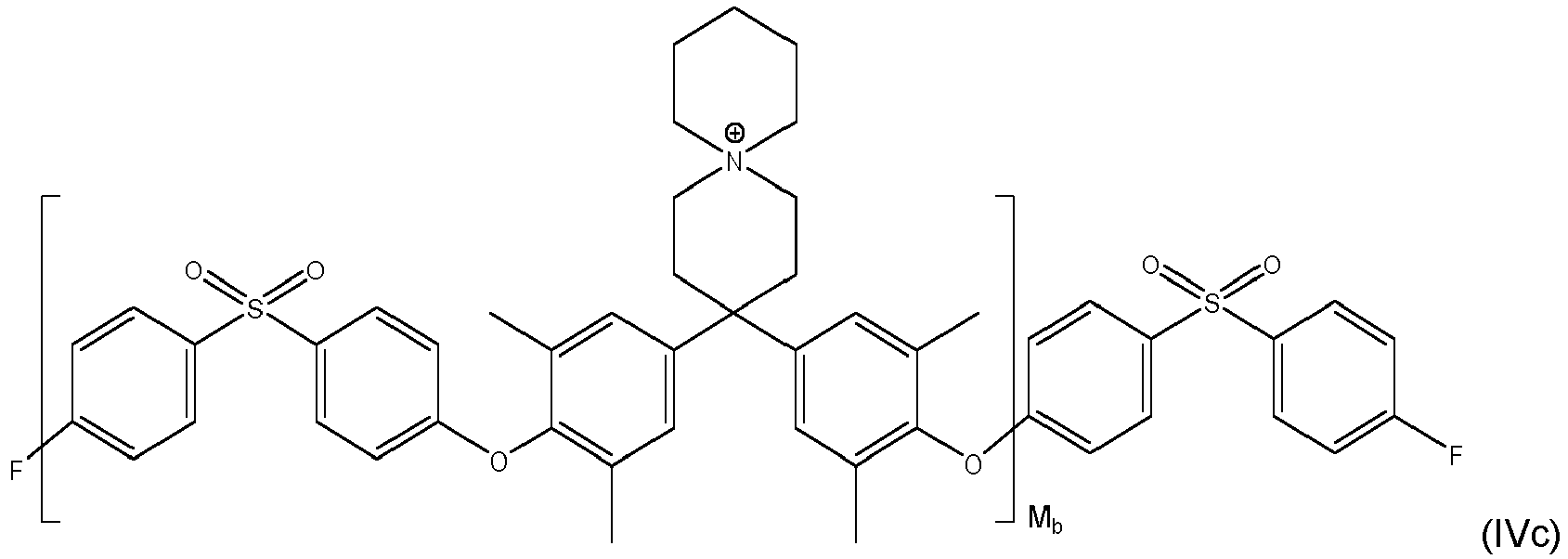
- inventive compound is represented by at least one of formulas (IVa) to (IVf): with M a , M b and M c each being an integer of from 1 to 1000, preferably M a , M b and M c each being an integer of from 5 to 500.
- said aromatic 6-ring is further substituted with one or more halogen and/or one or more C 1 - to C 4 - alkyl radicals.
- said aromatic 6-ring is free of any further substitution with one or more halogen and/or one or more C 1 - to C 4 - alkyl radicals.
- Precursor materials for preparing such compounds are cheaper. Thus, preparation and final compound is less cost intensive.
- Yet another object of the present invention is to provide a process for preparing inventive compounds.
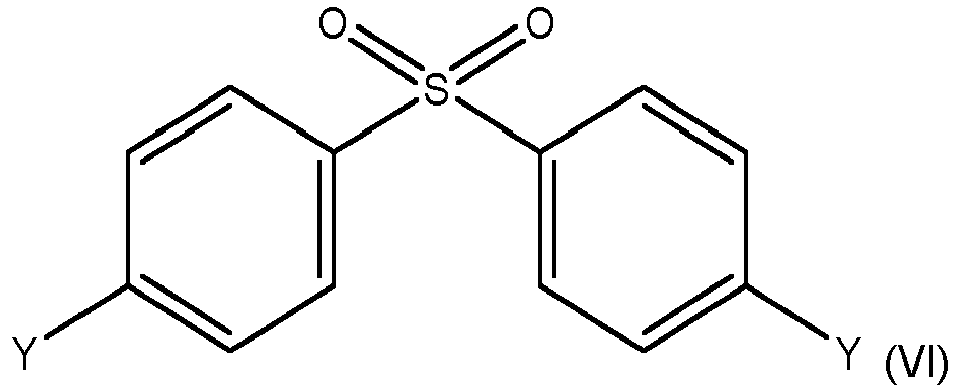
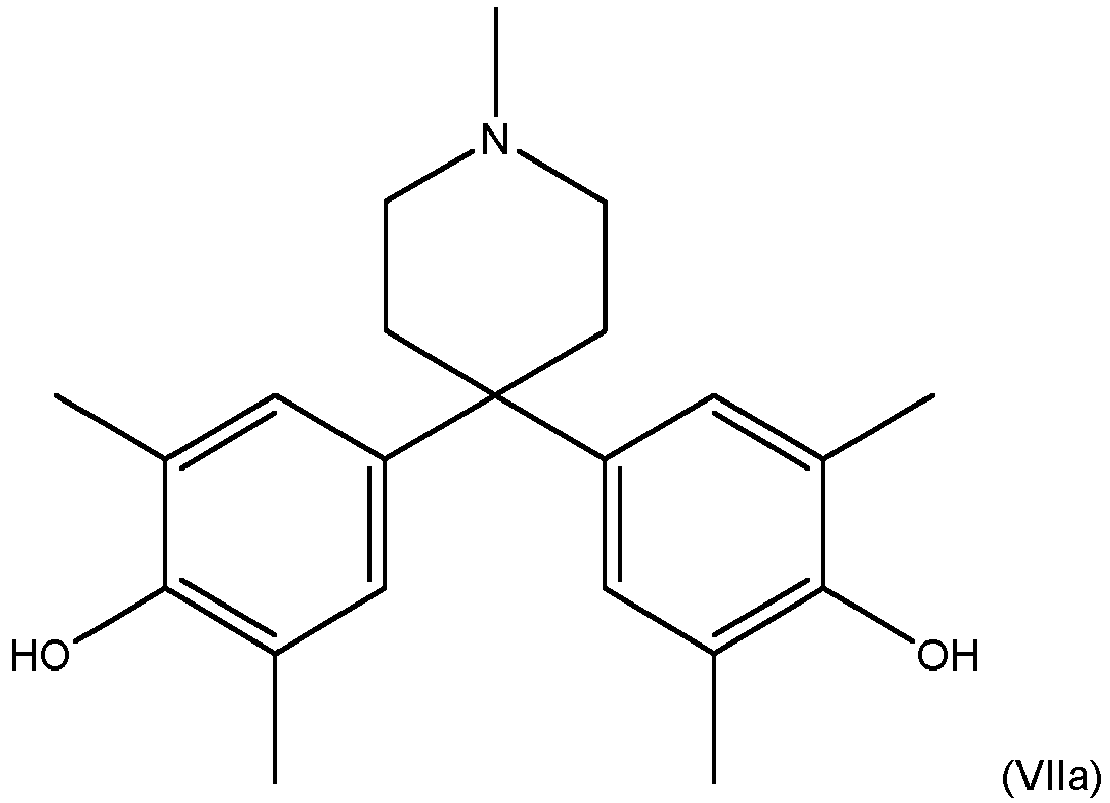
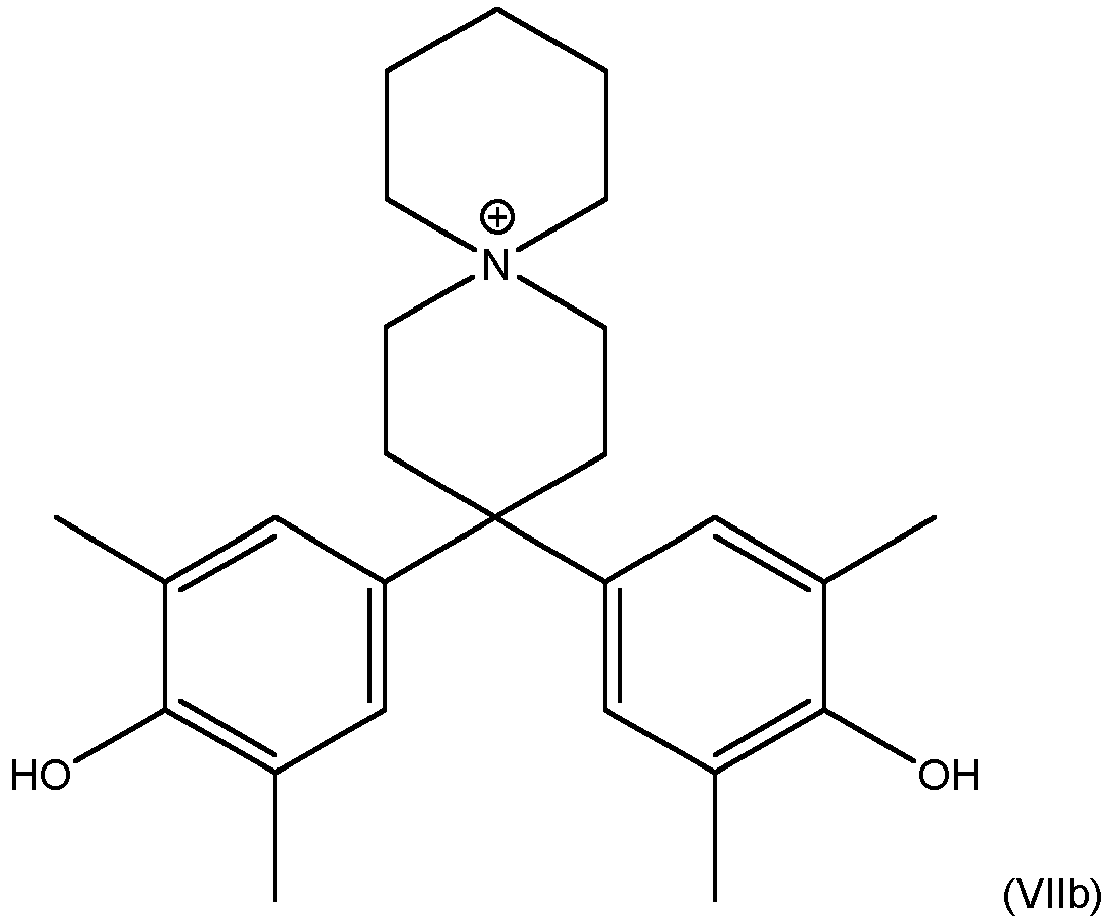
- This object is solved by a process that comprises a step in which a compound of the formula (VI), where Y is same or different halogen, preferred F, is reacted with one or both compounds selected from formulas (VIIa) or/and (Vllb) wherein the aromatic rings might further be substituted with one or more halogen and/or one or more C 1 - to C 4 - alkyl radicals.
- a process that comprises a step in which a compound of the formula (VI), where Y is same or different halogen, preferred F, is reacted with one or both compounds selected from formulas (VIIa) or/and (Vllb) wherein the aromatic rings might further be substituted with one or more halogen and/or one or more C 1 - to C 4 - alkyl radicals.
- an additional step quaternization of nitrogen atom
- this reaction step is carried out at a temperature of from 100 °C to 300 °C, more preferably at a reaction temperature of from 125 °C to 175 °C. Most preferably the reaction step is carried out at a temperature where the reaction mixture is boiling, preferably while stirring. The reaction step is most preferably carried out under an inert gas atmosphere, preferably a nitrogen atmosphere. At the top of the reaction vessel, any water formed is preferably removed.
- the reaction step is preferably carried out in the presence of a base like KOH, NaOH, K 2 CO 3 or Na 2 CO 3 .
- a base like KOH, NaOH, K 2 CO 3 or Na 2 CO 3 .
- Preferred base is K 2 CO 3
- the reaction step is carried out in the presence of an organic solvent.
- organic solvents are selected from the list consisting of N-Methyl-2-pyrrolidone (NMP), Dimethyl sulfoxide (DMSO), N,N-Dimethylformamide (DMF) and N,N-Dimethylacetamide (DMAC).
- NMP N-Methyl-2-pyrrolidone
- DMSO Dimethyl sulfoxide
- DMF N,N-Dimethylformamide
- DMAC N,N-Dimethylacetamide
- N,N-Dimethylacetamide is used as a solvent.
- the process according to the invention comprises a step where an alkylating reagent, preferably a methylating reagent, is used.
- an alkylating reagent preferably a methylating reagent
- the preferred methylating agent used is iodomethane.
- the aromatic rings in the compounds of formula (VI), (VIIa) and (Vllb) are free of any further substitution with one or more halogen or one or more C 1 - to C 4 - alkyl radicals.
- the compounds of the present invention might be used for different purposes.
- the compounds of the present invention are polymers and are used as anion-conducting membranes or for the production of anion-conducting membranes. Such use is a further object of present invention.
- inventive compounds serve as separation active material due to their excellent anion-conducting properties, while being very gas tight.
- membranes may comprise further materials, for instance porous support, e.g. a fabric or non-woven material.
- an anion-conducting membrane comprising such material may be employed in an electrochemical cell.
- another embodiment of the invention is an electrochemical cell having an anion-conducting membrane, wherein said anion-conducting membrane comprises inventive compound.
- each a preferred embodiment of inventive electrochemical cell is an electrolyzer, a fuel cell or a redox flow battery.
- said electrochemical process is an electrolysis or an electrodialysis or an electrochemical process taking place during operation of a fuel cell or an electrochemical process taking place during operation of a redox flow battery.
- Synthesis was performed in a 500 mL three-necked flask with oil bath, mechanical stirrer, a packed column with distillation head cooler with adjustable return ratio and condensate removal.
- 16.98 g (0.05 mol) of piperidine containing monomer (VIIa) from Example 1 12.72 g (0.05 mol) of 4,4'-Difluordiphenylsulfon, 180 mL of N,N-Dimethylacetamide and 15.21 g (0.011 mol) of finely ground K 2 CO 3 were mixed under nitrogen atmosphere over one hour at room temperature. Afterwards the temperature of the reaction mixture was increased to 120°C and generated water was removed using the column over 4 hours.
- Example 3 Quaternization of piperidine containing polymer from Example 2
- Example 4 Membrane casting of piperidine containing polymer from Example 3
- the solution of the quaternized polymer from Example 3 was directly used for preparation of the membrane.
- the required amount of polymer solution was taken up with a syringe and applied directly through a 1 ⁇ m PTFE filter on a glass plate preheated to 40°C.
- an applicator with doctor blade was automatically pulled over the glass plate at a speed of 5 mm/s.
- the applied wet layer was pre-dried for 24 hours under N 2 atmosphere at room temperature and then finally dried for 6 hours at 60°C under vacuum.
- reaction products were cooled to room temperature, precipitated KBr was separated by filtration and the solution was concentrated on a rotary evaporator. During concentration process additional amount of KBr crystallizes and was filtered off. The filtrate solidified at temperature below 80°C, was filtered and used without further purification as one of educts for synthesis of spiro containing monomer (VIIb).
- Synthesis was performed in a 250 mL three-necked flask with oil bath, mechanical stirrer, a packed column with distillation head cooler with adjustable return ratio and condensate removal.
- spiro containing monomer (VIIb) from Example 5 2.54 g (0.01 mol) of 4,4'-Difluordiphenylsulfon, 45 mL of N,N-Dimethylformamide and 3.03 g (0.022 mol) of finely ground K 2 CO 3 were mixed under nitrogen atmosphere over one hour at room temperature. Afterwards the temperature of the reaction mixture was increased to 120°C and generated water was removed using the column over 4 hours.
- Example 7 Membrane casting of spiro containing polymer from Example 6
- Example 9 Membrane casting of piperidine containing polymer from Example 8.
- the solution of the quaternized polymer from Example 8 was directly used for preparation of the membrane.
- the required amount of polymer solution was taken up with a syringe and applied directly through a 1 ⁇ m PTFE filter on a glass plate preheated to 40°C.
- an applicator with doctor blade was automatically pulled over the glass plate at a speed of 5 mm/s.
- the applied wet layer was pre-dried for 24 hours under N 2 atmosphere at room temperature and then finally dried for 6 hours at 60°C under vacuum.
- Example 10 Partial quaternization of piperidine containing polymer from Example 2
- Example 11 Crosslinking and membrane casting of polymer from Example 10
- the membranes prepared in Examples 4, 7, 9 and 11 respectively were ion-exchanged: Samples of the membranes were placed in fresh portions of 1 M KOH solution 3 times for 1 hour each at 60°C and subsequently in fresh portion of 1 M KOH solution for 24 hours at 60°C. Afterwards the membrane samples were rinsed off with deionized water and placed in fresh portions of the deionized water 3 times for 1 hour each at 60°C. Subsequently, the membrane samples were stored in a fresh portion of the deionized water overnight at 60°C and finally rinsed with deionized water at room temperature.
- Commercially available anion exchange membrane FAA-3-50 was ion exchanged in the same way.
- the ionic conductivity (IC) of ion-exchanged membrane samples from Example 12 were measured by means of impedance spectroscopy (EIS) in a conventional 4-electrode arrangement.
- the membrane sample was mounted in a commercial BT-112 cell (Bekk Tech LLC), so that the two outer Pt wires were placed under the sample and the two midpoint Pt wires above the sample.
- the BT-112 cell was mounted between 2 PTFE plates and filled with deionized water. The temperature of the deionized water was controlled by a water bath and deionized water was pumped permanently through the cell.
- the calculation of the membrane resistance (R membrane ) was carried out by fitting acquired EIS spectrum using a widely used R (RC) Randles equivalent circuit.
- ⁇ L / R membran * A
- L the distance between Pt wires (5 mm)
- A the area of the membrane sample between the two outer Pt wires.
- Ion-exchanged membrane samples from Example 12 (3 samples per each membrane tested) were used for measurement of water uptake (WU). All samples were dried for 24 hours in a vacuum oven at 40 °C and 2.5 kPa (25 mbar), then cooled in a desiccator to room temperature and weighted. For the measurement of the water uptake, membrane samples were stored for 24 hours in deionized water at 25 °C. Subsequently, the weight of each sample was determined again. For this purpose, adhering water was removed from the membrane with the aid of a filter paper. Each measurement was repeated 3 times and a mean ⁇ standard deviation was calculated.
- Commercially available anion exchange membrane FAA-3-50 was tested in the same way. The results of the measurements are given in Table 1.
- Ion-exchanged membrane samples from Example 12 (3 samples per each membrane tested) were used for the measurement of dimensional stability (DS). All samples were dried for 24 hours in a vacuum oven at 40 °C and 2.5 kPa (25 mbar), then cooled in a desiccator to room temperature. Such parameters as the sample length, the sample width and the sample thickness were determined. To determine the swelling behavior, membrane samples were stored for 24 hours in deionized water at 25 °C. Subsequently, the sample length, the sample width and the sample thickness were determined again. For this purpose, adhering water was removed from the membrane with the aid of a filter paper. Each measurement was repeated 3 times and a mean ⁇ standard deviation was calculated.
- DS dimensional stability
- DS I The swelling behavior in length
- DS w width
- DSt thickness
- DS x x wet ⁇ x dry / x dry * 100 % with x wet the length, width or thickness of the sample after swelling and x dry the dry length, dry width or dry thickness of the sample.
- DS value is calculated as (DS l + DS w + DSt)/3.
- anion exchange membrane FAA-3-50 was tested in the same way. The results of the measurements are given in Table 1.
- Table 1 Experimental data obtained according to Examples 13 to 15 with membranes from Example 4 labeled as Membrane 1, from Example 7 labeled as Membrane 2, from Example 9 labeled as Membrane 3 and from Example 11 labeled as Membrane 4 and commercially available anion exchange membrane FAA-3-50 labeled as FAA-3-50.
- FAA-3-50 is a commercially available anion exchange membrane from FUMATECH BWT GmbH, 74321 Bietigheim-Bissingen, DE.
- the membranes according to the invention show up to two times higher ionic conductivity combined with at least three times better dimensional stability and up to two times lower water uptake compared to commercially available anion-conducting membrane FAA-3-50.
Landscapes
- Chemical & Material Sciences (AREA)
- Chemical Kinetics & Catalysis (AREA)
- Engineering & Computer Science (AREA)
- Organic Chemistry (AREA)
- Manufacturing & Machinery (AREA)
- Polymers & Plastics (AREA)
- Medicinal Chemistry (AREA)
- Health & Medical Sciences (AREA)
- Electrochemistry (AREA)
- Materials Engineering (AREA)
- Metallurgy (AREA)
- General Chemical & Material Sciences (AREA)
- Inorganic Chemistry (AREA)
- Sustainable Energy (AREA)
- Sustainable Development (AREA)
- Life Sciences & Earth Sciences (AREA)
- Crystallography & Structural Chemistry (AREA)
- Addition Polymer Or Copolymer, Post-Treatments, Or Chemical Modifications (AREA)
- Manufacture Of Macromolecular Shaped Articles (AREA)
- Nitrogen Condensed Heterocyclic Rings (AREA)
- Polyethers (AREA)
- Pyridine Compounds (AREA)
Abstract
Description
- The present invention provides compounds, especially polymeric compounds, a process for preparation thereof and for the use of these compounds. Intended use is in field of electrochemistry. Anion-conducting properties of disclosed compounds making this material suitable for preparing anion-conducting membranes.
- One important example for an electrochemical process is electrolysis of water to gain molecular hydrogen and molecular oxygen. The electrochemical aggregate used to perform such process is called electrolyzer. Such electrolyzer typically comprise many electrochemical cells. Each electrochemical cell comprises two compartments, each equipped with one gas evolving electrode and a membrane separating both compartments. To enable electrolytic splitting of water, the membrane needs to be conductive for ions (cations or anions), while almost impermeable for hydrogen and oxygen gas. Compounds discussed herein are intended to compose such membranes.
- As the membranes of electrolyzers are in contact with water, they need to be stable against extensive swelling or deformation (wrinkling) caused by extensive water uptake within the polymeric structure. Extensive swelling may result in mechanical damage of membrane and lead to increased permeability of gases. For the sake of security, gas permeability needs to be limited. Otherwise, there is risk of oxyhydrogen explosion.
- However, measures to increase stability against swelling shall not impair anionic conductivity of the material as this would result in poor process efficiency.
- Similar requirements relate to membranes used in electrochemical cells performing other electrochemical processes in aqueous/hydrous environment. Examples are fuel cells, redox flow batteries and cells used for electrodialysis.
- A polymeric anion-conducting material suitable for preparing a membrane to be used in electrolyzers is known from
WO 2019/076860 A1 . This material is characterized by at least one imidazole and/or imidazolium unit. -
CN 104829814 A discloses a polymer containing a quaternized piperidine group. This polymer is used for preparing an anion exchange membrane as well. - A preparation method for a tertiary amine type polyarylether sulfone (ketone) polymer resin is known from
CN110294845A . This polymer is used for preparing an anion exchange membrane. - Several anion exchange membranes for water electrolysis are commercially available. A market overview has been compiled by Henkensmeier et al.:
Henkensmeier, Dirk and Najibah, Malikah and Harms, Corinna and Žitka, Jan and Hnat, Jaromir and Bouzek, Karel (2020) Overview: State-of-the Art Commercial Membranes for Anion Exchange Membrane Water Electrolysis. Journal of Electrochemical Energy Conversion and Storage, 18 (2), 024001. American Society of Mechanical Engineers (ASME). DOI: 10.1115/1.4047963 ISSN 2381-6872 - An example for a commercially available anion exchange membrane is the product called fumasep® FAA-3-50, produced by FUMATECH BWT GmbH, 74321 Bietigheim-Bissingen, DE. According to Henkensmeier et al., this membrane is based on a polyaromatic polymer with ether bonds in the main chain and quaternary ammonium groups attached to the main chain.
- The drawbacks of these known materials are extensive water uptake, extensive swelling, rare and expensive precursors, toxic and highly corrosive solvents, complicated preparation conditions being difficult for production at industrial scale. Therefore, these known materials have expensive preparation costs.
- Thus, it is object of present invention to provide an easy-to-prepare material with proper anion-conducting properties and controlled swelling especially in aqueous environments. The precursors needed to synthesize the compound shall be inexpensive and synthesis process shall be suitable for industrial production.
- Currently undisclosed international patent application
PCT/EP2020/070153 
- However, the inventors have surprisingly found that this problem can also be solved by the compounds according to the present invention as described hereinafter and in the claims as well.
- The present invention therefore provides compounds as defined in the claims and described hereinafter.
- Inventive compound is characterized by at least one unit of the formula (I)

position - Thus, inventive compounds differ from compounds according to formula (0) at least by a sulfonic group.
- The present invention likewise provides a process for preparing such compounds and for the use thereof as anion-conducting membranes in electrochemical cells.
- The polymers according to the invention have the advantage that they can be prepared in a simple manner. Precursors are comparable cheap. Thus, preparation is cost efficient.
- The membranes produced therefrom have the advantage that they have very high mechanical stability and low swelling characteristics combined with high dimensional stability. In addition, the membranes exhibit quite high anion conductivities. Therefore, inventive compounds are well suited separation active material of membranes, which are employed in electrochemical cells performing electrochemical processes in aqueous/hydrous environments.
- In a preferred embodiment, inventive compound is represented by formula (la) or (Ib)


- According to a preferred embodiment of present invention, structure element X represents a unit of formula (IIa), (IIb) or (IIc)

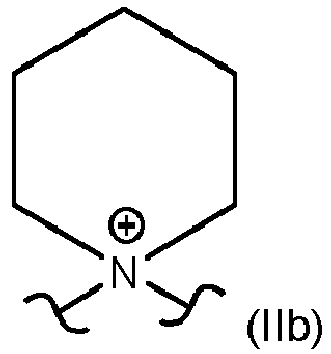

- Most preferably, structure element X present represents in more than 5 %, preferably in more than 50 %, and most preferred in more than 90 % of its occurrence a unit of formula (IIa), (IIb) or (IIc). The occurrence can be determined for example by classical 1H-NMR performed accordingly to 01/2005:20233 (EUROPEAN PHARMACOPOEIA 5.0. 2.2.33. Nuclear magnetic resonance spectrometry) at room temperature in DMSO-d6 as solvent. The occurrence can be calculated via integration of the area of corresponding signal and comparison of normalized area of corresponding signal (peak) with the number of corresponding protons in a target unit, e.g. a unit of formula (IIa) contains 6 hydrogen atoms and as presented in
Fig. 2 the normalized area of corresponding signal (labeled with 5) is equal to 6.003. This indicate that the occurrence of a unit of formula (IIa) in the analyzed polymer from Example 3 is equal to 100% (calculated as 6.003 / 6 * 100% = 100%)". - According to a further preferred embodiment of the invention, the structure element Z of the compound represents a unit of formula (III)

- Six preferred embodiments of inventive compound are represented by at least one of formulas (IVa) to (IVf):
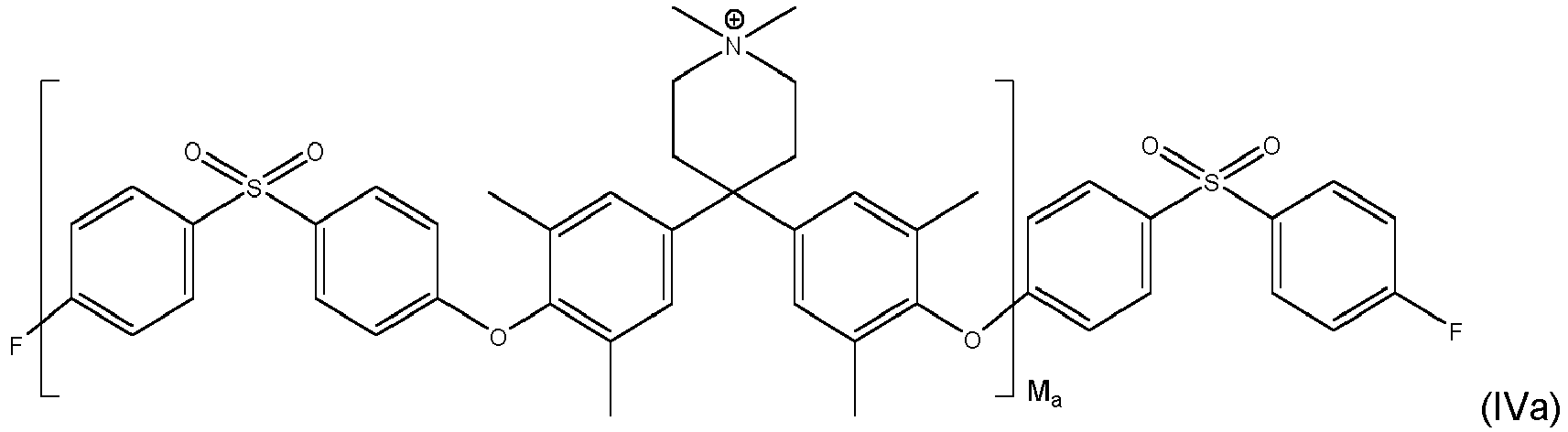
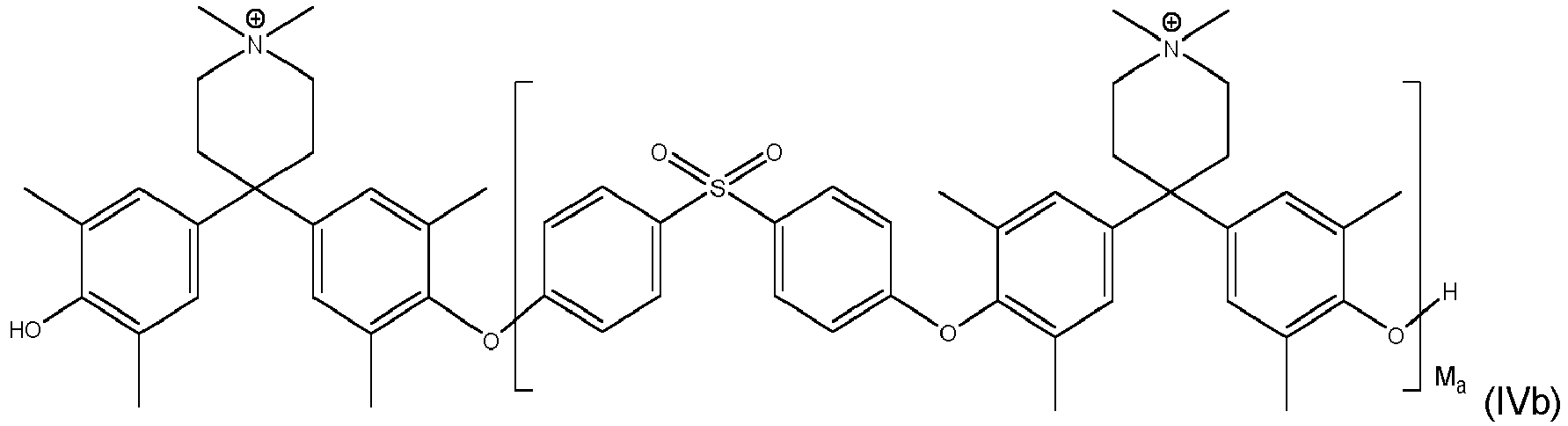


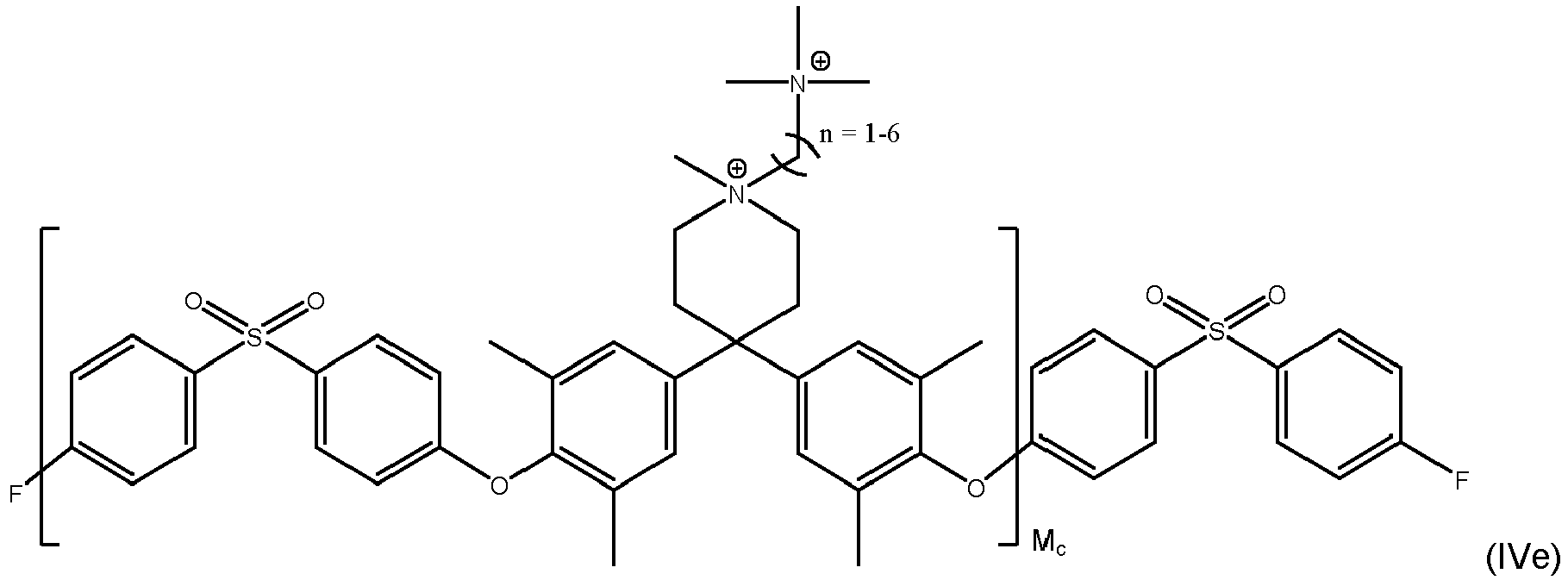

- Even more preferred compounds are cross-linked ones as represented by at least one of formulas (Va) to (Vd):
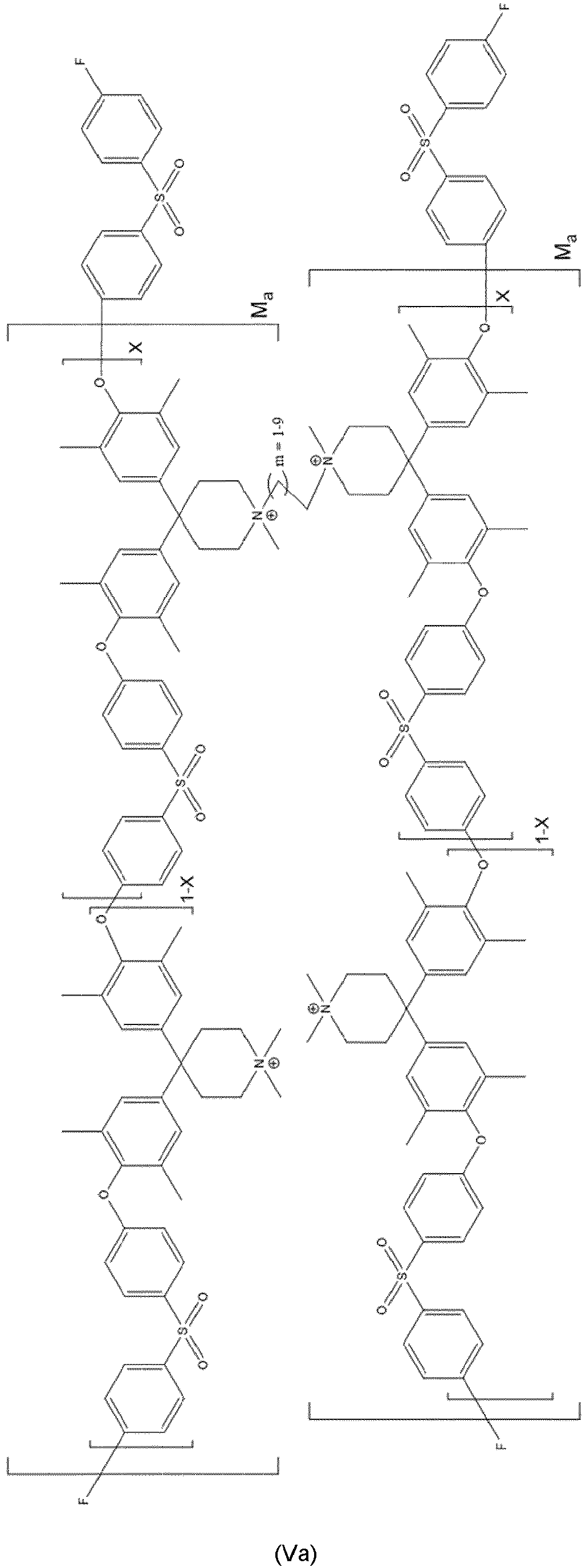


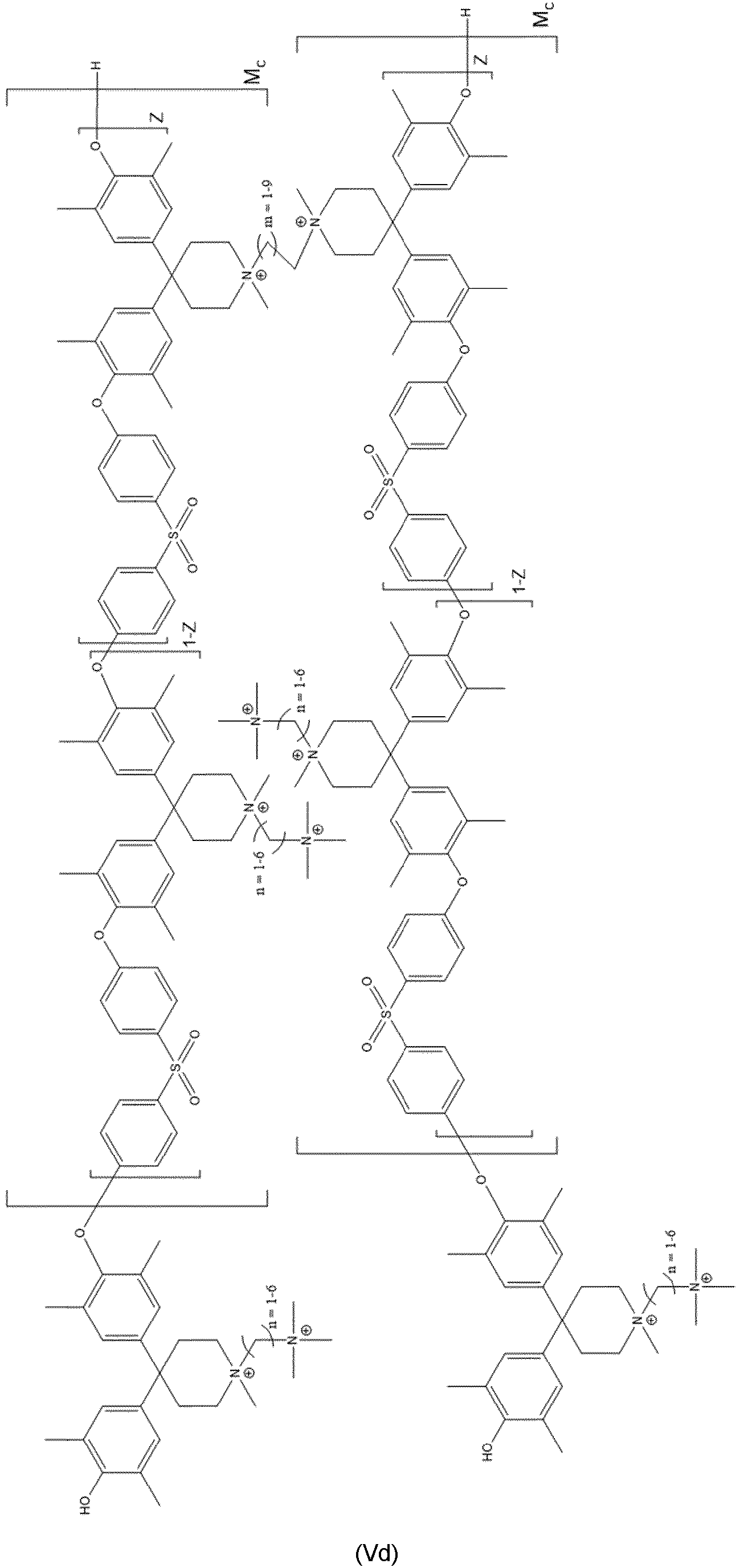
- As derivable from the formulae (I), (la), (lb), (IVa) to (IVf) and (Va) to (Vd) and related definitions, all inventive compounds comprising an aromatic 6-ring which is directly bonded to one of the oxygen atoms, which is substituted in
position - According a first variant of the invention, said aromatic 6-ring is further substituted with one or more halogen and/or one or more C1- to C4- alkyl radicals.
- According to a second, preferred variant of the invention, said aromatic 6-ring is free of any further substitution with one or more halogen and/or one or more C1- to C4- alkyl radicals. Precursor materials for preparing such compounds are cheaper. Thus, preparation and final compound is less cost intensive.
- Yet another object of the present invention is to provide a process for preparing inventive compounds.
- This object is solved by a process that comprises a step in which a compound of the formula (VI), where Y is same or different halogen, preferred F,


- Such process is quite simple to conduct and yields desired compounds.
- Preferably, this reaction step is carried out at a temperature of from 100 °C to 300 °C, more preferably at a reaction temperature of from 125 °C to 175 °C. Most preferably the reaction step is carried out at a temperature where the reaction mixture is boiling, preferably while stirring. The reaction step is most preferably carried out under an inert gas atmosphere, preferably a nitrogen atmosphere. At the top of the reaction vessel, any water formed is preferably removed.
- The reaction step is preferably carried out in the presence of a base like KOH, NaOH, K2CO3 or Na2CO3. Preferred base is K2CO3
- The reaction step is carried out in the presence of an organic solvent. Preferred solvents are selected from the list consisting of N-Methyl-2-pyrrolidone (NMP), Dimethyl sulfoxide (DMSO), N,N-Dimethylformamide (DMF) and N,N-Dimethylacetamide (DMAC). Preferably N,N-Dimethylacetamide is used as a solvent.
- Preferably the process according to the invention comprises a step where an alkylating reagent, preferably a methylating reagent, is used. The preferred methylating agent used is iodomethane.
- According to a preferred inventive preparation method, the aromatic rings in the compounds of formula (VI), (VIIa) and (Vllb) are free of any further substitution with one or more halogen or one or more C1- to C4- alkyl radicals.
- The compounds of the present invention might be used for different purposes. Preferably the compounds of the present invention are polymers and are used as anion-conducting membranes or for the production of anion-conducting membranes. Such use is a further object of present invention.
- Within such membranes inventive compounds serve as separation active material due to their excellent anion-conducting properties, while being very gas tight. Beside inventive compounds, mentioned membranes may comprise further materials, for instance porous support, e.g. a fabric or non-woven material.
- Thanks to designed properties of the component disclosed herein, an anion-conducting membrane comprising such material may be employed in an electrochemical cell. Thus, another embodiment of the invention is an electrochemical cell having an anion-conducting membrane, wherein said anion-conducting membrane comprises inventive compound.
- The excellent water stability of present compounds makes this material suitable for employment in electrolyzers or a fuel cells or redox flow batteries. Thus, each a preferred embodiment of inventive electrochemical cell is an electrolyzer, a fuel cell or a redox flow battery.
- Performing an electrochemical process by means of an inventive electrochemical cell is another embodiment of the invention.
- Preferably, said electrochemical process is an electrolysis or an electrodialysis or an electrochemical process taking place during operation of a fuel cell or an electrochemical process taking place during operation of a redox flow battery.
- Further details of present invention are derivable from the examples and accompanying figures. The latter show:
- Figure 1:
- 1H-NMR spectrum of monomer (VIIa)
- Figure 2:
- 1H-NMR spectrum of quaternized piperidine containing polymer from Example 3
- Figure 3:
- 1H-NMR spectrum of monomer (VIIb)
- Figure 4:
- 1H-NMR spectrum of spiro containing polymer from Example 6
- Figure 5:
- 1H-NMR spectrum of piperidine containing polymer quaternized with (2-Bromoethyl)-trimethylammonium bromide from Example 8
- One 500 ml three-necked flask with internal thermometer, heating with magnetic stirrer and reflux cooler was fed with 150 g of acetic acid, 17 g (0.15 mol) of N-Methylpiperidone, 49 g (0.40 mol) of 2,6-Dimethylphenol and 30 g of concentrated hydrochloric acid. Subsequently, this solution was heated under stirring to 90°C. Over the reaction time a significant part of the product precipitated. After 40 hours, the reaction mass was cooled to room temperature. The crystallized precipitate was filtered off, washed three times with a small amount of acetic acid and suspended in a mixture of 250 g of water with 400 g of ethanol. Subsequently, the suspension was heated to 80°C leading to dissolution of suspended solid. By adding
ammonia solution 4,4-bis-(4-hydroxy-3,5-dimethylphenyl)-1-methyl-piperidine monomer (VIIa) was precipitated. After cooling to room temperature this was filtered off, the filter cake was 3 times washed with water and dried overnight in vacuum at 40°C. Chemical structure of monomer (VIIa) was confirmed by 1H-NMR; 1H-NMR spectrum is given inFigure 1 . DMSO-d6 was used as solvent. - Synthesis was performed in a 500 mL three-necked flask with oil bath, mechanical stirrer, a packed column with distillation head cooler with adjustable return ratio and condensate removal. At the beginning of synthesis 16.98 g (0.05 mol) of piperidine containing monomer (VIIa) from Example 1, 12.72 g (0.05 mol) of 4,4'-Difluordiphenylsulfon, 180 mL of N,N-Dimethylacetamide and 15.21 g (0.011 mol) of finely ground K2CO3 were mixed under nitrogen atmosphere over one hour at room temperature. Afterwards the temperature of the reaction mixture was increased to 120°C and generated water was removed using the column over 4 hours. After four hours additional 18 mL of N,N-Dimethylacetamide were added to the reaction mixture and temperature of the reaction mixture was increased to 165°C. After 20 hours the heating of the oil bath was turned off, the viscous reaction product was cooled down and poured into cold water. The precipitated product was washed with hot water three times and was dried under vacuum at 40°C over 48 hours. The yield was 25.53 g (92.2%).
- 10 g of the polymer from Example 2 were dissolved in 40 mL of N,N-Dimethylacetamide under stirring at 60°C for one hour. After cooling of the polymer solution down to 30°C dropwise 2.8 mL of iodomethane were added to the polymer solution and polymer solution was stirred for 24 hours at 30°C leading to quaternization of the polymer. Chemical structure of quaternized piperidine containing polymer from Example 3 was confirmed by 1H-NMR; 1H-NMR spectrum is given in
Figure 2 . DMSO-d6 was used as solvent. - The solution of the quaternized polymer from Example 3 was directly used for preparation of the membrane. The required amount of polymer solution was taken up with a syringe and applied directly through a 1 µm PTFE filter on a glass plate preheated to 40°C. For the coating of the glass plate, an applicator with doctor blade was automatically pulled over the glass plate at a speed of 5 mm/s. The applied wet layer was pre-dried for 24 hours under N2 atmosphere at room temperature and then finally dried for 6 hours at 60°C under vacuum.
- In a 2 L three-necked flask with magnetic stirrer, temperature control and condenser 36 g (0.26 mol) of K2CO3 were dissolved in 150 ml of EtOH. Then 57.3 g (0.40 mol) of 1,4-Dioxa-8-azaspiro[4,5] decane were dissolved in 800 ml of EtOH and transferred in three-necked flask. After that temperature was regulated to 35°C. Subsequently, a solution of 92 g (0.40 mol) of 1,5-Dibrompentane in 150 ml of EtOH was added dropwise over 12 hours. After 70 hours reaction products were cooled to room temperature, precipitated KBr was separated by filtration and the solution was concentrated on a rotary evaporator. During concentration process additional amount of KBr crystallizes and was filtered off. The filtrate solidified at temperature below 80°C, was filtered and used without further purification as one of educts for synthesis of spiro containing monomer (VIIb).
- In a 500 ml round bottom flask with magnetic stirrer and oil bath 51.5 g (0.177 mol) of the molecule described above and 0.44 mol of 2,6-Dimethylphenol and 20 g (0.21 mol) of methanesulfonic acid, 1 g of water and 0.90 g (0.005 mol) of Sodium 3-mercapto-1-propanesulfonate were stirred for 70 hours at 100°C. The mixture was cooled to room temperature and mixed three times with 200 g of water. After that it was distilled at 1 kPa (10 mbar) pressure to remove volatile substances. Spiro containing monomer (Vllb) partially solidified and was two times recrystallized in 25 vol% mixture of EtOH in water. Finally, it was dried overnight in vacuum at 40°C. Chemical structure of monomer (Vllb) was confirmed by 1H-NMR; 1H-NMR spectrum is given in
Figure 3 . DMSO-d6 was used as solvent. - Synthesis was performed in a 250 mL three-necked flask with oil bath, mechanical stirrer, a packed column with distillation head cooler with adjustable return ratio and condensate removal. At the beginning of synthesis 4.89 g (0.01 mol) of spiro containing monomer (VIIb) from Example 5, 2.54 g (0.01 mol) of 4,4'-Difluordiphenylsulfon, 45 mL of N,N-Dimethylformamide and 3.03 g (0.022 mol) of finely ground K2CO3 were mixed under nitrogen atmosphere over one hour at room temperature. Afterwards the temperature of the reaction mixture was increased to 120°C and generated water was removed using the column over 4 hours. After four hours additional 5 mL of N,N-Dimethylformamide were added to the reaction mixture and temperature of the reaction mixture was increased to 154°C. After 20 hours the heating of the oil bath was turned off, the viscous reaction product was cooled down and poured into cold water. The precipitated product was washed with hot water three times and was dried under vacuum at 40°C over 48 hours. The yield was 6.21 g (88.3%). Chemical structure of spiro containing polymer from Example 6 was confirmed by 1H-NMR; 1H-NMR spectrum is given in
Figure 4 . DMSO-d6 was used as solvent. - 5 g of polymer from Example 6 were dissolved in 20 mL of N,N-Dimethylformamide under stirring at 60°C for one hour. The required amount of polymer solution was taken up with a syringe and applied directly through a 1 µm PTFE filter on a glass plate preheated to 40°C. For the coating of the glass plate, an applicator with doctor blade was automatically pulled over the glass plate at a speed of 5 mm/s. The applied wet layer was pre-dried for 24 hours under N2 atmosphere at room temperature and then finally dried for 6 hours at 60°C under vacuum.
- 5 g of the polymer from Example 2 were dissolved in 20 mL of N,N-Dimethylacetamide under stirring at 60°C for one hour and 4.46 g of (2-Bromoethyl)-trimethylammonium bromide were dissolved in 10 mL of N,N-Dimethylacetamide. Solution of (2-Bromoethyl)-trimethylammonium bromide was dropwise added to the polymer solution and polymer solution was stirred for 48 hours at 100°C leading to quaternization of the polymer. Chemical structure of piperidine containing polymer quaternized with (2-Bromoethyl)-trimethylammonium bromide was confirmed by 1H-NMR; 1H-NMR spectrum is given in
Figure 5 . DMSO-d6 was used as solvent. - The solution of the quaternized polymer from Example 8 was directly used for preparation of the membrane. The required amount of polymer solution was taken up with a syringe and applied directly through a 1 µm PTFE filter on a glass plate preheated to 40°C. For the coating of the glass plate, an applicator with doctor blade was automatically pulled over the glass plate at a speed of 5 mm/s. The applied wet layer was pre-dried for 24 hours under N2 atmosphere at room temperature and then finally dried for 6 hours at 60°C under vacuum.
- 5 g of the polymer from Example 2 were dissolved in 20 mL of N,N-Dimethylacetamide under stirring at 60°C for one hour and 0.25 mL of iodomethane were dissolved in 5 mL of N,N-Dimethylacetamide. After cooling of the polymer solution down to 30°C solution of iodomethane was dropwise added to the polymer solution and polymer solution was stirred for 24 hours at 30°C leading to partial quaternization of the polymer.
- 0.15 g of 1,6-Diiodohexane were dissolved in 5 mL of N,N-Dimethylacetamide and dropwise added to the polymer solution from Example 10. The polymer solution was steered for additional 10 minutes at 30°C and directly used for casting of the membrane. The required amount of polymer solution was taken up with a syringe and applied directly through a 1 µm PTFE filter on a glass plate preheated to 40°C. For the coating of the glass plate, an applicator with doctor blade was automatically pulled over the glass plate at a speed of 5 mm/s. The applied wet layer was covered with metal cover to slow down the evaporation of the solvent and coated glass plate was heated in the oven for 48 hours at 80°C. Finally, the membrane was dried for 6 hours at 60°C under vacuum without metal cover. Obtained membrane was insoluble in DMSO-d6.
- The membranes prepared in Examples 4, 7, 9 and 11 respectively were ion-exchanged: Samples of the membranes were placed in fresh portions of 1
M KOH solution 3 times for 1 hour each at 60°C and subsequently in fresh portion of 1 M KOH solution for 24 hours at 60°C. Afterwards the membrane samples were rinsed off with deionized water and placed in fresh portions of thedeionized water 3 times for 1 hour each at 60°C. Subsequently, the membrane samples were stored in a fresh portion of the deionized water overnight at 60°C and finally rinsed with deionized water at room temperature. Commercially available anion exchange membrane FAA-3-50 was ion exchanged in the same way. - The ionic conductivity (IC) of ion-exchanged membrane samples from Example 12 were measured by means of impedance spectroscopy (EIS) in a conventional 4-electrode arrangement. The membrane sample was mounted in a commercial BT-112 cell (Bekk Tech LLC), so that the two outer Pt wires were placed under the sample and the two midpoint Pt wires above the sample. The BT-112 cell was mounted between 2 PTFE plates and filled with deionized water. The temperature of the deionized water was controlled by a water bath and deionized water was pumped permanently through the cell. The calculation of the membrane resistance (Rmembrane) was carried out by fitting acquired EIS spectrum using a widely used R (RC) Randles equivalent circuit.
- The ionic conductivity (σ) of the membrane sample is given by Equation (1):

- Ion-exchanged membrane samples from Example 12 (3 samples per each membrane tested) were used for measurement of water uptake (WU). All samples were dried for 24 hours in a vacuum oven at 40 °C and 2.5 kPa (25 mbar), then cooled in a desiccator to room temperature and weighted. For the measurement of the water uptake, membrane samples were stored for 24 hours in deionized water at 25 °C. Subsequently, the weight of each sample was determined again. For this purpose, adhering water was removed from the membrane with the aid of a filter paper. Each measurement was repeated 3 times and a mean ± standard deviation was calculated.
- The water uptake (WU) results from Equation (2):

- Ion-exchanged membrane samples from Example 12 (3 samples per each membrane tested) were used for the measurement of dimensional stability (DS). All samples were dried for 24 hours in a vacuum oven at 40 °C and 2.5 kPa (25 mbar), then cooled in a desiccator to room temperature. Such parameters as the sample length, the sample width and the sample thickness were determined. To determine the swelling behavior, membrane samples were stored for 24 hours in deionized water at 25 °C. Subsequently, the sample length, the sample width and the sample thickness were determined again. For this purpose, adhering water was removed from the membrane with the aid of a filter paper. Each measurement was repeated 3 times and a mean ± standard deviation was calculated.
- The swelling behavior in length (referred as DSI), width (referred as DSw) and thickness (referred as DSt) was calculated by Equation (3):

Table 1: Experimental data obtained according to Examples 13 to 15 with membranes from Example 4 labeled as Membrane 1, from Example 7 labeled asMembrane 2, from Example 9 labeled asMembrane 3 and from Example 11 labeled asMembrane 4 and commercially available anion exchange membrane FAA-3-50 labeled as FAA-3-50.Label Qualification WU [%] DS [%] IC [mS/cm] Membrane 1inventive 47.1 ± 2.1 15.4 ± 1.7 76.9 ± 3.1 Membrane 2inventive 36.4 ± 2.4 12.1 ± 2.1 43.7 ± 2.3 Membrane 3inventive 59.9 ± 2.9 19.1 ± 1.9 63.8 ± 2.6 Membrane 4inventive 33.7 ± 2.5 11.7 ± 1.5 54.4 ± 2.8 FAA-3-50 conventional 78.5 ± 3.3 65.1 ± 2.6 33.7 ± 3.4 - FAA-3-50 is a commercially available anion exchange membrane from FUMATECH BWT GmbH, 74321 Bietigheim-Bissingen, DE.
- It can be seen from Table 1, that the membranes according to the invention show up to two times higher ionic conductivity combined with at least three times better dimensional stability and up to two times lower water uptake compared to commercially available anion-conducting membrane FAA-3-50.
Claims (17)
- Compound containing at least one unit of the formula (I)

- Compound according to Claim 1, characterized in that the compound is represented by formula (la) or (Ib)


- Compound according to Claim 1 or 2, characterized in that the structure element X represents a unit of formula (IIa), (IIb) or (IIc)


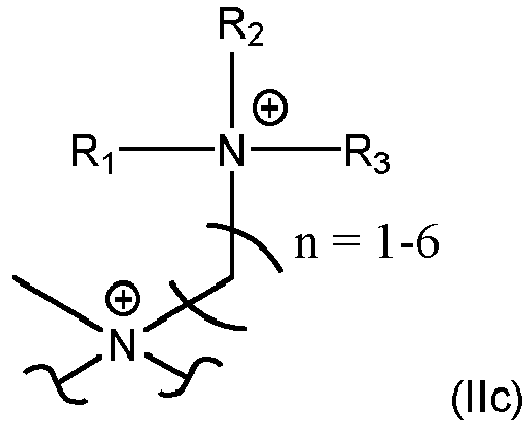
- Compound according to any one of Claims 1 to 3, characterized in that the structure element X present in the compound represents in more than 5 %, preferably in more than 50 %, and most preferred in more than 90 % of its occurrence a unit of formula (IIa), (IIb) or (IIc).
- Compound according to any one of Claims 1 to 4, characterized in that the structure element Z represents a unit of formula (III)

- Compound according to at least one of Claims 1 to 5, characterized in that the compound is represented by at least one of formulas (IVa) to (IVf):
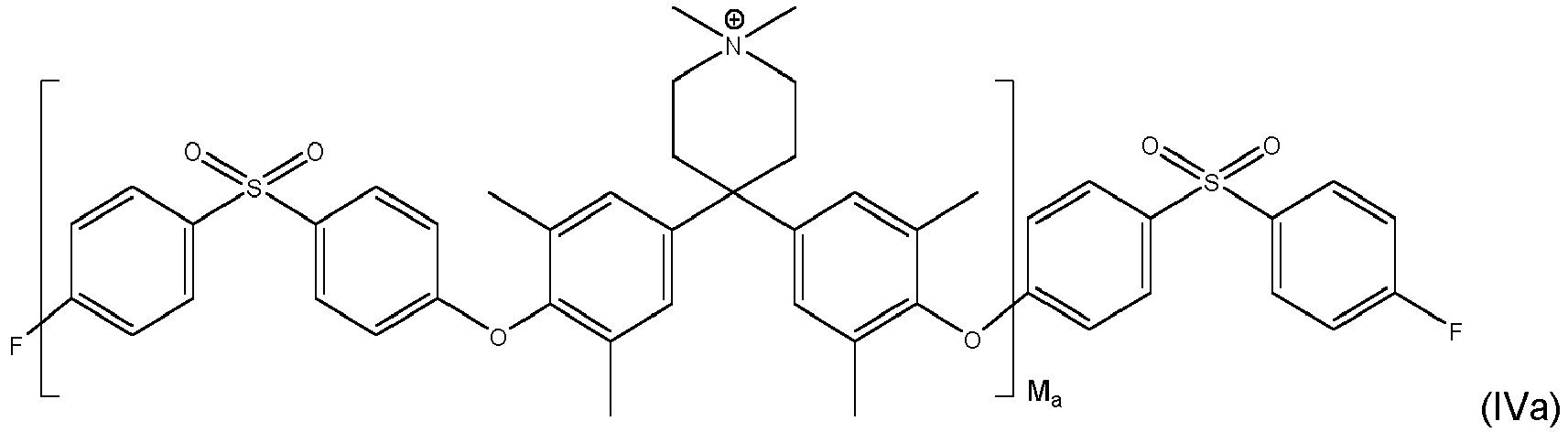



- Compound according to at least one of Claims 1 to 6, characterized in that the compound is represented by at least one of formulas (Va) to (Vd):


- Compound according to any of claims 1 to 7, wherein said aromatic 6-ring directly bonded to one of the oxygen atoms, which is substituted in position 3 and 5 with the same or different alkyl group having from 1 to 4 carbon atoms, is further substituted with one or more halogen and/or one or more C1- to C4- alkyl radicals.
- Compound according to any of claims 1 to 7, wherein said aromatic 6-ring directly bonded to one of the oxygen atoms, which is substituted in position 3 and 5 with the same or different alkyl group having from 1 to 4 carbon atoms, is free of any further substitution with one or more halogen and/or one or more C1- to C4- alkyl radicals.
- Process for preparing compounds according to any one of Claims 1 to 9, characterized in that it comprises a step in which a compound of the formula (VI), where Y is same or different halogen, preferred F,
- Process according to Claim 10, characterized in that it comprises a step where an alkylating reagent, preferably a methylating reagent, is used.
- Process according to Claim 10 or 11, characterized in that the aromatic rings in the compounds of formula (VI), (VIIa) and (Vllb) are free of any further substitution with one or more halogen or one or more C1- to C4- alkyl radicals.
- Use of a compound according to any of Claims 1 to 9 as anion-conducting membrane or for the production of an anion-conducting membrane.
- Electrochemical cell having an anion-conducting membrane, characterized in that said anion-conducting membrane comprises at least one compound according to at least one of claims 1 to 9.
- Electrochemical cell according to claim 14, characterized in that electrochemical cell is a component of an electrolyzer or of a fuel cell or of a redox flow battery.
- Performing an electrochemical process by means of an electrochemical cell according to claim 14.
- Performing an electrochemical process according to claim 16, wherein said electrochemical process is an electrolysis or an electrodialysis or an electrochemical process taking place during operation of a fuel cell or an electrochemical process taking place during operation of a redox flow battery.
Priority Applications (10)
| Application Number | Priority Date | Filing Date | Title |
|---|---|---|---|
| EP21152487.1A EP4032934B1 (en) | 2021-01-20 | 2021-01-20 | Polymeric anion-conducting compound, its preparation and its use in electrochemistry |
| US18/261,988 US20240301153A1 (en) | 2021-01-20 | 2022-01-10 | Polymeric anion-conducting compound, its preparation and its use in electrochemistry |
| CN202280010696.9A CN116745341A (en) | 2021-01-20 | 2022-01-10 | Polymeric anionically conductive compounds, their preparation and their use in electrochemistry |
| PCT/EP2022/050298 WO2022157019A1 (en) | 2021-01-20 | 2022-01-10 | Polymeric anion-conducting compound, its preparation and its use in electrochemistry |
| JP2023541740A JP2024503388A (en) | 2021-01-20 | 2022-01-10 | Polymeric anion-conducting compounds, their preparation, and their use in electrochemistry |
| CA3205168A CA3205168A1 (en) | 2021-01-20 | 2022-01-10 | Polymeric anion-conducting compound, its preparation and its use in electrochemistry |
| AU2022211566A AU2022211566A1 (en) | 2021-01-20 | 2022-01-10 | Polymeric anion-conducting compound, its preparation and its use in electrochemistry |
| KR1020237024423A KR20230131215A (en) | 2021-01-20 | 2022-01-10 | Polymeric anion-conducting compounds, their preparation and their use in electrochemistry |
| ARP220100077A AR124654A1 (en) | 2021-01-20 | 2022-01-17 | ANION CONDUCTING POLYMERIC COMPOUND, ITS PREPARATION AND ITS USE IN ELECTROCHEMISTRY |
| TW111101977A TWI886370B (en) | 2021-01-20 | 2022-01-18 | Polymeric anion-conducting compound, its preparation and its use in electrochemistry |
Applications Claiming Priority (1)
| Application Number | Priority Date | Filing Date | Title |
|---|---|---|---|
| EP21152487.1A EP4032934B1 (en) | 2021-01-20 | 2021-01-20 | Polymeric anion-conducting compound, its preparation and its use in electrochemistry |
Publications (2)
| Publication Number | Publication Date |
|---|---|
| EP4032934A1 true EP4032934A1 (en) | 2022-07-27 |
| EP4032934B1 EP4032934B1 (en) | 2024-03-20 |
Family
ID=74194531
Family Applications (1)
| Application Number | Title | Priority Date | Filing Date |
|---|---|---|---|
| EP21152487.1A Active EP4032934B1 (en) | 2021-01-20 | 2021-01-20 | Polymeric anion-conducting compound, its preparation and its use in electrochemistry |
Country Status (10)
| Country | Link |
|---|---|
| US (1) | US20240301153A1 (en) |
| EP (1) | EP4032934B1 (en) |
| JP (1) | JP2024503388A (en) |
| KR (1) | KR20230131215A (en) |
| CN (1) | CN116745341A (en) |
| AR (1) | AR124654A1 (en) |
| AU (1) | AU2022211566A1 (en) |
| CA (1) | CA3205168A1 (en) |
| TW (1) | TWI886370B (en) |
| WO (1) | WO2022157019A1 (en) |
Cited By (7)
| Publication number | Priority date | Publication date | Assignee | Title |
|---|---|---|---|---|
| EP4165106A1 (en) * | 2020-06-11 | 2023-04-19 | Solvay Specialty Polymers USA, LLC. | Blends of poly(etherketoneketone) polymers |
| EP4438773A1 (en) | 2023-03-28 | 2024-10-02 | Evonik Operations GmbH | Coating anion exchange membranes |
| EP4464820A1 (en) | 2023-05-15 | 2024-11-20 | Evonik Operations GmbH | Structural design of an electrochemical cell |
| EP4588963A1 (en) | 2024-01-17 | 2025-07-23 | Evonik Operations GmbH | Manufacture of catalytically coated anion exchange membrane |
| EP4606933A1 (en) | 2024-02-26 | 2025-08-27 | Evonik Operations GmbH | High solids rollable catalyst ink |
| WO2025214812A1 (en) | 2024-04-11 | 2025-10-16 | Evonik Operations Gmbh | Production of electrocatalytically active layered bodies with anion conductivity |
| EP4645482A1 (en) | 2024-04-29 | 2025-11-05 | Evonik Operations GmbH | Direct coating of anion exchange membranes with catalytically active material |
Citations (12)
| Publication number | Priority date | Publication date | Assignee | Title |
|---|---|---|---|---|
| EP2424018A1 (en) * | 2010-08-27 | 2012-02-29 | JSR Corporation | Polyarylene block copolymer having sulfonic acid group and use thereof |
| CN104829814A (en) | 2015-04-27 | 2015-08-12 | 南阳师范学院 | Polymer containing quaternized piperidine group, preparation method thereof, anion exchange membrane, and preparation method thereof |
| CN104829813A (en) * | 2015-04-27 | 2015-08-12 | 南阳师范学院 | Phosphine-containing ionized polymer, preparation method and anion exchange membrane |
| CN106750303A (en) * | 2017-01-20 | 2017-05-31 | 吉林大学 | A kind of polyarylether containing methyl piperidine group and preparation method thereof |
| WO2017172824A1 (en) * | 2016-03-28 | 2017-10-05 | University Of Delaware | Poly(aryl piperidinium) polymers for use as hydroxide exchange membranes and ionomers |
| WO2019068051A2 (en) * | 2017-09-28 | 2019-04-04 | Yushan Yan | Poly(aryl piperidinium) polymers including those with stable cationic pendant groups for use as anion exchange membranes and ionomers |
| WO2019076860A1 (en) | 2017-10-17 | 2019-04-25 | Evonik Degussa Gmbh | POLYMER ANIONS CONDUCTIVE MEMBRANES |
| CN110294845A (en) | 2019-07-03 | 2019-10-01 | 中国科学院长春应用化学研究所 | A kind of tertiary amine-type polyether sulphone (ketone) fluoropolymer resin and preparation method thereof and anion-exchange membrane |
| CN111040137A (en) * | 2019-12-27 | 2020-04-21 | 惠州市亿纬新能源研究院 | Anion exchange polymer and preparation method and application thereof |
| KR20200046471A (en) * | 2018-10-24 | 2020-05-07 | 한국화학연구원 | Anion exchange material having chain extension group and preparation method thereof |
| CN111269401A (en) * | 2020-01-21 | 2020-06-12 | 惠州市亿纬新能源研究院 | Polymer containing piperidine tertiary amine group, anion exchange polymer, and preparation methods and applications thereof |
| CN111303360A (en) * | 2020-01-21 | 2020-06-19 | 惠州市亿纬新能源研究院 | Polymer containing piperidine tertiary amine group, anion exchange polymer, and preparation methods and applications thereof |
-
2021
- 2021-01-20 EP EP21152487.1A patent/EP4032934B1/en active Active
-
2022
- 2022-01-10 CN CN202280010696.9A patent/CN116745341A/en active Pending
- 2022-01-10 JP JP2023541740A patent/JP2024503388A/en active Pending
- 2022-01-10 CA CA3205168A patent/CA3205168A1/en active Pending
- 2022-01-10 WO PCT/EP2022/050298 patent/WO2022157019A1/en not_active Ceased
- 2022-01-10 KR KR1020237024423A patent/KR20230131215A/en active Pending
- 2022-01-10 AU AU2022211566A patent/AU2022211566A1/en active Pending
- 2022-01-10 US US18/261,988 patent/US20240301153A1/en active Pending
- 2022-01-17 AR ARP220100077A patent/AR124654A1/en unknown
- 2022-01-18 TW TW111101977A patent/TWI886370B/en active
Patent Citations (12)
| Publication number | Priority date | Publication date | Assignee | Title |
|---|---|---|---|---|
| EP2424018A1 (en) * | 2010-08-27 | 2012-02-29 | JSR Corporation | Polyarylene block copolymer having sulfonic acid group and use thereof |
| CN104829814A (en) | 2015-04-27 | 2015-08-12 | 南阳师范学院 | Polymer containing quaternized piperidine group, preparation method thereof, anion exchange membrane, and preparation method thereof |
| CN104829813A (en) * | 2015-04-27 | 2015-08-12 | 南阳师范学院 | Phosphine-containing ionized polymer, preparation method and anion exchange membrane |
| WO2017172824A1 (en) * | 2016-03-28 | 2017-10-05 | University Of Delaware | Poly(aryl piperidinium) polymers for use as hydroxide exchange membranes and ionomers |
| CN106750303A (en) * | 2017-01-20 | 2017-05-31 | 吉林大学 | A kind of polyarylether containing methyl piperidine group and preparation method thereof |
| WO2019068051A2 (en) * | 2017-09-28 | 2019-04-04 | Yushan Yan | Poly(aryl piperidinium) polymers including those with stable cationic pendant groups for use as anion exchange membranes and ionomers |
| WO2019076860A1 (en) | 2017-10-17 | 2019-04-25 | Evonik Degussa Gmbh | POLYMER ANIONS CONDUCTIVE MEMBRANES |
| KR20200046471A (en) * | 2018-10-24 | 2020-05-07 | 한국화학연구원 | Anion exchange material having chain extension group and preparation method thereof |
| CN110294845A (en) | 2019-07-03 | 2019-10-01 | 中国科学院长春应用化学研究所 | A kind of tertiary amine-type polyether sulphone (ketone) fluoropolymer resin and preparation method thereof and anion-exchange membrane |
| CN111040137A (en) * | 2019-12-27 | 2020-04-21 | 惠州市亿纬新能源研究院 | Anion exchange polymer and preparation method and application thereof |
| CN111269401A (en) * | 2020-01-21 | 2020-06-12 | 惠州市亿纬新能源研究院 | Polymer containing piperidine tertiary amine group, anion exchange polymer, and preparation methods and applications thereof |
| CN111303360A (en) * | 2020-01-21 | 2020-06-19 | 惠州市亿纬新能源研究院 | Polymer containing piperidine tertiary amine group, anion exchange polymer, and preparation methods and applications thereof |
Non-Patent Citations (3)
| Title |
|---|
| HENKENSMEIER, DIRKNAJIBAH, MALIKAHHARMS, CORINNAZITKA, JANHNAT, JAROMIRBOUZEK, KAREL: "Journal of Electrochemical Energy Conversion and Storage", vol. 18, 2020, AMERICAN SOCIETY OF MECHANICAL ENGINEERS (ASME, article "Overview: State-of-the Art Commercial Membranes for Anion Exchange Membrane Water Electrolysis", pages: 024001 |
| LI SU ET AL: "Anion conductive piperidinium based poly (ether sulfone): Synthesis, properties and cell performance", JOURNAL OF MEMBRANE SCIENCE, ELSEVIER BV, NL, vol. 594, 13 September 2019 (2019-09-13), XP085877527, ISSN: 0376-7388, [retrieved on 20190913], DOI: 10.1016/J.MEMSCI.2019.117471 * |
| WANG FEN ET AL: "Synthesis and property of novel anion exchange membrane based on poly(aryl ether sulfone)s bearing piperidinium moieties", JOURNAL OF MEMBRANE SCIENCE, ELSEVIER BV, NL, vol. 591, 1 August 2019 (2019-08-01), XP085764659, ISSN: 0376-7388, [retrieved on 20190801], DOI: 10.1016/J.MEMSCI.2019.117334 * |
Cited By (12)
| Publication number | Priority date | Publication date | Assignee | Title |
|---|---|---|---|---|
| EP4165106A1 (en) * | 2020-06-11 | 2023-04-19 | Solvay Specialty Polymers USA, LLC. | Blends of poly(etherketoneketone) polymers |
| EP4165106B1 (en) * | 2020-06-11 | 2025-05-21 | Solvay Specialty Polymers USA, LLC. | Blends of poly(etherketoneketone) polymers |
| EP4438773A1 (en) | 2023-03-28 | 2024-10-02 | Evonik Operations GmbH | Coating anion exchange membranes |
| WO2024200138A1 (en) | 2023-03-28 | 2024-10-03 | Evonik Operations Gmbh | Coating of anion exchange membranes |
| EP4464820A1 (en) | 2023-05-15 | 2024-11-20 | Evonik Operations GmbH | Structural design of an electrochemical cell |
| EP4464819A1 (en) | 2023-05-15 | 2024-11-20 | Evonik Operations GmbH | Structural design of an electrochemical cell |
| EP4588963A1 (en) | 2024-01-17 | 2025-07-23 | Evonik Operations GmbH | Manufacture of catalytically coated anion exchange membrane |
| WO2025153355A1 (en) | 2024-01-17 | 2025-07-24 | Evonik Operations Gmbh | Production of a catalytically coated anion exchange membrane |
| EP4606933A1 (en) | 2024-02-26 | 2025-08-27 | Evonik Operations GmbH | High solids rollable catalyst ink |
| WO2025180862A1 (en) | 2024-02-26 | 2025-09-04 | Evonik Operations Gmbh | Catalyst ink usable with a doctor blade and having a high solids proportion |
| WO2025214812A1 (en) | 2024-04-11 | 2025-10-16 | Evonik Operations Gmbh | Production of electrocatalytically active layered bodies with anion conductivity |
| EP4645482A1 (en) | 2024-04-29 | 2025-11-05 | Evonik Operations GmbH | Direct coating of anion exchange membranes with catalytically active material |
Also Published As
| Publication number | Publication date |
|---|---|
| EP4032934B1 (en) | 2024-03-20 |
| TW202237693A (en) | 2022-10-01 |
| WO2022157019A1 (en) | 2022-07-28 |
| CN116745341A (en) | 2023-09-12 |
| TWI886370B (en) | 2025-06-11 |
| US20240301153A1 (en) | 2024-09-12 |
| JP2024503388A (en) | 2024-01-25 |
| CA3205168A1 (en) | 2022-07-28 |
| AU2022211566A1 (en) | 2023-09-07 |
| KR20230131215A (en) | 2023-09-12 |
| AR124654A1 (en) | 2023-04-19 |
Similar Documents
| Publication | Publication Date | Title |
|---|---|---|
| EP4032934B1 (en) | Polymeric anion-conducting compound, its preparation and its use in electrochemistry | |
| EP3770201B1 (en) | Polymeric anion-conducting membrane | |
| US20240166811A1 (en) | Long-term anion-conducting compound, its preparation and its use in electrochemistry | |
| JP7001284B2 (en) | Hydroxide-stable polybenzimidazolium and polyimidazolium membranes and ionomer cross-linking | |
| KR102570710B1 (en) | Polymeric anion-conducting membrane | |
| CN112979946A (en) | Benzimidazole anion exchange membrane and preparation method thereof | |
| US20250376554A1 (en) | Highly alkali-stable poly(arylene alkylene piperidinium) cationic polymer having branched structure, and preparation method and use thereof | |
| HK40063021A (en) | Polymeric anion-conducting membrane | |
| CN120615101A (en) | Polymer, method for producing the same, and material for anion exchange containing the same |
Legal Events
| Date | Code | Title | Description |
|---|---|---|---|
| PUAI | Public reference made under article 153(3) epc to a published international application that has entered the european phase |
Free format text: ORIGINAL CODE: 0009012 |
|
| STAA | Information on the status of an ep patent application or granted ep patent |
Free format text: STATUS: THE APPLICATION HAS BEEN PUBLISHED |
|
| AK | Designated contracting states |
Kind code of ref document: A1 Designated state(s): AL AT BE BG CH CY CZ DE DK EE ES FI FR GB GR HR HU IE IS IT LI LT LU LV MC MK MT NL NO PL PT RO RS SE SI SK SM TR |
|
| STAA | Information on the status of an ep patent application or granted ep patent |
Free format text: STATUS: REQUEST FOR EXAMINATION WAS MADE |
|
| 17P | Request for examination filed |
Effective date: 20221212 |
|
| RBV | Designated contracting states (corrected) |
Designated state(s): AL AT BE BG CH CY CZ DE DK EE ES FI FR GB GR HR HU IE IS IT LI LT LU LV MC MK MT NL NO PL PT RO RS SE SI SK SM TR |
|
| STAA | Information on the status of an ep patent application or granted ep patent |
Free format text: STATUS: EXAMINATION IS IN PROGRESS |
|
| 17Q | First examination report despatched |
Effective date: 20230623 |
|
| GRAP | Despatch of communication of intention to grant a patent |
Free format text: ORIGINAL CODE: EPIDOSNIGR1 |
|
| STAA | Information on the status of an ep patent application or granted ep patent |
Free format text: STATUS: GRANT OF PATENT IS INTENDED |
|
| INTG | Intention to grant announced |
Effective date: 20231214 |
|
| RIN1 | Information on inventor provided before grant (corrected) |
Inventor name: ROEGL, HARALD Inventor name: CONRADI, OLIVER Inventor name: MALJUSCH, ARTJOM |
|
| GRAS | Grant fee paid |
Free format text: ORIGINAL CODE: EPIDOSNIGR3 |
|
| GRAA | (expected) grant |
Free format text: ORIGINAL CODE: 0009210 |
|
| STAA | Information on the status of an ep patent application or granted ep patent |
Free format text: STATUS: THE PATENT HAS BEEN GRANTED |
|
| AK | Designated contracting states |
Kind code of ref document: B1 Designated state(s): AL AT BE BG CH CY CZ DE DK EE ES FI FR GB GR HR HU IE IS IT LI LT LU LV MC MK MT NL NO PL PT RO RS SE SI SK SM TR |
|
| REG | Reference to a national code |
Ref country code: GB Ref legal event code: FG4D |
|
| P01 | Opt-out of the competence of the unified patent court (upc) registered |
Effective date: 20240215 |
|
| REG | Reference to a national code |
Ref country code: CH Ref legal event code: EP |
|
| REG | Reference to a national code |
Ref country code: IE Ref legal event code: FG4D |
|
| REG | Reference to a national code |
Ref country code: DE Ref legal event code: R096 Ref document number: 602021010529 Country of ref document: DE |
|
| PG25 | Lapsed in a contracting state [announced via postgrant information from national office to epo] |
Ref country code: LT Free format text: LAPSE BECAUSE OF FAILURE TO SUBMIT A TRANSLATION OF THE DESCRIPTION OR TO PAY THE FEE WITHIN THE PRESCRIBED TIME-LIMIT Effective date: 20240320 |
|
| REG | Reference to a national code |
Ref country code: LT Ref legal event code: MG9D |
|
| PG25 | Lapsed in a contracting state [announced via postgrant information from national office to epo] |
Ref country code: GR Free format text: LAPSE BECAUSE OF FAILURE TO SUBMIT A TRANSLATION OF THE DESCRIPTION OR TO PAY THE FEE WITHIN THE PRESCRIBED TIME-LIMIT Effective date: 20240621 |
|
| PG25 | Lapsed in a contracting state [announced via postgrant information from national office to epo] |
Ref country code: RS Free format text: LAPSE BECAUSE OF FAILURE TO SUBMIT A TRANSLATION OF THE DESCRIPTION OR TO PAY THE FEE WITHIN THE PRESCRIBED TIME-LIMIT Effective date: 20240620 Ref country code: HR Free format text: LAPSE BECAUSE OF FAILURE TO SUBMIT A TRANSLATION OF THE DESCRIPTION OR TO PAY THE FEE WITHIN THE PRESCRIBED TIME-LIMIT Effective date: 20240320 |
|
| REG | Reference to a national code |
Ref country code: NL Ref legal event code: FP |
|
| PG25 | Lapsed in a contracting state [announced via postgrant information from national office to epo] |
Ref country code: RS Free format text: LAPSE BECAUSE OF FAILURE TO SUBMIT A TRANSLATION OF THE DESCRIPTION OR TO PAY THE FEE WITHIN THE PRESCRIBED TIME-LIMIT Effective date: 20240620 Ref country code: NO Free format text: LAPSE BECAUSE OF FAILURE TO SUBMIT A TRANSLATION OF THE DESCRIPTION OR TO PAY THE FEE WITHIN THE PRESCRIBED TIME-LIMIT Effective date: 20240620 Ref country code: LT Free format text: LAPSE BECAUSE OF FAILURE TO SUBMIT A TRANSLATION OF THE DESCRIPTION OR TO PAY THE FEE WITHIN THE PRESCRIBED TIME-LIMIT Effective date: 20240320 Ref country code: HR Free format text: LAPSE BECAUSE OF FAILURE TO SUBMIT A TRANSLATION OF THE DESCRIPTION OR TO PAY THE FEE WITHIN THE PRESCRIBED TIME-LIMIT Effective date: 20240320 Ref country code: GR Free format text: LAPSE BECAUSE OF FAILURE TO SUBMIT A TRANSLATION OF THE DESCRIPTION OR TO PAY THE FEE WITHIN THE PRESCRIBED TIME-LIMIT Effective date: 20240621 Ref country code: FI Free format text: LAPSE BECAUSE OF FAILURE TO SUBMIT A TRANSLATION OF THE DESCRIPTION OR TO PAY THE FEE WITHIN THE PRESCRIBED TIME-LIMIT Effective date: 20240320 Ref country code: BG Free format text: LAPSE BECAUSE OF FAILURE TO SUBMIT A TRANSLATION OF THE DESCRIPTION OR TO PAY THE FEE WITHIN THE PRESCRIBED TIME-LIMIT Effective date: 20240320 |
|
| REG | Reference to a national code |
Ref country code: AT Ref legal event code: MK05 Ref document number: 1667788 Country of ref document: AT Kind code of ref document: T Effective date: 20240320 |
|
| PG25 | Lapsed in a contracting state [announced via postgrant information from national office to epo] |
Ref country code: SE Free format text: LAPSE BECAUSE OF FAILURE TO SUBMIT A TRANSLATION OF THE DESCRIPTION OR TO PAY THE FEE WITHIN THE PRESCRIBED TIME-LIMIT Effective date: 20240320 Ref country code: LV Free format text: LAPSE BECAUSE OF FAILURE TO SUBMIT A TRANSLATION OF THE DESCRIPTION OR TO PAY THE FEE WITHIN THE PRESCRIBED TIME-LIMIT Effective date: 20240320 |
|
| REG | Reference to a national code |
Ref country code: CH Ref legal event code: PK Free format text: BERICHTIGUNGEN |
|
| PG25 | Lapsed in a contracting state [announced via postgrant information from national office to epo] |
Ref country code: IS Free format text: LAPSE BECAUSE OF FAILURE TO SUBMIT A TRANSLATION OF THE DESCRIPTION OR TO PAY THE FEE WITHIN THE PRESCRIBED TIME-LIMIT Effective date: 20240720 |
|
| PG25 | Lapsed in a contracting state [announced via postgrant information from national office to epo] |
Ref country code: PT Free format text: LAPSE BECAUSE OF FAILURE TO SUBMIT A TRANSLATION OF THE DESCRIPTION OR TO PAY THE FEE WITHIN THE PRESCRIBED TIME-LIMIT Effective date: 20240722 Ref country code: SM Free format text: LAPSE BECAUSE OF FAILURE TO SUBMIT A TRANSLATION OF THE DESCRIPTION OR TO PAY THE FEE WITHIN THE PRESCRIBED TIME-LIMIT Effective date: 20240320 |
|
| RIN2 | Information on inventor provided after grant (corrected) |
Inventor name: LUPPI, GIANLUIGI Inventor name: ROEGL, HARALD Inventor name: CONRADI, OLIVER Inventor name: MALJUSCH, ARTJOM |
|
| PG25 | Lapsed in a contracting state [announced via postgrant information from national office to epo] |
Ref country code: ES Free format text: LAPSE BECAUSE OF FAILURE TO SUBMIT A TRANSLATION OF THE DESCRIPTION OR TO PAY THE FEE WITHIN THE PRESCRIBED TIME-LIMIT Effective date: 20240320 |
|
| PG25 | Lapsed in a contracting state [announced via postgrant information from national office to epo] |
Ref country code: EE Free format text: LAPSE BECAUSE OF FAILURE TO SUBMIT A TRANSLATION OF THE DESCRIPTION OR TO PAY THE FEE WITHIN THE PRESCRIBED TIME-LIMIT Effective date: 20240320 Ref country code: CZ Free format text: LAPSE BECAUSE OF FAILURE TO SUBMIT A TRANSLATION OF THE DESCRIPTION OR TO PAY THE FEE WITHIN THE PRESCRIBED TIME-LIMIT Effective date: 20240320 |
|
| PG25 | Lapsed in a contracting state [announced via postgrant information from national office to epo] |
Ref country code: AT Free format text: LAPSE BECAUSE OF FAILURE TO SUBMIT A TRANSLATION OF THE DESCRIPTION OR TO PAY THE FEE WITHIN THE PRESCRIBED TIME-LIMIT Effective date: 20240320 |
|
| PG25 | Lapsed in a contracting state [announced via postgrant information from national office to epo] |
Ref country code: PL Free format text: LAPSE BECAUSE OF FAILURE TO SUBMIT A TRANSLATION OF THE DESCRIPTION OR TO PAY THE FEE WITHIN THE PRESCRIBED TIME-LIMIT Effective date: 20240320 |
|
| PG25 | Lapsed in a contracting state [announced via postgrant information from national office to epo] |
Ref country code: SK Free format text: LAPSE BECAUSE OF FAILURE TO SUBMIT A TRANSLATION OF THE DESCRIPTION OR TO PAY THE FEE WITHIN THE PRESCRIBED TIME-LIMIT Effective date: 20240320 |
|
| PG25 | Lapsed in a contracting state [announced via postgrant information from national office to epo] |
Ref country code: SM Free format text: LAPSE BECAUSE OF FAILURE TO SUBMIT A TRANSLATION OF THE DESCRIPTION OR TO PAY THE FEE WITHIN THE PRESCRIBED TIME-LIMIT Effective date: 20240320 Ref country code: SK Free format text: LAPSE BECAUSE OF FAILURE TO SUBMIT A TRANSLATION OF THE DESCRIPTION OR TO PAY THE FEE WITHIN THE PRESCRIBED TIME-LIMIT Effective date: 20240320 Ref country code: RO Free format text: LAPSE BECAUSE OF FAILURE TO SUBMIT A TRANSLATION OF THE DESCRIPTION OR TO PAY THE FEE WITHIN THE PRESCRIBED TIME-LIMIT Effective date: 20240320 Ref country code: PT Free format text: LAPSE BECAUSE OF FAILURE TO SUBMIT A TRANSLATION OF THE DESCRIPTION OR TO PAY THE FEE WITHIN THE PRESCRIBED TIME-LIMIT Effective date: 20240722 Ref country code: PL Free format text: LAPSE BECAUSE OF FAILURE TO SUBMIT A TRANSLATION OF THE DESCRIPTION OR TO PAY THE FEE WITHIN THE PRESCRIBED TIME-LIMIT Effective date: 20240320 Ref country code: IS Free format text: LAPSE BECAUSE OF FAILURE TO SUBMIT A TRANSLATION OF THE DESCRIPTION OR TO PAY THE FEE WITHIN THE PRESCRIBED TIME-LIMIT Effective date: 20240720 Ref country code: ES Free format text: LAPSE BECAUSE OF FAILURE TO SUBMIT A TRANSLATION OF THE DESCRIPTION OR TO PAY THE FEE WITHIN THE PRESCRIBED TIME-LIMIT Effective date: 20240320 Ref country code: EE Free format text: LAPSE BECAUSE OF FAILURE TO SUBMIT A TRANSLATION OF THE DESCRIPTION OR TO PAY THE FEE WITHIN THE PRESCRIBED TIME-LIMIT Effective date: 20240320 Ref country code: CZ Free format text: LAPSE BECAUSE OF FAILURE TO SUBMIT A TRANSLATION OF THE DESCRIPTION OR TO PAY THE FEE WITHIN THE PRESCRIBED TIME-LIMIT Effective date: 20240320 Ref country code: AT Free format text: LAPSE BECAUSE OF FAILURE TO SUBMIT A TRANSLATION OF THE DESCRIPTION OR TO PAY THE FEE WITHIN THE PRESCRIBED TIME-LIMIT Effective date: 20240320 |
|
| REG | Reference to a national code |
Ref country code: DE Ref legal event code: R097 Ref document number: 602021010529 Country of ref document: DE |
|
| PG25 | Lapsed in a contracting state [announced via postgrant information from national office to epo] |
Ref country code: DK Free format text: LAPSE BECAUSE OF FAILURE TO SUBMIT A TRANSLATION OF THE DESCRIPTION OR TO PAY THE FEE WITHIN THE PRESCRIBED TIME-LIMIT Effective date: 20240320 |
|
| PLBE | No opposition filed within time limit |
Free format text: ORIGINAL CODE: 0009261 |
|
| STAA | Information on the status of an ep patent application or granted ep patent |
Free format text: STATUS: NO OPPOSITION FILED WITHIN TIME LIMIT |
|
| PG25 | Lapsed in a contracting state [announced via postgrant information from national office to epo] |
Ref country code: DK Free format text: LAPSE BECAUSE OF FAILURE TO SUBMIT A TRANSLATION OF THE DESCRIPTION OR TO PAY THE FEE WITHIN THE PRESCRIBED TIME-LIMIT Effective date: 20240320 |
|
| PGFP | Annual fee paid to national office [announced via postgrant information from national office to epo] |
Ref country code: NL Payment date: 20250121 Year of fee payment: 5 |
|
| 26N | No opposition filed |
Effective date: 20241223 |
|
| PGFP | Annual fee paid to national office [announced via postgrant information from national office to epo] |
Ref country code: DE Payment date: 20250121 Year of fee payment: 5 |
|
| PG25 | Lapsed in a contracting state [announced via postgrant information from national office to epo] |
Ref country code: SI Free format text: LAPSE BECAUSE OF FAILURE TO SUBMIT A TRANSLATION OF THE DESCRIPTION OR TO PAY THE FEE WITHIN THE PRESCRIBED TIME-LIMIT Effective date: 20240320 |
|
| PGFP | Annual fee paid to national office [announced via postgrant information from national office to epo] |
Ref country code: BE Payment date: 20250121 Year of fee payment: 5 |
|
| PGFP | Annual fee paid to national office [announced via postgrant information from national office to epo] |
Ref country code: FR Payment date: 20250128 Year of fee payment: 5 |
|
| PGFP | Annual fee paid to national office [announced via postgrant information from national office to epo] |
Ref country code: IT Payment date: 20250129 Year of fee payment: 5 Ref country code: GB Payment date: 20250128 Year of fee payment: 5 |
|
| REG | Reference to a national code |
Ref country code: CH Ref legal event code: PL |
|
| PG25 | Lapsed in a contracting state [announced via postgrant information from national office to epo] |
Ref country code: MC Free format text: LAPSE BECAUSE OF FAILURE TO SUBMIT A TRANSLATION OF THE DESCRIPTION OR TO PAY THE FEE WITHIN THE PRESCRIBED TIME-LIMIT Effective date: 20240320 Ref country code: LU Free format text: LAPSE BECAUSE OF NON-PAYMENT OF DUE FEES Effective date: 20250120 |
|
| PG25 | Lapsed in a contracting state [announced via postgrant information from national office to epo] |
Ref country code: CH Free format text: LAPSE BECAUSE OF NON-PAYMENT OF DUE FEES Effective date: 20250131 |