EP4032756B1 - Driver seat airbag device - Google Patents
Driver seat airbag device Download PDFInfo
- Publication number
- EP4032756B1 EP4032756B1 EP20865330.3A EP20865330A EP4032756B1 EP 4032756 B1 EP4032756 B1 EP 4032756B1 EP 20865330 A EP20865330 A EP 20865330A EP 4032756 B1 EP4032756 B1 EP 4032756B1
- Authority
- EP
- European Patent Office
- Prior art keywords
- region
- frontal region
- vehicle
- cover member
- cover
- Prior art date
- Legal status (The legal status is an assumption and is not a legal conclusion. Google has not performed a legal analysis and makes no representation as to the accuracy of the status listed.)
- Active
Links
Images







Classifications
-
- B—PERFORMING OPERATIONS; TRANSPORTING
- B60—VEHICLES IN GENERAL
- B60R—VEHICLES, VEHICLE FITTINGS, OR VEHICLE PARTS, NOT OTHERWISE PROVIDED FOR
- B60R21/00—Arrangements or fittings on vehicles for protecting or preventing injuries to occupants or pedestrians in case of accidents or other traffic risks
- B60R21/02—Occupant safety arrangements or fittings, e.g. crash pads
- B60R21/16—Inflatable occupant restraints or confinements designed to inflate upon impact or impending impact, e.g. air bags
- B60R21/20—Arrangements for storing inflatable members in their non-use or deflated condition; Arrangement or mounting of air bag modules or components
- B60R21/203—Arrangements for storing inflatable members in their non-use or deflated condition; Arrangement or mounting of air bag modules or components in steering wheels or steering columns
-
- B—PERFORMING OPERATIONS; TRANSPORTING
- B60—VEHICLES IN GENERAL
- B60R—VEHICLES, VEHICLE FITTINGS, OR VEHICLE PARTS, NOT OTHERWISE PROVIDED FOR
- B60R21/00—Arrangements or fittings on vehicles for protecting or preventing injuries to occupants or pedestrians in case of accidents or other traffic risks
- B60R21/02—Occupant safety arrangements or fittings, e.g. crash pads
- B60R21/16—Inflatable occupant restraints or confinements designed to inflate upon impact or impending impact, e.g. air bags
- B60R21/20—Arrangements for storing inflatable members in their non-use or deflated condition; Arrangement or mounting of air bag modules or components
- B60R21/215—Arrangements for storing inflatable members in their non-use or deflated condition; Arrangement or mounting of air bag modules or components characterised by the covers for the inflatable member
- B60R21/2165—Arrangements for storing inflatable members in their non-use or deflated condition; Arrangement or mounting of air bag modules or components characterised by the covers for the inflatable member characterised by a tear line for defining a deployment opening
-
- B—PERFORMING OPERATIONS; TRANSPORTING
- B60—VEHICLES IN GENERAL
- B60R—VEHICLES, VEHICLE FITTINGS, OR VEHICLE PARTS, NOT OTHERWISE PROVIDED FOR
- B60R21/00—Arrangements or fittings on vehicles for protecting or preventing injuries to occupants or pedestrians in case of accidents or other traffic risks
- B60R21/02—Occupant safety arrangements or fittings, e.g. crash pads
- B60R21/16—Inflatable occupant restraints or confinements designed to inflate upon impact or impending impact, e.g. air bags
- B60R21/20—Arrangements for storing inflatable members in their non-use or deflated condition; Arrangement or mounting of air bag modules or components
- B60R21/215—Arrangements for storing inflatable members in their non-use or deflated condition; Arrangement or mounting of air bag modules or components characterised by the covers for the inflatable member
- B60R21/2165—Arrangements for storing inflatable members in their non-use or deflated condition; Arrangement or mounting of air bag modules or components characterised by the covers for the inflatable member characterised by a tear line for defining a deployment opening
- B60R21/21656—Steering wheel covers or similar cup-shaped covers
-
- B—PERFORMING OPERATIONS; TRANSPORTING
- B60—VEHICLES IN GENERAL
- B60R—VEHICLES, VEHICLE FITTINGS, OR VEHICLE PARTS, NOT OTHERWISE PROVIDED FOR
- B60R21/00—Arrangements or fittings on vehicles for protecting or preventing injuries to occupants or pedestrians in case of accidents or other traffic risks
- B60R21/02—Occupant safety arrangements or fittings, e.g. crash pads
- B60R21/16—Inflatable occupant restraints or confinements designed to inflate upon impact or impending impact, e.g. air bags
- B60R21/23—Inflatable members
- B60R21/231—Inflatable members characterised by their shape, construction or spatial configuration
- B60R21/2334—Expansion control features
- B60R21/2346—Soft diffusers
-
- B—PERFORMING OPERATIONS; TRANSPORTING
- B62—LAND VEHICLES FOR TRAVELLING OTHERWISE THAN ON RAILS
- B62D—MOTOR VEHICLES; TRAILERS
- B62D1/00—Steering controls, i.e. means for initiating a change of direction of the vehicle
- B62D1/02—Steering controls, i.e. means for initiating a change of direction of the vehicle vehicle-mounted
- B62D1/04—Hand wheels
- B62D1/06—Rims, e.g. with heating means; Rim covers
-
- B—PERFORMING OPERATIONS; TRANSPORTING
- B60—VEHICLES IN GENERAL
- B60R—VEHICLES, VEHICLE FITTINGS, OR VEHICLE PARTS, NOT OTHERWISE PROVIDED FOR
- B60R21/00—Arrangements or fittings on vehicles for protecting or preventing injuries to occupants or pedestrians in case of accidents or other traffic risks
- B60R21/02—Occupant safety arrangements or fittings, e.g. crash pads
- B60R21/16—Inflatable occupant restraints or confinements designed to inflate upon impact or impending impact, e.g. air bags
- B60R21/20—Arrangements for storing inflatable members in their non-use or deflated condition; Arrangement or mounting of air bag modules or components
- B60R21/215—Arrangements for storing inflatable members in their non-use or deflated condition; Arrangement or mounting of air bag modules or components characterised by the covers for the inflatable member
- B60R2021/21543—Arrangements for storing inflatable members in their non-use or deflated condition; Arrangement or mounting of air bag modules or components characterised by the covers for the inflatable member with emblems
-
- B—PERFORMING OPERATIONS; TRANSPORTING
- B62—LAND VEHICLES FOR TRAVELLING OTHERWISE THAN ON RAILS
- B62D—MOTOR VEHICLES; TRAILERS
- B62D1/00—Steering controls, i.e. means for initiating a change of direction of the vehicle
- B62D1/02—Steering controls, i.e. means for initiating a change of direction of the vehicle vehicle-mounted
- B62D1/04—Hand wheels
Definitions
- the present invention relates to a driver's seat airbag device for restraining an occupant in an emergency.
- the airbag cushion of the driver seat airbag device is primarily stored in the central hub of the steering wheel, and expands and deploys in front of an occupant by cleaving a plastic cover member or the like by the expansion pressure thereof.
- the cover body 23 is configured to open upward.
- the airbag 22 is supported from the forward side of the vehicle by the cover body 23.
- Patent Document 1 Japanese Unexamined Patent Application Publication No. 2008-30718
- the shape of an airbag cushion for the driver seat is determined based on the assumption that the occupant is seated in the seat in a normal posture.
- the occupant may not always be in a constant posture, for example, they may lean forward unexpectedly.
- the airbag cushion may contact the head of the occupant from below in the event of an emergency situation. In this case, the airbag cushion will cause the head of the occupant to retroflex backwards. Due to the structure of the human body, it is known that movements that rotate the head, such as retroflexing backwards, tend to place a burden on the body.
- SBW steer-by-wire
- the rim In the steer-by-wire steering system described above, rotation of greater than 180° as in conventional systems is not required so the rim can be something other than a circular shape.
- the rim may be provided only to the left and the right of the central hub or the part above the center on a conventional circular rim, in other words, the rim part 5a in FIG. 1 of cited document 1 may be omitted.
- the rim with the upper center omitted is beneficial in terms of design and visibility of meter displays, but the head of the occupant moves forward more readily as well.
- Document JP 2008 296760 A discloses a driver seat airbag device, comprising a steering wheel of a vehicle and an airbag module according to the preamble of claim 1.
- an object of the present invention is to provide a driver seat airbag device that takes safety into consideration when activated.
- a representative configuration of a driver seat airbag device according to the present invention comprises the features of claim 1.
- the cover doors open to the left and right so upward thrust of the head of the occupant by the cover doors can be prevented.
- the cover member also opens up to the upper region in addition to the frontal region, if the head of the occupant is positioned above the cover member, expansion pressure of the airbag cushion can more readily be dispersed toward the front of the vehicle.
- reducing and dispersing force causing upward thrust on the head of the occupant suppresses backward retroflexion of the head and improves safety of the occupant.
- the tear lines described above branch from near the center of the upper region to the left and right along the front edge of the upper region, extend towards the sides of the upper region, extend at each of the sides of the upper region towards the frontal region respectively, reaching the frontal region, and then respectively extending along the sides of the frontal region, parts of the tear lines are omitted along the sides of the frontal region respectively that do not cleave, forming a pair of side hinge regions that are hinges for the two cover doors.
- This configuration enables implementing cover doors that open to the left and right and widely opening the upper region of the cover member.
- the pair of side hinge regions are formed such that the respective axes thereof are parallel when viewed directly facing the frontal region. This configuration suitably enables implementing cover doors that open to the left and right.
- the tear line described above may extend from near the center of the frontal region to the bottom end of the frontal region, branching from the bottom towards each of the sides of the frontal region, and up to the pair of side hinge regions. This configuration also suitably enables implementing cover doors that open to the left and right.
- the one or more cover doors of the upper region are formed over 35 mm or more towards the front of the vehicle from the chin of an occupant, who is in contact with the steering wheel and in a state where motion toward the front of the vehicle has culminated. Causing the upper region of the cover member to open along these dimensions efficiently suppresses upward thrust of the airbag cushion on the head of the occupant.
- the one or more cover doors described above are preferably formed to include a range in the upper region from the frontal region up to a point more forward in the vehicle than the module installation surface. This configuration also enables causing the upper region of the cover member to open widely.
- a part of the tear line provided in the frontal region described above is preferably thinner than the tear line provided in the upper region.
- the airbag cushion described above includes:
- the one or more discharge ports described above are preferably formed on a path connecting the inflator and tear line.
- the flow-regulating material of this configuration enables efficient cleaving of the cover member tear line.
- the one or more discharge ports described above can discharge gas diagonally from the side opposite the frontal region. This configuration enables dispersing expansion pressure of the airbag cushion toward the front of the vehicle.
- a driver seat airbag device that takes safety into consideration when activated can be provided.
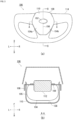
- FIG. 1 is a diagram illustrating an overview of a driver seat airbag device (hereinafter referred to as airbag device 100) according to an embodiment of the present invention.
- FIG. 1(a) is a diagram illustrating a state before activation of the airbag device 100.
- a vehicle front-rear direction is illustrated by the symbols F (Front) and B (Back), a vehicle width direction of the vehicle by the symbols L (Left) and R (Right), and a vehicle up-down direction by the symbols U (Up) and D (Down).
- the airbag device 100 is applied in the present embodiment as the airbag for the driver's seat for vehicles with a steering wheel on a left side (front row left side seat 102).
- front row left side seat 102 for example, a vehicle outer side in the vehicle width direction (hereinafter, vehicle outer side) refers to a left side of the vehicle, and an inner side in the vehicle width direction (hereinafter, vehicle inner side) refers to a right side of the vehicle.
- the airbag cushion (hereinafter, referred to as cushion 104 (see FIG. 1(b) ) of the airbag device 100 is stored in a folded or rolled condition or the like in front of a seating position of the seat 102, inside a central hub 108 of a steering wheel 106. At this time, the cushion 104 is stowed together with an inflator 112 (see FIG. 2(a) ) that supplies gas; forming an airbag module 105 (see FIG. 2(a) ).
- the steering wheel 106 is assumed to be of a configuration in which occupant operation is converted into an electrical signal and transmitted to the wheels, and the shape of a rim 114 gripped by the occupant is a different shape as compared to a conventional circular shape.
- the rim 114 has a shape of only being provided on the left, right and below the central hub 108 while the central upper part above the hub 108 is omitted.
- FIG. 1(b) is a diagram illustrating a vehicle after activation of the driver seat airbag device 100.
- the cushion 104 begins to expand based on gas from the inflator 112 (see FIG. 2 (a) ), opening a cover member 110 of the hub 108 (see FIG. 1 (a) ).
- the cushion 104 expands and deploys at the front of the seat 102 sitting position and restrains the upper torso, head, and chest of the occupant attempting to move forward from the seating position.
- the cushion 104 has a circular shape as viewed from the seating position side, and is formed by overlaying a plurality of panels that form the surface thereof and then stitching or adhering.
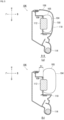
- FIG. 2 is a diagram illustrating the after activated airbag module 105 in FIG. 1(b) from various directions.
- FIG. 2(a) illustrates the airbag module 105 of FIG. 1(b) viewed from slightly above the exterior of the vehicle.
- a portion of the panel configuring the cushion 104 is cut out to expose the internal inflator 112.
- the cushion 104 has a shape similar to a truncated cone, with the diameter widening from the steering wheel 106 side (see FIG. 1(a) ) toward the occupant side (vehicle rear side).
- the cushion 104 is formed from a plurality of panels and contains a front panel 120 positioned on the occupant side, a rear panel 122 positioned on the steering wheel 106 side (see FIG. 1(a) ), and a side panel 124 connecting the front panel 120 and the rear panel 122 to form a side portion of the cushion 104.
- the side panels 124 are also provided with vent holes 126a for discharging gas.
- the inflator 112 is a device for supplying gas, and in the present embodiment, a disk type is used. Regarding the inflator 112, a portion thereof formed with a gas outlet port 116 inserted into the cushion 104 through a rear panel 122, is activated based on an impact detection signal transmitted from a sensor (not shown) to supply gas to the cushion 104.
- the inflator 112 is provided with a plurality of stud bolts 118.
- the stud bolts 118 pass through a rear panel 122 of the cushion 104 to fasten to the module installation surface 109 inside of the hub 108 of the steering wheel 106 (see FIG. 4(a) ).
- the cushion 104 is also secured to the steering wheel 106 by fastening of the stud bolts 118 to the module installation surface 109.
- examples of currently prevailing inflators include: types filled with a gas generating agent and that burns the agent to generate a gas; types filled with a compressed gas and supplies the gas without generating heat; hybrid types that utilize both a combustion gas and a compressed gas; and the like. Any of these types of inflators can be used as the inflator 112.
- FIG. 2 illustrates an occupant 138 normally seated in the cushion 104 and seat 102 as viewed from the left side in the vehicle width direction.
- the cushion 104 can restrain the occupant 138 from the head 140 to chest 142, and to the abdomen 144 thereof, with the occupant side front panel 120 as the primary restraining surface.
- the occupant 138 attempting to move forward in the vehicle will make contact at an early stage from the upper portion 104a of the cushion 104.
- the width of the upper portion 104a of the expanded and deployed cushion 104 is thicker than the width of the lower part 104b of the cushion 104, enabling suitably absorbing the load from the head 140 of the occupant 138.
- the width in the front-rear direction of the vehicle decreases toward the lower part 104b, and therefore, the lower part 104b readily enters the narrow space between the steering wheel 106 and the abdomen 144.
- FIG. 3 is a diagram illustrating the steering wheel 106 in FIG. 1(a) from various directions.
- FIG. 3(a) is an enlarged view of the steering wheel 106 in FIG. 1(a) .
- a cover member 110 made of resin is attached to the central hub 108 of the steering wheel 106.
- the frontal region 150 on the occupant side of the cover member 110 is a region formed as a flat surface or a curved surface that widens on the front face of the cover member 110 in the field of view as viewed from the passenger seated normally in the seat 102 (see FIG. 2 (b) ), with an emblem 152 or the like applied thereon.
- the upper and lower and left-right direction directions of the cover member 110 refer to the upper and lower left and right directions of the steering wheel 106 in the neutral position.
- the vertical direction of the cover member 110 is the vertical direction when the frontal region 150 is viewed from the front of the steering wheel 106 in the neutral position, and does not represent the strict vertical direction.
- the left-right direction of the cover member 110 is the left-right direction when the frontal region 150 is viewed from the front of the steering wheel 106 in the neutral position.
- the front and rear of the cover member 110 means the forward side and rearward side of the vehicle as viewed from a position above the cover member 110 and does not mean a strict horizontal line in the front-to-back direction.
- the cover member 110 in the present embodiment is configured so as to cleave open during expansion and deployment of the cushion 104 (see FIG. 1(b) ) and two cover doors 154a and 154b open to the left and right.
- the cover doors 154a and 154b are defined by a tear line 156 provided in the cover member 110.
- FIG. 3(b) is a cross-sectional view along line A-A of the hub 108 of the steering wheel 106 in FIG. 3(a) .
- the airbag module 105 is stowed inside the hub 108 located in the center of the rim 114 (see FIG. 3(a) ).
- the airbag module 105 is installed on the module installation surface 109 inside the hub 108 and is covered by the cover member 110.
- the tear line 156 is provided in a groove on the side of the airbag module 105 of the cover member 110.
- the tear line 156 induces a cleavage in the cover member 110 when subjected to inflation pressure from the cushion 104 by reducing the plate thickness of the cover member 110.
- FIG. 4 is a perspective view illustrating the cover member 110 in FIG. 3(a) by itself.
- FIG. 4(a) illustrates a cover member 110 prior to cleavage.
- the frontal region 150 of the cover member 110 covers the passenger side of the airbag module 105 (see FIG. 3(b) ), and the upper region 158 covers the upper side of the airbag module 105.
- the tear line 156 is provided from the frontal region 150 of the cover member 110 to the upper region 158.
- FIG. 4(b) is a diagram illustrating the cover member 110 after cleavage.
- the cover member 110 of the present embodiment is made of resin, and in a normal temperature environment (approximately 23°C, for example), the expansion pressure of the cushion 104 causes cleaving starting at the tear line 156 (see FIG. 4(a) ).
- the two cover doors 154a and 154b open to the left and right when viewed from the proximity of the center of the frontal region 150.
- the left cover door 154b includes an emblem 152 and the frontal region 150 and upper region 158 of the cover member 110 are formed so as to be divided into the left and right.
- the cover member 110 is formed with hinges 160a and 160b that connect a body of the cover member 110 to the cover doors 154a and 154a such that the cover doors 154a and 154b do not go flying.
- the tear line 156 extends continuously from the center of the frontal region 150 to the vicinity of the center of the upper region 158 while avoiding the emblem 152.
- the tear line 156 extends from the central vicinity toward the front end 162 and branches to the left and right along the front end 162 to extend toward the side portions 164a and 164b of the upper surface region 158, respectively.
- the tear line 156 extends towards the frontal region 150 of side parts 164a and 164b of the upper region 158.
- the tear line 156 Upon reaching the frontal region 150, the tear line 156 extends along each of the sides 168a and 168b of the frontal region 150.
- the tear line 156 branches from the lower end 166 towards the respective sides 168a and 168b of the frontal region 150.
- vicinity of the center of the frontal region 150 indicates an area including the area center of gravity and vicinity with the frontal region 150 in a plane and viewed vertically from above and the area including the geometric center position of the frontal region 150 and the vicinity thereof.
- the center region of the upper region 158 means when viewing the upper region 158 as a plane perpendicularly from above, the area center of gravity thereof and nearby areas, the geometric center position of the upper region 158 and nearby areas, or simply the areas close to the centerline of the upper region 158 in left and right directions.
- a part of the tear line 156 along the side parts 168a and 168b of the frontal region 150 is omitted and so cannot be broken.
- This non-breakable part forms a pair of side hinge regions 170a and 170b that are hinges 160a and 160b (see FIG. 4 (b) ) of the cover door 154a.
- the pair of side hinge regions 170a and 170b are formed respectively on side parts 168a and 168b of the frontal region 150 where the tear line 156 is not present.
- the pair of side hinge regions 170a and 170b are formed such that the respective axes (see FIG. 4 (b) ) of the hinges 160a and 160b are parallel when viewed directly facing the frontal region 150.
- the cover doors 154a and 154b are able to mutually open broadly in a 180° direction relative to each other to form a wide opening.
- FIG. 5 is a cross sectional view taken along line B-B of the steering wheel 106 of FIG. 3(a) .
- FIG. 5(a) illustrates the state prior to cleaving of the cover member 110.
- the frontal region 150 of the cover member 110 covers the occupant side of the airbag module 105.
- the upper region 158 extends from the upper end of the frontal region 150 toward the front of the vehicle and covers the upper side of the airbag module 105.
- FIG. 5(b) illustrates the state after cleaving of the cover member 110.
- the upper region 158 (see FIG. 5(a) ) of the cover member 110 is configured with a wide opening in consideration of safety when the cushion 104 (see FIG. 6(a), and the like) expands and deploys. More specifically, compared to the module installation surface 109 where the inflator 112 of the airbag module 105 is installed and secured, an opening in the upper region 158 extends to a position beyond the module installation surface 109 by a distance S1 towards the front of the vehicle.
- the cover doors 154a and 154b are formed to include a range of the upper region 158 from the frontal region 150 side to a point more forward in the vehicle than the module installation surface 109 (see FIG. 6B). That is, the tear line 156 extends from near the center of the frontal region 150 to a point more forward on the vehicle than the module installation surface 109 near the center of the upper region 158.
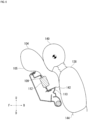
- FIG. 6 is a diagram illustrating the occupant 138 in a non-normal seating position (normally called out-of-position) when the cushion 104 expands and deploys as in FIG. 5(b) .
- FIG. 6 illustrates the cushion 104 and the occupant 138 as viewed from the left side in the vehicle width direction.
- the angle of the steering wheel 106 can be suitably changed compared to FIG. 5(a) , and in a normal vehicle, the upper part is tilted more toward the front of the vehicle.
- the cushion 104 may approach the head 140 of the occupant 138 from below, for example, when the occupant is leaning out of the seat 102 (see FIG. 5 ).
- upward thrust of the cushion 104 is suppressed by the cover doors 154a and 154b to enable the cover doors 154a and 154b (see FIG. 4(b) ) to open to the left and right. Therefore, even if the head 140 of the occupant 138 is located above the cover member 110, upward thrust of the head 140 of the occupant 138 caused by the cover doors 154a and 154b can be prevented.
- the upper region 158 part of the cover member 110 also is opened in addition to the frontal region 150.
- the upper region 158 opens widely to a position of the vehicle more forward than the module installation surface 109.
- FIG. 7 is a diagram illustrating an occupant 138 in proximity to the steering wheel 106 in FIG. 5(a) .
- FIG. 7(a) illustrates a steering wheel 106 before activation of the airbag device 100 and an occupant 138 in a non-normal seating position corresponding to FIG. 6 .
- FIG. 7(b) is a diagram illustrating the cover member 110 and the head 140 of the occupant 138 of FIG. 7(a) as viewed from above.
- the upper region 158 preferably opens over a range of 35 mm or more from a chin 141 of the occupant 138 toward the front of the vehicle with the occupant in contact with the steering wheel 106 and movement toward the front of the vehicle stops (S2 > 35 mm).
- FMVSS208 US Federal Motor Vehicle Safety Standards
- OOP out-of-position
- the steering wheel 106 when the steering wheel 106 (see FIG. 7 (a) ) of the present embodiment is applicable, the steering wheel 106 is inclined toward the front of the vehicle at an angle of approximately 18° to 27° in the same manner as a normal steering wheel, but there is no rim 114 at the upper part. Therefore, the human body dummy that mimics the occupant 138 moves forward without the head 140 coming into contact with a structure, and the chin 141 and chest 142 are in proximity to the cover member 110.
- opening of the cover member 110 upper region 158 over a range of 35 mm or more toward the front of the vehicle than the chin 141 of the occupant 138 (S2 > 35 mm) enables the cushion 104 to expand in front of the head 140 as illustrated in FIG. 6 , suppressing upward thrust of the cushion 104 on the head 140.
- Examples of an occupant 140 [sic] described above include a Hybrid III dummy and a Thor dummy that are human body dummies specified in FMVSS208.
- Hybrid III dummies are available in a plurality of models that mimic people of different physiques and genders.
- the Thor dummy is developed as a successor to the Hybrid III dummy, and models only the average body mass male.
- the AF05 model of the Hybrid III dummy mimics a female with a small build.
- the seat 102 (see FIG. 1 (a) ) is often positioned further forward as compared to that of an adult male and is thus in a posture closer to the steering wheel 106. Therefore, the head of a small adult female is more likely to be positioned over the cover member 110 of the steering wheel 106 as compared to an adult male or the like.
- small adult females have lower body tolerance and are more prone to injury than adult males.
- the cover member 110 upper region 158 can be opened over a distance of 35 mm or more towards the front of the vehicle from the chin 141 of the AF05 model. This makes it possible to suitably ensure the safety of a small adult female. Furthermore, by applying the technical concept of this airbag device 100, even for a steering wheel with a different shape or dimensions, the steering wheel cover member is opened over a range of 35 mm or more toward the front of the vehicle from the chin of an occupant whose forward movement has culminated so safety of the occupant can be suitably ensured.
- FIG. 4(a) is again referred to.
- a series illustrating cleaving of the cover member 110 of the present embodiment For example, in the tear line 156, a portion of the tear line 156 provided in the frontal region 150, in particular, a first thin part 156a is provided in a range along the emblem 152, as a portion having the thinnest plate thickness. Furthermore, of the tear line 156, subsequent to a first thin part 156a, a second thin part 156b is provided over a range branching in 3 directions from a front end 162 of the upper region 158 as thin portions. With this configuration, the cover member 110 will normally tear first from the frontal region 150 starting from the first thin part 156a.
- the pressure thereof is applied to the upper region 158 and causes cleavage with a starting point of the second thin part 156b. That is, when the occupant 138 is in a non-normal seating position, the cover member 110 can be easily cleaved from the upper region 158, and the cushion 104 can expand and deploy in front of the head 140 of the occupant 138 to disperse the expansion pressure and prevent thrusting up of the head 140 of the occupant 138.
- the cover doors 154a and 154b opening to the left and right and the cover member 110 upper region 158 open widely so upward thrust of the cushion 104 on the head 140 of the occupant 138 (see FIG. 6 ) can be reduced and dispersed; suppressing backward retroflexion of the head 140 and thus ensuring safety of the occupant 138 upon activation.
- FIG. 8 is a diagram illustrating a first modified example (cover member 200) of the cover member 110 in FIG. 4(a) .
- FIG. 8(a) illustrates the cover member 200 corresponding to FIG. 4(a) before cleavage.
- the cover member 200 of the present embodiment differs from the cover member 110 in that two cover doors 202a and 202b open up and down.
- the cover doors 202a and 202b are formed by bisecting the cover member 110 frontal region 150 such that an emblem 164 is included in the upper cover door 202b.
- a tear line 204 cuts across the frontal region 150 avoiding the emblem 152, reaches the side parts 168a and 168b of the frontal region 150, and extends along the side parts 168a and 168b to a point close to the side parts 164a and 164b of the upper region 158. From there, the tear line 204 extends close to the front end 162 of the upper surface region 158 along the side parts 164a and 164b of the upper region 158. Herein, the tear line 204 extends along the side parts 164a and 164b of the upper region 158 to a point more forward in the vehicle than the module installation surface 109 of the upper region 158 (see FIG. 8(b) ).
- a front hinge region 206 is formed as an end point of the tear line 204 in a region more forward in the vehicle than the module installation surface 109 of the upper region 158 as a region where the tear line 156 is omitted and that cannot be cleaved, provided as a hinge for the cover door 202a.
- FIG. 8(b) illustrates the cover member 200 corresponding to FIG. 6 after cleavage.
- the cover member 200 if the head 140 of the occupant 138 is positioned above or below the cover member 200, opening of the cover door 202a more to the front of the vehicle than the module installation surface 109 enables the cover door 202a to prevent the cushion 104 from thrusting up the head 140 of the occupant 138 from below.
- widely opening the upper region 158 of the cover member 200 enables dispersing the cushion 104 expansion pressure to a point more toward the front of the vehicle than the head 140 of the occupant 138.
- backward retroflexion of the head 140 can be reduced and dispersed by reducing upward thrust on the head 140 of the occupant 138, and the safety of the occupant 138 can be improved.
- FIG. 9 is a diagram illustrating the second to fourth modified examples of the cover member 110 in FIG. 4(a) .
- Each of the cover members differ in structure from that of the cover member 200 of FIG. 4(a) depending on the cover door structure.
- FIG. 9(a) illustrates a cover member 220 of the second modified example.
- cover member 220 With the cover member 220, a total of three cover doors are formed including cover doors 222a and 222b which open to the lower left and right and the cover door 202a which opens upward based on a tear line 224.
- the cover door 202a opens at a point more to the front of the vehicle than the module installation surface 109 (see FIG. 8(b) ), enabling reducing and dispersing the upward thrust force of the cushion 104 on the head 140 of the occupant 138.
- FIG. 9(b) illustrates a cover member 240 of the third modified example.
- the upper part of the cover member 240 is made up of two cover doors 242a and 242b that open to the left and right due to a tear line 244 and the lower part is made up of a cover door 242c that opens downward.
- the cover doors 242a and 242b include up to near the front end 162 of the upper region 158, similar to the cover member 110 of FIG. 6 , upward thrust force of the cushion 104 on the head 140 of the occupant 138 can be reduced and dispersed, suppressing backward retroflexion of the head 140 and enabling improving the safety of the occupant 138 when activated.
- FIG. 9(c) illustrates a cover member 260 of the fourth modified example.
- the cover member 260 With the cover member 260, a large part of the frontal region 150 and the upper region 158 are configured to open upward due to the tear line 262 as a single cover door 264.
- the cover door 264 opens at a point more to the front of the vehicle than the module installation surface 109 (see FIG. 8(b) ) enabling reducing and dispersing the upward thrust force of the cushion 104 on the head 140 of the occupant 138.
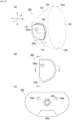
- FIG. 10 is a diagram illustrating a first modified example of the airbag module 105 in FIG. 2(a) (airbag module 300).
- FIG. 10(a) illustrates the internal structure of the cushion 104 through each panel of the cushion 104.
- the cushion 104 is provided with a flow-regulating material 302 as an internal structure.
- the flow-regulating material 302 is a member that guides the inflator 112 (see FIG. 2(a) ) gas in a particular direction and is encapsulated in a bag shaped main bag 304 that makes up the outer surface of the cushion 104. With the part including the gas outlet port 116 of the inflator 112 inserted into the main bag 304 covered, the flow-regulating material 302 is connected to the rear panel 122.
- the flow-regulating material 302 includes side outlets 306a and 306b as well as a bottom outlet 306c as locations where the gas from the inflator 112 is discharged.
- FIG. 10(b) is a diagram illustrating the flow-regulating material 302 in FIG. 10(a) from the side.
- the flow-regulating material 302 is formed in a bag shape by sewing, and a bottom outlet 306c is formed in an opening in the lower edge.
- the bottom outlet 306c is formed with a larger diameter than that of the side outlets 306a and 306b and more gas passes therethrough than the side outlets 306a and 306b.
- This causes the cushion 104 (see FIG. 10 (a) ) to expand and deploy preferentially from the lower part 104b.
- the cushion 104 allows the lower part 104b to enter between the steering wheel 106 and the abdomen 142 of the occupant 138 at an early stage and to be sandwiched between the steering wheel 106 and the abdomen 142.
- FIG. 10(c) illustrates a state where the flow-regulating material 302 of FIG. 10(b) is unstitched and spread out on a plane.
- the flow-regulating material 302 is provided at the inlet port 308 where a part of the central inflator 112 (see FIG. 2(a) ) is inserted and is secured together with the inflator 112 to the module installation surface 109 (see FIG. 3 (b) ).
- FIG. 11 is a diagram illustrating the flow-regulating material 302 in FIG. 10(b) from various directions.
- FIG. 11(a) is a cross-sectional view of the flow-regulating material 302 along C-C in FIG. 10(b) .
- FIG. 11(a) schematically illustrates the upper part of the cover member 110 of FIG. 3(a) .
- the flow-regulating material 302 is made up of side outlets 306a and 306b and when viewing the frontal region 150 directly from the front, gas discharges diagonally upward to the left and right.
- This configuration enables efficient application of gas so that with respect to the cover member 110, the cover doors 154a and 154b (see FIG. 4(b) ) are opened to the left and right.
- the side outlets 306a and 306b are formed on a path connecting the inflator 112 and the tear line 156. This configuration enables the tear line 156 of the cover member 110 to cleave efficiently.
- FIG. 11(b) illustrates a state in which the cushion 104 is expanded using the flow-regulating material 302 in FIG. 11(a) .
- gas is discharged from the side outlets 306a and 306b but is not discharged directly upwards. Therefore, if the head 140 of a non-normal seating position occupant 138 (see FIG. 6 ) is positioned above the steering wheel 106, the cushion 104 expands to the left and right while enabling suppressing upward expansion pressure of the cushion 104.
- FIG. 11(c) is a cross-sectional view of the flow-regulating material 302 along D-D in FIG. 10(b) .
- the flow-regulating material 302 is set up so that when inflated, gas from the side outlets 306a and 306b flows out at an angle more towards the front of the vehicle than in the vehicle width direction. As illustrated in FIG. 6 , this configuration more readily enables dispersion of cushion 104 expansion pressure to the front of the vehicle in the case the occupant 138 is in a non-normal seating position.
- FIG. 11(d) illustrates the flow-regulating material 302 and the steering wheel 106 in FIG. 10(b) as viewed from the left side in the vehicle width direction.
- the side outlets 306a and 306b preferably discharge gas diagonally at a prescribed angle toward the front of the car, opposite the frontal region 150 ( FIG. 5(a) ).
- this configuration also more readily enables dispersion of the cushion 104 expansion pressure to the front of the vehicle in the case the occupant 138 is in a non-normal seating position.
- the flow-regulating material enables efficient opening of the cover member 110 cover doors 154a and 154b to the left and right. Therefore, the flow-regulating material 302 enables suitably combining the cover member 110 (see FIG. 4(a) ) having cover doors that open to the left and right and the cover member 240 ( FIG. 9(b) ).
- the flow-regulating material 302 implementing a flow-regulating material having a discharge port adapted to a tear line and cover door configuration of the cover member 200 ( FIG. 8 ), cover member 220 ( FIG. 9 (a) ), or cover member 260 ( FIG. 9(c) ) is feasible.
- FIG. 12 is a diagram illustrating a second modified example of the airbag module 105 in FIG. 2(a) (airbag module 320).
- the airbag module 320 is provided with a flow-regulating material 322 as in the internal structure of the cushion 104.
- the flow-regulating material 322 is different from the flow-regulating material 302 of FIG. 11(a) in having an overall flat circular shape. Similar to the flow-regulating material 302, the flow-regulating material 322 also has side outlets 306a and 306b and a bottom outlet 306c.
- FIG. 12(b) illustrates a rear panel 324 of the flow-regulating material 322 of FIG. 12(a) unfolded on a flat surface.
- the rear panel 324 is provided with an insertion hole 308 in the center, notches are formed along the side outlets 306a and 306b and along the bottom outlet 306c on the left and right bottom edges and a notch is formed to make the flow-regulating material 322 round.
- FIG. 12(c) illustrates a front panel 326 of the flow-regulating material of FIG. 12(a) unfolded on a flat surface.
- the front panel 326 can be substantially circular and the flow-regulating material (see FIG. 12(a) ) can be created by joining the edges to the rear panel 324 ( FIG. 12(b) ).
- the flow-regulating material 322 also enables efficient opening of the cover member 110 cover doors 154a and 154b to the left and right. Therefore, the flow-regulating material 322 enables suitably combining the cover member 110 (see FIG. 4(a) ) having cover doors that open to the left and right and the cover member 240 ( FIG. 9(b) ).
- the present invention can be used in a driver's seat airbag device for restraining an occupant in an emergency.
Landscapes
- Engineering & Computer Science (AREA)
- Mechanical Engineering (AREA)
- Chemical & Material Sciences (AREA)
- Combustion & Propulsion (AREA)
- Transportation (AREA)
- Air Bags (AREA)
- Steering Controls (AREA)
Description
- The present invention relates to a driver's seat airbag device for restraining an occupant in an emergency.
- Currently, nearly all vehicle steering wheels are equipped with a driver seat airbag device. The airbag cushion of the driver seat airbag device is primarily stored in the central hub of the steering wheel, and expands and deploys in front of an occupant by cleaving a plastic cover member or the like by the expansion pressure thereof. For example, in the
steering wheel 1 ofPatent Document 1, when the airbag 22 expands and deploys, the cover body 23 is configured to open upward. InPatent Document 1, by bringing the cover body 23 into contact with the rim part 5, the airbag 22 is supported from the forward side of the vehicle by the cover body 23. - Patent Document 1:
Japanese Unexamined Patent Application Publication No. 2008-30718 - Normally, the shape of an airbag cushion for the driver seat is determined based on the assumption that the occupant is seated in the seat in a normal posture. However, while traveling, the occupant may not always be in a constant posture, for example, they may lean forward unexpectedly. When the occupant is in a non-normal position relative to the seat sitting position (commonly known as out-of-position), the airbag cushion may contact the head of the occupant from below in the event of an emergency situation. In this case, the airbag cushion will cause the head of the occupant to retroflex backwards. Due to the structure of the human body, it is known that movements that rotate the head, such as retroflexing backwards, tend to place a burden on the body.
- In addition, in recent years, a system that transmits a steering operation using an electrical signal is becoming popular. This manner of steering system is called steer-by-wire (SBW) where steering force is transmitted using a wiring harness rather than a steering shaft, and is attracting attention in terms of operability and design.
- In the steer-by-wire steering system described above, rotation of greater than 180° as in conventional systems is not required so the rim can be something other than a circular shape. For example, the rim may be provided only to the left and the right of the central hub or the part above the center on a conventional circular rim, in other words, the rim part 5a in
FIG. 1 of citeddocument 1 may be omitted. The rim with the upper center omitted is beneficial in terms of design and visibility of meter displays, but the head of the occupant moves forward more readily as well. For example, when the rim part 5a inFIG. 1 ofPatent Document 1 is omitted, the head of the occupant more readily moves forward, and the cover body 23 and the airbag 22 are more likely to push the head up from below. DocumentJP 2008 296760 A claim 1. - In view of these issues, an object of the present invention is to provide a driver seat airbag device that takes safety into consideration when activated.
- In order to resolve the problems described above, a representative configuration of a driver seat airbag device according to the present invention comprises the features of
claim 1. - With the configuration described above, even if the head of the occupant is positioned above the cover member, the cover doors open to the left and right so upward thrust of the head of the occupant by the cover doors can be prevented. Additionally, since the cover member also opens up to the upper region in addition to the frontal region, if the head of the occupant is positioned above the cover member, expansion pressure of the airbag cushion can more readily be dispersed toward the front of the vehicle. Herein, with the configuration described above reducing and dispersing force causing upward thrust on the head of the occupant suppresses backward retroflexion of the head and improves safety of the occupant.
- The tear lines described above branch from near the center of the upper region to the left and right along the front edge of the upper region, extend towards the sides of the upper region, extend at each of the sides of the upper region towards the frontal region respectively, reaching the frontal region, and then respectively extending along the sides of the frontal region,
parts of the tear lines are omitted along the sides of the frontal region respectively that do not cleave, forming a pair of side hinge regions that are hinges for the two cover doors. This configuration enables implementing cover doors that open to the left and right and widely opening the upper region of the cover member. - The pair of side hinge regions are formed such that the respective axes thereof are parallel when viewed directly facing the frontal region. This configuration suitably enables implementing cover doors that open to the left and right.
- The tear line described above may extend from near the center of the frontal region to the bottom end of the frontal region, branching from the bottom towards each of the sides of the frontal region, and up to the pair of side hinge regions. This configuration also suitably enables implementing cover doors that open to the left and right.
- The one or more cover doors of the upper region are formed over 35 mm or more towards the front of the vehicle from the chin of an occupant, who is in contact with the steering wheel and in a state where motion toward the front of the vehicle has culminated. Causing the upper region of the cover member to open along these dimensions efficiently suppresses upward thrust of the airbag cushion on the head of the occupant.
- The one or more cover doors described above are preferably formed to include a range in the upper region from the frontal region up to a point more forward in the vehicle than the module installation surface. This configuration also enables causing the upper region of the cover member to open widely.
- A part of the tear line provided in the frontal region described above is preferably thinner than the tear line provided in the upper region. With this configuration, the cover member normally first cleaves from the frontal region while if the frontal region does not readily open, for example, if in contact with an occupant, cleaving starts from the upper region enabling dispersing expansion pressure of the airbag cushion toward the front of the vehicle.
- The airbag cushion described above includes:
- a main bag in a bag shape; and
- a flow-regulating material encapsulated in this main bag that covers portions including gas outlet ports of the inflator;
- the flow-regulating material comprises:
- one or a plurality of discharge ports for discharging gas supplied by the inflator, and
- the one or a plurality of discharge ports discharge gas diagonally upward to the left and right when viewing the frontal region directly from the front. This configuration of the flow-regulating material enables efficient application of gas so that with respect to the cover member, the cover doors open to the left and right.
- The one or more discharge ports described above are preferably formed on a path connecting the inflator and tear line. The flow-regulating material of this configuration enables efficient cleaving of the cover member tear line.
- The one or more discharge ports described above can discharge gas diagonally from the side opposite the frontal region. This configuration enables dispersing expansion pressure of the airbag cushion toward the front of the vehicle.
- According to the present invention, a driver seat airbag device that takes safety into consideration when activated can be provided.
-
-
FIG. 1 is a diagram illustrating an overview of a driver's seat airbag device in accordance with an embodiment of the present invention. -
FIG. 2 is a diagram illustrating the airbag module inFIG. 1(b) in an activated state from various directions. -
FIG. 3 is a diagram illustrating the steering wheel inFIG. 1(a) from various directions. -
FIG. 4 is a perspective view illustrating the cover member ofFIG. 3(a) by itself. -
FIG. 5 is a cross sectional view taken along B-B of the steering wheel ofFIG. 3(a) . -
FIG. 6 is a diagram illustrating the cushion inFIG. 5(b) during expansion and deployment and an occupant in a non-normal seating position. -
FIG. 7 is a diagram illustrating an example of an occupant in proximity to the steering wheel inFIG. 5(a) . -
FIG. 8 is a diagram illustrating a first modified example of the cover member inFIG. 4(a) that does not belong to the invention. -
FIG. 9 is a diagram illustrating the second to fourth modified examples of the cover member inFIG. 4(a) that do not belong to the invention. -
FIG. 10 is a diagram illustrating a first modified example of the airbag module inFIG. 2(a) that does not belong to the invention. -
FIG. 11 is a diagram illustrating the flow-regulating material inFIG. 10(b) from various directions. -
FIG. 12 is a diagram illustrating a second modified example of the airbag module inFIG. 2(a) that does not belong to the invention. - Preferred embodiments according to the present invention will hereinafter be described in detail with reference to the attached drawings. Dimensions, materials, other specific numerical values, and the like indicated in the embodiments are merely examples for ease of understanding of the invention and do not limit the present invention unless otherwise noted. Note that in the present specification and drawings, elements having essentially identical functions and configurations are labeled with identical symbols in order to omit redundant descriptions along with an illustration of elements not directly related to the present invention.
-
FIG. 1 is a diagram illustrating an overview of a driver seat airbag device (hereinafter referred to as airbag device 100) according to an embodiment of the present invention.FIG. 1(a) is a diagram illustrating a state before activation of theairbag device 100. Hereinafter, regardingFIG. 1 and other diagrams, a vehicle front-rear direction is illustrated by the symbols F (Front) and B (Back), a vehicle width direction of the vehicle by the symbols L (Left) and R (Right), and a vehicle up-down direction by the symbols U (Up) and D (Down). - The
airbag device 100 is applied in the present embodiment as the airbag for the driver's seat for vehicles with a steering wheel on a left side (front row left side seat 102). Hereinafter, descriptions are made assuming the front row leftside seat 102, for example, a vehicle outer side in the vehicle width direction (hereinafter, vehicle outer side) refers to a left side of the vehicle, and an inner side in the vehicle width direction (hereinafter, vehicle inner side) refers to a right side of the vehicle. - The airbag cushion (hereinafter, referred to as cushion 104 (see
FIG. 1(b) ) of theairbag device 100 is stored in a folded or rolled condition or the like in front of a seating position of theseat 102, inside acentral hub 108 of asteering wheel 106. At this time, thecushion 104 is stowed together with an inflator 112 (seeFIG. 2(a) ) that supplies gas; forming an airbag module 105 (seeFIG. 2(a) ). - The
steering wheel 106 is assumed to be of a configuration in which occupant operation is converted into an electrical signal and transmitted to the wheels, and the shape of arim 114 gripped by the occupant is a different shape as compared to a conventional circular shape. As a result, therim 114 has a shape of only being provided on the left, right and below thecentral hub 108 while the central upper part above thehub 108 is omitted. -
FIG. 1(b) is a diagram illustrating a vehicle after activation of the driverseat airbag device 100. Thecushion 104 begins to expand based on gas from the inflator 112 (seeFIG. 2 (a) ), opening acover member 110 of the hub 108 (seeFIG. 1 (a) ). Thecushion 104 expands and deploys at the front of theseat 102 sitting position and restrains the upper torso, head, and chest of the occupant attempting to move forward from the seating position. Thecushion 104 has a circular shape as viewed from the seating position side, and is formed by overlaying a plurality of panels that form the surface thereof and then stitching or adhering. -
FIG. 2 is a diagram illustrating the after activatedairbag module 105 inFIG. 1(b) from various directions.FIG. 2(a) illustrates theairbag module 105 ofFIG. 1(b) viewed from slightly above the exterior of the vehicle. InFIG. 2(a) , a portion of the panel configuring thecushion 104 is cut out to expose theinternal inflator 112. - The
cushion 104 has a shape similar to a truncated cone, with the diameter widening from thesteering wheel 106 side (seeFIG. 1(a) ) toward the occupant side (vehicle rear side). Thecushion 104 is formed from a plurality of panels and contains afront panel 120 positioned on the occupant side, arear panel 122 positioned on thesteering wheel 106 side (seeFIG. 1(a) ), and aside panel 124 connecting thefront panel 120 and therear panel 122 to form a side portion of thecushion 104. Theside panels 124 are also provided with vent holes 126a for discharging gas. - The
inflator 112 is a device for supplying gas, and in the present embodiment, a disk type is used. Regarding theinflator 112, a portion thereof formed with agas outlet port 116 inserted into thecushion 104 through arear panel 122, is activated based on an impact detection signal transmitted from a sensor (not shown) to supply gas to thecushion 104. Theinflator 112 is provided with a plurality ofstud bolts 118. Thestud bolts 118 pass through arear panel 122 of thecushion 104 to fasten to themodule installation surface 109 inside of thehub 108 of the steering wheel 106 (seeFIG. 4(a) ). Thecushion 104 is also secured to thesteering wheel 106 by fastening of thestud bolts 118 to themodule installation surface 109. - Note that examples of currently prevailing inflators include: types filled with a gas generating agent and that burns the agent to generate a gas; types filled with a compressed gas and supplies the gas without generating heat; hybrid types that utilize both a combustion gas and a compressed gas; and the like. Any of these types of inflators can be used as the
inflator 112. -
FIG. 2 illustrates anoccupant 138 normally seated in thecushion 104 andseat 102 as viewed from the left side in the vehicle width direction. Thecushion 104 can restrain theoccupant 138 from thehead 140 tochest 142, and to theabdomen 144 thereof, with the occupant sidefront panel 120 as the primary restraining surface. In an emergency, theoccupant 138 attempting to move forward in the vehicle will make contact at an early stage from theupper portion 104a of thecushion 104. The width of theupper portion 104a of the expanded and deployedcushion 104 is thicker than the width of thelower part 104b of thecushion 104, enabling suitably absorbing the load from thehead 140 of theoccupant 138. With thecushion 104 of the present example, the width in the front-rear direction of the vehicle decreases toward thelower part 104b, and therefore, thelower part 104b readily enters the narrow space between thesteering wheel 106 and the abdomen 144. -
FIG. 3 is a diagram illustrating thesteering wheel 106 inFIG. 1(a) from various directions.FIG. 3(a) is an enlarged view of thesteering wheel 106 inFIG. 1(a) . Acover member 110 made of resin is attached to thecentral hub 108 of thesteering wheel 106. Thefrontal region 150 on the occupant side of thecover member 110 is a region formed as a flat surface or a curved surface that widens on the front face of thecover member 110 in the field of view as viewed from the passenger seated normally in the seat 102 (seeFIG. 2 (b) ), with anemblem 152 or the like applied thereon. - In the following description, the upper and lower and left-right direction directions of the
cover member 110 refer to the upper and lower left and right directions of thesteering wheel 106 in the neutral position. Specifically, the vertical direction of thecover member 110 is the vertical direction when thefrontal region 150 is viewed from the front of thesteering wheel 106 in the neutral position, and does not represent the strict vertical direction. Additionally, the left-right direction of thecover member 110 is the left-right direction when thefrontal region 150 is viewed from the front of thesteering wheel 106 in the neutral position. Note that the front and rear of thecover member 110 means the forward side and rearward side of the vehicle as viewed from a position above thecover member 110 and does not mean a strict horizontal line in the front-to-back direction. - The
cover member 110 in the present embodiment is configured so as to cleave open during expansion and deployment of the cushion 104 (seeFIG. 1(b) ) and twocover doors cover doors tear line 156 provided in thecover member 110. -
FIG. 3(b) is a cross-sectional view along line A-A of thehub 108 of thesteering wheel 106 inFIG. 3(a) . Theairbag module 105 is stowed inside thehub 108 located in the center of the rim 114 (seeFIG. 3(a) ). Theairbag module 105 is installed on themodule installation surface 109 inside thehub 108 and is covered by thecover member 110. Thetear line 156 is provided in a groove on the side of theairbag module 105 of thecover member 110. Thetear line 156 induces a cleavage in thecover member 110 when subjected to inflation pressure from thecushion 104 by reducing the plate thickness of thecover member 110. -
FIG. 4 is a perspective view illustrating thecover member 110 inFIG. 3(a) by itself.FIG. 4(a) illustrates acover member 110 prior to cleavage. Thefrontal region 150 of thecover member 110 covers the passenger side of the airbag module 105 (seeFIG. 3(b) ), and theupper region 158 covers the upper side of theairbag module 105. Thetear line 156 is provided from thefrontal region 150 of thecover member 110 to theupper region 158. -
FIG. 4(b) is a diagram illustrating thecover member 110 after cleavage. Thecover member 110 of the present embodiment is made of resin, and in a normal temperature environment (approximately 23°C, for example), the expansion pressure of thecushion 104 causes cleaving starting at the tear line 156 (seeFIG. 4(a) ). In thecleaved cover member 110, the twocover doors frontal region 150. - Regarding the
cover doors left cover door 154b includes anemblem 152 and thefrontal region 150 andupper region 158 of thecover member 110 are formed so as to be divided into the left and right. Thecover member 110 is formed withhinges cover member 110 to thecover doors cover doors - As illustrated in
FIG. 4(a) , thetear line 156 extends continuously from the center of thefrontal region 150 to the vicinity of the center of theupper region 158 while avoiding theemblem 152. In theupper region 158, thetear line 156 extends from the central vicinity toward thefront end 162 and branches to the left and right along thefront end 162 to extend toward theside portions upper surface region 158, respectively. Also, thetear line 156 extends towards thefrontal region 150 ofside parts upper region 158. Upon reaching thefrontal region 150, thetear line 156 extends along each of thesides frontal region 150. Also, upon reaching thelower end 166 of thefrontal region 150 below theemblem 152, thetear line 156 branches from thelower end 166 towards therespective sides frontal region 150. - Note that in the descriptions above, vicinity of the center of the
frontal region 150 indicates an area including the area center of gravity and vicinity with thefrontal region 150 in a plane and viewed vertically from above and the area including the geometric center position of thefrontal region 150 and the vicinity thereof. In addition, the center region of theupper region 158 means when viewing theupper region 158 as a plane perpendicularly from above, the area center of gravity thereof and nearby areas, the geometric center position of theupper region 158 and nearby areas, or simply the areas close to the centerline of theupper region 158 in left and right directions. - A part of the
tear line 156 along theside parts frontal region 150 is omitted and so cannot be broken. This non-breakable part forms a pair ofside hinge regions FIG. 4 (b) ) of thecover door 154a. - The pair of
side hinge regions side parts frontal region 150 where thetear line 156 is not present. The pair ofside hinge regions FIG. 4 (b) ) of thehinges frontal region 150. With this configuration, thecover doors -
FIG. 5 is a cross sectional view taken along line B-B of thesteering wheel 106 ofFIG. 3(a) .FIG. 5(a) illustrates the state prior to cleaving of thecover member 110. As described above, thefrontal region 150 of thecover member 110 covers the occupant side of theairbag module 105. Also, theupper region 158 extends from the upper end of thefrontal region 150 toward the front of the vehicle and covers the upper side of theairbag module 105. -
FIG. 5(b) illustrates the state after cleaving of thecover member 110. In this embodiment, the upper region 158 (seeFIG. 5(a) ) of thecover member 110 is configured with a wide opening in consideration of safety when the cushion 104 (see FIG. 6(a), and the like) expands and deploys. More specifically, compared to themodule installation surface 109 where theinflator 112 of theairbag module 105 is installed and secured, an opening in theupper region 158 extends to a position beyond themodule installation surface 109 by a distance S1 towards the front of the vehicle. - To achieve the configuration described above, the
cover doors FIG. 4A ) are formed to include a range of theupper region 158 from thefrontal region 150 side to a point more forward in the vehicle than the module installation surface 109 (see FIG. 6B). That is, thetear line 156 extends from near the center of thefrontal region 150 to a point more forward on the vehicle than themodule installation surface 109 near the center of theupper region 158. -
FIG. 6 is a diagram illustrating theoccupant 138 in a non-normal seating position (normally called out-of-position) when thecushion 104 expands and deploys as inFIG. 5(b) .FIG. 6 illustrates thecushion 104 and theoccupant 138 as viewed from the left side in the vehicle width direction. The angle of thesteering wheel 106 can be suitably changed compared toFIG. 5(a) , and in a normal vehicle, the upper part is tilted more toward the front of the vehicle. - The
cushion 104 may approach thehead 140 of theoccupant 138 from below, for example, when the occupant is leaning out of the seat 102 (seeFIG. 5 ). In this case, with theairbag device 100 according to the present embodiment, upward thrust of thecushion 104 is suppressed by thecover doors cover doors FIG. 4(b) ) to open to the left and right. Therefore, even if thehead 140 of theoccupant 138 is located above thecover member 110, upward thrust of thehead 140 of theoccupant 138 caused by thecover doors - In addition, in the
airbag device 100 according to the present embodiment, theupper region 158 part of thecover member 110 also is opened in addition to thefrontal region 150. In particular, theupper region 158 opens widely to a position of the vehicle more forward than themodule installation surface 109. Thus, when thehead 140 of theoccupant 138 is positioned above thecover member 110, thecushion 104 can expand toward the front of the vehicle from thehead 140 so as to avoid thehead 140 of theoccupant 138. At this time, the expansion pressure toward the upper side of thecushion 104 is also dispersed toward the front of the vehicle, so thrust upward of thehead 140 of theoccupant 138 by thecushion 104 is suppressed. -
FIG. 7 is a diagram illustrating anoccupant 138 in proximity to thesteering wheel 106 inFIG. 5(a) .FIG. 7(a) illustrates asteering wheel 106 before activation of theairbag device 100 and anoccupant 138 in a non-normal seating position corresponding toFIG. 6 .FIG. 7(b) is a diagram illustrating thecover member 110 and thehead 140 of theoccupant 138 ofFIG. 7(a) as viewed from above. In theairbag device 100, as a guide for the dimension of the opening of theupper region 158, for example, theupper region 158 preferably opens over a range of 35 mm or more from achin 141 of theoccupant 138 toward the front of the vehicle with the occupant in contact with thesteering wheel 106 and movement toward the front of the vehicle stops (S2 > 35 mm). - Here, in the US Federal Motor Vehicle Safety Standards (FMVSS) standard 208 (FMVSS208) there is a definition related to the front collision test of the vehicle, and the evaluation of a restraining device such as an airbag or a seat belt is also defined therein with a non-normal seating position (out-of-position (hereinafter, abbreviated as OOP)). In the OOP test for airbags, the load experienced by the human body dummy is measured while the human body dummy is in proximity to the airbag.
- In the OOP test described above, when the steering wheel 106 (see
FIG. 7 (a) ) of the present embodiment is applicable, thesteering wheel 106 is inclined toward the front of the vehicle at an angle of approximately 18° to 27° in the same manner as a normal steering wheel, but there is norim 114 at the upper part. Therefore, the human body dummy that mimics theoccupant 138 moves forward without thehead 140 coming into contact with a structure, and thechin 141 andchest 142 are in proximity to thecover member 110. When forward movement of the occupant culminates, opening of thecover member 110upper region 158 over a range of 35 mm or more toward the front of the vehicle than thechin 141 of the occupant 138 (S2 > 35 mm), as illustrated inFIG. 7(b) , enables thecushion 104 to expand in front of thehead 140 as illustrated inFIG. 6 , suppressing upward thrust of thecushion 104 on thehead 140. - Examples of an occupant 140 [sic] described above include a Hybrid III dummy and a Thor dummy that are human body dummies specified in FMVSS208. Hybrid III dummies are available in a plurality of models that mimic people of different physiques and genders. The Thor dummy is developed as a successor to the Hybrid III dummy, and models only the average body mass male.
- Of the human body dummies, the AF05 model of the Hybrid III dummy mimics a female with a small build. In general, when a small adult female operates a vehicle, the seat 102 (see
FIG. 1 (a) ) is often positioned further forward as compared to that of an adult male and is thus in a posture closer to thesteering wheel 106. Therefore, the head of a small adult female is more likely to be positioned over thecover member 110 of thesteering wheel 106 as compared to an adult male or the like. In addition, small adult females have lower body tolerance and are more prone to injury than adult males. - Thus, with regards to the
airbag device 100, with thechest 142 of the AF05 model in contact with thefrontal region 150 of thecover member 110, thecover member 110upper region 158 can be opened over a distance of 35 mm or more towards the front of the vehicle from thechin 141 of the AF05 model. This makes it possible to suitably ensure the safety of a small adult female. Furthermore, by applying the technical concept of thisairbag device 100, even for a steering wheel with a different shape or dimensions, the steering wheel cover member is opened over a range of 35 mm or more toward the front of the vehicle from the chin of an occupant whose forward movement has culminated so safety of the occupant can be suitably ensured. -
FIG. 4(a) is again referred to. A series illustrating cleaving of thecover member 110 of the present embodiment. For example, in thetear line 156, a portion of thetear line 156 provided in thefrontal region 150, in particular, a firstthin part 156a is provided in a range along theemblem 152, as a portion having the thinnest plate thickness. Furthermore, of thetear line 156, subsequent to a firstthin part 156a, a secondthin part 156b is provided over a range branching in 3 directions from afront end 162 of theupper region 158 as thin portions. With this configuration, thecover member 110 will normally tear first from thefrontal region 150 starting from the firstthin part 156a. Furthermore, if theoccupant 138 in a non-normal seating position (FIG. 6(a)) contacts thefrontal region 150 but the first cleavage part does not cleave, the pressure thereof is applied to theupper region 158 and causes cleavage with a starting point of the secondthin part 156b. That is, when theoccupant 138 is in a non-normal seating position, thecover member 110 can be easily cleaved from theupper region 158, and thecushion 104 can expand and deploy in front of thehead 140 of theoccupant 138 to disperse the expansion pressure and prevent thrusting up of thehead 140 of theoccupant 138. - With this
airbag device 100, thecover doors FIG. 4(a) ) opening to the left and right and thecover member 110upper region 158 open widely so upward thrust of thecushion 104 on thehead 140 of the occupant 138 (seeFIG. 6 ) can be reduced and dispersed; suppressing backward retroflexion of thehead 140 and thus ensuring safety of theoccupant 138 upon activation. - Modified examples of each of the above-described components are described below that do not belong to the invention. In each of the diagrams
FIG. 8 to FIG. 12 , the same sign is attached to the same elements as those already described, and descriptions of the previously mentioned elements are omitted. In the following description, components having the same name as a component already described are assumed to have the same function unless otherwise specified, even if marked with a different sign. -
FIG. 8 is a diagram illustrating a first modified example (cover member 200) of thecover member 110 inFIG. 4(a) .FIG. 8(a) illustrates thecover member 200 corresponding toFIG. 4(a) before cleavage. Thecover member 200 of the present embodiment differs from thecover member 110 in that twocover doors cover doors cover member 110frontal region 150 such that an emblem 164 is included in theupper cover door 202b. - A
tear line 204 cuts across thefrontal region 150 avoiding theemblem 152, reaches theside parts frontal region 150, and extends along theside parts side parts upper region 158. From there, thetear line 204 extends close to thefront end 162 of theupper surface region 158 along theside parts upper region 158. Herein, thetear line 204 extends along theside parts upper region 158 to a point more forward in the vehicle than themodule installation surface 109 of the upper region 158 (seeFIG. 8(b) ). Furthermore, afront hinge region 206 is formed as an end point of thetear line 204 in a region more forward in the vehicle than themodule installation surface 109 of theupper region 158 as a region where thetear line 156 is omitted and that cannot be cleaved, provided as a hinge for thecover door 202a. -
FIG. 8(b) illustrates thecover member 200 corresponding toFIG. 6 after cleavage. In this variation, if thehead 140 of theoccupant 138 is positioned above or below thecover member 200, opening of thecover door 202a more to the front of the vehicle than themodule installation surface 109 enables thecover door 202a to prevent thecushion 104 from thrusting up thehead 140 of theoccupant 138 from below. In addition, widely opening theupper region 158 of thecover member 200 enables dispersing thecushion 104 expansion pressure to a point more toward the front of the vehicle than thehead 140 of theoccupant 138. As described above, even in this configuration, backward retroflexion of thehead 140 can be reduced and dispersed by reducing upward thrust on thehead 140 of theoccupant 138, and the safety of theoccupant 138 can be improved. -
FIG. 9 is a diagram illustrating the second to fourth modified examples of thecover member 110 inFIG. 4(a) . Each of the cover members differ in structure from that of thecover member 200 ofFIG. 4(a) depending on the cover door structure. -
FIG. 9(a) illustrates acover member 220 of the second modified example. With thecover member 220, a total of three cover doors are formed includingcover doors cover door 202a which opens upward based on atear line 224. With thecover member 220 as well, similar to thecover member 200, thecover door 202a opens at a point more to the front of the vehicle than the module installation surface 109 (seeFIG. 8(b) ), enabling reducing and dispersing the upward thrust force of thecushion 104 on thehead 140 of theoccupant 138. -
FIG. 9(b) illustrates acover member 240 of the third modified example. The upper part of thecover member 240 is made up of twocover doors tear line 244 and the lower part is made up of acover door 242c that opens downward. With thecover member 240 as well, because thecover doors front end 162 of theupper region 158, similar to thecover member 110 ofFIG. 6 , upward thrust force of thecushion 104 on thehead 140 of theoccupant 138 can be reduced and dispersed, suppressing backward retroflexion of thehead 140 and enabling improving the safety of theoccupant 138 when activated. -
FIG. 9(c) illustrates acover member 260 of the fourth modified example. With thecover member 260, a large part of thefrontal region 150 and theupper region 158 are configured to open upward due to thetear line 262 as a single cover door 264. With thecover member 260 as well, similar to thecover member 200, the cover door 264 opens at a point more to the front of the vehicle than the module installation surface 109 (seeFIG. 8(b) ) enabling reducing and dispersing the upward thrust force of thecushion 104 on thehead 140 of theoccupant 138. -
FIG. 10 is a diagram illustrating a first modified example of theairbag module 105 inFIG. 2(a) (airbag module 300).FIG. 10(a) illustrates the internal structure of thecushion 104 through each panel of thecushion 104. Regarding theairbag module 300, thecushion 104 is provided with a flow-regulatingmaterial 302 as an internal structure. - The flow-regulating
material 302 is a member that guides the inflator 112 (seeFIG. 2(a) ) gas in a particular direction and is encapsulated in a bag shapedmain bag 304 that makes up the outer surface of thecushion 104. With the part including thegas outlet port 116 of the inflator 112 inserted into themain bag 304 covered, the flow-regulatingmaterial 302 is connected to therear panel 122. The flow-regulatingmaterial 302 includesside outlets bottom outlet 306c as locations where the gas from theinflator 112 is discharged. -
FIG. 10(b) is a diagram illustrating the flow-regulatingmaterial 302 inFIG. 10(a) from the side. The flow-regulatingmaterial 302 is formed in a bag shape by sewing, and abottom outlet 306c is formed in an opening in the lower edge. Thebottom outlet 306c is formed with a larger diameter than that of theside outlets side outlets FIG. 10 (a) ) to expand and deploy preferentially from thelower part 104b. According to this configuration, thecushion 104 allows thelower part 104b to enter between thesteering wheel 106 and theabdomen 142 of theoccupant 138 at an early stage and to be sandwiched between thesteering wheel 106 and the abdomen 142. -
FIG. 10(c) illustrates a state where the flow-regulatingmaterial 302 ofFIG. 10(b) is unstitched and spread out on a plane. The flow-regulatingmaterial 302 is provided at theinlet port 308 where a part of the central inflator 112 (seeFIG. 2(a) ) is inserted and is secured together with the inflator 112 to the module installation surface 109 (seeFIG. 3 (b) ). -
FIG. 11 is a diagram illustrating the flow-regulatingmaterial 302 inFIG. 10(b) from various directions.FIG. 11(a) is a cross-sectional view of the flow-regulatingmaterial 302 along C-C inFIG. 10(b) .FIG. 11(a) schematically illustrates the upper part of thecover member 110 ofFIG. 3(a) . The flow-regulatingmaterial 302 is made up ofside outlets frontal region 150 directly from the front, gas discharges diagonally upward to the left and right. This configuration enables efficient application of gas so that with respect to thecover member 110, thecover doors FIG. 4(b) ) are opened to the left and right. In particular, theside outlets inflator 112 and thetear line 156. This configuration enables thetear line 156 of thecover member 110 to cleave efficiently. -
FIG. 11(b) illustrates a state in which thecushion 104 is expanded using the flow-regulatingmaterial 302 inFIG. 11(a) . For the flow-regulating material 302 (seeFIG. 11(a) ), gas is discharged from theside outlets head 140 of a non-normal seating position occupant 138 (seeFIG. 6 ) is positioned above thesteering wheel 106, thecushion 104 expands to the left and right while enabling suppressing upward expansion pressure of thecushion 104. -
FIG. 11(c) is a cross-sectional view of the flow-regulatingmaterial 302 along D-D inFIG. 10(b) . The flow-regulatingmaterial 302 is set up so that when inflated, gas from theside outlets FIG. 6 , this configuration more readily enables dispersion ofcushion 104 expansion pressure to the front of the vehicle in the case theoccupant 138 is in a non-normal seating position. -
FIG. 11(d) illustrates the flow-regulatingmaterial 302 and thesteering wheel 106 inFIG. 10(b) as viewed from the left side in the vehicle width direction. With the flow-regulatingmaterial 302 in an expanded state, theside outlets FIG. 5(a) ). As illustrated inFIG. 6 , this configuration also more readily enables dispersion of thecushion 104 expansion pressure to the front of the vehicle in the case theoccupant 138 is in a non-normal seating position. - Thus, the flow-regulating material enables efficient opening of the
cover member 110cover doors material 302 enables suitably combining the cover member 110 (seeFIG. 4(a) ) having cover doors that open to the left and right and the cover member 240 (FIG. 9(b) ). In addition, in applying the technical concept of the flow-regulatingmaterial 302, implementing a flow-regulating material having a discharge port adapted to a tear line and cover door configuration of the cover member 200 (FIG. 8 ), cover member 220 (FIG. 9 (a) ), or cover member 260 (FIG. 9(c) ) is feasible. -
FIG. 12 is a diagram illustrating a second modified example of theairbag module 105 inFIG. 2(a) (airbag module 320). Theairbag module 320 is provided with a flow-regulatingmaterial 322 as in the internal structure of thecushion 104. - The flow-regulating
material 322 is different from the flow-regulatingmaterial 302 ofFIG. 11(a) in having an overall flat circular shape. Similar to the flow-regulatingmaterial 302, the flow-regulatingmaterial 322 also hasside outlets bottom outlet 306c. -
FIG. 12(b) illustrates arear panel 324 of the flow-regulatingmaterial 322 ofFIG. 12(a) unfolded on a flat surface. Therear panel 324 is provided with aninsertion hole 308 in the center, notches are formed along theside outlets bottom outlet 306c on the left and right bottom edges and a notch is formed to make the flow-regulatingmaterial 322 round.
FIG. 12(c) illustrates afront panel 326 of the flow-regulating material ofFIG. 12(a) unfolded on a flat surface. Thefront panel 326 can be substantially circular and the flow-regulating material (seeFIG. 12(a) ) can be created by joining the edges to the rear panel 324 (FIG. 12(b) ). - Thus, the flow-regulating
material 322 also enables efficient opening of thecover member 110cover doors material 322 enables suitably combining the cover member 110 (seeFIG. 4(a) ) having cover doors that open to the left and right and the cover member 240 (FIG. 9(b) ). - Preferred examples of the present invention were described above while referring to the attached drawings 1-7. However, the embodiments described above are preferred examples of the present invention, and other embodiments can be implemented or performed by various methods. In particular, unless described otherwise in the specification of the present application, the invention is not limited to the shape, size, configurational disposition, and the like of parts illustrated in detail in the attached drawings. Furthermore, expressions and terms used in the specification of the present application are used for providing a description, and the invention is not limited thereto, unless specifically described otherwise.
- Therefore, it is obvious that a person with ordinary skill in the art can conceive various changed examples or modified examples within the scope described in the scope of the claims, which is understood to naturally belong to the technical scope of the present invention.
- The present invention can be used in a driver's seat airbag device for restraining an occupant in an emergency.
-
- S1: Distance from the end of the opening of the cover member upper region and the module installation surface;
- S2: Dimension from the module installation surface of the cover member upper region;
- 100: Airbag device;
- 102: Seat;
- 104: Cushion;
- 104a: Upper portion of cushion;
- 104b: Lower portion of cushion;
- 105: Airbag module;
- 106: Steering wheel;
- 108: Hub;
- 109: Module installation surface;
- 110: Cover member;
- 112: Inflator;
- 114: Rim;
- 116: Gas outlet port;
- 118: Stud bolts;
- 120: Front panel;
- 122: Rear panel;
- 124: Side panel;
- 126: Vent hole;
- 138: Occupant;
- 140: Head;
- 141: Chin;
- 142: Chest;
- 144: Abdomen;
- 150: Frontal region;
- 152: Emblem;
- 154a: Left cover door;
- 154b: Right cover door;
- 156: Tear line;
- 156a: First thin part;
- 156b: Second thin part;
- 158: Upper region;
- 160a: Left hinge;
- 160b: Right hinge;
- 162: Front of upper region;
- 164a: Left side of upper region;
- 164b: Right side of upper region;
- 166: Bottom of frontal region;
- 168a: Left side of frontal region;
- 168b: Right side of frontal region;
- 170a: Left side hinge region;
- 170b: Right side hinge region;
- 200: Cover member of first modified example;
- 202a: Upper cover door;
- 202b: Lower cover door;
- 204: Tear line;
- 206: Front hinge region;
- 220: Cover member of second modified example;
- 222a: Lower left cover door;
- 222b: Lower right cover door;
- 240: Cover member of third modified example;
- 242a: Upper left cover door;
- 242b: Upper right cover door;
- 242c: Cover door;
- 260: Cover member of fourth modified example;
- 262: Tear line;
- 264: Cover door;
- 300: Airbag module of the first modified example;
- 302: Flow-regulating material;
- 304: Main bag;
- 306a: Left side outlet;
- 306b: Right side outlet;
- 306c: Bottom outlet;
- 320: Airbag module of the second modified example;
- 322: Flow-regulating material;
- 324: Rear panel of flow-regulating material;
- 326: Front panel of flow-regulating material;
Claims (9)
- A driver seat airbag device, comprising a steering wheel (106) of a vehicle; and an airbag module (105) including an inflator (112) and an airbag cushion (104), the airbag module (105) being housed in the steering wheel (106), whereinthe steering wheel (106) comprises:a variant rim (114) with upper center part thereof omitted;a module installation surface (109) for installing the airbag module (105) provided in a center of the rim (114);a cover member (110) covering the airbag module (105) installed on the module installation surface (109);the cover member (110) comprises:a frontal region (150) covering an occupant side of the airbag module (105);an upper region (158) extending from the upper end of the frontal region (105) toward the front of the vehicle and covering the upper side of the airbag module (105); anda tear line (156) provided in a groove shape on the airbag module side of the frontal region (150) and upper region (158), which cleaves open due to expansion pressure of the airbag cushion, and causes the frontal region (150) and upper region (158) to open as a plurality of cover doors;the tear line (156) extends continuously from at least the center of the frontal region (150) to at least the center of the upper region (158), andthe plurality of cover doors includes a left cover door (154a) and a right cover door (154b) that open respectively from the center regions of the frontal region (150) and upper region (158) to the left and right,characterized in thatthe tear line (156) extends from near the center of the frontal region (150) to a point near the center of the upper region (158) that is more forward on the vehicle than the module installation surface (109), such thatthe cover doors (154a, 154b) are formed to include a region extending from the frontal region up to the point more toward the front of the vehicle than the module installation surface 109), andafter cleaving of the cover member (110) an opening in the upper region (158) extends towards the front of the vehicle to a position beyond the module installation surface (109) by a distance (S1).
- The driver seat airbag device according to claim 1, whereinthe tear lines branch from near the center of the upper region to the left and right along the front edge of the upper region, extend towards the sides of the upper region, extend at each of the sides of the upper region towards the frontal region respectively, reaching the frontal region, and then respectively extending along the sides of the frontal region,parts of the tear lines are omitted along the sides of the frontal region respectively that do not cleave, forming a pair of side hinge regions that are hinges for the two cover doors.
- The driver seat airbag device according to claim 2, wherein the pair of side hinge regions are formed in a manner that when the frontal region is viewed directly from the front, the axes thereof are mutually parallel.
- The driver seat airbag device according to claim 2 or 3, wherein the tear line extends from near the center of the frontal region to the lower end of the frontal region and branches from the lower end toward each side of the frontal region and then extending to the pair of side hinge regions.
- The driver seat airbag device according to any one of claims 1 to 4, wherein the the left cover door (154a) and the right cover door (154b) are formed over 35 mm or more towards the front of the vehicle from the chin of an occupant, who is in contact with the steering wheel and in a state where motion toward the front of the vehicle has culminated.
- The driver seat airbag device according to any one of claims 1 to 5, wherein a part of a tear line provided in the frontal region is thinner than a tear line provided in the upper region.
- The driver seat airbag device according to any one of claims 1 to 6, whereinthe airbag cushion comprises:a main bag in a bag shape; anda flow-regulating material encapsulated in this main bag that covers portions including gas outlet ports of the inflator;the flow-regulating material comprises:one or a plurality of discharge ports for discharging gas supplied by the inflator, andthe one or a plurality of discharge ports discharge gas diagonally upward to the left and right when viewing the frontal region directly from the front.
- The driver seat airbag device according to claim 7, wherein the one or more discharge ports are formed on a path connecting the inflator and the tear line.
- The driver seat airbag device according to claim 7 or 8, wherein the one or more discharge ports are inclined toward the side opposite of the frontal region when viewed from the vehicle width direction.
Applications Claiming Priority (2)
| Application Number | Priority Date | Filing Date | Title |
|---|---|---|---|
| JP2019168778 | 2019-09-17 | ||
| PCT/JP2020/029689 WO2021053982A1 (en) | 2019-09-17 | 2020-08-03 | Driver seat airbag device |
Publications (3)
| Publication Number | Publication Date |
|---|---|
| EP4032756A1 EP4032756A1 (en) | 2022-07-27 |
| EP4032756A4 EP4032756A4 (en) | 2023-10-11 |
| EP4032756B1 true EP4032756B1 (en) | 2024-10-09 |
Family
ID=74883006
Family Applications (1)
| Application Number | Title | Priority Date | Filing Date |
|---|---|---|---|
| EP20865330.3A Active EP4032756B1 (en) | 2019-09-17 | 2020-08-03 | Driver seat airbag device |
Country Status (6)
| Country | Link |
|---|---|
| US (1) | US11794681B2 (en) |
| EP (1) | EP4032756B1 (en) |
| JP (1) | JP7316364B2 (en) |
| KR (1) | KR102678248B1 (en) |
| CN (2) | CN114222685B (en) |
| WO (1) | WO2021053982A1 (en) |
Cited By (1)
| Publication number | Priority date | Publication date | Assignee | Title |
|---|---|---|---|---|
| US20240425011A1 (en) * | 2021-08-24 | 2024-12-26 | Autoliv Development Ab | Vehicular airbag device |
Families Citing this family (8)
| Publication number | Priority date | Publication date | Assignee | Title |
|---|---|---|---|---|
| EP3960550B1 (en) * | 2019-04-25 | 2024-03-13 | Autoliv Development AB | Driver airbag device |
| EP3988400B1 (en) * | 2019-06-18 | 2025-11-26 | Autoliv Development AB | Driver's seat airbag device |
| WO2021111746A1 (en) * | 2019-12-05 | 2021-06-10 | オートリブ ディベロップメント エービー | Airbag device |
| US11938995B2 (en) * | 2019-12-19 | 2024-03-26 | Autoliv Development Ab | Steering wheel |
| JP7412582B2 (en) * | 2020-09-01 | 2024-01-12 | オートリブ ディベロップメント エービー | Airbag device for driver seat |
| CN116419874B (en) * | 2020-12-03 | 2025-10-28 | 奥托立夫开发公司 | Airbag device |
| JP7544002B2 (en) | 2021-08-25 | 2024-09-03 | 豊田合成株式会社 | Steering wheel airbag device |
| WO2024097951A1 (en) * | 2022-11-03 | 2024-05-10 | Divergent Technologies, Inc. | Driver airbag cover |
Family Cites Families (41)
| Publication number | Priority date | Publication date | Assignee | Title |
|---|---|---|---|---|
| JPH08207692A (en) * | 1995-01-31 | 1996-08-13 | Nippon Plast Co Ltd | Air bag device |
| KR0157158B1 (en) * | 1995-12-22 | 1998-10-15 | 정몽원 | Steering wheel for vehicle |
| US5730460A (en) * | 1996-11-22 | 1998-03-24 | General Motors Corporation | Air bag cover |
| JPH11342819A (en) * | 1998-06-02 | 1999-12-14 | Honda Motor Co Ltd | Airbag device |
| US6168189B1 (en) * | 1998-09-14 | 2001-01-02 | Breed Automotive Technology, Inc. | Airbag cover |
| DE10011066A1 (en) * | 2000-03-07 | 2001-09-13 | Delphi Tech Inc | Airbag module for motor vehicle has deflection pocket in region of airbag's inlet opening and consisting of lower material layer with through-opening aligned with inlet opening and at least partially covered by upper layer |
| US7004497B2 (en) * | 2003-01-07 | 2006-02-28 | General Motors Corporation | Styling flexible driver air bag module and method of making same |
| DE20304056U1 (en) * | 2003-03-05 | 2003-06-12 | TAKATA-PETRI AG, 63743 Aschaffenburg | Decorative element for cover caps of airbag modules |
| US7441799B2 (en) | 2003-12-08 | 2008-10-28 | Autoliv Asp, Inc. | Non-circular steering wheel assembly and airbag module |
| JP2006001326A (en) * | 2004-06-15 | 2006-01-05 | Takata Corp | Airbag cover and airbag device |
| KR20060024971A (en) * | 2004-09-15 | 2006-03-20 | 현대모비스 주식회사 | Airbag |
| US7390013B2 (en) * | 2005-03-10 | 2008-06-24 | Tk Holdings Inc. | Airbag module |
| JP4848141B2 (en) * | 2005-06-08 | 2011-12-28 | マツダ株式会社 | Airbag device |
| JP2007062469A (en) * | 2005-08-30 | 2007-03-15 | Toyoda Gosei Co Ltd | Air bag device |
| EP1790538A3 (en) * | 2005-11-28 | 2008-09-03 | Toyoda Gosei Co., Ltd. | Airbag apparatus |
| WO2007088961A1 (en) * | 2006-02-03 | 2007-08-09 | Takata Corporation | Air bag and air bag system |
| JP4841350B2 (en) | 2006-07-31 | 2011-12-21 | 日本プラスト株式会社 | Cover body for airbag device, airbag device, and steering wheel |
| JP4337850B2 (en) * | 2006-08-25 | 2009-09-30 | トヨタ自動車株式会社 | Airbag device for driver's seat |
| KR20080030718A (en) | 2006-10-02 | 2008-04-07 | 이일우 | Manufacturing method of glutinous rice baguette with aloe and whole wheat |
| JP4241799B2 (en) * | 2006-10-16 | 2009-03-18 | トヨタ自動車株式会社 | Vehicle steering device |
| JP4265657B2 (en) * | 2007-01-16 | 2009-05-20 | トヨタ自動車株式会社 | Vehicle airbag device |
| JP2008201251A (en) * | 2007-02-20 | 2008-09-04 | Toyota Motor Corp | Vehicle steering device |
| JP4609450B2 (en) * | 2007-05-07 | 2011-01-12 | トヨタ自動車株式会社 | Vehicle steering device |
| JP2008296760A (en) * | 2007-05-31 | 2008-12-11 | Toyota Motor Corp | Vehicle steering device |
| JP4950814B2 (en) * | 2007-08-31 | 2012-06-13 | 日本プラスト株式会社 | Steering wheel with airbag device |
| JP5322275B2 (en) * | 2009-02-06 | 2013-10-23 | タカタ株式会社 | Airbag device |
| KR101063390B1 (en) * | 2009-02-09 | 2011-09-07 | 현대자동차주식회사 | Driver seat airbag cover |
| JP5950444B2 (en) * | 2012-04-27 | 2016-07-13 | 日本プラスト株式会社 | Cover body of airbag device |
| KR102095565B1 (en) * | 2013-11-01 | 2020-03-31 | 현대모비스 주식회사 | Airbag of Vehicle |
| US9283921B2 (en) * | 2013-11-21 | 2016-03-15 | Ford Global Technologies, Llc | Driver airbag module having multiple deployment paths |
| US9333937B1 (en) * | 2014-12-10 | 2016-05-10 | Autoliv Asp, Inc. | Airbag cover with stress relief features |
| US9694780B1 (en) * | 2016-03-17 | 2017-07-04 | Autoliv Asp, Inc. | Airbag cover with breakaway-resistant features |
| JP6628408B2 (en) * | 2016-03-29 | 2020-01-08 | 日本プラスト株式会社 | Cover body of airbag device |
| US10427638B2 (en) * | 2016-06-08 | 2019-10-01 | Autoliv Asp, Inc. | Frontal airbag assemblies for reducing rotational velocity of a head of an occupant |
| US20170355341A1 (en) * | 2016-06-09 | 2017-12-14 | Autoliv Asp, Inc. | Airbag cushions for eccentric steering wheels and related systems and methods |
| JP6680233B2 (en) * | 2017-02-02 | 2020-04-15 | 豊田合成株式会社 | Airbag |
| WO2019069796A1 (en) * | 2017-10-05 | 2019-04-11 | オートリブ ディベロップメント エービー | Air bag device |
| US11932189B2 (en) * | 2019-02-07 | 2024-03-19 | Autoliv Development Ab | Driver seat airbag |
| US11254275B2 (en) * | 2019-03-27 | 2022-02-22 | Toyoda Gosei Co., Ltd. | Airbag device for a driver's seat |
| KR102659563B1 (en) * | 2019-05-22 | 2024-04-22 | 현대모비스 주식회사 | Cover device of airbag |
| JP7192712B2 (en) * | 2019-08-21 | 2022-12-20 | トヨタ自動車株式会社 | air bag device |
-
2020
- 2020-08-03 CN CN202080057949.9A patent/CN114222685B/en active Active
- 2020-08-03 US US17/753,763 patent/US11794681B2/en active Active
- 2020-08-03 WO PCT/JP2020/029689 patent/WO2021053982A1/en not_active Ceased
- 2020-08-03 CN CN202311325617.6A patent/CN117261810A/en active Pending
- 2020-08-03 KR KR1020227012102A patent/KR102678248B1/en active Active
- 2020-08-03 EP EP20865330.3A patent/EP4032756B1/en active Active
- 2020-08-03 JP JP2021546539A patent/JP7316364B2/en active Active
Cited By (2)
| Publication number | Priority date | Publication date | Assignee | Title |
|---|---|---|---|---|
| US20240425011A1 (en) * | 2021-08-24 | 2024-12-26 | Autoliv Development Ab | Vehicular airbag device |
| US12515609B2 (en) * | 2021-08-24 | 2026-01-06 | Autoliv Development Ab | Vehicular airbag device |
Also Published As
| Publication number | Publication date |
|---|---|
| US11794681B2 (en) | 2023-10-24 |
| WO2021053982A1 (en) | 2021-03-25 |
| CN117261810A (en) | 2023-12-22 |
| CN114222685B (en) | 2023-11-07 |
| JP7316364B2 (en) | 2023-07-27 |
| JPWO2021053982A1 (en) | 2021-03-25 |
| EP4032756A1 (en) | 2022-07-27 |
| EP4032756A4 (en) | 2023-10-11 |
| KR20220061216A (en) | 2022-05-12 |
| KR102678248B1 (en) | 2024-06-26 |
| CN114222685A (en) | 2022-03-22 |
| US20220379832A1 (en) | 2022-12-01 |
Similar Documents
| Publication | Publication Date | Title |
|---|---|---|
| EP4032756B1 (en) | Driver seat airbag device | |
| US10202095B2 (en) | Occupant protection system | |
| US10137853B2 (en) | Vehicle airbag device and vehicle occupant restraint device | |
| EP3280620B1 (en) | Airbag assemblies for vehicles with generous leg room | |
| CN102741092B (en) | Front passenger's seat knee airbag device | |
| JP6748294B2 (en) | Occupant protection device | |
| US7712781B2 (en) | Protective cushion wrap with slip feature | |
| CN110843718B (en) | Safety air bag | |
| US12024111B2 (en) | Airbag device for driver's seat | |
| CN107499275A (en) | Vehicle airbag installations | |
| EP4090559B1 (en) | Vehicle having a seat and an airbag assembly | |
| JPWO2019026538A1 (en) | Occupant protection device | |
| CN111976644B (en) | Airbag device | |
| CN112141038B (en) | Side airbag device and knee airbag device | |
| US11267433B2 (en) | Side airbag device and vehicle seat provided with same | |
| JP6350462B2 (en) | Side airbag device for rear seats | |
| US11358555B2 (en) | Vehicle seat | |
| US7390013B2 (en) | Airbag module | |
| KR20220019050A (en) | Airbag device for driver's seat | |
| KR20230129856A (en) | Passenger seat airbag apparatus for vehicle | |
| JP2016043713A (en) | Front passenger seat airbag system | |
| US20240059245A1 (en) | Side airbag device and method for manufacturing airbag used in same | |
| EP4470848A1 (en) | Airbag device for driver's seat | |
| JP7762297B2 (en) | Vehicle airbag device | |
| KR20070107967A (en) | Knee Protection Airbag Structure of Car |
Legal Events
| Date | Code | Title | Description |
|---|---|---|---|
| STAA | Information on the status of an ep patent application or granted ep patent |
Free format text: STATUS: THE INTERNATIONAL PUBLICATION HAS BEEN MADE |
|
| PUAI | Public reference made under article 153(3) epc to a published international application that has entered the european phase |
Free format text: ORIGINAL CODE: 0009012 |
|
| STAA | Information on the status of an ep patent application or granted ep patent |
Free format text: STATUS: REQUEST FOR EXAMINATION WAS MADE |
|
| 17P | Request for examination filed |
Effective date: 20220405 |
|
| AK | Designated contracting states |
Kind code of ref document: A1 Designated state(s): AL AT BE BG CH CY CZ DE DK EE ES FI FR GB GR HR HU IE IS IT LI LT LU LV MC MK MT NL NO PL PT RO RS SE SI SK SM TR |
|
| DAV | Request for validation of the european patent (deleted) | ||
| DAX | Request for extension of the european patent (deleted) | ||
| A4 | Supplementary search report drawn up and despatched |
Effective date: 20230913 |
|
| RIC1 | Information provided on ipc code assigned before grant |
Ipc: B60R 21/215 20110101ALN20230907BHEP Ipc: B62D 1/06 20060101ALI20230907BHEP Ipc: B60R 21/2346 20110101ALI20230907BHEP Ipc: B60R 21/203 20060101ALI20230907BHEP Ipc: B60R 21/2165 20110101AFI20230907BHEP |
|
| GRAP | Despatch of communication of intention to grant a patent |
Free format text: ORIGINAL CODE: EPIDOSNIGR1 |
|
| STAA | Information on the status of an ep patent application or granted ep patent |
Free format text: STATUS: GRANT OF PATENT IS INTENDED |
|
| RIC1 | Information provided on ipc code assigned before grant |
Ipc: B60R 21/215 20110101ALN20240425BHEP Ipc: B62D 1/06 20060101ALI20240425BHEP Ipc: B60R 21/2346 20110101ALI20240425BHEP Ipc: B60R 21/203 20060101ALI20240425BHEP Ipc: B60R 21/2165 20110101AFI20240425BHEP |
|
| INTG | Intention to grant announced |
Effective date: 20240510 |
|
| GRAS | Grant fee paid |
Free format text: ORIGINAL CODE: EPIDOSNIGR3 |
|
| GRAA | (expected) grant |
Free format text: ORIGINAL CODE: 0009210 |
|
| STAA | Information on the status of an ep patent application or granted ep patent |
Free format text: STATUS: THE PATENT HAS BEEN GRANTED |
|
| AK | Designated contracting states |
Kind code of ref document: B1 Designated state(s): AL AT BE BG CH CY CZ DE DK EE ES FI FR GB GR HR HU IE IS IT LI LT LU LV MC MK MT NL NO PL PT RO RS SE SI SK SM TR |
|
| REG | Reference to a national code |
Ref country code: CH Ref legal event code: EP |
|
| REG | Reference to a national code |
Ref country code: DE Ref legal event code: R096 Ref document number: 602020039305 Country of ref document: DE |
|
| REG | Reference to a national code |
Ref country code: IE Ref legal event code: FG4D |
|
| REG | Reference to a national code |
Ref country code: LT Ref legal event code: MG9D |
|
| REG | Reference to a national code |
Ref country code: NL Ref legal event code: MP Effective date: 20241009 |
|
| REG | Reference to a national code |
Ref country code: AT Ref legal event code: MK05 Ref document number: 1730278 Country of ref document: AT Kind code of ref document: T Effective date: 20241009 |
|
| PG25 | Lapsed in a contracting state [announced via postgrant information from national office to epo] |
Ref country code: NL Free format text: LAPSE BECAUSE OF FAILURE TO SUBMIT A TRANSLATION OF THE DESCRIPTION OR TO PAY THE FEE WITHIN THE PRESCRIBED TIME-LIMIT Effective date: 20241009 |
|
| PG25 | Lapsed in a contracting state [announced via postgrant information from national office to epo] |
Ref country code: NL Free format text: LAPSE BECAUSE OF FAILURE TO SUBMIT A TRANSLATION OF THE DESCRIPTION OR TO PAY THE FEE WITHIN THE PRESCRIBED TIME-LIMIT Effective date: 20241009 |
|
| PG25 | Lapsed in a contracting state [announced via postgrant information from national office to epo] |
Ref country code: PT Free format text: LAPSE BECAUSE OF FAILURE TO SUBMIT A TRANSLATION OF THE DESCRIPTION OR TO PAY THE FEE WITHIN THE PRESCRIBED TIME-LIMIT Effective date: 20250210 Ref country code: HR Free format text: LAPSE BECAUSE OF FAILURE TO SUBMIT A TRANSLATION OF THE DESCRIPTION OR TO PAY THE FEE WITHIN THE PRESCRIBED TIME-LIMIT Effective date: 20241009 Ref country code: IS Free format text: LAPSE BECAUSE OF FAILURE TO SUBMIT A TRANSLATION OF THE DESCRIPTION OR TO PAY THE FEE WITHIN THE PRESCRIBED TIME-LIMIT Effective date: 20250209 |
|
| PG25 | Lapsed in a contracting state [announced via postgrant information from national office to epo] |
Ref country code: FI Free format text: LAPSE BECAUSE OF FAILURE TO SUBMIT A TRANSLATION OF THE DESCRIPTION OR TO PAY THE FEE WITHIN THE PRESCRIBED TIME-LIMIT Effective date: 20241009 |
|
| PG25 | Lapsed in a contracting state [announced via postgrant information from national office to epo] |
Ref country code: BG Free format text: LAPSE BECAUSE OF FAILURE TO SUBMIT A TRANSLATION OF THE DESCRIPTION OR TO PAY THE FEE WITHIN THE PRESCRIBED TIME-LIMIT Effective date: 20241009 |
|
| PG25 | Lapsed in a contracting state [announced via postgrant information from national office to epo] |
Ref country code: ES Free format text: LAPSE BECAUSE OF FAILURE TO SUBMIT A TRANSLATION OF THE DESCRIPTION OR TO PAY THE FEE WITHIN THE PRESCRIBED TIME-LIMIT Effective date: 20241009 |
|
| PG25 | Lapsed in a contracting state [announced via postgrant information from national office to epo] |
Ref country code: NO Free format text: LAPSE BECAUSE OF FAILURE TO SUBMIT A TRANSLATION OF THE DESCRIPTION OR TO PAY THE FEE WITHIN THE PRESCRIBED TIME-LIMIT Effective date: 20250109 |
|
| PG25 | Lapsed in a contracting state [announced via postgrant information from national office to epo] |
Ref country code: GR Free format text: LAPSE BECAUSE OF FAILURE TO SUBMIT A TRANSLATION OF THE DESCRIPTION OR TO PAY THE FEE WITHIN THE PRESCRIBED TIME-LIMIT Effective date: 20250110 Ref country code: LV Free format text: LAPSE BECAUSE OF FAILURE TO SUBMIT A TRANSLATION OF THE DESCRIPTION OR TO PAY THE FEE WITHIN THE PRESCRIBED TIME-LIMIT Effective date: 20241009 Ref country code: AT Free format text: LAPSE BECAUSE OF FAILURE TO SUBMIT A TRANSLATION OF THE DESCRIPTION OR TO PAY THE FEE WITHIN THE PRESCRIBED TIME-LIMIT Effective date: 20241009 |
|
| PG25 | Lapsed in a contracting state [announced via postgrant information from national office to epo] |
Ref country code: PL Free format text: LAPSE BECAUSE OF FAILURE TO SUBMIT A TRANSLATION OF THE DESCRIPTION OR TO PAY THE FEE WITHIN THE PRESCRIBED TIME-LIMIT Effective date: 20241009 |
|
| PG25 | Lapsed in a contracting state [announced via postgrant information from national office to epo] |
Ref country code: RS Free format text: LAPSE BECAUSE OF FAILURE TO SUBMIT A TRANSLATION OF THE DESCRIPTION OR TO PAY THE FEE WITHIN THE PRESCRIBED TIME-LIMIT Effective date: 20250109 |
|
| PG25 | Lapsed in a contracting state [announced via postgrant information from national office to epo] |
Ref country code: SM Free format text: LAPSE BECAUSE OF FAILURE TO SUBMIT A TRANSLATION OF THE DESCRIPTION OR TO PAY THE FEE WITHIN THE PRESCRIBED TIME-LIMIT Effective date: 20241009 |
|
| PG25 | Lapsed in a contracting state [announced via postgrant information from national office to epo] |
Ref country code: DK Free format text: LAPSE BECAUSE OF FAILURE TO SUBMIT A TRANSLATION OF THE DESCRIPTION OR TO PAY THE FEE WITHIN THE PRESCRIBED TIME-LIMIT Effective date: 20241009 |
|
| REG | Reference to a national code |
Ref country code: DE Ref legal event code: R097 Ref document number: 602020039305 Country of ref document: DE |
|
| PG25 | Lapsed in a contracting state [announced via postgrant information from national office to epo] |
Ref country code: EE Free format text: LAPSE BECAUSE OF FAILURE TO SUBMIT A TRANSLATION OF THE DESCRIPTION OR TO PAY THE FEE WITHIN THE PRESCRIBED TIME-LIMIT Effective date: 20241009 |
|
| PG25 | Lapsed in a contracting state [announced via postgrant information from national office to epo] |
Ref country code: RO Free format text: LAPSE BECAUSE OF FAILURE TO SUBMIT A TRANSLATION OF THE DESCRIPTION OR TO PAY THE FEE WITHIN THE PRESCRIBED TIME-LIMIT Effective date: 20241009 |
|
| PG25 | Lapsed in a contracting state [announced via postgrant information from national office to epo] |
Ref country code: SK Free format text: LAPSE BECAUSE OF FAILURE TO SUBMIT A TRANSLATION OF THE DESCRIPTION OR TO PAY THE FEE WITHIN THE PRESCRIBED TIME-LIMIT Effective date: 20241009 |
|
| PG25 | Lapsed in a contracting state [announced via postgrant information from national office to epo] |
Ref country code: CZ Free format text: LAPSE BECAUSE OF FAILURE TO SUBMIT A TRANSLATION OF THE DESCRIPTION OR TO PAY THE FEE WITHIN THE PRESCRIBED TIME-LIMIT Effective date: 20241009 |
|
| PG25 | Lapsed in a contracting state [announced via postgrant information from national office to epo] |
Ref country code: IT Free format text: LAPSE BECAUSE OF FAILURE TO SUBMIT A TRANSLATION OF THE DESCRIPTION OR TO PAY THE FEE WITHIN THE PRESCRIBED TIME-LIMIT Effective date: 20241009 |
|
| PLBE | No opposition filed within time limit |
Free format text: ORIGINAL CODE: 0009261 |
|
| STAA | Information on the status of an ep patent application or granted ep patent |
Free format text: STATUS: NO OPPOSITION FILED WITHIN TIME LIMIT |
|
| PG25 | Lapsed in a contracting state [announced via postgrant information from national office to epo] |
Ref country code: SE Free format text: LAPSE BECAUSE OF FAILURE TO SUBMIT A TRANSLATION OF THE DESCRIPTION OR TO PAY THE FEE WITHIN THE PRESCRIBED TIME-LIMIT Effective date: 20241009 |
|
| 26N | No opposition filed |
Effective date: 20250710 |
|
| PGFP | Annual fee paid to national office [announced via postgrant information from national office to epo] |
Ref country code: DE Payment date: 20250827 Year of fee payment: 6 |
|
| PGFP | Annual fee paid to national office [announced via postgrant information from national office to epo] |
Ref country code: GB Payment date: 20250826 Year of fee payment: 6 |
|
| PGFP | Annual fee paid to national office [announced via postgrant information from national office to epo] |
Ref country code: FR Payment date: 20250825 Year of fee payment: 6 |
|
| REG | Reference to a national code |
Ref country code: CH Ref legal event code: H13 Free format text: ST27 STATUS EVENT CODE: U-0-0-H10-H13 (AS PROVIDED BY THE NATIONAL OFFICE) Effective date: 20260324 |
|
| PG25 | Lapsed in a contracting state [announced via postgrant information from national office to epo] |
Ref country code: MC Free format text: LAPSE BECAUSE OF FAILURE TO SUBMIT A TRANSLATION OF THE DESCRIPTION OR TO PAY THE FEE WITHIN THE PRESCRIBED TIME-LIMIT Effective date: 20241009 |
|
| PG25 | Lapsed in a contracting state [announced via postgrant information from national office to epo] |
Ref country code: LU Free format text: LAPSE BECAUSE OF NON-PAYMENT OF DUE FEES Effective date: 20250803 |
|
| PG25 | Lapsed in a contracting state [announced via postgrant information from national office to epo] |
Ref country code: CH Free format text: LAPSE BECAUSE OF NON-PAYMENT OF DUE FEES Effective date: 20250831 |