EP4031303B1 - Metal substrate with a surface texture - Google Patents
Metal substrate with a surface texture Download PDFInfo
- Publication number
- EP4031303B1 EP4031303B1 EP20775600.8A EP20775600A EP4031303B1 EP 4031303 B1 EP4031303 B1 EP 4031303B1 EP 20775600 A EP20775600 A EP 20775600A EP 4031303 B1 EP4031303 B1 EP 4031303B1
- Authority
- EP
- European Patent Office
- Prior art keywords
- metal substrate
- surface texture
- range
- mznac
- previous
- Prior art date
- Legal status (The legal status is an assumption and is not a legal conclusion. Google has not performed a legal analysis and makes no representation as to the accuracy of the status listed.)
- Active
Links
Images


Classifications
-
- B—PERFORMING OPERATIONS; TRANSPORTING
- B32—LAYERED PRODUCTS
- B32B—LAYERED PRODUCTS, i.e. PRODUCTS BUILT-UP OF STRATA OF FLAT OR NON-FLAT, e.g. CELLULAR OR HONEYCOMB, FORM
- B32B15/00—Layered products comprising a layer of metal
- B32B15/01—Layered products comprising a layer of metal all layers being exclusively metallic
- B32B15/013—Layered products comprising a layer of metal all layers being exclusively metallic one layer being formed of an iron alloy or steel, another layer being formed of a metal other than iron or aluminium
-
- B—PERFORMING OPERATIONS; TRANSPORTING
- B21—MECHANICAL METAL-WORKING WITHOUT ESSENTIALLY REMOVING MATERIAL; PUNCHING METAL
- B21H—MAKING PARTICULAR METAL OBJECTS BY ROLLING, e.g. SCREWS, WHEELS, RINGS, BARRELS, BALLS
- B21H8/00—Rolling metal of indefinite length in repetitive shapes specially designed for the manufacture of particular objects, e.g. checkered sheets
- B21H8/005—Embossing sheets or rolls
-
- B—PERFORMING OPERATIONS; TRANSPORTING
- B23—MACHINE TOOLS; METAL-WORKING NOT OTHERWISE PROVIDED FOR
- B23K—SOLDERING OR UNSOLDERING; WELDING; CLADDING OR PLATING BY SOLDERING OR WELDING; CUTTING BY APPLYING HEAT LOCALLY, e.g. FLAME CUTTING; WORKING BY LASER BEAM
- B23K26/00—Working by laser beam, e.g. welding, cutting or boring
- B23K26/34—Laser welding for purposes other than joining
- B23K26/342—Build-up welding
-
- B—PERFORMING OPERATIONS; TRANSPORTING
- B23—MACHINE TOOLS; METAL-WORKING NOT OTHERWISE PROVIDED FOR
- B23K—SOLDERING OR UNSOLDERING; WELDING; CLADDING OR PLATING BY SOLDERING OR WELDING; CUTTING BY APPLYING HEAT LOCALLY, e.g. FLAME CUTTING; WORKING BY LASER BEAM
- B23K26/00—Working by laser beam, e.g. welding, cutting or boring
- B23K26/352—Working by laser beam, e.g. welding, cutting or boring for surface treatment
- B23K26/3568—Modifying rugosity
-
- B—PERFORMING OPERATIONS; TRANSPORTING
- B32—LAYERED PRODUCTS
- B32B—LAYERED PRODUCTS, i.e. PRODUCTS BUILT-UP OF STRATA OF FLAT OR NON-FLAT, e.g. CELLULAR OR HONEYCOMB, FORM
- B32B3/00—Layered products comprising a layer with external or internal discontinuities or unevennesses, or a layer of non-planar shape; Layered products comprising a layer having particular features of form
- B32B3/26—Layered products comprising a layer with external or internal discontinuities or unevennesses, or a layer of non-planar shape; Layered products comprising a layer having particular features of form characterised by a particular shape of the outline of the cross-section of a continuous layer; characterised by a layer with cavities or internal voids ; characterised by an apertured layer
- B32B3/263—Layered products comprising a layer with external or internal discontinuities or unevennesses, or a layer of non-planar shape; Layered products comprising a layer having particular features of form characterised by a particular shape of the outline of the cross-section of a continuous layer; characterised by a layer with cavities or internal voids ; characterised by an apertured layer characterised by a layer having non-uniform thickness
-
- C—CHEMISTRY; METALLURGY
- C23—COATING METALLIC MATERIAL; COATING MATERIAL WITH METALLIC MATERIAL; CHEMICAL SURFACE TREATMENT; DIFFUSION TREATMENT OF METALLIC MATERIAL; COATING BY VACUUM EVAPORATION, BY SPUTTERING, BY ION IMPLANTATION OR BY CHEMICAL VAPOUR DEPOSITION, IN GENERAL; INHIBITING CORROSION OF METALLIC MATERIAL OR INCRUSTATION IN GENERAL
- C23C—COATING METALLIC MATERIAL; COATING MATERIAL WITH METALLIC MATERIAL; SURFACE TREATMENT OF METALLIC MATERIAL BY DIFFUSION INTO THE SURFACE, BY CHEMICAL CONVERSION OR SUBSTITUTION; COATING BY VACUUM EVAPORATION, BY SPUTTERING, BY ION IMPLANTATION OR BY CHEMICAL VAPOUR DEPOSITION, IN GENERAL
- C23C2/00—Hot-dipping or immersion processes for applying the coating material in the molten state without affecting the shape; Apparatus therefor
- C23C2/04—Hot-dipping or immersion processes for applying the coating material in the molten state without affecting the shape; Apparatus therefor characterised by the coating material
- C23C2/06—Zinc or cadmium or alloys based thereon
-
- G—PHYSICS
- G01—MEASURING; TESTING
- G01B—MEASURING LENGTH, THICKNESS OR SIMILAR LINEAR DIMENSIONS; MEASURING ANGLES; MEASURING AREAS; MEASURING IRREGULARITIES OF SURFACES OR CONTOURS
- G01B11/00—Measuring arrangements characterised by the use of optical techniques
- G01B11/30—Measuring arrangements characterised by the use of optical techniques for measuring roughness or irregularity of surfaces
-
- B—PERFORMING OPERATIONS; TRANSPORTING
- B21—MECHANICAL METAL-WORKING WITHOUT ESSENTIALLY REMOVING MATERIAL; PUNCHING METAL
- B21B—ROLLING OF METAL
- B21B1/00—Metal-rolling methods or mills for making semi-finished products of solid or profiled cross-section; Sequence of operations in milling trains; Layout of rolling-mill plant, e.g. grouping of stands; Succession of passes or of sectional pass alternations
- B21B1/22—Metal-rolling methods or mills for making semi-finished products of solid or profiled cross-section; Sequence of operations in milling trains; Layout of rolling-mill plant, e.g. grouping of stands; Succession of passes or of sectional pass alternations for rolling plates, strips, bands or sheets of indefinite length
- B21B1/227—Surface roughening or texturing
-
- B—PERFORMING OPERATIONS; TRANSPORTING
- B21—MECHANICAL METAL-WORKING WITHOUT ESSENTIALLY REMOVING MATERIAL; PUNCHING METAL
- B21B—ROLLING OF METAL
- B21B2261/00—Product parameters
- B21B2261/14—Roughness
-
- B—PERFORMING OPERATIONS; TRANSPORTING
- B23—MACHINE TOOLS; METAL-WORKING NOT OTHERWISE PROVIDED FOR
- B23K—SOLDERING OR UNSOLDERING; WELDING; CLADDING OR PLATING BY SOLDERING OR WELDING; CUTTING BY APPLYING HEAT LOCALLY, e.g. FLAME CUTTING; WORKING BY LASER BEAM
- B23K26/00—Working by laser beam, e.g. welding, cutting or boring
- B23K26/36—Removing material
- B23K26/362—Laser etching
Definitions
- the invention relates to a metal substrate provided with a surface texture characterised in that the Maximum Zero Normalised Auto Correlation (MZNAC) of the surface texture is between 0.2 - 0.8, as well as to a method to apply such surface textures on a metal substrate.
- MZNAC Maximum Zero Normalised Auto Correlation
- a metal strip is subjected to levelling and/or temper rolling.
- levelling the shape and flatness of the strip are controlled and with temper rolling the mechanical properties of the metal strip are improved by lengthening of the strip.
- surface quality of the strip is improved as far as it concerns appearance, surface texture and surface function(ality).
- temper rolling step a texture may be transferred to the surface of the strip from the work rolls to get a certain function.
- the texturing of the metal strip is tailored to the requirements of the end user, for instance end users in the automotive industry.
- the surface texture of the metal substrate has several important functional aspects such as tribological properties, press performance, paint properties and visual appearance.
- a generic model for a surface texture development, wear and roughness transfer in skin pass rolling is described by D.J Wentink et al. / Wear 328-329 (2015) 167-176 .
- Recently, new methodology to apply surface textures by design have been developed, for example by means of laser textured work rolls or by laser texturing directly on the metal substrate as described in WO2017/125497A1 . These methodologies open up the possibility to improve and customize the surface texture such that more advanced surfaces with enhanced surface functionality can be created.
- Metal substrates with (pseudo)deterministic surface texture have shown excellent surface properties for visual appearance and press performance.
- Moiré patterns may occur when two or more textures are superposed, e.g. in rolling strip with multiple passes in rolling mills with at least one (pseudo)deterministic textured roll or when digital images are made of deterministic textured surface, for example by camera's or surface inspection systems. This influences the visual appearance of the final product in a negative manner.
- a metal substrate is provided with a surface texture characterised in that the Maximum Zero Normalised Auto Correlation (MZNAC) of the surface texture is in a range of 0.2 - 0.8.
- MZNAC Maximum Zero Normalised Auto Correlation
- ZNAC Zero Normalised Auto Correlation
- ZNCC Zero Normalised Cross Correlation
- the ZNAC should be determined for a sample of at least 2 mm x 2 mm, with a spacing of at most 2 ⁇ m.
- ⁇ x and ⁇ y should be determined up to at least 0.3 mm, to obtain a representative value.
- the MZNAC of the surface texture should be in a range of 0.2 - 0.8 to have good paint properties and an acceptable Moiré pattern.
- paint properties is to be understood to comprise both paint appearance as well as paint adherence, The most important feature for the paint properties is waviness (Wsa), in addition to roughness (Ra) and peak count (RPc) as well known to a person skilled in the art.
- Ra and RPc may be determined according to ISO4278 or EN10094, using a threshold of +/- 0.5 ⁇ m for RPc.
- the surface texture relates to the height topography of the surface, i.e. a surface height map consisting of features such as peaks and valleys.
- the MZNAC should be at least 0.2, preferably at least 0.3, more preferably at least 0.4 to have a good waviness.
- the MZNAC should be at most 0.8, preferably at most 0.7, more preferably at most 0.6 to suppress the moiré effect of a surface texture on the metal substrate.
- the MZNAC is in a range of 0.2 - 0.6 to enable a surface texture with sufficient waviness and excellent moiré suppression.
- the MZNAC is in a range of 0.4-0.8 to enable a surface texture with sufficient moiré suppression and excellent waviness.
- the surface texture has a MZNAC in a range of 0.4 - 0.6, which allows a well balanced surface texture in terms of moiré suppression and waviness. Deterministic surface texture as described in the prior art will have a MZNAC above 0.8 and will suffer from moiré patterns, whereas a stochastic surface texture, for example a metal substrate with a surface texture obtained from an EDT treated work roll, will have a MZNAC below 0.2 and hence mediocre paint properties.
- the metal substrate according to the invention is preferably a blank or a strip.
- the metal could in principle be any metal, but in most cases will be steel, which for automotive purposes comprises (advanced) high strength steels for instance for parts such as A, B, C, (D) pillars, and also softer better formable steels for outer panels.
- the metal substrate according to the invention comprises a metallic coating layer, preferably a zinc based coating or a tin based coating.
- the metal substrate is steel.
- the material will typically be provided with a metallic coating to prevent corrosion of the substrate.
- a metallic coating is provided on the metal substrate before applying a surface texture.
- metallic coatings comprise Zn coatings and Zn alloy coatings such as ZnAI, ZnMg, ZnAlMg coatings, Cr and Cr alloy coatings and Sn and Sn alloy coatings.
- the surface texture of the metal substrate comprises a height map with a plurality of features with a pseudo deterministic spatial distribution.
- features comprises hills and valleys.
- Valleys may be depression, recesses or dimples, which are used interchangeably and comprise depressions, recesses or dimples of any shape.
- Hills may be bulges or protrusion, which are used interchangeably and comprise bulges or protrusion of any shape.
- the features can be made by methods as known to a person skilled in the art.
- One method may be by imprinting these features on the metal substrate via a textured work roll.
- Such a work roll is typically obtained by electric discharge texturing (EDT), electron beam texturing (EBT) or laser texturing the work roll.
- Another method is to apply the plurality of features directly on the metal substrate, for example by laser treatment, for example laser ablation or laser deposition, or chemical etching.
- Such features are applied on the metal substrate which already has a surface texture inherited from the process, e.g. from a temper mill.
- various properties such as moiré effect, waviness, peak count, roughness, and tool and/or press performance may be further optimised, either locally or on the whole metal substrate.
- the positioning of the features is preferably done in a pseudo-deterministic manner. In general a pseudo-deterministic positioning will result in a suppression of the moiré effect relative to deterministic positioning.
- the features can be applied in regular raster (deterministic), e.g. a hexagonal or square raster, and can be dislocated to a certain degree to obtain a pseudo deterministic surface texture.
- This dislocation can be measured from the centre points of the deterministic raster.
- the centre points are spaced apart at a distance r, wherein r is preferably in the range of 0.2 ⁇ m to 100 ⁇ m.
- the dislocation of a feature from the centre points of the deterministic raster varies preferably stochastically in a range of 0 - 60% of the distance r, at a random angle in the range of 0 - 360°.
- the dislocation of a feature from the centre points of the deterministic raster varies more preferably in a range of 0 - 45%, most preferably in a range of 0 - 30%. In general, a higher variation in dislocation with respect to the deterministic raster will result in a lower MZNAC.
- the stochastic dislocation of the features relative to the deterministic raster follows a Gaussian distribution where 3 times the standard deviation equals 60% of the distance r, more preferably 45% of the distance r, most preferably 30% of the distance r.
- the stochastic dislocation of the features relative to the deterministic raster follows a superposition of a Gaussian shaped and rectangular shaped distribution.
- 3 times the standard deviation of the Gaussian distribution is at most 60% of the distance r, more preferably 45% of the distance r, most preferably 30% of the distance r.
- the boundary of the rectangular shaped distribution is preferably at most 60% of the distance r, more preferably 45% of the distance r, most preferably 30% of the distance r.
- the features have an average diameter in a range of 25 - 120 ⁇ m preferably in a range of 25 -70 ⁇ m, most preferably in a range of 30 - 45 ⁇ m.
- a surface texture with an average diameter of the features in this range will be beneficial to optimise waviness. Below 25 ⁇ m the preparation of the features will become challenging. In the case of making surface texture with a rolling process, the roughness transfer becomes less robust. In the case of making the surface with a laser, the process will be less efficient. Above 120 ⁇ m the length scale of the surface texture becomes too coarse and the waviness increases such that the paint properties will be worse.
- the features have an amplitude in a range of 0.2 - 12 ⁇ m.
- a surface texture with the amplitude of the features in a range of 0.2 - 12 ⁇ m will lead to a low waviness change due to the applied surface texture.
- Amplitude can be interpreted as depth or height of the feature.
- the features preferably have an amplitude in a range of 2 - 7 ⁇ m, more preferably 3 - 5 ⁇ m.
- the features on the uncoated steel preferably have an amplitude in a range of 0.2 ⁇ m to 5 ⁇ m. In this range, a desired roughness (Ra) in a range between 0.10 and 2.5 ⁇ m may be obtained.
- the features have a density in a range between 100 to 10000 per square millimetre, preferably 180 to 600 per square millimetre.
- a metal substrate with features with a density in a range between 100 to 10000 per square millimetre may increase the roughness of the metal substrate, which is important for paint adhesion and press performance.
- the feature density is at least 100 features per square millimetre, more preferably at least 150 features per square millimetre, most preferably at least 180 features per square millimetre.
- the higher density is limited by the method of texturing, for example a density of 10000 features per square millimetre is feasible with ultrafine laser texturing, whereas imprinting may be limited to a density of 600 features per square millimetre.
- the metal substrate has a Wsa of at most 0.4 ⁇ m to obtain optimal paint properties.
- the Wsa is at most 0.3 ⁇ m, more preferably 0.20 ⁇ m.
- Wsa can be measured according to SEP1941
- a method is provided to obtain a metal substrate with a surface texture with a MZNAC in the range of 0,2-0,8 with the steps according to claim 12.
- the metal substrate can be either coated, or uncoated, and may be provided as a strip or sheet, for example a coiled steel strip.
- the metal substrate may be temper rolled in a second step to obtain desired mechanical properties and/or an initial low roughness of the strip.
- the metal substrate is temper rolled to a roughness to an arithmetic mean height Ra ⁇ 1.4 ⁇ m, more preferably to Ra ⁇ 1.2 ⁇ m, most preferably to Ra ⁇ 0.9.
- a surface texture will be provided to the metal substrate by a texturing means, which results in a metal substrate with a surface texture with a MZNAC in a range of 0.2 - 0.8. It is also possible to temper roll the metal substrate during the same step the surface texture is applied, for example if the surface texture is provided by a texturing means such as a temper mill work roll. The surface texture may be applied locally on the metal substrate or on the full width and length of the strip.
- the texturing means may be either an imprinting means, such as a work roll or a press, wherein the surface texture is imprinted by the imprinting means to the metal substrate or may be a obtained by texturing means, such as a laser, electron beam, plasma etching or chemical etching, wherein the surface texture is obtained by a direct treatment of the metal substrate.
- texturing means such as a laser, electron beam, plasma etching or chemical etching, wherein the surface texture is obtained by a direct treatment of the metal substrate.
- the surface texture may either be obtained via laser ablation or via laser assisted melting and redepositing of the material.
- the texturing means is a textured work roll and the surface texture on the steel substrate is provided by imprinting a surface texture on the metal substrate by one or more textured work rolls.
- the texturing means is a laser and the surface texture is provided by laser ablation or laser assisted melting and redepositing
- the method further comprises the step of e.
- Optionally repeating step d Two more texturing steps are performed over the full width and length of the metal substrate to ensure a MZNAC in the range of 0.2 - 0.8, for example by superposing several surface texture modifications on top of each other to obtain a metal substrate with a MZNAC in the range of 0.2 - 0.8 and hence good paint appearance and suppressed moiré patterns.
- the texturing means may be laser ablation which results in a pattern of depressions in the metal substrate or by a textured work roll, which imprints the surface texture on the metal substrate.
- a product either has one side or both sides that have to meet high appearance standards, but in most cases as for instance with products for the automotive industry there is only one side that has to fulfil the highest appearance standards.
- the opposite side is covered and will normally not be visible in which case appearance is far less important.
- the tribological properties and press performance are equally important on both sides. Accordingly it is provided that only one side of the metal substrate is provided with texture patterns or wherein different texture patterns and/or different areas are provided with texture patterns on opposite sides of the metal substrate. With a texture pattern applied according to the method on only one side, for example using laser ablation, the other side will still have a texture resulting from the temper rolling of the metal substrate.
- FIG. 1 Shows a summary of computational results for surface textures according to the invention and according to the prior art.
- Several surface textures were modelled and analysed for surface appearance properties such as waviness (Wa), peak count (RPc) and roughness (Ra), moiré effect and related MZNAC.
- Wa waviness
- RPc peak count
- Ra roughness
- MZNAC moiré effect
- the spatial distribution of features was either in a hexagonal or square raster with different levels of dislocation based on a superposition of a Gaussian shaped and rectangular shaped distribution. Consequently, the textures varied from deterministic, to pseudo deterministic to stochastic like.
- the shape of the features as seen on the surface was either circular or square. On average, the features had an amplitude of 7 ⁇ m.
- Example 1 had depressions with a depth of 7 ⁇ m in a hexagonal raster.
- Example 6 had depressions with rims, which is typically obtained if the surface texture is applied by laser.
- Example 7-10 show a metal substrate with superposed surface textures.
- Example 7 shows a (pseudo)deterministic surface texture on a rough surface, with a depression depth relative to the rough surface, which would be obtained via a method with a laser as texturing means.
- Example 8 shows a (pseudo)deterministic surface texture on a rough surface with depressions with a constant minimum, as typically obtained from a process with a work roll as texturing means.
- ZNCC Zero Normalised Cross Correlation
- the ZNAC was determined for a sample of at least 2 mm x 2 mm, with a spacing of at most 2 ⁇ m. ⁇ x and ⁇ y was determined up to at least 0.3 mm. An example of the obtained ZNAC values is given for example 1, with a MZNAC value of 0.49 in FIG. 5 .
- the moiré effect was visualised by calculating a digital 4K (3840x2160 pixels) photographic image of the examples.
- a 250 mm x 141 mm surface texture was analysed. Each pixel covered a part of the surface of 250/3840 by 141/2160 mm 2 , roughly corresponding to 65 by 65 ⁇ m 2 .
- the height of the surface was taken as the original and the intensity of each pixel was calculated as the average height of that piece of the surface that is captured by that pixel. Due to the camera grid, the image is not the same as the original.
- a 150 by 150 pixels part of the 4K grey scale image was calculated and is shown as a black/white image where the threshold lies halfway the highest and the lowest intensity.
- the metal substrate provided with a surface texture accorded to the invention should have a MZNAC of at least 0.2 to have good waviness, and hence good paint appearance.
- a clear moiré pattern was observed for all samples if the MZNAC was above 0.8. The moiré pattern was acceptable for all examples at a MZNAC of at most 0.8. This can be clearly seen in FIG. 2 ., FIG. 3 and FIG. 4 . Furthermore, it was observed from the experiments that a MZNAC between 0.4 - 0.6 resulted in a significant suppression of the moiré pattern, while maintaining acceptable waviness.
Landscapes
- Engineering & Computer Science (AREA)
- Mechanical Engineering (AREA)
- Physics & Mathematics (AREA)
- Optics & Photonics (AREA)
- Plasma & Fusion (AREA)
- Chemical & Material Sciences (AREA)
- Chemical Kinetics & Catalysis (AREA)
- Materials Engineering (AREA)
- Metallurgy (AREA)
- Organic Chemistry (AREA)
- General Physics & Mathematics (AREA)
- Metal Rolling (AREA)
- Laser Beam Processing (AREA)
Description
- The invention relates to a metal substrate provided with a surface texture characterised in that the Maximum Zero Normalised Auto Correlation (MZNAC) of the surface texture is between 0.2 - 0.8, as well as to a method to apply such surface textures on a metal substrate.
- In the finishing of (coated) metal strip, a metal strip is subjected to levelling and/or temper rolling. With levelling the shape and flatness of the strip are controlled and with temper rolling the mechanical properties of the metal strip are improved by lengthening of the strip. Also the surface quality of the strip is improved as far as it concerns appearance, surface texture and surface function(ality). With the temper rolling step a texture may be transferred to the surface of the strip from the work rolls to get a certain function. The texturing of the metal strip is tailored to the requirements of the end user, for instance end users in the automotive industry.
- The surface texture of the metal substrate has several important functional aspects such as tribological properties, press performance, paint properties and visual appearance. A generic model for a surface texture development, wear and roughness transfer in skin pass rolling is described by D.J Wentink et al. / Wear 328-329 (2015) 167-176. Recently, new methodology to apply surface textures by design have been developed, for example by means of laser textured work rolls or by laser texturing directly on the metal substrate as described in
WO2017/125497A1 . These methodologies open up the possibility to improve and customize the surface texture such that more advanced surfaces with enhanced surface functionality can be created. Metal substrates with (pseudo)deterministic surface texture have shown excellent surface properties for visual appearance and press performance. However, the problem with such surface texture is the possible occurrence of moiré patterns Moiré patterns may occur when two or more textures are superposed, e.g. in rolling strip with multiple passes in rolling mills with at least one (pseudo)deterministic textured roll or when digital images are made of deterministic textured surface, for example by camera's or surface inspection systems. This influences the visual appearance of the final product in a negative manner. - Therefore it is an objective of this invention to provide a metal substrate comprising a surface texture which has an enhanced surface functionality, in particular good paint properties, while simultaneously suppressing the Moiré pattern. It is a further objective of this invention to provide a method to obtain such a metal substrate.
- In a first aspect according to the invention a metal substrate is provided with a surface texture characterised in that the Maximum Zero Normalised Auto Correlation (MZNAC) of the surface texture is in a range of 0.2 - 0.8.
- It was observed that a metal substrate with a surface texture with a MZNAC in a range of 0.2 - 0.8 showed an acceptable level of Moiré patterns, while maintaining good paint properties. A Zero Normalised Auto Correlation (ZNAC) of a surface can be obtained from the Zero Normalised Cross Correlation (ZNCC) as described by Pan et.al, Meas. Sci. Technol. 20 (2009) 062001, doi:10.1088/0957-0233/20/6/062001, in table 1, by adjusting the formula for a single surface (f=Z and g=Z). Hence the ZNAC can be obtained from the following equation:

- It should be noted that in the context of this invention, the surface texture relates to the height topography of the surface, i.e. a surface height map consisting of features such as peaks and valleys.
- It was found by the inventors that a metal substrate with an MZNAC below 0.2 had an unacceptable waviness (Wsa), while a metal substrate with an MZNAC above 0.8 showed too much moiré effect. Hence the MZNAC should be at least 0.2, preferably at least 0.3, more preferably at least 0.4 to have a good waviness. At the other hand, the MZNAC should be at most 0.8, preferably at most 0.7, more preferably at most 0.6 to suppress the moiré effect of a surface texture on the metal substrate. In a preferred embodiment, the MZNAC is in a range of 0.2 - 0.6 to enable a surface texture with sufficient waviness and excellent moiré suppression. In another preferred embodiment, the MZNAC is in a range of 0.4-0.8 to enable a surface texture with sufficient moiré suppression and excellent waviness. In another preferred embodiment, the surface texture has a MZNAC in a range of 0.4 - 0.6, which allows a well balanced surface texture in terms of moiré suppression and waviness. Deterministic surface texture as described in the prior art will have a MZNAC above 0.8 and will suffer from moiré patterns, whereas a stochastic surface texture, for example a metal substrate with a surface texture obtained from an EDT treated work roll, will have a MZNAC below 0.2 and hence mediocre paint properties.
- The metal substrate according to the invention is preferably a blank or a strip. The metal could in principle be any metal, but in most cases will be steel, which for automotive purposes comprises (advanced) high strength steels for instance for parts such as A, B, C, (D) pillars, and also softer better formable steels for outer panels.
- In a preferred embodiment, the metal substrate according to the invention comprises a metallic coating layer, preferably a zinc based coating or a tin based coating. In a preferred embodiment the metal substrate is steel. In case of a steel strip or blank the material will typically be provided with a metallic coating to prevent corrosion of the substrate. In most cases such a metallic coating is provided on the metal substrate before applying a surface texture. However, when very thin coatings are applied, for instance by means of Physical Vapour Deposition (PVD), the texture patterns may be applied before applying the coating. Metallic coatings comprise Zn coatings and Zn alloy coatings such as ZnAI, ZnMg, ZnAlMg coatings, Cr and Cr alloy coatings and Sn and Sn alloy coatings.
- In a preferred embodiment, the surface texture of the metal substrate comprises a height map with a plurality of features with a pseudo deterministic spatial distribution.
- The term features comprises hills and valleys. Valleys may be depression, recesses or dimples, which are used interchangeably and comprise depressions, recesses or dimples of any shape. Hills may be bulges or protrusion, which are used interchangeably and comprise bulges or protrusion of any shape. The features can be made by methods as known to a person skilled in the art. One method may be by imprinting these features on the metal substrate via a textured work roll. Such a work roll is typically obtained by electric discharge texturing (EDT), electron beam texturing (EBT) or laser texturing the work roll. Another method is to apply the plurality of features directly on the metal substrate, for example by laser treatment, for example laser ablation or laser deposition, or chemical etching. Typically such features are applied on the metal substrate which already has a surface texture inherited from the process, e.g. from a temper mill. By varying the location of the features, various properties such as moiré effect, waviness, peak count, roughness, and tool and/or press performance may be further optimised, either locally or on the whole metal substrate. The positioning of the features is preferably done in a pseudo-deterministic manner. In general a pseudo-deterministic positioning will result in a suppression of the moiré effect relative to deterministic positioning. The features can be applied in regular raster (deterministic), e.g. a hexagonal or square raster, and can be dislocated to a certain degree to obtain a pseudo deterministic surface texture. This dislocation can be measured from the centre points of the deterministic raster. The centre points are spaced apart at a distance r, wherein r is preferably in the range of 0.2 µm to 100 µm. The dislocation of a feature from the centre points of the deterministic raster varies preferably stochastically in a range of 0 - 60% of the distance r, at a random angle in the range of 0 - 360°. The dislocation of a feature from the centre points of the deterministic raster varies more preferably in a range of 0 - 45%, most preferably in a range of 0 - 30%. In general, a higher variation in dislocation with respect to the deterministic raster will result in a lower MZNAC.
- In a preferred embodiment the stochastic dislocation of the features relative to the deterministic raster follows a Gaussian distribution where 3 times the standard deviation equals 60% of the distance r, more preferably 45% of the distance r, most preferably 30% of the distance r.
- In a preferred embodiment the stochastic dislocation of the features relative to the deterministic raster follows a superposition of a Gaussian shaped and rectangular shaped distribution. Preferably, 3 times the standard deviation of the Gaussian distribution is at most 60% of the distance r, more preferably 45% of the distance r, most preferably 30% of the distance r. The boundary of the rectangular shaped distribution is preferably at most 60% of the distance r, more preferably 45% of the distance r, most preferably 30% of the distance r.
- In a preferred embodiment, the features have an average diameter in a range of 25 - 120 µm preferably in a range of 25 -70 µm, most preferably in a range of 30 - 45 µm. A surface texture with an average diameter of the features in this range will be beneficial to optimise waviness. Below 25 µm the preparation of the features will become challenging. In the case of making surface texture with a rolling process, the roughness transfer becomes less robust. In the case of making the surface with a laser, the process will be less efficient. Above 120 µm the length scale of the surface texture becomes too coarse and the waviness increases such that the paint properties will be worse.
- In a preferred embodiment, the features have an amplitude in a range of 0.2 - 12 µm. A surface texture with the amplitude of the features in a range of 0.2 - 12 µm will lead to a low waviness change due to the applied surface texture. Amplitude can be interpreted as depth or height of the feature. Thus, if the feature is a hill, the feature will have a height in range of 0.2 - 12 µm; if the feature is a valley, the feature will have a depth in a range of 0.2 - 12 µm. For automotive purposes, the features preferably have an amplitude in a range of 2 - 7 µm, more preferably 3 - 5 µm. Below 2 µm the roughness of the surface texture will become insufficient, negatively impacting the press performance. In case of a coated metal substrate, the depressions may pierce the upper layer completely at a depth of 12 µm. For packaging purposes, for example for tin plated cans, the features on the uncoated steel preferably have an amplitude in a range of 0.2 µm to 5 µm. In this range, a desired roughness (Ra) in a range between 0.10 and 2.5 µm may be obtained.
- In a preferred embodiment, the features have a density in a range between 100 to 10000 per square millimetre, preferably 180 to 600 per square millimetre. A metal substrate with features with a density in a range between 100 to 10000 per square millimetre may increase the roughness of the metal substrate, which is important for paint adhesion and press performance. In order to maintain a good Wsa, while increasing roughness, the feature density is at least 100 features per square millimetre, more preferably at least 150 features per square millimetre, most preferably at least 180 features per square millimetre. The higher density is limited by the method of texturing, for example a density of 10000 features per square millimetre is feasible with ultrafine laser texturing, whereas imprinting may be limited to a density of 600 features per square millimetre.
- In a preferred embodiment, the metal substrate has a Wsa of at most 0.4 µm to obtain optimal paint properties. Preferably, the Wsa is at most 0.3 µm, more preferably 0.20 µm. Wsa can be measured according to SEP1941
- In a further aspect according to the invention, a method is provided to obtain a metal substrate with a surface texture with a MZNAC in the range of 0,2-0,8 with the steps according to claim 12. In a first step the metal substrate is provided. The metal substrate can be either coated, or uncoated, and may be provided as a strip or sheet, for example a coiled steel strip. Optionally, the metal substrate may be temper rolled in a second step to obtain desired mechanical properties and/or an initial low roughness of the strip. Preferably, the metal substrate is temper rolled to a roughness to an arithmetic mean height Ra < 1.4 µm, more preferably to Ra < 1.2 µm, most preferably to Ra < 0.9. Such roughness will make the metal substrate especially suitable for automotive purposes. Finally a surface texture will be provided to the metal substrate by a texturing means, which results in a metal substrate with a surface texture with a MZNAC in a range of 0.2 - 0.8. It is also possible to temper roll the metal substrate during the same step the surface texture is applied, for example if the surface texture is provided by a texturing means such as a temper mill work roll. The surface texture may be applied locally on the metal substrate or on the full width and length of the strip. The texturing means may be either an imprinting means, such as a work roll or a press, wherein the surface texture is imprinted by the imprinting means to the metal substrate or may be a obtained by texturing means, such as a laser, electron beam, plasma etching or chemical etching, wherein the surface texture is obtained by a direct treatment of the metal substrate. For example, with a laser the surface texture may either be obtained via laser ablation or via laser assisted melting and redepositing of the material.
- In an embodiment, the texturing means is a textured work roll and the surface texture on the steel substrate is provided by imprinting a surface texture on the metal substrate by one or more textured work rolls.
- In an embodiment, the texturing means is a laser and the surface texture is provided by laser ablation or laser assisted melting and redepositing In an embodiment, the method further comprises the step of e. Optionally repeating step d Two more texturing steps are performed over the full width and length of the metal substrate to ensure a MZNAC in the range of 0.2 - 0.8, for example by superposing several surface texture modifications on top of each other to obtain a metal substrate with a MZNAC in the range of 0.2 - 0.8 and hence good paint appearance and suppressed moiré patterns. In a preferred embodiment, the texturing means may be laser ablation which results in a pattern of depressions in the metal substrate or by a textured work roll, which imprints the surface texture on the metal substrate.
- A product either has one side or both sides that have to meet high appearance standards, but in most cases as for instance with products for the automotive industry there is only one side that has to fulfil the highest appearance standards. The opposite side is covered and will normally not be visible in which case appearance is far less important. However, the tribological properties and press performance are equally important on both sides. Accordingly it is provided that only one side of the metal substrate is provided with texture patterns or wherein different texture patterns and/or different areas are provided with texture patterns on opposite sides of the metal substrate. With a texture pattern applied according to the method on only one side, for example using laser ablation, the other side will still have a texture resulting from the temper rolling of the metal substrate.
- The invention will be further explained by means of the examples shown in the drawings obtained from computational studies..
-
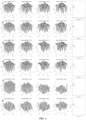
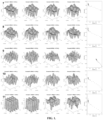
FIG 1 . Shows an overview of the correlation of MZNAC and waviness for several surface textures, from example 1-11. - FIG 2a. Shows four surface textures of example 1 varying from deterministic to pseudo deterministic to stochastic like (left to right), the corresponding ZNAC peaks above 0.8 (second row), the corresponding ZNAC peaks above 0.2 (third row) and the corresponding moiré patterns (last row). FIG 2b shows the correlation of example 1 surface textures, with parameters Wsa, RPc and Ra.
- FIG 3a. Shows four surface textures of example 7 varying from deterministic to pseudo deterministic to stochastic like (left to right), the corresponding ZNAC peaks above 0.8 (second row), the corresponding ZNAC peaks above 0.2 (third row) and the corresponding moiré patterns (last row). FIG 3b shows the correlation of the MZNAC value of example 7 surface textures, with parameters Wsa, RPc and Ra.
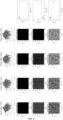
- FIG 4a. Shows four surface textures of example 8 varying from deterministic to pseudo deterministic to stochastic like (left to right), the corresponding ZNAC peaks above 0.8 (second row), the corresponding ZNAC peaks above 0.2 (third row) and the corresponding moiré patterns (last row). FIG 4b shows the correlation of the MZNAC value of example 8 surface textures, with parameters Wsa, RPc and Ra.
-
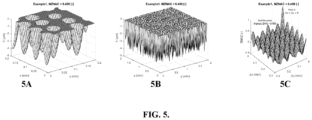
FIG 5a shows a close up of the surface texture of example 1, 5b shows the surface texture of example 1 for a sample of 2 mm x 2 mm and 5c shows the corresponding ZNAC values, clearly showing the 0,0 peak (Δx = Δy =0), and the MZNAC of 0.490, corresponding to the highest satellite peak in the ZNAC spectrum. -
FIG. 1 . Shows a summary of computational results for surface textures according to the invention and according to the prior art. Several surface textures were modelled and analysed for surface appearance properties such as waviness (Wa), peak count (RPc) and roughness (Ra), moiré effect and related MZNAC. For each example, the spatial distribution of features was either in a hexagonal or square raster with different levels of dislocation based on a superposition of a Gaussian shaped and rectangular shaped distribution. Consequently, the textures varied from deterministic, to pseudo deterministic to stochastic like. The shape of the features as seen on the surface was either circular or square. On average, the features had an amplitude of 7 µm. Example 1 (see alsoFIG.2 ) had depressions with a depth of 7 µm in a hexagonal raster. Example 6 had depressions with rims, which is typically obtained if the surface texture is applied by laser. Example 7-10 show a metal substrate with superposed surface textures. Example 7 (see alsoFIG. 3 ) shows a (pseudo)deterministic surface texture on a rough surface, with a depression depth relative to the rough surface, which would be obtained via a method with a laser as texturing means. Example 8 (see alsoFIG. 4 ) shows a (pseudo)deterministic surface texture on a rough surface with depressions with a constant minimum, as typically obtained from a process with a work roll as texturing means. For all examples, the ZNAC of the surface of 2 mm x 2 mm was obtained from the Zero Normalised Cross Correlation (ZNCC) as described by Pan et.al, Meas. Sci. Technol. 20 (2009) 062001, doi:10.1088/0957-0233/20/6/062001, in table 1, by adjusting the formula for a single surface (f=Z and g =Z). Thus, the ZNAC was obtained from the following equation:
- The ZNAC was determined for a sample of at least 2 mm x 2 mm, with a spacing of at most 2 µm. Δx and Δy was determined up to at least 0.3 mm. An example of the obtained ZNAC values is given for example 1, with a MZNAC value of 0.49 in
FIG. 5 . The MZNAC was determined from the ZNAC and relates to the highest peak in the ZNAC, except for the peak at Δx=Δy=0, also referred to as the 0,0 peak. The waviness, roughness and peak count was also analysed. - In addition the moiré effect was visualised by calculating a digital 4K (3840x2160 pixels) photographic image of the examples. A 250 mm x 141 mm surface texture was analysed. Each pixel covered a part of the surface of 250/3840 by 141/2160 mm2, roughly corresponding to 65 by 65 µm2. In the calculations, the height of the surface was taken as the original and the intensity of each pixel was calculated as the average height of that piece of the surface that is captured by that pixel. Due to the camera grid, the image is not the same as the original. A 150 by 150 pixels part of the 4K grey scale image was calculated and is shown as a black/white image where the threshold lies halfway the highest and the lowest intensity.
- For all examples, a higher waviness was obtained for a lower MZNAC. It was found that a MZNAC below 0.2 resulted in a too large increase in waviness. Therefore the metal substrate provided with a surface texture accorded to the invention should have a MZNAC of at least 0.2 to have good waviness, and hence good paint appearance. At the other hand, a clear moiré pattern was observed for all samples if the MZNAC was above 0.8. The moiré pattern was acceptable for all examples at a MZNAC of at most 0.8. This can be clearly seen in
FIG. 2 .,FIG. 3 andFIG. 4 . Furthermore, it was observed from the experiments that a MZNAC between 0.4 - 0.6 resulted in a significant suppression of the moiré pattern, while maintaining acceptable waviness.
Claims (15)
- A metal substrate provided with a surface texture comprising a surface height map consisting of features such as peaks and valleys, characterised in that the Maximum Zero Normalised Auto Correlation (MZNAC) of the surface texture is in a range of 0.2 - 0.8, wherein the MZNAC corresponds to the highest peak in the Zero Normalised Auto Correlation (ZNAC), except for the peak at Δx=Δy=0, wherein the ZNAC of the surface can be obtained from the following equation:

- The metal substrate of claim 1, wherein the surface texture has a MZNAC in a range of 0.2-0.6.
- The metal substrate of claim 1, wherein the surface texture has a MZNAC in a range of 0.4-0.8.
- The metal substrate according to any of the previous claims, wherein the surface texture has a MZNAC in a range of 0.4 - 0.6.
- The metal substrate according to any of the previous claims, wherein the metal substrate comprises a metallic coating, preferably a zinc based coating.
- The metal substrate according to any of the previous claims, wherein the surface texture comprises a plurality of features with a pseudo-deterministic spatial distribution.
- The metal substrate according to any of the previous claims, wherein the features have an average diameter in a range of 25 - 120 µm.
- The metal substrate according to any of the previous claims, wherein the features have an amplitude in a range of 0.2 - 12 µm, preferably in a range of 2 - 7 µm.
- The metal substrate according to any of the previous claims, wherein the features have a density in a range between 100 to 10000 per square millimetre, preferably 180 to 600 per square millimetre.
- The metal substrate according to any of the previous claims, wherein the waviness (Wsa) is ≤ 0.4 µm.
- The metal substrate according to any of the previous claims, wherein the metal substrate is a blank or a strip.
- A method to obtain a metal substrate according to claim 1-11, comprising the steps ofa. Providing a metal substrateb. Optionally temper rolling the metal substratec. Providing a surface texture by texturing means,d. Performing two or more texturing steps over the full width and length of the metal substrate by superposing several surface texture modifications on top of each other,such as to obtain a metal substrate with a MZNAC in the range of 0.2 - 0.8 according to any of the claims 1-11.
- A method according to claim 12 , wherein the metal substrate comprises a metallic coating.
- A method according to any of the claims 12 - 13, wherein the texturing means is a textured work roll, and wherein the surface texture is provided by imprinting a surface texture on the metal substrate by one or more textured work rolls.
- A method according to any of the claims 12 - 14, wherein the texturing means is a laser and wherein the surface texture is provided by laser ablation or laser assisted melting and redepositing
Applications Claiming Priority (2)
| Application Number | Priority Date | Filing Date | Title |
|---|---|---|---|
| EP19198137 | 2019-09-18 | ||
| PCT/EP2020/076011 WO2021053088A1 (en) | 2019-09-18 | 2020-09-17 | Metal substrate with a surface texture |
Publications (2)
| Publication Number | Publication Date |
|---|---|
| EP4031303A1 EP4031303A1 (en) | 2022-07-27 |
| EP4031303B1 true EP4031303B1 (en) | 2024-11-06 |
Family
ID=67997531
Family Applications (1)
| Application Number | Title | Priority Date | Filing Date |
|---|---|---|---|
| EP20775600.8A Active EP4031303B1 (en) | 2019-09-18 | 2020-09-17 | Metal substrate with a surface texture |
Country Status (6)
| Country | Link |
|---|---|
| US (1) | US11826980B2 (en) |
| EP (1) | EP4031303B1 (en) |
| KR (1) | KR102982482B1 (en) |
| ES (1) | ES2994807T3 (en) |
| PT (1) | PT4031303T (en) |
| WO (1) | WO2021053088A1 (en) |
Families Citing this family (6)
| Publication number | Priority date | Publication date | Assignee | Title |
|---|---|---|---|---|
| DE102020215248B4 (en) * | 2020-12-03 | 2024-05-23 | Thyssenkrupp Steel Europe Ag | Process for surface texturing of rolls, rollers and flat metal products |
| DE102021200744A1 (en) | 2021-01-28 | 2022-07-28 | Thyssenkrupp Steel Europe Ag | Process for texturing a temper roll, temper roll and skin tempered steel sheet |
| DE102022113809A1 (en) | 2022-06-01 | 2023-12-07 | Thyssenkrupp Steel Europe Ag | Flat metal product and component thereof |
| CN119325522A (en) * | 2022-06-10 | 2025-01-17 | 日本制铁株式会社 | Hot dip plated steel sheet |
| DE102022114930A1 (en) | 2022-06-14 | 2023-12-14 | Thyssenkrupp Steel Europe Ag | Tempered, hot-dip coated steel sheet |
| WO2025184536A1 (en) * | 2024-03-01 | 2025-09-04 | CMBF Products, Inc. | Materials, methods and techniques for textured steel articles |
Citations (3)
| Publication number | Priority date | Publication date | Assignee | Title |
|---|---|---|---|---|
| DE19529429A1 (en) | 1995-08-10 | 1997-02-13 | Thyssen Stahl Ag | Thin sheet, rolling mill roll for thin sheet production, process for structuring the surface of the rolling mill roll and its use |
| DE102012017703A1 (en) | 2012-09-07 | 2014-03-13 | Daetwyler Graphics Ag | Flat product of metal material, in particular a steel material, use of such a flat product and roller and method for producing such flat products |
| WO2017125497A1 (en) | 2016-01-22 | 2017-07-27 | Tata Steel Nederland Technology B.V. | Laser texturing of steel strip |
-
2020
- 2020-09-17 PT PT207756008T patent/PT4031303T/en unknown
- 2020-09-17 US US17/640,999 patent/US11826980B2/en active Active
- 2020-09-17 ES ES20775600T patent/ES2994807T3/en active Active
- 2020-09-17 EP EP20775600.8A patent/EP4031303B1/en active Active
- 2020-09-17 KR KR1020227007413A patent/KR102982482B1/en active Active
- 2020-09-17 WO PCT/EP2020/076011 patent/WO2021053088A1/en not_active Ceased
Patent Citations (3)
| Publication number | Priority date | Publication date | Assignee | Title |
|---|---|---|---|---|
| DE19529429A1 (en) | 1995-08-10 | 1997-02-13 | Thyssen Stahl Ag | Thin sheet, rolling mill roll for thin sheet production, process for structuring the surface of the rolling mill roll and its use |
| DE102012017703A1 (en) | 2012-09-07 | 2014-03-13 | Daetwyler Graphics Ag | Flat product of metal material, in particular a steel material, use of such a flat product and roller and method for producing such flat products |
| WO2017125497A1 (en) | 2016-01-22 | 2017-07-27 | Tata Steel Nederland Technology B.V. | Laser texturing of steel strip |
Non-Patent Citations (4)
| Title |
|---|
| BING PAN; KEMAO QIAN; HUIMIN XIE; ANAND ASUNDI: "TOPICAL REVIEW; Two-dimensional digital image correlation for in-plane displacement and strain measurement: a review", MEASUREMENT SCIENCE AND TECHNOLOGY., IOP, BRISTOL., GB, vol. 20, no. 6, 1 June 2009 (2009-06-01), GB , pages 062001, XP020160427, ISSN: 0957-0233, DOI: 10.1088/0957-0233/20/6/062001 |
| D5a - Eidesstattliche Erklärung von Herrn Folkert Schulze-Kraasch, Arbeitnehmer bei der Einsprechenden und bei Bedarf als Zeuge zu laden über die Einsprechende; |
| DEUTSCHER O.; PAESOLD, D.; KÖRNER, K.; WEYEN, H.-G.; JUPP, S. P.: "Characterising the surface waviness of hot dip galvanised steel sheets for optical high-quality paintability (Carsteel)", CHARACTERISING THE SURFACE WAVINESS OF HOT DIP GALVANISED STEEL SHEETS FOR OPTICAL HIGH-QUALITY PAINTABILITY (CARSTEEL), OFF. FOR OFFICIAL PUBL. OF THE EUROPEAN COMMUNITIES, LU, 1 January 2009 (2009-01-01), LU , pages 1 - 133, XP002717503, ISBN: 978-92-79-11303-1, DOI: 10.2777/65928 |
| Μ. VERMEULEN, J. SCHEERS, C. DE MARE: "Characterisation of EBT surfaces", SIBETEX 2, SECOND SEMINAR ON SURFACE TEXTURE IN THE APPLICATION OF SHEET STEEL; OCTOBER 20, 1994; ZELZATE, BELGIUM, OCAS, BELGIUM, 1 January 1994 (1994-01-01) - 20 October 1994 (1994-10-20), Belgium, pages 1 - 27, XP009562447 |
Also Published As
| Publication number | Publication date |
|---|---|
| PT4031303T (en) | 2024-12-02 |
| KR20220062508A (en) | 2022-05-17 |
| US11826980B2 (en) | 2023-11-28 |
| EP4031303A1 (en) | 2022-07-27 |
| ES2994807T3 (en) | 2025-01-31 |
| KR102982482B1 (en) | 2026-06-24 |
| US20220332091A1 (en) | 2022-10-20 |
| WO2021053088A1 (en) | 2021-03-25 |
Similar Documents
| Publication | Publication Date | Title |
|---|---|---|
| US11826980B2 (en) | Metal substrate with a surface texture | |
| KR20220038021A (en) | Rough nickel plating material and manufacturing method thereof | |
| US20190176198A1 (en) | Planishing roll, method for planishing a flat product therewith and flat product therefrom | |
| CN114423536B (en) | Steel plates with a defined surface structure | |
| EP3354359B1 (en) | Method for manufacturing plated steel sheet having excellent clarity of image after coating | |
| CN110073027A (en) | The manufacturing method of punching formation property and the excellent hot-dip galvanized steel sheet of coating clarity and the hot-dip galvanized steel sheet manufactured by this method | |
| KR102692723B1 (en) | Metal substrates provided with custom surface textures and methods for applying these textures to metal substrates | |
| CN114945699B (en) | Method for producing surface-tempered and surface-finished steel plates | |
| US20230081814A1 (en) | Sheet Metal Packaging Product with Textured Surface And Method of Producing Such a Sheet Metal Packaging Product | |
| EP4003621B1 (en) | Metal substrate provided with surface texture and method for applying such textures on metal substrates | |
| WO2017144407A1 (en) | Roller, in particular skin pass roller, and skin passed flat product | |
| JP2718627B2 (en) | Galvanized steel sheet with excellent slidability and paint clarity | |
| JPH0347925B2 (en) | ||
| JPH0675728B2 (en) | Manufacturing method of surface-treated steel sheet with excellent image clarity | |
| CN119365622A (en) | Hot dip coated, temper rolled steel sheets | |
| CN119365623A (en) | Method for temper rolling a hot-dip coated steel sheet and corresponding temper rolled hot-dip coated steel sheet | |
| KR20190075479A (en) | Rolling roll, method for treating surface of rolling roll, and coated steel sheet manufactured by rolling roll | |
| CA2022235A1 (en) | Steel drawing sheet with metal coating | |
| JP7360041B2 (en) | Plated steel plate having embossed portions and method for forming embossed portions on plated steel sheets | |
| DE102023106421A1 (en) | Dressed and coated steel sheet | |
| CN119301291A (en) | Flat metal products and components made thereof | |
| JPH06210304A (en) | Aluminum rolling plate for processing and aluminum alloy rolling plate for processing with excellent paint clarity and scratch resistance | |
| JPH05192701A (en) | Metallic sheet excellent in galling resistance and rolling roll used for manufacturing same | |
| JP2003025002A (en) | Hot-dip galvanized steel sheet with excellent sharpness and method for producing the same | |
| JPH04253503A (en) | Steel sheet for working having excellent painting brightness and production thereof |
Legal Events
| Date | Code | Title | Description |
|---|---|---|---|
| STAA | Information on the status of an ep patent application or granted ep patent |
Free format text: STATUS: UNKNOWN |
|
| STAA | Information on the status of an ep patent application or granted ep patent |
Free format text: STATUS: THE INTERNATIONAL PUBLICATION HAS BEEN MADE |
|
| PUAI | Public reference made under article 153(3) epc to a published international application that has entered the european phase |
Free format text: ORIGINAL CODE: 0009012 |
|
| STAA | Information on the status of an ep patent application or granted ep patent |
Free format text: STATUS: REQUEST FOR EXAMINATION WAS MADE |
|
| 17P | Request for examination filed |
Effective date: 20220419 |
|
| AK | Designated contracting states |
Kind code of ref document: A1 Designated state(s): AL AT BE BG CH CY CZ DE DK EE ES FI FR GB GR HR HU IE IS IT LI LT LU LV MC MK MT NL NO PL PT RO RS SE SI SK SM TR |
|
| DAV | Request for validation of the european patent (deleted) | ||
| DAX | Request for extension of the european patent (deleted) | ||
| STAA | Information on the status of an ep patent application or granted ep patent |
Free format text: STATUS: EXAMINATION IS IN PROGRESS |
|
| 17Q | First examination report despatched |
Effective date: 20230405 |
|
| GRAP | Despatch of communication of intention to grant a patent |
Free format text: ORIGINAL CODE: EPIDOSNIGR1 |
|
| STAA | Information on the status of an ep patent application or granted ep patent |
Free format text: STATUS: GRANT OF PATENT IS INTENDED |
|
| INTG | Intention to grant announced |
Effective date: 20240417 |
|
| GRAS | Grant fee paid |
Free format text: ORIGINAL CODE: EPIDOSNIGR3 |
|
| GRAA | (expected) grant |
Free format text: ORIGINAL CODE: 0009210 |
|
| STAA | Information on the status of an ep patent application or granted ep patent |
Free format text: STATUS: THE PATENT HAS BEEN GRANTED |
|
| AK | Designated contracting states |
Kind code of ref document: B1 Designated state(s): AL AT BE BG CH CY CZ DE DK EE ES FI FR GB GR HR HU IE IS IT LI LT LU LV MC MK MT NL NO PL PT RO RS SE SI SK SM TR |
|
| REG | Reference to a national code |
Ref country code: GB Ref legal event code: FG4D |
|
| REG | Reference to a national code |
Ref country code: CH Ref legal event code: EP |
|
| REG | Reference to a national code |
Ref country code: DE Ref legal event code: R096 Ref document number: 602020040903 Country of ref document: DE |
|
| REG | Reference to a national code |
Ref country code: PT Ref legal event code: SC4A Ref document number: 4031303 Country of ref document: PT Date of ref document: 20241202 Kind code of ref document: T Free format text: AVAILABILITY OF NATIONAL TRANSLATION Effective date: 20241125 |
|
| REG | Reference to a national code |
Ref country code: IE Ref legal event code: FG4D Ref country code: NL Ref legal event code: FP |
|
| REG | Reference to a national code |
Ref country code: SK Ref legal event code: T3 Ref document number: E 45414 Country of ref document: SK |
|
| REG | Reference to a national code |
Ref country code: ES Ref legal event code: FG2A Ref document number: 2994807 Country of ref document: ES Kind code of ref document: T3 Effective date: 20250131 |
|
| P01 | Opt-out of the competence of the unified patent court (upc) registered |
Free format text: CASE NUMBER: APP_329/2025 Effective date: 20250106 |
|
| REG | Reference to a national code |
Ref country code: LT Ref legal event code: MG9D |
|
| PG25 | Lapsed in a contracting state [announced via postgrant information from national office to epo] |
Ref country code: HR Free format text: LAPSE BECAUSE OF FAILURE TO SUBMIT A TRANSLATION OF THE DESCRIPTION OR TO PAY THE FEE WITHIN THE PRESCRIBED TIME-LIMIT Effective date: 20241106 Ref country code: IS Free format text: LAPSE BECAUSE OF FAILURE TO SUBMIT A TRANSLATION OF THE DESCRIPTION OR TO PAY THE FEE WITHIN THE PRESCRIBED TIME-LIMIT Effective date: 20250306 |
|
| PG25 | Lapsed in a contracting state [announced via postgrant information from national office to epo] |
Ref country code: FI Free format text: LAPSE BECAUSE OF FAILURE TO SUBMIT A TRANSLATION OF THE DESCRIPTION OR TO PAY THE FEE WITHIN THE PRESCRIBED TIME-LIMIT Effective date: 20241106 |
|
| REG | Reference to a national code |
Ref country code: AT Ref legal event code: MK05 Ref document number: 1738814 Country of ref document: AT Kind code of ref document: T Effective date: 20241106 |
|
| PG25 | Lapsed in a contracting state [announced via postgrant information from national office to epo] |
Ref country code: BG Free format text: LAPSE BECAUSE OF FAILURE TO SUBMIT A TRANSLATION OF THE DESCRIPTION OR TO PAY THE FEE WITHIN THE PRESCRIBED TIME-LIMIT Effective date: 20241106 |
|
| PG25 | Lapsed in a contracting state [announced via postgrant information from national office to epo] |
Ref country code: NO Free format text: LAPSE BECAUSE OF FAILURE TO SUBMIT A TRANSLATION OF THE DESCRIPTION OR TO PAY THE FEE WITHIN THE PRESCRIBED TIME-LIMIT Effective date: 20250206 |
|
| PG25 | Lapsed in a contracting state [announced via postgrant information from national office to epo] |
Ref country code: GR Free format text: LAPSE BECAUSE OF FAILURE TO SUBMIT A TRANSLATION OF THE DESCRIPTION OR TO PAY THE FEE WITHIN THE PRESCRIBED TIME-LIMIT Effective date: 20250207 Ref country code: LV Free format text: LAPSE BECAUSE OF FAILURE TO SUBMIT A TRANSLATION OF THE DESCRIPTION OR TO PAY THE FEE WITHIN THE PRESCRIBED TIME-LIMIT Effective date: 20241106 Ref country code: AT Free format text: LAPSE BECAUSE OF FAILURE TO SUBMIT A TRANSLATION OF THE DESCRIPTION OR TO PAY THE FEE WITHIN THE PRESCRIBED TIME-LIMIT Effective date: 20241106 |
|
| PG25 | Lapsed in a contracting state [announced via postgrant information from national office to epo] |
Ref country code: PL Free format text: LAPSE BECAUSE OF FAILURE TO SUBMIT A TRANSLATION OF THE DESCRIPTION OR TO PAY THE FEE WITHIN THE PRESCRIBED TIME-LIMIT Effective date: 20241106 |
|
| PG25 | Lapsed in a contracting state [announced via postgrant information from national office to epo] |
Ref country code: RS Free format text: LAPSE BECAUSE OF FAILURE TO SUBMIT A TRANSLATION OF THE DESCRIPTION OR TO PAY THE FEE WITHIN THE PRESCRIBED TIME-LIMIT Effective date: 20250206 |
|
| PG25 | Lapsed in a contracting state [announced via postgrant information from national office to epo] |
Ref country code: SM Free format text: LAPSE BECAUSE OF FAILURE TO SUBMIT A TRANSLATION OF THE DESCRIPTION OR TO PAY THE FEE WITHIN THE PRESCRIBED TIME-LIMIT Effective date: 20241106 |
|
| PG25 | Lapsed in a contracting state [announced via postgrant information from national office to epo] |
Ref country code: DK Free format text: LAPSE BECAUSE OF FAILURE TO SUBMIT A TRANSLATION OF THE DESCRIPTION OR TO PAY THE FEE WITHIN THE PRESCRIBED TIME-LIMIT Effective date: 20241106 |
|
| PG25 | Lapsed in a contracting state [announced via postgrant information from national office to epo] |
Ref country code: EE Free format text: LAPSE BECAUSE OF FAILURE TO SUBMIT A TRANSLATION OF THE DESCRIPTION OR TO PAY THE FEE WITHIN THE PRESCRIBED TIME-LIMIT Effective date: 20241106 |
|
| PG25 | Lapsed in a contracting state [announced via postgrant information from national office to epo] |
Ref country code: RO Free format text: LAPSE BECAUSE OF FAILURE TO SUBMIT A TRANSLATION OF THE DESCRIPTION OR TO PAY THE FEE WITHIN THE PRESCRIBED TIME-LIMIT Effective date: 20241106 |
|
| PG25 | Lapsed in a contracting state [announced via postgrant information from national office to epo] |
Ref country code: CZ Free format text: LAPSE BECAUSE OF FAILURE TO SUBMIT A TRANSLATION OF THE DESCRIPTION OR TO PAY THE FEE WITHIN THE PRESCRIBED TIME-LIMIT Effective date: 20241106 |
|
| REG | Reference to a national code |
Ref country code: DE Ref legal event code: R026 Ref document number: 602020040903 Country of ref document: DE |
|
| PLBI | Opposition filed |
Free format text: ORIGINAL CODE: 0009260 |
|
| PLAX | Notice of opposition and request to file observation + time limit sent |
Free format text: ORIGINAL CODE: EPIDOSNOBS2 |
|
| 26 | Opposition filed |
Opponent name: THYSSENKRUPP STEEL EUROPE AG Effective date: 20250730 |
|
| PG25 | Lapsed in a contracting state [announced via postgrant information from national office to epo] |
Ref country code: SE Free format text: LAPSE BECAUSE OF FAILURE TO SUBMIT A TRANSLATION OF THE DESCRIPTION OR TO PAY THE FEE WITHIN THE PRESCRIBED TIME-LIMIT Effective date: 20241106 |
|
| PGFP | Annual fee paid to national office [announced via postgrant information from national office to epo] |
Ref country code: PT Payment date: 20250903 Year of fee payment: 6 |
|
| PGFP | Annual fee paid to national office [announced via postgrant information from national office to epo] |
Ref country code: DE Payment date: 20250929 Year of fee payment: 6 |
|
| PGFP | Annual fee paid to national office [announced via postgrant information from national office to epo] |
Ref country code: NL Payment date: 20250926 Year of fee payment: 6 Ref country code: IT Payment date: 20250919 Year of fee payment: 6 |
|
| PGFP | Annual fee paid to national office [announced via postgrant information from national office to epo] |
Ref country code: BE Payment date: 20250929 Year of fee payment: 6 Ref country code: GB Payment date: 20250929 Year of fee payment: 6 |
|
| PGFP | Annual fee paid to national office [announced via postgrant information from national office to epo] |
Ref country code: FR Payment date: 20250925 Year of fee payment: 6 |
|
| PGFP | Annual fee paid to national office [announced via postgrant information from national office to epo] |
Ref country code: SK Payment date: 20250903 Year of fee payment: 6 |
|
| PLBB | Reply of patent proprietor to notice(s) of opposition received |
Free format text: ORIGINAL CODE: EPIDOSNOBS3 |
|
| PGFP | Annual fee paid to national office [announced via postgrant information from national office to epo] |
Ref country code: ES Payment date: 20251001 Year of fee payment: 6 |
|
| REG | Reference to a national code |
Ref country code: CH Ref legal event code: H13 Free format text: ST27 STATUS EVENT CODE: U-0-0-H10-H13 (AS PROVIDED BY THE NATIONAL OFFICE) Effective date: 20260504 |
|
| PG25 | Lapsed in a contracting state [announced via postgrant information from national office to epo] |
Ref country code: LU Free format text: LAPSE BECAUSE OF NON-PAYMENT OF DUE FEES Effective date: 20250917 |
|
| PG25 | Lapsed in a contracting state [announced via postgrant information from national office to epo] |
Ref country code: LT Free format text: LAPSE BECAUSE OF FAILURE TO SUBMIT A TRANSLATION OF THE DESCRIPTION OR TO PAY THE FEE WITHIN THE PRESCRIBED TIME-LIMIT Effective date: 20241106 |
|
| PG25 | Lapsed in a contracting state [announced via postgrant information from national office to epo] |
Ref country code: MC Free format text: LAPSE BECAUSE OF FAILURE TO SUBMIT A TRANSLATION OF THE DESCRIPTION OR TO PAY THE FEE WITHIN THE PRESCRIBED TIME-LIMIT Effective date: 20241106 |
|
| PG25 | Lapsed in a contracting state [announced via postgrant information from national office to epo] |
Ref country code: IE Free format text: LAPSE BECAUSE OF NON-PAYMENT OF DUE FEES Effective date: 20250917 Ref country code: CH Free format text: LAPSE BECAUSE OF NON-PAYMENT OF DUE FEES Effective date: 20250930 |