EP4030328A1 - Method for enabling contact detection among a plurality of persons and for enabling contact tracing for the plurality of persons individually, system, server entity or functionality or edge device or wearable device, computing device, program and computer-readable medium - Google Patents
Method for enabling contact detection among a plurality of persons and for enabling contact tracing for the plurality of persons individually, system, server entity or functionality or edge device or wearable device, computing device, program and computer-readable medium Download PDFInfo
- Publication number
- EP4030328A1 EP4030328A1 EP21152080.4A EP21152080A EP4030328A1 EP 4030328 A1 EP4030328 A1 EP 4030328A1 EP 21152080 A EP21152080 A EP 21152080A EP 4030328 A1 EP4030328 A1 EP 4030328A1
- Authority
- EP
- European Patent Office
- Prior art keywords
- wearable device
- wearable
- computing device
- functionality
- log data
- Prior art date
- Legal status (The legal status is an assumption and is not a legal conclusion. Google has not performed a legal analysis and makes no representation as to the accuracy of the status listed.)
- Granted
Links
Images

Classifications
-
- G—PHYSICS
- G06—COMPUTING OR CALCULATING; COUNTING
- G06F—ELECTRIC DIGITAL DATA PROCESSING
- G06F21/00—Security arrangements for protecting computers, components thereof, programs or data against unauthorised activity
- G06F21/60—Protecting data
- G06F21/62—Protecting access to data via a platform, e.g. using keys or access control rules
- G06F21/6218—Protecting access to data via a platform, e.g. using keys or access control rules to a system of files or objects, e.g. local or distributed file system or database
- G06F21/6245—Protecting personal data, e.g. for financial or medical purposes
-
- G—PHYSICS
- G06—COMPUTING OR CALCULATING; COUNTING
- G06F—ELECTRIC DIGITAL DATA PROCESSING
- G06F21/00—Security arrangements for protecting computers, components thereof, programs or data against unauthorised activity
- G06F21/60—Protecting data
- G06F21/606—Protecting data by securing the transmission between two devices or processes
-
- H—ELECTRICITY
- H04—ELECTRIC COMMUNICATION TECHNIQUE
- H04W—WIRELESS COMMUNICATION NETWORKS
- H04W12/00—Security arrangements; Authentication; Protecting privacy or anonymity
- H04W12/02—Protecting privacy or anonymity, e.g. protecting personally identifiable information [PII]
-
- H—ELECTRICITY
- H04—ELECTRIC COMMUNICATION TECHNIQUE
- H04W—WIRELESS COMMUNICATION NETWORKS
- H04W4/00—Services specially adapted for wireless communication networks; Facilities therefor
- H04W4/02—Services making use of location information
- H04W4/023—Services making use of location information using mutual or relative location information between multiple location based services [LBS] targets or of distance thresholds
-
- H—ELECTRICITY
- H04—ELECTRIC COMMUNICATION TECHNIQUE
- H04W—WIRELESS COMMUNICATION NETWORKS
- H04W4/00—Services specially adapted for wireless communication networks; Facilities therefor
- H04W4/02—Services making use of location information
- H04W4/029—Location-based management or tracking services
Definitions
- the present invention relates to a method for enabling contact detection among a plurality of persons and for enabling contact tracing for the plurality of persons individually, by means of each of the plurality of persons wearing or carrying a wearable device of a plurality of wearable devices.
- the present invention relates to a system for enabling contact detection among a plurality of persons and for enabling contact tracing for the plurality of persons individually, by means of each of the plurality of persons wearing or carrying a wearable device of a plurality of wearable devices.
- the present invention relates to a server entity or a functionality or edge device or a wearable device for enabling contact detection among a plurality of persons and for enabling contact tracing for the plurality of persons individually.
- the present invention relates to a computing device, especially a mobile phone or a personal digital assistant, and especially as part of an inventive system.
- the present invention relates to a program and to a computer-readable medium for enabling contact detection among a plurality of persons and for enabling contact tracing for the plurality of persons individually according to the inventive method.
- wearable devices especially so-called ultra-wideband wearable devices, or ultra-wideband tags.
- Such wearable devices typically store log data related to the contact situation of the respective or considered wearable device with other wearable devices being or having been in proximity during a considered time interval such as, e.g., a day or a work shift, thereby providing the possibility - e.g. in workplaces or other environments where mobile phones are either unsuitable to be carried or undesirable or banned - to either help to avoid the spread of infectious diseases or at least to be able to detect encounters between at least two persons and later on to trace such contacts or encounters.
- log data need to be moved, or transmitted, from the respective wearable device or tag, towards a device of the rightful owner of these log data - i.e. the person having carried the respective wearable device during the respective time interval covered by the log data - without being visible or usable to anyone else, especially also including the organization providing the use of the wearable devices and their infrastructure, such as the respective person's employer or the like.
- An object of the present invention is to provide a technically simple, effective and cost effective solution for enabling contact detection and contact tracing among a plurality of persons wearing or carrying wearable devices and for securely transmitting or moving the resulting log data of or generated by such wearable devices to a computing device of the respective person.
- a further object of the present invention is to provide a corresponding system, server entity or functionality or edge device or wearable device, an accordingly programmed computing device, especially a mobile phone or a personal digital assistant, and a corresponding program and computer-readable medium.
- the object of the present invention is achieved by a method for enabling contact detection among a plurality of persons and for enabling contact tracing for the plurality of persons individually, by means of each of the plurality of persons wearing or carrying a wearable device of a plurality of wearable devices, the wearable devices having or being associated or assigned to, respectively, a tag identifier, the tag identifiers being repeatedly broadcast by the wearable devices, respectively, using a wireless communication interface of the wearable devices, wherein, in a contact situation of a wearable device with a further wearable device of the plurality of wearable devices, the wearable device is able, by means of the wearable device's wireless communication interface and with respect to the further wearable device, to determine repeatedly the distance, at different points in time, towards the further wearable device and to receive the further wearable device's tag identifier, thereby generating and storing log data of the contact situation of the wearable device with the further wearable device, wherein in order to provide for an individual contact tracing regarding the wearable device
- each wearable device or tag has a unique ID, or tag identifier - typically contained on a QR code sticker on the tag's case - which is broadcast and saved by other wearable devices or tags in the vicinity.
- the sum or combination of these measurements gives rise to logs (or log data), which are stored on the wearable device or tag and needs somehow to be transported to the computing device or phone of the rightful owner of the log data.
- the wearable devices or tags are typically not personalized per se as they can be used and reused by anyone (typically among the group of persons concerned, e.g. the staff of an organization or a differently defined group of persons), but during one session, only a single user is typically using one wearable device or tag.
- a certain number of persons is considered such as, especially, the staff of an enterprise or of an organization. It is aimed at enabling contact detection and contact tracing for these persons such that contact tracing is able to be performed individually for each person, and typically performed by each person individually using their personal computing device, especially a smart phone or other personal portable device.
- each person is wearing or carrying a wearable device or tag (typically one, but, in principle, it is not excluded to wear more than one tag) of the plurality of wearable devices.
- a wearable device or tag typically one, but, in principle, it is not excluded to wear more than one tag
- tag identifier i.e. an identifying information such as a serial number or the like.
- each wearable device or each tag is associated to exactly one tag identifier; however, in principle according to the present invention, it is not excluded that one and the same wearable device or tag is able to be associated or assigned (successively) to more than one tag identifier, especially in order to still enhance the level of data protection or data privacy, especially by avoiding to create specific pattern, e.g. regarding the usage of certain wearable devices or tags by certain persons or the like.
- a mechanism is needed to securely identify or determine such tag identifier without doubt each time the wearable device or tag is used.
- the invention is mainly described under the assumption that a tag identifier is fixedly, i.e. unchangeably, associated or assigned to a wearable device or tag.
- the wearable devices or tags while in operation, more or less continuously, i.e. repeatedly, broadcast the assigned or associated (at this point in time unique) tag identifier (using the wireless communication interface of the wearable devices), i.e. these broadcasts are typically performed, by the wearable devices and under normal conditions, by applying a certain rate of broadcasts (i.e. a number of broadcasts per time unit, such as, typically once per second (i.e. 1 Hz) or the like; usual such broadcast rates might range from about 0,1 Hz (i.e.
- some signal parameter such as, typically, some signal strength parameter
- some signal content such as, e.g., time stamp information and/or emission power information
- each such broadcast event of a wearable device involves the wearable device transmitting or broadcasting its (at least temporarily) associated or assigned tag identifier (hereinafter also called tag identifier information).
- the wearable device in a contact situation of a wearable device with a further wearable device (of the plurality of wearable devices), the wearable device is able, by means of the wearable device's wireless communication interface and with respect to the further wearable device, to determine repeatedly the distance, at different points in time, towards the further wearable device and to receive (typically at a plurality of points in time) the further wearable device's tag identifier. From these received broadcast pieces of information (that each wearable device is able to receive from the other wearable devices nearby, i.e.
- each wearable device generates (and typically stores) log data, this log data corresponding to or representing the contact situation of the wearable device with the further wearable device (in case of only one further wearable device) or with the plurality of further wearable devices (in case of more than one further wearable device nearby).
- an individual, hence privacy protected, contact tracing is provided for such that a person is enabled to use an associated or owned computing device for performing the individual contact tracing regarding herself, i.e. regarding the wearable device or tag having been associated to (and worn by) this person (or regarding the plurality of wearable devices or tags previously worn).
- this is possible to be implemented by means of:
- the public key is transmitted, by the server entity or functionality, to the edge device, wherein during the third step, the edge device
- the wearable device's tag identifier is transmitted, by the wearable device, to the computing device prior to or after the wearable device being worn, wherein the wearable device's tag identifier is especially transmitted to the computing device using at least one out of the following:
- the log data are transmitted to the edge device using a secure data transmission between the wearable device and the edge device, using
- the computing device generates a log access token - especially during the first step while or in connection with generating the private and public keys -, and transmits the log access token to the server entity or functionality.
- the computing device provides a credential information that can later on be used to authenticate the computing device in view of requesting the encrypted log data.
- the encrypted log data are able to be retrieved, by the computing device, from the server entity or functionality by means of the computing device requesting the encrypted log data using both the log access token and a signed log access token, the signed log access token being signed by means of the private key.
- the wireless communication interface of the wearable devices is an ultra-wideband interface allowing for a high-precision contact detection and tracing.
- the tag identifier is used for the upload of log data (from the edge device) to the server entity or functionality.
- the log access token is used.
- the present invention relates to a system for enabling contact detection among a plurality of persons and for enabling contact tracing for the plurality of persons individually, by means of each of the plurality of persons wearing or carrying a wearable device of a plurality of wearable devices, the system comprising, besides the plurality of wearable devices, a server entity or functionality, an edge device, and computing devices, the wearable devices having or being associated or assigned to, respectively, a tag identifier, the tag identifiers being repeatedly broadcast by the wearable devices, respectively, using a wireless communication interface of the wearable devices, wherein, in a contact situation of a wearable device with a further wearable device of the plurality of wearable devices, the wearable device is able, by means of the wearable device's wireless communication interface and with respect to the further wearable device, to determine repeatedly the distance, at different points in time, towards the further wearable device and to receive the further wearable device's tag identifier, thereby generating and storing log data of the contact situation of the
- the present invention relates to a server entity or functionality or edge device or wearable device for enabling contact detection among a plurality of persons and for enabling contact tracing for the plurality of persons individually, in or as part of an inventive system.
- the present invention relates to a computing device, especially a mobile phone or a personal digital assistant, and especially as part of a system according claim 8, being programmed for enabling contact detection among a plurality of persons and for enabling contact tracing for the plurality of persons individually, by means of each of the plurality of persons wearing or carrying a wearable device of a plurality of wearable devices generating and storing log data of the contact situations, wherein in order to provide for an individual contact tracing regarding the person associated to the computing device and the wearable device the computing device is configured such that:
- the present invention relates to a program comprising a computer readable program code which, when executed on a computer and/or on a computing device and/or on a server entity or functionality and/or on an edge device and/or on a wearable device, or in part on a computing device and/or in part on a server entity or functionality and/or in part on an edge device and/or on a wearable device, causes the computer and/or the computing device and/or the server entity or functionality and/or the edge device and/or the wearable device to perform the inventive method.
- the present invention relates to a computer-readable medium comprising instructions which when executed on a computer and/or on a computing device and/or on a server entity or functionality and/or on an edge device and/or on a wearable device, or in part on a computing device and/or in part on a server entity or functionality and/or in part on an edge device and/or on a wearable device, causes the computer and/or the computing device and/or the server entity or functionality and/or the edge device and/or the wearable device to perform the inventive method.
- FIG 1 a plurality of persons 100 in a contact detection and/or contact tracing setting are schematically represented, wherein each of the plurality of persons 100 is wearing or carrying a wearable device (or tag) of a plurality of wearable devices (or tags) 200, wherein for the sake of simplicity, Figure 1 only shows wearable devices 200 for four persons 100 explicitly.
- FIG. 2 a situation of a plurality of wearable devices (or tags) 200 being connected to an edge device 300 is schematically shown, wherein the edge device 300 is communicating with a server entity or functionality 400.
- FIG 3 a contact situation of a (specific) wearable device 201 with a (specific) further wearable device 202 is schematically shown.
- Each of the wearable devices 201, 202 comprise, respectively, a wireless communication interface 220, and each of the wearable devices 201, 202 comprise, respectively, a tag identifier, the wearable device's tag identifier being indicated, in Figure 3 , by means of reference sign 241, and the further wearable device's tag identifier being indicated by means of reference sign 242.
- the wearable device's wireless communication interface 220 the wearable device 201 is able, with respect to the further wearable device 202, to determine repeatedly the or its distance (i.e.
- analogous contact situations will typically also arise with respect to still further wearable devices (not individually indicated by means of references signs), i.e. the wearable device 201 will typically also receive the broadcast signals of these still further wearable devices, and, consequently, the log data 261 will typically also comprise information regarding the corresponding contact situations.
- Figure 3 furthermore schematically shows the log data 261 of the wearable device 201 being stored in a suitable memory device or module of the wearable device 201 (i.e. the wearable device 201 comprises such a suitable memory device or module 280, only represented in Figure 3 for the wearable device 201) and being transferred to the edge device 300, shown in Figure 2 .
- the log data 261 (of the wearable device 201) are transferred to the edge device 300, typically once the wearable device 201 is - after having been used by a person, e.g. during a work shift or during a working day - put back to or with the edge device 300, especially for purposes of charging (the batteries of the wearable device 201) - a situation that is schematically shown in Figure 2 .
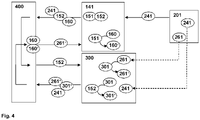
- FIG 4 an exemplary embodiment of the method according to the present invention is schematically shown, thereby realizing the possibility of a user-individual contact tracing regarding the wearable device 201 using a user's computing device 141, the server entity or functionality 400 as well as the edge device 300:
- the wearable device 201 repeatedly (i.e.
- the wearable device 201 determines the distance towards the further wearable device 202 and receives the further wearable device's tag identifier 242, thereby generating and storing the log data 261 of especially the contact situation of the wearable device 201 with the further wearable device 202 (typically not only thereof but likely also information regarding additional contact situations of the wearable device 201 with still further wearable devices, i.e. this information (i.e. the respective distance data for different points in time and the still further wearable device's tag identifiers) is typically also part of the log data 261).
- this information i.e. the respective distance data for different points in time and the still further wearable device's tag identifiers
- the wearable device 201 is typically put back to the edge device 300 and the log data 261 transferred to the edge device 300 in a protected manner, i.e. protected especially against eavesdropping the transmission of the - especially unencrypted log data 261 to the edge device 300.
- the edge device 300 encrypts the log data 261 in a manner that only the computing device 141 is able to decrypt, thereby avoiding the possibility of any other interfering instance having access to these log data 261 in unencrypted form (i.e. the cleartext thereof).
- the computing device 141 generates (in a sufficiently secure manner) a key pair comprising a private key 151 and a public key 152.
- the public key 152 will be transmitted to the edge device 300; this is realized by means of the computing device 141 transmitting the public key 152 to the server entity or functionality 400 (in the first step of the inventive method), and by means of the server entity or functionality 400 transmitting the public key 152 (prior to the third step) to the edge device 300.
- the log data 261 After having generated the log data 261, while the wearable device 201 being used, and stored the log data 261 in the memory device or module 280 of the wearable device 201, the log data 261 are transferred or transmitted to the edge device 300.
- the edge device 300 is able to encrypt the log data 261 received from the wearable device 201, The resulting encrypted log data 261' (i.e.
- the cyphertext 261' of the unencrypted log data 261) is then able to be transmitted to the server entity or functionality 400, and from the server entity or functionality 400 to the computing device 141. Additionally, the computing device 141 receives, from the wearable device 201, the wearable device's tag identifier 241 (especially in the second step but this could also happen in the first step or prior thereto, prior to or after the wearable device 201 being worn), and the computing device 141 transmits the wearable device's tag identifier 241 to the server entity or functionality 400.
- the log data 261 are encrypted, by the edge device 300, as follows: the edge device 300 generates a random further key 301, encrypts the log data 261 using the further key 301, thereby generating the encrypted log data 261', and additionally encrypts the further key 301 using the public key 152, thereby generating the encrypted further key 301'. Both the encrypted log data 261', and the encrypted further key 301' are transmitted to the server entity or functionality 400, ready to be transmitted to the computing device 141 (in the fourth step of the inventive method).
- the computing device 141 in order to provide for such a transfer of the encrypted log data 261' in a secured manner, the computing device 141 generates a log access token 160 - especially during the first step while or in connection with generating the private and public keys 151, 152 -, and transmits the log access token 160 to the server entity or functionality 400.
- the encrypted log data 261' are able to be retrieved, by the computing device 141, from the server entity or functionality 400 by means of the computing device 141 requesting the encrypted log data 261' using both the log access token 160 and a signed log access token 160', the signed log access token 160' being signed by means of the private key 151 (i.e. corresponding to the (cleartext of the) log access token 160, encrypted using the private key 151) - and the signed log access token 160' is able to be verified, by the server entity or functionality 400, by means of using the public key 152.
- the wearable device's tag identifier 241 is transmitted, by the wearable device 201, to the computing device 141 using at least one out of the following:
- the log data 261 are transmitted to the edge device 300 using a secure data transmission between the wearable device 201 and the edge device 300, either using a wireline communication interface of the wearable device 201 (especially using wireline contacts of the wearable device 201 used for charging the wearable device 201), or the wireless communication interface 220 of the wearable device 201 (or a further wireless communication interface 220 of the wearable device 201, especially according to one of the Bluetooth and Zigbee communication standards).
- log data 261 of a wearable device 201 are available on or via the wearable device 201, but natively not on a person's personal computing device 141 such as a smart phone.
- it is especially differentiated between a "check-in phase,” a "check-out phase,” and an "update” phase.
- the user picks up a tag (or wearable device 201) and, e.g., scans the QR code (or otherwise provides the tag identifier 241 to the computing device 141 or phone).
- the phone (or computing device 141) generates an asymmetric key pair 251, 252, especially using RSA-3072 (or RSA-2048, or RSA-4096), and a random number, especially a 128-bit-UUID (or a 256-bit UUID), as the log access token, LAT 261.
- the ID (tag identifier 241), the public key (PuK) 252, and the log access token 261 are transmitted to the server entity or functionality 400, i.e. to a central component on the cloud, hereinafter also called log processing service, LPS.
- the tag or wearable device 201 collects contact data (i.e. log data 261).
- the tag or wearable device 201 is returned to a charging board connected to an edge device (300), especially corresponding to a simple industrial computer: This is check-out.
- the edge device 300 reads the logs (i.e. the log data 261) from the tag or wearable device 201, downloads the appropriate public key PuK (public key 252) from the LPS (server entity or functionality 400), compresses the log data 261, encrypts it with a random AES-256 key K (i.e. the random further key 301), encrypts K 301 with PuK 252 to give K' (or encrypted further key 301'), and uploads the encrypted log 261' plus K' 301' to the LPS (or server entity or functionality 400).
- PuK public key 252
- the phone uses its LAT 261 plus the signed LAT 261' (the LAT, encrypted with the private key 251 of the computing device 141) to retrieve the log data 261 (actually the encrypted log data 261') from the LPS (or server entity or functionality 400) after a certain customer-specific timeout.
- the downloaded data i.e. the encrypted log data 261' and the encrypted further key 301'
- the phone knows the private key 251 necessary to decrypt K' 301', which gives K, which is then used to decrypt the encrypted log data 261', which is then decompressed.
- the log data 261 is on the phone, i.e. on the computing device 141, transmitted in a secure and protected manner.
Landscapes
- Engineering & Computer Science (AREA)
- Theoretical Computer Science (AREA)
- Health & Medical Sciences (AREA)
- Computer Security & Cryptography (AREA)
- Computer Networks & Wireless Communication (AREA)
- Bioethics (AREA)
- General Health & Medical Sciences (AREA)
- Signal Processing (AREA)
- Software Systems (AREA)
- Physics & Mathematics (AREA)
- General Engineering & Computer Science (AREA)
- General Physics & Mathematics (AREA)
- Computer Hardware Design (AREA)
- Medical Informatics (AREA)
- Databases & Information Systems (AREA)
- Mobile Radio Communication Systems (AREA)
Abstract
Description
- The present invention relates to a method for enabling contact detection among a plurality of persons and for enabling contact tracing for the plurality of persons individually, by means of each of the plurality of persons wearing or carrying a wearable device of a plurality of wearable devices.
- Furthermore, the present invention relates to a system for enabling contact detection among a plurality of persons and for enabling contact tracing for the plurality of persons individually, by means of each of the plurality of persons wearing or carrying a wearable device of a plurality of wearable devices.
- Additionally, the present invention relates to a server entity or a functionality or edge device or a wearable device for enabling contact detection among a plurality of persons and for enabling contact tracing for the plurality of persons individually.
- Furthermore, the present invention relates to a computing device, especially a mobile phone or a personal digital assistant, and especially as part of an inventive system.
- Additionally, the present invention relates to a program and to a computer-readable medium for enabling contact detection among a plurality of persons and for enabling contact tracing for the plurality of persons individually according to the inventive method.
- It is conventionally known to realize contact detection and/or contact tracing for a plurality of persons by means of using wearable devices, especially so-called ultra-wideband wearable devices, or ultra-wideband tags. Such wearable devices typically store log data related to the contact situation of the respective or considered wearable device with other wearable devices being or having been in proximity during a considered time interval such as, e.g., a day or a work shift, thereby providing the possibility - e.g. in workplaces or other environments where mobile phones are either unsuitable to be carried or undesirable or banned - to either help to avoid the spread of infectious diseases or at least to be able to detect encounters between at least two persons and later on to trace such contacts or encounters.
- However, such log data need to be moved, or transmitted, from the respective wearable device or tag, towards a device of the rightful owner of these log data - i.e. the person having carried the respective wearable device during the respective time interval covered by the log data - without being visible or usable to anyone else, especially also including the organization providing the use of the wearable devices and their infrastructure, such as the respective person's employer or the like.
- Although more and more smartphones come with ultra-wideband capabilities, it is also the direct data links that are lacking between tags and phones; complicating this situation, such phones are often unavailable or downright forbidden in certain places, e.g. where contact tracing should be performed (via, e.g. enterprise protections systems, EPS), and phones may be switched off (or suffering from poor reception) around the time of returning the tags. Consequently, log data from the tags must somehow take an indirect route, which necessitates special security measures, since the log data must be neither visible to nor downloadable for anyone but the rightful owner.
- An object of the present invention is to provide a technically simple, effective and cost effective solution for enabling contact detection and contact tracing among a plurality of persons wearing or carrying wearable devices and for securely transmitting or moving the resulting log data of or generated by such wearable devices to a computing device of the respective person. A further object of the present invention is to provide a corresponding system, server entity or functionality or edge device or wearable device, an accordingly programmed computing device, especially a mobile phone or a personal digital assistant, and a corresponding program and computer-readable medium.
- The object of the present invention is achieved by a method for enabling contact detection among a plurality of persons and for enabling contact tracing for the plurality of persons individually, by means of each of the plurality of persons wearing or carrying a wearable device of a plurality of wearable devices, the wearable devices having or being associated or assigned to, respectively, a tag identifier, the tag identifiers being repeatedly broadcast by the wearable devices, respectively, using a wireless communication interface of the wearable devices,
wherein, in a contact situation of a wearable device with a further wearable device of the plurality of wearable devices, the wearable device is able, by means of the wearable device's wireless communication interface and with respect to the further wearable device, to determine repeatedly the distance, at different points in time, towards the further wearable device and to receive the further wearable device's tag identifier, thereby generating and storing log data of the contact situation of the wearable device with the further wearable device,
wherein in order to provide for an individual contact tracing regarding the wearable device a computing device, associated to the person wearing the wearable device, is used as well as a server entity or functionality and an edge device, the method comprising the following steps: - -- in a first step, the computing device generates a key pair comprising a private key and a public key, and the computing device transmits the public key to the server entity or functionality,
- -- in a second step, the log data, being generated while the wearable device is used, are stored in the wearable device, and the computing device receives, from the wearable device, the wearable device's tag identifier,
- -- in a third step, the log data, stored in the wearable device, are transmitted to the edge device, encrypted, by the edge device, involving the public key, and transmitted as encrypted log data to the server entity or functionality,
- -- in a fourth step, the encrypted log data are transmitted from the server entity or functionality to the computing device.
- It is thereby advantageously possible according to the present invention to securely move or transmit log data produced or generated by wearable devices (or tags), based on contact or encounter situations between at least two persons, to or towards the respective person's computing device, i.e. to the rightful owner of these log data.
- When using contact detecting and/or tracing tags or wearable devices, these tags or wearable devices allow to combine high-precision contact tracing - especially if ultra-wideband, UWB, wearables or wearable devices or tags are used - with a decentralized risk calculation on a computing device, often or typically the users' smartphones. Typically, each wearable device or tag has a unique ID, or tag identifier - typically contained on a QR code sticker on the tag's case - which is broadcast and saved by other wearable devices or tags in the vicinity. The sum or combination of these measurements gives rise to logs (or log data), which are stored on the wearable device or tag and needs somehow to be transported to the computing device or phone of the rightful owner of the log data. Especially, the wearable devices or tags are typically not personalized per se as they can be used and reused by anyone (typically among the group of persons concerned, e.g. the staff of an organization or a differently defined group of persons), but during one session, only a single user is typically using one wearable device or tag.
- According to the present invention, normally a certain number of persons is considered such as, especially, the staff of an enterprise or of an organization. It is aimed at enabling contact detection and contact tracing for these persons such that contact tracing is able to be performed individually for each person, and typically performed by each person individually using their personal computing device, especially a smart phone or other personal portable device.
- During operation, e.g. during a work shift or during a workday, each person is wearing or carrying a wearable device or tag (typically one, but, in principle, it is not excluded to wear more than one tag) of the plurality of wearable devices. To each wearable device is assigned or each wearable device is associated to a tag identifier, i.e. an identifying information such as a serial number or the like. At a specific point in time, each wearable device or each tag is associated to exactly one tag identifier; however, in principle according to the present invention, it is not excluded that one and the same wearable device or tag is able to be associated or assigned (successively) to more than one tag identifier, especially in order to still enhance the level of data protection or data privacy, especially by avoiding to create specific pattern, e.g. regarding the usage of certain wearable devices or tags by certain persons or the like. However, in case that more than one tag identifiers are able to be associated or assigned to one and the same wearable device or tag, a mechanism is needed to securely identify or determine such tag identifier without doubt each time the wearable device or tag is used. In the following, the invention is mainly described under the assumption that a tag identifier is fixedly, i.e. unchangeably, associated or assigned to a wearable device or tag.
- According to the present invention, the wearable devices or tags, while in operation, more or less continuously, i.e. repeatedly, broadcast the assigned or associated (at this point in time unique) tag identifier (using the wireless communication interface of the wearable devices), i.e. these broadcasts are typically performed, by the wearable devices and under normal conditions, by applying a certain rate of broadcasts (i.e. a number of broadcasts per time unit, such as, typically once per second (i.e. 1 Hz) or the like; usual such broadcast rates might range from about 0,1 Hz (i.e. once every 10 seconds) to about 10 Hz (ten broadcasts per second)); a broadcast typically corresponding to a radio frequency signal being emitted by the respective wearable device applying a certain standardized or usual emission power such that another wearable device, located in proximity, is able to receive such radio frequency signal and derive or determine, from some signal parameter (such as, typically, some signal strength parameter) and/or from some signal content (such as, e.g., time stamp information and/or emission power information) an indication regarding the distance between both wearable devices. Of course, a corresponding broadcast and radio frequency signal reception procedure is symmetric and both are occurring simultaneously. This also means that, in case that more than two wearable devices are present or located at a specific location or within a considered area (of a size or extension smaller than the radio frequency coverage area of each of the wearable devices), there might be many broadcasts and many radio frequency signals to be received and processed, often leading to - in case of a density of wearable devices (and/or in case of a rate of radio frequency signals to be received and/or processed by each one of the wearable devices considered) exceeding a certain density threshold - the wearable devices or tags broadcasting the radio frequency signals less often in such high density conditions, i.e. the above mentioned rate of broadcasts (under normal conditions) might be adaptively reduced in such high density conditions. However, each such broadcast event of a wearable device involves the wearable device transmitting or broadcasting its (at least temporarily) associated or assigned tag identifier (hereinafter also called tag identifier information).
- Hence according to the present invention, in a contact situation of a wearable device with a further wearable device (of the plurality of wearable devices), the wearable device is able, by means of the wearable device's wireless communication interface and with respect to the further wearable device, to determine repeatedly the distance, at different points in time, towards the further wearable device and to receive (typically at a plurality of points in time) the further wearable device's tag identifier. From these received broadcast pieces of information (that each wearable device is able to receive from the other wearable devices nearby, i.e. within the coverage area of the respective other wearable device), each wearable device generates (and typically stores) log data, this log data corresponding to or representing the contact situation of the wearable device with the further wearable device (in case of only one further wearable device) or with the plurality of further wearable devices (in case of more than one further wearable device nearby).
- According to the present invention, by means of using a server entity or functionality and an edge device, an individual, hence privacy protected, contact tracing is provided for such that a person is enabled to use an associated or owned computing device for performing the individual contact tracing regarding herself, i.e. regarding the wearable device or tag having been associated to (and worn by) this person (or regarding the plurality of wearable devices or tags previously worn). According to the present invention, this is possible to be implemented by means of:
- -- in a first step, the computing device generates a key pair comprising a private key and a public key, and the computing device transmits the public key to the server entity or functionality,
- -- in a second step, the log data, being generated while the wearable device is used, are stored in the wearable device, and the computing device receives, from the wearable device, the wearable device's tag identifier,
- -- in a third step, the log data, stored in the wearable device, are transmitted to the edge device, encrypted, by the edge device, involving the public key, and transmitted as encrypted log data to the server entity or functionality,
- -- in a fourth step, the encrypted log data are transmitted from the server entity or functionality to the computing device.
- By means of transmitting - between the edge device, the server entity or functionality, and the computing device - the log data only in encrypted form, it is advantageously possible to ensure that no one else than the rightful user is enabled to analyze or otherwise use these log data.
- According to the present invention, it is advantageously possible and preferred that, prior to the third step, the public key is transmitted, by the server entity or functionality, to the edge device, wherein during the third step, the edge device
- -- generates a random further key,
- -- encrypts the log data using the further key, thereby generating the encrypted log data, and
- -- additionally encrypts the further key using the public key, thereby generating the encrypted further key,
- Thereby, it is advantageously possible to provide for an efficient solution to transfer the log data to the computing device in a secure and protected manner.
- According to the present invention, it is furthermore advantageously possible and preferred that the wearable device's tag identifier is transmitted, by the wearable device, to the computing device prior to or after the wearable device being worn, wherein the wearable device's tag identifier is especially transmitted to the computing device using at least one out of the following:
- -- an optical code, especially a QR-code, or an optically readable or detectable identifier statically provided on or attached to the wearable device or dynamically displayed by means of a display device or module of the wearable device, and especially being scanned or otherwise detected by a camera device of or associated to the computing device,
- -- RFID, radio frequency identification, technology between the wearable device and an RFID reading component or module of the computing device,
- -- the wireless communication interface of the wearable device - or a further wireless communication interface of the wearable device, distinct from the wireless communication interface, especially according to one of the Bluetooth and Zigbee communication standards -, and a wireless communication interface of the computing device.
- Thereby, it is advantageously possible to safely and easily transmit the wearable device's tag identifier to the computing device prior to or after the wearable device being worn.
- According to the present invention, it is furthermore advantageously possible and preferred that, in the third step, the log data are transmitted to the edge device using a secure data transmission between the wearable device and the edge device, using
- -- a wireline communication interface of the wearable device, especially using wireline contacts of the wearable device used for charging the wearable device, or
- -- the wireless communication interface of the wearable device or a further wireless communication interface of the wearable device.
- According to the present invention, it is advantageously furthermore possible and preferred that the computing device generates a log access token - especially during the first step while or in connection with generating the private and public keys -, and transmits the log access token to the server entity or functionality.
- It is thereby advantageously possible according to the present invention that the computing device provides a credential information that can later on be used to authenticate the computing device in view of requesting the encrypted log data.
- According to the present invention, it is furthermore advantageously possible and preferred that, in the fourth step, the encrypted log data are able to be retrieved, by the computing device, from the server entity or functionality by means of the computing device requesting the encrypted log data using both the log access token and a signed log access token, the signed log access token being signed by means of the private key.
- According to a further preferred embodiment of the present invention, the wireless communication interface of the wearable devices is an ultra-wideband interface allowing for a high-precision contact detection and tracing.
- Additionally, it is furthermore preferred that the tag identifier is used for the upload of log data (from the edge device) to the server entity or functionality. In order to determine which log data (or, rather which encrypted log data) correspond to the computing device, the log access token is used.
- Furthermore, the present invention relates to a system for enabling contact detection among a plurality of persons and for enabling contact tracing for the plurality of persons individually, by means of each of the plurality of persons wearing or carrying a wearable device of a plurality of wearable devices, the system comprising, besides the plurality of wearable devices, a server entity or functionality, an edge device, and computing devices, the wearable devices having or being associated or assigned to, respectively, a tag identifier, the tag identifiers being repeatedly broadcast by the wearable devices, respectively, using a wireless communication interface of the wearable devices,
wherein, in a contact situation of a wearable device with a further wearable device of the plurality of wearable devices, the wearable device is able, by means of the wearable device's wireless communication interface and with respect to the further wearable device, to determine repeatedly the distance, at different points in time, towards the further wearable device and to receive the further wearable device's tag identifier, thereby generating and storing log data of the contact situation of the wearable device with the further wearable device,
wherein in order to provide for an individual contact tracing regarding the wearable device a computing device, associated to the person wearing the wearable device, is used,
wherein the system is configured such that: - -- the computing device generates a key pair comprising a private key and a public key, and the computing device transmits the public key to the server entity or functionality,
- -- the log data, being generated while the wearable device is used, are stored in the wearable device, and the computing device receives, from the wearable device, the wearable device's tag identifier,
- -- the log data, stored in the wearable device, are transmitted to the edge device, encrypted, by the edge device, involving the public key, and transmitted as encrypted log data to the server entity or functionality,
- -- the encrypted log data are transmitted from the server entity or functionality to the computing device.
- Furthermore, the present invention relates to a server entity or functionality or edge device or wearable device for enabling contact detection among a plurality of persons and for enabling contact tracing for the plurality of persons individually, in or as part of an inventive system.
- Additionally, the present invention relates to a computing device, especially a mobile phone or a personal digital assistant, and especially as part of a system according claim 8, being programmed for enabling contact detection among a plurality of persons and for enabling contact tracing for the plurality of persons individually, by means of each of the plurality of persons wearing or carrying a wearable device of a plurality of wearable devices generating and storing log data of the contact situations, wherein in order to provide for an individual contact tracing regarding the person associated to the computing device and the wearable device the computing device is configured such that:
- -- the computing device generates a key pair comprising a private key and a public key, and the computing device transmits the public key to the server entity or functionality,
- -- the computing device receives, from the wearable device, the wearable device's tag identifier,
- -- the encrypted log data are received, by the computing device, from a server entity or functionality.
- Additionally, the present invention relates to a program comprising a computer readable program code which, when executed on a computer and/or on a computing device and/or on a server entity or functionality and/or on an edge device and/or on a wearable device, or in part on a computing device and/or in part on a server entity or functionality and/or in part on an edge device and/or on a wearable device, causes the computer and/or the computing device and/or the server entity or functionality and/or the edge device and/or the wearable device to perform the inventive method.
- Still additionally, the present invention relates to a computer-readable medium comprising instructions which when executed on a computer and/or on a computing device and/or on a server entity or functionality and/or on an edge device and/or on a wearable device, or in part on a computing device and/or in part on a server entity or functionality and/or in part on an edge device and/or on a wearable device, causes the computer and/or the computing device and/or the server entity or functionality and/or the edge device and/or the wearable device to perform the inventive method.
- These and other characteristics, features and advantages of the present invention will become apparent from the following detailed description, taken in conjunction with the accompanying drawings, which illustrate, by way of example, the principles of the invention. The description is given for the sake of example only, without limiting the scope of the invention. The reference figures quoted below refer to the attached drawings.
-
-
Figure 1 schematically illustrates a plurality of persons in a contact detection and/or contact tracing setting, wherein each of the plurality of persons is wearing or carrying a wearable device (or tag) of a plurality of wearable devices (or tags). -
Figure 2 schematically illustrates a situation of a plurality of wearable devices (or tags) being connected to an edge device, and the edge device communicating with a server entity or functionality. -
Figure 3 schematically illustrates a contact situation of a wearable device with a further wearable device, the wearable device being able, by means of the wearable device's wireless communication interface and with respect to the further wearable device, to determine repeatedly the distance towards the further wearable device and to receive the further wearable device's tag identifier, thereby generating and storing log data of the contact situation of the wearable device with the further wearable device. -
Figure 4 schematically illustrates an exemplary embodiment according to the present invention for realizing an individual contact tracing regarding the wearable device using a user's computing device, the server entity or functionality and the edge device. - The present invention will be described with respect to particular embodiments and with reference to certain drawings, but the invention is not limited thereto but only by the claims. The drawings described are only schematic and are nonlimiting. In the drawings, the size of some of the elements may be exaggerated and not drawn on scale for illustrative purposes.
- Where an indefinite or definite article is used when referring to a singular noun, e.g. "a", "an", "the", this includes a plural of that noun unless something else is specifically stated.
- Furthermore, the terms first, second, third and the like in the description and in the claims are used for distinguishing between similar elements and not necessarily for describing a sequential or chronological order. It is to be understood that the terms so used are interchangeable under appropriate circumstances and that the embodiments of the invention described herein are capable of operation in other sequences than described or illustrated herein.
- In
Figure 1 , a plurality ofpersons 100 in a contact detection and/or contact tracing setting are schematically represented, wherein each of the plurality ofpersons 100 is wearing or carrying a wearable device (or tag) of a plurality of wearable devices (or tags) 200, wherein for the sake of simplicity,Figure 1 only showswearable devices 200 for fourpersons 100 explicitly. - In
Figure 2 , a situation of a plurality of wearable devices (or tags) 200 being connected to anedge device 300 is schematically shown, wherein theedge device 300 is communicating with a server entity orfunctionality 400. - In
Figure 3 , a contact situation of a (specific)wearable device 201 with a (specific) furtherwearable device 202 is schematically shown. Each of thewearable devices wireless communication interface 220, and each of thewearable devices Figure 3 , by means ofreference sign 241, and the further wearable device's tag identifier being indicated by means ofreference sign 242. By means of the wearable device'swireless communication interface 220, thewearable device 201 is able, with respect to the furtherwearable device 202, to determine repeatedly the or its distance (i.e. the distance of the wearable device 201) towards the furtherwearable device 202 and to receive the further wearable device's tag identifier 242 (by means of receiving radio frequency signals broadcast by the furtherwearable device 202 and comprising the further wearable device's tag identifier 242), thereby generating and storinglog data 261 of the contact situation of thewearable device 201 with the furtherwearable device 202. Of course, analogous contact situations will typically also arise with respect to still further wearable devices (not individually indicated by means of references signs), i.e. thewearable device 201 will typically also receive the broadcast signals of these still further wearable devices, and, consequently, thelog data 261 will typically also comprise information regarding the corresponding contact situations. -
Figure 3 furthermore schematically shows thelog data 261 of thewearable device 201 being stored in a suitable memory device or module of the wearable device 201 (i.e. thewearable device 201 comprises such a suitable memory device ormodule 280, only represented inFigure 3 for the wearable device 201) and being transferred to theedge device 300, shown inFigure 2 . According to one embodiment of the present invention, the log data 261 (of the wearable device 201) are transferred to theedge device 300, typically once thewearable device 201 is - after having been used by a person, e.g. during a work shift or during a working day - put back to or with theedge device 300, especially for purposes of charging (the batteries of the wearable device 201) - a situation that is schematically shown inFigure 2 . - In
Figure 4 , an exemplary embodiment of the method according to the present invention is schematically shown, thereby realizing the possibility of a user-individual contact tracing regarding thewearable device 201 using a user'scomputing device 141, the server entity orfunctionality 400 as well as the edge device 300:
As has been explained especially with respect toFigure 3 , in a contact situation of thewearable device 201 with the furtherwearable device 202, thewearable device 201 repeatedly (i.e. at different points in time) determines the distance towards the furtherwearable device 202 and receives the further wearable device'stag identifier 242, thereby generating and storing thelog data 261 of especially the contact situation of thewearable device 201 with the further wearable device 202 (typically not only thereof but likely also information regarding additional contact situations of thewearable device 201 with still further wearable devices, i.e. this information (i.e. the respective distance data for different points in time and the still further wearable device's tag identifiers) is typically also part of the log data 261). After thewearable device 201 has been used (i.e. worn by the respective user or person of the plurality of persons 100), thewearable device 201 is typically put back to theedge device 300 and thelog data 261 transferred to theedge device 300 in a protected manner, i.e. protected especially against eavesdropping the transmission of the - especiallyunencrypted log data 261 to theedge device 300. - According to the present invention, it is provided for a secured transfer of the
log data 261 from theedge device 300 to thecomputing device 141 of the user (or person having worn the respectivewearable device 201 thelog data 261 stem from): Theedge device 300 encrypts thelog data 261 in a manner that only thecomputing device 141 is able to decrypt, thereby avoiding the possibility of any other interfering instance having access to theselog data 261 in unencrypted form (i.e. the cleartext thereof). In this respect, it is proposed according to the present invention that thecomputing device 141 generates (in a sufficiently secure manner) a key pair comprising aprivate key 151 and apublic key 152. Thepublic key 152 will be transmitted to theedge device 300; this is realized by means of thecomputing device 141 transmitting thepublic key 152 to the server entity or functionality 400 (in the first step of the inventive method), and by means of the server entity orfunctionality 400 transmitting the public key 152 (prior to the third step) to theedge device 300. After having generated thelog data 261, while thewearable device 201 being used, and stored thelog data 261 in the memory device ormodule 280 of thewearable device 201, thelog data 261 are transferred or transmitted to theedge device 300.
By means of using thepublic key 152, theedge device 300 is able to encrypt thelog data 261 received from thewearable device 201, The resulting encrypted log data 261' (i.e. the cyphertext 261' of the unencrypted log data 261) is then able to be transmitted to the server entity orfunctionality 400, and from the server entity orfunctionality 400 to thecomputing device 141.
Additionally, thecomputing device 141 receives, from thewearable device 201, the wearable device's tag identifier 241 (especially in the second step but this could also happen in the first step or prior thereto, prior to or after thewearable device 201 being worn), and thecomputing device 141 transmits the wearable device'stag identifier 241 to the server entity orfunctionality 400. - According to a preferred embodiment of the present invention, the
log data 261 are encrypted, by theedge device 300, as follows: theedge device 300 generates a randomfurther key 301, encrypts thelog data 261 using thefurther key 301, thereby generating the encrypted log data 261', and additionally encrypts thefurther key 301 using thepublic key 152, thereby generating the encrypted further key 301'. Both the encrypted log data 261', and the encrypted further key 301' are transmitted to the server entity orfunctionality 400, ready to be transmitted to the computing device 141 (in the fourth step of the inventive method).
According to the present invention, in order to provide for such a transfer of the encrypted log data 261' in a secured manner, thecomputing device 141 generates a log access token 160 - especially during the first step while or in connection with generating the private andpublic keys 151, 152 -, and transmits thelog access token 160 to the server entity orfunctionality 400. In the fourth step, the encrypted log data 261' are able to be retrieved, by thecomputing device 141, from the server entity orfunctionality 400 by means of thecomputing device 141 requesting the encrypted log data 261' using both thelog access token 160 and a signed log access token 160', the signed log access token 160' being signed by means of the private key 151 (i.e. corresponding to the (cleartext of the)log access token 160, encrypted using the private key 151) - and the signed log access token 160' is able to be verified, by the server entity orfunctionality 400, by means of using thepublic key 152. - According to preferred embodiment of the present invention, the wearable device's
tag identifier 241 is transmitted, by thewearable device 201, to thecomputing device 141 using at least one out of the following: - -- an optical code, especially a QR-code, or an optically readable or detectable identifier statically provided on or attached to the
wearable device 201 or dynamically displayed by means of a display device or module of thewearable device 201, and especially being scanned or otherwise detected by a camera device of or associated to thecomputing device 141, - -- RFID, radio frequency identification, technology between the
wearable device 201 and an RFID reading component or module of thecomputing device 141, - -- the
wireless communication interface 220 of the wearable device 201 - or a furtherwireless communication interface 220 of thewearable device 201, distinct from thewireless communication interface 220, especially according to one of the Bluetooth and Zigbee communication standards -, and a wireless communication interface of thecomputing device 141. - Furthermore it is preferred that, in the third step, the
log data 261 are transmitted to theedge device 300 using a secure data transmission between thewearable device 201 and theedge device 300, either using a wireline communication interface of the wearable device 201 (especially using wireline contacts of thewearable device 201 used for charging the wearable device 201), or thewireless communication interface 220 of the wearable device 201 (or a furtherwireless communication interface 220 of thewearable device 201, especially according to one of the Bluetooth and Zigbee communication standards). - Hence, according to the present invention, it is advantageously possible to provide a solution for the situation that log
data 261 of awearable device 201 are available on or via thewearable device 201, but natively not on a person'spersonal computing device 141 such as a smart phone.
According to the present invention, it is especially differentiated between a "check-in phase," a "check-out phase," and an "update" phase. During check-in, the user picks up a tag (or wearable device 201) and, e.g., scans the QR code (or otherwise provides thetag identifier 241 to thecomputing device 141 or phone). At the same time, the phone (or computing device 141) generates an asymmetric key pair 251, 252, especially using RSA-3072 (or RSA-2048, or RSA-4096), and a random number, especially a 128-bit-UUID (or a 256-bit UUID), as the log access token,LAT 261. The ID (tag identifier 241), the public key (PuK) 252, and thelog access token 261 are transmitted to the server entity orfunctionality 400, i.e. to a central component on the cloud, hereinafter also called log processing service, LPS. In use, the tag orwearable device 201 collects contact data (i.e. log data 261). Afterwards, the tag orwearable device 201 is returned to a charging board connected to an edge device (300), especially corresponding to a simple industrial computer: This is check-out. The user does nothing, but theedge device 300 reads the logs (i.e. the log data 261) from the tag orwearable device 201, downloads the appropriate public key PuK (public key 252) from the LPS (server entity or functionality 400), compresses thelog data 261, encrypts it with a random AES-256 key K (i.e. the random further key 301), encryptsK 301 with PuK 252 to give K' (or encrypted further key 301'), and uploads the encrypted log 261' plus K' 301' to the LPS (or server entity or functionality 400). In the last phase, update, the phone (or computing device 141) uses itsLAT 261 plus the signed LAT 261' (the LAT, encrypted with the private key 251 of the computing device 141) to retrieve the log data 261 (actually the encrypted log data 261') from the LPS (or server entity or functionality 400) after a certain customer-specific timeout. The downloaded data (i.e. the encrypted log data 261' and the encrypted further key 301') is then decrypted: The phone (computing device 141) knows the private key 251 necessary to decrypt K' 301', which gives K, which is then used to decrypt the encrypted log data 261', which is then decompressed. As a result, thelog data 261 is on the phone, i.e. on thecomputing device 141, transmitted in a secure and protected manner.
Claims (12)
- Method for enabling contact detection among a plurality of persons (100) and for enabling contact tracing for the plurality of persons (100) individually, by means of each of the plurality of persons (100) wearing or carrying a wearable device of a plurality of wearable devices (200), the wearable devices (200) having or being associated or assigned to, respectively, a tag identifier, the tag identifiers being repeatedly broadcast by the wearable devices (200), respectively, using a wireless communication interface (220) of the wearable devices (200),
wherein, in a contact situation of a wearable device (201) with a further wearable device (202) of the plurality of wearable devices (200), the wearable device (201) is able, by means of the wearable device's wireless communication interface (220) and with respect to the further wearable device (202), to determine repeatedly the distance, at different points in time, towards the further wearable device (202) and to receive the further wearable device's tag identifier (242), thereby generating and storing log data (261) of the contact situation of the wearable device (201) with the further wearable device (202),
wherein in order to provide for an individual contact tracing regarding the wearable device (201) a computing device (141), associated to the person wearing the wearable device (201), is used as well as a server entity or functionality (400) and an edge device (300), the method comprising the following steps:-- in a first step, the computing device (141) generates a key pair comprising a private key (151) and a public key (152), and the computing device (141) transmits the public key (152) to the server entity or functionality (400),-- in a second step, the log data (261), being generated while the wearable device (201) is used, are stored in the wearable device (201), and the computing device (141) receives, from the wearable device (201), the wearable device's tag identifier (241),-- in a third step, the log data (261), stored in the wearable device (201), are transmitted to the edge device (300), encrypted, by the edge device (300), involving the public key (152), and transmitted as encrypted log data (261') to the server entity or functionality (400),-- in a fourth step, the encrypted log data (261') are transmitted from the server entity or functionality (400) to the computing device (141). - Method according to claim 1, wherein, prior to the third step, the public key (152) is transmitted, by the server entity or functionality (400), to the edge device (300), wherein during the third step, the edge device (300)-- generates a random further key (301),-- encrypts the log data (261) using the further key (301), thereby generating the encrypted log data (261'), and-- additionally encrypts the further key (301) using the public key (152), thereby generating the encrypted further key (301'),wherein both the encrypted log data (261'), and the encrypted further key (301') are transmitted to the server entity or functionality (400).
- Method according to one of the preceding claims, wherein the wearable device's tag identifier (241) is transmitted, by the wearable device (201), to the computing device (141) prior to or after the wearable device (201) being worn,
wherein the wearable device's tag identifier (241) is especially transmitted to the computing device (141) using at least one out of the following:-- an optical code, especially a QR-code, or an optically readable or detectable identifier statically provided on or attached to the wearable device (201) or dynamically displayed by means of a display device or module of the wearable device (201), and especially being scanned or otherwise detected by a camera device of or associated to the computing device (141),-- RFID, radio frequency identification, technology between the wearable device (201) and an RFID reading component or module of the computing device (141),-- the wireless communication interface (220) of the wearable device (201) - or a further wireless communication interface (220) of the wearable device (201), distinct from the wireless communication interface (220), especially according to one of the Bluetooth and Zigbee communication standards -, and a wireless communication interface of the computing device (141). - Method according to one of the preceding claims, wherein, in the third step, the log data (261) are transmitted to the edge device (300) using a secure data transmission between the wearable device (201) and the edge device (300), using-- a wireline communication interface of the wearable device (201), especially using wireline contacts of the wearable device (201) used for charging the wearable device (201), or-- the wireless communication interface (220) of the wearable device (201) or a further wireless communication interface (220) of the wearable device (201).
- Method according to one of the preceding claims, wherein the computing device (141) generates a log access token (160) - especially during the first step while or in connection with generating the private and public keys (151, 152) -, and transmits the log access token (160) to the server entity or functionality (400).
- Method according to one of the preceding claims, wherein, in the fourth step, the encrypted log data (261') are able to be retrieved, by the computing device (141), from the server entity or functionality (400) by means of the computing device (141) requesting the encrypted log data (261') using both the log access token (160) and a signed log access token (160'), the signed log access token (160') being signed by means of the private key (151).
- Method according to one of the preceding claims, wherein the wireless communication interface (220) of the wearable devices (200) is an ultra-wideband interface allowing for a high-precision contact detection and tracing.
- System for enabling contact detection among a plurality of persons (100) and for enabling contact tracing for the plurality of persons (100) individually, by means of each of the plurality of persons (100) wearing or carrying a wearable device of a plurality of wearable devices (200), the system comprising, besides the plurality of wearable devices (200), a server entity or functionality (400), an edge device (300), and computing devices, the wearable devices (200) having or being associated or assigned to, respectively, a tag identifier, the tag identifiers being repeatedly broadcast by the wearable devices (200), respectively, using a wireless communication interface (220) of the wearable devices (200),
wherein, in a contact situation of a wearable device (201) with a further wearable device (202) of the plurality of wearable devices (200), the wearable device (201) is able, by means of the wearable device's wireless communication interface (220) and with respect to the further wearable device (202), to determine repeatedly the distance, at different points in time, towards the further wearable device (202) and to receive the further wearable device's tag identifier (242), thereby generating and storing log data (261) of the contact situation of the wearable device (201) with the further wearable device (202),
wherein in order to provide for an individual contact tracing regarding the wearable device (201) a computing device (141), associated to the person wearing the wearable device (201), is used, wherein the system is configured such that:-- the computing device (141) generates a key pair comprising a private key (151) and a public key (152), and the computing device (141) transmits the public key (152) to the server entity or functionality (400),-- the log data (261), being generated while the wearable device (201) is used, are stored in the wearable device (201), and the computing device (141) receives, from the wearable device (201), the wearable device's tag identifier (241),-- the log data (261), stored in the wearable device (201), are transmitted to the edge device (300), encrypted, by the edge device (300), involving the public key (152), and transmitted as encrypted log data (261') to the server entity or functionality (400),-- the encrypted log data (261') are transmitted from the server entity or functionality (400) to the computing device (141). - Server entity or functionality (400) or edge device (300) or wearable device (201) for enabling contact detection among a plurality of persons (100) and for enabling contact tracing for the plurality of persons (100) individually, in or as part of a system according to claim 8.
- Computing device (141), especially a mobile phone or a personal digital assistant, and especially as part of a system according claim 8, being programmed for enabling contact detection among a plurality of persons (100) and for enabling contact tracing for the plurality of persons (100) individually, by means of each of the plurality of persons (100) wearing or carrying a wearable device of a plurality of wearable devices (200) generating and storing log data (261) of the contact situations, wherein in order to provide for an individual contact tracing regarding the person associated to the computing device (141) and the wearable device (201) the computing device (141) is configured such that:-- the computing device (141) generates a key pair comprising a private key (151) and a public key (152), and the computing device (141) transmits the public key (152) to the server entity or functionality (400),-- the computing device (141) receives, from the wearable device (201), the wearable device's tag identifier (241),-- the encrypted log data (261') are received, by the computing device (141), from a server entity or functionality (400).
- Program comprising a computer readable program code, which, when executed on a computer and/or on a computing device (141) and/or on a server entity or functionality (400) and/or on an edge device (300) and/or on a wearable device (201), or in part on a computing device (141) and/or in part on a server entity or functionality (400) and/or in part on an edge device (300) and/or on a wearable device (201), causes the computer and/or the computing device (141) and/or the server entity or functionality (400) and/or the edge device (300) and/or the wearable device (201) to perform a method according one of claims 1 to 7.
- Computer-readable medium comprising instructions which when executed on a computer and/or on a computing device (141) and/or on a server entity or functionality (400) and/or on an edge device (300) and/or on a wearable device (201), or in part on a computing device (141) and/or in part on a server entity or functionality (400) and/or in part on an edge device (300) and/or on a wearable device (201), causes the computer and/or the computing device (141) and/or the server entity or functionality (400) and/or the edge device (300) and/or the wearable device (201) to perform a method according one of claims 1 to 7.
Priority Applications (1)
| Application Number | Priority Date | Filing Date | Title |
|---|---|---|---|
| EP21152080.4A EP4030328B1 (en) | 2021-01-18 | 2021-01-18 | Method for enabling contact detection among a plurality of persons and for enabling contact tracing for the plurality of persons individually, system, server entity or functionality or edge device or wearable device, computing device, program and computer-readable medium |
Applications Claiming Priority (1)
| Application Number | Priority Date | Filing Date | Title |
|---|---|---|---|
| EP21152080.4A EP4030328B1 (en) | 2021-01-18 | 2021-01-18 | Method for enabling contact detection among a plurality of persons and for enabling contact tracing for the plurality of persons individually, system, server entity or functionality or edge device or wearable device, computing device, program and computer-readable medium |
Publications (2)
| Publication Number | Publication Date |
|---|---|
| EP4030328A1 true EP4030328A1 (en) | 2022-07-20 |
| EP4030328B1 EP4030328B1 (en) | 2026-01-14 |
Family
ID=74191536
Family Applications (1)
| Application Number | Title | Priority Date | Filing Date |
|---|---|---|---|
| EP21152080.4A Active EP4030328B1 (en) | 2021-01-18 | 2021-01-18 | Method for enabling contact detection among a plurality of persons and for enabling contact tracing for the plurality of persons individually, system, server entity or functionality or edge device or wearable device, computing device, program and computer-readable medium |
Country Status (1)
| Country | Link |
|---|---|
| EP (1) | EP4030328B1 (en) |
-
2021
- 2021-01-18 EP EP21152080.4A patent/EP4030328B1/en active Active
Non-Patent Citations (2)
| Title |
|---|
| BENSKY T: "A no-phone/no-app contact tracing hardware token", ARXIV.ORG, CORNELL UNIVERSITY LIBRARY, 201 OLIN LIBRARY CORNELL UNIVERSITY ITHACA, NY 14853, 6 August 2020 (2020-08-06), XP081735578 * |
| WILLIAM J BUCHANAN ET AL: "Review and Critical Analysis of Privacy-preserving Infection Tracking and Contact Tracing", ARXIV.ORG, CORNELL UNIVERSITY LIBRARY, 201 OLIN LIBRARY CORNELL UNIVERSITY ITHACA, NY 14853, 10 September 2020 (2020-09-10), XP081760207 * |
Also Published As
| Publication number | Publication date |
|---|---|
| EP4030328B1 (en) | 2026-01-14 |
Similar Documents
| Publication | Publication Date | Title |
|---|---|---|
| EP0843425B1 (en) | Electronic communication apparatus using the human body as a transmission medium | |
| EP3338398B1 (en) | Server and method for transmitting a geo-encrypted message | |
| US20150215321A1 (en) | Authorising A User By Means of a Portable Communications Terminal | |
| CN107231231B (en) | Method and system for terminal equipment to safely access Internet of things | |
| JP6204854B2 (en) | Information providing system, information providing method, near field communication device, information providing apparatus and server | |
| EP0788688A1 (en) | Method and apparatus for secure identification of a mobile user in a communication network | |
| CN103988465B (en) | Method and apparatus for implementing key stream hierarchy | |
| US20180352434A1 (en) | Wireless communication system, beacon device, information processing terminal, and beacon device authentication method | |
| CN112983132A (en) | Unlocking method, wearable device, unlocking device and unlocking device | |
| WO2017040124A1 (en) | System and method for detection of cloned devices | |
| JP2017107440A (en) | Server device and electronic ticket system | |
| US10009139B1 (en) | Peer-to-peer proximity pairing of electronic devices with cameras and see-through heads-up displays | |
| WO2014177278A2 (en) | Method and apparatus for transmission of visually encoded data | |
| EP4030328B1 (en) | Method for enabling contact detection among a plurality of persons and for enabling contact tracing for the plurality of persons individually, system, server entity or functionality or edge device or wearable device, computing device, program and computer-readable medium | |
| CZ2014126A3 (en) | Method of and assembly for securing control of bank account | |
| CN104992135B (en) | A kind of information matching method and its system, remote scanning equipment, user terminal | |
| CN108458724B (en) | Step counting method and device | |
| JPWO2019026391A1 (en) | Wireless communication device, wireless communication method, and wireless communication system | |
| EP4471630A1 (en) | Method for using an ambient internet-of-things reader device in a mobile communication network in order to communicate with an ambient internet-of-things tag device, ambient internet-of-things reader device, especially user equipment, system or mobile communication network, ambient internet-of-things tag device, program and computer-readable medium | |
| JP4585529B2 (en) | Mobile terminal, ID information concealment method, and ID information inquiry method | |
| CN103986572A (en) | Cipher system and one-time random cipher generation method and application based on space variation thereof | |
| US8615265B2 (en) | Coded system for radio frequency communication | |
| KR101216993B1 (en) | A Low-Cost RFID Tag Search Method Preventing the Reuse of Mobile Reader's Tag-List | |
| Song et al. | Security improvement of an RFID security protocol of ISO/IEC WD 29167-6 | |
| EP4030788B1 (en) | Method for securely revealing a personal identifier of or related to two persons, respectively, to a contact tracing entity of a contact tracing system or method, system, computing device or functionalities and wearable or portable devices, program and computer-readable medium |
Legal Events
| Date | Code | Title | Description |
|---|---|---|---|
| PUAI | Public reference made under article 153(3) epc to a published international application that has entered the european phase |
Free format text: ORIGINAL CODE: 0009012 |
|
| STAA | Information on the status of an ep patent application or granted ep patent |
Free format text: STATUS: REQUEST FOR EXAMINATION WAS MADE |
|
| 17P | Request for examination filed |
Effective date: 20211213 |
|
| AK | Designated contracting states |
Kind code of ref document: A1 Designated state(s): AL AT BE BG CH CY CZ DE DK EE ES FI FR GB GR HR HU IE IS IT LI LT LU LV MC MK MT NL NO PL PT RO RS SE SI SK SM TR |
|
| GRAP | Despatch of communication of intention to grant a patent |
Free format text: ORIGINAL CODE: EPIDOSNIGR1 |
|
| STAA | Information on the status of an ep patent application or granted ep patent |
Free format text: STATUS: GRANT OF PATENT IS INTENDED |
|
| INTG | Intention to grant announced |
Effective date: 20230626 |
|
| GRAJ | Information related to disapproval of communication of intention to grant by the applicant or resumption of examination proceedings by the epo deleted |
Free format text: ORIGINAL CODE: EPIDOSDIGR1 |
|
| STAA | Information on the status of an ep patent application or granted ep patent |
Free format text: STATUS: REQUEST FOR EXAMINATION WAS MADE |
|
| STAA | Information on the status of an ep patent application or granted ep patent |
Free format text: STATUS: EXAMINATION IS IN PROGRESS |
|
| INTC | Intention to grant announced (deleted) | ||
| 17Q | First examination report despatched |
Effective date: 20231110 |
|
| GRAP | Despatch of communication of intention to grant a patent |
Free format text: ORIGINAL CODE: EPIDOSNIGR1 |
|
| STAA | Information on the status of an ep patent application or granted ep patent |
Free format text: STATUS: GRANT OF PATENT IS INTENDED |
|
| INTG | Intention to grant announced |
Effective date: 20250807 |
|
| GRAS | Grant fee paid |
Free format text: ORIGINAL CODE: EPIDOSNIGR3 |
|
| GRAA | (expected) grant |
Free format text: ORIGINAL CODE: 0009210 |
|
| STAA | Information on the status of an ep patent application or granted ep patent |
Free format text: STATUS: THE PATENT HAS BEEN GRANTED |
|
| AK | Designated contracting states |
Kind code of ref document: B1 Designated state(s): AL AT BE BG CH CY CZ DE DK EE ES FI FR GB GR HR HU IE IS IT LI LT LU LV MC MK MT NL NO PL PT RO RS SE SI SK SM TR |
|
| REG | Reference to a national code |
Ref country code: CH Ref legal event code: F10 Free format text: ST27 STATUS EVENT CODE: U-0-0-F10-F00 (AS PROVIDED BY THE NATIONAL OFFICE) Effective date: 20260114 Ref country code: GB Ref legal event code: FG4D |
|
| REG | Reference to a national code |
Ref country code: DE Ref legal event code: R096 Ref document number: 602021046227 Country of ref document: DE |
|
| REG | Reference to a national code |
Ref country code: IE Ref legal event code: FG4D |
|
| PGFP | Annual fee paid to national office [announced via postgrant information from national office to epo] |
Ref country code: GB Payment date: 20260302 Year of fee payment: 6 |
|
| PGFP | Annual fee paid to national office [announced via postgrant information from national office to epo] |
Ref country code: DE Payment date: 20260302 Year of fee payment: 6 |
|
| PGFP | Annual fee paid to national office [announced via postgrant information from national office to epo] |
Ref country code: FR Payment date: 20260302 Year of fee payment: 6 |
|
| REG | Reference to a national code |
Ref country code: NL Ref legal event code: MP Effective date: 20260114 |
|
| PG25 | Lapsed in a contracting state [announced via postgrant information from national office to epo] |
Ref country code: NL Free format text: LAPSE BECAUSE OF FAILURE TO SUBMIT A TRANSLATION OF THE DESCRIPTION OR TO PAY THE FEE WITHIN THE PRESCRIBED TIME-LIMIT Effective date: 20260114 |
|
| REG | Reference to a national code |
Ref country code: AT Ref legal event code: MK05 Ref document number: 1877557 Country of ref document: AT Kind code of ref document: T Effective date: 20260114 |
|
| PG25 | Lapsed in a contracting state [announced via postgrant information from national office to epo] |
Ref country code: RS Free format text: LAPSE BECAUSE OF FAILURE TO SUBMIT A TRANSLATION OF THE DESCRIPTION OR TO PAY THE FEE WITHIN THE PRESCRIBED TIME-LIMIT Effective date: 20260414 |
|
| PG25 | Lapsed in a contracting state [announced via postgrant information from national office to epo] |
Ref country code: ES Free format text: LAPSE BECAUSE OF FAILURE TO SUBMIT A TRANSLATION OF THE DESCRIPTION OR TO PAY THE FEE WITHIN THE PRESCRIBED TIME-LIMIT Effective date: 20260114 |
|
| PG25 | Lapsed in a contracting state [announced via postgrant information from national office to epo] |
Ref country code: PL Free format text: LAPSE BECAUSE OF FAILURE TO SUBMIT A TRANSLATION OF THE DESCRIPTION OR TO PAY THE FEE WITHIN THE PRESCRIBED TIME-LIMIT Effective date: 20260114 |
|
| PG25 | Lapsed in a contracting state [announced via postgrant information from national office to epo] |
Ref country code: GR Free format text: LAPSE BECAUSE OF FAILURE TO SUBMIT A TRANSLATION OF THE DESCRIPTION OR TO PAY THE FEE WITHIN THE PRESCRIBED TIME-LIMIT Effective date: 20260415 |
|
| REG | Reference to a national code |
Ref country code: LT Ref legal event code: MG9D |
|
| PG25 | Lapsed in a contracting state [announced via postgrant information from national office to epo] |
Ref country code: LT Free format text: LAPSE BECAUSE OF FAILURE TO SUBMIT A TRANSLATION OF THE DESCRIPTION OR TO PAY THE FEE WITHIN THE PRESCRIBED TIME-LIMIT Effective date: 20260114 |
|
| PG25 | Lapsed in a contracting state [announced via postgrant information from national office to epo] |
Ref country code: NO Free format text: LAPSE BECAUSE OF FAILURE TO SUBMIT A TRANSLATION OF THE DESCRIPTION OR TO PAY THE FEE WITHIN THE PRESCRIBED TIME-LIMIT Effective date: 20260414 |
|
| PG25 | Lapsed in a contracting state [announced via postgrant information from national office to epo] |
Ref country code: FI Free format text: LAPSE BECAUSE OF FAILURE TO SUBMIT A TRANSLATION OF THE DESCRIPTION OR TO PAY THE FEE WITHIN THE PRESCRIBED TIME-LIMIT Effective date: 20260114 Ref country code: SE Free format text: LAPSE BECAUSE OF FAILURE TO SUBMIT A TRANSLATION OF THE DESCRIPTION OR TO PAY THE FEE WITHIN THE PRESCRIBED TIME-LIMIT Effective date: 20260114 Ref country code: AT Free format text: LAPSE BECAUSE OF FAILURE TO SUBMIT A TRANSLATION OF THE DESCRIPTION OR TO PAY THE FEE WITHIN THE PRESCRIBED TIME-LIMIT Effective date: 20260114 |
|
| PG25 | Lapsed in a contracting state [announced via postgrant information from national office to epo] |
Ref country code: HR Free format text: LAPSE BECAUSE OF FAILURE TO SUBMIT A TRANSLATION OF THE DESCRIPTION OR TO PAY THE FEE WITHIN THE PRESCRIBED TIME-LIMIT Effective date: 20260114 |
|
| PG25 | Lapsed in a contracting state [announced via postgrant information from national office to epo] |
Ref country code: IS Free format text: LAPSE BECAUSE OF FAILURE TO SUBMIT A TRANSLATION OF THE DESCRIPTION OR TO PAY THE FEE WITHIN THE PRESCRIBED TIME-LIMIT Effective date: 20260514 Ref country code: PT Free format text: LAPSE BECAUSE OF FAILURE TO SUBMIT A TRANSLATION OF THE DESCRIPTION OR TO PAY THE FEE WITHIN THE PRESCRIBED TIME-LIMIT Effective date: 20260514 |
|
| PG25 | Lapsed in a contracting state [announced via postgrant information from national office to epo] |
Ref country code: LV Free format text: LAPSE BECAUSE OF FAILURE TO SUBMIT A TRANSLATION OF THE DESCRIPTION OR TO PAY THE FEE WITHIN THE PRESCRIBED TIME-LIMIT Effective date: 20260114 |
|
| PG25 | Lapsed in a contracting state [announced via postgrant information from national office to epo] |
Ref country code: BG Free format text: LAPSE BECAUSE OF FAILURE TO SUBMIT A TRANSLATION OF THE DESCRIPTION OR TO PAY THE FEE WITHIN THE PRESCRIBED TIME-LIMIT Effective date: 20260114 |