EP4029674A1 - Additive manufacturing method - Google Patents
Additive manufacturing method Download PDFInfo
- Publication number
- EP4029674A1 EP4029674A1 EP21152245.3A EP21152245A EP4029674A1 EP 4029674 A1 EP4029674 A1 EP 4029674A1 EP 21152245 A EP21152245 A EP 21152245A EP 4029674 A1 EP4029674 A1 EP 4029674A1
- Authority
- EP
- European Patent Office
- Prior art keywords
- max
- kpa
- die
- mass rate
- internal diameter
- Prior art date
- Legal status (The legal status is an assumption and is not a legal conclusion. Google has not performed a legal analysis and makes no representation as to the accuracy of the status listed.)
- Granted
Links
Images
Classifications
-
- B—PERFORMING OPERATIONS; TRANSPORTING
- B29—WORKING OF PLASTICS; WORKING OF SUBSTANCES IN A PLASTIC STATE IN GENERAL
- B29C—SHAPING OR JOINING OF PLASTICS; SHAPING OF MATERIAL IN A PLASTIC STATE, NOT OTHERWISE PROVIDED FOR; AFTER-TREATMENT OF THE SHAPED PRODUCTS, e.g. REPAIRING
- B29C64/00—Additive manufacturing, i.e. manufacturing of three-dimensional [3D] objects by additive deposition, additive agglomeration or additive layering, e.g. by 3D printing, stereolithography or selective laser sintering
- B29C64/10—Processes of additive manufacturing
- B29C64/106—Processes of additive manufacturing using only liquids or viscous materials, e.g. depositing a continuous bead of viscous material
- B29C64/118—Processes of additive manufacturing using only liquids or viscous materials, e.g. depositing a continuous bead of viscous material using filamentary material being melted, e.g. fused deposition modelling [FDM]
-
- B—PERFORMING OPERATIONS; TRANSPORTING
- B29—WORKING OF PLASTICS; WORKING OF SUBSTANCES IN A PLASTIC STATE IN GENERAL
- B29C—SHAPING OR JOINING OF PLASTICS; SHAPING OF MATERIAL IN A PLASTIC STATE, NOT OTHERWISE PROVIDED FOR; AFTER-TREATMENT OF THE SHAPED PRODUCTS, e.g. REPAIRING
- B29C48/00—Extrusion moulding, i.e. expressing the moulding material through a die or nozzle which imparts the desired form; Apparatus therefor
- B29C48/022—Extrusion moulding, i.e. expressing the moulding material through a die or nozzle which imparts the desired form; Apparatus therefor characterised by the choice of material
-
- B—PERFORMING OPERATIONS; TRANSPORTING
- B29—WORKING OF PLASTICS; WORKING OF SUBSTANCES IN A PLASTIC STATE IN GENERAL
- B29C—SHAPING OR JOINING OF PLASTICS; SHAPING OF MATERIAL IN A PLASTIC STATE, NOT OTHERWISE PROVIDED FOR; AFTER-TREATMENT OF THE SHAPED PRODUCTS, e.g. REPAIRING
- B29C48/00—Extrusion moulding, i.e. expressing the moulding material through a die or nozzle which imparts the desired form; Apparatus therefor
- B29C48/25—Component parts, details or accessories; Auxiliary operations
- B29C48/30—Extrusion nozzles or dies
-
- B—PERFORMING OPERATIONS; TRANSPORTING
- B29—WORKING OF PLASTICS; WORKING OF SUBSTANCES IN A PLASTIC STATE IN GENERAL
- B29C—SHAPING OR JOINING OF PLASTICS; SHAPING OF MATERIAL IN A PLASTIC STATE, NOT OTHERWISE PROVIDED FOR; AFTER-TREATMENT OF THE SHAPED PRODUCTS, e.g. REPAIRING
- B29C64/00—Additive manufacturing, i.e. manufacturing of three-dimensional [3D] objects by additive deposition, additive agglomeration or additive layering, e.g. by 3D printing, stereolithography or selective laser sintering
- B29C64/20—Apparatus for additive manufacturing; Details thereof or accessories therefor
- B29C64/205—Means for applying layers
- B29C64/209—Heads; Nozzles
-
- B—PERFORMING OPERATIONS; TRANSPORTING
- B29—WORKING OF PLASTICS; WORKING OF SUBSTANCES IN A PLASTIC STATE IN GENERAL
- B29C—SHAPING OR JOINING OF PLASTICS; SHAPING OF MATERIAL IN A PLASTIC STATE, NOT OTHERWISE PROVIDED FOR; AFTER-TREATMENT OF THE SHAPED PRODUCTS, e.g. REPAIRING
- B29C64/00—Additive manufacturing, i.e. manufacturing of three-dimensional [3D] objects by additive deposition, additive agglomeration or additive layering, e.g. by 3D printing, stereolithography or selective laser sintering
- B29C64/30—Auxiliary operations or equipment
- B29C64/386—Data acquisition or data processing for additive manufacturing
- B29C64/393—Data acquisition or data processing for additive manufacturing for controlling or regulating additive manufacturing processes
-
- B—PERFORMING OPERATIONS; TRANSPORTING
- B33—ADDITIVE MANUFACTURING TECHNOLOGY
- B33Y—ADDITIVE MANUFACTURING, i.e. MANUFACTURING OF THREE-DIMENSIONAL [3D] OBJECTS BY ADDITIVE DEPOSITION, ADDITIVE AGGLOMERATION OR ADDITIVE LAYERING, e.g. BY 3D PRINTING, STEREOLITHOGRAPHY OR SELECTIVE LASER SINTERING
- B33Y10/00—Processes of additive manufacturing
-
- B—PERFORMING OPERATIONS; TRANSPORTING
- B33—ADDITIVE MANUFACTURING TECHNOLOGY
- B33Y—ADDITIVE MANUFACTURING, i.e. MANUFACTURING OF THREE-DIMENSIONAL [3D] OBJECTS BY ADDITIVE DEPOSITION, ADDITIVE AGGLOMERATION OR ADDITIVE LAYERING, e.g. BY 3D PRINTING, STEREOLITHOGRAPHY OR SELECTIVE LASER SINTERING
- B33Y30/00—Apparatus for additive manufacturing; Details thereof or accessories therefor
-
- B—PERFORMING OPERATIONS; TRANSPORTING
- B33—ADDITIVE MANUFACTURING TECHNOLOGY
- B33Y—ADDITIVE MANUFACTURING, i.e. MANUFACTURING OF THREE-DIMENSIONAL [3D] OBJECTS BY ADDITIVE DEPOSITION, ADDITIVE AGGLOMERATION OR ADDITIVE LAYERING, e.g. BY 3D PRINTING, STEREOLITHOGRAPHY OR SELECTIVE LASER SINTERING
- B33Y50/00—Data acquisition or data processing for additive manufacturing
- B33Y50/02—Data acquisition or data processing for additive manufacturing for controlling or regulating additive manufacturing processes
-
- B—PERFORMING OPERATIONS; TRANSPORTING
- B33—ADDITIVE MANUFACTURING TECHNOLOGY
- B33Y—ADDITIVE MANUFACTURING, i.e. MANUFACTURING OF THREE-DIMENSIONAL [3D] OBJECTS BY ADDITIVE DEPOSITION, ADDITIVE AGGLOMERATION OR ADDITIVE LAYERING, e.g. BY 3D PRINTING, STEREOLITHOGRAPHY OR SELECTIVE LASER SINTERING
- B33Y70/00—Materials specially adapted for additive manufacturing
-
- B—PERFORMING OPERATIONS; TRANSPORTING
- B33—ADDITIVE MANUFACTURING TECHNOLOGY
- B33Y—ADDITIVE MANUFACTURING, i.e. MANUFACTURING OF THREE-DIMENSIONAL [3D] OBJECTS BY ADDITIVE DEPOSITION, ADDITIVE AGGLOMERATION OR ADDITIVE LAYERING, e.g. BY 3D PRINTING, STEREOLITHOGRAPHY OR SELECTIVE LASER SINTERING
- B33Y80/00—Products made by additive manufacturing
-
- B—PERFORMING OPERATIONS; TRANSPORTING
- B29—WORKING OF PLASTICS; WORKING OF SUBSTANCES IN A PLASTIC STATE IN GENERAL
- B29C—SHAPING OR JOINING OF PLASTICS; SHAPING OF MATERIAL IN A PLASTIC STATE, NOT OTHERWISE PROVIDED FOR; AFTER-TREATMENT OF THE SHAPED PRODUCTS, e.g. REPAIRING
- B29C48/00—Extrusion moulding, i.e. expressing the moulding material through a die or nozzle which imparts the desired form; Apparatus therefor
- B29C48/02—Small extruding apparatus, e.g. handheld, toy or laboratory extruders
-
- B—PERFORMING OPERATIONS; TRANSPORTING
- B29—WORKING OF PLASTICS; WORKING OF SUBSTANCES IN A PLASTIC STATE IN GENERAL
- B29C—SHAPING OR JOINING OF PLASTICS; SHAPING OF MATERIAL IN A PLASTIC STATE, NOT OTHERWISE PROVIDED FOR; AFTER-TREATMENT OF THE SHAPED PRODUCTS, e.g. REPAIRING
- B29C48/00—Extrusion moulding, i.e. expressing the moulding material through a die or nozzle which imparts the desired form; Apparatus therefor
- B29C48/03—Extrusion moulding, i.e. expressing the moulding material through a die or nozzle which imparts the desired form; Apparatus therefor characterised by the shape of the extruded material at extrusion
- B29C48/05—Filamentary, e.g. strands
-
- B—PERFORMING OPERATIONS; TRANSPORTING
- B29—WORKING OF PLASTICS; WORKING OF SUBSTANCES IN A PLASTIC STATE IN GENERAL
- B29K—INDEXING SCHEME ASSOCIATED WITH SUBCLASSES B29B, B29C OR B29D, RELATING TO MOULDING MATERIALS OR TO MATERIALS FOR MOULDS, REINFORCEMENTS, FILLERS OR PREFORMED PARTS, e.g. INSERTS
- B29K2075/00—Use of PU, i.e. polyureas or polyurethanes or derivatives thereof, as moulding material
Definitions
- the present invention relates to fused deposition modeling method operating parameters in conjunction with a certain class of thermoplastic polyurethanes.
- thermoplastic polyurethanes (TPU) as build materials in additive manufacturing (3D printing) processes is known.
- thermoplastic polyurethanes which are particularly suited for such processing.
- the useful thermoplastic polyurethanes are derived from (a) a polyisocyanate component, (b) a polyol component, and (c) an optional chain extender component where the resulting thermoplastic polyurethane has a crystallization temperature above 80 °C and retains more than 20% of its shear storage modulus at 100°C relative to its shear storage modulus at 20°C.
- the viscosity of a molten TPU depends upon, inter alia, its shear rate, pressure and temperature. Viscosity characteristics of the molten TPU can influence the result of the 3D printing process, for example the total time needed to print the desired article, the resolution achievable and the deviations from dimensional stability as a result of warping in the finished article. Furthermore, melt dripping of polymer out of the printing head is undesirable since countermeasures such as retracting the filament have to be taken.
- the present invention has the object of providing optimized 3D printing parameters in a fused deposition modeling (FDM) process for a certain type of TPU build material. This object is achieved by a method according to claim 1.
- Advantageous embodiments are the subject of the dependent claims. They may be combined freely unless the context clearly indicates otherwise.
- an additive manufacturing method comprises the fabrication of an article in a fused deposition modeling process from a build material comprising a thermoplastic polyurethane; wherein the build material has a crystallization temperature of ⁇ 80 °C as determined by differential scanning calorimetry according to DIN EN ISO 11357 at a cooling rate of 10 K/min, a storage modulus G' 20 at 20 °C as determined by torsional dynamic mechanical analysis according to DIN EN ISO 6721 at a frequency of 1 Hz and a heating rate of 2 K/min, a storage modulus G' 100 at 100 °C as determined by torsional dynamic mechanical analysis according to DIN EN ISO 6721 at a frequency of 1 Hz and a heating rate of 2 K/min and a ratio G' 100 /G' 20 of ⁇ 0.2; wherein the build material is molten inside a printing head comprising a nozzle with a length l Noz and an internal diameter d Noz a) of ⁇ 1.7 mm to ⁇ 1.8
- the method furthermore provides for that:
- the total melt dripping from the printing head expressed as the sum of dripping induced by the thermal expansion of the material and by gravity, is minimized.
- the expansion dripping is considered as a measure for an initial melt dripping and the gravity dripping a measure for a long-term melt dripping.
- the unwanted oozing of molten build material from the die during traveling of the print head can be minimized or suppressed entirely.
- the pressure drop between the internal pressure inside the nozzle and the outside, atmospheric pressure can be calculated using the Hagen-Poiseuille equation with contributions from the nozzle and the die.
- the dripping from the melt compression and via contribution from gravity may be expressed analytically.
- the ratio l Noz :d Noz is ⁇ 4:1 to ⁇ 7:1.
- the build material has a crystallization temperature of ⁇ 80 °C to ⁇ 85 °C as determined by differential scanning calorimetry according to DIN EN ISO 11357 at a cooling rate of 10 K/min.
- the build material has a storage modulus G' 20 at 20 °C of ⁇ 50 MPa to ⁇ 60 MPa as determined by torsional dynamic mechanical analysis according to DIN EN ISO 6721 at a frequency of 1 Hz and a heating rate of 2 K/min.
- the build material has a storage modulus G' 100 at 100 °C of ⁇ 15 MPa to ⁇ 25 MPa as determined by torsional dynamic mechanical analysis according to DIN EN ISO 6721 at a frequency of 1 Hz and a heating rate of 2 K/min.
- the build material has a ratio G' 100 /G' 20 of ⁇ 1:4 to ⁇ 1:1.5.
- the build material has a Shore A hardness according to DIN ISO 7619-1 of ⁇ 82 to ⁇ 87.
- the article is a fluid-controlled actuator.
- actuators may be hydraulic or pneumatic soft grippers, for example.
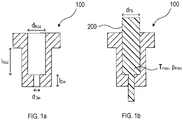
- FIG. 1a schematically shows a cross-section of a printing head 100 comprising a nozzle and a die.
- the length of the nozzle is denoted as 1 Noz and the internal diameter of the nozzle is denoted as d Noz .
- the length of the die is denoted as l Die and the internal diameter of the die is denoted as d Die .
- a chamber within the nozzle is adapted to receive a filament of thermoplastic build material, as will be shown in FIG. 1b .
- the thermal energy transfer needed to melt the build material takes place via the walls of the nozzle. Therefore, 1 Noz signifies the length of a heating chamber. Heating elements are not depicted.
- FIG. 1b shows the printing head 100 of FIG. 1a after having received a filament 200 of thermoplastic build material.
- the filament 200 has a diameter d Fil which matches d Noz as closely as possible and ideally is equal to d Noz .
- filament 200 has been molten. Inside the nozzle the molten material has a maximum melt temperature T max and exerts a maximum pressure p max against the walls of the nozzle.
- examples 1 to 4 the individual contributions of the dripping owing to material expansion in the nozzle and to gravity were calculated for two different filament diameters.
- the build material which was used in the calculations was an aromatic, C 4 ester-based thermoplastic polyurethane having a crystallization temperature (DSC according to DIN EN ISO 11357, 10 K/min) of 82 °C and a ratio of storage modulus G' 100 at 100 °C to storage modulus G' 20 at 20 °C (DMA according to DIN EN ISO 6721, 1 Hz, 2 K/min) of 55%.
- DSC crystallization temperature
- DMA storage modulus G' 100 at 100 °C to storage modulus G' 20 at 20 °C
- Example 1 1,75 mm filament diameter d Fil , 1,0 mm die diameter d Die
- Example 3 1,75 mm filament diameter d Fil , 0,4 mm die diameter d Die
Landscapes
- Engineering & Computer Science (AREA)
- Chemical & Material Sciences (AREA)
- Materials Engineering (AREA)
- Manufacturing & Machinery (AREA)
- Mechanical Engineering (AREA)
- Physics & Mathematics (AREA)
- Optics & Photonics (AREA)
Abstract
Description
- The present invention relates to fused deposition modeling method operating parameters in conjunction with a certain class of thermoplastic polyurethanes.
- The use of thermoplastic polyurethanes (TPU) as build materials in additive manufacturing (3D printing) processes is known.
-
WO 2015/109141 A1 discloses systems and methods for solid freeform fabrication as well as various articles made using the same, where the systems and methods utilize certain thermoplastic polyurethanes which are particularly suited for such processing. The useful thermoplastic polyurethanes are derived from (a) a polyisocyanate component, (b) a polyol component, and (c) an optional chain extender component where the resulting thermoplastic polyurethane has a crystallization temperature above 80 °C and retains more than 20% of its shear storage modulus at 100°C relative to its shear storage modulus at 20°C. - The viscosity of a molten TPU depends upon, inter alia, its shear rate, pressure and temperature. Viscosity characteristics of the molten TPU can influence the result of the 3D printing process, for example the total time needed to print the desired article, the resolution achievable and the deviations from dimensional stability as a result of warping in the finished article. Furthermore, melt dripping of polymer out of the printing head is undesirable since countermeasures such as retracting the filament have to be taken.
- The present invention has the object of providing optimized 3D printing parameters in a fused deposition modeling (FDM) process for a certain type of TPU build material. This object is achieved by a method according to claim 1. Advantageous embodiments are the subject of the dependent claims. They may be combined freely unless the context clearly indicates otherwise.
- Accordingly, an additive manufacturing method is provided which comprises the fabrication of an article in a fused deposition modeling process from a build material comprising a thermoplastic polyurethane; wherein the build material has a crystallization temperature of ≥ 80 °C as determined by differential scanning calorimetry according to DIN EN ISO 11357 at a cooling rate of 10 K/min, a storage modulus G'20 at 20 °C as determined by torsional dynamic mechanical analysis according to DIN EN ISO 6721 at a frequency of 1 Hz and a heating rate of 2 K/min, a storage modulus G'100 at 100 °C as determined by torsional dynamic mechanical analysis according to DIN EN ISO 6721 at a frequency of 1 Hz and a heating rate of 2 K/min and a ratio G'100/G'20 of ≥ 0.2; wherein the build material is molten inside a printing head comprising a nozzle with a length lNoz and an internal diameter dNoz a) of ≥ 1.7 mm to ≤ 1.8 mm or b) of ≥ 2.8 mm to ≤ 2.9 mm; such that the molten build material has a maximum temperature Tmax and such that the molten build material has a maximum internal pressure pmax and wherein the molten build material is expelled through an unclogged die of the nozzle at a mass rate ṁ, the die having a length lDie an internal diameter dDie of ≥ 0,9 mm to ≤ 1,1 mm or of ≥ 0,3 mm to ≤ 0,5 mm.
- The method furthermore provides for that:
- a) for the nozzle having an internal diameter dNoz of ≥ 1,7 mm to ≤ 1,8 mm and the die having an internal diameter dDie of ≥ 0,9 mm to ≤ 1,1 mm:
- aa) for the mass rate ṁ being ≥ 15 mg/s to ≤ 60 mg/s: Tmax is ≥ 220 °C to ≤ 230 °C and pmax is ≥ 300 kPa to ≤ 600 kPa;
- ab) for the mass rate ṁ being > 60 mg/s to ≤ 165 mg/s: Tmax is ≥ 235 °C to ≤ 245 °C and pmax is ≥ 400 kPa to ≤ 850 kPa;
- b) for the nozzle having an internal diameter dNoz of ≥ 2,8 mm to ≤ 2,9 mm and the die having an internal diameter dDie of ≥ 0,9 mm to ≤ 1,1 mm:
- ba) for the mass rate ṁ being ≥ 15 mg/s to ≤ 60 mg/s: Tmax is ≥ 220 °C to ≤ 230 °C and pmax is ≥ 200 kPa to ≤ 450 kPa;
- bb) for the mass rate ṁ being > 60 mg/s to ≤ 165 mg/s: Tmax is ≥ 235 °C to ≤ 245 °C and pmax is ≥ 280 kPa to ≤ 550 kPa;
- c) for the nozzle having an internal diameter dNoz of ≥ 1,7 mm to ≤ 1,8 mm and the die having an internal diameter dDie of ≥ 0,3 mm to ≤ 0,5 mm:
- ca) for the mass rate ṁ being ≥ 15 mg/s to ≤ 60 mg/s: Tmax is ≥ 250 °C to ≤ 260 °C and pmax is ≥ 900 kPa to ≤ 1900 kPa;
- cb) for the mass rate ṁ being > 60 mg/s to ≤ 165 mg/s: Tmax is ≥ 250 °C to ≤ 260 °C and pmax is ≥ 2500 kPa to ≤ 4500 kPa;
- d) for the nozzle having an internal diameter dNoz of ≥ 2,8 mm to ≤ 2,9 mm and the die having an internal diameter dDie of ≥ 0,3 mm to ≤ 0,5 mm:
- da) for the mass rate ṁ being ≥ 15 mg/s to ≤ 60 mg/s: Tmax is ≥ 250 °C to ≤ 260 °C and pmax is ≥ 900 kPa to ≤ 1900 kPa;
- db) for the mass rate ṁ being > 60 mg/s to ≤ 165 mg/s: Tmax is ≥ 250 °C to ≤ 260 °C and pmax is ≥ 2500 kPa to ≤ 4500 kPa.
- It has been found that in an FDM process using the material, parameters and machine settings according to the invention the total melt dripping from the printing head, expressed as the sum of dripping induced by the thermal expansion of the material and by gravity, is minimized. The expansion dripping is considered as a measure for an initial melt dripping and the gravity dripping a measure for a long-term melt dripping. In particular, the unwanted oozing of molten build material from the die during traveling of the print head can be minimized or suppressed entirely.
- For an analytical modeling, the pressure drop between the internal pressure inside the nozzle and the outside, atmospheric pressure can be calculated using the Hagen-Poiseuille equation with contributions from the nozzle and the die. Likewise, the dripping from the melt compression and via contribution from gravity may be expressed analytically.
- In another embodiment of the method,
- a) for the nozzle having an internal diameter dNoz of ≥ 1.7 mm to ≤ 1.8 mm and the die having an internal diameter dDie of ≥ 0,9 mm to ≤ 1,1 mm:
- aaa) for the mass rate ṁ being ≥ 15 mg/s to ≤ 25 mg/s: Tmax is ≥ 220 °C to ≤ 230 °C and pmax is ≥ 300 kPa to ≤ 330 kPa;
- aab) for the mass rate ṁ being ≥ 35 mg/s to ≤ 45 mg/s: Tmax is ≥ 220 °C to ≤ 230 °C and pmax is ≥ 565 kPa to ≤ 595 kPa;
- aba) for the mass rate ṁ being ≥ 75 mg/s to ≤ 85 mg/s: Tmax is ≥ 235 °C to ≤ 245 °C and pmax is ≥ 415 kPa to ≤ 445 kPa;
- abb) for the mass rate ṁ being ≥ 155 mg/s to ≤ 165 mg/s: Tmax is ≥ 235 °C to ≤ 245 °C and pmax is ≥ 765 kPa to ≤ 795 kPa;
- b) for the nozzle having an internal diameter dNoz of ≥ 2,8 mm to ≤ 2,9 mm and the die having an internal diameter dDie of ≥ 0,9 mm to ≤ 1,1 mm:
- baa) for the mass rate ṁ being ≥ 15 mg/s to ≤ 25 mg/s: Tmax is ≥ 220 °C to ≤ 230 °C and pmax is ≥ 200 kPa to ≤ 230 kPa;
- bab) for the mass rate ṁ being ≥ 35 mg/s to ≤ 45 mg/s: Tmax is ≥ 220 °C to ≤ 230 °C and pmax is ≥ 380 kPa to ≤ 410 kPa;
- bba) for the mass rate ṁ being ≥ 75 mg/s to ≤ 85 mg/s: Tmax is ≥ 235 °C to ≤ 245 °C and pmax is ≥ 280 kPa to ≤ 310 kPa;
- bbb) for the mass rate ṁ being ≥ 155 mg/s to ≤ 165 mg/s: Tmax is ≥ 235 °C to ≤ 245 °C and
- pmax is ≥ 510 kPa to ≤ 540 kPa;
- c) for the nozzle having an internal diameter dNoz of ≥ 1.7 mm to ≤ 1.8 mm and the die having an internal diameter dDie of ≥ 0,3 mm to ≤ 0,5 mm:
- caa) for the mass rate ṁ being ≥ 15 mg/s to ≤ 25 mg/s: Tmax is ≥ 250 °C to ≤ 260 °C and pmax is ≥ 1010 kPa to ≤ 1040 kPa;
- cab) for the mass rate ṁ being ≥ 35 mg/s to ≤ 45 mg/s: Tmax is ≥ 250 °C to ≤ 260 °C and pmax is ≥ 1735 kPa to ≤ 1765 kPa;
- cba) for the mass rate ṁ being ≥ 75 mg/s to ≤ 85 mg/s: Tmax is ≥ 250 °C to ≤ 260 °C and pmax is ≥ 2825 kPa to ≤ 2855 kPa;
- cbb) for the mass rate ṁ being ≥ 155 mg/s to ≤ 165 mg/s: Tmax is ≥ 250 °C to ≤ 260 °C and pmax is ≥ 4330 kPa to ≤ 4360 kPa;
- d) for the nozzle having an internal diameter dNoz of ≥ 2,8 mm to ≤ 2,9 mm and the die having an internal diameter dDie of ≥ 0,3 mm to ≤ 0,5 mm:
- daa) for the mass rate ṁ being ≥ 15 mg/s to ≤ 25 mg/s: Tmax is ≥ 250 °C to ≤ 260 °C and pmax is ≥ 1010 kPa to ≤ 1040 kPa;
- dab) for the mass rate ṁ being ≥ 35 mg/s to ≤ 45 mg/s: Tmax is ≥ 250 °C to ≤ 260 °C and pmax is ≥ 1735 kPa to ≤ 1765 kPa;
- dba) for the mass rate ṁ being ≥ 75 mg/s to ≤ 85 mg/s: Tmax is ≥ 250 °C to ≤ 250 °C and pmax is ≥ 2765 kPa to ≤ 2795 kPa;
- dbb) for the mass rate ṁ being ≥ 155 mg/s to ≤ 165 mg/s: Tmax is ≥ 250 °C to ≤ 260 °C and pmax is ≥ 4215 kPa to ≤ 4245 kPa.
- In another embodiment of the method the ratio lNoz:dNoz is ≥ 4:1 to ≤ 7:1.
- In another embodiment of the method the build material has a crystallization temperature of ≥ 80 °C to ≤ 85 °C as determined by differential scanning calorimetry according to DIN EN ISO 11357 at a cooling rate of 10 K/min.
- In another embodiment of the method the build material has a storage modulus G'20 at 20 °C of ≥ 50 MPa to ≤ 60 MPa as determined by torsional dynamic mechanical analysis according to DIN EN ISO 6721 at a frequency of 1 Hz and a heating rate of 2 K/min.
- In another embodiment of the method the build material has a storage modulus G'100 at 100 °C of ≥ 15 MPa to ≤ 25 MPa as determined by torsional dynamic mechanical analysis according to DIN EN ISO 6721 at a frequency of 1 Hz and a heating rate of 2 K/min.
- In another embodiment of the method the build material has a ratio G'100/G'20 of ≥ 1:4 to ≤ 1:1.5.
- In another embodiment of the method the build material has a Shore A hardness according to DIN ISO 7619-1 of ≥ 82 to ≤ 87.
- In another embodiment of the method the polyurethane is obtainable by the reaction of:
- a) a polyisocyanate component comprising an aromatic diisocyanate, an aliphatic diisocyanate or a mixture of the aforementioned substances;
- b) a polyol component comprising poly(tetramethylene ether glycol), polybutylene adipate or a mixture of the aforementioned substances and
- c) a chain extender component comprising a linear α,ω-alkylene diol.
- Preferred are molar ratios of chain extenders c) to polyols b) of ≥ 1,5:1.
- In another embodiment of the method the article is a fluid-controlled actuator. Such actuators may be hydraulic or pneumatic soft grippers, for example.
- The present invention will be described in greater detail with reference to the following examples and figures without wishing to be limited to them.
-
FIG. 1a schematically shows a cross-section of aprinting head 100 comprising a nozzle and a die. The length of the nozzle is denoted as 1Noz and the internal diameter of the nozzle is denoted as dNoz. Likewise, the length of the die is denoted as lDie and the internal diameter of the die is denoted as dDie. A chamber within the nozzle is adapted to receive a filament of thermoplastic build material, as will be shown inFIG. 1b . The thermal energy transfer needed to melt the build material takes place via the walls of the nozzle. Therefore, 1Noz signifies the length of a heating chamber. Heating elements are not depicted. -
FIG. 1b shows theprinting head 100 ofFIG. 1a after having received afilament 200 of thermoplastic build material. Thefilament 200 has a diameter dFil which matches dNoz as closely as possible and ideally is equal to dNoz. In the course of a 3D printing operation,filament 200 has been molten. Inside the nozzle the molten material has a maximum melt temperature Tmax and exerts a maximum pressure pmax against the walls of the nozzle. - In examples 1 to 4 the individual contributions of the dripping owing to material expansion in the nozzle and to gravity were calculated for two different filament diameters. In examples 1 and 2, the dimensions of the nozzle and die (cf.
FIG. 1a ) were: dNoz = dFil; lNoz = 11,5 mm; dDie = 1,0 mm and lDie = 2,47 mm. In examples 3 and 4, the dimensions of the nozzle and die (cf.FIG. 1a ) were: dNoz = dFil; lNoz = 11,5 mm; dDie = 0,4 mm and lDie = 2,47 mm. - In each of examples 1 to 4, the lowest total melt dripping sum for a given mass rate ṁ is marked in underlined bold typeface. Then it is easy to identify machine settings such as melt temperatures Tmax for a desired printing speed (i.e., mass rate).
- The build material which was used in the calculations was an aromatic, C4 ester-based thermoplastic polyurethane having a crystallization temperature (DSC according to DIN EN ISO 11357, 10 K/min) of 82 °C and a ratio of storage modulus G'100 at 100 °C to storage modulus G'20 at 20 °C (DMA according to DIN EN ISO 6721, 1 Hz, 2 K/min) of 55%.
-
Melt temperature Tmax [°C] 225 Mass rate ṁ [mg/s] 20 40 80 160 Pressure pmax [bar] 3,1455643 5,8100516 10,3660944 17,7295613 Dripping - Expansion [mg] 0,0054885 0,0100394 0,0176652 0,0296598 Dripping - Gravity [mg/s] 0,0037610 0,0037636 0,0037639 0,0037645 Total Melt Dripping 0,0092495 0,0138030 0,0214291 0,0334243 Melt temperature Tmax [°C] 240 Mass rate ṁ [mg/s] 20 40 80 160 Pressure pmax [bar] 1,1979556 2,2946814 4,2985392 7,8107118 Dripping - Expansion [mg] 0,0022166 0,0042236 0,0078486 0,0140948 Dripping - Gravity [mg/s] 0,0104380 0,0104383 0,0104387 0,0104395 Total Melt Dripping 0,0126546 0,0146618 0,0182873 0,0245343 Melt temperature Tmax [°C] 255 Mass rate ṁ [mg/s] 20 40 80 160 Pressure pmax [bar] 0,5101828 0,9957166 1,9167280 3,6158387 Dripping - Expansion [mg] 0,0009964 0,0019389 0,0037149 0,0069579 Dripping - Gravity [mg/s] 0,0248208 0,0248211 0,0248211 0,0248211 Total Melt Dripping 0,0258171 0,0267599 0,0285360 0,0317790 -
Melt temperature Tmax [°C] 225 Mass rate ṁ [mg/s] 20 40 80 160 Pressure pmax [bar] 2,1783936 3,9544568 6,8875359 11,4241749 Dripping - Expansion [mg] 0,0118911 0,0215041 0,0372325 0,0612064 Dripping - Gravity [mg/s] 0,0103084 0,0103089 0,0103096 0,0103092 Total Melt Dripping 0,0221996 0,0318130 0,0475421 0,0715155 Melt temperature Tmax [°C] 240 Mass rate ṁ [mg/s] 20 40 80 160 Pressure pmax [bar] 0,8430297 1,5994318 2,9533409 5,2568063 Dripping - Expansion [mg] 0,0048527 0,0091893 0,0169165 0,0299662 Dripping - Gravity [mg/s] 0,0285749 0,0285755 0,0285765 0,0285643 Total Melt Dripping 0,0334276 0,0377648 0,0454930 0,0585305 Melt temperature Tmax [°C] 255 Mass rate ṁ [mg/s] 20 40 80 160 Pressure pmax [bar] 0,3617169 0,7021239 1,3401402 2,4957428 Dripping - Expansion [mg] 0,0021918 0,0042502 0,0080989 0,0150423 Dripping - Gravity [mg/s] 0,0681300 0,0681328 0,0681340 0,0680789 Total Melt Dripping 0,0703218 0,0723830 0,0762330 0,0831211 -
Melt temperature Tmax [°C] 225 Mass rate ṁ [mg/s] 20 40 80 160 Pressure pmax [bar] 39,6935451 58,2627990 81,7355813 110,8671013 Dripping - Expansion [mg] 0,0802176 0,1167452 0,1619082 0,2163630 Dripping - Gravity [mg/s] 0,0006050 0,0006064 0,0006048 0,0006053 Total Melt Dripping 0,0808226 0,1173516 0,1625130 0,2169682 Melt temperature Tmax [°C] 240 Mass rate ṁ [mg/s] 20 40 80 160 Pressure pmax [bar] 20,1731389 32,1551369 48,4455618 69,4151355 Dripping - Expansion [mg] 0,0432011 0,0685014 0,1024375 0,1452838 Dripping - Gravity [mg/s] 0,0016776 0,0016788 0,0016874 0,0016840 Total Melt Dripping 0,0448787 0,0701802 0,1041249 0,1469678 Melt temperature Tmax [°C] 255 Mass rate ṁ [mg/s] 20 40 80 160 Pressure pmax [bar] 10,2482954 17,5262589 28,3857055 43,4310305 Dripping - Expansion [mg] 0,0231652 0,0394899 0,0636484 0,0967037 Dripping - Gravity [mg/s] 0,0040049 0,0040014 0,0040036 0,0040095 Total Melt Dripping 0,0271701 0,0434913 0,0676519 0,1007132 -
Melt temperature Tmax [°C] 225 Mass rate ṁ [mg/s] 20 40 80 160 Pressure pmax [bar] 38,7263744 56,4072041 78,2570228 104,5617148 Dripping - Expansion [mg] 0,2143017 0,3106296 0,4282936 0,5678392 Dripping - Gravity [mg/s] 0,0016467 0,0016484 0,0016490 0,0016492 Total Melt Dripping 0,2159484 0,3122780 0,4299426 0,5694884 Melt temperature Tmax [°C] 240 Mass rate ṁ [mg/s] 20 40 80 160 Pressure pmax [bar] 19,8182130 31,4598873 47,1003634 66,8612300 Dripping - Expansion [mg] 0,1158317 0,1832724 0,2731644 0,3855352 Dripping - Gravity [mg/s] 0,0045606 0,0045565 0,0045644 0,0045653 Total Melt Dripping 0,1203924 0,1878289 0,2777288 0,3901005 Melt temperature Tmax [°C] 255 Mass rate ṁ [mg/s] 20 40 80 160 Pressure pmax [bar] 10,0998295 17,2326662 27,8091177 42,3109346 Dripping - Expansion [mg] 0,0622142 0,1059290 0,1704084 0,2581506 Dripping - Gravity [mg/s] 0,0108704 0,0108894 0,0108230 0,0108721 Total Melt Dripping 0,0730846 0,1168184 0,1812314 0,2690227
Claims (10)
- An additive manufacturing method comprising the fabrication of an article in a fused deposition modeling process from a build material comprising a thermoplastic polyurethane;
wherein the build material hasa crystallization temperature of ≥ 80 °C as determined by differential scanning calorimetry according to DIN EN ISO 11357 at a cooling rate of 10 K/min,a storage modulus G'20 at 20 °C as determined by torsional dynamic mechanical analysis according to DIN EN ISO 6721 at a frequency of 1 Hz and a heating rate of 2 K/min,a storage modulus G'100 at 100 °C as determined by torsional dynamic mechanical analysis according to DIN EN ISO 6721 at a frequency of 1 Hz and a heating rate of 2 K/min anda ratio G'100/G'20 of ≥ 0.2;wherein the build material is molten inside a printing head comprising a nozzle with a length lNoz and an internal diameter dNoZ of ≥ 1,7 mm to ≤ 1,8 mm or of ≥ 2,8 mm to ≤ 2,9 mm;
such that the molten build material has a maximum temperature Tmax and such that the molten build material has a maximum internal pressure pmax
and
wherein the molten build material is expelled through an unclogged die of the nozzle at a mass rate ṁ, the die having a length lDie an internal diameter dDie of ≥ 0,9 mm to ≤ 1,1 mm or of ≥ 0,3 mm to ≤ 0,5 mm,
characterized in thata) for the nozzle having an internal diameter dNoz of ≥ 1,7 mm to ≤ 1,8 mm and the die having an internal diameter dDie of ≥ 0,9 mm to ≤ 1,1 mm:aa) for the mass rate ṁ being ≥ 15 mg/s to ≤ 60 mg/s: Tmax is ≥ 220 °C to ≤ 230 °C and pmax is ≥ 300 kPa to ≤ 600 kPa;ab) for the mass rate ṁ being > 60 mg/s to ≤ 165 mg/s: Tmax is ≥ 235 °C to ≤ 245 °C and pmax is ≥ 400 kPa to ≤ 850 kPa;b) for the nozzle having an internal diameter dNoz of ≥ 2,8 mm to ≤ 2,9 mm and the die having an internal diameter dDie of ≥ 0,9 mm to ≤ 1,1 mm:ba) for the mass rate ṁ being ≥ 15 mg/s to ≤ 60 mg/s: Tmax is ≥ 220 °C to ≤ 230 °C and pmax is ≥ 200 kPa to ≤ 450 kPa;bb) for the mass rate ṁ being > 60 mg/s to ≤ 165 mg/s: Tmax is ≥ 235 °C to ≤ 245 °C and pmax is ≥ 280 kPa to ≤ 550 kPa;c) for the nozzle having an internal diameter dNoz of ≥ 1,7 mm to ≤ 1,8 mm and the die having an internal diameter dDie of ≥ 0,3 mm to ≤ 0,5 mm:ca) for the mass rate ṁ being ≥ 15 mg/s to ≤ 60 mg/s: Tmax is ≥ 250 °C to ≤ 260 °C and pmax is ≥ 900 kPa to ≤ 1900 kPa;cb) for the mass rate ṁ being > 60 mg/s to ≤ 165 mg/s: Tmax is ≥ 250 °C to ≤ 260 °C and pmax is ≥ 2500 kPa to ≤ 4500 kPa;andd) for the nozzle having an internal diameter dNoz of ≥ 2,8 mm to ≤ 2,9 mm and the die having an internal diameter dDie of ≥ 0,3 mm to ≤ 0,5 mm:da) for the mass rate ṁ being ≥ 15 mg/s to ≤ 60 mg/s: Tmax is ≥ 250 °C to ≤ 260 °C and pmax is ≥ 900 kPa to ≤ 1900 kPa;db) for the mass rate ṁ being > 60 mg/s to ≤ 165 mg/s: Tmax is ≥ 250 °C to ≤ 260 °C and pmax is ≥ 2500 kPa to ≤ 4500 kPa. - The method according to claim 1, wherein:a) for the nozzle having an internal diameter dNoz of ≥ 1.7 mm to ≤ 1.8 mm and the die having an internal diameter dDie of ≥ 0,9 mm to ≤ 1,1 mm:aaa) for the mass rate ṁ being ≥ 15 mg/s to ≤ 25 mg/s: Tmax is ≥ 220 °C to ≤ 230 °C and pmax is ≥ 300 kPa to ≤ 330 kPa;aab) for the mass rate ṁ being ≥ 35 mg/s to ≤ 45 mg/s: Tmax is ≥ 220 °C to ≤ 230 °C and pmax is ≥ 565 kPa to ≤ 595 kPa;aba) for the mass rate ṁ being ≥ 75 mg/s to ≤ 85 mg/s: Tmax is ≥ 235 °C to ≤ 245 °C and pmax is ≥ 415 kPa to ≤ 445 kPa;abb) for the mass rate ṁ being ≥ 155 mg/s to ≤ 165 mg/s: Tmax is ≥ 235 °C to ≤ 245 °C and pmax is ≥ 765 kPa to ≤ 795 kPa;b) for the nozzle having an internal diameter dNoz of ≥ 2,8 mm to ≤ 2,9 mm and the die having an internal diameter dDie of ≥ 0,9 mm to ≤ 1,1 mm:baa) for the mass rate ṁ being ≥ 15 mg/s to ≤ 25 mg/s: Tmax is ≥ 220 °C to ≤ 230 °C and pmax is ≥ 200 kPa to ≤ 230 kPa;bab) for the mass rate ṁ being ≥ 35 mg/s to ≤ 45 mg/s: Tmax is ≥ 220 °C to ≤ 230 °C and pmax is ≥ 380 kPa to ≤ 410 kPa;bba) for the mass rate ṁ being ≥ 75 mg/s to ≤ 85 mg/s: Tmax is ≥ 235 °C to ≤ 245 °C and pmax is ≥ 280 kPa to ≤ 310 kPa;bbb) for the mass rate ṁ being ≥ 155 mg/s to ≤ 165 mg/s: Tmax is ≥ 235 °C to ≤ 245 °C and pmax is ≥ 510 kPa to ≤ 540 kPa;c) for the nozzle having an internal diameter dNoz of ≥ 1.7 mm to ≤ 1.8 mm and the die having an internal diameter dDie of ≥ 0,3 mm to ≤ 0,5 mm:caa) for the mass rate ṁ being ≥ 15 mg/s to ≤ 25 mg/s: Tmax is ≥ 250 °C to ≤ 260 °C and pmax is ≥ 1010 kPa to ≤ 1040 kPa;cab) for the mass rate ṁ being ≥ 35 mg/s to ≤ 45 mg/s: Tmax is ≥ 250 °C to ≤ 260 °C and pmax is ≥ 1735 kPa to ≤ 1765 kPa;cba) for the mass rate ṁ being ≥ 75 mg/s to ≤ 85 mg/s: Tmax is ≥ 250 °C to ≤ 260 °C and pmax is ≥ 2825 kPa to ≤ 2855 kPa;cbb) for the mass rate ṁ being ≥ 155 mg/s to ≤ 165 mg/s: Tmax is ≥ 250 °C to ≤ 260 °C and pmax is ≥ 4330 kPa to ≤ 4360 kPa;andd) for the nozzle having an internal diameter dNoz of ≥ 2,8 mm to ≤ 2,9 mm and the die having an internal diameter dDie of ≥ 0,3 mm to ≤ 0,5 mm:daa) for the mass rate ṁ being ≥ 15 mg/s to ≤ 25 mg/s: Tmax is ≥ 250 °C to ≤ 260 °C and pmax is ≥ 1010 kPa to ≤ 1040 kPa;dab) for the mass rate ṁ being ≥ 35 mg/s to ≤ 45 mg/s: Tmax is ≥ 250 °C to ≤ 260 °C and pmax is ≥ 1735 kPa to ≤ 1765 kPa;dba) for the mass rate ṁ being ≥ 75 mg/s to ≤ 85 mg/s: Tmax is ≥ 250 °C to ≤ 250 °C and pmax is ≥ 2765 kPa to ≤ 2795 kPa;dbb) for the mass rate ṁ being ≥ 155 mg/s to ≤ 165 mg/s: Tmax is ≥ 250 °C to ≤ 260 °C and pmax is ≥ 4215 kPa to ≤ 4245 kPa.
- The method according to claim 1 or 2, wherein the ratio lNoz:dNoz is ≥ 4:1 to ≤ 7:1.
- The method according to any one of the preceding claims, wherein the build material has a crystallization temperature of ≥ 80 °C to ≤ 85 °C as determined by differential scanning calorimetry according to DIN EN ISO 11357 at a cooling rate of 10 K/min.
- The method according to any one of the preceding claims, wherein the build material has a storage modulus G'20 at 20 °C of ≥ 50 MPa to ≤ 60 MPa as determined by torsional dynamic mechanical analysis according to DIN EN ISO 6721 at a frequency of 1 Hz and a heating rate of 2 K/min.
- The method according to any one of the preceding claims, wherein the build material has a storage modulus G'100 at 100 °C of ≥ 15 MPa to ≤ 25 MPa as determined by torsional dynamic mechanical analysis according to DIN EN ISO 6721 at a frequency of 1 Hz and a heating rate of 2 K/min.
- The method according to any one of the preceding claims, wherein the build material has a ratio G'100/G'20 of ≥ 1:4 to ≤ 1:1.5.
- The method according to any one of the preceding claims, wherein the build material has a Shore A hardness according to DIN ISO 7619-1 of ≥ 82 to ≤ 87.
- The method according to any one of the preceding claims, wherein the polyurethane is obtainable by the reaction of:a) a polyisocyanate component comprising an aromatic diisocyanate, an aliphatic diisocyanate or a mixture of the aforementioned substances;b) a polyol component comprising poly(tetramethylene ether glycol), polybutylene adipate or a mixture of the aforementioned substances andc) a chain extender component comprising a linear α,ω-alkylene diol.
- The method according to any one of the preceding claims, wherein the article is a fluid-controlled actuator.
Priority Applications (3)
| Application Number | Priority Date | Filing Date | Title |
|---|---|---|---|
| EP21152245.3A EP4029674B8 (en) | 2021-01-19 | 2021-01-19 | Additive manufacturing method |
| EP21840554.6A EP4281274A1 (en) | 2021-01-19 | 2021-12-17 | Additive manufacturing method |
| PCT/EP2021/086363 WO2022156972A1 (en) | 2021-01-19 | 2021-12-17 | Additive manufacturing method |
Applications Claiming Priority (1)
| Application Number | Priority Date | Filing Date | Title |
|---|---|---|---|
| EP21152245.3A EP4029674B8 (en) | 2021-01-19 | 2021-01-19 | Additive manufacturing method |
Publications (3)
| Publication Number | Publication Date |
|---|---|
| EP4029674A1 true EP4029674A1 (en) | 2022-07-20 |
| EP4029674B1 EP4029674B1 (en) | 2023-11-01 |
| EP4029674B8 EP4029674B8 (en) | 2024-01-17 |
Family
ID=74191563
Family Applications (2)
| Application Number | Title | Priority Date | Filing Date |
|---|---|---|---|
| EP21152245.3A Active EP4029674B8 (en) | 2021-01-19 | 2021-01-19 | Additive manufacturing method |
| EP21840554.6A Withdrawn EP4281274A1 (en) | 2021-01-19 | 2021-12-17 | Additive manufacturing method |
Family Applications After (1)
| Application Number | Title | Priority Date | Filing Date |
|---|---|---|---|
| EP21840554.6A Withdrawn EP4281274A1 (en) | 2021-01-19 | 2021-12-17 | Additive manufacturing method |
Country Status (2)
| Country | Link |
|---|---|
| EP (2) | EP4029674B8 (en) |
| WO (1) | WO2022156972A1 (en) |
Citations (1)
| Publication number | Priority date | Publication date | Assignee | Title |
|---|---|---|---|---|
| WO2015109141A1 (en) | 2014-01-17 | 2015-07-23 | Lubrizol Advanced Materials, Inc. | Methods of using thermoplastic polyurethanes in fused deposition modeling and systems and articles thereof |
-
2021
- 2021-01-19 EP EP21152245.3A patent/EP4029674B8/en active Active
- 2021-12-17 WO PCT/EP2021/086363 patent/WO2022156972A1/en not_active Ceased
- 2021-12-17 EP EP21840554.6A patent/EP4281274A1/en not_active Withdrawn
Patent Citations (2)
| Publication number | Priority date | Publication date | Assignee | Title |
|---|---|---|---|---|
| WO2015109141A1 (en) | 2014-01-17 | 2015-07-23 | Lubrizol Advanced Materials, Inc. | Methods of using thermoplastic polyurethanes in fused deposition modeling and systems and articles thereof |
| EP3540012A1 (en) * | 2014-01-17 | 2019-09-18 | Lubrizol Advanced Materials, Inc. | Methods of using thermoplastic polyurethanes in fused deposition modeling and systems and articles thereof |
Non-Patent Citations (2)
| Title |
|---|
| MIDORR: "Tipps für TPU-Druck - 3D Drucker - FPV Racing Forum - die Community für FPV Racer!", 10 November 2017 (2017-11-10), XP055818124, Retrieved from the Internet <URL:https://fpv-racing-forum.de/thread/5924-tipps-für-tpu-druck/?pageNo=1> [retrieved on 20210625] * |
| RICHTER ALEC: "How To Succeed When Printing With Flexible Filament | MatterHackers", MATTERHACKERS, 9 September 2020 (2020-09-09), pages 1 - 23, XP055818134, Retrieved from the Internet <URL:https://www.matterhackers.com/articles/how-to-succeed-when-printing-with-flexible-filament> [retrieved on 20210625] * |
Also Published As
| Publication number | Publication date |
|---|---|
| EP4029674B8 (en) | 2024-01-17 |
| EP4029674B1 (en) | 2023-11-01 |
| WO2022156972A1 (en) | 2022-07-28 |
| EP4281274A1 (en) | 2023-11-29 |
Similar Documents
| Publication | Publication Date | Title |
|---|---|---|
| EP2213387B1 (en) | Magnesium alloy hot-rolling mill | |
| EP2025730B1 (en) | Moisture-curable polyurethane hot melt adhesive and multilayer sheet using the same | |
| US10926459B2 (en) | Powder-based additive manufacturing process at low temperatures | |
| KR102458782B1 (en) | Articles made from hydrophilic thermoplastic polyurethane compositions | |
| TWI648340B (en) | Thermoplastic polyurethanes, production thereof and use | |
| CN107075075A (en) | The purposes of thermoplastic polyurethane powder | |
| US11440242B2 (en) | Fused deposition modeling-based additive manufacturing process at low temperatures | |
| EP4029674B1 (en) | Additive manufacturing method | |
| US10899075B2 (en) | Powder-based additive manufacturing process | |
| US10899074B2 (en) | Powder-based additive manufacturing process | |
| EP2552987B1 (en) | Hotmelt adhesive bonding with thermoplastic polyurethane | |
| DE102019007939A1 (en) | Process for the production of molded polymer parts from thermoplastic polymers with shape memory properties and / or with thermoresponsive properties, in particular by means of 4D printing, as well as molded polymer parts produced in this way | |
| US8628841B2 (en) | Ceramic green body and method for producing the same | |
| EP2243758B1 (en) | Ceramic green sheet and process for producing the same | |
| US10208227B2 (en) | Low free MDI prepolymers for rotational casting | |
| KR20220045957A (en) | Methods of making thermoplastic processable polyurethane polymers | |
| CN114269543A (en) | Method for preparing 3D object by fuse manufacturing method | |
| KR101675649B1 (en) | Cutting tool | |
| KR20160031009A (en) | Isocyanate prepolymer composition and crosslinked polyurethane prepared therefrom | |
| EP4045290B1 (en) | A process for producing a three-dimensional (3d) object employing granulates | |
| KR101376358B1 (en) | Extrusion Method | |
| US20210276245A1 (en) | Polyester filament and use in fused filament fabrication | |
| KR101824654B1 (en) | Cutting insert for forged steel | |
| EP4461509A1 (en) | Systems and methods for additively manufacturing leak resistant objects | |
| KR20240160574A (en) | PEBA with hollow glass beads for direct bonding to TPE |
Legal Events
| Date | Code | Title | Description |
|---|---|---|---|
| PUAI | Public reference made under article 153(3) epc to a published international application that has entered the european phase |
Free format text: ORIGINAL CODE: 0009012 |
|
| STAA | Information on the status of an ep patent application or granted ep patent |
Free format text: STATUS: THE APPLICATION HAS BEEN PUBLISHED |
|
| AK | Designated contracting states |
Kind code of ref document: A1 Designated state(s): AL AT BE BG CH CY CZ DE DK EE ES FI FR GB GR HR HU IE IS IT LI LT LU LV MC MK MT NL NO PL PT RO RS SE SI SK SM TR |
|
| STAA | Information on the status of an ep patent application or granted ep patent |
Free format text: STATUS: REQUEST FOR EXAMINATION WAS MADE |
|
| 17P | Request for examination filed |
Effective date: 20221221 |
|
| RBV | Designated contracting states (corrected) |
Designated state(s): AL AT BE BG CH CY CZ DE DK EE ES FI FR GB GR HR HU IE IS IT LI LT LU LV MC MK MT NL NO PL PT RO RS SE SI SK SM TR |
|
| GRAP | Despatch of communication of intention to grant a patent |
Free format text: ORIGINAL CODE: EPIDOSNIGR1 |
|
| STAA | Information on the status of an ep patent application or granted ep patent |
Free format text: STATUS: GRANT OF PATENT IS INTENDED |
|
| RIC1 | Information provided on ipc code assigned before grant |
Ipc: B29K 75/00 20060101ALI20230502BHEP Ipc: B29C 48/00 20190101ALI20230502BHEP Ipc: B29C 64/209 20170101ALI20230502BHEP Ipc: B29C 64/393 20170101ALI20230502BHEP Ipc: B33Y 10/00 20150101ALI20230502BHEP Ipc: B33Y 30/00 20150101ALI20230502BHEP Ipc: B33Y 50/02 20150101ALI20230502BHEP Ipc: B33Y 70/00 20200101ALI20230502BHEP Ipc: B33Y 80/00 20150101ALI20230502BHEP Ipc: B22F 10/00 20210101ALI20230502BHEP Ipc: B22F 12/00 20210101ALI20230502BHEP Ipc: B29C 48/02 20190101ALI20230502BHEP Ipc: B29C 48/30 20190101ALI20230502BHEP Ipc: B29C 48/92 20190101ALI20230502BHEP Ipc: B29C 64/118 20170101AFI20230502BHEP |
|
| INTG | Intention to grant announced |
Effective date: 20230517 |
|
| GRAS | Grant fee paid |
Free format text: ORIGINAL CODE: EPIDOSNIGR3 |
|
| GRAA | (expected) grant |
Free format text: ORIGINAL CODE: 0009210 |
|
| STAA | Information on the status of an ep patent application or granted ep patent |
Free format text: STATUS: THE PATENT HAS BEEN GRANTED |
|
| AK | Designated contracting states |
Kind code of ref document: B1 Designated state(s): AL AT BE BG CH CY CZ DE DK EE ES FI FR GB GR HR HU IE IS IT LI LT LU LV MC MK MT NL NO PL PT RO RS SE SI SK SM TR |
|
| REG | Reference to a national code |
Ref country code: GB Ref legal event code: FG4D |
|
| REG | Reference to a national code |
Ref country code: CH Ref legal event code: EP |
|
| REG | Reference to a national code |
Ref country code: DE Ref legal event code: R096 Ref document number: 602021006274 Country of ref document: DE |
|
| REG | Reference to a national code |
Ref country code: IE Ref legal event code: FG4D |
|
| REG | Reference to a national code |
Ref country code: CH Ref legal event code: PK Free format text: BERICHTIGUNG B8 |
|
| RAP2 | Party data changed (patent owner data changed or rights of a patent transferred) |
Owner name: STRATASYS, INC. |
|
| REG | Reference to a national code |
Ref country code: LT Ref legal event code: MG9D |
|
| REG | Reference to a national code |
Ref country code: NL Ref legal event code: MP Effective date: 20231101 |
|
| PG25 | Lapsed in a contracting state [announced via postgrant information from national office to epo] |
Ref country code: GR Free format text: LAPSE BECAUSE OF FAILURE TO SUBMIT A TRANSLATION OF THE DESCRIPTION OR TO PAY THE FEE WITHIN THE PRESCRIBED TIME-LIMIT Effective date: 20240202 |
|
| PG25 | Lapsed in a contracting state [announced via postgrant information from national office to epo] |
Ref country code: IS Free format text: LAPSE BECAUSE OF FAILURE TO SUBMIT A TRANSLATION OF THE DESCRIPTION OR TO PAY THE FEE WITHIN THE PRESCRIBED TIME-LIMIT Effective date: 20240301 |
|
| PG25 | Lapsed in a contracting state [announced via postgrant information from national office to epo] |
Ref country code: LT Free format text: LAPSE BECAUSE OF FAILURE TO SUBMIT A TRANSLATION OF THE DESCRIPTION OR TO PAY THE FEE WITHIN THE PRESCRIBED TIME-LIMIT Effective date: 20231101 |
|
| REG | Reference to a national code |
Ref country code: AT Ref legal event code: MK05 Ref document number: 1626731 Country of ref document: AT Kind code of ref document: T Effective date: 20231101 |
|
| PG25 | Lapsed in a contracting state [announced via postgrant information from national office to epo] |
Ref country code: NL Free format text: LAPSE BECAUSE OF FAILURE TO SUBMIT A TRANSLATION OF THE DESCRIPTION OR TO PAY THE FEE WITHIN THE PRESCRIBED TIME-LIMIT Effective date: 20231101 |
|
| PG25 | Lapsed in a contracting state [announced via postgrant information from national office to epo] |
Ref country code: AT Free format text: LAPSE BECAUSE OF FAILURE TO SUBMIT A TRANSLATION OF THE DESCRIPTION OR TO PAY THE FEE WITHIN THE PRESCRIBED TIME-LIMIT Effective date: 20231101 |
|
| PG25 | Lapsed in a contracting state [announced via postgrant information from national office to epo] |
Ref country code: ES Free format text: LAPSE BECAUSE OF FAILURE TO SUBMIT A TRANSLATION OF THE DESCRIPTION OR TO PAY THE FEE WITHIN THE PRESCRIBED TIME-LIMIT Effective date: 20231101 |
|
| PG25 | Lapsed in a contracting state [announced via postgrant information from national office to epo] |
Ref country code: NL Free format text: LAPSE BECAUSE OF FAILURE TO SUBMIT A TRANSLATION OF THE DESCRIPTION OR TO PAY THE FEE WITHIN THE PRESCRIBED TIME-LIMIT Effective date: 20231101 Ref country code: LT Free format text: LAPSE BECAUSE OF FAILURE TO SUBMIT A TRANSLATION OF THE DESCRIPTION OR TO PAY THE FEE WITHIN THE PRESCRIBED TIME-LIMIT Effective date: 20231101 Ref country code: IS Free format text: LAPSE BECAUSE OF FAILURE TO SUBMIT A TRANSLATION OF THE DESCRIPTION OR TO PAY THE FEE WITHIN THE PRESCRIBED TIME-LIMIT Effective date: 20240301 Ref country code: GR Free format text: LAPSE BECAUSE OF FAILURE TO SUBMIT A TRANSLATION OF THE DESCRIPTION OR TO PAY THE FEE WITHIN THE PRESCRIBED TIME-LIMIT Effective date: 20240202 Ref country code: ES Free format text: LAPSE BECAUSE OF FAILURE TO SUBMIT A TRANSLATION OF THE DESCRIPTION OR TO PAY THE FEE WITHIN THE PRESCRIBED TIME-LIMIT Effective date: 20231101 Ref country code: BG Free format text: LAPSE BECAUSE OF FAILURE TO SUBMIT A TRANSLATION OF THE DESCRIPTION OR TO PAY THE FEE WITHIN THE PRESCRIBED TIME-LIMIT Effective date: 20240201 Ref country code: AT Free format text: LAPSE BECAUSE OF FAILURE TO SUBMIT A TRANSLATION OF THE DESCRIPTION OR TO PAY THE FEE WITHIN THE PRESCRIBED TIME-LIMIT Effective date: 20231101 Ref country code: PT Free format text: LAPSE BECAUSE OF FAILURE TO SUBMIT A TRANSLATION OF THE DESCRIPTION OR TO PAY THE FEE WITHIN THE PRESCRIBED TIME-LIMIT Effective date: 20240301 |
|
| PG25 | Lapsed in a contracting state [announced via postgrant information from national office to epo] |
Ref country code: SE Free format text: LAPSE BECAUSE OF FAILURE TO SUBMIT A TRANSLATION OF THE DESCRIPTION OR TO PAY THE FEE WITHIN THE PRESCRIBED TIME-LIMIT Effective date: 20231101 Ref country code: RS Free format text: LAPSE BECAUSE OF FAILURE TO SUBMIT A TRANSLATION OF THE DESCRIPTION OR TO PAY THE FEE WITHIN THE PRESCRIBED TIME-LIMIT Effective date: 20231101 Ref country code: PL Free format text: LAPSE BECAUSE OF FAILURE TO SUBMIT A TRANSLATION OF THE DESCRIPTION OR TO PAY THE FEE WITHIN THE PRESCRIBED TIME-LIMIT Effective date: 20231101 Ref country code: NO Free format text: LAPSE BECAUSE OF FAILURE TO SUBMIT A TRANSLATION OF THE DESCRIPTION OR TO PAY THE FEE WITHIN THE PRESCRIBED TIME-LIMIT Effective date: 20240201 Ref country code: LV Free format text: LAPSE BECAUSE OF FAILURE TO SUBMIT A TRANSLATION OF THE DESCRIPTION OR TO PAY THE FEE WITHIN THE PRESCRIBED TIME-LIMIT Effective date: 20231101 Ref country code: HR Free format text: LAPSE BECAUSE OF FAILURE TO SUBMIT A TRANSLATION OF THE DESCRIPTION OR TO PAY THE FEE WITHIN THE PRESCRIBED TIME-LIMIT Effective date: 20231101 |
|
| PG25 | Lapsed in a contracting state [announced via postgrant information from national office to epo] |
Ref country code: DK Free format text: LAPSE BECAUSE OF FAILURE TO SUBMIT A TRANSLATION OF THE DESCRIPTION OR TO PAY THE FEE WITHIN THE PRESCRIBED TIME-LIMIT Effective date: 20231101 |
|
| PG25 | Lapsed in a contracting state [announced via postgrant information from national office to epo] |
Ref country code: CZ Free format text: LAPSE BECAUSE OF FAILURE TO SUBMIT A TRANSLATION OF THE DESCRIPTION OR TO PAY THE FEE WITHIN THE PRESCRIBED TIME-LIMIT Effective date: 20231101 |
|
| PG25 | Lapsed in a contracting state [announced via postgrant information from national office to epo] |
Ref country code: SK Free format text: LAPSE BECAUSE OF FAILURE TO SUBMIT A TRANSLATION OF THE DESCRIPTION OR TO PAY THE FEE WITHIN THE PRESCRIBED TIME-LIMIT Effective date: 20231101 |
|
| PG25 | Lapsed in a contracting state [announced via postgrant information from national office to epo] |
Ref country code: SM Free format text: LAPSE BECAUSE OF FAILURE TO SUBMIT A TRANSLATION OF THE DESCRIPTION OR TO PAY THE FEE WITHIN THE PRESCRIBED TIME-LIMIT Effective date: 20231101 Ref country code: SK Free format text: LAPSE BECAUSE OF FAILURE TO SUBMIT A TRANSLATION OF THE DESCRIPTION OR TO PAY THE FEE WITHIN THE PRESCRIBED TIME-LIMIT Effective date: 20231101 Ref country code: IT Free format text: LAPSE BECAUSE OF FAILURE TO SUBMIT A TRANSLATION OF THE DESCRIPTION OR TO PAY THE FEE WITHIN THE PRESCRIBED TIME-LIMIT Effective date: 20231101 Ref country code: EE Free format text: LAPSE BECAUSE OF FAILURE TO SUBMIT A TRANSLATION OF THE DESCRIPTION OR TO PAY THE FEE WITHIN THE PRESCRIBED TIME-LIMIT Effective date: 20231101 Ref country code: DK Free format text: LAPSE BECAUSE OF FAILURE TO SUBMIT A TRANSLATION OF THE DESCRIPTION OR TO PAY THE FEE WITHIN THE PRESCRIBED TIME-LIMIT Effective date: 20231101 Ref country code: CZ Free format text: LAPSE BECAUSE OF FAILURE TO SUBMIT A TRANSLATION OF THE DESCRIPTION OR TO PAY THE FEE WITHIN THE PRESCRIBED TIME-LIMIT Effective date: 20231101 |
|
| REG | Reference to a national code |
Ref country code: DE Ref legal event code: R097 Ref document number: 602021006274 Country of ref document: DE |
|
| PG25 | Lapsed in a contracting state [announced via postgrant information from national office to epo] |
Ref country code: MC Free format text: LAPSE BECAUSE OF FAILURE TO SUBMIT A TRANSLATION OF THE DESCRIPTION OR TO PAY THE FEE WITHIN THE PRESCRIBED TIME-LIMIT Effective date: 20231101 |
|
| PG25 | Lapsed in a contracting state [announced via postgrant information from national office to epo] |
Ref country code: MC Free format text: LAPSE BECAUSE OF FAILURE TO SUBMIT A TRANSLATION OF THE DESCRIPTION OR TO PAY THE FEE WITHIN THE PRESCRIBED TIME-LIMIT Effective date: 20231101 |
|
| REG | Reference to a national code |
Ref country code: CH Ref legal event code: PL |
|
| PLBE | No opposition filed within time limit |
Free format text: ORIGINAL CODE: 0009261 |
|
| STAA | Information on the status of an ep patent application or granted ep patent |
Free format text: STATUS: NO OPPOSITION FILED WITHIN TIME LIMIT |
|
| PG25 | Lapsed in a contracting state [announced via postgrant information from national office to epo] |
Ref country code: LU Free format text: LAPSE BECAUSE OF NON-PAYMENT OF DUE FEES Effective date: 20240119 |
|
| PG25 | Lapsed in a contracting state [announced via postgrant information from national office to epo] |
Ref country code: LU Free format text: LAPSE BECAUSE OF NON-PAYMENT OF DUE FEES Effective date: 20240119 |
|
| 26N | No opposition filed |
Effective date: 20240802 |
|
| PG25 | Lapsed in a contracting state [announced via postgrant information from national office to epo] |
Ref country code: BE Free format text: LAPSE BECAUSE OF NON-PAYMENT OF DUE FEES Effective date: 20240131 |
|
| PG25 | Lapsed in a contracting state [announced via postgrant information from national office to epo] |
Ref country code: CH Free format text: LAPSE BECAUSE OF NON-PAYMENT OF DUE FEES Effective date: 20240131 |
|
| PG25 | Lapsed in a contracting state [announced via postgrant information from national office to epo] |
Ref country code: SI Free format text: LAPSE BECAUSE OF FAILURE TO SUBMIT A TRANSLATION OF THE DESCRIPTION OR TO PAY THE FEE WITHIN THE PRESCRIBED TIME-LIMIT Effective date: 20231101 |
|
| PG25 | Lapsed in a contracting state [announced via postgrant information from national office to epo] |
Ref country code: SI Free format text: LAPSE BECAUSE OF FAILURE TO SUBMIT A TRANSLATION OF THE DESCRIPTION OR TO PAY THE FEE WITHIN THE PRESCRIBED TIME-LIMIT Effective date: 20231101 Ref country code: CH Free format text: LAPSE BECAUSE OF NON-PAYMENT OF DUE FEES Effective date: 20240131 Ref country code: BE Free format text: LAPSE BECAUSE OF NON-PAYMENT OF DUE FEES Effective date: 20240131 |
|
| REG | Reference to a national code |
Ref country code: BE Ref legal event code: MM Effective date: 20240131 |
|
| PG25 | Lapsed in a contracting state [announced via postgrant information from national office to epo] |
Ref country code: IE Free format text: LAPSE BECAUSE OF NON-PAYMENT OF DUE FEES Effective date: 20240119 |
|
| PG25 | Lapsed in a contracting state [announced via postgrant information from national office to epo] |
Ref country code: IE Free format text: LAPSE BECAUSE OF NON-PAYMENT OF DUE FEES Effective date: 20240119 |
|
| PG25 | Lapsed in a contracting state [announced via postgrant information from national office to epo] |
Ref country code: RO Free format text: LAPSE BECAUSE OF FAILURE TO SUBMIT A TRANSLATION OF THE DESCRIPTION OR TO PAY THE FEE WITHIN THE PRESCRIBED TIME-LIMIT Effective date: 20231101 |
|
| PG25 | Lapsed in a contracting state [announced via postgrant information from national office to epo] |
Ref country code: CY Free format text: LAPSE BECAUSE OF FAILURE TO SUBMIT A TRANSLATION OF THE DESCRIPTION OR TO PAY THE FEE WITHIN THE PRESCRIBED TIME-LIMIT; INVALID AB INITIO Effective date: 20210119 |
|
| PG25 | Lapsed in a contracting state [announced via postgrant information from national office to epo] |
Ref country code: HU Free format text: LAPSE BECAUSE OF FAILURE TO SUBMIT A TRANSLATION OF THE DESCRIPTION OR TO PAY THE FEE WITHIN THE PRESCRIBED TIME-LIMIT; INVALID AB INITIO Effective date: 20210119 |
|
| PG25 | Lapsed in a contracting state [announced via postgrant information from national office to epo] |
Ref country code: FI Free format text: LAPSE BECAUSE OF FAILURE TO SUBMIT A TRANSLATION OF THE DESCRIPTION OR TO PAY THE FEE WITHIN THE PRESCRIBED TIME-LIMIT Effective date: 20231101 |
|
| PG25 | Lapsed in a contracting state [announced via postgrant information from national office to epo] |
Ref country code: TR Free format text: LAPSE BECAUSE OF FAILURE TO SUBMIT A TRANSLATION OF THE DESCRIPTION OR TO PAY THE FEE WITHIN THE PRESCRIBED TIME-LIMIT Effective date: 20231101 |
|
| PGFP | Annual fee paid to national office [announced via postgrant information from national office to epo] |
Ref country code: GB Payment date: 20251220 Year of fee payment: 6 |
|
| PGFP | Annual fee paid to national office [announced via postgrant information from national office to epo] |
Ref country code: FR Payment date: 20251217 Year of fee payment: 6 |
|
| PGFP | Annual fee paid to national office [announced via postgrant information from national office to epo] |
Ref country code: DE Payment date: 20251217 Year of fee payment: 6 |