EP4029538A1 - Biocompatible implant and preparation method of biocompatible implant - Google Patents
Biocompatible implant and preparation method of biocompatible implant Download PDFInfo
- Publication number
- EP4029538A1 EP4029538A1 EP20862738.0A EP20862738A EP4029538A1 EP 4029538 A1 EP4029538 A1 EP 4029538A1 EP 20862738 A EP20862738 A EP 20862738A EP 4029538 A1 EP4029538 A1 EP 4029538A1
- Authority
- EP
- European Patent Office
- Prior art keywords
- coating film
- calcium phosphate
- biocompatible implant
- particles
- crystals
- Prior art date
- Legal status (The legal status is an assumption and is not a legal conclusion. Google has not performed a legal analysis and makes no representation as to the accuracy of the status listed.)
- Withdrawn
Links
- 239000007943 implant Substances 0.000 title claims abstract description 36
- 238000002513 implantation Methods 0.000 title 1
- 238000002360 preparation method Methods 0.000 title 1
- 238000000576 coating method Methods 0.000 claims abstract description 92
- 239000011248 coating agent Substances 0.000 claims abstract description 90
- 239000002245 particle Substances 0.000 claims abstract description 68
- QORWJWZARLRLPR-UHFFFAOYSA-H tricalcium bis(phosphate) Chemical compound [Ca+2].[Ca+2].[Ca+2].[O-]P([O-])([O-])=O.[O-]P([O-])([O-])=O QORWJWZARLRLPR-UHFFFAOYSA-H 0.000 claims abstract description 50
- 229910000389 calcium phosphate Inorganic materials 0.000 claims abstract description 46
- 239000001506 calcium phosphate Substances 0.000 claims abstract description 46
- 235000011010 calcium phosphates Nutrition 0.000 claims abstract description 46
- 239000013078 crystal Substances 0.000 claims abstract description 41
- 229910052709 silver Inorganic materials 0.000 claims abstract description 37
- 239000004332 silver Substances 0.000 claims abstract description 37
- 238000007751 thermal spraying Methods 0.000 claims description 24
- 238000010335 hydrothermal treatment Methods 0.000 claims description 11
- 238000004519 manufacturing process Methods 0.000 claims description 6
- 229910052751 metal Inorganic materials 0.000 claims description 5
- 239000002184 metal Substances 0.000 claims description 5
- 239000000919 ceramic Substances 0.000 claims description 4
- 229910052588 hydroxylapatite Inorganic materials 0.000 claims description 3
- XYJRXVWERLGGKC-UHFFFAOYSA-D pentacalcium;hydroxide;triphosphate Chemical compound [OH-].[Ca+2].[Ca+2].[Ca+2].[Ca+2].[Ca+2].[O-]P([O-])([O-])=O.[O-]P([O-])([O-])=O.[O-]P([O-])([O-])=O XYJRXVWERLGGKC-UHFFFAOYSA-D 0.000 claims description 3
- 239000004033 plastic Substances 0.000 claims description 3
- 229920003023 plastic Polymers 0.000 claims description 3
- 238000012545 processing Methods 0.000 claims description 3
- XLYOFNOQVPJJNP-UHFFFAOYSA-N water Substances O XLYOFNOQVPJJNP-UHFFFAOYSA-N 0.000 claims description 3
- 210000000988 bone and bone Anatomy 0.000 claims description 2
- 239000004053 dental implant Substances 0.000 claims description 2
- 229940100890 silver compound Drugs 0.000 claims description 2
- 150000003379 silver compounds Chemical class 0.000 claims description 2
- GBNXLQPMFAUCOI-UHFFFAOYSA-H tetracalcium;oxygen(2-);diphosphate Chemical compound [O-2].[Ca+2].[Ca+2].[Ca+2].[Ca+2].[O-]P([O-])([O-])=O.[O-]P([O-])([O-])=O GBNXLQPMFAUCOI-UHFFFAOYSA-H 0.000 claims description 2
- 239000002994 raw material Substances 0.000 claims 1
- BQCADISMDOOEFD-UHFFFAOYSA-N Silver Chemical compound [Ag] BQCADISMDOOEFD-UHFFFAOYSA-N 0.000 description 29
- 230000000052 comparative effect Effects 0.000 description 18
- 238000000034 method Methods 0.000 description 18
- 230000000845 anti-microbial effect Effects 0.000 description 15
- 239000000463 material Substances 0.000 description 15
- 239000007789 gas Substances 0.000 description 6
- OYPRJOBELJOOCE-UHFFFAOYSA-N Calcium Chemical compound [Ca] OYPRJOBELJOOCE-UHFFFAOYSA-N 0.000 description 5
- MCMNRKCIXSYSNV-UHFFFAOYSA-N Zirconium dioxide Chemical compound O=[Zr]=O MCMNRKCIXSYSNV-UHFFFAOYSA-N 0.000 description 5
- 229910052791 calcium Inorganic materials 0.000 description 5
- 239000011575 calcium Substances 0.000 description 5
- 238000010828 elution Methods 0.000 description 5
- 239000012888 bovine serum Substances 0.000 description 4
- -1 polyethylene Polymers 0.000 description 4
- NDVLTYZPCACLMA-UHFFFAOYSA-N silver oxide Chemical compound [O-2].[Ag+].[Ag+] NDVLTYZPCACLMA-UHFFFAOYSA-N 0.000 description 4
- 238000007669 thermal treatment Methods 0.000 description 4
- 229910001069 Ti alloy Inorganic materials 0.000 description 3
- RTAQQCXQSZGOHL-UHFFFAOYSA-N Titanium Chemical compound [Ti] RTAQQCXQSZGOHL-UHFFFAOYSA-N 0.000 description 3
- 239000007983 Tris buffer Substances 0.000 description 3
- 238000004090 dissolution Methods 0.000 description 3
- 239000007788 liquid Substances 0.000 description 3
- 238000012360 testing method Methods 0.000 description 3
- 229910052719 titanium Inorganic materials 0.000 description 3
- 239000010936 titanium Substances 0.000 description 3
- LENZDBCJOHFCAS-UHFFFAOYSA-N tris Chemical compound OCC(N)(CO)CO LENZDBCJOHFCAS-UHFFFAOYSA-N 0.000 description 3
- MYMOFIZGZYHOMD-UHFFFAOYSA-N Dioxygen Chemical compound O=O MYMOFIZGZYHOMD-UHFFFAOYSA-N 0.000 description 2
- PXHVJJICTQNCMI-UHFFFAOYSA-N Nickel Chemical compound [Ni] PXHVJJICTQNCMI-UHFFFAOYSA-N 0.000 description 2
- KDLHZDBZIXYQEI-UHFFFAOYSA-N Palladium Chemical compound [Pd] KDLHZDBZIXYQEI-UHFFFAOYSA-N 0.000 description 2
- 238000010521 absorption reaction Methods 0.000 description 2
- 229910045601 alloy Inorganic materials 0.000 description 2
- 239000000956 alloy Substances 0.000 description 2
- HSFWRNGVRCDJHI-UHFFFAOYSA-N alpha-acetylene Natural products C#C HSFWRNGVRCDJHI-UHFFFAOYSA-N 0.000 description 2
- PNEYBMLMFCGWSK-UHFFFAOYSA-N aluminium oxide Inorganic materials [O-2].[O-2].[O-2].[Al+3].[Al+3] PNEYBMLMFCGWSK-UHFFFAOYSA-N 0.000 description 2
- 238000000354 decomposition reaction Methods 0.000 description 2
- 229910001882 dioxygen Inorganic materials 0.000 description 2
- 201000010099 disease Diseases 0.000 description 2
- 208000037265 diseases, disorders, signs and symptoms Diseases 0.000 description 2
- 125000002534 ethynyl group Chemical group [H]C#C* 0.000 description 2
- 238000011156 evaluation Methods 0.000 description 2
- 230000006870 function Effects 0.000 description 2
- 238000004949 mass spectrometry Methods 0.000 description 2
- BASFCYQUMIYNBI-UHFFFAOYSA-N platinum Chemical compound [Pt] BASFCYQUMIYNBI-UHFFFAOYSA-N 0.000 description 2
- 239000000843 powder Substances 0.000 description 2
- 229920005989 resin Polymers 0.000 description 2
- 239000011347 resin Substances 0.000 description 2
- 229910001923 silver oxide Inorganic materials 0.000 description 2
- 238000007740 vapor deposition Methods 0.000 description 2
- 229920001342 Bakelite® Polymers 0.000 description 1
- YCKRFDGAMUMZLT-UHFFFAOYSA-N Fluorine atom Chemical compound [F] YCKRFDGAMUMZLT-UHFFFAOYSA-N 0.000 description 1
- ZOKXTWBITQBERF-UHFFFAOYSA-N Molybdenum Chemical compound [Mo] ZOKXTWBITQBERF-UHFFFAOYSA-N 0.000 description 1
- 239000004696 Poly ether ether ketone Substances 0.000 description 1
- 239000004698 Polyethylene Substances 0.000 description 1
- 206010041925 Staphylococcal infections Diseases 0.000 description 1
- ATJFFYVFTNAWJD-UHFFFAOYSA-N Tin Chemical compound [Sn] ATJFFYVFTNAWJD-UHFFFAOYSA-N 0.000 description 1
- 238000002441 X-ray diffraction Methods 0.000 description 1
- QCWXUUIWCKQGHC-UHFFFAOYSA-N Zirconium Chemical compound [Zr] QCWXUUIWCKQGHC-UHFFFAOYSA-N 0.000 description 1
- 229910052782 aluminium Inorganic materials 0.000 description 1
- XAGFODPZIPBFFR-UHFFFAOYSA-N aluminium Chemical compound [Al] XAGFODPZIPBFFR-UHFFFAOYSA-N 0.000 description 1
- 239000004599 antimicrobial Substances 0.000 description 1
- QVGXLLKOCUKJST-UHFFFAOYSA-N atomic oxygen Chemical compound [O] QVGXLLKOCUKJST-UHFFFAOYSA-N 0.000 description 1
- 230000001580 bacterial effect Effects 0.000 description 1
- 239000004637 bakelite Substances 0.000 description 1
- JUPQTSLXMOCDHR-UHFFFAOYSA-N benzene-1,4-diol;bis(4-fluorophenyl)methanone Chemical compound OC1=CC=C(O)C=C1.C1=CC(F)=CC=C1C(=O)C1=CC=C(F)C=C1 JUPQTSLXMOCDHR-UHFFFAOYSA-N 0.000 description 1
- 239000000788 chromium alloy Substances 0.000 description 1
- 238000010288 cold spraying Methods 0.000 description 1
- 239000002131 composite material Substances 0.000 description 1
- 230000006378 damage Effects 0.000 description 1
- 210000001787 dendrite Anatomy 0.000 description 1
- 239000003822 epoxy resin Substances 0.000 description 1
- 239000011737 fluorine Substances 0.000 description 1
- 229910052731 fluorine Inorganic materials 0.000 description 1
- 238000010438 heat treatment Methods 0.000 description 1
- 230000036571 hydration Effects 0.000 description 1
- 238000006703 hydration reaction Methods 0.000 description 1
- 238000007737 ion beam deposition Methods 0.000 description 1
- 238000007733 ion plating Methods 0.000 description 1
- 150000002500 ions Chemical class 0.000 description 1
- 230000008407 joint function Effects 0.000 description 1
- 238000005259 measurement Methods 0.000 description 1
- 238000000691 measurement method Methods 0.000 description 1
- 208000015688 methicillin-resistant staphylococcus aureus infectious disease Diseases 0.000 description 1
- 238000002156 mixing Methods 0.000 description 1
- 239000000203 mixture Substances 0.000 description 1
- 229910052750 molybdenum Inorganic materials 0.000 description 1
- 239000011733 molybdenum Substances 0.000 description 1
- 229910052759 nickel Inorganic materials 0.000 description 1
- 229910052758 niobium Inorganic materials 0.000 description 1
- 239000010955 niobium Substances 0.000 description 1
- GUCVJGMIXFAOAE-UHFFFAOYSA-N niobium atom Chemical compound [Nb] GUCVJGMIXFAOAE-UHFFFAOYSA-N 0.000 description 1
- 239000001301 oxygen Substances 0.000 description 1
- 229910052760 oxygen Inorganic materials 0.000 description 1
- 229910052763 palladium Inorganic materials 0.000 description 1
- 238000005240 physical vapour deposition Methods 0.000 description 1
- 229910052697 platinum Inorganic materials 0.000 description 1
- 229920000647 polyepoxide Polymers 0.000 description 1
- 229920002530 polyetherether ketone Polymers 0.000 description 1
- 229920000573 polyethylene Polymers 0.000 description 1
- 239000002356 single layer Substances 0.000 description 1
- 238000003980 solgel method Methods 0.000 description 1
- 241000894007 species Species 0.000 description 1
- 238000004544 sputter deposition Methods 0.000 description 1
- 229910001256 stainless steel alloy Inorganic materials 0.000 description 1
- 229910052715 tantalum Inorganic materials 0.000 description 1
- GUVRBAGPIYLISA-UHFFFAOYSA-N tantalum atom Chemical compound [Ta] GUVRBAGPIYLISA-UHFFFAOYSA-N 0.000 description 1
- 229910052718 tin Inorganic materials 0.000 description 1
- 229910052720 vanadium Inorganic materials 0.000 description 1
- LEONUFNNVUYDNQ-UHFFFAOYSA-N vanadium atom Chemical compound [V] LEONUFNNVUYDNQ-UHFFFAOYSA-N 0.000 description 1
- 229910052726 zirconium Inorganic materials 0.000 description 1
Images


Classifications
-
- A—HUMAN NECESSITIES
- A61—MEDICAL OR VETERINARY SCIENCE; HYGIENE
- A61L—METHODS OR APPARATUS FOR STERILISING MATERIALS OR OBJECTS IN GENERAL; DISINFECTION, STERILISATION OR DEODORISATION OF AIR; CHEMICAL ASPECTS OF BANDAGES, DRESSINGS, ABSORBENT PADS OR SURGICAL ARTICLES; MATERIALS FOR BANDAGES, DRESSINGS, ABSORBENT PADS OR SURGICAL ARTICLES
- A61L27/00—Materials for grafts or prostheses or for coating grafts or prostheses
- A61L27/28—Materials for coating prostheses
- A61L27/30—Inorganic materials
- A61L27/32—Phosphorus-containing materials, e.g. apatite
-
- A—HUMAN NECESSITIES
- A61—MEDICAL OR VETERINARY SCIENCE; HYGIENE
- A61L—METHODS OR APPARATUS FOR STERILISING MATERIALS OR OBJECTS IN GENERAL; DISINFECTION, STERILISATION OR DEODORISATION OF AIR; CHEMICAL ASPECTS OF BANDAGES, DRESSINGS, ABSORBENT PADS OR SURGICAL ARTICLES; MATERIALS FOR BANDAGES, DRESSINGS, ABSORBENT PADS OR SURGICAL ARTICLES
- A61L27/00—Materials for grafts or prostheses or for coating grafts or prostheses
- A61L27/50—Materials characterised by their function or physical properties, e.g. injectable or lubricating compositions, shape-memory materials, surface modified materials
- A61L27/54—Biologically active materials, e.g. therapeutic substances
-
- A—HUMAN NECESSITIES
- A61—MEDICAL OR VETERINARY SCIENCE; HYGIENE
- A61L—METHODS OR APPARATUS FOR STERILISING MATERIALS OR OBJECTS IN GENERAL; DISINFECTION, STERILISATION OR DEODORISATION OF AIR; CHEMICAL ASPECTS OF BANDAGES, DRESSINGS, ABSORBENT PADS OR SURGICAL ARTICLES; MATERIALS FOR BANDAGES, DRESSINGS, ABSORBENT PADS OR SURGICAL ARTICLES
- A61L31/00—Materials for other surgical articles, e.g. stents, stent-grafts, shunts, surgical drapes, guide wires, materials for adhesion prevention, occluding devices, surgical gloves, tissue fixation devices
- A61L31/08—Materials for coatings
- A61L31/082—Inorganic materials
- A61L31/086—Phosphorus-containing materials, e.g. apatite
-
- A—HUMAN NECESSITIES
- A61—MEDICAL OR VETERINARY SCIENCE; HYGIENE
- A61L—METHODS OR APPARATUS FOR STERILISING MATERIALS OR OBJECTS IN GENERAL; DISINFECTION, STERILISATION OR DEODORISATION OF AIR; CHEMICAL ASPECTS OF BANDAGES, DRESSINGS, ABSORBENT PADS OR SURGICAL ARTICLES; MATERIALS FOR BANDAGES, DRESSINGS, ABSORBENT PADS OR SURGICAL ARTICLES
- A61L31/00—Materials for other surgical articles, e.g. stents, stent-grafts, shunts, surgical drapes, guide wires, materials for adhesion prevention, occluding devices, surgical gloves, tissue fixation devices
- A61L31/14—Materials characterised by their function or physical properties, e.g. injectable or lubricating compositions, shape-memory materials, surface modified materials
- A61L31/16—Biologically active materials, e.g. therapeutic substances
-
- C—CHEMISTRY; METALLURGY
- C23—COATING METALLIC MATERIAL; COATING MATERIAL WITH METALLIC MATERIAL; CHEMICAL SURFACE TREATMENT; DIFFUSION TREATMENT OF METALLIC MATERIAL; COATING BY VACUUM EVAPORATION, BY SPUTTERING, BY ION IMPLANTATION OR BY CHEMICAL VAPOUR DEPOSITION, IN GENERAL; INHIBITING CORROSION OF METALLIC MATERIAL OR INCRUSTATION IN GENERAL
- C23C—COATING METALLIC MATERIAL; COATING MATERIAL WITH METALLIC MATERIAL; SURFACE TREATMENT OF METALLIC MATERIAL BY DIFFUSION INTO THE SURFACE, BY CHEMICAL CONVERSION OR SUBSTITUTION; COATING BY VACUUM EVAPORATION, BY SPUTTERING, BY ION IMPLANTATION OR BY CHEMICAL VAPOUR DEPOSITION, IN GENERAL
- C23C4/00—Coating by spraying the coating material in the molten state, e.g. by flame, plasma or electric discharge
- C23C4/04—Coating by spraying the coating material in the molten state, e.g. by flame, plasma or electric discharge characterised by the coating material
-
- C—CHEMISTRY; METALLURGY
- C23—COATING METALLIC MATERIAL; COATING MATERIAL WITH METALLIC MATERIAL; CHEMICAL SURFACE TREATMENT; DIFFUSION TREATMENT OF METALLIC MATERIAL; COATING BY VACUUM EVAPORATION, BY SPUTTERING, BY ION IMPLANTATION OR BY CHEMICAL VAPOUR DEPOSITION, IN GENERAL; INHIBITING CORROSION OF METALLIC MATERIAL OR INCRUSTATION IN GENERAL
- C23C—COATING METALLIC MATERIAL; COATING MATERIAL WITH METALLIC MATERIAL; SURFACE TREATMENT OF METALLIC MATERIAL BY DIFFUSION INTO THE SURFACE, BY CHEMICAL CONVERSION OR SUBSTITUTION; COATING BY VACUUM EVAPORATION, BY SPUTTERING, BY ION IMPLANTATION OR BY CHEMICAL VAPOUR DEPOSITION, IN GENERAL
- C23C4/00—Coating by spraying the coating material in the molten state, e.g. by flame, plasma or electric discharge
- C23C4/18—After-treatment
-
- A—HUMAN NECESSITIES
- A61—MEDICAL OR VETERINARY SCIENCE; HYGIENE
- A61L—METHODS OR APPARATUS FOR STERILISING MATERIALS OR OBJECTS IN GENERAL; DISINFECTION, STERILISATION OR DEODORISATION OF AIR; CHEMICAL ASPECTS OF BANDAGES, DRESSINGS, ABSORBENT PADS OR SURGICAL ARTICLES; MATERIALS FOR BANDAGES, DRESSINGS, ABSORBENT PADS OR SURGICAL ARTICLES
- A61L2300/00—Biologically active materials used in bandages, wound dressings, absorbent pads or medical devices
- A61L2300/10—Biologically active materials used in bandages, wound dressings, absorbent pads or medical devices containing or releasing inorganic materials
- A61L2300/102—Metals or metal compounds, e.g. salts such as bicarbonates, carbonates, oxides, zeolites, silicates
- A61L2300/104—Silver, e.g. silver sulfadiazine
-
- A—HUMAN NECESSITIES
- A61—MEDICAL OR VETERINARY SCIENCE; HYGIENE
- A61L—METHODS OR APPARATUS FOR STERILISING MATERIALS OR OBJECTS IN GENERAL; DISINFECTION, STERILISATION OR DEODORISATION OF AIR; CHEMICAL ASPECTS OF BANDAGES, DRESSINGS, ABSORBENT PADS OR SURGICAL ARTICLES; MATERIALS FOR BANDAGES, DRESSINGS, ABSORBENT PADS OR SURGICAL ARTICLES
- A61L2300/00—Biologically active materials used in bandages, wound dressings, absorbent pads or medical devices
- A61L2300/40—Biologically active materials used in bandages, wound dressings, absorbent pads or medical devices characterised by a specific therapeutic activity or mode of action
- A61L2300/404—Biocides, antimicrobial agents, antiseptic agents
-
- A—HUMAN NECESSITIES
- A61—MEDICAL OR VETERINARY SCIENCE; HYGIENE
- A61L—METHODS OR APPARATUS FOR STERILISING MATERIALS OR OBJECTS IN GENERAL; DISINFECTION, STERILISATION OR DEODORISATION OF AIR; CHEMICAL ASPECTS OF BANDAGES, DRESSINGS, ABSORBENT PADS OR SURGICAL ARTICLES; MATERIALS FOR BANDAGES, DRESSINGS, ABSORBENT PADS OR SURGICAL ARTICLES
- A61L2300/00—Biologically active materials used in bandages, wound dressings, absorbent pads or medical devices
- A61L2300/60—Biologically active materials used in bandages, wound dressings, absorbent pads or medical devices characterised by a special physical form
- A61L2300/63—Crystals
-
- A—HUMAN NECESSITIES
- A61—MEDICAL OR VETERINARY SCIENCE; HYGIENE
- A61L—METHODS OR APPARATUS FOR STERILISING MATERIALS OR OBJECTS IN GENERAL; DISINFECTION, STERILISATION OR DEODORISATION OF AIR; CHEMICAL ASPECTS OF BANDAGES, DRESSINGS, ABSORBENT PADS OR SURGICAL ARTICLES; MATERIALS FOR BANDAGES, DRESSINGS, ABSORBENT PADS OR SURGICAL ARTICLES
- A61L2400/00—Materials characterised by their function or physical properties
- A61L2400/12—Nanosized materials, e.g. nanofibres, nanoparticles, nanowires, nanotubes; Nanostructured surfaces
-
- A—HUMAN NECESSITIES
- A61—MEDICAL OR VETERINARY SCIENCE; HYGIENE
- A61L—METHODS OR APPARATUS FOR STERILISING MATERIALS OR OBJECTS IN GENERAL; DISINFECTION, STERILISATION OR DEODORISATION OF AIR; CHEMICAL ASPECTS OF BANDAGES, DRESSINGS, ABSORBENT PADS OR SURGICAL ARTICLES; MATERIALS FOR BANDAGES, DRESSINGS, ABSORBENT PADS OR SURGICAL ARTICLES
- A61L2420/00—Materials or methods for coatings medical devices
- A61L2420/02—Methods for coating medical devices
-
- A—HUMAN NECESSITIES
- A61—MEDICAL OR VETERINARY SCIENCE; HYGIENE
- A61L—METHODS OR APPARATUS FOR STERILISING MATERIALS OR OBJECTS IN GENERAL; DISINFECTION, STERILISATION OR DEODORISATION OF AIR; CHEMICAL ASPECTS OF BANDAGES, DRESSINGS, ABSORBENT PADS OR SURGICAL ARTICLES; MATERIALS FOR BANDAGES, DRESSINGS, ABSORBENT PADS OR SURGICAL ARTICLES
- A61L2420/00—Materials or methods for coatings medical devices
- A61L2420/04—Coatings containing a composite material such as inorganic/organic, i.e. material comprising different phases
-
- A—HUMAN NECESSITIES
- A61—MEDICAL OR VETERINARY SCIENCE; HYGIENE
- A61L—METHODS OR APPARATUS FOR STERILISING MATERIALS OR OBJECTS IN GENERAL; DISINFECTION, STERILISATION OR DEODORISATION OF AIR; CHEMICAL ASPECTS OF BANDAGES, DRESSINGS, ABSORBENT PADS OR SURGICAL ARTICLES; MATERIALS FOR BANDAGES, DRESSINGS, ABSORBENT PADS OR SURGICAL ARTICLES
- A61L2420/00—Materials or methods for coatings medical devices
- A61L2420/06—Coatings containing a mixture of two or more compounds
-
- A—HUMAN NECESSITIES
- A61—MEDICAL OR VETERINARY SCIENCE; HYGIENE
- A61L—METHODS OR APPARATUS FOR STERILISING MATERIALS OR OBJECTS IN GENERAL; DISINFECTION, STERILISATION OR DEODORISATION OF AIR; CHEMICAL ASPECTS OF BANDAGES, DRESSINGS, ABSORBENT PADS OR SURGICAL ARTICLES; MATERIALS FOR BANDAGES, DRESSINGS, ABSORBENT PADS OR SURGICAL ARTICLES
- A61L2430/00—Materials or treatment for tissue regeneration
- A61L2430/02—Materials or treatment for tissue regeneration for reconstruction of bones; weight-bearing implants
-
- A—HUMAN NECESSITIES
- A61—MEDICAL OR VETERINARY SCIENCE; HYGIENE
- A61L—METHODS OR APPARATUS FOR STERILISING MATERIALS OR OBJECTS IN GENERAL; DISINFECTION, STERILISATION OR DEODORISATION OF AIR; CHEMICAL ASPECTS OF BANDAGES, DRESSINGS, ABSORBENT PADS OR SURGICAL ARTICLES; MATERIALS FOR BANDAGES, DRESSINGS, ABSORBENT PADS OR SURGICAL ARTICLES
- A61L2430/00—Materials or treatment for tissue regeneration
- A61L2430/12—Materials or treatment for tissue regeneration for dental implants or prostheses
-
- A—HUMAN NECESSITIES
- A61—MEDICAL OR VETERINARY SCIENCE; HYGIENE
- A61L—METHODS OR APPARATUS FOR STERILISING MATERIALS OR OBJECTS IN GENERAL; DISINFECTION, STERILISATION OR DEODORISATION OF AIR; CHEMICAL ASPECTS OF BANDAGES, DRESSINGS, ABSORBENT PADS OR SURGICAL ARTICLES; MATERIALS FOR BANDAGES, DRESSINGS, ABSORBENT PADS OR SURGICAL ARTICLES
- A61L2430/00—Materials or treatment for tissue regeneration
- A61L2430/24—Materials or treatment for tissue regeneration for joint reconstruction
-
- A—HUMAN NECESSITIES
- A61—MEDICAL OR VETERINARY SCIENCE; HYGIENE
- A61L—METHODS OR APPARATUS FOR STERILISING MATERIALS OR OBJECTS IN GENERAL; DISINFECTION, STERILISATION OR DEODORISATION OF AIR; CHEMICAL ASPECTS OF BANDAGES, DRESSINGS, ABSORBENT PADS OR SURGICAL ARTICLES; MATERIALS FOR BANDAGES, DRESSINGS, ABSORBENT PADS OR SURGICAL ARTICLES
- A61L2430/00—Materials or treatment for tissue regeneration
- A61L2430/38—Materials or treatment for tissue regeneration for reconstruction of the spine, vertebrae or intervertebral discs
Definitions
- the present disclosure relates to a biocompatible implant.
- a biocompatible implant provided with a coating film expressing antimicrobial properties is known.
- a biocompatible implant includes a base and a calcium phosphate coating film located on a surface of the base and including silver.
- the calcium phosphate coating film includes a plurality of calcium phosphate particles located on a surface thereof, and a plurality of needle-like crystals located on a surface of the plurality of calcium phosphate particles, and the plurality of needle-like crystals is located in a gap at an interface between adjacent calcium phosphate particles among the plurality of calcium phosphate particles.
- the antimicrobial properties can be maintained over a long period of time.
- biocompatible implant 1 of an embodiment while referencing the drawings.
- the figures referred to below are simplified representations of only a configuration necessary for description of the embodiment.
- the biocompatible implant 1 may include any configuration not illustrated in the figures referred to.
- the dimensions of the configuration in the figures do not faithfully represent the actual dimensions of the configuration, the dimension ratios of the configuration, or the like.
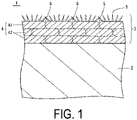
- the biocompatible implant 1 includes a base 2 and a calcium phosphate coating film 3 (hereinafter, also referred to as "coating film 3") located on a surface of the base 2 and including silver.
- coating film 3 a calcium phosphate coating film 3 located on a surface of the base 2 and including silver.
- Examples of a material of the base 2 include a metal, a ceramics, and a plastic.
- Examples of the metal include stainless steel alloys, cobalt chromium alloys, titanium, titanium alloys, alumina, and zirconia.
- Examples of titanium alloys include alloys to which at least one of, for example, aluminum, tin, zirconium, molybdenum, nickel, palladium, tantalum, niobium, vanadium, and platinum is added.
- Specific examples of titanium alloys include Ti-6A1-4V alloy.
- Examples of the ceramics include, for example, alumina, zirconia, and an alumina-zirconia composite ceramics.
- Examples of the plastic include, for example, polyethylene, fluorine-based resin, epoxy resin, PEEK resin, and Bakelite.
- the coating film 3 contains silver having an antimicrobial function.
- the silver in the coating film 3 is, in the present embodiment, metal silver or a silver compound, and is dispersed and distributed in the coating film 3 as irregularly shaped particles each being 1 nm or greater.
- the silver in the coating film 3 may be included in the form of silver ions in the calcium phosphate based material forming the coating film 3. Both silver in the form of particles and silver in the ionic state may also be included.
- the upper limit of the size of each of the irregularly shaped particles may be 10 ⁇ m or less.
- the content of silver in the coating film 3 may be, for example, from 0.05 to 10 mass%.
- the thickness of the coating film 3 may be, for example, from 5 to 300 ⁇ m.
- the coating film 3 may be a single layer or multiple layers.
- the coating film 3 is formed of a calcium phosphate based material.
- the calcium phosphate based material include hydroxyapatite (hereafter, also referred to as "HA"), ⁇ -tricalcium phosphate, ⁇ -tricalcium phosphate or tetracalcium phosphate.
- HA hydroxyapatite
- ⁇ -tricalcium phosphate ⁇ -tricalcium phosphate
- ⁇ -tricalcium phosphate tetracalcium phosphate.
- the exemplified calcium phosphate based materials may be used in a single or a mixture of two or more types.
- the coating film 3 may be located on a portion of a surface of the base 2, or may be located on the entire surface of the base 2.
- Examples of a method for disposing the coating film 3 on the surface of the base 2 include, for example, a thermal spraying method, a vapor deposition method, and a wet coating method.
- Examples of the thermal spraying method include, for example, a flame thermal spraying method, a high-speed flame thermal spraying method, a plasma thermal spraying method, and a cold spraying method.
- the vapor deposition method include, for example, a physical vapor deposition method such as a sputtering method, an ion plating method, an ion beam deposition method, or an ion mixing method.
- Examples of the wet coating method include, for example, a sol-gel method.
- the coating film 3 may be a calcium phosphate thermally sprayed coating film (hereinafter, also referred to as "thermally sprayed coating film").
- the thermally sprayed coating film is a coating film disposed on the surface of the base 2 by the thermal spraying method.
- Specific examples of the thermally sprayed coating film include a silver hydroxyapatite thermally sprayed coating film.
- the silver HA thermally sprayed coating film is a thermally sprayed coating film including silver and HA.
- the coating film 3 includes a plurality of calcium phosphate particles 4 (hereinafter, also referred to as "particles 4") located on the surface of the coating film 3 and a plurality of needle-like crystals 5 located on the surface of the plurality of particles 4.
- the plurality of needle-like crystals 5 is located in a gap S at an interface between adjacent ones of the particles 4 among the plurality of particles 4. According to this configuration, a state in which the coating film 3 contains silver is easily maintained. Thus, antimicrobial properties can be maintained over a long period of time.
- the above configuration may be, for example, magnified and evaluated using a scanning electron microscope (hereinafter, also referred to as "SEM").
- the degree of crystallinity of the coating film 3 may be greater than 90%. Such a degree of crystallinity is greater than the degree of crystallinity of a conventional coating film. In a coating film 3 having a degree of crystallinity of greater than 90%, decomposition and absorption (dissolution rate) in a living body is slower than that of a conventional coating film, and accordingly, the amount of elution of silver ions is less than that of a conventional coating film.
- the initial antimicrobial properties are lower than those of the conventional coating film, but since the rate of dissolution in a living body is relatively slow, the period until the coating film 3 disappears is longer than that of the conventional coating film, and as a result, the period during which silver ions can be eluted in a living body is longer than that of the conventional coating film.
- the antimicrobial properties can be maintained over a long period of time.
- the antimicrobial properties can also be expected to be maintained over a long period of time beyond years.
- the upper limit value of the degree of crystallinity of the coating film 3 may be 100% or less.
- the degree of crystallinity of the coating film 3 may be measured using an X-ray diffraction apparatus (hereafter, also referred to as "XRD") based on ISO13779-3.
- the particles 4 are formed of the calcium phosphate based material.
- the particles 4 are not limited to a particular size.
- the particle size of each of the particles 4 may be from 0.5 to 100 ⁇ m.
- the particle size may be measured using SEM.
- the particles 4 may be flat thermally sprayed particles (molten particles) formed when the coating film 3 is disposed on the surface of the base 2 by the thermal spraying method.
- the particles 4 are located inside the coating film 3 as weld particles.
- the particles 4 located on the surface of the coating film 3 may be calcium phosphate first particles 41 (hereinafter, also referred to as "first particles 41"), and the particles 4 located closer to the base 2 side than the first particles 41 may be calcium phosphate second particles 42 (hereinafter, also referred to as "second particles 42").
- first particles 41 calcium phosphate first particles 41
- second particles 42 calcium phosphate second particles 42
- the particles 4 need not contain silver.
- the silver may be located inside the particles 4 as irregularly shaped particles and may be located in the gap S at an interface between adjacent ones of the first particles 41.
- the silver may also be located in a gap at an interface between adjacent ones of the first particles 41 and the second particles 42 and in a gap at an interface between adjacent ones of the second particles 42.
- the plurality of needle-like crystals 5 may be located on a portion of the surface of the particles 4 or may be located on the entire surface of the particles 4. In a case where the plurality of needle-like crystals 5 are located on the entire surface of the particles 4, it is easy for the coating film 3 to maintain its silver content.
- the needle-like crystals 5 may be formed of the calcium phosphate based material.
- the needle-like crystals 5 need not contain silver.
- the needle-like crystals 5 may be precipitated from the particles 4.
- the needle-like crystals 5 may be smaller than the particles 4. Note that each of the needle-like crystals 5 is not limited to a specific size. For example, a major axis of each of the needle-like crystals 5 may be from 0.1 to 50 ⁇ m. A minor axis of each of the needle-like crystals 5 may be from 0.001 to 10 ⁇ m. The sizes of the major axis and the minor axis may be measured using SEM.
- the coating film 3 may include dendritic crystals located therein. In this case, since the coating film 3 is densified, the period until the coating film 3 disappears is long. Thus, the antimicrobial properties can be maintained over a long period of time. Note that the inside of the coating film 3 may be formed of the dendritic crystals. In a case where the coating film 3 includes the particles 4, the dendritic crystals may be located inside the particles 4. The dendritic crystals may also be referred to as dendrites.
- the above configuration may be, for example, evaluated by magnifying and observing the cross section of the coating film using SEM.
- the biocompatible implant 1 includes a biocompatible implant, such as an artificial bone or an inner fixing tool used for treatment of diseases or injuries, a prosthetic joint used for restoring lost joint functions, a dental implant used for restoring teeth, and a spinal implant used for treating diseases of vertebral bodies and intervertebral discs. Note that the biocompatible implant 1 is not limited to the illustrated examples.
- the flame thermal spraying method a gas flame of a combustible gas and oxygen is used as the heat source. Then, a powder of the calcium phosphate based material to which silver oxide is added is used as the thermal spraying material, the thermal spraying material is brought into a state of being molten or being nearly molten, and the thermal spraying material is sprayed onto the surface of the base 2 to form the coating film 3 (thermally sprayed coating film), thereby obtaining the biocompatible implant 1.
- the thermal spraying temperature may be about 2700°C.
- the thermal spraying speed may be Mach 0.6.
- the flame thermal spraying may be performed by, for example, introducing the thermal spraying material using dry air of 100 psi into a gas flame torch of oxygen gas 50 psi and acetylene gas 43 psi, under the conditions of setting the thermal spraying distance to be from 60 to 100 mm.
- the formed coating film 3 may be subjected to a hydrothermal treatment.
- the degree of crystallinity of the coating film 3 easily exceeds 90%.
- the needle-like crystals 5 are easily precipitated from the particles 4.
- a plurality of the needle-like crystals 5 are likely to be located in the gap S.
- the plurality of dendritic crystals are also likely to be located inside the coating film 3.
- the hydrothermal treatment is a treatment that involves heating to a temperature above 100°C in a pressure vessel containing water.
- a pressure vessel examples include a high-pressure cylinder.
- the conditions of the hydrothermal treatment may be, for example, set as follows.
- a 50 mm ⁇ 50 mm ⁇ 2 mm titanium plate was prepared.
- HA powder containing 3 mass% of silver oxide and 97 mass% of HA was used as the thermal spraying material, and the thermal spraying material was sprayed by the flame thermal spraying method on one surface of the titanium plate, thereby forming a silver HA thermally sprayed coating film having a thickness of 30 ⁇ m.
- the silver HA thermally sprayed coating film was subjected to hydrothermal treatment, thereby obtaining specimens.
- the flame thermal spraying was performed under the conditions of introducing the thermal spraying material using dry air of 100 psi into a gas flame torch of oxygen gas 50 psi and acetylene gas 43 psi, and setting the thermal spraying distance to be from 60 to 100 mm.
- the hydrothermal treatment was performed under the following conditions in a high pressure cylinder.
- Example 2 Specimens were fabricated under the same conditions as in Example 1 with the exception that the hydrothermal treatment was performed under the conditions indicated below.
- Specimens were fabricated under the same conditions as in Example 1 with the exception that a vacuum thermal treatment instead of the hydrothermal treatment was applied to the silver HA thermally sprayed coating film.
- the vacuum thermal treatment was performed in a vacuum oven under the following conditions.
- Example 2 and Comparative Example 1 Calcium elution rates were measured for Example 2 and Comparative Example 1. In addition, silver elution amounts were measured, and antimicrobial tests were performed for Example 1 and Comparative Example 1. Each measurement method and results are described below.
- Example 2 had lower calcium concentrations in the Tris buffer after 14 days than Comparative Example 1. Thus, it can be seen that, in Example 2, the dissolution rate was slower than that of Comparative Example 1, and the period until the coating film disappears was long.
- Example 1 showed lower silver concentrations in the bovine serum after 72 days than Comparative Example 1. Thus, it can be seen that compared with Comparative Example 1, in Example 1, the coating film more easily maintains its silver content, and the antimicrobial properties can be maintained over a long period of time.
- the antimicrobial activity value was measured by a coating film adhesion method in accordance with JIS Z 2801.
- the test conditions are as follows.
- Examples 1 and 2 and Comparative Example 1 A microscopic observation by SEM was performed for Examples 1 and 2 and Comparative Example 1.
- a scanning electron microscope SEM: SN - 3400N, manufactured by Hitachi, Ltd.
- SEM scanning electron microscope
- a plurality of flat molten particles were observed on the surface of the silver HA thermally sprayed coating film.
- a plurality of HA needle-like crystals were observed on the entire surface of the plurality of molten particles, and a state in which the plurality of HA needle-like crystals are located in the gap at the interface between adjacent ones of the molten particles of calcium phosphate was observed. but, in Comparative Example 1, such a state was not observed.
- Comparative Example 1 the inside of the coating film was mainly formed of fine crystals of HA.
- HA crystals had grown in a dendritic form inside the coating film (molten particles of calcium phosphate), and dendritic crystals were contained inside the coating film.
- FIG. 2 A SEM photograph of the surface of the specimen of Comparative Example 1 is shown in FIG. 2 .
- the scale is illustrated in the lower right of FIG. 2 . Note that one mark indicates 1 ⁇ m, and ten marks indicate 10 ⁇ m.
- a plurality of flat molten particles were observed on the surface, a plurality of HA needle-like crystals were observed on the entire surface of the plurality of molten particles, and a state in which the plurality of HA needle-like crystals are located in the gap S at the interface between adjacent ones of the molten particles was observed.
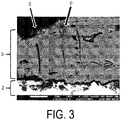
- FIG. 3 A SEM photograph of the cross section near the surface including the coating film of the specimen of Example 2 is shown in FIG. 3 .
- the scale is illustrated in the lower left of FIG. 3 , with a white bar length of 10 ⁇ m.
- the plurality of needle-like crystals 5 on the surface of the coating film 3 can be confirmed. It can be confirmed that the dendritic crystals 6 are located between the particles inside the coating film 3.
- FIG. 4 A SEM photograph of the surface of the specimen of Comparative Example 1 is shown in FIG. 4 .
- the scale is illustrated in the lower right of FIG. 4 . Note that one mark indicates 1 ⁇ m, and ten marks indicate 10 ⁇ m.
- a plurality of flat molten particles were observed, but needle-like crystals were not observed.
- the specimens of Comparative Example 1 was further subjected to a hydration treatment described in patent 6192014 (immersed from 10 to 60 minutes in water from 60 to 100°C). Although the needle-like crystals were observed on the surface, the state in which the plurality of HA needle-like crystals are located in the gap at the interface between adjacent ones of the molten particles was not observed.
Landscapes
- Health & Medical Sciences (AREA)
- Chemical & Material Sciences (AREA)
- Life Sciences & Earth Sciences (AREA)
- Engineering & Computer Science (AREA)
- Medicinal Chemistry (AREA)
- Veterinary Medicine (AREA)
- Public Health (AREA)
- General Health & Medical Sciences (AREA)
- Animal Behavior & Ethology (AREA)
- Epidemiology (AREA)
- Dermatology (AREA)
- Transplantation (AREA)
- Oral & Maxillofacial Surgery (AREA)
- Inorganic Chemistry (AREA)
- Molecular Biology (AREA)
- Biomedical Technology (AREA)
- Materials Engineering (AREA)
- Metallurgy (AREA)
- Mechanical Engineering (AREA)
- Physics & Mathematics (AREA)
- Chemical Kinetics & Catalysis (AREA)
- Plasma & Fusion (AREA)
- Organic Chemistry (AREA)
- Heart & Thoracic Surgery (AREA)
- Surgery (AREA)
- Vascular Medicine (AREA)
- Materials For Medical Uses (AREA)
- Dental Prosthetics (AREA)
Abstract
Description
- This application claims the priority of
JP 2019-165593 filed on September 11, 2019 - The present disclosure relates to a biocompatible implant.
- A biocompatible implant provided with a coating film expressing antimicrobial properties is known.
- A biocompatible implant according to one aspect of the present disclosure includes a base and a calcium phosphate coating film located on a surface of the base and including silver. The calcium phosphate coating film includes a plurality of calcium phosphate particles located on a surface thereof, and a plurality of needle-like crystals located on a surface of the plurality of calcium phosphate particles, and the plurality of needle-like crystals is located in a gap at an interface between adjacent calcium phosphate particles among the plurality of calcium phosphate particles.
-
-
FIG. 1 is a schematic view illustrating a biocompatible implant of an embodiment. -
FIG. 2 is a scanning electron microscope (SEM) photograph of a surface of a specimen of Example 1. -
FIG. 3 is a SEM photograph of a cross section near a surface including a coating film of a specimen of Example 2. -
FIG. 4 is a SEM photograph of a surface of a specimen of Comparative Example 1. - In a conventional coating film, since decomposition and absorption in a living body are fast, there is a concern that a period until the coating film disappears is as short as several months to several years. When the coating film disappears, antimicrobial function is also lost, and thus there is a risk that antimicrobial properties cannot be maintained over a long period of time, such as longer than several years. According to one aspect of the present disclosure, the antimicrobial properties can be maintained over a long period of time.
- The following describes in detail a biocompatible implant 1 of an embodiment while referencing the drawings. However, the figures referred to below are simplified representations of only a configuration necessary for description of the embodiment. Thus, the biocompatible implant 1 may include any configuration not illustrated in the figures referred to. Further, the dimensions of the configuration in the figures do not faithfully represent the actual dimensions of the configuration, the dimension ratios of the configuration, or the like.
- As illustrated in
FIG. 1 , the biocompatible implant 1 includes abase 2 and a calcium phosphate coating film 3 (hereinafter, also referred to as "coating film 3") located on a surface of thebase 2 and including silver. - Examples of a material of the
base 2 include a metal, a ceramics, and a plastic. Examples of the metal include stainless steel alloys, cobalt chromium alloys, titanium, titanium alloys, alumina, and zirconia. Examples of titanium alloys include alloys to which at least one of, for example, aluminum, tin, zirconium, molybdenum, nickel, palladium, tantalum, niobium, vanadium, and platinum is added. Specific examples of titanium alloys include Ti-6A1-4V alloy. Examples of the ceramics include, for example, alumina, zirconia, and an alumina-zirconia composite ceramics. Examples of the plastic include, for example, polyethylene, fluorine-based resin, epoxy resin, PEEK resin, and Bakelite. - The
coating film 3 contains silver having an antimicrobial function. The silver in thecoating film 3 is, in the present embodiment, metal silver or a silver compound, and is dispersed and distributed in thecoating film 3 as irregularly shaped particles each being 1 nm or greater. Note that the silver in thecoating film 3 may be included in the form of silver ions in the calcium phosphate based material forming thecoating film 3. Both silver in the form of particles and silver in the ionic state may also be included. The upper limit of the size of each of the irregularly shaped particles may be 10 µm or less. The content of silver in thecoating film 3 may be, for example, from 0.05 to 10 mass%. The thickness of thecoating film 3 may be, for example, from 5 to 300 µm. Thecoating film 3 may be a single layer or multiple layers. - The
coating film 3 is formed of a calcium phosphate based material. Examples of the calcium phosphate based material include hydroxyapatite (hereafter, also referred to as "HA"), α-tricalcium phosphate, β-tricalcium phosphate or tetracalcium phosphate. The exemplified calcium phosphate based materials may be used in a single or a mixture of two or more types. - The
coating film 3 may be located on a portion of a surface of thebase 2, or may be located on the entire surface of thebase 2. Examples of a method for disposing thecoating film 3 on the surface of thebase 2 include, for example, a thermal spraying method, a vapor deposition method, and a wet coating method. Examples of the thermal spraying method include, for example, a flame thermal spraying method, a high-speed flame thermal spraying method, a plasma thermal spraying method, and a cold spraying method. Examples of the vapor deposition method include, for example, a physical vapor deposition method such as a sputtering method, an ion plating method, an ion beam deposition method, or an ion mixing method. Examples of the wet coating method include, for example, a sol-gel method. - The
coating film 3 may be a calcium phosphate thermally sprayed coating film (hereinafter, also referred to as "thermally sprayed coating film"). The thermally sprayed coating film is a coating film disposed on the surface of thebase 2 by the thermal spraying method. Specific examples of the thermally sprayed coating film include a silver hydroxyapatite thermally sprayed coating film. The silver HA thermally sprayed coating film is a thermally sprayed coating film including silver and HA. - The
coating film 3 includes a plurality of calcium phosphate particles 4 (hereinafter, also referred to as "particles 4") located on the surface of thecoating film 3 and a plurality of needle-like crystals 5 located on the surface of the plurality ofparticles 4. The plurality of needle-like crystals 5 is located in a gap S at an interface between adjacent ones of theparticles 4 among the plurality ofparticles 4. According to this configuration, a state in which thecoating film 3 contains silver is easily maintained. Thus, antimicrobial properties can be maintained over a long period of time. The above configuration may be, for example, magnified and evaluated using a scanning electron microscope (hereinafter, also referred to as "SEM"). - Here, the degree of crystallinity of the
coating film 3 may be greater than 90%. Such a degree of crystallinity is greater than the degree of crystallinity of a conventional coating film. In acoating film 3 having a degree of crystallinity of greater than 90%, decomposition and absorption (dissolution rate) in a living body is slower than that of a conventional coating film, and accordingly, the amount of elution of silver ions is less than that of a conventional coating film. Thus, in a case where thecoating film 3 contains silver in the same concentration as the conventional coating film, the initial antimicrobial properties are lower than those of the conventional coating film, but since the rate of dissolution in a living body is relatively slow, the period until thecoating film 3 disappears is longer than that of the conventional coating film, and as a result, the period during which silver ions can be eluted in a living body is longer than that of the conventional coating film. Thus, the antimicrobial properties can be maintained over a long period of time. The antimicrobial properties can also be expected to be maintained over a long period of time beyond years. - The upper limit value of the degree of crystallinity of the
coating film 3 may be 100% or less. The degree of crystallinity of thecoating film 3 may be measured using an X-ray diffraction apparatus (hereafter, also referred to as "XRD") based on ISO13779-3. - The
particles 4 are formed of the calcium phosphate based material. Theparticles 4 are not limited to a particular size. For example, the particle size of each of theparticles 4 may be from 0.5 to 100 µm. The particle size may be measured using SEM. - As in an example illustrated in
FIG. 1 , theparticles 4 may be flat thermally sprayed particles (molten particles) formed when thecoating film 3 is disposed on the surface of thebase 2 by the thermal spraying method. In this case, in addition to the surface of thecoating film 3, theparticles 4 are located inside thecoating film 3 as weld particles. Theparticles 4 located on the surface of thecoating film 3 may be calcium phosphate first particles 41 (hereinafter, also referred to as "first particles 41"), and theparticles 4 located closer to thebase 2 side than thefirst particles 41 may be calcium phosphate second particles 42 (hereinafter, also referred to as "second particles 42"). Note that theparticles 4 need not contain silver. The silver may be located inside theparticles 4 as irregularly shaped particles and may be located in the gap S at an interface between adjacent ones of thefirst particles 41. The silver may also be located in a gap at an interface between adjacent ones of thefirst particles 41 and thesecond particles 42 and in a gap at an interface between adjacent ones of thesecond particles 42. - The plurality of needle-like crystals 5 may be located on a portion of the surface of the
particles 4 or may be located on the entire surface of theparticles 4. In a case where the plurality of needle-like crystals 5 are located on the entire surface of theparticles 4, it is easy for thecoating film 3 to maintain its silver content. - The needle-like crystals 5 may be formed of the calcium phosphate based material. The needle-like crystals 5 need not contain silver. The needle-like crystals 5 may be precipitated from the
particles 4. - The needle-like crystals 5 may be smaller than the
particles 4. Note that each of the needle-like crystals 5 is not limited to a specific size. For example, a major axis of each of the needle-like crystals 5 may be from 0.1 to 50 µm. A minor axis of each of the needle-like crystals 5 may be from 0.001 to 10 µm. The sizes of the major axis and the minor axis may be measured using SEM. - The
coating film 3 may include dendritic crystals located therein. In this case, since thecoating film 3 is densified, the period until thecoating film 3 disappears is long. Thus, the antimicrobial properties can be maintained over a long period of time. Note that the inside of thecoating film 3 may be formed of the dendritic crystals. In a case where thecoating film 3 includes theparticles 4, the dendritic crystals may be located inside theparticles 4. The dendritic crystals may also be referred to as dendrites. The above configuration may be, for example, evaluated by magnifying and observing the cross section of the coating film using SEM. - The biocompatible implant 1 includes a biocompatible implant, such as an artificial bone or an inner fixing tool used for treatment of diseases or injuries, a prosthetic joint used for restoring lost joint functions, a dental implant used for restoring teeth, and a spinal implant used for treating diseases of vertebral bodies and intervertebral discs. Note that the biocompatible implant 1 is not limited to the illustrated examples.
- Next, a description will be given for the method of manufacturing the biocompatible implant according to the embodiment with reference to a case of manufacture of the biocompatible implant 1 using the flame thermal spraying method.
- In the flame thermal spraying method, a gas flame of a combustible gas and oxygen is used as the heat source. Then, a powder of the calcium phosphate based material to which silver oxide is added is used as the thermal spraying material, the thermal spraying material is brought into a state of being molten or being nearly molten, and the thermal spraying material is sprayed onto the surface of the
base 2 to form the coating film 3 (thermally sprayed coating film), thereby obtaining the biocompatible implant 1. - The thermal spraying temperature may be about 2700°C. The thermal spraying speed may be Mach 0.6. The flame thermal spraying may be performed by, for example, introducing the thermal spraying material using dry air of 100 psi into a gas flame torch of oxygen gas 50 psi and acetylene gas 43 psi, under the conditions of setting the thermal spraying distance to be from 60 to 100 mm.
- The formed
coating film 3 may be subjected to a hydrothermal treatment. In this case, the degree of crystallinity of thecoating film 3 easily exceeds 90%. The needle-like crystals 5 are easily precipitated from theparticles 4. A plurality of the needle-like crystals 5 are likely to be located in the gap S. The plurality of dendritic crystals are also likely to be located inside thecoating film 3. - The hydrothermal treatment is a treatment that involves heating to a temperature above 100°C in a pressure vessel containing water. Examples of the pressure vessel include a high-pressure cylinder. The conditions of the hydrothermal treatment may be, for example, set as follows.
- Liquid volume: from 5 to 7 ml/cm2
- Temperature: from 130 to 155°C
- Time: from 11 to 25 hours
- The present disclosure will be described in detail below using examples, but the present disclosure is not limited to the following examples.
- First, a 50 mm × 50 mm × 2 mm titanium plate was prepared. Next, HA powder containing 3 mass% of silver oxide and 97 mass% of HA was used as the thermal spraying material, and the thermal spraying material was sprayed by the flame thermal spraying method on one surface of the titanium plate, thereby forming a silver HA thermally sprayed coating film having a thickness of 30 µm. Finally, the silver HA thermally sprayed coating film was subjected to hydrothermal treatment, thereby obtaining specimens.
- The flame thermal spraying was performed under the conditions of introducing the thermal spraying material using dry air of 100 psi into a gas flame torch of oxygen gas 50 psi and acetylene gas 43 psi, and setting the thermal spraying distance to be from 60 to 100 mm.
- The hydrothermal treatment was performed under the following conditions in a high pressure cylinder.
- Liquid volume: 6 ml/cm2
- Temperature: 135°C
- Time: 24 hours
- The degree of crystallinity of the obtained specimens was measured using XRD based on ISO13779-3. The result is described below.
Degree of crystallinity: 91% - Specimens were fabricated under the same conditions as in Example 1 with the exception that the hydrothermal treatment was performed under the conditions indicated below.
- Liquid volume: 6 ml/cm2
- Temperature: 150°C
- Time: 24 hours
- The degree of crystallinity of the obtained specimens was measured in the same manner as in Example 1. The result is described below.
Degree of crystallinity: 100% - Specimens were fabricated under the same conditions as in Example 1 with the exception that a vacuum thermal treatment instead of the hydrothermal treatment was applied to the silver HA thermally sprayed coating film. The vacuum thermal treatment was performed in a vacuum oven under the following conditions.
- Temperature: 650°C
- Time: 3 hours
- The degree of crystallinity of the obtained specimens was measured in the same manner as in Example 1. The result is described below.
Degree of crystallinity: 75% - Calcium elution rates were measured for Example 2 and Comparative Example 1. In addition, silver elution amounts were measured, and antimicrobial tests were performed for Example 1 and Comparative Example 1. Each measurement method and results are described below.
- Specimens were immersed in Tris buffer at 37°C and pH 7.3. The calcium concentration (mg/L) in the Tris buffer was measured using ICP mass spectrometry at each time shown in Table 1. The results are shown in Table 1.
[Table 1] Specimen Calcium concentration (mg/L) Degree of crystallinity (%) Processing conditions 0.0 d 0.2 d 0.3 d 1.0 d 3.0 d 7.0 d 14.0 d Example 2 100 Hydrothermal treatment 0 0.2 0.4 1.2 2.6 4.5 5.9 Comparative Example 1 75 Vacuum thermal treatment 0 3.9 5.6 8.1 10.0 10.4 11.2 - As can be seen from Table 1, Example 2 had lower calcium concentrations in the Tris buffer after 14 days than Comparative Example 1. Thus, it can be seen that, in Example 2, the dissolution rate was slower than that of Comparative Example 1, and the period until the coating film disappears was long.
- The specimens were immersed in bovine serum at 37°C. The silver concentration (mg/L) in the bovine serum was measured using ICP mass spectrometry at each time shown in Table 2. The evaluation results are shown in Table 2.
[Table 2] Specimen Silver concentration (mg/L) Degree of crystallinity (%) Processing conditions 0 h 4 h 12 h 24 h 72 h Example 1 91 Hydrothermal treatment 0 31 39 52 106 Comparative Example 1 75 Vacuum thermal treatment 0 27 57 86 143 - As can be seen from Table 2, Example 1 showed lower silver concentrations in the bovine serum after 72 days than Comparative Example 1. Thus, it can be seen that compared with Comparative Example 1, in Example 1, the coating film more easily maintains its silver content, and the antimicrobial properties can be maintained over a long period of time.
- The antimicrobial activity value (R-value) was measured by a coating film adhesion method in accordance with JIS Z 2801. The test conditions are as follows.
- Bacterial species: MRSA/UOEH6
- Medium: Non-activated bovine serum
- The measurement results are as follows.
- Antimicrobial activity value
- Example 1: 0.5
- Comparative Example 1: 3.6
- A microscopic observation by SEM was performed for Examples 1 and 2 and Comparative Example 1. A scanning electron microscope (SEM: SN - 3400N, manufactured by Hitachi, Ltd.) was used. As a result, in Examples 1 and 2 and Comparative Example 1, a plurality of flat molten particles were observed on the surface of the silver HA thermally sprayed coating film. In Examples 1 and 2, a plurality of HA needle-like crystals were observed on the entire surface of the plurality of molten particles, and a state in which the plurality of HA needle-like crystals are located in the gap at the interface between adjacent ones of the molten particles of calcium phosphate was observed. but, in Comparative Example 1, such a state was not observed.
- In Comparative Example 1, the inside of the coating film was mainly formed of fine crystals of HA. In contrast, in Examples 1 to 2, HA crystals had grown in a dendritic form inside the coating film (molten particles of calcium phosphate), and dendritic crystals were contained inside the coating film.
- A SEM photograph of the surface of the specimen of Comparative Example 1 is shown in
FIG. 2 . The scale is illustrated in the lower right ofFIG. 2 . Note that one mark indicates 1 µm, and ten marks indicate 10 µm. As described above, a plurality of flat molten particles were observed on the surface, a plurality of HA needle-like crystals were observed on the entire surface of the plurality of molten particles, and a state in which the plurality of HA needle-like crystals are located in the gap S at the interface between adjacent ones of the molten particles was observed. - A SEM photograph of the cross section near the surface including the coating film of the specimen of Example 2 is shown in
FIG. 3 . The scale is illustrated in the lower left ofFIG. 3 , with a white bar length of 10 µm. In a cross-sectional view, the plurality of needle-like crystals 5 on the surface of thecoating film 3 can be confirmed. It can be confirmed that thedendritic crystals 6 are located between the particles inside thecoating film 3. - A SEM photograph of the surface of the specimen of Comparative Example 1 is shown in
FIG. 4 . The scale is illustrated in the lower right ofFIG. 4 . Note that one mark indicates 1 µm, and ten marks indicate 10 µm. As described above, a plurality of flat molten particles were observed, but needle-like crystals were not observed. The specimens of Comparative Example 1 was further subjected to a hydration treatment described in patent6192014 -
- 1
- Biocompatible implant
- 2
- Base
- 3
- Calcium phosphate coating film
- 4
- Calcium phosphate particle
- 41
- Calcium phosphate first particle
- 42
- Calcium phosphate second particle
- S
- Gap at interface between calcium phosphate particles
- 5
- Needle-like crystal
- 6
- Dendritic crystal
Claims (13)
- A biocompatible implant comprising:a base; anda calcium phosphate coating film located on a surface of the base and including silver, whereinthe calcium phosphate coating film comprises a plurality of calcium phosphate particles located on a surface thereof, and a plurality of needle-like crystals located on a surface of the plurality of calcium phosphate particles, andthe plurality of needle-like crystals are located in a gap at an interface between adjacent calcium phosphate particles among the plurality of calcium phosphate particles.
- The biocompatible implant according to claim 1, wherein
the degree of crystallinity of the calcium phosphate coating film is greater than 90%. - The biocompatible implant of claim 1 or claim 2, wherein
the calcium phosphate coating film includes dendritic crystals located therein. - The biocompatible implant according to any one of claims 1 to 3, wherein
the calcium phosphate coating film is a calcium phosphate thermally sprayed coating film. - The biocompatible implant according to any one of claims 1 to 4, wherein
the silver is metal silver or a silver compound and is dispersed and distributed in the calcium phosphate coating film as irregularly shaped particles each being 1 nm or greater. - The biocompatible implant according to any one of claims 1 to 5, wherein
a thickness of the calcium phosphate coating film is from 5 to 300 µm. - The biocompatible implant according to any one of claims 1 to 6, wherein
the calcium phosphate coating film contains any one or more of hydroxyapatite, α-tricalcium phosphate, β-tricalcium phosphate or tetracalcium phosphate. - The biocompatible implant according to any one of claims 1 to 7, wherein
a particle size of each of the plurality of calcium phosphate particles is from 0.5 to 100 µm. - The biocompatible implant according to any one of claims 1 to 8, wherein
each of the plurality of needle-like crystals has a major axis from 0.1 to 50 µm and a minor axis from 0.001 to 10 µm. - The biocompatible implant according to any one of claims 1 to 9, wherein
the base includes any one of a metal, a ceramics or a plastic. - The biocompatible implant according to any one of claims 1 to 10, wherein
the biocompatible implant is any one of an artificial bone, an inner fixing tool, a prosthetic joint, a dental implant or a spinal implant. - A method of manufacturing a biocompatible implant comprising:thermal spraying a calcium phosphate raw material containing silver onto a base for a biocompatible implant to form a coating film on a surface of the base; andforming a plurality of needle-like crystals on the surface of the coating film by subjecting the coating film to hydrothermal treatment in which the coating film is heated to a temperature greater than 100°C in a pressure vessel containing water.
- The method of manufacturing the biocompatible implant according to claim 12, wherein
processing conditions of the hydrothermal treatment are temperature: from 130 to 155°C, and time: from 11 to 25 hours.
Applications Claiming Priority (2)
| Application Number | Priority Date | Filing Date | Title |
|---|---|---|---|
| JP2019165593A JP7267881B2 (en) | 2019-09-11 | 2019-09-11 | bioimplant |
| PCT/JP2020/033973 WO2021049494A1 (en) | 2019-09-11 | 2020-09-08 | Biocompatible implant and preparation method of biocompatible implant |
Publications (2)
| Publication Number | Publication Date |
|---|---|
| EP4029538A1 true EP4029538A1 (en) | 2022-07-20 |
| EP4029538A4 EP4029538A4 (en) | 2023-07-05 |
Family
ID=74863260
Family Applications (1)
| Application Number | Title | Priority Date | Filing Date |
|---|---|---|---|
| EP20862738.0A Withdrawn EP4029538A4 (en) | 2019-09-11 | 2020-09-08 | BIOCOMPATIBLE IMPLANT AND METHOD FOR PREPARING A BIOCOMPATIBLE IMPLANT |
Country Status (4)
| Country | Link |
|---|---|
| US (1) | US20220339318A1 (en) |
| EP (1) | EP4029538A4 (en) |
| JP (2) | JP7267881B2 (en) |
| WO (1) | WO2021049494A1 (en) |
Families Citing this family (1)
| Publication number | Priority date | Publication date | Assignee | Title |
|---|---|---|---|---|
| WO2025263511A1 (en) * | 2024-06-20 | 2025-12-26 | 京セラ株式会社 | Biological implant and method for manufacturing same |
Family Cites Families (9)
| Publication number | Priority date | Publication date | Assignee | Title |
|---|---|---|---|---|
| DE10029520A1 (en) * | 2000-06-21 | 2002-01-17 | Merck Patent Gmbh | Coating for metallic implant materials |
| WO2008029612A1 (en) | 2006-09-08 | 2008-03-13 | Japan Medical Materials Corporation | Bioimplant |
| WO2009062671A2 (en) * | 2007-11-12 | 2009-05-22 | Medicoat Ag | Implant and method for coating an implant |
| WO2009111307A2 (en) * | 2008-02-29 | 2009-09-11 | Smith & Nephew, Inc. | Coating and coating method |
| WO2013114947A1 (en) | 2012-02-03 | 2013-08-08 | 国立大学法人佐賀大学 | Bioimplant |
| US10814039B2 (en) * | 2012-02-03 | 2020-10-27 | Kyocera Corporation | Bioimplant with antibacterial coating and method of making same |
| NL2011195C2 (en) * | 2013-07-18 | 2015-01-21 | Xpand Biotechnology B V | Method for producing an osteoinductive calcium phosphate and products thus obtained. |
| US20170173213A1 (en) * | 2014-03-10 | 2017-06-22 | University Of Rochester | Polarized hydroxyapatite films and methods of making and using same |
| WO2017150539A1 (en) * | 2016-02-29 | 2017-09-08 | 国立大学法人東京工業大学 | Silver-containing calcium phosphate sintered body and method for producing same |
-
2019
- 2019-09-11 JP JP2019165593A patent/JP7267881B2/en active Active
-
2020
- 2020-09-08 WO PCT/JP2020/033973 patent/WO2021049494A1/en not_active Ceased
- 2020-09-08 US US17/641,072 patent/US20220339318A1/en not_active Abandoned
- 2020-09-08 EP EP20862738.0A patent/EP4029538A4/en not_active Withdrawn
-
2023
- 2023-04-19 JP JP2023068273A patent/JP2023090761A/en active Pending
Also Published As
| Publication number | Publication date |
|---|---|
| JP2023090761A (en) | 2023-06-29 |
| US20220339318A1 (en) | 2022-10-27 |
| WO2021049494A1 (en) | 2021-03-18 |
| EP4029538A4 (en) | 2023-07-05 |
| JP7267881B2 (en) | 2023-05-02 |
| JP2021040972A (en) | 2021-03-18 |
Similar Documents
| Publication | Publication Date | Title |
|---|---|---|
| Abe et al. | Apatite coating on ceramics, metals and polymers utilizing a biological process | |
| Li et al. | Formation and growth of calcium phosphate on the surface of oxidized Ti–29Nb–13Ta–4.6 Zr alloy | |
| JP4157679B2 (en) | Implant element | |
| Gkomoza et al. | Comparative study of structure and properties of thermal spray coatings using conventional and nanostructured hydroxyapatite powder, for applications in medical implants | |
| Shuai et al. | Processing and characterization of laser sintered hydroxyapatite scaffold for tissue engineering | |
| Vangolu et al. | Wear and corrosion properties of wollastonite and boron nitride doped, hydroxyapatite-based HAp-Wo-BN composite coatings prepared by pulsed laser deposition | |
| Say et al. | Effects of hydroxyapatite/Zr and bioglass/Zr coatings on morphology and corrosion behaviour of Rex-734 alloy | |
| EP1225927A1 (en) | Hard tissue repairing material | |
| Mohammadtaheri et al. | Fabrication of Ti–Al2O3–HA composites by spark plasma sintering and its properties for medical applications | |
| Choudhury et al. | Hydroxyapatite (HA) coatings for biomaterials | |
| EP4029538A1 (en) | Biocompatible implant and preparation method of biocompatible implant | |
| Kaliaraj et al. | Silver-ceria stabilized zirconia composite coatings on titanium for potential implant applications | |
| Kuśmierczyk et al. | Development and characterization of multilayered Cu/HA/ZnS+ PEEK coating system by hybrid technology | |
| Asmawi et al. | Development of bioactive ceramic coating on titanium alloy substrate for biomedical application using dip coating method | |
| DE69022776T2 (en) | Use of ceramic materials as replacement materials for living tissue. | |
| Poinescu et al. | 316L Stainless steel/hydroxyapatite composite materials for biomedical applications | |
| Oh et al. | Influence of tricalcium aluminate phase on in vitro biocompatibility and bioactivity of calcium aluminate bone cement | |
| Codescu et al. | Bio-functionalization of a novel biocompatible high entropy alloy used for bone implants | |
| López-Cuevas et al. | In vitro bioactivity of AISI 316L stainless steel coated with hydroxyapatite-seeded 58S bioglass | |
| Zhang et al. | Fabrication, characterization, and in vitro studies of Selenium-substituted hydroxyapatite coatings | |
| Akın | Hydroxyapatite Deposition on Silicon Nitride and SiAlON Ceramic Substrates via Biomimetic Method | |
| Sharifnabi et al. | Synthesis and characterization of nanosized magnesium-doped fluorapatite powder and coating for biomedical application | |
| Rizwan et al. | Synthesis, Characterization, and In Vitro Biochemical Analysis of Hydroxyapatite–Bioglass® Composite Scaffolds for Bone Tissue Repair: Rizwan, Yousuf, Sohail, Bashir, Alias, Hamdi, and Basirun | |
| Filiaggi et al. | Mechanical and chemical characterization of a metal-bioceramic interface | |
| Băilă et al. | Contact angle measurements at the interface of Co-Cr alloy sintered by DMLS and coated with hydroxyapatite |
Legal Events
| Date | Code | Title | Description |
|---|---|---|---|
| STAA | Information on the status of an ep patent application or granted ep patent |
Free format text: STATUS: THE INTERNATIONAL PUBLICATION HAS BEEN MADE |
|
| PUAI | Public reference made under article 153(3) epc to a published international application that has entered the european phase |
Free format text: ORIGINAL CODE: 0009012 |
|
| STAA | Information on the status of an ep patent application or granted ep patent |
Free format text: STATUS: REQUEST FOR EXAMINATION WAS MADE |
|
| 17P | Request for examination filed |
Effective date: 20220331 |
|
| AK | Designated contracting states |
Kind code of ref document: A1 Designated state(s): AL AT BE BG CH CY CZ DE DK EE ES FI FR GB GR HR HU IE IS IT LI LT LU LV MC MK MT NL NO PL PT RO RS SE SI SK SM TR |
|
| DAV | Request for validation of the european patent (deleted) | ||
| DAX | Request for extension of the european patent (deleted) | ||
| P01 | Opt-out of the competence of the unified patent court (upc) registered |
Effective date: 20230505 |
|
| A4 | Supplementary search report drawn up and despatched |
Effective date: 20230607 |
|
| RIC1 | Information provided on ipc code assigned before grant |
Ipc: A61L 31/08 20060101ALI20230601BHEP Ipc: A61L 31/16 20060101ALI20230601BHEP Ipc: A61L 27/54 20060101ALI20230601BHEP Ipc: A61L 27/32 20060101ALI20230601BHEP Ipc: A61L 27/30 20060101AFI20230601BHEP |
|
| STAA | Information on the status of an ep patent application or granted ep patent |
Free format text: STATUS: EXAMINATION IS IN PROGRESS |
|
| 17Q | First examination report despatched |
Effective date: 20240415 |
|
| STAA | Information on the status of an ep patent application or granted ep patent |
Free format text: STATUS: THE APPLICATION HAS BEEN WITHDRAWN |
|
| 18W | Application withdrawn |
Effective date: 20240723 |