EP4028384B1 - Process for the preparation of alpha-methyl-[4-(nitro)-2-(trifluoromethyl)]-benzyl nitrate - Google Patents
Process for the preparation of alpha-methyl-[4-(nitro)-2-(trifluoromethyl)]-benzyl nitrate Download PDFInfo
- Publication number
- EP4028384B1 EP4028384B1 EP20761871.1A EP20761871A EP4028384B1 EP 4028384 B1 EP4028384 B1 EP 4028384B1 EP 20761871 A EP20761871 A EP 20761871A EP 4028384 B1 EP4028384 B1 EP 4028384B1
- Authority
- EP
- European Patent Office
- Prior art keywords
- compound
- nitric acid
- mole
- sulfuric acid
- oleum
- Prior art date
- Legal status (The legal status is an assumption and is not a legal conclusion. Google has not performed a legal analysis and makes no representation as to the accuracy of the status listed.)
- Active
Links
Classifications
-
- C—CHEMISTRY; METALLURGY
- C07—ORGANIC CHEMISTRY
- C07C—ACYCLIC OR CARBOCYCLIC COMPOUNDS
- C07C201/00—Preparation of esters of nitric or nitrous acid or of compounds containing nitro or nitroso groups bound to a carbon skeleton
- C07C201/02—Preparation of esters of nitric acid
-
- C—CHEMISTRY; METALLURGY
- C07—ORGANIC CHEMISTRY
- C07C—ACYCLIC OR CARBOCYCLIC COMPOUNDS
- C07C203/00—Esters of nitric or nitrous acid
- C07C203/02—Esters of nitric acid
- C07C203/08—Esters of nitric acid having nitrate groups bound to carbon atoms of rings other than six-membered aromatic rings
-
- C—CHEMISTRY; METALLURGY
- C07—ORGANIC CHEMISTRY
- C07C—ACYCLIC OR CARBOCYCLIC COMPOUNDS
- C07C201/00—Preparation of esters of nitric or nitrous acid or of compounds containing nitro or nitroso groups bound to a carbon skeleton
- C07C201/06—Preparation of nitro compounds
- C07C201/08—Preparation of nitro compounds by substitution of hydrogen atoms by nitro groups
-
- C—CHEMISTRY; METALLURGY
- C07—ORGANIC CHEMISTRY
- C07C—ACYCLIC OR CARBOCYCLIC COMPOUNDS
- C07C201/00—Preparation of esters of nitric or nitrous acid or of compounds containing nitro or nitroso groups bound to a carbon skeleton
- C07C201/06—Preparation of nitro compounds
- C07C201/16—Separation; Purification; Stabilisation; Use of additives
-
- C—CHEMISTRY; METALLURGY
- C07—ORGANIC CHEMISTRY
- C07C—ACYCLIC OR CARBOCYCLIC COMPOUNDS
- C07C203/00—Esters of nitric or nitrous acid
- C07C203/02—Esters of nitric acid
-
- C—CHEMISTRY; METALLURGY
- C07—ORGANIC CHEMISTRY
- C07C—ACYCLIC OR CARBOCYCLIC COMPOUNDS
- C07C203/00—Esters of nitric or nitrous acid
- C07C203/02—Esters of nitric acid
- C07C203/04—Esters of nitric acid having nitrate groups bound to acyclic carbon atoms
-
- C—CHEMISTRY; METALLURGY
- C07—ORGANIC CHEMISTRY
- C07C—ACYCLIC OR CARBOCYCLIC COMPOUNDS
- C07C205/00—Compounds containing nitro groups bound to a carbon skeleton
- C07C205/07—Compounds containing nitro groups bound to a carbon skeleton the carbon skeleton being further substituted by halogen atoms
- C07C205/11—Compounds containing nitro groups bound to a carbon skeleton the carbon skeleton being further substituted by halogen atoms having nitro groups bound to carbon atoms of six-membered aromatic rings
-
- C—CHEMISTRY; METALLURGY
- C07—ORGANIC CHEMISTRY
- C07C—ACYCLIC OR CARBOCYCLIC COMPOUNDS
- C07C205/00—Compounds containing nitro groups bound to a carbon skeleton
- C07C205/39—Compounds containing nitro groups bound to a carbon skeleton the carbon skeleton being further substituted by esterified hydroxy groups
- C07C205/42—Compounds containing nitro groups bound to a carbon skeleton the carbon skeleton being further substituted by esterified hydroxy groups having nitro groups or esterified hydroxy groups bound to carbon atoms of six-membered aromatic rings of the carbon skeleton
Definitions
- the present invention relates to a process for the preparation of ⁇ -methyl-[4-(nitro)-2-(trifluoromethyl)]-benzyl nitrate.
- One of the ways for preparing nitro compounds is the nitration of the respective precursors.
- GB 735545 Meditsinskaya Promyshlennost SSSR, 1956, 10 (4), pp. 9-10 and Zhurnal Obshchei Khimii, 1958, 28, 1608-10 describe the nitration of ⁇ -(alkyl or haloalkyl)-benzyl alcohols, wherein the phenyl ring is unsubstituted or substituted in o- or m-positions.
- the substrates are reacted with the nitric acid in the presence of the sulfuric or sulfanilic acid. Usually, mixtures of regioisomeric nitro-benzyl nitrates are formed. The yield of p-nitro-benzyl nitrates amounts to 40 to 70%.
- US 4 846 875 A describes the preparation of 1-(2-chloro-4-fluoro-5-nitrophenyl)ethyl nitrate by nitrating 1-(2-chloro-4-fluorophenyl)ethanol in a yield of 78%.
- CN106699729 and WO 2005/063720 describe the nitration of 2-trifluoromethyl-benzyl alcohol using the nitric acid in the presence of the sulfuric acid yielding 2-trifluoromethyl-4-nitro-benzyl alcohol (yield 42%) and 2-trifluoromethyl-4-nitro-benzyl nitrate respectively (yield 38%).
- the present invention relates to a process for the preparation of the compound of formula (I) comprising the following step: (i) reacting a compound of formula (II) with the nitric acid in the presence of the sulfuric acid or oleum, wherein the nitric acid is used in an amount of 2 to 20 mole equivalents per 1 mole of the compound (II).
- the compound of formula (I) is also part of the present invention.
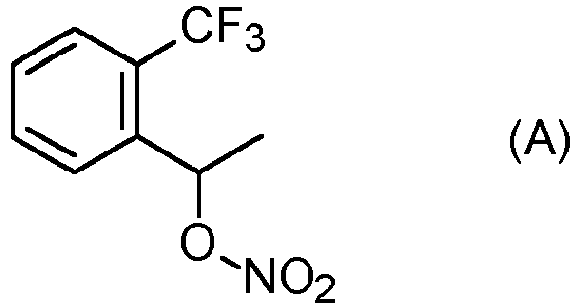
- step (i) compound (A) is formed as an intermediate compound.
- Compound (A) is also part of the present invention.
- the process according to the present invention entails a series of advantages. It is safe, cheap and leads to the product in high yields. Undesired side reactions leading to unwanted byproducts (like oxidation or elimination of the hydroxy-group or nitration in e.g. m- or o- positions) are minimized. The nitration occurs regioselective and nearly quantitative.
- the process can be carried out at a room temperature and does not require sophisticated cooling equipment. If desired, the product can be employed in the next reaction step without purification. According to some embodiments, the amount of nitric and/or sulfuric acid can be significantly reduced. Any of these advantages saves resources and energy and makes the process industrially simple and environmentally friendly.
- Starting compound (II) is commercially available or can be synthesized as known to the skilled person, e.g. from Polymer 52, (2011), 949-953 .
- the step (i) according to the present invention can be carried out batchwise or continuously. According to one embodiment, it is carried out batchwise. According to another embodiment, it is carried out continuously.
- Nitric acid suitable for the present invention preferably has a concentration of at least 20 mol%. Usually it has a concentration of from 20 to 100 mol%, preferably from 60 to 100 mol%, more preferably from 80 to 100 mol%, most preferably from 90 to 100 mol%, particularly preferably from 95 to 100 mol%. It can contain dissolved nitrogen dioxide or be essentially free thereof. Essentially free means that it contains 0.5 mol % or less of dissolved nitrogen dioxide.
- the nitric acid is a red fuming nitric acid.
- the nitric acid is a white fuming nitric acid (also called 100% nitric acid).
- the nitric acid is prepared in situ by contacting a nitrate salt, such as NaNO 3 or KNO 3 with the sulfuric acid.
- a nitrate salt such as NaNO 3 or KNO 3
- the nitric acid is usually used in an amount of from 2 to 20 mole equivalents per 1 mole of compound (II), preferably from 2 to 10 mole equivalents per 1 mole of compound (II), more preferably from 2 to 8 mole equivalents per 1 mole of compound (II), most preferably from 2 to 4 mole equivalents per 1 mole of compound (II), particularly preferably from 2.1 to 2.5 mole equivalents per 1 mole of compound (II).
- the nitric acid is preferably used in an amount of from 2 to 8 mole equivalents per 1 mole of compound (II), preferably from 2 to 6 mole equivalents per 1 mole of compound (II), more preferably from 2 to 3.5 mole equivalents per 1 mole of compound (II), most preferably from 2 to 3 mole equivalents per 1 mole of compound (II), particularly preferably from 2.1 to 2.5 mole equivalents per 1 mole of compound (II).
- the nitric acid is preferably used in an amount of from 2 to 20 mole equivalents per 1 mole of compound (II), preferably from 2 to 16 mole equivalents per 1 mole of compound (II), more preferably from 2 to 12 mole equivalents per 1 mole of compound (II), most preferably from 2 to 10 mole equivalents per 1 mole of compound (II), particularly preferably from 2 to 8 mole equivalents per 1 mole of compound (II).
- the reaction is carried out in the presence of the sulfuric acid or oleum.
- the reaction is carried out in the presence of oleum.
- reaction is carried out in the presence of the sulfuric acid.
- the sulfuric acid suitable for the present invention preferably has a concentration of at least 50 mol%. Usually it has a concentration of from 50 to 100 mol%, preferably from 70 to 100 mol%, more preferably from 80 to 100 mol%, most preferably from 90 to 100 mol%, particularly preferably from 95 to 100 mol%.
- the sulfuric acid is usually used in an amount of from 2 to 40 mole equivalents per 1 mole of compound (II), preferably from 3 to 30 mole equivalents per 1 mole of compound (II), more preferably from 5 to 20 mole equivalents per 1 mole of compound (II), most preferably from 5 to 10 mole equivalents per 1 mole of compound (II), particularly preferably from 5 to 7 mole equivalents per 1 mole of compound (II).
- the molar ratio of the nitric acid to the sulfuric acid is usually from 1:1 to 1:20, preferably from 1:1 to 1:15, more preferably from 1:1 to 1:10, most preferably from 1:1 to 1:8, particularly preferably from 1:1 to 1:4. According to a specific embodiment, the ratio is from 1:1 to 1:2. According to a further specific embodiment, the ratio is 1:1.
- the nitration according to the present invention is can be carried out at a room temperature, e.g. at 20 to 25°C. It is, however, can be carried out at elevated or reduced temperatures, usually at -30 to 80°C, preferably at -15 to 60°C, more preferably at 0 to 50°C, most preferably at 5 to 45°C, particularly preferably from 10 to 40°C.
- the reaction can be carried out with or without a solvent.
- the reaction is carried out without a solvent.
- the reaction is carried out in a solvent.
- Suitable solvents are selected from halogenated aliphatic solvents, such as dichloromethane (CH 2 Cl 2 ), chloroform (CHCl 3 ), tetrachloroethane (CCl 4 ), 1,2-dichloroethane or any mixture of the abovementioned solvents.
- the solvent is selected from dichloromethane, chloroform, tetrachloroethane, 1,2-dichloroethane or any mixture thereof.
- the excess of H 2 SO 4 can be used as a solvent.
- the solvent is dichloromethane.
- the solvent is chloroform.
- the solvent is tetrachloroethane.
- the solvent is 1,2-dichloroethane.
- the excess of H 2 SO 4 is used as a solvent.
- step (i) in the step (i)
- the amount of the nitric acid used in step (i) a) is preferably from 1 to 15 mole equivalents per 1 mole of compound (II), more preferably from 1 to 10 mole equivalents per 1 mole of compound (II), most preferably from 1 to 5 mole equivalents per 1 mole of compound (II), particularly preferably from 1 to 2.5 mole equivalents per 1 mole of compound (II), specifically from 1 to 1.5 mole equivalents per 1 mole of compound (II).
- the water can be removed as known to the skilled person.
- a water immiscible organic solvent like halogenated aliphatic solvents as described above. If the reaction is carried out in a such halogenated aliphatic solvent, the organic phase can be separated from the aqueous phase as known to the skilled person. Alternatively, the stoichiometric amount of oleum can be added to the reaction mixture.
- Water to be removed in the step (i) b) includes the water formed during the reaction in the step (i) a) and, in case aqueous solutions of nitric and/or sulfuric acids were employed in the step (i) a), also the water from that aqueous solutions.
- step (i) b) the excess of nitric acid and sulfuric acid or oleum are removed from the reaction mixture together with the water.
- the order of adding the reagents to the reaction mixture is variable.
- the nitric acid is pre-mixed with the sulfuric acid or oleum and this mixture is added to compound (II).
- the pre-mixed acids can be added to the reaction mixture in one portion or gradually. According to one embodiment they are added to the reaction mixture in one portion. According to another embodiment they are added to the reaction mixture gradually. Gradual addition is preferred.
- compound (II) is added to the pre-mixed acid comprising nitric acid and sulfuric acid or oleum.
- the compound (II) can be added to the reaction mixture in one portion or gradually. According to one embodiment it is added to the reaction mixture in one portion. According to another embodiment it is added to the reaction mixture gradually. Gradual addition is preferred.
- a work-up of the reaction mixture can be carried out by procedures known in a general manner to the person skilled in the art.
- the reaction mixture is diluted with water or ice and the aqueous phase is extracted with a suitable solvent, e.g. toluene or o-xylene.
- a suitable solvent e.g. toluene or o-xylene.
- the organic phase containing the product can be separated directly from the nitration acid.
- the organic phases can be washed with water to remove residual acid, if necessary.
- the raw product obtained after evaporation of the solvent(s) can directly be used in a further step, if desired. However, the raw product can also be further worked up and/or purified as generally known to the skilled person.
- the process can further comprise a further step (ii) according to which the excess of the nitric acid and sulfuric acid or oleum is separated from the reaction mass after step (i) is finished and returned back to the nitration step (i). If necessary, prior to returning the separated acids to step (i) the concentration of said acids can be adjusted to reach the initial concentration.
- the excess of the nitric acid and sulfuric acid or oleum is returned to step (i) a).
- the separation can be carried out by procedures known in a general manner to the person skilled in the art.
- the separates are then treated with oleum or sulfur trioxide in order to remove the water formed during the reaction and achieve the initial concentration of the sulfuric acid.
- the recycled concentrated sulfuric acid is reused in the production process.
- HPLC-method Agilent 1200; column: Hailo C-18 150x4,6 mm; mobile phase A: acetonitrile, mobile phase B: H 2 O + 0.5% 0.5 mol/L H 2 SO 4 ; flow 1.0 mL/min; gradient: 0min 80% B - 15min 22% B - 18min 0% B - 20min 80% B; temperature 30°C, wavelength 230nm Product is at 13.6min
- ⁇ -methyl-2-(trifluoromethyl)-benzyl alcohol (28.5 g, 150 mmol) was dissolved in 1,2-dichloroethane (90 g) and the solution cooled to 0 °C.
- a mixture of 11.2 g nitric acid (99%, 0.18 mol, 1.2 eq) and 17.7 g sulfuric acid (98%, 0.18 mol, 1.2 eq) was added within 27 min under intensive stirring, keeping the temperature at 0-5 °C. Stirring was continued for 90 min at 5 °C and the phases were separated. The upper organic phase containing ⁇ -methyl-2-(trifluoromethyl)-benzyl nitrate was left in the reactor.
- the isolated dry product (compound (I)) is shock-sensitive.
Landscapes
- Chemical & Material Sciences (AREA)
- Organic Chemistry (AREA)
- Organic Low-Molecular-Weight Compounds And Preparation Thereof (AREA)
Description
- The present invention relates to a process for the preparation of α-methyl-[4-(nitro)-2-(trifluoromethyl)]-benzyl nitrate.
- α-methyl-[4-(nitro)-2-(trifluoromethyl)]-benzyl nitrate (I) is a valuable substrate for synthesis of pesticidally active compounds. Therefore, there is a need for processes that easily make it available.
- One of the ways for preparing nitro compounds is the nitration of the respective precursors.
-
GB 735545 -
US 4 846 875 A describes the preparation of 1-(2-chloro-4-fluoro-5-nitrophenyl)ethyl nitrate by nitrating 1-(2-chloro-4-fluorophenyl)ethanol in a yield of 78%. -
CN106699729 andWO 2005/063720 describe the nitration of 2-trifluoromethyl-benzyl alcohol using the nitric acid in the presence of the sulfuric acid yielding 2-trifluoromethyl-4-nitro-benzyl alcohol (yield 42%) and 2-trifluoromethyl-4-nitro-benzyl nitrate respectively (yield 38%). - The yields are in general unsatisfactory, especially in view of an upscale to industrially relevant amounts. Additionally, some of these reactions require a large excess of the nitric acid. Further, it is well known that nitration reactions are usually highly exothermic and have high risk of runaway to explosion. The nitrated aromatic products must be handled carefully because of their explosive potential. For these reasons, safety issues must be always kept in mind when developing nitration processes.
- Therefore, it was an object of the present invention to develop a process for the preparation of α-methyl-[4-(nitro)-2-(trifluoromethyl)]-benzyl nitrate, which method is safe, cheap and leads to the desired product in high yield, hence being suitable for an upscale to industrially relevant amounts.
- It has now surprisingly been found a highly efficient process for nitration of α-methyl-2-(trifluoromethyl)-benzyl alcohol affording α-methyl-[4-(nitro)-2-(trifluoromethyl)]-benzyl nitrate in high yields.
- Accordingly, the present invention relates to a process for the preparation of the compound of formula (I)

(i) reacting a compound of formula (II)
- The compound of formula (I) is also part of the present invention.
- In the step (i) compound (A) is formed as an intermediate compound. Compound (A) is also part of the present invention.

- The process according to the present invention entails a series of advantages. It is safe, cheap and leads to the product in high yields. Undesired side reactions leading to unwanted byproducts (like oxidation or elimination of the hydroxy-group or nitration in e.g. m- or o- positions) are minimized. The nitration occurs regioselective and nearly quantitative. The process can be carried out at a room temperature and does not require sophisticated cooling equipment. If desired, the product can be employed in the next reaction step without purification. According to some embodiments, the amount of nitric and/or sulfuric acid can be significantly reduced. Any of these advantages saves resources and energy and makes the process industrially simple and environmentally friendly.
- Further embodiments of the invention are evident from the claims, the description and the examples.
- Starting compound (II) is commercially available or can be synthesized as known to the skilled person, e.g. from Polymer 52, (2011), 949-953.
- The step (i) according to the present invention can be carried out batchwise or continuously. According to one embodiment, it is carried out batchwise. According to another embodiment, it is carried out continuously.
- Nitric acid suitable for the present invention preferably has a concentration of at least 20 mol%. Usually it has a concentration of from 20 to 100 mol%, preferably from 60 to 100 mol%, more preferably from 80 to 100 mol%, most preferably from 90 to 100 mol%, particularly preferably from 95 to 100 mol%. It can contain dissolved nitrogen dioxide or be essentially free thereof. Essentially free means that it contains 0.5 mol % or less of dissolved nitrogen dioxide.
- According to one specific embodiment, the nitric acid is a red fuming nitric acid.
- According to another specific embodiment, the nitric acid is a white fuming nitric acid (also called 100% nitric acid).
- According to another specific embodiment, the nitric acid is prepared in situ by contacting a nitrate salt, such as NaNO3 or KNO3 with the sulfuric acid.
- The nitric acid is usually used in an amount of from 2 to 20 mole equivalents per 1 mole of compound (II), preferably from 2 to 10 mole equivalents per 1 mole of compound (II), more preferably from 2 to 8 mole equivalents per 1 mole of compound (II), most preferably from 2 to 4 mole equivalents per 1 mole of compound (II), particularly preferably from 2.1 to 2.5 mole equivalents per 1 mole of compound (II).
- If the step (i) is carried out batchwise, the nitric acid is preferably used in an amount of from 2 to 8 mole equivalents per 1 mole of compound (II), preferably from 2 to 6 mole equivalents per 1 mole of compound (II), more preferably from 2 to 3.5 mole equivalents per 1 mole of compound (II), most preferably from 2 to 3 mole equivalents per 1 mole of compound (II), particularly preferably from 2.1 to 2.5 mole equivalents per 1 mole of compound (II).
- If the step (i) is carried out continuously, the nitric acid is preferably used in an amount of from 2 to 20 mole equivalents per 1 mole of compound (II), preferably from 2 to 16 mole equivalents per 1 mole of compound (II), more preferably from 2 to 12 mole equivalents per 1 mole of compound (II), most preferably from 2 to 10 mole equivalents per 1 mole of compound (II), particularly preferably from 2 to 8 mole equivalents per 1 mole of compound (II).
- The reaction is carried out in the presence of the sulfuric acid or oleum.
- According to one embodiment, the reaction is carried out in the presence of oleum.
- According to another embodiment, the reaction is carried out in the presence of the sulfuric acid.
- The sulfuric acid suitable for the present invention preferably has a concentration of at least 50 mol%. Usually it has a concentration of from 50 to 100 mol%, preferably from 70 to 100 mol%, more preferably from 80 to 100 mol%, most preferably from 90 to 100 mol%, particularly preferably from 95 to 100 mol%.
- The sulfuric acid is usually used in an amount of from 2 to 40 mole equivalents per 1 mole of compound (II), preferably from 3 to 30 mole equivalents per 1 mole of compound (II), more preferably from 5 to 20 mole equivalents per 1 mole of compound (II), most preferably from 5 to 10 mole equivalents per 1 mole of compound (II), particularly preferably from 5 to 7 mole equivalents per 1 mole of compound (II).
- The molar ratio of the nitric acid to the sulfuric acid is usually from 1:1 to 1:20, preferably from 1:1 to 1:15, more preferably from 1:1 to 1:10, most preferably from 1:1 to 1:8, particularly preferably from 1:1 to 1:4. According to a specific embodiment, the ratio is from 1:1 to 1:2. According to a further specific embodiment, the ratio is 1:1.
- The nitration according to the present invention is can be carried out at a room temperature, e.g. at 20 to 25°C. It is, however, can be carried out at elevated or reduced temperatures, usually at -30 to 80°C, preferably at -15 to 60°C, more preferably at 0 to 50°C, most preferably at 5 to 45°C, particularly preferably from 10 to 40°C.
- The reaction can be carried out with or without a solvent.
- According to one embodiment, the reaction is carried out without a solvent.
- According to another embodiment, the reaction is carried out in a solvent. Suitable solvents are selected from halogenated aliphatic solvents, such as dichloromethane (CH2Cl2), chloroform (CHCl3), tetrachloroethane (CCl4), 1,2-dichloroethane or any mixture of the abovementioned solvents. Preferably the solvent is selected from dichloromethane, chloroform, tetrachloroethane, 1,2-dichloroethane or any mixture thereof. Alternatively, the excess of H2SO4 can be used as a solvent.
- According to one specific embodiment, the solvent is dichloromethane.
- According to another specific embodiment, the solvent is chloroform.
- According to another specific embodiment, the solvent is tetrachloroethane.
- According to another specific embodiment, the solvent is 1,2-dichloroethane.
- According to another specific embodiment, the excess of H2SO4 is used as a solvent.
- According to one specific embodiment, in the step (i)
- a) the compound (II) is first reacted with at least 1 mole equivalent of the nitric acid per 1 mole of the compound (II) to obtain the intermediate compound (A)

- b) the water is removed from the reaction mixture and
- c) the compound (A) is further reacted with 1 to 2.5 mole equivalents of the nitric acid per 1 mole of the compound (A) to obtain the compound (I).
- The amount of the nitric acid used in step (i) a) is preferably from 1 to 15 mole equivalents per 1 mole of compound (II), more preferably from 1 to 10 mole equivalents per 1 mole of compound (II), most preferably from 1 to 5 mole equivalents per 1 mole of compound (II), particularly preferably from 1 to 2.5 mole equivalents per 1 mole of compound (II), specifically from 1 to 1.5 mole equivalents per 1 mole of compound (II).
- In the step (i) b) the water can be removed as known to the skilled person. For example, it can be done by extracting the intermediate compound (A) with a water immiscible organic solvent, like halogenated aliphatic solvents as described above. If the reaction is carried out in a such halogenated aliphatic solvent, the organic phase can be separated from the aqueous phase as known to the skilled person. Alternatively, the stoichiometric amount of oleum can be added to the reaction mixture.
- Water to be removed in the step (i) b) includes the water formed during the reaction in the step (i) a) and, in case aqueous solutions of nitric and/or sulfuric acids were employed in the step (i) a), also the water from that aqueous solutions.
- According to one specific embodiment, after the step (i) a) is finished, in step (i) b) the excess of nitric acid and sulfuric acid or oleum are removed from the reaction mixture together with the water.
- The order of adding the reagents to the reaction mixture is variable.
- According to one embodiment, the nitric acid is pre-mixed with the sulfuric acid or oleum and this mixture is added to compound (II). The pre-mixed acids can be added to the reaction mixture in one portion or gradually. According to one embodiment they are added to the reaction mixture in one portion. According to another embodiment they are added to the reaction mixture gradually. Gradual addition is preferred.
- According to another embodiment, compound (II) is added to the pre-mixed acid comprising nitric acid and sulfuric acid or oleum. The compound (II) can be added to the reaction mixture in one portion or gradually. According to one embodiment it is added to the reaction mixture in one portion. According to another embodiment it is added to the reaction mixture gradually. Gradual addition is preferred.
- After step (i), a work-up of the reaction mixture can be carried out by procedures known in a general manner to the person skilled in the art. For example, the reaction mixture is diluted with water or ice and the aqueous phase is extracted with a suitable solvent, e.g. toluene or o-xylene. If the reaction is run in the presence of halogenated organic solvents, the organic phase containing the product can be separated directly from the nitration acid. The organic phases can be washed with water to remove residual acid, if necessary. The raw product obtained after evaporation of the solvent(s) can directly be used in a further step, if desired. However, the raw product can also be further worked up and/or purified as generally known to the skilled person.
- The process can further comprise a further step (ii) according to which the excess of the nitric acid and sulfuric acid or oleum is separated from the reaction mass after step (i) is finished and returned back to the nitration step (i). If necessary, prior to returning the separated acids to step (i) the concentration of said acids can be adjusted to reach the initial concentration.
- According to one specific embodiment, the excess of the nitric acid and sulfuric acid or oleum is returned to step (i) a).
- The separation can be carried out by procedures known in a general manner to the person skilled in the art. The separates are then treated with oleum or sulfur trioxide in order to remove the water formed during the reaction and achieve the initial concentration of the sulfuric acid. The recycled concentrated sulfuric acid is reused in the production process.
- The invention is illustrated by the following examples without being limited thereto or thereby.
- HPLC-method: Agilent 1200; column: Hailo C-18 150x4,6 mm; mobile phase A: acetonitrile, mobile phase B: H2O + 0.5% 0.5 mol/L H2SO4; flow 1.0 mL/min; gradient: 0min 80% B - 15min 22% B - 18min 0% B - 20min 80% B; temperature 30°C, wavelength 230nm Product is at 13.6min
- 12.5 mL 100% nitric acid (0.30 mol) was treated with 25 mL 96% sulfuric acid (0.47 mol) with cooling. 2.9 g molten α-methyl-2-(trifluoromethyl)-benzyl alcohol (15 mmol) was added to the mixture within 10 min while keeping the temperature at 0-5 °C. After 15 min a solid precipitated from the mixture. The entire mixture was poured into 250 ml cold water and the product extracted with 50 mL CH2Cl2. The organic phase was washed with aqueous sodium bicarbonate and water. The CH2Cl2 was removed by rotary evaporation keeping the temperature below 25 °C. The product was obtained as an oil which solidified upon standing in a few minutes. Yield 4.1 g, (14.6 mmol), 97% by qualitative HPLC, essentially pure by NMR.
- 1H-NMR: (500 MHz, CDCl3): 8.58 (d, 1H, J=2.0 Hz), 8.48 (dd, 1H, J=8.6, 2.0 Hz), 7.89 (d, 1H, J=8.6 Hz), 6.32 (q, 1H, J=6.6 Hz), 1.65 (d, 3H, J=6.6 Hz) ppm.
- 13C-NMR: (125 MHz, CDCl3): 20.8, 76.3 (q, J=2.5 Hz), 121.9 (q, J=6.0 Hz), 122.7 (q, J=275 Hz), 127.6, 127.7, 128.7 (q, J=33.1 Hz), 145.9, 147.5
- 10 g 65% nitric acid (0.10 mol) was treated with 31 g 98% sulfuric acid (0.31 mol) with cooling. 5.0 g molten α-methyl-2-(trifluoromethyl)-benzyl alcohol (26 mmol) was added to the mixture while the temperature was allowed to reach 50-55 °C. The mixture cooled down to 23 °C and was post-stirred for 1h before it was poured into 65 g of cold water. The temperature reached 55 °C. The precipitated product was filtered and washed with 15 g water, followed by 2 x 15 g 5% aqueous sodium bicarbonate solution and 2 x 15 g water. The product was dried at 60 °C / 80 mbar. Yield 6.5 g, (24.3 mmol), 97% by qualitative HPLC, essentially pure by NMR.
- 28.5 g 99% nitric acid (0.45 mmol) was added slowly to 105 g 98% sulfuric acid (1.05 mol) with cooling. 61.5 g 1,2-dichloroethane was added. 28.5 g α-methyl-2-(trifluoromethyl)-benzyl alcohol (0.15 mol), dissolved in 28.5 g 1,2-dichloroethane, was added within 48 min while keeping the temperature at 19-23 °C. The biphasic mixture was post-stirred for 5 h. The phases were separated. The organic phase contained 98% yield of the desired product by quantitative HPLC.
- 18.4 g 98% sulfuric acid (184 mmol) is added to nitric acid 11.7 g 99% nitric acid (184 mmol) at 0°C to form nitrating acid. α-methyl-2-(trifluoromethyl)-benzyl alcohol (5 g, 26.3 mmol) is dissolved in 1,2-dichloromethane (15 mL). Said solution and the nitrating acid are dosed to a continuous reactor maintained at 40 °C with a rate of an approximately 2 mL/min per solution. The reactor is rinsed with 1,2-dichloromethane (12 mL) after the dosing is finished. The combined phases are collected, the organic phase is separated and characterized via HPLC. The content of the desired product is 20.9% w/w (yield 91%).
- α-methyl-2-(trifluoromethyl)-benzyl alcohol (28.5 g, 150 mmol) was dissolved in 1,2-dichloroethane (90 g) and the solution cooled to 0 °C. A mixture of 11.2 g nitric acid (99%, 0.18 mol, 1.2 eq) and 17.7 g sulfuric acid (98%, 0.18 mol, 1.2 eq) was added within 27 min under intensive stirring, keeping the temperature at 0-5 °C. Stirring was continued for 90 min at 5 °C and the phases were separated. The upper organic phase containing α-methyl-2-(trifluoromethyl)-benzyl nitrate was left in the reactor. A mixture of 14.0 g nitric acid (99%, 0.22 mol, 1.5 eq) and 29.4 g sulfuric acid (98%, 0.30 mol, 2.0 eq) was added within 30 min under intensive stirring, keeping the temperature at 2-9 °C. The mixture was post-stirred over night at 15-20 °C. The phases were separated and the organic phase (109.9 g) was analyzed. The content of the desired product was 34.2% w/w (134 mmol, yield 89%).
- A mixture of 160 g 96% sulfuric acid (1.57 mol) and 101 g 98% nitric acid (1.57 mol) was prepared. Of this mixture, 0.55 g/min (0.30 mL/min, 3.2 mmol/mol, 5.8 eq) was continuously pumped into a 5 ml vessel with overflow. In parallel, a 25 wt% solution of α-methyl-2-(trifluoromethyl)-benzyl alcohol in 1,2-dichloroethane (0.32 mL/min, 0.42 g/min, 0.55 mmol/min) was pumped into the vessel with intense stirring. The temperature was kept at 20 °C by external cooling. After reaching a steady state, the product flow was collected. The phases were separated, and the organic phase was washed with water. Quantitative HPLC analysis of the dichloroethane solution showed a product concentration of 31.0 wt% corresponding to 94% chemical yield.
- 4.0 g nitric acid (99 wt%, 64 mmol, 0.15 eq) and 141.4 g sulfuric acid (98 wt%, 1.41 mol, 3.0 eq) are mixed with cooling. 152 g 1,2-dichloroethane is added. The mixture is cooled to 5 °C. A solution of 90.0 g α-methyl-2-(trifluoromethyl)-benzyl alcohol (0.47 mol) in 129 g 1,2-dichloroethane is added within 118 min. In parallel, 86 g nitric acid (99 wt%, 1.35 mol, 2.85 eq) is added within 97 min. During the first half of the additions, the temperature is kept at maximum 5 °C and for the rest of the dosage at maximum 15 °C. The biphasic mixture is post-stirred for 5 h at 20 °C. The phases are separated. Quantitative HPLC analysis of the dichloroethane solution (422 g) showed a product concentration of 28.8 wt% corresponding to 92% chemical yield.
- The isolated dry product (compound (I)) is shock-sensitive.
Claims (15)
- A process for the preparation of the compound of formula (I)

(ii) reacting a compound of formula (II)
- The process of claim 1, wherein the nitric acid is used in an amount of 2 to 10 mole equivalents per 1 mole of the compound (II).
- The process of any one of claims 1 to 3, wherein the nitric acid has a concentration of from 95 to 100 mol% or is a fuming nitric acid.
- The process of any one of claims 1 to 4, wherein the reaction is carried out in the presence of the sulfuric acid.
- The process of any one of claims 1 to 5, wherein the sulfuric acid has a concentration of from 95 to 100 mol%.
- The process of any one of claims 1 to 4, wherein the reaction is carried out in the presence of oleum.
- The process of any one of claims 5 to 7, wherein the molar ratio of the nitric acid to the sulfuric acid or oleum is from 1:1 to 1:20.
- The process of any one of claims 5 to 8, wherein the molar ratio of the nitric acid to the sulfuric acid or oleum is from 1:2 to 1:6.
- The process of any one of claims 1 to 10, wherein the reaction is carried out in a chlorinated aliphatic solvent.
- The process of any one of claims 1 to 9, wherein in the step (i)b) the compound (II) is first reacted with at least 1 mole equivalents of the nitric acid per 1 mole of the compound (II) to obtain the intermediate compound (A)
 b) the water, optionally together with the excess of the nitric acid and sulfuric acid or oleum, is removed from the reaction mixture andc) the compound (A) is further reacted with 1 to 2.5 mole equivalents of the nitric acid per 1 mole of the compound (A) to obtain the compound (I).
 - The process of claim 10, wherein in the step (i) a) 1 to 1.5 mole equivalents of the nitric acid per 1 mole of the compound (II) are used.
- The process of any one of claims 1 to 11, wherein it is carried out in continuous mode of operation.
- The process of any one of claims 1 to 12, further comprising step
(iii) separating the excess of the nitric acid and sulfuric acid or oleum from the reaction mass, optionally adjusting the concentration to reach the initial concentration, and thereafter returning it to the nitration step i). - The process of claim 1 to 13, wherein the excess of the nitric acid and sulfuric acid or oleum is returned to step i) a).
- Compounds of formula (I) or formula (A)

Applications Claiming Priority (2)
| Application Number | Priority Date | Filing Date | Title |
|---|---|---|---|
| EP19196848 | 2019-09-12 | ||
| PCT/EP2020/074478 WO2021047978A1 (en) | 2019-09-12 | 2020-09-02 | Process for the preparation of α-methyl-[4-(nitro)-2-(trifluoromethyl)]-benzyl nitrate |
Publications (2)
| Publication Number | Publication Date |
|---|---|
| EP4028384A1 EP4028384A1 (en) | 2022-07-20 |
| EP4028384B1 true EP4028384B1 (en) | 2023-11-08 |
Family
ID=67953578
Family Applications (1)
| Application Number | Title | Priority Date | Filing Date |
|---|---|---|---|
| EP20761871.1A Active EP4028384B1 (en) | 2019-09-12 | 2020-09-02 | Process for the preparation of alpha-methyl-[4-(nitro)-2-(trifluoromethyl)]-benzyl nitrate |
Country Status (4)
| Country | Link |
|---|---|
| US (1) | US12410119B2 (en) |
| EP (1) | EP4028384B1 (en) |
| CN (1) | CN114364655B (en) |
| WO (1) | WO2021047978A1 (en) |
Families Citing this family (1)
| Publication number | Priority date | Publication date | Assignee | Title |
|---|---|---|---|---|
| EP4524127A4 (en) | 2022-05-09 | 2026-01-21 | Maxunitech Inc | METHOD FOR THE PREPARATION OF 4-NITRO-2-TRIFLUORMETHYLACETOPHENONE AND ITS USE |
Family Cites Families (13)
| Publication number | Priority date | Publication date | Assignee | Title |
|---|---|---|---|---|
| GB735545A (en) | 1952-06-02 | 1955-08-24 | Dow Chemical Co | Alpha-(halomethyl) nitrobenzyl nitrates |
| GB804467A (en) | 1954-11-01 | 1958-11-19 | Parke Davis & Co | Process for producing a nitro-acetophenone |
| IT1201113B (en) * | 1986-01-10 | 1989-01-27 | Fmc Corp | HERBICIDE COMPOUNDS |
| US4846875A (en) * | 1987-07-21 | 1989-07-11 | Fmc Corporation | Herbicidal triazolinones |
| US6229051B1 (en) | 1997-06-03 | 2001-05-08 | Eastman Chemical Company | Catalyst for oxidative NEF reaction using basic hydrogen peroxide |
| GB9911181D0 (en) | 1999-05-13 | 1999-07-14 | Rhone Poulenc Agrochimie | Process |
| JPWO2005063720A1 (en) | 2003-12-25 | 2007-07-19 | 日本新薬株式会社 | Amide derivatives and pharmaceuticals |
| MX2007003378A (en) | 2004-09-23 | 2007-05-10 | Schering Plough Ltd | Control of parasites in animals by the use of novel trifluoromethanesulfonanilide oxime ether derivatives. |
| PE20081692A1 (en) | 2007-01-24 | 2008-12-18 | Mochida Pharm Co Ltd | NEW DERIVATIVE OF HETEROCICLIDEN ACETAMIDA |
| GB0817208D0 (en) * | 2008-09-19 | 2008-10-29 | Pimco 2664 Ltd | Therapeutic apsap compounds and their use |
| ES2570187T3 (en) | 2011-07-13 | 2016-05-17 | Basf Agro Bv | Fungicidal compounds of 2- [2-halogenoalkyl-4- (phenoxy) -phenyl] -1- [1,2,4] triazol-1-yl-ethanol substituted |
| CN105008336A (en) | 2012-11-27 | 2015-10-28 | 巴斯夫欧洲公司 | Substituted 2-[phenoxy-phenyl]-1-[1,2,4]triazol-1-yl-ethanol compounds and their use as fungicides |
| CN106699729A (en) | 2015-11-12 | 2017-05-24 | 浙江大德药业集团有限公司 | Benzamide compounds containing acetenyl group |
-
2020
- 2020-09-02 EP EP20761871.1A patent/EP4028384B1/en active Active
- 2020-09-02 US US17/634,276 patent/US12410119B2/en active Active
- 2020-09-02 WO PCT/EP2020/074478 patent/WO2021047978A1/en not_active Ceased
- 2020-09-02 CN CN202080063694.7A patent/CN114364655B/en active Active
Also Published As
| Publication number | Publication date |
|---|---|
| EP4028384A1 (en) | 2022-07-20 |
| US12410119B2 (en) | 2025-09-09 |
| CN114364655A (en) | 2022-04-15 |
| US20220324790A1 (en) | 2022-10-13 |
| CN114364655B (en) | 2025-01-07 |
| WO2021047978A1 (en) | 2021-03-18 |
Similar Documents
| Publication | Publication Date | Title |
|---|---|---|
| EP1222159B1 (en) | Intermediates for making a benzofuran or benzothiophene derivative nitrated in position 5 and uses thereof | |
| JP5525515B2 (en) | Process for producing 2-halo-4-nitroimidazole and its intermediate | |
| CA3012167A1 (en) | Process for the preparation of 4-alkoxy-3-acetoxypicolinic acids | |
| US12410119B2 (en) | Process for the preparation of a-methyl-[4-(nitro)-2-(trifluoromethyl)-benzyl nitrate | |
| EP4073056B1 (en) | Process for the preparation of lasmiditan and of a synthesis intermediate | |
| PL206020B1 (en) | Method for the production of benzophenones | |
| JP6559798B2 (en) | Process for preparing 2-thiophenecarbonyl chloride | |
| CN115052853B (en) | Preparation method of 1-[4-nitro-2-(trifluoromethyl)phenyl]alkanone | |
| US6531605B1 (en) | Process for the manufacture of arylsulfonyl chloride | |
| RU2744834C2 (en) | Method for producing 4-alkoxy-3-hydroxypicolinic acids | |
| EP1246796B1 (en) | Process for the preparation of diphenyl ether compounds | |
| EP0130876B1 (en) | Process for the simultaneous halogenation and fluorination of aromatic compounds | |
| EP0274194B1 (en) | Process for the preparation of 2-nitro-5-phenoxy-n-alkylsulfonyl benzamides by nitration | |
| RU2133734C1 (en) | Method of synthesis of cycloalkyl- or halogenalkyl-o-amino-phenylketones (variants) | |
| EP0130875A1 (en) | Process for the halogenation-nitration fluorination of aromatic compounds | |
| EP4225723B1 (en) | Process for the preparation of alpha-alkyl-2-(trifluoromethyl)-benzyl alcohols | |
| CN104797556A (en) | Continuous method for producing ortho-substituted anilines in a flow reactor | |
| JPS6238346B2 (en) | ||
| CN110218177B (en) | Preparation method of 2, 6-dichloro-3-nitropyridine | |
| JP2001151736A (en) | Method for producing trifluoromethylaniline | |
| JPH0656749A (en) | Production of dinitropolyalkylbenzene compound | |
| PL129167B1 (en) | Process for preparing esters of 3-acylazopropionic acid | |
| US20220348538A1 (en) | Process of preparing 1,1'-disulfandiylbis(4-fluoro-2-methyl-5-nitrobenzol) | |
| JP2003503473A (en) | Improved exchange and release of amines from their carbamoyl fluorides. | |
| PL194723B1 (en) | New processes for the preparation of 3-bromoanisole and 3-bromonitrobenzene |
Legal Events
| Date | Code | Title | Description |
|---|---|---|---|
| STAA | Information on the status of an ep patent application or granted ep patent |
Free format text: STATUS: UNKNOWN |
|
| STAA | Information on the status of an ep patent application or granted ep patent |
Free format text: STATUS: THE INTERNATIONAL PUBLICATION HAS BEEN MADE |
|
| PUAI | Public reference made under article 153(3) epc to a published international application that has entered the european phase |
Free format text: ORIGINAL CODE: 0009012 |
|
| STAA | Information on the status of an ep patent application or granted ep patent |
Free format text: STATUS: REQUEST FOR EXAMINATION WAS MADE |
|
| 17P | Request for examination filed |
Effective date: 20220412 |
|
| AK | Designated contracting states |
Kind code of ref document: A1 Designated state(s): AL AT BE BG CH CY CZ DE DK EE ES FI FR GB GR HR HU IE IS IT LI LT LU LV MC MK MT NL NO PL PT RO RS SE SI SK SM TR |
|
| DAV | Request for validation of the european patent (deleted) | ||
| DAX | Request for extension of the european patent (deleted) | ||
| GRAP | Despatch of communication of intention to grant a patent |
Free format text: ORIGINAL CODE: EPIDOSNIGR1 |
|
| STAA | Information on the status of an ep patent application or granted ep patent |
Free format text: STATUS: GRANT OF PATENT IS INTENDED |
|
| INTG | Intention to grant announced |
Effective date: 20230508 |
|
| P01 | Opt-out of the competence of the unified patent court (upc) registered |
Effective date: 20230622 |
|
| GRAS | Grant fee paid |
Free format text: ORIGINAL CODE: EPIDOSNIGR3 |
|
| RAP3 | Party data changed (applicant data changed or rights of an application transferred) |
Owner name: BASF AGRO B.V. |
|
| GRAA | (expected) grant |
Free format text: ORIGINAL CODE: 0009210 |
|
| STAA | Information on the status of an ep patent application or granted ep patent |
Free format text: STATUS: THE PATENT HAS BEEN GRANTED |
|
| AK | Designated contracting states |
Kind code of ref document: B1 Designated state(s): AL AT BE BG CH CY CZ DE DK EE ES FI FR GB GR HR HU IE IS IT LI LT LU LV MC MK MT NL NO PL PT RO RS SE SI SK SM TR |
|
| REG | Reference to a national code |
Ref country code: GB Ref legal event code: FG4D |
|
| REG | Reference to a national code |
Ref country code: CH Ref legal event code: EP |
|
| REG | Reference to a national code |
Ref country code: DE Ref legal event code: R096 Ref document number: 602020020750 Country of ref document: DE |
|
| REG | Reference to a national code |
Ref country code: IE Ref legal event code: FG4D |
|
| REG | Reference to a national code |
Ref country code: LT Ref legal event code: MG9D |
|
| REG | Reference to a national code |
Ref country code: NL Ref legal event code: MP Effective date: 20231108 |
|
| PG25 | Lapsed in a contracting state [announced via postgrant information from national office to epo] |
Ref country code: GR Free format text: LAPSE BECAUSE OF FAILURE TO SUBMIT A TRANSLATION OF THE DESCRIPTION OR TO PAY THE FEE WITHIN THE PRESCRIBED TIME-LIMIT Effective date: 20240209 |
|
| PG25 | Lapsed in a contracting state [announced via postgrant information from national office to epo] |
Ref country code: IS Free format text: LAPSE BECAUSE OF FAILURE TO SUBMIT A TRANSLATION OF THE DESCRIPTION OR TO PAY THE FEE WITHIN THE PRESCRIBED TIME-LIMIT Effective date: 20240308 |
|
| PG25 | Lapsed in a contracting state [announced via postgrant information from national office to epo] |
Ref country code: LT Free format text: LAPSE BECAUSE OF FAILURE TO SUBMIT A TRANSLATION OF THE DESCRIPTION OR TO PAY THE FEE WITHIN THE PRESCRIBED TIME-LIMIT Effective date: 20231108 |
|
| PG25 | Lapsed in a contracting state [announced via postgrant information from national office to epo] |
Ref country code: NL Free format text: LAPSE BECAUSE OF FAILURE TO SUBMIT A TRANSLATION OF THE DESCRIPTION OR TO PAY THE FEE WITHIN THE PRESCRIBED TIME-LIMIT Effective date: 20231108 |
|
| PG25 | Lapsed in a contracting state [announced via postgrant information from national office to epo] |
Ref country code: ES Free format text: LAPSE BECAUSE OF FAILURE TO SUBMIT A TRANSLATION OF THE DESCRIPTION OR TO PAY THE FEE WITHIN THE PRESCRIBED TIME-LIMIT Effective date: 20231108 |
|
| PG25 | Lapsed in a contracting state [announced via postgrant information from national office to epo] |
Ref country code: NL Free format text: LAPSE BECAUSE OF FAILURE TO SUBMIT A TRANSLATION OF THE DESCRIPTION OR TO PAY THE FEE WITHIN THE PRESCRIBED TIME-LIMIT Effective date: 20231108 Ref country code: LT Free format text: LAPSE BECAUSE OF FAILURE TO SUBMIT A TRANSLATION OF THE DESCRIPTION OR TO PAY THE FEE WITHIN THE PRESCRIBED TIME-LIMIT Effective date: 20231108 Ref country code: IS Free format text: LAPSE BECAUSE OF FAILURE TO SUBMIT A TRANSLATION OF THE DESCRIPTION OR TO PAY THE FEE WITHIN THE PRESCRIBED TIME-LIMIT Effective date: 20240308 Ref country code: GR Free format text: LAPSE BECAUSE OF FAILURE TO SUBMIT A TRANSLATION OF THE DESCRIPTION OR TO PAY THE FEE WITHIN THE PRESCRIBED TIME-LIMIT Effective date: 20240209 Ref country code: ES Free format text: LAPSE BECAUSE OF FAILURE TO SUBMIT A TRANSLATION OF THE DESCRIPTION OR TO PAY THE FEE WITHIN THE PRESCRIBED TIME-LIMIT Effective date: 20231108 Ref country code: BG Free format text: LAPSE BECAUSE OF FAILURE TO SUBMIT A TRANSLATION OF THE DESCRIPTION OR TO PAY THE FEE WITHIN THE PRESCRIBED TIME-LIMIT Effective date: 20240208 Ref country code: PT Free format text: LAPSE BECAUSE OF FAILURE TO SUBMIT A TRANSLATION OF THE DESCRIPTION OR TO PAY THE FEE WITHIN THE PRESCRIBED TIME-LIMIT Effective date: 20240308 |
|
| PG25 | Lapsed in a contracting state [announced via postgrant information from national office to epo] |
Ref country code: SE Free format text: LAPSE BECAUSE OF FAILURE TO SUBMIT A TRANSLATION OF THE DESCRIPTION OR TO PAY THE FEE WITHIN THE PRESCRIBED TIME-LIMIT Effective date: 20231108 Ref country code: RS Free format text: LAPSE BECAUSE OF FAILURE TO SUBMIT A TRANSLATION OF THE DESCRIPTION OR TO PAY THE FEE WITHIN THE PRESCRIBED TIME-LIMIT Effective date: 20231108 Ref country code: PL Free format text: LAPSE BECAUSE OF FAILURE TO SUBMIT A TRANSLATION OF THE DESCRIPTION OR TO PAY THE FEE WITHIN THE PRESCRIBED TIME-LIMIT Effective date: 20231108 Ref country code: NO Free format text: LAPSE BECAUSE OF FAILURE TO SUBMIT A TRANSLATION OF THE DESCRIPTION OR TO PAY THE FEE WITHIN THE PRESCRIBED TIME-LIMIT Effective date: 20240208 Ref country code: LV Free format text: LAPSE BECAUSE OF FAILURE TO SUBMIT A TRANSLATION OF THE DESCRIPTION OR TO PAY THE FEE WITHIN THE PRESCRIBED TIME-LIMIT Effective date: 20231108 Ref country code: HR Free format text: LAPSE BECAUSE OF FAILURE TO SUBMIT A TRANSLATION OF THE DESCRIPTION OR TO PAY THE FEE WITHIN THE PRESCRIBED TIME-LIMIT Effective date: 20231108 |
|
| PG25 | Lapsed in a contracting state [announced via postgrant information from national office to epo] |
Ref country code: DK Free format text: LAPSE BECAUSE OF FAILURE TO SUBMIT A TRANSLATION OF THE DESCRIPTION OR TO PAY THE FEE WITHIN THE PRESCRIBED TIME-LIMIT Effective date: 20231108 |
|
| PG25 | Lapsed in a contracting state [announced via postgrant information from national office to epo] |
Ref country code: CZ Free format text: LAPSE BECAUSE OF FAILURE TO SUBMIT A TRANSLATION OF THE DESCRIPTION OR TO PAY THE FEE WITHIN THE PRESCRIBED TIME-LIMIT Effective date: 20231108 |
|
| PG25 | Lapsed in a contracting state [announced via postgrant information from national office to epo] |
Ref country code: SK Free format text: LAPSE BECAUSE OF FAILURE TO SUBMIT A TRANSLATION OF THE DESCRIPTION OR TO PAY THE FEE WITHIN THE PRESCRIBED TIME-LIMIT Effective date: 20231108 |
|
| PG25 | Lapsed in a contracting state [announced via postgrant information from national office to epo] |
Ref country code: SM Free format text: LAPSE BECAUSE OF FAILURE TO SUBMIT A TRANSLATION OF THE DESCRIPTION OR TO PAY THE FEE WITHIN THE PRESCRIBED TIME-LIMIT Effective date: 20231108 Ref country code: SK Free format text: LAPSE BECAUSE OF FAILURE TO SUBMIT A TRANSLATION OF THE DESCRIPTION OR TO PAY THE FEE WITHIN THE PRESCRIBED TIME-LIMIT Effective date: 20231108 Ref country code: RO Free format text: LAPSE BECAUSE OF FAILURE TO SUBMIT A TRANSLATION OF THE DESCRIPTION OR TO PAY THE FEE WITHIN THE PRESCRIBED TIME-LIMIT Effective date: 20231108 Ref country code: IT Free format text: LAPSE BECAUSE OF FAILURE TO SUBMIT A TRANSLATION OF THE DESCRIPTION OR TO PAY THE FEE WITHIN THE PRESCRIBED TIME-LIMIT Effective date: 20231108 Ref country code: EE Free format text: LAPSE BECAUSE OF FAILURE TO SUBMIT A TRANSLATION OF THE DESCRIPTION OR TO PAY THE FEE WITHIN THE PRESCRIBED TIME-LIMIT Effective date: 20231108 Ref country code: DK Free format text: LAPSE BECAUSE OF FAILURE TO SUBMIT A TRANSLATION OF THE DESCRIPTION OR TO PAY THE FEE WITHIN THE PRESCRIBED TIME-LIMIT Effective date: 20231108 Ref country code: CZ Free format text: LAPSE BECAUSE OF FAILURE TO SUBMIT A TRANSLATION OF THE DESCRIPTION OR TO PAY THE FEE WITHIN THE PRESCRIBED TIME-LIMIT Effective date: 20231108 |
|
| REG | Reference to a national code |
Ref country code: DE Ref legal event code: R097 Ref document number: 602020020750 Country of ref document: DE |
|
| REG | Reference to a national code |
Ref country code: AT Ref legal event code: UEP Ref document number: 1629512 Country of ref document: AT Kind code of ref document: T Effective date: 20231108 |
|
| PLBE | No opposition filed within time limit |
Free format text: ORIGINAL CODE: 0009261 |
|
| STAA | Information on the status of an ep patent application or granted ep patent |
Free format text: STATUS: NO OPPOSITION FILED WITHIN TIME LIMIT |
|
| 26N | No opposition filed |
Effective date: 20240809 |
|
| PG25 | Lapsed in a contracting state [announced via postgrant information from national office to epo] |
Ref country code: SI Free format text: LAPSE BECAUSE OF FAILURE TO SUBMIT A TRANSLATION OF THE DESCRIPTION OR TO PAY THE FEE WITHIN THE PRESCRIBED TIME-LIMIT Effective date: 20231108 |
|
| PG25 | Lapsed in a contracting state [announced via postgrant information from national office to epo] |
Ref country code: SI Free format text: LAPSE BECAUSE OF FAILURE TO SUBMIT A TRANSLATION OF THE DESCRIPTION OR TO PAY THE FEE WITHIN THE PRESCRIBED TIME-LIMIT Effective date: 20231108 |
|
| PG25 | Lapsed in a contracting state [announced via postgrant information from national office to epo] |
Ref country code: MC Free format text: LAPSE BECAUSE OF FAILURE TO SUBMIT A TRANSLATION OF THE DESCRIPTION OR TO PAY THE FEE WITHIN THE PRESCRIBED TIME-LIMIT Effective date: 20231108 |
|
| PG25 | Lapsed in a contracting state [announced via postgrant information from national office to epo] |
Ref country code: LU Free format text: LAPSE BECAUSE OF NON-PAYMENT OF DUE FEES Effective date: 20240902 |
|
| REG | Reference to a national code |
Ref country code: BE Ref legal event code: MM Effective date: 20240930 |
|
| PG25 | Lapsed in a contracting state [announced via postgrant information from national office to epo] |
Ref country code: BE Free format text: LAPSE BECAUSE OF NON-PAYMENT OF DUE FEES Effective date: 20240930 |
|
| PG25 | Lapsed in a contracting state [announced via postgrant information from national office to epo] |
Ref country code: IE Free format text: LAPSE BECAUSE OF NON-PAYMENT OF DUE FEES Effective date: 20240902 |
|
| REG | Reference to a national code |
Ref country code: CH Ref legal event code: U11 Free format text: ST27 STATUS EVENT CODE: U-0-0-U10-U11 (AS PROVIDED BY THE NATIONAL OFFICE) Effective date: 20251001 |
|
| PG25 | Lapsed in a contracting state [announced via postgrant information from national office to epo] |
Ref country code: FI Free format text: LAPSE BECAUSE OF FAILURE TO SUBMIT A TRANSLATION OF THE DESCRIPTION OR TO PAY THE FEE WITHIN THE PRESCRIBED TIME-LIMIT Effective date: 20231108 |
|
| PGFP | Annual fee paid to national office [announced via postgrant information from national office to epo] |
Ref country code: DE Payment date: 20250926 Year of fee payment: 6 |
|
| PGFP | Annual fee paid to national office [announced via postgrant information from national office to epo] |
Ref country code: GB Payment date: 20250923 Year of fee payment: 6 |
|
| PGFP | Annual fee paid to national office [announced via postgrant information from national office to epo] |
Ref country code: FR Payment date: 20250925 Year of fee payment: 6 Ref country code: AT Payment date: 20250917 Year of fee payment: 6 |
|
| PGFP | Annual fee paid to national office [announced via postgrant information from national office to epo] |
Ref country code: CH Payment date: 20251001 Year of fee payment: 6 |
|
| PG25 | Lapsed in a contracting state [announced via postgrant information from national office to epo] |
Ref country code: CY Free format text: LAPSE BECAUSE OF FAILURE TO SUBMIT A TRANSLATION OF THE DESCRIPTION OR TO PAY THE FEE WITHIN THE PRESCRIBED TIME-LIMIT; INVALID AB INITIO Effective date: 20200902 |
|
| PG25 | Lapsed in a contracting state [announced via postgrant information from national office to epo] |
Ref country code: HU Free format text: LAPSE BECAUSE OF FAILURE TO SUBMIT A TRANSLATION OF THE DESCRIPTION OR TO PAY THE FEE WITHIN THE PRESCRIBED TIME-LIMIT; INVALID AB INITIO Effective date: 20200902 |