EP4027545A1 - Method of training a machine learning module for detecting at least one jammed frequency hop in a frequency hopping signal, and receiver - Google Patents
Method of training a machine learning module for detecting at least one jammed frequency hop in a frequency hopping signal, and receiver Download PDFInfo
- Publication number
- EP4027545A1 EP4027545A1 EP21150919.5A EP21150919A EP4027545A1 EP 4027545 A1 EP4027545 A1 EP 4027545A1 EP 21150919 A EP21150919 A EP 21150919A EP 4027545 A1 EP4027545 A1 EP 4027545A1
- Authority
- EP
- European Patent Office
- Prior art keywords
- jammed
- signal
- hops
- machine learning
- receiver
- Prior art date
- Legal status (The legal status is an assumption and is not a legal conclusion. Google has not performed a legal analysis and makes no representation as to the accuracy of the status listed.)
- Pending
Links
- 238000010801 machine learning Methods 0.000 title claims abstract description 65
- 238000012549 training Methods 0.000 title claims abstract description 60
- 238000000034 method Methods 0.000 title claims abstract description 35
- 235000008694 Humulus lupulus Nutrition 0.000 claims abstract description 77
- 238000013528 artificial neural network Methods 0.000 claims abstract description 61
- 238000002372 labelling Methods 0.000 claims abstract description 6
- 239000013598 vector Substances 0.000 claims description 47
- 238000012545 processing Methods 0.000 claims description 12
- 238000001228 spectrum Methods 0.000 claims description 10
- 230000001537 neural effect Effects 0.000 description 8
- 230000005540 biological transmission Effects 0.000 description 6
- 238000002360 preparation method Methods 0.000 description 4
- 238000004458 analytical method Methods 0.000 description 3
- 238000004891 communication Methods 0.000 description 3
- 238000001514 detection method Methods 0.000 description 3
- 238000007781 pre-processing Methods 0.000 description 3
- 238000013527 convolutional neural network Methods 0.000 description 2
- 238000013461 design Methods 0.000 description 2
- 238000005516 engineering process Methods 0.000 description 2
- 238000000605 extraction Methods 0.000 description 2
- 230000006870 function Effects 0.000 description 2
- 238000013507 mapping Methods 0.000 description 2
- 239000000654 additive Substances 0.000 description 1
- 230000000996 additive effect Effects 0.000 description 1
- 238000006243 chemical reaction Methods 0.000 description 1
- 238000004590 computer program Methods 0.000 description 1
- 238000013135 deep learning Methods 0.000 description 1
- 230000002452 interceptive effect Effects 0.000 description 1
- 230000015654 memory Effects 0.000 description 1
- 238000010606 normalization Methods 0.000 description 1
- 238000011176 pooling Methods 0.000 description 1
- 238000013139 quantization Methods 0.000 description 1
- 238000011084 recovery Methods 0.000 description 1
- 238000005070 sampling Methods 0.000 description 1
- 230000008054 signal transmission Effects 0.000 description 1
- 230000003595 spectral effect Effects 0.000 description 1
- 238000010200 validation analysis Methods 0.000 description 1
Images

Classifications
-
- H—ELECTRICITY
- H04—ELECTRIC COMMUNICATION TECHNIQUE
- H04K—SECRET COMMUNICATION; JAMMING OF COMMUNICATION
- H04K3/00—Jamming of communication; Counter-measures
- H04K3/20—Countermeasures against jamming
- H04K3/22—Countermeasures against jamming including jamming detection and monitoring
-
- H—ELECTRICITY
- H04—ELECTRIC COMMUNICATION TECHNIQUE
- H04K—SECRET COMMUNICATION; JAMMING OF COMMUNICATION
- H04K3/00—Jamming of communication; Counter-measures
- H04K3/20—Countermeasures against jamming
- H04K3/22—Countermeasures against jamming including jamming detection and monitoring
- H04K3/224—Countermeasures against jamming including jamming detection and monitoring with countermeasures at transmission and/or reception of the jammed signal, e.g. stopping operation of transmitter or receiver, nulling or enhancing transmitted power in direction of or at frequency of jammer
- H04K3/226—Selection of non-jammed channel for communication
Definitions
- the invention relates to a method of training a machine learning module for detecting at least one jammed frequency hop in a frequency hopping signal. Further, the invention relates to a receiver for receiving and processing a radio frequency signal.
- a jammer is a transmitter or rather radio source that transmits on the same or similar frequency spectrum of the intended transmitter the RF signal of which shall be received such that the respective signals interfere with each other, thereby disturbing the intended communication.
- the FHSS ensures that the radio frequency signal of the intended transmitter rapidly changes the carrier frequency among many distinct frequencies occupying a large spectral band since a hopping pattern is used.
- the respective hopping pattern namely the changing of the carrier frequency, is controlled by a code that is known to both the transmitter and the receiver. Accordingly, the RF signal used for communication is transmitted via a different channel when the carrier frequency is changed such that the RF signal is subjected to a different set of interfering signals during each frequency hop due to the different carrier frequencies used. This avoids the problem of failing communication at a particular frequency due to a fade or a particular interferer at a certain frequency such as a jammer.
- the FHSS provides a rapidly changing carrier frequency among many distinct frequencies, it is ensured that only portions of the entire message transmitted by the RF signal may be disturbed, resulting in a (substantially) error-free transmission, which however depends on the respective scenario.
- the respective receiver it is advantageous for the respective receiver if the disturbed portions, e.g. frequency hops or slots, are detected such that these portions can be discarded or specially treated.
- a decoder module of the receiver may decode more erasures than errors.
- the detection of the disturbed portions is done by means of algorithms and heuristics, namely so-called expert systems, that are designed specifically for a certain field of application.
- algorithms and heuristics namely so-called expert systems, that are designed specifically for a certain field of application.
- possible scenarios for instance a certain number of jammers and/or characteristics of the jammer(s), have to be considered, resulting in a limited field of application.
- the algorithms and heuristics process the radio frequency signals received within a certain radio frequency spectrum in order to identify certain characteristics that have been pre-defined previously by the respective designer of the algorithms and heuristics.
- the invention provides a method of training a machine learning module for detecting at least one jammed frequency slot in a frequency hopping signal, wherein the method comprises the steps of:
- the main idea relates to training a machine learning module executing an artificial neural network with at least partly labeled training data, namely IQ samples generated and their respective classification obtained by the labels, namely "jammed” or rather “benign", in order to distinguish at least two categories.
- the training data comprises input data of the artificial neural network, namely the IQ samples, as well as output data of the artificial neural network, namely the respective classification that shall be outputted by the trained artificial neural network.
- the training of the machine learning module may correspond to a supervised learning according to which the artificial neural network learns a function that maps the input data to the output data based on example input-output pairs, namely the IQ samples and the classes, namely the respective labels.
- the supervised learning infers a function from labeled training data consisting of a set of training examples.
- the training of the machine learning module may also correspond to a semi-supervised learning.
- the semi-supervised learning combines a small amount of labeled data (similar to the supervised learning) with a large amount of unlabeled data during the respective training.
- the training of the machine learning module may relate to a deep learning.
- a convolutional neural network CNN
- CNN convolutional neural network
- module is understood to describe suitable hardware, suitable software, or a combination of hardware and software that is configured to have a certain functionality.
- the hardware may, inter alia, comprise a CPU, a GPU, an FPGA, an ASIC, or other types of electronic circuitry.
- the labeling may relate to the hops only or to the slots only. Accordingly, the respective hops may be classified, wherein each hop is associated with several IQ samples, e.g. 16 to 32 IQ samples. Put differently, each hop may comprise between 16 and 32 IQ samples.
- each slot may be classified, wherein each slot is associated with several hops, e.g. 23 hops. Put differently, each slot may comprise 23 hops and, therefore, each slot may comprise between 368 and 736 IQ samples.
- both the hops and the slots may be categorized during the labeling.
- benign hops and benign slots may be labelled, wherein these labels are used as training data together with the associated IQ samples.
- the frequency hopping signal relates to a radio frequency (RF) signal that is transmitted by a transmitter, wherein at least one receiver shall receive the radio frequency signal.
- the radio frequency signal is transmitted according to a frequency hopping pattern in order to reduce the risk of jamming.
- the content to be transmitted by means of the RF signal is typically encoded such that the receiver has to decode the RF signal in order to gather the respective content.
- the coding of the content is done by an encoder associated with the transmitter wherein a codeword is used that is transmitted during one slot, particularly at different frequencies due to the frequency hopping applied. In other words, when using the frequency hopping signal, the codeword is transmitted by means of several frequency hops, for instance 23 hops. However, the codeword may also span a different number of hops.
- the developer of the expert system will only be able to consider a limited number of scenarios, e.g. jammers or rather characteristics of the jammer(s).
- the artificial neural networks can be trained with arbitrary data, particularly disturbed by different jammers.
- the artificial neural networks react robustly to unknown data such as unknown jammers that have not been used during the training phase.
- the method relates at least partially to a computer-implemented method.
- the step of training the machine learning module is a computer-implemented process/method (step).
- the method is at least partially carried out by a processor/circuit, e.g. a computer comprising a processor/circuit.
- each of the hops and/or slots associated with the jammed frequency hopping baseband signal is labelled. Therefore, the training relates to a supervised learning since the IQ samples being part of the training data are labelled completely, thereby providing a large training data base.
- the machine learning module directly receives the IQ samples generated, namely without any intermediate stage for feature extraction. Therefore, the artificial neural network executed by the machine learning module directly receives the IQ samples that are processed by the artificial neural network without any intermediate processing.
- the artificial neural network may process the training data received differently, particularly the IQ samples, by applying filter(s) that are trained/learnt by the artificial neural network during the training.
- the artificial neural network has several layers, e.g. an input layer and an output layer as well as intermediate layer(s), such as convolutional layer(s) and/or pooling layer(s).
- a zero stuffing is performed.
- the hops may have different lengths with regard to the number of samples. Hence, respective hops may be filled with 0 up to a predetermined length. This ensures that the individual hops have the same length with regard to samples, namely the predetermined length. Accordingly, missing samples of shorter hops are filled with 0 up to the predetermined length. Since each slot comprise several hops, the zero stuffing also applies to the hops in a similar manner.
- the zero stuffing relates to a preparation of the training data, particularly a preparation of the hops and/or slots.
- a scaling may be performed.
- the scaling also called normalization, used to normalize the range of independent variables or features of the training data, particularly the IQ samples.
- the scaling also relates to a preparation of the training data, particularly a preparation of the hops and/or slots.
- the IQ samples may be collected and gathered into a vector, e.g. an input vector, that is processed by the machine learning module, in particular wherein the IQ samples are processed by a filter structure.
- the respective vector may relate to a parameter vector that is used for the training of the machine learning module, namely the artificial neural network.
- the parameter vector may describe all relevant parameters for a hop to allow an optimal de-mapping of respective symbols associated with the IQ samples for decoding.
- information contained in the vector may be used for determining log likelihood ratios (LLRs) correctly that are used by a subsequent decoding in order to obtain a message transmitted.
- LLRs log likelihood ratios
- the message may be included in several hops, particularly in a redundant manner. Accordingly, receiver receiving and decoding the information received may make use of the redundancy within the RF signal.
- the IQ samples or rather the IQ signal derived therefrom are/is processed by the filter structure, for instance a matched filter.
- the matched filter is the optimal linear filter for maximizing the signal-to-noise ratio (SNR) in the presence of additive stochastic noise.
- the vector can be used for training the machine learning module, particularly the artificial neural network.
- the machine learning module is trained such that a vector is outputted, e.g. an output vector.
- the (output) vector contains information about the signal-to-noise ratio (SNR) of benign symbols, information about the signal-to-interference-plus-noise ratio (SINR) of jammed symbols, a symbol index of the first jammed symbol in the vector, and/or a symbol index of the last jammed symbol in the vector. Therefore, the machine learning module, particularly the artificial neural network, can decide if a sub-vector of the vector is jammed or not. In other words, the respective sub-vectors may relate to jammed symbols or rather benign symbols.
- SNR signal-to-noise ratio
- SINR signal-to-interference-plus-noise ratio
- information concerning the respective sub-vectors may be provided additionally, namely the signal-to-noise ratio for the sub-vector associated with benign symbols as well as the signal-to-interference-plus-noise ratio for the sub-vector associated with jammed symbols.
- the machine learning module is trained by receiving training data that comprises the IQ samples processed such that the vector is obtained as well as labels indicating which part of the vector is jammed or not and how much the part is jammed by providing information concerning the SNR or rather SINR.
- the invention further provides a receiver for receiving and processing a radio frequency signal.
- the receiver comprises a radio frequency reception interface for receiving the radio frequency signal.
- the receiver comprises a converter module that is connected with the radio frequency reception interface.
- the converter module is configured to convert the radio frequency signal received into an IQ signal.
- the receiver further comprises a machine learning module that is configured to execute an artificial neural network trained according to the method described above.
- the machine learning module is connected with the converter module, thereby receiving the IQ signal.
- the machine learning module is configured to process the IQ signal received, thereby obtaining at least one jamming information for hops and/or slots of the radio frequency signal received.
- the converter module performs a sampling and a down-conversion such that the radio frequency (RF) signal is converted into the baseband while obtaining IQ samples.
- the radio frequency signal received is sampled, thereby generating the IQ samples.
- the respective quantization of the symbols is performed for each frequency hop.
- the radio frequency signal received is processed by the receiver, particularly the trained machine learning module, such that information concerning the IQ samples associated with the radio frequency signal received is outputted by the receiver, namely the machine learning module, due to the artificial neural network trained as described above.
- the artificial neural network is enabled to categorize the respective IQ samples sampled from the radio frequency signal received appropriately in order to decide whether hops and/or slots are jammed or not.
- the machine learning module is configured to execute/carry out the artificial neural network trained.
- the receiver comprises a processing module that is connected with the machine learning module such that the processing module is configured to receive and process the at least one jamming information obtained, thereby adapting a decoder module of the receiver which is configured to decode the radio frequency signal received. Accordingly, the decoding of the radio frequency signal received can be improved appropriately by using the jamming information outputted by the trained artificial neural network. Hence, it is not the purpose of the receiver or rather the trained artificial neural network to perform a modelling of the jammer, but to improve decoding of the radio frequency signal received.
- the decoder module may be configured to use redundant information within the radio frequency signal received. Information encompassed within a message transmitted is spread along several hops, wherein the respective information may be provided in a redundant manner.
- the decoder module is configured to use the redundant information associated with a certain slot of the radio frequency signal received in case that the decoder module receives the jamming information from the machine learning module, which indicates that the certain slot has a low reliability. Accordingly, jammed slots can be discarded such that the decoding is improved, thereby improving the recovery.
- the at least one jamming information corresponds to a classification of the hops and/or slots, indicating at least one of jammed hops and/or slots and benign hops and/or slots.
- the jamming information outputted by the artificial neural network corresponds to the respective classification of the hops and/or slots.
- the at least one jamming information may correspond to a characteristic of jammed hops and/or slots, particularly a power or a time period of a jamming signal. Distorted symbols can be recovered easier if the power/strength of the jamming and noise is known, particularly for each symbol.
- the at least one jamming information comprises reliability information per symbol, reliability information per group of consecutive symbols, reliability information per hop, reliability information per slot, and/or reliability information in a vector that holds the beginning and end of regions with similar reliability and the reliability of each region, e.g. an area/region of jammed symbols.
- the artificial neural network is enabled to output jamming information associated with each single symbol or rather a group of consecutive symbols, e.g. a defined number of consecutive symbols such as every N consecutive symbols.
- the jamming information may also concern the hop encompassing several symbols and/or the slot comprising several hops.
- the respective vector may correspond to the parameter vector that has certain sub-vectors, also called ranges.
- the vector may comprise entries that indicate characteristics of the IQ samples.
- the reliability information corresponds to a signal-to-interference-plus-noise ratio and/or a signal-to-noise ratio.
- the signal to interference plus noise ratio (SINR) as well as the signal-to-noise ratio each characterize the quality of the respective symbol(s) received.
- This information may be used for de-mapping in order to determine correct log likelihood ratios (LLRs) that can be used by the decoder module.
- LLRs log likelihood ratios
- the vector provided by the artificial neural network may have different entries, for instance for entries.
- One entry e.g. the first entry
- Another entry e.g. the second entry
- a further entry e.g. the third entry
- a further entry e.g. the third entry
- An additional, entry e.g. the fourth entry
- the last jammed symbol In case of no jamming, only the first entry has a valid entry indicating the SNR while the others are set to NaN. In case of all symbols being jammed or interfered, the first entry is set to NaN while the second entry indicates the SINR, the third entry is set to 1 and the fourth entry is set to the last symbol of the hop.
- the receiver has an output interface via which controlling information is forwarded to a transmitter of the radio frequency signal received, thereby controlling a frequency spectrum used such that receiver, particularly the machine learning module, is configured to perform a dynamic spectrum management. Accordingly, the receiver may forward information to the transmitter to use another frequency range for transmission due to a jamming detected.
- the IQ signal is a narrowband IQ signal, in particular wherein the IQ signal has a bandwidth up to 100 kHz, preferably up to 50 kHz, more preferably up to 25 kHz.
- the respective signals may relate to tactical radio signals.
- the radio frequency signal relates to an anti-jam narrowband waveform, namely an AJ-NB signal.
- the respective signal/waveform provides a very high frequency or rather ultra-high frequency (VHF/UHF) frequency hopping functionality for mobile units and high-speed airborne platforms.
- the waveform covers wide transmission ranges and is highly robust against follower jammers and deception.
- the waveform uses a TDMA-based transmission concept.
- the phrase "at least one of A, B, and C", for example, means (A), (B), (C), (A and B), (A and C), (B and C), or (A, B, and C), including all further possible permutations when more than three elements are listed.
- the term “at least one of A and B” generally means “A and/or B", namely "A” alone, “B” alone or "A and B”.
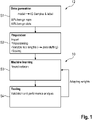
- Figure 1 an overview is shown that illustrates the respective steps of a method for training a machine learning module 10 that executes an artificial neural network in order to output jamming information for hops and/or slots of a frequency hopping signal.
- training data for the machine learning module 10, particularly the artificial neural network is generated.
- IQ samples are generated according to a model that describes a certain scenario.
- the IQ samples are associated with a jammed frequency hopping baseband signal having hops and slots.
- a pre-defined number of the hops and slots is jammed by a certain jamming signal that can be chosen, particularly its characteristics.
- labels associated with the IQ samples are also provided that can be processed by the machine learning module 10, particularly the artificial neural network, for learning/training purposes.
- the labels indicate at least one of jammed hops and/or benign hops and jammed slots and/or benign slots.
- the training of the artificial neural network may be based on hops solely, on slots solely or on a combination of slots and hops.
- each of the hops and/or slots associated with the jammed frequency hopping baseband signal may be labelled.
- the training may corresponds to a supervised learning according to which all training data provided is labeled or rather a semi-supervised learning according to which only a portion of the training data is labeled.
- the hops may be labelled by a single classification, e.g. only benign hops or only jammed hops. However, the hops may also be labelled with respect to both classifications, namely benign hops and jammed hops. The same applies mutatis mutandis for the slots.
- the training is based on hops and slots, wherein the benign ones are labelled accordingly.
- the benign ones are labelled accordingly.
- 85% of the hops provided are benign ones, whereas 44 % of the slots are benign ones.
- the respective training data may relate to a training data generation step that can be performed by a separate training data generation module 12.
- the training data may be outputted by means of csv-files.
- a second step S2 the training data generated, e.g. the csv-files, is imported and a pre-processing of the IQ samples generated may take place such that the training is simplified.
- the pre-processing may relate to a zero stuffing and/or scaling of the training data. This ensures that the individual hops/slots have the same length with regard to samples, namely a predetermined length.
- the scaling is done to normalize the range of independent variables or features of the training data.
- the training data can be processed in an easier manner by the machine learning module 10, namely the artificial neural network.
- the pre-processing step is an optional step.
- the machine learning module 10 receives the (optionally preprocessed) training data, namely the IQ samples generated as well as the labels.
- the machine learning module 10 namely the artificial neural network, processes the IQ samples generated which relate to input data in order to predict respective jamming information such as labels.
- a fourth step S4 the predicted jamming information, namely the predicted labels, outputted by the machine learning module 10 is compared with the labels being part of the training data, thereby validating the artificial neural network and/or conducting a performance analysis of the artificial neural network.
- respective settings of the artificial neural network are adapted, namely weights of the artificial neural network in order to improve the artificial neural network, which is done during the training of the artificial neural network, particularly at the beginning.
- the artificial neural network with adapted settings/weights processes the training data again, particularly the IQ samples, wherein the artificial neural network with adapted settings/weights is validated again and/or a performance analysis of the artificial neural network with adapted settings/weights is performed again.
- the respective settings of the artificial neural network are adapted, namely weights of the artificial neural network.
- the machine learning module 10 namely the artificial neural network
- FIGS 3 and 4 schematic overviews of an artificial neuronal network providing hop-based classification and an artificial neuronal network providing slot-based classification are shown, respectively.
- the respective artificial neuronal network receives one hop or one slot, namely the respective number of IQ samples associated with one hop (32 IQ samples in the embodiment shown or rather 23 x 32 IQ samples).
- the respective artificial neuronal network trained outputs jamming information that indicates if a respective hop is a jammed hop or a benign hop.
- the respective artificial neuronal network trained outputs jamming information, namely a vector, that indicates jammed hops associated with the slot.
- a vector is shown that may also be used during the training of the machine learning module 10, e.g. an input vector and/or an output vector.
- the machine learning module 10 For generating the respective (input) vector, several IQ samples are collected and gathered into the vector.
- the machine learning module 10 namely the artificial neural network, processes the (input) vector consisting of IQ samples.
- the IQ samples are filtered by means of a filter structure.
- an output vector may be outputted by the machine learning module 10, namely the artificial neural network, wherein the output vector comprises jamming information for the hops and/or slot, particularly the respective symbols associated with the hops and/or slots.
- the output vector contains information about the signal-to-noise ratio (SNR) of benign symbols, information about the signal-to-interference-plus-noise ratio (SINR) of jammed symbols, a symbol index of the first jammed symbol in the (input) vector, e.g. labelled with "start”, and/or a symbol index of the last jammed symbol in the (input) vector, e.g. labelled with "end”.
- SNR signal-to-noise ratio
- SINR signal-to-interference-plus-noise ratio
- the respective labels may be provided in form of the output vector.
- a receiver 14 for receiving and processing a radio frequency (RF) signal is shown, particularly a frequency hopping signal.
- RF radio frequency
- the receiver 14 has radio frequency reception interface 16 for receiving the RF signal, which is connected with a converter module 18.
- the converter module 18 converts the RF signal received into an IQ signal encompassing several IQ samples.
- the IQ signal may correspond to a narrowband IQ signal, in particular wherein the IQ signal has a bandwidth up to 100 kHz, preferably up to 50 kHz, more preferably up to 25 kHz.
- the converter module 18 samples and a down-converts the RF signal into the baseband while obtaining the IQ samples that together establish the IQ signal.
- the receiver 14 comprises a machine learning module 20 that executes an artificial neural network trained as described above.
- the machine learning module 20 is connected with the converter module 18 such that the IQ signal is received that is processed by the machine learning module 20, particularly the artificial neural network, in order to output at least one jamming information for the hops and/or slots associated with the radio frequency signal received.
- the receiver 14 also has a processing module 22 that is connected with the machine learning module 20, which receives and processed the jamming information provided by the machine learning module 20.
- the processing module 22 is connected with a decoder module 24 that decodes the RF signal received, namely the respective symbols.
- the jamming information gathered by the machine learning module 20, particularly the artificial neural network is used by the receiver 14 in order to improve the decoding properties of the receiver 14.
- the decoder module 20 of the receiver 14 is adapted by means of the jamming information.
- the jamming information corresponds to a classification of the hops and/or slots, indicating at least one of jammed hops and/or slots and benign hops and/or slots, namely "jammed hop”, “benign hop”, “jammed slot” and/or "benign slot”.
- the jamming information may relate to a characteristic of the jammed hops and/or slots, particularly a power or a time period of the jamming signal.
- the jamming information comprises reliability information per symbol, reliability information per group of consecutive symbols, reliability information per hop, reliability information per slot, and/or reliability information in a vector that holds the beginning and end of regions with similar reliability and the reliability of each region.
- the jamming information may be outputted by means of a vector as indicated in Figure 5 , wherein the respective reliability information corresponds to a signal-to-interference-plus-noise ratio (SINR) and/or a signal-to-noise ratio (SNR).
- SINR signal-to-interference-plus-noise ratio
- the decoder module 24 may use redundant information within the RF signal during the decoding. Hence, the decoder module 24 uses the redundant information associated with a certain slot of the RF signal received in case that the decoder module 24 receives the jamming information from the machine learning module 20, which indicates that the certain slot has a low reliability that may indicate a jamming.
- the decoder module 24 discards the respective slot, wherein the corresponding information is gathered from another slot due to the redundancy provided in the RF signal.
- the receiver 14 comprises an output interface 26 via which controlling information can be forwarded to a transmitter of the RF signal received.
- the controlling information can be used for controlling a frequency spectrum used by the transmitter.
- the receiver 14, particularly the machine learning module 20, is configured to perform a dynamic spectrum management while communicating with the transmitter.
- circuitry e.g., one or more circuits
- circuitry operably couple two or more components, generate information, process information, analyze information, generate signals, encode/decode signals, convert signals, transmit and/or receive signals, control other devices, etc.
- Circuitry of any type can be used.
- circuitry includes, among other things, one or more computing devices such as a processor (e.g., a microprocessor), a central processing unit (CPU), a digital signal processor (DSP), an application-specific integrated circuit (ASIC), a field-programmable gate array (FPGA), a system on a chip (SoC), or the like, or any combinations thereof, and can include discrete digital or analog circuit elements or electronics, or combinations thereof.
- a processor e.g., a microprocessor
- CPU central processing unit
- DSP digital signal processor
- ASIC application-specific integrated circuit
- FPGA field-programmable gate array
- SoC system on a chip
- circuitry includes hardware circuit implementations (e.g., implementations in analog circuitry, implementations in digital circuitry, and the like, and combinations thereof).
- circuitry includes combinations of circuits and computer program products having software or firmware instructions stored on one or more computer readable memories that work together to cause a device to perform one or more protocols, methodologies or technologies described herein.
- circuitry includes circuits, such as, for example, microprocessors or portions of microprocessor, that require software, firmware, and the like for operation.
- circuitry includes one or more processors or portions thereof and accompanying software, firmware, hardware, and the like.
- the present application may reference quantities and numbers. Unless specifically stated, such quantities and numbers are not to be considered restrictive, but exemplary of the possible quantities or numbers associated with the present application. Also in this regard, the present application may use the term “plurality” to reference a quantity or number. In this regard, the term “plurality” is meant to be any number that is more than one, for example, two, three, four, five, etc. The terms “about”, “approximately”, “near” etc., mean plus or minus 5% of the stated value.
Landscapes
- Engineering & Computer Science (AREA)
- Radar, Positioning & Navigation (AREA)
- Remote Sensing (AREA)
- Computer Networks & Wireless Communication (AREA)
- Signal Processing (AREA)
- Mobile Radio Communication Systems (AREA)
Abstract
Description
- The invention relates to a method of training a machine learning module for detecting at least one jammed frequency hop in a frequency hopping signal. Further, the invention relates to a receiver for receiving and processing a radio frequency signal.
- It is known in the state of the art that a substantially undisturbed transmission of a radio frequency (RF) signal can be ensured even in the event of interference from so-called jammers by using frequency hopping techniques, for instance applying a Frequency-hopping spread spectrum (FHSS).
- Generally, a jammer is a transmitter or rather radio source that transmits on the same or similar frequency spectrum of the intended transmitter the RF signal of which shall be received such that the respective signals interfere with each other, thereby disturbing the intended communication.
- The FHSS ensures that the radio frequency signal of the intended transmitter rapidly changes the carrier frequency among many distinct frequencies occupying a large spectral band since a hopping pattern is used. The respective hopping pattern, namely the changing of the carrier frequency, is controlled by a code that is known to both the transmitter and the receiver. Accordingly, the RF signal used for communication is transmitted via a different channel when the carrier frequency is changed such that the RF signal is subjected to a different set of interfering signals during each frequency hop due to the different carrier frequencies used. This avoids the problem of failing communication at a particular frequency due to a fade or a particular interferer at a certain frequency such as a jammer.
- Since the FHSS provides a rapidly changing carrier frequency among many distinct frequencies, it is ensured that only portions of the entire message transmitted by the RF signal may be disturbed, resulting in a (substantially) error-free transmission, which however depends on the respective scenario.
- In any case, it is advantageous for the respective receiver if the disturbed portions, e.g. frequency hops or slots, are detected such that these portions can be discarded or specially treated. For instance, a decoder module of the receiver may decode more erasures than errors.
- In the state of the art, the detection of the disturbed portions is done by means of algorithms and heuristics, namely so-called expert systems, that are designed specifically for a certain field of application. In the respective design phase of the algorithms and heuristics, possible scenarios, for instance a certain number of jammers and/or characteristics of the jammer(s), have to be considered, resulting in a limited field of application. The algorithms and heuristics process the radio frequency signals received within a certain radio frequency spectrum in order to identify certain characteristics that have been pre-defined previously by the respective designer of the algorithms and heuristics.
- Thus, high efforts are necessary to design a respective classification. However, its field of application is limited nevertheless due to unavoidable limitations when designing the classification used for jamming detection.
- Accordingly, there is a need for a simplified jamming detection.
- The invention provides a method of training a machine learning module for detecting at least one jammed frequency slot in a frequency hopping signal, wherein the method comprises the steps of:
- Generating IQ samples associated with a jammed frequency hopping baseband signal having hops and slots, wherein a pre-defined number of the hops and slots is jammed,
- Labeling the IQ samples generated, thereby obtaining labels indicating at least one of jammed hops and/or benign hops and jammed slots and/or benign slots, and
- Training the machine learning module by using the IQ samples generated and the labels obtained, wherein the machine learning module is configured to execute an artificial neural network that is trained.
- The main idea relates to training a machine learning module executing an artificial neural network with at least partly labeled training data, namely IQ samples generated and their respective classification obtained by the labels, namely "jammed" or rather "benign", in order to distinguish at least two categories. The training data comprises input data of the artificial neural network, namely the IQ samples, as well as output data of the artificial neural network, namely the respective classification that shall be outputted by the trained artificial neural network.
- The training of the machine learning module may correspond to a supervised learning according to which the artificial neural network learns a function that maps the input data to the output data based on example input-output pairs, namely the IQ samples and the classes, namely the respective labels. The supervised learning infers a function from labeled training data consisting of a set of training examples.
- However, the training of the machine learning module, particularly the artificial neural network, may also correspond to a semi-supervised learning. The semi-supervised learning combines a small amount of labeled data (similar to the supervised learning) with a large amount of unlabeled data during the respective training.
- Generally, the training of the machine learning module may relate to a deep learning. Hence, a convolutional neural network (CNN) may be used.
- With regard to the machine learning module, it is to be noted that the term "module" is understood to describe suitable hardware, suitable software, or a combination of hardware and software that is configured to have a certain functionality. The hardware may, inter alia, comprise a CPU, a GPU, an FPGA, an ASIC, or other types of electronic circuitry.
- Generally, only one class may be labelled, e.g. "jammed" or "benign", thereby implicitly defining that the unlabeled data corresponds to the other class. However, the labeling may also explicitly label both categories, e.g. "jammed" and "benign".
- Furthermore, the labeling may relate to the hops only or to the slots only. Accordingly, the respective hops may be classified, wherein each hop is associated with several IQ samples, e.g. 16 to 32 IQ samples. Put differently, each hop may comprise between 16 and 32 IQ samples.
- Alternatively, the respective slots may be classified, wherein each slot is associated with several hops, e.g. 23 hops. Put differently, each slot may comprise 23 hops and, therefore, each slot may comprise between 368 and 736 IQ samples.
- However, both the hops and the slots may be categorized during the labeling.
- According to an embodiment, benign hops and benign slots may be labelled, wherein these labels are used as training data together with the associated IQ samples.
- Generally, the frequency hopping signal relates to a radio frequency (RF) signal that is transmitted by a transmitter, wherein at least one receiver shall receive the radio frequency signal. The radio frequency signal is transmitted according to a frequency hopping pattern in order to reduce the risk of jamming. Further, the content to be transmitted by means of the RF signal is typically encoded such that the receiver has to decode the RF signal in order to gather the respective content. The coding of the content is done by an encoder associated with the transmitter wherein a codeword is used that is transmitted during one slot, particularly at different frequencies due to the frequency hopping applied. In other words, when using the frequency hopping signal, the codeword is transmitted by means of several frequency hops, for instance 23 hops. However, the codeword may also span a different number of hops.
- As mentioned above, when designing an expert system, only properties (features) that are recognized by the developer can be used for categorizing the respective input data. In the training of the artificial neural networks, no features have to be specified (manually), as these are found out (implicitly) by the artificial neural network itself.
- Moreover, the developer of the expert system will only be able to consider a limited number of scenarios, e.g. jammers or rather characteristics of the jammer(s). In contrast thereto, the artificial neural networks can be trained with arbitrary data, particularly disturbed by different jammers. In addition, the artificial neural networks react robustly to unknown data such as unknown jammers that have not been used during the training phase.
- Furthermore, it is easier to make adjustments when requirements change, for instance taking new types of jammers into account. In fact, it is only necessary to adapt or rather exchange weights of the artificial neural network instead of implementing completely new algorithms and/or heuristics.
- Accordingly, the method relates at least partially to a computer-implemented method. Particularly, the step of training the machine learning module is a computer-implemented process/method (step). In other word, the method is at least partially carried out by a processor/circuit, e.g. a computer comprising a processor/circuit.
- An aspect provides that each of the hops and/or slots associated with the jammed frequency hopping baseband signal is labelled. Therefore, the training relates to a supervised learning since the IQ samples being part of the training data are labelled completely, thereby providing a large training data base.
- Another aspect provides that the machine learning module directly receives the IQ samples generated, namely without any intermediate stage for feature extraction. Therefore, the artificial neural network executed by the machine learning module directly receives the IQ samples that are processed by the artificial neural network without any intermediate processing.
- However, the artificial neural network may process the training data received differently, particularly the IQ samples, by applying filter(s) that are trained/learnt by the artificial neural network during the training.
- In fact, the artificial neural network has several layers, e.g. an input layer and an output layer as well as intermediate layer(s), such as convolutional layer(s) and/or pooling layer(s).
- According to a further aspect, a zero stuffing is performed. The hops may have different lengths with regard to the number of samples. Hence, respective hops may be filled with 0 up to a predetermined length. This ensures that the individual hops have the same length with regard to samples, namely the predetermined length. Accordingly, missing samples of shorter hops are filled with 0 up to the predetermined length. Since each slot comprise several hops, the zero stuffing also applies to the hops in a similar manner. The zero stuffing relates to a preparation of the training data, particularly a preparation of the hops and/or slots.
- Moreover, a scaling may be performed. The scaling, also called normalization, used to normalize the range of independent variables or features of the training data, particularly the IQ samples. The scaling also relates to a preparation of the training data, particularly a preparation of the hops and/or slots.
- The IQ samples may be collected and gathered into a vector, e.g. an input vector, that is processed by the machine learning module, in particular wherein the IQ samples are processed by a filter structure. The respective vector may relate to a parameter vector that is used for the training of the machine learning module, namely the artificial neural network. Generally, the parameter vector may describe all relevant parameters for a hop to allow an optimal de-mapping of respective symbols associated with the IQ samples for decoding. In fact, information contained in the vector may be used for determining log likelihood ratios (LLRs) correctly that are used by a subsequent decoding in order to obtain a message transmitted.
- In fact, the message may be included in several hops, particularly in a redundant manner. Accordingly, receiver receiving and decoding the information received may make use of the redundancy within the RF signal.
- The IQ samples or rather the IQ signal derived therefrom are/is processed by the filter structure, for instance a matched filter. The matched filter is the optimal linear filter for maximizing the signal-to-noise ratio (SNR) in the presence of additive stochastic noise.
- Generally, the vector can be used for training the machine learning module, particularly the artificial neural network.
- For instance, the machine learning module, particularly the artificial neural network, is trained such that a vector is outputted, e.g. an output vector.
- The (output) vector contains information about the signal-to-noise ratio (SNR) of benign symbols, information about the signal-to-interference-plus-noise ratio (SINR) of jammed symbols, a symbol index of the first jammed symbol in the vector, and/or a symbol index of the last jammed symbol in the vector. Therefore, the machine learning module, particularly the artificial neural network, can decide if a sub-vector of the vector is jammed or not. In other words, the respective sub-vectors may relate to jammed symbols or rather benign symbols. Furthermore, information concerning the respective sub-vectors may be provided additionally, namely the signal-to-noise ratio for the sub-vector associated with benign symbols as well as the signal-to-interference-plus-noise ratio for the sub-vector associated with jammed symbols.
- Accordingly, the machine learning module, particularly the artificial neural network, is trained by receiving training data that comprises the IQ samples processed such that the vector is obtained as well as labels indicating which part of the vector is jammed or not and how much the part is jammed by providing information concerning the SNR or rather SINR.
- The invention further provides a receiver for receiving and processing a radio frequency signal. The receiver comprises a radio frequency reception interface for receiving the radio frequency signal. The receiver comprises a converter module that is connected with the radio frequency reception interface. The converter module is configured to convert the radio frequency signal received into an IQ signal. The receiver further comprises a machine learning module that is configured to execute an artificial neural network trained according to the method described above. The machine learning module is connected with the converter module, thereby receiving the IQ signal. The machine learning module is configured to process the IQ signal received, thereby obtaining at least one jamming information for hops and/or slots of the radio frequency signal received.
- The converter module performs a sampling and a down-conversion such that the radio frequency (RF) signal is converted into the baseband while obtaining IQ samples. In other words, the radio frequency signal received is sampled, thereby generating the IQ samples. For instance, the respective quantization of the symbols is performed for each frequency hop.
- The radio frequency signal received is processed by the receiver, particularly the trained machine learning module, such that information concerning the IQ samples associated with the radio frequency signal received is outputted by the receiver, namely the machine learning module, due to the artificial neural network trained as described above. Hence, the artificial neural network is enabled to categorize the respective IQ samples sampled from the radio frequency signal received appropriately in order to decide whether hops and/or slots are jammed or not.
- In other words, the machine learning module is configured to execute/carry out the artificial neural network trained.
- An aspect provides that the receiver comprises a processing module that is connected with the machine learning module such that the processing module is configured to receive and process the at least one jamming information obtained, thereby adapting a decoder module of the receiver which is configured to decode the radio frequency signal received. Accordingly, the decoding of the radio frequency signal received can be improved appropriately by using the jamming information outputted by the trained artificial neural network. Hence, it is not the purpose of the receiver or rather the trained artificial neural network to perform a modelling of the jammer, but to improve decoding of the radio frequency signal received.
- The decoder module may be configured to use redundant information within the radio frequency signal received. Information encompassed within a message transmitted is spread along several hops, wherein the respective information may be provided in a redundant manner.
- Particularly, the decoder module is configured to use the redundant information associated with a certain slot of the radio frequency signal received in case that the decoder module receives the jamming information from the machine learning module, which indicates that the certain slot has a low reliability. Accordingly, jammed slots can be discarded such that the decoding is improved, thereby improving the recovery.
- According to another aspect, the at least one jamming information corresponds to a classification of the hops and/or slots, indicating at least one of jammed hops and/or slots and benign hops and/or slots. Hence, the jamming information outputted by the artificial neural network corresponds to the respective classification of the hops and/or slots.
- Furthermore, the at least one jamming information may correspond to a characteristic of jammed hops and/or slots, particularly a power or a time period of a jamming signal. Distorted symbols can be recovered easier if the power/strength of the jamming and noise is known, particularly for each symbol.
- A further aspect provides that the at least one jamming information comprises reliability information per symbol, reliability information per group of consecutive symbols, reliability information per hop, reliability information per slot, and/or reliability information in a vector that holds the beginning and end of regions with similar reliability and the reliability of each region, e.g. an area/region of jammed symbols. Accordingly, the artificial neural network is enabled to output jamming information associated with each single symbol or rather a group of consecutive symbols, e.g. a defined number of consecutive symbols such as every N consecutive symbols. The jamming information may also concern the hop encompassing several symbols and/or the slot comprising several hops. The respective vector may correspond to the parameter vector that has certain sub-vectors, also called ranges. The vector may comprise entries that indicate characteristics of the IQ samples.
- Particularly, the reliability information corresponds to a signal-to-interference-plus-noise ratio and/or a signal-to-noise ratio. The signal to interference plus noise ratio (SINR) as well as the signal-to-noise ratio each characterize the quality of the respective symbol(s) received. This information may be used for de-mapping in order to determine correct log likelihood ratios (LLRs) that can be used by the decoder module.
- In fact, the vector provided by the artificial neural network may have different entries, for instance for entries. One entry, e.g. the first entry, may indicate the signal-to-noise ratio of benign symbols. Another entry, e.g. the second entry, may indicate the signal-to- interference-plus-noise ratio of jammed symbols. A further entry, e.g. the third entry, may indicate the first jammed symbol. An additional, entry, e.g. the fourth entry, may indicate the last jammed symbol. In case of no jamming, only the first entry has a valid entry indicating the SNR while the others are set to NaN. In case of all symbols being jammed or interfered, the first entry is set to NaN while the second entry indicates the SINR, the third entry is set to 1 and the fourth entry is set to the last symbol of the hop.
- Another aspect provides that the receiver has an output interface via which controlling information is forwarded to a transmitter of the radio frequency signal received, thereby controlling a frequency spectrum used such that receiver, particularly the machine learning module, is configured to perform a dynamic spectrum management. Accordingly, the receiver may forward information to the transmitter to use another frequency range for transmission due to a jamming detected.
- According to a further aspect, the IQ signal is a narrowband IQ signal, in particular wherein the IQ signal has a bandwidth up to 100 kHz, preferably up to 50 kHz, more preferably up to 25 kHz. The respective signals may relate to tactical radio signals. Particularly, the radio frequency signal relates to an anti-jam narrowband waveform, namely an AJ-NB signal. The respective signal/waveform provides a very high frequency or rather ultra-high frequency (VHF/UHF) frequency hopping functionality for mobile units and high-speed airborne platforms. The waveform covers wide transmission ranges and is highly robust against follower jammers and deception. The waveform uses a TDMA-based transmission concept.
- In fact, no pilot tones will be transmitted prior to the signal transmission. The respective transmission channel is within the coherence bandwidth. This is caused by the short hop scheme. This means the number of symbols which will be transmitted within one hop.
- The foregoing aspects and many of the attendant advantages of the claimed subject matter will become more readily appreciated as the same become better understood by reference to the following detailed description, when taken in conjunction with the accompanying drawings, wherein:
-
Figure 1 schematically shows an overview of a method of training a machine learning module according to the invention, -
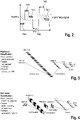
Figure 2 schematically shows a spectrum of a frequency hopping signal and a jammer, -
Figure 3 shows a schematic overview of an artificial neuronal network providing hop-based classification, -
Figure 4 shows a schematic overview of an artificial neuronal network providing slot-based classification, -
Figure 5 schematically shows an overview of a vector used for training the machine learning module, and -
Figure 6 shows a receiver according to the invention. - The detailed description set forth below in connection with the appended drawings, where like numerals reference like elements, is intended as a description of various embodiments of the disclosed subject matter and is not intended to represent the only embodiments. Each embodiment described in this disclosure is provided merely as an example or illustration and should not be construed as preferred or advantageous over other embodiments. The illustrative examples provided herein are not intended to be exhaustive or to limit the claimed subject matter to the precise forms disclosed.
- For the purposes of the present disclosure, the phrase "at least one of A, B, and C", for example, means (A), (B), (C), (A and B), (A and C), (B and C), or (A, B, and C), including all further possible permutations when more than three elements are listed. In other words, the term "at least one of A and B" generally means "A and/or B", namely "A" alone, "B" alone or "A and B".
- In
Figure 1 , an overview is shown that illustrates the respective steps of a method for training amachine learning module 10 that executes an artificial neural network in order to output jamming information for hops and/or slots of a frequency hopping signal. - In a first step S1, training data for the
machine learning module 10, particularly the artificial neural network, is generated. - Accordingly, IQ samples are generated according to a model that describes a certain scenario. The IQ samples are associated with a jammed frequency hopping baseband signal having hops and slots. A pre-defined number of the hops and slots is jammed by a certain jamming signal that can be chosen, particularly its characteristics.
- During the first step, in which the training data is provided, labels associated with the IQ samples are also provided that can be processed by the
machine learning module 10, particularly the artificial neural network, for learning/training purposes. - Depending on the respective purpose of the artificial neural network, the labels indicate at least one of jammed hops and/or benign hops and jammed slots and/or benign slots.
- Accordingly, the training of the artificial neural network may be based on hops solely, on slots solely or on a combination of slots and hops. Thus, each of the hops and/or slots associated with the jammed frequency hopping baseband signal may be labelled.
- Generally, the training may corresponds to a supervised learning according to which all training data provided is labeled or rather a semi-supervised learning according to which only a portion of the training data is labeled.
- In any case, the hops may be labelled by a single classification, e.g. only benign hops or only jammed hops. However, the hops may also be labelled with respect to both classifications, namely benign hops and jammed hops. The same applies mutatis mutandis for the slots.
- In the example shown in
Figure 1 , the training is based on hops and slots, wherein the benign ones are labelled accordingly. In fact, 85% of the hops provided are benign ones, whereas 44 % of the slots are benign ones. - The respective training data may relate to a training data generation step that can be performed by a separate training
data generation module 12. The training data may be outputted by means of csv-files. - In
Figure 2 , the respective scenario used for training the artificial neural network is schematically illustrated in parts. The respective frequency hops are clearly visualized as well as the jamming signal that covers a certain frequency range and, therefore, disturbs some of the hops and, therefore, some of the slots comprising several hops. - In a second step S2, the training data generated, e.g. the csv-files, is imported and a pre-processing of the IQ samples generated may take place such that the training is simplified.
- The pre-processing may relate to a zero stuffing and/or scaling of the training data. This ensures that the individual hops/slots have the same length with regard to samples, namely a predetermined length. The scaling is done to normalize the range of independent variables or features of the training data. Hence, the training data can be processed in an easier manner by the
machine learning module 10, namely the artificial neural network. - However, the pre-processing step is an optional step.
- In a third step S3, the
machine learning module 10 receives the (optionally preprocessed) training data, namely the IQ samples generated as well as the labels. - The
machine learning module 10, namely the artificial neural network, processes the IQ samples generated which relate to input data in order to predict respective jamming information such as labels. - In a fourth step S4, the predicted jamming information, namely the predicted labels, outputted by the
machine learning module 10 is compared with the labels being part of the training data, thereby validating the artificial neural network and/or conducting a performance analysis of the artificial neural network. - Depending on the outcome of the validation and/or performance analysis, respective settings of the artificial neural network are adapted, namely weights of the artificial neural network in order to improve the artificial neural network, which is done during the training of the artificial neural network, particularly at the beginning.
- Afterwards, the artificial neural network with adapted settings/weights processes the training data again, particularly the IQ samples, wherein the artificial neural network with adapted settings/weights is validated again and/or a performance analysis of the artificial neural network with adapted settings/weights is performed again.
- Depending on the outcome, the respective settings of the artificial neural network are adapted, namely weights of the artificial neural network.
- This is repeated several times during the (deep) learning phase of the
machine learning module 10, namely the artificial neural network. - Generally, the
machine learning module 10, namely the artificial neural network, directly receives the IQ samples generated without any intermediate stage for feature extraction, as themachine learning module 10, namely the artificial neural network, derives the respective information directly from the IQ samples. - In
Figures 3 and 4 , schematic overviews of an artificial neuronal network providing hop-based classification and an artificial neuronal network providing slot-based classification are shown, respectively. - It becomes obvious that the IQ samples associated with the hops and/or slots are processed by the different layers of the artificial neuronal network accordingly.
- The respective artificial neuronal network receives one hop or one slot, namely the respective number of IQ samples associated with one hop (32 IQ samples in the embodiment shown or rather 23 x 32 IQ samples).
- In the embodiment shown in
Figure 3 , the respective artificial neuronal network trained outputs jamming information that indicates if a respective hop is a jammed hop or a benign hop. - In the embodiment shown in
Figure 4 , the respective artificial neuronal network trained outputs jamming information, namely a vector, that indicates jammed hops associated with the slot. - In
Figure 5 , a vector is shown that may also be used during the training of themachine learning module 10, e.g. an input vector and/or an output vector. - For generating the respective (input) vector, several IQ samples are collected and gathered into the vector. During the training the
machine learning module 10, namely the artificial neural network, processes the (input) vector consisting of IQ samples. Particularly, the IQ samples are filtered by means of a filter structure. - Moreover, an output vector may be outputted by the
machine learning module 10, namely the artificial neural network, wherein the output vector comprises jamming information for the hops and/or slot, particularly the respective symbols associated with the hops and/or slots. - As shown in
Figure 5 , the output vector contains information about the signal-to-noise ratio (SNR) of benign symbols, information about the signal-to-interference-plus-noise ratio (SINR) of jammed symbols, a symbol index of the first jammed symbol in the (input) vector, e.g. labelled with "start", and/or a symbol index of the last jammed symbol in the (input) vector, e.g. labelled with "end". - During the training, the respective labels may be provided in form of the output vector.
- In
Figure 6 , areceiver 14 for receiving and processing a radio frequency (RF) signal is shown, particularly a frequency hopping signal. - The
receiver 14 has radiofrequency reception interface 16 for receiving the RF signal, which is connected with aconverter module 18. Theconverter module 18 converts the RF signal received into an IQ signal encompassing several IQ samples. The IQ signal may correspond to a narrowband IQ signal, in particular wherein the IQ signal has a bandwidth up to 100 kHz, preferably up to 50 kHz, more preferably up to 25 kHz. - In fact, the
converter module 18 samples and a down-converts the RF signal into the baseband while obtaining the IQ samples that together establish the IQ signal. - Furthermore, the
receiver 14 comprises amachine learning module 20 that executes an artificial neural network trained as described above. Themachine learning module 20 is connected with theconverter module 18 such that the IQ signal is received that is processed by themachine learning module 20, particularly the artificial neural network, in order to output at least one jamming information for the hops and/or slots associated with the radio frequency signal received. - The
receiver 14 also has aprocessing module 22 that is connected with themachine learning module 20, which receives and processed the jamming information provided by themachine learning module 20. Theprocessing module 22 is connected with adecoder module 24 that decodes the RF signal received, namely the respective symbols. - Accordingly, the jamming information gathered by the
machine learning module 20, particularly the artificial neural network, is used by thereceiver 14 in order to improve the decoding properties of thereceiver 14. In other words, thedecoder module 20 of thereceiver 14 is adapted by means of the jamming information. - The jamming information corresponds to a classification of the hops and/or slots, indicating at least one of jammed hops and/or slots and benign hops and/or slots, namely "jammed hop", "benign hop", "jammed slot" and/or "benign slot".
- Moreover, the jamming information may relate to a characteristic of the jammed hops and/or slots, particularly a power or a time period of the jamming signal.
- Particularly, the jamming information comprises reliability information per symbol, reliability information per group of consecutive symbols, reliability information per hop, reliability information per slot, and/or reliability information in a vector that holds the beginning and end of regions with similar reliability and the reliability of each region. The jamming information may be outputted by means of a vector as indicated in
Figure 5 , wherein the respective reliability information corresponds to a signal-to-interference-plus-noise ratio (SINR) and/or a signal-to-noise ratio (SNR). - The
decoder module 24 may use redundant information within the RF signal during the decoding. Hence, thedecoder module 24 uses the redundant information associated with a certain slot of the RF signal received in case that thedecoder module 24 receives the jamming information from themachine learning module 20, which indicates that the certain slot has a low reliability that may indicate a jamming. - Accordingly, the
decoder module 24 discards the respective slot, wherein the corresponding information is gathered from another slot due to the redundancy provided in the RF signal. - In addition, the
receiver 14 comprises anoutput interface 26 via which controlling information can be forwarded to a transmitter of the RF signal received. The controlling information can be used for controlling a frequency spectrum used by the transmitter. Hence, thereceiver 14, particularly themachine learning module 20, is configured to perform a dynamic spectrum management while communicating with the transmitter. - Certain embodiments disclosed herein, particularly the respective module(s), utilize circuitry (e.g., one or more circuits) in order to implement standards, protocols, methodologies or technologies disclosed herein, operably couple two or more components, generate information, process information, analyze information, generate signals, encode/decode signals, convert signals, transmit and/or receive signals, control other devices, etc. Circuitry of any type can be used.
- In an embodiment, circuitry includes, among other things, one or more computing devices such as a processor (e.g., a microprocessor), a central processing unit (CPU), a digital signal processor (DSP), an application-specific integrated circuit (ASIC), a field-programmable gate array (FPGA), a system on a chip (SoC), or the like, or any combinations thereof, and can include discrete digital or analog circuit elements or electronics, or combinations thereof. In an embodiment, circuitry includes hardware circuit implementations (e.g., implementations in analog circuitry, implementations in digital circuitry, and the like, and combinations thereof).
- In an embodiment, circuitry includes combinations of circuits and computer program products having software or firmware instructions stored on one or more computer readable memories that work together to cause a device to perform one or more protocols, methodologies or technologies described herein. In an embodiment, circuitry includes circuits, such as, for example, microprocessors or portions of microprocessor, that require software, firmware, and the like for operation. In an embodiment, circuitry includes one or more processors or portions thereof and accompanying software, firmware, hardware, and the like.
- The present application may reference quantities and numbers. Unless specifically stated, such quantities and numbers are not to be considered restrictive, but exemplary of the possible quantities or numbers associated with the present application. Also in this regard, the present application may use the term "plurality" to reference a quantity or number. In this regard, the term "plurality" is meant to be any number that is more than one, for example, two, three, four, five, etc. The terms "about", "approximately", "near" etc., mean plus or minus 5% of the stated value.
Claims (15)
- A method of training a machine learning module (10) for detecting at least one jammed frequency slot in a frequency hopping signal, wherein the method comprises the steps of:- Generating IQ samples associated with a jammed frequency hopping baseband signal having hops and slots, wherein a pre-defined number of the hops and slots is jammed,- Labeling the IQ samples generated, thereby obtaining labels indicating at least one of jammed hops and/or benign hops and jammed slots and/or benign slots, and- Training the machine learning module (10) by using the IQ samples generated and the labels obtained, wherein the machine learning module (10) is configured to execute an artificial neural network that is trained.
- The method according to claim 1, wherein each of the hops and/or slots associated with the jammed frequency hopping baseband signal is labelled.
- The method according to claim 1 or 2, wherein the machine learning module directly receives the IQ samples generated.
- The method according to any of the preceding claims, wherein a zero stuffing is performed and/or a scaling are/is performed.
- The method according to any of the preceding claims, wherein the IQ samples are collected and gathered into a vector that is processed by the machine learning module, in particular wherein the IQ samples are processed by a filter structure.
- The method according to claim 5, wherein the vector contains information about the signal-to-noise ratio of benign symbols, information about the signal-to-interference-plus-noise ratio of jammed symbols, a symbol index of the first jammed symbol in the vector, and/or a symbol index of the last jammed symbol in the vector.
- A receiver for receiving and processing a radio frequency signal, wherein the receiver (14) comprises a radio frequency reception interface (16) for receiving the radio frequency signal, wherein the receiver (14) comprises a converter module (18) that is connected with the radio frequency reception interface (16), wherein the converter module (18) is configured to convert the radio frequency signal received into an IQ signal, wherein the receiver (14) further comprises a machine learning module (20) that is configured to execute an artificial neural network trained according to the method of any of the preceding claims, wherein the machine learning module (20) is connected with the converter module (18), thereby receiving the IQ signal, and wherein the machine learning module (20) is configured to process the IQ signal received, thereby obtaining at least one jamming information for hops and/or slots of the radio frequency signal received.
- The receiver according to claim 7, wherein the receiver (14) comprises a processing module (22) that is connected with the machine learning module (20) such that the processing module (22) is configured to receive and process the at least one jamming information obtained, thereby adapting a decoder module (24) of the receiver which is configured to decode the radio frequency signal received.
- The receiver according to claim 8, wherein the decoder module (24) is configured to use redundant information within the radio frequency signal received, in particular wherein the decoder module (24) is configured to use the redundant information associated with a certain slot of the radio frequency signal received in case that the decoder module (24) receives the jamming information from the machine learning module (20), which indicates that the certain slot has a low reliability.
- The receiver according to any of claims 7 to 9, wherein the at least one jamming information corresponds to a classification of the hops and/or slots, indicating at least one of jammed hops and/or slots and benign hops and/or slots.
- The receiver according to any of claims 7 to 10, wherein the at least one jamming information corresponds to a characteristic of jammed hops and/or slots, particularly a power or a time period of a jamming signal.
- The receiver according to any of claims 7 to 11, wherein the at least one jamming information comprises reliability information per symbol, reliability information per group of consecutive symbols, reliability information per hop, reliability information per slot, and/or reliability information in a vector that holds the beginning and end of regions with similar reliability and the reliability of each region.
- The receiver according to claim 12, wherein the reliability information corresponds to a signal-to-interference-plus-noise ratio and/or a signal-to-noise ratio.
- The receiver according to any of claims 7 to 13, wherein the receiver (14) has an output interface (26) via which controlling information is forwarded to a transmitter of the radio frequency signal received, thereby controlling a frequency spectrum used such that the receiver (14), particularly the machine learning module (20), is configured to perform a dynamic spectrum management.
- The receiver according to any of claims 7 to 14, wherein the IQ signal is a narrowband IQ signal, in particular wherein the IQ signal has a bandwidth up to 100 kHz, preferably up to 50 kHz, more preferably up to 25 kHz.
Priority Applications (1)
| Application Number | Priority Date | Filing Date | Title |
|---|---|---|---|
| EP21150919.5A EP4027545A1 (en) | 2021-01-11 | 2021-01-11 | Method of training a machine learning module for detecting at least one jammed frequency hop in a frequency hopping signal, and receiver |
Applications Claiming Priority (1)
| Application Number | Priority Date | Filing Date | Title |
|---|---|---|---|
| EP21150919.5A EP4027545A1 (en) | 2021-01-11 | 2021-01-11 | Method of training a machine learning module for detecting at least one jammed frequency hop in a frequency hopping signal, and receiver |
Publications (1)
| Publication Number | Publication Date |
|---|---|
| EP4027545A1 true EP4027545A1 (en) | 2022-07-13 |
Family
ID=74130105
Family Applications (1)
| Application Number | Title | Priority Date | Filing Date |
|---|---|---|---|
| EP21150919.5A Pending EP4027545A1 (en) | 2021-01-11 | 2021-01-11 | Method of training a machine learning module for detecting at least one jammed frequency hop in a frequency hopping signal, and receiver |
Country Status (1)
| Country | Link |
|---|---|
| EP (1) | EP4027545A1 (en) |
Cited By (3)
| Publication number | Priority date | Publication date | Assignee | Title |
|---|---|---|---|---|
| CN116112038A (en) * | 2022-12-29 | 2023-05-12 | 中国电子科技集团公司第三十研究所 | A frequency hopping signal network station sorting method and system based on image processing |
| CN118152777A (en) * | 2024-02-04 | 2024-06-07 | 中国人民解放军国防科技大学 | A method and system for frequency hopping radio station individual identification based on multi-branch parallel learning |
| WO2024263338A1 (en) * | 2023-06-19 | 2024-12-26 | Qualcomm Incorporated | Unmanned aerial vehicle (uav) interference mitigation |
Citations (3)
| Publication number | Priority date | Publication date | Assignee | Title |
|---|---|---|---|---|
| WO2018184682A1 (en) * | 2017-04-06 | 2018-10-11 | Nokia Technologies Oy | Wireless network communications for classifying transmission signatures and machine learning based signature generation |
| WO2019161076A1 (en) * | 2018-02-19 | 2019-08-22 | Digital Global Systems, Inc. | Systems, methods, and devices for unmanned vehicle detection and threat management |
| US20200153535A1 (en) * | 2018-11-09 | 2020-05-14 | Bluecom Systems and Consulting LLC | Reinforcement learning based cognitive anti-jamming communications system and method |
-
2021
- 2021-01-11 EP EP21150919.5A patent/EP4027545A1/en active Pending
Patent Citations (3)
| Publication number | Priority date | Publication date | Assignee | Title |
|---|---|---|---|---|
| WO2018184682A1 (en) * | 2017-04-06 | 2018-10-11 | Nokia Technologies Oy | Wireless network communications for classifying transmission signatures and machine learning based signature generation |
| WO2019161076A1 (en) * | 2018-02-19 | 2019-08-22 | Digital Global Systems, Inc. | Systems, methods, and devices for unmanned vehicle detection and threat management |
| US20200153535A1 (en) * | 2018-11-09 | 2020-05-14 | Bluecom Systems and Consulting LLC | Reinforcement learning based cognitive anti-jamming communications system and method |
Non-Patent Citations (1)
| Title |
|---|
| RAJENDRAN SREERAJ ET AL: "Unsupervised Wireless Spectrum Anomaly Detection With Interpretable Features", IEEE TRANSACTIONS ON COGNITIVE COMMUNICATIONS AND NETWORKING, IEEE, USA, vol. 5, no. 3, September 2019 (2019-09-01), pages 637 - 647, XP011744861, DOI: 10.1109/TCCN.2019.2911524 * |
Cited By (4)
| Publication number | Priority date | Publication date | Assignee | Title |
|---|---|---|---|---|
| CN116112038A (en) * | 2022-12-29 | 2023-05-12 | 中国电子科技集团公司第三十研究所 | A frequency hopping signal network station sorting method and system based on image processing |
| CN116112038B (en) * | 2022-12-29 | 2024-05-24 | 中国电子科技集团公司第三十研究所 | A frequency hopping signal network station sorting method and system based on image processing |
| WO2024263338A1 (en) * | 2023-06-19 | 2024-12-26 | Qualcomm Incorporated | Unmanned aerial vehicle (uav) interference mitigation |
| CN118152777A (en) * | 2024-02-04 | 2024-06-07 | 中国人民解放军国防科技大学 | A method and system for frequency hopping radio station individual identification based on multi-branch parallel learning |
Similar Documents
| Publication | Publication Date | Title |
|---|---|---|
| KR101554732B1 (en) | Distributed spectrum sensing | |
| US11923881B2 (en) | Interference detection and suppression in non-coordinated systems | |
| Fehske et al. | A new approach to signal classification using spectral correlation and neural networks | |
| JP5248608B2 (en) | Communication system, receiver and communication method | |
| EP2628340B1 (en) | System and method for selective channel removal in multi-channel receivers | |
| US20070202829A1 (en) | Receiver for Narrowband Interference Cancellation | |
| Chae et al. | Rethinking autocorrelation for deep spectrum sensing in cognitive radio networks | |
| US20240106494A1 (en) | Cognitive radio system providing operating parameter changes based upon cognitive group hierarchy and related methods | |
| CN119363291A (en) | An artificial intelligence-based UAV remote control signal source interference control system | |
| US8891700B1 (en) | Method for detecting, classifying, and reducing interference in wireless networks | |
| Wang et al. | Blind recognition method for non-cooperative communication signals based on aerial computing | |
| CN115942367B (en) | Channel quality assessment method of narrow-band system and narrow-band receiver | |
| US12401388B2 (en) | Spectrum sensing apparatus and the operation method | |
| EP2086255B1 (en) | Process for sensing vacant sub-space over the spectrum bandwidth and apparatus for performing the same | |
| EP2506428B1 (en) | Technique for automatic gain control | |
| KR102231207B1 (en) | Learning based anti-jamming communication system and control method | |
| US5905765A (en) | Method of processing error-control coded, frequency-hopped communication signals | |
| KR100506487B1 (en) | detection of code vectors in single frequency, multiple transmitter networks | |
| Guo et al. | Few-shot source separation for IoT anti-jamming via multitask learning and meta-learning | |
| Ibadik et al. | Frequency domain energy detection for multiband spectrum sensing in cognitive radio system | |
| GB2299917A (en) | Error processing in ADPCM voice transmission system | |
| Wang et al. | AI-driven self-optimizing receivers for cognitive radio networks | |
| Joly et al. | Improving BLE Coexistence: Automatic Gain Control Index Prediction Using Bagged Tree | |
| Joly et al. | Algorithm for AGC index management against crowded radio environment | |
| Murillo-fuentes et al. | Gaussian processes for multiuser detection in CDMA receivers |
Legal Events
| Date | Code | Title | Description |
|---|---|---|---|
| PUAI | Public reference made under article 153(3) epc to a published international application that has entered the european phase |
Free format text: ORIGINAL CODE: 0009012 |
|
| STAA | Information on the status of an ep patent application or granted ep patent |
Free format text: STATUS: THE APPLICATION HAS BEEN PUBLISHED |
|
| AK | Designated contracting states |
Kind code of ref document: A1 Designated state(s): AL AT BE BG CH CY CZ DE DK EE ES FI FR GB GR HR HU IE IS IT LI LT LU LV MC MK MT NL NO PL PT RO RS SE SI SK SM TR |
|
| STAA | Information on the status of an ep patent application or granted ep patent |
Free format text: STATUS: REQUEST FOR EXAMINATION WAS MADE |
|
| 17P | Request for examination filed |
Effective date: 20221227 |
|
| RBV | Designated contracting states (corrected) |
Designated state(s): AL AT BE BG CH CY CZ DE DK EE ES FI FR GB GR HR HU IE IS IT LI LT LU LV MC MK MT NL NO PL PT RO RS SE SI SK SM TR |
|
| P01 | Opt-out of the competence of the unified patent court (upc) registered |
Effective date: 20230525 |
|
| STAA | Information on the status of an ep patent application or granted ep patent |
Free format text: STATUS: EXAMINATION IS IN PROGRESS |
|
| 17Q | First examination report despatched |
Effective date: 20241108 |