EP4027476B1 - Energy storage system comprising multiple battery packs - Google Patents
Energy storage system comprising multiple battery packs Download PDFInfo
- Publication number
- EP4027476B1 EP4027476B1 EP20940597.6A EP20940597A EP4027476B1 EP 4027476 B1 EP4027476 B1 EP 4027476B1 EP 20940597 A EP20940597 A EP 20940597A EP 4027476 B1 EP4027476 B1 EP 4027476B1
- Authority
- EP
- European Patent Office
- Prior art keywords
- converter
- vbus
- energy storage
- terminal
- storage system
- Prior art date
- Legal status (The legal status is an assumption and is not a legal conclusion. Google has not performed a legal analysis and makes no representation as to the accuracy of the status listed.)
- Active
Links
Images


Classifications
-
- H—ELECTRICITY
- H02—GENERATION; CONVERSION OR DISTRIBUTION OF ELECTRIC POWER
- H02J—ELECTRIC POWER NETWORKS; CIRCUIT ARRANGEMENTS OR SYSTEMS FOR SUPPLYING OR DISTRIBUTING ELECTRIC POWER; SYSTEMS FOR STORING ELECTRIC ENERGY
- H02J3/00—Circuit arrangements for AC mains or AC distribution networks
- H02J3/28—Arrangements for balancing of the load in networks by storage of energy
- H02J3/32—Arrangements for balancing of the load in networks by storage of energy using batteries or super capacitors with converting means
-
- H—ELECTRICITY
- H02—GENERATION; CONVERSION OR DISTRIBUTION OF ELECTRIC POWER
- H02J—ELECTRIC POWER NETWORKS; CIRCUIT ARRANGEMENTS OR SYSTEMS FOR SUPPLYING OR DISTRIBUTING ELECTRIC POWER; SYSTEMS FOR STORING ELECTRIC ENERGY
- H02J3/00—Circuit arrangements for AC mains or AC distribution networks
- H02J3/38—Arrangements for feeding a single network from two or more generators or sources in parallel; Arrangements for feeding already energised networks from additional generators or sources in parallel
- H02J3/381—Dispersed generators
-
- H—ELECTRICITY
- H02—GENERATION; CONVERSION OR DISTRIBUTION OF ELECTRIC POWER
- H02J—ELECTRIC POWER NETWORKS; CIRCUIT ARRANGEMENTS OR SYSTEMS FOR SUPPLYING OR DISTRIBUTING ELECTRIC POWER; SYSTEMS FOR STORING ELECTRIC ENERGY
- H02J7/00—Circuit arrangements for charging or discharging batteries or for supplying loads from batteries
- H02J7/50—Circuit arrangements for charging or discharging batteries or for supplying loads from batteries acting upon multiple batteries simultaneously or sequentially
-
- H—ELECTRICITY
- H02—GENERATION; CONVERSION OR DISTRIBUTION OF ELECTRIC POWER
- H02J—ELECTRIC POWER NETWORKS; CIRCUIT ARRANGEMENTS OR SYSTEMS FOR SUPPLYING OR DISTRIBUTING ELECTRIC POWER; SYSTEMS FOR STORING ELECTRIC ENERGY
- H02J7/00—Circuit arrangements for charging or discharging batteries or for supplying loads from batteries
- H02J7/50—Circuit arrangements for charging or discharging batteries or for supplying loads from batteries acting upon multiple batteries simultaneously or sequentially
- H02J7/52—Circuit arrangements for charging or discharging batteries or for supplying loads from batteries acting upon multiple batteries simultaneously or sequentially for charge balancing, e.g. equalisation of charge between batteries
- H02J7/56—Active balancing, e.g. using capacitor-based, inductor-based or DC-DC converters
-
- H—ELECTRICITY
- H02—GENERATION; CONVERSION OR DISTRIBUTION OF ELECTRIC POWER
- H02J—ELECTRIC POWER NETWORKS; CIRCUIT ARRANGEMENTS OR SYSTEMS FOR SUPPLYING OR DISTRIBUTING ELECTRIC POWER; SYSTEMS FOR STORING ELECTRIC ENERGY
- H02J7/00—Circuit arrangements for charging or discharging batteries or for supplying loads from batteries
- H02J7/865—Battery or charger load switching, e.g. concurrent charging and load supply
-
- H—ELECTRICITY
- H02—GENERATION; CONVERSION OR DISTRIBUTION OF ELECTRIC POWER
- H02J—ELECTRIC POWER NETWORKS; CIRCUIT ARRANGEMENTS OR SYSTEMS FOR SUPPLYING OR DISTRIBUTING ELECTRIC POWER; SYSTEMS FOR STORING ELECTRIC ENERGY
- H02J2101/00—Supply or distribution of decentralised, dispersed or local electric power generation
- H02J2101/20—Dispersed power generation using renewable energy sources
- H02J2101/22—Solar energy
- H02J2101/24—Photovoltaics
- H02J2101/25—Photovoltaics involving maximum power point tracking control for photovoltaic sources
-
- H—ELECTRICITY
- H02—GENERATION; CONVERSION OR DISTRIBUTION OF ELECTRIC POWER
- H02J—ELECTRIC POWER NETWORKS; CIRCUIT ARRANGEMENTS OR SYSTEMS FOR SUPPLYING OR DISTRIBUTING ELECTRIC POWER; SYSTEMS FOR STORING ELECTRIC ENERGY
- H02J2101/00—Supply or distribution of decentralised, dispersed or local electric power generation
- H02J2101/20—Dispersed power generation using renewable energy sources
- H02J2101/28—Wind energy
-
- H—ELECTRICITY
- H02—GENERATION; CONVERSION OR DISTRIBUTION OF ELECTRIC POWER
- H02J—ELECTRIC POWER NETWORKS; CIRCUIT ARRANGEMENTS OR SYSTEMS FOR SUPPLYING OR DISTRIBUTING ELECTRIC POWER; SYSTEMS FOR STORING ELECTRIC ENERGY
- H02J2207/00—Details of circuit arrangements for charging or discharging batteries or supplying loads from batteries
- H02J2207/20—Charging or discharging characterised by the power electronics converter
-
- H—ELECTRICITY
- H02—GENERATION; CONVERSION OR DISTRIBUTION OF ELECTRIC POWER
- H02J—ELECTRIC POWER NETWORKS; CIRCUIT ARRANGEMENTS OR SYSTEMS FOR SUPPLYING OR DISTRIBUTING ELECTRIC POWER; SYSTEMS FOR STORING ELECTRIC ENERGY
- H02J7/00—Circuit arrangements for charging or discharging batteries or for supplying loads from batteries
- H02J7/34—Parallel operation in networks using both storage and other DC sources, e.g. providing buffering
- H02J7/35—Parallel operation in networks using both storage and other DC sources, e.g. providing buffering with light sensitive cells
-
- Y—GENERAL TAGGING OF NEW TECHNOLOGICAL DEVELOPMENTS; GENERAL TAGGING OF CROSS-SECTIONAL TECHNOLOGIES SPANNING OVER SEVERAL SECTIONS OF THE IPC; TECHNICAL SUBJECTS COVERED BY FORMER USPC CROSS-REFERENCE ART COLLECTIONS [XRACs] AND DIGESTS
- Y02—TECHNOLOGIES OR APPLICATIONS FOR MITIGATION OR ADAPTATION AGAINST CLIMATE CHANGE
- Y02E—REDUCTION OF GREENHOUSE GAS [GHG] EMISSIONS, RELATED TO ENERGY GENERATION, TRANSMISSION OR DISTRIBUTION
- Y02E10/00—Energy generation through renewable energy sources
- Y02E10/50—Photovoltaic [PV] energy
- Y02E10/56—Power conversion systems, e.g. maximum power point trackers
Definitions
- This application relates to the power supply field, and in particular, to an electrical energy storage system and an energy storage system.
- An electrical energy storage system may store electrical energy generated by a power generation system in a battery, and obtain electricity from the battery when needed.
- the power generation system may be a new energy power generation system, for example, a wind power generation system or a photovoltaic power generation system.
- the power generation system may output a direct current or an alternating current.
- the direct current may be supplied to the electrical energy storage system for storage, and the alternating current is used to be supplied to an alternating current power grid or an alternating current load.
- An alternating current voltage that is output by the power generation system includes different voltage levels.
- the alternating current voltage levels usually may include single-phase 220 Vac and three-phase 380 Vac.
- the single-phase 220 Vac corresponds to a direct current voltage 311 Vdc
- the three-phase 380 Vac corresponds to a direct current voltage 537 Vdc
- Vac represents a maximum magnitude value of an alternating current voltage
- Vdc represents a magnitude of a direct current voltage
- a direct current to direct current (direct current to direct current, DC/DC) converter in the electrical energy storage system is configured to: receive a direct current that is output by the power generation system, and input the direct current to a battery pack for storage after performing direct current voltage conversion. Therefore, the DC/DC converter needs to be designed, so that an input voltage range of the DC/DC converter adapts to an output voltage range of the power generation system.
- an input voltage range of a DC/DC converter in an electrical energy storage system is usually designed to match a voltage level of an alternating current of a power generation system.
- the alternating current voltage level of the power generation system changes, for example, changes from single-phase 220 Vac to three-phase 380 Vac
- the DC/DC converter cannot support an input voltage range corresponding to the three-phase 380 Vac because the input voltage range of the DC/DC converter is designed to support the single-phase 220 Vac. Consequently, the electrical energy storage system cannot support different voltage levels, and application flexibility of the electrical energy storage system is affected.
- CN 204 230 948 U discloses an energy-feed charging and discharging machine, which is applied to a rechargeable battery pack production system.
- the battery pack production system is connected to a main power grid.
- the charging and discharging machine includes: A first DC bus and a second DC bus for transmitting a stable DC power.
- the first DC bus and the second DC are connected by a first bi-directional energy storage DC/DC converter for charging rechargeable batteries from the second DC bus which are connected to the first DC bus.
- a second bi-directional energy storage DC/DC converter may be provided in the second DC bus.
- US 2019/334349 A1 discloses a multi-power distributed storage system including a first power source; a second power source electrically connected to a common bus with the first power source; and a single input port inverter electrically connected to the common bus.
- the system includes a controller configured to communicate with at least the second power source, and the single input port inverter.
- the second power source includes a plurality of battery banks and a plurality of bi-directional DC/DC converters configured to charge and discharge the plurality of battery banks and provide DC to the single input port inverter.
- CN 109 921 409 A discloses a system and control method of all-DC power supply and storage for a building.
- the system includes a renewable energy power generation apparatus, a mains grid system, a first DC/DC conversion apparatus, an AC/DC conversion apparatus, a first voltage DC bus, a first energy storage apparatus, and a first charge-discharge conversion apparatus.
- the first DC/DC conversion apparatus is configured to convert DC voltage generated by the renewable energy power generation apparatus to voltage of the first voltage DC bus.
- the AC/DC conversion apparatus is configured to convert AC power from the mains grid system to DC power.
- the first charge-discharge conversion apparatus is configured to control charge/discharge of the first energy storage apparatus.
- the first voltage DC bus is connected to a first electrical device and configured to power the first electrical device.
- CN 110 912 235 A discloses an energy storage system and a current equalizing method thereof.
- the energy storage system comprises X current equalizing units and X battery clusters, wherein in each current equalizing unit, the first end of the DC/DC converter at the uppermost stage is connected with the direct-current bus of the corresponding battery cluster; the second ends of the Y lowest-stage DC/DC converters are respectively connected with the corresponding battery packs of the corresponding battery clusters, and the second end of the uppermost-stage DC/DC converter is directly connected with the first end of each lowest-stage DC/DC converter or is connected with the first end of each lowest-stage DC/DC converter through other stages of DC/DC converters.
- This application provides an energy storage system, to improve application flexibility of the electrical energy storage system.
- the invention provides an energy storage system of claim 1, comprising an electrical energy storage system and a power generation system. Further embodiments are disclosed in the dependent claims.
- the electrical energy storage system includes: M battery packs; M first direct current to direct current (DC/DC) converters, where first terminals of the M first DC/DC converters are respectively connected to the M battery packs, the M first DC/DC converters are classified into N first DC/DC converter sets, M is an integer greater than or equal to 4, and N is an integer greater than 1; and N second DC/DC converters, where the N second DC/DC converters one-to-one correspond to the N first DC/DC converter sets, a first terminal of each second DC/DC converter is connected to second terminals of all first DC/DC converters in a first DC/DC converter set corresponding to the second DC/DC converter, a second terminal of each second DC/DC converter is connected to a first interface of the electrical energy storage system, the first interface is configured to receive a direct current from a power generation system or output a direct current to the power generation system, and N is an integer greater than 1 and the N second DC/DC converters are connected in parallel.
- M direct current to direct current
- the electrical energy storage system includes two types of DC/DC converters, and the N second DC/DC converters are disposed between the power generation system and the first DC/DC converters.
- the second DC/DC converter may be configured to perform voltage conversion on a voltage input by the power generation system, so that an output voltage adapts to the input voltage range of the first DC/DC converter.
- the second DC/DC converter may perform voltage conversion on a voltage input by the first DC/DC converter, so that a range of voltages output to the power generation system adapts to a voltage level of the power generation system. Therefore, the electrical energy storage system can support different voltage levels of the power generation system, thereby improving application flexibility of the electrical energy storage system.
- the electrical energy storage system can support different voltage levels of the power generation system, the electrical energy storage system can adapt to inverters of different voltage levels in the power generation system.
- the electrical energy storage system corresponding to the power generation systems of different voltage levels can be produced by using a unified standard, thereby improving the production efficiency.
- the second DC/DC converter when Vinv - Vbus > Vth and a battery pack is discharged, the second DC/DC converter is configured to boost Vbus to output Vinv; or when Vinv - Vbus > Vth and a battery pack is charged, the second DC/DC converter is configured to buck Vinv to output Vbus, where Vinv represents a rated voltage of the second terminal of the second DC/DC converter, Vbus represents a rated voltage of the first terminal of the second DC/DC converter, and Vth represents a preset threshold voltage.
- the second DC/DC converter works in a direct mode, where Vinv represents the rated voltage of the second terminal of the second DC/DC converter, Vbus represents the rated voltage of the first terminal of the second DC/DC converter, and Vth represents the preset threshold voltage.
- the second DC/DC converter when Vinv - Vbus ⁇ - Vth and the battery pack is discharged, the second DC/DC converter is configured to buck Vbus to output Vinv; or when Vinv - Vbus > Vth and the battery pack is charged, the second DC/DC converter is configured to boost Vinv to output Vbus, where Vinv represents the rated voltage of the second terminal of the second DC/DC converter, Vbus represents the rated voltage of the first terminal of the second DC/DC converter, and Vth represents the preset threshold voltage.
- the first DC/DC converter when Vbus > Vbat and the battery pack is discharged, the first DC/DC converter is configured to boost Vbat to output Vbus; or when Vbus > Vbat and the battery pack is charged, the first DC/DC converter is configured to buck Vbus to output Vbat, where Vbus represents the rated voltage of the first terminal of the second DC/DC converter, and Vbat represents a rated voltage of an anode of the battery pack.
- the first DC/DC converter works in the direct mode, where Vbus represents the rated voltage of the first terminal of the second DC/DC converter, and Vbat represents the rated voltage of the anode of the battery pack.
- the first DC/DC converter when Vbus ⁇ Vbat and the battery pack is discharged, the first DC/DC converter is configured to buck Vbat to output Vbus; or when Vbus ⁇ Vbat and the battery pack is charged, the first DC/DC converter is configured to boost Vbus to output Vbat, where Vbus represents the rated voltage of the first terminal of the second DC/DC converter, and Vbat represents the rated voltage of the anode of the battery pack.
- the power generation system includes an inverter, a first terminal of the inverter is connected to the first interface of the electrical energy storage system, and a second terminal of the inverter is connected to an alternating current load or an alternating current power grid.
- the power generation system is a photovoltaic power generation system
- the power generation system includes a photovoltaic inverter
- the photovoltaic inverter includes a maximum power point tracking (MPPT) module and a DC/AC converter
- the inverter is the DC/AC converter
- a first terminal of the DC/AC converter is connected to the first interface of the electrical energy storage system
- the first terminal of the DC/AC converter is further connected to the MPPT module
- a second terminal of the DC/AC converter is connected to the alternating current load or the alternating current power grid.
- MPPT maximum power point tracking
- the system of claim 1 includes the electrical energy storage system according to the first aspect and a power generation system.
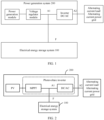
- FIG. 1 is a schematic diagram of an application scenario according to an embodiment of this application.
- a power generation system 200 may generate an alternating current or a direct current, and supply the alternating current to an alternating current power grid or an alternating current load.
- the power generation system 200 may further supply the generated direct current to an electrical energy storage system 100, and the electrical energy storage system 100 stores electrical energy.
- the electrical energy storage system 100 may output a direct current to the power generation system 200.
- a direct current to alternating current (direct current to alternating current, DC/AC) converter in the power generation system 200 processes the direct current, an alternating current is obtained and supplied to the alternating current load or the alternating current power grid.
- DC/AC direct current to alternating current
- the power generation system 200 may be a new energy power generation system, for example, a wind power generation system or a photovoltaic power generation system.
- the power generation system 200 includes a power generation module, and the power generation module may generate a direct current or an alternating current.
- the power generation module in a wind power generation system usually generates an alternating current
- a power generation module in a photovoltaic power generation system usually generates a direct current.
- the power generation system 200 further includes a voltage regulator module, and the voltage regulator module may regulate a voltage output by the power generation module. If a current output by the power generation module is an alternating current, the voltage regulator module is further configured to convert the alternating current into a direct current.
- a voltage regulator module in a wind power generation system is usually an AC/DC converter
- a voltage regulator module in a photovoltaic power generation system is usually a DC/DC converter.
- the DC/DC converter may be disposed in a maximum power point tracking (maximum power point tracking, MPPT) module in a photovoltaic inverter (referring to FIG. 2 ).
- MPPT maximum power point tracking
- the power generation system 200 further includes an inverter.
- the inverter is usually disposed between the voltage regulator module and the alternating current load (or the alternating current power grid), and can implement direct current to alternating current conversion.
- the inverter may also be referred to as a DC/AC converter.
- the inverter includes a first terminal A1 and a second terminal A2.
- the first terminal A1 is configured to receive a direct current
- the second terminal A2 is connected to the alternating current load or the alternating current power grid.
- the inverter may implement DC/AC conversion in a direction from the first terminal A1 to the second terminal A2, and supply an obtained alternating current to the alternating current load or the alternating current power grid.
- the first terminal A1 of the inverter is further connected to a first interface F of the electrical energy storage system 100 to output a direct current to the electrical energy storage system 100.
- the inverter may alternatively implement AC/DC conversion in a direction from the second terminal A2 to the first terminal A1.
- an alternating current input by the alternating current power grid may be converted into a direct current, and the direct current is supplied to the electrical energy storage system 100.
- the inverter may be a DC/AC converter in a photovoltaic inverter (referring to FIG. 2 ).
- FIG. 2 is a schematic diagram of an application scenario according to an embodiment of this application.
- the scenario in FIG. 2 may be applied to a photovoltaic power generation scenario.
- the application scenario includes a power generation system 200 and an electrical energy storage system 100.
- the power generation system 200 includes a photovoltaic (photovoltaic, PV) component and a photovoltaic inverter.
- the photovoltaic inverter is a special inverter designed for the photovoltaic power generation system.
- a core of photovoltaic power generation is to convert solar energy into electrical energy by using a photovoltaic component (namely, a solar energy battery panel).
- a photovoltaic component namely, a solar energy battery panel.
- the photovoltaic component can generate only a direct current
- the photovoltaic inverter needs to convert the direct current into an alternating current to facilitate transmission and use of the electrical energy.
- the photovoltaic inverter further includes an MPPT module.
- the MPPT module includes a DC/DC converter.
- the MPPT module may be configured to track a maximum voltage current value, so that the power generation system 200 outputs a current at a maximum power.
- the MPPT module and the DC/DC module in the photovoltaic inverter may be disposed in a same encapsulation component, or may be disposed in different encapsulation components.
- the MPPT module After performing voltage conversion on a direct current generated by the PV component, the MPPT module outputs the direct current to the electrical energy storage system 100.
- a first terminal A1 of the DC/AC converter is connected to the MPPT module and the electrical energy storage system 100, and a second terminal A2 of the DC/AC converter is connected to an alternating current power grid or an alternating current load to convert a direct current output by the MPPT module or the electrical energy storage system 100 into an alternating current and supply the alternating current to the alternating current load or the alternating current power grid.
- the electrical energy storage system 100 generally includes one or more DC/DC converters, one or more battery packs, and one or more battery management systems (battery management systems, BMSs). Each battery pack corresponds to one BMS.
- BMS battery management systems
- the BMS is usually configured to implement functions such as dynamic monitoring of charging and discharging of a battery, battery balancing, and state of charge evaluation of the battery.
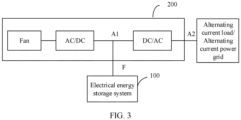
- FIG. 3 is a schematic diagram of an application scenario according to another embodiment of this application.
- the scenario in FIG. 3 may be applied to a wind power generation scenario.
- the application scenario includes a power generation system 200 and an electrical energy storage system 100.
- the power generation system 200 includes a fan system, an AC/DC converter, and a DC/AC converter (namely, an inverter).
- the fan system is configured to generate an alternating current.
- the AC/DC converter may be configured to: convert the alternating current generated by the fan system into a direct current, and implement a voltage regulation function.
- the AC/DC converter may further output the direct current to the electrical energy storage system 100, so that the electrical energy storage system 100 stores the electrical energy.
- the DC/AC converter may be configured to: receive the direct current output by the AC/DC converter, convert the received direct current into an alternating current, and supply the alternating current to an alternating current load or an alternating current power grid.
- the DC/AC converter may further be configured to: receive a direct current output by the electrical energy storage system 100, convert the received direct current into an alternating current, and supply the alternating current to the alternating current load or the alternating current power grid.
- FIG. 1 to FIG. 3 are merely examples, but are not limitations.
- the electrical energy storage system and the energy storage system in the embodiments of this application may further be applied to an application scenario of another power generation type.
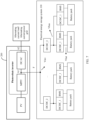
- FIG. 4 is a schematic diagram depicting a structure of an energy storage system according to an embodiment of this application.
- the energy storage system includes a power generation system 200 and an electrical energy storage system 100.
- the electrical energy storage system 100 includes: M battery packs, M first DC/DC converters (expressed as DC/DC_1 in the figure), N second DC/DC converters (expressed as DC/DC_2 in the figure), and M BMSs, where M is an integer greater than or equal to 4 and N is an integer greater thar 1.
- the M battery packs one-to-one correspond to the M BMSs.
- Each BMS is configured to manage a corresponding battery pack, for example, perform functions such as dynamic monitoring of charging and discharging of a battery of the battery pack, battery balancing, and state of charge evaluation of the battery.
- the M battery packs one-to-one correspond to the M first DC/DC converters.
- Each battery pack is connected to a first terminal of a corresponding first DC/DC converter.
- the M first DC/DC converters are classified into N first DC/DC converter sets.
- the N first DC/DC converter sets one-to-one correspond to the N second DC/DC converters.
- Each first DC/DC converter set includes one or more first DC/DC converters.
- Different first DC/DC converter sets may include a same quantity of first DC/DC converters or different quantities of first DC/DC converters.
- the M battery packs are classified into N battery pack sets.
- the N battery pack sets, the N first DC/DC converter sets, and the N second DC/DC converters are in a one-to-one correspondence mutually.
- a first terminal of each of the N second DC/DC converters is connected to second terminals of all first DC/DC converters in a first DC/DC converter set corresponding to the second DC/DC converter.
- a second terminal of each second DC/DC converter is connected to a first interface F of the electrical energy storage system 100, the first interface F is configured to receive a direct current from the power generation system 200 or output a direct current to the power generation system 200, and N is an integer greater than 1.
- the first terminal and the second terminal of the first DC/DC converter each include two terminals: a positive terminal and a negative terminal.
- the positive terminal and the negative terminal of the first terminal of the first DC/DC converter are respectively connected to an anode and a cathode of a battery pack.
- the first terminal and the second terminal of the second DC/DC converter each include two terminals: a positive terminal and a negative terminal.
- the first interface F is connected to a first terminal A1 of an inverter in the power generation system 200.
- the first DC/DC converter and the second DC/DC converter each can implement a bidirectional boost or buck function.
- the first DC/DC converter and the second DC/DC converter may further work in a direct mode. In the direct mode, the first DC/DC converter and the second DC/DC converter do not execute a boost/buck function, and are equivalent to one power switch.
- the N second DC/DC converters are connected in parallel. Moreover, the first DC/DC converters in the set are connected in parallel.
- the first DC/DC converter may use an isolated power conversion manner, or may use a non-isolated power conversion manner.
- the second DC/DC converter may use an isolated power conversion manner, or may use a non-isolated power conversion manner.
- Isolated power conversion means that a transformer is disposed in a DC/DC converter.
- battery packs in different battery pack sets may be of a same model, or may be manufactured by different vendors or may be of different models.
- the electrical energy storage system in this embodiment of this application may support different types of battery packs.
- the power generation system 200 includes the inverter (namely, a DC/AC converter), the first terminal A1 of the inverter is connected to the first interface F of the electrical energy storage system 100, and a second terminal A2 of the inverter is connected to an alternating current load or an alternating current power grid.
- the inverter may output a direct current to the electrical energy storage system 100 through the first interface F of the electrical energy storage system 100.
- the power generation system 200 is a new energy power generation system, for example, a wind power generation system or a photovoltaic power generation system.
- the power generation system 200 may further be connected to the alternating current power grid.
- An alternating current supplied by the alternating current power grid may be rectified by using the inverter in the power generation system 200 to obtain a direct current, and the direct current is supplied to the electrical energy storage system 100.
- the power generation system 200 further includes a power generation module and a voltage regulator module.
- the power generation module is configured to generate a direct current or an alternating current.
- the direct current or the alternating current becomes a direct current after passing through the voltage regulator module.
- the first terminal A1 of the inverter is configured to receive a direct current output by the voltage regulator module.
- the inverter may implement DC/AC conversion in a direction from the first terminal A1 to the second terminal A2, and supply an obtained alternating current to the alternating current load.
- the inverter may alternatively implement AC/DC conversion in a direction from the second terminal A2 to the first terminal A1.
- an alternating current input by the alternating current power grid may be converted into a direct current, and the direct current is supplied to the electrical energy storage system 100.
- the power generation module includes a PV component and the inverter is a DC/AC converter in a photovoltaic inverter, and the voltage regulator module is an MPPT module in the photovoltaic inverter.
- the electrical energy storage system includes two types of DC/DC converters, and the N second DC/DC converters are disposed between the power generation system 200 and the first DC/DC converters.
- the second DC/DC converter may be configured to perform voltage conversion on a voltage input by the power generation system, so that an output voltage adapts to the input voltage range of the first DC/DC converter.
- the second DC/DC converter may perform voltage conversion on a voltage input by the first DC/DC converter, so that a range of voltages output to the power generation system adapts to a voltage level of the power generation system. Therefore, the electrical energy storage system can support different voltage levels of the power generation system, thereby improving application flexibility of the electrical energy storage system.
- the electrical energy storage system can support different voltage levels of the power generation system, the electrical energy storage system can adapt to inverters of different voltage levels in the power generation system.
- the electrical energy storage system corresponding to the power generation systems of different voltage levels can be produced by using a unified standard, thereby improving the production efficiency.
- FIG. 5 is a schematic diagram of control logic of an electrical energy storage system 100 according to an embodiment of this application.
- Vbus represents a rated voltage of a first terminal of any second DC/DC converter (in other words, a rated voltage of a second terminal of a first DC/DC converter)
- Vbat represents a rated voltage of a battery pack (in other words, a rated voltage of a first terminal of the first DC/DC converter).
- the rated voltage may be an optimal voltage at which electrical equipment works normally for a long time.
- control logic of the first DC/DC converter is as follows:
- the first DC/DC converter When Vbus > Vbat, if the battery pack is discharged, the first DC/DC converter is configured to boost Vbat to output Vbus; or if the battery pack is charged, the first DC/DC converter is configured to buck Vbus to output Vbat.
- the first DC/DC converter When Vbus ⁇ Vbat, if the battery pack is discharged, the first DC/DC converter is configured to buck Vbat to output Vbus; or if the battery pack is charged, the first DC/DC converter is configured to boost Vbus to output Vbat.
- the first DC/DC converter when the battery pack is discharged, the first DC/DC converter is configured to boost Vbat to output Vbus; or when the battery pack is charged, the first DC/DC converter is configured to buck Vbus to output Vbat.
- FIG. 6 is a schematic diagram of control logic of an electrical energy storage system 100 according to an embodiment of this application.
- Vinv represents a rated voltage of a second terminal of any second DC/DC converter (in other words, a rated voltage at a first interface F)
- Vbus represents a rated voltage of a first terminal of any second DC/DC converter (in other words, a rated voltage of a second terminal of a first DC/DC converter)
- Vth represents a preset threshold voltage.
- control logic of the second DC/DC converter is as follows:
- the second DC/DC converter When Vinv - Vbus > Vth, if a battery pack is discharged, the second DC/DC converter is configured to boost Vbus to output Vinv; or if a battery pack is charged, the second DC/DC converter is configured to buck Vinv to output Vbus.
- the second DC/DC converter works in a direct mode.
- the second DC/DC converter When Vinv - Vbus ⁇ -Vth, if a battery pack is discharged, the second DC/DC converter is configured to buck Vbus to output Vinv; or if a battery pack is charged, the second DC/DC converter is configured to boost Vinv to output Vbus.
- a specific value of Vth may be determined based on practice.
- the specific value of Vth may be related to an input voltage range of the first DC/DC converter.
- Vinv ⁇ [Vbus - Vth, Vbus + Vth]
- Vinv falls within the input voltage range of the first DC/DC converter. Therefore, the second DC/DC converter works in a direct mode, and Vinv may be directly used as an input voltage of the second DC/DC converter.
- Vth is 5 Vor 10 V
- Vinv 1000 V
- Vbus 350 V
- Vth 10 V That is, Vinv - Vbus > Vth.
- the second DC/DC converter is configured to boost Vbus to output Vinv; or when the battery pack is charged, the second DC/DC converter is configured to buck Vinv to output Vbus.
- FIG. 7 is a schematic diagram depicting a structure of an energy storage system according to an embodiment of this application.
- the energy storage system includes an electrical energy storage system 100 and a power generation system 200.
- the power generation system 200 in FIG. 7 is a photovoltaic power generation system.
- the power generation system 200 includes a photovoltaic inverter.
- the photovoltaic inverter includes an MPPT module and a DC/AC converter.
- the inverter in FIG. 4 may be the DC/AC converter, and the voltage regulator module may be the MPPT module.
- a first terminal A1 of the DC/AC converter is connected to a first interface F of the electrical energy storage system 100, and the first terminal A1 of the DC/AC converter is further connected to the MPPT module to receive a direct current from a photovoltaic (PV) component.
- a second terminal A2 of the DC/AC converter is connected to an alternating current load or an alternating current power grid.
- the DC/AC converter may receive a direct current output by the MPPT module, implement DC/AC conversion in a direction from the first terminal A1 to the second terminal A2, and supply an obtained alternating current to the alternating current load.
- the first terminal A1 of the DC/AC converter is further configured to output a direct current to the electrical energy storage system 100 through the first interface F.
- the DC/AC converter may alternatively implement AC/DC conversion in a direction from the second terminal A2 to the first terminal A1.
- an alternating current input by the alternating current power grid may be converted into a direct current, and the direct current is supplied to the electrical energy storage system 100.
- a function of the electrical energy storage system 100 is similar to that in FIG. 4 .
- details are not described herein again.
- the disclosed system, apparatus, and method may be implemented in other manners.
- the described apparatus embodiment is merely an example.
- the unit division is merely logical function division and may be other division in actual implementation.
- a plurality of units or components may be combined or integrated into another system, or some features may be ignored or not performed.
- the displayed or discussed mutual couplings or direct couplings or communication connections may be implemented through some interfaces.
- the indirect couplings or communication connections between the apparatuses or units may be implemented in electronic, mechanical, or other forms.
- the units described as separate parts may or may not be physically separate, and parts displayed as units may or may not be physical units, may be located in one position, or may be distributed on a plurality of network units. Some or all of the units may be selected depending on actual requirements to achieve the objectives of the solutions in the embodiments.
- the functions When the functions are implemented in a form of a software functional unit and sold or used as an independent product, the functions may be stored in a computer-readable storage medium. Based on such an understanding, the technical solutions of this application essentially, or the part contributing to the conventional technology, or some of the technical solutions may be implemented in a form of a software product.
- the computer software product is stored in a storage medium, and includes several instructions for instructing a computer device (which may be a personal computer, a server, or a network device) to perform all or some of the steps of the methods described in the embodiments of this application.
- the foregoing storage medium includes any medium that can store program code, such as a USB flash drive, a removable hard disk, a read-only memory (Read-Only Memory, ROM), a random access memory (Random Access Memory, RAM), a magnetic disk, or an optical disc.
- program code such as a USB flash drive, a removable hard disk, a read-only memory (Read-Only Memory, ROM), a random access memory (Random Access Memory, RAM), a magnetic disk, or an optical disc.
Landscapes
- Engineering & Computer Science (AREA)
- Power Engineering (AREA)
- Charge And Discharge Circuits For Batteries Or The Like (AREA)
- Supply And Distribution Of Alternating Current (AREA)
Description
- This application relates to the power supply field, and in particular, to an electrical energy storage system and an energy storage system.
- An electrical energy storage system may store electrical energy generated by a power generation system in a battery, and obtain electricity from the battery when needed. The power generation system may be a new energy power generation system, for example, a wind power generation system or a photovoltaic power generation system.
- The power generation system may output a direct current or an alternating current. The direct current may be supplied to the electrical energy storage system for storage, and the alternating current is used to be supplied to an alternating current power grid or an alternating current load. An alternating current voltage that is output by the power generation system includes different voltage levels. For example, the alternating current voltage levels usually may include single-phase 220 Vac and three-phase 380 Vac. After alternating current to direct current (alternating current to direct current, AC/DC) is performed on alternating current voltages of different levels to obtain direct current voltages, magnitudes of the direct current voltages also vary greatly. For example, the single-phase 220 Vac corresponds to a direct current voltage 311 Vdc, and the three-phase 380 Vac corresponds to a direct current voltage 537 Vdc. Vac represents a maximum magnitude value of an alternating current voltage, and Vdc represents a magnitude of a direct current voltage.
- A direct current to direct current (direct current to direct current, DC/DC) converter in the electrical energy storage system is configured to: receive a direct current that is output by the power generation system, and input the direct current to a battery pack for storage after performing direct current voltage conversion. Therefore, the DC/DC converter needs to be designed, so that an input voltage range of the DC/DC converter adapts to an output voltage range of the power generation system.
- In a conventional technology, an input voltage range of a DC/DC converter in an electrical energy storage system is usually designed to match a voltage level of an alternating current of a power generation system. However, in some scenarios, if the alternating current voltage level of the power generation system changes, for example, changes from single-phase 220 Vac to three-phase 380 Vac, the DC/DC converter cannot support an input voltage range corresponding to the three-phase 380 Vac because the input voltage range of the DC/DC converter is designed to support the single-phase 220 Vac. Consequently, the electrical energy storage system cannot support different voltage levels, and application flexibility of the electrical energy storage system is affected.
-
CN 204 230 948 U discloses an energy-feed charging and discharging machine, which is applied to a rechargeable battery pack production system. The battery pack production system is connected to a main power grid. The charging and discharging machine includes: A first DC bus and a second DC bus for transmitting a stable DC power. The first DC bus and the second DC but are connected by a first bi-directional energy storage DC/DC converter for charging rechargeable batteries from the second DC bus which are connected to the first DC bus. According to a further embodiment, a second bi-directional energy storage DC/DC converter may be provided in the second DC bus. -
US 2019/334349 A1 discloses a multi-power distributed storage system including a first power source; a second power source electrically connected to a common bus with the first power source; and a single input port inverter electrically connected to the common bus. The system includes a controller configured to communicate with at least the second power source, and the single input port inverter. The second power source includes a plurality of battery banks and a plurality of bi-directional DC/DC converters configured to charge and discharge the plurality of battery banks and provide DC to the single input port inverter. -
CN 109 921 409 A discloses a system and control method of all-DC power supply and storage for a building. The system includes a renewable energy power generation apparatus, a mains grid system, a first DC/DC conversion apparatus, an AC/DC conversion apparatus, a first voltage DC bus, a first energy storage apparatus, and a first charge-discharge conversion apparatus. The first DC/DC conversion apparatus is configured to convert DC voltage generated by the renewable energy power generation apparatus to voltage of the first voltage DC bus. The AC/DC conversion apparatus is configured to convert AC power from the mains grid system to DC power. The first charge-discharge conversion apparatus is configured to control charge/discharge of the first energy storage apparatus. The first voltage DC bus is connected to a first electrical device and configured to power the first electrical device. -
CN 110 912 235 A discloses an energy storage system and a current equalizing method thereof. The energy storage system comprises X current equalizing units and X battery clusters, wherein in each current equalizing unit, the first end of the DC/DC converter at the uppermost stage is connected with the direct-current bus of the corresponding battery cluster; the second ends of the Y lowest-stage DC/DC converters are respectively connected with the corresponding battery packs of the corresponding battery clusters, and the second end of the uppermost-stage DC/DC converter is directly connected with the first end of each lowest-stage DC/DC converter or is connected with the first end of each lowest-stage DC/DC converter through other stages of DC/DC converters. - This application provides an energy storage system, to improve application flexibility of the electrical energy storage system.
- The invention provides an energy storage system of
claim 1, comprising an electrical energy storage system and a power generation system. Further embodiments are disclosed in the dependent claims. - According to a first aspect, the electrical energy storage system is provided. The system includes: M battery packs; M first direct current to direct current (DC/DC) converters, where first terminals of the M first DC/DC converters are respectively connected to the M battery packs, the M first DC/DC converters are classified into N first DC/DC converter sets, M is an integer greater than or equal to 4, and N is an integer greater than 1; and N second DC/DC converters, where the N second DC/DC converters one-to-one correspond to the N first DC/DC converter sets, a first terminal of each second DC/DC converter is connected to second terminals of all first DC/DC converters in a first DC/DC converter set corresponding to the second DC/DC converter, a second terminal of each second DC/DC converter is connected to a first interface of the electrical energy storage system, the first interface is configured to receive a direct current from a power generation system or output a direct current to the power generation system, and N is an integer greater than 1 and the N second DC/DC converters are connected in parallel.
- The electrical energy storage system includes two types of DC/DC converters, and the N second DC/DC converters are disposed between the power generation system and the first DC/DC converters. When an output voltage range of the power generation system does not match an input voltage range of the first DC/DC converter and a battery is charged, the second DC/DC converter may be configured to perform voltage conversion on a voltage input by the power generation system, so that an output voltage adapts to the input voltage range of the first DC/DC converter. When the battery is discharged, the second DC/DC converter may perform voltage conversion on a voltage input by the first DC/DC converter, so that a range of voltages output to the power generation system adapts to a voltage level of the power generation system. Therefore, the electrical energy storage system can support different voltage levels of the power generation system, thereby improving application flexibility of the electrical energy storage system.
- In this first aspect, because the electrical energy storage system can support different voltage levels of the power generation system, the electrical energy storage system can adapt to inverters of different voltage levels in the power generation system. In other words, in production processes of the electrical energy storage system and the power generation system, because the electrical energy storage system can adapt to power generation systems of different voltage levels, the electrical energy storage system corresponding to the power generation systems of different voltage levels can be produced by using a unified standard, thereby improving the production efficiency.
- With reference to the first aspect, when Vinv - Vbus > Vth and a battery pack is discharged, the second DC/DC converter is configured to boost Vbus to output Vinv; or when Vinv - Vbus > Vth and a battery pack is charged, the second DC/DC converter is configured to buck Vinv to output Vbus, where Vinv represents a rated voltage of the second terminal of the second DC/DC converter, Vbus represents a rated voltage of the first terminal of the second DC/DC converter, and Vth represents a preset threshold voltage.
- With reference to the first aspect, in a possible implementation of the first aspect, when -Vth ≤ Vinv - Vbus < Vth, the second DC/DC converter works in a direct mode, where Vinv represents the rated voltage of the second terminal of the second DC/DC converter, Vbus represents the rated voltage of the first terminal of the second DC/DC converter, and Vth represents the preset threshold voltage.
- With reference to the first aspect, in a possible implementation of the first aspect when Vinv - Vbus < - Vth and the battery pack is discharged, the second DC/DC converter is configured to buck Vbus to output Vinv; or when Vinv - Vbus > Vth and the battery pack is charged, the second DC/DC converter is configured to boost Vinv to output Vbus, where Vinv represents the rated voltage of the second terminal of the second DC/DC converter, Vbus represents the rated voltage of the first terminal of the second DC/DC converter, and Vth represents the preset threshold voltage.
- With reference to the first aspect, when Vbus > Vbat and the battery pack is discharged, the first DC/DC converter is configured to boost Vbat to output Vbus; or when Vbus > Vbat and the battery pack is charged, the first DC/DC converter is configured to buck Vbus to output Vbat, where Vbus represents the rated voltage of the first terminal of the second DC/DC converter, and Vbat represents a rated voltage of an anode of the battery pack.
- With reference to the first aspect, in a possible implementation of the first aspect, when Vbus = Vbat, the first DC/DC converter works in the direct mode, where Vbus represents the rated voltage of the first terminal of the second DC/DC converter, and Vbat represents the rated voltage of the anode of the battery pack.
- With reference to the first aspect, in a possible implementation of the first aspect, when Vbus < Vbat and the battery pack is discharged, the first DC/DC converter is configured to buck Vbat to output Vbus; or when Vbus < Vbat and the battery pack is charged, the first DC/DC converter is configured to boost Vbus to output Vbat, where Vbus represents the rated voltage of the first terminal of the second DC/DC converter, and Vbat represents the rated voltage of the anode of the battery pack.
- With reference to the first aspect, the power generation system includes an inverter, a first terminal of the inverter is connected to the first interface of the electrical energy storage system, and a second terminal of the inverter is connected to an alternating current load or an alternating current power grid.
- With reference to the first aspect, the power generation system is a photovoltaic power generation system, the power generation system includes a photovoltaic inverter, the photovoltaic inverter includes a maximum power point tracking (MPPT) module and a DC/AC converter, and the inverter is the DC/AC converter; and a first terminal of the DC/AC converter is connected to the first interface of the electrical energy storage system, the first terminal of the DC/AC converter is further connected to the MPPT module, and a second terminal of the DC/AC converter is connected to the alternating current load or the alternating current power grid.
- The system of
claim 1 includes the electrical energy storage system according to the first aspect and a power generation system. -
-
FIG. 1 is a schematic diagram of an application scenario according to an embodiment of this application; -
FIG. 2 is a schematic diagram of an application scenario according to an embodiment of this application; -
FIG. 3 is a schematic diagram of an application scenario according to an embodiment of this application; -
FIG. 4 is a schematic diagram depicting a structure of an energy storage system according to an embodiment of this application; -
FIG. 5 is a schematic diagram of control logic of an electricalenergy storage system 100 according to an embodiment of this application; -
FIG. 6 is a schematic diagram of control logic of an electricalenergy storage system 100 according to an embodiment of this application; and -
FIG. 7 is a schematic diagram depicting a structure of an energy storage system according to an embodiment of this application. - The following describes the technical solutions of this application with reference to the accompanying drawings.
- For ease of understanding the solutions of the embodiments of this application, several terms used in the embodiments of this application are first described.
-
FIG. 1 is a schematic diagram of an application scenario according to an embodiment of this application. As shown inFIG. 1 , apower generation system 200 may generate an alternating current or a direct current, and supply the alternating current to an alternating current power grid or an alternating current load. Thepower generation system 200 may further supply the generated direct current to an electricalenergy storage system 100, and the electricalenergy storage system 100 stores electrical energy. When power needs to be supplied to the alternating current load, the electricalenergy storage system 100 may output a direct current to thepower generation system 200. After a direct current to alternating current (direct current to alternating current, DC/AC) converter in thepower generation system 200 processes the direct current, an alternating current is obtained and supplied to the alternating current load or the alternating current power grid. - Optionally, the
power generation system 200 may be a new energy power generation system, for example, a wind power generation system or a photovoltaic power generation system. - Optionally, the
power generation system 200 includes a power generation module, and the power generation module may generate a direct current or an alternating current. For example, a power generation module in a wind power generation system usually generates an alternating current, and a power generation module in a photovoltaic power generation system usually generates a direct current. - Optionally, the
power generation system 200 further includes a voltage regulator module, and the voltage regulator module may regulate a voltage output by the power generation module. If a current output by the power generation module is an alternating current, the voltage regulator module is further configured to convert the alternating current into a direct current. For example, a voltage regulator module in a wind power generation system is usually an AC/DC converter, and a voltage regulator module in a photovoltaic power generation system is usually a DC/DC converter. For example, the DC/DC converter may be disposed in a maximum power point tracking (maximum power point tracking, MPPT) module in a photovoltaic inverter (referring toFIG. 2 ). - The
power generation system 200 further includes an inverter. The inverter is usually disposed between the voltage regulator module and the alternating current load (or the alternating current power grid), and can implement direct current to alternating current conversion. The inverter may also be referred to as a DC/AC converter. - The inverter includes a first terminal A1 and a second terminal A2. The first terminal A1 is configured to receive a direct current, and the second terminal A2 is connected to the alternating current load or the alternating current power grid. The inverter may implement DC/AC conversion in a direction from the first terminal A1 to the second terminal A2, and supply an obtained alternating current to the alternating current load or the alternating current power grid.
- The first terminal A1 of the inverter is further connected to a first interface F of the electrical
energy storage system 100 to output a direct current to the electricalenergy storage system 100. - Optionally, the inverter may alternatively implement AC/DC conversion in a direction from the second terminal A2 to the first terminal A1. For example, when the
power generation system 200 is connected to the alternating current power grid, an alternating current input by the alternating current power grid may be converted into a direct current, and the direct current is supplied to the electricalenergy storage system 100. - For example, in the photovoltaic power generation system, the inverter may be a DC/AC converter in a photovoltaic inverter (referring to
FIG. 2 ). -
FIG. 2 is a schematic diagram of an application scenario according to an embodiment of this application. The scenario inFIG. 2 may be applied to a photovoltaic power generation scenario. - As shown in
FIG. 2 , the application scenario includes apower generation system 200 and an electricalenergy storage system 100. Thepower generation system 200 includes a photovoltaic (photovoltaic, PV) component and a photovoltaic inverter. - The photovoltaic inverter is a special inverter designed for the photovoltaic power generation system. A core of photovoltaic power generation is to convert solar energy into electrical energy by using a photovoltaic component (namely, a solar energy battery panel). However, because the photovoltaic component can generate only a direct current, the photovoltaic inverter needs to convert the direct current into an alternating current to facilitate transmission and use of the electrical energy.
- Compared with an ordinary inverter, in addition to a DC/AC converter, the photovoltaic inverter further includes an MPPT module. The MPPT module includes a DC/DC converter. The MPPT module may be configured to track a maximum voltage current value, so that the
power generation system 200 outputs a current at a maximum power. - Optionally, the MPPT module and the DC/DC module in the photovoltaic inverter may be disposed in a same encapsulation component, or may be disposed in different encapsulation components.
- After performing voltage conversion on a direct current generated by the PV component, the MPPT module outputs the direct current to the electrical
energy storage system 100. A first terminal A1 of the DC/AC converter is connected to the MPPT module and the electricalenergy storage system 100, and a second terminal A2 of the DC/AC converter is connected to an alternating current power grid or an alternating current load to convert a direct current output by the MPPT module or the electricalenergy storage system 100 into an alternating current and supply the alternating current to the alternating current load or the alternating current power grid. - The electrical
energy storage system 100 generally includes one or more DC/DC converters, one or more battery packs, and one or more battery management systems (battery management systems, BMSs). Each battery pack corresponds to one BMS. The BMS is usually configured to implement functions such as dynamic monitoring of charging and discharging of a battery, battery balancing, and state of charge evaluation of the battery. A specific structure of the electricalenergy storage system 100 continues to be described below with reference to the accompanying drawings. -
FIG. 3 is a schematic diagram of an application scenario according to another embodiment of this application. The scenario inFIG. 3 may be applied to a wind power generation scenario. - As shown in
FIG. 3 , the application scenario includes apower generation system 200 and an electricalenergy storage system 100. Thepower generation system 200 includes a fan system, an AC/DC converter, and a DC/AC converter (namely, an inverter). - The fan system is configured to generate an alternating current. The AC/DC converter may be configured to: convert the alternating current generated by the fan system into a direct current, and implement a voltage regulation function. The AC/DC converter may further output the direct current to the electrical
energy storage system 100, so that the electricalenergy storage system 100 stores the electrical energy. The DC/AC converter may be configured to: receive the direct current output by the AC/DC converter, convert the received direct current into an alternating current, and supply the alternating current to an alternating current load or an alternating current power grid. The DC/AC converter may further be configured to: receive a direct current output by the electricalenergy storage system 100, convert the received direct current into an alternating current, and supply the alternating current to the alternating current load or the alternating current power grid. - It should be understood that the scenarios shown in
FIG. 1 to FIG. 3 are merely examples, but are not limitations. The electrical energy storage system and the energy storage system in the embodiments of this application may further be applied to an application scenario of another power generation type. -
FIG. 4 is a schematic diagram depicting a structure of an energy storage system according to an embodiment of this application. The energy storage system includes apower generation system 200 and an electricalenergy storage system 100. - As shown in
FIG. 4 , the electricalenergy storage system 100 includes: M battery packs, M first DC/DC converters (expressed as DC/DC_1 in the figure), N second DC/DC converters (expressed as DC/DC_2 in the figure), and M BMSs, where M is an integer greater than or equal to 4 and N is an integergreater thar 1. - The M battery packs one-to-one correspond to the M BMSs. Each BMS is configured to manage a corresponding battery pack, for example, perform functions such as dynamic monitoring of charging and discharging of a battery of the battery pack, battery balancing, and state of charge evaluation of the battery.
- The M battery packs one-to-one correspond to the M first DC/DC converters. Each battery pack is connected to a first terminal of a corresponding first DC/DC converter.
- The M first DC/DC converters are classified into N first DC/DC converter sets. The N first DC/DC converter sets one-to-one correspond to the N second DC/DC converters. Each first DC/DC converter set includes one or more first DC/DC converters. Different first DC/DC converter sets may include a same quantity of first DC/DC converters or different quantities of first DC/DC converters.
- Correspondingly, the M battery packs are classified into N battery pack sets. The N battery pack sets, the N first DC/DC converter sets, and the N second DC/DC converters are in a one-to-one correspondence mutually.
- A first terminal of each of the N second DC/DC converters is connected to second terminals of all first DC/DC converters in a first DC/DC converter set corresponding to the second DC/DC converter.
- A second terminal of each second DC/DC converter is connected to a first interface F of the electrical
energy storage system 100, the first interface F is configured to receive a direct current from thepower generation system 200 or output a direct current to thepower generation system 200, and N is an integer greater than 1. - Optionally, the first terminal and the second terminal of the first DC/DC converter each include two terminals: a positive terminal and a negative terminal. For example, the positive terminal and the negative terminal of the first terminal of the first DC/DC converter are respectively connected to an anode and a cathode of a battery pack.
- Optionally, the first terminal and the second terminal of the second DC/DC converter each include two terminals: a positive terminal and a negative terminal.
- The first interface F is connected to a first terminal A1 of an inverter in the
power generation system 200. - The first DC/DC converter and the second DC/DC converter each can implement a bidirectional boost or buck function. The first DC/DC converter and the second DC/DC converter may further work in a direct mode. In the direct mode, the first DC/DC converter and the second DC/DC converter do not execute a boost/buck function, and are equivalent to one power switch.
- According to the invention, the N second DC/DC converters are connected in parallel. Moreover, the first DC/DC converters in the set are connected in parallel.
- Optionally, the first DC/DC converter may use an isolated power conversion manner, or may use a non-isolated power conversion manner.
- Optionally, the second DC/DC converter may use an isolated power conversion manner, or may use a non-isolated power conversion manner.
- Isolated power conversion means that a transformer is disposed in a DC/DC converter. Non-isolated power conversion means that no transformer is disposed in a DC/DC converter.
- Optionally, in this embodiment of this application, battery packs in different battery pack sets may be of a same model, or may be manufactured by different vendors or may be of different models. In other words, the electrical energy storage system in this embodiment of this application may support different types of battery packs.
- As shown in
FIG. 4 , thepower generation system 200 includes the inverter (namely, a DC/AC converter), the first terminal A1 of the inverter is connected to the first interface F of the electricalenergy storage system 100, and a second terminal A2 of the inverter is connected to an alternating current load or an alternating current power grid. The inverter may output a direct current to the electricalenergy storage system 100 through the first interface F of the electricalenergy storage system 100. - The
power generation system 200 is a new energy power generation system, for example, a wind power generation system or a photovoltaic power generation system. - The
power generation system 200 may further be connected to the alternating current power grid. An alternating current supplied by the alternating current power grid may be rectified by using the inverter in thepower generation system 200 to obtain a direct current, and the direct current is supplied to the electricalenergy storage system 100. - Optionally, the
power generation system 200 further includes a power generation module and a voltage regulator module. The power generation module is configured to generate a direct current or an alternating current. The direct current or the alternating current becomes a direct current after passing through the voltage regulator module. The first terminal A1 of the inverter is configured to receive a direct current output by the voltage regulator module. The inverter may implement DC/AC conversion in a direction from the first terminal A1 to the second terminal A2, and supply an obtained alternating current to the alternating current load. - Optionally, the inverter may alternatively implement AC/DC conversion in a direction from the second terminal A2 to the first terminal A1. For example, when the
power generation system 200 is connected to the alternating current power grid, an alternating current input by the alternating current power grid may be converted into a direct current, and the direct current is supplied to the electricalenergy storage system 100. - Being the power generation system 200 a photovoltaic power generation system, the power generation module includes a PV component and the inverter is a DC/AC converter in a photovoltaic inverter, and the voltage regulator module is an MPPT module in the photovoltaic inverter.
- In this embodiment of this application, the electrical energy storage system includes two types of DC/DC converters, and the N second DC/DC converters are disposed between the
power generation system 200 and the first DC/DC converters. When an output voltage range of thepower generation system 200 does not match an input voltage range of the first DC/DC converter and a battery is charged, the second DC/DC converter may be configured to perform voltage conversion on a voltage input by the power generation system, so that an output voltage adapts to the input voltage range of the first DC/DC converter. When the battery is discharged, the second DC/DC converter may perform voltage conversion on a voltage input by the first DC/DC converter, so that a range of voltages output to the power generation system adapts to a voltage level of the power generation system. Therefore, the electrical energy storage system can support different voltage levels of the power generation system, thereby improving application flexibility of the electrical energy storage system. - In this embodiment of this application, because the electrical energy storage system can support different voltage levels of the power generation system, the electrical energy storage system can adapt to inverters of different voltage levels in the power generation system. In other words, in production processes of the electrical energy storage system and the power generation system, because the electrical energy storage system can adapt to power generation systems of different voltage levels, the electrical energy storage system corresponding to the power generation systems of different voltage levels can be produced by using a unified standard, thereby improving the production efficiency.
- In this embodiment of this application, a manner in which a plurality of battery packs are connected in parallel is used in the electrical energy storage system. Therefore, when a battery pack is invalid, normal work of another battery pack is not affected, thereby improving reliability of the electrical energy storage system.
-
FIG. 5 is a schematic diagram of control logic of an electricalenergy storage system 100 according to an embodiment of this application. With reference toFIG. 4 andFIG. 5 , it is assumed that Vbus represents a rated voltage of a first terminal of any second DC/DC converter (in other words, a rated voltage of a second terminal of a first DC/DC converter), and Vbat represents a rated voltage of a battery pack (in other words, a rated voltage of a first terminal of the first DC/DC converter). The rated voltage may be an optimal voltage at which electrical equipment works normally for a long time. In this case, control logic of the first DC/DC converter is as follows: - When Vbus > Vbat, if the battery pack is discharged, the first DC/DC converter is configured to boost Vbat to output Vbus; or if the battery pack is charged, the first DC/DC converter is configured to buck Vbus to output Vbat.
- When Vbus = Vbat, the first DC/DC converter works in a direct mode.
- When Vbus < Vbat, if the battery pack is discharged, the first DC/DC converter is configured to buck Vbat to output Vbus; or if the battery pack is charged, the first DC/DC converter is configured to boost Vbus to output Vbat.
- In an example, it is assumed that Vbus = 350 Vdc and Vbat = 48 Vdc. That is, Vbus > Vbat. In this case, when the battery pack is discharged, the first DC/DC converter is configured to boost Vbat to output Vbus; or when the battery pack is charged, the first DC/DC converter is configured to buck Vbus to output Vbat.
-
FIG. 6 is a schematic diagram of control logic of an electricalenergy storage system 100 according to an embodiment of this application. With reference toFIG. 4 andFIG. 6 , it is assumed that Vinv represents a rated voltage of a second terminal of any second DC/DC converter (in other words, a rated voltage at a first interface F), Vbus represents a rated voltage of a first terminal of any second DC/DC converter (in other words, a rated voltage of a second terminal of a first DC/DC converter), and Vth represents a preset threshold voltage. In this case, control logic of the second DC/DC converter is as follows: - When Vinv - Vbus > Vth, if a battery pack is discharged, the second DC/DC converter is configured to boost Vbus to output Vinv; or if a battery pack is charged, the second DC/DC converter is configured to buck Vinv to output Vbus.
- When -Vth ≤ Vinv - Vbus < Vth, the second DC/DC converter works in a direct mode.
- When Vinv - Vbus < -Vth, if a battery pack is discharged, the second DC/DC converter is configured to buck Vbus to output Vinv; or if a battery pack is charged, the second DC/DC converter is configured to boost Vinv to output Vbus.
- Optionally, a specific value of Vth may be determined based on practice. For example, the specific value of Vth may be related to an input voltage range of the first DC/DC converter. When Vinv ∈ [Vbus - Vth, Vbus + Vth], Vinv falls within the input voltage range of the first DC/DC converter. Therefore, the second DC/DC converter works in a direct mode, and Vinv may be directly used as an input voltage of the second DC/DC converter. For example, Vth is 5 Vor 10 V
- In an example, it is assumed that Vinv = 1000 V, Vbus = 350 V, and Vth = 10 V That is, Vinv - Vbus > Vth. When the battery pack is discharged, the second DC/DC converter is configured to boost Vbus to output Vinv; or when the battery pack is charged, the second DC/DC converter is configured to buck Vinv to output Vbus.
-
FIG. 7 is a schematic diagram depicting a structure of an energy storage system according to an embodiment of this application. The energy storage system includes an electricalenergy storage system 100 and apower generation system 200. Thepower generation system 200 inFIG. 7 is a photovoltaic power generation system. - As shown in
FIG. 7 , thepower generation system 200 includes a photovoltaic inverter. The photovoltaic inverter includes an MPPT module and a DC/AC converter. The inverter inFIG. 4 may be the DC/AC converter, and the voltage regulator module may be the MPPT module. A first terminal A1 of the DC/AC converter is connected to a first interface F of the electricalenergy storage system 100, and the first terminal A1 of the DC/AC converter is further connected to the MPPT module to receive a direct current from a photovoltaic (PV) component. A second terminal A2 of the DC/AC converter is connected to an alternating current load or an alternating current power grid. - The DC/AC converter may receive a direct current output by the MPPT module, implement DC/AC conversion in a direction from the first terminal A1 to the second terminal A2, and supply an obtained alternating current to the alternating current load.
- Optionally, the first terminal A1 of the DC/AC converter is further configured to output a direct current to the electrical
energy storage system 100 through the first interface F. - Optionally, the DC/AC converter may alternatively implement AC/DC conversion in a direction from the second terminal A2 to the first terminal A1. For example, when the
power generation system 200 is connected to the alternating current power grid, an alternating current input by the alternating current power grid may be converted into a direct current, and the direct current is supplied to the electricalenergy storage system 100. - A function of the electrical
energy storage system 100 is similar to that inFIG. 4 . For brevity, details are not described herein again. - A person of ordinary skill in the art may be aware that units, algorithms, and steps in the examples described with reference to the embodiments disclosed in this specification can be implemented by electronic hardware or a combination of computer software and electronic hardware. Whether the functions are performed by hardware or software depends on particular applications and design constraint conditions of the technical solutions. A person skilled in the art may use different methods to implement the described functions for each particular application, but it should not be considered that the implementation goes beyond the scope of this application.
- In the several embodiments provided in this application, it should be understood that the disclosed system, apparatus, and method may be implemented in other manners. For example, the described apparatus embodiment is merely an example. For example, the unit division is merely logical function division and may be other division in actual implementation. For example, a plurality of units or components may be combined or integrated into another system, or some features may be ignored or not performed. In addition, the displayed or discussed mutual couplings or direct couplings or communication connections may be implemented through some interfaces. The indirect couplings or communication connections between the apparatuses or units may be implemented in electronic, mechanical, or other forms.
- The units described as separate parts may or may not be physically separate, and parts displayed as units may or may not be physical units, may be located in one position, or may be distributed on a plurality of network units. Some or all of the units may be selected depending on actual requirements to achieve the objectives of the solutions in the embodiments.
- In addition, functional units in the embodiments of this application may be integrated into one processing unit, or each of the units may exist alone physically, or two or more units are integrated into one unit.
- When the functions are implemented in a form of a software functional unit and sold or used as an independent product, the functions may be stored in a computer-readable storage medium. Based on such an understanding, the technical solutions of this application essentially, or the part contributing to the conventional technology, or some of the technical solutions may be implemented in a form of a software product. The computer software product is stored in a storage medium, and includes several instructions for instructing a computer device (which may be a personal computer, a server, or a network device) to perform all or some of the steps of the methods described in the embodiments of this application. The foregoing storage medium includes any medium that can store program code, such as a USB flash drive, a removable hard disk, a read-only memory (Read-Only Memory, ROM), a random access memory (Random Access Memory, RAM), a magnetic disk, or an optical disc.
- The foregoing descriptions are merely specific implementations of this application, but are not intended to limit the protection scope of this application. The protection scope of this application shall be subject to the protection scope of the claims.
Claims (5)
- An energy storage system, comprising an electrical energy storage system (100) and a power generation system (200), wherein the electrical energy storage system (100) comprises:M battery packs;M first direct current to direct current, DC/DC, converters, wherein first terminals of the M first DC/DC converters are respectively connected to the M battery packs, the M first DC/DC converters are classified into N first DC/DC converter sets, and M is an integer greater than or equal to 4; andN second DC/DC converters, wherein the N second DC/DC converters one-to-one correspond to the N first DC/DC converter sets, a first terminal of each second DC/DC converter is connected to second terminals of all first DC/DC converters in a first DC/DC converter set corresponding to the second DC/DC converter, a second terminal of each second DC/DC converter is connected to a first interface of the electrical energy storage system (100), the first interface is configured to receive a direct current from the power generation system (200) or output a direct current to the power generation system (200), N is an integer greater than 1 and the N second DC/DC converters are connected in parallel;the power generation system (200) comprises a photovoltaic inverter, the photovoltaic inverter comprises a maximum power point tracking, MPPT, module and a DC/AC converter;wherein a first terminal of the MPPT module is configured to connect to a PV component, and a second terminal of the MPPT is configured to connect to a first interface of the electrical energy storage system (100); a first terminal of the DC/AC converter is connected to both the first interface of the electrical energy storage system (100) and the MPPT module, and a second terminal of the DC/AC converter is configured to connect to an alternating current load or an alternating current power grid; the MPPT is configured to perform voltage conversion on a direct current generated by the PV component and output the direct current to the electrical energy storage system 100; the DC/AC converter is configured to convert the direct current output by the MPPT module into an alternating current and supply the alternating current to the alternating current load or the alternating current power grid;when Vinv - Vbus > Vth and a battery pack is discharged, the second DC/DC converter is configured to boost Vbus to output Vinv; orwhen Vinv - Vbus > Vth and a battery pack is charged, the second DC/DC converter is configured to buck Vinv to output Vbus, whereinVinv represents a rated voltage of the second terminal of the second DC/DC converter, Vbus represents a rated voltage of the first terminal of the second DC/DC converter, and Vth represents a preset threshold voltage;when Vbus > Vbat and the battery pack is discharged, the first DC/DC converter is configured to boost Vbat to output Vbus; orwhen Vbus > Vbat and the battery pack is charged, the first DC/DC converter is configured to buck Vbus to output Vbat, whereinVbus represents the rated voltage of the first terminal of the second DC/DC converter, and Vbat represents a rated voltage of an anode of the battery pack.
- The system (100) according to claim 1, wherein when -Vth ≤ Vinv - Vbus < Vth, the second DC/DC converter is configured to work in a direct mode.
- The system (100) according to claim 1 or 2, whereinwhen Vinv - Vbus < -Vth and the battery pack is discharged, the second DC/DC converter is configured to buck Vbus to output Vinv; orwhen Vinv - Vbus > Vth and the battery pack is charged, the second DC/DC converter is configured to boost Vinv to output Vbus.
- The system (100) according to any one of claims 1 to 3, wherein when Vbus = Vbat, the first DC/DC converter is configured to work in a direct mode.
- The system (100) according to any one of claims 1 to 4, whereinwhen Vbus < Vbat and the battery pack is discharged, the first DC/DC converter is configured to buck Vbat to output Vbus; orwhen Vbus < Vbat and the battery pack is charged, the first DC/DC converter is configured to boost Vbus to output Vbat.
Priority Applications (1)
| Application Number | Priority Date | Filing Date | Title |
|---|---|---|---|
| EP24189308.0A EP4478583A3 (en) | 2020-06-17 | 2020-06-17 | Electrical energy storage system and energy storage system |
Applications Claiming Priority (1)
| Application Number | Priority Date | Filing Date | Title |
|---|---|---|---|
| PCT/CN2020/096468 WO2021253257A1 (en) | 2020-06-17 | 2020-06-17 | Power energy storage system and energy storage power supply system |
Related Child Applications (2)
| Application Number | Title | Priority Date | Filing Date |
|---|---|---|---|
| EP24189308.0A Division EP4478583A3 (en) | 2020-06-17 | 2020-06-17 | Electrical energy storage system and energy storage system |
| EP24189308.0A Division-Into EP4478583A3 (en) | 2020-06-17 | 2020-06-17 | Electrical energy storage system and energy storage system |
Publications (3)
| Publication Number | Publication Date |
|---|---|
| EP4027476A1 EP4027476A1 (en) | 2022-07-13 |
| EP4027476A4 EP4027476A4 (en) | 2022-12-07 |
| EP4027476B1 true EP4027476B1 (en) | 2025-01-15 |
Family
ID=77712091
Family Applications (2)
| Application Number | Title | Priority Date | Filing Date |
|---|---|---|---|
| EP20940597.6A Active EP4027476B1 (en) | 2020-06-17 | 2020-06-17 | Energy storage system comprising multiple battery packs |
| EP24189308.0A Pending EP4478583A3 (en) | 2020-06-17 | 2020-06-17 | Electrical energy storage system and energy storage system |
Family Applications After (1)
| Application Number | Title | Priority Date | Filing Date |
|---|---|---|---|
| EP24189308.0A Pending EP4478583A3 (en) | 2020-06-17 | 2020-06-17 | Electrical energy storage system and energy storage system |
Country Status (6)
| Country | Link |
|---|---|
| US (2) | US11749995B2 (en) |
| EP (2) | EP4027476B1 (en) |
| CN (3) | CN118693878A (en) |
| AU (1) | AU2020454251A1 (en) |
| ES (1) | ES3015245T3 (en) |
| WO (1) | WO2021253257A1 (en) |
Families Citing this family (3)
| Publication number | Priority date | Publication date | Assignee | Title |
|---|---|---|---|---|
| EP4383496A1 (en) | 2022-12-08 | 2024-06-12 | Hitachi Energy Ltd | An energy storage system for a direct current transmission system and a method for exchanging energy with a direct current transmission |
| WO2024228575A1 (en) * | 2023-05-04 | 2024-11-07 | 엘지이노텍 주식회사 | Battery module |
| CN116742704A (en) * | 2023-06-15 | 2023-09-12 | 横店集团东磁股份有限公司 | A smart home energy storage system and its implementation method |
Citations (2)
| Publication number | Priority date | Publication date | Assignee | Title |
|---|---|---|---|---|
| CN109921409A (en) * | 2019-04-16 | 2019-06-21 | 清华大学 | It is a kind of to build full direct current supply and accumulating system and control method |
| CN110912235A (en) * | 2019-12-13 | 2020-03-24 | 阳光电源股份有限公司 | Energy storage system and current sharing method thereof |
Family Cites Families (13)
| Publication number | Priority date | Publication date | Assignee | Title |
|---|---|---|---|---|
| US8319471B2 (en) | 2006-12-06 | 2012-11-27 | Solaredge, Ltd. | Battery power delivery module |
| US9088178B2 (en) | 2006-12-06 | 2015-07-21 | Solaredge Technologies Ltd | Distributed power harvesting systems using DC power sources |
| US7911079B2 (en) * | 2007-07-31 | 2011-03-22 | Caterpillar Inc | Electrical system architecture having high voltage bus |
| CN103178553B (en) * | 2013-03-08 | 2015-10-28 | 沃太能源南通有限公司 | A kind of family expenses mixed power supply system |
| KR20160023169A (en) | 2014-08-21 | 2016-03-03 | 주식회사 엘지씨엔에스 | Power control aparatus of energy storage system |
| CN204230948U (en) * | 2014-09-30 | 2015-03-25 | 深圳市盛弘电气有限公司 | A kind of new forms of energy feed-type charge-discharge machine |
| CN107404149A (en) * | 2017-09-04 | 2017-11-28 | 广州泓淮能源科技有限公司 | A kind of storage battery parallel power supply system based on straight-flow system |
| US11394236B2 (en) * | 2017-10-02 | 2022-07-19 | Enatel | Modular power systems |
| WO2019102565A1 (en) * | 2017-11-24 | 2019-05-31 | Tdk株式会社 | Direct current power supply system |
| US10811993B2 (en) * | 2017-12-15 | 2020-10-20 | Ess Tech, Inc. | Power conversion system and method |
| US10951040B2 (en) * | 2018-04-27 | 2021-03-16 | Nextracker Inc. | DC/DC converter for distributed storage and solar systems |
| US11387659B2 (en) * | 2018-06-26 | 2022-07-12 | Texas Instruments Incorporated | Switching mode charger with pass through mode |
| CN109193614B (en) * | 2018-08-29 | 2020-01-24 | 微控物理储能研究开发(深圳)有限公司 | Flywheel energy storage regenerative braking energy feedback system and control method thereof |
-
2020
- 2020-06-17 AU AU2020454251A patent/AU2020454251A1/en active Pending
- 2020-06-17 CN CN202410719647.3A patent/CN118693878A/en active Pending
- 2020-06-17 EP EP20940597.6A patent/EP4027476B1/en active Active
- 2020-06-17 EP EP24189308.0A patent/EP4478583A3/en active Pending
- 2020-06-17 CN CN202080012506.8A patent/CN113424388A/en active Pending
- 2020-06-17 CN CN202311021305.6A patent/CN117200289A/en active Pending
- 2020-06-17 WO PCT/CN2020/096468 patent/WO2021253257A1/en not_active Ceased
- 2020-06-17 ES ES20940597T patent/ES3015245T3/en active Active
-
2022
- 2022-07-21 US US17/870,790 patent/US11749995B2/en active Active
-
2023
- 2023-07-31 US US18/362,728 patent/US12212142B2/en active Active
Patent Citations (2)
| Publication number | Priority date | Publication date | Assignee | Title |
|---|---|---|---|---|
| CN109921409A (en) * | 2019-04-16 | 2019-06-21 | 清华大学 | It is a kind of to build full direct current supply and accumulating system and control method |
| CN110912235A (en) * | 2019-12-13 | 2020-03-24 | 阳光电源股份有限公司 | Energy storage system and current sharing method thereof |
Also Published As
| Publication number | Publication date |
|---|---|
| EP4478583A2 (en) | 2024-12-18 |
| AU2020454251A1 (en) | 2022-04-21 |
| US12212142B2 (en) | 2025-01-28 |
| CN118693878A (en) | 2024-09-24 |
| CN113424388A (en) | 2021-09-21 |
| US11749995B2 (en) | 2023-09-05 |
| EP4027476A4 (en) | 2022-12-07 |
| US20230378757A1 (en) | 2023-11-23 |
| CN117200289A (en) | 2023-12-08 |
| EP4027476A1 (en) | 2022-07-13 |
| EP4478583A3 (en) | 2025-03-19 |
| ES3015245T3 (en) | 2025-04-30 |
| US20220360086A1 (en) | 2022-11-10 |
| WO2021253257A1 (en) | 2021-12-23 |
Similar Documents
| Publication | Publication Date | Title |
|---|---|---|
| EP3447883B1 (en) | Uninterruptible power supply system and method thereof | |
| EP3148037B1 (en) | Energy storage system | |
| US12212142B2 (en) | Electrical energy storage system and energy storage system | |
| US8232676B2 (en) | Uninterruptible fuel cell system | |
| Cvetkovic et al. | A testbed for experimental validation of a low-voltage DC nanogrid for buildings | |
| US8263276B1 (en) | Startup power control in a fuel cell system | |
| KR101369633B1 (en) | Energy storage system and method of controlling the same | |
| CN106300407B (en) | Power generation system | |
| CN103155335A (en) | Power conversion system for energy storage system and controlling method of the same | |
| CN106159980B (en) | Power generation system and energy management method | |
| US20230352959A1 (en) | Energy conversion management system and method | |
| US20250266708A1 (en) | Multi-machine parallel energy storage system and a charging and discharging control method thereof | |
| WO2021192107A1 (en) | Power feeding system and power management device | |
| AU2022316768B2 (en) | Off-grid power supply system and control method thereof | |
| KR20150085227A (en) | The control device and method for Energy Storage System | |
| KR20190062812A (en) | An energy storage system | |
| CN110224389B (en) | Direct current micro-grid system based on self-discipline floating voltage operation strategy | |
| CN118539526A (en) | An intelligent multi-source input new energy control system based on 240V DC architecture | |
| JP2024017513A (en) | Distributed power supply system and distributed power supply control method | |
| CN115498685A (en) | Power supply terminal, power supply control method, control device and storage medium | |
| JP7165507B2 (en) | DC power supply system | |
| KR102046821B1 (en) | Power distribution and power transmission control apparatus based on generation voltage of solar-cell power generating system | |
| CN121417363A (en) | Control methods, devices, electronic equipment and storage media for energy storage arrays | |
| WO2019202471A1 (en) | Receptacle panel device for dc to dc electric power supply |
Legal Events
| Date | Code | Title | Description |
|---|---|---|---|
| STAA | Information on the status of an ep patent application or granted ep patent |
Free format text: STATUS: THE INTERNATIONAL PUBLICATION HAS BEEN MADE |
|
| PUAI | Public reference made under article 153(3) epc to a published international application that has entered the european phase |
Free format text: ORIGINAL CODE: 0009012 |
|
| STAA | Information on the status of an ep patent application or granted ep patent |
Free format text: STATUS: REQUEST FOR EXAMINATION WAS MADE |
|
| 17P | Request for examination filed |
Effective date: 20220406 |
|
| AK | Designated contracting states |
Kind code of ref document: A1 Designated state(s): AL AT BE BG CH CY CZ DE DK EE ES FI FR GB GR HR HU IE IS IT LI LT LU LV MC MK MT NL NO PL PT RO RS SE SI SK SM TR |
|
| REG | Reference to a national code |
Ref country code: DE Ref legal event code: R079 Free format text: PREVIOUS MAIN CLASS: H02J0003340000 Ipc: H02J0003320000 Ref country code: DE Ref legal event code: R079 Ref document number: 602020045008 Country of ref document: DE Free format text: PREVIOUS MAIN CLASS: H02J0003340000 Ipc: H02J0003320000 |
|
| A4 | Supplementary search report drawn up and despatched |
Effective date: 20221107 |
|
| RIC1 | Information provided on ipc code assigned before grant |
Ipc: H02J 7/00 20060101ALI20221031BHEP Ipc: H02J 3/38 20060101ALI20221031BHEP Ipc: H02J 3/32 20060101AFI20221031BHEP |
|
| STAA | Information on the status of an ep patent application or granted ep patent |
Free format text: STATUS: EXAMINATION IS IN PROGRESS |
|
| DAV | Request for validation of the european patent (deleted) | ||
| DAX | Request for extension of the european patent (deleted) | ||
| 17Q | First examination report despatched |
Effective date: 20230915 |
|
| GRAP | Despatch of communication of intention to grant a patent |
Free format text: ORIGINAL CODE: EPIDOSNIGR1 |
|
| STAA | Information on the status of an ep patent application or granted ep patent |
Free format text: STATUS: GRANT OF PATENT IS INTENDED |
|
| INTG | Intention to grant announced |
Effective date: 20240426 |
|
| GRAJ | Information related to disapproval of communication of intention to grant by the applicant or resumption of examination proceedings by the epo deleted |
Free format text: ORIGINAL CODE: EPIDOSDIGR1 |
|
| STAA | Information on the status of an ep patent application or granted ep patent |
Free format text: STATUS: EXAMINATION IS IN PROGRESS |
|
| GRAP | Despatch of communication of intention to grant a patent |
Free format text: ORIGINAL CODE: EPIDOSNIGR1 |
|
| STAA | Information on the status of an ep patent application or granted ep patent |
Free format text: STATUS: GRANT OF PATENT IS INTENDED |
|
| INTC | Intention to grant announced (deleted) | ||
| P01 | Opt-out of the competence of the unified patent court (upc) registered |
Free format text: CASE NUMBER: APP_44234/2024 Effective date: 20240730 |
|
| INTG | Intention to grant announced |
Effective date: 20240816 |
|
| GRAS | Grant fee paid |
Free format text: ORIGINAL CODE: EPIDOSNIGR3 |
|
| GRAA | (expected) grant |
Free format text: ORIGINAL CODE: 0009210 |
|
| STAA | Information on the status of an ep patent application or granted ep patent |
Free format text: STATUS: THE PATENT HAS BEEN GRANTED |
|
| AK | Designated contracting states |
Kind code of ref document: B1 Designated state(s): AL AT BE BG CH CY CZ DE DK EE ES FI FR GB GR HR HU IE IS IT LI LT LU LV MC MK MT NL NO PL PT RO RS SE SI SK SM TR |
|
| REG | Reference to a national code |
Ref country code: CH Ref legal event code: EP Ref country code: GB Ref legal event code: FG4D |
|
| REG | Reference to a national code |
Ref country code: DE Ref legal event code: R096 Ref document number: 602020045008 Country of ref document: DE |
|
| REG | Reference to a national code |
Ref country code: IE Ref legal event code: FG4D |
|
| REG | Reference to a national code |
Ref country code: NL Ref legal event code: FP |
|
| REG | Reference to a national code |
Ref country code: ES Ref legal event code: FG2A Ref document number: 3015245 Country of ref document: ES Kind code of ref document: T3 Effective date: 20250430 |
|
| PGFP | Annual fee paid to national office [announced via postgrant information from national office to epo] |
Ref country code: NL Payment date: 20250516 Year of fee payment: 6 |
|
| PG25 | Lapsed in a contracting state [announced via postgrant information from national office to epo] |
Ref country code: RS Free format text: LAPSE BECAUSE OF FAILURE TO SUBMIT A TRANSLATION OF THE DESCRIPTION OR TO PAY THE FEE WITHIN THE PRESCRIBED TIME-LIMIT Effective date: 20250415 |
|
| PG25 | Lapsed in a contracting state [announced via postgrant information from national office to epo] |
Ref country code: FI Free format text: LAPSE BECAUSE OF FAILURE TO SUBMIT A TRANSLATION OF THE DESCRIPTION OR TO PAY THE FEE WITHIN THE PRESCRIBED TIME-LIMIT Effective date: 20250115 |
|
| PG25 | Lapsed in a contracting state [announced via postgrant information from national office to epo] |
Ref country code: PL Free format text: LAPSE BECAUSE OF FAILURE TO SUBMIT A TRANSLATION OF THE DESCRIPTION OR TO PAY THE FEE WITHIN THE PRESCRIBED TIME-LIMIT Effective date: 20250115 |
|
| PGFP | Annual fee paid to national office [announced via postgrant information from national office to epo] |
Ref country code: DE Payment date: 20250429 Year of fee payment: 6 |
|
| REG | Reference to a national code |
Ref country code: LT Ref legal event code: MG9D |
|
| PG25 | Lapsed in a contracting state [announced via postgrant information from national office to epo] |
Ref country code: IS Free format text: LAPSE BECAUSE OF FAILURE TO SUBMIT A TRANSLATION OF THE DESCRIPTION OR TO PAY THE FEE WITHIN THE PRESCRIBED TIME-LIMIT Effective date: 20250515 Ref country code: NO Free format text: LAPSE BECAUSE OF FAILURE TO SUBMIT A TRANSLATION OF THE DESCRIPTION OR TO PAY THE FEE WITHIN THE PRESCRIBED TIME-LIMIT Effective date: 20250415 |
|
| REG | Reference to a national code |
Ref country code: AT Ref legal event code: MK05 Ref document number: 1760466 Country of ref document: AT Kind code of ref document: T Effective date: 20250115 |
|
| PG25 | Lapsed in a contracting state [announced via postgrant information from national office to epo] |
Ref country code: HR Free format text: LAPSE BECAUSE OF FAILURE TO SUBMIT A TRANSLATION OF THE DESCRIPTION OR TO PAY THE FEE WITHIN THE PRESCRIBED TIME-LIMIT Effective date: 20250115 |
|
| PG25 | Lapsed in a contracting state [announced via postgrant information from national office to epo] |
Ref country code: LV Free format text: LAPSE BECAUSE OF FAILURE TO SUBMIT A TRANSLATION OF THE DESCRIPTION OR TO PAY THE FEE WITHIN THE PRESCRIBED TIME-LIMIT Effective date: 20250115 Ref country code: PT Free format text: LAPSE BECAUSE OF FAILURE TO SUBMIT A TRANSLATION OF THE DESCRIPTION OR TO PAY THE FEE WITHIN THE PRESCRIBED TIME-LIMIT Effective date: 20250515 |
|
| PG25 | Lapsed in a contracting state [announced via postgrant information from national office to epo] |
Ref country code: BG Free format text: LAPSE BECAUSE OF FAILURE TO SUBMIT A TRANSLATION OF THE DESCRIPTION OR TO PAY THE FEE WITHIN THE PRESCRIBED TIME-LIMIT Effective date: 20250115 Ref country code: GR Free format text: LAPSE BECAUSE OF FAILURE TO SUBMIT A TRANSLATION OF THE DESCRIPTION OR TO PAY THE FEE WITHIN THE PRESCRIBED TIME-LIMIT Effective date: 20250416 |
|
| PG25 | Lapsed in a contracting state [announced via postgrant information from national office to epo] |
Ref country code: AT Free format text: LAPSE BECAUSE OF FAILURE TO SUBMIT A TRANSLATION OF THE DESCRIPTION OR TO PAY THE FEE WITHIN THE PRESCRIBED TIME-LIMIT Effective date: 20250115 |
|
| PG25 | Lapsed in a contracting state [announced via postgrant information from national office to epo] |
Ref country code: SE Free format text: LAPSE BECAUSE OF FAILURE TO SUBMIT A TRANSLATION OF THE DESCRIPTION OR TO PAY THE FEE WITHIN THE PRESCRIBED TIME-LIMIT Effective date: 20250115 |
|
| PG25 | Lapsed in a contracting state [announced via postgrant information from national office to epo] |
Ref country code: SM Free format text: LAPSE BECAUSE OF FAILURE TO SUBMIT A TRANSLATION OF THE DESCRIPTION OR TO PAY THE FEE WITHIN THE PRESCRIBED TIME-LIMIT Effective date: 20250115 |
|
| PGFP | Annual fee paid to national office [announced via postgrant information from national office to epo] |
Ref country code: ES Payment date: 20250707 Year of fee payment: 6 |
|
| PG25 | Lapsed in a contracting state [announced via postgrant information from national office to epo] |
Ref country code: DK Free format text: LAPSE BECAUSE OF FAILURE TO SUBMIT A TRANSLATION OF THE DESCRIPTION OR TO PAY THE FEE WITHIN THE PRESCRIBED TIME-LIMIT Effective date: 20250115 |
|
| PG25 | Lapsed in a contracting state [announced via postgrant information from national office to epo] |
Ref country code: IT Free format text: LAPSE BECAUSE OF FAILURE TO SUBMIT A TRANSLATION OF THE DESCRIPTION OR TO PAY THE FEE WITHIN THE PRESCRIBED TIME-LIMIT Effective date: 20250115 |
|
| REG | Reference to a national code |
Ref country code: DE Ref legal event code: R097 Ref document number: 602020045008 Country of ref document: DE |
|
| PG25 | Lapsed in a contracting state [announced via postgrant information from national office to epo] |
Ref country code: CZ Free format text: LAPSE BECAUSE OF FAILURE TO SUBMIT A TRANSLATION OF THE DESCRIPTION OR TO PAY THE FEE WITHIN THE PRESCRIBED TIME-LIMIT Effective date: 20250115 Ref country code: EE Free format text: LAPSE BECAUSE OF FAILURE TO SUBMIT A TRANSLATION OF THE DESCRIPTION OR TO PAY THE FEE WITHIN THE PRESCRIBED TIME-LIMIT Effective date: 20250115 |
|
| PG25 | Lapsed in a contracting state [announced via postgrant information from national office to epo] |
Ref country code: RO Free format text: LAPSE BECAUSE OF FAILURE TO SUBMIT A TRANSLATION OF THE DESCRIPTION OR TO PAY THE FEE WITHIN THE PRESCRIBED TIME-LIMIT Effective date: 20250115 |
|
| PG25 | Lapsed in a contracting state [announced via postgrant information from national office to epo] |
Ref country code: SK Free format text: LAPSE BECAUSE OF FAILURE TO SUBMIT A TRANSLATION OF THE DESCRIPTION OR TO PAY THE FEE WITHIN THE PRESCRIBED TIME-LIMIT Effective date: 20250115 |
|
| PLBE | No opposition filed within time limit |
Free format text: ORIGINAL CODE: 0009261 |
|
| STAA | Information on the status of an ep patent application or granted ep patent |
Free format text: STATUS: NO OPPOSITION FILED WITHIN TIME LIMIT |
|
| REG | Reference to a national code |
Ref country code: CH Ref legal event code: L10 Free format text: ST27 STATUS EVENT CODE: U-0-0-L10-L00 (AS PROVIDED BY THE NATIONAL OFFICE) Effective date: 20251126 |
|
| 26N | No opposition filed |
Effective date: 20251016 |
|
| REG | Reference to a national code |
Ref country code: CH Ref legal event code: H13 Free format text: ST27 STATUS EVENT CODE: U-0-0-H10-H13 (AS PROVIDED BY THE NATIONAL OFFICE) Effective date: 20260127 |
|
| PG25 | Lapsed in a contracting state [announced via postgrant information from national office to epo] |
Ref country code: MC Free format text: LAPSE BECAUSE OF FAILURE TO SUBMIT A TRANSLATION OF THE DESCRIPTION OR TO PAY THE FEE WITHIN THE PRESCRIBED TIME-LIMIT Effective date: 20250115 |
|
| PG25 | Lapsed in a contracting state [announced via postgrant information from national office to epo] |
Ref country code: LU Free format text: LAPSE BECAUSE OF NON-PAYMENT OF DUE FEES Effective date: 20250617 |
|
| GBPC | Gb: european patent ceased through non-payment of renewal fee |
Effective date: 20250617 |
|
| REG | Reference to a national code |
Ref country code: BE Ref legal event code: MM Effective date: 20250630 |
|
| PG25 | Lapsed in a contracting state [announced via postgrant information from national office to epo] |
Ref country code: GB Free format text: LAPSE BECAUSE OF NON-PAYMENT OF DUE FEES Effective date: 20250617 |
|
| PG25 | Lapsed in a contracting state [announced via postgrant information from national office to epo] |
Ref country code: IE Free format text: LAPSE BECAUSE OF NON-PAYMENT OF DUE FEES Effective date: 20250617 |
|
| PG25 | Lapsed in a contracting state [announced via postgrant information from national office to epo] |
Ref country code: BE Free format text: LAPSE BECAUSE OF NON-PAYMENT OF DUE FEES Effective date: 20250630 |
|
| PG25 | Lapsed in a contracting state [announced via postgrant information from national office to epo] |
Ref country code: FR Free format text: LAPSE BECAUSE OF NON-PAYMENT OF DUE FEES Effective date: 20250630 |
|
| PG25 | Lapsed in a contracting state [announced via postgrant information from national office to epo] |
Ref country code: CH Free format text: LAPSE BECAUSE OF NON-PAYMENT OF DUE FEES Effective date: 20250630 |