EP4027424B1 - Apparatus for inspecting stacking of electrodes of secondary battery and inspection method thereof - Google Patents
Apparatus for inspecting stacking of electrodes of secondary battery and inspection method thereof Download PDFInfo
- Publication number
- EP4027424B1 EP4027424B1 EP21218138.2A EP21218138A EP4027424B1 EP 4027424 B1 EP4027424 B1 EP 4027424B1 EP 21218138 A EP21218138 A EP 21218138A EP 4027424 B1 EP4027424 B1 EP 4027424B1
- Authority
- EP
- European Patent Office
- Prior art keywords
- stacking
- separator
- electrode plate
- stacked
- stacked body
- Prior art date
- Legal status (The legal status is an assumption and is not a legal conclusion. Google has not performed a legal analysis and makes no representation as to the accuracy of the status listed.)
- Active
Links
Images






Classifications
-
- G—PHYSICS
- G01—MEASURING; TESTING
- G01N—INVESTIGATING OR ANALYSING MATERIALS BY DETERMINING THEIR CHEMICAL OR PHYSICAL PROPERTIES
- G01N21/00—Investigating or analysing materials by the use of optical means, i.e. using sub-millimetre waves, infrared, visible or ultraviolet light
- G01N21/84—Systems specially adapted for particular applications
- G01N21/88—Investigating the presence of flaws or contamination
- G01N21/95—Investigating the presence of flaws or contamination characterised by the material or shape of the object to be examined
- G01N21/956—Inspecting patterns on the surface of objects
-
- G—PHYSICS
- G01—MEASURING; TESTING
- G01N—INVESTIGATING OR ANALYSING MATERIALS BY DETERMINING THEIR CHEMICAL OR PHYSICAL PROPERTIES
- G01N21/00—Investigating or analysing materials by the use of optical means, i.e. using sub-millimetre waves, infrared, visible or ultraviolet light
- G01N21/01—Arrangements or apparatus for facilitating the optical investigation
-
- G—PHYSICS
- G01—MEASURING; TESTING
- G01N—INVESTIGATING OR ANALYSING MATERIALS BY DETERMINING THEIR CHEMICAL OR PHYSICAL PROPERTIES
- G01N21/00—Investigating or analysing materials by the use of optical means, i.e. using sub-millimetre waves, infrared, visible or ultraviolet light
- G01N21/84—Systems specially adapted for particular applications
- G01N21/88—Investigating the presence of flaws or contamination
- G01N21/95—Investigating the presence of flaws or contamination characterised by the material or shape of the object to be examined
-
- H—ELECTRICITY
- H01—ELECTRIC ELEMENTS
- H01M—PROCESSES OR MEANS, e.g. BATTERIES, FOR THE DIRECT CONVERSION OF CHEMICAL ENERGY INTO ELECTRICAL ENERGY
- H01M10/00—Secondary cells; Manufacture thereof
- H01M10/04—Construction or manufacture in general
- H01M10/0404—Machines for assembling batteries
-
- H—ELECTRICITY
- H01—ELECTRIC ELEMENTS
- H01M—PROCESSES OR MEANS, e.g. BATTERIES, FOR THE DIRECT CONVERSION OF CHEMICAL ENERGY INTO ELECTRICAL ENERGY
- H01M10/00—Secondary cells; Manufacture thereof
- H01M10/04—Construction or manufacture in general
- H01M10/0459—Cells or batteries with folded separator between plate-like electrodes
-
- H—ELECTRICITY
- H01—ELECTRIC ELEMENTS
- H01M—PROCESSES OR MEANS, e.g. BATTERIES, FOR THE DIRECT CONVERSION OF CHEMICAL ENERGY INTO ELECTRICAL ENERGY
- H01M10/00—Secondary cells; Manufacture thereof
- H01M10/05—Accumulators with non-aqueous electrolyte
- H01M10/058—Construction or manufacture
- H01M10/0583—Construction or manufacture of accumulators with folded construction elements except wound ones, i.e. folded positive or negative electrodes or separators, e.g. with "Z"-shaped electrodes or separators
-
- G—PHYSICS
- G01—MEASURING; TESTING
- G01N—INVESTIGATING OR ANALYSING MATERIALS BY DETERMINING THEIR CHEMICAL OR PHYSICAL PROPERTIES
- G01N21/00—Investigating or analysing materials by the use of optical means, i.e. using sub-millimetre waves, infrared, visible or ultraviolet light
- G01N21/01—Arrangements or apparatus for facilitating the optical investigation
- G01N2021/0106—General arrangement of respective parts
- G01N2021/0112—Apparatus in one mechanical, optical or electronic block
-
- Y—GENERAL TAGGING OF NEW TECHNOLOGICAL DEVELOPMENTS; GENERAL TAGGING OF CROSS-SECTIONAL TECHNOLOGIES SPANNING OVER SEVERAL SECTIONS OF THE IPC; TECHNICAL SUBJECTS COVERED BY FORMER USPC CROSS-REFERENCE ART COLLECTIONS [XRACs] AND DIGESTS
- Y02—TECHNOLOGIES OR APPLICATIONS FOR MITIGATION OR ADAPTATION AGAINST CLIMATE CHANGE
- Y02E—REDUCTION OF GREENHOUSE GAS [GHG] EMISSIONS, RELATED TO ENERGY GENERATION, TRANSMISSION OR DISTRIBUTION
- Y02E60/00—Enabling technologies; Technologies with a potential or indirect contribution to GHG emissions mitigation
- Y02E60/10—Energy storage using batteries
-
- Y—GENERAL TAGGING OF NEW TECHNOLOGICAL DEVELOPMENTS; GENERAL TAGGING OF CROSS-SECTIONAL TECHNOLOGIES SPANNING OVER SEVERAL SECTIONS OF THE IPC; TECHNICAL SUBJECTS COVERED BY FORMER USPC CROSS-REFERENCE ART COLLECTIONS [XRACs] AND DIGESTS
- Y02—TECHNOLOGIES OR APPLICATIONS FOR MITIGATION OR ADAPTATION AGAINST CLIMATE CHANGE
- Y02P—CLIMATE CHANGE MITIGATION TECHNOLOGIES IN THE PRODUCTION OR PROCESSING OF GOODS
- Y02P70/00—Climate change mitigation technologies in the production process for final industrial or consumer products
- Y02P70/50—Manufacturing or production processes characterised by the final manufactured product
Definitions
- the application relates to an apparatus for inspecting stacking of electrodes of a secondary battery and an inspection method thereof.
- secondary batteries are batteries capable of being used repeatedly through a discharging process of converting chemical energy into electric energy and a charging process that is the reverse direction of the discharging process.
- Types of secondary batteries include a nickelcadmium (Ni-Cd) battery, a nickel-hydrogen (Ni-MH) battery, a lithium-metal battery, a lithium-ion (Ni-Ion) battery, and a lithium-ion polymer battery (hereinafter referred to as 'LIPB').
- a secondary battery includes a positive electrode, a negative electrode, an electrolyte, and a separator, and stores and generates electricity by using a voltage difference between different positive and negative materials. Discharging is the movement of electrons from a high-voltage negative electrode to a low-voltage positive electrode (i.e., electricity is generated as much as the voltage difference between both electrodes), and charging is the movement of electrons from the positive electrode to the negative electrode again.
- the positive electrode material receives electrons and lithium ions to be retumed to an original metal oxide.
- a charging current flows as metal atoms move from the positive electrode to the negative electrode through the separator when a secondary battery is charged, and the metal atoms move from the negative electrode to the positive electrode and a discharging current flows when the secondary battery is discharged.
- the field of quality control that is the most basic in a battery manufactured by an electrode stacking method among the battery manufacturing methods, relates to whether electrode components are stacked in a normal order and arrangement.
- the battery cannot be used as a battery due to a short circuit, abnormal operation, etc., and may explode in severe cases.
- the methods for manufacturing such a secondary battery are divided into a winding method and a stacking method, and the stacking method is a method of alternately stacking positive and negative plates cut to a predetermined size to manufacture an electrode assembly.
- Korean Patent Registration No. 1421847 (May 31, 2012 ) is disclosed.
- there was a problem in that it was not possible to detect defects such as misalignment of the electrode plates and lifting in an electrode stacking process and the like such as that disclosed in KR 101 956 758 B1 .
- Patent Document 1 KR 10- 1421847 B1
- the present disclosure has been made keeping in mind the above problem occurring in the related art, and the present disclosure is intended to provide an apparatus for inspecting stacking of electrodes of a secondary battery to efficiently secure stacking alignment and stacking reliability in a stacking process of a secondary battery and an inspection method thereof.
- the present disclosure is intended to provide an apparatus for inspecting stacking of electrodes of a secondary battery, in which reliability of an electrode stacking process of the secondary battery is inspected in real-time during the process, so that reliability of secondary battery manufacturing may be secured and a more precise electrode assembly may be manufactured, and an inspection method thereof.
- An apparatus for inspecting stacking of electrodes of a secondary battery may include: a separator supply device configured to supply a separator; a stacking main body having a stacking table formed on a first surface thereof and configured to allow the separator to be stacked on the stacking table; a stacking jig configured to stack an electrode plate on the separator stacked on the stacking main body; a fixing jig configured to fix a first surface of the electrode plate in a stacking direction; a lighting device configured to emit light from a first surface of the stacking table to allow the light to pass through the separator and the electrode plate; and a capturing unit configured to capture an image of the light that has passed through the separator and the electrode plate, wherein the fixing jig is disposed on a path of the light that is emitted from the lighting device and passes through the separator and the electrode plate, and an open hole is formed on an extension line of the path of the light that passes through the separator and the electrode plate.
- the stacking main body may include a rotary shaft and allows the separator to be stacked on the stacking table in a zigzag direction as reciprocating in a direction from a first side of the rotary shaft to a second side of the rotary shaft, wherein the stacking main body allows a first electrode plate to be stacked on a first separator in a first direction of the rotary shaft by the stacking jig, and allows a second electrode plate to be stacked on a second separator in a second direction of the rotary shaft by the stacking jig.
- the lighting device emits light to allow the light to pass through a first stacked body in which the first separator, the first electrode plate, the second separator, and the second electrode plate are sequentially stacked, and the fixing jig is disposed on a first surface of the first stacked body and fixes the first stacked body, wherein the fixing jig has the open hole formed on the path of the light that has passed through the first stacked body.
- the lighting device may include a lighting unit configured to emit light to allow the light to pass through the first stacked body and an angle adjustment unit configured to adjust an emission angle of the light emitted by the lighting unit.
- the stacking table has a receiving groove formed therein to receive the lighting device, wherein the receiving groove is open so as to cover a radius of an acute angle range to which the light of the lighting device is emitted.
- the stacking main body may include a guide shaft configured to be operated to allow the stacking main body to move vertically in a direction perpendicular to the first surface of the stacking main body.
- the stacking main body stacks a plurality of first stacked bodies by a plurality of reciprocating movements in the direction from the first side of the rotary shaft to the second side of the rotary shaft, and the lighting device emits light for each first stacked body as the stacked body reciprocates from the first side to the second side by the rotary shaft, so that stacking inspection may be performed in real-time.
- An inspection method for an apparatus for inspecting stacking of electrodes of a secondary battery may include: forming a first stacked body, which includes: stacking a first separator supplied from a separator supply device on a stacking table of a stacking main body; stacking a first electrode plate on the first separator by a stacking jig; stacking a second separator supplied from the separator supply device on the first electrode plate; and stacking a second electrode plate on the second separator by the stacking jig, and performing a first inspection process, which includes: coupling a fixing jig configured to fix the first stacked body in a stacking direction on the first stacked body; emitting, by a lighting device, light having a path passing through an open hole of the fixing jig and through the first stacked body; and capturing, by a capturing unit, an image of the light that has passed through the first stacked body, wherein the forming the first stacked body and the performing the first inspection process are repeated a plurality of times,
- the emitting, by the lighting device, the light having the path passing through the open hole of the fixing jig and through the first stacked body may further include adjusting an angle of the light emitted by the lighting device.
- the forming the first stacked body may include: allowing the stacking main body to rotate in a first direction of a rotary shaft to stack the first separator supplied from the separator supply device on the stacking table of the stacking main body; stacking the first electrode plate on the first separator by the stacking jig; allowing the stacking main body to rotate in a second direction of the rotary shaft to stack the second separator on the first electrode plate; and stacking the second electrode plate on the second separator by the stacking jig.
- the forming the first stacked body may further include: allowing a center of the rotary shaft to move toward an upper part and a lower part in the stacking direction of the first stacked body by a guide shaft as the stacking main body reciprocates in the first or second direction of the rotary shaft.
- the apparatus provides an effect of securing reliability and efficiency of an electrode stacking process of a secondary battery.
- the apparatus provides effects of securing stacking reliability of a final electrode assembly and effectively decreasing defect rate through real-time stacking inspection of the electrode stacking process of a secondary battery.
- the electrode stacking inspection is performed in real-time in the electrode stacking process of a secondary battery through a transmission method by a lighting device, and thus the apparatus provides an effect of increasing correction and accuracy in the stacking inspection.
- a unit stacked body stacked in real-time in the electrode stacking process of a secondary battery is continuously performed in real-time in the electrode stacking process of a secondary battery through the transmission method, and thus the apparatus provides effectiveness and reliability of a transmission-type stacking inspection by the lighting device.
- FIG. 1 is an operation schematic diagram of an apparatus for inspecting stacking of electrodes of a secondary battery according to an embodiment of the present disclosure
- FIG. 2 is a schematic diagram of a direction in which a separator and an electrode plate are sequentially stacked on a stacking main body 16 according to FIG. 1
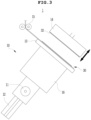
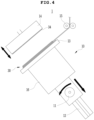
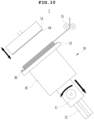
- FIGS. 3 to 6 are views illustrating a process for inspecting a first stacked body 30 according to an embodiment of the present disclosure
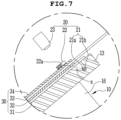
- FIG. 7 is an enlarged view of an inspection portion of the first stacked body 30 of FIG. 6 .
- An apparatus for inspecting stacking of electrodes of a secondary battery may include a separator supply device 15 configured to supply a separator, a stacking main body 16 having a stacking table 13 formed on one surface and configured to allow the separator to be stacked on the stacking table 13, a stacking jig 14 configured to stack an electrode plate on the separator stacked on the stacking main body 16, a fixing jig 22 configured to fix one surface of the electrode plate in a stacking direction, a lighting device 21 configured to emit light from one surface of the stacking table 13 to allow the light to pass sequentially through the separator and the electrode plate, and a capturing unit 23 configured to capture an image of the light that has passed through the separator and the electrode plate by the lighting device 21, wherein the fixing jig 22 is disposed on a path of the light that is emitted from the lighting device 21 and passes through the separator and the electrode plate, and an open hole 22a is formed on an extension line of the path of the light that passes through the
- a separator is supplied from a separator supply device 15, and the stacking main body 16 is reciprocally rotated in one side direction to the other side direction.
- the separator is naturally stacked on the stacking table 13 of the stacking main body 16, and as illustrated in FIG. 2 , electrode plates e1 and e2 are respectively stacked on a separator s in a zigzag direction on one side and the other side of the stacking main body 16 by the stacking jig 14.
- the apparatus for inspecting stacking of electrodes of a secondary battery inspects stacking alignment or stacking state by light that passes through the stacked body from a lower surface of the stacked body to an upper exposure surface of the same by the lighting device 21 disposed on the stacking table 13 for each unit stacked body in real-time during a process of stacking the separator and the electrode plate, so that such a method may be also applied to various types of stacking processes.
- an electrode stacking device 10 for a secondary battery stacks the separator supplied from the separator supply device 15 and at the same time, sequentially stacks a first electrode plate 32 and a second electrode plate 34 on one side and the other side thereof through the stacking jig 14, while reciprocally rotating in one side direction to the other side direction with respect to a rotary shaft 11.
- the separator and the electrode plate are altemately stacked, so that an electrode assembly may be formed.
- the separator supply device 15 provides the separator in one direction, as illustrated in FIG. 3 .
- the separator supply device 15 may naturally stack the separator on the stacking table 13 of the stacking main body in a zigzag direction.
- a continuous electrode stacking process may be performed while a positive is naturally adjusted in a vertical direction by a guide shaft 12.
- the stacking jig 14 stacks the electrode plate on the stacking table 13.
- the stacking jig 14 stacks the electrode plate on the separator.
- Such a process of stacking the separator and repetitively stacking the electrode plate on the separator is repetitively performed, and thus a unit stacked body or an electrode assembly of a secondary battery may be manufactured.
- the electrode stacking device 10 sequentially and respectively stacks positive and negative plates of different polarities of the first electrode plate 32 and the second electrode plate 34 on one side and the other side with the separator interposed therebetween, thereby forming an electrode assembly.
- the electrode stacking device 10 may further include an image capturing device 20 disposed on the stacking table 13 to inspect electrode stacking alignment or electrode stacking state of the unit stacked body.
- the image capturing device 20 may include the lighting device 21, the fixing jig 22, and the capturing unit 23, and each configuration will be described below.
- the fixing jig 22 softly presses and fixes an upper surface of the unit stacked body so that the electrode stacking state may be inspected.
- the fixing jig 22 is fixed on the stacked body and the lighting device 21 emits light in a direction penetrating the stacked body, so that the capturing unit 23 captures an image, and thus it is possible to inspect the stacking alignment and the stacking state.
- the lighting device 21 emits light toward each corner or at least two comers of the unit stacked body disposed on the stacking table 13, so that the capturing unit 23 may capture an image thereof.
- the lighting device 21 emits light toward each corner or at least two comers of the unit stacked body disposed on the stacking table 13, so that the capturing unit 23 may capture an image thereof.
- it is not limited to the number of such locations or points.
- the open hole 22a may be formed on a path of light that is emitted from the lighting device 21 and passes through the unit stacked body, and the capturing unit 23 may capture an image representing the stacking alignment or stacking state of the stacked body through the light that passes through the stacked body and passes through the open hole 22a.
- the open hole 22a is an area through which the light emitted from the lighting device 21 may pass and may be photographed, that is, an area for securing optimal fixation of the stacked body through the fixing jig 22 and, at the same time, efficiently securing a penetration position of the light for efficiently inspecting the stacking alignment and state.
- the fixing jig 22 is disposed (positioned) on one surface of the first stacked body 30, and then open hole 22a may be formed on a path of light that has passed through the first stacked body 30.
- the first stacked body 30 as a unit stacked body is defined as a first separator 31, a first electrode plate 32, a second separator 33, and a second electrode plate 34, wherein the first electrode plate 32 and the second electrode plate 34 may be formed of a positive electrode plate or a negative electrode plate having opposite polarities.
- the lighting device 21 may fix the stacked body by the fixing jig 22 during the stacking process of the electrode stacking device 10 to check the electrode stacking alignment or state in real-time. As described above, the electrode stacking alignment may be efficiently inspected through a transmission method by the lighting device 21 for each unit stacked body sequentially stacked in units of the first stacked body 30 that is the unit stacked body.
- the lighting device 21 may include a lighting unit 21a of a light source emitting light and an angle adjustment unit 21b for covering an adjustment range of an acute angle range of the light emitted from the lighting unit 21a.
- the angle adjustment unit 21b is for adjusting an emission angle of the light to emit the light that has passed through each unit stacked body during the electrode stacking process.
- the lighting device 21 is installed in a receiving groove S formed on the stacking table 13 and the receiving groove S may form an open part of a range for covering the emission range of the acute angle range of the light by the angle adjustment unit 21b of the lighting unit 21a.
- An installation position of the lighting device 21 is arranged at an edge of the stacking table 13, that is, at a corresponding position of the edge of the stacked body, so that the electrode stacking alignment or state may be efficiently inspected, and it is also possible to change the installation position of the lighting device 21 depending on the state or stacking method of the stacked body.
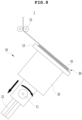
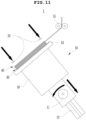
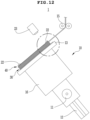
- FIGS. 8 to 12 are views illustrating a process for inspecting stacking of the second stacked body according to an embodiment of the present disclosure
- FIG. 13 is an enlarged view of an inspection portion of the second stacked body of FIG. 12
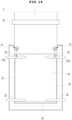
- FIG. 14 is a plan view of an apparatus for inspecting stacking of electrodes of a secondary battery according to an embodiment of the present disclosure.
- An inspection method for an apparatus for inspecting stacking of electrodes of a secondary battery may include forming a first stacked body, which includes: stacking a first separator 31 supplied from a separator supply device 15 on a stacking table 13 of a stacking main body 16; stacking a first electrode plate 32 on the first separator 31 by a stacking jig 14; stacking a second separator 33 supplied from the separator supply device 15 on the first electrode plate 31; and stacking a second electrode plate 34 on the second separator 33 by the stacking jig 14, and performing a first inspection process, which includes: coupling a fixing jig 22 configured to fix a first stacked body 30 in a stacking direction on the first stacked body 30; emitting, by a lighting device 21, light having a path passing through an open hole 22a of the fixing jig 22 through the first stacked body 30; and capturing, by a capturing unit 23, an image of the light that has passed through the first stacked body 30, where
- the inspection method for the apparatus for inspecting stacking of electrodes of a secondary battery inspects stacking alignment or state of electrodes for each unit stacked body at each point in time when the unit stacked body is formed during a process of sequentially stacking separators and electrode plates on the stacked body 16.
- the stacking method itself is illustrated as the zigzag method according to an embodiment of the present disclosure, but is not limited thereto. However, it is also premised on a technical configuration capable of inspecting the stacking alignment or state of the electrodes in real-time in units of a corresponding unit stacked body whenever the unit stacked body is stacked in a sequential stacking process of the separator and the electrode plate.
- the first separator 31 supplied from the separator supply device 15 is stacked on the stacking table 13 of the stacking main body 16. That is, the stacking main body 16 rotates in one direction with respect to a rotary shaft 11 so that the first separator 31 is stacked from the separator supply device 15 on the stacking table 13.
- the separator supplied from the separator supply device 15 moves in the zigzag direction while the stacking main body 16 reciprocates from one side to the other side with respect to the rotary shaft 11, and thus the separator and the electrode plate are sequentially and alternately stacked on the stack table 13.
- the first electrode plate 32 is staked on the separator by the stacking jig 14. That is, as illustrated in FIG. 3 , the first electrode plate 32 is stacked on the first separator 31 by the stacking jig 14.
- the first electrode plate 32 may be a negative electrode plate or a positive electrode plate, and is formed of an electrode plate having a polarity opposite to that of the second electrode plate 34 to be stacked thereafter.
- the second separator 33 supplied from the separator supply device 15 is stacked on the first electrode plate 32.
- the second separator 33 is naturally stacked on the first electrode plate 32 while the stacking main body 16 rotates in the other direction with respect to the rotary shaft 11.
- the second separator 33 is naturally stacked on the first electrode plate 32 by the separator supply device 15 in a central direction of the rotary shaft 11 while moving in the other direction with respect to the rotary shaft 11.
- the second electrode plate 34 is stacked on the second separator 33 by the stacking jig 14 to form the first stacked body 30.
- the first stacked body 30 is defined as a stacked body of the first separator 31, the first electrode plate 32, the second separator 33, and the second electrode plate 34, and in addition, it is also possible to change and adjust a necessary unit stacked body.
- the second electrode plate 34 is stacked on the second separator 33 by the stacking jig 14. As described above, the second electrode plate 34 may be an electrode plate having a polarity different from that of the first electrode plate 32.
- the fixing jig 22 is coupled to one surface of the outermost second electrode plate 34 to fix the first stacked body 30. That is, the fixing jig 22 for fixing the second electrode plate 34 to press the second electrode plate 34 is coupled to the second electrode plate 34.
- pressurization does not mean that a substantial predetermined pressure is applied, but rather a coupling force of a conventional fixing jig 22 for fixing the first stacked body 30.
- the fixing jig 22 is the same as the fixing jig 22 of an apparatus for inspecting stacking of electrodes of a secondary battery according to an embodiment of the present disclosure, and a detailed description thereof will be omitted.
- the lighting device 21 emits light of a path that sequentially passes through the first separator 31, the first electrode plate 32, the second separator 33, and the second electrode plate 34 from an upper surface of the stacking table 13 and passes through the open hole 22a of the fixing jig 22.
- the first inspection process is completed by allowing the capturing unit 23 to capture an image of the light that has passed through the first stacked body 30.
- the first inspection process may be repeatedly performed in real-time during a stacking process of the electrode stacking device 10 as described above.
- the stacking alignment or state of electrodes may be inspected by a transmission method in which light emitted from the lighting device 21 penetrates each unit stacked body in a direction from a lower part to an upper part. That is, the lighting unit 21a of the lighting device 21 installed on the receiving groove S of the stacking table 13 emits light at a predetermined angle to pass through the first stacked body 30 and the capturing unit 23 captures an image of the transmitted light, and thus the stacking state of the first stacked body 30 may be inspected by the transmission method.
- the stacking alignment or state of electrodes of each unit stacked body may be continuously inspected during an electrode stacking process of a secondary battery in real-time.
- a process repeated after the formation of the first stacked body 30 will be defined as the second stacked body 40 and will be described later.
- a third separator 41 is stacked on the second electrode plate 34 from the separator supply device 15.
- a third electrode plate 42 is stacked on the third separator 41 by the stacking jig 14.
- the third electrode plate 42 may be formed of an electrode plate having a polarity different from that of a fourth electrode plate 44 to be described later.
- a fourth separator 43 is stacked on the third electrode plate 42 while the stacking main body 16 rotates at a predetermined angle in the other direction with respect to the rotary shaft 11 and a fourth electrode plate 44 is stacked on the fourth separator 43 by the stacking jig 14.
- the second stacked body 40 is stacked on the first stacked body 30.
- the fixing jig 22 for fixing and pressing the fourth electrode plate 44 is coupled to the fourth electrode plate 44.
- the fixing jig 22 is the same as the fixing jig 22 in the above-described first inspection process, and the overlapping detailed description will be omitted.
- the first inspection process is repeatedly performed, wherein the first inspection process may include allowing the lighting device 21 to emit light in a path passing through only the second stacked body 40 in which the third separator 41, the third electrode plate 42, the fourth separator 43, and the fourth electrode plate 44 are sequentially formed to pass through the open hole 22a of the fixing jig 22, and allowing the capturing unit 23 to capture an image of the light that has passed through the second stacked body 40.
- the lighting device 21 may include an angle adjustment unit 21b for adjusting a required light emission direction.
- the inspection method may include sequentially stacking the separator and the electrode plate while continuously repeating the first inspection process in this way and, at the same time, gradually and vertically lowering a center of the rotary shaft 11 in a lower side by a guide shaft 12 as a stacking height is increased.
- the guide shaft 12 may also selectively move up and down in a vertical direction as needed.
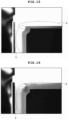
- FIG. 15 is a photograph taken by an inspection method for an apparatus for inspecting stacking of electrodes of a secondary battery according to an embodiment of the present disclosure
- FIG. 16 is a photograph taken by a general method for inspecting stacking of electrodes of a secondary battery.
- FIG. 15 is an image of an alignment state of a stacked body photographed by a transmission method through the inspection method for an apparatus for inspecting stacking of electrodes of a secondary battery according to an embodiment of the present disclosure
- Figure 16 is an image of photographed by a stacked body inspection method as a general non-transmission method.
- edges regions a, b of a stacked body are accurately displayed so that stacking alignment may be accurately measured and inspected, but as illustrated in FIG. 16 , according to a conventional method, edge regions a, b of the stacked body are indistinctly blurred images, so it can be seen that reliability of actual electrode stacking inspection cannot be ensured.
Landscapes
- Chemical & Material Sciences (AREA)
- Engineering & Computer Science (AREA)
- Manufacturing & Machinery (AREA)
- Chemical Kinetics & Catalysis (AREA)
- Electrochemistry (AREA)
- General Chemical & Material Sciences (AREA)
- Life Sciences & Earth Sciences (AREA)
- Health & Medical Sciences (AREA)
- Physics & Mathematics (AREA)
- Analytical Chemistry (AREA)
- Biochemistry (AREA)
- General Health & Medical Sciences (AREA)
- General Physics & Mathematics (AREA)
- Immunology (AREA)
- Pathology (AREA)
- Secondary Cells (AREA)
Description
- The application relates to an apparatus for inspecting stacking of electrodes of a secondary battery and an inspection method thereof.
- In general, secondary batteries are batteries capable of being used repeatedly through a discharging process of converting chemical energy into electric energy and a charging process that is the reverse direction of the discharging process. Types of secondary batteries include a nickelcadmium (Ni-Cd) battery, a nickel-hydrogen (Ni-MH) battery, a lithium-metal battery, a lithium-ion (Ni-Ion) battery, and a lithium-ion polymer battery (hereinafter referred to as 'LIPB').
- A secondary battery includes a positive electrode, a negative electrode, an electrolyte, and a separator, and stores and generates electricity by using a voltage difference between different positive and negative materials. Discharging is the movement of electrons from a high-voltage negative electrode to a low-voltage positive electrode (i.e., electricity is generated as much as the voltage difference between both electrodes), and charging is the movement of electrons from the positive electrode to the negative electrode again. The positive electrode material receives electrons and lithium ions to be retumed to an original metal oxide. A charging current flows as metal atoms move from the positive electrode to the negative electrode through the separator when a secondary battery is charged, and the metal atoms move from the negative electrode to the positive electrode and a discharging current flows when the secondary battery is discharged.
- The field of quality control, that is the most basic in a battery manufactured by an electrode stacking method among the battery manufacturing methods, relates to whether electrode components are stacked in a normal order and arrangement. When any of the electrode components of the stacked battery is arranged in an abnormal order or is missing, the battery cannot be used as a battery due to a short circuit, abnormal operation, etc., and may explode in severe cases.
- On the other hand, the methods for manufacturing such a secondary battery are divided into a winding method and a stacking method, and the stacking method is a method of alternately stacking positive and negative plates cut to a predetermined size to manufacture an electrode assembly. In this regard,
Korean Patent Registration No. 1421847 (May 31, 2012 KR 101 956 758 B1 - The foregoing is intended merely to aid in the understanding of the background of the present disclosure, and is not intended to mean that the present disclosure falls within the purview of the related art that is already known to those skilled in the art.
- (Patent Document 1)
KR 10- 1421847 B1 - The invention is given in the claims. Accordingly, the present disclosure has been made keeping in mind the above problem occurring in the related art, and the present disclosure is intended to provide an apparatus for inspecting stacking of electrodes of a secondary battery to efficiently secure stacking alignment and stacking reliability in a stacking process of a secondary battery and an inspection method thereof.
- In addition, the present disclosure is intended to provide an apparatus for inspecting stacking of electrodes of a secondary battery, in which reliability of an electrode stacking process of the secondary battery is inspected in real-time during the process, so that reliability of secondary battery manufacturing may be secured and a more precise electrode assembly may be manufactured, and an inspection method thereof.
- An apparatus for inspecting stacking of electrodes of a secondary battery according to an embodiment of the present disclosure may include: a separator supply device configured to supply a separator; a stacking main body having a stacking table formed on a first surface thereof and configured to allow the separator to be stacked on the stacking table; a stacking jig configured to stack an electrode plate on the separator stacked on the stacking main body; a fixing jig configured to fix a first surface of the electrode plate in a stacking direction; a lighting device configured to emit light from a first surface of the stacking table to allow the light to pass through the separator and the electrode plate; and a capturing unit configured to capture an image of the light that has passed through the separator and the electrode plate, wherein the fixing jig is disposed on a path of the light that is emitted from the lighting device and passes through the separator and the electrode plate, and an open hole is formed on an extension line of the path of the light that passes through the separator and the electrode plate.
- The stacking main body may include a rotary shaft and allows the separator to be stacked on the stacking table in a zigzag direction as reciprocating in a direction from a first side of the rotary shaft to a second side of the rotary shaft, wherein the stacking main body allows a first electrode plate to be stacked on a first separator in a first direction of the rotary shaft by the stacking jig, and allows a second electrode plate to be stacked on a second separator in a second direction of the rotary shaft by the stacking jig.
- The lighting device emits light to allow the light to pass through a first stacked body in which the first separator, the first electrode plate, the second separator, and the second electrode plate are sequentially stacked, and the fixing jig is disposed on a first surface of the first stacked body and fixes the first stacked body, wherein the fixing jig has the open hole formed on the path of the light that has passed through the first stacked body.
- The lighting device may include a lighting unit configured to emit light to allow the light to pass through the first stacked body and an angle adjustment unit configured to adjust an emission angle of the light emitted by the lighting unit.
- The stacking table has a receiving groove formed therein to receive the lighting device, wherein the receiving groove is open so as to cover a radius of an acute angle range to which the light of the lighting device is emitted.
- The stacking main body may include a guide shaft configured to be operated to allow the stacking main body to move vertically in a direction perpendicular to the first surface of the stacking main body.
- The stacking main body stacks a plurality of first stacked bodies by a plurality of reciprocating movements in the direction from the first side of the rotary shaft to the second side of the rotary shaft, and the lighting device emits light for each first stacked body as the stacked body reciprocates from the first side to the second side by the rotary shaft, so that stacking inspection may be performed in real-time.
- An inspection method for an apparatus for inspecting stacking of electrodes of a secondary battery may include: forming a first stacked body, which includes: stacking a first separator supplied from a separator supply device on a stacking table of a stacking main body; stacking a first electrode plate on the first separator by a stacking jig; stacking a second separator supplied from the separator supply device on the first electrode plate; and stacking a second electrode plate on the second separator by the stacking jig, and performing a first inspection process, which includes: coupling a fixing jig configured to fix the first stacked body in a stacking direction on the first stacked body; emitting, by a lighting device, light having a path passing through an open hole of the fixing jig and through the first stacked body; and capturing, by a capturing unit, an image of the light that has passed through the first stacked body, wherein the forming the first stacked body and the performing the first inspection process are repeated a plurality of times, and the first inspection process is performed on a previously formed first stacked body among a plurality of first stacked bodies.
- The emitting, by the lighting device, the light having the path passing through the open hole of the fixing jig and through the first stacked body may further include adjusting an angle of the light emitted by the lighting device.
- The forming the first stacked body may include: allowing the stacking main body to rotate in a first direction of a rotary shaft to stack the first separator supplied from the separator supply device on the stacking table of the stacking main body; stacking the first electrode plate on the first separator by the stacking jig; allowing the stacking main body to rotate in a second direction of the rotary shaft to stack the second separator on the first electrode plate; and stacking the second electrode plate on the second separator by the stacking jig.
- In addition, the forming the first stacked body may further include: allowing a center of the rotary shaft to move toward an upper part and a lower part in the stacking direction of the first stacked body by a guide shaft as the stacking main body reciprocates in the first or second direction of the rotary shaft.
- The features and advantages of the present disclosure will become more apparent from the following detailed description taken in conjunction with the accompanying drawings.
- According to an embodiment of the present disclosure, the apparatus provides an effect of securing reliability and efficiency of an electrode stacking process of a secondary battery.
- The apparatus provides effects of securing stacking reliability of a final electrode assembly and effectively decreasing defect rate through real-time stacking inspection of the electrode stacking process of a secondary battery.
- The electrode stacking inspection is performed in real-time in the electrode stacking process of a secondary battery through a transmission method by a lighting device, and thus the apparatus provides an effect of increasing correction and accuracy in the stacking inspection.
- In addition, a unit stacked body stacked in real-time in the electrode stacking process of a secondary battery is continuously performed in real-time in the electrode stacking process of a secondary battery through the transmission method, and thus the apparatus provides effectiveness and reliability of a transmission-type stacking inspection by the lighting device.
- The above and other objectives, features, and other advantages of the present disclosure will be more clearly understood from the following detailed description when taken in conjunction with the accompanying drawings, in which:
-
FIG. 1 is an operation schematic diagram of an apparatus for inspecting stacking of electrodes of a secondary battery according to an embodiment of the present disclosure; -
FIG. 2 is a schematic diagram of a direction in which a separator and an electrode plate are sequentially stacked on a stacking main body according toFIG. 1 ; -
FIGS. 3 to 6 are views illustrating a process for inspecting a first stacked body according to an embodiment of the present disclosure; -
FIG. 7 is an enlarged view of an inspection portion of the first stacked body ofFIG. 6 ; -
FIGS. 8 to 12 are views illustrating a process for inspecting stacking of a second stacked body according to an embodiment of the present disclosure; -
FIG. 13 is an enlarged view of an inspection portion of the second stacked body ofFIG. 12 ; -
FIG. 14 is a plan view of an apparatus for inspecting stacking of electrodes of a secondary battery according to an embodiment of the present disclosure; -
FIG. 15 is a photograph taken by an inspection method for an apparatus for inspecting stacking of electrodes of a secondary battery according to an embodiment of the present disclosure; and -
FIG. 16 is a photograph taken by a general method for inspecting stacking of electrodes of a secondary battery. - The obj ectives, specific advantages, and novel features of the invention will become more apparent from the following detailed description and preferred embodiments taken in conjunction with the accompanying drawings. In the present specification, in adding reference numbers to the components of each drawing, it should be noted that only the same components are given the same number as possible even though they are indicated on different drawings. In addition, terms, such as "one side", "other side", "first", "second", etc., are used to distinguish one component from another component, and the component is not limited by the terms. Hereinafter, in describing the present disclosure, detailed descriptions of related known technologies that may unnecessarily obscure the gist of the present disclosure will be omitted.
- Hereinafter, an embodiment of the present disclosure will be described in detail with reference to the accompanying drawings, wherein like reference numerals indicate like members.
-
FIG. 1 is an operation schematic diagram of an apparatus for inspecting stacking of electrodes of a secondary battery according to an embodiment of the present disclosure,FIG. 2 is a schematic diagram of a direction in which a separator and an electrode plate are sequentially stacked on a stackingmain body 16 according toFIG. 1 ,FIGS. 3 to 6 are views illustrating a process for inspecting a first stackedbody 30 according to an embodiment of the present disclosure, andFIG. 7 is an enlarged view of an inspection portion of the first stackedbody 30 ofFIG. 6 . - An apparatus for inspecting stacking of electrodes of a secondary battery according to an embodiment of the present disclosure may include a
separator supply device 15 configured to supply a separator, a stackingmain body 16 having a stacking table 13 formed on one surface and configured to allow the separator to be stacked on the stacking table 13, astacking jig 14 configured to stack an electrode plate on the separator stacked on the stackingmain body 16, afixing jig 22 configured to fix one surface of the electrode plate in a stacking direction, alighting device 21 configured to emit light from one surface of the stacking table 13 to allow the light to pass sequentially through the separator and the electrode plate, and a capturingunit 23 configured to capture an image of the light that has passed through the separator and the electrode plate by thelighting device 21, wherein thefixing jig 22 is disposed on a path of the light that is emitted from thelighting device 21 and passes through the separator and the electrode plate, and anopen hole 22a is formed on an extension line of the path of the light that passes through the separator and the electrode plate. - As illustrated in
FIG. 1 , in the apparatus for inspecting stacking of electrodes of a secondary battery according to an embodiment of the present disclosure, a separator is supplied from aseparator supply device 15, and the stackingmain body 16 is reciprocally rotated in one side direction to the other side direction. As the stackingmain body 16 reciprocates from one side to the other side, the separator is naturally stacked on the stacking table 13 of the stackingmain body 16, and as illustrated inFIG. 2 , electrode plates e1 and e2 are respectively stacked on a separator s in a zigzag direction on one side and the other side of the stackingmain body 16 by thestacking jig 14. - Although such a zigzag-type stacking method is illustrated as an example, the apparatus for inspecting stacking of electrodes of a secondary battery according to an embodiment of the present disclosure inspects stacking alignment or stacking state by light that passes through the stacked body from a lower surface of the stacked body to an upper exposure surface of the same by the
lighting device 21 disposed on the stacking table 13 for each unit stacked body in real-time during a process of stacking the separator and the electrode plate, so that such a method may be also applied to various types of stacking processes. - Hereinafter, a zigzag-type stacking method of a separator and an electrode plate according to an embodiment of the present disclosure will be described as an example.
- In particular, as illustrated in
FIGS. 3 and4 , anelectrode stacking device 10 for a secondary battery according to an embodiment of the present disclosure stacks the separator supplied from theseparator supply device 15 and at the same time, sequentially stacks afirst electrode plate 32 and asecond electrode plate 34 on one side and the other side thereof through thestacking jig 14, while reciprocally rotating in one side direction to the other side direction with respect to arotary shaft 11. As such operation is repetitively performed, the separator and the electrode plate are altemately stacked, so that an electrode assembly may be formed. - The
separator supply device 15 provides the separator in one direction, as illustrated inFIG. 3 . In addition, as the stackingmain body 16 reciprocates from one side to the other side with respect to therotary shaft 11, theseparator supply device 15 may naturally stack the separator on the stacking table 13 of the stacking main body in a zigzag direction. - When a stacking height increases during a process of stacking the separator and the electrode plate on the stacking table 13 of the stacking
main body 16, a continuous electrode stacking process may be performed while a positive is naturally adjusted in a vertical direction by aguide shaft 12. - The stacking
jig 14 stacks the electrode plate on the stacking table 13. When the separator is naturally stacked on the stacking table 13, while the stackingmain body 16 reciprocally rotates from one side to the other side, the stackingjig 14 stacks the electrode plate on the separator. Such a process of stacking the separator and repetitively stacking the electrode plate on the separator is repetitively performed, and thus a unit stacked body or an electrode assembly of a secondary battery may be manufactured. - In other words, the
electrode stacking device 10 sequentially and respectively stacks positive and negative plates of different polarities of thefirst electrode plate 32 and thesecond electrode plate 34 on one side and the other side with the separator interposed therebetween, thereby forming an electrode assembly. - The
electrode stacking device 10 may further include animage capturing device 20 disposed on the stacking table 13 to inspect electrode stacking alignment or electrode stacking state of the unit stacked body. Theimage capturing device 20 may include thelighting device 21, the fixingjig 22, and the capturingunit 23, and each configuration will be described below. - When the unit stacked body is stacked on the stacking table 13, the fixing
jig 22 softly presses and fixes an upper surface of the unit stacked body so that the electrode stacking state may be inspected. When one unit stacked body is stacked during the electrode stacking process, the fixingjig 22 is fixed on the stacked body and thelighting device 21 emits light in a direction penetrating the stacked body, so that the capturingunit 23 captures an image, and thus it is possible to inspect the stacking alignment and the stacking state. - In an embodiment of the present disclosure, the
lighting device 21 emits light toward each corner or at least two comers of the unit stacked body disposed on the stacking table 13, so that the capturingunit 23 may capture an image thereof. However, it is not limited to the number of such locations or points. - On the other hand, in the fixing
jig 22, theopen hole 22a may be formed on a path of light that is emitted from thelighting device 21 and passes through the unit stacked body, and the capturingunit 23 may capture an image representing the stacking alignment or stacking state of the stacked body through the light that passes through the stacked body and passes through theopen hole 22a. - The
open hole 22a is an area through which the light emitted from thelighting device 21 may pass and may be photographed, that is, an area for securing optimal fixation of the stacked body through the fixingjig 22 and, at the same time, efficiently securing a penetration position of the light for efficiently inspecting the stacking alignment and state. As illustrated inFIG. 14 , the fixingjig 22 is disposed (positioned) on one surface of the firststacked body 30, and thenopen hole 22a may be formed on a path of light that has passed through the firststacked body 30. - In an embodiment of the present disclosure, the first
stacked body 30 as a unit stacked body is defined as afirst separator 31, afirst electrode plate 32, asecond separator 33, and asecond electrode plate 34, wherein thefirst electrode plate 32 and thesecond electrode plate 34 may be formed of a positive electrode plate or a negative electrode plate having opposite polarities. - When the unit stacked body is stacked, the
lighting device 21 may fix the stacked body by the fixingjig 22 during the stacking process of theelectrode stacking device 10 to check the electrode stacking alignment or state in real-time. As described above, the electrode stacking alignment may be efficiently inspected through a transmission method by thelighting device 21 for each unit stacked body sequentially stacked in units of the firststacked body 30 that is the unit stacked body. - The
lighting device 21 may include alighting unit 21a of a light source emitting light and anangle adjustment unit 21b for covering an adjustment range of an acute angle range of the light emitted from thelighting unit 21a. - That is, the
angle adjustment unit 21b is for adjusting an emission angle of the light to emit the light that has passed through each unit stacked body during the electrode stacking process. - As illustrated in
FIG. 7 , to emit light to allow the light to penetrate the stacked body in a direction from a lower surface of the stacked body to an upper surface of the stacked body, thelighting device 21 is installed in a receiving groove S formed on the stacking table 13 and the receiving groove S may form an open part of a range for covering the emission range of the acute angle range of the light by theangle adjustment unit 21b of thelighting unit 21a. - An installation position of the
lighting device 21 is arranged at an edge of the stacking table 13, that is, at a corresponding position of the edge of the stacked body, so that the electrode stacking alignment or state may be efficiently inspected, and it is also possible to change the installation position of thelighting device 21 depending on the state or stacking method of the stacked body. -
FIGS. 8 to 12 are views illustrating a process for inspecting stacking of the second stacked body according to an embodiment of the present disclosure,FIG. 13 is an enlarged view of an inspection portion of the second stacked body ofFIG. 12 , andFIG. 14 is a plan view of an apparatus for inspecting stacking of electrodes of a secondary battery according to an embodiment of the present disclosure. - An inspection method for an apparatus for inspecting stacking of electrodes of a secondary battery according to an embodiment of the present disclosure may include forming a first stacked body, which includes: stacking a
first separator 31 supplied from aseparator supply device 15 on a stacking table 13 of a stackingmain body 16; stacking afirst electrode plate 32 on thefirst separator 31 by a stackingjig 14; stacking asecond separator 33 supplied from theseparator supply device 15 on thefirst electrode plate 31; and stacking asecond electrode plate 34 on thesecond separator 33 by the stackingjig 14, and performing a first inspection process, which includes: coupling a fixingjig 22 configured to fix a firststacked body 30 in a stacking direction on the firststacked body 30; emitting, by alighting device 21, light having a path passing through anopen hole 22a of the fixingjig 22 through the firststacked body 30; and capturing, by a capturingunit 23, an image of the light that has passed through the firststacked body 30, wherein the forming the firststacked body 30 and the performing the first inspection process are repeated a plurality of times, and the first inspection process is performed on a previously formed single first stacked body among a plurality of firststacked bodies 30. - The inspection method for the apparatus for inspecting stacking of electrodes of a secondary battery according to an embodiment of the present disclosure inspects stacking alignment or state of electrodes for each unit stacked body at each point in time when the unit stacked body is formed during a process of sequentially stacking separators and electrode plates on the
stacked body 16. - Therefore, in the inspection method for the apparatus for inspecting stacking of electrodes of a secondary battery, the stacking method itself is illustrated as the zigzag method according to an embodiment of the present disclosure, but is not limited thereto. However, it is also premised on a technical configuration capable of inspecting the stacking alignment or state of the electrodes in real-time in units of a corresponding unit stacked body whenever the unit stacked body is stacked in a sequential stacking process of the separator and the electrode plate.
- Hereinafter, a stacking method of a separator and an electrode plate in a zigzag direction according to an embodiment of the present disclosure will be described as an example.
- In a first, as illustrated in
FIG. 3 , thefirst separator 31 supplied from theseparator supply device 15 is stacked on the stacking table 13 of the stackingmain body 16. That is, the stackingmain body 16 rotates in one direction with respect to arotary shaft 11 so that thefirst separator 31 is stacked from theseparator supply device 15 on the stacking table 13. - The separator supplied from the
separator supply device 15 moves in the zigzag direction while the stackingmain body 16 reciprocates from one side to the other side with respect to therotary shaft 11, and thus the separator and the electrode plate are sequentially and alternately stacked on the stack table 13. - Next, the
first electrode plate 32 is staked on the separator by the stackingjig 14. That is, as illustrated inFIG. 3 , thefirst electrode plate 32 is stacked on thefirst separator 31 by the stackingjig 14. Thefirst electrode plate 32 may be a negative electrode plate or a positive electrode plate, and is formed of an electrode plate having a polarity opposite to that of thesecond electrode plate 34 to be stacked thereafter. - Next, the
second separator 33 supplied from theseparator supply device 15 is stacked on thefirst electrode plate 32. - As illustrated in
FIG. 4 , thesecond separator 33 is naturally stacked on thefirst electrode plate 32 while the stackingmain body 16 rotates in the other direction with respect to therotary shaft 11. Thesecond separator 33 is naturally stacked on thefirst electrode plate 32 by theseparator supply device 15 in a central direction of therotary shaft 11 while moving in the other direction with respect to therotary shaft 11. - Next, the
second electrode plate 34 is stacked on thesecond separator 33 by the stackingjig 14 to form the firststacked body 30. The firststacked body 30 is defined as a stacked body of thefirst separator 31, thefirst electrode plate 32, thesecond separator 33, and thesecond electrode plate 34, and in addition, it is also possible to change and adjust a necessary unit stacked body. - The
second electrode plate 34 is stacked on thesecond separator 33 by the stackingjig 14. As described above, thesecond electrode plate 34 may be an electrode plate having a polarity different from that of thefirst electrode plate 32. - When the first
stacked body 30 formed of thefirst separator 31, thefirst electrode plate 32, thesecond separator 33, and thesecond electrode plate 34 is stacked during the electrode stacking process, as illustrated inFIG. 5 , the fixingjig 22 is coupled to one surface of the outermostsecond electrode plate 34 to fix the firststacked body 30. That is, the fixingjig 22 for fixing thesecond electrode plate 34 to press thesecond electrode plate 34 is coupled to thesecond electrode plate 34. - Here, pressurization does not mean that a substantial predetermined pressure is applied, but rather a coupling force of a
conventional fixing jig 22 for fixing the firststacked body 30. As illustrated inFIG. 14 , the fixingjig 22 is the same as the fixingjig 22 of an apparatus for inspecting stacking of electrodes of a secondary battery according to an embodiment of the present disclosure, and a detailed description thereof will be omitted. - Next, as illustrated in
FIGS. 6 and7 , when the firststacked body 30 is fixed on the stacking table 13 by the fixingjig 22, thelighting device 21 emits light of a path that sequentially passes through thefirst separator 31, thefirst electrode plate 32, thesecond separator 33, and thesecond electrode plate 34 from an upper surface of the stacking table 13 and passes through theopen hole 22a of the fixingjig 22. - Next, the first inspection process is completed by allowing the capturing
unit 23 to capture an image of the light that has passed through the firststacked body 30. The first inspection process may be repeatedly performed in real-time during a stacking process of theelectrode stacking device 10 as described above. - At this time, as illustrated in
FIG. 7 , the stacking alignment or state of electrodes may be inspected by a transmission method in which light emitted from thelighting device 21 penetrates each unit stacked body in a direction from a lower part to an upper part. That is, thelighting unit 21a of thelighting device 21 installed on the receiving groove S of the stacking table 13 emits light at a predetermined angle to pass through the firststacked body 30 and the capturingunit 23 captures an image of the transmitted light, and thus the stacking state of the firststacked body 30 may be inspected by the transmission method. - After the first
stacked body 30 is formed, as a process of performing the first inspection process is repeated, the stacking alignment or state of electrodes of each unit stacked body may be continuously inspected during an electrode stacking process of a secondary battery in real-time. - Specifically, a process repeated after the formation of the first
stacked body 30 will be defined as the secondstacked body 40 and will be described later. - First, as illustrated in
FIG. 8 , while the stackingmain body 16 rotates at a predetermined angle in one direction with respect to therotary shaft 11, athird separator 41 is stacked on thesecond electrode plate 34 from theseparator supply device 15. - Next, as illustrated in
FIG. 9 , athird electrode plate 42 is stacked on thethird separator 41 by the stackingjig 14. Here, thethird electrode plate 42 may be formed of an electrode plate having a polarity different from that of afourth electrode plate 44 to be described later. - Next, as illustrated in
FIG. 10 , a fourth separator 43 is stacked on thethird electrode plate 42 while the stackingmain body 16 rotates at a predetermined angle in the other direction with respect to therotary shaft 11 and afourth electrode plate 44 is stacked on the fourth separator 43 by the stackingjig 14. In this way, the secondstacked body 40 is stacked on the firststacked body 30. - Next, to inspect the stacking state or alignment of electrodes of the second
stacked body 40, as illustrated inFIG. 11 , the fixingjig 22 for fixing and pressing thefourth electrode plate 44 is coupled to thefourth electrode plate 44. Here, the fixingjig 22 is the same as the fixingjig 22 in the above-described first inspection process, and the overlapping detailed description will be omitted. - Next, as illustrated in
FIGS. 12 and13 , the first inspection process is repeatedly performed, wherein the first inspection process may include allowing thelighting device 21 to emit light in a path passing through only the secondstacked body 40 in which thethird separator 41, thethird electrode plate 42, the fourth separator 43, and thefourth electrode plate 44 are sequentially formed to pass through theopen hole 22a of the fixingjig 22, and allowing the capturingunit 23 to capture an image of the light that has passed through the secondstacked body 40. - As illustrated in
FIG. 13 , in the first inspection process, only the secondstacked body 40 stacked in the subsequent processes is inspected except for the firststacked body 30 stacked in the previous first process. To emit the light that has passed through the secondstacked body 40, thelighting device 21 may include anangle adjustment unit 21b for adjusting a required light emission direction. - Moreover, the inspection method may include sequentially stacking the separator and the electrode plate while continuously repeating the first inspection process in this way and, at the same time, gradually and vertically lowering a center of the
rotary shaft 11 in a lower side by aguide shaft 12 as a stacking height is increased. Theguide shaft 12 may also selectively move up and down in a vertical direction as needed. -
FIG. 15 is a photograph taken by an inspection method for an apparatus for inspecting stacking of electrodes of a secondary battery according to an embodiment of the present disclosure andFIG. 16 is a photograph taken by a general method for inspecting stacking of electrodes of a secondary battery. - Specifically,
FIG. 15 is an image of an alignment state of a stacked body photographed by a transmission method through the inspection method for an apparatus for inspecting stacking of electrodes of a secondary battery according to an embodiment of the present disclosure, andFigure 16 , as a comparative example, is an image of photographed by a stacked body inspection method as a general non-transmission method. - As illustrated in
FIG. 15 , according to an apparatus for inspecting stacking of electrodes of a secondary battery and an inspection method thereof according to an embodiment of the present disclosure, images of edge areas a, b of a stacked body is accurately displayed so that stacking alignment may be accurately measured and inspected, but as illustrated inFIG. 16 , according to a conventional method, edge regions a, b of the stacked body are indistinctly blurred images, so it can be seen that reliability of actual electrode stacking inspection cannot be ensured.
Claims (11)
- An apparatus for inspecting stacking of electrodes of a secondary battery, the apparatus, comprising:a separator supply device (15) configured to supply a separator (s);a stacking main body (16) having a stacking table (13) formed on a first surface thereof and configured to allow the separator to be stacked on the stacking table;a stacking jig (14) configured to stack an electrode plate (e1, e2) on the separator stacked on the stacking main body;a fixing jig (22) configured to fix a first surface of the electrode plate in a stacking direction and comprising an open hole (22a);a lighting device (21) configured to emit light from the first surface of the stacking table to allow the light to pass through the separator and the electrode plate; the fixing jig being disposed on a path of the light that is emitted from the lighting device and passes through the separator and the electrode plate such that the open hole of the fixing jig is positioned on an extension line of the path of the light that passes through the separator and the electrode plate so that the light passing through the separator and the electrode plate passes through the open hole of the fixing jig; anda capturing unit (23) configured to capture an image of the light that has passed through the separator, the electrode plate, and the open hole of the fixing jig.
- The apparatus of claim 1, wherein the stacking main body 16) comprises a rotary shaft (11) and is configured to allow the separator (s) to be stacked on the stacking table (13) in a zigzag direction as reciprocating in a direction from a first side of the rotary shaft to a second side of the rotary shaft,
wherein the stacking main body is configured to allow a first electrode plate (32) to be stacked on a first separator (31) in a first direction of the rotary shaft by the stacking jig, and is further configured to allow a second electrode plate (34) to be stacked on a second separator (33) in a second direction of the rotary shaft by the stacking jig (14). - The apparatus of claim 2, wherein the lighting device (21) is configured to emit light to allow the light to pass through a first stacked body (30) in which the first separator (31), the first electrode plate (32), the second separator (33), and the second electrode plate (e2; 34) are sequentially stacked; wherein the fixing jig is (22) disposed on a first surface of the first stacked body such that the path of light that passes through the first stacked body passes through the open hole (22a) of the fixing jig and wherein the fixing jig is configured to fix the first stacked body.
- The apparatus of claim 3, wherein the lighting device (21) comprises:a lighting unit (21a) configured to emit the light to allow the light to pass through the first stacked body; andan angle adjustment unit (21b) configured to adjust an emission angle of the light emitted by the lighting unit.
- The apparatus of claim 4, wherein the stacking table (13) has a receiving groove (S) formed therein to receive the lighting device (21),
wherein the receiving groove is open so as to cover a radius of an acute angle range to which the light of the lighting device is emitted. - The apparatus of claim 1, wherein the stacking main body (16) comprises a guide shaft (12) configured to be operated to allow the stacking main body to move vertically in a direction perpendicular to the first surface of the stacking main body.
- The apparatus of claim 3, wherein the stacking main body (16) is configured to stack a plurality of first stacked bodies by a plurality of reciprocating movements in the direction from the first side of the rotary shaft (11) to the second side of the rotary shaft, and the lighting device (21) is configured to emit light for each first stacked body (30) as the stacked body reciprocates from the first side to the second side by the rotary shaft, so that stacking inspection may be performed in real-time.
- An inspection method for an apparatus for inspecting stacking of electrodes of a secondary battery, the method, comprising:forming a first stacked body (30), which comprises: stacking a first separator (s, 41) supplied from a separator supply device (15) on a stacking table (13) of a stacking main body (16); stacking a first electrode plate (32) on the first separator (31) by a stacking jig (14); stacking a second separator (33) supplied from the separator supply device on the first electrode plate; and stacking a second electrode plate (34) on the second separator by the stacking jig, andperforming a first inspection process, which comprises: coupling a fixing jig (22) configured to fix the first stacked body in a stacking direction on the first stacked body; emitting, by a lighting device (21), light having a path passing through an open hole (22a) of the fixing jig and through the first stacked body; and capturing, by a capturing unit (23), an image of the light that has passed through the first stacked body,wherein the forming the first stacked body and the performing the first inspection process are repeated a plurality of times, and the first inspection process is performed on a previously formed first stacked body among a plurality of first stacked bodies.
- The method of claim 8, wherein the emitting, by the lighting device (21), the light having the path passing through the open hole (22a) of the fixing jig (22) and through the first stacked body (30) further comprises adjusting an angle of the light emitted by the lighting device.
- The method of claim 8, wherein the forming the first stacked body comprises:allowing the stacking main body (16) to rotate in a first direction of a rotary shaft (11) to stack the first separator (31) supplied from the separator supply device (15) on the stacking table (13) of the stacking main body (16);stacking the first electrode plate (32) on the first separator by the stacking jig (14);allowing the stacking main body to rotate in a second direction of the rotary shaft to stack the second separator (33) on the first electrode plate; andstacking the second electrode plate (34) on the second separator by the stacking jig.
- The method of claim 10, further comprising:
allowing a center of the rotary shaft (11) to move toward an upper part and a lower part in the stacking direction of the first stacked body (30) by a guide shaft (12) as the stacking main body (16) reciprocates in the first or second direction of the rotary shaft.
Applications Claiming Priority (1)
| Application Number | Priority Date | Filing Date | Title |
|---|---|---|---|
| KR1020210002093A KR20220099788A (en) | 2021-01-07 | 2021-01-07 | Electrode stacking inspection device and inspection method using the same |
Publications (2)
| Publication Number | Publication Date |
|---|---|
| EP4027424A1 EP4027424A1 (en) | 2022-07-13 |
| EP4027424B1 true EP4027424B1 (en) | 2025-04-02 |
Family
ID=79185857
Family Applications (1)
| Application Number | Title | Priority Date | Filing Date |
|---|---|---|---|
| EP21218138.2A Active EP4027424B1 (en) | 2021-01-07 | 2021-12-29 | Apparatus for inspecting stacking of electrodes of secondary battery and inspection method thereof |
Country Status (5)
| Country | Link |
|---|---|
| US (1) | US20220216501A1 (en) |
| EP (1) | EP4027424B1 (en) |
| KR (1) | KR20220099788A (en) |
| CN (1) | CN114720485A (en) |
| HU (1) | HUE071775T2 (en) |
Families Citing this family (8)
| Publication number | Priority date | Publication date | Assignee | Title |
|---|---|---|---|---|
| KR102917430B1 (en) * | 2021-10-20 | 2026-01-23 | 주식회사 엘지에너지솔루션 | Electrode surface inspection deivce |
| KR20230150104A (en) * | 2022-04-21 | 2023-10-30 | 현대자동차주식회사 | Method for battery cell electrode alignment inspection and apparatus thereof |
| KR20240102274A (en) * | 2022-12-26 | 2024-07-03 | 주식회사 엘지에너지솔루션 | Electrode stacking inspection device and inspection method using the same |
| DE102023200459B4 (en) * | 2023-01-20 | 2025-05-28 | Powerco Se | Method for determining a position of a corner region of an electrode composite stack |
| DE102023202492B3 (en) | 2023-03-21 | 2024-03-28 | Volkswagen Aktiengesellschaft | Method for testing a battery element stack with regard to the position of battery element layers |
| KR20250149028A (en) * | 2024-04-08 | 2025-10-15 | 주식회사 엘지에너지솔루션 | Method for inspecting alignment and damage of electrode assembly |
| KR20250149061A (en) * | 2024-04-08 | 2025-10-15 | 주식회사 엘지에너지솔루션 | Electrode inspection apparatus |
| KR20250162144A (en) * | 2024-05-10 | 2025-11-18 | 주식회사 엘지에너지솔루션 | Electrode stacking apparatus |
Family Cites Families (11)
| Publication number | Priority date | Publication date | Assignee | Title |
|---|---|---|---|---|
| EP2477255B1 (en) | 2009-09-10 | 2020-02-26 | Envision AESC Energy Devices Ltd. | Stacked battery and method for manufacturing same |
| JP5736921B2 (en) * | 2011-04-07 | 2015-06-17 | 日産自動車株式会社 | Wrinkle detection device and wrinkle detection method |
| JP6022177B2 (en) * | 2011-04-07 | 2016-11-09 | 日産自動車株式会社 | Electrode position detection device and electrode position detection method |
| JP6589663B2 (en) * | 2016-01-28 | 2019-10-16 | 株式会社村田製作所 | Inspection method, multilayer battery manufacturing method, inspection apparatus, and multilayer battery manufacturing apparatus |
| KR101933550B1 (en) * | 2017-09-28 | 2018-12-31 | 주식회사 디에이테크놀로지 | System for Manufacturing Cell Stack of Secondary Battery |
| KR101956758B1 (en) * | 2017-10-23 | 2019-03-11 | 주식회사 디에이테크놀로지 | Machine for Manufacturing Cell Stack of Secondary Battery |
| JP6955989B2 (en) * | 2017-12-13 | 2021-10-27 | 東京エレクトロン株式会社 | Inspection equipment |
| KR102629119B1 (en) * | 2018-05-02 | 2024-01-26 | 에스케이온 주식회사 | Electrode plate position inspection system and inspection method |
| CN113196537B (en) * | 2018-12-19 | 2024-03-22 | Lg电子株式会社 | Apparatus for manufacturing cell stack of secondary battery |
| KR102383177B1 (en) * | 2021-09-16 | 2022-04-08 | 주식회사 신룡 | Apparatus And Method for Manufacturing Cell Stack of Secondary Battery |
| KR102370749B1 (en) * | 2021-09-27 | 2022-03-08 | 주식회사 신룡 | Apparatus And Method for Manufacturing Cell Stack of Secondary Battery |
-
2021
- 2021-01-07 KR KR1020210002093A patent/KR20220099788A/en active Pending
- 2021-12-29 HU HUE21218138A patent/HUE071775T2/en unknown
- 2021-12-29 EP EP21218138.2A patent/EP4027424B1/en active Active
-
2022
- 2022-01-06 US US17/569,993 patent/US20220216501A1/en active Pending
- 2022-01-07 CN CN202210016252.8A patent/CN114720485A/en active Pending
Also Published As
| Publication number | Publication date |
|---|---|
| US20220216501A1 (en) | 2022-07-07 |
| CN114720485A (en) | 2022-07-08 |
| EP4027424A1 (en) | 2022-07-13 |
| HUE071775T2 (en) | 2025-09-28 |
| KR20220099788A (en) | 2022-07-14 |
Similar Documents
| Publication | Publication Date | Title |
|---|---|---|
| EP4027424B1 (en) | Apparatus for inspecting stacking of electrodes of secondary battery and inspection method thereof | |
| US11781859B2 (en) | Alignment inspection apparatus for electrode assembly and alignment inspection method for electrode assembly using the same | |
| US10957944B2 (en) | Electrode plate aligned state inspection system and method | |
| KR102256378B1 (en) | System And Method for Manufacturing Cell Stack of Secondary Battery | |
| KR102676855B1 (en) | Cell stack manufacturing equipment for secondary batteries | |
| CN112670546B (en) | Secondary battery manufacturing equipment with multi-model visual inspection function | |
| KR102821620B1 (en) | Stacking ispection apparatus for electrode plate or unit cell | |
| KR101992467B1 (en) | An electrode plate transfer apparatrus of a secondary battery manufacturing apparatus including an electrode plate inspection function | |
| KR20150061825A (en) | Inspection Device for Secondary Battery Unit Cell | |
| KR102624807B1 (en) | Electrode assembly and inspecting method for the same | |
| EP4372855A1 (en) | Manufacturing method of electrode assembly | |
| CA3218672A1 (en) | Method for testing at least one battery cell stack with regard to the position of battery cell layers | |
| JP2013127989A (en) | Film outer package battery | |
| KR20200113823A (en) | Manufacture method for electrode assembly and manufacture apparatus for the same | |
| JP5481766B2 (en) | Method for producing film-clad battery | |
| KR20210134166A (en) | electrode cell manufacturing method of secondary battery | |
| US20250130177A1 (en) | Electrode assembly alignment inspection apparatus and method | |
| EP4310986A1 (en) | Bonding state inspection apparatus and bonding state inspection method using same | |
| KR102952010B1 (en) | Stack cell for being easy to identification of separator, separator inspection apparatus and method thereof | |
| KR20260001441A (en) | Unit cell inspection device and inspection method using the same | |
| KR20250167417A (en) | Apparatus for pressurizing electrode tab and method for controlling thereof | |
| KR20220025502A (en) | Device of manufacturing a secondary battery | |
| KR20260021403A (en) | Electrode alignnment vision inspection apparatus | |
| KR20210073165A (en) | Method for Evaluating Mismatched Separator and Manufacturing Secondary Battery | |
| KR20230047817A (en) | Apparatus for measuring of electrode camber |
Legal Events
| Date | Code | Title | Description |
|---|---|---|---|
| PUAI | Public reference made under article 153(3) epc to a published international application that has entered the european phase |
Free format text: ORIGINAL CODE: 0009012 |
|
| STAA | Information on the status of an ep patent application or granted ep patent |
Free format text: STATUS: REQUEST FOR EXAMINATION WAS MADE |
|
| 17P | Request for examination filed |
Effective date: 20211229 |
|
| AK | Designated contracting states |
Kind code of ref document: A1 Designated state(s): AL AT BE BG CH CY CZ DE DK EE ES FI FR GB GR HR HU IE IS IT LI LT LU LV MC MK MT NL NO PL PT RO RS SE SI SK SM TR |
|
| P01 | Opt-out of the competence of the unified patent court (upc) registered |
Effective date: 20230602 |
|
| GRAP | Despatch of communication of intention to grant a patent |
Free format text: ORIGINAL CODE: EPIDOSNIGR1 |
|
| STAA | Information on the status of an ep patent application or granted ep patent |
Free format text: STATUS: GRANT OF PATENT IS INTENDED |
|
| INTG | Intention to grant announced |
Effective date: 20241023 |
|
| GRAS | Grant fee paid |
Free format text: ORIGINAL CODE: EPIDOSNIGR3 |
|
| GRAA | (expected) grant |
Free format text: ORIGINAL CODE: 0009210 |
|
| STAA | Information on the status of an ep patent application or granted ep patent |
Free format text: STATUS: THE PATENT HAS BEEN GRANTED |
|
| AK | Designated contracting states |
Kind code of ref document: B1 Designated state(s): AL AT BE BG CH CY CZ DE DK EE ES FI FR GB GR HR HU IE IS IT LI LT LU LV MC MK MT NL NO PL PT RO RS SE SI SK SM TR |
|
| REG | Reference to a national code |
Ref country code: GB Ref legal event code: FG4D |
|
| REG | Reference to a national code |
Ref country code: CH Ref legal event code: EP |
|
| REG | Reference to a national code |
Ref country code: IE Ref legal event code: FG4D |
|
| REG | Reference to a national code |
Ref country code: DE Ref legal event code: R096 Ref document number: 602021028470 Country of ref document: DE |
|
| RAP4 | Party data changed (patent owner data changed or rights of a patent transferred) |
Owner name: SK ON CO., LTD. |
|
| REG | Reference to a national code |
Ref country code: NL Ref legal event code: MP Effective date: 20250402 |
|
| PG25 | Lapsed in a contracting state [announced via postgrant information from national office to epo] |
Ref country code: NL Free format text: LAPSE BECAUSE OF FAILURE TO SUBMIT A TRANSLATION OF THE DESCRIPTION OR TO PAY THE FEE WITHIN THE PRESCRIBED TIME-LIMIT Effective date: 20250402 |
|
| REG | Reference to a national code |
Ref country code: AT Ref legal event code: MK05 Ref document number: 1782218 Country of ref document: AT Kind code of ref document: T Effective date: 20250402 |
|
| REG | Reference to a national code |
Ref country code: HU Ref legal event code: AG4A Ref document number: E071775 Country of ref document: HU |
|
| PG25 | Lapsed in a contracting state [announced via postgrant information from national office to epo] |
Ref country code: FI Free format text: LAPSE BECAUSE OF FAILURE TO SUBMIT A TRANSLATION OF THE DESCRIPTION OR TO PAY THE FEE WITHIN THE PRESCRIBED TIME-LIMIT Effective date: 20250402 Ref country code: ES Free format text: LAPSE BECAUSE OF FAILURE TO SUBMIT A TRANSLATION OF THE DESCRIPTION OR TO PAY THE FEE WITHIN THE PRESCRIBED TIME-LIMIT Effective date: 20250402 Ref country code: PT Free format text: LAPSE BECAUSE OF FAILURE TO SUBMIT A TRANSLATION OF THE DESCRIPTION OR TO PAY THE FEE WITHIN THE PRESCRIBED TIME-LIMIT Effective date: 20250804 |
|
| REG | Reference to a national code |
Ref country code: LT Ref legal event code: MG9D |
|
| PG25 | Lapsed in a contracting state [announced via postgrant information from national office to epo] |
Ref country code: NO Free format text: LAPSE BECAUSE OF FAILURE TO SUBMIT A TRANSLATION OF THE DESCRIPTION OR TO PAY THE FEE WITHIN THE PRESCRIBED TIME-LIMIT Effective date: 20250702 Ref country code: GR Free format text: LAPSE BECAUSE OF FAILURE TO SUBMIT A TRANSLATION OF THE DESCRIPTION OR TO PAY THE FEE WITHIN THE PRESCRIBED TIME-LIMIT Effective date: 20250703 |
|
| PG25 | Lapsed in a contracting state [announced via postgrant information from national office to epo] |
Ref country code: PL Free format text: LAPSE BECAUSE OF FAILURE TO SUBMIT A TRANSLATION OF THE DESCRIPTION OR TO PAY THE FEE WITHIN THE PRESCRIBED TIME-LIMIT Effective date: 20250402 |
|
| PG25 | Lapsed in a contracting state [announced via postgrant information from national office to epo] |
Ref country code: BG Free format text: LAPSE BECAUSE OF FAILURE TO SUBMIT A TRANSLATION OF THE DESCRIPTION OR TO PAY THE FEE WITHIN THE PRESCRIBED TIME-LIMIT Effective date: 20250402 |
|
| PG25 | Lapsed in a contracting state [announced via postgrant information from national office to epo] |
Ref country code: HR Free format text: LAPSE BECAUSE OF FAILURE TO SUBMIT A TRANSLATION OF THE DESCRIPTION OR TO PAY THE FEE WITHIN THE PRESCRIBED TIME-LIMIT Effective date: 20250402 |
|
| PG25 | Lapsed in a contracting state [announced via postgrant information from national office to epo] |
Ref country code: AT Free format text: LAPSE BECAUSE OF FAILURE TO SUBMIT A TRANSLATION OF THE DESCRIPTION OR TO PAY THE FEE WITHIN THE PRESCRIBED TIME-LIMIT Effective date: 20250402 |
|
| PG25 | Lapsed in a contracting state [announced via postgrant information from national office to epo] |
Ref country code: RS Free format text: LAPSE BECAUSE OF FAILURE TO SUBMIT A TRANSLATION OF THE DESCRIPTION OR TO PAY THE FEE WITHIN THE PRESCRIBED TIME-LIMIT Effective date: 20250702 |
|
| PG25 | Lapsed in a contracting state [announced via postgrant information from national office to epo] |
Ref country code: IS Free format text: LAPSE BECAUSE OF FAILURE TO SUBMIT A TRANSLATION OF THE DESCRIPTION OR TO PAY THE FEE WITHIN THE PRESCRIBED TIME-LIMIT Effective date: 20250802 |
|
| PG25 | Lapsed in a contracting state [announced via postgrant information from national office to epo] |
Ref country code: LV Free format text: LAPSE BECAUSE OF FAILURE TO SUBMIT A TRANSLATION OF THE DESCRIPTION OR TO PAY THE FEE WITHIN THE PRESCRIBED TIME-LIMIT Effective date: 20250402 |
|
| REG | Reference to a national code |
Ref country code: DE Ref legal event code: R097 Ref document number: 602021028470 Country of ref document: DE |
|
| PGFP | Annual fee paid to national office [announced via postgrant information from national office to epo] |
Ref country code: DE Payment date: 20250922 Year of fee payment: 5 |
|
| PGFP | Annual fee paid to national office [announced via postgrant information from national office to epo] |
Ref country code: GB Payment date: 20251001 Year of fee payment: 5 |
|
| PG25 | Lapsed in a contracting state [announced via postgrant information from national office to epo] |
Ref country code: SM Free format text: LAPSE BECAUSE OF FAILURE TO SUBMIT A TRANSLATION OF THE DESCRIPTION OR TO PAY THE FEE WITHIN THE PRESCRIBED TIME-LIMIT Effective date: 20250402 Ref country code: DK Free format text: LAPSE BECAUSE OF FAILURE TO SUBMIT A TRANSLATION OF THE DESCRIPTION OR TO PAY THE FEE WITHIN THE PRESCRIBED TIME-LIMIT Effective date: 20250402 |
|
| PGFP | Annual fee paid to national office [announced via postgrant information from national office to epo] |
Ref country code: HU Payment date: 20251029 Year of fee payment: 5 |
|
| PG25 | Lapsed in a contracting state [announced via postgrant information from national office to epo] |
Ref country code: CZ Free format text: LAPSE BECAUSE OF FAILURE TO SUBMIT A TRANSLATION OF THE DESCRIPTION OR TO PAY THE FEE WITHIN THE PRESCRIBED TIME-LIMIT Effective date: 20250402 |
|
| PG25 | Lapsed in a contracting state [announced via postgrant information from national office to epo] |
Ref country code: EE Free format text: LAPSE BECAUSE OF FAILURE TO SUBMIT A TRANSLATION OF THE DESCRIPTION OR TO PAY THE FEE WITHIN THE PRESCRIBED TIME-LIMIT Effective date: 20250402 |
|
| PG25 | Lapsed in a contracting state [announced via postgrant information from national office to epo] |
Ref country code: SK Free format text: LAPSE BECAUSE OF FAILURE TO SUBMIT A TRANSLATION OF THE DESCRIPTION OR TO PAY THE FEE WITHIN THE PRESCRIBED TIME-LIMIT Effective date: 20250402 Ref country code: RO Free format text: LAPSE BECAUSE OF FAILURE TO SUBMIT A TRANSLATION OF THE DESCRIPTION OR TO PAY THE FEE WITHIN THE PRESCRIBED TIME-LIMIT Effective date: 20250402 |
|
| PG25 | Lapsed in a contracting state [announced via postgrant information from national office to epo] |
Ref country code: IT Free format text: LAPSE BECAUSE OF FAILURE TO SUBMIT A TRANSLATION OF THE DESCRIPTION OR TO PAY THE FEE WITHIN THE PRESCRIBED TIME-LIMIT Effective date: 20250402 |
|
| PLBE | No opposition filed within time limit |
Free format text: ORIGINAL CODE: 0009261 |
|
| STAA | Information on the status of an ep patent application or granted ep patent |
Free format text: STATUS: NO OPPOSITION FILED WITHIN TIME LIMIT |
|
| REG | Reference to a national code |
Ref country code: CH Ref legal event code: L10 Free format text: ST27 STATUS EVENT CODE: U-0-0-L10-L00 (AS PROVIDED BY THE NATIONAL OFFICE) Effective date: 20260211 |
|
| 26N | No opposition filed |
Effective date: 20260105 |