EP4026798B1 - Solid hydride flow reactor - Google Patents
Solid hydride flow reactor Download PDFInfo
- Publication number
- EP4026798B1 EP4026798B1 EP21215774.7A EP21215774A EP4026798B1 EP 4026798 B1 EP4026798 B1 EP 4026798B1 EP 21215774 A EP21215774 A EP 21215774A EP 4026798 B1 EP4026798 B1 EP 4026798B1
- Authority
- EP
- European Patent Office
- Prior art keywords
- hydride
- tubular member
- fuel
- hydrogen gas
- hydride fuel
- Prior art date
- Legal status (The legal status is an assumption and is not a legal conclusion. Google has not performed a legal analysis and makes no representation as to the accuracy of the status listed.)
- Active
Links
Images




Classifications
-
- C—CHEMISTRY; METALLURGY
- C01—INORGANIC CHEMISTRY
- C01B—NON-METALLIC ELEMENTS; COMPOUNDS THEREOF; METALLOIDS OR COMPOUNDS THEREOF NOT COVERED BY SUBCLASS C01C
- C01B3/00—Hydrogen; Gaseous mixtures containing hydrogen; Separation of hydrogen from mixtures containing it; Purification of hydrogen; Reversible storage of hydrogen
- C01B3/02—Production of hydrogen; Production of gaseous mixtures containing hydrogen
- C01B3/04—Production of hydrogen; Production of gaseous mixtures containing hydrogen by decomposition of inorganic compounds
-
- B—PERFORMING OPERATIONS; TRANSPORTING
- B01—PHYSICAL OR CHEMICAL PROCESSES OR APPARATUS IN GENERAL
- B01J—CHEMICAL OR PHYSICAL PROCESSES, e.g. CATALYSIS OR COLLOID CHEMISTRY; THEIR RELEVANT APPARATUS
- B01J7/00—Apparatus for generating gases
-
- H—ELECTRICITY
- H01—ELECTRIC ELEMENTS
- H01M—PROCESSES OR MEANS, e.g. BATTERIES, FOR THE DIRECT CONVERSION OF CHEMICAL ENERGY INTO ELECTRICAL ENERGY
- H01M8/00—Fuel cells; Manufacture thereof
- H01M8/04—Auxiliary arrangements, e.g. for control of pressure or for circulation of fluids
- H01M8/04082—Arrangements for control of reactant parameters, e.g. pressure or concentration
- H01M8/04201—Reactant storage and supply, e.g. means for feeding, pipes
-
- H—ELECTRICITY
- H01—ELECTRIC ELEMENTS
- H01M—PROCESSES OR MEANS, e.g. BATTERIES, FOR THE DIRECT CONVERSION OF CHEMICAL ENERGY INTO ELECTRICAL ENERGY
- H01M8/00—Fuel cells; Manufacture thereof
- H01M8/06—Combination of fuel cells with means for production of reactants or for treatment of residues
- H01M8/0606—Combination of fuel cells with means for production of reactants or for treatment of residues with means for production of gaseous reactants
- H01M8/065—Combination of fuel cells with means for production of reactants or for treatment of residues with means for production of gaseous reactants by dissolution of metals or alloys; by dehydriding metallic substances
-
- C—CHEMISTRY; METALLURGY
- C01—INORGANIC CHEMISTRY
- C01B—NON-METALLIC ELEMENTS; COMPOUNDS THEREOF; METALLOIDS OR COMPOUNDS THEREOF NOT COVERED BY SUBCLASS C01C
- C01B2203/00—Integrated processes for the production of hydrogen or synthesis gas
- C01B2203/02—Processes for making hydrogen or synthesis gas
- C01B2203/0266—Processes for making hydrogen or synthesis gas containing a decomposition step
- C01B2203/0272—Processes for making hydrogen or synthesis gas containing a decomposition step containing a non-catalytic decomposition step
-
- C—CHEMISTRY; METALLURGY
- C01—INORGANIC CHEMISTRY
- C01B—NON-METALLIC ELEMENTS; COMPOUNDS THEREOF; METALLOIDS OR COMPOUNDS THEREOF NOT COVERED BY SUBCLASS C01C
- C01B2203/00—Integrated processes for the production of hydrogen or synthesis gas
- C01B2203/04—Integrated processes for the production of hydrogen or synthesis gas containing a purification step for the hydrogen or the synthesis gas
-
- C—CHEMISTRY; METALLURGY
- C01—INORGANIC CHEMISTRY
- C01B—NON-METALLIC ELEMENTS; COMPOUNDS THEREOF; METALLOIDS OR COMPOUNDS THEREOF NOT COVERED BY SUBCLASS C01C
- C01B2203/00—Integrated processes for the production of hydrogen or synthesis gas
- C01B2203/08—Methods of heating or cooling
- C01B2203/0805—Methods of heating the process for making hydrogen or synthesis gas
- C01B2203/0855—Methods of heating the process for making hydrogen or synthesis gas by electromagnetic heating
-
- C—CHEMISTRY; METALLURGY
- C01—INORGANIC CHEMISTRY
- C01B—NON-METALLIC ELEMENTS; COMPOUNDS THEREOF; METALLOIDS OR COMPOUNDS THEREOF NOT COVERED BY SUBCLASS C01C
- C01B2203/00—Integrated processes for the production of hydrogen or synthesis gas
- C01B2203/16—Controlling the process
- C01B2203/1614—Controlling the temperature
- C01B2203/1623—Adjusting the temperature
-
- C—CHEMISTRY; METALLURGY
- C01—INORGANIC CHEMISTRY
- C01B—NON-METALLIC ELEMENTS; COMPOUNDS THEREOF; METALLOIDS OR COMPOUNDS THEREOF NOT COVERED BY SUBCLASS C01C
- C01B2203/00—Integrated processes for the production of hydrogen or synthesis gas
- C01B2203/16—Controlling the process
- C01B2203/1628—Controlling the pressure
- C01B2203/1638—Adjusting the pressure
-
- H—ELECTRICITY
- H01—ELECTRIC ELEMENTS
- H01M—PROCESSES OR MEANS, e.g. BATTERIES, FOR THE DIRECT CONVERSION OF CHEMICAL ENERGY INTO ELECTRICAL ENERGY
- H01M2250/00—Fuel cells for particular applications; Specific features of fuel cell system
- H01M2250/20—Fuel cells in motive systems, e.g. vehicle, ship, plane
-
- Y—GENERAL TAGGING OF NEW TECHNOLOGICAL DEVELOPMENTS; GENERAL TAGGING OF CROSS-SECTIONAL TECHNOLOGIES SPANNING OVER SEVERAL SECTIONS OF THE IPC; TECHNICAL SUBJECTS COVERED BY FORMER USPC CROSS-REFERENCE ART COLLECTIONS [XRACs] AND DIGESTS
- Y02—TECHNOLOGIES OR APPLICATIONS FOR MITIGATION OR ADAPTATION AGAINST CLIMATE CHANGE
- Y02E—REDUCTION OF GREENHOUSE GAS [GHG] EMISSIONS, RELATED TO ENERGY GENERATION, TRANSMISSION OR DISTRIBUTION
- Y02E60/00—Enabling technologies; Technologies with a potential or indirect contribution to GHG emissions mitigation
- Y02E60/30—Hydrogen technology
- Y02E60/36—Hydrogen production from non-carbon containing sources, e.g. by water electrolysis
Definitions
- Hydrogen fuel cell systems may generate high specific energies (e.g., >800 Wh/kg).
- hydrogen storage remains a challenge and limits scalability.
- the most common hydrogen storage method employed today includes high pressure (e.g., carbon fiber) hydrogen tanks. Although this storage method has a reasonable specific energy and energy density at large scale (e.g., >50 kWh), it is often too heavy and too spacious at medium and small scales (e.g., ⁇ 10 kWh).
- the high pressure requirement limits the design flexibility of the storage system. Future electric and hybrid electric vehicles may require power systems with specific energies ⁇ 700 Wh/kg.
- US6866836 describes, in accordance with its abstract, a method that generates hydrogen to power a hydrogen consuming device.
- Hydrogen is stored on-board a vehicle in dry lithium and/or sodium borohydride particles.
- a portion of the borohydride is conveyed to an axial flow reactor. Water is then injected into the reactor in controlled amounts to hydrolyze the borohydride particles thus, producing hydrogen gas and solid-phase by-products.
- the reactor includes parallel, closely spanned, counter rotating augers to mix and convey the borohydride particles and solid by-products through the reactor.
- a separate grinding mechanism can be used to further crush and grind large by-product particles to increase packing efficiencies in a by-products storage vessel, where reaction products will later be stored.
- Hydrogen gas produced in the reaction is delivered to either a hydrogen buffer container for temporary storage or to the hydrogen consuming device.
- a hydride flow reactor includes a tank configured to receive a hydride fuel.
- the reactor also includes a tubular member coupled to the tank and configured to receive the hydride fuel from the tank.
- the reactor also includes a transporter positioned at least partially within the tubular member and configured to transport the hydride fuel through the tubular member.
- the reactor also includes a heater positioned at least partially around the tubular member and the transporter. The heater is configured to heat the hydride fuel in the tubular member to convert the hydride fuel into hydrogen gas and a reacted byproduct.
- the reactor also includes a heater positioned at least partially around the tubular member and the auger.
- the heater is configured to heat the metastable hydride fuel in the tubular member to a temperature from about 100 °C to about 300°C to convert the metastable hydride fuel into hydrogen gas and a reacted byproduct.
- the reactor also includes an outlet configured to discharge the hydrogen gas.
- the outlet includes a filter that is configured to prevent particles entrained in the hydrogen gas from being discharged through the outlet.
- the vehicle uses the hydrogen gas as a fuel.
- the reactor also includes a container configured to collect the reacted byproduct.
- a method is also disclosed.
- the method includes introducing a hydride fuel into a tank.
- the method also includes transferring the hydride fuel from the tank into a tubular member.
- the method also includes moving the hydride fuel within the tubular member using an auger positioned within the tubular member.
- the method also includes heating a reaction zone within the tubular member using a heater to convert the hydride fuel into hydrogen gas and a reacted byproduct.
- the heater is positioned outside of the tubular member.
- the method also includes discharging the hydrogen gas through an outlet.
- the method also includes collecting the reacted byproduct in a container.
- Figure 1 illustrates a schematic view of a solid hydride flow reactor 100, according to an implementation.
- the reactor 100 is configured to perform a continuous and/or variable conversion of a hydride fuel 102 into a hydrogen gas. More particularly, the reactor 100 may be configured to produce a clean hydrogen gas, on demand, without high-pressure storage tanks, as described below.
- the hydride fuel 102 is a powdered solid. In other words, the hydride fuel 102 is not a liquid or a slurry.
- the hydride fuel 102 is or includes lithium aluminum hydride (LiAlH 4 ), aluminum hydride (AlH 3 ), or a combination thereof, which may be thermally decomposed within the reactor 100 to generate/release a hydrogen gas.
- the hydride fuel 102 may have a high gravimetric and/or volumetric density.
- the hydride fuel 102 may have a gravimetric and/or volumetric density from about 30 kg/m 3 (on a material basis) to about 200 kg/m 3 , about 40 kg/m 3 to about 175 kg/m 3 , or about 50 kg/m 3 to about 150 kg/m 3 .
- the hydride fuel 102 may have a gravimetric and/or volumetric density from about 50 kg/m 3 to about 100 kg/m 3 , about 100 kg/m 3 to about 150 kg/m 3 , or about 150 kg/m 3 to about 200 kg/m 3 .
- LiAlH 4 may have a hydrogen material density of about 78 kg/m 3
- AlH 3 may have a hydrogen material density of about 148 kg/m 3 . These ranges are based on the known hydrogen material density from reference material(s).
- the reactor 100 may include a tank (also referred to as a reservoir or hopper) 110 that is configured to receive and/or store the hydride fuel 102 therein.
- the tank 110 may be made from a polymer (e.g., polycarbonate), which is durable, air-tight, and optically-transparent.
- An upper portion of the tank 110 may include top seal 112, which may serve as a loading area when adding the hydride fuel 102 into the tank 110 in an inert atmosphere (e.g., a glove box).
- the top seal 112 may include a top flange and cap with a compression clamp.
- the top cap may be coupled to the flange, and may also include a pressure release valve 113, which may be configured to actuate into an open position to release pressure when the pressure reaches or exceeds a predetermined threshold (e.g., 10 PSI).
- a predetermined threshold e.g. 10 PSI
- a lower portion of the tank 110 may include a bottom seal 114, which may include a flange and cap with a compression clamp.
- the tank 110 may also include a filter 116 that is configured to separate/remove particles (e.g., powder) from a gas flowing therethrough. This may prevent particles from clogging the pressure release valve 113.
- a substantially conical gravity feed adapter 118 may be coupled to and/or positioned below the tank 110.
- the hydride fuel 102 is shown as being transferred from the hopper 110 via a gravity feed, in other implementations, the hydride fuel 102 may also or instead be transferred from the tank 110 using a linear actuator (e.g., a pneumatic or hydraulic piston or plunger, an electrically-powered screw, etc.), or a vibratory-type delivery system (e.g., a vibratory feeder and/or vibratory hopper).
- a linear actuator e.g., a pneumatic or hydraulic piston or plunger, an electrically-powered screw, etc.
- a vibratory-type delivery system e.g., a vibratory feeder and/or vibratory hopper.
- the reactor 100 may also include a tubular member 120 that is configured to receive the hydride fuel 102 from the tank 110.
- the tubular member 120 may include an inlet tee joint 122 and an outlet tee joint 124.
- the hydride fuel 102 may flow from the tank 110, through the feed adapter 118 (e.g., due to gravity), through the inlet tee joint 122, and into the tubular member 120.
- the reactor 100 e.g., the tank 110 and the tubular member 120
- the reactor 100 may be hermetically sealed to exclude ambient air, as the hydride reactants and/or byproducts may be air-sensitive and/or moisture-sensitive.
- the reactor 100 may also include a motor 130.
- the motor 130 may be or include a variable speed motor.
- a chain 132 may be coupled to the motor 130 and configured to translate rotational motion from the motor 130.
- a rotary feedthrough 134 may be coupled to the chain 132.
- a rigid shaft coupler 136 may be coupled to the rotary feed through 134.
- the reactor 100 may also include a transporter 140 that is positioned at least partially within the tubular member 120. As shown, the transporter 140 may extend at least partially through the inlet tee joint 122 and/or the outlet tee joint 124. The transporter 140 may be coupled to the shaft coupler 136. The motor 130, the chain 132, the rotary feedthrough 134, the shaft coupler 136, or a combination thereof may be configured to cause the transporter 140 to move (e.g., rotate) to transport the hydride fuel 102 through the tubular member 120 (e.g., to the right as shown in Figure 1 ). In one example, the transporter 140 may be or include a powder feed auger.
- the transporter 140 may have a lubricant (e.g., molybdenum disulfide: MoS 2 ) applied thereto.
- the lubricant may include a binder material, such as mineral oil or a similar paraffin-based material. After the lubricant is applied, the transporter 140 and/or lubricant may be heated to bake out and remove the binder material from the lubricant.
- the transporter 140 may have a graphite paint applied thereto, which may aid in measuring the temperature of the transporter 140.
- the reactor 100 may also include a heater 150.
- the heater 150 may be positioned at least partially around the tubular member 120 and/or the transporter 140.
- the heater 150 may be configured to heat the hydride fuel 102 to a temperature from about 100 °C to about 300 °C, about 150 °C to about 250 °C, or about 175 °C to about 225 °C, at which temperature the hydride fuel 102 generates/releases hydrogen gas and a reacted byproduct.
- the reacted byproduct may be, for example, aluminum metal and lithium hydride when the hydride fuel 102 is LiAlH 4 . In another example, the reacted byproduct may be aluminum metal when the hydride fuel 102 is AlH 3 .
- the heater 150 may initially heat the reaction zone 156 to a temperature from about 70 °C to about 150 °C, about 80 °C to about 130 °C, or about 90 °C to about 110 °C, and the heater 150 may gradually increase the temperature in the reaction zone 156 to about 160 °C to about 300 °C, about 180 °C to about 275 °C, or about 200 °C to about 250 °C over a time period from about 1 minute to about 10 minutes, about 1 minute to about 5 minutes, or about 1 minute to about 3 minutes.
- the heater 150 may be or include a resistive heating coil that may serve as a conductive heater.
- the heater 150 e.g., the wire coil
- the heater 150 may be coated with an enamel and/or resin (e.g., a PAC resin).
- the heater 150 may be or include an inductive heating coil.
- the heating coil may be wrapped helically around the tubular member 120 and/or the transporter 140.
- the reactor 100 may also include an induction heater circuit 152 and a DC power supply 154 (e.g., when the heater 150 is an inductive heating coil). Induction heating may improve the response time of on-demand hydrogen gas generation when compared to conventional heat conduction techniques.
- the heater 150 may be configured to heat the hydride fuel 102 within the tubular member 120. This may be referred to herein as a reaction zone 156 because the heat causes the hydride fuel 102 to react and convert into a hydrogen gas and a reacted byproduct.
- the heater 150 may be at least partially surrounded by an insulation 158.
- the insulation 158 may direct the heat from the heater 150 inwards toward the reaction zone 156.
- the insulation 158 may also or instead reduce the amount of heat lost to the surrounding environment, thereby increasing the efficiency of the reactor 100.
- the insulation 158 may be or include a synthetic porous material (e.g., aerogel), a polyimide film (e.g., poly (4,4'-oxydiphenylene-pyromellitimide), or a combination thereof.
- One or more temperature sensors (e.g., thermocouples) 160 may be configured to measure the temperature in the reaction zone 156.
- the temperature sensor(s) 160 may be positioned inside the tubular member 120 or outside the tubular member 120. When located outside of the tubular member 120, the temperature sensor(s) 160 may be positioned at least partially between coil windings of the heater 150. When located outside of the tubular member 120, the measurements from the temperature sensor(s) 160 may be used to estimate the temperature in the reaction zone 156.
- the outlet tee joint 124 may be or include a phase separator that is configured to separate two phases from one another.
- the phase separator may be configured to separate the hydrogen gas from the reacted byproduct.
- the reactor 100 may also include a gas outlet 170 through which the hydrogen gas may flow.
- the gas outlet 170 may be coupled to or integral with an upper portion of the outlet tee joint 124.
- the gas outlet 170 may include a filter 172 that is configured to separate/remove particles from the hydrogen gas as the hydrogen gas flows through the gas outlet 170.
- the gas outlet 170 may also include a pressure release valve 174, which may be configured to actuate into an open position to release pressure when the pressure reaches or exceeds a predetermined threshold (e.g., 10 PSI).
- a predetermined threshold e.g. 10 PSI
- the gas outlet 170 may include a flow meter 176 that is configured to measure the rate at which the hydrogen gas flows through the gas outlet 170.
- the reactor 100 may also include one or more pressure sensors (one is shown: 178) that is/are configured to measure the pressure within the reactor 100. As shown, the pressure sensor 178 is coupled to and/or proximate to the gas outlet 170. In another implementation, the pressure sensor 178 (or another pressure sensor) may be coupled to and/or proximate to the tank 110. The pressure release valve(s) 113, 174 may be actuated in response to the pressure measurements from the pressure sensor(s) 178.
- the rate at which the hydrogen gas is produced may depend at least partially upon the feed rate of the hydride fuel 102 from the tank 110 into the tubular member 120. For example, as the feed rate varies (e.g., increases), the rate at which the hydrogen gas is produced may also vary (e.g., increase). The rate at which the hydrogen gas is produced may also or instead depend at least partially upon the rate at which the transporter 140 moves the hydride fuel 102 through the tubular member 120. For example, as the rate at which the transporter 140 moves (e.g., rotates) varies, the rate at which the hydrogen gas is produced may also vary. The rate at which the hydrogen gas is produced may also or instead depend at least partially upon the temperature in the reaction zone 156. For example, as the temperature varies (e.g., increases), the rate at which the hydrogen gas is produced may also vary (e.g., increase).
- the reactor 100 may also include a collector 180 that is configured to receive/store the reacted byproduct.
- the collector 180 may be coupled to or integral with a lower portion of the outlet tee joint 124.
- a fuel cell 190 may be configured to receive and/or store the hydrogen gas produced by the reactor 100.
- the reactor 100, the hydrogen gas, and/or the fuel cell 190 may be configured to achieve a specific energy of up to about 250 Wh/kg, up to about 500 Wh/kg, about 1000 Wh/kg, or about 1500 Wh/kg.
- the reactor 100, the hydrogen gas, and/or the fuel cell 190 may be configured to achieve a specific energy from about 500 Wh/kg to about 750 Wh/kg, about 750 Wh/kg to about 1000 Wh/kg, about 1000 Wh/kg to about 1500 Wh/kg, or more.
- the reactor 100 may be coupled to and/or positioned within a vehicle 192, and the vehicle 192 may use the hydrogen gas discharged from the outlet 170 as a fuel.
- the vehicle 192 may be or include an electric and/or hybrid-electric vehicle.
- the vehicle 192 may be or include an aircraft such as an airplane, a helicopter, an unmanned aerial vehicle (UAV), a spacecraft, or the like.
- UAV unmanned aerial vehicle
- the vehicle 192 may also or instead include a car, a train, a boat, an underwater vehicle, or the like.
- Figure 2A illustrates a cross-sectional side view of the reaction zone 156 of the reactor 100, according to an implementation.
- the tubular member 120 is made from a metal (e.g., steel)
- the transporter 140 is made from a metal (e.g., steel).
- the heater 150 is a resistive heating coil, and the insulation 158 is positioned at least partially around the heater 150.
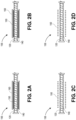
- Figure 2B illustrates a cross-sectional side view of the reaction zone 156 of the reactor 100, according to an implementation.
- the tubular member 120 is made from a metal (e.g., steel), and the transporter 140 is made from a polymer (e.g., polyether ether ketone). Switching the transporter 140 from metal to polymer may reduce friction and binding because the polymer is chemically dissimilar from the metallic tubular member 120. In addition, switching the transporter 140 from metal to polymer may reduce the weight and/or density (e.g., 5x less) of the transporter 140.
- the heater 150 is a resistive heating coil, and the insulation 158 is positioned at least partially around the heater 150.
- Figure 2C illustrates a cross-sectional side view of the reaction zone 156 of the reactor 100, according to an implementation.
- the tubular member 120 is made from a polymer (e.g., polyether ether ketone), and the transporter 140 is made from a metal (e.g., steel). Switching the tubular member 120 from metal to polymer may reduce friction and binding because the polymer is chemically dissimilar from the metallic transporter 140.
- the heater 150 is an inductive heating coil, and the insulation 158 is omitted.
- the inductive heater 150 may heat the metallic transporter 140, but may not directly heat the tubular member 120, which is made of polymer.
- the heat from the metallic transporter 140 may be transferred to the hydride fuel 102. Because this heat is occurring from inside the tubular member 120, and the polymer has a relatively low thermal conductivity, heat losses may be reduced, and heating efficiency may be increased.
- the weight/density of the polymer is also less than that of the metal.
- hydrogen dehydrogenation is performed in the reactor 100 where the tubular member 120 is made from a polymer, and the transporter 140 is made from metal.
- the process is performed in an argon-filled glove box.
- the tubular member 120 is 6 inches long with a 0.56 inch inner diameter and a 0.75 inch outer diameter.
- the transporter 140 is a metallic auger that is 3 inches long.
- the region around the auger is filled with 1.436 g of LiAlH 4 hydride catalyzed with 0.03 mol % TiF 3 .
- a 7 turn, 3.75 inch diameter induction heating coil 150 is placed around the section of the polymeric tubular member 120 containing the auger 140 and the hydride.
- the top of the tubular member 120 is sealed and held in place with a plastic syringe using a metal clamp.
- the plastic syringe is used to avoid any additional metal being proximate to the heating coil 150.
- the heating coil 150 is powered with the inductive heating circuit 152, which in turn is powered by a 24 VDC power supply 154.
- Figure 2D illustrates a cross-sectional side view of the reaction zone 156 of the reactor 100, according to an implementation.
- the tubular member 120 is made from a polymer (e.g., polyether ether ketone), and the transporter 140 is made from a polymer (e.g., polyether ether ketone).
- the heater 150 is an inductive heating coil, and the insulation 158 is omitted.
- induction heating is used to directly heat the hydride fuel 102.
- the hydride fuel 102 is (at least initially) non-metallic and may not be heated by induction. However, electrically conductive additives may be added to the hydride powder 102.
- the electrically conductive additive may be or include from about 1 wt % to about 30 wt%, about 5 wt% to about 25 wt%, or about 10 wt% to about 20 wt% carbon powder, where wt% refers to weight of total solids.
- the electrically conductive additive may be or include from about 1 wt % to about 30 wt%, about 5 wt% to about 25 wt%, or about 10 wt% to about 20 wt% metallic (e.g., iron) powder, where wt% refers to weight of total solids.
- the additive may transfer heat to the hydride fuel 102 within the flowing powder bed to enable efficient heating.
- Figure 3 illustrates a graph 300 showing the flow rate and temperature of the hydride fuel 102 in the reaction zone 156 versus time, according to an implementation.
- the transporter (e.g., auger) 140 may rotate from about 1 revolution to about 20 revolutions, about 2 revolutions to about 15 revolutions, or about 3 revolutions to about 15 revolutions.
- the rate of rotation may be from about 0.5 RPM to about 5 RPM, about 1 RPM to about 4 RPM, or about 2 RPM to about 3 RPM. This may move the hydride fuel 102 from about 2 cm to about 20 cm, about 3 cm to about 15 cm, or about 4 cm to about 10 cm within the tubular member 120, which may be the length of the reaction zone 156.
- the reaction zone 156 may include from about 0.5 g to about 5 g, about 1 g to about 4 g, or about 1.5 g to about 3 g of the hydride fuel 102 therein.
- the residence time of the hydride fuel 102 in the reaction zone 156 may be from about 30 seconds to about 5 minutes, about 1 minute to about 4 minutes, or about 2 minutes to about 3 minutes.
- the reactor 100 may run from about 30 minutes to about 5 hours, about 1 hour to about 4 hours, or about 2 hours to about 3 hours.
- the hydrogen gas flow rate may be about 1 liter for every 5 rotations of the auger 140. At about 2 RPM, this translates to a flow rate from about 0.1 L/min to about 2 L/min, about 0.2 L/min to about 1.5 L/min, or about 0.3 L/min to about 1 L/min. As shown, the reactor 100 may be started with a temperature of about 200 °C, and the flow rate immediately increases to about 0.4 L/min, indicating about 90% hydrogen gas recovery.
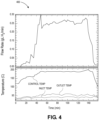
- Figure 4 illustrates another graph 400 showing the flow rate and temperature of the hydride fuel 102 in the reaction zone 156 versus time, according to an implementation.
- 115 g of LiAlH 4 (catalyzed with 3 mol% TiF 3 ) is introduced into the reactor 100.
- the reactor 100 runs for about 2 hours with an average flow rate from about 0.1 L/min to about 1 L/min, about 0.15 L/min to about 0.75 L/min, or about 0.2 L/min to about 0.5 L/min at a rate from about 0.5 RPM to about 5 RPM, about 1 RPM to about 4 RPM, or about 2 RPM to about 3 RPM.
- the hydrogen recovery is from about 30% to about 70%, about 40% to about 60%, or about 45% to about 55%.
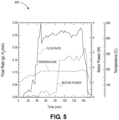
- Figure 5 illustrates another graph 500 showing the flow rate of hydrogen gas and temperature of the hydride fuel 102 in the reaction zone 156 versus time, according to an implementation.
- the power required to turn the motor 130 is relatively low (e.g., from about 0.1 W to about 1 W, about 0.2 W to about 0.5 W, or about 0.25 W to about 0.35 W).
- time e.g., about 85 minutes
- the power increases to between about 1 W and about 3 W, about 1.5 W and about 2.5 W, or about 1.75 W and about 2 W with relatively no change in motor speed or reaction temperature.
- the flow rate of the hydride fuel 102 and/or the hydrogen gas through the reactor 100 may be from about 0.1 L/min to about 1 L/min, about 0.2 L/min to about 0.8 L/min, or about 0.3 L/min to about 0.5 L/min.
- the fuel may be depleted in about 1 hour to about 10 hours, about 2 hours to about 8 hours, or about 3 hours to about 5 hours. This may be normalized to the amount of total fuel stored in the fuel cell 190.
- the fuel cell may release from about 10% to about 100% of the stored hydrogen per hour, from about 20% to about 80% of the stored hydrogen per hour, or from about 20% to about 50% of the stored hydrogen per hour.
- Figure 6 illustrates a graph 600 showing temperatures of three differently-sized heaters 150 versus time, according to an implementation.
- the heating coils are helical, and the term “diameter” refers to the diameter of the helix, not the diameter of the coil itself.
- the heater (e.g., heating coil) 150 with the 3.75 inch diameter provided an optimal heating profile for dehydrogenation of the LiAlH 4 hydride fuel 102. As shown, a temperature of about 150 °C is reached in about 5 minutes, and a temperature of about 200 °C is reached in about 10 minutes. Larger diameter heater coils (e.g., 4.5 inches and 6.4 inches) heat too slowly while smaller coils (data not shown) heat too quickly.
- Power measurements with and without the transporter 140 in the heater 150 indicate that the heating power to the heater 150 increases with decreasing coil diameter: from 3 W at 6.5 inches, to 9 W at 4.5 inches, to 17 W at 3.75 inches.
- the temperature is measured with an optical pyrometer. Heating is performed in air with the transporter 140, not in the polymer tubular member 120, positioned vertically in the center of the heater 150.
- FIG. 7 illustrates a graph 700 showing flow rate and integrated flow versus time, according to an implementation.
- the metallic transporter (e.g., auger) 140 is inductively heated inside the polymeric tubular member 120.
- the flow rate begins to rise at about 3.5 minutes and about 135 °C.
- the flow rate peaks at about 0.17 liters/minute and then decreases to about 0.03 liters per minute at about 15 minutes.
- the integrated flow is about 0.82 liters, which corresponds to about 0.033 mole-H 2 or 0.067 g-H 2 .
- integrated flow refers to the total amount of evolved hydrogen gas.
- the measured weight loss of the assembled polymeric tubular member 120 is 0.088 g.
- the induction heating of the hydride fuel 102 in the reactor 100 with the metallic transporter 140 is performed a second time.
- the flow rate increases to about 0.12 L/minute within less than a minute after showing signs of positive pressure outward on the flow meter 176.
- the heater 150 is shut off.
- the flow rate starts to decrease a few seconds later, indicating a quick response time and strong correlation to the inductive heating energy going into the transporter 140.
- Figure 8 illustrates a flowchart of a method 800 for converting the hydride fuel 102 into hydrogen gas, according to an implementation.
- An illustrative order of the method 800 is provided below; however, one or more steps of the method 800 may be performed in a different order, performed simultaneously, repeated, or omitted.
- the method 800 may include introducing an additive to the hydride fuel 102, as at 802.
- the additive may be or include a carbon powder or a metallic powder.
- the method 800 may also include applying a lubricant to the transporter (e.g., the auger) 140, as at 804.
- the method 800 may also include increasing a temperature of the transporter 140 and/or the lubricant to cause a binder material in the lubricant to at least partially evaporate, as at 806. This may leave behind the lubricant with little or no binder material.
- the method 800 may include introducing the hydride fuel 102 into the tank 110, as at 808.
- the method 800 may also include transferring the hydride fuel 102 from the tank into the tubular member 120, as at 810.
- the method 800 may also include moving the hydride fuel 102 within the tubular member 120 using the transporter 140, as at 812.
- the transporter 140 may be or include an auger that is rotated by the motor 130, which moves the hydride fuel 102 within the tubular member 120.
- the method 800 may also include heating the reaction zone 156 using the heater 150 to convert the hydride fuel 102 into hydrogen gas and a reacted byproduct, as at 814.
- the method 800 may also include discharging the hydrogen gas through the outlet 170, as at 816.
- the method 800 may also include receiving/storing the hydrogen gas in the fuel cell 190, as at 817.
- the method 800 may also include powering the vehicle 192 using the hydrogen gas, as at 818.
- the hydrogen gas may be supplied to the vehicle 190 directly from the outlet 170 or from the fuel cell 190.
- the method 800 may also include collecting the reacted byproduct in the collector 180, as at 820.
- the terms “inner” and “outer”; “up” and “down”; “upper” and “lower”; “upward” and “downward”; “upstream” and “downstream”; “above” and “below”; “inward” and “outward”; and other like terms as used herein refer to relative positions to one another and are not intended to denote a particular direction or spatial orientation.
- Couple refers to "in direct connection with” or “in connection with via one or more intermediate elements or members.”
- bonded refers to "directly bonded to” or “bonded to via one or more intermediate elements, members, or layers.”
- the term "at least one of A and B" with respect to a listing of items such as, for example, A and B, means A alone, B alone, or A and B.
- Those skilled in the art will recognize that these and other variations are possible.
- the terms “including,” “includes,” “having,” “has,” “with,” or variants thereof are used in either the detailed description and the claims, such terms are intended to be inclusive in a manner similar to the term “comprising.”
- the term “about” indicates that the value listed may be somewhat altered, as long as the alteration does not result in nonconformance of the process or structure to the intended purpose described herein.
- “exemplary” indicates the description is used as an example, rather than implying that it is an ideal.
Landscapes
- Chemical & Material Sciences (AREA)
- Organic Chemistry (AREA)
- Engineering & Computer Science (AREA)
- Chemical Kinetics & Catalysis (AREA)
- Sustainable Energy (AREA)
- Life Sciences & Earth Sciences (AREA)
- Manufacturing & Machinery (AREA)
- Sustainable Development (AREA)
- Electrochemistry (AREA)
- General Chemical & Material Sciences (AREA)
- Inorganic Chemistry (AREA)
- Health & Medical Sciences (AREA)
- Combustion & Propulsion (AREA)
- General Health & Medical Sciences (AREA)
- Fuel Cell (AREA)
Description
- Hydrogen fuel cell systems may generate high specific energies (e.g., >800 Wh/kg). However, hydrogen storage remains a challenge and limits scalability. The most common hydrogen storage method employed today includes high pressure (e.g., carbon fiber) hydrogen tanks. Although this storage method has a reasonable specific energy and energy density at large scale (e.g., >50 kWh), it is often too heavy and too spacious at medium and small scales (e.g., <10 kWh). In addition, the high pressure requirement limits the design flexibility of the storage system. Future electric and hybrid electric vehicles may require power systems with specific energies ≥700 Wh/kg.
-
US6866836 describes, in accordance with its abstract, a method that generates hydrogen to power a hydrogen consuming device. Hydrogen is stored on-board a vehicle in dry lithium and/or sodium borohydride particles. Upon demand from the hydrogen consuming device, such as a fuel cell, a portion of the borohydride is conveyed to an axial flow reactor. Water is then injected into the reactor in controlled amounts to hydrolyze the borohydride particles thus, producing hydrogen gas and solid-phase by-products. The reactor includes parallel, closely spanned, counter rotating augers to mix and convey the borohydride particles and solid by-products through the reactor. A separate grinding mechanism can be used to further crush and grind large by-product particles to increase packing efficiencies in a by-products storage vessel, where reaction products will later be stored. Hydrogen gas produced in the reaction is delivered to either a hydrogen buffer container for temporary storage or to the hydrogen consuming device. - MARUTHI N. DEVARAKONDA ET AL: "Dynamic Modeling and Simulation Based Analysis of an AmmoniaBorane (AB) Reactor System for Hydrogen Storage", ECS-THE ELECTROCHEMICAL SOCIETY, vol. 33, no. 1, 2010, pages 1959-1972 disclose the production of hydrogen by thermal decomposition of ammonia borane in flow through (auger) reactors.
- The invention to which this European patent relates is defined in the appended claims.
- A hydride flow reactor is disclosed. The reactor includes a tank configured to receive a hydride fuel. The reactor also includes a tubular member coupled to the tank and configured to receive the hydride fuel from the tank. The reactor also includes a transporter positioned at least partially within the tubular member and configured to transport the hydride fuel through the tubular member. The reactor also includes a heater positioned at least partially around the tubular member and the transporter. The heater is configured to heat the hydride fuel in the tubular member to convert the hydride fuel into hydrogen gas and a reacted byproduct.
- A vehicle is also disclosed. The vehicle includes a hydride flow reactor. The reactor includes a tank configured to receive a metastable hydride fuel. The metastable hydride fuel includes a solid powder. The metastable hydride fuel includes lithium aluminum hydride, aluminum hydride, or a combination thereof. The metastable hydride fuel has a hydrogen material density that is from about 30 kg/m3 to about 200 kg/m3. The reactor also includes a tubular member configured to receive the metastable hydride fuel from the tank. The reactor also includes an auger positioned within the tubular member. The reactor also includes a motor configured to rotate the auger, which moves the metastable hydride fuel through the tubular member. The reactor also includes a heater positioned at least partially around the tubular member and the auger. The heater is configured to heat the metastable hydride fuel in the tubular member to a temperature from about 100 °C to about 300°C to convert the metastable hydride fuel into hydrogen gas and a reacted byproduct. The reactor also includes an outlet configured to discharge the hydrogen gas. The outlet includes a filter that is configured to prevent particles entrained in the hydrogen gas from being discharged through the outlet. The vehicle uses the hydrogen gas as a fuel. The reactor also includes a container configured to collect the reacted byproduct.
- A method is also disclosed. The method includes introducing a hydride fuel into a tank. The method also includes transferring the hydride fuel from the tank into a tubular member. The method also includes moving the hydride fuel within the tubular member using an auger positioned within the tubular member. The method also includes heating a reaction zone within the tubular member using a heater to convert the hydride fuel into hydrogen gas and a reacted byproduct. The heater is positioned outside of the tubular member. The method also includes discharging the hydrogen gas through an outlet. The method also includes collecting the reacted byproduct in a container.
- The accompanying drawings, which are incorporated in and constitute a part of this specification, illustrate aspects of the present teachings and together with the description, serve to explain the principles of the present teachings.
-
Figure 1 illustrates a schematic view of a solid hydride flow reactor, according to an implementation. -
Figure 2A illustrates a cross-sectional side view of a reaction zone of the reactor, according to an implementation. -
Figure 2B illustrates a cross-sectional side view of the reaction zone of the reactor, according to another implementation. -
Figure 2C illustrates a cross-sectional side view of the reaction zone of the reactor, according to another implementation. -
Figure 2D illustrates a cross-sectional side view of the reaction zone of the reactor, according to another implementation. -
Figure 3 illustrates a graph showing the flow rate of the evolved hydrogen gas and temperature of the hydride fuel in the reaction zone versus time, according to an implementation. -
Figure 4 illustrates another graph showing the flow rate of the evolved hydrogen gas and temperature of the hydride fuel in the reaction zone versus time, according to an implementation. -
Figure 5 illustrates another graph showing the flow rate of the evolved hydrogen gas and temperature of the hydride fuel in the reaction zone versus time, according to an implementation. -
Figure 6 illustrates a graph showing temperatures of three differently-sized heaters versus time, according to an implementation. -
Figure 7 illustrates a graph showing flow rate of the hydrogen gas and integrated flow of the hydrogen gas versus time, according to an implementation. -
Figure 8 illustrates a flowchart of a method for converting a hydride fuel into a hydrogen gas, according to an implementation. - It should be noted that some details of the figures have been simplified and are drawn to facilitate understanding rather than to maintain strict structural accuracy, detail, and scale.
- Reference will now be made in detail to the present teachings, examples of which are illustrated in the accompanying drawings. In the drawings, like reference numerals have been used throughout to designate identical elements. In the following description, reference is made to the accompanying drawings that form a part thereof, and in which is shown by way of illustration specific examples of practicing the present teachings. The following description is, therefore, merely exemplary.
-
Figure 1 illustrates a schematic view of a solidhydride flow reactor 100, according to an implementation. Thereactor 100 is configured to perform a continuous and/or variable conversion of ahydride fuel 102 into a hydrogen gas. More particularly, thereactor 100 may be configured to produce a clean hydrogen gas, on demand, without high-pressure storage tanks, as described below. - The
hydride fuel 102 is a powdered solid. In other words, thehydride fuel 102 is not a liquid or a slurry. Thehydride fuel 102 is or includes lithium aluminum hydride (LiAlH4), aluminum hydride (AlH3), or a combination thereof, which may be thermally decomposed within thereactor 100 to generate/release a hydrogen gas. Thehydride fuel 102 may have a high gravimetric and/or volumetric density. For example, thehydride fuel 102 may have a gravimetric and/or volumetric density from about 30 kg/m3 (on a material basis) to about 200 kg/m3, about 40 kg/m3 to about 175 kg/m3, or about 50 kg/m3 to about 150 kg/m3. In another implementation, thehydride fuel 102 may have a gravimetric and/or volumetric density from about 50 kg/m3 to about 100 kg/m3, about 100 kg/m3 to about 150 kg/m3, or about 150 kg/m3 to about 200 kg/m3. For example, LiAlH4 may have a hydrogen material density of about 78 kg/m3, and AlH3 may have a hydrogen material density of about 148 kg/m3. These ranges are based on the known hydrogen material density from reference material(s). - The
reactor 100 may include a tank (also referred to as a reservoir or hopper) 110 that is configured to receive and/or store thehydride fuel 102 therein. Thetank 110 may be made from a polymer (e.g., polycarbonate), which is durable, air-tight, and optically-transparent. An upper portion of thetank 110 may include top seal 112, which may serve as a loading area when adding thehydride fuel 102 into thetank 110 in an inert atmosphere (e.g., a glove box). The top seal 112 may include a top flange and cap with a compression clamp. The top cap may be coupled to the flange, and may also include a pressure release valve 113, which may be configured to actuate into an open position to release pressure when the pressure reaches or exceeds a predetermined threshold (e.g., 10 PSI). - A lower portion of the
tank 110 may include a bottom seal 114, which may include a flange and cap with a compression clamp. Thetank 110 may also include a filter 116 that is configured to separate/remove particles (e.g., powder) from a gas flowing therethrough. This may prevent particles from clogging the pressure release valve 113. A substantially conicalgravity feed adapter 118 may be coupled to and/or positioned below thetank 110. Although thehydride fuel 102 is shown as being transferred from thehopper 110 via a gravity feed, in other implementations, thehydride fuel 102 may also or instead be transferred from thetank 110 using a linear actuator (e.g., a pneumatic or hydraulic piston or plunger, an electrically-powered screw, etc.), or a vibratory-type delivery system (e.g., a vibratory feeder and/or vibratory hopper). - The
reactor 100 may also include atubular member 120 that is configured to receive thehydride fuel 102 from thetank 110. Thetubular member 120 may include an inlet tee joint 122 and an outlet tee joint 124. For example, thehydride fuel 102 may flow from thetank 110, through the feed adapter 118 (e.g., due to gravity), through the inlet tee joint 122, and into thetubular member 120. In one implementation, the reactor 100 (e.g., thetank 110 and the tubular member 120) may be hermetically sealed to exclude ambient air, as the hydride reactants and/or byproducts may be air-sensitive and/or moisture-sensitive. - The
reactor 100 may also include amotor 130. Themotor 130 may be or include a variable speed motor. Achain 132 may be coupled to themotor 130 and configured to translate rotational motion from themotor 130. Arotary feedthrough 134 may be coupled to thechain 132. Arigid shaft coupler 136 may be coupled to the rotary feed through 134. - The
reactor 100 may also include atransporter 140 that is positioned at least partially within thetubular member 120. As shown, thetransporter 140 may extend at least partially through the inlet tee joint 122 and/or the outlet tee joint 124. Thetransporter 140 may be coupled to theshaft coupler 136. Themotor 130, thechain 132, therotary feedthrough 134, theshaft coupler 136, or a combination thereof may be configured to cause thetransporter 140 to move (e.g., rotate) to transport thehydride fuel 102 through the tubular member 120 (e.g., to the right as shown inFigure 1 ). In one example, thetransporter 140 may be or include a powder feed auger. - The
transporter 140 may have a lubricant (e.g., molybdenum disulfide: MoS2) applied thereto. The lubricant may include a binder material, such as mineral oil or a similar paraffin-based material. After the lubricant is applied, thetransporter 140 and/or lubricant may be heated to bake out and remove the binder material from the lubricant. Thetransporter 140 may have a graphite paint applied thereto, which may aid in measuring the temperature of thetransporter 140. - The
reactor 100 may also include aheater 150. Theheater 150 may be positioned at least partially around thetubular member 120 and/or thetransporter 140. Theheater 150 may be configured to heat thehydride fuel 102 to a temperature from about 100 °C to about 300 °C, about 150 °C to about 250 °C, or about 175 °C to about 225 °C, at which temperature thehydride fuel 102 generates/releases hydrogen gas and a reacted byproduct. The reacted byproduct may be, for example, aluminum metal and lithium hydride when thehydride fuel 102 is LiAlH4. In another example, the reacted byproduct may be aluminum metal when thehydride fuel 102 is AlH3. In one example, theheater 150 may initially heat thereaction zone 156 to a temperature from about 70 °C to about 150 °C, about 80 °C to about 130 °C, or about 90 °C to about 110 °C, and theheater 150 may gradually increase the temperature in thereaction zone 156 to about 160 °C to about 300 °C, about 180 °C to about 275 °C, or about 200 °C to about 250 °C over a time period from about 1 minute to about 10 minutes, about 1 minute to about 5 minutes, or about 1 minute to about 3 minutes. - In one example, the
heater 150 may be or include a resistive heating coil that may serve as a conductive heater. The heater 150 (e.g., the wire coil) may be coated with an enamel and/or resin (e.g., a PAC resin). In another example, theheater 150 may be or include an inductive heating coil. The heating coil may be wrapped helically around thetubular member 120 and/or thetransporter 140. Thereactor 100 may also include aninduction heater circuit 152 and a DC power supply 154 (e.g., when theheater 150 is an inductive heating coil). Induction heating may improve the response time of on-demand hydrogen gas generation when compared to conventional heat conduction techniques. Theheater 150 may be configured to heat thehydride fuel 102 within thetubular member 120. This may be referred to herein as areaction zone 156 because the heat causes thehydride fuel 102 to react and convert into a hydrogen gas and a reacted byproduct. - In one implementation, the
heater 150 may be at least partially surrounded by aninsulation 158. Theinsulation 158 may direct the heat from theheater 150 inwards toward thereaction zone 156. Theinsulation 158 may also or instead reduce the amount of heat lost to the surrounding environment, thereby increasing the efficiency of thereactor 100. Theinsulation 158 may be or include a synthetic porous material (e.g., aerogel), a polyimide film (e.g., poly (4,4'-oxydiphenylene-pyromellitimide), or a combination thereof. - One or more temperature sensors (e.g., thermocouples) 160 may be configured to measure the temperature in the
reaction zone 156. The temperature sensor(s) 160 may be positioned inside thetubular member 120 or outside thetubular member 120. When located outside of thetubular member 120, the temperature sensor(s) 160 may be positioned at least partially between coil windings of theheater 150. When located outside of thetubular member 120, the measurements from the temperature sensor(s) 160 may be used to estimate the temperature in thereaction zone 156. - The outlet tee joint 124 may be or include a phase separator that is configured to separate two phases from one another. For example, the phase separator may be configured to separate the hydrogen gas from the reacted byproduct.
- The
reactor 100 may also include agas outlet 170 through which the hydrogen gas may flow. Thegas outlet 170 may be coupled to or integral with an upper portion of the outlet tee joint 124. Thegas outlet 170 may include afilter 172 that is configured to separate/remove particles from the hydrogen gas as the hydrogen gas flows through thegas outlet 170. Thegas outlet 170 may also include apressure release valve 174, which may be configured to actuate into an open position to release pressure when the pressure reaches or exceeds a predetermined threshold (e.g., 10 PSI). In one implementation, thegas outlet 170 may include aflow meter 176 that is configured to measure the rate at which the hydrogen gas flows through thegas outlet 170. - The
reactor 100 may also include one or more pressure sensors (one is shown: 178) that is/are configured to measure the pressure within thereactor 100. As shown, thepressure sensor 178 is coupled to and/or proximate to thegas outlet 170. In another implementation, the pressure sensor 178 (or another pressure sensor) may be coupled to and/or proximate to thetank 110. The pressure release valve(s) 113, 174 may be actuated in response to the pressure measurements from the pressure sensor(s) 178. - The rate at which the hydrogen gas is produced may depend at least partially upon the feed rate of the
hydride fuel 102 from thetank 110 into thetubular member 120. For example, as the feed rate varies (e.g., increases), the rate at which the hydrogen gas is produced may also vary (e.g., increase). The rate at which the hydrogen gas is produced may also or instead depend at least partially upon the rate at which thetransporter 140 moves thehydride fuel 102 through thetubular member 120. For example, as the rate at which thetransporter 140 moves (e.g., rotates) varies, the rate at which the hydrogen gas is produced may also vary. The rate at which the hydrogen gas is produced may also or instead depend at least partially upon the temperature in thereaction zone 156. For example, as the temperature varies (e.g., increases), the rate at which the hydrogen gas is produced may also vary (e.g., increase). - The
reactor 100 may also include acollector 180 that is configured to receive/store the reacted byproduct. Thecollector 180 may be coupled to or integral with a lower portion of the outlet tee joint 124. - A
fuel cell 190 may be configured to receive and/or store the hydrogen gas produced by thereactor 100. Thereactor 100, the hydrogen gas, and/or thefuel cell 190 may be configured to achieve a specific energy of up to about 250 Wh/kg, up to about 500 Wh/kg, about 1000 Wh/kg, or about 1500 Wh/kg. In another embodiment, thereactor 100, the hydrogen gas, and/or thefuel cell 190 may be configured to achieve a specific energy from about 500 Wh/kg to about 750 Wh/kg, about 750 Wh/kg to about 1000 Wh/kg, about 1000 Wh/kg to about 1500 Wh/kg, or more. - In one implementation, the
reactor 100 may be coupled to and/or positioned within avehicle 192, and thevehicle 192 may use the hydrogen gas discharged from theoutlet 170 as a fuel. Thevehicle 192 may be or include an electric and/or hybrid-electric vehicle. For example, thevehicle 192 may be or include an aircraft such as an airplane, a helicopter, an unmanned aerial vehicle (UAV), a spacecraft, or the like. Thevehicle 192 may also or instead include a car, a train, a boat, an underwater vehicle, or the like. -
Figure 2A illustrates a cross-sectional side view of thereaction zone 156 of thereactor 100, according to an implementation. In this implementation, thetubular member 120 is made from a metal (e.g., steel), and thetransporter 140 is made from a metal (e.g., steel). Theheater 150 is a resistive heating coil, and theinsulation 158 is positioned at least partially around theheater 150. -
Figure 2B illustrates a cross-sectional side view of thereaction zone 156 of thereactor 100, according to an implementation. In this implementation, thetubular member 120 is made from a metal (e.g., steel), and thetransporter 140 is made from a polymer (e.g., polyether ether ketone). Switching thetransporter 140 from metal to polymer may reduce friction and binding because the polymer is chemically dissimilar from the metallictubular member 120. In addition, switching thetransporter 140 from metal to polymer may reduce the weight and/or density (e.g., 5x less) of thetransporter 140. Theheater 150 is a resistive heating coil, and theinsulation 158 is positioned at least partially around theheater 150. -
Figure 2C illustrates a cross-sectional side view of thereaction zone 156 of thereactor 100, according to an implementation. In this implementation, thetubular member 120 is made from a polymer (e.g., polyether ether ketone), and thetransporter 140 is made from a metal (e.g., steel). Switching thetubular member 120 from metal to polymer may reduce friction and binding because the polymer is chemically dissimilar from themetallic transporter 140. Theheater 150 is an inductive heating coil, and theinsulation 158 is omitted. Theinductive heater 150 may heat themetallic transporter 140, but may not directly heat thetubular member 120, which is made of polymer. The heat from themetallic transporter 140 may be transferred to thehydride fuel 102. Because this heat is occurring from inside thetubular member 120, and the polymer has a relatively low thermal conductivity, heat losses may be reduced, and heating efficiency may be increased. The weight/density of the polymer is also less than that of the metal. - In an example, hydrogen dehydrogenation is performed in the
reactor 100 where thetubular member 120 is made from a polymer, and thetransporter 140 is made from metal. The process is performed in an argon-filled glove box. Thetubular member 120 is 6 inches long with a 0.56 inch inner diameter and a 0.75 inch outer diameter. Thetransporter 140 is a metallic auger that is 3 inches long. The region around the auger is filled with 1.436 g of LiAlH4 hydride catalyzed with 0.03 mol % TiF3. A 7 turn, 3.75 inch diameterinduction heating coil 150 is placed around the section of the polymerictubular member 120 containing theauger 140 and the hydride. The top of thetubular member 120 is sealed and held in place with a plastic syringe using a metal clamp. The plastic syringe is used to avoid any additional metal being proximate to theheating coil 150. Theheating coil 150 is powered with theinductive heating circuit 152, which in turn is powered by a 24VDC power supply 154. -
Figure 2D illustrates a cross-sectional side view of thereaction zone 156 of thereactor 100, according to an implementation. In this implementation, thetubular member 120 is made from a polymer (e.g., polyether ether ketone), and thetransporter 140 is made from a polymer (e.g., polyether ether ketone). Theheater 150 is an inductive heating coil, and theinsulation 158 is omitted. In this example, induction heating is used to directly heat thehydride fuel 102. Thehydride fuel 102 is (at least initially) non-metallic and may not be heated by induction. However, electrically conductive additives may be added to thehydride powder 102. For example, the electrically conductive additive may be or include from about 1 wt % to about 30 wt%, about 5 wt% to about 25 wt%, or about 10 wt% to about 20 wt% carbon powder, where wt% refers to weight of total solids. In another example, the electrically conductive additive may be or include from about 1 wt % to about 30 wt%, about 5 wt% to about 25 wt%, or about 10 wt% to about 20 wt% metallic (e.g., iron) powder, where wt% refers to weight of total solids. The additive may transfer heat to thehydride fuel 102 within the flowing powder bed to enable efficient heating. -
Figure 3 illustrates agraph 300 showing the flow rate and temperature of thehydride fuel 102 in thereaction zone 156 versus time, according to an implementation. The transporter (e.g., auger) 140 may rotate from about 1 revolution to about 20 revolutions, about 2 revolutions to about 15 revolutions, or about 3 revolutions to about 15 revolutions. The rate of rotation may be from about 0.5 RPM to about 5 RPM, about 1 RPM to about 4 RPM, or about 2 RPM to about 3 RPM. This may move thehydride fuel 102 from about 2 cm to about 20 cm, about 3 cm to about 15 cm, or about 4 cm to about 10 cm within thetubular member 120, which may be the length of thereaction zone 156. Thereaction zone 156 may include from about 0.5 g to about 5 g, about 1 g to about 4 g, or about 1.5 g to about 3 g of thehydride fuel 102 therein. The residence time of thehydride fuel 102 in thereaction zone 156 may be from about 30 seconds to about 5 minutes, about 1 minute to about 4 minutes, or about 2 minutes to about 3 minutes. Thereactor 100 may run from about 30 minutes to about 5 hours, about 1 hour to about 4 hours, or about 2 hours to about 3 hours. - In an example, given a hydrogen content of 7.2 wt% (e.g., for catalyzed LiAlH4) and 90% decomposition, the hydrogen gas flow rate may be about 1 liter for every 5 rotations of the
auger 140. At about 2 RPM, this translates to a flow rate from about 0.1 L/min to about 2 L/min, about 0.2 L/min to about 1.5 L/min, or about 0.3 L/min to about 1 L/min. As shown, thereactor 100 may be started with a temperature of about 200 °C, and the flow rate immediately increases to about 0.4 L/min, indicating about 90% hydrogen gas recovery. -
Figure 4 illustrates anothergraph 400 showing the flow rate and temperature of thehydride fuel 102 in thereaction zone 156 versus time, according to an implementation. In this example, 115 g of LiAlH4 (catalyzed with 3 mol% TiF3) is introduced into thereactor 100. Thereactor 100 runs for about 2 hours with an average flow rate from about 0.1 L/min to about 1 L/min, about 0.15 L/min to about 0.75 L/min, or about 0.2 L/min to about 0.5 L/min at a rate from about 0.5 RPM to about 5 RPM, about 1 RPM to about 4 RPM, or about 2 RPM to about 3 RPM. The hydrogen recovery is from about 30% to about 70%, about 40% to about 60%, or about 45% to about 55%. -
Figure 5 illustrates anothergraph 500 showing the flow rate of hydrogen gas and temperature of thehydride fuel 102 in thereaction zone 156 versus time, according to an implementation. During the early stages of the run, the power required to turn themotor 130 is relatively low (e.g., from about 0.1 W to about 1 W, about 0.2 W to about 0.5 W, or about 0.25 W to about 0.35 W). After time (e.g., about 85 minutes), the power increases to between about 1 W and about 3 W, about 1.5 W and about 2.5 W, or about 1.75 W and about 2 W with relatively no change in motor speed or reaction temperature. About 58 g of thehydride fuel 102 passed through thereactor 100, and the remaining 57 g is left unreacted. - In another embodiment, the flow rate of the
hydride fuel 102 and/or the hydrogen gas through the reactor 100 (e.g., the tubular member 120) may be from about 0.1 L/min to about 1 L/min, about 0.2 L/min to about 0.8 L/min, or about 0.3 L/min to about 0.5 L/min. As will be appreciated, larger systems may evolve more hydrogen per unit time. For automotive applications, the fuel may be depleted in about 1 hour to about 10 hours, about 2 hours to about 8 hours, or about 3 hours to about 5 hours. This may be normalized to the amount of total fuel stored in thefuel cell 190. For example, the fuel cell may release from about 10% to about 100% of the stored hydrogen per hour, from about 20% to about 80% of the stored hydrogen per hour, or from about 20% to about 50% of the stored hydrogen per hour. -
Figure 6 illustrates agraph 600 showing temperatures of three differently-sized heaters 150 versus time, according to an implementation. InFigure 6 , the heating coils are helical, and the term "diameter" refers to the diameter of the helix, not the diameter of the coil itself. The heater (e.g., heating coil) 150 with the 3.75 inch diameter provided an optimal heating profile for dehydrogenation of the LiAlH4 hydride fuel 102. As shown, a temperature of about 150 °C is reached in about 5 minutes, and a temperature of about 200 °C is reached in about 10 minutes. Larger diameter heater coils (e.g., 4.5 inches and 6.4 inches) heat too slowly while smaller coils (data not shown) heat too quickly. Power measurements with and without the transporter (e.g., auger) 140 in theheater 150 indicate that the heating power to theheater 150 increases with decreasing coil diameter: from 3 W at 6.5 inches, to 9 W at 4.5 inches, to 17 W at 3.75 inches. The temperature is measured with an optical pyrometer. Heating is performed in air with thetransporter 140, not in thepolymer tubular member 120, positioned vertically in the center of theheater 150. -
Figure 7 illustrates agraph 700 showing flow rate and integrated flow versus time, according to an implementation. In the example shown inFigure 7 , the metallic transporter (e.g., auger) 140 is inductively heated inside the polymerictubular member 120. The flow rate begins to rise at about 3.5 minutes and about 135 °C. The flow rate peaks at about 0.17 liters/minute and then decreases to about 0.03 liters per minute at about 15 minutes. The integrated flow is about 0.82 liters, which corresponds to about 0.033 mole-H2 or 0.067 g-H2. As used herein, "integrated flow" refers to the total amount of evolved hydrogen gas. The measured weight loss of the assembled polymerictubular member 120 is 0.088 g. From the weight of thehydride fuel 102 added (1.436 g), and assuming a capacity of about 7 wt% for the LiAlH4 + 0.03 TiF3 mixture, the theoretical weight of hydrogen is about 0.100 g. These values indicate that a significant dehydrogenization of the hydride (e.g., about 67%) is achieved by inductively heating thetransporter 140. - The induction heating of the
hydride fuel 102 in thereactor 100 with themetallic transporter 140 is performed a second time. The flow rate increases to about 0.12 L/minute within less than a minute after showing signs of positive pressure outward on theflow meter 176. At this point, theheater 150 is shut off. The flow rate starts to decrease a few seconds later, indicating a quick response time and strong correlation to the inductive heating energy going into thetransporter 140. -
Figure 8 illustrates a flowchart of amethod 800 for converting thehydride fuel 102 into hydrogen gas, according to an implementation. An illustrative order of themethod 800 is provided below; however, one or more steps of themethod 800 may be performed in a different order, performed simultaneously, repeated, or omitted. - The
method 800 may include introducing an additive to thehydride fuel 102, as at 802. As discussed above, the additive may be or include a carbon powder or a metallic powder. Themethod 800 may also include applying a lubricant to the transporter (e.g., the auger) 140, as at 804. Themethod 800 may also include increasing a temperature of thetransporter 140 and/or the lubricant to cause a binder material in the lubricant to at least partially evaporate, as at 806. This may leave behind the lubricant with little or no binder material. - The
method 800 may include introducing thehydride fuel 102 into thetank 110, as at 808. Themethod 800 may also include transferring thehydride fuel 102 from the tank into thetubular member 120, as at 810. Themethod 800 may also include moving thehydride fuel 102 within thetubular member 120 using thetransporter 140, as at 812. For example, thetransporter 140 may be or include an auger that is rotated by themotor 130, which moves thehydride fuel 102 within thetubular member 120. Themethod 800 may also include heating thereaction zone 156 using theheater 150 to convert thehydride fuel 102 into hydrogen gas and a reacted byproduct, as at 814. Themethod 800 may also include discharging the hydrogen gas through theoutlet 170, as at 816. Themethod 800 may also include receiving/storing the hydrogen gas in thefuel cell 190, as at 817. Themethod 800 may also include powering thevehicle 192 using the hydrogen gas, as at 818. The hydrogen gas may be supplied to thevehicle 190 directly from theoutlet 170 or from thefuel cell 190. Themethod 800 may also include collecting the reacted byproduct in thecollector 180, as at 820. - As used herein, the terms "inner" and "outer"; "up" and "down"; "upper" and "lower"; "upward" and "downward"; "upstream" and "downstream"; "above" and "below"; "inward" and "outward"; and other like terms as used herein refer to relative positions to one another and are not intended to denote a particular direction or spatial orientation. The terms "couple," "coupled," "connect," "connection," "connected," "in connection with," and "connecting" refer to "in direct connection with" or "in connection with via one or more intermediate elements or members." Similarly, the terms "bonded" and "bonding" refer to "directly bonded to" or "bonded to via one or more intermediate elements, members, or layers."
- Notwithstanding that the numerical ranges and parameters setting forth the broad scope of the disclosure are approximations, the numerical values set forth in the specific examples are reported as precisely as possible. Any numerical value, however, inherently contains certain errors necessarily resulting from the standard deviation found in their respective testing measurements. Moreover, all ranges disclosed herein are to be understood to encompass any and all sub-ranges subsumed therein.
- While the present teachings have been illustrated with respect to one or more implementations, alterations and/or modifications can be made to the illustrated examples without departing from the scope of the appended claims. In addition, while a particular feature of the present teachings may have been disclosed with respect to only one of several implementations, such feature may be combined with one or more other features of the other implementations as may be desired and advantageous for any given or particular function. As used herein, the terms "a", "an", and "the" may refer to one or more elements or parts of elements. As used herein, the terms "first" and "second" may refer to two different elements or parts of elements. As used herein, the term "at least one of A and B" with respect to a listing of items such as, for example, A and B, means A alone, B alone, or A and B. Those skilled in the art will recognize that these and other variations are possible. Furthermore, to the extent that the terms "including," "includes," "having," "has," "with," or variants thereof are used in either the detailed description and the claims, such terms are intended to be inclusive in a manner similar to the term "comprising." Further, in the discussion and claims herein, the term "about" indicates that the value listed may be somewhat altered, as long as the alteration does not result in nonconformance of the process or structure to the intended purpose described herein. Finally, "exemplary" indicates the description is used as an example, rather than implying that it is an ideal.
- It will be appreciated that variants of the above-disclosed and other features and functions, or alternatives thereof, may be combined into many other different systems or applications. Various presently unforeseen or unanticipated alternatives, modifications, variations, or improvements therein may be subsequently made by those skilled in the art which are also intended to be encompasses by the following claims.
Claims (15)
- A hydride flow reactor (100), comprising:a tank (110) containing a powdered hydride fuel (102) comprising lithium aluminum hydride, aluminum hydride, or a combination thereof;a tubular member (120) coupled to the tank (110) and configured to receive the hydride fuel (102) from the tank (110);a transporter (140) positioned at least partially within the tubular member (120) and configured to transport the hydride fuel (102) through the tubular member (120) in powder form; anda heater (150) positioned at least partially around the tubular member (120) and the transporter (140), wherein the heater (150) is configured to heat the hydride fuel (102) in the tubular member (120) to convert the hydride fuel (102) into hydrogen gas and a reacted byproduct.
- The hydride flow reactor of claim 1, wherein the hydride fuel (102) comprises a solid powder that is metastable.
- The hydride flow reactor of any preceding claim, wherein the hydride fuel (102) also comprises a conductive additive, wherein the conductive additive comprises from about 1 wt% to about 20 wt% carbon powder, about 1 wt% to about 20 wt% metal powder, or a combination thereof, where wt% refers to weight of total solids.
- The hydride flow reactor according to any preceding claim, wherein the hydride fuel (102) comprises a lubricant, and wherein the lubricant comprises graphite, molybdenum disulfide, or a combination thereof.
- The hydride flow reactor of any of claims 1 to 4, wherein the transporter (140) comprises an auger positioned within the tubular member (120) and configured to rotate to transport the hydride fuel (102) through the tubular member (120).
- The hydride flow reactor of claim 5, wherein the auger has a lubricant applied thereto, and wherein the lubricant does not comprise a binder material.
- The hydride flow reactor of claim 5 or claim 6, further comprising a motor (130) coupled to the auger and configured to rotate the auger, and wherein a rate at which the motor (130) rotates the auger controls a rate at which the hydride fuel (102) is transported through the tubular member (120).
- The hydride flow reactor of any of claims 1 to 7, wherein the tank (110), the tubular member (120), or both are hermetically sealed.
- The hydride flow reactor of any of claims 1 to 8, further comprising:a pressure sensor (178) that is configured to measure a pressure of the hydrogen gas; anda valve (113, 174) that is configured to actuate from a first position to a second position when the pressure exceeds a threshold.
- The hydride flow reactor of any of claims 1 to 9, further comprising a temperature sensor (160) positioned outside of the tubular member (120) that is configured to measure a temperature in the tubular member (120), wherein a rate at which the transporter (140) transports the hydride fuel (102) through the tubular member (120) is adjusted in response to the measured temperature to achieve a predetermined decomposition rate.
- The hydride flow reactor of any of claims 1 to 10, further comprising a temperature sensor (160) positioned outside of the tubular member (120) that is configured to measure a temperature in the tubular member (120), wherein the heater (150) is configured to adjust an amount of heat introduced into the tubular member (120) in response to the measured temperature to achieve a predetermined decomposition rate.
- The hydride flow reactor of any of claims 1 to 11, further comprising:a phase separator (124) configured to separate the hydrogen gas from the reacted byproduct;an outlet (170) downstream from the phase separator (124) and configured to discharge the hydrogen gas, wherein the outlet (170) comprises a filter (172) that is configured to prevent particles entrained in the hydrogen gas from being discharged through the outlet (170); anda container (180) downstream from the phase separator (124) and configured to collect the reacted byproduct.
- A vehicle (192) comprising a hydride flow reactor (100) according to claim 1;wherein the powdered hydride fuel is metastable, and wherein the metastable hydride fuel (102) comprises a hydrogen material density that is from about 30 kg/m3 to about 200 kg/m3;wherein the tubular member (120) is configured to receive the metastable hydride fuel (102);wherein the transporter comprises an auger (140) positioned within the tubular member (120); andwherein the heater (150) is positioned at least partially around the auger (140), wherein the heater (150) is configured to heat the metastable hydride fuel (102) in the tubular member (120) to a temperature from about 100 °C to about 300°C to convert the metastable hydride fuel (102) into hydrogen gas and a reacted byproduct,the vehicle further comprising:a motor (130) configured to rotate the auger (140), which moves the metastable hydride fuel (102) through the tubular member (120);an outlet (170) configured to discharge the hydrogen gas, wherein the outlet (170) comprises a filter (172) that is configured to prevent particles entrained in the hydrogen gas from being discharged through the outlet (170), and wherein the vehicle (190) uses the hydrogen gas as a fuel; anda container (180) configured to collect the reacted byproduct.
- The vehicle of claim 13, wherein the vehicle (192) comprises an electric or hybrid-electric aircraft that uses the hydrogen gas as the fuel.
- A method, comprising:introducing a hydride fuel into a tank, wherein the hydride fuel comprises powdered lithium aluminum hydride, aluminum hydride, or a combination thereof;transferring the hydride fuel from the tank into a tubular member;moving the hydride fuel within the tubular member in powdered form using an auger positioned within the tubular member;heating a reaction zone within the tubular member using a heater to convert the hydride fuel into hydrogen gas and a reacted byproduct, wherein the heater is positioned outside of the tubular member;discharging the hydrogen gas through an outlet; andcollecting the reacted byproduct in a container.
Applications Claiming Priority (2)
| Application Number | Priority Date | Filing Date | Title |
|---|---|---|---|
| US202163136075P | 2021-01-11 | 2021-01-11 | |
| US17/449,970 US11827516B2 (en) | 2021-01-11 | 2021-10-05 | Solid hydride flow reactor |
Publications (2)
| Publication Number | Publication Date |
|---|---|
| EP4026798A1 EP4026798A1 (en) | 2022-07-13 |
| EP4026798B1 true EP4026798B1 (en) | 2025-06-25 |
Family
ID=78957964
Family Applications (1)
| Application Number | Title | Priority Date | Filing Date |
|---|---|---|---|
| EP21215774.7A Active EP4026798B1 (en) | 2021-01-11 | 2021-12-17 | Solid hydride flow reactor |
Country Status (2)
| Country | Link |
|---|---|
| US (1) | US11827516B2 (en) |
| EP (1) | EP4026798B1 (en) |
Families Citing this family (1)
| Publication number | Priority date | Publication date | Assignee | Title |
|---|---|---|---|---|
| TR2024002853A1 (en) * | 2024-03-08 | 2025-09-22 | Nigde Oemer Halisdemir Ueniversitesi Rektoerluegue | AUTOMATIC CONTROLLED METAL HYDRIDE REACTOR |
Family Cites Families (14)
| Publication number | Priority date | Publication date | Assignee | Title |
|---|---|---|---|---|
| FR2272272B1 (en) * | 1974-05-24 | 1979-05-25 | Peugeot & Renault | |
| GB1568374A (en) * | 1976-12-07 | 1980-05-29 | Atomic Energy Authority Uk | Hydrogen from a hydride material |
| SU1467003A1 (en) * | 1987-03-25 | 1989-03-23 | Кузнецкий металлургический комбинат им.В.И.Ленина | Screw feeder |
| US5732794A (en) | 1994-09-30 | 1998-03-31 | Orlitzky; Anton T. | Auger-driven automatic lubricator |
| US5710360A (en) * | 1995-03-31 | 1998-01-20 | Vanish, Inc. | Thermal desorption system for decontaminating materials |
| US6811764B2 (en) * | 2002-09-12 | 2004-11-02 | General Motors Corporation | Hydrogen generation system using stabilized borohydrides for hydrogen storage |
| US6866836B2 (en) | 2002-09-13 | 2005-03-15 | General Motors Corporation | Method of generating hydrogen from borohydrides and water |
| US7179443B2 (en) | 2003-02-26 | 2007-02-20 | Daimlerchrysler Corporation | Powder metal hydride hydrogen generator |
| JP4758130B2 (en) | 2005-04-12 | 2011-08-24 | 国立大学法人北見工業大学 | Method for producing nanocarbon and catalytic reactor for producing nanocarbon |
| JP2007327534A (en) * | 2006-06-07 | 2007-12-20 | Taiheiyo Cement Corp | Hydrogen storage container and hydrogen occlusion/release device |
| TW200806392A (en) | 2006-06-20 | 2008-02-01 | Lynntech Inc | Microcartridge hydrogen generator |
| US8889097B2 (en) | 2011-01-10 | 2014-11-18 | Battelle Memorial Institute | Combined on-board hydride slurry storage and reactor system and process for hydrogen-powered vehicles and devices |
| GB2502126A (en) * | 2012-05-17 | 2013-11-20 | Oil From Waste Ltd | Thermal decomposition of waste plastic |
| FR3038454B1 (en) * | 2015-06-30 | 2017-07-28 | Herakles | DEVICE FOR GENERATING GASEOUS DIHYDROGEN |
-
2021
- 2021-10-05 US US17/449,970 patent/US11827516B2/en active Active
- 2021-12-17 EP EP21215774.7A patent/EP4026798B1/en active Active
Also Published As
| Publication number | Publication date |
|---|---|
| US20220219974A1 (en) | 2022-07-14 |
| US11827516B2 (en) | 2023-11-28 |
| EP4026798A1 (en) | 2022-07-13 |
Similar Documents
| Publication | Publication Date | Title |
|---|---|---|
| US9469532B2 (en) | Aluminum-alkali hydroxide recyclable hydrogen generator | |
| EP4026798B1 (en) | Solid hydride flow reactor | |
| US8911703B2 (en) | Reducing and/or harvesting drag energy from transport vehicles, including for chemical reactors, and associated systems and methods | |
| TW535320B (en) | Recyclable fuel distribution, storage, delivery and supply system | |
| US20130101502A1 (en) | Reducing and/or harvesting drag energy from transport vehicles, including for chemical reactors, and associated systems and methods | |
| CN104821409B (en) | Method, apparatus and fuel for hydrogen manufacturing | |
| US6866836B2 (en) | Method of generating hydrogen from borohydrides and water | |
| US6811764B2 (en) | Hydrogen generation system using stabilized borohydrides for hydrogen storage | |
| US10322932B2 (en) | Method and generator for hydrogen production | |
| CA3232727A1 (en) | Systems and methods for producing graphene | |
| CN103477487A (en) | Water reactive hydrogen fuel cell power system | |
| WO2004001205A2 (en) | Methods and apparatus for converting internal combustion engine (ice) vehicles to hydrogen fuel | |
| JP2011236930A (en) | Hydrogen filling system | |
| EP3801876B1 (en) | System and method for transferring energy | |
| CN110271867B (en) | Solid state hydrogenation unit | |
| US20250312756A1 (en) | Hydrogen generation apparatus and reaction case | |
| WO2025238525A1 (en) | Integrated system for preparing hydrogen and a dehydrogenated product from an alcohol | |
| CN121631857A (en) | Phase-change micro-heating network waste heat recovery system for heating distributed natural gas single well | |
| SA et al. | Solar-to-grid power system achieves 31.25% efficiency | |
| WO2019158940A1 (en) | Thermal management | |
| HK40072637A (en) | Fuel for hydrogen generation | |
| EA045052B1 (en) | METHOD, DEVICE AND FUEL FOR HYDROGEN PRODUCTION | |
| HK40074404A (en) | Device for hydrogen generation | |
| HK40074405A (en) | Method for refuelling a fuel tank, service station and connector line |
Legal Events
| Date | Code | Title | Description |
|---|---|---|---|
| PUAI | Public reference made under article 153(3) epc to a published international application that has entered the european phase |
Free format text: ORIGINAL CODE: 0009012 |
|
| STAA | Information on the status of an ep patent application or granted ep patent |
Free format text: STATUS: THE APPLICATION HAS BEEN PUBLISHED |
|
| AK | Designated contracting states |
Kind code of ref document: A1 Designated state(s): AL AT BE BG CH CY CZ DE DK EE ES FI FR GB GR HR HU IE IS IT LI LT LU LV MC MK MT NL NO PL PT RO RS SE SI SK SM TR |
|
| STAA | Information on the status of an ep patent application or granted ep patent |
Free format text: STATUS: REQUEST FOR EXAMINATION WAS MADE |
|
| 17P | Request for examination filed |
Effective date: 20221129 |
|
| RBV | Designated contracting states (corrected) |
Designated state(s): AL AT BE BG CH CY CZ DE DK EE ES FI FR GB GR HR HU IE IS IT LI LT LU LV MC MK MT NL NO PL PT RO RS SE SI SK SM TR |
|
| RAP3 | Party data changed (applicant data changed or rights of an application transferred) |
Owner name: THE BOEING COMPANY |
|
| GRAP | Despatch of communication of intention to grant a patent |
Free format text: ORIGINAL CODE: EPIDOSNIGR1 |
|
| STAA | Information on the status of an ep patent application or granted ep patent |
Free format text: STATUS: GRANT OF PATENT IS INTENDED |
|
| INTG | Intention to grant announced |
Effective date: 20250320 |
|
| GRAS | Grant fee paid |
Free format text: ORIGINAL CODE: EPIDOSNIGR3 |
|
| GRAA | (expected) grant |
Free format text: ORIGINAL CODE: 0009210 |
|
| STAA | Information on the status of an ep patent application or granted ep patent |
Free format text: STATUS: THE PATENT HAS BEEN GRANTED |
|
| P01 | Opt-out of the competence of the unified patent court (upc) registered |
Free format text: CASE NUMBER: APP_21671/2025 Effective date: 20250505 |
|
| AK | Designated contracting states |
Kind code of ref document: B1 Designated state(s): AL AT BE BG CH CY CZ DE DK EE ES FI FR GB GR HR HU IE IS IT LI LT LU LV MC MK MT NL NO PL PT RO RS SE SI SK SM TR |
|
| REG | Reference to a national code |
Ref country code: GB Ref legal event code: FG4D |
|
| REG | Reference to a national code |
Ref country code: CH Ref legal event code: EP |
|
| REG | Reference to a national code |
Ref country code: DE Ref legal event code: R096 Ref document number: 602021032763 Country of ref document: DE |
|
| REG | Reference to a national code |
Ref country code: CH Ref legal event code: EP |
|
| REG | Reference to a national code |
Ref country code: IE Ref legal event code: FG4D |
|
| PG25 | Lapsed in a contracting state [announced via postgrant information from national office to epo] |
Ref country code: FI Free format text: LAPSE BECAUSE OF FAILURE TO SUBMIT A TRANSLATION OF THE DESCRIPTION OR TO PAY THE FEE WITHIN THE PRESCRIBED TIME-LIMIT Effective date: 20250625 |
|
| REG | Reference to a national code |
Ref country code: LT Ref legal event code: MG9D |
|
| PG25 | Lapsed in a contracting state [announced via postgrant information from national office to epo] |
Ref country code: NO Free format text: LAPSE BECAUSE OF FAILURE TO SUBMIT A TRANSLATION OF THE DESCRIPTION OR TO PAY THE FEE WITHIN THE PRESCRIBED TIME-LIMIT Effective date: 20250925 Ref country code: GR Free format text: LAPSE BECAUSE OF FAILURE TO SUBMIT A TRANSLATION OF THE DESCRIPTION OR TO PAY THE FEE WITHIN THE PRESCRIBED TIME-LIMIT Effective date: 20250926 |
|
| PG25 | Lapsed in a contracting state [announced via postgrant information from national office to epo] |
Ref country code: BG Free format text: LAPSE BECAUSE OF FAILURE TO SUBMIT A TRANSLATION OF THE DESCRIPTION OR TO PAY THE FEE WITHIN THE PRESCRIBED TIME-LIMIT Effective date: 20250625 |
|
| PG25 | Lapsed in a contracting state [announced via postgrant information from national office to epo] |
Ref country code: HR Free format text: LAPSE BECAUSE OF FAILURE TO SUBMIT A TRANSLATION OF THE DESCRIPTION OR TO PAY THE FEE WITHIN THE PRESCRIBED TIME-LIMIT Effective date: 20250625 |
|
| PG25 | Lapsed in a contracting state [announced via postgrant information from national office to epo] |
Ref country code: RS Free format text: LAPSE BECAUSE OF FAILURE TO SUBMIT A TRANSLATION OF THE DESCRIPTION OR TO PAY THE FEE WITHIN THE PRESCRIBED TIME-LIMIT Effective date: 20250925 |
|
| PG25 | Lapsed in a contracting state [announced via postgrant information from national office to epo] |
Ref country code: LV Free format text: LAPSE BECAUSE OF FAILURE TO SUBMIT A TRANSLATION OF THE DESCRIPTION OR TO PAY THE FEE WITHIN THE PRESCRIBED TIME-LIMIT Effective date: 20250625 |
|
| REG | Reference to a national code |
Ref country code: NL Ref legal event code: MP Effective date: 20250625 |
|
| PG25 | Lapsed in a contracting state [announced via postgrant information from national office to epo] |
Ref country code: NL Free format text: LAPSE BECAUSE OF FAILURE TO SUBMIT A TRANSLATION OF THE DESCRIPTION OR TO PAY THE FEE WITHIN THE PRESCRIBED TIME-LIMIT Effective date: 20250625 |
|
| PG25 | Lapsed in a contracting state [announced via postgrant information from national office to epo] |
Ref country code: PT Free format text: LAPSE BECAUSE OF FAILURE TO SUBMIT A TRANSLATION OF THE DESCRIPTION OR TO PAY THE FEE WITHIN THE PRESCRIBED TIME-LIMIT Effective date: 20251027 |
|
| REG | Reference to a national code |
Ref country code: AT Ref legal event code: MK05 Ref document number: 1806318 Country of ref document: AT Kind code of ref document: T Effective date: 20250625 |
|
| PG25 | Lapsed in a contracting state [announced via postgrant information from national office to epo] |
Ref country code: IS Free format text: LAPSE BECAUSE OF FAILURE TO SUBMIT A TRANSLATION OF THE DESCRIPTION OR TO PAY THE FEE WITHIN THE PRESCRIBED TIME-LIMIT Effective date: 20251025 |
|
| PGFP | Annual fee paid to national office [announced via postgrant information from national office to epo] |
Ref country code: GB Payment date: 20251229 Year of fee payment: 5 |
|
| PG25 | Lapsed in a contracting state [announced via postgrant information from national office to epo] |
Ref country code: AT Free format text: LAPSE BECAUSE OF FAILURE TO SUBMIT A TRANSLATION OF THE DESCRIPTION OR TO PAY THE FEE WITHIN THE PRESCRIBED TIME-LIMIT Effective date: 20250625 Ref country code: SM Free format text: LAPSE BECAUSE OF FAILURE TO SUBMIT A TRANSLATION OF THE DESCRIPTION OR TO PAY THE FEE WITHIN THE PRESCRIBED TIME-LIMIT Effective date: 20250625 |
|
| PGFP | Annual fee paid to national office [announced via postgrant information from national office to epo] |
Ref country code: FR Payment date: 20251226 Year of fee payment: 5 |
|
| PG25 | Lapsed in a contracting state [announced via postgrant information from national office to epo] |
Ref country code: CZ Free format text: LAPSE BECAUSE OF FAILURE TO SUBMIT A TRANSLATION OF THE DESCRIPTION OR TO PAY THE FEE WITHIN THE PRESCRIBED TIME-LIMIT Effective date: 20250625 |
|
| PG25 | Lapsed in a contracting state [announced via postgrant information from national office to epo] |
Ref country code: PL Free format text: LAPSE BECAUSE OF FAILURE TO SUBMIT A TRANSLATION OF THE DESCRIPTION OR TO PAY THE FEE WITHIN THE PRESCRIBED TIME-LIMIT Effective date: 20250625 |
|
| PG25 | Lapsed in a contracting state [announced via postgrant information from national office to epo] |
Ref country code: EE Free format text: LAPSE BECAUSE OF FAILURE TO SUBMIT A TRANSLATION OF THE DESCRIPTION OR TO PAY THE FEE WITHIN THE PRESCRIBED TIME-LIMIT Effective date: 20250625 |
|
| PG25 | Lapsed in a contracting state [announced via postgrant information from national office to epo] |
Ref country code: SK Free format text: LAPSE BECAUSE OF FAILURE TO SUBMIT A TRANSLATION OF THE DESCRIPTION OR TO PAY THE FEE WITHIN THE PRESCRIBED TIME-LIMIT Effective date: 20250625 |
|
| PG25 | Lapsed in a contracting state [announced via postgrant information from national office to epo] |
Ref country code: ES Free format text: LAPSE BECAUSE OF FAILURE TO SUBMIT A TRANSLATION OF THE DESCRIPTION OR TO PAY THE FEE WITHIN THE PRESCRIBED TIME-LIMIT Effective date: 20250625 |
|
| PG25 | Lapsed in a contracting state [announced via postgrant information from national office to epo] |
Ref country code: RO Free format text: LAPSE BECAUSE OF FAILURE TO SUBMIT A TRANSLATION OF THE DESCRIPTION OR TO PAY THE FEE WITHIN THE PRESCRIBED TIME-LIMIT Effective date: 20250625 |
|
| PG25 | Lapsed in a contracting state [announced via postgrant information from national office to epo] |
Ref country code: DK Free format text: LAPSE BECAUSE OF FAILURE TO SUBMIT A TRANSLATION OF THE DESCRIPTION OR TO PAY THE FEE WITHIN THE PRESCRIBED TIME-LIMIT Effective date: 20250625 |
|
| PGFP | Annual fee paid to national office [announced via postgrant information from national office to epo] |
Ref country code: DE Payment date: 20251229 Year of fee payment: 5 |
|
| PG25 | Lapsed in a contracting state [announced via postgrant information from national office to epo] |
Ref country code: IT Free format text: LAPSE BECAUSE OF FAILURE TO SUBMIT A TRANSLATION OF THE DESCRIPTION OR TO PAY THE FEE WITHIN THE PRESCRIBED TIME-LIMIT Effective date: 20250625 |
|
| PLBE | No opposition filed within time limit |
Free format text: ORIGINAL CODE: 0009261 |
|
| STAA | Information on the status of an ep patent application or granted ep patent |
Free format text: STATUS: NO OPPOSITION FILED WITHIN TIME LIMIT |