EP4026735B1 - Wire harness routing method, wire harness routing structure, and wire harness protector - Google Patents
Wire harness routing method, wire harness routing structure, and wire harness protector Download PDFInfo
- Publication number
- EP4026735B1 EP4026735B1 EP22150691.8A EP22150691A EP4026735B1 EP 4026735 B1 EP4026735 B1 EP 4026735B1 EP 22150691 A EP22150691 A EP 22150691A EP 4026735 B1 EP4026735 B1 EP 4026735B1
- Authority
- EP
- European Patent Office
- Prior art keywords
- wire harness
- cover
- protruding piece
- protector base
- fixed
- Prior art date
- Legal status (The legal status is an assumption and is not a legal conclusion. Google has not performed a legal analysis and makes no representation as to the accuracy of the status listed.)
- Active
Links
Images




Classifications
-
- H—ELECTRICITY
- H02—GENERATION; CONVERSION OR DISTRIBUTION OF ELECTRIC POWER
- H02G—INSTALLATION OF ELECTRIC CABLES OR LINES, OR OF COMBINED OPTICAL AND ELECTRIC CABLES OR LINES
- H02G3/00—Installations of electric cables or lines or protective tubing therefor in or on buildings, equivalent structures or vehicles
- H02G3/02—Details
- H02G3/04—Protective tubing or conduits, e.g. cable ladders or cable troughs
- H02G3/0437—Channels
-
- B—PERFORMING OPERATIONS; TRANSPORTING
- B60—VEHICLES IN GENERAL
- B60R—VEHICLES, VEHICLE FITTINGS, OR VEHICLE PARTS, NOT OTHERWISE PROVIDED FOR
- B60R16/00—Electric or fluid circuits specially adapted for vehicles and not otherwise provided for; Arrangement of elements of electric or fluid circuits specially adapted for vehicles and not otherwise provided for
- B60R16/02—Electric or fluid circuits specially adapted for vehicles and not otherwise provided for; Arrangement of elements of electric or fluid circuits specially adapted for vehicles and not otherwise provided for electric constitutive elements
- B60R16/0207—Wire harnesses
- B60R16/0215—Protecting, fastening and routing means therefor
-
- H—ELECTRICITY
- H02—GENERATION; CONVERSION OR DISTRIBUTION OF ELECTRIC POWER
- H02G—INSTALLATION OF ELECTRIC CABLES OR LINES, OR OF COMBINED OPTICAL AND ELECTRIC CABLES OR LINES
- H02G3/00—Installations of electric cables or lines or protective tubing therefor in or on buildings, equivalent structures or vehicles
- H02G3/02—Details
-
- B—PERFORMING OPERATIONS; TRANSPORTING
- B60—VEHICLES IN GENERAL
- B60R—VEHICLES, VEHICLE FITTINGS, OR VEHICLE PARTS, NOT OTHERWISE PROVIDED FOR
- B60R16/00—Electric or fluid circuits specially adapted for vehicles and not otherwise provided for; Arrangement of elements of electric or fluid circuits specially adapted for vehicles and not otherwise provided for
- B60R16/02—Electric or fluid circuits specially adapted for vehicles and not otherwise provided for; Arrangement of elements of electric or fluid circuits specially adapted for vehicles and not otherwise provided for electric constitutive elements
-
- H—ELECTRICITY
- H01—ELECTRIC ELEMENTS
- H01B—CABLES; CONDUCTORS; INSULATORS; SELECTION OF MATERIALS FOR THEIR CONDUCTIVE, INSULATING OR DIELECTRIC PROPERTIES
- H01B13/00—Apparatus or processes specially adapted for manufacturing conductors or cables
- H01B13/012—Apparatus or processes specially adapted for manufacturing conductors or cables for manufacturing wire harnesses
- H01B13/01263—Tying, wrapping, binding, lacing, strapping or sheathing harnesses
-
- H—ELECTRICITY
- H02—GENERATION; CONVERSION OR DISTRIBUTION OF ELECTRIC POWER
- H02G—INSTALLATION OF ELECTRIC CABLES OR LINES, OR OF COMBINED OPTICAL AND ELECTRIC CABLES OR LINES
- H02G1/00—Methods or apparatus specially adapted for installing, maintaining, repairing or dismantling electric cables or lines
-
- H—ELECTRICITY
- H02—GENERATION; CONVERSION OR DISTRIBUTION OF ELECTRIC POWER
- H02G—INSTALLATION OF ELECTRIC CABLES OR LINES, OR OF COMBINED OPTICAL AND ELECTRIC CABLES OR LINES
- H02G3/00—Installations of electric cables or lines or protective tubing therefor in or on buildings, equivalent structures or vehicles
- H02G3/02—Details
- H02G3/04—Protective tubing or conduits, e.g. cable ladders or cable troughs
- H02G3/0406—Details thereof
-
- H—ELECTRICITY
- H02—GENERATION; CONVERSION OR DISTRIBUTION OF ELECTRIC POWER
- H02G—INSTALLATION OF ELECTRIC CABLES OR LINES, OR OF COMBINED OPTICAL AND ELECTRIC CABLES OR LINES
- H02G3/00—Installations of electric cables or lines or protective tubing therefor in or on buildings, equivalent structures or vehicles
- H02G3/02—Details
- H02G3/04—Protective tubing or conduits, e.g. cable ladders or cable troughs
- H02G3/0406—Details thereof
- H02G3/0418—Covers or lids; Their fastenings
-
- H—ELECTRICITY
- H02—GENERATION; CONVERSION OR DISTRIBUTION OF ELECTRIC POWER
- H02G—INSTALLATION OF ELECTRIC CABLES OR LINES, OR OF COMBINED OPTICAL AND ELECTRIC CABLES OR LINES
- H02G3/00—Installations of electric cables or lines or protective tubing therefor in or on buildings, equivalent structures or vehicles
- H02G3/02—Details
- H02G3/04—Protective tubing or conduits, e.g. cable ladders or cable troughs
- H02G3/0431—Wall trunking
-
- H—ELECTRICITY
- H02—GENERATION; CONVERSION OR DISTRIBUTION OF ELECTRIC POWER
- H02G—INSTALLATION OF ELECTRIC CABLES OR LINES, OR OF COMBINED OPTICAL AND ELECTRIC CABLES OR LINES
- H02G3/00—Installations of electric cables or lines or protective tubing therefor in or on buildings, equivalent structures or vehicles
- H02G3/30—Installations of cables or lines on walls, floors or ceilings
- H02G3/34—Installations of cables or lines on walls, floors or ceilings using separate protective tubing
Definitions
- the present invention relates to a wire harness routing method that fixes a wire harness to a fixing target member such as a vehicle body using a protector, a wire harness routing structure, and a wire harness protector used for the routing method and the routing structure.
- a protector having a gutter-like protector base having a wire harness accommodation space therein and a cover to be put on an open upper face of the protector base is generally well known as the protector.
- Patent Literature 1 discloses a protector in which a protruding piece extending in a tongue-like shape is provided at an end portion of a bottom wall of a protector base in a longitudinal direction, and a wire harness is fixed to the protruding piece by a binding band or a tape.
- a protective tape is wound around an outer periphery of the wire harness in advance, and the binding band is used to fasten the protective tape together with the protruding piece from above the protective tape.
- the protective tape is preferably wound only around the outer periphery of the wire harness.
- the wire harness-fixed protruding piece is provided on the protector base as described above, when the protective tape is wound around the outer periphery of the wire harness, the protruding piece may be wound together with the tape. Therefore, in order to prevent the protruding piece from being wound together, the tape is wound while lifting the wire harness. As a result, when the wire harness is lifted, a position of electric wires of the wire harness may be deviated or an electric wire bundle may be collapsed.
- Patent Literature 1 JP-2001-95126-A JP 4 403987 B2 discloses a wire harness routing method and a wire harness routing structure.
- WO 2016/117366 discloses a wire harness routing method according to the preamble of claim 1, a wire harness routing structure according to the preamble of claim 3 and wire harness protector according to the preamble of claim 5.
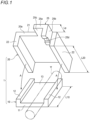
- Fig. 1 is a perspective view showing a configuration of a wire harness protector used for implementing a wire harness routing method and a wire harness routing structure according to the present embodiment.
- a wire harness protector 1 shown in Fig. 1 includes a protector base 10 as a protector body and a cover 20 to be put on the protector base 10. Both the protector base 10 and the cover 20 are integrally molded articles of resin.
- the protector base 10 is a gutter-like member whose upper face is open and whose inner space serves as an accommodation space 13 for a wire harness W to extend along a longitudinal direction of the protector base 10.
- the protector base 10 includes a bottom wall 11 and a pair of left and right side walls 12.
- the protector base 10 is fixed to a case of a vehicle body or an electrical component, or a fixing target member such as sheet metal for fixing the electrical component, through any portion of the bottom wall 11 or the side walls 12.
- the cover 20 is a member attached to the protector base 10 so as to cover the open upper face of the protector base 10.
- the cover 20 includes an upper wall 21 facing the bottom wall 11 of the protector base 10 and a pair of left and right side walls 22 putting on the outside of the side walls 12 of the protector base 10.
- the cover 20 is attached to the protector base 10 as indicated by an arrow A in the drawing, is not directly fixed to the fixing target member such as the vehicle body, and is engaged with the protector base 10 by an engagement unit (not shown) so as not to be detached.
- the wire harness W is set on the protector base 10 so as to extend along the longitudinal direction of the protector base 10 and the cover 20.
- a length L20 of a main portion of the cover 20 is set to be equal to a length L 10 of the protector base 10.
- One end portion 20a of the cover 20 in the longitudinal direction is provided with a wire harness-fixed protruding piece 25 which extends outward from an end portion of the protector base 10 in the longitudinal direction when the cover 20 is attached to the protector base 10.
- a protruding length Lp of the protruding piece 25 is set to a length appropriate for tape winding and binding band winding, which will be described later.
- the wire harness-fixed protruding piece 25 has an L-shaped cross section when viewed from the front in the longitudinal direction of the cover 20.
- the protruding piece 25 includes a protruding piece upper wall 25a flush with the upper wall 21 of the cover 20 and a protruding piece side wall 25b parallel to the side wall 22 of the cover 20.
- the protruding piece 25 is disposed at a position close to the one side wall 22 in a width direction of the cover 20, and is configured such that the wire harness W can be accommodated in an inner corner space 25c of an L-shaped cross-sectional wall formed by the protruding piece upper wall 25a and the protruding piece side wall 25b.
- the protruding piece side wall 25b is provided at a position inside the side wall 22 of the cover 20.
- a recessed portion 25d for positioning a band portion of a binding band (described later) is provided at a lower end edge of the protruding piece side wall 25b.
- Figs. 2 to 8 are views showing step contents of the routing method.
- Fig. 2 is a perspective view showing a state in which the wire harness W is to be set on the protector base 10 of the wire harness protector 1.
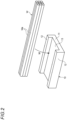
- Fig. 3 is a perspective view showing a state in which a protective tape is wound around an outer periphery of a necessary portion of the wire harness set on the protector base and the cover is put on the protector base.
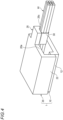
- Fig. 4 is a perspective view showing a state immediately before the cover is put on the protector base and the wire harness is fastened by the binding band.
- Fig. 2 is a perspective view showing a state in which the wire harness W is to be set on the protector base 10 of the wire harness protector 1.
- Fig. 3 is a perspective view showing a state in which a protective tape is wound around an outer periphery of a necessary portion of the wire harness set on the protector base and the cover is put on the protector base.
- Fig. 4 is a perspective view showing a state immediately before the cover is
- FIG. 5 is a perspective view showing a completed state of the routing structure in which the binding band is wound around a portion of the wire harness around which the tape is wound and a protruding piece provided on a cover side and fastened.
- Fig. 6 is a front view showing the state in Fig. 3 .
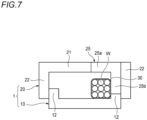
- Fig. 7 is a front view of a state where the cover is put on.
- Fig. 8 is a front view showing the state in Fig. 5 .
- the protector base 10 is disposed on a routing path of the wire harness W formed of a bundle of a plurality of electric wires Wa and is fixed to the fixing target member. Then, as shown in Fig. 2 , the wire harness W is routed inside the protector base 10 so as to extend in the longitudinal direction. Next, as shown in Figs. 3 and 6 , a wire harness-protective tape 30 is wound around the outer periphery of the wire harness W at a position outside the end portion of the protector base 10 in the longitudinal direction.
- the wire harness-fixed protruding piece 25 When winding the tape, since the wire harness-fixed protruding piece 25 is provided not on a protector base 10 side but on a cover 20 side to be attached to the protector base 10 later, the protruding piece 25 does not get in the way of the winding of the tape 30. That is, since there is no risk of the protruding piece 25 being wound together with the tape 30, it is not necessary to wind the tape 30 while lifting the wire harness W. Therefore, an operation can be made easier than in the related art.
- the cover 20 When the winding of the tape 30 is finished, under the state, as shown in Figs. 4 and 7 , the cover 20 is put on the protector base 10 so as to cover the open upper face of the protector base 10.
- the electric wires around which the tape 30 is wound may be brought close to the protruding piece 25.
- the binding band 40 as a fixing unit is wound around the outer periphery of the tape 30 and the protruding piece 25 and fastened at a position where the tape 30 is wound with respect to the wire harness-fixed protruding piece 25 protruding outward in the longitudinal direction from the end portion 20a of the cover 20 in the longitudinal direction, so that the wire harness W is accommodated in the inner corner space 25c of the protruding piece 25 and the wire harness W is fixed to the wire harness-fixed protruding piece 25 on the cover 20 side.
- the wire harness W is accommodated in the inner corner space 25c of the protruding piece 25 and the wire harness W is fixed to the wire harness-fixed protruding piece 25 on the cover 20 side.
- the cover 20 and the wire harness W are kept in close contact with each other from the beginning. Therefore, when a stone, another wire harness, a bracket, or the like on the vehicle hit the cover 20 from the outside of the vehicle (since the protector base 10 side is the fixing target member side such as the vehicle body, the stone, another component on the vehicle, or the like mainly hit the cover 20 side), damage to the wire harness W due to an impact can be prevented. That is, for example, when the wire harness W is fixed to the protector base 10 side, the cover 20 and the wire harness W are not in close contact with each other.
- the wire harness W can be held in a state of floating from the bottom wall 11 of the protector base 10. Therefore, in this case, even if water enters the protector base 10, the water inside the protector base 10 is easily discharged, and the wire harness W can be protected from water immersion.
- the binding band 40 is used as a unit for fixing the wire harness W to the protruding piece 25 on the cover 20 side.
- a tape, a claw portion provided on the protruding piece 25, or the like can be used as the fixing unit.
- the wire harness W can be fixed to the protruding piece 25 by winding and fastening the wire harness W together with the protruding piece 25 with the tape.
- the claw portion for example, the claw portion is provided on the protruding piece 25.
- the wire harness W can be fixed to the protruding piece 25 by press-fitting the wire harness W into a space formed by the claw portion.
- the protector base 10 and the cover 20 are formed as separate molded articles in the above embodiment, the protector base 10 and the cover 20 may be connected by a hinge to form an integrally molded article.
- the side walls 12 and 22 on the side opposite to the side on which the protruding piece 25 is provided are connected by the hinge.
- a temporary holding unit such as an electric wire presser may be provided inside the protector base 10 so that the wire harness W can be temporarily held.
- a position of the temporary holding unit such as the electric wire presser is preferably set at a position away from the end portion 20a provided with the protruding piece 25.
- the wire harness W is configured with a bundle of the plurality of electric wires Wa, and may be configured with one electric wire.
- the wire harness-fixed protruding piece is provided not on the protector base side but on the cover side covering the open upper face of the protector base. Therefore, when the wire harness-protective tape is wound around the outer periphery of the wire harness, the wire harness-fixed protruding piece on the cover side does not get in the way. That is, when there is the wire harness-fixed protruding piece on the protector base side, in order to prevent the protruding piece from being wound together with the tape, the tape needs to be wound around the outer periphery of the wire harness while lifting the wire harness. However, since the wire harness-fixed protruding piece does not get in the way, there is no need to lift the wire harness.
- the protector base side is a fixing target member side such as the case of the vehicle body or the electrical component, or the sheet metal for fixing the electrical component, the stone from the outside of the vehicle, components on the vehicle such as another wire harness, the bracket, or the like mainly hit the cover side, and it is possible to prevent the damage to the wire harness due to the impact when the components hit the cover. That is, for example, when the wire harness is fixed to the protector base side, the cover and the wire harness are not in close contact with each other. That is, there is play (movement allowance) between the cover and the wire harness.
- the impact acting on the cover may cause the opening edge (edge) of the cover to collide with the wire harness and damage the wire harness.
- the cover and the wire harness are in close contact with each other from the beginning, the possibility of collision can be prevented.
- the protruding piece is formed not on the protector base side but on the cover side, the protruding piece itself can prevent the stone from the outside of the vehicle, another component on the vehicle, and the like from directly hitting the wire harness, and thus the damage to the wire harness can be prevented.
- the wire harness By fixing the wire harness to the cover side, the wire harness can be held in the state of floating from the bottom wall of the protector base. Therefore, even if the water enters the interior of the protector base, the water is easily discharged to the outside, and the wire harness can be protected from the water immersion.
- the wire harness can be easily and reliably fixed to the wire harness-fixed protruding piece on the cover side by fastening using the binding band as the fixing unit.
- the wire harness can be easily and reliably fixed to the wire harness-fixed protruding piece on the cover side by fastening using the binding band as the fixing unit.
- the wire harness-fixed protruding piece is provided not on the protector base side but on the cover side covering the open upper face of the protector base. Therefore, when the wire harness-protective tape is wound around the outer periphery of the wire harness, the wire harness-fixed protruding piece on the cover side does not get in the way. That is, when there is the wire harness-fixed protruding piece on the protector base side, in order to prevent the protruding piece from being wound together with the tape, the tape needs to be wound around the outer periphery of the wire harness while lifting the wire harness. However, since the wire harness-fixed protruding piece does not get in the way, there is no need to lift the wire harness.
- the protector base side is a fixing target member side such as the case of the vehicle body or the electrical component, or the sheet metal for fixing the electrical component, the stone from the outside of the vehicle, components on the vehicle such as another wire harness, the bracket, or the like mainly hit the cover side, and it is possible to prevent the damage to the wire harness due to the impact when the components hit the cover. That is, for example, when the wire harness is fixed to the protector base side, the cover and the wire harness are not in close contact with each other. That is, there is play (movement allowance) between the cover and the wire harness.
- the impact acting on the cover may cause the opening edge (edge) of the cover to collide with the wire harness and damage the wire harness.
- the cover and the wire harness are in close contact with each other from the beginning, the possibility of collision can be prevented.
- the protruding piece is formed not on the protector base side but on the cover side, the protruding piece itself can prevent the stone from the outside of the vehicle, another component on the vehicle, and the like from directly hitting the wire harness, and thus the damage to the wire harness can be prevented.
- the wire harness By fixing the wire harness to the cover side, the wire harness can be held in the state of floating from the bottom wall of the protector base. Therefore, even if the water enters the interior of the protector base, the water is easily discharged to the outside, and the wire harness can be protected from the water immersion.
- the protective tape when the protective tape is wound around the outer periphery of the wire harness, it is not necessary to lift the wire harness in particular, and the tape winding operation can be easily performed.
- the positional deviation of the electric wires configuring the wire harness or collapse of the electric wire bundle may occur.
Landscapes
- Engineering & Computer Science (AREA)
- Mechanical Engineering (AREA)
- Architecture (AREA)
- Civil Engineering (AREA)
- Structural Engineering (AREA)
- Manufacturing & Machinery (AREA)
- Details Of Indoor Wiring (AREA)
- Protection Of Pipes Against Damage, Friction, And Corrosion (AREA)
Description
- The present invention relates to a wire harness routing method that fixes a wire harness to a fixing target member such as a vehicle body using a protector, a wire harness routing structure, and a wire harness protector used for the routing method and the routing structure.
- When a wire harness routed in a vehicle is fixed to a fixing target member such as a vehicle body, a protector is widely used from a viewpoint of wire harness protection. A protector having a gutter-like protector base having a wire harness accommodation space therein and a cover to be put on an open upper face of the protector base is generally well known as the protector.
- This type of protector is often provided with a protruding piece at an end portion of the protector base in a longitudinal direction for fixing the wire harness with a binding band, a tape, or the like. For example,
Patent Literature 1 discloses a protector in which a protruding piece extending in a tongue-like shape is provided at an end portion of a bottom wall of a protector base in a longitudinal direction, and a wire harness is fixed to the protruding piece by a binding band or a tape. - Incidentally, when the wire harness is fixed to the protruding piece of the protector base by, for example, the binding band, in order to prevent a side slip of the wire harness after the fixing or to reduce hitting on the wire harness by the binding band, that is, in order to protect the wire harness, a protective tape is wound around an outer periphery of the wire harness in advance, and the binding band is used to fasten the protective tape together with the protruding piece from above the protective tape. In this case, the protective tape is preferably wound only around the outer periphery of the wire harness.
- However, if the wire harness-fixed protruding piece is provided on the protector base as described above, when the protective tape is wound around the outer periphery of the wire harness, the protruding piece may be wound together with the tape. Therefore, in order to prevent the protruding piece from being wound together, the tape is wound while lifting the wire harness. As a result, when the wire harness is lifted, a position of electric wires of the wire harness may be deviated or an electric wire bundle may be collapsed.
- Patent Literature 1:
JP-2001-95126-A JP 4 403987 B2 WO 2016/117366 discloses a wire harness routing method according to the preamble ofclaim 1, a wire harness routing structure according to the preamble of claim 3 and wire harness protector according to the preamble of claim 5. - The above inconveniences can be overcome with the features of
claims 1, 3 and 4. According to the present invention, when a protective tape is wound around an outer periphery of the wire harness on a protector base, it is not necessary to lift the wire harness, so that a tape winding operation can be easily performed. - The invention is defined by the independent claims.
-
-
Fig. 1 is a perspective view showing a configuration of a wire harness protector according to an embodiment of the present invention. -
Fig. 2 is a perspective view showing a state in which a wire harness is to be set on a protector base of the wire harness protector according to the embodiment. -
Fig. 3 is a perspective view showing a state in which a protective tape is wound around an outer periphery of a necessary portion of the wire harness set on the protector base and a cover is put on the protector base. -
Fig. 4 is a perspective view showing a state immediately before the cover is put on the protector base and the wire harness is fastened by a binding band. -
Fig. 5 is a perspective view showing a completed state of a routing structure in which the binding band is wound around a portion of the wire harness around which the tape is wound and a protruding piece provided on a cover side and fastened. -
Fig. 6 is a front view showing the state shown inFig. 3 . -
Fig. 7 is a front view showing a state where the cover is put on. -
Fig. 8 is a front view showing the state shown inFig. 5 . - A specific embodiment according to the present invention will be described below with reference to the drawings.
-
Fig. 1 is a perspective view showing a configuration of a wire harness protector used for implementing a wire harness routing method and a wire harness routing structure according to the present embodiment. - A
wire harness protector 1 shown inFig. 1 includes aprotector base 10 as a protector body and acover 20 to be put on theprotector base 10. Both theprotector base 10 and thecover 20 are integrally molded articles of resin. - The
protector base 10 is a gutter-like member whose upper face is open and whose inner space serves as anaccommodation space 13 for a wire harness W to extend along a longitudinal direction of theprotector base 10. Theprotector base 10 includes abottom wall 11 and a pair of left andright side walls 12. Theprotector base 10 is fixed to a case of a vehicle body or an electrical component, or a fixing target member such as sheet metal for fixing the electrical component, through any portion of thebottom wall 11 or theside walls 12. - The
cover 20 is a member attached to theprotector base 10 so as to cover the open upper face of theprotector base 10. Thecover 20 includes anupper wall 21 facing thebottom wall 11 of theprotector base 10 and a pair of left andright side walls 22 putting on the outside of theside walls 12 of theprotector base 10. Thecover 20 is attached to theprotector base 10 as indicated by an arrow A in the drawing, is not directly fixed to the fixing target member such as the vehicle body, and is engaged with theprotector base 10 by an engagement unit (not shown) so as not to be detached. - The wire harness W is set on the
protector base 10 so as to extend along the longitudinal direction of theprotector base 10 and thecover 20. Here, a length L20 of a main portion of thecover 20 is set to be equal to alength L 10 of theprotector base 10. - One
end portion 20a of thecover 20 in the longitudinal direction is provided with a wire harness-fixedprotruding piece 25 which extends outward from an end portion of theprotector base 10 in the longitudinal direction when thecover 20 is attached to theprotector base 10. A protruding length Lp of the protrudingpiece 25 is set to a length appropriate for tape winding and binding band winding, which will be described later. - The wire harness-fixed
protruding piece 25 has an L-shaped cross section when viewed from the front in the longitudinal direction of thecover 20. Theprotruding piece 25 includes a protruding pieceupper wall 25a flush with theupper wall 21 of thecover 20 and a protrudingpiece side wall 25b parallel to theside wall 22 of thecover 20. Theprotruding piece 25 is disposed at a position close to the oneside wall 22 in a width direction of thecover 20, and is configured such that the wire harness W can be accommodated in aninner corner space 25c of an L-shaped cross-sectional wall formed by the protruding pieceupper wall 25a and the protrudingpiece side wall 25b. However, the protrudingpiece side wall 25b is provided at a position inside theside wall 22 of thecover 20. A recessedportion 25d for positioning a band portion of a binding band (described later) is provided at a lower end edge of the protrudingpiece side wall 25b. - Next, the wire harness routing method and the wire harness routing structure using the
wire harness protector 1 configured as described above will be described. -
Figs. 2 to 8 are views showing step contents of the routing method.Fig. 2 is a perspective view showing a state in which the wire harness W is to be set on theprotector base 10 of thewire harness protector 1.Fig. 3 is a perspective view showing a state in which a protective tape is wound around an outer periphery of a necessary portion of the wire harness set on the protector base and the cover is put on the protector base.Fig. 4 is a perspective view showing a state immediately before the cover is put on the protector base and the wire harness is fastened by the binding band.Fig. 5 is a perspective view showing a completed state of the routing structure in which the binding band is wound around a portion of the wire harness around which the tape is wound and a protruding piece provided on a cover side and fastened.Fig. 6 is a front view showing the state inFig. 3 .Fig. 7 is a front view of a state where the cover is put on.Fig. 8 is a front view showing the state inFig. 5 . - In a routing procedure, first, the
protector base 10 is disposed on a routing path of the wire harness W formed of a bundle of a plurality of electric wires Wa and is fixed to the fixing target member. Then, as shown inFig. 2 , the wire harness W is routed inside theprotector base 10 so as to extend in the longitudinal direction. Next, as shown inFigs. 3 and6 , a wire harness-protective tape 30 is wound around the outer periphery of the wire harness W at a position outside the end portion of theprotector base 10 in the longitudinal direction. - When winding the tape, since the wire harness-fixed
protruding piece 25 is provided not on aprotector base 10 side but on acover 20 side to be attached to theprotector base 10 later, theprotruding piece 25 does not get in the way of the winding of thetape 30. That is, since there is no risk of the protrudingpiece 25 being wound together with thetape 30, it is not necessary to wind thetape 30 while lifting the wire harness W. Therefore, an operation can be made easier than in the related art. - When the wire harness W is lifted and the
tape 30 is wound, positional deviation of the electric wires Wa configuring the wire harness W or collapse of an electric wire bundle may occur. By providing the protruding piece on the cover side, there is no need to worry about the positional deviation and the collapse. - When the winding of the
tape 30 is finished, under the state, as shown inFigs. 4 and7 , thecover 20 is put on theprotector base 10 so as to cover the open upper face of theprotector base 10. In order to facilitate winding of abinding band 40 after thecover 20 is put thereon, as shown inFig. 4 , the electric wires around which thetape 30 is wound may be brought close to the protrudingpiece 25. - Next, as shown in
Figs. 5 and8 , the bindingband 40 as a fixing unit is wound around the outer periphery of thetape 30 and the protrudingpiece 25 and fastened at a position where thetape 30 is wound with respect to the wire harness-fixedprotruding piece 25 protruding outward in the longitudinal direction from theend portion 20a of thecover 20 in the longitudinal direction, so that the wire harness W is accommodated in theinner corner space 25c of the protrudingpiece 25 and the wire harness W is fixed to the wire harness-fixedprotruding piece 25 on thecover 20 side. At this time, as shown inFig. 8 , while abase portion 41 of the bindingband 40 is held at a fixed position, an intermediate portion of aband portion 42 extending from thebase portion 41 is passed through the recessedportion 25d on the protrudingpiece side wall 25b, and while theband portion 42 is wound around the outer periphery of thetape 30 and the protrudingpiece 25, a tip of theband portion 42 is inserted into an engagement hole of thebase portion 41 to fasten theband portion 42. By doing so, the wire harness W can be easily, securely, and firmly fixed to the protrudingpiece 25 on thecover 20 side. - In this way, by fixing the wire harness W to the protruding
piece 25 on thecover 20 side, thecover 20 and the wire harness W are kept in close contact with each other from the beginning. Therefore, when a stone, another wire harness, a bracket, or the like on the vehicle hit thecover 20 from the outside of the vehicle (since theprotector base 10 side is the fixing target member side such as the vehicle body, the stone, another component on the vehicle, or the like mainly hit thecover 20 side), damage to the wire harness W due to an impact can be prevented. That is, for example, when the wire harness W is fixed to theprotector base 10 side, thecover 20 and the wire harness W are not in close contact with each other. That is, since there is a play (movement allowance) between thecover 20 and the wire harness W, when the stone, another component, or the like hit thecover 20, an opening edge (edge) of thecover 20 may collide with the wire harness W and damage the wire harness W due to the impact acting on thecover 20. However, when thecover 20 and the wire harness W are in close contact with each other from the beginning as in the present embodiment, it is possible to prevent the possibility. Further, since the protruding piece is formed not on theprotector base 10 side but on thecover 20 side, the protrudingpiece 25 itself can prevent the stone from the outside of the vehicle and another component on the vehicle from directly hitting the wire harness W, and thus the damage to the wire harness W can be prevented. - Further, as shown in
Fig. 8 , by fixing the wire harness W to thecover 20 side, the wire harness W can be held in a state of floating from thebottom wall 11 of theprotector base 10. Therefore, in this case, even if water enters theprotector base 10, the water inside theprotector base 10 is easily discharged, and the wire harness W can be protected from water immersion. - In the above embodiment, the binding
band 40 is used as a unit for fixing the wire harness W to the protrudingpiece 25 on thecover 20 side. In addition, a tape, a claw portion provided on the protrudingpiece 25, or the like can be used as the fixing unit. In the case of the tape, the wire harness W can be fixed to the protrudingpiece 25 by winding and fastening the wire harness W together with the protrudingpiece 25 with the tape. In the case of the claw portion, for example, the claw portion is provided on the protrudingpiece 25. The wire harness W can be fixed to the protrudingpiece 25 by press-fitting the wire harness W into a space formed by the claw portion. - Although the
protector base 10 and thecover 20 are formed as separate molded articles in the above embodiment, theprotector base 10 and thecover 20 may be connected by a hinge to form an integrally molded article. In this case, for example, it is preferable that theside walls piece 25 is provided are connected by the hinge. - Further, a temporary holding unit such as an electric wire presser may be provided inside the
protector base 10 so that the wire harness W can be temporarily held. In this case, a position of the temporary holding unit such as the electric wire presser is preferably set at a position away from theend portion 20a provided with the protrudingpiece 25. - In the above embodiment, the wire harness W is configured with a bundle of the plurality of electric wires Wa, and may be configured with one electric wire.
- Here, features of the wire harness routing method and the wire harness routing structure and the wire harness protector according to the embodiment of the present invention described above will be briefly summarized and listed in the following [1] to [5].
- [1] A wire harness routing method includes:
- preparing a gutter-like protector base (10) whose upper face is open, and routing a wire harness (W) inside the protector base (10) so as to extend in a longitudinal direction of the protector base (10);
- winding a wire harness-protective tape (30) around an outer periphery of the wire harness (W) at a position outside an end portion of the protector base (10) in the longitudinal direction;
- putting, under the above state, a cover (20) on the protector base (10) so as to cover the open upper face of the protector base (10); and
- fixing, by a fixing unit (40), at a position where the tape (30) is wound, the wire harness (W) to a wire harness-fixed protruding piece (25) protruding outward in the longitudinal direction from an end portion (20a) of the cover (20) in the longitudinal direction.
- [2] The wire harness routing method according to [1], in which, a binding band (40), as the fixing unit, is wound around an outer periphery of the tape (30) and the wire harness-fixed protruding piece (25) at the position where the tape (30) is wound, and thereby the wire harness (W) is fixed to the wire harness-fixed protruding piece (25).
- [3] A wire harness routing structure includes a wire harness protector (1) having including the gutter-like protector base (10) whose upper face is open and whose internal space serves as an accommodation space (13) for the wire harness (W) to extend along a longitudinal direction, and a cover (20) to be put on the protector base (10) so as to cover the open upper face of the protector base (10). The wire harness protector (1) is disposed on a routing path of a wire harness (W) under a state where a protector base (10) is fixed to a fixing target member. The wire harness (W) is routed inside the protector base (10) so as to extend in the longitudinal direction of the protector base. A wire harness-protective tape (30) is wound around an outer periphery of the wire harness (W) at a position outside an end portion of the protector base (10) in the longitudinal direction. The cover (20) is put on the protector base (10) so as to cover the open upper face of the protector base (10). The wire harness (W) is fixed by a fixing unit (40), at a position where the tape (30) is wound, to a wire harness-fixed protruding piece (25) provided to protrude outward in the longitudinal direction from an end portion (20a) of the cover (20) in the longitudinal direction.
- [4] The wire harness routing structure according to [3], in which, a binding band (40) is used as the fixing unit, and the binding band (40) is wound around an outer periphery of the tape (30) and the wire harness-fixed protruding piece (25) at the position where the tape (30) is wound, and thereby the wire harness (W) is fixed to the wire harness-fixed protruding piece (25).
- [5] A wire harness protector includes: a gutter-like protector base (10) whose upper face is open and whose inner space serves as an accommodation space (13) for a wire harness (W) to extend along a longitudinal direction of the protector base; and a cover (20) to be put on the protector base (10) so as to cover the open upper face of the protector base (10). The protector base (10) is configured as a member to be fixed to a fixing target member, and a wire harness-fixed protruding piece (25) is provided on an end portion (20a) of the cover (20) in the longitudinal direction, the protruding piece extending outward from an end portion of the protector base (10) in the longitudinal direction when the cover (20) is put on the protector base (10).
- According to the wire harness routing method in the embodiment and the wire harness routing structure in the embodiment, the wire harness-fixed protruding piece is provided not on the protector base side but on the cover side covering the open upper face of the protector base. Therefore, when the wire harness-protective tape is wound around the outer periphery of the wire harness, the wire harness-fixed protruding piece on the cover side does not get in the way. That is, when there is the wire harness-fixed protruding piece on the protector base side, in order to prevent the protruding piece from being wound together with the tape, the tape needs to be wound around the outer periphery of the wire harness while lifting the wire harness. However, since the wire harness-fixed protruding piece does not get in the way, there is no need to lift the wire harness. Therefore, the operation of winding the wire harness-protective tape can be facilitated. When the wire harness is lifted and the tape is wound, the positional deviation of the electric wires configuring the wire harness or collapse of the electric wire bundle may occur. By providing the protruding piece on the cover side, it is possible to avoid the positional deviation and the collapse.
- By fixing the wire harness to the protruding piece on the cover side, the cover and the wire harness are kept in close contact with each other from the beginning. Here, since the protector base side is a fixing target member side such as the case of the vehicle body or the electrical component, or the sheet metal for fixing the electrical component, the stone from the outside of the vehicle, components on the vehicle such as another wire harness, the bracket, or the like mainly hit the cover side, and it is possible to prevent the damage to the wire harness due to the impact when the components hit the cover. That is, for example, when the wire harness is fixed to the protector base side, the cover and the wire harness are not in close contact with each other. That is, there is play (movement allowance) between the cover and the wire harness. Therefore, when the stone, the component on the vehicle, or the like hit the cover, the impact acting on the cover may cause the opening edge (edge) of the cover to collide with the wire harness and damage the wire harness. However, since the cover and the wire harness are in close contact with each other from the beginning, the possibility of collision can be prevented. Further, since the protruding piece is formed not on the protector base side but on the cover side, the protruding piece itself can prevent the stone from the outside of the vehicle, another component on the vehicle, and the like from directly hitting the wire harness, and thus the damage to the wire harness can be prevented.
- By fixing the wire harness to the cover side, the wire harness can be held in the state of floating from the bottom wall of the protector base. Therefore, even if the water enters the interior of the protector base, the water is easily discharged to the outside, and the wire harness can be protected from the water immersion.
- According to the wire harness routing method in the embodiment, the wire harness can be easily and reliably fixed to the wire harness-fixed protruding piece on the cover side by fastening using the binding band as the fixing unit.
- According to the wire harness routing structure in the embodiment, the wire harness can be easily and reliably fixed to the wire harness-fixed protruding piece on the cover side by fastening using the binding band as the fixing unit.
- According to the wire harness protector in the embodiment, the wire harness-fixed protruding piece is provided not on the protector base side but on the cover side covering the open upper face of the protector base. Therefore, when the wire harness-protective tape is wound around the outer periphery of the wire harness, the wire harness-fixed protruding piece on the cover side does not get in the way. That is, when there is the wire harness-fixed protruding piece on the protector base side, in order to prevent the protruding piece from being wound together with the tape, the tape needs to be wound around the outer periphery of the wire harness while lifting the wire harness. However, since the wire harness-fixed protruding piece does not get in the way, there is no need to lift the wire harness. Therefore, the operation of winding the wire harness-protective tape can be facilitated. When the wire harness is lifted and the tape is wound, the positional deviation of the electric wires configuring the wire harness or collapse of the electric wire bundle may occur. By providing the protruding piece on the cover side, it is possible to avoid the positional deviation and the collapse.
- By fixing the wire harness to the protruding piece on the cover side, the cover and the wire harness are kept in close contact with each other from the beginning. Here, since the protector base side is a fixing target member side such as the case of the vehicle body or the electrical component, or the sheet metal for fixing the electrical component, the stone from the outside of the vehicle, components on the vehicle such as another wire harness, the bracket, or the like mainly hit the cover side, and it is possible to prevent the damage to the wire harness due to the impact when the components hit the cover. That is, for example, when the wire harness is fixed to the protector base side, the cover and the wire harness are not in close contact with each other. That is, there is play (movement allowance) between the cover and the wire harness. Therefore, when the stone, the component on the vehicle, or the like hit the cover, the impact acting on the cover may cause the opening edge (edge) of the cover to collide with the wire harness and damage the wire harness. However, since the cover and the wire harness are in close contact with each other from the beginning, the possibility of collision can be prevented. Further, since the protruding piece is formed not on the protector base side but on the cover side, the protruding piece itself can prevent the stone from the outside of the vehicle, another component on the vehicle, and the like from directly hitting the wire harness, and thus the damage to the wire harness can be prevented.
- By fixing the wire harness to the cover side, the wire harness can be held in the state of floating from the bottom wall of the protector base. Therefore, even if the water enters the interior of the protector base, the water is easily discharged to the outside, and the wire harness can be protected from the water immersion.
- According to the present invention, when the protective tape is wound around the outer periphery of the wire harness, it is not necessary to lift the wire harness in particular, and the tape winding operation can be easily performed. When the wire harness is lifted and the tape is wound, the positional deviation of the electric wires configuring the wire harness or collapse of the electric wire bundle may occur. By providing the protruding piece on the cover side, it is possible to avoid the positional deviation and the collapse.
Claims (5)
- A wire harness routing method comprising:preparing a gutter-like protector base (10) whose an upper face is open, and routing a wire harness (W) inside the protector base (10) so as to extend in a longitudinal direction of the protector base (10);winding a wire harness-protective tape (30) around an outer periphery of the wire harness (W) at a position outside an end portion of the protector base (10) in the longitudinal direction;putting, in a state that the wire harness-protective tape has been wound around the outer periphery of the wire harness (W), a cover (20) on the protector base (10) so as to cover the open upper face of the protector base (10); andcharacterized byfixing, by a fixing unit (40), at a position where the tape (30) is wound, the wire harness (W) to a wire harness-fixed protruding piece (25) protruding outward in the longitudinal direction from an end portion (20a) of the cover (20) in the longitudinal direction,wherein the wire harness-fixed protruding piece (25) has an L-shaped cross section when viewed from the front in the longitudinal direction of the cover (20), and includes a protruding piece upper wall (25a) flush with the upper wall (21) of the cover 20 and a protruding piece side wall (25b) parallel to the side wall (22) of the cover (20),wherein the protruding piece side wall (25b) is provided at a position inside the side wall (22) of the cover (20),wherein a recessed portion (25d) for positioning the fixing unit (40) is provided at a lower end edge of the protruding piece side wall (25b), andwherein the wire harness (W) is accommodated in an inner corner space (25c) of the protruding piece (25) and the wire harness (W) is fixed to the wire harness-fixed protruding piece (25) on the cover (20) side.
- The routing method of the wire harness according to claim 1,
wherein a binding band (40), as the fixing unit, is passed through the recessed portion (25d) on the on the protruding piece side wall (25b) and is wound around an outer periphery of the tape (30) and the wire harness-fixed protruding piece (25) at the position where the tape (30) is wound, and thereby the wire harness (W) is fixed to the wire harness-fixed protruding piece (25). - A wire harness routing structure comprising:a wire harness protector (1) that includes a gutter-like protector base (10) whose upper face is open and whose internal space serves as an accommodation space (13) for a wire harness (W) to extend along a longitudinal direction, and a cover (20) to be put on the protector base (10) so as to cover the open upper face of the protector base (10),wherein the wire harness protector is disposed on a routing path of a wire harness in a state that the protector base (10) is fixed to a fixing target member,the wire harness (W) is routed inside the protector base (10) so as to extend in the longitudinal direction of the protector base (10),a wire harness-protective tape (30) is wound around an outer periphery of the wire harness (W) at a position outside an end portion of the protector base (10) in the longitudinal direction,the cover (20) is put on the protector base (10) so as to cover the open upper face of the protector base (10), andthe wire harness (W) is fixed by a fixing unit (40), at a position where the tape (30) is wound, to a wire harness-fixed protruding piece (25) provided to protrude outward in the longitudinal direction from an end portion (20a) of the cover (20) in the longitudinal direction,wherein the wire harness-fixed protruding piece (25) has an L-shaped cross section when viewed from the front in the longitudinal direction of the cover (20), and includes a protruding piece upper wall (25a) flush with the upper wall (21) of the cover 20 and a protruding piece side wall (25b) parallel to the side wall (22) of the cover (20),wherein the protruding piece side wall (25b) is provided at a position inside the side wall (22) of the cover (20),wherein a recessed portion (25d) for positioning the fixing unit (40) is provided at a lower end edge of the protruding piece side wall (25b), andwherein the wire harness (W) is accommodated in an inner corner space (25c) of the protruding piece (25) and the wire harness (W) is fixed to the wire harness-fixed protruding piece (25) on the cover (20) side.
- The wire harness routing structure according to claim 3,wherein a binding band (40) is used as the fixing unit, andthe binding band (40) is passed through the recessed portion (25d) on the on the protruding piece side wall (25b) and is wound around an outer periphery of the tape (30) and the wire harness-fixed protruding piece (25) at the position where the tape (30) is wound, and thereby the wire harness (W) is fixed to the wire harness-fixed protruding piece.
- A wire harness protector comprising:a gutter-like protector base (10) whose upper face is open and whose inner space serves as an accommodation space (13) for a wire harness to extend along a longitudinal direction of the protector base (10); anda cover (20) to be put on the protector base (10) so as to cover the open upper face of the protector base (10),wherein the protector base (10) is configured as a member to be fixed to a fixing target member, anda wire harness-fixed protruding piece (25) is provided on an end portion (20a) of the cover (20) in the longitudinal direction, the protruding piece extending outward from an end portion of the protector base (10) in the longitudinal direction when the cover (20) is put on the protector base (10),wherein the wire harness-fixed protruding piece (25) has an L-shaped cross section when viewed from the front in the longitudinal direction of the cover (20), and includes a protruding piece upper wall (25a) flush with the upper wall (21) of the cover (20) and a protruding piece side wall (25b) parallel to the side wall (22) of the cover (20),wherein the protruding piece side wall (25b) is provided at a position inside the side wall (22) of the cover (20), andwherein a recessed portion (25d) for positioning the fixing unit (40) is provided at a lower end edge of the protruding piece side wall (25b).
Applications Claiming Priority (1)
| Application Number | Priority Date | Filing Date | Title |
|---|---|---|---|
| JP2021002958A JP7252269B2 (en) | 2021-01-12 | 2021-01-12 | Wiring harness wiring method, wiring structure, and wire harness protector |
Publications (2)
| Publication Number | Publication Date |
|---|---|
| EP4026735A1 EP4026735A1 (en) | 2022-07-13 |
| EP4026735B1 true EP4026735B1 (en) | 2023-07-12 |
Family
ID=79287620
Family Applications (1)
| Application Number | Title | Priority Date | Filing Date |
|---|---|---|---|
| EP22150691.8A Active EP4026735B1 (en) | 2021-01-12 | 2022-01-10 | Wire harness routing method, wire harness routing structure, and wire harness protector |
Country Status (4)
| Country | Link |
|---|---|
| US (1) | US11600975B2 (en) |
| EP (1) | EP4026735B1 (en) |
| JP (1) | JP7252269B2 (en) |
| CN (1) | CN114765351B (en) |
Family Cites Families (23)
| Publication number | Priority date | Publication date | Assignee | Title |
|---|---|---|---|---|
| JP2894586B2 (en) | 1993-07-29 | 1999-05-24 | 矢崎総業株式会社 | Lock structure of band clamp to protector |
| JPH0965541A (en) * | 1995-08-28 | 1997-03-07 | Sumitomo Wiring Syst Ltd | Protector |
| JP3018962B2 (en) * | 1995-10-24 | 2000-03-13 | 住友電装株式会社 | Wiring harness mounting structure to protector |
| JP3346322B2 (en) * | 1999-02-16 | 2002-11-18 | 住友電装株式会社 | Wire harness protector |
| JP3936502B2 (en) | 1999-09-22 | 2007-06-27 | 矢崎総業株式会社 | Protector device for wire harness |
| JP2003230212A (en) * | 2002-01-30 | 2003-08-15 | Yazaki Corp | Harness protector |
| JP4403987B2 (en) * | 2005-03-07 | 2010-01-27 | 住友電装株式会社 | Protector for inserting wire harness |
| JP4311431B2 (en) * | 2006-09-29 | 2009-08-12 | 住友電装株式会社 | Protector |
| JP4360392B2 (en) * | 2006-09-29 | 2009-11-11 | 住友電装株式会社 | Protector |
| JP2009065798A (en) | 2007-09-07 | 2009-03-26 | Sumitomo Wiring Syst Ltd | Protector for wire harness |
| JP4983525B2 (en) * | 2007-10-11 | 2012-07-25 | 住友電装株式会社 | Wire harness protector mounting structure |
| JP2010284043A (en) * | 2009-06-05 | 2010-12-16 | Furukawa Electric Co Ltd:The | Wire harness protector |
| JP5510064B2 (en) * | 2010-05-24 | 2014-06-04 | 住友電装株式会社 | Protector for wire harness |
| JP2012085478A (en) * | 2010-10-14 | 2012-04-26 | Sumitomo Wiring Syst Ltd | Protector for vehicle |
| JP2014045608A (en) * | 2012-08-28 | 2014-03-13 | Sumitomo Wiring Syst Ltd | Protector |
| JP2014207738A (en) * | 2013-04-11 | 2014-10-30 | 住友電装株式会社 | Wire harness and protector |
| JP2015167450A (en) * | 2014-03-04 | 2015-09-24 | 住友電装株式会社 | Wire harness with protector and method of manufacturing wire harness with protector |
| JP2015188294A (en) * | 2014-03-27 | 2015-10-29 | 住友電装株式会社 | protector and wire harness with protector |
| JP2016135038A (en) | 2015-01-21 | 2016-07-25 | 住友電装株式会社 | Harness protector |
| JP2016181961A (en) * | 2015-03-23 | 2016-10-13 | 矢崎総業株式会社 | Fixing structure of routing material and wire harness |
| JP2016185015A (en) | 2015-03-26 | 2016-10-20 | 住友電装株式会社 | Protector and wire with the same |
| JP2017005867A (en) * | 2015-06-10 | 2017-01-05 | 住友電装株式会社 | Protector and wiring harness |
| JP2017108531A (en) * | 2015-12-09 | 2017-06-15 | 古河電気工業株式会社 | Protector, wire harness with protector, and fitting method for wire harness |
-
2021
- 2021-01-12 JP JP2021002958A patent/JP7252269B2/en active Active
-
2022
- 2022-01-10 EP EP22150691.8A patent/EP4026735B1/en active Active
- 2022-01-10 US US17/572,572 patent/US11600975B2/en active Active
- 2022-01-12 CN CN202210030624.2A patent/CN114765351B/en active Active
Also Published As
| Publication number | Publication date |
|---|---|
| JP2022108105A (en) | 2022-07-25 |
| US11600975B2 (en) | 2023-03-07 |
| JP7252269B2 (en) | 2023-04-04 |
| CN114765351A (en) | 2022-07-19 |
| US20220224089A1 (en) | 2022-07-14 |
| EP4026735A1 (en) | 2022-07-13 |
| CN114765351B (en) | 2024-02-06 |
Similar Documents
| Publication | Publication Date | Title |
|---|---|---|
| JP4311431B2 (en) | Protector | |
| CN103069677B (en) | Bindle wire protector | |
| US10873178B2 (en) | Wire harness protector and manufacturing method of wire harness | |
| JP4983525B2 (en) | Wire harness protector mounting structure | |
| US10862282B2 (en) | Protector for wire harness, and method for manufacturing wire harness | |
| EP3691063B1 (en) | Protective tube connection structure | |
| JP6587657B2 (en) | Protector | |
| JP6613287B2 (en) | Protector and routing structure | |
| CN111373617A (en) | Wire harness protector and wire harness assembly | |
| JP6825879B2 (en) | Protector and wire harness with it | |
| EP4026735B1 (en) | Wire harness routing method, wire harness routing structure, and wire harness protector | |
| JP7339225B2 (en) | Resin structure and wire harness | |
| JP5217873B2 (en) | Protector | |
| JPH11150841A (en) | Corrugated tube guide clamp | |
| CN113937688B (en) | Protector and wire harness | |
| JP7544619B2 (en) | Wire Harness | |
| KR102417171B1 (en) | Fixing Structure For Cable | |
| JP2014017937A (en) | Wire harness sheathing body, wire harness sheathing structure, and wire harness protection structure | |
| JP2001333522A (en) | Protector for grommet | |
| JPH11299046A (en) | Harness protector and method for fixing harness protector to harness | |
| JP3198028B2 (en) | Wire holding mechanism | |
| JP6918549B2 (en) | Protector and wire harness | |
| JP2023146635A (en) | Wire harness protective structure and method for manufacturing the wire harness protective structure | |
| JP2006040816A (en) | Processing structure for wire harness terminals, etc. | |
| JP2013219858A (en) | Corrugated tube with route maintaining member |
Legal Events
| Date | Code | Title | Description |
|---|---|---|---|
| PUAI | Public reference made under article 153(3) epc to a published international application that has entered the european phase |
Free format text: ORIGINAL CODE: 0009012 |
|
| STAA | Information on the status of an ep patent application or granted ep patent |
Free format text: STATUS: REQUEST FOR EXAMINATION WAS MADE |
|
| 17P | Request for examination filed |
Effective date: 20220110 |
|
| AK | Designated contracting states |
Kind code of ref document: A1 Designated state(s): AL AT BE BG CH CY CZ DE DK EE ES FI FR GB GR HR HU IE IS IT LI LT LU LV MC MK MT NL NO PL PT RO RS SE SI SK SM TR |
|
| STAA | Information on the status of an ep patent application or granted ep patent |
Free format text: STATUS: EXAMINATION IS IN PROGRESS |
|
| 17Q | First examination report despatched |
Effective date: 20221208 |
|
| GRAP | Despatch of communication of intention to grant a patent |
Free format text: ORIGINAL CODE: EPIDOSNIGR1 |
|
| STAA | Information on the status of an ep patent application or granted ep patent |
Free format text: STATUS: GRANT OF PATENT IS INTENDED |
|
| INTG | Intention to grant announced |
Effective date: 20230417 |
|
| RAP3 | Party data changed (applicant data changed or rights of an application transferred) |
Owner name: YAZAKI CORPORATION |
|
| GRAS | Grant fee paid |
Free format text: ORIGINAL CODE: EPIDOSNIGR3 |
|
| GRAA | (expected) grant |
Free format text: ORIGINAL CODE: 0009210 |
|
| STAA | Information on the status of an ep patent application or granted ep patent |
Free format text: STATUS: THE PATENT HAS BEEN GRANTED |
|
| AK | Designated contracting states |
Kind code of ref document: B1 Designated state(s): AL AT BE BG CH CY CZ DE DK EE ES FI FR GB GR HR HU IE IS IT LI LT LU LV MC MK MT NL NO PL PT RO RS SE SI SK SM TR |
|
| REG | Reference to a national code |
Ref country code: CH Ref legal event code: EP |
|
| REG | Reference to a national code |
Ref country code: IE Ref legal event code: FG4D |
|
| REG | Reference to a national code |
Ref country code: DE Ref legal event code: R096 Ref document number: 602022000176 Country of ref document: DE |
|
| REG | Reference to a national code |
Ref country code: LT Ref legal event code: MG9D |
|
| REG | Reference to a national code |
Ref country code: NL Ref legal event code: MP Effective date: 20230712 |
|
| REG | Reference to a national code |
Ref country code: AT Ref legal event code: MK05 Ref document number: 1586814 Country of ref document: AT Kind code of ref document: T Effective date: 20230712 |
|
| PG25 | Lapsed in a contracting state [announced via postgrant information from national office to epo] |
Ref country code: NL Free format text: LAPSE BECAUSE OF FAILURE TO SUBMIT A TRANSLATION OF THE DESCRIPTION OR TO PAY THE FEE WITHIN THE PRESCRIBED TIME-LIMIT Effective date: 20230712 |
|
| PG25 | Lapsed in a contracting state [announced via postgrant information from national office to epo] |
Ref country code: GR Free format text: LAPSE BECAUSE OF FAILURE TO SUBMIT A TRANSLATION OF THE DESCRIPTION OR TO PAY THE FEE WITHIN THE PRESCRIBED TIME-LIMIT Effective date: 20231013 |
|
| PG25 | Lapsed in a contracting state [announced via postgrant information from national office to epo] |
Ref country code: ES Free format text: LAPSE BECAUSE OF FAILURE TO SUBMIT A TRANSLATION OF THE DESCRIPTION OR TO PAY THE FEE WITHIN THE PRESCRIBED TIME-LIMIT Effective date: 20230712 |
|
| PG25 | Lapsed in a contracting state [announced via postgrant information from national office to epo] |
Ref country code: IS Free format text: LAPSE BECAUSE OF FAILURE TO SUBMIT A TRANSLATION OF THE DESCRIPTION OR TO PAY THE FEE WITHIN THE PRESCRIBED TIME-LIMIT Effective date: 20231112 |
|
| PG25 | Lapsed in a contracting state [announced via postgrant information from national office to epo] |
Ref country code: SE Free format text: LAPSE BECAUSE OF FAILURE TO SUBMIT A TRANSLATION OF THE DESCRIPTION OR TO PAY THE FEE WITHIN THE PRESCRIBED TIME-LIMIT Effective date: 20230712 Ref country code: RS Free format text: LAPSE BECAUSE OF FAILURE TO SUBMIT A TRANSLATION OF THE DESCRIPTION OR TO PAY THE FEE WITHIN THE PRESCRIBED TIME-LIMIT Effective date: 20230712 Ref country code: PT Free format text: LAPSE BECAUSE OF FAILURE TO SUBMIT A TRANSLATION OF THE DESCRIPTION OR TO PAY THE FEE WITHIN THE PRESCRIBED TIME-LIMIT Effective date: 20231113 Ref country code: NO Free format text: LAPSE BECAUSE OF FAILURE TO SUBMIT A TRANSLATION OF THE DESCRIPTION OR TO PAY THE FEE WITHIN THE PRESCRIBED TIME-LIMIT Effective date: 20231012 Ref country code: LV Free format text: LAPSE BECAUSE OF FAILURE TO SUBMIT A TRANSLATION OF THE DESCRIPTION OR TO PAY THE FEE WITHIN THE PRESCRIBED TIME-LIMIT Effective date: 20230712 Ref country code: LT Free format text: LAPSE BECAUSE OF FAILURE TO SUBMIT A TRANSLATION OF THE DESCRIPTION OR TO PAY THE FEE WITHIN THE PRESCRIBED TIME-LIMIT Effective date: 20230712 Ref country code: IS Free format text: LAPSE BECAUSE OF FAILURE TO SUBMIT A TRANSLATION OF THE DESCRIPTION OR TO PAY THE FEE WITHIN THE PRESCRIBED TIME-LIMIT Effective date: 20231112 Ref country code: HR Free format text: LAPSE BECAUSE OF FAILURE TO SUBMIT A TRANSLATION OF THE DESCRIPTION OR TO PAY THE FEE WITHIN THE PRESCRIBED TIME-LIMIT Effective date: 20230712 Ref country code: GR Free format text: LAPSE BECAUSE OF FAILURE TO SUBMIT A TRANSLATION OF THE DESCRIPTION OR TO PAY THE FEE WITHIN THE PRESCRIBED TIME-LIMIT Effective date: 20231013 Ref country code: FI Free format text: LAPSE BECAUSE OF FAILURE TO SUBMIT A TRANSLATION OF THE DESCRIPTION OR TO PAY THE FEE WITHIN THE PRESCRIBED TIME-LIMIT Effective date: 20230712 Ref country code: ES Free format text: LAPSE BECAUSE OF FAILURE TO SUBMIT A TRANSLATION OF THE DESCRIPTION OR TO PAY THE FEE WITHIN THE PRESCRIBED TIME-LIMIT Effective date: 20230712 Ref country code: AT Free format text: LAPSE BECAUSE OF FAILURE TO SUBMIT A TRANSLATION OF THE DESCRIPTION OR TO PAY THE FEE WITHIN THE PRESCRIBED TIME-LIMIT Effective date: 20230712 |
|
| PG25 | Lapsed in a contracting state [announced via postgrant information from national office to epo] |
Ref country code: PL Free format text: LAPSE BECAUSE OF FAILURE TO SUBMIT A TRANSLATION OF THE DESCRIPTION OR TO PAY THE FEE WITHIN THE PRESCRIBED TIME-LIMIT Effective date: 20230712 |
|
| REG | Reference to a national code |
Ref country code: DE Ref legal event code: R097 Ref document number: 602022000176 Country of ref document: DE |
|
| PG25 | Lapsed in a contracting state [announced via postgrant information from national office to epo] |
Ref country code: SM Free format text: LAPSE BECAUSE OF FAILURE TO SUBMIT A TRANSLATION OF THE DESCRIPTION OR TO PAY THE FEE WITHIN THE PRESCRIBED TIME-LIMIT Effective date: 20230712 Ref country code: RO Free format text: LAPSE BECAUSE OF FAILURE TO SUBMIT A TRANSLATION OF THE DESCRIPTION OR TO PAY THE FEE WITHIN THE PRESCRIBED TIME-LIMIT Effective date: 20230712 Ref country code: EE Free format text: LAPSE BECAUSE OF FAILURE TO SUBMIT A TRANSLATION OF THE DESCRIPTION OR TO PAY THE FEE WITHIN THE PRESCRIBED TIME-LIMIT Effective date: 20230712 Ref country code: DK Free format text: LAPSE BECAUSE OF FAILURE TO SUBMIT A TRANSLATION OF THE DESCRIPTION OR TO PAY THE FEE WITHIN THE PRESCRIBED TIME-LIMIT Effective date: 20230712 Ref country code: CZ Free format text: LAPSE BECAUSE OF FAILURE TO SUBMIT A TRANSLATION OF THE DESCRIPTION OR TO PAY THE FEE WITHIN THE PRESCRIBED TIME-LIMIT Effective date: 20230712 Ref country code: SK Free format text: LAPSE BECAUSE OF FAILURE TO SUBMIT A TRANSLATION OF THE DESCRIPTION OR TO PAY THE FEE WITHIN THE PRESCRIBED TIME-LIMIT Effective date: 20230712 |
|
| PLBE | No opposition filed within time limit |
Free format text: ORIGINAL CODE: 0009261 |
|
| STAA | Information on the status of an ep patent application or granted ep patent |
Free format text: STATUS: NO OPPOSITION FILED WITHIN TIME LIMIT |
|
| PG25 | Lapsed in a contracting state [announced via postgrant information from national office to epo] |
Ref country code: IT Free format text: LAPSE BECAUSE OF FAILURE TO SUBMIT A TRANSLATION OF THE DESCRIPTION OR TO PAY THE FEE WITHIN THE PRESCRIBED TIME-LIMIT Effective date: 20230712 |
|
| 26N | No opposition filed |
Effective date: 20240415 |
|
| PG25 | Lapsed in a contracting state [announced via postgrant information from national office to epo] |
Ref country code: SI Free format text: LAPSE BECAUSE OF FAILURE TO SUBMIT A TRANSLATION OF THE DESCRIPTION OR TO PAY THE FEE WITHIN THE PRESCRIBED TIME-LIMIT Effective date: 20230712 |
|
| PG25 | Lapsed in a contracting state [announced via postgrant information from national office to epo] |
Ref country code: MC Free format text: LAPSE BECAUSE OF FAILURE TO SUBMIT A TRANSLATION OF THE DESCRIPTION OR TO PAY THE FEE WITHIN THE PRESCRIBED TIME-LIMIT Effective date: 20230712 |
|
| PG25 | Lapsed in a contracting state [announced via postgrant information from national office to epo] |
Ref country code: MC Free format text: LAPSE BECAUSE OF FAILURE TO SUBMIT A TRANSLATION OF THE DESCRIPTION OR TO PAY THE FEE WITHIN THE PRESCRIBED TIME-LIMIT Effective date: 20230712 |
|
| PG25 | Lapsed in a contracting state [announced via postgrant information from national office to epo] |
Ref country code: LU Free format text: LAPSE BECAUSE OF NON-PAYMENT OF DUE FEES Effective date: 20240110 |
|
| PG25 | Lapsed in a contracting state [announced via postgrant information from national office to epo] |
Ref country code: LU Free format text: LAPSE BECAUSE OF NON-PAYMENT OF DUE FEES Effective date: 20240110 |
|
| PG25 | Lapsed in a contracting state [announced via postgrant information from national office to epo] |
Ref country code: BE Free format text: LAPSE BECAUSE OF NON-PAYMENT OF DUE FEES Effective date: 20240131 |
|
| PG25 | Lapsed in a contracting state [announced via postgrant information from national office to epo] |
Ref country code: FR Free format text: LAPSE BECAUSE OF NON-PAYMENT OF DUE FEES Effective date: 20240131 |
|
| PG25 | Lapsed in a contracting state [announced via postgrant information from national office to epo] |
Ref country code: FR Free format text: LAPSE BECAUSE OF NON-PAYMENT OF DUE FEES Effective date: 20240131 Ref country code: BE Free format text: LAPSE BECAUSE OF NON-PAYMENT OF DUE FEES Effective date: 20240131 |
|
| REG | Reference to a national code |
Ref country code: BE Ref legal event code: MM Effective date: 20240131 |
|
| PG25 | Lapsed in a contracting state [announced via postgrant information from national office to epo] |
Ref country code: BG Free format text: LAPSE BECAUSE OF FAILURE TO SUBMIT A TRANSLATION OF THE DESCRIPTION OR TO PAY THE FEE WITHIN THE PRESCRIBED TIME-LIMIT Effective date: 20230712 |
|
| PG25 | Lapsed in a contracting state [announced via postgrant information from national office to epo] |
Ref country code: BG Free format text: LAPSE BECAUSE OF FAILURE TO SUBMIT A TRANSLATION OF THE DESCRIPTION OR TO PAY THE FEE WITHIN THE PRESCRIBED TIME-LIMIT Effective date: 20230712 |
|
| PG25 | Lapsed in a contracting state [announced via postgrant information from national office to epo] |
Ref country code: IE Free format text: LAPSE BECAUSE OF NON-PAYMENT OF DUE FEES Effective date: 20240110 |
|
| PG25 | Lapsed in a contracting state [announced via postgrant information from national office to epo] |
Ref country code: IE Free format text: LAPSE BECAUSE OF NON-PAYMENT OF DUE FEES Effective date: 20240110 |
|
| PG25 | Lapsed in a contracting state [announced via postgrant information from national office to epo] |
Ref country code: CY Free format text: LAPSE BECAUSE OF FAILURE TO SUBMIT A TRANSLATION OF THE DESCRIPTION OR TO PAY THE FEE WITHIN THE PRESCRIBED TIME-LIMIT; INVALID AB INITIO Effective date: 20220110 |
|
| REG | Reference to a national code |
Ref country code: CH Ref legal event code: PL |
|
| PG25 | Lapsed in a contracting state [announced via postgrant information from national office to epo] |
Ref country code: CH Free format text: LAPSE BECAUSE OF NON-PAYMENT OF DUE FEES Effective date: 20250131 |
|
| PG25 | Lapsed in a contracting state [announced via postgrant information from national office to epo] |
Ref country code: TR Free format text: LAPSE BECAUSE OF FAILURE TO SUBMIT A TRANSLATION OF THE DESCRIPTION OR TO PAY THE FEE WITHIN THE PRESCRIBED TIME-LIMIT Effective date: 20230712 |
|
| PGFP | Annual fee paid to national office [announced via postgrant information from national office to epo] |
Ref country code: DE Payment date: 20251203 Year of fee payment: 5 |