EP4025004A1 - A method for establishing communication in a wireless network - Google Patents
A method for establishing communication in a wireless network Download PDFInfo
- Publication number
- EP4025004A1 EP4025004A1 EP20217943.8A EP20217943A EP4025004A1 EP 4025004 A1 EP4025004 A1 EP 4025004A1 EP 20217943 A EP20217943 A EP 20217943A EP 4025004 A1 EP4025004 A1 EP 4025004A1
- Authority
- EP
- European Patent Office
- Prior art keywords
- station
- access point
- connection request
- rssi
- bandwidth
- Prior art date
- Legal status (The legal status is an assumption and is not a legal conclusion. Google has not performed a legal analysis and makes no representation as to the accuracy of the status listed.)
- Granted
Links
Images


Classifications
-
- H—ELECTRICITY
- H04—ELECTRIC COMMUNICATION TECHNIQUE
- H04W—WIRELESS COMMUNICATION NETWORKS
- H04W76/00—Connection management
- H04W76/10—Connection setup
-
- H—ELECTRICITY
- H04—ELECTRIC COMMUNICATION TECHNIQUE
- H04W—WIRELESS COMMUNICATION NETWORKS
- H04W76/00—Connection management
- H04W76/10—Connection setup
- H04W76/18—Management of setup rejection or failure
-
- H—ELECTRICITY
- H04—ELECTRIC COMMUNICATION TECHNIQUE
- H04W—WIRELESS COMMUNICATION NETWORKS
- H04W84/00—Network topologies
- H04W84/02—Hierarchically pre-organised networks, e.g. paging networks, cellular networks, WLAN [Wireless Local Area Network] or WLL [Wireless Local Loop]
- H04W84/10—Small scale networks; Flat hierarchical networks
- H04W84/12—WLAN [Wireless Local Area Networks]
Definitions
- the present invention relates to establishing communication in a wireless network.
- Wi-Fi i.e. a family of wireless network protocols, based on the IEEE 802.11 family of standards, which are commonly used for local area networking of devices and Internet access.
- Wi-Fi compatible devices can network through wireless access points to each other as well as to wired devices and the Internet.
- Wi-Fi's wavebands have relatively high absorption and work best for line-of-sight use. Many physical obstructions such as walls may greatly reduce range of communication.
- a Wi-Fi network comprises a plurality of access points that communicate with a plurality of client stations
- a station is within a communication range of several access points, it will connect to the access point which has the highest signal strength. It may lead to a situation wherein one access point may be overloaded by communication with many stations which are located closest to it, while the other nearby access points have relatively low resource usage. This creates inefficient use scenario from the point of view of the network as a whole.
- the object of the invention is a method for establishing communication between a station and an access point in a wireless network, the method comprising the steps of: at the station : measuring a received signal strength (AP_RSSI) of the access point; and sending to the access point a connection request and the AP_RSSI; at the access point: receiving the connection request and the AP_RSSI from the station; measuring a received signal strength (S_RSSI) of the station; determining whether the AP_RSSI and the S_RSSI are above a threshold and whether the access point has sufficient bandwidth available to communicate with the station and: if so, sending an acceptance of connection request to the station to continue communication with that station and if not, sending a denial of connection request to the station.
- API received signal strength
- S_RSSI received signal strength
- the method further comprises, at the station : creating a list of access points and sorting the list according to AP_RSSI; upon receiving a denial of connection request from the access point, selecting another access point from the list of access points.
- connection request is of a regular type and a prioritized type, wherein for a prioritized type connection request, the sufficient bandwidth criteria applied by the access point are lower than for a regular type connection request.
- the method comprises sending a prioritized type connection request from the station to the access point if a prior attempt to connect with a regular type connection request resulted in the denial of connection request.
- connection request is of a regular type and a demand type, wherein for a demand type connection request, the access point always sends an acceptance of connection request to the station to continue communication with that station.
- the access point has sufficient bandwidth available to communicate with the station includes checking whether the bandwidth that can be offered is above a certain threshold value.
- the access point has sufficient bandwidth available to communicate with the station includes checking whether the bandwidth that can be offered is above an average bandwidth consumed by other stations connected to that access point.
- determining whether the access point has sufficient bandwidth available to communicate with the station includes checking whether the bandwidth that can be offered is sufficient for a particular type of service.
- determining whether the access point has sufficient bandwidth available to communicate with the station includes checking whether the bandwidth that can be offered is over a minimum bandwidth required by the station.
- Another object of the invention is a wireless communication system comprising a plurality of stations and access points, wherein the station controllers and access point controllers are configured to operate according to the method of any of previous claims.
- these quantities take the form of electrical or magnetic signals capable of being stored, transferred, combined, compared, and otherwise manipulated in a computer system.
- these signals are referred to as bits, packets, messages, values, elements, symbols, characters, terms, numbers, or the like.
- a computer-readable (storage) medium typically may be non-transitory and/or comprise a non-transitory device.
- a non-transitory storage medium may include a device that may be tangible, meaning that the device has a concrete physical form, although the device may change its physical state.
- non-transitory refers to a device remaining tangible despite a change in state.
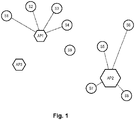
- FIG. 1 An example of a wireless network, such as a Wi-Fi network, is shown in Fig. 1 .
- a wireless network such as a Wi-Fi network
- Four stations S1-S4 are connected to the first access point AP1 and four stations S5-S8 are connected to the second access point AP2, which generates a signal of a higher power than the other access points or has more antennas or has less obstacles between the access point and the stations (e.g. the other access points may be hidden behind walls or other obstacles).
- No station is connected to the third access point AP3, which offers the same signal power as the first access point AP1.
- the access points may be located in a crowded place, such as a hotel lobby, wherein many users attempt to use bandwidth-consuming resources, such as watching video streams.
- a new station S9 attempts to connect to the system. Assume S9 receives a signal of the strongest power from AP2, then a signal of moderate power from AP1 and a low power signal from AP3.
- the new station S9 would scan the available channels and notice that the strongest signal is available from the second access point AP2 and attempt to connect to that access point AP2. Consequently, the second access point AP2 would need to communicate with five stations S5-S8, S9 and divide its available bandwidth across five stations, which might even lead to a necessity to reduce quality of video in order to deliver data to all five stations.
- the system according to the invention operates differently.
- each station 100 comprises an antenna 101, a signal strength meter 102 and a station controller 103.
- each access point 110 comprises an antenna 111, a signal strength meter 112 and an access point controller 113.
- the signal strength meter 102, 112 may output a value of RSSI (received signal strength indicator) as well known in Wi-Fi networks.
- the controllers 103, 113 are configured to perform the steps of the method as shown in Fig. 3 .
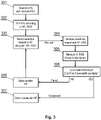
- Fig. 3 shows a procedure for establishing communication in the wireless network, wherein the left side shows the actions performed by the station controller 103 and the right side shows the actions performed by the access point controller 113.
- the station controller 103 scans the channels of the wireless network in order to find all appropriate access points.
- it stores the signal strength of the signal received from the access point (for example, by determining the RSSI value) and sorts the access points according to the RSSI.
- it attempts to connect to the access point with the highest RSSI and sends the measured value of the RSSI to the access point.
- the access point controller 113 receives the request to connect along with the RSSI measured by the station.
- the access point controller 113 measures the strength of signal received from the station (for example, as shown in Fig. 1 , the RSSI of AP2 measured by S9 will be higher than the RSSI of S9 measured by AP2, since AP2 uses higher transmission power than S9).
- the access point controller checks whether two criteria are met:
- the access point signal strength measured by the station is moderately acceptable (i.e. not very high, but above a threshold)
- the access point may be already handling communications with other stations and may have not enough bandwidth to handle service for another station at some moderate signal level (which requires more bandwidth than if the signal strength was higher) - in that case, this would require the access point to reduce resources for other stations connected to it.
- the access point may apply various criteria, such as:
- the access point controller 113 sends an acceptance to the station controller 103 and they continue to communicate in step 307.
- the access point controller 113 sends a rejection to the station controller 103 and the station controller 103 selects in step 308 another access point according to the list created in step 302.
- two kinds of requests may be sent in step 303 from the station to the access point - a normal request and a prioritized request.
- a normal request is sent upon a first attempt to connect to the access point.
- the station attempts to connect to all access points from the list created in step 302 and is rejected by all access points, it may repeat the procedure and send the requests to the access points again, but this time send a prioritized request.
- the access point may apply different selection criteria in step 306, for example the required threshold of the signal strength may be decreased or the access point may accept to reduce bandwidth available for stations handled so far in order to fit one more station.
- the access point may send, along with a rejection request, the parameters on which the rejection was based, such as the signal strength of the station measured by the access point and the available bandwidth of the station.
- the station may select the access point for which the accessibility would be optimal and in step 303 send a third type of request - i.e. a demand to connect, without performing the assessment of step 306, just as in a typical Wi-Fi connection scenario.
- Fig. 4 shows a schematic illustration of the station controller 103 and the access point controller 113.
- the controller 400 may include at least one non-transitory processor-readable storage medium 410 that stores at least one of processor-executable instructions 415 or data (such as station RSSI or access point RSSI or access points list); and at least one processor 420 communicably coupled to the at least one non-transitory processor-readable storage medium 410.
- the at least one processor 420 may be configured to (by executing the instructions 415) perform the corresponding steps of the method of Fig. 3 (i.e. steps 301, 302, 303, 307, 308 for the station controller 103 or steps 304, 305, 306 for the access point controller 113).
Landscapes
- Engineering & Computer Science (AREA)
- Computer Networks & Wireless Communication (AREA)
- Signal Processing (AREA)
- Mobile Radio Communication Systems (AREA)
Abstract
Description
- The present invention relates to establishing communication in a wireless network.
- One of popular wireless networks is Wi-Fi, i.e. a family of wireless network protocols, based on the IEEE 802.11 family of standards, which are commonly used for local area networking of devices and Internet access. Wi-Fi compatible devices can network through wireless access points to each other as well as to wired devices and the Internet. Wi-Fi's wavebands have relatively high absorption and work best for line-of-sight use. Many physical obstructions such as walls may greatly reduce range of communication.
- When a Wi-Fi network comprises a plurality of access points that communicate with a plurality of client stations, there is a problem of selecting an access point with which a particular station shall communicate. Typically, if a station is within a communication range of several access points, it will connect to the access point which has the highest signal strength. It may lead to a situation wherein one access point may be overloaded by communication with many stations which are located closest to it, while the other nearby access points have relatively low resource usage. This creates inefficient use scenario from the point of view of the network as a whole.
- Therefore, there is a need to provide an alternative method for establishing communication in a wireless network between stations and access points that will result in efficient use of network resources.
- The object of the invention is a method for establishing communication between a station and an access point in a wireless network, the method comprising the steps of: at the station : measuring a received signal strength (AP_RSSI) of the access point; and sending to the access point a connection request and the AP_RSSI; at the access point: receiving the connection request and the AP_RSSI from the station; measuring a received signal strength (S_RSSI) of the station; determining whether the AP_RSSI and the S_RSSI are above a threshold and whether the access point has sufficient bandwidth available to communicate with the station and: if so, sending an acceptance of connection request to the station to continue communication with that station and if not, sending a denial of connection request to the station.
- Preferably, the method further comprises, at the station : creating a list of access points and sorting the list according to AP_RSSI; upon receiving a denial of connection request from the access point, selecting another access point from the list of access points.
- Preferably, the connection request is of a regular type and a prioritized type, wherein for a prioritized type connection request, the sufficient bandwidth criteria applied by the access point are lower than for a regular type connection request.
- Preferably, the method comprises sending a prioritized type connection request from the station to the access point if a prior attempt to connect with a regular type connection request resulted in the denial of connection request.
- Preferably, the connection request is of a regular type and a demand type, wherein for a demand type connection request, the access point always sends an acceptance of connection request to the station to continue communication with that station.
- Preferably, the access point has sufficient bandwidth available to communicate with the station includes checking whether the bandwidth that can be offered is above a certain threshold value.
- Preferably, the access point has sufficient bandwidth available to communicate with the station includes checking whether the bandwidth that can be offered is above an average bandwidth consumed by other stations connected to that access point.
- Preferably, determining whether the access point has sufficient bandwidth available to communicate with the station includes checking whether the bandwidth that can be offered is sufficient for a particular type of service.
- Preferably, determining whether the access point has sufficient bandwidth available to communicate with the station includes checking whether the bandwidth that can be offered is over a minimum bandwidth required by the station.
- Another object of the invention is a wireless communication system comprising a plurality of stations and access points, wherein the station controllers and access point controllers are configured to operate according to the method of any of previous claims.
- The present invention is shown by means of example embodiment on a drawing, in which:
-
Fig. 1 shows an example configuration of a wireless network in which the present invention is applicable; -
Fig. 2 shows a schematic structure of a station and an access point; -
Fig. 3 shows a method for establishing communication between a station and an access point; -
Fig. 4 shows a schematic representation of a station controller and an access point controller. - Some portions of the detailed description which follows are presented in terms of data processing procedures, steps or other symbolic representations of operations on data bits that can be performed on computer memory. Therefore, a computer executes such logical steps thus requiring physical manipulations of physical quantities.
- Usually these quantities take the form of electrical or magnetic signals capable of being stored, transferred, combined, compared, and otherwise manipulated in a computer system. For reasons of common usage, these signals are referred to as bits, packets, messages, values, elements, symbols, characters, terms, numbers, or the like.
- Additionally, all of these and similar terms are to be associated with the appropriate physical quantities and are merely convenient labels applied to these quantities. Terms such as "processing" or "creating" or "transferring" or "executing" or "determining" or "detecting" or "obtaining" or "selecting" or "calculating" or "generating" or the like, refer to the action and processes of a computer system that manipulates and transforms data represented as physical (electronic) quantities within the computer's registers and memories into other data similarly represented as physical quantities within the memories or registers or other such information storage.
- A computer-readable (storage) medium, such as referred to herein, typically may be non-transitory and/or comprise a non-transitory device. In this context, a non-transitory storage medium may include a device that may be tangible, meaning that the device has a concrete physical form, although the device may change its physical state. Thus, for example, non-transitory refers to a device remaining tangible despite a change in state.
- An example of a wireless network, such as a Wi-Fi network, is shown in
Fig. 1 . In the example shown, there are three access points AP1-AP3 located in open space. Four stations S1-S4 are connected to the first access point AP1 and four stations S5-S8 are connected to the second access point AP2, which generates a signal of a higher power than the other access points or has more antennas or has less obstacles between the access point and the stations (e.g. the other access points may be hidden behind walls or other obstacles). No station is connected to the third access point AP3, which offers the same signal power as the first access point AP1. The access points may be located in a crowded place, such as a hotel lobby, wherein many users attempt to use bandwidth-consuming resources, such as watching video streams. Assume a new station S9 attempts to connect to the system. Assume S9 receives a signal of the strongest power from AP2, then a signal of moderate power from AP1 and a low power signal from AP3. - In a typical scenario, the new station S9 would scan the available channels and notice that the strongest signal is available from the second access point AP2 and attempt to connect to that access point AP2. Consequently, the second access point AP2 would need to communicate with five stations S5-S8, S9 and divide its available bandwidth across five stations, which might even lead to a necessity to reduce quality of video in order to deliver data to all five stations.
- The system according to the invention operates differently.
- As shown in
Fig. 2 , eachstation 100 comprises anantenna 101, asignal strength meter 102 and astation controller 103. In turn, eachaccess point 110 comprises anantenna 111, asignal strength meter 112 and anaccess point controller 113. For example, thesignal strength meter controllers Fig. 3 . -
Fig. 3 shows a procedure for establishing communication in the wireless network, wherein the left side shows the actions performed by thestation controller 103 and the right side shows the actions performed by theaccess point controller 113. - First, in
step 301, thestation controller 103 scans the channels of the wireless network in order to find all appropriate access points. Instep 302, it stores the signal strength of the signal received from the access point (for example, by determining the RSSI value) and sorts the access points according to the RSSI. Next, instep 303, it attempts to connect to the access point with the highest RSSI and sends the measured value of the RSSI to the access point. Instep 304 theaccess point controller 113 receives the request to connect along with the RSSI measured by the station. Instep 305 theaccess point controller 113 measures the strength of signal received from the station (for example, as shown inFig. 1 , the RSSI of AP2 measured by S9 will be higher than the RSSI of S9 measured by AP2, since AP2 uses higher transmission power than S9). Instep 306 the access point controller checks whether two criteria are met: - 1) both signal strength values (i.e. the RSSI of the station signal measured by the access point and the RSSI of the access point signal measured by the station) are above a threshold value;
- 2) the access point has sufficient free bandwidth to provide service for that station on the basis of known characteristic of transmission speed with respect to the access point signal strength measured by the station
- It is possible that although the access point signal strength measured by the station is moderately acceptable (i.e. not very high, but above a threshold), the access point may be already handling communications with other stations and may have not enough bandwidth to handle service for another station at some moderate signal level (which requires more bandwidth than if the signal strength was higher) - in that case, this would require the access point to reduce resources for other stations connected to it.
- When checking whether sufficient bandwidth is available for the station, the access point may apply various criteria, such as:
- checking whether the bandwidth that can be offered is above a certain threshold (e.g. over 1Mbit/s) - this allows to provide a minimum quality of service;
- checking whether the bandwidth that can be offered is above an average bandwidth consumed by other stations connected to that access point - this allows to provide a quality of service at the level required by other users connected to that access point;
- in addition, the connection request received from the station may include an identifier indicating the type of services or a minimum bandwidth required by that station - then, checking whether the available bandwidth meets requirements for that service or is above the requested minimum bandwidth.
- If both criteria are met, then the
access point controller 113 sends an acceptance to thestation controller 103 and they continue to communicate instep 307. - If at least one of these two criteria is not met, then the
access point controller 113 sends a rejection to thestation controller 103 and thestation controller 103 selects instep 308 another access point according to the list created instep 302. - Various modifications to the procedure are possible. For example, two kinds of requests may be sent in
step 303 from the station to the access point - a normal request and a prioritized request. A normal request is sent upon a first attempt to connect to the access point. However, if the station attempts to connect to all access points from the list created instep 302 and is rejected by all access points, it may repeat the procedure and send the requests to the access points again, but this time send a prioritized request. Upon receiving a prioritized request, the access point may apply different selection criteria instep 306, for example the required threshold of the signal strength may be decreased or the access point may accept to reduce bandwidth available for stations handled so far in order to fit one more station. - Alternatively, or additionally, in
step 308 the access point may send, along with a rejection request, the parameters on which the rejection was based, such as the signal strength of the station measured by the access point and the available bandwidth of the station. Upon receiving parameters from all access points, the station may select the access point for which the accessibility would be optimal and instep 303 send a third type of request - i.e. a demand to connect, without performing the assessment ofstep 306, just as in a typical Wi-Fi connection scenario. -
Fig. 4 shows a schematic illustration of thestation controller 103 and theaccess point controller 113. Thecontroller 400 may include at least one non-transitory processor-readable storage medium 410 that stores at least one of processor-executable instructions 415 or data (such as station RSSI or access point RSSI or access points list); and at least oneprocessor 420 communicably coupled to the at least one non-transitory processor-readable storage medium 410. The at least oneprocessor 420 may be configured to (by executing the instructions 415) perform the corresponding steps of the method ofFig. 3 (i.e. steps 301, 302, 303, 307, 308 for thestation controller 103 orsteps - While the invention presented herein has been depicted, described, and has been defined with reference to particular preferred embodiments, such references and examples of implementation in the foregoing specification do not imply any limitation on the invention. It will, however, be evident that various modifications and changes may be made thereto without departing from the broader scope of the technical concept. The presented preferred embodiments are exemplary only, and are not exhaustive of the scope of the technical concept presented herein.
- Accordingly, the scope of protection is not limited to the preferred embodiments described in the specification, but is only limited by the claims that follow.
Claims (10)
- A method for establishing communication between a station (100) and an access point (110) in a wireless network, the method comprising the steps of:- at the station (100):- measuring (301) a received signal strength (AP_RSSI) of the access point (110); and- sending (303) to the access point (110) a connection request and the AP_RSSI;- at the access point (110):- receiving (304) the connection request and the AP_RSSI from the station (100);- measuring (305) a received signal strength (S_RSSI) of the station (100);- determining (306) whether the AP_RSSI and the S_RSSI are above a threshold and whether the access point (110) has sufficient bandwidth available to communicate with the station (100) and:- if so, sending an acceptance of connection request to the station (100) to continue (307) communication with that station and- if not, sending a denial of connection request to the station (100).
- The method according to claim 1, further comprising, at the station (100):- creating (302) a list of access points (110) and sorting the list according to AP_RSSI;- upon receiving a denial of connection request from the access point (110), selecting (308) another access point (110) from the list of access points.
- The method according to any of previous claims, wherein the connection request is of a regular type and a prioritized type, wherein for a prioritized type connection request, the sufficient bandwidth criteria applied by the access point are lower than for a regular type connection request.
- The method according to claim 3, comprising sending (303) a prioritized type connection request from the station (100) to the access point (110) if a prior attempt to connect with a regular type connection request resulted in the denial of connection request.
- The method according to any of previous claims, wherein the connection request is of a regular type and a demand type, wherein for a demand type connection request, the access point (110) always sends an acceptance of connection request to the station (100) to continue (307) communication with that station.
- The method according to any of previous claims, wherein determining (306) whether the access point (110) has sufficient bandwidth available to communicate with the station (100) includes checking whether the bandwidth that can be offered is above a certain threshold value.
- The method according to any of previous claims, wherein determining (306) whether the access point (110) has sufficient bandwidth available to communicate with the station (100) includes checking whether the bandwidth that can be offered is above an average bandwidth consumed by other stations connected to that access point.
- The method according to any of previous claims, wherein determining (306) whether the access point (110) has sufficient bandwidth available to communicate with the station (100) includes checking whether the bandwidth that can be offered is sufficient for a particular type of service.
- The method according to any of previous claims, wherein determining (306) whether the access point (110) has sufficient bandwidth available to communicate with the station (100) includes checking whether the bandwidth that can be offered is over a minimum bandwidth required by the station.
- A wireless communication system comprising a plurality of stations (100) and access points (110), wherein the station controllers (103) and access point controllers (113) are configured to operate according to the method of any of previous claims.
Priority Applications (1)
| Application Number | Priority Date | Filing Date | Title |
|---|---|---|---|
| EP20217943.8A EP4025004B1 (en) | 2020-12-30 | 2020-12-30 | A method for establishing communication in a wireless network, and corresponding wireless communication system |
Applications Claiming Priority (1)
| Application Number | Priority Date | Filing Date | Title |
|---|---|---|---|
| EP20217943.8A EP4025004B1 (en) | 2020-12-30 | 2020-12-30 | A method for establishing communication in a wireless network, and corresponding wireless communication system |
Publications (3)
| Publication Number | Publication Date |
|---|---|
| EP4025004A1 true EP4025004A1 (en) | 2022-07-06 |
| EP4025004C0 EP4025004C0 (en) | 2024-10-02 |
| EP4025004B1 EP4025004B1 (en) | 2024-10-02 |
Family
ID=74045387
Family Applications (1)
| Application Number | Title | Priority Date | Filing Date |
|---|---|---|---|
| EP20217943.8A Active EP4025004B1 (en) | 2020-12-30 | 2020-12-30 | A method for establishing communication in a wireless network, and corresponding wireless communication system |
Country Status (1)
| Country | Link |
|---|---|
| EP (1) | EP4025004B1 (en) |
Citations (3)
| Publication number | Priority date | Publication date | Assignee | Title |
|---|---|---|---|---|
| US20130223423A1 (en) * | 2012-02-29 | 2013-08-29 | Pantech Co., Ltd. | Terminal and method for determining priority of connection with a wireless network access point |
| EP3174356A1 (en) * | 2015-09-15 | 2017-05-31 | Huawei Technologies Co., Ltd. | Service processing method, service processing device, and communication system |
| US20190199458A1 (en) * | 2017-12-26 | 2019-06-27 | Kddi Corporation | Threshold determination device and threshold determination method in wireless communication system |
-
2020
- 2020-12-30 EP EP20217943.8A patent/EP4025004B1/en active Active
Patent Citations (3)
| Publication number | Priority date | Publication date | Assignee | Title |
|---|---|---|---|---|
| US20130223423A1 (en) * | 2012-02-29 | 2013-08-29 | Pantech Co., Ltd. | Terminal and method for determining priority of connection with a wireless network access point |
| EP3174356A1 (en) * | 2015-09-15 | 2017-05-31 | Huawei Technologies Co., Ltd. | Service processing method, service processing device, and communication system |
| US20190199458A1 (en) * | 2017-12-26 | 2019-06-27 | Kddi Corporation | Threshold determination device and threshold determination method in wireless communication system |
Non-Patent Citations (1)
| Title |
|---|
| MINGMING LU ET AL: "Localized Access Point Association in Wireless LANs with Bounded Approximation Ratio", PROCEEDINGS OF 17TH INTERNATIONAL CONFERENCE ON COMPUTER COMMUNICATIONS AND NETWORKS, 2008, ICCCN '08 : 3 - 7 AUG. 2008, ST. THOMAS, U.S. VIRGIN ISLANDS ; [INCLUDING WORKSHOP PAPERS], IEEE, PISCATAWAY, NJ, USA, 3 August 2008 (2008-08-03), pages 1 - 8, XP031825229, ISBN: 978-1-4244-2389-7, DOI: 10.1109/ICCCN.2008.ECP.126 * |
Also Published As
| Publication number | Publication date |
|---|---|
| EP4025004C0 (en) | 2024-10-02 |
| EP4025004B1 (en) | 2024-10-02 |
Similar Documents
| Publication | Publication Date | Title |
|---|---|---|
| US7782769B2 (en) | Access control device, wireless device, and network | |
| EP4178307A1 (en) | Method, apparatus and system for establishing direct link, and method, apparatus and system for sending wireless local area network frame | |
| US20150105115A1 (en) | Wireless communication apparatus, wireless communication method, and computer-readable recording medium | |
| CN111373788B (en) | Method for selecting primary channel for wireless communication | |
| EP2493129A2 (en) | Method for allocating group address in wireless lan, method for transmitting response request frame and response frame to terminals, and data transmission method using same group address | |
| CN104602312A (en) | Wireless channel switching method and AP (Access Point) | |
| JP2022520466A (en) | Transmission resource detection method, transmission resource determination method and communication equipment | |
| EP2858326B1 (en) | Service information discovery method and device | |
| US10257759B2 (en) | Load balancing among wireless access points | |
| CN115777181B (en) | Method for reporting received signal strength on a per frame basis in WI-FI network | |
| US10057171B2 (en) | Apparatus and method for controlling vehicle communication | |
| US11329908B2 (en) | Communication device for transmitting a transmission control protocol segment over a communication network using a multipath transmission control protocol | |
| US20020068579A1 (en) | Communication system and resource assigning method therefor | |
| CN114500511A (en) | Data transmission method and device and electronic equipment | |
| US9246698B2 (en) | Apparatus, and associated method, for facilitating a radio resource measurement in a radio communication system | |
| US20180176814A1 (en) | Communication control device, communication system and communication method | |
| CN112369078B (en) | Communication device, access point management device, selective communication connection method, and non-transitory computer readable medium | |
| EP3522389A1 (en) | Method and apparatus for transmitting physical downlink control channel, and base station and terminal | |
| EP4025004B1 (en) | A method for establishing communication in a wireless network, and corresponding wireless communication system | |
| US9750052B2 (en) | Random access to wireless network | |
| KR100541879B1 (en) | Mobile communication system and control method of random access channel and recording medium storing same | |
| US7366138B2 (en) | Method and system for handoff to a destination base station by measuring signal strength of carrier signals during at least one CSMA-backoff time | |
| US11405075B2 (en) | Method and system for enabling distributed multiple-input-multiple-output communication in wireless networks | |
| US20250089060A1 (en) | Pdcch transmission method and apparatus, and communication device | |
| US20220217627A1 (en) | Gateway selection method |
Legal Events
| Date | Code | Title | Description |
|---|---|---|---|
| PUAI | Public reference made under article 153(3) epc to a published international application that has entered the european phase |
Free format text: ORIGINAL CODE: 0009012 |
|
| STAA | Information on the status of an ep patent application or granted ep patent |
Free format text: STATUS: THE APPLICATION HAS BEEN PUBLISHED |
|
| AK | Designated contracting states |
Kind code of ref document: A1 Designated state(s): AL AT BE BG CH CY CZ DE DK EE ES FI FR GB GR HR HU IE IS IT LI LT LU LV MC MK MT NL NO PL PT RO RS SE SI SK SM TR |
|
| STAA | Information on the status of an ep patent application or granted ep patent |
Free format text: STATUS: REQUEST FOR EXAMINATION WAS MADE |
|
| 17P | Request for examination filed |
Effective date: 20230104 |
|
| RBV | Designated contracting states (corrected) |
Designated state(s): AL AT BE BG CH CY CZ DE DK EE ES FI FR GB GR HR HU IE IS IT LI LT LU LV MC MK MT NL NO PL PT RO RS SE SI SK SM TR |
|
| RIC1 | Information provided on ipc code assigned before grant |
Ipc: H04W 84/12 20090101ALN20240418BHEP Ipc: H04W 76/18 20180101ALN20240418BHEP Ipc: H04W 76/10 20180101AFI20240418BHEP |
|
| RIC1 | Information provided on ipc code assigned before grant |
Ipc: H04W 84/12 20090101ALN20240419BHEP Ipc: H04W 76/18 20180101ALN20240419BHEP Ipc: H04W 76/10 20180101AFI20240419BHEP |
|
| GRAP | Despatch of communication of intention to grant a patent |
Free format text: ORIGINAL CODE: EPIDOSNIGR1 |
|
| STAA | Information on the status of an ep patent application or granted ep patent |
Free format text: STATUS: GRANT OF PATENT IS INTENDED |
|
| RIC1 | Information provided on ipc code assigned before grant |
Ipc: H04W 84/12 20090101ALN20240506BHEP Ipc: H04W 76/18 20180101ALN20240506BHEP Ipc: H04W 76/10 20180101AFI20240506BHEP |
|
| INTG | Intention to grant announced |
Effective date: 20240610 |
|
| GRAS | Grant fee paid |
Free format text: ORIGINAL CODE: EPIDOSNIGR3 |
|
| GRAA | (expected) grant |
Free format text: ORIGINAL CODE: 0009210 |
|
| STAA | Information on the status of an ep patent application or granted ep patent |
Free format text: STATUS: THE PATENT HAS BEEN GRANTED |
|
| AK | Designated contracting states |
Kind code of ref document: B1 Designated state(s): AL AT BE BG CH CY CZ DE DK EE ES FI FR GB GR HR HU IE IS IT LI LT LU LV MC MK MT NL NO PL PT RO RS SE SI SK SM TR |
|
| REG | Reference to a national code |
Ref country code: GB Ref legal event code: FG4D |
|
| REG | Reference to a national code |
Ref country code: CH Ref legal event code: EP |
|
| REG | Reference to a national code |
Ref country code: IE Ref legal event code: FG4D |
|
| REG | Reference to a national code |
Ref country code: DE Ref legal event code: R096 Ref document number: 602020038643 Country of ref document: DE |
|
| U01 | Request for unitary effect filed |
Effective date: 20241015 |
|
| U07 | Unitary effect registered |
Designated state(s): AT BE BG DE DK EE FI FR IT LT LU LV MT NL PT RO SE SI Effective date: 20241031 |
|
| U20 | Renewal fee for the european patent with unitary effect paid |
Year of fee payment: 5 Effective date: 20241227 |
|
| PG25 | Lapsed in a contracting state [announced via postgrant information from national office to epo] |
Ref country code: HR Free format text: LAPSE BECAUSE OF FAILURE TO SUBMIT A TRANSLATION OF THE DESCRIPTION OR TO PAY THE FEE WITHIN THE PRESCRIBED TIME-LIMIT Effective date: 20241002 Ref country code: IS Free format text: LAPSE BECAUSE OF FAILURE TO SUBMIT A TRANSLATION OF THE DESCRIPTION OR TO PAY THE FEE WITHIN THE PRESCRIBED TIME-LIMIT Effective date: 20250202 |
|
| PG25 | Lapsed in a contracting state [announced via postgrant information from national office to epo] |
Ref country code: ES Free format text: LAPSE BECAUSE OF FAILURE TO SUBMIT A TRANSLATION OF THE DESCRIPTION OR TO PAY THE FEE WITHIN THE PRESCRIBED TIME-LIMIT Effective date: 20241002 |
|
| PG25 | Lapsed in a contracting state [announced via postgrant information from national office to epo] |
Ref country code: NO Free format text: LAPSE BECAUSE OF FAILURE TO SUBMIT A TRANSLATION OF THE DESCRIPTION OR TO PAY THE FEE WITHIN THE PRESCRIBED TIME-LIMIT Effective date: 20250102 |
|
| PG25 | Lapsed in a contracting state [announced via postgrant information from national office to epo] |
Ref country code: GR Free format text: LAPSE BECAUSE OF FAILURE TO SUBMIT A TRANSLATION OF THE DESCRIPTION OR TO PAY THE FEE WITHIN THE PRESCRIBED TIME-LIMIT Effective date: 20250103 |
|
| PG25 | Lapsed in a contracting state [announced via postgrant information from national office to epo] |
Ref country code: PL Free format text: LAPSE BECAUSE OF FAILURE TO SUBMIT A TRANSLATION OF THE DESCRIPTION OR TO PAY THE FEE WITHIN THE PRESCRIBED TIME-LIMIT Effective date: 20241002 Ref country code: CZ Free format text: LAPSE BECAUSE OF FAILURE TO SUBMIT A TRANSLATION OF THE DESCRIPTION OR TO PAY THE FEE WITHIN THE PRESCRIBED TIME-LIMIT Effective date: 20241002 |
|
| PG25 | Lapsed in a contracting state [announced via postgrant information from national office to epo] |
Ref country code: RS Free format text: LAPSE BECAUSE OF FAILURE TO SUBMIT A TRANSLATION OF THE DESCRIPTION OR TO PAY THE FEE WITHIN THE PRESCRIBED TIME-LIMIT Effective date: 20250102 |
|
| PG25 | Lapsed in a contracting state [announced via postgrant information from national office to epo] |
Ref country code: SM Free format text: LAPSE BECAUSE OF FAILURE TO SUBMIT A TRANSLATION OF THE DESCRIPTION OR TO PAY THE FEE WITHIN THE PRESCRIBED TIME-LIMIT Effective date: 20241002 |
|
| PG25 | Lapsed in a contracting state [announced via postgrant information from national office to epo] |
Ref country code: MC Free format text: LAPSE BECAUSE OF FAILURE TO SUBMIT A TRANSLATION OF THE DESCRIPTION OR TO PAY THE FEE WITHIN THE PRESCRIBED TIME-LIMIT Effective date: 20241002 |
|
| PG25 | Lapsed in a contracting state [announced via postgrant information from national office to epo] |
Ref country code: SK Free format text: LAPSE BECAUSE OF FAILURE TO SUBMIT A TRANSLATION OF THE DESCRIPTION OR TO PAY THE FEE WITHIN THE PRESCRIBED TIME-LIMIT Effective date: 20241002 |
|
| REG | Reference to a national code |
Ref country code: CH Ref legal event code: PL |
|
| PLBE | No opposition filed within time limit |
Free format text: ORIGINAL CODE: 0009261 |
|
| STAA | Information on the status of an ep patent application or granted ep patent |
Free format text: STATUS: NO OPPOSITION FILED WITHIN TIME LIMIT |
|
| 26N | No opposition filed |
Effective date: 20250703 |
|
| PG25 | Lapsed in a contracting state [announced via postgrant information from national office to epo] |
Ref country code: CH Free format text: LAPSE BECAUSE OF NON-PAYMENT OF DUE FEES Effective date: 20241231 |
|
| PG25 | Lapsed in a contracting state [announced via postgrant information from national office to epo] |
Ref country code: IE Free format text: LAPSE BECAUSE OF NON-PAYMENT OF DUE FEES Effective date: 20241230 |
|
| PGFP | Annual fee paid to national office [announced via postgrant information from national office to epo] |
Ref country code: GB Payment date: 20251229 Year of fee payment: 6 |
|
| U20 | Renewal fee for the european patent with unitary effect paid |
Year of fee payment: 6 Effective date: 20251229 |