EP4024656B1 - Apparatus and system to be charged, wireless charging method, and storage medium - Google Patents
Apparatus and system to be charged, wireless charging method, and storage medium Download PDFInfo
- Publication number
- EP4024656B1 EP4024656B1 EP20887927.0A EP20887927A EP4024656B1 EP 4024656 B1 EP4024656 B1 EP 4024656B1 EP 20887927 A EP20887927 A EP 20887927A EP 4024656 B1 EP4024656 B1 EP 4024656B1
- Authority
- EP
- European Patent Office
- Prior art keywords
- charging
- voltage
- conversion circuit
- current
- battery
- Prior art date
- Legal status (The legal status is an assumption and is not a legal conclusion. Google has not performed a legal analysis and makes no representation as to the accuracy of the status listed.)
- Active
Links
Images



Classifications
-
- H—ELECTRICITY
- H02—GENERATION; CONVERSION OR DISTRIBUTION OF ELECTRIC POWER
- H02J—ELECTRIC POWER NETWORKS; CIRCUIT ARRANGEMENTS OR SYSTEMS FOR SUPPLYING OR DISTRIBUTING ELECTRIC POWER; SYSTEMS FOR STORING ELECTRIC ENERGY
- H02J50/00—Circuit arrangements or systems for wireless supply or distribution of electric power
- H02J50/10—Circuit arrangements or systems for wireless supply or distribution of electric power using inductive coupling
- H02J50/12—Circuit arrangements or systems for wireless supply or distribution of electric power using inductive coupling of the resonant type
-
- H—ELECTRICITY
- H02—GENERATION; CONVERSION OR DISTRIBUTION OF ELECTRIC POWER
- H02J—ELECTRIC POWER NETWORKS; CIRCUIT ARRANGEMENTS OR SYSTEMS FOR SUPPLYING OR DISTRIBUTING ELECTRIC POWER; SYSTEMS FOR STORING ELECTRIC ENERGY
- H02J50/00—Circuit arrangements or systems for wireless supply or distribution of electric power
- H02J50/80—Circuit arrangements or systems for wireless supply or distribution of electric power involving the exchange of data, concerning supply or distribution of electric power, between transmitting devices and receiving devices
-
- H—ELECTRICITY
- H02—GENERATION; CONVERSION OR DISTRIBUTION OF ELECTRIC POWER
- H02J—ELECTRIC POWER NETWORKS; CIRCUIT ARRANGEMENTS OR SYSTEMS FOR SUPPLYING OR DISTRIBUTING ELECTRIC POWER; SYSTEMS FOR STORING ELECTRIC ENERGY
- H02J7/00—Circuit arrangements for charging or discharging batteries or for supplying loads from batteries
- H02J7/02—Circuit arrangements for charging or discharging batteries or for supplying loads from batteries for charging batteries from AC mains by converters
-
- H—ELECTRICITY
- H02—GENERATION; CONVERSION OR DISTRIBUTION OF ELECTRIC POWER
- H02J—ELECTRIC POWER NETWORKS; CIRCUIT ARRANGEMENTS OR SYSTEMS FOR SUPPLYING OR DISTRIBUTING ELECTRIC POWER; SYSTEMS FOR STORING ELECTRIC ENERGY
- H02J7/00—Circuit arrangements for charging or discharging batteries or for supplying loads from batteries
- H02J7/90—Regulation of charging or discharging current or voltage
- H02J7/933—Regulation of charging or discharging current or voltage the cycle being controlled or terminated in response to electric parameters
-
- H—ELECTRICITY
- H02—GENERATION; CONVERSION OR DISTRIBUTION OF ELECTRIC POWER
- H02J—ELECTRIC POWER NETWORKS; CIRCUIT ARRANGEMENTS OR SYSTEMS FOR SUPPLYING OR DISTRIBUTING ELECTRIC POWER; SYSTEMS FOR STORING ELECTRIC ENERGY
- H02J7/00—Circuit arrangements for charging or discharging batteries or for supplying loads from batteries
- H02J7/90—Regulation of charging or discharging current or voltage
- H02J7/971—Regulation of charging or discharging current or voltage the charge cycle being controlled or terminated in response to non-electric parameters
- H02J7/975—Regulation of charging or discharging current or voltage the charge cycle being controlled or terminated in response to non-electric parameters in response to temperature
- H02J7/977—Regulation of charging or discharging current or voltage the charge cycle being controlled or terminated in response to non-electric parameters in response to temperature of the battery
-
- H—ELECTRICITY
- H01—ELECTRIC ELEMENTS
- H01F—MAGNETS; INDUCTANCES; TRANSFORMERS; SELECTION OF MATERIALS FOR THEIR MAGNETIC PROPERTIES
- H01F27/00—Details of transformers or inductances, in general
- H01F27/28—Coils; Windings; Conductive connections
- H01F27/29—Terminals; Tapping arrangements for signal inductances
-
- H—ELECTRICITY
- H01—ELECTRIC ELEMENTS
- H01F—MAGNETS; INDUCTANCES; TRANSFORMERS; SELECTION OF MATERIALS FOR THEIR MAGNETIC PROPERTIES
- H01F38/00—Adaptations of transformers or inductances for specific applications or functions
- H01F38/14—Inductive couplings
-
- H—ELECTRICITY
- H02—GENERATION; CONVERSION OR DISTRIBUTION OF ELECTRIC POWER
- H02J—ELECTRIC POWER NETWORKS; CIRCUIT ARRANGEMENTS OR SYSTEMS FOR SUPPLYING OR DISTRIBUTING ELECTRIC POWER; SYSTEMS FOR STORING ELECTRIC ENERGY
- H02J2207/00—Details of circuit arrangements for charging or discharging batteries or supplying loads from batteries
- H02J2207/20—Charging or discharging characterised by the power electronics converter
-
- Y—GENERAL TAGGING OF NEW TECHNOLOGICAL DEVELOPMENTS; GENERAL TAGGING OF CROSS-SECTIONAL TECHNOLOGIES SPANNING OVER SEVERAL SECTIONS OF THE IPC; TECHNICAL SUBJECTS COVERED BY FORMER USPC CROSS-REFERENCE ART COLLECTIONS [XRACs] AND DIGESTS
- Y02—TECHNOLOGIES OR APPLICATIONS FOR MITIGATION OR ADAPTATION AGAINST CLIMATE CHANGE
- Y02E—REDUCTION OF GREENHOUSE GAS [GHG] EMISSIONS, RELATED TO ENERGY GENERATION, TRANSMISSION OR DISTRIBUTION
- Y02E60/00—Enabling technologies; Technologies with a potential or indirect contribution to GHG emissions mitigation
- Y02E60/10—Energy storage using batteries
Definitions
- This disclosure relates to the technical field of wireless communication, and particularly to a device to-be-charged, a system, a wireless charging method, and a storage medium.
- EP 3043439 A1 relates to a resonator circuit, which includes: a first inductive element and a second inductive element that is connected to the first inductive element in series; a first capacitive element, connected to a first end of the first inductive element and a first output end of the resonator circuit; and a set of second capacitive elements connected in series, the set of second capacitive elements having one end connected between the first and second capacitive elements and having another end connected between the second capacitive element and a second output end of the resonator circuit.
- the intermediate end of the set of second capacitive elements is used as a third output end of the resonator circuit.
- US 2018013309 provides a method, a portable electronic device and a wireless charging system, which enables a load to be charged by selectively using a detection circuit configuration and a power receiving circuit configuration.
- a controller is coupled within a wireless power receiver (i) to a sensing circuit having a multi-tapped coil and (ii) to a rectifier that is coupled to the sensing circuit and removably coupled to a load.
- the controller detects, at an output of the rectifier, a first signal corresponding to an externally transmitted signal that is magnetically coupled to the multi-tapped coil while the sensing circuit is in the detection circuit configuration. In response to detecting the first signal, the controller switches from the detection circuit configuration to the power receiving circuit configuration.
- CN 109546711 provides a wireless charging control method and circuit, and a terminal device.
- the wireless charging control method is applied to a wireless charging control circuit in a terminal device.
- the wireless charging control circuit includes a wireless charging receiving coil which has at least two operating states, and the inductance value of the wireless charging receiving coil in each operating state is distinctly different.
- the wireless charging control method includes the steps: acquiring an induced voltage of the wireless charging receiving coil; and according to the induced voltage, controlling the wireless charging receiving coil to operate according to the corresponding operating state.
- the charging state of the terminal device is not fixed, and the charging state of the terminal device can be flexibly adjusted according to the induced voltage of the wireless charging receiving coil, thereby ensuring the wireless charging performance of the terminal device, so as to preferably satisfy the demand of users and achieve a good user charging experience.
- US2019089154 discloses various receive circuits by which to receive a plurality of guided surface waves transmitted by a plurality of guided surface waveguide probes over a surface of a terrestrial medium according to various embodiments.
- EP 3462564 A1 provides a wireless charging system, apparatus, and method, and a device to be charged.
- the wireless charging system (200) comprises a wireless charging apparatus (220) and a device to be charged (230), the wireless charging apparatus comprising a wireless transmitting circuit (221) used to transmit an electromagnetic signal for wireless charging the device to be charged; and a first communication control circuit (222) used to conduct wireless communication with the device to be charged during a wireless charging process;
- the device to be charged comprises: a battery (232); a wireless receiving circuit (231) used to receive an electromagnetic signal and convert the electromagnetic signal into output voltage and output current of the wireless charging circuit; a first charging channel (233) used to receive the output voltage and the output current of the wireless receiving circuit and charge the battery on the basis of the output voltage and the output current of the wireless receiving circuit; and a second communication control circuit (235) used to conduct wireless communication with the first communication control circuit according to the output voltage and/or the output current of the wireless receiving circuit which is detected by the detection circuit, such that the first communication control circuit adjusts the transmitting power of the wireless transmitting circuit so that the output voltage and/or output current of the wireless receiving circuit match
- Implementations of the disclosure provide a device to-be-charged, a system, a wireless charging method, and a storage medium, which can increase charging power and meanwhile reduce heating during charging, thereby improving charging efficiency.
- a tap is adopted in the receiving coil, multiple charging paths can be formed and the battery can be charged through each charging path, which is possible to increase a charging power of the device to-be-charged.
- a charging power of each charging path can be reduced. In this way, heating spots can be dispersed and heating during charging can be reduced, which also improves charging efficiency.
- Wireless charging technologies originate from wireless electrical-energy transmission technologies.
- wireless charging can be in the manner of electromagnetic induction (or magnetic coupling), radio waves, and electromagnetic resonance.
- main wireless charging standard includes Qi standard, power matters alliance (PMA) standard, alliance for wireless power (A4WP) standard, etc.
- Qi standard and the PMA standard electromagnetic induction is adopted for wireless charging
- A4WP standard electromagnetic resonance is adopted for wireless charging.
- a wireless charging technology for a device to-be-charged adopts electromagnetic induction. Energy is transferred from a wireless transmitting apparatus (such as wireless charging base) to the device to-be-charged through a magnetic field, and there is no need to provide a charging cable for connection therebetween. As such, charging can be performed on a battery of the device to-be-charged, which makes charging more convenient.
- the "device to-be-charged” may be a terminal.
- the “terminal” can include but is not limited to a device configured via a wired line and/or a wireless interface to receive/transmit communication signals.
- Examples of the wired line may include, but are not limited to, a public switched telephone network (PSTN), a digital subscriber line (DSL), a digital cable, a direct connection cable, and/or another data connection/network.
- Examples of the wireless interface may include, but are not limited to, a wireless interface with a cellular network, a wireless local area network (WLAN), a digital television (TV) network (such as a digital video broadcasting-handheld (DVB-H) network), a satellite network, an amplitude modulation-frequency modulation (AM-FM) broadcast transmitter, and/or with another communication terminal.
- WLAN wireless local area network
- TV digital television
- AM-FM amplitude modulation-frequency modulation
- a terminal configured to communicate via a wireless interface may be called a "wireless communication terminal", a “wireless terminal”, and/or a "mobile terminal”.
- the mobile terminal herein includes but is not limited to a mobile terminal device such as a mobile phone, a tablet computer, a notebook computer, a palmtop computer, a personal digital assistant (PDA), a portable media player (PMP), a navigation device, etc., and may further include a stationary terminal device such as a digital TV, a desktop computer, etc.
- the device to-be-charged used in implementations of the disclosure can further include a power bank.
- the power bank can store received charging energy to provide the energy to other electronic devices. Implementations of the disclosure are not specifically limited in this regard.
- the wireless charging system 10 includes a power supply device 110, a wireless transmitting apparatus 120, and a device to-be-charged 130.
- the wireless transmitting apparatus 120 includes a transmitting unit 121.
- the device to-be-charged 130 includes a receiving unit 131, a charging unit 132, and a battery 133.
- the wireless transmitting apparatus 120 may be, for example, a wireless charging base, and the device to-be-charged 130 may be, for example, a terminal.
- the power supply device 110 After being coupled with the wireless transmitting apparatus 120, the power supply device 110 transmits an output voltage and an output current of the power supply device 110 to the wireless transmitting apparatus 120.
- the wireless charging apparatus 120 can convert, via an internal transmitting unit 121, the output voltage and the output current of the power supply device 110 into a wireless charging signal (electromagnetic signal) for transmission.
- the transmitting unit 121 can convert the output current of the power supply device 110 into an alternating current (AC), and convert the AC into an electromagnetic signal via a transmitting coil or transmitting antenna.
- AC alternating current
- the device to-be-charged 130 can receive, via the receiving unit 131, an electromagnetic signal transmitted by the transmitting unit 121 and then perform voltage conversion on the electromagnetic signal via the charging unit 132, to obtain a charging voltage and/or a charging current expected by the battery 133 of the device to-be-charged 130.
- the charging unit 132 includes a rectifying circuit 1321 and a voltage conversion circuit 1322.
- the electromagnetic signal can be converted into an output voltage and an output current of the rectifying circuit 1321.
- the receiving unit 131 can convert, via a receiving coil or receiving antenna, the electromagnetic signal transmitted by the transmitting unit 121 into an AC. Then the rectifying circuit 1321 rectifies and/or filters the AC to convert the AC into the output voltage and the output current of the rectifying circuit 1321.
- the wireless transmitting apparatus 120 will negotiate in advance with the device to-be-charged 130 a transmission power of the transmitting unit 121. If the power negotiated between the wireless transmitting apparatus 120 and the device to-be-charged 130 is 5W (watt), the output voltage and the output current of the rectifying circuit 1321 is generally 5V (volt) and 1A (ampere) respectively. If the power negotiated between the wireless transmitting apparatus 120 and the device to-be-charged 130 is 10.8W, the output voltage and the output current of the rectifying circuit 1321 is generally 9V and 1.2A respectively.
- the output voltage of the rectifying circuit 1321 is not suitable for being directly applied to the battery 133, the output voltage of the rectifying circuit 1321 further needs to experience constant-voltage control and/or constant-current control performed by the voltage conversion circuit 1322, to obtain the charging voltage and/or the charging current expected by the battery 133 of the device to-be-charged 130.
- the voltage conversion circuit 1322 can be configured to convert the output voltage of the rectifying circuit 1321, such that an output voltage and/or an output current of the voltage conversion circuit 1322 meets requirements on charging voltage and/or charging current of the battery 133.
- the voltage conversion circuit 1322 may be, for example, a charging integrated circuit (IC), a charge pump circuit, a buck circuit, a buck-boost circuit, or a low dropout (LDO) linear voltage regulator, etc.
- the receiving unit 131 In practice, due to influence of volume and IC process on the device to-be-charged 130, the receiving unit 131 usually includes one receiving coil.
- a commonly used wireless charging method at present is single-path wireless charging. With continuous increase in requirements on wireless charging power, due to limitation of the receiving coil, a current in the coil cannot be very large. In this case, the charging power can be increased by increasing a voltage of a rectifying bridge of the rectifying circuit 1321.
- a cost of the IC process will be very high, which limits further increase in charging power.
- design space and heat dissipation space of the device to-be-charged 130 are both very small (for example, mobile terminals are becoming lighter and thinner in physical size, and meanwhile, a large number of electronic components are densely arranged inside the mobile terminal to improve performance of the mobile terminal). As a result, it will be difficult to promptly remove heat accumulated inside the device to-be-charged 130, which results in low charging efficiency.
- the device to-be-charged includes a receiving coil, a first charging unit, and a second charging unit.
- the receiving coil includes a first end, a second end, and a middle tap.
- the first charging unit is coupled with the first end and the middle tap of the receiving coil and configured to convert an electromagnetic signal received at the first end and the middle tap into a first voltage and a first current for charging a battery.
- the second charging unit is coupled with the second end and the middle tap of the receiving coil and configured to convert an electromagnetic signal received at the second end and the middle tap into a second voltage and a second current for charging the battery.
- a tap is adopted in the receiving coil, it is possible not only to enlarge a coil but also to increase charging paths, thereby increasing a charging power of the device to-be-charged.
- a charging power of each charging path can be reduced. In this way, heating spots can be dispersed and heating during charging can be reduced, which can also improve charging efficiency.
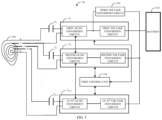
- the device to-be-charged 20 includes a receiving coil 210, a first charging unit 211, and a second charging unit 212.
- the receiving coil 210 includes a first end a, a second end b, and a middle tap c.
- the first charging unit 211 is coupled with the first end a and the middle tap c of the receiving coil 210 and configured to convert an electromagnetic signal received at the first end a and the middle tap c into a first voltage and a first current for charging a battery 213.
- the second charging unit 212 is coupled with the second end b and the middle tap c of the receiving coil and configured to convert an electromagnetic signal received at the second end b and the middle tap c into a second voltage and a second current for charging the battery 213.
- the tap means one or more joints tapped in a winding process of a coil or winding. It can also be regarded that multiple coils or windings are connected in series, and a lead wire tapped from a serial connection point is called tap.
- a lead-in wire and a lead-out wire at two ends are not counted, and only a lead wire at a middle point is counted. If there is only one lead wire at the middle point, it means that the receiving coil has one tap, and the one tap can be called a center tap. If there are multiple lead wires at middle points, it is means that the receiving coil has multiple taps.
- an electromagnetic signal received can be divided into two electromagnetic signals through the center tap, and the two electromagnetic signals are respectively inputted into two charging units (including the first charging unit 211 and the second charging unit 212) to form two charging paths.
- an electromagnetic signal received can be divided into multiple electromagnetic signals through the multiple taps, and the multiple electromagnetic signals are respectively inputted into multiple charging units to form multiple charging paths.
- the center tap is adopted in the receiving coil 210, two charging paths can be formed and the battery 213 can be charged through each charging path, which is possible to increase a charging power of the device to-be-charged 20.
- a charging power of each charging path can be reduced. In this way, heating spots can be dispersed and heating during charging can be reduced, which can improve charging efficiency.
- the device to-be-charged 20 further includes a first control unit 214.
- the first control unit 214 is configured to control the first charging unit 211 and/or the second charging unit 212 to work according to a charging mode or a charging stage of the battery 213 to charge the battery 213.
- the charging mode includes a first charging mode and a second charging mode, where a charging speed in the first charging mode is higher than that in the second charging mode.
- the charging stage of the battery at least includes one of the following charging stages: a trickle charging stage, a constant-current charging stage, and a constant-voltage charging stage.
- the first charging mode may correspond to the constant-current charging stage
- the second charging mode may correspond to the trickle charging stage and/or the constant-voltage charging stage.
- the charging mode may not correspond to the charging stage, that is, the charging mode corresponds to a charging speed.
- the charging mode corresponds to a charging speed.
- a quick-charging mode of high charging speed when a required charging power is higher than a set value, it is the first charging mode, and two charging units (including the first charging unit 211 and the second charging unit 212) may work together.
- a normal charging mode of low charging speed it is the second charging mode, and only one charging unit (the first charging unit 211 or the second charging unit 212) works.
- the working charging unit in the first charging mode, the working charging unit may be consistent with the constant-current charging stage; in the second charging mode, the working charging unit may be consistent with the trickle charging stage and/or the constant-voltage charging stage.
- the first charging unit 211 includes a first AC-direct current (DC) conversion circuit 211a and a first voltage conversion circuit 211b.
- the second charging unit 212 includes a second AC-DC conversion circuit 212a and a second voltage conversion circuit 212b.
- the first end a and the middle tap c of the receiving coil 210 are coupled with the first AC-DC conversion circuit 211a, the first AC-DC conversion circuit 211a is coupled with the first voltage conversion circuit 211b, and the first voltage conversion circuit 211b is coupled with the battery 213, to charge the battery 213.
- the second end b and the middle tap c of the receiving coil 210 are coupled with the second AC-DC conversion circuit 212a, the second AC-DC conversion circuit 212a is coupled with the second voltage conversion circuit 212b, and the second voltage conversion circuit 212b is coupled with the battery 213, to charge the battery 213.
- the first AC-DC conversion circuit 211a or the second AC-DC conversion circuit 212a is configured to perform AC-DC voltage conversion on a corresponding electromagnetic signal received from the receiving coil 210 to obtain a DC voltage and a DC current.
- the first voltage conversion circuit 211b or the second voltage conversion circuit 212b is configured to perform DC-DC voltage conversion on the DC voltage and the DC current to obtain an output voltage and an output current of a corresponding charging unit.
- the first voltage and the first current outputted by the first charging unit 211 may be applied to the battery 213 for charging.
- the second voltage and the second current outputted by the second charging unit 212 may be applied to the battery 213 for charging.
- the first control unit 214 is specifically configured to control the first AC-DC conversion circuit 211a and the first voltage conversion circuit 211b to work and/or control the second AC-DC conversion circuit 212a and the second voltage conversion circuit 212b to work, according to the charging mode or the charging stage of the battery 213.
- the first control unit 214 may be a separate microcontroller unit (MCU) of the device to-be-charged 20, and as such, it is possible to improve reliability in control.
- the first control unit 214 may also be an application processor (AP) of the device to-be-charged 20, and as such, it is possible to save hardware cost. Implementations of the disclosure are not specifically limited in this regard.
- the charging stage may include the trickle charging stage, the constant-current charging stage, and the constant-voltage charging stage.
- the trickle charging stage is mainly used for pre-charging a fully discharged battery (recovery charging).
- Trickle charging is adopted usually when a battery voltage of a single-cell lithium battery is lower than about 3V.
- a trickle-charging current is usually one tenth of a constant-current charging current.
- a current for constant-current charging is generally 0.2C (coulomb) ⁇ 1.0C.
- the battery voltage gradually increases with a constant-current charging process.
- a voltage of a single-cell lithium battery in the constant-current charging stage ranges from 3.0V to 4.2V.
- the constant-voltage charging stage when the battery voltage rises to 4.2V, the constant-current charging stage ends and the constant-voltage charging stage begins.
- the charging current gradually decreases.
- the charging current decreases to 0.01C, it can be considered that charging is cut-off.
- C represents a nominal capacity of the battery, and 0.01C can be regarded as a charging cut-off current of the battery.
- the charging stage there can be no constant-voltage charging stage, that is, the charging stage includes only the trickle charging stage and the constant-current charging stage.
- the constant-voltage charging stage may be adjusted to a multi-stage constant-voltage charging stage, that is, the charging stage includes the trickle charging stage, the constant-current charging stage, and the multi-stage constant-voltage charging stage. Implementations of the disclosure are not specifically limited in this regard.
- the first voltage conversion circuit 211b is a buck circuit, a charging IC, or a buck-boost circuit.
- the first control unit 214 is configured to control the first voltage conversion circuit 211b to work in one or more of the following charging stages: the trickle charging stage, the constant-current charging stage, and the constant-voltage charging stage.
- the second voltage conversion circuit 212b is a charge pump circuit.
- the first control unit 214 is configured to control the second voltage conversion circuit 212b to work in the constant-current charging stage.
- the buck circuit, the charging IC, the buck-boost circuit, or the charge pump circuit each is a DC-DC voltage conversion circuit.
- a ratio of an input voltage to an output voltage of the charge pump circuit may be 1:1, 2:1, 3:1, ..., N:1, etc.
- the charging IC can be an integration of a recognizing circuit, an LDO circuit (voltage stabilizing circuit), a buck/boost circuit, a path management circuit, a temperature detecting circuit, etc.
- LDO circuit voltage stabilizing circuit
- buck/boost circuit buck/boost circuit
- path management circuit a temperature detecting circuit
- the first voltage conversion circuit 211b and the second voltage conversion circuit 212b each are a charge pump circuit.
- the device to-be-charged 20 may further include a third voltage conversion circuit 215 coupled with the first AC-DC conversion circuit 211a and/or the second AC-DC conversion circuit 212a.
- the third voltage conversion circuit 215 is a charging IC, a buck circuit, or a buck-boost circuit.
- the first control unit 214 is configured to control the first voltage conversion circuit 211b and the second voltage conversion circuit 212b to work in the constant-current charging stage, and control the third voltage conversion circuit 215 to work in the trickle charging stage and/or the constant-voltage charging stage.
- the third voltage conversion circuit 215 when the third voltage conversion circuit 215 is coupled with only one AC-DC conversion circuit (such as the first AC-DC conversion circuit 211a or the second AC-DC conversion circuit 212a), for example, as illustrated in FIG. 2 , the third voltage conversion circuit 215 is coupled with first AC-DC conversion circuit 211a, in the trickle charging stage and/or the constant-voltage charging stage, the battery 213 is charged via the third voltage conversion circuit 215 through only one charging path.
- the third voltage conversion circuit 215 is coupled with two AC-DC conversion circuits (such as the first AC-DC conversion circuit 211a and the second AC-DC conversion circuit 212a) at the same time, for example, as illustrated in FIG.
- the third voltage conversion circuit 215 is coupled with both the first AC-DC conversion circuit 211a and the second AC-DC conversion circuit 212a, in the trickle charging stage and/or the constant-voltage charging stage, the battery 213 is charged via the third voltage conversion circuit 215 through the two charging paths simultaneously.
- the first voltage conversion circuit 211b may realize DC-DC conversion on a voltage and a current outputted by the first AC-DC conversion circuit 211a, such that a first voltage and a first current outputted by the first voltage conversion circuit 211b can be directly applied to the battery 213.
- the second voltage conversion circuit 212b may realize DC-DC conversion on a voltage and a current outputted by the second AC-DC conversion circuit 212a, such that a second voltage and a second current outputted by the second voltage conversion circuit 212b can be directly applied to the battery 213.
- the third voltage conversion circuit 215 can also realize DC-DC conversion on the voltage and the current outputted by the first AC-DC conversion circuit 211a and/or DC-DC conversion on the voltage and the current outputted by the second AC-DC conversion circuit 212a, such that a third voltage and a third current outputted by the third voltage conversion circuit 215 can be directly applied to the battery 213.
- the first voltage conversion circuit 211b and the second voltage conversion circuit 212b usually work in the constant-current charging stage, and the third voltage conversion circuit 215 usually works in the trickle charging stage and/or the constant-voltage charging stage.
- the first charging unit 211 includes a first AC-DC conversion circuit 211a.
- the second charging unit 212 includes a second AC-DC conversion circuit 212a.
- the device to-be-charged 20 further includes a fourth voltage conversion circuit 401 and a fifth voltage conversion circuit 402.
- the first control unit 214 is configured to control the fourth voltage conversion circuit 401 to work in the constant-current charging stage, and control the fifth voltage conversion circuit 402 to work in the trickle charging stage and/or the constant-voltage charging stage.
- the fourth voltage conversion circuit 401 is a charge pump circuit
- the fifth voltage conversion circuit 402 is a charging IC, a buck circuit, or a buck-boost circuit.
- the fourth voltage conversion circuit 401 is coupled with both the first AC-DC conversion circuit 211a and the second AC-DC conversion circuit 212a.
- the battery 213 is charged via the fourth voltage conversion circuit 401 through two charging paths simultaneously.
- the fifth voltage conversion circuit 402 is coupled with both the first AC-DC conversion circuit 211a and the second AC-DC conversion circuit 212a. In this case, in the trickle charging stage and/or the constant-voltage charging stage, the battery 213 is charged via the fifth voltage conversion circuit 402 through two charging paths simultaneously.
- the fifth voltage conversion circuit 402 may also be coupled with only one AC-DC conversion circuit (the first AC-DC conversion circuit 211a or the second AC-DC conversion circuit 212a). In this case, in the trickle charging stage and/or the constant-voltage charging stage, the battery 213 is charged via the fifth voltage conversion circuit 402 through only one charging path. In other words, when the fifth voltage conversion circuit 402 is coupled with only the first AC-DC conversion circuit 211a, in the trickle charging stage and/or the constant-voltage charging stage, the battery 213 is charged via the first AC-DC conversion circuit 211a and the fifth voltage conversion circuit 402 through the first charging path.
- the battery 213 is charged via the second AC-DC conversion circuit 212a and the fifth voltage conversion circuit 402 through the second charging path.
- the first control unit 214 is further configured to generate feedback information according to at least one of the following charging parameters and feed back the feedback information to a wireless transmitting apparatus: a charging voltage across the battery 213, a charging current of the battery 213, an output current of the first AC-DC conversion circuit 211a, an output voltage of the first AC-DC conversion circuit 211a, an output current of the second AC-DC conversion circuit 212a, and an output voltage of the second AC-DC conversion circuit 212a.
- the charging voltage across the battery 213 and the charging current of the battery 213 are used for the wireless transmitting apparatus to determine a transmission power.
- the output current of the first AC-DC conversion circuit 211a, the output voltage of the first AC-DC conversion circuit 211a, the output current of the second AC-DC conversion circuit 212a, and the output voltage of the second AC-DC conversion circuit 212a are used for the wireless transmitting apparatus to determine a transmission voltage when determining the transmission power.
- the first control unit 214 is configured to determine a required charging power according to a charging voltage across the battery and/or a charging current of the battery, and feed back the required charging power to a wireless transmitting apparatus, to make the wireless transmitting apparatus adjust a transmission power of an electromagnetic signal according to the required charging power.
- the required charging power can be determined according to the charging voltage across the battery 213 and/or the charging current of the battery 213. Then the required charging power can be sent to the wireless transmitting apparatus, such that the wireless transmitting apparatus can adjust the transmission power.
- the first control unit 214 is configured to determine a required current according to an output current and/or an output voltage of the first AC-DC conversion circuit, and/or according to an output current and/or an output voltage of the second AC-DC conversion circuit.
- the first control unit 214 is further configured to feed back the required current to a wireless transmitting apparatus, to make the wireless transmitting apparatus adjust a transmission power of an electromagnetic signal according to the required current.
- a first required current can be determined according to the output current and/or the output voltage of the first AC-DC conversion circuit 211a
- a second required current can be determined according to the output current and/or the output voltage of the second AC-DC conversion circuit 212a
- the required current can be determined according to the first required current and the second required current. Then the required current is sent to the wireless transmitting apparatus, such that the wireless transmitting apparatus can adjust the transmission power.
- the required current can determined according to the first required current and the second required current. Specifically, if two charging paths have the same required current, that is, the first required current is the same as the second required current, any one of the two can be selected to be a required current to-be-determined.
- a main charging path can be determined from the two charging paths, and then a required current of the main charging path can be taken as the required current to-be-determined; alternatively, a maximum value of the first required current and the second required current can be selected and taken as the required current to-be-determined, that is, a required current of a charging path with more serious heating is taken as the required current to-be-determined. Implementations of the disclosure are not specifically limited in this regard.
- an output current of an AC-DC conversion circuit may be an output current of the receiving coil 210, or may be a current in a charging path, for example, a current in the first charging path from the receiving coil 210 to the first voltage conversion circuit 211b, or a current in the second charging path from the receiving coil 210 to the second voltage conversion circuit 212b.
- the output current of the AC-DC conversion circuit may be any current that can reflect the receiving coil 210, and implementations of the disclosure are not specifically limited in this regard.
- the middle tap is adopted in the receiving coil 210, two charging paths can be obtained, that is, the first charging path where the first charging unit 211 is located and the second charging path where the second charging unit 212 is located.
- a related parameter (output voltage and/or output current) of each charging path is separately obtained.
- there is only one transmitting coil in the wireless transmitting apparatus that is, information to be fed back to the wireless transmitting apparatus can only be a related parameter of one of the charging paths. In this case, if factors such as the number of turns, material, winding manner, process, tap position, etc. of receiving coil 210 are taken into consideration, it is possible to ensure that charging powers of the two charging paths are nearly the same, that is, a transmission power of the wireless transmitting apparatus is evenly allocated.
- the required current can be determined with respect to any charging path selected from the two charging paths.
- charging powers of the two charging paths are different.
- power is allocated through the first control unit, for example, one third of the power is allocated to the first charging path, and two thirds of the power is allocated to the second charging path.
- a required current of the main charging path can be taken as the required current to-be-determined, or a required current of the charging path with more serious heating can be taken as the required current to-be-determined. Then the required current is sent to the wireless transmitting apparatus, such that the wireless transmitting apparatus can adjust the transmission power.
- the first control unit 214 is further configured to detect the output current of the receiving coil, and compare the detected output current with a preset current range. If the detected output current does not meet the preset current range, it indicates that the transmission power of the wireless transmitting apparatus needs to be adjusted. In this case, the required current determined can be fed back to the wireless transmitting apparatus, such that the wireless transmitting apparatus can adjust a transmission power of an electromagnetic signal according to the required current.
- the preset current range means an output current range of the receiving coil that is set in advance for a present charging stage, for example, the preset current range may be 0.95A ⁇ 1.05A.
- the preset current range is set according to actual needs. It is possible to set both a maximum preset value (such as 1.05A) and a minimum preset value (such as 0.95A), or set only the maximum preset value (such as 1.05A), and implementations of the disclosure are not specifically limited in this regard.
- the first control unit 214 is configured to determine a required charging power according to a charging voltage across the battery and/or a charging current of the battery, and determine a required current according to an output current and/or an output voltage of the first AC-DC conversion circuit, and/or according to an output current and/or an output voltage of the second AC-DC conversion circuit.
- the first control unit 214 is further configured to determine a required voltage according to the required charging power and the required current.
- the first control unit 214 is configured to feed back the required voltage to a wireless transmitting apparatus, to make the wireless transmitting apparatus adjust a transmission power of an electromagnetic signal according to the required voltage.
- the required charging power can be determined according to a related parameter of the battery 213 (such as the charging voltage across the battery 213 and/or the charging current of the battery 213), and the required current can be determined according to a related parameter of an AC-DC conversion circuit (such as the output current and/or the output voltage of the first AC-DC conversion circuit 211a, and/or the output current and/or the output voltage of the second AC-DC conversion circuit 212a).
- the required voltage can be determined according to the required charging power and the required current. Then the required voltage is fed back to the wireless transmitting apparatus, such that the wireless transmitting apparatus can adjust the transmission power.
- the required voltage is determined according to the required charging power and the required current. Specifically, a first required power of the first charging path and a second required power of the second charging path are determined according to a preset power allocation principle. Since the required current is determined according to a main charging path or a charging path with more serious heating, after obtaining a required power corresponding to the main charging path or the charging path with more serious heating (the first required power or the second required power), a required voltage corresponding to the main charging path or the charging path with more serious heating can be determined and then used as a required voltage to-be-determined.
- a first required voltage corresponding to the first charging path can be determined according to the first required power and the first required current
- a second required voltage corresponding to the second charging path can be determined according to the second required power and the second required current. If the main charging path or the charging path with more serious heating is the first charging path, the required voltage to-be-determined is the first required voltage. If the main charging path or the charging path with more serious heating is the second charging path, the required voltage to-be-determined is the second required voltage. Implementations of the disclosure are not specifically limited in this regard.
- the first control unit 214 is further configured to, after determining the required voltage, compare the required voltage with an output voltage of the first AC-DC conversion circuit and/or an output voltage of the second AC-DC conversion circuit that is currently received, to determine a voltage difference.
- the first control unit 214 is further configured to feed back the voltage difference to the wireless transmitting apparatus, to make the wireless transmitting apparatus adjust a transmission power of an electromagnetic signal according to the voltage difference.
- the first control unit 214 is further configured to send to a wireless transmitting apparatus feedback information indicating to increase a transmission voltage or decrease a transmission voltage.
- the required voltage can be compared with the currently received output voltage of the first AC-DC conversion circuit 211a to determine the voltage difference; if the required voltage is obtained according to the second charging path, the required voltage can be compared with the currently received output voltage of the second AC-DC conversion circuit 212a to determine the voltage difference. Then the determined voltage difference is sent to the wireless transmitting apparatus, such that the wireless transmitting apparatus can adjust the transmission power.
- whether to increase or decrease the transmission voltage can be determined according to at least one of the following charging parameters obtained: the output current of the first AC-DC conversion circuit 211a, the output voltage of the first AC-DC conversion circuit 211a, the output current of the second AC-DC conversion circuit 212a, and the output voltage of the second AC-DC conversion circuit 212a.
- feedback information indicating to increase the transmission voltage or decrease the transmission voltage can be generated and then sent to the wireless transmitting apparatus for adjustment of the transmission voltage, such that the wireless transmitting apparatus can adjust the transmission power.
- the first control unit 214 is further configured to detect a temperature of the battery 213, and send a first instruction to the wireless transmitting apparatus when the detected temperature of the battery is higher than a temperature threshold and lower than a preset temperature value, where the first instruction is used for instructing the wireless transmitting apparatus to adjust a transmission power of an electromagnetic signal.
- the temperature of the battery 213 can be detected through a temperature sensor. It is also possible to detect a temperature of the receiving coil 210 or even a temperature of a housing of the device to-be-charged 20, and implementations of the disclosure are not specifically limited in this regard. Take detection of the temperature of the battery 213 as an example. The detected temperature is compared with the temperature threshold. If the detected temperature is higher than the temperature threshold, it indicates that the temperature is excessively high.
- a charging power of the device to-be-charged can be reduced, that is, the first instruction is sent to the wireless transmitting apparatus, where the first instruction is used for instructing the wireless transmitting apparatus to adjust the transmission power of the electromagnetic signal, thereby reducing the temperature of the battery 213 of the device to-be-charged.
- input voltages of two charging paths can be equal in theory. For example, suppose that a gain between a transmitting coil of the wireless transmitting apparatus and the receiving coil of the device to-be-charged is 1. Since an output current of the receiving coil is the same in the two charging paths and the tap is the center tap, an output voltage of each charging path may be half of an input voltage of an inverse rectifying bridge of the wireless transmitting apparatus. However, due to factors such as the material, winding manner, process, tap position, etc. of the coil, it is hard to ensure the same output voltage in the two charging paths, that is, charging powers of the two charging paths may be different.
- a charging power of each charging path may be the same or different.
- the charging power of each charging path will be different.
- heating of each charging path may also be different. Therefore, the first control unit can also achieve intelligent control on the charging power of each charging path according to different heating spots of the device to-be-charged.
- the first control unit 214 is further configured to detect a temperature at a first temperature-measurement point in the first charging unit 211 and a temperature at a second temperature-measurement point in the second charging unit 212.
- the first control unit 214 is further configured to adjust a charging power of the first charging unit 211 to obtain an adjusted first voltage and an adjusted first current when the temperature at the first temperature-measurement point is higher than the temperature threshold, and apply the adjusted first voltage and the adjusted first current to the battery 213 for charging.
- the first control unit 214 is further configured to switch off a charging path of the first charging unit 211 to stop charging the battery 213 through the first charging unit 211, when the temperature at the first temperature-measurement point is higher than the temperature threshold.
- the first temperature-measurement point represents a temperature-measurement point arranged at a heating position in the first charging unit 211.
- the second temperature-measurement point represents a temperature-measurement point arranged at a heating position in the second charging unit 212.
- the temperature at the first temperature-measurement point or the temperature at the second temperature-measurement point can be detected through a temperature sensor.
- a temperature of one charging unit obtained is higher than the temperature threshold, it indicates that a temperature of a charging path where the charging unit is located is excessively high, which results in great loss.
- a charging power of the charging path can be reduced, or the charging path can be directly switched off.
- the temperature at the first temperature-measurement point is higher than the temperature threshold, in this case, the charging power of the first charging unit 211 can be reduced.
- the charging power of the first charging unit 211 can be reduced by controlling a duty cycle of a switch transistor of the first voltage conversion circuit 211b or a working frequency of the first voltage conversion circuit 211b, where the first voltage conversion circuit 211b is a buck circuit.
- the reduced part of charging power may be provided to the second charging unit 212.
- a switch transistor of the first AC-DC conversion circuit 211a can be controlled to be off or a switch transistor of the first voltage conversion circuit 211b can be controlled to be off, thereby switching off the first charging path.
- heating of the device to-be-charged can be reduced, thereby improving charging efficiency.
- the first control unit 214 needs to adjust a charging power of the second charging unit 212 to obtain an adjusted second voltage and an adjusted second current, and apply the adjusted second voltage and the adjusted second current to the battery 213 for charging.
- the charging power of the second charging unit 212 can be reduced by controlling a duty cycle of a switch transistor of the second voltage conversion circuit 212b or a working frequency of the second voltage conversion circuit 212b, where the second voltage conversion circuit 212b is a buck circuit.
- the first control unit 214 can also switch off a charging path of the second charging unit 212, to stop charging the battery through the second charging unit 212.
- a switch transistor of the second AC-DC conversion circuit 212a can be controlled to be off or a switch transistor of the second voltage conversion circuit 212b can be controlled to be off, thereby switching off the second charging path. As such, heating of the device to-be-charged can be reduced, thereby improving charging efficiency.
- the first control unit 214 is further configured to detect a charging status of the device to-be-charged 20, and send a second instruction to the wireless transmitting apparatus when the charging status is an abnormal charging status.
- the second instruction is used for instructing the wireless transmitting apparatus to stop transmitting an electromagnetic signal, so as to stop providing a transmission power to the device to-be-charged.
- the abnormal charging status includes: a remaining power of the battery is higher than a preset power value, and/or the temperature of the battery is higher than the preset temperature value, and/or the charging voltage across the battery is higher than a preset voltage value, and/or the charging current of the battery is higher than a preset current value.
- the preset temperature value is greater than the temperature threshold.
- the first instruction is sent to the wireless transmitting apparatus, to instruct the wireless transmitting apparatus to adjust a transmission power of an electromagnetic signal.
- the second instruction is sent to the wireless transmitting apparatus, to instruct the wireless transmitting apparatus to stop transmitting an electromagnetic signal, so as to stop providing a transmission power to the device to-be-charged.
- the first control unit 214 can also detect the remaining power of the battery 213 and then determine, according to the remaining power detected, whether to continue controlling the wireless transmitting apparatus to provide a transmission power to the device to-be-charged to charge. In other words, the remaining power detected is compared with a preset power threshold. If the remaining power detected is higher than the preset power threshold, it indicates that the battery is fully charged.
- the charging status is the abnormal charging status
- the second instruction is used for instructing the wireless transmitting apparatus to stop transmitting an electromagnetic signal (that is, to disable signal transmission of the transmitting coil), so as to stop providing a transmission power to the device to-be-charged, thereby stopping charging the battery of the device to-be-charged.
- the remaining power detected is lower than the preset power threshold, it indicates that the battery is not yet fully charged.
- the charging status is a normal charging status
- a third instruction can be sent to the wireless transmitting apparatus, where the third instruction is used for instructing the wireless transmitting apparatus to continue providing a transmission power to the device to-be-charged, so as to continue charging the battery of the device to-be-charged.
- the first control unit 214 is further configured to obtain a maximum transmission power of the wireless transmitting apparatus, and when the obtained maximum transmission power is lower than a preset power threshold, control the first charging unit 211 or the second charging unit 212 to work.
- the first charging unit 211 after obtaining the maximum transmission power of the wireless transmitting apparatus, if the obtained maximum transmission power is lower than the preset power threshold, control the first charging unit 211 to work and control the second charging unit 212 not to work, where the first voltage conversion circuit 211b is at least one of the following: a buck circuit, a charging IC, or an integrated circuit of a charge pump circuit and a charging IC.
- the second charging unit 212 if the obtained maximum transmission power is lower than the preset power threshold, control the second charging unit 212 to work and control the first charging unit 211 not to work, where the second voltage conversion circuit 212b is at least one of the following: a buck circuit, a charging IC, or an integrated circuit of a charge pump circuit and a charging IC.
- a voltage conversion circuit included in the charging unit may be a buck circuit, or may be a charging IC, or may be an integrated circuit of a charge pump circuit and a charging IC, and implementations of the disclosure are not specifically limited in this regard.
- an AC-DC conversion circuit (such as the first AC-DC conversion circuit 211a or the second AC-DC conversion circuit 212a) may further include a rectifying unit (not illustrated in FIG. 2 ).
- the rectifying unit is configured to receive a control signal, and perform AC-DC voltage conversion on a corresponding electromagnetic signal received from the receiving coil 210 according to the control signal to obtain an output voltage and an output current of the AC-DC conversion circuit.
- the device to-be-charged 20 may further include a rectification control unit (not illustrated in FIG. 2 ).
- the rectification control unit is configured to send a control signal to the rectifying unit, where the control signal is used for instructing the rectifying unit to perform AC-DC voltage conversion.
- the rectification control unit may be disposed in the first AC-DC conversion circuit 211a, or may be disposed in the second AC-DC conversion circuit 212a, or may be disposed in the first AC-DC conversion circuit 211a and the second AC-DC conversion circuit 212a.
- the rectification control unit may be disposed in an AC-DC conversion circuit in one charging path.
- the control signal is sent to a rectifying unit of an AC-DC conversion circuit in each charging path.
- a working status of a rectifying bridge of the rectifying unit is controlled, so as to realize AC-DC voltage conversion in each charging path.
- the rectification control units may be disposed respectively in the first AC-DC conversion circuit 211a and the second AC-DC conversion circuit 212a in the two charging paths, for example, each AC-DC conversion circuit is provided with one rectification control unit and one rectifying unit.
- the control signal is sent to their respective rectifying units. Then, with the control signal, a working status of a rectifying bridge of the rectifying unit is controlled, so as to realize AC-DC voltage conversion in each charging path.
- the rectification control unit may also be disposed in the first control unit 214. Via the first control unit, the control signal is sent to a rectifying unit of an AC-DC conversion circuit in each charging path. Then, with the control signal, a working status of a rectifying bridge of the rectifying unit is controlled, so as to realize AC-DC voltage conversion in each charging path.
- implementations of the disclosure are not specifically limited in terms of the position and number of the rectification control unit.
- the device to-be-charged 20 may further include a first communicating unit (not illustrated in FIG. 2 ).
- the first communicating unit is configured to establish handshake communication between the device to-be-charged and the wireless transmitting apparatus, so as to control the wireless transmitting apparatus to provide a transmission power to the device to-be-charged to charge the battery 213.
- the device to-be-charged and the wireless transmitting apparatus need be capable of communicating a charging handshake protocol, to establish handshake communication between the device to-be-charged and the wireless transmitting apparatus.
- the wireless transmitting apparatus can be controlled to provide a transmission power to the device to-be-charged to charge the battery.
- a wireless-charging communication protocol in implementations of the disclosure may include a standard charging protocol such as Qi protocol, or may include a non-standard charging protocol such as universal serial bus (USB)-power delivery (USB-PD) protocol, quick charge (QC) protocol, and the like, which is not specifically limited in implementations of the disclosure.
- a standard charging protocol such as Qi protocol
- a non-standard charging protocol such as universal serial bus (USB)-power delivery (USB-PD) protocol, quick charge (QC) protocol, and the like, which is not specifically limited in implementations of the disclosure.
- USB universal serial bus
- USB-PD power delivery
- QC quick charge
- the first communicating unit may be disposed in the first charging unit 211, or may be disposed in the second charging unit 212, or may be disposed in the first charging unit 211 and the second charging unit 212.
- the first communicating unit is disposed in one charging path (that is, in the first charging unit 211 or in the second charging unit 212).
- communication with the wireless transmitting apparatus is realized via the first communicating unit in the first charging unit 211 or in the second charging unit 212.
- the first communicating units are disposed respectively in the first charging unit 211 and the second charging unit 212 in the two charging paths. In this case, the first charging unit 211 and the second charging unit 212 communicate with the wireless transmitting apparatus through time-sharing communication.
- the first communicating unit may be disposed in the first charging unit 211.
- one first communicating unit is provided, and communication with the wireless transmitting apparatus is realized via the first communicating unit.
- communication information (such as charging power, output voltage, and output current) relating to other charging paths (such as the second charging unit 212) may be first sent to the first charging unit 211, and then the first communicating unit in the first charging unit 211 performs information interaction with the wireless transmitting apparatus.
- the first communicating unit may also be disposed in the first charging unit 211 and the second charging unit 212, that is, each charging unit is provided with one first communicating unit. In this case, two first communicating units are provided. Communication is in the manner of time-sharing communication, that is, each charging unit alternately communicates with the wireless transmitting apparatus.
- the first communicating unit may also be disposed in the first control unit 214. Via the first control unit, handshake communication between the device to-be-charged and the wireless transmitting apparatus is established, to control the wireless transmitting apparatus to provide a transmission power to the device to-be-charged to charge.
- implementations of the disclosure are also not specifically limited in terms of the position and number of the first communicating unit.
- the device to-be-charged adopts in-band communication, for multiple charging paths, one of the charging paths may be selected for communication with the wireless transmitting apparatus, while other charging paths are not used for communication with the wireless transmitting apparatus.
- communication may also be realized alternately through different charging path, that is, time-sharing communication is adopted.
- the device to-be-charged may also adopt out-of-band communication, that is, communicate with the wireless transmitting apparatus through third-party out-of-band communication.
- a resonant capacitor such as C1 and C2 illustrated in FIG. 2 , needs to be disposed between the receiving coil and each charging unit.
- the receiving coil and the resonant capacitor constitute an LC resonant circuit.
- the structure of the device to-be-charged 20 illustrated in FIG. 2 does not constitute any limitation on a device to-be-charged.
- the device to-be-charged may include more or fewer components than illustrated or may combine certain components or have different configurations or arrangements of components.
- the foregoing implementations provide a device to-be-charged.
- the device to-be-charged includes the receiving coil, the first charging unit, and the second charging unit.
- the receiving coil includes the first end, the second end, and the middle tap.
- the first charging unit is coupled with the first end and the middle tap of the receiving coil and configured to convert the electromagnetic signal received at the first end and the middle tap into the first voltage and the first current for charging the battery.
- the second charging unit is coupled with the second end and the middle tap of the receiving coil and configured to convert the electromagnetic signal received at the second end and the middle tap into the second voltage and the second current for charging the battery.
- a tap is adopted in the receiving coil, it is possible not only to enlarge a coil but also to increase charging paths, thereby increasing a charging power of the device to-be-charged.
- a charging power of each charging path can be reduced. In this way, heating spots can be dispersed and heating during charging can be reduced, thereby improving charging efficiency.
- the receiving coil 210 may also have multiple taps.
- the device to-be-charged 20 may include multiple charging units, to form multiple charging paths.
- FIG. 5 is a schematic structural diagram of another device to-be-charged 20 provided in implementations of the disclosure.
- the device to-be-charged 20 includes a receiving coil 210, a first charging unit, an i th charging unit, and an (N+1) th charging unit.
- the receiving coil 210 includes a first end a, a second end b, and N taps (1, 2, ..., N), where N is a positive integer and N>1.
- the first charging unit is coupled with the first end a and a first tap of the N taps of the receiving coil 210 and configured to convert an electromagnetic signal received at the first end and the first tap into a first voltage and a first current for charging a battery 213.
- the i th charging unit is coupled with an (i-1) th tap and an i th tap of the N taps of the receiving coil 210 and configured to convert an electromagnetic signal received at the (i-1) th tap and the i th tap into an i th voltage and an i th current for charging the battery 213, where i is a positive integer and 1 ⁇ i ⁇ N.
- the (N+1) th charging unit is coupled with an N th tap of the N taps and the second end b of the receiving coil 210 and configured to convert an electromagnetic signal received at the N th tap and the second end into an (N+1) th voltage and an (N+1) th current for charging the battery 213.
- a k th charging unit includes a k th AC-DC conversion circuit and a k th voltage conversion circuit, the k th AC-DC conversion circuit is coupled with the k th voltage conversion circuit, and k is a positive integer and 1 ⁇ k ⁇ N+1.
- the k th AC-DC conversion circuit is configured to perform AC-DC voltage conversion on a k th electromagnetic signal received from the receiving coil 210, to obtain an output voltage and an output current of the k th AC-DC conversion circuit.
- the k th voltage conversion circuit is configured to perform DC-DC voltage conversion on the output voltage and the output current of the k th AC-DC conversion circuit, to obtain a k th voltage and a k th current for charging the battery 213.
- multiple resonant capacitors such as C 1 , C 2 , ..., C N+1 .
- the multiple resonant capacitors are respectively coupled between the receiving coil 210 and a charging unit (such as the first charging unit U 1 , a second charging unit U 2 , ..., the (N+1) th charging unit U N+1 ) to form multiple charging paths.
- the first charging unit U 1 includes a first AC-DC conversion circuit and a first voltage conversion circuit, the first AC-DC conversion circuit is coupled with the first voltage conversion circuit, and the first voltage conversion circuit is coupled with the battery 213 to charge the battery 213.
- the second charging unit U 2 includes a second AC-DC conversion circuit and a second voltage conversion circuit, the second AC-DC conversion circuit is coupled with the second voltage conversion circuit, and the second voltage conversion circuit is coupled with the battery 213 to charge the battery 213.
- the (N+1) th charging unit U N+1 includes an (N+1) th AC-DC conversion circuit and an (N+1) th voltage conversion circuit, the (N+1) th AC-DC conversion circuit is coupled with the (N+1) th voltage conversion circuit, and the (N+1) th voltage conversion circuit is coupled with the battery 213 to charge the battery 213.
- an electromagnetic signal received can be divided into multiple electromagnetic signals through the multiple taps, and the multiple electromagnetic signals are respectively inputted into multiple charging units to form multiple charging paths.
- taps are adopted in the receiving coil 210, multiple charging paths can be formed and the battery 213 can be charged through each charging path, which is possible to increase a charging power of the device to-be-charged 20.
- a charging power of each charging path can be reduced. In this way, heating spots can be dispersed and heating during charging can be reduced, which improves charging efficiency.
- the battery 213 may include a single cell, or may include multiple cells.
- the multiple cells may include a multi-cell series structure and a multi-cell parallel structure.
- voltages and currents of multiple charging units may be applied together to the multiple cells for charging, or each charging unit may charge one corresponding cell. Implementations of the disclosure are not limited in terms of the manner and circuit structure for charging the multiple cells through the multiple charging units.
- the battery 213 includes cell 1, cell 2, ..., cell N+1, where cell 1, cell 2, ..., cell N+1 are connected in parallel.
- a k th cell of the multiple cells is coupled with the k th voltage conversion circuit of the k th charging unit, so as to control each charging path to be responsible for charging one corresponding cell.
- k is a positive integer and 1 ⁇ k ⁇ N+ 1.
- the first voltage conversion circuit in the first charging path is coupled with cell 1
- the second voltage conversion circuit in the second charging path is coupled with cell 2
- the (N+1) th voltage conversion circuit in the (N+1) th charging path is coupled with cell N+1.
- cell 1 can be charged through the first charging path
- cell 2 can be charged through the second charging path
- cell N+1 can be charged through the (N+1) th charging path, which is possible to increase charging speed.
- the battery 213 of the device to-be-charged 20 may have a multi-cell series structure, that is, multiple cells (such as cell 1, cell 2, ..., cell N+1) are connected in series.
- a charging current required by the multi-cell series structure is 1/K time a charging current required by a single cell (K is the number of cells coupled in series in the device to-be-charged 20).
- K is the number of cells coupled in series in the device to-be-charged 20.
- the multiple cells can be cells with the same or similar specification or parameter. Cells with the same or similar specification can facilitate unified management. On the other hand, the overall performance and service life of multiple cells can be improved by adopting cells with the same or similar specification or parameter.
- the foregoing implementations provide a device to-be-charged.
- the device to-be-charged includes the receiving coil, the first charging unit, and the second charging unit.
- the receiving coil includes the first end, the second end, and the N taps.
- the first charging unit is coupled with the first end a and the first tap of the N taps of the receiving coil and configured to convert the electromagnetic signal received at the first end and the first tap into the first voltage and the first current for charging a battery.
- the i th charging unit is coupled with the (i-1) th tap and the i th tap of the N taps of the receiving coil and configured to convert the electromagnetic signal received at the (i-1) th tap and the i th tap into the i th voltage and the i th current for charging the battery, where i is a positive integer and 1 ⁇ i ⁇ N.
- the (N+1) th charging unit is coupled with the N th tap of the N taps and the second end b of the receiving coil and configured to convert the electromagnetic signal received at the N th tap and the second end into the (N+1) th voltage and the (N+1) th current for charging the battery.
- taps are adopted in the receiving coil, it is possible not only to enlarge a coil but also to increase charging paths, thereby increasing a charging power of the device to-be-charged.
- a charging power of each charging path can be reduced. In this way, heating spots can be dispersed and heating during charging can be reduced, which can improve charging efficiency.
- FIG. 7 is a schematic structural diagram of a wireless charging system 50 provided in implementations of the disclosure.
- the wireless charging system 50 includes a power supply device 510, a wireless transmitting apparatus 520, and the device to-be-charged 20 in any of the foregoing implementations.
- the power supply device 510 is configured to power the wireless transmitting apparatus 520.
- the power supply device 510 may include a rectifying unit, a transforming unit, a control unit, a charging interface, etc.
- the power supply device 510 can convert an input AC into an output DC to be provided to the wireless transmitting apparatus 520.
- the power supply device 510 may be an adapter, a power bank, an in-vehicle power supply, etc.
- the power supply device 510 can directly provide an AC to the wireless transmitting apparatus 520.
- the power supply device 510 may be an AC power supply.
- the wireless transmitting apparatus 520 further includes a unit or module for converting AC into DC, such as an inverse rectifying-and-filtering unit, a DC/DC conversion unit, etc.
- the wireless transmitting apparatus 520 is configured to convert a DC or AC provided by the power supply device 510 into a wireless charging signal (electromagnetic signal) for power transmission in a wireless manner.
- the wireless transmitting apparatus 520 may include a fourth voltage conversion circuit 521, an inverse rectifying circuit 522, a transmitting coil 523, and a second control unit 524.
- a fourth voltage conversion circuit 521 may be included in the wireless transmitting apparatus 520 .
- an inverse rectifying circuit 522 may be included in the wireless transmitting apparatus 520 .
- a transmitting coil 523 may be included in the wireless transmitting apparatus 520 .
- a second control unit 524 may be any limitation on a wireless transmitting apparatus.
- the wireless transmitting apparatus may include more or fewer components than illustrated or may combine certain components or have different configurations or arrangements of components.
- the power supply device 510 may be a normal adapter, or may be a voltage-adjustable adapter (that is, the adapter can adjust its own output voltage), or even may be a power bank. If the power supply device 510 is the voltage-adjustable adapter, the wireless transmitting apparatus 520 may not include the fourth voltage conversion circuit 521.
- the fourth voltage conversion circuit 521 is configured to perform DC-DC voltage conversion, and mainly to adjust an output voltage of the power supply device 510 to a fixed voltage value and provide the adjusted voltage to the inverse rectifying circuit 522.
- the inverse rectifying circuit 522 is configured to convert a DC provided by the fourth voltage conversion circuit 521 or a DC provided by the power supply device 510 into an AC that can be coupled to the transmitting coil, and provide the AC to the transmitting coil 523. Via the transmitting coil 523, the AC is converted into an electromagnetic signal for transmission.
- the inverse rectifying circuit 522 may include multiple switch transistors (or referred to as inverse rectifying bridge). By controlling an on-time (that is, duty cycle) of the switch transistor, a transmission power can be adjusted.
- the wireless transmitting apparatus 520 may further include an inverse rectification control unit 525.
- the inverse rectification control unit 525 is configured to send a control signal to the inverse rectifying circuit 522.
- the control signal is used for controlling the on-time (that is, duty cycle) of the switch transistor, thereby adjusting the transmission power.
- the inverse rectification control unit 525 may be a separate control unit, or may be integrated into the second control unit 524, and implementations of the disclosure are not specifically limited in this regard.
- the wireless transmitting apparatus 520 may further include a resonant capacitor C3.
- the resonant capacitor C3 and the transmitting coil 523 form an LC resonant circuit.
- a transmission power of the wireless transmitting apparatus 520 can also be adjusted by controlling a working frequency of the LC resonant circuit.
- the wireless transmitting apparatus 520 may be a wireless charging base or a device with an energy storage function.
- the wireless transmitting apparatus 520 may further include an energy storage module (such as lithium battery, etc.).
- the energy storage module can also provide electrical energy to the inverse rectifying circuit 522.
- the wireless transmitting apparatus 520 can obtain electrical energy from the external power supply device 510 in a wired or wireless manner.
- the wireless transmitting apparatus 520 is coupled with the power supply device 510 via a charging interface (such as Type-C interface or USB interface) to obtain electrical energy.
- a charging interface such as Type-C interface or USB interface
- the wireless transmitting apparatus 520 may further include a receiving coil and can obtain electrical energy wirelessly from a device with a wireless charging function.
- the second control unit 524 is configured to control a wireless charging process.
- the second control unit 524 may communicate with the power supply device 210, to determine an output voltage and/or an output current of the power supply device.
- the second control unit 524 may also communicate with the device to-be-charged 20, to exchange charging information (such as voltage information, current information, temperature information, remaining power information, etc. of a battery 213 of the device to-be-charged 20) and determine a charging parameter (such as charging voltage and/or charging current) used for wireless charging.
- charging information such as voltage information, current information, temperature information, remaining power information, etc. of a battery 213 of the device to-be-charged 20
- a charging parameter such as charging voltage and/or charging current
- the wireless transmitting apparatus 520 may further include other related hardware, logic devices, units, and/or coding for implementing corresponding functions.
- the wireless transmitting apparatus 520 may further include a displaying unit (such as a light-emitting diode (LED) or an LED display screen).
- the displaying unit is configured to display in real time a charging status (such as "in charging” or “charging ended") in a wireless charging process. Implementations of the disclosure are not specifically limited in this regard.
- the device to-be-charged 20 includes a receiving coil 210, a first charging unit 211, and a second charging unit 212.
- the receiving coil 210 includes a first end a, a second end b, and a middle tap c and is configured to receive an electromagnetic signal transmitted by the transmitting coil 523.
- the first charging unit 211 is coupled with the first end a and the middle tap c of the receiving coil 210 and configured to convert an electromagnetic signal received at the first end a and the middle tap c into a first voltage and a first current for charging the battery 213.
- the second charging unit 212 is coupled with the second end b and the middle tap c of the receiving coil and configured to convert an electromagnetic signal received at the second end b and the middle tap c into a second voltage and a second current for charging the battery 213.
- the first charging unit 211 may include a first AC-DC conversion circuit 211a and a first voltage conversion circuit 211b.
- the second charging unit 212 may include a second AC-DC conversion circuit 212a and a second voltage conversion circuit 212b.
- the device to-be-charged 20 may further include a first control unit 214.
- the first control unit 214 is configured to control the first AC-DC conversion circuit and the first voltage conversion circuit to work and/or control the second AC-DC conversion circuit and the second voltage conversion circuit to work, according to a charging mode or a charging stage of the battery 213.
- the charging mode includes a first charging mode and a second charging mode, where a charging speed in the first charging mode is higher than that in the second charging mode.
- the charging stage of the battery at least includes one of the following charging stages: a trickle charging stage, a constant-current charging stage, and a constant-voltage charging stage.
- the device to-be-charged 20 illustrated in FIG. 7 may further include other related hardware, logic devices, units, and/or coding for implementing corresponding functions.
- the structure of the device to-be-charged 20 does not constitute any limitation on a device to-be-charged.
- the device to-be-charged may include more or fewer components than illustrated or may combine certain components or have different configurations or arrangements of components.
- power supply device 510 powers the wireless transmitting apparatus 520.
- the device to-be-charged 20 is placed on a surface of the wireless transmitting apparatus 520.
- the wireless transmitting apparatus 520 charges the battery 213 of the device to-be-charged 20 through electromagnetic induction.
- a wireless connection is established between the wireless transmitting apparatus 520 and the device to-be-charged 20, and the wireless transmitting apparatus 520 and the device to-be-charged 20 can also communicate with each other.
- the manner of wireless communication includes, but is not limited to, Bluetooth ® communication, wireless fidelity (Wi-Fi) communication, high-carrier-frequency based short-distance wireless communication, optical communication, ultrasonic communication, ultra-wideband communication, mobile communication, and the like, and implementations of the disclosure are not specifically limited in this regard.
- Wi-Fi wireless fidelity
- high-carrier-frequency based short-distance wireless communication optical communication
- ultrasonic communication ultra-wideband communication
- mobile communication and the like
- a current in one direction will be generated at the receiving coil 210 through electromagnetic induction between the transmitting coil 523 and the receiving coil 210.
- a rectifying bridge included in a rectifying unit of the AC-DC conversion circuit is in a reverse mode.
- Each rectifying unit will respectively rectify one voltage and then input the rectified voltage into a voltage conversion circuit (such as the first voltage conversion circuit, the second voltage conversion circuit, or a third voltage conversion circuit).
- a charging voltage and/or a charging current expected by the battery 213 of the device to-be-charged 20 is obtained.
- the first control unit 214 is further configured to generate feedback information according to at least one of the following charging parameters and feed back the feedback information to the wireless transmitting apparatus 520: a charging voltage across the battery, a charging current of the battery, an output current of the first AC-DC conversion circuit, an output voltage of the first AC-DC conversion circuit, an output current of the second AC-DC conversion circuit, and an output voltage of the second AC-DC conversion circuit.
- the charging voltage across the battery and the charging current of the battery are used for the wireless transmitting apparatus 520 to determine a transmission power.
- the output current of the first AC-DC conversion circuit, the output voltage of the first AC-DC conversion circuit, the output current of the second AC-DC conversion circuit, and the output voltage of the second AC-DC conversion circuit are used for the wireless transmitting apparatus 520 to determine a transmission voltage when determining the transmission power.
- the second control unit 524 is further configured to receive the feedback information sent by the first control unit of the device to-be-charged 20, and adjust a transmission power of the wireless transmitting apparatus 520 according to the feedback information.
- the second control unit 524 is specifically configured to adjust a duty cycle of a switch transistor of the wireless transmitting apparatus according to the feedback information to adjust the transmission power of the wireless transmitting apparatus, or adjust a working frequency of the wireless transmitting apparatus according to the feedback information to adjustment the transmission power of the wireless transmitting apparatus, or adjust a transmission voltage of the wireless transmitting apparatus according to the feedback information to adjust the transmission power of the wireless transmitting apparatus.
- the wireless transmitting apparatus 520 can adjust the transmission power of the wireless transmitting apparatus according to the feedback information received, such that the transmission power of the wireless transmitting apparatus meets the charging power required by the battery of the device to-be-charged.
- the wireless transmitting apparatus can also adjust the transmission power of the wireless transmitting apparatus according to the feedback information received, such that the output current of the receiving coil of the device to-be-charged meets the preset current range.
- the transmission power of the wireless transmitting apparatus can meet the charging power required by the battery of the device to-be-charged, and the output current of the receiving coil of the device to-be-charged can meet the preset current range, which is possible to reduce heat generation of the device to-be-charged during charging, thereby improving charging efficiency.
- the wireless transmitting apparatus 520 includes a voltage conversion unit (such as the fourth voltage conversion circuit 521 illustrated in FIG. 7 ), which can control adjustment of the transmission voltage of the wireless transmitting apparatus 520 according to the feedback information.
- the second control unit 524 can control the fourth voltage conversion circuit 521 to make an output voltage of the fourth voltage conversion circuit 521 vary, thereby adjusting the transmission voltage.
- the second control unit 524 can adjust an input voltage of the fourth voltage conversion circuit 521 (for example, adjust the output voltage of the power supply device 510 illustrated in FIG. 7 ) to make the output voltage of the fourth voltage conversion circuit 521 vary, thereby adjusting the transmission voltage. As such, the transmission power can be adjusted.
- the second control unit 524 (or the inverse rectification control unit 525) may also adjust a duty cycle of a switch transistor of the inverse rectifying circuit 522, or the second control unit 524 may even adjust a working frequency of a resonant circuit of the wireless transmitting apparatus 520, which can also adjust the transmission power. This can be set according to actual needs in practice, and implementations of the disclosure are not specifically limited in this regard.
- the first control unit 214 is configured to determine a required charging power according to the charging voltage across the battery and/or the charging current of the battery, and feed back the required charging power to the wireless transmitting apparatus.
- the second control unit 524 is configured to receive the required charging power, and control adjustment of the transmission power the wireless transmitting apparatus according to the required charging power, such that an adjusted transmission power meets a required charging power of the battery of the device to-be-charged.
- the first control unit 214 is configured to determine a required current according to the output current and/or the output voltage of the first AC-DC conversion circuit, and/or according to the output current and/or the output voltage of the second AC-DC conversion circuit, and feed back the required current to the wireless transmitting apparatus.
- the second control unit 524 is configured to receive the required current, and control adjustment of the transmission power the wireless transmitting apparatus according to the required current, such that an output current of the receiving coil of the device to-be-charged meets the preset current range.
- the first control unit 214 is configured to determine a required charging power according to the charging voltage across the battery and/or the charging current of the battery, and determine a required current according to the output current and/or the output voltage of the first AC-DC conversion circuit, and/or according to the output current and/or the output voltage of the second AC-DC conversion circuit.
- the first control unit 214 is further configured to determine a required voltage according to the required charging power and the required current, and feed back the required voltage to the wireless transmitting apparatus.
- the second control unit 524 is configured to receive the required voltage, and control adjustment of the transmission power of the wireless transmitting apparatus according to the required voltage, such that an adjusted transmission power meets a required charging power of the battery of the device to-be-charged and an output current of the receiving coil of the device to-be-charged meets the preset current range.
- the first control unit 214 is further configured to, after determining the required voltage, compare the required voltage with an output voltage of the first AC-DC conversion circuit and/or an output voltage of the second AC-DC conversion circuit that is currently received, to determine a voltage difference.
- the first control unit 214 is further configured to feed back the voltage difference to the wireless transmitting apparatus.
- the second control unit 524 is further configured to receive the voltage difference, and control adjustment of the transmission power of the wireless transmitting apparatus according to the voltage difference, such that an adjusted transmission power meets a required charging power of the battery of the device to-be-charged and an output current of the receiving coil of the device to-be-charged meets the preset current range.
- the first control unit 214 is further configured to send to the wireless transmitting apparatus feedback information indicating to increase a transmission voltage or decrease a transmission voltage.
- the second control unit 524 is further configured to receive the feedback information indicating to increase a transmission voltage or decrease a transmission voltage, and adjust the transmission voltage to control adjustment of the transmission power of the wireless transmitting apparatus, such that an adjusted transmission power meets a required charging power of the battery of the device to-be-charged and an output current of the receiving coil of the device to-be-charged meets the preset current range.
- the first control unit 214 is further configured to detect a temperature of the battery, and send a first instruction to the wireless transmitting apparatus when the detected temperature of the battery is higher than a temperature threshold and lower than a preset temperature value.
- the second control unit 524 is further configured to receive the first instruction, and adjust the transmission power of the wireless transmitting apparatus according to the first instruction, to reduce the temperature of the battery of the device to-be-charged.
- the first control unit 214 is further configured to detect a charging status of the device to-be-charged, and send a second instruction to the wireless transmitting apparatus when the charging status is an abnormal charging status.
- the abnormal charging status includes: a remaining power of the battery is higher than a preset power value, and/or the temperature of the battery is higher than the preset temperature value, and/or the charging voltage across the battery is higher than a preset voltage value, and/or the charging current of the battery is higher than a preset current value.
- the second control unit 524 is further configured to receive the second instruction, and control, according to the second instruction, the wireless transmitting apparatus to stop transmitting an electromagnetic signal, so as to stop providing a transmission power to the device to-be-charged.
- the first control unit 214 is further configured to obtain a maximum transmission power of the wireless transmitting apparatus, and when the obtained maximum transmission power is lower than a preset power threshold, control the first charging unit to work and control the second charging unit not to work.
- the first voltage conversion circuit at least is one of: a buck circuit, a charging IC, or an integrated circuit of a charge pump circuit and a charging IC.
- the first control unit 214 is configured to control the second charging unit to work and control the first charging unit not to work, when the obtained maximum transmission power is lower than the preset power threshold.
- the second voltage conversion circuit at least is one of: a buck circuit, a charging IC, or an integrated circuit of a charge pump circuit and a charging IC.
- the wireless charging system includes the power supply device, the wireless transmitting apparatus, and the device to-be-charged.
- the power supply device powers the wireless transmitting apparatus, and the wireless transmitting apparatus charges the battery of the device to-be-charged.
- the device to-be-charged is placed on a surface of the wireless transmitting apparatus, and energy is transferred therebetween through electromagnetic induction to charge the battery of the device to-be-charged. Since a tap is adopted in the receiving coil of the device to-be-charged, multiple charging paths can be formed and the battery can be charged through each charging path, which is possible to increase a charging power of the device to-be-charged. In addition, since there are multiple charging paths, a charging power of each charging path can be reduced. In this way, heating spots can be dispersed and heating during charging can be reduced, which can improve charging efficiency.
- FIG. 8 is a schematic flowchart of a wireless charging method provided in implementations of the disclosure. As illustrated in FIG. 8 , the method includes the following.
- an electromagnetic signal is received via a receiving coil.
- the receiving coil includes a first end, a second end, and a middle tap.
- a first charging unit is coupled with the first end and the middle tap of the receiving coil.
- a second charging unit is coupled with the second end and the middle tap of the receiving coil.
- an electromagnetic signal received at the first end and the middle tap is converted into a first voltage and a first current for charging a battery.
- an electromagnetic signal received at the second end and the middle tap is converted into a second voltage and a second current for charging the battery.
- the method is applicable to a device to-be-charged described in any of the foregoing implementations.
- the receiving coil has one center tap. Through the center tap, an electromagnetic signal received can be divided into two electromagnetic signals, and the two electromagnetic signals are respectively inputted into the first charging unit and the second charging unit to form two charging paths.
- a tap is adopted in the receiving coil of the device to-be-charged, multiple charging paths can be formed and the battery can be charged through each charging path, which is possible to increase a charging power of the device to-be-charged.
- a charging power of each charging path can be reduced. In this way, heating spots can be dispersed and heating during charging can be reduced, which can improve charging efficiency.
- the method may further include the following.
- the first charging unit and/or the second charging unit is controlled to work via a first control unit according to a charging mode or a charging stage of the battery to charge the battery.
- the charging mode includes a first charging mode and a second charging mode, where a charging speed in the first charging mode is higher than that in the second charging mode.
- the charging stage of the battery at least includes one of the following charging stages: a trickle charging stage, a constant-current charging stage, and a constant-voltage charging stage.
- the first charging unit includes a first AC-DC conversion circuit and a first voltage conversion circuit.
- the second charging unit includes a second AC-DC conversion circuit and a second voltage conversion circuit.
- the first charging unit and/or the second charging unit is controlled to work via the first control unit according to the charging mode or the charging stage of the battery as follows. Via the first control unit, the first AC-DC conversion circuit and the first voltage conversion circuit are controlled to work and/or the second AC-DC conversion circuit and the second voltage conversion circuit are controlled to work, according to the charging mode or the charging stage of the battery.
- the first AC-DC conversion circuit or the second AC-DC conversion circuit can perform AC-DC voltage conversion on a corresponding electromagnetic signal received from the receiving coil to obtain a DC voltage and a DC current.
- the first voltage conversion circuit or the second voltage conversion circuit can perform DC-DC voltage conversion on the DC voltage and the DC current to obtain an output voltage and an output current of a corresponding charging unit, for example, the first voltage and the first current outputted by the first charging unit as well as the second voltage and the second current outputted by the second charging unit. Then the first voltage and the first current as well as the second voltage and the second current are applied to the battery for charging.
- the first control unit may be a separate MCU of the device to-be-charged, and as such, it is possible to improve reliability in control.
- the first control unit may also be an AP of the device to-be-charged, and as such, it is possible to save hardware cost. Implementations of the disclosure are not specifically limited in this regard.
- the first voltage conversion circuit is a buck circuit, a charging IC, or a buck-boost circuit.
- the method further includes the following. Via the first control unit, the first voltage conversion circuit is controlled to work in one or more of the following charging stages: the trickle charging stage, the constant-current charging stage, and the constant-voltage charging stage.
- the second voltage conversion circuit is a charge pump circuit.
- the method further includes the following. Via the first control unit, the second voltage conversion circuit is controlled to work in the constant-current charging stage.
- the first voltage conversion circuit and the second voltage conversion circuit each are a charge pump circuit.
- the device to-be-charged further includes a third voltage conversion circuit.
- the method further includes the following. Via the first control unit, the first voltage conversion circuit and the second voltage conversion circuit are controlled to work when the battery is in the constant-current charging stage. Via the first control unit, the third voltage conversion circuit is controlled to work when the battery is in the trickle charging stage and/or the constant-voltage charging stage.
- the first voltage conversion circuit and the second voltage conversion circuit each may be a charge pump circuit.
- the third voltage conversion circuit may be a charging IC, a buck circuit, or a buck-boost circuit.
- the first voltage conversion circuit may realize DC-DC conversion on a voltage and a current outputted by the first AC-DC conversion circuit, such that the first voltage and the first current outputted by the first charging unit can be directly applied to the battery.
- the second voltage conversion circuit may realize DC-DC conversion on a voltage and a current outputted by the second AC-DC conversion circuit, such that the second voltage and the second current outputted by the second charging unit can be directly applied to the battery.
- the third voltage conversion circuit can also realize DC-DC conversion on the voltage and the current outputted by the first AC-DC conversion circuit and/or implementing DC-DC conversion on the voltage and the current outputted by the second AC-DC conversion circuit, such that a third voltage and a third current outputted through this charging path can be directly applied to the battery.
- the charging stage of the battery of the device to-be-charged may include the trickle charging stage, the constant-current charging stage, and the constant-voltage charging stage.
- the first voltage conversion circuit and the second voltage conversion circuit usually work in the constant-current charging stage, and the third voltage conversion circuit usually works in the trickle charging stage and/or the constant-voltage charging stage.
- the device to-be-charged may further include a fourth voltage conversion circuit and a fifth voltage conversion circuit.
- the method further includes the following. Via the first control unit, the fourth voltage conversion circuit is controlled to work when the battery is in the constant-current charging stage. Via the first control unit, the fifth voltage conversion circuit is controlled to work when the battery is in the trickle charging stage and/or the constant-voltage charging stage.
- the fourth voltage conversion circuit is a charge pump circuit
- the fifth voltage conversion circuit is a charging IC, a buck circuit, or a buck-boost circuit.
- FIG. 4 the fourth voltage conversion circuit 401 is coupled with both the first AC-DC conversion circuit 211a and the second AC-DC conversion circuit 212a. In this case, in the constant-current charging stage, the battery 213 is charged via the fourth voltage conversion circuit 401 through two charging paths simultaneously.
- the fifth voltage conversion circuit 402 is coupled with both the first AC-DC conversion circuit 211a and the second AC-DC conversion circuit 212a. In this case, in the trickle charging stage and/or the constant-voltage charging stage, the battery 213 is charged via the fifth voltage conversion circuit 402 through two charging paths simultaneously.
- the fifth voltage conversion circuit 402 may also be coupled with only one AC-DC conversion circuit (the first AC-DC conversion circuit 211a or the second AC-DC conversion circuit 212a). In this case, in the trickle charging stage and/or the constant-voltage charging stage, and the battery 213 is charged via the fifth voltage conversion circuit 402 through only one charging path. In other words, when the fifth voltage conversion circuit 402 is coupled with only the first AC-DC conversion circuit 211a, in the trickle charging stage and/or the constant-voltage charging stage, the battery 213 is charged via the first AC-DC conversion circuit 211a and the fifth voltage conversion circuit 402 through a first charging path.
- the battery 213 is charged via the second AC-DC conversion circuit 212a and the fifth voltage conversion circuit 402 through a second charging path.
- the device to-be-charged may further include a first communicating unit.
- the method may further include the following. Handshake communication is established with a wireless transmitting apparatus through the first communicating unit. If the handshake communication is successfully established, the wireless transmitting apparatus is controlled to provide a transmission power to the device to-be-charged to charge the battery.
- the device to-be-charged and the wireless transmitting apparatus need be capable of communicating a charging handshake protocol, to establish handshake communication between the device to-be-charged and the wireless transmitting apparatus. If handshake communication is successfully established, the wireless transmitting apparatus can be controlled to provide a transmission power to the device to-be-charged to charge.
- the transmission power provided to the device to-be-charged by the wireless transmitting apparatus is converted into an electromagnetic signal via a transmitting coil for transmission to the outside. Then the electromagnetic signal is received by the receiving coil.
- the method may further include the following.
- Feedback information is generated via the first control unit according to at least one of the following charging parameters and the feedback information is fed back to the wireless transmitting apparatus.
- the charging parameter includes: a charging voltage across the battery, a charging current of the battery, an output current of the first AC-DC conversion circuit, an output voltage of the first AC-DC conversion circuit, an output current of the second AC-DC conversion circuit, and an output voltage of the second AC-DC conversion circuit.
- the charging voltage across the battery and the charging current of the battery are used for the wireless transmitting apparatus to determine a transmission power.
- the output current of the first AC-DC conversion circuit, the output voltage of the first AC-DC conversion circuit, the output current of the second AC-DC conversion circuit, and the output voltage of the second AC-DC conversion circuit are used for the wireless transmitting apparatus to determine a transmission voltage when determining the transmission power.
- the feedback information may be fed back to the wireless transmitting apparatus as follows.
- a required charging power is determined according to the charging voltage across the battery and/or the charging current of the battery.
- the required charging power is fed back to the wireless transmitting apparatus as the feedback information, to make the wireless transmitting apparatus adjust a transmission power of an electromagnetic signal according to the required charging power.
- the feedback information may be fed back to the wireless transmitting apparatus as follows.
- a required current is determined according to an output current and/or an output voltage of the first AC-DC conversion circuit, and/or according to an output current and/or an output voltage of the second AC-DC conversion circuit.
- the required current is fed back to the wireless transmitting apparatus as the feedback information, to make the wireless transmitting apparatus adjust a transmission power of an electromagnetic signal according to the required current.
- the feedback information may be fed back to the wireless transmitting apparatus as follows.
- a required charging power is determined according to the charging voltage across the battery and/or the charging current of the battery.
- a required current is determined according to the output current and/or the output voltage of the first AC-DC conversion circuit, and/or according to the output current and/or the output voltage of the second AC-DC conversion circuit.
- a required voltage is determined according to the required charging power and the required current. The required voltage is fed back to the wireless transmitting apparatus as the feedback information, to make the wireless transmitting apparatus adjust a transmission power of an electromagnetic signal according to the required voltage.
- the method may further include the following after determining the required voltage. According to the required voltage determined, the required voltage is compared with an output voltage of the first AC-DC conversion circuit and/or an output voltage of the second AC-DC conversion circuit that is currently received, to determine a voltage difference. The voltage difference is fed back to the wireless transmitting apparatus as the feedback information, to make the wireless transmitting apparatus adjust a transmission power of an electromagnetic signal according to the voltage difference.
- the required voltage can be compared with the currently received output voltage of the first AC-DC conversion circuit 211a to determine the voltage difference; if the required voltage is obtained according to the second charging path, the required voltage can be compared with the currently received output voltage of the second AC-DC conversion circuit 212a to determine the voltage difference. Then the determined voltage difference is sent to the wireless transmitting apparatus, such that the wireless transmitting apparatus can adjust the transmission power.
- whether to increase or decrease a transmission voltage can be determined according to at least one of the following charging parameters obtained: the output current of the first AC-DC conversion circuit 211a, the output voltage of the first AC-DC conversion circuit 211a, the output current of the second AC-DC conversion circuit 212a, and the output voltage of the second AC-DC conversion circuit 212a.
- feedback information indicating to increase the transmission voltage or decrease the transmission voltage can be generated and then sent to the wireless transmitting apparatus for adjustment of the transmission voltage, such that the wireless transmitting apparatus can adjust the transmission power.
- the method may further include the following.
- a temperature of the battery is detected.
- a first instruction is sent to the wireless transmitting apparatus when the detected temperature of the battery is higher than a temperature threshold and lower than a preset temperature value, where the first instruction in used for instructing the wireless transmitting apparatus to adjust a transmission power of an electromagnetic signal.
- the temperature of the battery can be detected through a temperature sensor. It is also possible to detect a temperature of the receiving coil or even a temperature of a housing of the device to-be-charged, and implementations of the disclosure are not specifically limited in this regard. Take detection of the temperature of the battery as an example. The detected temperature is compared with the temperature threshold. If the detected temperature is higher than the temperature threshold, it indicates that the temperature is excessively high. In this case, a charging power of the device to-be-charged can be reduced, that is, the first instruction is sent to the wireless transmitting apparatus, where the first instruction is used for instructing the wireless transmitting apparatus to adjust the transmission power of the electromagnetic signal, thereby reducing the temperature of the battery of the device to-be-charged.
- the method may further include the following.
- a charging status of the device to-be-charged is detected.
- a second instruction is sent to the wireless transmitting apparatus when the charging status is an abnormal charging status.
- the second instruction is used for instructing the wireless transmitting apparatus to stop transmitting an electromagnetic signal, so as to stop providing a transmission power to the device to-be-charged.
- the abnormal charging status includes: a remaining power of the battery is higher than a preset power value, and/or the temperature of the battery is higher than the preset temperature value, and/or the charging voltage across the battery is higher than a preset voltage value, and/or the charging current of the battery is higher than a preset current value.
- the first control unit 214 can also detect the remaining power of the battery 213 and then determine, according to the remaining power detected, whether to continue controlling the wireless transmitting apparatus to provide a transmission power to the device to-be-charged to charge. In other words, the remaining power detected is compared with a preset power threshold. If the remaining power detected is higher than the preset power threshold, it indicates that the battery is fully charged.
- the charging status is the abnormal charging status
- the second instruction is used for instructing the wireless transmitting apparatus to stop transmitting an electromagnetic signal (that is, to disable signal transmission of the transmitting coil), so as to stop providing a transmission power to the device to-be-charged, thereby stopping charging the battery of the device to-be-charged.
- the remaining power detected is lower than the preset power threshold, it indicates that the battery is not yet fully charged.
- the charging status is a normal charging status
- a third instruction can be sent to the wireless transmitting apparatus, where the third instruction is used for instructing the wireless transmitting apparatus to continue providing a transmission power to the device to-be-charged, so as to continue charging the battery of the device to-be-charged.
- the method may further include the following.
- a maximum transmission power of the wireless transmitting apparatus is obtained.
- the first charging unit or the second charging unit is controlled to work when the obtained maximum transmission power is lower than a preset power threshold.
- the first charging unit to work and control the second charging unit not to work via the first control unit, where the first voltage conversion circuit is at least one of the following: a buck circuit, a charging IC, or an integrated circuit of a charge pump circuit and a charging IC.
- the second charging unit to work and control the first charging unit not to work via the first control unit, where the second voltage conversion circuit is at least one of the following: a buck circuit, a charging IC, or an integrated circuit of a charge pump circuit and a charging IC.
- a voltage conversion circuit included in the charging unit may be a buck circuit, or may be a charging IC, or may be an integrated circuit of a charge pump circuit and a charging IC, and implementations of the disclosure are not specifically limited in this regard.
- the battery may include a single cell, or may include multiple cells.
- the multiple cells may include a multi-cell series structure and a multi-cell parallel structure. Therefore, in some implementations, when the battery has the multi-cell parallel structure, the method may further include the following.
- a k th charging unit of multiple charging units is controlled to charge a k th cell of the battery, where the k th cell is coupled with the k th charging unit of the multiple charging units, and k is a positive integer and 1 ⁇ k ⁇ N+1.
- the multiple charging units include a first charging unit and a second charging unit. Supposing that the battery is a dual-cell parallel structure, it is possible that the first charging unit charges a first cell and the second charging unit charges a second cell.
- the battery 213 includes cell 1, cell 2, ..., cell N+1, where cell 1, cell 2, ..., cell N+1 are connected in parallel.
- a first voltage conversion circuit in a first charging path is coupled with cell 1
- a second voltage conversion circuit in a second charging path is coupled with cell 2
- an (N+1) th voltage conversion circuit in an (N+1) th charging path is coupled with cell N+1.
- cell 1 can be charged through the first charging path
- cell 2 can be charged through the second charging path
- cell N+1 can be charged through the (N+1) th charging path, which is possible to increase charging speed.
- the battery 213 of the device to-be-charged 20 may also have the multi-cell series structure, that is, multiple cells (such as cell 1, cell 2, ..., cell N+1) are in series.
- a charging current required by the multi-cell series structure is 1/K time a charging current required by a single cell (K is the number of cells coupled in series in the device to-be-charged 20).
- K is the number of cells coupled in series in the device to-be-charged 20.
- Implementations provide a wireless charging method.
- the method is applicable to a device to-be-charged.
- An electromagnetic signal is received via the receiving coil.
- the receiving coil includes the first end, the second end, and the middle tap.
- the first charging unit is coupled with the first end and the middle tap of the receiving coil.
- the second charging unit is coupled with the second end and the middle tap of the receiving coil.
- the electromagnetic signal received at the first end and the middle tap is converted into the first voltage and the first current for charging the battery.
- the electromagnetic signal received at the second end and the middle tap is converted into the second voltage and the second current for charging the battery.
- the first voltage and the first current as well as the second voltage and the second current are applied to the battery for charging.
- a tap is adopted in the receiving coil.
- an electromagnetic signal received is divided into at least two electromagnetic signals, and each of the at least two electromagnetic signals is respectively inputted into each charging unit, which can form at least two charging paths, thereby increasing a charging power of the device to-be-charged.
- a charging power of each charging path can be reduced. In this way, heating spots can be dispersed and heating during charging can be reduced, which can improve charging efficiency.
- FIG. 9 is a schematic flowchart of a wireless charging method provided in implementations of the disclosure. As illustrated in FIG. 9 , the method includes the following.
- an electromagnetic signal is transmitted via a transmitting coil.
- the electromagnetic signal is used for providing a transmission power to a device to-be-charged, such that a first charging unit and a second charging unit of the device to-be-charged can respectively charge a battery.
- the first charging unit is coupled with a first end and a middle tap of a receiving coil of the device to-be-charged.
- the second charging unit is coupled with a second end and the middle tap of the receiving coil of the device to-be-charged.
- the wireless charging method is applicable to a wireless transmitting apparatus described in any of the foregoing implementations.
- the wireless transmitting apparatus at least includes the transmitting coil.
- the transmitting coil can generate electromagnetic induction with the receiving coil of the device to-be-charged.
- the wireless transmitting apparatus transmits an electromagnetic signal via the transmitting coil, and can provide a transmission power to the device to-be-charged through electromagnetic induction between the transmitting coil and the receiving coil, such that the first charging unit and the second charging unit of device to-be-charged can respectively charge the battery.
- the first charging unit is coupled with the first end and the middle tap of the receiving coil of the device to-be-charged, to form a first charging path.
- the second charging unit is coupled with the second end and the middle tap of the receiving coil of the device to-be-charged, to form a second charging path.
- the wireless transmitting apparatus may include a second communicating unit. Before transmitting the electromagnetic signal via the transmitting coil at S901, the method may further include the following. Handshake communication is established with the device to-be-charged via the second communicating unit. When the handshake communication is successfully established, the wireless transmitting apparatus is controlled to provide a transmission power to the device to-be-charged to charge the battery.
- the device to-be-charged and the wireless transmitting apparatus need be capable of communicating a charging handshake protocol, to establish handshake communication between the device to-be-charged and the wireless transmitting apparatus. If handshake communication is successfully established, the wireless transmitting apparatus can be controlled to provide a transmission power to the device to-be-charged to charge.
- the transmission power provided to the device to-be-charged by the wireless transmitting apparatus is converted into an electromagnetic signal via the transmitting coil for transmission to the outside. Then the electromagnetic signal is received by the receiving coil.
- the second communicating unit may be a separate unit or module, or may be integrated into a second control unit of the wireless transmitting apparatus, or may even be integrated into an inverse rectification control unit, and implementations of the disclosure are not specifically limited in this regard.
- the device to-be-charged can send feedback information to the wireless transmitting apparatus. Then the wireless transmitting apparatus adjusts a transmission power of an electromagnetic signal according to the feedback information received.
- the feedback information at least includes one of the following: a charging voltage across the battery, a charging current of the battery, an output current of a first AC-DC conversion circuit, an output voltage of the first AC-DC conversion circuit, an output current of a second AC-DC conversion circuit, and an output voltage of the second AC-DC conversion circuit.
- the charging voltage across the battery and the charging current of the battery are used for the wireless transmitting apparatus to determine a transmission power.
- the output current of the first AC-DC conversion circuit, the output voltage of the first AC-DC conversion circuit, the output current of the second AC-DC conversion circuit, and the output voltage of the second AC-DC conversion circuit are used for the wireless transmitting apparatus to determine a transmission voltage when determining the transmission power.
- Implementations provide a wireless charging method.
- the method is applicable to a wireless transmitting apparatus.
- An electromagnetic signal is transmitted via the transmitting coil.
- the electromagnetic signal is used for providing a transmission power to the device to-be-charged, such that the first charging unit and the second charging unit of the device to-be-charged can respectively charge the battery.
- the first charging unit is coupled with the first end and the middle tap of the receiving coil of the device to-be-charged.
- the second charging unit is coupled with the second end and the middle tap of the receiving coil of the device to-be-charged.
- a "unit” may be a part of circuit, a part of processor, a part of program or software, etc., and may also be a module or may be non-modular.
- various parts in implementations may be integrated into one processing unit or may be present as a number of physically separated units, and two or more units may be integrated into one.
- the integrated unit may take the form of hardware or a software functional module.
- the integrated units are implemented as software functional modules and sold or used as standalone products, they may be stored in a computer readable storage medium.
- the computer software products can be stored in a storage medium and may include multiple instructions that, when executed, can cause a computing device, e.g., a personal computer, a server, a network device, etc., or a processor to execute some or all operations of the methods described in implementations.
- the above storage medium may include various kinds of media that can store program codes, such as a USB flash disk, a mobile hard drive, a read only memory (ROM), a random access memory (RAM), a magnetic disk, or an optical disk.
- implementations provide a computer storage medium.
- the computer storage medium is configured to store programs for wireless charging which, when executed by a device to-be-charged, are operable with the device to-be-charged to perform the wireless charging method described in any of the foregoing implementations.
- programs or instructions corresponding to the wireless charging method may be stored in a storage medium such as an optical disk, a hard drive, a USB flash disk, etc.
- the programs corresponding to the wireless charging method in the storage medium when read or executed by the device to-be-charged, include the following.
- a receiving coil includes a first end, a second end, and a middle tap.
- a first charging unit is coupled with the first end and the middle tap of the receiving coil and configured to convert an electromagnetic signal received at the first end and the middle tap into a first voltage and a first current for charging a battery.
- a second charging unit is coupled with the second end and the middle tap of the receiving coil and configured to convert an electromagnetic signal received at the second end and the middle tap into a second voltage and a second current for charging the battery.
- implementations of the disclosure further provide another computer storage medium.
- the computer storage medium is configured to store programs for wireless charging which, when executed by a wireless transmitting apparatus, are operable with the wireless transmitting apparatus to perform the wireless charging method described in any of the foregoing implementations.
- programs or instructions corresponding to the wireless charging method may be stored in a storage medium such as an optical disk, a hard drive, a USB flash disk, etc.
- the programs corresponding to the wireless charging method in the storage medium when read or executed by the wireless transmitting apparatus, include the following.
- An electromagnetic signal is transmitted via a transmitting coil.
- the electromagnetic signal is used for providing a transmission power to a device to-be-charged, such that a first charging unit and a second charging unit of the device to-be-charged can respectively charge a battery.
- the first charging unit is coupled with a first end and a middle tap of a receiving coil of the device to-be-charged.
- the second charging unit is coupled with a second end and the middle tap of the receiving coil of the device to-be-charged.
- a device to-be-charged includes a receiving coil, a first charging unit, and a second charging unit.
- the receiving coil includes a first end, a second end, and a middle tap.
- the first charging unit is coupled with the first end and the middle tap of the receiving coil and configured to convert an electromagnetic signal received at the first end and the middle tap into a first voltage and a first current for charging a battery.
- the second charging unit is coupled with the second end and the middle tap of the receiving coil and configured to convert an electromagnetic signal received at the second end and the middle tap into a second voltage and a second current for charging the battery.
- a tap is adopted in the receiving coil, multiple charging paths can be formed and the battery can be charged through each charging path, which is possible to increase a charging power of the device to-be-charged.
- a charging power of each charging path can be reduced. In this way, heating spots can be dispersed and heating during charging can be reduced, which also improves charging efficiency.
Landscapes
- Engineering & Computer Science (AREA)
- Power Engineering (AREA)
- Computer Networks & Wireless Communication (AREA)
- Charge And Discharge Circuits For Batteries Or The Like (AREA)
Description
- This application claims priority to and the benefit of
Chinese Patent Application No. 201911115066.4, filed November 14, 2019 - This disclosure relates to the technical field of wireless communication, and particularly to a device to-be-charged, a system, a wireless charging method, and a storage medium.
- At present, for electronic devices such as smartphones, palmtop computers, notebook computers, and power banks, common charging methods include wired charging and wireless charging. If wired charging is adopted for an electronic device, it is necessary to couple a charging adapter and the electronic device to-be-charged via a charging cable before charging. If there is no charging cable, it is impossible to charge the electronic device. However, although wireless charging has an advantage of no charging cable, based on an existing wireless charging solution, due to limitation of a wireless power receiving coil and process requirements of an integrated circuit, increase in charging power is limited and charging efficiency is low.
EP 3043439 A1 relates to a resonator circuit, which includes: a first inductive element and a second inductive element that is connected to the first inductive element in series; a first capacitive element, connected to a first end of the first inductive element and a first output end of the resonator circuit; and a set of second capacitive elements connected in series, the set of second capacitive elements having one end connected between the first and second capacitive elements and having another end connected between the second capacitive element and a second output end of the resonator circuit. The intermediate end of the set of second capacitive elements is used as a third output end of the resonator circuit.
US 2018013309 provides a method, a portable electronic device and a wireless charging system, which enables a load to be charged by selectively using a detection circuit configuration and a power receiving circuit configuration. A controller is coupled within a wireless power receiver (i) to a sensing circuit having a multi-tapped coil and (ii) to a rectifier that is coupled to the sensing circuit and removably coupled to a load. The controller detects, at an output of the rectifier, a first signal corresponding to an externally transmitted signal that is magnetically coupled to the multi-tapped coil while the sensing circuit is in the detection circuit configuration. In response to detecting the first signal, the controller switches from the detection circuit configuration to the power receiving circuit configuration. The controller then connects the load to the output of the rectifier in order to deliver power to the load.
CN 109546711 provides a wireless charging control method and circuit, and a terminal device. The wireless charging control method is applied to a wireless charging control circuit in a terminal device. The wireless charging control circuit includes a wireless charging receiving coil which has at least two operating states, and the inductance value of the wireless charging receiving coil in each operating state is distinctly different. The wireless charging control method includes the steps: acquiring an induced voltage of the wireless charging receiving coil; and according to the induced voltage, controlling the wireless charging receiving coil to operate according to the corresponding operating state. Therefore, in the wireless charging control method and circuit, and the terminal device, the charging state of the terminal device is not fixed, and the charging state of the terminal device can be flexibly adjusted according to the induced voltage of the wireless charging receiving coil, thereby ensuring the wireless charging performance of the terminal device, so as to preferably satisfy the demand of users and achieve a good user charging experience.
US2019089154 discloses various receive circuits by which to receive a plurality of guided surface waves transmitted by a plurality of guided surface waveguide probes over a surface of a terrestrial medium according to various embodiments.
EP 3462564 A1 provides a wireless charging system, apparatus, and method, and a device to be charged. The wireless charging system (200) comprises a wireless charging apparatus (220) and a device to be charged (230), the wireless charging apparatus comprising a wireless transmitting circuit (221) used to transmit an electromagnetic signal for wireless charging the device to be charged; and a first communication control circuit (222) used to conduct wireless communication with the device to be charged during a wireless charging process; the device to be charged comprises: a battery (232); a wireless receiving circuit (231) used to receive an electromagnetic signal and convert the electromagnetic signal into output voltage and output current of the wireless charging circuit; a first charging channel (233) used to receive the output voltage and the output current of the wireless receiving circuit and charge the battery on the basis of the output voltage and the output current of the wireless receiving circuit; and a second communication control circuit (235) used to conduct wireless communication with the first communication control circuit according to the output voltage and/or the output current of the wireless receiving circuit which is detected by the detection circuit, such that the first communication control circuit adjusts the transmitting power of the wireless transmitting circuit so that the output voltage and/or output current of the wireless receiving circuit match the charging phase which the battery is currently at. - Implementations of the disclosure provide a device to-be-charged, a system, a wireless charging method, and a storage medium, which can increase charging power and meanwhile reduce heating during charging, thereby improving charging efficiency.
- The invention is set out in the appended set of claims. Technical solutions of the disclosure are implemented as follows.
- As such, since a tap is adopted in the receiving coil, multiple charging paths can be formed and the battery can be charged through each charging path, which is possible to increase a charging power of the device to-be-charged. In addition, since there are multiple charging paths, a charging power of each charging path can be reduced. In this way, heating spots can be dispersed and heating during charging can be reduced, which also improves charging efficiency.
- The examples of
fig. 1-3 ,5-9 are not according to the invention and are present for illustration purposes only. -
FIG. 1 is a schematic structural diagram of a wireless charging system provided in the related art. -
FIG. 2 is a schematic structural diagram of a device to-be-charged provided in implementations of the disclosure. -
FIG. 3 is a schematic structural diagram of another device to-be-charged provided in implementations of the disclosure. -
FIG. 4 is a schematic structural diagram of another device to-be-charged according to the invention. -
FIG. 5 is a schematic structural diagram of another device to-be-charged provided in implementations of the disclosure. -
FIG. 6 is a schematic structural diagram of another device to-be-charged provided in implementations of the disclosure. -
FIG. 7 is a schematic structural diagram of a wireless charging system provided in implementations of the disclosure. -
FIG. 8 is a schematic flowchart of a wireless charging method provided in implementations of the disclosure. -
FIG. 9 is a schematic flowchart of another wireless charging method provided in implementations of the disclosure. - Technical solutions of implementations of the disclosure will be described clearly and completely below with reference to the accompanying drawings of implementations of the disclosure. It can be understood that, specific implementations described herein are merely for explaining, rather than limiting, the disclosure. In addition, it is to be further noted that, for the convenience of description, the accompanying drawings only illustrate parts related to the disclosure.
- Wireless charging technologies originate from wireless electrical-energy transmission technologies. According to various wireless charging principles, wireless charging can be in the manner of electromagnetic induction (or magnetic coupling), radio waves, and electromagnetic resonance. At present, main wireless charging standard includes Qi standard, power matters alliance (PMA) standard, alliance for wireless power (A4WP) standard, etc. Under the Qi standard and the PMA standard, electromagnetic induction is adopted for wireless charging, and under the A4WP standard, electromagnetic resonance is adopted for wireless charging. In implementations of the disclosure, a wireless charging technology for a device to-be-charged adopts electromagnetic induction. Energy is transferred from a wireless transmitting apparatus (such as wireless charging base) to the device to-be-charged through a magnetic field, and there is no need to provide a charging cable for connection therebetween. As such, charging can be performed on a battery of the device to-be-charged, which makes charging more convenient.
- It can be understood that, the "device to-be-charged" may be a terminal. The "terminal" can include but is not limited to a device configured via a wired line and/or a wireless interface to receive/transmit communication signals. Examples of the wired line may include, but are not limited to, a public switched telephone network (PSTN), a digital subscriber line (DSL), a digital cable, a direct connection cable, and/or another data connection/network. Examples of the wireless interface may include, but are not limited to, a wireless interface with a cellular network, a wireless local area network (WLAN), a digital television (TV) network (such as a digital video broadcasting-handheld (DVB-H) network), a satellite network, an amplitude modulation-frequency modulation (AM-FM) broadcast transmitter, and/or with another communication terminal. A terminal configured to communicate via a wireless interface may be called a "wireless communication terminal", a "wireless terminal", and/or a "mobile terminal". The mobile terminal herein includes but is not limited to a mobile terminal device such as a mobile phone, a tablet computer, a notebook computer, a palmtop computer, a personal digital assistant (PDA), a portable media player (PMP), a navigation device, etc., and may further include a stationary terminal device such as a digital TV, a desktop computer, etc. In addition, the device to-be-charged used in implementations of the disclosure can further include a power bank. The power bank can store received charging energy to provide the energy to other electronic devices. Implementations of the disclosure are not specifically limited in this regard.
- Refer to
FIG. 1 , which is a schematic structural diagram of awireless charging system 10 provided in the related art. As illustrated inFIG. 1 , thewireless charging system 10 includes a power supply device 110, awireless transmitting apparatus 120, and a device to-be-charged 130. Thewireless transmitting apparatus 120 includes a transmittingunit 121. The device to-be-charged 130 includes a receivingunit 131, a chargingunit 132, and abattery 133. Here, thewireless transmitting apparatus 120 may be, for example, a wireless charging base, and the device to-be-charged 130 may be, for example, a terminal. - After being coupled with the
wireless transmitting apparatus 120, the power supply device 110 transmits an output voltage and an output current of the power supply device 110 to thewireless transmitting apparatus 120. - The
wireless charging apparatus 120 can convert, via aninternal transmitting unit 121, the output voltage and the output current of the power supply device 110 into a wireless charging signal (electromagnetic signal) for transmission. For example, the transmittingunit 121 can convert the output current of the power supply device 110 into an alternating current (AC), and convert the AC into an electromagnetic signal via a transmitting coil or transmitting antenna. - The device to-be-charged 130 can receive, via the receiving
unit 131, an electromagnetic signal transmitted by the transmittingunit 121 and then perform voltage conversion on the electromagnetic signal via thecharging unit 132, to obtain a charging voltage and/or a charging current expected by thebattery 133 of the device to-be-charged 130. The chargingunit 132 includes arectifying circuit 1321 and avoltage conversion circuit 1322. In other words, via therectifying circuit 1321, the electromagnetic signal can be converted into an output voltage and an output current of therectifying circuit 1321. Here, the receivingunit 131 can convert, via a receiving coil or receiving antenna, the electromagnetic signal transmitted by the transmittingunit 121 into an AC. Then the rectifyingcircuit 1321 rectifies and/or filters the AC to convert the AC into the output voltage and the output current of therectifying circuit 1321. - In some implementations, before wireless charging, the
wireless transmitting apparatus 120 will negotiate in advance with the device to-be-charged 130 a transmission power of the transmittingunit 121. If the power negotiated between thewireless transmitting apparatus 120 and the device to-be-charged 130 is 5W (watt), the output voltage and the output current of therectifying circuit 1321 is generally 5V (volt) and 1A (ampere) respectively. If the power negotiated between thewireless transmitting apparatus 120 and the device to-be-charged 130 is 10.8W, the output voltage and the output current of therectifying circuit 1321 is generally 9V and 1.2A respectively. - If the output voltage of the
rectifying circuit 1321 is not suitable for being directly applied to thebattery 133, the output voltage of therectifying circuit 1321 further needs to experience constant-voltage control and/or constant-current control performed by thevoltage conversion circuit 1322, to obtain the charging voltage and/or the charging current expected by thebattery 133 of the device to-be-charged 130. - The
voltage conversion circuit 1322 can be configured to convert the output voltage of therectifying circuit 1321, such that an output voltage and/or an output current of thevoltage conversion circuit 1322 meets requirements on charging voltage and/or charging current of thebattery 133. In some implementations, thevoltage conversion circuit 1322 may be, for example, a charging integrated circuit (IC), a charge pump circuit, a buck circuit, a buck-boost circuit, or a low dropout (LDO) linear voltage regulator, etc. - In practice, due to influence of volume and IC process on the device to-be-charged 130, the receiving
unit 131 usually includes one receiving coil. In addition, a commonly used wireless charging method at present is single-path wireless charging. With continuous increase in requirements on wireless charging power, due to limitation of the receiving coil, a current in the coil cannot be very large. In this case, the charging power can be increased by increasing a voltage of a rectifying bridge of therectifying circuit 1321. However, according to requirements of an existing IC process, once a voltage exceeds 30V, a cost of the IC process will be very high, which limits further increase in charging power. In addition, design space and heat dissipation space of the device to-be-charged 130 are both very small (for example, mobile terminals are becoming lighter and thinner in physical size, and meanwhile, a large number of electronic components are densely arranged inside the mobile terminal to improve performance of the mobile terminal). As a result, it will be difficult to promptly remove heat accumulated inside the device to-be-charged 130, which results in low charging efficiency. - In order to solve the above problems, implementations of the disclosure provide a device to-be-charged. The device to-be-charged includes a receiving coil, a first charging unit, and a second charging unit. The receiving coil includes a first end, a second end, and a middle tap. The first charging unit is coupled with the first end and the middle tap of the receiving coil and configured to convert an electromagnetic signal received at the first end and the middle tap into a first voltage and a first current for charging a battery. The second charging unit is coupled with the second end and the middle tap of the receiving coil and configured to convert an electromagnetic signal received at the second end and the middle tap into a second voltage and a second current for charging the battery. As such, since a tap is adopted in the receiving coil, it is possible not only to enlarge a coil but also to increase charging paths, thereby increasing a charging power of the device to-be-charged. In addition, since there are multiple charging paths, a charging power of each charging path can be reduced. In this way, heating spots can be dispersed and heating during charging can be reduced, which can also improve charging efficiency.
- The following will describe various implementations of the disclosure in detail with reference to the accompanying drawings.
- Refer to
FIG. 2 , which is a schematic structural diagram of a device to-be-charged 20 provided in implementations of the disclosure. As illustrated inFIG. 2 , the device to-be-charged 20 includes a receivingcoil 210, afirst charging unit 211, and asecond charging unit 212. The receivingcoil 210 includes a first end a, a second end b, and a middle tap c. Thefirst charging unit 211 is coupled with the first end a and the middle tap c of the receivingcoil 210 and configured to convert an electromagnetic signal received at the first end a and the middle tap c into a first voltage and a first current for charging abattery 213. Thesecond charging unit 212 is coupled with the second end b and the middle tap c of the receiving coil and configured to convert an electromagnetic signal received at the second end b and the middle tap c into a second voltage and a second current for charging thebattery 213. - It is to be noted that, the tap means one or more joints tapped in a winding process of a coil or winding. It can also be regarded that multiple coils or windings are connected in series, and a lead wire tapped from a serial connection point is called tap. As to the receiving
coil 210, a lead-in wire and a lead-out wire at two ends are not counted, and only a lead wire at a middle point is counted. If there is only one lead wire at the middle point, it means that the receiving coil has one tap, and the one tap can be called a center tap. If there are multiple lead wires at middle points, it is means that the receiving coil has multiple taps. - As such, if the receiving
coil 210 has one center tap, an electromagnetic signal received can be divided into two electromagnetic signals through the center tap, and the two electromagnetic signals are respectively inputted into two charging units (including thefirst charging unit 211 and the second charging unit 212) to form two charging paths. In addition, if the receivingcoil 210 has multiple taps, an electromagnetic signal received can be divided into multiple electromagnetic signals through the multiple taps, and the multiple electromagnetic signals are respectively inputted into multiple charging units to form multiple charging paths. - In implementations of the disclosure, since the center tap is adopted in the receiving
coil 210, two charging paths can be formed and thebattery 213 can be charged through each charging path, which is possible to increase a charging power of the device to-be-charged 20. In addition, since there are two charging paths, a charging power of each charging path can be reduced. In this way, heating spots can be dispersed and heating during charging can be reduced, which can improve charging efficiency. - In some implementations, based on the device to-be-charged 20 illustrated in
FIG. 2 , the device to-be-charged 20 further includes afirst control unit 214. Thefirst control unit 214 is configured to control thefirst charging unit 211 and/or thesecond charging unit 212 to work according to a charging mode or a charging stage of thebattery 213 to charge thebattery 213. The charging mode includes a first charging mode and a second charging mode, where a charging speed in the first charging mode is higher than that in the second charging mode. The charging stage of the battery at least includes one of the following charging stages: a trickle charging stage, a constant-current charging stage, and a constant-voltage charging stage. - It is to be noted that, in a possible implementation, the first charging mode may correspond to the constant-current charging stage, and the second charging mode may correspond to the trickle charging stage and/or the constant-voltage charging stage.
- In another possible implementation, the charging mode may not correspond to the charging stage, that is, the charging mode corresponds to a charging speed. For example, in a quick-charging mode of high charging speed, when a required charging power is higher than a set value, it is the first charging mode, and two charging units (including the
first charging unit 211 and the second charging unit 212) may work together. Otherwise, in a normal charging mode of low charging speed, it is the second charging mode, and only one charging unit (thefirst charging unit 211 or the second charging unit 212) works. In this case, in the first charging mode, the working charging unit may be consistent with the constant-current charging stage; in the second charging mode, the working charging unit may be consistent with the trickle charging stage and/or the constant-voltage charging stage. - In addition, based on the device to-be-charged 20 illustrated in
FIG. 2 , thefirst charging unit 211 includes a first AC-direct current (DC)conversion circuit 211a and a firstvoltage conversion circuit 211b. Thesecond charging unit 212 includes a second AC-DC conversion circuit 212a and a secondvoltage conversion circuit 212b. - As illustrated in
FIG. 2 , in a first charging path, the first end a and the middle tap c of the receivingcoil 210 are coupled with the first AC-DC conversion circuit 211a, the first AC-DC conversion circuit 211a is coupled with the firstvoltage conversion circuit 211b, and the firstvoltage conversion circuit 211b is coupled with thebattery 213, to charge thebattery 213. In a second charging path, the second end b and the middle tap c of the receivingcoil 210 are coupled with the second AC-DC conversion circuit 212a, the second AC-DC conversion circuit 212a is coupled with the secondvoltage conversion circuit 212b, and the secondvoltage conversion circuit 212b is coupled with thebattery 213, to charge thebattery 213. - It is to be noted that, the first AC-
DC conversion circuit 211a or the second AC-DC conversion circuit 212a is configured to perform AC-DC voltage conversion on a corresponding electromagnetic signal received from the receivingcoil 210 to obtain a DC voltage and a DC current. The firstvoltage conversion circuit 211b or the secondvoltage conversion circuit 212b is configured to perform DC-DC voltage conversion on the DC voltage and the DC current to obtain an output voltage and an output current of a corresponding charging unit. For example, in the first charging path, the first voltage and the first current outputted by thefirst charging unit 211 may be applied to thebattery 213 for charging. In the second charging path, the second voltage and the second current outputted by thesecond charging unit 212 may be applied to thebattery 213 for charging. - In addition, the
first control unit 214 is specifically configured to control the first AC-DC conversion circuit 211a and the firstvoltage conversion circuit 211b to work and/or control the second AC-DC conversion circuit 212a and the secondvoltage conversion circuit 212b to work, according to the charging mode or the charging stage of thebattery 213. - It is to be noted that, the
first control unit 214 may be a separate microcontroller unit (MCU) of the device to-be-charged 20, and as such, it is possible to improve reliability in control. In some implementations, thefirst control unit 214 may also be an application processor (AP) of the device to-be-charged 20, and as such, it is possible to save hardware cost. Implementations of the disclosure are not specifically limited in this regard. - It is to be further noted that, during charging of a device to-be-charged, the charging stage may include the trickle charging stage, the constant-current charging stage, and the constant-voltage charging stage. The trickle charging stage is mainly used for pre-charging a fully discharged battery (recovery charging). Trickle charging is adopted usually when a battery voltage of a single-cell lithium battery is lower than about 3V. A trickle-charging current is usually one tenth of a constant-current charging current. As to the constant-current charging stage, when the battery voltage rises above a trickle-charging threshold, increase a charging current for constant-current charging. A current for constant-current charging is generally 0.2C (coulomb)~1.0C. In addition, in the constant-current charging stage, the battery voltage gradually increases with a constant-current charging process. Generally, a voltage of a single-cell lithium battery in the constant-current charging stage ranges from 3.0V to 4.2V. As to the constant-voltage charging stage, when the battery voltage rises to 4.2V, the constant-current charging stage ends and the constant-voltage charging stage begins. As the charging process continues, the charging current gradually decreases. When the charging current decreases to 0.01C, it can be considered that charging is cut-off. Here, C represents a nominal capacity of the battery, and 0.01C can be regarded as a charging cut-off current of the battery.
- In implementations of the disclosure, as to the charging stage, there can be no constant-voltage charging stage, that is, the charging stage includes only the trickle charging stage and the constant-current charging stage. Alternatively, the constant-voltage charging stage may be adjusted to a multi-stage constant-voltage charging stage, that is, the charging stage includes the trickle charging stage, the constant-current charging stage, and the multi-stage constant-voltage charging stage. Implementations of the disclosure are not specifically limited in this regard.
- In some implementations, the first
voltage conversion circuit 211b is a buck circuit, a charging IC, or a buck-boost circuit. - In addition, the
first control unit 214 is configured to control the firstvoltage conversion circuit 211b to work in one or more of the following charging stages: the trickle charging stage, the constant-current charging stage, and the constant-voltage charging stage. - In some implementations, the second
voltage conversion circuit 212b is a charge pump circuit. - In addition, the
first control unit 214 is configured to control the secondvoltage conversion circuit 212b to work in the constant-current charging stage. - It is to be noted that, the buck circuit, the charging IC, the buck-boost circuit, or the charge pump circuit each is a DC-DC voltage conversion circuit. A ratio of an input voltage to an output voltage of the charge pump circuit may be 1:1, 2:1, 3:1, ..., N:1, etc. The charging IC can be an integration of a recognizing circuit, an LDO circuit (voltage stabilizing circuit), a buck/boost circuit, a path management circuit, a temperature detecting circuit, etc. However, implementations of the disclosure are not specifically limited in this regard.
- In some implementations, the first
voltage conversion circuit 211b and the secondvoltage conversion circuit 212b each are a charge pump circuit. In this case, the device to-be-charged 20 may further include a thirdvoltage conversion circuit 215 coupled with the first AC-DC conversion circuit 211a and/or the second AC-DC conversion circuit 212a. The thirdvoltage conversion circuit 215 is a charging IC, a buck circuit, or a buck-boost circuit. - In addition, the
first control unit 214 is configured to control the firstvoltage conversion circuit 211b and the secondvoltage conversion circuit 212b to work in the constant-current charging stage, and control the thirdvoltage conversion circuit 215 to work in the trickle charging stage and/or the constant-voltage charging stage. - It is to be noted that, as to the third
voltage conversion circuit 215, when the thirdvoltage conversion circuit 215 is coupled with only one AC-DC conversion circuit (such as the first AC-DC conversion circuit 211a or the second AC-DC conversion circuit 212a), for example, as illustrated inFIG. 2 , the thirdvoltage conversion circuit 215 is coupled with first AC-DC conversion circuit 211a, in the trickle charging stage and/or the constant-voltage charging stage, thebattery 213 is charged via the thirdvoltage conversion circuit 215 through only one charging path. When the thirdvoltage conversion circuit 215 is coupled with two AC-DC conversion circuits (such as the first AC-DC conversion circuit 211a and the second AC-DC conversion circuit 212a) at the same time, for example, as illustrated inFIG. 3 , the thirdvoltage conversion circuit 215 is coupled with both the first AC-DC conversion circuit 211a and the second AC-DC conversion circuit 212a, in the trickle charging stage and/or the constant-voltage charging stage, thebattery 213 is charged via the thirdvoltage conversion circuit 215 through the two charging paths simultaneously. - Specifically, the first
voltage conversion circuit 211b may realize DC-DC conversion on a voltage and a current outputted by the first AC-DC conversion circuit 211a, such that a first voltage and a first current outputted by the firstvoltage conversion circuit 211b can be directly applied to thebattery 213. The secondvoltage conversion circuit 212b may realize DC-DC conversion on a voltage and a current outputted by the second AC-DC conversion circuit 212a, such that a second voltage and a second current outputted by the secondvoltage conversion circuit 212b can be directly applied to thebattery 213. The thirdvoltage conversion circuit 215 can also realize DC-DC conversion on the voltage and the current outputted by the first AC-DC conversion circuit 211a and/or DC-DC conversion on the voltage and the current outputted by the second AC-DC conversion circuit 212a, such that a third voltage and a third current outputted by the thirdvoltage conversion circuit 215 can be directly applied to thebattery 213. The firstvoltage conversion circuit 211b and the secondvoltage conversion circuit 212b usually work in the constant-current charging stage, and the thirdvoltage conversion circuit 215 usually works in the trickle charging stage and/or the constant-voltage charging stage. - According to the invention, based on the device to-be-charged 20 illustrated in
FIG. 2 , as illustrated inFIG. 4 , thefirst charging unit 211 includes a first AC-DC conversion circuit 211a. Thesecond charging unit 212 includes a second AC-DC conversion circuit 212a. In this case, the device to-be-charged 20 further includes a fourthvoltage conversion circuit 401 and a fifthvoltage conversion circuit 402. Thefirst control unit 214 is configured to control the fourthvoltage conversion circuit 401 to work in the constant-current charging stage, and control the fifthvoltage conversion circuit 402 to work in the trickle charging stage and/or the constant-voltage charging stage. - The fourth
voltage conversion circuit 401 is a charge pump circuit, and the fifthvoltage conversion circuit 402 is a charging IC, a buck circuit, or a buck-boost circuit. - It is to be noted that, in
FIG. 4 , the fourthvoltage conversion circuit 401 is coupled with both the first AC-DC conversion circuit 211a and the second AC-DC conversion circuit 212a. In this case, in the constant-current charging stage, thebattery 213 is charged via the fourthvoltage conversion circuit 401 through two charging paths simultaneously. InFIG. 4 , the fifthvoltage conversion circuit 402 is coupled with both the first AC-DC conversion circuit 211a and the second AC-DC conversion circuit 212a. In this case, in the trickle charging stage and/or the constant-voltage charging stage, thebattery 213 is charged via the fifthvoltage conversion circuit 402 through two charging paths simultaneously. - Besides, the fifth
voltage conversion circuit 402 may also be coupled with only one AC-DC conversion circuit (the first AC-DC conversion circuit 211a or the second AC-DC conversion circuit 212a). In this case, in the trickle charging stage and/or the constant-voltage charging stage, thebattery 213 is charged via the fifthvoltage conversion circuit 402 through only one charging path. In other words, when the fifthvoltage conversion circuit 402 is coupled with only the first AC-DC conversion circuit 211a, in the trickle charging stage and/or the constant-voltage charging stage, thebattery 213 is charged via the first AC-DC conversion circuit 211a and the fifthvoltage conversion circuit 402 through the first charging path. When the fifthvoltage conversion circuit 402 is coupled only with the second AC-DC conversion circuit 212a, in the trickle charging stage and/or the constant-voltage charging stage, thebattery 213 is charged via the second AC-DC conversion circuit 212a and the fifthvoltage conversion circuit 402 through the second charging path. - In some implementations, the
first control unit 214 is further configured to generate feedback information according to at least one of the following charging parameters and feed back the feedback information to a wireless transmitting apparatus: a charging voltage across thebattery 213, a charging current of thebattery 213, an output current of the first AC-DC conversion circuit 211a, an output voltage of the first AC-DC conversion circuit 211a, an output current of the second AC-DC conversion circuit 212a, and an output voltage of the second AC-DC conversion circuit 212a. - Specifically, the charging voltage across the
battery 213 and the charging current of thebattery 213 are used for the wireless transmitting apparatus to determine a transmission power. The output current of the first AC-DC conversion circuit 211a, the output voltage of the first AC-DC conversion circuit 211a, the output current of the second AC-DC conversion circuit 212a, and the output voltage of the second AC-DC conversion circuit 212a are used for the wireless transmitting apparatus to determine a transmission voltage when determining the transmission power. - In addition, the
first control unit 214 is configured to determine a required charging power according to a charging voltage across the battery and/or a charging current of the battery, and feed back the required charging power to a wireless transmitting apparatus, to make the wireless transmitting apparatus adjust a transmission power of an electromagnetic signal according to the required charging power. - It is to be noted that, at a device to-be-charged 20 side, supposing that only charging power is considered, the required charging power can be determined according to the charging voltage across the
battery 213 and/or the charging current of thebattery 213. Then the required charging power can be sent to the wireless transmitting apparatus, such that the wireless transmitting apparatus can adjust the transmission power. - In addition, the
first control unit 214 is configured to determine a required current according to an output current and/or an output voltage of the first AC-DC conversion circuit, and/or according to an output current and/or an output voltage of the second AC-DC conversion circuit. Thefirst control unit 214 is further configured to feed back the required current to a wireless transmitting apparatus, to make the wireless transmitting apparatus adjust a transmission power of an electromagnetic signal according to the required current. - It is to be noted that, at a device to-be-charged 20 side, supposing that only heating of the receiving
coil 210 is considered, a first required current can be determined according to the output current and/or the output voltage of the first AC-DC conversion circuit 211a, a second required current can be determined according to the output current and/or the output voltage of the second AC-DC conversion circuit 212a, and the required current can be determined according to the first required current and the second required current. Then the required current is sent to the wireless transmitting apparatus, such that the wireless transmitting apparatus can adjust the transmission power. - Here, the required current can determined according to the first required current and the second required current. Specifically, if two charging paths have the same required current, that is, the first required current is the same as the second required current, any one of the two can be selected to be a required current to-be-determined. If the two charging paths have different required currents, that is, the first required current is different from the second required current, a main charging path can be determined from the two charging paths, and then a required current of the main charging path can be taken as the required current to-be-determined; alternatively, a maximum value of the first required current and the second required current can be selected and taken as the required current to-be-determined, that is, a required current of a charging path with more serious heating is taken as the required current to-be-determined. Implementations of the disclosure are not specifically limited in this regard.
- It is to be further noted that, an output current of an AC-DC conversion circuit (including the first AC-
DC conversion circuit 211a and/or the second AC-DC conversion circuit 212a) may be an output current of the receivingcoil 210, or may be a current in a charging path, for example, a current in the first charging path from the receivingcoil 210 to the firstvoltage conversion circuit 211b, or a current in the second charging path from the receivingcoil 210 to the secondvoltage conversion circuit 212b. In other words, the output current of the AC-DC conversion circuit may be any current that can reflect the receivingcoil 210, and implementations of the disclosure are not specifically limited in this regard. - In addition, since the middle tap is adopted in the receiving
coil 210, two charging paths can be obtained, that is, the first charging path where thefirst charging unit 211 is located and the second charging path where thesecond charging unit 212 is located. A related parameter (output voltage and/or output current) of each charging path is separately obtained. However, there is only one transmitting coil in the wireless transmitting apparatus, that is, information to be fed back to the wireless transmitting apparatus can only be a related parameter of one of the charging paths. In this case, if factors such as the number of turns, material, winding manner, process, tap position, etc. of receivingcoil 210 are taken into consideration, it is possible to ensure that charging powers of the two charging paths are nearly the same, that is, a transmission power of the wireless transmitting apparatus is evenly allocated. In this situation, for the required current, the required current can be determined with respect to any charging path selected from the two charging paths. However, in practice, due to influence of factors such as the number of turns, material, winding manner, process, tap position, etc. of receivingcoil 210, charging powers of the two charging paths are different. In this case, power is allocated through the first control unit, for example, one third of the power is allocated to the first charging path, and two thirds of the power is allocated to the second charging path. In this situation, for the required current, since required currents of the two charging paths are different, a required current of the main charging path can be taken as the required current to-be-determined, or a required current of the charging path with more serious heating can be taken as the required current to-be-determined. Then the required current is sent to the wireless transmitting apparatus, such that the wireless transmitting apparatus can adjust the transmission power. - It is to be noted that, if the output current of the receiving
coil 210 is excessively large during charging, it will result in serious heating of the receiving coil. In some implementations, thefirst control unit 214 is further configured to detect the output current of the receiving coil, and compare the detected output current with a preset current range. If the detected output current does not meet the preset current range, it indicates that the transmission power of the wireless transmitting apparatus needs to be adjusted. In this case, the required current determined can be fed back to the wireless transmitting apparatus, such that the wireless transmitting apparatus can adjust a transmission power of an electromagnetic signal according to the required current. - Here, the preset current range means an output current range of the receiving coil that is set in advance for a present charging stage, for example, the preset current range may be 0.95A~1.05A. In practice, the preset current range is set according to actual needs. It is possible to set both a maximum preset value (such as 1.05A) and a minimum preset value (such as 0.95A), or set only the maximum preset value (such as 1.05A), and implementations of the disclosure are not specifically limited in this regard.
- In addition, the
first control unit 214 is configured to determine a required charging power according to a charging voltage across the battery and/or a charging current of the battery, and determine a required current according to an output current and/or an output voltage of the first AC-DC conversion circuit, and/or according to an output current and/or an output voltage of the second AC-DC conversion circuit. Thefirst control unit 214 is further configured to determine a required voltage according to the required charging power and the required current. Thefirst control unit 214 is configured to feed back the required voltage to a wireless transmitting apparatus, to make the wireless transmitting apparatus adjust a transmission power of an electromagnetic signal according to the required voltage. - It is to be noted that, at a device to-be-charged 20 side, if both charging power and heating of the receiving coil are considered, the required charging power can be determined according to a related parameter of the battery 213 (such as the charging voltage across the
battery 213 and/or the charging current of the battery 213), and the required current can be determined according to a related parameter of an AC-DC conversion circuit (such as the output current and/or the output voltage of the first AC-DC conversion circuit 211a, and/or the output current and/or the output voltage of the second AC-DC conversion circuit 212a). The required voltage can be determined according to the required charging power and the required current. Then the required voltage is fed back to the wireless transmitting apparatus, such that the wireless transmitting apparatus can adjust the transmission power. - Here, the required voltage is determined according to the required charging power and the required current. Specifically, a first required power of the first charging path and a second required power of the second charging path are determined according to a preset power allocation principle. Since the required current is determined according to a main charging path or a charging path with more serious heating, after obtaining a required power corresponding to the main charging path or the charging path with more serious heating (the first required power or the second required power), a required voltage corresponding to the main charging path or the charging path with more serious heating can be determined and then used as a required voltage to-be-determined. Alternatively, after obtaining a first required current corresponding to the first charging path and a second required current corresponding to the second charging path, a first required voltage corresponding to the first charging path can be determined according to the first required power and the first required current, and a second required voltage corresponding to the second charging path can be determined according to the second required power and the second required current. If the main charging path or the charging path with more serious heating is the first charging path, the required voltage to-be-determined is the first required voltage. If the main charging path or the charging path with more serious heating is the second charging path, the required voltage to-be-determined is the second required voltage. Implementations of the disclosure are not specifically limited in this regard.
- In addition, the
first control unit 214 is further configured to, after determining the required voltage, compare the required voltage with an output voltage of the first AC-DC conversion circuit and/or an output voltage of the second AC-DC conversion circuit that is currently received, to determine a voltage difference. Thefirst control unit 214 is further configured to feed back the voltage difference to the wireless transmitting apparatus, to make the wireless transmitting apparatus adjust a transmission power of an electromagnetic signal according to the voltage difference. - In addition, the
first control unit 214 is further configured to send to a wireless transmitting apparatus feedback information indicating to increase a transmission voltage or decrease a transmission voltage. - It is to be noted that, at a device to-be-charged 20 side, when both charging power and heating of the receiving coil are considered, after obtaining the required voltage, if the required voltage is obtained according to the first charging path, the required voltage can be compared with the currently received output voltage of the first AC-
DC conversion circuit 211a to determine the voltage difference; if the required voltage is obtained according to the second charging path, the required voltage can be compared with the currently received output voltage of the second AC-DC conversion circuit 212a to determine the voltage difference. Then the determined voltage difference is sent to the wireless transmitting apparatus, such that the wireless transmitting apparatus can adjust the transmission power. - It is to be further noted that, at the device to-be-charged 20 side, whether to increase or decrease the transmission voltage can be determined according to at least one of the following charging parameters obtained: the output current of the first AC-
DC conversion circuit 211a, the output voltage of the first AC-DC conversion circuit 211a, the output current of the second AC-DC conversion circuit 212a, and the output voltage of the second AC-DC conversion circuit 212a. In this situation, feedback information indicating to increase the transmission voltage or decrease the transmission voltage can be generated and then sent to the wireless transmitting apparatus for adjustment of the transmission voltage, such that the wireless transmitting apparatus can adjust the transmission power. - In some implementations, the
first control unit 214 is further configured to detect a temperature of thebattery 213, and send a first instruction to the wireless transmitting apparatus when the detected temperature of the battery is higher than a temperature threshold and lower than a preset temperature value, where the first instruction is used for instructing the wireless transmitting apparatus to adjust a transmission power of an electromagnetic signal. - It is to be noted that, the temperature of the
battery 213 can be detected through a temperature sensor. It is also possible to detect a temperature of the receivingcoil 210 or even a temperature of a housing of the device to-be-charged 20, and implementations of the disclosure are not specifically limited in this regard. Take detection of the temperature of thebattery 213 as an example. The detected temperature is compared with the temperature threshold. If the detected temperature is higher than the temperature threshold, it indicates that the temperature is excessively high. In this case, a charging power of the device to-be-charged can be reduced, that is, the first instruction is sent to the wireless transmitting apparatus, where the first instruction is used for instructing the wireless transmitting apparatus to adjust the transmission power of the electromagnetic signal, thereby reducing the temperature of thebattery 213 of the device to-be-charged. - It is to be further noted that, when the receiving
coil 210 has one center tap, input voltages of two charging paths can be equal in theory. For example, suppose that a gain between a transmitting coil of the wireless transmitting apparatus and the receiving coil of the device to-be-charged is 1. Since an output current of the receiving coil is the same in the two charging paths and the tap is the center tap, an output voltage of each charging path may be half of an input voltage of an inverse rectifying bridge of the wireless transmitting apparatus. However, due to factors such as the material, winding manner, process, tap position, etc. of the coil, it is hard to ensure the same output voltage in the two charging paths, that is, charging powers of the two charging paths may be different. - In other words, for the two charging paths, a charging power of each charging path may be the same or different. In general, due to factors such as a tap position, winding manner, and the like of the coil, the charging power of each charging path will be different. In addition, with respect to a layout design of each charging path in the device to-be-charged, heating of each charging path may also be different. Therefore, the first control unit can also achieve intelligent control on the charging power of each charging path according to different heating spots of the device to-be-charged.
- In some implementations, the
first control unit 214 is further configured to detect a temperature at a first temperature-measurement point in thefirst charging unit 211 and a temperature at a second temperature-measurement point in thesecond charging unit 212. Thefirst control unit 214 is further configured to adjust a charging power of thefirst charging unit 211 to obtain an adjusted first voltage and an adjusted first current when the temperature at the first temperature-measurement point is higher than the temperature threshold, and apply the adjusted first voltage and the adjusted first current to thebattery 213 for charging. - In addition, the
first control unit 214 is further configured to switch off a charging path of thefirst charging unit 211 to stop charging thebattery 213 through thefirst charging unit 211, when the temperature at the first temperature-measurement point is higher than the temperature threshold. - It is to be noted that, the first temperature-measurement point represents a temperature-measurement point arranged at a heating position in the
first charging unit 211. The second temperature-measurement point represents a temperature-measurement point arranged at a heating position in thesecond charging unit 212. The temperature at the first temperature-measurement point or the temperature at the second temperature-measurement point can be detected through a temperature sensor. - It is to be further noted that, when a temperature of one charging unit obtained is higher than the temperature threshold, it indicates that a temperature of a charging path where the charging unit is located is excessively high, which results in great loss. In this case, a charging power of the charging path can be reduced, or the charging path can be directly switched off. Suppose that the temperature at the first temperature-measurement point is higher than the temperature threshold, in this case, the charging power of the
first charging unit 211 can be reduced. Specifically, the charging power of thefirst charging unit 211 can be reduced by controlling a duty cycle of a switch transistor of the firstvoltage conversion circuit 211b or a working frequency of the firstvoltage conversion circuit 211b, where the firstvoltage conversion circuit 211b is a buck circuit. In addition, in such a process, in order to ensure a charging power at a battery side, the reduced part of charging power may be provided to thesecond charging unit 212. When a charging path where thefirst charging unit 211 is located has excessively high temperature and needs to be switched off, a switch transistor of the first AC-DC conversion circuit 211a can be controlled to be off or a switch transistor of the firstvoltage conversion circuit 211b can be controlled to be off, thereby switching off the first charging path. As such, heating of the device to-be-charged can be reduced, thereby improving charging efficiency. - Accordingly, suppose that the temperature at the second temperature-measurement point is higher than the temperature threshold, in this case, the
first control unit 214 needs to adjust a charging power of thesecond charging unit 212 to obtain an adjusted second voltage and an adjusted second current, and apply the adjusted second voltage and the adjusted second current to thebattery 213 for charging. Specifically, the charging power of thesecond charging unit 212 can be reduced by controlling a duty cycle of a switch transistor of the secondvoltage conversion circuit 212b or a working frequency of the secondvoltage conversion circuit 212b, where the secondvoltage conversion circuit 212b is a buck circuit. In addition, when a temperature of thesecond charging unit 212 is higher than the temperature threshold, thefirst control unit 214 can also switch off a charging path of thesecond charging unit 212, to stop charging the battery through thesecond charging unit 212. Specifically, a switch transistor of the second AC-DC conversion circuit 212a can be controlled to be off or a switch transistor of the secondvoltage conversion circuit 212b can be controlled to be off, thereby switching off the second charging path. As such, heating of the device to-be-charged can be reduced, thereby improving charging efficiency. - In some implementations, the
first control unit 214 is further configured to detect a charging status of the device to-be-charged 20, and send a second instruction to the wireless transmitting apparatus when the charging status is an abnormal charging status. The second instruction is used for instructing the wireless transmitting apparatus to stop transmitting an electromagnetic signal, so as to stop providing a transmission power to the device to-be-charged. The abnormal charging status includes: a remaining power of the battery is higher than a preset power value, and/or the temperature of the battery is higher than the preset temperature value, and/or the charging voltage across the battery is higher than a preset voltage value, and/or the charging current of the battery is higher than a preset current value. - It is to be noted that, the preset temperature value is greater than the temperature threshold. When the temperature of the battery is higher than the temperature threshold and lower than the preset temperature value, it indicates that the charging status is not the abnormal charging status. In this case, the first instruction is sent to the wireless transmitting apparatus, to instruct the wireless transmitting apparatus to adjust a transmission power of an electromagnetic signal. When the temperature of the battery is higher than the preset temperature value, it indicates that the charging status is the abnormal charging status. In this case, it is necessary to send the second instruction to the wireless transmitting apparatus, to instruct the wireless transmitting apparatus to stop transmitting an electromagnetic signal, so as to stop providing a transmission power to the device to-be-charged.
- Take the abnormal charging status that the remaining power of the battery is higher than the preset power value as an example. During charging of the device to-be-charged, the
first control unit 214 can also detect the remaining power of thebattery 213 and then determine, according to the remaining power detected, whether to continue controlling the wireless transmitting apparatus to provide a transmission power to the device to-be-charged to charge. In other words, the remaining power detected is compared with a preset power threshold. If the remaining power detected is higher than the preset power threshold, it indicates that the battery is fully charged. In this case, the charging status is the abnormal charging status, and it is necessary to send the second instruction to the wireless transmitting apparatus, where the second instruction is used for instructing the wireless transmitting apparatus to stop transmitting an electromagnetic signal (that is, to disable signal transmission of the transmitting coil), so as to stop providing a transmission power to the device to-be-charged, thereby stopping charging the battery of the device to-be-charged. In addition, if the remaining power detected is lower than the preset power threshold, it indicates that the battery is not yet fully charged. In this case, the charging status is a normal charging status, and a third instruction can be sent to the wireless transmitting apparatus, where the third instruction is used for instructing the wireless transmitting apparatus to continue providing a transmission power to the device to-be-charged, so as to continue charging the battery of the device to-be-charged. - In some implementations, the
first control unit 214 is further configured to obtain a maximum transmission power of the wireless transmitting apparatus, and when the obtained maximum transmission power is lower than a preset power threshold, control thefirst charging unit 211 or thesecond charging unit 212 to work. - Specifically, after obtaining the maximum transmission power of the wireless transmitting apparatus, if the obtained maximum transmission power is lower than the preset power threshold, control the
first charging unit 211 to work and control thesecond charging unit 212 not to work, where the firstvoltage conversion circuit 211b is at least one of the following: a buck circuit, a charging IC, or an integrated circuit of a charge pump circuit and a charging IC. Alternatively, if the obtained maximum transmission power is lower than the preset power threshold, control thesecond charging unit 212 to work and control thefirst charging unit 211 not to work, where the secondvoltage conversion circuit 212b is at least one of the following: a buck circuit, a charging IC, or an integrated circuit of a charge pump circuit and a charging IC. - It is to be noted that, since a tap is adopted in the receiving coil, multiple charging units can be obtained. However, among the multiple charging units, only one charging unit works at a certain time. For example, if a maximum transmission power that can be provided by the wireless transmitting apparatus is lower than the preset power threshold (such as 15W), only the
first charging unit 211 or thesecond charging unit 212 is controlled to work. It is to be noted that, for a working charging unit, a voltage conversion circuit included in the charging unit may be a buck circuit, or may be a charging IC, or may be an integrated circuit of a charge pump circuit and a charging IC, and implementations of the disclosure are not specifically limited in this regard. - In some implementations, in each charging path, an AC-DC conversion circuit (such as the first AC-
DC conversion circuit 211a or the second AC-DC conversion circuit 212a) may further include a rectifying unit (not illustrated inFIG. 2 ). The rectifying unit is configured to receive a control signal, and perform AC-DC voltage conversion on a corresponding electromagnetic signal received from the receivingcoil 210 according to the control signal to obtain an output voltage and an output current of the AC-DC conversion circuit. - In addition, the device to-be-charged 20 may further include a rectification control unit (not illustrated in
FIG. 2 ). The rectification control unit is configured to send a control signal to the rectifying unit, where the control signal is used for instructing the rectifying unit to perform AC-DC voltage conversion. - It is to be noted that, the rectification control unit may be disposed in the first AC-
DC conversion circuit 211a, or may be disposed in the second AC-DC conversion circuit 212a, or may be disposed in the first AC-DC conversion circuit 211a and the second AC-DC conversion circuit 212a. Specifically, when one rectification control unit is provided, the rectification control unit may be disposed in an AC-DC conversion circuit in one charging path. In this case, through the rectification control unit, the control signal is sent to a rectifying unit of an AC-DC conversion circuit in each charging path. Then, with the control signal, a working status of a rectifying bridge of the rectifying unit is controlled, so as to realize AC-DC voltage conversion in each charging path. Alternatively, when two rectification control units are provided, the rectification control units may be disposed respectively in the first AC-DC conversion circuit 211a and the second AC-DC conversion circuit 212a in the two charging paths, for example, each AC-DC conversion circuit is provided with one rectification control unit and one rectifying unit. In this case, via a rectification control unit of each AC-DC conversion circuit, the control signal is sent to their respective rectifying units. Then, with the control signal, a working status of a rectifying bridge of the rectifying unit is controlled, so as to realize AC-DC voltage conversion in each charging path. - Besides, the rectification control unit may also be disposed in the
first control unit 214. Via the first control unit, the control signal is sent to a rectifying unit of an AC-DC conversion circuit in each charging path. Then, with the control signal, a working status of a rectifying bridge of the rectifying unit is controlled, so as to realize AC-DC voltage conversion in each charging path. Thus, implementations of the disclosure are not specifically limited in terms of the position and number of the rectification control unit. - In some implementations, the device to-be-charged 20 may further include a first communicating unit (not illustrated in
FIG. 2 ). The first communicating unit is configured to establish handshake communication between the device to-be-charged and the wireless transmitting apparatus, so as to control the wireless transmitting apparatus to provide a transmission power to the device to-be-charged to charge thebattery 213. - It is to be noted that, before charging of the device to-be-charged 20, the device to-be-charged and the wireless transmitting apparatus need be capable of communicating a charging handshake protocol, to establish handshake communication between the device to-be-charged and the wireless transmitting apparatus. In addition, if handshake communication is successfully established, the wireless transmitting apparatus can be controlled to provide a transmission power to the device to-be-charged to charge the battery.
- It is to be further noted that, a wireless-charging communication protocol in implementations of the disclosure may include a standard charging protocol such as Qi protocol, or may include a non-standard charging protocol such as universal serial bus (USB)-power delivery (USB-PD) protocol, quick charge (QC) protocol, and the like, which is not specifically limited in implementations of the disclosure. In some implementations, since the wireless transmitting apparatus usually adopts standard Qi protocol for communication, the first communicating unit of the device to-be-charged needs to support the standard Qi protocol.
- In implementations of the disclosure, the first communicating unit may be disposed in the
first charging unit 211, or may be disposed in thesecond charging unit 212, or may be disposed in thefirst charging unit 211 and thesecond charging unit 212. When one first communicating unit is provided, the first communicating unit is disposed in one charging path (that is, in thefirst charging unit 211 or in the second charging unit 212). In this case, communication with the wireless transmitting apparatus is realized via the first communicating unit in thefirst charging unit 211 or in thesecond charging unit 212. Alternatively, if two first communicating units are provided, the first communicating units are disposed respectively in thefirst charging unit 211 and thesecond charging unit 212 in the two charging paths. In this case, thefirst charging unit 211 and thesecond charging unit 212 communicate with the wireless transmitting apparatus through time-sharing communication. - Specifically, the first communicating unit may be disposed in the
first charging unit 211. In this case, one first communicating unit is provided, and communication with the wireless transmitting apparatus is realized via the first communicating unit. In this situation, communication information (such as charging power, output voltage, and output current) relating to other charging paths (such as the second charging unit 212) may be first sent to thefirst charging unit 211, and then the first communicating unit in thefirst charging unit 211 performs information interaction with the wireless transmitting apparatus. Alternatively, the first communicating unit may also be disposed in thefirst charging unit 211 and thesecond charging unit 212, that is, each charging unit is provided with one first communicating unit. In this case, two first communicating units are provided. Communication is in the manner of time-sharing communication, that is, each charging unit alternately communicates with the wireless transmitting apparatus. - Besides, the first communicating unit may also be disposed in the
first control unit 214. Via the first control unit, handshake communication between the device to-be-charged and the wireless transmitting apparatus is established, to control the wireless transmitting apparatus to provide a transmission power to the device to-be-charged to charge. Thus, implementations of the disclosure are also not specifically limited in terms of the position and number of the first communicating unit. - In other words, when the device to-be-charged adopts in-band communication, for multiple charging paths, one of the charging paths may be selected for communication with the wireless transmitting apparatus, while other charging paths are not used for communication with the wireless transmitting apparatus. In addition, communication may also be realized alternately through different charging path, that is, time-sharing communication is adopted. Furthermore, the device to-be-charged may also adopt out-of-band communication, that is, communicate with the wireless transmitting apparatus through third-party out-of-band communication.
- In some implementations, for each charging path, in order to form an LC resonant circuit through inductor (represented by L)-capacitor (represented by C), a resonant capacitor, such as C1 and C2 illustrated in
FIG. 2 , needs to be disposed between the receiving coil and each charging unit. As such, the receiving coil and the resonant capacitor constitute an LC resonant circuit. It is to be noted that, those skilled in the art can understand that the structure of the device to-be-charged 20 illustrated inFIG. 2 does not constitute any limitation on a device to-be-charged. The device to-be-charged may include more or fewer components than illustrated or may combine certain components or have different configurations or arrangements of components. - The foregoing implementations provide a device to-be-charged. The device to-be-charged includes the receiving coil, the first charging unit, and the second charging unit. The receiving coil includes the first end, the second end, and the middle tap. The first charging unit is coupled with the first end and the middle tap of the receiving coil and configured to convert the electromagnetic signal received at the first end and the middle tap into the first voltage and the first current for charging the battery. The second charging unit is coupled with the second end and the middle tap of the receiving coil and configured to convert the electromagnetic signal received at the second end and the middle tap into the second voltage and the second current for charging the battery. As such, since a tap is adopted in the receiving coil, it is possible not only to enlarge a coil but also to increase charging paths, thereby increasing a charging power of the device to-be-charged. In addition, since there are multiple charging paths, a charging power of each charging path can be reduced. In this way, heating spots can be dispersed and heating during charging can be reduced, thereby improving charging efficiency.
- In addition, the receiving
coil 210 may also have multiple taps. In this case, the device to-be-charged 20 may include multiple charging units, to form multiple charging paths. In other words, refer toFIG. 5 , which is a schematic structural diagram of another device to-be-charged 20 provided in implementations of the disclosure. As illustrated inFIG. 5 , when the receivingcoil 210 has multiple taps, the device to-be-charged 20 includes a receivingcoil 210, a first charging unit, an ith charging unit, and an (N+1)th charging unit. The receivingcoil 210 includes a first end a, a second end b, and N taps (1, 2, ..., N), where N is a positive integer and N>1. The first charging unit is coupled with the first end a and a first tap of the N taps of the receivingcoil 210 and configured to convert an electromagnetic signal received at the first end and the first tap into a first voltage and a first current for charging abattery 213. The ith charging unit is coupled with an (i-1)th tap and an ith tap of the N taps of the receivingcoil 210 and configured to convert an electromagnetic signal received at the (i-1)th tap and the ith tap into an ith voltage and an ith current for charging thebattery 213, where i is a positive integer and 1<i≤N. The (N+1)th charging unit is coupled with an Nth tap of the N taps and the second end b of the receivingcoil 210 and configured to convert an electromagnetic signal received at the Nth tap and the second end into an (N+1)th voltage and an (N+1)th current for charging thebattery 213. - In addition, a kth charging unit includes a kth AC-DC conversion circuit and a kth voltage conversion circuit, the kth AC-DC conversion circuit is coupled with the kth voltage conversion circuit, and k is a positive integer and 1≤k≤N+1. The kth AC-DC conversion circuit is configured to perform AC-DC voltage conversion on a kth electromagnetic signal received from the receiving
coil 210, to obtain an output voltage and an output current of the kth AC-DC conversion circuit. The kth voltage conversion circuit is configured to perform DC-DC voltage conversion on the output voltage and the output current of the kth AC-DC conversion circuit, to obtain a kth voltage and a kth current for charging thebattery 213. - In
FIG. 5 , multiple resonant capacitors, such as C1, C2, ..., CN+1, are provided. The multiple resonant capacitors are respectively coupled between the receivingcoil 210 and a charging unit (such as the first charging unit U1, a second charging unit U2, ..., the (N+1)th charging unit UN+1) to form multiple charging paths. Here, in a first charging path, the first charging unit U1 includes a first AC-DC conversion circuit and a first voltage conversion circuit, the first AC-DC conversion circuit is coupled with the first voltage conversion circuit, and the first voltage conversion circuit is coupled with thebattery 213 to charge thebattery 213. In a second charging path, the second charging unit U2 includes a second AC-DC conversion circuit and a second voltage conversion circuit, the second AC-DC conversion circuit is coupled with the second voltage conversion circuit, and the second voltage conversion circuit is coupled with thebattery 213 to charge thebattery 213. In an (N+1)th charging path, the (N+1)th charging unit UN+1 includes an (N+1)th AC-DC conversion circuit and an (N+1)th voltage conversion circuit, the (N+1)th AC-DC conversion circuit is coupled with the (N+1)th voltage conversion circuit, and the (N+1)th voltage conversion circuit is coupled with thebattery 213 to charge thebattery 213. - In other words, when the receiving
coil 210 has multiple taps, an electromagnetic signal received can be divided into multiple electromagnetic signals through the multiple taps, and the multiple electromagnetic signals are respectively inputted into multiple charging units to form multiple charging paths. - In implementations of the disclosure, since taps are adopted in the receiving
coil 210, multiple charging paths can be formed and thebattery 213 can be charged through each charging path, which is possible to increase a charging power of the device to-be-charged 20. In addition, since there are multiple charging paths, a charging power of each charging path can be reduced. In this way, heating spots can be dispersed and heating during charging can be reduced, which improves charging efficiency. - In some implementations, the
battery 213 may include a single cell, or may include multiple cells. When thebattery 213 includes multiple cells, the multiple cells may include a multi-cell series structure and a multi-cell parallel structure. - When the
battery 213 includes multiple cells, voltages and currents of multiple charging units may be applied together to the multiple cells for charging, or each charging unit may charge one corresponding cell. Implementations of the disclosure are not limited in terms of the manner and circuit structure for charging the multiple cells through the multiple charging units. - In addition, as illustrated in
FIG. 6 , thebattery 213 includescell 1,cell 2, ..., cell N+1, wherecell 1,cell 2, ..., cell N+1 are connected in parallel. In this case, a kth cell of the multiple cells is coupled with the kth voltage conversion circuit of the kth charging unit, so as to control each charging path to be responsible for charging one corresponding cell. k is a positive integer and 1≤k≤N+ 1. - Specifically, the first voltage conversion circuit in the first charging path is coupled with
cell 1, the second voltage conversion circuit in the second charging path is coupled withcell 2, ..., the (N+1)th voltage conversion circuit in the (N+1)th charging path is coupled with cell N+1. As such,cell 1 can be charged through the first charging path,cell 2 can be charged through the second charging path, ..., cell N+1 can be charged through the (N+1)th charging path, which is possible to increase charging speed. - In addition, in order to ensure charging speed and further reduce heating of the device to-be-charged 20, the
battery 213 of the device to-be-charged 20 may have a multi-cell series structure, that is, multiple cells (such ascell 1,cell 2, ..., cell N+1) are connected in series. Compared with a single-cell scheme, to achieve an equal charging speed, a charging current required by the multi-cell series structure is 1/K time a charging current required by a single cell (K is the number of cells coupled in series in the device to-be-charged 20). In other words, under the same charging speed, by adopting this implementation of the disclosure, it is possible to substantially decrease a charging current, thereby further decreasing the amount of heat generated by the device to-be-charged 213 during charging. - It is to be noted that, the multiple cells can be cells with the same or similar specification or parameter. Cells with the same or similar specification can facilitate unified management. On the other hand, the overall performance and service life of multiple cells can be improved by adopting cells with the same or similar specification or parameter.
- The foregoing implementations provide a device to-be-charged. The device to-be-charged includes the receiving coil, the first charging unit, and the second charging unit. The receiving coil includes the first end, the second end, and the N taps. The first charging unit is coupled with the first end a and the first tap of the N taps of the receiving coil and configured to convert the electromagnetic signal received at the first end and the first tap into the first voltage and the first current for charging a battery. The ith charging unit is coupled with the (i-1)th tap and the ith tap of the N taps of the receiving coil and configured to convert the electromagnetic signal received at the (i-1)th tap and the ith tap into the ith voltage and the ith current for charging the battery, where i is a positive integer and 1<i≤N. The (N+1)th charging unit is coupled with the Nth tap of the N taps and the second end b of the receiving coil and configured to convert the electromagnetic signal received at the Nth tap and the second end into the (N+1)th voltage and the (N+1)th current for charging the battery. As such, since taps are adopted in the receiving coil, it is possible not only to enlarge a coil but also to increase charging paths, thereby increasing a charging power of the device to-be-charged. In addition, since there can be multiple charging paths, a charging power of each charging path can be reduced. In this way, heating spots can be dispersed and heating during charging can be reduced, which can improve charging efficiency.
- Refer to
FIG. 7 , which is a schematic structural diagram of awireless charging system 50 provided in implementations of the disclosure. As illustrated inFIG. 7 , thewireless charging system 50 includes apower supply device 510, awireless transmitting apparatus 520, and the device to-be-charged 20 in any of the foregoing implementations. - The
power supply device 510 is configured to power thewireless transmitting apparatus 520. Thepower supply device 510 may include a rectifying unit, a transforming unit, a control unit, a charging interface, etc. Thepower supply device 510 can convert an input AC into an output DC to be provided to thewireless transmitting apparatus 520. For example, thepower supply device 510 may be an adapter, a power bank, an in-vehicle power supply, etc. - In some implementations, the
power supply device 510 can directly provide an AC to thewireless transmitting apparatus 520. For example, thepower supply device 510 may be an AC power supply. When thepower supply device 510 is an AC power supply, thewireless transmitting apparatus 520 further includes a unit or module for converting AC into DC, such as an inverse rectifying-and-filtering unit, a DC/DC conversion unit, etc. - The
wireless transmitting apparatus 520 is configured to convert a DC or AC provided by thepower supply device 510 into a wireless charging signal (electromagnetic signal) for power transmission in a wireless manner. - In some implementations, as illustrated in
FIG. 7 , thewireless transmitting apparatus 520 may include a fourthvoltage conversion circuit 521, aninverse rectifying circuit 522, a transmittingcoil 523, and asecond control unit 524. Those skilled in the art can understand that the structure of thewireless transmitting apparatus 520 illustrated inFIG. 7 does not constitute any limitation on a wireless transmitting apparatus. The wireless transmitting apparatus may include more or fewer components than illustrated or may combine certain components or have different configurations or arrangements of components. - It is to be noted that, the
power supply device 510 may be a normal adapter, or may be a voltage-adjustable adapter (that is, the adapter can adjust its own output voltage), or even may be a power bank. If thepower supply device 510 is the voltage-adjustable adapter, thewireless transmitting apparatus 520 may not include the fourthvoltage conversion circuit 521. Here, the fourthvoltage conversion circuit 521 is configured to perform DC-DC voltage conversion, and mainly to adjust an output voltage of thepower supply device 510 to a fixed voltage value and provide the adjusted voltage to theinverse rectifying circuit 522. - The
inverse rectifying circuit 522 is configured to convert a DC provided by the fourthvoltage conversion circuit 521 or a DC provided by thepower supply device 510 into an AC that can be coupled to the transmitting coil, and provide the AC to the transmittingcoil 523. Via the transmittingcoil 523, the AC is converted into an electromagnetic signal for transmission. - In some implementations, the
inverse rectifying circuit 522 may include multiple switch transistors (or referred to as inverse rectifying bridge). By controlling an on-time (that is, duty cycle) of the switch transistor, a transmission power can be adjusted. In other words, thewireless transmitting apparatus 520 may further include an inverserectification control unit 525. The inverserectification control unit 525 is configured to send a control signal to theinverse rectifying circuit 522. The control signal is used for controlling the on-time (that is, duty cycle) of the switch transistor, thereby adjusting the transmission power. Here, the inverserectification control unit 525 may be a separate control unit, or may be integrated into thesecond control unit 524, and implementations of the disclosure are not specifically limited in this regard. - In some implementations, the
wireless transmitting apparatus 520 may further include a resonant capacitor C3. The resonant capacitor C3 and the transmittingcoil 523 form an LC resonant circuit. In this case, a transmission power of thewireless transmitting apparatus 520 can also be adjusted by controlling a working frequency of the LC resonant circuit. - In some implementations, the
wireless transmitting apparatus 520 may be a wireless charging base or a device with an energy storage function. When thewireless transmitting apparatus 520 is the device with an energy storage function, thewireless transmitting apparatus 520 may further include an energy storage module (such as lithium battery, etc.). In this situation, electrical energy is obtained from an externalpower supply device 510 and stored. As such, the energy storage module can also provide electrical energy to theinverse rectifying circuit 522. Those skilled in the art can understand that, thewireless transmitting apparatus 520 can obtain electrical energy from the externalpower supply device 510 in a wired or wireless manner. In terms of the wired manner, for example, thewireless transmitting apparatus 520 is coupled with thepower supply device 510 via a charging interface (such as Type-C interface or USB interface) to obtain electrical energy. In terms of the wireless manner, for example, thewireless transmitting apparatus 520 may further include a receiving coil and can obtain electrical energy wirelessly from a device with a wireless charging function. - The
second control unit 524 is configured to control a wireless charging process. For example, thesecond control unit 524 may communicate with thepower supply device 210, to determine an output voltage and/or an output current of the power supply device. Thesecond control unit 524 may also communicate with the device to-be-charged 20, to exchange charging information (such as voltage information, current information, temperature information, remaining power information, etc. of abattery 213 of the device to-be-charged 20) and determine a charging parameter (such as charging voltage and/or charging current) used for wireless charging. - Those skilled in the art can understand that, the
wireless transmitting apparatus 520 may further include other related hardware, logic devices, units, and/or coding for implementing corresponding functions. For example, thewireless transmitting apparatus 520 may further include a displaying unit (such as a light-emitting diode (LED) or an LED display screen). The displaying unit is configured to display in real time a charging status (such as "in charging" or "charging ended") in a wireless charging process. Implementations of the disclosure are not specifically limited in this regard. - In some implementations, as illustrated in
FIG. 7 , the device to-be-charged 20 includes a receivingcoil 210, afirst charging unit 211, and asecond charging unit 212. The receivingcoil 210 includes a first end a, a second end b, and a middle tap c and is configured to receive an electromagnetic signal transmitted by the transmittingcoil 523. Thefirst charging unit 211 is coupled with the first end a and the middle tap c of the receivingcoil 210 and configured to convert an electromagnetic signal received at the first end a and the middle tap c into a first voltage and a first current for charging thebattery 213. Thesecond charging unit 212 is coupled with the second end b and the middle tap c of the receiving coil and configured to convert an electromagnetic signal received at the second end b and the middle tap c into a second voltage and a second current for charging thebattery 213. - Here, the
first charging unit 211 may include a first AC-DC conversion circuit 211a and a firstvoltage conversion circuit 211b. Thesecond charging unit 212 may include a second AC-DC conversion circuit 212a and a secondvoltage conversion circuit 212b. In addition, the device to-be-charged 20 may further include afirst control unit 214. Thefirst control unit 214 is configured to control the first AC-DC conversion circuit and the first voltage conversion circuit to work and/or control the second AC-DC conversion circuit and the second voltage conversion circuit to work, according to a charging mode or a charging stage of thebattery 213. The charging mode includes a first charging mode and a second charging mode, where a charging speed in the first charging mode is higher than that in the second charging mode. The charging stage of the battery at least includes one of the following charging stages: a trickle charging stage, a constant-current charging stage, and a constant-voltage charging stage. - Those skilled in the art can understand that, the device to-be-charged 20 illustrated in
FIG. 7 may further include other related hardware, logic devices, units, and/or coding for implementing corresponding functions. In other words, the structure of the device to-be-charged 20 does not constitute any limitation on a device to-be-charged. The device to-be-charged may include more or fewer components than illustrated or may combine certain components or have different configurations or arrangements of components. - It is to be noted that,
power supply device 510 powers thewireless transmitting apparatus 520. The device to-be-charged 20 is placed on a surface of thewireless transmitting apparatus 520. Thewireless transmitting apparatus 520 charges thebattery 213 of the device to-be-charged 20 through electromagnetic induction. Here, a wireless connection is established between thewireless transmitting apparatus 520 and the device to-be-charged 20, and thewireless transmitting apparatus 520 and the device to-be-charged 20 can also communicate with each other. - In some implementations, the manner of wireless communication includes, but is not limited to, Bluetooth® communication, wireless fidelity (Wi-Fi) communication, high-carrier-frequency based short-distance wireless communication, optical communication, ultrasonic communication, ultra-wideband communication, mobile communication, and the like, and implementations of the disclosure are not specifically limited in this regard.
- As such, when the
wireless transmitting apparatus 520 transmits an electromagnetic signal via the transmittingcoil 523, that is, thewireless transmitting apparatus 520 has an AC power for transmission, a current in one direction will be generated at the receivingcoil 210 through electromagnetic induction between the transmittingcoil 523 and the receivingcoil 210. For example, if an anticlockwise current is generated, for each AC-DC conversion circuit in the device to-be-charged 20, a rectifying bridge included in a rectifying unit of the AC-DC conversion circuit is in a reverse mode. Each rectifying unit will respectively rectify one voltage and then input the rectified voltage into a voltage conversion circuit (such as the first voltage conversion circuit, the second voltage conversion circuit, or a third voltage conversion circuit). Through DC-DC voltage conversion, a charging voltage and/or a charging current expected by thebattery 213 of the device to-be-charged 20 is obtained. - For the device to-be-charged 20, the
first control unit 214 is further configured to generate feedback information according to at least one of the following charging parameters and feed back the feedback information to the wireless transmitting apparatus 520: a charging voltage across the battery, a charging current of the battery, an output current of the first AC-DC conversion circuit, an output voltage of the first AC-DC conversion circuit, an output current of the second AC-DC conversion circuit, and an output voltage of the second AC-DC conversion circuit. The charging voltage across the battery and the charging current of the battery are used for thewireless transmitting apparatus 520 to determine a transmission power. The output current of the first AC-DC conversion circuit, the output voltage of the first AC-DC conversion circuit, the output current of the second AC-DC conversion circuit, and the output voltage of the second AC-DC conversion circuit are used for thewireless transmitting apparatus 520 to determine a transmission voltage when determining the transmission power. - For the
wireless transmitting apparatus 520, thesecond control unit 524 is further configured to receive the feedback information sent by the first control unit of the device to-be-charged 20, and adjust a transmission power of thewireless transmitting apparatus 520 according to the feedback information. - The following will describe in detail adjustment of the transmission power of the
wireless transmitting apparatus 520. - In some implementations, the
second control unit 524 is specifically configured to adjust a duty cycle of a switch transistor of the wireless transmitting apparatus according to the feedback information to adjust the transmission power of the wireless transmitting apparatus, or adjust a working frequency of the wireless transmitting apparatus according to the feedback information to adjustment the transmission power of the wireless transmitting apparatus, or adjust a transmission voltage of the wireless transmitting apparatus according to the feedback information to adjust the transmission power of the wireless transmitting apparatus. - It is to be noted that, based on communication between the
wireless transmitting apparatus 520 and the device to-be-charged 20, if the transmission power of thewireless transmitting apparatus 520 does not meet a charging power required by the battery of the device to-be-charged 20, thewireless transmitting apparatus 520 can adjust the transmission power of the wireless transmitting apparatus according to the feedback information received, such that the transmission power of the wireless transmitting apparatus meets the charging power required by the battery of the device to-be-charged. Alternatively, if an output current of the receiving coil of the device to-be-charged does not meet a preset current range, the wireless transmitting apparatus can also adjust the transmission power of the wireless transmitting apparatus according to the feedback information received, such that the output current of the receiving coil of the device to-be-charged meets the preset current range. In this way, by adjusting the transmission power, the transmission power of the wireless transmitting apparatus can meet the charging power required by the battery of the device to-be-charged, and the output current of the receiving coil of the device to-be-charged can meet the preset current range, which is possible to reduce heat generation of the device to-be-charged during charging, thereby improving charging efficiency. - It is to be further noted that, in connection with the wireless charging system illustrated in
FIG. 7 , thewireless transmitting apparatus 520 includes a voltage conversion unit (such as the fourthvoltage conversion circuit 521 illustrated inFIG. 7 ), which can control adjustment of the transmission voltage of thewireless transmitting apparatus 520 according to the feedback information. Specifically, thesecond control unit 524 can control the fourthvoltage conversion circuit 521 to make an output voltage of the fourthvoltage conversion circuit 521 vary, thereby adjusting the transmission voltage. Alternatively, thesecond control unit 524 can adjust an input voltage of the fourth voltage conversion circuit 521 (for example, adjust the output voltage of thepower supply device 510 illustrated inFIG. 7 ) to make the output voltage of the fourthvoltage conversion circuit 521 vary, thereby adjusting the transmission voltage. As such, the transmission power can be adjusted. Besides, the second control unit 524 (or the inverse rectification control unit 525) may also adjust a duty cycle of a switch transistor of theinverse rectifying circuit 522, or thesecond control unit 524 may even adjust a working frequency of a resonant circuit of thewireless transmitting apparatus 520, which can also adjust the transmission power. This can be set according to actual needs in practice, and implementations of the disclosure are not specifically limited in this regard. - Specifically, based on communication between the device to-be-charged 20 and the
wireless transmitting apparatus 520, in some implementations, thefirst control unit 214 is configured to determine a required charging power according to the charging voltage across the battery and/or the charging current of the battery, and feed back the required charging power to the wireless transmitting apparatus. Thesecond control unit 524 is configured to receive the required charging power, and control adjustment of the transmission power the wireless transmitting apparatus according to the required charging power, such that an adjusted transmission power meets a required charging power of the battery of the device to-be-charged. - In some implementations, the
first control unit 214 is configured to determine a required current according to the output current and/or the output voltage of the first AC-DC conversion circuit, and/or according to the output current and/or the output voltage of the second AC-DC conversion circuit, and feed back the required current to the wireless transmitting apparatus. Thesecond control unit 524 is configured to receive the required current, and control adjustment of the transmission power the wireless transmitting apparatus according to the required current, such that an output current of the receiving coil of the device to-be-charged meets the preset current range. - In some implementations, the
first control unit 214 is configured to determine a required charging power according to the charging voltage across the battery and/or the charging current of the battery, and determine a required current according to the output current and/or the output voltage of the first AC-DC conversion circuit, and/or according to the output current and/or the output voltage of the second AC-DC conversion circuit. Thefirst control unit 214 is further configured to determine a required voltage according to the required charging power and the required current, and feed back the required voltage to the wireless transmitting apparatus. Thesecond control unit 524 is configured to receive the required voltage, and control adjustment of the transmission power of the wireless transmitting apparatus according to the required voltage, such that an adjusted transmission power meets a required charging power of the battery of the device to-be-charged and an output current of the receiving coil of the device to-be-charged meets the preset current range. - In some implementations, the
first control unit 214 is further configured to, after determining the required voltage, compare the required voltage with an output voltage of the first AC-DC conversion circuit and/or an output voltage of the second AC-DC conversion circuit that is currently received, to determine a voltage difference. Thefirst control unit 214 is further configured to feed back the voltage difference to the wireless transmitting apparatus. Thesecond control unit 524 is further configured to receive the voltage difference, and control adjustment of the transmission power of the wireless transmitting apparatus according to the voltage difference, such that an adjusted transmission power meets a required charging power of the battery of the device to-be-charged and an output current of the receiving coil of the device to-be-charged meets the preset current range. - In some implementations, the
first control unit 214 is further configured to send to the wireless transmitting apparatus feedback information indicating to increase a transmission voltage or decrease a transmission voltage. Thesecond control unit 524 is further configured to receive the feedback information indicating to increase a transmission voltage or decrease a transmission voltage, and adjust the transmission voltage to control adjustment of the transmission power of the wireless transmitting apparatus, such that an adjusted transmission power meets a required charging power of the battery of the device to-be-charged and an output current of the receiving coil of the device to-be-charged meets the preset current range. - In some implementations, the
first control unit 214 is further configured to detect a temperature of the battery, and send a first instruction to the wireless transmitting apparatus when the detected temperature of the battery is higher than a temperature threshold and lower than a preset temperature value. Thesecond control unit 524 is further configured to receive the first instruction, and adjust the transmission power of the wireless transmitting apparatus according to the first instruction, to reduce the temperature of the battery of the device to-be-charged. - In some implementations, the
first control unit 214 is further configured to detect a charging status of the device to-be-charged, and send a second instruction to the wireless transmitting apparatus when the charging status is an abnormal charging status. The abnormal charging status includes: a remaining power of the battery is higher than a preset power value, and/or the temperature of the battery is higher than the preset temperature value, and/or the charging voltage across the battery is higher than a preset voltage value, and/or the charging current of the battery is higher than a preset current value. Thesecond control unit 524 is further configured to receive the second instruction, and control, according to the second instruction, the wireless transmitting apparatus to stop transmitting an electromagnetic signal, so as to stop providing a transmission power to the device to-be-charged. - In some implementations, the
first control unit 214 is further configured to obtain a maximum transmission power of the wireless transmitting apparatus, and when the obtained maximum transmission power is lower than a preset power threshold, control the first charging unit to work and control the second charging unit not to work. The first voltage conversion circuit at least is one of: a buck circuit, a charging IC, or an integrated circuit of a charge pump circuit and a charging IC. Alternatively, thefirst control unit 214 is configured to control the second charging unit to work and control the first charging unit not to work, when the obtained maximum transmission power is lower than the preset power threshold. The second voltage conversion circuit at least is one of: a buck circuit, a charging IC, or an integrated circuit of a charge pump circuit and a charging IC. - Implementations provide a wireless charging system. The wireless charging system includes the power supply device, the wireless transmitting apparatus, and the device to-be-charged. The power supply device powers the wireless transmitting apparatus, and the wireless transmitting apparatus charges the battery of the device to-be-charged. During charging of the device to-be-charged, the device to-be-charged is placed on a surface of the wireless transmitting apparatus, and energy is transferred therebetween through electromagnetic induction to charge the battery of the device to-be-charged. Since a tap is adopted in the receiving coil of the device to-be-charged, multiple charging paths can be formed and the battery can be charged through each charging path, which is possible to increase a charging power of the device to-be-charged. In addition, since there are multiple charging paths, a charging power of each charging path can be reduced. In this way, heating spots can be dispersed and heating during charging can be reduced, which can improve charging efficiency.
- Based on the wireless charging system illustrated in
FIG. 7 , refer toFIG. 8 , which is a schematic flowchart of a wireless charging method provided in implementations of the disclosure. As illustrated inFIG. 8 , the method includes the following. - S801, an electromagnetic signal is received via a receiving coil. The receiving coil includes a first end, a second end, and a middle tap. A first charging unit is coupled with the first end and the middle tap of the receiving coil. A second charging unit is coupled with the second end and the middle tap of the receiving coil.
- S802, via the first charging unit, an electromagnetic signal received at the first end and the middle tap is converted into a first voltage and a first current for charging a battery.
- S803, via the second charging unit, an electromagnetic signal received at the second end and the middle tap is converted into a second voltage and a second current for charging the battery.
- S804, the first voltage and the first current as well as the second voltage and the second current are applied to the battery for charging.
- It is to be noted that, the method is applicable to a device to-be-charged described in any of the foregoing implementations. In the device to-be-charged, the receiving coil has one center tap. Through the center tap, an electromagnetic signal received can be divided into two electromagnetic signals, and the two electromagnetic signals are respectively inputted into the first charging unit and the second charging unit to form two charging paths.
- In implementations of the disclosure, since a tap is adopted in the receiving coil of the device to-be-charged, multiple charging paths can be formed and the battery can be charged through each charging path, which is possible to increase a charging power of the device to-be-charged. In addition, since there are multiple charging paths, a charging power of each charging path can be reduced. In this way, heating spots can be dispersed and heating during charging can be reduced, which can improve charging efficiency.
- In some implementations, the method may further include the following. The first charging unit and/or the second charging unit is controlled to work via a first control unit according to a charging mode or a charging stage of the battery to charge the battery. The charging mode includes a first charging mode and a second charging mode, where a charging speed in the first charging mode is higher than that in the second charging mode. The charging stage of the battery at least includes one of the following charging stages: a trickle charging stage, a constant-current charging stage, and a constant-voltage charging stage.
- In addition, the first charging unit includes a first AC-DC conversion circuit and a first voltage conversion circuit. The second charging unit includes a second AC-DC conversion circuit and a second voltage conversion circuit. The first charging unit and/or the second charging unit is controlled to work via the first control unit according to the charging mode or the charging stage of the battery as follows. Via the first control unit, the first AC-DC conversion circuit and the first voltage conversion circuit are controlled to work and/or the second AC-DC conversion circuit and the second voltage conversion circuit are controlled to work, according to the charging mode or the charging stage of the battery.
- It is to be noted that, the first AC-DC conversion circuit or the second AC-DC conversion circuit can perform AC-DC voltage conversion on a corresponding electromagnetic signal received from the receiving coil to obtain a DC voltage and a DC current. The first voltage conversion circuit or the second voltage conversion circuit can perform DC-DC voltage conversion on the DC voltage and the DC current to obtain an output voltage and an output current of a corresponding charging unit, for example, the first voltage and the first current outputted by the first charging unit as well as the second voltage and the second current outputted by the second charging unit. Then the first voltage and the first current as well as the second voltage and the second current are applied to the battery for charging.
- It is to be further noted that, the first control unit may be a separate MCU of the device to-be-charged, and as such, it is possible to improve reliability in control. In some implementations, the first control unit may also be an AP of the device to-be-charged, and as such, it is possible to save hardware cost. Implementations of the disclosure are not specifically limited in this regard.
- In addition, in some implementations, the first voltage conversion circuit is a buck circuit, a charging IC, or a buck-boost circuit. The method further includes the following. Via the first control unit, the first voltage conversion circuit is controlled to work in one or more of the following charging stages: the trickle charging stage, the constant-current charging stage, and the constant-voltage charging stage.
- In addition, in some implementations, the second voltage conversion circuit is a charge pump circuit. The method further includes the following. Via the first control unit, the second voltage conversion circuit is controlled to work in the constant-current charging stage.
- In addition, in some implementations, the first voltage conversion circuit and the second voltage conversion circuit each are a charge pump circuit. The device to-be-charged further includes a third voltage conversion circuit. The method further includes the following. Via the first control unit, the first voltage conversion circuit and the second voltage conversion circuit are controlled to work when the battery is in the constant-current charging stage. Via the first control unit, the third voltage conversion circuit is controlled to work when the battery is in the trickle charging stage and/or the constant-voltage charging stage.
- It is to be noted that, the first voltage conversion circuit and the second voltage conversion circuit each may be a charge pump circuit. The third voltage conversion circuit may be a charging IC, a buck circuit, or a buck-boost circuit. The first voltage conversion circuit may realize DC-DC conversion on a voltage and a current outputted by the first AC-DC conversion circuit, such that the first voltage and the first current outputted by the first charging unit can be directly applied to the battery. The second voltage conversion circuit may realize DC-DC conversion on a voltage and a current outputted by the second AC-DC conversion circuit, such that the second voltage and the second current outputted by the second charging unit can be directly applied to the battery. The third voltage conversion circuit can also realize DC-DC conversion on the voltage and the current outputted by the first AC-DC conversion circuit and/or implementing DC-DC conversion on the voltage and the current outputted by the second AC-DC conversion circuit, such that a third voltage and a third current outputted through this charging path can be directly applied to the battery.
- It is to be further noted, the charging stage of the battery of the device to-be-charged may include the trickle charging stage, the constant-current charging stage, and the constant-voltage charging stage. The first voltage conversion circuit and the second voltage conversion circuit usually work in the constant-current charging stage, and the third voltage conversion circuit usually works in the trickle charging stage and/or the constant-voltage charging stage.
- In some implementations, the device to-be-charged may further include a fourth voltage conversion circuit and a fifth voltage conversion circuit. The method further includes the following. Via the first control unit, the fourth voltage conversion circuit is controlled to work when the battery is in the constant-current charging stage. Via the first control unit, the fifth voltage conversion circuit is controlled to work when the battery is in the trickle charging stage and/or the constant-voltage charging stage.
- It is to be noted that, the fourth voltage conversion circuit is a charge pump circuit, and the fifth voltage conversion circuit is a charging IC, a buck circuit, or a buck-boost circuit. Take
FIG. 4 as an example. InFIG. 4 , the fourthvoltage conversion circuit 401 is coupled with both the first AC-DC conversion circuit 211a and the second AC-DC conversion circuit 212a. In this case, in the constant-current charging stage, thebattery 213 is charged via the fourthvoltage conversion circuit 401 through two charging paths simultaneously. InFIG. 4 , the fifthvoltage conversion circuit 402 is coupled with both the first AC-DC conversion circuit 211a and the second AC-DC conversion circuit 212a. In this case, in the trickle charging stage and/or the constant-voltage charging stage, thebattery 213 is charged via the fifthvoltage conversion circuit 402 through two charging paths simultaneously. - Besides, the fifth
voltage conversion circuit 402 may also be coupled with only one AC-DC conversion circuit (the first AC-DC conversion circuit 211a or the second AC-DC conversion circuit 212a). In this case, in the trickle charging stage and/or the constant-voltage charging stage, and thebattery 213 is charged via the fifthvoltage conversion circuit 402 through only one charging path. In other words, when the fifthvoltage conversion circuit 402 is coupled with only the first AC-DC conversion circuit 211a, in the trickle charging stage and/or the constant-voltage charging stage, thebattery 213 is charged via the first AC-DC conversion circuit 211a and the fifthvoltage conversion circuit 402 through a first charging path. When the fifthvoltage conversion circuit 402 is coupled only with the second AC-DC conversion circuit 212a, in the trickle charging stage and/or the constant-voltage charging stage, thebattery 213 is charged via the second AC-DC conversion circuit 212a and the fifthvoltage conversion circuit 402 through a second charging path. - In some implementations, the device to-be-charged may further include a first communicating unit. Before receiving an electromagnetic signal via the receiving coil at S801, the method may further include the following. Handshake communication is established with a wireless transmitting apparatus through the first communicating unit. If the handshake communication is successfully established, the wireless transmitting apparatus is controlled to provide a transmission power to the device to-be-charged to charge the battery.
- It is to be noted that, before charging of the device to-be-charged, the device to-be-charged and the wireless transmitting apparatus need be capable of communicating a charging handshake protocol, to establish handshake communication between the device to-be-charged and the wireless transmitting apparatus. If handshake communication is successfully established, the wireless transmitting apparatus can be controlled to provide a transmission power to the device to-be-charged to charge. Here, the transmission power provided to the device to-be-charged by the wireless transmitting apparatus is converted into an electromagnetic signal via a transmitting coil for transmission to the outside. Then the electromagnetic signal is received by the receiving coil.
- As such, based on communication between the device to-be-charged and the wireless transmitting apparatus, in some implementations, the method may further include the following. Feedback information is generated via the first control unit according to at least one of the following charging parameters and the feedback information is fed back to the wireless transmitting apparatus. The charging parameter includes: a charging voltage across the battery, a charging current of the battery, an output current of the first AC-DC conversion circuit, an output voltage of the first AC-DC conversion circuit, an output current of the second AC-DC conversion circuit, and an output voltage of the second AC-DC conversion circuit.
- It is to be noted that, the charging voltage across the battery and the charging current of the battery are used for the wireless transmitting apparatus to determine a transmission power. The output current of the first AC-DC conversion circuit, the output voltage of the first AC-DC conversion circuit, the output current of the second AC-DC conversion circuit, and the output voltage of the second AC-DC conversion circuit are used for the wireless transmitting apparatus to determine a transmission voltage when determining the transmission power.
- In addition, if only charging power is considered, in some implementations, the feedback information may be fed back to the wireless transmitting apparatus as follows. A required charging power is determined according to the charging voltage across the battery and/or the charging current of the battery. The required charging power is fed back to the wireless transmitting apparatus as the feedback information, to make the wireless transmitting apparatus adjust a transmission power of an electromagnetic signal according to the required charging power.
- In addition, if only heating of the receiving coil is considered, in some implementations, the feedback information may be fed back to the wireless transmitting apparatus as follows. A required current is determined according to an output current and/or an output voltage of the first AC-DC conversion circuit, and/or according to an output current and/or an output voltage of the second AC-DC conversion circuit. The required current is fed back to the wireless transmitting apparatus as the feedback information, to make the wireless transmitting apparatus adjust a transmission power of an electromagnetic signal according to the required current.
- In addition, if both charging power and heating of the receiving coil are considered, in some implementations, the feedback information may be fed back to the wireless transmitting apparatus as follows. A required charging power is determined according to the charging voltage across the battery and/or the charging current of the battery. A required current is determined according to the output current and/or the output voltage of the first AC-DC conversion circuit, and/or according to the output current and/or the output voltage of the second AC-DC conversion circuit. A required voltage is determined according to the required charging power and the required current. The required voltage is fed back to the wireless transmitting apparatus as the feedback information, to make the wireless transmitting apparatus adjust a transmission power of an electromagnetic signal according to the required voltage.
- In addition, if both charging power and heating of the receiving coil are considered, the method may further include the following after determining the required voltage. According to the required voltage determined, the required voltage is compared with an output voltage of the first AC-DC conversion circuit and/or an output voltage of the second AC-DC conversion circuit that is currently received, to determine a voltage difference. The voltage difference is fed back to the wireless transmitting apparatus as the feedback information, to make the wireless transmitting apparatus adjust a transmission power of an electromagnetic signal according to the voltage difference.
- It is to be noted that, at a device to-be-charged 20 side, when both charging power and heating of the receiving coil are considered, after obtaining the required voltage, if the required voltage is obtained according to the first charging path, the required voltage can be compared with the currently received output voltage of the first AC-
DC conversion circuit 211a to determine the voltage difference; if the required voltage is obtained according to the second charging path, the required voltage can be compared with the currently received output voltage of the second AC-DC conversion circuit 212a to determine the voltage difference. Then the determined voltage difference is sent to the wireless transmitting apparatus, such that the wireless transmitting apparatus can adjust the transmission power. - It is to be further noted that, at the device to-be-charged 20 side, whether to increase or decrease a transmission voltage can be determined according to at least one of the following charging parameters obtained: the output current of the first AC-
DC conversion circuit 211a, the output voltage of the first AC-DC conversion circuit 211a, the output current of the second AC-DC conversion circuit 212a, and the output voltage of the second AC-DC conversion circuit 212a. In this situation, feedback information indicating to increase the transmission voltage or decrease the transmission voltage can be generated and then sent to the wireless transmitting apparatus for adjustment of the transmission voltage, such that the wireless transmitting apparatus can adjust the transmission power. - In some implementations, the method may further include the following. A temperature of the battery is detected. A first instruction is sent to the wireless transmitting apparatus when the detected temperature of the battery is higher than a temperature threshold and lower than a preset temperature value, where the first instruction in used for instructing the wireless transmitting apparatus to adjust a transmission power of an electromagnetic signal.
- It is to be noted that, the temperature of the battery can be detected through a temperature sensor. It is also possible to detect a temperature of the receiving coil or even a temperature of a housing of the device to-be-charged, and implementations of the disclosure are not specifically limited in this regard. Take detection of the temperature of the battery as an example. The detected temperature is compared with the temperature threshold. If the detected temperature is higher than the temperature threshold, it indicates that the temperature is excessively high. In this case, a charging power of the device to-be-charged can be reduced, that is, the first instruction is sent to the wireless transmitting apparatus, where the first instruction is used for instructing the wireless transmitting apparatus to adjust the transmission power of the electromagnetic signal, thereby reducing the temperature of the battery of the device to-be-charged.
- In some implementations, the method may further include the following. A charging status of the device to-be-charged is detected. A second instruction is sent to the wireless transmitting apparatus when the charging status is an abnormal charging status. The second instruction is used for instructing the wireless transmitting apparatus to stop transmitting an electromagnetic signal, so as to stop providing a transmission power to the device to-be-charged. The abnormal charging status includes: a remaining power of the battery is higher than a preset power value, and/or the temperature of the battery is higher than the preset temperature value, and/or the charging voltage across the battery is higher than a preset voltage value, and/or the charging current of the battery is higher than a preset current value.
- Take the abnormal charging status that the remaining power of the battery is higher than the preset power value as an example. During charging of the device to-be-charged, the
first control unit 214 can also detect the remaining power of thebattery 213 and then determine, according to the remaining power detected, whether to continue controlling the wireless transmitting apparatus to provide a transmission power to the device to-be-charged to charge. In other words, the remaining power detected is compared with a preset power threshold. If the remaining power detected is higher than the preset power threshold, it indicates that the battery is fully charged. In this case, the charging status is the abnormal charging status, and it is necessary to send the second instruction to the wireless transmitting apparatus, where the second instruction is used for instructing the wireless transmitting apparatus to stop transmitting an electromagnetic signal (that is, to disable signal transmission of the transmitting coil), so as to stop providing a transmission power to the device to-be-charged, thereby stopping charging the battery of the device to-be-charged. In addition, if the remaining power detected is lower than the preset power threshold, it indicates that the battery is not yet fully charged. In this case, the charging status is a normal charging status, and a third instruction can be sent to the wireless transmitting apparatus, where the third instruction is used for instructing the wireless transmitting apparatus to continue providing a transmission power to the device to-be-charged, so as to continue charging the battery of the device to-be-charged. - In some implementations, the method may further include the following. A maximum transmission power of the wireless transmitting apparatus is obtained. Via the first control unit, the first charging unit or the second charging unit is controlled to work when the obtained maximum transmission power is lower than a preset power threshold.
- It is to be noted that, after obtaining the maximum transmission power of the wireless transmitting apparatus, if the obtained maximum transmission power is lower than the preset power threshold, control the first charging unit to work and control the second charging unit not to work via the first control unit, where the first voltage conversion circuit is at least one of the following: a buck circuit, a charging IC, or an integrated circuit of a charge pump circuit and a charging IC. Alternatively, if the obtained maximum transmission power is lower than the preset power threshold, control the second charging unit to work and control the first charging unit not to work via the first control unit, where the second voltage conversion circuit is at least one of the following: a buck circuit, a charging IC, or an integrated circuit of a charge pump circuit and a charging IC.
- It is to be further noted that, since a tap is adopted in the receiving coil, multiple charging units can be obtained. However, among the multiple charging units, only one charging unit works at a certain time. For example, if a maximum transmission power that can be provided by the wireless transmitting apparatus is lower than the preset power threshold (such as 15W), only the first charging unit or the second charging unit is controlled to work. It is to be noted that, for a working charging unit, a voltage conversion circuit included in the charging unit may be a buck circuit, or may be a charging IC, or may be an integrated circuit of a charge pump circuit and a charging IC, and implementations of the disclosure are not specifically limited in this regard.
- In some implementations, the battery may include a single cell, or may include multiple cells. When the battery includes multiple cells, the multiple cells may include a multi-cell series structure and a multi-cell parallel structure. Therefore, in some implementations, when the battery has the multi-cell parallel structure, the method may further include the following. A kth charging unit of multiple charging units is controlled to charge a kth cell of the battery, where the kth cell is coupled with the kth charging unit of the multiple charging units, and k is a positive integer and 1≤k≤N+1.
- It is to be noted that, when the receiving coil has one center tap, the multiple charging units include a first charging unit and a second charging unit. Supposing that the battery is a dual-cell parallel structure, it is possible that the first charging unit charges a first cell and the second charging unit charges a second cell. When the receiving coil has multiple taps, taking the device to-be-charged 20 illustrated in
FIG. 4 as an example, inFIG. 4 , thebattery 213 includescell 1,cell 2, ..., cell N+1, wherecell 1,cell 2, ..., cell N+1 are connected in parallel. A first voltage conversion circuit in a first charging path is coupled withcell 1, a second voltage conversion circuit in a second charging path is coupled withcell 2, ..., an (N+1)th voltage conversion circuit in an (N+1)th charging path is coupled with cell N+1. As such,cell 1 can be charged through the first charging path,cell 2 can be charged through the second charging path, and cell N+1 can be charged through the (N+1)th charging path, which is possible to increase charging speed. - In addition, in order to ensure charging speed and further reduce heating of the device to-be-charged 20, the
battery 213 of the device to-be-charged 20 may also have the multi-cell series structure, that is, multiple cells (such ascell 1,cell 2, ..., cell N+1) are in series. Compared with a single-cell scheme, to achieve an equal charging speed, a charging current required by the multi-cell series structure is 1/K time a charging current required by a single cell (K is the number of cells coupled in series in the device to-be-charged 20). In other words, under the same charging speed, by adopting this implementation of the disclosure, it is possible to substantially decrease a charging current, thereby further decreasing the amount of heat generated by the device to-be-charged 213 during charging. - Implementations provide a wireless charging method. The method is applicable to a device to-be-charged. An electromagnetic signal is received via the receiving coil. The receiving coil includes the first end, the second end, and the middle tap. The first charging unit is coupled with the first end and the middle tap of the receiving coil. The second charging unit is coupled with the second end and the middle tap of the receiving coil. Via the first charging unit, the electromagnetic signal received at the first end and the middle tap is converted into the first voltage and the first current for charging the battery. Via the second charging unit, the electromagnetic signal received at the second end and the middle tap is converted into the second voltage and the second current for charging the battery. The first voltage and the first current as well as the second voltage and the second current are applied to the battery for charging. Here, a tap is adopted in the receiving coil. Through at least one tap, an electromagnetic signal received is divided into at least two electromagnetic signals, and each of the at least two electromagnetic signals is respectively inputted into each charging unit, which can form at least two charging paths, thereby increasing a charging power of the device to-be-charged. In addition, since there are multiple charging paths, a charging power of each charging path can be reduced. In this way, heating spots can be dispersed and heating during charging can be reduced, which can improve charging efficiency.
- Based on the wireless charging system illustrated in
FIG. 7 , refer toFIG. 9 , which is a schematic flowchart of a wireless charging method provided in implementations of the disclosure. As illustrated inFIG. 9 , the method includes the following. - S901, an electromagnetic signal is transmitted via a transmitting coil. The electromagnetic signal is used for providing a transmission power to a device to-be-charged, such that a first charging unit and a second charging unit of the device to-be-charged can respectively charge a battery. The first charging unit is coupled with a first end and a middle tap of a receiving coil of the device to-be-charged. The second charging unit is coupled with a second end and the middle tap of the receiving coil of the device to-be-charged.
- It is to be noted that, the wireless charging method is applicable to a wireless transmitting apparatus described in any of the foregoing implementations. The wireless transmitting apparatus at least includes the transmitting coil. The transmitting coil can generate electromagnetic induction with the receiving coil of the device to-be-charged.
- In implementations of the disclosure, the wireless transmitting apparatus transmits an electromagnetic signal via the transmitting coil, and can provide a transmission power to the device to-be-charged through electromagnetic induction between the transmitting coil and the receiving coil, such that the first charging unit and the second charging unit of device to-be-charged can respectively charge the battery. The first charging unit is coupled with the first end and the middle tap of the receiving coil of the device to-be-charged, to form a first charging path. The second charging unit is coupled with the second end and the middle tap of the receiving coil of the device to-be-charged, to form a second charging path. As such, since a tap is adopted in the receiving coil of the device to-be-charged, multiple charging paths can be formed and the battery can be charged through each charging path, which is possible to increase a charging power of the device to-be-charged.
- In some implementations, the wireless transmitting apparatus may include a second communicating unit. Before transmitting the electromagnetic signal via the transmitting coil at S901, the method may further include the following. Handshake communication is established with the device to-be-charged via the second communicating unit. When the handshake communication is successfully established, the wireless transmitting apparatus is controlled to provide a transmission power to the device to-be-charged to charge the battery.
- It is to be noted that, before charging of the device to-be-charged, the device to-be-charged and the wireless transmitting apparatus need be capable of communicating a charging handshake protocol, to establish handshake communication between the device to-be-charged and the wireless transmitting apparatus. If handshake communication is successfully established, the wireless transmitting apparatus can be controlled to provide a transmission power to the device to-be-charged to charge. Here, the transmission power provided to the device to-be-charged by the wireless transmitting apparatus is converted into an electromagnetic signal via the transmitting coil for transmission to the outside. Then the electromagnetic signal is received by the receiving coil.
- It is to be further noted that, the second communicating unit may be a separate unit or module, or may be integrated into a second control unit of the wireless transmitting apparatus, or may even be integrated into an inverse rectification control unit, and implementations of the disclosure are not specifically limited in this regard.
- As such, based on communication between the wireless transmitting apparatus and the device to-be-charged, the device to-be-charged can send feedback information to the wireless transmitting apparatus. Then the wireless transmitting apparatus adjusts a transmission power of an electromagnetic signal according to the feedback information received. The feedback information at least includes one of the following: a charging voltage across the battery, a charging current of the battery, an output current of a first AC-DC conversion circuit, an output voltage of the first AC-DC conversion circuit, an output current of a second AC-DC conversion circuit, and an output voltage of the second AC-DC conversion circuit. The charging voltage across the battery and the charging current of the battery are used for the wireless transmitting apparatus to determine a transmission power. The output current of the first AC-DC conversion circuit, the output voltage of the first AC-DC conversion circuit, the output current of the second AC-DC conversion circuit, and the output voltage of the second AC-DC conversion circuit are used for the wireless transmitting apparatus to determine a transmission voltage when determining the transmission power.
- Implementations provide a wireless charging method. The method is applicable to a wireless transmitting apparatus. An electromagnetic signal is transmitted via the transmitting coil. The electromagnetic signal is used for providing a transmission power to the device to-be-charged, such that the first charging unit and the second charging unit of the device to-be-charged can respectively charge the battery. The first charging unit is coupled with the first end and the middle tap of the receiving coil of the device to-be-charged. The second charging unit is coupled with the second end and the middle tap of the receiving coil of the device to-be-charged. As such, since a tap is adopted in the receiving coil of the device to-be-charged, it is possible not only to enlarge a coil but also to increase charging paths, thereby increasing a charging power of the device to-be-charged. In addition, since there are multiple charging paths, a charging power of each charging path can be reduced. In this way, heating spots can be dispersed and heating during charging can be reduced, which can improve charging efficiency.
- It can be understood that, in implementations of the disclosure, a "unit" may be a part of circuit, a part of processor, a part of program or software, etc., and may also be a module or may be non-modular. In addition, various parts in implementations may be integrated into one processing unit or may be present as a number of physically separated units, and two or more units may be integrated into one. The integrated unit may take the form of hardware or a software functional module.
- If the integrated units are implemented as software functional modules and sold or used as standalone products, they may be stored in a computer readable storage medium. Based on such an understanding, the essential technical solution of implementations of the disclosure, or the portion that contributes to the prior art, or all or part of the technical solution may be embodied as software products. The computer software products can be stored in a storage medium and may include multiple instructions that, when executed, can cause a computing device, e.g., a personal computer, a server, a network device, etc., or a processor to execute some or all operations of the methods described in implementations. The above storage medium may include various kinds of media that can store program codes, such as a USB flash disk, a mobile hard drive, a read only memory (ROM), a random access memory (RAM), a magnetic disk, or an optical disk.
- Therefore, implementations provide a computer storage medium. The computer storage medium is configured to store programs for wireless charging which, when executed by a device to-be-charged, are operable with the device to-be-charged to perform the wireless charging method described in any of the foregoing implementations.
- Specifically, in implementations of the disclosure, programs or instructions corresponding to the wireless charging method may be stored in a storage medium such as an optical disk, a hard drive, a USB flash disk, etc. The programs corresponding to the wireless charging method in the storage medium, when read or executed by the device to-be-charged, include the following. A receiving coil includes a first end, a second end, and a middle tap. A first charging unit is coupled with the first end and the middle tap of the receiving coil and configured to convert an electromagnetic signal received at the first end and the middle tap into a first voltage and a first current for charging a battery. A second charging unit is coupled with the second end and the middle tap of the receiving coil and configured to convert an electromagnetic signal received at the second end and the middle tap into a second voltage and a second current for charging the battery.
- In addition, implementations of the disclosure further provide another computer storage medium. The computer storage medium is configured to store programs for wireless charging which, when executed by a wireless transmitting apparatus, are operable with the wireless transmitting apparatus to perform the wireless charging method described in any of the foregoing implementations.
- Specifically, in implementations of the disclosure, programs or instructions corresponding to the wireless charging method may be stored in a storage medium such as an optical disk, a hard drive, a USB flash disk, etc. The programs corresponding to the wireless charging method in the storage medium, when read or executed by the wireless transmitting apparatus, include the following. An electromagnetic signal is transmitted via a transmitting coil. The electromagnetic signal is used for providing a transmission power to a device to-be-charged, such that a first charging unit and a second charging unit of the device to-be-charged can respectively charge a battery. The first charging unit is coupled with a first end and a middle tap of a receiving coil of the device to-be-charged. The second charging unit is coupled with a second end and the middle tap of the receiving coil of the device to-be-charged.
- It is to be noted that, in implementations of the disclosure, the terms "include", "contain" as well as variations thereof are intended to cover non-exclusive inclusion, such that a process, method, object, or apparatus including a series of elements is not limited to the listed elements, on the contrary, it can optionally include other elements that are not specifically listed; alternatively, other elements inherent to the process, method, object, or apparatus can be also included. Without further limitation, an element qualified by the phrase "including a..." does not exclude the presence of additional identical elements in a process, method, object, or apparatus that includes the element.
- The sequential numbers in the foregoing implementations of the disclosure are only for description, and do not represent superiority or inferiority of the implementations.
- The methods disclosed in the method implementations provided in the disclosure can be arbitrarily combined without conflict, to obtain a new method implementation.
- The features disclosed in the product implementations provided in the disclosure can be arbitrarily combined without conflict, to obtain a new product implementation.
- The features disclosed in the method or device implementations provided in the disclosure may be combined arbitrarily without conflict, to obtain a new method implementation or device implementation.
- The disclosure has been described in connection with certain embodiments.
- In implementations of the disclosure, a device to-be-charged includes a receiving coil, a first charging unit, and a second charging unit. The receiving coil includes a first end, a second end, and a middle tap. The first charging unit is coupled with the first end and the middle tap of the receiving coil and configured to convert an electromagnetic signal received at the first end and the middle tap into a first voltage and a first current for charging a battery. The second charging unit is coupled with the second end and the middle tap of the receiving coil and configured to convert an electromagnetic signal received at the second end and the middle tap into a second voltage and a second current for charging the battery. As such, since a tap is adopted in the receiving coil, multiple charging paths can be formed and the battery can be charged through each charging path, which is possible to increase a charging power of the device to-be-charged. In addition, since there are multiple charging paths, a charging power of each charging path can be reduced. In this way, heating spots can be dispersed and heating during charging can be reduced, which also improves charging efficiency.
Claims (9)
- A device to-be-charged, comprising:a receiving coil (210) comprising a first end, a second end, and a middle tap;a first charging unit (211) coupled with the first end and the middle tap of the receiving coil and configured to convert an electromagnetic signal received at the first end and the middle tap into a first voltage and a first current for charging a battery; anda second charging unit (212) coupled with the second end and the middle tap of the receiving coil and configured to convert an electromagnetic signal received at the second end and the middle tap into a second voltage and a second current for charging the battery;characterized in:the first charging unit comprises a first AC-DC conversion circuit (211a);the second charging unit comprises a second AC-DC conversion circuit (212a);the device to-be-charged further comprises:a fourth voltage conversion circuit (401) coupled with the first AC-DC conversion circuit and the second AC-DC conversion circuit; anda fifth voltage conversion circuit coupled with the first AC-DC conversion circuit and/or the second AC-DC conversion circuit; anda first control unit is configured to control the fourth voltage conversion circuit to work in a constant-current charging stage, and control the fifth voltage conversion circuit to work in a trickle charging stage and/or a constant-voltage charging stage.
- The device to-be-charged of claim 1, wherein the first control unit is further configured to:generate feedback information according to at least one of the following charging parameters and feed back the feedback information to a wireless transmitting apparatus: a charging voltage across the battery, a charging current of the battery, an output current of the first AC-DC conversion circuit, an output voltage of the first AC-DC conversion circuit, an output current of the second AC-DC conversion circuit, and an output voltage of the second AC-DC conversion circuit, whereinthe charging voltage across the battery and the charging current of the battery are used for the wireless transmitting apparatus to determine a transmission power; andthe output current of the first AC-DC conversion circuit, the output voltage of the first AC-DC conversion circuit, the output current of the second AC-DC conversion circuit, and the output voltage of the second AC-DC conversion circuit are used for the wireless transmitting apparatus to determine a transmission voltage when determining the transmission power.
- The device to-be-charged of claim 1, wherein the first control unit is configured to:determine a required charging power according to a charging voltage across the battery and/or a charging current of the battery, and feed back the required charging power to a wireless transmitting apparatus, to make the wireless transmitting apparatus adjust a transmission power of an electromagnetic signal according to the required charging power; ordetermine a required current according to an output current and/or an output voltage of the first AC-DC conversion circuit, and/or according to an output current and/or an output voltage of the second AC-DC conversion circuit, and feed back the required current to a wireless transmitting apparatus, to make the wireless transmitting apparatus adjust a transmission power of an electromagnetic signal according to the required current; ordetermine a required charging power according to a charging voltage across the battery and/or a charging current of the battery, and determine a required current according to an output current and/or an output voltage of the first AC-DC conversion circuit, and/or according to an output current and/or an output voltage of the second AC-DC conversion circuit, determine a required voltage according to the required charging power and the required current, and feed back the required voltage to a wireless transmitting apparatus, to make the wireless transmitting apparatus adjust a transmission power of an electromagnetic signal according to the required voltage.
- The device to-be-charged of claim 3, wherein the first control unit is further configured to:
after determining the required voltage,compare the required voltage with an output voltage of the first AC-DC conversion circuit and/or an output voltage of the second AC-DC conversion circuit that is currently received, to determine a voltage difference; andfeed back the voltage difference to the wireless transmitting apparatus, to make the wireless transmitting apparatus adjust a transmission power of an electromagnetic signal according to the voltage difference. - The device to-be-charged of claim 1, wherein the first control unit is further configured to:
send to a wireless transmitting apparatus feedback information indicating to increase a transmission voltage or decrease a transmission voltage. - The device to-be-charged of any of claims 1 to 5, wherein the first control unit is further configured to:detect a temperature of the battery; andsend a first instruction to the wireless transmitting apparatus when the detected temperature of the battery is higher than a temperature threshold and lower than a preset temperature value, wherein the first instruction is used for instructing the wireless transmitting apparatus to adjust a transmission power of an electromagnetic signal.
- The device to-be-charged of any of claims 1 to 6, wherein the first control unit is further configured to:detect a charging status of the device to-be-charged; andsend a second instruction to the wireless transmitting apparatus when the charging status is an abnormal charging status, whereinthe second instruction is used for instructing the wireless transmitting apparatus to stop transmitting an electromagnetic signal, so as to stop providing a transmission power to the device to-be-charged, wherein the abnormal charging status comprises: a remaining power of the battery is higher than a preset power value, and/or the temperature of the battery is higher than the preset temperature value, and/or the charging voltage across the battery is higher than a preset voltage value, and/or the charging current of the battery is higher than a preset current value.
- The device to-be-charged of any of claims 1 to 7, wherein the first control unit is further configured to:obtain a maximum transmission power of the wireless transmitting apparatus; andcontrol the first charging unit or the second charging unit to work when the obtained maximum transmission power is lower than a preset power threshold.
- A wireless charging method, being applicable to a device to-be-charged and comprising:receiving (S801), via a receiving coil, an electromagnetic signal, the receiving coil comprising a first end, a second end, and a middle tap, a first charging unit being coupled with the first end and the middle tap of the receiving coil, and a second charging unit being coupled with the second end and the middle tap of the receiving coil;converting (S802), via the first charging unit, an electromagnetic signal received at the first end and the middle tap into a first voltage and a first current for charging a battery;converting (S803), via the second charging unit, an electromagnetic signal received at the second end and the middle tap into a second voltage and a second current for charging the battery; andapplying (S804) the first voltage and the first current as well as the second voltage and the second current to the battery for charging;characterized in further comprises:
controlling, via a first control unit, a fourth voltage conversion circuit to work in a constant-current charging stage, and controlling, via the first control unit, a fifth voltage conversion circuit to work in a trickle charging stage and/or a constant-voltage charging stage, wherein the fourth voltage conversion circuit is coupled with a first AC-DC conversion circuit of the first charging unit and a second AC-DC conversion circuit of the second charging unit, and the fifth voltage conversion circuit is coupled with the first AC-DC conversion circuit and/or the second AC-DC conversion circuit.
Applications Claiming Priority (2)
| Application Number | Priority Date | Filing Date | Title |
|---|---|---|---|
| CN201911115066.4A CN112803610B (en) | 2019-11-14 | 2019-11-14 | Device to be charged, system, wireless charging method, and storage medium |
| PCT/CN2020/127486 WO2021093704A1 (en) | 2019-11-14 | 2020-11-09 | Apparatus and system to be charged, wireless charging method, and storage medium |
Publications (3)
| Publication Number | Publication Date |
|---|---|
| EP4024656A1 EP4024656A1 (en) | 2022-07-06 |
| EP4024656A4 EP4024656A4 (en) | 2022-11-02 |
| EP4024656B1 true EP4024656B1 (en) | 2025-05-28 |
Family
ID=75803852
Family Applications (1)
| Application Number | Title | Priority Date | Filing Date |
|---|---|---|---|
| EP20887927.0A Active EP4024656B1 (en) | 2019-11-14 | 2020-11-09 | Apparatus and system to be charged, wireless charging method, and storage medium |
Country Status (4)
| Country | Link |
|---|---|
| US (1) | US12308657B2 (en) |
| EP (1) | EP4024656B1 (en) |
| CN (1) | CN112803610B (en) |
| WO (1) | WO2021093704A1 (en) |
Families Citing this family (9)
| Publication number | Priority date | Publication date | Assignee | Title |
|---|---|---|---|---|
| US11637441B2 (en) * | 2020-11-02 | 2023-04-25 | Aira, Inc. | Thermal regulation for wireless charging pad |
| CN113766614B (en) * | 2021-06-10 | 2023-04-18 | 荣耀终端有限公司 | Method for reducing power consumption of terminal equipment and terminal equipment |
| US12199701B2 (en) * | 2021-12-16 | 2025-01-14 | Dell Products Lp | System and method for a battery integrated antenna module with thermal cross spreading |
| CN114336843B (en) * | 2021-12-28 | 2024-06-07 | 歌尔科技有限公司 | Chargeable terminal equipment and charging system thereof |
| CN114336993B (en) * | 2022-01-12 | 2024-05-31 | 维沃移动通信有限公司 | Charging device and charging method |
| CN115912582B (en) * | 2023-03-08 | 2023-07-14 | 紫光同芯微电子有限公司 | Wireless charger and control method thereof |
| JP7638315B2 (en) * | 2023-03-20 | 2025-03-03 | 本田技研工業株式会社 | Contactless Power Transmission System |
| CN116198348A (en) * | 2023-05-06 | 2023-06-02 | 宁德时代新能源科技股份有限公司 | Wireless power supply system and vehicle |
| CN118432294B (en) * | 2024-07-02 | 2024-08-30 | 嘉兴安翼嘉智能科技有限公司 | Wireless charging control method and wireless charging device |
Family Cites Families (17)
| Publication number | Priority date | Publication date | Assignee | Title |
|---|---|---|---|---|
| CN101976871B (en) * | 2010-10-22 | 2013-03-06 | 艾默生网络能源有限公司 | UPS (Uninterrupted Power Supply) power supply control circuit and UPS power supply |
| WO2012090030A1 (en) * | 2010-12-31 | 2012-07-05 | Nokia Corporation | Power transfer |
| US9419465B2 (en) * | 2013-01-07 | 2016-08-16 | Nxp B.V. | Wireless charger |
| US9859707B2 (en) * | 2014-09-11 | 2018-01-02 | Cpg Technologies, Llc | Simultaneous multifrequency receive circuits |
| US9923387B2 (en) * | 2015-01-09 | 2018-03-20 | Mediatek Inc. | Multi-mode wireless receiver apparatus and resonator circuit design |
| US9979237B2 (en) * | 2015-03-11 | 2018-05-22 | Integrated Device Technology, Inc. | Adaptive resonant topology application in wearable devices |
| WO2017143514A1 (en) * | 2016-02-23 | 2017-08-31 | Texas Instruments Incorporated | Battery apparatus and cell balancing circuits |
| US10523035B2 (en) * | 2016-07-11 | 2019-12-31 | Motorola Mobility Llc | Multi-tapped coil for wireless charging range and efficiency |
| CN107623344A (en) * | 2016-07-15 | 2018-01-23 | 华为技术有限公司 | Wireless charging circuit, wireless charging system and circuit control method |
| CN106451705B (en) * | 2016-12-20 | 2019-02-12 | 北京小米移动软件有限公司 | Electronic device, wireless charging system, device, method and apparatus |
| US10804726B2 (en) * | 2017-01-15 | 2020-10-13 | Chargedge, Inc. | Wheel coils and center-tapped longitudinal coils for wireless power transfer |
| EP3462564A4 (en) * | 2017-04-07 | 2019-05-08 | Guangdong Oppo Mobile Telecommunications Corp., Ltd. | SYSTEM, APPARATUS AND METHOD FOR WIRELESS LOADING, AND DEVICE FOR CHARGING |
| CN108923545B (en) * | 2018-07-10 | 2020-01-17 | 维沃移动通信有限公司 | An electronic device, wireless charging device and wireless charging method |
| CN109120029B (en) * | 2018-08-14 | 2024-09-06 | Oppo广东移动通信有限公司 | Charging circuit, electronic device, charging management method and storage medium |
| CN209088635U (en) * | 2018-12-21 | 2019-07-09 | 深圳市博格半导体技术有限公司 | A kind of double-direction radio charge coil |
| CN109546711A (en) * | 2018-12-28 | 2019-03-29 | 维沃移动通信有限公司 | Wireless charging control method, circuit and terminal device |
| CN109888863A (en) | 2019-02-22 | 2019-06-14 | 苏州加士革电子科技有限公司 | A kind of wireless power transmission system for charging the battery |
-
2019
- 2019-11-14 CN CN201911115066.4A patent/CN112803610B/en active Active
-
2020
- 2020-11-09 WO PCT/CN2020/127486 patent/WO2021093704A1/en not_active Ceased
- 2020-11-09 EP EP20887927.0A patent/EP4024656B1/en active Active
-
2022
- 2022-04-15 US US17/721,601 patent/US12308657B2/en active Active
Also Published As
| Publication number | Publication date |
|---|---|
| US20220239155A1 (en) | 2022-07-28 |
| CN112803610A (en) | 2021-05-14 |
| EP4024656A1 (en) | 2022-07-06 |
| WO2021093704A1 (en) | 2021-05-20 |
| EP4024656A4 (en) | 2022-11-02 |
| CN112803610B (en) | 2024-07-09 |
| US12308657B2 (en) | 2025-05-20 |
Similar Documents
| Publication | Publication Date | Title |
|---|---|---|
| EP4024656B1 (en) | Apparatus and system to be charged, wireless charging method, and storage medium | |
| US11437865B2 (en) | Wireless charging system, wireless charging method, and device to-be-charged | |
| KR102213689B1 (en) | Charging standby equipment and charging method | |
| EP3273570B1 (en) | Charging system, charging method, and power adapter for terminal | |
| KR102222153B1 (en) | Wireless charging device, wireless charging method, and charging standby equipment | |
| JP7008013B2 (en) | Equalization circuit, charge target device and charge control method | |
| CN204290504U (en) | Power transmission system and power transmission device used in the power transmission system | |
| US11616400B2 (en) | Electronic device | |
| EP3806279B1 (en) | Charging method and charging apparatus | |
| EP4024663B1 (en) | Wireless charging apparatus, device to be charged, charging system and method, and storage medium | |
| EP3881411A1 (en) | Out-of-band communication during wireless battery charging | |
| KR20190127886A (en) | Wireless charging device, method and device to be charged | |
| EP4060852B1 (en) | Electronic device, and wireless charging apparatus, system and method | |
| CN113169584B (en) | Wireless charging method, device to be charged and wireless charging system | |
| JP2016537951A (en) | Wireless power transmission / reception method and apparatus | |
| EP3937333A1 (en) | Apparatus to be charged, and charging and discharging control method | |
| EP3890142A1 (en) | Charging control method, device to be charged, wireless charging device and storage medium | |
| CN113491030A (en) | Charging and discharging control method and device to be charged | |
| CN116391310B (en) | Power receiving device, power transmitting device and power transmission method | |
| US20240072574A1 (en) | Wireless charging method and apparatus, and storage medium | |
| US20250055305A1 (en) | Charging circuit, electronic device and charging system | |
| CN112821499A (en) | Wireless charging base and electronic equipment system | |
| HK40022360A (en) | Wireless charging system and method, and device to be charged | |
| HK40022360B (en) | Wireless charging system and method, and device to be charged | |
| HK40017793A (en) | Device to be charged and wireless charging method and system |
Legal Events
| Date | Code | Title | Description |
|---|---|---|---|
| STAA | Information on the status of an ep patent application or granted ep patent |
Free format text: STATUS: THE INTERNATIONAL PUBLICATION HAS BEEN MADE |
|
| PUAI | Public reference made under article 153(3) epc to a published international application that has entered the european phase |
Free format text: ORIGINAL CODE: 0009012 |
|
| STAA | Information on the status of an ep patent application or granted ep patent |
Free format text: STATUS: REQUEST FOR EXAMINATION WAS MADE |
|
| 17P | Request for examination filed |
Effective date: 20220330 |
|
| AK | Designated contracting states |
Kind code of ref document: A1 Designated state(s): AL AT BE BG CH CY CZ DE DK EE ES FI FR GB GR HR HU IE IS IT LI LT LU LV MC MK MT NL NO PL PT RO RS SE SI SK SM TR |
|
| A4 | Supplementary search report drawn up and despatched |
Effective date: 20220929 |
|
| RIC1 | Information provided on ipc code assigned before grant |
Ipc: H02J 50/80 20160101ALN20220923BHEP Ipc: H01F 27/29 20060101ALI20220923BHEP Ipc: H02J 50/12 20160101ALI20220923BHEP Ipc: H02J 7/00 20060101ALI20220923BHEP Ipc: H02J 7/02 20160101AFI20220923BHEP |
|
| DAV | Request for validation of the european patent (deleted) | ||
| DAX | Request for extension of the european patent (deleted) | ||
| STAA | Information on the status of an ep patent application or granted ep patent |
Free format text: STATUS: EXAMINATION IS IN PROGRESS |
|
| 17Q | First examination report despatched |
Effective date: 20230920 |
|
| GRAP | Despatch of communication of intention to grant a patent |
Free format text: ORIGINAL CODE: EPIDOSNIGR1 |
|
| STAA | Information on the status of an ep patent application or granted ep patent |
Free format text: STATUS: GRANT OF PATENT IS INTENDED |
|
| RIC1 | Information provided on ipc code assigned before grant |
Ipc: H02J 50/80 20160101ALN20250113BHEP Ipc: H01F 27/29 20060101ALI20250113BHEP Ipc: H02J 50/12 20160101ALI20250113BHEP Ipc: H02J 7/00 20060101ALI20250113BHEP Ipc: H02J 7/02 20160101AFI20250113BHEP |
|
| RIC1 | Information provided on ipc code assigned before grant |
Ipc: H02J 50/80 20160101ALN20250120BHEP Ipc: H01F 27/29 20060101ALI20250120BHEP Ipc: H02J 50/12 20160101ALI20250120BHEP Ipc: H02J 7/00 20060101ALI20250120BHEP Ipc: H02J 7/02 20160101AFI20250120BHEP |
|
| INTG | Intention to grant announced |
Effective date: 20250203 |
|
| GRAS | Grant fee paid |
Free format text: ORIGINAL CODE: EPIDOSNIGR3 |
|
| GRAA | (expected) grant |
Free format text: ORIGINAL CODE: 0009210 |
|
| STAA | Information on the status of an ep patent application or granted ep patent |
Free format text: STATUS: THE PATENT HAS BEEN GRANTED |
|
| AK | Designated contracting states |
Kind code of ref document: B1 Designated state(s): AL AT BE BG CH CY CZ DE DK EE ES FI FR GB GR HR HU IE IS IT LI LT LU LV MC MK MT NL NO PL PT RO RS SE SI SK SM TR |
|
| REG | Reference to a national code |
Ref country code: GB Ref legal event code: FG4D |
|
| REG | Reference to a national code |
Ref country code: CH Ref legal event code: EP |
|
| REG | Reference to a national code |
Ref country code: IE Ref legal event code: FG4D Ref country code: DE Ref legal event code: R096 Ref document number: 602020052107 Country of ref document: DE |
|
| REG | Reference to a national code |
Ref country code: NL Ref legal event code: MP Effective date: 20250528 |
|
| PG25 | Lapsed in a contracting state [announced via postgrant information from national office to epo] |
Ref country code: FI Free format text: LAPSE BECAUSE OF FAILURE TO SUBMIT A TRANSLATION OF THE DESCRIPTION OR TO PAY THE FEE WITHIN THE PRESCRIBED TIME-LIMIT Effective date: 20250528 Ref country code: ES Free format text: LAPSE BECAUSE OF FAILURE TO SUBMIT A TRANSLATION OF THE DESCRIPTION OR TO PAY THE FEE WITHIN THE PRESCRIBED TIME-LIMIT Effective date: 20250528 |
|
| REG | Reference to a national code |
Ref country code: LT Ref legal event code: MG9D |
|
| PG25 | Lapsed in a contracting state [announced via postgrant information from national office to epo] |
Ref country code: GR Free format text: LAPSE BECAUSE OF FAILURE TO SUBMIT A TRANSLATION OF THE DESCRIPTION OR TO PAY THE FEE WITHIN THE PRESCRIBED TIME-LIMIT Effective date: 20250829 Ref country code: NO Free format text: LAPSE BECAUSE OF FAILURE TO SUBMIT A TRANSLATION OF THE DESCRIPTION OR TO PAY THE FEE WITHIN THE PRESCRIBED TIME-LIMIT Effective date: 20250828 |
|
| PG25 | Lapsed in a contracting state [announced via postgrant information from national office to epo] |
Ref country code: PL Free format text: LAPSE BECAUSE OF FAILURE TO SUBMIT A TRANSLATION OF THE DESCRIPTION OR TO PAY THE FEE WITHIN THE PRESCRIBED TIME-LIMIT Effective date: 20250528 Ref country code: NL Free format text: LAPSE BECAUSE OF FAILURE TO SUBMIT A TRANSLATION OF THE DESCRIPTION OR TO PAY THE FEE WITHIN THE PRESCRIBED TIME-LIMIT Effective date: 20250528 |
|
| PG25 | Lapsed in a contracting state [announced via postgrant information from national office to epo] |
Ref country code: BG Free format text: LAPSE BECAUSE OF FAILURE TO SUBMIT A TRANSLATION OF THE DESCRIPTION OR TO PAY THE FEE WITHIN THE PRESCRIBED TIME-LIMIT Effective date: 20250528 |
|
| PG25 | Lapsed in a contracting state [announced via postgrant information from national office to epo] |
Ref country code: HR Free format text: LAPSE BECAUSE OF FAILURE TO SUBMIT A TRANSLATION OF THE DESCRIPTION OR TO PAY THE FEE WITHIN THE PRESCRIBED TIME-LIMIT Effective date: 20250528 |
|
| PG25 | Lapsed in a contracting state [announced via postgrant information from national office to epo] |
Ref country code: RS Free format text: LAPSE BECAUSE OF FAILURE TO SUBMIT A TRANSLATION OF THE DESCRIPTION OR TO PAY THE FEE WITHIN THE PRESCRIBED TIME-LIMIT Effective date: 20250828 |
|
| PG25 | Lapsed in a contracting state [announced via postgrant information from national office to epo] |
Ref country code: IS Free format text: LAPSE BECAUSE OF FAILURE TO SUBMIT A TRANSLATION OF THE DESCRIPTION OR TO PAY THE FEE WITHIN THE PRESCRIBED TIME-LIMIT Effective date: 20250928 |
|
| PG25 | Lapsed in a contracting state [announced via postgrant information from national office to epo] |
Ref country code: LV Free format text: LAPSE BECAUSE OF FAILURE TO SUBMIT A TRANSLATION OF THE DESCRIPTION OR TO PAY THE FEE WITHIN THE PRESCRIBED TIME-LIMIT Effective date: 20250528 |
|
| REG | Reference to a national code |
Ref country code: AT Ref legal event code: MK05 Ref document number: 1799223 Country of ref document: AT Kind code of ref document: T Effective date: 20250528 |
|
| PG25 | Lapsed in a contracting state [announced via postgrant information from national office to epo] |
Ref country code: SM Free format text: LAPSE BECAUSE OF FAILURE TO SUBMIT A TRANSLATION OF THE DESCRIPTION OR TO PAY THE FEE WITHIN THE PRESCRIBED TIME-LIMIT Effective date: 20250528 Ref country code: DK Free format text: LAPSE BECAUSE OF FAILURE TO SUBMIT A TRANSLATION OF THE DESCRIPTION OR TO PAY THE FEE WITHIN THE PRESCRIBED TIME-LIMIT Effective date: 20250528 Ref country code: AT Free format text: LAPSE BECAUSE OF FAILURE TO SUBMIT A TRANSLATION OF THE DESCRIPTION OR TO PAY THE FEE WITHIN THE PRESCRIBED TIME-LIMIT Effective date: 20250528 |
|
| PG25 | Lapsed in a contracting state [announced via postgrant information from national office to epo] |
Ref country code: CZ Free format text: LAPSE BECAUSE OF FAILURE TO SUBMIT A TRANSLATION OF THE DESCRIPTION OR TO PAY THE FEE WITHIN THE PRESCRIBED TIME-LIMIT Effective date: 20250528 |
|
| PG25 | Lapsed in a contracting state [announced via postgrant information from national office to epo] |
Ref country code: EE Free format text: LAPSE BECAUSE OF FAILURE TO SUBMIT A TRANSLATION OF THE DESCRIPTION OR TO PAY THE FEE WITHIN THE PRESCRIBED TIME-LIMIT Effective date: 20250528 |
|
| PG25 | Lapsed in a contracting state [announced via postgrant information from national office to epo] |
Ref country code: SK Free format text: LAPSE BECAUSE OF FAILURE TO SUBMIT A TRANSLATION OF THE DESCRIPTION OR TO PAY THE FEE WITHIN THE PRESCRIBED TIME-LIMIT Effective date: 20250528 |
|
| PG25 | Lapsed in a contracting state [announced via postgrant information from national office to epo] |
Ref country code: IT Free format text: LAPSE BECAUSE OF FAILURE TO SUBMIT A TRANSLATION OF THE DESCRIPTION OR TO PAY THE FEE WITHIN THE PRESCRIBED TIME-LIMIT Effective date: 20250528 |
|
| REG | Reference to a national code |
Ref country code: DE Ref legal event code: R097 Ref document number: 602020052107 Country of ref document: DE |
|
| PG25 | Lapsed in a contracting state [announced via postgrant information from national office to epo] |
Ref country code: RO Free format text: LAPSE BECAUSE OF FAILURE TO SUBMIT A TRANSLATION OF THE DESCRIPTION OR TO PAY THE FEE WITHIN THE PRESCRIBED TIME-LIMIT Effective date: 20250528 |
|
| PLBE | No opposition filed within time limit |
Free format text: ORIGINAL CODE: 0009261 |
|
| STAA | Information on the status of an ep patent application or granted ep patent |
Free format text: STATUS: NO OPPOSITION FILED WITHIN TIME LIMIT |
|
| REG | Reference to a national code |
Ref country code: CH Ref legal event code: L10 Free format text: ST27 STATUS EVENT CODE: U-0-0-L10-L00 (AS PROVIDED BY THE NATIONAL OFFICE) Effective date: 20260409 |