EP4024641B1 - Photovoltaic power generation system and method - Google Patents
Photovoltaic power generation system and method Download PDFInfo
- Publication number
- EP4024641B1 EP4024641B1 EP20868782.2A EP20868782A EP4024641B1 EP 4024641 B1 EP4024641 B1 EP 4024641B1 EP 20868782 A EP20868782 A EP 20868782A EP 4024641 B1 EP4024641 B1 EP 4024641B1
- Authority
- EP
- European Patent Office
- Prior art keywords
- direct current
- branch circuit
- current branch
- power generation
- generation system
- Prior art date
- Legal status (The legal status is an assumption and is not a legal conclusion. Google has not performed a legal analysis and makes no representation as to the accuracy of the status listed.)
- Active
Links
Images




Classifications
-
- H—ELECTRICITY
- H02—GENERATION; CONVERSION OR DISTRIBUTION OF ELECTRIC POWER
- H02S—GENERATION OF ELECTRIC POWER BY CONVERSION OF INFRARED RADIATION, VISIBLE LIGHT OR ULTRAVIOLET LIGHT, e.g. USING PHOTOVOLTAIC [PV] MODULES
- H02S50/00—Monitoring or testing of PV systems, e.g. load balancing or fault identification
-
- H—ELECTRICITY
- H02—GENERATION; CONVERSION OR DISTRIBUTION OF ELECTRIC POWER
- H02H—EMERGENCY PROTECTIVE CIRCUIT ARRANGEMENTS
- H02H1/00—Details of emergency protective circuit arrangements
- H02H1/0007—Details of emergency protective circuit arrangements concerning the detecting means
-
- H—ELECTRICITY
- H02—GENERATION; CONVERSION OR DISTRIBUTION OF ELECTRIC POWER
- H02H—EMERGENCY PROTECTIVE CIRCUIT ARRANGEMENTS
- H02H3/00—Emergency protective circuit arrangements for automatic disconnection directly responsive to an undesired change from normal electric working condition with or without subsequent reconnection ; integrated protection
- H02H3/02—Details
- H02H3/04—Details with warning or supervision in addition to disconnection, e.g. for indicating that protective apparatus has functioned
- H02H3/042—Details with warning or supervision in addition to disconnection, e.g. for indicating that protective apparatus has functioned combined with means for locating the fault
-
- H—ELECTRICITY
- H02—GENERATION; CONVERSION OR DISTRIBUTION OF ELECTRIC POWER
- H02H—EMERGENCY PROTECTIVE CIRCUIT ARRANGEMENTS
- H02H3/00—Emergency protective circuit arrangements for automatic disconnection directly responsive to an undesired change from normal electric working condition with or without subsequent reconnection ; integrated protection
- H02H3/26—Emergency protective circuit arrangements for automatic disconnection directly responsive to an undesired change from normal electric working condition with or without subsequent reconnection ; integrated protection responsive to difference between voltages or between currents; responsive to phase angle between voltages or between currents
- H02H3/32—Emergency protective circuit arrangements for automatic disconnection directly responsive to an undesired change from normal electric working condition with or without subsequent reconnection ; integrated protection responsive to difference between voltages or between currents; responsive to phase angle between voltages or between currents involving comparison of the voltage or current values at corresponding points in different conductors of a single system, e.g. of currents in go and return conductors
- H02H3/33—Emergency protective circuit arrangements for automatic disconnection directly responsive to an undesired change from normal electric working condition with or without subsequent reconnection ; integrated protection responsive to difference between voltages or between currents; responsive to phase angle between voltages or between currents involving comparison of the voltage or current values at corresponding points in different conductors of a single system, e.g. of currents in go and return conductors using summation current transformers
- H02H3/332—Emergency protective circuit arrangements for automatic disconnection directly responsive to an undesired change from normal electric working condition with or without subsequent reconnection ; integrated protection responsive to difference between voltages or between currents; responsive to phase angle between voltages or between currents involving comparison of the voltage or current values at corresponding points in different conductors of a single system, e.g. of currents in go and return conductors using summation current transformers with means responsive to DC component in the fault current
-
- H—ELECTRICITY
- H02—GENERATION; CONVERSION OR DISTRIBUTION OF ELECTRIC POWER
- H02H—EMERGENCY PROTECTIVE CIRCUIT ARRANGEMENTS
- H02H7/00—Emergency protective circuit arrangements specially adapted for specific types of electric machines or apparatus or for sectionalised protection of cable or line systems, and effecting automatic switching in the event of an undesired change from normal working conditions
- H02H7/10—Emergency protective circuit arrangements specially adapted for specific types of electric machines or apparatus or for sectionalised protection of cable or line systems, and effecting automatic switching in the event of an undesired change from normal working conditions for converters; for rectifiers
- H02H7/12—Emergency protective circuit arrangements specially adapted for specific types of electric machines or apparatus or for sectionalised protection of cable or line systems, and effecting automatic switching in the event of an undesired change from normal working conditions for converters; for rectifiers for static converters or rectifiers
- H02H7/1213—Emergency protective circuit arrangements specially adapted for specific types of electric machines or apparatus or for sectionalised protection of cable or line systems, and effecting automatic switching in the event of an undesired change from normal working conditions for converters; for rectifiers for static converters or rectifiers for DC-DC converters
-
- H—ELECTRICITY
- H02—GENERATION; CONVERSION OR DISTRIBUTION OF ELECTRIC POWER
- H02H—EMERGENCY PROTECTIVE CIRCUIT ARRANGEMENTS
- H02H7/00—Emergency protective circuit arrangements specially adapted for specific types of electric machines or apparatus or for sectionalised protection of cable or line systems, and effecting automatic switching in the event of an undesired change from normal working conditions
- H02H7/20—Emergency protective circuit arrangements specially adapted for specific types of electric machines or apparatus or for sectionalised protection of cable or line systems, and effecting automatic switching in the event of an undesired change from normal working conditions for electronic equipment
-
- H—ELECTRICITY
- H02—GENERATION; CONVERSION OR DISTRIBUTION OF ELECTRIC POWER
- H02H—EMERGENCY PROTECTIVE CIRCUIT ARRANGEMENTS
- H02H7/00—Emergency protective circuit arrangements specially adapted for specific types of electric machines or apparatus or for sectionalised protection of cable or line systems, and effecting automatic switching in the event of an undesired change from normal working conditions
- H02H7/26—Sectionalised protection of cable or line systems, e.g. for disconnecting a section on which a short-circuit, earth fault, or arc discharge has occured
- H02H7/261—Sectionalised protection of cable or line systems, e.g. for disconnecting a section on which a short-circuit, earth fault, or arc discharge has occured involving signal transmission between at least two stations
- H02H7/263—Sectionalised protection of cable or line systems, e.g. for disconnecting a section on which a short-circuit, earth fault, or arc discharge has occured involving signal transmission between at least two stations involving transmissions of measured values
-
- H—ELECTRICITY
- H02—GENERATION; CONVERSION OR DISTRIBUTION OF ELECTRIC POWER
- H02H—EMERGENCY PROTECTIVE CIRCUIT ARRANGEMENTS
- H02H7/00—Emergency protective circuit arrangements specially adapted for specific types of electric machines or apparatus or for sectionalised protection of cable or line systems, and effecting automatic switching in the event of an undesired change from normal working conditions
- H02H7/26—Sectionalised protection of cable or line systems, e.g. for disconnecting a section on which a short-circuit, earth fault, or arc discharge has occured
- H02H7/268—Sectionalised protection of cable or line systems, e.g. for disconnecting a section on which a short-circuit, earth fault, or arc discharge has occured for DC systems
-
- H—ELECTRICITY
- H02—GENERATION; CONVERSION OR DISTRIBUTION OF ELECTRIC POWER
- H02J—ELECTRIC POWER NETWORKS; CIRCUIT ARRANGEMENTS OR SYSTEMS FOR SUPPLYING OR DISTRIBUTING ELECTRIC POWER; SYSTEMS FOR STORING ELECTRIC ENERGY
- H02J3/00—Circuit arrangements for AC mains or AC distribution networks
- H02J3/38—Arrangements for feeding a single network from two or more generators or sources in parallel; Arrangements for feeding already energised networks from additional generators or sources in parallel
- H02J3/381—Dispersed generators
-
- H—ELECTRICITY
- H02—GENERATION; CONVERSION OR DISTRIBUTION OF ELECTRIC POWER
- H02H—EMERGENCY PROTECTIVE CIRCUIT ARRANGEMENTS
- H02H3/00—Emergency protective circuit arrangements for automatic disconnection directly responsive to an undesired change from normal electric working condition with or without subsequent reconnection ; integrated protection
- H02H3/16—Emergency protective circuit arrangements for automatic disconnection directly responsive to an undesired change from normal electric working condition with or without subsequent reconnection ; integrated protection responsive to fault current to earth, frame or mass
-
- H—ELECTRICITY
- H02—GENERATION; CONVERSION OR DISTRIBUTION OF ELECTRIC POWER
- H02H—EMERGENCY PROTECTIVE CIRCUIT ARRANGEMENTS
- H02H3/00—Emergency protective circuit arrangements for automatic disconnection directly responsive to an undesired change from normal electric working condition with or without subsequent reconnection ; integrated protection
- H02H3/26—Emergency protective circuit arrangements for automatic disconnection directly responsive to an undesired change from normal electric working condition with or without subsequent reconnection ; integrated protection responsive to difference between voltages or between currents; responsive to phase angle between voltages or between currents
- H02H3/32—Emergency protective circuit arrangements for automatic disconnection directly responsive to an undesired change from normal electric working condition with or without subsequent reconnection ; integrated protection responsive to difference between voltages or between currents; responsive to phase angle between voltages or between currents involving comparison of the voltage or current values at corresponding points in different conductors of a single system, e.g. of currents in go and return conductors
- H02H3/33—Emergency protective circuit arrangements for automatic disconnection directly responsive to an undesired change from normal electric working condition with or without subsequent reconnection ; integrated protection responsive to difference between voltages or between currents; responsive to phase angle between voltages or between currents involving comparison of the voltage or current values at corresponding points in different conductors of a single system, e.g. of currents in go and return conductors using summation current transformers
-
- H—ELECTRICITY
- H02—GENERATION; CONVERSION OR DISTRIBUTION OF ELECTRIC POWER
- H02H—EMERGENCY PROTECTIVE CIRCUIT ARRANGEMENTS
- H02H3/00—Emergency protective circuit arrangements for automatic disconnection directly responsive to an undesired change from normal electric working condition with or without subsequent reconnection ; integrated protection
- H02H3/40—Emergency protective circuit arrangements for automatic disconnection directly responsive to an undesired change from normal electric working condition with or without subsequent reconnection ; integrated protection responsive to ratio of voltage and current
-
- H—ELECTRICITY
- H02—GENERATION; CONVERSION OR DISTRIBUTION OF ELECTRIC POWER
- H02H—EMERGENCY PROTECTIVE CIRCUIT ARRANGEMENTS
- H02H7/00—Emergency protective circuit arrangements specially adapted for specific types of electric machines or apparatus or for sectionalised protection of cable or line systems, and effecting automatic switching in the event of an undesired change from normal working conditions
- H02H7/10—Emergency protective circuit arrangements specially adapted for specific types of electric machines or apparatus or for sectionalised protection of cable or line systems, and effecting automatic switching in the event of an undesired change from normal working conditions for converters; for rectifiers
- H02H7/12—Emergency protective circuit arrangements specially adapted for specific types of electric machines or apparatus or for sectionalised protection of cable or line systems, and effecting automatic switching in the event of an undesired change from normal working conditions for converters; for rectifiers for static converters or rectifiers
- H02H7/122—Emergency protective circuit arrangements specially adapted for specific types of electric machines or apparatus or for sectionalised protection of cable or line systems, and effecting automatic switching in the event of an undesired change from normal working conditions for converters; for rectifiers for static converters or rectifiers for inverters, i.e. DC/AC converters
- H02H7/1222—Emergency protective circuit arrangements specially adapted for specific types of electric machines or apparatus or for sectionalised protection of cable or line systems, and effecting automatic switching in the event of an undesired change from normal working conditions for converters; for rectifiers for static converters or rectifiers for inverters, i.e. DC/AC converters responsive to abnormalities in the input circuit, e.g. transients in the DC input
-
- H—ELECTRICITY
- H02—GENERATION; CONVERSION OR DISTRIBUTION OF ELECTRIC POWER
- H02J—ELECTRIC POWER NETWORKS; CIRCUIT ARRANGEMENTS OR SYSTEMS FOR SUPPLYING OR DISTRIBUTING ELECTRIC POWER; SYSTEMS FOR STORING ELECTRIC ENERGY
- H02J1/00—Circuit arrangements for DC mains or DC distribution networks
- H02J1/10—Parallel operation of DC sources
- H02J1/102—Parallel operation of DC sources being switching converters
-
- H—ELECTRICITY
- H02—GENERATION; CONVERSION OR DISTRIBUTION OF ELECTRIC POWER
- H02J—ELECTRIC POWER NETWORKS; CIRCUIT ARRANGEMENTS OR SYSTEMS FOR SUPPLYING OR DISTRIBUTING ELECTRIC POWER; SYSTEMS FOR STORING ELECTRIC ENERGY
- H02J2101/00—Supply or distribution of decentralised, dispersed or local electric power generation
- H02J2101/20—Dispersed power generation using renewable energy sources
- H02J2101/22—Solar energy
-
- H—ELECTRICITY
- H02—GENERATION; CONVERSION OR DISTRIBUTION OF ELECTRIC POWER
- H02J—ELECTRIC POWER NETWORKS; CIRCUIT ARRANGEMENTS OR SYSTEMS FOR SUPPLYING OR DISTRIBUTING ELECTRIC POWER; SYSTEMS FOR STORING ELECTRIC ENERGY
- H02J2101/00—Supply or distribution of decentralised, dispersed or local electric power generation
- H02J2101/20—Dispersed power generation using renewable energy sources
- H02J2101/22—Solar energy
- H02J2101/24—Photovoltaics
Definitions
- This application relates to the field of photovoltaic power generation technologies, and in particular, to a photovoltaic power generation system and a method.
- Photovoltaic power generation is a technology that uses a photovoltaic effect of a semiconductor interface to convert light energy into electric energy.
- a photovoltaic power generation system usually includes devices such as a photovoltaic unit, a power converter, and an inverter.
- an electric energy yield is usually expanded in a multi-channel MPPT (Maximum Power Point Tracking, maximum power point tracking) manner, that is, an input end of an inverter includes a plurality of direct current branch circuits, and each direct current branch circuit includes a photovoltaic unit and a power converter.
- MPPT Maximum Power Point Tracking, maximum power point tracking
- an insulation fault on a direct current branch circuit causes a potential safety hazard for running of the photovoltaic power generation system and contact with human or livestock. Therefore, insulation fault detection needs to be performed on the photovoltaic power generation system. It may be determined, by detecting a value of an overall insulation resistance to earth of the photovoltaic power generation system, whether an insulation fault occurs in the photovoltaic power generation system. However, when it is determined that an insulation fault occurs in the photovoltaic power generation system, a direct current branch circuit on which the insulation fault occurs cannot be specifically positioned, and therefore the fault cannot be isolated before the photovoltaic power generation system runs or when the photovoltaic power generation system runs.
- EP 3264550 A1 describes a device and an access control method of parallel direct current power.
- Direct current power supplies with single insulation resistances to ground failing to meet a first preset condition or causing a total insulation resistances to fail to meet a second preset condition are disconnected from a grid-connected inverter, and direct current power supplies with single insulation resistance to ground meeting the first preset condition and enabling the total insulation resistance to meet the second preset condition are connected with the grid-connected inverter for grid-connected inverting.
- EP 2750258 A2 describes a method for determining a ground fault or insulation degradation condition within energy conversion systems are described.
- the method includes, a comparison of baseline waveform of differential current to a waveform of differential current during operation for a plurality of DC current carrying conductors in an energy conversion system.
- the method may include, a comparison of baseline frequency spectra of differential current to frequency spectra of differential current transient at start-up for a plurality of DC current carrying conductors in an energy conversion system.
- CN 105 606 897 B describes a branch insulation impedance monitoring and photovoltaic power generation method, an inverter and a photovoltaic generating system.
- the system includes a set of photovoltaic panels, a sensor, inverter, and a transformer.
- a master control unit confirms a grounding, the respective branch is out of service, to avoid the malfunction or miss operation.
- EP 2648009 A1 describes a ground fault detection device for detecting a ground fault within a photovoltaic array in a solar energy generator system.
- the ground fault detection device includes a detection section for detecting a ground fault in the photovoltaic array or the photovoltaic string while the photovoltaic array or a photovoltaic string is switched off by a switching section.
- the online insulation monitoring system includes an insulation intelligent leakage current sensor, an insulation balancing resistor, an insulation voltage transmitter, an insulation monitor.
- this application provides a photovoltaic power generation system and a method, to determine a direct current branch circuit on which an insulation fault occurs in the photovoltaic power generation system, so that measures are taken in time for the direct current branch circuit on which the insulation fault occurs, to eliminate a potential safety hazard.
- this application provides a photovoltaic power generation system.
- the system includes an inverter, a controller, and at least two direct current branch circuits.
- Each direct current branch circuit includes a DC-DC converter and a leakage current detection apparatus.
- An input end of the DC-DC converter is connected to a corresponding photovoltaic unit, and an output end of the DC-DC converter is connected to an input end of the inverter.
- the DC-DC converter is configured to: perform DC-DC conversion on a direct current that is output by the corresponding photovoltaic unit, and then transmit a converted direct current to the inverter.
- the inverter is configured to invert the direct current transmitted by the DC-DC converter into an alternating current.
- the leakage current detection apparatus is configured to: detect a leakage current of the direct current branch circuit on which the leakage current detection apparatus is located, and send the leakage current to the controller.
- the controller is configured to: before the photovoltaic power generation system runs, determine, based on values and directions of leakage currents of the direct current branch circuits, a direct current branch circuit on which an insulation fault occurs.
- the controller is further configured to: when the photovoltaic power generation system runs, when a value of a leakage current of the direct current branch circuit exceeds a preset range, determine that an insulation fault occurs on the direct current branch circuit.
- a leakage current of a normal direct current branch circuit flows to a direct current branch circuit on which the insulation fault occurs. Therefore, a value of a leakage current of the direct current branch circuit on which the insulation fault occurs is a sum of values of leakage currents of all normal direct current branch circuits, and a direction of the leakage current of the direct current branch circuit on which the insulation fault occurs is opposite to directions of the leakage currents of all the normal direct current branch circuits. Therefore, the controller can determine, based on the values and the directions of the leakage currents of the direct current branch circuits, the direct current branch circuit on which the insulation fault occurs.
- the controller can determine that the insulation fault occurs on the direct current branch circuit, so that measures are taken in time for the direct current branch circuit on which the insulation fault occurs, to eliminate a potential safety hazard.
- the photovoltaic power generation system further includes an insulation resistance detection apparatus.
- the insulation resistance detection apparatus is configured to: before the photovoltaic power generation system runs, detect a value of an insulation resistance to earth of the photovoltaic power generation system, and send the value of the insulation resistance to earth to the controller.
- the controller is configured to: when the value of the insulation resistance to earth is less than a preset resistance range, determine that an insulation fault occurs in the photovoltaic power generation system.
- leakage current detection apparatuses may be used to detect leakage currents of the direct current branch circuits, and send the leakage currents to the controller, so that the controller determines, based on values and directions of the leakage currents of the direct current branch circuits, a direct current branch circuit on which the insulation fault occurs.
- the leakage current detection apparatuses do not need to detect leakage currents of the direct current branch circuits. Therefore, insulation resistance detection efficiency can be improved.
- each direct current branch circuit further includes an input voltage detection apparatus.
- the input voltage detection apparatus is configured to detect a voltage to earth of the input end of the DC-DC converter of the corresponding direct current branch circuit.
- the controller is further configured to: when the voltage to earth of the input end of the DC-DC converter is less than a preset input voltage range, determine that an insulation fault occurs on the corresponding direct current branch circuit.
- the input voltage detection apparatus is added to the input end of the DC-DC converter, so that the controller determines, based on a detection result of the input voltage detection apparatus, a direct current branch circuit on which an insulation fault occurs, or may perform comparison verification on the obtained determining conclusion and the determining conclusion obtained by using the leakage current of the direct current branch circuit, to further improve insulation fault detection accuracy.
- each direct current branch circuit further includes an output voltage detection apparatus.
- the output voltage detection apparatus is configured to detect a voltage to earth of the output end of the DC-DC converter of the corresponding direct current branch circuit.
- the controller is configured to: when the voltage to earth of the output end of the DC-DC converter is less than a preset output voltage range, determine that an insulation fault occurs on the corresponding direct current branch circuit.
- the output voltage detection apparatus is added to the output end of the DC-DC converter, so that the controller determines, based on a detection result of the output voltage detection apparatus, a direct current branch circuit on which an insulation fault occurs, or may perform comparison verification on the obtained determining conclusion and the determining conclusion obtained by using the leakage current of the direct current branch circuit, to further improve insulation fault detection accuracy.
- each direct current branch circuit further includes a breaking apparatus.
- the controller is further configured to: when determining that an insulation fault occurs on the direct current branch circuit, control the breaking apparatus on the direct current branch circuit on which the insulation fault occurs to be disconnected, to fast isolate the insulation fault.
- the controller is further configured to: after controlling the breaking apparatus on the direct current branch circuit on which the insulation fault occurs to be disconnected, control the DC-DC converter on the direct current branch circuit on which the insulation fault occurs to be powered off, to protect the corresponding direct current branch circuit, thereby facilitating fault maintenance.
- the breaking apparatus of each direct current branch circuit is integrated into the DC-DC converter, or the breaking apparatus of each direct current branch circuit is integrated into the inverter.
- a specific disposition position of the breaking apparatus may be determined based on an actual case. This is not specifically limited in this application.
- the leakage current detection apparatus of each direct current branch circuit is integrated into the corresponding DC-DC converter, or the leakage current detection apparatus of each direct current branch circuit is integrated into the inverter.
- a specific disposition position of the leakage current detection apparatus may be determined based on an actual case. This is not specifically limited in this application.
- an example further provides a photovoltaic power generation system.
- the system includes an insulation resistance detection apparatus, an inverter, a controller, and at least two direct current branch circuits.
- Each direct current branch circuit includes a DC-DC converter and a breaking apparatus.
- An input end of the DC-DC converter is connected to a corresponding photovoltaic unit, and an output end of the DC-DC converter is connected to an input end of the inverter.
- the DC-DC converter is configured to: perform direct current-direct current conversion on a direct current that is output by the corresponding photovoltaic unit, and then transmit a converted direct current to the inverter.
- the inverter is configured to invert the direct current transmitted by the DC-DC converter into an alternating current.
- the insulation resistance detection apparatus is configured to: before the photovoltaic power generation system runs, detect a value of an insulation resistance to earth of the photovoltaic power generation system, and send the value of the insulation resistance to earth to the controller.
- the controller is configured to: when the value of the insulation resistance to earth is less than a preset resistance range, determine that an insulation fault occurs in the photovoltaic power generation system, and sequentially control breaking apparatuses on the direct current branch circuits to be disconnected, to determine a direct current branch circuit on which the insulation fault occurs.
- the value of the insulation resistance to earth of the photovoltaic power generation system is detected by using the insulation resistance detection apparatus, so that it can be first determined whether an insulation fault occurs in the entire photovoltaic power generation system.
- the controller can sequentially control the breaking apparatuses on the direct current branch circuits to be disconnected, to determine a direct current branch circuit on which the insulation fault occurs, so that insulation fault isolation can be performed in time on the direct current branch circuit on which the insulation fault occurs, to eliminate a potential safety hazard.
- this application further provides a method for diagnosing an insulation fault of a photovoltaic power generation system.
- the photovoltaic power generation system includes an inverter and at least two direct current branch circuits.
- Each direct current branch circuit includes a DC-DC converter and a leakage current detection apparatus.
- An input end of the DC-DC converter is connected to a corresponding photovoltaic unit, and an output end of the DC-DC converter is connected to an input end of the inverter.
- the method includes: controlling the DC-DC converter to perform direct current-direct current conversion on a direct current that is output by the corresponding photovoltaic unit, and then transmit a converted direct current to the inverter, controlling the inverter to invert the direct current transmitted by the DC-DC converter into an alternating current, and receiving a leakage current that is of the direct current branch circuit on which the leakage current detection apparatus is located and that is detected by the leakage current detection apparatus; before the photovoltaic power generation system runs, determining, based on values and directions of leakage currents of the direct current branch circuits, a direct current branch circuit on which an insulation fault occurs; and when the photovoltaic power generation system runs, when a value of a leakage current of the direct current branch circuit exceeds a preset range, determining that an insulation fault occurs on the direct current branch circuit.
- the direct current branch circuit on which the insulation fault occurs before the photovoltaic power generation system runs, the direct current branch circuit on which the insulation fault occurs can be determined based on the values and the directions of the leakage currents of the direct current branch circuits; and further, when the photovoltaic power generation system runs, when the value of the leakage current of the direct current branch circuit exceeds the preset range, it can be determined that the insulation fault occurs on the direct current branch circuit. Therefore, according to the method, a direct current branch circuit on which an insulation fault occurs can be determined before the photovoltaic power generation system runs or when the photovoltaic power generation system runs, so that the direct current branch circuit on which the insulation fault occurs can be controlled in time to stop working to isolate the insulation fault, to eliminate a potential safety hazard.
- the method before the determining, based on values and directions of leakage currents of the direct current branch circuits, a direct current branch circuit on which an insulation fault occurs, the method further includes: obtaining a value of an insulation resistance to earth of the photovoltaic power generation system; and when the value of the insulation resistance to earth is less than a preset resistance range, determining that the insulation fault occurs in the photovoltaic power generation system.
- leakage current detection apparatuses may be used to detect leakage currents of the direct current branch circuits, and send the leakage currents to a controller, so that the controller determines, based on values and directions of the leakage currents of the direct current branch circuits, a direct current branch circuit on which the insulation fault occurs.
- the leakage current detection apparatuses may be controlled to no longer detect leakage currents of the direct current branch circuits. Therefore, insulation resistance detection efficiency can be improved.
- the method further includes: obtaining a voltage to earth of the input end of the DC-DC converter of the corresponding direct current branch circuit; and when the voltage to earth of the input end of the DC-DC converter is less than a preset input voltage range, determining that an insulation fault occurs on the corresponding direct current branch circuit.
- the controller may determine, based on a detection result of an input voltage detection apparatus, a direct current branch circuit on which an insulation fault occurs, or may perform comparison verification on the obtained determining conclusion and the determining conclusion obtained by using the leakage current of the direct current branch circuit, to further improve insulation fault detection accuracy.
- the method further includes: obtaining a voltage to earth of the output end of the DC-DC converter of the corresponding direct current branch circuit; and when the voltage to earth of the output end of the DC-DC converter is less than a preset output voltage range, determining that an insulation fault occurs on the corresponding direct current branch circuit.
- the controller may determine, based on a detection result of an output voltage detection apparatus, a direct current branch circuit on which an insulation fault occurs, or may perform comparison verification on the obtained determining conclusion and the determining conclusion obtained by using the leakage current of the direct current branch circuit, to further improve insulation fault detection accuracy.
- each direct current branch circuit includes a breaking apparatus; and the method further includes: when determining that an insulation fault occurs on the direct current branch circuit, controlling the breaking apparatus on the direct current branch circuit on which the insulation fault occurs to be disconnected, to fast and effectively isolate the insulation fault.
- the method further includes: after controlling the breaking apparatus on the direct current branch circuit on which the insulation fault occurs to be disconnected, controlling the DC-DC converter on the direct current branch circuit on which the insulation fault occurs to be powered off, to protect the corresponding direct current branch circuit, thereby facilitating fault maintenance.
- an example provides another method for diagnosing an insulation fault of a photovoltaic power generation system.
- the photovoltaic power generation system includes an insulation resistance detection apparatus, an inverter, and at least two direct current branch circuits.
- Each direct current branch circuit includes a DC-DC converter and a breaking apparatus. An input end of the DC-DC converter is connected to a corresponding photovoltaic unit, and an output end of the DC-DC converter is connected to an input end of the inverter.
- the method includes: controlling the DC-DC converter to perform direct current-direct current conversion on a direct current that is output by the corresponding photovoltaic unit, and then transmit a converted direct current to the inverter, controlling the inverter to invert the direct current transmitted by the DC-DC converter into an alternating current, and controlling the insulation resistance detection apparatus to detect, before the photovoltaic power generation system runs, a value of an insulation resistance to earth of the photovoltaic power generation system; when the value of the insulation resistance to earth is less than a preset resistance range, determining that an insulation fault occurs in the photovoltaic power generation system; and sequentially controlling breaking apparatuses on the direct current branch circuits to be disconnected, to determine a direct current branch circuit on which the insulation fault occurs.
- the value of the insulation resistance to earth of the photovoltaic power generation system is detected by using the insulation resistance detection apparatus, so that it can be first determined whether an insulation fault occurs in the entire photovoltaic power generation system.
- the controller can sequentially control the breaking apparatuses on the direct current branch circuits to be disconnected, to determine a direct current branch circuit on which the insulation fault occurs, so that insulation fault isolation can be performed in time on the direct current branch circuit on which the insulation fault occurs, to eliminate a potential safety hazard.
- Each direct current branch circuit of the photovoltaic power generation system provided in this application includes the DC-DC converter and the leakage current detection apparatus.
- the leakage current detection apparatus can detect the leakage current of the direct current branch circuit on which the leakage current detection apparatus is located, and send a detection result of the leakage current to the controller.
- a leakage current of a normal direct current branch circuit flows to a direct current branch circuit on which the insulation fault occurs.
- a value of a leakage current of the direct current branch circuit on which the insulation fault occurs is a sum of values of leakage currents of all normal direct current branch circuits, and a direction of the leakage current of the direct current branch circuit on which the insulation fault occurs is opposite to directions of the leakage currents of all the normal direct current branch circuits. Therefore, the controller can determine, based on the values and the directions of the leakage currents of the direct current branch circuits, the direct current branch circuit on which the insulation fault occurs.
- a value of a leakage current of a direct current branch circuit on which the insulation fault occurs significantly increases. Therefore, when the value of the leakage current of the direct current branch circuit exceeds the preset range, the controller can determine that the insulation fault occurs on the direct current branch circuit.
- the photovoltaic power generation system provided in this application can determine, before running or when running, a direct current branch circuit on which an insulation fault occurs, so that measures are taken in time for the direct current branch circuit on which the insulation fault occurs, for example, the direct current branch circuit on which the insulation fault occurs is controlled in time to stop working to isolate the insulation fault, to eliminate a potential safety hazard.
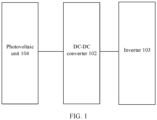
- FIG. 1 is a schematic diagram of a photovoltaic power generation system.
- the photovoltaic power generation system includes a photovoltaic unit 104, a DC-DC converter 102, and an inverter 103.
- the DC-DC converter 102 is configured to: perform direct current-direct current conversion on a direct current that is output by the corresponding photovoltaic unit 104, and then transmit a converted direct current to the inverter 103.
- an insulation resistance value of the photovoltaic power generation system decreases. In this case, the photovoltaic power generation system can be powered off for troubleshooting.
- this application provides a photovoltaic power generation system and a method.
- a leakage current detection apparatus is added to each direct current branch circuit of the photovoltaic power generation system, so that a leakage current of each direct current branch circuit can be detected and a detection result can be sent to a controller.
- the controller can determine, based on values and directions of leakage currents of the direct current branch circuits before the photovoltaic power generation system runs, a direct current branch circuit on which an insulation fault occurs, and can further determine, when a value of a leakage current of the direct current branch circuit exceeds a preset range when the photovoltaic power generation system runs, that an insulation fault occurs on the direct current branch circuit. Therefore, a direct current branch circuit on which an insulation fault occurs in the photovoltaic power generation system can be determined, so that the direct current branch circuit on which the insulation fault occurs can be controlled in time to stop working to isolate the insulation fault.
- a direct current branch circuit on which an insulation fault occurs is referred to as a faulty branch circuit.
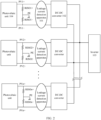
- FIG. 2 is a schematic diagram of a photovoltaic power generation system according to an embodiment of this invention.
- the photovoltaic power generation system includes an inverter 103, a controller (not shown in the figure), and at least two direct current branch circuits.
- a quantity of direct current branch circuits may be greater than or equal to 2.
- Each direct current branch circuit includes a leakage current detection apparatus 101 and a DC-DC converter 102.
- An input end of the DC-DC converter 102 is connected to a corresponding photovoltaic unit 104, and an output end of the DC-DC converter 102 is connected to an input end of the inverter 103.
- the DC-DC converter 102 is configured to: perform direct current-direct current conversion on a direct current that is output by the corresponding photovoltaic unit 104, and then transmit a converted direct current to the inverter 103.
- the photovoltaic unit 104 in this embodiment may include one photovoltaic component, or may include a plurality of photovoltaic component strings connected in parallel. For example, a plurality of photovoltaic components are first connected in series to form photovoltaic component strings, and then the plurality of photovoltaic component strings are connected in parallel to form a photovoltaic unit.
- a specific quantity of photovoltaic components is not specifically limited in this embodiment, and may be set by a person skilled in the art based on an actual application scenario.
- the DC-DC converter 102 is configured to perform power conversion, for example, may be specifically a boost (boost) circuit, configured to implement MPPT adjustment.
- boost boost
- the inverter 103 is configured to invert the direct current transmitted by the DC-DC converter 102 into an alternating current.
- the direct current branch circuits are first connected in parallel and then connected to the input end of the inverter 103 . It may be understood that the direct current branch circuits may be alternatively connected to different input ports of the inverter 103 and connected in parallel inside the inverter 103. This is not specifically limited in this embodiment.
- the leakage current detection apparatus 101 is configured to: detect a leakage current of the direct current branch circuit on which the leakage current detection apparatus 101 is located, and send the leakage current to the controller.
- the leakage current detection apparatus 101 detects a leakage current on a direct current side.
- the leakage current detection apparatus 101 is located between the photovoltaic unit 104 and the DC-DC converter 102 is used. It may be understood that alternatively, the leakage current detection apparatus 101 of each direct current branch circuit may be integrated into the corresponding DC-DC converter 102 or integrated into the inverter 103, or may be separately disposed, for example, connected between the DC-DC converter 102 and the inverter 103.
- the leakage current detection apparatus 101 When the leakage current detection apparatus 101 is integrated into the corresponding DC-DC converter 102, the leakage current detection apparatus 101 may be integrated into the input end of the DC-DC converter 102 or integrated into the output end of the DC-DC converter 102.
- leakage current detection apparatus 101 is located between the photovoltaic unit 104 and the DC-DC converter 102 in the following for description.
- the leakage current detection apparatus 101 is located in another position, a working principle is similar, and details are not described in this embodiment of the invention.
- the leakage current detection apparatus 101 is configured to: before the photovoltaic power generation system runs and when the photovoltaic power generation system runs, detect currents of a positive output branch circuit PV+ and a negative output branch circuit PV- of the photovoltaic unit 104 on the direct current branch circuit on which the leakage current detection apparatus 101 is located.
- the leakage current detection apparatus 101 may use a difference between a current value of the positive output branch circuit PV+ and a current value of the negative output branch circuit PV- as a leakage current detection value, and then send the leakage current detection value I RCD to the controller.
- the controller determines, based on values and directions of leakage currents of the direct current branch circuits, a direct current branch circuit on which an insulation fault occurs.
- a leakage current of a normal direct current branch circuit flows to the direct current branch circuit on which the insulation fault occurs. Therefore, a value of a leakage current of the direct current branch circuit on which the insulation fault occurs is a sum of values of leakage currents of all normal direct current branch circuits, and a direction of the leakage current of the direct current branch circuit on which the insulation fault occurs is opposite to directions of the leakage currents of all the normal direct current branch circuits. Therefore, the controller can determine, based on the values and the directions of the leakage currents of the direct current branch circuits, the direct current branch circuit on which the insulation fault occurs. The following is an example.
- a direct current branch circuit 1 to a direct current branch circuit 5 and an insulation fault occurs on a PV1+ branch circuit of the direct current branch circuit 1 is used for description.
- leakage current detection values of the direct current branch circuits refer to Table 1.
- Table 1 Data table of leakage current detection values during short circuit of a PV branch circuit Leakage current detection value (mA)
- Direct current branch circuit 1 Direct current branch circuit 2
- Direct current branch circuit 3 Direct current branch circuit 4
- Direct current branch circuit 5 Insulation fault on the PV1+ branch circuit -40 +10 +10 +10 +10 +10 +10
- the positive and negative signs in front of the leakage current detection values represent different directions of leakage currents.
- the photovoltaic power generation system determines that before running, no insulation fault occurs or an insulation fault has been eliminated, the photovoltaic power generation system can enter a running state.
- an insulation fault may occur due to accidental collision with human or livestock, rainy or snowy weather, or the like, and a leakage current of a direct current branch circuit on which the insulation fault occurs significantly increases. Therefore, it can be determined, based on a value of a leakage current of the direct current branch circuit, whether an insulation fault occurs on the direct current branch circuit.
- a preset range that is of a value of a leakage current of the direct current branch circuit and that is obtained when no insulation fault occurs on the direct current branch circuit may be determined in advance.
- the leakage current detection apparatus 101 detects, in real time, a leakage current of the direct current branch circuit on which the leakage current detection apparatus 101 is located, and sends the leakage current to the controller.
- the controller is further configured to: when a value of the leakage current of the direct current branch circuit exceeds the preset range, determine that an insulation fault occurs on the direct current branch circuit.
- the preset range may be set based on an actual application scenario, and is not specifically limited in this embodiment of the invention.
- Each direct current branch circuit of the photovoltaic power generation system provided in this embodiment includes the DC-DC converter and the leakage current detection apparatus.
- the leakage current detection apparatus can detect the leakage current of the direct current branch circuit on which the leakage current detection apparatus is located, and send a detection result of the leakage current to the controller of the photovoltaic power generation system.
- a leakage current of a normal direct current branch circuit flows to a direct current branch circuit on which the insulation fault occurs.
- a value of a leakage current of the direct current branch circuit on which the insulation fault occurs is a sum of values of leakage currents of all normal direct current branch circuits, and a direction of the leakage current of the direct current branch circuit on which the insulation fault occurs is opposite to directions of the leakage currents of all the normal direct current branch circuits. Therefore, the controller of the photovoltaic power generation system can determine, based on the values and the directions of the leakage currents of the direct current branch circuits, the direct current branch circuit on which the insulation fault occurs.
- a value of a leakage current of a direct current branch circuit on which the insulation fault occurs significantly increases. Therefore, when the value of the leakage current of the direct current branch circuit exceeds the preset range, the controller can determine that the insulation fault occurs on the direct current branch circuit.
- the photovoltaic power generation system provided in this embodiment of this application can determine, before running or when running, a direct current branch circuit on which an insulation fault occurs, so that the direct current branch circuit on which the insulation fault occurs can be controlled in time to stop working to isolate the insulation fault, to eliminate a potential safety hazard.
- Each direct current branch circuit of the photovoltaic power generation system provided in the foregoing embodiment includes the leakage current detection apparatus, so that the leakage current of the corresponding direct current branch circuit can be detected before the photovoltaic power generation system runs.
- An embodiment of this invention further provides a photovoltaic power generation system, so that a value of an insulation resistance to earth of the photovoltaic power generation system can be detected, so that it can be first determined whether an insulation fault occurs in the entire photovoltaic power generation system.
- a direct current branch circuit on which the insulation fault occurs is positioned based on leakage currents detected by a leakage current detection apparatus. If no insulation fault occurs, no insulation fault needs to be positioned based on leakage currents detected by the leakage current detection apparatus, thereby improving working efficiency.
- FIG. 3 is a schematic diagram of another photovoltaic power generation system according to an embodiment of this invention.
- the photovoltaic power generation system further includes an insulation resistance detection apparatus 105.
- the insulation resistance detection apparatus 105 may be an independent apparatus. It may be understood that alternatively, the insulation resistance detection apparatus 105 may be integrated into the inverter 103, integrated into a DC-DC converter 102, or integrated into a photovoltaic unit 104, or may be disposed outside the photovoltaic power generation system. When the insulation resistance detection apparatus 105 is integrated into the DC-DC converter 102, the insulation resistance detection apparatus 105 may be integrated into an input end or an output end of the DC-DC converter 102. A disposition position of the insulation resistance detection apparatus 105 is not specifically limited in this embodiment of the invention.
- the photovoltaic power generation system When no insulation fault occurs in the photovoltaic power generation system, the photovoltaic power generation system is insulated from earth. When an insulation fault occurs in the photovoltaic power generation system, a value of an insulation resistance to earth of the photovoltaic power generation system decreases. Therefore, a preset resistance range that is of the photovoltaic power generation system and that is obtained when no insulation fault occurs in the photovoltaic power generation system may be determined in advance.
- the insulation resistance detection apparatus 105 is used to detect a value of an insulation resistance to earth of the photovoltaic power generation system, and send the value of the insulation resistance to earth to a controller.
- the controller is further configured to: when the value of the insulation resistance to earth is less than the preset resistance range, determine that the insulation fault occurs in the photovoltaic power generation system.
- the preset resistance range may be set based on an actual application scenario, and is not specifically limited herein in this embodiment of this invention.
- the photovoltaic power generation system provided in this embodiment of this invention further has the insulation resistance detection apparatus, so that the value of the insulation resistance to earth of the photovoltaic power generation system can be detected, and the value of the insulation resistance to earth can be sent to the controller, so that the controller can determine, when the value of the insulation resistance to earth is less than the preset resistance range, that the insulation fault occurs in the photovoltaic power generation system.
- leakage current detection apparatuses may be used to detect leakage currents of the direct current branch circuits, and send the leakage currents to the controller, so that the controller determines, based on values and directions of the leakage currents of the direct current branch circuits, a direct current branch circuit on which the insulation fault occurs.
- the leakage current detection apparatuses do not need to detect leakage currents of the direct current branch circuits. Therefore, insulation resistance detection efficiency can be improved.
- Embodiment 3 of this application further provides a photovoltaic power generation system, so that it can be further determined, based on a voltage to earth of an input end or a voltage to earth of an output end of a DC-DC converter, whether an insulation fault occurs on a direct current branch circuit, to verify whether an insulation fault determined based on leakage currents is accurate.
- FIG. 4 is a schematic diagram of still another photovoltaic power generation system according to an embodiment of the invention.
- each direct current branch circuit further includes an input voltage detection apparatus 106.
- the input voltage detection apparatus 106 may be connected to an input end of a DC-DC converter 102, and may be specifically integrated into the DC-DC converter 102 or integrated into a photovoltaic unit 104, or may be separately disposed. This is not specifically limited in this embodiment of the invention.
- the input voltage detection apparatus 106 is configured to detect a voltage to earth of the input end of the DC-DC converter 102 of the corresponding direct current branch circuit.
- the voltage to earth of the input end may specifically include a voltage to earth of a positive input end and a voltage to earth of a negative input end.
- the input voltage detection apparatus 106 may further send a detection result to a controller.
- the preset input voltage range may include a preset input voltage range corresponding to the positive input end and a preset input voltage range corresponding to the negative input end.
- the controller compares, with the preset input voltage range corresponding to the positive input end, the voltage to earth that is of the positive input end and that is detected by the input voltage detection apparatus 106, and compares the voltage to earth of the negative input end with the preset input voltage range corresponding to the negative input end.
- the preset input voltage range may be set based on an actual application scenario, and is not specifically limited herein in this embodiment of the invention. For example, when an insulation fault to earth occurs at the positive input end of the DC-DC converter 102, the input voltage detection apparatus 106 detects a voltage of the positive input end. The controller may compare the detected voltage with a preset value. For example, when the preset value is 0, when the detected voltage is 0, it is determined that an insulation fault to earth occurs at the positive input end. For another example, when the preset value is a positive value near 0, when the detected voltage is less than or equal to the preset value, it is determined that an insulation fault to earth occurs at the positive input end.
- the controller determines that an insulation fault occurs on the corresponding direct current branch circuit.
- the controller may perform comparison verification on the determining conclusion and the determining conclusion obtained by using the leakage current of the direct current branch circuit in System Embodiment 1, to improve insulation fault detection accuracy. Therefore, erroneous determining of the controller can be effectively avoided, so that an insulation fault can be effectively isolated.
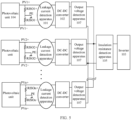
- FIG. 5 is a schematic diagram of yet another photovoltaic power generation system according to an embodiment of this invention.
- each direct current branch circuit further includes an output voltage detection apparatus 107.
- the output voltage detection apparatus 107 is connected to an output end of a DC-DC converter 102, and may be specifically integrated into the DC-DC converter 102, or may be separately disposed. This is not specifically limited in this embodiment of the invention.
- the output voltage detection apparatus 107 is configured to detect a voltage to earth of the output end of the DC-DC converter 102 of the corresponding direct current branch circuit.
- the voltage to earth of the output end may specifically include a voltage to earth of a positive output end and a voltage to earth of a negative output end.
- the output voltage detection apparatus 107 may further send a detection result to a controller.
- the preset output voltage range may include a preset output voltage range corresponding to the positive output end and a preset output voltage range corresponding to the negative output end.
- the controller compares, with the preset output voltage range corresponding to the positive output end, the voltage to earth that is of the positive output end and that is detected by the output voltage detection apparatus 107, and compares the voltage to earth of the negative output end with the preset output voltage range corresponding to the negative output end.
- the preset output voltage range may be set based on an actual application scenario, and is not specifically limited herein in this embodiment of the application.
- the controller determines that an insulation fault occurs on the corresponding direct current branch circuit.
- the controller may perform comparison verification on the determining conclusion and the determining conclusion obtained by using the leakage current of the direct current branch circuit in System Embodiment 1, to improve insulation fault detection accuracy. Therefore, erroneous determining of the controller can be effectively avoided, so that an insulation fault can be effectively isolated.
- FIG. 6 is a schematic diagram of still yet another photovoltaic power generation system according to an embodiment of this invention.
- each direct current branch circuit further includes an input voltage detection apparatus 106 and an output voltage detection apparatus 107.
- voltage detection apparatuses are added to both an input end and an output end of a DC-DC converter 102, so that a controller can more accurately determine, based on detection results of the voltage detection apparatuses at the input end and the output end of the DC-DC converter 102, a direct current branch circuit on which an insulation fault occurs.
- the controller may perform comparison verification on the obtained determining conclusion and the determining conclusion obtained by using the leakage current of the direct current branch circuit in System Embodiment 1, to further improve insulation fault detection accuracy. Therefore, erroneous determining of the controller can be effectively avoided, so that an insulation fault can be effectively isolated.
- a leakage current detection apparatus is added to each direct current branch circuit of the photovoltaic power generation system provided in this embodiment of the invention, and further a voltage detection apparatus is added to at least one of the input end and the output end of the DC-DC converter, so that the controller determines, based on a detection result of the voltage detection apparatus, a direct current branch circuit on which an insulation fault occurs, or may perform comparison verification on the obtained determining conclusion and the determining conclusion obtained by using the leakage current of the direct current branch circuit in System Embodiment 1, to further improve insulation fault detection accuracy. Therefore, the photovoltaic power generation system provided in this embodiment of this invention can effectively avoid erroneous determining of the controller, thereby improving accuracy during insulation fault isolation.
- the faulty branch circuit can be further controlled to be disconnected, to implement insulation fault isolation.
- a power converter of the faulty branch circuit may be controlled, by using the controller, to be powered off to isolate the insulation fault.
- a breaking apparatus may be added to each direct current branch circuit to isolate the insulation fault. This is specifically described in the following with reference to the accompanying drawings.
- FIG. 7 is a schematic diagram of a further photovoltaic power generation system according to an embodiment of the invention.
- each direct current branch circuit further includes a breaking apparatus 108.
- the breaking apparatus 108 is disposed at an output end of a DC-DC converter 102 and is used as an independent apparatus. It may be understood that in actual application, alternatively, the breaking apparatus 108 may be disposed at an input end of the DC-DC converter 102 as an independent apparatus, integrated into an input end of the DC-DC converter 102, integrated into an input end of an inverter 103, or integrated into a photovoltaic unit 104. In addition, when direct current branch circuits are connected to different input ports of the inverter 103 and connected in parallel inside the inverter 103, the breaking apparatus 108 may be alternatively integrated into the inverter 103. A disposition position of the breaking apparatus 108 in the photovoltaic power generation system is not specifically limited in this embodiment of this invention.
- a controller is further configured to: when determining that an insulation fault occurs on the direct current branch circuit, control the breaking apparatus 108 on the direct current branch circuit on which the insulation fault occurs to be disconnected. After the breaking apparatus 108 is disconnected, the faulty branch circuit on which the breaking apparatus 108 is located is broken. Therefore, the faulty branch circuit cannot be connected to the inverter 103, thereby implementing insulation fault isolation.
- the controller controls the DC-DC converter 102 on the direct current branch circuit on which the insulation fault occurs to be powered off.
- FIG. 8 is a schematic diagram of a still further photovoltaic power generation system according to an embodiment of the invention.
- the photovoltaic power generation system further includes an insulation resistance detection apparatus 105, so that a value of an insulation resistance to earth of the photovoltaic power generation system can be detected, and the value of the insulation resistance to earth can be sent to a controller, so that the controller can determine, when the value of the insulation resistance to earth is less than a preset resistance range, that an insulation fault occurs in the photovoltaic power generation system.
- leakage current detection apparatuses may be used to detect leakage currents of direct current branch circuits, and send the leakage currents to the controller, so that the controller determines, based on values and directions of the leakage currents of the direct current branch circuits, a direct current branch circuit on which the insulation fault occurs.
- the leakage current detection apparatuses do not need to detect leakage currents of the direct current branch circuits. Therefore, insulation resistance detection efficiency can be improved.
- an input voltage detection apparatus may be also added to an input end of a DC-DC converter 102 of each direct current branch circuit and/or an output voltage detection apparatus may be also added to an output end of the DC-DC converter 102.
- an input voltage detection apparatus may be also added to an input end of a DC-DC converter 102 of each direct current branch circuit and/or an output voltage detection apparatus may be also added to an output end of the DC-DC converter 102.
- the breaking apparatus is also added to each direct current branch circuit of the photovoltaic power generation system provided in this embodiment of this invention, so that when the controller determines, based on a detection result of the leakage current detection apparatus, a direct current branch circuit on which an insulation fault occurs, the controller may further control a breaking apparatus on the direct current branch circuit on which the insulation fault occurs to be disconnected, to implement insulation fault isolation.
- a leakage current of a direct current branch circuit on which a leakage current detection apparatus is located may be detected by using the leakage current detection apparatus, so that a direct current branch circuit on which an insulation fault occurs is determined by using a controller.
- An embodiment of the invention further provides a photovoltaic power generation system.
- Each direct current branch circuit includes a breaking apparatus but does not include a leakage current detection apparatus.
- FIG. 9 is a schematic diagram of a yet further photovoltaic power generation system according to an unclaimed example.
- the photovoltaic power generation system includes an insulation resistance detection apparatus 105, an inverter 103, a controller (not shown in the figure), and at least two direct current branch circuits.
- a quantity of direct current branch circuits may be greater than or equal to 2.
- Each direct current branch circuit includes a DC-DC converter 102 and a breaking apparatus 108.
- the photovoltaic unit 104 in this embodiment of this application may include one photovoltaic component, or may include a plurality of photovoltaic component strings connected in parallel. For example, a plurality of photovoltaic components are first connected in series to form photovoltaic component strings, and then the plurality of photovoltaic component strings are connected in parallel to form a photovoltaic unit.
- a specific quantity of photovoltaic components is not specifically limited in this example and may be set by a person skilled in the art based on an actual application scenario.
- the DC-DC converter 102 is configured to perform power conversion, for example, may be specifically a boost (boost) circuit, configured to implement MPPT adjustment.
- the DC-DC converter 102 performs direct current-direct current conversion on a direct current that is output by the corresponding photovoltaic unit 104, and then transmits a converted direct current to the inverter 103.
- the inverter 103 is configured to invert the direct current transmitted by the DC-DC converter 102 into an alternating current.
- the direct current branch circuits are first connected in parallel and then connected to the input end of the inverter 103 . It may be understood that the direct current branch circuits may be alternatively connected to different input ports of the inverter 103 and connected in parallel inside the inverter 103. This is not specifically limited in this example.
- the photovoltaic power generation system When no insulation fault occurs in the photovoltaic power generation system, the photovoltaic power generation system is insulated from earth. When an insulation fault occurs in the photovoltaic power generation system, a value of an insulation resistance to earth of the photovoltaic power generation system decreases. Therefore, a preset resistance range that is of the photovoltaic power generation system and that is obtained when no insulation fault occurs in the photovoltaic power generation system may be determined in advance.
- the insulation resistance detection apparatus 105 is used to detect a value of an insulation resistance to earth of the photovoltaic power generation system, and send the value of the insulation resistance to earth to a controller. The controller can determine, when the value of the insulation resistance to earth is less than the preset resistance range, that the insulation fault occurs in the photovoltaic power generation system.
- the controller can further sequentially control breaking apparatuses 108 on the direct current branch circuits to be disconnected, to determine a direct current branch circuit on which the insulation fault occurs.
- a breaking apparatus breaks the direct current branch circuit on which the insulation fault occurs, it is equivalent that insulation fault isolation is implemented. After the photovoltaic power generation system isolates the insulation fault, the photovoltaic power generation system recovers to be insulated from earth. Therefore, if the breaking apparatus breaks the direct current branch circuit on which the insulation fault occurs, a detection result of the insulation resistance detection apparatus recovers to be in the preset resistance range.
- the controller may sequentially control the breaking apparatuses on the direct current branch circuits to be disconnected, and further determine, based on a detection result that is of the insulation resistance detection apparatus and that is obtained after the breaking apparatus is disconnected, the direct current branch circuit on which the insulation fault occurs.
- the controller can sequentially control the breaking apparatuses on the direct current branch circuits to be disconnected, to determine a direct current branch circuit on which the insulation fault occurs, so that insulation fault isolation can be performed in time on the direct current branch circuit on which the insulation fault occurs, to eliminate a potential safety hazard.
- an embodiment of this invention further provides a method for diagnosing an insulation fault of a photovoltaic power generation system. This is specifically described in the following with reference to the accompanying drawings.
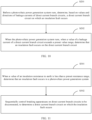
- FIG. 10 is a flowchart of a method for diagnosing an insulation fault of a photovoltaic power generation system according to an embodiment of the invention.
- the photovoltaic power generation system includes an inverter, a controller, and at least two direct current branch circuits.
- Each direct current branch circuit includes a DC-DC converter and a leakage current detection apparatus.
- An input end of the DC-DC converter is connected to a corresponding photovoltaic unit, and an output end of the DC-DC converter is connected to an input end of the inverter.
- the DC-DC converter is configured to: perform direct current-direct current conversion on a direct current that is output by the corresponding photovoltaic unit, and then send a converted direct current to the inverter.
- the inverter is configured to invert the direct current transmitted by the DC-DC converter into an alternating current.
- the leakage current detection apparatus is configured to detect a leakage current of the direct current branch circuit on which the leakage current detection apparatus is located.
- the method in this embodiment may be implemented by a controller.
- the method provided in this embodiment includes the following steps:
- the leakage current detection apparatus of each direct current branch circuit detects a leakage current of the direct current branch circuit on which the leakage current detection apparatus is located, and sends a detection result of the leakage current to the controller.
- a leakage current of a normal direct current branch circuit flows to the direct current branch circuit on which the insulation fault occurs. Therefore, a value of a leakage current of the direct current branch circuit on which the insulation fault occurs is a sum of values of leakage currents of all normal direct current branch circuits, and a direction of the leakage current of the direct current branch circuit on which the insulation fault occurs is opposite to directions of the leakage currents of all the normal direct current branch circuits. Therefore, the controller can determine, based on the values and the directions of the leakage currents of the direct current branch circuits, the direct current branch circuit on which the insulation fault occurs.
- the preset range that is of a value of a leakage current of the direct current branch circuit and that is obtained when no insulation fault occurs on the direct current branch circuit may be determined in advance.
- the controller is further configured to: when the value of the leakage current of the direct current branch circuit exceeds the preset range, determine that the insulation fault occurs on the direct current branch circuit.
- the preset range may be set based on an actual application scenario, and is not specifically limited in this embodiment of the invention.
- the direct current branch circuit on which the insulation fault occurs can be determined based on the values and the directions of the leakage currents of the direct current branch circuits; and further, when the photovoltaic power generation system runs, when the value of the leakage current of the direct current branch circuit exceeds the preset range, it can be determined that the insulation fault occurs on the direct current branch circuit.
- a direct current branch circuit on which an insulation fault occurs can be determined before the photovoltaic power generation system runs or when the photovoltaic power generation system runs, so that the direct current branch circuit on which the insulation fault occurs can be controlled in time to stop working to isolate the insulation fault, to eliminate a potential safety hazard.
- the method may further include the following steps:
- the photovoltaic power generation system When no insulation fault occurs in the photovoltaic power generation system, the photovoltaic power generation system is insulated from earth. When an insulation fault occurs in the photovoltaic power generation system, a value of an insulation resistance to earth of the photovoltaic power generation system decreases. Therefore, the preset resistance range that is of the photovoltaic power generation system and that is obtained when no insulation fault occurs in the photovoltaic power generation system may be determined in advance. Before the photovoltaic power generation system runs, the insulation resistance detection apparatus is used to detect the value of the insulation resistance to earth of the photovoltaic power generation system, and send the value of the insulation resistance to earth to the controller.
- the controller can determine, when the value of the insulation resistance to earth is less than the preset resistance range, that the insulation fault occurs in the photovoltaic power generation system.
- leakage current detection apparatuses may be used to detect leakage currents of the direct current branch circuits, and send the leakage currents to the controller, so that the controller determines, based on values and directions of the leakage currents of the direct current branch circuits, a direct current branch circuit on which the insulation fault occurs.
- the leakage current detection apparatuses may be controlled to no longer detect leakage currents of the direct current branch circuits. Therefore, insulation resistance detection efficiency can be improved.
- the method further includes the following steps:
- the voltage to earth of the input end of the DC-DC converter of the corresponding direct current branch circuit is detected by using the input voltage detection apparatus.
- the voltage to earth of the input end may specifically include a voltage to earth of a positive input end and a voltage to earth of a negative input end.
- the input voltage detection apparatus may further send a detection result to the controller.
- the preset input voltage range that is of the direct current branch circuit and that is obtained when no insulation fault occurs on the direct current branch circuit may be determined in advance.
- the preset input voltage range may include a preset input voltage range corresponding to the positive input end and a preset input voltage range corresponding to the negative input end.
- the controller can compare, with the preset input voltage range corresponding to the positive input end, the voltage to earth that is of the positive input end and that is detected by the input voltage detection apparatus, and compare the voltage to earth of the negative input end with the preset input voltage range corresponding to the negative input end.
- the controller determines that the insulation fault occurs on the corresponding direct current branch circuit.
- the controller may perform comparison verification on the determining conclusion and the determining conclusion obtained by using the leakage current of the direct current branch circuit in S202, to improve insulation fault detection accuracy. Therefore, erroneous determining of the controller can be effectively avoided, so that an insulation fault can be effectively isolated.
- the method further includes the following steps:
- the voltage to earth of the output end of the DC-DC converter of the corresponding direct current branch circuit is detected by using the output voltage detection apparatus.
- the voltage to earth of the output end may specifically include a voltage to earth of a positive output end and a voltage to earth of a negative output end.
- the output voltage detection apparatus may further send a detection result to the controller.
- the preset output voltage range that is of the direct current branch circuit and that is obtained when no insulation fault occurs on the direct current branch circuit may be determined in advance.
- the preset output voltage range may include a preset output voltage range corresponding to the positive output end and a preset output voltage range corresponding to the negative output end.
- the controller compares, with the preset output voltage range corresponding to the positive output end, the voltage to earth that is of the positive output end and that is detected by the output voltage detection apparatus, and compares the voltage to earth of the negative output end with the preset output voltage range corresponding to the negative output end.
- the controller determines that the insulation fault occurs on the corresponding direct current branch circuit.
- the controller may perform comparison verification on the determining conclusion and the determining conclusion obtained by using the leakage current of the direct current branch circuit in S202, to improve insulation fault detection accuracy. Therefore, erroneous determining of the controller can be effectively avoided, so that an insulation fault can be effectively isolated.
- each direct current branch circuit of the photovoltaic power generation system further includes a breaking apparatus
- the method further includes the following step: when determining that an insulation fault occurs on the direct current branch circuit, controlling the breaking apparatus on the direct current branch circuit on which the insulation fault occurs to be disconnected, so that the faulty branch circuit is broken, to isolate the insulation fault.
- a further unclaimed example provides a method for diagnosing an insulation fault of a photovoltaic power generation system.
- the method can be applied to a photovoltaic power generation system in which a direct current branch circuit does not include a leakage current detection apparatus. This is specifically described in the following with reference to the accompanying drawings.
- FIG. 11 is a flowchart of another method for diagnosing an insulation fault of a photovoltaic power generation system according to this example, which is not part of the claimed invention.
- the photovoltaic power generation system includes an insulation resistance detection apparatus, an inverter, a controller, and at least two direct current branch circuits.
- Each direct current branch circuit includes a DC-DC converter and a breaking apparatus.
- An input end of the DC-DC converter is connected to a corresponding photovoltaic unit, and an output end of the DC-DC converter is connected to an input end of the inverter.
- the DC-DC converter is configured to: perform direct current-direct current conversion on a direct current that is output by the corresponding photovoltaic unit, and then transmit a converted direct current to the inverter.
- the inverter is configured to invert the direct current transmitted by the DC-DC converter into an alternating current.
- the insulation resistance detection apparatus is configured to: before the photovoltaic power generation system runs, detect a value of an insulation resistance to earth of the photovoltaic power generation system, and send a detection result to the controller.
- the method in this example may be implemented by a controller.
- the method provided in this example includes the following steps:
- the photovoltaic power generation system When no insulation fault occurs in the photovoltaic power generation system, the photovoltaic power generation system is insulated from earth. When an insulation fault occurs in the photovoltaic power generation system, a value of an insulation resistance to earth of the photovoltaic power generation system decreases. Therefore, the preset resistance range that is of the photovoltaic power generation system and that is obtained when no insulation fault occurs in the photovoltaic power generation system may be determined in advance. Before the photovoltaic power generation system runs, the insulation resistance detection apparatus is used to detect the value of the insulation resistance to earth of the photovoltaic power generation system, and send the value of the insulation resistance to earth to the controller.
- the controller can determine, when the value of the insulation resistance to earth is less than the preset resistance range, that the insulation fault occurs in the photovoltaic power generation system.
- a breaking apparatus breaks the direct current branch circuit on which the insulation fault occurs, it is equivalent that insulation fault isolation is implemented. After the photovoltaic power generation system isolates the insulation fault, the photovoltaic power generation system recovers to be insulated from earth. Therefore, if the breaking apparatus breaks the direct current branch circuit on which the insulation fault occurs, a detection result of the insulation resistance detection apparatus recovers to be in the preset resistance range.
- the controller may sequentially control the breaking apparatuses on the direct current branch circuits to be disconnected, and further determine, based on a detection result that is of the insulation resistance detection apparatus and that is obtained after the breaking apparatus is disconnected, the direct current branch circuit on which the insulation fault occurs.
- the controller can sequentially control the breaking apparatuses on the direct current branch circuits to be disconnected, to determine a direct current branch circuit on which the insulation fault occurs, so that insulation fault isolation can be performed in time on the direct current branch circuit on which the insulation fault occurs, to eliminate a potential safety hazard.
- At least one (item) means one or more, and "a plurality of” means two or more.
- the term “and/or” is used to describe an association relationship between associated objects, and indicates that three relationships may exist.
- a and/or B may represent the following three cases: Only A exists, only B exists, and both A and B exist, where A and B may be singular or plural.
- the character “/” generally indicates an “or” relationship between the associated objects.
- At least one of the following items (pieces) or a similar expression thereof indicates any combination of these items, including a single item (piece) or any combination of a plurality of items (pieces).
- At least one of a, b, or c may indicate a, b, c, "a and b", “a and c", “b and c", or "a, b, and c", where a, b, and c may be singular or plural.
Landscapes
- Engineering & Computer Science (AREA)
- Power Engineering (AREA)
- Testing Of Short-Circuits, Discontinuities, Leakage, Or Incorrect Line Connections (AREA)
- Emergency Protection Circuit Devices (AREA)
- Photovoltaic Devices (AREA)
Description
- This application relates to the field of photovoltaic power generation technologies, and in particular, to a photovoltaic power generation system and a method.
- Photovoltaic power generation is a technology that uses a photovoltaic effect of a semiconductor interface to convert light energy into electric energy. A photovoltaic power generation system usually includes devices such as a photovoltaic unit, a power converter, and an inverter.
- As an input capacity configuration of the photovoltaic power generation system is increasingly high, an electric energy yield is usually expanded in a multi-channel MPPT (Maximum Power Point Tracking, maximum power point tracking) manner, that is, an input end of an inverter includes a plurality of direct current branch circuits, and each direct current branch circuit includes a photovoltaic unit and a power converter.
- For a photovoltaic power generation system that includes a plurality of direct current branch circuits, an insulation fault on a direct current branch circuit causes a potential safety hazard for running of the photovoltaic power generation system and contact with human or livestock. Therefore, insulation fault detection needs to be performed on the photovoltaic power generation system. It may be determined, by detecting a value of an overall insulation resistance to earth of the photovoltaic power generation system, whether an insulation fault occurs in the photovoltaic power generation system. However, when it is determined that an insulation fault occurs in the photovoltaic power generation system, a direct current branch circuit on which the insulation fault occurs cannot be specifically positioned, and therefore the fault cannot be isolated before the photovoltaic power generation system runs or when the photovoltaic power generation system runs.
-
EP 3264550 A1 describes a device and an access control method of parallel direct current power. Direct current power supplies with single insulation resistances to ground failing to meet a first preset condition or causing a total insulation resistances to fail to meet a second preset condition are disconnected from a grid-connected inverter, and direct current power supplies with single insulation resistance to ground meeting the first preset condition and enabling the total insulation resistance to meet the second preset condition are connected with the grid-connected inverter for grid-connected inverting. -
EP 2750258 A2 describes a method for determining a ground fault or insulation degradation condition within energy conversion systems are described. The method includes, a comparison of baseline waveform of differential current to a waveform of differential current during operation for a plurality of DC current carrying conductors in an energy conversion system. The method may include, a comparison of baseline frequency spectra of differential current to frequency spectra of differential current transient at start-up for a plurality of DC current carrying conductors in an energy conversion system. -
CN 105 606 897 B -
EP 2648009 A1 describes a ground fault detection device for detecting a ground fault within a photovoltaic array in a solar energy generator system. The ground fault detection device includes a detection section for detecting a ground fault in the photovoltaic array or the photovoltaic string while the photovoltaic array or a photovoltaic string is switched off by a switching section. -
CN 203 117 365 U describes an online insulation monitoring system for a photovoltaic grid-connected power generation system. The online insulation monitoring system includes an insulation intelligent leakage current sensor, an insulation balancing resistor, an insulation voltage transmitter, an insulation monitor. - To resolve the foregoing technical problem, this application provides a photovoltaic power generation system and a method, to determine a direct current branch circuit on which an insulation fault occurs in the photovoltaic power generation system, so that measures are taken in time for the direct current branch circuit on which the insulation fault occurs, to eliminate a potential safety hazard. This is achieved by the features of the independent claims. Further advantageous embodiments are subject-matter of the dependent claims.
- Hereinafter, before coming to a detailed description of the embodiments of the invention with reference to the attached drawings, some general aspects which are useful for contributing to the understanding of the inventive details in these embodiments are described below separately.
- According to a first aspect, this application provides a photovoltaic power generation system. The system includes an inverter, a controller, and at least two direct current branch circuits. Each direct current branch circuit includes a DC-DC converter and a leakage current detection apparatus. An input end of the DC-DC converter is connected to a corresponding photovoltaic unit, and an output end of the DC-DC converter is connected to an input end of the inverter. The DC-DC converter is configured to: perform DC-DC conversion on a direct current that is output by the corresponding photovoltaic unit, and then transmit a converted direct current to the inverter. The inverter is configured to invert the direct current transmitted by the DC-DC converter into an alternating current. The leakage current detection apparatus is configured to: detect a leakage current of the direct current branch circuit on which the leakage current detection apparatus is located, and send the leakage current to the controller. The controller is configured to: before the photovoltaic power generation system runs, determine, based on values and directions of leakage currents of the direct current branch circuits, a direct current branch circuit on which an insulation fault occurs. The controller is further configured to: when the photovoltaic power generation system runs, when a value of a leakage current of the direct current branch circuit exceeds a preset range, determine that an insulation fault occurs on the direct current branch circuit.
- When an insulation fault occurs in the photovoltaic power generation system before the photovoltaic power generation system runs, a leakage current of a normal direct current branch circuit flows to a direct current branch circuit on which the insulation fault occurs. Therefore, a value of a leakage current of the direct current branch circuit on which the insulation fault occurs is a sum of values of leakage currents of all normal direct current branch circuits, and a direction of the leakage current of the direct current branch circuit on which the insulation fault occurs is opposite to directions of the leakage currents of all the normal direct current branch circuits. Therefore, the controller can determine, based on the values and the directions of the leakage currents of the direct current branch circuits, the direct current branch circuit on which the insulation fault occurs. When an insulation fault occurs in the photovoltaic power generation system when the photovoltaic power generation system runs, a value of a leakage current of a direct current branch circuit on which the insulation fault occurs significantly increases. Therefore, when the value of the leakage current of the direct current branch circuit exceeds the preset range, the controller can determine that the insulation fault occurs on the direct current branch circuit, so that measures are taken in time for the direct current branch circuit on which the insulation fault occurs, to eliminate a potential safety hazard.
- With reference to the first aspect, in a first possible implementation, the photovoltaic power generation system further includes an insulation resistance detection apparatus. The insulation resistance detection apparatus is configured to: before the photovoltaic power generation system runs, detect a value of an insulation resistance to earth of the photovoltaic power generation system, and send the value of the insulation resistance to earth to the controller. The controller is configured to: when the value of the insulation resistance to earth is less than a preset resistance range, determine that an insulation fault occurs in the photovoltaic power generation system.
- When the insulation resistance detection apparatus determines that the insulation fault occurs in the photovoltaic power generation system, leakage current detection apparatuses may be used to detect leakage currents of the direct current branch circuits, and send the leakage currents to the controller, so that the controller determines, based on values and directions of the leakage currents of the direct current branch circuits, a direct current branch circuit on which the insulation fault occurs. When it is determined that no insulation fault occurs in the photovoltaic power generation system, the leakage current detection apparatuses do not need to detect leakage currents of the direct current branch circuits. Therefore, insulation resistance detection efficiency can be improved.
- With reference to any one of the first aspect or the foregoing implementation, in a second possible implementation, each direct current branch circuit further includes an input voltage detection apparatus. The input voltage detection apparatus is configured to detect a voltage to earth of the input end of the DC-DC converter of the corresponding direct current branch circuit. The controller is further configured to: when the voltage to earth of the input end of the DC-DC converter is less than a preset input voltage range, determine that an insulation fault occurs on the corresponding direct current branch circuit.
- The input voltage detection apparatus is added to the input end of the DC-DC converter, so that the controller determines, based on a detection result of the input voltage detection apparatus, a direct current branch circuit on which an insulation fault occurs, or may perform comparison verification on the obtained determining conclusion and the determining conclusion obtained by using the leakage current of the direct current branch circuit, to further improve insulation fault detection accuracy.
- With reference to any one of the first aspect or the foregoing implementations, in a third possible implementation, each direct current branch circuit further includes an output voltage detection apparatus. The output voltage detection apparatus is configured to detect a voltage to earth of the output end of the DC-DC converter of the corresponding direct current branch circuit. The controller is configured to: when the voltage to earth of the output end of the DC-DC converter is less than a preset output voltage range, determine that an insulation fault occurs on the corresponding direct current branch circuit.
- The output voltage detection apparatus is added to the output end of the DC-DC converter, so that the controller determines, based on a detection result of the output voltage detection apparatus, a direct current branch circuit on which an insulation fault occurs, or may perform comparison verification on the obtained determining conclusion and the determining conclusion obtained by using the leakage current of the direct current branch circuit, to further improve insulation fault detection accuracy.
- With reference to any one of the first aspect or the foregoing implementations, in a fourth possible implementation, each direct current branch circuit further includes a breaking apparatus. The controller is further configured to: when determining that an insulation fault occurs on the direct current branch circuit, control the breaking apparatus on the direct current branch circuit on which the insulation fault occurs to be disconnected, to fast isolate the insulation fault.
- With reference to any one of the first aspect or the foregoing implementations, in a fifth possible implementation, the controller is further configured to: after controlling the breaking apparatus on the direct current branch circuit on which the insulation fault occurs to be disconnected, control the DC-DC converter on the direct current branch circuit on which the insulation fault occurs to be powered off, to protect the corresponding direct current branch circuit, thereby facilitating fault maintenance.
- With reference to any one of the first aspect or the foregoing implementations, in a sixth possible implementation, the breaking apparatus of each direct current branch circuit is integrated into the DC-DC converter, or the breaking apparatus of each direct current branch circuit is integrated into the inverter. A specific disposition position of the breaking apparatus may be determined based on an actual case. This is not specifically limited in this application.
- With reference to any one of the first aspect or the foregoing implementations, in a seventh possible implementation, the leakage current detection apparatus of each direct current branch circuit is integrated into the corresponding DC-DC converter, or the leakage current detection apparatus of each direct current branch circuit is integrated into the inverter. A specific disposition position of the leakage current detection apparatus may be determined based on an actual case. This is not specifically limited in this application.
- According to a second unclaimed aspect, an example further provides a photovoltaic power generation system. The system includes an insulation resistance detection apparatus, an inverter, a controller, and at least two direct current branch circuits. Each direct current branch circuit includes a DC-DC converter and a breaking apparatus. An input end of the DC-DC converter is connected to a corresponding photovoltaic unit, and an output end of the DC-DC converter is connected to an input end of the inverter. The DC-DC converter is configured to: perform direct current-direct current conversion on a direct current that is output by the corresponding photovoltaic unit, and then transmit a converted direct current to the inverter. The inverter is configured to invert the direct current transmitted by the DC-DC converter into an alternating current. The insulation resistance detection apparatus is configured to: before the photovoltaic power generation system runs, detect a value of an insulation resistance to earth of the photovoltaic power generation system, and send the value of the insulation resistance to earth to the controller. The controller is configured to: when the value of the insulation resistance to earth is less than a preset resistance range, determine that an insulation fault occurs in the photovoltaic power generation system, and sequentially control breaking apparatuses on the direct current branch circuits to be disconnected, to determine a direct current branch circuit on which the insulation fault occurs.
- Before the photovoltaic power generation system runs, the value of the insulation resistance to earth of the photovoltaic power generation system is detected by using the insulation resistance detection apparatus, so that it can be first determined whether an insulation fault occurs in the entire photovoltaic power generation system. When determining that an insulation fault occurs in the photovoltaic power generation system, the controller can sequentially control the breaking apparatuses on the direct current branch circuits to be disconnected, to determine a direct current branch circuit on which the insulation fault occurs, so that insulation fault isolation can be performed in time on the direct current branch circuit on which the insulation fault occurs, to eliminate a potential safety hazard.
- According to a third aspect, this application further provides a method for diagnosing an insulation fault of a photovoltaic power generation system. The photovoltaic power generation system includes an inverter and at least two direct current branch circuits. Each direct current branch circuit includes a DC-DC converter and a leakage current detection apparatus. An input end of the DC-DC converter is connected to a corresponding photovoltaic unit, and an output end of the DC-DC converter is connected to an input end of the inverter. The method includes: controlling the DC-DC converter to perform direct current-direct current conversion on a direct current that is output by the corresponding photovoltaic unit, and then transmit a converted direct current to the inverter, controlling the inverter to invert the direct current transmitted by the DC-DC converter into an alternating current, and receiving a leakage current that is of the direct current branch circuit on which the leakage current detection apparatus is located and that is detected by the leakage current detection apparatus; before the photovoltaic power generation system runs, determining, based on values and directions of leakage currents of the direct current branch circuits, a direct current branch circuit on which an insulation fault occurs; and when the photovoltaic power generation system runs, when a value of a leakage current of the direct current branch circuit exceeds a preset range, determining that an insulation fault occurs on the direct current branch circuit.
- According to the method, before the photovoltaic power generation system runs, the direct current branch circuit on which the insulation fault occurs can be determined based on the values and the directions of the leakage currents of the direct current branch circuits; and further, when the photovoltaic power generation system runs, when the value of the leakage current of the direct current branch circuit exceeds the preset range, it can be determined that the insulation fault occurs on the direct current branch circuit. Therefore, according to the method, a direct current branch circuit on which an insulation fault occurs can be determined before the photovoltaic power generation system runs or when the photovoltaic power generation system runs, so that the direct current branch circuit on which the insulation fault occurs can be controlled in time to stop working to isolate the insulation fault, to eliminate a potential safety hazard.
- With reference to the third aspect, in a first possible implementation, before the determining, based on values and directions of leakage currents of the direct current branch circuits, a direct current branch circuit on which an insulation fault occurs, the method further includes: obtaining a value of an insulation resistance to earth of the photovoltaic power generation system; and when the value of the insulation resistance to earth is less than a preset resistance range, determining that the insulation fault occurs in the photovoltaic power generation system.
- When it is determined that the insulation fault occurs in the photovoltaic power generation system, leakage current detection apparatuses may be used to detect leakage currents of the direct current branch circuits, and send the leakage currents to a controller, so that the controller determines, based on values and directions of the leakage currents of the direct current branch circuits, a direct current branch circuit on which the insulation fault occurs. When it is determined that no insulation fault occurs in the photovoltaic power generation system, the leakage current detection apparatuses may be controlled to no longer detect leakage currents of the direct current branch circuits. Therefore, insulation resistance detection efficiency can be improved.
- With reference to any one of the third aspect or the foregoing implementation, in a second possible implementation, the method further includes: obtaining a voltage to earth of the input end of the DC-DC converter of the corresponding direct current branch circuit; and when the voltage to earth of the input end of the DC-DC converter is less than a preset input voltage range, determining that an insulation fault occurs on the corresponding direct current branch circuit.
- The controller may determine, based on a detection result of an input voltage detection apparatus, a direct current branch circuit on which an insulation fault occurs, or may perform comparison verification on the obtained determining conclusion and the determining conclusion obtained by using the leakage current of the direct current branch circuit, to further improve insulation fault detection accuracy.
- With reference to any one of the third aspect or the foregoing implementations, in a third possible implementation, the method further includes: obtaining a voltage to earth of the output end of the DC-DC converter of the corresponding direct current branch circuit; and when the voltage to earth of the output end of the DC-DC converter is less than a preset output voltage range, determining that an insulation fault occurs on the corresponding direct current branch circuit.
- The controller may determine, based on a detection result of an output voltage detection apparatus, a direct current branch circuit on which an insulation fault occurs, or may perform comparison verification on the obtained determining conclusion and the determining conclusion obtained by using the leakage current of the direct current branch circuit, to further improve insulation fault detection accuracy.
- With reference to any one of the third aspect and the foregoing implementations, in a fourth possible implementation, each direct current branch circuit includes a breaking apparatus; and the method further includes: when determining that an insulation fault occurs on the direct current branch circuit, controlling the breaking apparatus on the direct current branch circuit on which the insulation fault occurs to be disconnected, to fast and effectively isolate the insulation fault.
- With reference to any one of the third aspect and the foregoing implementations, in a fifth possible implementation, the method further includes: after controlling the breaking apparatus on the direct current branch circuit on which the insulation fault occurs to be disconnected, controlling the DC-DC converter on the direct current branch circuit on which the insulation fault occurs to be powered off, to protect the corresponding direct current branch circuit, thereby facilitating fault maintenance.
- According to a fourth unclaimed aspect, an example provides another method for diagnosing an insulation fault of a photovoltaic power generation system. The photovoltaic power generation system includes an insulation resistance detection apparatus, an inverter, and at least two direct current branch circuits. Each direct current branch circuit includes a DC-DC converter and a breaking apparatus. An input end of the DC-DC converter is connected to a corresponding photovoltaic unit, and an output end of the DC-DC converter is connected to an input end of the inverter. The method includes: controlling the DC-DC converter to perform direct current-direct current conversion on a direct current that is output by the corresponding photovoltaic unit, and then transmit a converted direct current to the inverter, controlling the inverter to invert the direct current transmitted by the DC-DC converter into an alternating current, and controlling the insulation resistance detection apparatus to detect, before the photovoltaic power generation system runs, a value of an insulation resistance to earth of the photovoltaic power generation system; when the value of the insulation resistance to earth is less than a preset resistance range, determining that an insulation fault occurs in the photovoltaic power generation system; and sequentially controlling breaking apparatuses on the direct current branch circuits to be disconnected, to determine a direct current branch circuit on which the insulation fault occurs.
- Before the photovoltaic power generation system runs, the value of the insulation resistance to earth of the photovoltaic power generation system is detected by using the insulation resistance detection apparatus, so that it can be first determined whether an insulation fault occurs in the entire photovoltaic power generation system. When determining that an insulation fault occurs in the photovoltaic power generation system, the controller can sequentially control the breaking apparatuses on the direct current branch circuits to be disconnected, to determine a direct current branch circuit on which the insulation fault occurs, so that insulation fault isolation can be performed in time on the direct current branch circuit on which the insulation fault occurs, to eliminate a potential safety hazard.
- This application has at least the following advantages:
Each direct current branch circuit of the photovoltaic power generation system provided in this application includes the DC-DC converter and the leakage current detection apparatus. The leakage current detection apparatus can detect the leakage current of the direct current branch circuit on which the leakage current detection apparatus is located, and send a detection result of the leakage current to the controller. When an insulation fault occurs in the photovoltaic power generation system before the photovoltaic power generation system runs, a leakage current of a normal direct current branch circuit flows to a direct current branch circuit on which the insulation fault occurs. Therefore, a value of a leakage current of the direct current branch circuit on which the insulation fault occurs is a sum of values of leakage currents of all normal direct current branch circuits, and a direction of the leakage current of the direct current branch circuit on which the insulation fault occurs is opposite to directions of the leakage currents of all the normal direct current branch circuits. Therefore, the controller can determine, based on the values and the directions of the leakage currents of the direct current branch circuits, the direct current branch circuit on which the insulation fault occurs. When an insulation fault occurs in the photovoltaic power generation system when the photovoltaic power generation system runs, a value of a leakage current of a direct current branch circuit on which the insulation fault occurs significantly increases. Therefore, when the value of the leakage current of the direct current branch circuit exceeds the preset range, the controller can determine that the insulation fault occurs on the direct current branch circuit. - The photovoltaic power generation system provided in this application can determine, before running or when running, a direct current branch circuit on which an insulation fault occurs, so that measures are taken in time for the direct current branch circuit on which the insulation fault occurs, for example, the direct current branch circuit on which the insulation fault occurs is controlled in time to stop working to isolate the insulation fault, to eliminate a potential safety hazard.
-
-
FIG. 1 is a schematic diagram of a photovoltaic power generation system; -
FIG. 2 is a schematic diagram of a photovoltaic power generation system according to an embodiment of this invention; -
FIG. 3 is a schematic diagram of another photovoltaic power generation system according to an embodiment of this invention; -
FIG. 4 is a schematic diagram of still another photovoltaic power generation system according to an embodiment of this invention; -
FIG. 5 is a schematic diagram of yet another photovoltaic power generation system according to an embodiment of this invention; -
FIG. 6 is a schematic diagram of still yet another photovoltaic power generation system according to an embodiment of this invention; -
FIG. 7 is a schematic diagram of a further photovoltaic power generation system according to an embodiment of this invention; -
FIG. 8 is a schematic diagram of a still further photovoltaic power generation system according to an embodiment of this invention; -
FIG. 9 is a schematic diagram of a yet further photovoltaic power generation system according to an unclaimed example; -
FIG. 10 is a flowchart of a method for diagnosing an insulation fault of a photovoltaic power generation system according to an embodiment of this invention; and -
FIG. 11 is a flowchart of another method for diagnosing an insulation fault of a photovoltaic power generation system according to an unclaimed example. - Currently, for a photovoltaic power generation system that includes a plurality of direct current branch circuits, when an insulation fault occurs in the photovoltaic power generation system before the photovoltaic power generation system runs, normal startup of the photovoltaic power generation system is affected; or when an insulation fault occurs in the photovoltaic power generation system when the photovoltaic power generation system runs, if human or livestock is in contact with the photovoltaic power generation system, a potential safety hazard is caused. Therefore, insulation fault detection needs to be performed on the photovoltaic power generation system.
- The following first describes, with reference to the accompanying drawings, a method for performing insulation fault detection on a photovoltaic power generation system.
FIG. 1 is a schematic diagram of a photovoltaic power generation system. - The photovoltaic power generation system includes a
photovoltaic unit 104, a DC-DC converter 102, and aninverter 103. - The DC-
DC converter 102 is configured to: perform direct current-direct current conversion on a direct current that is output by the correspondingphotovoltaic unit 104, and then transmit a converted direct current to theinverter 103. - It may be determined, by detecting an insulation resistance to earth of the entire photovoltaic power generation system, whether an insulation fault occurs in the photovoltaic power generation system. When an insulation fault occurs in the photovoltaic power generation system, an insulation resistance value of the photovoltaic power generation system decreases. In this case, the photovoltaic power generation system can be powered off for troubleshooting.
- However, when it is determined, by using the method, that an insulation fault occurs in the photovoltaic power generation system, a direct current branch circuit on which the insulation fault occurs cannot be specifically positioned, and therefore the fault cannot be isolated before the photovoltaic power generation system runs or when the photovoltaic power generation system runs.
- To resolve the foregoing technical problem, this application provides a photovoltaic power generation system and a method. A leakage current detection apparatus is added to each direct current branch circuit of the photovoltaic power generation system, so that a leakage current of each direct current branch circuit can be detected and a detection result can be sent to a controller. The controller can determine, based on values and directions of leakage currents of the direct current branch circuits before the photovoltaic power generation system runs, a direct current branch circuit on which an insulation fault occurs, and can further determine, when a value of a leakage current of the direct current branch circuit exceeds a preset range when the photovoltaic power generation system runs, that an insulation fault occurs on the direct current branch circuit. Therefore, a direct current branch circuit on which an insulation fault occurs in the photovoltaic power generation system can be determined, so that the direct current branch circuit on which the insulation fault occurs can be controlled in time to stop working to isolate the insulation fault.
- To make a person skilled in the art better understand the technical solutions in this application, the following describes the technical solutions in embodiments of this invention with reference to the accompanying drawings. In the following description, a direct current branch circuit on which an insulation fault occurs is referred to as a faulty branch circuit.
- This embodiment of this application provides a photovoltaic power generation system. This is specifically described in the following with reference to the accompanying drawings.
-
FIG. 2 is a schematic diagram of a photovoltaic power generation system according to an embodiment of this invention. - The photovoltaic power generation system includes an
inverter 103, a controller (not shown in the figure), and at least two direct current branch circuits. In other words, a quantity of direct current branch circuits may be greater than or equal to 2. - Each direct current branch circuit includes a leakage
current detection apparatus 101 and a DC-DC converter 102. - An input end of the DC-
DC converter 102 is connected to a correspondingphotovoltaic unit 104, and an output end of the DC-DC converter 102 is connected to an input end of theinverter 103. The DC-DC converter 102 is configured to: perform direct current-direct current conversion on a direct current that is output by the correspondingphotovoltaic unit 104, and then transmit a converted direct current to theinverter 103. - The
photovoltaic unit 104 in this embodiment may include one photovoltaic component, or may include a plurality of photovoltaic component strings connected in parallel. For example, a plurality of photovoltaic components are first connected in series to form photovoltaic component strings, and then the plurality of photovoltaic component strings are connected in parallel to form a photovoltaic unit. A specific quantity of photovoltaic components is not specifically limited in this embodiment, and may be set by a person skilled in the art based on an actual application scenario. - The DC-
DC converter 102 is configured to perform power conversion, for example, may be specifically a boost (boost) circuit, configured to implement MPPT adjustment. - The
inverter 103 is configured to invert the direct current transmitted by the DC-DC converter 102 into an alternating current. - In the figure, an example in which the direct current branch circuits are first connected in parallel and then connected to the input end of the
inverter 103 is used. It may be understood that the direct current branch circuits may be alternatively connected to different input ports of theinverter 103 and connected in parallel inside theinverter 103. This is not specifically limited in this embodiment. - The leakage
current detection apparatus 101 is configured to: detect a leakage current of the direct current branch circuit on which the leakagecurrent detection apparatus 101 is located, and send the leakage current to the controller. The leakagecurrent detection apparatus 101 detects a leakage current on a direct current side. - In
FIG. 2 , an example in which the leakagecurrent detection apparatus 101 is located between thephotovoltaic unit 104 and the DC-DC converter 102 is used. It may be understood that alternatively, the leakagecurrent detection apparatus 101 of each direct current branch circuit may be integrated into the corresponding DC-DC converter 102 or integrated into theinverter 103, or may be separately disposed, for example, connected between the DC-DC converter 102 and theinverter 103. - When the leakage
current detection apparatus 101 is integrated into the corresponding DC-DC converter 102, the leakagecurrent detection apparatus 101 may be integrated into the input end of the DC-DC converter 102 or integrated into the output end of the DC-DC converter 102. - An example in which the leakage
current detection apparatus 101 is located between thephotovoltaic unit 104 and the DC-DC converter 102 is used in the following for description. When the leakagecurrent detection apparatus 101 is located in another position, a working principle is similar, and details are not described in this embodiment of the invention. - In a possible implementation, the leakage
current detection apparatus 101 is configured to: before the photovoltaic power generation system runs and when the photovoltaic power generation system runs, detect currents of a positive output branch circuit PV+ and a negative output branch circuit PV- of thephotovoltaic unit 104 on the direct current branch circuit on which the leakagecurrent detection apparatus 101 is located. The leakagecurrent detection apparatus 101 may use a difference between a current value of the positive output branch circuit PV+ and a current value of the negative output branch circuit PV- as a leakage current detection value, and then send the leakage current detection value IRCD to the controller. - Before the photovoltaic power generation system runs, the controller determines, based on values and directions of leakage currents of the direct current branch circuits, a direct current branch circuit on which an insulation fault occurs.
- Specifically, when an insulation fault occurs on a direct current branch circuit, a leakage current of a normal direct current branch circuit flows to the direct current branch circuit on which the insulation fault occurs. Therefore, a value of a leakage current of the direct current branch circuit on which the insulation fault occurs is a sum of values of leakage currents of all normal direct current branch circuits, and a direction of the leakage current of the direct current branch circuit on which the insulation fault occurs is opposite to directions of the leakage currents of all the normal direct current branch circuits. Therefore, the controller can determine, based on the values and the directions of the leakage currents of the direct current branch circuits, the direct current branch circuit on which the insulation fault occurs. The following is an example.
- An example in which the photovoltaic inverter system includes the following five direct current branch circuits: a direct current branch circuit 1 to a direct current branch circuit 5 and an insulation fault occurs on a PV1+ branch circuit of the direct current branch circuit 1 is used for description. For leakage current detection values of the direct current branch circuits, refer to Table 1.
Table 1 Data table of leakage current detection values during short circuit of a PV branch circuit Leakage current detection value (mA) Direct current branch circuit 1 Direct current branch circuit 2 Direct current branch circuit 3 Direct current branch circuit 4 Direct current branch circuit 5 Insulation fault on the PV1+ branch circuit -40 +10 +10 +10 +10 - In the table, the positive and negative signs in front of the leakage current detection values represent different directions of leakage currents. When the insulation fault occurs on the PV1+ branch circuit of the direct current branch circuit 1 before running, a leakage current of a normal direct current branch circuit flows to the direct current branch circuit on which the insulation fault occurs. Therefore, a value (that is, 40 mA) of a leakage current of the direct current branch circuit on which the insulation fault occurs is a sum (that is, 10 mA×4=40 mA) of values of leakage currents of all normal direct current branch circuits, and a direction of the leakage current of the direct current branch circuit on which the insulation fault occurs is opposite to directions of the leakage currents of all the normal direct current branch circuits. Therefore, the controller of the photovoltaic power generation system can determine, based on the values and the directions of the leakage currents of the direct current branch circuits, that the direct current branch circuit on which the insulation fault occurs is the direct current branch circuit 1.
- It may be understood that the foregoing values are merely for illustration purposes. During actual detection, there may be relatively small differences. For example, a sum of absolute values of leakage currents of branch circuits on which an insulation fault occurs is approximately equal to a sum of absolute values of leakage currents of normal branch circuits.
- When the photovoltaic power generation system determines that before running, no insulation fault occurs or an insulation fault has been eliminated, the photovoltaic power generation system can enter a running state. However, when the photovoltaic power generation system is in the running state, an insulation fault may occur due to accidental collision with human or livestock, rainy or snowy weather, or the like, and a leakage current of a direct current branch circuit on which the insulation fault occurs significantly increases. Therefore, it can be determined, based on a value of a leakage current of the direct current branch circuit, whether an insulation fault occurs on the direct current branch circuit.
- Specifically, a preset range that is of a value of a leakage current of the direct current branch circuit and that is obtained when no insulation fault occurs on the direct current branch circuit may be determined in advance. After the photovoltaic power generation system enters the running state, the leakage
current detection apparatus 101 detects, in real time, a leakage current of the direct current branch circuit on which the leakagecurrent detection apparatus 101 is located, and sends the leakage current to the controller. The controller is further configured to: when a value of the leakage current of the direct current branch circuit exceeds the preset range, determine that an insulation fault occurs on the direct current branch circuit. The preset range may be set based on an actual application scenario, and is not specifically limited in this embodiment of the invention. - Each direct current branch circuit of the photovoltaic power generation system provided in this embodiment includes the DC-DC converter and the leakage current detection apparatus. The leakage current detection apparatus can detect the leakage current of the direct current branch circuit on which the leakage current detection apparatus is located, and send a detection result of the leakage current to the controller of the photovoltaic power generation system. When an insulation fault occurs in the photovoltaic power generation system before the photovoltaic power generation system runs, a leakage current of a normal direct current branch circuit flows to a direct current branch circuit on which the insulation fault occurs. Therefore, a value of a leakage current of the direct current branch circuit on which the insulation fault occurs is a sum of values of leakage currents of all normal direct current branch circuits, and a direction of the leakage current of the direct current branch circuit on which the insulation fault occurs is opposite to directions of the leakage currents of all the normal direct current branch circuits. Therefore, the controller of the photovoltaic power generation system can determine, based on the values and the directions of the leakage currents of the direct current branch circuits, the direct current branch circuit on which the insulation fault occurs. When an insulation fault occurs in the photovoltaic power generation system when the photovoltaic power generation system runs, a value of a leakage current of a direct current branch circuit on which the insulation fault occurs significantly increases. Therefore, when the value of the leakage current of the direct current branch circuit exceeds the preset range, the controller can determine that the insulation fault occurs on the direct current branch circuit.
- The photovoltaic power generation system provided in this embodiment of this application can determine, before running or when running, a direct current branch circuit on which an insulation fault occurs, so that the direct current branch circuit on which the insulation fault occurs can be controlled in time to stop working to isolate the insulation fault, to eliminate a potential safety hazard.
- Each direct current branch circuit of the photovoltaic power generation system provided in the foregoing embodiment includes the leakage current detection apparatus, so that the leakage current of the corresponding direct current branch circuit can be detected before the photovoltaic power generation system runs. An embodiment of this invention further provides a photovoltaic power generation system, so that a value of an insulation resistance to earth of the photovoltaic power generation system can be detected, so that it can be first determined whether an insulation fault occurs in the entire photovoltaic power generation system. When it is determined that an insulation fault occurs in the photovoltaic power generation system, a direct current branch circuit on which the insulation fault occurs is positioned based on leakage currents detected by a leakage current detection apparatus. If no insulation fault occurs, no insulation fault needs to be positioned based on leakage currents detected by the leakage current detection apparatus, thereby improving working efficiency. The following provides specific descriptions with reference to the accompanying drawing.
-
FIG. 3 is a schematic diagram of another photovoltaic power generation system according to an embodiment of this invention. - A difference between the photovoltaic power generation system and the photovoltaic power generation system provided in System Embodiment 1 lies in that the photovoltaic power generation system further includes an insulation
resistance detection apparatus 105. For descriptions of remaining parts, refer to the foregoing embodiment. Details are not described herein again in this embodiment. - In this embodiment, an alternative in which direct current branch circuits are first connected in parallel and then connected to an input end of an
inverter 103 and the insulationresistance detection apparatus 105 is connected to a direct current bus of the photovoltaic power generation system is used for description. In other words, the insulationresistance detection apparatus 105 may be an independent apparatus. It may be understood that alternatively, the insulationresistance detection apparatus 105 may be integrated into theinverter 103, integrated into a DC-DC converter 102, or integrated into aphotovoltaic unit 104, or may be disposed outside the photovoltaic power generation system. When the insulationresistance detection apparatus 105 is integrated into the DC-DC converter 102, the insulationresistance detection apparatus 105 may be integrated into an input end or an output end of the DC-DC converter 102. A disposition position of the insulationresistance detection apparatus 105 is not specifically limited in this embodiment of the invention. - When no insulation fault occurs in the photovoltaic power generation system, the photovoltaic power generation system is insulated from earth. When an insulation fault occurs in the photovoltaic power generation system, a value of an insulation resistance to earth of the photovoltaic power generation system decreases. Therefore, a preset resistance range that is of the photovoltaic power generation system and that is obtained when no insulation fault occurs in the photovoltaic power generation system may be determined in advance. Before the photovoltaic power generation system runs, the insulation
resistance detection apparatus 105 is used to detect a value of an insulation resistance to earth of the photovoltaic power generation system, and send the value of the insulation resistance to earth to a controller. The controller is further configured to: when the value of the insulation resistance to earth is less than the preset resistance range, determine that the insulation fault occurs in the photovoltaic power generation system. - The preset resistance range may be set based on an actual application scenario, and is not specifically limited herein in this embodiment of this invention.
- The photovoltaic power generation system provided in this embodiment of this invention further has the insulation resistance detection apparatus, so that the value of the insulation resistance to earth of the photovoltaic power generation system can be detected, and the value of the insulation resistance to earth can be sent to the controller, so that the controller can determine, when the value of the insulation resistance to earth is less than the preset resistance range, that the insulation fault occurs in the photovoltaic power generation system. When it is determined that the insulation fault occurs in the photovoltaic power generation system, leakage current detection apparatuses may be used to detect leakage currents of the direct current branch circuits, and send the leakage currents to the controller, so that the controller determines, based on values and directions of the leakage currents of the direct current branch circuits, a direct current branch circuit on which the insulation fault occurs. When it is determined that no insulation fault occurs in the photovoltaic power generation system, the leakage current detection apparatuses do not need to detect leakage currents of the direct current branch circuits. Therefore, insulation resistance detection efficiency can be improved.
- To avoid erroneous determining of a controller to more accurately determine whether an insulation fault occurs on a direct current branch circuit, thereby effectively isolating an insulation fault, Embodiment 3 of this application further provides a photovoltaic power generation system, so that it can be further determined, based on a voltage to earth of an input end or a voltage to earth of an output end of a DC-DC converter, whether an insulation fault occurs on a direct current branch circuit, to verify whether an insulation fault determined based on leakage currents is accurate. This is specifically described in the following with reference to the accompanying drawings.
-
FIG. 4 is a schematic diagram of still another photovoltaic power generation system according to an embodiment of the invention. - A difference between the photovoltaic power generation system and the photovoltaic power generation system provided in System Embodiment 2 lies in that each direct current branch circuit further includes an input voltage detection apparatus 106. For descriptions of remaining parts, refer to the foregoing embodiment. Details are not described herein again in this embodiment.
- The input voltage detection apparatus 106 may be connected to an input end of a DC-
DC converter 102, and may be specifically integrated into the DC-DC converter 102 or integrated into aphotovoltaic unit 104, or may be separately disposed. This is not specifically limited in this embodiment of the invention. - The input voltage detection apparatus 106 is configured to detect a voltage to earth of the input end of the DC-
DC converter 102 of the corresponding direct current branch circuit. The voltage to earth of the input end may specifically include a voltage to earth of a positive input end and a voltage to earth of a negative input end. The input voltage detection apparatus 106 may further send a detection result to a controller. - When an insulation fault occurs at the input end of the DC-
DC converter 102, the voltage to earth of the input end decreases. Therefore, a preset input voltage range that is of the direct current branch circuit and that is obtained when no insulation fault occurs on the direct current branch circuit may be determined in advance. Specifically, the preset input voltage range may include a preset input voltage range corresponding to the positive input end and a preset input voltage range corresponding to the negative input end. - The controller compares, with the preset input voltage range corresponding to the positive input end, the voltage to earth that is of the positive input end and that is detected by the input voltage detection apparatus 106, and compares the voltage to earth of the negative input end with the preset input voltage range corresponding to the negative input end.
- The preset input voltage range may be set based on an actual application scenario, and is not specifically limited herein in this embodiment of the invention. For example, when an insulation fault to earth occurs at the positive input end of the DC-
DC converter 102, the input voltage detection apparatus 106 detects a voltage of the positive input end. The controller may compare the detected voltage with a preset value. For example, when the preset value is 0, when the detected voltage is 0, it is determined that an insulation fault to earth occurs at the positive input end. For another example, when the preset value is a positive value near 0, when the detected voltage is less than or equal to the preset value, it is determined that an insulation fault to earth occurs at the positive input end. - When determining that the voltage to earth of the input end of the DC-
DC converter 102 is less than the preset input voltage range, the controller determines that an insulation fault occurs on the corresponding direct current branch circuit. In this case, the controller may perform comparison verification on the determining conclusion and the determining conclusion obtained by using the leakage current of the direct current branch circuit in System Embodiment 1, to improve insulation fault detection accuracy. Therefore, erroneous determining of the controller can be effectively avoided, so that an insulation fault can be effectively isolated. -
FIG. 5 is a schematic diagram of yet another photovoltaic power generation system according to an embodiment of this invention. - A difference between the photovoltaic power generation system and the photovoltaic power generation system provided in System Embodiment 2 lies in that each direct current branch circuit further includes an output
voltage detection apparatus 107. For descriptions of remaining parts, refer to the foregoing embodiment. Details are not described herein again in this embodiment. - The output
voltage detection apparatus 107 is connected to an output end of a DC-DC converter 102, and may be specifically integrated into the DC-DC converter 102, or may be separately disposed. This is not specifically limited in this embodiment of the invention. - The output
voltage detection apparatus 107 is configured to detect a voltage to earth of the output end of the DC-DC converter 102 of the corresponding direct current branch circuit. The voltage to earth of the output end may specifically include a voltage to earth of a positive output end and a voltage to earth of a negative output end. The outputvoltage detection apparatus 107 may further send a detection result to a controller. - When an insulation fault occurs at the output end of the DC-
DC converter 102, the voltage to earth of the output end decreases. Therefore, a preset output voltage range that is of the direct current branch circuit and that is obtained when no insulation fault occurs on the direct current branch circuit may be determined in advance. Specifically, the preset output voltage range may include a preset output voltage range corresponding to the positive output end and a preset output voltage range corresponding to the negative output end. - The controller compares, with the preset output voltage range corresponding to the positive output end, the voltage to earth that is of the positive output end and that is detected by the output
voltage detection apparatus 107, and compares the voltage to earth of the negative output end with the preset output voltage range corresponding to the negative output end. - The preset output voltage range may be set based on an actual application scenario, and is not specifically limited herein in this embodiment of the application.
- When determining that the voltage to earth of the output end of the DC-
DC converter 102 is less than the preset output voltage range, the controller determines that an insulation fault occurs on the corresponding direct current branch circuit. In this case, the controller may perform comparison verification on the determining conclusion and the determining conclusion obtained by using the leakage current of the direct current branch circuit in System Embodiment 1, to improve insulation fault detection accuracy. Therefore, erroneous determining of the controller can be effectively avoided, so that an insulation fault can be effectively isolated. -
FIG. 6 is a schematic diagram of still yet another photovoltaic power generation system according to an embodiment of this invention. - A difference between the photovoltaic power generation system and the photovoltaic power generation system provided in System Embodiment 2 lies in that each direct current branch circuit further includes an input voltage detection apparatus 106 and an output
voltage detection apparatus 107. For descriptions of remaining parts, refer to the foregoing embodiment. Details are not described herein again in this embodiment. - For descriptions of the input voltage detection apparatus 106, refer to the related descriptions corresponding to
FIG. 4 in this embodiment. For descriptions of the outputvoltage detection apparatus 107, refer to the related descriptions corresponding toFIG. 5 in this embodiment. Details are not described herein again. - In the photovoltaic power generation system, voltage detection apparatuses are added to both an input end and an output end of a DC-
DC converter 102, so that a controller can more accurately determine, based on detection results of the voltage detection apparatuses at the input end and the output end of the DC-DC converter 102, a direct current branch circuit on which an insulation fault occurs. In this case, the controller may perform comparison verification on the obtained determining conclusion and the determining conclusion obtained by using the leakage current of the direct current branch circuit in System Embodiment 1, to further improve insulation fault detection accuracy. Therefore, erroneous determining of the controller can be effectively avoided, so that an insulation fault can be effectively isolated. - In conclusion, a leakage current detection apparatus is added to each direct current branch circuit of the photovoltaic power generation system provided in this embodiment of the invention, and further a voltage detection apparatus is added to at least one of the input end and the output end of the DC-DC converter, so that the controller determines, based on a detection result of the voltage detection apparatus, a direct current branch circuit on which an insulation fault occurs, or may perform comparison verification on the obtained determining conclusion and the determining conclusion obtained by using the leakage current of the direct current branch circuit in System Embodiment 1, to further improve insulation fault detection accuracy. Therefore, the photovoltaic power generation system provided in this embodiment of this invention can effectively avoid erroneous determining of the controller, thereby improving accuracy during insulation fault isolation.
- Because the photovoltaic power generation system provided in this embodiment can determine a direct current branch circuit on which an insulation fault occurs, the faulty branch circuit can be further controlled to be disconnected, to implement insulation fault isolation. In a possible implementation, a power converter of the faulty branch circuit may be controlled, by using the controller, to be powered off to isolate the insulation fault. In another possible implementation, a breaking apparatus may be added to each direct current branch circuit to isolate the insulation fault. This is specifically described in the following with reference to the accompanying drawings.
-
FIG. 7 is a schematic diagram of a further photovoltaic power generation system according to an embodiment of the invention. - A difference between the photovoltaic power generation system and the photovoltaic power generation system provided in System Embodiment 1 lies in that each direct current branch circuit further includes a
breaking apparatus 108. For descriptions of remaining parts, refer to the foregoing embodiment. Details are not described herein again in this embodiment. - In the figure, an example in which the
breaking apparatus 108 is disposed at an output end of a DC-DC converter 102 and is used as an independent apparatus is used. It may be understood that in actual application, alternatively, thebreaking apparatus 108 may be disposed at an input end of the DC-DC converter 102 as an independent apparatus, integrated into an input end of the DC-DC converter 102, integrated into an input end of aninverter 103, or integrated into aphotovoltaic unit 104. In addition, when direct current branch circuits are connected to different input ports of theinverter 103 and connected in parallel inside theinverter 103, thebreaking apparatus 108 may be alternatively integrated into theinverter 103. A disposition position of thebreaking apparatus 108 in the photovoltaic power generation system is not specifically limited in this embodiment of this invention. - A controller is further configured to: when determining that an insulation fault occurs on the direct current branch circuit, control the
breaking apparatus 108 on the direct current branch circuit on which the insulation fault occurs to be disconnected. After thebreaking apparatus 108 is disconnected, the faulty branch circuit on which thebreaking apparatus 108 is located is broken. Therefore, the faulty branch circuit cannot be connected to theinverter 103, thereby implementing insulation fault isolation. - Further, after controlling the
breaking apparatus 108 on the direct current branch circuit on which the insulation fault occurs to be disconnected, the controller controls the DC-DC converter 102 on the direct current branch circuit on which the insulation fault occurs to be powered off. -
FIG. 8 is a schematic diagram of a still further photovoltaic power generation system according to an embodiment of the invention. - The photovoltaic power generation system further includes an insulation
resistance detection apparatus 105, so that a value of an insulation resistance to earth of the photovoltaic power generation system can be detected, and the value of the insulation resistance to earth can be sent to a controller, so that the controller can determine, when the value of the insulation resistance to earth is less than a preset resistance range, that an insulation fault occurs in the photovoltaic power generation system. When it is determined that the insulation fault occurs in the photovoltaic power generation system, leakage current detection apparatuses may be used to detect leakage currents of direct current branch circuits, and send the leakage currents to the controller, so that the controller determines, based on values and directions of the leakage currents of the direct current branch circuits, a direct current branch circuit on which the insulation fault occurs. When it is determined that no insulation fault occurs in the photovoltaic power generation system, the leakage current detection apparatuses do not need to detect leakage currents of the direct current branch circuits. Therefore, insulation resistance detection efficiency can be improved. - Further, an input voltage detection apparatus may be also added to an input end of a DC-
DC converter 102 of each direct current branch circuit and/or an output voltage detection apparatus may be also added to an output end of the DC-DC converter 102. For details, refer to the related descriptions in System Embodiment 3. Details are not described herein again in this embodiment of the invention. - in addition to the leakage current detection apparatus, the breaking apparatus is also added to each direct current branch circuit of the photovoltaic power generation system provided in this embodiment of this invention, so that when the controller determines, based on a detection result of the leakage current detection apparatus, a direct current branch circuit on which an insulation fault occurs, the controller may further control a breaking apparatus on the direct current branch circuit on which the insulation fault occurs to be disconnected, to implement insulation fault isolation.
- In any one of the foregoing system embodiments, a leakage current of a direct current branch circuit on which a leakage current detection apparatus is located may be detected by using the leakage current detection apparatus, so that a direct current branch circuit on which an insulation fault occurs is determined by using a controller. An embodiment of the invention further provides a photovoltaic power generation system. Each direct current branch circuit includes a breaking apparatus but does not include a leakage current detection apparatus. When determining that an insulation fault occurs in the photovoltaic power generation system before the photovoltaic power generation system runs, a controller sequentially controls breaking apparatuses on direct current branch circuits to be disconnected, to determine a direct current branch circuit on which the insulation fault occurs. This is specifically described in the following with reference to the accompanying drawings.
-
FIG. 9 is a schematic diagram of a yet further photovoltaic power generation system according to an unclaimed example. - The photovoltaic power generation system provided in this example not being part of the invention, includes an insulation
resistance detection apparatus 105, aninverter 103, a controller (not shown in the figure), and at least two direct current branch circuits. In other words, a quantity of direct current branch circuits may be greater than or equal to 2. - Each direct current branch circuit includes a DC-
DC converter 102 and abreaking apparatus 108. - An input end of the DC-
DC converter 102 is connected to a correspondingphotovoltaic unit 104, and an output end of the DC-DC converter 102 is connected to an input end of theinverter 103. Thephotovoltaic unit 104 in this embodiment of this application may include one photovoltaic component, or may include a plurality of photovoltaic component strings connected in parallel. For example, a plurality of photovoltaic components are first connected in series to form photovoltaic component strings, and then the plurality of photovoltaic component strings are connected in parallel to form a photovoltaic unit. A specific quantity of photovoltaic components is not specifically limited in this example and may be set by a person skilled in the art based on an actual application scenario. - The DC-
DC converter 102 is configured to perform power conversion, for example, may be specifically a boost (boost) circuit, configured to implement MPPT adjustment. The DC-DC converter 102 performs direct current-direct current conversion on a direct current that is output by the correspondingphotovoltaic unit 104, and then transmits a converted direct current to theinverter 103. - The
inverter 103 is configured to invert the direct current transmitted by the DC-DC converter 102 into an alternating current. - In the figure, an example in which the direct current branch circuits are first connected in parallel and then connected to the input end of the
inverter 103 is used. It may be understood that the direct current branch circuits may be alternatively connected to different input ports of theinverter 103 and connected in parallel inside theinverter 103. This is not specifically limited in this example. - When no insulation fault occurs in the photovoltaic power generation system, the photovoltaic power generation system is insulated from earth. When an insulation fault occurs in the photovoltaic power generation system, a value of an insulation resistance to earth of the photovoltaic power generation system decreases. Therefore, a preset resistance range that is of the photovoltaic power generation system and that is obtained when no insulation fault occurs in the photovoltaic power generation system may be determined in advance. Before the photovoltaic power generation system runs, the insulation
resistance detection apparatus 105 is used to detect a value of an insulation resistance to earth of the photovoltaic power generation system, and send the value of the insulation resistance to earth to a controller. The controller can determine, when the value of the insulation resistance to earth is less than the preset resistance range, that the insulation fault occurs in the photovoltaic power generation system. - The controller can further sequentially
control breaking apparatuses 108 on the direct current branch circuits to be disconnected, to determine a direct current branch circuit on which the insulation fault occurs. - When a breaking apparatus breaks the direct current branch circuit on which the insulation fault occurs, it is equivalent that insulation fault isolation is implemented. After the photovoltaic power generation system isolates the insulation fault, the photovoltaic power generation system recovers to be insulated from earth. Therefore, if the breaking apparatus breaks the direct current branch circuit on which the insulation fault occurs, a detection result of the insulation resistance detection apparatus recovers to be in the preset resistance range. The controller may sequentially control the breaking apparatuses on the direct current branch circuits to be disconnected, and further determine, based on a detection result that is of the insulation resistance detection apparatus and that is obtained after the breaking apparatus is disconnected, the direct current branch circuit on which the insulation fault occurs.
- In conclusion, according to the photovoltaic power generation system provided in this example, before the photovoltaic power generation system runs, the value of the insulation resistance to earth of the photovoltaic power generation system is detected by using the insulation resistance detection apparatus, so that it can be first determined whether an insulation fault occurs in the entire photovoltaic power generation system. When determining that an insulation fault occurs in the photovoltaic power generation system, the controller can sequentially control the breaking apparatuses on the direct current branch circuits to be disconnected, to determine a direct current branch circuit on which the insulation fault occurs, so that insulation fault isolation can be performed in time on the direct current branch circuit on which the insulation fault occurs, to eliminate a potential safety hazard.
- Based on the photovoltaic power generation system provided in a foregoing embodiment, an embodiment of this invention further provides a method for diagnosing an insulation fault of a photovoltaic power generation system. This is specifically described in the following with reference to the accompanying drawings.
-
FIG. 10 is a flowchart of a method for diagnosing an insulation fault of a photovoltaic power generation system according to an embodiment of the invention. - The photovoltaic power generation system includes an inverter, a controller, and at least two direct current branch circuits.
- Each direct current branch circuit includes a DC-DC converter and a leakage current detection apparatus. An input end of the DC-DC converter is connected to a corresponding photovoltaic unit, and an output end of the DC-DC converter is connected to an input end of the inverter.
- The DC-DC converter is configured to: perform direct current-direct current conversion on a direct current that is output by the corresponding photovoltaic unit, and then send a converted direct current to the inverter.
- The inverter is configured to invert the direct current transmitted by the DC-DC converter into an alternating current.
- The leakage current detection apparatus is configured to detect a leakage current of the direct current branch circuit on which the leakage current detection apparatus is located.
- For specific descriptions of the photovoltaic power generation system, refer to System Embodiment 1. Details are not described herein again in this embodiment of the invention.
- The method in this embodiment may be implemented by a controller. The method provided in this embodiment includes the following steps:
- S201. Before the photovoltaic power generation system runs, determine, based on values and directions of leakage currents of the direct current branch circuits, a direct current branch circuit on which an insulation fault occurs.
- Before the photovoltaic power generation system runs, the leakage current detection apparatus of each direct current branch circuit detects a leakage current of the direct current branch circuit on which the leakage current detection apparatus is located, and sends a detection result of the leakage current to the controller.
- When an insulation fault occurs on a direct current branch circuit, a leakage current of a normal direct current branch circuit flows to the direct current branch circuit on which the insulation fault occurs. Therefore, a value of a leakage current of the direct current branch circuit on which the insulation fault occurs is a sum of values of leakage currents of all normal direct current branch circuits, and a direction of the leakage current of the direct current branch circuit on which the insulation fault occurs is opposite to directions of the leakage currents of all the normal direct current branch circuits. Therefore, the controller can determine, based on the values and the directions of the leakage currents of the direct current branch circuits, the direct current branch circuit on which the insulation fault occurs.
- S202. When the photovoltaic power generation system runs, when a value of a leakage current of the direct current branch circuit exceeds a preset range, determine that an insulation fault occurs on the direct current branch circuit.
- When the photovoltaic power generation system runs, a value of a leakage current of a direct current branch circuit on which an insulation fault occurs significantly increases. Therefore, it can be determined, based on the value of the leakage current of the direct current branch circuit, whether an insulation fault occurs on the direct current branch circuit.
- The preset range that is of a value of a leakage current of the direct current branch circuit and that is obtained when no insulation fault occurs on the direct current branch circuit may be determined in advance. After the photovoltaic power generation system enters a running state, the leakage current detection apparatus detects, in real time, a leakage current of the direct current branch circuit on which the leakage current detection apparatus is located, and sends the leakage current to the controller.
- The controller is further configured to: when the value of the leakage current of the direct current branch circuit exceeds the preset range, determine that the insulation fault occurs on the direct current branch circuit. The preset range may be set based on an actual application scenario, and is not specifically limited in this embodiment of the invention.
- In conclusion, according to the method for diagnosing an insulation fault of a photovoltaic power generation system provided in this embodiment, before the photovoltaic power generation system runs, the direct current branch circuit on which the insulation fault occurs can be determined based on the values and the directions of the leakage currents of the direct current branch circuits; and further, when the photovoltaic power generation system runs, when the value of the leakage current of the direct current branch circuit exceeds the preset range, it can be determined that the insulation fault occurs on the direct current branch circuit. Therefore, according to the method, a direct current branch circuit on which an insulation fault occurs can be determined before the photovoltaic power generation system runs or when the photovoltaic power generation system runs, so that the direct current branch circuit on which the insulation fault occurs can be controlled in time to stop working to isolate the insulation fault, to eliminate a potential safety hazard.
- Further, when the photovoltaic power generation system further includes an insulation resistance detection apparatus, before S201, the method may further include the following steps:
- obtaining a value of an insulation resistance to earth of the photovoltaic power generation system; and
- when the value of the insulation resistance to earth is less than a preset resistance range, determining that the insulation fault occurs in the photovoltaic power generation system.
- When no insulation fault occurs in the photovoltaic power generation system, the photovoltaic power generation system is insulated from earth. When an insulation fault occurs in the photovoltaic power generation system, a value of an insulation resistance to earth of the photovoltaic power generation system decreases. Therefore, the preset resistance range that is of the photovoltaic power generation system and that is obtained when no insulation fault occurs in the photovoltaic power generation system may be determined in advance. Before the photovoltaic power generation system runs, the insulation resistance detection apparatus is used to detect the value of the insulation resistance to earth of the photovoltaic power generation system, and send the value of the insulation resistance to earth to the controller.
- The controller can determine, when the value of the insulation resistance to earth is less than the preset resistance range, that the insulation fault occurs in the photovoltaic power generation system.
- When it is determined that the insulation fault occurs in the photovoltaic power generation system, leakage current detection apparatuses may be used to detect leakage currents of the direct current branch circuits, and send the leakage currents to the controller, so that the controller determines, based on values and directions of the leakage currents of the direct current branch circuits, a direct current branch circuit on which the insulation fault occurs. When it is determined that no insulation fault occurs in the photovoltaic power generation system, the leakage current detection apparatuses may be controlled to no longer detect leakage currents of the direct current branch circuits. Therefore, insulation resistance detection efficiency can be improved.
- Further, when the input end of the DC-DC converter of each direct current branch circuit is connected to an input voltage detection apparatus, the method further includes the following steps:
- obtaining a voltage to earth of the input end of the DC-DC converter of the corresponding direct current branch circuit; and
- when the voltage to earth of the input end of the DC-DC converter is less than a preset input voltage range, determining that an insulation fault occurs on the corresponding direct current branch circuit.
- The voltage to earth of the input end of the DC-DC converter of the corresponding direct current branch circuit is detected by using the input voltage detection apparatus. The voltage to earth of the input end may specifically include a voltage to earth of a positive input end and a voltage to earth of a negative input end. The input voltage detection apparatus may further send a detection result to the controller.
- When an insulation fault occurs at the input end of the DC-DC converter, the voltage to earth of the input end decreases. Therefore, the preset input voltage range that is of the direct current branch circuit and that is obtained when no insulation fault occurs on the direct current branch circuit may be determined in advance.
- Specifically, the preset input voltage range may include a preset input voltage range corresponding to the positive input end and a preset input voltage range corresponding to the negative input end.
- The controller can compare, with the preset input voltage range corresponding to the positive input end, the voltage to earth that is of the positive input end and that is detected by the input voltage detection apparatus, and compare the voltage to earth of the negative input end with the preset input voltage range corresponding to the negative input end. When determining that the voltage to earth of the input end of the DC-DC converter is less than the preset input voltage range, the controller determines that the insulation fault occurs on the corresponding direct current branch circuit. In this case, the controller may perform comparison verification on the determining conclusion and the determining conclusion obtained by using the leakage current of the direct current branch circuit in S202, to improve insulation fault detection accuracy. Therefore, erroneous determining of the controller can be effectively avoided, so that an insulation fault can be effectively isolated.
- Further, when the output end of the DC-DC converter of each direct current branch circuit is connected to an output voltage detection apparatus, the method further includes the following steps:
- obtaining a voltage to earth of the output end of the DC-DC converter of the corresponding direct current branch circuit; and
- when the voltage to earth of the output end of the DC-DC converter is less than a preset output voltage range, determining that an insulation fault occurs on the corresponding direct current branch circuit.
- The voltage to earth of the output end of the DC-DC converter of the corresponding direct current branch circuit is detected by using the output voltage detection apparatus. The voltage to earth of the output end may specifically include a voltage to earth of a positive output end and a voltage to earth of a negative output end. The output voltage detection apparatus may further send a detection result to the controller.
- When an insulation fault occurs at the output end of the DC-DC converter, the voltage to earth of the output end decreases. Therefore, the preset output voltage range that is of the direct current branch circuit and that is obtained when no insulation fault occurs on the direct current branch circuit may be determined in advance. Specifically, the preset output voltage range may include a preset output voltage range corresponding to the positive output end and a preset output voltage range corresponding to the negative output end.
- The controller compares, with the preset output voltage range corresponding to the positive output end, the voltage to earth that is of the positive output end and that is detected by the output voltage detection apparatus, and compares the voltage to earth of the negative output end with the preset output voltage range corresponding to the negative output end. When determining that the voltage to earth of the output end of the DC-DC converter is less than the preset output voltage range, the controller determines that the insulation fault occurs on the corresponding direct current branch circuit. In this case, the controller may perform comparison verification on the determining conclusion and the determining conclusion obtained by using the leakage current of the direct current branch circuit in S202, to improve insulation fault detection accuracy. Therefore, erroneous determining of the controller can be effectively avoided, so that an insulation fault can be effectively isolated.
- Further, when each direct current branch circuit of the photovoltaic power generation system further includes a breaking apparatus, the method further includes the following step:
when determining that an insulation fault occurs on the direct current branch circuit, controlling the breaking apparatus on the direct current branch circuit on which the insulation fault occurs to be disconnected, so that the faulty branch circuit is broken, to isolate the insulation fault. - A further unclaimed example provides a method for diagnosing an insulation fault of a photovoltaic power generation system. The method can be applied to a photovoltaic power generation system in which a direct current branch circuit does not include a leakage current detection apparatus. This is specifically described in the following with reference to the accompanying drawings.
-
FIG. 11 is a flowchart of another method for diagnosing an insulation fault of a photovoltaic power generation system according to this example, which is not part of the claimed invention. - The photovoltaic power generation system includes an insulation resistance detection apparatus, an inverter, a controller, and at least two direct current branch circuits.
- Each direct current branch circuit includes a DC-DC converter and a breaking apparatus.
- An input end of the DC-DC converter is connected to a corresponding photovoltaic unit, and an output end of the DC-DC converter is connected to an input end of the inverter.
- The DC-DC converter is configured to: perform direct current-direct current conversion on a direct current that is output by the corresponding photovoltaic unit, and then transmit a converted direct current to the inverter.
- The inverter is configured to invert the direct current transmitted by the DC-DC converter into an alternating current.
- The insulation resistance detection apparatus is configured to: before the photovoltaic power generation system runs, detect a value of an insulation resistance to earth of the photovoltaic power generation system, and send a detection result to the controller.
- For specific descriptions of the photovoltaic power generation system, refer to System Example 5.
- Details are not described herein again in this example.
- The method in this example may be implemented by a controller. The method provided in this example includes the following steps:
- S301. When the value of the insulation resistance to earth is less than a preset resistance range, determine that an insulation fault occurs in the photovoltaic power generation system.
- When no insulation fault occurs in the photovoltaic power generation system, the photovoltaic power generation system is insulated from earth. When an insulation fault occurs in the photovoltaic power generation system, a value of an insulation resistance to earth of the photovoltaic power generation system decreases. Therefore, the preset resistance range that is of the photovoltaic power generation system and that is obtained when no insulation fault occurs in the photovoltaic power generation system may be determined in advance. Before the photovoltaic power generation system runs, the insulation resistance detection apparatus is used to detect the value of the insulation resistance to earth of the photovoltaic power generation system, and send the value of the insulation resistance to earth to the controller.
- The controller can determine, when the value of the insulation resistance to earth is less than the preset resistance range, that the insulation fault occurs in the photovoltaic power generation system.
- S302. Sequentially control breaking apparatuses on the direct current branch circuits to be disconnected, to determine a direct current branch circuit on which the insulation fault occurs.
- When a breaking apparatus breaks the direct current branch circuit on which the insulation fault occurs, it is equivalent that insulation fault isolation is implemented. After the photovoltaic power generation system isolates the insulation fault, the photovoltaic power generation system recovers to be insulated from earth. Therefore, if the breaking apparatus breaks the direct current branch circuit on which the insulation fault occurs, a detection result of the insulation resistance detection apparatus recovers to be in the preset resistance range. The controller may sequentially control the breaking apparatuses on the direct current branch circuits to be disconnected, and further determine, based on a detection result that is of the insulation resistance detection apparatus and that is obtained after the breaking apparatus is disconnected, the direct current branch circuit on which the insulation fault occurs.
- In conclusion, according to the method for diagnosing an insulation fault of a photovoltaic power generation system provided in this example, before the photovoltaic power generation system runs, the value of the insulation resistance to earth of the photovoltaic power generation system is detected by using the insulation resistance detection apparatus, so that it can be first determined whether an insulation fault occurs in the entire photovoltaic power generation system. When determining that an insulation fault occurs in the photovoltaic power generation system, the controller can sequentially control the breaking apparatuses on the direct current branch circuits to be disconnected, to determine a direct current branch circuit on which the insulation fault occurs, so that insulation fault isolation can be performed in time on the direct current branch circuit on which the insulation fault occurs, to eliminate a potential safety hazard.
- It should be understood that, in this application, "at least one (item)" means one or more, and "a plurality of" means two or more. The term "and/or" is used to describe an association relationship between associated objects, and indicates that three relationships may exist. For example, "A and/or B" may represent the following three cases: Only A exists, only B exists, and both A and B exist, where A and B may be singular or plural. The character "/" generally indicates an "or" relationship between the associated objects. "At least one of the following items (pieces)" or a similar expression thereof indicates any combination of these items, including a single item (piece) or any combination of a plurality of items (pieces). For example, at least one of a, b, or c may indicate a, b, c, "a and b", "a and c", "b and c", or "a, b, and c", where a, b, and c may be singular or plural.
- The foregoing descriptions are merely preferable embodiments of this application, but are not intended to limit this application. By using the method and the technical content disclosed above, any persons of ordinary skill in the art can make a plurality of possible changes and modifications on the technical solutions of this application, or amend the technical solutions thereof to be embodiments with equal effects through equivalent variations without departing from the protection scope of appended claims.
Claims (14)
- A photovoltaic power generation system, comprising an inverter (103), a controller, and at least two direct current branch circuits, whereineach direct current branch circuit comprises a DC-DC converter (102) and a leakage current detection apparatus (101), wherein an input end of the DC-DC converter (102) is configured to be connected to a corresponding photovoltaic unit (104), and an output end of the DC-DC converter (102) connected to an input end of the inverter (103), wherein the DC-DC converter (102) is configured to: perform direct current-direct current conversion on a direct current that is output by the corresponding photovoltaic unit (104), and then transmit a converted direct current to the inverter (103);the inverter (103) is configured to invert the direct current transmitted by the DC-DC converters (102) into an alternating current;each leakage current detection apparatus (101) is configured to: detect a leakage current of the direct current branch circuit on which the leakage current detection apparatus (101) is located, and send the leakage current to the controller;the controller is configured to: when the photovoltaic power generation system enters a running state, detect that an insulation fault occurs on the respective direct current branch circuit, when a value of a leakage current of a direct current branch circuit of the direct current branch circuits exceeds a preset range;the photovoltaic power generation system characterized in that the controller is further configured to: before the photovoltaic power generation system enters the running state, detect a direct current branch circuit on which an insulation fault occurs, based on values and directions of the detected leakage currents.
- The photovoltaic power generation system according to claim 1, further comprising an insulation resistance detection apparatus (105), whereinthe insulation resistance detection apparatus (105) is configured to: before the photovoltaic power generation system enters the running state, detect a value of an insulation resistance to earth of the photovoltaic power generation system, and send the value of the insulation resistance to earth to the controller; andthe controller is configured to: when the value of the insulation resistance to earth is less than a preset resistance range, detect that an insulation fault occurs in the photovoltaic power generation system.
- The photovoltaic power generation system according to claim 1, wherein each direct current branch circuit further comprises an input voltage detection apparatus (106);the input voltage detection apparatus (106) is configured to detect a voltage to earth of the input end of the DC-DC converter (102) of the corresponding direct current branch circuit; andthe controller is configured to: when the voltage to earth of the input end of the DC-DC converter (102) is less than a preset input voltage range, detect that an insulation fault occurs on the corresponding direct current branch circuit.
- The photovoltaic power generation system according to claim 1 or 3, wherein each direct current branch circuit further comprises an output voltage detection apparatus (107);the output voltage detection apparatus (107) is configured to detect a voltage to earth of the output end of the DC-DC converter (102) of the corresponding direct current branch circuit; andthe controller is configured to: when the voltage to earth of the output end of the DC-DC converter (102) is less than a preset output voltage range, detect that an insulation fault occurs on the corresponding direct current branch circuit.
- The photovoltaic power generation system according to any one of claims 1 to 4, wherein each direct current branch circuit further comprises a breaking apparatus (108); and
the controller is further configured to: when determining that an insulation fault occurs on the direct current branch circuit, control the breaking apparatus (108) on the direct current branch circuit on which the insulation fault occurs to be disconnected, to isolate the insulation fault. - The photovoltaic power generation system according to claim 5, wherein the controller is further configured to: after controlling the breaking apparatus (108) on the direct current branch circuit on which the insulation fault occurs to be disconnected, control the DC-DC converter (102) on the direct current branch circuit on which the insulation fault occurs to be powered off.
- The photovoltaic power generation system according to claim 5, wherein the breaking apparatus (108) of each direct current branch circuit is integrated into the DC-DC converter (102), or the breaking apparatus (108) of each direct current branch circuit is integrated into the inverter (103).
- The photovoltaic power generation system according to any one of claims 1 to 4, wherein the leakage current detection apparatus (101) of each direct current branch circuit is integrated into the corresponding DC-DC converter (102), or the leakage current detection apparatus (101) of each direct current branch circuit is integrated into the inverter (103).
- A method for diagnosing an insulation fault of a photovoltaic power generation system, wherein the photovoltaic power generation system comprises a controller, an inverter (103) and at least two direct current branch circuits, each direct current branch circuit comprises a DC-DC converter (102) and a leakage current detection apparatus (101), wherein an input end of the DC-DC converter (102) is connected to a corresponding photovoltaic unit (104), and an output end of the DC-DC converter (102) is connected to an input end of the inverter (103); and
the method comprises:controlling the DC-DC converters (102) to perform direct current-direct current conversion on a direct current that is output by the corresponding photovoltaic unit (104), and then transmit a converted direct current to the inverter,controlling the inverter (103) to invert the direct current transmitted by the DC-DC converters (102) into an alternating current, andreceiving, by the controller, leakage currents of the direct current branch circuits on which the leakage current detection apparatuses (101) are located and that are detected by the respective leakage current detection apparatuses (101);when the photovoltaic power generation system enters a running state, when a value of a received leakage current of a direct current branch circuit of the direct current branch circuits exceeds a preset range, determining, by the controller, that an insulation fault occurs on the respective direct current branch circuit;the method characterized in,before the photovoltaic power generation system enters the running state, determining, by the controller, based on values and directions of the received leakage currents, a direct current branch circuit on which an insulation fault occurs. - The method according to claim 9, wherein before the determining based on values and directions of leakage currents of the direct current branch circuits, a direct current branch circuit on which an insulation fault occurs, the method further comprises:obtaining a value of an insulation resistance to earth of the photovoltaic power generation system; andwhen the value of the insulation resistance to earth is less than a preset resistance range, determining that the insulation fault occurs in the photovoltaic power generation system.
- The method according to claim 9, further comprising:obtaining a voltage to earth of the input end of the DC-DC converter (102) of the corresponding direct current branch circuit; andwhen the voltage to earth of the input end of the DC-DC converter (102) is less than a preset input voltage range, determining that an insulation fault occurs on the corresponding direct current branch circuit.
- The method according to claim 9 or 11, further comprising:obtaining a voltage to earth of the output end of the DC-DC converter (102) of the corresponding direct current branch circuit; andwhen the voltage to earth of the output end of the DC-DC converter (102) is less than a preset output voltage range, determining that an insulation fault occurs on the corresponding direct current branch circuit.
- The method according to any one of claims 9 to 12, wherein each direct current branch circuit comprises a breaking apparatus (108); and
the method further comprises:
when determining that an insulation fault occurs on the direct current branch circuit, controlling the breaking apparatus (108) on the direct current branch circuit on which the insulation fault occurs to be disconnected, to isolate the insulation fault. - The method according to claim 13, further comprising:
after controlling the breaking apparatus (108) on the direct current branch circuit on which the insulation fault occurs to be disconnected, controlling the DC-DC converter (102) on the direct current branch circuit on which the insulation fault occurs to be powered off.
Applications Claiming Priority (2)
| Application Number | Priority Date | Filing Date | Title |
|---|---|---|---|
| CN201910905938.0A CN112636694B (en) | 2019-09-24 | 2019-09-24 | Photovoltaic power generation system and method |
| PCT/CN2020/090227 WO2021057037A1 (en) | 2019-09-24 | 2020-05-14 | Photovoltaic power generation system and method |
Publications (3)
| Publication Number | Publication Date |
|---|---|
| EP4024641A1 EP4024641A1 (en) | 2022-07-06 |
| EP4024641A4 EP4024641A4 (en) | 2022-10-12 |
| EP4024641B1 true EP4024641B1 (en) | 2024-10-23 |
Family
ID=75165533
Family Applications (1)
| Application Number | Title | Priority Date | Filing Date |
|---|---|---|---|
| EP20868782.2A Active EP4024641B1 (en) | 2019-09-24 | 2020-05-14 | Photovoltaic power generation system and method |
Country Status (4)
| Country | Link |
|---|---|
| US (1) | US12136808B2 (en) |
| EP (1) | EP4024641B1 (en) |
| CN (1) | CN112636694B (en) |
| WO (1) | WO2021057037A1 (en) |
Cited By (1)
| Publication number | Priority date | Publication date | Assignee | Title |
|---|---|---|---|---|
| US20230402972A1 (en) * | 2021-02-23 | 2023-12-14 | Huawei Digital Power Technologies Co., Ltd. | Photovoltaic system, power supply system, and insulation fault detection method |
Families Citing this family (9)
| Publication number | Priority date | Publication date | Assignee | Title |
|---|---|---|---|---|
| EP3879277A1 (en) * | 2020-03-11 | 2021-09-15 | FRONIUS INTERNATIONAL GmbH | Method and photovoltaic conversion device for determining the insulation resistance of a photovoltaic device against ground |
| CN113328463B (en) * | 2021-07-09 | 2024-08-13 | 阳光电源股份有限公司 | A photovoltaic inverter system and insulation fault detection method thereof |
| EP4358340A4 (en) * | 2021-07-12 | 2024-11-06 | Huawei Digital Power Technologies Co., Ltd. | POWER SUPPLY SYSTEM, PROTECTION METHOD FOR POWER SUPPLY SYSTEM AND DC-DC CONVERTER |
| CN114430159B (en) * | 2022-01-21 | 2024-05-24 | 上海碳索能源服务股份有限公司 | DC micro-grid system with independent leakage detection protection of branches |
| CN115021324B (en) * | 2022-08-09 | 2022-11-15 | 阳光电源股份有限公司 | Confluence device, photovoltaic system and fault detection method |
| CN115629258A (en) * | 2022-10-20 | 2023-01-20 | 珠海格力电器股份有限公司 | DC/DC module fault detection method, device and equipment |
| CN115567000B (en) * | 2022-12-06 | 2023-06-23 | 锦浪科技股份有限公司 | A method for detecting insulation resistance to ground of a modular multi-level photovoltaic system |
| WO2025069254A1 (en) * | 2023-09-27 | 2025-04-03 | 三菱電機株式会社 | Power distribution system |
| CN118091235B (en) * | 2023-12-28 | 2024-08-27 | 东莞市俊熙智能科技有限公司 | Photovoltaic inverter residual current test generating device with self-diagnosis function |
Family Cites Families (25)
| Publication number | Priority date | Publication date | Assignee | Title |
|---|---|---|---|---|
| JP2001169561A (en) * | 1999-12-02 | 2001-06-22 | Canon Inc | Power supply device, control device, and control method therefor |
| JP2006349424A (en) * | 2005-06-14 | 2006-12-28 | Toyoji Ahei | System and method for detecting leak current |
| EP2144359A2 (en) * | 2008-07-09 | 2010-01-13 | SMA Solar Technology AG | DC/DC-converter |
| EP2339730A1 (en) * | 2009-12-23 | 2011-06-29 | SMA Solar Technology AG | Earthable DC/DC-converter |
| US8564916B2 (en) * | 2010-02-16 | 2013-10-22 | Western Gas And Electric Company | Photovoltaic array ground fault detection method for utility-scale grounded solar electric power generating systems |
| JP5819602B2 (en) * | 2010-11-29 | 2015-11-24 | Jx日鉱日石エネルギー株式会社 | Ground fault detection device, ground fault detection method, solar power generation system, and ground fault detection program |
| JP5802076B2 (en) * | 2011-08-01 | 2015-10-28 | Jx日鉱日石エネルギー株式会社 | Ground fault detection device, ground fault detection method, solar power generation system, and ground fault detection program |
| ES2601251T3 (en) * | 2011-08-12 | 2017-02-14 | Abb Schweiz Ag | Control of leakage currents in systems with a plurality of parallel inverters |
| DE102012101340B4 (en) * | 2012-02-20 | 2015-11-19 | Sma Solar Technology Ag | Protection of photovoltaic modules of a photovoltaic generator against overvoltages to earth |
| KR101248592B1 (en) * | 2012-06-25 | 2013-04-02 | 주식회사 광명전기 | Leakage current and insulation resistance measuring system for photovoltaic module |
| CN103048544B (en) | 2012-12-13 | 2015-03-11 | 常熟开关制造有限公司(原常熟开关厂) | Insulation resistance monitoring method of photovoltaic power generation system |
| CN203117365U (en) * | 2012-12-20 | 2013-08-07 | 长沙全程数字机电科技有限公司 | Online insulation monitoring system suitable for photovoltaic grid-connected power generation system |
| US9103865B2 (en) * | 2012-12-26 | 2015-08-11 | General Electric Company | Methods for locating ground faults and insulation degradation condition in energy conversion systems |
| CN103475271B (en) * | 2013-09-24 | 2016-04-27 | 深圳市禾望电气股份有限公司 | A kind of photovoltaic generating system and control method thereof |
| CN103558496B (en) * | 2013-11-14 | 2016-08-17 | 阳光电源股份有限公司 | A kind of one pole earthed system and failure detector, method |
| CN203929889U (en) * | 2014-04-09 | 2014-11-05 | 浙江科瑞普电气有限公司 | A kind of insulation resistance monitoring protector with leakage current test |
| CN103901315B (en) * | 2014-04-21 | 2017-12-22 | 阳光电源股份有限公司 | A kind of monopole earthed system, ground protection and fault monitoring device and method |
| JP6352682B2 (en) * | 2014-06-03 | 2018-07-04 | 東朋テクノロジー株式会社 | Solar power generation system monitoring device |
| CN106602507B (en) * | 2015-10-15 | 2019-02-26 | 比亚迪股份有限公司 | Charger and leakage current protection device for charger |
| CN105606897B (en) * | 2015-12-28 | 2019-02-26 | 哈密创动科技有限公司 | Branch insulation impedance monitoring and photovoltaic power generation method, inverter and photovoltaic system |
| CN205353281U (en) * | 2015-12-28 | 2016-06-29 | 华北电力大学 | Modified direct current system insulation monitoring and warning device |
| CN107305224A (en) | 2016-04-19 | 2017-10-31 | 台达电子企业管理(上海)有限公司 | Insulation resistance detection circuit, detection method and the photovoltaic DC-to-AC converter of photovoltaic DC-to-AC converter |
| CN205792453U (en) * | 2016-05-12 | 2016-12-07 | 国网江苏省电力公司常州供电公司 | A kind of distributed photovoltaic system online insulation against ground safety monitoring assembly |
| CN106208129B (en) * | 2016-06-21 | 2019-10-29 | 阳光电源股份有限公司 | The connection control method of parallel connection direct power supply and its device of application |
| CN107968627A (en) * | 2017-11-14 | 2018-04-27 | 珠海格力电器股份有限公司 | Detection device and method and non-isolated photovoltaic system comprising detection device |
-
2019
- 2019-09-24 CN CN201910905938.0A patent/CN112636694B/en active Active
-
2020
- 2020-05-14 WO PCT/CN2020/090227 patent/WO2021057037A1/en not_active Ceased
- 2020-05-14 EP EP20868782.2A patent/EP4024641B1/en active Active
-
2022
- 2022-03-23 US US17/701,940 patent/US12136808B2/en active Active
Cited By (2)
| Publication number | Priority date | Publication date | Assignee | Title |
|---|---|---|---|---|
| US20230402972A1 (en) * | 2021-02-23 | 2023-12-14 | Huawei Digital Power Technologies Co., Ltd. | Photovoltaic system, power supply system, and insulation fault detection method |
| US12401320B2 (en) * | 2021-02-23 | 2025-08-26 | Huawei Digital Power Technologies Co., Ltd. | Photovoltaic system, power supply system, and insulation fault detection method |
Also Published As
| Publication number | Publication date |
|---|---|
| EP4024641A1 (en) | 2022-07-06 |
| CN112636694A (en) | 2021-04-09 |
| WO2021057037A1 (en) | 2021-04-01 |
| US20220216690A1 (en) | 2022-07-07 |
| EP4024641A4 (en) | 2022-10-12 |
| US12136808B2 (en) | 2024-11-05 |
| CN112636694B (en) | 2022-06-14 |
Similar Documents
| Publication | Publication Date | Title |
|---|---|---|
| EP4024641B1 (en) | Photovoltaic power generation system and method | |
| US10503126B2 (en) | Access control method for parallel direct current power supplies and device thereof | |
| US10305273B2 (en) | Photovoltaic system and rapid shutdown method thereof | |
| US12199567B2 (en) | Photovoltaic power generation system and method and device for detecting earth fault of photovoltaic string | |
| AU2011358195B2 (en) | Protective device for a photovoltaic system | |
| CN104919671B (en) | For protecting multiple strings of a photovoltaic generator from the method and apparatus of reverse current | |
| EP2608341B1 (en) | Grounding device | |
| CN102239618B (en) | Systems and methods for electrical device protection | |
| US8688283B2 (en) | Method and system for power quality protection | |
| US12401320B2 (en) | Photovoltaic system, power supply system, and insulation fault detection method | |
| WO2010078303A2 (en) | Electrical safety shutoff system and devices for photovoltaic modules | |
| CN102939660A (en) | Method and photovoltaic system for limiting the generator voltage of a photovoltaic system in hazardous situations | |
| US20060227472A1 (en) | Inverter ground fault circuit | |
| WO2017048597A1 (en) | Devices and methods for de-energizing a photovoltaic system | |
| US9419428B2 (en) | Protection device for DC collection systems | |
| EP3391489B1 (en) | Ground fault detection and interrupt system | |
| CN102694367A (en) | Wiring cable used for solar cell module | |
| US10777697B1 (en) | Photovoltaic assemblies capable of communicating an event occurrence, and associated systems and methods | |
| US20260029453A1 (en) | Energy storage system and insulation impedance detection method for energy storage system | |
| CN105518965A (en) | Photovoltaic grid-connected control method and photovoltaic grid-connected system | |
| CN115764889A (en) | Photovoltaic optimization device, method and system for automatically and quickly controlling voltage safety | |
| Mitolo et al. | Equipotential bonding of photovoltaic systems | |
| CN105914704B (en) | It is applicable in the protection circuit of concatenation power-supply system and the system using concatenation power supply power supply | |
| CN206807047U (en) | A kind of charging gun protection circuit of two-in-one mode | |
| Wakode et al. | A new protection scheme for DC microgrid using numerical computational method |
Legal Events
| Date | Code | Title | Description |
|---|---|---|---|
| STAA | Information on the status of an ep patent application or granted ep patent |
Free format text: STATUS: THE INTERNATIONAL PUBLICATION HAS BEEN MADE |
|
| PUAI | Public reference made under article 153(3) epc to a published international application that has entered the european phase |
Free format text: ORIGINAL CODE: 0009012 |
|
| STAA | Information on the status of an ep patent application or granted ep patent |
Free format text: STATUS: REQUEST FOR EXAMINATION WAS MADE |
|
| 17P | Request for examination filed |
Effective date: 20220330 |
|
| AK | Designated contracting states |
Kind code of ref document: A1 Designated state(s): AL AT BE BG CH CY CZ DE DK EE ES FI FR GB GR HR HU IE IS IT LI LT LU LV MC MK MT NL NO PL PT RO RS SE SI SK SM TR |
|
| A4 | Supplementary search report drawn up and despatched |
Effective date: 20220909 |
|
| RIC1 | Information provided on ipc code assigned before grant |
Ipc: H02S 50/00 20140101ALI20220905BHEP Ipc: H02H 3/33 20060101ALI20220905BHEP Ipc: H02H 7/26 20060101ALI20220905BHEP Ipc: H02H 7/20 20060101ALI20220905BHEP Ipc: H02H 7/12 20060101ALI20220905BHEP Ipc: H02H 3/04 20060101ALI20220905BHEP Ipc: G01R 31/00 20060101ALI20220905BHEP Ipc: H02H 3/16 20060101AFI20220905BHEP |
|
| DAV | Request for validation of the european patent (deleted) | ||
| DAX | Request for extension of the european patent (deleted) | ||
| STAA | Information on the status of an ep patent application or granted ep patent |
Free format text: STATUS: EXAMINATION IS IN PROGRESS |
|
| 17Q | First examination report despatched |
Effective date: 20230525 |
|
| REG | Reference to a national code |
Ref country code: DE Ref legal event code: R079 Free format text: PREVIOUS MAIN CLASS: H02H0003160000 Ipc: H02H0007200000 Ref document number: 602020040073 Country of ref document: DE |
|
| RIC1 | Information provided on ipc code assigned before grant |
Ipc: H02H 3/40 20060101ALI20231128BHEP Ipc: H02H 7/26 20060101ALI20231128BHEP Ipc: H02H 7/122 20060101ALI20231128BHEP Ipc: H02H 3/04 20060101ALI20231128BHEP Ipc: H02S 50/00 20140101ALI20231128BHEP Ipc: G01R 31/00 20060101ALI20231128BHEP Ipc: H02H 3/16 20060101ALI20231128BHEP Ipc: H02H 3/33 20060101ALI20231128BHEP Ipc: H02H 7/20 20060101AFI20231128BHEP |
|
| GRAP | Despatch of communication of intention to grant a patent |
Free format text: ORIGINAL CODE: EPIDOSNIGR1 |
|
| STAA | Information on the status of an ep patent application or granted ep patent |
Free format text: STATUS: GRANT OF PATENT IS INTENDED |
|
| INTG | Intention to grant announced |
Effective date: 20240125 |
|
| GRAS | Grant fee paid |
Free format text: ORIGINAL CODE: EPIDOSNIGR3 |
|
| GRAJ | Information related to disapproval of communication of intention to grant by the applicant or resumption of examination proceedings by the epo deleted |
Free format text: ORIGINAL CODE: EPIDOSDIGR1 |
|
| GRAL | Information related to payment of fee for publishing/printing deleted |
Free format text: ORIGINAL CODE: EPIDOSDIGR3 |
|
| STAA | Information on the status of an ep patent application or granted ep patent |
Free format text: STATUS: EXAMINATION IS IN PROGRESS |
|
| P01 | Opt-out of the competence of the unified patent court (upc) registered |
Effective date: 20240404 |
|
| INTC | Intention to grant announced (deleted) | ||
| GRAP | Despatch of communication of intention to grant a patent |
Free format text: ORIGINAL CODE: EPIDOSNIGR1 |
|
| STAA | Information on the status of an ep patent application or granted ep patent |
Free format text: STATUS: GRANT OF PATENT IS INTENDED |
|
| INTG | Intention to grant announced |
Effective date: 20240603 |
|
| GRAA | (expected) grant |
Free format text: ORIGINAL CODE: 0009210 |
|
| STAA | Information on the status of an ep patent application or granted ep patent |
Free format text: STATUS: THE PATENT HAS BEEN GRANTED |
|
| AK | Designated contracting states |
Kind code of ref document: B1 Designated state(s): AL AT BE BG CH CY CZ DE DK EE ES FI FR GB GR HR HU IE IS IT LI LT LU LV MC MK MT NL NO PL PT RO RS SE SI SK SM TR |
|
| REG | Reference to a national code |
Ref country code: GB Ref legal event code: FG4D |
|
| REG | Reference to a national code |
Ref country code: CH Ref legal event code: EP |
|
| REG | Reference to a national code |
Ref country code: DE Ref legal event code: R096 Ref document number: 602020040073 Country of ref document: DE |
|
| REG | Reference to a national code |
Ref country code: IE Ref legal event code: FG4D |
|
| REG | Reference to a national code |
Ref country code: LT Ref legal event code: MG9D |
|
| REG | Reference to a national code |
Ref country code: NL Ref legal event code: MP Effective date: 20241023 |
|
| REG | Reference to a national code |
Ref country code: AT Ref legal event code: MK05 Ref document number: 1735637 Country of ref document: AT Kind code of ref document: T Effective date: 20241023 |
|
| PG25 | Lapsed in a contracting state [announced via postgrant information from national office to epo] |
Ref country code: NL Free format text: LAPSE BECAUSE OF FAILURE TO SUBMIT A TRANSLATION OF THE DESCRIPTION OR TO PAY THE FEE WITHIN THE PRESCRIBED TIME-LIMIT Effective date: 20241023 |
|
| PG25 | Lapsed in a contracting state [announced via postgrant information from national office to epo] |
Ref country code: NL Free format text: LAPSE BECAUSE OF FAILURE TO SUBMIT A TRANSLATION OF THE DESCRIPTION OR TO PAY THE FEE WITHIN THE PRESCRIBED TIME-LIMIT Effective date: 20241023 |
|
| PG25 | Lapsed in a contracting state [announced via postgrant information from national office to epo] |
Ref country code: IS Free format text: LAPSE BECAUSE OF FAILURE TO SUBMIT A TRANSLATION OF THE DESCRIPTION OR TO PAY THE FEE WITHIN THE PRESCRIBED TIME-LIMIT Effective date: 20250223 Ref country code: HR Free format text: LAPSE BECAUSE OF FAILURE TO SUBMIT A TRANSLATION OF THE DESCRIPTION OR TO PAY THE FEE WITHIN THE PRESCRIBED TIME-LIMIT Effective date: 20241023 Ref country code: PT Free format text: LAPSE BECAUSE OF FAILURE TO SUBMIT A TRANSLATION OF THE DESCRIPTION OR TO PAY THE FEE WITHIN THE PRESCRIBED TIME-LIMIT Effective date: 20250224 |
|
| PG25 | Lapsed in a contracting state [announced via postgrant information from national office to epo] |
Ref country code: FI Free format text: LAPSE BECAUSE OF FAILURE TO SUBMIT A TRANSLATION OF THE DESCRIPTION OR TO PAY THE FEE WITHIN THE PRESCRIBED TIME-LIMIT Effective date: 20241023 |
|
| PG25 | Lapsed in a contracting state [announced via postgrant information from national office to epo] |
Ref country code: BG Free format text: LAPSE BECAUSE OF FAILURE TO SUBMIT A TRANSLATION OF THE DESCRIPTION OR TO PAY THE FEE WITHIN THE PRESCRIBED TIME-LIMIT Effective date: 20241023 |
|
| PG25 | Lapsed in a contracting state [announced via postgrant information from national office to epo] |
Ref country code: ES Free format text: LAPSE BECAUSE OF FAILURE TO SUBMIT A TRANSLATION OF THE DESCRIPTION OR TO PAY THE FEE WITHIN THE PRESCRIBED TIME-LIMIT Effective date: 20241023 |
|
| PG25 | Lapsed in a contracting state [announced via postgrant information from national office to epo] |
Ref country code: NO Free format text: LAPSE BECAUSE OF FAILURE TO SUBMIT A TRANSLATION OF THE DESCRIPTION OR TO PAY THE FEE WITHIN THE PRESCRIBED TIME-LIMIT Effective date: 20250123 |
|
| PG25 | Lapsed in a contracting state [announced via postgrant information from national office to epo] |
Ref country code: LV Free format text: LAPSE BECAUSE OF FAILURE TO SUBMIT A TRANSLATION OF THE DESCRIPTION OR TO PAY THE FEE WITHIN THE PRESCRIBED TIME-LIMIT Effective date: 20241023 Ref country code: AT Free format text: LAPSE BECAUSE OF FAILURE TO SUBMIT A TRANSLATION OF THE DESCRIPTION OR TO PAY THE FEE WITHIN THE PRESCRIBED TIME-LIMIT Effective date: 20241023 Ref country code: GR Free format text: LAPSE BECAUSE OF FAILURE TO SUBMIT A TRANSLATION OF THE DESCRIPTION OR TO PAY THE FEE WITHIN THE PRESCRIBED TIME-LIMIT Effective date: 20250124 |
|
| PG25 | Lapsed in a contracting state [announced via postgrant information from national office to epo] |
Ref country code: PL Free format text: LAPSE BECAUSE OF FAILURE TO SUBMIT A TRANSLATION OF THE DESCRIPTION OR TO PAY THE FEE WITHIN THE PRESCRIBED TIME-LIMIT Effective date: 20241023 |
|
| PG25 | Lapsed in a contracting state [announced via postgrant information from national office to epo] |
Ref country code: RS Free format text: LAPSE BECAUSE OF FAILURE TO SUBMIT A TRANSLATION OF THE DESCRIPTION OR TO PAY THE FEE WITHIN THE PRESCRIBED TIME-LIMIT Effective date: 20250123 |
|
| PG25 | Lapsed in a contracting state [announced via postgrant information from national office to epo] |
Ref country code: SM Free format text: LAPSE BECAUSE OF FAILURE TO SUBMIT A TRANSLATION OF THE DESCRIPTION OR TO PAY THE FEE WITHIN THE PRESCRIBED TIME-LIMIT Effective date: 20241023 |
|
| PGFP | Annual fee paid to national office [announced via postgrant information from national office to epo] |
Ref country code: DE Payment date: 20250402 Year of fee payment: 6 |
|
| PG25 | Lapsed in a contracting state [announced via postgrant information from national office to epo] |
Ref country code: DK Free format text: LAPSE BECAUSE OF FAILURE TO SUBMIT A TRANSLATION OF THE DESCRIPTION OR TO PAY THE FEE WITHIN THE PRESCRIBED TIME-LIMIT Effective date: 20241023 |
|
| PGFP | Annual fee paid to national office [announced via postgrant information from national office to epo] |
Ref country code: IT Payment date: 20250422 Year of fee payment: 6 |
|
| PG25 | Lapsed in a contracting state [announced via postgrant information from national office to epo] |
Ref country code: EE Free format text: LAPSE BECAUSE OF FAILURE TO SUBMIT A TRANSLATION OF THE DESCRIPTION OR TO PAY THE FEE WITHIN THE PRESCRIBED TIME-LIMIT Effective date: 20241023 |
|
| PG25 | Lapsed in a contracting state [announced via postgrant information from national office to epo] |
Ref country code: RO Free format text: LAPSE BECAUSE OF FAILURE TO SUBMIT A TRANSLATION OF THE DESCRIPTION OR TO PAY THE FEE WITHIN THE PRESCRIBED TIME-LIMIT Effective date: 20241023 |
|
| REG | Reference to a national code |
Ref country code: DE Ref legal event code: R097 Ref document number: 602020040073 Country of ref document: DE |
|
| PG25 | Lapsed in a contracting state [announced via postgrant information from national office to epo] |
Ref country code: SK Free format text: LAPSE BECAUSE OF FAILURE TO SUBMIT A TRANSLATION OF THE DESCRIPTION OR TO PAY THE FEE WITHIN THE PRESCRIBED TIME-LIMIT Effective date: 20241023 |
|
| PG25 | Lapsed in a contracting state [announced via postgrant information from national office to epo] |
Ref country code: CZ Free format text: LAPSE BECAUSE OF FAILURE TO SUBMIT A TRANSLATION OF THE DESCRIPTION OR TO PAY THE FEE WITHIN THE PRESCRIBED TIME-LIMIT Effective date: 20241023 |
|
| PLBE | No opposition filed within time limit |
Free format text: ORIGINAL CODE: 0009261 |
|
| STAA | Information on the status of an ep patent application or granted ep patent |
Free format text: STATUS: NO OPPOSITION FILED WITHIN TIME LIMIT |
|
| PG25 | Lapsed in a contracting state [announced via postgrant information from national office to epo] |
Ref country code: SE Free format text: LAPSE BECAUSE OF FAILURE TO SUBMIT A TRANSLATION OF THE DESCRIPTION OR TO PAY THE FEE WITHIN THE PRESCRIBED TIME-LIMIT Effective date: 20241023 |
|
| 26N | No opposition filed |
Effective date: 20250724 |
|
| REG | Reference to a national code |
Ref country code: CH Ref legal event code: H13 Free format text: ST27 STATUS EVENT CODE: U-0-0-H10-H13 (AS PROVIDED BY THE NATIONAL OFFICE) Effective date: 20251223 |
|
| PG25 | Lapsed in a contracting state [announced via postgrant information from national office to epo] |
Ref country code: LU Free format text: LAPSE BECAUSE OF NON-PAYMENT OF DUE FEES Effective date: 20250514 |
|
| PG25 | Lapsed in a contracting state [announced via postgrant information from national office to epo] |
Ref country code: CH Free format text: LAPSE BECAUSE OF NON-PAYMENT OF DUE FEES Effective date: 20250531 |
|
| GBPC | Gb: european patent ceased through non-payment of renewal fee |
Effective date: 20250514 |
|
| REG | Reference to a national code |
Ref country code: BE Ref legal event code: MM Effective date: 20250531 |
|
| PG25 | Lapsed in a contracting state [announced via postgrant information from national office to epo] |
Ref country code: MC Free format text: LAPSE BECAUSE OF FAILURE TO SUBMIT A TRANSLATION OF THE DESCRIPTION OR TO PAY THE FEE WITHIN THE PRESCRIBED TIME-LIMIT Effective date: 20241023 |
|
| PG25 | Lapsed in a contracting state [announced via postgrant information from national office to epo] |
Ref country code: GB Free format text: LAPSE BECAUSE OF NON-PAYMENT OF DUE FEES Effective date: 20250514 |
|
| PG25 | Lapsed in a contracting state [announced via postgrant information from national office to epo] |
Ref country code: IE Free format text: LAPSE BECAUSE OF NON-PAYMENT OF DUE FEES Effective date: 20250514 |
|
| PG25 | Lapsed in a contracting state [announced via postgrant information from national office to epo] |
Ref country code: BE Free format text: LAPSE BECAUSE OF NON-PAYMENT OF DUE FEES Effective date: 20250531 |
|
| PG25 | Lapsed in a contracting state [announced via postgrant information from national office to epo] |
Ref country code: FR Free format text: LAPSE BECAUSE OF NON-PAYMENT OF DUE FEES Effective date: 20250531 |