EP4024551A1 - Electrolyte and electrochemical device - Google Patents
Electrolyte and electrochemical device Download PDFInfo
- Publication number
- EP4024551A1 EP4024551A1 EP20923314.7A EP20923314A EP4024551A1 EP 4024551 A1 EP4024551 A1 EP 4024551A1 EP 20923314 A EP20923314 A EP 20923314A EP 4024551 A1 EP4024551 A1 EP 4024551A1
- Authority
- EP
- European Patent Office
- Prior art keywords
- compound
- region
- current collector
- negative electrode
- tab
- Prior art date
- Legal status (The legal status is an assumption and is not a legal conclusion. Google has not performed a legal analysis and makes no representation as to the accuracy of the status listed.)
- Pending
Links
- 239000003792 electrolyte Substances 0.000 title claims abstract description 72
- -1 nitrile compound Chemical class 0.000 claims abstract description 78
- 239000013543 active substance Substances 0.000 claims abstract description 26
- 150000001875 compounds Chemical class 0.000 claims description 56
- RYGMFSIKBFXOCR-UHFFFAOYSA-N Copper Chemical group [Cu] RYGMFSIKBFXOCR-UHFFFAOYSA-N 0.000 claims description 52
- 239000011889 copper foil Substances 0.000 claims description 43
- 238000003466 welding Methods 0.000 claims description 32
- 239000000654 additive Substances 0.000 claims description 14
- 238000005520 cutting process Methods 0.000 claims description 13
- 150000001450 anions Chemical class 0.000 claims description 11
- 229910052802 copper Inorganic materials 0.000 claims description 9
- 239000010949 copper Substances 0.000 claims description 9
- VAYTZRYEBVHVLE-UHFFFAOYSA-N 1,3-dioxol-2-one Chemical compound O=C1OC=CO1 VAYTZRYEBVHVLE-UHFFFAOYSA-N 0.000 claims description 8
- 239000000126 substance Substances 0.000 claims description 8
- GWAOOGWHPITOEY-UHFFFAOYSA-N 1,5,2,4-dioxadithiane 2,2,4,4-tetraoxide Chemical compound O=S1(=O)CS(=O)(=O)OCO1 GWAOOGWHPITOEY-UHFFFAOYSA-N 0.000 claims description 5
- FALRKNHUBBKYCC-UHFFFAOYSA-N 2-(chloromethyl)pyridine-3-carbonitrile Chemical compound ClCC1=NC=CC=C1C#N FALRKNHUBBKYCC-UHFFFAOYSA-N 0.000 claims description 5
- SBLRHMKNNHXPHG-UHFFFAOYSA-N 4-fluoro-1,3-dioxolan-2-one Chemical compound FC1COC(=O)O1 SBLRHMKNNHXPHG-UHFFFAOYSA-N 0.000 claims description 5
- 230000000996 additive effect Effects 0.000 claims description 5
- 229940014800 succinic anhydride Drugs 0.000 claims description 5
- ZPFAVCIQZKRBGF-UHFFFAOYSA-N 1,3,2-dioxathiolane 2,2-dioxide Chemical compound O=S1(=O)OCCO1 ZPFAVCIQZKRBGF-UHFFFAOYSA-N 0.000 claims description 3
- FSSPGSAQUIYDCN-UHFFFAOYSA-N 1,3-Propane sultone Chemical compound O=S1(=O)CCCO1 FSSPGSAQUIYDCN-UHFFFAOYSA-N 0.000 claims description 3
- VDFVNEFVBPFDSB-UHFFFAOYSA-N 1,3-dioxane Chemical compound C1COCOC1 VDFVNEFVBPFDSB-UHFFFAOYSA-N 0.000 claims description 3
- CBTAIOOTRCAMBD-UHFFFAOYSA-N 2-ethoxy-2,4,4,6,6-pentafluoro-1,3,5-triaza-2$l^{5},4$l^{5},6$l^{5}-triphosphacyclohexa-1,3,5-triene Chemical compound CCOP1(F)=NP(F)(F)=NP(F)(F)=N1 CBTAIOOTRCAMBD-UHFFFAOYSA-N 0.000 claims description 3
- VWEYDBUEGDKEHC-UHFFFAOYSA-N 3-methyloxathiolane 2,2-dioxide Chemical compound CC1CCOS1(=O)=O VWEYDBUEGDKEHC-UHFFFAOYSA-N 0.000 claims description 3
- MHYFEEDKONKGEB-UHFFFAOYSA-N oxathiane 2,2-dioxide Chemical compound O=S1(=O)CCCCO1 MHYFEEDKONKGEB-UHFFFAOYSA-N 0.000 claims description 3
- LMBFAGIMSUYTBN-MPZNNTNKSA-N teixobactin Chemical compound C([C@H](C(=O)N[C@@H]([C@@H](C)CC)C(=O)N[C@@H](CO)C(=O)N[C@H](CCC(N)=O)C(=O)N[C@H]([C@@H](C)CC)C(=O)N[C@@H]([C@@H](C)CC)C(=O)N[C@@H](CO)C(=O)N[C@H]1C(N[C@@H](C)C(=O)N[C@@H](C[C@@H]2NC(=N)NC2)C(=O)N[C@H](C(=O)O[C@H]1C)[C@@H](C)CC)=O)NC)C1=CC=CC=C1 LMBFAGIMSUYTBN-MPZNNTNKSA-N 0.000 claims description 2
- 239000010410 layer Substances 0.000 description 46
- 238000012360 testing method Methods 0.000 description 41
- HBBGRARXTFLTSG-UHFFFAOYSA-N Lithium ion Chemical compound [Li+] HBBGRARXTFLTSG-UHFFFAOYSA-N 0.000 description 38
- 229910001416 lithium ion Inorganic materials 0.000 description 38
- 230000000052 comparative effect Effects 0.000 description 25
- 229940125782 compound 2 Drugs 0.000 description 25
- 229940125898 compound 5 Drugs 0.000 description 22
- 238000007667 floating Methods 0.000 description 21
- 229920000642 polymer Polymers 0.000 description 21
- 238000003860 storage Methods 0.000 description 19
- 230000014759 maintenance of location Effects 0.000 description 18
- 239000007773 negative electrode material Substances 0.000 description 18
- 238000007599 discharging Methods 0.000 description 17
- 229940125904 compound 1 Drugs 0.000 description 16
- 238000000034 method Methods 0.000 description 16
- 239000007774 positive electrode material Substances 0.000 description 16
- 229940126214 compound 3 Drugs 0.000 description 15
- 239000000463 material Substances 0.000 description 15
- 238000000576 coating method Methods 0.000 description 14
- 239000011248 coating agent Substances 0.000 description 13
- 239000011267 electrode slurry Substances 0.000 description 13
- OKTJSMMVPCPJKN-UHFFFAOYSA-N Carbon Chemical compound [C] OKTJSMMVPCPJKN-UHFFFAOYSA-N 0.000 description 12
- PXHVJJICTQNCMI-UHFFFAOYSA-N Nickel Chemical compound [Ni] PXHVJJICTQNCMI-UHFFFAOYSA-N 0.000 description 11
- 239000002390 adhesive tape Substances 0.000 description 11
- 229910003002 lithium salt Inorganic materials 0.000 description 10
- 159000000002 lithium salts Chemical class 0.000 description 10
- 238000002360 preparation method Methods 0.000 description 10
- 239000001768 carboxy methyl cellulose Substances 0.000 description 9
- 238000005868 electrolysis reaction Methods 0.000 description 9
- 238000002156 mixing Methods 0.000 description 9
- 239000000758 substrate Substances 0.000 description 9
- 239000011149 active material Substances 0.000 description 8
- 229910021383 artificial graphite Inorganic materials 0.000 description 8
- 239000011230 binding agent Substances 0.000 description 8
- 229910052744 lithium Inorganic materials 0.000 description 8
- 239000000203 mixture Substances 0.000 description 8
- 239000004743 Polypropylene Substances 0.000 description 7
- 229910052782 aluminium Inorganic materials 0.000 description 7
- 239000003575 carbonaceous material Substances 0.000 description 7
- 239000004020 conductor Substances 0.000 description 7
- 229920001155 polypropylene Polymers 0.000 description 7
- RUOJZAUFBMNUDX-UHFFFAOYSA-N propylene carbonate Chemical compound CC1COC(=O)O1 RUOJZAUFBMNUDX-UHFFFAOYSA-N 0.000 description 7
- OIFBSDVPJOWBCH-UHFFFAOYSA-N Diethyl carbonate Chemical compound CCOC(=O)OCC OIFBSDVPJOWBCH-UHFFFAOYSA-N 0.000 description 6
- XEKOWRVHYACXOJ-UHFFFAOYSA-N Ethyl acetate Chemical compound CCOC(C)=O XEKOWRVHYACXOJ-UHFFFAOYSA-N 0.000 description 6
- KMTRUDSVKNLOMY-UHFFFAOYSA-N Ethylene carbonate Chemical compound O=C1OCCO1 KMTRUDSVKNLOMY-UHFFFAOYSA-N 0.000 description 6
- 239000002033 PVDF binder Substances 0.000 description 6
- 239000000853 adhesive Substances 0.000 description 6
- 230000001070 adhesive effect Effects 0.000 description 6
- XAGFODPZIPBFFR-UHFFFAOYSA-N aluminium Chemical compound [Al] XAGFODPZIPBFFR-UHFFFAOYSA-N 0.000 description 6
- 238000005056 compaction Methods 0.000 description 6
- 229920003048 styrene butadiene rubber Polymers 0.000 description 6
- 229920002134 Carboxymethyl cellulose Polymers 0.000 description 5
- SECXISVLQFMRJM-UHFFFAOYSA-N N-Methylpyrrolidone Chemical compound CN1CCCC1=O SECXISVLQFMRJM-UHFFFAOYSA-N 0.000 description 5
- 239000004698 Polyethylene Substances 0.000 description 5
- 235000010948 carboxy methyl cellulose Nutrition 0.000 description 5
- 239000008112 carboxymethyl-cellulose Substances 0.000 description 5
- 238000004090 dissolution Methods 0.000 description 5
- 229910052751 metal Inorganic materials 0.000 description 5
- 239000002184 metal Substances 0.000 description 5
- 229910052759 nickel Inorganic materials 0.000 description 5
- 229920000573 polyethylene Polymers 0.000 description 5
- 229920002981 polyvinylidene fluoride Polymers 0.000 description 5
- XLYOFNOQVPJJNP-UHFFFAOYSA-N water Substances O XLYOFNOQVPJJNP-UHFFFAOYSA-N 0.000 description 5
- YEJRWHAVMIAJKC-UHFFFAOYSA-N 4-Butyrolactone Chemical compound O=C1CCCO1 YEJRWHAVMIAJKC-UHFFFAOYSA-N 0.000 description 4
- JPVYNHNXODAKFH-UHFFFAOYSA-N Cu2+ Chemical compound [Cu+2] JPVYNHNXODAKFH-UHFFFAOYSA-N 0.000 description 4
- 229910001290 LiPF6 Inorganic materials 0.000 description 4
- WHXSMMKQMYFTQS-UHFFFAOYSA-N Lithium Chemical compound [Li] WHXSMMKQMYFTQS-UHFFFAOYSA-N 0.000 description 4
- DPXJVFZANSGRMM-UHFFFAOYSA-N acetic acid;2,3,4,5,6-pentahydroxyhexanal;sodium Chemical compound [Na].CC(O)=O.OCC(O)C(O)C(O)C(O)C=O DPXJVFZANSGRMM-UHFFFAOYSA-N 0.000 description 4
- 239000002131 composite material Substances 0.000 description 4
- 229920001940 conductive polymer Polymers 0.000 description 4
- 229910001431 copper ion Inorganic materials 0.000 description 4
- 238000009831 deintercalation Methods 0.000 description 4
- FKRCODPIKNYEAC-UHFFFAOYSA-N ethyl propionate Chemical compound CCOC(=O)CC FKRCODPIKNYEAC-UHFFFAOYSA-N 0.000 description 4
- 239000011888 foil Substances 0.000 description 4
- 229910010272 inorganic material Inorganic materials 0.000 description 4
- 239000011147 inorganic material Substances 0.000 description 4
- 238000009830 intercalation Methods 0.000 description 4
- 230000002687 intercalation Effects 0.000 description 4
- 229910021645 metal ion Inorganic materials 0.000 description 4
- 239000007769 metal material Substances 0.000 description 4
- TZIHFWKZFHZASV-UHFFFAOYSA-N methyl formate Chemical compound COC=O TZIHFWKZFHZASV-UHFFFAOYSA-N 0.000 description 4
- 229910021382 natural graphite Inorganic materials 0.000 description 4
- 229920000058 polyacrylate Polymers 0.000 description 4
- 229920000036 polyvinylpyrrolidone Polymers 0.000 description 4
- 239000001267 polyvinylpyrrolidone Substances 0.000 description 4
- 235000013855 polyvinylpyrrolidone Nutrition 0.000 description 4
- 235000019812 sodium carboxymethyl cellulose Nutrition 0.000 description 4
- 229920001027 sodium carboxymethylcellulose Polymers 0.000 description 4
- 238000003756 stirring Methods 0.000 description 4
- XBDQKXXYIPTUBI-UHFFFAOYSA-M Propionate Chemical compound CCC([O-])=O XBDQKXXYIPTUBI-UHFFFAOYSA-M 0.000 description 3
- 229910052796 boron Inorganic materials 0.000 description 3
- 238000002485 combustion reaction Methods 0.000 description 3
- 230000000694 effects Effects 0.000 description 3
- 238000009778 extrusion testing Methods 0.000 description 3
- 229910002804 graphite Inorganic materials 0.000 description 3
- 239000010439 graphite Substances 0.000 description 3
- 229910021385 hard carbon Inorganic materials 0.000 description 3
- 229910000625 lithium cobalt oxide Inorganic materials 0.000 description 3
- BFZPBUKRYWOWDV-UHFFFAOYSA-N lithium;oxido(oxo)cobalt Chemical compound [Li+].[O-][Co]=O BFZPBUKRYWOWDV-UHFFFAOYSA-N 0.000 description 3
- 230000007774 longterm Effects 0.000 description 3
- 239000002931 mesocarbon microbead Substances 0.000 description 3
- 239000004745 nonwoven fabric Substances 0.000 description 3
- 229920001343 polytetrafluoroethylene Polymers 0.000 description 3
- 239000004810 polytetrafluoroethylene Substances 0.000 description 3
- 239000000843 powder Substances 0.000 description 3
- 230000002441 reversible effect Effects 0.000 description 3
- 229910052710 silicon Inorganic materials 0.000 description 3
- 239000002904 solvent Substances 0.000 description 3
- 239000002335 surface treatment layer Substances 0.000 description 3
- XOLBLPGZBRYERU-UHFFFAOYSA-N tin dioxide Chemical compound O=[Sn]=O XOLBLPGZBRYERU-UHFFFAOYSA-N 0.000 description 3
- XKRFYHLGVUSROY-UHFFFAOYSA-N Argon Chemical compound [Ar] XKRFYHLGVUSROY-UHFFFAOYSA-N 0.000 description 2
- BTBUEUYNUDRHOZ-UHFFFAOYSA-N Borate Chemical compound [O-]B([O-])[O-] BTBUEUYNUDRHOZ-UHFFFAOYSA-N 0.000 description 2
- 229920000049 Carbon (fiber) Polymers 0.000 description 2
- 239000006245 Carbon black Super-P Substances 0.000 description 2
- 229920002153 Hydroxypropyl cellulose Polymers 0.000 description 2
- 229910032387 LiCoO2 Inorganic materials 0.000 description 2
- 239000004677 Nylon Substances 0.000 description 2
- 229920003171 Poly (ethylene oxide) Polymers 0.000 description 2
- 239000004952 Polyamide Substances 0.000 description 2
- 229920000265 Polyparaphenylene Polymers 0.000 description 2
- 239000004372 Polyvinyl alcohol Substances 0.000 description 2
- BQCADISMDOOEFD-UHFFFAOYSA-N Silver Chemical compound [Ag] BQCADISMDOOEFD-UHFFFAOYSA-N 0.000 description 2
- 229920002125 Sokalan® Polymers 0.000 description 2
- XLOMVQKBTHCTTD-UHFFFAOYSA-N Zinc monoxide Chemical compound [Zn]=O XLOMVQKBTHCTTD-UHFFFAOYSA-N 0.000 description 2
- 239000006230 acetylene black Substances 0.000 description 2
- 229920005993 acrylate styrene-butadiene rubber polymer Polymers 0.000 description 2
- 229910045601 alloy Inorganic materials 0.000 description 2
- 239000000956 alloy Substances 0.000 description 2
- 229910003481 amorphous carbon Inorganic materials 0.000 description 2
- TZCXTZWJZNENPQ-UHFFFAOYSA-L barium sulfate Chemical compound [Ba+2].[O-]S([O-])(=O)=O TZCXTZWJZNENPQ-UHFFFAOYSA-L 0.000 description 2
- 230000015572 biosynthetic process Effects 0.000 description 2
- 239000003990 capacitor Substances 0.000 description 2
- 229910052799 carbon Inorganic materials 0.000 description 2
- 239000004917 carbon fiber Substances 0.000 description 2
- 239000005466 carboxylated polyvinylchloride Substances 0.000 description 2
- 229920005994 diacetyl cellulose Polymers 0.000 description 2
- 238000010586 diagram Methods 0.000 description 2
- 239000003822 epoxy resin Substances 0.000 description 2
- 150000002148 esters Chemical class 0.000 description 2
- JBTWLSYIZRCDFO-UHFFFAOYSA-N ethyl methyl carbonate Chemical compound CCOC(=O)OC JBTWLSYIZRCDFO-UHFFFAOYSA-N 0.000 description 2
- 238000002474 experimental method Methods 0.000 description 2
- 239000000835 fiber Substances 0.000 description 2
- 239000006260 foam Substances 0.000 description 2
- WBJINCZRORDGAQ-UHFFFAOYSA-N formic acid ethyl ester Natural products CCOC=O WBJINCZRORDGAQ-UHFFFAOYSA-N 0.000 description 2
- 239000007789 gas Substances 0.000 description 2
- 239000001863 hydroxypropyl cellulose Substances 0.000 description 2
- 235000010977 hydroxypropyl cellulose Nutrition 0.000 description 2
- 239000004615 ingredient Substances 0.000 description 2
- 239000010954 inorganic particle Substances 0.000 description 2
- 239000003273 ketjen black Substances 0.000 description 2
- VDVLPSWVDYJFRW-UHFFFAOYSA-N lithium;bis(fluorosulfonyl)azanide Chemical compound [Li+].FS(=O)(=O)[N-]S(F)(=O)=O VDVLPSWVDYJFRW-UHFFFAOYSA-N 0.000 description 2
- VNWKTOKETHGBQD-UHFFFAOYSA-N methane Chemical compound C VNWKTOKETHGBQD-UHFFFAOYSA-N 0.000 description 2
- 150000002825 nitriles Chemical class 0.000 description 2
- 229920001778 nylon Polymers 0.000 description 2
- 239000003960 organic solvent Substances 0.000 description 2
- 239000002245 particle Substances 0.000 description 2
- 238000011056 performance test Methods 0.000 description 2
- 239000004584 polyacrylic acid Substances 0.000 description 2
- 229920002239 polyacrylonitrile Polymers 0.000 description 2
- 229920002647 polyamide Polymers 0.000 description 2
- 229920000647 polyepoxide Polymers 0.000 description 2
- 229920002635 polyurethane Polymers 0.000 description 2
- 239000004814 polyurethane Substances 0.000 description 2
- 229920002451 polyvinyl alcohol Polymers 0.000 description 2
- 229920000915 polyvinyl chloride Polymers 0.000 description 2
- 239000004800 polyvinyl chloride Substances 0.000 description 2
- 229920001289 polyvinyl ether Polymers 0.000 description 2
- 229920002620 polyvinyl fluoride Polymers 0.000 description 2
- 229920000973 polyvinylchloride carboxylated Polymers 0.000 description 2
- 239000010703 silicon Substances 0.000 description 2
- 229910052709 silver Inorganic materials 0.000 description 2
- 239000004332 silver Substances 0.000 description 2
- 239000002002 slurry Substances 0.000 description 2
- 229910021384 soft carbon Inorganic materials 0.000 description 2
- 238000009864 tensile test Methods 0.000 description 2
- HNAGHMKIPMKKBB-UHFFFAOYSA-N 1-benzylpyrrolidine-3-carboxamide Chemical compound C1C(C(=O)N)CCN1CC1=CC=CC=C1 HNAGHMKIPMKKBB-UHFFFAOYSA-N 0.000 description 1
- UHOPWFKONJYLCF-UHFFFAOYSA-N 2-(2-sulfanylethyl)isoindole-1,3-dione Chemical compound C1=CC=C2C(=O)N(CCS)C(=O)C2=C1 UHOPWFKONJYLCF-UHFFFAOYSA-N 0.000 description 1
- DTCAGAIFZCHZFO-UHFFFAOYSA-N 2-(ethylamino)-1-(3-fluorophenyl)propan-1-one Chemical compound CCNC(C)C(=O)C1=CC=CC(F)=C1 DTCAGAIFZCHZFO-UHFFFAOYSA-N 0.000 description 1
- WSNKEJIFARPOSQ-UHFFFAOYSA-N 3-[4-(aminomethyl)-6-(trifluoromethyl)pyridin-2-yl]oxy-N-(1-benzothiophen-2-ylmethyl)benzamide Chemical compound NCC1=CC(=NC(=C1)C(F)(F)F)OC=1C=C(C(=O)NCC2=CC3=C(S2)C=CC=C3)C=CC=1 WSNKEJIFARPOSQ-UHFFFAOYSA-N 0.000 description 1
- MZSAMHOCTRNOIZ-UHFFFAOYSA-N 3-[4-(aminomethyl)-6-(trifluoromethyl)pyridin-2-yl]oxy-N-phenylaniline Chemical compound NCC1=CC(=NC(=C1)C(F)(F)F)OC=1C=C(NC2=CC=CC=C2)C=CC=1 MZSAMHOCTRNOIZ-UHFFFAOYSA-N 0.000 description 1
- LWLOKSXSAUHTJO-UHFFFAOYSA-N 4,5-dimethyl-1,3-dioxolan-2-one Chemical compound CC1OC(=O)OC1C LWLOKSXSAUHTJO-UHFFFAOYSA-N 0.000 description 1
- 229910001148 Al-Li alloy Inorganic materials 0.000 description 1
- ZOXJGFHDIHLPTG-UHFFFAOYSA-N Boron Chemical compound [B] ZOXJGFHDIHLPTG-UHFFFAOYSA-N 0.000 description 1
- VYZAMTAEIAYCRO-UHFFFAOYSA-N Chromium Chemical compound [Cr] VYZAMTAEIAYCRO-UHFFFAOYSA-N 0.000 description 1
- YCKRFDGAMUMZLT-UHFFFAOYSA-N Fluorine atom Chemical compound [F] YCKRFDGAMUMZLT-UHFFFAOYSA-N 0.000 description 1
- JGFBQFKZKSSODQ-UHFFFAOYSA-N Isothiocyanatocyclopropane Chemical compound S=C=NC1CC1 JGFBQFKZKSSODQ-UHFFFAOYSA-N 0.000 description 1
- 229910008365 Li-Sn Inorganic materials 0.000 description 1
- 229910008410 Li-Sn-O Inorganic materials 0.000 description 1
- 229910006759 Li—Sn Inorganic materials 0.000 description 1
- 229910006763 Li—Sn—O Inorganic materials 0.000 description 1
- PWHULOQIROXLJO-UHFFFAOYSA-N Manganese Chemical compound [Mn] PWHULOQIROXLJO-UHFFFAOYSA-N 0.000 description 1
- RJUFJBKOKNCXHH-UHFFFAOYSA-N Methyl propionate Chemical compound CCC(=O)OC RJUFJBKOKNCXHH-UHFFFAOYSA-N 0.000 description 1
- OAICVXFJPJFONN-UHFFFAOYSA-N Phosphorus Chemical compound [P] OAICVXFJPJFONN-UHFFFAOYSA-N 0.000 description 1
- 239000004642 Polyimide Substances 0.000 description 1
- VYPSYNLAJGMNEJ-UHFFFAOYSA-N Silicium dioxide Chemical compound O=[Si]=O VYPSYNLAJGMNEJ-UHFFFAOYSA-N 0.000 description 1
- XUIMIQQOPSSXEZ-UHFFFAOYSA-N Silicon Chemical compound [Si] XUIMIQQOPSSXEZ-UHFFFAOYSA-N 0.000 description 1
- 229910010248 TiO2—Li4Ti5O12 Inorganic materials 0.000 description 1
- GWEVSGVZZGPLCZ-UHFFFAOYSA-N Titan oxide Chemical compound O=[Ti]=O GWEVSGVZZGPLCZ-UHFFFAOYSA-N 0.000 description 1
- RTAQQCXQSZGOHL-UHFFFAOYSA-N Titanium Chemical compound [Ti] RTAQQCXQSZGOHL-UHFFFAOYSA-N 0.000 description 1
- HCHKCACWOHOZIP-UHFFFAOYSA-N Zinc Chemical compound [Zn] HCHKCACWOHOZIP-UHFFFAOYSA-N 0.000 description 1
- ABRVLXLNVJHDRQ-UHFFFAOYSA-N [2-pyridin-3-yl-6-(trifluoromethyl)pyridin-4-yl]methanamine Chemical compound FC(C1=CC(=CC(=N1)C=1C=NC=CC=1)CN)(F)F ABRVLXLNVJHDRQ-UHFFFAOYSA-N 0.000 description 1
- SOXUFMZTHZXOGC-UHFFFAOYSA-N [Li].[Mn].[Co].[Ni] Chemical compound [Li].[Mn].[Co].[Ni] SOXUFMZTHZXOGC-UHFFFAOYSA-N 0.000 description 1
- OBNDGIHQAIXEAO-UHFFFAOYSA-N [O].[Si] Chemical compound [O].[Si] OBNDGIHQAIXEAO-UHFFFAOYSA-N 0.000 description 1
- 230000002411 adverse Effects 0.000 description 1
- WNROFYMDJYEPJX-UHFFFAOYSA-K aluminium hydroxide Chemical compound [OH-].[OH-].[OH-].[Al+3] WNROFYMDJYEPJX-UHFFFAOYSA-K 0.000 description 1
- 150000001449 anionic compounds Chemical class 0.000 description 1
- 229910052786 argon Inorganic materials 0.000 description 1
- 229910052785 arsenic Inorganic materials 0.000 description 1
- 229910001593 boehmite Inorganic materials 0.000 description 1
- OBNCKNCVKJNDBV-UHFFFAOYSA-N butanoic acid ethyl ester Natural products CCCC(=O)OCC OBNCKNCVKJNDBV-UHFFFAOYSA-N 0.000 description 1
- PWLNAUNEAKQYLH-UHFFFAOYSA-N butyric acid octyl ester Natural products CCCCCCCCOC(=O)CCC PWLNAUNEAKQYLH-UHFFFAOYSA-N 0.000 description 1
- 239000011329 calcined coke Substances 0.000 description 1
- 229910052791 calcium Inorganic materials 0.000 description 1
- 239000011575 calcium Substances 0.000 description 1
- AXCZMVOFGPJBDE-UHFFFAOYSA-L calcium dihydroxide Chemical compound [OH-].[OH-].[Ca+2] AXCZMVOFGPJBDE-UHFFFAOYSA-L 0.000 description 1
- 239000000920 calcium hydroxide Substances 0.000 description 1
- 229910001861 calcium hydroxide Inorganic materials 0.000 description 1
- BRPQOXSCLDDYGP-UHFFFAOYSA-N calcium oxide Chemical compound [O-2].[Ca+2] BRPQOXSCLDDYGP-UHFFFAOYSA-N 0.000 description 1
- 239000000292 calcium oxide Substances 0.000 description 1
- ODINCKMPIJJUCX-UHFFFAOYSA-N calcium oxide Inorganic materials [Ca]=O ODINCKMPIJJUCX-UHFFFAOYSA-N 0.000 description 1
- 238000003490 calendering Methods 0.000 description 1
- NKCVNYJQLIWBHK-UHFFFAOYSA-N carbonodiperoxoic acid Chemical compound OOC(=O)OO NKCVNYJQLIWBHK-UHFFFAOYSA-N 0.000 description 1
- 229910000420 cerium oxide Inorganic materials 0.000 description 1
- 239000003610 charcoal Substances 0.000 description 1
- 229910052804 chromium Inorganic materials 0.000 description 1
- 239000011651 chromium Substances 0.000 description 1
- 229910017052 cobalt Inorganic materials 0.000 description 1
- 239000010941 cobalt Substances 0.000 description 1
- GUTLYIVDDKVIGB-UHFFFAOYSA-N cobalt atom Chemical compound [Co] GUTLYIVDDKVIGB-UHFFFAOYSA-N 0.000 description 1
- 229920001577 copolymer Polymers 0.000 description 1
- 230000003247 decreasing effect Effects 0.000 description 1
- 230000008021 deposition Effects 0.000 description 1
- 238000013461 design Methods 0.000 description 1
- 230000006866 deterioration Effects 0.000 description 1
- 238000011161 development Methods 0.000 description 1
- QHGJSLXSVXVKHZ-UHFFFAOYSA-N dilithium;dioxido(dioxo)manganese Chemical compound [Li+].[Li+].[O-][Mn]([O-])(=O)=O QHGJSLXSVXVKHZ-UHFFFAOYSA-N 0.000 description 1
- IEJIGPNLZYLLBP-UHFFFAOYSA-N dimethyl carbonate Chemical compound COC(=O)OC IEJIGPNLZYLLBP-UHFFFAOYSA-N 0.000 description 1
- 238000007598 dipping method Methods 0.000 description 1
- 238000007580 dry-mixing Methods 0.000 description 1
- 238000001035 drying Methods 0.000 description 1
- 238000003487 electrochemical reaction Methods 0.000 description 1
- 238000005538 encapsulation Methods 0.000 description 1
- 238000004146 energy storage Methods 0.000 description 1
- 238000005516 engineering process Methods 0.000 description 1
- 238000004880 explosion Methods 0.000 description 1
- 239000011737 fluorine Substances 0.000 description 1
- 229910052731 fluorine Inorganic materials 0.000 description 1
- 239000000446 fuel Substances 0.000 description 1
- 229910052733 gallium Inorganic materials 0.000 description 1
- 229910052732 germanium Inorganic materials 0.000 description 1
- 229910000449 hafnium oxide Inorganic materials 0.000 description 1
- WIHZLLGSGQNAGK-UHFFFAOYSA-N hafnium(4+);oxygen(2-) Chemical compound [O-2].[O-2].[Hf+4] WIHZLLGSGQNAGK-UHFFFAOYSA-N 0.000 description 1
- XLYOFNOQVPJJNP-UHFFFAOYSA-M hydroxide Chemical compound [OH-] XLYOFNOQVPJJNP-UHFFFAOYSA-M 0.000 description 1
- FAHBNUUHRFUEAI-UHFFFAOYSA-M hydroxidooxidoaluminium Chemical compound O[Al]=O FAHBNUUHRFUEAI-UHFFFAOYSA-M 0.000 description 1
- 229910001412 inorganic anion Inorganic materials 0.000 description 1
- 238000002955 isolation Methods 0.000 description 1
- 239000007788 liquid Substances 0.000 description 1
- 239000004973 liquid crystal related substance Substances 0.000 description 1
- 229910001540 lithium hexafluoroarsenate(V) Inorganic materials 0.000 description 1
- MHCFAGZWMAWTNR-UHFFFAOYSA-M lithium perchlorate Chemical compound [Li+].[O-]Cl(=O)(=O)=O MHCFAGZWMAWTNR-UHFFFAOYSA-M 0.000 description 1
- QSZMZKBZAYQGRS-UHFFFAOYSA-N lithium;bis(trifluoromethylsulfonyl)azanide Chemical compound [Li+].FC(F)(F)S(=O)(=O)[N-]S(=O)(=O)C(F)(F)F QSZMZKBZAYQGRS-UHFFFAOYSA-N 0.000 description 1
- URIIGZKXFBNRAU-UHFFFAOYSA-N lithium;oxonickel Chemical compound [Li].[Ni]=O URIIGZKXFBNRAU-UHFFFAOYSA-N 0.000 description 1
- MCVFFRWZNYZUIJ-UHFFFAOYSA-M lithium;trifluoromethanesulfonate Chemical compound [Li+].[O-]S(=O)(=O)C(F)(F)F MCVFFRWZNYZUIJ-UHFFFAOYSA-M 0.000 description 1
- 229910052749 magnesium Inorganic materials 0.000 description 1
- 239000011777 magnesium Substances 0.000 description 1
- VTHJTEIRLNZDEV-UHFFFAOYSA-L magnesium dihydroxide Chemical compound [OH-].[OH-].[Mg+2] VTHJTEIRLNZDEV-UHFFFAOYSA-L 0.000 description 1
- 239000000347 magnesium hydroxide Substances 0.000 description 1
- 229910001862 magnesium hydroxide Inorganic materials 0.000 description 1
- 239000000395 magnesium oxide Substances 0.000 description 1
- CPLXHLVBOLITMK-UHFFFAOYSA-N magnesium oxide Inorganic materials [Mg]=O CPLXHLVBOLITMK-UHFFFAOYSA-N 0.000 description 1
- AXZKOIWUVFPNLO-UHFFFAOYSA-N magnesium;oxygen(2-) Chemical compound [O-2].[Mg+2] AXZKOIWUVFPNLO-UHFFFAOYSA-N 0.000 description 1
- 229910052748 manganese Inorganic materials 0.000 description 1
- 239000011572 manganese Substances 0.000 description 1
- 238000004519 manufacturing process Methods 0.000 description 1
- 239000011302 mesophase pitch Substances 0.000 description 1
- 229940017219 methyl propionate Drugs 0.000 description 1
- YKYONYBAUNKHLG-UHFFFAOYSA-N n-Propyl acetate Natural products CCCOC(C)=O YKYONYBAUNKHLG-UHFFFAOYSA-N 0.000 description 1
- UUIQMZJEGPQKFD-UHFFFAOYSA-N n-butyric acid methyl ester Natural products CCCC(=O)OC UUIQMZJEGPQKFD-UHFFFAOYSA-N 0.000 description 1
- 229910000480 nickel oxide Inorganic materials 0.000 description 1
- 125000002560 nitrile group Chemical group 0.000 description 1
- TWNQGVIAIRXVLR-UHFFFAOYSA-N oxo(oxoalumanyloxy)alumane Chemical compound O=[Al]O[Al]=O TWNQGVIAIRXVLR-UHFFFAOYSA-N 0.000 description 1
- BMMGVYCKOGBVEV-UHFFFAOYSA-N oxo(oxoceriooxy)cerium Chemical compound [Ce]=O.O=[Ce]=O BMMGVYCKOGBVEV-UHFFFAOYSA-N 0.000 description 1
- SIWVEOZUMHYXCS-UHFFFAOYSA-N oxo(oxoyttriooxy)yttrium Chemical compound O=[Y]O[Y]=O SIWVEOZUMHYXCS-UHFFFAOYSA-N 0.000 description 1
- GNRSAWUEBMWBQH-UHFFFAOYSA-N oxonickel Chemical compound [Ni]=O GNRSAWUEBMWBQH-UHFFFAOYSA-N 0.000 description 1
- RVTZCBVAJQQJTK-UHFFFAOYSA-N oxygen(2-);zirconium(4+) Chemical compound [O-2].[O-2].[Zr+4] RVTZCBVAJQQJTK-UHFFFAOYSA-N 0.000 description 1
- 238000004806 packaging method and process Methods 0.000 description 1
- 229910052698 phosphorus Inorganic materials 0.000 description 1
- 239000011574 phosphorus Substances 0.000 description 1
- 229920003229 poly(methyl methacrylate) Polymers 0.000 description 1
- 229920005569 poly(vinylidene fluoride-co-hexafluoropropylene) Polymers 0.000 description 1
- 229920000139 polyethylene terephthalate Polymers 0.000 description 1
- 239000005020 polyethylene terephthalate Substances 0.000 description 1
- 229920001721 polyimide Polymers 0.000 description 1
- 229920000307 polymer substrate Polymers 0.000 description 1
- 238000006116 polymerization reaction Methods 0.000 description 1
- 239000004926 polymethyl methacrylate Substances 0.000 description 1
- 235000019422 polyvinyl alcohol Nutrition 0.000 description 1
- 229910052700 potassium Inorganic materials 0.000 description 1
- 238000003825 pressing Methods 0.000 description 1
- 229940090181 propyl acetate Drugs 0.000 description 1
- 238000011160 research Methods 0.000 description 1
- 238000007493 shaping process Methods 0.000 description 1
- HBMJWWWQQXIZIP-UHFFFAOYSA-N silicon carbide Chemical compound [Si+]#[C-] HBMJWWWQQXIZIP-UHFFFAOYSA-N 0.000 description 1
- 229910010271 silicon carbide Inorganic materials 0.000 description 1
- 229910052814 silicon oxide Inorganic materials 0.000 description 1
- 239000002153 silicon-carbon composite material Substances 0.000 description 1
- 229910052708 sodium Inorganic materials 0.000 description 1
- 239000011734 sodium Substances 0.000 description 1
- 229910052596 spinel Inorganic materials 0.000 description 1
- 239000011029 spinel Substances 0.000 description 1
- 238000005507 spraying Methods 0.000 description 1
- 239000010935 stainless steel Substances 0.000 description 1
- 229910001220 stainless steel Inorganic materials 0.000 description 1
- 239000002344 surface layer Substances 0.000 description 1
- RBYFNZOIUUXJQD-UHFFFAOYSA-J tetralithium oxalate Chemical compound [Li+].[Li+].[Li+].[Li+].[O-]C(=O)C([O-])=O.[O-]C(=O)C([O-])=O RBYFNZOIUUXJQD-UHFFFAOYSA-J 0.000 description 1
- 239000002562 thickening agent Substances 0.000 description 1
- 229910052718 tin Inorganic materials 0.000 description 1
- 229910001887 tin oxide Inorganic materials 0.000 description 1
- 239000010936 titanium Substances 0.000 description 1
- 229910052719 titanium Inorganic materials 0.000 description 1
- OGIDPMRJRNCKJF-UHFFFAOYSA-N titanium oxide Inorganic materials [Ti]=O OGIDPMRJRNCKJF-UHFFFAOYSA-N 0.000 description 1
- 239000011573 trace mineral Substances 0.000 description 1
- 235000013619 trace mineral Nutrition 0.000 description 1
- NQPDZGIKBAWPEJ-UHFFFAOYSA-N valeric acid Chemical compound CCCCC(O)=O NQPDZGIKBAWPEJ-UHFFFAOYSA-N 0.000 description 1
- 229910052720 vanadium Inorganic materials 0.000 description 1
- 229910052725 zinc Inorganic materials 0.000 description 1
- 239000011701 zinc Substances 0.000 description 1
- 239000011787 zinc oxide Substances 0.000 description 1
- 229910052726 zirconium Inorganic materials 0.000 description 1
- 229910001928 zirconium oxide Inorganic materials 0.000 description 1
Images


Classifications
-
- H—ELECTRICITY
- H01—ELECTRIC ELEMENTS
- H01M—PROCESSES OR MEANS, e.g. BATTERIES, FOR THE DIRECT CONVERSION OF CHEMICAL ENERGY INTO ELECTRICAL ENERGY
- H01M10/00—Secondary cells; Manufacture thereof
- H01M10/05—Accumulators with non-aqueous electrolyte
- H01M10/052—Li-accumulators
- H01M10/0525—Rocking-chair batteries, i.e. batteries with lithium insertion or intercalation in both electrodes; Lithium-ion batteries
-
- H—ELECTRICITY
- H01—ELECTRIC ELEMENTS
- H01M—PROCESSES OR MEANS, e.g. BATTERIES, FOR THE DIRECT CONVERSION OF CHEMICAL ENERGY INTO ELECTRICAL ENERGY
- H01M10/00—Secondary cells; Manufacture thereof
- H01M10/05—Accumulators with non-aqueous electrolyte
- H01M10/052—Li-accumulators
-
- H—ELECTRICITY
- H01—ELECTRIC ELEMENTS
- H01M—PROCESSES OR MEANS, e.g. BATTERIES, FOR THE DIRECT CONVERSION OF CHEMICAL ENERGY INTO ELECTRICAL ENERGY
- H01M10/00—Secondary cells; Manufacture thereof
- H01M10/05—Accumulators with non-aqueous electrolyte
- H01M10/056—Accumulators with non-aqueous electrolyte characterised by the materials used as electrolytes, e.g. mixed inorganic/organic electrolytes
- H01M10/0564—Accumulators with non-aqueous electrolyte characterised by the materials used as electrolytes, e.g. mixed inorganic/organic electrolytes the electrolyte being constituted of organic materials only
- H01M10/0566—Liquid materials
- H01M10/0567—Liquid materials characterised by the additives
-
- H—ELECTRICITY
- H01—ELECTRIC ELEMENTS
- H01M—PROCESSES OR MEANS, e.g. BATTERIES, FOR THE DIRECT CONVERSION OF CHEMICAL ENERGY INTO ELECTRICAL ENERGY
- H01M10/00—Secondary cells; Manufacture thereof
- H01M10/05—Accumulators with non-aqueous electrolyte
- H01M10/056—Accumulators with non-aqueous electrolyte characterised by the materials used as electrolytes, e.g. mixed inorganic/organic electrolytes
- H01M10/0564—Accumulators with non-aqueous electrolyte characterised by the materials used as electrolytes, e.g. mixed inorganic/organic electrolytes the electrolyte being constituted of organic materials only
- H01M10/0566—Liquid materials
- H01M10/0569—Liquid materials characterised by the solvents
-
- H—ELECTRICITY
- H01—ELECTRIC ELEMENTS
- H01M—PROCESSES OR MEANS, e.g. BATTERIES, FOR THE DIRECT CONVERSION OF CHEMICAL ENERGY INTO ELECTRICAL ENERGY
- H01M10/00—Secondary cells; Manufacture thereof
- H01M10/42—Methods or arrangements for servicing or maintenance of secondary cells or secondary half-cells
- H01M10/4235—Safety or regulating additives or arrangements in electrodes, separators or electrolyte
-
- H—ELECTRICITY
- H01—ELECTRIC ELEMENTS
- H01M—PROCESSES OR MEANS, e.g. BATTERIES, FOR THE DIRECT CONVERSION OF CHEMICAL ENERGY INTO ELECTRICAL ENERGY
- H01M4/00—Electrodes
- H01M4/02—Electrodes composed of, or comprising, active material
- H01M4/13—Electrodes for accumulators with non-aqueous electrolyte, e.g. for lithium-accumulators; Processes of manufacture thereof
-
- H—ELECTRICITY
- H01—ELECTRIC ELEMENTS
- H01M—PROCESSES OR MEANS, e.g. BATTERIES, FOR THE DIRECT CONVERSION OF CHEMICAL ENERGY INTO ELECTRICAL ENERGY
- H01M4/00—Electrodes
- H01M4/02—Electrodes composed of, or comprising, active material
- H01M4/64—Carriers or collectors
- H01M4/66—Selection of materials
- H01M4/661—Metal or alloys, e.g. alloy coatings
-
- H—ELECTRICITY
- H01—ELECTRIC ELEMENTS
- H01M—PROCESSES OR MEANS, e.g. BATTERIES, FOR THE DIRECT CONVERSION OF CHEMICAL ENERGY INTO ELECTRICAL ENERGY
- H01M4/00—Electrodes
- H01M4/02—Electrodes composed of, or comprising, active material
- H01M4/64—Carriers or collectors
- H01M4/66—Selection of materials
- H01M4/665—Composites
- H01M4/667—Composites in the form of layers, e.g. coatings
-
- H—ELECTRICITY
- H01—ELECTRIC ELEMENTS
- H01M—PROCESSES OR MEANS, e.g. BATTERIES, FOR THE DIRECT CONVERSION OF CHEMICAL ENERGY INTO ELECTRICAL ENERGY
- H01M4/00—Electrodes
- H01M4/02—Electrodes composed of, or comprising, active material
- H01M4/64—Carriers or collectors
- H01M4/70—Carriers or collectors characterised by shape or form
-
- H—ELECTRICITY
- H01—ELECTRIC ELEMENTS
- H01M—PROCESSES OR MEANS, e.g. BATTERIES, FOR THE DIRECT CONVERSION OF CHEMICAL ENERGY INTO ELECTRICAL ENERGY
- H01M2300/00—Electrolytes
- H01M2300/0017—Non-aqueous electrolytes
- H01M2300/0025—Organic electrolyte
-
- Y—GENERAL TAGGING OF NEW TECHNOLOGICAL DEVELOPMENTS; GENERAL TAGGING OF CROSS-SECTIONAL TECHNOLOGIES SPANNING OVER SEVERAL SECTIONS OF THE IPC; TECHNICAL SUBJECTS COVERED BY FORMER USPC CROSS-REFERENCE ART COLLECTIONS [XRACs] AND DIGESTS
- Y02—TECHNOLOGIES OR APPLICATIONS FOR MITIGATION OR ADAPTATION AGAINST CLIMATE CHANGE
- Y02E—REDUCTION OF GREENHOUSE GAS [GHG] EMISSIONS, RELATED TO ENERGY GENERATION, TRANSMISSION OR DISTRIBUTION
- Y02E60/00—Enabling technologies; Technologies with a potential or indirect contribution to GHG emissions mitigation
- Y02E60/10—Energy storage using batteries
Definitions
- the present application relates to the technical field of energy storage, and more particularly to an electrolyte and an electrochemical device including the electrolyte.
- Electrochemical devices such as lithium-ion batteries
- nitrile additives may effectively improve stability of positive electrode and thus significantly improve properties such as cycle performance of electrochemical devices, the nitrile additives may cause copper dissolution from current collector of negative electrode, thus influencing stability of negative electrode, and particularly, battery self-discharging or even safety problems may occur when copper ions are dissolved at welding position of tab.
- the present application provides an electrochemical device capable of meeting highvoltage cycle stability, solving the self-discharging problem of electrochemical devices at high voltage, and improving safety characteristics.
- the present application provides an electrochemical device, including a positive electrode, a negative electrode, a separator and an electrolyte, wherein the electrolyte includes a nitrile compound, and the mass percentage of the nitrile compound in the electrolyte is A%.
- the negative electrode includes a current collector, and the current collector includes a first region and a second region;
- the nitrile compound includes at least one of the following: a compound of Formula I, a compound of Formula II, a compound of Formula III, a compound of Formula IV, a compound of Formula V or a compound of Formula VI: wherein each of a, d, f, j, k, l, m, r, u, w and y is an integer independently selected from 1 to 5, and each of b, c, e, g, h, i, n, o, p, q, s, t, v and x is an integer independently selected from 0 to 5; and the mass percentage A% of the nitrile compound in the electrolyte is 0.1% to 10%.
- the nitrile compound includes at least one of the following compounds:
- the negative electrode includes a tab.
- the tab is formed through being connected to the second region by welding, and A ⁇ B ⁇ 210.
- the negative electrode includes at least one tab, and the tab is formed by cutting the current collector.
- the tab includes a region not coated with a negative electrode active substance layer, and A ⁇ B ⁇ 500.
- At least one of the second region is positioned at an edge of the current collector, a distance between the tab closest to the edge of the current collector and the edge of the current collector is C, and 0 ⁇ C/tab width ⁇ 50.
- At least one of the second region is positioned at the edge of the current collector, and an edge of the second region positioned at the edge of the current collector is either folded or not folded, wherein if the edge of the second region positioned at the edge of the current collector is folded, the width of the folded region is D, and 0.1 ⁇ D/tab width ⁇ 20.
- the current collector is a copper foil, and the copper foil has one or more of the following properties:
- the second region is optionally covered by a substance capable of being adhered onto the second region.
- a portion of the tab is optionally covered by a substance capable of being adhered onto the portion of the tab.
- the electrolyte further includes an additive.
- the additive includes at least one of the following: 1,3-propane sultone, fluoroethylene carbonate, vinylene carbonate, 2,4-butane sultone, 1,4-butane sultone, methylene methanedisulfonate, ethylene sulfate, succinic anhydride, ethoxy(pentafluoro)cyclotriphosphazene, 1,3-dioxane, or propenyl-1,3-sultone.
- the electrolyte further includes an anion, and the anion includes at least one of the following: Cl - , Br - , SO 4 2- , CO 3 2- or F - , and the content of the anion in the electrolyte is less than or equal to 1000 ppm.
- the present application provides an electronic device, and the electronic device includes any of the electrochemical devices above.
- the term when being used in combination with a value, the term may refer to a variation range of less than or equal to ⁇ 10% of the value, for example, less than or equal to ⁇ 5%, less than or equal to ⁇ 4%, less than or equal to ⁇ 3%, less than or equal to ⁇ 2%, less than or equal to ⁇ 1%, less than or equal to ⁇ 0.5%, less than or equal to ⁇ 0.1%, or less than or equal to ⁇ 0.05%, and then it may be regarded that two values are "substantially" the same.
- a list of items connected by the term "at least one of' may mean any one of the listed items. For example, if items A and B are listed, then the phrase “one of A and B" means only A or only B. In another example, if items A, B, and C are listed, then the phrase "one of A, B and C" means only A; only B; or only C.
- the item A may include a single component or multiple components.
- the item B may include a single component or multiple components.
- the item C may include a single component or multiple components.
- a list of items connected by the term "at least one of” may mean any combination of the listed items. For example, if items A and B are listed, then the phrase “at least one of A and B" or “at least one of A or B” means only A; only B; or A and B. In another example, if items A, B and C are listed, then the phrases “at least one of A, B and C" or “at least one of A, B or C” mean only A; or only B; only C; A and B (excluding C); A and C (excluding B); B and C (excluding A); or all of A, B and C.
- the item A may include a single component or multiple components.
- the item B may include a single component or multiple components.
- the item C may include a single component or multiple components.
- the content of each ingredient in an electrolyte is obtained on the basis of the total weight of the electrolyte.
- the electrolyte of the present application includes a nitrile compound
- the nitrile compound includes at least one of a compound shown as Formula I, a compound shown as Formula II, a compound shown as Formula III, a compound shown as Formula IV, a compound shown as Formula V or a compound shown as Formula VI: wherein each of a, d, f, j, k, l, m, r, u, w and y is independently selected from 1, 2, 3, 4 or 5, and each of b, c, e, g, h, i, n, o, p, q, s, t, v and x is independently selected from 0, 1, 2, 3, 4 or 5; the mass percentage A% of the nitrile compound in the electrolyte is 0.1% to 10%, 0.3% to 8%, 1% to 6%, or 3% to 4%; and in some embodiments, A% is about 0.5%, about 1.5%, about 2.5%, about 3.5%, about 4.
- the nitrile compound includes at least one of the following compounds:
- the electrolyte further includes one or more of the following additives: 1,3-propane sultone (PS), fluoroethylene carbonate (FEC), vinylene carbonate (VC), 2,4-butane sultone, 1,4-butane sultone, methylene methanedisulfonate (MMDS), ethylene sulfate (DTD), succinic anhydride (SA), ethoxy(pentafluoro)cyclotriphosphazene and 1,3-dioxane (DOX), or propenyl-1,3-sultone.
- PS 1,3-propane sultone
- FEC fluoroethylene carbonate
- VC vinylene carbonate
- MMDS methylene methanedisulfonate
- DTD ethylene sulfate
- SA succinic anhydride
- SA ethoxy(pentafluoro)cyclotriphosphazene and 1,3-dioxane
- the electrolyte in order to inhibit copper dissolution caused by the electrolyte containing the nitrile compound, may further contain an anion, such as at least one of the inorganic anions Cl - , Br - , SO 4 2- , CO 3 2- or F - . In some embodiments, the content of the anion in the electrolyte is less than or equal to 1000 ppm.
- the electrolyte further includes a lithium salt and an organic solvent.
- the lithium salt is one or more selected from inorganic lithium salts and organic lithium salts.
- the lithium salt contains at least one of a fluorine element, a boron element or a phosphorus element.
- the lithium salt is selected from one or more of the following lithium salts: at least one of lithium hexafluorophosphate (LiPF 6 ), bistrifluoromethanesulfonimide lithium salt (LiTFSI), lithium bis(fluorosulfonyl)imide (LiFSI), lithium bis(oxalate)borate (LiBOB), lithium difluoro(oxalato)borate (LiDFOB), lithium hexafluoroarsenate (LiAsF 6 ), lithium perchlorate (LiClO 4 ) and lithium trifluoromethanesulfonate (LiCF 3 SO 3 ).
- the concentration of the lithium salt is 0.5 M to 1.5 M. In some embodiments, the concentration of the lithium salt is 0.8 M to 1.2 M.
- the organic solvent includes a cyclic ester and a chain ester; the cyclic ester is at least one selected from ethylene carbonate (EC), propylene carbonate (PC), ⁇ -butyrolactone (BL) and 2,3-butylene carbonate; and the chain ester is at least one selected from dimethyl carbonate (DMC), diethyl carbonate (DEC), ethyl methyl carbonate (EMC), propylene carbonate, methyl formate (MF), ethyl formate (EF), ethyl acetate (EA), ethyl propionate (EP), propyl propionate (PP), methyl propionate, propyl acetate, methyl butyrate and ethyl butyrate.
- DMC dimethyl carbonate
- DEC diethyl carbonate
- EMC ethyl methyl carbonate
- MF methyl formate
- EF ethyl formate
- EA ethyl propionate
- the electrochemical device of the present application includes any device in which an electrochemical reaction occurs, and specific examples of the electrochemical device includes all kinds of primary batteries, secondary batteries, fuel cells, solar cells, or capacitors.
- the electrochemical device is a lithium secondary battery including a lithium metal secondary battery, a lithium-ion secondary battery, a lithium polymer secondary battery or a lithium-ion polymer secondary battery.
- the electrochemical device of the present application is an electrochemical device including a positive electrode with a positive electrode active substance capable of absorbing and releasing metal ions and a negative electrode with a negative electrode active substance capable of absorbing and releasing metal ions, and is characterized by including any of the above electrolytes of the present application.
- the electrolyte used in the electrochemical device of the present application is any of the above electrolytes of the present application.
- the negative electrode includes a current collector and a negative electrode active material layer arranged on the current collector.
- the negative electrode active material layer includes a negative electrode active material.
- the specific type of the negative electrode active material is not particularly limited, and may be selected according to requirements.
- the negative electrode may be prepared according to a preparation method known in the art.
- the negative electrode may be obtained through the following method: mixing an active material, a conductive material and a binder in a solvent to prepare an active material composition, and applying the active material composition to the current collector.
- the negative electrode active material includes a material for reversible intercalation/deintercalation of lithium ions.
- the material for reversible intercalation/deintercalation of lithium ions includes a carbon material.
- the carbon material may be any carbon-based negative electrode active material commonly used in lithium-ion rechargeable batteries.
- the carbon material includes, but is not limited to, crystalline carbon, amorphous carbon, or a mixture thereof.
- the crystalline carbon may be amorphous, plate-shaped, platelet-shaped, spherical or fibrous natural graphite or artificial graphite.
- the amorphous carbon may be soft carbon, hard carbon, carbonized mesophase pitch, calcined coke, and the like.
- the negative electrode active material layer includes a negative electrode active material.
- the negative electrode active material includes, but is not limited to, lithium metal, structured lithium metal, natural graphite, artificial graphite, mesocarbon microbead (MCMB), hard carbon, soft carbon, silicon, silicon-carbon composite, Li-Sn alloy, Li-Sn-O alloy, Sn, SnO, SnO 2 , lithiated TiO 2 -Li 4 Ti 5 O 12 of a spinel structure, Li-Al alloy or any combination thereof.
- the negative electrode active material layer may include a binder, and optionally includes a conductive material.
- the binder increases binding of negative electrode active material particles to each other and binding of the negative electrode active material to the current collector.
- the binder includes, but is not limited to, polyvinyl alcohol, carboxymethyl cellulose, hydroxypropyl cellulose, diacetyl cellulose, polyvinyl chloride, carboxylated polyvinyl chloride, polyvinyl fluoride, an ethylene-oxide-containing polymer, polyvinylpyrrolidone, polyurethane, polytetrafluoroethylene, poly(1,1-difluoroethylene), polyethylene, polypropylene, styrene butadiene rubber, acrylated styrene butadiene rubber, epoxy resin, nylon, etc.
- the conductive material includes, but is not limited to, a carbon-based material, a metal-based material, a conductive polymer or a mixture thereof.
- the carbon-based material is selected from natural graphite, artificial graphite, carbon black, acetylene black, Ketjen black, carbon fiber or any combination thereof.
- the metal-based material is selected from metal powder, metal fiber, copper, nickel, aluminum and silver.
- the conductive polymer is a polyphenylene derivative.
- the current collector of the negative electrode in the electrochemical device according to the present application may be selected from a copper foil, a nickel foil, a stainless steel foil, a titanium foil, nickel foam, copper foam, a polymer substrate coated with a conductive metal, and combinations thereof.
- the current collector includes a copper foil.
- the copper foil is formed through electrolysis or calendaring. Its purity is greater than or equal to 99.5%, and the total content of trace elements such as nickel, zinc and chromium is less than or equal to 0.5 wt%.
- the copper foil has one or more of the following properties:
- the copper foil is formed through electrolysis, its purity is greater than or equal to 99.5%, its thickness is about 6 microns, the tensile strength is greater than or equal to 30 kg/mm 2 , and the elongation rate is greater than or equal to 3%.
- the copper foil has anti-corrosive properties, for example, no obvious color change occurs after the copper foil is soaked in an electrolyte prepared from ethylene carbonate (EC), propylene carbonate (PC) and diethyl carbonate (DEC) in a mass ratio of 3:1:7, and a LiPF 6 content being 1 mol/L at 45°C for about 48 hours.
- EC ethylene carbonate
- PC propylene carbonate
- DEC diethyl carbonate
- the electrochemical device in some embodiments includes a positive electrode, a negative electrode, a separator and an electrolyte, wherein the electrolyte includes a nitrile compound.
- the mass percentage of the nitrile compound in the electrolyte is A%.
- the negative electrode includes a current collector.
- the current collector includes a first region and a second region, wherein the first region is provided with a negative electrode active substance layer; the second region does not include a negative electrode active substance layer.
- the area of the second region accounts for B% of the surface area of the current collector, and the value of A times B is smaller than 600, for example, the value of A times B is smaller than 550, smaller than 500, smaller than 450, smaller than 400, smaller than 350, smaller than 300, smaller than 250, smaller than 200, smaller than 150, smaller than 100, smaller than 50, smaller than 30, smaller than 15, or smaller than 5.
- the negative electrode includes a tab.
- the tab is formed through being connected to the second region by welding, and the value of A times B is smaller than 210.
- the value of A times B is smaller than 200, smaller than 150, smaller than 100, smaller than 50, smaller than 30, smaller than 15, or smaller than 10.
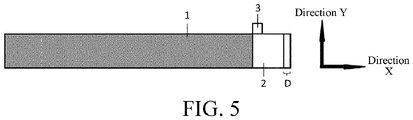
- FIG. 1 and FIG. 2 show schematic diagrams of a current collector of a negative electrode according to an embodiment of the present application.
- the current collector includes a first region 1 and a second region 2, wherein the first region is provided with a negative electrode active substance layer (as shown by gray region in the figure); and the second region does not include a negative electrode active substance layer.
- the negative electrode is provided with a tab 3, and the tab is formed by being connected to the second region through welding.
- At least one second region is positioned at an edge of the current collector, wherein a distance between the tab closest to the edge of the current collector and the edge of the current collector is C, the width of the tab is W, and the range of "C/W (i.e., the ratio of C to W) is 0 to 50, for example, 5 to 40, 10 to 30, 15 to 40, or 20 to 30.
- the negative electrode is provided with 1 to 150 tabs, for example, the number of the tabs is 3, 5, 7, 9, 10, 15, 20, 25, 30, 35, 40, 45, 50, 60, 70, 80, 90, 100, 110, 120, 130, or 140; the tabs are formed by cutting the current collector; the tabs include regions not coated with the negative electrode active substance layer; the value of A times B is smaller than about 500; and for example, the value of A times B is smaller than 450, smaller than 400, smaller than 350, smaller than 300, smaller than 250, smaller than 200, smaller than 150, smaller than 100, smaller than 50, smaller than 30, smaller than 15 or smaller than 10.
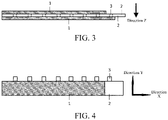
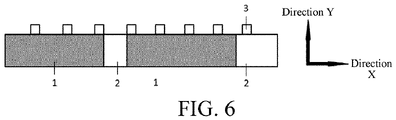
- FIG. 3 and FIG. 4 show schematic diagrams of a current collector of a negative electrode of another embodiment of the present application.
- the current collector includes a first region 1 and a second region 2, wherein the first region is provided with a negative electrode active substance layer; the second region does not include a negative electrode active substance layer.
- the negative electrode is provided with a plurality of tabs 3. The tabs are formed by cutting the current collector, and the tab includes a region not coated with the negative electrode active substance layer.
- At least one second region is positioned at the edge of the current collector, and an edge of the second region positioned at the edge of the current collector is either folded or not folded.
- the width of the folded region is D
- the width of the tab is W
- the range of "D/W" i.e., the ratio of D to W
- At least one second region is positioned at the edge of the current collector; and the negative electrode further includes one or more second regions positioned in the middle of the current collector, wherein the one or more second regions do not include a negative electrode active substance layer.
- the second region in order to reduce the surface area of the second region as much as possible, is optionally covered by a substance capable of being bond onto the second region.
- a part of the second region is covered by, for example but not limited to, a polymer adhesive tape 4.
- a position of the tab is optionally covered by a substance capable of being adhered onto the position of the tab.
- a substance capable of being adhered onto the position of the tab for example, as shown in FIG. 8 , in order to reduce copper ion dissolution in a welding position of the tab and the second region, the welding part of the tab may be covered by, for example but not limited to, a polymer adhesive tape.
- the first region i.e., the region provided with the negative electrode active substance layer
- the second region may be positioned at the edge and/or the inside of the current collector of the negative electrode
- the second region further includes a tab-welding position, a tab region formed through cutting, and an edge folded region.
- a material of the positive electrode used in the electrochemical device of the present application may be prepared by using materials, structures, and manufacturing methods known in the art.
- techniques recorded in US9812739B may be used for preparing the positive electrode of the present application, which is incorporated into the present application by reference in its entirety.
- the positive electrode includes a current collector and a positive electrode active material layer positioned on the current collector.
- a positive electrode active material includes at least one lithiated intercalation compound for reversible intercalation/deintercalation of lithium ions.
- the positive electrode active material includes a composite oxide.
- the composite oxide contains lithium and at least one element selected from cobalt, manganese and nickel.
- the positive electrode active material is selected from one or more of a lithium cobalt oxide, lithium manganate, a lithium nickel oxide or a lithium nickel manganese cobalt ternary material.
- the negative electrode active material contains silicon or silicon-oxygen materials, and may also be optionally selected from any of negative electrode materials capable of realizing deintercalation of lithium, such as graphite, hard carbon and mesocarbon microbeads.
- the positive electrode active material may be provided with a coating on the surface, or may be mixed with another compound with a coating.
- the coating may include at least one coating element compound selected from an oxide of a coating element, a hydroxide of the coating element, an oxyhydroxide of the coating element, an oxycarbonate of the coating element and a hydroxycarbonate of the coating element.
- the compound used for the coating may be amorphous or crystalline.
- the coating element contained in the coating may include Mg, Al, Co, K, Na, Ca, Si, Ti, V, Sn, Ge, Ga, B, As, Zr or any combination thereof.
- the coating may be applied by any method as long as the method does not adversely affect the performance of the positive electrode active material.
- the method may include any coating method known in the art, such as spray coating and dipping.
- the positive electrode active material layer further includes a binder, and optionally includes a conductive material.
- the binder increases binding of positive electrode active material particles to each other and binding of the positive electrode active material and the current collector.
- the binder includes, but is not limited to, polyvinyl alcohol, hydroxypropyl cellulose, diacetyl cellulose, polyvinyl chloride, carboxylated polyvinyl chloride, polyvinyl fluoride, an ethylene-oxide-containing polymer, polyvinylpyrrolidone, polyurethane, polytetrafluoroethylene, poly(1,1-difluoroethylene), polyethylene, polypropylene, styrene butadiene rubber, acrylated styrene butadiene rubber, epoxy resin, nylon, etc.
- the conductive material includes, but is not limited to, a carbon-based material, a metal-based material, a conductive polymer and a mixture thereof.
- the carbon-based material is selected from natural graphite, artificial graphite, carbon black, acetylene black, Ketjen black, carbon fiber or any combination thereof.
- the metal-based material is selected from metal powder, metal fiber, copper, nickel, aluminum and silver.
- the conductive polymer is a polyphenylene derivative.
- the current collector may be aluminum, but is not limited thereto.
- the positive electrode may be prepared by a preparation method known in the art.
- the positive electrode may be obtained by the following method: mixing the active material, the conductive material and the binder in a solvent to prepare an active material composition, and applying the active material composition to the current collector.
- the solvent may include N-methylpyrrolidone and the like, but is not limited thereto.
- the positive electrode is prepared by forming a positive electrode material on the current collector by using a positive electrode active substance layer including lithium-transition metal compound powder and an adhesive.
- the positive electrode active substance layer may be generally prepared through the following operation: performing dry mixing on the positive electrode material and the adhesive (and a conductive material, a thickener, etc., used if needed) to form flakes, and pressing the obtained flakes on the current collector of the positive electrode; or dissolving or dispersing the materials in a liquid medium to form slurry, applying the slurry to the current collector of the positive electrode, and performing drying.
- the material of the positive electrode active substance layer includes any material known in the art.
- the electrochemical device of the present application is provided with a separator between the positive electrode and the negative electrode to prevent short circuit.
- the material and shape of the separator used in the electrochemical device of the present application are not particularly limited, and may be any relevant techniques disclosed in the prior art.
- the separator includes a polymer or an inorganic material and the like formed by a material stable in the electrolyte of the present application.
- the separator may include a substrate layer and a surface treatment layer.
- the substrate layer is a nonwoven fabric of a porous structure, a film or a composite film, and the material of the substrate layer is at least one selected from polyethylene, polypropylene, polyethylene terephthalate and polyimide.
- a porous polypropylene film, a porous polyethylene film, a polypropylene nonwoven fabric, a polyethylene nonwoven fabric, or a porous polypropylene-polyethylene-polypropylene composite film may be selected and used.
- the substrate layer may be one layer or multiple layers. When the substrate layers are multiple layers, composition of polymers of different substrate layers may be identical or different, and weightaverage molecular weights are different; and when the substrate layers are multiple layers, shutdown temperatures of the polymers of different substrate layers are different.
- a surface treatment layer is arranged on at least one surface of the substrate layer, and the surface treatment layer may be a polymer layer or an inorganic material layer, or may be a layer formed by mixing a polymer and an inorganic material.
- the inorganic material layer includes inorganic particles and an adhesive.
- the inorganic particles are selected from one or a combination of several of aluminum oxide, silicon oxide, magnesium oxide, titanium oxide, hafnium oxide, tin oxide, cerium oxide, nickel oxide, zinc oxide, calcium oxide, zirconium oxide, yttrium oxide, silicon carbide, boehmite, aluminum hydroxide, magnesium hydroxide, calcium hydroxide and barium sulfate.
- the adhesive is selected from one or a combination of several of polyvinylidene fluoride, vinylidene fluoride-hexafluoropropylene copolymers, polyamide, polyacrylonitrile, polyacrylate, polyacrylic acid, polyacrylate, polyvinylpyrrolidone, polyvinyl ether, polymethyl methacrylate, polytetrafluoroethylene and polyhexafluoropropylene.
- the polymer layer includes a polymer, and the material of the polymer includes at least one of polyamide, polyacrylonitrile, acrylate polymers, polyacrylic acid, polyacrylate, polyvinylpyrrolidone, polyvinyl ether, polyvinylidene fluoride or poly(vinylidene fluoride-hexafluoropropylene).
- the electrochemical device according to embodiments of the present application has improved cycle performance and high-temperature stability characteristics under an over-discharge condition, and is suitable to be used in various electronic devices.
- the purpose of the electrochemical device of the present application is not particularly limited, and the electrochemical device can be used for various known purposes, for example, a notebook computer, a pen input computer, a mobile computer, an e-book player, a portable phone, a portable fax machine, a portable copy machine, a portable printer, stereo headphones, a video recorder, a liquid crystal display television, a portable cleaner, a portable CD player, a mini disk, a transceiver, an electronic notebook, a calculator, a memory card, a portable recorder, a radio, a backup power supply, a motor, a car, a motorcycle, a power bicycle, a bicycle, a lighting fixture, a toy, a game console, a clock, an electric tool, a flash lamp, a camera, a large household storage battery or a lithium-ion capacitor, etc.
- a positive electrode active material of lithium cobalt oxide (molecular formula: LiCoO 2 ), an adhesive of polyvinylidene fluoride (PVDF) and conductive graphite (Super-P) were dissolved in N-methylpyrrolidone (NMP) according to a mass ratio of 96:2:2 to obtain a positive electrode slurry through uniform mixing.
- the positive electrode slurry was uniformly applied onto an aluminum foil (having a thickness of about 12 micron) that acts as the current collector of the positive electrode.
- a positive electrode active material layer was obtained after baking at 120°C for 1 hour, and then, the positive electrode was obtained through compaction, tab-welding and splitting.
- a positive electrode active material of lithium cobalt oxide (molecular formula: LiCoO 2 ), an adhesive of polyvinylidene fluoride (PVDF) and conductive graphite (Super-P) were dissolved in N-methylpyrrolidone (NMP) according to a mass ratio of 96:2:2 to obtain a positive electrode slurry through uniform mixing.
- the positive electrode slurry was uniformly applied onto a 12 micron-thick aluminum foil that acts as the current collector of the positive electrode.
- a positive electrode active material layer was obtained after baking at 120°C for 1 hour, and then, the positive electrode was obtained through compaction, tab-cutting and splitting.
- ethylene carbonate (EC), propylene carbonate (PC) and diethyl carbonate (DEC) were mixed according to a mass ratio of 3:1:7; LiPF 6 was added as a lithium salt, specific types and quantities of additives (the types and the quantities of added substances were shown in Table 1, and the content of each ingredient in the electrolyte was obtained on the basis of the total weight of the electrolyte) were added.
- the concentration of LiPF 6 in the electrolyte was about 1 mol/L.
- a polypropylene separator having a thickness of about 12 microns was selected.
- the positive electrode, the separator and the negative electrode were sequentially stacked, so that the separator was positioned between the positive electrode and the negative electrode to achieve an isolation effect. Then, the obtained structure was wound and charged into an aluminum foil packaging bag. After baking at 80°C to remove water, a corresponding electrolyte was injected. Through work procedures of vacuum encapsulation, still standing, formation, shaping and the like, a lithium-ion battery was obtained.
- Copper foil thickness test An average value was taken after five points were measured by a micrometer.
- Tensile strength test A tensile testing machine was used for testing. The length of a test sample was 200 ⁇ 0.5 mm, the width of the test sample was 15 ⁇ 0.25 mm, a tensile speed was set to be 50 mm/min, the chuck distance of the testing machine was 125 ⁇ 0.1 mm. Five parallel samples were tested, and an average value was taken as a test result. During the test, the length direction of the test sample was parallel to the axial line of a clamp, the sample was maintained at a linear state, and an experiment temperature was 20 ⁇ 5°C.
- a lithium-ion battery was charged to 4.45 V at a 1 C constant current under the condition of 45°C, stood for 30 minutes, and then discharged at 1 C to 3.0 V.
- the lithium-ion battery was cyclically charged and discharged for 500 times.
- Capacity retention rate (%) of lithium-ion battery discharge capacity after 500 cycles /initial discharge capacity ⁇ 100%.
- the lithium-ion battery was put into a 25°C incubator, and was charged to 3.95 V at a 0.5 C constant current; and the thickness of the battery was tested. Then, the battery was fully charged to 4.45 V. The battery was put into a 60°C oven and stored for 30 days. During this period, the thickness of the battery was tested every 3 days. If the thickness increase rate of the battery relative to that under the condition of 3.95 V is greater than 60%, the test was stopped.
- Thickness increase rate (thickness after storage-thickness under the condition of 3.95 V) / thickness under the condition of 3.95 V ⁇ 100%.
- the lithium-ion battery was stood for 120 minutes under the condition of 45°C, was charged to 4.45 V at 1 C, and was maintained at a constant-voltage charge state for 15 days. The magnitude of the current after the 15 days was recorded.
- the lithium-ion battery was put into a 25°C incubator, charged to 4.45 V at a 0.5 C constant current, and was then charged at a constant voltage to reach a 0.05 C current. Then, the battery was extruded by a 20 KN pressure, and whether combustion or explosion occurred to the battery was observed.
- A. The electrolytes and the lithium-ion batteries in Examples 1-39 and Comparative Examples 1-6 were prepared according to the above methods, wherein the current collector of the negative electrode was a copper foil generated through electrolysis.
- the copper foil had a purity of ⁇ 99.5%, a thickness of 6 microns, a tensile strength of ⁇ 30 kg/mm 2 , and an elongation rate of ⁇ 3%.
- B% i.e., the proportion of the area of a second region in the surface area of the negative electrode
- the tab was connected to the second region by welding.
- the width W of the tab was 0.8 cm.
- the distance C between the tab and the edge of the current collector was 2 cm.
- the width D of an edge folded region of the second region located at the edge of the current collector was 1.8 cm.
- Tab of the positive electrode was correspondingly prepared by welding. The cycle capacity retention rate after certain cycles, the floating charging leakage current and the 60°C high-temperature storage test of the lithium-ion batteries were tested. Test results are shown in Table 1.
- Example 1 Nitrile compound Mass percentage of nitrile compound in electrolyte A (%) Proportion of area of second region in surface area of current collector B (%) AxB Capacity retention rate (%) Floating charging leakage current (mA) 60°C high-temperature storage test (%) Example 1 Compound 1 0.3 18.2 5.46 70 4 48 Example 2 Compound 1 1 18.2 18.2 78 5 35 Example 3 Compound 1 3 18.2 54.6 75 7 15 Example 4 Compound 1 5 18.2 91 74 9 14 Example 5 Compound 1 10 18.2 182 67 20 14 Example 6 Compound 2 1 18.2 18.2 87 6 33 Example 7 Compound 2 3 18.2 54.6 86 8 15 Example 8 Compound 2 10 18.2 182 72 18 14 Example 9 Compound 3 0.3 18.2 5.46 72 4 47 Example 10 Compound 3 1 18.2 18.2 84 7 36 Example 11 Compound 3 3 18.2 54.6 79 9 18 Example 12 Compound 3 10 18.2 182 72 23 18 Example 13 Compound 5 0.3 18.2 5.46 70 3 50 Example 14 Compound 5
- Table 1 shows examples and comparative examples wherein B% (the proportion of the area of the second region in the surface area of the negative electrode) was fixed to be 18.2%.
- B% the proportion of the area of the second region in the surface area of the negative electrode
- Examples 1 to 39 in which a specific nitrile compound ranging from 0.1 wt% to 10 wt% was added into the electrolyte, show significantly improved cycle performance. From Comparative Examples 2 to 5 and Comparative Example 1, it can be seen that when increasing the content of the nitrile compound to 12 wt% so that the value of A times B reaches 218.2, the cycle performance was improved compared with that of Comparative Example 1, but the degree of improvement was reduced; and meanwhile, battery self-discharging was further improved.
- the nitrile compound can adhere on the surface of the positive electrode to decrease contact between the positive electrode and the electrolyte. Due to a combination of the two effects, the cycle and floating charging performances of the battery can be significantly improved.
- the nitrile compound may cause a certain degree of dissolution of the copper foil current collector of the negative electrode. Particularly when a copper foil current collector with no active substance on its surface is exposed in the electrolyte, the dissolution of the copper foil caused by the nitrile compound is greatly enhanced. Dissolved copper ions can be slowly reduced into elemental copper and continuously deposited on the surface of the negative electrode during the charging and discharging process of the battery, which finally would cause a local short circuit and deteriorate the self-discharging of the battery.
- the nitrile compound may deteriorate self-discharging of a battery, it can improve electric performance of the battery. Therefore, it is necessary to add a certain content of nitrile compound into the electrolyte, and control the area of the exposed bare copper foil within a certain range, in order to control both the electric performance and self-discharging of the battery.
- the electrolytes and the lithium-ion batteries in Examples 40 to 52 and Comparative Example 8 were prepared according to the above methods, wherein the current collector of the negative electrode was a copper foil generated through electrolysis.
- the copper foil had a purity of ⁇ 99.8%, a thickness of 8 microns, a tensile strength of ⁇ 30 kg/mm 2 , and an elongation rate of ⁇ 3%.
- the tab and the second region were connected by welding.
- the width W of the tab was 0.8 cm; the distance C between the tab and the edge of the current collectors was 2 cm; the width D of the edge folded region of the second region located at the edge of the current collector was 2.5 cm.
- the tab of the positive electrode was correspondingly prepared by welding.
- Table 2 shows examples and comparative examples with the content of the nitrile compound in the electrolyte being 3 wt%.
- Examples 40 to 51 when the content of the nitrile compound in the electrolyte was fixed to 3 wt%, the cycle and storage performances of the batteries were good. With adjustment of the area of the second region of the negative electrode in the battery to increase the value of A times B, the floating charging leakage current of the batteries was increased. As shown in Comparative Example 8, when the value of A times B exceeds 210, serious self-discharging occurred, which affected and the function of the batteries.
- the current collector of the negative electrode in Example 52 did not include a second region (i.e., B is 0.4), so that the value of A times B is 1.2. Compared with Comparative Example 8, the battery of Example 52 achieved better cycle performance and smaller leakage current.
- the electrolytes and the lithium-ion batteries in Examples 53 to 60 and Comparative Example 9 were prepared according to the above methods, wherein the current collector of the negative electrode was a copper foil generated through electrolysis.
- the copper foil had a purity of ⁇ 99.8%, a thickness of 6 microns, a tensile strength of ⁇ 30 kg/mm 2 , and an elongation rate of ⁇ 2%.
- the tab and the second region were connected through cutting; the number of the tabs was 9, the width W of the tab was 1.5 cm; the width D of the edge folded region of the second region positioned at the edge of the current collector was 1.5 cm.
- the tab of the positive electrode was correspondingly prepared by cutting.
- Examples 53 to 60 and Comparative Example 9 show that adjustment of B% (i.e, the proportion of the area of the second region) did not seem to significantly affect the capacity retention rate of the battery, but increased self-discharging of the battery.
- B% the proportion of the area of the second region
- B% 2.3%, which is the proportion of a bare copper foil at the positions of the tabs
- the battery of Example 60 achieved better cycle and storage performances and smaller leakage current.
- the value of A times B should be controlled within 600 to arrive at good battery performance.
- the electrolytes and the lithium-ion batteries in Examples 61 to 63 were prepared according to the above methods, wherein the current collector of the negative electrode was a copper foil generated through electrolysis.
- the copper foil had a purity of ⁇ 99.8%, a thickness of 6 microns, a tensile strength of ⁇ 30 kg/mm 2 , and an elongation rate of ⁇ 2%.
- the tab and the second region were connected by welding.
- the width of the tab was 0.8 cm.
- the distance C between the tab and the edge of the current collector was 2 cm.
- the width D of the edge folded region of the second region positioned at the edge of the current collector was 1.8 cm.
- the tabs of the positive electrode were correspondingly prepared by welding.
- Example 61 the copper foil region not coated with the active substance layer was covered by a certain area of a polymer adhesive tape so as to reduce the contact area between the copper foil and the electrolyte. Compared with Example 63 which did not use the polymer adhesive tape, Example 61 achieved lower leakage current. In Example 62, the welding position of the tab was covered with a certain area of a polymer adhesive tape. Compared with Example 63 which did not use the polymer adhesive tape, the self-discharging of the battery of Example 62 was decreased.
- the welding position of the tab on the copper foil current collector of the negative electrode and other bare copper foil regions not coated with negative electrode active substances can be covered with a polymer adhesive tape or another substance capable of being bond onto the copper foil and tab, in order to reduce self-discharging of the battery.
- the electrolytes and the lithium-ion batteries in Examples 64 to 70 were prepared according to the above methods, wherein the current collector of the negative electrode was a copper foil generated through electrolysis.
- the copper foil had a purity of ⁇ 99.8%, a thickness of 6 microns, a tensile strength of ⁇ 30 kg/mm 2 , and an elongation rate of ⁇ 2%.
- the tab and the second region were connected by welding; the width of the tab was 0.8 cm; the distance C between the tab and the edge of the current collector was 2 cm; and the width D of the edge folded region of the second region positioned at the edge of the current collectors was 1.8 cm.
- the tab of the positive electrode was correspondingly prepared by welding.
- addition of other additives in the electrolyte containing specific nitride compounds can significantly improve the cycle performance and floating charging thickness increase rate of batteries.
- the addition of FEC can increase the LiF content of the negative electrode SEI, and can improve stability of the negative electrode SEI.
- the addition of VC can facilitate the formation of a reticular protection layer at the surface layer of SEI through polymerization, and can increase flexibility of SEI. Addition of other additives can stabilize or strength the SEI protection layer to a certain degree. Therefore, the cycle performance of battery was improved. Meanwhile, due to a film forming effect of the additives on the negative electrode, deposition of copper ions on the negative electrode can be reduced to a certain degree, self-discharging of the battery can be reduced, which further improved the overall electric performance of the battery.
- the nitrile compound as an effective additive for improving the cycle stability has great influence on the self-discharging of the battery.
- the cycle performance and self-discharging of the battery can be improved, and the long-term cycle and storage of the battery can be ensured.
- the electrolytes and the lithium-ion batteries in Examples 71 to 72 were prepared according to the above methods, wherein the current collector of the negative electrode was a copper foil generated through electrolysis.
- the copper foil had a purity of ⁇ 99.8%, a thickness of 6 microns, a tensile strength of ⁇ 30 kg/mm 2 , and an elongation rate of ⁇ 2%.
- the tab and the second region were connected by welding.
- the width W of the tabs was 0.8 cm.
- the distance C between the tab and the edge of the current collectors was 2 cm.
- the width D of the edge folded region of the second region positioned at the edge of the current collector was 1.8 cm.
- Example 72 the edge of the second region positioned at the edge of the current collector was not folded.
- the positive electrode tab was correspondingly prepared by welding.
- the cycle capacity retention rate after certain cycles, the floating charging leakage current and the 60°C high-temperature storage test of the lithium-ion batteries were tested. The test results are shown in Table 6.
- Table 6 Nitrile compound Mass percentage of nitrile compound in electrolyte A (%) AxB Capacity retention rate (%) Floating charging leakage current (mA) Extrusion test
- Example 71 Compound 2 3 52.5 84% 5 No combustion occurred
- Example 72 Compound 2 3 52.5 83% 6 Combustion occurre d
- Example 71 As shown in Table 6, in Example 71, the edge of the second region positioned at the edge of the current collector was folded; and in Example 72 the edge of the second region positioned at the edge of the current collector was not folded.
- the capacity retention rates and the floating charging leakage current of Example 71 and Example 72 did not show obvious differences, but the extrusion test showed that the risk of piercing the separator by burrs in the welding position of the tab was reduced due to the folding, which made the battery achieve better safety performance.
- the electrolytes and the lithium-ion batteries in Examples 73 to 76 were prepared according to the above methods, wherein the current collector of the negative electrode was a copper foil generated through electrolysis.
- the copper foil had a purity of ⁇ 99.8%, a thickness of 6 microns, a tensile strength of ⁇ 30 kg/mm 2 , and an elongation rate of ⁇ 2%.
- the tab and the second region were connected by welding.
- the width W of the tab was 0.8 cm.
- the distance C between the tab and the edge of the current collector was 2 cm.
- the width D of the edge folded region of the second region positioned at the edge of the current collector was 1.8 cm.
- the tab of the positive electrode was correspondingly prepared by welding.
- references to “embodiment,” “part of embodiments,” “one embodiment,” “another example,” “example,” “specific example” or “part of examples” mean that at least one example or example of the present application includes specific features, structures, materials or characteristics described in the embodiment or example.
- the descriptions appear throughout the specification, such as “in some embodiments,” “in an embodiment,” “in one embodiment,” “in another example,” “in an example,” “in a particular example” or “for example,” are not necessarily the same embodiment or example in the application.
- the specific features, structures, materials or characteristics in the descriptions can be combined in any suitable manner in one or more embodiments or examples.
Landscapes
- Chemical & Material Sciences (AREA)
- Engineering & Computer Science (AREA)
- Chemical Kinetics & Catalysis (AREA)
- Electrochemistry (AREA)
- General Chemical & Material Sciences (AREA)
- Manufacturing & Machinery (AREA)
- Materials Engineering (AREA)
- Condensed Matter Physics & Semiconductors (AREA)
- Physics & Mathematics (AREA)
- General Physics & Mathematics (AREA)
- Inorganic Chemistry (AREA)
- Composite Materials (AREA)
- Secondary Cells (AREA)
Abstract
Description
- The present application relates to the technical field of energy storage, and more particularly to an electrolyte and an electrochemical device including the electrolyte.
- Electrochemical devices, such as lithium-ion batteries, have the advantages of high energy density, high working voltage, low self-discharging rate, long cycle life, no pollution and the like, and thus have been widely applied to the fields of computers, intelligent wearable devices, smart phones, unmanned aerial vehicles, electric vehicles and the like. With the development of modern information technology and the expansion of the application range of lithium-ion batteries, there are higher requirements on energy density of lithium-ion batteries in the art.
- There are many factors affecting the energy density of lithium-ion batteries. At present, improving a charging cut-off voltage of the lithium-ion battery is one of the effective measures for improving the energy density, but the voltage improvement causes deterioration of positive electrode stability. How to solve the above-mentioned problem to increase the energy density of lithium-ion batteries has become an urgent problem to be solved in the art.
- Through research, the inventor discovers that although nitrile additives may effectively improve stability of positive electrode and thus significantly improve properties such as cycle performance of electrochemical devices, the nitrile additives may cause copper dissolution from current collector of negative electrode, thus influencing stability of negative electrode, and particularly, battery self-discharging or even safety problems may occur when copper ions are dissolved at welding position of tab.
- The present application provides an electrochemical device capable of meeting highvoltage cycle stability, solving the self-discharging problem of electrochemical devices at high voltage, and improving safety characteristics.
- In some embodiments, the present application provides an electrochemical device, including a positive electrode, a negative electrode, a separator and an electrolyte, wherein the electrolyte includes a nitrile compound, and the mass percentage of the nitrile compound in the electrolyte is A%.
- The negative electrode includes a current collector, and the current collector includes a first region and a second region;
- the first region is provided with a negative electrode active substance layers;
- the second region does not include a negative electrode active substance layer;
- the area of the second region accounts for B% of the surface area of the current collector; and

- In some embodiments, the nitrile compound includes at least one of the following: a compound of Formula I, a compound of Formula II, a compound of Formula III, a compound of Formula IV, a compound of Formula V or a compound of Formula VI:
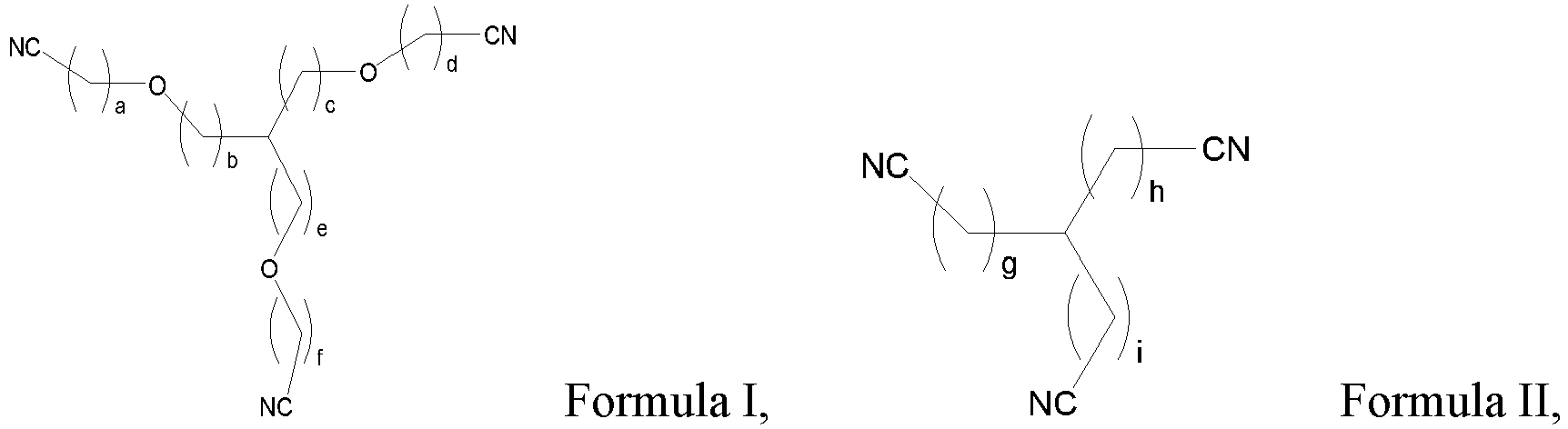


- In some embodiments, the nitrile compound includes at least one of the following compounds:


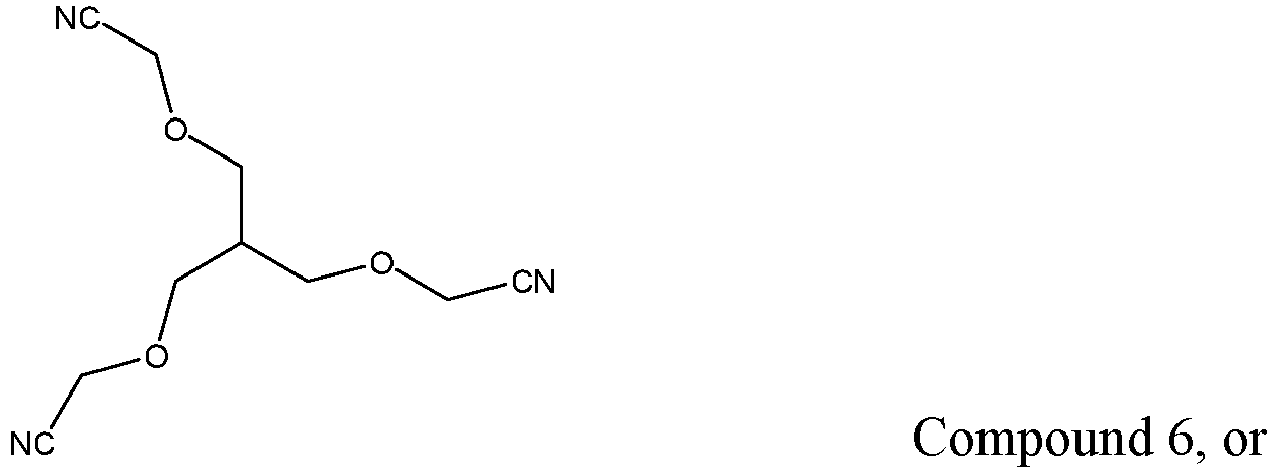

- In some embodiments, the negative electrode includes a tab. The tab is formed through being connected to the second region by welding, and A×B<210.
- In some embodiments, the negative electrode includes at least one tab, and the tab is formed by cutting the current collector. The tab includes a region not coated with a negative electrode active substance layer, and A×B<500.
- In some embodiments, at least one of the second region is positioned at an edge of the current collector, a distance between the tab closest to the edge of the current collector and the edge of the current collector is C, and 0≤C/tab width≤50.
- In some embodiments, at least one of the second region is positioned at the edge of the current collector, and an edge of the second region positioned at the edge of the current collector is either folded or not folded, wherein if the edge of the second region positioned at the edge of the current collector is folded, the width of the folded region is D, and 0.1≤D/tab width≤20.
- In some embodiments, the current collector is a copper foil, and the copper foil has one or more of the following properties:
- a copper purity of ≥99.5%,
- a thickness of 3 microns to 15 microns,
- a weight per unit area of 30 g/m2 to 150 g/m2,
- a tensile strength of ≥20 kg/mm2, and
- an elongation rate of ≥1.5%.
- In some embodiments, the second region is optionally covered by a substance capable of being adhered onto the second region.
- In some embodiments, a portion of the tab is optionally covered by a substance capable of being adhered onto the portion of the tab.
- In some embodiments, the electrolyte further includes an additive. The additive includes at least one of the following: 1,3-propane sultone, fluoroethylene carbonate, vinylene carbonate, 2,4-butane sultone, 1,4-butane sultone, methylene methanedisulfonate, ethylene sulfate, succinic anhydride, ethoxy(pentafluoro)cyclotriphosphazene, 1,3-dioxane, or propenyl-1,3-sultone.
- In some embodiments, the electrolyte further includes an anion, and the anion includes at least one of the following: Cl-, Br-, SO4 2-, CO3 2- or F-, and the content of the anion in the electrolyte is less than or equal to 1000 ppm.
- In another aspect, the present application provides an electronic device, and the electronic device includes any of the electrochemical devices above.
- Additional aspects and advantages of the embodiments of the present application will be described or shown in the following description or interpreted by implementing the embodiments of the present application.
-
-
FIG. 1 is a top view of a current collector of a negative electrode according to an embodiment of the present application. -
FIG. 2 is a side view of the current collector inFIG. 1 in direction Z. -
FIG. 3 is a top view of a current collector of a negative electrode according to another embodiment of the present application. -
FIG. 4 is a side view of the current collector inFIG. 3 in direction Z. -
FIG. 5 is a side view of a current collector of a negative electrode according to another embodiment of the present application. -
FIG. 6 is a side view of a current collector of a negative electrode according to another embodiment of the present application. -
FIG. 7 is a side view of a current collector of a negative electrode according to another embodiment of the present application. -
FIG. 8 is a top view of a current collector of a negative electrode according to another embodiment of the present application. - The embodiments of the present application will be described in detail below. The embodiments of the present application should not be interpreted as limitations to the protection scope of the present application. Unless otherwise expressly indicated, the following terms used herein have the meanings indicated below.
- As used in the present application, terms "approximately", "substantially", "essentially", and "about" are used for describing and explaining a small variation. When being used in combination with an event or circumstance, the term may refer to an example in which the event or circumstance occurs precisely, and an example in which the event or circumstance occurs approximately. For example, when being used in combination with a value, the term may refer to a variation range of less than or equal to ±10% of the value, for example, less than or equal to ±5%, less than or equal to ±4%, less than or equal to ±3%, less than or equal to ±2%, less than or equal to ±1%, less than or equal to ±0.5%, less than or equal to ±0.1%, or less than or equal to ±0.05%, and then it may be regarded that two values are "substantially" the same.
- In addition, sometimes, a quantity, a ratio, and another value are presented in a range format in the present application. It should be appreciated that such range formats are for convenience and conciseness, and should be flexibly understood as including not only values explicitly specified to range constraints, but also all individual values or sub-ranges within the ranges, like explicitly specifying each value and each sub-range.
- In the detailed description and the claims, a list of items connected by the term "at least one of' may mean any one of the listed items. For example, if items A and B are listed, then the phrase "one of A and B" means only A or only B. In another example, if items A, B, and C are listed, then the phrase "one of A, B and C" means only A; only B; or only C. The item A may include a single component or multiple components. The item B may include a single component or multiple components. The item C may include a single component or multiple components.
- In the detailed description and the claims, a list of items connected by the term "at least one of" may mean any combination of the listed items. For example, if items A and B are listed, then the phrase "at least one of A and B" or "at least one of A or B" means only A; only B; or A and B. In another example, if items A, B and C are listed, then the phrases "at least one of A, B and C" or "at least one of A, B or C" mean only A; or only B; only C; A and B (excluding C); A and C (excluding B); B and C (excluding A); or all of A, B and C. The item A may include a single component or multiple components. The item B may include a single component or multiple components. The item C may include a single component or multiple components.
- As used herein, the content of each ingredient in an electrolyte is obtained on the basis of the total weight of the electrolyte.
- In some embodiments, the electrolyte of the present application includes a nitrile compound, and the nitrile compound includes at least one of a compound shown as Formula I, a compound shown as Formula II, a compound shown as Formula III, a compound shown as Formula IV, a compound shown as Formula V or a compound shown as Formula VI:


- In some embodiments, the nitrile compound includes at least one of the following compounds:


- In some embodiments, in order to further improve performance of a lithium-ion battery, the electrolyte further includes one or more of the following additives: 1,3-propane sultone (PS), fluoroethylene carbonate (FEC), vinylene carbonate (VC), 2,4-butane sultone, 1,4-butane sultone, methylene methanedisulfonate (MMDS), ethylene sulfate (DTD), succinic anhydride (SA), ethoxy(pentafluoro)cyclotriphosphazene and 1,3-dioxane (DOX), or propenyl-1,3-sultone.
- In some embodiments, in order to inhibit copper dissolution caused by the electrolyte containing the nitrile compound, the electrolyte may further contain an anion, such as at least one of the inorganic anions Cl-, Br-, SO4 2-, CO3 2- or F-. In some embodiments, the content of the anion in the electrolyte is less than or equal to 1000 ppm.
- In some embodiments, the electrolyte further includes a lithium salt and an organic solvent.
- In some embodiments, the lithium salt is one or more selected from inorganic lithium salts and organic lithium salts. In some embodiments, the lithium salt contains at least one of a fluorine element, a boron element or a phosphorus element. In some embodiments, the lithium salt is selected from one or more of the following lithium salts: at least one of lithium hexafluorophosphate (LiPF6), bistrifluoromethanesulfonimide lithium salt (LiTFSI), lithium bis(fluorosulfonyl)imide (LiFSI), lithium bis(oxalate)borate (LiBOB), lithium difluoro(oxalato)borate (LiDFOB), lithium hexafluoroarsenate (LiAsF6), lithium perchlorate (LiClO4) and lithium trifluoromethanesulfonate (LiCF3SO3).
- In some embodiments, the concentration of the lithium salt is 0.5 M to 1.5 M. In some embodiments, the concentration of the lithium salt is 0.8 M to 1.2 M.
- The organic solvent includes a cyclic ester and a chain ester; the cyclic ester is at least one selected from ethylene carbonate (EC), propylene carbonate (PC), γ-butyrolactone (BL) and 2,3-butylene carbonate; and the chain ester is at least one selected from dimethyl carbonate (DMC), diethyl carbonate (DEC), ethyl methyl carbonate (EMC), propylene carbonate, methyl formate (MF), ethyl formate (EF), ethyl acetate (EA), ethyl propionate (EP), propyl propionate (PP), methyl propionate, propyl acetate, methyl butyrate and ethyl butyrate.
- The electrochemical device of the present application includes any device in which an electrochemical reaction occurs, and specific examples of the electrochemical device includes all kinds of primary batteries, secondary batteries, fuel cells, solar cells, or capacitors. Particularly, the electrochemical device is a lithium secondary battery including a lithium metal secondary battery, a lithium-ion secondary battery, a lithium polymer secondary battery or a lithium-ion polymer secondary battery. In some embodiments, the electrochemical device of the present application is an electrochemical device including a positive electrode with a positive electrode active substance capable of absorbing and releasing metal ions and a negative electrode with a negative electrode active substance capable of absorbing and releasing metal ions, and is characterized by including any of the above electrolytes of the present application.
- The electrolyte used in the electrochemical device of the present application is any of the above electrolytes of the present application.
- In the electrochemical device according to the present application, the negative electrode includes a current collector and a negative electrode active material layer arranged on the current collector. The negative electrode active material layer includes a negative electrode active material. The specific type of the negative electrode active material is not particularly limited, and may be selected according to requirements.
- The negative electrode may be prepared according to a preparation method known in the art. For example, the negative electrode may be obtained through the following method: mixing an active material, a conductive material and a binder in a solvent to prepare an active material composition, and applying the active material composition to the current collector.
- The negative electrode active material includes a material for reversible intercalation/deintercalation of lithium ions. In some embodiments, the material for reversible intercalation/deintercalation of lithium ions includes a carbon material. In some embodiments, the carbon material may be any carbon-based negative electrode active material commonly used in lithium-ion rechargeable batteries. In some embodiments, the carbon material includes, but is not limited to, crystalline carbon, amorphous carbon, or a mixture thereof. The crystalline carbon may be amorphous, plate-shaped, platelet-shaped, spherical or fibrous natural graphite or artificial graphite. The amorphous carbon may be soft carbon, hard carbon, carbonized mesophase pitch, calcined coke, and the like.
- In some embodiments, the negative electrode active material layer includes a negative electrode active material. In some embodiments, the negative electrode active material includes, but is not limited to, lithium metal, structured lithium metal, natural graphite, artificial graphite, mesocarbon microbead (MCMB), hard carbon, soft carbon, silicon, silicon-carbon composite, Li-Sn alloy, Li-Sn-O alloy, Sn, SnO, SnO2, lithiated TiO2-Li4Ti5O12 of a spinel structure, Li-Al alloy or any combination thereof.
- In some embodiments, the negative electrode active material layer may include a binder, and optionally includes a conductive material. The binder increases binding of negative electrode active material particles to each other and binding of the negative electrode active material to the current collector. In some embodiments, the binder includes, but is not limited to, polyvinyl alcohol, carboxymethyl cellulose, hydroxypropyl cellulose, diacetyl cellulose, polyvinyl chloride, carboxylated polyvinyl chloride, polyvinyl fluoride, an ethylene-oxide-containing polymer, polyvinylpyrrolidone, polyurethane, polytetrafluoroethylene, poly(1,1-difluoroethylene), polyethylene, polypropylene, styrene butadiene rubber, acrylated styrene butadiene rubber, epoxy resin, nylon, etc.
- In some embodiments, the conductive material includes, but is not limited to, a carbon-based material, a metal-based material, a conductive polymer or a mixture thereof. In some embodiments, the carbon-based material is selected from natural graphite, artificial graphite, carbon black, acetylene black, Ketjen black, carbon fiber or any combination thereof. In some embodiments, the metal-based material is selected from metal powder, metal fiber, copper, nickel, aluminum and silver. In some embodiments, the conductive polymer is a polyphenylene derivative.
- The current collector of the negative electrode in the electrochemical device according to the present application may be selected from a copper foil, a nickel foil, a stainless steel foil, a titanium foil, nickel foam, copper foam, a polymer substrate coated with a conductive metal, and combinations thereof. In some embodiments, the current collector includes a copper foil.
- In some embodiments, the copper foil is formed through electrolysis or calendaring. Its purity is greater than or equal to 99.5%, and the total content of trace elements such as nickel, zinc and chromium is less than or equal to 0.5 wt%.
- In some embodiments, the copper foil has one or more of the following properties:
- a copper purity of ≥99.5%;
- a thickness of 3 microns to 15 microns, for example, the thickness is about 4 microns, about 5 microns, about 6 microns, about 7 microns, about 8 microns, about 9 microns, about 10 microns, about 11 microns, about 12 microns, about 13 microns, or about 14 microns;
- a weight per unit area of 30 g/m2 to 150 g/m2, for example, the weight in the unit area is about 50 g/m2, about 70 g/m2, about 90 g/m2, about 110 g/m2, or about 130 g/m2;
- a tensile strength of ≥20 kg/mm2, for example, the tensile strength≥30 kg/mm2, ≥40 kg/mm2, or ≥50 kg/mm2; and
- an elongation rate of ≥1.5%, for example, the elongation rate≥2%, ≥2.5%, ≥3%, ≥3.5%, or ≥4%.
- In some embodiments, the copper foil is formed through electrolysis, its purity is greater than or equal to 99.5%, its thickness is about 6 microns, the tensile strength is greater than or equal to 30 kg/mm2, and the elongation rate is greater than or equal to 3%.
- In some embodiments, the copper foil has anti-corrosive properties, for example, no obvious color change occurs after the copper foil is soaked in an electrolyte prepared from ethylene carbonate (EC), propylene carbonate (PC) and diethyl carbonate (DEC) in a mass ratio of 3:1:7, and a LiPF6 content being 1 mol/L at 45°C for about 48 hours.
- The electrochemical device in some embodiments includes a positive electrode, a negative electrode, a separator and an electrolyte, wherein the electrolyte includes a nitrile compound. The mass percentage of the nitrile compound in the electrolyte is A%. The negative electrode includes a current collector. The current collector includes a first region and a second region, wherein the first region is provided with a negative electrode active substance layer; the second region does not include a negative electrode active substance layer. The area of the second region accounts for B% of the surface area of the current collector, and the value of A times B is smaller than 600, for example, the value of A times B is smaller than 550, smaller than 500, smaller than 450, smaller than 400, smaller than 350, smaller than 300, smaller than 250, smaller than 200, smaller than 150, smaller than 100, smaller than 50, smaller than 30, smaller than 15, or smaller than 5.
- In some embodiments, the negative electrode includes a tab. The tab is formed through being connected to the second region by welding, and the value of A times B is smaller than 210. For example, the value of A times B is smaller than 200, smaller than 150, smaller than 100, smaller than 50, smaller than 30, smaller than 15, or smaller than 10.
-
FIG. 1 and FIG. 2 show schematic diagrams of a current collector of a negative electrode according to an embodiment of the present application. The current collector includes afirst region 1 and asecond region 2, wherein the first region is provided with a negative electrode active substance layer (as shown by gray region in the figure); and the second region does not include a negative electrode active substance layer. The negative electrode is provided with atab 3, and the tab is formed by being connected to the second region through welding. - As shown in
FIG. 2 , in some embodiments, at least one second region is positioned at an edge of the current collector, wherein a distance between the tab closest to the edge of the current collector and the edge of the current collector is C, the width of the tab is W, and the range of "C/W (i.e., the ratio of C to W) is 0 to 50, for example, 5 to 40, 10 to 30, 15 to 40, or 20 to 30. - In some embodiments, the negative electrode is provided with 1 to 150 tabs, for example, the number of the tabs is 3, 5, 7, 9, 10, 15, 20, 25, 30, 35, 40, 45, 50, 60, 70, 80, 90, 100, 110, 120, 130, or 140; the tabs are formed by cutting the current collector; the tabs include regions not coated with the negative electrode active substance layer; the value of A times B is smaller than about 500; and for example, the value of A times B is smaller than 450, smaller than 400, smaller than 350, smaller than 300, smaller than 250, smaller than 200, smaller than 150, smaller than 100, smaller than 50, smaller than 30, smaller than 15 or smaller than 10.
-
FIG. 3 and FIG. 4 show schematic diagrams of a current collector of a negative electrode of another embodiment of the present application. The current collector includes afirst region 1 and asecond region 2, wherein the first region is provided with a negative electrode active substance layer; the second region does not include a negative electrode active substance layer. The negative electrode is provided with a plurality oftabs 3. The tabs are formed by cutting the current collector, and the tab includes a region not coated with the negative electrode active substance layer. - As shown in
FIG. 5 , in some embodiments, at least one second region is positioned at the edge of the current collector, and an edge of the second region positioned at the edge of the current collector is either folded or not folded. When the edge of the second region positioned at the edge of the current collector is folded, the width of the folded region is D, the width of the tab is W, and the range of "D/W" (i.e., the ratio of D to W) is 0.1 to 20, for example, 2 to 18, 4 to 16, 6 to 14, 8 to 12, or 9 to 10. - As shown in
FIG. 6 , in some embodiments, at least one second region is positioned at the edge of the current collector; and the negative electrode further includes one or more second regions positioned in the middle of the current collector, wherein the one or more second regions do not include a negative electrode active substance layer. - In some embodiments, in order to reduce the surface area of the second region as much as possible, the second region is optionally covered by a substance capable of being bond onto the second region. For example, as shown in
FIG. 7 , a part of the second region is covered by, for example but not limited to, a polymer adhesive tape 4. - In some embodiments, a position of the tab is optionally covered by a substance capable of being adhered onto the position of the tab. For example, as shown in
FIG. 8 , in order to reduce copper ion dissolution in a welding position of the tab and the second region, the welding part of the tab may be covered by, for example but not limited to, a polymer adhesive tape. - In the negative electrode of the present application, the first region (i.e., the region provided with the negative electrode active substance layer) may be positioned on an upper surface, on a lower surface, or on both the upper and lower surfaces of the current collector of the negative electrode; the second region may be positioned at the edge and/or the inside of the current collector of the negative electrode; and the second region further includes a tab-welding position, a tab region formed through cutting, and an edge folded region.
- A material of the positive electrode used in the electrochemical device of the present application may be prepared by using materials, structures, and manufacturing methods known in the art. In some embodiments, techniques recorded in
US9812739B - In some embodiments, the positive electrode includes a current collector and a positive electrode active material layer positioned on the current collector. A positive electrode active material includes at least one lithiated intercalation compound for reversible intercalation/deintercalation of lithium ions. In some embodiments, the positive electrode active material includes a composite oxide. In some embodiments, the composite oxide contains lithium and at least one element selected from cobalt, manganese and nickel.
- In some embodiments, the positive electrode active material is selected from one or more of a lithium cobalt oxide, lithium manganate, a lithium nickel oxide or a lithium nickel manganese cobalt ternary material. The negative electrode active material contains silicon or silicon-oxygen materials, and may also be optionally selected from any of negative electrode materials capable of realizing deintercalation of lithium, such as graphite, hard carbon and mesocarbon microbeads.
- In some embodiments, the positive electrode active material may be provided with a coating on the surface, or may be mixed with another compound with a coating. The coating may include at least one coating element compound selected from an oxide of a coating element, a hydroxide of the coating element, an oxyhydroxide of the coating element, an oxycarbonate of the coating element and a hydroxycarbonate of the coating element. The compound used for the coating may be amorphous or crystalline.
- In some embodiments, the coating element contained in the coating may include Mg, Al, Co, K, Na, Ca, Si, Ti, V, Sn, Ge, Ga, B, As, Zr or any combination thereof. The coating may be applied by any method as long as the method does not adversely affect the performance of the positive electrode active material. For example, the method may include any coating method known in the art, such as spray coating and dipping.
- The positive electrode active material layer further includes a binder, and optionally includes a conductive material. The binder increases binding of positive electrode active material particles to each other and binding of the positive electrode active material and the current collector.
- In some embodiments, the binder includes, but is not limited to, polyvinyl alcohol, hydroxypropyl cellulose, diacetyl cellulose, polyvinyl chloride, carboxylated polyvinyl chloride, polyvinyl fluoride, an ethylene-oxide-containing polymer, polyvinylpyrrolidone, polyurethane, polytetrafluoroethylene, poly(1,1-difluoroethylene), polyethylene, polypropylene, styrene butadiene rubber, acrylated styrene butadiene rubber, epoxy resin, nylon, etc.
- In some embodiments, the conductive material includes, but is not limited to, a carbon-based material, a metal-based material, a conductive polymer and a mixture thereof. In some embodiments, the carbon-based material is selected from natural graphite, artificial graphite, carbon black, acetylene black, Ketjen black, carbon fiber or any combination thereof. In some embodiments, the metal-based material is selected from metal powder, metal fiber, copper, nickel, aluminum and silver. In some embodiments, the conductive polymer is a polyphenylene derivative.
- In some embodiments, the current collector may be aluminum, but is not limited thereto.
- The positive electrode may be prepared by a preparation method known in the art. For example, the positive electrode may be obtained by the following method: mixing the active material, the conductive material and the binder in a solvent to prepare an active material composition, and applying the active material composition to the current collector. In some embodiments, the solvent may include N-methylpyrrolidone and the like, but is not limited thereto.
- In some embodiments, the positive electrode is prepared by forming a positive electrode material on the current collector by using a positive electrode active substance layer including lithium-transition metal compound powder and an adhesive.
- In some embodiments, the positive electrode active substance layer may be generally prepared through the following operation: performing dry mixing on the positive electrode material and the adhesive (and a conductive material, a thickener, etc., used if needed) to form flakes, and pressing the obtained flakes on the current collector of the positive electrode; or dissolving or dispersing the materials in a liquid medium to form slurry, applying the slurry to the current collector of the positive electrode, and performing drying. In some embodiments, the material of the positive electrode active substance layer includes any material known in the art.
- In some embodiments, the electrochemical device of the present application is provided with a separator between the positive electrode and the negative electrode to prevent short circuit. The material and shape of the separator used in the electrochemical device of the present application are not particularly limited, and may be any relevant techniques disclosed in the prior art. In some embodiments, the separator includes a polymer or an inorganic material and the like formed by a material stable in the electrolyte of the present application.
- For example, the separator may include a substrate layer and a surface treatment layer. The substrate layer is a nonwoven fabric of a porous structure, a film or a composite film, and the material of the substrate layer is at least one selected from polyethylene, polypropylene, polyethylene terephthalate and polyimide. Specifically, a porous polypropylene film, a porous polyethylene film, a polypropylene nonwoven fabric, a polyethylene nonwoven fabric, or a porous polypropylene-polyethylene-polypropylene composite film may be selected and used. The substrate layer may be one layer or multiple layers. When the substrate layers are multiple layers, composition of polymers of different substrate layers may be identical or different, and weightaverage molecular weights are different; and when the substrate layers are multiple layers, shutdown temperatures of the polymers of different substrate layers are different.
- A surface treatment layer is arranged on at least one surface of the substrate layer, and the surface treatment layer may be a polymer layer or an inorganic material layer, or may be a layer formed by mixing a polymer and an inorganic material.
- The inorganic material layer includes inorganic particles and an adhesive. The inorganic particles are selected from one or a combination of several of aluminum oxide, silicon oxide, magnesium oxide, titanium oxide, hafnium oxide, tin oxide, cerium oxide, nickel oxide, zinc oxide, calcium oxide, zirconium oxide, yttrium oxide, silicon carbide, boehmite, aluminum hydroxide, magnesium hydroxide, calcium hydroxide and barium sulfate. The adhesive is selected from one or a combination of several of polyvinylidene fluoride, vinylidene fluoride-hexafluoropropylene copolymers, polyamide, polyacrylonitrile, polyacrylate, polyacrylic acid, polyacrylate, polyvinylpyrrolidone, polyvinyl ether, polymethyl methacrylate, polytetrafluoroethylene and polyhexafluoropropylene. The polymer layer includes a polymer, and the material of the polymer includes at least one of polyamide, polyacrylonitrile, acrylate polymers, polyacrylic acid, polyacrylate, polyvinylpyrrolidone, polyvinyl ether, polyvinylidene fluoride or poly(vinylidene fluoride-hexafluoropropylene).
- The electrochemical device according to embodiments of the present application has improved cycle performance and high-temperature stability characteristics under an over-discharge condition, and is suitable to be used in various electronic devices.
- The purpose of the electrochemical device of the present application is not particularly limited, and the electrochemical device can be used for various known purposes, for example, a notebook computer, a pen input computer, a mobile computer, an e-book player, a portable phone, a portable fax machine, a portable copy machine, a portable printer, stereo headphones, a video recorder, a liquid crystal display television, a portable cleaner, a portable CD player, a mini disk, a transceiver, an electronic notebook, a calculator, a memory card, a portable recorder, a radio, a backup power supply, a motor, a car, a motorcycle, a power bicycle, a bicycle, a lighting fixture, a toy, a game console, a clock, an electric tool, a flash lamp, a camera, a large household storage battery or a lithium-ion capacitor, etc.
- Hereinafter, the present application will be specifically illustrated by way of examples and comparative examples. However, the present application is not limited thereto as long as they do not deviate from the spirit of the present application.
- Artificial graphite powder, sodium carboxymethylcellulose (CMC) and styrene butadiene rubber were dissolved in water according to a mass ratio of 96:2:2 to obtain a negative electrode slurry through sufficient mixing and stirring; the negative electrode slurry was uniformly applied onto a specific region of a 12 micron-thick copper foil of a current collector of a negative electrode; baking was performed at 120°C for 1 hour to obtain a negative electrode active material layer; and then, the negative electrode was obtained through compaction, splitting, and tab-welding.
- Artificial graphite powder, sodium carboxymethylcellulose (CMC) and styrene butadiene rubber were dissolved in water according to a mass ratio of 96:2:2 to obtain a negative electrode slurry through sufficient mixing and stirring; the negative electrode slurry was uniformly applied onto a specific region of a 12 micron-thick copper foil of a current collector of a negative electrode; baking was performed at 120°C for 1 hour to obtain a negative electrode active material layer; and then, the negative electrode was obtained through compaction, tab-cutting, and splitting.
- Artificial graphite powder, sodium carboxymethylcellulose (CMC) and styrene butadiene rubber were dissolved in water according to a mass ratio of 96:2:2 to obtain negative electrode slurry through sufficient mixing and stirring; the negative electrode slurry was uniformly applied onto a specific region of a 12 micron-thick copper foil of a current collector of a negative electrode; baking was performed at 120°C for 1 hour to obtain a negative electrode active material layer; and then, the negative electrode was obtained through compaction, splitting, tab-welding, and sticking of a polymer adhesive tape made of acrylic ester onto a second region (i.e., the region not coated with the negative electrode slurry).
- Artificial graphite powder, sodium carboxymethylcellulose (CMC) and styrene butadiene rubber were dissolved in water according to a mass ratio of 96:2:2 to obtain a negative electrode slurry through sufficient mixing and stirring; the negative electrode slurry was uniformly applied onto a specific region of a 12 micron-thick copper foil of a current collector of a negative electrode; baking was performed at 120°C for 1 hour to obtain a negative electrode active material layer; and then, the negative electrode was obtained through compaction, splitting, tab-welding, and sticking of a polymer adhesive tape made of acrylic ester onto a welding region of a tab.
- A positive electrode active material of lithium cobalt oxide (molecular formula: LiCoO2), an adhesive of polyvinylidene fluoride (PVDF) and conductive graphite (Super-P) were dissolved in N-methylpyrrolidone (NMP) according to a mass ratio of 96:2:2 to obtain a positive electrode slurry through uniform mixing. The positive electrode slurry was uniformly applied onto an aluminum foil (having a thickness of about 12 micron) that acts as the current collector of the positive electrode. A positive electrode active material layer was obtained after baking at 120°C for 1 hour, and then, the positive electrode was obtained through compaction, tab-welding and splitting.
- A positive electrode active material of lithium cobalt oxide (molecular formula: LiCoO2), an adhesive of polyvinylidene fluoride (PVDF) and conductive graphite (Super-P) were dissolved in N-methylpyrrolidone (NMP) according to a mass ratio of 96:2:2 to obtain a positive electrode slurry through uniform mixing. The positive electrode slurry was uniformly applied onto a 12 micron-thick aluminum foil that acts as the current collector of the positive electrode. A positive electrode active material layer was obtained after baking at 120°C for 1 hour, and then, the positive electrode was obtained through compaction, tab-cutting and splitting.
- In a dry argon gas atmosphere glovebox, ethylene carbonate (EC), propylene carbonate (PC) and diethyl carbonate (DEC) were mixed according to a mass ratio of 3:1:7; LiPF6 was added as a lithium salt, specific types and quantities of additives (the types and the quantities of added substances were shown in Table 1, and the content of each ingredient in the electrolyte was obtained on the basis of the total weight of the electrolyte) were added. The concentration of LiPF6 in the electrolyte was about 1 mol/L.
- A polypropylene separator having a thickness of about 12 microns was selected.
- The positive electrode, the separator and the negative electrode were sequentially stacked, so that the separator was positioned between the positive electrode and the negative electrode to achieve an isolation effect. Then, the obtained structure was wound and charged into an aluminum foil packaging bag. After baking at 80°C to remove water, a corresponding electrolyte was injected. Through work procedures of vacuum encapsulation, still standing, formation, shaping and the like, a lithium-ion battery was obtained.
- Copper foil thickness test: An average value was taken after five points were measured by a micrometer.
- Mass per unit area: The copper foil was cut into 100mm × 100 mm wide flakes and weighed, for calculating the mass per unit area. Mass per unit area=weight/area.
- Tensile strength test: A tensile testing machine was used for testing. The length of a test sample was 200±0.5 mm, the width of the test sample was 15±0.25 mm, a tensile speed was set to be 50 mm/min, the chuck distance of the testing machine was 125±0.1 mm. Five parallel samples were tested, and an average value was taken as a test result. During the test, the length direction of the test sample was parallel to the axial line of a clamp, the sample was maintained at a linear state, and an experiment temperature was 20±5°C.
- Elongation rate test: A tensile testing machine was used for testing. The length of a test sample was 200±0.5 mm, the width of the test sample was 15±0.25 mm, a tensile speed was set to be 50 mm/min, the chuck distance of the testing machine was 125±0.1 mm. Five parallel samples were tested, and an average value was taken as a test result. During the test, the length direction of the test sample was parallel to the axial line of a clamp, the sample was maintained at a linear state, and the experiment temperature was 20±5°C. Elongation rate=tensile length/original length.
- A lithium-ion battery was charged to 4.45 V at a 1 C constant current under the condition of 45°C, stood for 30 minutes, and then discharged at 1 C to 3.0 V. The lithium-ion battery was cyclically charged and discharged for 500 times.
- Capacity retention rate (%) of lithium-ion battery = discharge capacity after 500 cycles /initial discharge capacity × 100%.
- The lithium-ion battery was put into a 25°C incubator, and was charged to 3.95 V at a 0.5 C constant current; and the thickness of the battery was tested. Then, the battery was fully charged to 4.45 V. The battery was put into a 60°C oven and stored for 30 days. During this period, the thickness of the battery was tested every 3 days. If the thickness increase rate of the battery relative to that under the condition of 3.95 V is greater than 60%, the test was stopped.
- Thickness increase rate = (thickness after storage-thickness under the condition of 3.95 V) / thickness under the condition of 3.95 V×100%.
- The lithium-ion battery was stood for 120 minutes under the condition of 45°C, was charged to 4.45 V at 1 C, and was maintained at a constant-voltage charge state for 15 days. The magnitude of the current after the 15 days was recorded.
- The lithium-ion battery was put into a 25°C incubator, charged to 4.45 V at a 0.5 C constant current, and was then charged at a constant voltage to reach a 0.05 C current. Then, the battery was extruded by a 20 KN pressure, and whether combustion or explosion occurred to the battery was observed.
A. The electrolytes and the lithium-ion batteries in Examples 1-39 and Comparative Examples 1-6 were prepared according to the above methods, wherein the current collector of the negative electrode was a copper foil generated through electrolysis. The copper foil had a purity of ≥99.5%, a thickness of 6 microns, a tensile strength of ≥30 kg/mm2, and an elongation rate of ≥3%. B% (i.e., the proportion of the area of a second region in the surface area of the negative electrode) was 18.2%, and the tab was connected to the second region by welding. The width W of the tab was 0.8 cm. The distance C between the tab and the edge of the current collector was 2 cm. The width D of an edge folded region of the second region located at the edge of the current collector was 1.8 cm. Tab of the positive electrode was correspondingly prepared by welding. The cycle capacity retention rate after certain cycles, the floating charging leakage current and the 60°C high-temperature storage test of the lithium-ion batteries were tested. Test results are shown in Table 1.Table 1 Nitrile compound Mass percentage of nitrile compound in electrolyte A (%) Proportion of area of second region in surface area of current collector B (%) AxB Capacity retention rate (%) Floating charging leakage current (mA) 60°C high-temperature storage test (%) Example 1 Compound 1 0.3 18.2 5.46 70 4 48 Example 2 Compound 1 1 18.2 18.2 78 5 35 Example 3 Compound 1 3 18.2 54.6 75 7 15 Example 4 Compound 1 5 18.2 91 74 9 14 Example 5 Compound 1 10 18.2 182 67 20 14 Example 6 Compound 2 1 18.2 18.2 87 6 33 Example 7 Compound 2 3 18.2 54.6 86 8 15 Example 8 Compound 2 10 18.2 182 72 18 14 Example 9 Compound 3 0.3 18.2 5.46 72 4 47 Example 10 Compound 3 1 18.2 18.2 84 7 36 Example 11 Compound 3 3 18.2 54.6 79 9 18 Example 12 Compound 3 10 18.2 182 72 23 18 Example 13 Compound 5 0.3 18.2 5.46 70 3 50 Example 14 Compound 5 1 18.2 18.2 82 5 32 Example 15 Compound 5 3 18.2 54.6 81 6 13 Example 16 Compound 5 5 18.2 91 75 9 10 Example 17 Compound 5 10 18.2 182 70 19 10 Example 18 Compound 6 1 18.2 18.2 81 3 23 Example 19 Compound 6 3 18.2 54.6 81 4 14 Example 20 Compound 6 10 18.2 182 70 23 14 Example 21 Compound 7 0.3 18.2 5.46 70 3 51 Example 22 Compound 7 1 18.2 18.2 85 5 35 Example 23 Compound 7 3 18.2 54.6 83 6 13 Example 24 Compound 7 10 18.2 182 70 19 13 Example 25 Compound 1+ Compound 2 1.5+1.5 18.2 54.6 81 5 37 Example 26 Compound 1+ Compound 3 1.5+1.5 18.2 54.6 83 4 35 Example 27 Compound 1+ Compound 4 1.5+1.5 18.2 54.6 81 5 34 Example 28 Compound 1+ Compound 5 1.5+1.5 18.2 54.6 83 3 35 Example 29 Compound 1+ Compound 6 1.5+1.5 18.2 54.6 87 3 33 Example 30 Compound 1+ Compound 7 1.5+1.5 18.2 54.6 85 3 37 Example 31 Compound 2+ Compound 5 1.5+1.5 18.2 54.6 83 5 34 Example 32 Compound 2+ Compound 6 1.5+1.5 18.2 54.6 83 8 35 Example 33 Compound 2+ Compound 7 1.5+1.5 18.2 54.6 81 4 30 Example 34 Compound 3+ Compound 6 1.5+1.5 18.2 54.6 80 5 37 Example 35 Compound 3+ Compound 7 1.5+1.5 18.2 54.6 85 4 35 Example 36 Compound 1+ Compound 2+ Compound 3 1+1+1 18.2 54.6 81 3 35 Example 37 Compound 2+ Compound 4+ Compound 5 1+1+1 18.2 54.6 84 2.9 35 Example 38 Compound 3+ Compound 4+ Compound 6 1+1+1 18.2 54.6 84 4 36 Example 39 Compound 5+ Compound 6+ Compound 7 1+1+1 18.2 54.6 87 4 36 Comparative example 1 / 0 18.2 0 61 2.5 Test stopped due to serious gas expansion Comparative example 2 Compound 2 12 18.2 218.2 56 45 20 Comparative example 3 Compound 3 12 18.2 218.2 54 38 23 Comparative example 4 Compound 5 12 18.2 218.2 56 43 21 Comparative example 5 Compound 6 12 18.2 218.2 59 36 18 Comparative example 6 Compound 7 15 18.2 345 51 51 19 Note: "/" represents absent. - Table 1 shows examples and comparative examples wherein B% (the proportion of the area of the second region in the surface area of the negative electrode) was fixed to be 18.2%. Compared with Comparative Example 1 wherein no nitrile compound was added to the electrolyte, Examples 1 to 39, in which a specific nitrile compound ranging from 0.1 wt% to 10 wt% was added into the electrolyte, show significantly improved cycle performance. From Comparative Examples 2 to 5 and Comparative Example 1, it can be seen that when increasing the content of the nitrile compound to 12 wt% so that the value of A times B reaches 218.2, the cycle performance was improved compared with that of Comparative Example 1, but the degree of improvement was reduced; and meanwhile, battery self-discharging was further improved. From Comparative Example 6, it can be seen that when increasing the content of the nitrile compound to 15% so as to make the product of A and B be greater than 210, the floating charging leakage current exceeded 50 mA, which seriously affected the function of the battery. Therefore, for conditions where the electrolyte contains 0.1 wt% to 10 wt% of the specific nitrile compound, when the tab and the second region is connected by welding, making the value of A times B be less than 210 can improve battery performance and meanwhile introduce small self-discharging. Addition of the nitrile compound can improve cycle performance because nitrile groups can complex with metal ions on the positive electrode and stabilize potential of the metal ions, thereby reducing phase changing of the structure of the positive electrode material. Meanwhile, the nitrile compound can adhere on the surface of the positive electrode to decrease contact between the positive electrode and the electrolyte. Due to a combination of the two effects, the cycle and floating charging performances of the battery can be significantly improved. However, the nitrile compound may cause a certain degree of dissolution of the copper foil current collector of the negative electrode. Particularly when a copper foil current collector with no active substance on its surface is exposed in the electrolyte, the dissolution of the copper foil caused by the nitrile compound is greatly enhanced. Dissolved copper ions can be slowly reduced into elemental copper and continuously deposited on the surface of the negative electrode during the charging and discharging process of the battery, which finally would cause a local short circuit and deteriorate the self-discharging of the battery. Although the nitrile compound may deteriorate self-discharging of a battery, it can improve electric performance of the battery. Therefore, it is necessary to add a certain content of nitrile compound into the electrolyte, and control the area of the exposed bare copper foil within a certain range, in order to control both the electric performance and self-discharging of the battery.
- B. The electrolytes and the lithium-ion batteries in Examples 40 to 52 and Comparative Example 8 were prepared according to the above methods, wherein the current collector of the negative electrode was a copper foil generated through electrolysis. The copper foil had a purity of ≥99.8%, a thickness of 8 microns, a tensile strength of ≥30 kg/mm2, and an elongation rate of ≥3%. The tab and the second region were connected by welding. The width W of the tab was 0.8 cm; the distance C between the tab and the edge of the current collectors was 2 cm; the width D of the edge folded region of the second region located at the edge of the current collector was 2.5 cm. The tab of the positive electrode was correspondingly prepared by welding. The cycle capacity retention rate after certain cycles, the floating charging leakage current and the 60°C high-temperature storage test of the lithium-ion batteries were tested. The test results are shown in Table 2.
Table 2 Nitrile compound Mass percentage of nitrile compound in electrolyte A (%) Proportion of area of second region in surface area of current collector B (%) AxB Capacity retention rate (%) Floating charging leakage current (mA) 60°C high-temperature storage test (%) Example 40 Compound 23 9.1 27.3 83 8 32 Example 41 Compound 33 17.6 52.8 88 8 32 Example 42 Compound 4 3 21.9 65.7 88 15 30 Example 43 Compound 5 3 23 69 86 16 35 Example 44 Compound 6 3 27 81 85 17 34 Example 45 Compound 7 3 31 93 81 11 34 Example 46 Compound 2+Compound 31.5+1.5 17.6 52.8 81 6 37 Example 47 Compound 3+ Compound 41.5+1.5 17.6 52.8 81 3 34 Example 48 Compound 3+ Compound 51.5+1.5 21.9 65.7 81 6 36 Example 49 Compound 3+ Compound 5+ Compound 71+1+1 23 69 81 21 36 Example 50 Compound 2+ Compound 4+ Compound 51+1+1 23 69 81 23 35 Example 51 Compound 2+ Compound 4+ Compound 61+1+1 23 69 81 23 35 Example 52 Compound 23 0.4 1.2 82 0.6 35 Comparative example 8 Compound 23 85 255 70 47 37 - Table 2 shows examples and comparative examples with the content of the nitrile compound in the electrolyte being 3 wt%. As shown in Examples 40 to 51, when the content of the nitrile compound in the electrolyte was fixed to 3 wt%, the cycle and storage performances of the batteries were good. With adjustment of the area of the second region of the negative electrode in the battery to increase the value of A times B, the floating charging leakage current of the batteries was increased. As shown in Comparative Example 8, when the value of A times B exceeds 210, serious self-discharging occurred, which affected and the function of the batteries. The current collector of the negative electrode in Example 52 did not include a second region (i.e., B is 0.4), so that the value of A times B is 1.2. Compared with Comparative Example 8, the battery of Example 52 achieved better cycle performance and smaller leakage current.
- C. The electrolytes and the lithium-ion batteries in Examples 53 to 60 and Comparative Example 9 were prepared according to the above methods, wherein the current collector of the negative electrode was a copper foil generated through electrolysis. The copper foil had a purity of ≥99.8%, a thickness of 6 microns, a tensile strength of ≥30 kg/mm2, and an elongation rate of ≥2%. The tab and the second region were connected through cutting; the number of the tabs was 9, the width W of the tab was 1.5 cm; the width D of the edge folded region of the second region positioned at the edge of the current collector was 1.5 cm. The tab of the positive electrode was correspondingly prepared by cutting. The cycle capacity retention rate after certain cycles, the floating charging leakage current and the 60°C high-temperature storage test of the lithium-ion batteries were tested. The test results are shown in Table 3.
Table 3 Nitrile compound Mass percentage of nitrile compound in electrolyte A (%) Proportion of area of second region in surface area of current collector B (%) AxB Capacity retention rate (%) Floating charging leakage current (mA) 60°C high-temperature storage test (%) Example 53 Compound 13 18.1 54.3 83 2 34 Example 54 Compound 23 22.5 67.5 85 3 28 Example 55 Compound 4 3 36.7 110.1 86 6 29 Example 56 Compound 5 3 54 162 83 21 32 Example 57 Compound 1+Compound 21.5+1.5 18.1 54.3 84 4 33 Example 58 Compound 2+ Compound 41.5+1.5 18.1 54.3 81 3 33 Example 59 Compound 2+ Compound 4+ Compound 51.5+1.5+1.5 18.1 54.3 83 4 26 Example 60 Compound 23 2.3 6.9 83 0.2 31 Comparative example 9 Compound 5 12 54 648 80 40 15 - As shown in Table 3, in Examples 53 to 60 and Comparative Example 9, the tabs of the batteries were all prepared by cutting. Examples 53 to 59 show that adjustment of B% (i.e, the proportion of the area of the second region) did not seem to significantly affect the capacity retention rate of the battery, but increased self-discharging of the battery. In Comparative Example 9 where A% (the mass percentage of the nitrile compound) was 12 wt% and B% (the proportion of the area of the second region) was 54% so that the value of A times B was 648, the self-discharging current reached 40 mA. The current collector of the negative electrode in Example 60 was completely coated with an active material, but no active material was applied to the tabs (i.e., B%=2.3%, which is the proportion of a bare copper foil at the positions of the tabs), so that the value of A times B is 6.9. Compared with Comparative Example 9, The battery of Example 60 achieved better cycle and storage performances and smaller leakage current. In view of the above, when preparing the tabs of the batteries by cutting, the value of A times B should be controlled within 600 to arrive at good battery performance.
- D. The electrolytes and the lithium-ion batteries in Examples 61 to 63 were prepared according to the above methods, wherein the current collector of the negative electrode was a copper foil generated through electrolysis. The copper foil had a purity of ≥99.8%, a thickness of 6 microns, a tensile strength of ≥30 kg/mm2, and an elongation rate of ≥2%. The tab and the second region were connected by welding. The width of the tab was 0.8 cm. The distance C between the tab and the edge of the current collector was 2 cm. The width D of the edge folded region of the second region positioned at the edge of the current collector was 1.8 cm. The tabs of the positive electrode were correspondingly prepared by welding. The cycle capacity retention rate after certain cycles, the floating charging leakage current and the 60°C high-temperature storage test of the lithium-ion batteries were tested. The test results are shown in Table 4.
Table 4 Nitrile compound Mass percentage of nitrile compound in electrolyte A (%) AxB Capacity retention rate (%) Floating charging leakage current (mA) 60°C high-temperature storage test (%) Example 61 Compound 13 42 85 4 35 Example 62 Compound 13 75 84 8 34 Example 63 Compound 13 76.8 85 12 34 - As shown in Table 4, in Example 61, the copper foil region not coated with the active substance layer was covered by a certain area of a polymer adhesive tape so as to reduce the contact area between the copper foil and the electrolyte. Compared with Example 63 which did not use the polymer adhesive tape, Example 61 achieved lower leakage current. In Example 62, the welding position of the tab was covered with a certain area of a polymer adhesive tape. Compared with Example 63 which did not use the polymer adhesive tape, the self-discharging of the battery of Example 62 was decreased. Therefore, in practical battery design, the welding position of the tab on the copper foil current collector of the negative electrode and other bare copper foil regions not coated with negative electrode active substances can be covered with a polymer adhesive tape or another substance capable of being bond onto the copper foil and tab, in order to reduce self-discharging of the battery.
- E. The electrolytes and the lithium-ion batteries in Examples 64 to 70 were prepared according to the above methods, wherein the current collector of the negative electrode was a copper foil generated through electrolysis. The copper foil had a purity of ≥99.8%, a thickness of 6 microns, a tensile strength of ≥30 kg/mm2, and an elongation rate of ≥2%.. The tab and the second region were connected by welding; the width of the tab was 0.8 cm; the distance C between the tab and the edge of the current collector was 2 cm; and the width D of the edge folded region of the second region positioned at the edge of the current collectors was 1.8 cm. The tab of the positive electrode was correspondingly prepared by welding. The cycle capacity retention rate after certain cycles, the floating charging leakage current and the 60°C high-temperature storage test of the lithium-ion batteries were tested. The test results are shown in Table 5.
Table 5 Nitrile compound Mass percentage of nitrile compound in electrolyte A (%) Other additives and mass percentage thereof in electrolyte (%) A*B Capacity retention rate (%) Floating charging leakage current (mA) 60°C high-temperatur e storage test (%) Example 64 Compound 13 PS 152.5 87% 5 25 Example 65 Compound 23 FEC+ PS 1+152.5 84% 3 23 Example 66 Compound 4 3 PS+ VC 1+0.552.5 86% 2.4 17 Example 67 Compound 5 3 DTD+ SA 1+0.552.5 86% 8 16 Example 68 Compound 23 MMDS+VC 0.5+0.5 52.5 85% 7 17 Example 69 Compound 4 3 PS+VC+ DTD 1+0.5+152.5 88% 10 15 Example 70 Compound 13 / 52.5 75% 11 36 Note: "/" represents not added. - From Examples 64 to 69 and Example 70, it can be seen that addition of other additives in the electrolyte containing specific nitride compounds can significantly improve the cycle performance and floating charging thickness increase rate of batteries. The addition of FEC can increase the LiF content of the negative electrode SEI, and can improve stability of the negative electrode SEI. The addition of VC can facilitate the formation of a reticular protection layer at the surface layer of SEI through polymerization, and can increase flexibility of SEI. Addition of other additives can stabilize or strength the SEI protection layer to a certain degree. Therefore, the cycle performance of battery was improved. Meanwhile, due to a film forming effect of the additives on the negative electrode, deposition of copper ions on the negative electrode can be reduced to a certain degree, self-discharging of the battery can be reduced, which further improved the overall electric performance of the battery.
- Therefore, it can be seen from the examples and the comparative examples that the nitrile compound as an effective additive for improving the cycle stability has great influence on the self-discharging of the battery. In order to improve the long-term storage performance of the battery, it is necessary to control the content of the nitrile compound and the area of the bare copper foil region within a certain range so as to ensure that the capacity of the battery would not be significantly reduced after long-term storage. Meanwhile, through addition of a certain content of other additives into the electrolyte, the cycle performance and self-discharging of the battery can be improved, and the long-term cycle and storage of the battery can be ensured.
- F. The electrolytes and the lithium-ion batteries in Examples 71 to 72 were prepared according to the above methods, wherein the current collector of the negative electrode was a copper foil generated through electrolysis. The copper foil had a purity of ≥99.8%, a thickness of 6 microns, a tensile strength of ≥30 kg/mm2, and an elongation rate of ≥2%. The tab and the second region were connected by welding. The width W of the tabs was 0.8 cm. The distance C between the tab and the edge of the current collectors was 2 cm. In Example 71, the width D of the edge folded region of the second region positioned at the edge of the current collector was 1.8 cm. In Example 72, the edge of the second region positioned at the edge of the current collector was not folded. The positive electrode tab was correspondingly prepared by welding. The cycle capacity retention rate after certain cycles, the floating charging leakage current and the 60°C high-temperature storage test of the lithium-ion batteries were tested. The test results are shown in Table 6.
Table 6 Nitrile compound Mass percentage of nitrile compound in electrolyte A (%) AxB Capacity retention rate (%) Floating charging leakage current (mA) Extrusion test Example 71 Compound 23 52.5 84% 5 No combustion occurred Example 72 Compound 23 52.5 83% 6 Combustion occurre d - As shown in Table 6, in Example 71, the edge of the second region positioned at the edge of the current collector was folded; and in Example 72 the edge of the second region positioned at the edge of the current collector was not folded. The capacity retention rates and the floating charging leakage current of Example 71 and Example 72 did not show obvious differences, but the extrusion test showed that the risk of piercing the separator by burrs in the welding position of the tab was reduced due to the folding, which made the battery achieve better safety performance.
- G. The electrolytes and the lithium-ion batteries in Examples 73 to 76 were prepared according to the above methods, wherein the current collector of the negative electrode was a copper foil generated through electrolysis. The copper foil had a purity of ≥99.8%, a thickness of 6 microns, a tensile strength of ≥30 kg/mm2, and an elongation rate of ≥2%. The tab and the second region were connected by welding. The width W of the tab was 0.8 cm. The distance C between the tab and the edge of the current collector was 2 cm. The width D of the edge folded region of the second region positioned at the edge of the current collector was 1.8 cm. The tab of the positive electrode was correspondingly prepared by welding. The cycle capacity retention rate after certain cycles, the floating charging leakage current and the 60°C high-temperature storage test of the lithium-ion batteries were tested. The test results are shown in Table 7.
Table 7 Nitrile compound Mass percentage of nitrile compound in electrolyte A (%) AxB Cl- content (ppm) Capacity retention rate (%) Floating charging leakage current (mA) Example 73 Compound 5 3 36.9% 100 81% 7 Example 74 Compound 5 3 36.9% 500 82% 6 Example 75 Compound 5 3 36.9% 1000 80% 5 Example 76 Compound 5 3 36.9% 1100 75% 4 - As shown in Table 7, addition of a proper amount of an anion (e.g., Cl-) in the electrolyte can improve leakage current of the battery. However, high amount of the anion (e.g., exceeding 1000 ppm) would greatly affect the capacity retention rate of the battery. Therefore, while ensuring the electric performance of the battery, a proper amount of the anion may be added into the electrolyte to improve the floating charging leakage current.
- The foregoing descriptions are merely a few embodiments of the present application and are not intended to limit the present application in any manner. Although the present application is described with reference to preferred embodiments, the embodiments are not intended to limit the present application.
- Throughout the specification, references to "embodiment," "part of embodiments," "one embodiment," "another example," "example," "specific example" or "part of examples" mean that at least one example or example of the present application includes specific features, structures, materials or characteristics described in the embodiment or example. Thus, the descriptions appear throughout the specification, such as "in some embodiments," "in an embodiment," "in one embodiment," "in another example," "in an example," "in a particular example" or "for example," are not necessarily the same embodiment or example in the application. Furthermore, the specific features, structures, materials or characteristics in the descriptions can be combined in any suitable manner in one or more embodiments or examples.
- Although the illustrative embodiments have been shown and described, it should be understood by those skilled in the art that the above embodiments cannot be interpreted as limitations to the present application, and the embodiments can be changed, substituted and modified without departing from the spirit, principle and scope of the present application.
Claims (13)
- An electrochemical device, comprising a positive electrode, a negative electrode, a separator film and an electrolyte, whereinthe electrolyte comprises a nitrile compound, and the mass percentage of the nitrile compound in the electrolyte is A%;the negative electrode comprises a current collector, wherein the current collector comprises a first region and a second region;the first region is provided with a negative electrode active substance layer;the second region does not comprise a negative electrode active substance layer;the area of the second region is B% of the surface area of the current collector; and

- The electrochemical device according to claim 1, wherein the nitrile compound comprises at least one of a compound of Formula I, a compound of Formula II, a compound of Formula III, a compound of Formula IV, a compound of Formula V or a compound of Formula VI:


- The electrochemical device according to claim 1, wherein the nitrile compound comprises at least one of:


- The electrochemical device according to claim 1, wherein the negative electrode comprises a tab, the tab is formed by being connected to the second region through welding, and A×B<210.
- The electrochemical device according to claim 1, wherein the negative electrode comprises at least one tab, the tab is formed by cutting the current collector, the tab comprises a region not coated with the negative electrode active substance layer, and A×B<500.
- The electrochemical device according to claim 4 or 5, wherein at least one second region is positioned at an edge of the current collector, wherein a distance between the tab closest to the edge of the current collector and the edge of the current collector is C, and 0≤C/tab width≤50.
- The electrochemical device according to claim 1, wherein at least one second region is positioned at the edge of the current collector, and an edge of the second region positioned at the edge of the current collector is either folded or not folded, wherein when the edge of the second region positioned at the edge of the current collector is folded, the width of the folded region is D, and 0.1≤D/tab width≤20.
- The electrochemical device according to claim 1, wherein the current collector is a copper foil, and the copper foil has one or more of the following properties:a copper purity of ≥99.5%,a thickness of 3 microns to 15 microns,a weight per unit area of 30 g/m2 to 150 g/m2,a tensile strength of ≥20 kg/mm 2, andan elongation rate of ≥1.5%.
- The electrochemical device according to claim 1, wherein the second region is optionally covered by a substance capable of being adhered onto the second region.
- The electrochemical device according to claim 4 to 5, wherein a position of the tab is optionally covered by a substance capable of being bond onto the position of the tab.
- The electrochemical device according to claim 1, wherein the electrolyte further comprises an additive, and the additive comprises at least one of the following: 1,3-propane sultone, fluoroethylene carbonate, vinylene carbonate, 2,4-butane sultone, 1,4-butane sultone, methylene methanedisulfonate, ethylene sulfate, succinic anhydride, ethoxy(pentafluoro)cyclotriphosphazene, 1,3-dioxane, or propenyl-1,3-sultone.
- The electrochemical device according to claim 1, wherein the electrolyte further comprises an anion, the anion comprises at least one of Cl-, Br-, SO4 2-, CO3 2-or F-, and the content of the anion in the electrolyte is less than or equal to 1000 ppm.
- An electronic device, comprising the electrochemical device according to any one of claims 1 to 12.
Applications Claiming Priority (1)
| Application Number | Priority Date | Filing Date | Title |
|---|---|---|---|
| PCT/CN2020/077638 WO2021174417A1 (en) | 2020-03-03 | 2020-03-03 | Electrolyte and electrochemical device |
Publications (2)
| Publication Number | Publication Date |
|---|---|
| EP4024551A1 true EP4024551A1 (en) | 2022-07-06 |
| EP4024551A4 EP4024551A4 (en) | 2023-05-24 |
Family
ID=77612849
Family Applications (1)
| Application Number | Title | Priority Date | Filing Date |
|---|---|---|---|
| EP20923314.7A Pending EP4024551A4 (en) | 2020-03-03 | 2020-03-03 | Electrolyte and electrochemical device |
Country Status (3)
| Country | Link |
|---|---|
| US (2) | US11967674B2 (en) |
| EP (1) | EP4024551A4 (en) |
| WO (1) | WO2021174417A1 (en) |
Families Citing this family (2)
| Publication number | Priority date | Publication date | Assignee | Title |
|---|---|---|---|---|
| JP7431846B2 (en) * | 2020-10-15 | 2024-02-15 | 寧徳新能源科技有限公司 | Electrochemical and electronic devices |
| CN116169359A (en) * | 2023-02-10 | 2023-05-26 | 香河昆仑新能源材料股份有限公司 | A kind of lithium battery electrolyte and application thereof |
Family Cites Families (15)
| Publication number | Priority date | Publication date | Assignee | Title |
|---|---|---|---|---|
| US7776475B2 (en) | 2004-08-03 | 2010-08-17 | Samsung Sdi Co., Ltd. | Lithium rechargeable battery and lithium rechargeable battery pack |
| KR100644074B1 (en) * | 2004-12-02 | 2006-11-10 | 주식회사 엘지화학 | COPPER COLLECTOR FOR SECONDARY BATTERY COMPRISING Cu-NITRILE COMPOUND COMPLEX FORMED ON SURFACE THEREOF |
| WO2010053200A1 (en) | 2008-11-10 | 2010-05-14 | 株式会社エクォス・リサーチ | Positive electrode for secondary battery, secondary battery using same, collector, and battery using the collector |
| CN102668221B (en) | 2009-10-28 | 2015-06-03 | Nec能源元器件株式会社 | Non-aqueous electrolytic solution and equipment containing same |
| KR102307905B1 (en) | 2014-12-22 | 2021-10-05 | 삼성에스디아이 주식회사 | Non-aqueous electrolyte solution for lithium secondary battery and lithium secondary battery comprising the same |
| CN104505535B (en) | 2014-12-29 | 2017-03-29 | 珠海市赛纬电子材料股份有限公司 | A kind of nonaqueous electrolytic solution of high-voltage lithium ion batteries |
| CN104766995B (en) | 2015-03-31 | 2017-03-15 | 宁德时代新能源科技股份有限公司 | Electrolyte additive and application thereof in lithium ion battery |
| CN105057354B (en) | 2015-09-16 | 2017-04-19 | 富威科技(吴江)有限公司 | Production technology for rolled copper foil for lithium battery |
| JP2018156803A (en) | 2017-03-17 | 2018-10-04 | 旭化成株式会社 | Nonaqueous secondary battery |
| CN107256980B (en) | 2017-07-18 | 2020-06-19 | 哈尔滨工业大学 | A method for improving the overdischarge resistance of lithium ion batteries |
| JP7169772B2 (en) | 2018-05-28 | 2022-11-11 | マクセル株式会社 | Non-aqueous electrolyte battery and manufacturing method thereof |
| CN109361018B (en) | 2018-11-20 | 2020-12-15 | 宁德新能源科技有限公司 | Electrolytes and Electrochemical Devices |
| CN110042439A (en) | 2019-04-24 | 2019-07-23 | 福建清景铜箔有限公司 | Rapid Cleaning foil device |
| CN110739487A (en) | 2019-11-28 | 2020-01-31 | 东莞维科电池有限公司 | micro-button battery and preparation method thereof |
| CN113437366B (en) | 2020-03-03 | 2023-02-03 | 宁德新能源科技有限公司 | Electrolyte and electrochemical device |
-
2020
- 2020-03-03 EP EP20923314.7A patent/EP4024551A4/en active Pending
- 2020-03-03 US US16/970,864 patent/US11967674B2/en active Active
- 2020-03-03 WO PCT/CN2020/077638 patent/WO2021174417A1/en not_active Ceased
-
2024
- 2024-03-18 US US18/607,737 patent/US12334494B2/en active Active
Also Published As
| Publication number | Publication date |
|---|---|
| US11967674B2 (en) | 2024-04-23 |
| US12334494B2 (en) | 2025-06-17 |
| EP4024551A4 (en) | 2023-05-24 |
| US20240243344A1 (en) | 2024-07-18 |
| US20230123288A1 (en) | 2023-04-20 |
| WO2021174417A1 (en) | 2021-09-10 |
Similar Documents
| Publication | Publication Date | Title |
|---|---|---|
| US12119447B2 (en) | Electrolyte and electrochemical apparatus | |
| CN113437366B (en) | Electrolyte and electrochemical device | |
| US12136697B2 (en) | Electrolyte and electrochemical apparatus | |
| CN113078361B (en) | Electrolyte and electrochemical device | |
| CN112400249A (en) | Electrolyte and electrochemical device | |
| US11031630B2 (en) | Electrolyte and electrochemical device | |
| US12334494B2 (en) | Electrolyte and electrochemical device | |
| US12444770B2 (en) | Electrolyte and electrochemical device | |
| US20220223915A1 (en) | Electrolyte, electrochemical device including same, and electronic device | |
| EP4425598A1 (en) | Electrochemical device and electronic device comprising same | |
| CN112103561B (en) | Electrolyte and electrochemical device | |
| KR102795064B1 (en) | Non-aqueous electrolyte and lithium secondary battery comprising the same | |
| US11830981B2 (en) | Electrolyte and electrochemical device | |
| EP4084182B1 (en) | Electrolyte and electrochemical device | |
| KR20200122636A (en) | Nonaqueous electrolyte additive for lithium secondary battery, nonaqueous electrolyte for lithium secondary battery comprising the same, and lithium secondary battery | |
| KR20190044443A (en) | Preparing method of positive electrode active material for lithium secondary battery, positive electrode active material thereby, positive electrode and lithium secondary battery including the same | |
| EP4425597A1 (en) | Electrochemical device and electronic device comprising same | |
| US12119446B2 (en) | Electrolyte and electrochemical device | |
| CN116053461B (en) | Electrochemical device and electronic device including same | |
| CN117239241B (en) | Electrolyte and lithium ion battery | |
| CN120642095A (en) | Electrochemical device and electronic device including the same | |
| CN118040004A (en) | Secondary battery and electronic device including the same |
Legal Events
| Date | Code | Title | Description |
|---|---|---|---|
| STAA | Information on the status of an ep patent application or granted ep patent |
Free format text: STATUS: THE INTERNATIONAL PUBLICATION HAS BEEN MADE |
|
| PUAI | Public reference made under article 153(3) epc to a published international application that has entered the european phase |
Free format text: ORIGINAL CODE: 0009012 |
|
| STAA | Information on the status of an ep patent application or granted ep patent |
Free format text: STATUS: REQUEST FOR EXAMINATION WAS MADE |
|
| 17P | Request for examination filed |
Effective date: 20220331 |
|
| AK | Designated contracting states |
Kind code of ref document: A1 Designated state(s): AL AT BE BG CH CY CZ DE DK EE ES FI FR GB GR HR HU IE IS IT LI LT LU LV MC MK MT NL NO PL PT RO RS SE SI SK SM TR |
|
| A4 | Supplementary search report drawn up and despatched |
Effective date: 20230424 |
|
| RIC1 | Information provided on ipc code assigned before grant |
Ipc: H01M 4/13 20100101ALI20230418BHEP Ipc: H01M 4/70 20060101ALI20230418BHEP Ipc: H01M 4/66 20060101ALI20230418BHEP Ipc: H01M 4/64 20060101ALI20230418BHEP Ipc: H01M 10/42 20060101ALI20230418BHEP Ipc: H01M 10/052 20100101ALI20230418BHEP Ipc: H01M 10/0567 20100101AFI20230418BHEP |
|
| DAV | Request for validation of the european patent (deleted) | ||
| DAX | Request for extension of the european patent (deleted) |