EP4024407A1 - Electronic device and method for screening features for predicting physiological state - Google Patents
Electronic device and method for screening features for predicting physiological state Download PDFInfo
- Publication number
- EP4024407A1 EP4024407A1 EP21175249.8A EP21175249A EP4024407A1 EP 4024407 A1 EP4024407 A1 EP 4024407A1 EP 21175249 A EP21175249 A EP 21175249A EP 4024407 A1 EP4024407 A1 EP 4024407A1
- Authority
- EP
- European Patent Office
- Prior art keywords
- feature
- features
- subsets
- model
- computing module
- Prior art date
- Legal status (The legal status is an assumption and is not a legal conclusion. Google has not performed a legal analysis and makes no representation as to the accuracy of the status listed.)
- Pending
Links
Images


Classifications
-
- G—PHYSICS
- G16—INFORMATION AND COMMUNICATION TECHNOLOGY [ICT] SPECIALLY ADAPTED FOR SPECIFIC APPLICATION FIELDS
- G16H—HEALTHCARE INFORMATICS, i.e. INFORMATION AND COMMUNICATION TECHNOLOGY [ICT] SPECIALLY ADAPTED FOR THE HANDLING OR PROCESSING OF MEDICAL OR HEALTHCARE DATA
- G16H50/00—ICT specially adapted for medical diagnosis, medical simulation or medical data mining; ICT specially adapted for detecting, monitoring or modelling epidemics or pandemics
- G16H50/70—ICT specially adapted for medical diagnosis, medical simulation or medical data mining; ICT specially adapted for detecting, monitoring or modelling epidemics or pandemics for mining of medical data, e.g. analysing previous cases of other patients
-
- G—PHYSICS
- G16—INFORMATION AND COMMUNICATION TECHNOLOGY [ICT] SPECIALLY ADAPTED FOR SPECIFIC APPLICATION FIELDS
- G16H—HEALTHCARE INFORMATICS, i.e. INFORMATION AND COMMUNICATION TECHNOLOGY [ICT] SPECIALLY ADAPTED FOR THE HANDLING OR PROCESSING OF MEDICAL OR HEALTHCARE DATA
- G16H50/00—ICT specially adapted for medical diagnosis, medical simulation or medical data mining; ICT specially adapted for detecting, monitoring or modelling epidemics or pandemics
- G16H50/30—ICT specially adapted for medical diagnosis, medical simulation or medical data mining; ICT specially adapted for detecting, monitoring or modelling epidemics or pandemics for calculating health indices; for individual health risk assessment
-
- A—HUMAN NECESSITIES
- A61—MEDICAL OR VETERINARY SCIENCE; HYGIENE
- A61B—DIAGNOSIS; SURGERY; IDENTIFICATION
- A61B5/00—Measuring for diagnostic purposes; Identification of persons
- A61B5/72—Signal processing specially adapted for physiological signals or for diagnostic purposes
- A61B5/7271—Specific aspects of physiological measurement analysis
-
- G—PHYSICS
- G06—COMPUTING OR CALCULATING; COUNTING
- G06F—ELECTRIC DIGITAL DATA PROCESSING
- G06F18/00—Pattern recognition
- G06F18/20—Analysing
- G06F18/21—Design or setup of recognition systems or techniques; Extraction of features in feature space; Blind source separation
- G06F18/214—Generating training patterns; Bootstrap methods, e.g. bagging or boosting
-
- G—PHYSICS
- G16—INFORMATION AND COMMUNICATION TECHNOLOGY [ICT] SPECIALLY ADAPTED FOR SPECIFIC APPLICATION FIELDS
- G16H—HEALTHCARE INFORMATICS, i.e. INFORMATION AND COMMUNICATION TECHNOLOGY [ICT] SPECIALLY ADAPTED FOR THE HANDLING OR PROCESSING OF MEDICAL OR HEALTHCARE DATA
- G16H50/00—ICT specially adapted for medical diagnosis, medical simulation or medical data mining; ICT specially adapted for detecting, monitoring or modelling epidemics or pandemics
- G16H50/20—ICT specially adapted for medical diagnosis, medical simulation or medical data mining; ICT specially adapted for detecting, monitoring or modelling epidemics or pandemics for computer-aided diagnosis, e.g. based on medical expert systems
-
- G—PHYSICS
- G16—INFORMATION AND COMMUNICATION TECHNOLOGY [ICT] SPECIALLY ADAPTED FOR SPECIFIC APPLICATION FIELDS
- G16H—HEALTHCARE INFORMATICS, i.e. INFORMATION AND COMMUNICATION TECHNOLOGY [ICT] SPECIALLY ADAPTED FOR THE HANDLING OR PROCESSING OF MEDICAL OR HEALTHCARE DATA
- G16H50/00—ICT specially adapted for medical diagnosis, medical simulation or medical data mining; ICT specially adapted for detecting, monitoring or modelling epidemics or pandemics
- G16H50/50—ICT specially adapted for medical diagnosis, medical simulation or medical data mining; ICT specially adapted for detecting, monitoring or modelling epidemics or pandemics for simulation or modelling of medical disorders
-
- G—PHYSICS
- G16—INFORMATION AND COMMUNICATION TECHNOLOGY [ICT] SPECIALLY ADAPTED FOR SPECIFIC APPLICATION FIELDS
- G16H—HEALTHCARE INFORMATICS, i.e. INFORMATION AND COMMUNICATION TECHNOLOGY [ICT] SPECIALLY ADAPTED FOR THE HANDLING OR PROCESSING OF MEDICAL OR HEALTHCARE DATA
- G16H10/00—ICT specially adapted for the handling or processing of patient-related medical or healthcare data
- G16H10/40—ICT specially adapted for the handling or processing of patient-related medical or healthcare data for data related to laboratory analysis, e.g. patient specimen analysis
-
- G—PHYSICS
- G16—INFORMATION AND COMMUNICATION TECHNOLOGY [ICT] SPECIALLY ADAPTED FOR SPECIFIC APPLICATION FIELDS
- G16H—HEALTHCARE INFORMATICS, i.e. INFORMATION AND COMMUNICATION TECHNOLOGY [ICT] SPECIALLY ADAPTED FOR THE HANDLING OR PROCESSING OF MEDICAL OR HEALTHCARE DATA
- G16H10/00—ICT specially adapted for the handling or processing of patient-related medical or healthcare data
- G16H10/60—ICT specially adapted for the handling or processing of patient-related medical or healthcare data for patient-specific data, e.g. for electronic patient records
Definitions
- the disclosure relates to an electronic device and a method for screening features for predicting a physiological state.
- the use of blood to obtain multiple metabolite indexes of a test subject such that the doctor may determine the physiological state of the test subject according to the multiple metabolite indexes is an important medical technology that is gradually developing.
- the conventional technology may use the body mass index (BMI) to determine the degree of obesity of the test subject, but the calculation of the BMI only takes into account the weight and height without considering the metabolic status of the test subject.
- BMI body mass index
- the method may assist the doctor in monitoring the physiological state of the test subject more accurately.
- the disclosure provides an electronic device and a method for screening features for predicting a physiological state, which can screen out the features that are significantly related to a specific physiological state from multiple features.
- An electronic device for screening features for predicting a physiological state of the disclosure includes a processor, a storage medium, and a transceiver.
- the storage medium stores multiple modules.
- the processor is coupled to the storage medium and the transceiver, and accesses and executes the multiple modules.
- the multiple modules include a data collection module, a training module, a computing module, and an output module.
- the data collection module obtains multiple physiological data corresponding to multiple features through the transceiver.
- the training module generates multiple first subsets of the multiple features according to the multiple physiological data based on a first model. The multiple first subsets correspond to the multiple physiological data.
- the computing module selects a first feature from the multiple features according to the multiple first subsets, calculates a first relation index of the first feature and a second feature corresponding to the multiple features, and selects the second feature as an accompanied feature of the first feature according to the first relation index.
- the output module outputs the first feature and the accompanied feature through the transceiver.
- the training module generates multiple second subsets of the multiple features according to the multiple physiological data based on a second model.
- the multiple second subsets respectively correspond to the multiple physiological data.
- the computing module selects the first feature from the multiple features according to the multiple first subsets and the multiple second subsets.
- the computing module calculates a first number of the first feature in the multiple first subsets, and calculates a second number of the first feature in the multiple second subsets.
- the computing module selects the first feature from the multiple features according to the first number and the second number.
- the computing module calculates a first score of the first feature according to the first number, a first weight corresponding to the first model, the second number, and a second weight corresponding to the second model.
- the computing module selects the first feature from the multiple features in response to the first score being greater than a first threshold value.
- the computing module calculates a first score of the first feature according to the first number, a first weight corresponding to the first model, the second number, and a second weight corresponding to the second model.
- the computing module calculates a third number of a third feature in the multiple first subsets and a fourth number of the third feature in the multiple second subsets.
- the computing module calculates a second score of the third feature according to the third number, the first weight, the fourth number, and the second weight.
- the computing module selects the first feature from the first feature and the third feature in response to the first score being greater than the second score.
- the computing module obtains a first number of the first feature in each of the multiple first subsets to generate a first vector.
- the computing module obtains a second number of the second feature in each of the multiple first subsets to generate a second vector.
- the computing module calculates the first relation index according to the first vector and the second vector.
- the computing module selects the second feature as the accompanied feature of the first feature in response to the first relation index being greater than a second threshold value.
- the computing module calculates a second relation index corresponding to a third feature and a fourth feature in the multiple features.
- the computing module selects the second feature as the accompanied feature of the first feature in response to the first relation index being greater than the second relation index.
- the training module trains at least one first prediction model of the physiological state according to the multiple physiological data, the first feature, and the accompanied feature, and calculates at least one first performance index corresponding to the at least one first prediction model.
- the training module randomly selects a third feature and a fourth feature from the multiple features. Any one of the third feature and the fourth feature is different from any one of the first feature and the second feature.
- the training module trains at least one second prediction model of the physiological state according to the multiple physiological data, the third feature, and the fourth feature, and calculates at least one second performance index of the at least one second prediction model.
- the computing module determines that the first feature and the accompanied feature are usable in response to the at least one first performance index being greater than the at least one second performance index.
- the output module outputs the first feature and the accompanied feature in response to the first feature and the accompanied feature being usable.
- the multiple features correspond to multiple metabolites of a human body.
- the data collection module receives a physiological data set through the transceiver, and divides the physiological data set into multiple training data and multiple test data respectively corresponding to the multiple physiological data according to a bootstrap.
- the training module generates the multiple first subsets according to the multiple training data.
- the training module generates the at least one first prediction model according to the multiple training data.
- the training module calculates the at least one first performance index according to the multiple test data.
- the first model or the second model is associated with one of a random forest algorithm, a logistic regression, and a support vector machine.
- the first model generates the multiple first subsets based on one of a stepwise selection and a feature importance.
- a method for screening features for predicting a physiological state of the disclosure includes the following steps. Multiple physiological data corresponding to multiple features are obtained. Multiple first subsets of the multiple features are generated according to the multiple physiological data based on a first model. The multiple first subsets respectively correspond to the multiple physiological data. A first feature is selected from the multiple features according to the multiple first subsets, a first relation index of the first feature and a second feature corresponding to the multiple features is calculated, and the second feature is selected as an accompanied feature of the first feature according to the first relation index. The first feature and the accompanied feature are output.
- the disclosure may select the feature that can significantly affect the prediction result of the physiological state of a test subject, and select the accompanied feature corresponding to the feature.
- the disclosure may output the feature and the accompanied feature as reference for the user. For example, assuming that the user is a doctor, the user may determine the degree of obesity of the test subject only by referring to the metabolite and the accompanied metabolite output by the disclosure without the need to spend effort on analyzing metabolites that are totally unrelated to obesity.
- FIG. 1 is a schematic diagram of an electronic device 100 for screening features for predicting a physiological state according to an embodiment of the disclosure.
- the electronic device 100 may include a processor 110, a storage medium 120, and a transceiver 130.
- the processor 110 is, for example, a central processing unit (CPU), other programmable general-purpose or specific-purpose micro control unit (MCU), microprocessor, digital signal processor (DSP), programmable controller, application specific integrated circuit (ASIC), graphics processing unit (GPU), image signal processor (ISP), image processing unit (IPU), arithmetic logic unit (ALU), complex programmable logic device (CPLD), field programmable gate array (FPGA), other similar elements, or a combination of the above elements.
- the processor 110 may be coupled to the storage medium 120 and the transceiver 130, and access and execute multiple modules and various applications stored in the storage medium 120.
- the storage medium 120 is, for example, any type of fixed or removable random access memory (RAM), read-only memory (ROM), flash memory, hard disk drive (HDD), solid state drive (SSD), similar elements, or a combination of the above elements, which is used to store multiple modules or various applications that may be executed by the processor 110.
- the storage medium 120 may store multiple modules including a data collection module 121, a training module 122, a computing module 123, an output module 124, etc., and the functions thereof will be explained later.
- the transceiver 130 transmits and receives signals in a wireless or wired manner.
- the transceiver 130 may also execute operations such as low noise amplification, impedance matching, frequency mixing, up or down frequency conversion, filtering, and amplification.
- FIG. 2 is a flowchart of a method for screening features for predicting a physiological state according to an embodiment of the disclosure. The method may be implemented by the electronic device 100 shown in FIG. 1 .
- the data collection module 121 may receive a physiological data set of a test subject through the transceiver 130.
- the physiological data set may include K feature values respectively corresponding to K features.
- the K features (which are respectively features f 1 , f 2 , ..., f K ) may respectively correspond to K types of metabolites of a human body, where K may be any positive integer.
- the data collection module 121 may divide the physiological data set into N physiological data corresponding to the K features, where N may be any positive integer. Specifically, the data collection module 121 may divide the physiological data set into the N physiological data according to a bootstrap. Each of the N physiological data may include training data and test data. In other words, the data collection module 121 may divide the physiological data set into N training data and N test data respectively corresponding to the N physiological data.
- the data collection module 121 may divide the physiological data set into a single physiological data corresponding to the K features.
- the physiological data may include the training data and the test data.
- the data collection module 121 may divide the physiological data set into the training data and the test data according to k-fold cross-validation, thereby generating the physiological data.
- the training module 122 may generate N subsets SB 1 of the K features according to the N training data based on a first model.
- the N subsets SB 1 may respectively correspond to the N training data.
- the first model may be configured to select one or more features that significantly affect a specific physiological state (for example, the degree of obesity) from the K features according to a training data.
- the one or more features are the subsets SB 1 of the K features.
- the N training data may generate the N subsets SB 1 of the K features, which are respectively subsets SB 1 1 , SB 1 2 , ... , SB 1 N .
- the training module 122 may generate N subsets SB 2 of the K features according to the N training data based on a second model.
- the N subsets SB 2 may respectively correspond to the N training data.
- the second model may be configured to select one or more features that significantly affect a specific physiological state (for example, the degree of obesity) from the K features according to a training data.
- the one or more features are the subsets SB 2 of the K features.
- the N training data may generate the N subsets SB 2 of the K features, which are respectively subsets SB 2 1 , SB 2 2 , ... , SB 2 N .
- the training module 122 may generate N subsets SB 3 of the K features according to the N training data based on a third model.
- the N subsets SB 3 may respectively correspond to the N training data.
- the third model may be configured to select one or more features that significantly affect a specific physiological state (for example, the degree of obesity) from the K features according to a training data.
- the one or more features are the subsets SB 3 of the K features.
- the N training data may generate the N subsets SB 3 of the K features, which are respectively subsets SB 3 1 , SB 3 2 , ... , SB 3 N .
- a number M of models adopted in Step S203 may be defined by the user according to requirements. Although the number M in this embodiment is equal to 3 (that is, 3 models such as the first model, the second model, and the third model are adopted), the disclosure is not limited thereto.
- the number M may be any positive integer greater than 1
- the first model may correspond to a random forest (RF) algorithm, a logistic regression, or a support vector machine (SVM), but the disclosure is not limited thereto.
- the first model (the second model, or the third model) may, for example, use a stepwise selection or a feature importance to select one or more features that significantly affect a specific physiological state from the K features.
- the first model may use the stepwise selection to select one or more features from the K features based on a p-value or an Akaike information criterion (AIC).
- AIC Akaike information criterion
- Different models may adopt the same or different algorithms.
- the first model, the second model, and the third model may adopt the same or different algorithms.
- the computing module 123 may obtain the N subsets SB 1 corresponding to the first model (which are respectively the subsets SB 1 1 , SB 1 2 , ... , SB 1 N ) the N subsets SB 2 corresponding to the second model (which are respectively the subsets SB 2 1 , SB 2 2 , ... , SB 2 N ), and the N subsets SB 3 corresponding to the third model (which are respectively the subsets SB 3 1 , SB 3 2 , ... , SB 3 N ).
- the computing module 123 may generate the following Table 1, Table 2, and Table 3 according to Equation (1).
- Table 1 corresponds to the first model
- Table 2 corresponds to the second model
- Table 3 corresponds to the third model.
- the computing module 123 may calculate a ratio R j,SB m corresponding to the number S j,SB m according to Equation (2), where S j,SB m is the number corresponding to the N subsets SB m and the feature f j .
- R j , SB m S j , SB m / N
- the computing module 123 may generate the following Table 4 according to Table 1, Table 2, and Table 3 based on Equation (2).
- a number S j,SB 1 and a ratio R j,SB 1 correspond to the first model
- a number S j,SB 2 and a ratio R j,SB 2 correspond to the second model
- a number Sj ,SB 3 and a ratio R j,SB 3 correspond to the third model.
- the computing module 123 may calculate the score Z j corresponding to the feature f j according to Equation (3), where w m is the weight corresponding to an m-th model, and R j,SB m is the ratio corresponding to the feature f j and the m-th model.
- the computing module 123 may generate the following Table 5 according to Table 4 based on Equation (3) as shown below.
- Table 5 Feature f j Ratio R j,SB 1 Ratio R j,SB 2 Ratio R j,SB 3 Score Z j Feature f 1 2/3 2/3 2/3 Feature f 2 1/3 1/3 1/3 1/3 Feature f 3 1/3 2/3 1/3 4/9 Feature f 4 1/3 1/3 1/3 1/3 1/3 Feature f 5 1/3 1/3 2/3 4/9
- Step S206 the computing module 123 may determine whether the feature f j is a selected feature according to a threshold value m1 and the score Z j .
- the threshold value m1 may be associated with a score ranking of the feature f j in the K features.
- the threshold value m1 may indicate that features with what high scores in the K features are used as selected features.
- the computing module 123 may select the feature f 1 with the highest score from the feature f 1 to the feature f 5 as the selected feature according to the threshold value m1.
- the computing module 123 may select the feature f 1 corresponding to the score Z 1 from the feature f 1 to the feature f 5 as the selected feature in response to the score Z 1 being greater than the score Z 2 , the score Z 3 , the score Z 4 , and the score Z 5 .
- the computing module 123 may select the feature f j as the selected feature in response to the score Z j exceeding the threshold value m1. Taking Table 5 as an example, assuming that the threshold value m1 is equal to 5/9, the computing module 123 may select the feature f 1 as the selected feature in response to the score Z 1 of the feature f 1 being greater than 5/9.
- the computing module 123 may calculate a relation index between each of the K features and other features. Specifically, the computing module 123 may obtain K vectors respectively corresponding to the K features, and select two vectors from the K vectors to calculate the relation index between the two vectors.
- the computing module 123 may generate a vector V A,SB m as shown in Equation (4) according to the number of the feature f A in the N subsets SB m , and generate a vector V B , SB m as shown in Equation (5) according to the number of the feature f B in the N subsets SB m , where S A , SB m i is the number of the feature f A in the i-th subset in the N subsets SB m , and S B , SB m i is the number of the feature f B in the i-th subset in the N subsets SB m .
- the computing module 123 may calculate the relation index between the feature f A and the feature f B according to the vector V A,SB m and the vector V B,SB m .
- the relation index corresponds to the m-th model.
- the relation index is, for example, related to Pearson coefficient of correlation (PCC), but the disclosure is not limited thereto.
- V A , SB m S A , SB m 1 , S A , SB m 2 , ... , S A , SB m N
- V B , SB m S B , SB m 1 , S B , SB m 2 , ... , S B , SB m N
- the computing module 123 may generate the following Table 6 according to Tables 1, 2, and 3 based on Equation (4) and Equation (5).
- the computing module 123 may calculate the relation index corresponding to at least two features. For example, if the at least two features include only two features, the computing module 123 may calculate the relation index between the two features (for example, the feature f A and the feature f B ) based on Equation (6), where C(V x ,V y ) is the correlation coefficient between a vector V x and a vector V y , and W m is the weight corresponding to the m-th model. For another example, if the at least two features exceed two features, the computing module 123 may calculate the p-value of the at least two features based on an analysis of variance (ANOVA) test as the relation index.
- ANOVA analysis of variance
- the computing module 123 may generate Table 7 according to the vectors of Table 6 based on Equation (6).
- Step S208 the computing module 123 may determine whether the feature f A and the feature f B are the selected feature pair according to the threshold value m2 and the relation index RI(f A , f B ).
- the threshold value m2 may be associated with a relation index ranking of a feature pair in C 2 K feature pairs.
- the threshold value m2 may indicate that feature pairs with what high relation indexes in the C 2 K feature pairs are used as selected feature pairs.
- the computing module 123 may select the feature pair (f 1 , f 2 ) with the highest relation index from 10 feature pairs according to the threshold value m2 as the selected feature pair.
- the computing module 123 may select the feature pair (f 1 , f 2 ) from the 10 feature pairs in Table 7 as the selected feature pair in response to the relation index RI(f 1 , f 2 ) being greater than the relation indexes RI(f 1 , f 3 ), RI(f 1 , f 4 ), RI(f 1 , f 5 ), RI(f 2 , f 3 ), RI(f 2 , f 3 ), RI(f 2 , f 5 ), RI(f 3 , f 4 ), RI(f 3 , f 5 ), and RI(f 4 ,f 5 ).
- the computing module 123 may select the feature pair (f A , f B ) as the selected feature pair in response to the relation index RI(f A , f B ) exceeding the threshold value m2. Taking Table 7 as an example, assuming that the threshold value m2 is equal to 1/4, the computing module 123 may select the feature pair (f 1 , f 2 ) as the selected feature pair in response to the relation index RI(f 1 , f 2 ) being greater than 1/4, but the selected feature pair is not limited to one pair.
- the computing module 123 may obtain a feature corresponding to the selected feature from the selected feature pair as an accompanied feature. For example, after determining that the feature f A is the selected feature and the feature pair (f A , f B ) is the selected feature pair, the computing module 123 may select the feature f B corresponding to the feature f A from the feature pair (f A , f B ) as the accompanied feature of the feature f A .
- the accompanied feature may be selected by a professional from the K features according to experience as the accompanied feature.
- the output module 124 may output the selected feature and the accompanied feature through the transceiver 130.
- the computing module 123 may determine whether the selected feature and the accompanied feature are usable. If the selected feature and the accompanied feature are usable, the output module 124 may output the selected feature and the accompanied feature. If the selected feature and the accompanied feature are not usable, the output module 124 may not output the selected feature and the accompanied feature.
- FIG. 3 is a flowchart of a method for determining whether a selected feature and an accompanied feature are usable according to an embodiment of the disclosure.
- Step S301 the computing module 123 obtains a selected feature and an accompanied feature corresponding to the selected feature.
- the training module 122 may obtain parts corresponding to the selected feature and the accompanied feature from N training data to train at least one first prediction model for predicting a physiological state.
- the at least one first prediction model may correspond to an RF algorithm, a logistic regression, or a SVM, but the disclosure is not limited thereto.
- the training module 122 may obtain parts corresponding to the selected feature and the accompanied feature from N test data to calculate at least one first performance index corresponding to the at least one first prediction model.
- the at least one first performance index may correspond to parameters such as accuracy (ACC), precision, recall rate, false positive (FP), or F1 score in a confusion matrix.
- the training module 122 may select two random features from the K features. Any one of the two random features is different from any one of the selected feature and the accompanied feature. Then, the training module 122 may obtain parts corresponding to the two random features from the N training data to train at least one second prediction model for predicting the physiological state.
- the at least one second prediction model may correspond to the RF algorithm, the logistic regression, or the SVM, but the disclosure is not limited thereto.
- the training module 122 may select multiple random features corresponding to the number of selected features and accompanied features from the K features, so as to train the at least one second prediction model. For example, if the total number of selected features and accompanied features obtained by the computing module 123 in Step S301 is 4, the training module 122 may select 4 random features from the K features to train the at least one second prediction model.
- the training module 122 may obtain parts corresponding to the two random features (or multiple random features corresponding to the number of selected features and accompanied features) from the N test data to calculate at least one second performance index corresponding to the at least one second prediction model.
- the at least one second performance index may correspond to the parameters such as ACC, precision, recall, FP, or F1 score in the confusion matrix.
- Step S306 the computing module 123 may determine whether the at least one first performance index is greater than the at least one second performance index. If the at least one first performance index is greater than the at least one second performance index, Step S307 is proceeded. If the at least one first performance index is less than or equal to the at least one second performance index, Step S308 is proceeded.
- Step S307 the computing module 123 may determine that the selected feature and the accompanied feature are usable. In Step S308, the computing module 123 may determine that the selected feature and the accompanied feature are not usable.
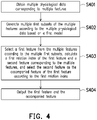
- FIG. 4 is a flowchart of a method for screening features for predicting a physiological state according to another embodiment of the disclosure.
- the method may be implemented by the electronic device 100 shown in FIG. 1 .
- Step S401 multiple physiological data corresponding to multiple features are obtained.
- Step S402 multiple first subsets of the multiple features are generated according to the multiple physiological data based on a first model. The multiple first subsets respectively correspond to the multiple physiological data.
- Step S403 a first feature is selected from the multiple features according to the multiple first subsets, a first relation index of the first feature and a second feature corresponding to the multiple features is calculated, and the second feature is selected as the accompanied feature of the first feature according to the first relation index.
- Step S404 the first feature and the accompanied feature are output.
- the disclosure may use different types of models to select the feature that significantly affects the prediction result of the physiological state from multiple features, and may select the accompanied feature corresponding to the feature according to the relation index between the feature and other features.
- the accompanied features selected according to the method may also significantly affect the prediction result of the physiological state.
- the disclosure may train the prediction model according to the at least one feature and the at least one accompanied feature, and calculate the performance index of the prediction model. If the performance index shows that the at least one feature and the at least one accompanied feature may significantly affect the prediction result of the physiological state by the prediction model, the disclosure may output the at least one feature and the at least one accompanied feature as reference for the user.
Landscapes
- Engineering & Computer Science (AREA)
- Health & Medical Sciences (AREA)
- Medical Informatics (AREA)
- Public Health (AREA)
- Data Mining & Analysis (AREA)
- Biomedical Technology (AREA)
- Pathology (AREA)
- General Health & Medical Sciences (AREA)
- Epidemiology (AREA)
- Primary Health Care (AREA)
- Databases & Information Systems (AREA)
- Life Sciences & Earth Sciences (AREA)
- Physics & Mathematics (AREA)
- Computer Vision & Pattern Recognition (AREA)
- Artificial Intelligence (AREA)
- Theoretical Computer Science (AREA)
- Signal Processing (AREA)
- Animal Behavior & Ethology (AREA)
- Veterinary Medicine (AREA)
- Surgery (AREA)
- Molecular Biology (AREA)
- Heart & Thoracic Surgery (AREA)
- Physiology (AREA)
- Psychiatry (AREA)
- Biophysics (AREA)
- Bioinformatics & Cheminformatics (AREA)
- Bioinformatics & Computational Biology (AREA)
- Evolutionary Biology (AREA)
- Evolutionary Computation (AREA)
- General Physics & Mathematics (AREA)
- General Engineering & Computer Science (AREA)
- Measuring And Recording Apparatus For Diagnosis (AREA)
- Information Retrieval, Db Structures And Fs Structures Therefor (AREA)
- Measurement Of The Respiration, Hearing Ability, Form, And Blood Characteristics Of Living Organisms (AREA)
Abstract
An electronic device (100) and a method for screening features for predicting a physiological state are provided. The method includes: obtaining multiple physiological data corresponding to multiple features; generating multiple first subsets of the multiple features according to the multiple physiological data based on a first model, wherein the multiple first subsets respectively correspond to the multiple physiological data; selecting a first feature from the multiple features according to the multiple first subsets, calculating a first relation index of the first feature and a second feature corresponding to the multiple features, and selecting the second feature as an accompanied feature of the first feature according to the first relation index; and outputting the first feature and the accompanied feature.
Description
- The disclosure relates to an electronic device and a method for screening features for predicting a physiological state.
- The use of blood to obtain multiple metabolite indexes of a test subject such that the doctor may determine the physiological state of the test subject according to the multiple metabolite indexes is an important medical technology that is gradually developing. Taking the determination of the degree of obesity of the test subject as an example, the conventional technology may use the body mass index (BMI) to determine the degree of obesity of the test subject, but the calculation of the BMI only takes into account the weight and height without considering the metabolic status of the test subject.
- There are many types of metabolites produced by the human body, and the correlation between each metabolite and different physiological states is also different. Therefore, if a method for screening out metabolites that are highly related to a specific physiological state can be developed, the method may assist the doctor in monitoring the physiological state of the test subject more accurately.
- The disclosure provides an electronic device and a method for screening features for predicting a physiological state, which can screen out the features that are significantly related to a specific physiological state from multiple features.
- An electronic device for screening features for predicting a physiological state of the disclosure includes a processor, a storage medium, and a transceiver. The storage medium stores multiple modules. The processor is coupled to the storage medium and the transceiver, and accesses and executes the multiple modules. The multiple modules include a data collection module, a training module, a computing module, and an output module. The data collection module obtains multiple physiological data corresponding to multiple features through the transceiver. The training module generates multiple first subsets of the multiple features according to the multiple physiological data based on a first model. The multiple first subsets correspond to the multiple physiological data. The computing module selects a first feature from the multiple features according to the multiple first subsets, calculates a first relation index of the first feature and a second feature corresponding to the multiple features, and selects the second feature as an accompanied feature of the first feature according to the first relation index. The output module outputs the first feature and the accompanied feature through the transceiver.
- In an embodiment of the disclosure, the training module generates multiple second subsets of the multiple features according to the multiple physiological data based on a second model. The multiple second subsets respectively correspond to the multiple physiological data. The computing module selects the first feature from the multiple features according to the multiple first subsets and the multiple second subsets.
- In an embodiment of the disclosure, the computing module calculates a first number of the first feature in the multiple first subsets, and calculates a second number of the first feature in the multiple second subsets. The computing module selects the first feature from the multiple features according to the first number and the second number.
- In an embodiment of the disclosure, the computing module calculates a first score of the first feature according to the first number, a first weight corresponding to the first model, the second number, and a second weight corresponding to the second model. The computing module selects the first feature from the multiple features in response to the first score being greater than a first threshold value.
- In an embodiment of the disclosure, the computing module calculates a first score of the first feature according to the first number, a first weight corresponding to the first model, the second number, and a second weight corresponding to the second model. The computing module calculates a third number of a third feature in the multiple first subsets and a fourth number of the third feature in the multiple second subsets. The computing module calculates a second score of the third feature according to the third number, the first weight, the fourth number, and the second weight. The computing module selects the first feature from the first feature and the third feature in response to the first score being greater than the second score.
- In an embodiment of the disclosure, the computing module obtains a first number of the first feature in each of the multiple first subsets to generate a first vector. The computing module obtains a second number of the second feature in each of the multiple first subsets to generate a second vector. The computing module calculates the first relation index according to the first vector and the second vector.
- In an embodiment of the disclosure, the computing module selects the second feature as the accompanied feature of the first feature in response to the first relation index being greater than a second threshold value.
- In an embodiment of the disclosure, the computing module calculates a second relation index corresponding to a third feature and a fourth feature in the multiple features. The computing module selects the second feature as the accompanied feature of the first feature in response to the first relation index being greater than the second relation index.
- In an embodiment of the disclosure, the training module trains at least one first prediction model of the physiological state according to the multiple physiological data, the first feature, and the accompanied feature, and calculates at least one first performance index corresponding to the at least one first prediction model. The training module randomly selects a third feature and a fourth feature from the multiple features. Any one of the third feature and the fourth feature is different from any one of the first feature and the second feature. The training module trains at least one second prediction model of the physiological state according to the multiple physiological data, the third feature, and the fourth feature, and calculates at least one second performance index of the at least one second prediction model. The computing module determines that the first feature and the accompanied feature are usable in response to the at least one first performance index being greater than the at least one second performance index. The output module outputs the first feature and the accompanied feature in response to the first feature and the accompanied feature being usable.
- In an embodiment of the disclosure, the multiple features correspond to multiple metabolites of a human body.
- In an embodiment of the disclosure, the data collection module receives a physiological data set through the transceiver, and divides the physiological data set into multiple training data and multiple test data respectively corresponding to the multiple physiological data according to a bootstrap. The training module generates the multiple first subsets according to the multiple training data. The training module generates the at least one first prediction model according to the multiple training data. The training module calculates the at least one first performance index according to the multiple test data.
- In an embodiment of the disclosure, the first model or the second model is associated with one of a random forest algorithm, a logistic regression, and a support vector machine.
- In an embodiment of the disclosure, the first model generates the multiple first subsets based on one of a stepwise selection and a feature importance.
- A method for screening features for predicting a physiological state of the disclosure includes the following steps. Multiple physiological data corresponding to multiple features are obtained. Multiple first subsets of the multiple features are generated according to the multiple physiological data based on a first model. The multiple first subsets respectively correspond to the multiple physiological data. A first feature is selected from the multiple features according to the multiple first subsets, a first relation index of the first feature and a second feature corresponding to the multiple features is calculated, and the second feature is selected as an accompanied feature of the first feature according to the first relation index. The first feature and the accompanied feature are output.
- Based on the above, the disclosure may select the feature that can significantly affect the prediction result of the physiological state of a test subject, and select the accompanied feature corresponding to the feature. The disclosure may output the feature and the accompanied feature as reference for the user. For example, assuming that the user is a doctor, the user may determine the degree of obesity of the test subject only by referring to the metabolite and the accompanied metabolite output by the disclosure without the need to spend effort on analyzing metabolites that are totally unrelated to obesity.
-
-
FIG. 1 is a schematic diagram of an electronic device for screening features for predicting a physiological state according to an embodiment of the disclosure. -
FIG. 2 is a flowchart of a method for screening features for predicting a physiological state according to an embodiment of the disclosure. -
FIG. 3 is a flowchart of a method for determining whether a selected feature and an accompanied feature are usable according to an embodiment of the disclosure. -
FIG. 4 is a flowchart of a method for screening features for predicting a physiological state according to another embodiment of the disclosure. - In order for the content of the disclosure to be more understandable, the following embodiments are specifically cited as examples on which the disclosure can be implemented. In addition, wherever possible, elements/components/steps with the same reference numerals in the drawings and embodiments represent the same or similar parts.
-
FIG. 1 is a schematic diagram of anelectronic device 100 for screening features for predicting a physiological state according to an embodiment of the disclosure. Theelectronic device 100 may include aprocessor 110, astorage medium 120, and atransceiver 130. - The
processor 110 is, for example, a central processing unit (CPU), other programmable general-purpose or specific-purpose micro control unit (MCU), microprocessor, digital signal processor (DSP), programmable controller, application specific integrated circuit (ASIC), graphics processing unit (GPU), image signal processor (ISP), image processing unit (IPU), arithmetic logic unit (ALU), complex programmable logic device (CPLD), field programmable gate array (FPGA), other similar elements, or a combination of the above elements. Theprocessor 110 may be coupled to thestorage medium 120 and thetransceiver 130, and access and execute multiple modules and various applications stored in thestorage medium 120. - The
storage medium 120 is, for example, any type of fixed or removable random access memory (RAM), read-only memory (ROM), flash memory, hard disk drive (HDD), solid state drive (SSD), similar elements, or a combination of the above elements, which is used to store multiple modules or various applications that may be executed by theprocessor 110. In this embodiment, thestorage medium 120 may store multiple modules including adata collection module 121, atraining module 122, acomputing module 123, anoutput module 124, etc., and the functions thereof will be explained later. - The
transceiver 130 transmits and receives signals in a wireless or wired manner. Thetransceiver 130 may also execute operations such as low noise amplification, impedance matching, frequency mixing, up or down frequency conversion, filtering, and amplification. -
FIG. 2 is a flowchart of a method for screening features for predicting a physiological state according to an embodiment of the disclosure. The method may be implemented by theelectronic device 100 shown inFIG. 1 . - In Step S201, the
data collection module 121 may receive a physiological data set of a test subject through thetransceiver 130. The physiological data set may include K feature values respectively corresponding to K features. The K features (which are respectively features f1, f2, ..., fK) may respectively correspond to K types of metabolites of a human body, where K may be any positive integer. - In Step S202, the
data collection module 121 may divide the physiological data set into N physiological data corresponding to the K features, where N may be any positive integer. Specifically, thedata collection module 121 may divide the physiological data set into the N physiological data according to a bootstrap. Each of the N physiological data may include training data and test data. In other words, thedata collection module 121 may divide the physiological data set into N training data and N test data respectively corresponding to the N physiological data. - In an embodiment, the
data collection module 121 may divide the physiological data set into a single physiological data corresponding to the K features. The physiological data may include the training data and the test data. Specifically, thedata collection module 121 may divide the physiological data set into the training data and the test data according to k-fold cross-validation, thereby generating the physiological data. - In Step S203, the
training module 122 may generate N subsets SB1 of the K features according to the N training data based on a first model. The N subsets SB1 may respectively correspond to the N training data. The first model may be configured to select one or more features that significantly affect a specific physiological state (for example, the degree of obesity) from the K features according to a training data. The one or more features are the subsets SB1 of the K features. Accordingly, the N training data may generate the N subsets SB1 of the K features, which are respectively subsets
- Similarly, the
training module 122 may generate N subsets SB2 of the K features according to the N training data based on a second model. The N subsets SB2 may respectively correspond to the N training data. The second model may be configured to select one or more features that significantly affect a specific physiological state (for example, the degree of obesity) from the K features according to a training data. The one or more features are the subsets SB2 of the K features. Accordingly, the N training data may generate the N subsets SB2 of the K features, which are respectively subsets
- Similarly, the
training module 122 may generate N subsets SB3 of the K features according to the N training data based on a third model. The N subsets SB3 may respectively correspond to the N training data. The third model may be configured to select one or more features that significantly affect a specific physiological state (for example, the degree of obesity) from the K features according to a training data. The one or more features are the subsets SB3 of the K features. Accordingly, the N training data may generate the N subsets SB3 of the K features, which are respectively subsets
- A number M of models adopted in Step S203 may be defined by the user according to requirements. Although the number M in this embodiment is equal to 3 (that is, 3 models such as the first model, the second model, and the third model are adopted), the disclosure is not limited thereto. For example, the number M may be any positive integer greater than 1
- In an embodiment, the first model (the second model, or the third model) may correspond to a random forest (RF) algorithm, a logistic regression, or a support vector machine (SVM), but the disclosure is not limited thereto. The first model (the second model, or the third model) may, for example, use a stepwise selection or a feature importance to select one or more features that significantly affect a specific physiological state from the K features. For example, the first model may use the stepwise selection to select one or more features from the K features based on a p-value or an Akaike information criterion (AIC). Different models may adopt the same or different algorithms. For example, the first model, the second model, and the third model may adopt the same or different algorithms.
- In Step S204, the
computing module 123 may obtain the N subsets SB1 corresponding to the first model (which are respectively the subsets


- In Step S205, the
computing module 123 may calculate a score of each of the K features according to N subsets SBm, where m is the index of the model. For example, m=1 corresponds to the first model, m=2 corresponds to the second model, and m=3 corresponds to the third model. - Assuming that the
computing module 123 intends to calculate a score Zj of a feature fj in the K features, thecomputing module 123 may calculate a number Sj,SBm of the feature fj in N the subsets SBm according to Equation (1), where


- For example, assuming that the total number of physiological data is 3 (N=3) and the total number of features is 5 (K=5), the
computing module 123 may generate the following Table 1, Table 2, and Table 3 according to Equation (1). Table 1 corresponds to the first model, Table 2 corresponds to the second model, and Table 3 corresponds to the third model. Taking a feature f1 in Table 1 as an example, a number S1,SB1 corresponding to the feature f1 is S1,SB1 =
Table 1 Feature fj 1st statistical result 
2nd statistical result 
3rd statistical result 
Feature f1 1 1 0 Feature f2 1 0 0 Feature f3 0 0 1 Feature f4 0 0 1 Feature f5 0 1 0 Table 2 Feature fj 1st statistical result 
2nd statistical result 
3rd statistical result 
Feature f1 1 1 0 Feature f2 1 0 0 Feature f3 1 1 0 Feature f4 0 1 0 Feature f5 0 0 1 Table 3 Feature fj 1st statistical result 
2nd statistical result 
3rd statistical result 
Feature f1 1 1 0 Feature f2 0 1 0 Feature f3 0 0 1 Feature f4 1 0 0 Feature f5 1 1 0 - After obtaining the number Sj,SB
m of the feature fj in the N subsets SBm, thecomputing module 123 may calculate a ratio Rj,SBm corresponding to the number Sj,SBm according to Equation (2), where Sj,SBm is the number corresponding to the N subsets SBm and the feature fj.
- For example, assuming that N=3, the
computing module 123 may generate the following Table 4 according to Table 1, Table 2, and Table 3 based on Equation (2). A number Sj,SB1 and a ratio Rj,SB1 correspond to the first model, a number Sj,SB2 and a ratio Rj,SB2 correspond to the second model, and a number Sj,SB3 and a ratio Rj,SB3 correspond to the third model.Table 4 Feature fj Number Sj,SB 1 Number Sj,SB 2 Number Sj,SB 3 Ratio Rj,SB 1 Ratio Rj,SB 2 Ratio Rj,SB 3 Feature f1 2 2 2 2/3 2/3 2/3 Feature f2 1 1 1 1/3 1/3 1/3 Feature f3 1 2 1 1/3 2/3 1/3 Feature f4 1 1 1 1/3 1/3 1/3 Feature f5 1 1 2 1/3 1/3 2/3 - After obtaining the ratio Rj,SB
m , thecomputing module 123 may calculate the score Zj corresponding to the feature fj according to Equation (3), where wm is the weight corresponding to an m-th model, and Rj,SBm is the ratio corresponding to the feature fj and the m-th model. For example, weights corresponding to the first model, the second model, and the third model may respectively be a weight w1 = 0, a weight w2 = 0, and a weight w3 = 1. For another example, the weights corresponding to the first model, the second model, and the third model may respectively be the weight w1 = 1/3, the weight w2 = 1/3, and the weight w3 = 1/3.
- For example, assuming that the weight w1 = 1/3, the weight w2 = 1/3, and the weight w3 = 1/3, the
computing module 123 may generate the following Table 5 according to Table 4 based on Equation (3) as shown below.Table 5 Feature fj Ratio Rj,SB 1 Ratio Rj,SB 2 Ratio Rj,SB 3 Score Zj Feature f1 2/3 2/3 2/3 2/3 Feature f2 1/3 1/3 1/3 1/3 Feature f3 1/3 2/3 1/3 4/9 Feature f4 1/3 1/3 1/3 1/3 Feature f5 1/3 1/3 2/3 4/9 - After obtaining the score Zj corresponding to the feature fj in the K features, in Step S206, the
computing module 123 may determine whether the feature fj is a selected feature according to a threshold value m1 and the score Zj. - In an embodiment, the threshold value m1 may be associated with a score ranking of the feature fj in the K features. For example, the threshold value m1 may indicate that features with what high scores in the K features are used as selected features. Taking Table 5 as an example, the
computing module 123 may select the feature f1 with the highest score from the feature f1 to the feature f5 as the selected feature according to the threshold value m1. In other words, thecomputing module 123 may select the feature f1 corresponding to the score Z1 from the feature f1 to the feature f5 as the selected feature in response to the score Z1 being greater than the score Z2, the score Z3, the score Z4, and the score Z5. - In an embodiment, the
computing module 123 may select the feature fj as the selected feature in response to the score Zj exceeding the threshold value m1. Taking Table 5 as an example, assuming that the threshold value m1 is equal to 5/9, thecomputing module 123 may select the feature f1 as the selected feature in response to the score Z1 of the feature f1 being greater than 5/9. - In Step S207, the
computing module 123 may calculate a relation index between each of the K features and other features. Specifically, thecomputing module 123 may obtain K vectors respectively corresponding to the K features, and select two vectors from the K vectors to calculate the relation index between the two vectors. - If the
computing module 123 intends to calculate the relation index between a feature fA and a feature fB in the K features, thecomputing module 123 may generate a vector VA,SBm as shown in Equation (4) according to the number of the feature fA in the N subsets SBm, and generate a vector VB,SBm as shown in Equation (5) according to the number of the feature fB in the N subsets SBm, where
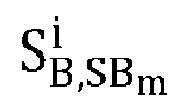
computing module 123 may calculate the relation index between the feature fA and the feature fB according to the vector VA,SBm and the vector VB,SBm . The relation index corresponds to the m-th model. The relation index is, for example, related to Pearson coefficient of correlation (PCC), but the disclosure is not limited thereto.

- For example, the
computing module 123 may generate the following Table 6 according to Tables 1, 2, and 3 based on Equation (4) and Equation (5). Table 6 includes M*K vectors corresponding to the K features (where K=5) and M models (where M=3). Each vector may include N elements (where N=3) corresponding to the N training data.Table 6 Feature fj Vector Vj,SB 1 Vector Vj,SB 2 Vector Vj,SB 3 Feature f1 V1,SB 1 = (1,1,0)V1,SB 2 = (1,1,0)V1,SB 3 = (1,1,0)Feature f2 V2,SB 1 = (1,0,0)V2,SB 2 = (1,0,0)V2,SB 3 = (0,1,0)Feature f3 V3,SB 1 = (0,0,1)V3,SB 2 = (1,1,0)V3,SB 3 = (0,0,1)Feature f4 V4,SB 1 = (0,0,1)V4,SB 2 = (0,1,0)V4,SB 3 = (1,0,0)Feature f5 V5,SB 1 = (0,1,0)V5,SB 2 = (0,0,1)V5,SB 3 = (1,1,0) - The
computing module 123 may calculate the relation index corresponding to at least two features. For example, if the at least two features include only two features, thecomputing module 123 may calculate the relation index between the two features (for example, the feature fA and the feature fB) based on Equation (6), where C(Vx,Vy) is the correlation coefficient between a vector Vx and a vector Vy, and Wm is the weight corresponding to the m-th model. For another example, if the at least two features exceed two features, thecomputing module 123 may calculate the p-value of the at least two features based on an analysis of variance (ANOVA) test as the relation index.
- In an embodiment, the weights corresponding to the first model, the second model, and the third model may respectively be the weight w1 = 0, the weight w2 = 0, and the weight w3 = 1. In an embodiment, the weights corresponding to the first model, the second model, and the third model may respectively be the weight w1 = 1/3, the weight w2 = 1/3, and the weight w3 = 1/3. For example, if the weight w1 = 1/3, the weight w2 = 1/3, and the weight w3 = 1/3, the
computing module 123 may generate Table 7 according to the vectors of Table 6 based on Equation (6).Table 7 Feature pair Correlation coefficient corresponding to first model Correlation coefficient corresponding to second model Correlation coefficient corresponding to third model Relation index RI f1, f2 C(V1,SB 1 V2,SB1 ) = 0.5C(V1,SB 2 ,V2,SB2 ) = 0.5C(V1,SB 3 ,V2,SB3 ) = 0.51/2 f1, f3 C(V1,SB 1 ,V3,SB3 ) = -1.0C(V1,SB 2 ,V3,SB2 ) = 1.0C(V1,SB 3 , V3,SB3 ) = -1-1/3 f1, f4 C(V1,SB 1 , V4,SB1 ) = -1.0C(V1,SB 2 , V4,SB2 ) = 0.5C(V1,SB 3 ,V4,SB3 ) = 0.50 f1, f5 C(V1,SB 1 V5,SB1 ) = 0.5C(V1,SB 2 , V5,SB2 ) = -1.0C(V1,SB 3 , V5,SB3 ) = 1.01/6 f2, f3 C(V2,SB 1 , V3,SB1 ) = -0.5C(V2,SB 2 , V3,SB2 ) = 0.5C(V2,SB 3 , V3,SB3 ) = -0.5-1/6 f2, f4 C(V2,SB 1 , V4,SB1 ) = -0.5C(V2,SB 2 , V4,SB2 ) = -0.5C(V2,SB 3 , V4,SB3 ) = -0.5-1/2 f2, f5 C(V2,SB 1 , V5,SB1 ) = -0.5C(V2,SB 2 , V5,SB2 ) = -0.5C(V2,SB 3 , V5,SB3 ) = 0.5-1/6 f3, f4 C(V3,SB 1 , V4,SB1 ) = 1.0C(V3,SB 2 , V4,SB2 ) = 0.5C(V3,SB 3 , V4,SB3 ) = -0.51/3 f3, f5 C(V3,SB 1 , V5,SB1 ) = -0.5C(V3,SB 2 , V5,SB2 ) = -1.0C(V3,SB 3 V5,SB3 ) = -1.0-5/6 f4, f5 C(V4,SB, 1 , V5,SB1 ) = -0.5C(V4,SB 2 , V5,SB2 ) = -0.5C(V4,SB 3 , V5,SB3 ) = 0.5-1/6 - In Step S208, the
computing module 123 may determine whether the feature fA and the feature fB are the selected feature pair according to the threshold value m2 and the relation index RI(fA, fB). - In an embodiment, the threshold value m2 may be associated with a relation index ranking of a feature pair in


computing module 123 may select the feature pair (f1, f2) with the highest relation index from 10 feature pairs according to the threshold value m2 as the selected feature pair. In other words, thecomputing module 123 may select the feature pair (f1, f2) from the 10 feature pairs in Table 7 as the selected feature pair in response to the relation index RI(f1, f2) being greater than the relation indexes RI(f1, f3), RI(f1, f4), RI(f1, f5), RI(f2, f3), RI(f2, f3), RI(f2, f5), RI(f3, f4), RI(f3, f5), and RI(f4,f5). - In an embodiment, the
computing module 123 may select the feature pair (fA, fB) as the selected feature pair in response to the relation index RI(fA, fB) exceeding the threshold value m2. Taking Table 7 as an example, assuming that the threshold value m2 is equal to 1/4, thecomputing module 123 may select the feature pair (f1, f2) as the selected feature pair in response to the relation index RI(f1, f2) being greater than 1/4, but the selected feature pair is not limited to one pair. - After executing Step S206 and Step S208 to respectively obtain the selected feature and the selected feature pair, in Step S209, the
computing module 123 may obtain a feature corresponding to the selected feature from the selected feature pair as an accompanied feature. For example, after determining that the feature fA is the selected feature and the feature pair (fA, fB) is the selected feature pair, thecomputing module 123 may select the feature fB corresponding to the feature fA from the feature pair (fA, fB) as the accompanied feature of the feature fA. - In an embodiment, the accompanied feature may be selected by a professional from the K features according to experience as the accompanied feature.
- In Step S210, the
output module 124 may output the selected feature and the accompanied feature through thetransceiver 130. In an embodiment, thecomputing module 123 may determine whether the selected feature and the accompanied feature are usable. If the selected feature and the accompanied feature are usable, theoutput module 124 may output the selected feature and the accompanied feature. If the selected feature and the accompanied feature are not usable, theoutput module 124 may not output the selected feature and the accompanied feature.FIG. 3 is a flowchart of a method for determining whether a selected feature and an accompanied feature are usable according to an embodiment of the disclosure. - In Step S301, the
computing module 123 obtains a selected feature and an accompanied feature corresponding to the selected feature. - In Step S302, the
training module 122 may obtain parts corresponding to the selected feature and the accompanied feature from N training data to train at least one first prediction model for predicting a physiological state. The at least one first prediction model may correspond to an RF algorithm, a logistic regression, or a SVM, but the disclosure is not limited thereto. - In Step S303, the
training module 122 may obtain parts corresponding to the selected feature and the accompanied feature from N test data to calculate at least one first performance index corresponding to the at least one first prediction model. The at least one first performance index may correspond to parameters such as accuracy (ACC), precision, recall rate, false positive (FP), or F1 score in a confusion matrix. - In Step S304, the
training module 122 may select two random features from the K features. Any one of the two random features is different from any one of the selected feature and the accompanied feature. Then, thetraining module 122 may obtain parts corresponding to the two random features from the N training data to train at least one second prediction model for predicting the physiological state. The at least one second prediction model may correspond to the RF algorithm, the logistic regression, or the SVM, but the disclosure is not limited thereto. In an embodiment, thetraining module 122 may select multiple random features corresponding to the number of selected features and accompanied features from the K features, so as to train the at least one second prediction model. For example, if the total number of selected features and accompanied features obtained by thecomputing module 123 in Step S301 is 4, thetraining module 122 may select 4 random features from the K features to train the at least one second prediction model. - In Step S305, the
training module 122 may obtain parts corresponding to the two random features (or multiple random features corresponding to the number of selected features and accompanied features) from the N test data to calculate at least one second performance index corresponding to the at least one second prediction model. The at least one second performance index may correspond to the parameters such as ACC, precision, recall, FP, or F1 score in the confusion matrix. - In Step S306, the
computing module 123 may determine whether the at least one first performance index is greater than the at least one second performance index. If the at least one first performance index is greater than the at least one second performance index, Step S307 is proceeded. If the at least one first performance index is less than or equal to the at least one second performance index, Step S308 is proceeded. - In Step S307, the
computing module 123 may determine that the selected feature and the accompanied feature are usable. In Step S308, thecomputing module 123 may determine that the selected feature and the accompanied feature are not usable. -
FIG. 4 is a flowchart of a method for screening features for predicting a physiological state according to another embodiment of the disclosure. The method may be implemented by theelectronic device 100 shown inFIG. 1 . In Step S401, multiple physiological data corresponding to multiple features are obtained. In Step S402, multiple first subsets of the multiple features are generated according to the multiple physiological data based on a first model. The multiple first subsets respectively correspond to the multiple physiological data. In Step S403, a first feature is selected from the multiple features according to the multiple first subsets, a first relation index of the first feature and a second feature corresponding to the multiple features is calculated, and the second feature is selected as the accompanied feature of the first feature according to the first relation index. In Step S404, the first feature and the accompanied feature are output. - In summary, the disclosure may use different types of models to select the feature that significantly affects the prediction result of the physiological state from multiple features, and may select the accompanied feature corresponding to the feature according to the relation index between the feature and other features. The accompanied features selected according to the method may also significantly affect the prediction result of the physiological state. After obtaining at least one feature and at least one corresponding accompanied feature, the disclosure may train the prediction model according to the at least one feature and the at least one accompanied feature, and calculate the performance index of the prediction model. If the performance index shows that the at least one feature and the at least one accompanied feature may significantly affect the prediction result of the physiological state by the prediction model, the disclosure may output the at least one feature and the at least one accompanied feature as reference for the user.
-
- 100: electronic device
- 110: processor
- 120: storage medium
- 121: data collection module
- 122: training module
- 123: computing module
- 124: output module
- 130: transceiver
- S201, S202, S203, S204, S205, S206, S207, S208, S209, S210, S301, S302, S303, S304, S305, S306, S307, S308, S401, S402, S403, S404: Step
Claims (14)
- An electronic device (100) for screening features for predicting a physiological state, comprising:a transceiver (130);a storage medium (120), storing a plurality of modules; anda processor (110), coupled to the storage medium (120) and the transceiver (130), and accessing and executing the plurality of modules, wherein the plurality of modules comprise:a data collection module (121), obtaining a plurality of physiological data corresponding to a plurality of features through the transceiver;a training module (122), generating a plurality of first subsets of the plurality of features according to the plurality of physiological data based on a first model, wherein the plurality of first subsets respectively correspond to the plurality of physiological data;a computing module (123), selecting a first feature from the plurality of features according to the plurality of first subsets, calculating a first relation index of the first feature and a second feature corresponding to the plurality of features, and selecting the second feature as an accompanied feature of the first feature according to the first relation index; andan output module (124), outputting the first feature and the accompanied feature through the transceiver (130).
- The electronic device (100) according to claim 1, wherein
the training module (122) generates a plurality of second subsets of the plurality of features according to the plurality of physiological data based on a second model, wherein the plurality of second subsets respectively correspond to the plurality of physiological data; and
the computing module (123) selects the first feature from the plurality of features according to the plurality of first subsets and the plurality of second subsets. - The electronic device (100) according to claim 2, wherein
the computing module (123) calculates a first number of the first feature in the plurality of first subsets, and calculates a second number of the first feature in the plurality of second subsets; and
the computing module (123) selects the first feature from the plurality of features according to the first number and the second number. - The electronic device (100) according to claim 3, wherein
the computing module (123) calculates a first score of the first feature according to the first number, a first weight corresponding to the first model, the second number, and a second weight corresponding to the second model; and
the computing module (123) selects the first feature from the plurality of features in response to the first score being greater than a first threshold value. - The electronic device (100) according to claim 3, wherein
the computing module (123) calculates a first score of the first feature according to the first number, a first weight corresponding to the first model, the second number, and a second weight corresponding to the second model;
the computing module (123) calculates a third number of a third feature in the plurality of first subsets, and calculates a fourth number of the third feature in the plurality of second subsets;
the computing module (123) calculates a second score of the third feature according to the third number, the first weight, the fourth number, and the second weight; and
the computing module (123) selects the first feature from the first feature and the third feature in response to the first score being greater than the second score. - The electronic device (100) according to one of claims 2-5, wherein
the computing module (123) obtains a first number of the first feature in each of the plurality of first subsets to generate a first vector;
the computing module (123) obtains a second number of the second feature in each of the plurality of first subsets to generate a second vector; and
the computing module (123) calculates the first relation index according to the first vector and the second vector. - The electronic device (100) according to one of the preceding claims, wherein
the computing module (123) selects the second feature as the accompanied feature of the first feature in response to the first relation index being greater than a second threshold value. - The electronic device (100) according to one of the preceding claims, wherein
the computing module (123) calculates a second relation index corresponding to a third feature and a fourth feature in the plurality of features; and
the computing module (123) selects the second feature as the accompanied feature of the first feature in response to the first relation index being greater than the second relation index. - The electronic device (100) according to one of the preceding claims, wherein
the training module (122) trains at least one first prediction model of the physiological state according to the plurality of physiological data, the first feature, and the accompanied feature, and calculates at least one first performance index corresponding to the at least one first prediction model;
the training module (122) randomly selects a third feature and a fourth feature from the plurality of features, wherein any one of the third feature and the fourth feature is different from any one of the first feature and the second feature;
the training module (122) trains at least one second prediction model of the physiological state according to the plurality of physiological data, the third feature, and the fourth feature, and calculates at least one second performance index of the at least one second prediction model;
the computing module determines that the first feature and the accompanied feature are usable in response to the at least one first performance index being greater than the at least one second performance index; and
the output module (124) outputs the first feature and the accompanied feature in response to the first feature and the accompanied feature being usable. - The electronic device (100) according to one of the preceding claims, wherein the plurality of features respectively correspond to a plurality of types of metabolites of a human body.
- The electronic device (100) according to claim 9, wherein
the data collection module (121) receives a physiological data set through the transceiver (130), and divides the physiological data set into a plurality of training data and a plurality of test data respectively corresponding to the plurality of physiological data according to a bootstrap;
the training module (122) generates the plurality of first subsets according to the plurality of training data;
the training module (122) generates the at least one first prediction model according to the plurality of training data; and
the training module (122) calculates the at least one first performance index according to the plurality of test data. - The electronic device (100) according to one of claims 2-11, wherein the first model or the second model is associated with one of a random forest algorithm, a logistic regression, and a support vector machine.
- The electronic device (100) according to claim 12, wherein the first model generates the plurality of first subsets based on one of a stepwise selection and a feature importance.
- A method for screening features for predicting a physiological state, comprising:obtaining a plurality of physiological data corresponding to a plurality of features;generating a plurality of first subsets of the plurality of features according to the plurality of physiological data based on a first model, wherein the plurality of first subsets respectively correspond to the plurality of physiological data;selecting a first feature from the plurality of features according to the plurality of first subsets, calculating a first relation index of the first feature and a second feature corresponding to the plurality of features, and selecting the second feature as an accompanied feature of the first feature according to the first relation index; andoutputting the first feature and the accompanied feature.
Applications Claiming Priority (1)
| Application Number | Priority Date | Filing Date | Title |
|---|---|---|---|
| TW109146620A TWI763215B (en) | 2020-12-29 | 2020-12-29 | Electronic device and method for screening feature for predicting physiological state |
Publications (1)
| Publication Number | Publication Date |
|---|---|
| EP4024407A1 true EP4024407A1 (en) | 2022-07-06 |
Family
ID=76059723
Family Applications (1)
| Application Number | Title | Priority Date | Filing Date |
|---|---|---|---|
| EP21175249.8A Pending EP4024407A1 (en) | 2020-12-29 | 2021-05-21 | Electronic device and method for screening features for predicting physiological state |
Country Status (4)
| Country | Link |
|---|---|
| US (1) | US20220208382A1 (en) |
| EP (1) | EP4024407A1 (en) |
| CN (1) | CN114694838B (en) |
| TW (1) | TWI763215B (en) |
Citations (2)
| Publication number | Priority date | Publication date | Assignee | Title |
|---|---|---|---|---|
| US20190310269A1 (en) * | 2018-04-04 | 2019-10-10 | Human Longevity, Inc. | Systems and methods for measuring obesity using metabolome analysis |
| US20200194126A1 (en) * | 2018-12-17 | 2020-06-18 | The Regents Of The University Of California | Systems and methods for profiling and classifying health-related features |
Family Cites Families (20)
| Publication number | Priority date | Publication date | Assignee | Title |
|---|---|---|---|---|
| WO2008003148A1 (en) * | 2006-07-06 | 2008-01-10 | Biorics Nv | Real-time monitoring and control of physical and arousal status of individual organisms |
| RU2640568C2 (en) * | 2012-05-03 | 2018-01-09 | Медиал Рисеч Лтд. | Methods and systems for gastrointestinal tract cancer risk assessment |
| CN103761451B (en) * | 2014-01-02 | 2017-04-05 | 中国科学院数学与系统科学研究院 | Biomarker combined recognising method and system based on biomedical big data |
| CN104573410A (en) * | 2015-01-20 | 2015-04-29 | 合肥工业大学 | Cancer chemosensitivity prediction technique based on molecular subnet and random forest classifier |
| EP3356560A4 (en) * | 2015-09-30 | 2019-06-12 | Inform Genomics, Inc. | Systems and methods for predicting treatment-regimen-related outcomes |
| CN106250715A (en) * | 2016-09-28 | 2016-12-21 | 湖南老码信息科技有限责任公司 | A kind of chronic pharyngolaryngitis Forecasting Methodology based on increment type neural network model and prognoses system |
| CN107133448B (en) * | 2017-04-10 | 2020-05-01 | 温州医科大学 | A metabolomics data fusion optimization method |
| AU2018318756B2 (en) * | 2017-08-14 | 2021-12-02 | Macrogen Inc. | Disease-associated microbiome characterization process |
| KR102001398B1 (en) * | 2018-01-25 | 2019-07-18 | 재단법인 아산사회복지재단 | Method and apparatus for predicting brain desease change though machine learning and program for the same |
| WO2020037244A1 (en) * | 2018-08-17 | 2020-02-20 | Henry M. Jackson Foundation For The Advancement Of Military Medicine | Use of machine learning models for prediction of clinical outcomes |
| CA3115969A1 (en) * | 2018-10-12 | 2020-04-16 | Sumitomo Dainippon Pharma Co., Ltd. | Method, device, and program for assessing relevance of respective preventive interventional actions to health in health domain of interest |
| CN109460825A (en) * | 2018-10-24 | 2019-03-12 | 阿里巴巴集团控股有限公司 | For constructing the Feature Selection Algorithms, device and equipment of machine learning model |
| CN109884302B (en) * | 2019-03-14 | 2023-02-03 | 北京博远精准医疗科技有限公司 | Early diagnosis markers and application of lung cancer based on metabolomics and artificial intelligence technology |
| WO2020198068A1 (en) * | 2019-03-22 | 2020-10-01 | Inflammatix, Inc. | Systems and methods for deriving and optimizing classifiers from multiple datasets |
| US11145052B2 (en) * | 2019-04-25 | 2021-10-12 | International Business Machines Corporation | Intelligent classification of regions of interest of an organism from multispectral video streams using perfusion models |
| TW202107478A (en) * | 2019-08-07 | 2021-02-16 | 臺北醫學大學 | Computing device, portable device and computer-implemented method for predicting major adverse cardiovascular events |
| CN110646554B (en) * | 2019-09-12 | 2022-05-13 | 北京博远精准医疗科技有限公司 | Pancreatic cancer diagnosis marker based on metabonomics and screening method and application thereof |
| TWI715250B (en) * | 2019-10-17 | 2021-01-01 | 宏碁股份有限公司 | Feature identifying method and electronic device |
| WO2022006628A1 (en) * | 2020-07-08 | 2022-01-13 | Southern Adelaide Local Health Network Inc. | Computer-implemented method and system for identifying measurable features for use in a predictive model |
| TWI790479B (en) * | 2020-09-17 | 2023-01-21 | 宏碁股份有限公司 | Physiological status evaluation method and physiological status evaluation device |
-
2020
- 2020-12-29 TW TW109146620A patent/TWI763215B/en active
-
2021
- 2021-04-19 US US17/233,577 patent/US20220208382A1/en not_active Abandoned
- 2021-05-21 EP EP21175249.8A patent/EP4024407A1/en active Pending
- 2021-06-03 CN CN202110695287.4A patent/CN114694838B/en active Active
Patent Citations (2)
| Publication number | Priority date | Publication date | Assignee | Title |
|---|---|---|---|---|
| US20190310269A1 (en) * | 2018-04-04 | 2019-10-10 | Human Longevity, Inc. | Systems and methods for measuring obesity using metabolome analysis |
| US20200194126A1 (en) * | 2018-12-17 | 2020-06-18 | The Regents Of The University Of California | Systems and methods for profiling and classifying health-related features |
Non-Patent Citations (4)
| Title |
|---|
| "The Handbook of Metabonomics and Metabolomics", 11 December 2006, ELSEVIER B.V., article EBBELS TIMOTHY M.D.: "Chapter 7 Non-linear Methods for the Analysis of Metabolic Profiles", pages: 201 - 226, XP055857619 * |
| ANONYMOUS: "Machine learning - Wikipedia", 20 December 2020 (2020-12-20), XP055858166, Retrieved from the Internet <URL:https://en.wikipedia.org/w/index.php?title=Machine_learning&oldid=995303079#Model_assessments> [retrieved on 20211104] * |
| ANONYMOUS: "Metabolomics - Wikipedia", 22 December 2020 (2020-12-22), XP055857630, Retrieved from the Internet <URL:https://en.wikipedia.org/w/index.php?title=Metabolomics&oldid=995706304> [retrieved on 20211103] * |
| HSU YU-HAN H ET AL: "Integrating untargeted metabolomics, genetically informed causal inference, and pathway enrichment to define the obesity metabolome", INTERNATIONAL JOURNAL OF OBESITY, NATURE PUBLISHING GROUP UK, LONDON, vol. 44, no. 7, 28 May 2020 (2020-05-28), pages 1596 - 1606, XP037166549, ISSN: 0307-0565, [retrieved on 20200528], DOI: 10.1038/S41366-020-0603-X * |
Also Published As
| Publication number | Publication date |
|---|---|
| TW202226269A (en) | 2022-07-01 |
| CN114694838A (en) | 2022-07-01 |
| CN114694838B (en) | 2025-09-23 |
| TWI763215B (en) | 2022-05-01 |
| US20220208382A1 (en) | 2022-06-30 |
Similar Documents
| Publication | Publication Date | Title |
|---|---|---|
| CN110838366B (en) | A method and device for predicting disease risk | |
| Xie et al. | AutoScore: a machine learning–based automatic clinical score generator and its application to mortality prediction using electronic health records | |
| Mollura et al. | A novel artificial intelligence based intensive care unit monitoring system: using physiological waveforms to identify sepsis | |
| US11062792B2 (en) | Discovering genomes to use in machine learning techniques | |
| US20160249863A1 (en) | Health condition determination method and health condition determination system | |
| Hans et al. | Boosting distributional copula regression | |
| Khalid et al. | A dynamic selection hybrid model for advancing thyroid care with boo-st balancing method | |
| Jentzer et al. | Prognostic performance of serial determination of the society for cardiovascular angiography and interventions shock classification in adults with critical illness | |
| Mawlood et al. | Improving cardiovascular disease prediction through stratified machine learning models and combined datasets | |
| Pongthao et al. | Machine learning classification with logistic regression feature selection approach on health datasets | |
| US12548679B2 (en) | Individual optimal mode of delivery | |
| US11844633B2 (en) | Feature identifying method and electronic device | |
| EP4020494A1 (en) | Electronic device and method for predicting blockage of coronary artery | |
| US20200350077A1 (en) | Elderly mortality after trauma prediction system with multi-stage modelling and reporting | |
| CN114999639A (en) | Diabetes scoring model establishing method and diabetes risk scoring method | |
| US20220208382A1 (en) | Electronic device and method for screening features for predicting physiological state | |
| Qiu et al. | Fast leave-one-cluster-out cross-validation using clustered network information criterion | |
| EP3845121B1 (en) | Method and electronic device for selecting influence indicators by using automatic mechanism | |
| Phanbua et al. | Classification model of dementia and heart failure in older adults using extra trees and oversampling-based technique | |
| CN115376664A (en) | Method and device for determining user receiving a doctor, electronic equipment and storage medium | |
| Lumumba et al. | Evaluating the Performance of Ensemble and Single Classifiers with Explainable Artificial Intelligence (XAI) on Hypertension Risk Prediction | |
| EP4528750A1 (en) | Detection of hemodynamic instability | |
| Swathikrishna et al. | Preeclampsia Risk Prediction Using Machine Learning Algorithms | |
| Marozas et al. | Algorithm for diabetes risk evaluation from past gestational diabetes data | |
| TW202107478A (en) | Computing device, portable device and computer-implemented method for predicting major adverse cardiovascular events |
Legal Events
| Date | Code | Title | Description |
|---|---|---|---|
| PUAI | Public reference made under article 153(3) epc to a published international application that has entered the european phase |
Free format text: ORIGINAL CODE: 0009012 |
|
| STAA | Information on the status of an ep patent application or granted ep patent |
Free format text: STATUS: REQUEST FOR EXAMINATION WAS MADE |
|
| 17P | Request for examination filed |
Effective date: 20220330 |
|
| AK | Designated contracting states |
Kind code of ref document: A1 Designated state(s): AL AT BE BG CH CY CZ DE DK EE ES FI FR GB GR HR HU IE IS IT LI LT LU LV MC MK MT NL NO PL PT RO RS SE SI SK SM TR |
|
| STAA | Information on the status of an ep patent application or granted ep patent |
Free format text: STATUS: EXAMINATION IS IN PROGRESS |
|
| 17Q | First examination report despatched |
Effective date: 20250121 |