EP4024387B1 - Projection method, projection device, and projection system - Google Patents
Projection method, projection device, and projection system Download PDFInfo
- Publication number
- EP4024387B1 EP4024387B1 EP20857933.4A EP20857933A EP4024387B1 EP 4024387 B1 EP4024387 B1 EP 4024387B1 EP 20857933 A EP20857933 A EP 20857933A EP 4024387 B1 EP4024387 B1 EP 4024387B1
- Authority
- EP
- European Patent Office
- Prior art keywords
- projection
- drawing data
- distance
- projection device
- points
- Prior art date
- Legal status (The legal status is an assumption and is not a legal conclusion. Google has not performed a legal analysis and makes no representation as to the accuracy of the status listed.)
- Active
Links
Images





Classifications
-
- B—PERFORMING OPERATIONS; TRANSPORTING
- B25—HAND TOOLS; PORTABLE POWER-DRIVEN TOOLS; MANIPULATORS
- B25H—WORKSHOP EQUIPMENT, e.g. FOR MARKING-OUT WORK; STORAGE MEANS FOR WORKSHOPS
- B25H7/00—Marking-out or setting-out work
-
- G—PHYSICS
- G03—PHOTOGRAPHY; CINEMATOGRAPHY; ANALOGOUS TECHNIQUES USING WAVES OTHER THAN OPTICAL WAVES; ELECTROGRAPHY; HOLOGRAPHY
- G03B—APPARATUS OR ARRANGEMENTS FOR TAKING PHOTOGRAPHS OR FOR PROJECTING OR VIEWING THEM; APPARATUS OR ARRANGEMENTS EMPLOYING ANALOGOUS TECHNIQUES USING WAVES OTHER THAN OPTICAL WAVES; ACCESSORIES THEREFOR
- G03B21/00—Projectors or projection-type viewers; Accessories therefor
- G03B21/14—Details
- G03B21/142—Adjusting of projection optics
-
- B—PERFORMING OPERATIONS; TRANSPORTING
- B25—HAND TOOLS; PORTABLE POWER-DRIVEN TOOLS; MANIPULATORS
- B25H—WORKSHOP EQUIPMENT, e.g. FOR MARKING-OUT WORK; STORAGE MEANS FOR WORKSHOPS
- B25H7/00—Marking-out or setting-out work
- B25H7/04—Devices, e.g. scribers, for marking
- B25H7/045—Devices, e.g. scribers, for marking characterised by constructional details of the marking elements
-
- G—PHYSICS
- G01—MEASURING; TESTING
- G01C—MEASURING DISTANCES, LEVELS OR BEARINGS; SURVEYING; NAVIGATION; GYROSCOPIC INSTRUMENTS; PHOTOGRAMMETRY OR VIDEOGRAMMETRY
- G01C15/00—Surveying instruments or accessories not provided for in groups G01C1/00 - G01C13/00
- G01C15/002—Active optical surveying means
-
- G—PHYSICS
- G01—MEASURING; TESTING
- G01C—MEASURING DISTANCES, LEVELS OR BEARINGS; SURVEYING; NAVIGATION; GYROSCOPIC INSTRUMENTS; PHOTOGRAMMETRY OR VIDEOGRAMMETRY
- G01C15/00—Surveying instruments or accessories not provided for in groups G01C1/00 - G01C13/00
- G01C15/02—Means for marking measuring points
-
- G—PHYSICS
- G03—PHOTOGRAPHY; CINEMATOGRAPHY; ANALOGOUS TECHNIQUES USING WAVES OTHER THAN OPTICAL WAVES; ELECTROGRAPHY; HOLOGRAPHY
- G03B—APPARATUS OR ARRANGEMENTS FOR TAKING PHOTOGRAPHS OR FOR PROJECTING OR VIEWING THEM; APPARATUS OR ARRANGEMENTS EMPLOYING ANALOGOUS TECHNIQUES USING WAVES OTHER THAN OPTICAL WAVES; ACCESSORIES THEREFOR
- G03B21/00—Projectors or projection-type viewers; Accessories therefor
- G03B21/14—Details
- G03B21/147—Optical correction of image distortions, e.g. keystone
-
- G—PHYSICS
- G03—PHOTOGRAPHY; CINEMATOGRAPHY; ANALOGOUS TECHNIQUES USING WAVES OTHER THAN OPTICAL WAVES; ELECTROGRAPHY; HOLOGRAPHY
- G03B—APPARATUS OR ARRANGEMENTS FOR TAKING PHOTOGRAPHS OR FOR PROJECTING OR VIEWING THEM; APPARATUS OR ARRANGEMENTS EMPLOYING ANALOGOUS TECHNIQUES USING WAVES OTHER THAN OPTICAL WAVES; ACCESSORIES THEREFOR
- G03B21/00—Projectors or projection-type viewers; Accessories therefor
- G03B21/14—Details
- G03B21/26—Projecting separately subsidiary matter simultaneously with main image
-
- G—PHYSICS
- G09—EDUCATION; CRYPTOGRAPHY; DISPLAY; ADVERTISING; SEALS
- G09G—ARRANGEMENTS OR CIRCUITS FOR CONTROL OF INDICATING DEVICES USING STATIC MEANS TO PRESENT VARIABLE INFORMATION
- G09G3/00—Control arrangements or circuits, of interest only in connection with visual indicators other than cathode-ray tubes
- G09G3/001—Control arrangements or circuits, of interest only in connection with visual indicators other than cathode-ray tubes using specific devices not provided for in groups G09G3/02 - G09G3/36, e.g. using an intermediate record carrier such as a film slide; Projection systems; Display of non-alphanumerical information, solely or in combination with alphanumerical information, e.g. digital display on projected diapositive as background
-
- H—ELECTRICITY
- H04—ELECTRIC COMMUNICATION TECHNIQUE
- H04N—PICTORIAL COMMUNICATION, e.g. TELEVISION
- H04N9/00—Details of colour television systems
- H04N9/12—Picture reproducers
- H04N9/31—Projection devices for colour picture display, e.g. using electronic spatial light modulators [ESLM]
- H04N9/3179—Video signal processing therefor
- H04N9/3185—Geometric adjustment, e.g. keystone or convergence
-
- H—ELECTRICITY
- H04—ELECTRIC COMMUNICATION TECHNIQUE
- H04N—PICTORIAL COMMUNICATION, e.g. TELEVISION
- H04N9/00—Details of colour television systems
- H04N9/12—Picture reproducers
- H04N9/31—Projection devices for colour picture display, e.g. using electronic spatial light modulators [ESLM]
- H04N9/3191—Testing thereof
- H04N9/3194—Testing thereof including sensor feedback
-
- G—PHYSICS
- G09—EDUCATION; CRYPTOGRAPHY; DISPLAY; ADVERTISING; SEALS
- G09G—ARRANGEMENTS OR CIRCUITS FOR CONTROL OF INDICATING DEVICES USING STATIC MEANS TO PRESENT VARIABLE INFORMATION
- G09G2320/00—Control of display operating conditions
- G09G2320/06—Adjustment of display parameters
- G09G2320/0693—Calibration of display systems
Definitions
- the present invention relates to a projection method, a projection device, and a projection system.
- JP 2008-224516 A describes a construction support apparatus, for projecting and displaying the image for supporting a construction work on a target plane as a work target, including: a keystone information obtaining means for obtaining keystone information used for correcting distortions in the projected image generated due to an angle between the target plane and a projection light; a construction support image generating meansfor generating a predetermined construction support image; a keystone correcting meansfor implementing image processing for correcting a keystone in the construction support image, based on the keystone information; and an image projecting meansfor projecting the construction support image on the target plane, after the keystone in the construction support image is corrected.
- JP 2017-181342 A describes a setting-out support device that supports the setting-out to an architectural structure.
- the setting-out support device includes: a projection unit for projecting an image to an object surface for setting-out in an architectural structure; and a projection image control unit that determines the size of the image to be projected on the basis of the distance between the object surface and the setting-out support device, determines the position of the image to be projected on the basis of the position, on the object surface, of the foot of a perpendicular from the setting-out support device to the object surface, and projects the image to the projection unit at the determined position and size of the image to be projected.
- the present invention provides a projection method, a projection device, and a projection system which can readily form an association between a position in drawing data and a position in a projection plane onto which the drawing data is projected.
- the present invention relates to a projection method according to claim 1, a projection device according to claim 7, and a projection system according to claim 8.
- Claims 2 to 6 refer to specifically advantageous realizations of the projection method according to claim 1.
- a projection method, a projection device, and a projection system according to the present invention can readily form an association between a position in drawing data and a position in a projection plane onto which the drawing data is projected.
- Projection system 10 includes projection device 20.
- Projection device 20 is provided in space 100 in a building under construction.
- Projection device 20 projects, in actual size, drawing data that is at least a part of architectural design data onto a structure (specifically, a floor, a wall, or a ceiling) creating space 100.
- the drawing data indicates a marking position in the space, for example.
- a line of light having a length as designed is projected onto a position where a user, such as a worker for construction work, is to draw a marking line.
- a line of light is used as a guide to draw a marking line.
- a line of light itself may be used as a marking line.
- projection system 10 may be able to project a part of or the whole of architectural design data, and drawing data may be data other than data indicating a marking position. For example, if drawing data includes data indicating an installation position of equipment such as a built-in kitchen or a bathtub, projection system 10 may project the installation position of the equipment in actual size.
- FIG. 2 is a block diagram illustrating a functional configuration of projection system 10.
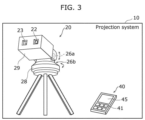
- FIG. 3 is a diagram illustrating an appearance of devices constituting projection system 10. As illustrated in FIG. 2 and FIG. 3 , projection system 10 includes projection device 20 and operation device 40. First, projection device 20 will be described.
- Communicator 21 is a communication circuit (in other words, a communication module) for projection device 20 to communicate with operation device 40. Communicator 21 performs wireless communication with operation device 40, but may perform wired communication with operation device 40. A communication standard for communication performed by communicator 21 is not particularly limited.
- Distance meter 22 detects a distance from projection device 20 to a structure creating space 100.
- Distance meter 22 is a distance measurement sensor such as a time of flight (TOF) sensor.
- Distance meter 22 may be other distance measurement sensors, such as a distance measurement sensor using a phase difference detection method, or a distance measurement sensor using a triangular distance measurement method.
- Distance meter 22 includes light source for distance measurement 22a and detector 22b.
- Light source for distance measurement 22a emits light toward a structure.
- Light source for distance measurement 22a is implemented by, for example, a light emitting element that emits infrared light, but may be implemented by a light emitting element that emits visible light.
- distance meter 22 has a laser pointer function for presenting the current distance measurement target point to a user. This function is implemented by a light source different from light source for distance measurement 22a, but in the case where light source for distance measurement 22a emits visible light, the function may be implemented by light source for distance measurement 22a.
- light source for distance measurement 22a is not necessarily a light source different from light source 23a included in projector 23. That is, light source 23a included in projector 23 may be used as light source for distance measurement 22a. More specifically, distance meter 22 may be a sensor that includes only detector 22b, without light source for distance measurement 22a.
- Detector 22b is a light receiving element that detects reflected light which is light emitted by light source for distance measurement 22a and reflected off a structure. Detector 22b is implemented by, for example, a photodiode.
- Light source 23a is a laser light source implemented by a semiconductor light emitting element, for example.
- light source 23a may include light emitting elements having different luminescent colors (e.g., a red-light emitting element, a green-light emitting element, and a blue-light emitting element), and may have a configuration capable of switching between the luminescent colors.
- Scanner 23b scans, on a structure, light emitted by light source 23a.
- Scanner 23b is implemented by, for example, a micro electro mechanical systems (MEMS) mirror.
- MEMS micro electro mechanical systems
- Controller 24 is a control device that controls distance meter 22, projector 23, and driver 26 for projecting drawing data onto projection plane 50. Controller 24 is implemented by, for example, a microcomputer or a processor. Moreover, controller 24 may include a driving circuit for driving projector 23, and a driving circuit for driving driver 26.
- Storage 25 is a storage device that stores drawing data, and a control program to be executed by controller 24. This control program is for projecting drawing data in actual size.
- Storage 25 is implemented by, for example, a semiconductor memory.
- Driver 26 is a driving mechanism for changing an orientation of projection device 20 (in other words, an orientation and an angle of distance meter 22). To be more specific, driver 26 changes an orientation of casing 29 with respect to attaching unit 28.
- Driver 26 includes first driver 26a for changing an orientation of projection device 20 toward a tilt direction, and second driver 26b for changing an orientation of projection device 20 toward a pan direction.
- Each of first driver 26a and second driver 26b is implemented by a rotary driving device such as a motor.
- driver 26 may include a third driver for changing an orientation of projection device 20 toward a roll direction.
- driver 26 may be a mechanism having a ball-shaped joint.
- Casing 29 accommodates communicator 21, distance meter 22, projector 23, controller 24, and storage 25.
- Casing 29 includes, for example, resin, but may include metal.
- Operation device 40 is a remote controller for a user to remotely control projection device 20.
- Operation device 40 is a remote controller exclusive to projection device 20, for example.
- a mobile terminal such as a smartphone or a tablet terminal in which an exclusive application program is installed may be used as operation device 40.
- operation device 40 includes operation receiver 41, communicator 42, controller 43, storage 44, and display 45.
- Operation receiver 41 is a user interface device that receives an operation performed by a user. Operation receiver 41 is implemented by, for example, a hardware button, but may be implemented by a touch panel.
- Storage 44 is a storage device that stores a control program to be executed by controller 43.
- Storage 44 is implemented by, for example, a semiconductor memory.
- Storage 44 also stores architectural design data.
- FIG. 5 is a diagram illustrating coordinate axes of orthogonal coordinates in space 100.
- the coordinate axes illustrated in FIG. 5 are determined by plotting, as origin O, the position of projection device 20 (more specifically, a predetermined position around distance meter 22 and projector 23 in projection device 20).
- projection plane 50 is a floor surface, and two reference lines L1 and L2 are drawn on the floor surface.
- the two reference lines L1 and L2 are drawn by, for example, a user.
- the two references lines L1 and L2 are orthogonal to each other.
- the position of an intersection point of the two reference lines L1 and L2 is reference point D.
- Reference point D is a point onto which a predetermined point in drawing data is to be projected.
- positions of reference lines L1 and L2 are specified in drawing data. Accordingly, reference lines L1 and L2 can be used for forming an association between a position in the drawing data and a position in projection plane 50.
- a user provides projection device 20 in space 100, and measures a distance from each of three distance measurement target points (hereinafter, also referred to as measurement points) on projection plane 50 to projection device 20 (S11). Note that the user is to measure a distance from each of at least three distance measurement target points to projection device 20. The user may measure a distance from each of three or more distance measurement target points to projection device 20.
- distance meter 22 of projection device 20 uses a laser pointer to present a measurement point on projection plane 50 to the user.
- the user drives driver 26 to move the laser pointer over reference line L1 (or reference line L2), and performs, in the current state, a measurement instruction operation instructing measurement (storage) of the distance.
- the distance from a measurement point to projection device 20 is stored in storage 25, together with the pan angle ⁇ and the tilt angle ⁇ at the time at which the measurement instruction operation is instructed.
- the pan angle ⁇ and the tilt angle ⁇ are measured by angle measurer 27.
- controller 24 calculates orthogonal coordinates (xyz coordinates) of the three measurement points, based on the stored information (i.e., results of the distance measurement) (S12).
- Distance r from each of the three measurement points to projection device 20, and, pan angles ⁇ and tilt angles ⁇ at the time at which the distances r are measured, which are stored in storage 25, represent polar coordinates of the three measurement points.
- controller 24 calculates a distance from projection device 20 to projection plane 50 (i.e., a plane that passes through measurement point A, measurement point B, and measurement point C), and the inclination angle of projection plane 50 relative to projection device 20 (S14).
- a distance i.e., a plane that passes through measurement point A, measurement point B, and measurement point C
- the inclination angle of projection plane 50 relative to projection device 20 S14.
- Normal vector n indicates the inclination angle of projection plane 50 in the orthogonal coordinates
- the length of normal vector n indicates the distance from projection device 20 to projection plane 50. That is, the calculation of a normal vector is equivalent to the calculation of a distance from projection device 20 to projection plane 50 and the inclination angle of projection plane 50 relative to projection device 20.
- x a y a z a x b y b z b x y c z c a b c d d d
- controller 24 causes projector 23 to project drawing data onto projection plane 50, based on the calculated distance from projection device 20 to projection plane 50 and the calculated inclination angle of projection plane 50 (S15). Specifically, controller 24 corrects distortion of the drawing data according to the calculated inclination angle of projection plane 50, and corrects a projection scaling factor for the drawing data, based on the calculated distance to projection plane 50.
- the two straight lines are the two reference lines L1 and L2 orthogonal to each other which are drawn on projection plane 50 in advance as marks.
- FIG. 7 is a diagram illustrating space 100 in which reference lines L1 and L2 are not drawn on projection plane 50.
- Reference point D is an intersection point of center lines indicating the center positions of the beams. These center lines are imaginary lines not drawn on projection plane 50, but the positions of the center lines are specified in drawing data.
- projection device 20 may indirectly measure a distance to measurement point E on a center line.
- a distance from measurement point E on the center line to projection device 20 may be indirectly measured by distance meter 22 measuring a distance from each of measurement point E1 on an edge of a beam and measurement point E2 on the other edge of the beam to projection device 20, and controller 24 calculating the distance to the point on the center line based on the measured distances.
- a beam is an example of a structure.
- a distance from a point on the center line of other structures excepting a beam to projection device 20 may be indirectly measured.
- FIGS. 8 and 9 are diagrams for describing a change in a driving speed of driver 26.
- controller 24 drives driver 26 at a slower speed for a longer distance, which is measured by distance meter 22. In other words, controller 24 reduces the speed at which an orientation of distance meter 22 is changed as the distance measured by distance meter 22 increases. Note that although the driving speed at which second driver 26b is driven in a pan direction is denoted by an arrow as an example in FIG. 8 , the driving speed at which first driver 26a is driven in a tilt direction is also changed in the same manner.
- operation locations e.g., positions of measurement target reference lines L1 and L2
- operation locations may be designated by a user for projection device 20 by inputting operation locations into operation device 40.
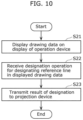
- FIG. 10 is a flowchart illustrating operation for receiving designation operation for designating reference lines.
- display 45 of operation device 40 displays drawing data (S21), and operation receiver 41 receives designation operation for designating reference lines in the displayed drawing data (S22).
- Controller 43 causes communicator 42 to transmit a result of the designation to projection device 20 (S23).
- FIG. 11 is a diagram illustrating an example of such confirmation image.
- FIG. 11 illustrates a diagram showing reference lines L1 and L2 drawn on projection plane 50 and a confirmation image which are viewed from a direction perpendicular to projection plane 50.
- confirmation image I is an L-shaped line determined by three measurement points (an L-shaped line that passes through the three measurement points), and is projected by projector 23. That is, the confirmation image is an image of two intersecting line segments.
- confirmation image I is to be an image showing positions of three measurement points.
- confirmation image I may show three dots that directly indicate the positions of the three measurement points.
- Confirmation image I may be any image so long as it shows positions of three measurement points.
- controller 24 may adjust the projection position of confirmation image I such that positions of the two line segments shown by confirmation image I are projected over the two reference lines, and may correct the projection position of drawing data according to a result of the adjustment.
- controller 24 finely adjusts the projection position of confirmation image I each time operation receiver 41 of operation device 40 receives an adjustment operation from a user.
- operation receiver 41 receives an adjustment completion operation from the user.
- Controller 24 stores an amount of adjustment which is added up from the start of the adjustment to the end of the adjustment in storage 25, and cause projector 23 to project drawing data with consideration given to the amount of adjustment. With this, a user can project drawing data onto projection plane 50, without remeasuring distances to three measurement points.
- Such a projection method as described above can readily form an association between a position in drawing data and a position in projection plane 50 by using points on reference lines L1 and L2 of the projection plane as measurement points (points whose coordinates are identified), when the positions of two lines in the drawing data are specified.
- the projection position is determined such that an intersection point of the two straight lines overlaps a predetermined point of the drawing data.
- Such a projection method as described above can readily form an association between a position in a drawing data and a position in projection plane 50 by using the position of an intersection point of two straight lines.
- the two straight lines are two straight lines orthogonal to each other which are drawn on projection plane 50 in advance.
- a user can set measurement points on two straight lines, since the user can visually check the two straight lines.
- At least one of the two straight lines is a center line indicating a center position of a structure and is an imaginary center line not drawn on projection plane 50, and at least one of the three or more points is positioned on the center line.
- the measuring the distance (S11) a distance from each of a point on an edge of the structure and a point on the other edge of the structure to projection device 20 is measured, and by calculating a distance to a point on the center line based on the measured distance, a distance from the at least one of the three or more points to projection device 20 is indirectly measured.
- the projection method further includes driving driver 26 included in projection device 20 to change an angle of distance meter 22 for selecting any of the three or more points as a distance measurement target point ( FIG. 8 and FIG. 9 ).
- the speed at which the angle of distance meter 22 is changed by driver 26 varies depending on a distance from the selected distance measurement target point to projection device 20.
- the projection method further includes: displaying the drawing data on display 45 (S21); and receiving an operation of a user for designating which parts of the displayed drawing data correspond to the two straight lines (S22).
- Such a projection method as described above can readily form an association between a position in a drawing data and a position in projection plane 50 by projection device 20 recognizing positions of two lines in drawing data which are designated by a user.
- the projection method further includes projecting confirmation image I indicating positions of the two straight lines ((a) of FIG. 11 ).
- confirmation image I is an image of two intersecting line segments.
- the projection method further includes adjusting a projection position of confirmation image I such that the positions of the two straight lines shown by confirmation image I are over the two reference lines ((b) of FIG. 11 ).
- Such a projection method as described above can correct the projection position of drawing data according to a result of adjustment.
- projection device 20 includes: projector 23 that projects drawing data for a building onto a projection plane of the building under construction; distance meter 22 that measures a distance from each of three or more points which are not aligned in a straight line and are on either of two non-parallel straight lines on projection plane 50 to projection device 20; angle measurer 27 that measures an angle of distance meter 22 at a time at which the distance is measured; and controller 24 that causes projector 23 to project the drawing data onto a projection position on projection plane 50 which is determined based on the measured distance and the angle of distance meter 22 at the time at which the distance is measured.
- Projection device 20 as described above can readily form an association between a position in drawing data and a position in projection plane 50 by using points on reference lines L1 and L2 of the projection plane as measurement points (points whose coordinates are identified), when the positions of two lines in the drawing data are specified.
- projection system 10 includes: projection device 20; and operation device 40 for a user to remotely control projection device 20.
- Projection system 10 as described above can readily form an association between a position in drawing data and a position in projection plane 50 by using points on reference lines L1 and L2 of the projection plane as measurement points (points whose coordinates are identified), when the positions of two lines in the drawing data are specified.
- the present invention may be implemented by a projector of another type.
- the projection device is to project at least a part of architectural design data onto a projection plane in actual size.
- the projection system includes a projection device and an operation device in the above-described embodiments.
- the projection system may be implemented as a single device.
- the projection system may be implemented as a client-server system. In this case, a server device performs a part of processing described as performed by the projection device in the above-described embodiments.
- the communication method employed between devices in the above-described embodiments is not particularly limited. Wireless communication or wired communication may be performed between the devices. Moreover, a combination of wireless communication and wired communication may be performed between the devices. In addition, when two devices perform communication in the above-described embodiments, a relay device that is not illustrated may be interposed between the two devices.
- each of elements may be implemented by executing a software program suitable for the element.
- Each element may be implemented by a program execution unit, such as a central processing unit (CPU), processor or the like, loading and executing a software program stored in a storage medium such as a hard disk or a semiconductor memory.
- a program execution unit such as a central processing unit (CPU), processor or the like, loading and executing a software program stored in a storage medium such as a hard disk or a semiconductor memory.
- each element may be implemented by a hardware product.
- each element may be a circuit (or an integrated circuit). These circuits may constitute a single circuit as a whole or may be individual circuits. Moreover, these circuits may be general-purpose circuits, or dedicated circuits.
- general or specific aspects of the present invention may be implemented by a system, a device, a method, an integrated circuit, a computer program, or a computer-readable recording medium such as a CD-ROM.
- the general or specific aspects of the present invention may also be implemented by an optional combination of a system, a device, a method, an integrated circuit, a computer program, and a recording medium.
- the present invention may be implemented as a program for causing a computer to execute the projection method.
- the present invention may be implemented as a non-transitory computer-readable recording medium on which such a program is recorded.
- the present invention also encompasses: embodiments achieved by applying various modifications conceivable to those skilled in the art to each embodiment.
Landscapes
- Physics & Mathematics (AREA)
- Engineering & Computer Science (AREA)
- General Physics & Mathematics (AREA)
- Mechanical Engineering (AREA)
- Multimedia (AREA)
- Signal Processing (AREA)
- Radar, Positioning & Navigation (AREA)
- Remote Sensing (AREA)
- Optics & Photonics (AREA)
- Theoretical Computer Science (AREA)
- Geometry (AREA)
- Computer Hardware Design (AREA)
- Projection Apparatus (AREA)
- Transforming Electric Information Into Light Information (AREA)
- Controls And Circuits For Display Device (AREA)
Description
- The present invention relates to a projection method, a projection device, and a projection system.
- Conventionally, projection devices that can project an image onto, for example, a screen have been known. As a technique relating to projection devices,
Japanese patent No. 6244008 -
JP 2008-224516 A -
JP 2017-181342 A -
US 2008/055554 A1 describes a full scale plan projection system including a processor and projector for displaying full scale building plans at a construction site or in a showroom. - In the method disclosed by
Japanese patent No. 6244008 - The present invention provides a projection method, a projection device, and a projection system which can readily form an association between a position in drawing data and a position in a projection plane onto which the drawing data is projected.
- The present invention relates to a projection method according to claim 1, a projection device according to claim 7, and a projection system according to claim 8. Claims 2 to 6 refer to specifically advantageous realizations of the projection method according to claim 1.
- A projection method, a projection device, and a projection system according to the present invention can readily form an association between a position in drawing data and a position in a projection plane onto which the drawing data is projected.
-
- [
FIG. 1 ]
FIG. 1 is a diagram illustrating an overview of operation performed by a projection system according to an embodiment. - [
FIG. 2 ]
FIG. 2 is a block diagram illustrating a functional configuration of the projection system according to the embodiment. - [
FIG. 3 ]
FIG. 3 is a diagram illustrating an appearance of devices constituting the projection system according to the embodiment. - [
FIG. 4 ]
FIG. 4 is a flowchart illustrating operation example 1 of operation performed by the projection system according to the embodiment. - [
FIG. 5 ]
FIG. 5 is a diagram illustrating coordinate axes of orthogonal coordinates in a space. - [
FIG. 6 ]
FIG. 6 is a diagram illustrating an equation for an orthogonal projection vector. - [
FIG. 7 ] Not falling under the claimed invention,FIG. 7 is a diagram illustrating a space in which reference lines are not drawn on a projection plane. - [
FIG. 8 ]
FIG. 8 is a first diagram illustrated for describing a change in a driving speed of a driver. - [
FIG. 9] FIG. 9 is a second diagram illustrated for describing a change in a driving speed of the driver. - [
FIG. 10] FIG. 10 is a flowchart illustrating operation for receiving designation operation for designating reference lines. - [
FIG. 11 ]
FIG. 11 is a diagram illustrating an example of a confirmation image. - Hereinafter, embodiments will be described in detail with reference to the drawings. Note that the embodiments below each describe a general or specific example. The numerical values, shapes, materials, elements, the arrangement and connection of the elements, steps, and orders of the steps, etc. presented in the embodiments below are mere examples, and are not intended to limit the present invention. Furthermore, among the elements in the embodiments below, those not recited in any one of the independent claims will be described as optional elements.
- Note that the drawings are schematic diagrams, and do not necessarily provide strictly accurate illustration. Throughout the drawings, the same numeral is given to substantially the same element, and redundant description may be omitted or simplified.
- First, an overview of a projection system according to an embodiment will be described.
FIG. 1 is a diagram illustrating an overview of operation performed by the projection system according to the embodiment. -
Projection system 10 according to the embodiment includesprojection device 20.Projection device 20 is provided inspace 100 in a building under construction.Projection device 20 projects, in actual size, drawing data that is at least a part of architectural design data onto a structure (specifically, a floor, a wall, or a ceiling) creatingspace 100. The drawing data indicates a marking position in the space, for example. A line of light having a length as designed is projected onto a position where a user, such as a worker for construction work, is to draw a marking line. - With this, the user can readily draw a marking line by tracing the projected line of light. Note that it is not essential that a line of light is used as a guide to draw a marking line. A line of light itself may be used as a marking line.
- Note that
projection system 10 may be able to project a part of or the whole of architectural design data, and drawing data may be data other than data indicating a marking position. For example, if drawing data includes data indicating an installation position of equipment such as a built-in kitchen or a bathtub,projection system 10 may project the installation position of the equipment in actual size. - Next, a configuration of the projection system according to the embodiment will be described.
FIG. 2 is a block diagram illustrating a functional configuration ofprojection system 10.FIG. 3 is a diagram illustrating an appearance of devices constitutingprojection system 10. As illustrated inFIG. 2 andFIG. 3 ,projection system 10 includesprojection device 20 andoperation device 40. First,projection device 20 will be described. -
Projection device 20 displays, in actual size, drawing data that is at least a part of architectural design data on a structure. Structures are, specifically, floors, walls, ceilings, and pillars.Projection device 20 is attached on a tripod and is provided on a floor, for example.Projection device 20 may be secured to a ceiling hanging bolt, or may be provided on a wall.Projection device 20 includescommunicator 21,distance meter 22,projector 23,controller 24,storage 25,driver 26,angle measurer 27, attaching unit 28 (illustrated inFIG. 3 ), and casing 29 (illustrate inFIG. 3 ). -
Communicator 21 is a communication circuit (in other words, a communication module) forprojection device 20 to communicate withoperation device 40.Communicator 21 performs wireless communication withoperation device 40, but may perform wired communication withoperation device 40. A communication standard for communication performed bycommunicator 21 is not particularly limited. -
Distance meter 22 detects a distance fromprojection device 20 to astructure creating space 100.Distance meter 22 is a distance measurement sensor such as a time of flight (TOF) sensor.Distance meter 22 may be other distance measurement sensors, such as a distance measurement sensor using a phase difference detection method, or a distance measurement sensor using a triangular distance measurement method.Distance meter 22 includes light source fordistance measurement 22a anddetector 22b. - Light source for
distance measurement 22a emits light toward a structure. Light source fordistance measurement 22a is implemented by, for example, a light emitting element that emits infrared light, but may be implemented by a light emitting element that emits visible light. Note that, as will be described later,distance meter 22 has a laser pointer function for presenting the current distance measurement target point to a user. This function is implemented by a light source different from light source fordistance measurement 22a, but in the case where light source fordistance measurement 22a emits visible light, the function may be implemented by light source fordistance measurement 22a. - Moreover, light source for
distance measurement 22a is not necessarily a light source different fromlight source 23a included inprojector 23. That is,light source 23a included inprojector 23 may be used as light source fordistance measurement 22a. More specifically,distance meter 22 may be a sensor that includesonly detector 22b, without light source fordistance measurement 22a. -
Detector 22b is a light receiving element that detects reflected light which is light emitted by light source fordistance measurement 22a and reflected off a structure.Detector 22b is implemented by, for example, a photodiode. -
Projector 23 is a projection module for projecting drawing data ontoprojection plane 50.Projector 23 includeslight source 23a, andscanner 23b. Note that, although not illustrated,projector 23 includes optical components such as a lens, a mirror, etc. other than the elements described above. -
Light source 23a is a laser light source implemented by a semiconductor light emitting element, for example. Note thatlight source 23a may include light emitting elements having different luminescent colors (e.g., a red-light emitting element, a green-light emitting element, and a blue-light emitting element), and may have a configuration capable of switching between the luminescent colors. -
Scanner 23b scans, on a structure, light emitted bylight source 23a.Scanner 23b is implemented by, for example, a micro electro mechanical systems (MEMS) mirror. -
Controller 24 is a control device that controlsdistance meter 22,projector 23, anddriver 26 for projecting drawing data ontoprojection plane 50.Controller 24 is implemented by, for example, a microcomputer or a processor. Moreover,controller 24 may include a driving circuit for drivingprojector 23, and a driving circuit for drivingdriver 26. -
Storage 25 is a storage device that stores drawing data, and a control program to be executed bycontroller 24. This control program is for projecting drawing data in actual size.Storage 25 is implemented by, for example, a semiconductor memory. -
Driver 26 is a driving mechanism for changing an orientation of projection device 20 (in other words, an orientation and an angle of distance meter 22). To be more specific,driver 26 changes an orientation of casing 29 with respect to attachingunit 28.Driver 26 includesfirst driver 26a for changing an orientation ofprojection device 20 toward a tilt direction, andsecond driver 26b for changing an orientation ofprojection device 20 toward a pan direction. Each offirst driver 26a andsecond driver 26b is implemented by a rotary driving device such as a motor. Note thatdriver 26 may include a third driver for changing an orientation ofprojection device 20 toward a roll direction. Moreover,driver 26 may be a mechanism having a ball-shaped joint. -
Angle measurer 27 measures an orientation of projection device 20 (in other words, an orientation and an angle of distance meter 22). Specifically,angle measurer 27 is an angle sensor that measures a driving amount (i.e., a tilt angle and a pan angle) ofdriver 26. Note that whendriver 26 includes a third driver for changing an orientation ofprojection device 20 toward a roll direction,angle measurer 27 may measure a roll angle as a driving amount ofdriver 26. - Attaching
unit 28 is an attaching structure for attachingprojection device 20 on a tripod. Note thatprojection device 20 may be attached to a ceiling hanging bolt. In this case, attachingunit 28 is an attaching structure for attachingprojection device 20 on a ceiling. -
Casing 29 accommodatescommunicator 21,distance meter 22,projector 23,controller 24, andstorage 25.Casing 29 includes, for example, resin, but may include metal. - Next,
operation device 40 will be described.Operation device 40 is a remote controller for a user to remotely controlprojection device 20.Operation device 40 is a remote controller exclusive toprojection device 20, for example. A mobile terminal such as a smartphone or a tablet terminal in which an exclusive application program is installed may be used asoperation device 40. Specifically,operation device 40 includesoperation receiver 41,communicator 42,controller 43,storage 44, anddisplay 45. -
Operation receiver 41 is a user interface device that receives an operation performed by a user.Operation receiver 41 is implemented by, for example, a hardware button, but may be implemented by a touch panel. -
Communicator 42 is a communication circuit (in other words, a communication module) foroperation device 40 to communicate withprojection device 20.Communicator 42 performs wireless communication withprojection device 20, but may perform wired communication withprojection device 20. A communication standard for communication performed bycommunicator 42 is not particularly limited. -
Controller 43 causescommunicator 42 to transmit, toprojection device 20, an instruction signal for causingprojection device 20 to operate according to an operation received byoperation receiver 41.Controller 43 is implemented by, for example, a microcomputer or a processor. -
Storage 44 is a storage device that stores a control program to be executed bycontroller 43.Storage 44 is implemented by, for example, a semiconductor memory.Storage 44 also stores architectural design data. - Architectural design data is three-dimensional data (more specifically, a three-dimensional CAD data) indicating the size and shape of
space 100. Architectural design data also includes drawing data (two-dimensional data) indicating a floor plan ofspace 100, and drawing data indicating a marking position. Note that at least drawing data included in architectural design data is also stored instorage 25 ofprojection device 20. -
Display 45 displays a screen showing, for example, operation conditions ofprojection device 20.Display 45 is implemented by, for example, a liquid crystal panel, or an organic electroluminescent (EL) panel. - In order to accurately project drawing data, it is important to form an association between a position in the drawing data and a position in
projection plane 50. Operation example 1 of operation performed byprojection system 10 which includes a process of forming such an association will be described.FIG. 4 is a flowchart illustrating operation example 1 of operation performed byprojection system 10. - Note that, in the following description of operation example 1, coordinate axes of orthogonal coordinates are set in
space 100 as illustrated inFIG. 5. FIG. 5 is a diagram illustrating coordinate axes of orthogonal coordinates inspace 100. The coordinate axes illustrated inFIG. 5 are determined by plotting, as origin O, the position of projection device 20 (more specifically, a predetermined position arounddistance meter 22 andprojector 23 in projection device 20). - Moreover, in the following description of operation example 1,
projection plane 50 is a floor surface, and two reference lines L1 and L2 are drawn on the floor surface. The two reference lines L1 and L2 are drawn by, for example, a user. The two references lines L1 and L2 are orthogonal to each other. The position of an intersection point of the two reference lines L1 and L2 is reference point D. Reference point D is a point onto which a predetermined point in drawing data is to be projected. Note that positions of reference lines L1 and L2 are specified in drawing data. Accordingly, reference lines L1 and L2 can be used for forming an association between a position in the drawing data and a position inprojection plane 50. - First, a user provides
projection device 20 inspace 100, and measures a distance from each of three distance measurement target points (hereinafter, also referred to as measurement points) onprojection plane 50 to projection device 20 (S11). Note that the user is to measure a distance from each of at least three distance measurement target points toprojection device 20. The user may measure a distance from each of three or more distance measurement target points toprojection device 20. - For example,
distance meter 22 ofprojection device 20 uses a laser pointer to present a measurement point onprojection plane 50 to the user. The user drivesdriver 26 to move the laser pointer over reference line L1 (or reference line L2), and performs, in the current state, a measurement instruction operation instructing measurement (storage) of the distance. Then, the distance from a measurement point toprojection device 20 is stored instorage 25, together with the pan angle ϕ and the tilt angle θ at the time at which the measurement instruction operation is instructed. Note that the pan angle ϕ and the tilt angle θ are measured byangle measurer 27. By the user repeatedly performing such an operation for three times, distance r from each of three mutually different measurement points onprojection plane 50 toprojection device 20, and pan angles ϕ and tilt angles θ at the time at which the distances r are measured are stored instorage 25. - Next,
controller 24 calculates orthogonal coordinates (xyz coordinates) of the three measurement points, based on the stored information (i.e., results of the distance measurement) (S12). Distance r from each of the three measurement points toprojection device 20, and, pan angles ϕ and tilt angles θ at the time at which the distances r are measured, which are stored instorage 25, represent polar coordinates of the three measurement points.Controller 24 can convert these polar coordinates into orthogonal coordinates (xyz coordinates) based on the following Math. 1.
[Math. 1]
- Next,
controller 24 calculates orthogonal coordinates of reference point D, based on the orthogonal coordinates of the three measurement points (S13). As illustrated inFIG. 5 , when the three measurement points are measurement point A, measurement point B, and measurement point C,controller 24 can calculate coordinates of reference point D based on an equation for an orthogonal projection vector shown inFIG. 6. FIG. 6 is a diagram illustrating an equation for an orthogonal projection vector. Note that, when one of measurement point A, measurement point B, and measurement point C is the same point as reference point D, a process of step S13 will be omitted. - Next,
controller 24 calculates a distance fromprojection device 20 to projection plane 50 (i.e., a plane that passes through measurement point A, measurement point B, and measurement point C), and the inclination angle ofprojection plane 50 relative to projection device 20 (S14). The following Math. 2 (determinant) holds when an equation ofprojection plane 50 is ax + by + cz = d, where coordinates of measurement point A is (xa, ya, za), coordinates of measurement point B is (xb, yb, zb), and coordinates of measurement point C is (xc, yc, zc).Controller 24 calculates normal vector n = (a, b, c) ofprojection plane 50 by modifying Math. 2 like Math. 3. Normal vector n indicates the inclination angle ofprojection plane 50 in the orthogonal coordinates, and the length of normal vector n indicates the distance fromprojection device 20 toprojection plane 50. That is, the calculation of a normal vector is equivalent to the calculation of a distance fromprojection device 20 toprojection plane 50 and the inclination angle ofprojection plane 50 relative toprojection device 20.
- Next,
controller 24causes projector 23 to project drawing data ontoprojection plane 50, based on the calculated distance fromprojection device 20 toprojection plane 50 and the calculated inclination angle of projection plane 50 (S15). Specifically,controller 24 corrects distortion of the drawing data according to the calculated inclination angle ofprojection plane 50, and corrects a projection scaling factor for the drawing data, based on the calculated distance toprojection plane 50. - In addition, the drawing data includes position information of the reference lines. Then,
controller 24causes projector 23 to project the corrected drawing data ontoprojection plane 50 such that reference lines L1 and L2 in the corrected drawing data overlap reference lines L1 and L2 of the projection plane, and that a predetermined point of the corrected drawing data overlaps the calculated coordinates of reference point D (i.e., determination of projection position). With this, the drawing data is projected ontoprojection plane 50 in actual size. - As has been described,
projection system 10 uses points on reference lines L1 and L2 of a projection plane which are specified in drawing data as measurement points (points whose coordinates are identified). Therefore,projection system 10 can readily form an association between a position in drawing data and a position inprojection plane 50. - In the above-described operation example 1, the two straight lines are the two reference lines L1 and L2 orthogonal to each other which are drawn on
projection plane 50 in advance as marks. However, not falling under the claimed invention, a case in which reference lines L1 and L2 are not drawn can be assumed.FIG. 7 is adiagram illustrating space 100 in which reference lines L1 and L2 are not drawn onprojection plane 50. - In the example shown in
FIG. 7 , two beams are disposed onprojection plane 50 such that the two beams intersect with each other, for example. Reference point D is an intersection point of center lines indicating the center positions of the beams. These center lines are imaginary lines not drawn onprojection plane 50, but the positions of the center lines are specified in drawing data. - When reference lines L1 and L2 are not drawn on
projection plane 50 as described above,projection device 20 may indirectly measure a distance to measurement point E on a center line. - For example,
distance meter 22 ofprojection device 20 uses a laser pointer to present a measurement target point onprojection plane 50 to a user. The user drivesdriver 26 to move the laser pointer over an edge (e.g., measurement point E1) of a beam, and performs, in the current state, a measurement instruction operation instructing measurement (storage) of the distance. Then, the distance from measurement point E1 toprojection device 20 is stored instorage 25, together with the pan angle ϕ and the tilt angle θ at the time at which the measurement instruction operation is instructed. - Similarly, the user drives
driver 26 to move the laser pointer over the other edge (e.g., measurement point E2) of the beam, and performs, in the current state, a measurement instruction operation instructing measurement (storage) of the distance. Then, the distance from measurement point E2 toprojection device 20 is stored instorage 25, together with the pan angle ϕ and the tilt angle θ at the time at which the measurement instruction operation is instructed. - Thereafter, controller 24 (or distance meter 22) calculates polar coordinates of the midpoint between polar coordinates of measurement point E1 and polar coordinates of measurement point E2 as polar coordinates of measurement point E.
- As has been described above, a distance from measurement point E on the center line to
projection device 20 may be indirectly measured bydistance meter 22 measuring a distance from each of measurement point E1 on an edge of a beam and measurement point E2 on the other edge of the beam toprojection device 20, andcontroller 24 calculating the distance to the point on the center line based on the measured distances. Note that a beam is an example of a structure. A distance from a point on the center line of other structures excepting a beam toprojection device 20 may be indirectly measured. - Since
projection system 10 as has been described above uses a point on a center line whose position is specified in drawing data as a measurement point (a point whose coordinates are identified),projection system 10 can readily form an association between a position in drawing data and a position inprojection plane 50. - When moving the laser pointer of
distance meter 22 over a point on reference lines L1 and L2 (in other words, when a user selects a distance measurement target point), an orientation ofdistance meter 22 is changed bydriver 26. In this case,distance meter 22 may continuously measure a distance to a distance measurement target point, andcontroller 24 may change a rotation driving speed ofdriver 26 according to the distance measured bydistance meter 22. That is, a speed at which an orientation ofprojection device 20 is changed bydriver 26 may vary depending on a distance from a selected distance measurement target point toprojection device 20.FIGS. 8 and 9 are diagrams for describing a change in a driving speed ofdriver 26. - As illustrated in
FIG. 8 , when the distance measured bydistance meter 22 is distance r1, the driving speed ofdriver 26 is v1. In contrast, when the distance measured bydistance meter 22 is distance r2 that is longer than distance r1 as illustrated inFIG. 9 , the driving speed ofdriver 26 is v2 that is slower than v1. As described,controller 24drives driver 26 at a slower speed for a longer distance, which is measured bydistance meter 22. In other words,controller 24 reduces the speed at which an orientation ofdistance meter 22 is changed as the distance measured bydistance meter 22 increases. Note that although the driving speed at whichsecond driver 26b is driven in a pan direction is denoted by an arrow as an example inFIG. 8 , the driving speed at whichfirst driver 26a is driven in a tilt direction is also changed in the same manner. - With this, since a measurement position is hardly changed when a distance measured by
distance meter 22 is long, an operation for a user to move a laser pointer is facilitated. - Since
space 100 in a huge building is large, a user needs to repeatedly perform operation of changing the position ofprojection device 20 and projecting a drawing data inspace 100. When a number of places having similar structure are present inspace 100, it may be difficult to form an association between a position in a drawing data and a position inprojection plane 50 only by performing operation described in operation example 1. For example, there may be a case where massive calculations need to be performed in order to form accurate associations. - In such case, operation locations (e.g., positions of measurement target reference lines L1 and L2) may be designated by a user for
projection device 20 by inputting operation locations intooperation device 40.FIG. 10 is a flowchart illustrating operation for receiving designation operation for designating reference lines. - As illustrated in
FIG. 10 ,display 45 ofoperation device 40 displays drawing data (S21), andoperation receiver 41 receives designation operation for designating reference lines in the displayed drawing data (S22).Controller 43 causescommunicator 42 to transmit a result of the designation to projection device 20 (S23). Once the user designates which parts of the displayed drawing data correspond to measurement target reference lines L1 and L2,projection device 20 can readily form associations between positions in the drawing data and positions inprojection plane 50 byprojection device 20 recognizing the reference lines in the drawing data. - As has been described above, three measurement points are selected by a user using, for example, the laser pointer function of
distance meter 22. For this reason, these points may be misaligned with reference lines drawn onprojection plane 50. Thus, after the user selecting three measurement points, a confirmation image showing the positions of the selected three measurement points may be projected.FIG. 11 is a diagram illustrating an example of such confirmation image.FIG. 11 illustrates a diagram showing reference lines L1 and L2 drawn onprojection plane 50 and a confirmation image which are viewed from a direction perpendicular toprojection plane 50. - As illustrated in
FIG. 11 , confirmation image I is an L-shaped line determined by three measurement points (an L-shaped line that passes through the three measurement points), and is projected byprojector 23. That is, the confirmation image is an image of two intersecting line segments. Note that confirmation image I is to be an image showing positions of three measurement points. For example, confirmation image I may show three dots that directly indicate the positions of the three measurement points. Confirmation image I may be any image so long as it shows positions of three measurement points. - As illustrated in (a) of
FIG. 11 , a user can readily recognize the misalignment between the three measurement points and reference lines L1 and L2 according to confirmation image I. - Here, when the three measurement points and reference lines L1 and L2 are misaligned as illustrated in (a) of
FIG. 11 , distances to the three measurement points may be remeasured once again (in other words, the three measurement points may be reselected). Alternatively,controller 24 may adjust the projection position of confirmation image I such that positions of the two line segments shown by confirmation image I are projected over the two reference lines, and may correct the projection position of drawing data according to a result of the adjustment. - For example,
controller 24 finely adjusts the projection position of confirmation image I eachtime operation receiver 41 ofoperation device 40 receives an adjustment operation from a user. When a confirmation image overlaps reference lines L1 and L2 as illustrated in (b) ofFIG. 11 as a result of repeated fine adjustments,operation receiver 41 receives an adjustment completion operation from the user.Controller 24 stores an amount of adjustment which is added up from the start of the adjustment to the end of the adjustment instorage 25, and causeprojector 23 to project drawing data with consideration given to the amount of adjustment. With this, a user can project drawing data ontoprojection plane 50, without remeasuring distances to three measurement points. - As has been described above, a projection method, which is executed by
projection device 20, for projecting drawing data for a building onto a projection plane of the building under construction includes: measuring a distance from each of three or more points which are not aligned in a straight line and are on either of two non-parallel straight lines onprojection plane 50 toprojection device 20 usingdistance meter 22 included in projection device 20 (S11); measuring an angle (e.g., a pan angle and a tilt angle) ofdistance meter 22 at a time at which the distance is measured; and projecting the drawing data onto a projection position onprojection plane 50 which is determined based on the distance measured and the angle ofdistance meter 22 at the time at which the distance is measured (S15). - Such a projection method as described above can readily form an association between a position in drawing data and a position in
projection plane 50 by using points on reference lines L1 and L2 of the projection plane as measurement points (points whose coordinates are identified), when the positions of two lines in the drawing data are specified. - In addition, the projection position is determined such that an intersection point of the two straight lines overlaps a predetermined point of the drawing data.
- Such a projection method as described above can readily form an association between a position in a drawing data and a position in
projection plane 50 by using the position of an intersection point of two straight lines. - In addition, the projection method further includes calculating a distance from
projection device 20 toprojection plane 50 and an inclination angle ofprojection plane 50, based on the measured distance and the measured angle ofdistance meter 22 at the time at which the distance is measured (S14). In the projecting (S15), the drawing data on which distortion correction is performed based on the calculated inclination angle ofprojection plane 50 is projected onto the projection position using a projection scaling factor determined based on the calculated distance fromprojection device 20 toprojection plane 50. - Such a projection method as described above can project drawing data in actual size.
- In addition, the two straight lines are two straight lines orthogonal to each other which are drawn on
projection plane 50 in advance. - In such a projection method as described above, a user can set measurement points on two straight lines, since the user can visually check the two straight lines.
- In addition, in Variation 1, at least one of the two straight lines is a center line indicating a center position of a structure and is an imaginary center line not drawn on
projection plane 50, and at least one of the three or more points is positioned on the center line. In the measuring the distance (S11), a distance from each of a point on an edge of the structure and a point on the other edge of the structure toprojection device 20 is measured, and by calculating a distance to a point on the center line based on the measured distance, a distance from the at least one of the three or more points toprojection device 20 is indirectly measured. - In such a projection method as described above, a user can set measurement points on two straight lines, even when the user cannot visually check the two straight lines.
- In addition, in Variation 2, the projection method further includes driving
driver 26 included inprojection device 20 to change an angle ofdistance meter 22 for selecting any of the three or more points as a distance measurement target point (FIG. 8 and FIG. 9 ). The speed at which the angle ofdistance meter 22 is changed bydriver 26 varies depending on a distance from the selected distance measurement target point toprojection device 20. - According to such a projection method as described above, an operation for a user to set a distance measurement target point is facilitated since a measurement position is hardly changed by reducing the speed at which an angle of
distance meter 22 is changed as the distance measured bydistance meter 22 increases. - In addition, in Variation 3, the projection method further includes: displaying the drawing data on display 45 (S21); and receiving an operation of a user for designating which parts of the displayed drawing data correspond to the two straight lines (S22).
- Such a projection method as described above can readily form an association between a position in a drawing data and a position in
projection plane 50 byprojection device 20 recognizing positions of two lines in drawing data which are designated by a user. - In addition, in Variation 4, the projection method further includes projecting confirmation image I indicating positions of the two straight lines ((a) of
FIG. 11 ). - According to such a projection method as described above, a user can readily check the positions of two straight lines.
- In addition, in Variation 4, confirmation image I is an image of two intersecting line segments.
- According to such a projection method as described above, a user can readily check the positions of two straight lines.
- In addition, in Variation 4, the projection method further includes adjusting a projection position of confirmation image I such that the positions of the two straight lines shown by confirmation image I are over the two reference lines ((b) of
FIG. 11 ). - Such a projection method as described above can correct the projection position of drawing data according to a result of adjustment.
- In addition,
projection device 20 includes:projector 23 that projects drawing data for a building onto a projection plane of the building under construction;distance meter 22 that measures a distance from each of three or more points which are not aligned in a straight line and are on either of two non-parallel straight lines onprojection plane 50 toprojection device 20;angle measurer 27 that measures an angle ofdistance meter 22 at a time at which the distance is measured; andcontroller 24 that causesprojector 23 to project the drawing data onto a projection position onprojection plane 50 which is determined based on the measured distance and the angle ofdistance meter 22 at the time at which the distance is measured. -
Projection device 20 as described above can readily form an association between a position in drawing data and a position inprojection plane 50 by using points on reference lines L1 and L2 of the projection plane as measurement points (points whose coordinates are identified), when the positions of two lines in the drawing data are specified. - In addition,
projection system 10 includes:projection device 20; andoperation device 40 for a user to remotely controlprojection device 20. -
Projection system 10 as described above can readily form an association between a position in drawing data and a position inprojection plane 50 by using points on reference lines L1 and L2 of the projection plane as measurement points (points whose coordinates are identified), when the positions of two lines in the drawing data are specified. - The foregoing has described embodiments, yet the present invention is not limited to the above-described embodiments.
- For example, although a laser scanning type projection device has been described in the above-described embodiments, the present invention may be implemented by a projector of another type. The projection device is to project at least a part of architectural design data onto a projection plane in actual size.
- In addition, the projection system includes a projection device and an operation device in the above-described embodiments. However, the projection system may be implemented as a single device. Moreover, the projection system may be implemented as a client-server system. In this case, a server device performs a part of processing described as performed by the projection device in the above-described embodiments.
- In addition, the orders of processes described in the flowcharts of the above-described embodiments are mere examples. The order of processes may be changed, and the processes may be performed in parallel.
- In addition, the communication method employed between devices in the above-described embodiments is not particularly limited. Wireless communication or wired communication may be performed between the devices. Moreover, a combination of wireless communication and wired communication may be performed between the devices. In addition, when two devices perform communication in the above-described embodiments, a relay device that is not illustrated may be interposed between the two devices.
- Moreover, in the above-described embodiments, each of elements may be implemented by executing a software program suitable for the element. Each element may be implemented by a program execution unit, such as a central processing unit (CPU), processor or the like, loading and executing a software program stored in a storage medium such as a hard disk or a semiconductor memory.
- Moreover, each element may be implemented by a hardware product. For example, each element may be a circuit (or an integrated circuit). These circuits may constitute a single circuit as a whole or may be individual circuits. Moreover, these circuits may be general-purpose circuits, or dedicated circuits.
- Note that general or specific aspects of the present invention may be implemented by a system, a device, a method, an integrated circuit, a computer program, or a computer-readable recording medium such as a CD-ROM. The general or specific aspects of the present invention may also be implemented by an optional combination of a system, a device, a method, an integrated circuit, a computer program, and a recording medium.
- For example, the present invention may be implemented as a program for causing a computer to execute the projection method. Alternatively, the present invention may be implemented as a non-transitory computer-readable recording medium on which such a program is recorded.
- The present invention also encompasses: embodiments achieved by applying various modifications conceivable to those skilled in the art to each embodiment.
-
- 10
- projection system
- 20
- projection device
- 22
- distance meter
- 23
- projector
- 26
- driver
- 27
- angle measurer
- 40
- operation device
- 45
- display
- 50
- projection plane
Claims (8)
- A projection method, which is executed by a projection device (20), for projecting drawing data for a building onto a projection plane (50) of the building under construction, the projection method comprising: measuring three or more distances, respectively, from three or more points on either of two straight lines (L1, L2) on the projection plane (50) to the projection device (20) using a distance meter (22) included in the projection device (20, the two straight lines being reference lines orthogonal to each other and drawn on the projection plane (50) in advance, the three or more points being not aligned in a straight line;measuring angles of the distance meter (22) at a time at which the distances are measured, wherein the angles include a pan angle and a tilt angle;calculating a distance from the projection device (20) to the projection plane (50) and an inclination angle of the projection plane (50) relative to the projection device (20), based on the distances measured and the angles measured;correcting distortion of the drawing data based on the calculated inclination angle;correcting a projection scaling factor for the drawing data based on the calculated distance; andprojecting the drawing data onto a projection position on the projection plane (50), wherein, in the projecting, the drawing data on which the distortion correction is performed is projected onto the projection position using the corrected projection scaling factor; wherein the projection position is determined based on the distances measured and the angles of the distance meter (22) at the time at which the distances are measured;wherein the drawing data includes position information of the two reference lines and the projection position is determined such that i) the two reference lines in the corrected drawing data overlap the two straight lines (L1, L2) on the projection plane (50), and ii) an intersection point of the two straight lines (L1, L2) overlaps a predetermined point of the corrected drawing data.
- The projection method according to claim 1, further comprising:driving a driver (26) included in the projection device (20) to change the pan angle and/or the tilt angle of the distance meter (22) for selecting any of the three or more points as a distance measurement target point, whereina speed at which the pan angle and/or the tilt angle of the distance meter (22) is changed by the driver varies depending on a distance from the distance measurement target point selected to the projection device (20).
- The projection method according to claim 1 or 2, further comprising:displaying the drawing data on a display (45); andreceiving an operation of a user for designating which parts of the drawing data displayed correspond to the two straight lines (L1, L2).
- The projection method according to any one of claims 1 to 3, wherein the three or more points are points selected by a user using a laser pointer function of the projection device (20), and wherein the method further comprises:
projecting a confirmation image showing positions of the three or more points selected by the user such that the user can recognize misalignment between the three or more points and the two straight lines (L1, L2). - The projection method according to claim 4, wherein
the confirmation image is an image of two intersecting line segments. - The projection method according to claim 4 or 5, further comprising:
adjusting a projection position of the confirmation image such that the positions of the three or more points shown by the confirmation image are over the two straight lines (L1, L2). - A projection device (20) comprising a projector (23), a distance meter (22), an angle measurer (27), and a controller (24);wherein the projector (23) is configured to project drawing data for a building onto a projection plane (50) of the building under construction;wherein the distance meter (22) is configured to measure three or more distances, respectively, from three or more points on either of two straight lines (L1, L2) on the projection plane (50) to the projection device (20), the two straight lines being reference lines orthogonal to each other and drawn on the projection plane (50) in advance, the three or more points being not aligned in a straight line;wherein the angle measurer (27) is configured to measure angles of the distance meter (22) at a time at which the distances are measured, wherein the angles include a pan angle and a tilt angle;wherein the controller (24) is configured to calculate a distance from the projection device (20) to the projection plane (50) and an inclination angle of the projection plane (50) relative to the projection device (20), based on the distances measured and the angles measured;wherein the controller (24) is configured to correct distortion of the drawing data based on the calculated inclination angle;wherein the controller (24) is configured to correct a projection scaling factor for the drawing data based on the calculated distance;wherein the controller (24) is configured to cause the projector (23) to project the drawing data onto a projection position on the projection plane (50), wherein, in the projecting, the drawing data on which the distortion correction is performed is projected onto the projection position using the corrected projection scaling factor;wherein the projection position is determined based on the distances measured and the angles of the distance meter (22) at the time at which the distances are measured;wherein the drawing data includes position information of the two reference lines and the projection position is determined such that i) the two reference lines in the corrected drawing data overlap the two straight lines (L1, L2) on the projection plane (50), and ii) an intersection point of the two straight lines (L1, L2) overlaps a predetermined point of the corrected drawing data.
- A projection system (10) comprisingthe projection device (20) according to claim 7; and
an operation device (40) for a user to remotely control the projection device (20).
Applications Claiming Priority (2)
| Application Number | Priority Date | Filing Date | Title |
|---|---|---|---|
| JP2019156176 | 2019-08-28 | ||
| PCT/JP2020/029850 WO2021039313A1 (en) | 2019-08-28 | 2020-08-04 | Projection method, projection device, and projection system |
Publications (4)
| Publication Number | Publication Date |
|---|---|
| EP4024387A1 EP4024387A1 (en) | 2022-07-06 |
| EP4024387A4 EP4024387A4 (en) | 2022-11-30 |
| EP4024387B1 true EP4024387B1 (en) | 2024-10-02 |
| EP4024387C0 EP4024387C0 (en) | 2024-10-02 |
Family
ID=74684157
Family Applications (1)
| Application Number | Title | Priority Date | Filing Date |
|---|---|---|---|
| EP20857933.4A Active EP4024387B1 (en) | 2019-08-28 | 2020-08-04 | Projection method, projection device, and projection system |
Country Status (5)
| Country | Link |
|---|---|
| US (1) | US11803109B2 (en) |
| EP (1) | EP4024387B1 (en) |
| JP (1) | JP7304591B2 (en) |
| CN (1) | CN114342363B (en) |
| WO (1) | WO2021039313A1 (en) |
Families Citing this family (4)
| Publication number | Priority date | Publication date | Assignee | Title |
|---|---|---|---|---|
| CN113518212A (en) * | 2021-04-13 | 2021-10-19 | 安徽优品智能科技有限公司 | Trapezoidal correction method and device for projection picture, projection equipment and storage medium |
| JP2024088400A (en) * | 2022-12-20 | 2024-07-02 | アルプスアルパイン株式会社 | Positioning system, entrance/exit management system, and positioning method |
| WO2025142482A1 (en) * | 2023-12-26 | 2025-07-03 | パナソニックIpマネジメント株式会社 | Projection device, projection system, and projection method |
| WO2026048404A1 (en) * | 2024-08-28 | 2026-03-05 | パナソニックIpマネジメント株式会社 | Projection device, projection system, and projection method |
Family Cites Families (12)
| Publication number | Priority date | Publication date | Assignee | Title |
|---|---|---|---|---|
| US4461856A (en) | 1983-11-03 | 1984-07-24 | The Dow Chemical Company | Aqueous hydraulic cement slurry |
| JP2001117906A (en) * | 1999-10-14 | 2001-04-27 | Building Research Inst Ministry Of Construction | Method for estimating plane position accuracy of spatial information |
| US20080055554A1 (en) | 2006-08-30 | 2008-03-06 | Keith Tubin | Full Scale Plan Projection |
| JP2008224516A (en) * | 2007-03-14 | 2008-09-25 | Seiko Epson Corp | Construction support device and construction support method |
| JP3165386U (en) * | 2010-10-15 | 2011-01-20 | 三光エンジニアリング株式会社 | Floor-projection sumiking machine |
| DE102013205593A1 (en) | 2013-03-28 | 2014-10-02 | Hilti Aktiengesellschaft | Method and device for displaying objects and object data of a construction plan |
| FR3021784B1 (en) * | 2014-05-27 | 2017-10-13 | European Aeronautic Defence & Space Co Eads France | METHOD FOR PROJECTING VIRTUAL DATA AND DEVICE FOR SAID PROJECTION |
| CN104964676B (en) * | 2015-07-30 | 2018-04-13 | 赵越刚 | Infrared laser projection liner |
| JP6746860B2 (en) * | 2016-03-31 | 2020-08-26 | 前田建設工業株式会社 | Marking support device and marking support method |
| JP2017208688A (en) * | 2016-05-18 | 2017-11-24 | 株式会社スクウェア・エニックス | Program, computer device, program execution method, and computer system |
| JP7013896B2 (en) * | 2018-01-31 | 2022-02-01 | セイコーエプソン株式会社 | Projection system, projection system control method, projector |
| CN109146990B (en) * | 2018-08-08 | 2023-02-24 | 广州市城市规划勘测设计研究院 | A Calculation Method of Building Outline |
-
2020
- 2020-08-04 US US17/637,675 patent/US11803109B2/en active Active
- 2020-08-04 CN CN202080059909.8A patent/CN114342363B/en active Active
- 2020-08-04 EP EP20857933.4A patent/EP4024387B1/en active Active
- 2020-08-04 WO PCT/JP2020/029850 patent/WO2021039313A1/en not_active Ceased
- 2020-08-04 JP JP2021542684A patent/JP7304591B2/en active Active
Also Published As
| Publication number | Publication date |
|---|---|
| CN114342363A (en) | 2022-04-12 |
| WO2021039313A1 (en) | 2021-03-04 |
| EP4024387A4 (en) | 2022-11-30 |
| EP4024387C0 (en) | 2024-10-02 |
| US20220276548A1 (en) | 2022-09-01 |
| JPWO2021039313A1 (en) | 2021-03-04 |
| US11803109B2 (en) | 2023-10-31 |
| CN114342363B (en) | 2024-07-19 |
| JP7304591B2 (en) | 2023-07-07 |
| EP4024387A1 (en) | 2022-07-06 |
Similar Documents
| Publication | Publication Date | Title |
|---|---|---|
| EP4024387B1 (en) | Projection method, projection device, and projection system | |
| EP3550262B1 (en) | Surveying instrument | |
| US9776320B2 (en) | Measurement and installation data indicating apparatus and measurement and installation data indicating method | |
| US20150377606A1 (en) | Projection system | |
| US12259243B2 (en) | System and method for controlling a light projector in a construction site | |
| JP7497553B2 (en) | Marking system, marking method | |
| US20210404808A1 (en) | Eyewear display system and eyewear display method | |
| US20240112327A1 (en) | Bar arrangement inspection system and bar arrangement inspection method | |
| EP3952296B1 (en) | Projection system and projection method | |
| EP4269943A1 (en) | Correcting position of a mobile device using a mobile reference | |
| US20230069309A1 (en) | Tilt analysis method, recording medium storing tilt analysis program, and tilt analysis device | |
| US20250224231A1 (en) | System and method for enabling mixed reality on mobile devices in a construction site | |
| JP7353126B2 (en) | surveying system | |
| JP2020096243A (en) | Projection apparatus, projection system, and projection method | |
| WO2025142482A1 (en) | Projection device, projection system, and projection method | |
| JP4677613B2 (en) | 3D shape measurement system | |
| EP4589255A1 (en) | Rover orientation measurement for surveying tilt compensation | |
| WO2026048404A1 (en) | Projection device, projection system, and projection method | |
| WO2025070414A1 (en) | Measurement module and three-dimensional data measurement system using same |
Legal Events
| Date | Code | Title | Description |
|---|---|---|---|
| STAA | Information on the status of an ep patent application or granted ep patent |
Free format text: STATUS: THE INTERNATIONAL PUBLICATION HAS BEEN MADE |
|
| PUAI | Public reference made under article 153(3) epc to a published international application that has entered the european phase |
Free format text: ORIGINAL CODE: 0009012 |
|
| STAA | Information on the status of an ep patent application or granted ep patent |
Free format text: STATUS: REQUEST FOR EXAMINATION WAS MADE |
|
| 17P | Request for examination filed |
Effective date: 20220218 |
|
| AK | Designated contracting states |
Kind code of ref document: A1 Designated state(s): AL AT BE BG CH CY CZ DE DK EE ES FI FR GB GR HR HU IE IS IT LI LT LU LV MC MK MT NL NO PL PT RO RS SE SI SK SM TR |
|
| A4 | Supplementary search report drawn up and despatched |
Effective date: 20221028 |
|
| RIC1 | Information provided on ipc code assigned before grant |
Ipc: H04N 5/74 20060101ALI20221024BHEP Ipc: G09G 5/38 20060101ALI20221024BHEP Ipc: G09G 5/36 20060101ALI20221024BHEP Ipc: G03B 21/14 20060101ALI20221024BHEP Ipc: G03B 21/00 20060101ALI20221024BHEP Ipc: B25H 7/04 20060101ALI20221024BHEP Ipc: G09G 5/00 20060101ALI20221024BHEP Ipc: G01C 15/02 20060101ALI20221024BHEP Ipc: G01C 15/00 20060101AFI20221024BHEP |
|
| DAV | Request for validation of the european patent (deleted) | ||
| DAX | Request for extension of the european patent (deleted) | ||
| REG | Reference to a national code |
Ref country code: DE Ref legal event code: R079 Free format text: PREVIOUS MAIN CLASS: G09G0005000000 Ipc: G01C0015000000 Ref country code: DE Ref legal event code: R079 Ref document number: 602020038831 Country of ref document: DE Free format text: PREVIOUS MAIN CLASS: G09G0005000000 Ipc: G01C0015000000 |
|
| GRAP | Despatch of communication of intention to grant a patent |
Free format text: ORIGINAL CODE: EPIDOSNIGR1 |
|
| STAA | Information on the status of an ep patent application or granted ep patent |
Free format text: STATUS: GRANT OF PATENT IS INTENDED |
|
| RIC1 | Information provided on ipc code assigned before grant |
Ipc: H04N 5/74 20060101ALI20240216BHEP Ipc: G09G 5/38 20060101ALI20240216BHEP Ipc: G09G 5/36 20060101ALI20240216BHEP Ipc: G03B 21/14 20060101ALI20240216BHEP Ipc: G03B 21/00 20060101ALI20240216BHEP Ipc: B25H 7/04 20060101ALI20240216BHEP Ipc: G09G 5/00 20060101ALI20240216BHEP Ipc: G01C 15/02 20060101ALI20240216BHEP Ipc: G01C 15/00 20060101AFI20240216BHEP |
|
| INTG | Intention to grant announced |
Effective date: 20240319 |
|
| GRAS | Grant fee paid |
Free format text: ORIGINAL CODE: EPIDOSNIGR3 |
|
| GRAA | (expected) grant |
Free format text: ORIGINAL CODE: 0009210 |
|
| STAA | Information on the status of an ep patent application or granted ep patent |
Free format text: STATUS: THE PATENT HAS BEEN GRANTED |
|
| AK | Designated contracting states |
Kind code of ref document: B1 Designated state(s): AL AT BE BG CH CY CZ DE DK EE ES FI FR GB GR HR HU IE IS IT LI LT LU LV MC MK MT NL NO PL PT RO RS SE SI SK SM TR |
|
| REG | Reference to a national code |
Ref country code: GB Ref legal event code: FG4D |
|
| REG | Reference to a national code |
Ref country code: CH Ref legal event code: EP |
|
| REG | Reference to a national code |
Ref country code: IE Ref legal event code: FG4D |
|
| REG | Reference to a national code |
Ref country code: DE Ref legal event code: R096 Ref document number: 602020038831 Country of ref document: DE |
|
| U01 | Request for unitary effect filed |
Effective date: 20241024 |
|
| U07 | Unitary effect registered |
Designated state(s): AT BE BG DE DK EE FI FR IT LT LU LV MT NL PT RO SE SI Effective date: 20241106 |
|
| PG25 | Lapsed in a contracting state [announced via postgrant information from national office to epo] |
Ref country code: IS Free format text: LAPSE BECAUSE OF FAILURE TO SUBMIT A TRANSLATION OF THE DESCRIPTION OR TO PAY THE FEE WITHIN THE PRESCRIBED TIME-LIMIT Effective date: 20250202 Ref country code: HR Free format text: LAPSE BECAUSE OF FAILURE TO SUBMIT A TRANSLATION OF THE DESCRIPTION OR TO PAY THE FEE WITHIN THE PRESCRIBED TIME-LIMIT Effective date: 20241002 |
|
| PG25 | Lapsed in a contracting state [announced via postgrant information from national office to epo] |
Ref country code: ES Free format text: LAPSE BECAUSE OF FAILURE TO SUBMIT A TRANSLATION OF THE DESCRIPTION OR TO PAY THE FEE WITHIN THE PRESCRIBED TIME-LIMIT Effective date: 20241002 |
|
| PG25 | Lapsed in a contracting state [announced via postgrant information from national office to epo] |
Ref country code: NO Free format text: LAPSE BECAUSE OF FAILURE TO SUBMIT A TRANSLATION OF THE DESCRIPTION OR TO PAY THE FEE WITHIN THE PRESCRIBED TIME-LIMIT Effective date: 20250102 |
|
| PG25 | Lapsed in a contracting state [announced via postgrant information from national office to epo] |
Ref country code: GR Free format text: LAPSE BECAUSE OF FAILURE TO SUBMIT A TRANSLATION OF THE DESCRIPTION OR TO PAY THE FEE WITHIN THE PRESCRIBED TIME-LIMIT Effective date: 20250103 |
|
| PG25 | Lapsed in a contracting state [announced via postgrant information from national office to epo] |
Ref country code: PL Free format text: LAPSE BECAUSE OF FAILURE TO SUBMIT A TRANSLATION OF THE DESCRIPTION OR TO PAY THE FEE WITHIN THE PRESCRIBED TIME-LIMIT Effective date: 20241002 Ref country code: CZ Free format text: LAPSE BECAUSE OF FAILURE TO SUBMIT A TRANSLATION OF THE DESCRIPTION OR TO PAY THE FEE WITHIN THE PRESCRIBED TIME-LIMIT Effective date: 20241002 |
|
| PG25 | Lapsed in a contracting state [announced via postgrant information from national office to epo] |
Ref country code: RS Free format text: LAPSE BECAUSE OF FAILURE TO SUBMIT A TRANSLATION OF THE DESCRIPTION OR TO PAY THE FEE WITHIN THE PRESCRIBED TIME-LIMIT Effective date: 20250102 |
|
| PG25 | Lapsed in a contracting state [announced via postgrant information from national office to epo] |
Ref country code: SM Free format text: LAPSE BECAUSE OF FAILURE TO SUBMIT A TRANSLATION OF THE DESCRIPTION OR TO PAY THE FEE WITHIN THE PRESCRIBED TIME-LIMIT Effective date: 20241002 |
|
| PG25 | Lapsed in a contracting state [announced via postgrant information from national office to epo] |
Ref country code: SK Free format text: LAPSE BECAUSE OF FAILURE TO SUBMIT A TRANSLATION OF THE DESCRIPTION OR TO PAY THE FEE WITHIN THE PRESCRIBED TIME-LIMIT Effective date: 20241002 |
|
| PLBE | No opposition filed within time limit |
Free format text: ORIGINAL CODE: 0009261 |
|
| STAA | Information on the status of an ep patent application or granted ep patent |
Free format text: STATUS: NO OPPOSITION FILED WITHIN TIME LIMIT |
|
| 26N | No opposition filed |
Effective date: 20250703 |
|
| U20 | Renewal fee for the european patent with unitary effect paid |
Year of fee payment: 6 Effective date: 20250827 |
|
| REG | Reference to a national code |
Ref country code: CH Ref legal event code: H13 Free format text: ST27 STATUS EVENT CODE: U-0-0-H10-H13 (AS PROVIDED BY THE NATIONAL OFFICE) Effective date: 20260324 |
|
| PG25 | Lapsed in a contracting state [announced via postgrant information from national office to epo] |
Ref country code: MC Free format text: LAPSE BECAUSE OF FAILURE TO SUBMIT A TRANSLATION OF THE DESCRIPTION OR TO PAY THE FEE WITHIN THE PRESCRIBED TIME-LIMIT Effective date: 20241002 |
|
| PG25 | Lapsed in a contracting state [announced via postgrant information from national office to epo] |
Ref country code: CH Free format text: LAPSE BECAUSE OF NON-PAYMENT OF DUE FEES Effective date: 20250831 |