EP4024260B1 - Computer simulation of multi-phase and multi-component fluid flows including physics of under-resolved porous structures - Google Patents
Computer simulation of multi-phase and multi-component fluid flows including physics of under-resolved porous structures Download PDFInfo
- Publication number
- EP4024260B1 EP4024260B1 EP21212490.3A EP21212490A EP4024260B1 EP 4024260 B1 EP4024260 B1 EP 4024260B1 EP 21212490 A EP21212490 A EP 21212490A EP 4024260 B1 EP4024260 B1 EP 4024260B1
- Authority
- EP
- European Patent Office
- Prior art keywords
- resolved
- under
- porous
- representation
- simulation
- Prior art date
- Legal status (The legal status is an assumption and is not a legal conclusion. Google has not performed a legal analysis and makes no representation as to the accuracy of the status listed.)
- Active
Links
Images



Classifications
-
- G—PHYSICS
- G06—COMPUTING OR CALCULATING; COUNTING
- G06F—ELECTRIC DIGITAL DATA PROCESSING
- G06F30/00—Computer-aided design [CAD]
- G06F30/20—Design optimisation, verification or simulation
- G06F30/28—Design optimisation, verification or simulation using fluid dynamics, e.g. using Navier-Stokes equations or computational fluid dynamics [CFD]
-
- G—PHYSICS
- G06—COMPUTING OR CALCULATING; COUNTING
- G06F—ELECTRIC DIGITAL DATA PROCESSING
- G06F30/00—Computer-aided design [CAD]
- G06F30/20—Design optimisation, verification or simulation
- G06F30/23—Design optimisation, verification or simulation using finite element methods [FEM] or finite difference methods [FDM]
-
- G—PHYSICS
- G06—COMPUTING OR CALCULATING; COUNTING
- G06T—IMAGE DATA PROCESSING OR GENERATION, IN GENERAL
- G06T7/00—Image analysis
- G06T7/10—Segmentation; Edge detection
-
- G—PHYSICS
- G06—COMPUTING OR CALCULATING; COUNTING
- G06F—ELECTRIC DIGITAL DATA PROCESSING
- G06F2111/00—Details relating to CAD techniques
- G06F2111/10—Numerical modelling
-
- G—PHYSICS
- G06—COMPUTING OR CALCULATING; COUNTING
- G06F—ELECTRIC DIGITAL DATA PROCESSING
- G06F2111/00—Details relating to CAD techniques
- G06F2111/20—Configuration CAD, e.g. designing by assembling or positioning modules selected from libraries of predesigned modules
-
- G—PHYSICS
- G06—COMPUTING OR CALCULATING; COUNTING
- G06F—ELECTRIC DIGITAL DATA PROCESSING
- G06F2113/00—Details relating to the application field
- G06F2113/08—Fluids
-
- G—PHYSICS
- G06—COMPUTING OR CALCULATING; COUNTING
- G06F—ELECTRIC DIGITAL DATA PROCESSING
- G06F2119/00—Details relating to the type or aim of the analysis or the optimisation
- G06F2119/14—Force analysis or force optimisation, e.g. static or dynamic forces
Definitions
- Multi-component fluid flows through porous regions is an important characteristic of hydrocarbon reservoir rocks and a crucial input to oil and gas industries, as well as other industries.
- EOR Enhanced Oil Recovery
- PPE Personal Protective Equipment
- the range of scales ranges is often across many orders magnitude in size.
- the range of scales are often heterogeneously distributed in space.
- a fully scale-resolved simulation of such a porous structure is computationally prohibitive both in terms of data size and computational time and computational resources.
- Such a simulation is limited to a sample of a size that is significantly smaller portion of the original porous material of interest. The latter may compromise on the statistical representation or limit the type of porous materials studied.
- US 2018/253514 describes capillary network simulations based on a low-dimensional representation of porous media.
- US 2019/154597 describes physical properties such as two-phase and three-phase relative permeabilities of porous material samples.
- a computer implemented method for conducting a fluid simulation of a porous medium includes retrieving by a computing system a representation of a three dimensional porous medium, the representation including pore space corresponding to the porous medium, with the representation including at least one portion of under-resolved pore structure in the porous medium, defining by the computing system, a representative flow model that includes the under-resolved pore structure in the representation, and constructing by the computer system fluid force curves that correspond to fluid forces in the under-resolved pore structure in the representation.
- Embodiments of the method can include any one or more of the following features or other features as disclosed herein.
- the representation of the three-dimensional porous medium is obtained from a three-dimensional image to which a three-dimensional segmentation is applied.
- the under-resolved pore structure belongs to a class of under-resolved pore structures that are represented by a common description for all elements of the class, also referred as PM type.
- the method further includes simulating fluid flow through the porous medium, and when detecting an under-resolved pore structure, accessing a model of the under-resolved pore structure, and applying the fluid force curves to the under-resolved pore structure.
- Applying further includes applying the fluid force curves according to local pore space data.
- the local pore space data comprises local porosity, local orientation / spatial gradient of the local porosity that are obtained from the representation of the three-dimensional porous media.
- the method further includes calculating by the computing system, fluid force curves from precomputed physical properties, including absolute permeability, relative permeability and capillary pressure curves of the under resolved pore structure in the representation based on the local pore space data.
- Calculating further includes calculating physical properties, including absolute permeability, relative permeability and capillary pressure curves via simulation of a set of fully resolved subdomains of the under-resolved pore scales in the representation based on the local pore space data.
- the method further includes storing in a repository or library parametric models for the physical properties that have parameters fitted to simulation data or adjusted according to subject expert matter knowledge.
- the representation is of a physical rock sample, the representation including pore space and grain space data corresponding to the physical porous rock sample, porous particle filter, and similar physical porous media.
- a computer system includes one or more processor devices, memory coupled to the one or more processor devices, storage storing executable computer instructions for conducting a fluid simulation of a porous medium, the instructions to configure the one or more processors to retrieve a representation of a three dimensional porous medium, the representation including pore space corresponding to the porous medium, with the representation including at least one portion of under-resolved pore structure in the porous medium, define a representative flow model that includes the under-resolved pore structure in the representation, and construct fluid force curves that correspond to fluid forces in the under-resolved pore structure in the representation.
- Embodiments of the computer system can include any one or more of the following features or other features as disclosed herein.
- the representation of the three-dimensional porous medium is obtained from a three-dimensional image to which a three-dimensional segmentation is applied.
- the system is further configured to simulate fluid flow through the porous medium, and when detecting an under-resolved pore structure, access a model of the under-resolved pore structure and apply the fluid force curves to the under-resolved pore structure.
- the local pore space data comprises local porosity, local orientation / spatial gradient of the local porosity that are obtained from the representation of the three-dimensional porous media.
- a computer program product tangibly stored on a computer readable non-transitory storage device that stores executable computer instructions to conduct a fluid simulation of a porous medium, the instructions for causing a computing system to retrieve a representation of a three dimensional porous medium, the representation including pore space corresponding to the porous medium, with the representation including at least one portion of under-resolved pore structure in the porous medium, define a representative flow model that includes the under-resolved pore structure in the representation, and construct fluid force curves that correspond to fluid forces in the under-resolved pore structure in the representation.
- Embodiments of the computer program product can include any one or more of the following features or other features as disclosed herein.
- the computer program product further includes instructions to calculate fluid force curves from precomputed physical properties, including absolute permeability, relative permeability and capillary pressure curves of the under resolved pore structure in the representation based on the local pore space data.
- the computer program product further includes instructions to calculate physical properties, including absolute permeability, relative permeability and capillary pressure curves via simulation of a set of fully resolved subdomains of the under-resolved pore scales in the representation based on the local pore space data.
- the computer program product further includes instructions to store in a repository or library parametric models for the physical properties that have parameters fitted to simulation data or adjusted according to subject expert matter knowledge.
- the computer program product further includes instructions to simulate fluid flow through the porous medium; and when detecting an under-resolved pore structure, access a model of the under-resolved pore structure, and apply the fluid force curves to the under-resolved pore structure .
- One or more of the above aspects may provide one or more of the following advantages.
- the numerical approach described herein enables multi-component fluid flow simulations of a multi-scale porous structure, while avoiding extremely expensive computational costs that are inherent in a fully scale-resolved simulation of the multi-scale porous structure.
- This numerical approach introduces locally, proper forces that act on the fluid components using complete set(s) of pre-calculated physical properties applicable to the under-resolved region(s) of the multi-scale porous structure.
- the usage of physical properties for representative porous structures in general, saves significant computational costs, while keeping a reasonable degree of accuracy.
- the proposed approach is applicable to the Lattice Boltzmann Method, as well as other computational fluid-dynamics methods including finite-volume method, finite-element method, etc.
- the stored physical properties in a representative solid structure can be extensively applied to any spatial scale and various fluid conditions, such as viscosity, surface tension, and surface wettability, because the properties can be stored in phenomenological non-dimensional form.
- a system 10 for conducting a simulation of a multi-scale porous material having under-resolved region(s) of the multi-scale porous material can be for various purposes such as to simulate a "wettability restoration" or an “aging” process representative of a subsurface reservoir conditions, i.e., "numerical aging.”
- Other simulations can include the effect of a vapor stream on PPE, and the like.
- a numerical aging engine 32 that operates on a digital representation of a physical rock sample that digitally represents a pore space and grain space of the digital representation of the physical material, e. g., a physical rock sample (digital rock sample).
- a simulation engine 34 that simulates wettability alteration using the simulation of the multi-scale porous material having under-resolved region(s).
- simulating multi-phase flow behavior occurs through a reservoir rock adjacent a gas or oil well (e.g., drilling rig 37), using the simulation of the multi-scale porous material having the under-resolved region(s).
- Determining the multi-phase flow behavior comprises determining the wettability alteration of the physical rock sample.
- the digital representation of the physical rock sample can be a third party application that is executed on a different system than server 12.
- the system 10 merely requires the digital representation of a physical rock sample 32' to have the numerical aging engine digitally prepare the digital representation of a physical rock sample.
- One approach to providing the digital representation 32' of the rock sample is to obtain the representation 32', for example, from a 3D image generated from a micro CT scan of the rock sample.
- the memory 18 may store parameters used by the engine 32.
- parameters used for the case entitled “Determination Of Oil Removed By Gas Via Miscible Displacement In Reservoir Rock” could include grain surface properties obtained by assigning mineral types 33a to the grains to determine the surface properties for each of those mineral types, and surface texture and roughness properties, for one or more of the above applications of the disclosed subject matter.
- the memory 18 may also store parameters such as fluid properties 33b, e.g., fluid density and viscosity of each expected fluid, (e.g., two or more of water, gas, oil) and fluid-fluid interfacial tension properties.
- the memory 18 also stores parameters such as chemical composition data 33c of the fluids and affinity data 33d of the fluid components for the particular mineral types.
- the memory 18 also stores disjoining pressure 33e for each mineral type in combination with the fluids, and a selected 33f aging time used by the aging engine 32.
- reservoir pressure and temperature data are also stored.
- the mineral types evaluated can be those found or expected at the actual site of the reservoir.
- the simulation engine 34 includes a module to set up the rock sample simulation environment, a module to perform a drainage/imbibition simulation, and a module to calculate local curvature of surfaces in the pore space.
- the simulation engine also includes a module 50 that performs processing of the multi-scale porous material having under-resolved region(s).
- the system 10 accesses a data repository 38 that stores 2D and/or 3D meshes, coordinate systems, and libraries that can be used for drainage/imbibition simulations using any well-known computational technique such as computational fluid dynamics or the so called Lattice Boltzmann method.
- the system 10 accesses a library 50a that includes models 50b that represent the under-resolved regions.
- FIGS. 2A and 2B illustrate an example of a porous medium having under-resolved regions that is obtained from a sub-surface porous medium for oil and gas applications.
- FIG. 2A is an original scanned image.
- FIG. 2A shows a typical cross section of a carbonate-rock sample 40 that has solid structures with multiple different scales and, which shows small-scale porous structures three of which are denoted as 42.
- FIG. 2B is a corresponding segmented image 40' of the carbonate-rock sample 40 ( FIG. 2A ) that shows small-scale porous structures three of which are denoted as 42' marked in grey.
- the length-scale difference between black and grey structures is approximately 10 times. Since the small scale porous regions in grey could impact the flow behavior in a significant way, it is necessary to properly take their contributions into account.
- a portion of FIG. 2B is denoted by a phantom line 44', and is further discussed in FIG. 4 .
- the process 50 simulates the original porous material having various sizes including under-resolved small scales, without the need to resolve all of the under-resolved small scales involved in the original porous material.
- the physical characteristics of these under-resolved small scales are properly incorporated in establishment of a process described below.
- the process 50 for addressing the aforementioned challenges of multi-component fluid-flow simulation with under-resolved porous structure involves a novel workflow, in which a fluid-flow simulation only resolves a porous sample down to a certain scale level.
- data contributions from under-resolved porous regions 42' are taken into account by numerical models.
- the essential idea is to recognize that the effect of the under-resolved porous regions on the flow is a set of forces, such as viscous, pressure, and capillary forces.
- the numerical models reproduce such forces as acting on the resolved fluid, by using local representative physical properties such as absolute permeability, relative permeability and capillary-pressure-saturation curves.
- Process 50 uses a simulation of a porous rock sample as an example.
- Process 50 includes conducting 52 a geometrical analysis of a typical porous structure, using scanned images to identify various types of under-resolved porous structures that are encountered in the porous structure being studied.
- the types of under-resolved porous structures are used to define 54 representative flow models for each gray region.
- the defined model is compared to existing models that are stored in the library of models.
- the models are defined as including sets of physical properties. If a corresponding set of physical properties already exists in the library 56, the model including the set of physical properties are retrieved 58 from the library.
- the process conducts 60 a fully-resolved simulation 62 in a representative subdomain of the gray region, and computes 64 a new set of physical properties that include absolute permeability, relative permeability, and capillary-pressure-saturation curves for the particular type of porous structure being modeled. These sets of physical properties describe the effective multi-phase flow behavior of a porous media structure.
- the now computed model is added 66 to the library and labeled for the particular under-resolved simulation conducted.
- the process 50 determines 66 if all under-resolved sites have been completed (done) using the local geometry information and physical properties. These proper fluid forces correspond to the viscous, pressure and capillary forces from the under-resolved solid structure.
- FIG. 4 there are various ways to define numerical models for fluid forces in the under-resolved region.
- image analysis segmentation
- a three-dimensional image analysis can define different types of under-resolved porous regions.
- the three-dimensional image analysis (segmentation) is applied to the three-dimensional image. As shown in FIG. 4 , upon segmentation, the under-resolved porous regions 42a' to 42d' are illustrated from a portion of FIG. 2B .
- Grey-scale values can be used to classify pixels according to material types (e.g., minerals, fluids, etc.).
- material types e.g., minerals, fluids, etc.
- the x-ray attenuation is an average of solid and pore fractions within the pixel (partial volume effect).
- PM porous media
- Absolute permeability is simulated by the single-phase flow Lattice Boltzmann (LB) solver, for example.
- the simulation output for a macroscopic 3D model is a permeability tensor with 3x3 values.
- the established similarity between macroscopic output and microscopic PM pixel input in general, should be a tensor as well.
- the tensor can be approximated by a single permeability vs. porosity function k ( ⁇ ), sometimes complemented by a local orientation that can be computed from the image itself.
- the PM permeability tensor for this pixel will be the identity matrix multiplied by k ( ⁇ ).
- permeability simulations for different sub-volumes can be used to produce a permeability vs. porosity relationship, ( ⁇ ), as illustrated in FIG. 5 .
- a "single channel" PM type there is a strong directional dependence for permeability.
- the preferential direction will vary locally, depending on the local orientation of the sub-resolution channels in the image.
- Local orientation can be computed from the image itself, for instance, from local derivatives of the grey-scale values.
- a single permeability curve can be used as input, and the local image orientation information will be used to modulate the values in a given direction.
- the LB flow solver needs to compute all contributions to the flow.
- Local resistivity coefficients relating velocities and pressure gradients at different directions can be used to implement the permeability tensor effects in a PM pixel.
- Ryx which directly relates to the corresponding permeability tensor element kyx.
- ⁇ is the fluid density
- v is the dynamic viscosity.
- the process 50 uses the set of physical properties for the PM regions to simulate in turn the physical properties of the multiscale model.
- ⁇ and u are density and velocity of fluid flow, respectively.
- K 0 and K r ⁇ are the function of the porosity ⁇ and density ratio of fluid components under an assumption of homogeneous solid structure for under-resolved porous region.
- Mercury intrusion capillary pressure (MICP) measurements are typically used to determine porous media capillary pressure behavior independent of wettability effects.
- Pc * represents the drainage threshold pressure
- ⁇ Pc* represents the spread on the pore size distribution.
- a second curve is included with a different threshold pressure and corresponding spread.
- the capillary pressure behavior of each PM type can be represented by such parametrized curves, maybe based on sub-volume capillary simulation results of a fully-resolved model of the PM type, similarly to the absolute permeability example.
- an anisotropic P(Sw) could be computed for each direction by using the corresponding element of the permeability tensor in the J-function calculation.
- the capillary pressure behavior can be modelled by J-function calibrated using specific PM type relationships P c ( S w ).
- F ⁇ PM _ cap ⁇ ⁇ 2 ⁇ cos ⁇ J K 0 K r ⁇ / ⁇ ⁇ ⁇ ⁇ 1 ⁇ ⁇ G At ⁇ x
- J is the Leverett J -function
- P c K 0 K r ⁇ / ⁇ / ⁇ cos ⁇ that is the normalized capillary function of density ratio of the fluid components
- ⁇ 1 is an index of a corresponding component.
- a function G is a 'switch function' that depends on the local multi-component interface information.
- At ⁇ ⁇ 1 ⁇ ⁇ ⁇ 2 / ⁇ ⁇ 1 + ⁇ ⁇ 2 .
- the switch function ' G ' is used for the diffusive multi-component model because its non-zero interface thickness may cause an excessive artificial force. Moreover, this definition may not cover a scenario where a component fluid is confined in an under-resolved cell. In order to mitigate this problem, an additional model can be implemented using the Leverett J-function and local pressure.
- relative permeability curves for PM types can be computed from nano-scale models and used as library inputs for PM pixel behavior.
- the local preferential direction of the structure can be taken into account in the following manner.
- Orientation of a local solid structure is computed from the image, for instance, from the local derivative of the grey-scale values.
- the physical properties are modulated in a proper direction.
- absolute permeability is shown.
- e ij are the elements of the local rotation matrix in three dimensions and the values k i are the values of absolute permeability along the principle axis.
- the equation is written with the Einstein notation instead of the vector notation using indices for spatial directions, ⁇ and ⁇ .
- the matrix in the denominator indicates the invert matrix.
- the numerical approach described herein enables multi-component fluid flow simulations in a multi-scale porous structure, while avoiding extremely expensive computational costs that are inherent in a fully scale-resolved simulation of such the multi-scale porous structure.
- This numerical approach introduces locally proper forces that act on the fluid components using complete set(s) of pre-calculated physical properties applicable to the under-resolved region(s) of the multi-scale porous structure.
- the multi-scale simulation becomes feasible without sacrificing significant computational efficiency while achieving relatively accuracy in comparison to either the fully scale-resolved simulation or avoiding simulation of multi-scales in such a multi-scale porous structure.
- Both the under-resolved simulation with coarse resolution and the prior fully resolved simulation in the sub grey region with fine resolution for capturing the physical properties can be performed with a single fluid-dynamics solver.
- Use of the single fluid-dynamics solver is highly beneficial with respect to the consistence of the simulation process. That is, because any computational methods exhibit more or less peculiar numeric aspects, which can cause issues when these are connected to other methods. By using a consistent solver in the simulation process can circumvent such problem effectively.
- the proposed approach is applicable to the Lattice Boltzmann Method, as well as other computational fluid-dynamics methods including finite-volume method, finite-element method, etc.
- the stored physical properties in a representative solid structure can be extensively applied to any spatial scale and various fluid conditions, such as viscosity, surface tension, and surface wettability, because the properties can be stored in phenomenological non-dimensional form.
- phenomenological is meant that the properties are constructed from the results of experiments and/or simulations.
- Simulated physical properties in a certain multi-scale solid structure can be used as an input for a case at even a larger scale. Accordingly, by detecting the hierarchal structures and categorizing the structure types, this approach can be extensively applied to highly complex geometries possessing structures at various scales.
- Embodiments of the subject matter and the functional operations described in this specification can be implemented in digital electronic circuitry, tangibly-embodied computer software or firmware, computer hardware (including the structures disclosed in this specification and their structural equivalents), or in combinations of one or more of them.
- Embodiments of the subject matter described in this specification can be implemented as one or more computer programs (i.e., one or more modules of computer program instructions encoded on a tangible non-transitory program carrier for execution by, or to control the operation of, data processing apparatus).
- the computer storage medium can be a machine-readable storage device, a machine-readable storage substrate, a random or serial access memory device, or a combination of one or more of them.
- a computer program which may also be referred to or described as a program, software, a software application, a module, a software module, a script, or code, can be written in any form of programming language, including compiled or interpreted languages, or declarative or procedural languages, and it can be deployed in any form, including as a stand-alone program or as a module, component, subroutine, or other unit suitable for use in a computing environment.
- a computer program may, but need not, correspond to a file in a file system.
- a program can be stored in a portion of a file that holds other programs or data (e.g., one or more scripts stored in a markup language document, in a single file dedicated to the program in question, or in multiple coordinated files (e.g., files that store one or more modules, sub-programs, or portions of code)).
- a computer program can be deployed so that the program is executed on one computer or on multiple computers that are located at one site or distributed across multiple sites and interconnected by a data communication network.
- Computers suitable for the execution of a computer program can be based on general or special purpose microprocessors or both, or any other kind of central processing unit.
- a central processing unit will receive instructions and data from a read-only memory or a random access memory or both.
- the essential elements of a computer are a central processing unit for performing or executing instructions and one or more memory devices for storing instructions and data.
- a computer will also include, or be operatively coupled to receive data from or transfer data to, or both, one or more mass storage devices for storing data (e.g., magnetic, magneto-optical disks, or optical disks), however, a computer need not have such devices.
- Computer-readable media suitable for storing computer program instructions and data include all forms of non-volatile memory on media and memory devices, including by way of example semiconductor memory devices (e.g., EPROM, EEPROM, and flash memory devices), magnetic disks (e.g., internal hard disks or removable disks), magneto-optical disks, and CD-ROM and DVD-ROM disks.
- semiconductor memory devices e.g., EPROM, EEPROM, and flash memory devices
- magnetic disks e.g., internal hard disks or removable disks
- magneto-optical disks e.g., CD-ROM and DVD-ROM disks.
- the processor and the memory can be supplemented by, or incorporated in, special purpose logic circuitry.
Landscapes
- Engineering & Computer Science (AREA)
- Physics & Mathematics (AREA)
- Theoretical Computer Science (AREA)
- General Physics & Mathematics (AREA)
- Computer Hardware Design (AREA)
- General Engineering & Computer Science (AREA)
- Geometry (AREA)
- Evolutionary Computation (AREA)
- Fluid Mechanics (AREA)
- Pure & Applied Mathematics (AREA)
- Mathematical Physics (AREA)
- Mathematical Optimization (AREA)
- Mathematical Analysis (AREA)
- Computing Systems (AREA)
- Algebra (AREA)
- Computer Vision & Pattern Recognition (AREA)
- Management, Administration, Business Operations System, And Electronic Commerce (AREA)
Description
- Multi-component fluid flows through porous regions is an important characteristic of hydrocarbon reservoir rocks and a crucial input to oil and gas industries, as well as other industries.
- Numerical simulation of multi-component fluid flows in porous regions with complex solid structures is of great importance in many industrial applications, for example, Enhanced Oil Recovery (EOR) and Personal Protective Equipment (PPE). In order to achieve accurate simulation results, it is important to capture relevant data from all scales of a porous structure.
- For many porous materials, the range of scales ranges is often across many orders magnitude in size. In addition, the range of scales are often heterogeneously distributed in space. A fully scale-resolved simulation of such a porous structure is computationally prohibitive both in terms of data size and computational time and computational resources. Thus, often such a simulation is limited to a sample of a size that is significantly smaller portion of the original porous material of interest. The latter may compromise on the statistical representation or limit the type of porous materials studied.
-
US 2018/253514 describes capillary network simulations based on a low-dimensional representation of porous media. -
US 2019/154597 describes physical properties such as two-phase and three-phase relative permeabilities of porous material samples. - The invention is defined in the claims. According to an aspect, a computer implemented method for conducting a fluid simulation of a porous medium includes retrieving by a computing system a representation of a three dimensional porous medium, the representation including pore space corresponding to the porous medium, with the representation including at least one portion of under-resolved pore structure in the porous medium, defining by the computing system, a representative flow model that includes the under-resolved pore structure in the representation, and constructing by the computer system fluid force curves that correspond to fluid forces in the under-resolved pore structure in the representation.
- Embodiments of the method can include any one or more of the following features or other features as disclosed herein.
- The representation of the three-dimensional porous medium is obtained from a three-dimensional image to which a three-dimensional segmentation is applied. The under-resolved pore structure belongs to a class of under-resolved pore structures that are represented by a common description for all elements of the class, also referred as PM type. The method further includes simulating fluid flow through the porous medium, and when detecting an under-resolved pore structure, accessing a model of the under-resolved pore structure, and applying the fluid force curves to the under-resolved pore structure.
- Applying further includes applying the fluid force curves according to local pore space data. The local pore space data comprises local porosity, local orientation / spatial gradient of the local porosity that are obtained from the representation of the three-dimensional porous media.
- The method further includes calculating by the computing system, fluid force curves from precomputed physical properties, including absolute permeability, relative permeability and capillary pressure curves of the under resolved pore structure in the representation based on the local pore space data.
- Calculating further includes calculating physical properties, including absolute permeability, relative permeability and capillary pressure curves via simulation of a set of fully resolved subdomains of the under-resolved pore scales in the representation based on the local pore space data.
- The method further includes storing in a repository or library parametric models for the physical properties that have parameters fitted to simulation data or adjusted according to subject expert matter knowledge.
- The representation is of a physical rock sample, the representation including pore space and grain space data corresponding to the physical porous rock sample, porous particle filter, and similar physical porous media.
- According to an additional aspect, a computer system includes one or more processor devices, memory coupled to the one or more processor devices, storage storing executable computer instructions for conducting a fluid simulation of a porous medium, the instructions to configure the one or more processors to retrieve a representation of a three dimensional porous medium, the representation including pore space corresponding to the porous medium, with the representation including at least one portion of under-resolved pore structure in the porous medium, define a representative flow model that includes the under-resolved pore structure in the representation, and construct fluid force curves that correspond to fluid forces in the under-resolved pore structure in the representation.
- Embodiments of the computer system can include any one or more of the following features or other features as disclosed herein.
- The representation of the three-dimensional porous medium is obtained from a three-dimensional image to which a three-dimensional segmentation is applied.
- The system is further configured to simulate fluid flow through the porous medium, and when detecting an under-resolved pore structure, access a model of the under-resolved pore structure and apply the fluid force curves to the under-resolved pore structure.
- The local pore space data comprises local porosity, local orientation / spatial gradient of the local porosity that are obtained from the representation of the three-dimensional porous media.
- According to an additional aspect, a computer program product tangibly stored on a computer readable non-transitory storage device that stores executable computer instructions to conduct a fluid simulation of a porous medium, the instructions for causing a computing system to retrieve a representation of a three dimensional porous medium, the representation including pore space corresponding to the porous medium, with the representation including at least one portion of under-resolved pore structure in the porous medium, define a representative flow model that includes the under-resolved pore structure in the representation, and construct fluid force curves that correspond to fluid forces in the under-resolved pore structure in the representation.
- Embodiments of the computer program product can include any one or more of the following features or other features as disclosed herein.
- The computer program product further includes instructions to calculate fluid force curves from precomputed physical properties, including absolute permeability, relative permeability and capillary pressure curves of the under resolved pore structure in the representation based on the local pore space data.
- The computer program product further includes instructions to calculate physical properties, including absolute permeability, relative permeability and capillary pressure curves via simulation of a set of fully resolved subdomains of the under-resolved pore scales in the representation based on the local pore space data.
- The computer program product further includes instructions to store in a repository or library parametric models for the physical properties that have parameters fitted to simulation data or adjusted according to subject expert matter knowledge.
- The computer program product further includes instructions to simulate fluid flow through the porous medium; and when detecting an under-resolved pore structure, access a model of the under-resolved pore structure, and apply the fluid force curves to the under-resolved pore structure .
- One or more of the above aspects may provide one or more of the following advantages.
- The numerical approach described herein enables multi-component fluid flow simulations of a multi-scale porous structure, while avoiding extremely expensive computational costs that are inherent in a fully scale-resolved simulation of the multi-scale porous structure. This numerical approach introduces locally, proper forces that act on the fluid components using complete set(s) of pre-calculated physical properties applicable to the under-resolved region(s) of the multi-scale porous structure. The usage of physical properties for representative porous structures, in general, saves significant computational costs, while keeping a reasonable degree of accuracy.
- The proposed approach is applicable to the Lattice Boltzmann Method, as well as other computational fluid-dynamics methods including finite-volume method, finite-element method, etc. The stored physical properties in a representative solid structure can be extensively applied to any spatial scale and various fluid conditions, such as viscosity, surface tension, and surface wettability, because the properties can be stored in phenomenological non-dimensional form.
- Other features and advantages of the invention will become apparent from the following description, and from the claims.
-
-
FIG. 1 depicts a system for simulation of a multi-scale porous structure using models that have locally, proper forces applicable to under-resolved region(s) of the multi-scale porous structure. -
FIGS. 2A, 2B depict a cross-sectional view of a carbonate rock with an original scanned image (FIG. 2A ) and a segmented image (FIG. 2B ) showing small scale porous regions marked in gray. -
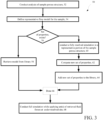
FIG. 3 depicts a flow chart showing operations for a multi-component fluid flow simulation with under-resolved porous structures. -
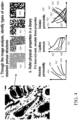
FIG. 4 depicts an image showing different types of under-resolved porous structures. -
FIG. 5 depicts a relationship between permeability vs. porosity. -
FIG. 6 depicts a model curve of drainage/imbibition capillary pressure vs. water saturation. - Referring to
FIG. 1 , asystem 10 for conducting a simulation of a multi-scale porous material having under-resolved region(s) of the multi-scale porous material. The simulation can be for various purposes such as to simulate a "wettability restoration" or an "aging" process representative of a subsurface reservoir conditions, i.e., "numerical aging." Other simulations can include the effect of a vapor stream on PPE, and the like. - The focus of the discussion herein will be on simulation of a multi-scale porous material having under-resolved region(s). In general, the
system 10 in this implementation is based on a client-server or cloud based architecture and includes aserver system 12 implemented as a massively parallel computing system 12 (stand alone or cloud-based) and aclient system 14. Theserver system 12 includesmemory 18, a bus system 11, interfaces 20 (e.g., user interfaces/network interfaces/display or monitor interfaces, etc.) and aprocessing device 24. - For the example of the wettability alternation, in
memory 18 are anumerical aging engine 32 that operates on a digital representation of a physical rock sample that digitally represents a pore space and grain space of the digital representation of the physical material, e. g., a physical rock sample (digital rock sample). Also in memory is asimulation engine 34 that simulates wettability alteration using the simulation of the multi-scale porous material having under-resolved region(s). - In some embodiments, simulating multi-phase flow behavior occurs through a reservoir rock adjacent a gas or oil well (e.g., drilling rig 37), using the simulation of the multi-scale porous material having the under-resolved region(s). Determining the multi-phase flow behavior comprises determining the wettability alteration of the physical rock sample.
- The digital representation of the physical rock sample can be a third party application that is executed on a different system than
server 12. Thesystem 10 merely requires the digital representation of a physical rock sample 32' to have the numerical aging engine digitally prepare the digital representation of a physical rock sample. One approach to providing the digital representation 32' of the rock sample is to obtain the representation 32', for example, from a 3D image generated from a micro CT scan of the rock sample. - For complete details on a simulation process please refer to
US Patent Application titled: "Multi-Phase Flow Visualizations Based On Fluid Occupation Time," Ser. No. 15/880,867, filed Jan. 26, 2018 US 11,461,512 B2 US Patent Application titled: "Determining Fluid Flow Characteristics Of Porous Mediums," Ser. No. 16/243,285, filed Jan. 9, 2019 US 2019/0212241 A1 ); orUS Patent Application titled: "Determination Of Oil Removed By Gas Via Miscible Displacement In Reservoir Rock," Ser. No. 16/545,387, filed Aug. 20, 2019 US 2020/0063532 A1 ), both of which are assigned to the assignee of the current application. - The
memory 18 may store parameters used by theengine 32. In particular parameters used for the case entitled "Determination Of Oil Removed By Gas Via Miscible Displacement In Reservoir Rock," could include grain surface properties obtained by assigning mineral types 33a to the grains to determine the surface properties for each of those mineral types, and surface texture and roughness properties, for one or more of the above applications of the disclosed subject matter. Thememory 18 may also store parameters such asfluid properties 33b, e.g., fluid density and viscosity of each expected fluid, (e.g., two or more of water, gas, oil) and fluid-fluid interfacial tension properties. Thememory 18 also stores parameters such as chemical composition data 33c of the fluids and affinity data 33d of the fluid components for the particular mineral types. Thememory 18 also stores disjoining pressure 33e for each mineral type in combination with the fluids, and a selected 33f aging time used by the agingengine 32. In addition, reservoir pressure and temperature data are also stored. The mineral types evaluated can be those found or expected at the actual site of the reservoir. - The
simulation engine 34 includes a module to set up the rock sample simulation environment, a module to perform a drainage/imbibition simulation, and a module to calculate local curvature of surfaces in the pore space. The simulation engine also includes amodule 50 that performs processing of the multi-scale porous material having under-resolved region(s). - The
system 10 accesses adata repository 38 that stores 2D and/or 3D meshes, coordinate systems, and libraries that can be used for drainage/imbibition simulations using any well-known computational technique such as computational fluid dynamics or the so called Lattice Boltzmann method. In addition, thesystem 10 accesses alibrary 50a that includesmodels 50b that represent the under-resolved regions. -
FIGS. 2A and 2B illustrate an example of a porous medium having under-resolved regions that is obtained from a sub-surface porous medium for oil and gas applications.FIG. 2A is an original scanned image.FIG. 2A shows a typical cross section of a carbonate-rock sample 40 that has solid structures with multiple different scales and, which shows small-scale porous structures three of which are denoted as 42. -
FIG. 2B is a corresponding segmented image 40' of the carbonate-rock sample 40 (FIG. 2A ) that shows small-scale porous structures three of which are denoted as 42' marked in grey. The length-scale difference between black and grey structures is approximately 10 times. Since the small scale porous regions in grey could impact the flow behavior in a significant way, it is necessary to properly take their contributions into account. A portion ofFIG. 2B is denoted by a phantom line 44', and is further discussed inFIG. 4 . - However, resolving all of such small scale details requires extremely fine resolutions, that results in a tremendously expensive computational simulation. The costs of such a simulation could increase by 10s of thousand times, compared to the unresolved case by simulating the grey regions, because of the increased number of three-dimensional cells and the reduction of time increments. Therefore, such fully resolved simulations are impractical for most industrial applications.
- The
process 50 simulates the original porous material having various sizes including under-resolved small scales, without the need to resolve all of the under-resolved small scales involved in the original porous material. The physical characteristics of these under-resolved small scales are properly incorporated in establishment of a process described below. - The
process 50 for addressing the aforementioned challenges of multi-component fluid-flow simulation with under-resolved porous structure involves a novel workflow, in which a fluid-flow simulation only resolves a porous sample down to a certain scale level. However, data contributions from under-resolved porous regions 42' (grey regions inFIG. 2B ) are taken into account by numerical models. The essential idea is to recognize that the effect of the under-resolved porous regions on the flow is a set of forces, such as viscous, pressure, and capillary forces. The numerical models reproduce such forces as acting on the resolved fluid, by using local representative physical properties such as absolute permeability, relative permeability and capillary-pressure-saturation curves. - These physical properties are obtained via simulation of a fully resolved much smaller subdomains of the original porous material that is representative of the small-scale unresolved grey porous regions, or are generated by user-calibrated parametric functional forms. Sets of these physical properties are stored in a library. Each set of physical properties represents a flow type for a particular under-resolved porous structure. In each grey region, a set of physical properties of the porous type from the library is chosen and assigned for the model during the simulation with under-resolved porous structures. By taking into account the local porous geometry information including porosity (the ratio of pore space to total volume) and directionality of the structure, the local under-resolved flow behavior can be properly reproduced.
- Referring now to
FIG. 3 , theprocess 50 for conducting a multi-component fluid-flow simulation with under-resolved porous structure is shown. Theprocess 50, uses a simulation of a porous rock sample as an example.Process 50 includes conducting 52 a geometrical analysis of a typical porous structure, using scanned images to identify various types of under-resolved porous structures that are encountered in the porous structure being studied. The types of under-resolved porous structures are used to define 54 representative flow models for each gray region. As a model is defined, the defined model is compared to existing models that are stored in the library of models. Essentially, the models are defined as including sets of physical properties. If a corresponding set of physical properties already exists in thelibrary 56, the model including the set of physical properties are retrieved 58 from the library. - If the set of properties does not exist, the process conducts 60 a fully-resolved
simulation 62 in a representative subdomain of the gray region, and computes 64 a new set of physical properties that include absolute permeability, relative permeability, and capillary-pressure-saturation curves for the particular type of porous structure being modeled. These sets of physical properties describe the effective multi-phase flow behavior of a porous media structure. Upon computation of the new set of physical properties, the now computed model is added 66 to the library and labeled for the particular under-resolved simulation conducted. - The
process 50 determines 66 if all under-resolved sites have been completed (done) using the local geometry information and physical properties. These proper fluid forces correspond to the viscous, pressure and capillary forces from the under-resolved solid structure. - Referring now to
FIG. 4 , there are various ways to define numerical models for fluid forces in the under-resolved region. Through image analysis (segmentation), a three-dimensional image analysis can define different types of under-resolved porous regions. - The three-dimensional image analysis (segmentation) is applied to the three-dimensional image. As shown in
FIG. 4 , upon segmentation, the under-resolvedporous regions 42a' to 42d' are illustrated from a portion ofFIG. 2B . - Different materials have different x-ray attenuation coefficients. Grey-scale values can be used to classify pixels according to material types (e.g., minerals, fluids, etc.). When a pixel contains sub-resolution pores, the x-ray attenuation is an average of solid and pore fractions within the pixel (partial volume effect).
- Additional textural features can be used to segment pixels into different porous media (PM) types, for example:
- Cellular structure (42a')
- Fibrous structure (42b')
- Micro-porous clay (42c')
- Micro porous dolomite (42d')
- Absolute permeability is simulated by the single-phase flow Lattice Boltzmann (LB) solver, for example. In general, the simulation output for a macroscopic 3D model is a permeability tensor with 3x3 values. The established similarity between macroscopic output and microscopic PM pixel input, in general, should be a tensor as well. However, in the majority of cases, the tensor can be approximated by a single permeability vs. porosity function k (Ø), sometimes complemented by a local orientation that can be computed from the image itself.
- For example, in the "micro-porous dolomite" PM type (42d'), pores are small compared with the pixel-size, and the internal structure is homogeneous and isotropic. In this case there is no preferential direction and the PM permeability can be described completely by a single curve, the PM permeability tensor for this pixel will be the identity matrix multiplied by k (Ø).
- If a nano-scale model of "micro-porous clay" PM type is available, for example from Focused Ion-Beam (FIB) images, permeability simulations for different sub-volumes can be used to produce a permeability vs. porosity relationship, (φ), as illustrated in
FIG. 5 . - In another example, a "single channel" PM type, there is a strong directional dependence for permeability. The preferential direction will vary locally, depending on the local orientation of the sub-resolution channels in the image. Local orientation can be computed from the image itself, for instance, from local derivatives of the grey-scale values.
- In this case as well, a single permeability curve can be used as input, and the local image orientation information will be used to modulate the values in a given direction.
- In order to account for flow for arbitrary orientations, the LB flow solver needs to compute all contributions to the flow. Local resistivity coefficients relating velocities and pressure gradients at different directions can be used to implement the permeability tensor effects in a PM pixel. For example, for flow in the y direction induced by a pressure gradient in the x direction, we use the resistivity coefficient Ryx: which directly relates to the corresponding permeability tensor element kyx. Here ρ is the fluid density, and v is the dynamic viscosity.


- The
process 50 uses the set of physical properties for the PM regions to simulate in turn the physical properties of the multiscale model. - One possible example, for the viscous force


u are density and velocity of fluid flow, respectively. Also, K 0 and
- Solver can be seen as an extension of the Brinkman equation.
- Mercury intrusion capillary pressure (MICP) measurements are typically used to determine porous media capillary pressure behavior independent of wettability effects.
- In general, when wettability is considered and using reservoir fluids (oil/water) instead mercury, there should be an irreducible water saturation Swi for drainage and some residual oil saturation Sor for imbibition. The amounts of fluids Sw + So = 1, water/oil, present in the PM pixel for different pressure gradients Po - Pw = Pc (Sw ), depends on the capillary radius rc size distribution, and wettability fluids-solid properties.
- In the model curve depicted in
FIG. 6 , Pc* represents the drainage threshold pressure, and ΔPc* represents the spread on the pore size distribution. In order to model the imbibition behavior, a second curve is included with a different threshold pressure and corresponding spread. - There are several capillary pressure - saturation models in the literature. For example there is the Thomeer, Brooks and Corey, Bentsen and Anli, models. For instance, in the Thomeer model, the capillary pressure relates to saturation by:

- The capillary pressure behavior of each PM type can be represented by such parametrized curves, maybe based on sub-volume capillary simulation results of a fully-resolved model of the PM type, similarly to the absolute permeability example.
- In order to model the porosity variability within a given PM type (similar to permeability), we can use the Leverett J-function (Sw), which consolidates capillary curves for different samples from the same rock type in to a single curve:

- In general, a J-function (Sw) should be given for each PM type. Then, for each individual PM pixel, with a sub-resolution porosity φ, the corresponding permeability is estimated from (Ø). With these two values, an individual Pc, can be estimated from the J-function for this PM type, at the required saturation Sw.
- Furthermore, in non-isotropic cases, like the "single channel" PM type, an anisotropic P(Sw), could be computed for each direction by using the corresponding element of the permeability tensor in the J-function calculation.
- Thus, for pores that are smaller than the pixel size, the capillary pressure behavior can be modelled by J-function calibrated using specific PM type relationships Pc (Sw ).
- A solver implementation can include an additional force in the direction of flow proportional to P(Sw ), such that the oil/water saturations So, Sw in each PM pixel satisfy

- An example for definition of capillary force

 " indicates the unit vector, and θ is the contact angle of the under-resolved porous solid. Here, J is the Leverett J-function,


- The switch function 'G' is used for the diffusive multi-component model because its non-zero interface thickness may cause an excessive artificial force. Moreover, this definition may not cover a scenario where a component fluid is confined in an under-resolved cell. In order to mitigate this problem, an additional model can be implemented using the Leverett J-function and local pressure.
- Following the same approach as for absolute permeability and capillary pressure, relative permeability curves for PM types can be computed from nano-scale models and used as library inputs for PM pixel behavior.
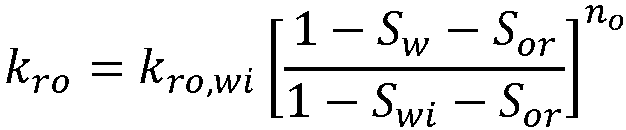
- The Corey model is a common parametrization of relative permeability curves where:

- When the physical properties in a representative porous structure are applied to an under-resolved site, the local preferential direction of the structure can be taken into account in the following manner.
- Orientation of a local solid structure is computed from the image, for instance, from the local derivative of the grey-scale values. By comparing such a structure orientation and orientation of the principle axis of permeability, the physical properties are modulated in a proper direction. In the following discussion, the case of absolute permeability is shown.
- The modulated tensorial formed absolute permeability K 0,αβ in three dimensions is computed as,



- Here, the equation is written with the Einstein notation instead of the vector notation using indices for spatial directions, α and β. The matrix in the denominator indicates the invert matrix.
- The numerical approach described herein enables multi-component fluid flow simulations in a multi-scale porous structure, while avoiding extremely expensive computational costs that are inherent in a fully scale-resolved simulation of such the multi-scale porous structure. This numerical approach introduces locally proper forces that act on the fluid components using complete set(s) of pre-calculated physical properties applicable to the under-resolved region(s) of the multi-scale porous structure. The multi-scale simulation becomes feasible without sacrificing significant computational efficiency while achieving relatively accuracy in comparison to either the fully scale-resolved simulation or avoiding simulation of multi-scales in such a multi-scale porous structure.
- The usage of physical properties in few representative porous structures for extensive under-resolved regions in general saves significant computational costs, more effectively, while keeping a reasonable degree of accuracy. The degree of accuracy results because the numerical approach described herein takes into consideration the local variation of the individual structures, via modulation, that is based on local porosity and directionality, both of which are estimated directly from the image.
- Both the under-resolved simulation with coarse resolution and the prior fully resolved simulation in the sub grey region with fine resolution for capturing the physical properties can be performed with a single fluid-dynamics solver. Use of the single fluid-dynamics solver is highly beneficial with respect to the consistence of the simulation process. That is, because any computational methods exhibit more or less peculiar numeric aspects, which can cause issues when these are connected to other methods. By using a consistent solver in the simulation process can circumvent such problem effectively.
- The proposed approach is applicable to the Lattice Boltzmann Method, as well as other computational fluid-dynamics methods including finite-volume method, finite-element method, etc.
- The stored physical properties in a representative solid structure can be extensively applied to any spatial scale and various fluid conditions, such as viscosity, surface tension, and surface wettability, because the properties can be stored in phenomenological non-dimensional form. By phenomenological is meant that the properties are constructed from the results of experiments and/or simulations. Simulated physical properties in a certain multi-scale solid structure can be used as an input for a case at even a larger scale. Accordingly, by detecting the hierarchal structures and categorizing the structure types, this approach can be extensively applied to highly complex geometries possessing structures at various scales.
- Embodiments of the subject matter and the functional operations described in this specification can be implemented in digital electronic circuitry, tangibly-embodied computer software or firmware, computer hardware (including the structures disclosed in this specification and their structural equivalents), or in combinations of one or more of them. Embodiments of the subject matter described in this specification can be implemented as one or more computer programs (i.e., one or more modules of computer program instructions encoded on a tangible non-transitory program carrier for execution by, or to control the operation of, data processing apparatus). The computer storage medium can be a machine-readable storage device, a machine-readable storage substrate, a random or serial access memory device, or a combination of one or more of them.
- A computer program, which may also be referred to or described as a program, software, a software application, a module, a software module, a script, or code, can be written in any form of programming language, including compiled or interpreted languages, or declarative or procedural languages, and it can be deployed in any form, including as a stand-alone program or as a module, component, subroutine, or other unit suitable for use in a computing environment. A computer program may, but need not, correspond to a file in a file system. A program can be stored in a portion of a file that holds other programs or data (e.g., one or more scripts stored in a markup language document, in a single file dedicated to the program in question, or in multiple coordinated files (e.g., files that store one or more modules, sub-programs, or portions of code)). A computer program can be deployed so that the program is executed on one computer or on multiple computers that are located at one site or distributed across multiple sites and interconnected by a data communication network.
- Computers suitable for the execution of a computer program can be based on general or special purpose microprocessors or both, or any other kind of central processing unit. Generally, a central processing unit will receive instructions and data from a read-only memory or a random access memory or both. The essential elements of a computer are a central processing unit for performing or executing instructions and one or more memory devices for storing instructions and data. Generally, a computer will also include, or be operatively coupled to receive data from or transfer data to, or both, one or more mass storage devices for storing data (e.g., magnetic, magneto-optical disks, or optical disks), however, a computer need not have such devices.
- Computer-readable media suitable for storing computer program instructions and data include all forms of non-volatile memory on media and memory devices, including by way of example semiconductor memory devices (e.g., EPROM, EEPROM, and flash memory devices), magnetic disks (e.g., internal hard disks or removable disks), magneto-optical disks, and CD-ROM and DVD-ROM disks. The processor and the memory can be supplemented by, or incorporated in, special purpose logic circuitry.
Claims (11)
- A computer implemented method (50) for conducting a fluid simulation of a porous medium, the method comprising:retrieving, by a computing system, a representation of a three-dimensional physical porous medium, the representation including pore space corresponding to the porous medium, with the representation including at least one portion of under-resolved pore structure (42a', 42b', 42c', 42d') in the porous medium;defining (54), by the computing system, a representative flow model for the under-resolved pore structure in the representation;constructing (58, 64), by the computing system fluid force curves that correspond to fluid forces in the under-resolved pore structure in the representation based on precomputed physical properties of the under-resolved pore structure corresponding to the defined representative flow model, wherein the constructing comprisesif precomputed physical properties for the defined representative flow model are stored in a library, retrieving the precomputed physical properties,if precomputed physical properties for the defined representative flow model are not stored in the library, conducting a simulation in a fully-resolved representative subdomain of the under-resolved pore structure to calculate the physical properties, anddetermining fluid forces in the under-resolved pore structure based on the precomputed physical properties of the under-resolved pore structure; andconducting (68) the fluid simulation of the porous medium, wherein conducting the fluid simulation of the porous medium comprises applying the determined fluid forces at the under-resolved pore structure.
- The method of claim 1, wherein the representation of the three-dimensional porous medium is obtained from a three-dimensional image to which a three-dimensional segmentation is applied.
- The method of claim 1, wherein the under-resolved pore structure belongs to a class of under-resolved pore structures that are represented by a common description for all elements of the class, also referred as porous medium, PM, type.
- The method of claim 1, wherein applying further comprises:
applying the fluid force curves according to local pore space data. - The method of claim 4, wherein the local pore space data comprises local porosity and local orientation or spatial gradient of the local porosity that are obtained from the representation of the three-dimensional porous media.
- The method of claim 1, wherein the fluid forces comprise viscous, pressure, and capillary forces.
- The method of claim 1, wherein calculating the physical properties comprises:
calculating one or more of absolute permeability, relative permeability, and capillary pressure curves via the simulation of the fully resolved subdomain of the under-resolved pore structure in the representation based on local pore space data. - The method of claim 1, further comprising:
storing, in the library, parametric models for the physical properties that have parameters fitted to simulation data or adjusted according to subject expert matter knowledge. - The method of claim 1, wherein the representation is of a physical rock sample, the representation including pore space and grain space data corresponding to the physical porous rock sample, porous particle filter, and similar physical porous media.
- A computing system comprising:one or more processor devices;memory coupled to the one or more processor devices;storage storing executable computer instructions to configure the one or more processors to perform the method of any one of claims 1 to 9.
- A computer program product tangibly stored on a computer readable non-transitory storage device that stores executable computer instructions for causing a computing system to perform the method of any one of claims 1 to 9.
Applications Claiming Priority (1)
| Application Number | Priority Date | Filing Date | Title |
|---|---|---|---|
| US17/136,259 US11907625B2 (en) | 2020-12-29 | 2020-12-29 | Computer simulation of multi-phase and multi-component fluid flows including physics of under-resolved porous structures |
Publications (3)
| Publication Number | Publication Date |
|---|---|
| EP4024260A1 EP4024260A1 (en) | 2022-07-06 |
| EP4024260B1 true EP4024260B1 (en) | 2025-03-26 |
| EP4024260C0 EP4024260C0 (en) | 2025-03-26 |
Family
ID=78822161
Family Applications (1)
| Application Number | Title | Priority Date | Filing Date |
|---|---|---|---|
| EP21212490.3A Active EP4024260B1 (en) | 2020-12-29 | 2021-12-06 | Computer simulation of multi-phase and multi-component fluid flows including physics of under-resolved porous structures |
Country Status (4)
| Country | Link |
|---|---|
| US (1) | US11907625B2 (en) |
| EP (1) | EP4024260B1 (en) |
| JP (1) | JP7748278B2 (en) |
| CN (1) | CN114692518B (en) |
Families Citing this family (11)
| Publication number | Priority date | Publication date | Assignee | Title |
|---|---|---|---|---|
| EP3574291B1 (en) | 2017-01-26 | 2023-12-06 | Dassault Systemes Simulia Corp. | Multi-phase flow visualizations based on fluid occupation time |
| US11530598B2 (en) | 2018-08-21 | 2022-12-20 | Dassault Systemes Simulia Corp. | Determination of oil removed by gas via miscible displacement in reservoir rock |
| US11847391B2 (en) | 2020-06-29 | 2023-12-19 | Dassault Systemes Simulia Corp. | Computer system for simulating physical processes using surface algorithm |
| US11746623B2 (en) * | 2022-01-27 | 2023-09-05 | Halliburton Energy Services, Inc. | System and method to calibrate digital rock wettability |
| CN115101787B (en) * | 2022-06-30 | 2025-03-18 | 东风汽车集团股份有限公司 | A flow simulation method, device, electronic equipment and medium for fuel cell |
| US20240256735A1 (en) | 2023-02-01 | 2024-08-01 | Dassault Systemes Simulia Corp. | Computer simulation methodology to analyze mass, momentum, energy and charge transport in a Proton Exchange Membrane Fuel Cell |
| EP4425366B1 (en) | 2023-02-28 | 2025-12-31 | Dassault Systèmes Americas Corp. | Multi-stage reactive flow in complex microstructures |
| CN117059206B (en) * | 2023-08-14 | 2025-12-05 | 西安交通大学 | A multi-scale topology optimization method, system, device, and medium for enhancing heat and mass transfer in porous media. |
| CN117875209B (en) * | 2024-01-12 | 2025-03-18 | 西安建筑科技大学 | A fluid-solid coupling analysis method based on pore network and CFD-DEM model |
| CN118428266B (en) * | 2024-04-30 | 2025-09-09 | 中国农业大学 | Characterization and numerical simulation method for porous medium model of attached dirt of farmland irrigation system |
| US20260010692A1 (en) * | 2024-07-03 | 2026-01-08 | Dassault Systemes Americas Corp. | Computer system for digitally simulating multi-scale fluid flows in a computer-aided design model |
Family Cites Families (118)
| Publication number | Priority date | Publication date | Assignee | Title |
|---|---|---|---|---|
| US3818757A (en) | 1972-05-05 | 1974-06-25 | Saratoga Sys Inc | Dual path ultrasonic fluid flow metering system and method |
| GB2066466A (en) | 1979-12-03 | 1981-07-08 | Water Res Centre | Ultrasonic Flow Measurement |
| US4498134A (en) | 1982-01-26 | 1985-02-05 | Hughes Aircraft Company | Segregator functional plane for use in a modular array processor |
| US4507726A (en) | 1982-01-26 | 1985-03-26 | Hughes Aircraft Company | Array processor architecture utilizing modular elemental processors |
| US4729098A (en) | 1985-06-05 | 1988-03-01 | General Electric Company | System and method employing nonlinear interpolation for the display of surface structures contained within the interior region of a solid body |
| US4831519A (en) | 1985-12-12 | 1989-05-16 | Itt Corporation | Cellular array processor with variable nesting depth vector control by selective enabling of left and right neighboring processor cells |
| US4809202A (en) | 1985-12-27 | 1989-02-28 | Thinking Machines Corporation | Method and apparatus for simulating systems described by partial differential equations |
| JPH0648486B2 (en) | 1986-10-08 | 1994-06-22 | 日本電気株式会社 | Vector data processor |
| US4933895A (en) | 1987-07-10 | 1990-06-12 | Hughes Aircraft Company | Cellular array having data dependent processing capabilities |
| JP2635617B2 (en) | 1987-09-29 | 1997-07-30 | 株式会社東芝 | Method of generating orthogonal lattice points for evaluating semiconductor device characteristics |
| US4989166A (en) | 1988-07-12 | 1991-01-29 | Hitachi, Ltd. | Method for synthesizing analysis model and flow analysis system |
| US5038302A (en) | 1988-07-26 | 1991-08-06 | The Research Foundation Of State University Of New York | Method of converting continuous three-dimensional geometrical representations into discrete three-dimensional voxel-based representations within a three-dimensional voxel-based system |
| US5159690A (en) | 1988-09-30 | 1992-10-27 | Massachusetts Institute Of Technology | Multidimensional cellular data array processing system which separately permutes stored data elements and applies transformation rules to permuted elements |
| JPH03276071A (en) | 1990-03-27 | 1991-12-06 | Yoshiomi Kondo | Predicting method for physical quantity of liquid and electromagnetic liquid |
| EP0734759B1 (en) | 1990-05-09 | 1999-02-03 | USF Filtration Limited | Polyvinylidene fluoride membrane |
| US5377129A (en) | 1990-07-12 | 1994-12-27 | Massachusetts Institute Of Technology | Particle interaction processing system |
| EP0538415B1 (en) | 1990-07-12 | 1995-09-27 | Massachusetts Institute Of Technology | A fluid dynamics parallel processor |
| IE69192B1 (en) | 1990-12-21 | 1996-08-21 | Hitachi Europ Ltd | A method of generating partial differential equations for simulation a simulation method and a method of generating simulation programs |
| US5069065A (en) | 1991-01-16 | 1991-12-03 | Mobil Oil Corporation | Method for measuring wettability of porous rock |
| US5442733A (en) | 1992-03-20 | 1995-08-15 | The Research Foundation Of State University Of New York | Method and apparatus for generating realistic images using a discrete representation |
| JP3426647B2 (en) | 1992-06-24 | 2003-07-14 | 日本電信電話株式会社 | Generalized solid modeling for 3D topography simulation |
| US5361385A (en) | 1992-08-26 | 1994-11-01 | Reuven Bakalash | Parallel computing system for volumetric modeling, data processing and visualization |
| US5424963A (en) | 1992-11-25 | 1995-06-13 | Photon Research Associates, Inc. | Molecular dynamics simulation method and apparatus |
| US5848260A (en) | 1993-12-10 | 1998-12-08 | Exa Corporation | Computer system for simulating physical processes |
| US5606517A (en) | 1994-06-08 | 1997-02-25 | Exa Corporation | Viscosity reduction in physical process simulation |
| US5548694A (en) | 1995-01-31 | 1996-08-20 | Mitsubishi Electric Information Technology Center America, Inc. | Collision avoidance system for voxel-based object representation |
| US5640335A (en) | 1995-03-23 | 1997-06-17 | Exa Corporation | Collision operators in physical process simulation |
| US5605517A (en) | 1995-11-21 | 1997-02-25 | General Motors Corporation | Multi-speed power transmission |
| US5953239A (en) | 1997-12-29 | 1999-09-14 | Exa Corporation | Computer simulation of physical processes |
| US7209873B1 (en) | 1999-09-03 | 2007-04-24 | Kliegel James R | Method of analyzing and computing anisotropic turbulent flows |
| US6318156B1 (en) | 1999-10-28 | 2001-11-20 | Micro Motion, Inc. | Multiphase flow measurement system |
| US6928399B1 (en) | 1999-12-03 | 2005-08-09 | Exxonmobil Upstream Research Company | Method and program for simulating a physical system using object-oriented programming |
| US6516080B1 (en) | 2000-04-05 | 2003-02-04 | The Board Of Trustees Of The Leland Stanford Junior University | Numerical method of estimating physical properties of three-dimensional porous media |
| FR2811760B1 (en) | 2000-07-17 | 2002-09-13 | Inst Francais Du Petrole | METHOD FOR MODELING FLUID DISPLACEMENTS IN A POROUS MEDIUM TAKING ACCOUNT OF HYSTERESIS EFFECTS |
| US6915245B1 (en) | 2000-09-14 | 2005-07-05 | General Atomics | Method of simulating a fluid by advection of a time-weighted equilibrium distribution function |
| FR2844355B1 (en) | 2002-09-11 | 2005-03-25 | Inst Francais Du Petrole | METHOD OF MEASURING ROLL MOLDING BY NUCLEAR MAGNETIC RESONANCE |
| US7379852B2 (en) | 2004-02-18 | 2008-05-27 | Chevron U.S.A. Inc. | N-phase interface tracking method utilizing unique enumeration of microgrid cells |
| EP1729151B1 (en) | 2005-05-27 | 2011-06-29 | Services Petroliers Schlumberger | Method and apparatus for measuring the wettability of geological formations |
| FR2886742B1 (en) | 2005-06-02 | 2007-07-27 | Inst Francais Du Petrole | METHOD OF CHANGING SCALE OF ABSOLUTE PERMEABILITIES TO BUILD A FLOW SIMULATION MODEL |
| US20070016389A1 (en) | 2005-06-24 | 2007-01-18 | Cetin Ozgen | Method and system for accelerating and improving the history matching of a reservoir simulation model |
| US7590514B1 (en) | 2006-05-24 | 2009-09-15 | Livermore Software Technology Corporation | Method and system for simulating inflation of an enclosed volume with flexible boundary using gas particles |
| US7716028B2 (en) | 2006-05-24 | 2010-05-11 | Schlumberger Technology Corporation | Method for modeling a reservoir using a 3D wettability map generated from a wettability logging tool |
| US20080012853A1 (en) | 2006-07-14 | 2008-01-17 | William Geiger | Generating mesh from implicit surface |
| US7558714B2 (en) | 2006-08-10 | 2009-07-07 | Exa Corporation | Computer simulation of physical processes |
| US20080044543A1 (en) | 2006-08-17 | 2008-02-21 | Mcclements David J | Stabilized emulsions, methods of preparation, and related reduced fat foods |
| US7983886B2 (en) | 2007-09-10 | 2011-07-19 | Chevron U.S.A. Inc. | Methods for performing simulation of surfactant flooding of a hydrocarbon reservoir |
| CA2705340C (en) | 2007-12-21 | 2016-09-27 | Exxonmobil Upstream Research Company | Method and apparatus for analyzing three-dimensional data |
| MY153811A (en) | 2008-05-23 | 2015-03-24 | Fei Co | Image data processing |
| MX2010011148A (en) | 2008-06-25 | 2010-11-05 | Schlumberger Technology Bv | Method for estimating formation permeability using time lapse measurements. |
| GB2462261A (en) | 2008-07-28 | 2010-02-03 | Fujitsu Ltd | Method, apparatus and computer program for simulating behaviou r of thermodynamic systems |
| MX2011002311A (en) | 2008-09-02 | 2011-06-21 | Chevron Usa Inc | DYNAMIC OVERLOADING, BASED ON INDIRECT ERROR, MULTIPLE PHASE FLOW IN POROUS MEDIA. |
| US8747656B2 (en) | 2008-10-10 | 2014-06-10 | Velocys, Inc. | Process and apparatus employing microchannel process technology |
| US8155377B2 (en) | 2008-11-24 | 2012-04-10 | Ingrain, Inc. | Method for determining rock physics relationships using computer tomographic images thereof |
| KR101199475B1 (en) | 2008-12-22 | 2012-11-09 | 한국전자통신연구원 | Method and apparatus for reconstruction 3 dimension model |
| CN101556687A (en) | 2009-04-23 | 2009-10-14 | 上海交通大学 | Three-dimensional visualization system of two-phase flow in micro-channel and method thereof |
| US20100312535A1 (en) | 2009-06-08 | 2010-12-09 | Chevron U.S.A. Inc. | Upscaling of flow and transport parameters for simulation of fluid flow in subsurface reservoirs |
| RU2533758C2 (en) | 2009-07-07 | 2014-11-20 | Сименс Акциенгезелльшафт | Device and method for measurement of multiphase fluid flow |
| CN104730586A (en) | 2009-12-16 | 2015-06-24 | 英国石油勘探运作有限公司 | Method for measuring rock wettability |
| US8868392B2 (en) | 2010-02-12 | 2014-10-21 | Bp Exploration Operating Company Limited | Method and system for predicting the effect of microbes injected into an oil-bearing reservoir |
| JP2011191848A (en) | 2010-03-12 | 2011-09-29 | Toyota Central R&D Labs Inc | Diffusion phenomenon analysis method, diffusion phenomenon analysis device and program |
| GB2498255B (en) | 2010-06-15 | 2018-11-14 | Exxonmobil Upstream Res Co | Method and system for stabilizing formulation methods |
| US8412501B2 (en) | 2010-06-16 | 2013-04-02 | Foroil | Production simulator for simulating a mature hydrocarbon field |
| US8757871B2 (en) | 2010-08-16 | 2014-06-24 | The Board Of Trustees Of The University Of Illinois | Particle dynamics microscopy using temperature jump and probe anticorrelation/correlation techniques |
| CN102383783B (en) | 2010-09-03 | 2015-06-17 | 中国石油化工股份有限公司 | Method for analyzing flow characteristic of oil and water in seam-hole type oil reservoir |
| CA2807300C (en) | 2010-09-20 | 2017-01-03 | Exxonmobil Upstream Research Company | Flexible and adaptive formulations for complex reservoir simulations |
| US8768628B2 (en) | 2010-10-20 | 2014-07-01 | Shawket Ghedan | Rise in core wettability characterization method |
| AU2011332274B2 (en) | 2010-11-23 | 2017-02-23 | Exxonmobil Upstream Research Company | Variable discretization method for flow simulation on complex geological models |
| US8645070B2 (en) | 2010-11-24 | 2014-02-04 | Chevron U.S.A. Inc. | System and method for estimating fluid distribution in a subterranean reservoir |
| US8583411B2 (en) | 2011-01-10 | 2013-11-12 | Saudi Arabian Oil Company | Scalable simulation of multiphase flow in a fractured subterranean reservoir as multiple interacting continua |
| US9051825B2 (en) | 2011-01-26 | 2015-06-09 | Schlumberger Technology Corporation | Visualizing fluid flow in subsurface reservoirs |
| CN102174888B (en) | 2011-03-03 | 2012-05-23 | 康志勇 | Stratum data processing method based on lithological parameters of reservoir rocks |
| US9507047B1 (en) | 2011-05-10 | 2016-11-29 | Ingrain, Inc. | Method and system for integrating logging tool data and digital rock physics to estimate rock formation properties |
| WO2013009512A2 (en) * | 2011-07-12 | 2013-01-17 | Ingrain, Inc. | Method for simulating fractional multi-phase/multi-component flow through porous media |
| US9037440B2 (en) | 2011-11-09 | 2015-05-19 | Exa Corporation | Computer simulation of fluid flow and acoustic behavior |
| US10360324B2 (en) | 2011-12-09 | 2019-07-23 | Dassault Systemes Simulia Corp. | Computer simulation of physical processes |
| CN104067290A (en) | 2012-02-10 | 2014-09-24 | 兰德马克绘图国际公司 | Systems and methods for estimating fluid breakthrough times at producing well locations |
| WO2013148021A1 (en) | 2012-03-28 | 2013-10-03 | Exxonmobil Upstream Research Company | Method for mutiphase flow upscaling |
| US20130317791A1 (en) | 2012-04-26 | 2013-11-28 | Conocophillips Company | Hydrodynamic slug flow model |
| RU2596692C2 (en) | 2012-05-14 | 2016-09-10 | Лэндмарк Графикс Корпорейшн | Method and system for estimation of forecast hydrocarbon production |
| MX2014013895A (en) | 2012-05-14 | 2015-05-08 | Landmark Graphics Corp | Method and system of displaying a graphical representation of hydrocarbon production parameters. |
| US9140117B2 (en) | 2012-07-13 | 2015-09-22 | Ingrain, Inc. | Method for evaluating relative permeability for fractional multi-phase, multi-component fluid flow through porous media |
| US9619592B2 (en) | 2012-08-31 | 2017-04-11 | Schlumberger Technology Corporation | Analysis of enhanced oil recovery (EOR) processes for naturally-fractured reservoirs |
| WO2014186545A1 (en) | 2013-05-16 | 2014-11-20 | Exa Corporation | Mass exchange model for relative permeability simulation |
| CA2919714C (en) | 2013-07-30 | 2018-04-10 | Heartflow, Inc. | Method and system for modeling blood flow with boundary conditions for optimized diagnostic performance |
| WO2015017648A2 (en) | 2013-07-31 | 2015-02-05 | Exa Corporation | Temperature coupling algorithm for hybrid thermal lattice boltzmann method |
| EA031381B1 (en) | 2013-08-06 | 2018-12-28 | Бипи Корпорейшн Норт Америка Инк. | Image-based direct numerical simulation of petrophysical properties under simulated stress and strain conditions |
| AR097342A1 (en) | 2013-08-15 | 2016-03-09 | Univ Texas | TOLERANT ALKALINE SYSTEM FOR MULTIVALENT MINERAL CATIONS FOR CHEMICAL EOR |
| CA2919530A1 (en) | 2013-08-27 | 2015-03-05 | Halliburton Energy Services, Inc. | Simulating fluid leak-off and flow-back in a fractured subterranean region |
| US9377392B2 (en) | 2013-09-05 | 2016-06-28 | Proptester, Inc. | Methods and systems for testing fluids on crushed formation materials under conditions of stress |
| US9910173B2 (en) | 2013-11-15 | 2018-03-06 | Schlumberger Technology Corporation | Saturation end-point adjustment |
| US20150141303A1 (en) | 2013-11-18 | 2015-05-21 | The Board Of Regents Of The University Of Oklahoma | Binary and ternary surfactant blends for enhanced oil recovery in reservoir brines with extremely high total dissolved solids |
| US9797225B2 (en) | 2013-11-27 | 2017-10-24 | Saudi Arabian Oil Company | Data compression of hydrocarbon reservoir simulation grids |
| CN103698102B (en) | 2013-12-17 | 2016-08-17 | 哈尔滨工程大学 | A kind of interbank High Temperature High Pressure vehicle repair major flow pattern experimental provision and discrimination method |
| US20150186562A1 (en) | 2013-12-30 | 2015-07-02 | Halliburton Energy Services, Inc | Preconditioning a Global Model of a Subterranean Region |
| AU2015231429B2 (en) | 2014-03-18 | 2019-10-17 | Dassault Systemes Americas Corp. | Fluid blob tracking for evaluation of multiphase flow simulations |
| FR3023316B1 (en) | 2014-07-04 | 2016-08-19 | Ifp Energies Now | METHOD FOR OPERATING A PETROLEUM STORAGE FROM A WELL POSITIONING TECHNIQUE |
| RU2670716C9 (en) | 2015-03-27 | 2018-11-29 | Шлюмберже Текнолоджи Б.В. | Method for determination of equilibrium wettability of interface between void and solid phase of rock sample |
| US10169498B2 (en) | 2015-04-14 | 2019-01-01 | California Institute Of Technology | Particle-based simulation through power diagrams |
| GB2554013B (en) | 2015-05-01 | 2021-03-24 | Geoquest Systems Bv | Multiphase flow in porous media |
| FR3041026B1 (en) | 2015-09-15 | 2017-10-20 | Ifp Energies Now | METHOD FOR CHARACTERIZING THE NETWORK OF FRACTURES OF A FRACTURE SLOT AND METHOD FOR OPERATING IT |
| US10436003B2 (en) | 2015-12-17 | 2019-10-08 | Baker Hughes, A Ge Company, Llc | Fluid blocking analysis and chemical evalution |
| CN105910996A (en) | 2016-04-07 | 2016-08-31 | 昆明理工大学 | Method for determining mixing time of multiphase flow by using RGB color model |
| FR3051938B1 (en) | 2016-05-31 | 2018-06-15 | IFP Energies Nouvelles | PROCESS FOR OPERATING HYDROCARBONS OF A SUBTERRANEAN FORMATION BY MEANS OF OPTIMIZED SCALING |
| US11371333B2 (en) | 2016-06-22 | 2022-06-28 | Schlumberger Technology Corporation | Visualizations of reservoir simulations with fracture networks |
| EP3574291B1 (en) | 2017-01-26 | 2023-12-06 | Dassault Systemes Simulia Corp. | Multi-phase flow visualizations based on fluid occupation time |
| US11163923B2 (en) | 2017-02-14 | 2021-11-02 | Landmark Graphics Corporation | Automated upscaling of relative permeability and capillary pressure in multi-porosity systems |
| US10691846B2 (en) | 2017-03-01 | 2020-06-23 | International Business Machines Corporation | Capillary network simulations based on a low-dimensional representation of porous media |
| US10942293B2 (en) | 2017-07-21 | 2021-03-09 | Halliburton Energy Services, Inc. | Rock physics based method of integrated subsurface reservoir characterization for use in optimized stimulation design of horizontal wells |
| US11299666B2 (en) | 2017-11-14 | 2022-04-12 | Total Se | Surfactant composition for the reinjection of produced water |
| US10830713B2 (en) | 2017-11-20 | 2020-11-10 | DigiM Solution LLC | System and methods for computing physical properties of materials using imaging data |
| US20190203593A1 (en) | 2017-12-29 | 2019-07-04 | Shawn Fullmer | Method and System for Modeling in a Subsurface Region |
| US11714040B2 (en) | 2018-01-10 | 2023-08-01 | Dassault Systemes Simulia Corp. | Determining fluid flow characteristics of porous mediums |
| US11530598B2 (en) | 2018-08-21 | 2022-12-20 | Dassault Systemes Simulia Corp. | Determination of oil removed by gas via miscible displacement in reservoir rock |
| JP6985573B2 (en) | 2018-11-29 | 2021-12-22 | ラトックシステムエンジニアリング株式会社 | Porous structure evaluation method, structure evaluation device, and structure evaluation program |
| US11544423B2 (en) * | 2018-12-31 | 2023-01-03 | Dassault Systemes Simulia Corp. | Computer simulation of physical fluids on a mesh in an arbitrary coordinate system |
| US11613984B2 (en) | 2019-09-04 | 2023-03-28 | Dassault Systemes Simulia Corp. | Determination of hydrocarbon mobilization potential for enhanced oil recovery |
| CN111428321B (en) | 2020-04-03 | 2022-10-04 | 中国石油天然气股份有限公司 | Conglomerate reservoir pore network model modeling method based on simplified digital core |
| US11847391B2 (en) | 2020-06-29 | 2023-12-19 | Dassault Systemes Simulia Corp. | Computer system for simulating physical processes using surface algorithm |
-
2020
- 2020-12-29 US US17/136,259 patent/US11907625B2/en active Active
-
2021
- 2021-12-06 EP EP21212490.3A patent/EP4024260B1/en active Active
- 2021-12-27 CN CN202111610273.4A patent/CN114692518B/en active Active
- 2021-12-28 JP JP2021214277A patent/JP7748278B2/en active Active
Also Published As
| Publication number | Publication date |
|---|---|
| EP4024260A1 (en) | 2022-07-06 |
| JP2022104831A (en) | 2022-07-11 |
| CN114692518B (en) | 2024-12-13 |
| JP7748278B2 (en) | 2025-10-02 |
| US11907625B2 (en) | 2024-02-20 |
| US20220207219A1 (en) | 2022-06-30 |
| CN114692518A (en) | 2022-07-01 |
| EP4024260C0 (en) | 2025-03-26 |
Similar Documents
| Publication | Publication Date | Title |
|---|---|---|
| US11907625B2 (en) | Computer simulation of multi-phase and multi-component fluid flows including physics of under-resolved porous structures | |
| Neumann et al. | High accuracy capillary network representation in digital rock reveals permeability scaling functions | |
| Bird et al. | Numerical modeling of fluid and electrical currents through geometries based on synchrotron X-ray tomographic images of reservoir rocks using Avizo and COMSOL | |
| Ramstad et al. | Pore-scale simulations of single-and two-phase flow in porous media: approaches and applications | |
| Silin et al. | Robust determination of the pore space morphology in sedimentary rocks | |
| US10830713B2 (en) | System and methods for computing physical properties of materials using imaging data | |
| Callow et al. | Optimal X-ray micro-CT image based methods for porosity and permeability quantification in heterogeneous sandstones | |
| Alpak et al. | Prediction of fluid topology and relative permeability in imbibition in sandstone rock by direct numerical simulation | |
| Al-Raoush et al. | A pore-scale investigation of a multiphase porous media system | |
| Jiang et al. | Pore geometry characterization by persistent homology theory | |
| Nordahl et al. | Petrophysical characterization of a heterolithic tidal reservoir interval using a process-based modelling tool | |
| WO2017041281A1 (en) | Porous media anaylysis system and method | |
| Jing et al. | Topological characterization of fractured coal | |
| Botha et al. | Mapping permeability in low‐resolution micro‐CT images: A multiscale statistical approach | |
| Karimpouli et al. | Estimating 3D elastic moduli of rock from 2D thin-section images using differential effective medium theory | |
| EP4102395B1 (en) | Prediction of mechanical properties of sedimentary rocks based on a grain to grain parametric cohesive contact model | |
| Shah et al. | Convex hull approach for determining rock representative elementary volume for multiple petrophysical parameters using pore-scale imaging and Lattice–Boltzmann modelling | |
| Prodanovic et al. | Investigating matrix/fracture transfer via a level set method for drainage and imbibition | |
| Tokan‐Lawal et al. | Investigating flow properties of partially cemented fractures in Travis Peak Formation using image‐based pore‐scale modeling | |
| Foroughi et al. | A framework for multiphase pore-scale modeling based on micro-CT imaging | |
| Qajar et al. | An investigation on the robustness and accuracy of permeability estimation from 3D μ-CT images of rock samples based on the solution of Laplace's equation for pressure | |
| Rabbani et al. | Analytical Pore-Network Approach (APNA): A novel method for rapid prediction of capillary pressure-saturation relationship in porous media | |
| Khimulia | Digital examination of pore space characteristics and structural properties of a gas condensate field reservoir on the basis of μCT images | |
| Ismail et al. | Rock-typing using the complete set of additive morphological descriptors | |
| Prodanovic et al. | Physics-driven interface modeling for drainage and imbibition in fractures |
Legal Events
| Date | Code | Title | Description |
|---|---|---|---|
| PUAI | Public reference made under article 153(3) epc to a published international application that has entered the european phase |
Free format text: ORIGINAL CODE: 0009012 |
|
| STAA | Information on the status of an ep patent application or granted ep patent |
Free format text: STATUS: THE APPLICATION HAS BEEN PUBLISHED |
|
| AK | Designated contracting states |
Kind code of ref document: A1 Designated state(s): AL AT BE BG CH CY CZ DE DK EE ES FI FR GB GR HR HU IE IS IT LI LT LU LV MC MK MT NL NO PL PT RO RS SE SI SK SM TR |
|
| STAA | Information on the status of an ep patent application or granted ep patent |
Free format text: STATUS: REQUEST FOR EXAMINATION WAS MADE |
|
| 17P | Request for examination filed |
Effective date: 20221221 |
|
| RBV | Designated contracting states (corrected) |
Designated state(s): AL AT BE BG CH CY CZ DE DK EE ES FI FR GB GR HR HU IE IS IT LI LT LU LV MC MK MT NL NO PL PT RO RS SE SI SK SM TR |
|
| RAP1 | Party data changed (applicant data changed or rights of an application transferred) |
Owner name: DASSAULT SYSTEMES AMERICAS CORP. |
|
| RIC1 | Information provided on ipc code assigned before grant |
Ipc: G06F 113/08 20200101ALN20241127BHEP Ipc: G06F 30/28 20200101ALI20241127BHEP Ipc: G06F 30/23 20200101AFI20241127BHEP |
|
| GRAP | Despatch of communication of intention to grant a patent |
Free format text: ORIGINAL CODE: EPIDOSNIGR1 |
|
| STAA | Information on the status of an ep patent application or granted ep patent |
Free format text: STATUS: GRANT OF PATENT IS INTENDED |
|
| RIC1 | Information provided on ipc code assigned before grant |
Ipc: G06F 113/08 20200101ALN20241216BHEP Ipc: G06F 30/28 20200101ALI20241216BHEP Ipc: G06F 30/23 20200101AFI20241216BHEP |
|
| INTG | Intention to grant announced |
Effective date: 20250103 |
|
| GRAS | Grant fee paid |
Free format text: ORIGINAL CODE: EPIDOSNIGR3 |
|
| GRAA | (expected) grant |
Free format text: ORIGINAL CODE: 0009210 |
|
| STAA | Information on the status of an ep patent application or granted ep patent |
Free format text: STATUS: THE PATENT HAS BEEN GRANTED |
|
| AK | Designated contracting states |
Kind code of ref document: B1 Designated state(s): AL AT BE BG CH CY CZ DE DK EE ES FI FR GB GR HR HU IE IS IT LI LT LU LV MC MK MT NL NO PL PT RO RS SE SI SK SM TR |
|
| REG | Reference to a national code |
Ref country code: GB Ref legal event code: FG4D |
|
| REG | Reference to a national code |
Ref country code: CH Ref legal event code: EP |
|
| REG | Reference to a national code |
Ref country code: DE Ref legal event code: R096 Ref document number: 602021028079 Country of ref document: DE |
|
| REG | Reference to a national code |
Ref country code: IE Ref legal event code: FG4D |
|
| U01 | Request for unitary effect filed |
Effective date: 20250407 |
|
| U07 | Unitary effect registered |
Designated state(s): AT BE BG DE DK EE FI FR IT LT LU LV MT NL PT RO SE SI Effective date: 20250411 |
|
| PG25 | Lapsed in a contracting state [announced via postgrant information from national office to epo] |
Ref country code: RS Free format text: LAPSE BECAUSE OF FAILURE TO SUBMIT A TRANSLATION OF THE DESCRIPTION OR TO PAY THE FEE WITHIN THE PRESCRIBED TIME-LIMIT Effective date: 20250626 |
|
| PG25 | Lapsed in a contracting state [announced via postgrant information from national office to epo] |
Ref country code: NO Free format text: LAPSE BECAUSE OF FAILURE TO SUBMIT A TRANSLATION OF THE DESCRIPTION OR TO PAY THE FEE WITHIN THE PRESCRIBED TIME-LIMIT Effective date: 20250626 |
|
| PG25 | Lapsed in a contracting state [announced via postgrant information from national office to epo] |
Ref country code: HR Free format text: LAPSE BECAUSE OF FAILURE TO SUBMIT A TRANSLATION OF THE DESCRIPTION OR TO PAY THE FEE WITHIN THE PRESCRIBED TIME-LIMIT Effective date: 20250326 |
|
| PG25 | Lapsed in a contracting state [announced via postgrant information from national office to epo] |
Ref country code: GR Free format text: LAPSE BECAUSE OF FAILURE TO SUBMIT A TRANSLATION OF THE DESCRIPTION OR TO PAY THE FEE WITHIN THE PRESCRIBED TIME-LIMIT Effective date: 20250627 |
|
| PG25 | Lapsed in a contracting state [announced via postgrant information from national office to epo] |
Ref country code: SM Free format text: LAPSE BECAUSE OF FAILURE TO SUBMIT A TRANSLATION OF THE DESCRIPTION OR TO PAY THE FEE WITHIN THE PRESCRIBED TIME-LIMIT Effective date: 20250326 |
|
| PG25 | Lapsed in a contracting state [announced via postgrant information from national office to epo] |
Ref country code: ES Free format text: LAPSE BECAUSE OF FAILURE TO SUBMIT A TRANSLATION OF THE DESCRIPTION OR TO PAY THE FEE WITHIN THE PRESCRIBED TIME-LIMIT Effective date: 20250326 |
|
| PG25 | Lapsed in a contracting state [announced via postgrant information from national office to epo] |
Ref country code: PL Free format text: LAPSE BECAUSE OF FAILURE TO SUBMIT A TRANSLATION OF THE DESCRIPTION OR TO PAY THE FEE WITHIN THE PRESCRIBED TIME-LIMIT Effective date: 20250326 |
|
| PG25 | Lapsed in a contracting state [announced via postgrant information from national office to epo] |
Ref country code: SK Free format text: LAPSE BECAUSE OF FAILURE TO SUBMIT A TRANSLATION OF THE DESCRIPTION OR TO PAY THE FEE WITHIN THE PRESCRIBED TIME-LIMIT Effective date: 20250326 |
|
| PG25 | Lapsed in a contracting state [announced via postgrant information from national office to epo] |
Ref country code: IS Free format text: LAPSE BECAUSE OF FAILURE TO SUBMIT A TRANSLATION OF THE DESCRIPTION OR TO PAY THE FEE WITHIN THE PRESCRIBED TIME-LIMIT Effective date: 20250726 |
|
| PGFP | Annual fee paid to national office [announced via postgrant information from national office to epo] |
Ref country code: GB Payment date: 20251127 Year of fee payment: 5 |
|
| U20 | Renewal fee for the european patent with unitary effect paid |
Year of fee payment: 5 Effective date: 20251205 |
|
| PG25 | Lapsed in a contracting state [announced via postgrant information from national office to epo] |
Ref country code: CZ Free format text: LAPSE BECAUSE OF FAILURE TO SUBMIT A TRANSLATION OF THE DESCRIPTION OR TO PAY THE FEE WITHIN THE PRESCRIBED TIME-LIMIT Effective date: 20250326 |
|
| PLBE | No opposition filed within time limit |
Free format text: ORIGINAL CODE: 0009261 |
|
| STAA | Information on the status of an ep patent application or granted ep patent |
Free format text: STATUS: NO OPPOSITION FILED WITHIN TIME LIMIT |
|
| REG | Reference to a national code |
Ref country code: CH Ref legal event code: L10 Free format text: ST27 STATUS EVENT CODE: U-0-0-L10-L00 (AS PROVIDED BY THE NATIONAL OFFICE) Effective date: 20260211 |
|
| 26N | No opposition filed |
Effective date: 20260105 |