EP4023607A1 - Carbonate precursor having high-nickel and low-cobalt sandwich structure, preparation method therefor and application thereof - Google Patents
Carbonate precursor having high-nickel and low-cobalt sandwich structure, preparation method therefor and application thereof Download PDFInfo
- Publication number
- EP4023607A1 EP4023607A1 EP20891936.5A EP20891936A EP4023607A1 EP 4023607 A1 EP4023607 A1 EP 4023607A1 EP 20891936 A EP20891936 A EP 20891936A EP 4023607 A1 EP4023607 A1 EP 4023607A1
- Authority
- EP
- European Patent Office
- Prior art keywords
- salt
- nickel
- cobalt
- hours
- soluble
- Prior art date
- Legal status (The legal status is an assumption and is not a legal conclusion. Google has not performed a legal analysis and makes no representation as to the accuracy of the status listed.)
- Pending
Links
Images

Classifications
-
- C—CHEMISTRY; METALLURGY
- C01—INORGANIC CHEMISTRY
- C01G—COMPOUNDS CONTAINING METALS NOT COVERED BY SUBCLASSES C01D OR C01F
- C01G53/00—Compounds of nickel
- C01G53/80—Compounds containing nickel, with or without oxygen or hydrogen, and containing one or more other elements
- C01G53/82—Compounds containing nickel, with or without oxygen or hydrogen, and containing two or more other elements
-
- C—CHEMISTRY; METALLURGY
- C01—INORGANIC CHEMISTRY
- C01G—COMPOUNDS CONTAINING METALS NOT COVERED BY SUBCLASSES C01D OR C01F
- C01G53/00—Compounds of nickel
- C01G53/40—Complex oxides containing nickel and at least one other metal element
- C01G53/42—Complex oxides containing nickel and at least one other metal element containing alkali metals, e.g. LiNiO2
- C01G53/44—Complex oxides containing nickel and at least one other metal element containing alkali metals, e.g. LiNiO2 containing manganese
-
- H—ELECTRICITY
- H01—ELECTRIC ELEMENTS
- H01M—PROCESSES OR MEANS, e.g. BATTERIES, FOR THE DIRECT CONVERSION OF CHEMICAL ENERGY INTO ELECTRICAL ENERGY
- H01M10/00—Secondary cells; Manufacture thereof
- H01M10/05—Accumulators with non-aqueous electrolyte
- H01M10/052—Li-accumulators
-
- H—ELECTRICITY
- H01—ELECTRIC ELEMENTS
- H01M—PROCESSES OR MEANS, e.g. BATTERIES, FOR THE DIRECT CONVERSION OF CHEMICAL ENERGY INTO ELECTRICAL ENERGY
- H01M4/00—Electrodes
- H01M4/02—Electrodes composed of, or comprising, active material
- H01M4/36—Selection of substances as active materials, active masses, active liquids
- H01M4/362—Composites
- H01M4/366—Composites as layered products
-
- H—ELECTRICITY
- H01—ELECTRIC ELEMENTS
- H01M—PROCESSES OR MEANS, e.g. BATTERIES, FOR THE DIRECT CONVERSION OF CHEMICAL ENERGY INTO ELECTRICAL ENERGY
- H01M4/00—Electrodes
- H01M4/02—Electrodes composed of, or comprising, active material
- H01M4/36—Selection of substances as active materials, active masses, active liquids
- H01M4/48—Selection of substances as active materials, active masses, active liquids of inorganic oxides or hydroxides
- H01M4/52—Selection of substances as active materials, active masses, active liquids of inorganic oxides or hydroxides of nickel, cobalt or iron
- H01M4/525—Selection of substances as active materials, active masses, active liquids of inorganic oxides or hydroxides of nickel, cobalt or iron of mixed oxides or hydroxides containing iron, cobalt or nickel for inserting or intercalating light metals, e.g. LiNiO2, LiCoO2 or LiCoOxFy
-
- H—ELECTRICITY
- H01—ELECTRIC ELEMENTS
- H01M—PROCESSES OR MEANS, e.g. BATTERIES, FOR THE DIRECT CONVERSION OF CHEMICAL ENERGY INTO ELECTRICAL ENERGY
- H01M4/00—Electrodes
- H01M4/02—Electrodes composed of, or comprising, active material
- H01M4/36—Selection of substances as active materials, active masses, active liquids
- H01M4/58—Selection of substances as active materials, active masses, active liquids of inorganic compounds other than oxides or hydroxides, e.g. sulfides, selenides, tellurides, halogenides or LiCoFy; of polyanionic structures, e.g. phosphates, silicates or borates
- H01M4/5825—Oxygenated metallic salts or polyanionic structures, e.g. borates, phosphates, silicates, olivines
-
- C—CHEMISTRY; METALLURGY
- C01—INORGANIC CHEMISTRY
- C01P—INDEXING SCHEME RELATING TO STRUCTURAL AND PHYSICAL ASPECTS OF SOLID INORGANIC COMPOUNDS
- C01P2004/00—Particle morphology
- C01P2004/60—Particles characterised by their size
- C01P2004/61—Micrometer sized, i.e. from 1-100 micrometer
-
- C—CHEMISTRY; METALLURGY
- C01—INORGANIC CHEMISTRY
- C01P—INDEXING SCHEME RELATING TO STRUCTURAL AND PHYSICAL ASPECTS OF SOLID INORGANIC COMPOUNDS
- C01P2004/00—Particle morphology
- C01P2004/80—Particles consisting of a mixture of two or more inorganic phases
- C01P2004/82—Particles consisting of a mixture of two or more inorganic phases two phases having the same anion, e.g. both oxidic phases
- C01P2004/84—Particles consisting of a mixture of two or more inorganic phases two phases having the same anion, e.g. both oxidic phases one phase coated with the other
-
- C—CHEMISTRY; METALLURGY
- C01—INORGANIC CHEMISTRY
- C01P—INDEXING SCHEME RELATING TO STRUCTURAL AND PHYSICAL ASPECTS OF SOLID INORGANIC COMPOUNDS
- C01P2006/00—Physical properties of inorganic compounds
- C01P2006/40—Electric properties
-
- C—CHEMISTRY; METALLURGY
- C01—INORGANIC CHEMISTRY
- C01P—INDEXING SCHEME RELATING TO STRUCTURAL AND PHYSICAL ASPECTS OF SOLID INORGANIC COMPOUNDS
- C01P2006/00—Physical properties of inorganic compounds
- C01P2006/80—Compositional purity
-
- H—ELECTRICITY
- H01—ELECTRIC ELEMENTS
- H01M—PROCESSES OR MEANS, e.g. BATTERIES, FOR THE DIRECT CONVERSION OF CHEMICAL ENERGY INTO ELECTRICAL ENERGY
- H01M2220/00—Batteries for particular applications
- H01M2220/20—Batteries in motive systems, e.g. vehicle, ship, plane
-
- Y—GENERAL TAGGING OF NEW TECHNOLOGICAL DEVELOPMENTS; GENERAL TAGGING OF CROSS-SECTIONAL TECHNOLOGIES SPANNING OVER SEVERAL SECTIONS OF THE IPC; TECHNICAL SUBJECTS COVERED BY FORMER USPC CROSS-REFERENCE ART COLLECTIONS [XRACs] AND DIGESTS
- Y02—TECHNOLOGIES OR APPLICATIONS FOR MITIGATION OR ADAPTATION AGAINST CLIMATE CHANGE
- Y02E—REDUCTION OF GREENHOUSE GAS [GHG] EMISSIONS, RELATED TO ENERGY GENERATION, TRANSMISSION OR DISTRIBUTION
- Y02E60/00—Enabling technologies; Technologies with a potential or indirect contribution to GHG emissions mitigation
- Y02E60/10—Energy storage using batteries
Definitions
- the present disclosure relates to the technical field of lithium batteries, for example, to a carbonate precursor having a high-nickel and low-cobalt sandwich structure, a preparation method therefor and an application thereof.
- lithium cobalt oxide batteries are easy to synthesize and have stable performance
- the commercial times of lithium cobalt oxide batteries no longer exist because of the high price of cobalt and the lack of cobalt resources, and low-cobalt and cobalt-free cathode materials will become a development direction in the future.
- lithium-ion battery ternary materials have developed rapidly, and the development of high-quality high-nickel and low-cobalt ternary precursors and cathode materials has become a hot spot.
- hydroxide precursors are generally used as raw materials and sintered into cathode materials while the research on carbonate ternary precursors and their cathode materials is relatively few.
- the reported carbonate precursors have the problems of insufficient particle uniformity, uneven particle size distribution, and poor fluidity, which causes the failure of continuous production of carbonate precursors.
- ammonium bicarbonate is used as a precipitant to synthesize the carbonate precursor. This scheme is feasible for common ternary precursors and cathode material systems, but it often fails to achieve good results for high-nickel products, the morphology, particle size, and particle size distribution cannot be well controlled, and there are environmental protection problems related to ammonia-containing wastewater treatment.
- the present disclosure provides a carbonate precursor having a high-nickel and low-cobalt sandwich structure, a preparation method therefor and an application thereof.
- the present disclosure provides a carbonate precursor having a high-nickel and low-cobalt sandwich structure in an embodiment.
- the carbonate precursor includes an inner core and outer shell layer.
- the chemical formula of the material of the inner core is Ni x1 Co y1 Mn (1-x1-y1) CO 3 , where x1 ranges from 0.75 to 0.92, such as 0.75, 0.76, 0.77, 0.78, 0.79, 0.80, 0.81, 0.82, 0.83, 0.84, 0.85, 0.86, 0.87, 0.88, 0.89, 0.90, 0.91, 0.92, etc., and y1 ranges from 0.01 to 0.15, such as 0.01, 0.02, 0.03, 0.04, 0.05, 0.06, 0.07, 0.08, 0.09, 0.1, 0.11, 0.12, 0.13, 0.14, 0.15, etc.
- the outer shell layer covers at least a part of the outer surface of the inner core, and the chemical formula of the material of the outer shell layer is Ni x2 Co y2 Mn (1-x2-y2) CO 3 , where x2 ranges from 0.7 to 0.92, such as 0.7, 0.72, 0.74, 0.76, 0.78, 0.80, 0.82, 0.84, 0.86, 0.88, 0.90, 0.92, etc., and y2 ranges from 0.01 to 0.15, such as 0.01, 0.02, 0.03, 0.04, 0.05, 0.06, 0.07, 0.08, 0.09, 0.1, 0.11, 0.12, 0.13, 0.14, 0.15, etc.
- the carbonate precursor having a high-nickel and low-cobalt sandwich structure has the advantages of narrow particle size distribution, good fluidity, and excellent electrochemical performance, and may be stably produced in both an ammonia-free system and an ammonia-containing system, especially in the ammonia-free system, that is, no ammonia-containing wastewater is produced, which is environmentally friendly.
- the precursor having a sandwich structure can achieve the complete transformation and crystallization of the high-nickel material at a relatively low temperature, which avoids the problem that the local structure of the high-nickel material collapses in the cycle process due to the mixing of cations in the high-temperature calcination process, and the residual alkali(s) becomes less, so that the prepared cathode material has a relatively high specific capacity and excellent cycle performance and electrochemical performance.
- the outer shell layer has a composition with a slightly low nickel content because such a low-nickel material is more stable and less likely to react with an electrolyte and affect the battery performance.
- the nickel content of the inner core is slightly higher because the outer surface of the inner core is covered with the outer shell layer and thus cannot be in contact with the electrolyte.
- the "sandwich structure" described in an embodiment of the present disclosure refers to a cavity structure existing between the inner core and the outer shell layer covering the outer surface of the inner core. Lithium ions penetrate into the cavity from the outer shell layer and continue to penetrate into the inner core from the cavity.
- the precursor has a particle size of 8 ⁇ m to 15 ⁇ m, such as 8 ⁇ m, 9 ⁇ m, 10 ⁇ m, 11 ⁇ m, 12 ⁇ m, 13 ⁇ m, 14 ⁇ m, 15 ⁇ m, etc.
- the particle size in an embodiment provided by the present disclosure refers to the average particle size.
- the particle size cannot be guaranteed to be below 8 ⁇ m, and if the particle size exceeds 15 ⁇ m, the permeability effect of the sandwich may become weak or the particles are fragile because the sandwich is too thick, which degrades the quality of the precursor.
- the present disclosure provides a method for preparing the preceding precursor in an embodiment.
- the method includes the following steps:
- the inner core structure is obtained after the first mixed salt obtained by mixing a soluble nickel salt, a soluble cobalt salt, and a soluble manganese salt according to the first ratio and a precipitant are subjected to a coprecipitation reaction, the inner core structure is covered by an outer shell after the second mixed salt obtained by mixing a soluble nickel salt, a soluble cobalt salt, and a soluble manganese salt according to the second ratio and the obtained first reacted liquid are mixed and subjected to a coprecipitation reaction, and finally, after subsequent washing, dehydration, drying, sieving, and iron removal processes, the carbonate precursor having a sandwich structure can be prepared, which has advantages of narrow particle size distribution, good fluidity, and excellent electrochemical performance.
- the carbonate precursor can be produced stably in both an ammonia-free system and an ammonia-containing system, especially in the ammonia-free system, that is, no ammonia-containing wastewater is produced, which is environmentally friendly.
- the precursor having such a structure can achieve the complete transformation and crystallization of the high-nickel material at a relatively low temperature, which avoids the problem that the local structure of the high-nickel material collapses in the cycle process due to the mixing of cations in the high-temperature calcination process, so that the prepared cathode material has a relatively high specific capacity and excellent cycle performance and electrochemical performance.
- the first ratio is a molar ratio of nickel, cobalt to manganese of (0.75 to 0.92):(0.01 to 0.15):(0.07 to 0.24), such as 0.75:0.15:0.1, 0.80:0.13:0.07, 0.85:0.05:0.1, 0.9:0.03:0.07, 0.92:0.01:0.07, 0.75:0.01:0.24, etc.
- the concentrations of the soluble nickel salt, the soluble cobalt salt, and the soluble manganese salt in the first mixed salt are each independently 80 g/L to 130 g/L, such as 80 g/L, 85 g/L, 90 g/L, 95 g/L, 100 g/L, 105 g/L, 110 g/L, 115 g/L, 120 g/L, 125 g/L, 130 g/L, etc.
- the second ratio is a molar ratio of nickel, cobalt to manganese of (0.7 to 0.92):(0.01 to 0.15):(0.07 to 0.29), such as 0.7:0.01:0.29, 0.80:0.13:0.07, 0.85:0.05:0.1, 0.9:0.03:0.07, 0.92:0.01:0.07, etc.
- the concentrations of the soluble nickel salt, the soluble cobalt salt, and the soluble manganese salt in the second mixed salt are each independently 80 g/L to 130 g/L, such as 80 g/L, 85 g/L, 90 g/L, 95 g/L, 100 g/L, 105 g/L, 110 g/L, 115 g/L, 120 g/L, 125 g/L, 130 g/L, etc.
- the soluble nickel salt is independently selected from at least one of nickel chloride, nickel nitrate, and nickel sulfate.
- the soluble cobalt salt is independently selected from at least one of cobalt chloride, cobalt nitrate, and cobalt sulfate.
- the soluble manganese salt is independently selected from at least one of manganese chloride, manganese nitrate, and manganese sulfate.
- the precipitant is selected from at least one of sodium carbonate, sodium bicarbonate, ammonium carbonate, and ammonium bicarbonate.
- the precipitant further includes ammonia water.
- the concentration of sodium carbonate is 100 g/L to 200 g/L, such as 100 g/L, 110 g/L, 120 g/L, 130 g/L, 140 g/L, 150 g/L, 160 g/L, 170 g/L, 180 g/L, 190 g/L, 200 g/L, etc.
- the concentration of sodium bicarbonate is 50 g/L to 100 g/L, such as 50 g/L, 55 g/L, 60 g/L, 65 g/L, 70 g/L, 75 g/L, 80 g/L, 85 g/L, 90 g/L, 95 g/L, 100 g/L, etc.
- the concentration of ammonium carbonate is 200 g/L to 500 g/L, such as 200 g/L, 250 g/L, 300 g/L, 350 g/L, 400 g/L, 450 g/L, 500 g/L, etc.
- the concentration of ammonium bicarbonate is 100 g/L to 200 g/L, such as 100 g/L, 110 g/L, 120 g/L, 130 g/L, 140 g/L, 150 g/L, 160 g/L, 170 g/L, 180 g/L, 190 g/L, 200 g/L, etc.
- the concentration of ammonia water is 100 g/L to 200 g/L, such as 100 g/L, 110 g/L, 120 g/L, 130 g/L, 140 g/L, 150 g/L, 160 g/L, 170 g/L, 180 g/L, 190 g/L, 200 g/L, etc.
- the stirring in the process of the first coprecipitation reaction is performed at a rotational speed of 700 rpm to 1000 rpm, such as 700 rpm, 750 rpm, 800 rpm, 850 rpm, 900 rpm, 950 rpm, 1000 rpm, etc., and a temperature of 50 °C to 70 °C, such as 50 °C, 52 °C, 54 °C, 56 °C, 58 °C, 60 °C, 62 °C, 64 °C, 68 °C, 70 °C, etc., for 5 hours to 60 hours, such as 5 hours, 10 hours, 15 hours, 20 hours, 25 hours, 30 hours, 35 hours, 40 hours, 45 hours, 50 hours, 55 hours, 60 hours, etc.; the pH of the first reacted liquid is 8.5 to 9.5, such as 8.5, 8.6, 8.7, 8.8, 8.9, 9.0, 9.1, 9.2, 9.3, 9.4, 9.5, etc.; and the liquid-solid content
- the inner core formed by the first coprecipitation reaction needs to have an irregular structure to form supporting points for the subsequent formation of the sandwich structure.
- a relatively high stirring rotational speed is adopted so that the inner core having an irregular structure can be formed in the first coprecipitation reaction to provide supporting points for the subsequent formation of the sandwich structure.
- the mass ratio of the first reacted liquid to the second mixed salt is (1 to 20):(1 to 5), such as 1:1, 2:1, 3:2, 5:3, 8:3, 10:4, 12:5, 14:5, 16:5, 18:5, 20:5, etc.
- step (4) the stirring is performed at a rotational speed of 550 rpm to 650 rpm, such as 500 rpm, 560 rpm, 570 rpm, 580 rpm, 590 rpm, 600 rpm, 610 rpm, 620 rpm, 630 rpm, 640 rpm, 650 rpm, etc., for 0.5 hours to 5 hours, such as 0.5 hours, 1 hour, 1.5 hours, 2 hours, 2.5 hours, 3 hours, 3.5 hours, 4 hours, 4.5 hours, 5 hours, etc.
- the rotational speed of the stirring is appropriately reduced so that the precipitate small particles formed in the second coprecipitation reaction process cannot cling to the surface of the inner core during growth, thereby forming a sandwich structure.
- the first mixed salt, the precipitant, and the second mixed liquid are continuously added from the bottom of a reaction kettle, and the obtained second reaction material overflows into an aging kettle.
- step (5) the second reacted material obtained in step (4) is mixed with a detergent to obtain a primary washed material.
- the stirring is performed for 0.1 hours to 5 hours, and the detergent used herein is a conventional detergent in the art, such as sodium hydroxide with a pH of 9.0. It is to be noted that those skilled in the art can choose the addition amount of the detergent and the rotational speed and time of the stirring according to actual requirements, as long as part of sodium and sulfur in the second reacted material can be removed.
- step (6) the primary washed material obtained in step (5) is subjected to a primary dehydration to obtain the primary dehydrated material, where the primary dehydration may be performed by a centrifuge, and the water content of the obtained primary dehydrated material is not higher than 10 wt%.
- step (7) the primary dehydrated material obtained in step (6) is subjected to a secondary washing and then dehydrated to obtain a secondary dehydrated material.
- the secondary washing is performed on the primary dehydrated material by using pure water to further remove sodium and sulfur in the dehydrated material.
- pure water to further remove sodium and sulfur in the dehydrated material.
- the dehydration in this dehydration process is also performed by a centrifuge, and the water content in the obtained secondary dehydrated material is not higher than 5wt% to 10 wt%.
- step (8) provided by an embodiment of the present disclosure, the secondary dehydrated material obtained in step (7) is dried and then sieved to remove iron to obtain the carbonate precursor having a high-nickel and low-cobalt sandwich structure.
- the processes of drying and sieving for iron removal are routine operations in the art, and those skilled in the art can choose according to actual requirements, which will not be described in detail herein.
- the present disclosure provides a method for preparing a cathode material, including:
- the precursor material is the preceding carbonate precursor having a high-nickel and low-cobalt sandwich structure or a carbonate precursor having a high-nickel and low-cobalt sandwich structure prepared by the preceding method.
- the carbonate precursor having a sandwich structure which has advantages of narrow particle size distribution, good fluidity, and excellent electrochemical performance, is pre-fired and then subjected to a primary sintering and a secondary sintering.
- the precursor can achieve the complete transformation and crystallization of the high-nickel material at a relatively low temperature, and the problem that the local structure of the high-nickel material collapses in the cycle process due to the mixing of cations in the high-temperature calcination process is avoided, so that the prepared cathode material has a high specific capacity and excellent cycle performance and electrochemical performance.
- step (a) the pre-firing is performed at a temperature of 400 °C to 500 °C, such as 400 °C, 410 °C, 420 °C, 430 °C, 440 °C, 450 °C, 460 °C, 470 °C, 480 °C, 490 °C, 500 °C, etc., for 2 hours to 6 hours, such as 2 hours, 3 hours, 4 hours, 5 hours, 6 hours, etc.
- a temperature of 400 °C to 500 °C such as 400 °C, 410 °C, 420 °C, 430 °C, 440 °C, 450 °C, 460 °C, 470 °C, 480 °C, 490 °C, 500 °C, etc.
- the pre-firing is performed under the conditions of the preceding pre-firing temperature and the pre-firing time, which can significantly improve the decomposition rate of the precursor carbonate without causing serious energy waste.
- the molar ratio of the pre-fired product to the lithium salt is 1:(1.02 to 1.08), such as 1:1.02, 1:1.03, 1:1.04, 1:1.05, 1:1.06, 1:1.07, 1:1.08, etc.
- the primary sintering is performed at a temperature of 700 °C to 850 °C, such as 700 °C, 710 °C, 720 °C, 730 °C, 740 °C, 750 °C, 760 °C, 770 °C, 780 °C, 790 °C, 800 °C, 810 °C, 820 °C, 830 °C, 840 °C, 850 °C, etc., for 10 hours to 22 hours, such as 10 hours, 11 hours, 12 hours, 13 hours, 14 hours, 15 hours, 16 hours, 17 hours, 18 hours, 19 hours, 20 hours, 21 hours, 22 hours, etc.
- the pre-fired product obtained in step (a) and a lithium salt are mixed and subjected to a primary sintering so that lithium ions migrate into the precursor material and combine to generate a lithium salt cathode material, that is, a primary sintered material.
- the primary sintering is performed under the conditions of the primary sintering temperature and time described in the present disclosure, which can promote the rapid migration of lithium ions into the precursor material without causing energy waste.
- step (c) the secondary sintering is performed at a temperature of 580 °C to 650 °C, such as 580 °C, 590 °C, 600 °C, 610 °C, 620 °C, 630 °C, 640 °C, 650 °C, etc., for 8 hours to 12 hours, such as 8 hours, 9 hours, 10 hours, 11 hours, 12 hours, etc.
- the primary sintered material obtained in step (b) is crushed and then subjected to a secondary sintering so that the carbonate in the precursor is completely decomposed to obtain the cathode material.
- the secondary sintering is performed under the conditions of the secondary sintering temperature and time described in the present disclosure, which can ensure that the precursor material is completely sintered without causing energy waste.
- the crushing particle size of the primary sintered material may be chosen by those skilled in the art according to actual requirements, which will not be described in detail herein.
- the present disclosure provides a cathode material in an embodiment.
- the cathode material is prepared by the method described in the preceding embodiment.
- the cathode material has a high specific capacity and excellent cycle performance and electrochemical performance.
- the present disclosure provides a lithium battery in an embodiment.
- the lithium battery includes the cathode material described in the preceding embodiment.
- the lithium battery has a long cycle life on the basis of having high specific energy.
- the present disclosure provides a vehicle in an embodiment.
- the vehicle includes the lithium battery described in the preceding embodiment.
- the vehicle loaded with the lithium battery having high specific energy and long cycle life has excellent endurance, thereby meeting the use requirements of consumers.
- the present disclosure provides a carbonate precursor having a high-nickel and low-cobalt sandwich structure.
- the carbonate precursor includes an inner core and outer shell layer covering at least a part of the outer surface of the inner core, where the chemical formula of the material of the inner core is Ni x1 Co y1 Mn (1-x1-y1) CO 3 , where x1 ranges from 0.75 to 0.92 and y1 ranges from 0.01 to 0.15, and the chemical formula of the material of the outer shell layer is Ni x2 Co y2 Mn (1-x2-y2) CO 3 , where x2 ranges from 0.7 to 0.92 and y2 ranges from 0.01 to 0.15.
- the carbonate precursor having a sandwich structure has the advantages of narrow particle size distribution, good fluidity, and excellent electrochemical performance, and may be stably produced in both an ammonia-free system and an ammonia-containing system, especially in the ammonia-free system, that is, no ammonia-containing wastewater is produced, which is environmentally friendly.
- a precursor material having a solid structure when the precursor material having a sandwich structure is sintered with lithium ions, since the outer shell layer is thin, lithium ions can more easily penetrate through the shell into the sandwich and then reach the inner core, which makes the sintering of lithium ions easier, and the same sintering effect can be achieved even if the sintering temperature is appropriately reduced.
- the precursor having a sandwich structure can achieve the complete transformation and crystallization of the high-nickel material at a relatively low temperature, which avoids the problem that the local structure of the high-nickel material collapses in the cycle process due to the mixing of cations in the high-temperature calcination process, and the residual alkali(s) becomes less, so that the prepared cathode material has a relatively high specific capacity and excellent cycle performance and electrochemical performance.
- the outer shell layer has a composition with a slightly low nickel content because such a low-nickel material is more stable and less likely to react with an electrolyte and affect the battery performance.
- the nickel content of the inner core is slightly higher because the outer surface of the inner core is covered with the outer shell layer and thus cannot be in contact with the electrolyte.
- the precursor has a particle size of 8 ⁇ m to 15 ⁇ m, and due to the existence of the sandwich structure, the particle size cannot be guaranteed to be below 8 ⁇ m, and if the particle size exceeds 15 ⁇ m, the permeability effect of the sandwich may become weak or the particles are fragile because the sandwich is too thick, which degrades the quality of the precursor.
- the present disclosure provides a method for preparing the preceding carbonate precursor having a high-nickel and low-cobalt sandwich structure. As shown in FIG. 1 , the method includes the following steps.
- a soluble nickel salt, a soluble cobalt salt, and a soluble manganese salt are mixed according to a first ratio to obtain a first mixed salt.
- the soluble nickel salt is at least one selected from the group consisting of nickel chloride, nickel nitrate, and nickel sulfate;
- the soluble cobalt salt is at least one selected from the group consisting of cobalt chloride, cobalt nitrate, and cobalt sulfate;
- the soluble manganese salt is at least one selected from the group consisting of manganese chloride, manganese nitrate, and manganese sulfate.
- the concentrations of the soluble nickel salt, the soluble cobalt salt, and the soluble manganese salt in the first mixed salt are each independently 80 g/L to 130 g/L.
- the first ratio is a molar ratio of nickel, cobalt to manganese of (0.75 to 0.92):(0.01 to 0.15):(0.07 to 0.24).
- a soluble nickel salt, a soluble cobalt salt, and a soluble manganese salt are mixed according to a second ratio to obtain a second mixed salt.
- the soluble nickel salt is at least one selected from the group consisting of nickel chloride, nickel nitrate, and nickel sulfate;
- the soluble cobalt salt is at least one selected from the group consisting of cobalt chloride, cobalt nitrate, and cobalt sulfate;
- the soluble manganese salt is at least one selected from the group consisting of manganese chloride, manganese nitrate, and manganese sulfate.
- the concentrations of the soluble nickel salt, the soluble cobalt salt, and the soluble manganese salt in the second mixed salt are each independently 80 g/L to 130 g/L.
- the second ratio is a molar ratio of nickel, cobalt to manganese of (0.7 to 0.92):(0.01 to 0.15):(0.07 to 0.29).
- the first mixed salt obtained in step S100 and a precipitant are mixed and subjected to a first coprecipitation reaction to obtain a first reacted liquid.
- the precipitant is at least one selected from the group consisting of sodium carbonate, sodium bicarbonate, ammonium carbonate, and ammonium bicarbonate, or includes ammonia water and at least one of the group consisting of sodium carbonate, sodium bicarbonate, ammonium carbonate, and ammonium bicarbonate, where the concentration of sodium bicarbonate is 50 g/L to 100 g/L, the concentration of sodium carbonate is 100 g/L to 200 g/L, the concentration of ammonium carbonate is 200 g/L to 500 g/L, the concentration of ammonium bicarbonate is 100 g/L to 200 g/L, and the concentration of ammonia water is 100 g/L to 200 g/L.
- the soluble nickel salt, the soluble cobalt salt, and the soluble manganese salt in the first mixed salt and the precipitant are coprecipitated to obtain a first reacted liquid containing nickel precipitate, cobalt precipitate, and manganese precipitate, thus obtaining an inner core having an irregular structure.
- the stirring in the process of the first coprecipitation reaction is performed at a rotational speed of 700 rpm to 1000 rpm and a temperature of 50 °C to 70 °C for 5 hours to 60 hours, the pH of the first reacted liquid is 8.5 to 9.5, and the mixing ratio of the first mixed salt to the precipitant needs to enable the liquid-solid content of the first reacted liquid to be 100 g/L to 300 g/L.
- step S400 with stirring, the second mixed salt obtained in step S200 and the first reacted liquid obtained in step S300 are mixed and subjected to a second coprecipitation reaction, where the generated precipitates are gradually deposited and grown on the supporting points provided by the inner core having an irregular structure formed in step S300, that is, the inner core is covered with the outer shell layer, to obtain a second reacted material.
- the stirring in this process is performed at a rotational speed of 550 rpm to 650 rpm for 0.5 hours to 5 hours.
- the first mixed salt, the precipitant, and the second mixed liquid are continuously added from the bottom of a reaction kettle, the obtained second reaction material overflows into an aging kettle, and the mass ratio of the first reacted liquid to the second mixed salt is (1 to 20):(1 to 5).
- step S500 with stirring, the second reacted material obtained in step S400 and a detergent are mixed to obtain a primary washed material, where the stirring is performed for 0.1 hours to 5 hours, and the detergent used herein is a conventional detergent in the art, such as sodium hydroxide with a pH of 9.0.
- the detergent used herein is a conventional detergent in the art, such as sodium hydroxide with a pH of 9.0.
- the primary washed material obtained in step S500 is subjected to a primary dehydration to obtain a primary dehydrated material.
- the primary dehydration may be performed by a centrifuge, and the water content of the obtained primary dehydrated material is not higher than 10 wt%.
- the primary dehydrated material obtained in step S600 is subjected to a second washing and dehydrated to obtain a secondary dehydrated material.
- the secondary washing is performed on the primary dehydrated material by using pure water to further remove sodium and sulfur in the dehydrated material, where the dehydration process is performed by a centrifuge, and the water content of the obtained secondary dehydrated material is not higher than 5 wt% to 10 wt%.
- the obtained secondary dehydrated material is dried and sieved to remove iron to obtain a carbonate precursor having a high-nickel and low-cobalt sandwich structure.
- the present disclosure provides a method for preparing a cathode material. As shown in FIG. 2 , the method includes the following steps.
- the carbonate precursor having a high-nickel and low-cobalt sandwich structure described in an embodiment or a carbonate precursor having a high-nickel and low-cobalt sandwich structure prepared in an embodiment is pre-fired at 400 °C to 500 °C for 2 hours to 6 hours to decompose the carbonate in the precursor.
- the pre-fired product obtained in step Sa and a lithium salt are mixed and subjected to a primary sintering so that lithium ions migrate into the precursor material and combine to generate a lithium salt cathode material, that is, a primary sintered material.
- the lithium salt is at least one selected from the group consisting of lithium hydroxide and lithium carbonate, the molar ratio of the precursor material to the lithium salt is 1:(1.02 to 1.08), and the primary sintering is performed at 700 °C to 850 °C for 10 hours to 22 hours.
- the primary sintered material obtained in step Sb is crushed and then subjected to a secondary sintering so that the carbonate in the precursor is completely decomposed to obtain the cathode material.
- the secondary sintering is performed at 580 °C to 650 °C for 8 hours to 12 hours.
- the present disclosure provides a cathode material.
- the cathode material is prepared by the method described in the preceding embodiment.
- the present disclosure provides a lithium battery.
- the lithium battery includes the cathode material described in the preceding embodiment.
- the present disclosure provides a vehicle.
- the vehicle includes the lithium battery described in the preceding embodiment.
- the method for preparing a carbonate precursor having a high-nickel and low-cobalt sandwich structure is as follows:
- the method for preparing a cathode material is as follows:
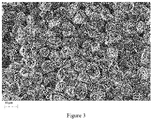
- FIG. 3 is a scanning electron microscopy image of a carbonate precursor having a high-nickel and low-cobalt sandwich structure prepared in an embodiment of the present disclosure.
- the prepared precursor material had a core-shell sandwich structure.
- the particle size distribution of the precursor was detected by a laser particle size analyzer, and it is found that the particle size distribution of the precursor was uniform. Meanwhile, through detection, the content of sodium in the precursor was less than 300 ppm and the content of sulfur was less than 1000 ppm.
- the obtained cathode material was assembled into a button battery (by using an EC/DMC electrolyte in which the content of lithium hexafluorophosphate was 1.0 mol/L), and the electrochemical performance of the button battery was detected.
- the capacity per gram of the product at 0.1C was 195 mAh to 200 mAh, and the first efficiency was 92%. There was no obvious gas generation in the soft package detection.
- the residual alkali(s) of the primary sintered material was detected to be 8000 ppm.
- the method for preparing a carbonate precursor having a high-nickel and low-cobalt sandwich structure is as follows:
- the method for preparing a cathode material is as follows:
- the prepared precursor material had a core-shell sandwich structure.
- the particle size distribution of the precursor was detected by a laser particle size analyzer, and it is found that the particle size distribution of the precursor was uniform. Meanwhile, through detection, the content of sodium in the precursor was less than 300 ppm and the content of sulfur was less than 1000 ppm.
- the obtained cathode material was assembled into a button battery (by using an EC/DMC electrolyte in which the content of lithium hexafluorophosphate was 1.0 mol/L), and the electrochemical performance of the button battery was detected.
- the capacity per gram of the product at 0.1C was 208 mAh to 210 mAh, and the first efficiency was 90%. There was no obvious gas generation in the soft package detection.
- the residual alkali(s) of the primary sintered material was detected to be 6000 ppm to 8000 ppm.
- the method for preparing a carbonate precursor having a high-nickel and low-cobalt sandwich structure is as follows:
- the method for preparing a cathode material is as follows:
- the prepared precursor material had a core-shell sandwich structure.
- the particle size distribution of the precursor was detected by a laser particle size analyzer, and it is found that the particle size distribution of the precursor was uniform. Meanwhile, through detection, the content of sodium in the precursor was less than 300 ppm and the content of sulfur was less than 1000 ppm.
- the obtained cathode material was assembled into a button battery (by using an EC/DMC electrolyte in which the content of lithium hexafluorophosphate was 1.0 mol/L), and the electrochemical performance of the button battery was detected.
- the capacity per gram of the product at 0.1C was 205 mAh to 210 mAh, and the first efficiency was 90%. There was no obvious gas generation in the soft package detection.
- the residual alkali(s) of the primary sintered material was detected to be 6000 ppm to 8000 ppm.
- the method for preparing a carbonate precursor having a high-nickel and low-cobalt sandwich structure is as follows:
- the method for preparing a cathode material is as follows:
- FIG. 3 is a scanning electron microscopy image of a carbonate precursor having a high-nickel and low-cobalt sandwich structure prepared in an embodiment of the present disclosure.
- the prepared precursor material had a core-shell sandwich structure.
- the particle size distribution of the precursor was detected by a laser particle size analyzer, and it is found that the particle size distribution of the precursor was uniform. Meanwhile, through detection, the content of sodium in the precursor was less than 300 ppm and the content of sulfur was less than 1000 ppm.
- the obtained cathode material was assembled into a button battery (by using an EC/DMC electrolyte in which the content of lithium hexafluorophosphate was 1.0 mol/L), and the electrochemical performance of the button battery was detected.
- the capacity per gram of the product at 0.1C was 193 mAh to 200 mAh, and the first efficiency was 91%. There was no obvious gas generation in the soft package detection.
- the residual alkali of the primary sintered material was detected to be 6000 ppm
- the method for preparing a carbonate precursor having a high-nickel and low-cobalt sandwich structure is as follows:
- the method for preparing a cathode material is as follows:
- FIG. 3 is a scanning electron microscopy image of a carbonate precursor having a high-nickel and low-cobalt sandwich structure prepared in an embodiment of the present disclosure.
- the prepared precursor material had a core-shell sandwich structure.
- the particle size distribution of the precursor was detected by a laser particle size analyzer, and it is found that the particle size distribution of the precursor was uniform. Meanwhile, through detection, the content of sodium in the precursor was less than 300 ppm and the content of sulfur was less than 1000 ppm.
- the obtained cathode material was assembled into a button battery (by using an EC/DMC electrolyte in which the content of lithium hexafluorophosphate was 1.0 mol/L), and the electrochemical performance of the button battery was detected.
- the capacity per gram of the product at 0.1C was 205 mAh to 215 mAh, and the first efficiency was 88%. There was no obvious gas generation in the soft package detection. The residual alkali of the primary sintered material was detected to be 9000 ppm.
Landscapes
- Chemical & Material Sciences (AREA)
- Organic Chemistry (AREA)
- Inorganic Chemistry (AREA)
- Chemical Kinetics & Catalysis (AREA)
- Electrochemistry (AREA)
- General Chemical & Material Sciences (AREA)
- Engineering & Computer Science (AREA)
- Manufacturing & Machinery (AREA)
- Composite Materials (AREA)
- Crystallography & Structural Chemistry (AREA)
- Inorganic Compounds Of Heavy Metals (AREA)
- Battery Electrode And Active Subsutance (AREA)
Abstract
Description
- The present disclosure relates to the technical field of lithium batteries, for example, to a carbonate precursor having a high-nickel and low-cobalt sandwich structure, a preparation method therefor and an application thereof.
- With the development of technology, although lithium cobalt oxide batteries are easy to synthesize and have stable performance, the commercial times of lithium cobalt oxide batteries no longer exist because of the high price of cobalt and the lack of cobalt resources, and low-cobalt and cobalt-free cathode materials will become a development direction in the future. In recent years, lithium-ion battery ternary materials have developed rapidly, and the development of high-quality high-nickel and low-cobalt ternary precursors and cathode materials has become a hot spot. In the market, hydroxide precursors are generally used as raw materials and sintered into cathode materials while the research on carbonate ternary precursors and their cathode materials is relatively few. At present, the reported carbonate precursors have the problems of insufficient particle uniformity, uneven particle size distribution, and poor fluidity, which causes the failure of continuous production of carbonate precursors. However, in most of the existing processes, ammonium bicarbonate is used as a precipitant to synthesize the carbonate precursor. This scheme is feasible for common ternary precursors and cathode material systems, but it often fails to achieve good results for high-nickel products, the morphology, particle size, and particle size distribution cannot be well controlled, and there are environmental protection problems related to ammonia-containing wastewater treatment.
- At the same time, for cathode materials, high-temperature calcination and oxidation in the process of preparing high-nickel ternary cathode materials are usually prone to cause the mixing of part of Ni divalent metal ions and lithium ions, which easily causes local structure collapse and instability during the cycle, resulting in the decrease of specific capacity and poor circulation of the final materials. In general, 750 °C and a pure oxygen atmosphere can enable the high-nickel materials to be completely transformed and crystallized, but the excessive temperature will aggravate cation mixing.
- Therefore, how to reduce the calcination temperature of carbonate precursor materials, especially large grained materials, is a direction to improve the properties of materials.
- The present disclosure provides a carbonate precursor having a high-nickel and low-cobalt sandwich structure, a preparation method therefor and an application thereof.
- The present disclosure provides a carbonate precursor having a high-nickel and low-cobalt sandwich structure in an embodiment. The carbonate precursor includes an inner core and outer shell layer. The chemical formula of the material of the inner core is Nix1Coy1Mn(1-x1-y1)CO3, where x1 ranges from 0.75 to 0.92, such as 0.75, 0.76, 0.77, 0.78, 0.79, 0.80, 0.81, 0.82, 0.83, 0.84, 0.85, 0.86, 0.87, 0.88, 0.89, 0.90, 0.91, 0.92, etc., and y1 ranges from 0.01 to 0.15, such as 0.01, 0.02, 0.03, 0.04, 0.05, 0.06, 0.07, 0.08, 0.09, 0.1, 0.11, 0.12, 0.13, 0.14, 0.15, etc.
- The outer shell layer covers at least a part of the outer surface of the inner core, and the chemical formula of the material of the outer shell layer is Nix2Coy2Mn(1-x2-y2)CO3, where x2 ranges from 0.7 to 0.92, such as 0.7, 0.72, 0.74, 0.76, 0.78, 0.80, 0.82, 0.84, 0.86, 0.88, 0.90, 0.92, etc., and y2 ranges from 0.01 to 0.15, such as 0.01, 0.02, 0.03, 0.04, 0.05, 0.06, 0.07, 0.08, 0.09, 0.1, 0.11, 0.12, 0.13, 0.14, 0.15, etc.
- In an embodiment provided by the present disclosure, the carbonate precursor having a high-nickel and low-cobalt sandwich structure has the advantages of narrow particle size distribution, good fluidity, and excellent electrochemical performance, and may be stably produced in both an ammonia-free system and an ammonia-containing system, especially in the ammonia-free system, that is, no ammonia-containing wastewater is produced, which is environmentally friendly. Compared with a precursor material having a solid structure, when the precursor material having a sandwich structure is sintered with lithium ions, since the outer shell layer is thin, lithium ions can more easily penetrate through the shell into the sandwich and then reach the inner core, which makes the sintering of lithium ions easier, and the same sintering effect can be achieved even if the sintering temperature is appropriately reduced. That is, the precursor having a sandwich structure can achieve the complete transformation and crystallization of the high-nickel material at a relatively low temperature, which avoids the problem that the local structure of the high-nickel material collapses in the cycle process due to the mixing of cations in the high-temperature calcination process, and the residual alkali(s) becomes less, so that the prepared cathode material has a relatively high specific capacity and excellent cycle performance and electrochemical performance. The outer shell layer has a composition with a slightly low nickel content because such a low-nickel material is more stable and less likely to react with an electrolyte and affect the battery performance. The nickel content of the inner core is slightly higher because the outer surface of the inner core is covered with the outer shell layer and thus cannot be in contact with the electrolyte.
- The "sandwich structure" described in an embodiment of the present disclosure refers to a cavity structure existing between the inner core and the outer shell layer covering the outer surface of the inner core. Lithium ions penetrate into the cavity from the outer shell layer and continue to penetrate into the inner core from the cavity.
- In an embodiment, the precursor has a particle size of 8 µm to 15 µm, such as 8 µm, 9 µm, 10 µm, 11 µm, 12 µm, 13 µm, 14 µm, 15 µm, etc.
- The particle size in an embodiment provided by the present disclosure refers to the average particle size.
- In an embodiment provided by the present disclosure, due to the existence of the sandwich structure, the particle size cannot be guaranteed to be below 8 µm, and if the particle size exceeds 15 µm, the permeability effect of the sandwich may become weak or the particles are fragile because the sandwich is too thick, which degrades the quality of the precursor.
- The present disclosure provides a method for preparing the preceding precursor in an embodiment. The method includes the following steps:
- (1) mixing a soluble nickel salt, a soluble cobalt salt, and a soluble manganese salt according to a first ratio to obtain a first mixed salt;
- (2) mixing a soluble nickel salt, a soluble cobalt salt, and a soluble manganese salt according to a second ratio to obtain a second mixed salt;
- (3) with stirring, mixing the first mixed salt and a precipitant and subjecting them to a first coprecipitation reaction to obtain a first reacted liquid;
- (4) with stirring, mixing the first reacted liquid and the second mixed salt and subjecting them to a second coprecipitation reaction to obtain a second reacted material;
- (5) with stirring, mixing the second reacted material and a detergent to obtain a primary washed material;
- (6) subjecting the primary washed material to a primary dehydration to obtain a primary dehydrated material;
- (7) with stirring, subjecting the primary dehydrated material to a second washing and then dehydration to obtain a secondary dehydrated material; and
- (8) drying the secondary dehydrated material and sieving the same to remove iron to obtain a carbonate precursor having a high-nickel and low-cobalt sandwich structure.
- In an embodiment provided by the present disclosure, the inner core structure is obtained after the first mixed salt obtained by mixing a soluble nickel salt, a soluble cobalt salt, and a soluble manganese salt according to the first ratio and a precipitant are subjected to a coprecipitation reaction, the inner core structure is covered by an outer shell after the second mixed salt obtained by mixing a soluble nickel salt, a soluble cobalt salt, and a soluble manganese salt according to the second ratio and the obtained first reacted liquid are mixed and subjected to a coprecipitation reaction, and finally, after subsequent washing, dehydration, drying, sieving, and iron removal processes, the carbonate precursor having a sandwich structure can be prepared, which has advantages of narrow particle size distribution, good fluidity, and excellent electrochemical performance. The carbonate precursor can be produced stably in both an ammonia-free system and an ammonia-containing system, especially in the ammonia-free system, that is, no ammonia-containing wastewater is produced, which is environmentally friendly. The precursor having such a structure can achieve the complete transformation and crystallization of the high-nickel material at a relatively low temperature, which avoids the problem that the local structure of the high-nickel material collapses in the cycle process due to the mixing of cations in the high-temperature calcination process, so that the prepared cathode material has a relatively high specific capacity and excellent cycle performance and electrochemical performance.
- In an embodiment, in step (1), the first ratio is a molar ratio of nickel, cobalt to manganese of (0.75 to 0.92):(0.01 to 0.15):(0.07 to 0.24), such as 0.75:0.15:0.1, 0.80:0.13:0.07, 0.85:0.05:0.1, 0.9:0.03:0.07, 0.92:0.01:0.07, 0.75:0.01:0.24, etc.
- In an embodiment, in step (1), the concentrations of the soluble nickel salt, the soluble cobalt salt, and the soluble manganese salt in the first mixed salt are each independently 80 g/L to 130 g/L, such as 80 g/L, 85 g/L, 90 g/L, 95 g/L, 100 g/L, 105 g/L, 110 g/L, 115 g/L, 120 g/L, 125 g/L, 130 g/L, etc.
- In an embodiment, in step (2), the second ratio is a molar ratio of nickel, cobalt to manganese of (0.7 to 0.92):(0.01 to 0.15):(0.07 to 0.29), such as 0.7:0.01:0.29, 0.80:0.13:0.07, 0.85:0.05:0.1, 0.9:0.03:0.07, 0.92:0.01:0.07, etc.
- In an embodiment, in step (2), the concentrations of the soluble nickel salt, the soluble cobalt salt, and the soluble manganese salt in the second mixed salt are each independently 80 g/L to 130 g/L, such as 80 g/L, 85 g/L, 90 g/L, 95 g/L, 100 g/L, 105 g/L, 110 g/L, 115 g/L, 120 g/L, 125 g/L, 130 g/L, etc.
- In an embodiment, in steps (1) and (2), the soluble nickel salt is independently selected from at least one of nickel chloride, nickel nitrate, and nickel sulfate.
- In an embodiment, in steps (1) and (2), the soluble cobalt salt is independently selected from at least one of cobalt chloride, cobalt nitrate, and cobalt sulfate.
- In an embodiment, in steps (1) and (2), the soluble manganese salt is independently selected from at least one of manganese chloride, manganese nitrate, and manganese sulfate.
- In an embodiment, in step (3), the precipitant is selected from at least one of sodium carbonate, sodium bicarbonate, ammonium carbonate, and ammonium bicarbonate.
- In an embodiment, the precipitant further includes ammonia water.
- In an embodiment, the concentration of sodium carbonate is 100 g/L to 200 g/L, such as 100 g/L, 110 g/L, 120 g/L, 130 g/L, 140 g/L, 150 g/L, 160 g/L, 170 g/L, 180 g/L, 190 g/L, 200 g/L, etc.
- In an embodiment, the concentration of sodium bicarbonate is 50 g/L to 100 g/L, such as 50 g/L, 55 g/L, 60 g/L, 65 g/L, 70 g/L, 75 g/L, 80 g/L, 85 g/L, 90 g/L, 95 g/L, 100 g/L, etc.
- In an embodiment, the concentration of ammonium carbonate is 200 g/L to 500 g/L, such as 200 g/L, 250 g/L, 300 g/L, 350 g/L, 400 g/L, 450 g/L, 500 g/L, etc.
- In an embodiment, the concentration of ammonium bicarbonate is 100 g/L to 200 g/L, such as 100 g/L, 110 g/L, 120 g/L, 130 g/L, 140 g/L, 150 g/L, 160 g/L, 170 g/L, 180 g/L, 190 g/L, 200 g/L, etc.
- In an embodiment, the concentration of ammonia water is 100 g/L to 200 g/L, such as 100 g/L, 110 g/L, 120 g/L, 130 g/L, 140 g/L, 150 g/L, 160 g/L, 170 g/L, 180 g/L, 190 g/L, 200 g/L, etc.
- In an embodiment, the stirring in the process of the first coprecipitation reaction is performed at a rotational speed of 700 rpm to 1000 rpm, such as 700 rpm, 750 rpm, 800 rpm, 850 rpm, 900 rpm, 950 rpm, 1000 rpm, etc., and a temperature of 50 °C to 70 °C, such as 50 °C, 52 °C, 54 °C, 56 °C, 58 °C, 60 °C, 62 °C, 64 °C, 68 °C, 70 °C, etc., for 5 hours to 60 hours, such as 5 hours, 10 hours, 15 hours, 20 hours, 25 hours, 30 hours, 35 hours, 40 hours, 45 hours, 50 hours, 55 hours, 60 hours, etc.; the pH of the first reacted liquid is 8.5 to 9.5, such as 8.5, 8.6, 8.7, 8.8, 8.9, 9.0, 9.1, 9.2, 9.3, 9.4, 9.5, etc.; and the liquid-solid content of the first reacted liquid is 100 g/L to 300 g/L, such as 100 g/L, 120 g/L, 140 g/L, 160 g/L, 180 g/L, 200 g/L, 220 g/L, 240 g/L, 260 g/L, 280 g/L, 300 g/L.
- In an embodiment provided by the present disclosure, because the precursor having a sandwich structure needs to be obtained later, the inner core formed by the first coprecipitation reaction needs to have an irregular structure to form supporting points for the subsequent formation of the sandwich structure. In this step, a relatively high stirring rotational speed is adopted so that the inner core having an irregular structure can be formed in the first coprecipitation reaction to provide supporting points for the subsequent formation of the sandwich structure.
- In an embodiment, in step (4), the mass ratio of the first reacted liquid to the second mixed salt is (1 to 20):(1 to 5), such as 1:1, 2:1, 3:2, 5:3, 8:3, 10:4, 12:5, 14:5, 16:5, 18:5, 20:5, etc.
- In an embodiment, in step (4), the stirring is performed at a rotational speed of 550 rpm to 650 rpm, such as 500 rpm, 560 rpm, 570 rpm, 580 rpm, 590 rpm, 600 rpm, 610 rpm, 620 rpm, 630 rpm, 640 rpm, 650 rpm, etc., for 0.5 hours to 5 hours, such as 0.5 hours, 1 hour, 1.5 hours, 2 hours, 2.5 hours, 3 hours, 3.5 hours, 4 hours, 4.5 hours, 5 hours, etc.
- In an embodiment provided by the present disclosure, the rotational speed of the stirring is appropriately reduced so that the precipitate small particles formed in the second coprecipitation reaction process cannot cling to the surface of the inner core during growth, thereby forming a sandwich structure. Specifically, the first mixed salt, the precipitant, and the second mixed liquid are continuously added from the bottom of a reaction kettle, and the obtained second reaction material overflows into an aging kettle.
- In step (5) provided by an embodiment of the present disclosure, the second reacted material obtained in step (4) is mixed with a detergent to obtain a primary washed material. In this process, the stirring is performed for 0.1 hours to 5 hours, and the detergent used herein is a conventional detergent in the art, such as sodium hydroxide with a pH of 9.0. It is to be noted that those skilled in the art can choose the addition amount of the detergent and the rotational speed and time of the stirring according to actual requirements, as long as part of sodium and sulfur in the second reacted material can be removed.
- In step (6) provided by an embodiment of the present disclosure, the primary washed material obtained in step (5) is subjected to a primary dehydration to obtain the primary dehydrated material, where the primary dehydration may be performed by a centrifuge, and the water content of the obtained primary dehydrated material is not higher than 10 wt%.
- In step (7) provided by an embodiment of the present disclosure, the primary dehydrated material obtained in step (6) is subjected to a secondary washing and then dehydrated to obtain a secondary dehydrated material. The secondary washing is performed on the primary dehydrated material by using pure water to further remove sodium and sulfur in the dehydrated material. Those skilled in the art can choose the amount of pure water and the rotational speed and time of the stirring according to actual requirements, as long as the content of sodium and sulfur is qualified. The dehydration in this dehydration process is also performed by a centrifuge, and the water content in the obtained secondary dehydrated material is not higher than 5wt% to 10 wt%.
- In step (8) provided by an embodiment of the present disclosure, the secondary dehydrated material obtained in step (7) is dried and then sieved to remove iron to obtain the carbonate precursor having a high-nickel and low-cobalt sandwich structure. The processes of drying and sieving for iron removal are routine operations in the art, and those skilled in the art can choose according to actual requirements, which will not be described in detail herein.
- In an embodiment, the present disclosure provides a method for preparing a cathode material, including:
- (a) pre-firing a precursor material;
- (b) mixing the pre-fired product obtained in step (a) and a lithium salt and subjecting them to a primary sintering to obtain a primary sintered material; and
- (c) crushing the primary sintered material and subjecting the same to a secondary sintering to obtain a cathode material.
- Wherein in step (a), the precursor material is the preceding carbonate precursor having a high-nickel and low-cobalt sandwich structure or a carbonate precursor having a high-nickel and low-cobalt sandwich structure prepared by the preceding method.
- In an embodiment provided by the present disclosure, the carbonate precursor having a sandwich structure, which has advantages of narrow particle size distribution, good fluidity, and excellent electrochemical performance, is pre-fired and then subjected to a primary sintering and a secondary sintering. In this way, due to the special sandwich structure of the carbonate precursor, the precursor can achieve the complete transformation and crystallization of the high-nickel material at a relatively low temperature, and the problem that the local structure of the high-nickel material collapses in the cycle process due to the mixing of cations in the high-temperature calcination process is avoided, so that the prepared cathode material has a high specific capacity and excellent cycle performance and electrochemical performance.
- In an embodiment, in step (a), the pre-firing is performed at a temperature of 400 °C to 500 °C, such as 400 °C, 410 °C, 420 °C, 430 °C, 440 °C, 450 °C, 460 °C, 470 °C, 480 °C, 490 °C, 500 °C, etc., for 2 hours to 6 hours, such as 2 hours, 3 hours, 4 hours, 5 hours, 6 hours, etc.
- In an embodiment provided by the present disclosure, the pre-firing is performed under the conditions of the preceding pre-firing temperature and the pre-firing time, which can significantly improve the decomposition rate of the precursor carbonate without causing serious energy waste.
- In an embodiment, in step (b), the molar ratio of the pre-fired product to the lithium salt is 1:(1.02 to 1.08), such as 1:1.02, 1:1.03, 1:1.04, 1:1.05, 1:1.06, 1:1.07, 1:1.08, etc.
- In an embodiment, in step (b), the primary sintering is performed at a temperature of 700 °C to 850 °C, such as 700 °C, 710 °C, 720 °C, 730 °C, 740 °C, 750 °C, 760 °C, 770 °C, 780 °C, 790 °C, 800 °C, 810 °C, 820 °C, 830 °C, 840 °C, 850 °C, etc., for 10 hours to 22 hours, such as 10 hours, 11 hours, 12 hours, 13 hours, 14 hours, 15 hours, 16 hours, 17 hours, 18 hours, 19 hours, 20 hours, 21 hours, 22 hours, etc.
- In an embodiment provided by the present disclosure, the pre-fired product obtained in step (a) and a lithium salt are mixed and subjected to a primary sintering so that lithium ions migrate into the precursor material and combine to generate a lithium salt cathode material, that is, a primary sintered material. The primary sintering is performed under the conditions of the primary sintering temperature and time described in the present disclosure, which can promote the rapid migration of lithium ions into the precursor material without causing energy waste.
- In an embodiment, in step (c), the secondary sintering is performed at a temperature of 580 °C to 650 °C, such as 580 °C, 590 °C, 600 °C, 610 °C, 620 °C, 630 °C, 640 °C, 650 °C, etc., for 8 hours to 12 hours, such as 8 hours, 9 hours, 10 hours, 11 hours, 12 hours, etc.
- In an embodiment provided by the present disclosure, the primary sintered material obtained in step (b) is crushed and then subjected to a secondary sintering so that the carbonate in the precursor is completely decomposed to obtain the cathode material. The secondary sintering is performed under the conditions of the secondary sintering temperature and time described in the present disclosure, which can ensure that the precursor material is completely sintered without causing energy waste. It should be noted that the crushing particle size of the primary sintered material may be chosen by those skilled in the art according to actual requirements, which will not be described in detail herein.
- The present disclosure provides a cathode material in an embodiment. The cathode material is prepared by the method described in the preceding embodiment.
- In an embodiment provided by the present disclosure, the cathode material has a high specific capacity and excellent cycle performance and electrochemical performance.
- The present disclosure provides a lithium battery in an embodiment. The lithium battery includes the cathode material described in the preceding embodiment.
- In an embodiment provided by the present disclosure, the lithium battery has a long cycle life on the basis of having high specific energy.
- The present disclosure provides a vehicle in an embodiment. The vehicle includes the lithium battery described in the preceding embodiment.
- In an embodiment provided by the present disclosure, the vehicle loaded with the lithium battery having high specific energy and long cycle life has excellent endurance, thereby meeting the use requirements of consumers.
- The drawings are used to provide a further understanding of the solutions of the present disclosure, constitute a part of the description, explain the solutions of the present disclosure in conjunction with the embodiments of the present application, and do not limit the solutions of the present disclosure.
-
FIG. 1 is a flowchart of a method for preparing a carbonate precursor having a high-nickel and low-cobalt sandwich structure according to an embodiment of the present disclosure; -
FIG. 2 is a flowchart of a method for preparing a cathode material according to an embodiment of the present disclosure; and -
FIG. 3 is a scanning electron microscopy image of the carbonate precursor having a high-nickel and low-cobalt sandwich structure prepared in an embodiment. - Technical solutions of the present disclosure are further described below through specific embodiments in conjunction with the drawings.
- In an embodiment, the present disclosure provides a carbonate precursor having a high-nickel and low-cobalt sandwich structure. The carbonate precursor includes an inner core and outer shell layer covering at least a part of the outer surface of the inner core, where the chemical formula of the material of the inner core is Nix1Coy1Mn(1-x1-y1)CO3, where x1 ranges from 0.75 to 0.92 and y1 ranges from 0.01 to 0.15, and the chemical formula of the material of the outer shell layer is Nix2Coy2Mn(1-x2-y2)CO3, where x2 ranges from 0.7 to 0.92 and y2 ranges from 0.01 to 0.15. The carbonate precursor having a sandwich structure has the advantages of narrow particle size distribution, good fluidity, and excellent electrochemical performance, and may be stably produced in both an ammonia-free system and an ammonia-containing system, especially in the ammonia-free system, that is, no ammonia-containing wastewater is produced, which is environmentally friendly. Compared with a precursor material having a solid structure, when the precursor material having a sandwich structure is sintered with lithium ions, since the outer shell layer is thin, lithium ions can more easily penetrate through the shell into the sandwich and then reach the inner core, which makes the sintering of lithium ions easier, and the same sintering effect can be achieved even if the sintering temperature is appropriately reduced. That is, the precursor having a sandwich structure can achieve the complete transformation and crystallization of the high-nickel material at a relatively low temperature, which avoids the problem that the local structure of the high-nickel material collapses in the cycle process due to the mixing of cations in the high-temperature calcination process, and the residual alkali(s) becomes less, so that the prepared cathode material has a relatively high specific capacity and excellent cycle performance and electrochemical performance. The outer shell layer has a composition with a slightly low nickel content because such a low-nickel material is more stable and less likely to react with an electrolyte and affect the battery performance. The nickel content of the inner core is slightly higher because the outer surface of the inner core is covered with the outer shell layer and thus cannot be in contact with the electrolyte. The precursor has a particle size of 8 µm to 15 µm, and due to the existence of the sandwich structure, the particle size cannot be guaranteed to be below 8 µm, and if the particle size exceeds 15 µm, the permeability effect of the sandwich may become weak or the particles are fragile because the sandwich is too thick, which degrades the quality of the precursor.
- In an embodiment, the present disclosure provides a method for preparing the preceding carbonate precursor having a high-nickel and low-cobalt sandwich structure. As shown in
FIG. 1 , the method includes the following steps. - In S100, a soluble nickel salt, a soluble cobalt salt, and a soluble manganese salt are mixed according to a first ratio to obtain a first mixed salt. The soluble nickel salt is at least one selected from the group consisting of nickel chloride, nickel nitrate, and nickel sulfate; the soluble cobalt salt is at least one selected from the group consisting of cobalt chloride, cobalt nitrate, and cobalt sulfate; and the soluble manganese salt is at least one selected from the group consisting of manganese chloride, manganese nitrate, and manganese sulfate. The concentrations of the soluble nickel salt, the soluble cobalt salt, and the soluble manganese salt in the first mixed salt are each independently 80 g/L to 130 g/L. The first ratio is a molar ratio of nickel, cobalt to manganese of (0.75 to 0.92):(0.01 to 0.15):(0.07 to 0.24).
- In S200, a soluble nickel salt, a soluble cobalt salt, and a soluble manganese salt are mixed according to a second ratio to obtain a second mixed salt. The soluble nickel salt is at least one selected from the group consisting of nickel chloride, nickel nitrate, and nickel sulfate; the soluble cobalt salt is at least one selected from the group consisting of cobalt chloride, cobalt nitrate, and cobalt sulfate; and the soluble manganese salt is at least one selected from the group consisting of manganese chloride, manganese nitrate, and manganese sulfate. The concentrations of the soluble nickel salt, the soluble cobalt salt, and the soluble manganese salt in the second mixed salt are each independently 80 g/L to 130 g/L. The second ratio is a molar ratio of nickel, cobalt to manganese of (0.7 to 0.92):(0.01 to 0.15):(0.07 to 0.29).
- In S300, with stirring, the first mixed salt obtained in step S100 and a precipitant are mixed and subjected to a first coprecipitation reaction to obtain a first reacted liquid. The precipitant is at least one selected from the group consisting of sodium carbonate, sodium bicarbonate, ammonium carbonate, and ammonium bicarbonate, or includes ammonia water and at least one of the group consisting of sodium carbonate, sodium bicarbonate, ammonium carbonate, and ammonium bicarbonate, where the concentration of sodium bicarbonate is 50 g/L to 100 g/L, the concentration of sodium carbonate is 100 g/L to 200 g/L, the concentration of ammonium carbonate is 200 g/L to 500 g/L, the concentration of ammonium bicarbonate is 100 g/L to 200 g/L, and the concentration of ammonia water is 100 g/L to 200 g/L. The soluble nickel salt, the soluble cobalt salt, and the soluble manganese salt in the first mixed salt and the precipitant are coprecipitated to obtain a first reacted liquid containing nickel precipitate, cobalt precipitate, and manganese precipitate, thus obtaining an inner core having an irregular structure. The stirring in the process of the first coprecipitation reaction is performed at a rotational speed of 700 rpm to 1000 rpm and a temperature of 50 °C to 70 °C for 5 hours to 60 hours, the pH of the first reacted liquid is 8.5 to 9.5, and the mixing ratio of the first mixed salt to the precipitant needs to enable the liquid-solid content of the first reacted liquid to be 100 g/L to 300 g/L.
- In S400, with stirring, the second mixed salt obtained in step S200 and the first reacted liquid obtained in step S300 are mixed and subjected to a second coprecipitation reaction, where the generated precipitates are gradually deposited and grown on the supporting points provided by the inner core having an irregular structure formed in step S300, that is, the inner core is covered with the outer shell layer, to obtain a second reacted material. The stirring in this process is performed at a rotational speed of 550 rpm to 650 rpm for 0.5 hours to 5 hours. The first mixed salt, the precipitant, and the second mixed liquid are continuously added from the bottom of a reaction kettle, the obtained second reaction material overflows into an aging kettle, and the mass ratio of the first reacted liquid to the second mixed salt is (1 to 20):(1 to 5).
- In S500, with stirring, the second reacted material obtained in step S400 and a detergent are mixed to obtain a primary washed material, where the stirring is performed for 0.1 hours to 5 hours, and the detergent used herein is a conventional detergent in the art, such as sodium hydroxide with a pH of 9.0.
- In S600, the primary washed material obtained in step S500 is subjected to a primary dehydration to obtain a primary dehydrated material. The primary dehydration may be performed by a centrifuge, and the water content of the obtained primary dehydrated material is not higher than 10 wt%.
- In S700, the primary dehydrated material obtained in step S600 is subjected to a second washing and dehydrated to obtain a secondary dehydrated material. The secondary washing is performed on the primary dehydrated material by using pure water to further remove sodium and sulfur in the dehydrated material, where the dehydration process is performed by a centrifuge, and the water content of the obtained secondary dehydrated material is not higher than 5 wt% to 10 wt%.
- In S800, the obtained secondary dehydrated material is dried and sieved to remove iron to obtain a carbonate precursor having a high-nickel and low-cobalt sandwich structure.
- In an embodiment, the present disclosure provides a method for preparing a cathode material. As shown in
FIG. 2 , the method includes the following steps. - In Sa, the carbonate precursor having a high-nickel and low-cobalt sandwich structure described in an embodiment or a carbonate precursor having a high-nickel and low-cobalt sandwich structure prepared in an embodiment is pre-fired at 400 °C to 500 °C for 2 hours to 6 hours to decompose the carbonate in the precursor.
- In Sb, the pre-fired product obtained in step Sa and a lithium salt are mixed and subjected to a primary sintering so that lithium ions migrate into the precursor material and combine to generate a lithium salt cathode material, that is, a primary sintered material. The lithium salt is at least one selected from the group consisting of lithium hydroxide and lithium carbonate, the molar ratio of the precursor material to the lithium salt is 1:(1.02 to 1.08), and the primary sintering is performed at 700 °C to 850 °C for 10 hours to 22 hours.
- In Sc, the primary sintered material obtained in step Sb is crushed and then subjected to a secondary sintering so that the carbonate in the precursor is completely decomposed to obtain the cathode material. The secondary sintering is performed at 580 °C to 650 °C for 8 hours to 12 hours.
- In an embodiment, the present disclosure provides a cathode material. The cathode material is prepared by the method described in the preceding embodiment.
- In an embodiment, the present disclosure provides a lithium battery. The lithium battery includes the cathode material described in the preceding embodiment.
- In an embodiment, the present disclosure provides a vehicle. The vehicle includes the lithium battery described in the preceding embodiment.
- The method for preparing a carbonate precursor having a high-nickel and low-cobalt sandwich structure is as follows:
- (1) Nickel sulfate, cobalt sulfate, and manganese sulfate were mixed according to a molar ratio of 0.88:0.05:0.07 to obtain a first mixed salt, where the concentrations of nickel sulfate, cobalt sulfate, and manganese sulfate in the first mixed salt were all 120 g/L.
- (2) Nickel sulfate, cobalt sulfate, and manganese sulfate were mixed according to a molar ratio of 0.83:0.05:0.12 to obtain a second mixed salt, where the concentrations of nickel sulfate, cobalt sulfate, and manganese sulfate in the second mixed salt were all 120 g/L.
- (3) With stirring, the preceding mixed solution, 100 g/L sodium bicarbonate, and 150 g/L ammonia water were mixed in a reaction kettle to perform a first coprecipitation reaction, where the stirring in the process of the first coprecipitation reaction was performed at a rotational speed of 750 rpm to 850 rpm and a temperature of 60 °C for 20 hours, and the pH of the first reacted liquid was controlled to be 8.5, and the liquid-solid content of the first reacted liquid was controlled to be 120 g/L.
- (4) With stirring, the second mixed salt obtained in step (2) and the first reacted liquid obtained in step (3) were mixed to perform a second coprecipitation reaction to obtain a second reacted material, where the mass ratio of the first reacted liquid to the second mixed salt was 2:1, and the stirring in the process was performed at a rotational speed of 600 rpm for 5 hours, and the obtained second reacted material overflowed into an aging kettle.
- (5) The obtained second reacted material and sodium hydroxide with a pH of 9 were mixed and stirred for 0.1 hours to obtain a primary washed material.
- (6) The obtained second reacted material was dehydrated by a centrifuge to obtain a primary dehydrated material with a water content not higher than 10 wt%.
- (7) The obtained primary dehydrated material was washed by using pure water and dehydrated to obtain a secondary dehydrated material with a water content not higher than 10 wt%.
- (8) The obtained secondary dehydrated material was dried and sieved to remove iron to obtain a carbonate precursor having a high-nickel and low-cobalt sandwich structure with a particle size of 12 µm.
- The method for preparing a cathode material is as follows:
- Sa: The carbonate precursor having a high-nickel and low-cobalt sandwich structure obtained in step (8) was pre-fired at 500 °C for 4 hours.
- Sb: The pre-fired product obtained in step Sa and lithium hydroxide were mixed according to a molar ratio of 1:1.06 and subjected to a primary sintering at 850 °C for 18 hours to obtain a primary sintered material.
- Sc: The obtained primary sintered material was crushed and subjected to a secondary sintering at 600 °C for 12 hours to obtain a cathode material.
-
FIG. 3 is a scanning electron microscopy image of a carbonate precursor having a high-nickel and low-cobalt sandwich structure prepared in an embodiment of the present disclosure. As can be seen from the image, the prepared precursor material had a core-shell sandwich structure. The particle size distribution of the precursor was detected by a laser particle size analyzer, and it is found that the particle size distribution of the precursor was uniform. Meanwhile, through detection, the content of sodium in the precursor was less than 300 ppm and the content of sulfur was less than 1000 ppm. The obtained cathode material was assembled into a button battery (by using an EC/DMC electrolyte in which the content of lithium hexafluorophosphate was 1.0 mol/L), and the electrochemical performance of the button battery was detected. The capacity per gram of the product at 0.1C was 195 mAh to 200 mAh, and the first efficiency was 92%. There was no obvious gas generation in the soft package detection. The residual alkali(s) of the primary sintered material was detected to be 8000 ppm. - The method for preparing a carbonate precursor having a high-nickel and low-cobalt sandwich structure is as follows:
- (1) Nickel nitrate, cobalt nitrate, and manganese nitrate were mixed according to a molar ratio of 0.90:0.03:0.07 to obtain a first mixed salt, where the concentrations of nickel nitrate, cobalt nitrate, and manganese nitrate in the first mixed salt were all 110 g/L.
- (2) Nickel nitrate, cobalt nitrate, and manganese nitrate were mixed according to a molar ratio of 0.83:0.03:0.14 to obtain a second mixed salt, where the concentrations of nickel nitrate, cobalt nitrate, and manganese nitrate in the second mixed salt were all 110 g/L.
- (3) With stirring, the preceding mixed solution, 200 g/L sodium carbonate, and 500 g/L ammonium carbonate were mixed in a reaction kettle to perform a first coprecipitation reaction, where the stirring in the process of the first coprecipitation reaction was performed at a rotational speed of 750 rpm to 850 rpm and a temperature of 65 °C for 30 hours, and the pH of the first reacted liquid was controlled to be 9, and the liquid-solid content of the first reacted liquid was controlled to be 180 g/L.
- (4) With stirring, the second mixed salt obtained in step (2) and the first reacted liquid obtained in step (3) were mixed to perform a second coprecipitation reaction to obtain a second reacted material, where the mass ratio of the first reacted liquid to the second mixed salt was 20:1, and the stirring in the process was performed at a rotational speed of 600 rpm for 5 hours, and the obtained second reacted material overflowed into an aging kettle.
- (5) The obtained second reacted material and sodium hydroxide with a pH of 9 were mixed and stirred for 1 hour to obtain a primary washed material.
- (6) The obtained second reacted material was dehydrated by a centrifuge to obtain a primary dehydrated material with a water content not higher than 10 wt%.
- (7) The obtained primary dehydrated material was washed by using pure water and dehydrated to obtain a secondary dehydrated material with a water content not higher than 10 wt%.
- (8) The obtained secondary dehydrated material was dried and sieved to remove iron to obtain a carbonate precursor having a high-nickel and low-cobalt sandwich structure with a particle size of 10 µm.
- The method for preparing a cathode material is as follows:
- Sa: The carbonate precursor having a high-nickel and low-cobalt sandwich structure obtained in step (8) was pre-fired at 500 °C for 4 hours.
- Sb: The pre-fired product obtained in step Sa and lithium carbonate were mixed according to a molar ratio of 1:1.03 and subjected to a primary sintering at 780 °C for 22 hours to obtain a primary sintered material.
- Sc: The obtained primary sintered material was crushed and subjected to a secondary sintering at 590 °C for 10 hours to obtain a cathode material.
- The prepared precursor material had a core-shell sandwich structure. The particle size distribution of the precursor was detected by a laser particle size analyzer, and it is found that the particle size distribution of the precursor was uniform. Meanwhile, through detection, the content of sodium in the precursor was less than 300 ppm and the content of sulfur was less than 1000 ppm. The obtained cathode material was assembled into a button battery (by using an EC/DMC electrolyte in which the content of lithium hexafluorophosphate was 1.0 mol/L), and the electrochemical performance of the button battery was detected. The capacity per gram of the product at 0.1C was 208 mAh to 210 mAh, and the first efficiency was 90%. There was no obvious gas generation in the soft package detection. The residual alkali(s) of the primary sintered material was detected to be 6000 ppm to 8000 ppm.
- The method for preparing a carbonate precursor having a high-nickel and low-cobalt sandwich structure is as follows:
- (1) Nickel chloride, cobalt chloride, and manganese chloride were mixed according to a molar ratio of 0.92:0.01:0.07 to obtain a first mixed salt, where the concentrations of nickel chloride, cobalt chloride, and manganese chloride in the first mixed salt were all 100 g/L.
- (2) Nickel chloride, cobalt chloride, and manganese chloride were mixed according to a molar ratio of 0.88:0.01:0.11 to obtain a second mixed salt, where the concentrations of nickel chloride, cobalt chloride, and manganese chloride in the second mixed salt were all 100 g/L.
- (3) With stirring, the preceding mixed solution, 200 g/L sodium carbonate, and 100 g/L sodium bicarbonate were mixed in a reaction kettle to perform a first coprecipitation reaction, where the stirring in the process of the first coprecipitation reaction was performed at a rotational speed of 750 rpm and a temperature of 50 °C for 50 hours, and the pH of the first reacted liquid was controlled to be 9.5, and the liquid-solid content of the first reacted liquid was controlled to be 150 g/L.
- (4) With stirring, the second mixed salt obtained in step (2) and the first reacted liquid obtained in step (3) were mixed to perform a second coprecipitation reaction to obtain a second reacted material, where the mass ratio of the first reacted liquid to the second mixed salt was 1:5, and the stirring in the process was performed at a rotational speed of 600 rpm for 5 hours, and the obtained second reacted material overflowed into an aging kettle.
- (5) The obtained second reacted material and sodium hydroxide with a pH of 9 were mixed and stirred for 1 hour to obtain a primary washed material.
- (6) The obtained second reacted material was dehydrated by a centrifuge to obtain a primary dehydrated material with a water content not higher than 10 wt%.
- (7) The obtained primary dehydrated material was washed by using pure water and dehydrated to obtain a secondary dehydrated material with a water content not higher than 10 wt%.
- (8) The obtained secondary dehydrated material was dried and sieved to remove iron to obtain a carbonate precursor having a high-nickel and low-cobalt sandwich structure with a particle size of 8 µm.
- The method for preparing a cathode material is as follows:
- Sa: The carbonate precursor having a high-nickel and low-cobalt sandwich structure obtained in step (8) was pre-fired at 500 °C for 4 hours.
- Sb: The pre-fired product obtained in step Sa and lithium hydroxide were mixed according to a molar ratio of 1:1.05 and subjected to a primary sintering at 740 °C for 20 hours to obtain a primary sintered material.
- Sc: The obtained primary sintered material was crushed and subjected to a secondary sintering at 580 °C for 10 hours to obtain a cathode material.
- The prepared precursor material had a core-shell sandwich structure. The particle size distribution of the precursor was detected by a laser particle size analyzer, and it is found that the particle size distribution of the precursor was uniform. Meanwhile, through detection, the content of sodium in the precursor was less than 300 ppm and the content of sulfur was less than 1000 ppm. The obtained cathode material was assembled into a button battery (by using an EC/DMC electrolyte in which the content of lithium hexafluorophosphate was 1.0 mol/L), and the electrochemical performance of the button battery was detected. The capacity per gram of the product at 0.1C was 205 mAh to 210 mAh, and the first efficiency was 90%. There was no obvious gas generation in the soft package detection. The residual alkali(s) of the primary sintered material was detected to be 6000 ppm to 8000 ppm.
- The method for preparing a carbonate precursor having a high-nickel and low-cobalt sandwich structure is as follows:
- (1) Nickel sulfate, cobalt sulfate, and manganese sulfate were mixed according to a molar ratio of 0.75:0.15:0.1 to obtain a first mixed salt, where the concentrations of nickel sulfate, cobalt sulfate, and manganese sulfate in the first mixed salt were all 80 g/L.
- (2) Nickel sulfate, cobalt sulfate, and manganese sulfate were mixed according to a molar ratio of 0.7:0.15:0.15 to obtain a second mixed salt, where the concentrations of nickel sulfate, cobalt sulfate, and manganese sulfate in the second mixed salt were all 80 g/L.
- (3) With stirring, the preceding mixed solution, 100 g/L sodium bicarbonate, and 150 g/L ammonia water were mixed in a reaction kettle to perform a first coprecipitation reaction, where the stirring in the process of the first coprecipitation reaction was performed at a rotational speed of 700 rpm to 750 rpm and a temperature of 50 °C for 60 hours, and the pH of the first reacted liquid was controlled to be 8.5, and the liquid-solid content of the first reacted liquid was controlled to be 100 g/L.
- (4) With stirring, the second mixed salt obtained in step (2) and the first reacted liquid obtained in step (3) were mixed to perform a second coprecipitation reaction to obtain a second reacted material, where the mass ratio of the first reacted liquid to the second mixed salt was 1:5, and the stirring in the process was performed at a rotational speed of 650 rpm for 5 hours, and the obtained second reacted material overflowed into an aging kettle.
- (5) The obtained second reacted material and sodium hydroxide with a pH of 9 were mixed and stirred for 0.1 hours to obtain a primary washed material.
- (6) The obtained second reacted material was dehydrated by a centrifuge to obtain a primary dehydrated material with a water content not higher than 10 wt%.
- (7) The obtained primary dehydrated material was washed by using pure water and dehydrated to obtain a secondary dehydrated material with a water content not higher than 10 wt%.
- (8) The obtained secondary dehydrated material was dried and sieved to remove iron to obtain a carbonate precursor having a high-nickel and low-cobalt sandwich structure with a particle size of 8 µm.
- The method for preparing a cathode material is as follows:
- Sa: The carbonate precursor having a high-nickel and low-cobalt sandwich structure obtained in step (8) was pre-fired at 400 °C for 6 hours.
- Sb: The pre-fired product obtained in step Sa and lithium hydroxide were mixed according to a molar ratio of 1:1.02 and subjected to a primary sintering at 700 °C for 22 hours to obtain a primary sintered material.
- Sc: The obtained primary sintered material was crushed and subjected to a secondary sintering at 580 °C for 12 hours to obtain a cathode material.
-
FIG. 3 is a scanning electron microscopy image of a carbonate precursor having a high-nickel and low-cobalt sandwich structure prepared in an embodiment of the present disclosure. As can be seen from the image, the prepared precursor material had a core-shell sandwich structure. The particle size distribution of the precursor was detected by a laser particle size analyzer, and it is found that the particle size distribution of the precursor was uniform. Meanwhile, through detection, the content of sodium in the precursor was less than 300 ppm and the content of sulfur was less than 1000 ppm. The obtained cathode material was assembled into a button battery (by using an EC/DMC electrolyte in which the content of lithium hexafluorophosphate was 1.0 mol/L), and the electrochemical performance of the button battery was detected. The capacity per gram of the product at 0.1C was 193 mAh to 200 mAh, and the first efficiency was 91%. There was no obvious gas generation in the soft package detection. The residual alkali of the primary sintered material was detected to be 6000 ppm. - The method for preparing a carbonate precursor having a high-nickel and low-cobalt sandwich structure is as follows:
- (1) Nickel sulfate, cobalt sulfate, and manganese sulfate were mixed according to a molar ratio of 0.92:0.01:0.07 to obtain a first mixed salt, where the concentrations of nickel sulfate, cobalt sulfate, and manganese sulfate in the first mixed salt were all 130 g/L.
- (2) Nickel sulfate, cobalt sulfate, and manganese sulfate were mixed according to a molar ratio of 0.92:0.01:0.07 to obtain a second mixed salt, where the concentrations of nickel sulfate, cobalt sulfate, and manganese sulfate in the second mixed salt were all 130 g/L.
- (3) With stirring, the preceding mixed solution, 200 g/L ammonium carbonate, and 100 g/L ammonia water were mixed in a reaction kettle to perform a first coprecipitation reaction, where the stirring in the process of the first coprecipitation reaction was performed at a rotational speed of 950 rpm to 1000 rpm and a temperature of 70 °C for 5 hours, and the pH of the first reacted liquid was controlled to be 9.5, and the liquid-solid content of the first reacted liquid was controlled to be 300 g/L.
- (4) With stirring, the second mixed salt obtained in step (2) and the first reacted liquid obtained in step (3) were mixed to perform a second coprecipitation reaction to obtain a second reacted material, where the mass ratio of the first reacted liquid to the second mixed salt was 20:1, and the stirring in the process was performed at a rotational speed of 900 rpm for 0.5 hours, and the obtained second reacted material overflowed into an aging kettle.
- (5) The obtained second reacted material and sodium hydroxide with a pH of 9 were mixed and stirred for 5 hours to obtain a primary washed material.
- (6) The obtained second reacted material was dehydrated by a centrifuge to obtain a primary dehydrated material with a water content not higher than 10 wt%.
- (7) The obtained primary dehydrated material was washed by using pure water and dehydrated to obtain a secondary dehydrated material with a water content not higher than 10 wt%.
- (8) The obtained secondary dehydrated material was dried and sieved to remove iron to obtain a carbonate precursor having a high-nickel and low-cobalt sandwich structure with a particle size of 7 µm.
- The method for preparing a cathode material is as follows:
- Sa: The carbonate precursor having a high-nickel and low-cobalt sandwich structure obtained in step (8) was pre-fired at 500 °C for 4 hours.
- Sb: The pre-fired product obtained in step Sa and lithium hydroxide were mixed according to a molar ratio of 1:1.08 and subjected to a primary sintering at 850 °C for 10 hours to obtain a primary sintered material.
- Sc: The obtained primary sintered material was crushed and subjected to a secondary sintering at 650 °C for 8 hours to obtain a cathode material.
-
FIG. 3 is a scanning electron microscopy image of a carbonate precursor having a high-nickel and low-cobalt sandwich structure prepared in an embodiment of the present disclosure. As can be seen from the image, the prepared precursor material had a core-shell sandwich structure. The particle size distribution of the precursor was detected by a laser particle size analyzer, and it is found that the particle size distribution of the precursor was uniform. Meanwhile, through detection, the content of sodium in the precursor was less than 300 ppm and the content of sulfur was less than 1000 ppm. The obtained cathode material was assembled into a button battery (by using an EC/DMC electrolyte in which the content of lithium hexafluorophosphate was 1.0 mol/L), and the electrochemical performance of the button battery was detected. The capacity per gram of the product at 0.1C was 205 mAh to 215 mAh, and the first efficiency was 88%. There was no obvious gas generation in the soft package detection. The residual alkali of the primary sintered material was detected to be 9000 ppm.
Claims (28)
- A carbonate precursor having a high-nickel and low-cobalt sandwich structure, comprising:an inner core, wherein the chemical formula of the material of the inner core is Nix1Coy1Mn(1-x1-y1)CO3, wherein x1 ranges from 0.75 to 0.92, and y1 ranges from 0.01 to 0.15; andan outer shell layer, wherein the outer shell layer covers at least a part of the outer surface of the inner core, and the chemical formula of the material of the outer shell layer is Nix2Coy2Mn(1-x2-y2)CO3, wherein x2 ranges from 0.7 to 0.92, and y2 ranges from 0.01 to 0.15.
- The precursor according to claim 1, wherein the precursor has a particle size of 8 µm to 15 µm.
- A method for preparing the precursor according to claim 1 or 2, comprising:(1) mixing a soluble nickel salt, a soluble cobalt salt, and a soluble manganese salt according to a first ratio to obtain a first mixed salt;(2) mixing a soluble nickel salt, a soluble cobalt salt, and a soluble manganese salt according to a second ratio to obtain a second mixed salt;(3) with stirring, mixing the first mixed salt and a precipitant and subjecting them to a first coprecipitation reaction to obtain a first reacted liquid;(4) with stirring, mixing the first reacted liquid and the second mixed salt and subjecting them to a second coprecipitation reaction to obtain a second reacted material;(5) with stirring, mixing the second reacted material and a detergent to obtain a primary washed material;(6) subjecting the primary washed material to a primary dehydration to obtain a primary dehydrated material;(7) with stirring, subjecting the primary dehydrated material to a second washing and then dehydration to obtain a secondary dehydrated material; and(8) drying the secondary dehydrated material and sieving the same to remove iron to obtain a carbonate precursor having a high-nickel and low-cobalt sandwich structure.
- The method according to claim 3, wherein, in step (1), the first ratio is a molar ratio of nickel, cobalt to manganese of (0.75 to 0.92):(0.01 to 0.15):(0.07 to 0.24).
- The method according to claim 3 or 4, wherein, in step (1), the concentrations of the soluble nickel salt, the soluble cobalt salt, and the soluble manganese salt in the first mixed salt are each independently 80 g/L to 130 g/L.
- The method according to any one of claims 3 to 5, wherein, in step (2), the second ratio is a molar ratio of nickel, cobalt to manganese of (0.7 to 0.92):(0.01 to 0.15):(0.07 to 0.29).
- The method according to any one of claims 3 to 6, wherein, in step (2), the concentrations of the soluble nickel salt, the soluble cobalt salt, and the soluble manganese salt in the second mixed salt are each independently 80 g/L to 130 g/L.
- The method according to any one of claims 3 to 7, wherein, in steps (1) and (2), the soluble nickel salt is independently selected from at least one the group consisting of nickel chloride, nickel nitrate, and nickel sulfate.
- The method according to any one of claims 3 to 8, wherein, in steps (1) and (2), the soluble cobalt salt is independently selected from at least one the group consisting of cobalt chloride, cobalt nitrate, and cobalt sulfate.
- The method according to any one of claims 3 to 9, wherein, in steps (1) and (2), the soluble manganese salt is independently selected from at least one the group consisting of manganese chloride, manganese nitrate, and manganese sulfate.
- The method according to any one of claims 3 to 10, wherein, in step (3), the precipitant is at least one selected from the group consisting of sodium carbonate, sodium bicarbonate, ammonium carbonate, and ammonium bicarbonate.
- The method according to claim 11, wherein the precipitant further comprises ammonia water.
- The method according to claim 11 or 12, wherein the concentration of sodium carbonate is 100 g/L to 200 g/L.
- The method according to any one of claims 11 to 13, wherein the concentration of sodium bicarbonate is 50 g/L to 100 g/L.
- The method according to any one of claims 11 to 14, wherein the concentration of ammonium carbonate is 200 g/L to 500 g/L.
- The method according to any one of claims 11 to 15, wherein the concentration of ammonium bicarbonate is 100 g/L to 200 g/L.
- The method according to claim 12, wherein the concentration of ammonia water is 100 g/L to 200 g/L.
- The method according to any one of claims 3 to 17, wherein the stirring in the process of the first coprecipitation reaction is performed at a rotational speed of 700 rpm to 1000 rpm and a temperature of 50 °C to 70 °C for 5 hours to 60 hours, the pH of the first reacted liquid is 8.5 to 9.5, and the liquid-solid content of the first reacted liquid is 100 g/L to 300 g/L.
- The method according to any one of claims 3 to 18, wherein, in step (4), the mass ratio of the first reacted liquid to the second mixed salt is (1 to 20):(1 to 5).
- The method according to any one of claims 3 to 19, wherein, in step (4), the stirring is performed at a rotational speed of 550 rpm to 650 rpm for 0.5 hours to 5 hours.
- A method for preparing a cathode material, comprising:(a) pre-firing a precursor material;(b) mixing the pre-fired product obtained in step (a) and a lithium salt and subjecting them to a primary sintering to obtain a primary sintered material; and(c) crushing the primary sintered material and subjecting the same to a secondary sintering to obtain a cathode material;wherein, in step (a), the precursor material is the carbonate precursor having a high-nickel and low-cobalt sandwich structure according to claim 1 or 2 or a carbonate precursor having a high-nickel and low-cobalt sandwich structure prepared by the method according to any one of claims 3 to 20.
- The method according to claim 21, wherein, in step (a), the pre-firing is performed at a temperature of 400 °C to 500 °C for 2 hours to 6 hours.
- The method according to claim 21 or 22, wherein, in step (b), the molar ratio of the pre-fired product to the lithium salt is 1:(1.02 to 1.08).
- The method according to any one of claims 21 to 23, wherein, in step (b), the primary sintering is performed at a temperature of 700 °C to 850 °C for 10 hours to 22 hours.
- The method according to any one of claims 21 to 24, wherein, in step (c), the secondary sintering is performed at a temperature of 580 °C to 650 °C for 8 hours to 12 hours.
- A cathode material prepared by the method according to any one of claims 21 to 25.
- A lithium battery comprising the cathode material according to claim 26.
- A vehicle comprising the lithium battery according to claim 27.
Applications Claiming Priority (2)
| Application Number | Priority Date | Filing Date | Title |
|---|---|---|---|
| CN201911203407.3A CN111422917B (en) | 2019-11-29 | 2019-11-29 | High-nickel low-cobalt carbonate precursor with sandwich structure and preparation method and application thereof |
| PCT/CN2020/123534 WO2021103879A1 (en) | 2019-11-29 | 2020-10-26 | Carbonate precursor having high-nickel and low-cobalt sandwich structure, preparation method therefor and application thereof |
Publications (2)
| Publication Number | Publication Date |
|---|---|
| EP4023607A1 true EP4023607A1 (en) | 2022-07-06 |
| EP4023607A4 EP4023607A4 (en) | 2023-10-25 |
Family
ID=71546864
Family Applications (1)
| Application Number | Title | Priority Date | Filing Date |
|---|---|---|---|
| EP20891936.5A Pending EP4023607A4 (en) | 2019-11-29 | 2020-10-26 | CARBONATE PRECURSOR HAVING HIGH NICKEL CONTENT AND LOW COBALT SANDWICH STRUCTURE, CORRESPONDING PREPARATION METHOD AND APPLICATION THEREOF |
Country Status (4)
| Country | Link |
|---|---|
| US (1) | US12509362B2 (en) |
| EP (1) | EP4023607A4 (en) |
| CN (1) | CN111422917B (en) |
| WO (1) | WO2021103879A1 (en) |
Families Citing this family (1)
| Publication number | Priority date | Publication date | Assignee | Title |
|---|---|---|---|---|
| CN111422917B (en) * | 2019-11-29 | 2022-10-25 | 蜂巢能源科技有限公司 | High-nickel low-cobalt carbonate precursor with sandwich structure and preparation method and application thereof |
Family Cites Families (17)
| Publication number | Priority date | Publication date | Assignee | Title |
|---|---|---|---|---|
| CN103367704B (en) * | 2012-04-06 | 2016-05-11 | 协鑫动力新材料(盐城)有限公司 | Composite multi-component material presoma that gradient distributes and its preparation method and application |
| CN104716315A (en) * | 2013-12-16 | 2015-06-17 | 青岛乾运高科新材料股份有限公司 | Preparation method of lithium ion batteries cathode material solid solution with core-shell structure |
| KR20160044090A (en) * | 2014-10-14 | 2016-04-25 | 경희대학교 산학협력단 | Method for fabricating continuous Couette-Taylor crystallization apparatus |
| CN104409716A (en) * | 2014-10-30 | 2015-03-11 | 中国科学院过程工程研究所 | Nickel lithium ion battery positive material with concentration gradient, and preparation method thereof |
| CN104966820A (en) * | 2015-05-08 | 2015-10-07 | 广州锂宝新材料有限公司 | Lithium-ion battery precursor material, composite positive electrode material and preparation method thereof |
| CN105609758A (en) | 2016-03-15 | 2016-05-25 | 上海铷戈科技发展有限公司 | Preparation method of rubdium- and cesium-doped lithium-rich ternary cathode material for lithium-ion battery |
| CN105977462B (en) | 2016-06-01 | 2018-08-17 | 中物院成都科学技术发展中心 | A kind of preparation method of the lithium-rich manganese-based anode material with hollow-core construction |
| CN106340638B (en) * | 2016-10-10 | 2019-03-15 | 哈尔滨工业大学 | High-rate lithium-rich manganese-based cathode material with double-layer hollow structure and preparation method thereof |
| CN106564967B (en) | 2016-10-31 | 2018-06-05 | 安泰科技股份有限公司 | Lithium-rich manganese-based anode material presoma, positive electrode and preparation method thereof |
| US11024839B2 (en) * | 2016-11-22 | 2021-06-01 | Sumitomo Metal Mining Co., Ltd. | Transition metal-containing composite hydroxide and production method thereof, and production method of positive electrode active material for nonaqueous electrolyte secondary battery |
| CN107834041A (en) * | 2017-10-11 | 2018-03-23 | 苏州宇量电池有限公司 | The preparation method of core shell structure high-performance lithium-rich manganese-based anode material |
| CN107968198B (en) * | 2017-11-24 | 2021-03-12 | 中国科学院过程工程研究所 | Nickel-cobalt lithium manganate precursor with core-shell structure, preparation method thereof and application of precursor in lithium ion battery |
| WO2019132332A1 (en) | 2017-12-26 | 2019-07-04 | 주식회사 포스코 | Cathode active material for lithium secondary battery, production method therefor, and lithium secondary battery comprising same |
| CN109671947A (en) * | 2018-09-17 | 2019-04-23 | 北京理工大学珠海学院 | A kind of preparation process of low-cost lithium ion battery anode |
| CN109686967A (en) * | 2018-11-22 | 2019-04-26 | 江苏大学 | A kind of lithium-rich manganese-based anode material and preparation method thereof |
| CN110233257B (en) | 2019-08-07 | 2020-01-10 | 湖南省正源储能材料与器件研究所 | Preparation method of solid spherical multiple annular lithium-rich manganese-based solid solution cathode material oxide precursor |
| CN111422917B (en) * | 2019-11-29 | 2022-10-25 | 蜂巢能源科技有限公司 | High-nickel low-cobalt carbonate precursor with sandwich structure and preparation method and application thereof |
-
2019
- 2019-11-29 CN CN201911203407.3A patent/CN111422917B/en active Active
-
2020
- 2020-10-26 EP EP20891936.5A patent/EP4023607A4/en active Pending
- 2020-10-26 WO PCT/CN2020/123534 patent/WO2021103879A1/en not_active Ceased
- 2020-10-26 US US17/780,958 patent/US12509362B2/en active Active
Also Published As
| Publication number | Publication date |
|---|---|
| CN111422917A (en) | 2020-07-17 |
| US12509362B2 (en) | 2025-12-30 |
| WO2021103879A1 (en) | 2021-06-03 |
| EP4023607A4 (en) | 2023-10-25 |
| US20230002241A1 (en) | 2023-01-05 |
| CN111422917B (en) | 2022-10-25 |
Similar Documents
| Publication | Publication Date | Title |
|---|---|---|
| CN110690416B (en) | High-nickel ternary positive electrode material for lithium secondary battery and preparation method thereof | |
| CN115520906B (en) | A narrow distribution large particle nickel-cobalt-manganese hydroxide and its preparation method | |
| US20230032851A1 (en) | Composite positive electrode material for lithium ion battery, preparation method therefor, and use thereof | |
| EP1875537B1 (en) | Method for preparing layered core-shell cathode active materials for lithium secondary batteries | |
| KR20220019046A (en) | W-containing high-nickel ternary cathode material and manufacturing method thereof | |
| CN107093741B (en) | A kind of preparation method of high rate nickel cobalt lithium aluminate cathode material | |
| CN108206279B (en) | Preparation method of high-nickel ternary cathode material with lithium salt coating layer coated on surface for lithium ion battery and lithium ion battery | |
| EP4023608A1 (en) | Carbonate binary precursor with hollow structure, preparation method therefore and use thereof | |
| CN108134064B (en) | Positive electrode material precursor, preparation method thereof and positive electrode material | |
| CN109962234B (en) | Concentration gradient single crystal cathode material and preparation method thereof | |
| JP7749691B2 (en) | Core-shell gradient ternary precursor, its preparation and use | |
| CN111540890A (en) | Nickel cobalt lithium manganate ternary cathode material and preparation method thereof | |
| CN111559763A (en) | Ternary high-nickel cubic precursor material and preparation method and application thereof | |
| CN115231627B (en) | Preparation method of large monocrystal nickel-cobalt-manganese positive electrode material | |
| CN111276689A (en) | Preparation method of nano porous ternary precursor | |
| EP4024522A1 (en) | Lithium-rich carbonate precursor, preparation method therefor, and application thereof | |
| CN108862406A (en) | A kind of carbonate precursor and its preparation method and application | |
| JP7782880B2 (en) | High-voltage lithium nickel manganese oxide-based cathode materials and their manufacturing methods and applications | |
| US12626916B2 (en) | Aluminum-coated precursor, preparation method therefor, and use thereof | |
| US12509362B2 (en) | Carbonate precursor having high-nickel and low-cobalt sandwich structure, preparation method therefor and application thereof | |
| CN112290009A (en) | Manganese-based lithium-rich oxide cathode material, preparation method thereof and electrochemical device using manganese-based lithium-rich oxide cathode material | |
| WO2007000075A1 (en) | Method for preparing spherical nickelous hydroxide which is dopped and multiple metal oxides, and lithium ion secondary battery | |
| CN117543004A (en) | Positive electrode material with stable structure, lithium ion battery and preparation method | |
| CN116443895A (en) | Manganese-based Prussian white material, preparation method and application thereof in sodium ion battery | |
| CN109768271A (en) | Preparation method, product and battery of modified LiNi0.7Co0.1Mn0.2O2 ternary cathode material |
Legal Events
| Date | Code | Title | Description |
|---|---|---|---|
| STAA | Information on the status of an ep patent application or granted ep patent |
Free format text: STATUS: THE INTERNATIONAL PUBLICATION HAS BEEN MADE |
|
| PUAI | Public reference made under article 153(3) epc to a published international application that has entered the european phase |
Free format text: ORIGINAL CODE: 0009012 |
|
| STAA | Information on the status of an ep patent application or granted ep patent |
Free format text: STATUS: REQUEST FOR EXAMINATION WAS MADE |
|
| 17P | Request for examination filed |
Effective date: 20220331 |
|
| AK | Designated contracting states |
Kind code of ref document: A1 Designated state(s): AL AT BE BG CH CY CZ DE DK EE ES FI FR GB GR HR HU IE IS IT LI LT LU LV MC MK MT NL NO PL PT RO RS SE SI SK SM TR |
|
| DAV | Request for validation of the european patent (deleted) | ||
| DAX | Request for extension of the european patent (deleted) | ||
| A4 | Supplementary search report drawn up and despatched |
Effective date: 20230922 |
|
| RIC1 | Information provided on ipc code assigned before grant |
Ipc: H01M 4/58 20100101ALI20230918BHEP Ipc: C01G 53/00 20060101AFI20230918BHEP |