EP4023333A1 - Regeneration method and application of nitrogen-containing carbon catalyst - Google Patents
Regeneration method and application of nitrogen-containing carbon catalyst Download PDFInfo
- Publication number
- EP4023333A1 EP4023333A1 EP20912191.2A EP20912191A EP4023333A1 EP 4023333 A1 EP4023333 A1 EP 4023333A1 EP 20912191 A EP20912191 A EP 20912191A EP 4023333 A1 EP4023333 A1 EP 4023333A1
- Authority
- EP
- European Patent Office
- Prior art keywords
- nitrogen
- containing carbon
- catalyst
- carbon catalyst
- atmosphere
- Prior art date
- Legal status (The legal status is an assumption and is not a legal conclusion. Google has not performed a legal analysis and makes no representation as to the accuracy of the status listed.)
- Granted
Links
Images

Classifications
-
- B—PERFORMING OPERATIONS; TRANSPORTING
- B01—PHYSICAL OR CHEMICAL PROCESSES OR APPARATUS IN GENERAL
- B01J—CHEMICAL OR PHYSICAL PROCESSES, e.g. CATALYSIS OR COLLOID CHEMISTRY; THEIR RELEVANT APPARATUS
- B01J27/00—Catalysts comprising the elements or compounds of halogens, sulfur, selenium, tellurium, phosphorus or nitrogen; Catalysts comprising carbon compounds
- B01J27/28—Regeneration or reactivation
-
- B—PERFORMING OPERATIONS; TRANSPORTING
- B01—PHYSICAL OR CHEMICAL PROCESSES OR APPARATUS IN GENERAL
- B01J—CHEMICAL OR PHYSICAL PROCESSES, e.g. CATALYSIS OR COLLOID CHEMISTRY; THEIR RELEVANT APPARATUS
- B01J27/00—Catalysts comprising the elements or compounds of halogens, sulfur, selenium, tellurium, phosphorus or nitrogen; Catalysts comprising carbon compounds
- B01J27/24—Nitrogen compounds
-
- B—PERFORMING OPERATIONS; TRANSPORTING
- B01—PHYSICAL OR CHEMICAL PROCESSES OR APPARATUS IN GENERAL
- B01J—CHEMICAL OR PHYSICAL PROCESSES, e.g. CATALYSIS OR COLLOID CHEMISTRY; THEIR RELEVANT APPARATUS
- B01J37/00—Processes, in general, for preparing catalysts; Processes, in general, for activation of catalysts
- B01J37/08—Heat treatment
- B01J37/082—Decomposition and pyrolysis
- B01J37/084—Decomposition of carbon-containing compounds into carbon
-
- B—PERFORMING OPERATIONS; TRANSPORTING
- B01—PHYSICAL OR CHEMICAL PROCESSES OR APPARATUS IN GENERAL
- B01J—CHEMICAL OR PHYSICAL PROCESSES, e.g. CATALYSIS OR COLLOID CHEMISTRY; THEIR RELEVANT APPARATUS
- B01J38/00—Regeneration or reactivation of catalysts, in general
- B01J38/02—Heat treatment
-
- B—PERFORMING OPERATIONS; TRANSPORTING
- B01—PHYSICAL OR CHEMICAL PROCESSES OR APPARATUS IN GENERAL
- B01J—CHEMICAL OR PHYSICAL PROCESSES, e.g. CATALYSIS OR COLLOID CHEMISTRY; THEIR RELEVANT APPARATUS
- B01J38/00—Regeneration or reactivation of catalysts, in general
- B01J38/04—Gas or vapour treating; Treating by using liquids vaporisable upon contacting spent catalyst
-
- B—PERFORMING OPERATIONS; TRANSPORTING
- B01—PHYSICAL OR CHEMICAL PROCESSES OR APPARATUS IN GENERAL
- B01J—CHEMICAL OR PHYSICAL PROCESSES, e.g. CATALYSIS OR COLLOID CHEMISTRY; THEIR RELEVANT APPARATUS
- B01J38/00—Regeneration or reactivation of catalysts, in general
- B01J38/04—Gas or vapour treating; Treating by using liquids vaporisable upon contacting spent catalyst
- B01J38/08—Gas or vapour treating; Treating by using liquids vaporisable upon contacting spent catalyst using ammonia or derivatives thereof
-
- C—CHEMISTRY; METALLURGY
- C07—ORGANIC CHEMISTRY
- C07C—ACYCLIC OR CARBOCYCLIC COMPOUNDS
- C07C17/00—Preparation of halogenated hydrocarbons
- C07C17/25—Preparation of halogenated hydrocarbons by splitting-off hydrogen halides from halogenated hydrocarbons
-
- C—CHEMISTRY; METALLURGY
- C07—ORGANIC CHEMISTRY
- C07C—ACYCLIC OR CARBOCYCLIC COMPOUNDS
- C07C21/00—Acyclic unsaturated compounds containing halogen atoms
- C07C21/02—Acyclic unsaturated compounds containing halogen atoms containing carbon-to-carbon double bonds
- C07C21/04—Chloro-alkenes
- C07C21/06—Vinyl chloride
-
- B—PERFORMING OPERATIONS; TRANSPORTING
- B01—PHYSICAL OR CHEMICAL PROCESSES OR APPARATUS IN GENERAL
- B01J—CHEMICAL OR PHYSICAL PROCESSES, e.g. CATALYSIS OR COLLOID CHEMISTRY; THEIR RELEVANT APPARATUS
- B01J21/00—Catalysts comprising the elements, oxides, or hydroxides of magnesium, boron, aluminium, carbon, silicon, titanium, zirconium, or hafnium
- B01J21/18—Carbon
-
- C—CHEMISTRY; METALLURGY
- C07—ORGANIC CHEMISTRY
- C07C—ACYCLIC OR CARBOCYCLIC COMPOUNDS
- C07C2527/00—Catalysts comprising the elements or compounds of halogens, sulfur, selenium, tellurium, phosphorus or nitrogen; Catalysts comprising carbon compounds
- C07C2527/24—Nitrogen compounds
-
- Y—GENERAL TAGGING OF NEW TECHNOLOGICAL DEVELOPMENTS; GENERAL TAGGING OF CROSS-SECTIONAL TECHNOLOGIES SPANNING OVER SEVERAL SECTIONS OF THE IPC; TECHNICAL SUBJECTS COVERED BY FORMER USPC CROSS-REFERENCE ART COLLECTIONS [XRACs] AND DIGESTS
- Y02—TECHNOLOGIES OR APPLICATIONS FOR MITIGATION OR ADAPTATION AGAINST CLIMATE CHANGE
- Y02P—CLIMATE CHANGE MITIGATION TECHNOLOGIES IN THE PRODUCTION OR PROCESSING OF GOODS
- Y02P20/00—Technologies relating to chemical industry
- Y02P20/50—Improvements relating to the production of bulk chemicals
- Y02P20/584—Recycling of catalysts
Definitions
- the present application relates to a regeneration method and use of a nitrogen-containing carbon catalyst, and belongs to the field of catalysts.
- Polyvinyl chloride is a universal synthetic resin material widely used around the world, and PVC is formed through the polymerization of the vinyl chloride monomer (VCM).
- VCM vinyl chloride monomer
- the first method is based on the addition reaction of acetylene and hydrogen chloride with mercury chloride as a catalyst
- the second method is based on the cracking of 1,2-dichloroethane (known as ethylene dichloride, EDC) with petroleum as a raw material. Due to the potential toxicity of mercury and the serious mercury pollution of mercury catalysts, the first method is gradually replaced by the second method, and thus it is of great significance to study the technology of producing VCM through the cracking of EDC.
- the technology of producing VCM through the cracking of EDC used in industry is a pyrolysis technology without the action of a catalyst, which is conducted at 500°C to 600°C and leads to an EDC conversion rate of about 50%.
- the pyrolysis process has a series of problems such as high reaction temperature, high energy consumption, low safety, easy coking, frequent coke cleaning, and a short production cycle.
- the use of a catalyst can greatly reduce a cracking reaction temperature, increase the reaction selectivity, and alleviate a coking degree of a reactor.
- Most of the catalysts currently reported in patents are nitrogen-doped porous carbon catalysts, which have advantages such as a high EDC conversion rate and a prominent selectivity of the product VCM.
- a regeneration method of a nitrogen-containing carbon catalyst is provided.
- the present disclosure provides a regeneration method of a nitrogen-containing carbon catalyst, including: roasting the nitrogen-containing carbon catalyst in a nitrogen-containing atmosphere to obtain a regenerated nitrogen-containing carbon catalyst.
- the nitrogen-containing carbon catalyst may be roasted in the nitrogen-containing atmosphere, and then cooled to obtain the regenerated nitrogen-containing carbon catalyst.
- the nitrogen-containing carbon catalyst may be roasted in the nitrogen-containing atmosphere, then the atmosphere may be switched to an inert atmosphere, and the nitrogen-containing carbon catalyst may be cooled to obtain the regenerated nitrogen-containing carbon catalyst.
- the nitrogen-containing carbon catalyst may include a nitrogen-doped carbon catalyst; in the nitrogen-containing carbon, a nitrogen element may be doped in a carbon material through a covalent bond; and a mass content of the nitrogen element in the nitrogen-containing carbon may be 0.1% to 20%.
- the nitrogen-containing carbon may be a carrier.
- the nitrogen-containing carbon may be loaded as an active component on a surface of an inorganic porous material.
- the method is a universal method, which is suitable for nitrogen-doped carbon catalysts.
- the roasting may be conducted as follows: heating to the highest temperature of 300°C to 850°C at a heating rate of 0. 1°C/min to 20°C/min, and keeping at the highest temperature for 0 min to 240 min.
- the roasting may be conducted as follows: heating to the highest temperature of 500°C to 800°C at a heating rate of 0.1°C/min to 5°C/min, and keeping at the highest temperature for 0 min to 60 min.
- the roasting may be conducted as follows: heating to the highest temperature of 300°C to 800°C at a heating rate of 0.1°C/min to 10°C/min, and keeping at the highest temperature for 0 min to 90 min.
- the roasting may be conducted as follows: heating to the highest temperature of 300°C to 800°C at a heating rate of 2°C/min to 10°C/min, and keeping at the highest temperature for 0 min to 90 min.
- the 0 min means that the nitrogen-containing carbon catalyst is cooled immediately after it is heated to a roasting temperature in the nitrogen-containing atmosphere.
- an upper limit of the heating rate may be selected from the group consisting of 0.5°C/min, 1°C/min, 2°C/min, 3°C/min, 4°C/min, 5°C/min, 6°C/min, 7°C/min, 8°C/min, 9°C/ min, and 10°C/min; and a lower limit of the heating rate may be selected from the group consisting of 0.1°C/min, 0.5°C/min, 1°C/min, 2°C/min, 3°C/min, 4°C/min, 5°C/min, 6°C/min, 7°C/min, 8°C/min, and 9°C/min.
- an upper limit of the highest temperature may be selected from the group consisting of 350°C, 400°C, 500°C, 550°C, 600°C, 700°C, and 800°C; and a lower limit of the highest temperature may be selected from the group consisting of 300°C, 350°C, 400°C, 500°C, 550°C, 600°C, and 700°C.
- an upper limit of the keeping time may be selected from the group consisting of 10 min, 20 min, 30 min, 40 min, 50 min, 60 min, 70 min, 80 min, and 90 min; and a lower limit of the keeping time may be selected from the group consisting of 0 min, 10 min, 20 min, 30 min, 40 min, 50 min, 60 min, 70 min, and 80 min.
- nitrogen in the nitrogen-containing atmosphere may be derived from at least one from the group consisting of ammonia and N 2 O.
- the ammonia may be produced by pyrolysis of ammonium bicarbonate, ammonium carbonate, ammonia water, or a urea compound.
- both organic and inorganic substances capable of producing ammonia through pyrolysis can be used as a source of the nitrogen-containing atmosphere in the present application.
- the nitrogen-containing atmosphere may be a mixed gas composed of a first gas and a second gas;
- a mass fraction of the first gas in the mixed gas may be 2% to 100%.
- a mass fraction of the first gas in the mixed gas may be 2% to 99.9%.
- a mass fraction of the first gas in the mixed gas may be 5% to 75%.
- a mass fraction of the first gas in the mixed gas may be 5% to 30%.
- a mass fraction of the first gas in the mixed gas may be 2% to 75%.
- an upper limit of the mass fraction of the first gas in the mixed gas may be selected from the group consisting of 2.5%, 5%, 10%, 15%, 20%, 25%, 30%, 40%, 45%, 50%, 55%, 60%, 70%, 75%, 80%, 85%, 90%, 95%, 99.9%, and 100%; and a lower limit of the mass fraction of the first gas in the mixed gas may be selected from the group consisting of 2%, 2.5%, 5%, 10%, 15%, 20%, 25%, 30%, 40%, 45%, 50%, 55%, 60%, and 70%.
- the inert gas may be at least one from the group consisting of nitrogen, argon, and helium.
- the regeneration process changes the composition and structure of nitrogen-containing carbon and increases a content of the active component nitrogen, and the performance of the regenerated catalyst is equivalent to or even higher than that of the fresh catalyst.
- a nitrogen content may be increased by 3% to 150%.
- a nitrogen content may be increased by 3% to 130%.
- a nitrogen-containing carbon catalyst deactivated in the catalysis of a reaction to produce VC through EDC cracking may be placed in a nitrogen-containing atmosphere, and then heated from room temperature to a specified temperature and kept at the temperature for a specified time, then the atmosphere may be switched to an inert atmosphere, and the nitrogen-containing carbon catalyst may be naturally cooled to room temperature to obtain a regenerated catalyst, which can be directly used in a cracking reaction.
- a method for producing VC through EDC cracking is provided.
- the method for producing VC through EDC cracking includes the following steps: vaporizing EDC, and introducing vaporized EDC into a reactor filled with a nitrogen-containing carbon catalyst; after the catalyst is deactivated, switching a reaction atmosphere to a nitrogen-containing atmosphere for regeneration; and after the regeneration is completed, switching the nitrogen-containing atmosphere back to the EDC-containing reaction atmosphere.
- the method and use for regenerating a catalyst for producing VC through EDC cracking may include: vaporizing EDC, and introducing vaporized EDC into a fixed bed/fluidized bed reactor filled with a catalyst; after the catalyst is deactivated, switching a reaction atmosphere to a nitrogen-containing atmosphere for regeneration; and after the regeneration is completed, switching the nitrogen-containing atmosphere back to the EDC-containing reaction atmosphere, thereby realizing the in-situ regeneration of the catalyst.
- a given data range refers to any value selected from the range, and includes endpoint values of the range.
- the raw materials and catalysts in the examples of the present application are all purchased from commercial sources. Unless otherwise specified, the test methods are all conventional methods, and the instrument settings are all those recommended by manufacturers.
- the silica gel spheres are 80-120 mesh white coarse-pored microsphere silica gel purchased from Shandong Dongying Yiming New Material Co., Ltd.
- a nitrogen content is determined by an EA3000 element analyzer of Leeman.
- EDC conversion rate and the VC selectivity are analyzed and determined through a fixed bed reactor, where EDC is carried by nitrogen into the reactor under bubbling, with a nitrogen flow rate of 2.5 ml/min, a bubbling temperature of 5°C, a catalyst filling amount of 0.2 g, and a bed residence time of 18.1 s.
- the conversion rate and selectivity in the examples of the present application are calculated as follows:
- the EDC conversion rate and the VC selectivity are calculated based on the number of moles:
- EDC conversion rate EDC consumed by a reaction mol / EDC introduced into a reactor mol ⁇ 100 %
- VC selectivity VC produced by a reaction mol / sum of all products produced by the recation mol ⁇ 100 %
- the nitrogen flow rate was changed to 45 mL/min, and an ammonia flow rate was 320 mL/min; gas replacement was conducted before a temperature rise; the silica gel spheres were heated to 800°C at 5°C/min and kept at the temperature for 1.5 h; the introduction of ammonia was stopped, and the nitrogen flow rate was changed to 250 mL/min; and the silica gel spheres were cooled to 600°C and kept at the temperature for 1.5 h, and then naturally lowered to room temperature. A mass percentage of nitrogen in the supported nitrogen-containing carbon material was 6.1%. The appearance of the sample was shown in FIG. 1 , which was recorded as Fresh-Cat#.
- EDC was charged under bubbling into a fixed bed reactor filled with the catalyst, with a reactor temperature of 250°C and an EDC residence time (GHSV) of 18.1 s. Test results showed that an EDC conversion rate was 13%, and the VC selectivity was 99%. After 45 days of reaction, the EDC conversion rate was 10%, and the VC selectivity was 98%. A deactivated sample was recorded as 45d-Cat#.
- the deactivated catalyst 45d-Cat# was placed in a mixed atmosphere of ammonia and nitrogen, heated from room temperature to 800°C, and subjected to a reaction for 1.5 h at 800°C; and then the atmosphere was switched to nitrogen, and a product was naturally cooled to room temperature.
- a rate of the heating was 5°C/min, and a mass fraction of the ammonia was 50%, which was recorded as NH 3 -1#.
- An evaluation process of the regenerated catalyst was the same as the above process.
- An EDC conversion rate was 15%.
- a mass percentage of nitrogen in the supported nitrogen-containing carbon material was 14.1%.
- the EDC conversion rate changed with the reaction time, as shown in FIG. 2 .
- the VC selectivity was 99%. It can be seen from FIG.
- This comparative example was basically the same as Example 1, except that the deactivated catalyst was first placed in a nitrogen atmosphere and heated from room temperature to 800°C; and then the nitrogen atmosphere was switched to a mixed atmosphere of ammonia and nitrogen, and a reaction was conducted for 1.5 h. A product was recorded as DB-1#. A mass percentage of nitrogen in the supported nitrogen-containing carbon material was 17.6%. A catalyst evaluation process was the same as the above process, and the reaction was conducted at 250°C. An EDC conversion rate was 3%, and the VC selectivity was 92%. The EDC conversion rate was shown in FIG. 2 . It can be seen that, although a mass content of nitrogen in the supported nitrogen-containing carbon material increases in the catalyst treated by this method, the regeneration of the catalyst cannot be achieved due to the different treatment order. This is because in an atmosphere without ammonia, the catalyst is irreversibly destroyed at a high temperature, and it is difficult to regenerate the catalyst even if an ammonia-containing gas is then introduced.
- the deactivated catalyst was placed in a mixed atmosphere of ammonia and nitrogen and heated from room temperature to 550°C, then the atmosphere was immediately switched to nitrogen, and a product was naturally cooled to room temperature.
- a rate for the heating was 5°C/min, and a mass fraction of the ammonia was 25%, which was denoted as NH 3 -2#.
- a mass percentage of nitrogen in the supported nitrogen-containing carbon material was 6.5%.
- An evaluation process of the regenerated catalyst was the same as the above process, and the reaction was conducted at 250°C.
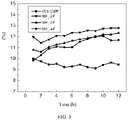
- An EDC conversion rate was 12%, as shown in FIG. 3 ; and the VC selectivity was 99%. After the induction period, a stabilized EDC conversion rate was higher than 13%.
- This example was different from Example 2 in that a mass fraction of ammonia was 75%, which was recorded as NH 3 -3#; amass percentage of nitrogen in the supported nitrogen-containing carbon material was 6.3%; an evaluation process of a regenerated catalyst was the same as the above process, and the reaction was conducted at 250°C; an EDC conversion rate was 11%, as shown in FIG. 3 ; and the VC selectivity was 99%. After the induction period, a stabilized EDC conversion rate was higher than 13%.
- This example was different from Example 3 in that the temperature was kept at 550°C for 1 h, which was recorded as NH 3-4#; a mass percentage of nitrogen in the supported nitrogen-containing carbon material was 6.9%; an evaluation process of a regenerated catalyst was the same as the above process, and the reaction was conducted at 250°C; an EDC conversion rate was 10%, and the reaction performance was shown in FIG. 3 ; and the VC selectivity was 99%. After the induction period, a stabilized EDC conversion rate was higher than 13%.
- FIG. 3 is a schematic diagram illustrating the raw material conversion rates of the regenerated catalysts obtained in Examples 2, 3, and 4 that change with the reaction time.
- This example was different from Example 2 in that a heating rate was 0.1°C/min.
- This example was different from Example 2 in that a heating rate was 10°C/min.
- Example 2 This example was different from Example 2 in that a mass fraction of ammonia was 2%.
- This example was different from Example 2 in that a mass fraction of ammonia was 5%.
- This example was different from Example 2 in that a mass fraction of ammonia was 15%.
- the regenerated catalysts in Examples 5 to 9 were evaluated by the same evaluation process as in Example 2, and the reaction was conducted at 250°C. After the induction period, the VC selectivity was 99%, and the EDC conversion rate was higher than 13%.
- This example was different from Example 3 in that the highest temperature for regeneration was 300°C; after the regeneration, a mass percentage of nitrogen in the supported nitrogen-containing carbon material was 6.4%; an evaluation reaction was conducted at 250°C; and an EDC conversion rate was 8%, and the VC selectivity was 99%. After the induction period, a stabilized EDC conversion rate was higher than 13%.
- This example was different from Example 3 in that the highest temperature for regeneration was 600°C; after the regeneration, a mass percentage of nitrogen in the supported nitrogen-containing carbon material was 6.6%; an evaluation reaction was conducted at 250°C; and an EDC conversion rate was 15%, and the VC selectivity was 99%. After the induction period, a stabilized EDC conversion rate was higher than 15%.
- the regeneration method of the present application is very convenient and efficient, for example, in Example 2, a very short residence time can achieve prominent regeneration performance.
- the regeneration method of the present application is very economical, for example, in Example 7, excellent regeneration performance can be achieved at a relatively low ammonia concentration, which can greatly reduce the regeneration cost.
Landscapes
- Chemical & Material Sciences (AREA)
- Organic Chemistry (AREA)
- Engineering & Computer Science (AREA)
- Materials Engineering (AREA)
- Chemical Kinetics & Catalysis (AREA)
- Physics & Mathematics (AREA)
- Thermal Sciences (AREA)
- Catalysts (AREA)
- Organic Low-Molecular-Weight Compounds And Preparation Thereof (AREA)
- Low-Molecular Organic Synthesis Reactions Using Catalysts (AREA)
Abstract
Description
- The present application relates to a regeneration method and use of a nitrogen-containing carbon catalyst, and belongs to the field of catalysts.
- Polyvinyl chloride (PVC) is a universal synthetic resin material widely used around the world, and PVC is formed through the polymerization of the vinyl chloride monomer (VCM). There are mainly two production methods for VCM, where the first method is based on the addition reaction of acetylene and hydrogen chloride with mercury chloride as a catalyst, and the second method is based on the cracking of 1,2-dichloroethane (known as ethylene dichloride, EDC) with petroleum as a raw material. Due to the potential toxicity of mercury and the serious mercury pollution of mercury catalysts, the first method is gradually replaced by the second method, and thus it is of great significance to study the technology of producing VCM through the cracking of EDC. At present, the technology of producing VCM through the cracking of EDC used in industry is a pyrolysis technology without the action of a catalyst, which is conducted at 500°C to 600°C and leads to an EDC conversion rate of about 50%. The pyrolysis process has a series of problems such as high reaction temperature, high energy consumption, low safety, easy coking, frequent coke cleaning, and a short production cycle. The use of a catalyst can greatly reduce a cracking reaction temperature, increase the reaction selectivity, and alleviate a coking degree of a reactor. Most of the catalysts currently reported in patents are nitrogen-doped porous carbon catalysts, which have advantages such as a high EDC conversion rate and a prominent selectivity of the product VCM. However, carbon deposits and coke tar generated during the reaction will accumulate on the surface of the nitrogen-doped porous carbon material, thereby shortening a life cycle of the catalyst. Carbon deposits on aluminum silicate or molecular sieves can be removed by simple roasting in air, but carbon deposits on the porous carbon materials cannot be removed in this way because such an oxidation regeneration method will destroy the original skeleton structure of the porous carbon material while removing carbon deposits, thereby causing a reduction in the mechanical strength and activity of the catalyst. Therefore, how to realize the regeneration of deactivated porous carbon catalysts is one of the keys to the industrialized application of the porous carbon catalysts in the catalytic cracking of EDC.
- According to one aspect of the present application, a regeneration method of a nitrogen-containing carbon catalyst is provided.
- The present disclosure provides a regeneration method of a nitrogen-containing carbon catalyst, including: roasting the nitrogen-containing carbon catalyst in a nitrogen-containing atmosphere to obtain a regenerated nitrogen-containing carbon catalyst.
- Optionally, the nitrogen-containing carbon catalyst may be roasted in the nitrogen-containing atmosphere, and then cooled to obtain the regenerated nitrogen-containing carbon catalyst.
- Optionally, the nitrogen-containing carbon catalyst may be roasted in the nitrogen-containing atmosphere, then the atmosphere may be switched to an inert atmosphere, and the nitrogen-containing carbon catalyst may be cooled to obtain the regenerated nitrogen-containing carbon catalyst.
- Optionally, the nitrogen-containing carbon catalyst may include a nitrogen-doped carbon catalyst; in the nitrogen-containing carbon, a nitrogen element may be doped in a carbon material through a covalent bond; and a mass content of the nitrogen element in the nitrogen-containing carbon may be 0.1% to 20%.
- Optionally, the nitrogen-containing carbon may be a carrier.
- Optionally, the nitrogen-containing carbon may be loaded as an active component on a surface of an inorganic porous material.
- The method is a universal method, which is suitable for nitrogen-doped carbon catalysts.
- Optionally, the roasting may be conducted as follows: heating to the highest temperature of 300°C to 850°C at a heating rate of 0. 1°C/min to 20°C/min, and keeping at the highest temperature for 0 min to 240 min.
- Optionally, the roasting may be conducted as follows: heating to the highest temperature of 500°C to 800°C at a heating rate of 0.1°C/min to 5°C/min, and keeping at the highest temperature for 0 min to 60 min.
- Optionally, the roasting may be conducted as follows: heating to the highest temperature of 300°C to 800°C at a heating rate of 0.1°C/min to 10°C/min, and keeping at the highest temperature for 0 min to 90 min.
- Optionally, the roasting may be conducted as follows: heating to the highest temperature of 300°C to 800°C at a heating rate of 2°C/min to 10°C/min, and keeping at the highest temperature for 0 min to 90 min.
- In the present application, the 0 min means that the nitrogen-containing carbon catalyst is cooled immediately after it is heated to a roasting temperature in the nitrogen-containing atmosphere.
- Optionally, an upper limit of the heating rate may be selected from the group consisting of 0.5°C/min, 1°C/min, 2°C/min, 3°C/min, 4°C/min, 5°C/min, 6°C/min, 7°C/min, 8°C/min, 9°C/ min, and 10°C/min; and a lower limit of the heating rate may be selected from the group consisting of 0.1°C/min, 0.5°C/min, 1°C/min, 2°C/min, 3°C/min, 4°C/min, 5°C/min, 6°C/min, 7°C/min, 8°C/min, and 9°C/min.
- Optionally, an upper limit of the highest temperature may be selected from the group consisting of 350°C, 400°C, 500°C, 550°C, 600°C, 700°C, and 800°C; and a lower limit of the highest temperature may be selected from the group consisting of 300°C, 350°C, 400°C, 500°C, 550°C, 600°C, and 700°C.
- Optionally, an upper limit of the keeping time may be selected from the group consisting of 10 min, 20 min, 30 min, 40 min, 50 min, 60 min, 70 min, 80 min, and 90 min; and a lower limit of the keeping time may be selected from the group consisting of 0 min, 10 min, 20 min, 30 min, 40 min, 50 min, 60 min, 70 min, and 80 min.
- Optionally, nitrogen in the nitrogen-containing atmosphere may be derived from at least one from the group consisting of ammonia and N2O.
- Optionally, the ammonia may be produced by pyrolysis of ammonium bicarbonate, ammonium carbonate, ammonia water, or a urea compound.
- In principle, both organic and inorganic substances capable of producing ammonia through pyrolysis can be used as a source of the nitrogen-containing atmosphere in the present application.
- Optionally, the nitrogen-containing atmosphere may be a mixed gas composed of a first gas and a second gas;
- the first gas may be at least one from the group consisting of ammonia and N2O; and
- the second gas may be an inert gas.
- Optionally, a mass fraction of the first gas in the mixed gas may be 2% to 100%.
- Optionally, a mass fraction of the first gas in the mixed gas may be 2% to 99.9%.
- Optionally, a mass fraction of the first gas in the mixed gas may be 5% to 75%.
- Optionally, a mass fraction of the first gas in the mixed gas may be 5% to 30%.
- Optionally, a mass fraction of the first gas in the mixed gas may be 2% to 75%.
- Optionally, an upper limit of the mass fraction of the first gas in the mixed gas may be selected from the group consisting of 2.5%, 5%, 10%, 15%, 20%, 25%, 30%, 40%, 45%, 50%, 55%, 60%, 70%, 75%, 80%, 85%, 90%, 95%, 99.9%, and 100%; and a lower limit of the mass fraction of the first gas in the mixed gas may be selected from the group consisting of 2%, 2.5%, 5%, 10%, 15%, 20%, 25%, 30%, 40%, 45%, 50%, 55%, 60%, and 70%.
- Optionally, the inert gas may be at least one from the group consisting of nitrogen, argon, and helium.
- The regeneration process changes the composition and structure of nitrogen-containing carbon and increases a content of the active component nitrogen, and the performance of the regenerated catalyst is equivalent to or even higher than that of the fresh catalyst.
- Optionally, after the nitrogen-containing carbon catalyst is roasted in the nitrogen-containing atmosphere, a nitrogen content may be increased by 3% to 150%.
- Optionally, after the nitrogen-containing carbon catalyst is roasted in the nitrogen-containing atmosphere, a nitrogen content may be increased by 3% to 130%.
- Optionally, a nitrogen-containing carbon catalyst deactivated in the catalysis of a reaction to produce VC through EDC cracking may be placed in a nitrogen-containing atmosphere, and then heated from room temperature to a specified temperature and kept at the temperature for a specified time, then the atmosphere may be switched to an inert atmosphere, and the nitrogen-containing carbon catalyst may be naturally cooled to room temperature to obtain a regenerated catalyst, which can be directly used in a cracking reaction.
- According to another aspect of the present application, use of the method in the regeneration of a nitrogen-containing carbon catalyst for EDC cracking to produce VC is provided.
- According to another aspect of the present application, a method for producing VC through EDC cracking is provided.
- The method for producing VC through EDC cracking includes the following steps:
vaporizing EDC, and introducing vaporized EDC into a reactor filled with a nitrogen-containing carbon catalyst; after the catalyst is deactivated, switching a reaction atmosphere to a nitrogen-containing atmosphere for regeneration; and after the regeneration is completed, switching the nitrogen-containing atmosphere back to the EDC-containing reaction atmosphere. - Optionally, the method and use for regenerating a catalyst for producing VC through EDC cracking may include: vaporizing EDC, and introducing vaporized EDC into a fixed bed/fluidized bed reactor filled with a catalyst; after the catalyst is deactivated, switching a reaction atmosphere to a nitrogen-containing atmosphere for regeneration; and after the regeneration is completed, switching the nitrogen-containing atmosphere back to the EDC-containing reaction atmosphere, thereby realizing the in-situ regeneration of the catalyst.
- In the present application, unless otherwise specified, a given data range refers to any value selected from the range, and includes endpoint values of the range.
- Possible beneficial effects of the present application:
- (1) The regeneration method provided by the present application is widely applicable and is suitable for nitrogen-doped carbon materials, where nitrogen-containing carbon can be used as an active component or as a carrier, which can be beneficially improved through the regeneration method of the present application.
- (2) The performance of a catalyst obtained after regeneration is stable, and the performance of a catalyst obtained after repeated regeneration is still not reduced compared with that of the fresh catalyst.
- (3) In the traditional oxidation regeneration method, a deactivated catalyst is roasted to remove carbon deposits on a surface of the catalyst, thereby restoring the activity of the catalyst. Oxidation regeneration is a strong exothermic reaction, where a temperature is not easy to control and it is prone to temperature runaway, which will destroy a carbon layer of a catalyst itself. In contrast, the regeneration method in a nitrogen-containing atmosphere provided by the present application does not show high requirements on the temperature accuracy control, and the higher the temperature, the better the regeneration performance. The selectivity and conversion rate of the regenerated catalyst are comparable to that of the fresh catalyst.
- (4) The regeneration process can be conducted in-situ in a reactor, which realizes the reuse of the catalyst and greatly reduces a preparation cost of the catalyst. A nitrogen source required by the regeneration in a nitrogen-containing atmosphere is cheap and easily available, making the catalyst have very promising industrial application prospects.
-
-
FIG. 1 is an outside view of a nitrogen-containing carbon catalyst sample supported by silica gel (Fresh-Cat#); -
FIG. 2 is a schematic diagram illustrating the raw material conversion rates of the regenerated catalysts obtained in Example 1 and Comparative Example 1 that change with the reaction time; and -
FIG. 3 is a schematic diagram illustrating the raw material conversion rates of the regenerated catalysts obtained in Examples 2, 3, and 4 that change with the reaction time. - The present application will be described in detail below with reference to examples, but the present application is not limited to these examples. Those skilled in the art can adjust the regeneration conditions using the method provided in the present application according to actual needs to obtain different regeneration effects.
- Unless otherwise specified, the raw materials and catalysts in the examples of the present application are all purchased from commercial sources. Unless otherwise specified, the test methods are all conventional methods, and the instrument settings are all those recommended by manufacturers.
- The silica gel spheres are 80-120 mesh white coarse-pored microsphere silica gel purchased from Shandong Dongying Yiming New Material Co., Ltd.
- Analysis methods in the examples of the present application are as follows:
A nitrogen content is determined by an EA3000 element analyzer of Leeman. - An EDC conversion rate and the VC selectivity are analyzed and determined through a fixed bed reactor, where EDC is carried by nitrogen into the reactor under bubbling, with a nitrogen flow rate of 2.5 ml/min, a bubbling temperature of 5°C, a catalyst filling amount of 0.2 g, and a bed residence time of 18.1 s.
- In the present application, when a regenerated catalyst is used for EDC cracking to produce VC, there is an induction period in the reaction, and during the induction period, the conversion rate gradually increases over time and is stable after 3 days.
- The conversion rate and selectivity in the examples of the present application are calculated as follows:
In the examples of the present application, the EDC conversion rate and the VC selectivity are calculated based on the number of moles:

- 200 mL of furfuryl alcohol was added to a 1,000 mL beaker at room temperature, then 2.00 g of oxalic acid was added under stirring, and after the oxalic acid was dissolved, 300 mL of xylene was added; then 500 mL of coarse-pored microsphere silica gel was added to the beaker, and the beaker was placed in a 20°C water bath to conduct impregnation for 6 h; excess liquid was removed through filtration, and then the silica gel was placed in a 1,000 mL beaker; and a polymerization reaction was conducted for 12 h in a 60°C water bath, the temperature was raised to 90°C, and a polymerization reaction was further conducted for 12 h.
- 500 mL of the treated coarse-pored silica gel spheres was taken and put into a quartz tube of a rotary tube furnace, and nitrogen was introduced at a flow rate of 250 mL/min for 4 h to replace the air and dry the impregnated pellets spheres. In the rotary tube furnace, under the protection of nitrogen, the silica gel spheres were heated to 150°C at 1°C/min and kept at the temperature for 3 h, then heated to 450°C and kept at the temperature for 3 h, and then cooled to room temperature.
- After the cooling under nitrogen, the nitrogen flow rate was changed to 45 mL/min, and an ammonia flow rate was 320 mL/min; gas replacement was conducted before a temperature rise; the silica gel spheres were heated to 800°C at 5°C/min and kept at the temperature for 1.5 h; the introduction of ammonia was stopped, and the nitrogen flow rate was changed to 250 mL/min; and the silica gel spheres were cooled to 600°C and kept at the temperature for 1.5 h, and then naturally lowered to room temperature. A mass percentage of nitrogen in the supported nitrogen-containing carbon material was 6.1%. The appearance of the sample was shown in
FIG. 1 , which was recorded as Fresh-Cat#. - EDC was charged under bubbling into a fixed bed reactor filled with the catalyst, with a reactor temperature of 250°C and an EDC residence time (GHSV) of 18.1 s. Test results showed that an EDC conversion rate was 13%, and the VC selectivity was 99%. After 45 days of reaction, the EDC conversion rate was 10%, and the VC selectivity was 98%. A deactivated sample was recorded as 45d-Cat#.
- The deactivated catalyst 45d-Cat# was placed in a mixed atmosphere of ammonia and nitrogen, heated from room temperature to 800°C, and subjected to a reaction for 1.5 h at 800°C; and then the atmosphere was switched to nitrogen, and a product was naturally cooled to room temperature. A rate of the heating was 5°C/min, and a mass fraction of the ammonia was 50%, which was recorded as NH3-1#. An evaluation process of the regenerated catalyst was the same as the above process. An EDC conversion rate was 15%. A mass percentage of nitrogen in the supported nitrogen-containing carbon material was 14.1%. The EDC conversion rate changed with the reaction time, as shown in
FIG. 2 . The VC selectivity was 99%. It can be seen fromFIG. 2 that a conversion rate of the regenerated catalyst during an induction period has reached more than 16%, which is better than a conversion rate of the fresh catalyst (13%); and during the induction period, the conversion rate gradually increases over time, and a stabilized conversion rate is higher than 16%, indicating that the performance of the catalyst can be restored through the regeneration process and the restored performance is better than the performance of the fresh catalyst. However, if the temperature is raised in an inert atmosphere and then a nitrogen-containing atmosphere (Comparative Example 1) is introduced, the conversion rate and selectivity of the catalyst will both decrease. - This comparative example was basically the same as Example 1, except that the deactivated catalyst was first placed in a nitrogen atmosphere and heated from room temperature to 800°C; and then the nitrogen atmosphere was switched to a mixed atmosphere of ammonia and nitrogen, and a reaction was conducted for 1.5 h. A product was recorded as DB-1#. A mass percentage of nitrogen in the supported nitrogen-containing carbon material was 17.6%. A catalyst evaluation process was the same as the above process, and the reaction was conducted at 250°C. An EDC conversion rate was 3%, and the VC selectivity was 92%. The EDC conversion rate was shown in
FIG. 2 . It can be seen that, although a mass content of nitrogen in the supported nitrogen-containing carbon material increases in the catalyst treated by this method, the regeneration of the catalyst cannot be achieved due to the different treatment order. This is because in an atmosphere without ammonia, the catalyst is irreversibly destroyed at a high temperature, and it is difficult to regenerate the catalyst even if an ammonia-containing gas is then introduced. - The deactivated catalyst was placed in a mixed atmosphere of ammonia and nitrogen and heated from room temperature to 550°C, then the atmosphere was immediately switched to nitrogen, and a product was naturally cooled to room temperature. A rate for the heating was 5°C/min, and a mass fraction of the ammonia was 25%, which was denoted as NH3-2#. A mass percentage of nitrogen in the supported nitrogen-containing carbon material was 6.5%. An evaluation process of the regenerated catalyst was the same as the above process, and the reaction was conducted at 250°C. An EDC conversion rate was 12%, as shown in
FIG. 3 ; and the VC selectivity was 99%. After the induction period, a stabilized EDC conversion rate was higher than 13%. - This example was different from Example 2 in that a mass fraction of ammonia was 75%, which was recorded as NH3-3#; amass percentage of nitrogen in the supported nitrogen-containing carbon material was 6.3%; an evaluation process of a regenerated catalyst was the same as the above process, and the reaction was conducted at 250°C; an EDC conversion rate was 11%, as shown in
FIG. 3 ; and the VC selectivity was 99%. After the induction period, a stabilized EDC conversion rate was higher than 13%. - This example was different from Example 3 in that the temperature was kept at 550°C for 1 h, which was recorded as NH 3-4#; a mass percentage of nitrogen in the supported nitrogen-containing carbon material was 6.9%; an evaluation process of a regenerated catalyst was the same as the above process, and the reaction was conducted at 250°C; an EDC conversion rate was 10%, and the reaction performance was shown in
FIG. 3 ; and the VC selectivity was 99%. After the induction period, a stabilized EDC conversion rate was higher than 13%. -
FIG. 3 is a schematic diagram illustrating the raw material conversion rates of the regenerated catalysts obtained in Examples 2, 3, and 4 that change with the reaction time. - This example was different from Example 2 in that a heating rate was 0.1°C/min.
- This example was different from Example 2 in that a heating rate was 10°C/min.
- This example was different from Example 2 in that a mass fraction of ammonia was 2%.
- This example was different from Example 2 in that a mass fraction of ammonia was 5%.
- This example was different from Example 2 in that a mass fraction of ammonia was 15%.
- The regenerated catalysts in Examples 5 to 9 were evaluated by the same evaluation process as in Example 2, and the reaction was conducted at 250°C. After the induction period, the VC selectivity was 99%, and the EDC conversion rate was higher than 13%.
- This example was different from Example 3 in that the highest temperature for regeneration was 300°C; after the regeneration, a mass percentage of nitrogen in the supported nitrogen-containing carbon material was 6.4%; an evaluation reaction was conducted at 250°C; and an EDC conversion rate was 8%, and the VC selectivity was 99%. After the induction period, a stabilized EDC conversion rate was higher than 13%.
- This example was different from Example 3 in that the highest temperature for regeneration was 600°C; after the regeneration, a mass percentage of nitrogen in the supported nitrogen-containing carbon material was 6.6%; an evaluation reaction was conducted at 250°C; and an EDC conversion rate was 15%, and the VC selectivity was 99%. After the induction period, a stabilized EDC conversion rate was higher than 15%.
- It can be seen that the regeneration method of the present application is very convenient and efficient, for example, in Example 2, a very short residence time can achieve prominent regeneration performance. The regeneration method of the present application is very economical, for example, in Example 7, excellent regeneration performance can be achieved at a relatively low ammonia concentration, which can greatly reduce the regeneration cost.
- The above examples are merely few examples of the present application, and do not limit the present application in any form. Although the present application is disclosed as above with preferred examples, the present application is not limited thereto. Some changes or modifications made by any technical personnel familiar with the profession using the technical content disclosed above without departing from the scope of the technical solutions of the present application are equivalent to equivalent implementation cases and fall within the scope of the technical solutions.
Claims (13)
- A regeneration method of a nitrogen-containing carbon catalyst, comprising: roasting the nitrogen-containing carbon catalyst in a nitrogen-containing atmosphere to obtain a regenerated nitrogen-containing carbon catalyst.
- The method according to claim 1, wherein the nitrogen-containing carbon catalyst is roasted in the nitrogen-containing atmosphere, and then cooled to obtain the regenerated nitrogen-containing carbon catalyst.
- The method according to claim 1, wherein the nitrogen-containing carbon catalyst is roasted in the nitrogen-containing atmosphere, then the nitrogen-containing atmosphere is switched to an inert atmosphere, and the nitrogen-containing carbon catalyst is cooled to obtain the regenerated nitrogen-containing carbon catalyst.
- The method according to claim 1, wherein the nitrogen-containing carbon catalyst comprises a nitrogen-doped carbon catalyst; in the nitrogen-containing carbon catalyst, a nitrogen element is doped in a carbon material through a covalent bond; and a mass content of the nitrogen element in nitrogen-containing carbon is 0.1% to 20%.
- The method according to claim 1, wherein a process of the roasting comprises: heating to a highest temperature of 300°C to 850°C at a heating rate of 0.1°C/min to 20°C/min, and keeping at the highest temperature for 0 min to 240 min.
- The method according to claim 1, wherein a process of the roasting comprises: heating to a highest temperature of 300°C to 800°C at a heating rate of 0.1°C/min to 10°C/min, and keeping at the highest temperature for 0 min to 90 min.
- The method according to claim 1, wherein nitrogen in the nitrogen-containing atmosphere is derived from at least one from the group consisting of ammonia and N2O.
- The method according to claim 1, wherein the nitrogen-containing atmosphere is a mixed gas composed of a first gas and a second gas;the first gas is at least one from the group consisting of ammonia and N2O; andthe second gas is an inert gas.
- The method according to claim 8, wherein a mass fraction of the first gas in the mixed gas is 2% to 100%.
- The method according to claim 8, wherein the inert gas is at least one from the group consisting of nitrogen, argon, and helium.
- The method according to claim 1, wherein after the nitrogen-containing carbon catalyst is roasted in the nitrogen-containing atmosphere, a nitrogen content is increased by 3% to 150%.
- Use of the method according to any one of claims 1 to 11 in the regeneration of a nitrogen-containing carbon catalyst for 1,2-dichloroethane cracking to produce vinyl chloride (VC).
- A method for producing VC through 1,2-dichloroethane cracking, comprising the following steps:
vaporizing 1,2-dichloroethane, and introducing vaporized 1,2-dichloroethane into a reactor filled with a nitrogen-containing carbon catalyst; after the catalyst is deactivated, switching a reaction atmosphere to a nitrogen-containing atmosphere for regeneration; and after the regeneration is completed, switching the nitrogen-containing atmosphere back to the 1,2-dichloroethane-containing reaction atmosphere.
Applications Claiming Priority (2)
| Application Number | Priority Date | Filing Date | Title |
|---|---|---|---|
| CN202010014910.0A CN113145149B (en) | 2020-01-07 | 2020-01-07 | Regeneration method and application of nitrogen-containing carbon catalyst |
| PCT/CN2020/131764 WO2021139429A1 (en) | 2020-01-07 | 2020-11-26 | Regeneration method and application of nitrogen-containing carbon catalyst |
Publications (4)
| Publication Number | Publication Date |
|---|---|
| EP4023333A1 true EP4023333A1 (en) | 2022-07-06 |
| EP4023333A4 EP4023333A4 (en) | 2022-12-28 |
| EP4023333C0 EP4023333C0 (en) | 2024-01-17 |
| EP4023333B1 EP4023333B1 (en) | 2024-01-17 |
Family
ID=76788381
Family Applications (1)
| Application Number | Title | Priority Date | Filing Date |
|---|---|---|---|
| EP20912191.2A Active EP4023333B1 (en) | 2020-01-07 | 2020-11-26 | Regeneration method and application of nitrogen-containing carbon catalyst |
Country Status (6)
| Country | Link |
|---|---|
| US (1) | US12440829B2 (en) |
| EP (1) | EP4023333B1 (en) |
| JP (1) | JP7410192B2 (en) |
| CN (1) | CN113145149B (en) |
| TW (1) | TWI766245B (en) |
| WO (1) | WO2021139429A1 (en) |
Families Citing this family (6)
| Publication number | Priority date | Publication date | Assignee | Title |
|---|---|---|---|---|
| CN116328807B (en) * | 2021-12-16 | 2024-10-22 | 中国科学院大连化学物理研究所 | A modification method of a silicon oxide-supported nitrogen-containing carbon catalyst, supported carbon catalyst and application thereof |
| CN116943539A (en) * | 2022-04-15 | 2023-10-27 | 中国科学院大连化学物理研究所 | Preparation method, regeneration method and method for preparing vinyl chloride by using bifunctional catalyst |
| CN115155672A (en) * | 2022-06-24 | 2022-10-11 | 西安近代化学研究所 | Regeneration method of hydrogen chloride oxidation catalyst |
| CN118204110A (en) * | 2022-12-15 | 2024-06-18 | 中国科学院大连化学物理研究所 | A two-step method for regenerating nitrogen-containing carbon catalyst and its application |
| CN116747892B (en) * | 2023-06-09 | 2024-06-25 | 浙江工业大学 | Nitrogen-doped carbon catalyst prepared from inclusion compound based on cyclodextrin and application thereof |
| CN120169401A (en) * | 2023-12-20 | 2025-06-20 | 中国科学院大连化学物理研究所 | A boron-doped nitrogen-carbon catalyst and its preparation method and application |
Family Cites Families (5)
| Publication number | Priority date | Publication date | Assignee | Title |
|---|---|---|---|---|
| DE84182C (en) | ||||
| JPS5212683B2 (en) * | 1973-11-22 | 1977-04-08 | ||
| CN106881135A (en) * | 2015-12-16 | 2017-06-23 | 中国科学院大连化学物理研究所 | A kind of carbon-based non-metal catalyst for acetylene method preparing chloroethylene, preparation method and renovation process |
| CN105833892A (en) * | 2016-04-22 | 2016-08-10 | 辽宁石油化工大学 | Catalyst for preparing vinyl chloride by cracking 1,2-dichloroethane as well as preparation method and application of catalyst |
| CN109926081A (en) * | 2017-12-15 | 2019-06-25 | 中国科学院大连化学物理研究所 | A kind of catalyst, preparation and regeneration method for 1,2- dichloroethanes cracking preparing chloroethylene |
-
2020
- 2020-01-07 CN CN202010014910.0A patent/CN113145149B/en active Active
- 2020-03-05 TW TW109107314A patent/TWI766245B/en active
- 2020-11-26 EP EP20912191.2A patent/EP4023333B1/en active Active
- 2020-11-26 WO PCT/CN2020/131764 patent/WO2021139429A1/en not_active Ceased
- 2020-11-26 JP JP2021576731A patent/JP7410192B2/en active Active
- 2020-11-26 US US17/622,716 patent/US12440829B2/en active Active
Also Published As
| Publication number | Publication date |
|---|---|
| CN113145149A (en) | 2021-07-23 |
| EP4023333A4 (en) | 2022-12-28 |
| TWI766245B (en) | 2022-06-01 |
| JP7410192B2 (en) | 2024-01-09 |
| JP2022539451A (en) | 2022-09-09 |
| CN113145149B (en) | 2022-09-16 |
| TW202126386A (en) | 2021-07-16 |
| US20220241759A1 (en) | 2022-08-04 |
| WO2021139429A1 (en) | 2021-07-15 |
| EP4023333C0 (en) | 2024-01-17 |
| EP4023333B1 (en) | 2024-01-17 |
| US12440829B2 (en) | 2025-10-14 |
Similar Documents
| Publication | Publication Date | Title |
|---|---|---|
| EP4023333B1 (en) | Regeneration method and application of nitrogen-containing carbon catalyst | |
| JP7003223B2 (en) | A catalyst for thermally decomposing 1,2-dichloroethane to produce vinyl chloride, and a method for producing and regenerating the catalyst. | |
| JPS60500754A (en) | Method for manufacturing a catalyst for ammonia production | |
| CN115193462B (en) | A supported alkali metal catalyst and preparation method thereof | |
| CN109926081A (en) | A kind of catalyst, preparation and regeneration method for 1,2- dichloroethanes cracking preparing chloroethylene | |
| CN106732559A (en) | A kind of palladium catalyst of cherry stone carbon load and preparation method and application | |
| CN117181314A (en) | Preparation method and application method of Cu-based catalyst for preparing vinyl chloride by hydrochlorination of acetylene in fixed bed | |
| JP7008138B2 (en) | A method for partially regenerating a catalyst for producing an olefin from methanol, and a method for producing an olefin from methanol. | |
| CN107497420B (en) | Regeneration method of carbon-containing noble metal catalyst | |
| CN107774299A (en) | A kind of difunctional mixed catalyst and its preparation and renovation process for methane aromatization | |
| CN116425610B (en) | Production method of trans-1-chloro-3, 3-trifluoropropene | |
| JP2004261771A (en) | Unsupported hydrocarbon direct cracking catalyst, method for producing the same, and method for producing hydrogen and carbon by direct hydrocarbon cracking | |
| CN114950455A (en) | Fenton-like catalyst and preparation method and application thereof | |
| CN118204110A (en) | A two-step method for regenerating nitrogen-containing carbon catalyst and its application | |
| CN117680191B (en) | Preparation method of catalyst for preparing chloroethylene by catalytic pyrolysis of high-selectivity 1, 2-dichloroethane | |
| CN116328807B (en) | A modification method of a silicon oxide-supported nitrogen-containing carbon catalyst, supported carbon catalyst and application thereof | |
| CN114618578A (en) | Catalyst for preparing vinyl chloride by cracking 1, 2-dichloroethane, preparation method and regeneration method | |
| CN118719132B (en) | A high-activity modified molecular sieve catalyst and its preparation method and application in the preparation of cyclohexane | |
| CN111054382B (en) | Catalyst for dehydrogenation of organic liquid hydrogen storage materials | |
| CN116139910A (en) | New application of a nickel-based rehydroxylation silicon-based catalyst | |
| CN121607175A (en) | Nickel-loaded nitrogen-sulfur double-doped carbon material photocatalyst and preparation method and application thereof | |
| CN114192169A (en) | Carbon-supported phosphorus boron catalyst and its preparation and application in the preparation of vinyl chloride from 1,2-dichloroethane from HCl | |
| CN114210325A (en) | Catalyst for synthesizing dimethyl oxalate by gas-phase carbonylation and preparation method and application thereof | |
| CN119524911A (en) | Catalyst for catalytic upgrading of volatiles from pyrolysis of waste plastics and preparation method thereof, and method for producing oil from pyrolysis of waste plastics | |
| CN117843838A (en) | Preparation method of chromium-based catalyst for gas-phase polyethylene induced condensation process |
Legal Events
| Date | Code | Title | Description |
|---|---|---|---|
| STAA | Information on the status of an ep patent application or granted ep patent |
Free format text: STATUS: THE INTERNATIONAL PUBLICATION HAS BEEN MADE |
|
| PUAI | Public reference made under article 153(3) epc to a published international application that has entered the european phase |
Free format text: ORIGINAL CODE: 0009012 |
|
| STAA | Information on the status of an ep patent application or granted ep patent |
Free format text: STATUS: REQUEST FOR EXAMINATION WAS MADE |
|
| 17P | Request for examination filed |
Effective date: 20211223 |
|
| AK | Designated contracting states |
Kind code of ref document: A1 Designated state(s): AL AT BE BG CH CY CZ DE DK EE ES FI FR GB GR HR HU IE IS IT LI LT LU LV MC MK MT NL NO PL PT RO RS SE SI SK SM TR |
|
| A4 | Supplementary search report drawn up and despatched |
Effective date: 20221128 |
|
| RIC1 | Information provided on ipc code assigned before grant |
Ipc: C07C 21/06 20060101ALI20221122BHEP Ipc: C07C 17/25 20060101ALI20221122BHEP Ipc: B01J 37/08 20060101ALI20221122BHEP Ipc: B01J 38/04 20060101ALI20221122BHEP Ipc: B01J 38/02 20060101ALI20221122BHEP Ipc: B01J 27/28 20060101ALI20221122BHEP Ipc: B01J 27/24 20060101AFI20221122BHEP |
|
| DAV | Request for validation of the european patent (deleted) | ||
| DAX | Request for extension of the european patent (deleted) | ||
| GRAP | Despatch of communication of intention to grant a patent |
Free format text: ORIGINAL CODE: EPIDOSNIGR1 |
|
| STAA | Information on the status of an ep patent application or granted ep patent |
Free format text: STATUS: GRANT OF PATENT IS INTENDED |
|
| INTG | Intention to grant announced |
Effective date: 20230809 |
|
| GRAS | Grant fee paid |
Free format text: ORIGINAL CODE: EPIDOSNIGR3 |
|
| GRAA | (expected) grant |
Free format text: ORIGINAL CODE: 0009210 |
|
| STAA | Information on the status of an ep patent application or granted ep patent |
Free format text: STATUS: THE PATENT HAS BEEN GRANTED |
|
| AK | Designated contracting states |
Kind code of ref document: B1 Designated state(s): AL AT BE BG CH CY CZ DE DK EE ES FI FR GB GR HR HU IE IS IT LI LT LU LV MC MK MT NL NO PL PT RO RS SE SI SK SM TR |
|
| REG | Reference to a national code |
Ref country code: GB Ref legal event code: FG4D |
|
| REG | Reference to a national code |
Ref country code: CH Ref legal event code: EP |
|
| REG | Reference to a national code |
Ref country code: DE Ref legal event code: R096 Ref document number: 602020024654 Country of ref document: DE |
|
| REG | Reference to a national code |
Ref country code: IE Ref legal event code: FG4D |
|
| U01 | Request for unitary effect filed |
Effective date: 20240206 |
|
| U07 | Unitary effect registered |
Designated state(s): AT BE BG DE DK EE FI FR IT LT LU LV MT NL PT SE SI Effective date: 20240214 |
|
| PG25 | Lapsed in a contracting state [announced via postgrant information from national office to epo] |
Ref country code: IS Free format text: LAPSE BECAUSE OF FAILURE TO SUBMIT A TRANSLATION OF THE DESCRIPTION OR TO PAY THE FEE WITHIN THE PRESCRIBED TIME-LIMIT Effective date: 20240517 |
|
| PG25 | Lapsed in a contracting state [announced via postgrant information from national office to epo] |
Ref country code: GR Free format text: LAPSE BECAUSE OF FAILURE TO SUBMIT A TRANSLATION OF THE DESCRIPTION OR TO PAY THE FEE WITHIN THE PRESCRIBED TIME-LIMIT Effective date: 20240418 |
|
| PG25 | Lapsed in a contracting state [announced via postgrant information from national office to epo] |
Ref country code: RS Free format text: LAPSE BECAUSE OF FAILURE TO SUBMIT A TRANSLATION OF THE DESCRIPTION OR TO PAY THE FEE WITHIN THE PRESCRIBED TIME-LIMIT Effective date: 20240417 Ref country code: HR Free format text: LAPSE BECAUSE OF FAILURE TO SUBMIT A TRANSLATION OF THE DESCRIPTION OR TO PAY THE FEE WITHIN THE PRESCRIBED TIME-LIMIT Effective date: 20240117 |
|
| PG25 | Lapsed in a contracting state [announced via postgrant information from national office to epo] |
Ref country code: ES Free format text: LAPSE BECAUSE OF FAILURE TO SUBMIT A TRANSLATION OF THE DESCRIPTION OR TO PAY THE FEE WITHIN THE PRESCRIBED TIME-LIMIT Effective date: 20240117 |
|
| PG25 | Lapsed in a contracting state [announced via postgrant information from national office to epo] |
Ref country code: RS Free format text: LAPSE BECAUSE OF FAILURE TO SUBMIT A TRANSLATION OF THE DESCRIPTION OR TO PAY THE FEE WITHIN THE PRESCRIBED TIME-LIMIT Effective date: 20240417 Ref country code: NO Free format text: LAPSE BECAUSE OF FAILURE TO SUBMIT A TRANSLATION OF THE DESCRIPTION OR TO PAY THE FEE WITHIN THE PRESCRIBED TIME-LIMIT Effective date: 20240417 Ref country code: IS Free format text: LAPSE BECAUSE OF FAILURE TO SUBMIT A TRANSLATION OF THE DESCRIPTION OR TO PAY THE FEE WITHIN THE PRESCRIBED TIME-LIMIT Effective date: 20240517 Ref country code: HR Free format text: LAPSE BECAUSE OF FAILURE TO SUBMIT A TRANSLATION OF THE DESCRIPTION OR TO PAY THE FEE WITHIN THE PRESCRIBED TIME-LIMIT Effective date: 20240117 Ref country code: GR Free format text: LAPSE BECAUSE OF FAILURE TO SUBMIT A TRANSLATION OF THE DESCRIPTION OR TO PAY THE FEE WITHIN THE PRESCRIBED TIME-LIMIT Effective date: 20240418 Ref country code: ES Free format text: LAPSE BECAUSE OF FAILURE TO SUBMIT A TRANSLATION OF THE DESCRIPTION OR TO PAY THE FEE WITHIN THE PRESCRIBED TIME-LIMIT Effective date: 20240117 |
|
| PG25 | Lapsed in a contracting state [announced via postgrant information from national office to epo] |
Ref country code: PL Free format text: LAPSE BECAUSE OF FAILURE TO SUBMIT A TRANSLATION OF THE DESCRIPTION OR TO PAY THE FEE WITHIN THE PRESCRIBED TIME-LIMIT Effective date: 20240117 |
|
| PG25 | Lapsed in a contracting state [announced via postgrant information from national office to epo] |
Ref country code: PL Free format text: LAPSE BECAUSE OF FAILURE TO SUBMIT A TRANSLATION OF THE DESCRIPTION OR TO PAY THE FEE WITHIN THE PRESCRIBED TIME-LIMIT Effective date: 20240117 |
|
| PG25 | Lapsed in a contracting state [announced via postgrant information from national office to epo] |
Ref country code: SM Free format text: LAPSE BECAUSE OF FAILURE TO SUBMIT A TRANSLATION OF THE DESCRIPTION OR TO PAY THE FEE WITHIN THE PRESCRIBED TIME-LIMIT Effective date: 20240117 |
|
| REG | Reference to a national code |
Ref country code: DE Ref legal event code: R097 Ref document number: 602020024654 Country of ref document: DE |
|
| PG25 | Lapsed in a contracting state [announced via postgrant information from national office to epo] |
Ref country code: CZ Free format text: LAPSE BECAUSE OF FAILURE TO SUBMIT A TRANSLATION OF THE DESCRIPTION OR TO PAY THE FEE WITHIN THE PRESCRIBED TIME-LIMIT Effective date: 20240117 |
|
| PG25 | Lapsed in a contracting state [announced via postgrant information from national office to epo] |
Ref country code: SK Free format text: LAPSE BECAUSE OF FAILURE TO SUBMIT A TRANSLATION OF THE DESCRIPTION OR TO PAY THE FEE WITHIN THE PRESCRIBED TIME-LIMIT Effective date: 20240117 |
|
| PG25 | Lapsed in a contracting state [announced via postgrant information from national office to epo] |
Ref country code: SM Free format text: LAPSE BECAUSE OF FAILURE TO SUBMIT A TRANSLATION OF THE DESCRIPTION OR TO PAY THE FEE WITHIN THE PRESCRIBED TIME-LIMIT Effective date: 20240117 Ref country code: SK Free format text: LAPSE BECAUSE OF FAILURE TO SUBMIT A TRANSLATION OF THE DESCRIPTION OR TO PAY THE FEE WITHIN THE PRESCRIBED TIME-LIMIT Effective date: 20240117 Ref country code: RO Free format text: LAPSE BECAUSE OF FAILURE TO SUBMIT A TRANSLATION OF THE DESCRIPTION OR TO PAY THE FEE WITHIN THE PRESCRIBED TIME-LIMIT Effective date: 20240117 Ref country code: CZ Free format text: LAPSE BECAUSE OF FAILURE TO SUBMIT A TRANSLATION OF THE DESCRIPTION OR TO PAY THE FEE WITHIN THE PRESCRIBED TIME-LIMIT Effective date: 20240117 |
|
| PLBE | No opposition filed within time limit |
Free format text: ORIGINAL CODE: 0009261 |
|
| STAA | Information on the status of an ep patent application or granted ep patent |
Free format text: STATUS: NO OPPOSITION FILED WITHIN TIME LIMIT |
|
| 26N | No opposition filed |
Effective date: 20241018 |
|
| U21 | Renewal fee for the european patent with unitary effect paid with additional fee |
Year of fee payment: 5 Effective date: 20250205 |
|
| REG | Reference to a national code |
Ref country code: CH Ref legal event code: PL |
|
| PG25 | Lapsed in a contracting state [announced via postgrant information from national office to epo] |
Ref country code: MC Free format text: LAPSE BECAUSE OF FAILURE TO SUBMIT A TRANSLATION OF THE DESCRIPTION OR TO PAY THE FEE WITHIN THE PRESCRIBED TIME-LIMIT Effective date: 20240117 |
|
| REG | Reference to a national code |
Ref country code: CH Ref legal event code: PL |
|
| GBPC | Gb: european patent ceased through non-payment of renewal fee |
Effective date: 20241126 |
|
| PG25 | Lapsed in a contracting state [announced via postgrant information from national office to epo] |
Ref country code: CH Free format text: LAPSE BECAUSE OF NON-PAYMENT OF DUE FEES Effective date: 20241130 |
|
| PG25 | Lapsed in a contracting state [announced via postgrant information from national office to epo] |
Ref country code: GB Free format text: LAPSE BECAUSE OF NON-PAYMENT OF DUE FEES Effective date: 20241126 |
|
| PG25 | Lapsed in a contracting state [announced via postgrant information from national office to epo] |
Ref country code: IE Free format text: LAPSE BECAUSE OF NON-PAYMENT OF DUE FEES Effective date: 20241126 |
|
| PG25 | Lapsed in a contracting state [announced via postgrant information from national office to epo] |
Ref country code: HU Free format text: LAPSE BECAUSE OF FAILURE TO SUBMIT A TRANSLATION OF THE DESCRIPTION OR TO PAY THE FEE WITHIN THE PRESCRIBED TIME-LIMIT; INVALID AB INITIO Effective date: 20201126 |
|
| PG25 | Lapsed in a contracting state [announced via postgrant information from national office to epo] |
Ref country code: CY Free format text: LAPSE BECAUSE OF FAILURE TO SUBMIT A TRANSLATION OF THE DESCRIPTION OR TO PAY THE FEE WITHIN THE PRESCRIBED TIME-LIMIT; INVALID AB INITIO Effective date: 20201126 |