EP4022174B1 - Turbomachine a double flux pour un aeronef - Google Patents
Turbomachine a double flux pour un aeronef Download PDFInfo
- Publication number
- EP4022174B1 EP4022174B1 EP20775385.6A EP20775385A EP4022174B1 EP 4022174 B1 EP4022174 B1 EP 4022174B1 EP 20775385 A EP20775385 A EP 20775385A EP 4022174 B1 EP4022174 B1 EP 4022174B1
- Authority
- EP
- European Patent Office
- Prior art keywords
- turbomachine
- openings
- flow
- flaps
- casing
- Prior art date
- Legal status (The legal status is an assumption and is not a legal conclusion. Google has not performed a legal analysis and makes no representation as to the accuracy of the status listed.)
- Active
Links
Images




Classifications
-
- F—MECHANICAL ENGINEERING; LIGHTING; HEATING; WEAPONS; BLASTING
- F01—MACHINES OR ENGINES IN GENERAL; ENGINE PLANTS IN GENERAL; STEAM ENGINES
- F01D—NON-POSITIVE DISPLACEMENT MACHINES OR ENGINES, e.g. STEAM TURBINES
- F01D7/00—Rotors with blades adjustable in operation; Control thereof
-
- F—MECHANICAL ENGINEERING; LIGHTING; HEATING; WEAPONS; BLASTING
- F01—MACHINES OR ENGINES IN GENERAL; ENGINE PLANTS IN GENERAL; STEAM ENGINES
- F01D—NON-POSITIVE DISPLACEMENT MACHINES OR ENGINES, e.g. STEAM TURBINES
- F01D1/00—Non-positive-displacement machines or engines, e.g. steam turbines
- F01D1/30—Non-positive-displacement machines or engines, e.g. steam turbines characterised by having a single rotor operable in either direction of rotation, e.g. by reversing of blades
-
- F—MECHANICAL ENGINEERING; LIGHTING; HEATING; WEAPONS; BLASTING
- F01—MACHINES OR ENGINES IN GENERAL; ENGINE PLANTS IN GENERAL; STEAM ENGINES
- F01D—NON-POSITIVE DISPLACEMENT MACHINES OR ENGINES, e.g. STEAM TURBINES
- F01D17/00—Regulating or controlling by varying flow
-
- F—MECHANICAL ENGINEERING; LIGHTING; HEATING; WEAPONS; BLASTING
- F01—MACHINES OR ENGINES IN GENERAL; ENGINE PLANTS IN GENERAL; STEAM ENGINES
- F01D—NON-POSITIVE DISPLACEMENT MACHINES OR ENGINES, e.g. STEAM TURBINES
- F01D17/00—Regulating or controlling by varying flow
- F01D17/10—Final actuators
- F01D17/105—Final actuators by passing part of the fluid
-
- F—MECHANICAL ENGINEERING; LIGHTING; HEATING; WEAPONS; BLASTING
- F02—COMBUSTION ENGINES; HOT-GAS OR COMBUSTION-PRODUCT ENGINE PLANTS
- F02C—GAS-TURBINE PLANTS; AIR INTAKES FOR JET-PROPULSION PLANTS; CONTROLLING FUEL SUPPLY IN AIR-BREATHING JET-PROPULSION PLANTS
- F02C6/00—Plural gas-turbine plants; Combinations of gas-turbine plants with other apparatus; Adaptations of gas-turbine plants for special use
- F02C6/04—Gas-turbine plants providing heated or pressurised working fluid for other apparatus, e.g. without mechanical power output
- F02C6/06—Gas-turbine plants providing heated or pressurised working fluid for other apparatus, e.g. without mechanical power output providing compressed gas
- F02C6/08—Gas-turbine plants providing heated or pressurised working fluid for other apparatus, e.g. without mechanical power output providing compressed gas the gas being bled from the gas-turbine compressor
-
- F—MECHANICAL ENGINEERING; LIGHTING; HEATING; WEAPONS; BLASTING
- F02—COMBUSTION ENGINES; HOT-GAS OR COMBUSTION-PRODUCT ENGINE PLANTS
- F02K—JET-PROPULSION PLANTS
- F02K1/00—Plants characterised by the form or arrangement of the jet pipe or nozzle; Jet pipes or nozzles peculiar thereto
- F02K1/54—Nozzles having means for reversing jet thrust
- F02K1/56—Reversing jet main flow
-
- F—MECHANICAL ENGINEERING; LIGHTING; HEATING; WEAPONS; BLASTING
- F02—COMBUSTION ENGINES; HOT-GAS OR COMBUSTION-PRODUCT ENGINE PLANTS
- F02K—JET-PROPULSION PLANTS
- F02K1/00—Plants characterised by the form or arrangement of the jet pipe or nozzle; Jet pipes or nozzles peculiar thereto
- F02K1/54—Nozzles having means for reversing jet thrust
- F02K1/64—Reversing fan flow
- F02K1/66—Reversing fan flow using reversing fan blades
-
- F—MECHANICAL ENGINEERING; LIGHTING; HEATING; WEAPONS; BLASTING
- F02—COMBUSTION ENGINES; HOT-GAS OR COMBUSTION-PRODUCT ENGINE PLANTS
- F02K—JET-PROPULSION PLANTS
- F02K3/00—Plants including a gas turbine driving a compressor or a ducted fan
- F02K3/02—Plants including a gas turbine driving a compressor or a ducted fan in which part of the working fluid by-passes the turbine and combustion chamber
- F02K3/04—Plants including a gas turbine driving a compressor or a ducted fan in which part of the working fluid by-passes the turbine and combustion chamber the plant including ducted fans, i.e. fans with high volume, low pressure outputs, for augmenting the jet thrust, e.g. of double-flow type
- F02K3/075—Plants including a gas turbine driving a compressor or a ducted fan in which part of the working fluid by-passes the turbine and combustion chamber the plant including ducted fans, i.e. fans with high volume, low pressure outputs, for augmenting the jet thrust, e.g. of double-flow type controlling flow ratio between flows
-
- F—MECHANICAL ENGINEERING; LIGHTING; HEATING; WEAPONS; BLASTING
- F05—INDEXING SCHEMES RELATING TO ENGINES OR PUMPS IN VARIOUS SUBCLASSES OF CLASSES F01-F04
- F05D—INDEXING SCHEME FOR ASPECTS RELATING TO NON-POSITIVE-DISPLACEMENT MACHINES OR ENGINES, GAS-TURBINES OR JET-PROPULSION PLANTS
- F05D2220/00—Application
- F05D2220/30—Application in turbines
- F05D2220/32—Application in turbines in gas turbines
- F05D2220/323—Application in turbines in gas turbines for aircraft propulsion, e.g. jet engines
-
- F—MECHANICAL ENGINEERING; LIGHTING; HEATING; WEAPONS; BLASTING
- F05—INDEXING SCHEMES RELATING TO ENGINES OR PUMPS IN VARIOUS SUBCLASSES OF CLASSES F01-F04
- F05D—INDEXING SCHEME FOR ASPECTS RELATING TO NON-POSITIVE-DISPLACEMENT MACHINES OR ENGINES, GAS-TURBINES OR JET-PROPULSION PLANTS
- F05D2240/00—Components
- F05D2240/10—Stators
- F05D2240/12—Fluid guiding means, e.g. vanes
-
- F—MECHANICAL ENGINEERING; LIGHTING; HEATING; WEAPONS; BLASTING
- F05—INDEXING SCHEMES RELATING TO ENGINES OR PUMPS IN VARIOUS SUBCLASSES OF CLASSES F01-F04
- F05D—INDEXING SCHEME FOR ASPECTS RELATING TO NON-POSITIVE-DISPLACEMENT MACHINES OR ENGINES, GAS-TURBINES OR JET-PROPULSION PLANTS
- F05D2240/00—Components
- F05D2240/20—Rotors
- F05D2240/30—Characteristics of rotor blades, i.e. of any element transforming dynamic fluid energy to or from rotational energy and being attached to a rotor
-
- F—MECHANICAL ENGINEERING; LIGHTING; HEATING; WEAPONS; BLASTING
- F05—INDEXING SCHEMES RELATING TO ENGINES OR PUMPS IN VARIOUS SUBCLASSES OF CLASSES F01-F04
- F05D—INDEXING SCHEME FOR ASPECTS RELATING TO NON-POSITIVE-DISPLACEMENT MACHINES OR ENGINES, GAS-TURBINES OR JET-PROPULSION PLANTS
- F05D2260/00—Function
- F05D2260/60—Fluid transfer
- F05D2260/606—Bypassing the fluid
-
- Y—GENERAL TAGGING OF NEW TECHNOLOGICAL DEVELOPMENTS; GENERAL TAGGING OF CROSS-SECTIONAL TECHNOLOGIES SPANNING OVER SEVERAL SECTIONS OF THE IPC; TECHNICAL SUBJECTS COVERED BY FORMER USPC CROSS-REFERENCE ART COLLECTIONS [XRACs] AND DIGESTS
- Y02—TECHNOLOGIES OR APPLICATIONS FOR MITIGATION OR ADAPTATION AGAINST CLIMATE CHANGE
- Y02T—CLIMATE CHANGE MITIGATION TECHNOLOGIES RELATED TO TRANSPORTATION
- Y02T50/00—Aeronautics or air transport
- Y02T50/60—Efficient propulsion technologies, e.g. for aircraft
Definitions
- the present invention relates to a dual-flow turbomachine for an aircraft.
- a propulsion assembly comprises for example a double flow turbomachine integrated in a nacelle, the turbomachine comprising from upstream to downstream, at least one fan and a gas generator comprising for example one or more compressor stages, low pressure and high pressure, a combustion chamber, one or more turbine stages, high pressure then low pressure.
- a so-called "propeller" mode of operation of the propulsion assembly for example when the aircraft is cruising, the air flow generated by the fan is divided, by a separator (or separation nozzle), into a primary air flow and a secondary air flow circulating from upstream to downstream.
- the primary flow flows in an annular primary stream of the gas generator and the secondary air flow flows in an annular secondary stream delimited radially between the gas generator and the nacelle, and participating predominantly in the thrust provided by the propulsion assembly.
- upstream and downstream are defined in relation to the direction of circulation of the gases in the propulsion assembly when the latter operates in “propulsion” mode.
- the terms “internal” and “external” are defined radially with respect to the longitudinal axis of the turbomachine, which is in particular the axis of rotation of the rotors of the compressors and the turbines.
- BPR dilution rate commonly called ByPass Ratio
- BPR dilution rate
- Blades with variable pitch so as to adjust the pitch (and more precisely the pitch angle) of the blades according to the flight parameters, and thus, to generally, optimize the operation of the propulsion assembly.
- the fact of having blades with variable pitch also makes it possible, in a so-called “reverse” operating mode, to use the latter to generate counter-thrust, and thus to participate in slowing down the aircraft in addition to the brakes so as to reduce its braking distance during landing.
- the pitch of the fan blades is generally considered to be positive and, in reverse operating mode, the pitch of the blades is generally considered to be negative.
- a turbomachine comprising a fan fitted with variable pitch blades does not include thrust reversers in its structure, to the benefit of the mass of the turbomachine.
- the secondary flow circulates from downstream to upstream in the secondary stream, a first part of the secondary flow being used to supply the primary stream of the gas generator in which the air flow always circulates upstream and downstream, a second part of the secondary flow escaping from the propulsion assembly via the fan so as to generate counter-thrust.
- the present invention aims in particular to resolve all or part of the aforementioned problems.
- the invention proposes a dual-flow turbomachine for an aircraft, according to claim 1, the turbomachine comprising a ducted fan and a gas generator, the fan being configured to generate a primary flow of air in a primary stream at inside the gas generator, and a secondary flow in a secondary stream extending around the gas generator and inside a fan casing, the fan comprising variable pitch blades which are capable of adopting a thrust reversal position causing a flow of a reverse flow of air in the secondary vein, the gas generator being connected to the fan casing by a stator blade which passes through the secondary vein, the gas generator comprising two annular casings , respectively external and internal, extending one around the other, the external casing internally delimiting at least partly the secondary vein and being connected to the stator blade, and the internal casing externally delimiting at least partly the primary vein, the turbomachine further comprising first reverse flow air inlet openings located on the external casing, and second outlet openings for this air located on the internal casing, at least part of said
- said first openings are located in a plane perpendicular to a longitudinal axis of the turbomachine passing substantially in the middle of said blade.
- the first and second openings as well as the positioning of the first openings with respect to said blade not only make it possible to optimize the flow of the air flow taken during its passage from the secondary vein to the primary vein but also to provide the adequate air flow in the primary vein when the turbomachine operates in “reverse” mode, to the benefit of the efficiency and lifespan of the turbomachine.
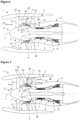
- a propulsion assembly 1 in particular for aircraft, comprising a nacelle 11 and a double-flow turbomachine 2 integrated in a fan casing 3, the turbomachine 2 comprising from upstream to downstream, a ducted fan 4 and a gas generator 5 comprising several compressor stages, low pressure 6 and high pressure 7, a combustion chamber 8, and several turbine stages, high pressure 9 then low pressure 10.
- the gas generator 5 comprises an external casing 17 and an internal casing 14 s extending one around the other and joining at a nozzle 19.
- the internal casing 14 and the external casing 17 have an axis C of revolution coincident with a longitudinal axis of the turbomachine 2, which is in particular l axis of rotation of the rotors of the fan 4, the compressors 6, 7 and the turbines 9, 10.
- the turbomachine 2 further comprises on the one hand an annular primary vein 12 of the gas generator 5 delimited radially between a casing 13 of the movable rotors of the turbomachine 2 and the internal casing 14, and on the other hand leaves a secondary annular vein 16 delimited radially between the external casing 17 and the fan casing 3.
- the external casing 17 thus internally delimits at least partly the external vein 16, and the internal casing 14 externally delimits at least partly the internal vein 12.
- the air flows circulating in the primary and secondary veins 12, 16 are respectively called primary flow and secondary flow.
- the inlets and outlets of these internal 12 and external 16 veins are configured in order to limit variations in curvature and avoid separation of the primary and secondary flows.
- the gas generator 5, particularly at its external casing 17, is connected to the fan casing 3 by a stator blade 40 which passes through the secondary stream 16.
- the fan 4 is surrounded by the fan casing 3 and comprises blades 18 with variable pitch which are able to adopt a thrust reversal position resulting in the flow of a reverse flow of air in the secondary stream 16.
- the pitch of a blade is quantified via the pitch angle which corresponds to the angle, in a longitudinal plane (which can be normal to the radial direction of the blade), between the chord of the blade 18 and the plane of rotation of the blower 4.
- the turbomachine 2 is shown operating in “propellant” mode.
- An air flow 20 generated by the blower 4 (circulating from upstream to downstream) is here divided, by the separation nozzle 19 separating the primary 12 and secondary 16 streams into a primary air flow 21 and a flow of secondary air 22 circulating from upstream to downstream.
- the primary air flow 21 thus circulates in the primary stream 12 inside the gas generator 5 and the secondary air flow 22 circulates in the secondary stream 16.
- the secondary flow 22 contributes predominantly to the thrust provided by the turbomachine 2.
- the pitch angle of the blades 18 of the fan 4 is here positive, the primary 21 and secondary 22 flows then generating a positive thrust, that is to say a thrust whose axial resultant is oriented from downstream to upstream. This mode of operation is for example used when the aircraft is in the take-off and/or cruising phase.
- turbomachine 2 is shown operating in “reverse” (or “thrust reversal”) mode.
- the pitch angle of the blades 18 of the fan 4 is here negative.
- the fan 4 then generates a reverse secondary air flow 24 circulating from downstream to upstream in the secondary stream 16.
- a first part 23 of the reverse secondary flow 24 is used to supply the primary vein 12 of the gas generator 5 in which the primary air flow 21 always circulates from upstream to downstream.
- a second part 25 of the reverse secondary flow 24 escapes from the turbomachine 2 via the fan 4 so as to generate a negative thrust (or counter-thrust), that is to say a thrust whose axial resultant is oriented from upstream to downstream, and thus participate in slowing down the aircraft in addition to the brakes so as to reduce its braking distance during landing.
- This reversal of the direction of flow is mainly achieved thanks to the cuts located between 30% and 100% in height of the variable pitch blades 18 (the blade heights being measured radially relative to the longitudinal axis C of the turbomachine, from their radially internal feet or ends).
- this new setting involves a mismatch of the cuts at the blade roots (from 0% to 30% of the height of the variable-pitch blades 18) with respect to the primary flow located just downstream, inducing an obstruction.
- the flow coming from upstream of the turbomachine 2 may no longer properly supply the primary flow and it is therefore important that the first part 23 of the reverse secondary flow 24 used to supply the primary stream 12 of the gas generator 5 is well oriented in the primary stream 12.
- the turbomachine 2 comprises in particular for this purpose first openings 28 for air inlet of the reverse secondary flow 24 located on the external casing 17, and second openings 29 for outlet of this air located on the internal casing 14 and configured to supply the primary vein 12 when the turbomachine 2 operates in “reverse” mode.
- the first openings 28 are located in a plane P perpendicular to the longitudinal axis C of the turbomachine 2 passing substantially in the middle of the blade 40.
- “middle” of the blade we means a zone located substantially in the middle of the blade 40 in an axial direction.
- the first air flow part 23 can therefore enter the gas generator 5, directly at the level of the blade 40.
- the first air flow part 23 enters the primary vein before a blade 60 connecting the internal casing 14 to the casing 13 of the mobile rotors. It is not necessary for the first part of the air flow 23 to arrive in the primary stream upstream of a rectifier 65 which usually straightens the flow deflected by the variable pitch vanes 18.
- the number of first and second openings , 28, 29 their lengths and their axial distributions will depend on the flow rate requirement of the gas generator 5 in “reverse” operation.
- the turbomachine 2 comprises for example first and second flaps 31, 32. They are in particular provided respectively at the level of the first 28 and second 29 openings and are movable between closed positions ( Figure 3 ) and release ( figures 4 to 13 ) of these openings 28, 29.
- first and second flaps 31, 32 are in the closed positions.
- closed position is meant a position in which the first and second flaps 31, 32 completely close the first and second openings 28, 29 respectively. That is to say that the first and second openings 28, 29 are made airtight by the flaps 31, 32.
- This closed position corresponds in particular to a “propellant” operating mode of the turbomachine 2 illustrated to the figure 1 .
- the first and second flaps 31, 32 respectively comprise downstream ends 31', 32' and upstream ends 31", 32" defined when the first and second flaps 31, 32 are in the closed position.
- the first and second flaps 31, 32 are for example movable in pivoting. It is understood here that they move from the release position to the closed position and vice versa by one or more pivot movements.
- the first flaps 31 of the first openings 28 have for example a scooping function and are configured to extend at least partly into the secondary vein 16 when they are in the release position.
- the first part 23 of the reverse secondary flow 24 will be captured by the first flaps 31, in particular by an internal face of the first flaps 31, so as to be directed through the external casing 17 and the internal casing 14 by a conduit 27 until it is distributed in the internal vein 12 via the second openings 29.
- the first flaps 31 are in particular pivotally mounted on the external casing 17 via their upstream ends 31 ". They then pivot outwards passing from their closed position to their release position.
- the second flaps 32 can also be mounted pivoted on the internal casing 14 via their upstream ends 32". They then pivot inwards, moving from their closed position to their release position. Thus, in the release position, the second flaps 32 are configured to extend at least partly in the primary vein 12. The second flaps 32 will thus direct the air flow 23 captured by the first flaps 31 in the normal direction flow of the air flow in the primary vein 12.
- the downstream ends 31' of the first flaps 31, that is to say radially external when the first flaps 31 are in the release position, are located at a radial dimension h in the secondary vein 16 which represents between 0 and 30% and preferably between 20 and 30% of the total radial dimension H of this vein 16, these dimensions being measured from the external casing 17 to the right of these ends 31'.
- the downstream ends 32' of the second flaps 32 that is to say radially internal when the second flaps 32 are in the release position, are located at a radial dimension in the primary vein 12, this dimension being measured from the internal casing 14 to the right of these ends 32'.
- first and second flaps 31, 32 are also movable in pivoting between their closed position and their release position.
- the first flaps 31 are mounted here pivoting relative to the external casing 17 at their downstream ends 31'. They then pivot inwards passing from their closed position to their release position so that once in the release position they are housed in conduit 27.
- the first flaps 31 therefore do not incorporate a scooping function here.
- the second flaps 32 are for example also mounted to pivot relative to the external casing 14 at their downstream ends 32'. They then pivot outwards passing from their closed position towards their release position so that once in the release position they are housed in conduit 27. This latter configuration makes it possible to reduce the flow of air impacting the variable pitch blades 18 in the absence of separation.
- the first and second flaps 31, 32 are always movable in pivoting between their closed position and their release position.
- the first flaps 31 are in particular pivotally mounted on the external casing 17 via their downstream end 31'. They pivot here outwards passing from their closed position to their release position until they fit into the external casing 17 and are no longer present in the secondary vein 16.
- the second flaps 32 are for example pivotally mounted on the internal casing 14 via their downstream end 32'. They pivot here inwards, passing from their closed position to their release position until they fit into the internal casing 14 and are no longer present in the primary vein 12.
- the flaps 31, 32 are for example movable in sliding.
- the shutters 31, 32 are in particular driven to slide via cylinders (not shown).
- the first flaps 31 are in particular configured to slide along a part of the casing external 17 during their movement from the closed position to the release position. This movement occurs in particular from upstream to downstream.
- the second flaps 32 are for example configured to slide along a part of the internal casing 14 during their movement from the closed position to the release position. This movement takes place in particular from upstream to downstream.
- the first flaps 31 are configured to slide by inserting into the external casing 17 during their movement from the closed position to the release position. This movement occurs in particular from upstream to downstream.
- the second flaps 32 are in particular configured to slide by inserting themselves into the internal casing 14 during their movement from the closed position to the release position. This movement occurs in particular from upstream to downstream.
- the translations or sliding are done from upstream to downstream, but it is understood that the invention covers all the embodiments in which a translation of the flaps 31, 32 is carried out in all directions allowing free access to the openings 28, 29, for example from downstream to upstream.
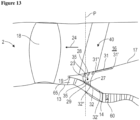
- Guide fins 35 are for example located in the first openings 28 (as illustrated in the figures 6 And 13 ).
- the fins 35 are notably present in the second openings 29 (as illustrated on the figures 5 , 6 , 8 , 12 , 13 And 17 ). They are in particular present between the first 28 and second openings 29.
- These guide fins 35 have the main function of improving the guidance of the first air flow part 23, when it passes through the conduit 27.
- the fins 35 make it possible to better guide the first part of the air flow 23 because they make it possible to straighten it before it arrives in the internal vein 12. They make it possible in particular to avoid possible separation during the passage of the first part 23 of the reverse secondary flow 24 in the conduit 27.
- the fins 35 have been illustrated with certain embodiments, but it is obvious that their different configurations mentioned above are applicable to all the embodiments of the invention.
- the stator blade 40 comprises structural arms 45 and flow straightening vanes 50, the arms 45 comprising trailing edges 46 downstream of trailing edges 51 of the vanes 50 relative to the primary flow.
- the arms 45 and the blades 50 also include leading edges 47, 52, located upstream of the respective trailing edges 46, 51 of the arms 45 and the blades 50.
- the first openings 28 are located between the arms 45, that is to say circumferentially between the arms 45. They can also be located between an arm 45 and a blade 50. The first openings 28 are also located at least partly in downstream of the trailing edges 51 of the blades 50. The downstream of the trailing edges 51 of the blades 50 is defined by the zone located downstream of the plane P' illustrated in Figure 14 .
- the nozzle 19 can be movable in translation relative to the internal 14 and external 17 casing between a closed position ( Figure 14 ) and a release position ( figures 15 and 16 ).
- the nozzle 19 here translates upstream between its closed position and its release position so that it creates the first and second openings 28, 29.
- Fins 35 similar to that presented previously can also be positioned in the first and/or second openings 28, 29, and/or between these.
- the first openings 28 and the second openings 29 may not be located here along the same axial abscissa.
- the first openings 28 and the second openings 29 can be located more or less close to the spout 29.
- the nozzle 29 can here be translated over 360°, that is to say over its entire circumference, or over discrete angular sectors.
- the key parameter for controlling the flow rate of the first part 23 of the reverse secondary air flow 24 is the length of the translation of the nozzle.
- the discretized case there will also be the angular occupation of the sectors (percentage of translating sectors compared to fixed sectors).
- the choices made for the different parameters will depend on the flow rate requirement of the gas generator 5 during reverse operation.
Landscapes
- Engineering & Computer Science (AREA)
- Mechanical Engineering (AREA)
- General Engineering & Computer Science (AREA)
- Chemical & Material Sciences (AREA)
- Combustion & Propulsion (AREA)
- Structures Of Non-Positive Displacement Pumps (AREA)
- Physics & Mathematics (AREA)
- Geometry (AREA)
- Control Of Turbines (AREA)
- Turbine Rotor Nozzle Sealing (AREA)
Description
- La présente invention concerne une turbomachine à double flux pour un aéronef.
- L'état de la technique comprend notamment le document
US-A1-2018/135557 . - Un ensemble propulsif comprend par exemple une turbomachine à double flux intégrée dans une nacelle, la turbomachine comprenant d'amont en aval, au moins une soufflante et un générateur de gaz comportant par exemple un ou plusieurs étages de compresseur, basse pression et haute pression, une chambre de combustion, un ou plusieurs étages de turbine, haute pression puis basse pression. Dans un mode de fonctionnement dit de « propulseur » de l'ensemble propulsif, par exemple lorsque l'aéronef est en croisière, le flux d'air généré par la soufflante est divisé, par un séparateur (ou bec de séparation), en un flux d'air primaire et un flux d'air secondaire circulant d'amont en aval. Plus précisément, le flux primaire s'écoule dans une veine primaire annulaire du générateur de gaz et le flux d'air secondaire s'écoule dans une veine secondaire annulaire délimitée radialement entre le générateur de gaz et la nacelle, et participant de manière prépondérante à la poussée fournie par l'ensemble propulsif. Par convention, dans la présente demande, les termes « amont » et « aval » sont définis par rapport au sens de circulation des gaz dans l'ensemble propulsif lorsque ce dernier fonctionne en mode « propulseur ». De même, par convention dans la présente demande, les termes « interne » et « externe » sont définis radialement par rapport à l'axe longitudinal de la turbomachine, qui est notamment l'axe de rotation des rotors des compresseurs et des turbines. Pour diminuer la consommation en carburant de l'ensemble propulsif, les motoristes cherchent continuellement à accroître le taux de dilution communément appelé BPR pour « ByPass Ratio » de l'ensemble propulsif, ce dernier correspondant au quotient du débit d'air dans la veine secondaire et dans la veine primaire. Pour répondre à cet objectif, il est notamment possible d'avoir une soufflante munie de pales à calage variable de manière à régler le calage (et plus précisément l'angle de calage) des pales en fonction des paramètres de vol, et ainsi, de manière générale, optimiser le fonctionnement de l'ensemble propulsif. Le fait d'avoir des pales à calage variable permet en outre, dans un mode de fonctionnement dit de « reverse », d'utiliser ces dernières pour générer une contre-poussée, et ainsi de participer au ralentissement de l'aéronef en complément des freins de manière à réduire sa distance de freinage lors de l'atterrissage. Ainsi, en mode de fonctionnement propulseur, le calage des aubes de la soufflante est généralement considéré comme positif et, en mode de fonctionnement reverse, le calage des aubes est généralement considéré comme négatif. Contrairement à une soufflante munie de pales à calage fixe qui nécessite l'ajout d'inverseurs de poussée (par exemple d'inverseurs à portes pivotantes et/ou capots coulissants incorporés dans la nacelle) pour générer cette contre-poussée lors de l'atterrissage de l'aéronef, une turbomachine comportant une soufflante munie de pales à calage variable ne comprend pas d'inverseurs de poussée dans sa structure, au bénéfice de la masse de la turbomachine. En mode de fonctionnement reverse, le flux secondaire circule d'aval en amont dans la veine secondaire, une première partie du flux secondaire étant utilisée pour alimenter la veine primaire du générateur de gaz dans laquelle le flux d'air circule quant à lui toujours d'amont en aval, une deuxième partie du flux secondaire s'échappant de l'ensemble propulsif via la soufflante de manière à générer une contre-poussée. Par retour d'expérience, en référence à la première partie du flux secondaire pénétrant dans la veine primaire en contournant le bec de séparation, on constate l'apparition de zones de décollement du flux d'air au niveau du bec. En mode de fonctionnement reverse, ces zones de décollement dégradent fortement le rendement du générateur de gaz, et de manière générale de la turbomachine. Selon le régime moteur utilisé, ces zones de décollement peuvent mettre en péril le fonctionnement du générateur de gaz.
- La présente invention a notamment pour but de résoudre tout ou partie des problèmes précités.
- L'invention propose à cet effet une turbomachine à double flux pour un aéronef, selon la revendication 1, la turbomachine comportant une soufflante carénée et un générateur de gaz, la soufflante étant configurée pour générer un flux primaire d'air dans une veine primaire à l'intérieur du générateur de gaz, et un flux secondaire dans une veine secondaire s'étendant autour du générateur de gaz et à l'intérieur d'un carter de soufflante, la soufflante comportant des aubes à calage variable qui sont aptes à adopter une position d'inversion de poussée entraînant un écoulement d'un flux inverse d'air dans la veine secondaire, le générateur de gaz étant relié au carter de soufflante par un aubage statorique qui traverse la veine secondaire, le générateur de gaz comportant deux carters annulaires, respectivement externe et interne, s'étendant l'un autour de l'autre, le carter externe délimitant intérieurement au moins en partie la veine secondaire et étant relié à l'aubage statorique, et le carter interne délimitant extérieurement au moins en partie la veine primaire, la turbomachine comportant en outre des premières ouvertures d'entrée d'air du flux inverse situées sur le carter externe, et des secondes ouvertures de sortie de cet air situées sur le carter interne, au moins une partie desdites premières ouvertures étant située dans un plan perpendiculaire à un axe longitudinal de la turbomachine passant dans une zone située au milieu dudit aubage selon une direction axiale, et des volets étant prévus au niveau desdites premières et secondes ouvertures et étant mobiles entre des positions de fermeture et de libération de ces ouvertures, lesdits volets étant mobiles en pivotement, ayant une fonction écopante et étant configurés pour s'étendre au moins en partie dans ladite veine secondaire lorsqu'ils sont en position de libération de sorte que les extrémités radialement externes des volets sont situées à une dimension radiale dans la veine secondaire, ladite turbomachine étant caractérisée en ce que la dimension radiale représente entre 20 et 30% de la dimension radiale totale de la veine secondaire, ces dimensions étant mesurées depuis le carter externe au droit des extrémités radialement externes.
- Selon l'invention, lesdites premières ouvertures sont situées dans un plan perpendiculaire à un axe longitudinal de la turbomachine passant sensiblement au milieu dudit aubage.
- Les premières et secondes ouvertures ainsi que le positionnement des premières ouvertures vis-à-vis dudit aubage permettent non seulement d'optimiser l'écoulement du flux d'air prélevé lors de son passage de la veine secondaire à la veine primaire mais également de fournir le débit d'air adéquat dans la veine primaire lorsque la turbomachine fonctionne en mode « reverse », au bénéfice du rendement et de la durée de vie de la turbomachine.
- La turbomachine selon l'invention peut comprendre une ou plusieurs des caractéristiques ci-dessous, prises isolément les unes des autres ou en combinaison les unes avec les autres :
- des ailettes de guidage sont situées dans lesdites premières ouvertures et/ou dans lesdites secondes ouvertures et/ou entre lesdites premières et secondes ouvertures ; et
- l'aubage statorique comprend des bras structuraux et des aubes de redressement de flux, les bras comportant des bords de fuite en aval des bords de fuites des aubes par rapport audit flux primaire, lesdites premières ouvertures étant situées entre les bras et au moins en partie en aval des bords de fuite des aubes.
- L'invention sera mieux comprise et d'autres détails, caractéristiques et avantages de l'invention, apparaîtront plus clairement à la lecture de la description suivante faite à titre d'exemple non limitatif et en référence aux dessins annexés dans lesquels :
- [
Fig.1 ] lafigure 1 est une vue schématique, en coupe longitudinale, d'un ensemble propulsif comprenant une turbomachine fonctionnant selon un mode dit de « propulseur » ; - [
Fig.2 ] lafigure 2 est une vue schématique, en coupe longitudinale, de l'ensemble propulsif comprenant une turbomachine fonctionnant selon un mode dit de « reverse » ; - [
Fig.3 ] lafigure 3 est une vue schématique partielle, en coupe longitudinale, d'une variante de réalisation d'une turbomachine selon l'invention ; - [
Fig.4 ] lafigure 4 est une vue schématique partielle, en coupe longitudinale, d'une variante de réalisation d'une turbomachine selon l'invention ; - [
Fig.5 ] lafigure 5 est une vue schématique partielle, en coupe longitudinale, d'une variante de réalisation d'une turbomachine selon l'invention ; - [
Fig.6 ] lafigure 6 est une vue schématique partielle, en coupe longitudinale, d'une variante de réalisation d'une turbomachine selon l'invention ; - [
Fig.7 ] lafigure 7 est une vue schématique partielle, en coupe longitudinale, d'une variante de réalisation d'une turbomachine selon l'invention ; - [
Fig.8 ] lafigure 8 est une vue schématique partielle, en coupe longitudinale, d'une variante de réalisation d'une turbomachine selon l'invention ; - [
Fig.9 ] lafigure 9 est une vue schématique partielle, en coupe longitudinale, d'une variante de réalisation d'une turbomachine selon l'invention ; - [
Fig.10 ] lafigure 10 est une vue schématique partielle, en coupe longitudinale, d'une variante de réalisation d'une turbomachine selon l'invention ; - [
Fig.11 ] lafigure 11 est une vue schématique partielle, en coupe longitudinale, d'une variante de réalisation d'une turbomachine selon l'invention ; - [
Fig.12 ] lafigure 12 est une vue schématique partielle, en coupe longitudinale, d'une variante de réalisation d'une turbomachine selon l'invention ; - [
Fig.13 ] lafigure 13 est une vue schématique partielle, en coupe longitudinale, d'une variante de réalisation d'une turbomachine selon l'invention ; - [
Fig.14 ] lafigure 14 représente schématiquement en vue de dessus un aubage statorique et des premières ouvertures d'une turbomachine selon l'invention ; - [
Fig.15 ] lafigure 15 est une vue schématique partielle, en coupe longitudinale, d'un autre mode de réalisation d'une turbomachine selon l'invention ; - [
Fig.16 ] lafigure 16 est une vue schématique partielle, en coupe longitudinale, d'un autre mode de réalisation d'une turbomachine selon l'invention ; et - [
Fig.17 ] lafigure 17 est une vue schématique partielle, en coupe longitudinale, d'un autre mode de réalisation d'une turbomachine selon l'invention. - Sur la
figure 1 est représenté un ensemble 1 propulsif, notamment pour aéronef, comprenant une nacelle 11 et une turbomachine 2 à double flux intégrée dans un carter de soufflante 3, la turbomachine 2 comprenant d'amont en aval, une soufflante 4 carénée et un générateur 5 de gaz comportant plusieurs étages de compresseur, basse pression 6 et haute pression 7, une chambre 8 de combustion, et plusieurs étages de turbine, haute pression 9 puis basse pression 10. Le générateur 5 de gaz comprend un carter externe 17 et un carter interne 14 s'étendant l'un autour de l'autre et se rejoignant au niveau d'un bec 19. Le carter interne 14 et le carter externe 17 présente un axe C de révolution confondu avec un axe longitudinal de la turbomachine 2, qui est notamment l'axe de rotation des rotors de la soufflante 4, des compresseurs 6, 7 et des turbines 9, 10. - La turbomachine 2 comprend en outre d'une part une veine 12 primaire annulaire du générateur 5 de gaz délimitée radialement entre un carter 13 des rotors mobiles de la turbomachine 2 et le carter interne 14, et d'autre part une veine 16 secondaire annulaire délimitée radialement entre le carter externe 17 et le carter de soufflante 3. Le carter externe 17 délimite ainsi intérieurement au moins en partie la veine externe 16, et le carter interne 14 délimite extérieurement au moins en partie la veine interne 12. Dans la suite de la description, les flux d'air circulant dans les veines 12, 16 primaire et secondaire sont respectivement nommés flux primaire et flux secondaire. Les entrées et sorties de ces veines interne 12 et externe 16 sont configurées afin de limiter les variations de courbures et éviter des décollements des flux primaire et secondaire.
- Le générateur de gaz 5 notamment au niveau de son carter externe 17, est relié au carter de soufflante 3 par un aubage statorique 40 qui traverse la veine secondaire 16.
- La soufflante 4 est entourée par le carter de soufflante 3 et comporte des aubes 18 à calage variable qui sont aptes à adopter une position d'inversion de poussée entraînant un écoulement d'un flux inverse d'air dans la veine secondaire 16. Le calage d'une aube est quantifié via l'angle de calage qui correspond à l'angle, dans un plan longitudinal (qui peut être normal à la direction radiale de l'aube), entre la corde de l'aube 18 et le plan de rotation de la soufflante 4. Sur la
figure 1 est représentée la turbomachine 2 fonctionnant en mode « propulseur ». Un flux d'air 20 généré par la soufflante 4 (circulant d'amont en aval) est ici divisé, par le bec 19 de séparation séparant les veines primaire 12 et secondaire 16 en un flux d'air primaire 21 et un flux d'air secondaire 22 circulant d'amont en aval. Le flux d'air primaire 21 circule ainsi dans la veine primaire 12 à l'intérieur du générateur de gaz 5 et le flux d'air secondaire 22 circule dans la veine secondaire 16. Le flux secondaire 22 participe de manière prépondérante à la poussée fournie par la turbomachine 2. L'angle de calage des aubes 18 de la soufflante 4 est ici positif, les flux primaire 21 et secondaire 22 générant alors une poussée positive, c'est-à-dire une poussée dont la résultante axiale est orientée de l'aval vers l'amont. Ce mode de fonctionnement est par exemple utilisé lorsque l'aéronef est en phase de décollage et/ou de croisière. - Sur la
figure 2 est représenté la turbomachine 2 fonctionnant en mode « reverse » (ou « inversion de poussée »). L'angle de calage des aubes 18 de la soufflante 4 est ici négatif. La soufflante 4 génère alors un flux d'air secondaire inverse 24 circulant d'aval en amont dans la veine 16 secondaire. Une première partie 23 du flux secondaire inverse 24 est utilisée pour alimenter la veine 12 primaire du générateur 5 de gaz dans laquelle le flux d'air primaire 21 circule quant à lui toujours d'amont en aval. Une seconde partie 25 du flux 24 secondaire inverse s'échappe quant à elle de la turbomachine 2 via la soufflante 4 de manière à générer une poussée négative (ou contre-poussée), c'est-à-dire une poussée dont la résultante axiale est orientée de l'amont vers l'aval, et ainsi participer au ralentissement de l'aéronef en complément des freins de manière à réduire sa distance de freinage lors de l'atterrissage. Cette inversion du sens du flux est principalement réalisée grâce aux coupes situées entre 30% et 100% de hauteur des aubes à calage variable 18 (les hauteurs d'aubes étant mesurées radialement par rapport à l'axe longitudinal C de la turbomachine, depuis leurs pieds ou extrémités radialement internes). En revanche, ce nouveau calage implique une désadaptation des coupes en pied d'aubes (de 0% à 30% de la hauteur des aubes à calage variable 18) vis-à-vis du flux primaire situé juste en aval, induisant une obstruction. L'écoulement provenant de l'amont de la turbomachine 2 peut ne plus alimenter convenablement le flux primaire et il est donc important que la première partie 23 du flux 24 secondaire inverse utilisée pour alimenter la veine 12 primaire du générateur 5 de gaz soit bien orientée dans la veine primaire 12. La turbomachine 2 comprend notamment pour cela des premières ouvertures 28 d'entrée d'air du flux secondaire inverse 24 situées sur le carter externe 17, et des secondes ouvertures 29 de sortie de cet air situées sur le carter interne 14 et configurées pour alimenter la veine 12 primaire lorsque la turbomachine 2 fonctionne en mode « reverse ». Selon l'invention, les premières ouvertures 28 sont situées dans un plan P perpendiculaire à l'axe longitudinal C de la turbomachine 2 passant sensiblement au milieu de l'aubage 40. Par « milieu » de l'aubage, on entend une zone située sensiblement au milieu de l'aubage 40 selon une direction axiale. - La première partie de flux d'air 23 peut donc entrer dans le générateur de gaz 5, directement au niveau de l'aubage 40. La première partie de flux d'air 23 entre dans la veine primaire avant un aubage 60 reliant le carter interne 14 au carter 13 des rotors mobiles. Il n'est pas nécessaire que la première partie de flux d'air 23 arrive dans la veine primaire en amont d'un redresseur 65 qui redresse habituellement l'écoulement dévié par les aubes à calage variable 18. Le nombre de premières et secondes ouvertures, 28, 29 leurs longueurs et leurs répartitions axiales dépendra du besoin de débit du générateur de gaz 5 en fonctionnement « reverse ».
- Comme mieux visible sur les
figures 3 à 13 , la turbomachine 2 comprend par exemple des premiers et seconds volets 31, 32. Ils sont notamment prévus respectivement au niveau des premières 28 et secondes 29 ouvertures et sont mobiles entre des positions de fermeture (figure 3 ) et de libération (figures 4 à 13 ) de ces ouvertures 28, 29. - Sur la
figures 3 , on remarque que les premiers et seconds volets 31, 32 sont en positions de fermeture. On entend par position de fermeture, une position dans laquelle les premiers et seconds volets 31, 32 obturent totalement les premières et secondes ouvertures 28, 29 respectivement. C'est-à-dire que les premières et secondes ouvertures 28, 29 sont rendues étanches à l'air par les volets 31, 32. Cette position de fermeture, correspond notamment à un mode de fonctionnement « propulseur » de la turbomachine 2 illustré à lafigure 1 . Les premiers et seconds volets 31, 32 comprennent respectivement des extrémités aval 31', 32' et des extrémités amont 31", 32" définies lorsque les premiers et seconds volets 31, 32 sont en position de fermeture. - Selon les modes de réalisation de l'invention illustrés sur les
figures 4 à 9 , les premiers et seconds volets 31, 32 sont par exemple mobiles en pivotement. On comprend ici qu'ils passent de la position de libération à la position de fermeture et inversement par un ou plusieurs mouvement de pivot. - Dans les exemples de réalisation illustrés sur les
figures 4 à 6 , les premiers volets 31 des premières ouvertures 28 ont par exemple une fonction écopante et sont configurés pour s'étendre au moins en partie dans la veine secondaire 16 lorsqu'ils sont en position de libération. On comprend ici que la première partie 23 du flux 24 secondaire inverse va être capté par les premiers volets 31, notamment par une face interne des premiers volets 31, de manière à être dirigé à travers le carter externe 17 et le carter interne 14 par un conduit 27 jusqu'à être distribué dans la veine interne 12 par l'intermédiaire des secondes ouvertures 29. Pour assurer cette fonction écopante, les premiers volets 31 sont notamment montés en pivot sur le carter externe 17 par l'intermédiaire de leurs extrémités amont 31". Ils pivotent alors vers l'extérieur en passant de leur position de fermeture à leur position de libération. Cette configuration permet de faciliter l'entrée de la partie de flux 23 dans la veine primaire 12. Les seconds volets 32 peuvent également être montés en pivot sur le carter interne 14 par l'intermédiaire de leurs extrémités amont 32". Ils pivotent alors vers l'intérieur en passant de leur position de fermeture à leur position de libération. Ainsi, en position de libération, les seconds volets 32 sont configurés pour s'étendre au moins en partie dans la veine primaire 12. Les seconds volets 32 vont ainsi diriger le flux d'air 23 capté par les premiers volets 31 dans la direction normale d'écoulement du flux d'air dans la veine primaire 12. - Les extrémités aval 31' des premiers volets 31, c'est-à-dire radialement externes lorsque les premiers volets 31 sont en position de libération sont situées à une dimension radiale h dans la veine secondaire 16 qui représente entre 0 et 30% et de préférence entre 20 et 30% de la dimension radiale totale H de cette veine 16, ces dimensions étant mesurées depuis le carter externe 17 au droit de ces extrémités 31'. De la même manière, les extrémités aval 32' des seconds volets 32, c'est-à-dire radialement internes lorsque les seconds volets 32 sont en position de libération, sont situées à une dimension radiale dans la veine primaire 12, cette dimension étant mesurée depuis le carter interne 14 au droit de ces extrémités 32'.
- Sur les exemples de réalisations illustrées sur les
figures 7 et8 , les premiers et seconds volets 31, 32 sont également mobiles en pivotement entre leur position de fermeture et leur position de libération. Les premiers volets 31 sont montés ici pivotant par rapport au carter externe 17 au niveau de leurs extrémités aval 31'. Ils pivotent alors vers l'intérieur en passant de leur position de fermeture vers leur position de libération de sorte qu'une fois en position de libération ils sont logés dans le conduit 27. Les premiers volets 31 n'intègrent donc pas ici de fonction écopante. Les seconds volets 32 sont par exemple également montés pivotant par rapport au carter externe 14 au niveau de leurs extrémités aval 32'. Ils pivotent alors vers l'extérieur en passant de leur position de fermeture vers leur position de libération de sorte qu'une fois en position de libération ils sont logés dans le conduit 27. Cette dernière configuration permet de réduire l'écoulement de flux d'air impactant les aubes à calage variable 18 en l'absence de décollement. - Selon le mode de réalisation illustré à la
figure 9 , les premiers et seconds volets 31, 32 sont toujours mobiles en pivotement entre leur position de fermeture et leur position de libération. Les premiers volets 31 sont notamment montés en pivot sur le carter externe 17 par l'intermédiaire de leur extrémité aval 31'. Ils pivotent ici vers l'extérieur en passant de leur position de fermeture jusqu'à leur position de libération jusqu'à s'encastrer dans le carter externe 17 et ne plus être présents dans la veine secondaire 16. De la même manière, les seconds volets 32 sont par exemple montés en pivot sur le carter interne 14 par l'intermédiaire de leur extrémité aval 32'. Ils pivotent ici vers l'intérieur en passant de leur position de fermeture jusqu'à leur position de libération jusqu'à s'encastrer dans le carter interne 14 et ne plus être présents dans la veine primaire 12. - Selon les exemples de réalisation illustrés sur les
figures 10 et11 , les volets 31, 32 sont par exemple mobiles en coulissement. Les volets 31, 32 sont notamment entraînés en coulissement par l'intermédiaire de vérins (non représentés). - Dans le mode de réalisation illustré sur la
figure 10 , les premiers volets 31 sont en particulier configurés pour coulisser le long d'une partie du carter externe 17 lors de leur déplacement depuis la position de fermeture jusqu'à la position de libération. Ce déplacement se fait notamment de l'amont vers l'aval. Les seconds volets 32 sont par exemple configurés pour coulisser le long d'une partie du carter interne 14 lors de leur déplacement depuis la position de fermeture jusqu'à la position de libération. Ce déplacement se fait en particulier de l'amont vers l'aval. - Selon une variante de réalisation illustrée à la
figure 11 , les premiers volets 31 sont configurés pour coulisser en s'insérant dans le carter externe 17 lors de leur déplacement depuis la position de fermeture jusqu'à la position de libération. Ce déplacement se fait notamment de l'amont vers l'aval. Les seconds volets 32 sont notamment configurés pour coulisser en s'insérant dans le carter interne 14 lors de leur déplacement depuis la position de fermeture jusqu'à la position de libération. Ce déplacement se fait en particulier de l'amont vers l'aval. - Selon les exemples illustrés, les translations ou coulissement se font de l'amont vers l'aval, mais il est entendu que l'invention couvre tous les modes de réalisation dans lesquels une translation des volets 31, 32 est effectuée selon toutes directions permettant de libérer l'accès aux ouvertures 28, 29, par exemple de l'aval vers l'amont.
- Ces solutions de coulissement permettent notamment d'améliorer l'écoulement de la première partie de flux d'air 23 pour le générateur de gaz 5 sans détériorer l'écoulement pour les aubes à calage variable 18.
- Des ailettes 35 de guidage (ou grilles redresseurs) sont par exemple situées dans les premières ouvertures 28 (comme illustrées sur les
figures 6 et13 ). Les ailettes 35 sont notamment présentes dans les secondes ouvertures 29 (comme illustrées sur lesfigures 5 ,6 ,8 ,12 ,13 et17 ). Elles sont en particulier présentes entre les premières 28 et secondes ouvertures 29. Ces ailettes de guidage 35 ont pour fonction principale d'améliorer le guidage de la première partie de flux d'air 23, lorsqu'elle traverse le conduit 27. Les ailettes 35 permettent de mieux guider la première partie de flux d'air 23 car elles permettent de la redresser avant son arrivée dans la veine interne 12. Elles permettent notamment d'éviter un possible décollement lors du passage de la première partie 23 du flux secondaire inverse 24 dans le conduit 27. Les ailettes 35 ont étés illustrées avec certains modes de réalisation, mais il est bien évident que leurs différentes configurations mentionnées précédemment sont applicable à tous les modes de réalisation de l'invention. - De la même manière, l'invention couvre également toutes les combinaisons de volets 31, 32 présentées précédemment, comme par exemple, des premiers volets 31 écopant associés à des seconds volets 32 non écopant. Comme illustré sur la
figure 14 , l'aubage statorique 40 comprend des bras structuraux 45 et des aubes de redressement 50 de flux, les bras 45 comportant des bords de fuite 46 en aval de bords de fuite 51 des aubes 50 par rapport au flux primaire. Les bras 45 et les aubes 50 comprennent également des bords d'attaques 47, 52, situés en amont des bords de fuite 46, 51 respectifs des bras 45 et des aubes 50. - Les premières ouvertures 28 sont situées entre les bras 45, c'est-à-dire circonférentiellement entre les bras 45. Elles peuvent être situées également entre un bras 45 et une aube 50. Les premières ouvertures 28 sont également situées au moins en partie en aval des bords de fuite 51 des aubes 50. L'aval des bords de fuites 51 des aubes 50 est défini par la zone située en aval du plan P' illustré à la
figure 14 . - Comme illustré sur les
figures 15 à 17 , le bec 19 peut être mobile en translation par rapport au carter interne 14 et externe 17 entre une position de fermeture (figure 14 ) et une position de libération (figures 15 et 16 ). Le bec 19 se translate ici vers l'amont entre sa position de fermeture et sa position de libération de sorte qu'il crée les premières et secondes ouvertures 28, 29. Des ailettes 35 similaires à celle présentées précédemment peuvent également être positionnées dans les premières et/ou secondes ouvertures 28, 29, et/ou entre ces dernières. Les premières ouvertures 28 et les secondes ouvertures 29 peuvent ne pas se trouver ici selon la même abscisse axiale. En outre, les premières ouvertures 28 et les secondes ouvertures 29 peuvent se trouver plus ou moins proches du bec 29. - Le bec 29 peut ici être translaté sur 360°, c'est-à-dire sur toute sa circonférence, ou sur secteurs angulaires discrets. Dans le cas où le bec se translate sur 360°, le paramètre clé pour contrôler le débit de la première partie 23 du flux d'air secondaire inverse 24 est la longueur de la translation du bec. Dans le cas discrétisé, il y aura en plus l'occupation angulaire des secteurs (pourcentage de secteurs translatants par rapport aux secteurs fixes). Dans les deux modes de réalisation cités précédemment, les choix effectués pour les différents paramètres dépendront du besoin de débit du générateur de gaz 5 pendant le fonctionnement reverse.
Claims (3)
- Turbomachine (2) à double flux pour un aéronef, la turbomachine (2) comportant une soufflante (4) carénée et un générateur de gaz (5), la soufflante (4) étant configurée pour générer un flux primaire (21) d'air dans une veine primaire (12) à l'intérieur du générateur de gaz (5), et un flux secondaire (22) dans une veine secondaire (16) s'étendant autour du générateur de gaz (5) et à l'intérieur d'un carter de soufflante (3), la soufflante (4) comportant des aubes à calage variable (18) qui sont aptes à adopter une position d'inversion de poussée entraînant un écoulement d'un flux inverse (24) d'air dans la veine secondaire (16), le générateur de gaz (5) étant relié au carter de soufflante (3) par un aubage statorique (40) qui traverse la veine secondaire (16), le générateur de gaz (5) comportant deux carters annulaires (14, 17), respectivement externe (17) et interne (14), s'étendant l'un autour de l'autre, le carter externe (17) délimitant intérieurement au moins en partie la veine secondaire (16) et étant relié à l'aubage statorique (40), et le carter interne (14) délimitant extérieurement au moins en partie la veine primaire (12), la turbomachine (2) comportant en outre des premières ouvertures (28) d'entrée d'air du flux inverse (24) situées sur le carter externe (17), et des secondes ouvertures (29) de sortie de cet air situées sur le carter interne (14), au moins une partie desdites premières ouvertures (28) étant située dans un plan perpendiculaire à un axe longitudinal (C) de la turbomachine (2) passant dans une zone située au milieu dudit aubage (40) selon une direction axiale, et des volets (31, 32) étant prévus au niveau desdites premières (28) et secondes (29) ouvertures et étant mobiles entre des positions de fermeture et de libération de ces ouvertures, lesdits volets (31, 32) étant mobiles en pivotement, ayant une fonction écopante et étant configurés pour s'étendre au moins en partie dans ladite veine secondaire (16) lorsqu'ils sont en position de libération de sorte que les extrémités radialement externes (31', 32') des volets (31, 32) sont situées à une dimension radiale (h) dans la veine secondaire (16), ladite turbomachine (2) étant caractérisée en ce que la dimension radiale (h) représente entre 20 et 30% de la dimension radiale totale (H) de la veine secondaire (16), ces dimensions étant mesurées depuis le carter externe (17) au droit des extrémités radialement externes (31', 32').
- Turbomachine (2) selon la revendication 1, dans laquelle des ailettes (35) de guidage sont situées dans lesdites premières ouvertures (28) et/ou dans lesdites secondes ouvertures (29) et/ou entre lesdites premières (28) et secondes ouvertures (29).
- Turbomachine (2) selon l'une des revendications précédentes, dans laquelle l'aubage statorique (40) comprend des bras structuraux (45) et des aubes de redressement (50) de flux, les bras (45) comportant des bords de fuite (46) en aval des bords de fuites (51) des aubes (50) par rapport audit flux primaire (21), lesdites premières ouvertures (28) étant situées entre les bras (45) et au moins en partie en aval des bords de fuite (51) des aubes (50).
Applications Claiming Priority (2)
| Application Number | Priority Date | Filing Date | Title |
|---|---|---|---|
| FR1909518A FR3100268B1 (fr) | 2019-08-29 | 2019-08-29 | Turbomachine a double flux pour un aeronef |
| PCT/FR2020/051502 WO2021038169A1 (fr) | 2019-08-29 | 2020-08-26 | Turbomachine a double flux pour un aeronef |
Publications (2)
| Publication Number | Publication Date |
|---|---|
| EP4022174A1 EP4022174A1 (fr) | 2022-07-06 |
| EP4022174B1 true EP4022174B1 (fr) | 2024-06-26 |
Family
ID=68138570
Family Applications (1)
| Application Number | Title | Priority Date | Filing Date |
|---|---|---|---|
| EP20775385.6A Active EP4022174B1 (fr) | 2019-08-29 | 2020-08-26 | Turbomachine a double flux pour un aeronef |
Country Status (5)
| Country | Link |
|---|---|
| US (1) | US12291978B2 (fr) |
| EP (1) | EP4022174B1 (fr) |
| CN (1) | CN114286889A (fr) |
| FR (1) | FR3100268B1 (fr) |
| WO (1) | WO2021038169A1 (fr) |
Families Citing this family (4)
| Publication number | Priority date | Publication date | Assignee | Title |
|---|---|---|---|---|
| FR3126733B1 (fr) | 2021-09-06 | 2024-08-23 | Safran Aircraft Engines | Turbomachine a double flux a bec variable en position |
| GB202210040D0 (en) * | 2022-05-20 | 2022-08-24 | Rolls Royce Plc | Gas turbine engine |
| GB202210039D0 (en) | 2022-05-20 | 2022-08-24 | Rolls Royce Plc | Gas turbine engine |
| FR3166660A1 (fr) * | 2024-09-24 | 2026-03-27 | Safran | Turbomachine a alimentation du flux primaire ameliore |
Family Cites Families (7)
| Publication number | Priority date | Publication date | Assignee | Title |
|---|---|---|---|---|
| CH458840A (fr) * | 1966-04-12 | 1968-06-30 | Dowty Rotol Ltd | Turbo-propulseur |
| FR2260697B1 (fr) * | 1974-02-11 | 1976-06-25 | Snecma | |
| US4371132A (en) * | 1980-01-11 | 1983-02-01 | Rolls Royce Limited | Reversible thrust ducted fan propulsion unit |
| US9879561B2 (en) * | 2012-08-09 | 2018-01-30 | Snecma | Turbomachine comprising a plurality of fixed radial blades mounted upstream of the fan |
| US10502160B2 (en) * | 2016-02-09 | 2019-12-10 | General Electric Company | Reverse thrust engine |
| FR3057620B1 (fr) * | 2016-10-18 | 2020-07-31 | Safran Aircraft Engines | Ensemble propulsif comprenant un conduit d'alimentation du generateur de gaz dans un carter inter-veine |
| FR3059365B1 (fr) * | 2016-11-25 | 2018-11-23 | Safran Aircraft Engines | Turbomachine a double flux equipee d'un systeme de decharge |
-
2019
- 2019-08-29 FR FR1909518A patent/FR3100268B1/fr active Active
-
2020
- 2020-08-26 US US17/753,045 patent/US12291978B2/en active Active
- 2020-08-26 CN CN202080059913.4A patent/CN114286889A/zh active Pending
- 2020-08-26 WO PCT/FR2020/051502 patent/WO2021038169A1/fr not_active Ceased
- 2020-08-26 EP EP20775385.6A patent/EP4022174B1/fr active Active
Also Published As
| Publication number | Publication date |
|---|---|
| WO2021038169A1 (fr) | 2021-03-04 |
| CN114286889A (zh) | 2022-04-05 |
| US12291978B2 (en) | 2025-05-06 |
| FR3100268A1 (fr) | 2021-03-05 |
| EP4022174A1 (fr) | 2022-07-06 |
| US20220333495A1 (en) | 2022-10-20 |
| FR3100268B1 (fr) | 2022-12-30 |
Similar Documents
| Publication | Publication Date | Title |
|---|---|---|
| EP4448933B1 (fr) | Turbomachine d'aéronef | |
| EP4022174B1 (fr) | Turbomachine a double flux pour un aeronef | |
| FR3057620A1 (fr) | Ensemble propulsif comprenant un conduit d'alimentation du generateur de gaz dans un carter inter-veine | |
| FR3037617B1 (fr) | Conduit de veine de decharge d'une turbomachine comprenant une grille vbv a section variable et actionnement passif | |
| EP3204620B1 (fr) | Stator de turbomachine d'aéronef | |
| EP2288813B1 (fr) | Injection d'air dans la veine d'un compresseur de turbomachine | |
| BE1025470B1 (fr) | Systeme d'aubes a calage variable de compresseur pour turbomachine | |
| WO2016156739A1 (fr) | Conduit de veine de décharge d'une turbomachine comprenant une grille vbv à calage variable | |
| FR3025843B1 (fr) | Bras de passage de servitudes pour une turbomachine | |
| FR2982842A1 (fr) | Avion | |
| EP3956223B1 (fr) | Turboréacteur comprenant une nacelle avec une entrée d'air pour favoriser une phase d'inversion de poussée | |
| FR3043650A1 (fr) | Aube de stator de turbomachine, carter de soufflante comprenant une telle aube, systeme d'inversion de poussee d'une turbomachine equipee d'une telle aube et turbomachine equipee de ladite aube, dudit carter ou dudit systeme | |
| WO2021123146A1 (fr) | Module pour turbomachine | |
| WO2024121464A1 (fr) | Turbomachine d'aéronef a triple flux | |
| FR3131601A1 (fr) | Ensemble propulsif pour un aéronef | |
| EP3563047B1 (fr) | Moyeu de carter intermédiaire comprenant des canaux de guidage du flux de décharge formés par les ailettes de décharge | |
| BE1028097B1 (fr) | Aube de compresseur de turbomachine, compresseur et turbomachine munis de celle-ci | |
| EP4240650B1 (fr) | Entrée d'air de nacelle d'ensemble propulsif d'aéronef pour favoriser une phase d'inversion de poussée | |
| WO2024121465A1 (fr) | Turbomachine d'aéronef a triple flux | |
| WO2025093843A1 (fr) | Aube de redresseur avec une fente | |
| EP4630673A1 (fr) | Ensemble propulsif pour un aéronef |
Legal Events
| Date | Code | Title | Description |
|---|---|---|---|
| STAA | Information on the status of an ep patent application or granted ep patent |
Free format text: STATUS: UNKNOWN |
|
| STAA | Information on the status of an ep patent application or granted ep patent |
Free format text: STATUS: THE INTERNATIONAL PUBLICATION HAS BEEN MADE |
|
| PUAI | Public reference made under article 153(3) epc to a published international application that has entered the european phase |
Free format text: ORIGINAL CODE: 0009012 |
|
| STAA | Information on the status of an ep patent application or granted ep patent |
Free format text: STATUS: REQUEST FOR EXAMINATION WAS MADE |
|
| 17P | Request for examination filed |
Effective date: 20220321 |
|
| AK | Designated contracting states |
Kind code of ref document: A1 Designated state(s): AL AT BE BG CH CY CZ DE DK EE ES FI FR GB GR HR HU IE IS IT LI LT LU LV MC MK MT NL NO PL PT RO RS SE SI SK SM TR |
|
| DAV | Request for validation of the european patent (deleted) | ||
| DAX | Request for extension of the european patent (deleted) | ||
| GRAP | Despatch of communication of intention to grant a patent |
Free format text: ORIGINAL CODE: EPIDOSNIGR1 |
|
| STAA | Information on the status of an ep patent application or granted ep patent |
Free format text: STATUS: GRANT OF PATENT IS INTENDED |
|
| INTG | Intention to grant announced |
Effective date: 20240122 |
|
| GRAS | Grant fee paid |
Free format text: ORIGINAL CODE: EPIDOSNIGR3 |
|
| GRAA | (expected) grant |
Free format text: ORIGINAL CODE: 0009210 |
|
| STAA | Information on the status of an ep patent application or granted ep patent |
Free format text: STATUS: THE PATENT HAS BEEN GRANTED |
|
| AK | Designated contracting states |
Kind code of ref document: B1 Designated state(s): AL AT BE BG CH CY CZ DE DK EE ES FI FR GB GR HR HU IE IS IT LI LT LU LV MC MK MT NL NO PL PT RO RS SE SI SK SM TR |
|
| REG | Reference to a national code |
Ref country code: GB Ref legal event code: FG4D Free format text: NOT ENGLISH |
|
| REG | Reference to a national code |
Ref country code: CH Ref legal event code: EP |
|
| REG | Reference to a national code |
Ref country code: DE Ref legal event code: R096 Ref document number: 602020033039 Country of ref document: DE |
|
| PG25 | Lapsed in a contracting state [announced via postgrant information from national office to epo] |
Ref country code: BG Free format text: LAPSE BECAUSE OF FAILURE TO SUBMIT A TRANSLATION OF THE DESCRIPTION OR TO PAY THE FEE WITHIN THE PRESCRIBED TIME-LIMIT Effective date: 20240626 |
|
| PG25 | Lapsed in a contracting state [announced via postgrant information from national office to epo] |
Ref country code: FI Free format text: LAPSE BECAUSE OF FAILURE TO SUBMIT A TRANSLATION OF THE DESCRIPTION OR TO PAY THE FEE WITHIN THE PRESCRIBED TIME-LIMIT Effective date: 20240626 Ref country code: HR Free format text: LAPSE BECAUSE OF FAILURE TO SUBMIT A TRANSLATION OF THE DESCRIPTION OR TO PAY THE FEE WITHIN THE PRESCRIBED TIME-LIMIT Effective date: 20240626 |
|
| REG | Reference to a national code |
Ref country code: LT Ref legal event code: MG9D |
|
| PG25 | Lapsed in a contracting state [announced via postgrant information from national office to epo] |
Ref country code: GR Free format text: LAPSE BECAUSE OF FAILURE TO SUBMIT A TRANSLATION OF THE DESCRIPTION OR TO PAY THE FEE WITHIN THE PRESCRIBED TIME-LIMIT Effective date: 20240927 |
|
| PG25 | Lapsed in a contracting state [announced via postgrant information from national office to epo] |
Ref country code: LV Free format text: LAPSE BECAUSE OF FAILURE TO SUBMIT A TRANSLATION OF THE DESCRIPTION OR TO PAY THE FEE WITHIN THE PRESCRIBED TIME-LIMIT Effective date: 20240626 |
|
| REG | Reference to a national code |
Ref country code: NL Ref legal event code: MP Effective date: 20240626 |
|
| PG25 | Lapsed in a contracting state [announced via postgrant information from national office to epo] |
Ref country code: NO Free format text: LAPSE BECAUSE OF FAILURE TO SUBMIT A TRANSLATION OF THE DESCRIPTION OR TO PAY THE FEE WITHIN THE PRESCRIBED TIME-LIMIT Effective date: 20240926 Ref country code: LV Free format text: LAPSE BECAUSE OF FAILURE TO SUBMIT A TRANSLATION OF THE DESCRIPTION OR TO PAY THE FEE WITHIN THE PRESCRIBED TIME-LIMIT Effective date: 20240626 Ref country code: HR Free format text: LAPSE BECAUSE OF FAILURE TO SUBMIT A TRANSLATION OF THE DESCRIPTION OR TO PAY THE FEE WITHIN THE PRESCRIBED TIME-LIMIT Effective date: 20240626 Ref country code: GR Free format text: LAPSE BECAUSE OF FAILURE TO SUBMIT A TRANSLATION OF THE DESCRIPTION OR TO PAY THE FEE WITHIN THE PRESCRIBED TIME-LIMIT Effective date: 20240927 Ref country code: FI Free format text: LAPSE BECAUSE OF FAILURE TO SUBMIT A TRANSLATION OF THE DESCRIPTION OR TO PAY THE FEE WITHIN THE PRESCRIBED TIME-LIMIT Effective date: 20240626 Ref country code: BG Free format text: LAPSE BECAUSE OF FAILURE TO SUBMIT A TRANSLATION OF THE DESCRIPTION OR TO PAY THE FEE WITHIN THE PRESCRIBED TIME-LIMIT Effective date: 20240626 Ref country code: RS Free format text: LAPSE BECAUSE OF FAILURE TO SUBMIT A TRANSLATION OF THE DESCRIPTION OR TO PAY THE FEE WITHIN THE PRESCRIBED TIME-LIMIT Effective date: 20240926 |
|
| PG25 | Lapsed in a contracting state [announced via postgrant information from national office to epo] |
Ref country code: NL Free format text: LAPSE BECAUSE OF FAILURE TO SUBMIT A TRANSLATION OF THE DESCRIPTION OR TO PAY THE FEE WITHIN THE PRESCRIBED TIME-LIMIT Effective date: 20240626 |
|
| REG | Reference to a national code |
Ref country code: AT Ref legal event code: MK05 Ref document number: 1697864 Country of ref document: AT Kind code of ref document: T Effective date: 20240626 |
|
| PG25 | Lapsed in a contracting state [announced via postgrant information from national office to epo] |
Ref country code: NL Free format text: LAPSE BECAUSE OF FAILURE TO SUBMIT A TRANSLATION OF THE DESCRIPTION OR TO PAY THE FEE WITHIN THE PRESCRIBED TIME-LIMIT Effective date: 20240626 |
|
| PG25 | Lapsed in a contracting state [announced via postgrant information from national office to epo] |
Ref country code: PT Free format text: LAPSE BECAUSE OF FAILURE TO SUBMIT A TRANSLATION OF THE DESCRIPTION OR TO PAY THE FEE WITHIN THE PRESCRIBED TIME-LIMIT Effective date: 20241028 |
|
| PG25 | Lapsed in a contracting state [announced via postgrant information from national office to epo] |
Ref country code: PT Free format text: LAPSE BECAUSE OF FAILURE TO SUBMIT A TRANSLATION OF THE DESCRIPTION OR TO PAY THE FEE WITHIN THE PRESCRIBED TIME-LIMIT Effective date: 20241028 |
|
| PG25 | Lapsed in a contracting state [announced via postgrant information from national office to epo] |
Ref country code: PL Free format text: LAPSE BECAUSE OF FAILURE TO SUBMIT A TRANSLATION OF THE DESCRIPTION OR TO PAY THE FEE WITHIN THE PRESCRIBED TIME-LIMIT Effective date: 20240626 |
|
| PG25 | Lapsed in a contracting state [announced via postgrant information from national office to epo] |
Ref country code: EE Free format text: LAPSE BECAUSE OF FAILURE TO SUBMIT A TRANSLATION OF THE DESCRIPTION OR TO PAY THE FEE WITHIN THE PRESCRIBED TIME-LIMIT Effective date: 20240626 |
|
| PG25 | Lapsed in a contracting state [announced via postgrant information from national office to epo] |
Ref country code: AT Free format text: LAPSE BECAUSE OF FAILURE TO SUBMIT A TRANSLATION OF THE DESCRIPTION OR TO PAY THE FEE WITHIN THE PRESCRIBED TIME-LIMIT Effective date: 20240626 Ref country code: IS Free format text: LAPSE BECAUSE OF FAILURE TO SUBMIT A TRANSLATION OF THE DESCRIPTION OR TO PAY THE FEE WITHIN THE PRESCRIBED TIME-LIMIT Effective date: 20241026 |
|
| PG25 | Lapsed in a contracting state [announced via postgrant information from national office to epo] |
Ref country code: CZ Free format text: LAPSE BECAUSE OF FAILURE TO SUBMIT A TRANSLATION OF THE DESCRIPTION OR TO PAY THE FEE WITHIN THE PRESCRIBED TIME-LIMIT Effective date: 20240626 |
|
| PG25 | Lapsed in a contracting state [announced via postgrant information from national office to epo] |
Ref country code: RO Free format text: LAPSE BECAUSE OF FAILURE TO SUBMIT A TRANSLATION OF THE DESCRIPTION OR TO PAY THE FEE WITHIN THE PRESCRIBED TIME-LIMIT Effective date: 20240626 Ref country code: SK Free format text: LAPSE BECAUSE OF FAILURE TO SUBMIT A TRANSLATION OF THE DESCRIPTION OR TO PAY THE FEE WITHIN THE PRESCRIBED TIME-LIMIT Effective date: 20240626 |
|
| PG25 | Lapsed in a contracting state [announced via postgrant information from national office to epo] |
Ref country code: SM Free format text: LAPSE BECAUSE OF FAILURE TO SUBMIT A TRANSLATION OF THE DESCRIPTION OR TO PAY THE FEE WITHIN THE PRESCRIBED TIME-LIMIT Effective date: 20240626 Ref country code: ES Free format text: LAPSE BECAUSE OF FAILURE TO SUBMIT A TRANSLATION OF THE DESCRIPTION OR TO PAY THE FEE WITHIN THE PRESCRIBED TIME-LIMIT Effective date: 20240626 |
|
| PG25 | Lapsed in a contracting state [announced via postgrant information from national office to epo] |
Ref country code: SM Free format text: LAPSE BECAUSE OF FAILURE TO SUBMIT A TRANSLATION OF THE DESCRIPTION OR TO PAY THE FEE WITHIN THE PRESCRIBED TIME-LIMIT Effective date: 20240626 Ref country code: SK Free format text: LAPSE BECAUSE OF FAILURE TO SUBMIT A TRANSLATION OF THE DESCRIPTION OR TO PAY THE FEE WITHIN THE PRESCRIBED TIME-LIMIT Effective date: 20240626 Ref country code: RO Free format text: LAPSE BECAUSE OF FAILURE TO SUBMIT A TRANSLATION OF THE DESCRIPTION OR TO PAY THE FEE WITHIN THE PRESCRIBED TIME-LIMIT Effective date: 20240626 Ref country code: PL Free format text: LAPSE BECAUSE OF FAILURE TO SUBMIT A TRANSLATION OF THE DESCRIPTION OR TO PAY THE FEE WITHIN THE PRESCRIBED TIME-LIMIT Effective date: 20240626 Ref country code: IS Free format text: LAPSE BECAUSE OF FAILURE TO SUBMIT A TRANSLATION OF THE DESCRIPTION OR TO PAY THE FEE WITHIN THE PRESCRIBED TIME-LIMIT Effective date: 20241026 Ref country code: ES Free format text: LAPSE BECAUSE OF FAILURE TO SUBMIT A TRANSLATION OF THE DESCRIPTION OR TO PAY THE FEE WITHIN THE PRESCRIBED TIME-LIMIT Effective date: 20240626 Ref country code: EE Free format text: LAPSE BECAUSE OF FAILURE TO SUBMIT A TRANSLATION OF THE DESCRIPTION OR TO PAY THE FEE WITHIN THE PRESCRIBED TIME-LIMIT Effective date: 20240626 Ref country code: CZ Free format text: LAPSE BECAUSE OF FAILURE TO SUBMIT A TRANSLATION OF THE DESCRIPTION OR TO PAY THE FEE WITHIN THE PRESCRIBED TIME-LIMIT Effective date: 20240626 Ref country code: AT Free format text: LAPSE BECAUSE OF FAILURE TO SUBMIT A TRANSLATION OF THE DESCRIPTION OR TO PAY THE FEE WITHIN THE PRESCRIBED TIME-LIMIT Effective date: 20240626 |
|
| PG25 | Lapsed in a contracting state [announced via postgrant information from national office to epo] |
Ref country code: IT Free format text: LAPSE BECAUSE OF FAILURE TO SUBMIT A TRANSLATION OF THE DESCRIPTION OR TO PAY THE FEE WITHIN THE PRESCRIBED TIME-LIMIT Effective date: 20240626 |
|
| REG | Reference to a national code |
Ref country code: DE Ref legal event code: R097 Ref document number: 602020033039 Country of ref document: DE |
|
| REG | Reference to a national code |
Ref country code: CH Ref legal event code: PL |
|
| PG25 | Lapsed in a contracting state [announced via postgrant information from national office to epo] |
Ref country code: DK Free format text: LAPSE BECAUSE OF FAILURE TO SUBMIT A TRANSLATION OF THE DESCRIPTION OR TO PAY THE FEE WITHIN THE PRESCRIBED TIME-LIMIT Effective date: 20240626 |
|
| PG25 | Lapsed in a contracting state [announced via postgrant information from national office to epo] |
Ref country code: LU Free format text: LAPSE BECAUSE OF NON-PAYMENT OF DUE FEES Effective date: 20240826 |
|
| PG25 | Lapsed in a contracting state [announced via postgrant information from national office to epo] |
Ref country code: CH Free format text: LAPSE BECAUSE OF NON-PAYMENT OF DUE FEES Effective date: 20240831 Ref country code: MC Free format text: LAPSE BECAUSE OF FAILURE TO SUBMIT A TRANSLATION OF THE DESCRIPTION OR TO PAY THE FEE WITHIN THE PRESCRIBED TIME-LIMIT Effective date: 20240626 |
|
| PLBE | No opposition filed within time limit |
Free format text: ORIGINAL CODE: 0009261 |
|
| STAA | Information on the status of an ep patent application or granted ep patent |
Free format text: STATUS: NO OPPOSITION FILED WITHIN TIME LIMIT |
|
| 26N | No opposition filed |
Effective date: 20250327 |
|
| REG | Reference to a national code |
Ref country code: BE Ref legal event code: MM Effective date: 20240831 |
|
| PG25 | Lapsed in a contracting state [announced via postgrant information from national office to epo] |
Ref country code: BE Free format text: LAPSE BECAUSE OF NON-PAYMENT OF DUE FEES Effective date: 20240831 |
|
| PG25 | Lapsed in a contracting state [announced via postgrant information from national office to epo] |
Ref country code: IE Free format text: LAPSE BECAUSE OF NON-PAYMENT OF DUE FEES Effective date: 20240826 |
|
| PG25 | Lapsed in a contracting state [announced via postgrant information from national office to epo] |
Ref country code: SE Free format text: LAPSE BECAUSE OF FAILURE TO SUBMIT A TRANSLATION OF THE DESCRIPTION OR TO PAY THE FEE WITHIN THE PRESCRIBED TIME-LIMIT Effective date: 20240626 |
|
| PGFP | Annual fee paid to national office [announced via postgrant information from national office to epo] |
Ref country code: DE Payment date: 20250819 Year of fee payment: 6 |
|
| PGFP | Annual fee paid to national office [announced via postgrant information from national office to epo] |
Ref country code: GB Payment date: 20250825 Year of fee payment: 6 |
|
| PGFP | Annual fee paid to national office [announced via postgrant information from national office to epo] |
Ref country code: FR Payment date: 20250821 Year of fee payment: 6 |
|
| PG25 | Lapsed in a contracting state [announced via postgrant information from national office to epo] |
Ref country code: CY Free format text: LAPSE BECAUSE OF FAILURE TO SUBMIT A TRANSLATION OF THE DESCRIPTION OR TO PAY THE FEE WITHIN THE PRESCRIBED TIME-LIMIT; INVALID AB INITIO Effective date: 20200826 |
|
| PG25 | Lapsed in a contracting state [announced via postgrant information from national office to epo] |
Ref country code: HU Free format text: LAPSE BECAUSE OF FAILURE TO SUBMIT A TRANSLATION OF THE DESCRIPTION OR TO PAY THE FEE WITHIN THE PRESCRIBED TIME-LIMIT; INVALID AB INITIO Effective date: 20200826 |