EP4020643B1 - Gasket assembly and fuel cell humidifier including same - Google Patents
Gasket assembly and fuel cell humidifier including same Download PDFInfo
- Publication number
- EP4020643B1 EP4020643B1 EP21809261.7A EP21809261A EP4020643B1 EP 4020643 B1 EP4020643 B1 EP 4020643B1 EP 21809261 A EP21809261 A EP 21809261A EP 4020643 B1 EP4020643 B1 EP 4020643B1
- Authority
- EP
- European Patent Office
- Prior art keywords
- mid
- case
- fuel cell
- cap
- cartridge
- Prior art date
- Legal status (The legal status is an assumption and is not a legal conclusion. Google has not performed a legal analysis and makes no representation as to the accuracy of the status listed.)
- Active
Links
Images



Classifications
-
- H—ELECTRICITY
- H01—ELECTRIC ELEMENTS
- H01M—PROCESSES OR MEANS, e.g. BATTERIES, FOR THE DIRECT CONVERSION OF CHEMICAL ENERGY INTO ELECTRICAL ENERGY
- H01M8/00—Fuel cells; Manufacture thereof
- H01M8/02—Details
- H01M8/0271—Sealing or supporting means around electrodes, matrices or membranes
-
- B—PERFORMING OPERATIONS; TRANSPORTING
- B01—PHYSICAL OR CHEMICAL PROCESSES OR APPARATUS IN GENERAL
- B01D—SEPARATION
- B01D63/00—Apparatus in general for separation processes using semi-permeable membranes
- B01D63/02—Hollow fibre modules
- B01D63/04—Hollow fibre modules comprising multiple hollow fibre assemblies
- B01D63/043—Hollow fibre modules comprising multiple hollow fibre assemblies with separate tube sheets
-
- F—MECHANICAL ENGINEERING; LIGHTING; HEATING; WEAPONS; BLASTING
- F16—ENGINEERING ELEMENTS AND UNITS; GENERAL MEASURES FOR PRODUCING AND MAINTAINING EFFECTIVE FUNCTIONING OF MACHINES OR INSTALLATIONS; THERMAL INSULATION IN GENERAL
- F16J—PISTONS; CYLINDERS; SEALINGS
- F16J15/00—Sealings
- F16J15/02—Sealings between relatively-stationary surfaces
- F16J15/06—Sealings between relatively-stationary surfaces with solid packing compressed between sealing surfaces
- F16J15/10—Sealings between relatively-stationary surfaces with solid packing compressed between sealing surfaces with non-metallic packing
-
- F—MECHANICAL ENGINEERING; LIGHTING; HEATING; WEAPONS; BLASTING
- F16—ENGINEERING ELEMENTS AND UNITS; GENERAL MEASURES FOR PRODUCING AND MAINTAINING EFFECTIVE FUNCTIONING OF MACHINES OR INSTALLATIONS; THERMAL INSULATION IN GENERAL
- F16J—PISTONS; CYLINDERS; SEALINGS
- F16J15/00—Sealings
- F16J15/02—Sealings between relatively-stationary surfaces
- F16J15/06—Sealings between relatively-stationary surfaces with solid packing compressed between sealing surfaces
- F16J15/10—Sealings between relatively-stationary surfaces with solid packing compressed between sealing surfaces with non-metallic packing
- F16J15/104—Sealings between relatively-stationary surfaces with solid packing compressed between sealing surfaces with non-metallic packing characterised by structure
-
- F—MECHANICAL ENGINEERING; LIGHTING; HEATING; WEAPONS; BLASTING
- F16—ENGINEERING ELEMENTS AND UNITS; GENERAL MEASURES FOR PRODUCING AND MAINTAINING EFFECTIVE FUNCTIONING OF MACHINES OR INSTALLATIONS; THERMAL INSULATION IN GENERAL
- F16J—PISTONS; CYLINDERS; SEALINGS
- F16J15/00—Sealings
- F16J15/02—Sealings between relatively-stationary surfaces
- F16J15/06—Sealings between relatively-stationary surfaces with solid packing compressed between sealing surfaces
- F16J15/10—Sealings between relatively-stationary surfaces with solid packing compressed between sealing surfaces with non-metallic packing
- F16J15/12—Sealings between relatively-stationary surfaces with solid packing compressed between sealing surfaces with non-metallic packing with metal reinforcement or covering
- F16J15/121—Sealings between relatively-stationary surfaces with solid packing compressed between sealing surfaces with non-metallic packing with metal reinforcement or covering with metal reinforcement
-
- F—MECHANICAL ENGINEERING; LIGHTING; HEATING; WEAPONS; BLASTING
- F24—HEATING; RANGES; VENTILATING
- F24F—AIR-CONDITIONING; AIR-HUMIDIFICATION; VENTILATION; USE OF AIR CURRENTS FOR SCREENING
- F24F3/00—Air-conditioning systems in which conditioned primary air is supplied from one or more central stations to distributing units in the rooms or spaces where it may receive secondary treatment; Apparatus specially designed for such systems
- F24F3/12—Air-conditioning systems in which conditioned primary air is supplied from one or more central stations to distributing units in the rooms or spaces where it may receive secondary treatment; Apparatus specially designed for such systems characterised by the treatment of the air otherwise than by heating and cooling
- F24F3/14—Air-conditioning systems in which conditioned primary air is supplied from one or more central stations to distributing units in the rooms or spaces where it may receive secondary treatment; Apparatus specially designed for such systems characterised by the treatment of the air otherwise than by heating and cooling by humidification; by dehumidification
-
- F—MECHANICAL ENGINEERING; LIGHTING; HEATING; WEAPONS; BLASTING
- F24—HEATING; RANGES; VENTILATING
- F24F—AIR-CONDITIONING; AIR-HUMIDIFICATION; VENTILATION; USE OF AIR CURRENTS FOR SCREENING
- F24F6/00—Air-humidification, e.g. cooling by humidification
-
- H—ELECTRICITY
- H01—ELECTRIC ELEMENTS
- H01M—PROCESSES OR MEANS, e.g. BATTERIES, FOR THE DIRECT CONVERSION OF CHEMICAL ENERGY INTO ELECTRICAL ENERGY
- H01M8/00—Fuel cells; Manufacture thereof
- H01M8/04—Auxiliary arrangements, e.g. for control of pressure or for circulation of fluids
- H01M8/04082—Arrangements for control of reactant parameters, e.g. pressure or concentration
- H01M8/04089—Arrangements for control of reactant parameters, e.g. pressure or concentration of gaseous reactants
- H01M8/04119—Arrangements for control of reactant parameters, e.g. pressure or concentration of gaseous reactants with simultaneous supply or evacuation of electrolyte; Humidifying or dehumidifying
-
- H—ELECTRICITY
- H01—ELECTRIC ELEMENTS
- H01M—PROCESSES OR MEANS, e.g. BATTERIES, FOR THE DIRECT CONVERSION OF CHEMICAL ENERGY INTO ELECTRICAL ENERGY
- H01M8/00—Fuel cells; Manufacture thereof
- H01M8/04—Auxiliary arrangements, e.g. for control of pressure or for circulation of fluids
- H01M8/04082—Arrangements for control of reactant parameters, e.g. pressure or concentration
- H01M8/04089—Arrangements for control of reactant parameters, e.g. pressure or concentration of gaseous reactants
- H01M8/04119—Arrangements for control of reactant parameters, e.g. pressure or concentration of gaseous reactants with simultaneous supply or evacuation of electrolyte; Humidifying or dehumidifying
- H01M8/04126—Humidifying
-
- H—ELECTRICITY
- H01—ELECTRIC ELEMENTS
- H01M—PROCESSES OR MEANS, e.g. BATTERIES, FOR THE DIRECT CONVERSION OF CHEMICAL ENERGY INTO ELECTRICAL ENERGY
- H01M8/00—Fuel cells; Manufacture thereof
- H01M8/04—Auxiliary arrangements, e.g. for control of pressure or for circulation of fluids
- H01M8/04082—Arrangements for control of reactant parameters, e.g. pressure or concentration
- H01M8/04089—Arrangements for control of reactant parameters, e.g. pressure or concentration of gaseous reactants
- H01M8/04119—Arrangements for control of reactant parameters, e.g. pressure or concentration of gaseous reactants with simultaneous supply or evacuation of electrolyte; Humidifying or dehumidifying
- H01M8/04126—Humidifying
- H01M8/04149—Humidifying by diffusion, e.g. making use of membranes
-
- B—PERFORMING OPERATIONS; TRANSPORTING
- B01—PHYSICAL OR CHEMICAL PROCESSES OR APPARATUS IN GENERAL
- B01D—SEPARATION
- B01D2313/00—Details relating to membrane modules or apparatus
- B01D2313/04—Specific sealing means
- B01D2313/041—Gaskets or O-rings
-
- Y—GENERAL TAGGING OF NEW TECHNOLOGICAL DEVELOPMENTS; GENERAL TAGGING OF CROSS-SECTIONAL TECHNOLOGIES SPANNING OVER SEVERAL SECTIONS OF THE IPC; TECHNICAL SUBJECTS COVERED BY FORMER USPC CROSS-REFERENCE ART COLLECTIONS [XRACs] AND DIGESTS
- Y02—TECHNOLOGIES OR APPLICATIONS FOR MITIGATION OR ADAPTATION AGAINST CLIMATE CHANGE
- Y02E—REDUCTION OF GREENHOUSE GAS [GHG] EMISSIONS, RELATED TO ENERGY GENERATION, TRANSMISSION OR DISTRIBUTION
- Y02E60/00—Enabling technologies; Technologies with a potential or indirect contribution to GHG emissions mitigation
- Y02E60/30—Hydrogen technology
- Y02E60/50—Fuel cells
Definitions
- the present disclosure relates to a fuel cell humidifier including a gasket assembly and more particularly, the gasket assembly can be manufactured with improved productivity and can dramatically reduce maintenance costs.
- a fuel cell is a power generation type cell that produces electricity by combining hydrogen and oxygen. Unlike general chemical cells such as dry cells and storage batteries, fuel cells can continuously produce electricity as long as hydrogen and oxygen are supplied, and there is no heat loss, so the efficiency is about twice that of an internal combustion engine.
- the fuel cell has the advantage of being environmentally friendly and reducing concerns about resource depletion due to increased energy consumption.
- KR 101 697 998 B1 relates to relates to a membrane humidifier, and more specifically, to a membrane humidifier in which a sealing member is interposed between a housing portion and a potting portion that secures the end of the hollow fiber membrane bundle to the housing portion.
- WO 2020/262911 A1 relates to a humidifier for fuel cells and a method of manufacturing the same, and more specifically, to a humidifier that not only can reliably prevent gas leakage due to repeated operation and stopping of a fuel cell, but can also be manufactured with relatively low manufacturing costs and high productivity.
- WO 2020/213990 A1 relates to a humidifier for fuel cells and a packing member therefor, and more specifically, to a humidifier for fuel cells and a packing member therefor that can not only be manufactured with improved productivity but also can dramatically reduce maintenance costs.
- DE 30 32 417 A1 relates to a heat and mass transfer apparatus comprising hollow synthetic polymer fibres as the heat exchanger tubes and being intended for medicinal purposes.
- KR 2019 0081736 A relates to a fuel cell membrane humidifier capable of performing an airtight function in a high temperature/high pressure/high humidity environment by a mechanical assembly structure.
- KR 2019 0138528 A relates to a fuel cell membrane humidifier, and more particularly, to a fuel cell membrane humidifier capable of performing an airtight function in a high temperature/high pressure/high humidity environment by a mechanical assembly structure.
- KR 2013 0034404 A relates to to a humidifier for a fuel cell, and more particularly, to a humidifier for a fuel cell that ensures operational reliability even in harsh environments such as polar regions and tropical regions.
- each of these fuel cells operates on the same principle, but the type of fuels used, operating temperatures, catalysts, electrolytes, or the like are different from each other.
- the polymer electrolyte fuel cell (PEMFC) can be operated at a low temperature compared to other fuel cells and can be miniaturized due to a high output density, and thus, the polymer electrolyte fuel cell (PEMFC) is known to be the most promising not only in small-scale stationary power generation equipment but also in transportation systems.
- PEMFC polymer electrolyte fuel cell
- MEA membrane-electrode assembly
- a method of humidifying the polymer electrolyte membrane there are 1) a bubbler humidification method of supplying moisture by causing a target gas to pass through a diffuser after filling a pressure-resistant container with water, 2) a direct injection method of calculating an amount of supplied moisture required for a fuel cell reaction and supplying moisture directly to a gas flow pipe through a solenoid valve, and 3) a humidification membrane method of supplying moisture to a fluidized bed of gas using a polymer membrane.
- the membrane humidification method water vapor is supplied to the air supplied to the polymer electrolyte membrane using a membrane that selectively transmits only water vapor contained in an off-gas, and thus, in the membrane humidification method of humidifying the polymer electrolyte membrane, it is possible to reduce weight and a size of the humidifier.
- a hollow fiber membrane having a large permeation area per unit volume is preferable. That is, when a humidifier is manufactured using the hollow fiber membrane, high integration of the hollow fiber membrane with a large contact surface area is possible. Accordingly, the fuel cell can be sufficiently humidified even with a small capacity, low-cost materials can be used, and the moisture and heat contained in the off-gas discharged at high temperature from the fuel cell can be collected and reused in the humidifier.
- FIG. 1 is an exploded perspective view illustrating a fuel cell humidifier according to the related art.
- a fuel cell humidifier 100 of the related art is a humidification module 110 includes a humidifying module 110 in which moisture exchange occurs between air supplied from the outside and an off-gas discharged from the fuel cell stack (not illustrated), and caps 120 coupled to both ends of the humidifying module 110.
- One of the caps 120 supplies the air supplied from the outside to the humidification module 110, and the other supplies air humidified by the humidification module 110 to the fuel cell stack.
- the humidification module 110 includes a mid-case 111 having an off-gas inlet 111a and an off-gas outlet 111b and a plurality of hollow fiber membranes 112 within the mid-case 111. Both ends of the bundle of hollow fiber membranes 112 are fixed to a potting portion 113.
- the potting portion 113 is generally formed by curing a liquid polymer such as a liquid polyurethane resin through a casting method.
- the off-gas introduced into the mid-case 111 through the off-gas inlet 111a is discharged from the mid-case 111 through the off-gas outlet 111b after coming into contact with outer surfaces of the hollow fiber membranes 112.
- moisture contained in the off-gas penetrates the hollow fiber membranes 112, and thus, humidifies air flowing along the hollows of the hollow fiber membranes 112.
- the repeated operation of the fuel cell is highly likely to cause a gap between the resin layer 114 and the mid-case 111. That is, as the operation and stop of the fuel cell are repeated, expansion and contraction of the resin layer 114 occur alternately, and there is a high probability that the resin layer 114 is separated from the mid-case 111 due to a difference in coefficients of thermal expansion between the mid-case 111 and the resin layer 114. As described above, when the gap is generated between the resin layer 114 and the mid-case 111, air leakage occurs due to the pressure difference, and thus, the amount of humidified air supplied to the fuel cell stack is reduced, and the power generation efficiency of the fuel cell is reduced.
- a casting process that is, a process of injecting and curing a liquid resin into a mold
- an additional sealing process that is, a process of applying and curing a sealant
- the gasket assembly of the present disclosure for preventing the air leakage between the mid-case and the cap is mounted on the humidification module 210 through mechanical assembly, when an abnormality occurs in a specific portion of the humidification module, the gasket assembly is simply separated mechanically, and then only the corresponding portion can be repaired or replaced. Therefore, according to the present disclosure, a maintenance cost of the fuel cell humidifier can be significantly reduced.
- FIG. 2 is an exploded perspective view illustrating a fuel cell humidifier including a gasket assembly according to a first embodiment of the present disclosure
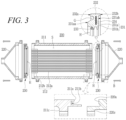
- FIG. 3 is an exploded cross-sectional view illustrating the fuel cell humidifier including the gasket assembly according to the first embodiment of the present disclosure
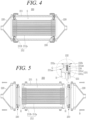
- FIG. 4 is a cross-sectional view illustrating the fuel cell humidifier including the gasket assembly according to the first embodiment of the present disclosure.
- a fuel cell humidifier 200 includes a humidification module 210 for humidifying air supplied from the outside with moisture in an off-gas discharged from the fuel cell stack.
- a humidification module 210 for humidifying air supplied from the outside with moisture in an off-gas discharged from the fuel cell stack.
- Each of both ends of the humidification module 210 is coupled to a cap 220.
- One of the caps 220 supplies air supplied from the outside to the humidification module 210, and the other supplies air humidified by the humidification module 210 to the fuel cell stack.
- the humidification module 210 is a device in which moisture exchange occurs between the air supplied from the outside and the off-gas, and may include a mid-case 211 having an off-gas inlet 211a and an off-gas outlet 211b and at least one cartridge 212 which is disposed in the mid-case 211.
- the mid-case 211 and the cap 220 may each independently be formed of a rigid plastic or metal, and may have a circular or polygonal cross-section in a width direction.
- a circle includes an ellipse, and a polygon includes a polygon with rounded corners.
- the rigid plastic may be polycarbonate, polyamide (PA), polyphthalamide (PPA), polypropylene (PP), or the like.
- the cartridge 212 as presently claimed includes a plurality of hollow fiber membranes 212a and a potting portion 212b for fixing the hollow fiber membranes 212a to each other. Accordingly, ends of the hollow fiber membranes 212a are fixed to the potting portion 212b.
- Each of the hollow fiber membranes 212a may include polysulfone resin, polyethersulfone resin, sulfonated polysulfone resin, polyvinylidene fluoride (PVDF) resin, polyacrylonitrile (PAN) resin, polyimide resin, polyamideimide resin, a polyester imide resin, or a polymer film formed of a mixture of at least two or more thereof, and the potting portion 212b may be formed by curing a liquid resin such as a liquid polyurethane resin through a casting method such as deep potting or centrifugal potting.
- PVDF polyvinylidene fluoride
- PAN polyacrylonitrile
- the potting portion 212b may be formed by curing a liquid resin such as a liquid polyurethane resin through a casting method such as deep potting or centrifugal potting.
- moisture contained in the off-gas penetrates the hollow fiber membranes 212a to humidify the air flowing along the hollows of the hollow fiber membranes 212a.
- the cap 220 is only in fluid communication with the hollows of the hollow fiber membranes 212a, and should be completely blocked from an inner space S of the mid-case 211. Otherwise, air leakage occurs due to the pressure difference, and thus, an amount of humidified air supplied to the fuel cell stack is reduced and power generation efficiency of the fuel cell is reduced.
- the fuel cell humidifier 200 of the present disclosure further includes a gasket assembly 230 which is airtightly coupled to each end of the humidification module 210 through mechanical assembly.
- the present disclosure since air leakage between the mid-case 211 and the cap 220 is prevented through the mechanical assembly of the gasket assembly 230, a casting process (that is, a process of injecting and curing a liquid resin into a mold) and an additional sealing process (that is, a process of applying and curing a sealant) of the related art may be omitted. Therefore, according to the present disclosure, it is possible to significantly improve productivity by shortening a production process time of the fuel cell humidifier 200 while preventing air leakage between the mid-case 211 and the cap 220.
- the gasket assembly 230 of the present disclosure for preventing the air leakage between the mid-case 211 and the cap 220 is mounted on the humidification module 210 through mechanical assembly, when an abnormality occurs in a specific portion (for example, cartridge 212) of the humidification module 210, the gasket assembly 230 is mechanically separated from the humidification module 210, and then only the corresponding portion can be repaired or replaced. Therefore, according to the present disclosure, a maintenance cost of the fuel cell humidifier 200 can be significantly reduced.
- the gasket assembly 230 includes a packing portion 231, an edge portion 232, and a sealing portion 233.
- Each of the packing portion 231 and the edge portion 232 may be formed of an elastic material (for example, silicone, rubber, or the like)) having a first hardness of 20 to 70 Shore A, preferably 30 to 60 Shore A.
- the sealing portion 233 may include at least one of a solid sealing material and a liquid sealing material.
- the solid sealing material may be made of a material such as silicone, acrylic rubber, EPDM, or NBR, and the liquid sealing material may be made of a material such as silicone or urethane.
- the packing portion 231 has a hole H into which the end (for example, the potting portion 212b) of the cartridge 212 is inserted, and is interposed between the mid-case 211 and the cartridge 212.
- the packing portion 231 includes a body member 231a and a protruding member 231b.
- the body member 231a has the hole H into which the end (for example, the potting portion 212b) of the cartridge 212 is inserted, and the hole H has a shape corresponding to a shape of the end of the cartridge 212.
- a lower body member 231aa protruding from the body member 231a toward the mid-case 211 may have a polygonal cross-section (for example, a trapezoidal shape), and an upper body member 231ab formed toward the cap 220 may be formed in a planar shape.
- a space in which the sealing portion 233 is disposed is formed between the lower body member 231aa and the cartridge potting portion 212b.
- a groove G into which the end 211a of the mid-case 211 is fitted is formed between the lower body member 231aa and the edge portion 232.
- the protruding member 231b is formed at one end of the body member 231a to be in contact with the cartridge potting portion 212b inserted into the hole H.
- the protruding member 231b may be at least one annular protrusion protruding from one end of the body member 231a.
- the protruding member 231b may be in contact with the cartridge potting portion 212b while pressing the cartridge potting portion 212b by an elastic force to airtightly seal the space of the mid-case 211 and the space by the cap 220. Accordingly, the protruding member 231b may prevent a fluid in the mid-case 211 from flowing into the space formed on the cap 220 side.
- the protruding member 231b since the protruding member 231b has elasticity, the protruding member 231b can perform a vibration-absorbing function, and thus, it is possible to prevent damage due to vibrations of the humidifier 200.
- the edge portion 232 is formed at the other end of the body member 231a.
- the edge portion 232 may be interposed in a space formed by the groove 211b formed at the end of the mid-case and an end 220a of the cap.
- the edge portion 232 may include edge wings 232a and 232b protruding in both directions.
- the edge wings 232a and 232b may be formed in a longitudinal direction of the humidification module 210.
- the edge wings 232a and 232b are inserted into the grooves 211b of the mid-case end, and the end portion 220a of the cap presses the edge wing 232b and then fastened and assembled by fastening means such as bolts B.
- edge wings 232a and 232b are made of an elastic material, the edge wings 232a and 232b may be interposed while filling a certain portion of the space of the groove 211b at the end of the mid-case.
- Fastening fragments 211c and 220c having fastening holes for fastening bolts may be formed on the end side surfaces of the mid-case 211 and the cap 220.
- the edge wings 232a and 232b may seal the inside and outside of the mid-case 211 and the mid-case 211 and the cap 220 by airtightly sealing the groove 211b of the end portion of the mid-case.
- the sealing portion 233 is formed to be in contact with the cartridge 212 and the packing portion 231 between the cartridge 212 and the packing portion 231. Specifically, the sealing portion 233 is formed to be in contact with (or adhere) the potting portion 212b of the cartridge and the lower body member 231aa of the packing portion at the same time. The sealing portion 233 airtightly seals the space of the mid-case 211 and the space of the cap 220 to prevent the fluid in the mid-case 211 from flowing toward the cap 220.
- the gasket assembly 230 may further include a reinforcing member 234.
- the reinforcing member 234 may have a second hardness higher than the first hardness.
- the reinforcing member 234 may be formed of a metal, a thermoplastic resin, or a thermosetting resin.
- the reinforcing member 234 may be formed by being inserted into the gasket assembly 230 and formed by manufacturing the reinforcing member 234 after inserting the metal plate into the mold when the gasket assembly 230 is molded.
- the reinforcing member 234 may be formed by being inserted into at least a portion of the packing portion 231 and at least a portion of the edge portion 232.
- the reinforcing member 234 may be formed in a portion (a portion in which the groove G is formed) vulnerable to deformation in the gasket assembly 230.
- the reinforcing member 234 having a higher hardness than those of the packing portion 231 and the edge portion 232 prevents the deformation of the body member 231a when the gasket assembly 230 is mechanically assembled to the humidification module 210 or when the humidifier is operated, and thus, it is possible to more reliably prevent the air leakage.
- FIG. 5 is an exploded cross-sectional view illustrating a fuel cell humidifier including a gasket assembly according to a second embodiment of the present disclosure
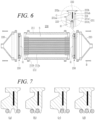
- FIG. 6 is an exploded cross-sectional view illustrating a fuel cell humidifier including a gasket assembly according to a third embodiment of the present disclosure
- FIG. 7 is a cross-sectional view illustrating various applications of the gasket assemblies according to embodiments of the present disclosure.
- each of the gasket assemblies includes the packing portion 231, the edge portion 232, and the sealing portion 233.
- the sealing portion 233 is different, and the rest of the configuration is substantially the same, and thus, repeated description will be omitted.
- the sealing portion 233 is formed to be in contact with the potting portion 212b of the cartridge and the upper body member 231ab of the packing portion at the same time.
- the sealing portion 233 is formed so as to be in contact with the potting portion 212b of the cartridge and the protruding member 231b of the packing portion at the same time.
- two or more protruding members 231b are formed, and the sealing portion 233 is formed between two or more protruding members 231b.
- FIG. 7 illustrates that the sealing portion 233 is formed to be in contact with at least one of the lower body member 231aa, the upper body member 231ab, and the protruding member 231b of the packing portion.
- the sealing portion 233 airtightly seals the space of the mid-case 211 and the space of the cap 220 to prevent the fluid in the mid-case 211 from flowing to the cap 220 side, and thus, each area in which the sealing portion 233 is formed may implement a first sealing area.
- the protruding member 231b is in contact with the cartridge potting portion 212b while pressing the cartridge potting portion 212b to airtightly seal the space of the mid-case 211 and the space by the cap 220, and thus, an area in which the protruding member 231b is formed implements a second sealing area.
- edge wings 232a and 232b airtightly seal the groove 211b of the mid-case end portion to seal the inside and outside of the mid-case 211, and the mid-case 211 and the cap 220, an area in which the edge wings 232a and 232b are formed may implement a third sealing area.
- the sealing area is formed in a double triple, it is possible to reliably prevent air leakage between the mid-case 211 and the cap 220.
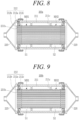
- FIG. 8 is a cross-sectional view illustrating the second embodiment of the fuel cell humidifier including the gasket assembly according to the first embodiment of the present disclosure.
- the fuel cell humidifier 200a is substantially the same as the fuel cell humidifier 200.
- the inner case 212c has an opening at each end and the hollow fiber membranes 212a are contained inside the inner case 212c.
- the potting portion 212b in which the end portions of the hollow fiber membranes 212a are potted closes the opening of the inner case 212c.
- the potting portion 212b may be located outside the inner case 212c, and the protruding member 231b of the gasket assembly 230 may be in close contact with the potting portion 212b.
- the inner case 212c includes a plurality of holes (hereinafter, "first mesh holes”) MH1 arranged in a mesh shape for fluid communication with the first space s1 and a plurality of holes (hereinafter, “second mesh holes”) arranged in a mesh shape for fluid communication with the second space S2.
- first mesh holes a plurality of holes
- second mesh holes a plurality of holes
- the off-gas introduced into the first space S1 of the mid-case 211 through the off-gas inlet 211a flows into the inner case 212c through the first mesh holes MH1, and comes into contact with the outer surfaces of the hollow fiber membranes 212a. Subsequently, the off-gas deprived of moisture is introduced into the second space S2 through the second mesh holes MH2 and then discharged from the mid-case 211 through the off-gas outlet 211c.
- the cartridge 212 including the inner case 212c it is possible to easily assemble to the mid-case 211 and easily replace the mid-case 211.
- FIG. 9 is a cross-sectional view illustrating the third embodiment of the fuel cell humidifier including the gasket assembly according to the first embodiment of the present disclosure.
- the fuel cell humidifier 200b is substantially the same as the fuel cell humidifier 200a according to the second embodiment described above.
- FIGS. 4 , 8, and 9 illustrate the fuel cell humidifiers 200, 200a, and 200b including the gasket assembly according to the first embodiment, but the embodiments of the present disclosure are not limited thereto, and the gasket assemblies according to various embodiments of FIGS. 5 to 7 may be applied to the fuel cell humidifier of the first to third embodiments.
- FIG. 10 is an exploded perspective view illustrating the fourth embodiment of the fuel cell humidifier including the gasket assembly according to the fourth embodiment of the present disclosure
- FIG. 11 is an exploded cross-sectional view illustrating the fourth embodiment of the fuel cell humidifier including the gasket assembly according to the fourth embodiment of the present disclosure
- FIG. 12 is a cross-sectional view illustrating the fourth embodiment of the fuel cell humidifier including the gasket assembly according to the fourth embodiment of the present disclosure.
- the humidification module 210 includes two or more cartridges 212
- the body member 231a of the packing portion 231 includes two or more holes H into which the cartridges 212 are inserted,
- two or more protruding members 231b formed at one end of the body member 231a to be in contact with the cartridge potting portion 212b are provided, and
- two or more sealing portions 233 formed to be in contact with the cartridge 212 and the packing portion 231 between the cartridge 212 and the packing portion 231 are provided
- the fuel cell humidifier 300 is substantially the same as the fuel cell humidifier 200a according to the second embodiment described above.
- the plurality of cartridges 212 each including the inner case 212c are mounted in the mid-case 211 at regular intervals. Accordingly, the off-gas is uniformly distributed to all the hollow fiber membranes 212a present in the mid-case 211, and only a specific cartridge 212 in which a problem occurs can be selectively replaced so that the maintenance cost of the fuel cell humidifier 300 can be further reduced.
- FIG. 13 schematically illustrates a cross-sectional view of the fuel cell humidifier 300a according to the fifth embodiment of the fuel cell humidifier to which the gasket assembly 330 according to the fourth embodiment of the present disclosure is applied.
- the fuel cell humidifier 300a is substantially the same as the fuel cell humidifier 300 according to the above-described fourth embodiment.
Landscapes
- Engineering & Computer Science (AREA)
- Chemical & Material Sciences (AREA)
- Chemical Kinetics & Catalysis (AREA)
- General Engineering & Computer Science (AREA)
- Manufacturing & Machinery (AREA)
- Life Sciences & Earth Sciences (AREA)
- Sustainable Development (AREA)
- Sustainable Energy (AREA)
- Electrochemistry (AREA)
- General Chemical & Material Sciences (AREA)
- Mechanical Engineering (AREA)
- Combustion & Propulsion (AREA)
- Fuel Cell (AREA)
- Separation Using Semi-Permeable Membranes (AREA)
Description
- The present disclosure relates to a fuel cell humidifier including a gasket assembly and more particularly, the gasket assembly can be manufactured with improved productivity and can dramatically reduce maintenance costs.
- A fuel cell is a power generation type cell that produces electricity by combining hydrogen and oxygen. Unlike general chemical cells such as dry cells and storage batteries, fuel cells can continuously produce electricity as long as hydrogen and oxygen are supplied, and there is no heat loss, so the efficiency is about twice that of an internal combustion engine.
- In addition, since chemical energy generated by the combination of hydrogen and oxygen is directly converted into electrical energy, the emission of pollutants is small. Accordingly, the fuel cell has the advantage of being environmentally friendly and reducing concerns about resource depletion due to increased energy consumption.
- These fuel cells are largely based on the type of electrolyte used: a polymer electrolyte membrane fuel cell (PEMFC), a phosphoric acid fuel cell (PAFC), a molten carbonate fuel cell (MCFC), a solid oxide fuel cell (SOFC), an alkaline fuel cell (AFC), or the like.
KR 101 697 998 B1 WO 2020/262911 A1 relates to a humidifier for fuel cells and a method of manufacturing the same, and more specifically, to a humidifier that not only can reliably prevent gas leakage due to repeated operation and stopping of a fuel cell, but can also be manufactured with relatively low manufacturing costs and high productivity.WO 2020/213990 A1 relates to a humidifier for fuel cells and a packing member therefor, and more specifically, to a humidifier for fuel cells and a packing member therefor that can not only be manufactured with improved productivity but also can dramatically reduce maintenance costs.DE 30 32 417 A1 relates to a heat and mass transfer apparatus comprising hollow synthetic polymer fibres as the heat exchanger tubes and being intended for medicinal purposes.KR 2019 0081736 A KR 2019 0138528 A KR 2013 0034404 A - Each of these fuel cells operates on the same principle, but the type of fuels used, operating temperatures, catalysts, electrolytes, or the like are different from each other. Among them, the polymer electrolyte fuel cell (PEMFC) can be operated at a low temperature compared to other fuel cells and can be miniaturized due to a high output density, and thus, the polymer electrolyte fuel cell (PEMFC) is known to be the most promising not only in small-scale stationary power generation equipment but also in transportation systems.
- One of the most important factors in improving performance of the polymer electrolyte fuel cell (PEMFC) is to maintain a moisture content by supplying more than a certain amount of moisture to a polymer electrolyte membrane or a proton exchange membrane (PEM) of a membrane-electrode assembly (MEA). This is because when the polymer electrolyte membrane is dried, the power generation efficiency is rapidly reduced.
- As a method of humidifying the polymer electrolyte membrane, there are 1) a bubbler humidification method of supplying moisture by causing a target gas to pass through a diffuser after filling a pressure-resistant container with water, 2) a direct injection method of calculating an amount of supplied moisture required for a fuel cell reaction and supplying moisture directly to a gas flow pipe through a solenoid valve, and 3) a humidification membrane method of supplying moisture to a fluidized bed of gas using a polymer membrane.
- Among them, in the membrane humidification method, water vapor is supplied to the air supplied to the polymer electrolyte membrane using a membrane that selectively transmits only water vapor contained in an off-gas, and thus, in the membrane humidification method of humidifying the polymer electrolyte membrane, it is possible to reduce weight and a size of the humidifier.
- When the selective permeable membranes used in the membrane humidification method form a module, a hollow fiber membrane having a large permeation area per unit volume is preferable. That is, when a humidifier is manufactured using the hollow fiber membrane, high integration of the hollow fiber membrane with a large contact surface area is possible. Accordingly, the fuel cell can be sufficiently humidified even with a small capacity, low-cost materials can be used, and the moisture and heat contained in the off-gas discharged at high temperature from the fuel cell can be collected and reused in the humidifier.
-
FIG. 1 is an exploded perspective view illustrating a fuel cell humidifier according to the related art. As illustrated inFIG. 1 , afuel cell humidifier 100 of the related art is ahumidification module 110 includes ahumidifying module 110 in which moisture exchange occurs between air supplied from the outside and an off-gas discharged from the fuel cell stack (not illustrated), andcaps 120 coupled to both ends of thehumidifying module 110. - One of the
caps 120 supplies the air supplied from the outside to thehumidification module 110, and the other supplies air humidified by thehumidification module 110 to the fuel cell stack. - The
humidification module 110 includes amid-case 111 having an off-gas inlet 111a and an off-gas outlet 111b and a plurality ofhollow fiber membranes 112 within themid-case 111. Both ends of the bundle ofhollow fiber membranes 112 are fixed to apotting portion 113. Thepotting portion 113 is generally formed by curing a liquid polymer such as a liquid polyurethane resin through a casting method. - Air supplied from the outside flows along the hollows of the
hollow fiber membranes 112. The off-gas introduced into themid-case 111 through the off-gas inlet 111a is discharged from the mid-case 111 through the off-gas outlet 111b after coming into contact with outer surfaces of thehollow fiber membranes 112. When the off-gas comes into contact with the outer surfaces of thehollow fiber membranes 112, moisture contained in the off-gas penetrates thehollow fiber membranes 112, and thus, humidifies air flowing along the hollows of thehollow fiber membranes 112. - The inner spaces of the
caps 120 are only in fluid communication with the hollows of thehollow fiber membranes 112, and should be completely blocked from the inner space of themid-case 111. Otherwise, air leakage occurs due to a pressure difference, and thus, an amount of the humidified air supplied to the fuel cell stack is reduced and the power generation efficiency of the fuel cell is reduced. - In general, as illustrated in
FIG. 1 , thepotting portion 113 to which ends of the plurality ofhollow fiber membranes 112 are fixed, and aresin layer 114 between thepotting portion 113 and themid-case 111 block the inner spaces of thecaps 120 and the inner space of themid-case 111 are blocked. Similar to thepotting portion 113, theresin layer 114 is generally formed by curing a liquid polymer such as a liquid polyurethane resin through a casting method. - However, since a casting process for forming the
resin layer 114 requires a relatively long process time, productivity of thehumidifier 100 is reduced. - In addition, since the
resin layer 114 is adhered to an inner wall of themid-case 111 as well as thepotting portion 113, when a problem occurs in thehollow fiber membrane 112, theentire humidification module 110 should be replaced, and thus, maintenance costs largely increase. - Moreover, the repeated operation of the fuel cell is highly likely to cause a gap between the
resin layer 114 and themid-case 111. That is, as the operation and stop of the fuel cell are repeated, expansion and contraction of theresin layer 114 occur alternately, and there is a high probability that theresin layer 114 is separated from the mid-case 111 due to a difference in coefficients of thermal expansion between themid-case 111 and theresin layer 114. As described above, when the gap is generated between theresin layer 114 and the mid-case 111, air leakage occurs due to the pressure difference, and thus, the amount of humidified air supplied to the fuel cell stack is reduced, and the power generation efficiency of the fuel cell is reduced. - In order to prevent the air leakage due to the occurrence of the gap between the
resin layer 114 and themid-case 111, it may be considered to perform an additional process such as applying a sealant between theresin layer 114 and themid-case 111 and/or mounting an outer gasket assembly therebetween. However, the additional process itself also requires additional process time, and thus, the productivity of thehumidifier 100 is reduced. - The present invention is defined by the subject-matter of the attached claims. The present disclosure provides a gasket assembly that can prevents problems due to the limitations and disadvantages of the related art as described above, can be manufactured with improved productivity, and can dramatically reduce maintenance costs, and a fuel cell humidifier including the same.
- In addition to the above-mentioned aspects of present disclosure, other features and advantages of present disclosure will be described below or will be clearly understood by those of ordinary skill in the art to which present disclosure belongs from such description.
- According to the present disclosure, since air leakage between the mid-case and the cap is prevented through mechanical assembly of the gasket assembly, a casting process (that is, a process of injecting and curing a liquid resin into a mold) and an additional sealing process (that is, a process of applying and curing a sealant) of the related art can be omitted. Therefore, according to the present disclosure, it is possible to significantly improve productivity by shortening a production process time of the fuel cell humidifier while preventing the air leakage between the mid-case and the cap.
- In addition, since the gasket assembly of the present disclosure for preventing the air leakage between the mid-case and the cap is mounted on the
humidification module 210 through mechanical assembly, when an abnormality occurs in a specific portion of the humidification module, the gasket assembly is simply separated mechanically, and then only the corresponding portion can be repaired or replaced. Therefore, according to the present disclosure, a maintenance cost of the fuel cell humidifier can be significantly reduced. -
-
FIG. 1 is an exploded perspective view illustrating a fuel cell humidifier according to the related art. -
FIG. 2 is an exploded perspective view illustrating a fuel cell humidifier including a gasket assembly according to a first embodiment of the present disclosure. -
FIG. 3 is an exploded cross-sectional view illustrating the fuel cell humidifier including the gasket assembly according to the first embodiment of the present disclosure. -
FIG. 4 is a cross-sectional view illustrating the fuel cell humidifier including the gasket assembly according to the first embodiment of the present disclosure. -
FIG. 5 is an exploded cross-sectional view illustrating a fuel cell humidifier including a gasket assembly according to a second embodiment of the present disclosure. -
FIG. 6 is an exploded cross-sectional view illustrating a fuel cell humidifier including a gasket assembly according to a third embodiment of the present disclosure. -
FIG. 7 is a cross-sectional view illustrating various applications of the gasket assemblies according to embodiments of the present disclosure. -
FIG. 8 is a cross-sectional view illustrating a second embodiment of the fuel cell humidifier including the gasket assembly according to the first embodiment of the present disclosure. -
FIG. 9 is a cross-sectional view illustrating a third embodiment of the fuel cell humidifier including the gasket assembly according to the first embodiment of the present disclosure. -
FIG. 10 is an exploded perspective view illustrating a fourth embodiment of a fuel cell humidifier including a gasket assembly according to a fourth embodiment of the present disclosure. -
FIG. 11 is an exploded cross-sectional view illustrating the fourth embodiment of the fuel cell humidifier including the gasket assembly according to the fourth embodiment of the present disclosure. -
FIG. 12 is a cross-sectional view illustrating the fourth embodiment of the fuel cell humidifier including the gasket assembly according to the fourth embodiment of the present disclosure. -
FIG. 13 is a cross-sectional view illustrating a fifth embodiment of the fuel cell humidifier including the gasket assembly according to the fourth embodiment of the present disclosure. - Since the present disclosure can have various modifications and can include various embodiments, specific embodiments are illustrated and described in detail in the detailed description. However, this is not intended to limit the present disclosure to specific embodiments.
- The terms used in the present disclosure are only used to describe specific embodiments, and are not intended to limit the present disclosure. The singular expression includes the plural expression unless the context clearly dictates otherwise. In the present disclosure, terms such as "comprise" or "have" are intended to designate that the features, numbers, steps, operations, components, parts, or combinations thereof described in the specification exist, and it is to be understood that the terms do not preclude possibilities of presences or additions of one or more other features, numbers, steps, operations, components, parts, or combinations thereof. Hereinafter, a gasket assembly and a fuel cell humidifier including the same according to embodiments of the present disclosure will be described with reference to the drawings.
-
FIG. 2 is an exploded perspective view illustrating a fuel cell humidifier including a gasket assembly according to a first embodiment of the present disclosure,FIG. 3 is an exploded cross-sectional view illustrating the fuel cell humidifier including the gasket assembly according to the first embodiment of the present disclosure, andFIG. 4 is a cross-sectional view illustrating the fuel cell humidifier including the gasket assembly according to the first embodiment of the present disclosure. - Referring to
FIG. 2 , afuel cell humidifier 200 according to an embodiment of the present disclosure includes ahumidification module 210 for humidifying air supplied from the outside with moisture in an off-gas discharged from the fuel cell stack. Each of both ends of thehumidification module 210 is coupled to acap 220. - One of the
caps 220 supplies air supplied from the outside to thehumidification module 210, and the other supplies air humidified by thehumidification module 210 to the fuel cell stack. - The
humidification module 210 is a device in which moisture exchange occurs between the air supplied from the outside and the off-gas, and may include a mid-case 211 having an off-gas inlet 211a and an off-gas outlet 211b and at least onecartridge 212 which is disposed in the mid-case 211. - The mid-case 211 and the
cap 220 may each independently be formed of a rigid plastic or metal, and may have a circular or polygonal cross-section in a width direction. A circle includes an ellipse, and a polygon includes a polygon with rounded corners. For example, the rigid plastic may be polycarbonate, polyamide (PA), polyphthalamide (PPA), polypropylene (PP), or the like. - The
cartridge 212 as presently claimed includes a plurality ofhollow fiber membranes 212a and apotting portion 212b for fixing thehollow fiber membranes 212a to each other. Accordingly, ends of thehollow fiber membranes 212a are fixed to thepotting portion 212b. - Each of the
hollow fiber membranes 212a may include polysulfone resin, polyethersulfone resin, sulfonated polysulfone resin, polyvinylidene fluoride (PVDF) resin, polyacrylonitrile (PAN) resin, polyimide resin, polyamideimide resin, a polyester imide resin, or a polymer film formed of a mixture of at least two or more thereof, and thepotting portion 212b may be formed by curing a liquid resin such as a liquid polyurethane resin through a casting method such as deep potting or centrifugal potting. - Air supplied from the outside flows along hollows of the hollow fiber membranes (212a). The off-gas introduced into the mid-case 211 through the off-
gas inlet 211a comes into contact with outer surfaces of thehollow fiber membranes 212a and then is discharged from the mid-case 211 through the off-gas outlet 211b. When the off-gas comes into contact with the outer surfaces of thehollow fiber membranes 212a, moisture contained in the off-gas penetrates thehollow fiber membranes 212a to humidify the air flowing along the hollows of thehollow fiber membranes 212a. - The
cap 220 is only in fluid communication with the hollows of thehollow fiber membranes 212a, and should be completely blocked from an inner space S of the mid-case 211. Otherwise, air leakage occurs due to the pressure difference, and thus, an amount of humidified air supplied to the fuel cell stack is reduced and power generation efficiency of the fuel cell is reduced. - To solve this problem, the
fuel cell humidifier 200 of the present disclosure further includes agasket assembly 230 which is airtightly coupled to each end of thehumidification module 210 through mechanical assembly. - According to the present disclosure, since air leakage between the mid-case 211 and the
cap 220 is prevented through the mechanical assembly of thegasket assembly 230, a casting process (that is, a process of injecting and curing a liquid resin into a mold) and an additional sealing process (that is, a process of applying and curing a sealant) of the related art may be omitted. Therefore, according to the present disclosure, it is possible to significantly improve productivity by shortening a production process time of thefuel cell humidifier 200 while preventing air leakage between the mid-case 211 and thecap 220. - In addition, since the
gasket assembly 230 of the present disclosure for preventing the air leakage between the mid-case 211 and thecap 220 is mounted on thehumidification module 210 through mechanical assembly, when an abnormality occurs in a specific portion (for example, cartridge 212) of thehumidification module 210, thegasket assembly 230 is mechanically separated from thehumidification module 210, and then only the corresponding portion can be repaired or replaced. Therefore, according to the present disclosure, a maintenance cost of thefuel cell humidifier 200 can be significantly reduced. - Referring to
FIGS. 3 and4 , thegasket assembly 230 according to the first embodiment of the present disclosure includes a packingportion 231, anedge portion 232, and a sealingportion 233. Each of the packingportion 231 and theedge portion 232 may be formed of an elastic material (for example, silicone, rubber, or the like)) having a first hardness of 20 to 70 Shore A, preferably 30 to 60 Shore A. The sealingportion 233 may include at least one of a solid sealing material and a liquid sealing material. The solid sealing material may be made of a material such as silicone, acrylic rubber, EPDM, or NBR, and the liquid sealing material may be made of a material such as silicone or urethane. - The packing
portion 231 has a hole H into which the end (for example, thepotting portion 212b) of thecartridge 212 is inserted, and is interposed between the mid-case 211 and thecartridge 212. The packingportion 231 includes abody member 231a and a protrudingmember 231b. - The
body member 231a has the hole H into which the end (for example, thepotting portion 212b) of thecartridge 212 is inserted, and the hole H has a shape corresponding to a shape of the end of thecartridge 212. A lower body member 231aa protruding from thebody member 231a toward the mid-case 211 may have a polygonal cross-section (for example, a trapezoidal shape), and an upper body member 231ab formed toward thecap 220 may be formed in a planar shape. A space in which the sealingportion 233 is disposed is formed between the lower body member 231aa and thecartridge potting portion 212b. Moreover, a groove G into which theend 211a of the mid-case 211 is fitted is formed between the lower body member 231aa and theedge portion 232. - The protruding
member 231b is formed at one end of thebody member 231a to be in contact with thecartridge potting portion 212b inserted into the hole H. The protrudingmember 231b may be at least one annular protrusion protruding from one end of thebody member 231a. The protrudingmember 231b may be in contact with thecartridge potting portion 212b while pressing thecartridge potting portion 212b by an elastic force to airtightly seal the space of the mid-case 211 and the space by thecap 220. Accordingly, the protrudingmember 231b may prevent a fluid in the mid-case 211 from flowing into the space formed on thecap 220 side. In addition, since the protrudingmember 231b has elasticity, the protrudingmember 231b can perform a vibration-absorbing function, and thus, it is possible to prevent damage due to vibrations of thehumidifier 200. - The
edge portion 232 is formed at the other end of thebody member 231a. Theedge portion 232 may be interposed in a space formed by thegroove 211b formed at the end of the mid-case and anend 220a of the cap. Theedge portion 232 may includeedge wings edge wings humidification module 210. At the time of assembling, theedge wings grooves 211b of the mid-case end, and theend portion 220a of the cap presses theedge wing 232b and then fastened and assembled by fastening means such as bolts B. In this case, since theedge wings edge wings groove 211b at the end of the mid-case. Fastening fragments 211c and 220c having fastening holes for fastening bolts may be formed on the end side surfaces of the mid-case 211 and thecap 220. Theedge wings cap 220 by airtightly sealing thegroove 211b of the end portion of the mid-case. - The sealing
portion 233 is formed to be in contact with thecartridge 212 and the packingportion 231 between thecartridge 212 and the packingportion 231. Specifically, the sealingportion 233 is formed to be in contact with (or adhere) thepotting portion 212b of the cartridge and the lower body member 231aa of the packing portion at the same time. The sealingportion 233 airtightly seals the space of the mid-case 211 and the space of thecap 220 to prevent the fluid in the mid-case 211 from flowing toward thecap 220. - In addition, the
gasket assembly 230 may further include a reinforcingmember 234. The reinforcingmember 234 may have a second hardness higher than the first hardness. For example, the reinforcingmember 234 may be formed of a metal, a thermoplastic resin, or a thermosetting resin. The reinforcingmember 234 may be formed by being inserted into thegasket assembly 230 and formed by manufacturing the reinforcingmember 234 after inserting the metal plate into the mold when thegasket assembly 230 is molded. The reinforcingmember 234 may be formed by being inserted into at least a portion of the packingportion 231 and at least a portion of theedge portion 232. The reinforcingmember 234 may be formed in a portion (a portion in which the groove G is formed) vulnerable to deformation in thegasket assembly 230. The reinforcingmember 234 having a higher hardness than those of the packingportion 231 and theedge portion 232 prevents the deformation of thebody member 231a when thegasket assembly 230 is mechanically assembled to thehumidification module 210 or when the humidifier is operated, and thus, it is possible to more reliably prevent the air leakage. - Next, gasket assemblies according to various embodiments of the present disclosure will be described with reference to
FIGS. 5 to 7 .FIG. 5 is an exploded cross-sectional view illustrating a fuel cell humidifier including a gasket assembly according to a second embodiment of the present disclosure,FIG. 6 is an exploded cross-sectional view illustrating a fuel cell humidifier including a gasket assembly according to a third embodiment of the present disclosure, andFIG. 7 is a cross-sectional view illustrating various applications of the gasket assemblies according to embodiments of the present disclosure. - Referring to
FIGS. 5 to 7 , each of the gasket assemblies according to various embodiments of the present disclosure includes the packingportion 231, theedge portion 232, and the sealingportion 233. In embodiments ofFIGS. 5 to 7 , only the position of the sealingportion 233 is different, and the rest of the configuration is substantially the same, and thus, repeated description will be omitted. - In the embodiment of
Figure 5 , the sealingportion 233 is formed to be in contact with thepotting portion 212b of the cartridge and the upper body member 231ab of the packing portion at the same time. - In the embodiment of
Figure 6 and as presently claimed, the sealingportion 233 is formed so as to be in contact with thepotting portion 212b of the cartridge and the protrudingmember 231b of the packing portion at the same time. In this case, two or moreprotruding members 231b are formed, and the sealingportion 233 is formed between two or moreprotruding members 231b. -
FIG. 7 illustrates that the sealingportion 233 is formed to be in contact with at least one of the lower body member 231aa, the upper body member 231ab, and the protrudingmember 231b of the packing portion. - In the above embodiments, the sealing
portion 233 airtightly seals the space of the mid-case 211 and the space of thecap 220 to prevent the fluid in the mid-case 211 from flowing to thecap 220 side, and thus, each area in which the sealingportion 233 is formed may implement a first sealing area. - In addition, as presently claimed, the protruding
member 231b is in contact with thecartridge potting portion 212b while pressing thecartridge potting portion 212b to airtightly seal the space of the mid-case 211 and the space by thecap 220, and thus, an area in which the protrudingmember 231b is formed implements a second sealing area. - In addition, in the above embodiments, the
edge wings groove 211b of the mid-case end portion to seal the inside and outside of the mid-case 211, and the mid-case 211 and thecap 220, an area in which theedge wings - As described above, in the embodiments, since the sealing area is formed in a double triple, it is possible to reliably prevent air leakage between the mid-case 211 and the
cap 220. - Next, a second embodiment of the fuel cell humidifier including the gasket assembly according to the first embodiment of the present disclosure will be described with reference to
FIG. 8. FIG. 8 is a cross-sectional view illustrating the second embodiment of the fuel cell humidifier including the gasket assembly according to the first embodiment of the present disclosure. - As illustrated in
FIG. 8 , in afuel cell humidifier 200a according to the second embodiment of the present disclosure, except that (i) the inner space of the mid-case 211 is divided into a first space S1 and asecond space 2 bypartitions 211c and (ii) thecartridge 212 further includes aninner case 212c, thefuel cell humidifier 200a is substantially the same as thefuel cell humidifier 200. - The
inner case 212c has an opening at each end and thehollow fiber membranes 212a are contained inside theinner case 212c. Thepotting portion 212b in which the end portions of thehollow fiber membranes 212a are potted closes the opening of theinner case 212c. - As illustrated in
FIG. 8 , at least a portion of thepotting portion 212b may be located outside theinner case 212c, and the protrudingmember 231b of thegasket assembly 230 may be in close contact with thepotting portion 212b. - The
inner case 212c includes a plurality of holes (hereinafter, "first mesh holes") MH1 arranged in a mesh shape for fluid communication with the first space s1 and a plurality of holes (hereinafter, "second mesh holes") arranged in a mesh shape for fluid communication with the second space S2. - The off-gas introduced into the first space S1 of the mid-case 211 through the off-
gas inlet 211a flows into theinner case 212c through the first mesh holes MH1, and comes into contact with the outer surfaces of thehollow fiber membranes 212a. Subsequently, the off-gas deprived of moisture is introduced into the second space S2 through the second mesh holes MH2 and then discharged from the mid-case 211 through the off-gas outlet 211c. - In the
cartridge 212 including theinner case 212c, it is possible to easily assemble to the mid-case 211 and easily replace the mid-case 211. - Next, a third embodiment of the fuel cell humidifier including the gasket assembly according to the first embodiment of the present disclosure will be described with reference to
FIG. 9. FIG. 9 is a cross-sectional view illustrating the third embodiment of the fuel cell humidifier including the gasket assembly according to the first embodiment of the present disclosure. - As illustrated in
FIG. 9 , in afuel cell humidifier 200b according to the third embodiment of the present disclosure, except that theentire potting portion 212b is located in theinner case 212c and the protrudingmember 231b of thegasket assembly 230 is in close contact with theinner case 212c rather than thepotting portion 212b, thefuel cell humidifier 200b is substantially the same as thefuel cell humidifier 200a according to the second embodiment described above. -
FIGS. 4 ,8, and 9 illustrate thefuel cell humidifiers FIGS. 5 to 7 may be applied to the fuel cell humidifier of the first to third embodiments. - Next, a fourth embodiment of a fuel cell humidifier including a gasket assembly according to a fourth embodiment of the present disclosure will be described with reference to
FIGS. 10 to 12 .FIG. 10 is an exploded perspective view illustrating the fourth embodiment of the fuel cell humidifier including the gasket assembly according to the fourth embodiment of the present disclosure,FIG. 11 is an exploded cross-sectional view illustrating the fourth embodiment of the fuel cell humidifier including the gasket assembly according to the fourth embodiment of the present disclosure, andFIG. 12 is a cross-sectional view illustrating the fourth embodiment of the fuel cell humidifier including the gasket assembly according to the fourth embodiment of the present disclosure. - Referring to
FIGS. 10 to 12 , in afuel cell humidifier 300 according to the fourth embodiment to which agasket assembly 330 according to the fourth embodiment of the present disclosure is applied, except that (i) thehumidification module 210 includes two ormore cartridges 212, (ii) thebody member 231a of the packingportion 231 includes two or more holes H into which thecartridges 212 are inserted, (iii) two or moreprotruding members 231b formed at one end of thebody member 231a to be in contact with thecartridge potting portion 212b are provided, and (iv) two ormore sealing portions 233 formed to be in contact with thecartridge 212 and the packingportion 231 between thecartridge 212 and the packingportion 231 are provided, thefuel cell humidifier 300 is substantially the same as thefuel cell humidifier 200a according to the second embodiment described above. - The plurality of
cartridges 212 each including theinner case 212c are mounted in the mid-case 211 at regular intervals. Accordingly, the off-gas is uniformly distributed to all thehollow fiber membranes 212a present in the mid-case 211, and only aspecific cartridge 212 in which a problem occurs can be selectively replaced so that the maintenance cost of thefuel cell humidifier 300 can be further reduced. -
FIG. 13 schematically illustrates a cross-sectional view of thefuel cell humidifier 300a according to the fifth embodiment of the fuel cell humidifier to which thegasket assembly 330 according to the fourth embodiment of the present disclosure is applied. - As illustrated in
FIG. 13 , in thefuel cell humidifier 300a according to the fifth embodiment of the present disclosure, except that theentire potting portion 212b of eachcartridge 212 is located in the correspondinginner case 212c and the protrudingmembers 231b of thegasket assembly 330 are in close contact with theinner cases 212c rather than thepotting portions 212b, thefuel cell humidifier 300a is substantially the same as thefuel cell humidifier 300 according to the above-described fourth embodiment. - Hereinbefore, embodiments of the present disclosure are described, but those of ordinary skill in the art can variously modify and change the present disclosure through addition, modification, deletion of components within a scope that does not depart from scope of the attached claims.
-
10, 200, 200a, 200b, 300, 300a: fuel cell humidifier 210: humidification module 211: mid-case 211a: off- gas inlet 211b: off- gas outlet 211c: partition 212: cartridge 212a: hollow fiber membrane 212b: potting portion 212c: inner case 220: cap 230, 330: gasket assembly 231: packing portion 231a: body member 231b: protruding member 232: edge portion 233: sealing portion 234: reinforcing member
Claims (3)
- A fuel cell humidifier (200) comprising:a mid-case (211);a cap (220) fastened to the mid-case (211);at least one cartridge (212) disposed in the mid-case (211) and accommodating a plurality of hollow fiber membranes (212a); anda gasket assembly (230) airtightly coupled to at least one end of a humidification module (210) through mechanical assembly so that the cap (220) is in fluid communication with only the hollow fiber membranes (212a),the gasket assembly (230) includes:a packing portion (231) including a body member (231a) having a hole into which an end portion of the cartridge (212) is inserted and two or more protruding members (231b) formed at one end of the body member (231a),an edge portion (232) formed at the other end of the body member (231a) and formed in a space formed by a groove formed in the end portion of the mid-case (211) and the end portion of the cap (220), anda sealing portion (233) formed to be in contact with the cartridge (212) and the packing portion (231) to prevent the fluid in the mid-case (211) from flowing to the cap side,wherein the body member (231a) includes a lower body member (231aa) formed to protrude the mid-case side and an upper body member (231ab) formed in a flat surface shape toward the cap side,the cartridge (212) includes the plurality of hollow fiber membranes (212a) and a potting portion (212b) for fixing the hollow fiber membranes (212a) to each other and ends of the hollow fiber membranes (212a) are fixed to the potting portion (212b),wherein the two or more protruding members (231b) are in contact with the potting portion (212b) inserted into the hole (H) to prevent a fluid in the mid-case (211) from flowing to the cap side,wherein the sealing portion (233) is formed so as to be in contact with the potting portion (212b) and the two or more protruding members (231b) at the same time,wherein the sealing portion (233) is formed between two or more protruding members (231b), andwherein the protruding members (231b) are in contact with the cartridge potting portion (212b) while pressing the cartridge potting portion (212b) to airtightly seal the space of the mid-case (211) and the space by the cap (220), and thereby, areas in which the protruding members (231b) are formed implement further sealing areas.
- The fuel cell humidifier (200) of claim 1, wherein the body member (231a) includes two or more holes (H) into which two or more cartridges (212) are inserted,the two or more protruding members (231b) are provided and formed to be in contact with end portions of the two or more cartridges (212), andtwo or more sealing portions (233) are provided and formed to be in contact with each of the two or more cartridges (212) and the packing portion (231).
- The fuel cell humidifier (200) of any one of claim 1 and claim 2, wherein the edge portion (232) includes edge wings (232a, 232b) protruding in both directions, and
the edge wing (232a, 232b) is disposed to fill the groove formed at an end portion of the mid-case (211), and seals an inside and an outside of the mid-case (211) and the cap (220).
Applications Claiming Priority (2)
| Application Number | Priority Date | Filing Date | Title |
|---|---|---|---|
| KR1020200061427A KR102546259B1 (en) | 2020-05-22 | 2020-05-22 | Gasket assembly and fuel cell humidifier comprising it |
| PCT/KR2021/006260 WO2021235854A1 (en) | 2020-05-22 | 2021-05-20 | Gasket assembly and fuel cell humidifier including same |
Publications (3)
| Publication Number | Publication Date |
|---|---|
| EP4020643A1 EP4020643A1 (en) | 2022-06-29 |
| EP4020643A4 EP4020643A4 (en) | 2023-08-30 |
| EP4020643B1 true EP4020643B1 (en) | 2025-04-30 |
Family
ID=78708722
Family Applications (1)
| Application Number | Title | Priority Date | Filing Date |
|---|---|---|---|
| EP21809261.7A Active EP4020643B1 (en) | 2020-05-22 | 2021-05-20 | Gasket assembly and fuel cell humidifier including same |
Country Status (6)
| Country | Link |
|---|---|
| US (1) | US11870109B2 (en) |
| EP (1) | EP4020643B1 (en) |
| JP (1) | JP7550217B2 (en) |
| KR (1) | KR102546259B1 (en) |
| CN (1) | CN114730897B (en) |
| WO (1) | WO2021235854A1 (en) |
Families Citing this family (1)
| Publication number | Priority date | Publication date | Assignee | Title |
|---|---|---|---|---|
| KR102769069B1 (en) * | 2021-02-04 | 2025-02-18 | 코오롱인더스트리 주식회사 | Gasket assembly and fuel cell membrane humidifier comprising it |
Family Cites Families (44)
| Publication number | Priority date | Publication date | Assignee | Title |
|---|---|---|---|---|
| DE3032417C2 (en) * | 1980-08-28 | 1985-08-14 | Akzo Gmbh, 5600 Wuppertal | Device for heat and mass transfer using hollow fibers |
| JP2005156062A (en) * | 2003-11-27 | 2005-06-16 | Nissan Motor Co Ltd | humidifier |
| JP5135844B2 (en) * | 2007-03-28 | 2013-02-06 | Nok株式会社 | Hollow fiber membrane module |
| KR101278398B1 (en) | 2007-08-01 | 2013-06-24 | 코오롱인더스트리 주식회사 | Hollow Fiber Membrane and Method for Manufacturing The Same |
| DE102007043330A1 (en) * | 2007-09-12 | 2009-03-19 | Carl Freudenberg Kg | humidifier |
| KR101398779B1 (en) | 2007-12-03 | 2014-05-28 | 코오롱인더스트리 주식회사 | Fuel Cell Humidifier with Improved Cold Resistance |
| EP2304326B1 (en) * | 2008-01-14 | 2018-09-19 | Core Energy Recovery Solutions Inc. | Cross-pleated membrane cartridges, and method for making cross-pleated membrane cartridges |
| KR20090128005A (en) | 2008-06-10 | 2009-12-15 | 주식회사 코오롱 | Humidification system for fuel cell and fuel cell system using same |
| KR20100108092A (en) | 2009-03-27 | 2010-10-06 | 주식회사 코오롱 | Humidifier for fuel cell |
| KR101375447B1 (en) | 2009-06-08 | 2014-03-17 | 코오롱인더스트리 주식회사 | Humidifier for Fuel Cell |
| KR20110001022A (en) | 2009-06-29 | 2011-01-06 | 코오롱인더스트리 주식회사 | Polymer electrolyte membrane for fuel cell and manufacturing method thereof |
| KR20110006122A (en) | 2009-07-13 | 2011-01-20 | 코오롱인더스트리 주식회사 | Polymer electrolyte membrane for fuel cell and manufacturing method thereof |
| KR101577828B1 (en) | 2009-07-13 | 2015-12-28 | 코오롱인더스트리 주식회사 | Filling System used for preparation of Polymer Electrolyte Membrane and Method of manufacturing Polymer Electrolyte Membrane using the same |
| KR20110021217A (en) | 2009-08-25 | 2011-03-04 | 코오롱인더스트리 주식회사 | Polymer electrolyte membrane for fuel cell and manufacturing method thereof |
| KR20110026696A (en) | 2009-09-08 | 2011-03-16 | 코오롱인더스트리 주식회사 | Humidifier for fuel cell and its manufacturing method |
| EP2507860B1 (en) | 2009-12-04 | 2017-10-18 | Kolon Industries, Inc. | Humidifier for fuel cell |
| JP5825032B2 (en) | 2011-10-14 | 2015-12-02 | 宇部興産株式会社 | Gas separation membrane module |
| JP2012134067A (en) * | 2010-12-22 | 2012-07-12 | Honda Motor Co Ltd | Fuel cell system |
| KR101251256B1 (en) * | 2011-03-09 | 2013-04-10 | 기아자동차주식회사 | Humidification device for fuel cell |
| KR101675742B1 (en) * | 2011-09-28 | 2016-11-15 | 코오롱인더스트리 주식회사 | Humidifier for fuel cell |
| KR101382672B1 (en) * | 2011-12-09 | 2014-04-07 | 기아자동차주식회사 | Method of producing hollow yarnmembrane modules for fuel cell |
| JP5690975B2 (en) * | 2011-12-29 | 2015-03-25 | コーロン インダストリーズ インク | Membrane humidifier |
| DE102012014723A1 (en) * | 2012-07-25 | 2014-05-15 | Volkswagen Aktiengesellschaft | Humidifying device for humidifying process gases and fuel cell assembly comprising such |
| KR101393558B1 (en) * | 2012-09-20 | 2014-05-09 | 기아자동차 주식회사 | Humidification device for fuel cell |
| DE102012020131A1 (en) * | 2012-10-15 | 2014-04-17 | Mann + Hummel Gmbh | Method for operating a humidifying device for a fuel cell |
| JP2014117667A (en) * | 2012-12-18 | 2014-06-30 | Nok Corp | Hollow fiber membrane module |
| KR20140099752A (en) * | 2013-02-04 | 2014-08-13 | 코오롱인더스트리 주식회사 | Hollow fiber membrane and hollow fiber membrane module comprising the same |
| US9188351B1 (en) * | 2013-03-08 | 2015-11-17 | Arkady Kipnis | Non-toxic food grade plastic humidifier, a kit of components, and methods of making and using same |
| DE102013020503B4 (en) * | 2013-12-11 | 2015-10-29 | Mann + Hummel Gmbh | Humidifier and fuel cell assembly |
| DE102014003959B4 (en) * | 2014-03-20 | 2018-11-08 | Mann+Hummel Gmbh | Humidifying device, for example for a fuel cell |
| KR102298888B1 (en) * | 2017-03-27 | 2021-09-08 | 현대자동차주식회사 | Humidifier for Fuel Cell |
| KR102204066B1 (en) * | 2017-09-25 | 2021-01-15 | 코오롱인더스트리 주식회사 | Hollow fiber membrane module with hollow fiber membrane of different material and fuel cell membrane humidifier comprising thereof |
| KR102263284B1 (en) * | 2018-06-05 | 2021-06-09 | 코오롱인더스트리 주식회사 | A membrane humidifier for fuel cell |
| WO2019132141A1 (en) * | 2017-12-29 | 2019-07-04 | 코오롱인더스트리 주식회사 | Membrane humidifier for fuel cell |
| KR102240511B1 (en) * | 2017-12-29 | 2021-04-14 | 코오롱인더스트리 주식회사 | Fuel cell membrane humidifier |
| CN208849007U (en) * | 2018-07-19 | 2019-05-10 | 昆山南洋电机配件有限公司 | One kind being used for hydrogen fuel cell humidifier cabinet |
| DE102019217301A1 (en) * | 2018-11-16 | 2020-06-04 | Mahle International Gmbh | Humidification module for humidifying a fluid |
| US20220181655A1 (en) * | 2019-04-17 | 2022-06-09 | Kolon Industries, Inc. | Fuel cell humidifier and packing member for same |
| JP7297093B2 (en) * | 2019-06-25 | 2023-06-23 | コーロン インダストリーズ インク | Humidifier for fuel cell and manufacturing method thereof |
| KR102805451B1 (en) * | 2019-07-22 | 2025-05-09 | 현대자동차주식회사 | Humidifier for fuel cell |
| KR102805455B1 (en) * | 2019-08-14 | 2025-05-15 | 현대자동차주식회사 | Humidifier for fuel cell |
| CA3157147C (en) * | 2019-11-29 | 2024-01-16 | Kolon Industries, Inc. | Fuel cell humidifier |
| KR102728782B1 (en) * | 2019-11-29 | 2024-11-08 | 코오롱인더스트리 주식회사 | Humidifier System for Fuel Cell |
| CN113889647A (en) * | 2020-07-03 | 2022-01-04 | 宝能汽车集团有限公司 | Humidity demand calculation method for fuel cell, storage medium, and computer device |
-
2020
- 2020-05-22 KR KR1020200061427A patent/KR102546259B1/en active Active
-
2021
- 2021-05-20 WO PCT/KR2021/006260 patent/WO2021235854A1/en not_active Ceased
- 2021-05-20 EP EP21809261.7A patent/EP4020643B1/en active Active
- 2021-05-20 JP JP2022516719A patent/JP7550217B2/en active Active
- 2021-05-20 CN CN202180006300.9A patent/CN114730897B/en active Active
-
2022
- 2022-02-11 US US17/669,643 patent/US11870109B2/en active Active
Also Published As
| Publication number | Publication date |
|---|---|
| EP4020643A4 (en) | 2023-08-30 |
| KR102546259B1 (en) | 2023-06-21 |
| JP7550217B2 (en) | 2024-09-12 |
| US20220181649A1 (en) | 2022-06-09 |
| US11870109B2 (en) | 2024-01-09 |
| CN114730897A (en) | 2022-07-08 |
| KR20210144290A (en) | 2021-11-30 |
| EP4020643A1 (en) | 2022-06-29 |
| JP2023525609A (en) | 2023-06-19 |
| CN114730897B (en) | 2024-06-21 |
| WO2021235854A1 (en) | 2021-11-25 |
Similar Documents
| Publication | Publication Date | Title |
|---|---|---|
| KR102430374B1 (en) | Humidifier for Fuel Cell and Packing Member Therefor | |
| KR20200122211A (en) | Humidifier for Fuel Cell and Packing Member Therefor | |
| US20240063408A1 (en) | Fuel cell membrane humidifier preventing damage of humidification membrane | |
| JP7550219B2 (en) | Gasket assembly and fuel cell humidifier including same | |
| EP4020643B1 (en) | Gasket assembly and fuel cell humidifier including same | |
| JP7791962B2 (en) | Gasket assembly and fuel cell membrane humidifier including same | |
| US20240322197A1 (en) | Gasket assembly and fuel cell membrane humidifier comprising same | |
| US20240063409A1 (en) | Fuel cell membrane humidifier | |
| US20230361320A1 (en) | Gasket assembly and fuel cell membrane humidifier including same | |
| KR20220111057A (en) | Fuel cell humidifier | |
| KR20220111058A (en) | Fuel cell humidifier |
Legal Events
| Date | Code | Title | Description |
|---|---|---|---|
| STAA | Information on the status of an ep patent application or granted ep patent |
Free format text: STATUS: THE INTERNATIONAL PUBLICATION HAS BEEN MADE |
|
| PUAI | Public reference made under article 153(3) epc to a published international application that has entered the european phase |
Free format text: ORIGINAL CODE: 0009012 |
|
| STAA | Information on the status of an ep patent application or granted ep patent |
Free format text: STATUS: REQUEST FOR EXAMINATION WAS MADE |
|
| 17P | Request for examination filed |
Effective date: 20220323 |
|
| AK | Designated contracting states |
Kind code of ref document: A1 Designated state(s): AL AT BE BG CH CY CZ DE DK EE ES FI FR GB GR HR HU IE IS IT LI LT LU LV MC MK MT NL NO PL PT RO RS SE SI SK SM TR |
|
| A4 | Supplementary search report drawn up and despatched |
Effective date: 20230731 |
|
| DAV | Request for validation of the european patent (deleted) | ||
| DAX | Request for extension of the european patent (deleted) | ||
| RIC1 | Information provided on ipc code assigned before grant |
Ipc: F24F 3/14 20060101ALN20230725BHEP Ipc: H01M 8/0271 20160101ALI20230725BHEP Ipc: F16J 15/06 20060101ALI20230725BHEP Ipc: B01D 63/04 20060101ALI20230725BHEP Ipc: F16J 15/12 20060101ALI20230725BHEP Ipc: F16F 15/04 20060101ALI20230725BHEP Ipc: F16J 15/10 20060101ALI20230725BHEP Ipc: B01D 63/02 20060101ALI20230725BHEP Ipc: H01M 8/04119 20160101AFI20230725BHEP |
|
| STAA | Information on the status of an ep patent application or granted ep patent |
Free format text: STATUS: EXAMINATION IS IN PROGRESS |
|
| 17Q | First examination report despatched |
Effective date: 20240301 |
|
| GRAP | Despatch of communication of intention to grant a patent |
Free format text: ORIGINAL CODE: EPIDOSNIGR1 |
|
| STAA | Information on the status of an ep patent application or granted ep patent |
Free format text: STATUS: GRANT OF PATENT IS INTENDED |
|
| INTG | Intention to grant announced |
Effective date: 20250113 |
|
| RIC1 | Information provided on ipc code assigned before grant |
Ipc: F24F 3/14 20060101ALN20250103BHEP Ipc: H01M 8/0271 20160101ALI20250103BHEP Ipc: F16J 15/06 20060101ALI20250103BHEP Ipc: B01D 63/04 20060101ALI20250103BHEP Ipc: F16J 15/12 20060101ALI20250103BHEP Ipc: F16F 15/04 20060101ALI20250103BHEP Ipc: F16J 15/10 20060101ALI20250103BHEP Ipc: B01D 63/02 20060101ALI20250103BHEP Ipc: H01M 8/04119 20160101AFI20250103BHEP |
|
| GRAS | Grant fee paid |
Free format text: ORIGINAL CODE: EPIDOSNIGR3 |
|
| GRAA | (expected) grant |
Free format text: ORIGINAL CODE: 0009210 |
|
| STAA | Information on the status of an ep patent application or granted ep patent |
Free format text: STATUS: THE PATENT HAS BEEN GRANTED |
|
| AK | Designated contracting states |
Kind code of ref document: B1 Designated state(s): AL AT BE BG CH CY CZ DE DK EE ES FI FR GB GR HR HU IE IS IT LI LT LU LV MC MK MT NL NO PL PT RO RS SE SI SK SM TR |
|
| REG | Reference to a national code |
Ref country code: CH Ref legal event code: EP Ref country code: GB Ref legal event code: FG4D |
|
| REG | Reference to a national code |
Ref country code: DE Ref legal event code: R096 Ref document number: 602021030123 Country of ref document: DE |
|
| REG | Reference to a national code |
Ref country code: IE Ref legal event code: FG4D |
|
| PGFP | Annual fee paid to national office [announced via postgrant information from national office to epo] |
Ref country code: DE Payment date: 20250530 Year of fee payment: 5 |
|
| PGFP | Annual fee paid to national office [announced via postgrant information from national office to epo] |
Ref country code: FR Payment date: 20250530 Year of fee payment: 5 |
|
| PGFP | Annual fee paid to national office [announced via postgrant information from national office to epo] |
Ref country code: AT Payment date: 20250721 Year of fee payment: 5 |
|
| REG | Reference to a national code |
Ref country code: NL Ref legal event code: MP Effective date: 20250430 |
|
| REG | Reference to a national code |
Ref country code: AT Ref legal event code: MK05 Ref document number: 1790925 Country of ref document: AT Kind code of ref document: T Effective date: 20250430 |
|
| PG25 | Lapsed in a contracting state [announced via postgrant information from national office to epo] |
Ref country code: ES Free format text: LAPSE BECAUSE OF FAILURE TO SUBMIT A TRANSLATION OF THE DESCRIPTION OR TO PAY THE FEE WITHIN THE PRESCRIBED TIME-LIMIT Effective date: 20250430 Ref country code: FI Free format text: LAPSE BECAUSE OF FAILURE TO SUBMIT A TRANSLATION OF THE DESCRIPTION OR TO PAY THE FEE WITHIN THE PRESCRIBED TIME-LIMIT Effective date: 20250430 Ref country code: PT Free format text: LAPSE BECAUSE OF FAILURE TO SUBMIT A TRANSLATION OF THE DESCRIPTION OR TO PAY THE FEE WITHIN THE PRESCRIBED TIME-LIMIT Effective date: 20250901 |
|
| REG | Reference to a national code |
Ref country code: LT Ref legal event code: MG9D |
|
| PG25 | Lapsed in a contracting state [announced via postgrant information from national office to epo] |
Ref country code: NO Free format text: LAPSE BECAUSE OF FAILURE TO SUBMIT A TRANSLATION OF THE DESCRIPTION OR TO PAY THE FEE WITHIN THE PRESCRIBED TIME-LIMIT Effective date: 20250730 Ref country code: GR Free format text: LAPSE BECAUSE OF FAILURE TO SUBMIT A TRANSLATION OF THE DESCRIPTION OR TO PAY THE FEE WITHIN THE PRESCRIBED TIME-LIMIT Effective date: 20250731 |
|
| PG25 | Lapsed in a contracting state [announced via postgrant information from national office to epo] |
Ref country code: PL Free format text: LAPSE BECAUSE OF FAILURE TO SUBMIT A TRANSLATION OF THE DESCRIPTION OR TO PAY THE FEE WITHIN THE PRESCRIBED TIME-LIMIT Effective date: 20250430 Ref country code: NL Free format text: LAPSE BECAUSE OF FAILURE TO SUBMIT A TRANSLATION OF THE DESCRIPTION OR TO PAY THE FEE WITHIN THE PRESCRIBED TIME-LIMIT Effective date: 20250430 |
|
| PG25 | Lapsed in a contracting state [announced via postgrant information from national office to epo] |
Ref country code: BG Free format text: LAPSE BECAUSE OF FAILURE TO SUBMIT A TRANSLATION OF THE DESCRIPTION OR TO PAY THE FEE WITHIN THE PRESCRIBED TIME-LIMIT Effective date: 20250430 |
|
| PG25 | Lapsed in a contracting state [announced via postgrant information from national office to epo] |
Ref country code: HR Free format text: LAPSE BECAUSE OF FAILURE TO SUBMIT A TRANSLATION OF THE DESCRIPTION OR TO PAY THE FEE WITHIN THE PRESCRIBED TIME-LIMIT Effective date: 20250430 |
|
| PG25 | Lapsed in a contracting state [announced via postgrant information from national office to epo] |
Ref country code: AT Free format text: LAPSE BECAUSE OF FAILURE TO SUBMIT A TRANSLATION OF THE DESCRIPTION OR TO PAY THE FEE WITHIN THE PRESCRIBED TIME-LIMIT Effective date: 20250430 |
|
| PG25 | Lapsed in a contracting state [announced via postgrant information from national office to epo] |
Ref country code: RS Free format text: LAPSE BECAUSE OF FAILURE TO SUBMIT A TRANSLATION OF THE DESCRIPTION OR TO PAY THE FEE WITHIN THE PRESCRIBED TIME-LIMIT Effective date: 20250731 |
|
| PG25 | Lapsed in a contracting state [announced via postgrant information from national office to epo] |
Ref country code: IS Free format text: LAPSE BECAUSE OF FAILURE TO SUBMIT A TRANSLATION OF THE DESCRIPTION OR TO PAY THE FEE WITHIN THE PRESCRIBED TIME-LIMIT Effective date: 20250830 |
|
| PG25 | Lapsed in a contracting state [announced via postgrant information from national office to epo] |
Ref country code: LV Free format text: LAPSE BECAUSE OF FAILURE TO SUBMIT A TRANSLATION OF THE DESCRIPTION OR TO PAY THE FEE WITHIN THE PRESCRIBED TIME-LIMIT Effective date: 20250430 |
|
| REG | Reference to a national code |
Ref country code: CH Ref legal event code: H13 Free format text: ST27 STATUS EVENT CODE: U-0-0-H10-H13 (AS PROVIDED BY THE NATIONAL OFFICE) Effective date: 20251223 |
|
| PG25 | Lapsed in a contracting state [announced via postgrant information from national office to epo] |
Ref country code: SM Free format text: LAPSE BECAUSE OF FAILURE TO SUBMIT A TRANSLATION OF THE DESCRIPTION OR TO PAY THE FEE WITHIN THE PRESCRIBED TIME-LIMIT Effective date: 20250430 Ref country code: DK Free format text: LAPSE BECAUSE OF FAILURE TO SUBMIT A TRANSLATION OF THE DESCRIPTION OR TO PAY THE FEE WITHIN THE PRESCRIBED TIME-LIMIT Effective date: 20250430 |
|
| PG25 | Lapsed in a contracting state [announced via postgrant information from national office to epo] |
Ref country code: LU Free format text: LAPSE BECAUSE OF NON-PAYMENT OF DUE FEES Effective date: 20250520 |
|
| PG25 | Lapsed in a contracting state [announced via postgrant information from national office to epo] |
Ref country code: CH Free format text: LAPSE BECAUSE OF NON-PAYMENT OF DUE FEES Effective date: 20250531 |
|
| PG25 | Lapsed in a contracting state [announced via postgrant information from national office to epo] |
Ref country code: CZ Free format text: LAPSE BECAUSE OF FAILURE TO SUBMIT A TRANSLATION OF THE DESCRIPTION OR TO PAY THE FEE WITHIN THE PRESCRIBED TIME-LIMIT Effective date: 20250430 |
|
| PG25 | Lapsed in a contracting state [announced via postgrant information from national office to epo] |
Ref country code: EE Free format text: LAPSE BECAUSE OF FAILURE TO SUBMIT A TRANSLATION OF THE DESCRIPTION OR TO PAY THE FEE WITHIN THE PRESCRIBED TIME-LIMIT Effective date: 20250430 |
|
| PG25 | Lapsed in a contracting state [announced via postgrant information from national office to epo] |
Ref country code: SK Free format text: LAPSE BECAUSE OF FAILURE TO SUBMIT A TRANSLATION OF THE DESCRIPTION OR TO PAY THE FEE WITHIN THE PRESCRIBED TIME-LIMIT Effective date: 20250430 Ref country code: RO Free format text: LAPSE BECAUSE OF FAILURE TO SUBMIT A TRANSLATION OF THE DESCRIPTION OR TO PAY THE FEE WITHIN THE PRESCRIBED TIME-LIMIT Effective date: 20250430 |
|
| PG25 | Lapsed in a contracting state [announced via postgrant information from national office to epo] |
Ref country code: IT Free format text: LAPSE BECAUSE OF FAILURE TO SUBMIT A TRANSLATION OF THE DESCRIPTION OR TO PAY THE FEE WITHIN THE PRESCRIBED TIME-LIMIT Effective date: 20250430 |
|
| REG | Reference to a national code |
Ref country code: BE Ref legal event code: MM Effective date: 20250531 |
|
| PG25 | Lapsed in a contracting state [announced via postgrant information from national office to epo] |
Ref country code: MC Free format text: LAPSE BECAUSE OF FAILURE TO SUBMIT A TRANSLATION OF THE DESCRIPTION OR TO PAY THE FEE WITHIN THE PRESCRIBED TIME-LIMIT Effective date: 20250430 |
|
| REG | Reference to a national code |
Ref country code: DE Ref legal event code: R097 Ref document number: 602021030123 Country of ref document: DE |
|
| PLBE | No opposition filed within time limit |
Free format text: ORIGINAL CODE: 0009261 |
|
| STAA | Information on the status of an ep patent application or granted ep patent |
Free format text: STATUS: NO OPPOSITION FILED WITHIN TIME LIMIT |
|
| REG | Reference to a national code |
Ref country code: CH Ref legal event code: L10 Free format text: ST27 STATUS EVENT CODE: U-0-0-L10-L00 (AS PROVIDED BY THE NATIONAL OFFICE) Effective date: 20260311 |
|
| 26N | No opposition filed |
Effective date: 20260202 |
|
| PGFP | Annual fee paid to national office [announced via postgrant information from national office to epo] |
Ref country code: GB Payment date: 20260309 Year of fee payment: 6 |
|
| PG25 | Lapsed in a contracting state [announced via postgrant information from national office to epo] |
Ref country code: IE Free format text: LAPSE BECAUSE OF NON-PAYMENT OF DUE FEES Effective date: 20250520 |
|
| PG25 | Lapsed in a contracting state [announced via postgrant information from national office to epo] |
Ref country code: BE Free format text: LAPSE BECAUSE OF NON-PAYMENT OF DUE FEES Effective date: 20250531 |