EP4020429A1 - Vru parameter update - Google Patents
Vru parameter update Download PDFInfo
- Publication number
- EP4020429A1 EP4020429A1 EP20306666.7A EP20306666A EP4020429A1 EP 4020429 A1 EP4020429 A1 EP 4020429A1 EP 20306666 A EP20306666 A EP 20306666A EP 4020429 A1 EP4020429 A1 EP 4020429A1
- Authority
- EP
- European Patent Office
- Prior art keywords
- vru
- parameter
- application server
- information related
- value
- Prior art date
- Legal status (The legal status is an assumption and is not a legal conclusion. Google has not performed a legal analysis and makes no representation as to the accuracy of the status listed.)
- Granted
Links
Images


Classifications
-
- G—PHYSICS
- G08—SIGNALLING
- G08G—TRAFFIC CONTROL SYSTEMS
- G08G1/00—Traffic control systems for road vehicles
- G08G1/16—Anti-collision systems
- G08G1/161—Decentralised systems, e.g. inter-vehicle communication
-
- G—PHYSICS
- G08—SIGNALLING
- G08G—TRAFFIC CONTROL SYSTEMS
- G08G1/00—Traffic control systems for road vehicles
- G08G1/16—Anti-collision systems
- G08G1/164—Centralised systems, e.g. external to vehicles
-
- G—PHYSICS
- G08—SIGNALLING
- G08G—TRAFFIC CONTROL SYSTEMS
- G08G1/00—Traffic control systems for road vehicles
- G08G1/16—Anti-collision systems
- G08G1/166—Anti-collision systems for active traffic, e.g. moving vehicles, pedestrians, bikes
-
- H—ELECTRICITY
- H04—ELECTRIC COMMUNICATION TECHNIQUE
- H04W—WIRELESS COMMUNICATION NETWORKS
- H04W4/00—Services specially adapted for wireless communication networks; Facilities therefor
- H04W4/02—Services making use of location information
- H04W4/025—Services making use of location information using location based information parameters
-
- H—ELECTRICITY
- H04—ELECTRIC COMMUNICATION TECHNIQUE
- H04W—WIRELESS COMMUNICATION NETWORKS
- H04W4/00—Services specially adapted for wireless communication networks; Facilities therefor
- H04W4/06—Selective distribution of broadcast services, e.g. multimedia broadcast multicast service [MBMS]; Services to user groups; One-way selective calling services
-
- H—ELECTRICITY
- H04—ELECTRIC COMMUNICATION TECHNIQUE
- H04W—WIRELESS COMMUNICATION NETWORKS
- H04W4/00—Services specially adapted for wireless communication networks; Facilities therefor
- H04W4/30—Services specially adapted for particular environments, situations or purposes
- H04W4/40—Services specially adapted for particular environments, situations or purposes for vehicles, e.g. vehicle-to-pedestrians [V2P]
-
- H—ELECTRICITY
- H04—ELECTRIC COMMUNICATION TECHNIQUE
- H04W—WIRELESS COMMUNICATION NETWORKS
- H04W4/00—Services specially adapted for wireless communication networks; Facilities therefor
- H04W4/30—Services specially adapted for particular environments, situations or purposes
- H04W4/40—Services specially adapted for particular environments, situations or purposes for vehicles, e.g. vehicle-to-pedestrians [V2P]
- H04W4/46—Services specially adapted for particular environments, situations or purposes for vehicles, e.g. vehicle-to-pedestrians [V2P] for vehicle-to-vehicle communication [V2V]
-
- H—ELECTRICITY
- H04—ELECTRIC COMMUNICATION TECHNIQUE
- H04W—WIRELESS COMMUNICATION NETWORKS
- H04W88/00—Devices specially adapted for wireless communication networks, e.g. terminals, base stations or access point devices
- H04W88/02—Terminal devices
- H04W88/04—Terminal devices adapted for relaying to or from another terminal or user
Definitions
- the present invention generally relates to the domain of device-to-device telecommunication system, and more specifically to vulnerable road user avoidance methods.
- VRU vulnerable road user
- VAM VRU Awareness Messages
- a vehicle in the coverage area of the VRU receives the VAM message, discovers the VRU and evaluates the risk of collision associated with the VRU.
- the application server transmits resource planning to the vehicle and to the VRU to inform them of the radio resources to be used to broadcast the VAM.
- This specific information requires the VRU to update the parameters related to the VRU avoidance method and the application server to update the status of the VRU. If the values of the parameters of the VRU do not correspond to the values of these parameters of the VRU status of the application server the VRU avoidance method cannot be correctly performed.
- the VRU broadcast the VAM which is received by the application server.
- the VAM contains the current position of the VRU, the speed of the VRU and other VRU related information like the type of the VRU (for example, pedestrians or bicycle).
- the application server determines or updates the VRU status. That is, the application server updates the values of the parameters of the VRU status, which comprises for example:
- the application server may transmit to the VRU new values of the VRU's parameters according to the updated VRU status. For example, the application server may change an ID or the radio resources reserved for transmitting the VAM. When these parameters are changed, the application server transmits to the VRU their new value.
- the application server transmits to the vehicle some information related to the new VRU status.
- the transmission of this information to the vehicle enables it to decode the radio resources in which the VRU transmits the VAM and therefore to discover the VRU. Based on the information received in the VAM the vehicle can evaluate the risk of collision with the VRU.
- VRU avoidance methods require the VRU to maintain connectivity with this application server. However, maintaining such connectivity may be difficult especially when the VRU is moving.
- the present invention aims at improving the situation.
- the invention relates to a method to relay a vulnerable road user, VRU, application server for updating a vulnerable road user parameter of a VRU corresponding to a first user equipment, UE, in a vehicle-to-everything, V2X, communication system, comprising:
- the second UE may perform at least part of the service performed by the application server during the time the application server and the first UE cannot exchange data. For example, based on the information related to a value of the VRU parameter, the second UE may maintain the VRU status of the VRU updated or may transmit this information to the application server which may maintain the VRU status of the VRU updated.
- the VRU status is not up to date and the second UE, or the application server, may update the value of the parameter in the VRU status. If the information related to a value of the VRU parameter indicates a value identical to the value of the parameter of the VRU status (or simply confirms that the value has been updated according to the information of the second message), the VRU status is up to date no specific action needs to be taken by the second UE regarding the VRU status, however, the second UE may transmit the information related to the value of the VRU to the application server and/or other UE.
- the VRU status which is held by the application server when connection with the first UE is maintained, is held by the second UE and/or by the application server (information is then relayed to the application server via the second UE) when the application server cannot receive the VAM properly from the first UE.
- the second UE may relay the application server on only part of the status or even on only one parameter, that is, the first message only concerns one VRU parameter of the first UE. However, this first message or another message received by the second UE from the application server may concern more than one VRU parameter of the first UE or even all the parameters of the status.
- the VRU status may be maintained by the second UE rather than by the application server, thus the second UE fully relays the application server, which is advantageous when the connection between the second UE and the application server cannot be maintained.
- the VRU status may also be maintained by the application server, thus the second UE mainly relays the application server to transmit the information related to the VRU parameter to the first UE and eventually to transmit the information related to a value of the VRU parameter to the application server.
- the VRU status may be maintained by both the application server and the second UE, thus, the second UE, in addition to updating the status on its side, transmits the information related to the VRU parameter to the first UE and transmits the information related to a value of the VRU parameter to the application server.
- another UE may also maintain the VRU status, therefore the application server transmits to this another UE the same message it sends to the second UE when the second UE maintains the status as it will be seen with the third UE and the second UE sends to this another UE the information related to a value of the VRU parameter to the application server as it will also be seen with the third UE.
- the first message (or an equivalent message sent to another UE when it is maintained by this another UE) may include information related to other VRU parameters, eventually all the VRU parameters of the VRU.
- the another UE may be considered as the third UE in the following.
- the invention thus avoids slow VRU discovery by the other vehicles due to VRU parameter mismatch between the VRU and the other vehicles due for example to unavailability of a connection with the application server. Therefore, latency is reduced when performing a VRU avoidance method.
- VRU avoidance method any method which enables a vehicle (for example corresponding to the second or third UE) to estimate the probability of a collision with the VRU, and eventually to alert the driver of the vehicle.
- vulnerable road user any user of space shared with motorized vehicles (for example roads) or dedicated to motorized vehicles (for example highways) and/or user of the space near those space (for example sidewalks) that could suffer from a collision with these motorized vehicles. It is for example, pedestrians, motorcycle, bicycle, etc. Vulnerable road user may also be defined according to ITS Directive as all the non-motorized road users (such as pedestrians and cyclists), the motorcyclists and people with disabilities or reduced mobility and orientation whatever vehicle they are driving.
- ITS Directive all the non-motorized road users (such as pedestrians and cyclists), the motorcyclists and people with disabilities or reduced mobility and orientation whatever vehicle they are driving.
- Vulnerable road user may also be understood as defined by the ETSI in its report "Intelligent Transport System (ITS); Vulnerable Road Users (VRU) awareness; Part 1: Use Cases definition; Release 2" (ETSI TR 103 300-1 V2.1.1) which considers the user but also the situation of this user in its environment (see table 4 of the ETSI report).
- ITS Intelligent Transport System
- VRU Vulnerable Road Users
- VRU application server it is understood the server which manages and/or provides the VRU service (which is an VRU avoidance method), that is, the service which aims at minimizing the conflict between VRUs and the other vehicles.
- vulnerable road user parameter of a VRU it is understood a parameter for which a value specific to the VRU is determined either by the VRU its self (for example, speed or position) or by the VRU application server (for example, application ID of the VRU) and/or by the UE which relays the VRU application server.
- the VRU status (which is held by the VRU application server and/or by another UE which relays the VRU application server such as the second UE) comprises the values specific to the VRU of each of the parameter of the VRU.
- the VRU status is held by the VRU application server and/or by any UE which relays the VRU application server. That is, the VRU status is stored and may be updated by the entity which holds the VRU status.
- the VRU status is specific to each VRU.
- the VRU itself may have a copy of the VRU status. However, the VRU stores the values of at least one of the parameters of the VRU status.
- VRU parameters Updating such VRU parameters is understood as modifying the value of the parameter related (or specific) to the VRU either in the status and/or directly on the first UE.
- VRU corresponding to a user equipment or a user equipment corresponding to the VRU
- VRU transporting the UE
- vehicle-to-everything communication system it is understood a computer networks in which vehicles and roadside units are the communicating nodes enabling at least to perform communications between the UEs of the vehicles, the UEs of the VRUs and the VRU application servers of this network.
- information related to the VRU parameter it is understood any information related to the VRU parameter, for example, the value of that parameter in the VRU status (on the application server side), the value to which the application server requires the first UE to update the parameter (on the UE side), a request intended to the first UE to send the value to which is set the parameter (on the UE side), etc.
- D2D device to device communication
- the transmission of the second message from the second UE to the first UE may be performed after a radio discovery of the first UE by the second UE to establish a communication channel.
- the first UE broadcasts a VAM through specific radio resources which are decoded by the second UE leading to the reception of the VAM when the second UE and the first UE are close enough to each other.
- the transmission of the third message from the first UE to the second UE may be performed via any type of communication, for example, through a device-to-device communication or through a cellular communication network.
- the method further comprises determining by the application server that the second UE is at a distance from the first UE under a threshold and/or that under a predetermined duration the second UE will be at a distance from the first UE under the threshold.
- the second UE is more likely to be able to perform the D2D communication with the first UE (for example, after a discovery procedure) when the second UE is chosen near the first UE or will be more likely to be able to perform the D2D communication with the first UE if it is heading towards the first UE.
- the application server may use a positioning system (for example, GPS, internet geolocation, Radiolocation, etc) or the application server may deduce the position and/or the path of the first UE based on previous D2D exchanges between the second UE and other UEs in the network.
- the position of the first UE may be assimilated to the last position reported to the application server through the VAM, this position may be improved with the information regarding the last speed of the first UE reported to the VRU application server.
- the method further comprises transmitting by the second UE to a third UE corresponding to another vehicle and being in the V2X communication system a fifth message including information related to the value of the VRU parameter of the first UE.
- the second UE transmits a message including information related to the value of the VRU parameter based on the information received via the third message.
- This enables the third UE to have the last updated value of the VRU parameter and therefore if the third UE, which corresponds to another vehicle, relays the application server as the second UE did he will be able to update the status or at least the VRU parameter even if the application server did not receive the information related to a value of the VRU parameter (which may happen when the second UE lost its connection with the application server, for example, when the first and the second UE are in a zone which is underserved in the cellular network due for example to the environment).
- This also reduces the latency between the time the second UE receives the third message and the time the third UE receives the information related to the value of the VRU parameter, which is especially advantageous in the vehicles are driving in the same direction requiring fast update to perform the VRU avoidance method.
- the transmission between the second UE and the third UE can be of any type, for example, through a device-to-device communication (which offers the best reduction of latency) or through a cellular communication network (which still reduces the latency since the application server does not process the information).
- the method further comprises transmitting by the second UE to the application server a fourth message including information related to the value of the VRU parameter of the first UE.
- the application server may update or validate the update of the status that it holds.
- the application server may proceed with the normal update procedure based on the last updates of the VRU status. If the connection with the first UE does not return, the application server may also be relayed by another UE based on the last updated status.
- the method further comprises updating by the first UE the parameter to the value based on the information related to the VRU parameter.
- the VRU ID also called application ID since this ID is related to the application layer
- the information related to the VRU parameter may therefore include the value to which the first UE updates the parameter.
- the information related to the VRU may also include an update command which commands the VRU (the first UE) to update the VRU parameter according to the value.
- the first UE may be configured to update to the value received when this value refers to specific VRU parameters.
- the method further comprises setting by the application server the VRU parameter of the VRU status of the first UE to an updated value based on the information related to the value.
- the parameter involved is managed by the first UE, for example the parameter corresponding to the position or the speed or the trajectory of the VRU.
- the information related to the value is sent by the second UE in the third message.
- setting the VRU parameter of the VRU status of the first UE to an updated value based on the information related to the value may be done by the second UE (or by the third UE when the fifth message is sent to it) when the VRU status is held by the second UE. Therefore, the transmission of the fourth message is not necessary.
- the VRU status may be held by several entities, that is, at least by the application server and the second UE or another UE (for example, the third UE).
- the information related to the VRU parameter comprises a previous to update value of the VRU parameter of the VRU status and further comprising comparing by the first UE the previous to update value with the value of the VRU parameter of the first UE.
- the first UE may determine if the value of the VRU parameter of the VRU status is up to date or not, if it is not up to date, the first UE may indicate it in the third message.
- the third message including information related to a value of the VRU parameter of the first UE may be sent:
- the method further comprises transmitting by the application server to the second UE and/or to the third UE, the first message when the application server does not receive or does not receive in time from the first UE a sixth message including information related to the VRU parameter of the first UE.
- the second UE and/or the third UE relay the application server when the connection with the first UE cannot be maintained.
- the relay of the application server may be implemented on a permanent basis to ensure less delay for updating the status when the first UE loses its connection to the application server.
- the sixth message may be any type of message, for example, a broadcast message or a point-to-point message.
- the sixth message is a broadcast message it may be a VRU Awareness Messages, VAM, that is, the message sent by the first UE to broadcast information (for example, the position of the VRU) to the proximate vehicles to enable them to perform a VRU avoidance method.
- VAM VRU Awareness Messages
- the VRU parameter is one among a position of the VRU, a speed of the VRU, a movement direction of the VRU, a VRU group ID, VRU identification information in the network as user terminal (UE), VRU application identification information in the application server or any other information for charactering the VRU group or cluster and/or the VRU application.
- VRU By position, speed and movement direction of the VRU it is understood the geographical position, speed and movement of the VRU which transports the first UE in the environment of the VRU.
- These values of these VRU parameters may be determined by the first UE directly or the first UE may transmit, for example, in the sixth message, data enabling the application server and/or the second UE and/or the third UE to determine these values. Any methods can be used to determine the values of these VRU parameters. For example, they can be obtained by using a positioning system (for example, GPS, internet geolocation, Radiolocation, etc) or obtained based on previous D2D exchanges between the second UE and other UEs in the network.
- a positioning system for example, GPS, internet geolocation, Radiolocation, etc
- ID UE identification information
- VRU application may be deployed for the VRUs.
- the VRU application may be related to the class information. An application may be used for example for pedestrians and another one may be defined for cyclists or motorcyclists.
- the device to device communication is established based on communication parameters transmitted by the application server.
- These communication parameters correspond for example to the radio resources that will be used by the first UE to send a VAM based on which the second UE discovers the first UE. These communication parameters may be transmitted in the first message.
- a second aspect of the invention concerns a user equipment, UE, configured to relay a vulnerable road user, VRU, application server for updating a vulnerable road user parameter of a VRU corresponding to another user equipment, UE, in a vehicle-to-everything, V2X, communication system, the UE corresponds to a vehicle and is in the V2X communication system, said UE comprises:
- a third aspect of the invention concerns a method to relay a vulnerable road user, VRU, application server for updating a vulnerable road user parameter of a VRU corresponding to a first user equipment, UE, in a vehicle-to-everything, V2X, communication system, comprising:
- the method further comprises generating by the application server the information related to the VRU parameter of the first UE based on a VRU status of the first UE.
- a fourth aspect of the invention concerns a vulnerable road user, VRU, application server configured to relay an application service to a second user equipment, UE, for updating a vulnerable road user parameter of a VRU corresponding to a first UE in a vehicle-to-everything, V2X, communication system, the UE corresponds to a vehicle and is in the V2X communication system, said VRU application server comprises:
- a fifth aspect of the invention concerns a method to relay a vulnerable road user, VRU, application server for updating a vulnerable road user parameter of a VRU corresponding to a first user equipment, UE, in a vehicle-to-everything, V2X, communication system, comprising:
- a sixth aspect of the invention concerns a user equipment, UE, client of a vulnerable road user, VRU, application server, said UE corresponds to a VRU and is in the V2X communication system, said UE comprises:
- a seventh aspect of the invention concerns a computer program product comprising code instructions to perform the method as described previously when said instructions are run by a processor.
- FIG 1 it is shown a V2X communication system implementing an embodiment of the invention.
- a VRU 1 which is in this example a user of a space near a space used by motorized vehicles (sidewalk) and may eventually use the pedestrian crossing which is a space shared with motorized vehicles.
- Other vehicles which are motorized are also represented 2, 3 and 4.
- These vehicles 2, 3, 4 are using the roads and may eventually have a risk of collision with the VRU 1.
- VRU 1 crosses the road on the pedestrian crossing than the vehicles 2 and 3 which are heading in the direction of the pedestrian crossing may have a risk of collision with the VRU 1.
- the situation of the vehicle 4 and the VRU 1 may also present such risk if vehicle 4 turns on its left or if the VRU 1 crosses the road without using the pedestrian crossing.
- the VRU avoidance method implemented by the V2X communication system involves a distributed VRU application on a client-server based model. A server part of this application is supported by a VRU application server 20.
- the VRU 1 carries a UE, named first UE.
- the first UE supports the client 21 part of the VRU application.
- the Vehicle 2 carries a UE, named second UE.
- the second UE supports also a client 22 part of the VRU application.
- the second UE may also support a server 22 part of the VRU application when the second UE replaces or duplicates the functions of the VRU application server.
- the second UE acts as a relay for the transmission of messages and not replacing or acting as a server the second UE does not support a server part of the VRU application and only acts like an end point entity of the network when it is considered as a client.
- the Vehicle 3 carries a UE, named third UE.
- the third UE supports also a client 23 part of the VRU application and may also support a server 23 part of the VRU application as it is done with the second UE.
- the Vehicle 4 may be identical to the other vehicles (and may carry a UE which supports part of the VRU application), however, for the sake of simplicity figure 1 does not show these details.
- Each of these entities may communicate via a network including a V2X communication system or any other communication system.
- the communications 320, 330 established between the vehicles 2, 3 and the VRU application server 20 may be supported by a classical cellular communication network.
- a radio channel may be established between the base station 40 and the vehicles 2, 3 to support the communication between the vehicles 2, 3 and the VRU application server 20.
- the communications 320, 330 between the vehicles 2, 3 and the VRU application server 20 may as well use a satellite communication technic.
- the communication 310 between the VRU 1 and the VRU application server 20 may use the same technics as for the communications between the vehicles 2, 3 and the VRU application server 20 (satellite, cellular, etc).
- the communication 321 between the VRU 1 and vehicle 2 is a D2D communication. However, part of the exchange (transmitting M3 from the first UE to the second UE) may be performed on another basis, for example, with the same technics used between the vehicles 2, 3 and the VRU application server 20.
- the communication 332 between the two vehicles 2 and 3 maybe based on the same technics used between the VRU 1 and the vehicle 2 (For example, a D2D communication).
- the VRU application server 20 stores a status 50 of the VRU 1 comprising values (PI, P2, P3, etc) of the VRU parameters. These VRU parameters are used by the VRU 1 and by the vehicles 2, 3 or 4 to perform the VRU avoidance method.
- P1 may be the UE identification information
- P2 may be the VRU group ID
- P3 may be the VRU position and speed of the VRU.
- the status 50 may comprise for each parameter (PI, P2 and P3) the values (VI, V2 and V3) corresponding to the VRU 1.
- the servers 22 and/or 23 maintain a VRU status 52 and/or 53 of the VRU 1, that is, they store and if needed update the VRU status.
- the second UE and/or the third UE of vehicles 2 or 3 do not replace or duplicate the service provided by the VRU application server 20 but only transmit the messages between the client 21 of the first UE and the VRU application server 20, the second UE and third UE may not maintain any status of the VRU 1.
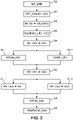
- FIG 2 there is shown a flowchart representing the steps of an embodiment according to the invention.
- the VRU application server 20 did not receive a VAM M6 from the first UE 61 which would have enabled it to update the VRU status 50. For example, a timer is started at the reception of the last VAM M6 received from the first UE 61 and no other VAM M6 is received when the timer ends. Thus, the connection between the VRU application server 20 and client 21 supported by the first UE 61 is lost.
- step S1 or S2 is implemented without previously implementing step S0.
- the VAM may be for example a message as described in ETSI TS 103 300-2 V2.1.1 (2020-05).
- the VRU application server 20 determines which vehicles are or will potentially be in the proximity of the VRU 1.
- the VRU application server 20 determines:
- the VRU application server 20 may implement step S2 with the vehicles which check this condition, in the example of figure 1 the vehicles are vehicle 2 and vehicle 3.
- any known method can be used to determine that one of the vehicles 2, 3, 4 is at a distance from the first UE 61 under a threshold or will be at a distance from the first UE 61 under the threshold.
- the VRU application server 20 may use a positioning system, for example, a GPS, to track the position of each vehicles 2, 3, 4.
- the position of the VRU 1 used to determine these distances may be the last position reported to the VRU application server 20 through the last VAM received.
- the VRU application server 20 sends a message M1 to the second UE and/or to the third UE through the communications 320 and 330 previously established.
- the first UE 61 and second UE 62 establish a D2D communication channel between them.
- the D2D communication may be established based on a radio discovery procedure. Indeed, based on the information on the radio resources, the second UE 62 may receive and decode the specific radio resources in which the first UE 61 may broadcast a VAM. If such VAM is received by the second UE 62, the second UE 62 can then establish a communication link with the first UE 61 based on the authentication information either to secure the communication channel between the second UE 62 and the first UE 61 and/or to connect the client 21 to the server 22 supported by the second UE 62.
- the second UE 62 sends to the first UE 61 and thus to the client 21 (at an application level) a message M2 through a D2D communication 321. Indeed, once the communication established between the first UE 61 and the second UE 62, the second UE 62 sends a message M2.
- message M2 contains a value Vi update of at least one of the VRU parameter Pi (PI or P3).
- the VRU application server 20 or the server 22 may reassign the ID of the client 21 (that is the application ID of the VRU 1), Vi update is thus the new ID.
- message M2 contains a value Vi or Vi' of at least one of the VRU parameter Pi (PI or P3).
- the VRU application server 20 or the server 22 may update the position of VRU 1. Therefore, M2 contains the position Vi or Vi' actually known by the VRU application server 20 or by the server 22.
- the first UE 61 updates the value Vi" of the VRU parameter Pi locally stored 51 and used by VRU 1 to the new value Vi update . This corresponds to the case of action 1.
- the first UE 61 compares the value Vi" of the VRU parameter Pi locally stored 51 and used by VRU 1 with the value Vi or Vi' sent in M2. This corresponds to the case of action 2. Therefore, the first UE 61 determines if the value Vi or Vi' of the VRU parameter of the VRU status 50, 52, 53 is up to date or not.
- the first UE 61 sends a message M3 to the second UE 62 via the communication 321, that is, the D2D communication established between the first UE 61 and the second UE 62.
- M3 may be sent through another communication channel, for example, via a classical cellular phone network.
- M3 may contained a confirmation of the update of Vi" to Vi update .
- M3 may only contain an information specifying such equality. If Vi" is different from Vi or Vi', M3 may comprise either the value Vi" or any information enabling the second UE 62 or the VRU application server 20 to retrieve said value Vi" (for example, the gap between Vi" and Vi or Vi'). Therefore, M3 comprises information related to the value Vi" to which le VRU parameter Pi of the VRU status should be updated.
- the second UE 62 (the part 22 of the VRU application supported by the second UE) sends a message M4 to the VRU application service 20.
- This message M4 contains the information transmitted to the second UE 62 by the first UE 61 in the message M3.
- M4 may contain a confirmation of the update of Vi" to Vi update or information enabling the second UE 62 or the VRU application server 20 to retrieve the value Vi".
- the second UE 62 (the part 22 of the VRU application supported by the second UE) sends a message M5 to the third UE.
- the message M5 may contain at least the same information than the message M4.
- the server 22 supported by the second UE 62 may transmit to the third UE any information transmitted to the clients of the VRU service by the servers.
- the server 22 may transmit to the client 23 the group ID of the VRU 1, the information on the radio resources used to establish a D2D communication with the first UE 61, etc.
- step S8 in the case action 1 is performed, that is, the VRU application server 20 or eventually the server 22 (when the second UE 62 replaces or duplicates the functions of the VRU application server 20) commands the client 21 to update the value of a VRU parameter 51 to the given value Vi update , the servers (20 and/or 22 and/or 23) of the VRU application validate that the client 21 has updated the parameter Pi 51 according to the value Vi update .
- each server (20 and/or 22 and/or 23) of the VRU application updates the status 50, 52, 53 it locally maintains, for example, by replacing the values Vi and/or Vi' by Vi".
- the clients (21, 22, 23) and servers (20, 22, 23) of the VRU application may perform the VRU avoidance method as described in ETSI TS 103 300-2 V2.1.1 (2020-05) based on the updated parameters Vi update and/or Vj".
- FIG. 3 there is shown the VRU application server 20, the first UE 61 and the second UE 62.
- the VRU application server 20 comprises a network interface (INT_NET) 20.3, one processing module (PROC_AS) 2.1 and a memory unit (MEMO_AS) 20.2.
- the MEMO_AS 20.2 comprises a non-volatile unit which retrieves the computer program and a volatile unit which retrieves the VRU status 50 with the different VRU parameter P1, P2, P3 of the VRU 1.
- the PROC_UE 20.1 is configured to perform at least the steps S0, S1, S2, S7.1, S8 and S9.
- the INT_NET 20.3 is configured to receive and transmit the messages M1 and M4 through the network.
- the first UE 61 comprises a communication module (COM_UE1) 61.3, one processing module (PROC_UE1) 61.1 and a memory unit (MEM0_UE1) 61.2.
- the MEMO_UE1 61.2 comprises a non-volatile unit which retrieves the computer program and a volatile unit which retrieves the VRU parameters 51 P1, P2, P3 used by the first UE 61 when implementing a VRU avoidance method.
- the PROC_UE 61.1 is configured to perform at least the steps S3, S4, S5.1, S5.2, S6 and S9.
- the COM_UE1 61.3 is configured to receive and transmit the messages M2, M3 and M6 through the network.
- the second UE 62 comprises a communication module (COM_UE2) 62.3, one processing module (PROC_UE2) 62.1 and a memory unit (MEMO_UE2) 62.2.
- the MEMO_UE2 62.2 comprises a non-volatile unit which retrieves the computer program and a volatile unit which retrieves the VRU parameters 51 P1, P2, P3 used by the first UE 61 when implementing a VRU avoidance method.
- the PROC_UE 62.1 is configured to perform at least the steps S2, S3, S4, S6, S7.1, S7.2, S8 and S9.
- the COM_UE1 62.3 is configured to receive and transmit the messages M1, M2, M3, M4 and M5 through the network.
Landscapes
- Engineering & Computer Science (AREA)
- Computer Networks & Wireless Communication (AREA)
- Signal Processing (AREA)
- Physics & Mathematics (AREA)
- General Physics & Mathematics (AREA)
- Multimedia (AREA)
- Mobile Radio Communication Systems (AREA)
- Traffic Control Systems (AREA)
Abstract
Description
- The present invention generally relates to the domain of device-to-device telecommunication system, and more specifically to vulnerable road user avoidance methods.
- In these methods the vulnerable road user (VRU) broadcasts a VRU Awareness Messages (VAM) that includes the VRU position, the VRU speed and various VRU related information. A vehicle in the coverage area of the VRU receives the VAM message, discovers the VRU and evaluates the risk of collision associated with the VRU. To perform such methods it is required that the VRU and the vehicle receive from an application server specific information. For example, the application server transmits resource planning to the vehicle and to the VRU to inform them of the radio resources to be used to broadcast the VAM. This specific information requires the VRU to update the parameters related to the VRU avoidance method and the application server to update the status of the VRU. If the values of the parameters of the VRU do not correspond to the values of these parameters of the VRU status of the application server the VRU avoidance method cannot be correctly performed.
- More precisely, in VRU avoidance methods, the VRU broadcast the VAM which is received by the application server. The VAM contains the current position of the VRU, the speed of the VRU and other VRU related information like the type of the VRU (for example, pedestrians or bicycle). Then the application server determines or updates the VRU status. That is, the application server updates the values of the parameters of the VRU status, which comprises for example:
- a parameter corresponding to an identification of the VRU,
- a parameter indicating the VAM reporting periodicity,
- synchronization information,
- radio resource planning for the VAM transmission,
- etc.
- The application server may transmit to the VRU new values of the VRU's parameters according to the updated VRU status. For example, the application server may change an ID or the radio resources reserved for transmitting the VAM. When these parameters are changed, the application server transmits to the VRU their new value.
- The application server transmits to the vehicle some information related to the new VRU status. The transmission of this information to the vehicle enables it to decode the radio resources in which the VRU transmits the VAM and therefore to discover the VRU. Based on the information received in the VAM the vehicle can evaluate the risk of collision with the VRU.
- The values of the parameters of the VRU (that is the values on the VRU side) should correspond to the values of these parameters of the VRU status (that is the values stored on the side of the application server) otherwise the application server will send to the vehicle information related to an incorrect VRU status. The vehicle will therefore not be able to implement the VRU avoidance method. VRU avoidance methods, thus, require the VRU to maintain connectivity with this application server. However, maintaining such connectivity may be difficult especially when the VRU is moving.
- The present invention aims at improving the situation.
- To that end, the invention relates to a method to relay a vulnerable road user, VRU, application server for updating a vulnerable road user parameter of a VRU corresponding to a first user equipment, UE, in a vehicle-to-everything, V2X, communication system, comprising:
- Receiving by a second UE a first message including information related to the VRU parameter of the first UE, said information being generated by an application server based on a VRU status of the first UE, said second UE corresponding to a vehicle and being in the V2X communication system ;
- Transmitting by the second UE to the first UE a second message including the information related to the VRU parameter via a device to device communication;
- Receiving by the second UE from the first UE a third message including information related to a value of the VRU parameter of the first UE.
- Therefore, when connectivity cannot be maintained between the first UE (corresponding to the VRU) and the application server is relayed by the second UE (corresponding to a vehicle which may as well be a VRU). That is, the second UE may perform at least part of the service performed by the application server during the time the application server and the first UE cannot exchange data. For example, based on the information related to a value of the VRU parameter, the second UE may maintain the VRU status of the VRU updated or may transmit this information to the application server which may maintain the VRU status of the VRU updated. More specifically, if the information related to a value of the VRU parameter indicates a different value than the value of the parameter of the VRU status, the VRU status is not up to date and the second UE, or the application server, may update the value of the parameter in the VRU status. If the information related to a value of the VRU parameter indicates a value identical to the value of the parameter of the VRU status (or simply confirms that the value has been updated according to the information of the second message), the VRU status is up to date no specific action needs to be taken by the second UE regarding the VRU status, however, the second UE may transmit the information related to the value of the VRU to the application server and/or other UE.
- Therefore, the VRU status, which is held by the application server when connection with the first UE is maintained, is held by the second UE and/or by the application server (information is then relayed to the application server via the second UE) when the application server cannot receive the VAM properly from the first UE.
- The second UE may relay the application server on only part of the status or even on only one parameter, that is, the first message only concerns one VRU parameter of the first UE. However, this first message or another message received by the second UE from the application server may concern more than one VRU parameter of the first UE or even all the parameters of the status.
- More generally, the VRU status may be maintained by the second UE rather than by the application server, thus the second UE fully relays the application server, which is advantageous when the connection between the second UE and the application server cannot be maintained. The VRU status may also be maintained by the application server, thus the second UE mainly relays the application server to transmit the information related to the VRU parameter to the first UE and eventually to transmit the information related to a value of the VRU parameter to the application server. The VRU status may be maintained by both the application server and the second UE, thus, the second UE, in addition to updating the status on its side, transmits the information related to the VRU parameter to the first UE and transmits the information related to a value of the VRU parameter to the application server. In addition to any of these possibilities, another UE may also maintain the VRU status, therefore the application server transmits to this another UE the same message it sends to the second UE when the second UE maintains the status as it will be seen with the third UE and the second UE sends to this another UE the information related to a value of the VRU parameter to the application server as it will also be seen with the third UE.
- When the status is maintained by another entity than the application server, the first message (or an equivalent message sent to another UE when it is maintained by this another UE) may include information related to other VRU parameters, eventually all the VRU parameters of the VRU. The another UE may be considered as the third UE in the following.
- The invention thus avoids slow VRU discovery by the other vehicles due to VRU parameter mismatch between the VRU and the other vehicles due for example to unavailability of a connection with the application server. Therefore, latency is reduced when performing a VRU avoidance method.
- By VRU avoidance method it is understood any method which enables a vehicle (for example corresponding to the second or third UE) to estimate the probability of a collision with the VRU, and eventually to alert the driver of the vehicle.
- By vulnerable road user it is understood any user of space shared with motorized vehicles (for example roads) or dedicated to motorized vehicles (for example highways) and/or user of the space near those space (for example sidewalks) that could suffer from a collision with these motorized vehicles. It is for example, pedestrians, motorcycle, bicycle, etc. Vulnerable road user may also be defined according to ITS Directive as all the non-motorized road users (such as pedestrians and cyclists), the motorcyclists and people with disabilities or reduced mobility and orientation whatever vehicle they are driving. Vulnerable road user may also be understood as defined by the ETSI in its report "Intelligent Transport System (ITS); Vulnerable Road Users (VRU) awareness; Part 1: Use Cases definition;
Release 2" (ETSI TR 103 300-1 V2.1.1) which considers the user but also the situation of this user in its environment (see table 4 of the ETSI report). - By VRU application server it is understood the server which manages and/or provides the VRU service (which is an VRU avoidance method), that is, the service which aims at minimizing the conflict between VRUs and the other vehicles.
- By vulnerable road user parameter of a VRU it is understood a parameter for which a value specific to the VRU is determined either by the VRU its self (for example, speed or position) or by the VRU application server (for example, application ID of the VRU) and/or by the UE which relays the VRU application server. The VRU status (which is held by the VRU application server and/or by another UE which relays the VRU application server such as the second UE) comprises the values specific to the VRU of each of the parameter of the VRU. The VRU status is held by the VRU application server and/or by any UE which relays the VRU application server. That is, the VRU status is stored and may be updated by the entity which holds the VRU status. The VRU status is specific to each VRU. The VRU itself may have a copy of the VRU status. However, the VRU stores the values of at least one of the parameters of the VRU status.
- Updating such VRU parameters is understood as modifying the value of the parameter related (or specific) to the VRU either in the status and/or directly on the first UE.
- By VRU corresponding to a user equipment (or a user equipment corresponding to the VRU) it is understood the VRU transporting the UE.
- By vehicle-to-everything communication system it is understood a computer networks in which vehicles and roadside units are the communicating nodes enabling at least to perform communications between the UEs of the vehicles, the UEs of the VRUs and the VRU application servers of this network.
- By information related to the VRU parameter it is understood any information related to the VRU parameter, for example, the value of that parameter in the VRU status (on the application server side), the value to which the application server requires the first UE to update the parameter (on the UE side), a request intended to the first UE to send the value to which is set the parameter (on the UE side), etc.
- By device to device communication (D2D) it is understood a direct communication between two UE.
- The transmission of the second message from the second UE to the first UE may be performed after a radio discovery of the first UE by the second UE to establish a communication channel. For example, the first UE broadcasts a VAM through specific radio resources which are decoded by the second UE leading to the reception of the VAM when the second UE and the first UE are close enough to each other.
- The transmission of the third message from the first UE to the second UE may be performed via any type of communication, for example, through a device-to-device communication or through a cellular communication network.
- According to an aspect of the invention, the method further comprises determining by the application server that the second UE is at a distance from the first UE under a threshold and/or that under a predetermined duration the second UE will be at a distance from the first UE under the threshold.
- Therefore, the second UE is more likely to be able to perform the D2D communication with the first UE (for example, after a discovery procedure) when the second UE is chosen near the first UE or will be more likely to be able to perform the D2D communication with the first UE if it is heading towards the first UE.
- Any methods can be used to determine that the second UE is at a distance from the first UE under a threshold or that the second UE will be at a distance from the first UE under the threshold. For example, the application server may use a positioning system (for example, GPS, internet geolocation, Radiolocation, etc) or the application server may deduce the position and/or the path of the first UE based on previous D2D exchanges between the second UE and other UEs in the network. The position of the first UE may be assimilated to the last position reported to the application server through the VAM, this position may be improved with the information regarding the last speed of the first UE reported to the VRU application server.
- According to an aspect of the invention, the method further comprises transmitting by the second UE to a third UE corresponding to another vehicle and being in the V2X communication system a fifth message including information related to the value of the VRU parameter of the first UE.
- Therefore, the second UE transmits a message including information related to the value of the VRU parameter based on the information received via the third message. This enables the third UE to have the last updated value of the VRU parameter and therefore if the third UE, which corresponds to another vehicle, relays the application server as the second UE did he will be able to update the status or at least the VRU parameter even if the application server did not receive the information related to a value of the VRU parameter (which may happen when the second UE lost its connection with the application server, for example, when the first and the second UE are in a zone which is underserved in the cellular network due for example to the environment). This also reduces the latency between the time the second UE receives the third message and the time the third UE receives the information related to the value of the VRU parameter, which is especially advantageous in the vehicles are driving in the same direction requiring fast update to perform the VRU avoidance method.
- The transmission between the second UE and the third UE can be of any type, for example, through a device-to-device communication (which offers the best reduction of latency) or through a cellular communication network (which still reduces the latency since the application server does not process the information).
- According to an aspect of the invention, the method further comprises transmitting by the second UE to the application server a fourth message including information related to the value of the VRU parameter of the first UE.
- Therefore, the application server may update or validate the update of the status that it holds. Thus, when the connection with the first UE returns the application server may proceed with the normal update procedure based on the last updates of the VRU status. If the connection with the first UE does not return, the application server may also be relayed by another UE based on the last updated status.
- According to an aspect of the invention, the method further comprises updating by the first UE the parameter to the value based on the information related to the VRU parameter.
- This is the case when the parameter involved is managed by the application server, for example, the VRU ID (also called application ID since this ID is related to the application layer) of the first UE, which may not be the case for example with the parameter corresponding to the position of the VRU. The information related to the VRU parameter may therefore include the value to which the first UE updates the parameter. In addition, the information related to the VRU may also include an update command which commands the VRU (the first UE) to update the VRU parameter according to the value. Alternatively, the first UE may be configured to update to the value received when this value refers to specific VRU parameters.
- According to an aspect of the invention, the method further comprises setting by the application server the VRU parameter of the VRU status of the first UE to an updated value based on the information related to the value.
- This is the case when the parameter involved is managed by the first UE, for example the parameter corresponding to the position or the speed or the trajectory of the VRU. The information related to the value is sent by the second UE in the third message.
- Alternatively or in complementary, setting the VRU parameter of the VRU status of the first UE to an updated value based on the information related to the value may be done by the second UE (or by the third UE when the fifth message is sent to it) when the VRU status is held by the second UE. Therefore, the transmission of the fourth message is not necessary. However, the VRU status may be held by several entities, that is, at least by the application server and the second UE or another UE (for example, the third UE).
- According to an aspect of the invention, the information related to the VRU parameter comprises a previous to update value of the VRU parameter of the VRU status and further comprising comparing by the first UE the previous to update value with the value of the VRU parameter of the first UE.
- Therefore, the first UE may determine if the value of the VRU parameter of the VRU status is up to date or not, if it is not up to date, the first UE may indicate it in the third message.
- In any case, the third message including information related to a value of the VRU parameter of the first UE may be sent:
- when the parameter is managed by the application server: to transmit the value to which the first UE has updated the VRU parameter, for example, when the first UE does not update to the value instructed by the application server, or to transmit only a confirmation that the value has been updated;
- when the parameter is managed by the application server: to transmit the value to which the VRU application server (or the UE which relays the VRU application server) should update the VRU parameter.
- According to an aspect of the invention, the method further comprises transmitting by the application server to the second UE and/or to the third UE, the first message when the application server does not receive or does not receive in time from the first UE a sixth message including information related to the VRU parameter of the first UE.
- Therefore, the second UE and/or the third UE (that is, the another UE) relay the application server when the connection with the first UE cannot be maintained. This reduces the data exchanged between the application server and the UEs that may relay it, and reduces the data to be stored by these UEs. However, the relay of the application server may be implemented on a permanent basis to ensure less delay for updating the status when the first UE loses its connection to the application server. The sixth message may be any type of message, for example, a broadcast message or a point-to-point message. By losing connection between the first UE and the application server it is understood that the application server no longer receives the sixth message or message like the sixth message from the first UE. When the sixth message is a broadcast message it may be a VRU Awareness Messages, VAM, that is, the message sent by the first UE to broadcast information (for example, the position of the VRU) to the proximate vehicles to enable them to perform a VRU avoidance method.
- According to an aspect of the invention the VRU parameter is one among a position of the VRU, a speed of the VRU, a movement direction of the VRU, a VRU group ID, VRU identification information in the network as user terminal (UE), VRU application identification information in the application server or any other information for charactering the VRU group or cluster and/or the VRU application.
- By position, speed and movement direction of the VRU it is understood the geographical position, speed and movement of the VRU which transports the first UE in the environment of the VRU. These values of these VRU parameters may be determined by the first UE directly or the first UE may transmit, for example, in the sixth message, data enabling the application server and/or the second UE and/or the third UE to determine these values. Any methods can be used to determine the values of these VRU parameters. For example, they can be obtained by using a positioning system (for example, GPS, internet geolocation, Radiolocation, etc) or obtained based on previous D2D exchanges between the second UE and other UEs in the network.
- By VRU group ID it is understood an ID identifying the cluster of close VRUs in the region of the deployment of the network. The group is identified by its size, range and group head. The group head (one among the VRUs of the cluster) relays information locally to the VRU group members. The group ID may be for example an identifier to identify uniquely the group head in the network. This identifier is shared between the group head and the VRU group members. The group ID may be also defined by the application server to identify uniquely clusters of VRUs in the deployment.
- By UE identification information (ID) it is understood any information which enables the application server and/or the second UE and/or the third UE and more generally any entities involved in the service to identify the first UE. This ID is therefore involved in identification at the level of the application layer. This ID is determined and/or attributed by the application server and/or the UE which relays the application server.
- Other parameters may be related to the identification of the VRU application. In this case, multiple VRU application can be deployed for the VRUs. The VRU application may be related to the class information. An application may be used for example for pedestrians and another one may be defined for cyclists or motorcyclists.
- According to an aspect of the invention the device to device communication is established based on communication parameters transmitted by the application server.
- This enables the second UE to set up a communication channel with the first UE. These communication parameters correspond for example to the radio resources that will be used by the first UE to send a VAM based on which the second UE discovers the first UE. These communication parameters may be transmitted in the first message.
- A second aspect of the invention concerns a user equipment, UE, configured to relay a vulnerable road user, VRU, application server for updating a vulnerable road user parameter of a VRU corresponding to another user equipment, UE, in a vehicle-to-everything, V2X, communication system, the UE corresponds to a vehicle and is in the V2X communication system, said UE comprises:
- a processor; and
- a non-transitory computer-readable medium comprising instructions stored thereon, which when executed by the processor configure the UE to:
- receive a first message including information related to the VRU parameter of the another UE, said information being generated by an application server based on a VRU status of the another UE;
- transmit to the another UE a second message including the information related to the VRU parameter via a device to device communication;
- receive from the another UE a third message including information related to a value of the VRU parameter of the another UE via the device to device communication.
- A third aspect of the invention concerns a method to relay a vulnerable road user, VRU, application server for updating a vulnerable road user parameter of a VRU corresponding to a first user equipment, UE, in a vehicle-to-everything, V2X, communication system, comprising:
- transmitting by the VRU application server to at least the second UE a message including an information related to the VRU parameter of the first UE based on a VRU status of the first UE, said second UE corresponding to a vehicle and being in the V2X communication system;
- receiving by the VRU application server from a least the second UE another message including information related to the value of the VRU parameter of the first UE.
- According to an aspect of the invention, the method further comprises generating by the application server the information related to the VRU parameter of the first UE based on a VRU status of the first UE.
- A fourth aspect of the invention concerns a vulnerable road user, VRU, application server configured to relay an application service to a second user equipment, UE, for updating a vulnerable road user parameter of a VRU corresponding to a first UE in a vehicle-to-everything, V2X, communication system, the UE corresponds to a vehicle and is in the V2X communication system, said VRU application server comprises:
- a processor; and
- a non-transitory computer-readable medium comprising instructions stored thereon, which when executed by the processor configure the VRU application server to:
- transmit to at least the second UE a message including an information related to the VRU parameter of the first UE based on a VRU status of the first UE, said second UE corresponding to a vehicle and being in the V2X communication system;
- receive from at least the second UE another message including information related to the value of the VRU parameter of the first UE.
- A fifth aspect of the invention concerns a method to relay a vulnerable road user, VRU, application server for updating a vulnerable road user parameter of a VRU corresponding to a first user equipment, UE, in a vehicle-to-everything, V2X, communication system, comprising:
- Receiving by the first UE from a second UE a message including an information related to the VRU parameter of the first UE via a device to device communication, said information being generated by an application server based on a VRU status of the first UE, said second UE corresponding to a vehicle and being in the V2X communication system;
- Transmitting by the first UE to the second UE another message including information related to a value of the VRU parameter of the first UE via the device to device communication.
- A sixth aspect of the invention concerns a user equipment, UE, client of a vulnerable road user, VRU, application server, said UE corresponds to a VRU and is in the V2X communication system, said UE comprises:
- a processor; and
- a non-transitory computer-readable medium comprising instructions stored thereon, which when executed by the processor configure the UE to:
- receive from another UE a message including an information related to a VRU parameter of the UE via a device to device communication, said information being generated by an application server based on a VRU status of the UE, said another UE corresponding to a vehicle and being in the V2X communication system;
- transmitting by the UE to the another UE another message including information related to a value of the VRU parameter of the UE via the device to device communication.
- A seventh aspect of the invention concerns a computer program product comprising code instructions to perform the method as described previously when said instructions are run by a processor.
- The present invention is illustrated by way of example, and not by way of limitation, in the figures of the accompanying drawings, in which like reference numerals refer to similar elements and in which:
-
Figure 1 illustrates a system implementing an embodiment of the invention. -
Figure 2 illustrates a flowchart representing an embodiment of the invention. -
Figure 3 illustrates a VRU application server and a first UE and a second UE implementing an embodiment of the invention. - Referring to
figure 1 , it is shown a V2X communication system implementing an embodiment of the invention. Infigure 1 there is shown a VRU 1 which is in this example a user of a space near a space used by motorized vehicles (sidewalk) and may eventually use the pedestrian crossing which is a space shared with motorized vehicles. Other vehicles which are motorized are also represented 2, 3 and 4. Thesevehicles vehicles vehicle 4 and the VRU 1 may also present such risk ifvehicle 4 turns on its left or if the VRU 1 crosses the road without using the pedestrian crossing. - The VRU avoidance method implemented by the V2X communication system involves a distributed VRU application on a client-server based model. A server part of this application is supported by a
VRU application server 20. - The VRU 1 carries a UE, named first UE. The first UE supports the
client 21 part of the VRU application. - The
Vehicle 2 carries a UE, named second UE. The second UE supports also aclient 22 part of the VRU application. In addition, the second UE may also support aserver 22 part of the VRU application when the second UE replaces or duplicates the functions of the VRU application server. When the second UE acts as a relay for the transmission of messages and not replacing or acting as a server the second UE does not support a server part of the VRU application and only acts like an end point entity of the network when it is considered as a client. - The
Vehicle 3 carries a UE, named third UE. The third UE supports also aclient 23 part of the VRU application and may also support aserver 23 part of the VRU application as it is done with the second UE. - The
Vehicle 4 may be identical to the other vehicles (and may carry a UE which supports part of the VRU application), however, for the sake of simplicityfigure 1 does not show these details. - Each of these entities (first UE, second UE, third UE and the VRU application server) may communicate via a network including a V2X communication system or any other communication system. For example, the
communications vehicles VRU application server 20 may be supported by a classical cellular communication network. For instance, a radio channel may be established between thebase station 40 and thevehicles vehicles VRU application server 20. Thecommunications vehicles VRU application server 20 may as well use a satellite communication technic. Thecommunication 310 between the VRU 1 and theVRU application server 20 may use the same technics as for the communications between thevehicles - The
communication 321 between the VRU 1 andvehicle 2 is a D2D communication. However, part of the exchange (transmitting M3 from the first UE to the second UE) may be performed on another basis, for example, with the same technics used between thevehicles VRU application server 20. Thecommunication 332 between the twovehicles - The
VRU application server 20 stores astatus 50 of the VRU 1 comprising values (PI, P2, P3, etc) of the VRU parameters. These VRU parameters are used by the VRU 1 and by thevehicles status 50 may comprise for each parameter (PI, P2 and P3) the values (VI, V2 and V3) corresponding to the VRU 1. When the second UE and/or the third UE ofvehicles VRU application server 20, theservers 22 and/or 23 maintain aVRU status 52 and/or 53 of the VRU 1, that is, they store and if needed update the VRU status. When the second UE and/or the third UE ofvehicles VRU application server 20 but only transmit the messages between theclient 21 of the first UE and theVRU application server 20, the second UE and third UE may not maintain any status of the VRU 1. - Referring to
figure 2 there is shown a flowchart representing the steps of an embodiment according to the invention. - At step S0, the
VRU application server 20 did not receive a VAM M6 from thefirst UE 61 which would have enabled it to update theVRU status 50. For example, a timer is started at the reception of the last VAM M6 received from thefirst UE 61 and no other VAM M6 is received when the timer ends. Thus, the connection between theVRU application server 20 andclient 21 supported by thefirst UE 61 is lost. - In case the
VRU application server 20 does not receive such VAM M6 it cannot update theVRU status 50 and therefore triggers the next steps so that thesecond UE 62 and/or the third UE relay it. However, this step may be optional, and thesecond UE 62 and/or the third UE may relay theVRU application server 20 independently from the reception or not of a VAM M6 from thefirst UE 61 which corresponds to the VRU 1. In that case step S1 or S2 is implemented without previously implementing step S0. - The VAM may be for example a message as described in ETSI TS 103 300-2 V2.1.1 (2020-05).
- At step S1, the
VRU application server 20 determines which vehicles are or will potentially be in the proximity of the VRU 1. - For example, the
VRU application server 20 determines: - the distances between the VRU 1 and the
vehicles - the directions to which heads the
vehicles - If at least one of the distances is under a threshold or if one of the directions to which heads the
vehicles VRU application server 20 to predict that one of thevehicles VRU application server 20 may implement step S2 with the vehicles which check this condition, in the example offigure 1 the vehicles arevehicle 2 andvehicle 3. - Any known method can be used to determine that one of the
vehicles first UE 61 under a threshold or will be at a distance from thefirst UE 61 under the threshold. For example, theVRU application server 20 may use a positioning system, for example, a GPS, to track the position of eachvehicles VRU application server 20 through the last VAM received. - At step S2, the
VRU application server 20 sends a message M1 to the second UE and/or to the third UE through thecommunications - These messages may comprise:
- the VRU status as maintained by the
VRU application server 20, that is, theVRU status 50. This is mainly the case whenserver 22 and/or 23 at least partly replace or duplicate the service provided by theVRU application server 20; - communication information (also referred to as communication parameters) comprising:
- ∘ authentication information enabling the
servers client 21 or simply to secure the transmission of message M3, and - ∘ information on specific radio resources that may be used to establish a
communication link 321 with thefirst UE 61;
- ∘ authentication information enabling the
- information related to the action to be performed by the
second UE 62 or the third UE. For example, theVRU application server 20 informs thesecond UE 62 or the third UE to duplicate the functions of theVRU application server 20. Or theVRU application server 20 informs thesecond UE 62 or the third UE to command theclient 21 to update one of theVRU parameters 51 to a value given by the VRU application server 20 (action 1). Or theVRU application server 20 may inform thesecond UE 62 or the third UE to command theclient 21 to compare the value of aVRU parameter 51 given in the information related to the action to be performed with the value of thisVRU parameter 51 used by theclient 21 and to transmit this value if different (action 2). When theVRU application server 20 commands thesecond UE 62 or the third UE to replicate or duplicate the functions of theVRU application server 20, theservers action 2 depending on the needs. Therefore, only the case of action 1 andaction 2 will be described in detail in the following. - At step S3, the
first UE 61 andsecond UE 62 establish a D2D communication channel between them. The D2D communication may be established based on a radio discovery procedure. Indeed, based on the information on the radio resources, thesecond UE 62 may receive and decode the specific radio resources in which thefirst UE 61 may broadcast a VAM. If such VAM is received by thesecond UE 62, thesecond UE 62 can then establish a communication link with thefirst UE 61 based on the authentication information either to secure the communication channel between thesecond UE 62 and thefirst UE 61 and/or to connect theclient 21 to theserver 22 supported by thesecond UE 62. - At step S4, the
second UE 62, more specifically thepart 22 of the VRU application supported by thesecond UE 62, sends to thefirst UE 61 and thus to the client 21 (at an application level) a message M2 through aD2D communication 321. Indeed, once the communication established between thefirst UE 61 and thesecond UE 62, thesecond UE 62 sends a message M2. - In the case of action 1, message M2 contains a value Viupdate of at least one of the VRU parameter Pi (PI or P3). For example, the
VRU application server 20 or theserver 22 may reassign the ID of the client 21 (that is the application ID of the VRU 1), Viupdate is thus the new ID. - In the case of
action 2, message M2 contains a value Vi or Vi' of at least one of the VRU parameter Pi (PI or P3). For example, theVRU application server 20 or theserver 22 may update the position of VRU 1. Therefore, M2 contains the position Vi or Vi' actually known by theVRU application server 20 or by theserver 22. - At step S5.1, the
first UE 61 updates the value Vi" of the VRU parameter Pi locally stored 51 and used by VRU 1 to the new value Viupdate. This corresponds to the case of action 1. - At step S5.2, the
first UE 61 compares the value Vi" of the VRU parameter Pi locally stored 51 and used by VRU 1 with the value Vi or Vi' sent in M2. This corresponds to the case ofaction 2. Therefore, thefirst UE 61 determines if the value Vi or Vi' of the VRU parameter of theVRU status - At step S6, the
first UE 61 sends a message M3 to thesecond UE 62 via thecommunication 321, that is, the D2D communication established between thefirst UE 61 and thesecond UE 62. Alternatively, M3 may be sent through another communication channel, for example, via a classical cellular phone network. - In case action 1 is performed, M3 may contained a confirmation of the update of Vi" to Viupdate.
- In
case action 2 is performed, if Vi" is equal to Vi or Vi', then M3 may only contain an information specifying such equality. If Vi" is different from Vi or Vi', M3 may comprise either the value Vi" or any information enabling thesecond UE 62 or theVRU application server 20 to retrieve said value Vi" (for example, the gap between Vi" and Vi or Vi'). Therefore, M3 comprises information related to the value Vi" to which le VRU parameter Pi of the VRU status should be updated. - At step S7.1, the second UE 62 (the
part 22 of the VRU application supported by the second UE) sends a message M4 to theVRU application service 20. - This message M4 contains the information transmitted to the
second UE 62 by thefirst UE 61 in the message M3. For example, M4 may contain a confirmation of the update of Vi" to Viupdate or information enabling thesecond UE 62 or theVRU application server 20 to retrieve the value Vi". - At step S7.2, the second UE 62 (the
part 22 of the VRU application supported by the second UE) sends a message M5 to the third UE. - When the third UE replaces or duplicates the functions of the
VRU application server 20 the message M5 may contain at least the same information than the message M4. In addition or in complementary, when thesecond UE 62 replaces or duplicates the functions of theVRU application server 20, theserver 22 supported by thesecond UE 62 may transmit to the third UE any information transmitted to the clients of the VRU service by the servers. For example, theserver 22 may transmit to theclient 23 the group ID of the VRU 1, the information on the radio resources used to establish a D2D communication with thefirst UE 61, etc. - At step S8, in the case action 1 is performed, that is, the
VRU application server 20 or eventually the server 22 (when thesecond UE 62 replaces or duplicates the functions of the VRU application server 20) commands theclient 21 to update the value of aVRU parameter 51 to the given value Viupdate, the servers (20 and/or 22 and/or 23) of the VRU application validate that theclient 21 has updated theparameter Pi 51 according to the value Viupdate. - In the
case action 2 is performed, that is, theclient 21 informs the servers (20 and/or 22 and/or 23) of the value Vi" used by it, each server (20 and/or 22 and/or 23) of the VRU application updates thestatus - At step S9, the clients (21, 22, 23) and servers (20, 22, 23) of the VRU application may perform the VRU avoidance method as described in ETSI TS 103 300-2 V2.1.1 (2020-05) based on the updated parameters Viupdate and/or Vj".
- Referring to
figure 3 , there is shown theVRU application server 20, thefirst UE 61 and thesecond UE 62. - The
VRU application server 20 comprises a network interface (INT_NET) 20.3, one processing module (PROC_AS) 2.1 and a memory unit (MEMO_AS) 20.2. The MEMO_AS 20.2 comprises a non-volatile unit which retrieves the computer program and a volatile unit which retrieves theVRU status 50 with the different VRU parameter P1, P2, P3 of the VRU 1. - The PROC_UE 20.1 is configured to perform at least the steps S0, S1, S2, S7.1, S8 and S9.
- The INT_NET 20.3 is configured to receive and transmit the messages M1 and M4 through the network.
- The
first UE 61 comprises a communication module (COM_UE1) 61.3, one processing module (PROC_UE1) 61.1 and a memory unit (MEM0_UE1) 61.2. The MEMO_UE1 61.2 comprises a non-volatile unit which retrieves the computer program and a volatile unit which retrieves theVRU parameters 51 P1, P2, P3 used by thefirst UE 61 when implementing a VRU avoidance method. - The PROC_UE 61.1 is configured to perform at least the steps S3, S4, S5.1, S5.2, S6 and S9.
- The COM_UE1 61.3 is configured to receive and transmit the messages M2, M3 and M6 through the network.
- The
second UE 62 comprises a communication module (COM_UE2) 62.3, one processing module (PROC_UE2) 62.1 and a memory unit (MEMO_UE2) 62.2. The MEMO_UE2 62.2 comprises a non-volatile unit which retrieves the computer program and a volatile unit which retrieves theVRU parameters 51 P1, P2, P3 used by thefirst UE 61 when implementing a VRU avoidance method. - The PROC_UE 62.1 is configured to perform at least the steps S2, S3, S4, S6, S7.1, S7.2, S8 and S9.
- The COM_UE1 62.3 is configured to receive and transmit the messages M1, M2, M3, M4 and M5 through the network.
Claims (18)
- Method to relay a vulnerable road user, VRU, application server for updating a vulnerable road user parameter of a VRU corresponding to a first user equipment, UE, in a vehicle-to-everything, V2X, communication system, comprising:Receiving from the VRU application server by a second UE a first message including information related to the VRU parameter of the first UE, said second UE corresponding to a vehicle and being in the V2X communication system ;Transmitting by the second UE to the first UE a second message including the information related to the VRU parameter via a device to device communication;Receiving by the second UE from the first UE a third message including information related to a value of the VRU parameter of the first UE.
- Method according to claim 1 further comprising determining by the application server that the second UE is at a distance from the first UE under a threshold and/or that under a predetermined duration the second UE will be at a distance from the first UE under the threshold.
- Method according to any one of the previous claims further comprising transmitting by the second UE to a third UE corresponding to another vehicle and being in the V2X communication system a fifth message including information related to the value of the VRU parameter of the first UE.
- Method according to any one of the previous claims further comprising transmitting by the second UE to the application server a fourth message including information related to the value of the VRU parameter of the first UE.
- Method according to any one of the previous claims further comprising updating by the first UE the VRU parameter to the value based on the information related to the VRU parameter.
- Method according to claim 4 further comprising setting by the application server the VRU parameter of a VRU status of the first UE to an updated value based on the information related to the value.
- Method according to claim 6 wherein the information related to the VRU parameter comprises a previous to update value of the VRU parameter of the VRU status and further comprising comparing by the first UE the previous to update value with the value of the VRU parameter of the first UE.
- Method according to any one of the previous claims further comprising transmitting by the application server to the second UE and/or to the third UE, the first message when the application server does not receive or does not receive in time from the first UE a sixth message including information related to the VRU parameter of the first UE.
- Method according to claim 8 wherein the sixth message is a VRU Awareness Messages, VAM.
- Method according to any one of the previous claims wherein the VRU parameter is one among a position of the VRU, a speed of the VRU, a VRU group ID, UE identification information.
- Method according to any one of the previous claims wherein the device to device communication is establish based on communication parameters transmitted by the application server.
- Method according to claim 11 further comprising, based on the communication parameters, the second UE receives a VRU Awareness Messages, VAM from the first UE.
- A user equipment, UE, configured to relay a vulnerable road user, VRU, application server for updating a vulnerable road user parameter of a VRU corresponding to another user equipment, UE, in a vehicle-to-everything, V2X, communication system, the UE corresponds to a vehicle and is in the V2X communication system, said UE comprises:a processor; anda non-transitory computer-readable medium comprising instructions stored thereon, which when executed by the processor configure the UE to:receive a first message including information related to the VRU parameter of the another UE, said information being generated by an application server based on a VRU status of the another UE;transmit to the another UE a second message including the information related to the VRU parameter via a device to device communication;receive from the another UE a third message including information related to a value of the VRU parameter of the another UE.
- Method to relay a vulnerable road user, VRU, application server for updating a vulnerable road user parameter of a VRU corresponding to a first user equipment, UE, in a vehicle-to-everything, V2X, communication system, comprising:transmitting by the VRU application server to at least the second UE a message including an information related to the VRU parameter of the first UE based on a VRU status of the first UE, said second UE corresponding to a vehicle and being in the V2X communication system;receiving by the VRU application server from a least the second UE another message including information related to the value of the VRU parameter of the first UE.
- A vulnerable road user, VRU, application server configured to relay an application service to a second user equipment, UE, for updating a vulnerable road user parameter of a VRU corresponding to a first UE in a vehicle-to-everything, V2X, communication system, the UE corresponds to a vehicle and is in the V2X communication system, said VRU application server comprises:a processor; anda non-transitory computer-readable medium comprising instructions stored thereon, which when executed by the processor configure the VRU application server to:transmit at least to the second UE a message including an information related to the VRU parameter of the first UE based on a VRU status of the first UE, said second UE corresponding to a vehicle and being in the V2X communication system;receive from at least the second UE another message including information related to the value of the VRU parameter of the first UE.
- Method to relay a vulnerable road user, VRU, application server for updating a vulnerable road user parameter of a VRU corresponding to a first user equipment, UE, in a vehicle-to-everything, V2X, communication system, comprising:Receiving by the first UE from a second UE a message including an information related to the VRU parameter of the first UE via a device to device communication, said information being generated by an application server based on a VRU status of the first UE, said second UE corresponding to a vehicle and being in the V2X communication system;Transmitting by the first UE to the second UE another message including information related to a value of the VRU parameter of the first UE via the device to device communication.
- A user equipment, UE, client of a vulnerable road user, VRU, application server, said UE corresponds to a VRU and is in the V2X communication system, said UE comprises:a processor; anda non-transitory computer-readable medium comprising instructions stored thereon, which when executed by the processor configure the UE to:receive from another UE a message including an information related to a VRU parameter of the UE via a device to device communication, said information being generated by an application server based on a VRU status of the UE, said another UE corresponding to a vehicle and being in the V2X communication system;transmit by the UE to the another UE another message including information related to a value of the VRU parameter of the UE via the device to device communication.
- Computer program product comprising code instructions to perform the method according to any one of claims 1 to 12, 14 and 16, when said instructions are run by at least a processor.
Priority Applications (6)
| Application Number | Priority Date | Filing Date | Title |
|---|---|---|---|
| EP20306666.7A EP4020429B1 (en) | 2020-12-22 | 2020-12-22 | Vru parameter update |
| PCT/JP2021/025230 WO2022137611A1 (en) | 2020-12-22 | 2021-06-28 | Method to relay vru application server for updating vru, and ue, vru application server, and ue crient |
| US18/034,118 US20230386337A1 (en) | 2020-12-22 | 2021-06-28 | Method to relay vru application server for updating vru, and ue, vru application server, and ue crient |
| KR1020237019799A KR102811204B1 (en) | 2020-12-22 | 2021-06-28 | Method for relaying a VRU application server that updates a VRU, and a UE, a VRU application server, and a UE client |
| CN202180084796.1A CN116746172A (en) | 2020-12-22 | 2021-06-28 | Relay method for updating VRU application server of VRU, and UE, VRU application server and UE client |
| JP2023539221A JP7691500B2 (en) | 2020-12-22 | 2021-06-28 | Method for relaying VRU application server for updating VRU, and UE, VRU application server, and UE client - Patent application |
Applications Claiming Priority (1)
| Application Number | Priority Date | Filing Date | Title |
|---|---|---|---|
| EP20306666.7A EP4020429B1 (en) | 2020-12-22 | 2020-12-22 | Vru parameter update |
Publications (2)
| Publication Number | Publication Date |
|---|---|
| EP4020429A1 true EP4020429A1 (en) | 2022-06-29 |
| EP4020429B1 EP4020429B1 (en) | 2024-07-17 |
Family
ID=74191498
Family Applications (1)
| Application Number | Title | Priority Date | Filing Date |
|---|---|---|---|
| EP20306666.7A Active EP4020429B1 (en) | 2020-12-22 | 2020-12-22 | Vru parameter update |
Country Status (6)
| Country | Link |
|---|---|
| US (1) | US20230386337A1 (en) |
| EP (1) | EP4020429B1 (en) |
| JP (1) | JP7691500B2 (en) |
| KR (1) | KR102811204B1 (en) |
| CN (1) | CN116746172A (en) |
| WO (1) | WO2022137611A1 (en) |
Families Citing this family (1)
| Publication number | Priority date | Publication date | Assignee | Title |
|---|---|---|---|---|
| EP4323262A4 (en) * | 2021-04-12 | 2025-07-09 | Spoke Safety Inc | DATA-DRIVEN AUTONOMOUS COMMUNICATION OPTIMIZATION SECURITY SYSTEMS, DEVICES AND METHODS |
Citations (2)
| Publication number | Priority date | Publication date | Assignee | Title |
|---|---|---|---|---|
| WO2018128946A1 (en) * | 2017-01-06 | 2018-07-12 | Pcms Holdings, Inc. | Method for providing vulnerable road user warnings in a blind spot of a parked vehicle |
| US20190159084A1 (en) * | 2016-08-11 | 2019-05-23 | Fujitsu Limited | Information Transmission Method and Apparatus and Communication System |
Family Cites Families (32)
| Publication number | Priority date | Publication date | Assignee | Title |
|---|---|---|---|---|
| US7286043B2 (en) * | 2003-04-28 | 2007-10-23 | Battelle Memorial Institute K1-53 | System and method for inventorying multiple remote objects |
| US9615354B2 (en) * | 2008-07-17 | 2017-04-04 | Nokia Solutions And Networks Oy | Device-to-device communications in cellular system |
| US10021621B2 (en) * | 2015-04-03 | 2018-07-10 | Qualcomm Incorporated | UE-to-UE relay list and determination of floor arbitrator |
| KR102415672B1 (en) * | 2015-04-09 | 2022-07-04 | 삼성전자주식회사 | Method and appratus for transmitting and receiving a message between devices |
| JP2018523322A (en) | 2015-06-24 | 2018-08-16 | インテル アイピー コーポレーション | Extended support for VEHICLE-TO-ANYTHING (V2X) communication |
| KR102424678B1 (en) * | 2015-06-24 | 2022-07-22 | 인텔 코포레이션 | Enhanced Proximity Services (ProSe) Protocol for Vehicle-to-X (V2X) Communication |
| WO2017007104A1 (en) | 2015-07-07 | 2017-01-12 | 엘지전자 주식회사 | Communication method of terminal in v2x communication system, and terminal |
| EP3353939B1 (en) | 2015-09-25 | 2022-08-17 | Telefonaktiebolaget LM Ericsson (PUBL) | Per-packet resource pool selection in lte v2x system |
| EP3360350B1 (en) | 2015-10-06 | 2021-08-04 | LG Electronics Inc. | A method and apparatus for transmittng a warning message by using v2x services in a wireless access system |
| EP3349517B1 (en) * | 2015-10-30 | 2026-01-21 | Huawei Technologies Co., Ltd. | Data sending method and device |
| EP3383124A4 (en) * | 2016-03-28 | 2019-10-23 | Guangdong Oppo Mobile Telecommunications Corp., Ltd. | DEVICE DEVICE COMMUNICATION METHOD, TERMINAL DEVICE, AND NETWORK DEVICE |
| US20180090005A1 (en) * | 2016-09-27 | 2018-03-29 | GM Global Technology Operations LLC | Method And Apparatus For Vulnerable Road User Incidence Avoidance |
| CN106790437B (en) * | 2016-12-05 | 2021-12-03 | 天津怡和嘉业医疗科技有限公司 | Information processing method and device |
| JP6688507B2 (en) * | 2017-03-30 | 2020-04-28 | 株式会社ユピテル | Relay system |
| IL251531A0 (en) * | 2017-04-03 | 2017-06-29 | Sibony Haim | A system and method for preventing car accidents and collisions between vehicles and pedestrians |
| WO2018202601A1 (en) | 2017-05-04 | 2018-11-08 | Telefonaktiebolaget Lm Ericsson (Publ) | Prediction based message transmission triggering |
| JP6993432B2 (en) | 2017-05-12 | 2022-01-13 | テレフオンアクチーボラゲット エルエム エリクソン(パブル) | To enable communication of wireless devices in wireless communication networks |
| WO2018221805A1 (en) | 2017-05-29 | 2018-12-06 | 엘지전자(주) | V2x communication device and secured communication method thereof |
| KR102325049B1 (en) * | 2017-08-10 | 2021-11-11 | 삼성전자주식회사 | Electronic device for transmitting communication signal associated with pedestrian safety and method for operating thereof |
| JP7175597B2 (en) * | 2017-09-29 | 2022-11-21 | 株式会社Nttドコモ | Communication device and report control method |
| EP3840521B1 (en) * | 2018-09-21 | 2023-08-09 | Samsung Electronics Co., Ltd. | Methods and devices for performing communication in wireless communication system |
| KR102130073B1 (en) * | 2018-11-15 | 2020-07-03 | 주식회사 지디에프랩 | Image learning system that performs resolution restoration function based on object |
| GB201907461D0 (en) * | 2019-05-27 | 2019-07-10 | Canon Res Centre France | Communication methods and devices in intelligent transport systems |
| US11991606B2 (en) * | 2019-07-02 | 2024-05-21 | Qualcomm Incorporated | Method and apparatus for hybrid vehicle to pedestrian system |
| US11758445B2 (en) * | 2019-09-16 | 2023-09-12 | Qualcomm Incorporated | Configuration for acquisition of relay cells |
| EP4073780A4 (en) * | 2019-12-12 | 2024-04-17 | INTEL Corporation | Vulnerable road user safety technologies based on responsibility sensitive safety |
| CN111583457A (en) * | 2020-04-28 | 2020-08-25 | 德施曼机电(中国)有限公司 | Intelligent door lock system based on face recognition |
| US11631323B2 (en) * | 2020-07-07 | 2023-04-18 | Qualcomm Incorporated | Movement-based event reporting for a vulnerable road user device |
| CN112001321B (en) * | 2020-08-25 | 2024-06-14 | 商汤国际私人有限公司 | Network training method, pedestrian re-identification method, device, electronic equipment and storage medium |
| WO2022043498A1 (en) * | 2020-08-31 | 2022-03-03 | Ipcom Gmbh & Co. Kg | Location dependent relay node configuration |
| US11470449B2 (en) * | 2020-11-24 | 2022-10-11 | Qualcomm Incorporated | Position message update rate adaptation for vehicle-to-pedestrian communications |
| US11488480B1 (en) * | 2021-07-08 | 2022-11-01 | Qualcomm Incorporated | Passive vehicle-to-pedestrian system |
-
2020
- 2020-12-22 EP EP20306666.7A patent/EP4020429B1/en active Active
-
2021
- 2021-06-28 WO PCT/JP2021/025230 patent/WO2022137611A1/en not_active Ceased
- 2021-06-28 CN CN202180084796.1A patent/CN116746172A/en active Pending
- 2021-06-28 US US18/034,118 patent/US20230386337A1/en not_active Abandoned
- 2021-06-28 JP JP2023539221A patent/JP7691500B2/en active Active
- 2021-06-28 KR KR1020237019799A patent/KR102811204B1/en active Active
Patent Citations (2)
| Publication number | Priority date | Publication date | Assignee | Title |
|---|---|---|---|---|
| US20190159084A1 (en) * | 2016-08-11 | 2019-05-23 | Fujitsu Limited | Information Transmission Method and Apparatus and Communication System |
| WO2018128946A1 (en) * | 2017-01-06 | 2018-07-12 | Pcms Holdings, Inc. | Method for providing vulnerable road user warnings in a blind spot of a parked vehicle |
Non-Patent Citations (4)
| Title |
|---|
| "Intelligent Transport System (ITS); Vulnerable Road Users (VRU) awareness; Part 1: Use Cases definition; Release 2", ETSI |
| ETSI TS 103 300-2 V2.1.1, May 2020 (2020-05-01) |
| FBCONSULTING S A R L: "Draft - DTS/ITS-001991 v0.5.0 (TS 103 300-3 ) VRU basic service", vol. TC ITS Intelligent Transport Systems, no. .5.0, 12 October 2020 (2020-10-12), pages 1 - 108, XP014383878, Retrieved from the Internet <URL:docbox.etsi.org/ITS/ITS/05-CONTRIBUTIONS/2020/ITS(20)040021_Draft_-_DTS_ITS-001991__v0_5_0__TS_103_300-3____VRU_basic_se/ITS-001991v050.docx> [retrieved on 20201012] * |
| NISHANTHI DASANAYAKA ET AL: "Enhancing Vulnerable Road User Safety: A Survey of Existing Practices and Consideration for Using Mobile Devices for V2X Connections", ARXIV.ORG, CORNELL UNIVERSITY LIBRARY, 201 OLIN LIBRARY CORNELL UNIVERSITY ITHACA, NY 14853, 29 October 2020 (2020-10-29), XP081801580 * |
Also Published As
| Publication number | Publication date |
|---|---|
| US20230386337A1 (en) | 2023-11-30 |
| EP4020429B1 (en) | 2024-07-17 |
| KR20230107321A (en) | 2023-07-14 |
| WO2022137611A1 (en) | 2022-06-30 |
| CN116746172A (en) | 2023-09-12 |
| KR102811204B1 (en) | 2025-05-21 |
| JP7691500B2 (en) | 2025-06-11 |
| JP2023543084A (en) | 2023-10-12 |
Similar Documents
| Publication | Publication Date | Title |
|---|---|---|
| KR20210038261A (en) | Method of apparatus for transmitting and receiving unmanned aerial system information in a wireless communication system | |
| JP6125724B2 (en) | Order reduction and order conditional concatenation for relaying fountain codes | |
| CN110138580B (en) | A method for updating a PDU session and a network side device | |
| CN110519172B (en) | Wireless communication method and apparatus | |
| CN108028710B (en) | Apparatus and method for transmitting communication messages | |
| Martín-Sacristán et al. | Low-latency infrastructure-based cellular V2V communications for multi-operator environments with regional split | |
| US20210166567A1 (en) | Vehicle platooning | |
| US20230139318A1 (en) | Management of Direct Wireless Link Establishment by D2D Communication Devices | |
| CN113382411A (en) | Method and apparatus for an end device to discover another end device | |
| CN116095764B (en) | Communication methods, devices and computer-readable storage media | |
| EP4020429B1 (en) | Vru parameter update | |
| CN113170387A (en) | Managing access and mobility functions | |
| US8385251B2 (en) | Data communication control apparatus, data communication system, data communication method, and computer-readable storage medium recording data communication program | |
| CN108605232A (en) | Method, device and system for group communication | |
| CN112399559A (en) | Feedback resource selection method and terminal | |
| CN112291742B (en) | Direct communication method and device | |
| US20080165692A1 (en) | Method and system for opportunistic data communication | |
| CN114500220B (en) | Autonomous communication flow of base station-free positioning system | |
| WO2023241670A1 (en) | End-to-end communication establishment method and system | |
| GB2576318A (en) | Vehicle platooning | |
| CN109842501B (en) | Method and equipment for data transmission | |
| CN116033413A (en) | Privacy security enhancement method for relay communication | |
| CN107172188A (en) | P2P update methods between mobile unit | |
| US20210166566A1 (en) | Vehicle platooning | |
| WO2024000134A1 (en) | Verification method and apparatus, device, and storage medium |
Legal Events
| Date | Code | Title | Description |
|---|---|---|---|
| PUAI | Public reference made under article 153(3) epc to a published international application that has entered the european phase |
Free format text: ORIGINAL CODE: 0009012 |
|
| STAA | Information on the status of an ep patent application or granted ep patent |
Free format text: STATUS: THE APPLICATION HAS BEEN PUBLISHED |
|
| AK | Designated contracting states |
Kind code of ref document: A1 Designated state(s): AL AT BE BG CH CY CZ DE DK EE ES FI FR GB GR HR HU IE IS IT LI LT LU LV MC MK MT NL NO PL PT RO RS SE SI SK SM TR |
|
| STAA | Information on the status of an ep patent application or granted ep patent |
Free format text: STATUS: REQUEST FOR EXAMINATION WAS MADE |
|
| 17P | Request for examination filed |
Effective date: 20220823 |
|
| RBV | Designated contracting states (corrected) |
Designated state(s): AL AT BE BG CH CY CZ DE DK EE ES FI FR GB GR HR HU IE IS IT LI LT LU LV MC MK MT NL NO PL PT RO RS SE SI SK SM TR |
|
| REG | Reference to a national code |
Ref country code: DE Ref legal event code: R079 Free format text: PREVIOUS MAIN CLASS: G08G0001160000 Ipc: H04W0088040000 Ref document number: 602020034061 Country of ref document: DE |
|
| GRAP | Despatch of communication of intention to grant a patent |
Free format text: ORIGINAL CODE: EPIDOSNIGR1 |
|
| STAA | Information on the status of an ep patent application or granted ep patent |
Free format text: STATUS: GRANT OF PATENT IS INTENDED |
|
| RIC1 | Information provided on ipc code assigned before grant |
Ipc: H04W 4/40 20180101ALI20240327BHEP Ipc: G08G 1/16 20060101ALI20240327BHEP Ipc: H04W 88/04 20090101AFI20240327BHEP |
|
| INTG | Intention to grant announced |
Effective date: 20240423 |
|
| GRAS | Grant fee paid |
Free format text: ORIGINAL CODE: EPIDOSNIGR3 |
|
| GRAA | (expected) grant |
Free format text: ORIGINAL CODE: 0009210 |
|
| STAA | Information on the status of an ep patent application or granted ep patent |
Free format text: STATUS: THE PATENT HAS BEEN GRANTED |
|
| P01 | Opt-out of the competence of the unified patent court (upc) registered |
Effective date: 20240528 |
|
| AK | Designated contracting states |
Kind code of ref document: B1 Designated state(s): AL AT BE BG CH CY CZ DE DK EE ES FI FR GB GR HR HU IE IS IT LI LT LU LV MC MK MT NL NO PL PT RO RS SE SI SK SM TR |
|
| REG | Reference to a national code |
Ref country code: CH Ref legal event code: EP |
|
| REG | Reference to a national code |
Ref country code: DE Ref legal event code: R096 Ref document number: 602020034061 Country of ref document: DE |
|
| REG | Reference to a national code |
Ref country code: IE Ref legal event code: FG4D |
|
| REG | Reference to a national code |
Ref country code: LT Ref legal event code: MG9D |
|
| REG | Reference to a national code |
Ref country code: NL Ref legal event code: MP Effective date: 20240717 |
|
| PG25 | Lapsed in a contracting state [announced via postgrant information from national office to epo] |
Ref country code: PT Free format text: LAPSE BECAUSE OF FAILURE TO SUBMIT A TRANSLATION OF THE DESCRIPTION OR TO PAY THE FEE WITHIN THE PRESCRIBED TIME-LIMIT Effective date: 20241118 |
|
| REG | Reference to a national code |
Ref country code: AT Ref legal event code: MK05 Ref document number: 1705316 Country of ref document: AT Kind code of ref document: T Effective date: 20240717 |
|
| PG25 | Lapsed in a contracting state [announced via postgrant information from national office to epo] |
Ref country code: NL Free format text: LAPSE BECAUSE OF FAILURE TO SUBMIT A TRANSLATION OF THE DESCRIPTION OR TO PAY THE FEE WITHIN THE PRESCRIBED TIME-LIMIT Effective date: 20240717 |
|
| PG25 | Lapsed in a contracting state [announced via postgrant information from national office to epo] |
Ref country code: PT Free format text: LAPSE BECAUSE OF FAILURE TO SUBMIT A TRANSLATION OF THE DESCRIPTION OR TO PAY THE FEE WITHIN THE PRESCRIBED TIME-LIMIT Effective date: 20241118 Ref country code: NL Free format text: LAPSE BECAUSE OF FAILURE TO SUBMIT A TRANSLATION OF THE DESCRIPTION OR TO PAY THE FEE WITHIN THE PRESCRIBED TIME-LIMIT Effective date: 20240717 |
|
| PG25 | Lapsed in a contracting state [announced via postgrant information from national office to epo] |
Ref country code: NO Free format text: LAPSE BECAUSE OF FAILURE TO SUBMIT A TRANSLATION OF THE DESCRIPTION OR TO PAY THE FEE WITHIN THE PRESCRIBED TIME-LIMIT Effective date: 20241017 |
|
| PG25 | Lapsed in a contracting state [announced via postgrant information from national office to epo] |
Ref country code: FI Free format text: LAPSE BECAUSE OF FAILURE TO SUBMIT A TRANSLATION OF THE DESCRIPTION OR TO PAY THE FEE WITHIN THE PRESCRIBED TIME-LIMIT Effective date: 20240717 Ref country code: PL Free format text: LAPSE BECAUSE OF FAILURE TO SUBMIT A TRANSLATION OF THE DESCRIPTION OR TO PAY THE FEE WITHIN THE PRESCRIBED TIME-LIMIT Effective date: 20240717 Ref country code: GR Free format text: LAPSE BECAUSE OF FAILURE TO SUBMIT A TRANSLATION OF THE DESCRIPTION OR TO PAY THE FEE WITHIN THE PRESCRIBED TIME-LIMIT Effective date: 20241018 |
|
| PG25 | Lapsed in a contracting state [announced via postgrant information from national office to epo] |
Ref country code: BG Free format text: LAPSE BECAUSE OF FAILURE TO SUBMIT A TRANSLATION OF THE DESCRIPTION OR TO PAY THE FEE WITHIN THE PRESCRIBED TIME-LIMIT Effective date: 20240717 |
|
| PG25 | Lapsed in a contracting state [announced via postgrant information from national office to epo] |
Ref country code: LV Free format text: LAPSE BECAUSE OF FAILURE TO SUBMIT A TRANSLATION OF THE DESCRIPTION OR TO PAY THE FEE WITHIN THE PRESCRIBED TIME-LIMIT Effective date: 20240717 |
|
| PG25 | Lapsed in a contracting state [announced via postgrant information from national office to epo] |
Ref country code: IS Free format text: LAPSE BECAUSE OF FAILURE TO SUBMIT A TRANSLATION OF THE DESCRIPTION OR TO PAY THE FEE WITHIN THE PRESCRIBED TIME-LIMIT Effective date: 20241117 Ref country code: AT Free format text: LAPSE BECAUSE OF FAILURE TO SUBMIT A TRANSLATION OF THE DESCRIPTION OR TO PAY THE FEE WITHIN THE PRESCRIBED TIME-LIMIT Effective date: 20240717 |
|
| PG25 | Lapsed in a contracting state [announced via postgrant information from national office to epo] |
Ref country code: HR Free format text: LAPSE BECAUSE OF FAILURE TO SUBMIT A TRANSLATION OF THE DESCRIPTION OR TO PAY THE FEE WITHIN THE PRESCRIBED TIME-LIMIT Effective date: 20240717 |
|
| PG25 | Lapsed in a contracting state [announced via postgrant information from national office to epo] |
Ref country code: ES Free format text: LAPSE BECAUSE OF FAILURE TO SUBMIT A TRANSLATION OF THE DESCRIPTION OR TO PAY THE FEE WITHIN THE PRESCRIBED TIME-LIMIT Effective date: 20240717 Ref country code: RS Free format text: LAPSE BECAUSE OF FAILURE TO SUBMIT A TRANSLATION OF THE DESCRIPTION OR TO PAY THE FEE WITHIN THE PRESCRIBED TIME-LIMIT Effective date: 20241017 |
|
| PG25 | Lapsed in a contracting state [announced via postgrant information from national office to epo] |
Ref country code: RS Free format text: LAPSE BECAUSE OF FAILURE TO SUBMIT A TRANSLATION OF THE DESCRIPTION OR TO PAY THE FEE WITHIN THE PRESCRIBED TIME-LIMIT Effective date: 20241017 Ref country code: PL Free format text: LAPSE BECAUSE OF FAILURE TO SUBMIT A TRANSLATION OF THE DESCRIPTION OR TO PAY THE FEE WITHIN THE PRESCRIBED TIME-LIMIT Effective date: 20240717 Ref country code: NO Free format text: LAPSE BECAUSE OF FAILURE TO SUBMIT A TRANSLATION OF THE DESCRIPTION OR TO PAY THE FEE WITHIN THE PRESCRIBED TIME-LIMIT Effective date: 20241017 Ref country code: LV Free format text: LAPSE BECAUSE OF FAILURE TO SUBMIT A TRANSLATION OF THE DESCRIPTION OR TO PAY THE FEE WITHIN THE PRESCRIBED TIME-LIMIT Effective date: 20240717 Ref country code: IS Free format text: LAPSE BECAUSE OF FAILURE TO SUBMIT A TRANSLATION OF THE DESCRIPTION OR TO PAY THE FEE WITHIN THE PRESCRIBED TIME-LIMIT Effective date: 20241117 Ref country code: HR Free format text: LAPSE BECAUSE OF FAILURE TO SUBMIT A TRANSLATION OF THE DESCRIPTION OR TO PAY THE FEE WITHIN THE PRESCRIBED TIME-LIMIT Effective date: 20240717 Ref country code: GR Free format text: LAPSE BECAUSE OF FAILURE TO SUBMIT A TRANSLATION OF THE DESCRIPTION OR TO PAY THE FEE WITHIN THE PRESCRIBED TIME-LIMIT Effective date: 20241018 Ref country code: FI Free format text: LAPSE BECAUSE OF FAILURE TO SUBMIT A TRANSLATION OF THE DESCRIPTION OR TO PAY THE FEE WITHIN THE PRESCRIBED TIME-LIMIT Effective date: 20240717 Ref country code: ES Free format text: LAPSE BECAUSE OF FAILURE TO SUBMIT A TRANSLATION OF THE DESCRIPTION OR TO PAY THE FEE WITHIN THE PRESCRIBED TIME-LIMIT Effective date: 20240717 Ref country code: BG Free format text: LAPSE BECAUSE OF FAILURE TO SUBMIT A TRANSLATION OF THE DESCRIPTION OR TO PAY THE FEE WITHIN THE PRESCRIBED TIME-LIMIT Effective date: 20240717 Ref country code: AT Free format text: LAPSE BECAUSE OF FAILURE TO SUBMIT A TRANSLATION OF THE DESCRIPTION OR TO PAY THE FEE WITHIN THE PRESCRIBED TIME-LIMIT Effective date: 20240717 |
|
| REG | Reference to a national code |
Ref country code: DE Ref legal event code: R082 Ref document number: 602020034061 Country of ref document: DE Representative=s name: PLASSERAUD IP GMBH, DE |
|
| PG25 | Lapsed in a contracting state [announced via postgrant information from national office to epo] |
Ref country code: SM Free format text: LAPSE BECAUSE OF FAILURE TO SUBMIT A TRANSLATION OF THE DESCRIPTION OR TO PAY THE FEE WITHIN THE PRESCRIBED TIME-LIMIT Effective date: 20240717 Ref country code: RO Free format text: LAPSE BECAUSE OF FAILURE TO SUBMIT A TRANSLATION OF THE DESCRIPTION OR TO PAY THE FEE WITHIN THE PRESCRIBED TIME-LIMIT Effective date: 20240717 Ref country code: DK Free format text: LAPSE BECAUSE OF FAILURE TO SUBMIT A TRANSLATION OF THE DESCRIPTION OR TO PAY THE FEE WITHIN THE PRESCRIBED TIME-LIMIT Effective date: 20240717 |
|
| REG | Reference to a national code |
Ref country code: DE Ref legal event code: R097 Ref document number: 602020034061 Country of ref document: DE |
|
| PG25 | Lapsed in a contracting state [announced via postgrant information from national office to epo] |
Ref country code: EE Free format text: LAPSE BECAUSE OF FAILURE TO SUBMIT A TRANSLATION OF THE DESCRIPTION OR TO PAY THE FEE WITHIN THE PRESCRIBED TIME-LIMIT Effective date: 20240717 |
|
| PG25 | Lapsed in a contracting state [announced via postgrant information from national office to epo] |
Ref country code: CZ Free format text: LAPSE BECAUSE OF FAILURE TO SUBMIT A TRANSLATION OF THE DESCRIPTION OR TO PAY THE FEE WITHIN THE PRESCRIBED TIME-LIMIT Effective date: 20240717 |
|
| PG25 | Lapsed in a contracting state [announced via postgrant information from national office to epo] |
Ref country code: SK Free format text: LAPSE BECAUSE OF FAILURE TO SUBMIT A TRANSLATION OF THE DESCRIPTION OR TO PAY THE FEE WITHIN THE PRESCRIBED TIME-LIMIT Effective date: 20240717 |
|
| PLBE | No opposition filed within time limit |
Free format text: ORIGINAL CODE: 0009261 |
|
| STAA | Information on the status of an ep patent application or granted ep patent |
Free format text: STATUS: NO OPPOSITION FILED WITHIN TIME LIMIT |
|
| 26N | No opposition filed |
Effective date: 20250422 |
|
| PG25 | Lapsed in a contracting state [announced via postgrant information from national office to epo] |
Ref country code: MC Free format text: LAPSE BECAUSE OF FAILURE TO SUBMIT A TRANSLATION OF THE DESCRIPTION OR TO PAY THE FEE WITHIN THE PRESCRIBED TIME-LIMIT Effective date: 20240717 |
|
| REG | Reference to a national code |
Ref country code: CH Ref legal event code: PL |
|
| PG25 | Lapsed in a contracting state [announced via postgrant information from national office to epo] |
Ref country code: LU Free format text: LAPSE BECAUSE OF NON-PAYMENT OF DUE FEES Effective date: 20241222 |
|
| PG25 | Lapsed in a contracting state [announced via postgrant information from national office to epo] |
Ref country code: SE Free format text: LAPSE BECAUSE OF FAILURE TO SUBMIT A TRANSLATION OF THE DESCRIPTION OR TO PAY THE FEE WITHIN THE PRESCRIBED TIME-LIMIT Effective date: 20240717 |
|
| REG | Reference to a national code |
Ref country code: BE Ref legal event code: MM Effective date: 20241231 |
|
| PG25 | Lapsed in a contracting state [announced via postgrant information from national office to epo] |
Ref country code: BE Free format text: LAPSE BECAUSE OF NON-PAYMENT OF DUE FEES Effective date: 20241231 |
|
| PG25 | Lapsed in a contracting state [announced via postgrant information from national office to epo] |
Ref country code: CH Free format text: LAPSE BECAUSE OF NON-PAYMENT OF DUE FEES Effective date: 20241231 |
|
| PG25 | Lapsed in a contracting state [announced via postgrant information from national office to epo] |
Ref country code: IE Free format text: LAPSE BECAUSE OF NON-PAYMENT OF DUE FEES Effective date: 20241222 |
|
| PGFP | Annual fee paid to national office [announced via postgrant information from national office to epo] |
Ref country code: GB Payment date: 20251229 Year of fee payment: 6 |
|
| PGFP | Annual fee paid to national office [announced via postgrant information from national office to epo] |
Ref country code: FR Payment date: 20251121 Year of fee payment: 6 |
|
| PG25 | Lapsed in a contracting state [announced via postgrant information from national office to epo] |
Ref country code: IT Free format text: LAPSE BECAUSE OF FAILURE TO SUBMIT A TRANSLATION OF THE DESCRIPTION OR TO PAY THE FEE WITHIN THE PRESCRIBED TIME-LIMIT Effective date: 20240717 |
|
| PGFP | Annual fee paid to national office [announced via postgrant information from national office to epo] |
Ref country code: DE Payment date: 20251231 Year of fee payment: 6 |
|
| PG25 | Lapsed in a contracting state [announced via postgrant information from national office to epo] |
Ref country code: CY Free format text: LAPSE BECAUSE OF FAILURE TO SUBMIT A TRANSLATION OF THE DESCRIPTION OR TO PAY THE FEE WITHIN THE PRESCRIBED TIME-LIMIT Effective date: 20240717 |