EP4019896B1 - System and method for fast magnetometer calibration using gyroscope - Google Patents
System and method for fast magnetometer calibration using gyroscope Download PDFInfo
- Publication number
- EP4019896B1 EP4019896B1 EP21217950.1A EP21217950A EP4019896B1 EP 4019896 B1 EP4019896 B1 EP 4019896B1 EP 21217950 A EP21217950 A EP 21217950A EP 4019896 B1 EP4019896 B1 EP 4019896B1
- Authority
- EP
- European Patent Office
- Prior art keywords
- magnetometer
- calibration
- sensor signals
- electronic device
- gyroscope
- Prior art date
- Legal status (The legal status is an assumption and is not a legal conclusion. Google has not performed a legal analysis and makes no representation as to the accuracy of the status listed.)
- Active
Links
Images



Classifications
-
- G—PHYSICS
- G01—MEASURING; TESTING
- G01R—MEASURING ELECTRIC VARIABLES; MEASURING MAGNETIC VARIABLES
- G01R33/00—Arrangements or instruments for measuring magnetic variables
- G01R33/0023—Electronic aspects, e.g. circuits for stimulation, evaluation, control; Treating the measured signals; calibration
- G01R33/0035—Calibration of single magnetic sensors, e.g. integrated calibration
-
- G—PHYSICS
- G01—MEASURING; TESTING
- G01C—MEASURING DISTANCES, LEVELS OR BEARINGS; SURVEYING; NAVIGATION; GYROSCOPIC INSTRUMENTS; PHOTOGRAMMETRY OR VIDEOGRAMMETRY
- G01C17/00—Compasses; Devices for ascertaining true or magnetic north for navigation or surveying purposes
- G01C17/38—Testing, calibrating, or compensating of compasses
-
- G—PHYSICS
- G01—MEASURING; TESTING
- G01C—MEASURING DISTANCES, LEVELS OR BEARINGS; SURVEYING; NAVIGATION; GYROSCOPIC INSTRUMENTS; PHOTOGRAMMETRY OR VIDEOGRAMMETRY
- G01C21/00—Navigation; Navigational instruments not provided for in groups G01C1/00 - G01C19/00
- G01C21/10—Navigation; Navigational instruments not provided for in groups G01C1/00 - G01C19/00 by using measurements of speed or acceleration
- G01C21/12—Navigation; Navigational instruments not provided for in groups G01C1/00 - G01C19/00 by using measurements of speed or acceleration executed aboard the object being navigated; Dead reckoning
- G01C21/16—Navigation; Navigational instruments not provided for in groups G01C1/00 - G01C19/00 by using measurements of speed or acceleration executed aboard the object being navigated; Dead reckoning by integrating acceleration or speed, i.e. inertial navigation
- G01C21/165—Navigation; Navigational instruments not provided for in groups G01C1/00 - G01C19/00 by using measurements of speed or acceleration executed aboard the object being navigated; Dead reckoning by integrating acceleration or speed, i.e. inertial navigation combined with non-inertial navigation instruments
-
- G—PHYSICS
- G01—MEASURING; TESTING
- G01C—MEASURING DISTANCES, LEVELS OR BEARINGS; SURVEYING; NAVIGATION; GYROSCOPIC INSTRUMENTS; PHOTOGRAMMETRY OR VIDEOGRAMMETRY
- G01C21/00—Navigation; Navigational instruments not provided for in groups G01C1/00 - G01C19/00
- G01C21/10—Navigation; Navigational instruments not provided for in groups G01C1/00 - G01C19/00 by using measurements of speed or acceleration
- G01C21/12—Navigation; Navigational instruments not provided for in groups G01C1/00 - G01C19/00 by using measurements of speed or acceleration executed aboard the object being navigated; Dead reckoning
- G01C21/16—Navigation; Navigational instruments not provided for in groups G01C1/00 - G01C19/00 by using measurements of speed or acceleration executed aboard the object being navigated; Dead reckoning by integrating acceleration or speed, i.e. inertial navigation
- G01C21/165—Navigation; Navigational instruments not provided for in groups G01C1/00 - G01C19/00 by using measurements of speed or acceleration executed aboard the object being navigated; Dead reckoning by integrating acceleration or speed, i.e. inertial navigation combined with non-inertial navigation instruments
- G01C21/1654—Navigation; Navigational instruments not provided for in groups G01C1/00 - G01C19/00 by using measurements of speed or acceleration executed aboard the object being navigated; Dead reckoning by integrating acceleration or speed, i.e. inertial navigation combined with non-inertial navigation instruments with electromagnetic compass
-
- G—PHYSICS
- G01—MEASURING; TESTING
- G01C—MEASURING DISTANCES, LEVELS OR BEARINGS; SURVEYING; NAVIGATION; GYROSCOPIC INSTRUMENTS; PHOTOGRAMMETRY OR VIDEOGRAMMETRY
- G01C25/00—Manufacturing, calibrating, cleaning, or repairing instruments or devices referred to in the other groups of this subclass
- G01C25/005—Manufacturing, calibrating, cleaning, or repairing instruments or devices referred to in the other groups of this subclass initial alignment, calibration or starting-up of inertial devices
-
- G—PHYSICS
- G01—MEASURING; TESTING
- G01R—MEASURING ELECTRIC VARIABLES; MEASURING MAGNETIC VARIABLES
- G01R33/00—Arrangements or instruments for measuring magnetic variables
- G01R33/0023—Electronic aspects, e.g. circuits for stimulation, evaluation, control; Treating the measured signals; calibration
Definitions
- the present invention is related to electronic devices that include magnetometers and, more particularly, to systems and methods for calibrating magnetometers in electronic devices.
- GPS systems are very useful for determining the position of an electronic device on the earth. However, GPS systems typically are not able to determine the orientation or heading of an electronic device. Electronic devices typically utilize magnetometers to assist in determining the orientation or heading of the electronic device. Magnetometers determine the orientation of the electronic device relative to the Earth's magnetic field. However, if there are other sources of magnetic field near the electronic device, then the magnetometer may provide a faulty orientation or heading.
- the present disclosure refers to an electronic device with a sensor module that is able to quickly and accurately calibrate a magnetometer of the sensor module.
- the calibration process utilizes multiple individual calibration techniques to calibrate the magnetometer.
- Each of the calibration techniques utilizes gyroscope sensor signals and magnetometer sensor signals to calibrate the magnetometer.
- the multiple calibration techniques are able to reinforce each other to ensure that the calibration is accurate.
- the sensor module utilizes both a Kalman filter process and a least-squares process to calibrate the magnetometer.
- the Kalman filter calibration process and the least squares calibration process utilize both gyroscope sensor signals and magnetometer sensor signals to generate calibration parameters that help filter out sources of magnetic field other than the Earth's magnetic field.
- the sensor module performs the calibration process with little or no disturbance to the user of the electronic device.
- the user may make a few simple gestures to aid in the calibration process.
- the sensor module can perform the calibration process without directing the user to make any additional movements. The result is a calibration process that is effective, efficient, and unobtrusive.
- FIG. 1 is a block diagram of an electronic device 100.
- the electronic device 100 includes a magnetometer 102 and a gyroscope 104.
- the electronic device 100 utilizes signals from both the magnetometer 102 and the gyroscope 104 in order to calibrate the magnetometer 102.
- the electronic device 100 utilizes both a Kalman filter calibration process and a least-squares calibration process, independent of each other, to calibrate the magnetometer 102.
- the electronic device 100 utilizes various sensors to determine position in a global reference frame, state of motion, orientation, and heading.
- the electronic device 100 can include one or more of a smartphone, a navigation device, a smartwatch, an augmented reality (AR)/virtual reality (VR) headset, an electronic compass in the rear-view mirror of an automobile, or other types of electronic devices.
- AR augmented reality
- VR virtual reality
- the magnetometer 102 senses magnetic fields in the vicinity of the electronic device 100.
- the magnetometer 102 outputs magnetic sensor signals indicating the strength and direction of the magnetic field at the location of the electronic device 100.
- the electronic device 100 can utilize the magnetic sensor signals to assist in determining the heading of the electronic device 100.
- the heading corresponds to the current orientation of the electronic device 100.
- the heading can indicate the direction that the headset is facing. If a user is wearing the headset, the heading indicates the direction that the user is looking.
- the magnetometer 102 can include a multiaxis magnetometer.
- the multiaxis magnetometer 102 senses the magnitude of the magnetic field in each of the multiple axes.
- the magnetic sensor signals can include magnetic field strength values sensed on each of the multiple axes.
- the multiaxis magnetometer 102 is a three axis magnetometer.
- the axes are mutually orthogonal with each other and can be labeled X, Y, and Z axes.
- the relative orientations of the axes can be based on the orientation of the magnetometer 102 within the electronic device 100.
- the magnetometer 102 can be a magnetoresistive sensor, a solid-state Hall effect sensor, an inductive coil based sensor, or other type of magnetic sensors.
- the electronic device 100 determines the heading based, in large part, on the Earth's magnetic field.
- the Earth's magnetic field is relatively constant in both magnitude and direction for a given latitude and longitude on the Earth's surface. Accordingly, the strength and direction of the magnetic field sensed by the magnetometer can give a strong indication of the orientation of the electronic device 100 relative to the Earth's magnetic field.
- the electronic device 100 may be in the presence of other magnetic fields in addition to the Earth's magnetic field.
- the electronic device 100 may be near a permanent magnet, an electromagnet, or other sources of magnetic fields. The presence of these other magnetic fields can obscure the Earth's magnetic field. If the other magnetic fields are not accounted for, then the electronic device 100 may generate erroneous heading estimations. This can result in poor function of the electronic device 100 and a frustrating experience for the user.
- the electronic device 100 includes a magnetometer calibration module 106.
- the magnetometer calibration module 106 receives magnetic sensor signals from the magnetometer 102 and generates one or more calibration parameters.
- the calibration parameters can include a hard iron offset parameter.
- the hard iron offset indicates the magnitude and direction of constant magnetic fields other than the Earth's magnetic field.
- the magnetometer calibration module 106 utilizes the hard iron offset parameter, or other calibration parameters, to filter out other magnetic fields or to otherwise isolate the Earth's magnetic field in the magnetic sensor signals from the magnetometer 102.
- the electronic device 100 provides a calibration process that is far less intrusive to the user than are traditional calibration processes.
- the magnetometer calibration process described below can be performed with little or no movement asked of the user. This is because the magnetometer calibration module 106 utilizes signals from both the magnetometer 102 and the gyroscope 104 during the calibration process. Furthermore, the magnetometer calibration module 106 determines a magnetometer calibration parameter with multiple independent methods and then checks the outcomes of these methods along with other conditions to determine whether the magnetometer calibration module 106 has correctly calibrated the magnetometer 102. Because the magnetometer calibration module 106 utilizes multiple types of sensor signals and multiple independent calibration processes to determine calibration parameters, little or no additional motion may be asked of the user in order to calibrate the magnetometer 102.
- the gyroscope 104 can be a multi-axis gyroscope. In this case, the gyroscope 104 senses angular motion around each of multiple axes.
- the gyroscope 104 is a three axis gyroscope that senses angular motion around each of three axes.
- the three axes are mutually orthogonal and can be labeled X, Y, and Z axes.
- the X, Y, and Z axes are defined in relation to the layout of the gyroscope 104 within the electronic device 100.
- the X, Y, and Z axes of the gyroscope 104 may correspond to the X, Y, and Z axes of the magnetometer 102 such that the angular motion rate for each axis can be paired with the magnetic field value for that axis during calibration of the magnetometer 102.
- the gyroscope 104 can be a microelectromechanical system (MEMS).
- MEMS microelectromechanical system
- the gyroscope 104 may be implemented in a silicon-based substrate with structures and components that result in the generation of electrical signals indicative of the angular motion sensed on one or more axes.
- the MEMS gyroscope 104 can include capacitive sensing configurations, piezoelectric sensing configurations, piezoresistive sensing configurations, or other types of sensing configurations.
- the magnetometer calibration module 106 utilizes a first calibration process and a second calibration process.
- Each of the first and second calibration processes utilize both the magnetic sensor signals and the gyroscope sensor signals.
- Each of the first and second calibration processes generates one or more calibration parameters.
- the calibration parameter or parameters from each process can be validated by comparing them to the calibration parameter or parameters from the other process. If the independently generated calibration parameters match each other, then this is an indication that the calibration parameter or parameters are correct and that the magnetometer 102 is properly calibrated. If the independently generated calibration parameter or parameters do not match each other, then this is an indication that the magnetometer 102 may not yet properly calibrated.
- the first calibration method is a Kalman filter method.
- the Kalman filter method generates a hard iron offset estimation by propagating magnetometer using gyroscope sensor values and minimizing the error with a constraint on individual components and the total magnetic field.
- the Kalman filter takes a plurality of sets of magnetometer and gyroscope sensor values. Each set of values corresponds to a particular point in time. In one example, each set of values includes the X, Y, and Z values from the magnetometer and the gyroscope at a given time.
- the Kalman filter process includes a linear quadratic estimation algorithm that uses the sets of magnetometer and angular motion sensor values to estimate the hard iron offset.
- the magnetometer and angular motion sensor values may include statistical noise and other inaccuracies.
- the Kalman filter process estimates the hard iron offset by estimating a joint probability distribution over the values for each timeframe. Additionally, or alternatively, the Kalman filter process can estimate calibration parameters other than the hard iron offset.
- the least squares method is a regression analysis technique.
- the magnetometer calibration module 106 may correspond to software blocks, hardware blocks, or combinations of software and hardware blocks.
- the Kalman filter and the least-squares processes may correspond to software processes that perform analyses, calculations, or estimations based on the magnetometer sensor signals and the gyroscope sensor signals.
- the magnetometer calibration module 106 may also include one or more memories for storing software instructions, sensor signal values, calibration parameter values, and other data.
- the magnetometer calibration module 106 may also include one or more processors for executing the software instructions order to generate the calibration parameter values.
- the electronic device 100 includes a sensor processor 108.
- the sensor processor 108 receives the calibration parameters from the magnetometer calibration module 106.
- the sensor processor 108 may also receive the magnetometer sensor signals from the magnetometer 102 or from the magnetometer calibration module 106.
- the sensor processor 108 processes the magnetometer sensor signals in order to determine the heading or orientation of the electronic device 100.
- the sensor processor 108 may include one or more processors and one or more memories.
- the memories may store software instructions and other types of data related to the processing of sensor signals.
- the one or more processors may execute the software instructions.
- the sensor processor 108 and the magnetometer calibration module 106 may share memory and processing resources.
- the gyroscope calibrator 110 can output gyroscope calibration parameters as an average of previous values.
- the Kalman filter module 112 receives, as inputs, magnetic sensor signals from the magnetometer sensor 102 and calibrated gyroscope sensor signals from the gyroscope calibrator 110. Accordingly, here, the Kalman filter module 112 does not receive the gyroscope signals directly from the gyroscope, but from the gyroscope calibrator 110.
- the Kalman filter approach is utilized to estimate the biases in total magnetic field strength by minimizing the root mean square error between measurements and prediction. This involves predicting a magnetic field vector by propagating with angular velocity, predicting bias and total magnetic field strength ( Rb) values, and propagating an error covariance matrix ( P ).
- Measurement and correction steps involved include preparing the measurements (magnetometer readings in total magnitude to the field), preparing a noise measurement matrix ( R ), and estimating the Kalman filter gain ( K ) and correcting of the prediction using Kalman filter update equations.
- ⁇ HI ⁇ ⁇ ⁇ B s t + ⁇ t ⁇ B s t ⁇ HI ⁇ .
- the least-squares module 114 can be utilized to estimate a hard iron offset.
- the magnetometer data extractor 120 receives the magnetic sensor signals from the magnetometer 102.
- the magnetometer data extractor 120 extracts unique data values from the magnetic sensor signals. For example, the magnetometer data extractor 120 extracts sensor signal values that are different from previous values.
- the magnetometer data extractor 120 analyzes each set of sensor signal values (each set including a value for each measurement axis of the magnetometer 102 at a given point in time).
- the magnetometer data extractor 120 identifies individual values or entire sets of values that are outside the range of recently received sensor signal values.
- the magnetometer data extractor 120 stores these values in a buffer.
- the unique values are then provided from the buffer to the validation unit, as will be described in more detail below.
- the magnetometer data extractor 120 checks for unique samples in the current sensor data stream with respect to stored magnetometer data (i.e. previous magnetic sensor signal values) in order to get uniform and wide ranges of data samples.
- Unique samples are extracted by checking the difference between the most recent previously stored magnetic sensor signal values and new magnetic sensor signal values. This can include checking the Euclidean or Manhattan distance between new sensor signal values and all stored sensor signal values.
- sensor signal values that are older than the threshold value are discarded and not used to identify unique values.
- the threshold time value is between 10 seconds and 20 seconds, though other values can be utilized.
- the validation unit 116 receives magnetometer calibration parameter values from the Kalman filter module 112, magnetometer calibration parameter values from the least-squares module 114, and unique magnetic sensor values from the magnetometer data extractor 120.
- the validation unit 116 validates the magnetometer calibration parameter values provided by the Kalman filter module 112 and the least-squares module 114.
- the validation unit 116 checks the rotation span of each axis. In one example, it is desirable that at least two axes have a rotation of 75°. The validation unit checks the total rotation with the expectation that the total rotation will exceed 180°.
- the calibration monitor 118 updates the calibration status based on the elapsed time from the last calibration value and the deviation in the array of unique magnetic field values as extracted by the magnetometer data extractor 120.
- the calibration monitor 118 continuously monitors the total magnetic field deviation computed on unique magnetic data points and makes a judgment of calibration quality based on the mean value and the variation values.
- the calibration quality is poor. If the deviation is greater than a second threshold deviation less than the first threshold deviation, then the calibration quality is passable. If the deviation is greater than a third threshold deviation less than the second threshold deviation, then the calibration quality is good.
- the magnetometer calibration module 106 can perform gyroscope calibration, magnetic calibration parameter estimation, unique magnetic value extraction, and validation between 50 and 200 times per second. Calibration quality monitoring may be performed at a much lower frequency. For example, calibration quality monitoring may be performed once per second. Other frequencies can be utilized.
- Figure 3 is a timeline 300 illustrating that multiple instances of Kalman filter and least squares process may be running simultaneously.
- the Kalman filter module 112 may initiate multiple overlapping instances of a Kalman filter process.
- the first instance 122a of a Kalman filter and a least-squares process is initiated by the Kalman filter module 112 and the least-squares module 114.
- the Kalman filter module 112 and the least-squares module 114 may be implemented in a single module that generates each instance 122a of a Kalman filter and a least-squares process.
- an instance 122b of a Kalman filter and a least-squares process is initiated while the instance 122a is still running.
- an instance 122c of a Kalman filter and a least-squares process is initiated while the instances 122a and 122b are still running.
- the downward pointing arrows indicate that the corresponding instance of a Kalman filter and a least-squares process has provided calibration parameters to the validation unit 116.
- the placement in time of the downward pointing arrows does not necessarily correspond to the actual time at which calibration parameters are provided to the validation unit 116.
- calibration parameters are provided from an instance of the Kalman filter and a least-squares process at the end of the Kalman filter and least squares process.
- Each instance of a Kalman filter and a least-squares process estimates calibration parameters based on sets of values of the sensor signals across a particular window of time.
- the windows of time may overlap with other Kalman filter and least squares instances. Accordingly, some of the sets of values used by a Kalman filter and least squares process are used by other instances of Kalman filters and least-squares processes.
- the size of the window may be selected to balance between capturing the calibration motion and minimizing the probability of external magnetic interference.
- the validation unit 116 may output a validity flag for each pair of calibration parameters provided from an instance of a Kalman filter and a least-squares process. Alternatively, the validation unit 116 may only output a validity flag after analyzing the calibration parameters from several instances of Kalman filters and least-squares processes.
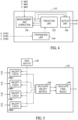
- FIG 4 is a block diagram of a Kalman filter module 112.
- the Kalman filter module 112 of Figure 4 is one example of a Kalman filter module 112 described in relation to Figures 1-3 .
- the propagation unit 134 receives gyroscope sensor signals on all three gyroscope axes X, Y, and Z.
- the propagation unit propagates magnetic field and total strength values to the prediction unit 132 using angular velocity values from the gyroscope sensor signals.
- the prediction unit 132 receives the propagated magnetic field and total strength values from the propagation unit 134.
- the prediction unit 132 predicts the bias and the noise matrix (R) and propagates the error covariance matrix (P).
- the measurement and correction unit 130 receives the magnetic sensor signals related to each sensing axis X, Y, and Z of the magnetometer 102.
- the measurement and correction unit 130 also receives the noise matrix and error covariance prediction values from the prediction unit 132.
- the measurement and correction unit 130 prepares a measurement of the noise matrix (R) and estimates the Kalman filter game (K) and corrects the predictions from the prediction unit 132 using Kalman filter update equations.
- the corrected values are provided to the prediction unit 132 and the output unit 136.
- the output unit 136 generates the hard iron offset/bias value and the noise matrix (R) and outputs them to the validation unit 116.
- FIG. 5 is a block diagram of a validation unit 116.
- the validation unit 116 of Figure 5 is one example of the validation unit as described in relation to Figure 2 .
- the validation unit is responsible for determining when to override or update calibration parameters.
- the inputs are the calibration parameters from the various Kalman filter and least squares instances and the magnetometer sensor values.
- the validation unit 116 initiates, for each instance 122 of a Kalman filter and least squares process, a validity check process.
- Each validity check process receives unique magnetic sensor signal data from the data buffer 138.
- the data buffer 138 stores unique magnetic sensor signal values extracted by the magnetometer data extractor 120 of Figure 2 .
- Each validity check process 140a-140d receives hard iron offset values and a computed total magnetic field strength from a corresponding Kalman filter and least squares instance 122 ( Figure 3 ).
- Each validity check process 140a-d checks if the validity flag is true and if the total magnetic field is within a valid range (e.g. 25-60 ⁇ T).
- Each validity check process 140a-d computes the total magnetic field and unique magnetic data points with calibration parameters, checks that the total deviation is not more than a threshold deviation (e.g. 5-7 ⁇ T) and that the average magnetic field is within a selected threshold (e.g. within 4-6 ⁇ T). If the calibration parameters meet these criteria, the calibration parameters have valid values and are passed to the calculated validity metrics process 142.
- a threshold deviation e.g. 5-7 ⁇ T
- a selected threshold e.g. within 4-6 ⁇ T
- the calculated validity metrics process 142 also checks consistency with other instances of calibration output.
- the calculated final results process 144 computes the weighted sum of all valid calibration parameters from all instances.
- the output may contain the current time, calibration parameters, and calibration quality based on deviation from true magnetic field.
- the calculated final results process 144 outputs the calibration parameters and the quality status.
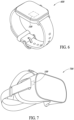
- FIG 6 is an illustration of a smartwatch 600, according to one embodiment.
- the smartwatch 600 is one example of an electronic device 100 of Figure 1 .
- the smartwatch 600 includes a sensor module 109.
- the sensor module 109 includes the gyroscope 104, the magnetometer 102, the magnetometer calibration module 106, and a sensor processor 108 described in relation to Figure 1 .
- the smartwatch 600 may prompt a user to make some small motions with the wrist to which the smartwatch 600 is coupled.
- the smartwatch 600 may perform calibration as described previously based on gyroscope and magnetometer sensor signals generated during the prescribed motion. The prescribed motion is small compared to traditional methods due to the effectiveness of the calibration process as described herein.
- the smartwatch 600 may perform calibration without requesting any movement at all.
- the sensor processor 108 can calculate the heading orientation of the smartwatch 600 based on the magnetometer and gyroscope sensor signals.
- FIG 7 is an illustration of a VR headset 700.
- the VR headset 700 is one example of an electronic device 100 of Figure 1 .
- the VR headset 700 includes a sensor module 109.
- the sensor module 109 includes the gyroscope 104, the magnetometer 102, the magnetometer calibration module 106, and a sensor processor 108 described in relation to Figure 1 .
- the VR headset 700 may prompt a user to make some small motions with the head.
- the VR headset 700 may perform calibration as described previously based on gyroscope and magnetometer sensor signals generated during the prescribed motion. The prescribed motion is small compared to traditional methods due to the effectiveness of the calibration process as described herein. In some cases, the VR headset 700 may perform calibration without requesting any movement at all.
- the sensor processor 108 can calculate the heading orientation of the VR headset 700 based on the magnetometer and gyroscope sensor signals.
- Figure 8 is a flow diagram of a method 800 for operating an electronic device.
- the method 800 includes generating gyroscope sensor signals with a gyroscope of an electronic device.
- the method 800 includes generating magnetometer sensor signals with a magnetometer of the electronic device.
- the method 800 includes estimating a first magnetometer calibration parameter by performing a Kalman filter process with the gyroscope sensor signals and the magnetometer sensor signals.
- the method 800 includes estimating a second magnetometer calibration parameter by performing a least squares process with the gyroscope sensor signals and the magnetometer sensor signals.
- the method 800 includes validating the first and second magnetometer calibration parameters by analyzing a convergence between the first magnetometer calibration parameter and the second magnetometer calibration parameter. Convergence may be evaluated by checking whether the first and second magnetometer calibration parameters are the same or their difference is less than a threshold.
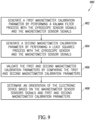
- Figure 9 is a flow diagram of a method 900 for determining an orientation of an electronic device.
- the method 900 includes generating a first magnetometer calibration parameter by performing a Kalman filter process on gyroscope sensor signals and magnetometer sensor signals.
- the method 900 includes generating a second magnetometer calibration parameter by performing a least squares process with the gyroscope sensor signals and the magnetometer sensor signals.
- the method 906 includes validating the first and second magnetometer calibration parameters by comparing the first and second magnetometer calibration parameters.
- the method 900 includes determining the orientation of the electronic device based on the magnetometer sensor signals and combination of first and second magnetometer calibration parameters.
Landscapes
- Engineering & Computer Science (AREA)
- Physics & Mathematics (AREA)
- Radar, Positioning & Navigation (AREA)
- Remote Sensing (AREA)
- General Physics & Mathematics (AREA)
- Condensed Matter Physics & Semiconductors (AREA)
- Manufacturing & Machinery (AREA)
- Automation & Control Theory (AREA)
- Electromagnetism (AREA)
- Measuring Magnetic Variables (AREA)
- Navigation (AREA)
Description
- The present invention is related to electronic devices that include magnetometers and, more particularly, to systems and methods for calibrating magnetometers in electronic devices.
- Many types of electronic devices utilize sensors to determine the position and orientation of the electronic device. For example, smart phones, smart watches, navigation devices, augmented reality/virtual reality glasses, electronic compasses in automobiles and other types of electronic devices utilize sensors to determine the position and orientation of the electronic devices.
- GPS systems are very useful for determining the position of an electronic device on the earth. However, GPS systems typically are not able to determine the orientation or heading of an electronic device. Electronic devices typically utilize magnetometers to assist in determining the orientation or heading of the electronic device. Magnetometers determine the orientation of the electronic device relative to the Earth's magnetic field. However, if there are other sources of magnetic field near the electronic device, then the magnetometer may provide a faulty orientation or heading.
- Troni Giancarlo et al.: "Field Sensor Bias Calibration With Angular-Rate Sensors: Theory and Experimental Evaluation With Application to Magnetometer Calibration", IEEE/ASME Transactions on Mechatronics, IEEE Service Center, vol.24, no. 4, 1 August 2019, pages 1698-1710, XP011739838, ISSN: 1083-4435 considers different methods for calibrating angular-rate sensors and evaluates their convergences to the true values.
- Therefore, it is an aim of the present invention to provide a system and a method for calibrating magnetometers in electronic devices that overcome the drawbacks of the prior art.
- According to the invention, a method for calibrating magnetometers in electronic devices and an electronic device are provided, according to the attached claims.
- For the understanding of the present invention, embodiments thereof are now described, purely as non-limitative examples, with reference to the enclosed drawings, wherein:
-
Figure 1 is a block diagram of an electronic device, according to one embodiment. -
Figure 2 is a block diagram of a magnetometer calibration module, according to one embodiment. -
Figure 3 is a timeline of multiple instances of Kalman filters and least-squares processes of a magnetometer calibration module, according to one embodiment. -
Figure 4 is a block diagram of a Kalman filter module of a magnetometer calibration module, according to one embodiment. -
Figure 5 is a block diagram of a validation unit of a magnetometer calibration module, according to one embodiment. -
Figure 6 is an illustration of a smartwatch including a sensor module, according to one embodiment. -
Figure 7 is an illustration of a virtual reality headset including a sensor module, according to one embodiment. -
Figure 8 is a flow diagram of a process for operating an electronic device, according to one embodiment. -
Figure 9 is a flow diagram of a process for operating an electronic device, according to one embodiment. - In general, the present disclosure refers to an electronic device with a sensor module that is able to quickly and accurately calibrate a magnetometer of the sensor module.
- The calibration process utilizes multiple individual calibration techniques to calibrate the magnetometer. Each of the calibration techniques utilizes gyroscope sensor signals and magnetometer sensor signals to calibrate the magnetometer. The multiple calibration techniques are able to reinforce each other to ensure that the calibration is accurate.
- The sensor module utilizes both a Kalman filter process and a least-squares process to calibrate the magnetometer.
- The Kalman filter calibration process and the least squares calibration process utilize both gyroscope sensor signals and magnetometer sensor signals to generate calibration parameters that help filter out sources of magnetic field other than the Earth's magnetic field.
- The calibration parameters generated by the Kalman filter and the least-squares process are checked against each other to ensure that the calibration parameters found by the two processes align with each other.
- The sensor module performs the calibration process with little or no disturbance to the user of the electronic device.
- In some cases, the user may make a few simple gestures to aid in the calibration process. In other cases, the sensor module can perform the calibration process without directing the user to make any additional movements. The result is a calibration process that is effective, efficient, and unobtrusive.
- Unless the context requires otherwise, throughout the specification and claims which follow, the word "comprise" and variations thereof, such as, "comprises" and "comprising" are to be construed in an open, inclusive sense, that is, as "including, but not limited to." Further, the terms "first," "second," and similar indicators of sequence are to be construed as interchangeable unless the context clearly dictates otherwise.
- As used in this specification and the appended claims, the singular forms "a," "an," and "the" include plural referents unless the content clearly dictates otherwise. It should also be noted that the term "or" is generally employed in its broadest sense, that is as meaning "and/or" unless the content clearly dictates otherwise.
-
Figure 1 is a block diagram of anelectronic device 100. Theelectronic device 100 includes amagnetometer 102 and agyroscope 104. As will be set forth in more detail below, theelectronic device 100 utilizes signals from both themagnetometer 102 and thegyroscope 104 in order to calibrate themagnetometer 102. Furthermore, theelectronic device 100 utilizes both a Kalman filter calibration process and a least-squares calibration process, independent of each other, to calibrate themagnetometer 102. - The
electronic device 100 utilizes various sensors to determine position in a global reference frame, state of motion, orientation, and heading. Theelectronic device 100 can include one or more of a smartphone, a navigation device, a smartwatch, an augmented reality (AR)/virtual reality (VR) headset, an electronic compass in the rear-view mirror of an automobile, or other types of electronic devices. - The
magnetometer 102 senses magnetic fields in the vicinity of theelectronic device 100. Themagnetometer 102 outputs magnetic sensor signals indicating the strength and direction of the magnetic field at the location of theelectronic device 100. Theelectronic device 100 can utilize the magnetic sensor signals to assist in determining the heading of theelectronic device 100. The heading corresponds to the current orientation of theelectronic device 100. In an example in which theelectronic device 100 is an AR/VR headset, the heading can indicate the direction that the headset is facing. If a user is wearing the headset, the heading indicates the direction that the user is looking. - The
magnetometer 102 can include a multiaxis magnetometer. Themultiaxis magnetometer 102 senses the magnitude of the magnetic field in each of the multiple axes. The magnetic sensor signals can include magnetic field strength values sensed on each of the multiple axes. - In one example, the
multiaxis magnetometer 102 is a three axis magnetometer. The axes are mutually orthogonal with each other and can be labeled X, Y, and Z axes. The relative orientations of the axes can be based on the orientation of themagnetometer 102 within theelectronic device 100. Themagnetometer 102 can be a magnetoresistive sensor, a solid-state Hall effect sensor, an inductive coil based sensor, or other type of magnetic sensors. - The
electronic device 100 determines the heading based, in large part, on the Earth's magnetic field. The Earth's magnetic field is relatively constant in both magnitude and direction for a given latitude and longitude on the Earth's surface. Accordingly, the strength and direction of the magnetic field sensed by the magnetometer can give a strong indication of the orientation of theelectronic device 100 relative to the Earth's magnetic field. - However, the
electronic device 100 may be in the presence of other magnetic fields in addition to the Earth's magnetic field. For example, theelectronic device 100 may be near a permanent magnet, an electromagnet, or other sources of magnetic fields. The presence of these other magnetic fields can obscure the Earth's magnetic field. If the other magnetic fields are not accounted for, then theelectronic device 100 may generate erroneous heading estimations. This can result in poor function of theelectronic device 100 and a frustrating experience for the user. - In order to account for the presence of magnetic fields other than the Earth's magnetic field, the
electronic device 100 includes amagnetometer calibration module 106. Themagnetometer calibration module 106 receives magnetic sensor signals from themagnetometer 102 and generates one or more calibration parameters. - The calibration parameters can include a hard iron offset parameter. The hard iron offset indicates the magnitude and direction of constant magnetic fields other than the Earth's magnetic field. The
magnetometer calibration module 106 utilizes the hard iron offset parameter, or other calibration parameters, to filter out other magnetic fields or to otherwise isolate the Earth's magnetic field in the magnetic sensor signals from themagnetometer 102. - Traditional calibration processes have asked that the user of an electronic device wave the electronic device with large sweeping motions in complex patterns in order to calibrate a magnetometer. Such motion is used to expose all axes of magnetometer to primary component of Earth's magnetic field vector. For example, traditional calibration processes may ask the user to move the electronic device in a large
figure 8 pattern. The traditional calibration processes may then ask users to repeatedly tilt the electronic device back and forth along multiple axes. This can be inconvenient and obtrusive to the user. This inconvenience is magnified for devices that are worn on the user as it is more difficult to move such devices in complex sweeping and tilting motions. - The
electronic device 100 provides a calibration process that is far less intrusive to the user than are traditional calibration processes. For example, the magnetometer calibration process described below can be performed with little or no movement asked of the user. This is because themagnetometer calibration module 106 utilizes signals from both themagnetometer 102 and thegyroscope 104 during the calibration process. Furthermore, themagnetometer calibration module 106 determines a magnetometer calibration parameter with multiple independent methods and then checks the outcomes of these methods along with other conditions to determine whether themagnetometer calibration module 106 has correctly calibrated themagnetometer 102. Because themagnetometer calibration module 106 utilizes multiple types of sensor signals and multiple independent calibration processes to determine calibration parameters, little or no additional motion may be asked of the user in order to calibrate themagnetometer 102. - The
gyroscope 104 senses angular rotational motion of theelectronic device 100. Thegyroscope 104 generates gyroscope sensor signals indicating the rate of angular motion (i.e., rotation motion) of theelectronic device 100. Thegyroscope 104 provides the gyroscope sensor signals to themagnetometer calibration module 106. Themagnetometer calibration module 106 utilizes the gyroscope sensor signals and the magnetometer sensor signals in order to calibrate themagnetometer 102. - The
gyroscope 104 can be a multi-axis gyroscope. In this case, thegyroscope 104 senses angular motion around each of multiple axes. - In one example, the
gyroscope 104 is a three axis gyroscope that senses angular motion around each of three axes. The three axes are mutually orthogonal and can be labeled X, Y, and Z axes. The X, Y, and Z axes are defined in relation to the layout of thegyroscope 104 within theelectronic device 100. - The X, Y, and Z axes of the
gyroscope 104 may correspond to the X, Y, and Z axes of themagnetometer 102 such that the angular motion rate for each axis can be paired with the magnetic field value for that axis during calibration of themagnetometer 102. - The
gyroscope 104 can be a microelectromechanical system (MEMS). In this case, thegyroscope 104 may be implemented in a silicon-based substrate with structures and components that result in the generation of electrical signals indicative of the angular motion sensed on one or more axes. TheMEMS gyroscope 104 can include capacitive sensing configurations, piezoelectric sensing configurations, piezoresistive sensing configurations, or other types of sensing configurations. - The
magnetometer calibration module 106 utilizes a first calibration process and a second calibration process. - Each of the first and second calibration processes utilize both the magnetic sensor signals and the gyroscope sensor signals. Each of the first and second calibration processes generates one or more calibration parameters. The calibration parameter or parameters from each process can be validated by comparing them to the calibration parameter or parameters from the other process. If the independently generated calibration parameters match each other, then this is an indication that the calibration parameter or parameters are correct and that the
magnetometer 102 is properly calibrated. If the independently generated calibration parameter or parameters do not match each other, then this is an indication that themagnetometer 102 may not yet properly calibrated. - The first calibration method is a Kalman filter method.
- The Kalman filter method generates a hard iron offset estimation by propagating magnetometer using gyroscope sensor values and minimizing the error with a constraint on individual components and the total magnetic field.
- The Kalman filter takes a plurality of sets of magnetometer and gyroscope sensor values. Each set of values corresponds to a particular point in time. In one example, each set of values includes the X, Y, and Z values from the magnetometer and the gyroscope at a given time.
- The Kalman filter process includes a linear quadratic estimation algorithm that uses the sets of magnetometer and angular motion sensor values to estimate the hard iron offset.
- The magnetometer and angular motion sensor values may include statistical noise and other inaccuracies.
- The Kalman filter process estimates the hard iron offset by estimating a joint probability distribution over the values for each timeframe. Additionally, or alternatively, the Kalman filter process can estimate calibration parameters other than the hard iron offset.
- The second calibration method is a least-squares method. The least-squares method estimates the hard iron offset by minimizing an error between a first derivative of magnetic field and a gyroscope propagated magnetic field reading corrected by bias.
- The least squares method is a regression analysis technique.
- The least-squares method utilizes both the magnetic sensor signal values in the gyroscope sensor signal values to make an estimate of the hard iron offset. Additionally, or alternatively, the least-squares method can estimate one or more calibration parameters other than a hard iron offset.
- The
magnetometer calibration module 106 utilizes a validation process to determine whether the hard iron offsets estimated by each calibration process are valid. The validation process checks convergence between the hard iron offset value generated by the Kalman filter and the hard iron offset value generated by the least-squares method. If the independently generated hard iron offset values converge, i.e. are the same or their difference is less than a threshold, then themagnetometer calibration module 106 determines that the calibration parameters are valid. - In one example, the
magnetometer calibration module 106 checks to see whether the difference between the hard iron offset values generated by the two processes is less than a threshold value. If the difference is less than the threshold value, then the hard iron offset values are valid and the calibration process is complete. - If the difference is greater than the threshold value, then the hard iron offsets are not valid and the calibration process is not complete.
- In one embodiment, the
magnetometer calibration module 106 continuously calibrates themagnetometer 102. In this case, themagnetometer calibration module 106 may estimate and validate the calibration parameter multiple times every second. Thus, as theelectronic device 100 is moved by a user, the calibration process is repeated frequently so that themagnetometer 102 is calibrated at earliest or updated with latest calibration parameters, thereby helping to ensure that the heading orientation of theelectronic device 100 is accurate moment by moment. Alternatively, the calibration process may be performed only once every few hours or even days. - The
magnetometer calibration module 106 may correspond to software blocks, hardware blocks, or combinations of software and hardware blocks. The Kalman filter and the least-squares processes may correspond to software processes that perform analyses, calculations, or estimations based on the magnetometer sensor signals and the gyroscope sensor signals. Themagnetometer calibration module 106 may also include one or more memories for storing software instructions, sensor signal values, calibration parameter values, and other data. Themagnetometer calibration module 106 may also include one or more processors for executing the software instructions order to generate the calibration parameter values. - In
Figure 1 , theelectronic device 100 includes asensor processor 108. Thesensor processor 108 receives the calibration parameters from themagnetometer calibration module 106. Thesensor processor 108 may also receive the magnetometer sensor signals from themagnetometer 102 or from themagnetometer calibration module 106. Thesensor processor 108 processes the magnetometer sensor signals in order to determine the heading or orientation of theelectronic device 100. - The
sensor processor 108 may include one or more processors and one or more memories. The memories may store software instructions and other types of data related to the processing of sensor signals. The one or more processors may execute the software instructions. Thesensor processor 108 and themagnetometer calibration module 106 may share memory and processing resources. - The
magnetometer 102, thegyroscope 104, themagnetometer calibration module 106, and thesensor processor 108 are part of asensor module 109 of theelectronic device 100. -
Figure 2 is a block diagram of amagnetometer calibration module 106. Themagnetometer calibration module 106 is one example of themagnetometer calibration module 106 ofFigure 1 . Themagnetometer calibration module 106 includes agyroscope calibrator 110, aKalman filter module 112, aleast squares module 114, avalidation unit 116, acalibration monitor 118, and amagnetometer data extractor 120. - The
gyroscope calibrator 110 receives uncalibrated gyroscope sensor signals from the gyroscope 104 (seeFigure 1 ). Thegyroscope calibrator 110 performs a calibration process to remove bias from the uncalibrated gyroscope sensor signals. Thegyroscope calibrator 110 outputs calibrated gyroscope sensor signals. - The
gyroscope calibrator 110 can compute variance about each axis, peak to peak value in a given time window, and average value. Thegyroscope calibrator 110 can detect status conditions. Thegyroscope calibrator 110 can identify if the device is stationary by checking if the variance about each axis is less than a threshold variance, if the average value is within an acceptable level of gyroscope bias, and if the predicted value is less than a threshold peak to peak value. - If the
calibration monitor 118 detects a static condition, thegyroscope calibrator 110 can output gyroscope calibration parameters as an average of previous values. - The
Kalman filter module 112 receives, as inputs, magnetic sensor signals from themagnetometer sensor 102 and calibrated gyroscope sensor signals from thegyroscope calibrator 110. Accordingly, here, theKalman filter module 112 does not receive the gyroscope signals directly from the gyroscope, but from thegyroscope calibrator 110. - Because the
Kalman filter module 112 utilizes gyroscope sensor signals to calibrate themagnetometer 102, it is beneficial to ensure that the gyroscope sensor signals are calibrated before being received by theKalman filter module 112. TheKalman filter module 112 performs the Kalman filter process on the magnetic sensor signals and the gyroscope sensor signals. TheKalman filter module 112 outputs magnetometer calibration parameters. In one example, the magnetometer calibration parameters include a hard iron offset value. - For the Kalman filter process, a three-dimensional vector can be represented by the following equation:
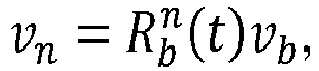
magnetic sensor 102 can also be represented in a global frame in the following manner:


Kalman filter module 112 may utilize these concepts to estimate a hard iron offset. - The Kalman filter approach is utilized to estimate the biases in total magnetic field strength by minimizing the root mean square error between measurements and prediction. This involves predicting a magnetic field vector by propagating with angular velocity, predicting bias and total magnetic field strength (Rb) values, and propagating an error covariance matrix (P).
- Measurement and correction steps involved include preparing the measurements (magnetometer readings in total magnitude to the field), preparing a noise measurement matrix (R), and estimating the Kalman filter gain (K) and correcting of the prediction using Kalman filter update equations.
- The least-
squares module 114 receives, as inputs, magnetic sensor signals from themagnetometer sensor 102 and calibrated gyroscope sensor signals from thegyroscope calibrator 110. The least-squares module 114 performs a least-squares process on the magnetic sensor signals and the gyroscope sensor signals. The least-squares module 114 outputs magnetometer calibration parameters. In one example, the magnetometer calibration parameters include a hard iron offset value. - When utilizing the least-squares method for estimating the hard iron offset, the following relationship can be used:

- The following cost function can be used to estimate an optimum HI value to minimize the loss:

- Differentiating the above equation with respect to HI for optimum value leads to the following relationship:

- In this manner, the least-
squares module 114 can be utilized to estimate a hard iron offset. - The
magnetometer data extractor 120 receives the magnetic sensor signals from themagnetometer 102. Themagnetometer data extractor 120 extracts unique data values from the magnetic sensor signals. For example, themagnetometer data extractor 120 extracts sensor signal values that are different from previous values. - The
magnetometer data extractor 120 analyzes each set of sensor signal values (each set including a value for each measurement axis of themagnetometer 102 at a given point in time). - The
magnetometer data extractor 120 identifies individual values or entire sets of values that are outside the range of recently received sensor signal values. Themagnetometer data extractor 120 stores these values in a buffer. The unique values are then provided from the buffer to the validation unit, as will be described in more detail below. - It can be valuable to extract unique magnetic field points to assess the quality of calibration rather than relying on current data or an average of data. Averaging can provide equal weights to duplicate points or values. Accordingly, it can be beneficial to maintain only sparse points.
- Accordingly, the
magnetometer data extractor 120 checks for unique samples in the current sensor data stream with respect to stored magnetometer data (i.e. previous magnetic sensor signal values) in order to get uniform and wide ranges of data samples. Unique samples are extracted by checking the difference between the most recent previously stored magnetic sensor signal values and new magnetic sensor signal values. This can include checking the Euclidean or Manhattan distance between new sensor signal values and all stored sensor signal values. - If a new sample is unique it will be stored in the buffer.
- In one example, sensor signal values that are older than the threshold value are discarded and not used to identify unique values. In one example, the threshold time value is between 10 seconds and 20 seconds, though other values can be utilized.
- The
validation unit 116 receives magnetometer calibration parameter values from theKalman filter module 112, magnetometer calibration parameter values from the least-squares module 114, and unique magnetic sensor values from themagnetometer data extractor 120. Thevalidation unit 116 validates the magnetometer calibration parameter values provided by theKalman filter module 112 and the least-squares module 114. - The
validation unit 116 checks the rotation span of each axis. In one example, it is desirable that at least two axes have a rotation of 75°. The validation unit checks the total rotation with the expectation that the total rotation will exceed 180°. - The
validation unit 116 checks the convergence of magnetometer calibration parameter values from both methods. If the distance between both bias vectors is higher than 2 µT, a validity flag is set to false and no calibration value will be output from thevalidation unit 116. In this example, 2 µT is a hard iron bias threshold value. For calibration validity, the difference between hard iron offset values should be less than or equal to 2 µT. Other threshold values can be utilized. - If the values converge with a difference less than the threshold, then the validity flag may be set to true and the
validation unit 116 outputs the calibration parameter (e.g. hard iron bias). - The
calibration monitor 118 is utilized to check the quality of calibration and to detect anomalies. Thecalibration monitor 118 receives, as input, the calibration parameter from thevalidation unit 116, if the validity flag is true or other validity information is available. The calibration monitor 118 also receives the unique magnetic data points from themagnetometer data extractor 120. - The calibration monitor 118 outputs a calibration quality status and updated calibration parameters. In one example, the calibration quality status can be either poor, passable, good, or unknown. Other types of statuses can be utilized without departing from the scope of the present disclosure.
- The calibration monitor 118 updates the calibration status based on the elapsed time from the last calibration value and the deviation in the array of unique magnetic field values as extracted by the
magnetometer data extractor 120. - The threshold times for determining whether to downgrade quality can be different depending on the most recent status value. For example, an elapsed time of 10 to 15 hours can result in a downgrade from good quality to passable quality. An elapsed time of one to three days can result in a downgrade from passable quality to poor quality. An elapsed time of 8 to 12 days can result in a downgrade from poor to unknown. Other threshold elapsed time thresholds can be utilized.
- The calibration monitor 118 continuously monitors the total magnetic field deviation computed on unique magnetic data points and makes a judgment of calibration quality based on the mean value and the variation values.
- In one example, if the deviation is greater than a first threshold deviation, then the calibration quality is poor. If the deviation is greater than a second threshold deviation less than the first threshold deviation, then the calibration quality is passable. If the deviation is greater than a third threshold deviation less than the second threshold deviation, then the calibration quality is good.
- For example, the
magnetometer calibration module 106 can perform gyroscope calibration, magnetic calibration parameter estimation, unique magnetic value extraction, and validation between 50 and 200 times per second. Calibration quality monitoring may be performed at a much lower frequency. For example, calibration quality monitoring may be performed once per second. Other frequencies can be utilized. -
Figure 3 is atimeline 300 illustrating that multiple instances of Kalman filter and least squares process may be running simultaneously. With reference toFigure 2 andFigure 3 , theKalman filter module 112 may initiate multiple overlapping instances of a Kalman filter process. - Likewise, the least-
squares module 114 may initiate multiple overlapping instances of a least-squares process. InFigure 3 , the combined instances of a Kalman filter and a least squares process are labeled as 122a-122f. Each instance generates a calibration parameter from a Kalman filter process and a calibration parameter from a least-squares process. Thevalidation unit 116 receives the calibration parameters from each of theinstances 122a-122f. - At time T1 the
first instance 122a of a Kalman filter and a least-squares process is initiated by theKalman filter module 112 and the least-squares module 114. In practice, theKalman filter module 112 and the least-squares module 114 may be implemented in a single module that generates eachinstance 122a of a Kalman filter and a least-squares process. At time T2 aninstance 122b of a Kalman filter and a least-squares process is initiated while theinstance 122a is still running. At time T3, aninstance 122c of a Kalman filter and a least-squares process is initiated while theinstances instance 122d of a Kalman filter the least-squares process is initiated while theinstances 122a-122c are still running. Between times T4 and T5, theinstance 122a has completed generation of calibration parameters and has provided the calibration parameters to thevalidation unit 116. At time T5, aninstance 122e of a Kalman filter and a least squares process is initiated while theinstances 122b-122d are still running. Between times T5 and T6, theinstance 122b has completed generation of calibration parameters and has provided the calibration parameters to thevalidation unit 116. At time T6, aninstance 122f of a Kalman filter and a least-squares process is initiated while theinstances 122c-122e are still running. - In
Figure 3 , the downward pointing arrows indicate that the corresponding instance of a Kalman filter and a least-squares process has provided calibration parameters to thevalidation unit 116. However, the placement in time of the downward pointing arrows does not necessarily correspond to the actual time at which calibration parameters are provided to thevalidation unit 116. In practice, calibration parameters are provided from an instance of the Kalman filter and a least-squares process at the end of the Kalman filter and least squares process. - Each instance of a Kalman filter and a least-squares process estimates calibration parameters based on sets of values of the sensor signals across a particular window of time. The windows of time may overlap with other Kalman filter and least squares instances. Accordingly, some of the sets of values used by a Kalman filter and least squares process are used by other instances of Kalman filters and least-squares processes.
- The size of the window may be selected to balance between capturing the calibration motion and minimizing the probability of external magnetic interference.
- The
validation unit 116 may output a validity flag for each pair of calibration parameters provided from an instance of a Kalman filter and a least-squares process. Alternatively, thevalidation unit 116 may only output a validity flag after analyzing the calibration parameters from several instances of Kalman filters and least-squares processes. -
Figure 4 is a block diagram of aKalman filter module 112. TheKalman filter module 112 ofFigure 4 is one example of aKalman filter module 112 described in relation toFigures 1-3 . - The
Kalman filter module 112 ofFigure 4 includes a measurement andcorrection unit 130, aprediction unit 132, and apropagation unit 134. - The
propagation unit 134 receives gyroscope sensor signals on all three gyroscope axes X, Y, and Z. The propagation unit propagates magnetic field and total strength values to theprediction unit 132 using angular velocity values from the gyroscope sensor signals. - The
prediction unit 132 receives the propagated magnetic field and total strength values from thepropagation unit 134. - The
prediction unit 132 predicts the bias and the noise matrix (R) and propagates the error covariance matrix (P). - The measurement and
correction unit 130 receives the magnetic sensor signals related to each sensing axis X, Y, and Z of themagnetometer 102. - The measurement and
correction unit 130 also receives the noise matrix and error covariance prediction values from theprediction unit 132. - The measurement and
correction unit 130 prepares a measurement of the noise matrix (R) and estimates the Kalman filter game (K) and corrects the predictions from theprediction unit 132 using Kalman filter update equations. The corrected values are provided to theprediction unit 132 and theoutput unit 136. - The
output unit 136 generates the hard iron offset/bias value and the noise matrix (R) and outputs them to thevalidation unit 116. -
Figure 5 is a block diagram of avalidation unit 116. Thevalidation unit 116 ofFigure 5 is one example of the validation unit as described in relation toFigure 2 . The validation unit is responsible for determining when to override or update calibration parameters. The inputs are the calibration parameters from the various Kalman filter and least squares instances and the magnetometer sensor values. - The
validation unit 116 initiates, for each instance 122 of a Kalman filter and least squares process, a validity check process. - Each validity check process receives unique magnetic sensor signal data from the
data buffer 138. Thedata buffer 138 stores unique magnetic sensor signal values extracted by themagnetometer data extractor 120 ofFigure 2 . Eachvalidity check process 140a-140d receives hard iron offset values and a computed total magnetic field strength from a corresponding Kalman filter and least squares instance 122 (Figure 3 ). - Each
validity check process 140a-d checks if the validity flag is true and if the total magnetic field is within a valid range (e.g. 25-60 µT). - Each
validity check process 140a-d computes the total magnetic field and unique magnetic data points with calibration parameters, checks that the total deviation is not more than a threshold deviation (e.g. 5-7 µT) and that the average magnetic field is within a selected threshold (e.g. within 4-6 µT). If the calibration parameters meet these criteria, the calibration parameters have valid values and are passed to the calculatedvalidity metrics process 142. - The calculated
validity metrics process 142 is responsible to compute the appropriate weights to each valid calibration parameter. This can be performed by computing the total deviation from the true magnetic field. Lower deviations will get higher weights. - The calculated
validity metrics process 142 also checks consistency with other instances of calibration output. - If calibration parameters are far from the rest of the calibration parameters, then zero weight may be assigned.
- If deviation with latest calibration parameters is lower than most recent successful calibration parameters, then weight will be increased.
- The calculated
final results process 144 computes the weighted sum of all valid calibration parameters from all instances. The output may contain the current time, calibration parameters, and calibration quality based on deviation from true magnetic field. The calculatedfinal results process 144 outputs the calibration parameters and the quality status. -
Figure 6 is an illustration of asmartwatch 600, according to one embodiment. Thesmartwatch 600 is one example of anelectronic device 100 ofFigure 1 . Thesmartwatch 600 includes asensor module 109. Thesensor module 109 includes thegyroscope 104, themagnetometer 102, themagnetometer calibration module 106, and asensor processor 108 described in relation toFigure 1 . When calibration of themagnetometer 102 is to be performed, thesmartwatch 600 may prompt a user to make some small motions with the wrist to which thesmartwatch 600 is coupled. Thesmartwatch 600 may perform calibration as described previously based on gyroscope and magnetometer sensor signals generated during the prescribed motion. The prescribed motion is small compared to traditional methods due to the effectiveness of the calibration process as described herein. In some cases, thesmartwatch 600 may perform calibration without requesting any movement at all. After calibration has been performed, thesensor processor 108 can calculate the heading orientation of thesmartwatch 600 based on the magnetometer and gyroscope sensor signals. -
Figure 7 is an illustration of aVR headset 700. TheVR headset 700 is one example of anelectronic device 100 ofFigure 1 . TheVR headset 700 includes asensor module 109. Thesensor module 109 includes thegyroscope 104, themagnetometer 102, themagnetometer calibration module 106, and asensor processor 108 described in relation toFigure 1 . When calibration of themagnetometer 102 is to be performed, theVR headset 700 may prompt a user to make some small motions with the head. TheVR headset 700 may perform calibration as described previously based on gyroscope and magnetometer sensor signals generated during the prescribed motion. The prescribed motion is small compared to traditional methods due to the effectiveness of the calibration process as described herein. In some cases, theVR headset 700 may perform calibration without requesting any movement at all. After calibration has been performed, thesensor processor 108 can calculate the heading orientation of theVR headset 700 based on the magnetometer and gyroscope sensor signals. -
Figure 8 is a flow diagram of amethod 800 for operating an electronic device. At 802, themethod 800 includes generating gyroscope sensor signals with a gyroscope of an electronic device. At 804, themethod 800 includes generating magnetometer sensor signals with a magnetometer of the electronic device. At 806, themethod 800 includes estimating a first magnetometer calibration parameter by performing a Kalman filter process with the gyroscope sensor signals and the magnetometer sensor signals. At 808, themethod 800 includes estimating a second magnetometer calibration parameter by performing a least squares process with the gyroscope sensor signals and the magnetometer sensor signals. At 810, themethod 800 includes validating the first and second magnetometer calibration parameters by analyzing a convergence between the first magnetometer calibration parameter and the second magnetometer calibration parameter. Convergence may be evaluated by checking whether the first and second magnetometer calibration parameters are the same or their difference is less than a threshold. -
Figure 9 is a flow diagram of amethod 900 for determining an orientation of an electronic device. At 902, themethod 900 includes generating a first magnetometer calibration parameter by performing a Kalman filter process on gyroscope sensor signals and magnetometer sensor signals. At 904, themethod 900 includes generating a second magnetometer calibration parameter by performing a least squares process with the gyroscope sensor signals and the magnetometer sensor signals. At 906, themethod 906 includes validating the first and second magnetometer calibration parameters by comparing the first and second magnetometer calibration parameters. At 908, themethod 900 includes determining the orientation of the electronic device based on the magnetometer sensor signals and combination of first and second magnetometer calibration parameters.
Claims (15)
- A method for calibrating magnetometers in electronic devices, comprising:generating (802) gyroscope sensor signals with a gyroscope (104) of an electronic device (100);generating (804) magnetometer sensor signals with a magnetometer (102) of the electronic device;estimating (806) a first magnetometer calibration parameter by performing a Kalman filter process with the gyroscope sensor signals and the magnetometer sensor signals; andestimating (808) a second magnetometer calibration parameter by performing a least squares process with the gyroscope sensor signals and the magnetometer sensor signals; characterized by:validating (810) the first and second magnetometer calibration parameters by analyzing a convergence between the first magnetometer calibration parameter and the second magnetometer calibration parameter.
- The method of claim 1, wherein estimating the first magnetometer calibration parameter and/or estimating the second magnetometer calibration includes determining a hard iron offset.
- The method of claim 2, wherein estimating the hard iron offset includes minimizing an error constraint on a total magnetic field based, in part, on the gyroscope sensor signals.
- The method of any of the preceding claims, wherein validating the first and second magnetometer calibration parameters includes determining a difference between the first and second magnetometer calibration parameters.
- The method of any of the preceding claims, further comprising simultaneously operating multiple instances of a Kalman filter and a least squares process.
- The method of the preceding claim, wherein the multiple instances of the Kalman filter and the least squares process are offset from each other in time.
- The method of any of the preceding claims, wherein calibration is performed continuously.
- The method of any of the preceding claims, further comprising determining an orientation of the electronic device based on the first and second magnetometer calibration parameters.
- An electronic device, comprising:a gyroscope (104) configured to output gyroscope sensor signals;a magnetometer (102) configured to output magnetometer sensor signals;a magnetometer calibration module (106) configured to receive the gyroscope sensor signals and the magnetometer sensor signals and to generate a first magnetometer calibration parameter with a Kalman filter process with the gyroscope sensor signals and the magnetometer sensor signals and to generate a second magnetometer calibration parameter based on a least squares process with the gyroscope sensor signals and the magnetometer sensor signals,and characterised by the magnetometer calibration module (106) being configured to validate the first and second magnetometer calibration parameters based on a convergence of the first magnetometer calibration parameter and the second magnetometer calibration parameter.
- The electronic device of the preceding claim, wherein the magnetometer calibration module (106) continuously calibrates the magnetometer (102).
- The electronic device of claim 9 or 10, further comprising a sensor processor (108) configured to receive the at least one of the first and second magnetometer calibration parameters and to determine an orientation of the magnetometer based on at least one of the first and second magnetometer calibration parameters.
- The electronic device of any of claims 9-11, wherein the magnetometer calibration module (106) is configured to determine a first hard iron offset with the Kalman filter process.
- The electronic device of the preceding claim, wherein the magnetometer calibration module (106) is configured to determine a second hard iron offset with the least squares process.
- The electronic device of the preceding claim, wherein the magnetometer calibration module (106) is configured to simultaneously implement instances of a Kalman filter and multiple instances of least squares process.
- The electronic device of any of claims 9-14, further comprising:at least one memory configured to store software instructions; andat least one processor (108) configured to execute the software instructions, wherein the magnetometer calibration module (106) is a software module implemented by executing the software instructions with the at least one processor.
Applications Claiming Priority (1)
| Application Number | Priority Date | Filing Date | Title |
|---|---|---|---|
| US17/135,628 US11815568B2 (en) | 2020-12-28 | 2020-12-28 | System and method for fast magnetometer calibration using gyroscope |
Publications (2)
| Publication Number | Publication Date |
|---|---|
| EP4019896A1 EP4019896A1 (en) | 2022-06-29 |
| EP4019896B1 true EP4019896B1 (en) | 2023-12-20 |
Family
ID=79170655
Family Applications (1)
| Application Number | Title | Priority Date | Filing Date |
|---|---|---|---|
| EP21217950.1A Active EP4019896B1 (en) | 2020-12-28 | 2021-12-28 | System and method for fast magnetometer calibration using gyroscope |
Country Status (3)
| Country | Link |
|---|---|
| US (2) | US11815568B2 (en) |
| EP (1) | EP4019896B1 (en) |
| CN (1) | CN114719846B (en) |
Families Citing this family (6)
| Publication number | Priority date | Publication date | Assignee | Title |
|---|---|---|---|---|
| CN114993351B (en) * | 2022-07-01 | 2025-05-02 | 天璺科技(上海)有限公司 | A real-time calibration method and computer system for magnetometer based on variable forgetting factor |
| US20240039580A1 (en) * | 2022-07-26 | 2024-02-01 | Electronics And Telecommunications Research Institute | Magnetic signal receiving device and magnetic field communication system |
| EP4311898A1 (en) * | 2022-07-27 | 2024-01-31 | Maytronics Ltd. | Navigating a pool related platform |
| CN115655310B (en) * | 2022-10-26 | 2024-04-05 | 荣耀终端有限公司 | Data calibration method, electronic device and readable storage medium |
| CN116625404A (en) * | 2023-02-17 | 2023-08-22 | 和芯星通科技(北京)有限公司 | Navigation information processing method, computer storage medium and terminal |
| CN119199688A (en) * | 2024-11-22 | 2024-12-27 | 雷鸟创新技术(深圳)有限公司 | Magnetometer calibration method and device for extended reality device and extended reality device |
Family Cites Families (25)
| Publication number | Priority date | Publication date | Assignee | Title |
|---|---|---|---|---|
| CN102393735B (en) | 2005-04-04 | 2014-07-09 | 费舍-柔斯芒特系统股份有限公司 | Statistical processing methods used in abnormal situation detection |
| US7930148B1 (en) | 2007-08-20 | 2011-04-19 | PNI Sensor Corporation | Spherical calibration and reference alignment algorithms |
| US7977941B2 (en) | 2009-02-25 | 2011-07-12 | Everspin Technologies, Inc. | Magnetic field sensing device |
| US8577637B2 (en) | 2009-09-28 | 2013-11-05 | Teledyne Rd Instruments, Inc. | System and method of magnetic compass calibration |
| DE102010029669B4 (en) | 2010-06-02 | 2023-10-05 | Robert Bosch Gmbh | Method for adjusting a measured value offset |
| DE102010029668A1 (en) | 2010-06-02 | 2011-12-08 | Robert Bosch Gmbh | Calibration of a three-axis magnetic field sensor |
| US8717009B2 (en) | 2010-10-06 | 2014-05-06 | Apple Inc. | Magnetometer calibration |
| EP2447730B1 (en) | 2010-10-26 | 2014-11-12 | BlackBerry Limited | System and method for determining quality of calibration parameters for a magnetometer |
| US8896301B2 (en) * | 2011-02-28 | 2014-11-25 | Blackberry Limited | Portable electronic device adapted to compensate for gyroscope bias |
| US8577640B2 (en) | 2011-08-17 | 2013-11-05 | Invensense, Inc. | Magnetometer bias and anomaly detector |
| US9534924B2 (en) | 2011-11-11 | 2017-01-03 | Qualcomm Incorporated | Sensor auto-calibration |
| TW201411096A (en) | 2012-08-02 | 2014-03-16 | Memsic Inc | Method and apparatus for data fusion of a three axis magnetometer and three axis accelerometer |
| US10337884B2 (en) * | 2013-03-05 | 2019-07-02 | Invensense, Inc. | Method and apparatus for fast magnetometer calibration |
| US9151610B2 (en) * | 2013-06-08 | 2015-10-06 | Apple Inc. | Validating calibrated magnetometer data |
| US20150019159A1 (en) * | 2013-07-15 | 2015-01-15 | Honeywell International Inc. | System and method for magnetometer calibration and compensation |
| US9863867B2 (en) | 2014-02-23 | 2018-01-09 | PNI Sensor Corporation | Automatically updating hard iron and soft iron coefficients of a magnetic sensor |
| US10444030B1 (en) | 2014-05-12 | 2019-10-15 | Inertial Labs, Inc. | Automatic calibration of magnetic sensors based on optical image tracking |
| GB201411300D0 (en) * | 2014-06-25 | 2014-08-06 | Trw Ltd | An electric power assisted steering system |
| GB201500411D0 (en) | 2014-09-15 | 2015-02-25 | Isis Innovation | Determining the position of a mobile device in a geographical area |
| EP3218674B1 (en) * | 2014-11-11 | 2021-06-23 | Intel Corporation | Extended kalman filter based autonomous magnetometer calibration |
| CN106033131B (en) * | 2015-03-20 | 2018-09-11 | 阿里巴巴集团控股有限公司 | A kind of geomagnetic sensor calibration method, device and smart machine |
| ITUB20153317A1 (en) | 2015-09-01 | 2017-03-01 | St Microelectronics Srl | CALIBRATION PROCEDURE FOR DEVICES MAGNETIC FIELD SENSORS, SYSTEM, EQUIPMENT AND CORRESPONDENT COMPUTER PRODUCT |
| US10151805B2 (en) | 2015-12-18 | 2018-12-11 | Stmicroelectronics, Inc. | Method for calibration of magnetic sensor |
| US10962609B2 (en) * | 2018-02-15 | 2021-03-30 | The Edge Vr, Inc. | Calibration system and method for magnetic tracking in virtual reality systems |
| US10976380B2 (en) * | 2019-01-18 | 2021-04-13 | Rockwell Collins, Inc. | System and method for magnetometer monitoring |
-
2020
- 2020-12-28 US US17/135,628 patent/US11815568B2/en active Active
-
2021
- 2021-12-27 CN CN202111619220.9A patent/CN114719846B/en active Active
- 2021-12-28 EP EP21217950.1A patent/EP4019896B1/en active Active
-
2023
- 2023-10-17 US US18/488,750 patent/US20240045001A1/en active Pending
Also Published As
| Publication number | Publication date |
|---|---|
| CN114719846B (en) | 2025-09-26 |
| US20220206085A1 (en) | 2022-06-30 |
| US20240045001A1 (en) | 2024-02-08 |
| CN114719846A (en) | 2022-07-08 |
| US11815568B2 (en) | 2023-11-14 |
| EP4019896A1 (en) | 2022-06-29 |
Similar Documents
| Publication | Publication Date | Title |
|---|---|---|
| EP4019896B1 (en) | System and method for fast magnetometer calibration using gyroscope | |
| CN103153790B (en) | The measurement data of the magnetometer using motion sensor and be attached to device estimates equipment and the method for this device yaw angle in gravitational frame of reference | |
| US9568321B2 (en) | Systems and methods for determining inertial navigation system faults | |
| US6792380B2 (en) | Attitude angle detecting apparatus | |
| US8560234B2 (en) | System and method of navigation based on state estimation using a stepped filter | |
| JP4199553B2 (en) | Hybrid navigation device | |
| US20100141515A1 (en) | Position tracking device and method | |
| US20040123474A1 (en) | Methods and apparatus for automatic magnetic compensation | |
| CN103299247B (en) | Apparatus and method for dynamic tracking and compensation of magnetic near field | |
| US20190325006A1 (en) | Apparatuses and methods for calibrating magnetometer attitude-independent parameters | |
| EP2685214B1 (en) | Multiple truth reference system and method | |
| EP2837911B1 (en) | Method to improve leveling performance in navigation systems | |
| EP2869026B1 (en) | Systems and methods for off-line and on-line sensor calibration | |
| CN115060275A (en) | Navigation information optimization method for multiple inertial navigation devices | |
| JP2017009294A (en) | Positioning device | |
| JP5528267B2 (en) | Positioning device | |
| US11343642B2 (en) | Method for estimating the harmonization values of a magnetometer installed in a mobile machine, associated device and computer program | |
| US10466081B2 (en) | Iterative method of determining a bias of a sensor for measuring a substantially continuous physical vector field | |
| Avzayesh et al. | Improved-performance vehicle’s state estimator under uncertain model dynamics | |
| JP2007101484A (en) | Device for measuring carrier phase relative position | |
| CN114910095A (en) | Method, device and equipment for determining error of centering rod and storage medium | |
| KR20070072306A (en) | Position estimation system of mobile robot and its method | |
| US20250290772A1 (en) | Systems, methods, and media for adapting a spectral density based on varying environmental operating conditions | |
| JP2007071868A (en) | Carrier phase relative positioning apparatus and method | |
| CN107543524A (en) | Direction determining method and device |
Legal Events
| Date | Code | Title | Description |
|---|---|---|---|
| PUAI | Public reference made under article 153(3) epc to a published international application that has entered the european phase |
Free format text: ORIGINAL CODE: 0009012 |
|
| STAA | Information on the status of an ep patent application or granted ep patent |
Free format text: STATUS: THE APPLICATION HAS BEEN PUBLISHED |
|
| AK | Designated contracting states |
Kind code of ref document: A1 Designated state(s): AL AT BE BG CH CY CZ DE DK EE ES FI FR GB GR HR HU IE IS IT LI LT LU LV MC MK MT NL NO PL PT RO RS SE SI SK SM TR |
|
| STAA | Information on the status of an ep patent application or granted ep patent |
Free format text: STATUS: REQUEST FOR EXAMINATION WAS MADE |
|
| 17P | Request for examination filed |
Effective date: 20221228 |
|
| RBV | Designated contracting states (corrected) |
Designated state(s): AL AT BE BG CH CY CZ DE DK EE ES FI FR GB GR HR HU IE IS IT LI LT LU LV MC MK MT NL NO PL PT RO RS SE SI SK SM TR |
|
| GRAP | Despatch of communication of intention to grant a patent |
Free format text: ORIGINAL CODE: EPIDOSNIGR1 |
|
| STAA | Information on the status of an ep patent application or granted ep patent |
Free format text: STATUS: GRANT OF PATENT IS INTENDED |
|
| INTG | Intention to grant announced |
Effective date: 20230712 |
|
| GRAS | Grant fee paid |
Free format text: ORIGINAL CODE: EPIDOSNIGR3 |
|
| GRAA | (expected) grant |
Free format text: ORIGINAL CODE: 0009210 |
|
| STAA | Information on the status of an ep patent application or granted ep patent |
Free format text: STATUS: THE PATENT HAS BEEN GRANTED |
|
| AK | Designated contracting states |
Kind code of ref document: B1 Designated state(s): AL AT BE BG CH CY CZ DE DK EE ES FI FR GB GR HR HU IE IS IT LI LT LU LV MC MK MT NL NO PL PT RO RS SE SI SK SM TR |
|
| REG | Reference to a national code |
Ref country code: GB Ref legal event code: FG4D |
|
| REG | Reference to a national code |
Ref country code: DE Ref legal event code: R096 Ref document number: 602021007869 Country of ref document: DE |
|
| REG | Reference to a national code |
Ref country code: CH Ref legal event code: EP |
|
| REG | Reference to a national code |
Ref country code: IE Ref legal event code: FG4D |
|
| PG25 | Lapsed in a contracting state [announced via postgrant information from national office to epo] |
Ref country code: GR Free format text: LAPSE BECAUSE OF FAILURE TO SUBMIT A TRANSLATION OF THE DESCRIPTION OR TO PAY THE FEE WITHIN THE PRESCRIBED TIME-LIMIT Effective date: 20240321 |
|
| REG | Reference to a national code |
Ref country code: LT Ref legal event code: MG9D |
|
| PG25 | Lapsed in a contracting state [announced via postgrant information from national office to epo] |
Ref country code: LT Free format text: LAPSE BECAUSE OF FAILURE TO SUBMIT A TRANSLATION OF THE DESCRIPTION OR TO PAY THE FEE WITHIN THE PRESCRIBED TIME-LIMIT Effective date: 20231220 |
|
| REG | Reference to a national code |
Ref country code: NL Ref legal event code: MP Effective date: 20231220 |
|
| PG25 | Lapsed in a contracting state [announced via postgrant information from national office to epo] |
Ref country code: ES Free format text: LAPSE BECAUSE OF FAILURE TO SUBMIT A TRANSLATION OF THE DESCRIPTION OR TO PAY THE FEE WITHIN THE PRESCRIBED TIME-LIMIT Effective date: 20231220 |
|
| PG25 | Lapsed in a contracting state [announced via postgrant information from national office to epo] |
Ref country code: LT Free format text: LAPSE BECAUSE OF FAILURE TO SUBMIT A TRANSLATION OF THE DESCRIPTION OR TO PAY THE FEE WITHIN THE PRESCRIBED TIME-LIMIT Effective date: 20231220 Ref country code: GR Free format text: LAPSE BECAUSE OF FAILURE TO SUBMIT A TRANSLATION OF THE DESCRIPTION OR TO PAY THE FEE WITHIN THE PRESCRIBED TIME-LIMIT Effective date: 20240321 Ref country code: FI Free format text: LAPSE BECAUSE OF FAILURE TO SUBMIT A TRANSLATION OF THE DESCRIPTION OR TO PAY THE FEE WITHIN THE PRESCRIBED TIME-LIMIT Effective date: 20231220 Ref country code: ES Free format text: LAPSE BECAUSE OF FAILURE TO SUBMIT A TRANSLATION OF THE DESCRIPTION OR TO PAY THE FEE WITHIN THE PRESCRIBED TIME-LIMIT Effective date: 20231220 Ref country code: BG Free format text: LAPSE BECAUSE OF FAILURE TO SUBMIT A TRANSLATION OF THE DESCRIPTION OR TO PAY THE FEE WITHIN THE PRESCRIBED TIME-LIMIT Effective date: 20240320 |
|
| REG | Reference to a national code |
Ref country code: AT Ref legal event code: MK05 Ref document number: 1642809 Country of ref document: AT Kind code of ref document: T Effective date: 20231220 |
|
| PG25 | Lapsed in a contracting state [announced via postgrant information from national office to epo] |
Ref country code: NL Free format text: LAPSE BECAUSE OF FAILURE TO SUBMIT A TRANSLATION OF THE DESCRIPTION OR TO PAY THE FEE WITHIN THE PRESCRIBED TIME-LIMIT Effective date: 20231220 |
|
| PG25 | Lapsed in a contracting state [announced via postgrant information from national office to epo] |
Ref country code: SE Free format text: LAPSE BECAUSE OF FAILURE TO SUBMIT A TRANSLATION OF THE DESCRIPTION OR TO PAY THE FEE WITHIN THE PRESCRIBED TIME-LIMIT Effective date: 20231220 Ref country code: RS Free format text: LAPSE BECAUSE OF FAILURE TO SUBMIT A TRANSLATION OF THE DESCRIPTION OR TO PAY THE FEE WITHIN THE PRESCRIBED TIME-LIMIT Effective date: 20231220 Ref country code: NO Free format text: LAPSE BECAUSE OF FAILURE TO SUBMIT A TRANSLATION OF THE DESCRIPTION OR TO PAY THE FEE WITHIN THE PRESCRIBED TIME-LIMIT Effective date: 20240320 Ref country code: NL Free format text: LAPSE BECAUSE OF FAILURE TO SUBMIT A TRANSLATION OF THE DESCRIPTION OR TO PAY THE FEE WITHIN THE PRESCRIBED TIME-LIMIT Effective date: 20231220 Ref country code: LV Free format text: LAPSE BECAUSE OF FAILURE TO SUBMIT A TRANSLATION OF THE DESCRIPTION OR TO PAY THE FEE WITHIN THE PRESCRIBED TIME-LIMIT Effective date: 20231220 Ref country code: HR Free format text: LAPSE BECAUSE OF FAILURE TO SUBMIT A TRANSLATION OF THE DESCRIPTION OR TO PAY THE FEE WITHIN THE PRESCRIBED TIME-LIMIT Effective date: 20231220 |
|
| PG25 | Lapsed in a contracting state [announced via postgrant information from national office to epo] |
Ref country code: IS Free format text: LAPSE BECAUSE OF FAILURE TO SUBMIT A TRANSLATION OF THE DESCRIPTION OR TO PAY THE FEE WITHIN THE PRESCRIBED TIME-LIMIT Effective date: 20240420 |
|
| PG25 | Lapsed in a contracting state [announced via postgrant information from national office to epo] |
Ref country code: CZ Free format text: LAPSE BECAUSE OF FAILURE TO SUBMIT A TRANSLATION OF THE DESCRIPTION OR TO PAY THE FEE WITHIN THE PRESCRIBED TIME-LIMIT Effective date: 20231220 Ref country code: AT Free format text: LAPSE BECAUSE OF FAILURE TO SUBMIT A TRANSLATION OF THE DESCRIPTION OR TO PAY THE FEE WITHIN THE PRESCRIBED TIME-LIMIT Effective date: 20231220 |
|
| PG25 | Lapsed in a contracting state [announced via postgrant information from national office to epo] |
Ref country code: SK Free format text: LAPSE BECAUSE OF FAILURE TO SUBMIT A TRANSLATION OF THE DESCRIPTION OR TO PAY THE FEE WITHIN THE PRESCRIBED TIME-LIMIT Effective date: 20231220 |
|
| PG25 | Lapsed in a contracting state [announced via postgrant information from national office to epo] |
Ref country code: SM Free format text: LAPSE BECAUSE OF FAILURE TO SUBMIT A TRANSLATION OF THE DESCRIPTION OR TO PAY THE FEE WITHIN THE PRESCRIBED TIME-LIMIT Effective date: 20231220 Ref country code: SK Free format text: LAPSE BECAUSE OF FAILURE TO SUBMIT A TRANSLATION OF THE DESCRIPTION OR TO PAY THE FEE WITHIN THE PRESCRIBED TIME-LIMIT Effective date: 20231220 Ref country code: RO Free format text: LAPSE BECAUSE OF FAILURE TO SUBMIT A TRANSLATION OF THE DESCRIPTION OR TO PAY THE FEE WITHIN THE PRESCRIBED TIME-LIMIT Effective date: 20231220 Ref country code: IT Free format text: LAPSE BECAUSE OF FAILURE TO SUBMIT A TRANSLATION OF THE DESCRIPTION OR TO PAY THE FEE WITHIN THE PRESCRIBED TIME-LIMIT Effective date: 20231220 Ref country code: IS Free format text: LAPSE BECAUSE OF FAILURE TO SUBMIT A TRANSLATION OF THE DESCRIPTION OR TO PAY THE FEE WITHIN THE PRESCRIBED TIME-LIMIT Effective date: 20240420 Ref country code: EE Free format text: LAPSE BECAUSE OF FAILURE TO SUBMIT A TRANSLATION OF THE DESCRIPTION OR TO PAY THE FEE WITHIN THE PRESCRIBED TIME-LIMIT Effective date: 20231220 Ref country code: CZ Free format text: LAPSE BECAUSE OF FAILURE TO SUBMIT A TRANSLATION OF THE DESCRIPTION OR TO PAY THE FEE WITHIN THE PRESCRIBED TIME-LIMIT Effective date: 20231220 Ref country code: AT Free format text: LAPSE BECAUSE OF FAILURE TO SUBMIT A TRANSLATION OF THE DESCRIPTION OR TO PAY THE FEE WITHIN THE PRESCRIBED TIME-LIMIT Effective date: 20231220 |
|
| PG25 | Lapsed in a contracting state [announced via postgrant information from national office to epo] |
Ref country code: PL Free format text: LAPSE BECAUSE OF FAILURE TO SUBMIT A TRANSLATION OF THE DESCRIPTION OR TO PAY THE FEE WITHIN THE PRESCRIBED TIME-LIMIT Effective date: 20231220 Ref country code: PT Free format text: LAPSE BECAUSE OF FAILURE TO SUBMIT A TRANSLATION OF THE DESCRIPTION OR TO PAY THE FEE WITHIN THE PRESCRIBED TIME-LIMIT Effective date: 20240422 |
|
| PG25 | Lapsed in a contracting state [announced via postgrant information from national office to epo] |
Ref country code: LU Free format text: LAPSE BECAUSE OF NON-PAYMENT OF DUE FEES Effective date: 20231228 |
|
| REG | Reference to a national code |
Ref country code: BE Ref legal event code: MM Effective date: 20231231 |
|
| PG25 | Lapsed in a contracting state [announced via postgrant information from national office to epo] |
Ref country code: PT Free format text: LAPSE BECAUSE OF FAILURE TO SUBMIT A TRANSLATION OF THE DESCRIPTION OR TO PAY THE FEE WITHIN THE PRESCRIBED TIME-LIMIT Effective date: 20240422 Ref country code: PL Free format text: LAPSE BECAUSE OF FAILURE TO SUBMIT A TRANSLATION OF THE DESCRIPTION OR TO PAY THE FEE WITHIN THE PRESCRIBED TIME-LIMIT Effective date: 20231220 Ref country code: LU Free format text: LAPSE BECAUSE OF NON-PAYMENT OF DUE FEES Effective date: 20231228 |
|
| REG | Reference to a national code |
Ref country code: DE Ref legal event code: R097 Ref document number: 602021007869 Country of ref document: DE |
|
| PG25 | Lapsed in a contracting state [announced via postgrant information from national office to epo] |
Ref country code: MC Free format text: LAPSE BECAUSE OF FAILURE TO SUBMIT A TRANSLATION OF THE DESCRIPTION OR TO PAY THE FEE WITHIN THE PRESCRIBED TIME-LIMIT Effective date: 20231220 |
|
| REG | Reference to a national code |
Ref country code: IE Ref legal event code: MM4A |
|
| PG25 | Lapsed in a contracting state [announced via postgrant information from national office to epo] |
Ref country code: IE Free format text: LAPSE BECAUSE OF NON-PAYMENT OF DUE FEES Effective date: 20231228 |
|
| PG25 | Lapsed in a contracting state [announced via postgrant information from national office to epo] |
Ref country code: DK Free format text: LAPSE BECAUSE OF FAILURE TO SUBMIT A TRANSLATION OF THE DESCRIPTION OR TO PAY THE FEE WITHIN THE PRESCRIBED TIME-LIMIT Effective date: 20231220 |
|
| PG25 | Lapsed in a contracting state [announced via postgrant information from national office to epo] |
Ref country code: BE Free format text: LAPSE BECAUSE OF NON-PAYMENT OF DUE FEES Effective date: 20231231 |
|
| PLBE | No opposition filed within time limit |
Free format text: ORIGINAL CODE: 0009261 |
|
| STAA | Information on the status of an ep patent application or granted ep patent |
Free format text: STATUS: NO OPPOSITION FILED WITHIN TIME LIMIT |
|
| PG25 | Lapsed in a contracting state [announced via postgrant information from national office to epo] |
Ref country code: SI Free format text: LAPSE BECAUSE OF FAILURE TO SUBMIT A TRANSLATION OF THE DESCRIPTION OR TO PAY THE FEE WITHIN THE PRESCRIBED TIME-LIMIT Effective date: 20231220 |
|
| PG25 | Lapsed in a contracting state [announced via postgrant information from national office to epo] |
Ref country code: SI Free format text: LAPSE BECAUSE OF FAILURE TO SUBMIT A TRANSLATION OF THE DESCRIPTION OR TO PAY THE FEE WITHIN THE PRESCRIBED TIME-LIMIT Effective date: 20231220 Ref country code: IE Free format text: LAPSE BECAUSE OF NON-PAYMENT OF DUE FEES Effective date: 20231228 Ref country code: DK Free format text: LAPSE BECAUSE OF FAILURE TO SUBMIT A TRANSLATION OF THE DESCRIPTION OR TO PAY THE FEE WITHIN THE PRESCRIBED TIME-LIMIT Effective date: 20231220 Ref country code: BE Free format text: LAPSE BECAUSE OF NON-PAYMENT OF DUE FEES Effective date: 20231231 |
|
| 26N | No opposition filed |
Effective date: 20240923 |
|
| PG25 | Lapsed in a contracting state [announced via postgrant information from national office to epo] |
Ref country code: FR Free format text: LAPSE BECAUSE OF NON-PAYMENT OF DUE FEES Effective date: 20240220 |
|
| PG25 | Lapsed in a contracting state [announced via postgrant information from national office to epo] |
Ref country code: FR Free format text: LAPSE BECAUSE OF NON-PAYMENT OF DUE FEES Effective date: 20240220 |
|
| PG25 | Lapsed in a contracting state [announced via postgrant information from national office to epo] |
Ref country code: CY Free format text: LAPSE BECAUSE OF FAILURE TO SUBMIT A TRANSLATION OF THE DESCRIPTION OR TO PAY THE FEE WITHIN THE PRESCRIBED TIME-LIMIT; INVALID AB INITIO Effective date: 20211228 |
|
| REG | Reference to a national code |
Ref country code: CH Ref legal event code: PL |
|
| PG25 | Lapsed in a contracting state [announced via postgrant information from national office to epo] |
Ref country code: CH Free format text: LAPSE BECAUSE OF NON-PAYMENT OF DUE FEES Effective date: 20241231 |
|
| PG25 | Lapsed in a contracting state [announced via postgrant information from national office to epo] |
Ref country code: TR Free format text: LAPSE BECAUSE OF FAILURE TO SUBMIT A TRANSLATION OF THE DESCRIPTION OR TO PAY THE FEE WITHIN THE PRESCRIBED TIME-LIMIT Effective date: 20231220 |
|
| PGFP | Annual fee paid to national office [announced via postgrant information from national office to epo] |
Ref country code: DE Payment date: 20251126 Year of fee payment: 5 |