EP4019763B1 - Electronic circuit and capacitor discharge ignition system comprising electronic circuit - Google Patents
Electronic circuit and capacitor discharge ignition system comprising electronic circuit Download PDFInfo
- Publication number
- EP4019763B1 EP4019763B1 EP21210327.9A EP21210327A EP4019763B1 EP 4019763 B1 EP4019763 B1 EP 4019763B1 EP 21210327 A EP21210327 A EP 21210327A EP 4019763 B1 EP4019763 B1 EP 4019763B1
- Authority
- EP
- European Patent Office
- Prior art keywords
- capacitor
- switch
- spark
- electronic circuit
- terminal
- Prior art date
- Legal status (The legal status is an assumption and is not a legal conclusion. Google has not performed a legal analysis and makes no representation as to the accuracy of the status listed.)
- Active
Links
Images




Classifications
-
- F—MECHANICAL ENGINEERING; LIGHTING; HEATING; WEAPONS; BLASTING
- F02—COMBUSTION ENGINES; HOT-GAS OR COMBUSTION-PRODUCT ENGINE PLANTS
- F02P—IGNITION, OTHER THAN COMPRESSION IGNITION, FOR INTERNAL-COMBUSTION ENGINES; TESTING OF IGNITION TIMING IN COMPRESSION-IGNITION ENGINES
- F02P3/00—Other installations
- F02P3/06—Other installations having capacitive energy storage
- F02P3/08—Layout of circuits
-
- F—MECHANICAL ENGINEERING; LIGHTING; HEATING; WEAPONS; BLASTING
- F02—COMBUSTION ENGINES; HOT-GAS OR COMBUSTION-PRODUCT ENGINE PLANTS
- F02P—IGNITION, OTHER THAN COMPRESSION IGNITION, FOR INTERNAL-COMBUSTION ENGINES; TESTING OF IGNITION TIMING IN COMPRESSION-IGNITION ENGINES
- F02P3/00—Other installations
- F02P3/06—Other installations having capacitive energy storage
- F02P3/08—Layout of circuits
- F02P3/0807—Closing the discharge circuit of the storage capacitor with electronic switching means
-
- F—MECHANICAL ENGINEERING; LIGHTING; HEATING; WEAPONS; BLASTING
- F02—COMBUSTION ENGINES; HOT-GAS OR COMBUSTION-PRODUCT ENGINE PLANTS
- F02P—IGNITION, OTHER THAN COMPRESSION IGNITION, FOR INTERNAL-COMBUSTION ENGINES; TESTING OF IGNITION TIMING IN COMPRESSION-IGNITION ENGINES
- F02P3/00—Other installations
- F02P3/02—Other installations having inductive energy storage, e.g. arrangements of induction coils
- F02P3/04—Layout of circuits
- F02P3/0407—Opening or closing the primary coil circuit with electronic switching means
-
- F—MECHANICAL ENGINEERING; LIGHTING; HEATING; WEAPONS; BLASTING
- F02—COMBUSTION ENGINES; HOT-GAS OR COMBUSTION-PRODUCT ENGINE PLANTS
- F02P—IGNITION, OTHER THAN COMPRESSION IGNITION, FOR INTERNAL-COMBUSTION ENGINES; TESTING OF IGNITION TIMING IN COMPRESSION-IGNITION ENGINES
- F02P9/00—Electric spark ignition control, not otherwise provided for
-
- F—MECHANICAL ENGINEERING; LIGHTING; HEATING; WEAPONS; BLASTING
- F02—COMBUSTION ENGINES; HOT-GAS OR COMBUSTION-PRODUCT ENGINE PLANTS
- F02P—IGNITION, OTHER THAN COMPRESSION IGNITION, FOR INTERNAL-COMBUSTION ENGINES; TESTING OF IGNITION TIMING IN COMPRESSION-IGNITION ENGINES
- F02P9/00—Electric spark ignition control, not otherwise provided for
- F02P9/002—Control of spark intensity, intensifying, lengthening, suppression
-
- F—MECHANICAL ENGINEERING; LIGHTING; HEATING; WEAPONS; BLASTING
- F02—COMBUSTION ENGINES; HOT-GAS OR COMBUSTION-PRODUCT ENGINE PLANTS
- F02P—IGNITION, OTHER THAN COMPRESSION IGNITION, FOR INTERNAL-COMBUSTION ENGINES; TESTING OF IGNITION TIMING IN COMPRESSION-IGNITION ENGINES
- F02P11/00—Safety means for electric spark ignition, not otherwise provided for
- F02P11/02—Preventing damage to engines or engine-driven gearing
- F02P11/025—Shortening the ignition when the engine is stopped
-
- F—MECHANICAL ENGINEERING; LIGHTING; HEATING; WEAPONS; BLASTING
- F02—COMBUSTION ENGINES; HOT-GAS OR COMBUSTION-PRODUCT ENGINE PLANTS
- F02P—IGNITION, OTHER THAN COMPRESSION IGNITION, FOR INTERNAL-COMBUSTION ENGINES; TESTING OF IGNITION TIMING IN COMPRESSION-IGNITION ENGINES
- F02P17/00—Testing of ignition installations, e.g. in combination with adjusting; Testing of ignition timing in compression-ignition engines
- F02P17/12—Testing characteristics of the spark, ignition voltage or current
- F02P2017/121—Testing characteristics of the spark, ignition voltage or current by measuring spark voltage
-
- F—MECHANICAL ENGINEERING; LIGHTING; HEATING; WEAPONS; BLASTING
- F02—COMBUSTION ENGINES; HOT-GAS OR COMBUSTION-PRODUCT ENGINE PLANTS
- F02P—IGNITION, OTHER THAN COMPRESSION IGNITION, FOR INTERNAL-COMBUSTION ENGINES; TESTING OF IGNITION TIMING IN COMPRESSION-IGNITION ENGINES
- F02P3/00—Other installations
- F02P3/005—Other installations having inductive-capacitance energy storage
-
- F—MECHANICAL ENGINEERING; LIGHTING; HEATING; WEAPONS; BLASTING
- F02—COMBUSTION ENGINES; HOT-GAS OR COMBUSTION-PRODUCT ENGINE PLANTS
- F02P—IGNITION, OTHER THAN COMPRESSION IGNITION, FOR INTERNAL-COMBUSTION ENGINES; TESTING OF IGNITION TIMING IN COMPRESSION-IGNITION ENGINES
- F02P3/00—Other installations
- F02P3/02—Other installations having inductive energy storage, e.g. arrangements of induction coils
- F02P3/04—Layout of circuits
- F02P3/0407—Opening or closing the primary coil circuit with electronic switching means
- F02P3/0414—Opening or closing the primary coil circuit with electronic switching means using digital techniques
-
- F—MECHANICAL ENGINEERING; LIGHTING; HEATING; WEAPONS; BLASTING
- F02—COMBUSTION ENGINES; HOT-GAS OR COMBUSTION-PRODUCT ENGINE PLANTS
- F02P—IGNITION, OTHER THAN COMPRESSION IGNITION, FOR INTERNAL-COMBUSTION ENGINES; TESTING OF IGNITION TIMING IN COMPRESSION-IGNITION ENGINES
- F02P3/00—Other installations
- F02P3/06—Other installations having capacitive energy storage
- F02P3/08—Layout of circuits
- F02P3/0876—Layout of circuits the storage capacitor being charged by means of an energy converter (DC-DC converter) or of an intermediate storage inductance
- F02P3/0884—Closing the discharge circuit of the storage capacitor with semiconductor devices
-
- F—MECHANICAL ENGINEERING; LIGHTING; HEATING; WEAPONS; BLASTING
- F02—COMBUSTION ENGINES; HOT-GAS OR COMBUSTION-PRODUCT ENGINE PLANTS
- F02P—IGNITION, OTHER THAN COMPRESSION IGNITION, FOR INTERNAL-COMBUSTION ENGINES; TESTING OF IGNITION TIMING IN COMPRESSION-IGNITION ENGINES
- F02P3/00—Other installations
- F02P3/06—Other installations having capacitive energy storage
- F02P3/08—Layout of circuits
- F02P3/0876—Layout of circuits the storage capacitor being charged by means of an energy converter (DC-DC converter) or of an intermediate storage inductance
- F02P3/0884—Closing the discharge circuit of the storage capacitor with semiconductor devices
- F02P3/0892—Closing the discharge circuit of the storage capacitor with semiconductor devices using digital techniques
-
- F—MECHANICAL ENGINEERING; LIGHTING; HEATING; WEAPONS; BLASTING
- F02—COMBUSTION ENGINES; HOT-GAS OR COMBUSTION-PRODUCT ENGINE PLANTS
- F02P—IGNITION, OTHER THAN COMPRESSION IGNITION, FOR INTERNAL-COMBUSTION ENGINES; TESTING OF IGNITION TIMING IN COMPRESSION-IGNITION ENGINES
- F02P9/00—Electric spark ignition control, not otherwise provided for
- F02P9/002—Control of spark intensity, intensifying, lengthening, suppression
- F02P9/007—Control of spark intensity, intensifying, lengthening, suppression by supplementary electrical discharge in the pre-ionised electrode interspace of the sparking plug, e.g. plasma jet ignition
Definitions
- Embodiments herein relate to ignition systems in spark ignited internal combustion engines (SI-ICE), such as capacitor discharge ignition (CDI) system or the like.
- SI-ICE spark ignited internal combustion engines
- combustion engines are natural- and bio-gas powered engines, hydrogen powered engines, gasoline powered engines, engines powered by alcohol such as methanol or ethanol, engines powered by ammonia and other fuels suitable for SI-ICE applications.
- an electronic circuit for said systems and a capacitor discharge ignition system comprising the electronic circuit as well as a combustion engine comprising such capacitor discharge ignition system are disclosed.
- Automotive ignition systems produce high voltage electrical discharges at the terminals of one or more spark plugs to ignite a compressed air fuel mixture.
- the electrical discharge is required to be released when the piston is at a particular physical position inside the cylinder.
- the time of occurrence and duration of the spark should be controllable in accordance with a predefined discharge profile.
- a voltage level U is supplied to the capacitor C1 by a voltage source V1 when a switch SW1 is open and switch SW4 is closed.
- the further switch SW4 is opened and when the switch SW1 closes a spark is released over the spark plug electrodes as follows.
- a transformer T is connected to the capacitor C1 which is arranged to supply a very high voltage to a spark plug SP1.
- a high voltage over the spark plug SP1 is required to create a plasma, i.e., a spark.
- To achieve the high voltage some hundred volts is applied over the transformer's primary coil L1, which transforms these some hundred volts up to some 50 kV, i.e., the high voltage required to create a flash-over, a spark.
- the transformer primary coil L1 and the capacitor C1 constitute a so-called resonance circuit with frequency 1/ ⁇ (L1 ⁇ C1).
- the resonance would continue endlessly if it did't for energy losses that exist in the physical components of the CDI system. Energy losses give rise to heat, and accordingly the energy output to the spark is reduced.
- Figure 2 illustrates the voltage over the capacitor C1 as a function of time, see solid line, and the current through the primary coil L1, see dotted line.
- a graph see dashed line, illustrates voltage over spark gap, or spark plug electrodes, as a function of time. The graphs are in different scales and units to improve legibility.
- the switch SW1 as shown in Figure 1 , is opened and the further switch SW4, also shown in Figure 1 , is closed.
- the switch SW1 is closed and the further switch SW4 is opened to form the spark.
- the current through the primary coil begins and increases while the voltage over the capacitor decreases.
- the increasing current through the primary coil is transformed to an increasing voltage over the secondary coil.
- US6662792 discloses a capacitor discharge ignition (CDI) system that is capable of generating intense continuous electrical discharge at a spark gap for a desired duration and may include a second controllable power switching circuit with its input terminal connected to an output terminal of a high voltage DC source device. An output terminal of the second controllable power switching circuit is connected to an input terminal of a first power switching circuit. The second controllable power switching circuit may also have a control terminal connected to an output of a controller. The first controllable power switching circuit may be used for discharging a discharge capacitor, and the second controllable power switching circuit may cause charging of the discharge capacitor.
- CDI capacitor discharge ignition
- an ignition current through an ignition coil of the system is enabled for any desired number of cycles during both the charge and discharge cycles of the discharge capacitor.
- a train of ignition current signals makes the spark extendable to any desired length of time.
- a disadvantage with such a solution is a limited flexibility to generate a spark with desired properties, and a high production cost.
- new, more cost efficient and flexible solutions are required.
- US7121270B1 relates to an ignition system providing a power- and duration-controlled ignition spark.
- US2007/181110A1 discloses a multiple discharge ignition control apparatus, a battery, an energy storage coil and a first IGBT connected in series.
- JPS62228815A relates to an ignition device configured to control spark ignition of an internal combustion engine.
- US2013049593A1 relates to a high frequency plasma generation system and high frequency plasma ignition device using the same.
- US2014116405A1 discloses an ignition coil apparatus for high-frequency discharge.
- An object may be to at least mitigate the abovementioned disadvantage(s) and/or problem(s).
- an electronic circuit for controlling a spark of a spark plug in a capacitor discharge ignition system for a combustion engine.
- the electronic circuit comprises an ignition coil arranged to provide current to the spark plug.
- the ignition coil comprises a primary winding, having a first primary terminal and a second primary terminal, and a secondary winding across which the spark plug is connectable.
- the electronic circuit comprises an ignition capacitor arranged to be capable of supplying energy to the primary winding.
- the ignition capacitor has a first capacitor terminal and a second capacitor terminal.
- the first capacitor terminal is connected to the second primary terminal.
- the electronic circuit comprises a voltage source arranged to be capable of supplying energy to at least one of the ignition capacitor and the primary winding.
- the voltage source has a first source terminal and a second source terminal.
- the electronic circuit comprises a first switch, a second switch and a third switch.
- the first switch is connected to the first primary terminal and the first source terminal.
- the second switch is connected to the second capacitor terminal and the second source terminal.
- the third switch is connected to the second capacitor terminal and the first source terminal.
- the object is achieved by a capacitor discharge ignition system comprising the electronic circuit according to any one of the embodiments disclosed herein.
- the object is achieved by a combustion engine comprising a capacitor discharge ignition system as disclosed herein.
- the electronic circuit enables control of characteristics of the spark in an efficient and independent manner.
- an ignition voltage available for charging the ignition capacitor control of certain characteristics of the spark may be enabled.
- each of the following characteristics comprising e.g. spark duration, ignition voltage and spark current, may be controlled independently from the other characteristics according to at least some embodiments.
- the electronic circuit comprises a fourth switch connected to the second primary terminal and the second source terminal.
- requirements on the voltage source e.g. in terms of output voltage and/or output current, may be relaxed. Accordingly, with relax requirements, cost of the voltage source may be reduced.
- the electronic circuit comprises a fifth switch connected to the first capacitor terminal and the first source terminal.
- any residual charge held by the ignition capacitor may be discharged after the spark has extinguished, thereby resetting a state of charge of the ignition capacitor.
- An advantage may be that the ignition capacitor's state of charge is known, or defined, such that a subsequent spark may be controlled as desired, i.e. starting from a known state of charge of the ignition capacitor. This may be particularly useful for controlling the spark duration.
- the electronic circuit comprises a storage capacitor connected to the first source terminal and the second switch, and a sixth switch connected to the second source terminal and the storage capacitor.
- the second switch is connected to the second source terminal by being indirectly connected to the second source terminal via the sixth switch, which is connected to the second switch.
- a sum of voltages over the storage capacitor and the voltage source may be applied when the first switch is closed, the second switch closed, the sixth switch closed, the third switch open, the fourth switch open and the fifth switch open.
- the electronic circuit comprises a control unit, which may be configured to perform various methods to control one or more of spark duration, ignition voltage and spark current.
- the electronic circuit may achieve, e.g. upon use within a combustion engine, control of the spark characteristics as disclosed herein.
- Figure 4 depicts an exemplifying electronic circuit 101 for controlling a spark of a spark plug SP1 in a capacitor discharge ignition system 100 for a combustion engine.
- the electronic circuit 101 comprises an ignition coil 110 arranged to provide current to the spark plug SP1.
- the ignition coil 110 comprises a primary winding L1, having a first primary terminal TL1 and a second primary terminal TL2, and a secondary winding L2 across which the spark plug SP1 is connectable. In case of multiple cylinders, there is a respective ignition coil for each cylinder.
- the electronic circuit 101 further comprises an ignition capacitor C1 arranged to be capable of supplying energy to the primary winding L1.
- the ignition capacitor C1 has a first capacitor terminal TC1 and a second capacitor terminal TC2.
- the first capacitor terminal TC1 is connected to the second primary terminal TL2.
- the electronic circuit 101 comprises a voltage source 130 arranged to be capable of supplying energy to at least one of the ignition capacitor C1 and the primary winding L1.
- the voltage source 130 has a first source terminal TS1 and a second source terminal TS2.
- the voltage source 130 may e.g. be powered from e.g. a 12 V or 24 V battery provided in connection with the combustion engine.
- the voltage source 130 may be an adjustable voltage source, such as a boost converter, step-up converter, buck-boost converter or the like.
- the electronic circuit 101 additionally comprises a first switch SW1 connected to the first primary terminal TL1 and the first source terminal TS1.
- a respective switch for each cylinder is connected in the same, similar or corresponding manner as the first switch SW1 with respect to its corresponding cylinder.
- the electronic circuit 101 comprises a second switch SW2 connected to the second capacitor terminal TC2 and the second source terminal TS2.
- Figure 4 further illustrates that the electronic circuit 101 comprises a third switch SW3 connected to the second capacitor terminal TC2 and the first source terminal TS1.
- the second switch SW2 and the third switch SW3 and the way they are connected in the electronic circuit 101 enables switching of to where energy is fed from the voltage source 130.
- switches are illustrated as ideal switches. In practical implemententions, protective diodes, further components, and/or the like may be provided.
- connection to may mean directly or indirectly connected to, i.e. via one or more further components.
- switch may or may not include additional components, such as diodes, protective diodes or the like.
- the spark plug SP1 may be considered to be in, or comprised in, the capacitor discharge ignition system.
- the spark plug is typically in the CDI system since the ignition of the spark of the spark plug is mounted at, or on/in, a cylinder whose ignition is controlled.
- the electronic circuit 101 may comprise a control unit 120, such as a microprocessor, microcontroller, a processor circuit, a central processing unit (CPU) or the like.
- a control unit 120 such as a microprocessor, microcontroller, a processor circuit, a central processing unit (CPU) or the like.
- the control unit 120 may be arranged to open or close one or more of the switches of the electronic circuit 101 according to any one of the embodiments herein. This may be done by that the control unit 120 is electrically connected (not shown) to a respective control port of each switch, such as a base of a transistor switch or the like. The controlling of the switches will be described in more detail below.
- control unit 120 may be configured to measure current, such as the secondary current
- small ignition coils may be designed, which is a desirable property due to the lack of space in modern SI-ICE.
- Small sized coils may be designed using a CDI approach, because the energy is stored in the ignition capacitor C1, as opposed to inductive type ignition coils where the energy is stored in a magnetic core in the form of a magnetic field which leads to large ignition coils in order to meet the requirements.
- less energy to create the initial spark flash over
- more energy may be added as the spark runs (or glows), i.e. before extinction. Therefore, small sized coils may be used and still meet the requirements on spark properties that come with modern SI-ICE applications.
- spark characteristics may be changed individually from one spark to another spark for improved ignitability and significantly reduced spark plug wear.
- Spark plug electrode wear is a well-known and cost driving problem in SI-ICE applications, due to erosion of the electrodes through evaporation, ejection of molten electrode metal and sputtering due to the impact of high energy particles on the electrode surface.
- Reduced spark plug electrode wear is achieved by adapting the spark to the engine operating condition and the fuel property such that excessive spark energy and/or power is avoided, or at least reduced.
- the solution is well suited for ion-current based combustion diagnostics due to low coil inductance and built-in active coil ringing suppression.
- the spark is extinguished, there is still some residual energy in the resonant ignition circuit that will "ring" back and forth describing a decaying sinusoidal signal. Such a ringing will interfere with ion current measurements and make such a measurement un-useful until the ringing has vanished.
- the active coil ringing suppression offered by the fifth switch SW5 in Fig. 8 further decreases the ringing, improving the ion current capability, or ion sense capability.
- the embodiments herein may be paricularly suited for hydrogen gas fuelled engines, which typically are more sensitive to so called pre ignition in which case the air-fuel mixture is ignited unintenionally before it should. This may not only reduce the efficiency of the engine, but also be harmful for, or even destroy, the engine.
- the cause for such pre-ignition may be "spark at make" which may arise at start of dwell in inductive ignition systems, or due to hot spots in the combustion chamber that may be the result of excessiove spark energy that may heat the spark plug electrodes.
- Hydrogen fuelled SI-ICE may especially benefit from a controlled and flexible spark ignition due to the inherent physical properties of hydrogen, and such a controlled and flexible ignition may be enabled with at least some of the embodiments herein.
- the electronic circuit 101 may comprise the fourth switch SW4, which may be connected to the second primary terminal TL2 and the second source terminal TS2.
- the ignition capacitor C1 may be charged without applying any voltage to the primary coil L1.
- the fourth switch SW4 is opened, the first switch SW1 is closed and the second switch SW2 is closed and the third switch SW3 is opened. Thereby, applying voltages over the ignition capacitor C1 and the voltage source in series over the primary coil L1.
- the 130 may only be required to be able to supply a voltage that is half of the voltage that is needed to be supplied by the voltage source 130 in the example of Figure 4 .
- the ignition capacitor C1 is typically capable of holding a voltage approximately equal to a maximum voltage available from the voltage source 130 of Figure 4 .
- Figure 6 shows voltage over the capacitor C1 as a function of time, see solid line, and current through the primary coil L1, see dotted line.
- a graph see dashed line, illustrates voltage over the spark gap, or the spark plug SP1, as a function of time. The graphs are in different scales and units to improve legibility.
- the first switch SW1 is open and the fourth switch SW4 is closed.
- the third switch SW3 is closed and the second switch SW2 is open. In this manner, the capacitor C1 is charged.
- the first switch SW1 and the third switch SW3 are closed and the second switch SW2 and the fourth switch SW4 are opened to form the spark.
- the current through the primary coil begins and increases while the voltage over the capacitor decreases.
- the increasing current through the primary coil is transformed to an increasing voltage over the secondary coil.
- the (voltage) increase continues until the voltage across the spark plug electrodes is so high that an electric break-down is created, generating a plasma between the spark plug electrodes, i.e., a spark has been initiated. While the spark burns it alternates with the oscillations of the voltage over the capacitor C1 and the current through the primary coil.
- the energy - causing the jump or irregularity of the solid line in Figure 6 - is supplied by a current from the voltage source 130 and/or a storage capacitor C2 to be introduced in connection with Figure 8 below.
- the control unit 120 may e.g., for this purpose, open the third switch SW3 and close the second switch SW2 at e.g. a point in time t2. At another point in time t3, the control unit 120 may close the third switch SW3 again and open the second switch SW2.
- the switches SW1, SW2, SW3 and SW4 may remain unchanged until the oscillations decay and the spark is extinguished (not shown).
- Figure 7 illustrates current through spark gap, see solid line, and current through primary coil, see dotted line. Time t1 is the same as in Figure 6 .
- the electronic circuit 101 may comprise a fifth switch SW5 connected to the first capacitor terminal TC1 and the first source terminal TS1. In this manner, any residual voltage held by the ignition capacitor C1 may be discharged to the ground GND after the spark has extinguished, thereby resetting a state of charge of the ignition capacitor C1.
- An advantage may be that the ignition capacitor's state of charge is known, or defined, such that a subsequent spark may be controlled as desired, i.e. starting from a known state of charge of the ignition capacitor. This may be particularly useful for controlling the spark duration.
- FIG. 8 illustrates a further exemplifying electronic circuit 101.
- the further electronic circuit 101 of Figure 8 further comprises a storage capacitor C2 connected to the first source terminal TS1 and the second switch SW2.
- the ignition capacitor C1 and the storage capacitor C2 may be referred to as the first capacitor C1 and the second capacitor C2, respectively. This means that the words “ignition” and “storage” are in this context merely used as labels to distinguish the respective capacitors from each other.
- the electronic circuit 101 of Figure 8 further comprises a sixth switch SW6 connected to the second source terminal TS2 and the storage capacitor C2.
- the second switch SW2 is connected to the second source terminal TS2 by being indirectly connected to the second source terminal TS2 via the sixth switch SW6, which is connected to the second switch SW2.
- capacitor discharge ignition system 100 comprising the electronic circuit 101 according to any one of the embodiments herein.
- E ⁇ V1 ⁇ I ⁇ dt. To maintain the spark current amplitude at or above a desired level this energy may preferably be greater than the total energy consumed during the last period of the resonating ignition circuit. Expressed differently: E > Ep + Es + Espark , where
- switch SW6, capacitor C2 and switch SW5 has been added to the circuit of Figure 5 .
- the electronic circuit 101 makes it possible to vary the voltage used for maintaining the spark and shut off the spark.
- SW1 1 st switch (one switch for each coil when used for multi-cylinder engines)
- SW4 4 th switch SW5 5 th switch SW6 6 th switch
- C2 Storage capacitor L1 Primary coil L2 Secondary coil SP1 Spark plug 120
- Control unit configured for measuring and controlling the switches
- X Closed switch (current passes through)
- Timing for shift is sycronized with oscillation.
- 7 X X For long durations the oscillation is maintained by syncronized repeated shifting of C2 reference with SW2 and SW3.
- 8 X X SW 5 is closed to short primary coil and stop coil ringing (optional). 9 Return to step 1 for next spark sequence.
- the control unit 120 may control the switches based on, e.g., measurement of the oscillating secondary current. This means that the control unit 120 may be configured to meausure the secondary current. In other examples, the control unit 120 may be configured to control the switches based on e.g. measuremnt of the oscillating primary current.
- primary current refers to current through the primary coild
- secondary current refers to current through the secondary coil.
- the voltage across the energy storage capacitor C1 is shown in red above. Some of the energy stored in the capacitor is lost when raising the voltage across the spark plug required to create a spark (flash-over).
- the control unit 120 may be configured to control the voltage output from the time dependent voltage source V2. Hence, it may rather be that the control unit 120 causes the voltage from the voltage source V2 to become time dependent thanks to appropriate controll signalling and circuitry for achieve the time dependent voltage.
- the electronic circuit 101 of Figure 9 may be equipped with the fifth switch SW5 connected similarly as shown in Figure 8 . In some examples, the voltage source V2 may not need to be time dependent.
- An advantage of the electronic circuit 101 of Figure 9 may be that the switches may be specified with lower voltage requirements than in the example of Figure 8 .
- CDI systems are normally powered from a 12 V or a 24 V power source, e.g. to power the adjustable voltage source 130.
- the capacitor is typically charged to a voltage of 200-400 V.
- the voltage needed to maintain the spark for a long or an infinite time is much smaller than 200-400V.
- a voltage in the range of 24-100 V can be used for this purpose.
- a low voltage such as e.g. 24 V
- a full bridge to add a voltage of 24 V to the capacitor C1 with different polarity
- a very energy efficient system is created, as there is no need for additional voltage conversions between 24 V and a higher voltage, such as the aforementioned 200-400 V. This implies a significant cost reduction.
- a system in case a higher voltage than 24 V is used, but in the interval of 24-100 V a system can be designed at lower cost and lower losses than when using a system with only one energy source at 200-400 V.
- duration energy in opposite phase may be inserted to dampen oscillation faster.
- duration and spark current may be controlled individually.
- FIG 11 shows a combustion engine 150 comprising an exemplyfing ignition system 100 according to the embodiments herein.
- the igntion system 100 may be a CDI system, CDI control system or the like.
Landscapes
- Engineering & Computer Science (AREA)
- Chemical & Material Sciences (AREA)
- Combustion & Propulsion (AREA)
- Mechanical Engineering (AREA)
- General Engineering & Computer Science (AREA)
- Ignition Installations For Internal Combustion Engines (AREA)
Description
- Embodiments herein relate to ignition systems in spark ignited internal combustion engines (SI-ICE), such as capacitor discharge ignition (CDI) system or the like. Examples of such combustion engines are natural- and bio-gas powered engines, hydrogen powered engines, gasoline powered engines, engines powered by alcohol such as methanol or ethanol, engines powered by ammonia and other fuels suitable for SI-ICE applications. In particular, an electronic circuit for said systems and a capacitor discharge ignition system comprising the electronic circuit as well as a combustion engine comprising such capacitor discharge ignition system are disclosed.
- Automotive ignition systems produce high voltage electrical discharges at the terminals of one or more spark plugs to ignite a compressed air fuel mixture. The electrical discharge is required to be released when the piston is at a particular physical position inside the cylinder. Further, to optimize engine performance, improve fuel economy, minimize spark plug electrode wear, and polluting emissions, the time of occurrence and duration of the spark should be controllable in accordance with a predefined discharge profile.
- A typical CDI system, illustrated in
Figure 1 , has a capacitor C1 as energy storage. Energy stored is E=1/2×C1×U^2. A voltage level U is supplied to the capacitor C1 by a voltage source V1 when a switch SW1 is open and switch SW4 is closed. When the capacitor C1 has been charged to a pre-defined voltage level U, the further switch SW4 is opened and when the switch SW1 closes a spark is released over the spark plug electrodes as follows. A transformer T is connected to the capacitor C1 which is arranged to supply a very high voltage to a spark plug SP1. A high voltage over the spark plug SP1 is required to create a plasma, i.e., a spark. To achieve the high voltage some hundred volts is applied over the transformer's primary coil L1, which transforms these some hundred volts up to some 50 kV, i.e., the high voltage required to create a flash-over, a spark. - The transformer primary coil L1 and the capacitor C1 constitute a so-called resonance circuit with frequency 1/√(L1×C1). The resonance would continue endlessly if it weren't for energy losses that exist in the physical components of the CDI system. Energy losses give rise to heat, and accordingly the energy output to the spark is reduced.
-
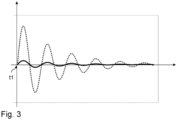
Figure 2 illustrates the voltage over the capacitor C1 as a function of time, see solid line, and the current through the primary coil L1, see dotted line. Moreover, a graph, see dashed line, illustrates voltage over spark gap, or spark plug electrodes, as a function of time. The graphs are in different scales and units to improve legibility. At time t0, the switch SW1, as shown inFigure 1 , is opened and the further switch SW4, also shown inFigure 1 , is closed. At time t1, the switch SW1 is closed and the further switch SW4 is opened to form the spark. The current through the primary coil begins and increases while the voltage over the capacitor decreases. The increasing current through the primary coil is transformed to an increasing voltage over the secondary coil. The (voltage) increase continues until the voltage across the spark plug electrodes is so high that an electric break-down is created, generating a plasma between the spark plug electrodes, i.e., a spark has been initiated. The polarity of the spark alternates thereafter due to the resonant circuit formed by the capacitor C1 and the transformer T, known to be a resonant circuits of this kind. Eventually, the spark is extinguished (not shown). Additionally,Figure 3 illustrates current through the spark gap, see solid line, and current through primary coil, see dotted line. Time t1 is the same as inFigure 2 . - Various solutions for varying spark duration in CDI systems exist. For example,
US6662792 discloses a capacitor discharge ignition (CDI) system that is capable of generating intense continuous electrical discharge at a spark gap for a desired duration and may include a second controllable power switching circuit with its input terminal connected to an output terminal of a high voltage DC source device. An output terminal of the second controllable power switching circuit is connected to an input terminal of a first power switching circuit. The second controllable power switching circuit may also have a control terminal connected to an output of a controller. The first controllable power switching circuit may be used for discharging a discharge capacitor, and the second controllable power switching circuit may cause charging of the discharge capacitor. As such, an ignition current through an ignition coil of the system is enabled for any desired number of cycles during both the charge and discharge cycles of the discharge capacitor. A train of ignition current signals makes the spark extendable to any desired length of time. However, a disadvantage with such a solution is a limited flexibility to generate a spark with desired properties, and a high production cost. For some applications, specifically for applications requiring flexible spark characteristics and cost efficient solutions, such as SI-ICE fuelled by alternative and renewable fuels, new, more cost efficient and flexible solutions are required. - Further documents within this technical field will be identified and briefly discussed in the following.
-
US7121270B1 relates to an ignition system providing a power- and duration-controlled ignition spark. -
US2007/181110A1 discloses a multiple discharge ignition control apparatus, a battery, an energy storage coil and a first IGBT connected in series. -
JPS62228815A -
US2013049593A1 relates to a high frequency plasma generation system and high frequency plasma ignition device using the same. -
US2014116405A1 discloses an ignition coil apparatus for high-frequency discharge. - An object may be to at least mitigate the abovementioned disadvantage(s) and/or problem(s).
- According to an aspect, the object is achieved by an electronic circuit for controlling a spark of a spark plug in a capacitor discharge ignition system for a combustion engine. The electronic circuit comprises an ignition coil arranged to provide current to the spark plug. The ignition coil comprises a primary winding, having a first primary terminal and a second primary terminal, and a secondary winding across which the spark plug is connectable. The electronic circuit comprises an ignition capacitor arranged to be capable of supplying energy to the primary winding. The ignition capacitor has a first capacitor terminal and a second capacitor terminal. The first capacitor terminal is connected to the second primary terminal. The electronic circuit comprises a voltage source arranged to be capable of supplying energy to at least one of the ignition capacitor and the primary winding. The voltage source has a first source terminal and a second source terminal.
- Moreover, the electronic circuit comprises a first switch, a second switch and a third switch. The first switch is connected to the first primary terminal and the first source terminal. The second switch is connected to the second capacitor terminal and the second source terminal. The third switch is connected to the second capacitor terminal and the first source terminal.
- According to another aspect, the object is achieved by a capacitor discharge ignition system comprising the electronic circuit according to any one of the embodiments disclosed herein.
- According to a further aspect, the object is achieved by a combustion engine comprising a capacitor discharge ignition system as disclosed herein.
- Thanks to the first, second and third switches, the electronic circuit enables control of characteristics of the spark in an efficient and independent manner. By means of adjusting the voltage source, an ignition voltage available for charging the ignition capacitor, control of certain characteristics of the spark may be enabled. For example, each of the following characteristics, comprising e.g. spark duration, ignition voltage and spark current, may be controlled independently from the other characteristics according to at least some embodiments.
- An advantage is hence that at least some embodiments herein enable flexible control of the spark, e.g. in a cost-efficient manner.
- In some embodiments, the electronic circuit comprises a fourth switch connected to the second primary terminal and the second source terminal. In this manner, requirements on the voltage source, e.g. in terms of output voltage and/or output current, may be relaxed. Accordingly, with relax requirements, cost of the voltage source may be reduced.
- In some embodiments, the electronic circuit comprises a fifth switch connected to the first capacitor terminal and the first source terminal. In this manner, any residual charge held by the ignition capacitor may be discharged after the spark has extinguished, thereby resetting a state of charge of the ignition capacitor. An advantage may be that the ignition capacitor's state of charge is known, or defined, such that a subsequent spark may be controlled as desired, i.e. starting from a known state of charge of the ignition capacitor. This may be particularly useful for controlling the spark duration.
- In some embodiments, the electronic circuit comprises a storage capacitor connected to the first source terminal and the second switch, and a sixth switch connected to the second source terminal and the storage capacitor. The second switch is connected to the second source terminal by being indirectly connected to the second source terminal via the sixth switch, which is connected to the second switch. In this manner, a sum of voltages over the storage capacitor and the voltage source may be applied when the first switch is closed, the second switch closed, the sixth switch closed, the third switch open, the fourth switch open and the fifth switch open. An advantage is hence that maximum voltage requirements on the voltage source may be relaxed, e.g. as compared to at least some of the embodiments herein, i.e., a cost efficient solution.
- In some embodiments, the electronic circuit comprises a control unit, which may be configured to perform various methods to control one or more of spark duration, ignition voltage and spark current.
- An advantage is hence that the electronic circuit may achieve, e.g. upon use within a combustion engine, control of the spark characteristics as disclosed herein.
- The various aspects of embodiments disclosed herein, including particular features and advantages thereof, will be readily understood from the following detailed description and the accompanying drawings, which are briefly described in the following.
-
Figure 1 is a schematic overview of an exemplifying electronic circuit for a CDI system according to prior art. -
Figure 2 andFigure 3 are graphs illustrating exemplifying currents and voltages during operation of the known electronic circuit ofFigure 1 . -
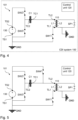
Figure 4 is a schematic circuit diagram of an exemplifying electronic circuit according to embodiments herein. -
Figure 5 is a schematic circuit diagram of another exemplifying electronic circuit according to embodiments herein. -
Figures 6 and7 are graphs illustrating exemplifying currents and voltages during operation of the exemplifying electronic circuit ofFigure 5 . -
Figure 8 is a schematic circuit diagram of a further exemplifying electronic circuit according to embodiments herein. -
Figure 9 is a schematic circuit diagram of a still further exemplifying electronic circuit not being part of the present invention as defined by the claims. -
Figure 10a to Figure 10d illustrates some examples of spark control that are enabled by the electronic circuit disclosed herein. -
Figure 11 is a schematic block diagram illustrating an exemplifying combustion engine comprising an embodiment of the ignition system herein. - Throughout the following description, similar reference numerals have been used to denote similar features, such as nodes, actions, modules, circuits, parts, items, elements, units or the like, when applicable.
Numerous embodiments of the present invention will now be described in detail; however, the present invention is defined only by those embodiments supported by the enclosed claims. -
Figure 4 depicts an exemplifyingelectronic circuit 101 for controlling a spark of a spark plug SP1 in a capacitordischarge ignition system 100 for a combustion engine. - The
electronic circuit 101 comprises anignition coil 110 arranged to provide current to the spark plug SP1. Theignition coil 110 comprises a primary winding L1, having a first primary terminal TL1 and a second primary terminal TL2, and a secondary winding L2 across which the spark plug SP1 is connectable. In case of multiple cylinders, there is a respective ignition coil for each cylinder. - The
electronic circuit 101 further comprises an ignition capacitor C1 arranged to be capable of supplying energy to the primary winding L1. The ignition capacitor C1 has a first capacitor terminal TC1 and a second capacitor terminal TC2. The first capacitor terminal TC1 is connected to the second primary terminal TL2. - Moreover, the
electronic circuit 101 comprises avoltage source 130 arranged to be capable of supplying energy to at least one of the ignition capacitor C1 and the primary winding L1. Thevoltage source 130 has a first source terminal TS1 and a second source terminal TS2. Thevoltage source 130 may e.g. be powered from e.g. a 12 V or 24 V battery provided in connection with the combustion engine. Thevoltage source 130 may be an adjustable voltage source, such as a boost converter, step-up converter, buck-boost converter or the like. - The
electronic circuit 101 additionally comprises a first switch SW1 connected to the first primary terminal TL1 and the first source terminal TS1. In case of multiple cylinders, there is a respective switch for each cylinder. Such respective switch is connected in the same, similar or corresponding manner as the first switch SW1 with respect to its corresponding cylinder. - Furthermore, the
electronic circuit 101 comprises a second switch SW2 connected to the second capacitor terminal TC2 and the second source terminal TS2. -
Figure 4 further illustrates that theelectronic circuit 101 comprises a third switch SW3 connected to the second capacitor terminal TC2 and the first source terminal TS1. - The second switch SW2 and the third switch SW3 and the way they are connected in the
electronic circuit 101 enables switching of to where energy is fed from thevoltage source 130. - Notably, throughout the present disclosure, the switches are illustrated as ideal switches. In practical implemententions, protective diodes, further components, and/or the like may be provided.
- As used herein, the term "connected to" may mean directly or indirectly connected to, i.e. via one or more further components.
- As used herein, the term "switch" may or may not include additional components, such as diodes, protective diodes or the like.
- In some examples, the spark plug SP1 may be considered to be in, or comprised in, the capacitor discharge ignition system. The spark plug is typically in the CDI system since the ignition of the spark of the spark plug is mounted at, or on/in, a cylinder whose ignition is controlled.
- The
electronic circuit 101 may comprise acontrol unit 120, such as a microprocessor, microcontroller, a processor circuit, a central processing unit (CPU) or the like. - The
control unit 120 may be arranged to open or close one or more of the switches of theelectronic circuit 101 according to any one of the embodiments herein. This may be done by that thecontrol unit 120 is electrically connected (not shown) to a respective control port of each switch, such as a base of a transistor switch or the like. The controlling of the switches will be described in more detail below. - Moreover, the
control unit 120 may be configured to measure current, such as the secondary current - An advantage according to the embodiments herein, it that small ignition coils may be designed, which is a desirable property due to the lack of space in modern SI-ICE. Small sized coils may be designed using a CDI approach, because the energy is stored in the ignition capacitor C1, as opposed to inductive type ignition coils where the energy is stored in a magnetic core in the form of a magnetic field which leads to large ignition coils in order to meet the requirements. Moreover, less energy to create the initial spark (flash over) may be required, since more energy may be added as the spark runs (or glows), i.e. before extinction. Therefore, small sized coils may be used and still meet the requirements on spark properties that come with modern SI-ICE applications.
- With at least some embodiments, spark characteristics may be changed individually from one spark to another spark for improved ignitability and significantly reduced spark plug wear. Spark plug electrode wear is a well-known and cost driving problem in SI-ICE applications, due to erosion of the electrodes through evaporation, ejection of molten electrode metal and sputtering due to the impact of high energy particles on the electrode surface. Reduced spark plug electrode wear is achieved by adapting the spark to the engine operating condition and the fuel property such that excessive spark energy and/or power is avoided, or at least reduced.
- Also, the solution is well suited for ion-current based combustion diagnostics due to low coil inductance and built-in active coil ringing suppression. When the spark is extinguished, there is still some residual energy in the resonant ignition circuit that will "ring" back and forth describing a decaying sinusoidal signal. Such a ringing will interfere with ion current measurements and make such a measurement un-useful until the ringing has vanished. Clearly, by reducing the inductance in the resonant circuit, the residual (magnetic) energy is reduced and hence, so also the ringing. The active coil ringing suppression offered by the fifth switch SW5 in
Fig. 8 further decreases the ringing, improving the ion current capability, or ion sense capability. - The embodiments herein may be paricularly suited for hydrogen gas fuelled engines, which typically are more sensitive to so called pre ignition in which case the air-fuel mixture is ignited unintenionally before it should. This may not only reduce the efficiency of the engine, but also be harmful for, or even destroy, the engine. The cause for such pre-ignition may be "spark at make" which may arise at start of dwell in inductive ignition systems, or due to hot spots in the combustion chamber that may be the result of excessiove spark energy that may heat the spark plug electrodes. Hydrogen fuelled SI-ICE may especially benefit from a controlled and flexible spark ignition due to the inherent physical properties of hydrogen, and such a controlled and flexible ignition may be enabled with at least some of the embodiments herein.
- Turning to
Figure 5 , a fourth switch SW4 has been added to the electronic circuit ofFigure 4 . Hence, theelectronic circuit 101 may comprise the fourth switch SW4, which may be connected to the second primary terminal TL2 and the second source terminal TS2. - With the fourth switch SW4 closed, the first switch SW1 opened and the second switch SW2 opened and the third switch SW3 closed, the ignition capacitor C1 may be charged without applying any voltage to the primary coil L1. Next, for ignition of the spark, the fourth switch SW4 is opened, the first switch SW1 is closed and the second switch SW2 is closed and the third switch SW3 is opened. Thereby, applying voltages over the ignition capacitor C1 and the voltage source in series over the primary coil L1.
- Therefore, voltage requirements on the
voltage source 130 may be relaxed thanks to the fourth switch SW4. For example, the 130 may only be required to be able to supply a voltage that is half of the voltage that is needed to be supplied by thevoltage source 130 in the example ofFigure 4 . The ignition capacitor C1 is typically capable of holding a voltage approximately equal to a maximum voltage available from thevoltage source 130 ofFigure 4 . - In the following, operation of the
electronic circuit 101 ofFigure 5 is illustrated with reference toFigure 6 . -
Figure 6 shows voltage over the capacitor C1 as a function of time, see solid line, and current through the primary coil L1, see dotted line. Moreover, a graph, see dashed line, illustrates voltage over the spark gap, or the spark plug SP1, as a function of time. The graphs are in different scales and units to improve legibility. At time t0, the first switch SW1 is open and the fourth switch SW4 is closed. The third switch SW3 is closed and the second switch SW2 is open. In this manner, the capacitor C1 is charged. At time t1, the first switch SW1 and the third switch SW3 are closed and the second switch SW2 and the fourth switch SW4 are opened to form the spark. The current through the primary coil begins and increases while the voltage over the capacitor decreases. The increasing current through the primary coil is transformed to an increasing voltage over the secondary coil. The (voltage) increase continues until the voltage across the spark plug electrodes is so high that an electric break-down is created, generating a plasma between the spark plug electrodes, i.e., a spark has been initiated. While the spark burns it alternates with the oscillations of the voltage over the capacitor C1 and the current through the primary coil. - After a few oscillations, the solid line jumps due to energy supplied in synchrony with the oscillations. Thus, extending the spark duration.
- As shown in
Figure 7 , the energy - causing the jump or irregularity of the solid line inFigure 6 - is supplied by a current from thevoltage source 130 and/or a storage capacitor C2 to be introduced in connection withFigure 8 below. Thecontrol unit 120 may e.g., for this purpose, open the third switch SW3 and close the second switch SW2 at e.g. a point in time t2. At another point in time t3, thecontrol unit 120 may close the third switch SW3 again and open the second switch SW2. The switches SW1, SW2, SW3 and SW4 may remain unchanged until the oscillations decay and the spark is extinguished (not shown). Additionally,Figure 7 illustrates current through spark gap, see solid line, and current through primary coil, see dotted line. Time t1 is the same as inFigure 6 . - In the table below, it is illustrated how the switches of the electronic circuit of
Figure 5 may be operated in order to control duration, or length, of the spark when generating a spark. This means that when the switches are operated as below with suitable timing a spark with desired characteristics may be generated.X = Closed switch (current passes through) Step SW1 SW2 SW3 SW4 Description: 0 Power up 1 X X C1 is charged to desired voltage for spark formation 2 X X C1 voltage is causing a current through ignition primary coil L1. 3 X X When energy is needed for maintaining spark current C1 is charged from 130. Timing for shift is sycronized with oscillation. 4 X X To continue osciallation SW2 is opened and SW3 is closed. For long durations the oscillation is maintained by syncronized repeated shifting of C1 with SW2 and SW3 for energy input or output, syncronized. 5 All switches are opened for fast spark turn off 6 Return to step 1 for next spark sequence. - In some examples (not illustrated by an accompanying Table/Figure), the
electronic circuit 101 may comprise a fifth switch SW5 connected to the first capacitor terminal TC1 and the first source terminal TS1. In this manner, any residual voltage held by the ignition capacitor C1 may be discharged to the ground GND after the spark has extinguished, thereby resetting a state of charge of the ignition capacitor C1. An advantage may be that the ignition capacitor's state of charge is known, or defined, such that a subsequent spark may be controlled as desired, i.e. starting from a known state of charge of the ignition capacitor. This may be particularly useful for controlling the spark duration. -
Figure 8 illustrates a further exemplifyingelectronic circuit 101. In addition to theelectronic circuit 101 ofFigure 5 , the furtherelectronic circuit 101 ofFigure 8 further comprises a storage capacitor C2 connected to the first source terminal TS1 and the second switch SW2. It may here be mentioned that the ignition capacitor C1 and the storage capacitor C2 may be referred to as the first capacitor C1 and the second capacitor C2, respectively. This means that the words "ignition" and "storage" are in this context merely used as labels to distinguish the respective capacitors from each other. - Moreover, the
electronic circuit 101 ofFigure 8 further comprises a sixth switch SW6 connected to the second source terminal TS2 and the storage capacitor C2. The second switch SW2 is connected to the second source terminal TS2 by being indirectly connected to the second source terminal TS2 via the sixth switch SW6, which is connected to the second switch SW2. - In some examples, there is provided a capacitor
discharge ignition system 100 comprising theelectronic circuit 101 according to any one of the embodiments herein. - Thanks to the two switches SW2, SW3, energy can be supplied to C1 each period of the resonating ignition circuit, whereby an amplitude (magnitude) of the spark current is maintained, or a decrease thereof is mitigated, hereby maintaining a desired power in the spark to enable robust ignition of the air-fuel mixture. This is done by keeping one of switch SW2/SW3 closed at each moment. When primary current >0 SW3 can be opened and SW2 closed for a time until energy supplied is enough to maintain the spark.
- Energy supplied to the CDI system is: E = ∫V1 × I × dt. To maintain the spark current amplitude at or above a desired level this energy may preferably be greater than the total energy consumed during the last period of the resonating ignition circuit. Expressed differently:

- Ep is losses in primary coil, Ep is dependent of Ip (primary current) and can be tabulated or calculated.
- Es is losses in secondary coil, Es is dependent of Is (secondary current) and can be tabulated or calculated, and
- Espark is energy in the spark. Espark is dependent of Is (spark current) and voltage over gap.
- According to
Figure 8 , switch SW6, capacitor C2 and switch SW5 has been added to the circuit ofFigure 5 . In this manner, theelectronic circuit 101 makes it possible to vary the voltage used for maintaining the spark and shut off the spark. -
Name Description 130 Voltage source. SW1 1st switch (one switch for each coil when used for multi-cylinder engines) SW2 2nd switch SW3 3rd switch SW4 4th switch SW5 5th switch SW6 6th switch C1 Capacitor Discharge-serial Capacitor C2 Storage capacitor L1 Primary coil L2 Secondary coil SP1 Spark plug 120 Control unit configured for measuring and controlling the switches - The table below shows an example of a method for setting the switches to control spark characteristics, such as duration, spark voltage and spark current (or secondary current).
X = Closed switch (current passes through) Step SW1 SW2 SW3 SW4 SW5 SW6 Description: 0 Power up 1 C2 is charged to pre set voltage for desired energy. 2 X X C1 is charged to desired voltage (Voltage in C2+C1 sets available spark voltage) 3 X X C1+C2 voltage is causing a current through ignition primary coil L1. 4 X X Reference voltage for C2 is shifted to C1. Timing for shift is syncronized with oscillation. 5 X X X More energy is added to C2 to maintain voltage level (optional). 6 X X Reference voltage for C2 is shifted to C1. Timing for shift is sycronized with oscillation. 7 X X For long durations the oscillation is maintained by syncronized repeated shifting of C2 reference with SW2 and SW3. 8 X X SW 5 is closed to short primary coil and stop coil ringing (optional). 9 Return to step 1 for next spark sequence. - The
control unit 120 may control the switches based on, e.g., measurement of the oscillating secondary current. This means that thecontrol unit 120 may be configured to meausure the secondary current. In other examples, thecontrol unit 120 may be configured to control the switches based on e.g. measuremnt of the oscillating primary current. As used herein, primary current refers to current through the primary coild and secondary current refers to current through the secondary coil. - The voltage across the energy storage capacitor C1 is shown in red above.
Some of the energy stored in the capacitor is lost when raising the voltage across the spark plug required to create a spark (flash-over). - Some of the energy stored in the capacitor is lost to maintain the spark and to drive the current through SW1 and the ignition coil (both magnetic and resistiv losses) and the (spark) plasma..
- This results in that the peak capacitor voltage (charge, energy) is succesively reduced, and the voltage-time area of the capacitor (positive, neagtive, positive, etc) is succesilvey reduced. This means that the current-time area on both the primary side and the secondary side are reduced as well.
- In case we would like to keep the AC spark current constant for a longer time, or regulate the spark current amplitude, this is possible by adding a time dependent voltage source V2, see
Figure 9 , which will add energy to the system. The embodiment illustrated infigure 9 is not part of the present invention as defined by the appended claims. Thecontrol unit 120 may be configured to control the voltage output from the time dependent voltage source V2. Hence, it may rather be that thecontrol unit 120 causes the voltage from the voltage source V2 to become time dependent thanks to appropriate controll signalling and circuitry for achieve the time dependent voltage. In one example, theelectronic circuit 101 ofFigure 9 may be equipped with the fifth switch SW5 connected similarly as shown inFigure 8 . In some examples, the voltage source V2 may not need to be time dependent. - An advantage of the
electronic circuit 101 ofFigure 9 may be that the switches may be specified with lower voltage requirements than in the example ofFigure 8 . - Turning to
Figure 10a through Figure 10d , a principle behind a method, e.g. performed by thecontrol unit 120, for controlling at least one spark characteristic, such as ignition voltage, spark current and spark duration, is described. - In
Figure 10a , the voltage over the capacitor C1 is shown as a solid line and the current through the primary coil PL1 is shown as a dotted line. - To keep the spark current amplitude constant, a voltage-time area may be added during each period p of the capacitor voltage, or during at least one of the negative and the positive half-period. This can be done by adding a medium high DC voltage in phase with the capacitor voltage during a certain time interval, a higher DC voltage during a shorter time period or a lower DC voltage during a longer time period as indicated in
Figure 10b . In this case a voltage of alternating polarity is used. This can be created using a DC voltage source combined with four switches in a H-bridge (full bridge) configuration. The height h and the width d may be varied to add a desired energy level WL, which is proportional to h*w. - In
Figure 10c , a voltage-time area is added only when the capacitor voltage is negative. This is a simpler method which makes it possible to maintain the spark current with only two switches in the form of a half-bridge supplied by a single DC voltage source. - In
Figure 10d , the time varying voltage source is also used to form the spark. By doing so, the capacitor C1 does not need to be charged to as high a voltage as in the previous examples, e.g., inFigure 4, Figure 5 orFigure 8 . As a result, cost of theelectronic circuit 101 may be reduced. - CDI systems are normally powered from a 12 V or a 24 V power source, e.g. to power the
adjustable voltage source 130. The capacitor is typically charged to a voltage of 200-400 V. - The voltage needed to maintain the spark for a long or an infinite time is much smaller than 200-400V. Typically, a voltage in the range of 24-100 V can be used for this purpose.
- If a low voltage such as e.g. 24 V can be used, combined with a full bridge to add a voltage of 24 V to the capacitor C1 with different polarity, a very energy efficient system is created, as there is no need for additional voltage conversions between 24 V and a higher voltage, such as the aforementioned 200-400 V. This implies a significant cost reduction.
- Also, in case a higher voltage than 24 V is used, but in the interval of 24-100 V a system can be designed at lower cost and lower losses than when using a system with only one energy source at 200-400 V.
- If only one voltage source V is used both for charging the capacitor C1 and for the creating the time varying voltage source V2, the voltage source can be reduced from typically 200-400 V to 100-200 V, which also simplifies the design of the CDI system This can be done by connecting the voltage source V2 = V to the left side of the capacitor C1 charged to a voltage of V, (see graph 5) which means that the voltage 2*V is connected shortly to the primary side of the ignition coil to create the spark.
- As illustrated in
Figure 10b to Figure 10d , energy is added during at least parts of a period such that the intergral reaches desired set point. Thereby individually controlling each of ignition voltage (if adding energy in "first" period), duration of spark and spark current. - If it is desired to increase spark current, but not extend duration energy in opposite phase may be inserted to dampen oscillation faster. Hence, duration and spark current may be controlled individually.
-
Figure 11 shows a combustion engine 150 comprising anexemplyfing ignition system 100 according to the embodiments herein. Theigntion system 100 may be a CDI system, CDI control system or the like.
Claims (7)
- An electronic circuit (101) for controlling a spark of a spark plug (SP1) in a capacitor discharge ignition system (100) for a combustion engine, wherein the electronic circuit (101) comprisesan ignition coil (110) arranged to provide current to the spark plug (SP1), wherein the ignition coil (110) comprises a primary winding (L1), having a first primary terminal (TL1) and a second primary terminal (TL2), and a secondary winding (L2) across which the spark plug (SP1) is connectable,an ignition capacitor (C1) arranged to be capable of supplying energy to the primary winding (L1), wherein the ignition capacitor (C1) has a first capacitor terminal (TC1) and a second capacitor terminal (TC2), wherein the first capacitor terminal (TC1) is connected to the second primary terminal (TL2),a voltage source (130) arranged to be capable of supplying energy to at least one of the ignition capacitor (C1) and the primary winding (L1), wherein the voltage source (130) has a first source terminal (TS1) and a second source terminal (TS2),a first switch (SW1) connected to the first primary terminal (TL1) and the first source terminal (TS1),characterized in that the electronic circuit (101) further comprisesa second switch (SW2) connected to the second capacitor terminal (TC2) and the second source terminal (TS2), anda third switch (SW3) connected to the second capacitor terminal (TC2) and the first source terminal (TS1),wherein the first, second, and third switch (SW1, SW2, SW3) are arranged to enable supply of energy to the capacitor (C1) each period of a resonating ignition circuit, whereby an amplitude of the spark current is maintained, or decrease thereof is mitigated.
- The electronic circuit (101) according to claim 1, wherein the electronic circuit (101) comprises
a fourth switch (SW4) connected to the second primary terminal (TL2) and the second source terminal (TS2). - The electronic circuit (101) according to claim 1 or 2, wherein the electronic circuit (101) comprises
a fifth switch (SW5) connected to the first capacitor terminal (TC1) and the first source terminal (TS1). - The electronic circuit (101) according to any one of claims 1-3, wherein the electronic circuit (101) comprisesa storage capacitor (C2) connected to the first source terminal (TS1) and the second switch (SW2), anda sixth switch (SW6) connected to the second source terminal (TS2) and the storage capacitor (C2), wherein the second switch (SW2) is connected to the second source terminal (TS2) by being indirectly connected to the second source terminal (TS2) via the sixth switch (SW6), which is connected to the second switch (SW2).
- The electronic circuit (101) according to any one of claims 1-4, wherein the electronic circuit (101) comprises a control unit (120).
- A capacitor discharge ignition system (100) comprising the electronic circuit (101) according to any one of claims 1-5.
- A combustion engine comprising a capacitor discharge ignition system (100) according to claim 6.
Applications Claiming Priority (1)
| Application Number | Priority Date | Filing Date | Title |
|---|---|---|---|
| SE2051548A SE2051548A1 (en) | 2020-12-22 | 2020-12-22 | Electronic circuit and capacitor discharge system comprising electronic circuit |
Publications (3)
| Publication Number | Publication Date |
|---|---|
| EP4019763A1 EP4019763A1 (en) | 2022-06-29 |
| EP4019763C0 EP4019763C0 (en) | 2025-01-29 |
| EP4019763B1 true EP4019763B1 (en) | 2025-01-29 |
Family
ID=78083407
Family Applications (1)
| Application Number | Title | Priority Date | Filing Date |
|---|---|---|---|
| EP21210327.9A Active EP4019763B1 (en) | 2020-12-22 | 2021-11-24 | Electronic circuit and capacitor discharge ignition system comprising electronic circuit |
Country Status (3)
| Country | Link |
|---|---|
| US (1) | US11560869B2 (en) |
| EP (1) | EP4019763B1 (en) |
| SE (1) | SE2051548A1 (en) |
Citations (3)
| Publication number | Priority date | Publication date | Assignee | Title |
|---|---|---|---|---|
| JPS62228815A (en) * | 1986-03-29 | 1987-10-07 | Toshiyasu Suzuki | Ignition device |
| US20130049593A1 (en) * | 2011-08-22 | 2013-02-28 | Denso Corporation | High frequency plasma generation system and high frequency plasma ignition device using the same |
| US20140116405A1 (en) * | 2012-10-26 | 2014-05-01 | Mitsubishi Electric Corporation | Ignition coil apparatus for high-frequency discharge |
Family Cites Families (7)
| Publication number | Priority date | Publication date | Assignee | Title |
|---|---|---|---|---|
| DE1952603C3 (en) * | 1969-10-18 | 1978-09-28 | Robert Bosch Gmbh, 7000 Stuttgart | Ignition device for internal combustion engines |
| JPH0422758A (en) * | 1990-05-18 | 1992-01-27 | Mitsubishi Electric Corp | Ignition device for internal combustion engine |
| US6408820B1 (en) * | 2000-08-02 | 2002-06-25 | Walbro Corporation | Capacitor discharge engine ignition system with automatic ignition advance and/or minimum ignition speed control |
| EP1298320A3 (en) | 2001-09-27 | 2004-10-20 | STMicroelectronics Pvt. Ltd | Capacitor discharge ignition (CDI) system |
| US7121270B1 (en) * | 2005-08-29 | 2006-10-17 | Vimx Technologies Inc. | Spark generation method and ignition system using same |
| US7404396B2 (en) * | 2006-02-08 | 2008-07-29 | Denso Corporation | Multiple discharge ignition control apparatus and method for internal combustion engines |
| SE536577C2 (en) * | 2012-04-13 | 2014-03-04 | Sem Ab | Ignition system comprising a measuring device arranged to provide measurement signals to the control system of an internal combustion engine |
-
2020
- 2020-12-22 SE SE2051548A patent/SE2051548A1/en unknown
-
2021
- 2021-11-24 EP EP21210327.9A patent/EP4019763B1/en active Active
- 2021-12-22 US US17/559,055 patent/US11560869B2/en active Active
Patent Citations (3)
| Publication number | Priority date | Publication date | Assignee | Title |
|---|---|---|---|---|
| JPS62228815A (en) * | 1986-03-29 | 1987-10-07 | Toshiyasu Suzuki | Ignition device |
| US20130049593A1 (en) * | 2011-08-22 | 2013-02-28 | Denso Corporation | High frequency plasma generation system and high frequency plasma ignition device using the same |
| US20140116405A1 (en) * | 2012-10-26 | 2014-05-01 | Mitsubishi Electric Corporation | Ignition coil apparatus for high-frequency discharge |
Also Published As
| Publication number | Publication date |
|---|---|
| US11560869B2 (en) | 2023-01-24 |
| EP4019763C0 (en) | 2025-01-29 |
| SE544004C2 (en) | 2021-10-26 |
| US20220252034A1 (en) | 2022-08-11 |
| CN114658582A (en) | 2022-06-24 |
| EP4019763A1 (en) | 2022-06-29 |
| SE2051548A1 (en) | 2021-10-26 |
Similar Documents
| Publication | Publication Date | Title |
|---|---|---|
| US6112730A (en) | Ignition system with clamping circuit for use in an internal combustion engine | |
| CN105705773B (en) | Method and apparatus for the multiple-spark discharge ignition system for controlling internal combustion engine | |
| US8807124B2 (en) | Ignition apparatus | |
| JP2015529774A (en) | Ignition device for internal combustion engine | |
| KR102600304B1 (en) | Method and device for controlling ignition systems | |
| US20110041804A1 (en) | Multiplexing Drive Circuit For An AC Ignition System | |
| JP2015529775A (en) | Ignition device for internal combustion engine | |
| US9784232B1 (en) | Forced frequency ignition system for an internal combustion engine | |
| US6135099A (en) | Ignition system for an internal combustion engine | |
| US6373199B1 (en) | Reducing stress on ignitor circuitry for gaseous discharge lamps | |
| JP6773004B2 (en) | Ignition system for internal combustion engine | |
| JP5253144B2 (en) | Ignition device for internal combustion engine | |
| EP4019763B1 (en) | Electronic circuit and capacitor discharge ignition system comprising electronic circuit | |
| EP0887546B1 (en) | An ignition device for an internal combustion engine | |
| CN114658582B (en) | Electronic circuits and capacitor discharge systems including electronic circuits | |
| JP4089484B2 (en) | Ignition device for internal combustion engine | |
| NL1019448C2 (en) | Internal combustion engine and ignition circuit for an internal combustion engine. | |
| US7240670B2 (en) | Extended duration high-energy ignition circuit | |
| JPS62210262A (en) | Pulse generation circuit and igniter using said circuit |
Legal Events
| Date | Code | Title | Description |
|---|---|---|---|
| PUAI | Public reference made under article 153(3) epc to a published international application that has entered the european phase |
Free format text: ORIGINAL CODE: 0009012 |
|
| STAA | Information on the status of an ep patent application or granted ep patent |
Free format text: STATUS: THE APPLICATION HAS BEEN PUBLISHED |
|
| AK | Designated contracting states |
Kind code of ref document: A1 Designated state(s): AL AT BE BG CH CY CZ DE DK EE ES FI FR GB GR HR HU IE IS IT LI LT LU LV MC MK MT NL NO PL PT RO RS SE SI SK SM TR |
|
| STAA | Information on the status of an ep patent application or granted ep patent |
Free format text: STATUS: REQUEST FOR EXAMINATION WAS MADE |
|
| 17P | Request for examination filed |
Effective date: 20221222 |
|
| RBV | Designated contracting states (corrected) |
Designated state(s): AL AT BE BG CH CY CZ DE DK EE ES FI FR GB GR HR HU IE IS IT LI LT LU LV MC MK MT NL NO PL PT RO RS SE SI SK SM TR |
|
| STAA | Information on the status of an ep patent application or granted ep patent |
Free format text: STATUS: EXAMINATION IS IN PROGRESS |
|
| 17Q | First examination report despatched |
Effective date: 20240103 |
|
| GRAP | Despatch of communication of intention to grant a patent |
Free format text: ORIGINAL CODE: EPIDOSNIGR1 |
|
| STAA | Information on the status of an ep patent application or granted ep patent |
Free format text: STATUS: GRANT OF PATENT IS INTENDED |
|
| RIC1 | Information provided on ipc code assigned before grant |
Ipc: F02P 11/02 20060101ALN20241112BHEP Ipc: F02P 3/04 20060101ALN20241112BHEP Ipc: F02P 3/00 20060101ALI20241112BHEP Ipc: F02P 9/00 20060101ALI20241112BHEP Ipc: F02P 3/08 20060101AFI20241112BHEP |
|
| GRAS | Grant fee paid |
Free format text: ORIGINAL CODE: EPIDOSNIGR3 |
|
| INTG | Intention to grant announced |
Effective date: 20241121 |
|
| RIN1 | Information on inventor provided before grant (corrected) |
Inventor name: SVENSSON, LARS Inventor name: KARLSSON, TOMAS Inventor name: EKLUND, JOHAN Inventor name: GUSTAFSSON, BERT Inventor name: BENGTSSON, JOERGEN |
|
| GRAA | (expected) grant |
Free format text: ORIGINAL CODE: 0009210 |
|
| STAA | Information on the status of an ep patent application or granted ep patent |
Free format text: STATUS: THE PATENT HAS BEEN GRANTED |
|
| AK | Designated contracting states |
Kind code of ref document: B1 Designated state(s): AL AT BE BG CH CY CZ DE DK EE ES FI FR GB GR HR HU IE IS IT LI LT LU LV MC MK MT NL NO PL PT RO RS SE SI SK SM TR |
|
| REG | Reference to a national code |
Ref country code: GB Ref legal event code: FG4D |
|
| REG | Reference to a national code |
Ref country code: CH Ref legal event code: EP |
|
| REG | Reference to a national code |
Ref country code: DE Ref legal event code: R096 Ref document number: 602021025334 Country of ref document: DE |
|
| REG | Reference to a national code |
Ref country code: IE Ref legal event code: FG4D |
|
| U01 | Request for unitary effect filed |
Effective date: 20250225 |
|
| U07 | Unitary effect registered |
Designated state(s): AT BE BG DE DK EE FI FR IT LT LU LV MT NL PT RO SE SI Effective date: 20250303 |
|
| PG25 | Lapsed in a contracting state [announced via postgrant information from national office to epo] |
Ref country code: RS Free format text: LAPSE BECAUSE OF FAILURE TO SUBMIT A TRANSLATION OF THE DESCRIPTION OR TO PAY THE FEE WITHIN THE PRESCRIBED TIME-LIMIT Effective date: 20250429 |
|
| PG25 | Lapsed in a contracting state [announced via postgrant information from national office to epo] |
Ref country code: PL Free format text: LAPSE BECAUSE OF FAILURE TO SUBMIT A TRANSLATION OF THE DESCRIPTION OR TO PAY THE FEE WITHIN THE PRESCRIBED TIME-LIMIT Effective date: 20250129 |
|
| PG25 | Lapsed in a contracting state [announced via postgrant information from national office to epo] |
Ref country code: ES Free format text: LAPSE BECAUSE OF FAILURE TO SUBMIT A TRANSLATION OF THE DESCRIPTION OR TO PAY THE FEE WITHIN THE PRESCRIBED TIME-LIMIT Effective date: 20250129 |
|
| PG25 | Lapsed in a contracting state [announced via postgrant information from national office to epo] |
Ref country code: NO Free format text: LAPSE BECAUSE OF FAILURE TO SUBMIT A TRANSLATION OF THE DESCRIPTION OR TO PAY THE FEE WITHIN THE PRESCRIBED TIME-LIMIT Effective date: 20250429 Ref country code: IS Free format text: LAPSE BECAUSE OF FAILURE TO SUBMIT A TRANSLATION OF THE DESCRIPTION OR TO PAY THE FEE WITHIN THE PRESCRIBED TIME-LIMIT Effective date: 20250529 |
|
| PG25 | Lapsed in a contracting state [announced via postgrant information from national office to epo] |
Ref country code: HR Free format text: LAPSE BECAUSE OF FAILURE TO SUBMIT A TRANSLATION OF THE DESCRIPTION OR TO PAY THE FEE WITHIN THE PRESCRIBED TIME-LIMIT Effective date: 20250129 |
|
| PG25 | Lapsed in a contracting state [announced via postgrant information from national office to epo] |
Ref country code: GR Free format text: LAPSE BECAUSE OF FAILURE TO SUBMIT A TRANSLATION OF THE DESCRIPTION OR TO PAY THE FEE WITHIN THE PRESCRIBED TIME-LIMIT Effective date: 20250430 |
|
| PG25 | Lapsed in a contracting state [announced via postgrant information from national office to epo] |
Ref country code: SM Free format text: LAPSE BECAUSE OF FAILURE TO SUBMIT A TRANSLATION OF THE DESCRIPTION OR TO PAY THE FEE WITHIN THE PRESCRIBED TIME-LIMIT Effective date: 20250129 |
|
| PG25 | Lapsed in a contracting state [announced via postgrant information from national office to epo] |
Ref country code: CZ Free format text: LAPSE BECAUSE OF FAILURE TO SUBMIT A TRANSLATION OF THE DESCRIPTION OR TO PAY THE FEE WITHIN THE PRESCRIBED TIME-LIMIT Effective date: 20250129 |
|
| PG25 | Lapsed in a contracting state [announced via postgrant information from national office to epo] |
Ref country code: SK Free format text: LAPSE BECAUSE OF FAILURE TO SUBMIT A TRANSLATION OF THE DESCRIPTION OR TO PAY THE FEE WITHIN THE PRESCRIBED TIME-LIMIT Effective date: 20250129 |
|
| U20 | Renewal fee for the european patent with unitary effect paid |
Year of fee payment: 5 Effective date: 20251022 |
|
| PLBE | No opposition filed within time limit |
Free format text: ORIGINAL CODE: 0009261 |
|
| STAA | Information on the status of an ep patent application or granted ep patent |
Free format text: STATUS: NO OPPOSITION FILED WITHIN TIME LIMIT |
|
| 26N | No opposition filed |
Effective date: 20251030 |