EP4019758B1 - Engine system, vehicle, method of controlling engine system, and computer program product - Google Patents
Engine system, vehicle, method of controlling engine system, and computer program product Download PDFInfo
- Publication number
- EP4019758B1 EP4019758B1 EP21205463.9A EP21205463A EP4019758B1 EP 4019758 B1 EP4019758 B1 EP 4019758B1 EP 21205463 A EP21205463 A EP 21205463A EP 4019758 B1 EP4019758 B1 EP 4019758B1
- Authority
- EP
- European Patent Office
- Prior art keywords
- uphill
- vehicle
- supercharger
- engine
- uphill angle
- Prior art date
- Legal status (The legal status is an assumption and is not a legal conclusion. Google has not performed a legal analysis and makes no representation as to the accuracy of the status listed.)
- Active
Links
Images




Classifications
-
- F—MECHANICAL ENGINEERING; LIGHTING; HEATING; WEAPONS; BLASTING
- F02—COMBUSTION ENGINES; HOT-GAS OR COMBUSTION-PRODUCT ENGINE PLANTS
- F02D—CONTROLLING COMBUSTION ENGINES
- F02D23/00—Controlling engines characterised by their being supercharged
- F02D23/005—Controlling engines characterised by their being supercharged with the supercharger being mechanically driven by the engine
-
- F—MECHANICAL ENGINEERING; LIGHTING; HEATING; WEAPONS; BLASTING
- F02—COMBUSTION ENGINES; HOT-GAS OR COMBUSTION-PRODUCT ENGINE PLANTS
- F02B—INTERNAL-COMBUSTION PISTON ENGINES; COMBUSTION ENGINES IN GENERAL
- F02B33/00—Engines characterised by provision of pumps for charging or scavenging
- F02B33/32—Engines with pumps other than of reciprocating-piston type
- F02B33/34—Engines with pumps other than of reciprocating-piston type with rotary pumps
- F02B33/36—Engines with pumps other than of reciprocating-piston type with rotary pumps of positive-displacement type
-
- F—MECHANICAL ENGINEERING; LIGHTING; HEATING; WEAPONS; BLASTING
- F02—COMBUSTION ENGINES; HOT-GAS OR COMBUSTION-PRODUCT ENGINE PLANTS
- F02B—INTERNAL-COMBUSTION PISTON ENGINES; COMBUSTION ENGINES IN GENERAL
- F02B33/00—Engines characterised by provision of pumps for charging or scavenging
- F02B33/32—Engines with pumps other than of reciprocating-piston type
- F02B33/34—Engines with pumps other than of reciprocating-piston type with rotary pumps
- F02B33/36—Engines with pumps other than of reciprocating-piston type with rotary pumps of positive-displacement type
- F02B33/38—Engines with pumps other than of reciprocating-piston type with rotary pumps of positive-displacement type of Roots type
-
- F—MECHANICAL ENGINEERING; LIGHTING; HEATING; WEAPONS; BLASTING
- F02—COMBUSTION ENGINES; HOT-GAS OR COMBUSTION-PRODUCT ENGINE PLANTS
- F02B—INTERNAL-COMBUSTION PISTON ENGINES; COMBUSTION ENGINES IN GENERAL
- F02B39/00—Component parts, details, or accessories relating to, driven charging or scavenging pumps, not provided for in groups F02B33/00 - F02B37/00
- F02B39/02—Drives of pumps; Varying pump drive gear ratio
- F02B39/04—Mechanical drives; Variable-gear-ratio drives
- F02B39/06—Mechanical drives; Variable-gear-ratio drives the engine torque being divided by a differential gear for driving a pump and the engine output shaft
-
- F—MECHANICAL ENGINEERING; LIGHTING; HEATING; WEAPONS; BLASTING
- F02—COMBUSTION ENGINES; HOT-GAS OR COMBUSTION-PRODUCT ENGINE PLANTS
- F02B—INTERNAL-COMBUSTION PISTON ENGINES; COMBUSTION ENGINES IN GENERAL
- F02B39/00—Component parts, details, or accessories relating to, driven charging or scavenging pumps, not provided for in groups F02B33/00 - F02B37/00
- F02B39/02—Drives of pumps; Varying pump drive gear ratio
- F02B39/12—Drives characterised by use of couplings or clutches therein
-
- F—MECHANICAL ENGINEERING; LIGHTING; HEATING; WEAPONS; BLASTING
- F02—COMBUSTION ENGINES; HOT-GAS OR COMBUSTION-PRODUCT ENGINE PLANTS
- F02D—CONTROLLING COMBUSTION ENGINES
- F02D23/00—Controlling engines characterised by their being supercharged
-
- F—MECHANICAL ENGINEERING; LIGHTING; HEATING; WEAPONS; BLASTING
- F02—COMBUSTION ENGINES; HOT-GAS OR COMBUSTION-PRODUCT ENGINE PLANTS
- F02D—CONTROLLING COMBUSTION ENGINES
- F02D41/00—Electrical control of supply of combustible mixture or its constituents
- F02D41/0002—Controlling intake air
- F02D41/0007—Controlling intake air for control of turbo-charged or super-charged engines
-
- F—MECHANICAL ENGINEERING; LIGHTING; HEATING; WEAPONS; BLASTING
- F02—COMBUSTION ENGINES; HOT-GAS OR COMBUSTION-PRODUCT ENGINE PLANTS
- F02D—CONTROLLING COMBUSTION ENGINES
- F02D41/00—Electrical control of supply of combustible mixture or its constituents
- F02D41/02—Circuit arrangements for generating control signals
- F02D41/021—Introducing corrections for particular conditions exterior to the engine
-
- F—MECHANICAL ENGINEERING; LIGHTING; HEATING; WEAPONS; BLASTING
- F02—COMBUSTION ENGINES; HOT-GAS OR COMBUSTION-PRODUCT ENGINE PLANTS
- F02D—CONTROLLING COMBUSTION ENGINES
- F02D41/00—Electrical control of supply of combustible mixture or its constituents
- F02D41/02—Circuit arrangements for generating control signals
- F02D41/021—Introducing corrections for particular conditions exterior to the engine
- F02D41/0215—Introducing corrections for particular conditions exterior to the engine in relation with elements of the transmission
- F02D41/022—Introducing corrections for particular conditions exterior to the engine in relation with elements of the transmission in relation with the clutch status
-
- F—MECHANICAL ENGINEERING; LIGHTING; HEATING; WEAPONS; BLASTING
- F02—COMBUSTION ENGINES; HOT-GAS OR COMBUSTION-PRODUCT ENGINE PLANTS
- F02D—CONTROLLING COMBUSTION ENGINES
- F02D41/00—Electrical control of supply of combustible mixture or its constituents
- F02D41/02—Circuit arrangements for generating control signals
- F02D41/021—Introducing corrections for particular conditions exterior to the engine
- F02D41/0215—Introducing corrections for particular conditions exterior to the engine in relation with elements of the transmission
- F02D41/023—Introducing corrections for particular conditions exterior to the engine in relation with elements of the transmission in relation with the gear ratio shifting
-
- F—MECHANICAL ENGINEERING; LIGHTING; HEATING; WEAPONS; BLASTING
- F02—COMBUSTION ENGINES; HOT-GAS OR COMBUSTION-PRODUCT ENGINE PLANTS
- F02D—CONTROLLING COMBUSTION ENGINES
- F02D41/00—Electrical control of supply of combustible mixture or its constituents
- F02D41/02—Circuit arrangements for generating control signals
- F02D41/14—Introducing closed-loop corrections
- F02D41/1401—Introducing closed-loop corrections characterised by the control or regulation method
- F02D41/1402—Adaptive control
-
- F—MECHANICAL ENGINEERING; LIGHTING; HEATING; WEAPONS; BLASTING
- F02—COMBUSTION ENGINES; HOT-GAS OR COMBUSTION-PRODUCT ENGINE PLANTS
- F02D—CONTROLLING COMBUSTION ENGINES
- F02D41/00—Electrical control of supply of combustible mixture or its constituents
- F02D41/02—Circuit arrangements for generating control signals
- F02D41/14—Introducing closed-loop corrections
- F02D41/1401—Introducing closed-loop corrections characterised by the control or regulation method
- F02D2041/1413—Controller structures or design
- F02D2041/1427—Decoupling, i.e. using a feedback such that one output is controlled by only one input
-
- F—MECHANICAL ENGINEERING; LIGHTING; HEATING; WEAPONS; BLASTING
- F02—COMBUSTION ENGINES; HOT-GAS OR COMBUSTION-PRODUCT ENGINE PLANTS
- F02D—CONTROLLING COMBUSTION ENGINES
- F02D2200/00—Input parameters for engine control
- F02D2200/02—Input parameters for engine control the parameters being related to the engine
- F02D2200/10—Parameters related to the engine output, e.g. engine torque or engine speed
- F02D2200/1002—Output torque
-
- F—MECHANICAL ENGINEERING; LIGHTING; HEATING; WEAPONS; BLASTING
- F02—COMBUSTION ENGINES; HOT-GAS OR COMBUSTION-PRODUCT ENGINE PLANTS
- F02D—CONTROLLING COMBUSTION ENGINES
- F02D2200/00—Input parameters for engine control
- F02D2200/50—Input parameters for engine control said parameters being related to the vehicle or its components
- F02D2200/501—Vehicle speed
-
- F—MECHANICAL ENGINEERING; LIGHTING; HEATING; WEAPONS; BLASTING
- F02—COMBUSTION ENGINES; HOT-GAS OR COMBUSTION-PRODUCT ENGINE PLANTS
- F02D—CONTROLLING COMBUSTION ENGINES
- F02D2200/00—Input parameters for engine control
- F02D2200/70—Input parameters for engine control said parameters being related to the vehicle exterior
- F02D2200/701—Information about vehicle position, e.g. from navigation system or GPS signal
-
- F—MECHANICAL ENGINEERING; LIGHTING; HEATING; WEAPONS; BLASTING
- F02—COMBUSTION ENGINES; HOT-GAS OR COMBUSTION-PRODUCT ENGINE PLANTS
- F02D—CONTROLLING COMBUSTION ENGINES
- F02D2200/00—Input parameters for engine control
- F02D2200/70—Input parameters for engine control said parameters being related to the vehicle exterior
- F02D2200/702—Road conditions
-
- F—MECHANICAL ENGINEERING; LIGHTING; HEATING; WEAPONS; BLASTING
- F02—COMBUSTION ENGINES; HOT-GAS OR COMBUSTION-PRODUCT ENGINE PLANTS
- F02D—CONTROLLING COMBUSTION ENGINES
- F02D41/00—Electrical control of supply of combustible mixture or its constituents
- F02D41/02—Circuit arrangements for generating control signals
- F02D41/021—Introducing corrections for particular conditions exterior to the engine
- F02D41/0215—Introducing corrections for particular conditions exterior to the engine in relation with elements of the transmission
- F02D41/0225—Introducing corrections for particular conditions exterior to the engine in relation with elements of the transmission in relation with the gear ratio or shift lever position
-
- F—MECHANICAL ENGINEERING; LIGHTING; HEATING; WEAPONS; BLASTING
- F02—COMBUSTION ENGINES; HOT-GAS OR COMBUSTION-PRODUCT ENGINE PLANTS
- F02D—CONTROLLING COMBUSTION ENGINES
- F02D41/00—Electrical control of supply of combustible mixture or its constituents
- F02D41/30—Controlling fuel injection
- F02D41/3011—Controlling fuel injection according to or using specific or several modes of combustion
- F02D41/3017—Controlling fuel injection according to or using specific or several modes of combustion characterised by the mode(s) being used
- F02D41/3035—Controlling fuel injection according to or using specific or several modes of combustion characterised by the mode(s) being used a mode being the premixed charge compression-ignition mode
- F02D41/3041—Controlling fuel injection according to or using specific or several modes of combustion characterised by the mode(s) being used a mode being the premixed charge compression-ignition mode with means for triggering compression ignition, e.g. spark plug
-
- Y—GENERAL TAGGING OF NEW TECHNOLOGICAL DEVELOPMENTS; GENERAL TAGGING OF CROSS-SECTIONAL TECHNOLOGIES SPANNING OVER SEVERAL SECTIONS OF THE IPC; TECHNICAL SUBJECTS COVERED BY FORMER USPC CROSS-REFERENCE ART COLLECTIONS [XRACs] AND DIGESTS
- Y02—TECHNOLOGIES OR APPLICATIONS FOR MITIGATION OR ADAPTATION AGAINST CLIMATE CHANGE
- Y02T—CLIMATE CHANGE MITIGATION TECHNOLOGIES RELATED TO TRANSPORTATION
- Y02T10/00—Road transport of goods or passengers
- Y02T10/10—Internal combustion engine [ICE] based vehicles
- Y02T10/12—Improving ICE efficiencies
Definitions
- the present disclosure relates to a vehicle having an engine system provided with an electromagnetic clutch which connects and/or disconnects a mechanical supercharger to/from a crankshaft.
- the present disclosure also relates to a method of controlling a engine system, and a computer program product.
- a booster boosts air to a combustion chamber of the engine in order to increase engine torque.
- a mechanical supercharger i.e., a supercharger
- an exhaust-turbine supercharger i.e., a turbocharger which uses exhaust pressure of the engine.
- An engine system disclosed in JP2019-039393A is provided with an electromagnetic clutch which connects a mechanical supercharger to a crankshaft when an engine operates within a given high-load range.
- the electromagnetic clutch connects the mechanical supercharger to the crankshaft. Accordingly, the mechanical supercharger can boost air to a combustion chamber of the engine to increase the engine torque.
- JP2019-039393A excels in the response compared with the exhaust-turbine supercharger as described above, when a vehicle goes up a hill (slope), acceleration delay of the vehicle may be caused as a result of response delay of the electromagnetic clutch.
- the electromagnetic clutch is disengaged so that the mechanical supercharger becomes a non-boosting state. Therefore, even if the accelerator opening is increased during re-acceleration of the vehicle, a time-lag may occur between the re-engagement of the electromagnetic clutch and the start of the boosting. As a result, the response delay of the boosting by the mechanical supercharger may be caused during the uphill-traveling, which may lead to the acceleration delay of the vehicle.
- US 5 133 326 A describes that a clutch control apparatus for a mechanical supercharger is used in connection with a mechanical supercharger provided in the intake passage of an engine and driven by the output shaft of the engine through a clutch.
- the present disclosure is made in view of the above situations, and one purpose thereof is reducing acceleration delay of a vehicle while traveling an uphill.
- the engine system of the present disclosure maintains boosting by a mechanical supercharger when an uphill angle is above a given first uphill angle during the uphill-traveling, even within a non-boosting range, so as to reduce the acceleration delay of the vehicle.
- a vehicle according to the invention is defined in claim 1 and a method according to the invention is defined in claim 10.
- an engine system which includes a supercharger driven by a crankshaft of an engine, an electromagnetic clutch disconnectably connecting the crankshaft to the supercharger, and a controller configured to output a control signal to the electromagnetic clutch.
- the electromagnetic clutch may disconnect and/or connect the crankshaft to the supercharger, or the electromagnetic clutch may disengage and/or engage the crankshaft with the supercharger.
- the controller may include a processor configured to execute an uphill-angle detecting module to detect an uphill angle during traveling of a vehicle, an uphill determining module to determine whether the detected uphill angle is above a given first uphill angle, and a boost controlling module to, when the uphill determining module determines that the uphill angle is above the first uphill angle, control the electromagnetic clutch to connect the crankshaft to the supercharger even when a target torque of the engine is within a non-boosting range.
- an uphill-angle detecting module to detect an uphill angle during traveling of a vehicle
- an uphill determining module to determine whether the detected uphill angle is above a given first uphill angle
- a boost controlling module to, when the uphill determining module determines that the uphill angle is above the first uphill angle, control the electromagnetic clutch to connect the crankshaft to the supercharger even when a target torque of the engine is within a non-boosting range.
- the boost controlling module controls the electromagnetic clutch to connect the crankshaft to the supercharger even if the target torque of the engine falls within the non-boosting range in which boosting is not performed. Therefore, even when the engine load changes during the uphill-traveling, the supercharger can always perform boosting regardless of the engine load when the uphill angle is above the first uphill angle. Therefore, response delay of the boosting can be reduced, and acceleration delay of the vehicle can be reduced.
- the boost controlling module may control the electromagnetic clutch to be disengaged when the uphill determining module determines that the uphill angle has fallen below a second uphill angle smaller than the first uphill angle.
- the disengagement of the electromagnetic clutch can be delayed, and a boosting period continued during the uphill-traveling can be made longer.
- the response delay in the re-acceleration during the uphill-traveling can be reduced for a long period.
- the controller may further include a timer.
- the timer may be actuated when the uphill determining module determines that the uphill angle has fallen below the second uphill angle.
- the boost controlling module may control the electromagnetic clutch to be disengaged after the timer measures a given period of time.
- the timing to disengage the electromagnetic clutch can be delayed for the given period which is set arbitrarily, and thus, the boosting period continued during the uphill-traveling can be made longer.
- the first uphill angle may be set to be smaller as a gear stage of a transmission becomes higher.
- the supercharger may be a mechanical supercharger mechanically linked with an engine body or the engine.
- the non-boosting range may include a range where spark controlled compression ignition combustion with an excess air ratio higher than 1 is performed.
- the non-boosting range may include a range where spark controlled compression ignition combustion with an excess air ratio higher than 1 is performed, and a boosting range may include a range where spark ignition combustion, or spark controlled compression ignition combustion with an excess air ratio at 1, is performed.
- the controller may control the supercharger to perform boosting regardless of the target engine torque calculated by a target torque calculating module.
- the controller may control the electromagnetic clutch to disconnect the crankshaft from the supercharger.
- the controller may store a map defining a relationship between a vehicle speed and the first uphill angle for each gear stage of a transmission.
- the first uphill angle may be set to be smaller as the gear stage becomes higher at the same vehicle speed.
- a vehicle includes the above engine system.
- an engine is particularly a four-stroke gasoline-direct-injection engine mounted on a vehicle, and serves as a drive source for traveling.
- the engine is provided with an engine body 1, an intake passage 30 through which intake air to be introduced into the engine body 1 passes, an exhaust passage 40 through which exhaust gas discharged from the engine body 1 passes, and an external exhaust gas recirculation (EGR) device 50 which recirculates part of the exhaust gas passing through the exhaust passage 40 to the intake passage 30.
- EGR exhaust gas recirculation
- the engine body 1 has a cylinder block 3 in which cylinders 2 are formed, a cylinder head 4 attached to an upper surface of the cylinder block 3 to close the cylinders 2 from above, and pistons 5 each reciprocatably inserted into the cylinder 2.
- a combustion chamber 6 is defined above the piston 5, and fuel particularly containing gasoline as a main component is supplied to the combustion chamber 6 by being injected from an injector 15 (described later). Then, the supplied fuel is mixed with air and combusts inside the combustion chamber 6, and an expansion force caused by the combustion reciprocates the piston 5 in an up-and-down direction.
- crankshaft 7 which is an output shaft of the engine body 1 is provided below the piston 5, a crankshaft 7 which is an output shaft of the engine body 1 is provided.
- the crankshaft 7 is coupled to the piston 5 via a connecting rod 8, and is rotary-driven about its center axis corresponding to the reciprocating motion (up-and-down motion) of the piston 5.
- the cylinder block 3 is particularly provided with a crank angle sensor SN1 which detects a rotational angle of the crankshaft 7 (crank angle), and a rotational speed of the crankshaft 7 (engine speed), and a water temperature sensor SN2 which detects the temperature of coolant (engine water temperature) which passes through inside the cylinder block 3 and the cylinder head 4.
- a crank angle sensor SN1 which detects a rotational angle of the crankshaft 7 (crank angle), and a rotational speed of the crankshaft 7 (engine speed)
- a water temperature sensor SN2 which detects the temperature of coolant (engine water temperature) which passes through inside the cylinder block 3 and the cylinder head 4.
- the cylinder head 4 is provided with an intake port 9 which introduces air supplied from the intake passage 30 to the combustion chamber 6, an exhaust port 10 which discharges exhaust gas generated inside the combustion chamber 6 to the exhaust passage 40, an intake valve 11 which opens and closes the opening of the intake port 9 on the combustion chamber 6 side, and an exhaust valve 12 which opens and closes the opening of the exhaust port 10 on the combustion chamber 6 side.
- the intake valve 11 and the exhaust valve 12 are driven to open and close interlockingly with the rotation of the crankshaft 7, by a valve mechanism particularly including a pair of camshafts provided to the cylinder head 4.
- An intake Sequential Valve Timing (S-VT) 13 which can change the open and close timings of the intake valve 11, may be built in the valve mechanism for the intake valve 11.
- an exhaust S-VT 14 which can change the open and close timings of the exhaust valve 12, may be built in the valve mechanism for the exhaust valve 12.
- the intake S-VT 13 (and/or exhaust S-VT 14) may be a so-called variable phase mechanism, and simultaneously changes the open timing and the close timing of the intake valve 11 (exhaust valve 12) by the same amount.
- the cylinder head 4 is provided with the injector 15 which injects fuel (gasoline) into the combustion chamber 6, and a spark plug 16 which ignites a mixture gas of intake air with fuel injected from the injector 15 into the combustion chamber 6.
- the injector 15 is particularly disposed at the central part of a ceiling surface of the combustion chamber 6 such that a tip-end part of the injector 15 opposes to the central part of a crown surface of the piston 5.
- the spark plug 16 is particularly disposed at a position somewhat deviated to the intake side with respect to the injector 15.
- the intake passage 30 is connected to one side surface of the cylinder head 4 to be communicated with the intake port 9. Air (fresh air) taken-in from an upstream end of the intake passage 30 is introduced into the combustion chamber 6 through the intake passage 30 and the intake port 9.
- the intake passage 30 is provided with an air cleaner 31 which removes foreign matter contained in the intake air, a throttle valve 32 which is openable and closable to control a flow rate of the intake air, a supercharger 33 which compresses and sends out the intake air, an intercooler 35 which cools the intake air compressed by the supercharger 33, and a surge tank 36, in this order from the upstream side of the intake passage 30.
- the intake passage 30 may be provided, at the corresponding parts, with an airflow sensor SN3 which detects the flow rate of the intake air, an intake temperature sensor SN4 which detects the temperature of the intake air, and an intake pressure sensor SN5 which detects the pressure of the intake air.
- the airflow sensor SN3 and the intake temperature sensor SN4 are particularly provided at a part of the intake passage 30 between the air cleaner 31 and the throttle valve 32 so as to detect the flow rate and the temperature of the intake air passing through this part, respectively.
- the intake pressure sensor SN5 is particularly provided to the surge tank 36 to detect the pressure of the intake air inside the surge tank 36.
- the supercharger 33 may be a mechanical supercharger which is mechanically linked with the engine body 1.
- a known supercharger such as a Lysholm-type, a Roots-type, or a centrifugal-type, may be used as the supercharger 33.
- the supercharger 33 is driven by the crankshaft 7 of the engine body 1.
- the supercharger 33 is disposed in the intake passage 30 communicating with the combustion chamber 6 via the intake port 9 of the engine body 1.
- An electromagnetic clutch 34 electrically switchable between engagement and disengagement is interposed between the supercharger 33 and the engine body 1.
- the electromagnetic clutch 34 disconnectably connects the crankshaft 7 to the supercharger 33. That is, when the electromagnetic clutch 34 is engaged, a drive force is transmitted from the engine body 1 to the supercharger 33 so that the supercharger 33 performs boosting. On the other hand, when the electromagnetic clutch 34 is disengaged, the transmission of the drive force is interrupted so that the boosting by the supercharger 33 is suspended.
- the electromagnetic clutch 34 takes a short amount of time to be engaged after receiving a control signal from a powertrain control module (PCM) 100 (described later), and the connection of the supercharger 33 can be made earlier.
- PCM powertrain control module
- the intake passage 30 may be provided with a bypass passage 38 which bypasses the supercharger 33.
- the bypass passage 38 connects the surge tank 36 and an EGR passage 51 (described later).
- the bypass passage 38 is provided with an openable bypass valve 39.
- the exhaust passage 40 is connected to the other side surface (opposite from the intake passage 30) of the cylinder head 4 to be communicated with the exhaust port 10. Burnt gas generated inside the combustion chamber 6 is discharged outside through the exhaust port 10 and the exhaust passage 40.
- the exhaust passage 40 is particularly provided with a catalytic converter 41.
- the catalytic converter 41 particularly includes a three-way catalyst 41a which removes harmful substances (HC, CO, and NO x ) contained in the exhaust gas passing through the exhaust passage 40, and a GPF (Gasoline Particulate Filter) 41b which captures particulate matter (PM) contained in the exhaust gas.
- a GPF Gasoline Particulate Filter
- An air/fuel (A/F) sensor SN6 which detects an oxygen concentration in the exhaust gas is particularly provided to a part of the exhaust passage 40 upstream of the catalytic converter 41.
- the external EGR device 50 particularly includes the EGR passage 51 connecting the exhaust passage 40 to the intake passage 30, an EGR cooler 52, and an EGR valve 53 which are provided to the EGR passage 51.
- the EGR passage 51 particularly connects a part of the exhaust passage 40 downstream of the catalytic converter 41, to a part of the intake passage 30 between the throttle valve 32 and the supercharger 33.
- the EGR cooler 52 cools, by heat exchange, exhaust gas (external EGR gas) recirculating from the exhaust passage 40 to the intake passage 30 through the EGR passage 51.
- the EGR valve 53 which is able to open and close, is provided to the EGR passage 51 downstream of the EGR cooler 52 (closer side to the intake passage 30), and controls a flow rate of the exhaust gas passing through the EGR passage 51.
- Fig. 2 is a block diagram illustrating a control system of the engine system.
- the PCM 100 (controller) illustrated in Fig. 2 is a microcomputer which integrally controls the engine, etc., and may be comprised of a well-known processor (e.g., a central processing unit (CPU)), memory (e.g., ROM and/or RAM), etc.
- a well-known processor e.g., a central processing unit (CPU)
- memory e.g., ROM and/or RAM
- the PCM 100 particularly receives inputs of detection signals from the various sensors.
- the PCM 100 is electrically connected to the crank angle sensor SN1, the water temperature sensor SN2, the airflow sensor SN3, the intake temperature sensor SN4, the intake pressure sensor SN5, and the A/F sensor SN6 described above, and information detected by these sensors (i.e., the crank angle, the engine speed, the engine water temperature, the intake flow rate, the intake temperature, the intake pressure, and the oxygen concentration in exhaust gas) is sequentially inputted into the PCM 100.
- the vehicle is provided with an accelerator sensor SN7 which detects an opening of an accelerator pedal (hereinafter, referred to as an "accelerator opening") which is operated by a driver who drives the vehicle, a vehicle speed sensor SN8 which detects a traveling speed of the vehicle (hereinafter, referred to as a “vehicle speed”), an acceleration sensor SN9 which detects an acceleration of the vehicle, and a gear stage sensor SN10 which detects a gear stage of a transmission. Detection signals by these sensors SN7 to SN10 are also sequentially inputted into the PCM 100.
- the PCM 100 controls each part of the engine while executing various determinations and calculations based on the input information from the various sensors described above. That is, the PCM 100 is electrically connected to, for example, the intake S-VT 13, the exhaust S-VT 14, the injector 15, the spark plug 16, the throttle valve 32, the electromagnetic clutch 34, the bypass valve 39, and the EGR valve 53, and outputs control signals to these devices based on the result of the calculations etc.
- the PCM 100 which is an example of a "controller" of the present disclosure includes a processor 109, a combustion controlling module 101, a target torque calculating module 102, an uphill determining module 103, an uphill calculating module 104, a memory 105, a boost controlling module 107, and a timer 108 used for retarding the disengagement of the electromagnetic clutch 34 by a given period of time.
- the modules may be executed by the processor 109 to perform their respective functions and are stored in the memory 105 as software modules.
- the combustion controlling module 101 is a control module which controls combustion of the mixture gas in the combustion chamber 6, and controls each part of the engine so that, for example, output torque of the engine becomes an appropriate value corresponding to a driver's demand.
- the target torque calculating module 102 calculates a target engine torque TQ based on, for example, the accelerator opening detected by the accelerator sensor SN7 (in detail, based on the accelerator opening, the gear stage, the vehicle speed, and the engine speed).
- the uphill determining module 103 determines whether an uphill angle ⁇ detected by an uphill-angle detecting module 106 (described later) is above a first threshold ⁇ 1 (first uphill angle). Moreover, the uphill determining module 103 also determines whether the uphill angle ⁇ is below a second threshold ⁇ 2 (second uphill angle) lower than the first threshold ⁇ 1.
- the boost controlling module 107 controls the engagement of the electromagnetic clutch 34 based on the determination result of the uphill determining module 103. Detailed method of the engagement control will be described later.
- the uphill-angle detecting module 106 may have any configuration, as long as it detects the uphill angle ⁇ during the traveling of the vehicle.
- the uphill-angle detecting module 106 is comprised of the acceleration sensor SN9 and the uphill calculating module 104.
- the uphill calculating module 104 is provided to the PCM 100, and calculates the climbing angle of the vehicle (the uphill angle ⁇ ) based on the vehicle acceleration detected by the acceleration sensor SN9. Therefore, the uphill determining module 103 determines whether the uphill angle ⁇ is above the first threshold ⁇ 1 based on the uphill angle ⁇ calculated by the uphill calculating module 104.
- the acceleration sensor SN9 is provided to the vehicle, and detects the vehicle acceleration.
- the acceleration sensor SN9 may have any configuration, as long as it detects the vehicle acceleration, and an existing G-sensor, etc. may be used as the acceleration sensor SN9.
- the configuration of the uphill-angle detecting module 106 of the present disclosure is not limited to the one having the acceleration sensor SN9 and the uphill calculating module 104, but an uphill angle sensor detectable of the uphill angle ⁇ may be used as the uphill-angle detecting module 106.
- FIG. 3 is an operation map illustrating operation ranges of the engine, and a boosting range of the supercharger 33 in which boosting is performed.
- the operation range of the engine may be roughly divided into a plurality of operation ranges, particularly four operation ranges A1 to A4 according to the combustion mode.
- the four operation ranges are a first operation range A1, a second operation range A2, a third operation range A3, and a fourth operation range A4, respectively
- the third operation range A3 is a lowest-speed range where the engine speed is below a first speed N1
- the fourth operation range A4 is a high-speed range where the engine speed is above a third speed N3
- the first operation range A1 is a range where the load is comparatively low within a speed range (low/middle-speed range) other than the third and fourth operation ranges A3 and A4 (i.e., a low-speed/low-load range)
- the second operation range A2 is the remainder of the range other than the first, third, and fourth operation ranges A1, A3, and A4.
- the first operation range A1 is a range having a substantially rectangular shape positioned inward of the second operation range A2, and surrounded by the first speed N1 which is the minimum speed of the second operation range A2, a second speed N2 which is lower than the maximum speed (the third speed N3) of the second operation range A2, a first load L1 higher than the minimum engine load, and a second load L2 higher than the first load L1.
- SI combustion partial compression ignition combustion
- CI Compression Ignition
- the SI combustion is a combustion mode in which the mixture gas is ignited by a spark generated from the spark plug 16, and the combusting range is spread from the ignition point to the surrounding so that the mixture gas is forcibly combusted by flame propagation.
- the CI combustion is a combustion mode in which the mixture gas is combusted by self-ignition under an environment sufficiently increased in the temperature and pressure as a result of compression by the piston 5, etc.
- the SPCCI combustion which is the combination of the SI combustion and the CI combustion, is a combustion mode in which part of the mixture gas inside the combustion chamber 6 is combusted by spark ignition (SI combustion) immediately before the self-ignition of the mixture gas, and the remaining mixture gas inside the combustion chamber 6 is combusted by self-ignition (CI combustion) after the SI combustion (by the further increase in the temperature and pressure resulting from the SI combustion).
- SI combustion spark ignition
- CI combustion self-ignition
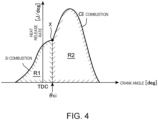
- Fig. 4 is a graph illustrating an example of a combustion waveform during the SPCCI combustion (i.e., a change in a heat release rate (J/deg) with respect to the crank angle).
- a heat release by the SI combustion and a heat release by the CI combustion consecutively occur in this order.
- the waveform of the heat release rate in the SPCCI combustion has an inflection point X which appears at a switching timing ( ⁇ ci) from the SI combustion (R1) to the CI combustion (R2).
- a control is executed such that the mixture gas is combusted by the SPCCI combustion while an A/F lean mixture gas having an air-fuel (A/F) ratio higher than the stoichiometric A/F ratio is formed inside the combustion chamber 6 (in other words, the mixture gas at ⁇ > 1 ( ⁇ is an excess air ratio) is combusted by the SPCCI combustion).
- the opening of the throttle valve 32 is set to a comparatively large value such that an amount of air, which is larger than the air amount corresponding to the stoichiometric A/F ratio, is introduced into the combustion chamber 6 through the intake passage 30.
- a target value of the A/F ratio (a weight ratio of air (fresh air) introduced into the combustion chamber 6 through the intake passage 30 to fuel injected into the combustion chamber 6 from the injector 15) is set to a value which is sufficiently larger than the stoichiometric A/F ratio (14.7: 1). Then, the opening of the throttle valve 32 achievable of the target value of the A/F ratio (target A/F ratio) is determined every time, and the throttle valve 32 is controlled based on this determination.
- the SI combustion is executed in all the operation ranges A1 to A4 of Fig. 3 .
- the operation range A1 does not exist, but is included in the operation range A2 whereas particularly in a fully warm state (a state where the engine wall temperature is e.g. at or above 80°C), the operation range A1 exists.
- the electromagnetic clutch 34 in an SCon range (a dotted area surrounded by a two-dot chain line) corresponding to any of the case where the engine load is above a load L3 or the case where the engine speed is above a fourth speed N4 within the entire operation ranges A1 to A4 of the engine, the electromagnetic clutch 34 particularly connects the crankshaft 7 to the supercharger 33 so that the supercharger 33 becomes the boosting state, that is, is operated to perform boosting.
- the engine speed N4 is particularly set within a range above a maximum value N2 of the engine speed of the operation range A1, and below a minimum value N3 of the engine speed of the operation range A4.
- the supercharger 33 is particularly in a non-boosting state, that is, is not operated to perform boosting.
- the supercharger 33 is controlled to be in the boosting state.
- the supercharger 33 is controlled to be in the boosting state based on the uphill angle ⁇ in priority to the map in Fig. 3 , thereby the response delay of the supercharger 33 and the acceleration delay of the vehicle during the uphill-traveling being reduced.
- the boost controlling module 107 controls the electromagnetic clutch 34 to connect the crankshaft 7 to the supercharger 33 when the uphill determining module 103 determines that the uphill angle ⁇ is above the first threshold ⁇ 1 (see step S3 in Fig. 5 and a time t1 in Fig. 6 described later) even when the target engine torque TQ is in a non-boosting range (see an SCoff range in Fig. 6 ).
- the boost controlling module 107 controls the supercharger 33 to boost regardless of the target engine torque TQ calculated by the target torque calculating module 102.
- the boost controlling module 107 controls the electromagnetic clutch 34 to disconnect/disengage the crankshaft 7 from the supercharger 33.
- the second threshold ⁇ 2 may be any angle, as long as it is lower than the first threshold ⁇ 1, and is set to an angle, for example, about 1% lower than the first threshold ⁇ 1 (i.e., 0.99 ⁇ 1).
- the timer 108 is particularly actuated when the uphill determining module 103 determines that the uphill angle ⁇ is below the second threshold ⁇ 2.
- the boost controlling module 107 controls the electromagnetic clutch 34 to disconnect the crankshaft 7 from the supercharger 33 after the timer 108 carries out the measurement for a given period of time (e.g., one second) (see step S7 in Fig. 5 and the time t7 in Fig. 6 ).
- the first threshold ⁇ 1 is set to be lower as the gear stage of the transmission becomes higher.
- Information on the gear stage of the transmission is sequentially transmitted to the PCM 100 by the gear stage sensor SN10.
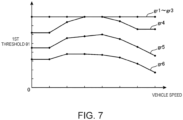
- Information on the first threshold ⁇ 1 for each of the transmission gear stages illustrated in a graph of Fig. 7 may be stored in the memory 105 of the PCM 100.
- a relationship between a vehicle speed V and the first threshold ⁇ 1 (angle) is indicated for each of the six stages (gr1 to gr6), and the first threshold ⁇ 1 is uniquely determined based on the gear stage and the vehicle speed V
- the first threshold ⁇ 1 is set to be lower as the gear stage (e.g., the fourth stage gr4 to the sixth stage gr6) becomes higher.
- the first threshold ⁇ 1 is arbitrarily set within a range, for example, from 1 to 8 degrees.
- the first threshold ⁇ 1 is set to be the same for the first to third gear stages (gr1 to gr3), the first threshold ⁇ 1 may be set to be lower as the gear stage is upshifted from the first stage to the third stage.
- the engine system configured as described above may execute the operation control of the supercharger 33 during the uphill-traveling (in detail, the control of the electromagnetic clutch 34) in the following process.
- step S1 the PCM 100 first reads the current gear stage of the transmission from the gear stage sensor SN10.
- the PCM 100 uses the map stored in the memory 105 (see Fig. 7 ) to select the first threshold ⁇ 1 based on the gear stage (e.g., gr1 to gr6 in the case of six stages) and the vehicle speed V
- the uphill determining module 103 determines whether the uphill angle ⁇ is above the first threshold ⁇ 1.
- the uphill angle ⁇ is detected using the uphill-angle detecting module 106 (in detail, the acceleration sensor SN9 and the uphill calculating module 104). That is, the uphill calculating module 104 calculates the uphill angle ⁇ using the acceleration of the vehicle detected by the acceleration sensor SN9.
- step S4 the boost controlling module 107 controls the electromagnetic clutch 34 to be engaged. Accordingly, the supercharger 33 is connected to the crankshaft 7 to perform boosting.
- this is a timing (t1) at which the uphill angle ⁇ of an uphill line SL1 becomes the first threshold ⁇ 1, and the electromagnetic clutch 34 becomes ON to make the supercharger 33 be in the connected state (see an engagement line C1) before a timing (t2) at which the target engine torque TQ reaches a given boosting torque TQ1.
- the connected state of the supercharger 33 is maintained for a long period (see a section from the time t1 to a time t7+ ⁇ t0 of the engagement line C1).
- step S6 the timer 108 is actuated (see a line T2 indicative of the timer actuation at the time t7; note that, step S5 is repeated if the uphill angle ⁇ is above the second threshold ⁇ 2).
- step S7 After the timer 108 counts a given period of time ⁇ t0 (e.g., 1 second) (step S7), the processing proceeds to step S8 where the boost controlling module 107 controls the electromagnetic clutch 34 to be disengaged. Accordingly, the supercharger 33 is disconnected from the crankshaft 7 to suspend the boosting.
- ⁇ t0 e.g. 1 second
- connection of the supercharger 33 when the uphill angle ⁇ is above the first threshold ⁇ 1, the connection of the supercharger 33 is maintained even if the target engine torque TQ decreases to be within the not-boosting range during the uphill-traveling (see times t3 and t6), and the connected state of the supercharger 33 is canceled only when the uphill angle ⁇ has fallen below the given second threshold ⁇ 2.
- the connection of the supercharger 33 can be maintained for a long period regardless of the engine load during the uphill-traveling, which reduces the response delay of the supercharger 33.
- step S5 after the engagement of the electromagnetic clutch 34 (step S4) and before the determination that the uphill angle ⁇ is below the second threshold ⁇ 2 (step S5) (for example, at immediately before the time t7 of the time chart in Fig. 6 ), when the engine operation range becomes the boosting range (the SCon range in Fig. 3 ) (i.e., when the target engine torque TQ becomes above the boosting torque TQ1) while the uphill angle ⁇ is decreasing, the engagement of the electromagnetic clutch 34 may be maintained (the engagement line C1 may be maintained ON) also after the time t7.
- step S5 while the timer 108 counts the ⁇ t0 after the determination that the uphill angle ⁇ is below the second threshold ⁇ 2 (step S5), when the engine operation range becomes the boosting range (the SCon range in Fig. 3 ) (i.e., when the target engine torque TQ becomes above the boosting torque TQ1), or when the uphill angle ⁇ becomes above the first threshold ⁇ 1 or the second threshold ⁇ 2, the engagement of the electromagnetic clutch 34 may be maintained (the engagement line C1 may be maintained ON) also after the time t7.
- step S3 if the uphill angle ⁇ is below the first threshold ⁇ 1 at step S3 (i.e., the case of an uphill line SL2 in Fig. 6 ), the processing proceeds to step S9 where a normal connection control of the supercharger 33 (see an engagement line C2 in Fig. 6 ) is executed.
- step S9 if the engine operation range becomes within the SCon range illustrated in the map of Fig. 3 at the time t2 (at which the target engine torque TQ becomes above the boosting torque TQ1 corresponding to the operation range falling within the SCon range), the processing proceeds to step S10 where the boost controlling module 107 controls the electromagnetic clutch 34 to be engaged, and the supercharger 33 starts boosting. Note that if the engine operation range is not in the SCon range at step S9, the processing returns to step S1.
- step S 11 if the engine operation range becomes outside the SCon range at the time t3 (at which the target engine torque TQ has fallen below the boosting torque TQ1), as illustrated at steps S6 to S8 described above, the timer 108 counts the given time period ⁇ t0 (see a line T11 indicative of the timer actuation at the time t3), and then, the boost controlling module 107 controls the electromagnetic clutch 34 to be disengaged, and suspends the boosting of the supercharger 33 (see a time t4 of the engagement line C2 in Fig. 6 ).
- the supercharger 33 again starts boosting, and then, if the engine operation range becomes outside the SCon range at a time t6 (at which the target engine torque TQ has fallen below the boosting torque TQ1), the supercharger 33 suspends boosting after the timer 108 counts the given time period ⁇ t0 (time t6+ ⁇ t0, see a line T12). In such a normal connection control of the supercharger 33 (see the engagement line C2 in Fig.
- the disengagement of the electromagnetic clutch 34 is repeated during the uphill-traveling (here, boosting is not performed for a long period between the time t4 and the time t5), and therefore, maintaining the connection of the supercharger 33 is difficult, and the response delay of the supercharger 33 easily occurs.
- the boosting is maintained only intermittently for a short period from the time t2 to the time t4, and from the time t5 to the time t6+ ⁇ t0. It is understood that, in such an intermittent engagement control, the response delay of the supercharger 33 during the uphill-traveling easily occurs.
- the boost controlling module 107 controls the electromagnetic clutch 34 to connect the crankshaft 7 to the supercharger 33 even if the target torque of the engine falls within the non-boosting range. Therefore, even when the engine load changes according to the change in the accelerator opening during the uphill-traveling, the supercharger 33 can always perform boosting regardless of the engine load when the uphill angle ⁇ is above the first threshold ⁇ 1. Therefore, the response delay of the boosting can be reduced, and the acceleration delay of the vehicle can be reduced.
- the boost controlling module 107 controls the electromagnetic clutch 34 to disconnect the crankshaft 7 from the supercharger 33 when the uphill determining module 103 determines that the uphill angle ⁇ has fallen below the second threshold ⁇ 2 lower than the first threshold ⁇ 1.
- the electromagnetic clutch 34 since the electromagnetic clutch 34 is disengaged after the uphill angle ⁇ has fallen below the second threshold ⁇ 2 lower than the first threshold ⁇ 1, the disengagement of the electromagnetic clutch 34 can be delayed, and the boosting period continued during the uphill-traveling can be made longer. As a result, the response delay in the re-acceleration during the uphill-traveling can be reduced for a long period.
- the PCM 100 (controller) further includes the timer 108.
- the timer 108 is actuated when the uphill determining module 103 determines that the uphill angle ⁇ has fallen below the second threshold ⁇ 2, and the boost controlling module 107 controls the electromagnetic clutch 34 to disconnect the crankshaft 7 from the supercharger 33 after the timer 108 measures the given period of time.
- the timing to disengage the electromagnetic clutch 34 can be delayed for the given period which is set arbitrarily, and thus, the boosting period continued during the uphill-traveling can be made longer.
- the first threshold ⁇ 1 is set to be smaller as the gear stage of the transmission becomes higher.
- the electromagnetic clutch 34 can be engaged early even when the transmission gear stage is high during the uphill-traveling, and thus, the response delay in the re-acceleration during the uphill-traveling can be reduced.
Landscapes
- Engineering & Computer Science (AREA)
- Chemical & Material Sciences (AREA)
- Combustion & Propulsion (AREA)
- Mechanical Engineering (AREA)
- General Engineering & Computer Science (AREA)
- Supercharger (AREA)
- Control Of Vehicle Engines Or Engines For Specific Uses (AREA)
- Output Control And Ontrol Of Special Type Engine (AREA)
Description
- The present disclosure relates to a vehicle having an engine system provided with an electromagnetic clutch which connects and/or disconnects a mechanical supercharger to/from a crankshaft. The present disclosure also relates to a method of controlling a engine system, and a computer program product.
- Conventionally, technologies for an engine system mounted on an automobile are known, in which when an engine operates within, for example, a high-load range or a high-speed range, a booster boosts air to a combustion chamber of the engine in order to increase engine torque. Particularly, a mechanical supercharger (i.e., a supercharger) which performs boosting by using a rotary-drive force from a crankshaft of the engine excels in response compared with an exhaust-turbine supercharger (i.e., a turbocharger) which uses exhaust pressure of the engine.
- An engine system disclosed in
JP2019-039393A - Although the mechanical supercharger disclosed in
JP2019-039393A - That is, when the engine load decreases corresponding to the change in the accelerator opening while traveling an uphill, the electromagnetic clutch is disengaged so that the mechanical supercharger becomes a non-boosting state. Therefore, even if the accelerator opening is increased during re-acceleration of the vehicle, a time-lag may occur between the re-engagement of the electromagnetic clutch and the start of the boosting. As a result, the response delay of the boosting by the mechanical supercharger may be caused during the uphill-traveling, which may lead to the acceleration delay of the vehicle.
-
US 5 133 326 A describes that a clutch control apparatus for a mechanical supercharger is used in connection with a mechanical supercharger provided in the intake passage of an engine and driven by the output shaft of the engine through a clutch. - The present disclosure is made in view of the above situations, and one purpose thereof is reducing acceleration delay of a vehicle while traveling an uphill.
- The engine system of the present disclosure maintains boosting by a mechanical supercharger when an uphill angle is above a given first uphill angle during the uphill-traveling, even within a non-boosting range, so as to reduce the acceleration delay of the vehicle.
- A vehicle according to the invention is defined in
claim 1 and a method according to the invention is defined inclaim 10. - According to one aspect of the present disclosure, an engine system is provided, which includes a supercharger driven by a crankshaft of an engine, an electromagnetic clutch disconnectably connecting the crankshaft to the supercharger, and a controller configured to output a control signal to the electromagnetic clutch. The electromagnetic clutch may disconnect and/or connect the crankshaft to the supercharger, or the electromagnetic clutch may disengage and/or engage the crankshaft with the supercharger. The controller may include a processor configured to execute an uphill-angle detecting module to detect an uphill angle during traveling of a vehicle, an uphill determining module to determine whether the detected uphill angle is above a given first uphill angle, and a boost controlling module to, when the uphill determining module determines that the uphill angle is above the first uphill angle, control the electromagnetic clutch to connect the crankshaft to the supercharger even when a target torque of the engine is within a non-boosting range.
- According to this configuration, when the uphill determining module determines that the uphill angle detected by the uphill-angle detecting module is above the first uphill angle, the boost controlling module controls the electromagnetic clutch to connect the crankshaft to the supercharger even if the target torque of the engine falls within the non-boosting range in which boosting is not performed. Therefore, even when the engine load changes during the uphill-traveling, the supercharger can always perform boosting regardless of the engine load when the uphill angle is above the first uphill angle. Therefore, response delay of the boosting can be reduced, and acceleration delay of the vehicle can be reduced.
- The boost controlling module may control the electromagnetic clutch to be disengaged when the uphill determining module determines that the uphill angle has fallen below a second uphill angle smaller than the first uphill angle.
- According to this configuration, since the electromagnetic clutch is disengaged after the uphill angle has fallen below the second uphill angle which is smaller than the first uphill angle during the uphill-traveling, the disengagement of the electromagnetic clutch can be delayed, and a boosting period continued during the uphill-traveling can be made longer. As a result, the response delay in the re-acceleration during the uphill-traveling can be reduced for a long period.
- The controller may further include a timer. The timer may be actuated when the uphill determining module determines that the uphill angle has fallen below the second uphill angle. The boost controlling module may control the electromagnetic clutch to be disengaged after the timer measures a given period of time.
- According to this configuration, by using the timer, the timing to disengage the electromagnetic clutch can be delayed for the given period which is set arbitrarily, and thus, the boosting period continued during the uphill-traveling can be made longer.
- The first uphill angle may be set to be smaller as a gear stage of a transmission becomes higher.
- There is a tendency that an engine speed decreases and the acceleration of the vehicle takes longer time as the transmission gear stage becomes higher. Here, according to this configuration, by setting the first uphill angle to be smaller as the transmission gear stage is shifted up, the electromagnetic clutch can be engaged early even when the transmission gear stage is high during the uphill-traveling, and thus, the response delay in the re-acceleration during the uphill-traveling can be reduced.
- The supercharger may be a mechanical supercharger mechanically linked with an engine body or the engine.
- The non-boosting range may include a range where spark controlled compression ignition combustion with an excess air ratio higher than 1 is performed.
- The non-boosting range may include a range where spark controlled compression ignition combustion with an excess air ratio higher than 1 is performed, and a boosting range may include a range where spark ignition combustion, or spark controlled compression ignition combustion with an excess air ratio at 1, is performed.
- When the uphill determining module determines that the uphill angle is above the first uphill angle, the controller may control the supercharger to perform boosting regardless of the target engine torque calculated by a target torque calculating module. When the uphill determining module determines that the uphill angle has fallen below the second uphill angle smaller than the first uphill angle, the controller may control the electromagnetic clutch to disconnect the crankshaft from the supercharger.
- The controller may store a map defining a relationship between a vehicle speed and the first uphill angle for each gear stage of a transmission. The first uphill angle may be set to be smaller as the gear stage becomes higher at the same vehicle speed.
- A vehicle includes the above engine system.
- Further, a method of controlling the above engine system is provided.
- Further, a computer program product including computer-readable instructions which, when loaded and executed on the above engine system, perform the above method is provided.
-
-
Fig. 1 is a system view illustrating the overall configuration of an engine system according to one embodiment of the present disclosure. -
Fig. 2 is a block diagram illustrating a control system of the engine system illustrated inFig. 1 . -
Fig. 3 is an operation map illustrating operation ranges of an engine, and a boosting range of a supercharger. -
Fig. 4 is a graph illustrating a waveform of a heat release rate during SPCCI (SPark Controlled Compression Ignition) combustion. -
Fig. 5 is a flowchart of a control of an electromagnetic clutch illustrated inFig. 1 . -
Fig. 6 is a time chart related to an uphill angle, ON-OFF of the electromagnetic clutch, a target engine torque, and a timer actuation, for controlling the electromagnetic clutch illustrated inFig. 1 . -
Fig. 7 is a graph illustrating a relationship between vehicle speeds at first to sixth gear stages of a transmission, respectively, and a first threshold. - Hereinafter, one preferred embodiment of the present disclosure is described in detail with reference to the accompanying drawings.
- In an engine system illustrated in
Fig. 1 , an engine is particularly a four-stroke gasoline-direct-injection engine mounted on a vehicle, and serves as a drive source for traveling. The engine is provided with anengine body 1, anintake passage 30 through which intake air to be introduced into theengine body 1 passes, anexhaust passage 40 through which exhaust gas discharged from theengine body 1 passes, and an external exhaust gas recirculation (EGR)device 50 which recirculates part of the exhaust gas passing through theexhaust passage 40 to theintake passage 30. - The
engine body 1 has acylinder block 3 in which cylinders 2 are formed, acylinder head 4 attached to an upper surface of thecylinder block 3 to close the cylinders 2 from above, andpistons 5 each reciprocatably inserted into the cylinder 2. - A combustion chamber 6 is defined above the
piston 5, and fuel particularly containing gasoline as a main component is supplied to the combustion chamber 6 by being injected from an injector 15 (described later). Then, the supplied fuel is mixed with air and combusts inside the combustion chamber 6, and an expansion force caused by the combustion reciprocates thepiston 5 in an up-and-down direction. - Below the
piston 5, acrankshaft 7 which is an output shaft of theengine body 1 is provided. Thecrankshaft 7 is coupled to thepiston 5 via a connectingrod 8, and is rotary-driven about its center axis corresponding to the reciprocating motion (up-and-down motion) of thepiston 5. - The
cylinder block 3 is particularly provided with a crank angle sensor SN1 which detects a rotational angle of the crankshaft 7 (crank angle), and a rotational speed of the crankshaft 7 (engine speed), and a water temperature sensor SN2 which detects the temperature of coolant (engine water temperature) which passes through inside thecylinder block 3 and thecylinder head 4. - The
cylinder head 4 is provided with anintake port 9 which introduces air supplied from theintake passage 30 to the combustion chamber 6, anexhaust port 10 which discharges exhaust gas generated inside the combustion chamber 6 to theexhaust passage 40, anintake valve 11 which opens and closes the opening of theintake port 9 on the combustion chamber 6 side, and anexhaust valve 12 which opens and closes the opening of theexhaust port 10 on the combustion chamber 6 side. - The
intake valve 11 and theexhaust valve 12 are driven to open and close interlockingly with the rotation of thecrankshaft 7, by a valve mechanism particularly including a pair of camshafts provided to thecylinder head 4. - An intake Sequential Valve Timing (S-VT) 13, which can change the open and close timings of the
intake valve 11, may be built in the valve mechanism for theintake valve 11. Similarly, an exhaust S-VT 14, which can change the open and close timings of theexhaust valve 12, may be built in the valve mechanism for theexhaust valve 12. The intake S-VT 13 (and/or exhaust S-VT 14) may be a so-called variable phase mechanism, and simultaneously changes the open timing and the close timing of the intake valve 11 (exhaust valve 12) by the same amount. - As illustrated in
Fig. 1 , thecylinder head 4 is provided with theinjector 15 which injects fuel (gasoline) into the combustion chamber 6, and aspark plug 16 which ignites a mixture gas of intake air with fuel injected from theinjector 15 into the combustion chamber 6. Theinjector 15 is particularly disposed at the central part of a ceiling surface of the combustion chamber 6 such that a tip-end part of theinjector 15 opposes to the central part of a crown surface of thepiston 5. Thespark plug 16 is particularly disposed at a position somewhat deviated to the intake side with respect to theinjector 15. - As illustrated in
Fig. 1 , theintake passage 30 is connected to one side surface of thecylinder head 4 to be communicated with theintake port 9. Air (fresh air) taken-in from an upstream end of theintake passage 30 is introduced into the combustion chamber 6 through theintake passage 30 and theintake port 9. - The
intake passage 30 is provided with anair cleaner 31 which removes foreign matter contained in the intake air, athrottle valve 32 which is openable and closable to control a flow rate of the intake air, asupercharger 33 which compresses and sends out the intake air, anintercooler 35 which cools the intake air compressed by thesupercharger 33, and asurge tank 36, in this order from the upstream side of theintake passage 30. - The
intake passage 30 may be provided, at the corresponding parts, with an airflow sensor SN3 which detects the flow rate of the intake air, an intake temperature sensor SN4 which detects the temperature of the intake air, and an intake pressure sensor SN5 which detects the pressure of the intake air. The airflow sensor SN3 and the intake temperature sensor SN4 are particularly provided at a part of theintake passage 30 between theair cleaner 31 and thethrottle valve 32 so as to detect the flow rate and the temperature of the intake air passing through this part, respectively. The intake pressure sensor SN5 is particularly provided to thesurge tank 36 to detect the pressure of the intake air inside thesurge tank 36. - The
supercharger 33 may be a mechanical supercharger which is mechanically linked with theengine body 1. Although the configuration of thesupercharger 33 is not particularly limited in detail, a known supercharger, such as a Lysholm-type, a Roots-type, or a centrifugal-type, may be used as thesupercharger 33. - The
supercharger 33 is driven by thecrankshaft 7 of theengine body 1. Thesupercharger 33 is disposed in theintake passage 30 communicating with the combustion chamber 6 via theintake port 9 of theengine body 1. - An electromagnetic clutch 34 electrically switchable between engagement and disengagement is interposed between the
supercharger 33 and theengine body 1. The electromagnetic clutch 34 disconnectably connects thecrankshaft 7 to thesupercharger 33. That is, when theelectromagnetic clutch 34 is engaged, a drive force is transmitted from theengine body 1 to thesupercharger 33 so that thesupercharger 33 performs boosting. On the other hand, when theelectromagnetic clutch 34 is disengaged, the transmission of the drive force is interrupted so that the boosting by thesupercharger 33 is suspended. - The
electromagnetic clutch 34 takes a short amount of time to be engaged after receiving a control signal from a powertrain control module (PCM) 100 (described later), and the connection of thesupercharger 33 can be made earlier. - The
intake passage 30 may be provided with abypass passage 38 which bypasses thesupercharger 33. Thebypass passage 38 connects thesurge tank 36 and an EGR passage 51 (described later). Thebypass passage 38 is provided with anopenable bypass valve 39. - The
exhaust passage 40 is connected to the other side surface (opposite from the intake passage 30) of thecylinder head 4 to be communicated with theexhaust port 10. Burnt gas generated inside the combustion chamber 6 is discharged outside through theexhaust port 10 and theexhaust passage 40. - The
exhaust passage 40 is particularly provided with acatalytic converter 41. Thecatalytic converter 41 particularly includes a three-way catalyst 41a which removes harmful substances (HC, CO, and NOx) contained in the exhaust gas passing through theexhaust passage 40, and a GPF (Gasoline Particulate Filter) 41b which captures particulate matter (PM) contained in the exhaust gas. - An air/fuel (A/F) sensor SN6 which detects an oxygen concentration in the exhaust gas is particularly provided to a part of the
exhaust passage 40 upstream of thecatalytic converter 41. - The
external EGR device 50 particularly includes theEGR passage 51 connecting theexhaust passage 40 to theintake passage 30, anEGR cooler 52, and anEGR valve 53 which are provided to theEGR passage 51. TheEGR passage 51 particularly connects a part of theexhaust passage 40 downstream of thecatalytic converter 41, to a part of theintake passage 30 between thethrottle valve 32 and thesupercharger 33. TheEGR cooler 52 cools, by heat exchange, exhaust gas (external EGR gas) recirculating from theexhaust passage 40 to theintake passage 30 through theEGR passage 51. TheEGR valve 53, which is able to open and close, is provided to theEGR passage 51 downstream of the EGR cooler 52 (closer side to the intake passage 30), and controls a flow rate of the exhaust gas passing through theEGR passage 51. -
Fig. 2 is a block diagram illustrating a control system of the engine system. The PCM 100 (controller) illustrated inFig. 2 is a microcomputer which integrally controls the engine, etc., and may be comprised of a well-known processor (e.g., a central processing unit (CPU)), memory (e.g., ROM and/or RAM), etc. - The
PCM 100 particularly receives inputs of detection signals from the various sensors. For example, thePCM 100 is electrically connected to the crank angle sensor SN1, the water temperature sensor SN2, the airflow sensor SN3, the intake temperature sensor SN4, the intake pressure sensor SN5, and the A/F sensor SN6 described above, and information detected by these sensors (i.e., the crank angle, the engine speed, the engine water temperature, the intake flow rate, the intake temperature, the intake pressure, and the oxygen concentration in exhaust gas) is sequentially inputted into thePCM 100. - Moreover, the vehicle is provided with an accelerator sensor SN7 which detects an opening of an accelerator pedal (hereinafter, referred to as an "accelerator opening") which is operated by a driver who drives the vehicle, a vehicle speed sensor SN8 which detects a traveling speed of the vehicle (hereinafter, referred to as a "vehicle speed"), an acceleration sensor SN9 which detects an acceleration of the vehicle, and a gear stage sensor SN10 which detects a gear stage of a transmission. Detection signals by these sensors SN7 to SN10 are also sequentially inputted into the
PCM 100. - The
PCM 100 controls each part of the engine while executing various determinations and calculations based on the input information from the various sensors described above. That is, thePCM 100 is electrically connected to, for example, the intake S-VT 13, the exhaust S-VT 14, theinjector 15, thespark plug 16, thethrottle valve 32, the electromagnetic clutch 34, thebypass valve 39, and theEGR valve 53, and outputs control signals to these devices based on the result of the calculations etc. - Particularly, the
PCM 100 which is an example of a "controller" of the present disclosure includes aprocessor 109, acombustion controlling module 101, a targettorque calculating module 102, an uphill determiningmodule 103, anuphill calculating module 104, amemory 105, aboost controlling module 107, and atimer 108 used for retarding the disengagement of the electromagnetic clutch 34 by a given period of time. The modules may be executed by theprocessor 109 to perform their respective functions and are stored in thememory 105 as software modules. - The
combustion controlling module 101 is a control module which controls combustion of the mixture gas in the combustion chamber 6, and controls each part of the engine so that, for example, output torque of the engine becomes an appropriate value corresponding to a driver's demand. - The target
torque calculating module 102 calculates a target engine torque TQ based on, for example, the accelerator opening detected by the accelerator sensor SN7 (in detail, based on the accelerator opening, the gear stage, the vehicle speed, and the engine speed). - The uphill determining
module 103 determines whether an uphill angle θ detected by an uphill-angle detecting module 106 (described later) is above a first threshold θ1 (first uphill angle). Moreover, the uphill determiningmodule 103 also determines whether the uphill angle θ is below a second threshold Θ2 (second uphill angle) lower than the first threshold θ1. - The
boost controlling module 107 controls the engagement of the electromagnetic clutch 34 based on the determination result of the uphill determiningmodule 103. Detailed method of the engagement control will be described later. - The uphill-
angle detecting module 106 may have any configuration, as long as it detects the uphill angle θ during the traveling of the vehicle. In this embodiment, the uphill-angle detecting module 106 is comprised of the acceleration sensor SN9 and theuphill calculating module 104. Theuphill calculating module 104 is provided to thePCM 100, and calculates the climbing angle of the vehicle (the uphill angle θ) based on the vehicle acceleration detected by the acceleration sensor SN9. Therefore, the uphill determiningmodule 103 determines whether the uphill angle θ is above the first threshold θ1 based on the uphill angle θ calculated by theuphill calculating module 104. - The acceleration sensor SN9 is provided to the vehicle, and detects the vehicle acceleration. The acceleration sensor SN9 may have any configuration, as long as it detects the vehicle acceleration, and an existing G-sensor, etc. may be used as the acceleration sensor SN9.
- Note that the configuration of the uphill-
angle detecting module 106 of the present disclosure is not limited to the one having the acceleration sensor SN9 and theuphill calculating module 104, but an uphill angle sensor detectable of the uphill angle θ may be used as the uphill-angle detecting module 106. - Next, combustion control of the engine is described.
Fig. 3 is an operation map illustrating operation ranges of the engine, and a boosting range of thesupercharger 33 in which boosting is performed. - As indicated in
Fig. 3 , the operation range of the engine may be roughly divided into a plurality of operation ranges, particularly four operation ranges A1 to A4 according to the combustion mode. Suppose that the four operation ranges are a first operation range A1, a second operation range A2, a third operation range A3, and a fourth operation range A4, respectively, the third operation range A3 is a lowest-speed range where the engine speed is below a first speed N1, the fourth operation range A4 is a high-speed range where the engine speed is above a third speed N3, the first operation range A1 is a range where the load is comparatively low within a speed range (low/middle-speed range) other than the third and fourth operation ranges A3 and A4 (i.e., a low-speed/low-load range), and the second operation range A2 is the remainder of the range other than the first, third, and fourth operation ranges A1, A3, and A4. - In the example of
Fig. 3 , the first operation range A1 is a range having a substantially rectangular shape positioned inward of the second operation range A2, and surrounded by the first speed N1 which is the minimum speed of the second operation range A2, a second speed N2 which is lower than the maximum speed (the third speed N3) of the second operation range A2, a first load L1 higher than the minimum engine load, and a second load L2 higher than the first load L1. - In the first operation range A1 (the low-speed/low-load range), partial compression ignition combustion (hereinafter, referred to as "SPCCI combustion") in which the SI combustion and CI (Compression Ignition) combustion are combined is carried out.
- The SI combustion is a combustion mode in which the mixture gas is ignited by a spark generated from the
spark plug 16, and the combusting range is spread from the ignition point to the surrounding so that the mixture gas is forcibly combusted by flame propagation. - The CI combustion is a combustion mode in which the mixture gas is combusted by self-ignition under an environment sufficiently increased in the temperature and pressure as a result of compression by the
piston 5, etc. - The SPCCI combustion, which is the combination of the SI combustion and the CI combustion, is a combustion mode in which part of the mixture gas inside the combustion chamber 6 is combusted by spark ignition (SI combustion) immediately before the self-ignition of the mixture gas, and the remaining mixture gas inside the combustion chamber 6 is combusted by self-ignition (CI combustion) after the SI combustion (by the further increase in the temperature and pressure resulting from the SI combustion). Note that "SPCCI" is the abbreviation of the "SPark Controlled Compression Ignition."
-
Fig. 4 is a graph illustrating an example of a combustion waveform during the SPCCI combustion (i.e., a change in a heat release rate (J/deg) with respect to the crank angle). As illustrated inFig. 4 , in the SPCCI combustion, a heat release by the SI combustion and a heat release by the CI combustion consecutively occur in this order. Here, due to the nature that the combustion speed is higher in the CI combustion, an initial rise of the heat release is sharper in the CI combustion compared with the SI combustion. Therefore, the waveform of the heat release rate in the SPCCI combustion has an inflection point X which appears at a switching timing (θci) from the SI combustion (R1) to the CI combustion (R2). - As a concrete mode of the SPCCI combustion described above, a control is executed such that the mixture gas is combusted by the SPCCI combustion while an A/F lean mixture gas having an air-fuel (A/F) ratio higher than the stoichiometric A/F ratio is formed inside the combustion chamber 6 (in other words, the mixture gas at λ> 1 (λ is an excess air ratio) is combusted by the SPCCI combustion). Here, the opening of the
throttle valve 32 is set to a comparatively large value such that an amount of air, which is larger than the air amount corresponding to the stoichiometric A/F ratio, is introduced into the combustion chamber 6 through theintake passage 30. That is, within the first operation range A1, a target value of the A/F ratio (a weight ratio of air (fresh air) introduced into the combustion chamber 6 through theintake passage 30 to fuel injected into the combustion chamber 6 from the injector 15) is set to a value which is sufficiently larger than the stoichiometric A/F ratio (14.7: 1). Then, the opening of thethrottle valve 32 achievable of the target value of the A/F ratio (target A/F ratio) is determined every time, and thethrottle valve 32 is controlled based on this determination. - Note that, particularly in a cold state of the engine (a state where the temperature of the engine wall (the temperature of the cylinder block 3) is e.g. at or below 30°C), the SI combustion is executed in all the operation ranges A1 to A4 of
Fig. 3 . Moreover, particularly in a semi-warm state of the engine (a state where the engine wall temperature is e.g. at or above 30°C and at or below 80°C), the operation range A1 does not exist, but is included in the operation range A2, whereas particularly in a fully warm state (a state where the engine wall temperature is e.g. at or above 80°C), the operation range A1 exists. - In the map illustrated in
Fig. 3 , in an SCon range (a dotted area surrounded by a two-dot chain line) corresponding to any of the case where the engine load is above a load L3 or the case where the engine speed is above a fourth speed N4 within the entire operation ranges A1 to A4 of the engine, the electromagnetic clutch 34 particularly connects thecrankshaft 7 to thesupercharger 33 so that thesupercharger 33 becomes the boosting state, that is, is operated to perform boosting. Note that the engine speed N4 is particularly set within a range above a maximum value N2 of the engine speed of the operation range A1, and below a minimum value N3 of the engine speed of the operation range A4. - On the other hand, in the other range of the map illustrated in
Fig. 3 (i.e., a range below the engine load L3 and below the engine speed N4), thesupercharger 33 is particularly in a non-boosting state, that is, is not operated to perform boosting. - During normal traveling, when the engine operates in the SCon range of the map in
Fig. 3 based on the engine load and the engine speed, thesupercharger 33 is controlled to be in the boosting state. On the other hand, according to the present disclosure, while traveling an uphill (during the uphill-traveling), thesupercharger 33 is controlled to be in the boosting state based on the uphill angle θ in priority to the map inFig. 3 , thereby the response delay of thesupercharger 33 and the acceleration delay of the vehicle during the uphill-traveling being reduced. - That is, the
boost controlling module 107 according to this embodiment controls the electromagnetic clutch 34 to connect thecrankshaft 7 to thesupercharger 33 when the uphill determiningmodule 103 determines that the uphill angle θ is above the first threshold θ1 (see step S3 inFig. 5 and a time t1 inFig. 6 described later) even when the target engine torque TQ is in a non-boosting range (see an SCoff range inFig. 6 ). - In other words, when the uphill determining
module 103 determines that the uphill angle θ calculated by theuphill calculating module 104 is above the first threshold θ1, theboost controlling module 107 controls thesupercharger 33 to boost regardless of the target engine torque TQ calculated by the targettorque calculating module 102. - Then, when the uphill determining
module 103 determines that the uphill angle θ has fallen below the second threshold Θ2 lower than the first threshold θ1 (see step S5 inFig. 5 and a time t7 inFig. 6 described later), theboost controlling module 107 controls the electromagnetic clutch 34 to disconnect/disengage thecrankshaft 7 from thesupercharger 33. - The second threshold Θ2 may be any angle, as long as it is lower than the first threshold θ1, and is set to an angle, for example, about 1% lower than the first threshold θ1 (i.e., 0.99×θ1).
- Moreover, in this embodiment, the
timer 108 is particularly actuated when the uphill determiningmodule 103 determines that the uphill angle θ is below the second threshold θ2. - The
boost controlling module 107 controls the electromagnetic clutch 34 to disconnect thecrankshaft 7 from thesupercharger 33 after thetimer 108 carries out the measurement for a given period of time (e.g., one second) (see step S7 inFig. 5 and the time t7 inFig. 6 ). - The first threshold θ1 is set to be lower as the gear stage of the transmission becomes higher. Information on the gear stage of the transmission is sequentially transmitted to the
PCM 100 by the gear stage sensor SN10. - Information on the first threshold θ1 for each of the transmission gear stages illustrated in a graph of
Fig. 7 (inFig. 7 six stages from gr1 to gr6) may be stored in thememory 105 of thePCM 100. In the graph ofFig. 7 , a relationship between a vehicle speed V and the first threshold θ1 (angle) is indicated for each of the six stages (gr1 to gr6), and the first threshold θ1 is uniquely determined based on the gear stage and the vehicle speed V - As illustrated in
Fig. 7 , when the vehicle speed V is the same, the first threshold θ1 is set to be lower as the gear stage (e.g., the fourth stage gr4 to the sixth stage gr6) becomes higher. The first threshold θ1 is arbitrarily set within a range, for example, from 1 to 8 degrees. - Although in the graph of
Fig. 7 the first threshold θ1 is set to be the same for the first to third gear stages (gr1 to gr3), the first threshold θ1 may be set to be lower as the gear stage is upshifted from the first stage to the third stage. - The engine system configured as described above may execute the operation control of the
supercharger 33 during the uphill-traveling (in detail, the control of the electromagnetic clutch 34) in the following process. - As illustrated in the flowchart of
Fig. 5 , at step S1, thePCM 100 first reads the current gear stage of the transmission from the gear stage sensor SN10. - Next, at step S2, the
PCM 100 uses the map stored in the memory 105 (seeFig. 7 ) to select the first threshold θ1 based on the gear stage (e.g., gr1 to gr6 in the case of six stages) and the vehicle speed V - Next, at Step S3, the uphill determining
module 103 determines whether the uphill angle θ is above the first threshold θ1. Here, the uphill angle θ is detected using the uphill-angle detecting module 106 (in detail, the acceleration sensor SN9 and the uphill calculating module 104). That is, theuphill calculating module 104 calculates the uphill angle θ using the acceleration of the vehicle detected by the acceleration sensor SN9. - If the uphill angle θ is above the first threshold θ1, the processing proceeds to step S4 where the
boost controlling module 107 controls the electromagnetic clutch 34 to be engaged. Accordingly, thesupercharger 33 is connected to thecrankshaft 7 to perform boosting. - Referring to the time chart of
Fig. 6 , this is a timing (t1) at which the uphill angle θ of an uphill line SL1 becomes the first threshold θ1, and theelectromagnetic clutch 34 becomes ON to make thesupercharger 33 be in the connected state (see an engagement line C1) before a timing (t2) at which the target engine torque TQ reaches a given boosting torque TQ1. Then, even if the operation range is irregularly and repeatedly shifted to any of the boosting range (SCon range) where the target engine torque TQ is above the boosting torque TQ1, and the non-boosting range (SCoff range) where the target engine torque TQ is below the boosting torque TQ1, the connected state of thesupercharger 33 is maintained for a long period (see a section from the time t1 to a time t7+Δt0 of the engagement line C1). - Then, when the uphill angle θ decreases as indicated by the uphill line SL1 in
Fig. 6 in the latter half of the uphill-traveling, the uphill determiningmodule 103 determines, at step S5, whether the uphill angle θ is below the second threshold Θ2 which is lower than the first threshold θ1 (θ2=θ1-α). - If the uphill angle θ is below the second threshold Θ2 lower than the first threshold θ1, the processing proceeds to step S6 where the
timer 108 is actuated (see a line T2 indicative of the timer actuation at the time t7; note that, step S5 is repeated if the uphill angle θ is above the second threshold θ2). - After the
timer 108 counts a given period of time Δt0 (e.g., 1 second) (step S7), the processing proceeds to step S8 where theboost controlling module 107 controls the electromagnetic clutch 34 to be disengaged. Accordingly, thesupercharger 33 is disconnected from thecrankshaft 7 to suspend the boosting. - Therefore, as described above, in the connection control of the
supercharger 33 when the uphill angle θ is above the first threshold θ1, the connection of thesupercharger 33 is maintained even if the target engine torque TQ decreases to be within the not-boosting range during the uphill-traveling (see times t3 and t6), and the connected state of thesupercharger 33 is canceled only when the uphill angle θ has fallen below the given second threshold Θ2. Thus, the connection of thesupercharger 33 can be maintained for a long period regardless of the engine load during the uphill-traveling, which reduces the response delay of thesupercharger 33. - Note that after the engagement of the electromagnetic clutch 34 (step S4) and before the determination that the uphill angle θ is below the second threshold Θ2 (step S5) (for example, at immediately before the time t7 of the time chart in
Fig. 6 ), when the engine operation range becomes the boosting range (the SCon range inFig. 3 ) (i.e., when the target engine torque TQ becomes above the boosting torque TQ1) while the uphill angle θ is decreasing, the engagement of the electromagnetic clutch 34 may be maintained (the engagement line C1 may be maintained ON) also after the time t7. - Moreover, while the
timer 108 counts the Δt0 after the determination that the uphill angle θ is below the second threshold Θ2 (step S5), when the engine operation range becomes the boosting range (the SCon range inFig. 3 ) (i.e., when the target engine torque TQ becomes above the boosting torque TQ1), or when the uphill angle θ becomes above the first threshold θ1 or the second threshold Θ2, the engagement of the electromagnetic clutch 34 may be maintained (the engagement line C1 may be maintained ON) also after the time t7. - On the other hand, if the uphill angle θ is below the first threshold θ1 at step S3 (i.e., the case of an uphill line SL2 in
Fig. 6 ), the processing proceeds to step S9 where a normal connection control of the supercharger 33 (see an engagement line C2 inFig. 6 ) is executed. - That is, at step S9, if the engine operation range becomes within the SCon range illustrated in the map of
Fig. 3 at the time t2 (at which the target engine torque TQ becomes above the boosting torque TQ1 corresponding to the operation range falling within the SCon range), the processing proceeds to step S10 where theboost controlling module 107 controls the electromagnetic clutch 34 to be engaged, and thesupercharger 33 starts boosting. Note that if the engine operation range is not in the SCon range at step S9, the processing returns to step S1. - Next, at
step S 11, if the engine operation range becomes outside the SCon range at the time t3 (at which the target engine torque TQ has fallen below the boosting torque TQ1), as illustrated at steps S6 to S8 described above, thetimer 108 counts the given time period Δt0 (see a line T11 indicative of the timer actuation at the time t3), and then, theboost controlling module 107 controls the electromagnetic clutch 34 to be disengaged, and suspends the boosting of the supercharger 33 (see a time t4 of the engagement line C2 inFig. 6 ). - Moreover, if the engine operation range again becomes in the SCon range at the time t5 (at which the target engine torque TQ becomes above the boosting torque TQ1) after the suspension of the
supercharger 33, thesupercharger 33 again starts boosting, and then, if the engine operation range becomes outside the SCon range at a time t6 (at which the target engine torque TQ has fallen below the boosting torque TQ1), thesupercharger 33 suspends boosting after thetimer 108 counts the given time period Δt0 (time t6+Δt0, see a line T12). In such a normal connection control of the supercharger 33 (see the engagement line C2 inFig. 6 ), the disengagement of theelectromagnetic clutch 34 is repeated during the uphill-traveling (here, boosting is not performed for a long period between the time t4 and the time t5), and therefore, maintaining the connection of thesupercharger 33 is difficult, and the response delay of thesupercharger 33 easily occurs. - Moreover, in terms of the length of the boosting period, in the engagement control of the electromagnetic clutch 34 based on the uphill angle θ which is the characteristic of the present disclosure (see steps S3 to S5 in
Fig. 5 , particularly), as indicated by the engagement line C1 inFig. 6 , the boosting is maintained for a long period from the time t1 to the time t7+Δt0, and thus, it is understood that the response delay of thesupercharger 33 during the uphill-traveling is unlikely to occur. On the other hand, in the engagement control of the electromagnetic clutch 34 based on the SCon range inFig. 3 (see steps S9 to S11 inFig. 5 , particularly), as indicated by the engagement line C2 inFig. 6 , the boosting is maintained only intermittently for a short period from the time t2 to the time t4, and from the time t5 to the time t6+Δt0. It is understood that, in such an intermittent engagement control, the response delay of thesupercharger 33 during the uphill-traveling easily occurs. -
- (1) The engine system of this embodiment includes the
mechanical supercharger 33 driven by thecrankshaft 7 of theengine body 1, the electromagnetic clutch 34 disconnectably connecting thecrankshaft 7 to thesupercharger 33, and thePCM 100 configured to output the control signal to theelectromagnetic clutch 34. ThePCM 100 includes the uphill-angle detecting module 106 (in this embodiment, the detecting module comprised of the acceleration sensor SN9 and the uphill calculating module 104) configured to detect the uphill angle θ during traveling of the vehicle, the uphill determiningmodule 103 configured to determine whether the uphill angle θ detected by the uphill-angle detecting module 106 is above the first threshold θ1, and theboost controlling module 107 configured to, when the uphill determiningmodule 103 determines that the uphill angle θ is above the first threshold θ1, control the electromagnetic clutch 34 to connect thecrankshaft 7 to thesupercharger 33 even when the target torque of the engine is within the non-boosting range. - According to this embodiment, when the uphill determining
module 103 determines that the uphill angle θ detected by the uphill-angle detecting module 106 is above the first threshold θ1, theboost controlling module 107 controls the electromagnetic clutch 34 to connect thecrankshaft 7 to thesupercharger 33 even if the target torque of the engine falls within the non-boosting range. Therefore, even when the engine load changes according to the change in the accelerator opening during the uphill-traveling, thesupercharger 33 can always perform boosting regardless of the engine load when the uphill angle θ is above the first threshold θ1. Therefore, the response delay of the boosting can be reduced, and the acceleration delay of the vehicle can be reduced. - (2) In the engine system of this embodiment, the
boost controlling module 107 controls the electromagnetic clutch 34 to disconnect thecrankshaft 7 from thesupercharger 33 when the uphill determiningmodule 103 determines that the uphill angle θ has fallen below the second threshold Θ2 lower than the first threshold θ1. - According to this embodiment, since the
electromagnetic clutch 34 is disengaged after the uphill angle θ has fallen below the second threshold Θ2 lower than the first threshold θ1, the disengagement of the electromagnetic clutch 34 can be delayed, and the boosting period continued during the uphill-traveling can be made longer. As a result, the response delay in the re-acceleration during the uphill-traveling can be reduced for a long period. - (3) In the engine system of this embodiment, the PCM 100 (controller) further includes the
timer 108. Thetimer 108 is actuated when the uphill determiningmodule 103 determines that the uphill angle θ has fallen below the second threshold Θ2, and theboost controlling module 107 controls the electromagnetic clutch 34 to disconnect thecrankshaft 7 from thesupercharger 33 after thetimer 108 measures the given period of time. - According to this embodiment, by using the
timer 108, the timing to disengage the electromagnetic clutch 34 can be delayed for the given period which is set arbitrarily, and thus, the boosting period continued during the uphill-traveling can be made longer. - (4) In the engine system of this embodiment, the first threshold θ1 is set to be smaller as the gear stage of the transmission becomes higher.
- There is a tendency that the engine speed decreases and the acceleration of the vehicle takes longer time as the transmission gear stage is shifted up. Here, according to this embodiment, by setting the first threshold θ1 to be lower as the transmission gear stage is shifted higher, the electromagnetic clutch 34 can be engaged early even when the transmission gear stage is high during the uphill-traveling, and thus, the response delay in the re-acceleration during the uphill-traveling can be reduced.
- It should be understood that the embodiments herein are illustrative and not restrictive, since the scope of the invention is defined by the appended claims rather than by the description preceding them.
-
- 1
- Engine Body
- 7
- Crankshaft
- 33
- Supercharger
- 34
- Electromagnetic Clutch
- 100
- PCM (Powertrain Control Module) (Controller)
- 102
- Target Torque Calculating Module
- 103
- Uphill Determining Module
- 104
- Uphill Calculating Module
- 106
- Uphill-angle Detecting Module
- 107
- Boost Controlling Module
- 108
- Timer
- SN9
- Acceleration Sensor
- SN10
- Gear Stage Sensor
Claims (13)
- A vehicle comprising an engine system, the engine system comprising:a supercharger (33) driven by a crankshaft (7) of an engine (1);an electromagnetic clutch (34) disconnectably connecting the crankshaft (7) to the supercharger (33); anda controller (100) configured to output a control signal to the electromagnetic clutch (34), wherein the controller (100) is configured to:detect an uphill angle during traveling of the vehicle; anddetermine whether the detected uphill angle is above a given first uphill angle (θ1),characterized in thatthe controller (100) is configured to control, when the uphill angle is above the first uphill angle (θ1), the electromagnetic clutch (34) to connect the crankshaft (7) to the supercharger (33) even when a target torque of the engine (1) is within a non-boosting range (SCoff).
- The vehicle of claim 1, wherein the controller (100) is configured to control the electromagnetic clutch (34) to be disengaged when the uphill angle has fallen below a second uphill angle (θ2) smaller than the first uphill angle (θ1).
- The vehicle of claim 2, wherein the controller (100) includes a timer (108),wherein the timer (108) is actuated when the uphill angle has fallen below the second uphill angle (θ2), andwherein controller (100) is configured to control the electromagnetic clutch (34) to be disengaged after the timer (108) measures a given period of time.
- The vehicle of any one of the preceding claims, wherein the first uphill angle (θ1) is set to be smaller as a gear stage of a transmission becomes higher.
- The vehicle of any one of the preceding claims, wherein the supercharger (33) is a mechanical supercharger mechanically linked with the engine (1).
- The vehicle of any one of the preceding claims, wherein the non-boosting range (SCoff) includes a range (A1) where spark controlled compression ignition combustion with an excess air ratio (λ) higher than 1 is performed.
- The vehicle of any one of the preceding claims,
wherein a boosting range (SCon) includes a range (A2, A4) where spark ignition combustion, or spark controlled compression ignition combustion with an excess air ratio at 1, is performed. - The vehicle of any one of the preceding claims,
wherein when the uphill angle is above the first uphill angle (θ1), the controller (100) is configured to control the supercharger (33) to perform boosting regardless of the target engine torque calculated by a target torque calculating module. - The vehicle of any one of the preceding claims,wherein the controller (100) stores a map defining a relationship between the vehicle speed and the first uphill angle (θ1) for each gear stage of a transmission, andwherein the first uphill angle (θ1) is set to be smaller as the gear stage becomes higher at the same vehicle speed.
- A method of controlling an engine system of a vehicle, the engine system including a supercharger (33) driven by a crankshaft (7) of an engine (1), and an electromagnetic clutch (34) disconnectably connecting the crankshaft (7) to the supercharger (33), the method comprising:detecting an uphill angle during traveling of the vehicle; anddetermining whether the detected uphill angle is above a given first uphill angle (θ1),characterized bycontrolling, when the uphill angle is above the first uphill angle (θ1), the electromagnetic clutch (34) to connect the crankshaft (7) to the supercharger (33) even when a target torque of the engine (1) is within a non-boosting range (SCoff).
- The method of claim 10, further comprising
setting the first uphill angle (θ1) to be smaller as a gear stage of a transmission becomes higher. - The method of claim 10 or 11, further comprising performing spark controlled compression ignition combustion in the non-boosting range (SCoff).
- A computer program product comprising computer-readable instructions which, when loaded and executed on the engine system of the vehicle of any one claims 1 to 9, perform a method of any one of claims 10 to 12.
Applications Claiming Priority (1)
| Application Number | Priority Date | Filing Date | Title |
|---|---|---|---|
| JP2020212496A JP7563162B2 (en) | 2020-12-22 | 2020-12-22 | Engine System |
Publications (2)
| Publication Number | Publication Date |
|---|---|
| EP4019758A1 EP4019758A1 (en) | 2022-06-29 |
| EP4019758B1 true EP4019758B1 (en) | 2024-06-19 |
Family
ID=78414456
Family Applications (1)
| Application Number | Title | Priority Date | Filing Date |
|---|---|---|---|
| EP21205463.9A Active EP4019758B1 (en) | 2020-12-22 | 2021-10-29 | Engine system, vehicle, method of controlling engine system, and computer program product |
Country Status (3)
| Country | Link |
|---|---|
| US (1) | US11560856B2 (en) |
| EP (1) | EP4019758B1 (en) |
| JP (1) | JP7563162B2 (en) |
Families Citing this family (1)
| Publication number | Priority date | Publication date | Assignee | Title |
|---|---|---|---|---|
| CN119712300B (en) * | 2025-01-08 | 2025-11-18 | 潍柴动力股份有限公司 | Control method and device of mechanical supercharging clutch |
Family Cites Families (16)
| Publication number | Priority date | Publication date | Assignee | Title |
|---|---|---|---|---|
| JPS6261936U (en) * | 1985-10-08 | 1987-04-17 | ||
| US5133326A (en) * | 1989-07-05 | 1992-07-28 | Mazda Motor Corporation | Clutch control apparatus for a mechanical supercharger |
| JPH0354321A (en) * | 1989-07-20 | 1991-03-08 | Mazda Motor Corp | Clutch control device for mechanical supercharger |
| JP3145426B2 (en) * | 1991-04-17 | 2001-03-12 | マツダ株式会社 | Vehicle driving force control device |
| JPH05272348A (en) * | 1992-03-24 | 1993-10-19 | Toyota Motor Corp | Supercharger controller |
| DE10355563A1 (en) | 2003-11-28 | 2005-06-30 | Daimlerchrysler Ag | Internal combustion engine with a mechanical supercharger and a turbo compound |
| JP4345555B2 (en) * | 2004-04-12 | 2009-10-14 | トヨタ自動車株式会社 | Control device for internal combustion engine and control method for internal combustion engine |
| JP2007077871A (en) | 2005-09-14 | 2007-03-29 | Toyota Motor Corp | Vehicle control device |
| JP4508995B2 (en) | 2005-09-16 | 2010-07-21 | 三菱自動車工業株式会社 | Powertrain control device for vehicle |
| CN105209731A (en) * | 2013-03-12 | 2015-12-30 | 伊顿公司 | Adaptive state of charge regulation and control of variable speed hybrid electric supercharger assembly for efficient vehicle operation |
| KR101714239B1 (en) * | 2015-10-21 | 2017-03-09 | 현대자동차주식회사 | Method for controlling clutch of vehicles |
| US10273874B2 (en) | 2016-04-15 | 2019-04-30 | Ford Global Technologies, Llc | Method and system for compressor outlet temperature regulation |
| JP6583370B2 (en) | 2017-08-25 | 2019-10-02 | マツダ株式会社 | Engine with supercharging system |
| JP6555312B2 (en) * | 2017-09-27 | 2019-08-07 | マツダ株式会社 | Turbocharged engine |
| JP7334402B2 (en) * | 2018-09-20 | 2023-08-29 | マツダ株式会社 | 2-stroke engine with supercharger |
| JP7225790B2 (en) * | 2018-12-26 | 2023-02-21 | マツダ株式会社 | Compression ignition engine with supercharger |
-
2020
- 2020-12-22 JP JP2020212496A patent/JP7563162B2/en active Active
-
2021
- 2021-10-29 EP EP21205463.9A patent/EP4019758B1/en active Active
- 2021-11-10 US US17/454,324 patent/US11560856B2/en active Active
Also Published As
| Publication number | Publication date |
|---|---|
| JP7563162B2 (en) | 2024-10-08 |
| EP4019758A1 (en) | 2022-06-29 |
| US20220195951A1 (en) | 2022-06-23 |
| JP2022098855A (en) | 2022-07-04 |
| US11560856B2 (en) | 2023-01-24 |
Similar Documents
| Publication | Publication Date | Title |
|---|---|---|
| EP3486468B1 (en) | Control device for engine, engine, method for controlling engine, and computer program product | |
| EP3690226B1 (en) | Engine control device, engine, vehicle, and method of controlling engine | |
| EP3597889A1 (en) | Engine control device, engine, engine control method, and computer program product | |
| US10196065B2 (en) | Vehicle control system | |
| EP3739195A1 (en) | Control device for compression ignition engine, engine, and method of controlling compression ignition engine | |
| EP1279813A2 (en) | Control device for a vehicle and control method thereof | |
| EP4019758B1 (en) | Engine system, vehicle, method of controlling engine system, and computer program product | |
| EP3690219B1 (en) | Control device for compression ignition engine, engine, vehicle, and method of controlling compression ignition engine | |
| US20220003181A1 (en) | Internal combustion engine control apparatus | |
| EP3734049A1 (en) | Device and method of controlling engine, and engine system | |
| JP4339878B2 (en) | Control device for compression ignition internal combustion engine | |
| EP4019759B1 (en) | Engine system, vehicle, method of controlling engine system, and computer program product | |
| JP2007040234A (en) | Control device for compression ignition internal combustion engine | |
| JP7509026B2 (en) | Engine System | |
| JP7512881B2 (en) | Engine System | |
| JP7543897B2 (en) | Engine System | |
| JP7556282B2 (en) | Engine System | |
| JP7211244B2 (en) | CONTROL METHOD AND CONTROL DEVICE FOR INTERNAL COMBUSTION ENGINE | |
| JP2020159327A (en) | Control device for internal combustion engine with supercharger | |
| EP3730771A1 (en) | Engine control method, computer program product, engine control device, and engine system | |
| EP3647572B1 (en) | Engine control device, engine method of controlling engine, and computer program product | |
| JP2001214812A (en) | In-cylinder direct injection engine with supercharger | |
| JP2007040235A (en) | Control device for compression ignition internal combustion engine | |
| JP2020200772A (en) | Engine control device | |
| CN110832182A (en) | Operation method of the internal combustion engine of a car with an automatic transmission |
Legal Events
| Date | Code | Title | Description |
|---|---|---|---|
| PUAI | Public reference made under article 153(3) epc to a published international application that has entered the european phase |
Free format text: ORIGINAL CODE: 0009012 |
|
| STAA | Information on the status of an ep patent application or granted ep patent |
Free format text: STATUS: THE APPLICATION HAS BEEN PUBLISHED |
|
| AK | Designated contracting states |
Kind code of ref document: A1 Designated state(s): AL AT BE BG CH CY CZ DE DK EE ES FI FR GB GR HR HU IE IS IT LI LT LU LV MC MK MT NL NO PL PT RO RS SE SI SK SM TR |
|
| STAA | Information on the status of an ep patent application or granted ep patent |
Free format text: STATUS: REQUEST FOR EXAMINATION WAS MADE |
|
| 17P | Request for examination filed |
Effective date: 20221006 |
|
| RBV | Designated contracting states (corrected) |
Designated state(s): AL AT BE BG CH CY CZ DE DK EE ES FI FR GB GR HR HU IE IS IT LI LT LU LV MC MK MT NL NO PL PT RO RS SE SI SK SM TR |
|
| GRAP | Despatch of communication of intention to grant a patent |
Free format text: ORIGINAL CODE: EPIDOSNIGR1 |
|
| STAA | Information on the status of an ep patent application or granted ep patent |
Free format text: STATUS: GRANT OF PATENT IS INTENDED |
|
| RIC1 | Information provided on ipc code assigned before grant |
Ipc: F02D 41/30 20060101ALN20240129BHEP Ipc: F02B 39/06 20060101ALI20240129BHEP Ipc: F02B 33/38 20060101ALI20240129BHEP Ipc: F02B 39/12 20060101ALI20240129BHEP Ipc: F02D 41/02 20060101ALI20240129BHEP Ipc: F02D 41/00 20060101ALI20240129BHEP Ipc: F02D 23/00 20060101AFI20240129BHEP |
|
| INTG | Intention to grant announced |
Effective date: 20240221 |
|
| GRAS | Grant fee paid |
Free format text: ORIGINAL CODE: EPIDOSNIGR3 |
|
| GRAA | (expected) grant |
Free format text: ORIGINAL CODE: 0009210 |
|
| STAA | Information on the status of an ep patent application or granted ep patent |
Free format text: STATUS: THE PATENT HAS BEEN GRANTED |
|
| AK | Designated contracting states |
Kind code of ref document: B1 Designated state(s): AL AT BE BG CH CY CZ DE DK EE ES FI FR GB GR HR HU IE IS IT LI LT LU LV MC MK MT NL NO PL PT RO RS SE SI SK SM TR |
|
| REG | Reference to a national code |
Ref country code: GB Ref legal event code: FG4D |
|
| REG | Reference to a national code |
Ref country code: CH Ref legal event code: EP |
|
| REG | Reference to a national code |
Ref country code: DE Ref legal event code: R096 Ref document number: 602021014541 Country of ref document: DE |
|
| PG25 | Lapsed in a contracting state [announced via postgrant information from national office to epo] |
Ref country code: BG Free format text: LAPSE BECAUSE OF FAILURE TO SUBMIT A TRANSLATION OF THE DESCRIPTION OR TO PAY THE FEE WITHIN THE PRESCRIBED TIME-LIMIT Effective date: 20240619 |
|
| PG25 | Lapsed in a contracting state [announced via postgrant information from national office to epo] |
Ref country code: FI Free format text: LAPSE BECAUSE OF FAILURE TO SUBMIT A TRANSLATION OF THE DESCRIPTION OR TO PAY THE FEE WITHIN THE PRESCRIBED TIME-LIMIT Effective date: 20240619 Ref country code: HR Free format text: LAPSE BECAUSE OF FAILURE TO SUBMIT A TRANSLATION OF THE DESCRIPTION OR TO PAY THE FEE WITHIN THE PRESCRIBED TIME-LIMIT Effective date: 20240619 |
|
| REG | Reference to a national code |
Ref country code: LT Ref legal event code: MG9D |
|
| PG25 | Lapsed in a contracting state [announced via postgrant information from national office to epo] |
Ref country code: GR Free format text: LAPSE BECAUSE OF FAILURE TO SUBMIT A TRANSLATION OF THE DESCRIPTION OR TO PAY THE FEE WITHIN THE PRESCRIBED TIME-LIMIT Effective date: 20240920 |
|
| REG | Reference to a national code |
Ref country code: NL Ref legal event code: MP Effective date: 20240619 |
|
| PG25 | Lapsed in a contracting state [announced via postgrant information from national office to epo] |
Ref country code: LV Free format text: LAPSE BECAUSE OF FAILURE TO SUBMIT A TRANSLATION OF THE DESCRIPTION OR TO PAY THE FEE WITHIN THE PRESCRIBED TIME-LIMIT Effective date: 20240619 |
|
| PG25 | Lapsed in a contracting state [announced via postgrant information from national office to epo] |
Ref country code: NO Free format text: LAPSE BECAUSE OF FAILURE TO SUBMIT A TRANSLATION OF THE DESCRIPTION OR TO PAY THE FEE WITHIN THE PRESCRIBED TIME-LIMIT Effective date: 20240919 Ref country code: LV Free format text: LAPSE BECAUSE OF FAILURE TO SUBMIT A TRANSLATION OF THE DESCRIPTION OR TO PAY THE FEE WITHIN THE PRESCRIBED TIME-LIMIT Effective date: 20240619 Ref country code: HR Free format text: LAPSE BECAUSE OF FAILURE TO SUBMIT A TRANSLATION OF THE DESCRIPTION OR TO PAY THE FEE WITHIN THE PRESCRIBED TIME-LIMIT Effective date: 20240619 Ref country code: GR Free format text: LAPSE BECAUSE OF FAILURE TO SUBMIT A TRANSLATION OF THE DESCRIPTION OR TO PAY THE FEE WITHIN THE PRESCRIBED TIME-LIMIT Effective date: 20240920 Ref country code: FI Free format text: LAPSE BECAUSE OF FAILURE TO SUBMIT A TRANSLATION OF THE DESCRIPTION OR TO PAY THE FEE WITHIN THE PRESCRIBED TIME-LIMIT Effective date: 20240619 Ref country code: BG Free format text: LAPSE BECAUSE OF FAILURE TO SUBMIT A TRANSLATION OF THE DESCRIPTION OR TO PAY THE FEE WITHIN THE PRESCRIBED TIME-LIMIT Effective date: 20240619 Ref country code: RS Free format text: LAPSE BECAUSE OF FAILURE TO SUBMIT A TRANSLATION OF THE DESCRIPTION OR TO PAY THE FEE WITHIN THE PRESCRIBED TIME-LIMIT Effective date: 20240919 |
|
| PG25 | Lapsed in a contracting state [announced via postgrant information from national office to epo] |
Ref country code: NL Free format text: LAPSE BECAUSE OF FAILURE TO SUBMIT A TRANSLATION OF THE DESCRIPTION OR TO PAY THE FEE WITHIN THE PRESCRIBED TIME-LIMIT Effective date: 20240619 |
|
| REG | Reference to a national code |
Ref country code: AT Ref legal event code: MK05 Ref document number: 1696053 Country of ref document: AT Kind code of ref document: T Effective date: 20240619 |
|
| PG25 | Lapsed in a contracting state [announced via postgrant information from national office to epo] |
Ref country code: NL Free format text: LAPSE BECAUSE OF FAILURE TO SUBMIT A TRANSLATION OF THE DESCRIPTION OR TO PAY THE FEE WITHIN THE PRESCRIBED TIME-LIMIT Effective date: 20240619 |
|
| PG25 | Lapsed in a contracting state [announced via postgrant information from national office to epo] |
Ref country code: PT Free format text: LAPSE BECAUSE OF FAILURE TO SUBMIT A TRANSLATION OF THE DESCRIPTION OR TO PAY THE FEE WITHIN THE PRESCRIBED TIME-LIMIT Effective date: 20241021 |
|
| PG25 | Lapsed in a contracting state [announced via postgrant information from national office to epo] |
Ref country code: PT Free format text: LAPSE BECAUSE OF FAILURE TO SUBMIT A TRANSLATION OF THE DESCRIPTION OR TO PAY THE FEE WITHIN THE PRESCRIBED TIME-LIMIT Effective date: 20241021 |
|
| PG25 | Lapsed in a contracting state [announced via postgrant information from national office to epo] |
Ref country code: PL Free format text: LAPSE BECAUSE OF FAILURE TO SUBMIT A TRANSLATION OF THE DESCRIPTION OR TO PAY THE FEE WITHIN THE PRESCRIBED TIME-LIMIT Effective date: 20240619 |
|
| PG25 | Lapsed in a contracting state [announced via postgrant information from national office to epo] |
Ref country code: EE Free format text: LAPSE BECAUSE OF FAILURE TO SUBMIT A TRANSLATION OF THE DESCRIPTION OR TO PAY THE FEE WITHIN THE PRESCRIBED TIME-LIMIT Effective date: 20240619 |
|
| PG25 | Lapsed in a contracting state [announced via postgrant information from national office to epo] |
Ref country code: AT Free format text: LAPSE BECAUSE OF FAILURE TO SUBMIT A TRANSLATION OF THE DESCRIPTION OR TO PAY THE FEE WITHIN THE PRESCRIBED TIME-LIMIT Effective date: 20240619 Ref country code: IS Free format text: LAPSE BECAUSE OF FAILURE TO SUBMIT A TRANSLATION OF THE DESCRIPTION OR TO PAY THE FEE WITHIN THE PRESCRIBED TIME-LIMIT Effective date: 20241019 |
|
| PG25 | Lapsed in a contracting state [announced via postgrant information from national office to epo] |
Ref country code: CZ Free format text: LAPSE BECAUSE OF FAILURE TO SUBMIT A TRANSLATION OF THE DESCRIPTION OR TO PAY THE FEE WITHIN THE PRESCRIBED TIME-LIMIT Effective date: 20240619 |
|
| PG25 | Lapsed in a contracting state [announced via postgrant information from national office to epo] |
Ref country code: RO Free format text: LAPSE BECAUSE OF FAILURE TO SUBMIT A TRANSLATION OF THE DESCRIPTION OR TO PAY THE FEE WITHIN THE PRESCRIBED TIME-LIMIT Effective date: 20240619 Ref country code: SK Free format text: LAPSE BECAUSE OF FAILURE TO SUBMIT A TRANSLATION OF THE DESCRIPTION OR TO PAY THE FEE WITHIN THE PRESCRIBED TIME-LIMIT Effective date: 20240619 |
|
| PG25 | Lapsed in a contracting state [announced via postgrant information from national office to epo] |
Ref country code: ES Free format text: LAPSE BECAUSE OF FAILURE TO SUBMIT A TRANSLATION OF THE DESCRIPTION OR TO PAY THE FEE WITHIN THE PRESCRIBED TIME-LIMIT Effective date: 20240619 Ref country code: SM Free format text: LAPSE BECAUSE OF FAILURE TO SUBMIT A TRANSLATION OF THE DESCRIPTION OR TO PAY THE FEE WITHIN THE PRESCRIBED TIME-LIMIT Effective date: 20240619 |
|
| PG25 | Lapsed in a contracting state [announced via postgrant information from national office to epo] |
Ref country code: SM Free format text: LAPSE BECAUSE OF FAILURE TO SUBMIT A TRANSLATION OF THE DESCRIPTION OR TO PAY THE FEE WITHIN THE PRESCRIBED TIME-LIMIT Effective date: 20240619 Ref country code: SK Free format text: LAPSE BECAUSE OF FAILURE TO SUBMIT A TRANSLATION OF THE DESCRIPTION OR TO PAY THE FEE WITHIN THE PRESCRIBED TIME-LIMIT Effective date: 20240619 Ref country code: RO Free format text: LAPSE BECAUSE OF FAILURE TO SUBMIT A TRANSLATION OF THE DESCRIPTION OR TO PAY THE FEE WITHIN THE PRESCRIBED TIME-LIMIT Effective date: 20240619 Ref country code: PL Free format text: LAPSE BECAUSE OF FAILURE TO SUBMIT A TRANSLATION OF THE DESCRIPTION OR TO PAY THE FEE WITHIN THE PRESCRIBED TIME-LIMIT Effective date: 20240619 Ref country code: IS Free format text: LAPSE BECAUSE OF FAILURE TO SUBMIT A TRANSLATION OF THE DESCRIPTION OR TO PAY THE FEE WITHIN THE PRESCRIBED TIME-LIMIT Effective date: 20241019 Ref country code: ES Free format text: LAPSE BECAUSE OF FAILURE TO SUBMIT A TRANSLATION OF THE DESCRIPTION OR TO PAY THE FEE WITHIN THE PRESCRIBED TIME-LIMIT Effective date: 20240619 Ref country code: EE Free format text: LAPSE BECAUSE OF FAILURE TO SUBMIT A TRANSLATION OF THE DESCRIPTION OR TO PAY THE FEE WITHIN THE PRESCRIBED TIME-LIMIT Effective date: 20240619 Ref country code: CZ Free format text: LAPSE BECAUSE OF FAILURE TO SUBMIT A TRANSLATION OF THE DESCRIPTION OR TO PAY THE FEE WITHIN THE PRESCRIBED TIME-LIMIT Effective date: 20240619 Ref country code: AT Free format text: LAPSE BECAUSE OF FAILURE TO SUBMIT A TRANSLATION OF THE DESCRIPTION OR TO PAY THE FEE WITHIN THE PRESCRIBED TIME-LIMIT Effective date: 20240619 |
|
| PG25 | Lapsed in a contracting state [announced via postgrant information from national office to epo] |
Ref country code: IT Free format text: LAPSE BECAUSE OF FAILURE TO SUBMIT A TRANSLATION OF THE DESCRIPTION OR TO PAY THE FEE WITHIN THE PRESCRIBED TIME-LIMIT Effective date: 20240619 |
|
| REG | Reference to a national code |
Ref country code: DE Ref legal event code: R097 Ref document number: 602021014541 Country of ref document: DE |
|
| PG25 | Lapsed in a contracting state [announced via postgrant information from national office to epo] |
Ref country code: DK Free format text: LAPSE BECAUSE OF FAILURE TO SUBMIT A TRANSLATION OF THE DESCRIPTION OR TO PAY THE FEE WITHIN THE PRESCRIBED TIME-LIMIT Effective date: 20240619 |
|
| PLBE | No opposition filed within time limit |
Free format text: ORIGINAL CODE: 0009261 |
|
| STAA | Information on the status of an ep patent application or granted ep patent |
Free format text: STATUS: NO OPPOSITION FILED WITHIN TIME LIMIT |
|
| 26N | No opposition filed |
Effective date: 20250320 |
|
| REG | Reference to a national code |
Ref country code: CH Ref legal event code: PL |
|
| PG25 | Lapsed in a contracting state [announced via postgrant information from national office to epo] |
Ref country code: MC Free format text: LAPSE BECAUSE OF FAILURE TO SUBMIT A TRANSLATION OF THE DESCRIPTION OR TO PAY THE FEE WITHIN THE PRESCRIBED TIME-LIMIT Effective date: 20240619 |
|
| PG25 | Lapsed in a contracting state [announced via postgrant information from national office to epo] |
Ref country code: LU Free format text: LAPSE BECAUSE OF NON-PAYMENT OF DUE FEES Effective date: 20241029 Ref country code: BE Free format text: LAPSE BECAUSE OF NON-PAYMENT OF DUE FEES Effective date: 20241031 |
|
| PG25 | Lapsed in a contracting state [announced via postgrant information from national office to epo] |
Ref country code: FR Free format text: LAPSE BECAUSE OF NON-PAYMENT OF DUE FEES Effective date: 20241031 |
|
| PG25 | Lapsed in a contracting state [announced via postgrant information from national office to epo] |
Ref country code: CH Free format text: LAPSE BECAUSE OF NON-PAYMENT OF DUE FEES Effective date: 20241031 |
|
| REG | Reference to a national code |
Ref country code: BE Ref legal event code: MM Effective date: 20241031 |
|
| PG25 | Lapsed in a contracting state [announced via postgrant information from national office to epo] |
Ref country code: SE Free format text: LAPSE BECAUSE OF FAILURE TO SUBMIT A TRANSLATION OF THE DESCRIPTION OR TO PAY THE FEE WITHIN THE PRESCRIBED TIME-LIMIT Effective date: 20240619 |
|
| PG25 | Lapsed in a contracting state [announced via postgrant information from national office to epo] |
Ref country code: IE Free format text: LAPSE BECAUSE OF NON-PAYMENT OF DUE FEES Effective date: 20241029 |
|
| PGFP | Annual fee paid to national office [announced via postgrant information from national office to epo] |
Ref country code: DE Payment date: 20250902 Year of fee payment: 5 |
|
| PG25 | Lapsed in a contracting state [announced via postgrant information from national office to epo] |
Ref country code: HU Free format text: LAPSE BECAUSE OF FAILURE TO SUBMIT A TRANSLATION OF THE DESCRIPTION OR TO PAY THE FEE WITHIN THE PRESCRIBED TIME-LIMIT; INVALID AB INITIO Effective date: 20211029 |
|
| PG25 | Lapsed in a contracting state [announced via postgrant information from national office to epo] |
Ref country code: CY Free format text: LAPSE BECAUSE OF FAILURE TO SUBMIT A TRANSLATION OF THE DESCRIPTION OR TO PAY THE FEE WITHIN THE PRESCRIBED TIME-LIMIT; INVALID AB INITIO Effective date: 20211029 |