EP4019477A1 - Phosphate glass and light-emitting device using same - Google Patents
Phosphate glass and light-emitting device using same Download PDFInfo
- Publication number
- EP4019477A1 EP4019477A1 EP20855691.0A EP20855691A EP4019477A1 EP 4019477 A1 EP4019477 A1 EP 4019477A1 EP 20855691 A EP20855691 A EP 20855691A EP 4019477 A1 EP4019477 A1 EP 4019477A1
- Authority
- EP
- European Patent Office
- Prior art keywords
- mol
- pgs
- phosphate glass
- zno
- oxides
- Prior art date
- Legal status (The legal status is an assumption and is not a legal conclusion. Google has not performed a legal analysis and makes no representation as to the accuracy of the status listed.)
- Granted
Links
Images




Classifications
-
- C—CHEMISTRY; METALLURGY
- C03—GLASS; MINERAL OR SLAG WOOL
- C03C—CHEMICAL COMPOSITION OF GLASSES, GLAZES OR VITREOUS ENAMELS; SURFACE TREATMENT OF GLASS; SURFACE TREATMENT OF FIBRES OR FILAMENTS MADE FROM GLASS, MINERALS OR SLAGS; JOINING GLASS TO GLASS OR OTHER MATERIALS
- C03C3/00—Glass compositions
- C03C3/12—Silica-free oxide glass compositions
- C03C3/16—Silica-free oxide glass compositions containing phosphorus
-
- C—CHEMISTRY; METALLURGY
- C03—GLASS; MINERAL OR SLAG WOOL
- C03C—CHEMICAL COMPOSITION OF GLASSES, GLAZES OR VITREOUS ENAMELS; SURFACE TREATMENT OF GLASS; SURFACE TREATMENT OF FIBRES OR FILAMENTS MADE FROM GLASS, MINERALS OR SLAGS; JOINING GLASS TO GLASS OR OTHER MATERIALS
- C03C4/00—Compositions for glass with special properties
- C03C4/12—Compositions for glass with special properties for luminescent glass; for fluorescent glass
-
- C—CHEMISTRY; METALLURGY
- C03—GLASS; MINERAL OR SLAG WOOL
- C03C—CHEMICAL COMPOSITION OF GLASSES, GLAZES OR VITREOUS ENAMELS; SURFACE TREATMENT OF GLASS; SURFACE TREATMENT OF FIBRES OR FILAMENTS MADE FROM GLASS, MINERALS OR SLAGS; JOINING GLASS TO GLASS OR OTHER MATERIALS
- C03C3/00—Glass compositions
- C03C3/04—Glass compositions containing silica
- C03C3/062—Glass compositions containing silica with less than 40% silica by weight
-
- C—CHEMISTRY; METALLURGY
- C03—GLASS; MINERAL OR SLAG WOOL
- C03C—CHEMICAL COMPOSITION OF GLASSES, GLAZES OR VITREOUS ENAMELS; SURFACE TREATMENT OF GLASS; SURFACE TREATMENT OF FIBRES OR FILAMENTS MADE FROM GLASS, MINERALS OR SLAGS; JOINING GLASS TO GLASS OR OTHER MATERIALS
- C03C3/00—Glass compositions
- C03C3/04—Glass compositions containing silica
- C03C3/062—Glass compositions containing silica with less than 40% silica by weight
- C03C3/064—Glass compositions containing silica with less than 40% silica by weight containing boron
- C03C3/068—Glass compositions containing silica with less than 40% silica by weight containing boron containing rare earths
-
- C—CHEMISTRY; METALLURGY
- C03—GLASS; MINERAL OR SLAG WOOL
- C03C—CHEMICAL COMPOSITION OF GLASSES, GLAZES OR VITREOUS ENAMELS; SURFACE TREATMENT OF GLASS; SURFACE TREATMENT OF FIBRES OR FILAMENTS MADE FROM GLASS, MINERALS OR SLAGS; JOINING GLASS TO GLASS OR OTHER MATERIALS
- C03C3/00—Glass compositions
- C03C3/12—Silica-free oxide glass compositions
- C03C3/16—Silica-free oxide glass compositions containing phosphorus
- C03C3/17—Silica-free oxide glass compositions containing phosphorus containing aluminium or beryllium
-
- H—ELECTRICITY
- H10—SEMICONDUCTOR DEVICES; ELECTRIC SOLID-STATE DEVICES NOT OTHERWISE PROVIDED FOR
- H10H—INORGANIC LIGHT-EMITTING SEMICONDUCTOR DEVICES HAVING POTENTIAL BARRIERS
- H10H20/00—Individual inorganic light-emitting semiconductor devices having potential barriers, e.g. light-emitting diodes [LED]
- H10H20/80—Constructional details
- H10H20/84—Coatings, e.g. passivation layers or antireflective coatings
-
- C—CHEMISTRY; METALLURGY
- C03—GLASS; MINERAL OR SLAG WOOL
- C03C—CHEMICAL COMPOSITION OF GLASSES, GLAZES OR VITREOUS ENAMELS; SURFACE TREATMENT OF GLASS; SURFACE TREATMENT OF FIBRES OR FILAMENTS MADE FROM GLASS, MINERALS OR SLAGS; JOINING GLASS TO GLASS OR OTHER MATERIALS
- C03C2204/00—Glasses, glazes or enamels with special properties
Definitions
- the present invention relates to phosphate glass and a light emitting device in which the phosphate glass is used.
- High-intensity light emitting elements such as light emitting diodes (LEDs) have been actively developed in recent years.
- the light emitting diode is combined with a material with which the light emitting diode is coated to form a device.
- an organic polymer, a silicon resin, or the like is generally used, but from the viewpoints of light resistance, gas permeability, heat resistance, and chemical durability, oxide glass that is easy to mold is the most suitable.
- ordinary oxide glass is produced with a melting method in which an oxide raw material powder is once heated to 1,000°C or higher and cooled in order to obtain a uniform melt.
- a high temperature far exceeds the heat-resistant temperature of a light emitting element, and therefore such a high-temperature melting method cannot be used.
- low melting point glass oxide glass having a characteristic of softening at a low temperature
- Low melting point glass is mainly used for coating and sealing in electronic components, and therefore the working temperature of low melting point glass is approximately 600°C or lower.
- low melting point glass in which lead is used is conventionally difficult to use as a coating material due to regulation in accordance with Restriction of the Use of Certain Hazardous Substances in Electrical and Electronic Equipment (RoHS).
- low melting point glass having a composition designed to substitute lead with a plurality of other elements is actively developed by industry-academicgovernment.
- one alternative candidate is low melting point glass containing bismuth, vanadium, and the like, and this glass has both excellent chemical durability and a low melting point (Patent Documents 1 and 2).
- inorganic oxide glass having both transparency in a near-ultraviolet to visible region and a softening characteristic at a low temperature is earnestly desired by the industry.
- Non-Patent Document 1 oxide glass containing 50 mol% or more of zinc is known (Non-Patent Document 1).
- a composition is known as a lead-free low-melting point frit, and has permeability depending on the composition even in an ultraviolet region.
- the lead-free low-melting point frit is to be manufactured through a plurality of steps, such as a step of adjusting the particle size of a frit produced by melting glass, and the glass is essentially to be melted once at a temperature close to 1,000°C.
- Examples of a production method that enables production at a low temperature include a sol-gel method in which a solution is used. However, even in this method, heating to 500°C or higher is generally to be performed in order to obtain an oxide material.
- Patent Document 3 As an oxide material that can be produced at a low temperature, a glass thin film containing ZnO is known (Patent Document 3, Non-Patent Document 2). Patent Document 3 describes that an amorphous glass thin film containing three components of SnO-ZnO-P 2 O 5 can be formed into a film in the order of micrometer at a low temperature of about 400°C in a single step by controlling the composition.
- a method is also known in which bulk low melting point glass is produced using a zinc compound and phosphoric acid as starting raw materials (Patent Document 4).
- This glass contains 55 to 90 mol% of P 2 O 5 and 10 to 45 mol% of ZnO in terms of mole percentage based on oxides, and can be produced at 500°C.
- Patent Document 4 has low durability against water, and has a problem of being easily dissolved in water when immersed in water.
- Patent Document 4 describes that the physical property can be adjusted by adding 0.1 to 5 mol% of another component with respect to two components of P 2 O 5 and ZnO, but improvement in the durability has not been confirmed.
- a phosphate glass that has a low melting point and has excellent water resistance while maintaining a glass structure.
- a light emitting device that includes phosphate glass having a low melting point and having excellent water resistance while maintaining a glass structure.
- the phosphate glass includes, in terms of mole percentage based on oxides, 55 to 65 [mol%] of P 2 O 5 , 10 to 27 [mol%] of ZnO, 0.5 to 7 [mol%] of R 2 O 3 being at least one of Al 2 O 3 , Ga 2 O 3 , or Y 2 O 3 , 0.5 to 3.5 [mol%] of a lanthanoid oxide L 2 O 3 being at least one of La 2 O 3 , Ce 2 O 3 , Pr 2 O 3 , Nd 2 O 3 , Pm 2 O 3 , Sm 2 O 3 , Eu 2 O 3 , Gd 2 O 3 , Tb 2 O 3 , Dy 2 O 3 , Ho 2 O 3 , Er 2 O 3 , Tm 2 O 3 , Yb 2 O 3 , or Lu 2 O 3 , and 4 to 15 [mol%] of X 2 O being at least one of Li 2 O, Na 2 O, K 2 O, Rb 2 O, Cs
- the total content of the P 2 O 5 and the ZnO is 68 to 85 [mol%]
- the total content of the R 2 O 3 and the L 2 O 3 is 1 to 10 [mol%].
- the glass transition temperature is 240°C or lower.
- the content of the Al 2 O 3 is 1 to 5 [mol%].
- the phosphate glass further includes 0.001 to 10.0 [mol%] of SnO.
- the glass transition temperature is higher than 240°C.
- the phosphate glass further includes 5 to 12 [mol%] of QO being at least one of BaO, SrO, CaO, or MgO.
- the phosphate glass further includes 0.1 to 9 [mol%] of SiO 2 .
- the light emitting device includes a light emitting element and a coating material.
- the light emitting element is coated with the coating material.
- the coating material includes the phosphate glass in any one of the configurations 1 to 8.
- a phosphate glass can be obtained that has a low melting point and has excellent water resistance while maintaining a glass structure.
- the phosphate glass PGS includes, in terms of mole percentage based on oxides, 55 to 65 [mol%] of P 2 O 5 , 10 to 27 [mol%] of ZnO, 0.5 to 7 [mol%] of R 2 O 3 being at least one of Al 2 O 3 , Ga 2 O 3 , or Y 2 O 3 , 0.5 to 3.5 [mol%] of a lanthanoid oxide L 2 O 3 being at least one of La 2 O 3 , Ce 2 O 3 , Pr 2 O 3 , Nd 2 O 3 , Pm 2 O 3 , Sm 2 O 3 , Eu 2 O 3 , Gd 2 O 3 , Tb 2 O 3 , Dy 2 O 3 , Ho 2 O 3 , Er 2 O 3 , Tm 2 O 3 , Yb 2 O 3 , or Lu 2 O 3 , and 4 to 15 [mol%] of X 2 O being at least one of Li 2 O, Na 2 O, K 2 O, Rb 2 O, C
- the P 2 O 5 and the ZnO are components that form a network of glass (components that stabilize glass).
- the R 2 O 3 and the L 2 O 3 are components that increase the durability against water (water resistance) and the glass transition temperature Tg.
- the P 2 O 5 and the X 2 O are components that decrease the water resistance and the glass transition temperature Tg.
- the phosphate glass PGS may have a glass transition temperature Tg of 240°C or lower.
- the phosphate glass PGS may have a glass transition temperature Tg of higher than 240°C and lower than 400°C.
- the phosphate glass PGS is characterized in that the glass is stabilized by 55 to 65 [mol%] of P 2 O 5 and 10 to 27 [mol%] of ZnO, and that the water resistance is improved by 0.5 to 7 [mol%] of R 2 O 3 and 0.5 to 3.5 [mol%] of L 2 O 3 . That is, the phosphate glass PGS achieves stabilization of the glass and improvement in the water resistance by a balance between the total content of P 2 O 5 and ZnO and the total content of R 2 O 3 and L 2 O 3 .
- the water resistance of the phosphate glass PGS is evaluated with any one method of the following (1) and (2).
- a smaller value of the loss rate ⁇ W indicates more excellent water resistance.
- the water resistance is determined to be excellent when the loss rate ⁇ W is smaller than 30 [%]
- the water resistance is determined to be excellent when the loss rate ⁇ W is smaller than 0.6 [%].
- the phosphate glass PGS more preferably includes 55.8 to 63.0 [mol%] of P 2 O 5 , 1.0 to 7.0 [mol%] of R 2 O 3 , and 1.0 to 3.5 [mol%] of L 2 O 3 , and still more preferably includes 1.0 to 6.1 [mol%] of R 2 O 3 and 1.0 to 3.0 [mol%] of L 2 O 3 .
- the phosphate glass PGS more preferably includes 0.7 to 4.9 [mol%] of R 2 O 3 , and still more preferably includes 0.7 to 3.5 [mol%] of R 2 O 3 and 0.7 to 3.0 [mol%] of L 2 O 3 .
- the phosphate glass PGS more preferably includes 55.8 to 63.0 [mol%] of P 2 O 5 , 1.0 to 4.9 [mol%] of R 2 O 3 , and 1.0 to 3.5 [mol%] of L 2 O 3 , and still more preferably includes 1.0 to 3.5 [mol%] of R 2 O 3 and 1.0 to 3.0 [mol%] of L 2 O 3 .
- the phosphate glass PGS may further include, in addition to P 2 O 5 , ZnO, R 2 O 3 , L 2 O 3 , and X 2 O, 0.001 to 10.0 [mol%] of SnO in terms of mole percentage based on oxides. If the phosphate glass PGS includes 0.001 to 10.0 [mol%] of SnO, the wavelength ⁇ TR of the light at the transmission end in the ultraviolet region can be controlled according to the content of SnO while the glass network structure is maintained. More specifically, the wavelength ⁇ TR of the light at the transmission end shifts to the long wavelength side in the ultraviolet region as the content of SnO increases, and shifts to the short wavelength side in the ultraviolet region as the content of SnO decreases.
- the phosphate glass PGS may include, in addition to P 2 O 5 , ZnO, R 2 O 3 , L 2 O 3 , and X 2 O, 5 to 12 [mol%] of QO being at least one of BaO, SrO, CaO, or MgO in terms of mole percentage based on oxides.
- QO is classified as a network modifier in oxide glass, but has a smaller effect of decreasing the glass transition temperature Tg and the water resistance than X 2 O.
- the phosphate glass PGS may include, in addition to P 2 O 5 , ZnO, R 2 O 3 , L 2 O 3 , and X 2 O, 0.1 to 9 [mol%] of SiO 2 in terms of mole percentage based on oxides. If the phosphate glass PGS includes SiO 2 as a component, the phosphate glass PGS achieving both stabilization of the glass and the water resistance can be manufactured even when the manufacturing process has an atmosphere including SiO 2 .
- Lanthanoid elements that can be used in an embodiment of the present invention are lanthanum (La), cerium (Ce), praseodymium (Pr), neodymium (Nd), promethium (Pm), samarium (Sm), europium (Eu), gadolinium (Gd), terbium (Tb), dysprosium (Dy), holmium (Ho), erbium (Er), thulium (Tm), ytterbium (Yb), and lutetium (Lu).
- Fig. 1 is a process chart showing a method for manufacturing the phosphate glass PGS.
- raw materials any one of H 3 PO 4 , (NH 4 )H 2 PO 4 , and (NH 4 ) 2 HPO 4 and any one of ZnO, R(OH) 3 being at least one of Al(OH) 3 , Ga(OH) 3 , or Y(OH) 3 , L 2 O 3
- an alkali metal phosphate being at least one of LiPO 3 , Li 3 PO 4 , LiH 2 PO 4 , Li 2 HPO 4 , NaPO 3 , Na 3 PO 4 , NaH 2 PO 4 , Na 2 HPO 4 , KPO 3 , K 3 PO 4 , KH 2 PO 4 , K 2 HPO 4 , RbPO 3 , Rb 3 PO 4 , RbH 2 PO 4 , Rb 2 HPO 4 , CsPO 3 , Cs 3 PO 4 , Cs 3 PO 4 , Cs 3 PO 4 , Cs 3 PO 4
- the weighed raw materials (any one of H 3 PO 4 , (NH 4 )H 2 PO 4 , and (NH 4 ) 2 HPO 4 and any one of ZnO, R(OH) 3 , L 2 O 3 , and an alkali metal phosphate) are mixed to produce a mixture (step S2).
- the mixture is heated at 200°C for a predetermined time (20 to 60 minutes) in the air to produce a precursor liquid (step S4).
- the precursor liquid is heat-treated at 400°C for a predetermined time (10 to 60 minutes) (step S5). Then, the precursor liquid is placed in an electric furnace and heated at 500°C for a predetermined time (10 to 30 minutes and preferably 10 to 20 minutes) to melt the mixture (step S6), and then the mixture is naturally cooled (step S7). In the case of melting the mixture at 800°C, the precursor liquid is placed in an electric furnace and heated at 800°C for a predetermined time (10 to 30 minutes and preferably 10 to 20 minutes) to melt the mixture (step S6), and then the mixture is naturally cooled (step S7).
- the phosphate glass PGS is manufactured.
- the pressure in the vacuum electric furnace is, for example, 1 kPa to 40 kPa.
- the phosphate glass PGS according to an embodiment of the present invention is manufactured by melting the raw materials at a temperature of 500°C to 800°C.
- a melt-quenching method as a conventional glass manufacturing method, raw materials are melted at a temperature of 1,000°C or higher, but in an embodiment of the present invention, the raw materials are melted at a temperature of 500°C to 800°C. Therefore, in the manufacturing method in an embodiment of the present invention, the temperature is lower than in a conventional glass manufacturing method, and energy used during synthesis can be suppressed. As a result, the environmental load can be reduced.
- Fig. 2 is a schematic view of the light emitting device according to an embodiment of the present invention.
- a light emitting device 10 according to an embodiment of the present invention includes a light emitting element 1 and a coating material 2.
- the light emitting element 1 is a light emitting element having a light emission wavelength in the ultraviolet region, and is, for example, an LED.
- the coating material 2 is disposed on the light emitting element 1 in contact with the light emitting surface of the light emitting element 1.
- the coating material 2 includes the phosphate glass PGS.
- the weighed raw materials were mixed, and the resulting mixture was heated at 200°C for 30 minutes in the air to obtain a precursor liquid.
- the precursor liquid was heated at 400°C for 20 minutes, then the heated precursor liquid was put into a vacuum electric furnace of model number KDF-75 Plus manufactured by DENKEN-HIGHDENTAL Co., Ltd., the pressure in the vacuum electric furnace was set to 40 kPa, and the precursor liquid was heated at 500°C for 15 minutes and then naturally cooled to produce phosphate glass PGS-1 in Example 1.
- Phosphate glass PGS-2 in Example 2 was produced in the same manner as in Example 1 except that 85% H 3 PO 4 , ZnO, Al(OH) 3 , La 2 O 3 , KPO 3 , and Ba(OH) 2 ⁇ 8H 2 O were weighed so that the contents of P 2 O 5 , ZnO, Al 2 O 3 , La 2 O 3 , K 2 O, and BaO were 62.1 [mol%], 22.6 [mol%], 2.8 [mol%], 1.1 [mol%], 5.7 [mol%], and 5.7 [mol%], respectively, in terms of mole percentage based on oxides.
- Phosphate glass PGS-3 in Example 3 was produced in the same manner as in Example 1 except that 85% H 3 PO 4 , ZnO, Al(OH) 3 , La 2 O 3 , KPO 3 , and Ba(OH) 2 ⁇ 8H 2 O were weighed so that the contents of P 2 O 5 , ZnO, Al 2 O 3 , La 2 O 3 , K 2 O, and BaO were 59.8 [mol%], 21.7 [mol%], 3.3 [mol%], 1.1 [mol%], 5.4 [mol%], and 8.7 [mol%], respectively, in terms of mole percentage based on oxides.
- Phosphate glass PGS-4 in Example 4 was produced in the same manner as in Example 1 except that 85% H 3 PO 4 , ZnO, Al(OH) 3 , La 2 O 3 , KPO 3 , and Ba(OH) 2 ⁇ 8H 2 O were weighed so that the contents of P 2 O 5 , ZnO, Al 2 O 3 , La 2 O 3 , K 2 O, and BaO were 64.9 [mol%], 10.8 [mol%], 2.7 [mol%], 2.2 [mol%], 10.8 [mol%], and 8.6 [mol%], respectively, in terms of mole percentage based on oxides.
- Phosphate glass PGS-5 in Example 5 was produced in the same manner as in Example 1 except that 85% H 3 PO 4 , ZnO, Al(OH) 3 , La 2 O 3 , KPO 3 , and Ba(OH) 2 ⁇ 8H 2 O were weighed so that the contents of P 2 O 5 , ZnO, Al 2 O 3 , La 2 O 3 , K 2 O, and BaO were 59.5 [mol%], 21.6 [mol%], 2.7 [mol%], 2.2 [mol%], 5.4 [mol%], and 8.6 [mol%], respectively, in terms of mole percentage based on oxides.
- Phosphate glass PGS-6 in Example 6 was produced in the same manner as in Example 1 except that 85% H 3 PO 4 , ZnO, Al(OH) 3 , La 2 O 3 , KPO 3 , and Ba(OH) 2 ⁇ 8H 2 O were weighed so that the contents of P 2 O 5 , ZnO, Al 2 O 3 , La 2 O 3 , K 2 O, and BaO were 56.1 [mol%], 25.4 [mol%], 2.6 [mol%], 2.6 [mol%], 5.1 [mol%], and 8.2 [mol%], respectively, in terms of mole percentage based on oxides.
- Phosphate glass PGS-7 in Example 7 was produced in the same manner as in Example 1 except that 85% H 3 PO 4 , ZnO, Al(OH) 3 , La 2 O 3 , KPO 3 , and Ba(OH) 2 ⁇ 8H 2 O were weighed so that the contents of P 2 O 5 , ZnO, Al 2 O 3 , La 2 O 3 , K 2 O, and BaO were 61.0 [mol%], 16.7 [mol%], 2.8 [mol%], 2.8 [mol%], 5.6 [mol%], and 11.1 [mol%], respectively, in terms of mole percentage based on oxides.
- Phosphate glass PGS-8 in Example 8 was produced in the same manner as in Example 1 except that 85% H 3 PO 4 , ZnO, Al(OH) 3 , La 2 O 3 , KPO 3 , and Ba(OH) 2 ⁇ 8H 2 O were weighed so that the contents of P 2 O 5 , ZnO, Al 2 O 3 , La 2 O 3 , K 2 O, and BaO were 62.8 [mol%], 17.4 [mol%], 2.9 [mol%], 2.9 [mol%], 4.7 [mol%], and 9.3 [mol%], respectively, in terms of mole percentage based on oxides.
- Phosphate glass PGS-9 in Example 9 was produced in the same manner as in Example 1 except that 85% H 3 PO 4 , ZnO, Al(OH) 3 , La 2 O 3 , KPO 3 , and Ba(OH) 2 ⁇ 8H 2 O were weighed so that the contents of P 2 O 5 , ZnO, Al 2 O 3 , La 2 O 3 , K 2 O, and BaO were 58.5 [mol%], 14.6 [mol%], 4.9 [mol%], 2.4 [mol%], 9.8 [mol%], and 9.8 [mol%], respectively, in terms of mole percentage based on oxides.
- Phosphate glass PGS-10 in Example 10 was produced in the same manner as in Example 1 except that 85% H 3 PO 4 , ZnO, Al(OH) 3 , La 2 O 3 , Lu 2 O 3 , KPO 3 , and Ba(OH) 2 ⁇ 8H 2 O were weighed so that the contents of P 2 O 5 , ZnO, Al 2 O 3 , La 2 O 3 , Lu 2 O 3 , K 2 O, and BaO were 60.0 [mol%], 20.0 [mol%], 1.5 [mol%], 2.0 [mol%], 1.5 [mol%], 6.0 [mol%], and 9.0 [mol%], respectively, in terms of mole percentage based on oxides.
- Phosphate glass PGS-11 in Example 11 was produced in the same manner as in Example 1 except that 85% H 3 PO 4 , ZnO, Al(OH) 3 , La 2 O 3 , KPO 3 , Ba(OH) 2 ⁇ 8H 2 O, and Y 2 O 3 were weighed so that the contents of P 2 O 5 , ZnO, Al 2 O 3 , La 2 O 3 , K 2 O, BaO, and Y 2 O 3 were 60.0 [mol%], 20.0 [mol%], 1.5 [mol%], 1.5 [mol%], 6.0 [mol%], 9.0 [mol%], and 2.0 [mol%], respectively, in terms of mole percentage based on oxides.
- Phosphate glass PGS-12 in Example 12 was produced in the same manner as in Example 1 except that 85% H 3 PO 4 , ZnO, Al(OH) 3 , La 2 O 3 , Ga 2 O 3 , KPO 3 , Ba(OH) 2 ⁇ 8H 2 O, and Y 2 O 3 were weighed so that the contents of P 2 O 5 , ZnO, Al 2 O 3 , La 2 O 3 , Ga 2 O 3 , K 2 O, BaO, and Y 2 O 3 were 60.0 [mol%], 20.0 [mol%], 1.0 [mol%], 1.5 [mol%], 0.5 [mol%], 6.0 [mol%], 9.0 [mol%], and 2.0 [mol%], respectively, in terms of mole percentage based on oxides.
- Phosphate glass PGS-13 in Example 13 was produced in the same manner as in Example 1 except that 85% H 3 PO 4 , ZnO, Al(OH) 3 , La 2 O 3 , KPO 3 , Ba(OH) 2 ⁇ 8H 2 O, and SnO were weighed so that the contents of P 2 O 5 , ZnO, Al 2 O 3 , La 2 O 3 , K 2 O, BaO, and SnO were 62.8 [mol%], 17.4 [mol%], 2.9 [mol%], 2.9 [mol%], 4.7 [mol%], 9.3 [mol%], and 0.001 [mol%], respectively, in terms of mole percentage based on oxides.
- Phosphate glass PGS-14 in Example 14 was produced in the same manner as in Example 1 except that 85% H 3 PO 4 , ZnO, Al(OH) 3 , La 2 O 3 , KPO 3 , Ba(OH) 2 ⁇ 8H 2 O, and SnO were weighed so that the contents of P 2 O 5 , ZnO, Al 2 O 3 , La 2 O 3 , K 2 O, BaO, and SnO were 62.8 [mol%], 17.4 [mol%], 2.9 [mol%], 2.9 [mol%], 4.7 [mol%], 9.3 [mol%], and 0.010 [mol%], respectively, in terms of mole percentage based on oxides.
- Phosphate glass PGS-15 in Example 15 was produced in the same manner as in Example 1 except that 85% H 3 PO 4 , ZnO, Al(OH) 3 , La 2 O 3 , KPO 3 , Ba(OH) 2 ⁇ 8H 2 O, and SnO were weighed so that the contents of P 2 O 5 , ZnO, Al 2 O 3 , La 2 O 3 , K 2 O, BaO, and SnO were 62.7 [mol%], 17.4 [mol%], 2.9 [mol%], 2.9 [mol%], 4.7 [mol%], 9.3 [mol%], and 0.1 [mol%], respectively, in terms of mole percentage based on oxides.
- Phosphate glass PGS-16 in Example 16 was produced in the same manner as in Example 1 except that 85% H 3 PO 4 , ZnO, Al(OH) 3 , La 2 O 3 , KPO 3 , Ba(OH) 2 ⁇ 8H 2 O, and SnO were weighed so that the contents of P 2 O 5 , ZnO, Al 2 O 3 , La 2 O 3 , K 2 O, BaO, and SnO were 62.1 [mol%], 17.3 [mol%], 2.9 [mol%], 2.9 [mol%], 4.6 [mol%], 9.2 [mol%], and 1.0 [mol%], respectively, in terms of mole percentage based on oxides.
- Phosphate glass PGS-17 in Example 17 was produced in the same manner as in Example 1 except that 85% H 3 PO 4 , ZnO, Al(OH) 3 , La 2 O 3 , KPO 3 , Ba(OH) 2 ⁇ 8H 2 O, and SnO were weighed so that the contents of P 2 O 5 , ZnO, Al 2 O 3 , La 2 O 3 , K 2 O, BaO, and SnO were 57.1 [mol%], 15.8 [mol%], 2.6 [mol%], 2.6 [mol%], 4.3 [mol%], 8.5 [mol%], and 9.1 [mol%], respectively, in terms of mole percentage based on oxides.
- Phosphate glass PGS-18 in Example 18 was produced in the same manner as in Example 1 except that 85% H 3 PO 4 , ZnO, Al(OH) 3 , La 2 O 3 , Ga 2 O 3 , KPO 3 , and Ba(OH) 2 ⁇ 8H 2 O were weighed so that the contents of P 2 O 5 , ZnO, Al 2 O 3 , La 2 O 3 , Ga 2 O 3 , K 2 O, and BaO were 62.8 [mol%], 17.4 [mol%], 1.4 [mol%], 2.9 [mol%], 1.5 [mol%], 4.7 [mol%], and 9.3 [mol%], respectively, in terms of mole percentage based on oxides.
- Phosphate glass PGS-19 in Example 19 was produced in the same manner as in Example 1 except that 85% H 3 PO 4 , ZnO, Al(OH) 3 , Lu 2 O 3 , Ga 2 O 3 , KPO 3 , and Ba(OH) 2 ⁇ 8H 2 O were weighed so that the contents of P 2 O 5 , ZnO, Al 2 O 3 , Lu 2 O 3 , Ga 2 O 3 , K 2 O, and BaO were 60.0 [mol%], 20.0 [mol%], 2.0 [mol%], 1.0 [mol%], 2.0 [mol%], 6.0 [mol%], and 9.0 [mol%], respectively, in terms of mole percentage based on oxides.
- Phosphate glass PGS-20 in Example 20 was produced in the same manner as in Example 1 except that 85% H 3 PO 4 , ZnO, Al(OH) 3 , Lu 2 O 3 , Ga 2 O 3 , KPO 3 , Ba(OH) 2 ⁇ 8H 2 O, and Y 2 O 3 were weighed so that the contents of P 2 O 5 , ZnO, Al 2 O 3 , Lu 2 O 3 , Ga 2 O 3 , K 2 O, BaO, and Y 2 O 3 were 60.0 [mol%], 20.0 [mol%], 1.5 [mol%], 1.5 [mol%], 1.0 [mol%], 6.0 [mol%], 9.0 [mol%], and 1.0 [mol%], respectively, in terms of mole percentage based on oxides.
- Phosphate glass PGS-21 in Example 21 was produced in the same manner as in Example 1 except that 85% H 3 PO 4 , ZnO, Lu 2 O 3 , Ga 2 O 3 , KPO 3 , and Ba(OH) 2 ⁇ 8H 2 O were weighed so that the contents of P 2 O 5 , ZnO, Lu 2 O 3 , Ga 2 O 3 , K 2 O, and BaO were 62.8 [mol%], 17.4 [mol%], 2.9 [mol%], 2.9 [mol%], 4.7 [mol%], and 9.3 [mol%], respectively, in terms of mole percentage based on oxides.
- Phosphate glass PGS-22 in Example 22 was produced in the same manner as in Example 1 except that 85% H 3 PO 4 , ZnO, Lu 2 O 3 , KPO 3 , Ba(OH) 2 ⁇ 8H 2 O, and Y 2 O 3 were weighed so that the contents of P 2 O 5 , ZnO, Lu 2 O 3 , K 2 O, BaO, and Y 2 O 3 were 60.0 [mol%], 20.0 [mol%], 3.0 [mol%], 6.0 [mol%], 9.0 [mol%], and 2.0 [mol%], respectively, in terms of mole percentage based on oxides.
- Phosphate glass PGS-23 in Example 23 was produced in the same manner as in Example 1 except that 85% H 3 PO 4 , ZnO, Al 2 O 3 , Lu 2 O 3 , KPO 3 , Ba(OH) 2 ⁇ 8H 2 O, and Y 2 O 3 were weighed so that the contents of P 2 O 5 , ZnO, Al 2 O 3 , Lu 2 O 3 , K 2 O, BaO, and Y 2 O 3 were 60.0 [mol%], 20.0 [mol%], 1.5 [mol%], 1.5 [mol%], 6.0 [mol%], 9.0 [mol%], and 2.0 [mol%], respectively, in terms of mole percentage based on oxides.
- Phosphate glass PGS-24 in Example 24 was produced in the same manner as in Example 1 except that 85% H 3 PO 4 , ZnO, La 2 O 3 , Ga 2 O 3 , KPO 3 , and Ba(OH) 2 ⁇ 8H 2 O were weighed so that the contents of P 2 O 5 , ZnO, La 2 O 3 , Ga 2 O 3 , K 2 O, and BaO were 62.8 [mol%], 17.4 [mol%], 2.9 [mol%], 2.9 [mol%], 4.7 [mol%], and 9.3 [mol%], respectively, in terms of mole percentage based on oxides.
- Phosphate glass PGS-25 in Example 25 was produced in the same manner as in Example 1 except that 85% H 3 PO 4 , ZnO, La 2 O 3 , KPO 3 , Ba(OH) 2 ⁇ 8H 2 O, and Y 2 O 3 were weighed so that the contents of P 2 O 5 , ZnO, La 2 O 3 , K 2 O, BaO, and Y 2 O 3 were 60.0 [mol%], 20.0 [mol%], 3.0 [mol%], 6.0 [mol%], 9.0 [mol%], and 2.0 [mol%], respectively, in terms of mole percentage based on oxides.
- Phosphate glass PGS-26 in Example 26 was produced in the same manner as in Example 1 except that 85% H 3 PO 4 , ZnO, La 2 O 3 , Ga 2 O 3 , KPO 3 , Ba(OH) 2 ⁇ 8H 2 O, and Y 2 O 3 were weighed so that the contents of P 2 O 5 , ZnO, La 2 O 3 , Ga 2 O 3 , K 2 O, BaO, and Y 2 O 3 were 60.0 [mol%], 20.0 [mol%], 1.0 [mol%], 2.0 [mol%], 6.0 [mol%], 9.0 [mol%], and 2.0 [mol%], respectively, in terms of mole percentage based on oxides.
- Phosphate glass PGS-27 in Example 27 was produced in the same manner as in Example 1 except that 85% H 3 PO 4 , ZnO, Lu 2 O 3 , Ga 2 O 3 , KPO 3 , Ba(OH) 2 ⁇ 8H 2 O, and Y 2 O 3 were weighed so that the contents of P 2 O 5 , ZnO, Lu 2 O 3 , Ga 2 O 3 , K 2 O, BaO, and Y 2 O 3 were 60.0 [mol%], 20.0 [mol%], 1.0 [mol%], 2.0 [mol%], 6.0 [mol%], 9.0 [mol%], and 2.0 [mol%], respectively, in terms of mole percentage based on oxides.
- Phosphate glass PGS-28 in Example 28 was produced in the same manner as in Example 1 except that 85% H 3 PO 4 , ZnO, Al(OH) 3 , La 2 O 3 , KPO 3 , and Ca(H 2 PO 4 ) 2 ⁇ H 2 O were weighed so that the contents of P 2 O 5 , ZnO, Al 2 O 3 , La 2 O 3 , K 2 O, and CaO were 62.1 [mol%], 22.6 [mol%], 2.8 [mol%], 1.1 [mol%], 5.7 [mol%], and 5.7 [mol%], respectively, in terms of mole percentage based on oxides.
- Phosphate glass PGS-28-2 in Example 28-2 was produced in the same manner as in Example 1 except that (NH 4 )H 2 PO 4 , ZnO, Al 2 O 3 , La 2 O 3 , KPO 3 , and SrO were weighed so that the contents of P 2 O 5 , ZnO, Al 2 O 3 , La 2 O 3 , K 2 O, and SrO were 62.1 [mol%], 22.6 [mol%], 2.8 [mol%], 1.1 [mol%], 5.7 [mol%], and 5.7 [mol%], respectively, in terms of mole percentage based on oxides.
- Phosphate glass PGS-29 in Example 29 was produced in the same manner as in Example 1 except that 85% H 3 PO 4 , ZnO, Al(OH) 3 , La 2 O 3 , and KPO 3 were weighed so that the contents of P 2 O 5 , ZnO, Al 2 O 3 , La 2 O 3 , and K 2 O were 59.0 [mol%], 20.0 [mol%], 3.5 [mol%], 3.0 [mol%], and 14.5 [mol%], respectively, in terms of mole percentage based on oxides.
- Phosphate glass PGS-30 in Example 30 was produced in the same manner as in Example 1 except that 85% H 3 PO 4 , ZnO, Al(OH) 3 , La 2 O 3 , and LiPO 3 were weighed so that the contents of P 2 O 5 , ZnO, Al 2 O 3 , La 2 O 3 , and Li 2 O were 62.5 [mol%], 21.5 [mol%], 1.5 [mol%], 2.5 [mol%], and 12.0 [mol%], respectively, in terms of mole percentage based on oxides.
- Phosphate glass PGS-31 in Example 31 was produced in the same manner as in Example 1 except that 85% H 3 PO 4 , ZnO, Al(OH) 3 , La 2 O 3 , and NaPO 3 were weighed so that the contents of P 2 O 5 , ZnO, Al 2 O 3 , La 2 O 3 , and Na 2 O were 62.5 [mol%], 21.5 [mol%], 1.5 [mol%], 2.5 [mol%], and 12.0 [mol%], respectively, in terms of mole percentage based on oxides.
- Phosphate glass PGS-32 in Example 32 was produced in the same manner as in Example 1 except that 85% H 3 PO 4 , ZnO, Al(OH) 3 , La 2 O 3 , NaPO 3 , and KPO 3 were weighed so that the contents of P 2 O 5 , ZnO, Al 2 O 3 , La 2 O 3 , Na 2 O, and K 2 O were 62.0 [mol%], 21.0 [mol%], 2.0 [mol%], 3.0 [mol%], 6.0 [mol%], and 6.0 [mol%], respectively, in terms of mole percentage based on oxides.
- Phosphate glass PGS-33 in Example 33 was produced in the same manner as in Example 1 except that 85% H 3 PO 4 , ZnO, Al(OH) 3 , Lu 2 O 3 , KPO 3 , and Ba(OH) 2 ⁇ 8H 2 O were weighed so that the contents of P 2 O 5 , ZnO, Al 2 O 3 , Lu 2 O 3 , K 2 O, and BaO were 62.8 [mol%], 17.4 [mol%], 2.9 [mol%], 2.9 [mol%], 4.7 [mol%], and 9.3 [mol%], respectively, in terms of mole percentage based on oxides.
- Phosphate glass PGS-34 in Example 34 was produced in the same manner as in Example 1 except that 85% H 3 PO 4 , ZnO, Al(OH) 3 , La 2 O 3 , KPO 3 , Ba(OH) 2 ⁇ 8H 2 O, and SiO 2 were weighed so that the contents of P 2 O 5 , ZnO, Al 2 O 3 , La 2 O 3 , K 2 O, BaO, and SiO 2 were 58.5 [mol%], 22.0 [mol%], 2.9 [mol%], 2.2 [mol%], 5.5 [mol%], 8.8 [mol%], and 0.1 [mol%], respectively, in terms of mole percentage based on oxides.
- Phosphate glass PGS-35 in Example 35 was produced in the same manner as in Example 1 except that 85% H 3 PO 4 , ZnO, Al(OH) 3 , La 2 O 3 , KPO 3 , Ba(OH) 2 ⁇ 8H 2 O, and SiO 2 were weighed so that the contents of P 2 O 5 , ZnO, Al 2 O 3 , La 2 O 3 , K 2 O, BaO, and SiO 2 were 62.1 [mol%], 17.2 [mol%], 2.9 [mol%], 2.9 [mol%], 4.6 [mol%], 9.2 [mol%], and 1.1 [mol%], respectively, in terms of mole percentage based on oxides.
- Phosphate glass PGS-36 in Example 36 was produced in the same manner as in Example 1 except that 85% H 3 PO 4 , ZnO, Al(OH) 3 , La 2 O 3 , KPO 3 , and SiO 2 were weighed so that the contents of P 2 O 5 , ZnO, Al 2 O 3 , La 2 O 3 , K 2 O, and SiO 2 were 59.0 [mol%], 20.0 [mol%], 1.0 [mol%], 3.0 [mol%], 14.5 [mol%], and 2.5 [mol%], respectively, in terms of mole percentage based on oxides.
- Phosphate glass PGS-37 in Example 37 was produced in the same manner as in Example 1 except that 85% H 3 PO 4 , ZnO, Al(OH) 3 , La 2 O 3 , KPO 3 , Ba(OH) 2 ⁇ 8H 2 O, and SiO 2 were weighed so that the contents of P 2 O 5 , ZnO, Al 2 O 3 , La 2 O 3 , K 2 O, BaO, and SiO 2 were 57.0 [mol%], 12.5 [mol%], 1.0 [mol%], 1.0 [mol%], 11.5 [mol%], 10.0 [mol%], and 7.0 [mol%], respectively, in terms of mole percentage based on oxides.
- Phosphate glass PGS-38 in Example 38 was produced in the same manner as in Example 1 except that 85% H 3 PO 4 , ZnO, Al(OH) 3 , La 2 O 3 , KPO 3 , Ba(OH) 2 ⁇ 8H 2 O, and SiO 2 were weighed so that the contents of P 2 O 5 , ZnO, Al 2 O 3 , La 2 O 3 , K 2 O, BaO, and SiO 2 were 56.7 [mol%], 11.7 [mol%], 0.7 [mol%], 0.7 [mol%], 11.9 [mol%], 9.8 [mol%], and 8.5 [mol%], respectively, in terms of mole percentage based on oxides.
- Phosphate glass PGS-39 in Example 39 was produced in the same manner as in Example 1 except that 85% H 3 PO 4 , ZnO, Al(OH) 3 , La 2 O 3 , KPO 3 , and Ba(OH) 2 ⁇ 8H 2 O were weighed so that the contents of P 2 O 5 , ZnO, Al 2 O 3 , La 2 O 3 , K 2 O, and BaO were 60.0 [mol%], 20.0 [mol%], 2.0 [mol%], 3.0 [mol%], 6.0 [mol%], and 9.0 [mol%], respectively, in terms of mole percentage based on oxides.
- Phosphate glass PGS-40 in Example 40 was produced in the same manner as in Example 1 except that 85% H 3 PO 4 , ZnO, La 2 O 3 , Ga 2 O 3 , KPO 3 , and Ba(OH) 2 ⁇ 8H 2 O were weighed so that the contents of P 2 O 5 , ZnO, La 2 O 3 , Ga 2 O 3 , K 2 O, and BaO were 61.0 [mol%], 20.5 [mol%], 1.5 [mol%], 2.0 [mol%], 6.0 [mol%], and 9.0 [mol%], respectively, in terms of mole percentage based on oxides.
- Phosphate glass PGS-41 in Example 41 was produced in the same manner as in Example 1 except that 85% H 3 PO 4 , ZnO, La 2 O 3 , KPO 3 , Ba(OH) 2 ⁇ 8H 2 O, and Y 2 O 3 were weighed so that the contents of P 2 O 5 , ZnO, La 2 O 3 , K 2 O, BaO, and Y 2 O 3 were 60.0 [mol%], 20.0 [mol%], 3.0 [mol%], 6.0 [mol%], 9.0 [mol%], and 2.0 [mol%], respectively, in terms of mole percentage based on oxides.
- Phosphate glass PGS-42 in Example 42 was produced in the same manner as in Example 1 except that 85% H 3 PO 4 , ZnO, Lu 2 O 3 , Ga 2 O 3 , KPO 3 , and Ba(OH) 2 ⁇ 8H 2 O were weighed so that the contents of P 2 O 5 , ZnO, Lu 2 O 3 , Ga 2 O 3 , K 2 O, and BaO were 60.0 [mol%], 20.0 [mol%], 1.0 [mol%], 2.0 [mol%], 7.0 [mol%], and 10.0 [mol%], respectively, in terms of mole percentage based on oxides.
- Phosphate glass PGS-43 in Example 43 was produced in the same manner as in Example 1 except that 85% H 3 PO 4 , ZnO, La 2 O 3 , Ga 2 O 3 , KPO 3 , and Ba(OH) 2 ⁇ 8H 2 O were weighed so that the contents of P 2 O 5 , ZnO, La 2 O 3 , Ga 2 O 3 , K 2 O, and BaO were 60.0 [mol%], 20.0 [mol%], 2.0 [mol%], 2.0 [mol%], 7.0 [mol%], and 9.0 [mol%], respectively, in terms of mole percentage based on oxides.
- Phosphate glass PGS-44 in Example 44 was produced in the same manner as in Example 1 except that 85% H 3 PO 4 , ZnO, Al 2 O 3 , La 2 O 3 , LiPO 3 , NaPO 3 , KPO 3 , and Ba(OH) 2 ⁇ 8H 2 O were weighed so that the contents of P 2 O 5 , ZnO, Al 2 O 3 , La 2 O 3 , Li 2 O, Na 2 O, K 2 O, and BaO were 60.0 [mol%], 20.0 [mol%], 1.5 [mol%], 1.5 [mol%], 1.0 [mol%], 1.0 [mol%], 6.0 [mol%], and 9.0 [mol%], respectively, in terms of mole percentage based on oxides.
- Phosphate glass PGS-45 in Example 45 was produced in the same manner as in Example 1 except that 85% H 3 PO 4 , ZnO, Al 2 O 3 , La 2 O 3 , KPO 3 , and Ca(H 2 PO 4 ) 2 ⁇ H 2 O were weighed so that the contents of P 2 O 5 , ZnO, Al 2 O 3 , La 2 O 3 , K 2 O, and CaO were 60.0 [mol%], 20.0 [mol%], 2.0 [mol%], 2.0 [mol%], 8.0 [mol%], and 8.0 [mol%], respectively, in terms of mole percentage based on oxides.
- Phosphate glass PGS-46 in Example 46 was produced in the same manner as in Example 1 except that 85% H 3 PO 4 , ZnO, Al 2 O 3 , La 2 O 3 , KPO 3 , Ba(OH) 2 ⁇ 8H 2 O, and SnO were weighed so that the contents of P 2 O 5 , ZnO, Al 2 O 3 , La 2 O 3 , K 2 O, BaO, and SnO were 60.0 [mol%], 20.0 [mol%], 1.0 [mol%], 2.0 [mol%], 7.0 [mol%], 9.0 [mol%], and 1.0 [mol%], respectively, in terms of mole percentage based on oxides.
- Phosphate glass PGS-47 in Example 47 was produced in the same manner as in Example 1 except that 85% H 3 PO 4 , ZnO, Al 2 O 3 , La 2 O 3 , KPO 3 , and MgO were weighed so that the contents of P 2 O 5 , ZnO, Al 2 O 3 , La 2 O 3 , K 2 O, and MgO were 60.0 [mol%], 20.0 [mol%], 1.5 [mol%], 3.0 [mol%], 9.0 [mol%], and 6.5 [mol%], respectively, in terms of mole percentage based on oxides.
- Phosphate glass PGS-48 in Example 48 was produced in the same manner as in Example 1 except that 85% H 3 PO 4 , ZnO, Al 2 O 3 , La 2 O 3 , Ga 2 O 3 , and KPO 3 were weighed so that the contents of P 2 O 5 , ZnO, Al 2 O 3 , La 2 O 3 , Ga 2 O 3 , and K 2 O were 62.5 [mol%], 22.0 [mol%], 1.5 [mol%], 2.0 [mol%], 2.0 [mol%], and 10.0 [mol%], respectively, in terms of mole percentage based on oxides.
- Phosphate glass PGS-49 in Example 49 was produced in the same manner as in Example 1 except that 85% H 3 PO 4 , ZnO, Al 2 O 3 , La 2 O 3 , Ga 2 O 3 , KPO 3 , and Ba(OH) 2 ⁇ 8H 2 O were weighed so that the contents of P 2 O 5 , ZnO, Al 2 O 3 , La 2 O 3 , Ga 2 O 3 , K 2 O, and BaO were 60.0 [mol%], 20.0 [mol%], 1.5 [mol%], 2.5 [mol%], 1.0 [mol%], 7.0 [mol%], and 8.0 [mol%], respectively, in terms of mole percentage based on oxides.
- Phosphate glass PGS-50 in Example 50 was produced in the same manner as in Example 1 except that 85% H 3 PO 4 , ZnO, Al 2 O 3 , La 2 O 3 , KPO 3 , Ba(OH) 2 ⁇ 8H 2 O, and SiO 2 were weighed so that the contents of P 2 O 5 , ZnO, Al 2 O 3 , La 2 O 3 , K 2 O, BaO, and SiO 2 were 60.0 [mol%], 20.0 [mol%], 1.5 [mol%], 2.5 [mol%], 6.0 [mol%], 9.0 [mol%], and 1.0 [mol%], respectively, in terms of mole percentage based on oxides.
- Phosphate glass PGS-51 in Example 51 was produced in the same manner as in Example 1 except that 85% H 3 PO 4 , ZnO, Al 2 O 3 , La 2 O 3 , KPO 3 , and SiO 2 were weighed so that the contents of P 2 O 5 , ZnO, Al 2 O 3 , La 2 O 3 , K 2 O, and SiO 2 were 62.5 [mol%], 21.0 [mol%], 2.0 [mol%], 3.0 [mol%], 10.0 [mol%], and 1.5 [mol%], respectively, in terms of mole percentage based on oxides.
- Phosphate glass PGS-52 in Example 52 was produced in the same manner as in Example 1 except that (NH 4 )H 2 PO 4 , ZnO, Al 2 O 3 , La 2 O 3 , and KPO 3 were weighed so that the contents of P 2 O 5 , ZnO, Al 2 O 3 , La 2 O 3 , and K 2 O were 63.0 [mol%], 22.0 [mol%], 2.0 [mol%], 3.0 [mol%], and 10.0 [mol%], respectively, in terms of mole percentage based on oxides.
- Phosphate glass PGS-53 in Example 53 was produced in the same manner as in Example 1 except that 85% H 3 PO 4 , ZnO, Al 2 O 3 , Lu 2 O 3 , KPO 3 , and Ba(OH) 2 ⁇ 8H 2 O were weighed so that the contents of P 2 O 5 , ZnO, Al 2 O 3 , Lu 2 O 3 , K 2 O, and BaO were 61.0 [mol%], 20.0 [mol%], 2.0 [mol%], 3.0 [mol%], 6.0 [mol%], and 8.0 [mol%], respectively, in terms of mole percentage based on oxides.
- Phosphate glass PGS-54 in Example 54 was produced in the same manner as in Example 1 except that 85% H 3 PO 4 , ZnO, Al 2 O 3 , La 2 O 3 , Ga 2 O 3 , KPO 3 , Ba(OH) 2 ⁇ 8H 2 O, and Cu 2 O were weighed so that the contents of P 2 O 5 , ZnO, Al 2 O 3 , La 2 O 3 , Ga 2 O 3 , K 2 O, BaO, and CU 2 O were 60.0 [mol%], 20.0 [mol%], 1.0 [mol%], 1.0 [mol%], 1.0 [mol%], 1.0 [mol%], 7.0 [mol%], 9.0 [mol%], and 1.0 [mol%], respectively, in terms of mole percentage based on oxides.
- Phosphate glass PGS-55 in Example 55 was produced in the same manner as in Example 1 except that 85% H 3 PO 4 , ZnO, Al 2 O 3 , La 2 O 3 , Ga 2 O 3 , KPO 3 , Ba(OH) 2 ⁇ 8H 2 O, and Ag 2 O were weighed so that the contents of P 2 O 5 , ZnO, Al 2 O 3 , La 2 O 3 , Ga 2 O 3 , K 2 O, BaO, and Ag 2 O were 60.0 [mol%], 20.0 [mol%], 1.0 [mol%], 1.0 [mol%], 1.0 [mol%], 1.0 [mol%], 7.0 [mol%], 9.0 [mol%], and 1.0 [mol%], respectively, in terms of mole percentage based on oxides.
- Phosphate glass PGS-56 in Example 56 was produced in the same manner as in Example 1 except that 85% H 3 PO 4 , ZnO, Al 2 O 3 , La 2 O 3 , Ga 2 O 3 , KPO 3 , Ba(OH) 2 ⁇ 8H 2 O, and MnO were weighed so that the contents of P 2 O 5 , ZnO, Al 2 O 3 , La 2 O 3 , Ga 2 O 3 , K 2 O, BaO, and MnO were 60.0 [mol%], 20.0 [mol%], 1.0 [mol%], 1.0 [mol%], 1.0 [mol%], 1.0 [mol%], 7.0 [mol%], 9.0 [mol%], and 1.0 [mol%], respectively, in terms of mole percentage based on oxides.
- Phosphate glass PGS-57 in Example 57 was produced in the same manner as in Example 1 except that 85% H 3 PO 4 , ZnO, Al 2 O 3 , La 2 O 3 , Ga 2 O 3 , KPO 3 , Ba(OH) 2 ⁇ 8H 2 O, and Cu 2 O were weighed so that the contents of P 2 O 5 , ZnO, Al 2 O 3 , La 2 O 3 , Ga 2 O 3 , K 2 O, BaO, and CU 2 O were 60.0 [mol%], 20.0 [mol%], 1.0 [mol%], 1.0 [mol%], 1.9 [mol%], 7.0 [mol%], 9.0 [mol%], and 0.1 [mol%], respectively, in terms of mole percentage based on oxides.
- Phosphate glass PGS-58 in Example 58 was produced in the same manner as in Example 1 except that (NH 4 )H 2 PO 4 , ZnO, Al 2 O 3 , La 2 O 3 , Ga 2 O 3 , KPO 3 , Ba(OH) 2 ⁇ 8H 2 O, and Ag 2 O were weighed so that the contents of P 2 O 5 , ZnO, Al 2 O 3 , La 2 O 3 , Ga 2 O 3 , K 2 O, BaO, and Ag 2 O were 60.0 [mol%], 20.0 [mol%], 1.0 [mol%], 1.0 [mol%], 1.9 [mol%], 7.0 [mol%], 9.0 [mol%], and 0.1 [mol%], respectively, in terms of mole percentage based on oxides.
- Phosphate glass PGS-59 in Example 59 was produced in the same manner as in Example 1 except that (NH 4 )H 2 PO 4 , ZnO, Al 2 O 3 , La 2 O 3 , Ga 2 O 3 , KPO 3 , Ba(OH) 2 ⁇ 8H 2 O, and MnO were weighed so that the contents of P 2 O 5 , ZnO, Al 2 O 3 , La 2 O 3 , Ga 2 O 3 , K 2 O, BaO, and MnO were 60.0 [mol%], 20.0 [mol%], 1.0 [mol%], 1.0 [mol%], 1.9 [mol%], 7.0 [mol%], 9.0 [mol%], and 0.1 [mol%], respectively, in terms of mole percentage based on oxides.
- Phosphate glass PGS-60 in Example 60 was produced in the same manner as in Example 1 except that (NH 4 )H 2 PO 4 , ZnO, Al 2 O 3 , La 2 O 3 , Ga 2 O 3 , KPO 3 , and Ba(OH) 2 ⁇ 8H 2 O were weighed so that the contents of P 2 O 5 , ZnO, Al 2 O 3 , La 2 O 3 , Ga 2 O 3 , K 2 O, and BaO were 60.0 [mol%], 20.0 [mol%], 1.0 [mol%], 1.0 [mol%], 2.0 [mol%], 7.0 [mol%], and 9.0 [mol%], respectively, in terms of mole percentage based on oxides.
- Phosphate glass PGS-Comp-1 in Comparative Example 1 was produced in the same manner as in Example 1 except that 85% H 3 PO 4 and ZnO were weighed so that the contents of P 2 O 5 and ZnO were 50.0 [mol%] and 50.0 [mol%], respectively, in terms of mole percentage based on oxides.
- Phosphate glass PGS-Comp-2 in Comparative Example 2 was produced in the same manner as in Example 1 except that 85% H 3 PO 4 , ZnO, and Ba(OH) 2 ⁇ 8H 2 O were weighed so that the contents of P 2 O 5 , ZnO, and BaO were 60.0 [mol%], 30.0 [mol%], and 10.0 [mol%], respectively, in terms of mole percentage based on oxides.
- Phosphate glass PGS-Comp-3 in Comparative Example 3 was produced in the same manner as in Example 1 except that 85% H 3 PO 4 , ZnO, KPO 3 , and Ba(OH) 2 ⁇ 8H 2 O were weighed so that the contents of P 2 O 5 , ZnO, K 2 O, and BaO were 59.1 [mol%], 27.3 [mol%], 4.5 [mol%], and 9.1 [mol%], respectively, in terms of mole percentage based on oxides.
- Phosphate glass PGS-Comp-4 in Comparative Example 4 was produced in the same manner as in Example 1 except that 85% H 3 PO 4 , ZnO, KPO 3 , and Ba(OH) 2 ⁇ 8H 2 O were weighed so that the contents of P 2 O 5 , ZnO, K 2 O, and BaO were 57.9 [mol%], 26.3 [mol%], 5.3 [mol%], and 10.5 [mol%], respectively, in terms of mole percentage based on oxides.
- Phosphate glass PGS-Comp-5 in Comparative Example 5 was produced in the same manner as in Example 1 except that 85% H 3 PO 4 , ZnO, and Ba(OH) 2 ⁇ 8H 2 O were weighed so that the contents of P 2 O 5 , ZnO, and BaO were 58.8 [mol%], 29.4 [mol%], and 11.8 [mol%], respectively, in terms of mole percentage based on oxides.
- Phosphate glass PGS-Comp-6 in Comparative Example 6 was produced in the same manner as in Example 1 except that 85% H 3 PO 4 , ZnO, Al(OH) 3 , KPO 3 , and Ba(OH) 2 ⁇ 8H 2 O were weighed so that the contents of P 2 O 5 , ZnO, Al 2 O 3 , K 2 O, and BaO were 59.5 [mol%], 21.6 [mol%], 2.7 [mol%], 5.4 [mol%], and 10.8 [mol%], respectively, in terms of mole percentage based on oxides.
- Phosphate glass PGS-Comp-7 in Comparative Example 7 was produced in the same manner as in Example 1 except that 85% H 3 PO 4 , ZnO, Al(OH) 3 , KPO 3 , and Ba(OH) 2 ⁇ 8H 2 O were weighed so that the contents of P 2 O 5 , ZnO, Al 2 O 3 , K 2 O, and BaO were 62.9 [mol%], 22.9 [mol%], 2.9 [mol%], 5.6 [mol%], and 5.7 [mol%], respectively, in terms of mole percentage based on oxides.
- Phosphate glass PGS-Comp-8 in Comparative Example 8 was produced in the same manner as in Example 1 except that 85% H 3 PO 4 , ZnO, Al(OH) 3 , KPO 3 , and Ba(OH) 2 ⁇ 8H 2 O were weighed so that the contents of P 2 O 5 , ZnO, Al 2 O 3 , K 2 O, and BaO were 61.1 [mol%], 22.2 [mol%], 5.6 [mol%], 5.5 [mol%], and 5.6 [mol%], respectively, in terms of mole percentage based on oxides.
- Phosphate glass PGS-Comp-9 in Comparative Example 9 was produced in the same manner as in Example 1 except that 85% H 3 PO 4 , ZnO, La 2 O 3 , KPO 3 , and Ba(OH) 2 ⁇ 8H 2 O were weighed so that the contents of P 2 O 5 , ZnO, La 2 O 3 , K 2 O, and BaO were 62.9 [mol%], 22.9 [mol%], 2.9 [mol%], 5.6 [mol%], and 5.7 [mol%], respectively, in terms of mole percentage based on oxides.
- Phosphate glass PGS-Comp-10 in Comparative Example 10 was produced in the same manner as in Example 1 except that 85% H 3 PO 4 , ZnO, La 2 O 3 , KPO 3 , and Ba(OH) 2 ⁇ 8H 2 O were weighed so that the contents of P 2 O 5 , ZnO, La 2 O 3 , K 2 O, and BaO were 59.1 [mol%], 21.5 [mol%], 5.4 [mol%], 5.4 [mol%], and 8.6 [mol%], respectively, in terms of mole percentage based on oxides.
- Phosphate glass PGS-Comp-11 in Comparative Example 11 was produced in the same manner as in Example 1 except that 85% H 3 PO 4 , ZnO, La 2 O 3 , KPO 3 , and Ba(OH) 2 ⁇ 8H 2 O were weighed so that the contents of P 2 O 5 , ZnO, La 2 O 3 , K 2 O, and BaO were 58.7 [mol%], 20.4 [mol%], 5.1 [mol%], 7.7 [mol%], and 8.1 [mol%], respectively, in terms of mole percentage based on oxides.
- Phosphate glass PGS-Comp-12 in Comparative Example 12 was produced in the same manner as in Example 1 except that 85% H 3 PO 4 , ZnO, Al(OH) 3 , La 2 O 3 , KPO 3 , Ba(OH) 2 ⁇ 8H 2 O, and SnO were weighed so that the contents of P 2 O 5 , ZnO, Al 2 O 3 , La 2 O 3 , K 2 O, BaO, and SnO were 62.8 [mol%], 5.8 [mol%], 2.9 [mol%], 2.9 [mol%], 4.7 [mol%], 9.3 [mol%], and 11.6 [mol%], respectively, in terms of mole percentage based on oxides.
- Phosphate glass PGS-Comp-13 in Comparative Example 13 was produced in the same manner as in Example 1 except that 85% H 3 PO 4 , ZnO, Al(OH) 3 , La 2 O 3 , KPO 3 , Ba(OH) 2 ⁇ 8H 2 O, and SnO were weighed so that the contents of P 2 O 5 , ZnO, Al 2 O 3 , La 2 O 3 , K 2 O, BaO, and SnO were 53.5 [mol%], 14.9 [mol%], 2.5 [mol%], 2.5 [mol%], 4.0 [mol%], 7.8 [mol%], and 14.8 [mol%], respectively, in terms of mole percentage based on oxides.
- Phosphate glass PGS-Comp-14 in Comparative Example 14 was produced in the same manner as in Example 1 except that 85% H 3 PO 4 , ZnO, Al(OH) 3 , La 2 O 3 , KPO 3 , Ba(OH) 2 ⁇ 8H 2 O, and SnO were weighed so that the contents of P 2 O 5 , ZnO, Al 2 O 3 , La 2 O 3 , K 2 O, BaO, and SnO were 59.3 [mol%], 5.5 [mol%], 2.7 [mol%], 2.7 [mol%], 4.5 [mol%], 8.8 [mol%], and 16.5 [mol%], respectively, in terms of mole percentage based on oxides.
- phosphate glass was produced through melting at a temperature of 500°C.
- the weighed raw materials were mixed, and the resulting mixture was heated at 400°C for 20 minutes in the air.
- the heated precursor was put into a high-speed heating electric furnace of model number SH manufactured by MOTOYAMA, heated at 800°C for 15 minutes, and then naturally cooled to produce phosphate glass PGS-61 in Example 61.
- Phosphate glass PGS-62 in Example 62 was produced in the same manner as in Example 61 except that (NH 4 )H 2 PO 4 , ZnO, Al(OH) 3 , La 2 O 3 , KPO 3 , and Ba(OH) 2 ⁇ 8H 2 O were weighed so that the contents of P 2 O 5 , ZnO, Al 2 O 3 , La 2 O 3 , K 2 O, and BaO were 57.1 [mol%], 21.0 [mol%], 2.4 [mol%], 2.4 [mol%], 9.5 [mol%], and 7.6 [mol%], respectively, in terms of mole percentage based on oxides.
- Phosphate glass PGS-63 in Example 63 was produced in the same manner as in Example 61 except that (NH 4 )H 2 PO 4 , ZnO, Al(OH) 3 , La 2 O 3 , KPO 3 , and Ba(OH) 2 ⁇ 8H 2 O were weighed so that the contents of P 2 O 5 , ZnO, Al 2 O 3 , La 2 O 3 , K 2 O, and BaO were 57.6 [mol%], 13.1 [mol%], 6.1 [mol%], 3.0 [mol%], 10.1 [mol%], and 10.1 [mol%], respectively, in terms of mole percentage based on oxides.
- Phosphate glass PGS-64 in Example 64 was produced in the same manner as in Example 61 except that (NH 4 )H 2 PO 4 , ZnO, Al(OH) 3 , La 2 O 3 , KPO 3 , and Ba(OH) 2 ⁇ 8H 2 O were weighed so that the contents of P 2 O 5 , ZnO, Al 2 O 3 , La 2 O 3 , K 2 O, and BaO were 58.5 [mol%], 14.6 [mol%], 4.9 [mol%], 2.4 [mol%], 9.8 [mol%], and 9.8 [mol%], respectively, in terms of mole percentage based on oxides.
- Phosphate glass PGS-65 in Example 65 was produced in the same manner as in Example 61 except that (NH 4 )H 2 PO 4 , ZnO, Al(OH) 3 , La 2 O 3 , KPO 3 , and Ba(OH) 2 ⁇ 8H 2 O were weighed so that the contents of P 2 O 5 , ZnO, Al 2 O 3 , La 2 O 3 , K 2 O, and BaO were 62.8 [mol%], 17.4 [mol%], 2.9 [mol%], 2.9 [mol%], 4.7 [mol%], and 9.3 [mol%], respectively, in terms of mole percentage based on oxides.
- Phosphate glass PGS-66 in Example 66 was produced in the same manner as in Example 61 except that (NH 4 )H 2 PO 4 , ZnO, Al(OH) 3 , La 2 O 3 , KPO 3 , and Ba(OH) 2 ⁇ 8H 2 O were weighed so that the contents of P 2 O 5 , ZnO, Al 2 O 3 , La 2 O 3 , K 2 O, and BaO were 56.1 [mol%], 25.5 [mol%], 2.55 [mol%], 2.55 [mol%], 5.1 [mol%], and 8.2 [mol%], respectively, in terms of mole percentage based on oxides.
- Phosphate glass PGS-67 in Example 67 was produced in the same manner as in Example 61 except that (NH 4 )H 2 PO 4 , ZnO, Al(OH) 3 , La 2 O 3 , KPO 3 , and Ba(OH) 2 ⁇ 8H 2 O were weighed so that the contents of P 2 O 5 , ZnO, Al 2 O 3 , La 2 O 3 , K 2 O, and BaO were 55.8 [mol%], 24.3 [mol%], 2.4 [mol%], 2.4 [mol%], 7.3 [mol%], and 7.8 [mol%], respectively, in terms of mole percentage based on oxides.
- Phosphate glass PGS-68 in Example 68 was produced in the same manner as in Example 61 except that (NH 4 )H 2 PO 4 , ZnO, Al(OH) 3 , La 2 O 3 , KPO 3 , and Ba(OH) 2 ⁇ 8H 2 O were weighed so that the contents of P 2 O 5 , ZnO, Al 2 O 3 , La 2 O 3 , K 2 O, and BaO were 59.6 [mol%], 20.7 [mol%], 2.6 [mol%], 1.0 [mol%], 7.8 [mol%], and 8.3 [mol%], respectively, in terms of mole percentage based on oxides.
- Phosphate glass PGS-69 in Example 69 was produced in the same manner as in Example 61 except that (NH 4 )H 2 PO 4 , ZnO, Al(OH) 3 , La 2 O 3 , KPO 3 , and Ba(OH) 2 ⁇ 8H 2 O were weighed so that the contents of P 2 O 5 , ZnO, Al 2 O 3 , La 2 O 3 , K 2 O, and BaO were 59.6 [mol%], 21.6 [mol%], 2.7 [mol%], 2.2 [mol%], 5.4 [mol%], and 8.6 [mol%], respectively, in terms of mole percentage based on oxides.
- Phosphate glass PGS-70 in Example 70 was produced in the same manner as in Example 61 except that (NH 4 )H 2 PO 4 , ZnO, Al(OH) 3 , La 2 O 3 , KPO 3 , and Ba(OH) 2 ⁇ 8H 2 O were weighed so that the contents of P 2 O 5 , ZnO, Al 2 O 3 , La 2 O 3 , K 2 O, and BaO were 62.5 [mol%], 21.7 [mol%], 2.7 [mol%], 2.2 [mol%], 5.5 [mol%], and 5.4 [mol%], respectively, in terms of mole percentage based on oxides.
- Phosphate glass PGS-71 in Example 71 was produced in the same manner as in Example 61 except that (NH 4 )H 2 PO 4 , ZnO, Al(OH) 3 , La 2 O 3 , Lu 2 O 3 , KPO 3 , and Ba(OH) 2 ⁇ 8H 2 O were weighed so that the contents of P 2 O 5 , ZnO, Al 2 O 3 , La 2 O 3 , Lu 2 O 3 , K 2 O, and BaO were 60.0 [mol%], 20.0 [mol%], 1.5 [mol%], 2.0 [mol%], 1.5 [mol%], 6.0 [mol%], and 9.0 [mol%], respectively, in terms of mole percentage based on oxides.
- Phosphate glass PGS-72 in Example 72 was produced in the same manner as in Example 61 except that (NH 4 )H 2 PO 4 , ZnO, Al(OH) 3 , La 2 O 3 , KPO 3 , Ba(OH) 2 ⁇ 8H 2 O, and Y 2 O 3 were weighed so that the contents of P 2 O 5 , ZnO, Al 2 O 3 , La 2 O 3 , K 2 O, BaO, and Y 2 O 3 were 60.0 [mol%], 20.0 [mol%], 1.5 [mol%], 1.5 [mol%], 6.0 [mol%], 9.0 [mol%], and 2.0 [mol%], respectively, in terms of mole percentage based on oxides.
- Phosphate glass PGS-73 in Example 73 was produced in the same manner as in Example 61 except that (NH 4 )H 2 PO 4 , ZnO, Al(OH) 3 , La 2 O 3 , Ga 2 O3, KPO 3 , Ba(OH) 2 ⁇ 8H 2 O, and Y 2 O 3 were weighed so that the contents of P 2 O 5 , ZnO, Al 2 O 3 , La 2 O 3 , Ga 2 O3, K 2 O, BaO, and Y 2 O 3 were 60.0 [mol%], 20.0 [mol%], 1.0 [mol%], 1.5 [mol%], 0.5 [mol%], 6.0 [mol%], 9.0 [mol%], and 2.0 [mol%], respectively, in terms of mole percentage based on oxides.
- Phosphate glass PGS-74 in Example 74 was produced in the same manner as in Example 61 except that (NH 4 )H 2 PO 4 , ZnO, La 2 O 3 , Ga 2 O3, KPO 3 , and Ba(OH) 2 ⁇ 8H 2 O were weighed so that the contents of P 2 O 5 , ZnO, La 2 O 3 , Ga 2 O3, K 2 O, and BaO were 62.5 [mol%], 21.7 [mol%], 2.2 [mol%], 2.7 [mol%], 5.5 [mol%], and 5.4 [mol%], respectively, in terms of mole percentage based on oxides.
- Phosphate glass PGS-75 in Example 75 was produced in the same manner as in Example 61 except that (NH 4 )H 2 PO 4 , ZnO, Al(OH) 3 , Lu 2 O 3 , Ga 2 O3, KPO 3 , and Ba(OH) 2 ⁇ 8H 2 O were weighed so that the contents of P 2 O 5 , ZnO, Al 2 O 3 , Lu 2 O 3 , Ga 2 O3, K 2 O, and BaO were 60.0 [mol%], 20.0 [mol%], 2.0 [mol%], 1.0 [mol%], 2.0 [mol%], 6.0 [mol%], and 9.0 [mol%], respectively, in terms of mole percentage based on oxides.
- Phosphate glass PGS-76 in Example 76 was produced in the same manner as in Example 61 except that (NH 4 )H 2 PO 4 , ZnO, Al(OH) 3 , Lu 2 O 3 , Ga 2 O3, KPO 3 , Ba(OH) 2 ⁇ 8H 2 O, and Y 2 O 3 were weighed so that the contents of P 2 O 5 , ZnO, Al 2 O 3 , Lu 2 O 3 , Ga 2 O3, K 2 O, BaO, and Y 2 O 3 were 60.0 [mol%], 20.0 [mol%], 1.5 [mol%], 1.5 [mol%], 1.0 [mol%], 6.0 [mol%], 9.0 [mol%], and 1.0 [mol%], respectively, in terms of mole percentage based on oxides.
- Phosphate glass PGS-77 in Example 77 was produced in the same manner as in Example 61 except that (NH 4 )H 2 PO 4 , ZnO, Al(OH) 3 , Lu 2 O 3 , KPO 3 , Ba(OH) 2 ⁇ 8H 2 O, and Y 2 O 3 were weighed so that the contents of P 2 O 5 , ZnO, Al 2 O 3 , Lu 2 O 3 , K 2 O, BaO, and Y 2 O 3 were 60.0 [mol%], 20.0 [mol%], 1.5 [mol%], 1.5 [mol%], 6.0 [mol%], 9.0 [mol%], and 2.0 [mol%], respectively, in terms of mole percentage based on oxides.
- Phosphate glass PGS-78 in Example 78 was produced in the same manner as in Example 61 except that (NH 4 ) 2 HPO 4 , ZnO, La 2 O 3 , KPO 3 , Ba(OH) 2 ⁇ 8H 2 O, and Y 2 O 3 were weighed so that the contents of P 2 O 5 , ZnO, La 2 O 3 , K 2 O, BaO, and Y 2 O 3 were 62.5 [mol%], 21.7 [mol%], 2.2 [mol%], 5.5 [mol%], 5.4 [mol%], and 2.7 [mol%], respectively, in terms of mole percentage based on oxides.
- Phosphate glass PGS-79 in Example 79 was produced in the same manner as in Example 61 except that (NH 4 ) 2 HPO 4 , ZnO, La 2 O 3 , KPO 3 , Ba(OH) 2 ⁇ 8H 2 O, and Y 2 O 3 were weighed so that the contents of P 2 O 5 , ZnO, La 2 O 3 , K 2 O, BaO, and Y 2 O 3 were 60.0 [mol%], 20.0 [mol%], 3.0 [mol%], 6.0 [mol%], 9.0 [mol%], and 2.0 [mol%], respectively, in terms of mole percentage based on oxides.
- Phosphate glass PGS-80 in Example 80 was produced in the same manner as in Example 61 except that (NH 4 ) 2 HPO 4 , ZnO, La 2 O 3 , Ga 2 O3, KPO 3 , Ba(OH) 2 ⁇ 8H 2 O, and Y 2 O 3 were weighed so that the contents of P 2 O 5 , ZnO, La 2 O 3 , Ga 2 O3, K 2 O, BaO, and Y 2 O 3 were 60.0 [mol%], 20.0 [mol%], 1.0 [mol%], 2.0 [mol%], 6.0 [mol%], 9.0 [mol%], and 2.0 [mol%], respectively, in terms of mole percentage based on oxides.
- Phosphate glass PGS-81 in Example 81 was produced in the same manner as in Example 61 except that (NH 4 ) 2 HPO 4 , ZnO, Lu 2 O 3 , KPO 3 , Ba(OH) 2 ⁇ 8H 2 O, and Y 2 O 3 were weighed so that the contents of P 2 O 5 , ZnO, Lu 2 O 3 , K 2 O, BaO, and Y 2 O 3 were 60.0 [mol%], 20.0 [mol%], 3.0 [mol%], 6.0 [mol%], 9.0 [mol%], and 2.0 [mol%], respectively, in terms of mole percentage based on oxides.
- Phosphate glass PGS-82 in Example 82 was produced in the same manner as in Example 61 except that (NH 4 )H 2 PO 4 , ZnO, Lu 2 O 3 , Ga 2 O3, KPO 3 , and Ba(OH) 2 ⁇ 8H 2 O were weighed so that the contents of P 2 O 5 , ZnO, Lu 2 O 3 , Ga 2 O3, K 2 O, and BaO were 62.8 [mol%], 17.4 [mol%], 2.9 [mol%], 2.9 [mol%], 4.7 [mol%], and 9.3 [mol%], respectively, in terms of mole percentage based on oxides.
- Phosphate glass PGS-83 in Example 83 was produced in the same manner as in Example 61 except that (NH 4 )H 2 PO 4 , ZnO, Lu 2 O 3 , Ga 2 O3, KPO 3 , Ba(OH) 2 ⁇ 8H 2 O, and Y 2 O 3 were weighed so that the contents of P 2 O 5 , ZnO, Lu 2 O 3 , Ga 2 O3, K 2 O, BaO, and Y 2 O 3 were 60.0 [mol%], 20.0 [mol%], 1.0 [mol%], 2.0 [mol%], 6.0 [mol%], 9.0 [mol%], and 2.0 [mol%], respectively, in terms of mole percentage based on oxides.
- Phosphate glass PGS-84 in Example 84 was produced in the same manner as in Example 61 except that (NH 4 )H 2 PO 4 , ZnO, La 2 O 3 , Ga 2 O3, KPO 3 , and Ba(OH) 2 ⁇ 8H 2 O were weighed so that the contents of P 2 O 5 , ZnO, La 2 O 3 , Ga 2 O3, K 2 O, and BaO were 62.8 [mol%], 17.4 [mol%], 2.9 [mol%], 2.9 [mol%], 4.7 [mol%], and 9.3 [mol%], respectively, in terms of mole percentage based on oxides.
- Phosphate glass PGS-85 in Example 85 was produced in the same manner as in Example 61 except that (NH 4 )H 2 PO 4 , ZnO, Al(OH) 3 , La 2 O 3 , LiPO 3 , NaPO 3 , KPO 3 , and Ba(OH) 2 ⁇ 8H 2 O were weighed so that the contents of P 2 O 5 , ZnO, Al 2 O 3 , La 2 O 3 , Li 2 O, Na 2 O, K 2 O, and BaO were 62.5 [mol%], 21.8 [mol%], 2.7 [mol%], 2.2 [mol%], 1.8 [mol%], 1.8 [mol%], 1.8 [mol%], and 5.4 [mol%], respectively, in terms of mole percentage based on oxides.
- Phosphate glass PGS-86 in Example 86 was produced in the same manner as in Example 61 except that (NH 4 )H 2 PO 4 , ZnO, Al(OH) 3 , La 2 O 3 , LiPO 3 , NaPO 3 , KPO 3 , and Ba(OH) 2 ⁇ 8H 2 O were weighed so that the contents of P 2 O 5 , ZnO, Al 2 O 3 , La 2 O 3 , Li 2 O, Na 2 O, K 2 O, and BaO were 60.2 [mol%], 20.9 [mol%], 2.6 [mol%], 2.6 [mol%], 1.8 [mol%], 1.8 [mol%], 1.8 [mol%], and 8.3 [mol%], respectively, in terms of mole percentage based on oxides.
- Phosphate glass PGS-87 in Example 87 was produced in the same manner as in Example 61 except that (NH 4 )H 2 PO 4 , ZnO, Al(OH) 3 , La 2 O 3 , and LiPO 3 were weighed so that the contents of P 2 O 5 , ZnO, Al 2 O 3 , La 2 O 3 , and Li 2 O were 62.5 [mol%], 21.5 [mol%], 1.5 [mol%], 2.5 [mol%], and 12.0 [mol%], respectively, in terms of mole percentage based on oxides.
- Phosphate glass PGS-88 in Example 88 was produced in the same manner as in Example 61 except that (NH 4 )H 2 PO 4 , ZnO, Al(OH) 3 , La 2 O 3 , and NaPO 3 were weighed so that the contents of P 2 O 5 , ZnO, Al 2 O 3 , La 2 O 3 , and Na 2 O were 62.5 [mol%], 21.5 [mol%], 1.5 [mol%], 2.5 [mol%], and 12.0 [mol%], respectively, in terms of mole percentage based on oxides.
- Phosphate glass PGS-89 in Example 89 was produced in the same manner as in Example 61 except that (NH 4 )H 2 PO 4 , ZnO, Al(OH) 3 , La 2 O 3 , NaPO 3 , and KPO 3 were weighed so that the contents of P 2 O 5 , ZnO, Al 2 O 3 , La 2 O 3 , Na 2 O, and K 2 O were 62.0 [mol%], 21.0 [mol%], 2.0 [mol%], 3.0 [mol%], 6.0 [mol%], and 6.0 [mol%], respectively, in terms of mole percentage based on oxides.
- Phosphate glass PGS-90 in Example 90 was produced in the same manner as in Example 61 except that (NH 4 )H 2 PO 4 , ZnO, Al(OH) 3 , La 2 O 3 , KPO 3 , and Ca(H 2 PO 4 ) 2 ⁇ H 2 O were weighed so that the contents of P 2 O 5 , ZnO, Al 2 O 3 , La 2 O 3 , K 2 O, and CaO were 62.1 [mol%], 22.6 [mol%], 2.8 [mol%], 1.1 [mol%], 5.7 [mol%], and 5.7 [mol%], respectively, in terms of mole percentage based on oxides.
- Phosphate glass PGS-90-2 in Example 90-2 was produced in the same manner as in Example 61 except that (NH 4 )H 2 PO 4 , ZnO, Al 2 O 3 , La 2 O 3 , KPO 3 , and SrO were weighed so that the contents of P 2 O 5 , ZnO, Al 2 O 3 , La 2 O 3 , K 2 O, and SrO were 62.1 [mol%], 22.6 [mol%], 2.8 [mol%], 1.1 [mol%], 5.7 [mol%], and 5.7 [mol%], respectively, in terms of mole percentage based on oxides.
- Phosphate glass PGS-91 in Example 91 was produced in the same manner as in Example 61 except that (NH 4 ) 2 HPO 4 , ZnO, Al(OH) 3 , La 2 O 3 , KPO 3 , Ba(OH) 2 ⁇ 8H 2 O, and SnO were weighed so that the contents of P 2 O 5 , ZnO, Al 2 O 3 , La 2 O 3 , K 2 O, BaO, and SnO were 57.1 [mol%], 15.8 [mol%], 2.6 [mol%], 2.6 [mol%], 4.3 [mol%], 8.5 [mol%], and 9.1 [mol%], respectively, in terms of mole percentage based on oxides.
- Phosphate glass PGS-92 in Example 92 was produced in the same manner as in Example 61 except that (NH 4 )H 2 PO 4 , ZnO, Al(OH) 3 , La 2 O 3 , KPO 3 , and MgO were weighed so that the contents of P 2 O 5 , ZnO, Al 2 O 3 , La 2 O 3 , K 2 O, and MgO were 59.0 [mol%], 20.0 [mol%], 1.0 [mol%], 3.0 [mol%], 14.0 [mol%], and 3.0 [mol%], respectively, in terms of mole percentage based on oxides.
- Phosphate glass PGS-93 in Example 93 was produced in the same manner as in Example 61 except that (NH 4 )H 2 PO 4 , ZnO, Al(OH) 3 , La 2 O 3 , and KPO 3 were weighed so that the contents of P 2 O 5 , ZnO, Al 2 O 3 , La 2 O 3 , and K 2 O were 59.0 [mol%], 20.0 [mol%], 3.5 [mol%], 3.0 [mol%], and 14.5 [mol%], respectively, in terms of mole percentage based on oxides.
- Phosphate glass PGS-94 in Example 94 was produced in the same manner as in Example 61 except that (NH 4 )H 2 PO 4 , ZnO, Al(OH) 3 , La 2 O 3 , Ga 2 O3, KPO 3 , and Ba(OH) 2 ⁇ 8H 2 O were weighed so that the contents of P 2 O 5 , ZnO, Al 2 O 3 , La 2 O 3 , Ga 2 O3, K 2 O, and BaO were 62.8 [mol%], 17.4 [mol%], 1.4 [mol%], 2.9 [mol%], 1.5 [mol%], 4.7 [mol%], and 9.3 [mol%], respectively, in terms of mole percentage based on oxides.
- Phosphate glass PGS-95 in Example 95 was produced in the same manner as in Example 61 except that (NH 4 )H 2 PO 4 , ZnO, Al(OH) 3 , La 2 O 3 , KPO 3 , Ba(OH) 2 ⁇ 8H 2 O, and SiO 2 were weighed so that the contents of P 2 O 5 , ZnO, Al 2 O 3 , La 2 O 3 , K 2 O, BaO, and SiO 2 were 58.5 [mol%], 22.0 [mol%], 2.9 [mol%], 2.2 [mol%], 5.5 [mol%], 8.8 [mol%], and 0.1 [mol%], respectively, in terms of mole percentage based on oxides.
- Phosphate glass PGS-96 in Example 96 was produced in the same manner as in Example 61 except that (NH 4 )H 2 PO 4 , ZnO, Al(OH) 3 , La 2 O 3 , KPO 3 , Ba(OH) 2 ⁇ 8H 2 O, and SiO 2 were weighed so that the contents of P 2 O 5 , ZnO, Al 2 O 3 , La 2 O 3 , K 2 O, BaO, and SiO 2 were 62.1 [mol%], 17.2 [mol%], 2.9 [mol%], 2.9 [mol%], 4.6 [mol%], 9.2 [mol%], and 1.1 [mol%], respectively, in terms of mole percentage based on oxides.
- Phosphate glass PGS-97 in Example 97 was produced in the same manner as in Example 61 except that (NH 4 )H 2 PO 4 , ZnO, Al(OH) 3 , La 2 O 3 , KPO 3 , and SiO 2 were weighed so that the contents of P 2 O 5 , ZnO, Al 2 O 3 , La 2 O 3 , K 2 O, and SiO 2 were 59.0 [mol%], 20.0 [mol%], 1.0 [mol%], 3.0 [mol%], 14.5 [mol%], and 2.5 [mol%], respectively, in terms of mole percentage based on oxides.
- Phosphate glass PGS-98 in Example 98 was produced in the same manner as in Example 61 except that (NH 4 )H 2 PO 4 , ZnO, Al(OH) 3 , La 2 O 3 , KPO 3 , Ba(OH) 2 ⁇ 8H 2 O, and SiO 2 were weighed so that the contents of P 2 O 5 , ZnO, Al 2 O 3 , La 2 O 3 , K 2 O, BaO, and SiO 2 were 57.5 [mol%], 13.5 [mol%], 2.0 [mol%], 2.0 [mol%], 10.0 [mol%], 10.0 [mol%], and 5.0 [mol%], respectively, in terms of mole percentage based on oxides.
- Phosphate glass PGS-99 in Example 99 was produced in the same manner as in Example 61 except that (NH 4 )H 2 PO 4 , ZnO, Al(OH) 3 , La 2 O 3 , KPO 3 , Ba(OH) 2 ⁇ 8H 2 O, and SiO 2 were weighed so that the contents of P 2 O 5 , ZnO, Al 2 O 3 , La 2 O 3 , K 2 O, BaO, and SiO 2 were 57.0 [mol%], 12.5 [mol%], 1.0 [mol%], 1.0 [mol%], 11.5 [mol%], 10.0 [mol%], and 7.0 [mol%], respectively, in terms of mole percentage based on oxides.
- Phosphate glass PGS-100 in Example 100 was produced in the same manner as in Example 61 except that (NH 4 )H 2 PO 4 , ZnO, Al(OH) 3 , La 2 O 3 , KPO 3 , Ba(OH) 2 ⁇ 8H 2 O, and SiO 2 were weighed so that the contents of P 2 O 5 , ZnO, Al 2 O 3 , La 2 O 3 , K 2 O, BaO, and SiO 2 were 56.7 [mol%], 11.7 [mol%], 0.7 [mol%], 0.7 [mol%], 11.9 [mol%], 9.8 [mol%], and 8.5 [mol%], respectively, in terms of mole percentage based on oxides.
- Phosphate glass PGS-101 in Example 101 was produced in the same manner as in Example 61 except that (NH 4 )H 2 PO 4 , ZnO, Al(OH) 3 , La 2 O 3 , KPO 3 , and Ba(OH) 2 ⁇ 8H 2 O were weighed so that the contents of P 2 O 5 , ZnO, Al 2 O 3 , La 2 O 3 , K 2 O, and BaO were 60.0 [mol%], 20.0 [mol%], 2.0 [mol%], 3.0 [mol%], 6.0 [mol%], and 9.0 [mol%], respectively, in terms of mole percentage based on oxides.
- Phosphate glass PGS-102 in Example 102 was produced in the same manner as in Example 61 except that (NH 4 )H 2 PO 4 , ZnO, La 2 O 3 , Ga 2 O3, KPO 3 , and Ba(OH) 2 ⁇ 8H 2 O were weighed so that the contents of P 2 O 5 , ZnO, La 2 O 3 , Ga 2 O3, K 2 O, and BaO were 61.0 [mol%], 20.5 [mol%], 1.5 [mol%], 2.0 [mol%], 6.0 [mol%], and 9.0 [mol%], respectively, in terms of mole percentage based on oxides.
- Phosphate glass PGS-103 in Example 103 was produced in the same manner as in Example 61 except that (NH 4 )H 2 PO 4 , ZnO, La 2 O 3 , KPO 3 , Ba(OH) 2 ⁇ 8H 2 O, and Y 2 O 3 were weighed so that the contents of P 2 O 5 , ZnO, La 2 O 3 , K 2 O, BaO, and Y 2 O 3 were 60.0 [mol%], 20.0 [mol%], 3.0 [mol%], 6.0 [mol%], 9.0 [mol%], and 2.0 [mol%], respectively, in terms of mole percentage based on oxides.
- Phosphate glass PGS-104 in Example 104 was produced in the same manner as in Example 61 except that (NH 4 )H 2 PO 4 , ZnO, Lu 2 O 3 , Ga 2 O3, KPO 3 , and Ba(OH) 2 ⁇ 8H 2 O were weighed so that the contents of P 2 O 5 , ZnO, Lu 2 O 3 , Ga 2 O3, K 2 O, and BaO were 60.0 [mol%], 20.0 [mol%], 1.0 [mol%], 2.0 [mol%], 7.0 [mol%], and 10.0 [mol%], respectively, in terms of mole percentage based on oxides.
- Phosphate glass PGS-105 in Example 105 was produced in the same manner as in Example 61 except that (NH 4 )H 2 PO 4 , ZnO, La 2 O 3 , Ga 2 O3, KPO 3 , and Ba(OH) 2 ⁇ 8H 2 O were weighed so that the contents of P 2 O 5 , ZnO, La 2 O 3 , Ga 2 O3, K 2 O, and BaO were 60.0 [mol%], 20.0 [mol%], 2.0 [mol%], 2.0 [mol%], 7.0 [mol%], and 9.0 [mol%], respectively, in terms of mole percentage based on oxides.
- Phosphate glass PGS-106 in Example 106 was produced in the same manner as in Example 61 except that (NH 4 )H 2 PO 4 , ZnO, Al 2 O 3 , La 2 O 3 , LiPO 3 , NaPO 3 , KPO 3 , and Ba(OH) 2 ⁇ 8H 2 O were weighed so that the contents of P 2 O 5 , ZnO, Al 2 O 3 , La 2 O 3 , Li 2 O, Na 2 O, K 2 O, and BaO were 60.0 [mol%], 20.0 [mol%], 1.5 [mol%], 1.5 [mol%], 1.0 [mol%], 1.0 [mol%], 6.0 [mol%], and 9.0 [mol%], respectively, in terms of mole percentage based on oxides.
- Phosphate glass PGS-107 in Example 107 was produced in the same manner as in Example 61 except that (NH 4 )H 2 PO 4 , ZnO, Al 2 O 3 , La 2 O 3 , KPO 3 , and Ca(H 2 PO 4 ) 2 ⁇ H 2 O were weighed so that the contents of P 2 O 5 , ZnO, Al 2 O 3 , La 2 O 3 , K 2 O, and CaO were 60.0 [mol%], 20.0 [mol%], 2.0 [mol%], 2.0 [mol%], 8.0 [mol%], and 8.0 [mol%], respectively, in terms of mole percentage based on oxides.
- Phosphate glass PGS-108 in Example 108 was produced in the same manner as in Example 61 except that (NH 4 )H 2 PO 4 , ZnO, Al 2 O 3 , La 2 O 3 , KPO 3 , Ba(OH) 2 ⁇ 8H 2 O, and SnO were weighed so that the contents of P 2 O 5 , ZnO, Al 2 O 3 , La 2 O 3 , K 2 O, BaO, and SnO were 60.0 [mol%], 20.0 [mol%], 1.0 [mol%], 2.0 [mol%], 7.0 [mol%], 9.0 [mol%], and 1.0 [mol%], respectively, in terms of mole percentage based on oxides.
- Phosphate glass PGS-109 in Example 109 was produced in the same manner as in Example 61 except that 85% H 3 PO 4 , ZnO, Al 2 O 3 , La 2 O 3 , KPO 3 , and MgO were weighed so that the contents of P 2 O 5 , ZnO, Al 2 O 3 , La 2 O 3 , K 2 O, and MgO were 60.0 [mol%], 20.0 [mol%], 1.5 [mol%], 3.0 [mol%], 9.0 [mol%], and 6.5 [mol%], respectively, in terms of mole percentage based on oxides.
- Phosphate glass PGS-110 in Example 110 was produced in the same manner as in Example 61 except that (NH 4 )H 2 PO 4 , ZnO, Al 2 O 3 , La 2 O 3 , Ga 2 O3, and KPO 3 were weighed so that the contents of P 2 O 5 , ZnO, Al 2 O 3 , La 2 O 3 , Ga 2 O3, and K 2 O were 62.5 [mol%], 22.0 [mol%], 1.5 [mol%], 2.0 [mol%], 2.0 [mol%], and 10.0 [mol%], respectively, in terms of mole percentage based on oxides.
- Phosphate glass PGS-111 in Example 111 was produced in the same manner as in Example 61 except that 85% H 3 PO 4 , ZnO, Al 2 O 3 , La 2 O 3 , Ga 2 O3, KPO 3 , and Ba(OH) 2 ⁇ 8H 2 O were weighed so that the contents of P 2 O 5 , ZnO, Al 2 O 3 , La 2 O 3 , Ga 2 O3, K 2 O, and BaO were 60.0 [mol%], 20.0 [mol%], 1.5 [mol%], 2.5 [mol%], 1.0 [mol%], 7.0 [mol%], and 8.0 [mol%], respectively, in terms of mole percentage based on oxides.
- Phosphate glass PGS-112 in Example 112 was produced in the same manner as in Example 61 except that 85% H 3 PO 4 , ZnO, Al 2 O 3 , La 2 O 3 , KPO 3 , Ba(OH) 2 ⁇ 8H 2 O, and SiO 2 were weighed so that the contents of P 2 O 5 , ZnO, Al 2 O 3 , La 2 O 3 , K 2 O, BaO, and SiO 2 were 60.0 [mol%], 20.0 [mol%], 1.5 [mol%], 2.5 [mol%], 6.0 [mol%], 9.0 [mol%], and 1.0 [mol%], respectively, in terms of mole percentage based on oxides.
- Phosphate glass PGS-113 in Example 113 was produced in the same manner as in Example 61 except that 85% H 3 PO 4 , ZnO, Al 2 O 3 , La 2 O 3 , KPO 3 , and SiO 2 were weighed so that the contents of P 2 O 5 , ZnO, Al 2 O 3 , La 2 O 3 , K 2 O, and SiO 2 were 62.5 [mol%], 21.0 [mol%], 2.0 [mol%], 3.0 [mol%], 10.0 [mol%], and 1.5 [mol%], respectively, in terms of mole percentage based on oxides.
- Phosphate glass PGS-114 in Example 114 was produced in the same manner as in Example 61 except that 85% H 3 PO 4 , ZnO, Al 2 O 3 , La 2 O 3 , and KPO 3 were weighed so that the contents of P 2 O 5 , ZnO, Al 2 O 3 , La 2 O 3 , and K 2 O were 63.0 [mol%], 22.0 [mol%], 2.0 [mol%], 3.0 [mol%], and 10.0 [mol%], respectively, in terms of mole percentage based on oxides.
- Phosphate glass PGS-115 in Example 115 was produced in the same manner as in Example 61 except that 85% H 3 PO 4 , ZnO, Al 2 O 3 , Lu 2 O 3 , KPO 3 , and Ba(OH) 2 ⁇ 8H 2 O were weighed so that the contents of P 2 O 5 , ZnO, Al 2 O 3 , Lu 2 O 3 , K 2 O, and BaO were 61.0 [mol%], 20.0 [mol%], 2.0 [mol%], 3.0 [mol%], 6.0 [mol%], and 8.0 [mol%], respectively, in terms of mole percentage based on oxides.
- Phosphate glass PGS-116 in Example 116 was produced in the same manner as in Example 61 except that 85% H 3 PO 4 , ZnO, Al 2 O 3 , La 2 O 3 , Ga 2 O3, KPO 3 , Ba(OH) 2 ⁇ 8H 2 O, and Cu 2 O were weighed so that the contents of P 2 O 5 , ZnO, Al 2 O 3 , La 2 O 3 , Ga 2 O3, K 2 O, BaO, and CU 2 O were 60.0 [mol%], 20.0 [mol%], 1.0 [mol%], 1.0 [mol%], 1.0 [mol%], 1.0 [mol%], 7.0 [mol%], 9.0 [mol%], and 1.0 [mol%], respectively, in terms of mole percentage based on oxides.
- Phosphate glass PGS-117 in Example 117 was produced in the same manner as in Example 61 except that 85% H 3 PO 4 , ZnO, Al 2 O 3 , La 2 O 3 , Ga 2 O3, KPO 3 , Ba(OH) 2 ⁇ 8H 2 O, and Ag 2 O were weighed so that the contents of P 2 O 5 , ZnO, Al 2 O 3 , La 2 O 3 , Ga 2 O3, K 2 O, BaO, and Ag 2 O were 60.0 [mol%], 20.0 [mol%], 1.0 [mol%], 1.0 [mol%], 1.0 [mol%], 1.0 [mol%], 7.0 [mol%], 9.0 [mol%], and 1.0 [mol%], respectively, in terms of mole percentage based on oxides.
- Phosphate glass PGS-118 in Example 118 was produced in the same manner as in Example 61 except that 85% H 3 PO 4 , ZnO, Al 2 O 3 , La 2 O 3 , Ga 2 O3, KPO 3 , Ba(OH) 2 ⁇ 8H 2 O, and MnO were weighed so that the contents of P 2 O 5 , ZnO, Al 2 O 3 , La 2 O 3 , Ga 2 O3, K 2 O, BaO, and MnO were 60.0 [mol%], 20.0 [mol%], 1.0 [mol%], 1.0 [mol%], 1.0 [mol%], 1.0 [mol%], 7.0 [mol%], 9.0 [mol%], and 1.0 [mol%], respectively, in terms of mole percentage based on oxides.
- Phosphate glass PGS-119 in Example 119 was produced in the same manner as in Example 61 except that (NH 4 )H 2 PO 4 , ZnO, Al 2 O 3 , La 2 O 3 , Ga 2 O3, KPO 3 , Ba(OH) 2 ⁇ 8H 2 O, and Cu 2 O were weighed so that the contents of P 2 O 5 , ZnO, Al 2 O 3 , La 2 O 3 , Ga 2 O3, K 2 O, BaO, and CU 2 O were 60.0 [mol%], 20.0 [mol%], 1.0 [mol%], 1.0 [mol%], 1.9 [mol%], 7.0 [mol%], 9.0 [mol%], and 0.1 [mol%], respectively, in terms of mole percentage based on oxides.
- Phosphate glass PGS-120 in Example 120 was produced in the same manner as in Example 61 except that (NH 4 )H 2 PO 4 , ZnO, Al 2 O 3 , La 2 O 3 , Ga 2 O3, KPO 3 , Ba(OH) 2 ⁇ 8H 2 O, and Ag 2 O were weighed so that the contents of P 2 O 5 , ZnO, Al 2 O 3 , La 2 O 3 , Ga 2 O3, K 2 O, BaO, and Ag 2 O were 60.0 [mol%], 20.0 [mol%], 1.0 [mol%], 1.0 [mol%], 1.9 [mol%], 7.0 [mol%], 9.0 [mol%], and 0.1 [mol%], respectively, in terms of mole percentage based on oxides.
- Phosphate glass PGS-121 in Example 121 was produced in the same manner as in Example 61 except that 85% H 3 PO 4 , ZnO, Al 2 O 3 , La 2 O 3 , Ga 2 O3, KPO 3 , Ba(OH) 2 ⁇ 8H 2 O, and MnO were weighed so that the contents of P 2 O 5 , ZnO, Al 2 O 3 , La 2 O 3 , Ga 2 O3, K 2 O, BaO, and MnO were 60.0 [mol%], 20.0 [mol%], 1.0 [mol%], 1.0 [mol%], 1.9 [mol%], 7.0 [mol%], 9.0 [mol%], and 0.1 [mol%], respectively, in terms of mole percentage based on oxides.
- Phosphate glass PGS-122 in Example 122 was produced in the same manner as in Example 61 except that 85% H 3 PO 4 , ZnO, Al 2 O 3 , La 2 O 3 , Ga 2 O3, KPO 3 , and Ba(OH) 2 ⁇ 8H 2 O were weighed so that the contents of P 2 O 5 , ZnO, Al 2 O 3 , La 2 O 3 , Ga 2 O3, K 2 O, and BaO were 60.0 [mol%], 20.0 [mol%], 1.0 [mol%], 1.0 [mol%], 2.0 [mol%], 7.0 [mol%], and 9.0 [mol%], respectively, in terms of mole percentage based on oxides.
- Phosphate glass PGS-123 in Example 123 was produced in the same manner as in Example 61 except that (NH 4 )H 2 PO 4 , ZnO, Al 2 O 3 , La 2 O 3 , Ga 2 O3, KPO 3 , Ba(OH) 2 ⁇ 8H 2 O, and Cu 2 O were weighed so that the contents of P 2 O 5 , ZnO, Al 2 O 3 , La 2 O 3 , Ga 2 O3, K 2 O, BaO, and CU 2 O were 60.0 [mol%], 20.0 [mol%], 1.0 [mol%], 1.0 [mol%], 2.0 [mol%], 7.0 [mol%], 9.0 [mol%], and 0.01 [mol%], respectively, in terms of mole percentage based on oxides.
- Phosphate glass PGS-124 in Example 124 was produced in the same manner as in Example 61 except that (NH 4 )H 2 PO 4 , ZnO, Al 2 O 3 , La 2 O 3 , Ga 2 O3, KPO 3 , Ba(OH) 2 ⁇ 8H 2 O, and Ag 2 O were weighed so that the contents of P 2 O 5 , ZnO, Al 2 O 3 , La 2 O 3 , Ga 2 O3, K 2 O, BaO, and Ag 2 O were 60.0 [mol%], 20.0 [mol%], 1.0 [mol%], 1.0 [mol%], 2.0 [mol%], 7.0 [mol%], 9.0 [mol%], and 0.01 [mol%], respectively, in terms of mole percentage based on oxides.
- Phosphate glass PGS-125 in Example 125 was produced in the same manner as in Example 61 except that (NH 4 )H 2 PO 4 , ZnO, Al 2 O 3 , La 2 O 3 , Ga 2 O3, KPO 3 , Ba(OH) 2 ⁇ 8H 2 O, and MnO were weighed so that the contents of P 2 O 5 , ZnO, Al 2 O 3 , La 2 O 3 , Ga 2 O3, K 2 O, BaO, and MnO were 60.0 [mol%], 20.0 [mol%], 1.0 [mol%], 1.0 [mol%], 2.0 [mol%], 7.0 [mol%], 9.0 [mol%], and 0.01 [mol%], respectively, in terms of mole percentage based on oxides.
- Phosphate glass PGS-Comp-15 in Comparative Example 15 was produced in the same manner as in Example 61 except that (NH 4 )H 2 PO 4 , ZnO, Al(OH) 3 , KPO 3 , and Ba(OH) 2 ⁇ 8H 2 O were weighed so that the contents of P 2 O 5 , ZnO, Al 2 O 3 , K 2 O, and BaO were 65.7 [mol%], 23.5 [mol%], 2.9 [mol%], 3.0 [mol%], and 4.9 [mol%], respectively, in terms of mole percentage based on oxides.
- Phosphate glass PGS-Comp-17 in Comparative Example 17 was produced in the same manner as in Example 61 except that (NH 4 )H 2 PO 4 , ZnO, Al(OH) 3 , KPO 3 , and Ba(OH) 2 ⁇ 8H 2 Owere weighed so that the contents of P 2 O 5 , ZnO, Al 2 O 3 , K 2 O, and BaO were 59.0 [mol%], 21.9 [mol%], 0.9 [mol%], 13.6 [mol%], and 4.6 [mol%], respectively, in terms of mole percentage based on oxides.
- Phosphate glass PGS-Comp-20 in Comparative Example 20 was produced in the same manner as in Example 61 except that (NH 4 )H 2 PO 4 , ZnO, Al(OH) 3 , La 2 O 3 , Lu 2 O 3 , KPO 3 , and Ba(OH) 2 ⁇ 8H 2 O were weighed so that the contents of P 2 O 5 , ZnO, Al 2 O 3 , La 2 O 3 , Lu 2 O 3 , K 2 O, and BaO were 65.0 [mol%], 24.0 [mol%], 2.0 [mol%], 0.5 [mol%], 0.5 [mol%], 2.5 [mol%], and 5.5 [mol%], respectively, in terms of mole percentage based on oxides.
- Phosphate glass PGS-Comp-22 in Comparative Example 22 was produced in the same manner as in Example 61 except that (NH 4 )H 2 PO 4 , ZnO, Al(OH) 3 , KPO 3 , and Ba(OH) 2 ⁇ 8H 2 O were weighed so that the contents of P 2 O 5 , ZnO, Al 2 O 3 , K 2 O, and BaO were 59.5 [mol%], 21.6 [mol%], 2.7 [mol%], 5.4 [mol%], and 10.8 [mol%], respectively, in terms of mole percentage based on oxides.
- phosphate glass was produced through melting at a temperature of 800°C.
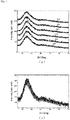
- the X-ray diffraction of phosphate glass was measured using an X-ray diffractometer of model number RINT2100 manufactured by Rigaku Corporation.
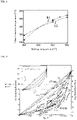
- the glass transition temperature Tg of the phosphate glass was measured using a differential thermal analyzer of model number Thermo plus EVO2 manufactured by Rigaku Corporation.
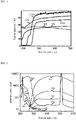
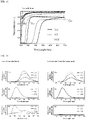
- the light transmission spectrum of the phosphate glass was measured using an ultraviolet-visible near-infrared spectrophotometer of model number UV4150 manufactured by Hitachi High-Tech Corporation.
- the fluorescence spectrum of the phosphate glass was measured using a fluorescence spectrophotometer of model number F-7000 manufactured by Hitachi High-Tech Corporation.
- the water resistance of the phosphate glass produced through melting at a temperature of 500°C was evaluated with the above-described method (1).
- the water resistance of the phosphate glass produced through melting at a temperature of 800°C was evaluated with the above-described method (2).
- Table 1 shows the contents of the components, the water resistance, and the glass transition temperature of the phosphate glass PGS-1 to PGS-7 in Examples 1 to 7.
- Table 2 shows the contents of the components, the water resistance, and the glass transition temperature of the phosphate glass PGS-8 to PGS-14 in Examples 8 to 14.
- Table 3 shows the contents of the components, the water resistance, and the glass transition temperature of the phosphate glass PGS-15 to PGS-20 in Examples 15 to 20.
- Table 4 shows the contents of the components, the water resistance, and the glass transition temperature of the phosphate glass PGS-21 to PGS-26 in Examples 21 to 26.
- Example 1 Example 2 Example 3 Example 4 Example 5
- Example 6 Example 7 Composition (mol%) P 2 O 5 59.6 62.1 59.8 64.9 59.5 56.1 61.0 ZnO 20.7 22.6 21.7 10.8 21.6 25.4 16.7 Al 2 O 3 2.6 2.8 3.3 2.7 2.7 2.6 2.8 La 2 O 3 1.0 1.1 1.1 2.2 2.2 2.6 2.8 Lu 2 O 3 0.0 0.0 0.0 0.0 0.0 0.0 0.0 0.0 0.0 Ga 2 O 3 0.0 0.0 0.0 0.0 0.0 0.0 0.0 0.0 0.0 0.0 Li 2 O 0.0 0.0 0.0 0.0 0.0 0.0 0.0 0.0 0.0 0.0 0.0 Na 2 O 0.0 0.0 0.0 0.0 0.0 0.0 0.0 0.0 0.0 0.0 0.0 0.0 K 2 O 7.8 5.7 5.4 10.8 5.4 5.1 5.6 BaO 8.3 5.7 8.7 8.6 8.6 8.2 11.1 MgO 0.0 0.0 0.0 0.0 0.0 0.0 0.0 0.0 0.0 0.0 CaO 0.0
- Table 5 shows the contents of the components, the water resistance, and the glass transition temperature of the phosphate glass PGS-27 to PGS-32 in Examples 27 to 32.
- Table 6 shows the contents of the components, the water resistance, and the glass transition temperature of the phosphate glass PGS-33 to PGS-38 in Examples 33 to 38.
- Table 7 shows the contents of the components, the water resistance, and the glass transition temperature of the phosphate glass PGS-39 to PGS-44 in Examples 39 to 44.
- Table 8 shows the contents of the components, the water resistance, and the glass transition temperature of the phosphate glass PGS-45 to PGS-50 in Examples 45 to 50.
- Table 9 shows the contents of the components, the water resistance, and the glass transition temperature of the phosphate glass PGS-51 to PGS-56 in Examples 51 to 56.
- Table 10 shows the contents of the components, the water resistance, and the glass transition temperature of the phosphate glass PGS-57 to PGS-60 in Examples 57 to 60.
- Example 27 Example 28-2 Example 29 Example 30
- Example 32 Composition (mol%) P 2 O 5 60.0 62.1 62.1 59.0 62.5 62.5 62.0 ZnO 20.0 22.6 22.6 20.0 21.5 21.5 21.0 Al 2 O 3 0.0 2.8 2.8 3.5 1.5 1.5 2.0 La 2 O 3 0.0 1.1 1.1 3.0 2.5 2.5 3.0 Lu 2 O 3 1.0 0.0 0.0 0.0 0.0 0.0 Ga 2 O 3 2.0 0.0 0.0 0.0 0.0 0.0 0.0 0.0 Li 2 O 0.0 0.0 0.0 0.0 0.0 0.0 0.0 0.0 Li 2 O 0.0 0.0 0.0 0.0 12.0 0.0 0.0 Na 2 O 0.0 0.0 0.0 0.0 0.0 12.0 6.0 K 2 O 6.0 5.7 5.7 14.5 0.0 0.0 6.0 BaO 9.0 0.0 0.0 0.0 0.0 0.0 0.0 0.0 MgO 0.0 0.0 0.0 0.0 0.0 0.0 0.0 0.0 0.0 CaO 0.0 5.7 0.0 0.0 0.0 0.0 0.0 0.0 0.0 0.0 0.0
- Table 11 shows the contents of the components, the water resistance, and the glass transition temperature of the phosphate glass PGS-Comp-1 to PGS-Comp-5 in Comparative Examples 1 to 5.
- Table 12 shows the contents of the components, the water resistance, and the glass transition temperature of the phosphate glass PGS-Comp-6 to PGS-Comp-10 in Comparative Examples 6 to 10.
- Table 13 shows the contents of the components, the water resistance, and the glass transition temperature of the phosphate glass PGS-Comp-11 to PGS-Comp-14 in Comparative Examples 11 to 14.
- Table 14 shows the contents of the components, the water resistance, and the glass transition temperature of the phosphate glass PGS-61 to PGS-67 in Examples 61 to 67.
- Table 15 shows the contents of the components, the water resistance, and the glass transition temperature of the phosphate glass PGS-68 to PGS-74 in Examples 68 to 74.
- Table 16 shows the contents of the components, the water resistance, and the glass transition temperature of the phosphate glass PGS-75 to PGS-81 in Examples 75 to 81.
- Table 17 shows the contents of the components, the water resistance, and the glass transition temperature of the phosphate glass PGS-82 to PGS-87 in Examples 82 to 87.
- Table 18 shows the contents of the components, the water resistance, and the glass transition temperature of the phosphate glass PGS-88 to PGS-93 in Examples 88 to 93.
- Table 19 shows the contents of the components, the water resistance, and the glass transition temperature of the phosphate glass PGS-94 to PGS-100 in Examples 94 to 100.
- Table 20 shows the contents of the components, the water resistance, and the glass transition temperature of the phosphate glass PGS-101 to PGS-106 in Examples 101 to 106.
- Table 21 shows the contents of the components, the water resistance, and the glass transition temperature of the phosphate glass PGS-107 to PGS-112 in Examples 107 to 112.
- Table 22 shows the contents of the components, the water resistance, and the glass transition temperature of the phosphate glass PGS-113 to PGS-118 in Examples 113 to 118.
- Table 23 shows the contents of the components, the water resistance, and the glass transition temperature of the phosphate glass PGS-119 to PGS-125 in Examples 119 to 125.
- Example 101 Example 102
- Example 103 Example 104
- Example 106 Composition (mol%) P 2 O 5 60.0 61.0 60.0 60.0 60.0 60.0 ZnO 20.0 20.5 20.0 20.0 20.0 20.0 Al 2 O 3 2.0 0.0 0.0 0.0 0.0 1.5 La 2 O 3 3.0 1.5 3.0 0.0 2.0 1.5 Lu 2 O 3 0.0 0.0 0.0 1.0 0.0 0.0 Ga 2 O 3 0.0 2.0 2.0 2.0 0.0 Li 2 O 0.0 0.0 0.0 0.0 0.0 1.0 Na 2 O 0.0 0.0 0.0 0.0 0.0 0.0 1.0 K 2 O 6.0 6.0 7.0 7.0 6.0 BaO 9.0 9.0 9.0 9.0 10.0 9.0 9.0 MgO 0.0 0.0 0.0 0.0 0.0 0.0 0.0 0.0 CaO 0.0 0.0 0.0 0.0 0.0 0.0 0.0 0.0 0.0 0.0 SrO 0.0 0.0 0.0 0.0 0.0 0.0 0.0 0.0 SiO 2 0.0 0.0 0.0 0.0 0.0 0.0 0.0 0.0 0.0 0.0 0.0
- Table 24 shows the contents of the components, the water resistance, and the glass transition temperature of the phosphate glass PGS-Comp-15 to PGS-Comp-19 in Comparative Examples 15 to 19.
- Table 25 shows the contents of the components, the water resistance, and the glass transition temperature of the phosphate glass PGS-Comp-20 to PGS-Comp-23 in Comparative Examples 20 to 23.
- Tables 1 to 13 show Examples 1 to 60 and Comparative Examples 1 to 14 in which the phosphate glass PGS was produced through melting at 500°C
- Tables 14 to 25 show Examples 61 to 125 and Comparative Examples 15 to 23 in which the phosphate glass PGS was produced through melting at 800°C.
- the content of P 2 O 5 is in the range of 56.1 [mol%] to 64.9 [mol%] in terms of mole percentage based on oxides
- the content of ZnO is in the range of 10.8 [mol%] to 25.4 [mol%] in terms of mole percentage based on oxides
- the content of Al 2 O 3 is in the range of 0.0 [mol%] to 4.9 [mol%] in terms of mole percentage based on oxides
- the content of La 2 O 3 is in the range of 0.0 [mol%] to 3.0 [mol%] in terms of mole percentage based on oxides
- the content of Lu 2 O 3 is in the range of 0.0 [mol%] to 3.0 [mol%] in terms of mole percentage based on oxides
- the content of Ga 2 O 3 is in the range of 0.0 [mol%] to 2.9 [mol%] in terms of mole percentage based on oxides
- the content of K 2 O is in the range of 0.0 [mol [mol
- the mass loss rate ⁇ W of the phosphate glass (hereinafter referred to as "water resistance") is 25.0 [%] or less, and the glass transition temperature Tg is 125°C to 232°C.
- the loss rate ⁇ W of 25.0 [%] or less is half or less the loss rate ⁇ W of the phosphate glass PGS-Comp-1 to PGS-Comp-14 in Comparative Examples 1 to 14 (50.0 [%] to 99.0 [%]), and therefore it can be said that the phosphate glass PGS-1 to the phosphate glass PGS-60 in Examples 1 to 60 are excellent in water resistance.
- the content of P 2 O 5 is in the range of 50.0 [mol%] to 62.9 [mol%] in terms of mole percentage based on oxides
- the content of ZnO is in the range of 5.5 [mol%] to 50.0 [mol%] in terms of mole percentage based on oxides
- the content of Al 2 O 3 is in the range of 0.0 [mol%] to 5.6 [mol%] in terms of mole percentage based on oxides
- the content of La 2 O 3 is in the range of 0.0 [mol%] to 5.4 [mol%] in terms of mole percentage based on oxides
- the content of K 2 O is in the range of 0.0 [mol%] to 7.7 [mol%] in terms of mole percentage based on oxides
- the content of BaO is in the range of 0.0 [mol%] to 11.8 [mol%] in terms of mole percentage based on oxides
- the content of SnO is in the range
- the phosphate glass PGS-Comp-1 to the phosphate glass PGS-Comp-14 in Comparative Examples 1 to 14 are measurable and have a water resistance of 50.0 [%] to 99.0 [%] or more and a glass transition temperature Tg of 50°C to 154°C.
- the phosphate glass PGS-Comp-1 to the phosphate glass PGS-Comp-11 in Comparative Examples 1 to 11 include neither Al 2 O 3 nor La 2 O 3 as components.
- the phosphate glass PGS-Comp-12 to the phosphate glass PGS-Comp-14 in Comparative Examples 12 to 14 include both Al 2 O 3 and La 2 O 3 as components, but the water resistance is evaluated to be "NG", and as the result, no phosphate glass is formed.
- the phosphate glass PGS-1 to the phosphate glass PGS-60 in Examples 1 to 60 include both at least one of Al 2 O 3 , Ga 2 O 3 , or Y 2 O 3 and at least one of La 2 O 3 or Lu 2 O 3 as components.
- the phosphate glass PGS-1 to the phosphate glass PGS-60 in Examples 1 to 60 have a component composition that differs from those of the phosphate glass PGS-Comp-1 to the phosphate glass PGS-Comp-14 in Comparative Examples 1 to 14.
- the phosphate glass PGS-1 to the phosphate glass PGS-9 in Examples 1 to 9 include P 2 O 5 , ZnO, Al 2 O 3 , La 2 O 3 , K 2 O, and BaO as components (see Tables 1 and 2).
- the phosphate glass PGS-Comp-1 in Comparative Example 1 includes P 2 O 5 and ZnO as components
- the phosphate glass PGS-Comp-2 and the phosphate glass PGS-Comp-5 in Comparative Examples 2 and 5 include P 2 O 5 , ZnO, and BaO as components
- the phosphate glass PGS-Comp-3 and the phosphate glass PGS-Comp-4 in Comparative Examples 3 and 4 include P 2 O 5 , ZnO, K 2 O, and BaO as components
- the phosphate glass PGS-Comp-6 to the phosphate glass PGS-Comp-8 in Comparative Examples 6 to 8 include P 2 O 5 , ZnO, Al 2 O 3 , K 2 O, and BaO as components
- the phosphate glass PGS-Comp-9 to the phosphate glass PGS-Comp-11 in Comparative Examples 9 to 11 include P 2 O 5 , ZnO, La 2 O 3 , K 2 O, and BaO as components (see Tables 11 to 13).
- the phosphate glass PGS-1 to the phosphate glass PGS-9 in Examples 1 to 9 are significantly superior in water resistance to the phosphate glass PGS-Comp-1 to the phosphate glass PGS-Comp-11 in Comparative Examples 1 to 11. This is considered to be because the phosphate glass PGS-1 to the phosphate glass PGS-9 in Examples 1 to 9 include both Al 2 O 3 and La 2 O 3 as components, whereas the phosphate glass PGS-Comp-1 to the phosphate glass PGS-Comp-11 in Comparative Examples 1 to 11 include neither Al 2 O 3 nor La 2 O 3 as components. Therefore, if both Al 2 O 3 and La 2 O 3 are included as components, the water resistance can be improved.
- the phosphate glass PGS-13 to the phosphate glass PGS-17 in Examples 13 to 17 are obtained by adding an SnO component to P 2 O 5 , ZnO, Al 2 O 3 , La 2 O 3 , K 2 O, and BaO each having a basic content as in the phosphate glass PGS-8 in Example 8.
- the phosphate glass PGS-13 to the phosphate glass PGS-17 include SnO at a content of 0.001 [mol%], 0.010 [mol%], 0.100 [mol%], 1.000 [mol%], and 9.100 [mol%], respectively, in terms of mole percentage based on oxides (see Tables 2 and 3).
- the phosphate glass PGS-13 to the phosphate glass PGS-17 have a water resistance of 0.5 [%] or less.
- the phosphate glass PGS-Comp-12 to the phosphate glass PGS-Comp-14 in Comparative Examples 12 to 14 include P 2 O 5 , ZnO, Al 2 O 3 , La 2 O 3 , K 2 O, BaO, and SnO as components (see Table 13).
- the water resistance is evaluated to be NG, and the glass transition temperature Tg is unmeasurable. This is considered to be because SnO is included at a very large content of 11.6 [mol%] to 16.5 [mol%] in terms of mole percentage based on oxides.
- the phosphate glass PGS-13 to the phosphate glass PGS-17 having excellent water resistance can be produced.
- the content of SnO of 9.1 [mol%] has a critical significance for formation of phosphate glass including SnO as a component.
- Fig. 3 are graphs showing the X-ray diffraction spectra of the phosphate glass PGS-8 and PGS-13 to PGS-17 in Examples 8 and 13 to 17.
- the spectra SP1 to SP6 indicate the X-ray diffraction spectra of the phosphate glass PGS-8 and PGS-13 to PGS-17 in Examples 8 and 13 to 17, respectively.
- Fig. 3(b) shows the X-ray diffraction spectra SP1 to SP6 of the phosphate glass PGS-8 and PGS-13 to PGS-17 in an overlapping manner.
- the X-ray diffraction spectra SP1 to SP6 of the phosphate glass PGS-8 and PGS-13 to PGS-17 have the same spectral shape. It has been found that the network structures of the phosphate glass PGS-13 to PGS-17 do not change even if SnO is added at a content of 0.001 [mol%] to 9.100 [mol%] in terms of mole percentage based on oxides because the phosphate glass PGS-8 in Example 8 includes no SnO as a component.
- Fig. 4 is a graph showing the light transmission spectra of the phosphate glass PGS-8 and PGS-13 to PGS-16 in Examples 8 and 13 to 16.
- the spectra SP7 to S11 indicate the light transmission spectra of the phosphate glass PGS-8 and PGS-13 to PGS-16, respectively.
- the phosphate glass PGS-8 and PGS-13 to PGS-16 have a film thickness of 1.5 mm, 5.0 mm, 1.43 mm, 0.47 mm, and 1.54 mm, respectively.
- the phosphate glass PGS-8 has a light transmission end at a wavelength shorter than 200 nm (see the light transmission spectrum SP7)
- the phosphate glass PGS-13 has a light transmission end at a wavelength shorter than 200 nm (see the light transmission spectrum SP8)
- the phosphate glass PGS-14 has a light transmission end at a wavelength of about 190 nm (see the light transmission spectrum SP9)
- the phosphate glass PGS-15 has a light transmission end at a wavelength of about 220 nm (see the light transmission spectrum SP10)
- the phosphate glass PGS-16 has a light transmission end at a wavelength of about 250 nm (see the light transmission spectrum SP11).
- the phosphate glass can have a light transmission end at a wavelength shifted to the long wavelength side in the ultraviolet region. That is, in the ultraviolet region, the wavelength at the light transmission end of the phosphate glass PGS can be controlled by the content of SnO.
- Fig. 5 is a graph showing the fluorescence spectra of the phosphate glass PGS-13 to PGS-16 in Examples 13 to 16.
- the spectra Ex1 to Ex4 indicate excitation light spectra
- the spectra FL1 to FL4 indicate the fluorescence spectra of the phosphate glass PGS-13 to PGS-16, respectively.
- the excitation light spectra Ex1 to Ex4 have a peak wavelength of 254 nm.
- the fluorescence spectra FL1 to FL4 have a peak wavelength of about 510 nm.
- the phosphate glass PGS-13 to the phosphate glass PGS-16 including SnO at a content of 0.001 [mol%], 0.010 [mol%], 0.100 [mol%], and 1.000 [mol%], respectively, in terms of mole percentage based on oxides have fluorescence spectra FL1 to FL4 having the same peak wavelength. Therefore, combination with a light emitting element (such as an LED) in the ultraviolet light region can yield a light emitting device that emits the fluorescence.
- a light emitting element such as an LED
- the phosphate glass PGS-8, PGS-18, PGS-21, PGS-24, and PGS-33 in Examples 8, 18, 21, 24, and 33 basically include 62.8 [mol%] of P 2 O 5 , 17.4 [mol%] of ZnO, 4.7 [mol%] of K 2 O, and 9.3 [mol%] of BaO in terms of mole percentage based on oxides, and have a total content of 5.8 [mol%] of two or three components selected from Al 2 O 3 , La 2 O 3 , Lu 2 O 3 , and Ga 2 O 3 .
- the phosphate glass PGS-8 in Example 8 includes, as components, Al 2 O 3 and La 2 O 3 out of Al 2 O 3 , La 2 O 3 , Lu 2 O 3 , and Ga 2 O 3
- the phosphate glass PGS-18 in Example 18 includes, as components, Al 2 O 3 , La 2 O 3 , and Ga 2 O 3 out of Al 2 O 3 , La 2 O 3 , Lu 2 O 3 , and Ga 2 O 3
- the phosphate glass PGS-21 in Example 21 includes, as components, Lu 2 O 3 and Ga 2 O 3 out of Al 2 O 3 , La 2 O 3 , Lu 2 O 3 , and Ga 2 O 3
- the phosphate glass PGS-24 in Example 24 includes, as components, La 2 O 3 and Ga 2 O 3 out of Al 2 O 3 , La 2 O 3 , Lu 2 O 3 , and Ga 2 O 3
- the phosphate glass PGS-33 in Example 33 includes, as components, Al 2 O 3 and Lu 2 O 3 out of Al 2 O 3 , La 2 O 3
- La which has the smallest atomic number among the lanthanoid elements
- Lu which has the largest atomic number among the lanthanoid elements
- phosphate glass having excellent water resistance can be produced using any of the lanthanoid elements (lanthanum (La), cerium (Ce), praseodymium (Pr), neodymium (Nd), promethium (Pm), samarium (Sm), europium (Eu), gadolinium (Gd), terbium (Tb), dysprosium (Dy), holmium (Ho), erbium (Er), thulium (Tm), ytterbium (Yb), and lutetium (Lu)).
- La lanthanoid elements
- Ce cerium
- Pr praseodymium
- Nd neodymium
- Pm promethium
- Sm samarium
- Eu europium
- Gd gadolinium
- Tb terbium
- the phosphate glass PGS-8, PGS-18, and PGS-24 in Examples 8, 18, and 24 are phosphate glass in which La 2 O 3 is selected as an oxide of a lanthanoid element L 2 O 3 , and at least one of Al 2 O 3 or Ga 2 O 3 is included.
- the phosphate glass PGS-8 includes Al 2 O 3 out of Al 2 O 3 and Ga 2 O 3 , and has a water resistance of 25.0 [%].
- the phosphate glass PGS-18 includes both Al 2 O 3 and Ga 2 O 3 , and has a water resistance of less than 0.5 [%].
- the phosphate glass PGS-24 includes Ga 2 O 3 out of Al 2 O 3 and Ga 2 O 3 , and has a water resistance of 4.0 [%].
- the phosphate glass PGS-19, PGS-21, and PGS-33 in Examples 19, 21, and 33 are phosphate glass in which Lu 2 O 3 is selected as an oxide of a lanthanoid element L 2 O 3 , and at least one of Al 2 O 3 or Ga 2 O 3 is included.
- the phosphate glass PGS-19 includes both Al 2 O 3 and Ga 2 O 3 , and has a water resistance of 0.059 [%].
- the phosphate glass PGS-21 includes Ga 2 O 3 out of Al 2 O 3 and Ga 2 O 3 , and has a water resistance of 1.0 [%].
- the phosphate glass PGS-33 includes Al 2 O 3 out of Al 2 O 3 and Ga 2 O 3 , and has a water resistance of less than 0.5 [%].
- the phosphate glass PGS-8, PGS-18, PGS-19, PGS-21, PGS-24, and PGS-33 in Examples 8, 18, 19, 21, 24, and 33 show that if an oxide of a lanthanoid element L 2 O 3 and at least one of Al 2 O 3 or Ga 2 O 3 are included in addition to the components consisting of P 2 O 5 , ZnO, K 2 O, and BaO, phosphate glass having excellent water resistance can be produced.
- the phosphate glass PGS-28 in Example 28 includes, in terms of mole percentage based on oxides, 62.1 [mol%] of P 2 O 5 , 22.6 [mol%] of ZnO, 2.8 [mol%] of Al 2 O 3 , 1.1 [mol%] of La 2 O 3 , 5.6 [mol%] of K 2 O, and 5.6 [mol%] of CaO. Therefore, the phosphate glass PGS-28 in Example 28 shows that even if BaO in the phosphate glass PGS-1 to PGS-9 in Examples 1 to 9 is replaced with CaO, phosphate glass having excellent water resistance can be produced.
- the phosphate glass PGS-29 in Example 29 includes, in terms of mole percentage based on oxides, 59.0 [mol%] of P 2 O 5 , 20.0 [mol%] of ZnO, 3.5 [mol%] of Al 2 O 3 , 3.0 [mol%] of La 2 O 3 , and 14.5 [mol%] of K 2 O. That is, the phosphate glass PGS-29 includes none of BaO, MgO, and CaO. Therefore, Example 29 shows that BaO, MgO, and CaO are optional components of the phosphate glass PGS produced through melting at 500°C.
- the phosphate glass PGS-34, PGS-35, PGS-37, and PGS-38 in Examples 34, 35, 37, and 38 are obtained by adding SiO 2 to the phosphate glass PGS including P 2 O 5 , ZnO, Al 2 O 3 , La 2 O 3 , K 2 O, and BaO.
- the content of SiO 2 is 0.1 [mol%] to 8.5 [mol%] in terms of mole percentage based on oxides.
- the phosphate glass PGS-36 in Example 36 is obtained by adding SiO 2 to the phosphate glass PGS including P 2 O 5 , ZnO, Al 2 O 3 , La 2 O 3 , and K 2 O (phosphate glass including none of BaO, MgO, and CaO).
- the phosphate glass PGS-34 to the phosphate glass PGS-38 in Examples 34 to 38 have a water resistance of 1.0 [%] or less.
- Examples 34 to 38 show that the phosphate glass PGS including SiO 2 as a component has excellent water resistance.
- the phosphate glass PGS-21 in Example 21 has more excellent water resistance than the phosphate glass PGS-22 in Example 22. Therefore, it has been found that in the phosphate glass PGS including Lu 2 O 3 , Ga 2 O 3 more contributes to improvement of water resistance than Y 2 O 3 .
- the phosphate glass PGS-25 in Example 25 has more excellent water resistance than the phosphate glass PGS-24 in Example 24. Therefore, it has been found that in the phosphate glass PGS including La 2 O 3 , Y 2 O 3 more contributes to improvement of water resistance than Ga 2 O 3 .
- the phosphate glass PGS-26 in Example 26 has more excellent water resistance than the phosphate glass PGS-27 in Example 27. Therefore, it has been found that in the phosphate glass PGS including Ga 2 O 3 and Y 2 O 3 , La 2 O 3 more contributes to improvement of water resistance than Lu 2 O 3 .
- Examples 26 and 27 have more excellent water resistance than the phosphate glass PGS-24 in Example 24. Therefore, Examples 26 and 27 show that in the phosphate glass including La 2 O 3 or Lu 2 O 3 as an oxide of a lanthanoid element L 2 O 3 , inclusion of both Ga 2 O 3 and Y 2 O 3 can more contribute to improvement of water resistance than inclusion of only Ga 2 O 3 .
- the phosphate glass PGS-26 has more excellent water resistance than the phosphate glass PGS-27, and therefore in a case where both Ga 2 O 3 and Y 2 O 3 are included as components, inclusion of La 2 O 3 can more improve water resistance than inclusion of Lu 2 O 3 .
- Table 26 shows the components and the water resistance of the phosphate glass PGS-1 to PGS-9, PGS-11, PGS-12, PGS-20 to PGS-22, PGS-26, and PGS-27 in Examples 1 to 9, 11, 12, 20 to 22, 26, and 27.
- Example 1 to 9 Example 21
- Example 22 Example 11
- Example 26 Example 19
- Example 12 Example 20
- P 2 O 5 ⁇ ⁇ ⁇ ⁇ ⁇ ⁇ ⁇ ⁇ ⁇ ZnO ⁇ ⁇ ⁇ ⁇ ⁇ ⁇ ⁇ Al 2 O 3 ⁇ ⁇ ⁇ ⁇ Ga 2 O 3 ⁇ ⁇ ⁇ ⁇ ⁇ ⁇ Y 2 O 3 ⁇ ⁇ ⁇ ⁇ ⁇ La 2 O 3 ⁇ ⁇ ⁇ ⁇ Lu 2 O 3 ⁇ ⁇ ⁇ ⁇ K 2 O ⁇ ⁇ ⁇ ⁇ ⁇ ⁇ ⁇ ⁇ BaO ⁇ ⁇ ⁇ ⁇ ⁇ ⁇ ⁇ ⁇ ⁇ Water resistance ( ⁇ W) [%] 1.0 to 2
- the phosphate glass PGS-1 to PGS-9, PGS-11, PGS-12, PGS-20 to PGS-22, PGS-26, and PGS-27 in Examples 1 to 9, 11, 12, 20 to 22, 26, and 27 include P 2 O 5 , ZnO, K 2 O, BaO, and La 2 O 3 or Lu 2 O 3 in common, and include at least one of Al 2 O 3 , Ga 2 O 3 , or Y 2 O 3 .
- the phosphate glass PGS-1 to the phosphate glass PGS-9 include only Al 2 O 3 out of Al 2 O 3 , Ga 2 O 3 , and Y 2 O 3 .
- the phosphate glass PGS-21 includes only Ga 2 O 3 out of Al 2 O 3 , Ga 2 O 3 , and Y 2 O 3 .
- the phosphate glass PGS-22 includes only Y 2 O 3 out of Al 2 O 3 , Ga 2 O 3 , and Y 2 O 3 .
- the phosphate glass PGS-1 to the phosphate glass PGS-9 have a water resistance of 1.0 to 25.0 [%].
- the phosphate glass PGS-21 has a water resistance of 1.0 [%].
- the phosphate glass PGS-22 has a water resistance of 9.607 [%].
- the phosphate glass PGS-11 includes Al 2 O 3 and Y 2 O 3 out of Al 2 O 3 , Ga 2 O 3 , and Y 2 O 3 .
- the phosphate glass PGS-19 includes Al 2 O 3 and Ga 2 O 3 out of Al 2 O 3 , Ga 2 O 3 , and Y 2 O 3 .
- the phosphate glass PGS-26 and the phosphate glass PGS-27 include Ga 2 O 3 and Y 2 O 3 out of Al 2 O 3 , Ga 2 O 3 , and Y 2 O 3 .
- the phosphate glass PGS-11 has a water resistance of 0.058 [%].
- the phosphate glass PGS-19 has a water resistance of 0.059 [%].
- the phosphate glass PGS-26 has a water resistance of 0.022 [%], and the phosphate glass PGS-27 has a water resistance of 0.129 [%].
- the phosphate glass PGS-12 and the phosphate glass PGS-20 include Al 2 O 3 , Ga 2 O 3 , and Y 2 O 3 .
- the phosphate glass PGS-12 has a water resistance of 0.028 [%]
- the phosphate glass PGS-20 has a water resistance of 0.105 [%].
- the phosphate glass PGS-1 to PGS-9 in Examples 1 to 9 include La 2 O 3 in common, and the phosphate glass in the above-described three groups respectively include one component, two components, and three components out of Al 2 O 3 , Ga 2 O 3 , and Y 2 O 3 .
- the phosphate glass PGS-11 and the phosphate glass PGS-26 that include two components out of Al 2 O 3 , Ga 2 O 3 , and Y 2 O 3 have more excellent water resistance than the phosphate glass PGS-1 to the phosphate glass PGS-9 that include one component out of Al 2 O 3 , Ga 2 O 3 , and Y 2 O 3 .
- the phosphate glass PGS-12 including three components out of Al 2 O 3 , Ga 2 O 3 , and Y 2 O 3 has more excellent water resistance than the phosphate glass PGS-11 including two components out of Al 2 O 3 , Ga 2 O 3 , and Y 2 O 3 .
- the phosphate glass PGS-12 has almost the same water resistance as the phosphate glass PGS-26 including two components out of Al 2 O 3 , Ga 2 O 3 , and Y 2 O 3 .
- the phosphate glass PGS-21 and PGS-22 in Examples 21 and 22, the phosphate glass PGS-19 and PGS-27 in Examples 19 and 27, and the phosphate glass PGS-20 in Example 20 include Lu 2 O 3 in common, and the phosphate glass in the above-described three groups respectively include one component, two components, and three components out of Al 2 O 3 , Ga 2 O 3 , and Y 2 O 3 .
- the phosphate glass PGS-19 and the phosphate glass PGS-27 that include two components out of Al 2 O 3 , Ga 2 O 3 , and Y 2 O 3 have more excellent water resistance than the phosphate glass PGS-21 and the phosphate glass PGS-22 that include one component out of Al 2 O 3 , Ga 2 O 3 , and Y 2 O 3 .
- the phosphate glass PGS-20 including three components out of Al 2 O 3 , Ga 2 O 3 , and Y 2 O 3 has more excellent water resistance than the phosphate glass PGS-27 including two components out of Al 2 O 3 , Ga 2 O 3 , and Y 2 O 3 .
- the phosphate glass PGS-20 has lower water resistance than the phosphate glass PGS-19 including two components out of Al 2 O 3 ,Ga 2 O 3 , and Y 2 O 3 , but the phosphate glass PGS-20 has more excellent water resistance than the phosphate glass PGS-21 and the phosphate glass PGS-22 that include one component out of Al 2 O 3 , Ga 2 O 3 , and Y 2 O 3 .
- the phosphate glass including La 2 O 3 or Lu 2 O 3 can have improved water resistance by including two or more components out of Al 2 O 3 , Ga 2 O 3 , and Y 2 O 3 .
- the phosphate glass can have improved water resistance by including two or more components out of Al 2 O 3 , Ga 2 O 3 , and Y 2 O 3 using any of the lanthanoid elements (lanthanum (La), cerium (Ce), praseodymium (Pr), neodymium (Nd), promethium (Pm), samarium (Sm), europium (Eu), gadolinium (Gd), terbium (Tb), dysprosium (Dy), holmium (Ho), erbium (Er), thulium (Tm), ytterbium
- La which has the smallest atomic number among the lanthanoid elements
- Lu which has the largest atomic number among the lanthanoid elements
- the phosphate glass PGS-29 to the phosphate glass PGS-31 in Examples 29 to 31 include P 2 O 5 , ZnO, Al 2 O 3 , and La 2 O 3 in common, and include any one of Li 2 O, Na 2 O, and K 2 O.
- the phosphate glass PGS-31 has the highest water resistance
- the phosphate glass PGS-29 has the second highest water resistance
- the phosphate glass PGS-30 has the lowest water resistance. Therefore, it has been found that among Li 2 O, Na 2 O, and K 2 O, Na 2 O most contributes to improvement of water resistance.
- the phosphate glass PGS-32 including Na 2 O and K 2 O has higher water resistance than the phosphate glass PGS-29 to PGS-31 by about one order of magnitude. Therefore, it has been found that the phosphate glass PGS can have further improved water resistance by including two components of Na 2 O and K 2 O.
- the content of P 2 O 5 is in the range of 55.8 [mol%] to 63.0 [mol%] in terms of mole percentage based on oxides
- the content of ZnO is in the range of 11.7 [mol%] to 25.5 [mol%] in terms of mole percentage based on oxides
- the content of Al 2 O 3 is in the range of 0.0 [mol%] to 6.1 [mol%] in terms of mole percentage based on oxides
- the content of La 2 O 3 is in the range of 0.0 [mol%] to 3.0 [mol%] in terms of mole percentage based on oxides
- the content of Lu 2 O 3 is in the range of 0.0 [mol%] to 3.0 [mol%] in terms of mole percentage based on oxides
- the content of Ga 2 O 3 is in the range of 0 [mol%] to 2.9 [mol%] in terms of mole percentage based on oxides
- the content of Li 2 O is in the range of
- the phosphate glass PGS-61 to the phosphate glass PGS-125 in Examples 61 to 125 have a water resistance of 0.005 [%] to 0.587 [%] and a glass transition temperature Tg of 258°C to 393°C.
- the content of P 2 O 5 is in the range of 54.0 [mol%] to 75.5 [mol%] in terms of mole percentage based on oxides
- the content of ZnO is in the range of 4.4 [mol%] to 32.0 [mol%] in terms of mole percentage based on oxides
- the content of Al 2 O 3 is in the range of 0.9 [mol%] to 5.5 [mol%] in terms of mole percentage based on oxides
- the content of La 2 O 3 is in the range of 0.0 [mol%] to 9.8 [mol%] in terms of mole percentage based on oxides
- the content of K 2 O is in the range of 0.0 [mol%] to 18.5 [mol%] in terms of mole percentage based on oxides
- the content of BaO is in the range of 0 [mol%] to 10.8 [mol%] in terms of mole percentage based on oxides (see Tables 24 and 25).
- measurable phosphate glass has a water resistance of 1.021 [%] to 18.528 [%] and a glass transition temperature Tg of 238°C to 285°C.
- the phosphate glass PGS-Comp-15, the phosphate glass PGS-Comp-17, and the phosphate glass PGS-Comp-22 in Comparative Examples 15, 17, and 22 include neither Al 2 O 3 nor La 2 O 3 as components.
- the phosphate glass PGS-Comp-16, PGS-Comp-18, PGS-Comp-19, PGS-Comp-21, and PGS-Comp-23 in Comparative Examples 16, 18, 19, 21, and 23 the water resistance is evaluated to be "NG", and as the result, no phosphate glass is formed.
- the phosphate glass PGS-61 to the phosphate glass PGS-125 in Examples 61 to 125 include an oxide of a lanthanoid element L 2 O 3 and at least one of Al 2 O 3 ,Ga 2 O 3 , or Y 2 O 3 as components.
- the phosphate glass PGS-61 to the phosphate glass PGS-125 in Examples 61 to 125 have a component composition that differs from those of the phosphate glass PGS-Comp-15 to the phosphate glass PGS-Comp-23 in Comparative Examples 15 to 23.
- the phosphate glass PGS-61 to the phosphate glass PGS-70 in Examples 61 to 70 include P 2 O 5 , ZnO, Al 2 O 3 , La 2 O 3 , K 2 O, and BaO as components.
- the phosphate glass PGS-61 to the phosphate glass PGS-70 in Examples 61 to 70 have a water resistance of 0.016 [%] to 0.587 [%] (see Tables 14 and 15).
- the phosphate glass PGS was formed in Comparative Examples 15, 17, 20, and 22 among Comparative Examples 15 to 23.
- the phosphate glass PGS-Comp-15, the phosphate glass PGS-Comp-17, and the phosphate glass PGS-Comp-22 in Comparative Examples 15, 17, and 22 include neither Al 2 O 3 nor La 2 O 3 as components.
- the phosphate glass PGS-Comp-15, the phosphate glass PGS-Comp-17, and the phosphate glass PGS-Comp-22 have a water resistance of 18.528 [%], 2.443 [%], and 1.021 [%], respectively.
- the phosphate glass PGS-Comp-20 in Comparative Example 20 includes both Al 2 O 3 and La 2 O 3 as components, but the content of La 2 O 3 is less than 1.0 [mol%].
- the phosphate glass PGS-Comp-20 has a water resistance of 8.078 [%] (see Tables 24 and 25).
- the phosphate glass PGS-61 to the phosphate glass PGS-70 in Examples 61 to 70 have more excellent water resistance than the phosphate glass PGS-Comp-15, PGS-Comp-17, PGS-Comp-20, and PGS-Comp-22 in Comparative Examples 15, 17, 20, and 22.
- the phosphate glass PGS-61 to the phosphate glass PGS-70 in Examples 61 to 70 include both Al 2 O 3 and La 2 O 3 as components, and because the content of La 2 O 3 is in the range of 1.0 [mol%] to 3.0 [mol%] in terms of mole percentage based on oxides.
- the phosphate glass PGS-74 in Example 74 is obtained by replacing Al 2 O 3 in the phosphate glass PGS-70 in Example 70 with Ga 2 O 3 at the same content.
- the phosphate glass PGS-78 in Example 78 is obtained by replacing Al 2 O 3 in the phosphate glass PGS-70 in Example 70 with Y 2 O 3 at the same content.
- the phosphate glass PGS-74 has more excellent water resistance than the phosphate glass PGS-70, and the phosphate glass PGS-78 has a water resistance of less than 0.090 [%].
- the phosphate glass PGS having excellent water resistance can be obtained.
- Al 2 O 3 , Ga 2 O 3 , and Y 2 O 3 constitute the components that improve the water resistance of the phosphate glass PGS.
- Example 82 The phosphate glass PGS-82 in Example 82 is obtained by replacing Al 2 O 3 and La 2 O 3 in the phosphate glass PGS-70 in Example 70 with Ga 2 O 3 and Lu 2 O 3 , respectively.
- Example 82 shows that the phosphate glass PGS obtained can have excellent water resistance also by including both Ga 2 O 3 and Lu 2 O 3 as components.
- the phosphate glass PGS-79 and PGS-81 in Examples 79 and 81 include P 2 O 5 , ZnO, K 2 O, BaO, and Y 2 O 3 in common and include La 2 O 3 or Lu 2 O 3 .
- the phosphate glass PGS-79 has a water resistance of 0.377 [%]
- the phosphate glass PGS-81 has a water resistance of 0.323 [%].
- Examples 79 and 81 show that the phosphate glass PGS including only Y 2 O 3 out of Al 2 O 3 , Ga 2 O 3 , and Y 2 O 3 can obtain almost the same water resistance whether La 2 O 3 or Lu 2 O 3 is included as a component.
- the phosphate glass PGS-70 in Example 70 is obtained by replacing Y 2 O 3 in the phosphate glass PGS-79 in Example 79 with Al 2 O 3
- the phosphate glass PGS-82 in Example 82 is obtained by replacing Y 2 O 3 in the phosphate glass PGS-81 in Example 81 with Ga 2 O 3 .
- the phosphate glass PGS-70 includes P 2 O 5 , ZnO, K 2 O, BaO, La 2 O 3 out of La 2 O 3 and Lu 2 O 3 , and Al 2 O 3 out of Al 2 O 3 , Ga 2 O 3 , and Y 2 O 3
- the phosphate glass PGS-82 includes P 2 O 5 , ZnO, K 2 O, BaO, Lu 2 O 3 out of La 2 O 3 and Lu 2 O 3 , and Ga 2 O 3 out of Al 2 O 3 , Ga 2 O 3 , and Y 2 O 3 .
- Examples 70, 79, 81, and 82 show that if phosphate glass including one component out of Al 2 O 3 , Ga 2 O 3 , and Y 2 O 3 includes one of all lanthanoid oxides from La 2 O 3 to Lu 2 O 3 as a component, the obtained phosphate glass can have excellent water resistance.
- the phosphate glass PGS-71 in Example 71 includes two lanthanoid oxides of La 2 O 3 and Lu 2 O 3 as components in addition to the components consisting of P 2 O 5 , ZnO, Al 2 O 3 , K 2 O, and BaO.
- the phosphate glass PGS-71 has almost the same water resistance as the phosphate glass PGS-68 in Example 68 including one component (La 2 O 3 ) out of La 2 O 3 and Lu 2 O 3 . Therefore, Example 71 shows that phosphate glass having excellent water resistance can be obtained also in a case where two of the lanthanoid oxides from La 2 O 3 to Lu 2 O 3 are included as components.
- the phosphate glass PGS-75 in Example 75 includes P 2 O 5 , ZnO, Al 2 O 3 , Lu 2 O 3 , Ga 2 O 3 , K 2 O, and BaO as components.
- the phosphate glass PGS-77 in Example 77 is obtained by replacing Ga 2 O 3 in the phosphate glass PGS-75 with Y 2 O 3 at the same content.
- the phosphate glass PGS-75 has a water resistance of 0.030 [%]
- the phosphate glass PGS-77 has a water resistance of 0.299 [%]. Therefore, it has been found that in the phosphate glass PGS including Lu 2 O 3 , inclusion of both Al 2 O 3 and Ga 2 O 3 more contributes to improvement of water resistance than inclusion of both Al 2 O 3 and Y 2 O 3 .
- the phosphate glass PGS-79 in Example 79 includes P 2 O 5 , ZnO, La 2 O 3 , K 2 O, BaO, and Y 2 O 3 as components.
- the phosphate glass PGS-81 in Example 81 is obtained by replacing La 2 O 3 in the phosphate glass PGS-79 with Lu 2 O 3 at the same content.
- the phosphate glass PGS-79 and the phosphate glass PGS-81 have almost the same water resistance.
- La which has the smallest atomic number among the lanthanoid elements
- Lu which has the largest atomic number among the lanthanoid elements
- phosphate glass having excellent water resistance can be obtained using any of the lanthanoid elements (lanthanum (La), cerium (Ce), praseodymium (Pr), neodymium (Nd), promethium (Pm), samarium (Sm), europium (Eu), gadolinium (Gd), terbium (Tb), dysprosium (Dy), holmium (Ho), erbium (Er), thulium (Tm), ytterbium (Yb), and lutetium (Lu)).
- La lanthanoid elements
- Ce cerium
- Pr praseodymium
- Nd neodymium
- Pm promethium
- Sm samarium
- Eu europium
- Gd gadolinium
- Tb terbium
- Example 84 The phosphate glass PGS-84 in Example 84 is obtained by replacing Lu 2 O 3 in the phosphate glass PGS-82 in Example 82 with La 2 O 3 at the same content.
- Example 84 shows that the phosphate glass PGS having more excellent water resistance can be obtained with a combination of Ga 2 O 3 and La 2 O 3 than with a combination of Ga 2 O 3 and Lu 2 O 3 .
- the phosphate glass PGS-85 and the phosphate glass PGS-86 in Examples 85 and 86 include Li 2 O, Na 2 O, and K 2 O as components in addition to the components consisting of P 2 O 5 , ZnO, Al 2 O 3 , La 2 O 3 , and BaO.
- the phosphate glass PGS-85 has a water resistance of less than 0.130 [%]
- the phosphate glass PGS-86 has a water resistance of less than 0.050 [%].
- Examples 85 and 86 show that the phosphate glass PGS having excellent water resistance can be obtained even if the oxides of three alkali metals (Li, Na, K) are included.
- the phosphate glass PGS-87 in Example 87 includes P 2 O 5 , ZnO, Al 2 O 3 , La 2 O 3 , and Li 2 O as components
- the phosphate glass PGS-88 in Example 88 includes P 2 O 5 , ZnO, Al 2 O 3 , La 2 O 3 , and Na 2 O as components
- the phosphate glass PGS-89 in Example 89 includes P 2 O 5 , ZnO, Al 2 O 3 , La 2 O 3 , K 2 O, and Na 2 O as components. That is, the phosphate glass PGS-87 to the phosphate glass PGS-89 include none of BaO, MgO, and CaO. Therefore, Examples 87 to 89 show that BaO, SrO, MgO, and CaO are optional components of the phosphate glass produced through melting at 800°C.
- the phosphate glass PGS-93 in Example 93 includes P 2 O 5 , ZnO, Al 2 O 3 , La 2 O 3 , Ga 2 O 3 , and K 2 O as components. That is, the phosphate glass PGS-93 includes none of BaO, MgO, and CaO. Therefore, Example 93 shows that BaO, SrO, MgO, and CaO are optional components in the phosphate glass PGS including Al 2 O 3 and Ga 2 O 3 out of Al 2 O 3 , Ga 2 O 3 , and Y 2 O 3 .
- the phosphate glass PGS-97 in Example 97 includes P 2 O 5 , ZnO, Al 2 O 3 , La 2 O 3 , K 2 O, and SiO 2 as components. That is, the phosphate glass PGS-97 includes none of BaO, SrO, MgO, and CaO. Therefore, Example 97 shows that BaO, MgO, and CaO are optional components in the phosphate glass PGS including SiO 2 .
- the phosphate glass PGS-90 in Example 90 includes CaO as a component in place of BaO in the components consisting of P 2 O 5 , ZnO, Al 2 O 3 , La 2 O 3 , K 2 O, and BaO.
- the phosphate glass PGS-90 has a water resistance of less than 0.400 [%]. As described above, Example 90 shows that even if CaO is included as a component in place of BaO, the phosphate glass PGS having excellent water resistance can be obtained.
- the phosphate glass PGS-91 in Example 91 includes 9.1 [mol%] of SnO as a component in terms of mole percentage based on oxides in addition to the components consisting of P 2 O 5 , ZnO, Al 2 O 3 , La 2 O 3 , K 2 O, and BaO.
- the phosphate glass PGS-91 has a water resistance of less than 0.060 [%]. As described above, Example 91 shows that even if P 2 O 5 , ZnO, Al 2 O 3 , La 2 O 3 , K 2 O, BaO, and SnO are included as components, the phosphate glass PGS having excellent water resistance can be obtained.
- the phosphate glass PGS-91 includes the same components as the phosphate glass PGS-17 in Example 17, and each component is included at the same content as in the phosphate glass PGS-17. Both the phosphate glass PGS-17 and the phosphate glass PGS-91 have a water resistance of less than 0.5 [%]. Therefore, the phosphate glass PGS including an SnO component has the same level of water resistance whether produced at a melting temperature of 500°C or 800°C. Even in the phosphate glass PGS produced at a melting temperature of 800°C, the content of SnO of 9.1 [mol%] has a critical significance in producing the phosphate glass PGS including SnO.
- the phosphate glass PGS-92 in Example 92 includes MgO as a component in place of BaO in the components consisting of P 2 O 5 , ZnO, Al 2 O 3 , La 2 O 3 , K 2 O, and BaO.
- the phosphate glass PGS-92 has a water resistance of less than 0.400 [%]. As described above, Example 92 shows that even if MgO is included as a component in place of BaO, the obtained phosphate glass PGS can have excellent water resistance.
- the phosphate glass PGS-94 in Example 94 was obtained by reducing the contents of Al 2 O 3 and Ga 2 O 3 in the phosphate glass PGS-93 in Example 93 of 3.5 [mol%] to 1.4 [mol%] and 1.5 [mol%], respectively, and replacing a part of K 2 O with BaO.
- the phosphate glass PGS-94 has better water resistance than the phosphate glass PGS-93 by one or more orders of magnitude.
- Example 94 shows that the water resistance can be further improved by reducing the contents of Al 2 O 3 and Ga 2 O 3 and replacing K 2 O with K 2 O and BaO so that the total content of K 2 O and BaO is substantially kept at the original content of K 2 O. That is, Example 94 shows that the phosphate glass PGS can have more improved water resistance by including both K 2 O and BaO as components than by including K 2 O simple substance.
- the phosphate glass PGS-95, PGS-96, and PGS-98 to PGS-100 in Examples 95, 96, and 98 to 100 are obtained by adding SiO 2 as a component to the components consisting of P 2 O 5 , ZnO, Al 2 O 3 , La 2 O 3 , K 2 O, and BaO.
- the phosphate glass PGS-97 in Example 97 is obtained by adding SiO 2 as a component to the components consisting of P 2 O 5 , ZnO, Al 2 O 3 , La 2 O 3 , and K 2 O.
- the phosphate glass PGS-95 to the phosphate glass PGS-100 have a water resistance of less than 0.510 [%].
- Examples 95 to 100 show that even if SiO 2 is included as a component, the obtained phosphate glass PGS can have excellent water resistance.
- Example 97 shows that the phosphate glass PGS including SiO 2 as a component has excellent water resistance even if none of BaO, MgO, and CaO is included.
- Examples 95 to 100 show that even in a case where SiO 2 is present in an environment in which the phosphate glass PGS is produced, and is automatically incorporated into the phosphate glass PGS, the phosphate glass PGS obtained can have excellent water resistance as long as the content of SiO 2 is in the range of 0.1 [mol%] to 8.5 [mol%].
- Table 27 shows the components and the water resistance of the phosphate glass PGS-61 to PGS-70, PGS-73 to PGS-78, PGS-80, PGS-82, and PGS-83 in Examples 61 to 70, 73 to 78, 80, 82, and 83.
- Example 61 to 70 Example 74
- Example 78 Example 82
- Example 75 Example 77
- Example 83 Example 73
- Example 76 P 2 O 5 ⁇ ⁇ ⁇ ⁇ ⁇ ⁇ ⁇ ⁇ ⁇ ⁇ ZnO ⁇ ⁇ ⁇ ⁇ ⁇ ⁇ ⁇ ⁇ ⁇ Al 2 O 3 ⁇ ⁇ ⁇ ⁇ ⁇ Ga 2 O 3 ⁇ ⁇ O O ⁇ ⁇ ⁇ Y 2 O 3 ⁇ ⁇ ⁇ ⁇ ⁇ La 2 O 3 ⁇ ⁇ ⁇ ⁇ ⁇ Lu 2 O 3 ⁇ ⁇ ⁇ ⁇ K 2 O ⁇ ⁇ ⁇ ⁇ ⁇ ⁇ ⁇ ⁇ BaO ⁇ ⁇ ⁇ ⁇ ⁇ ⁇ ⁇ ⁇ ⁇ ⁇ ⁇ ⁇ Water resistance ( ⁇ W) [%] 0.016 to 0.587 0.009 0.089 0.075 0346 : 0.030 0.299 0.537 0.542 0.536 Average: 0.159 Average: 0.289
- the phosphate glass PGS-61 to PGS-70, PGS-73 to PGS-78, PGS-80, PGS-82, and PGS-83 in Examples 61 to 70, 73 to 78, 80, 82, and 83 include P 2 O 5 , ZnO, K 2 O, BaO, and La 2 O 3 or Lu 2 O 3 in common, and include at least one of Al 2 O 3 , Ga 2 O 3 , or Y 2 O 3 .
- the phosphate glass PGS-61 to the phosphate glass PGS-70 include only Al 2 O 3 out of Al 2 O 3 , Ga 2 O 3 , and Y 2 O 3 .
- the phosphate glass PGS-52 and the phosphate glass PGS-60 include only Ga 2 O 3 out of Al 2 O 3 , Ga 2 O 3 , and Y 2 O 3 .
- the phosphate glass PGS-78 includes only Y 2 O 3 out of Al 2 O 3 , Ga 2 O 3 , and Y 2 O 3 .
- the phosphate glass PGS-61 to the phosphate glass PGS-70 have a water resistance of 0.016 to 0.587 [%].
- the phosphate glass PGS-74 has a water resistance of 0.009 [%].
- the phosphate glass PGS-78 has a water resistance of 0.089 [%].
- the phosphate glass PGS-82 has a water resistance of 0.075 [%].
- the phosphate glass PGS-77 includes Al 2 O 3 and Y 2 O 3 out of Al 2 O 3 , Ga 2 O 3 , and Y 2 O 3 .
- the phosphate glass PGS-80 and the phosphate glass PGS-83 include Ga 2 O 3 and Y 2 O 3 out of Al 2 O 3 , Ga 2 O 3 , and Y 2 O 3 .
- the phosphate glass PGS-75 includes Al 2 O 3 and Ga 2 O 3 out of Al 2 O 3 , Ga 2 O 3 , and Y 2 O 3 .
- the phosphate glass PGS-77 has a water resistance of 0.299 [%].
- the phosphate glass PGS-80 has a water resistance of 0.346 [%]
- the phosphate glass PGS-83 has a water resistance of 0.537 [%].
- the phosphate glass PGS-75 has a water resistance of 0.030 [%].
- the phosphate glass PGS-73 and the phosphate glass PGS-76 include Al 2 O 3 , Ga 2 O 3 , and Y 2 O 3 .
- the phosphate glass PGS-73 has a water resistance of 0.542 [%]
- the phosphate glass PGS-76 has a water resistance of 0.536 [%].
- the phosphate glass PGS-61 to PGS-70, PGS-74, and PGS-78 in Examples 61 to 70, 74, and 78, the phosphate glass PGS-80 in Example 80, and the phosphate glass PGS-73 in Example 73 include La 2 O 3 in common, and the phosphate glass in the above-described three groups respectively include one component, two components, and three components out of Al 2 O 3 , Ga 2 O 3 , and Y 2 O 3 .
- the phosphate glass PGS-61 to PGS-70, PGS-74, and PGS-78 that include one component out of Al 2 O 3 , Ga 2 O 3 , and Y 2 O 3 have an average water resistance of 0.159 [%].
- the phosphate glass PGS-61 to PGS-70, PGS-74, and PGS-78 that include one component out of Al 2 O 3 , Ga 2 O 3 , and Y 2 O 3 have more excellent water resistance than the phosphate glass PGS-80 including two components out of Al 2 O 3 , Ga 2 O 3 , and Y 2 O 3 , and the phosphate glass PGS-80 including two components out of Al 2 O 3 , Ga 2 O 3 , and Y 2 O 3 has more excellent water resistance than the phosphate glass PGS-73 including three components out of Al 2 O 3 , Ga 2 O 3 , and Y 2 O 3 .
- the phosphate glass PGS-82 in Examples 82, the phosphate glass PGS-75, PGS-77, and PGS-83 in Examples 75, 77, and 83, and the phosphate glass PGS-76 in Example 76 include Lu 2 O 3 in common, and the phosphate glass in the above-described three groups respectively include one component, two components, and three components out of Al 2 O 3 , Ga 2 O 3 , and Y 2 O 3 .
- the phosphate glass PGS-75, PGS-77, and PGS-83 that include two components out of Al 2 O 3 , Ga 2 O 3 , and Y 2 O 3 have an average water resistance of 0.289 [%].
- the phosphate glass PGS-83 including one component out of Al 2 O 3 , Ga 2 O 3 , and Y 2 O 3 has more excellent water resistance than the phosphate glass PGS-75, PGS-77, and PGS-83 that include two components out of Al 2 O 3 , Ga 2 O 3 , and Y 2 O 3 , and the phosphate glass PGS-75, PGS-77, and PGS-83 that include two components out of Al 2 O 3 , Ga 2 O 3 , and Y 2 O 3 have more excellent water resistance than the phosphate glass PGS-76 including three components out of Al 2 O 3 , Ga 2 O 3 , and Y 2 O 3 .
- the phosphate glass PGS-61 to 70, PGS-74, PGS-78, and PGS-82 that include one component out of Al 2 O 3 , Ga 2 O 3 , and Y 2 O 3 have more excellent water resistance than the phosphate glass PGS-75, PGS-77, PGS-80, and PGS-83 that include two components out of Al 2 O 3 , Ga 2 O 3 , and Y 2 O 3 and the phosphate glass PGS-73 and PGS-76 that include three components out of Al 2 O 3 , Ga 2 O 3 , and Y 2 O 3 , whether La 2 O 3 or Lu 2 O 3 is included as a component.
- the phosphate glass in the phosphate glass PGS-61 to PGS-70, PGS-73 to PGS-78, PGS-80, PGS-82, and PGS-83 in Examples 61 to 70, 73 to 78, 80, 82, and 83, La, which has the smallest atomic number among the lanthanoid elements, and Lu, which has the largest atomic number among the lanthanoid elements, are used, and therefore it is shown that the phosphate glass can have improved water resistance by including one component out of Al 2 O 3 , Ga 2 O 3 , and Y 2 O 3 using any of the lanthanoid elements (lanthanum (La), cerium (Ce), praseodymium (Pr), neodymium (Nd), promethium (Pm), samarium (Sm), europium (Eu), gadolinium (Gd), terbium (Tb), dysprosium (Dy), holmium (Ho), erbium (Er),
- the phosphate glass PGS-87 to the phosphate glass PGS-89 in Examples 87 to 89 include P 2 O 5 , ZnO, Al 2 O 3 , and La 2 O 3 in common, and include any of Li 2 O, Na 2 O, and two components constituting of Na 2 O and K 2 O.
- the phosphate glass PGS-88 has the highest water resistance
- the phosphate glass PGS-87 has the second highest water resistance
- the phosphate glass PGS-89 has the lowest water resistance. Therefore, it has been found that among Li 2 O, Na 2 O, and the two components constituting of Na 2 O and K 2 O, Na 2 O most contributes to improvement of water resistance.
- the phosphate glass PGS-61 to PGS-67, PGS-69, PGS-70, PGS-74, PGS-75, PGS-77 to PGS-82, and PGS-84 to PGS-99 in Examples 61 to 67, 69, 70, 74, 75, 77 to 82, and 84 to 99 have a water resistance of less than 0.400.
- the phosphate glass produced through melting at 800°C preferably includes, in terms of mole percentage based on oxides, P 2 O 5 at a content of 55 to 63 [mol%], ZnO at a content of 12 to 26 [mol%], R 2 O 3 being at least one of Al 2 O 3 , Ga 2 O 3 , or Y 2 O 3 at a content of 1.0 to 6.1 [mol%], a lanthanoid oxide being at least one of La 2 O 3 , Ce 2 O 3, Pr 2 O 3 , Nd 2 O 3 , Pm 2 O 3 , Sm 2 O 3 , Eu 2 O 3 , Gd 2 O 3 , Tb 2 O 3 , Dy 2 O 3 , HO 2 O 3 , Er 2 O 3 , Tm 2 O 3 , Yb 2 O 3 , or Lu 2 O 3 at a content of 1 to 3 [mol%], X 2 O being at least one of Li 2 O, Na 2 O, K 2 O, Rb 2 O, Cs 2 O,
- Fig. 6 are graphs, with the content of each component indicated in terms of mole percentage based on oxides, showing a relationship between the water resistance and the content of a specific component and a relationship between the glass transition temperature Tg and the content of the specific component in phosphate glass PGS-1 to PGS-9, PGS-13 to PGS-18, PGS-21, PGS-24, PGS-28, PGS-29, PGS-33 to PGS-38, PGS-61 to PGS-70, PGS-74, PGS-78, PGS-82, PGS-84 to PGS-86, PGS-90 to PGS-100, and PGS-Comp-1 to PGS-Comp-23 in Examples 1 to 9, 13 to 18, 21, 24, 28, 29, 33 to 38, 61 to 70, 74, 78, 82, 84 to 86, 90 to 100, and Comparative Examples 1 to 23.
- M in M 2 O 3 is any of Al, Ga, Y, and the lanthanoid elements.
- Fig. 6(a) illustrates a relationship between [(X 2 O + P 2 O 5 ) - (M 2 O 3 + SiO 2 )] and the water resistance ( ⁇ W)
- Fig. 6(b) illustrates a relationship between [(X 2 O + P 2 O 5 ) - (M 2 O 3 + SiO 2 )] and the glass transition temperature Tg.
- Fig. 7 are graphs, with the content of each component indicated in terms of mole percentage based on cations, showing a relationship between the water resistance and the content of a specific component and a relationship between the glass transition temperature Tg and the content of the specific component in the phosphate glass PGS-1 to PGS-9, PGS-13 to PGS-18, PGS-21, PGS-24, PGS-28, PGS-29, PGS-33 to PGS-38, PGS-61 to PGS-70, PGS-74, PGS-78, PGS-82, PGS-84 to PGS-86, PGS-90 to PGS-100, and PGS-Comp-1 to PGS-Comp-23 in Examples 1 to 9, 13 to 18, 21, 24, 28, 29, 33 to 38, 61 to 70, 74, 78, 82, 84 to 86, 90 to 100, and Comparative Examples 1 to 23.
- MO 3/2 is any of Al, Ga, Y, and the lanthanoid elements.
- Fig. 7(a) illustrates a relationship between [(XO 1/2 + PO 5/2 ) - (MO 3/2 + SiO 2 )] and the water resistance ( ⁇ W)
- Fig. 7(b) illustrates a relationship between [(XO 1/2 + PO 5/2 ) - (MO 3/2 + SiO 2 )] and the glass transition temperature Tg.
- the correlation in the relationship between the amount of [(XO 1/2 + PO 5/2 )-(MO 3/2 + SiO 2 )] and the glass transition temperature Tg shown in Fig. 7(b) is better than the correlation in the relationship between the amount of [(X 2 O + P 2 O 5 ) - (M 2 O 3 + SiO 2 )] and the glass transition temperature Tg shown in Fig. 6(b) .
- Table 28 shows the two component compositions.
- the content of each component in component compositions 1 and 2 in Table 28 are indicated in terms of mole percentage based on oxides.
- Component composition 1 Component composition 2 P 2 O 5 [mol%] 59.4 61.5 ZnO [mol%] 23.5 22.3 Al 2 O 3 [mol%] 2.9 2.8 La 2 O 3 [mol%] 2.4 2.2 K 2 O [mol%] 5.9 5.6 BaO [mol%] 2.9 5.6
- Fig. 8 is a graph showing relationships between the glass transition temperature and the melting temperature.
- a curve k1 shows the relationship between the glass transition temperature Tg and the melting temperature in the component composition 1
- a curve k2 shows the relationship between the glass transition temperature Tg and the melting temperature in the component composition 2.
- the phosphate glass PGS produced using the component composition 1 has a glass transition temperature Tg in the range of 160°C to 322°C in the melting temperature range of 500°C to 800°C (see the curve k1).
- the phosphate glass PGS produced using the component composition 2 has a glass transition temperature Tg in the range of 195°C to 310°C in the melting temperature range of 500°C to 800°C (see the curve k2).
- the glass transition temperature Tg increases as the melting temperature increases (see the curves k1 and k2). Then, it was confirmed that the water resistance was improved as the glass transition temperature Tg increased.
- the phosphate glass PGS produced at a melting temperature of 500°C using the component composition 1 and that produced using the component composition 2, respectively, have glass transition temperatures of 160°C and 195°C, which are in the range of the glass transition temperature Tg of the phosphate glass PGS-1 to PGS-60 in Examples 1 to 60, that is, in the range of 125°C to 232°C.
- the phosphate glass PGS produced at a melting temperature of 800°C using the component composition 1 and that produced using the component composition 2, respectively, have glass transition temperatures of 310°C and 322°C, which are in the range of the glass transition temperature Tg of the phosphate glass PGS-61 to PGS-125 in Examples 61 to 125, that is, in the range of 258°C to 393°C.
- the phosphate glass PGS produced using each of the component compositions shown in Examples 1 to 125 at a melting temperature in the range of 500°C to 800°C is considered to have a glass transition temperature Tg of 393°C or lower.
- Fig. 9 is a graph showing relationships between the viscosity and the glass transition temperature. The relationships between the viscosity and the glass transition temperature shown in Fig. 9 are described in Non-Patent Document 3. In Fig. 9 , the relationships between the viscosity and the glass transition temperature in oxide glass are shown in the range from the curve k3 to the curve k4.
- the phosphate glass PGS-1 to the phosphate glass PGS-125 in Examples 1 to 125 described above has a glass transition temperature Tg of lower than 490°C. Therefore, the phosphate glass PGS-1 to the phosphate glass PGS-125 are low melting point glass.
- the glass transition temperature Tg is lower than 490°C, and in terms of mole percentage based on oxides, the content of P 2 O 5 is 55 to 65 [mol%], the content of ZnO is 10 to 27 [mol%], the content of R 2 O 3 being at least one of Al 2 O 3 , Ga 2 O 3 , or Y 2 O 3 is 0.7 to 7 [mol%], the content of a lanthanoid oxide L 2 O 3 being at least one of La 2 O 3 , Ce 2 O 3, Pr 2 O 3 , Nd 2 O 3 , Pm 2 O 3 , Sm 2 O 3 , Eu 2 O 3 , Gd 2 O 3 , Tb 2 O 3 , Dy 2 O 3 , HO 2 O 3 , Er 2 O 3 , Tm 2 O 3 , Yb 2 O 3 , or Lu 2 O 3 is 0.7 to 3.5 [mol%], and the content of X 2 O being at least one of Li 2 O, Na 2 O,
- the phosphate glass PGS has a glass transition temperature of lower than 490°C and includes, in terms of mole percentage based on oxides, 55 to 65 [mol%] of P 2 O 5 , 10 to 27 [mol%] of ZnO, 0.5 to 7 [mol%] of R 2 O 3 being at least one of Al 2 O 3 , Ga 2 O 3 , or Y 2 O 3 , 0.5 to 3.5 [mol%] of L 2 O 3 being at least one of La 2 O 3 , Ce 2 O 3, Pr 2 O 3 , Nd 2 O 3 , Pm 2 O 3 , Sm 2 O 3 , Eu 2 O 3 , Gd 2 O 3 , Tb 2 O 3 , Dy 2 O 3 , HO 2 O 3 , Er 2 O 3 , Tm 2 O 3 , Yb 2 O 3 , or Lu 2 O 3 , and 4 to 15 [mol%] of X 2 O being at least one of Li 2 O, Na 2 O, K 2 O
- the content of QO being at least one of BaO, SrO, MgO, or CaO as an optional component is 0 to 11.1 [mol%] in terms of mole percentage based on oxides, and in a case where QO is included, the minimum content is 5.4 [mol%]. Therefore, the phosphate glass PGS according to an embodiment of the present invention preferably includes 5 to 12 [mol%] of QO in terms of mole percentage based on oxides.
- the phosphate glass PGS preferably has a glass transition temperature Tg of lower than 400°C.
- the phosphate glass PGS is characterized by including P 2 O 5 at a large content of 55 to 65 [mol%].
- the content of P 2 O 5 of 55 to 65 [mol%] results in the total content of P 2 O 5 and ZnO of 68 to 85 [mol%].
- P 2 O 5 and ZnO mainly contribute to maintenance of the glass structure of the phosphate glass PGS
- R 2 O 3 and L 2 O 3 mainly contribute to improvement of the water resistance
- X 2 O mainly contributes to having a low melting point.
- the phosphate glass PGS having a low melting point and excellent water resistance while maintaining a glass structure can be realized by adjusting the contents of P 2 O 5 and ZnO, the contents of R 2 O 3 and L 2 O 3 , and the content of X 2 O in the above-described ranges.
- the present invention is applied to phosphate glass and a light emitting device in which the phosphate glass is used.
Landscapes
- Chemical & Material Sciences (AREA)
- Life Sciences & Earth Sciences (AREA)
- Engineering & Computer Science (AREA)
- Chemical Kinetics & Catalysis (AREA)
- General Chemical & Material Sciences (AREA)
- Geochemistry & Mineralogy (AREA)
- Materials Engineering (AREA)
- Organic Chemistry (AREA)
- Glass Compositions (AREA)
- Optical Filters (AREA)
- Led Device Packages (AREA)
Abstract
Description
- The present invention relates to phosphate glass and a light emitting device in which the phosphate glass is used.
- High-intensity light emitting elements such as light emitting diodes (LEDs) have been actively developed in recent years. In a general method of using a light emitting diode as a light emitting element, the light emitting diode is combined with a material with which the light emitting diode is coated to form a device.
- As such a coating material, an organic polymer, a silicon resin, or the like is generally used, but from the viewpoints of light resistance, gas permeability, heat resistance, and chemical durability, oxide glass that is easy to mold is the most suitable.
- However, ordinary oxide glass is produced with a melting method in which an oxide raw material powder is once heated to 1,000°C or higher and cooled in order to obtain a uniform melt. Such a high temperature far exceeds the heat-resistant temperature of a light emitting element, and therefore such a high-temperature melting method cannot be used.
- Meanwhile, oxide glass having a characteristic of softening at a low temperature is referred to as low melting point glass. Low melting point glass is mainly used for coating and sealing in electronic components, and therefore the working temperature of low melting point glass is approximately 600°C or lower. However, low melting point glass in which lead is used is conventionally difficult to use as a coating material due to regulation in accordance with Restriction of the Use of Certain Hazardous Substances in Electrical and Electronic Equipment (RoHS).
- Therefore, low melting point glass having a composition designed to substitute lead with a plurality of other elements is actively developed by industry-academicgovernment. Among the developed glass, one alternative candidate is low melting point glass containing bismuth, vanadium, and the like, and this glass has both excellent chemical durability and a low melting point (
Patent Documents 1 and 2). - However, in many cases, such glass is colored and is difficult to use as low melting point glass for optical applications as described above.
- Therefore, development of inorganic oxide glass having both transparency in a near-ultraviolet to visible region and a softening characteristic at a low temperature is earnestly desired by the industry.
- As one composition for such optical applications at low temperatures, oxide glass containing 50 mol% or more of zinc is known (Non-Patent Document 1). Such a composition is known as a lead-free low-melting point frit, and has permeability depending on the composition even in an ultraviolet region. However, the lead-free low-melting point frit is to be manufactured through a plurality of steps, such as a step of adjusting the particle size of a frit produced by melting glass, and the glass is essentially to be melted once at a temperature close to 1,000°C.
- Examples of a production method that enables production at a low temperature include a sol-gel method in which a solution is used. However, even in this method, heating to 500°C or higher is generally to be performed in order to obtain an oxide material.
- As an oxide material that can be produced at a low temperature, a glass thin film containing ZnO is known (
Patent Document 3, Non-Patent Document 2).Patent Document 3 describes that an amorphous glass thin film containing three components of SnO-ZnO-P2O5 can be formed into a film in the order of micrometer at a low temperature of about 400°C in a single step by controlling the composition. - A method is also known in which bulk low melting point glass is produced using a zinc compound and phosphoric acid as starting raw materials (Patent Document 4). This glass contains 55 to 90 mol% of P2O5 and 10 to 45 mol% of ZnO in terms of mole percentage based on oxides, and can be produced at 500°C.
-
- Patent document 1:
Japanese Patent Laid-open Publication No. 2009-221048 - Patent document 2:
Japanese Patent Laid-open Publication No. 2019-038722 - Patent document 3:
Japanese Patent Laid-open Publication No. 2012-160697 - Patent document 4:
Japanese Patent Laid-open Publication No. 2017-049526 -
- Non-Patent Document 1: Morena, Journal of Non-Crystalline Solids, 2000, vol. 263-264, p. 382
- Non-Patent Document 2: Masai et al., Scientific Reports, 2015, vol. 5, p. 11224
- Non-Patent Document 3: C. A. ANGELL, Journal of Non-Crystalline Solids, 1988, vol. 102, p. 205-221
- However, the glass described in
Patent Document 4 has low durability against water, and has a problem of being easily dissolved in water when immersed in water.Patent Document 4 describes that the physical property can be adjusted by adding 0.1 to 5 mol% of another component with respect to two components of P2O5 and ZnO, but improvement in the durability has not been confirmed. - Therefore, according to an embodiment of the present invention, a phosphate glass is provided that has a low melting point and has excellent water resistance while maintaining a glass structure.
- Furthermore, according to an embodiment of the present invention, a light emitting device is provided that includes phosphate glass having a low melting point and having excellent water resistance while maintaining a glass structure.
- According to an embodiment of the present invention, the phosphate glass includes, in terms of mole percentage based on oxides, 55 to 65 [mol%] of P2O5, 10 to 27 [mol%] of ZnO, 0.5 to 7 [mol%] of R2O3 being at least one of Al2O3, Ga2O3, or Y2O3, 0.5 to 3.5 [mol%] of a lanthanoid oxide L2O3 being at least one of La2O3, Ce2O3, Pr2O3, Nd2O3, Pm2O3, Sm2O3, Eu2O3, Gd2O3, Tb2O3, Dy2O3, Ho2O3, Er2O3, Tm2O3, Yb2O3, or Lu2O3, and 4 to 15 [mol%] of X2O being at least one of Li2O, Na2O, K2O, Rb2O, Cs2O, or Fr2O, and the phosphate glass has a glass transition temperature of lower than 490°C.
- In the
configuration 1, the total content of the P2O5 and the ZnO is 68 to 85 [mol%], and the total content of the R2O3 and the L2O3 is 1 to 10 [mol%]. - In the
configuration - In the
configuration 3, the content of the Al2O3 is 1 to 5 [mol%]. - In the
configuration - In the
configuration - In any one of the
configurations 1 to 6, the phosphate glass further includes 5 to 12 [mol%] of QO being at least one of BaO, SrO, CaO, or MgO. - In any one of the
configurations 1 to 7, the phosphate glass further includes 0.1 to 9 [mol%] of SiO2. - According to an embodiment of the present invention, the light emitting device includes a light emitting element and a coating material. The light emitting element is coated with the coating material. The coating material includes the phosphate glass in any one of the
configurations 1 to 8. - A phosphate glass can be obtained that has a low melting point and has excellent water resistance while maintaining a glass structure.
-
-
Fig. 1 is a process chart showing a method for manufacturing phosphate glass PGS. -
Fig. 2 is a schematic view of a light emitting device according to an embodiment of the present invention. -
Fig. 3 are graphs showing the X-ray diffraction spectra of phosphate glass PGS-8 and PGS-13 to PGS-17 in Examples 8 and 13 to 17. -
Fig. 4 is a graph showing the light transmission spectra of the phosphate glass PGS-8 and PGS-13 to PGS-16 in Examples 8 and 13 to 16. -
Fig. 5 is a graph showing the fluorescence spectra of the phosphate glass PGS-13 to PGS-16 in Examples 13 to 16. -
Fig. 6 are graphs, with the content of each component indicated in terms of mole percentage based on oxides, showing a relationship between the water resistance and the content of a specific component and a relationship between the glass transition temperature Tg and the content of the specific component in phosphate glass PGS-1 to PGS-9, PGS-13 to PGS-18, PGS-21, PGS-24, PGS-28, PGS-29, PGS-33 to PGS-38, PGS-61 to PGS-70, PGS-74, PGS-78, PGS-82, PGS-84 to PGS-86, PGS-90 to PGS-100, and PGS-Comp-1 to PGS-Comp-23 in Examples 1 to 9, 13 to 18, 21, 24, 28, 29, 33 to 38, 61 to 70, 74, 78, 82, 84 to 86, 90 to 100, and Comparative Examples 1 to 23. -
Fig. 7 are graphs, with the content of each component indicated in terms of mole percentage based on cations, showing a relationship between the water resistance and the content of a specific component and a relationship between the glass transition temperature Tg and the content of the specific component in the phosphate glass PGS-1 to PGS-9, PGS-13 to PGS-18, PGS-21, PGS-24, PGS-28, PGS-29, PGS-33 to PGS-38, PGS-61 to PGS-70, PGS-74, PGS-78, PGS-82, PGS-84 to PGS-86, PGS-90 to PGS-100, and PGS-Comp-1 to PGS-Comp-23 in Examples 1 to 9, 13 to 18, 21, 24, 28, 29, 33 to 38, 61 to 70, 74, 78, 82, 84 to 86, 90 to 100, and Comparative Examples 1 to 23. -
Fig. 8 is a graph showing relationships between the glass transition temperature and the melting temperature. -
Fig. 9 is a graph showing relationships between the viscosity and the glass transition temperature. -
Fig. 10 is a graph showing relationships between the transmittance and the wavelength. -
Fig. 11 are graphs showing relationships between the fluorescence intensity and the wavelength. - The phosphate glass PGS according to an embodiment of the present invention includes, in terms of mole percentage based on oxides, 55 to 65 [mol%] of P2O5, 10 to 27 [mol%] of ZnO, 0.5 to 7 [mol%] of R2O3 being at least one of Al2O3, Ga2O3, or Y2O3, 0.5 to 3.5 [mol%] of a lanthanoid oxide L2O3 being at least one of La2O3, Ce2O3, Pr2O3, Nd2O3, Pm2O3, Sm2O3, Eu2O3, Gd2O3, Tb2O3, Dy2O3, Ho2O3, Er2O3, Tm2O3, Yb2O3, or Lu2O3, and 4 to 15 [mol%] of X2O being at least one of Li2O, Na2O, K2O, Rb2O, Cs2O, or Fr2O, and the phosphate glass PGS has a glass transition temperature Tg of lower than 490°C.
- The P2O5 and the ZnO are components that form a network of glass (components that stabilize glass). The R2O3 and the L2O3 are components that increase the durability against water (water resistance) and the glass transition temperature Tg. The P2O5 and the X2O are components that decrease the water resistance and the glass transition temperature Tg.
- The phosphate glass PGS may have a glass transition temperature Tg of 240°C or lower. The phosphate glass PGS may have a glass transition temperature Tg of higher than 240°C and lower than 400°C.
- The phosphate glass PGS is characterized in that the glass is stabilized by 55 to 65 [mol%] of P2O5 and 10 to 27 [mol%] of ZnO, and that the water resistance is improved by 0.5 to 7 [mol%] of R2O3 and 0.5 to 3.5 [mol%] of L2O3. That is, the phosphate glass PGS achieves stabilization of the glass and improvement in the water resistance by a balance between the total content of P2O5 and ZnO and the total content of R2O3 and L2O3.
- In an embodiment of the present invention, the water resistance of the phosphate glass PGS is evaluated with any one method of the following (1) and (2).
- (1) The water resistance is evaluated using a measurement result of the mass loss rate ΔW of the phosphate glass immersed in water having a pH of 7 (room temperature) for 360 minutes.
- (2) The water resistance is evaluated using a measurement result of the mass loss rate ΔW of the phosphate glass immersed in water having a pH of 7 (70°C) for 180 minutes.
- In both the methods (1) and (2), a smaller value of the loss rate ΔW indicates more excellent water resistance. In the case of evaluating the water resistance with the method (1), the water resistance is determined to be excellent when the loss rate ΔW is smaller than 30 [%], and in the case of evaluating the water resistance with the method (2), the water resistance is determined to be excellent when the loss rate ΔW is smaller than 0.6 [%].
- From the viewpoint of the loss rate ΔW, the phosphate glass PGS more preferably includes 55.8 to 63.0 [mol%] of P2O5, 1.0 to 7.0 [mol%] of R2O3, and 1.0 to 3.5 [mol%] of L2O3, and still more preferably includes 1.0 to 6.1 [mol%] of R2O3 and 1.0 to 3.0 [mol%] of L2O3. From the viewpoint of the glass transition temperature Tg, the phosphate glass PGS more preferably includes 0.7 to 4.9 [mol%] of R2O3, and still more preferably includes 0.7 to 3.5 [mol%] of R2O3 and 0.7 to 3.0 [mol%] of L2O3. In consideration of both the loss rate ΔW and the glass transition temperature Tg, the phosphate glass PGS more preferably includes 55.8 to 63.0 [mol%] of P2O5, 1.0 to 4.9 [mol%] of R2O3, and 1.0 to 3.5 [mol%] of L2O3, and still more preferably includes 1.0 to 3.5 [mol%] of R2O3 and 1.0 to 3.0 [mol%] of L2O3.
- The phosphate glass PGS may further include, in addition to P2O5, ZnO, R2O3, L2O3, and X2O, 0.001 to 10.0 [mol%] of SnO in terms of mole percentage based on oxides. If the phosphate glass PGS includes 0.001 to 10.0 [mol%] of SnO, the wavelength λTR of the light at the transmission end in the ultraviolet region can be controlled according to the content of SnO while the glass network structure is maintained. More specifically, the wavelength λTR of the light at the transmission end shifts to the long wavelength side in the ultraviolet region as the content of SnO increases, and shifts to the short wavelength side in the ultraviolet region as the content of SnO decreases.
- The phosphate glass PGS may include, in addition to P2O5, ZnO, R2O3, L2O3, and X2O, 5 to 12 [mol%] of QO being at least one of BaO, SrO, CaO, or MgO in terms of mole percentage based on oxides. Similarly to X2O, QO is classified as a network modifier in oxide glass, but has a smaller effect of decreasing the glass transition temperature Tg and the water resistance than X2O.
- Furthermore, the phosphate glass PGS may include, in addition to P2O5, ZnO, R2O3, L2O3, and X2O, 0.1 to 9 [mol%] of SiO2 in terms of mole percentage based on oxides. If the phosphate glass PGS includes SiO2 as a component, the phosphate glass PGS achieving both stabilization of the glass and the water resistance can be manufactured even when the manufacturing process has an atmosphere including SiO2.
- Lanthanoid elements that can be used in an embodiment of the present invention are lanthanum (La), cerium (Ce), praseodymium (Pr), neodymium (Nd), promethium (Pm), samarium (Sm), europium (Eu), gadolinium (Gd), terbium (Tb), dysprosium (Dy), holmium (Ho), erbium (Er), thulium (Tm), ytterbium (Yb), and lutetium (Lu).
-
Fig. 1 is a process chart showing a method for manufacturing the phosphate glass PGS. At the start of manufacturing the phosphate glass PGS with reference toFig. 1 , raw materials (any one of H3PO4, (NH4)H2PO4, and (NH4)2HPO4 and any one of ZnO, R(OH)3 being at least one of Al(OH)3, Ga(OH)3, or Y(OH)3, L2O3, and an alkali metal phosphate being at least one of LiPO3, Li3PO4, LiH2PO4, Li2HPO4, NaPO3, Na3PO4, NaH2PO4, Na2HPO4, KPO3, K3PO4, KH2PO4, K2HPO4, RbPO3, Rb3PO4, RbH2PO4, Rb2HPO4, CsPO3, Cs3PO4, CsH2PO4, Cs2HPO4, FrPO3, Fr3PO4, FrH2PO4, or Fr2HPO4) are weighed so that the content of each of P2O5, ZnO, R2O3 being at least one of Al2O3, Ga2O3, or Y2O3, L2O3 being at least one of La2O3, Ce2O3, Pr2O3, Nd2O3, Pm2O3, Sm2O3, Eu2O3, Gd2O3, Tb2O3, Dy2O3, Ho2O3, Er2O3, Tm2O3, Yb2O3, or Lu2O3, and X2O being at least one of Li2O, Na2O, K2O, Rb2O, Cs2O, or Fr2O is a predetermined content in terms of mole percentage based on oxides (step S1). - Then, the weighed raw materials (any one of H3PO4, (NH4)H2PO4, and (NH4)2HPO4 and any one of ZnO, R(OH)3, L2O3, and an alkali metal phosphate) are mixed to produce a mixture (step S2).
- In the case of using H3PO4 as a raw material ("YES" in the step S3), the mixture is heated at 200°C for a predetermined time (20 to 60 minutes) in the air to produce a precursor liquid (step S4).
- In the case of using no H3PO4 as a raw material ("NO" in the step S3), or after the step S4, the precursor liquid is heat-treated at 400°C for a predetermined time (10 to 60 minutes) (step S5). Then, the precursor liquid is placed in an electric furnace and heated at 500°C for a predetermined time (10 to 30 minutes and preferably 10 to 20 minutes) to melt the mixture (step S6), and then the mixture is naturally cooled (step S7). In the case of melting the mixture at 800°C, the precursor liquid is placed in an electric furnace and heated at 800°C for a predetermined time (10 to 30 minutes and preferably 10 to 20 minutes) to melt the mixture (step S6), and then the mixture is naturally cooled (step S7). In the case of melting the mixture at a temperature between 500°C and 800°C in the step S6, either the melting method at 500°C or the melting method at 800°C described above is used. As a result, the phosphate glass PGS is manufactured. In the case of using a vacuum electric furnace in the step S6, the pressure in the vacuum electric furnace is, for example, 1 kPa to 40 kPa.
- As described above, the phosphate glass PGS according to an embodiment of the present invention is manufactured by melting the raw materials at a temperature of 500°C to 800°C.
- In a melt-quenching method as a conventional glass manufacturing method, raw materials are melted at a temperature of 1,000°C or higher, but in an embodiment of the present invention, the raw materials are melted at a temperature of 500°C to 800°C. Therefore, in the manufacturing method in an embodiment of the present invention, the temperature is lower than in a conventional glass manufacturing method, and energy used during synthesis can be suppressed. As a result, the environmental load can be reduced.
-
Fig. 2 is a schematic view of the light emitting device according to an embodiment of the present invention. As can be seen with reference toFig. 2 , alight emitting device 10 according to an embodiment of the present invention includes alight emitting element 1 and acoating material 2. Thelight emitting element 1 is a light emitting element having a light emission wavelength in the ultraviolet region, and is, for example, an LED. - The
coating material 2 is disposed on thelight emitting element 1 in contact with the light emitting surface of thelight emitting element 1. Thecoating material 2 includes the phosphate glass PGS. - Hereinafter, the phosphate glass PGS will be described in detail with reference to Examples. Note that the sum of the numerical values of mole percentage may not be 100 [mol%] because the values are significant figures.
- Each of 85% H3PO4, ZnO, Al(OH)3, La2O3, KPO3, and Ba(OH)2·8H2O was weighed so that the contents of P2O5, ZnO, Al2O3, La2O3, K2O, and BaO were 59.6 [mol%], 20.7 [mol%], 2.6 [mol%], 1.0 [mol%], 7.8 [mol%], and 8.3 [mol%], respectively, in terms of mole percentage based on oxides.
- Then, the weighed raw materials were mixed, and the resulting mixture was heated at 200°C for 30 minutes in the air to obtain a precursor liquid. Next, the precursor liquid was heated at 400°C for 20 minutes, then the heated precursor liquid was put into a vacuum electric furnace of model number KDF-75 Plus manufactured by DENKEN-HIGHDENTAL Co., Ltd., the pressure in the vacuum electric furnace was set to 40 kPa, and the precursor liquid was heated at 500°C for 15 minutes and then naturally cooled to produce phosphate glass PGS-1 in Example 1.
- Phosphate glass PGS-2 in Example 2 was produced in the same manner as in Example 1 except that 85% H3PO4, ZnO, Al(OH)3, La2O3, KPO3, and Ba(OH)2·8H2O were weighed so that the contents of P2O5, ZnO, Al2O3, La2O3, K2O, and BaO were 62.1 [mol%], 22.6 [mol%], 2.8 [mol%], 1.1 [mol%], 5.7 [mol%], and 5.7 [mol%], respectively, in terms of mole percentage based on oxides.
- Phosphate glass PGS-3 in Example 3 was produced in the same manner as in Example 1 except that 85% H3PO4, ZnO, Al(OH)3, La2O3, KPO3, and Ba(OH)2·8H2O were weighed so that the contents of P2O5, ZnO, Al2O3, La2O3, K2O, and BaO were 59.8 [mol%], 21.7 [mol%], 3.3 [mol%], 1.1 [mol%], 5.4 [mol%], and 8.7 [mol%], respectively, in terms of mole percentage based on oxides.
- Phosphate glass PGS-4 in Example 4 was produced in the same manner as in Example 1 except that 85% H3PO4, ZnO, Al(OH)3, La2O3, KPO3, and Ba(OH)2·8H2O were weighed so that the contents of P2O5, ZnO, Al2O3, La2O3, K2O, and BaO were 64.9 [mol%], 10.8 [mol%], 2.7 [mol%], 2.2 [mol%], 10.8 [mol%], and 8.6 [mol%], respectively, in terms of mole percentage based on oxides.
- Phosphate glass PGS-5 in Example 5 was produced in the same manner as in Example 1 except that 85% H3PO4, ZnO, Al(OH)3, La2O3, KPO3, and Ba(OH)2·8H2O were weighed so that the contents of P2O5, ZnO, Al2O3, La2O3, K2O, and BaO were 59.5 [mol%], 21.6 [mol%], 2.7 [mol%], 2.2 [mol%], 5.4 [mol%], and 8.6 [mol%], respectively, in terms of mole percentage based on oxides.
- Phosphate glass PGS-6 in Example 6 was produced in the same manner as in Example 1 except that 85% H3PO4, ZnO, Al(OH)3, La2O3, KPO3, and Ba(OH)2·8H2O were weighed so that the contents of P2O5, ZnO, Al2O3, La2O3, K2O, and BaO were 56.1 [mol%], 25.4 [mol%], 2.6 [mol%], 2.6 [mol%], 5.1 [mol%], and 8.2 [mol%], respectively, in terms of mole percentage based on oxides.
- Phosphate glass PGS-7 in Example 7 was produced in the same manner as in Example 1 except that 85% H3PO4, ZnO, Al(OH)3, La2O3, KPO3, and Ba(OH)2·8H2O were weighed so that the contents of P2O5, ZnO, Al2O3, La2O3, K2O, and BaO were 61.0 [mol%], 16.7 [mol%], 2.8 [mol%], 2.8 [mol%], 5.6 [mol%], and 11.1 [mol%], respectively, in terms of mole percentage based on oxides.
- Phosphate glass PGS-8 in Example 8 was produced in the same manner as in Example 1 except that 85% H3PO4, ZnO, Al(OH)3, La2O3, KPO3, and Ba(OH)2·8H2O were weighed so that the contents of P2O5, ZnO, Al2O3, La2O3, K2O, and BaO were 62.8 [mol%], 17.4 [mol%], 2.9 [mol%], 2.9 [mol%], 4.7 [mol%], and 9.3 [mol%], respectively, in terms of mole percentage based on oxides.
- Phosphate glass PGS-9 in Example 9 was produced in the same manner as in Example 1 except that 85% H3PO4, ZnO, Al(OH)3, La2O3, KPO3, and Ba(OH)2·8H2O were weighed so that the contents of P2O5, ZnO, Al2O3, La2O3, K2O, and BaO were 58.5 [mol%], 14.6 [mol%], 4.9 [mol%], 2.4 [mol%], 9.8 [mol%], and 9.8 [mol%], respectively, in terms of mole percentage based on oxides.
- Phosphate glass PGS-10 in Example 10 was produced in the same manner as in Example 1 except that 85% H3PO4, ZnO, Al(OH)3, La2O3, Lu2O3, KPO3, and Ba(OH)2·8H2O were weighed so that the contents of P2O5, ZnO, Al2O3, La2O3, Lu2O3, K2O, and BaO were 60.0 [mol%], 20.0 [mol%], 1.5 [mol%], 2.0 [mol%], 1.5 [mol%], 6.0 [mol%], and 9.0 [mol%], respectively, in terms of mole percentage based on oxides.
- Phosphate glass PGS-11 in Example 11 was produced in the same manner as in Example 1 except that 85% H3PO4, ZnO, Al(OH)3, La2O3, KPO3, Ba(OH)2·8H2O, and Y2O3 were weighed so that the contents of P2O5, ZnO, Al2O3, La2O3, K2O, BaO, and Y2O3 were 60.0 [mol%], 20.0 [mol%], 1.5 [mol%], 1.5 [mol%], 6.0 [mol%], 9.0 [mol%], and 2.0 [mol%], respectively, in terms of mole percentage based on oxides.
- Phosphate glass PGS-12 in Example 12 was produced in the same manner as in Example 1 except that 85% H3PO4, ZnO, Al(OH)3, La2O3, Ga2O3, KPO3, Ba(OH)2·8H2O, and Y2O3 were weighed so that the contents of P2O5, ZnO, Al2O3, La2O3, Ga2O3, K2O, BaO, and Y2O3 were 60.0 [mol%], 20.0 [mol%], 1.0 [mol%], 1.5 [mol%], 0.5 [mol%], 6.0 [mol%], 9.0 [mol%], and 2.0 [mol%], respectively, in terms of mole percentage based on oxides.
- Phosphate glass PGS-13 in Example 13 was produced in the same manner as in Example 1 except that 85% H3PO4, ZnO, Al(OH)3, La2O3, KPO3, Ba(OH)2·8H2O, and SnO were weighed so that the contents of P2O5, ZnO, Al2O3, La2O3, K2O, BaO, and SnO were 62.8 [mol%], 17.4 [mol%], 2.9 [mol%], 2.9 [mol%], 4.7 [mol%], 9.3 [mol%], and 0.001 [mol%], respectively, in terms of mole percentage based on oxides.
- Phosphate glass PGS-14 in Example 14 was produced in the same manner as in Example 1 except that 85% H3PO4, ZnO, Al(OH)3, La2O3, KPO3, Ba(OH)2·8H2O, and SnO were weighed so that the contents of P2O5, ZnO, Al2O3, La2O3, K2O, BaO, and SnO were 62.8 [mol%], 17.4 [mol%], 2.9 [mol%], 2.9 [mol%], 4.7 [mol%], 9.3 [mol%], and 0.010 [mol%], respectively, in terms of mole percentage based on oxides.
- Phosphate glass PGS-15 in Example 15 was produced in the same manner as in Example 1 except that 85% H3PO4, ZnO, Al(OH)3, La2O3, KPO3, Ba(OH)2·8H2O, and SnO were weighed so that the contents of P2O5, ZnO, Al2O3, La2O3, K2O, BaO, and SnO were 62.7 [mol%], 17.4 [mol%], 2.9 [mol%], 2.9 [mol%], 4.7 [mol%], 9.3 [mol%], and 0.1 [mol%], respectively, in terms of mole percentage based on oxides.
- Phosphate glass PGS-16 in Example 16 was produced in the same manner as in Example 1 except that 85% H3PO4, ZnO, Al(OH)3, La2O3, KPO3, Ba(OH)2·8H2O, and SnO were weighed so that the contents of P2O5, ZnO, Al2O3, La2O3, K2O, BaO, and SnO were 62.1 [mol%], 17.3 [mol%], 2.9 [mol%], 2.9 [mol%], 4.6 [mol%], 9.2 [mol%], and 1.0 [mol%], respectively, in terms of mole percentage based on oxides.
- Phosphate glass PGS-17 in Example 17 was produced in the same manner as in Example 1 except that 85% H3PO4, ZnO, Al(OH)3, La2O3, KPO3, Ba(OH)2·8H2O, and SnO were weighed so that the contents of P2O5, ZnO, Al2O3, La2O3, K2O, BaO, and SnO were 57.1 [mol%], 15.8 [mol%], 2.6 [mol%], 2.6 [mol%], 4.3 [mol%], 8.5 [mol%], and 9.1 [mol%], respectively, in terms of mole percentage based on oxides.
- Phosphate glass PGS-18 in Example 18 was produced in the same manner as in Example 1 except that 85% H3PO4, ZnO, Al(OH)3, La2O3, Ga2O3, KPO3, and Ba(OH)2·8H2O were weighed so that the contents of P2O5, ZnO, Al2O3, La2O3, Ga2O3, K2O, and BaO were 62.8 [mol%], 17.4 [mol%], 1.4 [mol%], 2.9 [mol%], 1.5 [mol%], 4.7 [mol%], and 9.3 [mol%], respectively, in terms of mole percentage based on oxides.
- Phosphate glass PGS-19 in Example 19 was produced in the same manner as in Example 1 except that 85% H3PO4, ZnO, Al(OH)3, Lu2O3, Ga2O3, KPO3, and Ba(OH)2·8H2O were weighed so that the contents of P2O5, ZnO, Al2O3, Lu2O3, Ga2O3, K2O, and BaO were 60.0 [mol%], 20.0 [mol%], 2.0 [mol%], 1.0 [mol%], 2.0 [mol%], 6.0 [mol%], and 9.0 [mol%], respectively, in terms of mole percentage based on oxides.
- Phosphate glass PGS-20 in Example 20 was produced in the same manner as in Example 1 except that 85% H3PO4, ZnO, Al(OH)3, Lu2O3, Ga2O3, KPO3, Ba(OH)2·8H2O, and Y2O3 were weighed so that the contents of P2O5, ZnO, Al2O3, Lu2O3, Ga2O3, K2O, BaO, and Y2O3 were 60.0 [mol%], 20.0 [mol%], 1.5 [mol%], 1.5 [mol%], 1.0 [mol%], 6.0 [mol%], 9.0 [mol%], and 1.0 [mol%], respectively, in terms of mole percentage based on oxides.
- Phosphate glass PGS-21 in Example 21 was produced in the same manner as in Example 1 except that 85% H3PO4, ZnO, Lu2O3, Ga2O3, KPO3, and Ba(OH)2·8H2O were weighed so that the contents of P2O5, ZnO, Lu2O3, Ga2O3, K2O, and BaO were 62.8 [mol%], 17.4 [mol%], 2.9 [mol%], 2.9 [mol%], 4.7 [mol%], and 9.3 [mol%], respectively, in terms of mole percentage based on oxides.
- Phosphate glass PGS-22 in Example 22 was produced in the same manner as in Example 1 except that 85% H3PO4, ZnO, Lu2O3, KPO3, Ba(OH)2·8H2O, and Y2O3 were weighed so that the contents of P2O5, ZnO, Lu2O3, K2O, BaO, and Y2O3 were 60.0 [mol%], 20.0 [mol%], 3.0 [mol%], 6.0 [mol%], 9.0 [mol%], and 2.0 [mol%], respectively, in terms of mole percentage based on oxides.
- Phosphate glass PGS-23 in Example 23 was produced in the same manner as in Example 1 except that 85% H3PO4, ZnO, Al2O3, Lu2O3, KPO3, Ba(OH)2·8H2O, and Y2O3 were weighed so that the contents of P2O5, ZnO, Al2O3, Lu2O3, K2O, BaO, and Y2O3 were 60.0 [mol%], 20.0 [mol%], 1.5 [mol%], 1.5 [mol%], 6.0 [mol%], 9.0 [mol%], and 2.0 [mol%], respectively, in terms of mole percentage based on oxides.
- Phosphate glass PGS-24 in Example 24 was produced in the same manner as in Example 1 except that 85% H3PO4, ZnO, La2O3, Ga2O3, KPO3, and Ba(OH)2·8H2O were weighed so that the contents of P2O5, ZnO, La2O3, Ga2O3, K2O, and BaO were 62.8 [mol%], 17.4 [mol%], 2.9 [mol%], 2.9 [mol%], 4.7 [mol%], and 9.3 [mol%], respectively, in terms of mole percentage based on oxides.
- Phosphate glass PGS-25 in Example 25 was produced in the same manner as in Example 1 except that 85% H3PO4, ZnO, La2O3, KPO3, Ba(OH)2·8H2O, and Y2O3 were weighed so that the contents of P2O5, ZnO, La2O3, K2O, BaO, and Y2O3 were 60.0 [mol%], 20.0 [mol%], 3.0 [mol%], 6.0 [mol%], 9.0 [mol%], and 2.0 [mol%], respectively, in terms of mole percentage based on oxides.
- Phosphate glass PGS-26 in Example 26 was produced in the same manner as in Example 1 except that 85% H3PO4, ZnO, La2O3, Ga2O3, KPO3, Ba(OH)2·8H2O, and Y2O3 were weighed so that the contents of P2O5, ZnO, La2O3, Ga2O3, K2O, BaO, and Y2O3 were 60.0 [mol%], 20.0 [mol%], 1.0 [mol%], 2.0 [mol%], 6.0 [mol%], 9.0 [mol%], and 2.0 [mol%], respectively, in terms of mole percentage based on oxides.
- Phosphate glass PGS-27 in Example 27 was produced in the same manner as in Example 1 except that 85% H3PO4, ZnO, Lu2O3, Ga2O3, KPO3, Ba(OH)2·8H2O, and Y2O3 were weighed so that the contents of P2O5, ZnO, Lu2O3, Ga2O3, K2O, BaO, and Y2O3 were 60.0 [mol%], 20.0 [mol%], 1.0 [mol%], 2.0 [mol%], 6.0 [mol%], 9.0 [mol%], and 2.0 [mol%], respectively, in terms of mole percentage based on oxides.
- Phosphate glass PGS-28 in Example 28 was produced in the same manner as in Example 1 except that 85% H3PO4, ZnO, Al(OH)3, La2O3, KPO3, and Ca(H2PO4)2·H2O were weighed so that the contents of P2O5, ZnO, Al2O3, La2O3, K2O, and CaO were 62.1 [mol%], 22.6 [mol%], 2.8 [mol%], 1.1 [mol%], 5.7 [mol%], and 5.7 [mol%], respectively, in terms of mole percentage based on oxides.
- Phosphate glass PGS-28-2 in Example 28-2 was produced in the same manner as in Example 1 except that (NH4)H2PO4, ZnO, Al2O3, La2O3, KPO3, and SrO were weighed so that the contents of P2O5, ZnO, Al2O3, La2O3, K2O, and SrO were 62.1 [mol%], 22.6 [mol%], 2.8 [mol%], 1.1 [mol%], 5.7 [mol%], and 5.7 [mol%], respectively, in terms of mole percentage based on oxides.
- Phosphate glass PGS-29 in Example 29 was produced in the same manner as in Example 1 except that 85% H3PO4, ZnO, Al(OH)3, La2O3, and KPO3 were weighed so that the contents of P2O5, ZnO, Al2O3, La2O3, and K2O were 59.0 [mol%], 20.0 [mol%], 3.5 [mol%], 3.0 [mol%], and 14.5 [mol%], respectively, in terms of mole percentage based on oxides.
- Phosphate glass PGS-30 in Example 30 was produced in the same manner as in Example 1 except that 85% H3PO4, ZnO, Al(OH)3, La2O3, and LiPO3 were weighed so that the contents of P2O5, ZnO, Al2O3, La2O3, and Li2O were 62.5 [mol%], 21.5 [mol%], 1.5 [mol%], 2.5 [mol%], and 12.0 [mol%], respectively, in terms of mole percentage based on oxides.
- Phosphate glass PGS-31 in Example 31 was produced in the same manner as in Example 1 except that 85% H3PO4, ZnO, Al(OH)3, La2O3, and NaPO3 were weighed so that the contents of P2O5, ZnO, Al2O3, La2O3, and Na2O were 62.5 [mol%], 21.5 [mol%], 1.5 [mol%], 2.5 [mol%], and 12.0 [mol%], respectively, in terms of mole percentage based on oxides.
- Phosphate glass PGS-32 in Example 32 was produced in the same manner as in Example 1 except that 85% H3PO4, ZnO, Al(OH)3, La2O3, NaPO3, and KPO3 were weighed so that the contents of P2O5, ZnO, Al2O3, La2O3, Na2O, and K2O were 62.0 [mol%], 21.0 [mol%], 2.0 [mol%], 3.0 [mol%], 6.0 [mol%], and 6.0 [mol%], respectively, in terms of mole percentage based on oxides.
- Phosphate glass PGS-33 in Example 33 was produced in the same manner as in Example 1 except that 85% H3PO4, ZnO, Al(OH)3, Lu2O3, KPO3, and Ba(OH)2·8H2O were weighed so that the contents of P2O5, ZnO, Al2O3, Lu2O3, K2O, and BaO were 62.8 [mol%], 17.4 [mol%], 2.9 [mol%], 2.9 [mol%], 4.7 [mol%], and 9.3 [mol%], respectively, in terms of mole percentage based on oxides.
- Phosphate glass PGS-34 in Example 34 was produced in the same manner as in Example 1 except that 85% H3PO4, ZnO, Al(OH)3, La2O3, KPO3, Ba(OH)2·8H2O, and SiO2 were weighed so that the contents of P2O5, ZnO, Al2O3, La2O3, K2O, BaO, and SiO2 were 58.5 [mol%], 22.0 [mol%], 2.9 [mol%], 2.2 [mol%], 5.5 [mol%], 8.8 [mol%], and 0.1 [mol%], respectively, in terms of mole percentage based on oxides.
- Phosphate glass PGS-35 in Example 35 was produced in the same manner as in Example 1 except that 85% H3PO4, ZnO, Al(OH)3, La2O3, KPO3, Ba(OH)2·8H2O, and SiO2 were weighed so that the contents of P2O5, ZnO, Al2O3, La2O3, K2O, BaO, and SiO2 were 62.1 [mol%], 17.2 [mol%], 2.9 [mol%], 2.9 [mol%], 4.6 [mol%], 9.2 [mol%], and 1.1 [mol%], respectively, in terms of mole percentage based on oxides.
- Phosphate glass PGS-36 in Example 36 was produced in the same manner as in Example 1 except that 85% H3PO4, ZnO, Al(OH)3, La2O3, KPO3, and SiO2 were weighed so that the contents of P2O5, ZnO, Al2O3, La2O3, K2O, and SiO2 were 59.0 [mol%], 20.0 [mol%], 1.0 [mol%], 3.0 [mol%], 14.5 [mol%], and 2.5 [mol%], respectively, in terms of mole percentage based on oxides.
- Phosphate glass PGS-37 in Example 37 was produced in the same manner as in Example 1 except that 85% H3PO4, ZnO, Al(OH)3, La2O3, KPO3, Ba(OH)2·8H2O, and SiO2 were weighed so that the contents of P2O5, ZnO, Al2O3, La2O3, K2O, BaO, and SiO2 were 57.0 [mol%], 12.5 [mol%], 1.0 [mol%], 1.0 [mol%], 11.5 [mol%], 10.0 [mol%], and 7.0 [mol%], respectively, in terms of mole percentage based on oxides.
- Phosphate glass PGS-38 in Example 38 was produced in the same manner as in Example 1 except that 85% H3PO4, ZnO, Al(OH)3, La2O3, KPO3, Ba(OH)2·8H2O, and SiO2 were weighed so that the contents of P2O5, ZnO, Al2O3, La2O3, K2O, BaO, and SiO2 were 56.7 [mol%], 11.7 [mol%], 0.7 [mol%], 0.7 [mol%], 11.9 [mol%], 9.8 [mol%], and 8.5 [mol%], respectively, in terms of mole percentage based on oxides.
- Phosphate glass PGS-39 in Example 39 was produced in the same manner as in Example 1 except that 85% H3PO4, ZnO, Al(OH)3, La2O3, KPO3, and Ba(OH)2·8H2O were weighed so that the contents of P2O5, ZnO, Al2O3, La2O3, K2O, and BaO were 60.0 [mol%], 20.0 [mol%], 2.0 [mol%], 3.0 [mol%], 6.0 [mol%], and 9.0 [mol%], respectively, in terms of mole percentage based on oxides.
- Phosphate glass PGS-40 in Example 40 was produced in the same manner as in Example 1 except that 85% H3PO4, ZnO, La2O3, Ga2O3, KPO3, and Ba(OH)2·8H2O were weighed so that the contents of P2O5, ZnO, La2O3, Ga2O3, K2O, and BaO were 61.0 [mol%], 20.5 [mol%], 1.5 [mol%], 2.0 [mol%], 6.0 [mol%], and 9.0 [mol%], respectively, in terms of mole percentage based on oxides.
- Phosphate glass PGS-41 in Example 41 was produced in the same manner as in Example 1 except that 85% H3PO4, ZnO, La2O3, KPO3, Ba(OH)2·8H2O, and Y2O3 were weighed so that the contents of P2O5, ZnO, La2O3, K2O, BaO, and Y2O3 were 60.0 [mol%], 20.0 [mol%], 3.0 [mol%], 6.0 [mol%], 9.0 [mol%], and 2.0 [mol%], respectively, in terms of mole percentage based on oxides.
- Phosphate glass PGS-42 in Example 42 was produced in the same manner as in Example 1 except that 85% H3PO4, ZnO, Lu2O3, Ga2O3, KPO3, and Ba(OH)2·8H2O were weighed so that the contents of P2O5, ZnO, Lu2O3, Ga2O3, K2O, and BaO were 60.0 [mol%], 20.0 [mol%], 1.0 [mol%], 2.0 [mol%], 7.0 [mol%], and 10.0 [mol%], respectively, in terms of mole percentage based on oxides.
- Phosphate glass PGS-43 in Example 43 was produced in the same manner as in Example 1 except that 85% H3PO4, ZnO, La2O3, Ga2O3, KPO3, and Ba(OH)2·8H2O were weighed so that the contents of P2O5, ZnO, La2O3, Ga2O3, K2O, and BaO were 60.0 [mol%], 20.0 [mol%], 2.0 [mol%], 2.0 [mol%], 7.0 [mol%], and 9.0 [mol%], respectively, in terms of mole percentage based on oxides.
- Phosphate glass PGS-44 in Example 44 was produced in the same manner as in Example 1 except that 85% H3PO4, ZnO, Al2O3, La2O3, LiPO3, NaPO3, KPO3, and Ba(OH)2·8H2O were weighed so that the contents of P2O5, ZnO, Al2O3, La2O3, Li2O, Na2O, K2O, and BaO were 60.0 [mol%], 20.0 [mol%], 1.5 [mol%], 1.5 [mol%], 1.0 [mol%], 1.0 [mol%], 6.0 [mol%], and 9.0 [mol%], respectively, in terms of mole percentage based on oxides.
- Phosphate glass PGS-45 in Example 45 was produced in the same manner as in Example 1 except that 85% H3PO4, ZnO, Al2O3, La2O3, KPO3, and Ca(H2PO4)2·H2O were weighed so that the contents of P2O5, ZnO, Al2O3, La2O3, K2O, and CaO were 60.0 [mol%], 20.0 [mol%], 2.0 [mol%], 2.0 [mol%], 8.0 [mol%], and 8.0 [mol%], respectively, in terms of mole percentage based on oxides.
- Phosphate glass PGS-46 in Example 46 was produced in the same manner as in Example 1 except that 85% H3PO4, ZnO, Al2O3, La2O3, KPO3, Ba(OH)2·8H2O, and SnO were weighed so that the contents of P2O5, ZnO, Al2O3, La2O3, K2O, BaO, and SnO were 60.0 [mol%], 20.0 [mol%], 1.0 [mol%], 2.0 [mol%], 7.0 [mol%], 9.0 [mol%], and 1.0 [mol%], respectively, in terms of mole percentage based on oxides.
- Phosphate glass PGS-47 in Example 47 was produced in the same manner as in Example 1 except that 85% H3PO4, ZnO, Al2O3, La2O3, KPO3, and MgO were weighed so that the contents of P2O5, ZnO, Al2O3, La2O3, K2O, and MgO were 60.0 [mol%], 20.0 [mol%], 1.5 [mol%], 3.0 [mol%], 9.0 [mol%], and 6.5 [mol%], respectively, in terms of mole percentage based on oxides.
- Phosphate glass PGS-48 in Example 48 was produced in the same manner as in Example 1 except that 85% H3PO4, ZnO, Al2O3, La2O3, Ga2O3, and KPO3 were weighed so that the contents of P2O5, ZnO, Al2O3, La2O3, Ga2O3, and K2O were 62.5 [mol%], 22.0 [mol%], 1.5 [mol%], 2.0 [mol%], 2.0 [mol%], and 10.0 [mol%], respectively, in terms of mole percentage based on oxides.
- Phosphate glass PGS-49 in Example 49 was produced in the same manner as in Example 1 except that 85% H3PO4, ZnO, Al2O3, La2O3, Ga2O3, KPO3, and Ba(OH)2·8H2O were weighed so that the contents of P2O5, ZnO, Al2O3, La2O3, Ga2O3, K2O, and BaO were 60.0 [mol%], 20.0 [mol%], 1.5 [mol%], 2.5 [mol%], 1.0 [mol%], 7.0 [mol%], and 8.0 [mol%], respectively, in terms of mole percentage based on oxides.
- Phosphate glass PGS-50 in Example 50 was produced in the same manner as in Example 1 except that 85% H3PO4, ZnO, Al2O3, La2O3, KPO3, Ba(OH)2·8H2O, and SiO2 were weighed so that the contents of P2O5, ZnO, Al2O3, La2O3, K2O, BaO, and SiO2 were 60.0 [mol%], 20.0 [mol%], 1.5 [mol%], 2.5 [mol%], 6.0 [mol%], 9.0 [mol%], and 1.0 [mol%], respectively, in terms of mole percentage based on oxides.
- Phosphate glass PGS-51 in Example 51 was produced in the same manner as in Example 1 except that 85% H3PO4, ZnO, Al2O3, La2O3, KPO3, and SiO2 were weighed so that the contents of P2O5, ZnO, Al2O3, La2O3, K2O, and SiO2 were 62.5 [mol%], 21.0 [mol%], 2.0 [mol%], 3.0 [mol%], 10.0 [mol%], and 1.5 [mol%], respectively, in terms of mole percentage based on oxides.
- Phosphate glass PGS-52 in Example 52 was produced in the same manner as in Example 1 except that (NH4)H2PO4, ZnO, Al2O3, La2O3, and KPO3 were weighed so that the contents of P2O5, ZnO, Al2O3, La2O3, and K2O were 63.0 [mol%], 22.0 [mol%], 2.0 [mol%], 3.0 [mol%], and 10.0 [mol%], respectively, in terms of mole percentage based on oxides.
- Phosphate glass PGS-53 in Example 53 was produced in the same manner as in Example 1 except that 85% H3PO4, ZnO, Al2O3, Lu2O3, KPO3, and Ba(OH)2·8H2O were weighed so that the contents of P2O5, ZnO, Al2O3, Lu2O3, K2O, and BaO were 61.0 [mol%], 20.0 [mol%], 2.0 [mol%], 3.0 [mol%], 6.0 [mol%], and 8.0 [mol%], respectively, in terms of mole percentage based on oxides.
- Phosphate glass PGS-54 in Example 54 was produced in the same manner as in Example 1 except that 85% H3PO4, ZnO, Al2O3, La2O3, Ga2O3, KPO3, Ba(OH)2·8H2O, and Cu2O were weighed so that the contents of P2O5, ZnO, Al2O3, La2O3, Ga2O3, K2O, BaO, and CU2O were 60.0 [mol%], 20.0 [mol%], 1.0 [mol%], 1.0 [mol%], 1.0 [mol%], 7.0 [mol%], 9.0 [mol%], and 1.0 [mol%], respectively, in terms of mole percentage based on oxides.
- Phosphate glass PGS-55 in Example 55 was produced in the same manner as in Example 1 except that 85% H3PO4, ZnO, Al2O3, La2O3, Ga2O3, KPO3, Ba(OH)2·8H2O, and Ag2O were weighed so that the contents of P2O5, ZnO, Al2O3, La2O3, Ga2O3, K2O, BaO, and Ag2O were 60.0 [mol%], 20.0 [mol%], 1.0 [mol%], 1.0 [mol%], 1.0 [mol%], 7.0 [mol%], 9.0 [mol%], and 1.0 [mol%], respectively, in terms of mole percentage based on oxides.
- Phosphate glass PGS-56 in Example 56 was produced in the same manner as in Example 1 except that 85% H3PO4, ZnO, Al2O3, La2O3, Ga2O3, KPO3, Ba(OH)2·8H2O, and MnO were weighed so that the contents of P2O5, ZnO, Al2O3, La2O3, Ga2O3, K2O, BaO, and MnO were 60.0 [mol%], 20.0 [mol%], 1.0 [mol%], 1.0 [mol%], 1.0 [mol%], 7.0 [mol%], 9.0 [mol%], and 1.0 [mol%], respectively, in terms of mole percentage based on oxides.
- Phosphate glass PGS-57 in Example 57 was produced in the same manner as in Example 1 except that 85% H3PO4, ZnO, Al2O3, La2O3, Ga2O3, KPO3, Ba(OH)2·8H2O, and Cu2O were weighed so that the contents of P2O5, ZnO, Al2O3, La2O3, Ga2O3, K2O, BaO, and CU2O were 60.0 [mol%], 20.0 [mol%], 1.0 [mol%], 1.0 [mol%], 1.9 [mol%], 7.0 [mol%], 9.0 [mol%], and 0.1 [mol%], respectively, in terms of mole percentage based on oxides.
- Phosphate glass PGS-58 in Example 58 was produced in the same manner as in Example 1 except that (NH4)H2PO4, ZnO, Al2O3, La2O3, Ga2O3, KPO3, Ba(OH)2·8H2O, and Ag2O were weighed so that the contents of P2O5, ZnO, Al2O3, La2O3, Ga2O3, K2O, BaO, and Ag2O were 60.0 [mol%], 20.0 [mol%], 1.0 [mol%], 1.0 [mol%], 1.9 [mol%], 7.0 [mol%], 9.0 [mol%], and 0.1 [mol%], respectively, in terms of mole percentage based on oxides.
- Phosphate glass PGS-59 in Example 59 was produced in the same manner as in Example 1 except that (NH4)H2PO4, ZnO, Al2O3, La2O3, Ga2O3, KPO3, Ba(OH)2·8H2O, and MnO were weighed so that the contents of P2O5, ZnO, Al2O3, La2O3, Ga2O3, K2O, BaO, and MnO were 60.0 [mol%], 20.0 [mol%], 1.0 [mol%], 1.0 [mol%], 1.9 [mol%], 7.0 [mol%], 9.0 [mol%], and 0.1 [mol%], respectively, in terms of mole percentage based on oxides.
- Phosphate glass PGS-60 in Example 60 was produced in the same manner as in Example 1 except that (NH4)H2PO4, ZnO, Al2O3, La2O3, Ga2O3, KPO3, and Ba(OH)2·8H2O were weighed so that the contents of P2O5, ZnO, Al2O3, La2O3, Ga2O3, K2O, and BaO were 60.0 [mol%], 20.0 [mol%], 1.0 [mol%], 1.0 [mol%], 2.0 [mol%], 7.0 [mol%], and 9.0 [mol%], respectively, in terms of mole percentage based on oxides.
- Phosphate glass PGS-Comp-1 in Comparative Example 1 was produced in the same manner as in Example 1 except that 85% H3PO4 and ZnO were weighed so that the contents of P2O5 and ZnO were 50.0 [mol%] and 50.0 [mol%], respectively, in terms of mole percentage based on oxides.
- Phosphate glass PGS-Comp-2 in Comparative Example 2 was produced in the same manner as in Example 1 except that 85% H3PO4, ZnO, and Ba(OH)2·8H2O were weighed so that the contents of P2O5, ZnO, and BaO were 60.0 [mol%], 30.0 [mol%], and 10.0 [mol%], respectively, in terms of mole percentage based on oxides.
- Phosphate glass PGS-Comp-3 in Comparative Example 3 was produced in the same manner as in Example 1 except that 85% H3PO4, ZnO, KPO3, and Ba(OH)2·8H2O were weighed so that the contents of P2O5, ZnO, K2O, and BaO were 59.1 [mol%], 27.3 [mol%], 4.5 [mol%], and 9.1 [mol%], respectively, in terms of mole percentage based on oxides.
- Phosphate glass PGS-Comp-4 in Comparative Example 4 was produced in the same manner as in Example 1 except that 85% H3PO4, ZnO, KPO3, and Ba(OH)2·8H2O were weighed so that the contents of P2O5, ZnO, K2O, and BaO were 57.9 [mol%], 26.3 [mol%], 5.3 [mol%], and 10.5 [mol%], respectively, in terms of mole percentage based on oxides.
- Phosphate glass PGS-Comp-5 in Comparative Example 5 was produced in the same manner as in Example 1 except that 85% H3PO4, ZnO, and Ba(OH)2·8H2O were weighed so that the contents of P2O5, ZnO, and BaO were 58.8 [mol%], 29.4 [mol%], and 11.8 [mol%], respectively, in terms of mole percentage based on oxides.
- Phosphate glass PGS-Comp-6 in Comparative Example 6 was produced in the same manner as in Example 1 except that 85% H3PO4, ZnO, Al(OH)3, KPO3, and Ba(OH)2·8H2O were weighed so that the contents of P2O5, ZnO, Al2O3, K2O, and BaO were 59.5 [mol%], 21.6 [mol%], 2.7 [mol%], 5.4 [mol%], and 10.8 [mol%], respectively, in terms of mole percentage based on oxides.
- Phosphate glass PGS-Comp-7 in Comparative Example 7 was produced in the same manner as in Example 1 except that 85% H3PO4, ZnO, Al(OH)3, KPO3, and Ba(OH)2·8H2O were weighed so that the contents of P2O5, ZnO, Al2O3, K2O, and BaO were 62.9 [mol%], 22.9 [mol%], 2.9 [mol%], 5.6 [mol%], and 5.7 [mol%], respectively, in terms of mole percentage based on oxides.
- Phosphate glass PGS-Comp-8 in Comparative Example 8 was produced in the same manner as in Example 1 except that 85% H3PO4, ZnO, Al(OH)3, KPO3, and Ba(OH)2·8H2O were weighed so that the contents of P2O5, ZnO, Al2O3, K2O, and BaO were 61.1 [mol%], 22.2 [mol%], 5.6 [mol%], 5.5 [mol%], and 5.6 [mol%], respectively, in terms of mole percentage based on oxides.
- Phosphate glass PGS-Comp-9 in Comparative Example 9 was produced in the same manner as in Example 1 except that 85% H3PO4, ZnO, La2O3, KPO3, and Ba(OH)2·8H2O were weighed so that the contents of P2O5, ZnO, La2O3, K2O, and BaO were 62.9 [mol%], 22.9 [mol%], 2.9 [mol%], 5.6 [mol%], and 5.7 [mol%], respectively, in terms of mole percentage based on oxides.
- Phosphate glass PGS-Comp-10 in Comparative Example 10 was produced in the same manner as in Example 1 except that 85% H3PO4, ZnO, La2O3, KPO3, and Ba(OH)2·8H2O were weighed so that the contents of P2O5, ZnO, La2O3, K2O, and BaO were 59.1 [mol%], 21.5 [mol%], 5.4 [mol%], 5.4 [mol%], and 8.6 [mol%], respectively, in terms of mole percentage based on oxides.
- Phosphate glass PGS-Comp-11 in Comparative Example 11 was produced in the same manner as in Example 1 except that 85% H3PO4, ZnO, La2O3, KPO3, and Ba(OH)2·8H2O were weighed so that the contents of P2O5, ZnO, La2O3, K2O, and BaO were 58.7 [mol%], 20.4 [mol%], 5.1 [mol%], 7.7 [mol%], and 8.1 [mol%], respectively, in terms of mole percentage based on oxides.
- Phosphate glass PGS-Comp-12 in Comparative Example 12 was produced in the same manner as in Example 1 except that 85% H3PO4, ZnO, Al(OH)3, La2O3, KPO3, Ba(OH)2·8H2O, and SnO were weighed so that the contents of P2O5, ZnO, Al2O3, La2O3, K2O, BaO, and SnO were 62.8 [mol%], 5.8 [mol%], 2.9 [mol%], 2.9 [mol%], 4.7 [mol%], 9.3 [mol%], and 11.6 [mol%], respectively, in terms of mole percentage based on oxides.
- Phosphate glass PGS-Comp-13 in Comparative Example 13 was produced in the same manner as in Example 1 except that 85% H3PO4, ZnO, Al(OH)3, La2O3, KPO3, Ba(OH)2·8H2O, and SnO were weighed so that the contents of P2O5, ZnO, Al2O3, La2O3, K2O, BaO, and SnO were 53.5 [mol%], 14.9 [mol%], 2.5 [mol%], 2.5 [mol%], 4.0 [mol%], 7.8 [mol%], and 14.8 [mol%], respectively, in terms of mole percentage based on oxides.
- Phosphate glass PGS-Comp-14 in Comparative Example 14 was produced in the same manner as in Example 1 except that 85% H3PO4, ZnO, Al(OH)3, La2O3, KPO3, Ba(OH)2·8H2O, and SnO were weighed so that the contents of P2O5, ZnO, Al2O3, La2O3, K2O, BaO, and SnO were 59.3 [mol%], 5.5 [mol%], 2.7 [mol%], 2.7 [mol%], 4.5 [mol%], 8.8 [mol%], and 16.5 [mol%], respectively, in terms of mole percentage based on oxides.
- In Examples 1 to 60 and Comparative Examples 1 to 14, phosphate glass was produced through melting at a temperature of 500°C.
- Each of (NH4)H2PO4, ZnO, Al(OH)3, La2O3, KPO3, and Ba(OH)2·8H2O was weighed so that the contents of P2O5, ZnO, Al2O3, La2O3, K2O, and BaO were 58.5 [mol%], 22.1 [mol%], 2.9 [mol%], 2.2 [mol%], 5.5 [mol%], and 8.8 [mol%], respectively, in terms of mole percentage based on oxides.
- Then, the weighed raw materials were mixed, and the resulting mixture was heated at 400°C for 20 minutes in the air. Next, the heated precursor was put into a high-speed heating electric furnace of model number SH manufactured by MOTOYAMA, heated at 800°C for 15 minutes, and then naturally cooled to produce phosphate glass PGS-61 in Example 61.
- Phosphate glass PGS-62 in Example 62 was produced in the same manner as in Example 61 except that (NH4)H2PO4, ZnO, Al(OH)3, La2O3, KPO3, and Ba(OH)2·8H2O were weighed so that the contents of P2O5, ZnO, Al2O3, La2O3, K2O, and BaO were 57.1 [mol%], 21.0 [mol%], 2.4 [mol%], 2.4 [mol%], 9.5 [mol%], and 7.6 [mol%], respectively, in terms of mole percentage based on oxides.
- Phosphate glass PGS-63 in Example 63 was produced in the same manner as in Example 61 except that (NH4)H2PO4, ZnO, Al(OH)3, La2O3, KPO3, and Ba(OH)2·8H2O were weighed so that the contents of P2O5, ZnO, Al2O3, La2O3, K2O, and BaO were 57.6 [mol%], 13.1 [mol%], 6.1 [mol%], 3.0 [mol%], 10.1 [mol%], and 10.1 [mol%], respectively, in terms of mole percentage based on oxides.
- Phosphate glass PGS-64 in Example 64 was produced in the same manner as in Example 61 except that (NH4)H2PO4, ZnO, Al(OH)3, La2O3, KPO3, and Ba(OH)2·8H2O were weighed so that the contents of P2O5, ZnO, Al2O3, La2O3, K2O, and BaO were 58.5 [mol%], 14.6 [mol%], 4.9 [mol%], 2.4 [mol%], 9.8 [mol%], and 9.8 [mol%], respectively, in terms of mole percentage based on oxides.
- Phosphate glass PGS-65 in Example 65 was produced in the same manner as in Example 61 except that (NH4)H2PO4, ZnO, Al(OH)3, La2O3, KPO3, and Ba(OH)2·8H2O were weighed so that the contents of P2O5, ZnO, Al2O3, La2O3, K2O, and BaO were 62.8 [mol%], 17.4 [mol%], 2.9 [mol%], 2.9 [mol%], 4.7 [mol%], and 9.3 [mol%], respectively, in terms of mole percentage based on oxides.
- Phosphate glass PGS-66 in Example 66 was produced in the same manner as in Example 61 except that (NH4)H2PO4, ZnO, Al(OH)3, La2O3, KPO3, and Ba(OH)2·8H2O were weighed so that the contents of P2O5, ZnO, Al2O3, La2O3, K2O, and BaO were 56.1 [mol%], 25.5 [mol%], 2.55 [mol%], 2.55 [mol%], 5.1 [mol%], and 8.2 [mol%], respectively, in terms of mole percentage based on oxides.
- Phosphate glass PGS-67 in Example 67 was produced in the same manner as in Example 61 except that (NH4)H2PO4, ZnO, Al(OH)3, La2O3, KPO3, and Ba(OH)2·8H2O were weighed so that the contents of P2O5, ZnO, Al2O3, La2O3, K2O, and BaO were 55.8 [mol%], 24.3 [mol%], 2.4 [mol%], 2.4 [mol%], 7.3 [mol%], and 7.8 [mol%], respectively, in terms of mole percentage based on oxides.
- Phosphate glass PGS-68 in Example 68 was produced in the same manner as in Example 61 except that (NH4)H2PO4, ZnO, Al(OH)3, La2O3, KPO3, and Ba(OH)2·8H2O were weighed so that the contents of P2O5, ZnO, Al2O3, La2O3, K2O, and BaO were 59.6 [mol%], 20.7 [mol%], 2.6 [mol%], 1.0 [mol%], 7.8 [mol%], and 8.3 [mol%], respectively, in terms of mole percentage based on oxides.
- Phosphate glass PGS-69 in Example 69 was produced in the same manner as in Example 61 except that (NH4)H2PO4, ZnO, Al(OH)3, La2O3, KPO3, and Ba(OH)2·8H2O were weighed so that the contents of P2O5, ZnO, Al2O3, La2O3, K2O, and BaO were 59.6 [mol%], 21.6 [mol%], 2.7 [mol%], 2.2 [mol%], 5.4 [mol%], and 8.6 [mol%], respectively, in terms of mole percentage based on oxides.
- Phosphate glass PGS-70 in Example 70 was produced in the same manner as in Example 61 except that (NH4)H2PO4, ZnO, Al(OH)3, La2O3, KPO3, and Ba(OH)2·8H2O were weighed so that the contents of P2O5, ZnO, Al2O3, La2O3, K2O, and BaO were 62.5 [mol%], 21.7 [mol%], 2.7 [mol%], 2.2 [mol%], 5.5 [mol%], and 5.4 [mol%], respectively, in terms of mole percentage based on oxides.
- Phosphate glass PGS-71 in Example 71 was produced in the same manner as in Example 61 except that (NH4)H2PO4, ZnO, Al(OH)3, La2O3, Lu2O3, KPO3, and Ba(OH)2·8H2O were weighed so that the contents of P2O5, ZnO, Al2O3, La2O3, Lu2O3, K2O, and BaO were 60.0 [mol%], 20.0 [mol%], 1.5 [mol%], 2.0 [mol%], 1.5 [mol%], 6.0 [mol%], and 9.0 [mol%], respectively, in terms of mole percentage based on oxides.
- Phosphate glass PGS-72 in Example 72 was produced in the same manner as in Example 61 except that (NH4)H2PO4, ZnO, Al(OH)3, La2O3, KPO3, Ba(OH)2·8H2O, and Y2O3 were weighed so that the contents of P2O5, ZnO, Al2O3, La2O3, K2O, BaO, and Y2O3 were 60.0 [mol%], 20.0 [mol%], 1.5 [mol%], 1.5 [mol%], 6.0 [mol%], 9.0 [mol%], and 2.0 [mol%], respectively, in terms of mole percentage based on oxides.
- Phosphate glass PGS-73 in Example 73 was produced in the same manner as in Example 61 except that (NH4)H2PO4, ZnO, Al(OH)3, La2O3, Ga2O3, KPO3, Ba(OH)2·8H2O, and Y2O3 were weighed so that the contents of P2O5, ZnO, Al2O3, La2O3, Ga2O3, K2O, BaO, and Y2O3 were 60.0 [mol%], 20.0 [mol%], 1.0 [mol%], 1.5 [mol%], 0.5 [mol%], 6.0 [mol%], 9.0 [mol%], and 2.0 [mol%], respectively, in terms of mole percentage based on oxides.
- Phosphate glass PGS-74 in Example 74 was produced in the same manner as in Example 61 except that (NH4)H2PO4, ZnO, La2O3, Ga2O3, KPO3, and Ba(OH)2·8H2O were weighed so that the contents of P2O5, ZnO, La2O3, Ga2O3, K2O, and BaO were 62.5 [mol%], 21.7 [mol%], 2.2 [mol%], 2.7 [mol%], 5.5 [mol%], and 5.4 [mol%], respectively, in terms of mole percentage based on oxides.
- Phosphate glass PGS-75 in Example 75 was produced in the same manner as in Example 61 except that (NH4)H2PO4, ZnO, Al(OH)3, Lu2O3, Ga2O3, KPO3, and Ba(OH)2·8H2O were weighed so that the contents of P2O5, ZnO, Al2O3, Lu2O3, Ga2O3, K2O, and BaO were 60.0 [mol%], 20.0 [mol%], 2.0 [mol%], 1.0 [mol%], 2.0 [mol%], 6.0 [mol%], and 9.0 [mol%], respectively, in terms of mole percentage based on oxides.
- Phosphate glass PGS-76 in Example 76 was produced in the same manner as in Example 61 except that (NH4)H2PO4, ZnO, Al(OH)3, Lu2O3, Ga2O3, KPO3, Ba(OH)2·8H2O, and Y2O3 were weighed so that the contents of P2O5, ZnO, Al2O3, Lu2O3, Ga2O3, K2O, BaO, and Y2O3 were 60.0 [mol%], 20.0 [mol%], 1.5 [mol%], 1.5 [mol%], 1.0 [mol%], 6.0 [mol%], 9.0 [mol%], and 1.0 [mol%], respectively, in terms of mole percentage based on oxides.
- Phosphate glass PGS-77 in Example 77 was produced in the same manner as in Example 61 except that (NH4)H2PO4, ZnO, Al(OH)3, Lu2O3, KPO3, Ba(OH)2·8H2O, and Y2O3 were weighed so that the contents of P2O5, ZnO, Al2O3, Lu2O3, K2O, BaO, and Y2O3 were 60.0 [mol%], 20.0 [mol%], 1.5 [mol%], 1.5 [mol%], 6.0 [mol%], 9.0 [mol%], and 2.0 [mol%], respectively, in terms of mole percentage based on oxides.
- Phosphate glass PGS-78 in Example 78 was produced in the same manner as in Example 61 except that (NH4)2HPO4, ZnO, La2O3, KPO3, Ba(OH)2·8H2O, and Y2O3 were weighed so that the contents of P2O5, ZnO, La2O3, K2O, BaO, and Y2O3 were 62.5 [mol%], 21.7 [mol%], 2.2 [mol%], 5.5 [mol%], 5.4 [mol%], and 2.7 [mol%], respectively, in terms of mole percentage based on oxides.
- Phosphate glass PGS-79 in Example 79 was produced in the same manner as in Example 61 except that (NH4)2HPO4, ZnO, La2O3, KPO3, Ba(OH)2·8H2O, and Y2O3 were weighed so that the contents of P2O5, ZnO, La2O3, K2O, BaO, and Y2O3 were 60.0 [mol%], 20.0 [mol%], 3.0 [mol%], 6.0 [mol%], 9.0 [mol%], and 2.0 [mol%], respectively, in terms of mole percentage based on oxides.
- Phosphate glass PGS-80 in Example 80 was produced in the same manner as in Example 61 except that (NH4)2HPO4, ZnO, La2O3, Ga2O3, KPO3, Ba(OH)2·8H2O, and Y2O3 were weighed so that the contents of P2O5, ZnO, La2O3, Ga2O3, K2O, BaO, and Y2O3 were 60.0 [mol%], 20.0 [mol%], 1.0 [mol%], 2.0 [mol%], 6.0 [mol%], 9.0 [mol%], and 2.0 [mol%], respectively, in terms of mole percentage based on oxides.
- Phosphate glass PGS-81 in Example 81 was produced in the same manner as in Example 61 except that (NH4)2HPO4, ZnO, Lu2O3, KPO3, Ba(OH)2·8H2O, and Y2O3 were weighed so that the contents of P2O5, ZnO, Lu2O3, K2O, BaO, and Y2O3 were 60.0 [mol%], 20.0 [mol%], 3.0 [mol%], 6.0 [mol%], 9.0 [mol%], and 2.0 [mol%], respectively, in terms of mole percentage based on oxides.
- Phosphate glass PGS-82 in Example 82 was produced in the same manner as in Example 61 except that (NH4)H2PO4, ZnO, Lu2O3, Ga2O3, KPO3, and Ba(OH)2·8H2O were weighed so that the contents of P2O5, ZnO, Lu2O3, Ga2O3, K2O, and BaO were 62.8 [mol%], 17.4 [mol%], 2.9 [mol%], 2.9 [mol%], 4.7 [mol%], and 9.3 [mol%], respectively, in terms of mole percentage based on oxides.
- Phosphate glass PGS-83 in Example 83 was produced in the same manner as in Example 61 except that (NH4)H2PO4, ZnO, Lu2O3, Ga2O3, KPO3, Ba(OH)2·8H2O, and Y2O3 were weighed so that the contents of P2O5, ZnO, Lu2O3, Ga2O3, K2O, BaO, and Y2O3 were 60.0 [mol%], 20.0 [mol%], 1.0 [mol%], 2.0 [mol%], 6.0 [mol%], 9.0 [mol%], and 2.0 [mol%], respectively, in terms of mole percentage based on oxides.
- Phosphate glass PGS-84 in Example 84 was produced in the same manner as in Example 61 except that (NH4)H2PO4, ZnO, La2O3, Ga2O3, KPO3, and Ba(OH)2·8H2O were weighed so that the contents of P2O5, ZnO, La2O3, Ga2O3, K2O, and BaO were 62.8 [mol%], 17.4 [mol%], 2.9 [mol%], 2.9 [mol%], 4.7 [mol%], and 9.3 [mol%], respectively, in terms of mole percentage based on oxides.
- Phosphate glass PGS-85 in Example 85 was produced in the same manner as in Example 61 except that (NH4)H2PO4, ZnO, Al(OH)3, La2O3, LiPO3, NaPO3, KPO3, and Ba(OH)2·8H2O were weighed so that the contents of P2O5, ZnO, Al2O3, La2O3, Li2O, Na2O, K2O, and BaO were 62.5 [mol%], 21.8 [mol%], 2.7 [mol%], 2.2 [mol%], 1.8 [mol%], 1.8 [mol%], 1.8 [mol%], and 5.4 [mol%], respectively, in terms of mole percentage based on oxides.
- Phosphate glass PGS-86 in Example 86 was produced in the same manner as in Example 61 except that (NH4)H2PO4, ZnO, Al(OH)3, La2O3, LiPO3, NaPO3, KPO3, and Ba(OH)2·8H2O were weighed so that the contents of P2O5, ZnO, Al2O3, La2O3, Li2O, Na2O, K2O, and BaO were 60.2 [mol%], 20.9 [mol%], 2.6 [mol%], 2.6 [mol%], 1.8 [mol%], 1.8 [mol%], 1.8 [mol%], and 8.3 [mol%], respectively, in terms of mole percentage based on oxides.
- Phosphate glass PGS-87 in Example 87 was produced in the same manner as in Example 61 except that (NH4)H2PO4, ZnO, Al(OH)3, La2O3, and LiPO3 were weighed so that the contents of P2O5, ZnO, Al2O3, La2O3, and Li2O were 62.5 [mol%], 21.5 [mol%], 1.5 [mol%], 2.5 [mol%], and 12.0 [mol%], respectively, in terms of mole percentage based on oxides.
- Phosphate glass PGS-88 in Example 88 was produced in the same manner as in Example 61 except that (NH4)H2PO4, ZnO, Al(OH)3, La2O3, and NaPO3 were weighed so that the contents of P2O5, ZnO, Al2O3, La2O3, and Na2O were 62.5 [mol%], 21.5 [mol%], 1.5 [mol%], 2.5 [mol%], and 12.0 [mol%], respectively, in terms of mole percentage based on oxides.
- Phosphate glass PGS-89 in Example 89 was produced in the same manner as in Example 61 except that (NH4)H2PO4, ZnO, Al(OH)3, La2O3, NaPO3, and KPO3 were weighed so that the contents of P2O5, ZnO, Al2O3, La2O3, Na2O, and K2O were 62.0 [mol%], 21.0 [mol%], 2.0 [mol%], 3.0 [mol%], 6.0 [mol%], and 6.0 [mol%], respectively, in terms of mole percentage based on oxides.
- Phosphate glass PGS-90 in Example 90 was produced in the same manner as in Example 61 except that (NH4)H2PO4, ZnO, Al(OH)3, La2O3, KPO3, and Ca(H2PO4)2·H2O were weighed so that the contents of P2O5, ZnO, Al2O3, La2O3, K2O, and CaO were 62.1 [mol%], 22.6 [mol%], 2.8 [mol%], 1.1 [mol%], 5.7 [mol%], and 5.7 [mol%], respectively, in terms of mole percentage based on oxides.
- Phosphate glass PGS-90-2 in Example 90-2 was produced in the same manner as in Example 61 except that (NH4)H2PO4, ZnO, Al2O3, La2O3, KPO3, and SrO were weighed so that the contents of P2O5, ZnO, Al2O3, La2O3, K2O, and SrO were 62.1 [mol%], 22.6 [mol%], 2.8 [mol%], 1.1 [mol%], 5.7 [mol%], and 5.7 [mol%], respectively, in terms of mole percentage based on oxides.
- Phosphate glass PGS-91 in Example 91 was produced in the same manner as in Example 61 except that (NH4)2HPO4, ZnO, Al(OH)3, La2O3, KPO3, Ba(OH)2·8H2O, and SnO were weighed so that the contents of P2O5, ZnO, Al2O3, La2O3, K2O, BaO, and SnO were 57.1 [mol%], 15.8 [mol%], 2.6 [mol%], 2.6 [mol%], 4.3 [mol%], 8.5 [mol%], and 9.1 [mol%], respectively, in terms of mole percentage based on oxides.
- Phosphate glass PGS-92 in Example 92 was produced in the same manner as in Example 61 except that (NH4)H2PO4, ZnO, Al(OH)3, La2O3, KPO3, and MgO were weighed so that the contents of P2O5, ZnO, Al2O3, La2O3, K2O, and MgO were 59.0 [mol%], 20.0 [mol%], 1.0 [mol%], 3.0 [mol%], 14.0 [mol%], and 3.0 [mol%], respectively, in terms of mole percentage based on oxides.
- Phosphate glass PGS-93 in Example 93 was produced in the same manner as in Example 61 except that (NH4)H2PO4, ZnO, Al(OH)3, La2O3, and KPO3 were weighed so that the contents of P2O5, ZnO, Al2O3, La2O3, and K2O were 59.0 [mol%], 20.0 [mol%], 3.5 [mol%], 3.0 [mol%], and 14.5 [mol%], respectively, in terms of mole percentage based on oxides.
- Phosphate glass PGS-94 in Example 94 was produced in the same manner as in Example 61 except that (NH4)H2PO4, ZnO, Al(OH)3, La2O3, Ga2O3, KPO3, and Ba(OH)2·8H2O were weighed so that the contents of P2O5, ZnO, Al2O3, La2O3, Ga2O3, K2O, and BaO were 62.8 [mol%], 17.4 [mol%], 1.4 [mol%], 2.9 [mol%], 1.5 [mol%], 4.7 [mol%], and 9.3 [mol%], respectively, in terms of mole percentage based on oxides.
- Phosphate glass PGS-95 in Example 95 was produced in the same manner as in Example 61 except that (NH4)H2PO4, ZnO, Al(OH)3, La2O3, KPO3, Ba(OH)2·8H2O, and SiO2 were weighed so that the contents of P2O5, ZnO, Al2O3, La2O3, K2O, BaO, and SiO2 were 58.5 [mol%], 22.0 [mol%], 2.9 [mol%], 2.2 [mol%], 5.5 [mol%], 8.8 [mol%], and 0.1 [mol%], respectively, in terms of mole percentage based on oxides.
- Phosphate glass PGS-96 in Example 96 was produced in the same manner as in Example 61 except that (NH4)H2PO4, ZnO, Al(OH)3, La2O3, KPO3, Ba(OH)2·8H2O, and SiO2 were weighed so that the contents of P2O5, ZnO, Al2O3, La2O3, K2O, BaO, and SiO2 were 62.1 [mol%], 17.2 [mol%], 2.9 [mol%], 2.9 [mol%], 4.6 [mol%], 9.2 [mol%], and 1.1 [mol%], respectively, in terms of mole percentage based on oxides.
- Phosphate glass PGS-97 in Example 97 was produced in the same manner as in Example 61 except that (NH4)H2PO4, ZnO, Al(OH)3, La2O3, KPO3, and SiO2 were weighed so that the contents of P2O5, ZnO, Al2O3, La2O3, K2O, and SiO2 were 59.0 [mol%], 20.0 [mol%], 1.0 [mol%], 3.0 [mol%], 14.5 [mol%], and 2.5 [mol%], respectively, in terms of mole percentage based on oxides.
- Phosphate glass PGS-98 in Example 98 was produced in the same manner as in Example 61 except that (NH4)H2PO4, ZnO, Al(OH)3, La2O3, KPO3, Ba(OH)2·8H2O, and SiO2 were weighed so that the contents of P2O5, ZnO, Al2O3, La2O3, K2O, BaO, and SiO2 were 57.5 [mol%], 13.5 [mol%], 2.0 [mol%], 2.0 [mol%], 10.0 [mol%], 10.0 [mol%], and 5.0 [mol%], respectively, in terms of mole percentage based on oxides.
- Phosphate glass PGS-99 in Example 99 was produced in the same manner as in Example 61 except that (NH4)H2PO4, ZnO, Al(OH)3, La2O3, KPO3, Ba(OH)2·8H2O, and SiO2 were weighed so that the contents of P2O5, ZnO, Al2O3, La2O3, K2O, BaO, and SiO2 were 57.0 [mol%], 12.5 [mol%], 1.0 [mol%], 1.0 [mol%], 11.5 [mol%], 10.0 [mol%], and 7.0 [mol%], respectively, in terms of mole percentage based on oxides.
- Phosphate glass PGS-100 in Example 100 was produced in the same manner as in Example 61 except that (NH4)H2PO4, ZnO, Al(OH)3, La2O3, KPO3, Ba(OH)2·8H2O, and SiO2 were weighed so that the contents of P2O5, ZnO, Al2O3, La2O3, K2O, BaO, and SiO2 were 56.7 [mol%], 11.7 [mol%], 0.7 [mol%], 0.7 [mol%], 11.9 [mol%], 9.8 [mol%], and 8.5 [mol%], respectively, in terms of mole percentage based on oxides.
- Phosphate glass PGS-101 in Example 101 was produced in the same manner as in Example 61 except that (NH4)H2PO4, ZnO, Al(OH)3, La2O3, KPO3, and Ba(OH)2·8H2O were weighed so that the contents of P2O5, ZnO, Al2O3, La2O3, K2O, and BaO were 60.0 [mol%], 20.0 [mol%], 2.0 [mol%], 3.0 [mol%], 6.0 [mol%], and 9.0 [mol%], respectively, in terms of mole percentage based on oxides.
- Phosphate glass PGS-102 in Example 102 was produced in the same manner as in Example 61 except that (NH4)H2PO4, ZnO, La2O3, Ga2O3, KPO3, and Ba(OH)2·8H2O were weighed so that the contents of P2O5, ZnO, La2O3, Ga2O3, K2O, and BaO were 61.0 [mol%], 20.5 [mol%], 1.5 [mol%], 2.0 [mol%], 6.0 [mol%], and 9.0 [mol%], respectively, in terms of mole percentage based on oxides.
- Phosphate glass PGS-103 in Example 103 was produced in the same manner as in Example 61 except that (NH4)H2PO4, ZnO, La2O3, KPO3, Ba(OH)2·8H2O, and Y2O3 were weighed so that the contents of P2O5, ZnO, La2O3, K2O, BaO, and Y2O3 were 60.0 [mol%], 20.0 [mol%], 3.0 [mol%], 6.0 [mol%], 9.0 [mol%], and 2.0 [mol%], respectively, in terms of mole percentage based on oxides.
- Phosphate glass PGS-104 in Example 104 was produced in the same manner as in Example 61 except that (NH4)H2PO4, ZnO, Lu2O3, Ga2O3, KPO3, and Ba(OH)2·8H2O were weighed so that the contents of P2O5, ZnO, Lu2O3, Ga2O3, K2O, and BaO were 60.0 [mol%], 20.0 [mol%], 1.0 [mol%], 2.0 [mol%], 7.0 [mol%], and 10.0 [mol%], respectively, in terms of mole percentage based on oxides.
- Phosphate glass PGS-105 in Example 105 was produced in the same manner as in Example 61 except that (NH4)H2PO4, ZnO, La2O3, Ga2O3, KPO3, and Ba(OH)2·8H2O were weighed so that the contents of P2O5, ZnO, La2O3, Ga2O3, K2O, and BaO were 60.0 [mol%], 20.0 [mol%], 2.0 [mol%], 2.0 [mol%], 7.0 [mol%], and 9.0 [mol%], respectively, in terms of mole percentage based on oxides.
- Phosphate glass PGS-106 in Example 106 was produced in the same manner as in Example 61 except that (NH4)H2PO4, ZnO, Al2O3, La2O3, LiPO3, NaPO3, KPO3, and Ba(OH)2·8H2O were weighed so that the contents of P2O5, ZnO, Al2O3, La2O3, Li2O, Na2O, K2O, and BaO were 60.0 [mol%], 20.0 [mol%], 1.5 [mol%], 1.5 [mol%], 1.0 [mol%], 1.0 [mol%], 6.0 [mol%], and 9.0 [mol%], respectively, in terms of mole percentage based on oxides.
- Phosphate glass PGS-107 in Example 107 was produced in the same manner as in Example 61 except that (NH4)H2PO4, ZnO, Al2O3, La2O3, KPO3, and Ca(H2PO4)2·H2O were weighed so that the contents of P2O5, ZnO, Al2O3, La2O3, K2O, and CaO were 60.0 [mol%], 20.0 [mol%], 2.0 [mol%], 2.0 [mol%], 8.0 [mol%], and 8.0 [mol%], respectively, in terms of mole percentage based on oxides.
- Phosphate glass PGS-108 in Example 108 was produced in the same manner as in Example 61 except that (NH4)H2PO4, ZnO, Al2O3, La2O3, KPO3, Ba(OH)2·8H2O, and SnO were weighed so that the contents of P2O5, ZnO, Al2O3, La2O3, K2O, BaO, and SnO were 60.0 [mol%], 20.0 [mol%], 1.0 [mol%], 2.0 [mol%], 7.0 [mol%], 9.0 [mol%], and 1.0 [mol%], respectively, in terms of mole percentage based on oxides.
- Phosphate glass PGS-109 in Example 109 was produced in the same manner as in Example 61 except that 85% H3PO4, ZnO, Al2O3, La2O3, KPO3, and MgO were weighed so that the contents of P2O5, ZnO, Al2O3, La2O3, K2O, and MgO were 60.0 [mol%], 20.0 [mol%], 1.5 [mol%], 3.0 [mol%], 9.0 [mol%], and 6.5 [mol%], respectively, in terms of mole percentage based on oxides.
- Phosphate glass PGS-110 in Example 110 was produced in the same manner as in Example 61 except that (NH4)H2PO4, ZnO, Al2O3, La2O3, Ga2O3, and KPO3 were weighed so that the contents of P2O5, ZnO, Al2O3, La2O3, Ga2O3, and K2O were 62.5 [mol%], 22.0 [mol%], 1.5 [mol%], 2.0 [mol%], 2.0 [mol%], and 10.0 [mol%], respectively, in terms of mole percentage based on oxides.
- Phosphate glass PGS-111 in Example 111 was produced in the same manner as in Example 61 except that 85% H3PO4, ZnO, Al2O3, La2O3, Ga2O3, KPO3, and Ba(OH)2·8H2O were weighed so that the contents of P2O5, ZnO, Al2O3, La2O3, Ga2O3, K2O, and BaO were 60.0 [mol%], 20.0 [mol%], 1.5 [mol%], 2.5 [mol%], 1.0 [mol%], 7.0 [mol%], and 8.0 [mol%], respectively, in terms of mole percentage based on oxides.
- Phosphate glass PGS-112 in Example 112 was produced in the same manner as in Example 61 except that 85% H3PO4, ZnO, Al2O3, La2O3, KPO3, Ba(OH)2·8H2O, and SiO2 were weighed so that the contents of P2O5, ZnO, Al2O3, La2O3, K2O, BaO, and SiO2 were 60.0 [mol%], 20.0 [mol%], 1.5 [mol%], 2.5 [mol%], 6.0 [mol%], 9.0 [mol%], and 1.0 [mol%], respectively, in terms of mole percentage based on oxides.
- Phosphate glass PGS-113 in Example 113 was produced in the same manner as in Example 61 except that 85% H3PO4, ZnO, Al2O3, La2O3, KPO3, and SiO2 were weighed so that the contents of P2O5, ZnO, Al2O3, La2O3, K2O, and SiO2 were 62.5 [mol%], 21.0 [mol%], 2.0 [mol%], 3.0 [mol%], 10.0 [mol%], and 1.5 [mol%], respectively, in terms of mole percentage based on oxides.
- Phosphate glass PGS-114 in Example 114 was produced in the same manner as in Example 61 except that 85% H3PO4, ZnO, Al2O3, La2O3, and KPO3 were weighed so that the contents of P2O5, ZnO, Al2O3, La2O3, and K2O were 63.0 [mol%], 22.0 [mol%], 2.0 [mol%], 3.0 [mol%], and 10.0 [mol%], respectively, in terms of mole percentage based on oxides.
- Phosphate glass PGS-115 in Example 115 was produced in the same manner as in Example 61 except that 85% H3PO4, ZnO, Al2O3, Lu2O3, KPO3, and Ba(OH)2·8H2O were weighed so that the contents of P2O5, ZnO, Al2O3, Lu2O3, K2O, and BaO were 61.0 [mol%], 20.0 [mol%], 2.0 [mol%], 3.0 [mol%], 6.0 [mol%], and 8.0 [mol%], respectively, in terms of mole percentage based on oxides.
- Phosphate glass PGS-116 in Example 116 was produced in the same manner as in Example 61 except that 85% H3PO4, ZnO, Al2O3, La2O3, Ga2O3, KPO3, Ba(OH)2·8H2O, and Cu2O were weighed so that the contents of P2O5, ZnO, Al2O3, La2O3, Ga2O3, K2O, BaO, and CU2O were 60.0 [mol%], 20.0 [mol%], 1.0 [mol%], 1.0 [mol%], 1.0 [mol%], 7.0 [mol%], 9.0 [mol%], and 1.0 [mol%], respectively, in terms of mole percentage based on oxides.
- Phosphate glass PGS-117 in Example 117 was produced in the same manner as in Example 61 except that 85% H3PO4, ZnO, Al2O3, La2O3, Ga2O3, KPO3, Ba(OH)2·8H2O, and Ag2O were weighed so that the contents of P2O5, ZnO, Al2O3, La2O3, Ga2O3, K2O, BaO, and Ag2O were 60.0 [mol%], 20.0 [mol%], 1.0 [mol%], 1.0 [mol%], 1.0 [mol%], 7.0 [mol%], 9.0 [mol%], and 1.0 [mol%], respectively, in terms of mole percentage based on oxides.
- Phosphate glass PGS-118 in Example 118 was produced in the same manner as in Example 61 except that 85% H3PO4, ZnO, Al2O3, La2O3, Ga2O3, KPO3, Ba(OH)2·8H2O, and MnO were weighed so that the contents of P2O5, ZnO, Al2O3, La2O3, Ga2O3, K2O, BaO, and MnO were 60.0 [mol%], 20.0 [mol%], 1.0 [mol%], 1.0 [mol%], 1.0 [mol%], 7.0 [mol%], 9.0 [mol%], and 1.0 [mol%], respectively, in terms of mole percentage based on oxides.
- Phosphate glass PGS-119 in Example 119 was produced in the same manner as in Example 61 except that (NH4)H2PO4, ZnO, Al2O3, La2O3, Ga2O3, KPO3, Ba(OH)2·8H2O, and Cu2O were weighed so that the contents of P2O5, ZnO, Al2O3, La2O3, Ga2O3, K2O, BaO, and CU2O were 60.0 [mol%], 20.0 [mol%], 1.0 [mol%], 1.0 [mol%], 1.9 [mol%], 7.0 [mol%], 9.0 [mol%], and 0.1 [mol%], respectively, in terms of mole percentage based on oxides.
- Phosphate glass PGS-120 in Example 120 was produced in the same manner as in Example 61 except that (NH4)H2PO4, ZnO, Al2O3, La2O3, Ga2O3, KPO3, Ba(OH)2·8H2O, and Ag2O were weighed so that the contents of P2O5, ZnO, Al2O3, La2O3, Ga2O3, K2O, BaO, and Ag2O were 60.0 [mol%], 20.0 [mol%], 1.0 [mol%], 1.0 [mol%], 1.9 [mol%], 7.0 [mol%], 9.0 [mol%], and 0.1 [mol%], respectively, in terms of mole percentage based on oxides.
- Phosphate glass PGS-121 in Example 121 was produced in the same manner as in Example 61 except that 85% H3PO4, ZnO, Al2O3, La2O3, Ga2O3, KPO3, Ba(OH)2·8H2O, and MnO were weighed so that the contents of P2O5, ZnO, Al2O3, La2O3, Ga2O3, K2O, BaO, and MnO were 60.0 [mol%], 20.0 [mol%], 1.0 [mol%], 1.0 [mol%], 1.9 [mol%], 7.0 [mol%], 9.0 [mol%], and 0.1 [mol%], respectively, in terms of mole percentage based on oxides.
- Phosphate glass PGS-122 in Example 122 was produced in the same manner as in Example 61 except that 85% H3PO4, ZnO, Al2O3, La2O3, Ga2O3, KPO3, and Ba(OH)2·8H2O were weighed so that the contents of P2O5, ZnO, Al2O3, La2O3, Ga2O3, K2O, and BaO were 60.0 [mol%], 20.0 [mol%], 1.0 [mol%], 1.0 [mol%], 2.0 [mol%], 7.0 [mol%], and 9.0 [mol%], respectively, in terms of mole percentage based on oxides.
- Phosphate glass PGS-123 in Example 123 was produced in the same manner as in Example 61 except that (NH4)H2PO4, ZnO, Al2O3, La2O3, Ga2O3, KPO3, Ba(OH)2·8H2O, and Cu2O were weighed so that the contents of P2O5, ZnO, Al2O3, La2O3, Ga2O3, K2O, BaO, and CU2O were 60.0 [mol%], 20.0 [mol%], 1.0 [mol%], 1.0 [mol%], 2.0 [mol%], 7.0 [mol%], 9.0 [mol%], and 0.01 [mol%], respectively, in terms of mole percentage based on oxides.
- Phosphate glass PGS-124 in Example 124 was produced in the same manner as in Example 61 except that (NH4)H2PO4, ZnO, Al2O3, La2O3, Ga2O3, KPO3, Ba(OH)2·8H2O, and Ag2O were weighed so that the contents of P2O5, ZnO, Al2O3, La2O3, Ga2O3, K2O, BaO, and Ag2O were 60.0 [mol%], 20.0 [mol%], 1.0 [mol%], 1.0 [mol%], 2.0 [mol%], 7.0 [mol%], 9.0 [mol%], and 0.01 [mol%], respectively, in terms of mole percentage based on oxides.
- Phosphate glass PGS-125 in Example 125 was produced in the same manner as in Example 61 except that (NH4)H2PO4, ZnO, Al2O3, La2O3, Ga2O3, KPO3, Ba(OH)2·8H2O, and MnO were weighed so that the contents of P2O5, ZnO, Al2O3, La2O3, Ga2O3, K2O, BaO, and MnO were 60.0 [mol%], 20.0 [mol%], 1.0 [mol%], 1.0 [mol%], 2.0 [mol%], 7.0 [mol%], 9.0 [mol%], and 0.01 [mol%], respectively, in terms of mole percentage based on oxides.
- Phosphate glass PGS-Comp-15 in Comparative Example 15 was produced in the same manner as in Example 61 except that (NH4)H2PO4, ZnO, Al(OH)3, KPO3, and Ba(OH)2·8H2O were weighed so that the contents of P2O5, ZnO, Al2O3, K2O, and BaO were 65.7 [mol%], 23.5 [mol%], 2.9 [mol%], 3.0 [mol%], and 4.9 [mol%], respectively, in terms of mole percentage based on oxides.
- An attempt was made to produce phosphate glass in the same manner as in Example 61 except that (NH4)H2PO4, ZnO, Al(OH)3, La2O3, KPO3, and Ba(OH)2·8H2O were weighed so that the contents of P2O5, ZnO, Al2O3, La2O3, K2O, and BaO were 69.2 [mol%], 4.4 [mol%], 3.5 [mol%], 1.8 [mol%], 18.5 [mol%], and 2.6 [mol%], respectively, in terms of mole percentage based on oxides, but no phosphate glass was obtained.
- Phosphate glass PGS-Comp-17 in Comparative Example 17 was produced in the same manner as in Example 61 except that (NH4)H2PO4, ZnO, Al(OH)3, KPO3, and Ba(OH)2·8H2Owere weighed so that the contents of P2O5, ZnO, Al2O3, K2O, and BaO were 59.0 [mol%], 21.9 [mol%], 0.9 [mol%], 13.6 [mol%], and 4.6 [mol%], respectively, in terms of mole percentage based on oxides.
- An attempt was made to produce phosphate glass in the same manner as in Example 61 except that (NH4)H2PO4, ZnO, Al(OH)3, La2O3, KPO3, and Ba(OH)2·8H2O were weighed so that the contents of P2O5, ZnO, Al2O3, La2O3, K2O, and BaO were 75.5 [mol%], 9.8 [mol%], 4.9 [mol%], 2.0 [mol%], 2.9 [mol%], and 4.9 [mol%], respectively, in terms of mole percentage based on oxides, but no phosphate glass was obtained.
- An attempt was made to produce phosphate glass in the same manner as in Example 61 except that (NH4)H2PO4, ZnO, and Al(OH)3 were weighed so that the contents of P2O5, ZnO, and Al2O3 were 62.5 [mol%], 32.0 [mol%], and 5.5 [mol%], respectively, in terms of mole percentage based on oxides, but no phosphate glass was obtained.
- Phosphate glass PGS-Comp-20 in Comparative Example 20 was produced in the same manner as in Example 61 except that (NH4)H2PO4, ZnO, Al(OH)3, La2O3, Lu2O3, KPO3, and Ba(OH)2·8H2O were weighed so that the contents of P2O5, ZnO, Al2O3, La2O3, Lu2O3, K2O, and BaO were 65.0 [mol%], 24.0 [mol%], 2.0 [mol%], 0.5 [mol%], 0.5 [mol%], 2.5 [mol%], and 5.5 [mol%], respectively, in terms of mole percentage based on oxides.
- An attempt was made to produce phosphate glass in the same manner as in Example 61 except that (NH4)H2PO4, ZnO, Al(OH)3, KPO3, and Ba(OH)2·8H2Owere weighed so that the contents of P2O5, ZnO, Al2O3, K2O, and BaO were 63.4 [mol%], 24.3 [mol%], 5.4 [mol%], 4.9 [mol%], and 2.0 [mol%], respectively, in terms of mole percentage based on oxides, but no phosphate glass was obtained.
- Phosphate glass PGS-Comp-22 in Comparative Example 22 was produced in the same manner as in Example 61 except that (NH4)H2PO4, ZnO, Al(OH)3, KPO3, and Ba(OH)2·8H2O were weighed so that the contents of P2O5, ZnO, Al2O3, K2O, and BaO were 59.5 [mol%], 21.6 [mol%], 2.7 [mol%], 5.4 [mol%], and 10.8 [mol%], respectively, in terms of mole percentage based on oxides.
- An attempt was made to produce phosphate glass in the same manner as in Example 61 except that (NH4)H2PO4, ZnO, Al(OH)3, La2O3, KPO3, and Ba(OH)2 · 8H2O were weighed so that the contents of P2O5, ZnO, Al2O3, La2O3, K2O, and BaO were 54.0 [mol%], 18.4 [mol%], 3.1 [mol%], 9.8 [mol%], 4.9 [mol%], and 9.8 [mol%], respectively, in terms of mole percentage based on oxides, but no phosphate glass was obtained.
- In Examples 61 to 125 and Comparative Examples 15, 17, 20, and 22, phosphate glass was produced through melting at a temperature of 800°C.
- The X-ray diffraction of phosphate glass was measured using an X-ray diffractometer of model number RINT2100 manufactured by Rigaku Corporation.
- In addition, the glass transition temperature Tg of the phosphate glass was measured using a differential thermal analyzer of model number Thermo plus EVO2 manufactured by Rigaku Corporation.
- Furthermore, the light transmission spectrum of the phosphate glass was measured using an ultraviolet-visible near-infrared spectrophotometer of model number UV4150 manufactured by Hitachi High-Tech Corporation.
- Furthermore, the fluorescence spectrum of the phosphate glass was measured using a fluorescence spectrophotometer of model number F-7000 manufactured by Hitachi High-Tech Corporation.
- Furthermore, the water resistance of the phosphate glass produced through melting at a temperature of 500°C was evaluated with the above-described method (1). In addition, the water resistance of the phosphate glass produced through melting at a temperature of 800°C was evaluated with the above-described method (2).
- Table 1 shows the contents of the components, the water resistance, and the glass transition temperature of the phosphate glass PGS-1 to PGS-7 in Examples 1 to 7. Table 2 shows the contents of the components, the water resistance, and the glass transition temperature of the phosphate glass PGS-8 to PGS-14 in Examples 8 to 14. Table 3 shows the contents of the components, the water resistance, and the glass transition temperature of the phosphate glass PGS-15 to PGS-20 in Examples 15 to 20. Table 4 shows the contents of the components, the water resistance, and the glass transition temperature of the phosphate glass PGS-21 to PGS-26 in Examples 21 to 26.
[Table 1] Example 1 Example 2 Example 3 Example 4 Example 5 Example 6 Example 7 Composition (mol%) P2O5 59.6 62.1 59.8 64.9 59.5 56.1 61.0 ZnO 20.7 22.6 21.7 10.8 21.6 25.4 16.7 Al2O3 2.6 2.8 3.3 2.7 2.7 2.6 2.8 La2O3 1.0 1.1 1.1 2.2 2.2 2.6 2.8 Lu2O3 0.0 0.0 0.0 0.0 0.0 0.0 0.0 Ga2O3 0.0 0.0 0.0 0.0 0.0 0.0 0.0 Li2O 0.0 0.0 0.0 0.0 0.0 0.0 0.0 Na2O 0.0 0.0 0.0 0.0 0.0 0.0 0.0 K2O 7.8 5.7 5.4 10.8 5.4 5.1 5.6 BaO 8.3 5.7 8.7 8.6 8.6 8.2 11.1 MgO 0.0 0.0 0.0 0.0 0.0 0.0 0.0 CaO 0.0 0.0 0.0 0.0 0.0 0.0 0.0 SrO 0.0 0.0 0.0 0.0 0.0 0.0 0.0 SiO2 0.0 0.0 0.0 0.0 0.0 0.0 0.0 Y2O3 0.0 0.0 0.0 0.0 0.0 0.0 0.0 SnO 0.0 0.0 0.0 0.0 0.0 0.0 0.0 Cu2O 0.0 0.0 0.0 0.0 0.0 0.0 0.0 Ag2O 0.0 0.0 0.0 0.0 0.0 0.0 0.0 MnO 0.0 0.0 0.0 0.0 0.0 0.0 0.0 Total 100.0 100.0 100.0 100.0 100.0 100.0 100.0 Water resistance (ΔW) [%] 1.0 1.0 7.0 1.0 19.0 12.0 10.0 Glass transition temperature Tg [°C] 140 153 125 182 183 148 174 [Table 2] Example 8 Example 9 Example 10 Example 11 Example 12 Example 13 Example 14 Composition (mol%) P2O5 62.8 58.5 60.0 60.0 60.0 62.8 62.8 ZnO 17.4 14.6 20.0 20.0 20.0 17.4 17.4 Al2O3 2.9 4.9 1.5 1.5 1.0 2.9 2.9 La2O3 2.9 2.4 2.0 1.5 1.5 2.9 2.9 Lu2O3 0.0 0.0 1.5 0.0 0.0 0.0 0.0 Ga2O3 0.0 0.0 0.0 0.0 0.5 0.0 0.0 Li2O 0.0 0.0 0.0 0.0 0.0 0.0 0.0 Na2O 0.0 0.0 0.0 0.0 0.0 0.0 0.0 K2O 4.7 9.8 6.0 6.0 6.0 4.7 4.7 BaO 9.3 9.8 9.0 9.0 9.0 9.3 9.3 MgO 0.0 0.0 0.0 0.0 0.0 0.0 0.0 CaO 0.0 0.0 0.0 0.0 0.0 0.0 0.0 SrO 0.0 0.0 0.0 0.0 0.0 0.0 0.0 SiO2 0.0 0.0 0.0 0.0 0.0 0.0 0.0 Y2O3 0.0 0.0 0.0 2.0 2.0 0.0 0.0 SnO 0.0 0.0 0.0 0.0 0.0 0.001 0.010 Cu2O 0.0 0.0 0.0 0.0 0.0 0.0 0.0 Ag2O 0.0 0.0 0.0 0.0 0.0 0.0 0.0 MnO 0.0 0.0 0.0 0.0 0.0 0.0 0.0 Total 100.0 100.0 100.0 100.0 100.0 100.001 100.01 Water resistance (ΔW) [%] 25.0 1.0 0.5 0.1 0.0 0.5 0.5 Glass transition temperature Tg [°C] 196 224 218 232 229 180 184 [Table 3] Example 15 Example 16 Example 17 Example 18 Example 19 Example 20 Composition (mol%) P2O5 62.7 62.1 57.1 62.8 60.0 60.0 ZnO 17.4 17.3 15.8 17.4 20.0 20.0 Al2O3 2.9 2.9 2.6 1.4 2.0 1.5 La2O3 2.9 2.9 2.6 2.9 0.0 0.0 Lu2O3 0.0 0.0 0.0 0.0 1.0 1.5 Ga2O3 0.0 0.0 0.0 1.5 2.0 1.0 Li2O 0.0 0.0 0.0 0.0 0.0 0.0 Na2O 0.0 0.0 0.0 0.0 0.0 0.0 K2O 4.7 4.6 4.3 4.7 6.0 6.0 BaO 9.3 9.2 8.5 9.3 9.0 9.0 MgO 0.0 0.0 0.0 0.0 0.0 0.0 CaO 0.0 0.0 0.0 0.0 0.0 0.0 SrO 0.0 0.0 0.0 0.0 0.0 0.0 SiO2 0.0 0.0 0.0 0.0 0.0 0.0 Y2O3 0.0 0.0 0.0 0.0 0.0 1.0 SnO 0.1 1.0 9.1 0.0 0.0 0.0 Cu2O 0.0 0.0 0.0 0.0 0.0 0.0 Ag2O 0.0 0.0 0.0 0.0 0.0 0.0 MnO 0.0 0.0 0.0 0.0 0.0 0.0 Total 100.0 100.0 100.0 100.0 100.0 100.0 Water resistance (ΔW) [%] 0.5 0.5 0.5 0.5 0.059 0.105 Glass transition temperature Tg [°C] 174 184 200 190 214 207 [Table 4] Example 21 Example 22 Example 23 Example 24 Example 25 Example 26 Composition (mol%) P2O5 62.8 60.0 60.0 62.8 60.0 60.0 ZnO 17.4 20.0 20.0 17.4 20.0 20.0 Al2O3 0.0 0.0 1.5 0.0 0.0 0.0 La2O3 0.0 0.0 0.0 2.9 3.0 1.0 Lu2O3 2.9 3.0 1.5 0.0 0.0 0.0 Ga2O3 2.9 0.0 0.0 2.9 0.0 2.0 Li2O 0.0 0.0 0.0 0.0 0.0 0.0 Na2O 0.0 0.0 0.0 0.0 0.0 0.0 K2O 4.7 6.0 6.0 4.7 6.0 6.0 BaO 9.3 9.0 9.0 9.3 9.0 9.0 MgO 0.0 0.0 0.0 0.0 0.0 0.0 CaO 0.0 0.0 0.0 0.0 0.0 0.0 SrO 0.0 0.0 0.0 0.0 0.0 0.0 SiO2 0.0 0.0 0.0 0.0 0.0 0.0 Y2O3 0.0 2.0 2.0 0.0 2.0 2.0 SnO 0.0 0.0 0.0 0.0 0.0 0.0 Cu2O 0.0 0.0 0.0 0.0 0.0 .0 Ag2O 0.0 0.0 0.0 0.0 0.0 0.0 MnO 0.0 0.0 0.0 0.0 0.0 0.0 Total 100.0 100.0 100.0 100.0 100.0 100.0 Water resistance (ΔW) [%] 1.0 9.607 0.017 4.0 0.289 0.022 Glass transition temperature Tg [°C] 184 214 215 129 226 219 - Table 5 shows the contents of the components, the water resistance, and the glass transition temperature of the phosphate glass PGS-27 to PGS-32 in Examples 27 to 32. Table 6 shows the contents of the components, the water resistance, and the glass transition temperature of the phosphate glass PGS-33 to PGS-38 in Examples 33 to 38. Table 7 shows the contents of the components, the water resistance, and the glass transition temperature of the phosphate glass PGS-39 to PGS-44 in Examples 39 to 44. Table 8 shows the contents of the components, the water resistance, and the glass transition temperature of the phosphate glass PGS-45 to PGS-50 in Examples 45 to 50. Table 9 shows the contents of the components, the water resistance, and the glass transition temperature of the phosphate glass PGS-51 to PGS-56 in Examples 51 to 56. Table 10 shows the contents of the components, the water resistance, and the glass transition temperature of the phosphate glass PGS-57 to PGS-60 in Examples 57 to 60.
[Table 5] Example 27 Example 28 Example 28-2 Example 29 Example 30 Example 31 Example 32 Composition (mol%) P2O5 60.0 62.1 62.1 59.0 62.5 62.5 62.0 ZnO 20.0 22.6 22.6 20.0 21.5 21.5 21.0 Al2O3 0.0 2.8 2.8 3.5 1.5 1.5 2.0 La2O3 0.0 1.1 1.1 3.0 2.5 2.5 3.0 Lu2O3 1.0 0.0 0.0 0.0 0.0 0.0 0.0 Ga2O3 2.0 0.0 0.0 0.0 0.0 0.0 0.0 Li2O 0.0 0.0 0.0 0.0 12.0 0.0 0.0 Na2O 0.0 0.0 0.0 0.0 0.0 12.0 6.0 K2O 6.0 5.7 5.7 14.5 0.0 0.0 6.0 BaO 9.0 0.0 0.0 0.0 0.0 0.0 0.0 MgO 0.0 0.0 0.0 0.0 0.0 0.0 0.0 CaO 0.0 5.7 0.0 0.0 0.0 0.0 0.0 SrO 0.0 0.0 5.7 0.0 0.0 0.0 0.0 SiO2 0.0 0.0 0.0 0.0 0.0 0.0 0.0 Y2O3 2.0 0.0 0.0 0.0 0.0 0.0 0.0 SnO 0.0 0.0 0.0 0.0 0.0 0.0 0.0 Cu2O 0.0 0.0 0.0 0.0 0.0 0.0 0.0 Ag2O 0.0 0.0 0.0 0.0 0.0 0.0 0.0 MnO 0.0 0.0 0.0 0.0 0.0 0.0 0.0 Total 100.0 100.0 100.0 100.0 100.0 100.0 100.0 Water resistance (ΔW) [%] 0.129 2.0 0.209 5.0 15.964 3.156 0.33 Glass transition temperature Tg [°C] 208 139 182 187 150 164 183 [Table 6] Example 33 Example 34 Example 35 Example 36 Example 37 Example 38 Composition (mol%) P2O5 62.8 58.5 62.1 59.0 57.0 56.7 ZnO 17.4 22.0 17.2 20.0 12.5 11.7 Al2O3 2.9 2.9 2.9 1.0 1.0 0.7 La2O3 0.0 2.2 2.9 3.0 1.0 0.7 Lu2O3 2.9 0.0 0.0 0.0 0.0 0.0 Ga2O3 0.0 0.0 0.0 0.0 0.0 0.0 Li2O 0.0 0.0 0.0 0.0 0.0 0.0 Na2O 0.0 0.0 0.0 0.0 0.0 0.0 k2O 4.7 5.5 4.6 14.5 11.5 11.9 BaO 9.3 8.8 9.2 0.0 10.0 9.8 MgO 0.0 0.0 0.0 0.0 0.0 0.0 CaO 0.0 0.0 0.0 0.0 0.0 0.0 SrO 0.0 0.0 0.0 0.0 0.0 0.0 SiO2 0.0 0.1 1.1 2.5 7.0 8.5 Y2O3 0.0 0.0 0.0 0.0 0.0 0.0 SnO 0.0 0.0 0.0 0.0 0.0 0.0 Cu2O 0.0 0.0 0.0 0.0 0.0 0.0 Ag2O 0.0 0.0 0.0 0.0 0.0 0.0 MnO 0.0 0.0 0.0 0.0 0.0 0.0 Total 100.0 100.0 100.0 100.0 100.0 100.0 Water resistance (ΔW) [%] 0.5 1.0 0.5 1.0 1.0 1.0 Glass transition temperature Tg [°C] 184 205 202 171 158 168 [Table 7] Example 39 Example 40 Example 41 Example 42 Example 43 Example 44 Composition (mol%) P2O5 60.0 61.0 60.0 60.0 60.0 60.0 ZnO 20.0 20.5 20.0 20.0 20.0 20.0 Al2O3 2.0 0.0 0.0 0.0 0.0 1.5 La2O3 3.0 1.5 3.0 0.0 2.0 1.5 Lu2O3 0.0 0.0 0.0 1.0 0.0 0.0 Ga2O3 0.0 2.0 0.0 2.0 2.0 0.0 Li2O 0.0 0.0 0.0 0.0 0.0 1.0 Na2O 0.0 0.0 0.0 0.0 0.0 1.0 K2O 6.0 6.0 6.0 7.0 7.0 6.0 BaO 9.0 9.0 9.0 10.0 9.0 9.0 MgO 0.0 0.0 0.0 0.0 0.0 0.0 CaO 0.0 0.0 0.0 0.0 0.0 0.0 SrO 0.0 0.0 0.0 0.0 0.0 0.0 SiO2 0.0 0.0 0.0 0.0 0.0 0.0 Y2O3 0.0 0.0 2.0 0.0 0.0 0.0 SnO 0.0 0.0 0.0 0.0 0.0 0.0 Cu2O 0.0 0.0 0.0 0.0 0.0 0.0 Ag2O 0.0 0.0 0.0 0.0 0.0 0.0 MnO 0.0 0.0 0.0 0.0 0.0 0.0 Total 100.0 100.0 100.0 100.0 100.0 100.0 Water resistance (ΔW) [%] 0.019 0.031 0.020 0.045 0.145 0.014 Glass transition temperature Tg [°C] 223 195 213 184 203 194 [Table 8] Example 45 Example 46 Example 47 Example 48 Example 49 Example 50 Composition (mol%) P2O5 60.0 60.0 60.0 62.5 60.0 60.0 ZnO 20.0 20.0 20.0 22.0 20.0 20.0 Al2O3 2.0 1.0 1.5 1.5 1.5 1.5 La2O3 2.0 2.0 3.0 2.0 2.5 2.5 Lu2O3 0.0 0.0 0.0 0.0 0.0 0.0 Ga2O3 0.0 0.0 0.0 2.0 1.0 0.0 Li2O 0.0 0.0 0.0 0.0 0.0 0.0 Na2O 0.0 0.0 0.0 0.0 0.0 0.0 K2O 8.0 7.0 9.0 10.0 7.0 6.0 BaO 0.0 9.0 0.0 0.0 8.0 9.0 MgO 0.0 0.0 6.5 0.0 0.0 0.0 CaO 8.0 0.0 0.0 0.0 0.0 0.0 SrO 0.0 0.0 0.0 0.0 0.0 0.0 SiO2 0.0 0.0 0.0 0.0 0.0 1.0 Y2O3 0.0 0.0 0.0 0.0 0.0 0.0 SnO 0.0 1.0 0.0 0.0 0.0 0.0 Cu2O 0.0 0.0 0.0 0.0 0.0 0.0 Ag2O 0.0 0.0 0.0 0.0 0.0 0.0 MnO 0.0 0.0 0.0 0.0 0.0 0.0 Total 100.0 100.0 100.0 100.0 100.0 100.0 Water resistance (ΔW) [%] 0.031 0.026 0.006 0.120 0.049 0.098 Glass transition temperature Tg [°C] 194 194 194 169 221 214 [Table 9] Example 51 Example 52 Example 53 Example 54 Example 55 Example 56 Composition (mol%) P2O5 62.5 63.0 61.0 60.0 60.0 60.0 ZnO 21.0 22.0 20.0 20.0 20.0 20.0 Al2O3 2.0 2.0 2.0 1.0 1.0 1.0 La2O3 3.0 3.0 0.0 1.0 1.0 1.0 Lu2O3 0.0 0.0 3.0 0.0 0.0 0.0 Ga2O3 0.0 0.0 0.0 1.0 1.0 1.0 Li2O 0.0 0.0 0.0 0.0 0.0 0.0 Na2O 0.0 0.0 0.0 0.0 0.0 0.0 K2O 10.0 10.0 6.0 7.0 7.0 7.0 BaO 0.0 0.0 8.0 9.0 9.0 9.0 MgO 0.0 0.0 0.0 0.0 0.0 0.0 CaO 0.0 0.0 0.0 0.0 0.0 0.0 SrO 0.0 0.0 0.0 0.0 0.0 0.0 SiO2 1.5 0.0 0.0 0.0 0.0 0.0 Y2O3 0.0 0.0 0.0 0.0 0.0 0.0 SnO 0.0 0.0 0.0 0.0 0.0 0.0 Cu2O 0.0 0.0 0.0 1.0 0.0 0.0 Ag2O 0.0 0.0 0.0 0.0 1.0 0.0 MnO 0.0 0.0 0.0 0.0 0.0 1.0 Total 100.0 100.0 100.0 100.0 100.0 100.0 Water resistance (ΔW) [%] 0.510 0.730 0.030 0.138 0.290 1.999 Glass transition temperature Tg [°C] 190 156 208 183 185 188 [Table 10] Example 57 Example 58 Example 59 Example 60 Composition (mol%) P2O5 60.0 60.0 60.0 60.0 ZnO 20.0 20.0 20.0 20.0 Al2O3 1.0 1.0 1.0 1.0 La2O3 1.0 1.0 1.0 1.0 Lu2O3 0.0 0.0 0.0 0.0 Ga2O3 1.9 1.9 1.9 2.0 Li2O 0.0 0.0 0.0 0.0 Na2O 0.0 0.0 0.0 0.0 K2O 7.0 7.0 7.0 7.0 BaO 9.0 9.0 9.0 9.0 MgO 0.0 0.0 0.0 0.0 CaO 0.0 0.0 0.0 0.0 SrO 0.0 0.0 0.0 0.0 SiO2 0.0 0.0 0.0 0.0 Y2O3 0.0 0.0 0.0 0.0 SnO 0.0 0.0 0.0 0.0 Cu2O 0.1 0.0 0.0 0.0 Ag2O 0.0 0.1 0.0 0.0 MnO 0.0 0.0 0.1 0.0 Total 100.0 100.0 100.0 100.0 Water resistance (ΔW) [%] 0.028 0.229 0.249 0.068 Glass transition temperature Tg [°C] 211 185 194 199 - Table 11 shows the contents of the components, the water resistance, and the glass transition temperature of the phosphate glass PGS-Comp-1 to PGS-Comp-5 in Comparative Examples 1 to 5. Table 12 shows the contents of the components, the water resistance, and the glass transition temperature of the phosphate glass PGS-Comp-6 to PGS-Comp-10 in Comparative Examples 6 to 10. Table 13 shows the contents of the components, the water resistance, and the glass transition temperature of the phosphate glass PGS-Comp-11 to PGS-Comp-14 in Comparative Examples 11 to 14.
[Table 11] Comparative Example 1 Comparative Example 2 Comparative Example 3 Comparative Example 4 Comparative Example 5 Composition (mol%) P2O5 50.0 60.0 59.1 57.9 58.8 ZnO 50.0 30.0 27.3 26.3 29.4 Al2O3 0.0 0.0 0.0 0.0 0.0 La2O3 0.0 0.0 0.0 0.0 0.0 Lu2O3 0.0 0.0 0.0 0.0 0.0 Ga2O3 0.0 0.0 0.0 0.0 0.0 Li2O 0.0 0.0 0.0 0.0 0.0 Na2O 0.0 0.0 0.0 0.0 0.0 K2O 0.0 0.0 4.5 5.3 0.0 BaO 0.0 10.0 9.1 10.5 11.8 MgO 0.0 0.0 0.0 0.0 0.0 CaO 0.0 0.0 0.0 0.0 0.0 SiO2 0.0 0.0 0.0 0.0 0.0 Y2O3 0.0 0.0 0.0 0.0 0.0 SnO 0.0 0.0 0.0 0.0 0.0 Cu2O 0.0 0.0 0.0 0.0 0.0 Ag2O 0.0 0.0 0.0 0.0 0.0 MnO 0.0 0.0 0.0 0.0 0.0 Total 100.0 100.0 100.0 100.0 100.0 Water resistance (ΔW) [%] 99.0 99.0 99.0 99.0 99.0 Glass transition temperature Tg [°C] 50 129 130 154 128 [Table 12] Comparative Example 6 Comparative Example 7 Comparative Example 8 Comparative Example 9 Comparative Example 10 Composition (mol%) P2O5 59.5 62.9 61.1 62.9 59.1 ZnO 21.6 22.9 22.2 22.9 21.5 Al2O3 2.7 2.9 5.6 0.0 0.0 La2O3 0.0 0.0 0.0 2.9 5.4 Lu2O3 0.0 0.0 0.0 0.0 0.0 Ga2O3 0.0 0.0 0.0 0.0 0.0 Li2O 0.0 0.0 0.0 0.0 0.0 Na2O 0.0 0.0 0.0 0.0 0.0 K2O 5.4 5.6 5.5 5.6 5.4 BaO 10.8 5.7 5.6 5.7 8.6 MgO 0.0 0.0 0.0 0.0 0.0 CaO 0.0 0.0 0.0 0.0 0.0 SiO2 0.0 0.0 0.0 0.0 0.0 Y2O3 0.0 0.0 0.0 0.0 0.0 SnO 0.0 0.0 0.0 0.0 0.0 Cu2O 0.0 0.0 0.0 0.0 0.0 Ag2O 0.0 0.0 0.0 0.0 0.0 MnO 0.0 0.0 0.0 0.0 0.0 Total 100.0 100.0 100.0 100.0 100.0 Water resistance (ΔW) [%] 57.0 57.0 64.0 50.0 NG Glass transition temperature Tg [°C] 149 114 147 119 Unmeasurable [Table 13] Comparative Example 11 Comparative Example 12 Comparative Example 13 Comparative Example 14 Composition (mol%) P2O5 58.7 62.8 53.5 59.3 ZnO 20.4 5.8 14.9 5.5 Al2O3 0.0 2.9 2.5 2.7 La2O3 5.1 2.9 2.5 2.7 Lu2O3 0.0 0.0 0.0 0.0 Ga2O3 0.0 0.0 0.0 0.0 Li2O 0.0 0.0 0.0 0.0 Na2O 0.0 0.0 0.0 0.0 K2O 7.7 4.7 4.0 4.5 BaO 8.1 9.3 7.8 8.8 MgO 0.0 0.0 0.0 0.0 CaO 0.0 0.0 0.0 0.0 SiO2 0.0 0.0 0.0 0.0 Y2O3 0.0 0.0 0.0 0.0 SnO 0.0 11.6 14.8 16.5 Cu2O 0.0 0.0 0.0 0.0 Ag2O 0.0 0.0 0.0 0.0 MnO 0.0 0.0 0.0 0.0 Total 100.0 100.0 100.0 100.0 Water resistance (ΔW) [%] NG NG NG NG Glass transition temperature Tg [°C] Unmeasurable Unmeasurable Unmeasurable Unmeasurable - Table 14 shows the contents of the components, the water resistance, and the glass transition temperature of the phosphate glass PGS-61 to PGS-67 in Examples 61 to 67. Table 15 shows the contents of the components, the water resistance, and the glass transition temperature of the phosphate glass PGS-68 to PGS-74 in Examples 68 to 74. Table 16 shows the contents of the components, the water resistance, and the glass transition temperature of the phosphate glass PGS-75 to PGS-81 in Examples 75 to 81. Table 17 shows the contents of the components, the water resistance, and the glass transition temperature of the phosphate glass PGS-82 to PGS-87 in Examples 82 to 87. Table 18 shows the contents of the components, the water resistance, and the glass transition temperature of the phosphate glass PGS-88 to PGS-93 in Examples 88 to 93. Table 19 shows the contents of the components, the water resistance, and the glass transition temperature of the phosphate glass PGS-94 to PGS-100 in Examples 94 to 100.
[Table 14] Example 61 Example 62 Example 63 Example 64 Example 65 Example 66 Example 67 Composition (mol%) P2O5 58.5 57.1 57.6 58.5 62.8 56.1 55.8 ZnO 22.1 21.0 13.1 14.6 17.4 25.5 24.3 Al2O3 2.9 2.4 6.1 4.9 2.9 2.55 2.4 La2O3 2.2 2.4 3.0 2.4 2.9 2.55 2.4 Lu2O3 0.0 0.0 0.0 0.0 0.0 0.0 0.0 Ga2O3 0.0 0.0 0.0 0.0 0.0 0.0 0.0 Li2O 0.0 0.0 0.0 0.0 0.0 0.0 0.0 Na2O 0.0 0.0 0.0 0.0 0.0 0.0 0.0 K2O 5.5 9.5 10.1 9.8 4.7 5.1 7.3 BaO 8.8 7.6 10.1 9.8 9.3 8.2 7.8 MgO 0.0 0.0 0.0 0.0 0.0 0.0 0.0 CaO 0.0 0.0 0.0 0.0 0.0 0.0 0.0 SrO 0.0 0.0 0.0 0.0 0.0 0.0 0.0 SiO2 0.0 0.0 0.0 0.0 0.0 0.0 0.0 Y2O3 0.0 0.0 0.0 0.0 0.0 0.0 0.0 SnO 0.0 0.0 0.0 0.0 0.0 0.0 0.0 Cu2O 0.0 0.0 0.0 0.0 0.0 0.0 0.0 Ag2O 0.0 0.0 0.0 0.0 0.0 0.0 0.0 MnO 0.0 0.0 0.0 0.0 0.0 0.0 0.0 Total 100.0 100.0 100.0 100.0 100.0 100.0 100.0 Water resistance (ΔW) [%] 0.050 0.077 0.016 0.246 0.373 0.120 0.147 Glass transition temperature Tg [°C] 323 315 393 309 276 295 315 [Table 15] Example 68 Example 69 Example 70 Example 71 Example 72 Example 73 Example 74 Composition (mol%) P2O5 59.6 59.5 62.5 60.0 60.0 60.0 62.5 ZnO 20.7 21.6 21.7 20.0 20.0 20.0 21.7 Al2O3 2.6 2.7 2.7 1.5 1.5 1.0 0.0 La2O3 1.0 2.2 2.2 2.0 1.5 1.5 2.2 Lu2O3 0.0 0.0 0.0 1.5 0.0 0.0 0.0 Ga2O3 0.0 0.0 0.0 0.0 0.0 0.5 2.7 Li2O 0.0 0.0 0.0 0.0 0.0 0.0 0.0 Na2O 0.0 0.0 0.0 0.0 0.0 0.0 0.0 K2O 7.8 5.4 5.5 6.0 6.0 6.0 5.5 BaO 8.3 8.6 5.4 9.0 9.0 9.0 5.4 MgO 0.0 0.0 0.0 0.0 0.0 0.0 0.0 CaO 0.0 0.0 0.0 0.0 0.0 0.0 0.0 SrO 0.0 0.0 0.0 0.0 0.0 0.0 0.0 SiO2 0.0 0.0 0.0 0.0 0.0 0.0 0.0 Y2O3 0.0 0.0 0.0 0.0 2.0 2.0 0.0 SnO 0.0 0.0 0.0 0.0 0.0 0.0 0.0 Cu2O 0.0 0.0 0.0 0.0 0.0 0.0 0.0 Ag2O 0.0 0.0 0.0 0.0 0.0 0.0 0.0 MnO 0.0 0.0 0.0 0.0 0.0 0.0 0.0 Total 100.0 100.0 100.0 100.0 100.0 100.0 100.0 Water resistance (ΔW) [%] 0.587 0.153 0.038 0.572 0.556 0.542 0.009 Glass transition temperature Tg [°C] 276 297 310 358 333 372 298 [Table 16] Example 75 Example 76 Example 77 Example 78 Example 79 Example 80 Example 81 Composition (mol%) P2O5 60.0 60.0 60.0 62.5 60.0 60.0 60.0 ZnO 20.0 20.0 20.0 21.7 20.0 20.0 20.0 Al2O3 2.0 1.5 1.5 0.0 0.0 0.0 0.0 La2O3 0.0 0.0 0.0 2.2 3.0 1.0 0.0 Lu2O3 1.0 1.5 1.5 0.0 0.0 0.0 3.0 Ga2O3 2.0 1.0 0.0 0.0 0.0 2.0 0.0 Li2O 0.0 0.0 0.0 0.0 0.0 0.0 0.0 Na2O 0.0 0.0 0.0 0.0 0.0 0.0 0.0 K2O 6.0 6.0 6.0 5.5 6.0 6.0 6.0 BaO 9.0 9.0 9.0 5.4 9.0 9.0 9.0 MgO 0.0 0.0 0.0 0.0 0.0 0.0 0.0 CaO 0.0 0.0 0.0 0.0 0.0 0.0 0.0 SrO 0.0 0.0 0.0 0.0 0.0 0.0 0.0 SiO2 0.0 0.0 0.0 0.0 0.0 0.0 0.0 Y2O3 0.0 1.0 2.0 2.7 2.0 2.0 2.0 SnO 0.0 0.0 0.0 0.0 0.0 0.0 0.0 Cu2O 0.0 0.0 0.0 0.0 0.0 0.0 0.0 Ag2O 0.0 0.0 0.0 0.0 0.0 0.0 0.0 MnO 0.0 0.0 0.0 0.0 0.0 0.0 0.0 Total 100.0 100.0 100.0 100.0 100.0 100.0 100.0 Water resistance (ΔW) [%] 0.030 0.536 0.299 0.089 0.377 0.346 0.323 Glass transition temperature Tg [°C] 386 366 344 285 316 358 291 [Table 17] Example 82 Example 83 Example 84 Example 85 Example 86 Example 87 Composition (mol%) P2O5 62.8 60.0 62.8 62.5 60.2 62.5 ZnO 17.4 20.0 17.4 21.8 20.9 21.5 Al2O3 0.0 0.0 0.0 2.7 2.6 1.5 La2O3 0.0 0.0 2.9 2.2 2.6 2.5 Lu2O3 2.9 1.0 0.0 0.0 0.0 0.0 Ga2O3 2.9 2.0 2.9 0.0 0.0 0.0 Li2O 0.0 0.0 0.0 1.8 1.8 12.0 Na2O 0.0 0.0 0.0 1.8 1.8 0.0 K2O 4.7 6.0 4.7 1.8 1.8 0.0 BaO 9.3 9.0 9.3 5.4 8.3 0.0 MgO 0.0 0.0 0.0 0.0 0.0 0.0 CaO 0.0 0.0 0.0 0.0 0.0 0.0 SrO 0.0 0.0 0.0 0.0 0.0 0.0 SiO2 0.0 0.0 0.0 0.0 0.0 0.0 Y2O3 0.0 2.0 0.0 0.0 0.0 0.0 SnO 0.0 0.0 0.0 0.0 0.0 0.0 Cu2O 0.0 0.0 0.0 0.0 0.0 0.0 Ag2O 0.0 0.0 0.0 0.0 0.0 0.0 MnO 0.0 0.0 0.0 0.0 0.0 0.0 Total 100.0 100.0 100.0 100.0 100.0 100.0 Water resistance (ΔW) [%] 0.075 0.537 0.017 0.121 0.049 0.196 Glass transition temperature Tg [°C] 266 316 295 294 341 292 [Table 18] Example 88 Example 89 Example 90 Example 90-2 Example 91 Example 92 Example 93 Composition (mol%) P2O5 62.5 62.0 62.1 62.1 57.1 59.0 59.0 ZnO 21.5 21.0 22.6 22.6 15.8 20.0 20.0 Al2O3 1.5 2.0 2.8 2.8 2.6 1.0 3.5 La2O3 2.5 3.0 1.1 1.1 2.6 3.0 3.0 Lu2O3 0.0 0.0 0.0 0.0 0.0 0.0 0.0 Ga2O3 0.0 0.0 0.0 0.0 0.0 0.0 0.0 Li2O 0.0 0.0 0.0 0.0 0.0 0.0 0.0 Na2O 12.0 6.0 0.0 0.0 0.0 0.0 0.0 K2O 0.0 6.0 5.7 5.7 4.3 14.0 14.5 BaO 0.0 0.0 0.0 0.0 8.5 0.0 0.0 MgO 0.0 0.0 0.0 0.0 0.0 3.0 0.0 CaO 0.0 0.0 5.7 0.0 0.0 0.0 0.0 SrO 0.0 0.0 0.0 5.7 0.0 0.0 0.0 SiO2 0.0 0.0 0.0 0.0 0.0 0.0 0.0 Y2O3 0.0 0.0 0.0 0.0 0.0 0.0 0.0 SnO 0.0 0.0 0.0 0.0 9.1 0.0 0.0 Cu2O 0.0 0.0 0.0 0.0 0.0 0.0 0.0 Ag2O 0.0 0.0 0.0 0.0 0.0 0.0 0.0 MnO 0.0 0.0 0.0 0.0 0.0 0.0 0.0 Total 100.0 100.0 100.0 100.0 100.0 100.0 100.0 Water resistance (ΔW) [%] 0.127 0.242 0.340 0.079 0.059 0.350 0.347 Glass transition temperature Tg [°C] 262 319 258 335 359 298 304 [Table 19] Example 94 Example 95 Example 96 Example 97 Example 98 Example 99 Example 100 Composition (mol%) P2O5 62.8 58.5 62.1 59.0 57.5 57.0 56.7 ZnO 17.4 22.0 17.2 20.0 13.5 12.5 11.7 Al2O3 1.4 2.9 2.9 1.0 2.0 1.0 0.7 La2O3 2.9 2.2 2.9 3.0 2.0 1.0 0.7 Lu2O3 0.0 0.0 0.0 0.0 0.0 0.0 0.0 Ga2O3 1.5 0.0 0.0 0.0 0.0 0.0 0.0 Li2O 0.0 0.0 0.0 0.0 0.0 0.0 0.0 Na2O 0.0 0.0 0.0 0.0 0.0 0.0 0.0 K2O 4.7 5.5 4.6 14.5 10.0 11.5 11.9 BaO 9.3 8.8 9.2 0.0 10.0 10.0 9.8 MgO 0.0 0.0 0.0 0.0 0.0 0.0 0.0 CaO 0.0 0.0 0.0 0.0 0.0 0.0 0.0 SrO 0.0 0.0 0.0 0.0 0.0 0.0 0.0 SiO2 0.0 0.1 1.1 2.5 5.0 7.0 8.5 Y2O3 0.0 0.0 0.0 0.0 0.0 0.0 0.0 SnO 0.0 0.0 0.0 0.0 0.0 0.0 0.0 Cu2O 0.0 0.0 0.0 0.0 0.0 0.0 0.0 Ag2O 0.0 0.0 0.0 0.0 0.0 0.0 0.0 MnO 0.0 0.0 0.0 0.0 0.0 0.0 0.0 Total 100.0 100.0 100.0 100.0 100.0 100.0 100.0 Water resistance (ΔW) [%] 0.011 0.102 0.031 0.250 0.009 0.110 0.503 Glass transition temperature Tg [°C] 304 345 304 296 325 300 292 - Table 20 shows the contents of the components, the water resistance, and the glass transition temperature of the phosphate glass PGS-101 to PGS-106 in Examples 101 to 106. Table 21 shows the contents of the components, the water resistance, and the glass transition temperature of the phosphate glass PGS-107 to PGS-112 in Examples 107 to 112. Table 22 shows the contents of the components, the water resistance, and the glass transition temperature of the phosphate glass PGS-113 to PGS-118 in Examples 113 to 118. Table 23 shows the contents of the components, the water resistance, and the glass transition temperature of the phosphate glass PGS-119 to PGS-125 in Examples 119 to 125.
[Table 20] Example 101 Example 102 Example 103 Example 104 Example 105 Example 106 Composition (mol%) P2O5 60.0 61.0 60.0 60.0 60.0 60.0 ZnO 20.0 20.5 20.0 20.0 20.0 20.0 Al2O3 2.0 0.0 0.0 0.0 0.0 1.5 La2O3 3.0 1.5 3.0 0.0 2.0 1.5 Lu2O3 0.0 0.0 0.0 1.0 0.0 0.0 Ga2O3 0.0 2.0 0.0 2.0 2.0 0.0 Li2O 0.0 0.0 0.0 0.0 0.0 1.0 Na2O 0.0 0.0 0.0 0.0 0.0 1.0 K2O 6.0 6.0 6.0 7.0 7.0 6.0 BaO 9.0 9.0 9.0 10.0 9.0 9.0 MgO 0.0 0.0 0.0 0.0 0.0 0.0 CaO 0.0 0.0 0.0 0.0 0.0 0.0 SrO 0.0 0.0 0.0 0.0 0.0 0.0 SiO2 0.0 0.0 0.0 0.0 0.0 0.0 Y2O3 0.0 0.0 2.0 0.0 0.0 0.0 SnO 0.0 0.0 0.0 0.0 0.0 0.0 Cu2O 0.0 0.0 0.0 0.0 0.0 0.0 Ag2O 0.0 0.0 0.0 0.0 0.0 0.0 MnO 0.0 0.0 0.0 0.0 0.0 0.0 Total 100.0 100.0 100.0 100.0 100.0 100.0 Water resistance (ΔW) [%] 0.019 0.031 0.020 0.045 0.145 0.014 Glass transition temperature Tg [°C] 346 317 349 303 357 314 [Table 21] Example 107 Example 108 Example 109 Example 110 Example 111 Example 112 Composition (mol%) P2O5 60.0 60.0 60.0 62.5 60.0 60.0 ZnO 20.0 20.0 20.0 22.0 20.0 20.0 Al2O3 2.0 1.0 1.5 1.5 1.5 1.5 La2O3 2.0 2.0 3.0 2.0 2.5 2.5 Lu2O3 0.0 0.0 0.0 0.0 0.0 0.0 Ga2O3 0.0 0.0 0.0 2.0 1.0 0.0 Li2O 0.0 0.0 0.0 0.0 0.0 0.0 Na2O 0.0 0.0 0.0 0.0 0.0 0.0 K2O 8.0 7.0 9.0 10.0 7.0 6.0 BaO 0.0 9.0 0.0 0.0 8.0 9.0 MgO 0.0 0.0 6.5 0.0 0.0 0.0 CaO 8.0 0.0 0.0 0.0 0.0 0.0 SrO 0.0 0.0 0.0 0.0 0.0 0.0 SiO2 0.0 0.0 0.0 0.0 0.0 1.0 Y2O3 0.0 0.0 0.0 0.0 0.0 0.0 SnO 0.0 1.0 0.0 0.0 0.0 0.0 Cu2O 0.0 0.0 0.0 0.0 0.0 0.0 Ag2O 0.0 0.0 0.0 0.0 0.0 0.0 MnO 0.0 0.0 0.0 0.0 0.0 0.0 Total 100.0 100.0 100.0 100.0 100.0 100.0 Water resistance (ΔW) [%] 0.031 0.033 0.382 0.12 0.049 0.098 Glass transition temperature Tg [°C] 342 339 350 328 355 319 [Table 22] Example 113 Example 114 Example 115 Example 116 Example 117 Example 118 Composition (mol%) P2O5 62.5 63.0 61.0 60.0 60.0 60.0 ZnO 21.0 22.0 20.0 20.0 20.0 20.0 Al2O3 2.0 2.0 2.0 1.0 1.0 1.0 La2O3 3.0 3.0 0.0 1.0 1.0 1.0 Lu2O3 0.0 0.0 3.0 0.0 0.0 0.0 Ga2O3 0.0 0.0 0.0 1.0 1.0 1.0 Li2O 0.0 0.0 0.0 0.0 0.0 0.0 Na2O 0.0 0.0 0.0 0.0 0.0 0.0 K2O 10.0 10.0 6.0 7.0 7.0 7.0 BaO 0.0 0.0 8.0 9.0 9.0 9.0 MgO 0.0 0.0 0.0 0.0 0.0 0.0 CaO 0.0 0.0 0.0 0.0 0.0 0.0 SrO 0.0 0.0 0.0 0.0 0.0 0.0 SiO2 1.5 0.0 0.0 0.0 0.0 0.0 Y2O3 0.0 0.0 0.0 0.0 0.0 0.0 SnO 0.0 0.0 0.0 0.0 0.0 0.0 Cu2O 0.0 0.0 0.0 1.0 0.0 0.0 Ag2O 0.0 0.0 0.0 0.0 1.0 0.0 MnO 0.0 0.0 0.0 0.0 0.0 1.0 Total 100.0 100.0 100.0 100.0 100.0 100.0 Water resistance (ΔW) [%] 0.051 0.218 0.030 0.527 0.490 0.580 Glass transition temperature Tg [°C] 340 312 328 319 314 333 [Table 23] Example 119 Example 120 Example 121 Example 122 Example 123 Example 124 Example 125 Composition (mol%) P2O5 60.0 60.0 60.0 60.0 60.0 60.0 60.0 ZnO 20.0 20.0 20.0 20.0 20.0 20.0 20.0 Al2O3 1.0 1.0 1.0 1.0 1.0 1.0 1.0 La2O3 1.0 1.0 1.0 1.0 1.0 1.0 1.0 Lu2O3 0.0 0.0 0.0 0.0 0.0 0.0 0.0 Ga2O3 1.9 1.9 1.9 2.0 2.0 2.0 2.0 Li2O 0.0 0.0 0.0 0.0 0.0 0.0 0.0 Na2O 0.0 0.0 0.0 0.0 0.0 0.0 0.0 K2O 7.0 7.0 7.0 7.0 7.0 7.0 7.0 BaO 9.0 9.0 9.0 9.0 9.0 9.0 9.0 MgO 0.0 0.0 0.0 0.0 0.0 0.0 0.0 CaO 0.0 0.0 0.0 0.0 0.0 0.0 0.0 SrO 0.0 0.0 0.0 0.0 0.0 0.0 0.0 SiO2 0.0 0.0 0.0 0.0 0.0 0.0 0.0 Y2O3 0.0 0.0 0.0 0.0 0.0 0.0 0.0 SnO 0.0 0.0 0.0 0.0 0.0 0.0 0.0 Cu2O 0.1 0.0 0.0 0.0 0.01 0.0 0.0 Ag2O 0.0 0.1 0.0 0.0 0.0 0.01 0.0 MnO 0.0 0.0 0.1 0.0 0.0 0.0 0.01 Total 100.0 100.0 100.0 100.0 100.01 100.01 100.01 Water resistance (ΔW) [%] 0.01 0.045 0.033 0.005 0.127 0.191 0.262 Glass transition temperature Tg [°C] 336 352 335 354 328 331 337 - Table 24 shows the contents of the components, the water resistance, and the glass transition temperature of the phosphate glass PGS-Comp-15 to PGS-Comp-19 in Comparative Examples 15 to 19. Table 25 shows the contents of the components, the water resistance, and the glass transition temperature of the phosphate glass PGS-Comp-20 to PGS-Comp-23 in Comparative Examples 20 to 23.
[Table 24] Comparative Example 15 Comparative Example 16 Comparative Example 17 Comparative Example 18 Comparative Example 19 Composition (mol%) P2O5 65.7 69.2 59.0 75.5 62.5 ZnO 23.5 4.4 21.9 9.8 32.0 Al2O3 2.9 3.5 0.9 4.9 5.5 La2O3 0.0 1.8 0.0 2.0 0.0 Lu2O3 0.0 0.0 0.0 0.0 0.0 Ga2O3 0.0 0.0 0.0 0.0 0.0 Li2O 0.0 0.0 0.0 0.0 0.0 Na2O 0.0 0.0 0.0 0.0 0.0 K2O 3.0 18.5 13.6 2.9 0.0 BaO 4.9 2.6 4.6 4.9 0.0 MgO 0.0 0.0 0.0 0.0 0.0 CaO 0.0 0.0 0.0 0.0 0.0 SiO2 0.0 0.0 0.0 0.0 0.0 Y2O3 0.0 0.0 0.0 0.0 0.0 SnO 0.0 0.0 0.0 0.0 0.0 Cu2O 0.0 0.0 0.0 0.0 0.0 Ag2O 0.0 0.0 0.0 0.0 0.0 MnO 0.0 0.0 0.0 0.0 0.0 Total 100.0 100.0 100.0 100.0 100.0 Water resistance (ΔW) [%] 18.528 NG 2.443 NG NG Glass transition temperature Tg [°C] 256 Unmeasurable 243 Unmeasurable Unmeasurable [Table 25] Comparative Example 20 Comparative Example 21 Comparative Example 22 Comparative Example 23 Composition (mol%) P2O5 65.0 63.4 59.5 54.0 ZnO 24.0 24.3 21.6 18.4 Al2O3 2.0 5.4 2.7 3.1 La2O3 0.5 0.0 0.0 9.8 Lu2O3 0.5 0.0 0.0 0.0 Ga2O3 0.0 0.0 0.0 0.0 Li2O 0.0 0.0 0.0 0.0 Na2O 0.0 0.0 0.0 0.0 K2O 2.5 4.9 5.4 4.9 BaO 5.5 2.0 10.8 9.8 MgO 0.0 0.0 0.0 0.0 CaO 0.0 0.0 0.0 0.0 SiO2 0.0 0.0 0.0 0.0 Y2O3 0.0 0.0 0.0 0.0 SnO 0.0 0.0 0.0 0.0 Cu2O 0.0 0.0 0.0 0.0 Ag2O 0.0 0.0 0.0 0.0 MnO 0.0 0.0 0.0 0.0 Total 100.0 100.0 100.0 100.0 Water resistance (ΔW) [%] 8.078 NG 1.021 NG Glass transition temperature Tg [°C] 238 Unmeasurable 285 Unmeasurable - In Tables 1 to 25, a smaller value of the loss rate ΔW means higher water resistance, and a larger value of the loss rate ΔW means lower water resistance.
- The notation "NG" in Tables 12, 13, 24, and 25 means to be in one of the following states.
- (1) The phosphate glass has too high viscosity to flow out.
- (2) Vitrification is not achieved.
- (3) Phosphoric acid volatilizes so strongly due to the large P2O5 content that vitrification cannot be achieved.
- Tables 1 to 13 show Examples 1 to 60 and Comparative Examples 1 to 14 in which the phosphate glass PGS was produced through melting at 500°C, and Tables 14 to 25 show Examples 61 to 125 and Comparative Examples 15 to 23 in which the phosphate glass PGS was produced through melting at 800°C.
- In the phosphate glass PGS-1 to PGS-60 in Examples 1 to 60, the content of P2O5 is in the range of 56.1 [mol%] to 64.9 [mol%] in terms of mole percentage based on oxides, the content of ZnO is in the range of 10.8 [mol%] to 25.4 [mol%] in terms of mole percentage based on oxides, the content of Al2O3 is in the range of 0.0 [mol%] to 4.9 [mol%] in terms of mole percentage based on oxides, the content of La2O3 is in the range of 0.0 [mol%] to 3.0 [mol%] in terms of mole percentage based on oxides, the content of Lu2O3 is in the range of 0.0 [mol%] to 3.0 [mol%] in terms of mole percentage based on oxides, the content of Ga2O3 is in the range of 0.0 [mol%] to 2.9 [mol%] in terms of mole percentage based on oxides, the content of K2O is in the range of 0.0 [mol%] to 14.5 [mol%] in terms of mole percentage based on oxides, the content of BaO is in the range of 0.0 [mol%] to 11.1 [mol%] in terms of mole percentage based on oxides, the content of CaO is in the range of 0.0 [mol%] to 8.0 [mol%] in terms of mole percentage based on oxides, the content of SrO is in the range of 0.0 [mol%] to 5.7 [mol%] in terms of mole percentage based on oxides, the content of SiO2 is in the range of 0.0 [mol%] to 8.5 [mol%] in terms of mole percentage based on oxides, the content of Y2O3 is in the range of 0.0 [mol%] to 2.0 [mol%] in terms of mole percentage based on oxides, the content of SnO is in the range of 0.0 [mol%] to 9.1 [mol%] in terms of mole percentage based on oxides, the content of Cu2O is in the range of 0.0 [mol%] to 1.0 [mol%] in terms of mole percentage based on oxides, the content of Ag2O is in the range of 0.0 [mol%] to 1.0 [mol%] in terms of mole percentage based on oxides, and the content of MnO is in the range of 0.0 [mol%] to 1.0 [mol%] in terms of mole percentage based on oxides (see Tables 1 to 10).
- In the phosphate glass PGS-1 to PGS-60 in Examples 1 to 60, the mass loss rate ΔW of the phosphate glass (hereinafter referred to as "water resistance") is 25.0 [%] or less, and the glass transition temperature Tg is 125°C to 232°C. The loss rate ΔW of 25.0 [%] or less is half or less the loss rate ΔW of the phosphate glass PGS-Comp-1 to PGS-Comp-14 in Comparative Examples 1 to 14 (50.0 [%] to 99.0 [%]), and therefore it can be said that the phosphate glass PGS-1 to the phosphate glass PGS-60 in Examples 1 to 60 are excellent in water resistance.
- In the phosphate glass PGS-Comp-1 to PGS-Comp-14 in Comparative Examples 1 to 14, the content of P2O5 is in the range of 50.0 [mol%] to 62.9 [mol%] in terms of mole percentage based on oxides, the content of ZnO is in the range of 5.5 [mol%] to 50.0 [mol%] in terms of mole percentage based on oxides, the content of Al2O3 is in the range of 0.0 [mol%] to 5.6 [mol%] in terms of mole percentage based on oxides, the content of La2O3 is in the range of 0.0 [mol%] to 5.4 [mol%] in terms of mole percentage based on oxides, the content of K2O is in the range of 0.0 [mol%] to 7.7 [mol%] in terms of mole percentage based on oxides, the content of BaO is in the range of 0.0 [mol%] to 11.8 [mol%] in terms of mole percentage based on oxides, and the content of SnO is in the range of 0.0 [mol%] to 16.5 [mol%] in terms of mole percentage based on oxides (see Tables 7 to 9).
- The phosphate glass PGS-Comp-1 to the phosphate glass PGS-Comp-14 in Comparative Examples 1 to 14 are measurable and have a water resistance of 50.0 [%] to 99.0 [%] or more and a glass transition temperature Tg of 50°C to 154°C.
- The phosphate glass PGS-Comp-1 to the phosphate glass PGS-Comp-11 in Comparative Examples 1 to 11 include neither Al2O3 nor La2O3 as components. The phosphate glass PGS-Comp-12 to the phosphate glass PGS-Comp-14 in Comparative Examples 12 to 14 include both Al2O3 and La2O3 as components, but the water resistance is evaluated to be "NG", and as the result, no phosphate glass is formed.
- The phosphate glass PGS-1 to the phosphate glass PGS-60 in Examples 1 to 60 include both at least one of Al2O3, Ga2O3, or Y2O3 and at least one of La2O3 or Lu2O3 as components.
- Therefore, the phosphate glass PGS-1 to the phosphate glass PGS-60 in Examples 1 to 60 have a component composition that differs from those of the phosphate glass PGS-Comp-1 to the phosphate glass PGS-Comp-14 in Comparative Examples 1 to 14.
- The phosphate glass PGS-1 to the phosphate glass PGS-9 in Examples 1 to 9 include P2O5, ZnO, Al2O3, La2O3, K2O, and BaO as components (see Tables 1 and 2).
- The phosphate glass PGS-Comp-1 in Comparative Example 1 includes P2O5 and ZnO as components, the phosphate glass PGS-Comp-2 and the phosphate glass PGS-Comp-5 in Comparative Examples 2 and 5 include P2O5, ZnO, and BaO as components, the phosphate glass PGS-Comp-3 and the phosphate glass PGS-Comp-4 in Comparative Examples 3 and 4 include P2O5, ZnO, K2O, and BaO as components, the phosphate glass PGS-Comp-6 to the phosphate glass PGS-Comp-8 in Comparative Examples 6 to 8 include P2O5, ZnO, Al2O3, K2O, and BaO as components, and the phosphate glass PGS-Comp-9 to the phosphate glass PGS-Comp-11 in Comparative Examples 9 to 11 include P2O5, ZnO, La2O3, K2O, and BaO as components (see Tables 11 to 13).
- The phosphate glass PGS-1 to the phosphate glass PGS-9 in Examples 1 to 9 are significantly superior in water resistance to the phosphate glass PGS-Comp-1 to the phosphate glass PGS-Comp-11 in Comparative Examples 1 to 11. This is considered to be because the phosphate glass PGS-1 to the phosphate glass PGS-9 in Examples 1 to 9 include both Al2O3 and La2O3 as components, whereas the phosphate glass PGS-Comp-1 to the phosphate glass PGS-Comp-11 in Comparative Examples 1 to 11 include neither Al2O3 nor La2O3 as components. Therefore, if both Al2O3 and La2O3 are included as components, the water resistance can be improved.
- The phosphate glass PGS-13 to the phosphate glass PGS-17 in Examples 13 to 17 are obtained by adding an SnO component to P2O5, ZnO, Al2O3, La2O3, K2O, and BaO each having a basic content as in the phosphate glass PGS-8 in Example 8. The phosphate glass PGS-13 to the phosphate glass PGS-17 include SnO at a content of 0.001 [mol%], 0.010 [mol%], 0.100 [mol%], 1.000 [mol%], and 9.100 [mol%], respectively, in terms of mole percentage based on oxides (see Tables 2 and 3). The phosphate glass PGS-13 to the phosphate glass PGS-17 have a water resistance of 0.5 [%] or less.
- Therefore, If SnO is included at a content of 0.001 [mol%] to 9.100 [mol%] in terms of mole percentage based on oxides, the water resistance can be improved.
- The phosphate glass PGS-Comp-12 to the phosphate glass PGS-Comp-14 in Comparative Examples 12 to 14 include P2O5, ZnO, Al2O3, La2O3, K2O, BaO, and SnO as components (see Table 13). In the phosphate glass PGS-Comp-12 to the phosphate glass PGS-Comp-14, the water resistance is evaluated to be NG, and the glass transition temperature Tg is unmeasurable. This is considered to be because SnO is included at a very large content of 11.6 [mol%] to 16.5 [mol%] in terms of mole percentage based on oxides.
- Therefore, If the content of SnO is set in the range of 0.001 [mol%] to 9.100 [mol%] in terms of mole percentage based on oxides, the phosphate glass PGS-13 to the phosphate glass PGS-17 having excellent water resistance can be produced. In Comparative Example 12 in which SnO is included at a content of 11.6 [mol%], no phosphate glass is formed, and thus the content of SnO of 9.1 [mol%] has a critical significance for formation of phosphate glass including SnO as a component.
-
Fig. 3 are graphs showing the X-ray diffraction spectra of the phosphate glass PGS-8 and PGS-13 to PGS-17 in Examples 8 and 13 to 17. - In
Fig. 3(a) , the spectra SP1 to SP6 indicate the X-ray diffraction spectra of the phosphate glass PGS-8 and PGS-13 to PGS-17 in Examples 8 and 13 to 17, respectively.Fig. 3(b) shows the X-ray diffraction spectra SP1 to SP6 of the phosphate glass PGS-8 and PGS-13 to PGS-17 in an overlapping manner. - As can be seen with reference to
Fig. 3 , the X-ray diffraction spectra SP1 to SP6 of the phosphate glass PGS-8 and PGS-13 to PGS-17 have the same spectral shape. It has been found that the network structures of the phosphate glass PGS-13 to PGS-17 do not change even if SnO is added at a content of 0.001 [mol%] to 9.100 [mol%] in terms of mole percentage based on oxides because the phosphate glass PGS-8 in Example 8 includes no SnO as a component. -
Fig. 4 is a graph showing the light transmission spectra of the phosphate glass PGS-8 and PGS-13 to PGS-16 in Examples 8 and 13 to 16. - In
Fig. 4 , the spectra SP7 to S11 indicate the light transmission spectra of the phosphate glass PGS-8 and PGS-13 to PGS-16, respectively. When the light transmission spectra SP7 to S11 are measured, the phosphate glass PGS-8 and PGS-13 to PGS-16 have a film thickness of 1.5 mm, 5.0 mm, 1.43 mm, 0.47 mm, and 1.54 mm, respectively. - As can be seen with reference to
Fig. 4 , the phosphate glass PGS-8 has a light transmission end at a wavelength shorter than 200 nm (see the light transmission spectrum SP7), the phosphate glass PGS-13 has a light transmission end at a wavelength shorter than 200 nm (see the light transmission spectrum SP8), the phosphate glass PGS-14 has a light transmission end at a wavelength of about 190 nm (see the light transmission spectrum SP9), the phosphate glass PGS-15 has a light transmission end at a wavelength of about 220 nm (see the light transmission spectrum SP10), and the phosphate glass PGS-16 has a light transmission end at a wavelength of about 250 nm (see the light transmission spectrum SP11). - Therefore, if the content of SnO is increased, the phosphate glass can have a light transmission end at a wavelength shifted to the long wavelength side in the ultraviolet region. That is, in the ultraviolet region, the wavelength at the light transmission end of the phosphate glass PGS can be controlled by the content of SnO.
- In the visible light region, all the phosphate glass absorbs no light and has no color. Meanwhile, the transmittance changed from about 50% to more than 90%.
-
Fig. 5 is a graph showing the fluorescence spectra of the phosphate glass PGS-13 to PGS-16 in Examples 13 to 16. - In
Fig. 5 , the spectra Ex1 to Ex4 indicate excitation light spectra, and the spectra FL1 to FL4 indicate the fluorescence spectra of the phosphate glass PGS-13 to PGS-16, respectively. - As can be seen with reference to
Fig. 5 , the excitation light spectra Ex1 to Ex4 have a peak wavelength of 254 nm. The fluorescence spectra FL1 to FL4 have a peak wavelength of about 510 nm. As a result, it has been found that the phosphate glass PGS-13 to the phosphate glass PGS-16 including SnO at a content of 0.001 [mol%], 0.010 [mol%], 0.100 [mol%], and 1.000 [mol%], respectively, in terms of mole percentage based on oxides have fluorescence spectra FL1 to FL4 having the same peak wavelength. Therefore, combination with a light emitting element (such as an LED) in the ultraviolet light region can yield a light emitting device that emits the fluorescence. - The phosphate glass PGS-8, PGS-18, PGS-21, PGS-24, and PGS-33 in Examples 8, 18, 21, 24, and 33 basically include 62.8 [mol%] of P2O5, 17.4 [mol%] of ZnO, 4.7 [mol%] of K2O, and 9.3 [mol%] of BaO in terms of mole percentage based on oxides, and have a total content of 5.8 [mol%] of two or three components selected from Al2O3, La2O3, Lu2O3, and Ga2O3.
- The phosphate glass PGS-8 in Example 8 includes, as components, Al2O3 and La2O3 out of Al2O3, La2O3, Lu2O3, and Ga2O3, the phosphate glass PGS-18 in Example 18 includes, as components, Al2O3, La2O3, and Ga2O3 out of Al2O3, La2O3, Lu2O3, and Ga2O3, the phosphate glass PGS-21 in Example 21 includes, as components, Lu2O3 and Ga2O3 out of Al2O3, La2O3, Lu2O3, and Ga2O3, the phosphate glass PGS-24 in Example 24 includes, as components, La2O3 and Ga2O3 out of Al2O3, La2O3, Lu2O3, and Ga2O3, and the phosphate glass PGS-33 in Example 33 includes, as components, Al2O3 and Lu2O3 out of Al2O3, La2O3, Lu2O3, and Ga2O3.
- As the result, La, which has the smallest atomic number among the lanthanoid elements, and Lu, which has the largest atomic number among the lanthanoid elements, are used in the phosphate glass PGS-8, PGS-18, PGS-21, PGS-24, and PGS-33 in Examples 8, 18, 21, 24, and 33, and therefore it is shown that phosphate glass having excellent water resistance can be produced using any of the lanthanoid elements (lanthanum (La), cerium (Ce), praseodymium (Pr), neodymium (Nd), promethium (Pm), samarium (Sm), europium (Eu), gadolinium (Gd), terbium (Tb), dysprosium (Dy), holmium (Ho), erbium (Er), thulium (Tm), ytterbium (Yb), and lutetium (Lu)).
- The phosphate glass PGS-8, PGS-18, and PGS-24 in Examples 8, 18, and 24 are phosphate glass in which La2O3 is selected as an oxide of a lanthanoid element L2O3, and at least one of Al2O3 or Ga2O3 is included. The phosphate glass PGS-8 includes Al2O3 out of Al2O3 and Ga2O3, and has a water resistance of 25.0 [%]. The phosphate glass PGS-18 includes both Al2O3 and Ga2O3, and has a water resistance of less than 0.5 [%]. The phosphate glass PGS-24 includes Ga2O3 out of Al2O3 and Ga2O3, and has a water resistance of 4.0 [%].
- The phosphate glass PGS-19, PGS-21, and PGS-33 in Examples 19, 21, and 33 are phosphate glass in which Lu2O3 is selected as an oxide of a lanthanoid element L2O3, and at least one of Al2O3 or Ga2O3 is included. The phosphate glass PGS-19 includes both Al2O3 and Ga2O3, and has a water resistance of 0.059 [%]. The phosphate glass PGS-21 includes Ga2O3 out of Al2O3 and Ga2O3, and has a water resistance of 1.0 [%]. The phosphate glass PGS-33 includes Al2O3 out of Al2O3 and Ga2O3, and has a water resistance of less than 0.5 [%].
- Therefore, the phosphate glass PGS-8, PGS-18, PGS-19, PGS-21, PGS-24, and PGS-33 in Examples 8, 18, 19, 21, 24, and 33 show that if an oxide of a lanthanoid element L2O3 and at least one of Al2O3 or Ga2O3 are included in addition to the components consisting of P2O5, ZnO, K2O, and BaO, phosphate glass having excellent water resistance can be produced.
- The phosphate glass PGS-28 in Example 28 includes, in terms of mole percentage based on oxides, 62.1 [mol%] of P2O5, 22.6 [mol%] of ZnO, 2.8 [mol%] of Al2O3, 1.1 [mol%] of La2O3, 5.6 [mol%] of K2O, and 5.6 [mol%] of CaO. Therefore, the phosphate glass PGS-28 in Example 28 shows that even if BaO in the phosphate glass PGS-1 to PGS-9 in Examples 1 to 9 is replaced with CaO, phosphate glass having excellent water resistance can be produced.
- The phosphate glass PGS-29 in Example 29 includes, in terms of mole percentage based on oxides, 59.0 [mol%] of P2O5, 20.0 [mol%] of ZnO, 3.5 [mol%] of Al2O3, 3.0 [mol%] of La2O3, and 14.5 [mol%] of K2O. That is, the phosphate glass PGS-29 includes none of BaO, MgO, and CaO. Therefore, Example 29 shows that BaO, MgO, and CaO are optional components of the phosphate glass PGS produced through melting at 500°C.
- The phosphate glass PGS-34, PGS-35, PGS-37, and PGS-38 in Examples 34, 35, 37, and 38 are obtained by adding SiO2 to the phosphate glass PGS including P2O5, ZnO, Al2O3, La2O3, K2O, and BaO. The content of SiO2 is 0.1 [mol%] to 8.5 [mol%] in terms of mole percentage based on oxides. The phosphate glass PGS-36 in Example 36 is obtained by adding SiO2 to the phosphate glass PGS including P2O5, ZnO, Al2O3, La2O3, and K2O (phosphate glass including none of BaO, MgO, and CaO).
- The phosphate glass PGS-34 to the phosphate glass PGS-38 in Examples 34 to 38 have a water resistance of 1.0 [%] or less.
- Therefore, Examples 34 to 38 show that the phosphate glass PGS including SiO2 as a component has excellent water resistance.
- The phosphate glass PGS-21 in Example 21 has more excellent water resistance than the phosphate glass PGS-22 in Example 22. Therefore, it has been found that in the phosphate glass PGS including Lu2O3, Ga2O3 more contributes to improvement of water resistance than Y2O3.
- The phosphate glass PGS-25 in Example 25 has more excellent water resistance than the phosphate glass PGS-24 in Example 24. Therefore, it has been found that in the phosphate glass PGS including La2O3, Y2O3 more contributes to improvement of water resistance than Ga2O3.
- The phosphate glass PGS-26 in Example 26 has more excellent water resistance than the phosphate glass PGS-27 in Example 27. Therefore, it has been found that in the phosphate glass PGS including Ga2O3 and Y2O3, La2O3 more contributes to improvement of water resistance than Lu2O3.
- The phosphate glass PGS-26 and the phosphate glass PGS-27 in Examples 26 and 27 have more excellent water resistance than the phosphate glass PGS-24 in Example 24. Therefore, Examples 26 and 27 show that in the phosphate glass including La2O3 or Lu2O3 as an oxide of a lanthanoid element L2O3, inclusion of both Ga2O3 and Y2O3 can more contribute to improvement of water resistance than inclusion of only Ga2O3.
- The phosphate glass PGS-26 has more excellent water resistance than the phosphate glass PGS-27, and therefore in a case where both Ga2O3 and Y2O3 are included as components, inclusion of La2O3 can more improve water resistance than inclusion of Lu2O3.
- Table 26 shows the components and the water resistance of the phosphate glass PGS-1 to PGS-9, PGS-11, PGS-12, PGS-20 to PGS-22, PGS-26, and PGS-27 in Examples 1 to 9, 11, 12, 20 to 22, 26, and 27.
[Table 26] Example 1 to 9 Example 21 Example 22 Example 11 Example 26 Example 19 Example 27 Example 12 Example 20 P2O5 ○ ○ ○ ○ ○ ○ ○ ○ ○ ZnO ○ ○ ○ ○ ○ ○ ○ ○ ○ Al2O3 ○ ○ ○ ○ ○ Ga2O3 ○ ○ ○ ○ ○ ○ Y2O3 ○ ○ ○ ○ ○ ○ La2O3 ○ ○ ○ ○ Lu2O3 ● ● ● ● K2O ○ ○ ○ ○ ○ ○ ○ ○ ○ BaO ○ ○ ○ ○ ○ ○ ○ ○ ○ Water resistance (ΔW) [%] 1.0 to 25.0 1.0 9.607 0.058 0.022 0.059 0.129 0.028 : 0.105 - The phosphate glass PGS-1 to PGS-9, PGS-11, PGS-12, PGS-20 to PGS-22, PGS-26, and PGS-27 in Examples 1 to 9, 11, 12, 20 to 22, 26, and 27 include P2O5, ZnO, K2O, BaO, and La2O3 or Lu2O3 in common, and include at least one of Al2O3, Ga2O3, or Y2O3.
- The phosphate glass PGS-1 to the phosphate glass PGS-9 include only Al2O3 out of Al2O3, Ga2O3, and Y2O3.The phosphate glass PGS-21 includes only Ga2O3 out of Al2O3, Ga2O3, and Y2O3.The phosphate glass PGS-22 includes only Y2O3 out of Al2O3, Ga2O3, and Y2O3.
- The phosphate glass PGS-1 to the phosphate glass PGS-9 have a water resistance of 1.0 to 25.0 [%]. The phosphate glass PGS-21 has a water resistance of 1.0 [%]. The phosphate glass PGS-22 has a water resistance of 9.607 [%].
- The phosphate glass PGS-11 includes Al2O3 and Y2O3 out of Al2O3, Ga2O3, and Y2O3. The phosphate glass PGS-19 includes Al2O3 and Ga2O3 out of Al2O3, Ga2O3, and Y2O3. The phosphate glass PGS-26 and the phosphate glass PGS-27 include Ga2O3 and Y2O3 out of Al2O3, Ga2O3, and Y2O3.
- The phosphate glass PGS-11 has a water resistance of 0.058 [%]. The phosphate glass PGS-19 has a water resistance of 0.059 [%]. The phosphate glass PGS-26 has a water resistance of 0.022 [%], and the phosphate glass PGS-27 has a water resistance of 0.129 [%].
- The phosphate glass PGS-12 and the phosphate glass PGS-20 include Al2O3, Ga2O3, and Y2O3. The phosphate glass PGS-12 has a water resistance of 0.028 [%], and the phosphate glass PGS-20 has a water resistance of 0.105 [%].
- The phosphate glass PGS-1 to PGS-9 in Examples 1 to 9, the phosphate glass PGS-11 and PGS-26 in Examples 11 and 26, and the phosphate glass PGS-12 in Example 12 include La2O3 in common, and the phosphate glass in the above-described three groups respectively include one component, two components, and three components out of Al2O3, Ga2O3, and Y2O3. In the phosphate glass including La2O3, the phosphate glass PGS-11 and the phosphate glass PGS-26 that include two components out of Al2O3, Ga2O3, and Y2O3 have more excellent water resistance than the phosphate glass PGS-1 to the phosphate glass PGS-9 that include one component out of Al2O3, Ga2O3, and Y2O3. In the phosphate glass including La2O3, the phosphate glass PGS-12 including three components out of Al2O3, Ga2O3, and Y2O3 has more excellent water resistance than the phosphate glass PGS-11 including two components out of Al2O3, Ga2O3, and Y2O3. The phosphate glass PGS-12 has almost the same water resistance as the phosphate glass PGS-26 including two components out of Al2O3, Ga2O3, and Y2O3.
- The phosphate glass PGS-21 and PGS-22 in Examples 21 and 22, the phosphate glass PGS-19 and PGS-27 in Examples 19 and 27, and the phosphate glass PGS-20 in Example 20 include Lu2O3 in common, and the phosphate glass in the above-described three groups respectively include one component, two components, and three components out of Al2O3, Ga2O3, and Y2O3. In the phosphate glass including Lu2O3, the phosphate glass PGS-19 and the phosphate glass PGS-27 that include two components out of Al2O3, Ga2O3, and Y2O3 have more excellent water resistance than the phosphate glass PGS-21 and the phosphate glass PGS-22 that include one component out of Al2O3, Ga2O3, and Y2O3. In the phosphate glass including La2O3, the phosphate glass PGS-20 including three components out of Al2O3, Ga2O3, and Y2O3 has more excellent water resistance than the phosphate glass PGS-27 including two components out of Al2O3, Ga2O3, and Y2O3. The phosphate glass PGS-20 has lower water resistance than the phosphate glass PGS-19 including two components out of Al2O3,Ga2O3, and Y2O3, but the phosphate glass PGS-20 has more excellent water resistance than the phosphate glass PGS-21 and the phosphate glass PGS-22 that include one component out of Al2O3, Ga2O3, and Y2O3.
- Therefore, it has been found that the phosphate glass including La2O3 or Lu2O3 can have improved water resistance by including two or more components out of Al2O3, Ga2O3, and Y2O3.
- Furthermore, it has been found that in the phosphate glass PGS-12 and the phosphate glass PGS-20 that include three components of Al2O3, Ga2O3, and Y2O3, inclusion of La2O3 can more contribute to improvement of water resistance than inclusion of Lu2O3.
- In the phosphate glass PGS-1 to PGS-9, PGS-11, PGS-12, PGS-20 to PGS-22, PGS-26, and PGS-27 in Examples 1 to 9, 11, 12, 20 to 22, 26, and 27, La, which has the smallest atomic number among the lanthanoid elements, and Lu, which has the largest atomic number among the lanthanoid elements, are used, and therefore it is shown that the phosphate glass can have improved water resistance by including two or more components out of Al2O3, Ga2O3, and Y2O3 using any of the lanthanoid elements (lanthanum (La), cerium (Ce), praseodymium (Pr), neodymium (Nd), promethium (Pm), samarium (Sm), europium (Eu), gadolinium (Gd), terbium (Tb), dysprosium (Dy), holmium (Ho), erbium (Er), thulium (Tm), ytterbium (Yb), and lutetium (Lu)). Therefore, the phosphate glass PGS produced through melting at 500°C preferably includes two or more components out of Al2O3, Ga2O3, and Y2O3.
- The phosphate glass PGS-29 to the phosphate glass PGS-31 in Examples 29 to 31 include P2O5, ZnO, Al2O3, and La2O3 in common, and include any one of Li2O, Na2O, and K2O.
- In the phosphate glass PGS-29 to PGS-31, the phosphate glass PGS-31 has the highest water resistance, the phosphate glass PGS-29 has the second highest water resistance, and the phosphate glass PGS-30 has the lowest water resistance. Therefore, it has been found that among Li2O, Na2O, and K2O, Na2O most contributes to improvement of water resistance.
- The phosphate glass PGS-32 including Na2O and K2O has higher water resistance than the phosphate glass PGS-29 to PGS-31 by about one order of magnitude. Therefore, it has been found that the phosphate glass PGS can have further improved water resistance by including two components of Na2O and K2O.
- In the phosphate glass PGS-61 to PGS-125 in Examples 61 to 125, the content of P2O5 is in the range of 55.8 [mol%] to 63.0 [mol%] in terms of mole percentage based on oxides, the content of ZnO is in the range of 11.7 [mol%] to 25.5 [mol%] in terms of mole percentage based on oxides, the content of Al2O3 is in the range of 0.0 [mol%] to 6.1 [mol%] in terms of mole percentage based on oxides, the content of La2O3 is in the range of 0.0 [mol%] to 3.0 [mol%] in terms of mole percentage based on oxides, the content of Lu2O3 is in the range of 0.0 [mol%] to 3.0 [mol%] in terms of mole percentage based on oxides, the content of Ga2O3 is in the range of 0 [mol%] to 2.9 [mol%] in terms of mole percentage based on oxides, the content of Li2O is in the range of 0.0 [mol%] to 12.0 [mol%] in terms of mole percentage based on oxides, the content of Na2O is in the range of 0.0 [mol%] to 12.0 [mol%] in terms of mole percentage based on oxides, the content of K2O is in the range of 0.0 [mol%] to 14.5 [mol%] in terms of mole percentage based on oxides, the content of BaO is in the range of 0.0 [mol%] to 10.1 [mol%] in terms of mole percentage based on oxides, the content of MgO is in the range of 0.0 [mol%] to 6.5 [mol%] in terms of mole percentage based on oxides, the content of CaO is in the range of 0.0 [mol%] to 8.0 [mol%] in terms of mole percentage based on oxides, the content of SrO is in the range of 0.0 [mol%] to 5.7 [mol%] in terms of mole percentage based on oxides, the content of Y2O3 is in the range of 0.0 [mol%] to 2.7 [mol%] in terms of mole percentage based on oxides, the content of SiO2 is in the range of 0.0 [mol%] to 8.5 [mol%] in terms of mole percentage based on oxides, the content of SnO is in the range of 0.0 [mol%] to 9.1 [mol%] in terms of mole percentage based on oxides, the content of Cu2O is in the range of 0.0 [mol%] to 1.0 [mol%] in terms of mole percentage based on oxides, the content of Ag2O is in the range of 0.0 [mol%] to 1.0 [mol%] in terms of mole percentage based on oxides, and the content of MnO is in the range of 0.0 [mol%] to 1.0 [mol%] in terms of mole percentage based on oxides (see Tables 14 to 23).
- The phosphate glass PGS-61 to the phosphate glass PGS-125 in Examples 61 to 125 have a water resistance of 0.005 [%] to 0.587 [%] and a glass transition temperature Tg of 258°C to 393°C.
- In the phosphate glass PGS-Comp-15 to PGS-Comp-23 in Comparative Examples 15 to 23, the content of P2O5 is in the range of 54.0 [mol%] to 75.5 [mol%] in terms of mole percentage based on oxides, the content of ZnO is in the range of 4.4 [mol%] to 32.0 [mol%] in terms of mole percentage based on oxides, the content of Al2O3 is in the range of 0.9 [mol%] to 5.5 [mol%] in terms of mole percentage based on oxides, the content of La2O3 is in the range of 0.0 [mol%] to 9.8 [mol%] in terms of mole percentage based on oxides, the content of K2O is in the range of 0.0 [mol%] to 18.5 [mol%] in terms of mole percentage based on oxides, and the content of BaO is in the range of 0 [mol%] to 10.8 [mol%] in terms of mole percentage based on oxides (see Tables 24 and 25).
- Among the phosphate glass PGS-Comp-15 to PGS-Comp-25 in Comparative Examples 15 to 23, measurable phosphate glass has a water resistance of 1.021 [%] to 18.528 [%] and a glass transition temperature Tg of 238°C to 285°C.
- The phosphate glass PGS-Comp-15, the phosphate glass PGS-Comp-17, and the phosphate glass PGS-Comp-22 in Comparative Examples 15, 17, and 22 include neither Al2O3 nor La2O3 as components. In the phosphate glass PGS-Comp-16, PGS-Comp-18, PGS-Comp-19, PGS-Comp-21, and PGS-Comp-23 in Comparative Examples 16, 18, 19, 21, and 23, the water resistance is evaluated to be "NG", and as the result, no phosphate glass is formed.
- The phosphate glass PGS-61 to the phosphate glass PGS-125 in Examples 61 to 125 include an oxide of a lanthanoid element L2O3 and at least one of Al2O3,Ga2O3, or Y2O3 as components.
- Therefore, the phosphate glass PGS-61 to the phosphate glass PGS-125 in Examples 61 to 125 have a component composition that differs from those of the phosphate glass PGS-Comp-15 to the phosphate glass PGS-Comp-23 in Comparative Examples 15 to 23.
- The phosphate glass PGS-61 to the phosphate glass PGS-70 in Examples 61 to 70 include P2O5, ZnO, Al2O3, La2O3, K2O, and BaO as components. The phosphate glass PGS-61 to the phosphate glass PGS-70 in Examples 61 to 70 have a water resistance of 0.016 [%] to 0.587 [%] (see Tables 14 and 15).
- The phosphate glass PGS was formed in Comparative Examples 15, 17, 20, and 22 among Comparative Examples 15 to 23. The phosphate glass PGS-Comp-15, the phosphate glass PGS-Comp-17, and the phosphate glass PGS-Comp-22 in Comparative Examples 15, 17, and 22 include neither Al2O3 nor La2O3 as components. The phosphate glass PGS-Comp-15, the phosphate glass PGS-Comp-17, and the phosphate glass PGS-Comp-22 have a water resistance of 18.528 [%], 2.443 [%], and 1.021 [%], respectively. The phosphate glass PGS-Comp-20 in Comparative Example 20 includes both Al2O3 and La2O3 as components, but the content of La2O3 is less than 1.0 [mol%]. The phosphate glass PGS-Comp-20 has a water resistance of 8.078 [%] (see Tables 24 and 25).
- As the result, the phosphate glass PGS-61 to the phosphate glass PGS-70 in Examples 61 to 70 have more excellent water resistance than the phosphate glass PGS-Comp-15, PGS-Comp-17, PGS-Comp-20, and PGS-Comp-22 in Comparative Examples 15, 17, 20, and 22. This is because the phosphate glass PGS-61 to the phosphate glass PGS-70 in Examples 61 to 70 include both Al2O3 and La2O3 as components, and because the content of La2O3 is in the range of 1.0 [mol%] to 3.0 [mol%] in terms of mole percentage based on oxides.
- Therefore, if both Al2O3 and La2O3 are included as components and the content of La2O3 is set in the range of 1.0 [mol%] to 3.0 [mol%] in terms of mole percentage based on oxides, the water resistance can be improved.
- The phosphate glass PGS-74 in Example 74 is obtained by replacing Al2O3 in the phosphate glass PGS-70 in Example 70 with Ga2O3 at the same content. The phosphate glass PGS-78 in Example 78 is obtained by replacing Al2O3 in the phosphate glass PGS-70 in Example 70 with Y2O3 at the same content. The phosphate glass PGS-74 has more excellent water resistance than the phosphate glass PGS-70, and the phosphate glass PGS-78 has a water resistance of less than 0.090 [%].
- Therefore, even if Ga2O3 or Y2O3 is included as a component in place of Al2O3, the phosphate glass PGS having excellent water resistance can be obtained. As the result, Al2O3, Ga2O3, and Y2O3 constitute the components that improve the water resistance of the phosphate glass PGS.
- The phosphate glass PGS-82 in Example 82 is obtained by replacing Al2O3 and La2O3 in the phosphate glass PGS-70 in Example 70 with Ga2O3 and Lu2O3, respectively. As the result, Example 82 shows that the phosphate glass PGS obtained can have excellent water resistance also by including both Ga2O3 and Lu2O3 as components.
- The phosphate glass PGS-79 and PGS-81 in Examples 79 and 81 include P2O5, ZnO, K2O, BaO, and Y2O3 in common and include La2O3 or Lu2O3. The phosphate glass PGS-79 has a water resistance of 0.377 [%], and the phosphate glass PGS-81 has a water resistance of 0.323 [%].
- Therefore, Examples 79 and 81 show that the phosphate glass PGS including only Y2O3 out of Al2O3, Ga2O3, and Y2O3 can obtain almost the same water resistance whether La2O3 or Lu2O3 is included as a component.
- The phosphate glass PGS-70 in Example 70 is obtained by replacing Y2O3 in the phosphate glass PGS-79 in Example 79 with Al2O3, and the phosphate glass PGS-82 in Example 82 is obtained by replacing Y2O3 in the phosphate glass PGS-81 in Example 81 with Ga2O3. That is, the phosphate glass PGS-70 includes P2O5, ZnO, K2O, BaO, La2O3 out of La2O3 and Lu2O3, and Al2O3 out of Al2O3, Ga2O3, and Y2O3, and the phosphate glass PGS-82 includes P2O5, ZnO, K2O, BaO, Lu2O3 out of La2O3 and Lu2O3, and Ga2O3 out of Al2O3, Ga2O3, and Y2O3. Therefore, Examples 70, 79, 81, and 82 show that if phosphate glass including one component out of Al2O3, Ga2O3, and Y2O3 includes one of all lanthanoid oxides from La2O3 to Lu2O3 as a component, the obtained phosphate glass can have excellent water resistance.
- The phosphate glass PGS-71 in Example 71 includes two lanthanoid oxides of La2O3 and Lu2O3 as components in addition to the components consisting of P2O5, ZnO, Al2O3, K2O, and BaO. The phosphate glass PGS-71 has almost the same water resistance as the phosphate glass PGS-68 in Example 68 including one component (La2O3) out of La2O3 and Lu2O3. Therefore, Example 71 shows that phosphate glass having excellent water resistance can be obtained also in a case where two of the lanthanoid oxides from La2O3 to Lu2O3 are included as components.
- The phosphate glass PGS-75 in Example 75 includes P2O5, ZnO, Al2O3, Lu2O3, Ga2O3, K2O, and BaO as components. The phosphate glass PGS-77 in Example 77 is obtained by replacing Ga2O3 in the phosphate glass PGS-75 with Y2O3 at the same content. The phosphate glass PGS-75 has a water resistance of 0.030 [%], and the phosphate glass PGS-77 has a water resistance of 0.299 [%]. Therefore, it has been found that in the phosphate glass PGS including Lu2O3, inclusion of both Al2O3 and Ga2O3 more contributes to improvement of water resistance than inclusion of both Al2O3 and Y2O3.
- The phosphate glass PGS-79 in Example 79 includes P2O5, ZnO, La2O3, K2O, BaO, and Y2O3 as components. The phosphate glass PGS-81 in Example 81 is obtained by replacing La2O3 in the phosphate glass PGS-79 with Lu2O3 at the same content. The phosphate glass PGS-79 and the phosphate glass PGS-81 have almost the same water resistance. As the result, La, which has the smallest atomic number among the lanthanoid elements, and Lu, which has the largest atomic number among the lanthanoid elements, are used in Examples 79 and 81, and therefore it is shown that phosphate glass having excellent water resistance can be obtained using any of the lanthanoid elements (lanthanum (La), cerium (Ce), praseodymium (Pr), neodymium (Nd), promethium (Pm), samarium (Sm), europium (Eu), gadolinium (Gd), terbium (Tb), dysprosium (Dy), holmium (Ho), erbium (Er), thulium (Tm), ytterbium (Yb), and lutetium (Lu)).
- The phosphate glass PGS-84 in Example 84 is obtained by replacing Lu2O3 in the phosphate glass PGS-82 in Example 82 with La2O3 at the same content. As the result, Example 84 shows that the phosphate glass PGS having more excellent water resistance can be obtained with a combination of Ga2O3 and La2O3 than with a combination of Ga2O3 and Lu2O3.
- The phosphate glass PGS-85 and the phosphate glass PGS-86 in Examples 85 and 86 include Li2O, Na2O, and K2O as components in addition to the components consisting of P2O5, ZnO, Al2O3, La2O3, and BaO. The phosphate glass PGS-85 has a water resistance of less than 0.130 [%], and the phosphate glass PGS-86 has a water resistance of less than 0.050 [%]. As described above, Examples 85 and 86 show that the phosphate glass PGS having excellent water resistance can be obtained even if the oxides of three alkali metals (Li, Na, K) are included.
- The phosphate glass PGS-87 in Example 87 includes P2O5, ZnO, Al2O3, La2O3, and Li2O as components, the phosphate glass PGS-88 in Example 88 includes P2O5, ZnO, Al2O3, La2O3, and Na2O as components, and the phosphate glass PGS-89 in Example 89 includes P2O5, ZnO, Al2O3, La2O3, K2O, and Na2O as components. That is, the phosphate glass PGS-87 to the phosphate glass PGS-89 include none of BaO, MgO, and CaO. Therefore, Examples 87 to 89 show that BaO, SrO, MgO, and CaO are optional components of the phosphate glass produced through melting at 800°C.
- The phosphate glass PGS-93 in Example 93 includes P2O5, ZnO, Al2O3, La2O3, Ga2O3, and K2O as components. That is, the phosphate glass PGS-93 includes none of BaO, MgO, and CaO. Therefore, Example 93 shows that BaO, SrO, MgO, and CaO are optional components in the phosphate glass PGS including Al2O3 and Ga2O3 out of Al2O3, Ga2O3, and Y2O3.
- Furthermore, the phosphate glass PGS-97 in Example 97 includes P2O5, ZnO, Al2O3, La2O3, K2O, and SiO2 as components. That is, the phosphate glass PGS-97 includes none of BaO, SrO, MgO, and CaO. Therefore, Example 97 shows that BaO, MgO, and CaO are optional components in the phosphate glass PGS including SiO2.
- The phosphate glass PGS-90 in Example 90 includes CaO as a component in place of BaO in the components consisting of P2O5, ZnO, Al2O3, La2O3, K2O, and BaO. The phosphate glass PGS-90 has a water resistance of less than 0.400 [%]. As described above, Example 90 shows that even if CaO is included as a component in place of BaO, the phosphate glass PGS having excellent water resistance can be obtained.
- The phosphate glass PGS-91 in Example 91 includes 9.1 [mol%] of SnO as a component in terms of mole percentage based on oxides in addition to the components consisting of P2O5, ZnO, Al2O3, La2O3, K2O, and BaO. The phosphate glass PGS-91 has a water resistance of less than 0.060 [%]. As described above, Example 91 shows that even if P2O5, ZnO, Al2O3, La2O3, K2O, BaO, and SnO are included as components, the phosphate glass PGS having excellent water resistance can be obtained.
- The phosphate glass PGS-91 includes the same components as the phosphate glass PGS-17 in Example 17, and each component is included at the same content as in the phosphate glass PGS-17. Both the phosphate glass PGS-17 and the phosphate glass PGS-91 have a water resistance of less than 0.5 [%]. Therefore, the phosphate glass PGS including an SnO component has the same level of water resistance whether produced at a melting temperature of 500°C or 800°C. Even in the phosphate glass PGS produced at a melting temperature of 800°C, the content of SnO of 9.1 [mol%] has a critical significance in producing the phosphate glass PGS including SnO.
- The phosphate glass PGS-92 in Example 92 includes MgO as a component in place of BaO in the components consisting of P2O5, ZnO, Al2O3, La2O3, K2O, and BaO. The phosphate glass PGS-92 has a water resistance of less than 0.400 [%]. As described above, Example 92 shows that even if MgO is included as a component in place of BaO, the obtained phosphate glass PGS can have excellent water resistance.
- The phosphate glass PGS-94 in Example 94 was obtained by reducing the contents of Al2O3 and Ga2O3 in the phosphate glass PGS-93 in Example 93 of 3.5 [mol%] to 1.4 [mol%] and 1.5 [mol%], respectively, and replacing a part of K2O with BaO. The phosphate glass PGS-94 has better water resistance than the phosphate glass PGS-93 by one or more orders of magnitude. As described above, Example 94 shows that the water resistance can be further improved by reducing the contents of Al2O3 and Ga2O3 and replacing K2O with K2O and BaO so that the total content of K2O and BaO is substantially kept at the original content of K2O. That is, Example 94 shows that the phosphate glass PGS can have more improved water resistance by including both K2O and BaO as components than by including K2O simple substance.
- The phosphate glass PGS-95, PGS-96, and PGS-98 to PGS-100 in Examples 95, 96, and 98 to 100 are obtained by adding SiO2 as a component to the components consisting of P2O5, ZnO, Al2O3, La2O3, K2O, and BaO. The phosphate glass PGS-97 in Example 97 is obtained by adding SiO2 as a component to the components consisting of P2O5, ZnO, Al2O3, La2O3, and K2O. The phosphate glass PGS-95 to the phosphate glass PGS-100 have a water resistance of less than 0.510 [%].
- Therefore, Examples 95 to 100 show that even if SiO2 is included as a component, the obtained phosphate glass PGS can have excellent water resistance. Example 97 shows that the phosphate glass PGS including SiO2 as a component has excellent water resistance even if none of BaO, MgO, and CaO is included. Furthermore, Examples 95 to 100 show that even in a case where SiO2 is present in an environment in which the phosphate glass PGS is produced, and is automatically incorporated into the phosphate glass PGS, the phosphate glass PGS obtained can have excellent water resistance as long as the content of SiO2 is in the range of 0.1 [mol%] to 8.5 [mol%].
- Table 27 shows the components and the water resistance of the phosphate glass PGS-61 to PGS-70, PGS-73 to PGS-78, PGS-80, PGS-82, and PGS-83 in Examples 61 to 70, 73 to 78, 80, 82, and 83.
[Table 27] Example 61 to 70 Example 74 Example 78 Example 82 Example 80 Example 75 Example 77 Example 83 Example 73 Example 76 P2O5 ○ ○ ○ ○ ○ ○ ○ ○ ○ ○ ZnO ○ ○ ○ ○ ○ ○ ○ ○ ○ ○ Al2O3 ○ ○ ○ ○ ○ Ga2O3 ○ ○ O O ○ ○ ○ Y2O3 ○ ○ ○ ○ ○ ○ La2O3 ○ ○ ○ ○ ○ Lu2O3 ● ● ● ● ● K2O ○ ○ ○ ○ ○ ○ ○ ○ ○ ○ BaO ○ ○ ○ ○ ○ ○ ○ ○ ○ ○ Water resistance (ΔW) [%] 0.016 to 0.587 0.009 0.089 0.075 0346 : 0.030 0.299 0.537 0.542 0.536 Average: 0.159 Average: 0.289 - The phosphate glass PGS-61 to PGS-70, PGS-73 to PGS-78, PGS-80, PGS-82, and PGS-83 in Examples 61 to 70, 73 to 78, 80, 82, and 83 include P2O5, ZnO, K2O, BaO, and La2O3 or Lu2O3 in common, and include at least one of Al2O3, Ga2O3, or Y2O3.
- The phosphate glass PGS-61 to the phosphate glass PGS-70 include only Al2O3 out of Al2O3, Ga2O3, and Y2O3. The phosphate glass PGS-52 and the phosphate glass PGS-60 include only Ga2O3 out of Al2O3, Ga2O3, and Y2O3. The phosphate glass PGS-78 includes only Y2O3 out of Al2O3, Ga2O3, and Y2O3.
- The phosphate glass PGS-61 to the phosphate glass PGS-70 have a water resistance of 0.016 to 0.587 [%]. The phosphate glass PGS-74 has a water resistance of 0.009 [%]. The phosphate glass PGS-78 has a water resistance of 0.089 [%]. The phosphate glass PGS-82 has a water resistance of 0.075 [%].
- The phosphate glass PGS-77 includes Al2O3 and Y2O3 out of Al2O3, Ga2O3, and Y2O3. The phosphate glass PGS-80 and the phosphate glass PGS-83 include Ga2O3 and Y2O3 out of Al2O3, Ga2O3, and Y2O3. The phosphate glass PGS-75 includes Al2O3 and Ga2O3 out of Al2O3, Ga2O3, and Y2O3.
- The phosphate glass PGS-77 has a water resistance of 0.299 [%]. The phosphate glass PGS-80 has a water resistance of 0.346 [%], and the phosphate glass PGS-83 has a water resistance of 0.537 [%]. The phosphate glass PGS-75 has a water resistance of 0.030 [%].
- The phosphate glass PGS-73 and the phosphate glass PGS-76 include Al2O3, Ga2O3, and Y2O3. The phosphate glass PGS-73 has a water resistance of 0.542 [%], and the phosphate glass PGS-76 has a water resistance of 0.536 [%].
- The phosphate glass PGS-61 to PGS-70, PGS-74, and PGS-78 in Examples 61 to 70, 74, and 78, the phosphate glass PGS-80 in Example 80, and the phosphate glass PGS-73 in Example 73 include La2O3 in common, and the phosphate glass in the above-described three groups respectively include one component, two components, and three components out of Al2O3, Ga2O3, and Y2O3. In the phosphate glass including La2O3, the phosphate glass PGS-61 to PGS-70, PGS-74, and PGS-78 that include one component out of Al2O3, Ga2O3, and Y2O3 have an average water resistance of 0.159 [%]. Therefore, in the phosphate glass including La2O3, the phosphate glass PGS-61 to PGS-70, PGS-74, and PGS-78 that include one component out of Al2O3, Ga2O3, and Y2O3 have more excellent water resistance than the phosphate glass PGS-80 including two components out of Al2O3, Ga2O3, and Y2O3, and the phosphate glass PGS-80 including two components out of Al2O3, Ga2O3, and Y2O3 has more excellent water resistance than the phosphate glass PGS-73 including three components out of Al2O3, Ga2O3, and Y2O3.
- The phosphate glass PGS-82 in Examples 82, the phosphate glass PGS-75, PGS-77, and PGS-83 in Examples 75, 77, and 83, and the phosphate glass PGS-76 in Example 76 include Lu2O3 in common, and the phosphate glass in the above-described three groups respectively include one component, two components, and three components out of Al2O3, Ga2O3, and Y2O3. In the phosphate glass including Lu2O3, the phosphate glass PGS-75, PGS-77, and PGS-83 that include two components out of Al2O3, Ga2O3, and Y2O3 have an average water resistance of 0.289 [%]. Therefore, in the phosphate glass including Lu2O3, the phosphate glass PGS-83 including one component out of Al2O3, Ga2O3, and Y2O3 has more excellent water resistance than the phosphate glass PGS-75, PGS-77, and PGS-83 that include two components out of Al2O3, Ga2O3, and Y2O3, and the phosphate glass PGS-75, PGS-77, and PGS-83 that include two components out of Al2O3, Ga2O3, and Y2O3 have more excellent water resistance than the phosphate glass PGS-76 including three components out of Al2O3, Ga2O3, and Y2O3.
- As described above, it has been found that in the phosphate glass PGS produced through melting at 800°C, the phosphate glass PGS-61 to 70, PGS-74, PGS-78, and PGS-82 that include one component out of Al2O3, Ga2O3, and Y2O3 have more excellent water resistance than the phosphate glass PGS-75, PGS-77, PGS-80, and PGS-83 that include two components out of Al2O3, Ga2O3, and Y2O3 and the phosphate glass PGS-73 and PGS-76 that include three components out of Al2O3, Ga2O3, and Y2O3, whether La2O3 or Lu2O3 is included as a component.
- In the phosphate glass PGS-61 to PGS-70, PGS-73 to PGS-78, PGS-80, PGS-82, and PGS-83 in Examples 61 to 70, 73 to 78, 80, 82, and 83, La, which has the smallest atomic number among the lanthanoid elements, and Lu, which has the largest atomic number among the lanthanoid elements, are used, and therefore it is shown that the phosphate glass can have improved water resistance by including one component out of Al2O3, Ga2O3, and Y2O3 using any of the lanthanoid elements (lanthanum (La), cerium (Ce), praseodymium (Pr), neodymium (Nd), promethium (Pm), samarium (Sm), europium (Eu), gadolinium (Gd), terbium (Tb), dysprosium (Dy), holmium (Ho), erbium (Er), thulium (Tm), ytterbium (Yb), and lutetium (Lu)). Therefore, the phosphate glass PGS produced through melting at 800°C preferably includes one component out of Al2O3, Ga2O3, and Y2O3.
- The phosphate glass PGS-87 to the phosphate glass PGS-89 in Examples 87 to 89 include P2O5, ZnO, Al2O3, and La2O3 in common, and include any of Li2O, Na2O, and two components constituting of Na2O and K2O.
- In the phosphate glass PGS-87 to PGS-89, the phosphate glass PGS-88 has the highest water resistance, the phosphate glass PGS-87 has the second highest water resistance, and the phosphate glass PGS-89 has the lowest water resistance. Therefore, it has been found that among Li2O, Na2O, and the two components constituting of Na2O and K2O, Na2O most contributes to improvement of water resistance.
- The phosphate glass PGS-61 to PGS-67, PGS-69, PGS-70, PGS-74, PGS-75, PGS-77 to PGS-82, and PGS-84 to PGS-99 in Examples 61 to 67, 69, 70, 74, 75, 77 to 82, and 84 to 99 have a water resistance of less than 0.400. Therefore, the phosphate glass produced through melting at 800°C preferably includes, in terms of mole percentage based on oxides, P2O5 at a content of 55 to 63 [mol%], ZnO at a content of 12 to 26 [mol%], R2O3 being at least one of Al2O3, Ga2O3, or Y2O3 at a content of 1.0 to 6.1 [mol%], a lanthanoid oxide being at least one of La2O3, Ce2O3, Pr2O3, Nd2O3, Pm2O3, Sm2O3, Eu2O3, Gd2O3, Tb2O3, Dy2O3, HO2O3, Er2O3, Tm2O3, Yb2O3, or Lu2O3 at a content of 1 to 3 [mol%], X2O being at least one of Li2O, Na2O, K2O, Rb2O, Cs2O, or Fr2O at a content of 4.3 to 14.5 [mol%], and SiO2 at a content of 0.0 to 7 [mol%].
-
Fig. 6 are graphs, with the content of each component indicated in terms of mole percentage based on oxides, showing a relationship between the water resistance and the content of a specific component and a relationship between the glass transition temperature Tg and the content of the specific component in phosphate glass PGS-1 to PGS-9, PGS-13 to PGS-18, PGS-21, PGS-24, PGS-28, PGS-29, PGS-33 to PGS-38, PGS-61 to PGS-70, PGS-74, PGS-78, PGS-82, PGS-84 to PGS-86, PGS-90 to PGS-100, and PGS-Comp-1 to PGS-Comp-23 in Examples 1 to 9, 13 to 18, 21, 24, 28, 29, 33 to 38, 61 to 70, 74, 78, 82, 84 to 86, 90 to 100, and Comparative Examples 1 to 23. - The specific component is [(X2O + P2O5) - (M2O3 + SiO2)]. Here, M in M2O3 is any of Al, Ga, Y, and the lanthanoid elements.
-
Fig. 6(a) illustrates a relationship between [(X2O + P2O5) - (M2O3 + SiO2)] and the water resistance (ΔW), andFig. 6(b) illustrates a relationship between [(X2O + P2O5) - (M2O3 + SiO2)] and the glass transition temperature Tg. - As a result of plotting and linearly approximating the relationship between the amount of [(X2O + P2O5) - (M2O3 + SiO2)] and the water resistance, a contribution ratio of 0.16 was obtained (see
Fig. 6(a) ). - As a result of plotting and linearly approximating the relationship between the amount of [(X2O + P2O5) - (M2O3 + SiO2)] and the glass transition temperature Tg, a contribution ratio of 0.20 was obtained (see
Fig. 6(b) ). -
Fig. 7 are graphs, with the content of each component indicated in terms of mole percentage based on cations, showing a relationship between the water resistance and the content of a specific component and a relationship between the glass transition temperature Tg and the content of the specific component in the phosphate glass PGS-1 to PGS-9, PGS-13 to PGS-18, PGS-21, PGS-24, PGS-28, PGS-29, PGS-33 to PGS-38, PGS-61 to PGS-70, PGS-74, PGS-78, PGS-82, PGS-84 to PGS-86, PGS-90 to PGS-100, and PGS-Comp-1 to PGS-Comp-23 in Examples 1 to 9, 13 to 18, 21, 24, 28, 29, 33 to 38, 61 to 70, 74, 78, 82, 84 to 86, 90 to 100, and Comparative Examples 1 to 23. - The specific component is [(XO1/2 + PO5/2) - (MO3/2 + Si02)]. Here, M in MO3/2 is any of Al, Ga, Y, and the lanthanoid elements.
-
Fig. 7(a) illustrates a relationship between [(XO1/2 + PO5/2) - (MO3/2 + SiO2)] and the water resistance (ΔW), andFig. 7(b) illustrates a relationship between [(XO1/2 + PO5/2) - (MO3/2 + SiO2)] and the glass transition temperature Tg. - As a result of plotting and linearly approximating the relationship between the amount of [(XO1/2 + PO5/2) - (MO3/2 + SiO2)] and the water resistance, a contribution ratio of 0.28 was obtained (see
Fig. 7(a) ). - The correlation in the relationship between the amount of [(XO1/2 + PO5/2)-(MO3/2 + SiO2)] and the water resistance shown in
Fig. 7(a) is better than the correlation in the relationship between the amount of [(X2O + P2O5) - (M2O3 + SiO2)] and the water resistance shown inFig. 6(a) . - Therefore, a better correlation is exhibited between the amount of [(XO1/2 + PO5/2) - (MO3/2 + SiO2)] in which the content is indicated in terms of mole percentage based on cations and the water resistance.
- As a result of plotting and linearly approximating the relationship between the amount of [(XO1/2 + PO5/2) - (MO3/2 + SiO2)] and the glass transition temperature Tg, a contribution ratio of 0.35 was obtained (see
Fig. 7(b) ). - The correlation in the relationship between the amount of [(XO1/2 + PO5/2)-(MO3/2 + SiO2)] and the glass transition temperature Tg shown in
Fig. 7(b) is better than the correlation in the relationship between the amount of [(X2O + P2O5) - (M2O3 + SiO2)] and the glass transition temperature Tg shown inFig. 6(b) . - Therefore, a better correlation is exhibited between the amount of [(XO1/2 + PO5/2) - (MO3/2 + SiO2)] in which the content is indicated in terms of mole percentage based on cations and the glass transition temperature Tg.
- The relationship between the glass transition temperature Tg and the melting temperature was examined using two component compositions having different contents. Table 28 shows the two component compositions. The content of each component in
component compositions [Table 28] Component composition 1Component composition 2 P2O5 [mol%] 59.4 61.5 ZnO [mol%] 23.5 22.3 Al2O3 [mol%] 2.9 2.8 La2O3 [mol%] 2.4 2.2 K2O [mol%] 5.9 5.6 BaO [mol%] 2.9 5.6 -
Fig. 8 is a graph showing relationships between the glass transition temperature and the melting temperature. InFig. 8 , a curve k1 shows the relationship between the glass transition temperature Tg and the melting temperature in thecomponent composition 1, and a curve k2 shows the relationship between the glass transition temperature Tg and the melting temperature in thecomponent composition 2. - As can be seen with reference to
Fig. 8 , the phosphate glass PGS produced using thecomponent composition 1 has a glass transition temperature Tg in the range of 160°C to 322°C in the melting temperature range of 500°C to 800°C (see the curve k1). The phosphate glass PGS produced using thecomponent composition 2 has a glass transition temperature Tg in the range of 195°C to 310°C in the melting temperature range of 500°C to 800°C (see the curve k2). - In the phosphate glass PGS produced using each of the
component compositions - The phosphate glass PGS produced at a melting temperature of 500°C using the
component composition 1 and that produced using thecomponent composition 2, respectively, have glass transition temperatures of 160°C and 195°C, which are in the range of the glass transition temperature Tg of the phosphate glass PGS-1 to PGS-60 in Examples 1 to 60, that is, in the range of 125°C to 232°C. The phosphate glass PGS produced at a melting temperature of 800°C using thecomponent composition 1 and that produced using thecomponent composition 2, respectively, have glass transition temperatures of 310°C and 322°C, which are in the range of the glass transition temperature Tg of the phosphate glass PGS-61 to PGS-125 in Examples 61 to 125, that is, in the range of 258°C to 393°C. - Therefore, the phosphate glass PGS produced using each of the component compositions shown in Examples 1 to 125 at a melting temperature in the range of 500°C to 800°C is considered to have a glass transition temperature Tg of 393°C or lower.
-
Fig. 9 is a graph showing relationships between the viscosity and the glass transition temperature. The relationships between the viscosity and the glass transition temperature shown inFig. 9 are described inNon-Patent Document 3. InFig. 9 , the relationships between the viscosity and the glass transition temperature in oxide glass are shown in the range from the curve k3 to the curve k4. - The temperature at which the viscosity of glass η is η = 107.65 dPa · s (poise) is referred to as the softening point of low melting point glass. The softening point of low melting point glass is 600°C or lower. Therefore, in
Fig. 9 , Tg/T = 0.874 was extracted at the point corresponding to the viscosity of η = 107.65 dPa · s (poise) on the curve k4. The softening point of glass is 600°C or lower, and therefore, when T = 600°C = 873 K is substituted for T in Tg/T = 0.874, Tg = 763 K = 490°C is obtained. Therefore, the glass transition temperature Tg of the low melting point glass is 490°C or lower. Therefore, in an embodiment of the present invention, glass having a glass transition temperature Tg of 490°C or lower is referred to as "low melting point glass". - The phosphate glass PGS-1 to the phosphate glass PGS-125 in Examples 1 to 125 described above has a glass transition temperature Tg of lower than 490°C. Therefore, the phosphate glass PGS-1 to the phosphate glass PGS-125 are low melting point glass.
- For the phosphate glass in Examples 116 to 125 (in which Cu, Ag, and Mn are added at an amount shown in Table 29 described below),
Fig. 10 shows relationships between the light transmittance and the wavelength, and Fig. 12 shows relationships between the fluorescence intensity and the wavelength.[Table 29] Addition amount Additive Cu Ag Mn 0 Example 122 0.01 Example 123 Example 124 Example 125 0.1 Example 119 Example 120 Example 121 1.0 Example 116 Example 117 Example 118 - As can be seen in Examples 1 to 125 described above, the glass transition temperature Tg is lower than 490°C, and in terms of mole percentage based on oxides, the content of P2O5 is 55 to 65 [mol%], the content of ZnO is 10 to 27 [mol%], the content of R2O3 being at least one of Al2O3, Ga2O3, or Y2O3 is 0.7 to 7 [mol%], the content of a lanthanoid oxide L2O3 being at least one of La2O3, Ce2O3, Pr2O3, Nd2O3, Pm2O3, Sm2O3, Eu2O3, Gd2O3, Tb2O3, Dy2O3, HO2O3, Er2O3, Tm2O3, Yb2O3, or Lu2O3 is 0.7 to 3.5 [mol%], and the content of X2O being at least one of Li2O, Na2O, K2O, Rb2O, Cs2O, or Fr2O is 4.3 to 14.5 [mol%].
- Therefore, the phosphate glass PGS according to an embodiment of the present invention has a glass transition temperature of lower than 490°C and includes, in terms of mole percentage based on oxides, 55 to 65 [mol%] of P2O5, 10 to 27 [mol%] of ZnO, 0.5 to 7 [mol%] of R2O3 being at least one of Al2O3, Ga2O3, or Y2O3, 0.5 to 3.5 [mol%] of L2O3 being at least one of La2O3, Ce2O3, Pr2O3, Nd2O3, Pm2O3, Sm2O3, Eu2O3, Gd2O3, Tb2O3, Dy2O3, HO2O3, Er2O3, Tm2O3, Yb2O3, or Lu2O3, and 4 to 15 [mol%] of X2O being at least one of Li2O, Na2O, K2O, Rb2O, Cs2O, or Fr2O.
- Furthermore, as can be seen in Examples 1 to 125, the content of QO being at least one of BaO, SrO, MgO, or CaO as an optional component is 0 to 11.1 [mol%] in terms of mole percentage based on oxides, and in a case where QO is included, the minimum content is 5.4 [mol%]. Therefore, the phosphate glass PGS according to an embodiment of the present invention preferably includes 5 to 12 [mol%] of QO in terms of mole percentage based on oxides.
- The phosphate glass PGS preferably has a glass transition temperature Tg of lower than 400°C.
- The phosphate glass PGS is characterized by including P2O5 at a large content of 55 to 65 [mol%]. The content of P2O5 of 55 to 65 [mol%] results in the total content of P2O5 and ZnO of 68 to 85 [mol%].
- P2O5 and ZnO mainly contribute to maintenance of the glass structure of the phosphate glass PGS, R2O3 and L2O3 mainly contribute to improvement of the water resistance, and X2O mainly contributes to having a low melting point. As a result, the phosphate glass PGS having a low melting point and excellent water resistance while maintaining a glass structure can be realized by adjusting the contents of P2O5 and ZnO, the contents of R2O3 and L2O3, and the content of X2O in the above-described ranges.
- The present invention is applied to phosphate glass and a light emitting device in which the phosphate glass is used.
-
- 1: Light emitting element
- 2: Coating material
- 10: Light emitting device
Claims (9)
- Phosphate glass comprising, in terms of mole percentage based on oxides:55 to 65 [mol%] of P2O5;10 to 27 [mol%] of ZnO;0.5 to 7 [mol%] of R2O3 being at least one of Al2O3, Ga2O3, or Y2O3;0.5 to 3.5 [mol%] of a lanthanoid oxide L2O3 being at least one of La2O3, Ce2O3, Pr2O3, Nd2O3, Pm2O3, Sm2O3, Eu2O3, Gd2O3, Tb2O3, Dy2O3, HO2O3, Er2O3, Tm2O3, Yb2O3, or Lu2O3; and4 to 15 [mol%] of X2O being at least one of Li2O, Na2O, K2O, Rb2O, Cs2O, or Fr2O, the phosphate glass having a glass transition temperature of lower than 490°C.
- The phosphate glass according to claim 1, whereina total content of the P2O5 and the ZnO is 68 to 85 [mol%], anda total content of the R2O3 and the L2O3 is 1 to 10 [mol%].
- The phosphate glass according to claim 1 or 2, wherein the glass transition temperature is 240°C or lower.
- The phosphate glass according to claim 3, wherein a content of the Al2O3 is 1 to 5 [mol%].
- The phosphate glass according to claim 3 or 4, further comprising 0.001 to 10.0 [mol%] of SnO.
- The phosphate glass according to claim 1 or 2, wherein the glass transition temperature is higher than 240°C.
- The phosphate glass according to any one of claims 1 to 6, further comprising 5 to 12 [mol%] of QO being at least one of BaO, SrO, CaO, or MgO.
- The phosphate glass according to any one of claims 1 to 7, further comprising 0.1 to 9 [mol%] of SiO2.
- A light emitting device comprising:a light emitting element; anda coating material with which the light emitting element is coated, the coating material including the phosphate glass according to any one of claims 1 to 8.
Applications Claiming Priority (2)
| Application Number | Priority Date | Filing Date | Title |
|---|---|---|---|
| JP2019151314 | 2019-08-21 | ||
| PCT/JP2020/025807 WO2021033434A1 (en) | 2019-08-21 | 2020-07-01 | Phosphate glass and light-emitting device using same |
Publications (3)
| Publication Number | Publication Date |
|---|---|
| EP4019477A1 true EP4019477A1 (en) | 2022-06-29 |
| EP4019477A4 EP4019477A4 (en) | 2023-10-04 |
| EP4019477B1 EP4019477B1 (en) | 2024-08-28 |
Family
ID=74660826
Family Applications (1)
| Application Number | Title | Priority Date | Filing Date |
|---|---|---|---|
| EP20855691.0A Active EP4019477B1 (en) | 2019-08-21 | 2020-07-01 | Phosphate glass and light-emitting device using same |
Country Status (5)
| Country | Link |
|---|---|
| US (1) | US20220298060A1 (en) |
| EP (1) | EP4019477B1 (en) |
| JP (1) | JP7333103B2 (en) |
| CN (1) | CN114269703A (en) |
| WO (1) | WO2021033434A1 (en) |
Families Citing this family (1)
| Publication number | Priority date | Publication date | Assignee | Title |
|---|---|---|---|---|
| CN117776528A (en) * | 2023-05-25 | 2024-03-29 | 中国计量大学 | A wide color gamut Pr-doped fluorescent glass for laser display and its preparation method |
Family Cites Families (24)
| Publication number | Priority date | Publication date | Assignee | Title |
|---|---|---|---|---|
| JPS5342333B2 (en) * | 1975-03-18 | 1978-11-10 | ||
| US4248732A (en) * | 1978-02-14 | 1981-02-03 | Kigre, Inc. | Laser phosphate glass compositions |
| US5053165A (en) * | 1989-07-26 | 1991-10-01 | Hoya Optics, Inc. | Glass of improved thermal shock resistance for high average power solid state laser system |
| US5173456A (en) * | 1990-12-20 | 1992-12-22 | Schott Glass Technologies, Inc. | Phosphate glass useful in high energy lasers |
| US5122484A (en) * | 1991-05-23 | 1992-06-16 | Corning Incorporated | Zinc phosphate low temperature glasses |
| US5234871A (en) * | 1991-11-27 | 1993-08-10 | Schott Glass Technologies, Inc. | Vanadium- and copper-containing glasses for use as filters for light sources intended for use with night vision devices |
| US5526369A (en) * | 1992-10-07 | 1996-06-11 | Schott Glass Technologies, Inc. | Phosphate glass useful in high energy lasers |
| JP4744795B2 (en) * | 2003-09-04 | 2011-08-10 | Hoya株式会社 | Preform for precision press molding and manufacturing method thereof, optical element and manufacturing method thereof |
| JP2006001808A (en) * | 2004-06-18 | 2006-01-05 | Isuzu Seiko Glass Kk | Near infrared ray cutting glass |
| CN1974453B (en) * | 2005-09-30 | 2011-08-17 | Hoya株式会社 | Optical glass, precision press molding preform and manufacturing method of the same, optical element and manufacturing method of the same |
| JP4990354B2 (en) * | 2007-03-19 | 2012-08-01 | アルプス電気株式会社 | Phosphate mineral |
| CN101117271B (en) * | 2007-07-25 | 2010-12-15 | 中国科学院上海光学精密机械研究所 | Ytterbium-bismuth co-doped phosphate-based optical glass and method of making the same |
| JP5190672B2 (en) | 2008-03-17 | 2013-04-24 | 日本電気硝子株式会社 | Vanadium-based glass composition and vanadium-based material |
| US20100111487A1 (en) * | 2008-10-31 | 2010-05-06 | Bruce Gardiner Aitken | Phosphate Glasses Suitable for Neutron Detection and Fibers Utilizing Such Glasses |
| US8486850B2 (en) * | 2010-09-13 | 2013-07-16 | Schott Corporation | Aluminophosphate glass composition |
| JP2012072040A (en) | 2010-09-30 | 2012-04-12 | Ohara Inc | Glass |
| JPWO2012096018A1 (en) | 2011-01-13 | 2014-06-09 | 日立化成株式会社 | P-type diffusion layer forming composition, method for producing p-type diffusion layer, and method for producing solar cell element |
| US9118166B2 (en) * | 2012-11-28 | 2015-08-25 | Schott Corporation | Tuning rare earth ion emission wavelength in phosphate based glasses using cerium oxide |
| CN108840564B (en) * | 2014-12-16 | 2021-07-27 | 成都光明光电有限责任公司 | Phosphate laser neodymium glass without thermo-optic effect |
| JP2017049526A (en) | 2015-09-04 | 2017-03-09 | 株式会社ゼンリン | Map data generation method |
| JP6668750B2 (en) * | 2015-12-28 | 2020-03-18 | Agc株式会社 | Near infrared cut filter |
| JP7116353B2 (en) | 2017-08-28 | 2022-08-10 | 日本電気硝子株式会社 | sealing material |
| CN109081579B (en) * | 2018-09-17 | 2021-07-27 | 成都光明光电有限责任公司 | Phosphate Laser Neodymium Glass |
| CN113461328B (en) * | 2021-06-28 | 2022-04-15 | 成都光明光电有限责任公司 | Phosphate laser neodymium glass and preparation method thereof |
-
2020
- 2020-07-01 WO PCT/JP2020/025807 patent/WO2021033434A1/en not_active Ceased
- 2020-07-01 CN CN202080057912.6A patent/CN114269703A/en active Pending
- 2020-07-01 JP JP2021540653A patent/JP7333103B2/en active Active
- 2020-07-01 US US17/636,289 patent/US20220298060A1/en active Pending
- 2020-07-01 EP EP20855691.0A patent/EP4019477B1/en active Active
Also Published As
| Publication number | Publication date |
|---|---|
| WO2021033434A1 (en) | 2021-02-25 |
| JP7333103B2 (en) | 2023-08-24 |
| US20220298060A1 (en) | 2022-09-22 |
| EP4019477B1 (en) | 2024-08-28 |
| JPWO2021033434A1 (en) | 2021-02-25 |
| CN114269703A (en) | 2022-04-01 |
| EP4019477A4 (en) | 2023-10-04 |
Similar Documents
| Publication | Publication Date | Title |
|---|---|---|
| CN101466812B (en) | Phosphor composite material and phosphor composite member | |
| JP4957110B2 (en) | Light emitting device | |
| US7811471B2 (en) | Wavelength-converting member | |
| KR102772496B1 (en) | Wavelength conversion member, and light emitting device using same | |
| EP0847964B1 (en) | An oxide fluorescent glass capable of exhibiting visible fluorescence | |
| Sontakke et al. | A comparison on Ce3+ luminescence in borate glass and YAG ceramic: understanding the role of host’s characteristics | |
| KR102772497B1 (en) | Wavelength conversion member, and light emitting device using same | |
| Shinozaki et al. | High quantum yield and low concentration quenching of Eu3+ emission in oxyfluoride glass with high BaF2 and Al2O3 contents | |
| CN102076624A (en) | Conversion material, especially for a white or colored light source comprising a semiconductor light source, method for producing the same and light source comprising said conversion material | |
| Effendy et al. | Characterization and optical properties of erbium oxide doped ZnO–SLS glass for potential optical and optoelectronic materials | |
| JP2009270091A (en) | Fluorescent glass, method of manufacturing fluorescent glass, semiconductor light-emitting device, and method of manufacturing semiconductor light-emitting device | |
| CN1208272C (en) | Tungstate-based, molybdate-based and vanadate-based glasses | |
| JP2000281382A (en) | Luminous fluorescent glass ceramics | |
| Margha et al. | Influence of vanadium addition on the optical and photoluminescence properties of borate glasses and their glass–ceramic derivatives | |
| JPWO2011013505A1 (en) | Phosphor-dispersed glass and method for producing the same | |
| JP2012158494A (en) | Glass composition | |
| JP2009286681A (en) | Luminescent glass and luminescent crystallized glass | |
| KR20160063245A (en) | Phosphor-dispersed glass | |
| Sangwan et al. | Colour-tunable features in thermally stable Tb3+/Eu3+ co-doped telluro tungstate glasses for photonic applications | |
| EP4019477B1 (en) | Phosphate glass and light-emitting device using same | |
| KR20140106332A (en) | Rare earth ion added glass-phosphor composite and light emitting diode comprising the same | |
| Fujihara et al. | Sol-gel processing and luminescent properties of rare-earth oxyfluoride materials | |
| Liang et al. | High color‐purity broad orange‐red emission of Mn2+‐doped transparent phosphate glass–ceramics embedded NaYP2O7 crystals | |
| CN105906205A (en) | Luminescent glass used for controllable precipitation of ML-Ag cluster and Ag nanocrystals through rare earth compound codoping, and preparation method thereof | |
| CN102887641B (en) | A kind of Bi 2o 3-SiO 2glass of system and preparation method thereof |
Legal Events
| Date | Code | Title | Description |
|---|---|---|---|
| STAA | Information on the status of an ep patent application or granted ep patent |
Free format text: STATUS: THE INTERNATIONAL PUBLICATION HAS BEEN MADE |
|
| PUAI | Public reference made under article 153(3) epc to a published international application that has entered the european phase |
Free format text: ORIGINAL CODE: 0009012 |
|
| STAA | Information on the status of an ep patent application or granted ep patent |
Free format text: STATUS: REQUEST FOR EXAMINATION WAS MADE |
|
| 17P | Request for examination filed |
Effective date: 20220209 |
|
| AK | Designated contracting states |
Kind code of ref document: A1 Designated state(s): AL AT BE BG CH CY CZ DE DK EE ES FI FR GB GR HR HU IE IS IT LI LT LU LV MC MK MT NL NO PL PT RO RS SE SI SK SM TR |
|
| DAV | Request for validation of the european patent (deleted) | ||
| DAX | Request for extension of the european patent (deleted) | ||
| A4 | Supplementary search report drawn up and despatched |
Effective date: 20230905 |
|
| RIC1 | Information provided on ipc code assigned before grant |
Ipc: C03C 3/068 20060101ALI20230830BHEP Ipc: H01L 33/56 20100101ALI20230830BHEP Ipc: C03C 3/17 20060101ALI20230830BHEP Ipc: C03C 3/16 20060101ALI20230830BHEP Ipc: C03C 3/062 20060101AFI20230830BHEP |
|
| GRAP | Despatch of communication of intention to grant a patent |
Free format text: ORIGINAL CODE: EPIDOSNIGR1 |
|
| STAA | Information on the status of an ep patent application or granted ep patent |
Free format text: STATUS: GRANT OF PATENT IS INTENDED |
|
| RIC1 | Information provided on ipc code assigned before grant |
Ipc: C03C 3/068 20060101ALI20240329BHEP Ipc: H01L 33/56 20100101ALI20240329BHEP Ipc: C03C 3/17 20060101ALI20240329BHEP Ipc: C03C 3/16 20060101ALI20240329BHEP Ipc: C03C 3/062 20060101AFI20240329BHEP |
|
| INTG | Intention to grant announced |
Effective date: 20240423 |
|
| GRAS | Grant fee paid |
Free format text: ORIGINAL CODE: EPIDOSNIGR3 |
|
| GRAA | (expected) grant |
Free format text: ORIGINAL CODE: 0009210 |
|
| STAA | Information on the status of an ep patent application or granted ep patent |
Free format text: STATUS: THE PATENT HAS BEEN GRANTED |
|
| AK | Designated contracting states |
Kind code of ref document: B1 Designated state(s): AL AT BE BG CH CY CZ DE DK EE ES FI FR GB GR HR HU IE IS IT LI LT LU LV MC MK MT NL NO PL PT RO RS SE SI SK SM TR |
|
| REG | Reference to a national code |
Ref country code: CH Ref legal event code: EP |
|
| REG | Reference to a national code |
Ref country code: DE Ref legal event code: R096 Ref document number: 602020036845 Country of ref document: DE |
|
| REG | Reference to a national code |
Ref country code: IE Ref legal event code: FG4D |
|
| REG | Reference to a national code |
Ref country code: LT Ref legal event code: MG9D |
|
| PG25 | Lapsed in a contracting state [announced via postgrant information from national office to epo] |
Ref country code: NO Free format text: LAPSE BECAUSE OF FAILURE TO SUBMIT A TRANSLATION OF THE DESCRIPTION OR TO PAY THE FEE WITHIN THE PRESCRIBED TIME-LIMIT Effective date: 20241128 |
|
| REG | Reference to a national code |
Ref country code: AT Ref legal event code: MK05 Ref document number: 1717829 Country of ref document: AT Kind code of ref document: T Effective date: 20240828 |
|
| PG25 | Lapsed in a contracting state [announced via postgrant information from national office to epo] |
Ref country code: NL Free format text: LAPSE BECAUSE OF FAILURE TO SUBMIT A TRANSLATION OF THE DESCRIPTION OR TO PAY THE FEE WITHIN THE PRESCRIBED TIME-LIMIT Effective date: 20240828 Ref country code: PL Free format text: LAPSE BECAUSE OF FAILURE TO SUBMIT A TRANSLATION OF THE DESCRIPTION OR TO PAY THE FEE WITHIN THE PRESCRIBED TIME-LIMIT Effective date: 20240828 Ref country code: PT Free format text: LAPSE BECAUSE OF FAILURE TO SUBMIT A TRANSLATION OF THE DESCRIPTION OR TO PAY THE FEE WITHIN THE PRESCRIBED TIME-LIMIT Effective date: 20241230 Ref country code: GR Free format text: LAPSE BECAUSE OF FAILURE TO SUBMIT A TRANSLATION OF THE DESCRIPTION OR TO PAY THE FEE WITHIN THE PRESCRIBED TIME-LIMIT Effective date: 20241129 Ref country code: FI Free format text: LAPSE BECAUSE OF FAILURE TO SUBMIT A TRANSLATION OF THE DESCRIPTION OR TO PAY THE FEE WITHIN THE PRESCRIBED TIME-LIMIT Effective date: 20240828 |
|
| PG25 | Lapsed in a contracting state [announced via postgrant information from national office to epo] |
Ref country code: BG Free format text: LAPSE BECAUSE OF FAILURE TO SUBMIT A TRANSLATION OF THE DESCRIPTION OR TO PAY THE FEE WITHIN THE PRESCRIBED TIME-LIMIT Effective date: 20240828 |
|
| PG25 | Lapsed in a contracting state [announced via postgrant information from national office to epo] |
Ref country code: LV Free format text: LAPSE BECAUSE OF FAILURE TO SUBMIT A TRANSLATION OF THE DESCRIPTION OR TO PAY THE FEE WITHIN THE PRESCRIBED TIME-LIMIT Effective date: 20240828 |
|
| REG | Reference to a national code |
Ref country code: NL Ref legal event code: MP Effective date: 20240828 |
|
| PG25 | Lapsed in a contracting state [announced via postgrant information from national office to epo] |
Ref country code: AT Free format text: LAPSE BECAUSE OF FAILURE TO SUBMIT A TRANSLATION OF THE DESCRIPTION OR TO PAY THE FEE WITHIN THE PRESCRIBED TIME-LIMIT Effective date: 20240828 Ref country code: IS Free format text: LAPSE BECAUSE OF FAILURE TO SUBMIT A TRANSLATION OF THE DESCRIPTION OR TO PAY THE FEE WITHIN THE PRESCRIBED TIME-LIMIT Effective date: 20241228 |
|
| PG25 | Lapsed in a contracting state [announced via postgrant information from national office to epo] |
Ref country code: HR Free format text: LAPSE BECAUSE OF FAILURE TO SUBMIT A TRANSLATION OF THE DESCRIPTION OR TO PAY THE FEE WITHIN THE PRESCRIBED TIME-LIMIT Effective date: 20240828 |
|
| PG25 | Lapsed in a contracting state [announced via postgrant information from national office to epo] |
Ref country code: RS Free format text: LAPSE BECAUSE OF FAILURE TO SUBMIT A TRANSLATION OF THE DESCRIPTION OR TO PAY THE FEE WITHIN THE PRESCRIBED TIME-LIMIT Effective date: 20241128 Ref country code: ES Free format text: LAPSE BECAUSE OF FAILURE TO SUBMIT A TRANSLATION OF THE DESCRIPTION OR TO PAY THE FEE WITHIN THE PRESCRIBED TIME-LIMIT Effective date: 20240828 |
|
| PG25 | Lapsed in a contracting state [announced via postgrant information from national office to epo] |
Ref country code: RS Free format text: LAPSE BECAUSE OF FAILURE TO SUBMIT A TRANSLATION OF THE DESCRIPTION OR TO PAY THE FEE WITHIN THE PRESCRIBED TIME-LIMIT Effective date: 20241128 Ref country code: PT Free format text: LAPSE BECAUSE OF FAILURE TO SUBMIT A TRANSLATION OF THE DESCRIPTION OR TO PAY THE FEE WITHIN THE PRESCRIBED TIME-LIMIT Effective date: 20241230 Ref country code: PL Free format text: LAPSE BECAUSE OF FAILURE TO SUBMIT A TRANSLATION OF THE DESCRIPTION OR TO PAY THE FEE WITHIN THE PRESCRIBED TIME-LIMIT Effective date: 20240828 Ref country code: NO Free format text: LAPSE BECAUSE OF FAILURE TO SUBMIT A TRANSLATION OF THE DESCRIPTION OR TO PAY THE FEE WITHIN THE PRESCRIBED TIME-LIMIT Effective date: 20241128 Ref country code: NL Free format text: LAPSE BECAUSE OF FAILURE TO SUBMIT A TRANSLATION OF THE DESCRIPTION OR TO PAY THE FEE WITHIN THE PRESCRIBED TIME-LIMIT Effective date: 20240828 Ref country code: LV Free format text: LAPSE BECAUSE OF FAILURE TO SUBMIT A TRANSLATION OF THE DESCRIPTION OR TO PAY THE FEE WITHIN THE PRESCRIBED TIME-LIMIT Effective date: 20240828 Ref country code: IS Free format text: LAPSE BECAUSE OF FAILURE TO SUBMIT A TRANSLATION OF THE DESCRIPTION OR TO PAY THE FEE WITHIN THE PRESCRIBED TIME-LIMIT Effective date: 20241228 Ref country code: HR Free format text: LAPSE BECAUSE OF FAILURE TO SUBMIT A TRANSLATION OF THE DESCRIPTION OR TO PAY THE FEE WITHIN THE PRESCRIBED TIME-LIMIT Effective date: 20240828 Ref country code: GR Free format text: LAPSE BECAUSE OF FAILURE TO SUBMIT A TRANSLATION OF THE DESCRIPTION OR TO PAY THE FEE WITHIN THE PRESCRIBED TIME-LIMIT Effective date: 20241129 Ref country code: FI Free format text: LAPSE BECAUSE OF FAILURE TO SUBMIT A TRANSLATION OF THE DESCRIPTION OR TO PAY THE FEE WITHIN THE PRESCRIBED TIME-LIMIT Effective date: 20240828 Ref country code: ES Free format text: LAPSE BECAUSE OF FAILURE TO SUBMIT A TRANSLATION OF THE DESCRIPTION OR TO PAY THE FEE WITHIN THE PRESCRIBED TIME-LIMIT Effective date: 20240828 Ref country code: BG Free format text: LAPSE BECAUSE OF FAILURE TO SUBMIT A TRANSLATION OF THE DESCRIPTION OR TO PAY THE FEE WITHIN THE PRESCRIBED TIME-LIMIT Effective date: 20240828 Ref country code: AT Free format text: LAPSE BECAUSE OF FAILURE TO SUBMIT A TRANSLATION OF THE DESCRIPTION OR TO PAY THE FEE WITHIN THE PRESCRIBED TIME-LIMIT Effective date: 20240828 |
|
| PG25 | Lapsed in a contracting state [announced via postgrant information from national office to epo] |
Ref country code: RO Free format text: LAPSE BECAUSE OF FAILURE TO SUBMIT A TRANSLATION OF THE DESCRIPTION OR TO PAY THE FEE WITHIN THE PRESCRIBED TIME-LIMIT Effective date: 20240828 Ref country code: SM Free format text: LAPSE BECAUSE OF FAILURE TO SUBMIT A TRANSLATION OF THE DESCRIPTION OR TO PAY THE FEE WITHIN THE PRESCRIBED TIME-LIMIT Effective date: 20240828 Ref country code: DK Free format text: LAPSE BECAUSE OF FAILURE TO SUBMIT A TRANSLATION OF THE DESCRIPTION OR TO PAY THE FEE WITHIN THE PRESCRIBED TIME-LIMIT Effective date: 20240828 |
|
| PG25 | Lapsed in a contracting state [announced via postgrant information from national office to epo] |
Ref country code: EE Free format text: LAPSE BECAUSE OF FAILURE TO SUBMIT A TRANSLATION OF THE DESCRIPTION OR TO PAY THE FEE WITHIN THE PRESCRIBED TIME-LIMIT Effective date: 20240828 |
|
| PG25 | Lapsed in a contracting state [announced via postgrant information from national office to epo] |
Ref country code: CZ Free format text: LAPSE BECAUSE OF FAILURE TO SUBMIT A TRANSLATION OF THE DESCRIPTION OR TO PAY THE FEE WITHIN THE PRESCRIBED TIME-LIMIT Effective date: 20240828 |
|
| PG25 | Lapsed in a contracting state [announced via postgrant information from national office to epo] |
Ref country code: IT Free format text: LAPSE BECAUSE OF FAILURE TO SUBMIT A TRANSLATION OF THE DESCRIPTION OR TO PAY THE FEE WITHIN THE PRESCRIBED TIME-LIMIT Effective date: 20240828 Ref country code: SK Free format text: LAPSE BECAUSE OF FAILURE TO SUBMIT A TRANSLATION OF THE DESCRIPTION OR TO PAY THE FEE WITHIN THE PRESCRIBED TIME-LIMIT Effective date: 20240828 |
|
| REG | Reference to a national code |
Ref country code: DE Ref legal event code: R097 Ref document number: 602020036845 Country of ref document: DE |
|
| PLBE | No opposition filed within time limit |
Free format text: ORIGINAL CODE: 0009261 |
|
| STAA | Information on the status of an ep patent application or granted ep patent |
Free format text: STATUS: NO OPPOSITION FILED WITHIN TIME LIMIT |
|
| 26N | No opposition filed |
Effective date: 20250530 |
|
| PG25 | Lapsed in a contracting state [announced via postgrant information from national office to epo] |
Ref country code: SE Free format text: LAPSE BECAUSE OF FAILURE TO SUBMIT A TRANSLATION OF THE DESCRIPTION OR TO PAY THE FEE WITHIN THE PRESCRIBED TIME-LIMIT Effective date: 20240828 |
|
| PGFP | Annual fee paid to national office [announced via postgrant information from national office to epo] |
Ref country code: DE Payment date: 20250520 Year of fee payment: 6 |
|
| REG | Reference to a national code |
Ref country code: CH Ref legal event code: H13 Free format text: ST27 STATUS EVENT CODE: U-0-0-H10-H13 (AS PROVIDED BY THE NATIONAL OFFICE) Effective date: 20260224 |
|
| PG25 | Lapsed in a contracting state [announced via postgrant information from national office to epo] |
Ref country code: LU Free format text: LAPSE BECAUSE OF NON-PAYMENT OF DUE FEES Effective date: 20250701 |
|
| GBPC | Gb: european patent ceased through non-payment of renewal fee |
Effective date: 20250701 |
|
| REG | Reference to a national code |
Ref country code: BE Ref legal event code: MM Effective date: 20250731 |
|
| PG25 | Lapsed in a contracting state [announced via postgrant information from national office to epo] |
Ref country code: GB Free format text: LAPSE BECAUSE OF NON-PAYMENT OF DUE FEES Effective date: 20250701 |
|
| PG25 | Lapsed in a contracting state [announced via postgrant information from national office to epo] |
Ref country code: BE Free format text: LAPSE BECAUSE OF NON-PAYMENT OF DUE FEES Effective date: 20250731 |
|
| PG25 | Lapsed in a contracting state [announced via postgrant information from national office to epo] |
Ref country code: FR Free format text: LAPSE BECAUSE OF NON-PAYMENT OF DUE FEES Effective date: 20250731 |
|
| PG25 | Lapsed in a contracting state [announced via postgrant information from national office to epo] |
Ref country code: CH Free format text: LAPSE BECAUSE OF NON-PAYMENT OF DUE FEES Effective date: 20250731 |