EP4019371B1 - Vehicle control system and vehicle control method - Google Patents
Vehicle control system and vehicle control method Download PDFInfo
- Publication number
- EP4019371B1 EP4019371B1 EP21205006.6A EP21205006A EP4019371B1 EP 4019371 B1 EP4019371 B1 EP 4019371B1 EP 21205006 A EP21205006 A EP 21205006A EP 4019371 B1 EP4019371 B1 EP 4019371B1
- Authority
- EP
- European Patent Office
- Prior art keywords
- vehicle
- leading
- travel
- vehicles
- platoon
- Prior art date
- Legal status (The legal status is an assumption and is not a legal conclusion. Google has not performed a legal analysis and makes no representation as to the accuracy of the status listed.)
- Active
Links
Images


Classifications
-
- B—PERFORMING OPERATIONS; TRANSPORTING
- B60—VEHICLES IN GENERAL
- B60W—CONJOINT CONTROL OF VEHICLE SUB-UNITS OF DIFFERENT TYPE OR DIFFERENT FUNCTION; CONTROL SYSTEMS SPECIALLY ADAPTED FOR HYBRID VEHICLES; ROAD VEHICLE DRIVE CONTROL SYSTEMS FOR PURPOSES NOT RELATED TO THE CONTROL OF A PARTICULAR SUB-UNIT
- B60W30/00—Purposes of road vehicle drive control systems not related to the control of a particular sub-unit, e.g. of systems using conjoint control of vehicle sub-units
- B60W30/14—Adaptive cruise control
- B60W30/16—Control of distance between vehicles, e.g. keeping a distance to preceding vehicle
- B60W30/17—Control of distance between vehicles, e.g. keeping a distance to preceding vehicle with provision for special action when the preceding vehicle comes to a halt, e.g. stop and go
-
- B—PERFORMING OPERATIONS; TRANSPORTING
- B62—LAND VEHICLES FOR TRAVELLING OTHERWISE THAN ON RAILS
- B62D—MOTOR VEHICLES; TRAILERS
- B62D15/00—Steering not otherwise provided for
- B62D15/02—Steering position indicators ; Steering position determination; Steering aids
- B62D15/025—Active steering aids, e.g. helping the driver by actively influencing the steering system after environment evaluation
- B62D15/026—Active steering aids, e.g. helping the driver by actively influencing the steering system after environment evaluation combined with automatic distance control, i.e. electronic tow bar
-
- B—PERFORMING OPERATIONS; TRANSPORTING
- B60—VEHICLES IN GENERAL
- B60W—CONJOINT CONTROL OF VEHICLE SUB-UNITS OF DIFFERENT TYPE OR DIFFERENT FUNCTION; CONTROL SYSTEMS SPECIALLY ADAPTED FOR HYBRID VEHICLES; ROAD VEHICLE DRIVE CONTROL SYSTEMS FOR PURPOSES NOT RELATED TO THE CONTROL OF A PARTICULAR SUB-UNIT
- B60W30/00—Purposes of road vehicle drive control systems not related to the control of a particular sub-unit, e.g. of systems using conjoint control of vehicle sub-units
- B60W30/06—Automatic manoeuvring for parking
-
- B—PERFORMING OPERATIONS; TRANSPORTING
- B60—VEHICLES IN GENERAL
- B60W—CONJOINT CONTROL OF VEHICLE SUB-UNITS OF DIFFERENT TYPE OR DIFFERENT FUNCTION; CONTROL SYSTEMS SPECIALLY ADAPTED FOR HYBRID VEHICLES; ROAD VEHICLE DRIVE CONTROL SYSTEMS FOR PURPOSES NOT RELATED TO THE CONTROL OF A PARTICULAR SUB-UNIT
- B60W30/00—Purposes of road vehicle drive control systems not related to the control of a particular sub-unit, e.g. of systems using conjoint control of vehicle sub-units
- B60W30/14—Adaptive cruise control
- B60W30/16—Control of distance between vehicles, e.g. keeping a distance to preceding vehicle
-
- B—PERFORMING OPERATIONS; TRANSPORTING
- B60—VEHICLES IN GENERAL
- B60W—CONJOINT CONTROL OF VEHICLE SUB-UNITS OF DIFFERENT TYPE OR DIFFERENT FUNCTION; CONTROL SYSTEMS SPECIALLY ADAPTED FOR HYBRID VEHICLES; ROAD VEHICLE DRIVE CONTROL SYSTEMS FOR PURPOSES NOT RELATED TO THE CONTROL OF A PARTICULAR SUB-UNIT
- B60W30/00—Purposes of road vehicle drive control systems not related to the control of a particular sub-unit, e.g. of systems using conjoint control of vehicle sub-units
- B60W30/14—Adaptive cruise control
- B60W30/16—Control of distance between vehicles, e.g. keeping a distance to preceding vehicle
- B60W30/165—Automatically following the path of a preceding lead vehicle, e.g. "electronic tow-bar"
-
- B—PERFORMING OPERATIONS; TRANSPORTING
- B60—VEHICLES IN GENERAL
- B60W—CONJOINT CONTROL OF VEHICLE SUB-UNITS OF DIFFERENT TYPE OR DIFFERENT FUNCTION; CONTROL SYSTEMS SPECIALLY ADAPTED FOR HYBRID VEHICLES; ROAD VEHICLE DRIVE CONTROL SYSTEMS FOR PURPOSES NOT RELATED TO THE CONTROL OF A PARTICULAR SUB-UNIT
- B60W40/00—Estimation or calculation of non-directly measurable driving parameters for road vehicle drive control systems not related to the control of a particular sub unit, e.g. by using mathematical models
- B60W40/02—Estimation or calculation of non-directly measurable driving parameters for road vehicle drive control systems not related to the control of a particular sub unit, e.g. by using mathematical models related to ambient conditions
-
- B—PERFORMING OPERATIONS; TRANSPORTING
- B60—VEHICLES IN GENERAL
- B60W—CONJOINT CONTROL OF VEHICLE SUB-UNITS OF DIFFERENT TYPE OR DIFFERENT FUNCTION; CONTROL SYSTEMS SPECIALLY ADAPTED FOR HYBRID VEHICLES; ROAD VEHICLE DRIVE CONTROL SYSTEMS FOR PURPOSES NOT RELATED TO THE CONTROL OF A PARTICULAR SUB-UNIT
- B60W60/00—Drive control systems specially adapted for autonomous road vehicles
- B60W60/001—Planning or execution of driving tasks
-
- B—PERFORMING OPERATIONS; TRANSPORTING
- B62—LAND VEHICLES FOR TRAVELLING OTHERWISE THAN ON RAILS
- B62D—MOTOR VEHICLES; TRAILERS
- B62D15/00—Steering not otherwise provided for
- B62D15/02—Steering position indicators ; Steering position determination; Steering aids
- B62D15/027—Parking aids, e.g. instruction means
- B62D15/0285—Parking performed automatically
-
- G—PHYSICS
- G05—CONTROLLING; REGULATING
- G05D—SYSTEMS FOR CONTROLLING OR REGULATING NON-ELECTRIC VARIABLES
- G05D1/00—Control of position, course, altitude or attitude of land, water, air or space vehicles, e.g. using automatic pilots
- G05D1/02—Control of position or course in two dimensions
- G05D1/021—Control of position or course in two dimensions specially adapted to land vehicles
- G05D1/0287—Control of position or course in two dimensions specially adapted to land vehicles involving a plurality of land vehicles, e.g. fleet or convoy travelling
- G05D1/0291—Fleet control
- G05D1/0295—Fleet control by at least one leading vehicle of the fleet
-
- G—PHYSICS
- G06—COMPUTING OR CALCULATING; COUNTING
- G06Q—INFORMATION AND COMMUNICATION TECHNOLOGY [ICT] SPECIALLY ADAPTED FOR ADMINISTRATIVE, COMMERCIAL, FINANCIAL, MANAGERIAL OR SUPERVISORY PURPOSES; SYSTEMS OR METHODS SPECIALLY ADAPTED FOR ADMINISTRATIVE, COMMERCIAL, FINANCIAL, MANAGERIAL OR SUPERVISORY PURPOSES, NOT OTHERWISE PROVIDED FOR
- G06Q20/00—Payment architectures, schemes or protocols
- G06Q20/30—Payment architectures, schemes or protocols characterised by the use of specific devices or networks
- G06Q20/308—Payment architectures, schemes or protocols characterised by the use of specific devices or networks using the Internet of Things
-
- G—PHYSICS
- G06—COMPUTING OR CALCULATING; COUNTING
- G06Q—INFORMATION AND COMMUNICATION TECHNOLOGY [ICT] SPECIALLY ADAPTED FOR ADMINISTRATIVE, COMMERCIAL, FINANCIAL, MANAGERIAL OR SUPERVISORY PURPOSES; SYSTEMS OR METHODS SPECIALLY ADAPTED FOR ADMINISTRATIVE, COMMERCIAL, FINANCIAL, MANAGERIAL OR SUPERVISORY PURPOSES, NOT OTHERWISE PROVIDED FOR
- G06Q50/00—Information and communication technology [ICT] specially adapted for implementation of business processes of specific business sectors, e.g. utilities or tourism
- G06Q50/40—Business processes related to the transportation industry
-
- G—PHYSICS
- G08—SIGNALLING
- G08G—TRAFFIC CONTROL SYSTEMS
- G08G1/00—Traffic control systems for road vehicles
-
- G—PHYSICS
- G08—SIGNALLING
- G08G—TRAFFIC CONTROL SYSTEMS
- G08G1/00—Traffic control systems for road vehicles
- G08G1/22—Platooning, i.e. convoy of communicating vehicles
-
- H—ELECTRICITY
- H04—ELECTRIC COMMUNICATION TECHNIQUE
- H04W—WIRELESS COMMUNICATION NETWORKS
- H04W4/00—Services specially adapted for wireless communication networks; Facilities therefor
- H04W4/30—Services specially adapted for particular environments, situations or purposes
- H04W4/40—Services specially adapted for particular environments, situations or purposes for vehicles, e.g. vehicle-to-pedestrians [V2P]
- H04W4/46—Services specially adapted for particular environments, situations or purposes for vehicles, e.g. vehicle-to-pedestrians [V2P] for vehicle-to-vehicle communication [V2V]
Definitions
- the present disclosure relates to a vehicle control system and a vehicle control method.
- US 2019/016583 describes that, upon determination to refuel a platoon of vehicles, a respective fuel inlet location is identified for each of the vehicles in the platoon. Based on the fuel inlet locations, a refueling location is selected. The platoon is navigated to the refueling location US 2019/016583 A1 shows in particular a vehicle control system that controls a platoon travel in which a plurality of vehicles travel in a platoon, wherein the plurality of vehicles include a leading vehicle that is an autonomous driving vehicle and a following vehicle that follows immediately after the leading vehicle or follows the leading vehicle via one or more vehicles, and the following vehicle is permitted to park in a parking frame that exists in a range of detection performed by an external sensor mounted on the leading vehicle and configured to detect a surrounding environment of the leading vehicle.
- JP 2020 087261 A aims to provide a vehicle control device capable of platoon-driving with a higher degree of freedom while suppressing a communication cost.
- a vehicle control device comprises a management device and a subscriber identification information setting unit that can switch between valid and invalid of SIM information of the vehicle.
- a plurality of vehicles are grouped into a leading vehicle in which SIM information is set to a valid state in advance and subordinate vehicles in which SIM information is set to an invalid state in advance.
- the subscriber identification information setting unit sets the SIM information to the valid state in a separated vehicle when separating at least one subordinate vehicle from the main platoon group as the separated vehicle.
- US 2020/174496 A describes a control apparatus that controls a plurality of vehicles performing platoon travelling.
- Each of the vehicles is provided with an inter-vehicle communication apparatus that performs an inter-vehicle communication with another vehicle included in a column of the platoon travelling.
- At least some of the vehicles is provided with an external communication apparatus that performs an external communication based on own identification information given by a telecommunication company.
- the control apparatus is configured to control respective vehicles such that the number of vehicles capable of simultaneously performing the external communication is less than the number of vehicles included in the column.
- a vehicle control system that controls a platoon travel in which a plurality of vehicles travel in a platoon is known. As this kind of technology, Japanese Unexamined Patent Publication No.
- 2020-095506 discloses a platoon travel management system.
- the platoon travel management system described in Japanese Unexamined Patent Publication No. 2020-095506 when a designated platoon arrives at a parking area through a platoon travel by autonomous driving, the designated platoon is caused to park according to a set parking mode.
- an external sensor that detects surrounding environments may not be mounted on the following vehicle, or functions of the external sensor may be limited. In this case, it may be difficult for the following vehicle to park in a target parking frame while ensuring sufficient safety.
- One aspect of the present invention has an object of providing a vehicle control system and a vehicle control method capable of causing a following vehicle to park in a target parking frame while ensuring sufficient safety.
- a vehicle control system is a vehicle control system as defined in appended claim 1.
- a vehicle control method according to an aspect of the present invention is a vehicle control method as defined in appended claim 3.
- the vehicle control system and the vehicle control method it is possible to cause the following vehicle to park by setting the parking frame existing in the range of detection performed by the external sensor mounted on the leading vehicle as the target parking frame. Therefore, even if the external sensor is not mounted on the following vehicle or the function of the external sensor mounted on the following vehicle is limited, by using the result of detection performed by the external sensor of the leading vehicle, the surrounding environment relating to the target parking frame can be grasped. Therefore, it is possible to cause the following vehicle to park in the target parking frame while ensuring the sufficient safety.
- an i-th vehicle which is the i-th vehicle (i is an integer equal to or greater than 2) from the front among the plurality of vehicles that travel in a platoon, may be parked next, and determination is made as to whether the following vehicle is the i-th vehicle or not before the leading vehicle arrives at a destination, and a travel order of the plurality of vehicles that travel in a platoon may be changed such that the following vehicle becomes the i-th vehicle if the following vehicle is not the i-th vehicle.
- the vehicle control method may include causing an i-th vehicle, which is the i-th vehicle (i is an integer equal to or greater than 2) from the front among the plurality of vehicles that travel in a platoon, to park next, determining whether the following vehicle is the i-th vehicle or not before the leading vehicle arrives at a destination, and changing a travel order of the plurality of vehicles that travel in a platoon such that the following vehicle becomes the i-th vehicle if the following vehicle is not the i-th vehicle.
- i-th vehicle which is the i-th vehicle (i is an integer equal to or greater than 2) from the front among the plurality of vehicles that travel in a platoon
- a vehicle control system and a vehicle control method capable of causing a following vehicle to park in a target parking frame while ensuring sufficient safety.
- FIG. 1 is a block diagram illustrating a configuration of a vehicle control system 100.
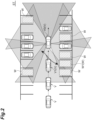
- FIG. 2 is a bird's-eye view illustrating an example of processing by the vehicle control system 100.
- a vehicle control system 100 controls a platoon travel in which a plurality of vehicles V travel in a platoon.
- a plurality of vehicles V travel side by side in a row to be sequentially connected.
- the plurality of vehicles V that travel in a platoon includes a leading vehicle V0 that travels at a top and a following vehicle V1 that follows the leading vehicle V0.
- the leading vehicle V0 is an autonomous driving vehicle capable of autonomous driving.
- the autonomous driving vehicle is a vehicle that does not require a driving operation by a driver and is capable of autonomous travel control that causes the vehicle V to autonomously travel.
- the vehicles V other than the leading vehicle V0 are partially autonomous driving vehicles.
- the partially autonomous driving vehicle does not require a driving operation by a driver, but is a vehicle in which the external sensor 23 described later is not mounted on the vehicle or the function is limited.
- the partially autonomous driving vehicle is, for example, a vehicle whose autonomous driving level is lower than that of the leading vehicle V0.
- the partially autonomous driving vehicle is, for example, a vehicle that performs following travel using vehicle-to-vehicle communication and road-to-vehicle communication.
- the following vehicle V1 may be a vehicle V that follows immediately after the leading vehicle va, or may be a vehicle V that follows the leading vehicle via one or more vehicles V.
- the vehicle V that follows immediately after the leading vehicle V0 is the vehicle V second from the front among the plurality of vehicles V that travel in a platoon.
- the vehicle control system 100 causes the plurality of vehicles V to autonomously travel in a platoon to go around the plurality of parking lots with each of the plurality of parking lots as the destination, and causes a part of the plurality of vehicles V to autonomously park in each parking lot.
- the plurality of vehicles V that travel in a platoon are unmanned travel vehicles.
- the vehicle V is an automobile for car-sharing or the like, and a parking lot is a car-sharing station.
- the vehicle control system 100 includes an operation terminal 5 and a server 10.
- the operation terminal 5 configures, for example, an interface for inputting and outputting information to and from the user.
- the operation terminal 5 communicates with the server 10.
- the operation terminal 5 receives various operation inputs.
- the operation terminal 5 transmits the information relating to the received operation input to the server 10.
- the operation terminal 5 receives, for example, the operation inputs for starting, stopping, and ending the platoon travel, and transmits the related information to the server 10.
- the operation terminal 5 receives the operation inputs relating to, for example, a plurality of destinations such as a transit point or an arrival point by the platoon travel, an order of parking of the plurality of vehicles V that travel in a platoon, and a parking frame targeted by each of the plurality of vehicles V that travel in a platoon (hereinafter, referred to as a "target parking frame"), and the like, and transmits the related information to the server 10.
- a PC a smartphone, or a tablet
- the parking frame is, for example, within a frame marked out by white lines.
- the parking frame is a place having a space for the vehicle V to park and is arranged in a layout in which the vehicle V can park.
- the server 10 includes a communication unit 11, a database 12, and a server electronic control unit (ECU) 13.
- the communication unit 11 communicates with the operation terminal 5 and with the plurality of vehicles V.
- the communication unit 11 inputs and outputs various information to and from the database 12 and the server ECU 13.
- the database 12 stores various information input from the communication unit 11.
- the database 12 stores the information relating to, for example, the plurality of destinations such as the transit point or the arrival point in the platoon travel, an order of parking of the plurality of vehicles V that travel in a platoon, and the target parking frame for each of the plurality of vehicles V that travel in a platoon (hereinafter, referred to as "platoon travel information).
- Map data is stored in the database 12 in advance.
- the server ECU 13 is an electronic control unit including a central processing unit (CPU), a read only memory (ROM), and a random access memory (RAM), and the like. In the server ECU 13, for example, various functions are realized by loading the program stored in the ROM into the RAM and executing the program loaded in the RAM in the CPU.
- the server ECU 13 may be configured with a plurality of electronic control units.
- the server ECU 13 generates a platoon travel route, which is a route for the platoon travel, based on various information and map data input from the communication unit 11.
- the generated platoon travel route includes, for example, a plurality of destinations.
- the server ECU 13 transmits the platoon travel information and the information on the platoon travel route to each vehicle V via the communication unit 11.
- the leading vehicle V0 which is the autonomous driving vehicle includes a communication unit 21, an internal sensor 22, an external sensor 23, a GPS receiving unit 24, an actuator 25, an HMI 26, and a vehicle ECU 27.
- the communication unit 21 communicates with the server 10.
- the communication unit 21 inputs and outputs various information to and from the vehicle ECU 27.
- the internal sensor 22 is a detection device that detects a travel state of the leading vehicle V0.
- the internal sensor 22 is mounted on the leading vehicle V0.
- the internal sensor 22 includes a vehicle speed sensor, an acceleration sensor, and a yaw rate sensor.
- the vehicle speed sensor is a detector that detects a speed of the leading vehicle V0.
- a wheel speed sensor is used, which is provided on wheels of the leading vehicle V0 or on a drive shaft that rotates integrally with the wheels and detects the rotation speed of the wheels.
- the vehicle speed sensor transmits the detected vehicle speed information (wheel speed information) to the vehicle ECU 27.
- the acceleration sensor is a detector that detects the acceleration of the leading vehicle V0.
- the acceleration sensor includes, for example, a longitudinal acceleration sensor that detects a acceleration in the longitudinal direction of the leading vehicle va, and a lateral acceleration sensor that detects a lateral acceleration of the leading vehicle V0.
- the acceleration sensor transmits, for example, the acceleration information of the leading vehicle V0 to the vehicle ECU 27.
- the yaw rate sensor is a detector that detects a yaw rate (rotation angular velocity) around the vertical axis of the center of gravity of the leading vehicle V0. As the yaw rate sensor, for example, a gyro sensor can be used.
- the yaw rate sensor transmits the detected yaw rate information of the leading vehicle V0 to the vehicle ECU 27.
- the external sensor 23 is a detection device that detects the surrounding environment of the leading vehicle V0.
- the external sensor 23 is mounted on the leading vehicle V0.
- the external sensor 23 includes cameras and a radar sensor.
- a camera is provided on the back side of the windshield of the leading vehicle V0, for example, and images the front of the leading vehicle V0.
- a camera may be provided on the back surface and the side surface of the leading vehicle V0.
- the cameras transmit the imaging information around the leading vehicle V0 to the vehicle ECU 27.
- the camera may be a monocular camera or a stereo camera.
- the stereo camera has two imaging units arranged to reproduce binocular parallax.
- the radar sensor is a detection device that detects an obstacle around the leading vehicle V0 using radio waves (for example, millimeter waves) or light.
- the radar sensor includes, for example, a millimeter-wave radar or a light detection and ranging (LIDAR).
- LIDAR light detection and ranging
- the radar sensor transmits radio waves or light to the periphery of the leading vehicle va, and detects the obstacle by receiving the radio waves or light reflected from the obstacle.
- the radar sensor transmits the detected obstacle information to the vehicle ECU 27.
- the range of detection performed by the external sensor 23 of the leading vehicle V0 is illustrated by a gray area around the leading vehicle V0.
- the GPS receiving unit 24 measures a position of the leading vehicle V0 (for example, the latitude and longitude of the leading vehicle Va) by receiving signals from three or more GPS satellites.
- the GPS receiving unit 24 transmits the measured position information of the leading vehicle V0 to the vehicle ECU 27.
- the position information of the leading vehicle V0 may be acquired by a simultaneous localization and mapping (SLAM) technology using the result of detection performed by the external sensor 23 and the map data.
- SLAM simultaneous localization and mapping
- the actuator 25 is a device that performs the platoon travel of the leading vehicle V0.
- the actuator 25 includes at least an engine actuator, a brake actuator, and a steering actuator.
- the engine actuator controls the driving force of the leading vehicle V0 by changing the amount of air supplied to the engine (for example, changing the throttle opening degree) according to the control signal from the vehicle ECU 27. If the leading vehicle V0 is a Hybrid Electric Vehicle or a Battery Electric Vehicle, the engine actuator controls the driving force of the motor as a power source.
- the brake actuator controls a braking force applied to the wheels of the leading vehicle V0 by controlling a brake system according to the control signal from the vehicle ECU 27. As the braking system, for example, a hydraulic braking system can be used.
- the steering actuator controls a drive of an assist motor that controls a steering torque in an electric power steering system according to the control signal from the vehicle ECU 27. As a result, the steering actuator controls the steering torque of the leading vehicle V0.
- the HMI 26 is an interface for inputting and outputting information to and from the driver.
- the HMI 26 includes, for example, a display unit (display) and a speaker of the leading vehicle V0.
- the HMI 26 performs the output of the image on the display and outputs of the audio from the speaker according to the control signal from the vehicle ECU 27.
- the HMI 26 may include a head up display HUD).
- the vehicle ECU 27 is an electronic control unit mounted on the leading vehicle V0.
- the vehicle ECU 27 is an electronic control unit including a CPU, ROM, RAM, and the like. In the vehicle ECU 27, for example, various functions are realized by loading the program stored in the ROM into the RAM and executing the program loaded in the RAM by the CPU.
- the vehicle ECU 27 may be configured with a plurality of electronic control units.
- the vehicle ECU 27 generates a travel plan that realizes the autonomous driving for the leading vehicle V0 to travel in a platoon. Specifically, the vehicle ECU 27 generates the travel plan that realizes the autonomous driving around a plurality of destinations by the platoon travel, based on the travel state of the leading vehicle V0, the surrounding environment of the leading vehicle V0, the position information of the leading vehicle V0, the map data, the platoon travel information and the information on the platoon travel route. The vehicle ECU 27 performs the autonomous driving by controlling the actuator 25 according to the travel plan. The vehicle ECU 27 generates the travel plan and performs the autonomous driving by a known method. The vehicle ECU 27 transmits the position information of the leading vehicle V0 to the server 10 via the communication unit 21. The vehicle ECU 27 transmits the information relating to the result of detection by the external sensor 23 to the server 10 via the communication unit 21.
- the vehicles V other than the leading vehicle V0 are configured in the same manner as the leading vehicle V0, except that the external sensor 23 is not mounted on the vehicle or the function of the external sensor 23 is limited.
- a fact that the function of the external sensor 23 is limited means that, for example, the detection accuracy is low and/or the range of detection is narrow compared with the external sensor 23 of the leading vehicle V0 which is an autonomous driving vehicle.
- the vehicles V other than the leading vehicle V0 may acquire the surrounding environment using the vehicle-to-vehicle communication and the road-to-vehicle communication.
- the server ECU 13 permits the following vehicle V1 to park in the parking frame W existing in the range of detection performed by the external sensor 23 of the leading vehicle V0. Specifically, the server ECU 13 determines whether or not the parking frame W exists in the range of detection performed by the external sensor 23 of the leading vehicle V0 based on the result of detection performed by the external sensor 23 and transmitted from the vehicle ECU 27 of the leading vehicle V0. When the parking frame W exists, the server ECU 13 permits the following vehicle V1 to park in the parking frame W.
- the following vehicle V1 for which the permission of parking is targeted is also hereinafter referred to as a "permission targeted following vehicle V1".
- the server ECU 13 determines whether or not a target parking frame W1 for the permission targeted following vehicle V1 is included in the parking frame W existing in the range of detection performed by the external sensor 23.
- the server ECU 13 transmits a signal indicating the parking permission and the information relating to the result of detection performed by the external sensor 23 to the permission targeted following vehicle V1 via the communication unit 11.
- the vehicle ECU 27 When receiving the signal indicating the parking permission, in the permission targeted following vehicle V1, the vehicle ECU 27 performs the autonomous parking driving to autonomously park in the target parking frame by controlling the actuator 25 based on the travel state of the permission targeted following vehicle V1, the result of detection performed by the external sensor 23 of the leading vehicle va, the position information of the permission targeted following vehicle V1, the map data, and the platoon travel information.
- the server ECU 13 calculates the position of the leading vehicle V0 where the target parking frame W1 for the permission targeted following vehicle V1 is included in the range of detection.
- the server ECU 13 transmits a movement command to move to the calculated position of the leading vehicle V0 to the leading vehicle V0 via the communication unit 11.
- the vehicle ECU 27 When receiving the movement command, in the leading vehicle va, the vehicle ECU 27 performs the autonomous driving to move the leading vehicle V0 to a position where the target parking frame for the permission targeted following vehicle V1 is included in the range of detection by controlling the actuator 25 based on the movement command.
- the server ECU 13 causes the i-th vehicle to park next, which is the i-th vehicle V from the front (here, i is an integer equal to or greater than 2).
- the server ECU 13 determines whether the permission targeted following vehicle V1 is the i-th vehicle or not before the leading vehicle V0 arrives at the destination.
- the server ECU 13 transmits a change command to change the travel order of the plurality of vehicles V that travel in a platoon to the plurality of vehicles V via the communication unit 11 such that the permission targeted following vehicle V1 becomes the i-th vehicle.
- the vehicle ECU 27 performs the autonomous driving to make the permission targeted following vehicle V1 be the i-th vehicle by controlling the actuator 25 based on the change command.
- the server ECU 13 determines whether or not the leading vehicle V0 exists in the vicinity of the first destination based on the platoon travel information and the position information of the leading vehicle V0 (Step S1).
- the vicinity means, for example, within a predetermined distance set in advance from the destination.
- Step S1 the server ECU 13 determines whether or not the permission targeted following vehicle V1 is the second vehicle in the travel order of the vehicles V to be parked next (that is, the second vehicle) based on the position information and the platoon travel information of all the vehicles V (Step S2). If No in Step S1 above, the process returns to the determination in Step S1.
- Step S3 If Yes in Step S2 above or after Step S3 above, when the leading vehicle V0 arrives at the destination, the leading vehicle V0 and other vehicles V following the leading vehicle V0 stop (Step S4).
- the server ECU 13 determines whether or not the target parking frame for the permission targeted following vehicle V1 exists in the range of detection performed by the external sensor 23 of the leading vehicle V0 based on the result of detection performed by the external sensor 23 and the platoon travel information of the leading vehicle V0 (Step S5). That is, in Step S5 above, whether or not the parking frame W exists in the range of detection performed by the external sensor 23 of the leading vehicle V0 is determined, and if it is determined that the parking frame W exists, whether or not the parking frame W is the target parking frame for the permission targeted following vehicle V1 is determined.
- Step S6 the server ECU 13 permits the permission targeted following vehicle V1 to park in the target parking frame.
- the server ECU 13 transmits the signal indicating the parking permission and the information relating to the result of detection performed by the external sensor 23 to the permission targeted following vehicle V1.
- the vehicle ECU 27 performs the autonomous parking driving to autonomously park in the target parking frame (Step S7).
- the server ECU 13 calculates the position of the leading vehicle V0 where the target parking frame for the permission targeted following vehicle V1 is included in the range of detection performed by the external sensor 23 of the leading vehicle V0 based on the map data and the platoon travel information.
- the server ECU 13 transmits a movement command to move to the calculated position of the leading vehicle V0 to the leading vehicle V0.
- the vehicle ECU 27 move to the position where the target parking frame for the permission targeted following vehicle V1 is included in the range of detection performed by the external sensor 23 by controlling the actuator 25 based on the movement command (Step S8).
- Step S8 above the process returns to the determination in Step S5 above.
- Step S9 the process proceeds to Step S1 for determining whether or not the leading vehicle V0 exists in the vicinity of the next destination. For example, if the next destination does not exist after Step S9, or if operation inputs to stop or end the platoon travel are performed via the operation terminal 5, the process ends.
- the leading vehicle V0 autonomously parks in the target parking frame by a known method, and then, the process ends.
- the present embodiment it is possible to cause the permission targeted following vehicle V1 to park by setting the parking frame W existing in the range of detection performed by the external sensor 23 of the leading vehicle V0 as the target parking frame W1. Therefore, even if the external sensor 23 is not mounted on the permission targeted following vehicle V1 or the function of the external sensor 23 mounted on the permission targeted following vehicle V1 is limited, by using the result of detection performed by the external sensor 23 of the leading vehicle va, the surrounding environment relating to the target parking frame W1 can be grasped. Therefore, it is possible to cause the permission targeted following vehicle V1 to park in the target parking frame W1 while ensuring the sufficient safety.
- the leading vehicle V0 is moved to the position where the target parking frame W1 is included in the range of detection performed by the external sensor 23. As a result, it is possible to reliably realize the parking of the permission targeted following vehicle V1 in the target parking frame W1 while ensuring the sufficient safety.
- the i-th vehicle which is the i-th vehicle V from the front (i is an integer equal to or greater than 2), is parked next. Whether the permission targeted following vehicle V1 is the i-th vehicle or not is determined before the leading vehicle V0 arrives at the destination. If the permission targeted following vehicle V1 is not the i-th vehicle, the travel order of the plurality of vehicles V that travel in a platoon is changed such that the permission targeted following vehicle V1 becomes the i-th vehicle. As a result, it is possible to cause the permission targeted following vehicle V1 to reliably park next.
- the method of realizing the platoon travel of a plurality of vehicles V is not particularly limited, but for example, various known methods of traveling to follow the front vehicle V can be used.
- all the vehicles V other than the leading vehicle V0 are partially autonomous driving vehicles, but at least a part of the vehicles V other than the leading vehicle V0 may be the autonomous driving vehicles.
- all or a part of the above-described functions of the operation terminal 5 and server 10 may be realized by other than the server 10, but for example, may be realized by a plurality of computers. In the embodiment described above, all or a part of the above-described functions of the operation terminal 5 and server 10 may be realized by the vehicle ECU 27 of the leading vehicle V0 or may be realized by the vehicle ECU 27 of a plurality of vehicles V.
- the second vehicle V is parked next, but any of the third and the subsequent vehicles V may be parked next.
- the n-th vehicle V may be parked next.
- the last vehicle V among the plurality of vehicles V that travel in a platoon can be parked first.
- parking in the parking frames other than the parking frame W existing in the range of detection performed by the external sensor 23 of leading vehicle V0 may be permitted.
Landscapes
- Engineering & Computer Science (AREA)
- Transportation (AREA)
- Mechanical Engineering (AREA)
- Automation & Control Theory (AREA)
- Physics & Mathematics (AREA)
- General Physics & Mathematics (AREA)
- Business, Economics & Management (AREA)
- Computer Networks & Wireless Communication (AREA)
- Strategic Management (AREA)
- General Business, Economics & Management (AREA)
- Combustion & Propulsion (AREA)
- Chemical & Material Sciences (AREA)
- Theoretical Computer Science (AREA)
- Signal Processing (AREA)
- Human Computer Interaction (AREA)
- Tourism & Hospitality (AREA)
- Health & Medical Sciences (AREA)
- General Health & Medical Sciences (AREA)
- Primary Health Care (AREA)
- Marketing (AREA)
- Computing Systems (AREA)
- Accounting & Taxation (AREA)
- Human Resources & Organizations (AREA)
- Economics (AREA)
- Aviation & Aerospace Engineering (AREA)
- Radar, Positioning & Navigation (AREA)
- Remote Sensing (AREA)
- Mathematical Physics (AREA)
- Traffic Control Systems (AREA)
- Control Of Driving Devices And Active Controlling Of Vehicle (AREA)
- Operations Research (AREA)
Description
- The present disclosure relates to a vehicle control system and a vehicle control method.
-
US 2019/016583 describes that, upon determination to refuel a platoon of vehicles, a respective fuel inlet location is identified for each of the vehicles in the platoon. Based on the fuel inlet locations, a refueling location is selected. The platoon is navigated to the refueling locationUS 2019/016583 A1 shows in particular a vehicle control system that controls a platoon travel in which a plurality of vehicles travel in a platoon, wherein the plurality of vehicles include a leading vehicle that is an autonomous driving vehicle and a following vehicle that follows immediately after the leading vehicle or follows the leading vehicle via one or more vehicles, and the following vehicle is permitted to park in a parking frame that exists in a range of detection performed by an external sensor mounted on the leading vehicle and configured to detect a surrounding environment of the leading vehicle.JP 2020 087261 A US 2020/174496 A describes a control apparatus that controls a plurality of vehicles performing platoon travelling. Each of the vehicles is provided with an inter-vehicle communication apparatus that performs an inter-vehicle communication with another vehicle included in a column of the platoon travelling. At least some of the vehicles is provided with an external communication apparatus that performs an external communication based on own identification information given by a telecommunication company. The control apparatus is configured to control respective vehicles such that the number of vehicles capable of simultaneously performing the external communication is less than the number of vehicles included in the column. A vehicle control system that controls a platoon travel in which a plurality of vehicles travel in a platoon is known. As this kind of technology,Japanese Unexamined Patent Publication No. 2020-095506 Japanese Unexamined Patent Publication No. 2020-095506 - In the vehicle control system described above, for example, when a following vehicle that follows a leading vehicle is a partially autonomous driving vehicle, an external sensor that detects surrounding environments may not be mounted on the following vehicle, or functions of the external sensor may be limited. In this case, it may be difficult for the following vehicle to park in a target parking frame while ensuring sufficient safety.
- One aspect of the present invention has an object of providing a vehicle control system and a vehicle control method capable of causing a following vehicle to park in a target parking frame while ensuring sufficient safety.
- A vehicle control system according to an aspect of the present invention is a vehicle control system as defined in appended
claim 1. - A vehicle control method according to an aspect of the present invention is a vehicle control method as defined in appended claim 3.
- In the vehicle control system and the vehicle control method, it is possible to cause the following vehicle to park by setting the parking frame existing in the range of detection performed by the external sensor mounted on the leading vehicle as the target parking frame. Therefore, even if the external sensor is not mounted on the following vehicle or the function of the external sensor mounted on the following vehicle is limited, by using the result of detection performed by the external sensor of the leading vehicle, the surrounding environment relating to the target parking frame can be grasped. Therefore, it is possible to cause the following vehicle to park in the target parking frame while ensuring the sufficient safety.
- It is possible to reliably realize the parking of the following vehicle in the target parking frame while ensuring the sufficient safety.
- In the vehicle control system according to an embodiment, an i-th vehicle, which is the i-th vehicle (i is an integer equal to or greater than 2) from the front among the plurality of vehicles that travel in a platoon, may be parked next, and determination is made as to whether the following vehicle is the i-th vehicle or not before the leading vehicle arrives at a destination, and a travel order of the plurality of vehicles that travel in a platoon may be changed such that the following vehicle becomes the i-th vehicle if the following vehicle is not the i-th vehicle. The vehicle control method according to an embodiment may include causing an i-th vehicle, which is the i-th vehicle (i is an integer equal to or greater than 2) from the front among the plurality of vehicles that travel in a platoon, to park next, determining whether the following vehicle is the i-th vehicle or not before the leading vehicle arrives at a destination, and changing a travel order of the plurality of vehicles that travel in a platoon such that the following vehicle becomes the i-th vehicle if the following vehicle is not the i-th vehicle. As a result, it is possible to cause the permission targeted following vehicle to reliably park next.
- According to various aspects and an embodiment of the present invention, it is possible to provide a vehicle control system and a vehicle control method capable of causing a following vehicle to park in a target parking frame while ensuring sufficient safety.
-
-
FIG. 1 is a block diagram illustrating a configuration of a vehicle control system according to an embodiment. -
FIG. 2 is a bird's-eye view illustrating an example of processing by the vehicle control system according to the embodiment. -
FIG. 3 is a flowchart illustrating an example of the vehicle control method according to the embodiment. - Hereinafter, an embodiment will be described with reference to the drawings. In the following description, the same reference numerals will be used for the same or equivalent elements, and the descriptions thereof will be omitted.
-
FIG. 1 is a block diagram illustrating a configuration of avehicle control system 100.FIG. 2 is a bird's-eye view illustrating an example of processing by thevehicle control system 100. As illustrated inFIG. 1 andFIG. 2 , avehicle control system 100 according to the embodiment controls a platoon travel in which a plurality of vehicles V travel in a platoon. In the platoon travel, a plurality of vehicles V travel side by side in a row to be sequentially connected. The plurality of vehicles V that travel in a platoon includes a leading vehicle V0 that travels at a top and a following vehicle V1 that follows the leading vehicle V0. - The leading vehicle V0 is an autonomous driving vehicle capable of autonomous driving. The autonomous driving vehicle is a vehicle that does not require a driving operation by a driver and is capable of autonomous travel control that causes the vehicle V to autonomously travel. The vehicles V other than the leading vehicle V0 are partially autonomous driving vehicles. The partially autonomous driving vehicle does not require a driving operation by a driver, but is a vehicle in which the
external sensor 23 described later is not mounted on the vehicle or the function is limited. The partially autonomous driving vehicle is, for example, a vehicle whose autonomous driving level is lower than that of the leading vehicle V0. The partially autonomous driving vehicle is, for example, a vehicle that performs following travel using vehicle-to-vehicle communication and road-to-vehicle communication. The following vehicle V1 may be a vehicle V that follows immediately after the leading vehicle va, or may be a vehicle V that follows the leading vehicle via one or more vehicles V. The vehicle V that follows immediately after the leading vehicle V0 is the vehicle V second from the front among the plurality of vehicles V that travel in a platoon. - In the present embodiment, the
vehicle control system 100 causes the plurality of vehicles V to autonomously travel in a platoon to go around the plurality of parking lots with each of the plurality of parking lots as the destination, and causes a part of the plurality of vehicles V to autonomously park in each parking lot. The plurality of vehicles V that travel in a platoon are unmanned travel vehicles. For example, the vehicle V is an automobile for car-sharing or the like, and a parking lot is a car-sharing station. - The
vehicle control system 100 includes anoperation terminal 5 and aserver 10. Theoperation terminal 5 configures, for example, an interface for inputting and outputting information to and from the user. Theoperation terminal 5 communicates with theserver 10. Theoperation terminal 5 receives various operation inputs. Theoperation terminal 5 transmits the information relating to the received operation input to theserver 10. - The
operation terminal 5 receives, for example, the operation inputs for starting, stopping, and ending the platoon travel, and transmits the related information to theserver 10. Theoperation terminal 5 receives the operation inputs relating to, for example, a plurality of destinations such as a transit point or an arrival point by the platoon travel, an order of parking of the plurality of vehicles V that travel in a platoon, and a parking frame targeted by each of the plurality of vehicles V that travel in a platoon (hereinafter, referred to as a "target parking frame"), and the like, and transmits the related information to theserver 10. As theoperation terminal 5, for example, a PC, a smartphone, or a tablet is used. The parking frame is, for example, within a frame marked out by white lines. The parking frame is a place having a space for the vehicle V to park and is arranged in a layout in which the vehicle V can park. - The
server 10 includes acommunication unit 11, adatabase 12, and a server electronic control unit (ECU) 13. Thecommunication unit 11 communicates with theoperation terminal 5 and with the plurality of vehicles V. Thecommunication unit 11 inputs and outputs various information to and from thedatabase 12 and theserver ECU 13. Thedatabase 12 stores various information input from thecommunication unit 11. Thedatabase 12 stores the information relating to, for example, the plurality of destinations such as the transit point or the arrival point in the platoon travel, an order of parking of the plurality of vehicles V that travel in a platoon, and the target parking frame for each of the plurality of vehicles V that travel in a platoon (hereinafter, referred to as "platoon travel information). Map data is stored in thedatabase 12 in advance. - The
server ECU 13 is an electronic control unit including a central processing unit (CPU), a read only memory (ROM), and a random access memory (RAM), and the like. In theserver ECU 13, for example, various functions are realized by loading the program stored in the ROM into the RAM and executing the program loaded in the RAM in the CPU. Theserver ECU 13 may be configured with a plurality of electronic control units. - The
server ECU 13 generates a platoon travel route, which is a route for the platoon travel, based on various information and map data input from thecommunication unit 11. The generated platoon travel route includes, for example, a plurality of destinations. Theserver ECU 13 transmits the platoon travel information and the information on the platoon travel route to each vehicle V via thecommunication unit 11. - The leading vehicle V0 which is the autonomous driving vehicle includes a
communication unit 21, aninternal sensor 22, anexternal sensor 23, aGPS receiving unit 24, anactuator 25, anHMI 26, and avehicle ECU 27. Thecommunication unit 21 communicates with theserver 10. Thecommunication unit 21 inputs and outputs various information to and from thevehicle ECU 27. - The
internal sensor 22 is a detection device that detects a travel state of the leading vehicle V0. Theinternal sensor 22 is mounted on the leading vehicle V0. Theinternal sensor 22 includes a vehicle speed sensor, an acceleration sensor, and a yaw rate sensor. The vehicle speed sensor is a detector that detects a speed of the leading vehicle V0. As the vehicle speed sensor, for example, a wheel speed sensor is used, which is provided on wheels of the leading vehicle V0 or on a drive shaft that rotates integrally with the wheels and detects the rotation speed of the wheels. The vehicle speed sensor transmits the detected vehicle speed information (wheel speed information) to thevehicle ECU 27. - The acceleration sensor is a detector that detects the acceleration of the leading vehicle V0. The acceleration sensor includes, for example, a longitudinal acceleration sensor that detects a acceleration in the longitudinal direction of the leading vehicle va, and a lateral acceleration sensor that detects a lateral acceleration of the leading vehicle V0. The acceleration sensor transmits, for example, the acceleration information of the leading vehicle V0 to the
vehicle ECU 27. The yaw rate sensor is a detector that detects a yaw rate (rotation angular velocity) around the vertical axis of the center of gravity of the leading vehicle V0. As the yaw rate sensor, for example, a gyro sensor can be used. The yaw rate sensor transmits the detected yaw rate information of the leading vehicle V0 to thevehicle ECU 27. - The
external sensor 23 is a detection device that detects the surrounding environment of the leading vehicle V0. Theexternal sensor 23 is mounted on the leading vehicle V0. Theexternal sensor 23 includes cameras and a radar sensor. A camera is provided on the back side of the windshield of the leading vehicle V0, for example, and images the front of the leading vehicle V0. A camera may be provided on the back surface and the side surface of the leading vehicle V0. The cameras transmit the imaging information around the leading vehicle V0 to thevehicle ECU 27. The camera may be a monocular camera or a stereo camera. The stereo camera has two imaging units arranged to reproduce binocular parallax. - The radar sensor is a detection device that detects an obstacle around the leading vehicle V0 using radio waves (for example, millimeter waves) or light. The radar sensor includes, for example, a millimeter-wave radar or a light detection and ranging (LIDAR). The radar sensor transmits radio waves or light to the periphery of the leading vehicle va, and detects the obstacle by receiving the radio waves or light reflected from the obstacle. The radar sensor transmits the detected obstacle information to the
vehicle ECU 27. InFIG. 2 , the range of detection performed by theexternal sensor 23 of the leading vehicle V0 is illustrated by a gray area around the leading vehicle V0. - The
GPS receiving unit 24 measures a position of the leading vehicle V0 (for example, the latitude and longitude of the leading vehicle Va) by receiving signals from three or more GPS satellites. TheGPS receiving unit 24 transmits the measured position information of the leading vehicle V0 to thevehicle ECU 27. Instead of or in addition to the acquisition of the position information by theGPS receiving unit 24, the position information of the leading vehicle V0 may be acquired by a simultaneous localization and mapping (SLAM) technology using the result of detection performed by theexternal sensor 23 and the map data. - The
actuator 25 is a device that performs the platoon travel of the leading vehicle V0. Theactuator 25 includes at least an engine actuator, a brake actuator, and a steering actuator. The engine actuator controls the driving force of the leading vehicle V0 by changing the amount of air supplied to the engine (for example, changing the throttle opening degree) according to the control signal from thevehicle ECU 27. If the leading vehicle V0 is a Hybrid Electric Vehicle or a Battery Electric Vehicle, the engine actuator controls the driving force of the motor as a power source. The brake actuator controls a braking force applied to the wheels of the leading vehicle V0 by controlling a brake system according to the control signal from thevehicle ECU 27. As the braking system, for example, a hydraulic braking system can be used. The steering actuator controls a drive of an assist motor that controls a steering torque in an electric power steering system according to the control signal from thevehicle ECU 27. As a result, the steering actuator controls the steering torque of the leading vehicle V0. - The
HMI 26 is an interface for inputting and outputting information to and from the driver. TheHMI 26 includes, for example, a display unit (display) and a speaker of the leading vehicle V0. TheHMI 26 performs the output of the image on the display and outputs of the audio from the speaker according to the control signal from thevehicle ECU 27. TheHMI 26 may include a head up display HUD). - The
vehicle ECU 27 is an electronic control unit mounted on the leading vehicle V0. Thevehicle ECU 27 is an electronic control unit including a CPU, ROM, RAM, and the like. In thevehicle ECU 27, for example, various functions are realized by loading the program stored in the ROM into the RAM and executing the program loaded in the RAM by the CPU. Thevehicle ECU 27 may be configured with a plurality of electronic control units. - The
vehicle ECU 27 generates a travel plan that realizes the autonomous driving for the leading vehicle V0 to travel in a platoon. Specifically, thevehicle ECU 27 generates the travel plan that realizes the autonomous driving around a plurality of destinations by the platoon travel, based on the travel state of the leading vehicle V0, the surrounding environment of the leading vehicle V0, the position information of the leading vehicle V0, the map data, the platoon travel information and the information on the platoon travel route. Thevehicle ECU 27 performs the autonomous driving by controlling theactuator 25 according to the travel plan. Thevehicle ECU 27 generates the travel plan and performs the autonomous driving by a known method. Thevehicle ECU 27 transmits the position information of the leading vehicle V0 to theserver 10 via thecommunication unit 21. Thevehicle ECU 27 transmits the information relating to the result of detection by theexternal sensor 23 to theserver 10 via thecommunication unit 21. - The vehicles V other than the leading vehicle V0 are configured in the same manner as the leading vehicle V0, except that the
external sensor 23 is not mounted on the vehicle or the function of theexternal sensor 23 is limited. A fact that the function of theexternal sensor 23 is limited means that, for example, the detection accuracy is low and/or the range of detection is narrow compared with theexternal sensor 23 of the leading vehicle V0 which is an autonomous driving vehicle. The vehicles V other than the leading vehicle V0 may acquire the surrounding environment using the vehicle-to-vehicle communication and the road-to-vehicle communication. - Next, the main part of the
vehicle control system 100 in the present embodiment will be described. - In the
vehicle control system 100, theserver ECU 13 permits the following vehicle V1 to park in the parking frame W existing in the range of detection performed by theexternal sensor 23 of the leading vehicle V0. Specifically, theserver ECU 13 determines whether or not the parking frame W exists in the range of detection performed by theexternal sensor 23 of the leading vehicle V0 based on the result of detection performed by theexternal sensor 23 and transmitted from thevehicle ECU 27 of the leading vehicle V0. When the parking frame W exists, theserver ECU 13 permits the following vehicle V1 to park in the parking frame W. The following vehicle V1 for which the permission of parking is targeted is also hereinafter referred to as a "permission targeted following vehicle V1". - When the permission targeted following vehicle V1 is permitted to park, the
server ECU 13 determines whether or not a target parking frame W1 for the permission targeted following vehicle V1 is included in the parking frame W existing in the range of detection performed by theexternal sensor 23. When the target parking frame is included in the parking frame W existing in the range of detection performed by theexternal sensor 23, theserver ECU 13 transmits a signal indicating the parking permission and the information relating to the result of detection performed by theexternal sensor 23 to the permission targeted following vehicle V1 via thecommunication unit 11. - When receiving the signal indicating the parking permission, in the permission targeted following vehicle V1, the
vehicle ECU 27 performs the autonomous parking driving to autonomously park in the target parking frame by controlling theactuator 25 based on the travel state of the permission targeted following vehicle V1, the result of detection performed by theexternal sensor 23 of the leading vehicle va, the position information of the permission targeted following vehicle V1, the map data, and the platoon travel information. - On the other hand, when the parking frame W does not exist in the range of detection performed by the
external sensor 23 of the leading vehicle V0, or when the target parking frame W1 for the permission targeted following vehicle V1 is not included in the parking frame W existing in the range of detection, theserver ECU 13 calculates the position of the leading vehicle V0 where the target parking frame W1 for the permission targeted following vehicle V1 is included in the range of detection. Theserver ECU 13 transmits a movement command to move to the calculated position of the leading vehicle V0 to the leading vehicle V0 via thecommunication unit 11. When receiving the movement command, in the leading vehicle va, thevehicle ECU 27 performs the autonomous driving to move the leading vehicle V0 to a position where the target parking frame for the permission targeted following vehicle V1 is included in the range of detection by controlling theactuator 25 based on the movement command. - Among a plurality of vehicles V that travel in a platoon, the
server ECU 13 causes the i-th vehicle to park next, which is the i-th vehicle V from the front (here, i is an integer equal to or greater than 2). Theserver ECU 13 determines whether the permission targeted following vehicle V1 is the i-th vehicle or not before the leading vehicle V0 arrives at the destination. Theserver ECU 13 determines whether the permission targeted following vehicle V1 is the i-th vehicle (here, i = 2) or not before the leading vehicle V0 arrives at the station ST illustrated inFIG. 2 , for example. When the permission targeted following vehicle V1 is not the i-th vehicle, theserver ECU 13 transmits a change command to change the travel order of the plurality of vehicles V that travel in a platoon to the plurality of vehicles V via thecommunication unit 11 such that the permission targeted following vehicle V1 becomes the i-th vehicle. When receiving the change command, in the plurality of vehicles V, thevehicle ECU 27 performs the autonomous driving to make the permission targeted following vehicle V1 be the i-th vehicle by controlling theactuator 25 based on the change command. - Next, an example of a vehicle control method implemented by the
vehicle control system 100 will be described with reference to the flowchart inFIG. 3 . - In the
vehicle control system 100, for example, when an operation input to start the platoon travel is performed via theoperation terminal 5, the following processing is executed. First, theserver ECU 13 determines whether or not the leading vehicle V0 exists in the vicinity of the first destination based on the platoon travel information and the position information of the leading vehicle V0 (Step S1). The vicinity means, for example, within a predetermined distance set in advance from the destination. - If Yes in Step S1 above, the
server ECU 13 determines whether or not the permission targeted following vehicle V1 is the second vehicle in the travel order of the vehicles V to be parked next (that is, the second vehicle) based on the position information and the platoon travel information of all the vehicles V (Step S2). If No in Step S1 above, the process returns to the determination in Step S1. - If No in Step S2 above, the
server ECU 13 transmits a change command to change the travel order of the current second vehicle and the permission targeted following vehicle V1 to the current second vehicle and the permission targeted following vehicle V1 such that the permission targeted following vehicle V1 becomes the second vehicle. As a result, the permission targeted following vehicle V1 is changed to become the second vehicle (Step S3). If Yes in Step S2 above or after Step S3 above, when the leading vehicle V0 arrives at the destination, the leading vehicle V0 and other vehicles V following the leading vehicle V0 stop (Step S4). - The
server ECU 13 determines whether or not the target parking frame for the permission targeted following vehicle V1 exists in the range of detection performed by theexternal sensor 23 of the leading vehicle V0 based on the result of detection performed by theexternal sensor 23 and the platoon travel information of the leading vehicle V0 (Step S5). That is, in Step S5 above, whether or not the parking frame W exists in the range of detection performed by theexternal sensor 23 of the leading vehicle V0 is determined, and if it is determined that the parking frame W exists, whether or not the parking frame W is the target parking frame for the permission targeted following vehicle V1 is determined. - If Yes in Step S5 above, the
server ECU 13 permits the permission targeted following vehicle V1 to park in the target parking frame (Step S6). Theserver ECU 13 transmits the signal indicating the parking permission and the information relating to the result of detection performed by theexternal sensor 23 to the permission targeted following vehicle V1. In the permission targeted following vehicle V1, thevehicle ECU 27 performs the autonomous parking driving to autonomously park in the target parking frame (Step S7). - If No in Step S5 above, the
server ECU 13 calculates the position of the leading vehicle V0 where the target parking frame for the permission targeted following vehicle V1 is included in the range of detection performed by theexternal sensor 23 of the leading vehicle V0 based on the map data and the platoon travel information. Theserver ECU 13 transmits a movement command to move to the calculated position of the leading vehicle V0 to the leading vehicle V0. As a result, in the leading vehicle va, thevehicle ECU 27 move to the position where the target parking frame for the permission targeted following vehicle V1 is included in the range of detection performed by theexternal sensor 23 by controlling theactuator 25 based on the movement command (Step S8). After Step S8 above, the process returns to the determination in Step S5 above. - After Step S7 above, the remaining vehicles V starts the platoon travel toward the next destination (Step S9). After Step S9 above, the process proceeds to Step S1 for determining whether or not the leading vehicle V0 exists in the vicinity of the next destination. For example, if the next destination does not exist after Step S9, or if operation inputs to stop or end the platoon travel are performed via the
operation terminal 5, the process ends. In addition, when parking is completed for all the vehicles V other than the leading vehicle va, the leading vehicle V0 autonomously parks in the target parking frame by a known method, and then, the process ends. - As described above, in the present embodiment, it is possible to cause the permission targeted following vehicle V1 to park by setting the parking frame W existing in the range of detection performed by the
external sensor 23 of the leading vehicle V0 as the target parking frame W1. Therefore, even if theexternal sensor 23 is not mounted on the permission targeted following vehicle V1 or the function of theexternal sensor 23 mounted on the permission targeted following vehicle V1 is limited, by using the result of detection performed by theexternal sensor 23 of the leading vehicle va, the surrounding environment relating to the target parking frame W1 can be grasped. Therefore, it is possible to cause the permission targeted following vehicle V1 to park in the target parking frame W1 while ensuring the sufficient safety. - In the present embodiment, if the target parking frame W1 for the permission targeted following vehicle V1 does not exist in the range of detection performed by the
external sensor 23 of the leading vehicle va, the leading vehicle V0 is moved to the position where the target parking frame W1 is included in the range of detection performed by theexternal sensor 23. As a result, it is possible to reliably realize the parking of the permission targeted following vehicle V1 in the target parking frame W1 while ensuring the sufficient safety. - In the present embodiment, among the plurality of vehicles V that travel in a platoon, the i-th vehicle, which is the i-th vehicle V from the front (i is an integer equal to or greater than 2), is parked next. Whether the permission targeted following vehicle V1 is the i-th vehicle or not is determined before the leading vehicle V0 arrives at the destination. If the permission targeted following vehicle V1 is not the i-th vehicle, the travel order of the plurality of vehicles V that travel in a platoon is changed such that the permission targeted following vehicle V1 becomes the i-th vehicle. As a result, it is possible to cause the permission targeted following vehicle V1 to reliably park next.
- Various exemplary embodiments have been described above, however, not limited to the exemplary embodiments described above, various omissions, substitutions, and changes may be made.
- In the embodiment described above, the method of realizing the platoon travel of a plurality of vehicles V is not particularly limited, but for example, various known methods of traveling to follow the front vehicle V can be used. In the embodiment described above, all the vehicles V other than the leading vehicle V0 are partially autonomous driving vehicles, but at least a part of the vehicles V other than the leading vehicle V0 may be the autonomous driving vehicles.
- In the embodiment described above, all or a part of the above-described functions of the
operation terminal 5 andserver 10 may be realized by other than theserver 10, but for example, may be realized by a plurality of computers. In the embodiment described above, all or a part of the above-described functions of theoperation terminal 5 andserver 10 may be realized by thevehicle ECU 27 of the leading vehicle V0 or may be realized by thevehicle ECU 27 of a plurality of vehicles V. - In the embodiment described above, the second vehicle V is parked next, but any of the third and the subsequent vehicles V may be parked next. For example, when the number of vehicles to travel in a platoon is n, the n-th vehicle V may be parked next. In this case, the last vehicle V among the plurality of vehicles V that travel in a platoon can be parked first.
- In the embodiment described above, in some cases, without prohibiting to park in the parking frames other than the parking frame W existing in the range of detection performed by the
external sensor 23 of leading vehicle va, parking in the parking frames other than the parking frame W existing in the range of detection performed by theexternal sensor 23 of the leading vehicle V0 may be permitted.
Claims (4)
- A vehicle control system (100) that controls a platoon travel in which a plurality of vehicles travel in a platoon,wherein the plurality of vehicles include a leading vehicle (V0) that is an autonomous driving vehicle (V) and a following vehicle that follows immediately after the leading vehicle (V0) or follows the leading vehicle (V0) via one or more vehicles (V),when a parking frame exists in a range of detection performed by an external sensor (23) mounted on the leading vehicle (V0) and configured to detect a surrounding environment of the leading vehicle (V0), the following vehicle (V) is permitted to park in the parking frame and when parking is completed for the following vehicle (V), the leading vehicle (V0) autonomously parks in the parking frame, andwhen a parking frame does not exist in the range of detection performed by the external sensor (23), when the leading vehicle (V0) arrives at a destination, the leading vehicle (V0) and following vehicle (V0) stop and the leading vehicle (V0) is moved to a position where a target parking frame for the following vehicle (V) is included in the range of detection performed by the external sensor (23).
- The vehicle control system according to claim 1,
wherein an i-th vehicle, which is the i-th vehicle, i being an integer equal to or greater than 2, from the front among the plurality of vehicles that travel in a platoon, is parked next, and
determination is made as to whether the following vehicle (V) to be parked is the i-th vehicle or not before the leading vehicle (V0) arrives at the destination, and a travel order of the plurality of vehicles that travel in a platoon is changed such that the following vehicle (V) becomes the i-th vehicle if the following vehicle (V) to be parked is not the i-th vehicle. - A vehicle control method for controlling a platoon travel in which a plurality of vehicles travel in a platoon,wherein the plurality of vehicles include a leading vehicle (V0) that is an autonomous driving vehicle and a following vehicle (V) that follows immediately after the leading vehicle (V0) or follows the leading vehicle (V0) via one or more vehicles, andthe method comprising:when a parking frame exists in a range of detection performed by an external sensor (23) mounted on the leading vehicle (V0) and configured to detect a surrounding environment of the leading vehicle (V0), permitting the following vehicle (V) to park in the parking frame and when parking is completed for the following vehicle (V), autonomously parking the leading vehicle (V0) in the parking frame,when a parking frame does not exist in the range of detection performed by the external sensor (23), when the leading vehicle (V0) arrives at a destination, stopping the leading vehicle (V0) and the following vehicle (V0) and moving the leading vehicle (V0) to a position where a target parking frame for the following vehicle (V) is included in the range of detection performed by the external sensor (23).
- The vehicle control method according to claim 3, further comprising:causing an i-th vehicle, which is the i-th vehicle, i being an integer equal to or greater than 2, from the front among the plurality of vehicles that travel in a platoon, to park next;determining whether the following vehicle (V) to be parked is the i-th vehicle or not before the leading vehicle (V0) arrives at the destination; andchanging a travel order of the plurality of vehicles that travel in a platoon such that the following vehicle (V) becomes the i-th vehicle if the following vehicle (V) to be parked is not the i-th vehicle.
Applications Claiming Priority (1)
| Application Number | Priority Date | Filing Date | Title |
|---|---|---|---|
| JP2020213868A JP7400710B2 (en) | 2020-12-23 | 2020-12-23 | Vehicle control system and vehicle control method |
Publications (2)
| Publication Number | Publication Date |
|---|---|
| EP4019371A1 EP4019371A1 (en) | 2022-06-29 |
| EP4019371B1 true EP4019371B1 (en) | 2024-12-18 |
Family
ID=78413808
Family Applications (1)
| Application Number | Title | Priority Date | Filing Date |
|---|---|---|---|
| EP21205006.6A Active EP4019371B1 (en) | 2020-12-23 | 2021-10-27 | Vehicle control system and vehicle control method |
Country Status (5)
| Country | Link |
|---|---|
| US (1) | US20220194375A1 (en) |
| EP (1) | EP4019371B1 (en) |
| JP (1) | JP7400710B2 (en) |
| KR (1) | KR20220091345A (en) |
| CN (1) | CN114734988A (en) |
Families Citing this family (3)
| Publication number | Priority date | Publication date | Assignee | Title |
|---|---|---|---|---|
| KR20240071496A (en) * | 2022-11-15 | 2024-05-23 | 현대자동차주식회사 | Automated Platooning System and method thereof |
| US20250091569A1 (en) * | 2023-09-19 | 2025-03-20 | Toyota Motor Engineering & Manufacturing North America, Inc. | Systems and methods for parking a following vehicle in a convoy |
| WO2026033686A1 (en) * | 2024-08-07 | 2026-02-12 | 日産自動車株式会社 | Parking control method and parking control apparatus |
Family Cites Families (14)
| Publication number | Priority date | Publication date | Assignee | Title |
|---|---|---|---|---|
| JP5737316B2 (en) | 2013-04-17 | 2015-06-17 | 株式会社デンソー | Convoy travel system |
| JP6765219B2 (en) * | 2016-05-18 | 2020-10-07 | 本田技研工業株式会社 | Vehicle control systems, communication systems, vehicle control methods, and vehicle control programs |
| US20190016583A1 (en) * | 2017-07-17 | 2019-01-17 | Ford Global Technologies, Llc | Vehicle platoon refueling |
| KR102102651B1 (en) * | 2017-10-12 | 2020-05-29 | 엘지전자 주식회사 | Autonomous vehicle and method for controlling the same |
| JP6822386B2 (en) * | 2017-11-30 | 2021-01-27 | トヨタ自動車株式会社 | Formation running system |
| JP2019172177A (en) | 2018-03-29 | 2019-10-10 | パナソニックIpマネジメント株式会社 | Parking support device, vehicle with parking support device, parking support method and parking support program |
| US11625049B2 (en) * | 2018-11-30 | 2023-04-11 | Denso Corporation | Plurality of vehicles performing platoon travelling and control apparatus for controlling the same |
| JP7172516B2 (en) | 2018-11-30 | 2022-11-16 | 株式会社デンソー | vehicle controller |
| JP7095585B2 (en) | 2018-12-13 | 2022-07-05 | トヨタ自動車株式会社 | Formation management system |
| JP2021142839A (en) * | 2020-03-11 | 2021-09-24 | 本田技研工業株式会社 | Vehicle and control device therefor |
| JP2021149704A (en) * | 2020-03-19 | 2021-09-27 | 本田技研工業株式会社 | Accommodation area management apparatus |
| CN113734152A (en) * | 2020-05-27 | 2021-12-03 | 佛吉亚歌乐电子有限公司 | Parking assistance device and control method for parking assistance device |
| KR20200125538A (en) * | 2020-08-31 | 2020-11-04 | 현대모비스 주식회사 | Apparatus and method for supporting parking |
| US20220126817A1 (en) * | 2020-10-26 | 2022-04-28 | GM Global Technology Operations LLC | Semi-autonomous parking of a follower vehicle |
-
2020
- 2020-12-23 JP JP2020213868A patent/JP7400710B2/en active Active
-
2021
- 2021-10-27 EP EP21205006.6A patent/EP4019371B1/en active Active
- 2021-11-01 KR KR1020210147776A patent/KR20220091345A/en not_active Ceased
- 2021-12-07 CN CN202111484803.5A patent/CN114734988A/en active Pending
- 2021-12-16 US US17/553,009 patent/US20220194375A1/en not_active Abandoned
Also Published As
| Publication number | Publication date |
|---|---|
| EP4019371A1 (en) | 2022-06-29 |
| JP7400710B2 (en) | 2023-12-19 |
| KR20220091345A (en) | 2022-06-30 |
| US20220194375A1 (en) | 2022-06-23 |
| JP2022099842A (en) | 2022-07-05 |
| CN114734988A (en) | 2022-07-12 |
Similar Documents
| Publication | Publication Date | Title |
|---|---|---|
| US11731701B2 (en) | Autonomous driving system | |
| US11636762B2 (en) | Image display device | |
| US11124203B2 (en) | Autonomous driving device and autonomous driving control method that displays the following road traveling route | |
| CN110473416B (en) | Vehicle control device | |
| US9902398B2 (en) | Driving control device | |
| US9550496B2 (en) | Travel control apparatus | |
| CN108885828B (en) | Vehicle control system, vehicle control method, and storage medium | |
| US20160325750A1 (en) | Travel control apparatus | |
| WO2019163121A1 (en) | Vehicle control system, vehicle control method, and program | |
| WO2018179359A1 (en) | Vehicle control system, vehicle control method, and vehicle control program | |
| US20210139019A1 (en) | Driving assistance apparatus | |
| EP4019371B1 (en) | Vehicle control system and vehicle control method | |
| JP7095585B2 (en) | Formation management system | |
| CN114750778B (en) | Vehicle control device, vehicle control method, and storage medium | |
| US12030483B2 (en) | Automated valet parking system, control method of automated valet parking system, and autonomous driving vehicle | |
| CN110271542A (en) | Controller of vehicle, control method for vehicle and storage medium | |
| US20210362727A1 (en) | Shared vehicle management device and management method for shared vehicle | |
| US20200180642A1 (en) | Vehicle control device | |
| CN116890818A (en) | Advanced driver assistance systems and vehicles equipped with such systems | |
| US12122379B2 (en) | Automated valet parking system, control method for automated valet parking system, and autonomous driving vehicle | |
| CN110446644A (en) | Vehicle control system, vehicle control method, vehicle control device, and vehicle control program | |
| US20260052319A1 (en) | Solid-state imaging device | |
| US11500389B2 (en) | Vehicle control device | |
| KR20250031554A (en) | Driving assistance system, vehicle and computer-readable recording medium | |
| WO2023063145A1 (en) | Information processing device, information processing method, and information processing program |
Legal Events
| Date | Code | Title | Description |
|---|---|---|---|
| PUAI | Public reference made under article 153(3) epc to a published international application that has entered the european phase |
Free format text: ORIGINAL CODE: 0009012 |
|
| STAA | Information on the status of an ep patent application or granted ep patent |
Free format text: STATUS: REQUEST FOR EXAMINATION WAS MADE |
|
| 17P | Request for examination filed |
Effective date: 20211027 |
|
| AK | Designated contracting states |
Kind code of ref document: A1 Designated state(s): AL AT BE BG CH CY CZ DE DK EE ES FI FR GB GR HR HU IE IS IT LI LT LU LV MC MK MT NL NO PL PT RO RS SE SI SK SM TR |
|
| GRAP | Despatch of communication of intention to grant a patent |
Free format text: ORIGINAL CODE: EPIDOSNIGR1 |
|
| STAA | Information on the status of an ep patent application or granted ep patent |
Free format text: STATUS: GRANT OF PATENT IS INTENDED |
|
| RIC1 | Information provided on ipc code assigned before grant |
Ipc: G06Q 20/30 20120101ALI20240906BHEP Ipc: G05D 1/00 20060101ALI20240906BHEP Ipc: G06Q 20/14 20120101ALI20240906BHEP Ipc: B62D 15/02 20060101AFI20240906BHEP |
|
| GRAS | Grant fee paid |
Free format text: ORIGINAL CODE: EPIDOSNIGR3 |
|
| GRAA | (expected) grant |
Free format text: ORIGINAL CODE: 0009210 |
|
| STAA | Information on the status of an ep patent application or granted ep patent |
Free format text: STATUS: THE PATENT HAS BEEN GRANTED |
|
| INTG | Intention to grant announced |
Effective date: 20241016 |
|
| AK | Designated contracting states |
Kind code of ref document: B1 Designated state(s): AL AT BE BG CH CY CZ DE DK EE ES FI FR GB GR HR HU IE IS IT LI LT LU LV MC MK MT NL NO PL PT RO RS SE SI SK SM TR |
|
| REG | Reference to a national code |
Ref country code: CH Ref legal event code: EP |
|
| REG | Reference to a national code |
Ref country code: DE Ref legal event code: R096 Ref document number: 602021023499 Country of ref document: DE |
|
| REG | Reference to a national code |
Ref country code: IE Ref legal event code: FG4D |
|
| REG | Reference to a national code |
Ref country code: LT Ref legal event code: MG9D |
|
| PG25 | Lapsed in a contracting state [announced via postgrant information from national office to epo] |
Ref country code: HR Free format text: LAPSE BECAUSE OF FAILURE TO SUBMIT A TRANSLATION OF THE DESCRIPTION OR TO PAY THE FEE WITHIN THE PRESCRIBED TIME-LIMIT Effective date: 20241218 |
|
| PG25 | Lapsed in a contracting state [announced via postgrant information from national office to epo] |
Ref country code: FI Free format text: LAPSE BECAUSE OF FAILURE TO SUBMIT A TRANSLATION OF THE DESCRIPTION OR TO PAY THE FEE WITHIN THE PRESCRIBED TIME-LIMIT Effective date: 20241218 |
|
| PG25 | Lapsed in a contracting state [announced via postgrant information from national office to epo] |
Ref country code: BG Free format text: LAPSE BECAUSE OF FAILURE TO SUBMIT A TRANSLATION OF THE DESCRIPTION OR TO PAY THE FEE WITHIN THE PRESCRIBED TIME-LIMIT Effective date: 20241218 |
|
| PG25 | Lapsed in a contracting state [announced via postgrant information from national office to epo] |
Ref country code: NO Free format text: LAPSE BECAUSE OF FAILURE TO SUBMIT A TRANSLATION OF THE DESCRIPTION OR TO PAY THE FEE WITHIN THE PRESCRIBED TIME-LIMIT Effective date: 20250318 |
|
| REG | Reference to a national code |
Ref country code: NL Ref legal event code: MP Effective date: 20241218 |
|
| PG25 | Lapsed in a contracting state [announced via postgrant information from national office to epo] |
Ref country code: LV Free format text: LAPSE BECAUSE OF FAILURE TO SUBMIT A TRANSLATION OF THE DESCRIPTION OR TO PAY THE FEE WITHIN THE PRESCRIBED TIME-LIMIT Effective date: 20241218 Ref country code: GR Free format text: LAPSE BECAUSE OF FAILURE TO SUBMIT A TRANSLATION OF THE DESCRIPTION OR TO PAY THE FEE WITHIN THE PRESCRIBED TIME-LIMIT Effective date: 20250319 |
|
| PG25 | Lapsed in a contracting state [announced via postgrant information from national office to epo] |
Ref country code: RS Free format text: LAPSE BECAUSE OF FAILURE TO SUBMIT A TRANSLATION OF THE DESCRIPTION OR TO PAY THE FEE WITHIN THE PRESCRIBED TIME-LIMIT Effective date: 20250318 |
|
| PG25 | Lapsed in a contracting state [announced via postgrant information from national office to epo] |
Ref country code: NL Free format text: LAPSE BECAUSE OF FAILURE TO SUBMIT A TRANSLATION OF THE DESCRIPTION OR TO PAY THE FEE WITHIN THE PRESCRIBED TIME-LIMIT Effective date: 20241218 |
|
| REG | Reference to a national code |
Ref country code: AT Ref legal event code: MK05 Ref document number: 1752043 Country of ref document: AT Kind code of ref document: T Effective date: 20241218 |
|
| P01 | Opt-out of the competence of the unified patent court (upc) registered |
Free format text: CASE NUMBER: APP_20536/2025 Effective date: 20250430 |
|
| PG25 | Lapsed in a contracting state [announced via postgrant information from national office to epo] |
Ref country code: SM Free format text: LAPSE BECAUSE OF FAILURE TO SUBMIT A TRANSLATION OF THE DESCRIPTION OR TO PAY THE FEE WITHIN THE PRESCRIBED TIME-LIMIT Effective date: 20241218 |
|
| PG25 | Lapsed in a contracting state [announced via postgrant information from national office to epo] |
Ref country code: PL Free format text: LAPSE BECAUSE OF FAILURE TO SUBMIT A TRANSLATION OF THE DESCRIPTION OR TO PAY THE FEE WITHIN THE PRESCRIBED TIME-LIMIT Effective date: 20241218 |
|
| PG25 | Lapsed in a contracting state [announced via postgrant information from national office to epo] |
Ref country code: ES Free format text: LAPSE BECAUSE OF FAILURE TO SUBMIT A TRANSLATION OF THE DESCRIPTION OR TO PAY THE FEE WITHIN THE PRESCRIBED TIME-LIMIT Effective date: 20241218 |
|
| PG25 | Lapsed in a contracting state [announced via postgrant information from national office to epo] |
Ref country code: IS Free format text: LAPSE BECAUSE OF FAILURE TO SUBMIT A TRANSLATION OF THE DESCRIPTION OR TO PAY THE FEE WITHIN THE PRESCRIBED TIME-LIMIT Effective date: 20250418 |
|
| PG25 | Lapsed in a contracting state [announced via postgrant information from national office to epo] |
Ref country code: PT Free format text: LAPSE BECAUSE OF FAILURE TO SUBMIT A TRANSLATION OF THE DESCRIPTION OR TO PAY THE FEE WITHIN THE PRESCRIBED TIME-LIMIT Effective date: 20250421 |
|
| PG25 | Lapsed in a contracting state [announced via postgrant information from national office to epo] |
Ref country code: EE Free format text: LAPSE BECAUSE OF FAILURE TO SUBMIT A TRANSLATION OF THE DESCRIPTION OR TO PAY THE FEE WITHIN THE PRESCRIBED TIME-LIMIT Effective date: 20241218 |
|
| PG25 | Lapsed in a contracting state [announced via postgrant information from national office to epo] |
Ref country code: AT Free format text: LAPSE BECAUSE OF FAILURE TO SUBMIT A TRANSLATION OF THE DESCRIPTION OR TO PAY THE FEE WITHIN THE PRESCRIBED TIME-LIMIT Effective date: 20241218 Ref country code: RO Free format text: LAPSE BECAUSE OF FAILURE TO SUBMIT A TRANSLATION OF THE DESCRIPTION OR TO PAY THE FEE WITHIN THE PRESCRIBED TIME-LIMIT Effective date: 20241218 |
|
| PG25 | Lapsed in a contracting state [announced via postgrant information from national office to epo] |
Ref country code: SK Free format text: LAPSE BECAUSE OF FAILURE TO SUBMIT A TRANSLATION OF THE DESCRIPTION OR TO PAY THE FEE WITHIN THE PRESCRIBED TIME-LIMIT Effective date: 20241218 |
|
| PG25 | Lapsed in a contracting state [announced via postgrant information from national office to epo] |
Ref country code: CZ Free format text: LAPSE BECAUSE OF FAILURE TO SUBMIT A TRANSLATION OF THE DESCRIPTION OR TO PAY THE FEE WITHIN THE PRESCRIBED TIME-LIMIT Effective date: 20241218 |
|
| PG25 | Lapsed in a contracting state [announced via postgrant information from national office to epo] |
Ref country code: IT Free format text: LAPSE BECAUSE OF FAILURE TO SUBMIT A TRANSLATION OF THE DESCRIPTION OR TO PAY THE FEE WITHIN THE PRESCRIBED TIME-LIMIT Effective date: 20241218 |
|
| PG25 | Lapsed in a contracting state [announced via postgrant information from national office to epo] |
Ref country code: SE Free format text: LAPSE BECAUSE OF FAILURE TO SUBMIT A TRANSLATION OF THE DESCRIPTION OR TO PAY THE FEE WITHIN THE PRESCRIBED TIME-LIMIT Effective date: 20241218 |
|
| REG | Reference to a national code |
Ref country code: DE Ref legal event code: R097 Ref document number: 602021023499 Country of ref document: DE |
|
| REG | Reference to a national code |
Ref country code: DE Ref legal event code: R084 Ref document number: 602021023499 Country of ref document: DE |
|
| PG25 | Lapsed in a contracting state [announced via postgrant information from national office to epo] |
Ref country code: DK Free format text: LAPSE BECAUSE OF FAILURE TO SUBMIT A TRANSLATION OF THE DESCRIPTION OR TO PAY THE FEE WITHIN THE PRESCRIBED TIME-LIMIT Effective date: 20241218 |
|
| PLBE | No opposition filed within time limit |
Free format text: ORIGINAL CODE: 0009261 |
|
| STAA | Information on the status of an ep patent application or granted ep patent |
Free format text: STATUS: NO OPPOSITION FILED WITHIN TIME LIMIT |
|
| 26N | No opposition filed |
Effective date: 20250919 |
|
| PGFP | Annual fee paid to national office [announced via postgrant information from national office to epo] |
Ref country code: DE Payment date: 20250902 Year of fee payment: 5 |