EP4019318A1 - Vehicle control device - Google Patents
Vehicle control device Download PDFInfo
- Publication number
- EP4019318A1 EP4019318A1 EP21788970.8A EP21788970A EP4019318A1 EP 4019318 A1 EP4019318 A1 EP 4019318A1 EP 21788970 A EP21788970 A EP 21788970A EP 4019318 A1 EP4019318 A1 EP 4019318A1
- Authority
- EP
- European Patent Office
- Prior art keywords
- velocity
- criterion
- value
- vehicle body
- slipping
- Prior art date
- Legal status (The legal status is an assumption and is not a legal conclusion. Google has not performed a legal analysis and makes no representation as to the accuracy of the status listed.)
- Pending
Links
Images


Classifications
-
- B—PERFORMING OPERATIONS; TRANSPORTING
- B60—VEHICLES IN GENERAL
- B60L—PROPULSION OF ELECTRICALLY-PROPELLED VEHICLES; SUPPLYING ELECTRIC POWER FOR AUXILIARY EQUIPMENT OF ELECTRICALLY-PROPELLED VEHICLES; ELECTRODYNAMIC BRAKE SYSTEMS FOR VEHICLES IN GENERAL; MAGNETIC SUSPENSION OR LEVITATION FOR VEHICLES; MONITORING OPERATING VARIABLES OF ELECTRICALLY-PROPELLED VEHICLES; ELECTRIC SAFETY DEVICES FOR ELECTRICALLY-PROPELLED VEHICLES
- B60L15/00—Methods, circuits, or devices for controlling the traction-motor speed of electrically-propelled vehicles
- B60L15/20—Methods, circuits, or devices for controlling the traction-motor speed of electrically-propelled vehicles for control of the vehicle or its driving motor to achieve a desired performance, e.g. speed, torque, programmed variation of speed
- B60L15/2036—Electric differentials, e.g. for supporting steering vehicles
-
- B—PERFORMING OPERATIONS; TRANSPORTING
- B60—VEHICLES IN GENERAL
- B60L—PROPULSION OF ELECTRICALLY-PROPELLED VEHICLES; SUPPLYING ELECTRIC POWER FOR AUXILIARY EQUIPMENT OF ELECTRICALLY-PROPELLED VEHICLES; ELECTRODYNAMIC BRAKE SYSTEMS FOR VEHICLES IN GENERAL; MAGNETIC SUSPENSION OR LEVITATION FOR VEHICLES; MONITORING OPERATING VARIABLES OF ELECTRICALLY-PROPELLED VEHICLES; ELECTRIC SAFETY DEVICES FOR ELECTRICALLY-PROPELLED VEHICLES
- B60L15/00—Methods, circuits, or devices for controlling the traction-motor speed of electrically-propelled vehicles
- B60L15/20—Methods, circuits, or devices for controlling the traction-motor speed of electrically-propelled vehicles for control of the vehicle or its driving motor to achieve a desired performance, e.g. speed, torque, programmed variation of speed
-
- B—PERFORMING OPERATIONS; TRANSPORTING
- B60—VEHICLES IN GENERAL
- B60L—PROPULSION OF ELECTRICALLY-PROPELLED VEHICLES; SUPPLYING ELECTRIC POWER FOR AUXILIARY EQUIPMENT OF ELECTRICALLY-PROPELLED VEHICLES; ELECTRODYNAMIC BRAKE SYSTEMS FOR VEHICLES IN GENERAL; MAGNETIC SUSPENSION OR LEVITATION FOR VEHICLES; MONITORING OPERATING VARIABLES OF ELECTRICALLY-PROPELLED VEHICLES; ELECTRIC SAFETY DEVICES FOR ELECTRICALLY-PROPELLED VEHICLES
- B60L15/00—Methods, circuits, or devices for controlling the traction-motor speed of electrically-propelled vehicles
- B60L15/20—Methods, circuits, or devices for controlling the traction-motor speed of electrically-propelled vehicles for control of the vehicle or its driving motor to achieve a desired performance, e.g. speed, torque, programmed variation of speed
- B60L15/2009—Methods, circuits, or devices for controlling the traction-motor speed of electrically-propelled vehicles for control of the vehicle or its driving motor to achieve a desired performance, e.g. speed, torque, programmed variation of speed for braking
-
- B—PERFORMING OPERATIONS; TRANSPORTING
- B60—VEHICLES IN GENERAL
- B60L—PROPULSION OF ELECTRICALLY-PROPELLED VEHICLES; SUPPLYING ELECTRIC POWER FOR AUXILIARY EQUIPMENT OF ELECTRICALLY-PROPELLED VEHICLES; ELECTRODYNAMIC BRAKE SYSTEMS FOR VEHICLES IN GENERAL; MAGNETIC SUSPENSION OR LEVITATION FOR VEHICLES; MONITORING OPERATING VARIABLES OF ELECTRICALLY-PROPELLED VEHICLES; ELECTRIC SAFETY DEVICES FOR ELECTRICALLY-PROPELLED VEHICLES
- B60L3/00—Electric devices on electrically-propelled vehicles for safety purposes; Monitoring operating variables, e.g. speed, deceleration or energy consumption
- B60L3/10—Indicating wheel slip ; Correction of wheel slip
- B60L3/102—Indicating wheel slip ; Correction of wheel slip of individual wheels
-
- B—PERFORMING OPERATIONS; TRANSPORTING
- B60—VEHICLES IN GENERAL
- B60L—PROPULSION OF ELECTRICALLY-PROPELLED VEHICLES; SUPPLYING ELECTRIC POWER FOR AUXILIARY EQUIPMENT OF ELECTRICALLY-PROPELLED VEHICLES; ELECTRODYNAMIC BRAKE SYSTEMS FOR VEHICLES IN GENERAL; MAGNETIC SUSPENSION OR LEVITATION FOR VEHICLES; MONITORING OPERATING VARIABLES OF ELECTRICALLY-PROPELLED VEHICLES; ELECTRIC SAFETY DEVICES FOR ELECTRICALLY-PROPELLED VEHICLES
- B60L3/00—Electric devices on electrically-propelled vehicles for safety purposes; Monitoring operating variables, e.g. speed, deceleration or energy consumption
- B60L3/10—Indicating wheel slip ; Correction of wheel slip
- B60L3/104—Indicating wheel slip ; Correction of wheel slip by indirect measurement of vehicle speed
-
- B—PERFORMING OPERATIONS; TRANSPORTING
- B60—VEHICLES IN GENERAL
- B60T—VEHICLE BRAKE CONTROL SYSTEMS OR PARTS THEREOF; BRAKE CONTROL SYSTEMS OR PARTS THEREOF, IN GENERAL; ARRANGEMENT OF BRAKING ELEMENTS ON VEHICLES IN GENERAL; PORTABLE DEVICES FOR PREVENTING UNWANTED MOVEMENT OF VEHICLES; VEHICLE MODIFICATIONS TO FACILITATE COOLING OF BRAKES
- B60T8/00—Arrangements for adjusting wheel-braking force to meet varying vehicular or ground-surface conditions, e.g. limiting or varying distribution of braking force
- B60T8/17—Using electrical or electronic regulation means to control braking
- B60T8/171—Detecting parameters used in the regulation; Measuring values used in the regulation
-
- B—PERFORMING OPERATIONS; TRANSPORTING
- B60—VEHICLES IN GENERAL
- B60T—VEHICLE BRAKE CONTROL SYSTEMS OR PARTS THEREOF; BRAKE CONTROL SYSTEMS OR PARTS THEREOF, IN GENERAL; ARRANGEMENT OF BRAKING ELEMENTS ON VEHICLES IN GENERAL; PORTABLE DEVICES FOR PREVENTING UNWANTED MOVEMENT OF VEHICLES; VEHICLE MODIFICATIONS TO FACILITATE COOLING OF BRAKES
- B60T8/00—Arrangements for adjusting wheel-braking force to meet varying vehicular or ground-surface conditions, e.g. limiting or varying distribution of braking force
- B60T8/17—Using electrical or electronic regulation means to control braking
- B60T8/172—Determining control parameters used in the regulation, e.g. by calculations involving measured or detected parameters
-
- B—PERFORMING OPERATIONS; TRANSPORTING
- B60—VEHICLES IN GENERAL
- B60T—VEHICLE BRAKE CONTROL SYSTEMS OR PARTS THEREOF; BRAKE CONTROL SYSTEMS OR PARTS THEREOF, IN GENERAL; ARRANGEMENT OF BRAKING ELEMENTS ON VEHICLES IN GENERAL; PORTABLE DEVICES FOR PREVENTING UNWANTED MOVEMENT OF VEHICLES; VEHICLE MODIFICATIONS TO FACILITATE COOLING OF BRAKES
- B60T8/00—Arrangements for adjusting wheel-braking force to meet varying vehicular or ground-surface conditions, e.g. limiting or varying distribution of braking force
- B60T8/32—Arrangements for adjusting wheel-braking force to meet varying vehicular or ground-surface conditions, e.g. limiting or varying distribution of braking force responsive to a speed condition, e.g. acceleration or deceleration
- B60T8/58—Arrangements for adjusting wheel-braking force to meet varying vehicular or ground-surface conditions, e.g. limiting or varying distribution of braking force responsive to a speed condition, e.g. acceleration or deceleration responsive to speed and another condition or to plural speed conditions
-
- B—PERFORMING OPERATIONS; TRANSPORTING
- B60—VEHICLES IN GENERAL
- B60L—PROPULSION OF ELECTRICALLY-PROPELLED VEHICLES; SUPPLYING ELECTRIC POWER FOR AUXILIARY EQUIPMENT OF ELECTRICALLY-PROPELLED VEHICLES; ELECTRODYNAMIC BRAKE SYSTEMS FOR VEHICLES IN GENERAL; MAGNETIC SUSPENSION OR LEVITATION FOR VEHICLES; MONITORING OPERATING VARIABLES OF ELECTRICALLY-PROPELLED VEHICLES; ELECTRIC SAFETY DEVICES FOR ELECTRICALLY-PROPELLED VEHICLES
- B60L2220/00—Electrical machine types; Structures or applications thereof
- B60L2220/40—Electrical machine applications
- B60L2220/42—Electrical machine applications with use of more than one motor
-
- B—PERFORMING OPERATIONS; TRANSPORTING
- B60—VEHICLES IN GENERAL
- B60L—PROPULSION OF ELECTRICALLY-PROPELLED VEHICLES; SUPPLYING ELECTRIC POWER FOR AUXILIARY EQUIPMENT OF ELECTRICALLY-PROPELLED VEHICLES; ELECTRODYNAMIC BRAKE SYSTEMS FOR VEHICLES IN GENERAL; MAGNETIC SUSPENSION OR LEVITATION FOR VEHICLES; MONITORING OPERATING VARIABLES OF ELECTRICALLY-PROPELLED VEHICLES; ELECTRIC SAFETY DEVICES FOR ELECTRICALLY-PROPELLED VEHICLES
- B60L2240/00—Control parameters of input or output; Target parameters
- B60L2240/10—Vehicle control parameters
- B60L2240/12—Speed
-
- B—PERFORMING OPERATIONS; TRANSPORTING
- B60—VEHICLES IN GENERAL
- B60L—PROPULSION OF ELECTRICALLY-PROPELLED VEHICLES; SUPPLYING ELECTRIC POWER FOR AUXILIARY EQUIPMENT OF ELECTRICALLY-PROPELLED VEHICLES; ELECTRODYNAMIC BRAKE SYSTEMS FOR VEHICLES IN GENERAL; MAGNETIC SUSPENSION OR LEVITATION FOR VEHICLES; MONITORING OPERATING VARIABLES OF ELECTRICALLY-PROPELLED VEHICLES; ELECTRIC SAFETY DEVICES FOR ELECTRICALLY-PROPELLED VEHICLES
- B60L2240/00—Control parameters of input or output; Target parameters
- B60L2240/10—Vehicle control parameters
- B60L2240/14—Acceleration
- B60L2240/16—Acceleration longitudinal
-
- B—PERFORMING OPERATIONS; TRANSPORTING
- B60—VEHICLES IN GENERAL
- B60L—PROPULSION OF ELECTRICALLY-PROPELLED VEHICLES; SUPPLYING ELECTRIC POWER FOR AUXILIARY EQUIPMENT OF ELECTRICALLY-PROPELLED VEHICLES; ELECTRODYNAMIC BRAKE SYSTEMS FOR VEHICLES IN GENERAL; MAGNETIC SUSPENSION OR LEVITATION FOR VEHICLES; MONITORING OPERATING VARIABLES OF ELECTRICALLY-PROPELLED VEHICLES; ELECTRIC SAFETY DEVICES FOR ELECTRICALLY-PROPELLED VEHICLES
- B60L2240/00—Control parameters of input or output; Target parameters
- B60L2240/40—Drive Train control parameters
- B60L2240/42—Drive Train control parameters related to electric machines
- B60L2240/423—Torque
-
- B—PERFORMING OPERATIONS; TRANSPORTING
- B60—VEHICLES IN GENERAL
- B60L—PROPULSION OF ELECTRICALLY-PROPELLED VEHICLES; SUPPLYING ELECTRIC POWER FOR AUXILIARY EQUIPMENT OF ELECTRICALLY-PROPELLED VEHICLES; ELECTRODYNAMIC BRAKE SYSTEMS FOR VEHICLES IN GENERAL; MAGNETIC SUSPENSION OR LEVITATION FOR VEHICLES; MONITORING OPERATING VARIABLES OF ELECTRICALLY-PROPELLED VEHICLES; ELECTRIC SAFETY DEVICES FOR ELECTRICALLY-PROPELLED VEHICLES
- B60L2240/00—Control parameters of input or output; Target parameters
- B60L2240/40—Drive Train control parameters
- B60L2240/46—Drive Train control parameters related to wheels
- B60L2240/461—Speed
-
- B—PERFORMING OPERATIONS; TRANSPORTING
- B60—VEHICLES IN GENERAL
- B60L—PROPULSION OF ELECTRICALLY-PROPELLED VEHICLES; SUPPLYING ELECTRIC POWER FOR AUXILIARY EQUIPMENT OF ELECTRICALLY-PROPELLED VEHICLES; ELECTRODYNAMIC BRAKE SYSTEMS FOR VEHICLES IN GENERAL; MAGNETIC SUSPENSION OR LEVITATION FOR VEHICLES; MONITORING OPERATING VARIABLES OF ELECTRICALLY-PROPELLED VEHICLES; ELECTRIC SAFETY DEVICES FOR ELECTRICALLY-PROPELLED VEHICLES
- B60L2240/00—Control parameters of input or output; Target parameters
- B60L2240/40—Drive Train control parameters
- B60L2240/46—Drive Train control parameters related to wheels
- B60L2240/463—Torque
-
- B—PERFORMING OPERATIONS; TRANSPORTING
- B60—VEHICLES IN GENERAL
- B60L—PROPULSION OF ELECTRICALLY-PROPELLED VEHICLES; SUPPLYING ELECTRIC POWER FOR AUXILIARY EQUIPMENT OF ELECTRICALLY-PROPELLED VEHICLES; ELECTRODYNAMIC BRAKE SYSTEMS FOR VEHICLES IN GENERAL; MAGNETIC SUSPENSION OR LEVITATION FOR VEHICLES; MONITORING OPERATING VARIABLES OF ELECTRICALLY-PROPELLED VEHICLES; ELECTRIC SAFETY DEVICES FOR ELECTRICALLY-PROPELLED VEHICLES
- B60L2240/00—Control parameters of input or output; Target parameters
- B60L2240/40—Drive Train control parameters
- B60L2240/46—Drive Train control parameters related to wheels
- B60L2240/465—Slip
-
- B—PERFORMING OPERATIONS; TRANSPORTING
- B60—VEHICLES IN GENERAL
- B60T—VEHICLE BRAKE CONTROL SYSTEMS OR PARTS THEREOF; BRAKE CONTROL SYSTEMS OR PARTS THEREOF, IN GENERAL; ARRANGEMENT OF BRAKING ELEMENTS ON VEHICLES IN GENERAL; PORTABLE DEVICES FOR PREVENTING UNWANTED MOVEMENT OF VEHICLES; VEHICLE MODIFICATIONS TO FACILITATE COOLING OF BRAKES
- B60T2250/00—Monitoring, detecting, estimating vehicle conditions
- B60T2250/04—Vehicle reference speed; Vehicle body speed
-
- Y—GENERAL TAGGING OF NEW TECHNOLOGICAL DEVELOPMENTS; GENERAL TAGGING OF CROSS-SECTIONAL TECHNOLOGIES SPANNING OVER SEVERAL SECTIONS OF THE IPC; TECHNICAL SUBJECTS COVERED BY FORMER USPC CROSS-REFERENCE ART COLLECTIONS [XRACs] AND DIGESTS
- Y02—TECHNOLOGIES OR APPLICATIONS FOR MITIGATION OR ADAPTATION AGAINST CLIMATE CHANGE
- Y02T—CLIMATE CHANGE MITIGATION TECHNOLOGIES RELATED TO TRANSPORTATION
- Y02T10/00—Road transport of goods or passengers
- Y02T10/60—Other road transportation technologies with climate change mitigation effect
- Y02T10/72—Electric energy management in electromobility
Definitions
- the present invention relates to a vehicle control device that calculates a vehicle body velocity of a vehicle.
- a technique to enhance the precision in calculating by considering slipping and locking of the wheels has conventionally existed for calculating a vehicle body velocity (vehicle velocity) of a vehicle.
- vehicle velocity vehicle body velocity
- one of the known methods calculates the vehicle body velocity based on the wheel velocity at the time of non-slipping, and calculates the vehicle body velocity based on the longitudinal acceleration of the vehicle at the time of slipping (see Patent Document 1).
- Patent Document 1 Japanese Laid-open Patent Publication No. HEI 6-222066 ( JP 1994-222066 A )
- Grasping the longitudinal acceleration of a vehicle requires an acceleration sensor or a gyro sensor, and therefore has a problem that the cost is likely to rise. Further, for example, in the method described in Patent Document 1, the method of calculating the vehicle body velocity is largely different between at the time of slipping and at the time of non-slipping. Therefore, the change in the vehicle body velocity calculated at the time of transition from the non-slipping state to the slipping state (or vice versa) tends to be large and makes it difficult to enhance the precision in the calculation.
- one of the objects of the present invention is to provide a device for calculating a vehicle body velocity that enhances the precision in the calculating of a vehicle body velocity, suppressing the cost rise.
- an effect which is derived from each configuration of "an embodiment to carry out the invention" to be described below and which conventional technique does not attain can be regarded as another object of the present disclosure.
- the disclosed vehicle control device calculates a vehicle body velocity of a vehicle and includes a sensor that obtains information corresponding to respective wheel velocities of left and right wheels arranged along a vehicle width direction; and a calculator that calculates, when the left and right wheels are not slipping, an average value of the wheel velocities as the vehicle body velocity, and calculates, when at least one of the left and right wheels is slipping, the vehicle body velocity based on the average value and a lower velocity value being a lower one of the wheel velocities.
- the disclosed vehicle control device can enhance the precision in calculating a vehicle body velocity, suppressing the cost rise.
- This vehicle control device has a function of calculating a velocity V of vehicle body (hereinafter also referred to as a "vehicle body velocity V") of the vehicle shown in FIG. 1 .
- the vehicle is mounted with a pair of motors 1 that drive the left and right wheels 5 (here rear wheels) arranged side by side along the vehicle width direction and a differential mechanism 3 that applies a torque difference to the left and right wheels 5.
- suffix letters such as R and L, which are added to the numerical signs, represent the arrangement positions of the elements related to the signs (i.e., the positions on the right side and the left side of the vehicle).
- a reference sign 5R represents one (i.e., right wheel) of the left and right wheels 5 positioned on the right side (Right) of the vehicle
- a reference sign 5L represents the other (i.e., left wheel) positioned on the left side (Left) of the vehicle.
- the pair of motors 1 have a function of driving at least either of the front wheels and the rear wheels of the vehicle, and can have a function of driving all four wheels. Between the pair of motors 1, one positioned on the right side is also referred to as a right motor 1R (right motor) and the other positioned on the left side is also referred to as a left motor 1L (left motor).
- the right motor 1R and left motor 1L operate independently of each other, and can individually output the driving forces having different magnitudes from each other.
- These motors 1 are each coupled to the differential mechanism 3 via one of a pair of reduction mechanisms 2, which are separately provided from each other.
- the right motor 1R and the left motor 1L of the present embodiment have the same rated outputs.
- Each reduction mechanism 2 is a mechanism that increases the torque by reducing the driving force output from the corresponding motor 1.
- the reduction ratio G of the reduction mechanism 2 is appropriately set according to the output characteristic and the performance of the motor 1.
- a right reduction mechanism 2R one positioned on the right side
- the other positioned on the left side is also referred to as a left reduction mechanism 2L.
- the right reduction mechanism 2R and the left reduction mechanism 2L of the present embodiment have the same velocity reduction ratio G. If the torque performances of the motors 1 are sufficiently high, the reduction mechanisms 2 may be omitted.
- the differential mechanism 3 is a differential mechanism directed to a vehicle and having a yaw control function, and is interposed between a wheel axle 4 (right wheel axle 4R) linked to the right wheel 5R and a wheel axle 4 (left wheel axle 4L) linked to the left wheel 5L.
- the yaw control function adjusts the yaw moment by actively controlling the sharing ratio of the driving forces (driving torques) of the left and right wheels, and stabilizes the posture of the vehicle.
- a gear train such as a planetary gear mechanism and/or a differential gear mechanism is incorporated. The driving force transmitted from the pair of motors 1 is distributed to the left and right wheels 5 through the gear train.
- FIG. 2 is a schematic diagram illustrating a configuration of the reduction mechanisms 2 and the differential mechanism 3.
- the reduction ratio G of each reduction mechanism 2 can be expressed as a ratio (or a ratio of the number of teeth of the gears) of the rotational angular velocity transmitted from the corresponding motor 1 to the reduction mechanism 2 and the rotational angular velocity transmitted from the reduction mechanism 2 to the differential mechanism 3.
- the following expressions 1 and 2 are established in the present embodiment when the gear ratio of the path through which the driving force of the left motor 1L is transmitted to the right wheel 5R is expressed as b 1 , the gear ratio of the path through which the driving force of the right motor 1R is transmitted to the left wheel 5L is expressed as b 2 , the rotational angular velocities of the left and right motors 1 are respectively expressed as the motor angular velocities ⁇ M1 and ⁇ M2 , and the rotational angular velocities of the left and right wheels 5 are respectively expressed as the wheel velocities ⁇ R and ⁇ L .
- the motors 1 are electrically coupled to a battery 7 via inverters 6.
- the inverters 6 are electric-power-conversion devices (DC-AC convertors) that mutually convert the electric power (DC power, direct-current power) of the DC circuit of the battery 7 side and the electric power (AC power, alternating-current power) of the AC circuit of the motor 1 side.
- the battery 7 is, for example, a lithium-ion battery or a nickel-metal hydride battery, and is a secondary battery capable of supplying a high-voltage DC current of several hundred volts. While the motors 1 are power running 1, the DC power is converted into AC power by the inverters 6 and the converted AC power is then supplied to the motors 1. While the motors 1 are generating, the generated power is converted into DC power by the inverters 6 and the battery 7 is charged with the converted DC power.
- the operating state of each inverter 6 is controlled by the control unit 10.
- the control unit 10 is a computer (electronic control unit) that controls the output of the motors 1 by managing the operating states of inverters 6.
- a processor central processing unit
- a memory main memory
- a storage device storage
- an interface device and the like, which do not appear in the drawings, are included, and these elements are communicably coupled to each other via an internal bus.
- the control unit 10 of the present embodiment functions to precisely grasp the vehicle body velocity V (vehicle velocity), which is the traveling velocity of the vehicle, and also to control the torque difference between the left and right wheels 5 on the basis of the vehicle body velocity V.
- V vehicle body velocity
- an accelerator sensor 13, a brake sensor 14, a steering angle sensor 15, resolvers 18, and wheel velocity sensors 19 are connected to the control unit 10.
- the accelerator sensor 13 is a sensor that detects the amount of depressing (accelerator opening degree) of the accelerator pedal and the depression velocity.
- the brake sensor 14 is a sensor that detects the amount of depressing (brake pedal stroke) of the brake pedal and the depression velocity.
- the steering sensor 15 is a sensor that detects a steering angle (actual steering angle or steering angle of the steering) of the left and right wheels 5.
- the resolvers 18 are sensors that detect the rotational angular velocities (motor angular velocities ⁇ M1 and ⁇ M2 ) of the motors 1, and are provided one for each of the motors 1.
- the wheel velocity sensors 19 are sensors that detect the rotational angular velocities (wheel velocities ⁇ R and ⁇ L ) of the left and right wheels 5 (or wheel axles 4), and are provided one in the vicinity of each of the right wheel 5R and the left wheel 5L.
- the control unit 10 controls the operating state of the pair of motors 1 on the basis of the information detected by these sensors 13-15, 18, and 19.
- the resolvers 18 and the wheel velocity sensors 19 function as "sensors that obtain information corresponding to the respective wheel velocities ⁇ R and ⁇ L of the left and right wheels 5".
- At least a calculator 11 and a controller 12 are provided in the control unit 10. These elements represent functions of the control unit 10 being classified convenience. These elements may be described as independent programs, or may be described as a composite program in which multiple elements are combined. The program corresponding to each element is stored in the memory or the storage device of the control unit 10 and executed by the processor. Alternatively, the calculator 11 and the controller 12 may be provided in the inverter 6.
- the calculator 11 calculates the vehicle body velocity V based on the information corresponding to the wheel velocities ⁇ R and ⁇ L of the left and right wheels 5.
- information corresponding to the wheel velocities ⁇ R and ⁇ L of the left and right wheels 5 include information of the motor angular velocities ⁇ M1 and ⁇ M2 detected by the resolvers 18, information of the wheel velocities ⁇ R and ⁇ L detected by the wheel velocity sensors 19, and information of the rotational velocities input from the reduction mechanisms 2 to the differential mechanism 3.
- the information of the vehicle body velocity V calculated here is transmitted to the controller 12.
- the controller 12 controls the torque difference between the left and right wheels 5 on the basis of the vehicle body velocity V calculated by the calculator 11.
- the output of each motor 1 is controlled on the basis of the accelerator opening degree, the brake pedal stroke, the steering angle, for example, and the output torque of each motor 1 is controlled such that the torque difference between the left and right wheels 5 does not exceed the maximum torque difference corresponding to the vehicle body velocity V.
- the operating states of the inverters 6 corresponding one to each of the right motor 1R and the left motor 1L are controlled according to the vehicle body velocity V.
- FIG. 3 is a graph showing a relationship between the maximum torque difference of the left and right wheels 5 controlled by the controller 12 and the vehicle body velocity V (which is denoted "velocity of vehicle body” in the drawings).
- the maximum torque difference admittable between the left and right wheels 5 is controlled so as to decrease as the vehicle body velocity V increases. For example, when the vehicle body velocity V is less than a first vehicle body velocity V 1 , the torque difference up to a first torque difference T 1 is allowed for the left and right wheels 5.
- the maximum torque difference between the left and right wheels 5 is limited to the second torque difference T 2 smaller than the first torque difference T 1 .
- the maximum torque difference is set to decrease toward the second torque difference T 2 as the vehicle body velocity V increases.
- FIG. 4 is a schematic block diagram showing functions of the controller 12 classified for convenience.
- the controller 12 is provided with an obtainer 41 of wheel velocity, an estimator 42 of wheel velocity, a calculator 43 of average value, a selector 44 for lower velocity value, a calculator 45 of absolute value of velocity difference, a judger 46, a subtractor 47, a first multiplier 48, a second multiplier 49, and an adder 50.
- the obtainer 41 of wheel velocity obtains information of wheel velocities ⁇ R and ⁇ L detected by the wheel velocity sensors 19. If the information of the wheel velocity sensor 19 can be used, the obtainer 41 of wheel velocity obtains the information of the wheel velocities ⁇ R and ⁇ L .
- the estimator 42 of wheel velocity calculates values corresponding to the wheel velocities ⁇ R and ⁇ L based on the motor angular velocities ⁇ M1 , ⁇ M2 detected by the resolvers 18.
- the estimator 42 of wheel velocity has a function of, if not using (or not available) the information of the wheel velocity sensor 19, calculating values corresponding to the wheel velocities ⁇ R and ⁇ L by using the information of the motor angular velocities ⁇ M1 and ⁇ M2 .
- values corresponding to the wheel velocities ⁇ R and ⁇ L are calculated, using Expressions 1 and 2, and the calculated values are transmitted to the obtainer 41 of wheel velocity.
- the calculator 43 of average value calculates an average value A of the left and right wheel velocities ⁇ R and ⁇ L .
- the average value A calculated here includes, for example, an arithmetic average, a geometric average, or a harmonized average.
- the average value A is half the sum of the right-wheel velocity ⁇ R and the left-wheel velocity ⁇ L .
- the average value A is twice (2/ ⁇ (1/ ⁇ R )+(1/ ⁇ L ) ⁇ ) the reciprocal of the sum of the reciprocal (1/ ⁇ R ) of the right wheel velocity and the reciprocal (1/ ⁇ L ) of the left wheel velocity.
- These average values A are considered to be close to the value of the actual traveling velocity in the non-slipping state of the vehicle.
- the information of the average value A calculated here is transmitted to the first multiplier 48.
- the selector 44 for lower velocity value selects a lower velocity value B which is the lower wheel velocity between the left and right wheel velocities ⁇ R and ⁇ L .
- the slipping wheel rotates at a higher velocity than the actual traveling velocity. Therefore, the wheel velocity on the low-velocity side has a possibility of being closer to the actual traveling velocity as compared with the wheel velocity on the high-velocity side, and the possibility is considered to increase as the degree of slipping increases.
- the information of the lower velocity value B selected here is transmitted to the second multiplier 49.
- the calculator 45 of absolute value of velocity difference calculates an absolute value C of the velocity difference, which is an absolute value of the difference between the left and right wheel velocities ⁇ R and ⁇ L .
- the information of the calculated absolute value C of velocity difference is transmitted to the judger 46.
- the absolute value C of velocity difference is almost zero when the vehicle is traveling straight, but comes to be greater as the degree of slipping is increased when at least one of the right and left wheels 5 is slipping. On the other hand, even if the vehicle is not slipping, the absolute value C of velocity difference may increase to some extent when the vehicle is turning.
- the judger 46 calculates a criterion E which is an index value obtained by quantifying the degree of slipping of the left and right wheels 5.
- the domain of the criterion E is, for example, a range from 0 to 1.
- the criterion E closer to 0 indicates that the degree of slipping of the left and right wheels 5 are lower, and the criterion E closer to 1 indicates that the degree of slipping of the left and right wheels 5 are higher.
- the criterion E is 0.
- the criterion E is calculated on the basis of the absolute value C of velocity difference. For example, the criterion E is calculated to be a larger value as the absolute value C of velocity difference is larger. A specific method of calculating the criterion E will be described below.
- the information of the criterion E calculated here is transmitted to the subtractor 47 and the second multiplier 49.
- the subtractor 47 calculates a toggle value F, which is an index value obtained by quantifying the degree of non-slipping of the vehicle.
- the toggle value F is a value obtained by inverting the criterion E, and is calculated, for example, by subtracting the criterion E from 1. In this case, the toggle value F is calculated such that the sum of the toggle value F and the criterion E becomes 1.
- the domain of the toggle value F is, for example, a range from 0 to 1 like the criterion E.
- the information of the toggle value F calculated here is transmitted to the first multiplier 48.
- the first multiplier 48 calculates the product of the average value A and the toggle value F.
- the value of the product calculated here becomes 0 at the minimum and becomes the average value A at the maximum.
- the value of the calculated product increases as the toggle value F is larger (i.e., the criterion E is smaller).
- the information of the calculated product is transmitted to the adder 50.
- the second multiplier 49 calculates the product of the lower velocity value B and the criterion E.
- the value of the product calculated here becomes 0 at the minimum and becomes the lower velocity value B at the maximum.
- the value of the calculated product increases as the criterion E is larger (i.e., the toggle value F is smaller).
- the information of the calculated product is transmitted to the adder 50.
- the calculated vehicle body velocity V becomes a value closer to the average value A as the degree of slipping of the left and right wheels 5 is lower and therefore the criterion E is closer to 0.
- the adder 50 has a function of estimating the vehicle body velocity V ranging between the average value A and the lower velocity value B on the basis of the degree of slipping of the left and right wheels 5.
- a smaller criterion E i.e., a larger toggle value F which means a lower degree of slipping of the left and right wheels 5 makes the value of the vehicle body velocity V closer to the average value A.
- a larger criterion E i.e., a smaller toggle value F which means a high degree of slipping of the left and right wheels 5 makes the value of the vehicle body velocity V closer to the lower velocity value B.
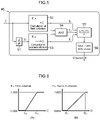
- FIG. 5 is a schematic block diagram showing functions of the judger 46 classified for convenience.
- the judger 46 is provided with a differential calculator 51, a calculator 52 of first criterion, a calculator 53 of second criterion, a selector 54 of maximum value, a calculator 55 of criterion, and a limiter 56 of criterion.
- the information of the absolute value C of velocity difference input from the calculator 45 of absolute value of velocity difference to the judger 46 is transmitted to the differential calculator 51 and the calculator 52 of first criterion.
- the differential calculator 51 calculates a time-derivative value D corresponding to a value obtained by time differentiating the absolute value C of velocity difference.
- the time-derivative value D is the amount of change per unit time of the absolute value C of velocity difference. If the time interval at which the information of the absolute value C of velocity difference is input into the differential calculator 51 is regarded as the time corresponding to a unit time, the difference between the present absolute value C of velocity difference and the previous absolute value C of velocity difference becomes a parameter corresponding to the time-derivative value D.
- the information of the calculated time-derivative value D is transmitted to the calculator 53 of second criterion.
- the calculator 52 of first criterion calculates a first criterion E 1 based on the absolute value C of velocity difference
- the calculator 53 of second criterion calculates a second criterion E 2 based on the time-derivative value D.
- the first criterion E 1 and the second criterion E 2 are index values for evaluating the degree of slipping of the left and right wheels 5.
- the calculator 52 of first criterion stores a mathematical expression, a graph, a map, and/or the like that define a correspondence relationship between the absolute value C of velocity difference and the first criterion E 1
- the calculator 53 of second criterion stores a mathematical expression, a graph, a map, and/or the like that defines a correspondence relationship between the time-derivative value D and the second criterion E 2 .
- FIG. 6(A) is an example of a map that defines correspondence relationship between the absolute value C of velocity difference and the first criterion E 1 .
- the value of the first criterion E 1 is defined as a decimal number having a three-place decimal.
- the first criterion E 1 is set to 0.
- the first criterion E 1 is set to 1.
- the first criterion E 1 is set to increase toward 1 as the absolute value C of velocity difference increases.
- the information of the first criterion E 1 calculated by the calculator 52 of first criterion is transmitted to the selector 54 of maximum value and the calculator 55 of criterion.
- FIG. 6(B) is an example of a map that defines a correspondence relationship between the time-derivative value D and the second criterion E 2 .
- the value of the second criterion E 2 is defined as a decimal number having a three-place decimal.
- the time-derivative value D is less than a first derivative value D 1
- the value of the second criterion E 2 is set to 0.
- the time-derivative value D is equal to or greater than a second derivative value D 2
- the value of the criterion E 2 is set to 1.
- the value of the criterion E 2 is set to increase toward 1 as the time-derivative value D increases.
- the information of the second criterion E 2 calculated by the calculator 53 of second criterion is transmitted to the selector 54 of maximum value and the calculator 55 of criterion.
- the selector 54 of maximum value selects a larger one between the first criterion E 1 and the second criterion E 2 , and sets the selected criterion as the third criterion E 3 .
- the third criterion E 3 is a parameter that is set to more intensively reflect the value of the larger one between the first criterion E 1 and the criterion E 2 onto the criterion E finally calculated by the calculator 11.
- the information of the set third criterion E 3 is transmitted to the calculator 55 of criterion.
- the calculator 55 of criterion calculates a criterion E representing a degree of slipping on the basis of at least the first criterion E 1 and the second criterion E 2 .
- the criterion E is set to a value at least larger than the minimum value among the criteria E 1 to E 3 , and is preferably set to a value larger than the average value of the first criterion E 1 and the second criterion E 2 .
- the criterion E is calculated on the basis of the first criterion E 1 , the second criterion E 2 , and the third criterion E 3 .
- criterion E a half of the sum of the first criterion E 1 , the second criterion E 2 , and the third criterion E 3 is calculated as the criterion E.
- the information of the calculated criterion E is transmitted to the limiter 56 of criterion.
- the limiter 56 of criterion limits the upper limit value and the lower limit value of the value calculated by the calculator 55 of criterion so that the calculated value does not deviate from the domain of the criterion E. For example, when the criterion E transmitted from the calculator 55 of criterion is less than 0, the value is corrected to 0, and when the criterion E exceeds 1, the value is corrected to 1. Note that, depending on the method of calculating the criterion E in the calculator 55 of criterion, the value calculated by the calculator 55 of criterion can be set within the domain of the criterion E. Such a case may omit the limiter 56 of criterion.
- the acceleration sensor and/or the gyro sensor may be omitted and the disclosed technique can be carried out in a simple configuration at relatively low costs.
- the calculator 11 determines the degree of slipping of the right and left wheels 5. Further, when the degree of slipping is lower (i.e., the criterion E is smaller), the calculated vehicle body velocity V is closer to the average value A whereas when the degree of slipping is higher (i.e., the criterion E is larger), the calculated vehicle body velocity V is closer to the lower velocity value B. With this configuration, it is possible to reduce the error in arithmetic operation caused from the slipping of the left and right wheels 5. Therefore, it is possible to further enhance the precision in calculating of the vehicle body velocity V.
- the first criterion E 1 is set on the basis of the absolute value C of velocity difference of the respective wheel velocities ⁇ R and ⁇ L
- the second criterion E 2 is set on the basis of the time-derivative value D of the absolute value C.
- the degree of slipping is determined on the basis of at least the first criterion E 1 and the second criterion E 2 .
- the slip state and the change thereof can be precisely grasped so that it is possible to further enhance the precision in calculating of the vehicle body velocity V.
- the change can be immediately reflected in the criterion E, and can be quickly reflected in the value of the vehicle body velocity V.
- a pair of motors 1 are coupled to the differential mechanism 3 that provides a torque difference to the left and right wheels 5, the motor angular velocities of the motors 1 are detected by a pair of resolvers 18.
- the calculator 11 calculates the respective wheel velocities ⁇ R and ⁇ L of the left and right wheels 5 based on the motor angular velocities ⁇ M1 and ⁇ M2 detected by the resolvers 18. With this configuration, it is possible to grasp the vehicle body velocity V without depending on the wheel velocity sensors 19.
- the vehicle body velocity V can be calculated.
- the final vehicle body velocity V may be determined by referring to both a vehicle body velocity V calculated on the basis of the wheel velocities ⁇ R and ⁇ L and a vehicle body velocity V calculated on the basis of the motor angular velocities ⁇ M1 and ⁇ M2 . With this configuration, it is possible to further enhance the precision in calculating of the vehicle body velocity V.
- the controller 12 that controls the maximum torque difference between the left and right wheels 5 on the basis the vehicle body velocity V calculated by the calculator 11 is provided.
- the controller 12 performs control to reduce the maximum torque difference admittable between the left and right wheels 5 as the vehicle body velocity V increases.
- the turning posture can be stabilized.
- the stability of the turning posture can be improved and the traveling performance of the vehicle can be enhanced.
- the above embodiment describes the vehicle control device applied to the rear wheels of a vehicle.
- the vehicle control device may be applied to the front wheels of a vehicle or to both the front and rear wheels of a vehicle in the same manner. If a vehicle is mounted with at least a sensor that obtains information corresponding to the respective wheel velocities ⁇ R and ⁇ L of the left and right wheels 5, the precision in calculating the vehicle body velocity can be enhance by performing the same control as that performed by the control unit 10, so that the same effects as those of the above-described embodiment can be obtained.
- the half value of the sum of the first criterion E 1 , the second criterion E 2 and the third criterion E 3 is calculated as the criterion E
- a specific method of calculating the criterion E is not limited to this. At least, by calculating the criterion E corresponding to the degree of slipping of the right and left wheels 5, the same effects as in those of the above embodiment can be obtained. Various known methods can be used for the method of calculating the criterion E corresponding to the degree of slipping.
Landscapes
- Engineering & Computer Science (AREA)
- Transportation (AREA)
- Mechanical Engineering (AREA)
- Power Engineering (AREA)
- Life Sciences & Earth Sciences (AREA)
- Sustainable Development (AREA)
- Sustainable Energy (AREA)
- Electric Propulsion And Braking For Vehicles (AREA)
- Regulating Braking Force (AREA)
Abstract
Description
- The present invention relates to a vehicle control device that calculates a vehicle body velocity of a vehicle.
- A technique to enhance the precision in calculating by considering slipping and locking of the wheels has conventionally existed for calculating a vehicle body velocity (vehicle velocity) of a vehicle. For example, one of the known methods calculates the vehicle body velocity based on the wheel velocity at the time of non-slipping, and calculates the vehicle body velocity based on the longitudinal acceleration of the vehicle at the time of slipping (see Patent Document 1).
- [Patent Document 1]
Japanese Laid-open Patent Publication No. HEI 6-222066 JP 1994-222066 A - Grasping the longitudinal acceleration of a vehicle requires an acceleration sensor or a gyro sensor, and therefore has a problem that the cost is likely to rise. Further, for example, in the method described in
Patent Document 1, the method of calculating the vehicle body velocity is largely different between at the time of slipping and at the time of non-slipping. Therefore, the change in the vehicle body velocity calculated at the time of transition from the non-slipping state to the slipping state (or vice versa) tends to be large and makes it difficult to enhance the precision in the calculation. - With the foregoing problems in view, one of the objects of the present invention is to provide a device for calculating a vehicle body velocity that enhances the precision in the calculating of a vehicle body velocity, suppressing the cost rise. In addition to this object, an effect which is derived from each configuration of "an embodiment to carry out the invention" to be described below and which conventional technique does not attain can be regarded as another object of the present disclosure.
- The disclosed vehicle control device calculates a vehicle body velocity of a vehicle and includes a sensor that obtains information corresponding to respective wheel velocities of left and right wheels arranged along a vehicle width direction; and a calculator that calculates, when the left and right wheels are not slipping, an average value of the wheel velocities as the vehicle body velocity, and calculates, when at least one of the left and right wheels is slipping, the vehicle body velocity based on the average value and a lower velocity value being a lower one of the wheel velocities.
- The disclosed vehicle control device can enhance the precision in calculating a vehicle body velocity, suppressing the cost rise.
-
- [
FIG. 1] FIG. 1 is a schematic diagram showing a vehicle adopting a vehicle control device according to an embodiment; - [
FIG. 2] FIG. 2 is a schematic diagram showing a configuration of the driving system of the vehicle ofFIG. 1 ; - [
FIG. 3] FIG. 3 is a graph illustrating an example of a relationship between a vehicle body velocity calculated in a control unit shown inFIG. 1 and a maximum torque difference admittable between the left and right wheels; - [
FIG. 4] FIG. 4 is a block diagram illustrating the contents of an arithmetic operation performed in the control unit shown inFIG. 1 ; - [
FIG. 5] FIG. 5 is a block diagram illustrating the contents of an arithmetic operation performed in a judger shown inFIG. 4 ; and - [
FIG. 6] FIG. 6 is graphs showing a method of setting criteria calculated in the judger shown inFIG. 5; FIG. 6A is a graph showing an example of a relationship between an absolute value C of velocity difference and a first criterion E1, andFIG. 6(B) is a graph showing a relationship between a time-derivative value D and a second criterion E2. - Referring to
FIG. 1 to 6 , description will now be made in relation to a vehicle control device according to an embodiment will now be described. This vehicle control device has a function of calculating a velocity V of vehicle body (hereinafter also referred to as a "vehicle body velocity V") of the vehicle shown inFIG. 1 . The vehicle is mounted with a pair ofmotors 1 that drive the left and right wheels 5 (here rear wheels) arranged side by side along the vehicle width direction and adifferential mechanism 3 that applies a torque difference to the left andright wheels 5. In this example, suffix letters such as R and L, which are added to the numerical signs, represent the arrangement positions of the elements related to the signs (i.e., the positions on the right side and the left side of the vehicle). For example, areference sign 5R represents one (i.e., right wheel) of the left andright wheels 5 positioned on the right side (Right) of the vehicle, and areference sign 5L represents the other (i.e., left wheel) positioned on the left side (Left) of the vehicle. - The pair of
motors 1 have a function of driving at least either of the front wheels and the rear wheels of the vehicle, and can have a function of driving all four wheels. Between the pair ofmotors 1, one positioned on the right side is also referred to as aright motor 1R (right motor) and the other positioned on the left side is also referred to as aleft motor 1L (left motor). Theright motor 1R andleft motor 1L operate independently of each other, and can individually output the driving forces having different magnitudes from each other. Thesemotors 1 are each coupled to thedifferential mechanism 3 via one of a pair ofreduction mechanisms 2, which are separately provided from each other. Theright motor 1R and theleft motor 1L of the present embodiment have the same rated outputs. - Each
reduction mechanism 2 is a mechanism that increases the torque by reducing the driving force output from thecorresponding motor 1. The reduction ratio G of thereduction mechanism 2 is appropriately set according to the output characteristic and the performance of themotor 1. Between the pair ofreduction mechanisms 2, one positioned on the right side is also referred to as aright reduction mechanism 2R, and the other positioned on the left side is also referred to as aleft reduction mechanism 2L. Theright reduction mechanism 2R and theleft reduction mechanism 2L of the present embodiment have the same velocity reduction ratio G. If the torque performances of themotors 1 are sufficiently high, thereduction mechanisms 2 may be omitted. - The
differential mechanism 3 is a differential mechanism directed to a vehicle and having a yaw control function, and is interposed between a wheel axle 4 (right wheel axle 4R) linked to theright wheel 5R and a wheel axle 4 (left wheel axle 4L) linked to theleft wheel 5L. The yaw control function adjusts the yaw moment by actively controlling the sharing ratio of the driving forces (driving torques) of the left and right wheels, and stabilizes the posture of the vehicle. Inside thedifferential mechanism 3, a gear train such as a planetary gear mechanism and/or a differential gear mechanism is incorporated. The driving force transmitted from the pair ofmotors 1 is distributed to the left andright wheels 5 through the gear train. -
FIG. 2 is a schematic diagram illustrating a configuration of thereduction mechanisms 2 and thedifferential mechanism 3. The reduction ratio G of eachreduction mechanism 2 can be expressed as a ratio (or a ratio of the number of teeth of the gears) of the rotational angular velocity transmitted from thecorresponding motor 1 to thereduction mechanism 2 and the rotational angular velocity transmitted from thereduction mechanism 2 to thedifferential mechanism 3. In thedifferential mechanism 3, the followingexpressions left motor 1L is transmitted to theright wheel 5R is expressed as b1, the gear ratio of the path through which the driving force of theright motor 1R is transmitted to theleft wheel 5L is expressed as b2, the rotational angular velocities of the left andright motors 1 are respectively expressed as the motor angular velocities ωM1 and ωM2, and the rotational angular velocities of the left andright wheels 5 are respectively expressed as the wheel velocities ωR and ωL.

- ωM1: motor angular velocity of the right motor
- ωM2: motor angular velocity of the left motor
- ωR: wheel velocity of the right wheel
- ωL: wheel velocity of the left wheel
- b1: gear ratio of a right-wheel side in differential mechanism
- b2: gear ratio of a left-wheel side in differential mechanism
- As shown in
FIG. 1 , themotors 1 are electrically coupled to abattery 7 viainverters 6. Theinverters 6 are electric-power-conversion devices (DC-AC convertors) that mutually convert the electric power (DC power, direct-current power) of the DC circuit of thebattery 7 side and the electric power (AC power, alternating-current power) of the AC circuit of themotor 1 side. Thebattery 7 is, for example, a lithium-ion battery or a nickel-metal hydride battery, and is a secondary battery capable of supplying a high-voltage DC current of several hundred volts. While themotors 1 are power running 1, the DC power is converted into AC power by theinverters 6 and the converted AC power is then supplied to themotors 1. While themotors 1 are generating, the generated power is converted into DC power by theinverters 6 and thebattery 7 is charged with the converted DC power. - The operating state of each
inverter 6 is controlled by thecontrol unit 10. Thecontrol unit 10 is a computer (electronic control unit) that controls the output of themotors 1 by managing the operating states ofinverters 6. Inside thecontrol unit 10, a processor (central processing unit), a memory (main memory), a storage device (storage), an interface device, and the like, which do not appear in the drawings, are included, and these elements are communicably coupled to each other via an internal bus. Thecontrol unit 10 of the present embodiment functions to precisely grasp the vehicle body velocity V (vehicle velocity), which is the traveling velocity of the vehicle, and also to control the torque difference between the left andright wheels 5 on the basis of the vehicle body velocity V. - As shown in
FIG. 1 , anaccelerator sensor 13, a brake sensor 14, asteering angle sensor 15,resolvers 18, andwheel velocity sensors 19 are connected to thecontrol unit 10. Theaccelerator sensor 13 is a sensor that detects the amount of depressing (accelerator opening degree) of the accelerator pedal and the depression velocity. The brake sensor 14 is a sensor that detects the amount of depressing (brake pedal stroke) of the brake pedal and the depression velocity. Thesteering sensor 15 is a sensor that detects a steering angle (actual steering angle or steering angle of the steering) of the left andright wheels 5. - The
resolvers 18 are sensors that detect the rotational angular velocities (motor angular velocities ωM1 and ωM2) of themotors 1, and are provided one for each of themotors 1. Similarly, thewheel velocity sensors 19 are sensors that detect the rotational angular velocities (wheel velocities ωR and ωL) of the left and right wheels 5 (or wheel axles 4), and are provided one in the vicinity of each of theright wheel 5R and theleft wheel 5L. Thecontrol unit 10 controls the operating state of the pair ofmotors 1 on the basis of the information detected by these sensors 13-15, 18, and 19. In the present embodiment, theresolvers 18 and thewheel velocity sensors 19 function as "sensors that obtain information corresponding to the respective wheel velocities ωR and ωL of the left andright wheels 5". - As shown in
FIG. 1 , at least acalculator 11 and acontroller 12 are provided in thecontrol unit 10. These elements represent functions of thecontrol unit 10 being classified convenience. These elements may be described as independent programs, or may be described as a composite program in which multiple elements are combined. The program corresponding to each element is stored in the memory or the storage device of thecontrol unit 10 and executed by the processor. Alternatively, thecalculator 11 and thecontroller 12 may be provided in theinverter 6. - The
calculator 11 calculates the vehicle body velocity V based on the information corresponding to the wheel velocities ωR and ωL of the left andright wheels 5. Specific examples of information corresponding to the wheel velocities ωR and ωL of the left andright wheels 5 include information of the motor angular velocities ωM1 and ωM2 detected by theresolvers 18, information of the wheel velocities ωR and ωL detected by thewheel velocity sensors 19, and information of the rotational velocities input from thereduction mechanisms 2 to thedifferential mechanism 3. The information of the vehicle body velocity V calculated here is transmitted to thecontroller 12. - The
controller 12 controls the torque difference between the left andright wheels 5 on the basis of the vehicle body velocity V calculated by thecalculator 11. In this example, the output of eachmotor 1 is controlled on the basis of the accelerator opening degree, the brake pedal stroke, the steering angle, for example, and the output torque of eachmotor 1 is controlled such that the torque difference between the left andright wheels 5 does not exceed the maximum torque difference corresponding to the vehicle body velocity V. In the present embodiment, the operating states of theinverters 6 corresponding one to each of theright motor 1R and theleft motor 1L are controlled according to the vehicle body velocity V. -
FIG. 3 is a graph showing a relationship between the maximum torque difference of the left andright wheels 5 controlled by thecontroller 12 and the vehicle body velocity V (which is denoted "velocity of vehicle body" in the drawings). The maximum torque difference admittable between the left andright wheels 5 is controlled so as to decrease as the vehicle body velocity V increases. For example, when the vehicle body velocity V is less than a first vehicle body velocity V1, the torque difference up to a first torque difference T1 is allowed for the left andright wheels 5. When the vehicle body velocity V is equal to or higher than a second vehicle body velocity V2, the maximum torque difference between the left andright wheels 5 is limited to the second torque difference T2 smaller than the first torque difference T1. When the vehicle body velocity V is equal to or higher than the first vehicle body velocity V1 and less than the second vehicle body velocity V2, the maximum torque difference is set to decrease toward the second torque difference T2 as the vehicle body velocity V increases. -
FIG. 4 is a schematic block diagram showing functions of thecontroller 12 classified for convenience. Thecontroller 12 is provided with anobtainer 41 of wheel velocity, anestimator 42 of wheel velocity, acalculator 43 of average value, aselector 44 for lower velocity value, acalculator 45 of absolute value of velocity difference, ajudger 46, asubtractor 47, a first multiplier 48, asecond multiplier 49, and anadder 50. - The
obtainer 41 of wheel velocity obtains information of wheel velocities ωR and ωL detected by thewheel velocity sensors 19. If the information of thewheel velocity sensor 19 can be used, theobtainer 41 of wheel velocity obtains the information of the wheel velocities ωR and ωL. On the other hand, theestimator 42 of wheel velocity calculates values corresponding to the wheel velocities ωR and ωL based on the motor angular velocities ωM1, ωM2 detected by theresolvers 18. Theestimator 42 of wheel velocity has a function of, if not using (or not available) the information of thewheel velocity sensor 19, calculating values corresponding to the wheel velocities ωR and ωL by using the information of the motor angular velocities ωM1 and ωM2. Here, for example, values corresponding to the wheel velocities ωR and ωL are calculated, usingExpressions obtainer 41 of wheel velocity. - The
calculator 43 of average value calculates an average value A of the left and right wheel velocities ωR and ωL. The average value A calculated here includes, for example, an arithmetic average, a geometric average, or a harmonized average. When an arithmetic average is used, the average value A is half the sum of the right-wheel velocity ωR and the left-wheel velocity ωL. When a harmonic average is used, the average value A is twice (2/{(1/ωR)+(1/ωL)}) the reciprocal of the sum of the reciprocal (1/ωR) of the right wheel velocity and the reciprocal (1/ωL) of the left wheel velocity. These average values A are considered to be close to the value of the actual traveling velocity in the non-slipping state of the vehicle. The information of the average value A calculated here is transmitted to the first multiplier 48. - The
selector 44 for lower velocity value selects a lower velocity value B which is the lower wheel velocity between the left and right wheel velocities ωR and ωL. In relation to the lower velocity value B, in the slipping state of the left andright wheels 5, the slipping wheel rotates at a higher velocity than the actual traveling velocity. Therefore, the wheel velocity on the low-velocity side has a possibility of being closer to the actual traveling velocity as compared with the wheel velocity on the high-velocity side, and the possibility is considered to increase as the degree of slipping increases. The information of the lower velocity value B selected here is transmitted to thesecond multiplier 49. - The
calculator 45 of absolute value of velocity difference calculates an absolute value C of the velocity difference, which is an absolute value of the difference between the left and right wheel velocities ωR and ωL. The information of the calculated absolute value C of velocity difference is transmitted to thejudger 46. The absolute value C of velocity difference is almost zero when the vehicle is traveling straight, but comes to be greater as the degree of slipping is increased when at least one of the right and leftwheels 5 is slipping. On the other hand, even if the vehicle is not slipping, the absolute value C of velocity difference may increase to some extent when the vehicle is turning. - The
judger 46 calculates a criterion E which is an index value obtained by quantifying the degree of slipping of the left andright wheels 5. The domain of the criterion E is, for example, a range from 0 to 1. The criterion E closer to 0 indicates that the degree of slipping of the left andright wheels 5 are lower, and the criterion E closer to 1 indicates that the degree of slipping of the left andright wheels 5 are higher. When the left andright wheels 5 are not slipping, the criterion E is 0. The criterion E is calculated on the basis of the absolute value C of velocity difference. For example, the criterion E is calculated to be a larger value as the absolute value C of velocity difference is larger. A specific method of calculating the criterion E will be described below. The information of the criterion E calculated here is transmitted to thesubtractor 47 and thesecond multiplier 49. - The
subtractor 47 calculates a toggle value F, which is an index value obtained by quantifying the degree of non-slipping of the vehicle. The toggle value F is a value obtained by inverting the criterion E, and is calculated, for example, by subtracting the criterion E from 1. In this case, the toggle value F is calculated such that the sum of the toggle value F and the criterion E becomes 1. The domain of the toggle value F is, for example, a range from 0 to 1 like the criterion E. The information of the toggle value F calculated here is transmitted to the first multiplier 48. - The first multiplier 48 calculates the product of the average value A and the toggle value F. The value of the product calculated here becomes 0 at the minimum and becomes the average value A at the maximum. The value of the calculated product increases as the toggle value F is larger (i.e., the criterion E is smaller). The information of the calculated product is transmitted to the
adder 50. - The
second multiplier 49 calculates the product of the lower velocity value B and the criterion E. The value of the product calculated here becomes 0 at the minimum and becomes the lower velocity value B at the maximum. The value of the calculated product increases as the criterion E is larger (i.e., the toggle value F is smaller). The information of the calculated product is transmitted to theadder 50. - The
adder 50 calculate, as the vehicle body velocity V, the sum (V=A*F+B*E=Ax(1-E)+B*E) of the product transmitted from the first multiplier 48 and the product transmitted from thesecond multiplier 49. The calculated vehicle body velocity V becomes a value closer to the average value A as the degree of slipping of the left andright wheels 5 is lower and therefore the criterion E is closer to 0. On the other hand, when the degree of slipping of the left andright wheels 5 is high and the criterion E is closer to 1, the vehicle body velocity V becomes closer to the lower velocity value B. As the above, theadder 50 has a function of estimating the vehicle body velocity V ranging between the average value A and the lower velocity value B on the basis of the degree of slipping of the left andright wheels 5. - The calculating
unit 11 of the present embodiment has a function of "calculating the average value A of the wheel velocities ωR and ωL as the vehicle body velocity V when the left andright wheels 5 are not slipping, and calculating the vehicle body velocity V based on the average value A and the lower velocity value B when at least one of the left andright wheels 5 is slipping". For example, since the criterion E is 0 and also the toggle value F is 1 if the right and leftwheels 5 are not slipping, the vehicle body velocity V becomes a value equal to the average value A (i.e. V=A). If at least one of the right and leftwheels 5 is slipping even slightly, the value of the vehicle body velocity V falls within the range between the average value A and the lower velocity value B. - Since the value of the vehicle body velocity V is equal to the sum of the product of the average value A and the toggle value F and the product of the lower velocity value B and the criterion E, a smaller criterion E (i.e., a larger toggle value F which means a lower degree of slipping of the left and right wheels 5) makes the value of the vehicle body velocity V closer to the average value A. Conversely, a larger criterion E (i.e., a smaller toggle value F which means a high degree of slipping of the left and right wheels 5) makes the value of the vehicle body velocity V closer to the lower velocity value B.
- A specific method of calculating the criterion E will be detailed below.
FIG. 5 is a schematic block diagram showing functions of thejudger 46 classified for convenience. Thejudger 46 is provided with adifferential calculator 51, acalculator 52 of first criterion, a calculator 53 of second criterion, aselector 54 of maximum value, acalculator 55 of criterion, and alimiter 56 of criterion. The information of the absolute value C of velocity difference input from thecalculator 45 of absolute value of velocity difference to thejudger 46 is transmitted to thedifferential calculator 51 and thecalculator 52 of first criterion. - The
differential calculator 51 calculates a time-derivative value D corresponding to a value obtained by time differentiating the absolute value C of velocity difference. The time-derivative value D is the amount of change per unit time of the absolute value C of velocity difference. If the time interval at which the information of the absolute value C of velocity difference is input into thedifferential calculator 51 is regarded as the time corresponding to a unit time, the difference between the present absolute value C of velocity difference and the previous absolute value C of velocity difference becomes a parameter corresponding to the time-derivative value D. The information of the calculated time-derivative value D is transmitted to the calculator 53 of second criterion. - The
calculator 52 of first criterion calculates a first criterion E1 based on the absolute value C of velocity difference, and the calculator 53 of second criterion calculates a second criterion E2 based on the time-derivative value D. The first criterion E1 and the second criterion E2 are index values for evaluating the degree of slipping of the left andright wheels 5. Thecalculator 52 of first criterion stores a mathematical expression, a graph, a map, and/or the like that define a correspondence relationship between the absolute value C of velocity difference and the first criterion E1, and the calculator 53 of second criterion stores a mathematical expression, a graph, a map, and/or the like that defines a correspondence relationship between the time-derivative value D and the second criterion E2. -
FIG. 6(A) is an example of a map that defines correspondence relationship between the absolute value C of velocity difference and the first criterion E1. According to the map shown inFIG. 6(A) , the value of the first criterion E1 is defined as a decimal number having a three-place decimal. When absolute value C of velocity difference is less than a first predetermined value C1, the first criterion E1 is set to 0. When the absolute value C of velocity difference is equal to or larger than a second predetermined value C2, the first criterion E1 is set to 1. When the absolute value C of velocity difference is equal to or larger than the first predetermined value C1 and less than the second predetermined value C2, the first criterion E1 is set to increase toward 1 as the absolute value C of velocity difference increases. The information of the first criterion E1 calculated by thecalculator 52 of first criterion is transmitted to theselector 54 of maximum value and thecalculator 55 of criterion. - Similarly,
FIG. 6(B) is an example of a map that defines a correspondence relationship between the time-derivative value D and the second criterion E2. According to the map shown inFIG. 6 (B) , the value of the second criterion E2 is defined as a decimal number having a three-place decimal. When the time-derivative value D is less than a first derivative value D1, the value of the second criterion E2 is set to 0. When the time-derivative value D is equal to or greater than a second derivative value D2, the value of the criterion E2 is set to 1. When the time-derivative value D is equal to or larger than the first derivative value D1 and less than the second derivative value D2, the value of the criterion E2 is set to increase toward 1 as the time-derivative value D increases. The information of the second criterion E2 calculated by the calculator 53 of second criterion is transmitted to theselector 54 of maximum value and thecalculator 55 of criterion. - The
selector 54 of maximum value selects a larger one between the first criterion E1 and the second criterion E2, and sets the selected criterion as the third criterion E3. The third criterion E3 is a parameter that is set to more intensively reflect the value of the larger one between the first criterion E1 and the criterion E2 onto the criterion E finally calculated by thecalculator 11. The information of the set third criterion E3 is transmitted to thecalculator 55 of criterion. - The
calculator 55 of criterion calculates a criterion E representing a degree of slipping on the basis of at least the first criterion E1 and the second criterion E2. The criterion E is set to a value at least larger than the minimum value among the criteria E1 to E3, and is preferably set to a value larger than the average value of the first criterion E1 and the second criterion E2. In thecalculator 55 of criterion of the present embodiment, the criterion E is calculated on the basis of the first criterion E1, the second criterion E2, and the third criterion E3. For example, a half of the sum of the first criterion E1, the second criterion E2, and the third criterion E3 is calculated as the criterion E. The information of the calculated criterion E is transmitted to thelimiter 56 of criterion. - The
limiter 56 of criterion limits the upper limit value and the lower limit value of the value calculated by thecalculator 55 of criterion so that the calculated value does not deviate from the domain of the criterion E. For example, when the criterion E transmitted from thecalculator 55 of criterion is less than 0, the value is corrected to 0, and when the criterion E exceeds 1, the value is corrected to 1. Note that, depending on the method of calculating the criterion E in thecalculator 55 of criterion, the value calculated by thecalculator 55 of criterion can be set within the domain of the criterion E. Such a case may omit thelimiter 56 of criterion. -
- (1) In the above embodiment, sensors (e.g., resolvers 18 and wheel velocity sensors 19) that obtain information corresponding to the respective wheel velocities ωR and ωL of the left and right wheels are provided, and a
calculator 11 that calculates the vehicle body velocity V based on information detected by the sensors is provided in thecontrol unit 10. Thecalculator 11 calculates the average value A of the wheel velocities ωR and ωL as the vehicle body velocity V when the left andright wheels 5 are not slipping. On the other hand, when at least one of the right and leftwheels 5 is slipping, thecalculator 11 calculates the vehicle body velocity V based on the average value A and the lower velocity value B. - With this configuration, it is possible to grasp the vehicle body velocity V even if the wheel velocity information of all four wheels cannot be used. In addition, it is possible to estimate the slipping state and the vehicle body velocity V only from the information corresponding to the wheel velocities ωR and ωL of the left and right wheels. Incidentally, since the longitudinal acceleration of the vehicle are not referred, the acceleration sensor and/or the gyro sensor may be omitted and the disclosed technique can be carried out in a simple configuration at relatively low costs.
- Furthermore, differentiating the method of estimating (i.e., the parameter used to calculate the vehicle body velocity V) between the time of the non-slipping and the time of the slipping makes it possible to enhance the precision in the calculating the vehicle body velocity V. On the other hand, the method of estimating at the time of non-slipping is a method positioned on the extension line of the method of estimating at the time of slipping (the Expression "V=A*F+B*E" for calculation is common to the time of non-slipping and the time of slipping, and E=0 corresponds to the time of non-slipping, and E>0 corresponds to the time of slipping), so that the change of the vehicle body velocity calculated at the time of transition from the non-slipping state to the slipping state (or vice versa) is small and the precision in calculating can be enhanced. Therefore, the above-described vehicle control device can enhance the precision in calculating of the vehicle body velocity V while suppressing cost rise.
- (2) In the above embodiment, the
calculator 11 determines the degree of slipping of the right and leftwheels 5. Further, when the degree of slipping is lower (i.e., the criterion E is smaller), the calculated vehicle body velocity V is closer to the average value A whereas when the degree of slipping is higher (i.e., the criterion E is larger), the calculated vehicle body velocity V is closer to the lower velocity value B. With this configuration, it is possible to reduce the error in arithmetic operation caused from the slipping of the left andright wheels 5. Therefore, it is possible to further enhance the precision in calculating of the vehicle body velocity V. - (3) In the above-described embodiment, the first criterion E1 is set on the basis of the absolute value C of velocity difference of the respective wheel velocities ωR and ωL, and the second criterion E2 is set on the basis of the time-derivative value D of the absolute value C. Further, the degree of slipping is determined on the basis of at least the first criterion E1 and the second criterion E2. With this configuration, the degree of slipping can be objectively evaluated using both the first criterion E1 derived from the velocity difference and the second criterion E2 derived from the time-differential value of the velocity difference, so that an appropriate criterion E can be obtained. Therefore, the slip state and the change thereof can be precisely grasped so that it is possible to further enhance the precision in calculating of the vehicle body velocity V. In particular, when the velocity difference between the respective wheel velocities ωR and ωL changes due to slipping, the change can be immediately reflected in the criterion E, and can be quickly reflected in the value of the vehicle body velocity V.
- (4) In the above embodiment, a pair of
motors 1 are coupled to thedifferential mechanism 3 that provides a torque difference to the left andright wheels 5, the motor angular velocities of themotors 1 are detected by a pair ofresolvers 18. Besides, thecalculator 11 calculates the respective wheel velocities ωR and ωL of the left andright wheels 5 based on the motor angular velocities ωM1 and ωM2 detected by theresolvers 18. With this configuration, it is possible to grasp the vehicle body velocity V without depending on thewheel velocity sensors 19. - Further, by preparing multiple methods of calculating the vehicle body velocity V, it is possible to enhance the robustness of the control against sensor failure. For example, even if the
wheel velocity sensors 19 fail, the vehicle body velocity V can be calculated. The final vehicle body velocity V may be determined by referring to both a vehicle body velocity V calculated on the basis of the wheel velocities ωR and ωL and a vehicle body velocity V calculated on the basis of the motor angular velocities ωM1 and ωM2. With this configuration, it is possible to further enhance the precision in calculating of the vehicle body velocity V. - (5) In the above embodiment, the
controller 12 that controls the maximum torque difference between the left andright wheels 5 on the basis the vehicle body velocity V calculated by thecalculator 11 is provided. For example, in accordance with the characteristics shown inFIG. 3 , thecontroller 12 performs control to reduce the maximum torque difference admittable between the left andright wheels 5 as the vehicle body velocity V increases. With this configuration, the turning posture can be stabilized. Further, as compared with conventional technology, since the precision in calculating of the vehicle body velocity V is improved, the stability of the turning posture can be improved and the traveling performance of the vehicle can be enhanced. - The foregoing example is illustrative only and is not intended to preclude the application of various modifications and techniques not explicitly set forth in the present examples. Each configuration of the present embodiment can be variously modified and implemented without departing from the scope thereof. Also, the configuration can be selected or omitted according to the requirement or appropriately combined.
- For example, the above embodiment describes the vehicle control device applied to the rear wheels of a vehicle. Alternatively, the vehicle control device may be applied to the front wheels of a vehicle or to both the front and rear wheels of a vehicle in the same manner. If a vehicle is mounted with at least a sensor that obtains information corresponding to the respective wheel velocities ωR and ωL of the left and
right wheels 5, the precision in calculating the vehicle body velocity can be enhance by performing the same control as that performed by thecontrol unit 10, so that the same effects as those of the above-described embodiment can be obtained. - Further, in the above-described embodiment, the half value of the sum of the first criterion E1, the second criterion E2 and the third criterion E3 is calculated as the criterion E, a specific method of calculating the criterion E is not limited to this. At least, by calculating the criterion E corresponding to the degree of slipping of the right and left
wheels 5, the same effects as in those of the above embodiment can be obtained. Various known methods can be used for the method of calculating the criterion E corresponding to the degree of slipping. -
- 1: motor
- 2: reduction mechanism
- 3: differential mechanism
- 4: wheel axle
- 5: left and right wheels
- 10: control unit
- 11: calculator
- 12: controller
- 18: resolver
- 19: sensor of wheel speed
- A: average value
- B: lower velocity value
- C: absolute value of velocity difference
- D: time-derivative value
- E: criterion
- F: toggle value
- V: velocity of vehicle body
Claims (5)
- A vehicle control device that calculates a vehicle body velocity of a vehicle, comprisinga sensor that obtains information corresponding to respective wheel velocities of left and right wheels arranged along a vehicle width direction; anda calculator that calculates, when the left and right wheels are not slipping, an average value of the wheel velocities as the vehicle body velocity, and calculates, when at least one of the left and right wheels is slipping, the vehicle body velocity based on the average value and a lower velocity value being a lower one of the wheel velocities.
- The vehicle control device according to claim 1, wherein
the calculator judges a degree of slipping of the left and right wheels and calculates, as the vehicle body velocity, a value closer to the average value as the degree of slipping is lower and a value closer to the low velocity value as the degree of slipping is higher. - The vehicle control device according to claim 2, wherein
the calculator judges the degree of slipping based on a first criterion and a second criterion, the first criterion being set on the basis of an absolute value of a difference between the wheel velocities, the second criterion being set on the basis of a time-derivative value of the absolute value. - The vehicle control device according to any one of claims 1-3, further comprising:a pair of motors that are coupled to a differential mechanism, the differential mechanism providing a torque difference to the left and right wheels; anda pair of resolvers that detect motor angular velocities output from the motors, whereinthe calculator calculates the wheel velocities based on the motor angular velocities.
- The vehicle control device according to any one of claims 1-4, further comprising:
a controller that controls, based on the vehicle body velocity calculated by the calculator, a maximum torque difference between the left and right wheels.
Applications Claiming Priority (2)
| Application Number | Priority Date | Filing Date | Title |
|---|---|---|---|
| JP2020072082 | 2020-04-14 | ||
| PCT/JP2021/013225 WO2021210373A1 (en) | 2020-04-14 | 2021-03-29 | Vehicle control device |
Publications (2)
| Publication Number | Publication Date |
|---|---|
| EP4019318A1 true EP4019318A1 (en) | 2022-06-29 |
| EP4019318A4 EP4019318A4 (en) | 2023-02-22 |
Family
ID=78083836
Family Applications (1)
| Application Number | Title | Priority Date | Filing Date |
|---|---|---|---|
| EP21788970.8A Pending EP4019318A4 (en) | 2020-04-14 | 2021-03-29 | VEHICLE CONTROL DEVICE |
Country Status (5)
| Country | Link |
|---|---|
| US (1) | US11807108B2 (en) |
| EP (1) | EP4019318A4 (en) |
| JP (1) | JP7207607B2 (en) |
| CN (1) | CN114450187B (en) |
| WO (1) | WO2021210373A1 (en) |
Cited By (1)
| Publication number | Priority date | Publication date | Assignee | Title |
|---|---|---|---|---|
| EP4574531A4 (en) * | 2022-08-16 | 2025-11-26 | Mitsubishi Motors Corp | VEHICLE CONTROL DEVICE AND VEHICLE CONTROL METHOD |
Families Citing this family (4)
| Publication number | Priority date | Publication date | Assignee | Title |
|---|---|---|---|---|
| JP7586008B2 (en) * | 2021-07-14 | 2024-11-19 | 株式会社デンソー | Motor Control Device |
| US20240124000A1 (en) * | 2022-10-18 | 2024-04-18 | Robert Bosch Gmbh | Detection and compensation of wheel speed sensor failure |
| CN116223835B (en) * | 2023-03-08 | 2023-09-22 | 浙江汉博汽车传感器有限公司 | Wheel speed monitoring system and wheel speed sensor |
| JP2025091562A (en) * | 2023-12-07 | 2025-06-19 | トヨタ自動車株式会社 | monitoring device |
Family Cites Families (21)
| Publication number | Priority date | Publication date | Assignee | Title |
|---|---|---|---|---|
| US4926333A (en) * | 1988-04-20 | 1990-05-15 | Mitsubishi Jidosha Kogyo Kabushiki Kaisha | Traction control apparatus |
| JPH075043B2 (en) * | 1988-04-20 | 1995-01-25 | 三菱自動車工業株式会社 | Vehicle acceleration slip prevention device |
| JP3236391B2 (en) | 1993-01-21 | 2001-12-10 | 富士重工業株式会社 | Calculation method of body speed of four-wheel drive vehicle |
| JPH07117649A (en) * | 1993-10-22 | 1995-05-09 | Mitsubishi Motors Corp | Vehicle slip control device |
| JP3204110B2 (en) * | 1996-08-27 | 2001-09-04 | 三菱自動車工業株式会社 | Hydroplaning detector |
| JP2008290535A (en) | 2007-05-23 | 2008-12-04 | Toyota Motor Corp | Traveling device and drive control device |
| FR2919929B1 (en) * | 2007-08-06 | 2009-10-02 | Renault Sas | METHOD FOR ESTIMATING THE LONGITUDINAL SPEED OF A VEHICLE, DEVICE FOR IMPLEMENTING SAID METHOD |
| JP2009119958A (en) * | 2007-11-13 | 2009-06-04 | Mazda Motor Corp | Vehicle state estimation device |
| KR101129257B1 (en) * | 2008-01-16 | 2012-03-26 | 주식회사 만도 | Determination methode of Vehicle Reference speed calculation used for vehicle electronic chassis control system |
| JP5098674B2 (en) | 2008-01-31 | 2012-12-12 | 株式会社アドヴィックス | Body speed calculation device |
| JP2010070142A (en) * | 2008-09-22 | 2010-04-02 | Advics Co Ltd | Road surface friction coefficient estimation device and anti-skid control |
| JP5333343B2 (en) * | 2010-05-13 | 2013-11-06 | 三菱自動車工業株式会社 | Left and right wheel drive |
| JP6135317B2 (en) * | 2013-06-13 | 2017-05-31 | スズキ株式会社 | Vehicle steering angle estimation device |
| JP6201209B2 (en) * | 2013-09-12 | 2017-09-27 | 日立オートモティブシステムズ株式会社 | Driving force control device and driving force control method |
| JP2016060219A (en) * | 2014-09-12 | 2016-04-25 | アイシン精機株式会社 | Vehicle position detector |
| JP5883490B1 (en) * | 2014-09-30 | 2016-03-15 | 富士重工業株式会社 | Vehicle control apparatus and vehicle control method |
| CN107878464B (en) * | 2016-09-30 | 2019-12-20 | 比亚迪股份有限公司 | Vehicle speed measuring method and device |
| JP2018144576A (en) * | 2017-03-03 | 2018-09-20 | Ntn株式会社 | Vehicle control device |
| JP6819526B2 (en) * | 2017-09-21 | 2021-01-27 | トヨタ自動車株式会社 | Control device for four-wheel drive vehicles |
| JP6969440B2 (en) * | 2018-02-26 | 2021-11-24 | トヨタ自動車株式会社 | Vehicle driving support device |
| CN110031019B (en) * | 2019-04-18 | 2021-05-07 | 北京智行者科技有限公司 | Slip detection processing method for automatic driving vehicle |
-
2021
- 2021-03-29 JP JP2022515276A patent/JP7207607B2/en active Active
- 2021-03-29 US US17/762,918 patent/US11807108B2/en active Active
- 2021-03-29 EP EP21788970.8A patent/EP4019318A4/en active Pending
- 2021-03-29 CN CN202180005505.5A patent/CN114450187B/en active Active
- 2021-03-29 WO PCT/JP2021/013225 patent/WO2021210373A1/en not_active Ceased
Cited By (1)
| Publication number | Priority date | Publication date | Assignee | Title |
|---|---|---|---|---|
| EP4574531A4 (en) * | 2022-08-16 | 2025-11-26 | Mitsubishi Motors Corp | VEHICLE CONTROL DEVICE AND VEHICLE CONTROL METHOD |
Also Published As
| Publication number | Publication date |
|---|---|
| US20220396155A1 (en) | 2022-12-15 |
| EP4019318A4 (en) | 2023-02-22 |
| JPWO2021210373A1 (en) | 2021-10-21 |
| CN114450187B (en) | 2023-12-01 |
| WO2021210373A1 (en) | 2021-10-21 |
| JP7207607B2 (en) | 2023-01-18 |
| US11807108B2 (en) | 2023-11-07 |
| CN114450187A (en) | 2022-05-06 |
Similar Documents
| Publication | Publication Date | Title |
|---|---|---|
| US11807108B2 (en) | Vehicle control device | |
| US12534085B2 (en) | Method and vehicle control device | |
| EP4382346A1 (en) | Vehicle control device | |
| BR112019000542B1 (en) | CONTROL METHOD AND VEHICLE CONTROL DEVICE | |
| JP2008081006A (en) | Vehicle travel control device | |
| EP4382345A1 (en) | Control system for vehicle | |
| WO2023032012A1 (en) | Control method for electric motor vehicle and control device for electric motor vehicle | |
| WO2021246179A1 (en) | Vehicle control device | |
| US20240317205A1 (en) | Vehicle control device | |
| JP4961751B2 (en) | Vehicle driving force distribution device | |
| US20260034979A1 (en) | Vehicle control device and vehicle control method | |
| EP4574534A1 (en) | Vehicle control device and vehicle control method | |
| US20260028012A1 (en) | Vehicle control device and vehicle control method | |
| US20260014973A1 (en) | Vehicle control device and vehicle control method | |
| JP7480661B2 (en) | Vehicle control device | |
| JP7718262B2 (en) | Control method for electric vehicle and control device for electric vehicle | |
| WO2025057583A1 (en) | Vehicle control device and vehicle control method | |
| WO2025033351A1 (en) | Vehicle control device and vehicle control method | |
| WO2025057582A1 (en) | Vehicle control device and vehicle control method | |
| WO2025083842A1 (en) | Motor control method and motor control device | |
| WO2025037495A1 (en) | Vehicle control device and vehicle control method | |
| CN121263324A (en) | Vehicle travel control device and travel control program |
Legal Events
| Date | Code | Title | Description |
|---|---|---|---|
| STAA | Information on the status of an ep patent application or granted ep patent |
Free format text: STATUS: THE INTERNATIONAL PUBLICATION HAS BEEN MADE |
|
| PUAI | Public reference made under article 153(3) epc to a published international application that has entered the european phase |
Free format text: ORIGINAL CODE: 0009012 |
|
| STAA | Information on the status of an ep patent application or granted ep patent |
Free format text: STATUS: REQUEST FOR EXAMINATION WAS MADE |
|
| 17P | Request for examination filed |
Effective date: 20220323 |
|
| AK | Designated contracting states |
Kind code of ref document: A1 Designated state(s): AL AT BE BG CH CY CZ DE DK EE ES FI FR GB GR HR HU IE IS IT LI LT LU LV MC MK MT NL NO PL PT RO RS SE SI SK SM TR |
|
| A4 | Supplementary search report drawn up and despatched |
Effective date: 20230124 |
|
| RIC1 | Information provided on ipc code assigned before grant |
Ipc: B60T 8/66 20060101ALI20230118BHEP Ipc: B60T 8/172 20060101ALI20230118BHEP Ipc: B60T 8/171 20060101ALI20230118BHEP Ipc: G01P 3/56 20060101ALI20230118BHEP Ipc: B60L 15/20 20060101AFI20230118BHEP |
|
| DAV | Request for validation of the european patent (deleted) | ||
| DAX | Request for extension of the european patent (deleted) |