EP4019051A1 - Bispidine derivatives and the use thereof - Google Patents
Bispidine derivatives and the use thereof Download PDFInfo
- Publication number
- EP4019051A1 EP4019051A1 EP20216739.1A EP20216739A EP4019051A1 EP 4019051 A1 EP4019051 A1 EP 4019051A1 EP 20216739 A EP20216739 A EP 20216739A EP 4019051 A1 EP4019051 A1 EP 4019051A1
- Authority
- EP
- European Patent Office
- Prior art keywords
- group
- substituted
- unsubstituted
- compound
- hydrogen
- Prior art date
- Legal status (The legal status is an assumption and is not a legal conclusion. Google has not performed a legal analysis and makes no representation as to the accuracy of the status listed.)
- Withdrawn
Links
- PTPQJKANBKHDPM-UHFFFAOYSA-N 3,7-diazabicyclo[3.3.1]nonane Chemical class C1NCC2CNCC1C2 PTPQJKANBKHDPM-UHFFFAOYSA-N 0.000 title description 28
- 150000001875 compounds Chemical class 0.000 claims abstract description 99
- -1 chloro, bromo, iodo Chemical group 0.000 claims abstract description 64
- 239000001257 hydrogen Substances 0.000 claims abstract description 49
- 229910052739 hydrogen Inorganic materials 0.000 claims abstract description 49
- 125000004169 (C1-C6) alkyl group Chemical group 0.000 claims abstract description 47
- 125000004435 hydrogen atom Chemical group [H]* 0.000 claims abstract description 30
- 125000003118 aryl group Chemical group 0.000 claims abstract description 25
- UFHFLCQGNIYNRP-UHFFFAOYSA-N Hydrogen Chemical compound [H][H] UFHFLCQGNIYNRP-UHFFFAOYSA-N 0.000 claims abstract description 19
- 125000006716 (C1-C6) heteroalkyl group Chemical group 0.000 claims abstract description 18
- 108090000765 processed proteins & peptides Proteins 0.000 claims abstract description 11
- 125000003178 carboxy group Chemical group [H]OC(*)=O 0.000 claims abstract description 7
- 125000000539 amino acid group Chemical group 0.000 claims abstract description 6
- QVGXLLKOCUKJST-UHFFFAOYSA-N atomic oxygen Chemical group [O] QVGXLLKOCUKJST-UHFFFAOYSA-N 0.000 claims abstract description 6
- 125000005647 linker group Chemical group 0.000 claims abstract description 6
- 239000001301 oxygen Substances 0.000 claims abstract description 6
- 229910052760 oxygen Inorganic materials 0.000 claims abstract description 6
- 125000006728 (C1-C6) alkynyl group Chemical group 0.000 claims abstract description 5
- 125000006727 (C1-C6) alkenyl group Chemical group 0.000 claims abstract description 4
- NINIDFKCEFEMDL-UHFFFAOYSA-N Sulfur Chemical group [S] NINIDFKCEFEMDL-UHFFFAOYSA-N 0.000 claims abstract description 4
- 229910052717 sulfur Inorganic materials 0.000 claims abstract description 4
- 239000011593 sulfur Chemical group 0.000 claims abstract description 4
- 150000002431 hydrogen Chemical class 0.000 claims abstract 8
- 229910021645 metal ion Inorganic materials 0.000 claims description 38
- 238000000034 method Methods 0.000 claims description 32
- 239000003446 ligand Substances 0.000 claims description 25
- 238000010668 complexation reaction Methods 0.000 claims description 18
- 238000006243 chemical reaction Methods 0.000 claims description 13
- 229910052765 Lutetium Inorganic materials 0.000 claims description 12
- 229910052767 actinium Inorganic materials 0.000 claims description 9
- 125000002887 hydroxy group Chemical group [H]O* 0.000 claims description 9
- 125000004076 pyridyl group Chemical group 0.000 claims description 5
- 229910052751 metal Inorganic materials 0.000 claims description 4
- 239000002184 metal Substances 0.000 claims description 4
- 150000003839 salts Chemical class 0.000 claims description 4
- YMWUJEATGCHHMB-UHFFFAOYSA-N Dichloromethane Chemical compound ClCCl YMWUJEATGCHHMB-UHFFFAOYSA-N 0.000 description 96
- OKKJLVBELUTLKV-UHFFFAOYSA-N Methanol Chemical compound OC OKKJLVBELUTLKV-UHFFFAOYSA-N 0.000 description 54
- OHSVLFRHMCKCQY-NJFSPNSNSA-N lutetium-177 Chemical compound [177Lu] OHSVLFRHMCKCQY-NJFSPNSNSA-N 0.000 description 51
- HEDRZPFGACZZDS-MICDWDOJSA-N Trichloro(2H)methane Chemical compound [2H]C(Cl)(Cl)Cl HEDRZPFGACZZDS-MICDWDOJSA-N 0.000 description 40
- DTQVDTLACAAQTR-UHFFFAOYSA-N Trifluoroacetic acid Chemical compound OC(=O)C(F)(F)F DTQVDTLACAAQTR-UHFFFAOYSA-N 0.000 description 39
- 230000015572 biosynthetic process Effects 0.000 description 34
- 238000003786 synthesis reaction Methods 0.000 description 31
- 239000007787 solid Substances 0.000 description 25
- WEVYAHXRMPXWCK-UHFFFAOYSA-N Acetonitrile Chemical compound CC#N WEVYAHXRMPXWCK-UHFFFAOYSA-N 0.000 description 24
- RTZKZFJDLAIYFH-UHFFFAOYSA-N Diethyl ether Chemical compound CCOCC RTZKZFJDLAIYFH-UHFFFAOYSA-N 0.000 description 24
- 239000002904 solvent Substances 0.000 description 23
- LFQSCWFLJHTTHZ-UHFFFAOYSA-N Ethanol Chemical compound CCO LFQSCWFLJHTTHZ-UHFFFAOYSA-N 0.000 description 21
- 125000000217 alkyl group Chemical group 0.000 description 21
- 150000002500 ions Chemical class 0.000 description 20
- 239000000243 solution Substances 0.000 description 20
- 125000006239 protecting group Chemical group 0.000 description 19
- 238000005160 1H NMR spectroscopy Methods 0.000 description 17
- XEKOWRVHYACXOJ-UHFFFAOYSA-N Ethyl acetate Chemical compound CCOC(C)=O XEKOWRVHYACXOJ-UHFFFAOYSA-N 0.000 description 17
- 125000002496 methyl group Chemical group [H]C([H])([H])* 0.000 description 17
- 125000000999 tert-butyl group Chemical group [H]C([H])([H])C(*)(C([H])([H])[H])C([H])([H])[H] 0.000 description 16
- 125000001160 methoxycarbonyl group Chemical group [H]C([H])([H])OC(*)=O 0.000 description 14
- 230000002285 radioactive effect Effects 0.000 description 14
- 239000000047 product Substances 0.000 description 13
- 238000000163 radioactive labelling Methods 0.000 description 13
- 239000011541 reaction mixture Substances 0.000 description 13
- 125000001424 substituent group Chemical group 0.000 description 13
- XLYOFNOQVPJJNP-UHFFFAOYSA-N water Substances O XLYOFNOQVPJJNP-UHFFFAOYSA-N 0.000 description 13
- CDBYLPFSWZWCQE-UHFFFAOYSA-L Sodium Carbonate Chemical compound [Na+].[Na+].[O-]C([O-])=O CDBYLPFSWZWCQE-UHFFFAOYSA-L 0.000 description 12
- 239000003814 drug Substances 0.000 description 12
- 238000000921 elemental analysis Methods 0.000 description 12
- 238000013459 approach Methods 0.000 description 11
- 239000012217 radiopharmaceutical Substances 0.000 description 11
- 229940121896 radiopharmaceutical Drugs 0.000 description 11
- 230000002799 radiopharmaceutical effect Effects 0.000 description 11
- 239000011734 sodium Substances 0.000 description 11
- 238000001644 13C nuclear magnetic resonance spectroscopy Methods 0.000 description 10
- 125000000753 cycloalkyl group Chemical group 0.000 description 10
- 239000002245 particle Substances 0.000 description 10
- 125000002924 primary amino group Chemical group [H]N([H])* 0.000 description 10
- 210000002966 serum Anatomy 0.000 description 10
- 125000003545 alkoxy group Chemical group 0.000 description 9
- 125000004432 carbon atom Chemical group C* 0.000 description 9
- 230000000694 effects Effects 0.000 description 9
- 239000000203 mixture Substances 0.000 description 9
- WFDIJRYMOXRFFG-UHFFFAOYSA-N Acetic anhydride Chemical compound CC(=O)OC(C)=O WFDIJRYMOXRFFG-UHFFFAOYSA-N 0.000 description 8
- KDLHZDBZIXYQEI-UHFFFAOYSA-N Palladium Chemical compound [Pd] KDLHZDBZIXYQEI-UHFFFAOYSA-N 0.000 description 8
- 229910052768 actinide Inorganic materials 0.000 description 8
- 229910052796 boron Inorganic materials 0.000 description 8
- 239000000872 buffer Substances 0.000 description 8
- 239000012043 crude product Substances 0.000 description 8
- 239000002243 precursor Substances 0.000 description 8
- 239000011347 resin Substances 0.000 description 8
- 229920005989 resin Polymers 0.000 description 8
- 238000002560 therapeutic procedure Methods 0.000 description 8
- USFZMSVCRYTOJT-UHFFFAOYSA-N Ammonium acetate Chemical compound N.CC(O)=O USFZMSVCRYTOJT-UHFFFAOYSA-N 0.000 description 7
- OPFJDXRVMFKJJO-ZHHKINOHSA-N N-{[3-(2-benzamido-4-methyl-1,3-thiazol-5-yl)-pyrazol-5-yl]carbonyl}-G-dR-G-dD-dD-dD-NH2 Chemical compound S1C(C=2NN=C(C=2)C(=O)NCC(=O)N[C@H](CCCN=C(N)N)C(=O)NCC(=O)N[C@H](CC(O)=O)C(=O)N[C@H](CC(O)=O)C(=O)N[C@H](CC(O)=O)C(N)=O)=C(C)N=C1NC(=O)C1=CC=CC=C1 OPFJDXRVMFKJJO-ZHHKINOHSA-N 0.000 description 7
- 239000007832 Na2SO4 Substances 0.000 description 7
- PMZURENOXWZQFD-UHFFFAOYSA-L Sodium Sulfate Chemical compound [Na+].[Na+].[O-]S([O-])(=O)=O PMZURENOXWZQFD-UHFFFAOYSA-L 0.000 description 7
- 229940126086 compound 21 Drugs 0.000 description 7
- 125000004663 dialkyl amino group Chemical group 0.000 description 7
- 235000019439 ethyl acetate Nutrition 0.000 description 7
- 229910052736 halogen Inorganic materials 0.000 description 7
- 150000002367 halogens Chemical class 0.000 description 7
- AEDROEGYZIARPU-UHFFFAOYSA-K lutetium(iii) chloride Chemical compound Cl[Lu](Cl)Cl AEDROEGYZIARPU-UHFFFAOYSA-K 0.000 description 7
- 239000012074 organic phase Substances 0.000 description 7
- 229910052938 sodium sulfate Inorganic materials 0.000 description 7
- UOXJNGFFPMOZDM-UHFFFAOYSA-N 2-[di(propan-2-yl)amino]ethylsulfanyl-methylphosphinic acid Chemical compound CC(C)N(C(C)C)CCSP(C)(O)=O UOXJNGFFPMOZDM-UHFFFAOYSA-N 0.000 description 6
- CSCPPACGZOOCGX-UHFFFAOYSA-N Acetone Chemical compound CC(C)=O CSCPPACGZOOCGX-UHFFFAOYSA-N 0.000 description 6
- IJGRMHOSHXDMSA-UHFFFAOYSA-N Atomic nitrogen Chemical compound N#N IJGRMHOSHXDMSA-UHFFFAOYSA-N 0.000 description 6
- CPELXLSAUQHCOX-UHFFFAOYSA-M Bromide Chemical compound [Br-] CPELXLSAUQHCOX-UHFFFAOYSA-M 0.000 description 6
- VYPSYNLAJGMNEJ-UHFFFAOYSA-N Silicium dioxide Chemical compound O=[Si]=O VYPSYNLAJGMNEJ-UHFFFAOYSA-N 0.000 description 6
- FJDQFPXHSGXQBY-UHFFFAOYSA-L caesium carbonate Chemical compound [Cs+].[Cs+].[O-]C([O-])=O FJDQFPXHSGXQBY-UHFFFAOYSA-L 0.000 description 6
- KBPLFHHGFOOTCA-UHFFFAOYSA-N caprylic alcohol Natural products CCCCCCCCO KBPLFHHGFOOTCA-UHFFFAOYSA-N 0.000 description 6
- 125000001316 cycloalkyl alkyl group Chemical group 0.000 description 6
- 238000003745 diagnosis Methods 0.000 description 6
- 238000001914 filtration Methods 0.000 description 6
- 125000001188 haloalkyl group Chemical group 0.000 description 6
- 239000012071 phase Substances 0.000 description 6
- 125000001997 phenyl group Chemical group [H]C1=C([H])C([H])=C(*)C([H])=C1[H] 0.000 description 6
- 229910000029 sodium carbonate Inorganic materials 0.000 description 6
- KNINFJIIRCTTJJ-UHFFFAOYSA-N tert-butyl 6-(bromomethyl)pyridine-2-carboxylate Chemical compound CC(C)(C)OC(=O)C1=CC=CC(CBr)=N1 KNINFJIIRCTTJJ-UHFFFAOYSA-N 0.000 description 6
- FZEUTOPXOIVDBG-UHFFFAOYSA-N 2-(6-methylpyridin-2-yl)pyridine-3-carboxylic acid Chemical compound CC1=CC=CC(C=2C(=CC=CN=2)C(O)=O)=N1 FZEUTOPXOIVDBG-UHFFFAOYSA-N 0.000 description 5
- SFHYNDMGZXWXBU-LIMNOBDPSA-N 6-amino-2-[[(e)-(3-formylphenyl)methylideneamino]carbamoylamino]-1,3-dioxobenzo[de]isoquinoline-5,8-disulfonic acid Chemical compound O=C1C(C2=3)=CC(S(O)(=O)=O)=CC=3C(N)=C(S(O)(=O)=O)C=C2C(=O)N1NC(=O)N\N=C\C1=CC=CC(C=O)=C1 SFHYNDMGZXWXBU-LIMNOBDPSA-N 0.000 description 5
- 206010028980 Neoplasm Diseases 0.000 description 5
- HEMHJVSKTPXQMS-UHFFFAOYSA-M Sodium hydroxide Chemical compound [OH-].[Na+] HEMHJVSKTPXQMS-UHFFFAOYSA-M 0.000 description 5
- 239000008346 aqueous phase Substances 0.000 description 5
- 201000011510 cancer Diseases 0.000 description 5
- 150000001768 cations Chemical class 0.000 description 5
- 229910052747 lanthanoid Inorganic materials 0.000 description 5
- 150000002602 lanthanoids Chemical class 0.000 description 5
- 238000000746 purification Methods 0.000 description 5
- 238000010992 reflux Methods 0.000 description 5
- 238000003756 stirring Methods 0.000 description 5
- OZAIFHULBGXAKX-UHFFFAOYSA-N 2-(2-cyanopropan-2-yldiazenyl)-2-methylpropanenitrile Chemical compound N#CC(C)(C)N=NC(C)(C)C#N OZAIFHULBGXAKX-UHFFFAOYSA-N 0.000 description 4
- JKMHFZQWWAIEOD-UHFFFAOYSA-N 2-[4-(2-hydroxyethyl)piperazin-1-yl]ethanesulfonic acid Chemical compound OCC[NH+]1CCN(CCS([O-])(=O)=O)CC1 JKMHFZQWWAIEOD-UHFFFAOYSA-N 0.000 description 4
- 239000005695 Ammonium acetate Substances 0.000 description 4
- OKKJLVBELUTLKV-MZCSYVLQSA-N Deuterated methanol Chemical compound [2H]OC([2H])([2H])[2H] OKKJLVBELUTLKV-MZCSYVLQSA-N 0.000 description 4
- QPCDCPDFJACHGM-UHFFFAOYSA-N N,N-bis{2-[bis(carboxymethyl)amino]ethyl}glycine Chemical compound OC(=O)CN(CC(O)=O)CCN(CC(=O)O)CCN(CC(O)=O)CC(O)=O QPCDCPDFJACHGM-UHFFFAOYSA-N 0.000 description 4
- WYURNTSHIVDZCO-UHFFFAOYSA-N Tetrahydrofuran Chemical compound C1CCOC1 WYURNTSHIVDZCO-UHFFFAOYSA-N 0.000 description 4
- WDLRUFUQRNWCPK-UHFFFAOYSA-N Tetraxetan Chemical compound OC(=O)CN1CCN(CC(O)=O)CCN(CC(O)=O)CCN(CC(O)=O)CC1 WDLRUFUQRNWCPK-UHFFFAOYSA-N 0.000 description 4
- WEVYAHXRMPXWCK-FIBGUPNXSA-N acetonitrile-d3 Chemical compound [2H]C([2H])([2H])C#N WEVYAHXRMPXWCK-FIBGUPNXSA-N 0.000 description 4
- 150000001255 actinides Chemical class 0.000 description 4
- 235000019257 ammonium acetate Nutrition 0.000 description 4
- 229940043376 ammonium acetate Drugs 0.000 description 4
- 208000037265 diseases, disorders, signs and symptoms Diseases 0.000 description 4
- 238000000605 extraction Methods 0.000 description 4
- 238000004128 high performance liquid chromatography Methods 0.000 description 4
- 229910021644 lanthanide ion Inorganic materials 0.000 description 4
- VZGDMQKNWNREIO-UHFFFAOYSA-N tetrachloromethane Chemical compound ClC(Cl)(Cl)Cl VZGDMQKNWNREIO-UHFFFAOYSA-N 0.000 description 4
- SZUVGFMDDVSKSI-WIFOCOSTSA-N (1s,2s,3s,5r)-1-(carboxymethyl)-3,5-bis[(4-phenoxyphenyl)methyl-propylcarbamoyl]cyclopentane-1,2-dicarboxylic acid Chemical compound O=C([C@@H]1[C@@H]([C@](CC(O)=O)([C@H](C(=O)N(CCC)CC=2C=CC(OC=3C=CC=CC=3)=CC=2)C1)C(O)=O)C(O)=O)N(CCC)CC(C=C1)=CC=C1OC1=CC=CC=C1 SZUVGFMDDVSKSI-WIFOCOSTSA-N 0.000 description 3
- DEQANNDTNATYII-OULOTJBUSA-N (4r,7s,10s,13r,16s,19r)-10-(4-aminobutyl)-19-[[(2r)-2-amino-3-phenylpropanoyl]amino]-16-benzyl-n-[(2r,3r)-1,3-dihydroxybutan-2-yl]-7-[(1r)-1-hydroxyethyl]-13-(1h-indol-3-ylmethyl)-6,9,12,15,18-pentaoxo-1,2-dithia-5,8,11,14,17-pentazacycloicosane-4-carboxa Chemical compound C([C@@H](N)C(=O)N[C@H]1CSSC[C@H](NC(=O)[C@H]([C@@H](C)O)NC(=O)[C@H](CCCCN)NC(=O)[C@@H](CC=2C3=CC=CC=C3NC=2)NC(=O)[C@H](CC=2C=CC=CC=2)NC1=O)C(=O)N[C@H](CO)[C@H](O)C)C1=CC=CC=C1 DEQANNDTNATYII-OULOTJBUSA-N 0.000 description 3
- MXDPZUIOZWKRAA-PRDSJKGBSA-K 2-[4-[2-[[(2r)-1-[[(4r,7s,10s,13r,16s,19r)-10-(4-aminobutyl)-4-[[(1s,2r)-1-carboxy-2-hydroxypropyl]carbamoyl]-7-[(1r)-1-hydroxyethyl]-16-[(4-hydroxyphenyl)methyl]-13-(1h-indol-3-ylmethyl)-6,9,12,15,18-pentaoxo-1,2-dithia-5,8,11,14,17-pentazacycloicos-19-y Chemical compound [177Lu+3].C([C@H](C(=O)N[C@H]1CSSC[C@H](NC(=O)[C@H]([C@@H](C)O)NC(=O)[C@H](CCCCN)NC(=O)[C@@H](CC=2C3=CC=CC=C3NC=2)NC(=O)[C@H](CC=2C=CC(O)=CC=2)NC1=O)C(=O)N[C@@H]([C@H](O)C)C(O)=O)NC(=O)CN1CCN(CC([O-])=O)CCN(CC([O-])=O)CCN(CC([O-])=O)CC1)C1=CC=CC=C1 MXDPZUIOZWKRAA-PRDSJKGBSA-K 0.000 description 3
- OKTJSMMVPCPJKN-UHFFFAOYSA-N Carbon Chemical group [C] OKTJSMMVPCPJKN-UHFFFAOYSA-N 0.000 description 3
- IAZDPXIOMUYVGZ-UHFFFAOYSA-N Dimethylsulphoxide Chemical compound CS(C)=O IAZDPXIOMUYVGZ-UHFFFAOYSA-N 0.000 description 3
- WSFSSNUMVMOOMR-UHFFFAOYSA-N Formaldehyde Chemical compound O=C WSFSSNUMVMOOMR-UHFFFAOYSA-N 0.000 description 3
- 239000007995 HEPES buffer Substances 0.000 description 3
- 108010016076 Octreotide Proteins 0.000 description 3
- NERFNHBZJXXFGY-UHFFFAOYSA-N [4-[(4-methylphenyl)methoxy]phenyl]methanol Chemical compound C1=CC(C)=CC=C1COC1=CC=C(CO)C=C1 NERFNHBZJXXFGY-UHFFFAOYSA-N 0.000 description 3
- QQINRWTZWGJFDB-YPZZEJLDSA-N actinium-225 Chemical compound [225Ac] QQINRWTZWGJFDB-YPZZEJLDSA-N 0.000 description 3
- 229940125666 actinium-225 Drugs 0.000 description 3
- 125000002252 acyl group Chemical group 0.000 description 3
- 125000001931 aliphatic group Chemical group 0.000 description 3
- 125000003342 alkenyl group Chemical group 0.000 description 3
- 230000029936 alkylation Effects 0.000 description 3
- 238000005804 alkylation reaction Methods 0.000 description 3
- 125000000304 alkynyl group Chemical group 0.000 description 3
- 150000001413 amino acids Chemical class 0.000 description 3
- 238000004458 analytical method Methods 0.000 description 3
- 125000003236 benzoyl group Chemical group [H]C1=C([H])C([H])=C(C([H])=C1[H])C(*)=O 0.000 description 3
- 125000001797 benzyl group Chemical group [H]C1=C([H])C([H])=C(C([H])=C1[H])C([H])([H])* 0.000 description 3
- 229910000024 caesium carbonate Inorganic materials 0.000 description 3
- 238000003776 cleavage reaction Methods 0.000 description 3
- 229910052681 coesite Inorganic materials 0.000 description 3
- 238000004440 column chromatography Methods 0.000 description 3
- 229940126543 compound 14 Drugs 0.000 description 3
- 229940125782 compound 2 Drugs 0.000 description 3
- 238000001816 cooling Methods 0.000 description 3
- 229910052906 cristobalite Inorganic materials 0.000 description 3
- 238000002425 crystallisation Methods 0.000 description 3
- 230000008025 crystallization Effects 0.000 description 3
- 230000001419 dependent effect Effects 0.000 description 3
- 201000010099 disease Diseases 0.000 description 3
- 239000000706 filtrate Substances 0.000 description 3
- 238000007306 functionalization reaction Methods 0.000 description 3
- 125000004404 heteroalkyl group Chemical group 0.000 description 3
- 229910052740 iodine Inorganic materials 0.000 description 3
- 108700033205 lutetium Lu 177 dotatate Proteins 0.000 description 3
- 229910052757 nitrogen Inorganic materials 0.000 description 3
- 230000000771 oncological effect Effects 0.000 description 3
- 238000005192 partition Methods 0.000 description 3
- 125000003884 phenylalkyl group Chemical group 0.000 description 3
- 238000002360 preparation method Methods 0.000 description 3
- 238000011160 research Methods 0.000 description 3
- 230000007017 scission Effects 0.000 description 3
- 239000000377 silicon dioxide Substances 0.000 description 3
- NHXLMOGPVYXJNR-ATOGVRKGSA-N somatostatin Chemical compound C([C@H]1C(=O)N[C@H](C(N[C@@H](CO)C(=O)N[C@@H](CSSC[C@@H](C(=O)N[C@@H](CCCCN)C(=O)N[C@@H](CC(N)=O)C(=O)N[C@@H](CC=2C=CC=CC=2)C(=O)N[C@@H](CC=2C=CC=CC=2)C(=O)N[C@@H](CC=2C3=CC=CC=C3NC=2)C(=O)N[C@@H](CCCCN)C(=O)N[C@H](C(=O)N1)[C@@H](C)O)NC(=O)CNC(=O)[C@H](C)N)C(O)=O)=O)[C@H](O)C)C1=CC=CC=C1 NHXLMOGPVYXJNR-ATOGVRKGSA-N 0.000 description 3
- 229910052682 stishovite Inorganic materials 0.000 description 3
- 125000003107 substituted aryl group Chemical group 0.000 description 3
- 125000005931 tert-butyloxycarbonyl group Chemical group [H]C([H])([H])C(OC(*)=O)(C([H])([H])[H])C([H])([H])[H] 0.000 description 3
- 229910052905 tridymite Inorganic materials 0.000 description 3
- GLGNXYJARSMNGJ-VKTIVEEGSA-N (1s,2s,3r,4r)-3-[[5-chloro-2-[(1-ethyl-6-methoxy-2-oxo-4,5-dihydro-3h-1-benzazepin-7-yl)amino]pyrimidin-4-yl]amino]bicyclo[2.2.1]hept-5-ene-2-carboxamide Chemical compound CCN1C(=O)CCCC2=C(OC)C(NC=3N=C(C(=CN=3)Cl)N[C@H]3[C@H]([C@@]4([H])C[C@@]3(C=C4)[H])C(N)=O)=CC=C21 GLGNXYJARSMNGJ-VKTIVEEGSA-N 0.000 description 2
- GHYOCDFICYLMRF-UTIIJYGPSA-N (2S,3R)-N-[(2S)-3-(cyclopenten-1-yl)-1-[(2R)-2-methyloxiran-2-yl]-1-oxopropan-2-yl]-3-hydroxy-3-(4-methoxyphenyl)-2-[[(2S)-2-[(2-morpholin-4-ylacetyl)amino]propanoyl]amino]propanamide Chemical compound C1(=CCCC1)C[C@@H](C(=O)[C@@]1(OC1)C)NC([C@H]([C@@H](C1=CC=C(C=C1)OC)O)NC([C@H](C)NC(CN1CCOCC1)=O)=O)=O GHYOCDFICYLMRF-UTIIJYGPSA-N 0.000 description 2
- WWTBZEKOSBFBEM-SPWPXUSOSA-N (2s)-2-[[2-benzyl-3-[hydroxy-[(1r)-2-phenyl-1-(phenylmethoxycarbonylamino)ethyl]phosphoryl]propanoyl]amino]-3-(1h-indol-3-yl)propanoic acid Chemical compound N([C@@H](CC=1C2=CC=CC=C2NC=1)C(=O)O)C(=O)C(CP(O)(=O)[C@H](CC=1C=CC=CC=1)NC(=O)OCC=1C=CC=CC=1)CC1=CC=CC=C1 WWTBZEKOSBFBEM-SPWPXUSOSA-N 0.000 description 2
- 125000003903 2-propenyl group Chemical group [H]C([*])([H])C([H])=C([H])[H] 0.000 description 2
- 125000001494 2-propynyl group Chemical group [H]C#CC([H])([H])* 0.000 description 2
- QGZKDVFQNNGYKY-UHFFFAOYSA-N Ammonia Chemical compound N QGZKDVFQNNGYKY-UHFFFAOYSA-N 0.000 description 2
- KZMGYPLQYOPHEL-UHFFFAOYSA-N Boron trifluoride etherate Chemical compound FB(F)F.CCOCC KZMGYPLQYOPHEL-UHFFFAOYSA-N 0.000 description 2
- 201000009030 Carcinoma Diseases 0.000 description 2
- ZAMOUSCENKQFHK-UHFFFAOYSA-N Chlorine atom Chemical compound [Cl] ZAMOUSCENKQFHK-UHFFFAOYSA-N 0.000 description 2
- 229940127049 Lutathera Drugs 0.000 description 2
- PCLIMKBDDGJMGD-UHFFFAOYSA-N N-bromosuccinimide Chemical compound BrN1C(=O)CCC1=O PCLIMKBDDGJMGD-UHFFFAOYSA-N 0.000 description 2
- XSQUKJJJFZCRTK-UHFFFAOYSA-N Urea Chemical compound NC(N)=O XSQUKJJJFZCRTK-UHFFFAOYSA-N 0.000 description 2
- 125000004442 acylamino group Chemical group 0.000 description 2
- 150000003862 amino acid derivatives Chemical class 0.000 description 2
- 239000007864 aqueous solution Substances 0.000 description 2
- 229910001451 bismuth ion Inorganic materials 0.000 description 2
- JDIBGQFKXXXXPN-UHFFFAOYSA-N bismuth(3+) Chemical compound [Bi+3] JDIBGQFKXXXXPN-UHFFFAOYSA-N 0.000 description 2
- 229910052794 bromium Inorganic materials 0.000 description 2
- 239000007853 buffer solution Substances 0.000 description 2
- 239000003795 chemical substances by application Substances 0.000 description 2
- 239000000460 chlorine Substances 0.000 description 2
- 229910052801 chlorine Inorganic materials 0.000 description 2
- 229940125797 compound 12 Drugs 0.000 description 2
- 229940125758 compound 15 Drugs 0.000 description 2
- 229940126208 compound 22 Drugs 0.000 description 2
- 125000004122 cyclic group Chemical group 0.000 description 2
- 238000010511 deprotection reaction Methods 0.000 description 2
- 238000011161 development Methods 0.000 description 2
- 230000018109 developmental process Effects 0.000 description 2
- YMWUJEATGCHHMB-DICFDUPASA-N dichloromethane-d2 Chemical compound [2H]C([2H])(Cl)Cl YMWUJEATGCHHMB-DICFDUPASA-N 0.000 description 2
- 238000009792 diffusion process Methods 0.000 description 2
- 208000017055 digestive system neuroendocrine neoplasm Diseases 0.000 description 2
- ZUOUZKKEUPVFJK-UHFFFAOYSA-N diphenyl Chemical compound C1=CC=CC=C1C1=CC=CC=C1 ZUOUZKKEUPVFJK-UHFFFAOYSA-N 0.000 description 2
- 239000012154 double-distilled water Substances 0.000 description 2
- 229940079593 drug Drugs 0.000 description 2
- 238000002330 electrospray ionisation mass spectrometry Methods 0.000 description 2
- 238000002474 experimental method Methods 0.000 description 2
- 239000007789 gas Substances 0.000 description 2
- 238000001727 in vivo Methods 0.000 description 2
- OHSVLFRHMCKCQY-UHFFFAOYSA-N lutetium atom Chemical compound [Lu] OHSVLFRHMCKCQY-UHFFFAOYSA-N 0.000 description 2
- 230000014759 maintenance of location Effects 0.000 description 2
- VLKZOEOYAKHREP-UHFFFAOYSA-N n-Hexane Chemical compound CCCCCC VLKZOEOYAKHREP-UHFFFAOYSA-N 0.000 description 2
- 125000001624 naphthyl group Chemical group 0.000 description 2
- 238000009206 nuclear medicine Methods 0.000 description 2
- 229960002700 octreotide Drugs 0.000 description 2
- 230000037361 pathway Effects 0.000 description 2
- 238000010647 peptide synthesis reaction Methods 0.000 description 2
- 229940117953 phenylisothiocyanate Drugs 0.000 description 2
- XUWHAWMETYGRKB-UHFFFAOYSA-N piperidin-2-one Chemical compound O=C1CCCCN1 XUWHAWMETYGRKB-UHFFFAOYSA-N 0.000 description 2
- 125000006413 ring segment Chemical group 0.000 description 2
- 229920006395 saturated elastomer Polymers 0.000 description 2
- 239000002002 slurry Substances 0.000 description 2
- 229910000104 sodium hydride Inorganic materials 0.000 description 2
- 239000007790 solid phase Substances 0.000 description 2
- 229940075620 somatostatin analogue Drugs 0.000 description 2
- 239000011550 stock solution Substances 0.000 description 2
- 239000000126 substance Substances 0.000 description 2
- 239000000725 suspension Substances 0.000 description 2
- 238000001308 synthesis method Methods 0.000 description 2
- CNGABXXXEAAWKI-UHFFFAOYSA-N tert-butyl 6-(bromomethyl)-2-pyridin-2-ylpyridine-3-carboxylate Chemical compound C(C)(C)(C)OC(=O)C=1C(=NC(=CC=1)CBr)C1=NC=CC=C1 CNGABXXXEAAWKI-UHFFFAOYSA-N 0.000 description 2
- YLQBMQCUIZJEEH-UHFFFAOYSA-N tetrahydrofuran Natural products C=1C=COC=1 YLQBMQCUIZJEEH-UHFFFAOYSA-N 0.000 description 2
- ZGYICYBLPGRURT-UHFFFAOYSA-N tri(propan-2-yl)silicon Chemical compound CC(C)[Si](C(C)C)C(C)C ZGYICYBLPGRURT-UHFFFAOYSA-N 0.000 description 2
- 238000005406 washing Methods 0.000 description 2
- UAOUIVVJBYDFKD-XKCDOFEDSA-N (1R,9R,10S,11R,12R,15S,18S,21R)-10,11,21-trihydroxy-8,8-dimethyl-14-methylidene-4-(prop-2-enylamino)-20-oxa-5-thia-3-azahexacyclo[9.7.2.112,15.01,9.02,6.012,18]henicosa-2(6),3-dien-13-one Chemical compound C([C@@H]1[C@@H](O)[C@@]23C(C1=C)=O)C[C@H]2[C@]12C(N=C(NCC=C)S4)=C4CC(C)(C)[C@H]1[C@H](O)[C@]3(O)OC2 UAOUIVVJBYDFKD-XKCDOFEDSA-N 0.000 description 1
- QOWBXWFYRXSBAS-UHFFFAOYSA-N (2,4-dimethoxyphenyl)methanamine Chemical compound COC1=CC=C(CN)C(OC)=C1 QOWBXWFYRXSBAS-UHFFFAOYSA-N 0.000 description 1
- IWZSHWBGHQBIML-ZGGLMWTQSA-N (3S,8S,10R,13S,14S,17S)-17-isoquinolin-7-yl-N,N,10,13-tetramethyl-2,3,4,7,8,9,11,12,14,15,16,17-dodecahydro-1H-cyclopenta[a]phenanthren-3-amine Chemical compound CN(C)[C@H]1CC[C@]2(C)C3CC[C@@]4(C)[C@@H](CC[C@@H]4c4ccc5ccncc5c4)[C@@H]3CC=C2C1 IWZSHWBGHQBIML-ZGGLMWTQSA-N 0.000 description 1
- UVNPEUJXKZFWSJ-LMTQTHQJSA-N (R)-N-[(4S)-8-[6-amino-5-[(3,3-difluoro-2-oxo-1H-pyrrolo[2,3-b]pyridin-4-yl)sulfanyl]pyrazin-2-yl]-2-oxa-8-azaspiro[4.5]decan-4-yl]-2-methylpropane-2-sulfinamide Chemical compound CC(C)(C)[S@@](=O)N[C@@H]1COCC11CCN(CC1)c1cnc(Sc2ccnc3NC(=O)C(F)(F)c23)c(N)n1 UVNPEUJXKZFWSJ-LMTQTHQJSA-N 0.000 description 1
- NLMDJJTUQPXZFG-UHFFFAOYSA-N 1,4,10,13-tetraoxa-7,16-diazacyclooctadecane Chemical compound C1COCCOCCNCCOCCOCCN1 NLMDJJTUQPXZFG-UHFFFAOYSA-N 0.000 description 1
- RYHBNJHYFVUHQT-UHFFFAOYSA-N 1,4-Dioxane Chemical compound C1COCCO1 RYHBNJHYFVUHQT-UHFFFAOYSA-N 0.000 description 1
- RNHDAKUGFHSZEV-UHFFFAOYSA-N 1,4-dioxane;hydrate Chemical compound O.C1COCCO1 RNHDAKUGFHSZEV-UHFFFAOYSA-N 0.000 description 1
- UNILWMWFPHPYOR-KXEYIPSPSA-M 1-[6-[2-[3-[3-[3-[2-[2-[3-[[2-[2-[[(2r)-1-[[2-[[(2r)-1-[3-[2-[2-[3-[[2-(2-amino-2-oxoethoxy)acetyl]amino]propoxy]ethoxy]ethoxy]propylamino]-3-hydroxy-1-oxopropan-2-yl]amino]-2-oxoethyl]amino]-3-[(2r)-2,3-di(hexadecanoyloxy)propyl]sulfanyl-1-oxopropan-2-yl Chemical compound O=C1C(SCCC(=O)NCCCOCCOCCOCCCNC(=O)COCC(=O)N[C@@H](CSC[C@@H](COC(=O)CCCCCCCCCCCCCCC)OC(=O)CCCCCCCCCCCCCCC)C(=O)NCC(=O)N[C@H](CO)C(=O)NCCCOCCOCCOCCCNC(=O)COCC(N)=O)CC(=O)N1CCNC(=O)CCCCCN\1C2=CC=C(S([O-])(=O)=O)C=C2CC/1=C/C=C/C=C/C1=[N+](CC)C2=CC=C(S([O-])(=O)=O)C=C2C1 UNILWMWFPHPYOR-KXEYIPSPSA-M 0.000 description 1
- YBYIRNPNPLQARY-UHFFFAOYSA-N 1H-indene Natural products C1=CC=C2CC=CC2=C1 YBYIRNPNPLQARY-UHFFFAOYSA-N 0.000 description 1
- YSUIQYOGTINQIN-UZFYAQMZSA-N 2-amino-9-[(1S,6R,8R,9S,10R,15R,17R,18R)-8-(6-aminopurin-9-yl)-9,18-difluoro-3,12-dihydroxy-3,12-bis(sulfanylidene)-2,4,7,11,13,16-hexaoxa-3lambda5,12lambda5-diphosphatricyclo[13.2.1.06,10]octadecan-17-yl]-1H-purin-6-one Chemical compound NC1=NC2=C(N=CN2[C@@H]2O[C@@H]3COP(S)(=O)O[C@@H]4[C@@H](COP(S)(=O)O[C@@H]2[C@@H]3F)O[C@H]([C@H]4F)N2C=NC3=C2N=CN=C3N)C(=O)N1 YSUIQYOGTINQIN-UZFYAQMZSA-N 0.000 description 1
- TVTJUIAKQFIXCE-HUKYDQBMSA-N 2-amino-9-[(2R,3S,4S,5R)-4-fluoro-3-hydroxy-5-(hydroxymethyl)oxolan-2-yl]-7-prop-2-ynyl-1H-purine-6,8-dione Chemical compound NC=1NC(C=2N(C(N(C=2N=1)[C@@H]1O[C@@H]([C@H]([C@H]1O)F)CO)=O)CC#C)=O TVTJUIAKQFIXCE-HUKYDQBMSA-N 0.000 description 1
- 125000000022 2-aminoethyl group Chemical group [H]C([*])([H])C([H])([H])N([H])[H] 0.000 description 1
- 125000000954 2-hydroxyethyl group Chemical group [H]C([*])([H])C([H])([H])O[H] 0.000 description 1
- QBWKPGNFQQJGFY-QLFBSQMISA-N 3-[(1r)-1-[(2r,6s)-2,6-dimethylmorpholin-4-yl]ethyl]-n-[6-methyl-3-(1h-pyrazol-4-yl)imidazo[1,2-a]pyrazin-8-yl]-1,2-thiazol-5-amine Chemical compound N1([C@H](C)C2=NSC(NC=3C4=NC=C(N4C=C(C)N=3)C3=CNN=C3)=C2)C[C@H](C)O[C@H](C)C1 QBWKPGNFQQJGFY-QLFBSQMISA-N 0.000 description 1
- QOXOZONBQWIKDA-UHFFFAOYSA-N 3-hydroxypropyl Chemical group [CH2]CCO QOXOZONBQWIKDA-UHFFFAOYSA-N 0.000 description 1
- BWGRDBSNKQABCB-UHFFFAOYSA-N 4,4-difluoro-N-[3-[3-(3-methyl-5-propan-2-yl-1,2,4-triazol-4-yl)-8-azabicyclo[3.2.1]octan-8-yl]-1-thiophen-2-ylpropyl]cyclohexane-1-carboxamide Chemical compound CC(C)C1=NN=C(C)N1C1CC2CCC(C1)N2CCC(NC(=O)C1CCC(F)(F)CC1)C1=CC=CS1 BWGRDBSNKQABCB-UHFFFAOYSA-N 0.000 description 1
- VOLRSQPSJGXRNJ-UHFFFAOYSA-N 4-nitrobenzyl bromide Chemical compound [O-][N+](=O)C1=CC=C(CBr)C=C1 VOLRSQPSJGXRNJ-UHFFFAOYSA-N 0.000 description 1
- AXEQQUBSQLCFNT-UHFFFAOYSA-N 6-[[7-[[6-(6-carboxypyridin-2-yl)pyridin-2-yl]methyl]-9-hydroxy-1,5-bis(methoxycarbonyl)-6,8-dipyridin-2-yl-3,7-diazabicyclo[3.3.1]nonan-3-yl]methyl]pyridine-2-carboxylic acid Chemical compound COC(C(CN(CC1=NC(C(O)=O)=CC=C1)CC12C(OC)=O)(C1O)C(C1=NC=CC=C1)N(CC1=CC=CC(C3=NC(C(O)=O)=CC=C3)=N1)C2C1=NC=CC=C1)=O AXEQQUBSQLCFNT-UHFFFAOYSA-N 0.000 description 1
- VQBBMDZQAVOYJV-UHFFFAOYSA-N 6-[[7-[bis(8-hydroxyquinolin-2-yl)methyl]-9-hydroxy-1,5-bis(methoxycarbonyl)-2,4-dipyridin-2-yl-3,7-diazabicyclo[3.3.1]nonan-3-yl]methyl]pyridine-2-carboxylic acid Chemical class COC(C(CN(CC12C(OC)=O)C(C(C=CC3=CC=C4)=NC3=C4O)C(C=CC3=CC=C4)=NC3=C4O)(C1O)C(C1=NC=CC=C1)N(CC1=CC=CC(C(O)=O)=N1)C2C1=NC=CC=C1)=O VQBBMDZQAVOYJV-UHFFFAOYSA-N 0.000 description 1
- ZCYVEMRRCGMTRW-UHFFFAOYSA-N 7553-56-2 Chemical compound [I] ZCYVEMRRCGMTRW-UHFFFAOYSA-N 0.000 description 1
- QTBSBXVTEAMEQO-UHFFFAOYSA-N Acetic acid Chemical compound CC(O)=O QTBSBXVTEAMEQO-UHFFFAOYSA-N 0.000 description 1
- 229910015900 BF3 Inorganic materials 0.000 description 1
- WKBOTKDWSSQWDR-UHFFFAOYSA-N Bromine atom Chemical compound [Br] WKBOTKDWSSQWDR-UHFFFAOYSA-N 0.000 description 1
- FGUUSXIOTUKUDN-IBGZPJMESA-N C1(=CC=CC=C1)N1C2=C(NC([C@H](C1)NC=1OC(=NN=1)C1=CC=CC=C1)=O)C=CC=C2 Chemical compound C1(=CC=CC=C1)N1C2=C(NC([C@H](C1)NC=1OC(=NN=1)C1=CC=CC=C1)=O)C=CC=C2 FGUUSXIOTUKUDN-IBGZPJMESA-N 0.000 description 1
- 102000000844 Cell Surface Receptors Human genes 0.000 description 1
- 108010001857 Cell Surface Receptors Proteins 0.000 description 1
- JPVYNHNXODAKFH-UHFFFAOYSA-N Cu2+ Chemical compound [Cu+2] JPVYNHNXODAKFH-UHFFFAOYSA-N 0.000 description 1
- SNRUBQQJIBEYMU-UHFFFAOYSA-N Dodecane Natural products CCCCCCCCCCCC SNRUBQQJIBEYMU-UHFFFAOYSA-N 0.000 description 1
- PXGOKWXKJXAPGV-UHFFFAOYSA-N Fluorine Chemical compound FF PXGOKWXKJXAPGV-UHFFFAOYSA-N 0.000 description 1
- 229910004373 HOAc Inorganic materials 0.000 description 1
- 102000008100 Human Serum Albumin Human genes 0.000 description 1
- 108091006905 Human Serum Albumin Proteins 0.000 description 1
- 229910001450 In3+ Inorganic materials 0.000 description 1
- JGFZNNIVVJXRND-UHFFFAOYSA-N N,N-Diisopropylethylamine (DIPEA) Chemical compound CCN(C(C)C)C(C)C JGFZNNIVVJXRND-UHFFFAOYSA-N 0.000 description 1
- NUGPIZCTELGDOS-QHCPKHFHSA-N N-[(1S)-3-[4-(3-methyl-5-propan-2-yl-1,2,4-triazol-4-yl)piperidin-1-yl]-1-pyridin-3-ylpropyl]cyclopentanecarboxamide Chemical compound C(C)(C)C1=NN=C(N1C1CCN(CC1)CC[C@@H](C=1C=NC=CC=1)NC(=O)C1CCCC1)C NUGPIZCTELGDOS-QHCPKHFHSA-N 0.000 description 1
- LFZAGIJXANFPFN-UHFFFAOYSA-N N-[3-[4-(3-methyl-5-propan-2-yl-1,2,4-triazol-4-yl)piperidin-1-yl]-1-thiophen-2-ylpropyl]acetamide Chemical compound C(C)(C)C1=NN=C(N1C1CCN(CC1)CCC(C=1SC=CC=1)NC(C)=O)C LFZAGIJXANFPFN-UHFFFAOYSA-N 0.000 description 1
- 238000012879 PET imaging Methods 0.000 description 1
- KEAYESYHFKHZAL-UHFFFAOYSA-N Sodium Chemical compound [Na] KEAYESYHFKHZAL-UHFFFAOYSA-N 0.000 description 1
- 102000005157 Somatostatin Human genes 0.000 description 1
- 108010056088 Somatostatin Proteins 0.000 description 1
- 108050001286 Somatostatin Receptor Proteins 0.000 description 1
- 102000011096 Somatostatin receptor Human genes 0.000 description 1
- 229910052771 Terbium Inorganic materials 0.000 description 1
- 229910052776 Thorium Inorganic materials 0.000 description 1
- 239000003875 Wang resin Substances 0.000 description 1
- LNUFLCYMSVYYNW-ZPJMAFJPSA-N [(2r,3r,4s,5r,6r)-2-[(2r,3r,4s,5r,6r)-6-[(2r,3r,4s,5r,6r)-6-[(2r,3r,4s,5r,6r)-6-[[(3s,5s,8r,9s,10s,13r,14s,17r)-10,13-dimethyl-17-[(2r)-6-methylheptan-2-yl]-2,3,4,5,6,7,8,9,11,12,14,15,16,17-tetradecahydro-1h-cyclopenta[a]phenanthren-3-yl]oxy]-4,5-disulfo Chemical compound O([C@@H]1[C@@H](COS(O)(=O)=O)O[C@@H]([C@@H]([C@H]1OS(O)(=O)=O)OS(O)(=O)=O)O[C@@H]1[C@@H](COS(O)(=O)=O)O[C@@H]([C@@H]([C@H]1OS(O)(=O)=O)OS(O)(=O)=O)O[C@@H]1[C@@H](COS(O)(=O)=O)O[C@H]([C@@H]([C@H]1OS(O)(=O)=O)OS(O)(=O)=O)O[C@@H]1C[C@@H]2CC[C@H]3[C@@H]4CC[C@@H]([C@]4(CC[C@@H]3[C@@]2(C)CC1)C)[C@H](C)CCCC(C)C)[C@H]1O[C@H](COS(O)(=O)=O)[C@@H](OS(O)(=O)=O)[C@H](OS(O)(=O)=O)[C@H]1OS(O)(=O)=O LNUFLCYMSVYYNW-ZPJMAFJPSA-N 0.000 description 1
- 239000002253 acid Substances 0.000 description 1
- QQINRWTZWGJFDB-UHFFFAOYSA-N actinium atom Chemical compound [Ac] QQINRWTZWGJFDB-UHFFFAOYSA-N 0.000 description 1
- 125000004390 alkyl sulfonyl group Chemical group 0.000 description 1
- PNEYBMLMFCGWSK-UHFFFAOYSA-N aluminium oxide Inorganic materials [O-2].[O-2].[O-2].[Al+3].[Al+3] PNEYBMLMFCGWSK-UHFFFAOYSA-N 0.000 description 1
- 125000003368 amide group Chemical group 0.000 description 1
- 150000001412 amines Chemical class 0.000 description 1
- 125000003277 amino group Chemical group 0.000 description 1
- 229910021529 ammonia Inorganic materials 0.000 description 1
- 150000001450 anions Chemical class 0.000 description 1
- 125000002029 aromatic hydrocarbon group Chemical group 0.000 description 1
- XRWSZZJLZRKHHD-WVWIJVSJSA-N asunaprevir Chemical compound O=C([C@@H]1C[C@H](CN1C(=O)[C@@H](NC(=O)OC(C)(C)C)C(C)(C)C)OC1=NC=C(C2=CC=C(Cl)C=C21)OC)N[C@]1(C(=O)NS(=O)(=O)C2CC2)C[C@H]1C=C XRWSZZJLZRKHHD-WVWIJVSJSA-N 0.000 description 1
- 125000003828 azulenyl group Chemical group 0.000 description 1
- 125000000499 benzofuranyl group Chemical group O1C(=CC2=C1C=CC=C2)* 0.000 description 1
- 125000004619 benzopyranyl group Chemical group O1C(C=CC2=C1C=CC=C2)* 0.000 description 1
- 125000004622 benzoxazinyl group Chemical group O1NC(=CC2=C1C=CC=C2)* 0.000 description 1
- 125000001743 benzylic group Chemical group 0.000 description 1
- 230000005271 beta minus decay Effects 0.000 description 1
- 125000002619 bicyclic group Chemical group 0.000 description 1
- 230000001588 bifunctional effect Effects 0.000 description 1
- 239000004305 biphenyl Substances 0.000 description 1
- 235000010290 biphenyl Nutrition 0.000 description 1
- 239000012267 brine Substances 0.000 description 1
- GDTBXPJZTBHREO-UHFFFAOYSA-N bromine Substances BrBr GDTBXPJZTBHREO-UHFFFAOYSA-N 0.000 description 1
- 125000004369 butenyl group Chemical group C(=CCC)* 0.000 description 1
- 239000004202 carbamide Substances 0.000 description 1
- 125000002837 carbocyclic group Chemical group 0.000 description 1
- 150000001721 carbon Chemical group 0.000 description 1
- 229910052799 carbon Inorganic materials 0.000 description 1
- 150000001735 carboxylic acids Chemical class 0.000 description 1
- 230000003197 catalytic effect Effects 0.000 description 1
- 239000002738 chelating agent Substances 0.000 description 1
- 239000003153 chemical reaction reagent Substances 0.000 description 1
- 239000008139 complexing agent Substances 0.000 description 1
- 229940125810 compound 20 Drugs 0.000 description 1
- 229940125961 compound 24 Drugs 0.000 description 1
- 229940125846 compound 25 Drugs 0.000 description 1
- 229940125851 compound 27 Drugs 0.000 description 1
- 229940125898 compound 5 Drugs 0.000 description 1
- RYGMFSIKBFXOCR-IGMARMGPSA-N copper-64 Chemical compound [64Cu] RYGMFSIKBFXOCR-IGMARMGPSA-N 0.000 description 1
- 229910052593 corundum Inorganic materials 0.000 description 1
- 239000013078 crystal Substances 0.000 description 1
- 125000001995 cyclobutyl group Chemical group [H]C1([H])C([H])([H])C([H])(*)C1([H])[H] 0.000 description 1
- 125000000582 cycloheptyl group Chemical group [H]C1([H])C([H])([H])C([H])([H])C([H])([H])C([H])(*)C([H])([H])C1([H])[H] 0.000 description 1
- 125000000596 cyclohexenyl group Chemical group C1(=CCCCC1)* 0.000 description 1
- 125000000113 cyclohexyl group Chemical group [H]C1([H])C([H])([H])C([H])([H])C([H])(*)C([H])([H])C1([H])[H] 0.000 description 1
- 125000002433 cyclopentenyl group Chemical group C1(=CCCC1)* 0.000 description 1
- 125000001511 cyclopentyl group Chemical group [H]C1([H])C([H])([H])C([H])([H])C([H])(*)C1([H])[H] 0.000 description 1
- 125000001559 cyclopropyl group Chemical group [H]C1([H])C([H])([H])C1([H])* 0.000 description 1
- 238000002059 diagnostic imaging Methods 0.000 description 1
- 229910003460 diamond Inorganic materials 0.000 description 1
- 239000010432 diamond Substances 0.000 description 1
- SPYOZCZLSKVZEO-UHFFFAOYSA-N dimethyl 7-[bis(8-hydroxyquinolin-2-yl)methyl]-9-hydroxy-2,4-dipyridin-2-yl-3-(pyridin-2-ylmethyl)-3,7-diazabicyclo[3.3.1]nonane-1,5-dicarboxylate Chemical compound COC(C(CN(CC12C(OC)=O)C(C(C=CC3=CC=C4)=NC3=C4O)C(C=CC3=CC=C4)=NC3=C4O)(C1O)C(C1=NC=CC=C1)N(CC1=NC=CC=C1)C2C1=NC=CC=C1)=O SPYOZCZLSKVZEO-UHFFFAOYSA-N 0.000 description 1
- USIUVYZYUHIAEV-UHFFFAOYSA-N diphenyl ether Chemical group C=1C=CC=CC=1OC1=CC=CC=C1 USIUVYZYUHIAEV-UHFFFAOYSA-N 0.000 description 1
- KZTYYGOKRVBIMI-UHFFFAOYSA-N diphenyl sulfone Chemical group C=1C=CC=CC=1S(=O)(=O)C1=CC=CC=C1 KZTYYGOKRVBIMI-UHFFFAOYSA-N 0.000 description 1
- 125000003438 dodecyl group Chemical group [H]C([H])([H])C([H])([H])C([H])([H])C([H])([H])C([H])([H])C([H])([H])C([H])([H])C([H])([H])C([H])([H])C([H])([H])C([H])([H])C([H])([H])* 0.000 description 1
- 238000001035 drying Methods 0.000 description 1
- 239000003480 eluent Substances 0.000 description 1
- 125000001495 ethyl group Chemical group [H]C([H])([H])C([H])([H])* 0.000 description 1
- 125000003983 fluorenyl group Chemical group C1(=CC=CC=2C3=CC=CC=C3CC12)* 0.000 description 1
- 239000011737 fluorine Substances 0.000 description 1
- 229910052731 fluorine Inorganic materials 0.000 description 1
- JAXFJECJQZDFJS-XHEPKHHKSA-N gtpl8555 Chemical compound OC(=O)C[C@H](N)C(=O)N[C@@H](CCC(O)=O)C(=O)N[C@@H](C(C)C)C(=O)N[C@@H](C(C)C)C(=O)N1CCC[C@@H]1C(=O)N[C@H](B1O[C@@]2(C)[C@H]3C[C@H](C3(C)C)C[C@H]2O1)CCC1=CC=C(F)C=C1 JAXFJECJQZDFJS-XHEPKHHKSA-N 0.000 description 1
- 125000004438 haloalkoxy group Chemical group 0.000 description 1
- 238000010438 heat treatment Methods 0.000 description 1
- 125000006038 hexenyl group Chemical group 0.000 description 1
- 125000002768 hydroxyalkyl group Chemical group 0.000 description 1
- 238000003384 imaging method Methods 0.000 description 1
- 238000000338 in vitro Methods 0.000 description 1
- 125000003454 indenyl group Chemical group C1(C=CC2=CC=CC=C12)* 0.000 description 1
- 229910001449 indium ion Inorganic materials 0.000 description 1
- RJMMFJHMVBOLGY-UHFFFAOYSA-N indium(3+) Chemical compound [In+3] RJMMFJHMVBOLGY-UHFFFAOYSA-N 0.000 description 1
- 238000002347 injection Methods 0.000 description 1
- 239000007924 injection Substances 0.000 description 1
- 229910017053 inorganic salt Inorganic materials 0.000 description 1
- 239000011630 iodine Substances 0.000 description 1
- YOBAEOGBNPPUQV-UHFFFAOYSA-N iron;trihydrate Chemical compound O.O.O.[Fe].[Fe] YOBAEOGBNPPUQV-UHFFFAOYSA-N 0.000 description 1
- NNPPMTNAJDCUHE-UHFFFAOYSA-N isobutane Chemical compound CC(C)C NNPPMTNAJDCUHE-UHFFFAOYSA-N 0.000 description 1
- 125000000959 isobutyl group Chemical group [H]C([H])([H])C([H])(C([H])([H])[H])C([H])([H])* 0.000 description 1
- 125000001449 isopropyl group Chemical group [H]C([H])([H])C([H])(*)C([H])([H])[H] 0.000 description 1
- ZBKFYXZXZJPWNQ-UHFFFAOYSA-N isothiocyanate group Chemical group [N-]=C=S ZBKFYXZXZJPWNQ-UHFFFAOYSA-N 0.000 description 1
- 238000002372 labelling Methods 0.000 description 1
- 239000010410 layer Substances 0.000 description 1
- 239000007788 liquid Substances 0.000 description 1
- 238000011068 loading method Methods 0.000 description 1
- 229940008393 lutetium lu 177 dotatate Drugs 0.000 description 1
- 150000002678 macrocyclic compounds Chemical class 0.000 description 1
- 238000013160 medical therapy Methods 0.000 description 1
- 150000002739 metals Chemical class 0.000 description 1
- 125000005394 methallyl group Chemical group 0.000 description 1
- 125000002950 monocyclic group Chemical group 0.000 description 1
- TVMXDCGIABBOFY-UHFFFAOYSA-N n-Octanol Natural products CCCCCCCC TVMXDCGIABBOFY-UHFFFAOYSA-N 0.000 description 1
- 125000001280 n-hexyl group Chemical group C(CCCCC)* 0.000 description 1
- 230000007935 neutral effect Effects 0.000 description 1
- HGASFNYMVGEKTF-UHFFFAOYSA-N octan-1-ol;hydrate Chemical compound O.CCCCCCCCO HGASFNYMVGEKTF-UHFFFAOYSA-N 0.000 description 1
- 125000004365 octenyl group Chemical group C(=CCCCCCC)* 0.000 description 1
- CFODQUSMSYDHBS-UHFFFAOYSA-N octreotate Chemical compound O=C1NC(CC=2C=CC=CC=2)C(=O)NC(CC=2[C]3C=CC=CC3=NC=2)C(=O)NC(CCCCN)C(=O)NC(C(C)O)C(=O)NC(C(=O)NC(C(O)C)C(O)=O)CSSCC1NC(=O)C(N)CC1=CC=CC=C1 CFODQUSMSYDHBS-UHFFFAOYSA-N 0.000 description 1
- 125000002347 octyl group Chemical group [H]C([*])([H])C([H])([H])C([H])([H])C([H])([H])C([H])([H])C([H])([H])C([H])([H])C([H])([H])[H] 0.000 description 1
- 239000012044 organic layer Substances 0.000 description 1
- 125000001147 pentyl group Chemical group C(CCCC)* 0.000 description 1
- 238000011349 peptide receptor radionuclide therapy Methods 0.000 description 1
- 239000003208 petroleum Substances 0.000 description 1
- 125000005561 phenanthryl group Chemical group 0.000 description 1
- 238000002600 positron emission tomography Methods 0.000 description 1
- 239000000843 powder Substances 0.000 description 1
- 239000002244 precipitate Substances 0.000 description 1
- 238000001556 precipitation Methods 0.000 description 1
- 238000002953 preparative HPLC Methods 0.000 description 1
- 238000012545 processing Methods 0.000 description 1
- 125000004368 propenyl group Chemical group C(=CC)* 0.000 description 1
- 125000001436 propyl group Chemical group [H]C([*])([H])C([H])([H])C([H])([H])[H] 0.000 description 1
- WGYKZJWCGVVSQN-UHFFFAOYSA-N propylamine Chemical group CCCN WGYKZJWCGVVSQN-UHFFFAOYSA-N 0.000 description 1
- 230000001681 protective effect Effects 0.000 description 1
- 239000003586 protic polar solvent Substances 0.000 description 1
- 238000010791 quenching Methods 0.000 description 1
- 238000001959 radiotherapy Methods 0.000 description 1
- 229910052761 rare earth metal Inorganic materials 0.000 description 1
- 150000002910 rare earth metals Chemical class 0.000 description 1
- 239000000376 reactant Substances 0.000 description 1
- 230000035484 reaction time Effects 0.000 description 1
- 229940072272 sandostatin Drugs 0.000 description 1
- 125000002914 sec-butyl group Chemical group [H]C([H])([H])C([H])([H])C([H])(*)C([H])([H])[H] 0.000 description 1
- 238000011894 semi-preparative HPLC Methods 0.000 description 1
- 238000007086 side reaction Methods 0.000 description 1
- 238000002603 single-photon emission computed tomography Methods 0.000 description 1
- 229910000033 sodium borohydride Inorganic materials 0.000 description 1
- 239000012279 sodium borohydride Substances 0.000 description 1
- 239000012312 sodium hydride Substances 0.000 description 1
- 229910000144 sodium(I) superoxide Inorganic materials 0.000 description 1
- HPALAKNZSZLMCH-UHFFFAOYSA-M sodium;chloride;hydrate Chemical compound O.[Na+].[Cl-] HPALAKNZSZLMCH-UHFFFAOYSA-M 0.000 description 1
- 239000011877 solvent mixture Substances 0.000 description 1
- 229960000553 somatostatin Drugs 0.000 description 1
- 238000010561 standard procedure Methods 0.000 description 1
- QAOWNCQODCNURD-UHFFFAOYSA-N sulfuric acid Substances OS(O)(=O)=O QAOWNCQODCNURD-UHFFFAOYSA-N 0.000 description 1
- CQXDYHPBXDZWBA-UHFFFAOYSA-N tert-butyl 2,2,2-trichloroethanimidate Chemical compound CC(C)(C)OC(=N)C(Cl)(Cl)Cl CQXDYHPBXDZWBA-UHFFFAOYSA-N 0.000 description 1
- MJUXDSUPAGUOMO-UHFFFAOYSA-N tert-butyl 2-(6-methylpyridin-2-yl)pyridine-3-carboxylate Chemical compound CC(C)(C)OC(C1=CC=CN=C1C1=NC(C)=CC=C1)=O MJUXDSUPAGUOMO-UHFFFAOYSA-N 0.000 description 1
- PLIIYMNJLQLLHS-UHFFFAOYSA-N tert-butyl 6-[6-(bromomethyl)pyridin-2-yl]pyridine-2-carboxylate Chemical compound BrCC1=CC=CC(=N1)C1=NC(=CC=C1)C(=O)OC(C)(C)C PLIIYMNJLQLLHS-UHFFFAOYSA-N 0.000 description 1
- 229940127044 therapeutic radiopharmaceutical Drugs 0.000 description 1
- 238000006478 transmetalation reaction Methods 0.000 description 1
- 238000001946 ultra-performance liquid chromatography-mass spectrometry Methods 0.000 description 1
- 239000013598 vector Substances 0.000 description 1
- 125000000391 vinyl group Chemical group [H]C([*])=C([H])[H] 0.000 description 1
- 229920002554 vinyl polymer Polymers 0.000 description 1
- 229910001845 yogo sapphire Inorganic materials 0.000 description 1
Classifications
-
- A—HUMAN NECESSITIES
- A61—MEDICAL OR VETERINARY SCIENCE; HYGIENE
- A61K—PREPARATIONS FOR MEDICAL, DENTAL OR TOILETRY PURPOSES
- A61K51/00—Preparations containing radioactive substances for use in therapy or testing in vivo
- A61K51/02—Preparations containing radioactive substances for use in therapy or testing in vivo characterised by the carrier, i.e. characterised by the agent or material covalently linked or complexing the radioactive nucleus
- A61K51/04—Organic compounds
- A61K51/08—Peptides, e.g. proteins, carriers being peptides, polyamino acids, proteins
- A61K51/083—Peptides, e.g. proteins, carriers being peptides, polyamino acids, proteins the peptide being octreotide or a somatostatin-receptor-binding peptide
-
- A—HUMAN NECESSITIES
- A61—MEDICAL OR VETERINARY SCIENCE; HYGIENE
- A61K—PREPARATIONS FOR MEDICAL, DENTAL OR TOILETRY PURPOSES
- A61K51/00—Preparations containing radioactive substances for use in therapy or testing in vivo
- A61K51/02—Preparations containing radioactive substances for use in therapy or testing in vivo characterised by the carrier, i.e. characterised by the agent or material covalently linked or complexing the radioactive nucleus
- A61K51/04—Organic compounds
- A61K51/0404—Lipids, e.g. triglycerides; Polycationic carriers
- A61K51/0406—Amines, polyamines, e.g. spermine, spermidine, amino acids, (bis)guanidines
-
- A—HUMAN NECESSITIES
- A61—MEDICAL OR VETERINARY SCIENCE; HYGIENE
- A61K—PREPARATIONS FOR MEDICAL, DENTAL OR TOILETRY PURPOSES
- A61K51/00—Preparations containing radioactive substances for use in therapy or testing in vivo
- A61K51/02—Preparations containing radioactive substances for use in therapy or testing in vivo characterised by the carrier, i.e. characterised by the agent or material covalently linked or complexing the radioactive nucleus
- A61K51/04—Organic compounds
- A61K51/0474—Organic compounds complexes or complex-forming compounds, i.e. wherein a radioactive metal (e.g. 111In3+) is complexed or chelated by, e.g. a N2S2, N3S, NS3, N4 chelating group
- A61K51/0478—Organic compounds complexes or complex-forming compounds, i.e. wherein a radioactive metal (e.g. 111In3+) is complexed or chelated by, e.g. a N2S2, N3S, NS3, N4 chelating group complexes from non-cyclic ligands, e.g. EDTA, MAG3
-
- A—HUMAN NECESSITIES
- A61—MEDICAL OR VETERINARY SCIENCE; HYGIENE
- A61K—PREPARATIONS FOR MEDICAL, DENTAL OR TOILETRY PURPOSES
- A61K51/00—Preparations containing radioactive substances for use in therapy or testing in vivo
- A61K51/02—Preparations containing radioactive substances for use in therapy or testing in vivo characterised by the carrier, i.e. characterised by the agent or material covalently linked or complexing the radioactive nucleus
- A61K51/04—Organic compounds
- A61K51/08—Peptides, e.g. proteins, carriers being peptides, polyamino acids, proteins
- A61K51/088—Peptides, e.g. proteins, carriers being peptides, polyamino acids, proteins conjugates with carriers being peptides, polyamino acids or proteins
-
- C—CHEMISTRY; METALLURGY
- C07—ORGANIC CHEMISTRY
- C07D—HETEROCYCLIC COMPOUNDS
- C07D471/00—Heterocyclic compounds containing nitrogen atoms as the only ring hetero atoms in the condensed system, at least one ring being a six-membered ring with one nitrogen atom, not provided for by groups C07D451/00 - C07D463/00
- C07D471/02—Heterocyclic compounds containing nitrogen atoms as the only ring hetero atoms in the condensed system, at least one ring being a six-membered ring with one nitrogen atom, not provided for by groups C07D451/00 - C07D463/00 in which the condensed system contains two hetero rings
- C07D471/08—Bridged systems
Definitions
- the invention relates to bispidine derivatives and the use thereof for the complexation of metal ions. Moreover, it relates to a method for preparing complexes having such bispidine derivatives as ligands, as well as such complexes.
- Nuclear medicine is considered to be a fast growing, interdisciplinary field of research, which makes use of open radioactive nuclides for diagnosis as well as therapy purposes.
- radiopharmaceuticals offer a new, more advantageous approach for cancer diagnosis and treatment.
- the biggest part of nuclear-medically usable radio-nuclides are metals, which is why the focus research in modern radiopharmaceuticals is just on these (" Therapeutic Radiopharmaceuticals” Chem. Rev. 1999, 99, 9, 2269-2292 ; " Radiopharmaceutical therapy in cancer: clinical advances and challenges” Nat. Rev. Drug. Discov. 2020, 19 (9), 589-608 ).
- the radio-active nuclides of the lanthanoids and actinides take a special position, in particular Lutetium-177 as beta-emitting radionuclide and Actinium-225 as alpha-emitting radionuclide. Due to their long half-lives ( 177 Lu: 6,7 d; 225 Ac: 10 d) they are ideally suitable for use in radio therapy. Lutetium-177 preparations are already used as such (" Lutetium Lu-177 Dotatate Approved by FDA", Cancer Discovery 2018, 8, 4 , OF2; Lutathera ® : " The first FDA- and EMA-approved radiopharmaceutical for peptide receptor radionuclide therapy", Pharmaceuticals 2019, 12, 114 ).
- DOTA requires high temperatures of 80°C to be able to carry out a complete radiolabelling.
- antibodies and target vectors often are thermolabile.
- DTPA allows a fast complexation, but its kinetic lability is proved.
- In vivo decomplexation releases radioactive metal.
- Macropa (1,7,10,16-tetraoxa-4,13-diazacyclooctadecane) and its derivatives are used as complexing agents for Targeted Alpha Therapy (TAT), mainly for actinium-225.
- Bispidine derivatives are known from the prior art that are used as ligands for radiolabelings.
- Bispidine is a compound of formula PI
- These bispidine derivatives are H 2 bispa 2 and H 2 bispox 2 (" Octadentate Picolinic Acid-Based Bispidine Ligand for Radiometal Ions" Chem. Eur. J. 2017, 23, 15945 - 15956 ; " Octadentate Oxine-Armed Bispidine Ligand for Radiopharmaceutical Chemistry” Inorg. Chem. 2019, 58, 8685-8693 .).
- Bispidine derivatives are also used as ligands for 64 Cu, which is a radiometal used in PET imaging techniques ( Comba, P.; Kerscher, M.; Ruck, K.
- the problem of the invention is to eliminate the drawbacks according to the prior art.
- compounds that are suitable as ligands for the complexation of large metal ions under mild conditions are provided.
- complexes having a high kinetic stability are provided.
- use of the compounds for the complexation of metal ions and a method for preparing the complexes are provided.
- the compounds according to the invention have a high radiolytic and chemical stability compared to the known compounds. Further, they allow a quantitative radiolabeling of both Lutetium and Actinium metal ions.
- the compounds according to the invention have shown a high stability to human serum albumin as well as faster radiolabeling at mild conditions with radiochemical purities of >95%.
- the compounds according to the invention allow to insert biomolecules to the bispidine moiety, for example via one or more of the following residues: residues R 1 , R 2 , R 3 , R 4 .
- the biomolecule may be a group L. It may be provided that the compound according to the invention has no or only one group L.
- a first embodiment of the invention in which X is selected from the first group of meanings given for X and Z is selected from the first group of meanings given for Z.
- X is selected from the second group of meanings given for X and Z is selected from the second group of meanings given for Z.
- X is selected from the third group of meanings given for X and Z is selected from the third group of meanings given for Z.
- R 1 and R 2 each independently can be a substituted or unsubstituted C 1 -C 6 alkyl group.
- a substituted C 1 -C 6 alkyl group may be for example a C 1 -C 6 alkyl group having an OH group.
- the substituted C 1 -C 6 alkyl group may be -CH 2 -OH.
- R 1 and R 2 each independently may be -C(O)-NR b -(CH 2 ) n -C(O)-O-R a .
- R 1 and R 2 independently are -C(O)-O-R a , wherein R a has the meanings given in context with general formula I.
- R 1 and R 2 each are -C(O)-O-R a , wherein R a is hydrogen or a substituted or unsubstituted C 1 -C 6 alkyl group.
- R 1 and R 2 each are -C(O)-O-R a , wherein R a is a methyl group.
- R 1 and R 2 have the same meaning.
- R 1 and R 2 independently are selected from the group consisting of -CH 2 -OH, -COOH, -C(O)-O-CH 3 , and -C(O)-NH-(CH 2 ) 3 -C(O)-O-R a , wherein R a has the meanings given in context with general formula I.
- R 1 and R 2 both are -C(O)-O-CH 3 .
- R 1 and R 2 have the same meaning.
- compounds of general formula I are shown, in which R 1 and R 2 have the same meaning.
- R 1 and R 2 each are -CH 2 -OH:
- R 1 and R 2 each are -C(O)-CH 3 :
- R 1 and R 2 each are -C(O)-OH:
- R 1 and R 2 each are -C(O)-NH-(CH 2 ) 3 -C(O)-OR a :
- formulae I-1, I-2, I-3, and 1-4 X and Z each have the meanings given in context with general formula I.
- R a is selected from the group consisting of hydrogen, a substituted or unsubstituted C 1 -C 6 alkyl group, a substituted or unsubstituted aryl group, a group A-L and a group L.
- R 3 N-O-R d , wherein R d has the meanings given in context with general formula I.
- R 3 N-O-R d , wherein R d is a substituted or unsubstituted C 1 -C 6 alkyl group.
- R 3 N-O-CH 3 .
- X and Z each have the meanings given in context with general formula I.
- the designation "py” indicates a pyridyl group.
- R 4 is OR h , wherein R h has the meanings given in context with general formula I.
- R 4 is OR h , wherein R h is selected from the group consisting of hydrogen, a substituted or unsubstituted C 1 -C 6 alkyl group, a substituted or unsubstituted C 1 -C 6 alkynyl group, -C(O)-(CH 2 ) m -R k , -C(O)-(CH 2 ) m -NR m R n , and a group L, wherein R k is selected from the group, consisting of a substituted or unsubstituted C 1 -C 6 alkyl group, a substituted or unsubstituted C 1 -C 6 heteroalkyl group, a substituted or unsubstituted aryl group, and -COOH, R m and R n each independently are hydrogen or a substituted or unsubstituted C 1
- R 4 can be an SH group.
- a preferred substituted or unsubstituted aryl group is a substituted or unsubstituted phenyl group.
- the substituted aryl group may be for example a phenyl group bearing an isothiocyanate group or chlorine.
- R 4 is -OH or -OR h , wherein R h has the meanings given in context with general formula I.
- R 4 is -OH or -OR h , wherein R h is a group -A-L or a group L.
- R 4 is -O-CH 2 -COOH:
- R 4 is -O-CH 2 -phenyl-isothiocyanate:
- R 4 is -O-C(O)-CH 2 -NH 2 :
- R 4 is -O-C(O)-phenyl-Cl:
- X and Z each have the meanings given in context with general formula I.
- the designation "py" indicates a pyridyl group.
- R 5 and R 6 independently are selected from hydrogen and O-R o , wherein R o is a substituted or unsubstituted C 1 -C 6 alkyl group. More preferably, R 5 and R 6 independently are selected from hydrogen and O-CH 3 . Preferably, R 5 and R 6 have the same meaning. Particular preferred, R 5 and R 6 are both hydrogen. In another embodiment, R 5 and R 6 are both O-CH 3 .
- Group L may be an amino acid residue or a peptide. If the compound according to the invention has no group L, it can be used to chemically bind a biomolecule to a bispidine moiety. For example, this can be done via one or more of the following residues: residues R 1 , R 2 , R 3 , R 4 .
- the biomolecule may be a group L.
- An amino acid residue means a group that has a substituted or unsubstituted carboxy group and at least one substituted or unsubstituted amino group.
- a peptide means a group that has two or more amino acids that are bound to each other via a peptide binding.
- the peptide may be somatostatin or a somatostatin analogue such as octreotide or octretate.
- Octretate has the amino acid sequence H-D-Phe-Cys-Phe-D-Trp-Lys-Thr-Cys-Thr-OH. It may be provided that the peptide has no more than 12 amino acid moieties.
- group L is a group of formula L1:
- the group of formula L1 is the somatostatin analogue (Tyr 3 ) octreotate (TATE).
- TATE is a cyclic octapeptide derived from the structure of the octreotide (also known as Sandostatin) and is specific for somatostatin receptors (cell surface receptors) that are overexpressed by some types of cancer.
- Said peptide is already used in the nuclear-medicine under the name Lutathera and is employed in the diagnosis and therapy of gastroenteropancreatic neuroendocrine tumors.
- Group L can be connected by a linker group A to the bispidine unit.
- a linker group is a group of formula A1: wherein L has the meanings given in context with general formula I.
- the group -A-L is a group of formula A1L1:
- X is a group of formula and Z is a group of formula Examples of such compounds are compounds A1 and A3 shown in table 1 below.
- X is a group of formula and Z is a group of formula
- An example of such a compound is compound A2 shown in table 1 below.
- the bispidine precursor may be a compound having R 1 , R 2 , X and either R 3 or R 4 .
- group Z is introduced.
- the bispidine precursor may be a compound having R 1 , R 2 , Z and either R 3 or R 4 .
- group X is introduced.
- Scheme 1 shows a first way of preparing a compound of general formula I:
- R 1 , R 2 , R 5 , R 6 , X, Y, and Z each have the meanings given in context with general formula I.
- PG1 indicates a first protective group.
- the first protective group protects the amino functionality.
- the first protective group may be selected from the group consisting of 2,4-dimethoxybenzyl (DMB), tert- butyloxycarbonyl (BOC), benzoyl (Bz) and Benzyl.
- group Z is introduced by substituting the hydrogen atom of the bispidine precursor IV-A.
- step (b) the first protective group PG1 is cleaved off and replaced by a hydrogen atom.
- step (c) group X is introduced by substituting the hydrogen atom.
- the skilled person is able to carry out the particular steps of this synthesis pathway on the basis of the general knowledge.
- Scheme 2 shows a second way of preparing a compound of general formula I:
- R 1 , R 2 , R 5 , R 6 , X, Y, and Z each have the meanings given in context with general formula I.
- PG1 indicates a first protective group.
- the first protective group protects the amino functionality.
- the first protective group may be selected from the group consisting of 2,4-dimethoxybenzyl (DMB), tert -butyloxycarbonyl (BOC), benzoyl (Bz) and Benzyl.
- DMB 2,4-dimethoxybenzyl
- BOC tert -butyloxycarbonyl
- Bz benzoyl
- PG2 indicates a second protective group.
- the second protective group protects the amino functionality.
- the first protective group may be selected from the group consisting of 2,4-dimethoxybenzyl (DMB), tert -butyloxycarbonyl (BOC), benzoyl (Bz) and Benzyl.
- the first protective group and the second protective group should be different groups that are cleaved off in different ways.
- the second protective group is different from the first protective group.
- step (a) the first protective group PG1 is cleaved off and replaced by a hydrogen atom of the bispidine precursor II-B.
- group X is introduced by substituting the hydrogen atom.
- the second protective group PG2 is cleaved off and replaced by a hydrogen atom.
- group Z is introduced by substituting the hydrogen atom.
- DMB 2,4-dimethoxybenzyl
- BOC tert -butyloxycarbonyl
- Bz benzoyl
- Benzyl Benzyl.
- the first protective group and the second protective group should be different groups
- a compound of general formula I for the complexation of a metal ion.
- the metal ion forms the central particle of the complex, the compound of general formula I the ligand of the complex.
- the metal ion may be a trivalent metal ion.
- the metal ion may be a radioactive metal ion.
- the metal ion is selected from the group consisting of a lanthanide ion, an actinide ion, an indium ion, a thorium ion, and a bismuth ion.
- the metal ion is selected from the group consisting of a lanthanide(III) ion, an actinide(III) ion (for example a thorium(III) ion), an indium(III) ion, and a bismuth(III) ion. Still more preferred, the metal ion is a lutetium ion or an actinium ion.
- the compound according to the invention can be used for the complexation of [ 177 Lu]Lu ions or [ 225 Ac]Ac ions.
- the compound according to the invention binds a radioactive lanthanide ion or a radioactive actinide ion with high stability. The complexes formed are stable in-vitro.
- the compounds of general formula I according to the invention in the complexation of the metal ions may form nona- and decadentate ligands around the central particle.
- the compounds of general formula I according to the invention are nona- or decadentate bispidine derivatives.
- a method for the complexation of metal ions in particular of lutetium ions or actinium ions, wherein a compound of general formula I according to the invention is contacted with the metal ion at a reaction temperature in the range of from 20 to 50°C.
- the compound of general formula I according to the invention is contacted with the metal ion at room temperature.
- the method according to the invention can be carried out at the reaction temperature of 37°C.
- the method according to the invention is carried out with a protic solvent, for example water.
- the pH value may be chosen in dependence on the used metal ion.
- the reaction may be carried out at a pH value of 5.5 to 7.5, preferably of 6 to 7 and particularly preferred at a pH value of 6 or 7.
- the reaction may be carried out at a pH value of 4.5 to 5.
- the reaction is preferably carried out at a pH value of 5.5 to 7.5, preferably of 6 to 7 and particularly preferred at a pH value of 6 or 7.
- a buffer can be added to the solvent.
- the buffer may be an ammonium acetate.
- a solution can be used that contains 0.1 to 0.2, preferably 0.15 M, of buffer.
- the method according to the invention can be carried out at ambient pressure. A protective gas is not required.
- the molar ratio of the compound of general formula I to a non-radioactive metal ion in the solution is 1 : 1.
- a measure for the ratio of a radionuclide to a ligand is the so-called molar specific activity (activity per amount of substance), i. e. the activity of [ 177 Lu]Lu ions or [ 225 Ac]Ac ions to the amount of the compound of general formula I.
- the lower the amount of the compound of general formula I preferably between 10 -6 and 10 -8 M), the higher the specific activity and the less the compound of general formula I is present in excess.
- a low specific activity is indicative of the presence of a large amount of "non-radioactive labelled" compound, that might cause side reactions in vivo.
- the molar specific activity is preferably in a range from 50 to 500 MBq/nmol.
- the metal ion is provided as an inorganic salt.
- Inorganic salts of radioactive metal ions may be provided as solution in 0.01 M HCl.
- the lutetium ions can be provided as LuCl 3 , in case of radioactive lutetium ions as [ 177 Lu]LuCl 3 .
- the actinium ions can be provided as AcNO 3 , for example as [ 225 Ac]AcNO 3 .
- a complex of a compound of general formula I according to the invention as ligands and a metal ion is preferably selected from the group consisting of a lanthanide ion, an actinide ion, or a bismuth ion. More preferably, the metal ion is a lutetium ion or an actinium ion, particularly preferably, a trivalent lutetium ion or a trivalent actinium ion.
- the metal ion for example the lutetium ion or the actinium ion, may be a radioactive metal ion.
- the compound according to the invention can be used for the complexation of trivalent metal ions, preferably for the complexation of [ 177 Lu]Lu ions or [ 225 Ac]Ac ions.
- the complex according to the invention consists of a central particle and one ligand.
- the metal ion forms the central particle of the complex.
- the compounds of general formula I according to the invention form a nona- or decadentate ligand.
- the complex may be a cation.
- the counter ion to the cation may be selected from the group consisting of Cl - , Br, I - , NO 3 - , CF 3 SO 2 - (OTf), CH 3 COO - (OAc), and CF 3 CO 2 - .
- Preferred complexes according to the invention are complexes having a [ 177 Lu]Lu ion as the central particle and a compound A1, A2, A3 or A4 as the ligand.
- Other preferred complexes according to the invention are complexes having an [ 225 Ac]Ac ion as the central particle and a compound A1, A2, A3 or A4 as the ligand.
- the compounds of general formula I according to the invention advantageously allow to utilize the preferred coordination geometry of the lanthanide ions and actinide ions. They allow a fast complexation due to their open-chain structures.
- the complexes according to the invention possess a high kinetic stability due to the rigid backbone that is formed by the compounds according to the invention.
- the compounds of general formula I according to the invention allow a fast quantitative radiolabeling under mild conditions.
- the complexes according to the invention possess a high specific molar activity and an excellent serum stability.
- Radiolabeling means the formation of a complex according to the invention having a radioactive metal ion as the central particle.
- radiolabeling can be carried out at 37°C.
- the complex according to the invention possesses a high kinetic stability in the presence of human serum, so that no trans metalation takes place.
- the compounds of general formula I according to the invention allow an easy functionalization of the bispidine moiety with a biomolecule, for example a group L.
- the invention allows the preparation of radiopharmaceuticals by fast and efficient radiolabeling with trivalent metal ions, mainly lanthanides and actinides.
- the complexes prepared retain the required kinetic stability.
- the invention allows to provide lanthanide and actinide radiopharmaceuticals.
- Said radiopharmaceuticals can be used for the diagnosis and therapy of cancer diseases, for example as alpha emitters, beta minus emitters or gamma emitters.
- the complexes according to the invention can be used as a medicament, in particular as a medicament for oncologic diseases.
- a pharmaceutically acceptable salt of a complex according to the invention can be used as a medicament, in particular as a medicament for oncologic diseases.
- the complexes according to the invention can be used as a medicament for the diagnosis and therapy of a carcinoma.
- a pharmaceutically acceptable salt of a complex according to the invention can be used as a medicament, in particular as a medicament for the diagnosis and therapy of a carcinoma.
- an oncologic disease is a gastroenteropancreatic neuroendocrine tumor.
- a complex according to the invention preferably a complex having a [ 177 Lu]Lu ion or an [ 225 Ac]Ac ion as the central particle, as a medicament.
- a complex according to the invention that has a [ 177 Lu]Lu ion or an [ 225 Ac]Ac ion as the central particle can be used as a radiopharmaceutical.
- the medicament is a radiopharmaceutical for use in the nuclear-medical therapy and diagnostics.
- a complex according to the invention may be used in the nuclear-medical imaging by means of single-photon emission computed tomography (SPECT) (for example in case of a complex having the metal ion Lu) or positron emission tomography (PET).
- SPECT single-photon emission computed tomography
- PET positron emission tomography
- SPECT single-photon emission computed tomography
- a complex having the metal ion Lu or Tb can be used for this purpose.
- Table 1 Compound Structure Name A1 dimethyl 7-(bis(8-hydroxyquinoline-2-yl)methyl)-9-hydroxy-2,4-di(pyridine-2-yl)-3-(pyridine-2-ylmethyl)-3,7-diazabicyclo[3.3.1]nonane-1,5-dicarboxylate A2 6'-((7-((6-carboxypyridine-2-yl)methyl)-9-hydroxy-1,5-bis(methoxycarbonyl)-2,4-di(pyridine-2-yl)-3,7-diazabicyclo[3.3.1]nonane-3-yl)methyl)-[2,2'-bipyridine]-6-carboxylic acid A3 6-((7-(bis(8-hydroxyquinoline-2-yl)methyl)-9-hydroxy-1,5-bis(methoxycarbonyl)-2,4-di(pyridine-2-yl)-3,7-diazabicyclo[
- Compound A4 shown below is a further example of a compound of general formula I.
- the designation "py” indicates a pyridyl group.
- Compound A4 illustrates the bio-conjugation of a bispidine derivative with an amino acid derivative.
- A4 is a derivative of compound A2 in which the OH group representing residue R 4 is substituted by a group -O-A-L, wherein -A-L is a group of formula A1L1:
- alkyl particularly relates to a monovalent, saturated, aliphatic hydrocarbon group having a branched or unbranched carbon chain with 1 to 12 carbon atoms, preferably 1 to 8 carbon atoms, and particularly preferably 1 to 6 carbon atoms.
- alkyl groups include, but are not limited to methyl, ethyl, propyl, isopropyl, isobutyl, sec -butyl, tert -butyl, pentyl, n -hexyl, octyl, dodecyl and the like.
- the alkyl group may optionally be substituted with one or more substituents, wherein each substituent independently is hydroxy, alkyl, alkoxy, halogen, haloalkyl, amino, mono-alkylamino or dialkylamino, unless specified otherwise.
- heteroalkyl particularly relates to an alkyl residue, as defined herein, wherein one, two or three hydrogen atoms were substituted by a substituent independently selected from the group consisting of -OR A , -NR B R C , and -S(O) n R D (in which n is an integer from 0 to 2), with the proviso that the point of attachment of the heteroalkyl residue is a carbon atom, wherein R A is hydrogen, acyl, alkyl, cycloalkyl, or cycloalkylalkyl; R B and R C independently are hydrogen, acyl, alkyl, cycloalkyl, or cycloalkylalkyl; and if n is 0, R D is hydrogen, alkyl, cycloalkyl, or cycloalkylalkyl, and if n is 1 or 2, R d is alkyl, cycloalkyl, cycloalkylalkyl, amino, acy
- Representative examples include, but are not limited to 2-hydroxyethyl, 3-hydroxypropyl, 2-hydroxy-1-hydroxymethylethyl, 2,3-dihydroxypropyl, 1-hydroxymethylethyl, 3-hydroxybutyl, 2,3-dihydroxybutyl, 2-hydroxy-1-methylpropyl, 2-aminoethyl, 3-aminopropyl, 2-methylsulfonylethyl, aminosulfonylmethyl, aminosulfonylethyl, aminosulfonylpropyl, methylamino-sulfonylmethyl, methylaminosulfonylethyl, methylaminosulfonylpropyl and the like.
- cycloalkyl particularly relates to monovalent, saturated, carbocyclic groups consisting of mono or bicyclic rings.
- the cycloalkyl group may optionally be substituted with one or more substituents, wherein each substituent independently is hydroxy, alkyl, alkoxy, halogen, haloalkyl, amino, monoalkylamino or dialkylamino, unless specified otherwise.
- substituents include, but are not limited to cyclopropyl, cyclobutyl, cyclopentyl, cyclohexyl, cycloheptyl, and the like, including partially unsaturated derivatives thereof, such as cyclohexenyl, cyclopentenyl, and the like.
- alkenyl particularly relates to an unsaturated, aliphatic hydrocarbon group having a branched or unbranched carbon chain with 2 to 12 carbon atoms, preferably 2 to 8 carbon atoms, and particularly preferably 2 to 6 carbon atoms, that has at least one olefinic double bond, and more preferably one single double bond.
- alkenyl groups include, but are not limited to vinyl, allyl, methallyl, 1,1-dimethylallyl, propenyl, butenyl, pentadienyl, hexenyl, octenyl, and the like. An allyl group is preferred.
- the alkenyl group may optionally be substituted with one or more substituents, wherein each substituent independently is hydroxy, alkyl, alkoxy, halogen, haloalkyl, amino, monoalkylamino or dialkylamino, unless specified otherwise.
- alkynyl particularly relates to an unsaturated, aliphatic hydrocarbon group having a branched or unbranched carbon chain with 2 to 12 carbon atoms, preferably 2 to 8 carbon atoms, and particularly preferably 2 to 6 carbon atoms, that has at least one olefinic triple bond and more preferably one single triple bond.
- alkynyl groups include, but are not limited to acetylenyl, propargyl, n -but-2-yn-1-yl, and the like. A propargyl group is preferred.
- the alkynyl group may optionally be substituted with one or more substituents, wherein each substituent independently is hydroxy, alkyl, alkoxy, halogen, haloalkyl, amino, monoalkylamino or dialkylamino, unless specified otherwise.
- alkoxy particularly relates to a group of formula -OR, in which R is an alkyl group, as defined herein.
- alkoxy components include, but are not limited to methoxy, ethoxy, isopropoxy, and the like.
- the alkoxy group may optionally be substituted with one or more substituents, wherein each substituent independently is hydroxy, alkyl, alkoxy, halogen, haloalkyl, amino, monoalkylamino or dialkylamino, unless specified otherwise.
- aryl particularly relates to a cyclic, aromatic hydrocarbon group consisting of a mono, bi or tricyclic aromatic ring system with 5 to 18 ring atoms, preferably 5 or 6 ring atoms.
- the aryl group may optionally be a substituted aryl group.
- aryl groups include, but are not limited to phenyl, naphthyl, anthracyl, naphthalenyl, phenanthryl, fluorenyl, indenyl, pentalenyl, azulenyl, oxydiphenyl, biphenyl, methylenediphenyl, aminodiphenyl, diphenylsulfidyl, diphenylsulfonyl, diphenylisopropylidenyl, benzodioxanyl, benzofuranyl, benzodioxylyl, benzopyranyl, benzoxazinyl, benzoxazinonyl, benzopiperadinyl, benzopiperazinyl, benzopyrrolidinyl, benzomorpholinyl, methylenedioxyphenyl, ethylenedioxyphenyl, and the like, including partially hydrogenated derivatives thereof.
- substituted aryl group particularly relates to an aryl group that is optionally independently substituted with one to four substituents, preferably one or two substituents selected from alkyl, cycloalkyl, heteroalkyl, hydroxyalkyl, halogen, nitro, cyano, isothiocyanato, hydroxy, alkoxy, amino, acylamino, monoalkylamino, dialkylamino, haloalkyl, haloalkoxy, urea, amido, alkanesulfonyl, -COR (in which R is hydrogen, alkyl, phenyl or phenylalkyl), -(CR'R") n -COOR (in which n is an integer from 0 to 5, R' and R" independently are hydrogen or alkyl, and R is hydrogen, alkyl, cycloalkyl, cycloalkylalkyl, phenyl or phenylalkyl) or or
- halogen relates to fluorine, chlorine, bromine or iodine.
- a bispidine precursor (1.0 eq.) was suspended in acetonitrile (MeCN). After addition of base (1.0 - 6.0 eq.) and the respective alkylation agent (1.0 - 1.1 eq.) over a given time, the reaction mixture was stirred under reflux (30 min - 16 h). Leftover base was filtered and the solvent of the filtrate was removed under reduced pressure. The leftover solid was dissolved in dichloromethane (DCM) and water and the organic phase collected, followed by extraction of the aqueous phase with DCM. The combined organic phases were dried over Na 2 SO 4 and the solvent removed in-vacuo. The compounds, comprising the protected bispidine derivative, were purified as described in each procedure.
- DCM dichloromethane
- the protected bispidine derviative was dissolved in DCM and equivalent amounts of trifluoroacetic acid was added to the solution.
- the reaction mixture was stirred under reflux for 16 h, the solvent was removed in-vacuo using a separate cooling trap and the crude product was purified as described in each procedure.
- DMB indicates 2,4-dimethoxybenzyl, t Bu a tert -butyl group.
- the protected bispidine derivative was placed in a three necked flask, suspended in EtOAc and 10 wt% of Pd/C was added.
- the flask was equipped with two adapters with stopcock and a reflux condenser attached to a balloon.
- the apparatus was flushed with nitrogen and put under vacuum using a water pump. This step was conducted three times, before the same was done using H 2 , leaving the apparatus under hydrogen the third time.
- the reaction mixture was stirred under reflux for at least 16 h until reaction control showed full conversion of the reactant. After filtration over Celite ® the solvent was removed under reduced pressure. The product was obtained by ether diffusion into ethanolic solution.
- scheme B1-1 The method for preparing compound A1 is shown in scheme B1-1.
- the synthesis of the bispidine fragment 1 follows the process mode described in AF. Bruchertseifer, P. Comba, B. Martin, A. Morgenstern, J. Notni, M. Starke, H. Wadepohl, ChemMedChem 2020 ; BP. Comba, M. Starke, H. Wadepohl, ChemPlusChem 2018, 83, 597-604 .
- the general procedure GP1 was conducted using following amounts: 500 mg of 1 (993 ⁇ mol, 1.0 eq.), 647 mg of Cs 2 CO 3 (1.99 mmol, 2.0 eq.) and 462 mg of 2 (993 ⁇ mol, 1.0 eq.) in 20 ml of acetonitrile (MeCN) and 30 min reaction time. Compound 2 was added over time (10 min). The product was obtained as white solid after crystallization from acetone (390 mg, 437 ⁇ mol, 44 %).
- the TFA salt was obtained by crystallization from ethyl acetate (EtOAc).
- Compound A1 was neutralized using pH 7 buffer solution. After DCM extraction (3x50 ml) the combined organic phases were dried over Na 2 SO 4 and the solvent was removed in-vacuo to furnish A1 as light-red solid (122 mg, 152 ⁇ mol, 64 %).
- Piperidone 7 (10.2 g, 21.8 mmol, 1.0 equiv.) was suspended in ethanol (EtOH) (130 ml) and heated to 50°C. To this suspension, 2,4-dimethoxybenzylamine (3.80 ml, 4.20 g, 25.1 mmol, 1.2 equiv.) and formaldehyde (3.70 ml, 37% in water, 1.61 g, 50.1 mmol, 2.3 equiv.) were added dropwise and simultaneously by syringe in a period of 5 min. The reaction mixture was refluxed for 16h. After cooling to room temperature, the solvent was removed under reduced pressure, the remaining solid was dissolved in EtOH (15 ml).
- EtOH ethanol
- the general procedure 1 was conducted using following approach: 3.24 g of 10 (5.25 mmol, 1.0 equiv.), 3.34 g of Na 2 CO 3 (31.5 mmol, 6.0 equiv.) and 1.64 g of tert -butyl 6-(bromomethyl)-picolinate 11 (6.04 mmol, 1.2 equiv.) were reacted in 100 ml of MeCN. 12 was recrystallized from hot ethanol (EtOH), yielding the pure compound as colorless solid (2.22 g, 3.20 mmol, 61%).
- the general procedure 2 was conducted with following approach: The crude of 15 (1.42 g, 1.0 equiv.) was reacted in 15 ml of DCM and 15 ml of trifluoroacetic acid (TFA). EtOH (10 ml) and 10 ml of diethyl ether were added to the crude solid. The formed precipitate was collected via filtration and the TFA salt of A2 was obtained as colorless solid (679 mg, 688 ⁇ mol, 45% over two steps).
- 6'-Methyl-2,2'-bipyridine carboxylic acid 17 (2.52 g, 11.8 mmol, 1.0 equiv.) was dissolved in 100 ml of DCM. To this solution were added 4.22 ml of tert-butyl 2,2,2-trichloroacetimidate (5.15 g, 23.6 mmol, 2.0 equiv.) and a catalytic amount of Boron trifluoride diethyl etherate (BF 3 (Et 2 O)) (0.24 ml, 276 mg, 1.97 mmol, 20 ⁇ l/mmol acid) and the mixture was let to stir for 16h at room temperature. Sodium carbonate (approx.
- N-bromosuccinimide N-bromosuccinimide
- AIBN azobisisobutyronitrile
- step f can be used for preparing compound 21.
- the OH group forming residue R 4 is subjected to a functionalization.
- the preparation of compound 21 is shown in scheme B3-1.
- Compound 21 can be converted into a compound according to the invention by cleavage of the tert-butyl protective group.
- the combined organic phases were dried over Na 2 SO 4 , filtrated and the solvent removed under reduced pressure.
- the product 19 was obtained by column chromatography (C 18 -SiO 2 , gradient from 80 % water to 100 % MeOH) as orange solid (75.2 mg, 74.7 ⁇ mol, 32 %).
- the synthesis of compound A4 illustrates the introduction of an amino acid derivative as residue R 4 .
- the synthesis of compound A4 is shown in scheme B5-1.
- the synthesis starts with compound 21 that is shown in scheme B5-1 in a varied form.
- picture A and picture B both are the reproduction of compound 21.
- picture B the designation "py” indicates a pyridyl group.
- the designation "Wang” used in compounds 28 and 29 indicates a resin for attaching carboxylic acids for further functionalization ( S. S. Wang, J. Am. Chem. Soc., 1973, 95, 1328 ).
- SPPS solid-phase peptide synthesis
- a cleavage cocktail was added to the resin. This mixture consisted of 95% trifluoracetic acid (TFA), 2.5% H 2 O, and 2.5% triisopropylsilane (TIPS). The resin was then agitated for 2 h at room temperature (RT). The cleavage cocktail was collected, and the resin was washed with minimal amounts of DMF ( ⁇ 1 mL). The filtrate was concentrated under a stream of nitrogen and the residue was dissolved in CH 3 CN/H 2 O (1:4, v/v). The pH of the solution was adjusted between 7 - 8 with 10% ammonia.
- TFA trifluoracetic acid
- TIPS triisopropylsilane
- radio-TLC analysis was assessed by radio-TLC analysis using system 1: Al 2 O 3 (neutral) TLC plates (Merck) and 1:1 (v/v) 1M NH 4 OAc/MeOH as eluent system, and system 2: iTLC-SA and an aqueous solution of 0.05 M Na-EDTA (pH 7). Plates were scanned using a BAS-1800II system (Raytest).
- the radiochemical purity and yield was monitored by radio-HPLC of [ 177 Lu]Lu- A1 and [ 177 Lu]Lu- A2 was performed on a Knauer Smartline System, consisting of a Smartline 1000 pump, a K-2501 UV detector, a Raytest Gabi Star activity detector, Chromgate 2.8 software, and a Smartline 5000 manager using a Phenomenex Aqua C18 column (4.6 mm x 250mm, 125 ⁇ , 5 ⁇ m). The flow rate was 1 mL/min and the injection volume 10 ⁇ L.
- the solvents used were H 2 O + 0.1% TFA (A) and CH 3 CN + 0.1% TFA (B).
- the gradient applied was as follows: 20 min 0% B to 100 % B.
Landscapes
- Health & Medical Sciences (AREA)
- Life Sciences & Earth Sciences (AREA)
- Chemical & Material Sciences (AREA)
- Proteomics, Peptides & Aminoacids (AREA)
- Pharmacology & Pharmacy (AREA)
- Veterinary Medicine (AREA)
- Medicinal Chemistry (AREA)
- Optics & Photonics (AREA)
- Physics & Mathematics (AREA)
- Epidemiology (AREA)
- Animal Behavior & Ethology (AREA)
- General Health & Medical Sciences (AREA)
- Public Health (AREA)
- Organic Chemistry (AREA)
- Biophysics (AREA)
- Molecular Biology (AREA)
- Medicines Containing Antibodies Or Antigens For Use As Internal Diagnostic Agents (AREA)
- Medicines That Contain Protein Lipid Enzymes And Other Medicines (AREA)
Abstract
The invention relates to a compound of general formula I

in which
X is selected from consisting of a first group, a second group or a third group, wherein the first group consists of 
the second group consists of


and the third group consists of

Y is a group of general formula II or of general formula III

if X is selected from the first group, Z is selected from a first group consisting of

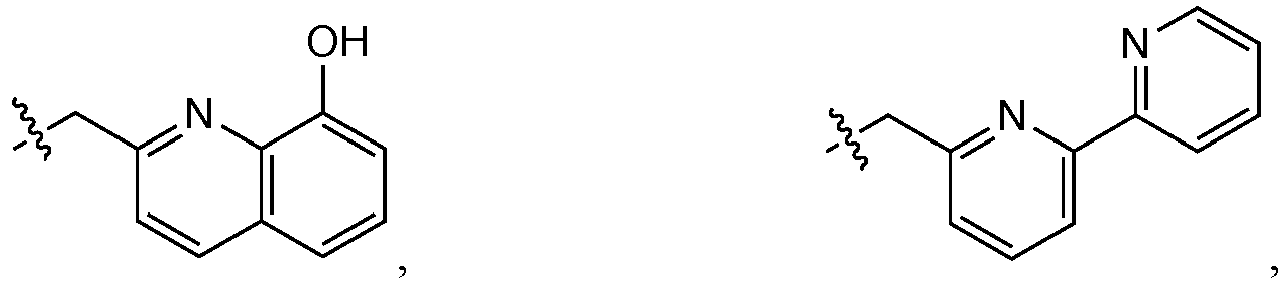
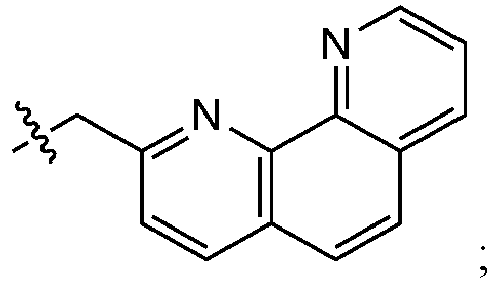
if X is selected from the second group, Z is selected from a second group consisting of

if X is selected from the third group, Z is selected from a third group consisting of


R1 and R2 independently are selected from the group consisting of a substituted or unsubstituted C1-C6 alkyl group, a substituted or unsubstituted C1-C6 heteroalkyl group, -C(O)-O-Ra, -C(O)-NRbRc, -C(O)-C(Ra)2-NRbRc, and -C(O)-NRb-(CH2)n-C(O)-O-Ra, wherein Ra, Rb and Rc each independently are selected from the group consisting of hydrogen, a substituted or unsubstituted C1-C6 alkyl group, a substituted or unsubstituted C1-C6 heteroalkyl group, a substituted or unsubstituted aryl group and a group L and n is an integer from 1 to 10;
R3 is selected from the group consisting of oxygen, sulfur, =NRd, and =CHRd, wherein Rd is selected from the group consisting of hydrogen, a substituted or unsubstituted C1-C6 alkyl group, a substituted or unsubstituted C1-C6 heteroalkyl group, a substituted or unsubstituted aryl group, -O-Re, -C(O)-O-Re, -C(O)-NRfRg, and a group L, Re is hydrogen or a substituted or unsubstituted C1-C6 alkyl group, and Rf and Rg each independently are hydrogen or a substituted or unsubstituted C1-C6 alkyl group; and
R4 is selected from the group consisting of -ORh, -SRh, -NHRh and -CH2Rh, wherein Rh is selected from the group consisting of hydrogen, a substituted or unsubstituted C1-C6 alkyl group, a substituted or unsubstituted C1-C6 alkenyl group, a substituted or unsubstituted C1-C6 alkynyl group, a substituted or unsubstituted C1-C6 heteroalkyl group, a substituted or unsubstituted aryl group, -C(O)-(CH2)m-Rk, -C(O)-(CH2)m-NRmRn, a group -A-L and a group L, Rk is selected from the group consisting of a substituted or unsubstituted C1-C6 alkyl group, a substituted or unsubstituted C1-C6 heteroalkyl group, a substituted or unsubstituted aryl group, and a substituted or unsubstituted carboxy group, Rm and Rn each independently are hydrogen or a substituted or unsubstituted C1-C6 alkyl group, and m is 0 or an integer from 1 to 10;
R5 and R6 independently are selected from the group consisting of hydrogen, chloro, bromo, iodo, and O-Ro, wherein R° is a substituted or unsubstituted C1-C6 alkyl group;
A is a linker group and
L is an amino acid residue or a peptide.
X is selected from consisting of a first group, a second group or a third group, wherein the first group consists of
R3 is selected from the group consisting of oxygen, sulfur, =NRd, and =CHRd, wherein Rd is selected from the group consisting of hydrogen, a substituted or unsubstituted C1-C6 alkyl group, a substituted or unsubstituted C1-C6 heteroalkyl group, a substituted or unsubstituted aryl group, -O-Re, -C(O)-O-Re, -C(O)-NRfRg, and a group L, Re is hydrogen or a substituted or unsubstituted C1-C6 alkyl group, and Rf and Rg each independently are hydrogen or a substituted or unsubstituted C1-C6 alkyl group; and
R4 is selected from the group consisting of -ORh, -SRh, -NHRh and -CH2Rh, wherein Rh is selected from the group consisting of hydrogen, a substituted or unsubstituted C1-C6 alkyl group, a substituted or unsubstituted C1-C6 alkenyl group, a substituted or unsubstituted C1-C6 alkynyl group, a substituted or unsubstituted C1-C6 heteroalkyl group, a substituted or unsubstituted aryl group, -C(O)-(CH2)m-Rk, -C(O)-(CH2)m-NRmRn, a group -A-L and a group L, Rk is selected from the group consisting of a substituted or unsubstituted C1-C6 alkyl group, a substituted or unsubstituted C1-C6 heteroalkyl group, a substituted or unsubstituted aryl group, and a substituted or unsubstituted carboxy group, Rm and Rn each independently are hydrogen or a substituted or unsubstituted C1-C6 alkyl group, and m is 0 or an integer from 1 to 10;
R5 and R6 independently are selected from the group consisting of hydrogen, chloro, bromo, iodo, and O-Ro, wherein R° is a substituted or unsubstituted C1-C6 alkyl group;
A is a linker group and
L is an amino acid residue or a peptide.
Description
- The invention relates to bispidine derivatives and the use thereof for the complexation of metal ions. Moreover, it relates to a method for preparing complexes having such bispidine derivatives as ligands, as well as such complexes.
- Nuclear medicine is considered to be a fast growing, interdisciplinary field of research, which makes use of open radioactive nuclides for diagnosis as well as therapy purposes. These so-called radiopharmaceuticals offer a new, more advantageous approach for cancer diagnosis and treatment. The biggest part of nuclear-medically usable radio-nuclides are metals, which is why the focus research in modern radiopharmaceuticals is just on these ("Therapeutic Radiopharmaceuticals" Chem. Rev. 1999, 99, 9, 2269-2292; "Radiopharmaceutical therapy in cancer: clinical advances and challenges" Nat. Rev. Drug. Discov. 2020, 19 (9), 589-608).
- In this regard, the radio-active nuclides of the lanthanoids and actinides take a special position, in particular Lutetium-177 as beta-emitting radionuclide and Actinium-225 as alpha-emitting radionuclide. Due to their long half-lives (177Lu: 6,7 d; 225Ac: 10 d) they are ideally suitable for use in radio therapy. Lutetium-177 preparations are already used as such ("Lutetium Lu-177 Dotatate Approved by FDA", Cancer Discovery 2018, 8, 4, OF2; Lutathera®: "The first FDA- and EMA-approved radiopharmaceutical for peptide receptor radionuclide therapy", Pharmaceuticals 2019, 12, 114). Development of new ligands for Lutetium-177 as well as Actinium-225 is a current question in research, since common ligands of these metal nuclides, for example 1,4,7,10-tetraazacyclododecane-1,4,7,10-tetraacetic acid (DOTA) and 2-[Bis[2-[bis(carboxymethyl)amino]ethyl]amino]acetic acid (DTPA), in spite of their high thermodynamic stability have drawbacks that have to be eliminated. Successful radiolabelling with DOTA ligands can only be realized by high temperatures, which is why this ligand for many applications becomes unsuitable. Alternatively, DTPA and its derivatives are used, which, however, are kinetic inert only to a low degree. ("Radioactive Main Group and Rare Earth Metals for Imaging and Therapy", Chem. Rev. 2019, 119, 2, 902-956).
- Thus, each of the known ligands is associated with disadvantages. DOTA requires high temperatures of 80°C to be able to carry out a complete radiolabelling. However, antibodies and target vectors often are thermolabile. Certainly, DTPA allows a fast complexation, but its kinetic lability is proved. In vivo decomplexation releases radioactive metal. Macropa (1,7,10,16-tetraoxa-4,13-diazacyclooctadecane) and its derivatives are used as complexing agents for Targeted Alpha Therapy (TAT), mainly for actinium-225. However, only an insufficient conversion of the radiolabeling with lanthanides, such as Lu3+ is achieved, the specific activity is low and the complexes are kinetically labile, so that radioactive metal ions can be liberated ("Implementing f-Block Metal ions in Medicine: Tuning Size Selectivity of expanded Macrocycles", Inorg. Chem. 2019, 58, 10483.).
- Bispidine derivatives are known from the prior art that are used as ligands for radiolabelings. Bispidine is a compound of formula PI

- The problem of the invention is to eliminate the drawbacks according to the prior art. In particular, there are provided compounds that are suitable as ligands for the complexation of large metal ions under mild conditions. In addition, there are provided complexes having a high kinetic stability. Finally, there are provided the use of the compounds for the complexation of metal ions and a method for preparing the complexes.
- This problem is solved by the features of claims 1, 10, 12, and 14. Practical developments of the inventions result from the features of the dependent claims.
- According to the invention there is provided a compound of general formula I

- X is selected from a first group or a second group or a third group, wherein the first group consists of


- Y is a group of general formula II or of general formula III

- if X is selected from the first group, Z is selected from a first group consisting of


- if X is selected from the second group, Z is selected from a second group consisting of

- if X is selected from the third group, Z is selected from a third group consisting of


- R1 and R2 independently are selected from the group consisting of a substituted or unsubstituted C1-C6 alkyl group, a substituted or unsubstituted C1-C6 heteroalkyl group, -C(O)-O-Ra, -C(O)-NRbRc, -C(O)-C(Ra)2-NRbRc, and -C(O)-NRb-(CH2)n-C(O)-O-Ra, wherein Ra, Rb and Rc each independently are selected from the group consisting of hydrogen, a substituted or unsubstituted C1-C6 alkyl group, a substituted or unsubstituted C1-C6 heteroalkyl group, a substituted or unsubstituted aryl group, a group -A-L, and a group L and n is an integer from 1 to 10;
- R3 is selected from the group consisting of oxygen, sulfur, =NRd, and =CHRd, wherein Rd is selected from the group consisting of hydrogen, a substituted or unsubstituted C1-C6 alkyl group, a substituted or unsubstituted C1-C6 heteroalkyl group, a substituted or unsubstituted aryl group, -O-Re, -C(O)-O-Re, -C(O)-NRfRg, a group -A-L, and a group L, Re is hydrogen or a substituted or unsubstituted C1-C6 alkyl group, and Rf and Rg each independently are hydrogen or a substituted or unsubstituted C1-C6 alkyl group; and
- R4 is selected from the group consisting of -ORh, -SRh, -NHRh and -CH2Rh, wherein Rh is selected from the group consisting of hydrogen, a substituted or unsubstituted C1-C6 alkyl group, a substituted or unsubstituted C1-C6 alkenyl group, a substituted or unsubstituted C1-C6 alkynyl group, a substituted or unsubstituted C1-C6 heteroalkyl group, a substituted or unsubstituted aryl group, -C(O)-(CH2)m-Rk, -C(O)-(CH2)m-NRmRn, a group -A-L, and a group L, Rk is selected from the group consisting of a substituted or unsubstituted C1-C6 alkyl group, a substituted or unsubstituted C1-C6 heteroalkyl group, a substituted or unsubstituted aryl group, and a substituted or unsubstituted carboxy group, Rm and Rn each independently are hydrogen or a substituted or unsubstituted C1-C6 alkyl group, and m is 0 or an integer from 1 to 10;
- R5 and R6 independently are selected from the group consisting of hydrogen, chloro, bromo, iodo, and O-Ro, wherein Ro is a substituted or unsubstituted C1-C6 alkyl group;
- A is a linker group; and
- L is selected from the group consisting of an amino acid residue and a peptide.
- In a compound of formula I it may be provided that X, Y, and Z have the meanings given above, wherein
- R1 and R2 independently are selected from the group consisting of a substituted or unsubstituted C1-C6 alkyl group, -C(O)-O-Ra, -C(O)-NRbRc, -C(O)-C(Ra)2-NRbRc, and -C(O)-NRb-(CH2)n-C(O)-O-Ra, wherein Ra, Rb, and Rc each independently are selected from the group consisting of hydrogen, a substituted or unsubstituted C1-C6 alkyl group, a substituted or unsubstituted aryl group, a group -A-L, and a group L; and n is an integer from 1 to 10;
- R3 is selected from the group consisting of oxygen, sulfur, =NRd, and =CHRd, wherein Rd is selected from the group consisting of hydrogen, a substituted or unsubstituted C1-C6 alkyl group, a substituted or unsubstituted aryl group, -O-Re, - C(O)-O-Re, -C(O)-NRfRg, a group -A-L, and a group L, Re is hydrogen or a substituted or unsubstituted C1-C6 alkyl group, and Rf and Rg each independently are hydrogen or a substituted or unsubstituted C1-C6 alkyl group; and
- R4 is selected from the group consisting of -ORh, -SRh, -NHRh, and -CH2Rh, wherein Rh is selected from the group consisting of hydrogen, a substituted or unsubstituted C1-C6 alkyl group, a substituted or unsubstituted C1-C6 alkenyl group, a substituted or unsubstituted C1-C6 alkynyl group, a substituted or unsubstituted C1-C6 heteroalkyl group, a substituted or unsubstituted aryl group, -C(O)-(CH2)m-Rk, -C(O)-(CH2)m-NRmRn, a group -A-L, and a group L, Rk is selected from the group consisting of a substituted or unsubstituted C1-C6 alkyl group, a substituted or unsubstituted C1-C6 heteroalkyl group, a substituted or unsubstituted aryl group, and a substituted or unsubstituted carboxy group, Rm and Rn each independently are hydrogen or a substituted or unsubstituted C1-C6 alkyl group, and m is 0 or an integer from 1 to 10;
- R5 and R6 independently are selected from hydrogen, O-Ro, wherein Ro is a substituted or unsubstituted C1-C6 alkyl group;
- A is a linker group; and
- L is selected from the group consisting of an amino acid residue and a peptide.
- The compounds according to the invention have a high radiolytic and chemical stability compared to the known compounds. Further, they allow a quantitative radiolabeling of both Lutetium and Actinium metal ions. In particular, the compounds according to the invention have shown a high stability to human serum albumin as well as faster radiolabeling at mild conditions with radiochemical purities of >95%. Moreover, the compounds according to the invention allow to insert biomolecules to the bispidine moiety, for example via one or more of the following residues: residues R1, R2, R3, R4. The biomolecule may be a group L. It may be provided that the compound according to the invention has no or only one group L.
- According to the invention a first embodiment of the invention is provided in which X is selected from the first group of meanings given for X and Z is selected from the first group of meanings given for Z. In a second embodiment X is selected from the second group of meanings given for X and Z is selected from the second group of meanings given for Z. In a third embodiment X is selected from the third group of meanings given for X and Z is selected from the third group of meanings given for Z. In this way, it can be ensured that the compounds of general formula I according to the invention can be used as nona- or decadentate ligands for the complexation of metal ions.
- R1 and R2 each independently can be a substituted or unsubstituted C1-C6 alkyl group. A substituted C1-C6 alkyl group may be for example a C1-C6 alkyl group having an OH group. In a preferred embodiment the substituted C1-C6 alkyl group may be -CH2-OH. R1 and R2 each independently may be -C(O)-NRb-(CH2)n-C(O)-O-Ra. Preferably, then Rb is hydrogen, n = 3, and Ra has the meanings given in context with general formula I.
- It may be provided that R1 and R2 independently are -C(O)-O-Ra, wherein Ra has the meanings given in context with general formula I. In a more preferred embodiment, R1 and R2 each are -C(O)-O-Ra, wherein Ra is hydrogen or a substituted or unsubstituted C1-C6 alkyl group. In a particularly preferred embodiment R1 and R2 each are -C(O)-O-Ra, wherein Ra is a methyl group. Preferably, R1 and R2 have the same meaning.
- Preferably, R1 and R2 independently are selected from the group consisting of -CH2-OH, -COOH, -C(O)-O-CH3, and -C(O)-NH-(CH2)3-C(O)-O-Ra, wherein Ra has the meanings given in context with general formula I. Preferably, R1 and R2 both are -C(O)-O-CH3.
- Preferably, R1 and R2 have the same meaning. In the following, compounds of general formula I are shown, in which R1 and R2 have the same meaning. In the compound of general formula 1-1 R1 and R2 each are -CH2-OH:


- It may be provided that R3 is oxygen or =NRd, wherein Rd has the meanings given in context with general formula I. In a preferred embodiment R3 is =N-O-Rd, wherein Rd has the meanings given in context with general formula I. In a more preferred embodiment R3 is =N-O-Rd, wherein Rd is a substituted or unsubstituted C1-C6 alkyl group. In a particularly preferred embodiment R3 is =N-O-CH3.
- The compound of general formula 1-5 shown below is a preferred compound of general formula I, in which R1 and R2 both are -C(O)-O-CH3 and R3 is =N-O-CH3.

- It may be provided that R4 is ORh, wherein Rh has the meanings given in context with general formula I. Preferably, R4 is ORh, wherein Rh is selected from the group consisting of hydrogen, a substituted or unsubstituted C1-C6 alkyl group, a substituted or unsubstituted C1-C6 alkynyl group, -C(O)-(CH2)m-Rk, -C(O)-(CH2)m-NRmRn, and a group L, wherein Rk is selected from the group, consisting of a substituted or unsubstituted C1-C6 alkyl group, a substituted or unsubstituted C1-C6 heteroalkyl group, a substituted or unsubstituted aryl group, and -COOH, Rm and Rn each independently are hydrogen or a substituted or unsubstituted C1-C6 alkyl group, and m is 0 or an integer from 1 to 10. R4 can be an SH group. A preferred substituted or unsubstituted aryl group is a substituted or unsubstituted phenyl group. The substituted aryl group may be for example a phenyl group bearing an isothiocyanate group or chlorine.
- In a preferred embodiment R4 is -OH or -ORh, wherein Rh has the meanings given in context with general formula I. In a particularly preferred embodiment R4 is -OH or -ORh, wherein Rh is a group -A-L or a group L.
- In another preferred embodiment R4 is selected from the group consisting of -O-C(O)-CH2-COOH, -O-CH2-C=CH3, -O-CH2-phenyl-isothiocyanate, -O-C(O)-CH2-NH2, and -O-C(O)-phenyl-Cl.
- The compounds of general formulae I-6, I-7, I-8, I-9, and I-10 shown below are preferred compounds of general formula I, in which R1 and R2 both are -C(O)-O-CH3. In the compound of general formula 1-6 R4 is -O-CH2-COOH:


- Preferably, R5 and R6 independently are selected from hydrogen and O-Ro, wherein Ro is a substituted or unsubstituted C1-C6 alkyl group. More preferably, R5 and R6 independently are selected from hydrogen and O-CH3. Preferably, R5 and R6 have the same meaning. Particular preferred, R5 and R6 are both hydrogen. In another embodiment, R5 and R6 are both O-CH3.
- In a preferred embodiment,
- X and Z have the meanings given in context with general formula I;
- R1 and R2 both are -C(O)-O-CH3;
- Y is a group of general formula III;
- R4 is -OH or -ORh, wherein Rh has the meanings given in context with general formula I; and
- R5 and R6 are both hydrogen.
- In another preferred embodiment,
- X is selected from the first group or the second group;
- Z has the meanings given in context with general formula I;
- R1 and R2 both are -C(O)-O-CH3;
- Y is a group of general formula III;
- R4 is -OH or -ORh, wherein Rh has the meanings given in context with general formula I; and
- R5 and R6 are both hydrogen.
- Group L may be an amino acid residue or a peptide. If the compound according to the invention has no group L, it can be used to chemically bind a biomolecule to a bispidine moiety. For example, this can be done via one or more of the following residues: residues R1, R2, R3, R4. The biomolecule may be a group L. An amino acid residue means a group that has a substituted or unsubstituted carboxy group and at least one substituted or unsubstituted amino group. A peptide means a group that has two or more amino acids that are bound to each other via a peptide binding. For example, the peptide may be somatostatin or a somatostatin analogue such as octreotide or octretate. Octretate has the amino acid sequence H-D-Phe-Cys-Phe-D-Trp-Lys-Thr-Cys-Thr-OH. It may be provided that the peptide has no more than 12 amino acid moieties.
- In one preferred example, group L is a group of formula L1:

- Group L can be connected by a linker group A to the bispidine unit. One preferred example of a linker group is a group of formula A1:


- In a first preferred embodiment X is a group of formula


- In a second preferred embodiment X is a group of formula


- For preparing the compounds of general formula I according to the invention it can be started with a bispidine precursor. The synthesis of a bispidine precursor can follow the way described in Mannich, C. and Mohs, Paul, Berichte der deutschen chemischen Gesellschaft (A and B Series), 63(3), 608-612, 1930. doi: 10.1002/cber.19300630314. The bispidine precursor may be a compound having R1, R2, X and either R3 or R4. Subsequently, group Z is introduced. Alternatively, the bispidine precursor may be a compound having R1, R2, Z and either R3 or R4. Subsequently, group X is introduced.
- Scheme 1 shows a first way of preparing a compound of general formula I:

- Scheme 2 shows a second way of preparing a compound of general formula I:

- General descriptions of processing modi for preparing the compounds according to the invention are given in section "General Synthesis Methods for the Compounds of general Formula I".
- According to the invention further provided is the use of a compound of general formula I according to the invention for the complexation of a metal ion. The metal ion forms the central particle of the complex, the compound of general formula I the ligand of the complex. The metal ion may be a trivalent metal ion. The metal ion may be a radioactive metal ion. Preferably, the metal ion is selected from the group consisting of a lanthanide ion, an actinide ion, an indium ion, a thorium ion, and a bismuth ion. More preferred, the metal ion is selected from the group consisting of a lanthanide(III) ion, an actinide(III) ion (for example a thorium(III) ion), an indium(III) ion, and a bismuth(III) ion. Still more preferred, the metal ion is a lutetium ion or an actinium ion. In particular, the compound according to the invention can be used for the complexation of [177Lu]Lu ions or [225Ac]Ac ions. The compound according to the invention binds a radioactive lanthanide ion or a radioactive actinide ion with high stability. The complexes formed are stable in-vitro.
- The compounds of general formula I according to the invention in the complexation of the metal ions may form nona- and decadentate ligands around the central particle. The compounds of general formula I according to the invention are nona- or decadentate bispidine derivatives.
- According to the invention additionally provided is a method for the complexation of metal ions, in particular of lutetium ions or actinium ions, wherein a compound of general formula I according to the invention is contacted with the metal ion at a reaction temperature in the range of from 20 to 50°C. Preferably, the compound of general formula I according to the invention is contacted with the metal ion at room temperature.
- The method according to the invention can be carried out at the reaction temperature of 37°C. Preferably, the method according to the invention is carried out with a protic solvent, for example water. The pH value may be chosen in dependence on the used metal ion. Generally, the reaction may be carried out at a pH value of 5.5 to 7.5, preferably of 6 to 7 and particularly preferred at a pH value of 6 or 7. In case of a bismuth(III) ion, the reaction may be carried out at a pH value of 4.5 to 5. In the case of a [177Lu]Lu ion or a [225Ac]Ac ion, the reaction is preferably carried out at a pH value of 5.5 to 7.5, preferably of 6 to 7 and particularly preferred at a pH value of 6 or 7.To adjust the pH value a buffer can be added to the solvent. For example, the buffer may be an ammonium acetate. For example, a solution can be used that contains 0.1 to 0.2, preferably 0.15 M, of buffer.
- The method according to the invention can be carried out at ambient pressure. A protective gas is not required.
- It may be provided that the molar ratio of the compound of general formula I to a non-radioactive metal ion in the solution is 1 : 1.
- A measure for the ratio of a radionuclide to a ligand is the so-called molar specific activity (activity per amount of substance), i. e. the activity of [177Lu]Lu ions or [225Ac]Ac ions to the amount of the compound of general formula I. The lower the amount of the compound of general formula I (preferably between 10-6 and 10-8 M), the higher the specific activity and the less the compound of general formula I is present in excess. A low specific activity is indicative of the presence of a large amount of "non-radioactive labelled" compound, that might cause side reactions in vivo. The molar specific activity is preferably in a range from 50 to 500 MBq/nmol.
- Preferably, the metal ion is provided as an inorganic salt. Inorganic salts of radioactive metal ions may be provided as solution in 0.01 M HCl. For example, the lutetium ions can be provided as LuCl3, in case of radioactive lutetium ions as [177Lu]LuCl3. The actinium ions can be provided as AcNO3, for example as [225Ac]AcNO3.
- According to the invention further provided is a complex of a compound of general formula I according to the invention as ligands and a metal ion. The metal ion is preferably selected from the group consisting of a lanthanide ion, an actinide ion, or a bismuth ion. More preferably, the metal ion is a lutetium ion or an actinium ion, particularly preferably, a trivalent lutetium ion or a trivalent actinium ion. The metal ion, for example the lutetium ion or the actinium ion, may be a radioactive metal ion. In particular, the compound according to the invention can be used for the complexation of trivalent metal ions, preferably for the complexation of [177Lu]Lu ions or [225Ac]Ac ions.
- The complex according to the invention consists of a central particle and one ligand. The metal ion forms the central particle of the complex. The compounds of general formula I according to the invention form a nona- or decadentate ligand. The complex may be a cation. The counter ion to the cation may be selected from the group consisting of Cl-, Br, I-, NO3 -, CF3SO2 - (OTf), CH3COO- (OAc), and CF3CO2 -.
- Preferred complexes according to the invention are complexes having a [177Lu]Lu ion as the central particle and a compound A1, A2, A3 or A4 as the ligand. Other preferred complexes according to the invention are complexes having an [225Ac]Ac ion as the central particle and a compound A1, A2, A3 or A4 as the ligand.
- The compounds of general formula I according to the invention advantageously allow to utilize the preferred coordination geometry of the lanthanide ions and actinide ions. They allow a fast complexation due to their open-chain structures. The complexes according to the invention possess a high kinetic stability due to the rigid backbone that is formed by the compounds according to the invention.
- The compounds of general formula I according to the invention allow a fast quantitative radiolabeling under mild conditions. The complexes according to the invention possess a high specific molar activity and an excellent serum stability. Radiolabeling means the formation of a complex according to the invention having a radioactive metal ion as the central particle.
- It is a particular advantage that radiolabeling can be carried out at 37°C. The complex according to the invention possesses a high kinetic stability in the presence of human serum, so that no trans metalation takes place.
- The compounds of general formula I according to the invention allow an easy functionalization of the bispidine moiety with a biomolecule, for example a group L.
- The invention allows the preparation of radiopharmaceuticals by fast and efficient radiolabeling with trivalent metal ions, mainly lanthanides and actinides. The complexes prepared retain the required kinetic stability. Thus, the invention allows to provide lanthanide and actinide radiopharmaceuticals. Said radiopharmaceuticals can be used for the diagnosis and therapy of cancer diseases, for example as alpha emitters, beta minus emitters or gamma emitters.
- Thus, the complexes according to the invention can be used as a medicament, in particular as a medicament for oncologic diseases. Also, a pharmaceutically acceptable salt of a complex according to the invention can be used as a medicament, in particular as a medicament for oncologic diseases. In one embodiment, the complexes according to the invention can be used as a medicament for the diagnosis and therapy of a carcinoma. Also, a pharmaceutically acceptable salt of a complex according to the invention can be used as a medicament, in particular as a medicament for the diagnosis and therapy of a carcinoma. One example of an oncologic disease is a gastroenteropancreatic neuroendocrine tumor.
- Thus, according to the invention it is provided the use of a complex according to the invention, preferably a complex having a [177Lu]Lu ion or an [225Ac]Ac ion as the central particle, as a medicament. Thus, a complex according to the invention that has a [177Lu]Lu ion or an [225Ac]Ac ion as the central particle can be used as a radiopharmaceutical. Preferably, the medicament is a radiopharmaceutical for use in the nuclear-medical therapy and diagnostics. A complex according to the invention may be used in the nuclear-medical imaging by means of single-photon emission computed tomography (SPECT) (for example in case of a complex having the metal ion Lu) or positron emission tomography (PET). For example, a complex having the metal ion Lu or Tb can be used for this purpose.
- In the following, the invention is explained in more detail with the help of examples not intended to limit the invention.
- Examples of compounds according to the invention are given in table 1.
Table 1 Compound Structure Name A1 
dimethyl 7-(bis(8-hydroxyquinoline-2-yl)methyl)-9-hydroxy-2,4-di(pyridine-2-yl)-3-(pyridine-2-ylmethyl)-3,7-diazabicyclo[3.3.1]nonane-1,5-dicarboxylate A2 
6'-((7-((6-carboxypyridine-2-yl)methyl)-9-hydroxy-1,5-bis(methoxycarbonyl)-2,4-di(pyridine-2-yl)-3,7-diazabicyclo[3.3.1]nonane-3-yl)methyl)-[2,2'-bipyridine]-6-carboxylic acid A3 
6-((7-(bis(8-hydroxyquinoline-2-yl)methyl)-9-hydroxy-1,5-bis(methoxycarbonyl)-2,4-di(pyridine-2-yl)-3,7-diazabicyclo[3.3.1]nonane-3-yl)methyl)picolinic acid
Compound A4 shown below is a further example of a compound of general formula I. The designation "py" indicates a pyridyl group.

- Examples of complexes according to the invention are given in table 2.
Table 2 Complex Structure (1) Central Particle (2) Ligand (3) Anion X - K1 = [177Lu]Lu-A2 
(1) [177Lu]Lu3+ (2) A2 (3) Cl-, Br-, I-, NO3 -, CF3SO2 -, CH3COO- or CF3CO2 - K2 = [177Lu]Lu-A1 
(1) [177Lu]Lu3+ (2) A1 (3) Cl-, Br-, I-, NO3 -, CF3SO2 -, CH3COO- or CF3CO2 - K3 = [177Lu]Lu-A3 
(1) [177Lu]Lu3+ (2) A3 (3) Complex is no cation. K4 = [225Ac]Ac-A1 
(1) [225Ac]Ac (2) A1 (3) Cl-, Br-, I-, NO3 -, CF3SO2 -, CH3COO- or CF3CO2 - K5 = [225Ac]Ac-A2 
(1) [225Ac]Ac (2) A2 (3) Cl-, Br-, I-, NO3 -, CF3SO2 -, CH3COO- or CF3CO2 - K6 = [225Ac]Ac-A3 
(1) [225Ac]Ac (2) A3 (3) Complex is no cation - The term "alkyl", unless specified otherwise, particularly relates to a monovalent, saturated, aliphatic hydrocarbon group having a branched or unbranched carbon chain with 1 to 12 carbon atoms, preferably 1 to 8 carbon atoms, and particularly preferably 1 to 6 carbon atoms. Examples of alkyl groups include, but are not limited to methyl, ethyl, propyl, isopropyl, isobutyl, sec-butyl, tert-butyl, pentyl, n-hexyl, octyl, dodecyl and the like. The alkyl group may optionally be substituted with one or more substituents, wherein each substituent independently is hydroxy, alkyl, alkoxy, halogen, haloalkyl, amino, mono-alkylamino or dialkylamino, unless specified otherwise.
- The term "heteroalkyl" particularly relates to an alkyl residue, as defined herein, wherein one, two or three hydrogen atoms were substituted by a substituent independently selected from the group consisting of -ORA, -NRBRC, and -S(O)nRD (in which n is an integer from 0 to 2), with the proviso that the point of attachment of the heteroalkyl residue is a carbon atom, wherein RA is hydrogen, acyl, alkyl, cycloalkyl, or cycloalkylalkyl; RB and RC independently are hydrogen, acyl, alkyl, cycloalkyl, or cycloalkylalkyl; and if n is 0, RD is hydrogen, alkyl, cycloalkyl, or cycloalkylalkyl, and if n is 1 or 2, Rd is alkyl, cycloalkyl, cycloalkylalkyl, amino, acylamino, monoalkylamino or dialkylamino. Representative examples include, but are not limited to 2-hydroxyethyl, 3-hydroxypropyl, 2-hydroxy-1-hydroxymethylethyl, 2,3-dihydroxypropyl, 1-hydroxymethylethyl, 3-hydroxybutyl, 2,3-dihydroxybutyl, 2-hydroxy-1-methylpropyl, 2-aminoethyl, 3-aminopropyl, 2-methylsulfonylethyl, aminosulfonylmethyl, aminosulfonylethyl, aminosulfonylpropyl, methylamino-sulfonylmethyl, methylaminosulfonylethyl, methylaminosulfonylpropyl and the like.
- The term "cycloalkyl" particularly relates to monovalent, saturated, carbocyclic groups consisting of mono or bicyclic rings. The cycloalkyl group may optionally be substituted with one or more substituents, wherein each substituent independently is hydroxy, alkyl, alkoxy, halogen, haloalkyl, amino, monoalkylamino or dialkylamino, unless specified otherwise. Examples of cycloalkyl components include, but are not limited to cyclopropyl, cyclobutyl, cyclopentyl, cyclohexyl, cycloheptyl, and the like, including partially unsaturated derivatives thereof, such as cyclohexenyl, cyclopentenyl, and the like.
- The term "alkenyl", unless specified otherwise, particularly relates to an unsaturated, aliphatic hydrocarbon group having a branched or unbranched carbon chain with 2 to 12 carbon atoms, preferably 2 to 8 carbon atoms, and particularly preferably 2 to 6 carbon atoms, that has at least one olefinic double bond, and more preferably one single double bond. Examples of alkenyl groups include, but are not limited to vinyl, allyl, methallyl, 1,1-dimethylallyl, propenyl, butenyl, pentadienyl, hexenyl, octenyl, and the like. An allyl group is preferred. The alkenyl group may optionally be substituted with one or more substituents, wherein each substituent independently is hydroxy, alkyl, alkoxy, halogen, haloalkyl, amino, monoalkylamino or dialkylamino, unless specified otherwise.
- The term "alkynyl", unless specified otherwise, particularly relates to an unsaturated, aliphatic hydrocarbon group having a branched or unbranched carbon chain with 2 to 12 carbon atoms, preferably 2 to 8 carbon atoms, and particularly preferably 2 to 6 carbon atoms, that has at least one olefinic triple bond and more preferably one single triple bond. Examples of alkynyl groups include, but are not limited to acetylenyl, propargyl, n-but-2-yn-1-yl, and the like. A propargyl group is preferred. The alkynyl group may optionally be substituted with one or more substituents, wherein each substituent independently is hydroxy, alkyl, alkoxy, halogen, haloalkyl, amino, monoalkylamino or dialkylamino, unless specified otherwise.
- The term "alkoxy", unless specified otherwise, particularly relates to a group of formula -OR, in which R is an alkyl group, as defined herein. Examples of alkoxy components include, but are not limited to methoxy, ethoxy, isopropoxy, and the like. The alkoxy group may optionally be substituted with one or more substituents, wherein each substituent independently is hydroxy, alkyl, alkoxy, halogen, haloalkyl, amino, monoalkylamino or dialkylamino, unless specified otherwise.
- The term "aryl", unless specified otherwise, particularly relates to a cyclic, aromatic hydrocarbon group consisting of a mono, bi or tricyclic aromatic ring system with 5 to 18 ring atoms, preferably 5 or 6 ring atoms. The aryl group may optionally be a substituted aryl group. Examples of aryl groups include, but are not limited to phenyl, naphthyl, anthracyl, naphthalenyl, phenanthryl, fluorenyl, indenyl, pentalenyl, azulenyl, oxydiphenyl, biphenyl, methylenediphenyl, aminodiphenyl, diphenylsulfidyl, diphenylsulfonyl, diphenylisopropylidenyl, benzodioxanyl, benzofuranyl, benzodioxylyl, benzopyranyl, benzoxazinyl, benzoxazinonyl, benzopiperadinyl, benzopiperazinyl, benzopyrrolidinyl, benzomorpholinyl, methylenedioxyphenyl, ethylenedioxyphenyl, and the like, including partially hydrogenated derivatives thereof. The term "substituted aryl group" particularly relates to an aryl group that is optionally independently substituted with one to four substituents, preferably one or two substituents selected from alkyl, cycloalkyl, heteroalkyl, hydroxyalkyl, halogen, nitro, cyano, isothiocyanato, hydroxy, alkoxy, amino, acylamino, monoalkylamino, dialkylamino, haloalkyl, haloalkoxy, urea, amido, alkanesulfonyl, -COR (in which R is hydrogen, alkyl, phenyl or phenylalkyl), -(CR'R")n-COOR (in which n is an integer from 0 to 5, R' and R" independently are hydrogen or alkyl, and R is hydrogen, alkyl, cycloalkyl, cycloalkylalkyl, phenyl or phenylalkyl) or -(CR'R")n-CONRA'RB' (in which n is an integer from 0 to 5, R' and R" independently are hydrogen or alkyl and RA' and RB' independently are hydrogen, alkyl, cycloalkyl, cycloalkylalkyl, phenyl or phenylalkyl). The aryl group, unless specified otherwise, may be mono or polyvalent, for example mono or divalent.
- The term "acyl", unless specified otherwise, relates to a group of formula -C(=O)R, wherein R is hydrogen or alkyl, as defined herein.
- The term "halogen" relates to fluorine, chlorine, bromine or iodine.
- A bispidine precursor (1.0 eq.) was suspended in acetonitrile (MeCN). After addition of base (1.0 - 6.0 eq.) and the respective alkylation agent (1.0 - 1.1 eq.) over a given time, the reaction mixture was stirred under reflux (30 min - 16 h). Leftover base was filtered and the solvent of the filtrate was removed under reduced pressure. The leftover solid was dissolved in dichloromethane (DCM) and water and the organic phase collected, followed by extraction of the aqueous phase with DCM. The combined organic phases were dried over Na2SO4 and the solvent removed in-vacuo. The compounds, comprising the protected bispidine derivative, were purified as described in each procedure.
- The protected bispidine derviative was dissolved in DCM and equivalent amounts of trifluoroacetic acid was added to the solution. The reaction mixture was stirred under reflux for 16 h, the solvent was removed in-vacuo using a separate cooling trap and the crude product was purified as described in each procedure. DMB indicates 2,4-dimethoxybenzyl, tBu a tert-butyl group.
- The protected bispidine derivative was placed in a three necked flask, suspended in EtOAc and 10 wt% of Pd/C was added. The flask was equipped with two adapters with stopcock and a reflux condenser attached to a balloon. The apparatus was flushed with nitrogen and put under vacuum using a water pump. This step was conducted three times, before the same was done using H2, leaving the apparatus under hydrogen the third time. The reaction mixture was stirred under reflux for at least 16 h until reaction control showed full conversion of the reactant. After filtration over Celite® the solvent was removed under reduced pressure. The product was obtained by ether diffusion into ethanolic solution.
- The method for preparing compound A1 is shown in scheme B1-1. The synthesis of the bispidine fragment 1 follows the process mode described in AF. Bruchertseifer, P. Comba, B. Martin, A. Morgenstern, J. Notni, M. Starke, H. Wadepohl, ChemMedChem 2020 ; BP. Comba, M. Starke, H. Wadepohl, ChemPlusChem 2018, 83, 597-604.

- The method for preparing compound 2 needed for preparing compound A1 is shown in scheme B1-2. The alkylation agent 2 was synthesized from literature known compound 5. Compound 5 is described in Y. Yamamoto, A. Miura, A. Kawamata, M. Miura, S. Takei, Bull. Chem. Soc. Jpn. 1978, 51, 3489-3495.

- 2.00 g of 5 (6.62 mmol, 1.0 eq.) was placed in a flame dried Schlenck tube under N2, 6.3 ml of acetic anhydride (Ac2O) (6.75 g, 66.2 mmol, 10.0 eq.) was added and the resulting slurry was stirred at room temperature (RT) for 30 min. Leftover acetic anhydride was removed in-vacuo with low heating (50°C). The product 6 was obtained as yellow solid and was used in the next reaction without further purification.
- The crude product of 6 (2.56 g, 6.62 mmol, 1.0 eq.) was suspended in CCl4 (65ml) and 1.18 g of N-bromosuccinimide (NBS) (6.62 mmol, 1.0 eq.) was added. The reaction mixture was refluxed for 30 min and after cooling to room temperature the precipitated solids were removed by filtration. The solvent of the filtrate was removed in-vacuo and the leftover solids dissolved in dichloromethane (DCM). The organic phase was washed with first water and then brine and then was dried over Na2SO4, filtrated and the solvent removed under reduced pressure. Compound 2 was obtained in quantitative yield as yellow solid (3.08 g, 6.62 mmol, 99 %).
1H-NMR (200 MHz, 300K, CDCl3): δ = 8.18 (d, J = 8.6 Hz, 2H, Har), 7.85 (d, J = 8.6 Hz, 2H, Har), 7.71 (dd, J = 8.1, 1.6 Hz, 2H, Har), 7.53 (dd, J = 8.1, 7.5 Hz, 2H, Har), 7.43 (dd, J = 7.5, 1.6 Hz, 2H, Har), 6.59 (s, 1H, CHBr), 2.36 (s, 6H, OAc). - The general procedure GP1 was conducted using following amounts: 500 mg of 1 (993 µmol, 1.0 eq.), 647 mg of Cs2CO3 (1.99 mmol, 2.0 eq.) and 462 mg of 2 (993 µmol, 1.0 eq.) in 20 ml of acetonitrile (MeCN) and 30 min reaction time. Compound 2 was added over time (10 min). The product was obtained as white solid after crystallization from acetone (390 mg, 437 µmol, 44 %).
2·0.25 Cs2CO3·1.5 H2O, [C52.25H53Cs0.5N7O11.5]: 1H-NMR (600 MHz, 295K, CDCl3): δ = 8.44 { 8.41 (m, 1H, Har), 8.41 { 8.37 (m, 2H, Hpy), 8.04 (d, J = 8.6 Hz, 2H, Hpy), 7.70 (d, J = 8.5 Hz, 3H, Har), 7.64 (dd, J = 8.2, 1.4 Hz, 2H, Har), 7.47 (t, J = 7.8 Hz, 2H, Har), 7.41 (dd, J = 7.5, 1.4 Hz, 2H, Hpy), 7.35 (td, J = 7.7, 1.9 Hz, 1H, Har), 7.19 { 7.14 (m, 2H, Hpy), 6.98 { 6.92 (m, 3H, Har), 6.65 (d, J = 7.8 Hz, 1H, Har), 5.32 (s, 1H, CHN7), 4.74 { 4.70 (m, 3H, CHpy/CHOH), 3.66 (s, 2H, CH2,py), 3.56 (s, 6H, CO2Me), 3.30 (d, J = 12.5 Hz, 2H, CH2,ax/eq), 3.08 (m, 2H, CH2,ax/eq), 2.48 (s, 6H, OAc) ppm. 13C-NMR (101 MHz, 295K, CDCl3): δ = 172.78, 169.91, 159.73, 149.12, 148.71, 147.65, 140.79, 136.28, 135.67, 135.54, 128.85, 126.15, 125.77, 124.58, 124.31, 123.28, 122.52, 121.58, 121.50, 78.32, 71.50, 65.99, 53.76, 52.22, 21.17, 15.41 ppm. ESI-HRMS (pos. DCM/MeOH): m/z [C50H46N7O9]+ ([M+H]+): calc.: 888.3352, exp.: 888.3370; m/z [C50H45N7NaO9]+ ([M+Na]+): calc.: 910.3171, exp.: 910.3189; elemental analysis (Nr.: 45315): calc.: C 60.57, H 4.86, N 9.84; exp.: C 60.66, H 4.83, N 9.96. - To a solution of 3 (212 mg, 238 µmol, 1.0 eq) in Methanol (MeOH) (10 ml) was added 75.9 mg Na2CO3 (716 µmol, 3.0 eq.) and the mixture was let to stir for 1 h at room temperature (RT). The solvent was removed under reduced pressure and the leftover solids dissolved in same amounts of dichloromethane (DCM) and water (20 ml). The phases were separated, the aqueous phase extracted with DCM (3x20 ml) and the combined organic phases dried over Na2SO4. After filtration the solvent was removed under reduced pressure. To remove coordination cations, the crude product was treated with trifluoroacetic acid (TFA). The TFA salt was obtained by crystallization from ethyl acetate (EtOAc). Compound A1 was neutralized using pH 7 buffer solution. After DCM extraction (3x50 ml) the combined organic phases were dried over Na2SO4 and the solvent was removed in-vacuo to furnish A1 as light-red solid (122 mg, 152 µmol, 64 %).
A1·2 MeOH, [C48H49N7O9]: 1H-NMR (400 MHz, 295K, CD3CN): δ = 8.68 - 8.61 (m, 1H, Hpy), 8.48 (d, J = 8.7 Hz, 2H, Hpy), 7.94 (d, J = 8.7 Hz, 2H, Hpy), 7.73 (d, J = 4.8 Hz, 2H, Har), 7.65 - 7.53 (m, 6H, Hpy,ar), 7.48 (td, J = 7.7, 1.8 Hz, 1H, Hpy), 7.24 (dd, J = 7.5, 1.4 Hz, 3H, Hpy), 7.14 - 7.05 (m, 4H, Har), 6.30 (d, J = 7.8 Hz, 1H, Hpy), 6.26 (s, 1H, CHN7), 5.02 (s, 2H, CHpy), 4.75 (s, 1H, CHOH), 4.02 - 3.93 (m, 4H, CH2,ax/eq), 3.55 (s, 2H, CH2,py), 3.49 (s, 6H, CO2Me). 13C-NMR (101 MHz, 295K, CD3CN): = 169.95, 155.74, 153.74, 150.60, 150.16,139.23, 138.61, 138.48, 138.04, 130.43, 129.54, 126.71, 124.89, 123.59, 123.46, 119.13, 112.51, 77.93, 71.78, 70.47, 66.22, 53.64, 53.40, 49.81, 15.56 ppm. ESI-HRMS (pos. DCM/MeOH): m/z [C46H42N7O7]+ ([M+H]+): calc.: 804.3140, exp.: 804.3155; m/z [C46H41N7NaO7]+ ([M+Na]+): calc.: 826.2960, exp.: 826.2977; m/z [C46H41KN7O7]+ ([M+K]+): calc.: 842.2699, exp.: 842.2624; elemental analysis (Nr.: 45429): calc.: C 66.42, H 5.69, N 11.30, exp.: C 66.26, H 5.70, N 11.03. - The method for preparing compound A2 is shown in scheme B2-1. Piperidone 7, tert-butyl 6-(bromomethyl)picolinate 11, and 6'-methyl-2,2'-bipyridin carboxylic acid 17 were synthesized according to literature procedure. Compound 7 was synthesized as described in P. Barman, A. K. Vardhaman, B. Martin, S. J. Worner, C. V. Sastri, P. Comba, Angew. Chem. Int. Ed. Engl. 2015, 54, 2095-2099. Compound 11 was synthesized as described in P. Comba, U. Jermilova, C. Orvig, B. O. Patrick, C. F. Ramogida, K. Ruck, C. Schneider, M. Starke, Chem. Eur. J. 2017, 23, 15945-15956. Compound 17 was synthesized as described in M. H. Al-Sayah, R. McDonald, N. R. Branda, Eur. J. Org. Chem. 2004, 2004, 173-182.

- The method for preparing compound 14 needed for preparing compound A1 is shown in scheme B2-2.

- Piperidone 7 (10.2 g, 21.8 mmol, 1.0 equiv.) was suspended in ethanol (EtOH) (130 ml) and heated to 50°C. To this suspension, 2,4-dimethoxybenzylamine (3.80 ml, 4.20 g, 25.1 mmol, 1.2 equiv.) and formaldehyde (3.70 ml, 37% in water, 1.61 g, 50.1 mmol, 2.3 equiv.) were added dropwise and simultaneously by syringe in a period of 5 min. The reaction mixture was refluxed for 16h. After cooling to room temperature, the solvent was removed under reduced pressure, the remaining solid was dissolved in EtOH (15 ml). Layering with diethyl ether yielded 8 as colorless solid (6.87 g, 10.6 mmol, 48%).
1H-NMR (200 MHz, CDCl3): δ = 8.49 (ddd, J = 4.9, 1.8, 0.8 Hz, 2H, Hpy), 8.13 (d, J = 7.9 Hz, 2H, Hpy), 7.43 (td, J = 7.7, 1.8 Hz, 2H, Hpy), 7.21 - 7.00 (m, 4H, Hpy,Bn), 6.84 (dd, J = 7.0, 2.6 Hz, 2H, Hpy), 6.63 (d, J = 2.4 Hz, 1H, HBn), 6.44 (dd, J = 8.2, 2.4 Hz, 1H, HBn), 5.08 (s, 2H, CHpy), 4.01 (s, 2H, CH2), 3.87 (s, 2H, CH2), 3.75 (s, 6H, CO2Me), 3.46 (s, 2H, CH2Bn/DMB), 3.39 (s, 2H, CH2Bn/DMB), 3.10 (d, J = 12.9 Hz, 2H, CH2ax,eq), 2.43 (d, J = 12.3 Hz, 2H, CH2ax,eq) ppm. - Compound 8 (6.87 g, 10.6 mmol, 1.0 equiv.) was suspended in 180 ml of a 1,4-dioxane-water mixture (3:1) and cooled to -5°C. A solution of sodium borohydride (201 mg, 5.30 mmol, 0.5 equiv.) in 90 ml of the same solvent mixture was added with a dropping funnel in a period of 20 min. The reaction mixture was allowed to warm up to 0°C and stir at this temperature for 16h. The pH value was set to 1 by adding concentrated sulfuric acid and the solution was stirred for 20 min. The volume was reduced to 50 ml under reduced pressure and an aqueous solution of sodium hydroxide (20 wt%) was added to adjust the pH value to 9. The resulting slurry was stirred for 1h at room temperature before adding DCM (100 ml). The leftover solid was filtered off and the liquid layers separated. Afterwards the aqueous phase was extracted with DCM (3x50 ml), the combined organic layers were dried over anhydrous Na2SO4. filtrated and the solvent removed under reduced pressure. Compound 9 was used in the next step without further purification.
- 9·1.5 1,4-dioxane: HRMS (ESI): m/z calcd for C37H41N4O7 +: 653.2970 [M+H]+; found: 653.2971; elemental analysis calcd (%) for C43H52N4O10: C 65.80, H 6.68, N 7.14; found: C 66.01, H 6.64, N 7.36.
- The general procedure 2 (GP2) was conducted using following approach: Crude of 9 (6.82 g) was reacted in 25 ml of DCM with 25 ml of trifluoroacetic acid (TFA). The product was obtained by ether diffusion into methanolic solution resulted in colorless crystals of 10 as TFA salt (3.24 g, 5.25 mmol, 24% over two steps).
10·TFA: 1H-NMR (600 MHz, CDCl3): δ = 8.67 (s, 2H, Hpy), 7.76 - 7.55 (m, 2H, Hpy), 7.25 - 7.22 (m, 2H, Hpy), 7.20 - 7.15 (m, 1H, HBn), 7.12 (t, J = 7.3 Hz, 2H, Hpy), 7.06 (s, 2H, HBn), 6.61 (d, J = 7.4 Hz, 2H, HBn), 4.75 (s, 1H, CHOH), 4.53 (d, J = 7.8 Hz, 2H, CHpy), 3.70 (d, J = 3.2 Hz, 2H, CH2ax,eq), 3.66-3.56 (m, 2H, CH2Bn), 3.54 (s, 6H, CO2Me) 3.32 (s, 2H, CH2ax,eq) ppm; HRMS (ESI): m/z calcd for C28H31N4O5 +: 503.2289 [M+H]+; found: 503.2286; elemental analysis calcd (%) for C30H31F3N4O7: C 58.44, H 5.07, N 9.09; found: C 58.52, H 5.19, N 9.22. - The general procedure 1 (GP1) was conducted using following approach: 3.24 g of 10 (5.25 mmol, 1.0 equiv.), 3.34 g of Na2CO3 (31.5 mmol, 6.0 equiv.) and 1.64 g of tert-butyl 6-(bromomethyl)-picolinate 11 (6.04 mmol, 1.2 equiv.) were reacted in 100 ml of MeCN. 12 was recrystallized from hot ethanol (EtOH), yielding the pure compound as colorless solid (2.22 g, 3.20 mmol, 61%).
1H-NMR (200 MHz, CDCl3): δ = 8.49 (ddd, J = 4.9, 1.8, 0.9 Hz, 2H, Hpy), 8.14 (d, J = 7.9 Hz, 2H, Hpy), 8.07 (dd, J = 7.8, 1.1 Hz, 1H, Hpa), 7.78 (t, J = 7.7 Hz, 1H, Hpa), 7.57 - 7.37 (m, 3H, Hpy,pa), 7.25 - 7.14 (m, 2H, Hpy), 7.11 (ddd, J = 7.4, 4.9, 1.2 Hz, 2H, Hpy), 6.85 (dd, J = 7.4, 1.9 Hz, 2H, Hpy), 4.53 (s, 2H, CHpy), 4.49 (d, J = 5.4 Hz, 1H, CHOH), 3.60 (s, 6H, CO2Me), 3.58 (s, 2H, CH2pa,Bn), 3.43 (s, 2H, CH2pa,Bn), 2.66 - 2.46 (m, 4H, CH2ax,eq), 1.64 (s, 9H, tBu) ppm. - The general procedure 3 (GP3) was conducted using following approach: Compound 12 (2.22 g, 3.20 mmol, 1.0 equiv.) and Pd/C (222 mg, 10 wt%) were reacted in 140 ml EtOAc. The crude product was dissolved in EtOH (10 ml). Layering with diethyl ether (Et2O) yielded 13 as colorless solid (1.52 g, 2.53 mmol, 79%).
13·0.75MeOH: 1H-NMR (200 MHz, CDCl3): δ = 8.36 (d, J = 4.9 Hz, 2H, Hpy), 8.24 (d, J = 7.1 Hz, 1H, Hpa), 8.12 - 7.85 (m, 2H, Hpy,pa), 7.71 - 7.52 (m, 2H, Hpy,pa), 7.28-7.24 (m, 2H, Hpy), 7.19 (dd, J = 7.6, 4.8 Hz, 2H, Hpy), 5.03 (s, 2H, CHpy), 3.83 (s, 2H, CH2pa), 3.73 (d, J = 1.0 Hz, 1H, CHOH), 3.66 (s, 6H, CO2Me), 3.01 (d, J = 5.4 Hz, 4H, CH2ax,eq), 1.61 (s, 9H, tBu) ppm; HRMS (ESI): m/z calcd for C32H38N5O7 +: 604.2766 [M+H]+; found: 604.2727; m/z calc. for C32H37N5NaO7 +: 626.2585 [M+Na]+; found: 626.2587; elemental analysis calcd (%) for C32.75H40N5O7.75: C 62.67, H 6.42, N 11.16; found: C 62.40, H 6.38, N 11.33. - General procedure 1 (GP1) was followed with following approach: 927 mg of 13 (1.54 mmol, 1.0 equiv), 976 mg of Na2CO3 (9.21 mmol, 6.0 equiv.) and 536 mg of tert-butyl 6-(bromomethyl)-[2,2'-bipyridine] carboxylate 14 (1.54 mmol, 1.0 equiv.) were reacted in 30 ml of MeCN. The crude product was used in the next step without further purification.
UPLC-MS (APCI): m/z calcd for C48H54N7O9 +: 872.399 [M+H]+; found: 872.530 (peak intensity 100%; retention time: 4.00 min). HRMS (ESI): m/z calcd for C48H54N7O9 +: 872.3978 [M+H]+; found: 872.3968; m/z calc. for C48H53N7NaO9 +: 894.3797 [M+Na]+; found: 894.3787. - The general procedure 2 (GP2) was conducted with following approach: The crude of 15 (1.42 g, 1.0 equiv.) was reacted in 15 ml of DCM and 15 ml of trifluoroacetic acid (TFA). EtOH (10 ml) and 10 ml of diethyl ether were added to the crude solid. The formed precipitate was collected via filtration and the TFA salt of A2 was obtained as colorless solid (679 mg, 688 µmol, 45% over two steps).
16·1.25TFA·2MeOH·0.5MeCN: 1H-NMR (600 MHz, CD3OD): δ = 8.70 (s, 1H, Harom), 8.43 (t, J = 7.8 Hz, 2H, Harom), 8.33 - 8.25 (m, 3H, Harom), 8.27 - 8.23 (m, 2H, Harom), 8.07 (s, 1H, Harom), 7.76 - 7.61 (m, 3H, Harom), 7.33 - 7.19 (m, 2H, Harom), 7.07 (s, 2H, Harom), 6.57 (s, 1H, Harom), 5.39 - 5.36 (m, 2H, CHpy), 4.85 (s, 1H, CHOH), 4.75 (s, 2H, CH2bpic), 4.17 (s, 2H, CH2ax/eq), 3.78 (d, J = 12.5 Hz, 2H, CH2pic), 3.59 (s, 6H, CO2Me), 3.52 - 3.46 (m, 2H, CH2ax/eq) ppm; 13C-NMR (151 MHz, CD3OD): δ = 208.86, 200.12, 170.61, 168.18, 167.38, 162.85, 157.35, 156.32, 155.53, 151.58, 150.98, 150.91, 149.42, 140.73, 139.76, 138.97, 138.90, 138.71, 126.59, 126.14, 125.28, 121.31, 72.36, 70.79, 62.73, 55.09, 53.98, 53.29, 51.28 ppm;, HRMS (ESI): m/z calcd for C40H36N7O9 -: 758.2580 [M-H]-; found: 758.2580; m/z calcd for C42H37F3N7O11 -: 872.2509 [M+TFA-H]-; found: 872.2506. elemental analysis calcd (%) for C45.5H47.75F3.75N7.5O13.5: C 55.37, H 4.88, N 10.64; found: C 55.28, H 4.73, N 10.65. - 6'-Methyl-2,2'-bipyridine carboxylic acid 17 (2.52 g, 11.8 mmol, 1.0 equiv.) was dissolved in 100 ml of DCM. To this solution were added 4.22 ml of tert-butyl 2,2,2-trichloroacetimidate (5.15 g, 23.6 mmol, 2.0 equiv.) and a catalytic amount of Boron trifluoride diethyl etherate (BF3(Et2O)) (0.24 ml, 276 mg, 1.97 mmol, 20 µl/mmol acid) and the mixture was let to stir for 16h at room temperature. Sodium carbonate (approx. 150 mg) was added to quench the reaction, the solvent was removed in vacuo and the remaining solid extracted with 200 ml of n-hexane. The extraction process was repeated three times, before removing the solvent in vacuo yielded 18 as colorless solid (1.36 g, 5.00 mmol, 43%).
1H-NMR (400 MHz, CDCl3): δ = 8.64 (d, J = 8.8 Hz, 1H, Car), 8.40 (d, J = 7.9 Hz, 1H, Car), 8.03 (dt, J = 7.8, 1.0 Hz, 1H, Car), 7.91 (td, J = 7.8, 1.0 Hz, 1H, Car), 7.73 (dd, J = 8.7, 6.8 Hz, 1H, Car), 7.20 (d, J = 7.6 Hz, 1H, Car), 2.65 (s, 3H, CH3), 1.66 (s, 9H, tBu) ppm; 13C-NMR (101 MHz, CDCl3): δ = 164.28, 157.87, 154.65, 148.88, 137.80, 137.54, 124.71, 124.00, 118.99, 82.22, 28.28, 27.83 ppm. - To a solution of 18 (1.99 g, 7.34 mmol, 1.0 equiv.) in CCl4 (80 ml) was added N-bromosuccinimide (NBS) (1.31 g, 7.34 mmol, 1.0 equiv.) and azobisisobutyronitrile (AIBN) (199 mg, 1.22 mmol, 10 wt%). The resulting suspension was refluxed for 6h, cooled to room temperature, filtrated and the solvent removed in vacuo. Compound 14 was obtained as colorless solid after purification with column chromatography (SiO2, gradient from 100% petroleum ether to 15% ethyl acetate) in 30% yield (777 mg, 2.22 mmol).
14: 1H-NMR (200 MHz, CDCl3): δ = 8.64 (dd, J = 7.8, 1.3 Hz, 1H, Car), 8.52 (dd, J = 7.9, 1.0 Hz, 1H, Car), 8.06 (dd, J = 7.7, 1.3 Hz, 1H, Car), 7.93 (t, J = 7.7 Hz, 1H, Car), 7.84 (t, J = 7.8 Hz, 1H, Car), 7.48 (dd, J = 7.7, 1.0 Hz, 1H, Car), 4.63 (s, 2H, CH2), 1.67 (s, 9H, tBu) ppm; 13C-NMR (151 MHz, CDCl3): δ = 164.06, 156.19, 148.82, 138.54, 138.13, 138.11, 125.13, 124.32, 124.21, 123.49, 121.24, 82.47, 33.79, 28.28 ppm; HRMS (ESI): m/z calcd for C16H17BrN2NaO2 +: 371.0366 [M+Na]+; found: 371.0363; elemental analysis calcd (%) for C16H17BrN2O2: C 55.03, H 4.91, N 8.02; found: C 54.73, H 4.85, N 8.55. - Compound 15 prepared in example 2, step f can be used for preparing compound 21. Here, the OH group forming residue R4 is subjected to a functionalization. The preparation of compound 21 is shown in scheme B3-1. Compound 21 can be converted into a compound according to the invention by cleavage of the tert-butyl protective group.

- Under nitrogen and in a flame dried Schlenck flask, 15 (200 mg, 229 µmol, 1.0 eq.) was dissolved in dry tetrahydrofuran (THF). After addition of sodium hydride (NaH) (60 wtf%, 7.20 mg, 298 µmol, 1.3 eq.) the reaction mixture was stirred for 1 h at 50°C, until gas evolution stopped. 64.4 mg of 4-nitrobenzylbromide (298 µmol, 1.3 eq.) was added and the mixture was stirred at 50°C for 24 h. The reaction was stopped by adding water (5 ml), followed by extraction with DCM (3x50 ml). The combined organic phases were dried over Na2SO4, filtrated and the solvent removed under reduced pressure. The product 19 was obtained by column chromatography (C18-SiO2, gradient from 80 % water to 100 % MeOH) as orange solid (75.2 mg, 74.7 µmol, 32 %).
1H-NMR (400 MHz, 295K, CDCl3): = 9.06 (d, J = 7.8 Hz, 1H, Hpy), 8.52 - 8.40 (m, 3H, Hpa,bpa), 8.17 (d, J = 7.8 Hz, 2H, Hpa,bpa), 8.11 (d, J = 8.7 Hz, 2H, HBn-NO2), 8.05 (td, J = 7.4, 1.1 Hz, 2H, Hpa,bpa), 7.98 (t, J = 7.8 Hz, 1H, Hpa/bpa), 7.74 (t, J = 7.7 Hz, 1H, Hpy), 7.68 (t, J = 7.7 Hz, 1H, Hpy), 7.47 (td, J = 7.6, 1.8 Hz, 3H, Hpy,pa/bpa), 7.28 (d, J = 8.7 Hz, 2H, HBn-NO2), 7.09 (ddd, J = 7.5, 4.8, 1.2 Hz, 2H, Hpy), 6.77 (d, J = 7.5 Hz, 1H, Hpy), 5.08 (s, 2H, CH2,Bn-NO2), 4.65 (s, 2H, CHpy), 4.53 (s, 1H, CHOH), 3.66 (s, 2H, CH2,bpa), 3.57 (s, 2H, CH2,pa), 3.47 (s, 6H, CO2Me), 2.58 (s, 4H, CH2,ax/eq), 1.68 (s, 9H, tBu), 1.65 (s, 9H, tBu). 13C-NMR (101 MHz, 295K, CDCl3): = 172.64, 164.94, 164.32, 160.21, 159.69, 158.52, 156.77, 154.76, 154.67, 148.58, 147.40, 147.18, 146.73, 146.54, 137.24, 137.22, 137.00, 136.95, 136.41, 135.96, 128.46, 127.48, 126.95, 125.76, 124.41, 123.58, 122.66, 119.77, 82.28, 82.19, 81.71, 77.48, 76.84, 73.77, 70.09, 65.37, 53.57, 52.67, 51.95, 50.31, 28.41, 28.31. ESI-HRMS (pos. DCM/MeOH): m/z [C55H59N8O11]+ ([M+H]+): calc.: 1007.4298, exp.: 1007.4361; m/z [C55H58N8NaO11]+ ([M+Na]+): calc.: 1029.4117, exp.: 1029.4171. - 128 mg of 19 (127 µmol, 1.0 eq.) was placed into a three necked flask and suspended in 40 ml of ethanol (EtOH), Pd/C (26.0 mg, 20wt%) was added and the flask equipped with two valves with stopcock and a reflux condenser attached to a balloon. The apparatus was flushed three times with N2 and put under vacuum using a water pump. The same procedure was done using H2, leaving the apparatus under hydrogen the third time. The reaction mixture was let to stir for 48h at room temperature, before it was filtrated through Celite®. The solvent was removed under reduced pressure and the solids extracted with Et2O, yielding the product 20 as pale-yellow solid (83.6 mg, 85.6 µmol, 67 %).
1H-NMR (600 MHz, 295K, CDCl3): δ = 9.08 (d, J = 7.4 Hz, 1H, Hpy), 8.47 - 8.44 (m, 2H, Hpa,bpa), 8.37 (d, J = 8.0 Hz, 1H, Hpa/bpa), 8.16 (d, J = 7.6 Hz, 2H, Hpa,bpa), 8.07 - 8.01 (m, 3H, Hpa,bpa), 7.76 (t, J = 7.8 Hz, 1H, Hpy), 7.70 (t, J = 7.7 Hz, 1H, Hpy), 7.47 (td, J = 7.6, 1.7 Hz, 2H, Hpy), 7.10 (dd, J = 7.2, 5.0 Hz, 2H, Hpy), 6.89 (d, J = 8.3 Hz, 2H, HBn-NH2), 6.74 (d, J = 7.9 Hz, 1H, Hpy), 6.56 (d, J = 8.3 Hz, 2H, HBn-NH2), 5.12 (d, J = 3.8 Hz, 2H, CH2,Bn-NH2), 4.53 (s, 1H, CHOH), 4.34 (s, 2H, CHpy), 3.64 (s, 2H, CH2,bpa), 3.56 (s, 6H, CO2Me), 3.48 (s, 2H, CH2,pa), 2.53 - 2.45 (m, 4H, CH2,ax/eq), 1.66 (s, 9H, tBu), 1.63 (s, 9H, tBu). ESI-HRMS (pos. DCM/MeOH): m/z [C55H60N8NaO9]+ ([M+Na]+): calc.: 999.4375, exp.: 999.4403. - 20 mg (20.5 µmol, 1 eq.) of 20 and 4.8 mg (20.5 µmol, 1 eq.) of 1,1-thio-carbonyldi-2-(1H)-pyridone were place into an oven dried round-bottom flask and dissolved in dry DCM. The reaction mixture was stirred for 24 h at room temperature. The solvent was removed under reduced pressure and purified by preparative HPLC using a Jupiter Proteo (250 mm x 21.2 mm, 4 µm, 90 Å) with a flow rate of 10 mL/min. The solvents used were H2O + 0.1% TFA (A) and acetonitrile + 0.1% TFA (B). The gradient was applied as follows: 5 min 50% B, 50% to 90% B in 20 min, 90 to 95% B in 1 min, 5 min 95% B. The retention time is 22.8 min. The fractions were combined and lyophilized to yield product 21 as a colorless powder (14 mg, 13.8 µmol, 67%).
ESI-MS (pos. H2O/CH3CN): m/z ([M+H]+): calc.: 1019.41, exp.: 1019.06; ([M+Na]+): calc.: 1041.4, exp.: 1041.00; ([M+H-tBu]+): calc.: 963.07, exp.: 963.07; ([M+2H-2tBu]+): calc.: 906.98, exp.: 906.98. IR (diamond, ATR): v (-NCS) = 2095 cm-1. - The method for preparing compound A3 is shown in scheme B4-1. Compound 22 was synthesized as described in AR. Haller, H. Unholzer, Arch. Pharm. 1971, 304, 654-659, and BA. Samhammer, U. Holzgrabe, R. Haller, Arch. Pharm. 1989, 322, 551-555.

- General procedure 1 (GP1) was conducted with the following approach: 1.00 g of 22 (1.99 mmol, 1.0 eq.), 1.27 g Na2CO3 (11.9 mmol, 6.0 eq.) and 542 mg 11 (1.99 mmol, 1.0 eq.) were reacted for 16 h in 40 ml acetonitrile (MeCN). The product was obtained by crystallization from acetone as colorless solid (888 mg, 1.28 mmol, 64 %).
[C39H43N5O7]: 1H-NMR (600M Hz, 295K, CDCl3): δ = 8.35 (dd, J = 5.0, 1.8 Hz, 2H, Hpy), 7.84- 7.81 (m, 2H, Hpy), 7.68 (d, J = 7.7 Hz, 1H, Hpa), 7.43 - 7.40 (m, 2H, HBn), 7.39 -7.36 (m, 2H, HBn), 7.35 - 7.32 (m, 2H, Hpa,Bn), 7.29 (td, J = 7.7, 1.9 Hz, 2H, Hpy), 6.99 (ddd, J = 7.5, 4.8, 1.2 Hz, 2H, Hpy), 6.67 (d, J = 7.8 Hz, 1H, Hpa), 4.91- 4.88 (m, 1H, CHOH), 4.77 (s, 2H, CHpy), 3.64 (d, J = 1.7 Hz, 2H, CH2,pa), 3.62 (s, 6H, CO2Me), 3.36 (s, 2H, CH2,Bn), 2.64 (s, 2H, CH2,ax/eq), 2.45 (s, 2H, CH2,ax/eq), 1.70 (s, 9H, tBu) ppm. 13C-NMR (151 MHz, 295K, CDCl3): = 172.67, 164.49, 159.13, 157.92, 148.96, 148.92, 148.26, 137.85, 136.20, 135.49, 130.65, 129.94, 128.30, 128.18, 127.29, 126.52, 124.78, 122.55, 122.51, 121.70, 81.74, 72.46, 66.77, 64.01, 53.24, 52.21, 52.02, 51.74, 49.33, 49.10, 28.33 ppm. ESI-HRMS (pos. DCM/MeOH): m/z [C39H43N5O7]+ ([M+H]+): calc.: 694.3244, exp.: 694.3244; elemental analysis (Nr.: 45409): calc.: C 67.52, H 6.25, N 10.09; exp.: C 67.31, H 6.21, N 10.11. - General procedure 3 (GP3) was conducted using following approach: 888 mg of 23 (1.28 mmol) and 88.8 mg of Pd/C were reacted in 60 ml ethyl acetate (EtOAc). The crude product was purified by washing with Et2O using an ultrasonic bath (10 min) and subsequent filtration. After drying in-vacuo the product 24 was obtained as colorless solid (488 mg, 808 µmol, 63 %).
24·0.5 H2O, [C32H38N5O7.5]: 1H-NMR (600 MHz, 295K, CDCl3): δ = 8.55 (s, 2H, Hpy), 7.78 (d, J = 7.2 Hz, 1H, Har), 7.58 (d, J = 47.8 Hz, 4H, Har), 7.15 (d, J = 6.4 Hz, 2H, Har), 6.87 (s, 1H, Har), 4.95 - 4.44 (m, 3H, CHpy/CHOH), 3.58 (s, 2H, CH2,pa), 3.47 (s, 6H, CO2Me), 3.20 - 3.04 (m, 4H, CH2,ax/eq), 1.65 (s, 9H, tBu) ppm. 13C-NMR (101 MHz, 295K, CDCl3): δ = 172.93, 164.37, 157.75, 149.47, 148.82, 136.59, 136.22, 123.02, 81.95, 73.60, 70.93, 65.98, 51.94, 51.64, 42.34, 37.44, 28.34 ppm. ESI-HRMS (pos. DCM/MeOH): m/z [C32H38N5O7]+ ([M+H]+): calc.: 604.2766, exp.: 604.2768 elemental analysis (Nr.: 45330): calc.: C 62.73, H 6.25, N 11.43; exp.: C 62.62, H 6.04, N 11.33. - General procedure 1 (GP1) was followed with the following approach: 431 mg of 24 (713 µmol, 1.0 eq.), 232 mg Cs2CO3 (713 µmol, 1.0 eq.) and 332 mg of 2 (713 µmol, 1.0 eq.) were reacted for 30 min in 20 ml MeCN. The bromide 2 was added over a time period of 10 min. The crude product was purified by use of column chromatography (C18-SiO2, gradient from 80 % water to 100 % MeOH) and yielded the 25 as yellow solid (290 mg, 293 µmol, 41 %).
25·5 H2O·0.25 MeCN, [C55.5H63.75N7.25O16]: 1H-NMR (600 MHz, 295K, CDCl3): δ = 8.36 (d, J = 8.5 Hz, 2H, Hpy), 7.99 (s, 2H, Har), 7.93 (d, J = 6.8 Hz, 1H, Har), 7.83 (d, J = 7.7 Hz, 2H, Hpy), 7.67 (t, J = 7.9 Hz, 1H, Har), 7.62 - 7.44 (m, 7H, Har), 7.22 (s, 2H, Hpy), 7.04 (s, 2H, Hpy), 6.25 (s, 1H, Har), 6.13 (s, 1H, CHN7), 5.03 (s, 3H, CHpy/CHOH), 4.41 (s, 2H, CH2,ax/eq), 4.07 (s, 2H, CH2,ax/eq), 3.63 (s, 6H, CO2Me), 3.60 (s, 2H, CH2,pa), 2.38 (s, 6H, OAc), 1.74 (s, 9H, tBu) ppm. 13C-NMR (151 MHz, 295K, CD2Cl2): δ = 169.97, 169.09, 163.93, 148.92, 148.69, 147.79, 147.65, 141.21, 137.96, 136.95, 129.28, 128.07, 126.00, 123.77, 123.26, 122.92, 117.65, 103.49, 82.67, 66.00, 53.09, 52.73, 49.30, 28.48, 26.81, 21.28 ppm. ESI-HRMS (pos. DCM/MeOH): m/z [C55H54N7O11]+ ([M+H]+): calc.: 988.3876, exp.: 988.3880; m/z [C55H53N7NaO11]+ ([M+Na]+): calc.: 1010.3695, exp.: 1010.3703; elemental analysis (Nr.: 45337): calc.: C 61.25, H 5.90, N 9.33; exp.: C 61.07, H 5.75, N 9.30. - To a solution of 25 (1.20 g, 1.21 mmol, 1.0 eq) in methanol (MeOH) (50 ml) was added 386 mg Na2CO3 (3.64 mmol, 3.0 eq.) and the mixture was let to stir for 1 h at room temperature (RT). The solvent was removed under reduced pressure and the leftover solids dissolved in same amounts of DCM and water (20 ml). The phases were separated, the aqueous phase extracted with DCM (3x20 ml) and the combined organic phases dried over Na2SO4. After filtration the solvent was removed under reduced pressure and the crude product of 26 was used in the next reaction without further purification.
26·2 H2O, [C51H53N7O11]: 1H-NMR (200 MHz, 300K, CDCl3): δ = 8.30 - 8.19 (m, 3H, Har,py), 7.96 (d, J = 8.5 Hz, 2H, Hpy), 7.87 - 7.77 (m, 2H, Har), 7.69 (d, J = 7.0 Hz, 2H, Har), 7.51 -7.34 (m, 5H, Har), 7.32 - 7.20 (m, 2H, Har), 7.12 (dd, J = 7.3, 1.6 Hz, 2H, Hpy), 6.98 - 6.86 (m, 2H, Hpy), 6.73 (d, J = 8.0 Hz, 1H, Har), 5.20 (s, 1H, CHN7), 4.73 (s, 1H, CHOH), 4.66 (s, 2H, CHpy), 3.59 (s, 2H, CH2,pa), 3.50 (s, 6H, CO2Me), 3.15 (d, J = 11.9 Hz, 2H, CH2,ax/eq), 2.90 (s, 2H, CH2,ax/eq), 1.66 (s, 9H, tBu) ppm. ESI-HRMS (pos. DCM/MeOH): m/z [C51H50N7O9]+ ([M+H]+): calc.: 904.3670, exp.: 904.3705; m/z [C51H49N7NaO9]+ ([M+Na]+): calc.: 926.3489, exp.: 926.3520; elemental analysis (Nr.: 45355): calc.: C 65.16, H 5.68, N 10.43, exp.: C 65.26, H 5.46, N 10.56. - General procedure 2 (GP2) was conducted using following approach: 240 mg of 26 (265 µmol) was reacted in 10 ml of DCM and 10 ml of trifluoroacetic acid. Product 27 was obtained by precipitation with diethyl ether (Et2O) from acetonic solution (128mg, 133 µmol, 50 %).
27·1.5 H2O·HOAc, [C49H48N7O12,5]: 1H-NMR (400 MHz, 295K, CD3CN): δ = 8.47 (d, J = 8.8 Hz, 2H, Hpy), 7.97 (d, J = 7.7 Hz, 2H, Hpy), 7.94 - 7.87 (m, 2H, Har), 7.86 - 7.79 (m, 1H, Har), 7.74 - 7.67 (m, 2H, Har), 7.67 - 7.59 (m, 3H, Har), 7.58 - 7.51 (m, 2H, Har), 7.24 (d, J = 7.5 Hz, 4H, Hpy), 7.16 (s, 2H, Har), 6.57 (s, 1H, Har), 6.30 (s, 1H, CHN7), 5.13 (s, 2H, CHpy), 4.73 (s, 1H, CHOH), 4.05 - 3.92 (m, 2H, CH2,ax/eq), 3.86 - 3.72 (m, 2H, CH2,ax/eq), 3.59 (s, 2H, CH2,pa), 3.50 (s, 6H CO2Me) ppm. 13C-NMR (101 MHz, 295K, CD3CN): δ = 166.64, 156.07, 153.70, 150.29, 146.56, 139.32, 138.57, 130.43, 124.86, 123.65, 119.12, 112.52, 53.64, 49.89 ppm. ESI-HRMS (pos. DCM/MeOH). m/z [C47H41KN7O9]+ ([M+K]+): calc.: 886.2597, exp.: 886.2528 m/z [C47H41N7NaO9]+ ([M+Na]+): calc.: 870.2858, exp.: 870.2755; elemental analysis (Nr.: 45315): calc.: C 62.95, H 5.17, N 10.49; exp.: C 63.12, H 5.17, N 10.69. - The synthesis of compound A4 illustrates the introduction of an amino acid derivative as residue R4. The synthesis of compound A4 is shown in scheme B5-1. The synthesis starts with compound 21 that is shown in scheme B5-1 in a varied form. Here, picture A and picture B both are the reproduction of compound 21.


- Compound 28 and compound A4 were conducted using SPPS (solid-phase peptide synthesis) approach: All solid-phase peptide synthesis (SPPS) was performed in syringes fitted with internal frits and removable caps on the needle end. The resin remains stuck in the syringe during washing and reagent switching steps. The peptide on the Wang resin 28 was swelled in 1 mL DCM for 30 min and then the solvent was removed. 5.3 mg of 21 (4.7 µmol) was dissolved in 1 mL DCM, treated with 0.9 µL (5.2 µmol) of N,N-diisopropylethylamine (DIPEA) and was added to the pre-swollen 28 (21.8 mg, loading capacity: 0.055 mmol/g). The reaction mixture was then agitated for 2 h at 40°C. The resin was washed thoroughly with DCM (2 × 1 mL), MeOH (2 × 1 mL) and Et2O (2 × 1 mL). Then, the resin was dried in an oven at 60 °C for 15 min. To cleave the synthesized conjugate 29 from the resin and remove the protecting groups, a cleavage cocktail was added to the resin. This mixture consisted of 95% trifluoracetic acid (TFA), 2.5% H2O, and 2.5% triisopropylsilane (TIPS). The resin was then agitated for 2 h at room temperature (RT). The cleavage cocktail was collected, and the resin was washed with minimal amounts of DMF (∼ 1 mL). The filtrate was concentrated under a stream of nitrogen and the residue was dissolved in CH3CN/H2O (1:4, v/v). The pH of the solution was adjusted between 7 - 8 with 10% ammonia. Finally, 10% (v/v) DMSO was added to the final solution (1 mL per mg) of crude 30 dissolved. The reaction mixture was stirred for 72 h and lyophilized. The crude was purified by semi-preparative HPLC using Gemini C18 (250 x 10mm, 5µ, 110 Å, Phenomenex), A: H2O, 0.1 % (TFA), B: CH3CN, 0.1 % (TFA), gradient 30 - 65 % B in 25 min, flow rate: 3 mL/min, tR = 17.1 min. The fractions were combined and lyophilized to yield the product A4 as TFA salt: 2.8 mg (1.26 µmol, 27%)
A4·TFA: ESI-MS (pos. CH3CN/H2O) m/z: [M+H+Fe3+]2+ calc.: 1078.36, exp.: 1078.26; [M+H+Fe3+]3+calc.: 718.90, exp.: 718.99. - To prove the high stability of the complexes according to the invention and the ability of fast radiolabeling compounds A1 and A2 according to the invention have been reacted with [177Lu]LuCl3 to the complexes [177Lu]Lu-A1 and [177Lu]Lu-A2, respectively.
- Different concentrations of [177Lu]Lu-A1 and [177Lu]Lu-A2 were prepared by adding 20 µL (to reach final concentration of 10-4 M or 10-6 M) or 2 µL (to reach final concentration of 10-5 M or 10-7 M) of A1 or A2 (10-3 M or 10-5 stock solution in ddH2O) to [177Lu]LuCl3 (∼5 MBq) diluted in 0.15 M ammonium acetate buffer (0.2 mL, pH 6 or pH 7) at 40 °C. The formation of the radiolutetium complex was verified by radio-TLC and radio-HPLC. A radiochemical yield >98% was achieved for [177Lu]Lu-A1 and [177Lu]Lu-A2 (up to 10-6M) at 40°C and pH 6 within 1h.
- The degree of radiolabeling was assessed by radio-TLC analysis using system 1: Al2O3 (neutral) TLC plates (Merck) and 1:1 (v/v) 1M NH4OAc/MeOH as eluent system, and system 2: iTLC-SA and an aqueous solution of 0.05 M Na-EDTA (pH 7). Plates were scanned using a BAS-1800II system (Raytest).
-
- R f value ([177Lu]Lu-A1): 0.85
- R f value ([177Lu]Lu-A2): 0.85
- R f value ([177Lu]Lu3+): 0
-
- R f value ([177Lu]Lu-A1): 0
- R f value ([177Lu]Lu-A2): 0
- R f value ([177Lu]Lu3+): 0.9
- The radiochemical purity and yield was monitored by radio-HPLC of [177Lu]Lu-A1 and [177Lu]Lu-A2 was performed on a Knauer Smartline System, consisting of a Smartline 1000 pump, a K-2501 UV detector, a Raytest Gabi Star activity detector, Chromgate 2.8 software, and a Smartline 5000 manager using a Phenomenex Aqua C18 column (4.6 mm x 250mm, 125 Å, 5 µm). The flow rate was 1 mL/min and the injection volume 10 µL. The solvents used were H2O + 0.1% TFA (A) and CH3CN + 0.1% TFA (B). The gradient applied was as follows: 20 min 0% B to 100 % B.
- tR = 4.3 min of [177Lu]Lu3+
- tR = 16.3 min of [177Lu]Lu-A1
- tR = 11.5 min of [177Lu]Lu-A2
- Partition Experiments (log D O/W) have been carried out to determine the distribution ratios of [177Lu]Lu-A1 or [177Lu]Lu-A2 in a two-phase system consisting of n-octanol and water at different pH values. The results are shown in table 3. Two replicates have been made.
Table 3. Partition Coefficients (log D O/W ) of the [ 177 Lu]Lu-bispidine at different pH pH 7.2 7.4 7.6 [177Lu]Lu-A1 0.77 ± 0.01 0.80 ± 0.01 0.80 ± 0.00 [177Lu]Lu-A2 -3.02 ± 0.01 -3.01 ± 0.01 -2.98 ± 0.01 - The determination of distribution ratio log D o/w at 25 ± 1°C followed the standard method used for copper-64. Information about the lipophilicity of the 177Lu-labeled bispidine ligand A1 or A2 was obtained using water/1-octanol mixtures. An aqueous ammonium acetate buffer solution (0.15 M, 380 µL, pH 6) containing A1 or A2 (1 mM, 50 µL) and LuCl3 (100 µM, 50 µL in 0.01 M HCl) spiked with [177Lu]LuCl3 (3-4 MBq , 20 µL) was prepared. Full complexation was checked by radio-HPLC and radio-TLC, which gave no evidence of free 177Lu3+ in the aqueous phase. Then, 50 µL of this solution was added to 450 µL of 0.05 M 4-(2-hydroxyethyl)-1-piperazine ethanesulfonic acid (HEPES)-NaOH buffer (pH of 7.2, 7.4, 7.6). The distribution experiments were carried out at room temperature in microcentrifuge tubes (2 cm3) with mechanical shaking for 30 min. The phase ratio V(1-octanol):V(aq) was 1:1 (0.5 mL each). All samples were centrifuged and the phases then separated. The lutetium complex concentration in both phases was determined radiometrically using γ-radiation [177Lu, NaI(Tl) scintillation counter, Hidex AMG, automatic gamma counter].
- The stability of the complexes in the presence of human serum (Sigma, product number: H6914, batch number: SLBS2266V) was investigated by radio-SEC. To 10-4 M solution of A1 or A2 in 0.15 M NH4OAc-buffer pH 6, total volume 0.2 mL) was added 100 MBq [177Lu]LuCl3 (in 0.01 M HCl). The reaction mixture was incubated for 5 min at 40°C. After complete complexation (radio-TLC), 100 µL of the [177Lu]Lu-A1 or [177Lu]Lu-A2 solution, respectively, was transferred to 250 µL of human serum and 50 µL of 1 M HEPES buffer (pH 7.4) was added. The mixture was incubated at 37 °C for 7 d. Time points taken for analysis were 1 h, 1 d, 3 d and 7 d using radio-TLC (system 2).
Table 4: Stability of [ 177 Lu]Lu-A1 and [ 177 Lu]Lu-A2 complex monitored by intact complex [%]* dependent on time 1h 1d 3d 7d [177Lu]Lu-A1 radio- TLC 94 94 83 76 [177Lu]Lu-A2 radio- TLC 97 96 96 94 "absolute value which is not bound/dissociated to human serum - To prove the high stability of the complexes according to the invention and the ability of fast radiolabeling compounds A1 and A2 according to the invention have been reacted with [225Ac]AcNO3 to the complexes [225Ac]Ac-A1 and [225Ac]Ac-A2, respectively.
- Different concentrations of [225Ac]Ac-A1 and [225Ac]Ac-A2 were prepared by adding 20 µL (to reach final concentration of 10-4 M or 10-6 M) or 2 µL (to reach final concentration of 10-5 M or 10-7 M) of A1 or A2 (10-3 M or 10-5 stock solution in ddH2O) to [225Ac]AcNO3 (40-100 kBq) diluted in 0.15 M ammonium acetate buffer (0.2 mL, pH 6 or pH 7) at 40 and 80°C. The formation of the radio complex was verified by radio-TLC. A radiochemical yield >98% was achieved up to 10-6 M at pH 6 for [225Ac]Ac-A2 at 40°C and for [225Ac]Ac-A1 at 80°C up to 10-5 M within 5 min.
-
- R f value ([225Ac]Ac-A1): 0
- R f value ([225Ac]Ac-A2): 0
- R f value (([225Ac]Ac3+): 0.85
- The stability of the complexes in the presence of human serum (Sigma, product number: H6914, batch number: SLBS2266V) was investigated by radio-TLC (system 2). To 10-4 M solution of A1 or A2 in 0.15 M NH4OAc-buffer pH 6, total volume 0.2 mL) was added 600 kBq [225Ac]AcNO3 (in 0.01 M HCl). The reaction mixture was incubated for 60 min at 40°C (for A2) or 80°C (for A1). After complete complexation (radio-TLC), 100 µL of the [225Ac]Ac-A1 or [225Ac]Ac-A2, respectively, (∼300 kBq) solution was transferred to 250 µL of human serum and 50 µL of 1 M HEPES buffer (pH 7.4) was added. The mixture was incubated at 37 °C for 10 d. Time points taken for analysis were 1 h, 1 d, 3 d, 7 d and 10 d using radio-TLC (system 2).
Table 5: Stability [%] of [ 225 Ac]Ac-A1 and [ 225 Ac]Ac-A2 complex monitored by intact complex [%]* dependent on time 1h 1d 3d 7d 10d [225Ac]Ac-A1 radio- TLC 98 97 83 73 66 [225Ac]Ac-A2 radio- TLC 99 98 95 94 93 *absolute value which is not bound/dissociated to human serum
Claims (15)
- A compound of general formula I
 X is selected from a first group or a second group or third group, wherein the first group consists of


 Y is a group of general formula II or of general formula III
 if X is selected from the first group, Z is selected from a first group consisting of

 if X is selected from the second group, Z is selected from a second group consisting of
 if X is selected from the third group, Z is selected from a third group consisting of
 R1 and R2 independently are selected from the group consisting of a substituted or unsubstituted C1-C6 alkyl group, a substituted or unsubstituted C1-C6 heteroalkyl group, -C(O)-O-Ra, -C(O)-NRbRc, -C(O)-C(Ra)2-NRbRc, and-C(O)-NRb-(CH2)n-C(O)-O-Ra, wherein Ra, Rb and Rc each independently are selected from the group consisting of hydrogen, a substituted or unsubstituted C1-C6 alkyl group, a substituted or unsubstituted C1-C6 heteroalkyl group, a substituted or unsubstituted aryl group, a group -A-L and a group L and n is an integer from 1 to 10;R3 is selected from the group consisting of oxygen, sulfur, =NRd, and =CHRd, wherein Rd is selected from the group consisting of hydrogen, a substituted or unsubstituted C1-C6 alkyl group, a substituted or unsubstituted C1-C6 heteroalkyl group, a substituted or unsubstituted aryl group, -O-Re, -C(O)-O-Re, -C(O)-NRfRg, a group -A-L and a group L, Re is hydrogen or a substituted or unsubstituted C1-C6 alkyl group, and Rf and Rg each independently are hydrogen or a substituted or unsubstituted C1-C6 alkyl group; andR4 is selected from the group consisting of -ORh, -SRh, -NHRh and -CH2Rh, wherein Rh is selected from the group consisting of hydrogen, a substituted or unsubstituted C1-C6 alkyl group, a substituted or unsubstituted C1-C6 alkenyl group, a substituted or unsubstituted C1-C6 alkynyl group, a substituted or unsubstituted C1-C6 heteroalkyl group, a substituted or unsubstituted aryl group, -C(O)-(CH2)m-Rk, -C(O)-(CH2)m-NRmRn, a group -A-L and a group L, Rk is selected from the group consisting of a substituted or unsubstituted C1-C6 alkyl group, a substituted or unsubstituted C1-C6 heteroalkyl group, a substituted or unsubstituted aryl group, and a substituted or unsubstituted carboxy group, Rm and Rn each independently are hydrogen or a substituted or unsubstituted C1-C6 alkyl group, and m is 0 or an integer from 1 to 10;R5 and R6 independently are selected from the group consisting of hydrogen, chloro, bromo, iodo, and O-Ro, wherein Ro is a substituted or unsubstituted C1-C6 alkyl group;A is a linker group andL is an amino acid residue or a peptide.
 - The compound according to claim 1, characterized in that R1 and R2 independently are -C(O)-O-Ra or -(CH)n-C(O)-O-Ra, wherein Ra has the meaning given in claim 1.
- The compound according to claim 1 or claim 2, characterized in that R3 is selected from the group consisting of oxygen and =NRd, wherein Rd has the meaning given in claim 1.
- The compound according to any of the preceding claims, characterized in that R4 is a hydroxy group or -ORh, wherein Rh has the meaning given in claim 1.
- The compound according to any of the preceding claims, characterized in that X is a group of formula


- The compound according to any of claims 1 to 4, characterized in that X is a group of formula


- The compound according to any of claims 1 to 5, characterized in that it is a compound of formula A1, A2, or A3:

- The compound according to any of claims 1 to 6, characterized in that the group -A-L is a group of formula L1

- The compound according to any of the preceding claims, characterized in that it is a compound of formula A4:

- Use of a compound according to any of claims 1 to 9 for the complexation of lutetium ions or actinium ions.
- The use according to claim 10, characterized in that the compound is used for the complexation of a metal ion.
- A method for the complexation of lutetium ions or actinium ions, wherein a compound according to any of claims 1 to 9 is contacted with a metal ion at a reaction temperature in the range of from 20 to 50°C.
- The method according to claim 12, characterized in that the compound according to claims 1 to 9 is reacted with a metal salt at ambient pressure.
- A complex of a compound according to any of claims 1 to 7 as ligands and a metal ion.
- The complex according to claim 14, characterized in that the ligand is a nonadentate or decadentate ligand.
Priority Applications (4)
| Application Number | Priority Date | Filing Date | Title |
|---|---|---|---|
| EP20216739.1A EP4019051A1 (en) | 2020-12-22 | 2020-12-22 | Bispidine derivatives and the use thereof |
| EP21839526.7A EP4267205B1 (en) | 2020-12-22 | 2021-12-17 | Bispidine derivatives and the use thereof |
| US18/258,631 US20240285817A1 (en) | 2020-12-22 | 2021-12-17 | Bispidine derivatives and the use thereof |
| PCT/EP2021/086407 WO2022136147A1 (en) | 2020-12-22 | 2021-12-17 | Bispidine derivatives and the use thereof |
Applications Claiming Priority (1)
| Application Number | Priority Date | Filing Date | Title |
|---|---|---|---|
| EP20216739.1A EP4019051A1 (en) | 2020-12-22 | 2020-12-22 | Bispidine derivatives and the use thereof |
Publications (1)
| Publication Number | Publication Date |
|---|---|
| EP4019051A1 true EP4019051A1 (en) | 2022-06-29 |
Family
ID=73856932
Family Applications (2)
| Application Number | Title | Priority Date | Filing Date |
|---|---|---|---|
| EP20216739.1A Withdrawn EP4019051A1 (en) | 2020-12-22 | 2020-12-22 | Bispidine derivatives and the use thereof |
| EP21839526.7A Active EP4267205B1 (en) | 2020-12-22 | 2021-12-17 | Bispidine derivatives and the use thereof |
Family Applications After (1)
| Application Number | Title | Priority Date | Filing Date |
|---|---|---|---|
| EP21839526.7A Active EP4267205B1 (en) | 2020-12-22 | 2021-12-17 | Bispidine derivatives and the use thereof |
Country Status (3)
| Country | Link |
|---|---|
| US (1) | US20240285817A1 (en) |
| EP (2) | EP4019051A1 (en) |
| WO (1) | WO2022136147A1 (en) |
-
2020
- 2020-12-22 EP EP20216739.1A patent/EP4019051A1/en not_active Withdrawn
-
2021
- 2021-12-17 WO PCT/EP2021/086407 patent/WO2022136147A1/en not_active Ceased
- 2021-12-17 EP EP21839526.7A patent/EP4267205B1/en active Active
- 2021-12-17 US US18/258,631 patent/US20240285817A1/en active Pending
Non-Patent Citations (22)
| Title |
|---|
| "Lutetium Lu-177 Dotatate Approved by FDA", CANCER DISCOVERY, 4 August 2018 (2018-08-04) |
| "Octadentate Oxine-Armed Bispidine Ligand for Radiopharmaceutical Chemistry", INORG. CHEM., vol. 58, 2019, pages 8685 - 8693 |
| "Octadentate Picolinic Acid-Based Bispidine Ligand for Radiometal Ions", CHEM. EUR. J., vol. 23, 2017, pages 15945 - 15956 |
| "Radioactive Main Group and Rare Earth Metals for Imaging and Therapy", CHEM. REV., vol. 119, no. 2, 2019, pages 902 - 956 |
| "Radiopharmaceutical therapy in cancer: clinical advances and challenges", NAT. REV. DRUG. DISCOV., vol. 19, no. 9, 2020, pages 589 - 608 |
| "The first FDA- and EMA-approved radiopharmaceutical for peptide receptor radionuclide therapy", PHARMACEUTICALS, vol. 12, 2019, pages 114 |
| "Therapeutic Radiopharmaceuticals", CHEM. REV., vol. 99, no. 9, 1999, pages 2269 - 2292 |
| AF. BRUCHERTSEIFERP. COMBAB. MARTINA. MORGENSTERNJ. NOTNIM. STARKEH. WADEPOHL, CHEMMEDCHEM, 2020 |
| AR. HALLERH. UNHOLZER, ARCH. PHARM., vol. 304, 1971, pages 654 - 659 |
| BA. SAMHAMMERU. HOLZGRABER. HALLER, ARCH. PHARM., vol. 322, 1989, pages 551 - 555 |
| BP. COMBAM. STARKEH. WADEPOHL, CHEMPLUSCHEM, vol. 83, 2018, pages 597 - 604 |
| BRUCHERTSEIFER FRANK ET AL: "First-Generation Bispidine Chelators for 213 Bi III Radiopharmaceutical Applications", CHEMMEDCHEM COMMUNICATIONS, vol. 15, no. 16, 19 August 2020 (2020-08-19), DE, pages 1591 - 1600, XP055807462, ISSN: 1860-7179, DOI: 10.1002/cmdc.202000361 * |
| CHOUDHARY NEHA ET AL: "Octadentate Oxine-Armed Bispidine Ligand for Radiopharmaceutical Chemistry", INORGANIC CHEMISTRY, vol. 58, no. 13, 11 July 2019 (2019-07-11), Easton , US, pages 8685 - 8693, XP055807458, ISSN: 0020-1669, DOI: 10.1021/acs.inorgchem.9b01016 * |
| COMBA PETER ET AL: "Octadentate Picolinic Acid-Based Bispidine Ligand for Radiometal Ions", CHEMISTRY - A EUROPEAN JOURNAL, vol. 23, no. 63, 13 November 2017 (2017-11-13), pages 15945 - 15956, XP055807454, ISSN: 0947-6539, DOI: 10.1002/chem.201702284 * |
| COMBA, P.KERSCHER, M.RUCK, KSTARKE, M.: "Bispidines for radiopharmaceuticals", DALTON TRANSACTIONS, vol. 47, 2018, pages 9202 - 9220 |
| M. H. AL-SAYAHR. MCDONALDN. R. BRANDA, EUR. J. ORG. CHEM., vol. 2004, 2004, pages 173 - 182 |
| MANNICH, CMOHS, PAUL, BERICHTE, DEUTSCHEN CHEMISCHEN GESELLSCHAFT (A AND B SERIES, vol. 63, no. 3, 1930, pages 608 - 612 |
| P. BARMANA. K. VARDHAMANB. MARTINS. J. WORNERC. V. SASTRIP. COMBA, ANGEW. CHEM. INT. ED. ENGL., vol. 54, 2015, pages 2095 - 2099 |
| P. COMBAU. JERMILOVAC. ORVIGB. O. PATRICKC. F. RAMOGIDAK. RUCKC. SCHNEIDERM. STARKE, CHEM. EUR. J., vol. 23, 2017, pages 15945 - 15956 |
| S. S. WANG, J. AM. CHEM. SOC., vol. 95, 1973, pages 1328 |
| SINGH, G.ZARSCHLER, K.HUNOLDT, S.MARTINEZ, I. I. S.RUEHL, C. L.MATTERNA, M.BERGMANN, R.MATHE, D.HEGEDUS, N.BACHMANN, M.: "Versatile Bispidine-Based Bifunctional Chelators for (64) Cu(II) -Labelling of Biomolecules", CHEMISTRY - A EUROPEAN JOURNAL, vol. 26, 2020, pages 1989 - 2001 |
| Y. YAMAMOTOA. MIURAA. KAWAMATAM. MIURAS. TAKEI, BULL. CHEM. SOC. JPN., vol. 51, 1978, pages 3489 - 3495 |
Also Published As
| Publication number | Publication date |
|---|---|
| EP4267205B1 (en) | 2025-02-19 |
| EP4267205A1 (en) | 2023-11-01 |
| WO2022136147A1 (en) | 2022-06-30 |
| US20240285817A1 (en) | 2024-08-29 |
Similar Documents
| Publication | Publication Date | Title |
|---|---|---|
| Kruper Jr et al. | Unexpected selectivity in the alkylation of polyazamacrocycles | |
| JP7271546B2 (en) | Compound, separation method and use thereof for separation of rare earth elements and s-, p-, d-metals | |
| EP2922830B1 (en) | Synthesis of imidazo(1,2-a)pyrazin-4-ium salts for the synthesis of 1,4,7-triazacyclononane (tacn) and n- and/or c-functionalized derivatives thereof | |
| Cai et al. | Synthesis of a novel bifunctional chelator AmBaSar based on sarcophagine for peptide conjugation and 64Cu radiolabelling | |
| CA2222183A1 (en) | Stable reagents for the preparation of radiopharmaceuticals | |
| Camus et al. | Full control of the regiospecific N-functionalization of C-functionalized cyclam bisaminal derivatives and application to the synthesis of their TETA, TE2A, and CB-TE2A analogues | |
| Zhu et al. | Synthesis of 3-chloro-6-((4-(di-tert-butyl [18 F] fluorosilyl)-benzyl) oxy)-1, 2, 4, 5-tetrazine ([18 F] SiFA-OTz) for rapid tetrazine-based 18 F-radiolabeling | |
| EP3029032A1 (en) | Bifunctional do2pa derivatives, chelates with metallic cations and use thereof | |
| McMurry et al. | Synthesis of 2-(p-thiocyanatobenzyl)-1, 4, 7-triazacyclononane-1, 4, 7-triacetic acid: application of the 4-methoxy-2, 3, 6-trimethylbenzenesulfonamide protecting group in the synthesis of macrocyclic polyamines | |
| JP5318874B2 (en) | Radiofluorination method | |
| AU2009286176B2 (en) | New benzofurans suitable as precursors to compounds that are useful for imaging amyloid deposits | |
| TW202146058A (en) | Radiolabeled boron-containing compound, preparation method and application capable of being used as imaging agent for medical imaging and drug for boron neutron capture therapy | |
| EP2536691A1 (en) | Bifunctional chelating agents | |
| CN109438517A (en) | A kind of complex of bifunctional linking reagent and preparation method thereof with the coordination of metal carbonyl core | |
| WO2020220020A1 (en) | Silicon-fluoride heteroaromatic systems for applications in positron emission tomography (pet) molecular imaging | |
| Benoist et al. | A Click procedure with heterogeneous copper to tether technetium-99m chelating agents and rhenium complexes. Evaluation of the chelating properties and biodistribution of the new radiolabelled glucose conjugates | |
| EP2920157B1 (en) | Di-macrocycles | |
| EP4267205B1 (en) | Bispidine derivatives and the use thereof | |
| EP2788354B1 (en) | Functionalisation of cage amine ligands for metallo-radiopharmaceuticals | |
| HK1222654A1 (en) | Compounds and their use for preparation of tau imaging agents and tau imaging formulations | |
| Koslowsky et al. | Synthesis and application of 4-[18F] fluorobenzylamine: a versatile building block for the preparation of PET radiotracers | |
| CN113966318A (en) | Compound for chromatographic separation of rare earth elements and s, p, d metals, separation method and use thereof | |
| WO2020010228A1 (en) | Deconstructive functionalization methods and compounds | |
| AU2008265184B2 (en) | Labelling methods | |
| EP2537834B1 (en) | Polyazamacrocyclic compound, and a production method and a biomedical use therefor |
Legal Events
| Date | Code | Title | Description |
|---|---|---|---|
| PUAI | Public reference made under article 153(3) epc to a published international application that has entered the european phase |
Free format text: ORIGINAL CODE: 0009012 |
|
| STAA | Information on the status of an ep patent application or granted ep patent |
Free format text: STATUS: THE APPLICATION HAS BEEN PUBLISHED |
|
| AK | Designated contracting states |
Kind code of ref document: A1 Designated state(s): AL AT BE BG CH CY CZ DE DK EE ES FI FR GB GR HR HU IE IS IT LI LT LU LV MC MK MT NL NO PL PT RO RS SE SI SK SM TR |
|
| STAA | Information on the status of an ep patent application or granted ep patent |
Free format text: STATUS: THE APPLICATION IS DEEMED TO BE WITHDRAWN |
|
| 18D | Application deemed to be withdrawn |
Effective date: 20230103 |